Diffuse urbanisation and irregular urban growth: processes and trends in medium-sized cities in the Castilla y León region (Spain)
Urbanização difusa e crescimento urbano irregular: processos e tendências nas cidades médias da região de Castilla y León (Espanha)
Urbanisation diffuse et croissance urbaine irregulière: processus et tendances dans les villes moyennes de la région de Castilla y León (Espagne)
Urbanización difusa y crecimiento urbano irregular: procesos y tendencias en las ciudades medias de la región de Castilla y León (España)
]]>
Gonzalo Andrés López1, María Jesús González González2
1 Associate Professor of Human Geography, Universidad de Burgos, Hospital del Rey, s/n, 09001, Burgos, Spain. E-mail: gandres@ubu.es
2 Professor of Human Geography, Universidad de León, León, Spain. E-mail: mjgong@unileon.es
ABSTRACT
The process of extension and growth of medium-sized cities towards their surrounding municipalities in recent years has not occurred in a linear or fully defined manner. Instead, in most of these intermediate nuclei, urban growth has been diffuse and irregular, generating processes of discontinuous extension. By virtue of the types of uses implemented in recent urbanization, different spatial impacts have occurred. Moreover, each dynamic has been affected in a specific way by the economic crisis, which has slowed down and / or paralyzed many of these developments initiated in the final years of the 20th century. This paper reflects on how these urbanization processes have taken place in medium-sized cities in the region of Castilla y León, proposes an analysis of recent trends which, since 2000, have configured complex and diverse urban areas around the central nuclei of these cities.
Keywords: Medium-sized cities; diffuse urbanization; irregular urban growth; Castilla y León.
]]> RESUMO
O processo de extensão e crescimento das cidades médias em direção aos municípios vizinhos nos últimos anos não ocorreu de maneira linear ou totalmente definida. Na maioria desses núcleos intermédios, o crescimento urbano tem sido difuso e irregular, gerando processos de extensão descontínua. Em virtude dos tipos de usos implementados pela recente urbanização, ocorreram diferentes impactos espaciais e, além disso, cada dinâmica foi afetada de maneira específica pela crise econ ómica, que desacelerou e/ou paralisou muitos desses desenvolvimentos iniciados no país nos finais do século XX. Este artigo reflete sobre como esses processos de urbaniza ção ocorreram em cidades médias na região de Castilla y León, propõe uma análise de tendências recentes que, desde 2000, configuraram áreas urbanas complexas e diversas em torno dos núcleos centrais dessas cidades.
Palavras-chave: Cidades médias; urbanização difusa; crescimento urbano irregular; Castilla y León.
RÉSUMÉ
Le processus d'extension et de croissance des villes moyennes vers les municipalités environnantes ne s'est pas déroulé de manière linéaire ou complètement d éfinie au cours des dernières années. Dans la plupart de ces noyaux intermédiaires, la croissance urbaine a été diffuse et irrégulière, gén érant des processus d'extension discontinue. En raison des types d'usages mis en œuvre dans l'urbanisation récente, différents impacts spatiaux se sont produits et chaque dynamique a été spécifiquement affectée par la crise économique, qui a ralenti et/ou paralysé nombreux de ces développements initiés dans les dernières années du vingtième siècle. Cet article examine comment ces processus d'urbanisation se sont produits dans les villes moyennes de la région de Castilla y León et propose une analyse des tendances récentes que, depuis 2000, ont façonné des zones urbaines complexes et diverses autour des noyaux centraux de ces villes.
Mots clés: Villes moyennes; urbanisation diffuse; croissance urbaine irrégulière; Castilla y León.
RESUMEN
El proceso de extensión y crecimiento de las ciudades medias hacia sus municipios circundantes en los últimos años no se ha producido de manera lineal o totalmente definida. En la mayoría de estos núcleos intermedios, el crecimiento urbano ha sido difuso e irregular, generando procesos de extensión discontinua. En virtud de los tipos de usos implementados en la urbanización reciente, se han producido diferentes impactos espaciales y, además, cada dinámica se ha visto afectada de manera específica por la crisis econó mica, que ha frenado y/o paralizado muchos de estos desarrollos, iniciados en los últimos años del siglo XX. Este artículo reflexiona sobre cómo se han producido estos procesos de urbanización en las ciudades medias de la región de Castilla y León y propone un análisis de las tendencias recientes que, desde el año 2000, ha configurado áreas urbanas complejas y diversas alrededor de los núcleos centrales de dichas ciudades.
]]> Palabras clave: Ciudades medias; urbanización difusa; crecimiento urbano irregular; Castilla y León.
I. INTRODUCTION
Medium-sized cities, intermediate cities or medium-sized urban centers make up an essential segment of the Spanish urban system according to the scale and function that define this type of cities. These are specific urban areas with an approximate dimension of between 50 and 300-500 000 inhabitants, which have a significant economic, cultural and social activity and structure the surrounding territory. They are nodes of the Spanish urban network, an intermediate stage between small cities and large metropolitan areas (Bellet Sanfeliu & Llop Torné, 2000; Ganau Casas & Vilagrasa Ibarz, 2003; 2004; Cebrián Abellán, García González, & Panadero Moya, 2013; López Trigal, 2010; 2014; García Martín 2014; 2016; Garc ía, Martínez, & Escudero, 2018).
Traditionally, it has been considered from Urban Geography and from other related disciplines in the study of the city that most Spanish medium-sized cities and spaces in their environment have maintained a certain specialization in activities related to agro-industry (Nadal, 1990; 2003; Fernández Cuesta & Fernández Prieto, 1999; Bellet Sanfeliu, 2009; Campos Sánchez, 2017; Andrés Lopéz, 2019, 2020). Based on this approach, many studies conclude that the urban economy of these nuclei has been fundamentally related to their rural environment and has not generated significant multiplier effects in other sectors of activity, a weak business fabric based on low productive sectors and the use of extensive and low-skilled labour being observed (VV.AA., 2010). However, this is difficult to sustain taking into account the spatial and socioeconomic evolution of some of these nuclei in the last three decades. It is interesting to reflect on the changes in uses, economic transformations and recent urban growth that have taken place in these cities in recent years (González González, 2017; Pereira & Ramalhete, 2017).
The reality is that throughout the twentieth century, Spanish medium-sized cities have been consolidating as structuring nuclei in the territory and that in the future their role as backbone elements of great value for their environments in the future will become stronger (Cebrián Abellán & Panadero Moya, 2013). Specifically, in recent times there has been a process of integral revalorization of their territorial role, especially recognized by some geographical research lines that stress their prominent role as economic, social and cultural references (Marallach & Vilagrasa, 2002; Capel, 2003; Bellet Sanfeliu & Llop Torné, 2004; Feria-Toribio, 2006; Caravaca, 2007).
The study of the areas of influence of medium cities and co-operation networks generated within them, open interesting perspectives on the territorial reality of this space, highlighting the indisputable protagonism of these mid-range urban centres in the generation of positive territorial synergies for themselves and their immediate surroundings. In the areas of influence and urban environments of this group of cities, urban growth takes place around the provincial capitals, resulting in the reconfiguration of agrarian-based spaces and the dismantling of the rural environment. In many cases, the consequences include traffic congestion, noise and atmospheric pollution, decreased safety in travel, complications when parking and increased health and social problems (López Trigal, 2002). These dynamics have led to an extraordinary boom in housing construction, mainly from 1997 to 2008, which in Spain has revolved around the deficient functioning of the control mechanisms of the activity of town councils (Burriel de Orueta, 2008; Rubiera, González, & Rivero, 2015).
Urban growth, urban expansion, dispersed or diffuse suburbanisation, urban sprawl, urban dispersion and other terms have been widely used to describe patterns of urban growth of different kinds. Given the complexity of defining precisely these forms of growth in the case of Spain, and in order not to assume terms of American or Anglo-Saxon origin that do not really explain the reality of the territory in these cities, we consider that the most adequate term to study Spanish medium-sized cities is the study of diffuse and irregular urban growth dynamics, forming urban extensions with a dispersed and complex morphology (different uses, typologies and forms of occupation) (Lois, Piñeira, & Vives, 2016; Olazabal & Bellet, 2017; 2018; Cebrián Abellán & S ánchez Ondoño & Escudero Gómez, 2019; Obeso Muñiz, 2019).
It is poses a reflexive approach to urban growth generated by different types of uses in the areas of influence in these cities; and, specifically, in urban spaces. The main aim of this research is to analyse the evolution of medium-sized cities in the Castilla y León region in the last two decades, to confirm that patterns of urban growth are not exclusive to large-size cities, mega-cities or so-called city-regions, but also to medium-sized ones and potentially smaller settlements. We confirm that medium-sized settlements can also describe diffuse patterns of urban development initially detected as mere irregular growth.
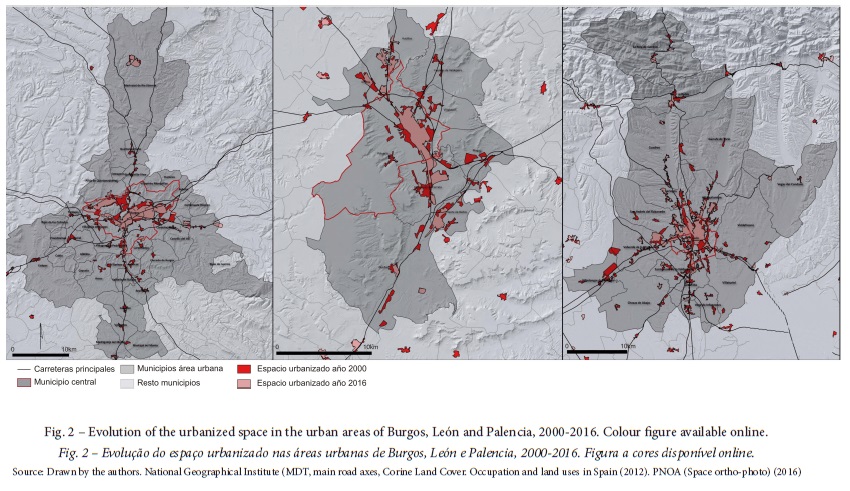
]]> Recent urban growth in these medium-sized cities is confirmed, and work has been done on the detailed mapping of land uses, obtaining not only the most adjusted figures for the dynamics of urban progression, but also changes that have taken place in the uses on which the extension has been based and how it was generated. Urban growth in these cities between 2000 and 2016 is mapped in the series of graphs that we present, based on the use of the Corine Land Cover, supplemented with ortho-photo. The aim of this paper is to demonstrate how, in the three case studies, the initial municipalities widely exceed their limits. The dynamics of extension consolidate the expansion of the cities in a clearly diffuse and irregular way in the main communication channels.
II. METHODOLOGY
The methodology we follow is to carry out research to highlight different problems that have occurred in urban areas, changes in land uses and their possible contributions to improving these areas. To do this, we use mainly statistical information related to the demographic and superficial evolution of the city to determine how urban growth has occurred beyond the traditional city. This article is conceived as a reflection on some modes of intervention in the surroundings of medium-sized cities in Castilla y León and certain urban growth strategies of León, Burgos and Palencia, providing a geographical perspective and focusing interest on the territorial factors that have resulted from this situation in the growth process and the importance of scale (the unique landscape which it has shaped).
The methodological approach followed is a mixed type: on the one hand, qualitative research was carried out from field work. On the other, the quantitative approach involved collecting data from the National Institute of Statistics, Land Registry, Ministry of Development, Official Associations of Architects and the National Geographic Institute, from which the map of occupation and land use in Spain was obtained (Corine Land Cover) and then checked against the latest spatial ortho-photo of the PNOA, the result of which was mapped using a Geographic Information System (GIS hereinafter).
With regard to obtaining the information, the methodology has focused on the collection of statistics that could reflect recent changes in these cities (2000-2016), with a double objective: firstly, to determine the expansive process of real estate dynamics and its results on the territory until 2008 and, secondly, to verify whether the trend has changed since the outbreak of the economic crisis in the last decade. To this end, our work is based on the use of statistical information related to the evolution of the population and its demographic dynamics, the built surface, changes in the real estate park, the process of development of real estate transactions and the analysis of changes in land uses, in both periods.
Once all these data were obtained from the aforementioned sources, our work methodology focused on the exhaustive analysis of trends in all municipalities of the areas of influence in the three cities within a radius of 30km from the limit of the central municipality. Starting from the previous consideration of other proposals for the delimitation of more complete areas from a functional point of view (AUF Urban Audit; AUF Ministry of Development and AUF JCYL) (López Trigal, 2014; Miramontes Carballada & Vieira de Sá Marques, 2016) is of no use in this case. The social, labour or mobility dynamics (necessary to understand the functional dynamics of the urban area) have been introduced, but the model has been limited to the verification of the existence of transformation and growth processes (positive demographic dynamics, increase in the urbanized area, increase in real estate transactions and defined changes in land uses) since the analysis really focuses on the change in urbanization dynamics. In this way, only the municipalities in the environment of each city in which this trend was appreciated were selected and, therefore, could be included in said transformation pattern between 2000 and 2016. With this criterion the area of influence of each urban set has been delimited, mapping the changes in the three urban areas that are analysed in the mentioned period of study.
The free and open source QGIS distribution tool was used to process these data for the purposes of cartography. In this program, all statistically associated information data were integrated and associated with the digital mapping bases of the National Geographic Institute (provinces, municipalities and urban areas) to obtain data from occupied surfaces and urbanized extension from the cartography at each moment of the analysed period. A particularly intense effort has been made to obtain the results of the measurement of the spatial analysis carried out on the basis of data associated with the Corine Land Cover Project data, from which information on the surface dimension of each urban area has been obtained. Knowing the limitations and problems presented by this source, which have already been revealed in various studies, has in any case been chosen because it is simple to use , and has various time series as well as the most recent data. Hence, Corine land use covers used with the exceptions already known (Bossard, Feranec, & Otahel, 2000; Catalá Mateo, Bosque Sendra, & Plata Rochas, 2008; Goerlich Gisbert & Cantarino Martí, 2013; Dí az-Pacheco & Gutiérrez Puebla, 2014.
This has enabled us, on the one hand, to obtain a specific cartography that reflects the evolution of these cities in recent years and draws their surface growth towards an area of increasingly significant influence. On the other hand, we have also represented the current distribution of types of land uses that have generated this growth, differentiating between the main dynamics (residential and tertiary) of the differential impact of industry and other economic activities related to transport, distribution or logistics. This information has made it possible to study in a specific way the diffuse urbanization process and generation of irregular urban growth in the cities of Castilla y León and to contextualize these tendencies in general with regard to what has happened in Spanish medium-sized cities.
We discuss the possible causes of this urban growth and provide an empirical analysis of data from various sources. We have processed the data using a geographical information system to obtain different digital mappings to show and explain this phenomenon. We have also compared the three surrounding areas (neighbourhood) and obtained results. The relevance of the paper lies in the fact that few studies have been carried out on urban growth in medium-sized cities in Spain.
]]>III. THE CAUSES OF DIFFUSE URBANISATION BEYOND THE CENTRAL CITY IN INTERMEDIATE AREAS: A DIFFERENTIAL, DISCONTINUOUS AND RECENT PROCESS
The highest level of spatial desegregation of public administration in Spain is the municipality. The country is divided into 8131 municipalities, fewer than 1/3 of which are urban areas mostly located in very rural environments. The supra-municipal term arises from the 50s in European cities that followed the Anglo-Saxon model, characterized by greater expansion towards peripheral areas, away from the main core, causing the decentralization of tertiary activities (Cebrián, García González, Panadero Moya, 2013)
The concept of supramunicipal city, in terms of the extension of middle cities beyond the original central municipality, occurs, in one way or another, in many areas of the Spanish territory. This situation occurs in a more established and consolidated way in some of the small urban agglomerations around different nuclei of this size, normally coinciding in the aggregation by nearby location of several intermediate cities (Oviedo-áviles-Gijón; Santander-Torrelavega; Tarragona-Reus...). This phenomenon can also be seen quite clearly in medium or large cities with regional influence (Valladolid-Palencia; San Sebastián-Irún...) or in articulated dynamics around metropolitan systems (with many examples in the urban areas of Madrid, Barcelona, Bilbao, Valencia or Seville) (López Trigal, 2014). Apart from each typology, in all cases parallel considerations arise regarding the characteristics that the effect of urban extension generates in the immediate surroundings, with the appearance of concepts or ideas such as that of the non-nuclear city or the city articulated in crowns very close to metropolitan areas of higher rank (Valenzuela Rubio & Salom Carrasco, 2008; Valdunciel, 2013; Ferrelli, Huamantinco, Delgado, & Piccolo, 2018).
However, there is a large group of medium-sized cities in Spain in which, beyond these clearly identifiable dynamics, the generation of the areas of influence has been much less perceptible, non-existent on many occasions until the mid-1990s and generated, when it has taken place subsequently, by virtue of differential growth related to different uses and produced in most cases in a rather diffuse manner. In fact, many of these medium-sized cities of structural rank in the national urban system have been particularly dynamic since the mid-1960s and 1970s, doubling their population and size, even with growth rates higher than those of cities with more than a million inhabitants. At the time, these cities showed higher vegetative growth rates than national averages, as a result of younger demographic structures, reflecting a process of socio-economic transformation. In this context, migration dynamics were shaped with interregional movements that consolidated some classic imbalances in the distribution of urban settlements (Vinuesa Angulo, 1989).
Since then, growth trends in some of these nuclei have sometimes generated uncontrolled urbanization processes, characteristic of spontaneous growth, in a context apparently regulated by consolidated planning (VV.AA., 2006). These cities, located mostly in the inner peninsula and defined by the provincial functions of articulation of their immediate territories, have only begun to extend beyond their municipal boundaries in a context marked by the economic and constructive bonanza dynamics that led to the bursting of the housing bubble. Conflicts of use have been generated in this sprawling and the debate has opened in these cities regarding the inconvenience of the diffuse city and the preservation of the compact city (Cebrián Abellán, 2007; Fitch Osuna, Escobar Ramírez, & Marmolejo Duarte, 2018.
The last twenty years have meant a significant change in the expectations of re-situation of these cities in the urban network on all scales (Salom & Fajardo, 2018). However, urban growth, improvements in conditions of equipment and the arrival of new infrastructures have given rise to urbanization that is not always continuous and which, in many cases, has taken place irregularly, causing multiple problems to arise (Baigorri, 2001; Feria-Toribio, 2006; Reula & Gavilán, 2011; Piñero, Sainz, Morales, & Morillo, 2015; Jiménez & Campesino, 2018).
The process has taken place in the changing Spanish urban context of recent years. The country grew exponentially in real estate before the crisis. This created severe urban imbalances that resulted in the bursting of the so-called real estate bubble. The urban model caused a marked differential character with respect to other nearby areas, including the consolidation of a unique identity with respect to tenure regimes and property systems. In 2007, 87% of families were home owners when the European average was 60%, a generalized process of extension of the concept of belonging identified with that of the property being observed. Many families participated in the idea of the second residence, associated with well-being, and a booming tendency was consolidated which, by accumulation, finally led to an unsustainable scheme (Sala, 2018).
The proliferation of suburbs, commercial areas and industrial real-estate around medium-sized cities has led not only to the modification of their landscapes and urban forms, but also to the systematic modification of their role in the urban hierarchy, taking into account their functional endowment and connection with other territories (Jiménez Barrado, Malheiros, & Campesino Fernández, 2018; Salom & Fajardo, 2018). Dynamics of this type have been generated in cities in the region of Castilla y León, studied in this work, producing clear processes of residential, industrial and commercial expansion in the surrounding municipalities, creating a new urban area. In these cities, sequences of urbanization of estates and sectors of different use in municipalities around the primitive central core have appeared since the beginning of 2000, configuring a new increasingly complex urban structure. In all cases, the linking of this process coincides not only with residential real estate actions, but also with a high degree of impact on the part of the productive areas that have contributed to consolidating the industrial profile of these capitals.
This situation has begun to stabilize and control mechanisms have been initiated in recent years. In the autonomous region of Castile and Leon, for example, in those municipalities with urbanized sectors not developed during the last decades, a process of declassification of land has begun, which has frustrated previous urbanistic expectations. In particular, in municipalities located in the vicinity of an urban centre with more than 20 000 inhabitants, this trend has been significant in capitals such as Burgos, Palencia, or León, where non-permitted zoned land has been declassified for residential and industrial developments. All expectations of urbanization in these sectors were frustrated as a result of the 2008 crisis (Calderón Calderón & Garc ía Cuesta, 2017).
]]>IV. MEDIUM-SIZED CITIES IN CASTILLA Y LEÓN: EVOLUTION AND MAIN DEMOGRAPHIC DYNAMICS IN THE 21ST CENTURY
In the three main medium-sized cities in the Castilla y León region (Burgos, León and Palencia), a process of urban growth towards the surroundings has been observed in recent years, which manifests itself in a very significant increase in the different variables that can be considered from a territorial point of view. We are referring to two medium-sized cities in the close range of 200 000 inhabitants (Burgos and León) and Palencia, with around 100 000 people. Table I shows the growing trend of these three nuclei and the extension dynamics generated in the last fifteen years towards their surroundings, during the first two decades of the 21st century.
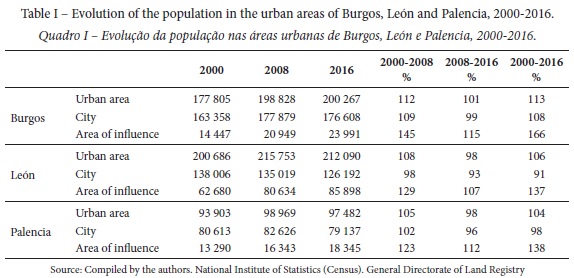
Burgos has increased from just 160 000 inhabitants in 2000 to approximately 180 000 today, with a set of municipalities in its closest area where the population has grown from just 14 000 to about 24 000 people. This means that the total urban area currently exceeds 200 000 inhabitants, with a demographic increase of 13% in just fifteen years, with no sign of a decline as a result of the recession. The municipalities in the urban area have grown by 66% over the starting figure and continue in a positive dynamic even from 2008 to the present, although it is true that the most progress was made between 2000 and 2008 (over 6000 inhabitants).
The case of León is more unusual, given that the urban area includes two municipalities (San Andrés del Rabanedo and Villaquilambre) that significantly increase the demographic set of the capital. In 2000, the city had barely 140 000 inhabitants, yet the urban area already exceeded 200 000 inhabitants. In 2016, the population of León city had fallen to just 126 000 (9% less) and, on the contrary, the urban area had grown significantly to exceed 212 000 inhabitants. The surrounding municipalities have increased their population to over 85 000 people (close to 40% since 2000), although it should be borne in mind that almost 50 000 inhabitants correspond to the two above-mentioned municipalities, which constitute an urban continuum with the streets of León.
Of less intensity is the demographic variation that has taken place in Palencia has been less intense. The population in the urban area risen from 94 000 people to 97 482. This implies a change in the last fifteen years of just 4%, but in this case the most interesting aspect is to differentiate the capital of Palencia from the municipalities of its immediate surroundings. While the city has lost more than 1500 people in this period, its environment has grown by a little more than 5000 inhabitants, the dynamics of extension to other municipalities of urban growth being manifest (table II).
]]> Table I shows a dynamic of demographic growth with a process of urban consolidation. Although the central cities lose population, the three urban areas increase. From this point of view, it is interesting to note that in the three medium-sized cities there is a sequence of formation of an area of urban influence.
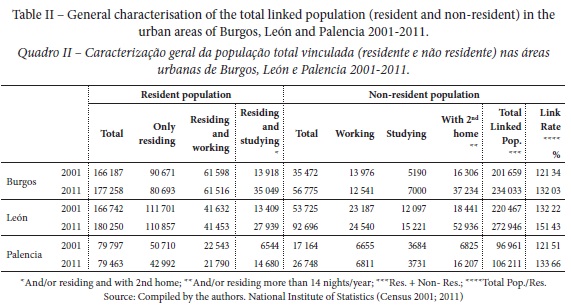
The greatest increases have occurred with people owning second homes in the city and who live intermittently in the urban area, probably in relation to the nearest rural areas. This reflects the existence of an urban dynamic which, in the last fifteen years, has exceeded that of the initial cities (table II).
V. DIFFUSE AND IRREGULAR URBANIZATION IN MEDIUM-SIZED CITIES IN CASTILLA Y LEóN: RECENT PROCESSES AND TRENDS
Demographic dynamics have generated processes of growth towards these environments, urbanising hundreds of hectares in the municipality closest to the three cities. Table III, figures 1 and 2 show the indicators of this variable that arise from the values provided by the Land Registry in terms of the surface area built.
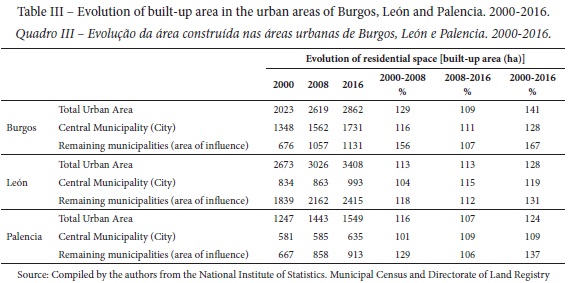
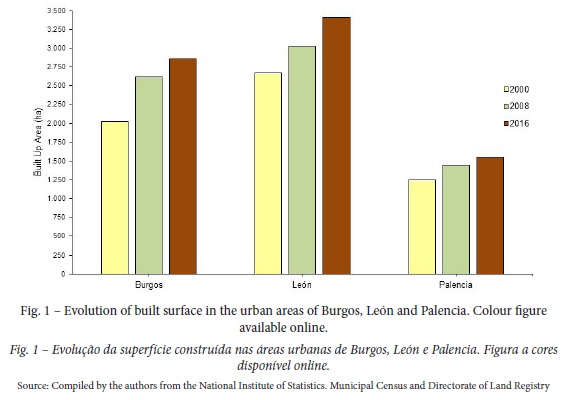
The urban area of Burgos goes from just 2000ha built to about 3000 in this period (a 41% increase); León, goes from 2600ha to more than 3400 (28% more); and Palencia from 1247 to 1549ha (24%). Once again, spaces close to the city grow well above the value of the central assembly: in Burgos, the city increases the area built by 28% and the municipalities in the area of influence do so by 67%; in León, these same values are 19% and 31%; and in Palencia the jump is even greater, between 9% for the capital and 37% for the surroundings.
]]> The extension of Burgos has been quite diffuse towards a very large number of municipalities (more than 40) and with an effect of considerable dispersion, without clear sequences of continuous urbanization. On the contrary, in the case of León, the most notable urban growth occurs in a concentrated way in San Andrés del Rabanedo and Villaquilambre (García Argüello, 2016) (fig. 2).More linear growth is observed in the urban area of Palencia, in which in addition to this type of extensions linked to the populations around the communication routes in the north axis, an urban growth process is directly associated with the intersection of connections in which the city is located. Figure 1 clearly shows the extensive urbanization that has taken place in municipal terms, in which there is a large increase in the area occupied (Delgado Huertos, 2014).
This growth in the three cities is due to a large extent to real estate dynamics. If we look at table IV we can see how the growth of housing construction has been very noticeable in all three cases with a progressive trend that has only slightly nuanced downwards in the crisis stage. In Burgos, the urban area recorded a progression in the number of residential properties exceeding 25% between 2000 and 2016. It went from 86 000 to about 110 000 homes in that period (99 600 in 2008). This implies a growth of 15% in the expansive period (2000-2008) and a downward nuance (10%) between 2008 and 2016. But what is really remarkable is that the data show the strong impact of growth in the surrounding municipalities of the capital. While in the central city the total growth barely reaches 20%, in the area of urban influence there is an increase of more than 71%.
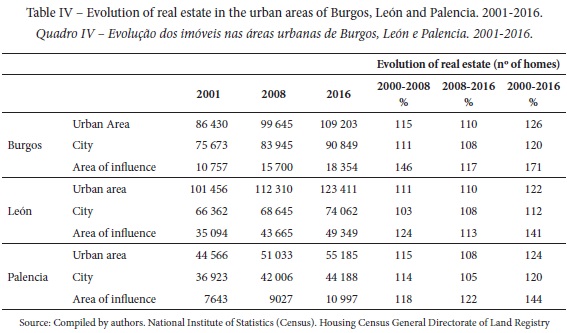
In León and Palencia, the growth of real estate is more contained (22 and 24% over the initial volume of the year 2001), but the relevance that the surrounding municipalities have in this extension is also observed. In León, there were 35 000 homes in 2000, 43 600 in 2008 and more than 49 000 in 2016 in the municipalities in the area of influence, which implies 41% more (while in that period the central city grew from 66 000 to 74 000 homes, just 12%). In Palencia the situation is quite similar, with an increase in the set of municipalities in the area of over 40%, while the number of houses in the central city grew by approximately half (20%) (table IV).
In León and Palencia, the growth of real estate is more contained (22 and 24% over the initial volume of the year 2001), but the relevance that the surrounding municipalities have in this extension is also observed. In León, there were 35 000 homes in 2000, 43 600 in 2008 and more than 49 000 in 2016 in the municipalities in the area of influence, which implies 41% more (while in that period the central city grew from 66 000 to 74 000 homes, just 12%). In Palencia the situation is quite similar, with an increase in the set of municipalities in the area of over 40%, while the number of houses in the central city grew by approximately half (20%) (table IV).
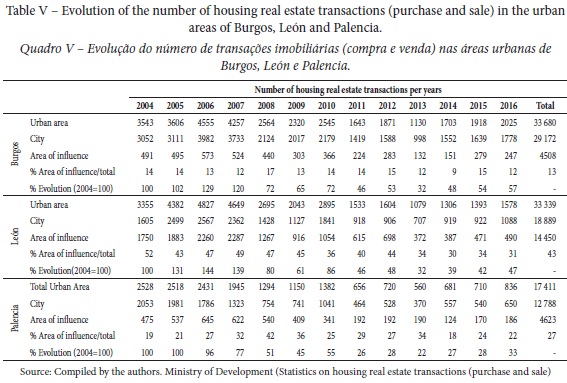
We can see how in the three cities there is a growing trend until 2008, when the maximum number of transactions occurs. On the other hand, there has been a sudden drop in this dynamic since 2008, which experienced some ups and downs until 2014, when a slow recovery seems to have begun, in line with the general trend of the Spanish real estate market. In fact, if we take as reference 100 the year 2004, in the three urban areas this trend is confirmed: first an initial increase appears until 2007 and then the collapse, which reduces the rate to the opposite extreme.
In these three medium-sized cities a very remarkable advance in the real estate park of built housing can be seen, attention being drawn to the fact that the figures (table V) indicate little constraint in the construction process since 2008, when the volume of building really does seem to have been significantly reduced. In this sense, it is also interesting to analyse not only the value of the total of existing residential buildings but also the evolution that the number of real estate transactions of home sales in these same urban areas has recently had. If we look at table V, we can see the extent to which a regressive trend has taken place in real estate dynamics in recent years (fig. 3).
 ]]>
]]>
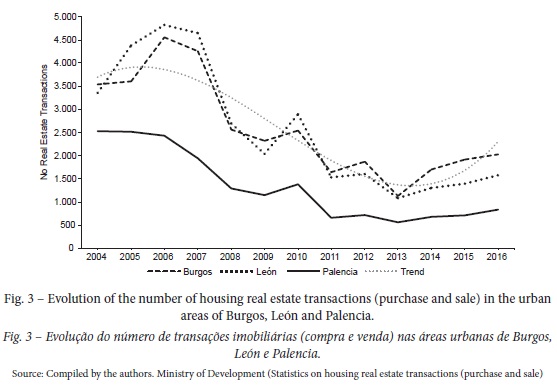
In León, the highest peak of transactions in the three cases is reached (table V), with almost 5000 operations in 2006, when the dynamic decreases progressively to 1,300-1,500 in recent years. This urban area presents other singular aspects, fundamentally focused on the great weight that the municipalities of the urban environment have on the whole. The percentage of transactions generated in the municipalities near León is always around 40% and the volume of transactions shows the relevance that the extensions have consolidated outside the central area of the capital.
The expansive effect of the growing residential dynamics takes place very clearly until 2007; since then a high impact of recession has emerged in this field.
The territorial analysis in all three cases speaks of a very notable increase in the number of dwellings with a very considerable effect from the point of view of the extension and growth of these cities. In the three case studies analysed, urban growth to the municipalities adjacent to the central city can be confirmed, and in all of them, despite the crisis, some increases in the occupied surface (table VI) may be considered as surprising. The city has been consolidated beyond its traditional urban space and intermediate urban areas have been formed.
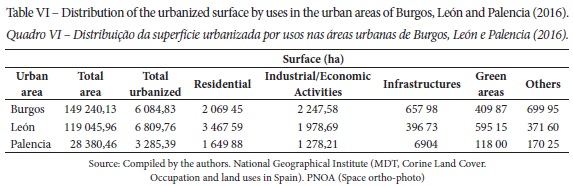
Specifically, the urban areas of Burgos and León initially show similar profiles, with extensive areas of more than 100 000ha in total, in which the urbanized complex exceeds 6000ha. With much smaller dimensions, the urbanized area in Palencia is around 3000ha, in a more limited territory (30 000ha). In this sense, the industrial profile of Burgos and Palencia differs significantly from the specialization of León, as a city of services more linked to its role as provincial capital.
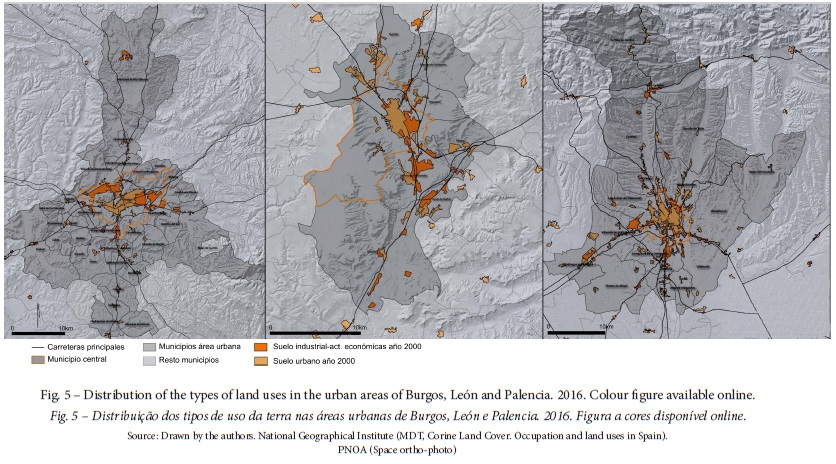
In this process of extension, it is interesting to deepen our knowledge of the changes in uses that urbanization has generated in these three cities (table VI). In this sense, it is interesting to observe how a significant part of the growth corresponds logically with the real estate dynamics of residential construction, but no less remarkable is the weight of the areas dedicated to economic activities and, specifically, to industry. In fact, the reality is that these are three cities with a significant productive profile and this has also been transferred to the processes of extension to the environment, with actions not only residential, but also industrial parks, commercial areas and services. If we look at table VI and figures 4 and 5, we can see how the non-residential surface actually has a significant impact on the urban space in the cities themselves and in the areas of peri-urban urbanization.
]]>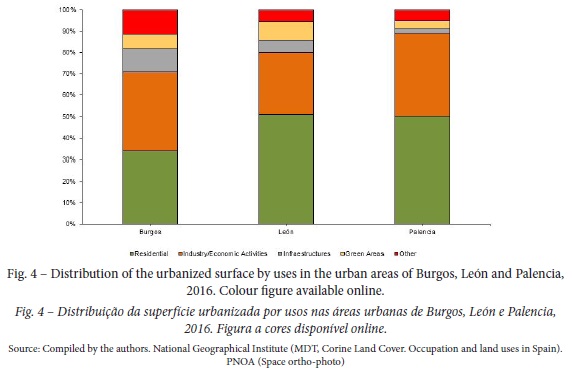
In the first place, Burgos clearly stands out as a city with a marked industrial profile, to the point of being one of the main urban areas of the country in terms of production. It is the second Spanish city in industrial land per inhabitant (112m2/person); the third in percentage of industrial active population (23%) and in industrial jobs for every 1000 inhabitants (98, double the national average); the fourth in percentage of industrial land on the urbanized total (37%); the tenth in total urbanized industrial land (about 2250ha) and the twelfth in absolute industrial employment (about 20 000 workers). Urbanized land in the urban area exceeds 2200ha and represents close to 40% of the urbanized total. As can be seen on the map, urban growth defined by the productive soils also generates important impacts in the adjacent municipalities, mainly in the aforementioned axis of National Motorway I, as well as the high impact of the infrastructures, with more than 650ha occupied by this use (Andrés López, Pascual Ruiz Valdepeñas, & Molina de la Torre, 2018).
Secondly, Palencia presents a lower dimension in absolute terms, although it is also shown in relative terms as a relevant productive centre. In fact, it is the first Spanish urban area in industrial land per capita, surpassing Burgos (just over 131m2 urbanized per person) and this function becomes essential when observing how industrial land exceeds 1200ha in a total of 3200ha. The map clearly shows how the industrial stain has spread in the mentioned communication junction.
Finally, in the case of León, although productive activity also has great significance in the territorial and socioeconomic configuration, more moderate indicators are manifested, due to being more closely linked to the provincial capital and its function as a service centre. The proportion of productive land decreases to approximately one third of the total and almost 3500ha of other urban uses predominantly linked to housing.
Quite similar dynamics can be seen in the three cities, clearly reflected in the maps, in that notable urban growth has occurred in the last 20 years towards some of the municipalities in the urban environment. In the case of León, the lack of adequate space for extension into the municipality justified the occupation of other nearby areas decades ago, although in Burgos and Palencia that dynamic has been slow to appear.
The reasons why extension to other cities has occurred are not unique but varied and based on diverse aspects. These include the appearance of other opportunistic urban plans that rapidly classified and managed cheap land in the expansive phase, or the dynamics themselves of land prices, lower taxes and, in short, better conditions for real estate or industrial investment in a context with the same or very similar advantages of accessibility and situation (hence in many cases the relationship that maps directly show with the appearance of the extension around the communication channels).
VI. CONCLUSION
In recent decades, the vision that the territory finally offers in the three analysed nuclei is of urban spaces in transformation, which have undergone the crisis as have other areas in the national set, but in which a consistent sequence of urban changes that have consolidated the medium-sized city as a backbone of their surroundings, can be observed. The medium-sized city grows and spreads to its immediate surroundings and is generating complex areas of influence, determined by the availability of land, existing historical territorial configurations and industrial demands that, slowly but systematically, affect peri-urban spaces more and more significantly.
]]> In the three cities, the urban area has grown significantly, and there is clear evidence that the interrelation, exchanges and social and economic movements are permanent. We have seen how the so-called linkage rate indicated by the INE exceeds 30% in these areas, reaching a value higher than 50% in León. This is clearly explanatory of the connection and the influences that the city generates with its surrounding spaces. This rate has increased in recent years (from 21 to 32 and 33% in Burgos and Palencia, respectively, between 2001 and 2011, and from 32 to 51% in León, in the same period).The reality is that, except for the continuous expansion of León in its two municipalities already integrated into the urban fabric, in the rest of the environments of the three cities, interventions have been irregular, leaving gaps and undeveloped areas and thus obtaining an urban model with some sprawl. In recent years, these cities have modified their urbanization patterns and since the end of the 1990s, expansion to other municipalities has implied a significant decrease in the occupation density of the space. In Burgos, the number of inhabitants per hectare in the urban area has gone from about 90 inhabitants/ha in the year 2000 to barely 69 inhabitants/ha at present; in León and Palencia, this indicator has also fallen from 75 to 62 inhabitants/ha.
Urban growth has generated the expansive phase in the years of economic boom and has resulted in suburbanization in these medium-sized cities, which has contributed to decreasing density and modified the pattern of the compact city. On the one hand, developments made in all the municipalities of these aureoles of the medium-sized cities have been closely linked to the low-density residential occupation model and, on the other hand, as we have seen, industry has been equally responsible for some extensions that have also consumed large areas of land, without affecting demographic occupation.
The analysis made allows us to conclude that medium-sized cities have left behind their function merely linked to their activities as provincial service centres, very focused on the exercise of the capital and the centralization of the nearby territory. They are becoming polarity nodes within a broader urban system in which they are increasingly dynamic. The economic activities that are taking place in these cities in recent years and their spatial incidence have given rise to urban areas in transformation, more dynamic than may appear. During 2008-2016, in the most acute phases of the economic collapse generated by the crisis, these cities have continued to grow and transform, extending their footprint in the territory.
The vision of the set of Spanish medium-sized cities reveals its roots in a provincial dynamic as a whole inserted in a geographical set with its own personality. Medium-sized cities cannot be understood as mere administrative centres. These urban areas are much more complex, they participate in networks, with active cooperation processes at all levels (institutional, economic, social...) and with specialized productive profiles that put them on the map and interrelate them with other very diverse territories. Worldwide, they will be integrated into territorial networks and sometimes constitute innovative spaces.
The challenges and questions are many. The existence of very rural-urban structures in the immediate surroundings of the cities studied is a good example of the difficulties of integration in these peri-urban zones. There is a growth of urbanizations and an inconsistent planning of urban centres and industrial estates, with singular contrasts towards the compact city. It is also evident that the municipal scale is not sufficient to address planning and it would be necessary to address formulas that study the possibilities of supra-municipal collaboration.
This planning shows weaknesses and has not been consolidated as an adequate management tool to order expansion and growth towards the area of influence of these cities. There are many uncertainties about the growth of medium-sized cities in their environment, since there are a multitude of problems related to transport, energy supply, mobility and the services of these spaces.
The urbanization of disconnected urban sectors and lack of services has created irregular urban spaces, with different degrees of maturity and different building intensity, which has created urban landscapes that show a diffuse city considered to be fully compact until just twenty years ago. Recent trends have modified this urban structure and the areas of influence generated in recent years have been integrated into a multifunctional territory that presents remarkable complexities and requires coordinated planning actions. In this context, undoubtedly, the transformation during the last years of peri-urban spaces in medium-sized cities is possibly one of the most interesting dilemmas in recent Spanish urbanism. This dilemma must be the object of a deeper analysis in the new time context, when the most acute economic crisis has been overcome.
ACKNOWLEDGEMENTS
]]> Data for this paper were obtained as part of the research project CSO2015-63970-R and RTI2018-096435-B-C22 with the financial support by the Spanish Ministry of Science and Technology.
REFERENCES
Andrés López, G. (2020). Las ciudades medias industriales en España. Caracterización geográfica, clasificación y tipologías [Industrial medium-sized cities in Spain. Geographical characterization, classification and typologies]. Cuadernos Geográficos, 59(1), in press.
Andrés López, G. (2019). Las ciudades medias industriales en España. Evolución histórica, proceso de urbanización y estructura urbana [Industrial medium-sized cities in Spain. Historical evolution, urbanization process and urban structure]. Ería, XXXVIII(1), 25-49.
Andrés López, G. (Coord.), Pascual Ruiz Valdepeñas, H., & Molina de la Torre, I. (2018). La industria en el área Urbana de Burgos. Análisis socioecon ómico y territorial [The industry in the Urban Area of Burgos. Socio-economic and Territorial Analysis]. Burgos: Ed. Fundación Caja Burgos. [ Links ]
Baigorri, A. (2001). Hacia la urbe global. Badajoz. Mesópolis Fronteriza [Towards the global city. Badajoz. Border mesopolis]. Cáceres: Editora Regional Extreme ña.
Bellet Sanfeliu, C. (2009). Del concepto "ciudad media" al de "ciudad intermedia" en los tiempos de la globalización [The "médium-sized city" concept to the "intermediate city" in the times of globalization]. In C. Bellet & M. E. Beltrao (Dirs.), Las ciudades medias o intermedias en un mundo globalizado [Medium sized cities in a globalized world] (pp. 21-40). Lé rida: Ed. Univ. [ Links ]
]]> Bellet Sanfeliu, C., & Llop Torné, J. M. (2004). Miradas a otros espacios urbanos: Las ciudades intermedias [Looks at other urban spaces: Intermediate cities]. Scripta Nova, VIII(165).Bellet Sanfeliu, C., & Llop Torné, J. M. (Eds.). (2000). Ciudades intermedias: urbanización y sostenibilidad [Medium-sized cities: urbanization and sustainability]. L érida: Editorial Milenio
Bossard, M., Feranec, J., & Otahel, J. (2000). Corine land cover technical guide. Addendum 2000. Technical Report 40. Copenhague: European Environment Agency. [ Links ]
Burriel de Orueta, E. L. (2008). La década prodigiosa del urbanismo español (1997-2006) [The prodigious decade of Spanish urbanism (1997-2006)]. Scripta Nova, XII (270). [ Links ]
Calderón Calderón, B., & García Cuesta, J. L. (2017). Legislación urbanística y planeamiento urbano en España, 1998-2015. Del despilfarro a la sostenibilidad [Urban legislation and urban planning in Spain, 1998-2015. From waste to sustainability]. Scripta Nova, XXI(570), 1-24. [ Links ]
Campos Sánchez, F. S. (2017). Ciudades medias españolas siglo XXI. Revisión y análisis bibliométrico de enfoques y temáticas predominantes [Spanish medium-sized cities 21st century. Bibliometric review and analysis of predominant approaches and themes]. Cuadernos Geográfico, 56(1), 217-241. [ Links ]
]]> Capel, H. (2003). Una mirada histórica sobre los estudios de redes de ciudades y sistemas urbanos [Analysis of possible errors in the Corine Land Cover database (1990-2000) in the Region of Madrid]. GeoTrópico, online, 1(1), 30-65.Caravaca I., González G., & Mendoza, A. (2007). Indicators of dynamism, innovation and development. Its application in small and medium-sized cities of Andalusia. Bolet ín de la A.G.E, 43, 131-154. [ Links ]
Catalá Mateo, R., Bosque Sendra, J., & Plata Rochas, W. (2008). Análisis de posibles errores en la base de datos Corine Land Cover (1990-2000) en la Comunidad de Madrid [Analysis of possible errors in the Corine Land Cover database (1990-2000) in the Region of Madrid]. Estudios Geográficos, LXIX, 81-104.
Cebrián Abellán, F. (2007). Cities with limits and cities without limits. Manifestations of the diffuse city in Castile-La Mancha. Boletín de la A.G.E., 43, 221-240. [ Links ]
Cebrián Abellán, F., & Panadero Moya, M. (Coords.). (2013). Ciudades medias. Formas de expansión urbana [Medium-sized cities. Forms of urban expansion]. Madrid: Ed. Biblioteca Nueva. [ Links ]
Cebrián Abellán, F., García González, J. A., & Panadero Moya, M. (2013). Dinámicas y transformaciones recientes en los procesos de expansión territorial de las ciudades medias en Castilla-La Mancha [Recent dynamics and transformations in the territorial expansion processes of medium-sized cities in Castilla-La Mancha]. In F. Cebrián Abellá n & M. Panadero Moya (Coords.) Ciudades medias. Formas de expansión urbana [Medium sized cities. Forms of urban expansion]. Madrid: Ed. Biblioteca Nueva. [ Links ]
]]>Cebrián Abellán, F., & Sánchez Ondoño, I. (2019). Urban Sprawl in Inner Medium-Sized Cities: The Behaviour in Some Spanish Cases Since the Beginning of the 21st Century. Urban Science, 3(10), 1-17. [ Links ]
Díaz-Pacheco, J., & Gutiérrez Puebla, J. (2014). Exploring the limitations of Corine Land Cover for monitoring urban land-use dynamics in metropolitan areas. Journal of Land Use Science, 9(3), 243-259. [ Links ]
Delgado Huertos, E. (2014). Palencia (1950-2010). Evolución urbana de una ciudad media [Palencia (1950-2010) Urban evolution of a medium-sized city]. Valladolid: Universidad de Valladolid.
Feria-Toribio, J. M. (2006). Los procesos metropolitanos como expresión relevante de la nueva realidad territorial [Metropolitan processes as a relevant expression of the new territorial reality]. In J. M. Feria-Toribio (Coords.), Los procesos metropolitanos: materiales para una aproximación inicial [Metropolitan processes: materials for an initial approach] (pp. 11-16). Sevilla: Fundación Pública Andaluza Centro de Estudios Andaluces. [ Links ]
Fernández Cuesta, G., & Fernández Prieto, J. R. (1999). Atlas industrial de España. Desequilibrios territoriales y localización de la industria [Industrial Atlas of Spain. Territorial imbalances and location of the industry]. Madrid: Ed. Nobel.
Ferrelli, F., Huamantinco M. A., Delgado, A. L., & Piccolo, M. C. (2018). Spatial and temporal analysis of the LST-NDVI relationship for the study of land cover changes and their contribution to urban planning in Monte Hermoso, Argentina. Documents d’Analisi Geografica, 64(1), 25-47. Doi: https://doi.org/10.5565/rev/dag.355
Fitch Osuna, J. M., Escobar Ramírez, A., & Marmolejo Duarte, C. (2018). Ciudad y territorio: ciudad compacta vs ciudad dispersa. Visiones desde España y México [City and territory: compact city vs dispersed city. Visions from Spain and Mexico]. Nuevo León, México: Universidad de Nuevo León. [ Links ]
Ganau Casas, J., & Vilagrasa Ibarz, J. (2003). Ciudades medias en España: posición en la red urbana y procesos urbanos recientes [Medium sized cities in Spain: position in the urban network and urban processes recent]. Mediterráneo Económico, 3, 37-73.
García Argüello, J. (2016). Evolución de la planificación urbanística en los municipios del área urbana de León [Evolution of urban planning in the municipalities of the urban area of León]. León: Universidad de León.
García Martín, F. M. (2014). ¿Ciudades intermedias? La conformación de un nuevo tipo de ciudades en España a lo largo del siglo XX [Intermediate cities? The conformation of a new type of cities in Spain throughout the 20th century]. [ Links ] VII Congreso Internacional de Ordenación del Territorio. Madrid: Fundicot.
García, J. A., Martínez, J. M., & Escudero, L. A. (2018). La importancia de las ciudades medias en el Sistema urbano de España [The importance of médium sized cities in the urban system in Spain]. In F. Cebrián Abellán (Coord.), Ciudades medias y áreas metropolitanas. De la dispersión a la regeneración [Medium sized cities and metropolitan areas. From dispersion to regeneration] (pp. 25-41). Cuenca: Universidad de Castilla La Mancha, Cuenca. [ Links ]
Goerlich Gisbert, F. J., & Cantarino Martí, I. (2013). Zonas de morfología urbana. Coberturas de suelo y demografía [Areas of urban morphology. Ground cover and demography]. Madrid: BBVA. Informes Economía y Sociedad. [ Links ]
González González, M. J. (2017). Planning, urban sprawl and spatial thinking. European Journal of Geography, 7(5), 32-43. [ Links ]
Jiménez, B. V., & Campesino, A. J. (2018). Deslocalización de lo urbano e impacto en el mundo rural: rururbanización en «pueblos dormitorio» de Cáceres capital [Relocation of the urban and impact on the rural world: rururbanization in "dormitory villages" of Cáceres capital]. Cuadernos Geográficos, 57(3), 243-266.
Jiménez, B. V., Malheiros, J., & Campesino Fernández, A. J. (2018). La función residencial en la regulación del suelo no urbanizable de la Península Ibé rica [The residential function in the regulation of undeveloped land in the Iberian Peninsula]. Finisterra – Revista Portuguesa de Geografia, 54(110), 37-54.
Lois, R. C., Piñeira, M. J., & Vives, S. (2016). El proceso urbanizador en España (1990-2014): una interpretación desde la Geografía y la teoría de los circuitos del capital [The urbanization process in Spain (1990-2014): an interpretation from the Geography and the theory of capital circuits]. Scripta Nova, XX(539). [ Links ]
López Trigal, L. (2014). Identificación y caracterización estratégica de las ciudades y aglomeraciones medias ibéricas [Identification and strategic characterization of Iberian médium sized cities and agglomerations]. Ciudad y Territorio, 182, 625-648.
López Trigal, L. (2010). Diccionario de términos sobre la ciudad y lo urbano [Dictionary of terms about the city and the urban]. Madrid: Ed. Biblioteca Nueva.
López Trigal, L. (2002). Ciudades y periferias sostenibles. Una revisión de conceptos y enfoques aplicados a España y Castilla y León [Sustainable cities and peripheries. A review of concepts and approaches applied to Spain and Castilla y León]. Polígonos, 11-12, 113-136.
Miramontes Carballada, A., & Vieira de Sá Marques, T. M. (2016). Las áreas urbanas en la península ibérica. Un ejercicio de delimitación [Urban areas in the Iberian Peninsula. An exercise in delimitation]. Papeles de Geografía, 62, 47-63.
Obeso Muñiz, í. (2019). Definir la urbanización periférica: conceptos y terminología [Define peripheral urbanization: concepts and terminology]. Ería, 2, 183-206.
]]> Olazabal, E., & Bellet, C. (2018). Procesos de urbanización y artificialización del suelo en las aglomeraciones urbanas españolas (1987-2011) [Urbanization and land artificiality in Spanish agglomerations (1987-2011)]. Cuadernos Geográficos, 57(2), 189-210.Olazabal, E., & Bellet, C. (2017). Análisis de las nuevas dinámicas de urbanización en España. Su estudio a través del uso de Corine Land Cover y SIOSE [Analysis of the new urbanization dynamics in Spain. Study through the use of Corine Land Cover and SIOSE]. [ Links ] Actas del XXV Congreso de la Asociación de Geógrafos Españoles. Madrid: AGE.
Pereira, M., & Ramalhete, F. (2017). Planeamento e conflitos territoriaisuma leitura na ótica da (in)justiça espacial [Planning and territorial conflicts a reading from the perspective of (in)spatial justice]. Finisterra – Revista Portuguesa de Geografia, 52(104), 7-24.
Piñero, A., Sainz, V., Morales, D., & Morillo, J. M. (2015). El urbanismo de la no ciudad. Los procesos de ocupación irregular en el suelo no urbanizable de Andalucía [The urbanism of the non city. The processes of irregular occupation in the undeveloped land of Andalusia]. Sevilla: Agencia de Obra Pública, Consejería de Fomento y Vivienda de la Junta de Andalucía.
Rubiera, M. F., González, V. M. M., & Rivero P. J. L. (2015). Urban sprawl in Spain: differences among cities and causes. European Planning Studies, 24(1), 207-226. Doi: https://doi.org/10.1080/09654313.2015.1080230 [ Links ]
Reula, L. M., & Gavilán, J. (2011). El urbanismo ilegal en suelo rural, tratamiento legal y regularización [Illegal urban planning on rural land, legal treatment and regularization]. LA LEY. Práctica Urbanística, 104, 14-27.
Sala, E. (2018). Crisis de la vivienda, movimientos sociales y empoderamiento: una revisión sistemática de la literatura [Housing crisis, social movements and empowerment: a systematic review of the literatura]. Documents d’Analisi Geografica, 64(1), 99-126
Salom, J., & Fajardo, F. (2018). El área metropolitana de Valencia en el sistema global de ciudades: los efectos de la crisis económica en la red de relaciones financieras de las empresas multinacionales [The metropolitan area of Valencia in the global system of cities: the effects of the economic crisis on the network of financial relationships of multinational companies]. Documents d’Analisi Geográfica, 64(1), 127-148.
Valenzuela Rubio, M., & Salom Carrasco, J. (2008). Los procesos de urbanización en España. Nuevos factores, nuevas tendencias [The urbanization processes in Spain. New factors, new trends]. España y el Mediterráneo: una reflexión desde la geografía española. Aportación Española al XXXI Congreso de la Unión Geográ fica Internacional, pp. 49-56.
]]> Valdunciel, J. (2013). Tipología de las formas de crecimiento del urbanismo expansivo [Typology of growth forms of expansive urbanism]. Espacios insulares y de frontera, una visión geográfica. Actas del XXIII Congreso de Geógrafos Españoles. Islas Baleares: AGE, 709-717.Vinuesa Angulo, J. (1989). La población de las ciudades medias españolas [The population of the Spanish médium-sized cities]. Revista de urbanismo (COAM), 6, 17-23.
VV.AA. (2010). Modelos de crecimiento urbano [(Urban growth models]. Oviedo: Trea.
VV.AA. (2006). Cambios de ocupación de suelo en España. Implicaciones para la sostenibilidad [Changes in land occupation in Spain. Implications for sustainability]. Madrid: Ministerio de Medio Ambiente.
Recebido: maio 2019. Aceite: outubro 2019.
]]>