Centro de Ecologia Aplicada "Prof. Baeta Neves" (CEABN). Instituto Superior de Agronomia. Tapada da Ajuda, 1349-017 LISBOA
Abstract. Analysis of sustainability and diversity of landscapes demands methods that quantify the composition of the mosaic in different habitats. Habitats have characteristic components of value in the context of a specific landscape, such as economic and ecologic values. We suggest that vector valuation of habitats as a complex number is an interesting approach for developing tools and a conceptual framework that allows for a deep insight over the compositional problem. It is defined an information index for the mosaic related to its potential variability, a measure of heterogeneity, characterized by a set of values and the probabilities of their occurrence as events, or frequency of states of a dynamic system. Such a conceptual framework may help assessing composition scenarios of a landscape mosaic in the context of the equilibrium manifold of an idealized system. We exemplify with an application with ecologic and economic data relative to the region of Nisa, central Portugal.
Avaliação de Habitats com Números Complexos e Índice de Informação do Mosaico de Paisagem
]]>
Sumário. A análise da sustentabilidade e da diversidade de paisagens exige métodos que quantifiquem a composição do mosaico em diferentes habitats. Os habitats têm componentes características de valor no contexto de uma paisagem específica, tais como o valor económico ou o valor ecológico. Sugere-se que a valorização de um habitat como um vector, um número complexo, é uma abordagem interessante para o desenvolvimento de instrumentos conceptuais que proporcionem uma visão mais aprofundada sobre o problema da composição. Define-se um índice de informação para o mosaico relacionado com a sua variabilidade potencial, uma medida de heterogeneidade, caracterizada por um conjunto de valores e as correspondentes probabilidades de ocorrência, como acontecimentos, ou frequências de estados de um sistema dinâmico. Este dispositivo conceptual pode ajudar a avaliar cenários de composição num mosaico de paisagem, no contexto da variedade de equilíbrios de um sistema idealizado. Exemplifica-se com uma aplicação a dados relativos ao concelho de Nisa, Portugal.
Palavras-chave: Composição do mosaico; valor económico; valor ecológico; variabilidade; variedade de equilíbrios
L'Évaluation d'Habitats avec des Nombres Complexes et Indice d'Information de la Mosaïque de Paysage
Résumé.L'analyse du développement durable et de la diversité de paysages exige des méthodes qui quantifient la composition de la mosaïque dans différents habitats. Les habitats ont des composantes caractéristiques de valeur dans le contexte d'un paysage spécifique, tels que la valeur socio-économique ou la valeur écologique. On suggère que l'évaluation d'un habitat comme un vecteur, un nombre complexe, est un abordage intéressant pour le développement d'instruments conceptuels qui fournissent une vision plus approfondie du problème de la composition. On définit un indice d'information pour la mosaïque rapportée avec sa variabilité potentielle, une mesure d'hétérogénéité, caractérisée par un ensemble de valeurs et les correspondantes probabilités des événements ou fréquences des états d’un système dynamique. Ce dispositif conceptuel peut aider à évaluer des scénarios de composition dans une mosaïque de paysage, dans le contexte de la variété d'équilibres d'un système idéalisé. On présente un exemple d'une application relative à l'information économique et écologique de la région de Nisa, Portugal central.
Mots clés: Composition de la mosaïque; valeur économique; valeur écologique; variabilité; variété d'équilibres
Introduction
"It is thought, however, that the imaginary biological systems which have been treated, and the principles which have been discussed, should be of some help in interpreting real biological forms."
Alan Turing, 1952
]]>
In a list of major research topics in landscape ecology WU and HOBBS (2002, 2007) refer the need of developing operational definitions and measures that integrate ecological, social, cultural, economic, and aesthetic components, in the context of landscape sustainability under a hierarchical and pluralistic view.
Benchmarking the value of a specific habitat in a landscape mosaic is a challenging task. That habitat has its own relevance as a community of species, and, as a spatial interface with other, may induce synergistic effects at the landscape scale. Such habitat will have an aesthetic value and an economic and social local relevance that may be benchmarked with number values. That multi-dimensionality asks for a vector-valuation procedure. Some authors claim that environmental resources are measured indirectly in the accounts but the underlying asset, the pristine lake or wilderness, is not valued explicitly (ATKINSON et al., 1997). MILLNER-GULLAND (1999) stated that the issue of the valuation of natural resources is a particularly thorny one for ecological economics, since if ecological assets are properly valued within the economy they will be conserved. TURNER and CARDILLE (2007) noticed that, with few exceptions, the consideration of ecosystem function in studies has lagged behind progress in understanding the causes and consequences of spatial heterogeneity. New developments and synthesis have been made in the last years concerning indicators for biodiversity and landscape values (e.g. LEITÃO and AHERN, 2002). Landscape elements such as patches are habitats of different types. The number and proportions of patch types are composition attributes while configuration is spatial and includes the arrangement of patches (LI and WU, 2007) and the number of patch types may indicate the level of resource diversity while the proportion may determine the dominance of critical resources, including fire. Patches were defined as structural components of landscape mosaic (FORMAN and GODRON, 1981) and affect processes including fire occurrence (MOREIRA et al., 2001). The richness of the mosaic, a composition measure, is defined as the number of different types of habitat that occur at the landscape level (TURNER, 1989; FORMAN, 1995).
Modelling the value of a habitat in the context of landscape mosaics is something that appeals for abstraction and, doing so, we proceed to the risks of reification (BOWMAN, 2007): a philosophical fallacy meaning that an abstraction is treated as a material thing. It is said that quantitative ecologists reify, because it is not possible providing a rigorous and unambiguous definition of landscape. Situation theory is a theory of information and its key insights is that much information is always available and is representable only partially (PARICK and CLARK, 2007).
Methods
Complex number valuation of habitats
Let us assume we have a mosaic with n different habitats and that all the components of value of a habitat that are not expressed as its economic value may be benchmarked by an ecological value, a real positive number. We denote the ordered pair of economic (a) and ecologic (b) values of the habitat, its vector value. Complex numbers, of the form , with a and b real numbers and , the imaginary unity, a name conceived from the words of the French mathematician Descartes, may be represented as where the dot symbol expresses the inner product of two symbolic vectors: the value vector and the vector , the basis of the complex plane. It was Wessel, the Norwegian topographer, who adopted the representation of a complex number as a vector on the Cartesian plane, as far as 1797.
With this concept – the value of a habitat in a landscape is modelled by a complex number – I suggest that the ecologic value of a habitat (b), although a real number, is linked to an imaginary axis, where the complexity and the uncertainty of the ecologic links may be expressed with more fairness. The expression means a vectorial sum of two entities, not an algebraic one, and so is not expressed in simple unities. The set S of complex values of a given mosaic with n habitats may then be represented as:
. (1)
]]>
The absolute value of the complex number is defined as , the length of the hypotenuse of a triangle rectangle calculated by the Pythagorean theorem, and expresses the distance of the point to the origin of the plane. Such a reduction from a complex number to its absolute value, a real positive number, is a strong loss of information. It is better to deal separately with the sets of economic values and ecologic values of the habitats of the mosaic, if we want to get a deeper insight on its compositional elements, measured as proportions of an actual mosaic, or the probabilities of existence as future, idealized scenarios. Functions of one complex variable will not be considered in this paper.
Information index of the mosaic
There is no such thing as an absolute measure of information. The most widely used is Shannon entropy measure (GUIASU and THEODORESCU, 1968; COVER and THOMAS, 2006), discussed in SHANNON (1948), twenty years after the preliminary work by Hartley. KLIR (2006) claims that in generalized information theory the concept of uncertainty is conceived in the broadest possible terms. PETZ (2008) extends the concept of Hartley’s information measure to quantum information. DELAHAYE (1994) reviews other information theories and measures, namely the theory of Kolmogorov based on algorithmic information and also Bennett's logic depth theory. ROSNAY (1995) considers that information is virtual time.
In general, we may say that an information measure is a tool of measurement of information based on the extent of the events that convey some kind of syntactic or semantic insight over the quantifiable object. The reasoning we adopt is related to a generalisation of Simpson's index of dominance (SIMPSON, 1949) the formula that is at the core of the relative evenness of the mosaic (e.g. FORMAN, 1995).
We may build a set of characteristic Bernoulli variables for the different habitats of the mosaic, using a relative extension measure - the probability of the occurrence of the habitat as an event: . The domain is represented by the simplex defined as: for with. The Bernoulli variables for the different habitats are of the form , where the arrow means with probability.
With this formalism, the characteristic Bernoulli variables for habitat could be expressed as and meaning and respectively related to the set of economic values and ecologic values. In general we may write where means indistinctly a positive real number. A natural measure of the information for the mosaic represented by the set of characteristic values is a measure of the potential variability of that system. Since we look for a measure of variability we can choose dealing with the sum of variances of the Bernoulli variables described above. Thus we can write:
and . (2)
Results
]]>
Formulas
When the probabilities of the events, or frequencies of states, change, the function V defined above (2) behaves like a measure, and quantifies the variability of the mosaic - the more variable a system is more information it contains, and we approach a first level of heterogeneity and complexity of the mosaic. The index of information V is a bounded positive function: when the mosaic reduces to a single habitat we deduce , because there is no compositional variability at the landscape level as the mosaic is reduced to the uniform matrix. At the other extreme, since V is a concave function defined on the simplex, the measure attains a maximum value: a scalar.
We have shown, through a Lagrangian multiplier method, that the maximization point coordinates are available with the formulas:
, ;
and , (3)
where k means the cardinal of a subset of the original n variables.
It is easy to check that for there is just the optimal solution, constant and independent of the characteristic values , and so . For the maximization point of function V may have null coordinate(s), although there will always be at least three positive values, , an intrinsic barrier of dimensionality; we can also prove that for and that the maximum point coordinates do not depend on the unities of . The maximum value of V may be calculated as with formulas defined in (3) and an algorithmic procedure (CASQUILHO, 1999; CASQUILHO et al., 2003).
The composition vector of an actual or hypothetic mosaic with n habitats characterized by the set S defined in (1), may be compared with optimal proportions , in the sense of or , calculated with previous formulas. The information index V has unities, related to the squared unities of the characteristic value, but we can proceed through a standardized number defined as , such that .
Application example
]]>
In the region of Nisa, between rivers Tejo and Sever, located in central Portugal near Spain, we know estimates of economic value (ev) of forest habitats, expressed in euros/hectare (PDFCIN, 2007); this economic value concept internalizes both actual mean existence values at market prices and recovering costs under the perspective of fire occurrence. Selecting three habitats: oak groves (Quercus rotundifolia, pure and mixed with Q. suber), eucalypt stands (Eucalyptus globulus) and pine stands (Pinus pinaster) the table of economic values is below (Table 1).
Table 1 - Estimates of economic value (ev) of forest habitats (€/ha)
ev
Oak groves
Eucalypt stands
Pine stands
Pure
112
]]>
136
91
Mixed
238,5
-
-
We also have estimates of the mean richness in ornithological species of these habitats, based on point count methods (CASQUILHO et al., 1995). The richness in bird species is considered a relevant property of the habitat, a measure of its intrinsic biodiversity (BRUSSARD et al., 1998). The mean richness index (mri) is defined as the mean number of species detected at the sampling units of the habitat; it may be interpreted as an estimate of the biodiversity of an area, an ecologic value. SOLÉ and BASCOMPTE (2006) reminds that stability seems to be associated with diversity, but the exact nature of such association has been a matter of debate for decades, and there is experimental evidence for a conflict between productivity and stability, mainly in small webs. The values are listed in Table 2.
Table 2 - Estimates of the mean richness index in bird species (mri) of forest habitats (Nisa)
]]>
Oak groves
Eucalypt stands
Pine stands
8,17
2,67
6,33
Thus, according to (1), S is the set of elements or referred to the habitats ordered as: oak groves, eucalypt stands and pine stands; about oak groves we allow for two different economic values, as it is pure or mixed stands with Q. suber; we have two versions of economic values or named ev1 or ev2, and we have ecologic values , named mri. Applying equations (3) with the economic values ev1 or , gives the optimal solution =and with ev2 or we obtain the point , changing significantly the numeric values previously obtained; we must think of ev2 as a perturbation of ev1 - both are of the same nature: economic values - and we conclude that the maximizing point of index V shows sensible behaviour. Applying equations (3) with the ecologic values mri or gives the vector . Optimal solutions of index V defined in (2), related to the different criteria may be scrutinized in Table 3, rounded as percentages, organized as composition vectors of the mosaic.
]]>
Table 3 - Optimal proportions of habitats under criteria ev1 or ev2 and mri.
ev1
ev2
mri
Oak groves
34%
45%
46%
]]>
Eucalypt stands
39% - 40%
36%
11%
Pine stands
26%
19%
43%
With these results we may conclude that oak groves and eucalypt stands may be largely represented at the landscape mosaic under the perspective of economic value, but the latest is substantially penalized if we adopt ecologic values such as biodiversity; this inversion also happens in the opposite sense with pine stands; oak groves are consistent in both economic and ecologic standards in a range that reaches 45% of the area of the landscape mosaic, or ecomosaic.
]]>
SASTRY (1999) reminds that although nonlinear models may be conceptually more satisfying and elegant, they are of little use if one cannot learn anything from their behavior. Eventually we design scenarios of allocating proportions of forest resources with some functional criteria that may be interpreted as an equilibrium point, in the presence of the ethics of agro-forestry occupation of soil at the landscape and regional level, concerning both economic and ecologic criteria as discussed in CASQUILHO (1994). In the context of dynamic programming CHIANG (1992) refers to the existence and the purpose of optimal value function and optimal policy function, terms that we could apply in the perspective of index V.
Assuming that the value of a habitat is better described by a complex number is just the same as saying that we need two real numbers (a,b) and not just one real value such as economic value; and also that it is more effective as a concept of value to pursuit a broad overview. BEBIANO da PROVIDÊNCIA (2009) writes that since complex numbers first appeared in Ars Magna of Cardano, published in 1545, until today, they persist among the most beautiful, perennial and fecund ideas of all mathematical thinking. NAHIN (2007) refers that the geometric interpretation of the imaginary unit goes back to Buée's claim, c. 1806, that it meant the sign of perpendicularity. KORNREICH (2008) says that physical data can only be measured to within some limit of accuracy and therefore real physical data is a random function, and may be complex valued such as the wave functions of quantum mechanics he renames information functions; other complex random variables may be derived. At last we may conclude with O'HALLORAN (2008) that mathematics is a multisemiotic construction: discourses formed through choices from the functional sign systems of language, mathematical symbolism and visual display.
Discussion and conclusions
When defining research priorities in landscape ecology, WU and HOBBS (2002) asked the question: "For example, can landscape patterns be optimised in terms of both the composition and configuration of patches and matrix characteristics for purposes of biodiversity conservation, ecosystem management and landscape sustainability?"
With the methodology described above, I hope we gave some contribute to go further on the problem of assessing quantitative insights about scenarios of composition of the mosaic in proportions of habitats. Assuming that valuating habitat patches as a complex number is an interesting view, the complex number is a model for the value (economic and ecologic) of the habitat in the context of a landscape mosaic. As PONNUSAMY and SILVERMAN (2006) refer, there is a complex field that contains a real field that contains a rational field. It could be argued that the natural vector valuation of habitats include three components: economic, ecologic and aesthetic values, but I belief that aesthetic value may be included both in economic and ecologic values, at least as a first approach; the b value, linked to the imaginary axis, is a nice candidate; so we need two real numbers for the value of an habitat at the landscape context. MAOR (2007) recalls that the number 2 has a unique place in number theory, as it is the only even prime number and perhaps the ultimate mathematical constant.
With the perspective that new quantitative methods that consider the magnitude of variability in ecosystem response variables may provide new insights (TURNER and CARDILLE, 2007), we may proceed merging actual proportions (or idealized ones) of different habitats in an information index of the mosaic, linked to its variability, an index in the sense of PEIRCE (1909) definition: it represents the objects independently of any resemblance to them, only by virtue of real connections with them.
Avoiding reification implies that we don't forget that as far as the problem is discussed here there is no explicit spatial structure of the mosaic, conceived as an abstraction and reduced to complex values of the habitats and their proportions of states or probabilities as events, a relative extension measure. May this conceptual framework allows for procedures that contribute to an adaptive learning process in spatial optimisation as proposed by HOF and FLATHER (2007) and helps developing an integrative research perspective in multifunctional landscapes as claimed frequently (FRY, 2001; TRESS et al., 2005; FRY et al., 2007).
Since it was introduced by the term morphogenesis through early work by TURING (1952), spatial self-organization is key to understand population stability and species diversity (SOLÉ and BASCOMPTE, 2006). The index V also may be thought as a potential function governing an idealized system, as a deformation of a functional germ under the paradigm of Catastrophe Theory in the sense of DEMAZURE (1989), setting the equilibrium manifold, in a way that O'NEILL et al. (1989) exemplified as the system manifold, in that case under the paradigm of percolation theory. The information index V does not follow the criteria of Hartley's uncertainty measure, but an analogous information measure of the mosaic, based in Shannon entropy, has been presented and discussed elsewhere (CASQUILHO et al., 1997). I conclude this discussion quoting Hintikka (PIETARINEN, 2007): "The traditional game-theoretic approach to semantics has two players, Myself and Nature, who assume the roles of the verifier and the falsifier of the expressions presented to them." For a better insight over the compositional problem of the mosaic let us remind that semiotics begins with the sensible world and ends with the intelligible world (MOURÃO and BABO, 2007).
]]>
Acknowledgments
I acknowledge Câmara Municipal de Nisa and forest engineer Carlos Janeiro in particular, for the document with economic values of habitats – PDFCIN, 2007 -calculated under the risk of fire perspective and structural assets based on criteria tabulated in Estratégia Nacional para as Florestas.
References
ATKINSON, G., DUBOURG, R., HAMILTON, K., MUNASINGHE, M., PEARCE, D.,YOUNG, C., 1997. Measuring Sustainable Development: Macroeconomics and the Environment. Edward Elgar Publishing Ltd, Cheltenam.
BEBIANO DA PROVIDÊNCIA, N., 2009. Análise Complexa. Gradiva. Lisboa.
BOWMAN, D., 2007. Using landscape ecology to make sense of Australia's last frontier. In J. Wu and R. Hobbs (Ed.), Key Topics in Landscape Ecology. Cambridge University Press. Cambridge, pp. 214-226.
BRUSSARD, P.F., Reed, J.M., Tracy, C.R., 1998. Ecosystem management: what is it really? Lands. And Urban Planning40: 9-20.
CASQUILHO, J., 1994. Ecologia, modelos e impactes – critérios para uma ética do uso agroflorestal do solo. Revista Florestal7: 3-20. [ Links ]
CASQUILHO, J., ONOFRE, N., COELHO, I., LEAL, G., 1995. Estudo de Impacte Ambiental da Florestação de Vale de Alfinetes e Joeiradeiro. CERN. Lisboa.
]]>
CASQUILHO, J., NEVES, M., REGO, F., 1997. Extensões da função de Shannon e equilíbrio de proporções - uma aplicação ao mosaico de paisagem. An. Inst. Sup. Agron.46: 77-99. [ Links ]
CASQUILHO, J., 1999. Ecomosaico: Índices para o Diagnóstico de Proporções de Composição. Tese de Doutoramento (PhD Thesis). Instituto Superior de Agronomia, UTL. Lisboa.
CASQUILHO, J., NEVES, M., REGO, F., 2003. A generalisation of Simpson's index of diversity. Relatório Técnico #7/2003, MA/IISA. Instituto Superior de Agronomia. Lisboa.
COVER, T.M., THOMAS, J.A., 2006. Elements of Information Theory (2nd ed.), John Wiley & Sons, Inc. New Jersey.
DELAHAYE, J.P., 1994. Information, Complexité et Hasard. Éditions Hermés. Paris.
DEMAZURE, M., 1989. Catastrophes et Bifurcations. Éd. Ellipses. Paris.
FORMAN, R.T.T., GODRON, M., 1981. Patches and structural components for a landscape ecology. Bioscience31: 733-40.
FORMAN, R.T.T., 1995. Land Mosaics: the Ecology of Landscapes and Regions. Cambridge University Press. Cambridge.
FRY, G.L.A., 2001. Multifunctional landscapes: towards transdisciplinary research. Landscape and Urban Planning57: 159-168.
]]>
FRY, G., TRESS, B., TRESS, G., 2007. Integrative landscape research: facts and challenges. In J. Wu and R. Hobbs (Ed.), Key Topics in Landscape Ecology. Cambridge University Press. Cambridge, pp. 246-270.
HOF, J., FLATHER, C., 2007. Optimization of landscape pattern. In Key Topics in Landscape Ecology (J. Wu and R. Hobbs ed). Cambridge University Press. Cambridge, pp. 143-160.
GUIASU, S., THEODORESCU, R., 1968. La Théorie Mathématique de l'Information. Dunod. Paris.
KLIR, G.J., 2006. Uncertainty and Information : foundations of generalized information theory. John Wiley & Sons. New Jersey.
KORNREICH, P., 2008. Mathematical Models of Information and Stochastic Systems. CRC Press. Boca Raton.
LEITÃO, A.B., AHERN, J., 2002. Applying landscape ecological concepts and metrics in sustainable landscape planning. Landscape and Urban Planning67:1-8.
LI, H., WU, J., 2007. Landscape pattern analysis: key issues and challenges.In Key Topics in Landscape Ecology (J. Wu and R. Hobbs ed.). Cambridge University Press. Cambridge, pp. 39-61.
MAOR, E., 2007. The Pythagorean Theorem: a 4,000-year history. Princeton University Press. Princeton.
MOREIRA, F., REGO, F.C., FERREIRA, P.G., 2001. Temporal (1958-1995) pattern of change in a cultural landscape of northwestern Portugal: implications for fire occurrence.Landscape Ecology16: 557-567.
]]>
MOURÃO, J. A., BABO, M. A., 2007. Semiótica: Genealogias e Cartografias. Edições Minerva Coimbra. Coimbra.
NAHIN, P.J., 2007. An Imaginary Tale. Princeton University Press. Princeton.
O'NEILL, R.V., JOHNSON, A.R, KING, A.W., 1989. A hierarchical framework for the analysis of scale. Landscape Ecology3(3/4):193-205.
PARICK, P., CLARK, R., 2007. An introduction to equilibrium semantics for natural language. In Game Theory and Linguistic Meaning (A-H Pietarinen ed.). Elsevier Ltd. Oxford, pp. 149-158.
PDFCIN, 2007. Plano Defesa da Floresta Contra Incêndio de Nisa. Gabinete Técnico Florestal e Nisa e Florasul. (Câmara Municipal de Nisa).
PEIRCE, C.S., 1909. A Sketch of Logical Critics. EP 2: 460-461.
PETZ, D., 2008. Quantum Information Theory and Quantum Statistics. Springer. Berlin.
PIETARINEN, A-V., 2007. An invitation to language and games. In Game Theory and Linguistic Meaning (A-H Pietarinen ed.). Elsevier Ltd. Oxford, pp. 1-15.
]]>
ROSNAY, J., 1995. L'Homme Symbiotique. Éditions du Seuil. Paris.
SASTRY, S., 1999. Nonlinear Systems: analysis, stability and control. Springer-Verlag. New York.
SHANNON, C.E., 1948. A mathematical theory of communication. Bell Syst.Tech. Journal27: 379-423.
SIMPSON, E. H., 1949. Measurement of diversity. Nature 163: 688.
SOLÉ, R.V., BASCOMPTE, J., 2006. Self-Organization in Complex Ecosystems. Princeton University Press. Princeton.
TURING, A., 1952. The chemical basis of morphogenesis. Philosophical Transactions of the Royal Society of London237 B: 37-72.
TRESS, G., TRESS, B., FRY, G., 2005. Clarifying integrative research concepts in landscape ecology. Landscape Ecology20: 479-493.
TURNER, M.G., 1989. Landscape ecology: the effect of pattern on process. Annual Review of Ecology and Systematics20: 171-197.
TURNER, M.G., CARDILLE, J.A., 2007. Spatial heterogeneity and ecosystem processes. In Key Topics in Landscape Ecology (J. Wu and R. Hobbs Ed.). Cambridge University Press. Cambridge, pp. 62-77.
WU, J., HOBBS, R., 2002. Key issues and research priorities in landscape ecology: an idiosyncratic synthesis. Landscape Ecology17: 355-65.
]]>
WU, J., HOBBS, R., 2007. Landscape ecology: the state-of-the-science.In Key Topics in Landscape Ecology (J. Wu and R. Hobbs Ed.). Cambridge University Press. Cambridge, pp. 271-287.
 the ordered pair of economic (a) and ecologic (b) values of the habitat, its vector value. Complex numbers, of the form
  , with a and b real numbers and
  , the imaginary unity, a name conceived from the words of the French mathematician Descartes, may be represented as
  where the dot symbol expresses the inner product of two symbolic vectors: the value vector
  and the vector
  , the basis of the complex plane. It was Wessel, the Norwegian topographer, who adopted the representation of a complex number as a vector on the Cartesian plane, as far as 1797.
  means a vectorial sum of two entities, not an algebraic one, and so is not expressed in simple unities. The set S of complex values of a given mosaic with n habitats may then be represented as:
 . (1)
. (1) is defined as
  , the length of the hypotenuse of a triangle rectangle calculated by the Pythagorean theorem, and expresses the distance of the point
  to the origin of the plane. Such a reduction from a complex number to its absolute value, a real positive number, is a strong loss of information. It is better to deal separately with the sets of economic values
  and ecologic values
  of the habitats of the mosaic, if we want to get a deeper insight on its compositional elements, measured as proportions of an actual mosaic, or the probabilities of existence as future, idealized scenarios. Functions of one complex variable will not be considered in this paper.
 of the mosaic, using a relative extension measure - the probability of the occurrence of the habitat as an event:
  . The domain is represented by the
  simplex defined as:
  for
for  with
with . The Bernoulli variables for the different habitats
  are of the form
  , where the arrow means with probability.
 could be expressed as
  and
and  meaning
  and
and  respectively related to the set of economic values
  and ecologic values
 . In general we may write
 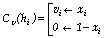 where
where  means indistinctly a positive real number. A natural measure of the information for the mosaic represented by the set of characteristic values is a measure of the potential variability of that system. Since we look for a measure of variability we can choose dealing with the sum of variances of the Bernoulli variables described above. Thus we can write:
  and
and 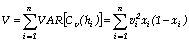 . (2)
. (2) , because there is no compositional variability at the landscape level as the mosaic is reduced to the uniform matrix. At the other extreme, since V is a concave function defined on the
  simplex, the measure attains a maximum value: a scalar
 .
.  ,
, 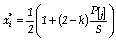 ;
;  and
and  , (3)
, (3) there is just the optimal solution
 , constant and independent of the characteristic values
  , and so
  . For
. For  the maximization point of function V may have null coordinate(s), although there will always be at least three positive values,
  , an intrinsic barrier of dimensionality; we can also prove that
  for
for  and that the maximum point coordinates do not depend on the unities of
  . The maximum value of V may be calculated as
 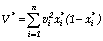 with formulas defined in (3) and an algorithmic procedure (CASQUILHO, 1999; CASQUILHO et al., 2003).
 of an actual or hypothetic mosaic with n habitats characterized by the set S defined in (1), may be compared with optimal proportions
  , in the sense of
  or
or  , calculated with previous formulas. The information index V has unities, related to the squared unities of the characteristic value
 , but we can proceed through a standardized number defined as
  , such that
  .
. or
or  referred to the habitats ordered as: oak groves, eucalypt stands and pine stands; about oak groves we allow for two different economic values, as it is pure or mixed stands with Q. suber; we have two versions of economic values
  or
or  named ev1 or ev2, and we have ecologic values
  , named mri. Applying equations (3) with the economic values ev1 or
  , gives the optimal solution
  =
= and with ev2 or
  we obtain the point
  , changing significantly the numeric values previously obtained; we must think of ev2 as a perturbation of ev1 - both are of the same nature: economic values - and we conclude that the maximizing point of index V shows sensible behaviour. Applying equations (3) with the ecologic values mri or
  gives the vector
  . Optimal solutions of index V defined in (2), related to the different criteria may be scrutinized in Table 3, rounded as percentages, organized as composition vectors of the mosaic.
 is a model for the value (economic and ecologic) of the habitat in the context of a landscape mosaic. As PONNUSAMY and SILVERMAN (2006) refer, there is a complex field that contains a real field that contains a rational field. It could be argued that the natural vector valuation of habitats include three components: economic, ecologic and aesthetic values, but I belief that aesthetic value may be included both in economic and ecologic values, at least as a first approach; the b value, linked to the imaginary axis, is a nice candidate; so we need two real numbers for the value of an habitat at the landscape context. MAOR (2007) recalls that the number 2 has a unique place in number theory, as it is the only even prime number and perhaps the ultimate mathematical constant.