<?xml version="1.0" encoding="ISO-8859-1"?><article xmlns:mml="http://www.w3.org/1998/Math/MathML" xmlns:xlink="http://www.w3.org/1999/xlink" xmlns:xsi="http://www.w3.org/2001/XMLSchema-instance">
<front>
<journal-meta>
<journal-id>0870-6352</journal-id>
<journal-title><![CDATA[Silva Lusitana]]></journal-title>
<abbrev-journal-title><![CDATA[Silva Lus.]]></abbrev-journal-title>
<issn>0870-6352</issn>
<publisher>
<publisher-name><![CDATA[Unidade de Silvicultura e Produtos Florestais]]></publisher-name>
</publisher>
</journal-meta>
<article-meta>
<article-id>S0870-63522010000300003</article-id>
<title-group>
<article-title xml:lang="en"><![CDATA[Relationships of Selected Soil Parameters and Natural Pastures Yield in the Montado Ecosystem of the Mediterranean Area Using Multivariate Analysis]]></article-title>
<article-title xml:lang="pt"><![CDATA[Relações Entre Parâmetros Seleccionados de Solo e Produção de Pastagens Naturais no Ecossistema Montado da Região do Mediterrâneo Através de Análise Multivariada]]></article-title>
<article-title xml:lang="fr"><![CDATA[Relations de Paramètres Sélectionnés des Sols et la Production des Pâturages Naturels Chez l'Écosystème «Montado» de la Région Méditerranéenne en Utilisant une Analyse Multivariée]]></article-title>
</title-group>
<contrib-group>
<contrib contrib-type="author">
<name>
<surname><![CDATA[Ferreira]]></surname>
<given-names><![CDATA[Eugénio Mendes]]></given-names>
</name>
<xref ref-type="aff" rid="A01"/>
</contrib>
<contrib contrib-type="author">
<name>
<surname><![CDATA[Simões]]></surname>
<given-names><![CDATA[Nuno]]></given-names>
</name>
<xref ref-type="aff" rid="A01"/>
</contrib>
<contrib contrib-type="author">
<name>
<surname><![CDATA[Castro]]></surname>
<given-names><![CDATA[Isabel Videira e]]></given-names>
</name>
<xref ref-type="aff" rid="A01"/>
</contrib>
<contrib contrib-type="author">
<name>
<surname><![CDATA[Carneiro]]></surname>
<given-names><![CDATA[Luís]]></given-names>
</name>
<xref ref-type="aff" rid="A01"/>
</contrib>
</contrib-group>
<aff id="A01">
<institution><![CDATA[,INRB - Instituto Nacional de Recursos Biológicos Instituto Nacional de Investigação Agrária ]]></institution>
<addr-line><![CDATA[OEIRAS ]]></addr-line>
</aff>
<pub-date pub-type="pub">
<day>00</day>
<month>00</month>
<year>2010</year>
</pub-date>
<pub-date pub-type="epub">
<day>00</day>
<month>00</month>
<year>2010</year>
</pub-date>
<volume>18</volume>
<numero>2</numero>
<fpage>151</fpage>
<lpage>166</lpage>
<copyright-statement/>
<copyright-year/>
<self-uri xlink:href="http://scielo.pt/scielo.php?script=sci_arttext&amp;pid=S0870-63522010000300003&amp;lng=en&amp;nrm=iso"></self-uri><self-uri xlink:href="http://scielo.pt/scielo.php?script=sci_abstract&amp;pid=S0870-63522010000300003&amp;lng=en&amp;nrm=iso"></self-uri><self-uri xlink:href="http://scielo.pt/scielo.php?script=sci_pdf&amp;pid=S0870-63522010000300003&amp;lng=en&amp;nrm=iso"></self-uri><abstract abstract-type="short" xml:lang="en"><p><![CDATA[Chemical, physical and biological soil parameters (OM, total N, pH, P2O5, K2O, Mg, B, WHC, free-living nitrogen fixing and rhizobial microflora properties) and pastures yield were characterized and used to determine relationships in 40 locations covering different growth conditions of the "montado" ecosystem. Soil samples were collected in Spring. Reasonable soil fertility was found. The soils presented, in general, intermediate values for OM, K2O, Mg, and Bo and low values for pH and P2O5. Populations of free-living nitrogen fixing bacteria were high, with an average of 4.2 x 10(7) CFU g-1 of soil, being nitrogenase activity highly variable, with an average of 34 nmoles of C2H4 g-1 of soil h-1. Rhizobial population associated to Trifolium subterraneum was high, with an average of 10(6) bacteria g-1 of soil, having adequate nitrogen fixing potential for the majority of the soils. Rhizobial population associated to Medicago polymorpha was low, with an average of 6.5 x 10(4) bacteria g-1 of soil, an insufficient value for a good nodulation, having low nitrogen fixing potential for the majority of the soils. Annual yield of natural pastures varied highly among locals, with an average of 3245 kg ha-1, a usual value for this ecosystem. In general, soil properties were independent of the soil samples. The chemical parameters OM, P2O5, K2O and total N were important factors to pasture yield. A great variability, even in soil samples collected within a short distance, was observed. A relationship between geological origin and productivity was found, being the granitic soils more productive in non-legume plants.]]></p></abstract>
<abstract abstract-type="short" xml:lang="pt"><p><![CDATA[Parâmetros químicos, físicos e biológicos do solo (MO, N total, pH, P2O5, K2O, Mg, B, CR, e as propriedades da microflora fixadora de azoto de vida livre e dos rizóbios) e a produção de pastagens foram caracterizados e utilizados para determinar as relações em 40 locais abrangendo diferentes condições de crescimento dentro do ecossistema "montado". As amostras de solo foram colhidas na Primavera. Uma razoável fertilidade dos solos foi encontrada; apresentando em geral valores intermédios para a MO, K2O, Mg e Bo e valores baixos para o pH e P2O5. As populações de bactérias fixadoras de azoto, de vida livre, foram elevadas, com uma média de 4.2 x 10(7) UFC g-1 de solo, com uma actividade da nitrogenase altamente variável e com uma média de 34 nmoles de C2H4 g-1 de solo h-1. A população rizobiana associada ao Trifolium subterraneum foi elevada, com uma média de 10(6) bactérias por grama de solo, tendo um potencial de fixação de azoto adequado para a maioria dos solos. A população rizobiana associada à Medicago polymorpha foi baixa, com uma média de 6.5 x 10(4) bactérias por grama de solo, um valor insuficiente para uma boa nodulação (no Outono), com um baixo potencial fixador de azoto para a maioria dos solos. A produtividade anual das pastagens naturais variou muito entre os locais, com uma média de 3245 kg ha-1, um valor normal para este ecossistema. Em geral, as propriedades do solo foram independentes das amostras de solo. Os parâmetros químicos MO, P2O5, K2O e N total foram factores importantes para a produção das pastagens. Uma grande variabilidade nas amostras de solo colhidas a uma curta distância foi observada. Uma relação entre a origem geológica e a produtividade foi também verificada, sendo os solos graníticos mais produtivos para as plantas não-leguminosas.]]></p></abstract>
<abstract abstract-type="short" xml:lang="fr"><p><![CDATA[Paramètreschimiques, physiques et biologiques des sols (MO, N total, pH, P2O5, K2O, Mg, B et propriétés de la microflore des microorganismes fixateurs de azote, vivant en vie libre, des Rhizobium) et la production des pâturages ont été caractérisés et utilisés pour déterminer les relations des 40 situations couvrant différentes conditions de croissance parmi l'écosystème "montado". Les terres ont été récoltées et analysées au Printemps. La fertilité des sols a été raisonnable, présentant en général, des valeurs intermédiaires pour la MO, K2O, Mg, et Bo et des valeurs faibles pour pH et P2O5. Les populations de bactéries fixatrices de azote, non symbiotiques, ont été élevées, avec une moyenne de 4.2 x 10(7) de colonies g-1 de sol, la nitrogénase était très variable, avec une moyenne de 34 nmoles de C2H4 g-1 de sol h-1. La population des rhizobia associés au Trifolium subterraneum était élevée, avec une moyenne de 10(6) bactéries g-1 de sol, ayant un potentiel adéquat de fixation d'azote pour la majorité des sols. La population des rhizobia associés à Medicago polymorpha était faible avec une moyenne de 6.5 x 10(4) bactéries g-1 de sol, une valeur insuffisante (à l'Automne) pour une bonne nodulation, ayant un faible potentiel de fixation pour la majorité des sols. La production annuelle des pâturages naturels a varié beaucoup selon les situations, avec une moyenne de 3245 kg ha-1, une valeur normale pour cet écosystème. En général, les propriétés du sol sont indépendantes des situations. Les paramètres chimiques MO, P2O5, K2O et N total ont été des facteurs importants pour la production des pâturages. Une grande variabilité, même dans les situations de sols prélevés à une courte distance, a été observée. Une relation entre l'origine géologique et la productivité a été trouvée, les sols granitiques étant plus productifs pour les plantes non-légumineuses.]]></p></abstract>
<kwd-group>
<kwd lng="en"><![CDATA[Montado ecosystem]]></kwd>
<kwd lng="en"><![CDATA[pasture yield]]></kwd>
<kwd lng="en"><![CDATA[soil parameters]]></kwd>
<kwd lng="en"><![CDATA[sustainable agriculture]]></kwd>
<kwd lng="pt"><![CDATA[Ecossistema montado]]></kwd>
<kwd lng="pt"><![CDATA[produção de pastagem]]></kwd>
<kwd lng="pt"><![CDATA[parâmetros do solo]]></kwd>
<kwd lng="pt"><![CDATA[agricultura sustentável]]></kwd>
<kwd lng="fr"><![CDATA[Écosystème montado]]></kwd>
<kwd lng="fr"><![CDATA[production des pâturages]]></kwd>
<kwd lng="fr"><![CDATA[paramètres du sol]]></kwd>
<kwd lng="fr"><![CDATA[agriculture soutenable]]></kwd>
</kwd-group>
</article-meta>
</front><body><![CDATA[ <p ><b >Relationships of Selected Soil Parameters and Natural Pastures Yield in the Montado Ecosystem of the Mediterranean Area Using Multivariate Analysis</b></p>      <p >&nbsp;</p>      <p ><b >Eugénio Mendes Ferreira*, Nuno Simões**, Isabel Videira e Castro* and Luís Carneiro*</b></p>      <p >*Senior Researchers</p>      <p >Instituto Nacional de Investigação Agrária/INRB, IP. Av. da República, Quinta do Marquês, 2780-159 OEIRAS</p>      <p >**Researcher</p>      <p >Instituto Nacional de Investigação Agrária/INRB, IP. Apartado 6, 7350-951 ELVAS</p>         <p >&nbsp;</p>        <p ><b >Abstract</b></p>     <p >Chemical, physical and biological soil parameters (OM, total N, pH, P<sub>2</sub>O<sub>5</sub>,    K<sub>2</sub>O, Mg, B, WHC, free&#8211;living nitrogen fixing and rhizobial microflora    properties) and pastures yield were characterized and used to determine relationships    in 40 locations covering different growth conditions of the &quot;montado&quot;    ecosystem. Soil samples were collected in Spring. Reasonable soil fertility    was found. The soils presented, in general, intermediate values for OM, K<sub>2</sub>O,    Mg, and Bo and low values for pH and P<sub>2</sub>O<sub>5</sub>. Populations    of free-living nitrogen fixing bacteria were high, with an average of 4.2 x    10<sup>7 </sup>CFU g<sup>-1</sup><sub> </sub>of soil, being nitrogenase activity    highly variable, with an average of 34 nmoles of C<sub>2</sub>H<sub>4</sub>    g<sup>-1</sup> of soil h<sup>-1</sup>. Rhizobial population associated to <i>Trifolium</i><i>    subterraneum</i> was high, with an average of 10<sup>6</sup> bacteria g<sup>-1</sup><sub>    </sub>of soil, having adequate nitrogen fixing potential for the majority of    the soils. Rhizobial population associated to <i>Medicago</i><i> polymorpha</i>    was low, with an average of 6.5 x 10<sup>4</sup> bacteria g<sup>-1</sup><sub>    </sub>of soil, an insufficient value for a good nodulation, having low nitrogen    fixing potential for the majority of the soils. Annual yield of natural pastures    varied highly among locals, with an average of 3245 kg ha<sup>-1</sup>, a usual    value for this ecosystem. In general, soil properties were independent of the    soil samples. The chemical parameters OM, P<sub>2</sub>O<sub>5</sub>, K<sub>2</sub>O    and total N were important factors to pasture yield. A great variability, even    in soil samples collected within a short distance, was observed. A relationship    between geological origin and productivity was found, being the granitic soils    more productive in non-legume plants.</p>      ]]></body>
<body><![CDATA[<p ><b>Key words:</b> Montado ecosystem; pasture yield; soil parameters; sustainable agriculture </p>      <p >&nbsp;</p>      <p  ><b >Relações Entre Parâmetros Seleccionados de Solo e Produção de Pastagens Naturais no Ecossistema Montado da Região do Mediterrâneo Através de Análise Multivariada</b></p>      <p ><b >Sumário</b></p>     <p > Parâmetros químicos, físicos e biológicos do solo (MO, N total, pH, P<sub>2</sub>O<sub>5</sub>,    K<sub>2</sub>O, Mg, B, CR, e as propriedades da microflora fixadora de azoto    de vida livre e dos rizóbios) e a produção de pastagens foram caracterizados    e utilizados para determinar as relações em 40 locais abrangendo diferentes    condições de crescimento dentro do ecossistema &quot;montado&quot;. As amostras    de solo foram colhidas na Primavera. Uma razoável fertilidade dos solos foi    encontrada; apresentando em geral valores intermédios para a MO, K<sub>2</sub>O,    Mg e Bo e valores baixos para o pH e P<sub>2</sub>O<sub>5</sub>. As populações    de bactérias fixadoras de azoto, de vida livre, foram elevadas, com uma média    de 4.2 x 10<sup>7</sup> UFC g<sup>-1</sup> de solo, com uma actividade da nitrogenase    altamente variável e com uma média de 34 nmoles de C<sub>2</sub>H<sub>4</sub>    g<sup>-1</sup> de solo h<sup>-1</sup>. A população rizobiana associada ao <i >Trifolium    subterraneum</i> foi elevada, com uma média de 10<sup>6 </sup>bactérias por    grama de solo, tendo um potencial de fixação de azoto adequado para a maioria    dos solos. A população rizobiana associada à <i >Medicago polymorpha</i> foi    baixa, com uma média de 6.5 x 10<sup>4</sup> bactérias por grama de solo, um    valor insuficiente para uma boa nodulação (no Outono), com um baixo potencial    fixador de azoto para a maioria dos solos. A produtividade anual das pastagens    naturais variou muito entre os locais, com uma média de 3245 kg ha<sup>-1</sup>,    um valor normal para este ecossistema. Em geral, as propriedades do solo foram    independentes das amostras de solo. Os parâmetros químicos MO, P<sub>2</sub>O<sub>5</sub>,    K<sub>2</sub>O e N total foram factores importantes para a produção das pastagens.    Uma grande variabilidade nas amostras de solo colhidas a uma curta distância    foi observada. Uma relação entre a origem geológica e a produtividade foi também    verificada, sendo os solos graníticos mais produtivos para as plantas não-leguminosas.</p>      <p ><b >Palavras-chave:</b> Ecossistema montado; produção de pastagem; parâmetros do solo; agricultura sustentável</p>      <p >&nbsp;</p>      <p  ><b >Relations de&nbsp; Paramètres Sélectionnés des Sols et la  Production des Pâturages Naturels Chez l'Écosystème «Montado» de la Région Méditerranéenne en Utilisant une Analyse Multivariée</b></p>      <p ><b >Résumé</b></p>     <p >Paramètreschimiques, physiques et biologiques des sols (MO, N total, pH, P<sub>2</sub>O<sub>5</sub>,    K<sub>2</sub>O, Mg, B et propriétés de la microflore des microorganismes fixateurs    de azote, vivant en vie libre, des <i >Rhizobium</i>) et la production des pâturages ont été caractérisés et utilisés    pour déterminer les relations des 40 situations couvrant différentes conditions    de croissance parmi l'écosystème &quot;montado&quot;. Les terres ont été récoltées    et analysées au Printemps. La fertilité des sols a été raisonnable, présentant    en général, des valeurs intermédiaires pour la MO, K<sub>2</sub>O, Mg, et Bo    et des valeurs faibles pour pH et P<sub>2</sub>O<sub>5</sub>. Les populations    de bactéries fixatrices de azote, non symbiotiques, ont été élevées, avec une    moyenne de 4.2 x 10<sup>7</sup> de colonies g<sup>-1</sup> de sol, la nitrogénase    était très variable, avec une moyenne de 34 nmoles de C<sub>2</sub>H<sub>4</sub>    g<sup>-1</sup> de sol h<sup>-1</sup>. La population des rhizobia associés au    <i >Trifolium subterraneum</i> était élevée, avec une moyenne de 10<sup>6</sup> bactéries    g<sup>-1</sup> de sol, ayant un potentiel adéquat de fixation d'azote pour la    majorité des sols. La  population des rhizobia associés à <i >Medicago polymorpha</i> était faible avec une moyenne de    ]]></body>
<body><![CDATA[<br>    6.5 x 10<sup>4</sup> bactéries g<sup>-1</sup> de sol, une valeur insuffisante    (à l'Automne) pour une bonne nodulation, ayant un faible potentiel de fixation    pour la majorité des sols. La production annuelle des pâturages naturels a varié    beaucoup selon les situations, avec une moyenne de 3245 kg ha<sup>-1</sup>,    une valeur normale pour cet écosystème. En général, les propriétés du sol sont    indépendantes des situations. Les paramètres chimiques MO, P<sub>2</sub>O<sub>5</sub>,    K<sub>2</sub>O et N total ont été des facteurs importants pour la production    des pâturages. Une grande variabilité, même dans les situations de sols prélevés    à une courte distance, a été observée. Une relation entre l'origine géologique    et la productivité a été trouvée,  les sols granitiques étant plus productifs    pour les plantes non-légumineuses.</p>      <p ><b >Mots clés:</b> Écosystème montado; production des pâturages; paramètres du sol; agriculture soutenable </p>       <p >&nbsp;</p>      <p ><b>Introduction  </b></p>      <p >The &quot;montado&quot; is an agroforestry and pasture system of the regions    of Southern of Iberian Peninsula, Portugal and Spain where it is called &quot;dehesa&quot;,    associated to extensive and sustainable livestock production under scattered    oak trees, <i>Quercus</i><i> suber </i>and<i> Quercus ilex</i>. It is the most    extended agroforestry system in Europe, with more than 3 million hectares. This    system has been known through centuries for its multiple use and renewable resources,    mainly silvo-pastoral and cereal cropping (JOFFRE <i >et al</i>., 1988). When well established it can assume different functions for    the ecosystem, such as optimisation of available energy through biomass production,    soil preservation, nutrients circulation, water conservation and bioregulation    of climate or microclimate stability (Trujillo and Mata, 2001).</p>      <p >In Portugal, this special ecosystem supports a sustainable extensive agriculture, where the natural pastures and the introduced legume based pastures play an important role, supporting the direct grazing by cows and sheep. Natural pastures are in their majority poor and managed with a low animal-stocking rate due the low soil fertility, associated to a diverse, but few productive natural flora.</p>      <p >Soil chemical and physical properties are usually associated to soil productivity providing information that can be used by land managers to make management decisions. In this rain-fed ecosystem, the nitrogen fixation by free-living bacteria and legume symbioses is a major process of providing nitrogen to the soils, being legumes an important component of a strategy for increasing productivity and sustainability of farming systems. The amount and effectiveness of background rhizobial populations are fundamental parameters for evaluation the need for legume seeds inoculation, procedure that can be determinant for improving pastures yield and quality.  </p>      <p >Our objectives were to assess some soil properties, to determine relationships among chemical, physical and biological soil parameters, sampling local, soil origin and natural pastures yield under <i>Quercus</i><i> suber </i>and<i> Quercus ilex</i> trees on the Southern of Portugal. These results will allow the identification of parameters that can be used for development of practices for increasing soil quality and crop production.</p>      <p >&nbsp;</p>      <p ><b >Materials and methods</b></p>      ]]></body>
<body><![CDATA[<p ><i >Study site</i></p>      <p >The study was carried out on a range of long term dryland natural pastures,    at the &quot;montado&quot; ecosystem (Alentejo-Portugal). This ecosystem covers    an area superior to 10<sup>6</sup> ha. The climate is characterized by dry hot    summers and wet cool winters with an average annual temperature ranging from    14 to 17ºC. Rainfall is very variable, with an average annual precipitation    ranging from 500 to 700 mm (450-600 during the agricultural year of experiment,    October-September), falling the majority during the cool season (October-April).    Soils, mainly derived from granite and schist, are mostly poor. Lightly hilly    lands are the dominant landscape, with average altitudes ranging from 200 to    250 m. </p>      <p >&nbsp;</p>      <p ><i >Field plants sampling and pasture yield </i></p>      <p >In Autumn (October), 13 farms (locals) in different edaphic and climatic environmental    conditions were selected for this study. At each farm, outside canopy shade,    three exclusion cages (1 x 1m) were placed at upper, mid and lower slope positions,    trying to embrace different plant growth conditions. On one farm, due their    larger area and different soils, four cages were placed. Dung patches visually    affected none of the cages places.</p>      <p >Two cuttings per season were undertaken, one in the end of February (winter) and the other in the end of May (Spring). The shoot material was handcut with shears to a height of 2 cm. The plants were separated into legumes (leg) and non-legumes (n-leg), dried at 70ºC and weight for total yield (TY).</p>      <p >&nbsp;</p>      <p ><i >Soil sampling and processing </i></p>      <p ><i>&nbsp;</i>In May, forty soil samples were collected on 13 farms (40 exclusion    cages) covering different growth conditions. Sampling was carried out in spring,    when soil biological activity in Mediterranean environmental conditions is higher    (GARCIA <i>et al</i>., 1997). Five soil cores from the upper 10 cm of soil,    were collected aseptically from each exclusion cage, bulked, and stored in sealed    plastic bags. Samples were transported to the laboratory under cooled conditions    where they were thoroughly mixed, passed through a 2 mm sieve to remove stones    and large pieces of organic matter and stored in the refrigerator (6ºC) before    physical, chemical and microbial analysis.  </p>      <p >&nbsp;</p>      ]]></body>
<body><![CDATA[<p ><i >Chemical and physical properties</i></p>      <p >Chemical and physical analysis of the soil samples: organic matter (OM), total    N, pH (H<sub>2</sub>O), extractable P (P<sub>2</sub>O<sub>5</sub>), K (K<sub>2</sub>O),    Mg and B, and water holding capacity (WHC) were done according to the usual    procedures of the Analytical Service.</p>      <p >&nbsp;</p>      <p ><i >Biological properties</i></p>      <p >Free-living nitrogen fixing microflora properties</p>      <p >Cultivable nitrogen-fixing bacteria were enumerated by plate counting from colony forming units (CFU) growing on a N-free medium (POCHON and TCHAN, 1948; PARKINSON <i >et al</i>., 1971), containing actidione at 20 mg l<sup>-1</sup>. The results (Free-liv) were expressed as log of number of colony forming unities (CFU) per gram of dried soil. </p>      <p >Potential nitrogen fixation by free-living microflora was evaluated indirectly by acetylene reduction assay (HARDY <i >et al</i>., 1973), a sensitive method for assaying nitrogenase activity, using the gas chromatography technique. Two seedlings of <i>Lolium</i><i> multiflorum</i> were grown in glass bottles containing 15 g of soil adjusted to 75% WHC in a controlled environmental growth room (18-20ºC, 12 h day) during 6 weeks. For measurement of acetylene reduction activity (ARA), acetylene was injected at 10% of the bottle volume, after removal of the same volume of air, being the soils exposed to C<sub>2</sub>H<sub>2</sub> for 1 h at 20ºC. The results (ARA Free-liv) were expressed as nanomoles (nmol) of C<sub>2</sub>H<sub>4</sub> per gram of soil and per hour. </p>      <p >&nbsp;</p>      <p ><i >Rhizobial</i><i > microflora properties </i></p>      <p >Rhizobial microflora associated to <i>Trifolium</i><i> subterraneum</i> (<i>Rhizobium</i><i>    leguminosarum</i> bv. <i>trifolii</i>) and <i>Medicago</i><i> polymorpha</i>    (<i>Sinorhizobium</i><i> meliloti</i>) were estimated by the most probable number    (MPN) method (VINCENT, 1970) using a ten-fold dilution series with the test    plants <i>Trifolium</i><i> subterraneum </i>cv. Clare and <i>Medicago</i><i>    polymorpha</i> cv. 66, growing in Jensen's agar medium (VINCENT, 1970). The    results were expressed as log of number of rhizobia bacteria (<i>Rh</i><i> trifolii    </i>for clover and <i>Rh</i><i> meliloti </i>for annual medic<i>)</i> per gram    of dried soil (Table 1). The plants were grown for 8 weeks in a controlled environmental    growth room (18-20ºC, 12 h day) and harvested. The roots were examined for nodulation    and the dry matter from the shoots was measured after oven drying at 70ºC. The    &quot;whole-soil inoculation technique&quot; (BROCKWELL <i >et al</i>., 1988;    QUIGLEY <i>et al</i><i >.,</i> 1997) was used to assess the nitrogen fixing    potential of the soil rhizobial populations. The results obtained from dry matter    production of the nodulated plants (<i>Trifolium</i><i> subterraneum</i> - DM    <i>Trifolium</i> <i>and</i> <i>Medicago</i><i> polymorpha</i> - DM <i>Medicago</i>),    from the soil dilutions 10<sup>-1</sup> and 10<sup>-2</sup>, allowed to differentiate    the rhizobial resident populations.</p>      ]]></body>
<body><![CDATA[<p ><i>&nbsp;</i></p>      <p ><i >Statistical analyses</i></p>      <p >The data were analysed using multivariate analysis: Principal component analysis    (PCA), using NTSYS-pc version 2.1 (ROHLF, 2000) and discriminant analysis (DA)    using NCSS software package (HINTZE, 2001).</p>      <p >Analyses were conducted on the complete dataset for the 40 soil samples characterized    by 16 properties (variables) (Table 1). The principal component analysis allows    us to classify the soil samples and to obtain different similarity groups and    to find relationships among variables. The discriminant analysis allows us to    validate the existence of geographical or geological patterns of soil samples    distribution. </p>     <p >&nbsp;</p>      <p ><b><a href="/img/revistas/slu/v18n2/18n2a03t1.jpg" target="_blank">Table    1</a></b> - Soil chemical, physical and biological parameters and pasture yield    (legumes and non-legumes)</p>     
<p >&nbsp;</p>      <p ><b>Results and discussion</b></p>      <p ><i >Pasture yield </i></p>      <p  >Annual yield of natural pastures varied highly among locals (Table 1). The    shoot material ranged from 0 to 1257 kg ha<sup>-1</sup> with an average of 404    kg ha<sup>-1</sup> for legumes (TY leg) and from 255 to 6255 kg ha<sup>-1</sup>    with an average of 2842 kg ha<sup>-1</sup> for non-legumes (TY n-leg). Total    yield ranged from 287 to 6866 kg ha<sup>-1</sup> with an average of 3245 kg    ha<sup>-1</sup>.</p>      ]]></body>
<body><![CDATA[<p  >Several authors obtained values for unfertilised annual pastures yield in this ecosystem: In Portugal, the yield of natural pastures was evaluated in different conditions; PARREIRA and GARRIDO, 1987, found values of 603, 951 and 1584 kg ha<sup>-1</sup> (average of 3 years) for pastures yield on 3 different soils. LOURENÇO <i >et al</i>., 1994, on 4 different soils, obtained values of 512, 532, 780 and 1201 kg ha<sup>-1</sup> for the yield (average of 3 years) under the oak trees, and values of 596, 627, 672 and 1418 kg ha<sup>-1</sup><sub>   </sub>in the open area<sub>. </sub>In the Spanish &quot;dehesa&quot;, MORENO <i >et al.,</i> 2007, obtained values ranging between 790 and 1774 kg ha<sup>-1</sup>. MORENO, 2007, obtained values ranging between 670 and 1033 kg ha<sup>-1</sup>. OLEA and SAN MIGUEL-AYANS, 2006, referred general values for pastures productivity, ranging from 1000 to 2700 kg ha<sup>-1</sup>.</p>      <p  >In this study we found pasture yields that confirm those results, being our results slightly superior, possibly as a consequence of a regular annual rainfall (450-600 mm). </p>      <p  >&nbsp;</p>      <p ><i >Chemical and physical properties</i></p>      <p  >Values for the soil variables presented in <a href="/img/revistas/slu/v18n2/18n2a03t1.jpg" target="_blank">Table    1</a> showed a wide range either among the sampling locals or the samples from    the same local. According to the recommended levels for crops fertilisation    in Portugal (Laboratório Químico Agrícola Rebelo da Silva 2000) the soils presented    in general, intermediate values for OM, K<sub>2</sub>O, Mg, and B  and  low     values for pH and P<sub>2</sub>O<sub>5</sub>.</p>      
<p >In spite of the acceptable soil fertility in the &quot;montado&quot; ecosystem,    it can be easily increased using a phosphorus and calcium based fertilizer,    as for example the calcium superphosphate (18% P<sub>2</sub>O<sub>5</sub>).</p>                 <p >&nbsp;</p>      <p ><i >Biological properties</i></p>      <p  >Free-living nitrogen fixing microflora properties</p>      <p  >Free-living nitrogen-fixing microbial populations in the natural ecosystem are crucial for the ecosystem maintenance and productivity due to the special role of these organisms in the global biogeochemical cycle of nitrogen (KAVADIA<sup> </sup><i >et al</i>., 2007). It is known that free-living nitrogen-fixing populations in soil are affected by environmental, physical and chemical conditions, including the organic components excreted by plant roots, as well as by interactions with other microbial populations. </p>      ]]></body>
<body><![CDATA[<p >Values of cultivable free-living nitrogen fixing bacteria, presented in <a href="/img/revistas/slu/v18n2/18n2a03t1.jpg" target="_blank">Table    1</a>, were high for all soils, ranging from 6.29 x 10<sup>6</sup> to 2.95 x    10<sup>8</sup> CFU g<sup>-1</sup><sub> </sub>of soil, with an average of 4.2    x 10<sup>7</sup>. These high values were probably due to the time of soil collection    (spring), to enough carbon sources (acceptable values for OM) and to the presence    of roots and root exudates, which supply the microorganisms with the energy    required for their growth and activity. Other authors working in different ecological    conditions also obtained results in a wide magnitude. In a study with soil from    an arable field in Portugal, OLIVEIRA and PAMPULHA, 2006, found numbers ranging    from 3.5 x 10<sup>4</sup> to 9.5 x 10<sup>4</sup> CFU g<sup>-1</sup><sub> </sub>of    soil. In Senegal, CHOTE <i >et al</i>. (2002), using soils from 3 and 19 years old natural fallows under    <i>Pennisetum</i> found numbers of 1.8 x 10<sup>6 </sup>and 4 x 10<sup>6 </sup>CFU    g<sup>-1</sup><sub> </sub>of soil, respectively. In Brasil, SOARES <i>et al</i>.    (2006), studying the nitrogen fixing bacterial community associated with oat    (<i>Avena</i><i> sativa</i>) in different soil management systems of Rio Grande    do Sul State, found values ranging from 1.6 x 10 <sup>6</sup> to 4 x 10<sup>11</sup>    CFU with an average of 2 x 10<sup>6</sup>. XIE and STEINBERGER, 2002, in the    Negev Desert (Israel) found numbers between 3.9 x 10<sup>6</sup> and 2.85x10<sup>7</sup>    CFU g<sup>-1</sup> of soil in a loessial soil and between 0.7 x 10<sup>6</sup>    and 1.07 x 10<sup>7</sup> CFU in a sandy soil. Also in a desert in Mexico, RODRÍGUEZ-ZARAGOZA    <i >et al</i>., 2008, in soils under perennial shrubs, found numbers ranged    from 1.1 x 10<sup>7</sup> CFU in the surface layer (0-10 cm) to 1.9 x 10<sup>4</sup>    CFU in a deeper layer (40-50 cm).</p>      
<p  >ARA was highly variable among the soil samples (Table 1), ranging from 0 to 170 nmoles of C<sub>2</sub>H<sub>4</sub> g<sup>-1</sup> of soil h<sup>-1</sup><sub>, </sub>with an average of 34 nmoles of C<sub>2</sub>H<sub>4</sub> g<sup>-1</sup> of soil h<sup>-1</sup><sub>, </sub>being detected higher rates of ARA in schistose soils. </p>      <p  >CHOTE <i >et al</i>., 2002, working on 3 and 19 years old natural fallows, found a potential N<sub>2</sub> fixation of 6.4 and 110 nmoles of C<sub>2</sub>H<sub>4</sub> g<sup>-1</sup> of soil day<sup>-1</sup>, respectively. </p>      <p >RODRÍGUEZ-ZARAGOZA <i>et al</i>., 2008, in soils under perennial shrubs in a desert in Mexico, found rates of ARA between 20.1 and 29 nmoles of C<sub>2</sub>H<sub>4</sub> g<sup>-1</sup> of soil day<sup>-1</sup>.<sup> </sup></p>      <p >Working with soil cores (6 cm diam x 15 cm length) containing grasses, obtainned from 25 sites in Texas, USA, MORRIS <i >et al</i>., 1985, found ARA rates ranging from 0 to 7.6 mmol of C<sub>2</sub>H<sub>4</sub>core<sup>-1</sup> day<sup>-1</sup>. Also in Texas, WRIGHT and WEAVER, 1981, had found ARA rates ranging from 0 to 5.5 mmol of C<sub>2</sub>H<sub>4</sub> core<sup>-1</sup> day<sup>-1</sup>, in root-soil cores (8 cm diam x 15 cm length) collected from forage grasses. </p>      <p  >Nitrogenase activity associated with several grass species was measured by THOMPSON <i>et al</i>., 1984, in soil cores (12.5 cm diam x 15 cm length) at 67 sites in New South Wales (Australia) finding a maximum of 246 nmol of C<sub>2</sub>H<sub>4</sub> core<sup>-1</sup>day<sup>-1</sup>. Also in Australia, in soil-plant cores (12 cm diam x 16.5 cm length), WEIER, 1980, obtained media values for ARA ranging from 5.3 to 17.2 mmol of C<sub>2</sub>H<sub>4</sub> core<sup>-1</sup> day<sup>-1</sup>, for three grass species in pasture soil.</p>      <p  >Correlations between populations of free-living nitrogen fixing microflora (in field conditions) and ARA (in laboratory controlled conditions) are poor and clear explanations cannot be given for the relatively low rates of ARA, but high amounts of CFU. This discrepancy can be a result of various factors including the plate count method used (it determines only the cultivable bacteria), the different plant rhizospheres and the environmental soil conditions used for counting the populations of free&#8211;living nitrogen fixing microflora and for ARA evaluation. However, in general terms, larger populations of free-living nitrogen fixers suggest considerable nitrogen fixation (XIE and STEINBERGER, 2002). Microflora around the roots is largely dependent of organic nutrients from the roots exudates and the factors controlling exudation also control nitrogenase (DOMMERGUES <i>et al</i>., (1973). Different plant species induce different environment (favourable or adverse) for nitrogenase activity in the rhizospheres. Also the plant growth stages and the physical, biological and chemical soil characteristics can influence the nitrogenase activity. </p>      <p ><i >&nbsp;</i></p>      <p ><i >Rhizobial</i><i > microflora properties</i></p>      <p  >Subterranean clovers and annual medics play a major role in supplying nitrogen    to dryland pastures on the Southern of Portugal, place where these legume plants    occur naturally. The numbers of the nodulating indigenous rhizobial populations    and their symbiotic effectiveness with the hosts are fundamental in satisfying    the nitrogen requirements of the legume plants, but a considerable variation    of the number of rhizobia in soils and a ample range of symbiotic effectiveness    can be found. Agricultural soils are often constrained in their ability to sustain    productive farming systems due to factors associated to low fertility and water    stress, that can have a negative impact on the legume-<i>Rhizobium</i>symbiotic    relationship.</p>      ]]></body>
<body><![CDATA[<p  >The size of rhizobial populations fluctuates through the year with higher numbers in spring and lower numbers in autumn, after the dry summer (sowing time). These fluctuations can be marked, 10-100 times more at spring than at autumn (SLATTERY and COVENTRY, 1993). When analysing our results, this seasonal variation, verified in similar environment, must be taken in account and a reduction of 50 times for rhizobial populations at sowing time can be realistic.</p>      <p  >Results from this study, presented in Table 1, showed that, in spring, the indigenous rhizobial populations associated to <i>Trifolium</i><i> subterraneum</i>, were in general high, ranging from 0 (only 1 soil sample) to 1.15 x 10<sup>7</sup> rhizobia bacteria per gram of soil, with an average of 10<sup>6</sup>. In a general way, the size of the rhizobial populations (5 x 10<sup>4</sup> in autumn) are enough for a good nodulation of the subterranean clovers and the introduction of new and more efficient rhizobial strains can be difficult and often unsuccessful (BROCKWELL, 1981; HERRIDGE <i>et al</i>., 2002; SLATTERY and PEARCE, 2002). The nitrogen fixing potential of the rhizobial populations associated to clover was adequate for the majority of the soils, originating a dry mater production similar to the inoculated control. In these conditions, the introduction of new clover seeds implies their inoculation with a large number of bacteria, superior to 10<sup>5</sup> per seed, using competitive and efficient rhizobial strains. </p>      <p  >The rhizobial populations associated to <i>Medicago</i><i> polymorpha</i> (annual medic), even in spring, were low, ranging from 4 x 10 to 10<sup>6 </sup>(only 1 soil sample) rhizobia bacteria per gram of soil, with an average of 6.5 x 10<sup>4</sup>, (1.3 x 10<sup>3</sup>, in autumn) being in their majority inferior to 10<sup>3</sup>, an insufficient value for a good nodulation (BROCKWELL, 1981; HERRIDGE <i >et al</i>., 2002; SLATTERY and PEARCE, 2002). The nitrogen fixing potential of the rhizobial populations associated to annual medics was low for the majority of the soils, originating a dry matter production about 50% of the inoculated control. The introduction of annual medics in these pastures requires the inoculation of the seeds with efficient rhizobial strains. </p>      <p  >&nbsp;</p>      <p ><i >Statistical analyses</i></p>      <p ><u>Principal component analysis</u></p>      <p  >A principal component analysis based on 16 variables (physical, chemical,    biological and pasture yield) from 40 soils, sampled on 13 farms was made (Figure    1). </p>      <p >&nbsp;</p>          <p ><b><a href="/img/revistas/slu/v18n2/18n2a03f1.jpg" target="_blank">Figure 1</a></b> -    Projections of the 40 soil samples onto the plane defined by the first and the    second principal axes with minimum spanning tree superimposed. The ellipses    enclose the soil samples with similar properties</p>      
<p >&nbsp;</p>             ]]></body>
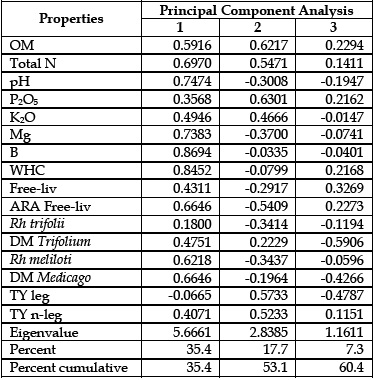
<body><![CDATA[<p  >The first three principal components (PC) account for 60.4% (PC1 = 35.4%;    PC2 = 17.7%; PC3 = 7.3%) of the total variation in the original matrix. In spite    of this relatively low value; the original distances had been preserved since    the cophenetic correlation between the matrix distances implied in the PCA and    the original ones was 0.90. The projections of the 16 variables onto the plane    defined by the principal axes (I and II) are presented in the Figure 2. The    correlations between the 16 original variables and the 3 principal components    (Table 2) showed the individual contribution of each variable (Figure 2) to    the spatial distribution of the soil samples presented in Figure 1.</p>     <p  >&nbsp;</p>     <p  ><b>Table 2</b> - Correlation between the original properties and principal    components</p>     <p  ><img src="/img/revistas/slu/v18n2/18n2a03t2.jpg" width="375" height="380"></p>     
<p  >&nbsp;</p>     <p  ><b><a href="/img/revistas/slu/v18n2/18n2a03f2.jpg" target="_blank">Figure 2</a></b>    - Projections of the 16 soil properties used to characterize the 40 soil samples    onto the plane defined by the first and the second principal axes</p>     
<p  >&nbsp;</p>     <p  >The PC1 separated the soil samples with higher values for the variables:    Total N, pH, K<sub>2</sub>O, Mg, B, WHC, Free-liv, ARA Free-liv, <i>Rh</i><i>    meliloti</i> and DM <i>Medicago</i>, on right side of Figure 1, from the soil    samples with lower values for the same variables. The PC2 separated the soil    samples with higher values for the variables OM, P<sub>2</sub>O<sub>5</sub>,    and TY (leg and non-leg), on upper side of Figure 1, from the soil samples with    lower values for the same variables. The PC3 (not shown) separated the soil    samples with higher values for the variable DM <i>Trifolium</i> from the soil    samples with lower values for this variable (Table 2).</p>       <p  >In <a href="/img/revistas/slu/v18n2/18n2a03f1.jpg" target="_blank">Figure 1</a>, we    can verify the existence of 4 groups of soil samples and 2 outliers (gr 31,    a very poor soil with low values for almost all variables and gr 34 a rich soil    for almost all variables). The group A includes the soil samples: sch 8, sch    15, sch 28, gr 19, with higher values for the variables P<sub>2</sub>O<sub>5</sub>,    OM, K<sub>2</sub>O total N and TY leg and non-leg. The group B includes the    soil samples: sch 26, and sch 27 with higher values for almost all biological    variables and some chemical and physical variables (B, WHC, Mg and pH). The    group C includes the soil samples: sch 1, sch 2, sch 3, sch 5, sch 7, sch 10,    sch 12, sch 13, sch 14, sch 25, gr 17, and gr 18, with intermediate values for    almost all biological variables and for pH, Mg, B and WHC. The group D includes    the remaining soil samples with lower values for biological variables. The obtained    groups of similarity join soil samples with similar geological origin. </p>      
<p  >In Figure 2, we can verify the importance of each variable in the spatial distribution of soil samples (Figure 1) and to observe that some chemical variables, mainly OM, P<sub>2</sub>O<sub>5, </sub>K<sub>2</sub>O and total N seem to be related to legume and non-legume pasture yield.</p>      ]]></body>
<body><![CDATA[<p >&nbsp;</p>      <p ><i >Discriminant</i><i > analysis</i></p>      <p  >The discriminant analysis used to verify the existence of a geographical    pattern of soil samples distribution, showed accuracy of 91.9% in the separation    of the different sampling locals (Figure 3).</p>      <p >&nbsp;</p>        <p ><b><a href="/img/revistas/slu/v18n2/18n2a03f3.jpg" target="_blank">Figure 3</a></b> -    Discriminant analysis of the soil samples geographical origin with the properties    vectors superimposed</p>      
<p >&nbsp;</p>       <p  >The first discriminant function accounted for 58.1% of the variance, discriminating    the soil samples from different locals, being Nisa on the upper left side and    Serpa and Portalegre on the down right side of the figure. It represents the    contrast of the variables B, Mg, pH, <i>Rh</i><i> meliloti</i>, DM <i>Medicago</i>    and ARA Free-liv, with high levels at Serpa and Portalegre and low levels at    Nisa. The second discriminant function accounted for 12.7% of the variance and    allowed the individualization of the remaining sampling locals, representing    the contrast between the two variables TY n-leg and P<sub>2</sub>O<sub>5</sub>    against K<sub>2</sub>O, Total N and OM, being the soil samples positioned according    to the values of these variables. These results can be used as a complement    of the PCA providing information on which variables are best adequate for discriminating    the sampling locals.</p>      <p  >The soil samples from each local were considered as uncorrelated soil samples. This methodology seems to be adequate, since the soil samples dispersion (Figure 3) in each local shows a general variability.</p>      <p  >When the discriminant analysis was used to group the soil samples according    to their geological origin (Figure 4), it was verified a good separation (89%    accuracy) between the 2 origins, except for 2 misclassified soil samples, 1    schistose soil (sch 11) that is classified as granitic soil and 1 granitic soil    (gr 18) that is classified as schistose soil. The soil sch 6 can be classified    either as schistose (48%) or as granitic (52%). The soil samples sch 26 and    sch 27 are a different group as already seen in PCA. The granite-derived soils,    in general, have higher values for TY n-leg, being TY leg not important to discriminate    the soils from different geological origin.</p>     <p  >&nbsp;</p>     ]]></body>
<body><![CDATA[<p  ><b><a href="/img/revistas/slu/v18n2/18n2a03f4.jpg" target="_blank">Figure    4</a></b> - Discriminant analysis of the soil samples according to their geological    origin. The ellipses enclose the soil samples with the same geological origin,    &#9650;- schist, · - granite (&#9830; sch 26 and &#9830; sch 27 are outliers)</p>     
<p  >&nbsp;</p>      <p  >Correlations of soil physical, chemical and biological properties with yield are often low due to the interactions with weather, topography, and other biotic or abiotic factors. Associated to these constraints, the soil properties evaluated differ among the authors; the obtained results are frequently discrepant and cannot be applied without critical adjustments. Studies related to soil properties and herbaceous vegetation yield in the Mediterranean area are scarce. REZAEI <i>et al.,</i> 2006, studying the relationships between soil chemical and physical properties and plant growth on the mountainous rangeland of northern Iran, a Mediterranean area, obtained results indicating that plant variables were more sensitive to soil physical properties than to soil chemical properties. Our results are different, showing that chemical properties are key factors to pasture yield. </p>            <p >&nbsp;</p>          <p ><b>Conclusions</b></p>      <p  >Soils chemical and physical properties in the &quot;montado&quot; ecosystem    are acceptable having low values for pH and P<sub>2</sub>O<sub>5</sub>. Properties    related to number and quality of free-living nitrogen fixing bacteria and rhizobial    populations associated to subclovers are adequate, contrasting with properties    of rhizobial populations associated to annual medics, that are insufficient    for a good nodulation, having a low nitrogen fixing potential.</p>      <p  >With the principal component analysis it were obtained groups of similarity, being the schistose soils dominant in the groups A, B and C and the granitic soils dominant in the group D. The groups are dispersed over all the study area, suggesting that soil properties are independent of the soil samples and that some chemical properties are important factors to pasture yield.</p>      <p  > The geographical distribution of the soil samples, when using the discriminant analysis, showed a large variability even in soil samples collected within a short distance. A good separation of the soil samples according to their geological origin was verified, being the granitic soils more productive in non-legume pasture. </p>      <p  >&nbsp;</p>      <p ><b>Acknowledgements</b> </p>      ]]></body>
<body><![CDATA[<p  >This research was founded by the PARIPIPI-E </p>      <p  >&nbsp;</p>      <p  ><b>References</b></p>      <!-- ref --><p >BROCKWELL, J., 1981. A strategy for legume nodulation research in developing    regions of the world. <i >Plant and Soil</i> <b>58:</b> 367-382.&nbsp;&nbsp;&nbsp;&nbsp;&nbsp;&nbsp;&nbsp;&nbsp;[&#160;<a href="javascript:void(0);" onclick="javascript: window.open('/scielo.php?script=sci_nlinks&ref=000126&pid=S0870-6352201000030000300001&lng=','','width=640,height=500,resizable=yes,scrollbars=1,menubar=yes,');">Links</a>&#160;]<!-- end-ref --><!-- ref --><p >BROCKWELL, J., HOLLIDAY A.R., PILKA, A., 1988. Evaluation of the symbiotic nitrogen-fixing potential of soils by direct microbiological means. <i>Plant Soil </i><b>108:</b> 163-170.&nbsp;&nbsp;&nbsp;&nbsp;&nbsp;&nbsp;&nbsp;&nbsp;[&#160;<a href="javascript:void(0);" onclick="javascript: window.open('/scielo.php?script=sci_nlinks&ref=000127&pid=S0870-6352201000030000300002&lng=','','width=640,height=500,resizable=yes,scrollbars=1,menubar=yes,');">Links</a>&#160;]<!-- end-ref --><!-- ref --><p >CHOTE, J., SCHWATZAMANN, A., BALLY, R., MONROZIER, L.J., 2002. Changes in bacterial communities and <i>Azospirillum</i> diversity in soil fractions of a tropical soil under 3 or 19 years of natural fallow. <i>Soil</i><i> Biology &amp; Biochemistry</i> <b>34</b>: 1083-1092.&nbsp;&nbsp;&nbsp;&nbsp;&nbsp;&nbsp;&nbsp;&nbsp;[&#160;<a href="javascript:void(0);" onclick="javascript: window.open('/scielo.php?script=sci_nlinks&ref=000128&pid=S0870-6352201000030000300003&lng=','','width=640,height=500,resizable=yes,scrollbars=1,menubar=yes,');">Links</a>&#160;]<!-- end-ref --><!-- ref --><p >DOMMERGUES, Y., BALANDREAU, J., RINAUDO, G., WEINHARD, P., 1973. Non-symbiotic nitrogen fixation in the rhizospheres of rice, maize and different tropical grasses. <i>Soil</i><i> Biology &amp; Biochemistry</i> <b>5:</b> 87-92. &nbsp;&nbsp;&nbsp;&nbsp;&nbsp;&nbsp;&nbsp;&nbsp;[&#160;<a href="javascript:void(0);" onclick="javascript: window.open('/scielo.php?script=sci_nlinks&ref=000129&pid=S0870-6352201000030000300004&lng=','','width=640,height=500,resizable=yes,scrollbars=1,menubar=yes,');">Links</a>&#160;]<!-- end-ref --><!-- ref --><p >GARCIA, C., ROLDAN, A., HERNANDEZ, T., 1997. Changes in microbial activity after abandonment of cultivation in a semiarid Mediterranean environment. <i>Journal</i><i>of<i>Environmental Quality</i></i><b> 26</b>: 285-291. &nbsp;&nbsp;&nbsp;&nbsp;&nbsp;&nbsp;&nbsp;&nbsp;[&#160;<a href="javascript:void(0);" onclick="javascript: window.open('/scielo.php?script=sci_nlinks&ref=000130&pid=S0870-6352201000030000300005&lng=','','width=640,height=500,resizable=yes,scrollbars=1,menubar=yes,');">Links</a>&#160;]<!-- end-ref --><!-- ref --><p >HARDY, R.W.F., BURNS, R.C., HOLSTEN, R.D., 1973. Application of the acetylene reduction assay for the measurement of nitrogen fixation. <i>Soil</i><i> Biology &amp; Biochemistry</i> <b>5:</b> 47-81.&nbsp;&nbsp;&nbsp;&nbsp;&nbsp;&nbsp;&nbsp;&nbsp;[&#160;<a href="javascript:void(0);" onclick="javascript: window.open('/scielo.php?script=sci_nlinks&ref=000131&pid=S0870-6352201000030000300006&lng=','','width=640,height=500,resizable=yes,scrollbars=1,menubar=yes,');">Links</a>&#160;]<!-- end-ref --><p >HERRIDGE, D., GEMEL, G., HARTLEY, E., 2002. Legume inoculants and quality control. In <i>Inoculants and Nitrogen Fixation of Legumes in Vietnam.</i><i>ACIAR </i><i>Proceedings</i> <i>No.109e</i>, Herridge, D., NSW, Australia, pp. 105-115.</p>      ]]></body>
<body><![CDATA[<p >HINTZE, J., 2001. <i>NCSS </i><i>and </i><i>PASS</i><i>.</i><i> Number Cruncher Statistical Systems.</i> Kaysville, Utah.</p>      <!-- ref --><p >JOFFRE, R., VACHER, J., LLANOS, C., LONG, G., 1988. The dehesa: an agrosilvopastoral system of the Mediterranean region with special reference to the Sierra Morena area of Spain. <i>Agroforestry</i><i> Systems</i><b> 6:</b> 71-96.  &nbsp;&nbsp;&nbsp;&nbsp;&nbsp;&nbsp;&nbsp;&nbsp;[&#160;<a href="javascript:void(0);" onclick="javascript: window.open('/scielo.php?script=sci_nlinks&ref=000134&pid=S0870-6352201000030000300007&lng=','','width=640,height=500,resizable=yes,scrollbars=1,menubar=yes,');">Links</a>&#160;]<!-- end-ref --><!-- ref --><p >KAVADIA, A., VAYENAS, D.V., PAVLOU, S., AGGELIS, G., 2007. Dynamics of free-living nitrogen-fixing bacterial populations in antagonistic conditions. <i>Ecological Modelling</i><b> 200:</b> 243-253. &nbsp;&nbsp;&nbsp;&nbsp;&nbsp;&nbsp;&nbsp;&nbsp;[&#160;<a href="javascript:void(0);" onclick="javascript: window.open('/scielo.php?script=sci_nlinks&ref=000135&pid=S0870-6352201000030000300008&lng=','','width=640,height=500,resizable=yes,scrollbars=1,menubar=yes,');">Links</a>&#160;]<!-- end-ref --><p >LABORATÓRIO QUÍMICO AGRÍCOLA REBELO DA SILVA, 2000. <i>Manual de Fertilização das Culturas</i>. INIA, LQRS, Lisboa, 221 pp.</p>      <!-- ref --><p >LOURENÇO, M.E., GONÇALVES, M.C., OLIVEIRA, A.J., SERRANO, J.E., 1994. Capacidade produtiva das pastagens naturais nas condições do montado alentejano. <i>Pastagens</i><i> e Forragens</i> <b>14/15:</b> 139-148.&nbsp;&nbsp;&nbsp;&nbsp;&nbsp;&nbsp;&nbsp;&nbsp;[&#160;<a href="javascript:void(0);" onclick="javascript: window.open('/scielo.php?script=sci_nlinks&ref=000137&pid=S0870-6352201000030000300009&lng=','','width=640,height=500,resizable=yes,scrollbars=1,menubar=yes,');">Links</a>&#160;]<!-- end-ref --><!-- ref --><p >MORENO, G., 2008. Response of understorey forage to multiple tree effects in Iberian dehesas. <i>Agricult Ecosys Environ</i> <b>123</b>: 239-244. MORENO, G., OBRADOR, J.J., GARCIA, A. 2007. Impact of evergreen oaks on soil fertility and crop production in intercropped dehesas. <i>Agriculture, Ecosystems &amp; Environment</i> <b>119</b>: 270-280.&nbsp;&nbsp;&nbsp;&nbsp;&nbsp;&nbsp;&nbsp;&nbsp;[&#160;<a href="javascript:void(0);" onclick="javascript: window.open('/scielo.php?script=sci_nlinks&ref=000138&pid=S0870-6352201000030000300010&lng=','','width=640,height=500,resizable=yes,scrollbars=1,menubar=yes,');">Links</a>&#160;]<!-- end-ref --><!-- ref -->    &nbsp;&nbsp;&nbsp;&nbsp;&nbsp;&nbsp;&nbsp;&nbsp;[&#160;<a href="javascript:void(0);" onclick="javascript: window.open('/scielo.php?script=sci_nlinks&ref=000139&pid=S0870-6352201000030000300011&lng=','','width=640,height=500,resizable=yes,scrollbars=1,menubar=yes,');">Links</a>&#160;]<!-- end-ref --><!-- ref --><p >MORRIS, D.R., ZUBERER, D.A., WEAVER, R.W., 1985. Nitrogen fixation by intact grass soil cores using nitrogen 15 and acetylene reduction. <i>Soil</i><i> Biology &amp; Biochemistry</i> <b>17</b>(1): 87-92. &nbsp;&nbsp;&nbsp;&nbsp;&nbsp;&nbsp;&nbsp;&nbsp;[&#160;<a href="javascript:void(0);" onclick="javascript: window.open('/scielo.php?script=sci_nlinks&ref=000140&pid=S0870-6352201000030000300012&lng=','','width=640,height=500,resizable=yes,scrollbars=1,menubar=yes,');">Links</a>&#160;]<!-- end-ref --><p >OLEA, L., SAN MIGUEL-AYANS, A., 2006. The Spanish dehesa. A traditional Mediterranean silvopastoral system linking production and nature conservation. In <i>21<sup>st</sup> General Meeting of the European Grassland Federation: Sustainable Grassland Productivity</i> Lloveras, J., González-Rodríguez, A., Vázquez-Yañez, O., Piñeiro, J., Santamaría, O., Olea, L., Poblaciones, M.J., Badajoz, pp 1-15.</p>      <!-- ref --><p >OLIVEIRA, A., PAMPULHA, M.E., 2006. Effects of long-term heavy metal contamination on soil microbial characteristics. <i>Journal of Bioscience and Bioengineering</i><b> 102</b>: 157-161. &nbsp;&nbsp;&nbsp;&nbsp;&nbsp;&nbsp;&nbsp;&nbsp;[&#160;<a href="javascript:void(0);" onclick="javascript: window.open('/scielo.php?script=sci_nlinks&ref=000142&pid=S0870-6352201000030000300013&lng=','','width=640,height=500,resizable=yes,scrollbars=1,menubar=yes,');">Links</a>&#160;]<!-- end-ref --><p >PARKINSON, D., GRAY, T.R.G., WILLIAMS, S.T., 1971. <i>Methods for Studying the Ecology of Soil Micro-organisms.</i><i> IBP Handbook No 19.</i> Blackwell Scientific Publications, Oxford, 351 pp.</p>      <!-- ref --><p >PARREIRA, J.S., GARRIDO, R.M.I., 1987. Contributo para o estudo de implantação de pastagens de sequeiro no Baixo Alentejo. <i>Pastagens e Forragens</i> <b>8</b>(2): 129-140.&nbsp;&nbsp;&nbsp;&nbsp;&nbsp;&nbsp;&nbsp;&nbsp;[&#160;<a href="javascript:void(0);" onclick="javascript: window.open('/scielo.php?script=sci_nlinks&ref=000144&pid=S0870-6352201000030000300014&lng=','','width=640,height=500,resizable=yes,scrollbars=1,menubar=yes,');">Links</a>&#160;]<!-- end-ref --><p >POCHON, J., TCHAN, Y.T., 1948. <i>Précis de Microbiologie du Sol</i>. Monographie de l'Institut Pasteur. Masson et Cie, Paris.</p>      <!-- ref --><p >QUIGLEY, P.E., CUNNINGHAM, P.J., HANNAH, M., WARD, G.N., MORGAN, T., 1997. Symbiotic effectiveness of <i>Rhizobium</i><i> leguminosarum</i> bv<i>. trifolii</i> collected from pastures in south-western Victoria. <i>Australian Journal of Experimental Agriculture</i><b> 37</b>(6): 623-630. &nbsp;&nbsp;&nbsp;&nbsp;&nbsp;&nbsp;&nbsp;&nbsp;[&#160;<a href="javascript:void(0);" onclick="javascript: window.open('/scielo.php?script=sci_nlinks&ref=000146&pid=S0870-6352201000030000300015&lng=','','width=640,height=500,resizable=yes,scrollbars=1,menubar=yes,');">Links</a>&#160;]<!-- end-ref --><!-- ref --><p >RODRÍGUEZ-ZARAGOZA, S., GONZÁLEZ-RUÍZ, T., GONZÁLEZ-LOZANO, E., LOZADA-ROJAS, A., MAYZLISH-GATI, E., STEINBERGER, Y., 2008. Vertical distribution of microbial communities under the canopy of two legume bushes in the Tehuacán Desert, Mexico. <i>European Journal of Soil Biology</i><b> 44</b>: 373-380. &nbsp;&nbsp;&nbsp;&nbsp;&nbsp;&nbsp;&nbsp;&nbsp;[&#160;<a href="javascript:void(0);" onclick="javascript: window.open('/scielo.php?script=sci_nlinks&ref=000147&pid=S0870-6352201000030000300016&lng=','','width=640,height=500,resizable=yes,scrollbars=1,menubar=yes,');">Links</a>&#160;]<!-- end-ref --><!-- ref --><p >REZAEI, A.S., GILKES, J.R., ANDREWS, S.S., 2006. A minimum data set for assessing soil quality in rangelands. <i>Geoderma</i> <b>136</b>: 229-234.&nbsp;&nbsp;&nbsp;&nbsp;&nbsp;&nbsp;&nbsp;&nbsp;[&#160;<a href="javascript:void(0);" onclick="javascript: window.open('/scielo.php?script=sci_nlinks&ref=000148&pid=S0870-6352201000030000300017&lng=','','width=640,height=500,resizable=yes,scrollbars=1,menubar=yes,');">Links</a>&#160;]<!-- end-ref --><p >ROHLF, F,J., 2000. <i>NTSYS</i><i>-pc Numerical Taxonomy and Multivariate Analysis System.</i><i> Version 2.1.</i> Exeter Publications, Setauket, New   York.</p>      <!-- ref --><p >SLATTERY, J.F., COVENTRY, D.R., 1993. Variation of soil populations of <i>Rhizobium</i><i> leguminosarum</i> bv. <i>trifolii</i> and the occurrence of inoculant rhizobia in nodules of subterranean clover after pasture renovation in north-eastern Victoria. <i>Soil</i><i> Biology &amp; Biochemistry</i> <b>25</b>: 1725-1730.&nbsp;&nbsp;&nbsp;&nbsp;&nbsp;&nbsp;&nbsp;&nbsp;[&#160;<a href="javascript:void(0);" onclick="javascript: window.open('/scielo.php?script=sci_nlinks&ref=000150&pid=S0870-6352201000030000300018&lng=','','width=640,height=500,resizable=yes,scrollbars=1,menubar=yes,');">Links</a>&#160;]<!-- end-ref --><p >SLATTERY, J., PEARCE, D., 2002. The impact of background rhizobial populations on inoculations response. In: <i>Inoculants and Nitrogen Fixation of Legumes in Vietnam. </i><i>ACIAR </i><i>Proceedings No.109e</i>, Herridge, D., NSW, Australia, pp. 37-45. </p>      <!-- ref --><p >SOARES, R.S., ROESCH, L.F.W., ZANATTA, G., CAMARGO, F.A.O., PASSAGLIA, L.M.P. 2006. Occurrence and distribution of nitrogen fixing bacterial community associated with oat (<i >Avena</i><i > sativa</i>) assessed by molecular and microbiological techniques. <i>Applied Soil Ecology</i><b> 33</b>: 221-234. &nbsp;&nbsp;&nbsp;&nbsp;&nbsp;&nbsp;&nbsp;&nbsp;[&#160;<a href="javascript:void(0);" onclick="javascript: window.open('/scielo.php?script=sci_nlinks&ref=000152&pid=S0870-6352201000030000300019&lng=','','width=640,height=500,resizable=yes,scrollbars=1,menubar=yes,');">Links</a>&#160;]<!-- end-ref --><!-- ref --><p >THOMPSON, J.A., GEMELL, L.G., ROUGHLEY, R.J., EVANS, J., NICHOLLS, P.J., 1984. Nitrogenase activity associated with pasture grasses in Northern New  South Wales. <i>Soil</i><i> Biology &amp; Biochemistry</i> <b>16</b>: 217-222.&nbsp;&nbsp;&nbsp;&nbsp;&nbsp;&nbsp;&nbsp;&nbsp;[&#160;<a href="javascript:void(0);" onclick="javascript: window.open('/scielo.php?script=sci_nlinks&ref=000153&pid=S0870-6352201000030000300020&lng=','','width=640,height=500,resizable=yes,scrollbars=1,menubar=yes,');">Links</a>&#160;]<!-- end-ref --><p >TRUJILLO, R.G., MATA, C., 2001. The Dehesa: an extensive livestock system in the Iberian Peninsula. In: <i>Proceedings of the Second NAHWOA Workshop. Diversity of Livestock Systems and Definition of Animal Welfare.</i> Hovi, M., Garcia Trujillo, R., University of Reading, UK, pp 50-61.</p>      <p >VINCENT, J,M., 1970. <i>A Manual for the Practical Study of Root-nodule Bacteria.</i><i> IBP Handbook No 15.</i> Blackwell Scientific Publications, Oxford, 164 pp.</p>      <!-- ref --><p >XIE, G., STEINBERGER, Y., 2002. Dynamics of the nitrogen-efficient guild and its relationship to nitrogen and carbon patterns in two desert soil ecosystems. <i>Arid Land Research and Management</i><b> 16</b>: 69-81.&nbsp;&nbsp;&nbsp;&nbsp;&nbsp;&nbsp;&nbsp;&nbsp;[&#160;<a href="javascript:void(0);" onclick="javascript: window.open('/scielo.php?script=sci_nlinks&ref=000156&pid=S0870-6352201000030000300021&lng=','','width=640,height=500,resizable=yes,scrollbars=1,menubar=yes,');">Links</a>&#160;]<!-- end-ref --><!-- ref --><p >WEIER, K.L., 1980. Nitrogenase activity associated with three tropical grasses growing in undisturbed soil cores. <i>Soil</i><i> Biology &amp; Biochemistry</i> <b>12</b>: 131-136.&nbsp;&nbsp;&nbsp;&nbsp;&nbsp;&nbsp;&nbsp;&nbsp;[&#160;<a href="javascript:void(0);" onclick="javascript: window.open('/scielo.php?script=sci_nlinks&ref=000157&pid=S0870-6352201000030000300022&lng=','','width=640,height=500,resizable=yes,scrollbars=1,menubar=yes,');">Links</a>&#160;]<!-- end-ref --><!-- ref --><p >WRIGHT, S.F., WEAVER, R.W., 1981. Enumeration and identification of nitrogen-fixing bacteria from forage grass roots. <i>Applied and Environmental Microbiology</i> <b>42</b>: 97-101.&nbsp;&nbsp;&nbsp;&nbsp;&nbsp;&nbsp;&nbsp;&nbsp;[&#160;<a href="javascript:void(0);" onclick="javascript: window.open('/scielo.php?script=sci_nlinks&ref=000158&pid=S0870-6352201000030000300023&lng=','','width=640,height=500,resizable=yes,scrollbars=1,menubar=yes,');">Links</a>&#160;]<!-- end-ref --><p >&nbsp;</p>      <p ><i>Entregue para publicação em Setembro de 2010</i></p>      <p ><i>Aceite para publicação em Outubro de 2010</i></p>       ]]></body><back>
<ref-list>
<ref id="B1">
<nlm-citation citation-type="journal">
<person-group person-group-type="author">
<name>
<surname><![CDATA[BROCKWELL]]></surname>
<given-names><![CDATA[J.]]></given-names>
</name>
</person-group>
<article-title xml:lang="en"><![CDATA[A strategy for legume nodulation research in developing regions of the world]]></article-title>
<source><![CDATA[Plant and Soil]]></source>
<year>1981</year>
<volume>58</volume>
<page-range>367-382</page-range></nlm-citation>
</ref>
<ref id="B2">
<nlm-citation citation-type="journal">
<person-group person-group-type="author">
<name>
<surname><![CDATA[BROCKWELL]]></surname>
<given-names><![CDATA[J.]]></given-names>
</name>
<name>
<surname><![CDATA[HOLLIDAY]]></surname>
<given-names><![CDATA[A.R.]]></given-names>
</name>
<name>
<surname><![CDATA[PILKA]]></surname>
<given-names><![CDATA[A.]]></given-names>
</name>
</person-group>
<article-title xml:lang="en"><![CDATA[Evaluation of the symbiotic nitrogen-fixing potential of soils by direct microbiological means]]></article-title>
<source><![CDATA[Plant Soil]]></source>
<year>1988</year>
<volume>108</volume>
<page-range>163-170</page-range></nlm-citation>
</ref>
<ref id="B3">
<nlm-citation citation-type="journal">
<person-group person-group-type="author">
<name>
<surname><![CDATA[CHOTE]]></surname>
<given-names><![CDATA[J.]]></given-names>
</name>
<name>
<surname><![CDATA[SCHWATZAMANN]]></surname>
<given-names><![CDATA[A.]]></given-names>
</name>
<name>
<surname><![CDATA[BALLY]]></surname>
<given-names><![CDATA[R.]]></given-names>
</name>
<name>
<surname><![CDATA[MONROZIER]]></surname>
<given-names><![CDATA[L.J.]]></given-names>
</name>
</person-group>
<article-title xml:lang="en"><![CDATA[Changes in bacterial communities and Azospirillum diversity in soil fractions of a tropical soil under 3 or 19 years of natural fallow]]></article-title>
<source><![CDATA[Soil Biology & Biochemistry]]></source>
<year>2002</year>
<volume>34</volume>
<page-range>1083-1092</page-range></nlm-citation>
</ref>
<ref id="B4">
<nlm-citation citation-type="journal">
<person-group person-group-type="author">
<name>
<surname><![CDATA[DOMMERGUES]]></surname>
<given-names><![CDATA[Y.]]></given-names>
</name>
<name>
<surname><![CDATA[BALANDREAU]]></surname>
<given-names><![CDATA[J.]]></given-names>
</name>
<name>
<surname><![CDATA[RINAUDO]]></surname>
<given-names><![CDATA[G.]]></given-names>
</name>
<name>
<surname><![CDATA[WEINHARD]]></surname>
<given-names><![CDATA[P.]]></given-names>
</name>
</person-group>
<article-title xml:lang="en"><![CDATA[Non-symbiotic nitrogen fixation in the rhizospheres of rice, maize and different tropical grasses]]></article-title>
<source><![CDATA[Soil Biology & Biochemistry]]></source>
<year>1973</year>
<volume>5</volume>
<page-range>87-92</page-range></nlm-citation>
</ref>
<ref id="B5">
<nlm-citation citation-type="journal">
<person-group person-group-type="author">
<name>
<surname><![CDATA[GARCIA]]></surname>
<given-names><![CDATA[C.]]></given-names>
</name>
<name>
<surname><![CDATA[ROLDAN]]></surname>
<given-names><![CDATA[A.]]></given-names>
</name>
<name>
<surname><![CDATA[HERNANDEZ]]></surname>
<given-names><![CDATA[T.]]></given-names>
</name>
</person-group>
<article-title xml:lang="en"><![CDATA[Changes in microbial activity after abandonment of cultivation in a semiarid Mediterranean environment]]></article-title>
<source><![CDATA[JournalofEnvironmental Quality]]></source>
<year>1997</year>
<volume>26</volume>
<page-range>285-291</page-range></nlm-citation>
</ref>
<ref id="B6">
<nlm-citation citation-type="journal">
<person-group person-group-type="author">
<name>
<surname><![CDATA[HARDY]]></surname>
<given-names><![CDATA[R.W.F.]]></given-names>
</name>
<name>
<surname><![CDATA[BURNS]]></surname>
<given-names><![CDATA[R.C.]]></given-names>
</name>
<name>
<surname><![CDATA[HOLSTEN]]></surname>
<given-names><![CDATA[R.D.]]></given-names>
</name>
</person-group>
<article-title xml:lang="en"><![CDATA[Application of the acetylene reduction assay for the measurement of nitrogen fixation]]></article-title>
<source><![CDATA[Soil Biology & Biochemistry]]></source>
<year>1973</year>
<volume>5</volume>
<page-range>47-81</page-range></nlm-citation>
</ref>
<ref id="B7">
<nlm-citation citation-type="journal">
<person-group person-group-type="author">
<name>
<surname><![CDATA[JOFFRE]]></surname>
<given-names><![CDATA[R.]]></given-names>
</name>
<name>
<surname><![CDATA[VACHER]]></surname>
<given-names><![CDATA[J.]]></given-names>
</name>
<name>
<surname><![CDATA[LLANOS]]></surname>
<given-names><![CDATA[C.]]></given-names>
</name>
<name>
<surname><![CDATA[LONG]]></surname>
<given-names><![CDATA[G.]]></given-names>
</name>
</person-group>
<article-title xml:lang="en"><![CDATA[The dehesa: an agrosilvopastoral system of the Mediterranean region with special reference to the Sierra Morena area of Spain]]></article-title>
<source><![CDATA[Agroforestry Systems]]></source>
<year>1988</year>
<volume>6</volume>
<page-range>71-96</page-range></nlm-citation>
</ref>
<ref id="B8">
<nlm-citation citation-type="journal">
<person-group person-group-type="author">
<name>
<surname><![CDATA[KAVADIA]]></surname>
<given-names><![CDATA[A.]]></given-names>
</name>
<name>
<surname><![CDATA[VAYENAS]]></surname>
<given-names><![CDATA[D.V.]]></given-names>
</name>
<name>
<surname><![CDATA[PAVLOU]]></surname>
<given-names><![CDATA[S.]]></given-names>
</name>
<name>
<surname><![CDATA[AGGELIS]]></surname>
<given-names><![CDATA[G.]]></given-names>
</name>
</person-group>
<article-title xml:lang="en"><![CDATA[Dynamics of free-living nitrogen-fixing bacterial populations in antagonistic conditions]]></article-title>
<source><![CDATA[Ecological Modelling]]></source>
<year>2007</year>
<volume>200</volume>
<page-range>243-253</page-range></nlm-citation>
</ref>
<ref id="B9">
<nlm-citation citation-type="journal">
<person-group person-group-type="author">
<name>
<surname><![CDATA[LOURENÇO]]></surname>
<given-names><![CDATA[M.E.]]></given-names>
</name>
<name>
<surname><![CDATA[GONÇALVES]]></surname>
<given-names><![CDATA[M.C.]]></given-names>
</name>
<name>
<surname><![CDATA[OLIVEIRA]]></surname>
<given-names><![CDATA[A.J.]]></given-names>
</name>
<name>
<surname><![CDATA[SERRANO]]></surname>
<given-names><![CDATA[J.E.]]></given-names>
</name>
</person-group>
<article-title xml:lang="pt"><![CDATA[Capacidade produtiva das pastagens naturais nas condições do montado alentejano]]></article-title>
<source><![CDATA[Pastagens e Forragens]]></source>
<year>1994</year>
<volume>14/15</volume>
<page-range>139-148</page-range></nlm-citation>
</ref>
<ref id="B10">
<nlm-citation citation-type="journal">
<person-group person-group-type="author">
<name>
<surname><![CDATA[MORENO]]></surname>
<given-names><![CDATA[G.]]></given-names>
</name>
</person-group>
<article-title xml:lang="en"><![CDATA[Response of understorey forage to multiple tree effects in Iberian dehesas]]></article-title>
<source><![CDATA[Agricult Ecosys Environ]]></source>
<year>2008</year>
<volume>123</volume>
<page-range>239-244</page-range></nlm-citation>
</ref>
<ref id="B11">
<nlm-citation citation-type="journal">
<person-group person-group-type="author">
<name>
<surname><![CDATA[MORENO]]></surname>
<given-names><![CDATA[G.]]></given-names>
</name>
<name>
<surname><![CDATA[OBRADOR]]></surname>
<given-names><![CDATA[J.J.]]></given-names>
</name>
<name>
<surname><![CDATA[GARCIA]]></surname>
<given-names><![CDATA[A.]]></given-names>
</name>
</person-group>
<article-title xml:lang="en"><![CDATA[Impact of evergreen oaks on soil fertility and crop production in intercropped dehesas]]></article-title>
<source><![CDATA[Agriculture, Ecosystems & Environment]]></source>
<year>2007</year>
<volume>119</volume>
<page-range>270-280</page-range></nlm-citation>
</ref>
<ref id="B12">
<nlm-citation citation-type="journal">
<person-group person-group-type="author">
<name>
<surname><![CDATA[MORRIS]]></surname>
<given-names><![CDATA[D.R.]]></given-names>
</name>
<name>
<surname><![CDATA[ZUBERER]]></surname>
<given-names><![CDATA[D.A.]]></given-names>
</name>
<name>
<surname><![CDATA[WEAVER]]></surname>
<given-names><![CDATA[R.W.]]></given-names>
</name>
</person-group>
<article-title xml:lang="en"><![CDATA[Nitrogen fixation by intact grass soil cores using nitrogen 15 and acetylene reduction]]></article-title>
<source><![CDATA[Soil Biology & Biochemistry]]></source>
<year>1985</year>
<volume>17</volume>
<numero>1</numero>
<issue>1</issue>
<page-range>87-92</page-range></nlm-citation>
</ref>
<ref id="B13">
<nlm-citation citation-type="journal">
<person-group person-group-type="author">
<name>
<surname><![CDATA[OLIVEIRA]]></surname>
<given-names><![CDATA[A.]]></given-names>
</name>
<name>
<surname><![CDATA[PAMPULHA]]></surname>
<given-names><![CDATA[M.E.]]></given-names>
</name>
</person-group>
<article-title xml:lang="en"><![CDATA[Effects of long-term heavy metal contamination on soil microbial characteristics]]></article-title>
<source><![CDATA[Journal of Bioscience and Bioengineering]]></source>
<year>2006</year>
<volume>102</volume>
<page-range>157-161</page-range></nlm-citation>
</ref>
<ref id="B14">
<nlm-citation citation-type="journal">
<person-group person-group-type="author">
<name>
<surname><![CDATA[PARREIRA]]></surname>
<given-names><![CDATA[J.S.]]></given-names>
</name>
<name>
<surname><![CDATA[GARRIDO]]></surname>
<given-names><![CDATA[R.M.I.]]></given-names>
</name>
</person-group>
<article-title xml:lang="pt"><![CDATA[Contributo para o estudo de implantação de pastagens de sequeiro no Baixo Alentejo]]></article-title>
<source><![CDATA[Pastagens e Forragens]]></source>
<year>1987</year>
<volume>8</volume>
<numero>2</numero>
<issue>2</issue>
<page-range>129-140</page-range></nlm-citation>
</ref>
<ref id="B15">
<nlm-citation citation-type="journal">
<person-group person-group-type="author">
<name>
<surname><![CDATA[QUIGLEY]]></surname>
<given-names><![CDATA[P.E.]]></given-names>
</name>
<name>
<surname><![CDATA[CUNNINGHAM]]></surname>
<given-names><![CDATA[P.J.]]></given-names>
</name>
<name>
<surname><![CDATA[HANNAH]]></surname>
<given-names><![CDATA[M.]]></given-names>
</name>
<name>
<surname><![CDATA[WARD]]></surname>
<given-names><![CDATA[G.N.]]></given-names>
</name>
<name>
<surname><![CDATA[MORGAN]]></surname>
<given-names><![CDATA[T.]]></given-names>
</name>
</person-group>
<article-title xml:lang="en"><![CDATA[Symbiotic effectiveness of Rhizobium leguminosarum bv. trifolii collected from pastures in south-western Victoria]]></article-title>
<source><![CDATA[Australian Journal of Experimental Agriculture]]></source>
<year>1997</year>
<volume>37</volume>
<numero>6</numero>
<issue>6</issue>
<page-range>623-630</page-range></nlm-citation>
</ref>
<ref id="B16">
<nlm-citation citation-type="journal">
<person-group person-group-type="author">
<name>
<surname><![CDATA[RODRÍGUEZ-ZARAGOZA]]></surname>
<given-names><![CDATA[S.]]></given-names>
</name>
<name>
<surname><![CDATA[GONZÁLEZ-RUÍZ]]></surname>
<given-names><![CDATA[T.]]></given-names>
</name>
<name>
<surname><![CDATA[GONZÁLEZ-LOZANO]]></surname>
<given-names><![CDATA[E.]]></given-names>
</name>
<name>
<surname><![CDATA[LOZADA-ROJAS]]></surname>
<given-names><![CDATA[A.]]></given-names>
</name>
<name>
<surname><![CDATA[MAYZLISH-GATI]]></surname>
<given-names><![CDATA[E.]]></given-names>
</name>
<name>
<surname><![CDATA[STEINBERGER]]></surname>
<given-names><![CDATA[Y.]]></given-names>
</name>
</person-group>
<article-title xml:lang="en"><![CDATA[Vertical distribution of microbial communities under the canopy of two legume bushes in the Tehuacán Desert, Mexico]]></article-title>
<source><![CDATA[European Journal of Soil Biology]]></source>
<year>2008</year>
<volume>44</volume>
<page-range>373-380</page-range></nlm-citation>
</ref>
<ref id="B17">
<nlm-citation citation-type="journal">
<person-group person-group-type="author">
<name>
<surname><![CDATA[REZAEI]]></surname>
<given-names><![CDATA[A.S.]]></given-names>
</name>
<name>
<surname><![CDATA[GILKES]]></surname>
<given-names><![CDATA[J.R.]]></given-names>
</name>
<name>
<surname><![CDATA[ANDREWS]]></surname>
<given-names><![CDATA[S.S.]]></given-names>
</name>
</person-group>
<article-title xml:lang="en"><![CDATA[A minimum data set for assessing soil quality in rangelands]]></article-title>
<source><![CDATA[Geoderma]]></source>
<year>2006</year>
<volume>136</volume>
<page-range>229-234</page-range></nlm-citation>
</ref>
<ref id="B18">
<nlm-citation citation-type="journal">
<person-group person-group-type="author">
<name>
<surname><![CDATA[SLATTERY]]></surname>
<given-names><![CDATA[J.F.]]></given-names>
</name>
<name>
<surname><![CDATA[COVENTRY]]></surname>
<given-names><![CDATA[D.R.]]></given-names>
</name>
</person-group>
<article-title xml:lang="en"><![CDATA[Variation of soil populations of Rhizobium leguminosarum bv. trifolii and the occurrence of inoculant rhizobia in nodules of subterranean clover after pasture renovation in north-eastern Victoria]]></article-title>
<source><![CDATA[Soil Biology & Biochemistry]]></source>
<year>1993</year>
<volume>25</volume>
<page-range>1725-1730</page-range></nlm-citation>
</ref>
<ref id="B19">
<nlm-citation citation-type="journal">
<person-group person-group-type="author">
<name>
<surname><![CDATA[SOARES]]></surname>
<given-names><![CDATA[R.S.]]></given-names>
</name>
<name>
<surname><![CDATA[ROESCH]]></surname>
<given-names><![CDATA[L.F.W.]]></given-names>
</name>
<name>
<surname><![CDATA[ZANATTA]]></surname>
<given-names><![CDATA[G.]]></given-names>
</name>
<name>
<surname><![CDATA[CAMARGO]]></surname>
<given-names><![CDATA[F.A.O.]]></given-names>
</name>
<name>
<surname><![CDATA[PASSAGLIA]]></surname>
<given-names><![CDATA[L.M.P.]]></given-names>
</name>
</person-group>
<article-title xml:lang="en"><![CDATA[Occurrence and distribution of nitrogen fixing bacterial community associated with oat (Avena sativa) assessed by molecular and microbiological techniques]]></article-title>
<source><![CDATA[Applied Soil Ecology]]></source>
<year>2006</year>
<volume>33</volume>
<page-range>221-234</page-range></nlm-citation>
</ref>
<ref id="B20">
<nlm-citation citation-type="journal">
<person-group person-group-type="author">
<name>
<surname><![CDATA[THOMPSON]]></surname>
<given-names><![CDATA[J.A.]]></given-names>
</name>
<name>
<surname><![CDATA[GEMELL]]></surname>
<given-names><![CDATA[L.G.]]></given-names>
</name>
<name>
<surname><![CDATA[ROUGHLEY]]></surname>
<given-names><![CDATA[R.J.]]></given-names>
</name>
<name>
<surname><![CDATA[EVANS]]></surname>
<given-names><![CDATA[J.]]></given-names>
</name>
<name>
<surname><![CDATA[NICHOLLS]]></surname>
<given-names><![CDATA[P.J.]]></given-names>
</name>
</person-group>
<article-title xml:lang="en"><![CDATA[Nitrogenase activity associated with pasture grasses in Northern New South Wales]]></article-title>
<source><![CDATA[Soil Biology & Biochemistry]]></source>
<year>1984</year>
<volume>16</volume>
<page-range>217-222</page-range></nlm-citation>
</ref>
<ref id="B21">
<nlm-citation citation-type="journal">
<person-group person-group-type="author">
<name>
<surname><![CDATA[XIE]]></surname>
<given-names><![CDATA[G.]]></given-names>
</name>
<name>
<surname><![CDATA[STEINBERGER]]></surname>
<given-names><![CDATA[Y.]]></given-names>
</name>
</person-group>
<article-title xml:lang="en"><![CDATA[Dynamics of the nitrogen-efficient guild and its relationship to nitrogen and carbon patterns in two desert soil ecosystems]]></article-title>
<source><![CDATA[Arid Land Research and Management]]></source>
<year>2002</year>
<volume>16</volume>
</nlm-citation>
</ref>
<ref id="B22">
<nlm-citation citation-type="journal">
<person-group person-group-type="author">
<name>
<surname><![CDATA[WEIER]]></surname>
<given-names><![CDATA[K.L.]]></given-names>
</name>
</person-group>
<article-title xml:lang="en"><![CDATA[Nitrogenase activity associated with three tropical grasses growing in undisturbed soil cores]]></article-title>
<source><![CDATA[Soil Biology & Biochemistry]]></source>
<year>1980</year>
<volume>12</volume>
<page-range>131-136</page-range></nlm-citation>
</ref>
<ref id="B23">
<nlm-citation citation-type="journal">
<person-group person-group-type="author">
<name>
<surname><![CDATA[WRIGHT]]></surname>
<given-names><![CDATA[S.F.]]></given-names>
</name>
<name>
<surname><![CDATA[WEAVER]]></surname>
<given-names><![CDATA[R.W.]]></given-names>
</name>
</person-group>
<article-title xml:lang="en"><![CDATA[Enumeration and identification of nitrogen-fixing bacteria from forage grass roots]]></article-title>
<source><![CDATA[Applied and Environmental Microbiology]]></source>
<year>1981</year>
<volume>42</volume>
<page-range>97-101</page-range></nlm-citation>
</ref>
</ref-list>
</back>
</article>
