 with
with  , and a set of intrinsic or characteristic economic values W={w}i=1,...,n expressed in monetary units by a standard unitary area. We define average contributive value of that characterrization of the landscape mosaic as: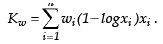
José Pinto Casquilho
Researcher
Centro de Ecologia Aplicada Prof. Baeta Neves (CEABN). Instituto Superior de Agronomia. Tapada da Ajuda, 1349-017 LISBOA
Abstract
Optimization of landscape mosaics is a theme that involves both compositional and configuration features. This paper just deals with the first problem: may we say what are the optimal proportions of different habitats in a mosaic under specified criteria? Environmental economists claim that landscape changes reflect monetary values and utility maximization or, in more general terms, maximization of expected subjective utility. Theory of Relevance advocates strategic reasoning in terms of the maximization of information and the minimization of the cognitive processing effort, and that could be assessed with a mathematical formula as far as it conveys some semantic insight over the compositional problem of the mosaic. Contributive value is a notion that goes back to Kant moral duty statements and may be approached through quantitative procedures that internalize both intrinsic and context values. Under that perspective Kw index here discussed may help assessing quantitative scenarios of the compositional problem of the landscape mosaic. I exemplify with an application with economic data relative to the region of Nisa, Portugal.
Key words: Expected utility maximization; contributive value; index Kw; theory of relevance
]]> Composição do Mosaico de Paisagem e Índice de Valor Contributivo Médio
Sumário
A optimização de mosaicos de paisagem é um tema que envolve tanto aspectos de composição como de configuração. Este trabalho ocupa-se apenas do primeiro problema: pode-se dizer quais são as proporções ideais dos diferentes habitats num mosaico sob critérios especificados? Economistas ambientais afirmam que as alterações na paisagem reflectem valores monetários e a maximização da utilidade ou, em termos mais gerais, a maximização da utilidade subjectiva esperada. A teoria da relevância defende o raciocínio estratégico em termos da maximização da informação e a minimização do esforço de processamento cognitivo, que poderiam ser avaliadas com uma fórmula matemática tanto quanto ela transmita algumas ideias com valor semântico sobre o problema de composição do mosaico. O valor contributivo é uma noção que remonta às proposições de dever moral de Kant e pode ser aproximado através de procedimentos quantitativos que internalizam tanto valores intrínsecos como valores de contexto. Sob essa perspectiva o índice Kw aqui discutido pode ajudar a avaliar cenários quantitativos do problema relativo à composição do mosaico de paisagem. Exemplifico com uma aplicação com dados económicos relativos à região de Nisa, Portugal.
Palavras-chave: Maximização da utilidade esperada; valor contributivo; índice Kw; teoria da relevância
Composition de la Mosaïque du Paysage et Valeur Contributive Moyenne
Résumé
L'optimisation d'une mosaïque de paysage est un thème qui touche aussi bien la composition que la configuration des lieux. Ce document traite seulement le premier problème: pouvons-nous dire quelles sont les proportions optimales d'habitats différents dans une mosaïque qui obéirait a des critères définis? Économistes environnementaux prétendent que les modifications du paysage reflètent les valeurs monétaires et la maximisation de l'utilité ou, en termes plus généraux, la maximisation de l'utilité subjective attendue. La théorie de la pertinence prône le raisonnement stratégique en termes de la maximisation de l'information et la minimisation de l'effort de traitement cognitif, ce qui pourrait être abordé avec une formule mathématique qui transmet une idée sémantique sur le problème de la composition de la mosaïque. La valeur contributive est une notion qui remonte aux propositions de devoir moral de Kant et peut être estimée par le biais de procédures quantitatives qui internalisent des valeurs intrinsèques et les valeurs de contexte. L'Index Kw ici présenté peut aider à évaluer des scénarios quantitatifs de la composition de la mosaïque du paysage. J'exemplifie avec une application de données économiques à la région de Nisa, Portugal.
Mots clés: Maximisation de l'utilité attendue; valeur contributive; indice Kw; théorie de la pertinence
]]> An educated mind is satisfied with the degree of precision that the nature of the subject admits and does not seek exactness where only approximation is possible.
Aristotle[1]
Introduction
Two decades ago it was claimed, as a provocative hypothesis, that there exists an optimal configuration of ecosystems and land uses to maximize ecological integrity and sustainability of an environment (FORMAN, 1990). WU and HOBBS (2002) asked the question: can landscape patterns be optimized in terms of both the composition and configuration of patches and matrix characteristics for purposes of biodiversity conservation, ecosystem management, and landscape sustainability? The authors identified key research themes in landscape ecology concerning optimization of landscape pattern, including land-use pattern, optimal management, design and planning, and development of operational definitions and measures that integrate ecological, social, cultural, economic and aesthetic components (HOBBS and WU, 2007). Such research items may be coupled with the reasoning of environmental economists stating that decisions involving landscape changes necessarily assign, explicitly or implicitly, a monetary value to the implied landscape benefits (SANTOS, 2001). In general, the standard answer in economics is that people make decisions maximizing expected utility with focus on subjective expected utility (GILBOA, 2009).
In landscape pattern analysis the quantifiable components of spatial pattern are the composition and the configuration of a landscape mosaic (LI and WU, 2007), where composition is nonspatial and includes the number and proportions of habitat types and the proportion may determine the dominance of critical resources. It is known from community ecology that coexistence of species in an ecosystem is maintained up to some limit as a function of either the number of discrete resources present or of the maximal tolerable niche overlap, or both (GILLER, 1984), and community assembly refers to the development of complex ecosystems from a regional species pool, which depends on interactions among species availability, the physical environment, evolutionary history and the temporal sequence (SOLÉ and BASCOMPTE, 2006).
Diversity measures of landscape include the number of habitat types and the proportions of areas in formulas derived from Shannon entropy measure (e. g. TURNER, 1989; FORMAN, 1995). Shannon entropy measure (SHANNON, 1948) is often conceived as an average information value of a canonical event space, or a phase space of a dynamic system where the probabilities are replaced by relative frequencies or proportions – in any case: relative extension measures related to existence or possibility; entropy is defined as the uncertainty of a random variable (COVER and THOMAS, 2006). KORNREICH (2008) says that Shannon entropy measures the average randomness equal to the information measured in binary bits a macroscopic parameter of a stochastic system. It is also claimed that Shannon entropy is the only meaningful functional for measuring uncertainty and information in probability theory (KLIR, 2006); information value, in the context of uncertainty based information theory, means that when the probability of an event is very low its actual observation has very large information content expressed as a real positive number. Contributive value is a relational form of value; it is the value that some part confers on the whole of which it is a part, because this contribution is conditioned by the other parts of the whole (STRATTON-LAKE, 2004), but since contributive value is different from intrinsic value, this view is consistent with the view that the intrinsic value of the part does not change from context to context.
Methods
Let us consider a landscape mosaic composition assessment described by the proportions of n habitats defining the n-1 simplex: with , and a set of intrinsic or characteristic economic values W={w}i=1,...,n expressed in monetary units by a standard unitary area. We define average contributive value of that characterrization of the landscape mosaic as:
 may follow the reasoning: consider a discrete random variable C assuming values with probabilities for
  ; so
; so  , where
  means the expected value operator. The contributive values
  are built as the product of intrinsic or characteristic values
  , positive real numbers, and the information factors with
  behaving as a decreasing function of probability; since the numbers
  are connected with the condition
  the information factors reflect context values. The index may be interpreted as an extension of Shannon entropy measure denoted[2]
  as if we make
  for we get the obvious result:
  .
.
Results
Formulas
Analytical properties of index were studied (CASQUILHO et al, 1997; CASQUILHO, 1999) and arguments on convexity and differentiability holds that is a continuous function defined in a compact set, reaching the minimum value at the vertex of the simplex where the habitat with minimum characteristic or intrinsic value fulfils the mosaic; at the other extreme the maximum value exists and is unique for each set of characteristic values W and a Lagrange multiplier method provides the formulas of the maximization point coordinates  that can be solved with numeric methods:
 and
and  for
for  (1)
(1)
As we can see from formulas (1) the optimal solution is insensitive to change in unities in the characteristic values and we get the numbers  for > with
  .
.
Exemplification
In the region of Nisa, central Portugal, we have recent estimates of economic value of forest areas expressed in euros per hectare for different land uses compromising market prices and fire risk (PDFCIN, 2007): oak groves of two types (Quercus rotundifolia- Qr and Q. suber-Qs), pine stands (Pinus pinaster-Pp), eucalypt stands (Eucalyptus globules-Eg) and strawberry trees (Arbutus unedo-Au). These characteristic economic values are listed in Table 1. If we admit as a working hypothesis that there is a large area suitable for a landscape mosaic where we could replicate indistinctly those habitats, without ecologic or other physical constraints, the question is: what would be the optimal solution provided by index ? The answer, obtained applying formulas (1), is listed in the same table, and, as a second approach, first I dropped out the Quercus suber habitat (a) and then the Pinus pinaster option (b) and calculated the optimal proportions for the remaining, as an example showing sensitive behavior of optimal coordinates.
Table 1 - Characteristic economic values, optimal solutions and maximum value
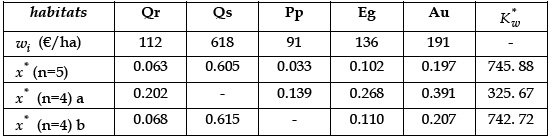
As we can observe from the results shown above index is rather sensitive in its maximum value and maximum point coordinates as we drop out the most valuable habitat, and stays about the same as we neglect the least valuable habitat; it is a plausible and logic performance as we have the partial derivative positive:  if
if  , showing monotonic behavior, increasing the value of the index correlative with the characteristic value.
Discussion
Science may be defined as methodical channeled knowledge (ZONNEVELD, 1990) and landscape ecology is the science and art of studying and influencing the relationship between spatial pattern and ecological processes across hierarchical levels of biological organizations and different scales in space and time (WU and HOBBS, 2007). As far as this paper is concerned only the compositional problem of the mosaic is discussed. Optimization of landscape pattern is often reduced to methods of spatial optimization, capturing spatial relationships between different land areas in the process of maximizing or minimizing an objective function subject to resource constraints (HOF and FLATHER, 2007). Nevertheless the compositional problem of the mosaic is in itself a research theme and, as an economic feature, we may consider discrete choice theory asking what factors affect the distribution of choice (GILBOA, 2009), under the perspective of maximization of expected utility. We may rewrite index as follows: 
where  means the average value - a linear function - of the set of economic values
  and
and  is a direct generalization of Shannon entropy measure; so Index makes an additive compromise between the traditional linear objective function and a nonlinear term we named index (CASQUILHO et al., 2003); I must emphasize that there is a substantial difference between indices and : the first is a weighted diversity measure and the second is a value index. In general, dealing with equilibrium points in dynamic systems, under potential formulation we consider minima while maxima are excluded and in probability formulation we consider maxima, while minima are excluded (HANSEN, 1993).
There has been in Portugal quite a long tradition of considering multiple use of forests as an economic feature (e.g. ALVES, 1963) and statements concerning sustainability of the mosaic under that perspective were made explicit as we see inGOMES (1985). Decisions at landscape level expresses tense compromises between economic and ecologic values (CASQUILHO, 1994) and landscape changes may be quite impressive in a short period of time: some decades may alter significantly the whole aspect of a region and the areas of different cultures or habitats (e.g. GASPAR and FIDALGO, 2002; FERREIRA, 2001). SANTOS (2001) provides a powerful conceptual device with cost-benefit analysis for the selection of optimal landscapes valuing alternative bundles and emphasizes the need for a multi-dimensional approach to landscape conservation. MINTER (1994)[3] said that valuation, through the very process of condensing complex issues into a single index, actually hides potential environmental conflicts; I subscribe that perspective and I have pointed that the most feasible numerical reduction of the value of a habitat in a landscape mosaic is a complex number, or two real numbers, economic and ecologic values (CASQUILHO, 2009).
]]> Index is not a traditional utility function as commonly defined in standard economics textbooks; it is a nonlinear function, an average value that approaches the notion of expected contributive value, as a compromise of intrinsic and context values, a syntactic construction defined under mathematical discourse consistency constraints with some semantic insight; O'HALLORAN (2008) reminds that contextual values attached to different choices or combinations of choices from semiotic resources are socially and culturally determined. Theory of Relevance advocates strategic reasoning in terms of the maximization of linguistic information and the minimization of the cognitive processing effort (PIETARINEN, 2007), where relevance itself is defined in terms of a trade-off between the effort needed to process some input and the informational benefit gained from undertaking that inferential processing (CANN et al., 2009); also the extent of contextual interaction with semantic processing indicates the importance of inference in deriving the meaning of an utterance and the impossibility that interpretation is strictly linear. Equilibrium semantics is a generalization of model theory and draws upon four central ideas: reference, use, indeterminacy and equilibrium (PARIKH and CLARK, 2007).
References
ALVES, A.A.M., 1963. O conceito florestal de uso múltiplo sob uma óptica de desenvolvimento económico. Agros 46(2): 141-150. [ Links ]
CANN, R., KEMPSON,R., GREGOROMICHELAKI, E., 2009. Semantics - An Introduction to Meaning in Language.Cambridge University Press, New York.
CASQUILHO, J., 1994. Valores na interface Ecologia/Economia. Ciência, Tecnologia e Sociedade 21: 15-22 [ Links ]
CASQUILHO, J., NEVES, M., REGO, F., 1997. Extensões da função de Shannon e equilíbrio de proporções - uma aplicação ao mosaico de paisagem. An. Inst. Sup. Agron. 46: 77-99. [ Links ]
CASQUILHO, J., 1999. Ecomosaico: índices para o diagnóstico de proporções de composição (PhD thesis). Universidade Técnica de Lisboa.
CASQUILHO J., NEVES, M., REGO, F., 2003. Hw index: Shannon function generalization. Report # 9/03. Instituto Superior de Agronomia, Lisboa.
CASQUILHO, J.P., 2009. Complex number valuation of habitats and information index of the landscape mosaic. Silva Lusitana 17(2): 171-180. [ Links ]
COVER, T.M., THOMAS, J.A., 2006. Elements of Information Theory (2nd ed.). John Wiley & Sons, Inc, New Jersey.
FERREIRA, D., 2001. Evolução da paisagem do montado no Alentejo interior ao longo do século XX: dinâmica e incidências ambientais. Finisterra 36(72): 179-193. [ Links ]
FORMAN, R.T.T., 1990. Ecologically Sustainable Landscapes: the Role of Spatial Configuration. In Changing Landscapes: An Ecological Perspective (I.S. Zonneveld and R.T.T. Forman eds), Springer-Verlag, New York, pp. 261-278.
FORMAN, R.T.T, 1995. Land Mosaics -The Ecology of Landscapes and Regions. Cambridge University Press, Cambridge.
Gaspar, J., Fidalgo, B., 2002. Evolução do Uso do Solo e Avaliação do Valor Paisagístico e de Recreio na Área de Paisagem Protegida da Serra do Açor. Silva Lusitana 10(2): 179-194. [ Links ]
HANSEN, V.L., 1993. Geometry in Nature. A K Peters Ltd., Wellesley, Massachusetts.
GILBOA, I., 2009. Theory of Decision under Uncertainty. Cambridge University Press, New York.
GILLER, P.S., 1984. Community Structure and the Niche. Chapman and Hall, London.
GOMES, A.M.A., 1985. Uma Alternativa Sectorial. Publicações Ciência e Vida, Lisboa.
HOBBS, R., WU, J., 2007. Perspectives and prospects of landscape ecology. In Key Topics in Landscape Ecology (J. Wu and R. Hobbs Ed.). Cambridge University Press. Cambridge, pp. 3-8.
]]> HOF, J., FLATHER, C., 2007. Optimization of landscape pattern. In Key Topics in Landscape Ecology (J. Wu and R. Hobbs ed). Cambridge University Press. Cambridge, pp. 143-160.KLIR, G.J., 2006. Uncertainty and Information – Foundations of Generalized Information Theory, John Wiley & Sons, Inc., New Jersey.
KORNREICH, P., 2008. Mathematical Models of Information and Stochastic Systems. CRC Press, Boca Raton.
LI, H., WU, J., 2007. Landscape pattern analysis: key issues and challenges.In Key Topics in Landscape Ecology (J. Wu and R. Hobbs ed.). Cambridge University Press, Cambridge, pp. 39-61.
O'HALLORAN, K.L., 2008. Mathematical Discourse – Language, Symbolism and Visual Images. Continuum, London.
PARIKH, P., CLARK, R., 2007. An introduction to equilibrium semantics for natural language. In Game Theory and Linguistic Meaning (A.-V. Pietarinen, ed.). Elsevier Ltd, Oxford, pp. 149-158.
PDFCIN, 2007. Plano Defesa da Floresta Contra Incêndio de Nisa. Gabinete Técnico Florestal de Nisa e Florasul. Câmara Municipal de Nisa.
PIETARINEN, A.-V., 2007. An invitation to language and games. In Game Theory and Linguistic Meaning (A.-V. Pietarinen, ed.). Elsevier Ltd, Oxford, pp. 1-16.
SANTOS, J.M.L, 2001. Valuing Alternative Bundles of Landscape Attributes: cost-benefit analysis for the selection of optimal landscapes. Finisterra 36(72): 207-239. [ Links ]
SOLÉ, R.V., BASCOMPTE, J., 2006. Self-Organization in Complex Ecosystems. Princeton University Press, Princeton.
]]>TURNER, M.G., 1989. Landscape ecology: the effect of pattern on process. Annual Review of Ecology and Systematics 20: 171-197. [ Links ]
SHANNON, C.E., 1948. A mathematical theory of communication. Bell Syst.Tech. Journal 27: 379-423. [ Links ]
STRATTON-LAKE, P., 2004. Kant, Duty, and Moral Worth. Routledge, London.
WU, J., HOBBS, R., 2002. Key issues and research priorities in landscape ecology: an idiosyncratic synthesis. Landscape Ecology 17: 355-65. [ Links ]
WU, J., HOBBS, R., 2007. Landscape ecology:s the state-of-the-science.In Key Topics in Landscape Ecology (J. Wu and R. Hobbs Ed.). Cambridge University Press. Cambridge, pp. 271-287.
ZONNEVELD, I., 1990. Scope and Concepts of Landscape Ecology as an Emerging Science. In Zonneveld and Forman (eds.) Changing Landscapes: An Ecological Perspective, Springer-Verlag, New York pp. 1-20.
[1] Cit in KLIR (2006).
[2] Shannon entropy measure is originally computed with base 2 logarithms but here I use nepperian logarithms as it does not affect the results; unities are therefore named nits.
[3] Cit. In SANTOS (2001).
]]>Entregue para publicação em Janeiro de 2010
Aceite para publicação em Março de 2010
]]>