Károly Rédei*, Irina Veperdi**, Margarida Tomé*** and Paula Soares****
*Investigador Coordenador
**Investigador
Forest Research Institute. Várkerület 30/A, 9600 Sárvár, HUNGARY
***Professora Catedrática
****Técnica Superior
Centro de Estudos Florestais. Instituto Superior de Agronomia. Universidade Técnica de Lisboa, Tapada da Ajuda, 1349-017 Lisboa, PORTUGAL
]]> Abstract
The importance of the establishment of short-rotation tree plantations for fuel production has been of international interest for many years. In this context, in Hungary, these plantations have been conducted for a long time. In this country, the black locust (Robinia pseudoacacia L.) is one of the most important stand-forming tree species, covering approximately 23% of the forested land (410 000 ha) and providing about 19% of the annual timber output. This paper describes an experimental energy plantation that was established in Helvécia (Central-Hungary, sand-soil region) using common black locust and its improved cultivars. The site may be considered as representative of an average yield class for black locust in Hungary. The experimental plantation was established with a spacing of 1.5 m x 1.0 m and included common black locust and two cultivars, 'Üllői' and 'Jászkiséri, as well as a plot regenerated by coppice. At the age of 7, the highest annual increment in stem oven-dry mass was produced by the cultivar 'Üllői' (9.7 Mg ha-1 yr-1) followed by the common black locust (8.4 Mg ha-1 yr-1) and the cultivar 'Jászkiséri (7.6 Mg ha-1 yr-1). In the plot of coppice origin, dendromass ranged from 6 to 8 Mg ha-1 yr-1 on an average.
Key words: Black locust (Robinia pseudoacacia L.); energy tree plantation; dendromass
Plantações Energéticas de Robínia (Robinia pseudoacacia L.) Na Hungria: Uma Revisão
Sumário
A importância da instalação de plantações florestais exploradas em curta rotação para produção de biomassa tem sido internacionalmente reconhecida ao longo dos anos. Neste contexto, na Hungria, estas plantações têm já longa tradição. Na Hungria, a Robinia pseudoacacia L. é uma das espécies mais importantes correspondendo a cerca de 23% da área florestal (410 000 ha) e fornecendo aproximadamente 19% da madeira cortada anualmente. Este trabalho descreve um ensaio de plantações energéticas que foi instalado na Helvécia (região central da Hungria, com solos arenosos) com Robinia pseudoacacia comercial e com variedades geneticamente melhoradas. Este local pode ser considerado como representativo de uma classe de produção média para a espécie neste país. O ensaio foi instalado a compasso 1.5 m x 1.0 m e incluiu Robinia pseudoacacia comercial e duas variedades 'Üllői' e 'Jászkiséri, bem como uma parcela explorada em talhadia. Aos 7 anos, o maior acréscimo anual em biomassa do tronco foi obtido pela variedade 'Üllői' (9.7 Mg ha-1 ano-1) seguido, respectivamente, pela planta comercial (8.4 Mg ha-1 ano-1) e pela variedade 'Jászkiséri (7.6 Mg ha-1 ano-1). Na parcela explorada em talhadia os valores de biomassa variaram, em média, entre 6 e 8 Mg ha-1 ano-1.
Palavras-chave: Robinia pseudoacacia L.; plantações energéticas; biomassa
Plantation de Robinia pseudoacacia L. en Cultures Énergétiques à Courte Rotation en Hongrie. Une Analyse
]]> RésuméL'importance de l'établissement de plantations forestières de courte rotation pour la production de biomasse a été internationalement reconnu au fil des ans. Dans ce contexte, en Hongrie, les plantations exploitées aux courtes rotations ont déjà une longue tradition. En Hongrie, Robinia pseudoacacia L. est l'une des espèces les plus importantes correspondant à environ 23% de la superficie forestière (410 000 ha) et fournit environ 19% de bois coupé. Ce document décrit un dispositif expérimental pour des plantations énergétiques qui a été installé en Helvétie (centre de la Hongrie, avec des sols sableux) avec Robinia pseudoacacia commercial et variétés améliorées génétiquement. Cet endroit peut être considéré comme représentatif d'une catégorie de la production moyenne pour l'espèce dans ce pays. Le dispositif expérimental a été fixé à espacement de 1.5m x 1.0m et comprenait Robinia pseudoacacia commercial et deux variétés, Ulloi et Jászkiséri,et une partie exploitée en taillis. À 7 ans, la plus forte augmentation de la biomasse du tronc a été produite par la variété Ulloi (9.7 Mg ha-1 an-1) suivie respectivement par la plante commerciale (8.4 Mg ha-1 an-1) et la variété Jászkiséri (7.6 Mg ha-1 an-1). Dans la partie exploitée en taillis les valeurs de la biomasse varient en moyenne entre 6 et 8 Mg ha-1 an-1.
Mots clés: Robinia pseudoacacia L.; plantations énergétiques; biomasse
Introduction
The energy crisis of the early 1970's stimulated renewed interest in short-rotation crops (tree plantations and forest stands) in temperate countries. Planted crops, which are subsequently coppiced on a 4 to 5 years cycle, are economically valued as alternative sources of wood, charcoal, and liquid fuels, a basis for chemical processes, wood pulp, and sometimes as a fodder. Forest crops (tree plantations and forest stands), of course, are not the only sources of biomass for energy, though they are among the most efficient in terms of the ratios of energy contained in the harvested crop to total energy input.
In Hungary the demand for timber is high leading to an annual wood harvest of about 7 million cubic meters. Wood harvested is used by building industry, furniture industry and packaging, and paper industries. About 3 million cubic meters of wood is used each year for energy fuel and approximately 0.5 million cubic meters of used-wood products is annually consumed to produce heat energy for industry or directly marketed for the population.
Considering the total wood-consumption of black locust, 55% is utilized for fuel and 45% is used as industrial raw material. Only about 70% of the country’s demand for timber can be met from current inland forest production. According to the EU regulations the use of renewable energy sources in Europe should be increased by 20% till 2020. In Hungary this value should be 13%. Plantations established for producing biomass (above-ground dendromass) and managed on a short rotation in general, may contribute to meet the demand of wood for energy purpose as a renewable source.
According to HALUPA and RÉDEI (1992), the major advantages of establishing energy crops are:
- they are renewable (continuous) and reproduce systematically;
]]> - they provide an alternative for utilizing lands on which agricultural production is temporarily abandoned;- they are environmentally compatible (protect against erosion) if the right silvicultural techniques are applied;
- they decrease the use of fossil energy sources, which pollute the environment with sulphur and ash;
- the ash of burnt wood can be used as nutrient supplement for plant crops;
- by establishing large scale energy plantations, the cost of geological research in connection with mining and mine openings can be reduced;
- they can be distributed in the country more uniformly than the fossil energy sources;
- capital for establishment is considerable less and the length of time for a return on the investment is shorter than that of the fossil energy sources, especially compared to deep underground coal-mining;
- their wood material can be used at most any time, and plantations can be established near the area of consumption, thus reducing the transportation cost;
- they could contribute to the employment of people in the given area.
Broadleaved species, rather than coniferous, are generally planted for short-rotation crops for two reasons:
]]> - costs can be reduced if more than one harvest can be made from one establishment operation; hence one of the most important attributes of a species for energy use is that it should be vigorously coppiced;- unlike evergreen conifers, deciduous broadleaved trees accumulate less assimilated material in their leaves and the leaves are, per unit area, photosynthetically more efficient than those of conifers; hence a larger amount of assimilate is available from an early age for the growth of stems, branches and roots.
In Hungary, black locust is the most promising species for energy tree plantations (HALUPA and RÉDEI, 1992, RÉDEI, 2003). Under the country's site conditions the following tree species would also be suitable for this purpose: Populus, Salix species and Ulmus pumilla
This paper describes the results of experimental energy plantations that were established in Hungary in order to determine the species and cultivars which produce the highest yield on the available sites, and to develop the most productive and profitable silviculture.
The role of black locust in establishing energy crops in Hungary
In Hungary, the black locust covered 37,000 ha in 1885, 109,000 ha in 1911, 186,000 ha in 1938 and 410,000 ha in 2007. This area represents approximately 23% of all forested lands in Hungary. One-third of black locust stands are high forests, while two-thirds of them are of coppice origin. In the 1960s, Hungary had more black locust forests than all the other European countries (RÉDEI, 2003).
Black locust timber can be used by industry (mining, construction, furniture) or by agriculture (post and pole wood), and black locust stands are the main basis for Hungarian apiculture and honey production. The black locust is one of the most suitable tree species for establishing energy plantations and for transforming existing traditional forests into energy forests.
The frequently expressed misconception that rapid growth rate is associated with low wood density is clearly not proved by black locust. Not only the species presents a very high density (690 kg/m3 ), but it has a fast height growth rate, 2–6 cm/day, which places it among the most fast growing plants in its juvenile stage. With this combination of both high density and volume increment, black locust can achieve impressive dendromass yield when growing on good sites. Moreover, because of its ability to fix atmospheric nitrogen, it requires little or no nitrogen fertilization. Considering these growth criteria (volume and density) and the symbiotic associations of both bacteria and mycorrhizal fungi, black locust offers an excellent opportunity for energy plantations.
Black locust energy forests can also be established by coppicing. Advantages of energy forests of coppice origin are that the cost of establishment is low compared to that of soil preparation, plantation and cultivation. From the developed root system of the previous stand, a large biomass (above-ground dendromass) can be produced within a short time period. Disadvantages of these forests are that the distribution of trees in coppice stands is not as uniform as in plantations optimized for energy production. In coppice stands the quantity of the produced above-ground dendromass is lower and the length of growing time is highly influenced by the uneven distribution of stems.
]]> More and more agricultural land is being taken out of use for food crops, some of which can be used for energy production plantations. Black locust is one of the best tree species for this purpose, thanks to its excellent properties for energy production, such as vigorous growing potential in the juvenile phase, excellent coppicing ability, high density of the wood, high dry matter production, favourable combustibility of the wood, relatively fast drying and easy harvesting and wood processing (HALUPA and RÉDEI, 1992; HALUPA et al., 2000).
Materials and methods
Data used in this study came from a short-rotation plantation trial established in Hungary in the subcompartment Helvécia 80A (Central-Hungary, Danube-Tisza Interfluves). The subcompartment presents slightly humous sandy soil without ground-water influence. The annual precipitation amounts to only 500 mm in some years, while in the dry summer period it is less than 300 mm, meaning that water supply is the limiting factor influencing the dendromass production. The trial at Helvécia is not on the very best sites available but can be considered as representative of an average yield class site for black locust in Hungary. Therefore the results are more representative of the average than of the potential productivity of this particular tree species in Hungary (RÉDEI and VEPERDI, 2005; RÉDEI and VEPERDI, 2007).
The trial was established using a spacing of 1.5 m x 1.0 m, with three repetitions and four treatments representing different plant material: common black locust and four cultivars 'Üllői', 'Jászkiséri', 'Nyírségi', and 'Kiscsalai'. Each treatment corresponds to a plot of 15 by 20 m. The planting material was one-year-old rooted cuttings (in the case of cultivars) and one-year-old seedlings (in the case of common black locust).
In the same subcompartment, tree stand surveys were carried out in two experimental plots where common black locust was regenerated by root suckers (coppice).
Measurements were made at the ages of 3, 5 and 7 years. At each one of these ages, all stems in each plot were counted and 10 trees were randomly selected for destructive sampling and its volume (v) was determined with Smalian's formula (VAAN LAAR and AKCA, 1997). The mean tree volume (vmean) was computed as an arithmetic mean of the felled trees volume. Stand volume (Vha-1) was estimated through multiplication of vmean by stand density (Nha-1). In the plots of black locust of coppice origin the measurements were carried out at the age of 4 by using the above-mentioned method including counting all the trees. The green dendromass was calculated (weighted) for the whole tree including branches and leaves, which amounted to 5 to 7 per cent of the total weight. The stem oven-dry dendromass was determined in laboratory using a drying temperature of 70oC.
Results
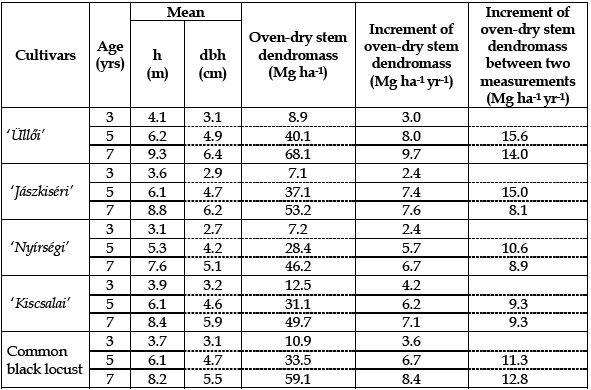
The evaluation of the trial established with black locust cultivars at the age of 3, 5 and 7 can be seen in Table 1. At the age of 5, the highest increment of oven-dry stem dendromass (being the basis of economic calculations) was produced by the cultivar 'Üllői' (8.0 Mg ha-1 yr-1), followed by 'Jászkiséri' (7.4 Mg ha-1 yr-1) and the common black locust (6.7 Mg ha-1 yr1). At the age of 7 the order was the following: 'Üllői' cultivar (9.7 Mg ha-1 yr-1), common black locust (8.4 Mg ha-1 yr-1) and 'Jászkiséri' cultivar (7.6 Mg ha-1 yr-1).
]]>Table 1 - Evaluation of a short-rotation plantation with black locust cultivars on the base of plot averages (Helvécia 80/A); Spacing: 1.5 m x 1.0 m
Table 2 gives the most important structure and dendromass factors of the two black locust short-rotation crops of coppice origin obtained and accounted on the base of stand surveys at the age of 4. Considering that height (h) and mean diameter (d) values are almost the same, mortality leading to different stand densities must have been the responsible for the differences in the stand oven-dry dendromass. The difference of 57% in stand density resulted in a surplus of about 15% in increment of oven-dry dendromass.
Table 2 - Evaluation of a short-rotation black locust stand of coppice origin (Helvécia 80/A).
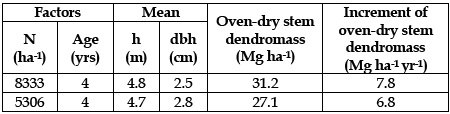
The data from both the planted and the coppiced short-rotation crops indicates that it is not reasonable to harvest in the first three years, as the yield in oven-dry weight between the fourth and seventh years is 2-3 times higher than it is in the previous years in spite of having a decrease in the increment of oven-dry stem dendromass in the period between two measurements. This result is important as it is known that harvesting too early may also increase the population of biotic pests as well (RÉDEI and VEPERDI, 2005).
]]>Discussion and conclusions
The results of the experimental plots presented here are preliminary ones to the evaluation of short-rotation crops for energy purpose in Hungary.
Dendromass yields of tree plantations and forest stands for energy purpose can be very promising but show great variation depending upon site, species, and climatic region. From the first experimental results in the 1970s, CANELL and SMITH (1980) and PARDÉ (1980) suggested that in most temperate regions it would not be realistic to give field predictions higher than 6 to 8 Mg ha-1 yr-1 of wood dry weight in stems and branches. In the USA, black locust increment in oven-dry weight of energy plantations from different temperate climate region ranged from 6 to 12 Mg ha-1 yr-1 (FREDERICK and MEGALOS,1989), similar to ones found in the trial described in this paper. First rotation yields are usually lower than succeeding cuts at 7 to 10 years intervals (GEYER, 1992) as it was also found in the present trial.
In Hungary, as mentioned above, black locust is the most suitable tree species for establishing energy tree plantations. Technology improvements in converting wood to energy will increase wood use and help meet the rising global demand for energy. Black locust is planted extensively world wide and has desirable fuel wood characteristics. Its low moisture content enables reduced handling costs and enhances desirability for efficient energy conversion. Black locust is considered the best fuel wood in Hungary, having good combustibility even when wet.
The results obtained in the experimental plots described in this paper show that the quantity of dendromass strongly depends on the plant material (cultivars) as well as on the number of stems per hectare. These factors are also important for the determination of the optimum length of the growing cycle.
The results of the presented experiments are the initial steps in the complete evaluation of short-rotation crops established for energy purpose. These results should be confirmed by other experiments to be carried out in similar site conditions and with similar cultivar composition.
Acknowledgements
The research on management of black locust short rotation plantations is partly supported by the project NKTH-TéT: PT-16/2007.
]]>References
CANELL, M.G.R., SMITH, R.I., 1980. Yields of minirotation closely spaced hardwood: temperate regions: review and appraisal. Forest Science 26: 415-428. [ Links ]
FREDERICK, D., MEGALOS, M.A., 1989. Woody biomass energy plantations. In Biomass Handbook, Gordon and Breach Sci. Pub., 192–199.
GEYER, W., 1992. Characteristics and Uses of Black Locust for Energy. In Proceedings of International Conference on Black Locust: Biology, Culture and Utilization, Michigan State University, 221-236.
HALUPA, L., RÉDEI, K., 1992. Establishment for forests primarily for energetic purpose. In Proceedings of the Hungarian Forest Research Institute (Erdészeti Kutatások), Budapest, 82–83: 304-312.
HALUPA, L., VEPERDI, G., VEPERDI, I., 2000. Evaluation of the energy-production plantations. In Proceedings of the Hungarian Forest Research Institute (Erdészeti Kutatások), Budapest, 90: 87–98.
PARDÉ, J., 1980. Forest biomass. Forestry Abstracts 41: 343-362. [ Links ]
RÉDEI, K. (edit.), 2003. Black Locust (Robinia pseudoacacia L.) Growing in Hungary. Second improved edition, Publications of the Hungarian Forest Research Institute, Budapest.
RÉDEI, K., VEPERDI, I., 2005. Robinienenergieholzplantagen. Forst und Holz 11: 468-469. [ Links ]
RÉDEI, K., VEPERDI, I., 2007. Management and yield of black locust energy plantations. In The biological basis of improvement of black locust growing. Agroinform Kiadó, Budapest.
VAN LAAR, A., AKCA, A., 1997. Forest Mensuration. Cuvilliers, Göttingen.
Entregue para publicação em Março de 2010
Aceite para publicação em Maio de 2010
]]>