<?xml version="1.0" encoding="ISO-8859-1"?><article xmlns:mml="http://www.w3.org/1998/Math/MathML" xmlns:xlink="http://www.w3.org/1999/xlink" xmlns:xsi="http://www.w3.org/2001/XMLSchema-instance">
<front>
<journal-meta>
<journal-id>0870-6352</journal-id>
<journal-title><![CDATA[Silva Lusitana]]></journal-title>
<abbrev-journal-title><![CDATA[Silva Lus.]]></abbrev-journal-title>
<issn>0870-6352</issn>
<publisher>
<publisher-name><![CDATA[Unidade de Silvicultura e Produtos Florestais]]></publisher-name>
</publisher>
</journal-meta>
<article-meta>
<article-id>S0870-63522011000100005</article-id>
<title-group>
<article-title xml:lang="en"><![CDATA[Ecomosaic Composition and Expected Utility Indices]]></article-title>
<article-title xml:lang="pt"><![CDATA[Composição de Ecomosaicos e Índices de Utilidade Esperada]]></article-title>
<article-title xml:lang="fr"><![CDATA[Composition d'Ecomosaïques et Indices de l'Utilité Attendue]]></article-title>
</title-group>
<contrib-group>
<contrib contrib-type="author">
<name>
<surname><![CDATA[Casquilho]]></surname>
<given-names><![CDATA[José Pinto]]></given-names>
</name>
<xref ref-type="aff" rid="A01"/>
</contrib>
</contrib-group>
<aff id="A01">
<institution><![CDATA[,Instituto Superior de Agronomia Centro de Ecologia Aplicada Prof. Baeta Neves ]]></institution>
<addr-line><![CDATA[LISBOA ]]></addr-line>
</aff>
<pub-date pub-type="pub">
<day>00</day>
<month>00</month>
<year>2011</year>
</pub-date>
<pub-date pub-type="epub">
<day>00</day>
<month>00</month>
<year>2011</year>
</pub-date>
<volume>19</volume>
<numero>1</numero>
<fpage>55</fpage>
<lpage>65</lpage>
<copyright-statement/>
<copyright-year/>
<self-uri xlink:href="http://scielo.pt/scielo.php?script=sci_arttext&amp;pid=S0870-63522011000100005&amp;lng=en&amp;nrm=iso"></self-uri><self-uri xlink:href="http://scielo.pt/scielo.php?script=sci_abstract&amp;pid=S0870-63522011000100005&amp;lng=en&amp;nrm=iso"></self-uri><self-uri xlink:href="http://scielo.pt/scielo.php?script=sci_pdf&amp;pid=S0870-63522011000100005&amp;lng=en&amp;nrm=iso"></self-uri><abstract abstract-type="short" xml:lang="en"><p><![CDATA[Forest planning is a major issue for future development of regions, and landscape changes reflect to a large extent land-use/cover patterns related to economic and option's values as driving forces. Managing for reducing variability may have high costs of stability or resilience. Decision theory relies on maximizing an average or expected value of a preference pattern expressed by utility functions. In this paper I discuss quantitative indices bonded to expected utility concepts that may provide diagnosis tools and become generators of the relative extension of the different habitats that compose an ecomosaic. The indices combine characteristic values and context values in contributive values, defined in a normalized measure space. Scenarios of composition for forest planning in the region of Nisa, Portugal, are discussed and benchmarked with standard measures: mean economic value, related to recover costs of forest habitats, and landscape diversity. Situation theory and relevance theory are axiomatic baselines of the abductive process and heuristic procedures here developed.]]></p></abstract>
<abstract abstract-type="short" xml:lang="pt"><p><![CDATA[O planeamento florestal integrado é fundamental para o desenvolvimento futuro das regiões e as alterações na paisagem reflectem em grande medida padrões de uso da terra e de cobertos florestais relacionados com valores económicos e de opção actuando como forças motrizes. Gerir para reduzir a variabilidade pode ter altos custos de estabilidade ou de resiliência. A teoria da decisão baseia-se na maximização do valor médio ou esperado de um padrão de preferências expresso por funções de utilidade. Neste artigo discutem-se índices quantitativos que podem fornecer ferramentas de diagnóstico e ser geradores da extensão relativa dos diferentes habitats que compõem um ecomosaico. Os índices combinam valores característicos com valores de contexto em valores contributivos definidos num espaço normalizado de medida. Discutem-se cenários de composição de planeamento florestal para a região de Nisa, Portugal, aferidos com medidas padronizadas: valor económico médio, relacionado com custos de reconstituição de habitats, e diversidade paisagística. A teoria da situação e a teoria da relevância são invocadas como linhas axiomáticas de base do procedimento heurístico e do processo abdutivo aqui apresentados.]]></p></abstract>
<abstract abstract-type="short" xml:lang="fr"><p><![CDATA[La planification forestièreest un enjeu majeur pour le développement futur des régions et les changements de paysage reflètent dans une large mesure les forces motrices rapportés avec des valeurs économiques et d'option en normes d'utilisation de la terre et des couverts forestiers. Ménager pour réduire la variabilité peut avoir des frais élevés de stabilité ou de résilience. La théorie de la décision s'appuie sur la maximisation de la valeur moyenne ou attendue d'un schéma de préférences exprimée par des fonctions d'utilité. Dans cet article on discute des indices quantitatives, fonctions d'utilité attendue, qui peuvent fournir des outils de diagnostic et générer des scénarios concernant l'extension relative des habitats qui composent un ecomosaic. Les indices combinent les valeurs caractéristiques et valeurs de contexte dans des valeurs contributives définies dans un espace normalisé de mesure. On discute aussi des scénarios de composition pour la région de Nisa, Portugal, comparés en termes de mesures standard: la valeur économique moyenne liée aux frais de reconstituer les habitats et la diversité du paysage. La théorie de la situation et la théorie de la pertinence sont des lignes axiomatiques de la procédure heuristique et de la démarche abductive ici présentées.]]></p></abstract>
<kwd-group>
<kwd lng="en"><![CDATA[Forest planning]]></kwd>
<kwd lng="en"><![CDATA[decision theory]]></kwd>
<kwd lng="en"><![CDATA[contributive values]]></kwd>
<kwd lng="en"><![CDATA[heuristic procedure]]></kwd>
<kwd lng="en"><![CDATA[Nisa]]></kwd>
<kwd lng="en"><![CDATA[Portugal]]></kwd>
<kwd lng="pt"><![CDATA[Planeamento florestal]]></kwd>
<kwd lng="pt"><![CDATA[teoria da decisão]]></kwd>
<kwd lng="pt"><![CDATA[valores contributivos]]></kwd>
<kwd lng="pt"><![CDATA[procedimento heurístico]]></kwd>
<kwd lng="pt"><![CDATA[Nisa]]></kwd>
<kwd lng="pt"><![CDATA[Portugal]]></kwd>
<kwd lng="fr"><![CDATA[Planification forestière]]></kwd>
<kwd lng="fr"><![CDATA[théorie de la décision]]></kwd>
<kwd lng="fr"><![CDATA[valeurs contributives]]></kwd>
<kwd lng="fr"><![CDATA[procédure heuristique]]></kwd>
<kwd lng="fr"><![CDATA[Nisa]]></kwd>
<kwd lng="fr"><![CDATA[Portugal]]></kwd>
</kwd-group>
</article-meta>
</front><body><![CDATA[ 
	    <p><b>Ecomosaic Composition and Expected Utility Indices</b></p>

	    <p>&nbsp;</p>

	    <p><b>Jos&eacute; Pinto Casquilho</b></p>

	    <p>Researcher</p>

	    <p>Centro de Ecologia Aplicada "Prof. Baeta Neves" (CEABN). Instituto Superior de Agronomia. Tapada da Ajuda, 1349&#45;017 LISBOA</p>

	    <p>&nbsp;</p>

	    <p><b>Abstract</b></p> 
	    <p>Forest planning is a major issue for future development of regions, and landscape changes reflect to a large extent land&#45;use/cover patterns related to economic and option's values as driving forces. Managing for reducing variability may have high costs of stability or resilience. Decision theory relies on maximizing an average or expected value of a preference pattern expressed by utility functions. In this paper I discuss quantitative indices bonded to expected utility concepts that may provide diagnosis tools and become generators of the relative extension of the different habitats that compose an ecomosaic. The indices combine characteristic values and context values in contributive values, defined in a normalized measure space. Scenarios of composition for forest planning in the region of Nisa, Portugal, are discussed and benchmarked with standard measures: mean economic value, related to recover costs of forest habitats, and landscape diversity. Situation theory and relevance theory are axiomatic baselines of the abductive process and heuristic procedures here developed.</p>

	    <p><b>Key words:</b> Forest planning; decision theory; contributive values; heuristic procedure; Nisa, Portugal</p>

	    ]]></body>
<body><![CDATA[<p>&nbsp;</p>

	    <p><b>Composi&ccedil;&atilde;o de Ecomosaicos e &Iacute;ndices de Utilidade Esperada</b></p>

	    <p><b>Sum&aacute;rio</b></p> 
	    <p>O planeamento florestal integrado &eacute; fundamental para o desenvolvimento futuro das regi&otilde;es e as altera&ccedil;&otilde;es na paisagem reflectem em grande medida padr&otilde;es de uso da terra e de cobertos florestais relacionados com valores econ&oacute;micos e de op&ccedil;&atilde;o actuando como for&ccedil;as motrizes. Gerir para reduzir a variabilidade pode ter altos custos de estabilidade ou de resili&ecirc;ncia. A teoria da decis&atilde;o baseia&#45;se na maximiza&ccedil;&atilde;o do valor m&eacute;dio ou esperado de um padr&atilde;o de prefer&ecirc;ncias expresso por fun&ccedil;&otilde;es de utilidade. Neste artigo discutem&#45;se &iacute;ndices quantitativos que podem fornecer ferramentas de diagn&oacute;stico e ser geradores da extens&atilde;o relativa dos diferentes habitats que comp&otilde;em um ecomosaico. Os &iacute;ndices combinam valores caracter&iacute;sticos com valores de contexto em valores contributivos definidos num espa&ccedil;o normalizado de medida. Discutem&#45;se cen&aacute;rios de composi&ccedil;&atilde;o de planeamento florestal para a regi&atilde;o de Nisa, Portugal, aferidos com medidas padronizadas: valor econ&oacute;mico m&eacute;dio, relacionado com custos de reconstitui&ccedil;&atilde;o de habitats, e diversidade paisag&iacute;stica. A teoria da situa&ccedil;&atilde;o e a teoria da relev&acirc;ncia s&atilde;o invocadas como linhas axiom&aacute;ticas de base do procedimento heur&iacute;stico e do processo abdutivo aqui apresentados.</p>

	    <p><b>Palavras&#45;chave:</b> Planeamento florestal; teoria da decis&atilde;o; valores contributivos; procedimento heur&iacute;stico; Nisa, Portugal</p>

	    <p><b>&nbsp;</b></p>

	    <p><b>Composition d'Ecomosa</b><b>&iuml;</b><b>ques et Indices de l'Utilit&eacute; Attendue</b></p>

	    <p><b>R&eacute;sum&eacute;</b></p> 
	    <p>La planification <i>foresti&egrave;re</i>est un enjeu majeur pour le d&eacute;veloppement futur <i>des r&eacute;gions</i> et les changements de paysage refl&egrave;tent dans une large mesure les forces motrices rapport&eacute;s avec des valeurs &eacute;conomiques et d'option en normes d'utilisation de la terre et des couverts forestiers. M&eacute;nager pour r&eacute;duire la variabilit&eacute; peut avoir des frais &eacute;lev&eacute;s de stabilit&eacute; ou de r&eacute;silience. La th&eacute;orie de la d&eacute;cision s'appuie sur la maximisation de la valeur moyenne ou attendue d'un sch&eacute;ma de pr&eacute;f&eacute;rences exprim&eacute;e par des fonctions d'utilit&eacute;. Dans cet article on discute des indices quantitatives, fonctions d'utilit&eacute; attendue, qui peuvent fournir des outils de diagnostic et g&eacute;n&eacute;rer des sc&eacute;narios concernant l'extension relative des habitats qui composent un ecomosaic. Les indices combinent les valeurs caract&eacute;ristiques et valeurs de contexte dans des valeurs contributives d&eacute;finies dans un espace normalis&eacute; de mesure. On discute aussi des sc&eacute;narios de composition pour la r&eacute;gion de Nisa, Portugal, compar&eacute;s en termes de mesures standard: la valeur &eacute;conomique moyenne li&eacute;e aux frais de reconstituer les habitats et la diversit&eacute; du paysage. La th&eacute;orie de la situation et la th&eacute;orie de la pertinence sont des lignes axiomatiques de la proc&eacute;dure heuristique et de la d&eacute;marche abductive ici pr&eacute;sent&eacute;es.</p>

	    <p><b>Mots cl&eacute;s:</b> Planification <i>foresti&egrave;re</i><i>;</i> th&eacute;orie de la d&eacute;cision; valeurs contributives; proc&eacute;dure heuristique; Nisa, Portugal</p>

	    ]]></body>
<body><![CDATA[<p>&nbsp;</p>
	
	    <p><i>&#91;...&#93; the work to be carried out, aiming at multiple objectives, is of multiple&#45;use, in the broadest sense of the word, and materializes associating diverse functions in the same areas and partitioning areas by separate functions or function groups, always in a mosaic that ensures the desired sustainable and balanced flow of goods and indirect benefits.</i></p>

	    <p>A. M. de Azevedo Gomes<a name="_ednref1"></a><a href="#_edn1" title="">&#91;1&#93;</a></p>

	    <p><b>&nbsp;</b></p>

	    <p><b>Introduction</b></p>

	    <p>Forest planning of a region is a major issue that begins with defining main categories of habitats or forest types presumed to be ecologically suitable and economically relevant, eventually assigned to specific areas. Such an utterance provides a rationale where planning for the future is considered valuable, anchored to a concept of knowledge as source of progress, and progress is conceived linked to clues of enhancing productivity and promoting sustainability and diversity of the forest landscape, perceived as an integrated object, described as a mosaic &#45; a metonymy of a territory engraved as a tile inspired by the muse. Forest planning in Portugal has long been characterized as an integrated approach, a multidisciplinary task, rooting at both socioeconomic and ecological contexts (ALVES, 1982).</p>

	    <p>Problems arise at many levels, but may be the first level to be considered is what PEARCE (2001) points out as: sustainable forests pay, but unsustainable forests pay more, although it is potentially large, but unknown, the value of the forest stock as scientific information that may be lost if irreversible deforestation continues apace. It is referred that harvesting activities might be scheduled over the landscape so that older forests might be sustained over time and arranged in large enough patches to be effective for wildlife habitat and natural ecological processes (HOGANSON <i>et al.</i>, 2004). Under an economic perspective, the crude benchmark rule for conservation of resources is that the economic value for conservation must exceed the economic value of conversion.</p>

	    <p>Economists in general think of values as instrumental quantities, meaning that they are derived from some objective function, the goal or purpose that is being thought, as for the case of maximizing human welfare or utility (PEARCE and PEARCE, 2001).</p>

	    <p>In mixed forests diversity has to be considered as they are managed not only for timber production but also for recreation, ecology, diversity, aesthetics, game, etc (GON&Ccedil;ALVES <i>et al</i>., 2010), and such a concept may be transferred to a landscape of different forest types or habitats, including shrublands. Landscape may be discussed as a set of values ordered within a view (CAUQUELIN, 2008), where the local ecosystems or land uses are repeated in similar form throughout, and mosaic stability, which includes analysis of land&#45;use changes, is a key element of sustainable development and analysis.</p>

	    <p>Recent studies clarify the extent that land&#45;use/cover change is the result, and a cause, of interaction between human societies and the environment (VALBUENA <i>et al.</i>, 2010; VERBURG <i>et al.</i>, 2010). The concept of landscape functions prevails, defined as the capacity or potential of landscapes to provide services such as food and fiber, regulation of environmental quality, as well as aesthetic qualities (BOLLIGER and KIENAST, 2010) and historical and future land&#45;use and land&#45;cover change have to be taken into account, namely landscape structure and composition.</p>

	    ]]></body>
<body><![CDATA[<p>&nbsp;</p>

	    <p><i>Forest planning and landscape ecology</i></p>

	    <p>Forest planning is merged in these days with landscape ecology, a science provided for the marriage of geography and biology (ZONNEVELD, 1990) and the act of sustainable planning and design is defined as a heuristic process (LEIT&Atilde;O and AHERN, 2002).Twentieth century management activities have significantly influenced forest landscape<a name="ref&#45;Wolter&#45;etal2002.1"></a><a name="ref&#45;Loefman&#45;etal2003.1"></a>s, and altered spatial patterns of physiognomies, cover types and structural conditions. In southern Portugal ACACIO <i>et al.</i> (2009) concluded that cork oak forests have been decreasing since 1985 along the time series 1958&#45;2002, while <i>Cistus</i> shrublands have been the most persistent and expanding, correlated with wildfires. HOUET <i>et al.</i> (2010) conclude that projection of future landscape changes requires an understanding and integration of past landscape trends, current land change processes and feedbacks, and the incorporation of plausible assumptions or scenarios, where the temporal dimension of landscapes has to be considered in order to monitor, model and assess human/nature interactions.</p>

	    <p>&nbsp;</p>

	    <p><i>Ecomosaic</i></p>

	    <p>Ecomosaic is a term defined as to be whole regions composed of landscapes and whole landscapes composed of local ecosystems with the focus on geomorphology, human culture and their interaction in producing the mosaics (FORMAN, 1995). NAGENDRA and GADGIL (1999) considered ecomosaics unities of observation at the scale of 10<sup>8</sup>&#150;10<sup>10</sup> m<sup>2</sup>, inside ecoregions and composed by ecotopes; its basic features are composition, distribution and configuration of patches of different habitats &#45; composition relies on number and proportions of patch types, while configuration is spatial and includes the arrangement of patches.</p>

	    <p>The composition of a mosaic is a fundamental indicator of patterns within the landscape (see O'NEILL <i>et al.</i>, 1988; LI and REYNOLDS, 1994) and in land cover pattern assessment (RIITERS <i>et al.,</i> 2009); pattern and process are assumed to be interactive and process creates, modifies and maintains pattern, whereas pattern constrains, promotes, or neutralizes processes (LI and WU, 2004). Ecological resilience is an important theme and there are systems with high variability and high resilience but low stability, as stability and resilience may have an inverse relationship (ALLEN <i>et al.</i>, 2010a), but in general where management has reduced variability often means that ecologic shifts have greater negative impact.</p>

	    <p>&nbsp;</p>

	    <p><i>Landscape changes and economic values</i></p>

	    <p>Environmental economists claim that monetary values are necessarily assigned to landscape, at least implicitly, by decisions involving landscape changes (VERBIC and SLABE&#45;ERKE, 2009) with emphasis on cost&#45;benefit analysis, contingent valuation and willingness&#45;to&#45;pay methods. In practice, forest planning deals with several frontiers of knowledge: economic preferences, ecologic constraints, constitutional rights and ethical demands. Economic preferences have its own driving impulse under stationary market forces and should be focused as a primer scenario generator.</p>

	    ]]></body>
<body><![CDATA[<p>Resilience may be lost because of management activities that focus on an optimal control strategy of a single target variable (ALLEN <i>et al.</i>, 2010b). Landscape processes are nested in a spatio&#45;temporal hierarchy (O'NEILL <i>et al.</i>, 1989; GILLSON, 2009) and geomorphology and climate may influence landscape pattern and processes at many hierarchical levels (BAILEY, 2005) but at intermediate or lower levels land use is the most important factor that structures landscapes (D&Iacute;AZ&#45;VARELA <i>et al.</i>, 2009) and land&#45;use change is affected by economic preferences as driving forces.</p>

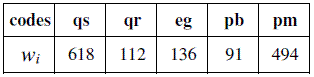
	    <p>About two decades ago I emphasized reposition cost as an economic indicator concerning conservation of forest resources (CASQUILHO, 1994), as it points to the expected investment necessary to recover an existent forest habitat under a perspective of loss. Recently, the municipality of Nisa published a technical document under the scope of the national strategy for forests in Portugal, where reposition costs of different pure or mixed stands where estimated in euros per hectare &#45; a total of 121 combinations of pure and mixed classes of eleven forest habitats and shrublands (see PMDFCIN, 2007), which include the main types I select for further developments in this paper: cork oak (<i>Quercus suber</i>); holm oak (<i>Q.</i> <i>rotundifolia</i>); eucalyptus plantations (<i>Eucalyptus globulus</i>); and pine groves of two kinds, maritime or cluster pine trees (<i>Pinus pinaster</i>) and stone pines(<i>P. pinea</i>). Table 1 summarizes the estimates of reposition costs in &euro;/ha, where I designate such numbers with the symbol <i>w<sub>i</sub></i> (meaning weight factor or characteristic value).</p>

	    <p>&nbsp;</p>

	    <p><b><a href="#t1">Table 1</a><a name="topt1"></a></b> &#150; Estimates of reposition costs (<i>w<sub>i</sub></i>: &euro;/ha) of different forest habitats in the region of Nisa, extracted from PMDFCIN (2007); codes: qs&#45;<i>Quercus suber</i>; qr&#45; <i>Quercus rotundifolia</i>; eg&#45; <i>Eucalyptus globulus</i>; pb&#45; <i>Pinus pinaster</i>; pm&#45; <i>Pinus pinea</i></p>

	    <p><img src="/img/revistas/slu/v19n1/19n1a05t1.gif"></p>
	
	    
<p>&nbsp;</p>
	
	    <p>The problem that is discussed next in this paper may be stated as follows: given these estimates of economic value as reposition costs is there any conceptual device that generates compositional solutions of ecomosaics for the region of Nisa, with some rationale that meets criteria of expected utility formulation? Can these solutions be benchmarked with bonds concerning average economic value and landscape diversity?</p>

	    <p>&nbsp;</p>

	    <p><b>Methods</b></p>

	    <p><i>Theories</i></p>

	    ]]></body>
<body><![CDATA[<p>The role of mathematical models, formulas, indices, is generating compromises of meaning&#45;making such that the results are somewhat insightful, crossing the semantic level and providing clues for further research. O'HALLORAN (2008) reminds that mathematical discourse is multisemiotic: the grammar of mathematical symbolism is based on a range of condensatory strategies of meaning and the result is a semiotic resource which can be used as a tool for reasoning.</p>

	    <p>Decision theory relies on work of Daniel Bernoulli, with a corner stone in von Neumann work on theory of games in the forties, and can be stated as focused in (subjective) expected utility maximization (GILBOA, 2009), as a consumer may be typified like a von Neumann&#45;Morgenstern utility maximiser (see BAUMOL, 1951), evaluating allocations and attaching subjective probabilities to events (ELLICKSON, 1993).</p>

	    <p>The expected&#45;utility hypothesis has long being considered potentially rich in empirical content (see FRIEDMAN and SAVAGE, 1952) and makes operative the notions of maximum mean value of a set of states or events indexed by numbers. The normal form of mean or average utility is the calculation of the expected value of a preference pattern expressed by bounded numerical functions (BLACKWELL and GIRSHIK, 1979). It is believed that political or community decisions rely upon criteria that involve maximization of expected utility of some sort: subjective expected utility and discrete choice methods are a possibility and, in general, an operational characterization of states of a physical system leads to their description by a probability distribution. When an option's outcome is uncertain, expected utility analysis is performed according to multiple objectives and the decision space is multidimensional (WEIRICH, 2001). In the procedure that follows the decision space is outlined to be two dimensional, bonded to landscape diversity and average economic value, this one based on reposition costs of different forest habitats considered as characteristic values.</p>

	    <p>&nbsp;</p>

	    <p><i>Indices W and Y</i></p>

	    <p>Assume that a system is characterized by a scenario of the world defined as the set of <i>n</i> elementary states, or index set, or sample space:  <img src="/img/revistas/slu/v19n1/19n1a05e1.gif">  where <img src="/img/revistas/slu/v19n1/19n1a05e2.gif">&nbsp;is a real number denoting a characteristic value of the elementary state indexed; the power set  <img src="/img/revistas/slu/v19n1/19n1a05e3.gif"> is the set of events, members of the collection generated by <i>S</i>; events &#150; here defined as areas of different forest habitats &#45; occur with probabilities linked to the distribution <img src="/img/revistas/slu/v19n1/19n1a05e4.gif"> such that <img src="/img/revistas/slu/v19n1/19n1a05e5.gif"> and <img src="/img/revistas/slu/v19n1/19n1a05e6.gif"> defining a <img src="/img/revistas/slu/v19n1/19n1a05e7.gif"> simplex; so the structure <img src="/img/revistas/slu/v19n1/19n1a05e8.gif"> is a normalized measure space or probability space and we can write the set of references of the system: <img src="/img/revistas/slu/v19n1/19n1a05e9.gif"> where the ordered pair <img src="/img/revistas/slu/v19n1/19n1a05e10.gif"> refers to habitat <i>j</i> in the context of the mosaic, represented by a characteristic value and a relative extension measure, with the condition <img src="/img/revistas/slu/v19n1/19n1a05e11.gif"> meaning absence of the indexed state.</p>

	    
<p>Index <i>W</i> is defined as a real positive number computed with the formula <img src="/img/revistas/slu/v19n1/19n1a05e12.gif">, an average value, or expected value, of a discrete random variable <i>U</i> that assumes utility values <img src="/img/revistas/slu/v19n1/19n1a05e13.gif"> with probabilities <img src="/img/revistas/slu/v19n1/19n1a05e14.gif"> for <img src="/img/revistas/slu/v19n1/19n1a05e15.gif"> The number <img src="/img/revistas/slu/v19n1/19n1a05e16.gif"> with <img src="/img/revistas/slu/v19n1/19n1a05e17.gif"> defines a measure of rarity or scarcity of the state or event indexed by <img src="/img/revistas/slu/v19n1/19n1a05e18.gif"> as it is the additive complement of the probability, with the set verifying the equation <img src="/img/revistas/slu/v19n1/19n1a05e19.gif">, the dimension of the simplex; we may consider the utility functions <img src="/img/revistas/slu/v19n1/19n1a05e20.gif"> as a numeric approach to contributive values, as they combine in a product characteristic and context values, the last defined as a rarity measure. Contributive value is a relational form of value, it is the value that some part confers on the whole of which it is a part, because this contribution is conditioned by the other parts of the whole (STRATTON&#45;LAKE, 2004).</p>

	    
<p>Whether the habitat tends to fulfill the area, its scarcity becomes null and also contributive value vanishes; the utilities <img src="/img/revistas/slu/v19n1/19n1a05e21.gif"> decrease in <img src="/img/revistas/slu/v19n1/19n1a05e22.gif"> but increase with <img src="/img/revistas/slu/v19n1/19n1a05e23.gif"> as <img src="/img/revistas/slu/v19n1/19n1a05e24.gif">; so, scarcity as a measure of the information value of a event is considered relevant. That valuation procedure goes with the general statement in information theory that the least a situation is probable the most significant it becomes (see PETITOT, 2004).</p>

	    
<p>Index <i>W</i> is thus generated as the expected value of a random utility pattern defined by real functions and is mathematically analogous to index <img src="/img/revistas/slu/v19n1/19n1a05e25.gif"> (CASQUILHO <i>et al</i>, 2003) and index <i>V</i> (CASQUILHO, 2009) with slight differences in notation, but quite distinct semantic blocking and interpretation.</p>

	    
<p>We may extend <i>W</i> index to a family of indices with a simple generalization of utility functions defined as a 1&#45;parameter family <img src="/img/revistas/slu/v19n1/19n1a05e26.gif"> with <img src="/img/revistas/slu/v19n1/19n1a05e27.gif">, keeping the domain as the <img src="/img/revistas/slu/v19n1/19n1a05e7.gif"> simplex and writing the index generator formula <img src="/img/revistas/slu/v19n1/19n1a05e28.gif">; we get the obvious result <img src="/img/revistas/slu/v19n1/19n1a05e29.gif"> and also obtain <img src="/img/revistas/slu/v19n1/19n1a05e30.gif">, with the formula for index <i>Y</i> written as <img src="/img/revistas/slu/v19n1/19n1a05e31.gif">; here the utility functions are defined as <img src="/img/revistas/slu/v19n1/19n1a05e32.gif">, a formula that enhances the presence of the characteristic value. In any case, arguments on convexity and differentiability ensure that there exists only an optimal solution, a point of maximum value, for any of the indices, given a fixed set <i>S</i> of characteristic values.</p>

	    
]]></body>
<body><![CDATA[<p>&nbsp;</p>

	    <p><b>Results</b></p>

	    <p><i>Optimal points<a name="_ednref2"></a><a href="#_edn2" title=""><b>&#91;2&#93;</b></a></i></p>

	    <p>Optimal solution of index <i>W</i>, a point with <i>n</i> coordinates symbolised <img src="/img/revistas/slu/v19n1/19n1a05e33.gif">, may be found with an algorithmic procedure based on a Lagrange multiplier method. We may proceed with a bottom&#45;up or top&#45;down scheme, here I choose one of the last kind: compute <img src="/img/revistas/slu/v19n1/19n1a05e34.gif"> and discard the lowest characteristic value that verifies <img src="/img/revistas/slu/v19n1/19n1a05e35.gif"> recalculating <i>T</i> without that number and recurring until we have verified <img src="/img/revistas/slu/v19n1/19n1a05e36.gif"> for all the (remaining) characteristic values of the habitats; then, the formula for the maximum point coordinates indexed by <i>i</i> is defined as: <img src="/img/revistas/slu/v19n1/19n1a05e37.gif">, where <i>k</i> is the cardinal of the subset of the original <i>n</i> variables that verify the inequality condition, and the other variables are set to zero; we obtain bounded solutions <img src="/img/revistas/slu/v19n1/19n1a05e38.gif"> and the null coordinate(s) may exist only for <img src="/img/revistas/slu/v19n1/19n1a05e39.gif">, hence we have a barrier <img src="/img/revistas/slu/v19n1/19n1a05e40.gif">. Optimal coordinates don&rsquo;t change if we change unities of the characteristic values by a linear transformation. Whenever the mosaic is reduced to a uniform matrix of a single habitat, calculating index <i>W</i> turns out the value zero, so denoting that there is a diversity measure attached in its mathematical structure: a germ of a related form of a measure of the concentration of the classification defined as &#955; (SIMPSON, 1949).</p>

	    
<p>Optimal point for index <i>Y</i> exists as well, obtained with the same recursion procedure described for index <i>W</i> modified with the calculation formula for the coordinates of maximum point now defined as: <img src="/img/revistas/slu/v19n1/19n1a05e41.gif"> if <img src="/img/revistas/slu/v19n1/19n1a05e42.gif">, otherwise the coordinates are settled to zero; unlike index <i>W</i> index <i>Y</i> has minimum value <img src="/img/revistas/slu/v19n1/19n1a05e43.gif">. For <img src="/img/revistas/slu/v19n1/19n1a05e44.gif"> the optimal coordinates are <img src="/img/revistas/slu/v19n1/19n1a05e45.gif"> and <img src="/img/revistas/slu/v19n1/19n1a05e46.gif"> and we deduce the results <img src="/img/revistas/slu/v19n1/19n1a05e47.gif"> and that there is a barrier <img src="/img/revistas/slu/v19n1/19n1a05e48.gif">. The optimal point coordinates of index <i>Y</i> also don&rsquo;t change when we change unities of the characteristic values by a linear transformation. Index <i>Y</i> is of the form of a value index, far enough from a diversity germ that entails and constrains index <i>W</i>.</p>

	    
<p>&nbsp;</p>

	    <p><i>Compositional forest planning scenarios in the region of Nisa</i></p>

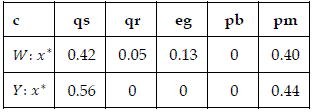
	    <p>Let us admit that we have a large area suitable to ecomosaics concept where we could replicate indistinctly without biophysical constraints and property restrictions five different forest habitats of the region: those listed in <a href="#topt1">Table 1</a><a name="#t1"></a> with codes {qs,qr,eg,pb,pm}.&nbsp; We search the optimal solution for indices <i>W</i> and <i>Y</i> according to previously discussed algorithms and procedures. Table 2 summarizes the results, the numbers being proportions of composition of the mosaic with the forest habitats encoded previously.</p>

	    <p>&nbsp;</p>

	    <p><b>Table 2</b> &#45;&nbsp; Optimal solutions (points) of the indices (see codes in <a href="#topt1">Table 1</a>)</p>

	    ]]></body>
<body><![CDATA[<p><img src="/img/revistas/slu/v19n1/19n1a05t2.gif"></p>
	
	    
<p>&nbsp;</p>

	    <p><b>Discussion</b></p>

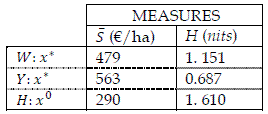
	    <p>Using two extra standard measures to anchor and discuss the results of compositional scenarios shown by optimal solutions of indices <i>W</i> e <i>Y</i>, I choose average economic value <img src="/img/revistas/slu/v19n1/19n1a05e49.gif"> and landscape diversity calculated as Shannon entropy, considered an index sensitive to the presence of rare habitats and recommended for landscape management (NAGENDRA, 2002), defined with the standard formula <img src="/img/revistas/slu/v19n1/19n1a05e50.gif">, log function being natural logarithms based and so the total sum is expressed in unities named <i>nits</i>, making an analogy with <i>bits</i>.</p>

	    
<p>Obviously, maximum economic value of the global area would be reached with the whole area covered with cork oak trees, and the minimum economic value with the area filled with stands of maritime pine, in any case the landscape diversity would be null: <img src="/img/revistas/slu/v19n1/19n1a05e51.gif">; maximum landscape diversity is obtained with the indifference solution denoted <img src="/img/revistas/slu/v19n1/19n1a05e52.gif">, meaning that each habitat fulfills 1/5 of the total area. Table 3 summarizes the numbers of these standard measures of the mosaic applied over three compositional scenarios.</p>

	    
<p>&nbsp;</p>

	    <p><b>Table 3</b> &#45; Measures of the mosaic &#45; mean economic value <img src="/img/revistas/slu/v19n1/19n1a05e53.gif"> and landscape diversity <i>H</i>&#45;, for three scenarios of composition: the optimal solution <img src="/img/revistas/slu/v19n1/19n1a05e54.gif"> of indices <i>W</i> and <i>Y</i> and the indifference solution<img src="/img/revistas/slu/v19n1/19n1a05e55.gif">.</p>

	    
<p><img src="/img/revistas/slu/v19n1/19n1a05t3.gif"></p>
	
	    
<p>&nbsp;</p>

	    <p>Utility analyses have been used in the policy design studies to help articulate conflicting preferences, to provide objective functions for the optimization efforts, and to simplify comparisons of policies (CLARK <i>et al.</i>, 1979) and insight of simple models have direct application for management complex resource models under the concept of adaptive resource management. In general, GUNDERSON <i>et al.</i>(2010) say that system states and alternative domains exist at specific scale ranges, and those system states are comprised of entities with a characteristic set of attributes, remarking that multi&#45;stable behavior can be explained by the use of models that include at least three but not more than five variables.</p>

	    ]]></body>
<body><![CDATA[<p>The reasoning described in this paper places indices <i>W</i> and <i>Y</i> as heuristic tools, that may be interpreted as expected utilities and generate compositional scenarios of the mosaic. I should say that the results from the example of planning scenario in Nisa show that index <i>W</i> seems to perform a better compromise concerning the tradeoff between landscape diversity and economic value than index <i>Y</i> &#45; this one is quite radical promoting the habitats with high reposition costs and penalizing substantially landscape diversity.</p>

	    <p>Similar, but smoother, indices based on Shannon entropy generalizations also exist, and share the same principle of expected utility and information average values, as is the case with mean contributive value index (CASQUILHO, 2010). RICOTTA (2002) discuss Shannon based formulas under the hypothesis of bridging the gap between ecological diversity indices and measures of biodiversity. In any case we are faced with compromises concerning planning the composition of a large area with different forest types and the trade&#45;off between two contexts: economic and ecologic, with their multiple interferences.</p>

	    <p>The axiomatic foundation of this compositional scenario generator method denoted <img src="/img/revistas/slu/v19n1/19n1a05e56.gif"> may be thought as rooted in two theories: situation theory, which is a theory of information and its key insight is that much information is always available and is representable only partially (PARIKH and CLARK, 2007) and relevance theory that entails that human cognition tends to be geared to the maximization of relevance (CANN <i>et al.</i>, 2009), where relevance is defined as a trade&#45;off between the effort needed to process some input and the informational benefit gained. The whole reasoning that was presented here may be conceived in terms of forest planning as a kind of abductive procedure entailing heuristic processes, noting that while deduction proves that something must be, and induction shows that something is actually operative, abduction &#45; a term coined by C. S. Peirce &#45;, merely suggests that something may be so (MOUR&Atilde;O, 2007) &#45; somewhere starting from an interaction between a human inquirer and its environment as a part of an interrogative process (PAAVOLA, 2007).</p>

	    
<p>&nbsp;</p>

	    <p><b>References</b></p>

	    <!-- ref --><p>AC&Aacute;CIO, V., HOLMGREN, M., REGO, F, MOREIRA, F., MOHREN, G.M.J. 2009. Are drought and wildfires turning Mediterranean cork oak forests into persistent shrublands? <i>Agroforestry Systems</i> <b>76</b>: 389&#45;400&nbsp;&nbsp;&nbsp;&nbsp;&nbsp;&nbsp;&nbsp;&nbsp;[&#160;<a href="javascript:void(0);" onclick="javascript: window.open('/scielo.php?script=sci_nlinks&ref=000088&pid=S0870-6352201100010000500001&lng=','','width=640,height=500,resizable=yes,scrollbars=1,menubar=yes,');">Links</a>&#160;]<!-- end-ref --><!-- ref --><p>ALLEN, C.R., GUNDERSON, L.H., HOLLING, C.S., 2010a. Commentary on part one articles. In <i>Foundations of Ecological Resilience</i> (GUNDERSON, L.H., ALLEN, C.R., HOLLING, C.S. eds). Island Press, Washington DC, pp. 3&#45;18.    &nbsp;&nbsp;&nbsp;&nbsp;&nbsp;&nbsp;&nbsp;&nbsp;[&#160;<a href="javascript:void(0);" onclick="javascript: window.open('/scielo.php?script=sci_nlinks&ref=000089&pid=S0870-6352201100010000500002&lng=','','width=640,height=500,resizable=yes,scrollbars=1,menubar=yes,');">Links</a>&#160;]<!-- end-ref --></p>

	    <!-- ref --><p>ALLEN, C.R., GUNDERSON, L.H., HOLLING, C.S., 2010b. Commentary on part three articles. In <i>Foundations of Ecological Resilience</i> (GUNDERSON, L.H., ALLEN, C.R., HOLLING, C.S. eds). Island Press, Washington DC, pp. 301&#45;307.    &nbsp;&nbsp;&nbsp;&nbsp;&nbsp;&nbsp;&nbsp;&nbsp;[&#160;<a href="javascript:void(0);" onclick="javascript: window.open('/scielo.php?script=sci_nlinks&ref=000091&pid=S0870-6352201100010000500003&lng=','','width=640,height=500,resizable=yes,scrollbars=1,menubar=yes,');">Links</a>&#160;]<!-- end-ref --></p>

	    ]]></body>
<body><![CDATA[<!-- ref --><p>ALVES, A.A.M, 1982. <i>T&eacute;cnicas de Produ&ccedil;&atilde;o Florestal</i>, Instituto Nacional de Investiga&ccedil;&atilde;o Cient&iacute;fica, Lisboa, 334 pp.    &nbsp;&nbsp;&nbsp;&nbsp;&nbsp;&nbsp;&nbsp;&nbsp;[&#160;<a href="javascript:void(0);" onclick="javascript: window.open('/scielo.php?script=sci_nlinks&ref=000093&pid=S0870-6352201100010000500004&lng=','','width=640,height=500,resizable=yes,scrollbars=1,menubar=yes,');">Links</a>&#160;]<!-- end-ref --></p>

	    <!-- ref --><p>BAILEY, R.G., 2005. Identifying ecoregion boundaries. <i>Environ. Management</i> <b>34</b>: 14&#45;28.    &nbsp;&nbsp;&nbsp;&nbsp;&nbsp;&nbsp;&nbsp;&nbsp;[&#160;<a href="javascript:void(0);" onclick="javascript: window.open('/scielo.php?script=sci_nlinks&ref=000095&pid=S0870-6352201100010000500005&lng=','','width=640,height=500,resizable=yes,scrollbars=1,menubar=yes,');">Links</a>&#160;]<!-- end-ref --></p>

	    <!-- ref --><p>BAUMOL, W.J., 1951. The Neumann&#45;Morgenstern utility index&#45;an ordinalist view. <cite>The Journal of Political Economy</cite> <b>59</b>(1): 61&#45;66.    &nbsp;&nbsp;&nbsp;&nbsp;&nbsp;&nbsp;&nbsp;&nbsp;[&#160;<a href="javascript:void(0);" onclick="javascript: window.open('/scielo.php?script=sci_nlinks&ref=000097&pid=S0870-6352201100010000500006&lng=','','width=640,height=500,resizable=yes,scrollbars=1,menubar=yes,');">Links</a>&#160;]<!-- end-ref --></p>

	    <!-- ref --><p>BOLLIGER, J., KIENAST, F., 2010. Landscape functions in a changing environment. <i>Landscape Online</i> <b>21</b>: 1&#45;5.    &nbsp;&nbsp;&nbsp;&nbsp;&nbsp;&nbsp;&nbsp;&nbsp;[&#160;<a href="javascript:void(0);" onclick="javascript: window.open('/scielo.php?script=sci_nlinks&ref=000099&pid=S0870-6352201100010000500007&lng=','','width=640,height=500,resizable=yes,scrollbars=1,menubar=yes,');">Links</a>&#160;]<!-- end-ref --></p>

	    <!-- ref --><p>BLACKWELL, D., GIRSHIK, M.A., 1979. <i>Theory of Games and Statistical Decisions</i>. Dover Publications Inc, New York, 355 pp.    &nbsp;&nbsp;&nbsp;&nbsp;&nbsp;&nbsp;&nbsp;&nbsp;[&#160;<a href="javascript:void(0);" onclick="javascript: window.open('/scielo.php?script=sci_nlinks&ref=000101&pid=S0870-6352201100010000500008&lng=','','width=640,height=500,resizable=yes,scrollbars=1,menubar=yes,');">Links</a>&#160;]<!-- end-ref --></p>

	    ]]></body>
<body><![CDATA[<!-- ref --><p>CANN, R., KEMPSON, R., GREGOROMI&#45;CHELAKI, E., 2009. <i>Semantics &#45; an Introduction to Meaning in Language.</i> Cambridge University Press, New York, 292 pp.    &nbsp;&nbsp;&nbsp;&nbsp;&nbsp;&nbsp;&nbsp;&nbsp;[&#160;<a href="javascript:void(0);" onclick="javascript: window.open('/scielo.php?script=sci_nlinks&ref=000103&pid=S0870-6352201100010000500009&lng=','','width=640,height=500,resizable=yes,scrollbars=1,menubar=yes,');">Links</a>&#160;]<!-- end-ref --></p>

	    <!-- ref --><p>CASQUILHO, J., 1994. Ecologia, modelos e impactes: crit&eacute;rios para uma &eacute;tica do uso agroflorestal do solo. <i>Revista Florestal</i><b>7</b>: 3&#45;20.    &nbsp;&nbsp;&nbsp;&nbsp;&nbsp;&nbsp;&nbsp;&nbsp;[&#160;<a href="javascript:void(0);" onclick="javascript: window.open('/scielo.php?script=sci_nlinks&ref=000105&pid=S0870-6352201100010000500010&lng=','','width=640,height=500,resizable=yes,scrollbars=1,menubar=yes,');">Links</a>&#160;]<!-- end-ref --></p>

	    <!-- ref --><p>CASQUILHO, J., 1999. <i>Ecomosaico: Indices para o Diagn&oacute;stico de Propor&ccedil;&otilde;es de Composi&ccedil;&atilde;o</i>. (tese de doutoramento). Instituto Superior de Agronomia, Universidade T&eacute;cnica de Lisboa, 205 pp.    &nbsp;&nbsp;&nbsp;&nbsp;&nbsp;&nbsp;&nbsp;&nbsp;[&#160;<a href="javascript:void(0);" onclick="javascript: window.open('/scielo.php?script=sci_nlinks&ref=000107&pid=S0870-6352201100010000500011&lng=','','width=640,height=500,resizable=yes,scrollbars=1,menubar=yes,');">Links</a>&#160;]<!-- end-ref --></p>

	    <p>CASQUILHO, J., NEVES, M., REGO, F., 2003. A generalisation of Simpson&rsquo;s index of diversity. <i>Technical Report #7/</i><i>IISA</i>, 3 pp. Universidade T&eacute;cnica de Lisboa.</p>

	    <!-- ref --><p>CASQUILHO, J.P, 2009. Complex number valuation of habitats and information index of the landscape mosaic. <i>Silva Lusitana</i> <b>17</b>(2): 171&#45;180.    &nbsp;&nbsp;&nbsp;&nbsp;&nbsp;&nbsp;&nbsp;&nbsp;[&#160;<a href="javascript:void(0);" onclick="javascript: window.open('/scielo.php?script=sci_nlinks&ref=000110&pid=S0870-6352201100010000500013&lng=','','width=640,height=500,resizable=yes,scrollbars=1,menubar=yes,');">Links</a>&#160;]<!-- end-ref --></p>

	    <!-- ref --><p>CASQUILHO, J.P, 2010. Landscape mosaic composition and mean contributive value index. <i>Silva Lusitana</i> <b>18</b>(2): 197&#45;203.    &nbsp;&nbsp;&nbsp;&nbsp;&nbsp;&nbsp;&nbsp;&nbsp;[&#160;<a href="javascript:void(0);" onclick="javascript: window.open('/scielo.php?script=sci_nlinks&ref=000112&pid=S0870-6352201100010000500014&lng=','','width=640,height=500,resizable=yes,scrollbars=1,menubar=yes,');">Links</a>&#160;]<!-- end-ref --></p>

	    <!-- ref --><p>CAUQUELIN, A., 2008. <i>A Inven&ccedil;&atilde;o da Paisagem</i> (2&ordf; ed.), Edi&ccedil;&otilde;es 70, Lisboa, 147 pp.    &nbsp;&nbsp;&nbsp;&nbsp;&nbsp;&nbsp;&nbsp;&nbsp;[&#160;<a href="javascript:void(0);" onclick="javascript: window.open('/scielo.php?script=sci_nlinks&ref=000114&pid=S0870-6352201100010000500015&lng=','','width=640,height=500,resizable=yes,scrollbars=1,menubar=yes,');">Links</a>&#160;]<!-- end-ref --></p>

	    <!-- ref --><p>CLARK, W.C., JONES, D.D., HOLLING, C.S., 1979. Lessons for ecological policy design: a case study of ecosystem management. <i>Ecological Modelling</i> <b>7</b>: 1&#45;53.    &nbsp;&nbsp;&nbsp;&nbsp;&nbsp;&nbsp;&nbsp;&nbsp;[&#160;<a href="javascript:void(0);" onclick="javascript: window.open('/scielo.php?script=sci_nlinks&ref=000116&pid=S0870-6352201100010000500016&lng=','','width=640,height=500,resizable=yes,scrollbars=1,menubar=yes,');">Links</a>&#160;]<!-- end-ref --></p>

	    <!-- ref --><p>D&Iacute;AZ&#45;VARELA, E., &Aacute;LVAREZ&#45;LOPEZ, C.J., MAREY&#45;P&Eacute;REZ, M.F., 2009. Multiscale delineation of landscape planning units based on spatial variation on land&#45;use patterns in Galicia, NW Spain. <i>Landscape Ecol. Eng.</i> <b>5</b>: 1&#45;10.    &nbsp;&nbsp;&nbsp;&nbsp;&nbsp;&nbsp;&nbsp;&nbsp;[&#160;<a href="javascript:void(0);" onclick="javascript: window.open('/scielo.php?script=sci_nlinks&ref=000118&pid=S0870-6352201100010000500017&lng=','','width=640,height=500,resizable=yes,scrollbars=1,menubar=yes,');">Links</a>&#160;]<!-- end-ref --></p>

	    <!-- ref --><p>ELLICKON, B., 1993. <i>Competitive Equilibrium &#150; Theory and Applications</i>. Cambridge University Press, Cambridge, 394 pp.    &nbsp;&nbsp;&nbsp;&nbsp;&nbsp;&nbsp;&nbsp;&nbsp;[&#160;<a href="javascript:void(0);" onclick="javascript: window.open('/scielo.php?script=sci_nlinks&ref=000120&pid=S0870-6352201100010000500018&lng=','','width=640,height=500,resizable=yes,scrollbars=1,menubar=yes,');">Links</a>&#160;]<!-- end-ref --></p>

	    <!-- ref --><p>FRIEDMAN, M., SAVAGE, L.J., 1952. The expected&#45;utility hypothesis and the measurability of utility. <i>The Journal of Political Economy</i> <b>60</b>(6): 463&#45;474.    &nbsp;&nbsp;&nbsp;&nbsp;&nbsp;&nbsp;&nbsp;&nbsp;[&#160;<a href="javascript:void(0);" onclick="javascript: window.open('/scielo.php?script=sci_nlinks&ref=000122&pid=S0870-6352201100010000500019&lng=','','width=640,height=500,resizable=yes,scrollbars=1,menubar=yes,');">Links</a>&#160;]<!-- end-ref --></p>

	    <!-- ref --><p>FORMAN, R.T.T., 1995. <i>Land Mosaics &#150; the Ecology of Landscapes and Regions</i>. Cambridge University Press, Cambridge, 632 pp.    &nbsp;&nbsp;&nbsp;&nbsp;&nbsp;&nbsp;&nbsp;&nbsp;[&#160;<a href="javascript:void(0);" onclick="javascript: window.open('/scielo.php?script=sci_nlinks&ref=000124&pid=S0870-6352201100010000500020&lng=','','width=640,height=500,resizable=yes,scrollbars=1,menubar=yes,');">Links</a>&#160;]<!-- end-ref --></p>

	    <!-- ref --><p>GILBOA, I., 2009. <i>Theory of Decision under Uncertainty</i>. Cambridge University Press, New York, 214 pp.    &nbsp;&nbsp;&nbsp;&nbsp;&nbsp;&nbsp;&nbsp;&nbsp;[&#160;<a href="javascript:void(0);" onclick="javascript: window.open('/scielo.php?script=sci_nlinks&ref=000126&pid=S0870-6352201100010000500021&lng=','','width=640,height=500,resizable=yes,scrollbars=1,menubar=yes,');">Links</a>&#160;]<!-- end-ref --></p>

	    <!-- ref --><p>GILLSON, L., 2009. Landscapes in time and space. <i>Landscape Ecology</i> <b>24</b>: 149&#150;155.    &nbsp;&nbsp;&nbsp;&nbsp;&nbsp;&nbsp;&nbsp;&nbsp;[&#160;<a href="javascript:void(0);" onclick="javascript: window.open('/scielo.php?script=sci_nlinks&ref=000128&pid=S0870-6352201100010000500022&lng=','','width=640,height=500,resizable=yes,scrollbars=1,menubar=yes,');">Links</a>&#160;]<!-- end-ref --></p>

	    <!-- ref --><p>GON&Ccedil;ALVES, A.C., OLIVEIRA, A.C., DIAS, S.S., 2010. Evolution in multi&#45;species high forest stands in serra da Lous&atilde;: diversity analysis. <i>Silva Lusitana</i> n&ordm; especial: 79&#45;90.    &nbsp;&nbsp;&nbsp;&nbsp;&nbsp;&nbsp;&nbsp;&nbsp;[&#160;<a href="javascript:void(0);" onclick="javascript: window.open('/scielo.php?script=sci_nlinks&ref=000130&pid=S0870-6352201100010000500023&lng=','','width=640,height=500,resizable=yes,scrollbars=1,menubar=yes,');">Links</a>&#160;]<!-- end-ref --></p>

	    <!-- ref --><p>GUNDERSON, L.H., HOLLING, C.S., ALLEN, C.R., 2010. Conclusion: the evolution of an idea &#150; the past, present, and future of ecological resilience. In <i>Foundations of Ecological Resilience</i> (GUNDERSON, L.H., ALLEN, C.R., HOLLING, C.S., eds) Island Press, Washington DC, pp. 423&#45;444.    &nbsp;&nbsp;&nbsp;&nbsp;&nbsp;&nbsp;&nbsp;&nbsp;[&#160;<a href="javascript:void(0);" onclick="javascript: window.open('/scielo.php?script=sci_nlinks&ref=000132&pid=S0870-6352201100010000500024&lng=','','width=640,height=500,resizable=yes,scrollbars=1,menubar=yes,');">Links</a>&#160;]<!-- end-ref --></p>

	    <!-- ref --><p>HOGANSON, H., BIXBY, J., BERGMANN, S., BORGES, J.G., 2004. Large&#45;scale planning address interior space production: three case studies from Northern Minnesota. <i>Silva Lus.</i>, vol.12, no.Especial, pp. 35&#45;47.    &nbsp;&nbsp;&nbsp;&nbsp;&nbsp;&nbsp;&nbsp;&nbsp;[&#160;<a href="javascript:void(0);" onclick="javascript: window.open('/scielo.php?script=sci_nlinks&ref=000134&pid=S0870-6352201100010000500025&lng=','','width=640,height=500,resizable=yes,scrollbars=1,menubar=yes,');">Links</a>&#160;]<!-- end-ref --></p>

	    <!-- ref --><p>HOUET, T., VERBURG, P.H., LOVELAND, T.R., 2010. Monitoring and modeling landscape dynamics. <i>Landscape Ecology</i> <b>25</b>: 163&#150;167.    &nbsp;&nbsp;&nbsp;&nbsp;&nbsp;&nbsp;&nbsp;&nbsp;[&#160;<a href="javascript:void(0);" onclick="javascript: window.open('/scielo.php?script=sci_nlinks&ref=000136&pid=S0870-6352201100010000500026&lng=','','width=640,height=500,resizable=yes,scrollbars=1,menubar=yes,');">Links</a>&#160;]<!-- end-ref --></p>

	    <!-- ref --><p>LEIT&Atilde;O, A.B., AHERN, J., 2002. Applying landscape ecological concepts and metrics in sustainable landscape planning. <i>Landscape and Urban Planning</i> <b>59</b>: 65&#45;93.    &nbsp;&nbsp;&nbsp;&nbsp;&nbsp;&nbsp;&nbsp;&nbsp;[&#160;<a href="javascript:void(0);" onclick="javascript: window.open('/scielo.php?script=sci_nlinks&ref=000138&pid=S0870-6352201100010000500027&lng=','','width=640,height=500,resizable=yes,scrollbars=1,menubar=yes,');">Links</a>&#160;]<!-- end-ref --></p>

	    <!-- ref --><p>LI, H., REYNOLDS, J.F., 1994. A simulation experiment to quantify spatial heterogeneity in categorical maps. <i>Ecology</i> <b>75</b>: 2446&#45;2455.    &nbsp;&nbsp;&nbsp;&nbsp;&nbsp;&nbsp;&nbsp;&nbsp;[&#160;<a href="javascript:void(0);" onclick="javascript: window.open('/scielo.php?script=sci_nlinks&ref=000140&pid=S0870-6352201100010000500028&lng=','','width=640,height=500,resizable=yes,scrollbars=1,menubar=yes,');">Links</a>&#160;]<!-- end-ref --></p>

	    <!-- ref --><p>LI, H., WU, J., 2004. Use and misuse of landscape indices. <i>Landscape Ecology</i> <b>19</b>: 389&#150;399.    &nbsp;&nbsp;&nbsp;&nbsp;&nbsp;&nbsp;&nbsp;&nbsp;[&#160;<a href="javascript:void(0);" onclick="javascript: window.open('/scielo.php?script=sci_nlinks&ref=000142&pid=S0870-6352201100010000500029&lng=','','width=640,height=500,resizable=yes,scrollbars=1,menubar=yes,');">Links</a>&#160;]<!-- end-ref --></p>

	    <!-- ref --><p>MOUR&Atilde;O, J.A., 2007. Abduction and metaphor. Tropism of truth. In <i>Abduction and the Process of Scientific Discovery</i> (POMBO, O. and GERNER, A. eds), Centro de Filosofia das Ci&ecirc;ncias da Universidade de Lisboa, Lisboa, pp. 265&#45;281.    &nbsp;&nbsp;&nbsp;&nbsp;&nbsp;&nbsp;&nbsp;&nbsp;[&#160;<a href="javascript:void(0);" onclick="javascript: window.open('/scielo.php?script=sci_nlinks&ref=000144&pid=S0870-6352201100010000500030&lng=','','width=640,height=500,resizable=yes,scrollbars=1,menubar=yes,');">Links</a>&#160;]<!-- end-ref --></p>

	    <!-- ref --><p>NAGENDRA, H., GADGIL, M., 1999. Biodiversity assessment at multiple scales: linking remotely sensed data with field information. <i>Proc. Natl. Acad. Sci. USA</i> <b>96</b>: 9154&#150;9158.    &nbsp;&nbsp;&nbsp;&nbsp;&nbsp;&nbsp;&nbsp;&nbsp;[&#160;<a href="javascript:void(0);" onclick="javascript: window.open('/scielo.php?script=sci_nlinks&ref=000146&pid=S0870-6352201100010000500031&lng=','','width=640,height=500,resizable=yes,scrollbars=1,menubar=yes,');">Links</a>&#160;]<!-- end-ref -->&nbsp;</p>

	    <!-- ref --><p>NAGENDRA, H., 2002. Opposite trends in response for the Shannon and Simpson indices of landscape diversity. <i>Applied Geograpy</i> <b>22</b>: 175&#45;186.    &nbsp;&nbsp;&nbsp;&nbsp;&nbsp;&nbsp;&nbsp;&nbsp;[&#160;<a href="javascript:void(0);" onclick="javascript: window.open('/scielo.php?script=sci_nlinks&ref=000148&pid=S0870-6352201100010000500032&lng=','','width=640,height=500,resizable=yes,scrollbars=1,menubar=yes,');">Links</a>&#160;]<!-- end-ref --></p>

	    <!-- ref --><p>O'HALLORAN, K., 2008. <i>Mathematical Discourse &#45; Language, Symbolism and Visual Images</i>. Continuum, London, 226 pp.    &nbsp;&nbsp;&nbsp;&nbsp;&nbsp;&nbsp;&nbsp;&nbsp;[&#160;<a href="javascript:void(0);" onclick="javascript: window.open('/scielo.php?script=sci_nlinks&ref=000150&pid=S0870-6352201100010000500033&lng=','','width=640,height=500,resizable=yes,scrollbars=1,menubar=yes,');">Links</a>&#160;]<!-- end-ref --></p>

	    <!-- ref --><p>O'NEILL, R.V., KRUMMEL, J.R., GARDNER, R.H., SUGIHARA, G., JACKSON, B., DEANGELIS, D.L., MILNE, B.T., TURNER, M.G., ZYGMUNT, B., CHRISTENSEN, S.W., DALE, V.H., GRAHAM, R.L., 1988. Indices of landscape pattern. <i>Landscape Ecology</i> <b>1</b>: 153&#45;162.    &nbsp;&nbsp;&nbsp;&nbsp;&nbsp;&nbsp;&nbsp;&nbsp;[&#160;<a href="javascript:void(0);" onclick="javascript: window.open('/scielo.php?script=sci_nlinks&ref=000152&pid=S0870-6352201100010000500034&lng=','','width=640,height=500,resizable=yes,scrollbars=1,menubar=yes,');">Links</a>&#160;]<!-- end-ref --></p>

	    <!-- ref --><p>O'NEILL, R.V., JOHNSON, A.R., KING, A.W., 1989. A hierarchical framework for the analysis of scale. <i>Landscape Ecology</i> <b>3</b> (3/4): 193&#45;205.    &nbsp;&nbsp;&nbsp;&nbsp;&nbsp;&nbsp;&nbsp;&nbsp;[&#160;<a href="javascript:void(0);" onclick="javascript: window.open('/scielo.php?script=sci_nlinks&ref=000154&pid=S0870-6352201100010000500035&lng=','','width=640,height=500,resizable=yes,scrollbars=1,menubar=yes,');">Links</a>&#160;]<!-- end-ref --></p>

	    <!-- ref --><p>PAAVOLA, S, 2007. Abductive logic of discovery with distributed means. In&nbsp;<i>Abduction and the Process of Scientific Discovery</i> (POMBO, O. and GERNER, A. eds), Centro de Filosofia das Ci&ecirc;ncias da Universidade de Lisboa, Lisboa, pp. 47&#45;62.    &nbsp;&nbsp;&nbsp;&nbsp;&nbsp;&nbsp;&nbsp;&nbsp;[&#160;<a href="javascript:void(0);" onclick="javascript: window.open('/scielo.php?script=sci_nlinks&ref=000156&pid=S0870-6352201100010000500036&lng=','','width=640,height=500,resizable=yes,scrollbars=1,menubar=yes,');">Links</a>&#160;]<!-- end-ref --></p>

	    <!-- ref --><p>PARIKH, P., CLARK, R., 2007. An introduction to equilibrium semantics for natural language. In <i>Game Theory and Linguistic Meaning</i> (Pietarinen, A&#45;H. ed). Elsevier Ltd., Oxford, pp. 149&#45;158.    &nbsp;&nbsp;&nbsp;&nbsp;&nbsp;&nbsp;&nbsp;&nbsp;[&#160;<a href="javascript:void(0);" onclick="javascript: window.open('/scielo.php?script=sci_nlinks&ref=000158&pid=S0870-6352201100010000500037&lng=','','width=640,height=500,resizable=yes,scrollbars=1,menubar=yes,');">Links</a>&#160;]<!-- end-ref --></p>

	    <!-- ref --><p>PEARCE, D.W., 2001. The economic value of forest ecosystems. <i>Ecosystem Health</i> <b>7</b>(4): 284&#45;296.    &nbsp;&nbsp;&nbsp;&nbsp;&nbsp;&nbsp;&nbsp;&nbsp;[&#160;<a href="javascript:void(0);" onclick="javascript: window.open('/scielo.php?script=sci_nlinks&ref=000160&pid=S0870-6352201100010000500038&lng=','','width=640,height=500,resizable=yes,scrollbars=1,menubar=yes,');">Links</a>&#160;]<!-- end-ref --></p>

	    <!-- ref --><p>PEARCE, D. W., PEARCE, C.G.T., 2001. <i>The Value of Forest Ecosystems</i>. Secretariat of the Convention on Biological Diversity. CBD Technical Series <b>4</b>: 1&#45;67, Montreal.    &nbsp;&nbsp;&nbsp;&nbsp;&nbsp;&nbsp;&nbsp;&nbsp;[&#160;<a href="javascript:void(0);" onclick="javascript: window.open('/scielo.php?script=sci_nlinks&ref=000162&pid=S0870-6352201100010000500039&lng=','','width=640,height=500,resizable=yes,scrollbars=1,menubar=yes,');">Links</a>&#160;]<!-- end-ref --></p>

	    <!-- ref --><p>PMDFCIN, 2007. <i>Plano Municipal de Defesa da Floresta Contra Inc&ecirc;ndio de Nisa</i>. C&acirc;mara Municipal de Nisa e Florasul, 327 pp.    &nbsp;&nbsp;&nbsp;&nbsp;&nbsp;&nbsp;&nbsp;&nbsp;[&#160;<a href="javascript:void(0);" onclick="javascript: window.open('/scielo.php?script=sci_nlinks&ref=000164&pid=S0870-6352201100010000500040&lng=','','width=640,height=500,resizable=yes,scrollbars=1,menubar=yes,');">Links</a>&#160;]<!-- end-ref --></p>

	    <!-- ref --><p>PETITOT, J., 2004. <i>Morphologie et Esth&eacute;tique</i>. Maisonneuve &amp; Larose, Paris, 374 pp.    &nbsp;&nbsp;&nbsp;&nbsp;&nbsp;&nbsp;&nbsp;&nbsp;[&#160;<a href="javascript:void(0);" onclick="javascript: window.open('/scielo.php?script=sci_nlinks&ref=000166&pid=S0870-6352201100010000500041&lng=','','width=640,height=500,resizable=yes,scrollbars=1,menubar=yes,');">Links</a>&#160;]<!-- end-ref --></p>

	    <!-- ref --><p>RICOTTA, C., 2002. Bridging the gap between ecological diversity indices and measures of biodiversity with Shannon's entropy: comment to Izs&aacute;k and Papp. <i>Ecological Modelling</i> <b>152</b>(1): 1&#45;3.    &nbsp;&nbsp;&nbsp;&nbsp;&nbsp;&nbsp;&nbsp;&nbsp;[&#160;<a href="javascript:void(0);" onclick="javascript: window.open('/scielo.php?script=sci_nlinks&ref=000168&pid=S0870-6352201100010000500042&lng=','','width=640,height=500,resizable=yes,scrollbars=1,menubar=yes,');">Links</a>&#160;]<!-- end-ref --></p>

	    <!-- ref --><p>RIITTERS, K.H., WICKHAM, J.D., WADE, T.G., 2009. An indicator of forest dynamics using a shifting landscape mosaic. <i>Ecological Indicators</i> <b>9</b>: 107&#45;117.    &nbsp;&nbsp;&nbsp;&nbsp;&nbsp;&nbsp;&nbsp;&nbsp;[&#160;<a href="javascript:void(0);" onclick="javascript: window.open('/scielo.php?script=sci_nlinks&ref=000170&pid=S0870-6352201100010000500043&lng=','','width=640,height=500,resizable=yes,scrollbars=1,menubar=yes,');">Links</a>&#160;]<!-- end-ref --></p>

	    <!-- ref --><p>SIMPSON, E.H., 1949. Measurement of diversity. <i>Nature</i>: <b>163</b>: 688.    &nbsp;&nbsp;&nbsp;&nbsp;&nbsp;&nbsp;&nbsp;&nbsp;[&#160;<a href="javascript:void(0);" onclick="javascript: window.open('/scielo.php?script=sci_nlinks&ref=000172&pid=S0870-6352201100010000500044&lng=','','width=640,height=500,resizable=yes,scrollbars=1,menubar=yes,');">Links</a>&#160;]<!-- end-ref --></p>

	    <!-- ref --><p>STRATTON&#45;LAKE, P., 2004.<i>Kant, Duty, and Moral Worth</i>. Routledge, New York, 157 p.    &nbsp;&nbsp;&nbsp;&nbsp;&nbsp;&nbsp;&nbsp;&nbsp;[&#160;<a href="javascript:void(0);" onclick="javascript: window.open('/scielo.php?script=sci_nlinks&ref=000174&pid=S0870-6352201100010000500045&lng=','','width=640,height=500,resizable=yes,scrollbars=1,menubar=yes,');">Links</a>&#160;]<!-- end-ref --></p>

	    <!-- ref --><p>VALBUENA, D, VERBURG, PH, BREGT, A.K., LIGTENBERG, A., 2010. An agent&#45;based approach to model land&#45;use change at a regional scale. <i>Landscape Ecology</i> <b>25</b>: 185&#150;199.    &nbsp;&nbsp;&nbsp;&nbsp;&nbsp;&nbsp;&nbsp;&nbsp;[&#160;<a href="javascript:void(0);" onclick="javascript: window.open('/scielo.php?script=sci_nlinks&ref=000176&pid=S0870-6352201100010000500046&lng=','','width=640,height=500,resizable=yes,scrollbars=1,menubar=yes,');">Links</a>&#160;]<!-- end-ref --></p>

	    <!-- ref --><p>VERBI&#268;, M., SLABE&#45;ERKER, R., 2009. An econometric analysis of willingness&#45;to&#45;pay for sustainable development: a case study of the Vol&#269;ji Potok landscape area. <i>Ecological Economics</i> <b>68</b>(5): 1316&#45;1328.    &nbsp;&nbsp;&nbsp;&nbsp;&nbsp;&nbsp;&nbsp;&nbsp;[&#160;<a href="javascript:void(0);" onclick="javascript: window.open('/scielo.php?script=sci_nlinks&ref=000178&pid=S0870-6352201100010000500047&lng=','','width=640,height=500,resizable=yes,scrollbars=1,menubar=yes,');">Links</a>&#160;]<!-- end-ref --></p>

	    <!-- ref --><p>VERBURG, P., van BERKEL, D., van DOORN, A., van EUPEN, M. and van den HEILIGENBERG, H., 2010. Trajectories of land use change in Europe: a model&#45;based exploration of rural futures. <i>Landscape Ecology</i> <b>25</b>: 217&#45;232.    &nbsp;&nbsp;&nbsp;&nbsp;&nbsp;&nbsp;&nbsp;&nbsp;[&#160;<a href="javascript:void(0);" onclick="javascript: window.open('/scielo.php?script=sci_nlinks&ref=000180&pid=S0870-6352201100010000500048&lng=','','width=640,height=500,resizable=yes,scrollbars=1,menubar=yes,');">Links</a>&#160;]<!-- end-ref --></p>

	    <!-- ref --><p>WEIRICH, P., 2001. <i>Decision Space: Multidimensional Utility Analysis</i>. Cambridge University Press, Cambridge, 272 pp.    &nbsp;&nbsp;&nbsp;&nbsp;&nbsp;&nbsp;&nbsp;&nbsp;[&#160;<a href="javascript:void(0);" onclick="javascript: window.open('/scielo.php?script=sci_nlinks&ref=000182&pid=S0870-6352201100010000500049&lng=','','width=640,height=500,resizable=yes,scrollbars=1,menubar=yes,');">Links</a>&#160;]<!-- end-ref --></p>

	    <!-- ref --><p>ZONNEVELD, I., 1990. Scope and concepts of landscape ecology as an emerging science. In <i>Changing Landscapes: an Ecological Perspective</i> (ZONNEVELD, I., FORMAN, R.T.T. eds.), Springer&#45;Verlag, New York, pp. 1&#45;20.    &nbsp;&nbsp;&nbsp;&nbsp;&nbsp;&nbsp;&nbsp;&nbsp;[&#160;<a href="javascript:void(0);" onclick="javascript: window.open('/scielo.php?script=sci_nlinks&ref=000184&pid=S0870-6352201100010000500050&lng=','','width=640,height=500,resizable=yes,scrollbars=1,menubar=yes,');">Links</a>&#160;]<!-- end-ref --></p>
        <p>&nbsp;</p>

	    <p><b>Acknowledgments</b></p>

	    <p>Eng. Carlos Janeiro, from the municipality of Nisa, for providing the technical document quoted: PMDFCIN (2007).</p>

	    <p>&nbsp;</p>
	    <p><i>Entregue para publica&ccedil;&atilde;o em Janeiro de 2011</i></p>

	    <p><i>Aceite para publica&ccedil;&atilde;o em Maio de 2011</i></p>

	    <p>&nbsp;</p>
    ]]></body>
<body><![CDATA[<p><b>Notas</b></p>
	    <p><a name="_edn1"></a><a href="#_ednref1" title="">&#91;1&#93;</a>&nbsp; Translated into English from the original: GOMES, A.M.A., 1985. <i>Uma Alternativa Sectorial</i>. Publica&ccedil;&atilde;o Ci&ecirc;ncia e Vida Lda. Lisboa, p. 37</p>

	    <p><a name="_edn2"></a><a href="#_ednref2" title="">&#91;2&#93;</a> &nbsp; Mathematical proofs of the results are available in CASQUILHO (1999).</p>
     ]]></body><back>
<ref-list>
<ref id="B1">
<nlm-citation citation-type="journal">
<person-group person-group-type="author">
<name>
<surname><![CDATA[ACÁCIO]]></surname>
<given-names><![CDATA[V.]]></given-names>
</name>
<name>
<surname><![CDATA[HOLMGREN]]></surname>
<given-names><![CDATA[M.]]></given-names>
</name>
<name>
<surname><![CDATA[REGO]]></surname>
<given-names><![CDATA[F]]></given-names>
</name>
<name>
<surname><![CDATA[MOREIRA]]></surname>
<given-names><![CDATA[F.]]></given-names>
</name>
<name>
<surname><![CDATA[MOHREN]]></surname>
<given-names><![CDATA[G.M.J.]]></given-names>
</name>
</person-group>
<article-title xml:lang="en"><![CDATA[Are drought and wildfires turning Mediterranean cork oak forests into persistent shrublands?]]></article-title>
<source><![CDATA[Agroforestry Systems]]></source>
<year>2009</year>
<volume>76</volume>
<page-range>389-400</page-range></nlm-citation>
</ref>
<ref id="B2">
<nlm-citation citation-type="book">
<person-group person-group-type="author">
<name>
<surname><![CDATA[ALLEN]]></surname>
<given-names><![CDATA[C.R.]]></given-names>
</name>
<name>
<surname><![CDATA[GUNDERSON]]></surname>
<given-names><![CDATA[L.H.]]></given-names>
</name>
<name>
<surname><![CDATA[HOLLING]]></surname>
<given-names><![CDATA[C.S.]]></given-names>
</name>
</person-group>
<article-title xml:lang="en"><![CDATA[Commentary on part one articles]]></article-title>
<person-group person-group-type="editor">
<name>
<surname><![CDATA[GUNDERSON]]></surname>
<given-names><![CDATA[L.H.]]></given-names>
</name>
<name>
<surname><![CDATA[ALLEN]]></surname>
<given-names><![CDATA[C.R.]]></given-names>
</name>
<name>
<surname><![CDATA[HOLLING]]></surname>
<given-names><![CDATA[C.S.]]></given-names>
</name>
</person-group>
<source><![CDATA[Foundations of Ecological Resilience]]></source>
<year>2010</year>
<page-range>3-18</page-range><publisher-loc><![CDATA[Washington^eDC DC]]></publisher-loc>
<publisher-name><![CDATA[Island Press]]></publisher-name>
</nlm-citation>
</ref>
<ref id="B3">
<nlm-citation citation-type="book">
<person-group person-group-type="author">
<name>
<surname><![CDATA[ALLEN]]></surname>
<given-names><![CDATA[C.R.]]></given-names>
</name>
<name>
<surname><![CDATA[GUNDERSON]]></surname>
<given-names><![CDATA[L.H.]]></given-names>
</name>
<name>
<surname><![CDATA[HOLLING]]></surname>
<given-names><![CDATA[C.S.]]></given-names>
</name>
</person-group>
<article-title xml:lang="en"><![CDATA[Commentary on part three articles]]></article-title>
<person-group person-group-type="editor">
<name>
<surname><![CDATA[GUNDERSON]]></surname>
<given-names><![CDATA[L.H.]]></given-names>
</name>
<name>
<surname><![CDATA[ALLEN]]></surname>
<given-names><![CDATA[C.R.]]></given-names>
</name>
<name>
<surname><![CDATA[HOLLING]]></surname>
<given-names><![CDATA[C.S.]]></given-names>
</name>
</person-group>
<source><![CDATA[Foundations of Ecological Resilience]]></source>
<year>2010</year>
<page-range>301-307</page-range><publisher-loc><![CDATA[Washington^eDC DC]]></publisher-loc>
<publisher-name><![CDATA[Island Press]]></publisher-name>
</nlm-citation>
</ref>
<ref id="B4">
<nlm-citation citation-type="book">
<person-group person-group-type="author">
<name>
<surname><![CDATA[ALVES]]></surname>
<given-names><![CDATA[A.A.M]]></given-names>
</name>
</person-group>
<source><![CDATA[Técnicas de Produção Florestal]]></source>
<year>1982</year>
<page-range>334</page-range><publisher-loc><![CDATA[Lisboa ]]></publisher-loc>
<publisher-name><![CDATA[Instituto Nacional de Investigação Científica]]></publisher-name>
</nlm-citation>
</ref>
<ref id="B5">
<nlm-citation citation-type="journal">
<person-group person-group-type="author">
<name>
<surname><![CDATA[BAILEY]]></surname>
<given-names><![CDATA[R.G.]]></given-names>
</name>
</person-group>
<article-title xml:lang="en"><![CDATA[Identifying ecoregion boundaries]]></article-title>
<source><![CDATA[Environ. Management]]></source>
<year>2005</year>
<volume>34</volume>
<page-range>14-28</page-range></nlm-citation>
</ref>
<ref id="B6">
<nlm-citation citation-type="journal">
<person-group person-group-type="author">
<name>
<surname><![CDATA[BAUMOL]]></surname>
<given-names><![CDATA[W.J.]]></given-names>
</name>
</person-group>
<article-title xml:lang="en"><![CDATA[The Neumann-Morgenstern utility index-an ordinalist view.]]></article-title>
<source><![CDATA[The Journal of Political Economy]]></source>
<year>1951</year>
<volume>59</volume>
<numero>1</numero>
<issue>1</issue>
<page-range>61-66</page-range></nlm-citation>
</ref>
<ref id="B7">
<nlm-citation citation-type="journal">
<person-group person-group-type="author">
<name>
<surname><![CDATA[BOLLIGER]]></surname>
<given-names><![CDATA[J.]]></given-names>
</name>
<name>
<surname><![CDATA[KIENAST]]></surname>
<given-names><![CDATA[F.]]></given-names>
</name>
</person-group>
<article-title xml:lang="en"><![CDATA[Landscape functions in a changing environment]]></article-title>
<source><![CDATA[Landscape Online]]></source>
<year>2010</year>
<volume>21</volume>
<page-range>1-5</page-range></nlm-citation>
</ref>
<ref id="B8">
<nlm-citation citation-type="book">
<person-group person-group-type="author">
<name>
<surname><![CDATA[BLACKWELL]]></surname>
<given-names><![CDATA[D.]]></given-names>
</name>
<name>
<surname><![CDATA[GIRSHIK]]></surname>
<given-names><![CDATA[M.A.]]></given-names>
</name>
</person-group>
<source><![CDATA[Theory of Games and Statistical Decisions]]></source>
<year>1979</year>
<page-range>355</page-range><publisher-loc><![CDATA[New York ]]></publisher-loc>
<publisher-name><![CDATA[Dover Publications Inc]]></publisher-name>
</nlm-citation>
</ref>
<ref id="B9">
<nlm-citation citation-type="book">
<person-group person-group-type="author">
<name>
<surname><![CDATA[CANN]]></surname>
<given-names><![CDATA[R.]]></given-names>
</name>
<name>
<surname><![CDATA[KEMPSON]]></surname>
<given-names><![CDATA[R.]]></given-names>
</name>
<name>
<surname><![CDATA[GREGOROMI-CHELAKI]]></surname>
<given-names><![CDATA[E.]]></given-names>
</name>
</person-group>
<source><![CDATA[Semantics - an Introduction to Meaning in Language]]></source>
<year>2009</year>
<page-range>292</page-range><publisher-loc><![CDATA[New York ]]></publisher-loc>
<publisher-name><![CDATA[Cambridge University Press]]></publisher-name>
</nlm-citation>
</ref>
<ref id="B10">
<nlm-citation citation-type="journal">
<person-group person-group-type="author">
<name>
<surname><![CDATA[CASQUILHO]]></surname>
<given-names><![CDATA[J.]]></given-names>
</name>
</person-group>
<article-title xml:lang="pt"><![CDATA[Ecologia, modelos e impactes: critérios para uma ética do uso agroflorestal do solo]]></article-title>
<source><![CDATA[Revista Florestal]]></source>
<year>1994</year>
<volume>7</volume>
<page-range>3-20</page-range></nlm-citation>
</ref>
<ref id="B11">
<nlm-citation citation-type="">
<person-group person-group-type="author">
<name>
<surname><![CDATA[CASQUILHO]]></surname>
<given-names><![CDATA[J.]]></given-names>
</name>
</person-group>
<source><![CDATA[Ecomosaico: Indices para o Diagnóstico de Proporções de Composição]]></source>
<year>1999</year>
<page-range>205</page-range></nlm-citation>
</ref>
<ref id="B12">
<nlm-citation citation-type="book">
<person-group person-group-type="author">
<name>
<surname><![CDATA[CASQUILHO]]></surname>
<given-names><![CDATA[J.]]></given-names>
</name>
<name>
<surname><![CDATA[NEVES]]></surname>
<given-names><![CDATA[M.]]></given-names>
</name>
<name>
<surname><![CDATA[REGO]]></surname>
<given-names><![CDATA[F.]]></given-names>
</name>
</person-group>
<source><![CDATA[A generalisation of Simpson&#8217;s index of diversity]]></source>
<year>2003</year>
<page-range>3</page-range><publisher-name><![CDATA[Universidade Técnica de Lisboa]]></publisher-name>
</nlm-citation>
</ref>
<ref id="B13">
<nlm-citation citation-type="journal">
<person-group person-group-type="author">
<name>
<surname><![CDATA[CASQUILHO]]></surname>
<given-names><![CDATA[J.P]]></given-names>
</name>
</person-group>
<article-title xml:lang="en"><![CDATA[Complex number valuation of habitats and information index of the landscape mosaic]]></article-title>
<source><![CDATA[Silva Lusitana]]></source>
<year>2009</year>
<volume>17</volume>
<numero>2</numero>
<issue>2</issue>
<page-range>171-180</page-range></nlm-citation>
</ref>
<ref id="B14">
<nlm-citation citation-type="journal">
<person-group person-group-type="author">
<name>
<surname><![CDATA[CASQUILHO]]></surname>
<given-names><![CDATA[J.P]]></given-names>
</name>
</person-group>
<article-title xml:lang="en"><![CDATA[Landscape mosaic composition and mean contributive value index]]></article-title>
<source><![CDATA[Silva Lusitana]]></source>
<year>2010</year>
<volume>18</volume>
<numero>2</numero>
<issue>2</issue>
<page-range>197-203</page-range></nlm-citation>
</ref>
<ref id="B15">
<nlm-citation citation-type="book">
<person-group person-group-type="author">
<name>
<surname><![CDATA[CAUQUELIN]]></surname>
<given-names><![CDATA[A.]]></given-names>
</name>
</person-group>
<source><![CDATA[A Invenção da Paisagem]]></source>
<year>2008</year>
<edition>2ª</edition>
<page-range>147</page-range><publisher-loc><![CDATA[Lisboa ]]></publisher-loc>
<publisher-name><![CDATA[Edições 70]]></publisher-name>
</nlm-citation>
</ref>
<ref id="B16">
<nlm-citation citation-type="journal">
<person-group person-group-type="author">
<name>
<surname><![CDATA[CLARK]]></surname>
<given-names><![CDATA[W.C.]]></given-names>
</name>
<name>
<surname><![CDATA[JONES]]></surname>
<given-names><![CDATA[D.D.]]></given-names>
</name>
<name>
<surname><![CDATA[HOLLING]]></surname>
<given-names><![CDATA[C.S.]]></given-names>
</name>
</person-group>
<article-title xml:lang="en"><![CDATA[Lessons for ecological policy design: a case study of ecosystem management]]></article-title>
<source><![CDATA[Ecological Modelling]]></source>
<year>1979</year>
<volume>7</volume>
<page-range>1-53</page-range></nlm-citation>
</ref>
<ref id="B17">
<nlm-citation citation-type="journal">
<person-group person-group-type="author">
<name>
<surname><![CDATA[DÍAZ-VARELA]]></surname>
<given-names><![CDATA[E.]]></given-names>
</name>
<name>
<surname><![CDATA[ÁLVAREZ-LOPEZ]]></surname>
<given-names><![CDATA[C.J.]]></given-names>
</name>
<name>
<surname><![CDATA[MAREY-PÉREZ]]></surname>
<given-names><![CDATA[M.F.]]></given-names>
</name>
</person-group>
<article-title xml:lang="en"><![CDATA[Multiscale delineation of landscape planning units based on spatial variation on land-use patterns in Galicia, NW Spain]]></article-title>
<source><![CDATA[Landscape Ecol. Eng.]]></source>
<year>2009</year>
<volume>5</volume>
<page-range>1-10</page-range></nlm-citation>
</ref>
<ref id="B18">
<nlm-citation citation-type="book">
<person-group person-group-type="author">
<name>
<surname><![CDATA[ELLICKON]]></surname>
<given-names><![CDATA[B.]]></given-names>
</name>
</person-group>
<source><![CDATA[Competitive Equilibrium - Theory and Applications]]></source>
<year>1993</year>
<page-range>394</page-range><publisher-loc><![CDATA[Cambridge ]]></publisher-loc>
<publisher-name><![CDATA[Cambridge University Press]]></publisher-name>
</nlm-citation>
</ref>
<ref id="B19">
<nlm-citation citation-type="journal">
<person-group person-group-type="author">
<name>
<surname><![CDATA[FRIEDMAN]]></surname>
<given-names><![CDATA[M.]]></given-names>
</name>
<name>
<surname><![CDATA[SAVAGE]]></surname>
<given-names><![CDATA[L.J.]]></given-names>
</name>
</person-group>
<article-title xml:lang="en"><![CDATA[The expected-utility hypothesis and the measurability of utility]]></article-title>
<source><![CDATA[The Journal of Political Economy]]></source>
<year>1952</year>
<volume>60</volume>
<numero>6</numero>
<issue>6</issue>
<page-range>463-474</page-range></nlm-citation>
</ref>
<ref id="B20">
<nlm-citation citation-type="book">
<person-group person-group-type="author">
<name>
<surname><![CDATA[FORMAN]]></surname>
<given-names><![CDATA[R.T.T.]]></given-names>
</name>
</person-group>
<source><![CDATA[Land Mosaics - the Ecology of Landscapes and Regions]]></source>
<year>1995</year>
<page-range>632</page-range><publisher-loc><![CDATA[Cambridge ]]></publisher-loc>
<publisher-name><![CDATA[Cambridge University Press]]></publisher-name>
</nlm-citation>
</ref>
<ref id="B21">
<nlm-citation citation-type="book">
<person-group person-group-type="author">
<name>
<surname><![CDATA[GILBOA]]></surname>
<given-names><![CDATA[I]]></given-names>
</name>
</person-group>
<source><![CDATA[Theory of Decision under Uncertainty]]></source>
<year>2009</year>
<page-range>214</page-range><publisher-loc><![CDATA[New York ]]></publisher-loc>
<publisher-name><![CDATA[Cambridge University Press]]></publisher-name>
</nlm-citation>
</ref>
<ref id="B22">
<nlm-citation citation-type="journal">
<person-group person-group-type="author">
<name>
<surname><![CDATA[GILLSON]]></surname>
<given-names><![CDATA[L.]]></given-names>
</name>
</person-group>
<article-title xml:lang="en"><![CDATA[Landscapes in time and space]]></article-title>
<source><![CDATA[Landscape Ecology]]></source>
<year>2009</year>
<volume>24</volume>
<page-range>149-155</page-range></nlm-citation>
</ref>
<ref id="B23">
<nlm-citation citation-type="journal">
<person-group person-group-type="author">
<name>
<surname><![CDATA[GONÇALVES]]></surname>
<given-names><![CDATA[A.C.]]></given-names>
</name>
<name>
<surname><![CDATA[OLIVEIRA]]></surname>
<given-names><![CDATA[A.C.]]></given-names>
</name>
<name>
<surname><![CDATA[DIAS]]></surname>
<given-names><![CDATA[S.S.]]></given-names>
</name>
</person-group>
<article-title xml:lang="en"><![CDATA[Evolution in multi-species high forest stands in serra da Lousã: diversity analysis]]></article-title>
<source><![CDATA[Silva Lusitana]]></source>
<year>2010</year>
<volume>especial</volume>
<page-range>79-90</page-range></nlm-citation>
</ref>
<ref id="B24">
<nlm-citation citation-type="book">
<person-group person-group-type="author">
<name>
<surname><![CDATA[GUNDERSON]]></surname>
<given-names><![CDATA[L.H.]]></given-names>
</name>
<name>
<surname><![CDATA[HOLLING]]></surname>
<given-names><![CDATA[C.S.]]></given-names>
</name>
<name>
<surname><![CDATA[ALLEN]]></surname>
<given-names><![CDATA[C.R.]]></given-names>
</name>
</person-group>
<article-title xml:lang="en"><![CDATA[Conclusion: the evolution of an idea - the past, present, and future of ecological resilience]]></article-title>
<person-group person-group-type="editor">
<name>
<surname><![CDATA[GUNDERSON]]></surname>
<given-names><![CDATA[L.H.]]></given-names>
</name>
<name>
<surname><![CDATA[ALLEN]]></surname>
<given-names><![CDATA[C.R.]]></given-names>
</name>
<name>
<surname><![CDATA[HOLLING]]></surname>
<given-names><![CDATA[C.S.]]></given-names>
</name>
</person-group>
<source><![CDATA[Foundations of Ecological Resilience]]></source>
<year>2010</year>
<page-range>423-444</page-range><publisher-loc><![CDATA[Washington^eDC DC]]></publisher-loc>
<publisher-name><![CDATA[Island Press]]></publisher-name>
</nlm-citation>
</ref>
<ref id="B25">
<nlm-citation citation-type="journal">
<person-group person-group-type="author">
<name>
<surname><![CDATA[HOGANSON]]></surname>
<given-names><![CDATA[H.]]></given-names>
</name>
<name>
<surname><![CDATA[BIXBY]]></surname>
<given-names><![CDATA[J.]]></given-names>
</name>
<name>
<surname><![CDATA[BERGMANN]]></surname>
<given-names><![CDATA[S.]]></given-names>
</name>
<name>
<surname><![CDATA[BORGES]]></surname>
<given-names><![CDATA[J.G.]]></given-names>
</name>
</person-group>
<article-title xml:lang="en"><![CDATA[Large-scale planning address interior space production: three case studies from Northern Minnesota]]></article-title>
<source><![CDATA[Silva Lus.]]></source>
<year>2004</year>
<volume>vol.12</volume>
<numero>Especial</numero>
<issue>Especial</issue>
<page-range>35-47</page-range></nlm-citation>
</ref>
<ref id="B26">
<nlm-citation citation-type="journal">
<person-group person-group-type="author">
<name>
<surname><![CDATA[HOUET]]></surname>
<given-names><![CDATA[T.]]></given-names>
</name>
<name>
<surname><![CDATA[VERBURG]]></surname>
<given-names><![CDATA[P.H.]]></given-names>
</name>
<name>
<surname><![CDATA[LOVELAND]]></surname>
<given-names><![CDATA[T.R.]]></given-names>
</name>
</person-group>
<article-title xml:lang="en"><![CDATA[Monitoring and modeling landscape dynamics]]></article-title>
<source><![CDATA[Landscape Ecology]]></source>
<year>2010</year>
<volume>25</volume>
<page-range>163-167</page-range></nlm-citation>
</ref>
<ref id="B27">
<nlm-citation citation-type="journal">
<person-group person-group-type="author">
<name>
<surname><![CDATA[LEITÃO]]></surname>
<given-names><![CDATA[A.B.]]></given-names>
</name>
<name>
<surname><![CDATA[AHERN]]></surname>
<given-names><![CDATA[J.]]></given-names>
</name>
</person-group>
<article-title xml:lang="en"><![CDATA[Applying landscape ecological concepts and metrics in sustainable landscape planning]]></article-title>
<source><![CDATA[Landscape and Urban Planning]]></source>
<year>2002</year>
<volume>59</volume>
<page-range>65-93</page-range></nlm-citation>
</ref>
<ref id="B28">
<nlm-citation citation-type="journal">
<person-group person-group-type="author">
<name>
<surname><![CDATA[LI]]></surname>
<given-names><![CDATA[H.]]></given-names>
</name>
<name>
<surname><![CDATA[REYNOLDS]]></surname>
<given-names><![CDATA[J.F.]]></given-names>
</name>
</person-group>
<article-title xml:lang="en"><![CDATA[A simulation experiment to quantify spatial heterogeneity in categorical maps]]></article-title>
<source><![CDATA[Ecology]]></source>
<year>1994</year>
<volume>75</volume>
<page-range>2446-2455</page-range></nlm-citation>
</ref>
<ref id="B29">
<nlm-citation citation-type="journal">
<person-group person-group-type="author">
<name>
<surname><![CDATA[LI]]></surname>
<given-names><![CDATA[H.]]></given-names>
</name>
<name>
<surname><![CDATA[WU]]></surname>
<given-names><![CDATA[J.]]></given-names>
</name>
</person-group>
<article-title xml:lang="en"><![CDATA[Use and misuse of landscape indices]]></article-title>
<source><![CDATA[Landscape Ecology]]></source>
<year>2004</year>
<volume>19</volume>
<page-range>389-399</page-range></nlm-citation>
</ref>
<ref id="B30">
<nlm-citation citation-type="book">
<person-group person-group-type="author">
<name>
<surname><![CDATA[MOURÃO]]></surname>
<given-names><![CDATA[J.A.]]></given-names>
</name>
</person-group>
<article-title xml:lang="en"><![CDATA[Abduction and metaphor: Tropism of truth]]></article-title>
<person-group person-group-type="editor">
<name>
<surname><![CDATA[POMBO]]></surname>
<given-names><![CDATA[O.]]></given-names>
</name>
<name>
<surname><![CDATA[GERNER]]></surname>
<given-names><![CDATA[A.]]></given-names>
</name>
</person-group>
<source><![CDATA[Abduction and the Process of Scientific Discovery]]></source>
<year>2007</year>
<page-range>265-281</page-range><publisher-loc><![CDATA[Lisboa ]]></publisher-loc>
<publisher-name><![CDATA[Centro de Filosofia das Ciências da Universidade de Lisboa]]></publisher-name>
</nlm-citation>
</ref>
<ref id="B31">
<nlm-citation citation-type="journal">
<person-group person-group-type="author">
<name>
<surname><![CDATA[NAGENDRA]]></surname>
<given-names><![CDATA[H.]]></given-names>
</name>
<name>
<surname><![CDATA[GADGIL]]></surname>
<given-names><![CDATA[M.]]></given-names>
</name>
</person-group>
<article-title xml:lang="en"><![CDATA[Biodiversity assessment at multiple scales: linking remotely sensed data with field information]]></article-title>
<source><![CDATA[Proc. Natl. Acad. Sci. USA]]></source>
<year>1999</year>
<volume>96</volume>
<numero>9154-9158</numero>
<issue>9154-9158</issue>
</nlm-citation>
</ref>
<ref id="B32">
<nlm-citation citation-type="journal">
<person-group person-group-type="author">
<name>
<surname><![CDATA[NAGENDRA]]></surname>
<given-names><![CDATA[H.]]></given-names>
</name>
</person-group>
<article-title xml:lang="en"><![CDATA[Opposite trends in response for the Shannon and Simpson indices of landscape diversity.]]></article-title>
<source><![CDATA[Applied Geograpy]]></source>
<year>2002</year>
<volume>22</volume>
<page-range>175-186</page-range></nlm-citation>
</ref>
<ref id="B33">
<nlm-citation citation-type="book">
<person-group person-group-type="author">
<name>
<surname><![CDATA[O'HALLORAN]]></surname>
<given-names><![CDATA[K.]]></given-names>
</name>
</person-group>
<source><![CDATA[Mathematical Discourse - Language, Symbolism and Visual Images]]></source>
<year>2008</year>
<page-range>226</page-range><publisher-loc><![CDATA[London ]]></publisher-loc>
<publisher-name><![CDATA[Continuum]]></publisher-name>
</nlm-citation>
</ref>
<ref id="B34">
<nlm-citation citation-type="journal">
<person-group person-group-type="author">
<name>
<surname><![CDATA[O'NEILL]]></surname>
<given-names><![CDATA[R.V.]]></given-names>
</name>
<name>
<surname><![CDATA[KRUMMEL]]></surname>
<given-names><![CDATA[J.R.]]></given-names>
</name>
<name>
<surname><![CDATA[GARDNER]]></surname>
<given-names><![CDATA[R.H.]]></given-names>
</name>
<name>
<surname><![CDATA[SUGIHARA]]></surname>
<given-names><![CDATA[G.]]></given-names>
</name>
<name>
<surname><![CDATA[JACKSON]]></surname>
<given-names><![CDATA[B.]]></given-names>
</name>
<name>
<surname><![CDATA[DEANGELIS]]></surname>
<given-names><![CDATA[D.L.]]></given-names>
</name>
<name>
<surname><![CDATA[MILNE]]></surname>
<given-names><![CDATA[B.T.]]></given-names>
</name>
<name>
<surname><![CDATA[TURNER]]></surname>
<given-names><![CDATA[M.G.]]></given-names>
</name>
<name>
<surname><![CDATA[ZYGMUNT]]></surname>
<given-names><![CDATA[B.]]></given-names>
</name>
<name>
<surname><![CDATA[CHRISTENSEN]]></surname>
<given-names><![CDATA[S.W.]]></given-names>
</name>
<name>
<surname><![CDATA[DALE]]></surname>
<given-names><![CDATA[V.H.]]></given-names>
</name>
<name>
<surname><![CDATA[GRAHAM]]></surname>
<given-names><![CDATA[R.L.]]></given-names>
</name>
</person-group>
<article-title xml:lang="en"><![CDATA[Indices of landscape pattern]]></article-title>
<source><![CDATA[Landscape Ecology]]></source>
<year>1988</year>
<volume>1</volume>
<page-range>153-162</page-range></nlm-citation>
</ref>
<ref id="B35">
<nlm-citation citation-type="journal">
<person-group person-group-type="author">
<name>
<surname><![CDATA[O'NEILL]]></surname>
<given-names><![CDATA[R.V.]]></given-names>
</name>
<name>
<surname><![CDATA[JOHNSON]]></surname>
<given-names><![CDATA[A.R.]]></given-names>
</name>
<name>
<surname><![CDATA[KING]]></surname>
<given-names><![CDATA[A.W.]]></given-names>
</name>
</person-group>
<article-title xml:lang="en"><![CDATA[A hierarchical framework for the analysis of scale.]]></article-title>
<source><![CDATA[Landscape Ecology]]></source>
<year>1989</year>
<volume>3</volume>
<numero>3/4</numero>
<issue>3/4</issue>
<page-range>193-205</page-range></nlm-citation>
</ref>
<ref id="B36">
<nlm-citation citation-type="book">
<person-group person-group-type="author">
<name>
<surname><![CDATA[PAAVOLA]]></surname>
<given-names><![CDATA[S]]></given-names>
</name>
</person-group>
<article-title xml:lang="en"><![CDATA[Abductive logic of discovery with distributed means]]></article-title>
<person-group person-group-type="editor">
<name>
<surname><![CDATA[POMBO]]></surname>
<given-names><![CDATA[O.]]></given-names>
</name>
<name>
<surname><![CDATA[GERNER]]></surname>
<given-names><![CDATA[A.]]></given-names>
</name>
</person-group>
<source><![CDATA[Abduction and the Process of Scientific Discovery]]></source>
<year>2007</year>
<page-range>47-62</page-range><publisher-loc><![CDATA[Lisboa ]]></publisher-loc>
<publisher-name><![CDATA[Centro de Filosofia das Ciências da Universidade de Lisboa]]></publisher-name>
</nlm-citation>
</ref>
<ref id="B37">
<nlm-citation citation-type="book">
<person-group person-group-type="author">
<name>
<surname><![CDATA[PARIKH]]></surname>
<given-names><![CDATA[P.]]></given-names>
</name>
<name>
<surname><![CDATA[CLARK]]></surname>
<given-names><![CDATA[R.]]></given-names>
</name>
</person-group>
<article-title xml:lang="en"><![CDATA[An introduction to equilibrium semantics for natural language]]></article-title>
<person-group person-group-type="editor">
<name>
<surname><![CDATA[Pietarinen]]></surname>
<given-names><![CDATA[A-H.]]></given-names>
</name>
</person-group>
<source><![CDATA[Game Theory and Linguistic Meaning]]></source>
<year>2007</year>
<page-range>149-158</page-range><publisher-loc><![CDATA[Oxford ]]></publisher-loc>
<publisher-name><![CDATA[Elsevier Ltd.]]></publisher-name>
</nlm-citation>
</ref>
<ref id="B38">
<nlm-citation citation-type="journal">
<person-group person-group-type="author">
<name>
<surname><![CDATA[PEARCE]]></surname>
<given-names><![CDATA[D.W.]]></given-names>
</name>
</person-group>
<article-title xml:lang="en"><![CDATA[The economic value of forest ecosystems]]></article-title>
<source><![CDATA[Ecosystem Health]]></source>
<year>2001</year>
<volume>7</volume>
<numero>4</numero>
<issue>4</issue>
<page-range>284-296</page-range></nlm-citation>
</ref>
<ref id="B39">
<nlm-citation citation-type="book">
<person-group person-group-type="author">
<name>
<surname><![CDATA[PEARCE]]></surname>
<given-names><![CDATA[D. W.]]></given-names>
</name>
<name>
<surname><![CDATA[PEARCE]]></surname>
<given-names><![CDATA[C.G.T.]]></given-names>
</name>
</person-group>
<source><![CDATA[The Value of Forest Ecosystems]]></source>
<year>2001</year>
<volume>4</volume>
<page-range>1-67</page-range><publisher-loc><![CDATA[Montreal ]]></publisher-loc>
<publisher-name><![CDATA[Secretariat of the Convention on Biological Diversity]]></publisher-name>
</nlm-citation>
</ref>
<ref id="B40">
<nlm-citation citation-type="book">
<collab>PMDFCIN</collab>
<source><![CDATA[Plano Municipal de Defesa da Floresta Contra Incêndio de Nisa]]></source>
<year>2007</year>
<page-range>327</page-range><publisher-name><![CDATA[Câmara Municipal de Nisa e Florasul]]></publisher-name>
</nlm-citation>
</ref>
<ref id="B41">
<nlm-citation citation-type="book">
<person-group person-group-type="author">
<name>
<surname><![CDATA[PETITOT]]></surname>
<given-names><![CDATA[J.]]></given-names>
</name>
</person-group>
<source><![CDATA[Morphologie et Esthétique]]></source>
<year>2004</year>
<page-range>374</page-range><publisher-loc><![CDATA[Paris ]]></publisher-loc>
<publisher-name><![CDATA[Maisonneuve & Larose]]></publisher-name>
</nlm-citation>
</ref>
<ref id="B42">
<nlm-citation citation-type="journal">
<person-group person-group-type="author">
<name>
<surname><![CDATA[RICOTTA]]></surname>
<given-names><![CDATA[C.]]></given-names>
</name>
</person-group>
<article-title xml:lang="en"><![CDATA[Bridging the gap between ecological diversity indices and measures of biodiversity with Shannon's entropy: comment to Izsák and Papp]]></article-title>
<source><![CDATA[Ecological Modelling]]></source>
<year>2002</year>
<volume>152</volume>
<numero>1</numero>
<issue>1</issue>
<page-range>1-3</page-range></nlm-citation>
</ref>
<ref id="B43">
<nlm-citation citation-type="journal">
<person-group person-group-type="author">
<name>
<surname><![CDATA[RIITTERS]]></surname>
<given-names><![CDATA[K.H.]]></given-names>
</name>
<name>
<surname><![CDATA[WICKHAM]]></surname>
<given-names><![CDATA[J.D.]]></given-names>
</name>
<name>
<surname><![CDATA[WADE]]></surname>
<given-names><![CDATA[T.G.]]></given-names>
</name>
</person-group>
<article-title xml:lang="en"><![CDATA[An indicator of forest dynamics using a shifting landscape mosaic]]></article-title>
<source><![CDATA[Ecological Indicators]]></source>
<year>2009</year>
<volume>9</volume>
<page-range>107-117</page-range></nlm-citation>
</ref>
<ref id="B44">
<nlm-citation citation-type="journal">
<person-group person-group-type="author">
<name>
<surname><![CDATA[SIMPSON]]></surname>
<given-names><![CDATA[E.H.]]></given-names>
</name>
</person-group>
<article-title xml:lang="en"><![CDATA[Measurement of diversity]]></article-title>
<source><![CDATA[Nature]]></source>
<year>1949</year>
<volume>163</volume>
<page-range>688</page-range></nlm-citation>
</ref>
<ref id="B45">
<nlm-citation citation-type="book">
<person-group person-group-type="author">
<name>
<surname><![CDATA[STRATTON-LAKE]]></surname>
<given-names><![CDATA[P]]></given-names>
</name>
</person-group>
<source><![CDATA[Kant, Duty, and Moral Worth]]></source>
<year>2004</year>
<page-range>157</page-range><publisher-loc><![CDATA[New York ]]></publisher-loc>
<publisher-name><![CDATA[Routledge]]></publisher-name>
</nlm-citation>
</ref>
<ref id="B46">
<nlm-citation citation-type="journal">
<person-group person-group-type="author">
<name>
<surname><![CDATA[VALBUENA]]></surname>
<given-names><![CDATA[D]]></given-names>
</name>
<name>
<surname><![CDATA[VERBURG]]></surname>
<given-names><![CDATA[PH]]></given-names>
</name>
<name>
<surname><![CDATA[BREGT]]></surname>
<given-names><![CDATA[A.K.]]></given-names>
</name>
<name>
<surname><![CDATA[LIGTENBERG]]></surname>
<given-names><![CDATA[A.]]></given-names>
</name>
</person-group>
<article-title xml:lang="en"><![CDATA[An agent-based approach to model land-use change at a regional scale]]></article-title>
<source><![CDATA[Landscape Ecology]]></source>
<year>2010</year>
<volume>25</volume>
<page-range>185-199</page-range></nlm-citation>
</ref>
<ref id="B47">
<nlm-citation citation-type="journal">
<person-group person-group-type="author">
<name>
<surname><![CDATA[VERBI&#268;]]></surname>
<given-names><![CDATA[M.]]></given-names>
</name>
<name>
<surname><![CDATA[SLABE-ERKER]]></surname>
<given-names><![CDATA[R.]]></given-names>
</name>
</person-group>
<article-title xml:lang="en"><![CDATA[An econometric analysis of willingness-to-pay for sustainable development: a case study of the Vol&#269;ji Potok landscape area]]></article-title>
<source><![CDATA[Ecological Economics]]></source>
<year>2009</year>
<volume>68</volume>
<numero>5</numero>
<issue>5</issue>
<page-range>1316-1328</page-range></nlm-citation>
</ref>
<ref id="B48">
<nlm-citation citation-type="journal">
<person-group person-group-type="author">
<name>
<surname><![CDATA[VERBURG]]></surname>
<given-names><![CDATA[P.]]></given-names>
</name>
<name>
<surname><![CDATA[van BERKEL]]></surname>
<given-names><![CDATA[D.]]></given-names>
</name>
<name>
<surname><![CDATA[van DOORN]]></surname>
<given-names><![CDATA[A.]]></given-names>
</name>
<name>
<surname><![CDATA[van EUPEN]]></surname>
<given-names><![CDATA[M.]]></given-names>
</name>
<name>
<surname><![CDATA[van den HEILIGENBERG]]></surname>
<given-names><![CDATA[H.]]></given-names>
</name>
</person-group>
<article-title xml:lang="en"><![CDATA[Trajectories of land use change in Europe: a model-based exploration of rural futures]]></article-title>
<source><![CDATA[Landscape Ecology]]></source>
<year>2010</year>
<volume>25</volume>
<page-range>217-232</page-range></nlm-citation>
</ref>
<ref id="B49">
<nlm-citation citation-type="book">
<person-group person-group-type="author">
<name>
<surname><![CDATA[WEIRICH]]></surname>
<given-names><![CDATA[P.]]></given-names>
</name>
</person-group>
<source><![CDATA[Decision Space: Multidimensional Utility Analysis]]></source>
<year>2001</year>
<page-range>272</page-range><publisher-loc><![CDATA[Cambridge ]]></publisher-loc>
<publisher-name><![CDATA[Cambridge University Press]]></publisher-name>
</nlm-citation>
</ref>
<ref id="B50">
<nlm-citation citation-type="book">
<person-group person-group-type="author">
<name>
<surname><![CDATA[ZONNEVELD]]></surname>
<given-names><![CDATA[I.]]></given-names>
</name>
</person-group>
<article-title xml:lang="en"><![CDATA[Scope and concepts of landscape ecology as an emerging science]]></article-title>
<person-group person-group-type="editor">
<name>
<surname><![CDATA[ZONNEVELD]]></surname>
<given-names><![CDATA[I.]]></given-names>
</name>
<name>
<surname><![CDATA[FORMAN]]></surname>
<given-names><![CDATA[R.T.T.]]></given-names>
</name>
</person-group>
<source><![CDATA[Changing Landscapes: an Ecological Perspective]]></source>
<year>1990</year>
<page-range>1-20</page-range><publisher-loc><![CDATA[New York ]]></publisher-loc>
<publisher-name><![CDATA[Springer-Verlag]]></publisher-name>
</nlm-citation>
</ref>
</ref-list>
</back>
</article>