<?xml version="1.0" encoding="ISO-8859-1"?><article xmlns:mml="http://www.w3.org/1998/Math/MathML" xmlns:xlink="http://www.w3.org/1999/xlink" xmlns:xsi="http://www.w3.org/2001/XMLSchema-instance">
<front>
<journal-meta>
<journal-id>0870-6352</journal-id>
<journal-title><![CDATA[Silva Lusitana]]></journal-title>
<abbrev-journal-title><![CDATA[Silva Lus.]]></abbrev-journal-title>
<issn>0870-6352</issn>
<publisher>
<publisher-name><![CDATA[Unidade de Silvicultura e Produtos Florestais]]></publisher-name>
</publisher>
</journal-meta>
<article-meta>
<article-id>S0870-63522011000100010</article-id>
<title-group>
<article-title xml:lang="en"><![CDATA[Andryala integrifolia L. (Asteraceae), a new alien species for the Island of Madeira (Portugal)]]></article-title>
</title-group>
<contrib-group>
<contrib contrib-type="author">
<name>
<surname><![CDATA[Ferreira]]></surname>
<given-names><![CDATA[Maria Zita]]></given-names>
</name>
<xref ref-type="aff" rid="A01"/>
</contrib>
<contrib contrib-type="author">
<name>
<surname><![CDATA[Fernández]]></surname>
<given-names><![CDATA[Inés Álvarez]]></given-names>
</name>
<xref ref-type="aff" rid="A02"/>
</contrib>
<contrib contrib-type="author">
<name>
<surname><![CDATA[Jardim]]></surname>
<given-names><![CDATA[Roberto]]></given-names>
</name>
<xref ref-type="aff" rid="A01"/>
</contrib>
<contrib contrib-type="author">
<name>
<surname><![CDATA[Sequeira]]></surname>
<given-names><![CDATA[Miguel Menezes de]]></given-names>
</name>
<xref ref-type="aff" rid="A01"/>
</contrib>
</contrib-group>
<aff id="A01">
<institution><![CDATA[,Universidade da Madeira Centro de Competências de Ciências da Vida ]]></institution>
<addr-line><![CDATA[Funchal ]]></addr-line>
<country>Portugal</country>
</aff>
<aff id="A02">
<institution><![CDATA[,Real Jardín Botánico  ]]></institution>
<addr-line><![CDATA[Madrid ]]></addr-line>
<country>España</country>
</aff>
<pub-date pub-type="pub">
<day>00</day>
<month>00</month>
<year>2011</year>
</pub-date>
<pub-date pub-type="epub">
<day>00</day>
<month>00</month>
<year>2011</year>
</pub-date>
<volume>19</volume>
<numero>1</numero>
<fpage>114</fpage>
<lpage>125</lpage>
<copyright-statement/>
<copyright-year/>
<self-uri xlink:href="http://scielo.pt/scielo.php?script=sci_arttext&amp;pid=S0870-63522011000100010&amp;lng=en&amp;nrm=iso"></self-uri><self-uri xlink:href="http://scielo.pt/scielo.php?script=sci_abstract&amp;pid=S0870-63522011000100010&amp;lng=en&amp;nrm=iso"></self-uri><self-uri xlink:href="http://scielo.pt/scielo.php?script=sci_pdf&amp;pid=S0870-63522011000100010&amp;lng=en&amp;nrm=iso"></self-uri></article-meta>
</front><body><![CDATA[ 
    <p><b>Notas do Herb&aacute;rio Florestal do INRB (LISFA): Fasc. XXXII</b></p>

	    <p>&#8747;1. <i>Novarum Flora Lusitana Commentarii</i></p>

	    <p><i>In memoriam</i> A.R. Pinto da Silva (1912 &#150; 1992)</p>
	
	    <p><b><i>Andryala integrifolia</i></b> <b>L. (Asteraceae), a new alien species for the Island of Madeira (Portugal)</b></p>
    <p>&nbsp;</p>

	    <p><b>Maria Zita Ferreira</b><sup>1</sup>, <b>In&eacute;s &Aacute;lvarez Fern&aacute;ndez</b><sup>2</sup>, <b>Roberto Jardim</b><sup>1</sup> 
	and <b>Miguel Menezes de Sequeira</b><sup>1</sup></p>

	    <p><sup>1</sup> Universidade da Madeira, Centro de Compet&ecirc;ncias de Ci&ecirc;ncias da Vida, Campus da Penteada, 9000&#45;390, 
	Funchal, Portugal, <a href="mailto:mzitaferreira@sapo.pt">mzitaferreira@sapo.pt</a>; 
	<a href="mailto:rjardim@netmadeira.com">rjardim@netmadeira.com</a>; <a href="mailto:sequeira@uma.pt">sequeira@uma.pt</a>;</p>

	    <p>	<sup>2</sup> Real Jard&iacute;n Bot&aacute;nico, CSIC, Plaza de Murillo, 2, Madrid, Espa&ntilde;a, 
	<a href="mailto:ines@rjb.csic.es">ines@rjb.csic.es</a></p>
	    <p>&nbsp;</p>

	    ]]></body>
<body><![CDATA[<p><b>Introduction</b></p>

	    <p>Madeira is an archipelago from Macaronesia comprising Porto Santo Island (11&#45;14 Ma) and Madeira and Desertas Islands which constitute a volcanic complex with 0&#45;6 Myrs. (GELDMACHER <i>et al.,</i>2006). In Madeira Island, the more recent volcanic activity occurred 6,000&#45;7,000 years ago (GELDMACHER <i>et al</i>., 2000). This island is situated between 32&deg;38&rsquo; and 32&deg;52'N and 16&deg;39' and 17&deg;16'W, at approximately 600 km northwest of the Western African coast.</p>

	    <p><i>Andryala</i> L. is represented in Macaronesia by at least 8 endemic taxa distributed in different archipelagos: 5 taxa in the Canary Islands (ACEBES&#45;GINOV&Eacute;S <i>et al</i>., 2010) and 3 in the archipelago of Madeira (JARDIM and MENEZES DE SEQUEIRA, 2008). The vascular flora of the archipelagos of Madeira and Selvagens comprises 1,204 taxa. Of these, 12.8% are endemic to the archipelagos of Madeira and Selvagens, and 6.1% are Macaronesian endemics (JARDIM and MENEZES DE SEQUEIRA, 2008).</p>

	    <p><i>Andryala integrifolia</i> was described by LINNAEUS (1753) in his "Species Plantarum". SELL (1976) and TALAVERA (1987) assigned this species for SW Europe, the Mediterranean Region and Macaronesia. It can also be found in North Africa: Tunisia (POIRRET&#45;ALAPETIT, 1981), Algeria (BATTANDIER and TRABUT, 1899) and Morocco (N&Egrave;GRE, 1962).</p>

	    <p>In what concerns Macaronesia, KUNKEL (1978) assigned <i>A. integrifolia</i> to the Canary Islands of El Hierro and Gran Canaria, and emphasized its Mediterranean origin. However, more recently ACEBES&#45;GINOV&Eacute;S <i>et al</i>. (2010) referred <i>A. integrifolia</i> as a "probable native" species of these two islands. It also occurs in the Azores (SELL, 1976), namely in the islands of S. Jorge and Faial (FRANCO, 1984; HANSEN and SUNDING, 1993). SILVA <i>et al.</i>(2005) considered <i>A. integrifolia</i> as introduced in these Azorean islands. Recently SILVA <i>et al.</i> (2010) included St. Maria Island in the Azorean distribution, regarding <i>A. integrifolia</i> as naturalized.</p>

	    <p><i>Andryala integrifolia</i> L. was recently found by us for the first time as a fully naturalized species in Madeira Island. Its morphological characters are clearly distinct from the endemics <i>Andryala glandulosa</i> Lam. and <i>Andryala crithmifolia</i> Aiton. A diagnostic key is provided and detailed images of the diagnostic characters are presented. The consequences of the introduction of <i>A. integrifolia</i> in Madeira Island are discussed.</p>

	    <p>&nbsp;</p>

	    <p><b>Material and methods</b></p>

	    <p>Most of the observations were made upon herbarium specimens from the herbaria MA, LISU and TFC. Specimens collected during 2005&#45;2010 in Madeira and in the Canary Islands were also revised. The macroscopic analysis was performed using a binocular microscope Zeiss model SV 11 APO. Micro characters were photographed using a Scanning Microscope (JEOL&#45;TSM T330A). The distribution map is based on geographic coordinates of localities for the studied specimens and was plotted with the application QUIKMAP for Windows Version 1.02.</p>

	    <p>&nbsp;</p>

	    ]]></body>
<body><![CDATA[<p><b>Results</b></p>

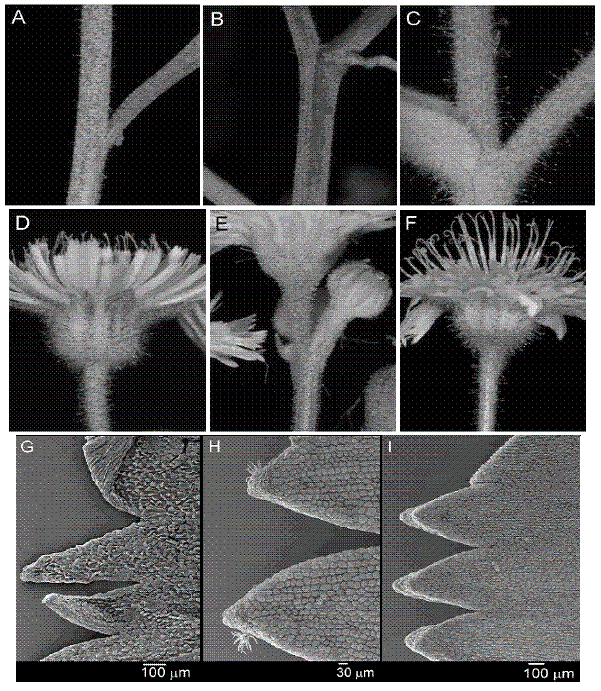
	    <p>During field work, plants with a contrasting morphology when compared with the Madeiran <i>Andryala</i> species (<i>Andryala glandulosa</i> Lam. and <i>Andryala crithmifolia</i> Aiton) were detected. Following various floras &#91;Flora de Portugal (COUTINHO, 1939); Flora Europaea Vol. IV (SELL, 1976); Nova Flora de Portugal (FRANCO, 1984) and Flora Vascular de Andaluc&iacute;a Occidental (TALAVERA, 1987)&#93; these plants correspond to <i>A. integrifolia</i>. The morphology of the vegetative and reproductive structures of this species differs from those recognized for the archipelago of Madeira (Figure 1). A key to Madeira archipelago <i>Andryala</i> L. is presented:</p>


	    <p><i>Key to Madeira Archipelago</i> Andryala <i>L. SPECIES</i></p>

	    <p>1. Lower leaves 1&#45;2&#45;pinnatissect with segments up to 3 mm in width; peduncles with short glandular hairs, ligules stellate&#45;hairy at the apex of all the teeth ........ <i>A. crithmifolia</i></p>

	    <p>&nbsp;&nbsp;&nbsp; Lower leaves subentire to pinnatipartite; peduncles with long glandular hairs, ligules not stellate&#45;hairy or rarely so at the apex of a few teeth ........ 2</p>

	    <p>2. Stem with numerous long glandular hairs, all along the stem or at least on the superior part; involucral bracts involute, enfolding a floret; florets golden yellow, external ones rarely with a reddish stripe on the outer face ........ <i>A. glandulosa</i></p>

	    <p>&nbsp;&nbsp;&nbsp; Stem sometimes with few glandular hairs on the superior part; involucral bracts flat, not enfolding a floret; external florets pale yellow, frequently with a reddish stripe on the outer face ........ <i>A. integrifolia</i></p>

	    <p>&nbsp;</p>

	    <p><img src="/img/revistas/slu/v19n1/19n1a10f1.gif"></p>

	    
<p><b>Figure 1  &#45; Stem:</b> A &#45; <i>A. integrifolia</i>; B &#45; <i>A. crithmifolia</i>; C &#45; <i>A. glandulosa</i>; <b>Peduncle:</b> D &#45; <i>A. integrifolia</i>; E &#45; <i>A. crithmifolia</i>; F &#45; <i>A. glandulosa</i>; <b>Teeth of the ligules:</b> G &#45; <i>A. integrifolia</i>; H &#45; <i>A. crithmifolia</i>; I. &#45; <i>A. glandulosa</i></p>

	    ]]></body>
<body><![CDATA[<p>&nbsp;</p>

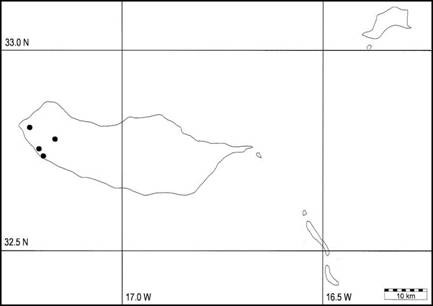
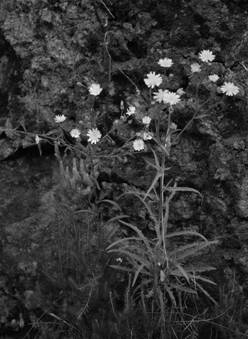
	    <p><i>A. integrifolia</i> has a very restrict distribution in Madeira (Figure 2). In 2009 it was found at Prazeres, Faj&atilde; da Ovelha and Paul da Serra, but more recently (2010) it was seen in abundance at Ponta do Pargo, the most far western locality of the island, co&#45;existing with <i>Andryala glandulosa</i> Lam. subsp. <i>glandulosa</i> and <i>Andryala glandulosa</i> Lam. subsp. <i>cheiranthifolia</i> (L'H&eacute;r.) Greuter. <i>A. integrifolia</i> has been reported to grow on sandy, rocky or sterile terrains, uncultivated lands and stone walls (COUTINHO, 1939; FRANCO, 1984). In Madeira Island it grows on rocky road slopes (Figure 3) and uncultivated lands nearby roads, at altitudes between 539 m (road to Prazeres) and 1500 m (Paul da Serra) above sea level.</p>

	    <p>&nbsp;</p>
	
	    <p><img src="/img/revistas/slu/v19n1/19n1a10f2.jpg"></p>

	    
<p><b>Figure 2</b> &#45; Distribution area of <i>Andryala integrifolia</i> in Madeira</p>

	    <p>&nbsp;</p>

	    <p><img src="/img/revistas/slu/v19n1/19n1a10f3.jpg"></p>

	    
<p><b>Figure 3</b> &#45; <i>A. integrifolia</i> (to the left), <i>A. glandulosa</i> (to the right)</p>

	    <p>&nbsp;</p>

	    <p><b>Studied material</b> (<i>Andryala integrifolia</i> L.)</p>

	    ]]></body>
<body><![CDATA[<p>PORTUGAL. Madeira: Paul da Serra, talude rochoso junto &agrave; Estrada, 24.VII.2009, M. Sequeira, A. Pupo Correia, A. Figueiredo, Z. Ferreira (MA 801896); Madeira: Estrada para os Prazeres, Alt. 590, 29.VII.2009, Z. Ferreira, M. Benedito &amp; M. Sequeira (MA 801898); Madeira: Estrada para os Prazeres, no talude da via r&aacute;pida, 29.VII.2009, Z. Ferreira, M. Benedito &amp; M. Sequeira (MA 801897); Beira Baixa: Barca d'Alva, taludes do caminho de ferro, VI.1915, R. Palhinha e F. Mendes (LISU 40310); Beira Litoral: Lous&atilde;, Quinta da Alfocheira, R.F. Palhinha (LISU 40284); Estremadura: Set&uacute;bal, Arr&aacute;bida, Casais da Serra, erva anual, com cerca de 50 cm, folhas onduladas, 06.VI.1979, Jo&atilde;o Paulo Lopes (LISU 139690); Ribatejo: Pancas, a sudoeste do Espanadal, linha de &aacute;gua que termina no Mosqueteiro, sebe ao longo da linha de &aacute;gua, na periferia, erva anual com ca. de 80 cm, cap&iacute;tulos amarelos, 22.VII.1982, M. Correia &amp; J. Cardoso (LISU 150967); Tr&aacute;s&#45;os&#45;Montes: Nantes, Serra da Brunheira, VI.1910, Dr. R. Palhinha, H. Navel e F. Mendes (LISU 40337)</p>

	    <p>SPAIN. Canary Islands: San Andr&eacute;s, El Pinar (El Hierro), borde carretera, 28.III.2004, Miguel Ant&oacute;nio Padr&oacute;n Mederos (TFC 45089); Can&aacute;rias: Vega de S. Mateo, Matazano (Gran Can&aacute;ria), en eriales de cultivos abandonados y zonas de pastoreo de las median&iacute;as altas, 23.V.1999, A. Marrero (MA 632723); Burgos: cercan&iacute;as de Huidobro, paramera caliza, 22.VII.1984, Gal&aacute;n Cela &amp; A. Mart&iacute;n (MA 639931); Cantabria: Valderredible, Ruijas, cuneta, 780 m, 29.VI.2000, M. Pardo de Santayana (MA 726270); Madrid: Sierra de Guadarrama, Collado Mediano, 26.VI.1995, M.A. Carrasco &amp; S. Pajar&oacute;n (MA582315).</p>

	    <p>&nbsp;</p>

	    <p><b>Discussion</b></p>

	    <p>AITON (1789) assigned <i>A. integrifolia</i> to South Europe and considered two <i>Andryala</i> species for Madeira, both endemic: <i>A. crithmifolia</i> Aiton and <i>Andryala cheiranthifolia</i> L&rsquo;H&eacute;r. (presently included in <i>A. glandulosa</i>). Likewise, no references to the presence of <i>A. integrifolia</i> in the Madeira archipelago are found on the basic floras by LOWE (1868), MENEZES (1914), PRESS &amp; SHORT (1994) and VIEIRA (2002), neither do JARDIM and MENEZES DE SEQUEIRA (2008) make any allusion. Thus, <i>A. integrifolia</i> can be considered a new alien species in Madeira.</p>

	    <p>According to DAISIE &#91;Delivering Alien Invasive Species Inventories for Europe (<a href="http://www.europe&#45;aliens.org/" target="_blank"> http://www.europe&#45;aliens.org/ </a>)&#93;, <i>A. integrifolia</i> is considered an alien species in Austria (not established) and the Azores (established). Alien plants are those whose presence in a given area is due to human involvement, or which have arrived there without people's intervention from an area in which they are alien (PY&Scaron;EK <i>et al</i>., 2004). These can become naturalized if they sustain self&#45;replacing populations for at least 10 years without direct intervention by people (or in spite of human intervention) by recruitment from seed or ramets capable of independent growth. Naturalized plant species acquire an invasive status when producing reproductive offspring, often in very large numbers, at considerable distances from the parent plants, thus exhibiting potential to spread over a large area (PY&Scaron;EK <i>et al</i>., op cit.).</p>

	    <p>Invasive species can alter the evolutionary pathway of native species by niche displacement, competitive exclusion, hybridization, introgression, and ultimately extinction (MOONEY and CLELAND, 2001). Invasive plants can displace native species through propagation abilities, soil chemistry alteration, allelopathic effects, competition for nutrients, water, etc (GLEADOW and ASHTON, 1981; D'ANTONIO and MAHALL, 1991; BAARS and KELLY, 1996; CLEVERLY <i>et al</i>., 1997; FOGARTY and FACELLI, 1999; CORDEIRO and SILVA, 2003; VAN DEN BOSCH <i>et al</i>., 2004; ASNER and VITOUSEK, 2005; BOLAND, 2006; REASER, 2007; NIU, 2007; SILVA <i>et al.,</i> 2008; GALLO <i>et al</i>., 2008; BOWMAN, 2008; CONSER and CONNOR, 2009).</p>

	    <p>Natural hybridization can increase genetic diversity at both the population and species level, and new species can be derived through this process (GALLEZ <i>et al</i>., 1982; RIESEBERG, 1991a; ARNOLD, 1993; WANG <i>et al</i>., 1994; MENEZES DE SEQUEIRA and CASTROVIEJO, 2007; SHERMAN and BURKE, 2009). However, hybridization due to the introduction of non&#45;native species can threaten the genetic integrity and persistence of native species (KRAHULCOV&Aacute; <i>et al</i>., 1996; GALLAGHER <i>et al</i>., 1997; ANTTILA <i>et al</i>., 1998; HUXEL, 1999; VIL&Agrave; <i>et al</i>., 2000; ABBOTT <i>et al.,</i>2003).</p>

	    <p>There is increasing evidence that invasive alien species have become the most significant driver of population declines and species extinction in island ecosystems (VITOUSEK <i>et al</i>., 1987; SMITH and TUNISON, 1992; REASER, 2007). The fairly recent, deliberate introduction of alien plants in Macaronesia has unfortunately meant considerable changes to the landscape during the 20<sup>th</sup> century and in some cases also meant a threat to the very survival of native types of vegetation (SJ&Ouml;GREN, 2000). In the Canary Archipelago, the total of alien vascular plants species is about 701, of which 82 are invasive (ACEBES GINOV&Eacute;S <i>et al</i>., 2010). While in the Azores no less than 60% of the vascular plant taxa is non&#45;indigenous (SILVA and SMITH, 2004), in the archipelagos of Madeira and Selvagens about 33.3% of the vascular flora is introduced (JARDIM and MENEZES DE SEQUEIRA, 2008).</p>

	    <p>The introduction of new plant species in Madeira seems to continue at a strong rhythm, and, apart from <i>A. integrifolia</i>, <i>Solidago chilensis</i> Meyen (GON&Ccedil;ALVES SILVA<i>et al</i>., 2008) and <i>Viburnum tinus</i> L. (SILVA <i>et al</i>., 2009) were recently detected. The introduction of <i>A. integrifolia</i> will certainly not have the same impact as some phanerophytes (e.g. <i>Acacia mearnsii</i> De Wild) have in the Madeiran landscape and ecosystems. Although the ecological impacts are expected to be negligible, the possible hybridization with endemics (<i>A. crithmifolia</i> and <i>A. glandulosa</i>) could lead to a biodiversity loss. The fact that there are several records of hybridization within <i>Andryala</i>, with <i>A. integrifolia</i> as one of the parental species, contributes to raise concerns in this matter. For instance, KUNKEL (1978) described the hybrid <i>x Andryala christii</i> Kunkel (= <i>A. integrifolia</i> L. x <i>A. pinnatifida</i> Aiton) for Gran Canaria. MAIRE (1926) described an algerian hybrid, <i>x Andryala faurei</i> Maire (= <i>Andryala arenaria</i> Boiss. et Reut. x <i>A. integrifolia</i> L.), considering it closer to <i>A. integrifolia</i>, which indicates that breeding probably resulted from pollination by this parental species. Later MAIRE (1937) described a new hybrid for Algeria: <i>x Andryala dichroa</i> Maire (= <i>A. integrifolia</i> L. x <i>A. laxiflora</i> Salzm.), which is closer to <i>A. laxiflora</i>, although the male parent is again <i>A. integrifolia</i>. Besides, <i>A. glandulosa</i> and <i>A. integrifolia</i> are both diploids with 2n=18 (DALGAARD, 1985; IZUZQUIZA, 1988), and therefore hybridization is quite possible. Hybridization is even more feasible at Ponta do Pargo, where <i>A. integrifolia</i> co&#45;exists with both subspecies of <i>A. glandulosa</i>.</p>

	    ]]></body>
<body><![CDATA[<p>Hybridization and subsequent introgression between abundant exotic taxa and rare native congeners can promote extinction of the latter (RHYMER and SIMBERLOFF, 1996; LEVIN <i>et al</i>., 1996; WOLF, 2001). Small insular populations are particularly vulnerable to extinction by hybridization (RIESEBERG, 1991b; LEVIN <i>et al</i>., 1996; MOONEY and CLELAND, 2001). In Madeira the populations of <i>A. crithmifolia</i> occur only in a few sites and are numerically small. Hence, the probability of extinction of this critically endangered endemism may be increased by hybridization with <i>A. integrifolia</i>, encase this congener becomes a widespread species invading areas where populations of <i>A. crithmifolia</i> occur.</p>

	    <p>All the well&#45;documented examples of invasive alien plants around the world, and especially on islands, clearly show that most of them constitute a serious conservation issue. Alien species may stay at a fairly low population size for years and then explode at some later date. This so&#45;called lag effect may simply be the result of the normal increase in size and distribution of a population (MOONEY and CLELAND, 2001; e.g. <i>Lantana camara</i> L. in Galapagos Archipelago, TYE, 2001). <i>A. integrifolia</i> is fully naturalized in Madeira, and may become a conservation problem in a near future. It is currently growing in western localities of Madeira Island, but it may be going through a time&#45;lag effect and the possibility of it becoming invasive must not be discarded. The fact that <i>A. integrifolia</i> was recently found on another Azorean island shows that its spreading ability should not be underestimated.</p>

	    <p>In order to implement efficient control methods, it is essential to understand how alien plants affect native vegetation. Relatively to <i>A. integrifolia</i> in Madeira, the impacts may seem insignificant when compared to other alien plants, but the strong possibility that two endemic <i>Andryala</i> species can be threatened by the presence of <i>A. integrifolia</i>, justifies the need of constant monitoring, since naturalized species can reach an invasive status replacing even endemisms. An early eradication at the sites where it co&#45;habits with <i>A. glandulosa</i> could help prevent hybridization and inherent consequences.</p>

	    <p>Globalization facilitates the spread of invasive alien species as international commerce develops new trade routes, markets, and products (MEYERSON and MOONEY, 2007). By trade, transport, travel and tourism, invasive alien species are introduced through various pathways, which can be intentional or unintentional (BURGIEL <i>et al</i>., 2006). Some major pathways of introduction for alien plants are forestry, seed contaminant, feral crop, horticulture, hitchhikers, and ornamental (HULME <i>et al.,</i> 2008). The introduction of <i>A. integrifolia</i> L. in Madeira was most likely unintentional as a by&#45;product of trade either as seed contaminants or accidental hitchhikers attached to vehicles or machinery. The increasing global rate of road construction is leading to a parallel increase of areas of degraded soil conditions and steep slopes that need revegetation. Hydro seeding with commercial seeds of fast&#45;growing grasses and legumes is a common practice in revegetation of motorway slopes (MATESANZ <i>et al</i>., 2006). In Madeira <i>A. integrifolia</i> grows on roadsides, and since road construction and road use are disturbed habitats related to weed proliferation (FORCELLA and HARVEY, 1983), another plausible explanation for the introduction of <i>A. integrifolia</i> is the hydro seeding of the roadsides with seed mixtures including alien species. Hydro seeding is a good method of revegetation as long as local species are used instead of the available commercial species (TORMO <i>et al</i>., 2007). To impede further introductions of <i>A. integrifolia</i> in Madeira, a special attention should be given to seed and plant trade, bearing in mind that the success of restoration by hydro seeding dwells in the selection of native species from the local flora that are more able to overcome the specific limitations of the disturbed area to be restored (BOCHET <i>et al</i>., 2009).</p>

	    <p>&nbsp;</p>

	    <p><b>References</b></p>

	    <!-- ref --><p>ABBOTT, R.J., JAMES, J.K., MILNE, R.I., GILLIES, A.C.M., 2003. Plant introductions, hybridization and gene flow. Philosophical Transactions of the Royal Society of London. B. <i>Biological Sciences</i> <b>358</b>: 1123&#45;1289.    &nbsp;&nbsp;&nbsp;&nbsp;&nbsp;&nbsp;&nbsp;&nbsp;[&#160;<a href="javascript:void(0);" onclick="javascript: window.open('/scielo.php?script=sci_nlinks&ref=000059&pid=S0870-6352201100010001000001&lng=','','width=640,height=500,resizable=yes,scrollbars=1,menubar=yes,');">Links</a>&#160;]<!-- end-ref --></p>

	    <!-- ref --><p>ACEBES GINOV&Eacute;S, J. R., LE&Oacute;N ARENCIBIA, M. C., RODR&Iacute;GUEZ NAVARRO, M. L., DEL ARCO AGUILAR, M., GARC&Iacute;A GALLO, A., P&Eacute;REZ DE PAZ, P. L., RODR&Iacute;GUEZ DELGADO, O., MART&Iacute;N OSORIO, V.E., WILDPRET DE LA TORRE, W., 2010. <i>Pteridophyta &amp; Spermatophyta. In Lista de especies silvestres de Canarias. Hongos, plantas y animales terrestres</i> 2009 (eds: ARECHAVALETA, M. S., RODR&Iacute;GUEZ, N. Z. &amp; GARC&Iacute;A, A.). Gobierno de Canarias, p. 156.    &nbsp;&nbsp;&nbsp;&nbsp;&nbsp;&nbsp;&nbsp;&nbsp;[&#160;<a href="javascript:void(0);" onclick="javascript: window.open('/scielo.php?script=sci_nlinks&ref=000061&pid=S0870-6352201100010001000002&lng=','','width=640,height=500,resizable=yes,scrollbars=1,menubar=yes,');">Links</a>&#160;]<!-- end-ref --></p>

	    ]]></body>
<body><![CDATA[<!-- ref --><p>AITON, W., 1789. <i>Hortus Kewensis, or, A Catalogue of the Plants cultivated in the Royal Botanic Garden at Kew</i>.&nbsp; Vol. III. Printed for Geoge Nicol, Bookseller to his Majesty, London, pp. 128&#45;129.    &nbsp;&nbsp;&nbsp;&nbsp;&nbsp;&nbsp;&nbsp;&nbsp;[&#160;<a href="javascript:void(0);" onclick="javascript: window.open('/scielo.php?script=sci_nlinks&ref=000063&pid=S0870-6352201100010001000003&lng=','','width=640,height=500,resizable=yes,scrollbars=1,menubar=yes,');">Links</a>&#160;]<!-- end-ref --></p>

	    <!-- ref --><p>ANTTILA, C.K., DAEHLER, C.C., RANK, N.E., STRONG, D.R., 1998. Greater male fitness of a rare invader (Spartina alterniflora, Poaceae) threatens a common native (Spartina foliosa) with hybridization. <i>American Journal of Botany</i> <b>85</b>(11): 1597&#45;1601.    &nbsp;&nbsp;&nbsp;&nbsp;&nbsp;&nbsp;&nbsp;&nbsp;[&#160;<a href="javascript:void(0);" onclick="javascript: window.open('/scielo.php?script=sci_nlinks&ref=000065&pid=S0870-6352201100010001000004&lng=','','width=640,height=500,resizable=yes,scrollbars=1,menubar=yes,');">Links</a>&#160;]<!-- end-ref --></p>

	    <!-- ref --><p>ARNOLD, M.L., 1993. Iris nelsonii (Iridaceae): origin and genetic composition of a homoploid hybrid species. <i>American Journal of Botany</i> <b>80</b>: 577&#150;83.    &nbsp;&nbsp;&nbsp;&nbsp;&nbsp;&nbsp;&nbsp;&nbsp;[&#160;<a href="javascript:void(0);" onclick="javascript: window.open('/scielo.php?script=sci_nlinks&ref=000067&pid=S0870-6352201100010001000005&lng=','','width=640,height=500,resizable=yes,scrollbars=1,menubar=yes,');">Links</a>&#160;]<!-- end-ref --></p>

	    <!-- ref --><p>ASNER, G.P., VITOUSEK, P.M., 2005. Remote analysis of biological invasion and biogeochemical change<i>. Proceedings of the National Academy of Sciences of the United States of America</i> <b>102</b>(12): 4383&#45;4386.    &nbsp;&nbsp;&nbsp;&nbsp;&nbsp;&nbsp;&nbsp;&nbsp;[&#160;<a href="javascript:void(0);" onclick="javascript: window.open('/scielo.php?script=sci_nlinks&ref=000069&pid=S0870-6352201100010001000006&lng=','','width=640,height=500,resizable=yes,scrollbars=1,menubar=yes,');">Links</a>&#160;]<!-- end-ref --></p>

	    <!-- ref --><p>BATTANDIER, J.A., TRABUT, L.C., 1899<i>. Flore de l'Algerie. Dicotyl&eacute;dones</i>. Typographie Adolphe Jourdan, Alger; Libraire F. Savy 77, Paris, pp. 566&#45;568.    &nbsp;&nbsp;&nbsp;&nbsp;&nbsp;&nbsp;&nbsp;&nbsp;[&#160;<a href="javascript:void(0);" onclick="javascript: window.open('/scielo.php?script=sci_nlinks&ref=000071&pid=S0870-6352201100010001000007&lng=','','width=640,height=500,resizable=yes,scrollbars=1,menubar=yes,');">Links</a>&#160;]<!-- end-ref --></p>

	    ]]></body>
<body><![CDATA[<!-- ref --><p>BAARS, R., KELLY, D., 1996. Survival and growth responses of native and introduced vines in New Zealand to light availability. <i>New Zealand Journal of&nbsp; Botany</i> <b>34</b>: 389&#150;400&nbsp;&nbsp;&nbsp;&nbsp;&nbsp;&nbsp;&nbsp;&nbsp;[&#160;<a href="javascript:void(0);" onclick="javascript: window.open('/scielo.php?script=sci_nlinks&ref=000073&pid=S0870-6352201100010001000008&lng=','','width=640,height=500,resizable=yes,scrollbars=1,menubar=yes,');">Links</a>&#160;]<!-- end-ref --><!-- ref --><p>BOCHET, E., TORMO, J., GARC&Iacute;A&#45;FAYOS, P., 2009. Native species for roadslope revegetation: selection, validation and cost effectiveness. <i>Restoration Ecology</i> <b>18</b>(5): 656&#45;663&nbsp;&nbsp;&nbsp;&nbsp;&nbsp;&nbsp;&nbsp;&nbsp;[&#160;<a href="javascript:void(0);" onclick="javascript: window.open('/scielo.php?script=sci_nlinks&ref=000074&pid=S0870-6352201100010001000009&lng=','','width=640,height=500,resizable=yes,scrollbars=1,menubar=yes,');">Links</a>&#160;]<!-- end-ref --><!-- ref --><p>BOLAND, J.M., 2006. The importance of layering in the rapid spread of Arundo Donax (Giant Reed) <i>Madro&ntilde;o</i> <b>53</b>(4): 303&#45;312.    &nbsp;&nbsp;&nbsp;&nbsp;&nbsp;&nbsp;&nbsp;&nbsp;[&#160;<a href="javascript:void(0);" onclick="javascript: window.open('/scielo.php?script=sci_nlinks&ref=000075&pid=S0870-6352201100010001000010&lng=','','width=640,height=500,resizable=yes,scrollbars=1,menubar=yes,');">Links</a>&#160;]<!-- end-ref --></p>

	    <!-- ref --><p>BOWMAN, G., TARAYRE, M., ATLAN, A., 2008. How is the invasive gorse Ulex europaeus pollinated during winter? A lesson from its native range. <i>Plant Ecology</i> <b>197</b>(2): 197&#45;206.    &nbsp;&nbsp;&nbsp;&nbsp;&nbsp;&nbsp;&nbsp;&nbsp;[&#160;<a href="javascript:void(0);" onclick="javascript: window.open('/scielo.php?script=sci_nlinks&ref=000077&pid=S0870-6352201100010001000011&lng=','','width=640,height=500,resizable=yes,scrollbars=1,menubar=yes,');">Links</a>&#160;]<!-- end-ref --></p>

	    <!-- ref --><p>BURGIEL, S., FOOTE, G., ORELLANA, M., PERRAULT, A., 2006. <i>Invasive Alien Species and Trade: Integrating Prevention Measures and International Trade Rules.</i> Center for International Environmental Law and Defenders of Wildlife, Washington, DC, USA., pp. 6&#45;8&nbsp;&nbsp;&nbsp;&nbsp;&nbsp;&nbsp;&nbsp;&nbsp;[&#160;<a href="javascript:void(0);" onclick="javascript: window.open('/scielo.php?script=sci_nlinks&ref=000079&pid=S0870-6352201100010001000012&lng=','','width=640,height=500,resizable=yes,scrollbars=1,menubar=yes,');">Links</a>&#160;]<!-- end-ref --><!-- ref --><p>CLEVERLY, J.R., SMITH, S.D., SALA, A., DEVITT, D.A., 1997. Invasive capacity of Tamarix ramosissima in a Mojave Desert floodplain: the role of drought. <i>Oecologia</i> <b>111</b>(1): 12&#150;18.    &nbsp;&nbsp;&nbsp;&nbsp;&nbsp;&nbsp;&nbsp;&nbsp;[&#160;<a href="javascript:void(0);" onclick="javascript: window.open('/scielo.php?script=sci_nlinks&ref=000080&pid=S0870-6352201100010001000013&lng=','','width=640,height=500,resizable=yes,scrollbars=1,menubar=yes,');">Links</a>&#160;]<!-- end-ref --></p>

	    <!-- ref --><p>CONSER, C., CONNOR, E.F., 2009. Assessing the residual effects of Carpobrotus edulis invasion, implications for restoration. <i>Biological Invasions</i> <b>11</b>(2):349&#150;358&nbsp;&nbsp;&nbsp;&nbsp;&nbsp;&nbsp;&nbsp;&nbsp;[&#160;<a href="javascript:void(0);" onclick="javascript: window.open('/scielo.php?script=sci_nlinks&ref=000082&pid=S0870-6352201100010001000014&lng=','','width=640,height=500,resizable=yes,scrollbars=1,menubar=yes,');">Links</a>&#160;]<!-- end-ref --><!-- ref --><p>CORDEIRO, N., SILVA, L., 2003. Seed production and vegetative growth of Hedychium gardnerianum Ker&#45;Gawler (Zingiberaceae) in S&atilde;o Miguel Island (Azores). Arquip&eacute;lago. <i>Life and Marine Sciences</i>. 20A: 31&#45;36.    &nbsp;&nbsp;&nbsp;&nbsp;&nbsp;&nbsp;&nbsp;&nbsp;[&#160;<a href="javascript:void(0);" onclick="javascript: window.open('/scielo.php?script=sci_nlinks&ref=000083&pid=S0870-6352201100010001000015&lng=','','width=640,height=500,resizable=yes,scrollbars=1,menubar=yes,');">Links</a>&#160;]<!-- end-ref --></p>

	    <!-- ref --><p>COUTINHO, C.A.P., 1939. <i>Flora de Portugal (Plantas Vasculares) Disposta em Chaves Dichotomicas</i>. 2&ordf; edi&ccedil;&atilde;o. Bertrand Ltd., Lisboa, p. 791.    &nbsp;&nbsp;&nbsp;&nbsp;&nbsp;&nbsp;&nbsp;&nbsp;[&#160;<a href="javascript:void(0);" onclick="javascript: window.open('/scielo.php?script=sci_nlinks&ref=000085&pid=S0870-6352201100010001000016&lng=','','width=640,height=500,resizable=yes,scrollbars=1,menubar=yes,');">Links</a>&#160;]<!-- end-ref --></p>

	    <!-- ref --><p>D'ANTONIO, C.M., MAHALL, B.E., 1991. Root profiles and competition between the invasive, exotic perennial, Carpobrotus edulis, and two native shrub species in California coastal scrub. <i>American Journal of Botany</i> <b>78</b>: 885&#45;894.    &nbsp;&nbsp;&nbsp;&nbsp;&nbsp;&nbsp;&nbsp;&nbsp;[&#160;<a href="javascript:void(0);" onclick="javascript: window.open('/scielo.php?script=sci_nlinks&ref=000087&pid=S0870-6352201100010001000017&lng=','','width=640,height=500,resizable=yes,scrollbars=1,menubar=yes,');">Links</a>&#160;]<!-- end-ref --></p>

	    <!-- ref --><p>DAISIE European Invasive Alien Species Gateway, 2008. Andryala integrifolia L.: <a href=" http://www.europe-aliens.org/speciesFactsheet.do?speciesId=21840" target="_blank"> www.europe&#45;aliens.org/speciesFactsheet.do?speciesId=21840</a> &#91;Accessed 18<sup>th</sup> Oct. 2010&#93;    &nbsp;&nbsp;&nbsp;&nbsp;&nbsp;&nbsp;&nbsp;&nbsp;[&#160;<a href="javascript:void(0);" onclick="javascript: window.open('/scielo.php?script=sci_nlinks&ref=000089&pid=S0870-6352201100010001000018&lng=','','width=640,height=500,resizable=yes,scrollbars=1,menubar=yes,');">Links</a>&#160;]<!-- end-ref -->.</p>
 
	    <!-- ref --><p>DALGAARD, V., 1985. Chromosome studies in flowering plants from Madeira. <i>Willdenowia</i> <b>15</b>: 137&#45;156.    &nbsp;&nbsp;&nbsp;&nbsp;&nbsp;&nbsp;&nbsp;&nbsp;[&#160;<a href="javascript:void(0);" onclick="javascript: window.open('/scielo.php?script=sci_nlinks&ref=000091&pid=S0870-6352201100010001000019&lng=','','width=640,height=500,resizable=yes,scrollbars=1,menubar=yes,');">Links</a>&#160;]<!-- end-ref --></p>

	    ]]></body>
<body><![CDATA[<!-- ref --><p>FOGARTY, G., FACELLI, J.M., 1999. Growth and competition of Cytisus scoparius, an invasive shrub, and Australian native shrubs. <i>Plant Ecology</i> <b>144</b>(1): 27&#45;35.    &nbsp;&nbsp;&nbsp;&nbsp;&nbsp;&nbsp;&nbsp;&nbsp;[&#160;<a href="javascript:void(0);" onclick="javascript: window.open('/scielo.php?script=sci_nlinks&ref=000093&pid=S0870-6352201100010001000020&lng=','','width=640,height=500,resizable=yes,scrollbars=1,menubar=yes,');">Links</a>&#160;]<!-- end-ref --></p>

	    <!-- ref --><p>FORCELLA, F., HARVEY, S.J., 1983. Relative abundance in an alien weed flora. <i>Oecologia</i> <b>59</b>: 292&#45;295.    &nbsp;&nbsp;&nbsp;&nbsp;&nbsp;&nbsp;&nbsp;&nbsp;[&#160;<a href="javascript:void(0);" onclick="javascript: window.open('/scielo.php?script=sci_nlinks&ref=000095&pid=S0870-6352201100010001000021&lng=','','width=640,height=500,resizable=yes,scrollbars=1,menubar=yes,');">Links</a>&#160;]<!-- end-ref --></p>

	    <p>GALLAGHER, K.G., SCHIERENBECK, K.A., D&rsquo;ANTONIO, C.M., 1997. Hybridization and introgression in Carpobrotus spp. (Aizoaceae) in California II. Allozyme evidence. <i>American Journal of Botany</i> <b>84</b>(8): 905&#45;911.</p>

	    <!-- ref --><p>FRANCO, J. A., 1984. Nova Flora de Portugal (Continente e A&ccedil;ores).&nbsp; Vol. 2. Lisboa, p. 543.    &nbsp;&nbsp;&nbsp;&nbsp;&nbsp;&nbsp;&nbsp;&nbsp;[&#160;<a href="javascript:void(0);" onclick="javascript: window.open('/scielo.php?script=sci_nlinks&ref=000098&pid=S0870-6352201100010001000023&lng=','','width=640,height=500,resizable=yes,scrollbars=1,menubar=yes,');">Links</a>&#160;]<!-- end-ref --></p>

	    <!-- ref --><p>GALLEZ, G.P., GOTTLIEB, L.D., 1982. Genetic evidence for the hybrid origin of the diploid plant Stephanomeria diegensis. <i>Evolution</i> <b>36</b>(6): 1158&#150;1167.    &nbsp;&nbsp;&nbsp;&nbsp;&nbsp;&nbsp;&nbsp;&nbsp;[&#160;<a href="javascript:void(0);" onclick="javascript: window.open('/scielo.php?script=sci_nlinks&ref=000100&pid=S0870-6352201100010001000024&lng=','','width=640,height=500,resizable=yes,scrollbars=1,menubar=yes,');">Links</a>&#160;]<!-- end-ref --></p>

	    <!-- ref --><p>GALLO, A.G., WILDPRET DE LA TORRE, W., RODR&Iacute;GUEZ, V.M., 2008. Especies vegetales consideradas invasoras de h&aacute;bitats, en la Historia Natural de Canarias. <i>Lazaroa</i> <b>29</b>: 49&#45;67.    &nbsp;&nbsp;&nbsp;&nbsp;&nbsp;&nbsp;&nbsp;&nbsp;[&#160;<a href="javascript:void(0);" onclick="javascript: window.open('/scielo.php?script=sci_nlinks&ref=000102&pid=S0870-6352201100010001000025&lng=','','width=640,height=500,resizable=yes,scrollbars=1,menubar=yes,');">Links</a>&#160;]<!-- end-ref --></p>

	    <!-- ref --><p>GELDMACHER, J., VAN DEN BOGAARD, P., HOERNLE, K., SCHMINCKE, H.&#45;U., 2000. The 40Ar/39Ar age dating of the Madeira Archipelago and hotspot track (eastern North Atlantic). <i>Geochemistry Geophysics Geosystems</i> <b>1</b>(2): 1&#45;26.    &nbsp;&nbsp;&nbsp;&nbsp;&nbsp;&nbsp;&nbsp;&nbsp;[&#160;<a href="javascript:void(0);" onclick="javascript: window.open('/scielo.php?script=sci_nlinks&ref=000104&pid=S0870-6352201100010001000026&lng=','','width=640,height=500,resizable=yes,scrollbars=1,menubar=yes,');">Links</a>&#160;]<!-- end-ref --></p>

	    <p>GELDMACHER, J., HOERNLE, K., KL&Uuml;GEL, A., BOGAARD, P. V. D., WOMBACHER, F., BERNING, B., 2006. Origin and geochemical evolution of the Madeira&#45;Tore Rise (eastern North Atlantic). <i>Journal of Geophysical Research</i> <b>111</b>: 1&#45;19.</p>

	    <!-- ref --><p>GLEADOW, R., ASHTON, D., 1981. Invasion by Pittosporum undulatum of the Forests of Central Victoria. I. Invasion Patterns and Plant Morphology. <i>Australian Journal of Botany</i> <b>29</b>(6): 705&#45;720.    &nbsp;&nbsp;&nbsp;&nbsp;&nbsp;&nbsp;&nbsp;&nbsp;[&#160;<a href="javascript:void(0);" onclick="javascript: window.open('/scielo.php?script=sci_nlinks&ref=000107&pid=S0870-6352201100010001000028&lng=','','width=640,height=500,resizable=yes,scrollbars=1,menubar=yes,');">Links</a>&#160;]<!-- end-ref --></p>

	    <!-- ref --><p>GON&Ccedil;ALVES SILVA, J.J., SEMPLE, J.C., LOPEZ LAPHITZ, R., MENEZES DE SEQUEIRA, M., 2008. First record of La Plate River Goldenrod Solidago chilensis Meyen (Asteraceae), in the Island of Madeira (Portugal). <i>Boletim do Museu Municipal do Funchal</i> <b>58</b>(320): 31&#45;36.    &nbsp;&nbsp;&nbsp;&nbsp;&nbsp;&nbsp;&nbsp;&nbsp;[&#160;<a href="javascript:void(0);" onclick="javascript: window.open('/scielo.php?script=sci_nlinks&ref=000109&pid=S0870-6352201100010001000029&lng=','','width=640,height=500,resizable=yes,scrollbars=1,menubar=yes,');">Links</a>&#160;]<!-- end-ref --></p>

	    <!-- ref --><p>HANSEN, A., SUNDING P., 1993. Flora of Macaronesia. Checklist of Vascular Plants. 4. Revised Edition. <i>Sommerfeltia</i> <b>17</b>: 34&#45;36.    &nbsp;&nbsp;&nbsp;&nbsp;&nbsp;&nbsp;&nbsp;&nbsp;[&#160;<a href="javascript:void(0);" onclick="javascript: window.open('/scielo.php?script=sci_nlinks&ref=000111&pid=S0870-6352201100010001000030&lng=','','width=640,height=500,resizable=yes,scrollbars=1,menubar=yes,');">Links</a>&#160;]<!-- end-ref --></p>

	    ]]></body>
<body><![CDATA[<p>HULME, P.E., BRUNDU, G., CAMARDA, I., D&Aacute;LIAS, P., LAMBDON, P., LLORET, F., MEDAIL, F., MORAGUES, E., SUEHS, C., TRAVESTE, A., TROUMBIS, A., VIL&Agrave;, M., 2008. Assessing the risks of alien plant invasions on Mediterranean islands. In <i>Plant invasions: Human perception, ecological impacts and management</i> (eds.: TOKARSKA&#45;GUZIK, B., BRUNDU, G., BROCK, J.H., CHILD, L.E., PY&Scaron;EK, P., DAEHLER, C.) Backhuys, Leiden, pp. 39&#45;56</p>

	    <!-- ref --><p>HUXEL, G.R., 1999. Rapid displacement of native species by invasive species: effects of hybridization. <i>Biological Conservation</i><b>89</b>: 143&#45;152.    &nbsp;&nbsp;&nbsp;&nbsp;&nbsp;&nbsp;&nbsp;&nbsp;[&#160;<a href="javascript:void(0);" onclick="javascript: window.open('/scielo.php?script=sci_nlinks&ref=000114&pid=S0870-6352201100010001000032&lng=','','width=640,height=500,resizable=yes,scrollbars=1,menubar=yes,');">Links</a>&#160;]<!-- end-ref --></p>

	    <!-- ref --><p>IZUZQUIZA, A., 1988. N&uacute;meros cromossom&aacute;&#45;ticos de plantas occidentales. <i>Anales del Jardin Bot&aacute;nico de Madrid</i> <b>45</b>(2): 511.    &nbsp;&nbsp;&nbsp;&nbsp;&nbsp;&nbsp;&nbsp;&nbsp;[&#160;<a href="javascript:void(0);" onclick="javascript: window.open('/scielo.php?script=sci_nlinks&ref=000116&pid=S0870-6352201100010001000033&lng=','','width=640,height=500,resizable=yes,scrollbars=1,menubar=yes,');">Links</a>&#160;]<!-- end-ref --></p>

	    <!-- ref --><p>JARDIM, R., MENEZES DE SEQUEIRA, M., 2008. <i>The vascular plants (Pteridophyta and Spermatophyta) of the Madeira and Selvagens archipelagos. In A list of the terrestrial fungi, flora and fauna of Madeira and Selvagens archipelagos</i>. (eds.: BORGES, P.AV., CUNHA, R., GABRIEL, R., MARTINS, A.F., SILVA, L., VIEIRA, V.) Direc&ccedil;&atilde;o Regional do Ambiente da Madeira e Universidade dos A&ccedil;ores, Funchal e Angra do Hero&iacute;smo, pp. 158&#45;207.    &nbsp;&nbsp;&nbsp;&nbsp;&nbsp;&nbsp;&nbsp;&nbsp;[&#160;<a href="javascript:void(0);" onclick="javascript: window.open('/scielo.php?script=sci_nlinks&ref=000118&pid=S0870-6352201100010001000034&lng=','','width=640,height=500,resizable=yes,scrollbars=1,menubar=yes,');">Links</a>&#160;]<!-- end-ref -->&nbsp;</p>

	    <!-- ref --><p>KRAHULCOV&Aacute;, A., KRAHULEC, F., KIRSCHNER, J., 1996. Introgressive hybridization between a native and an introduced species: Viola lutea subsp. sudetica versus V. Tricolor. <i>Folia Geobotanica</i> <b>31</b>(2): 219&#45;244.    &nbsp;&nbsp;&nbsp;&nbsp;&nbsp;&nbsp;&nbsp;&nbsp;[&#160;<a href="javascript:void(0);" onclick="javascript: window.open('/scielo.php?script=sci_nlinks&ref=000120&pid=S0870-6352201100010001000035&lng=','','width=640,height=500,resizable=yes,scrollbars=1,menubar=yes,');">Links</a>&#160;]<!-- end-ref --></p>

	    <!-- ref --><p>KUNKEL, G., 1978. An excursion through my herbarium. II. <i>Vieraea</i> <b>8</b>(2): 342&#45;345.    &nbsp;&nbsp;&nbsp;&nbsp;&nbsp;&nbsp;&nbsp;&nbsp;[&#160;<a href="javascript:void(0);" onclick="javascript: window.open('/scielo.php?script=sci_nlinks&ref=000122&pid=S0870-6352201100010001000036&lng=','','width=640,height=500,resizable=yes,scrollbars=1,menubar=yes,');">Links</a>&#160;]<!-- end-ref --></p>

	    <!-- ref --><p>LEVIN, D.A., FRANCISCO&#45;ORTEGA, J., JANSEN, R.K., 1996. Hybridization and the Extinction of Rare Plant Species. Conservation Biology <b>10</b>(1): 10&#45;16.    &nbsp;&nbsp;&nbsp;&nbsp;&nbsp;&nbsp;&nbsp;&nbsp;[&#160;<a href="javascript:void(0);" onclick="javascript: window.open('/scielo.php?script=sci_nlinks&ref=000124&pid=S0870-6352201100010001000037&lng=','','width=640,height=500,resizable=yes,scrollbars=1,menubar=yes,');">Links</a>&#160;]<!-- end-ref --></p>

	    <!-- ref --><p>LINNEAUS, C., 1753. <i>Species Plantarum, Exhibents Plantas Rite Cognitas, Ad Genera Relatas, Cum Differentiis Specificis, Nominibus Trivialibus, Synonymis Selectis, Loci Natalibus, Secundum Systema Sexuale Digestas</i>. Vol. II. Imprensis Laurentii Slavii, Holmiae, p. 808.    &nbsp;&nbsp;&nbsp;&nbsp;&nbsp;&nbsp;&nbsp;&nbsp;[&#160;<a href="javascript:void(0);" onclick="javascript: window.open('/scielo.php?script=sci_nlinks&ref=000126&pid=S0870-6352201100010001000038&lng=','','width=640,height=500,resizable=yes,scrollbars=1,menubar=yes,');">Links</a>&#160;]<!-- end-ref --></p>

	    <!-- ref --><p>LOWE, R.T., 1868. <i>A manual flora of Madeira and the adjacent islands of Porto Santo and the Desertas</i>.&nbsp; Vol. 1. John van Voorst, London, pp. 561&#45;567.    &nbsp;&nbsp;&nbsp;&nbsp;&nbsp;&nbsp;&nbsp;&nbsp;[&#160;<a href="javascript:void(0);" onclick="javascript: window.open('/scielo.php?script=sci_nlinks&ref=000128&pid=S0870-6352201100010001000039&lng=','','width=640,height=500,resizable=yes,scrollbars=1,menubar=yes,');">Links</a>&#160;]<!-- end-ref --></p>

	    <!-- ref --><p>MATESANZ, S., VALLADARES, F., TENA, D., COSTA&#45;TENORIO, M., BOTE, D., 2006. Early dynamics of plant communities in revegetated motorway slopes from Southern Spa in: is hydroseeding always needed? <i>Restoration Ecology</i> <b>14</b>(2): 297&#45;307.    &nbsp;&nbsp;&nbsp;&nbsp;&nbsp;&nbsp;&nbsp;&nbsp;[&#160;<a href="javascript:void(0);" onclick="javascript: window.open('/scielo.php?script=sci_nlinks&ref=000130&pid=S0870-6352201100010001000040&lng=','','width=640,height=500,resizable=yes,scrollbars=1,menubar=yes,');">Links</a>&#160;]<!-- end-ref --></p>

	    <!-- ref --><p>MENEZES, C.A., 1914. <i>Flora do Archipelago da Madeira (Phanerogamicas e Cryptogamicas Vasculares)</i>. Typ. Bazar do Povo, Funchal, pp.101&#45;102.    &nbsp;&nbsp;&nbsp;&nbsp;&nbsp;&nbsp;&nbsp;&nbsp;[&#160;<a href="javascript:void(0);" onclick="javascript: window.open('/scielo.php?script=sci_nlinks&ref=000132&pid=S0870-6352201100010001000041&lng=','','width=640,height=500,resizable=yes,scrollbars=1,menubar=yes,');">Links</a>&#160;]<!-- end-ref --></p>

	    <!-- ref --><p>MENEZES DE SEQUEIRA, M., CASTROVIEJO, S., 2007. Holcus azoricus M. Seq. &amp; Castrov. (Poaceae), a new species from the Azores Islands. <i>Botanical Journal of the Linnean Society</i>, <b>154</b>(2): 259&#45;267.    &nbsp;&nbsp;&nbsp;&nbsp;&nbsp;&nbsp;&nbsp;&nbsp;[&#160;<a href="javascript:void(0);" onclick="javascript: window.open('/scielo.php?script=sci_nlinks&ref=000134&pid=S0870-6352201100010001000042&lng=','','width=640,height=500,resizable=yes,scrollbars=1,menubar=yes,');">Links</a>&#160;]<!-- end-ref --></p>

	    <!-- ref --><p>MEYERSON, L.A., MOONEY, H.A., 2007. Invasive alien species in an era of globalization. <i>Frontiers in Ecology and the Environment</i> <b>5</b>(4): 199&#150;208.    &nbsp;&nbsp;&nbsp;&nbsp;&nbsp;&nbsp;&nbsp;&nbsp;[&#160;<a href="javascript:void(0);" onclick="javascript: window.open('/scielo.php?script=sci_nlinks&ref=000136&pid=S0870-6352201100010001000043&lng=','','width=640,height=500,resizable=yes,scrollbars=1,menubar=yes,');">Links</a>&#160;]<!-- end-ref --></p>

	    <!-- ref --><p>MOONEY, H.A., CLELAND, E.E., 2001. The evolutionary impact of invasive species. <i>Proceedings of the National Academy of Sciences of the USA</i> <b>98</b>(10): 5446&#150;5451.    &nbsp;&nbsp;&nbsp;&nbsp;&nbsp;&nbsp;&nbsp;&nbsp;[&#160;<a href="javascript:void(0);" onclick="javascript: window.open('/scielo.php?script=sci_nlinks&ref=000138&pid=S0870-6352201100010001000044&lng=','','width=640,height=500,resizable=yes,scrollbars=1,menubar=yes,');">Links</a>&#160;]<!-- end-ref --></p>

	    <!-- ref --><p>N&Egrave;GRE, R., 1962. <i>Petite Flore des R&eacute;gions Arides du Maroc Occidental</i>. Vol. 2. Editions du Centre National de la Recherche Scientifique, Paris, p.354.    &nbsp;&nbsp;&nbsp;&nbsp;&nbsp;&nbsp;&nbsp;&nbsp;[&#160;<a href="javascript:void(0);" onclick="javascript: window.open('/scielo.php?script=sci_nlinks&ref=000140&pid=S0870-6352201100010001000045&lng=','','width=640,height=500,resizable=yes,scrollbars=1,menubar=yes,');">Links</a>&#160;]<!-- end-ref --></p>

	    <!-- ref --><p>NIU, H., LIU, W., WAN, F., LIU, B., 2007. An invasive aster (<i>Ageratina adenophora</i>) invades and dominates forest understories in China: altered soil microbial communities facilitate the invader and inhibit natives. <i>Plant and Soil</i><b>294</b>(1): 73&#150;85.    &nbsp;&nbsp;&nbsp;&nbsp;&nbsp;&nbsp;&nbsp;&nbsp;[&#160;<a href="javascript:void(0);" onclick="javascript: window.open('/scielo.php?script=sci_nlinks&ref=000142&pid=S0870-6352201100010001000046&lng=','','width=640,height=500,resizable=yes,scrollbars=1,menubar=yes,');">Links</a>&#160;]<!-- end-ref --></p>

	    <!-- ref --><p>POIRRET&#45;ALAPETIT, G., 1981. <i>Flore de la Tunisie. Angiospermes &#45; Dicotyledones. Gamopetales.</i> Imprimeri Officialle de la R&eacute;publique de la Tunisienne, Tunisie, pp. 1104&#45;1105.    &nbsp;&nbsp;&nbsp;&nbsp;&nbsp;&nbsp;&nbsp;&nbsp;[&#160;<a href="javascript:void(0);" onclick="javascript: window.open('/scielo.php?script=sci_nlinks&ref=000144&pid=S0870-6352201100010001000047&lng=','','width=640,height=500,resizable=yes,scrollbars=1,menubar=yes,');">Links</a>&#160;]<!-- end-ref --></p>

	    <!-- ref --><p>PRESS, J., SHORT, M.J., 1994. Flora of Madeira. Natural History Museum, London, pp. 381&#45;382.    &nbsp;&nbsp;&nbsp;&nbsp;&nbsp;&nbsp;&nbsp;&nbsp;[&#160;<a href="javascript:void(0);" onclick="javascript: window.open('/scielo.php?script=sci_nlinks&ref=000146&pid=S0870-6352201100010001000048&lng=','','width=640,height=500,resizable=yes,scrollbars=1,menubar=yes,');">Links</a>&#160;]<!-- end-ref --></p>

	    <p>PY&Scaron;EK, P., RICHARDSON, D.M., REJM&Aacute;NEK, M., WEBSTER, G.L., WILLIAMSON, M., KIRSCHNER, J., 2004. Alien plants in checklists and floras: towards better communication between taxonomists and ecologists. <i>Taxon</i> <b>53</b>(1): 131&#150;143.</p>

	    <!-- ref --><p>REASER, J.K., MEYERSON L.A., CRONK, Q., POORTER, M. DE, ELDREGE, L.G., GREEN, E. KAIRO, M, LATASI, P., MACK, R.N. MAUREMOOTOO, J., O'DOWD, D., ORAPA, W., SASTROUTOMO, S., SAUNDERS, A., SHINE, C., THRAINSSON, S., VAIUTU, L., 2007. Ecological and socioeconomic impacts of invasive alien species in island ecosystems. <i>Environmental Conservation</i> <b>34</b>(2): 98&#45;111.    &nbsp;&nbsp;&nbsp;&nbsp;&nbsp;&nbsp;&nbsp;&nbsp;[&#160;<a href="javascript:void(0);" onclick="javascript: window.open('/scielo.php?script=sci_nlinks&ref=000149&pid=S0870-6352201100010001000050&lng=','','width=640,height=500,resizable=yes,scrollbars=1,menubar=yes,');">Links</a>&#160;]<!-- end-ref --></p>

	    <!-- ref --><p>RHYMER, J.M., SIMBERLOFF, D., 1996. Extinction by hybridization and introgression. Annual Review of Ecology and Systematics <b>27</b>: 83&#45;109.    &nbsp;&nbsp;&nbsp;&nbsp;&nbsp;&nbsp;&nbsp;&nbsp;[&#160;<a href="javascript:void(0);" onclick="javascript: window.open('/scielo.php?script=sci_nlinks&ref=000151&pid=S0870-6352201100010001000051&lng=','','width=640,height=500,resizable=yes,scrollbars=1,menubar=yes,');">Links</a>&#160;]<!-- end-ref --></p>

	    ]]></body>
<body><![CDATA[<!-- ref --><p>RIESEBERG, L.H., 1991a. Homoploid reticulate evolution in Helianthus (Asteraceae): evidence from ribosomal genes. <i>American Journal of Botany</i> <b>78</b>: 1218&#45;1237&nbsp;&nbsp;&nbsp;&nbsp;&nbsp;&nbsp;&nbsp;&nbsp;[&#160;<a href="javascript:void(0);" onclick="javascript: window.open('/scielo.php?script=sci_nlinks&ref=000153&pid=S0870-6352201100010001000052&lng=','','width=640,height=500,resizable=yes,scrollbars=1,menubar=yes,');">Links</a>&#160;]<!-- end-ref --><!-- ref --><p>RIESEBERG, L.H., 1991b. Hybridization in rare plants: Insights from case studies in Cercocarpus and Helianthus. In <i>Genetics and conservation of rare plants</i> (eds.: FALK, D.A.,HOLSINGER, K.E.). Oxford University Press, Oxford, pp. 171&#150;181.    &nbsp;&nbsp;&nbsp;&nbsp;&nbsp;&nbsp;&nbsp;&nbsp;[&#160;<a href="javascript:void(0);" onclick="javascript: window.open('/scielo.php?script=sci_nlinks&ref=000154&pid=S0870-6352201100010001000053&lng=','','width=640,height=500,resizable=yes,scrollbars=1,menubar=yes,');">Links</a>&#160;]<!-- end-ref --></p>

	    <!-- ref --><p>SELL, P.D., 1976. Andryala L. In <i>Flora Europaea</i>, Vol. IV (eds.: TUTIN, T.G., HEYWOOD, V.H., BURGESS, N.A., MOORE, D.M., VALENTINE, D.H., WALTERS, S.M., WEBB, D.A.). Cambridge University Press, Cambridge, p. 358.    &nbsp;&nbsp;&nbsp;&nbsp;&nbsp;&nbsp;&nbsp;&nbsp;[&#160;<a href="javascript:void(0);" onclick="javascript: window.open('/scielo.php?script=sci_nlinks&ref=000156&pid=S0870-6352201100010001000054&lng=','','width=640,height=500,resizable=yes,scrollbars=1,menubar=yes,');">Links</a>&#160;]<!-- end-ref --></p>

	    <!-- ref --><p>SHERMAN, N.A., BURKE, J.M., 2009. Population genetic analysis reveals a homoploid hybrid origin of Stephanomeria diegensis (Asteraceae). <i>Molecular Ecology</i> <b>18</b>(19): 4049&#150;4060.    &nbsp;&nbsp;&nbsp;&nbsp;&nbsp;&nbsp;&nbsp;&nbsp;[&#160;<a href="javascript:void(0);" onclick="javascript: window.open('/scielo.php?script=sci_nlinks&ref=000158&pid=S0870-6352201100010001000055&lng=','','width=640,height=500,resizable=yes,scrollbars=1,menubar=yes,');">Links</a>&#160;]<!-- end-ref --></p>

	    <!-- ref --><p>SILVA, JUAN J.G., R. BARONE, MENEZES DE SEQUEIRA, M., 2009. First record of naturalized <i>Viburnum tinus</i> L. (Caprifoliaceae) in the Island of Madeira (Portugal). <i>Boletim do Museu Municipal do Funchal</i> <b>59</b>(323): 5&#45;15.    &nbsp;&nbsp;&nbsp;&nbsp;&nbsp;&nbsp;&nbsp;&nbsp;[&#160;<a href="javascript:void(0);" onclick="javascript: window.open('/scielo.php?script=sci_nlinks&ref=000160&pid=S0870-6352201100010001000056&lng=','','width=640,height=500,resizable=yes,scrollbars=1,menubar=yes,');">Links</a>&#160;]<!-- end-ref --></p>

	    <!-- ref --><p>SILVA, L., LAND, E.O., RODR&Iacute;GUEZ LUENGO, J.L., 2008. <i>Evaluation of IAS in Macaronesia. In Invasive Terrestrial Flora &amp; Fauna of Macaronesia. TOP 100 in Azores, Madeira and Canaries</i> (eds.: SILVA. L., E. OJEDA LAND, J.L. RODR&Iacute;GUEZ LUENGO). ARENA, Ponta Delgada, pp. 137&#45;157.    &nbsp;&nbsp;&nbsp;&nbsp;&nbsp;&nbsp;&nbsp;&nbsp;[&#160;<a href="javascript:void(0);" onclick="javascript: window.open('/scielo.php?script=sci_nlinks&ref=000162&pid=S0870-6352201100010001000057&lng=','','width=640,height=500,resizable=yes,scrollbars=1,menubar=yes,');">Links</a>&#160;]<!-- end-ref --></p>

	    <!-- ref --><p>SILVA, L., PINTO, N., PRESS, B., RUMSEY, F., CARINE, M., HENDERSON, S., SJ&Ouml;GREN, E., 2005. <i>List Of Vascular Plants (Pteridophyta and Spermatophyta). In A list of the terrestrial fauna (Mollusca and Arthropoda) and flora (Bryophyta, Pteridophyta and Spermatophyta) from the Azores</i> (eds.: BORGES, P.A.V., CUNHA, R., GABRIEL, R., MARTINS, A.F., SILVA, L., VIEIRA, V.). Direc&ccedil;&atilde;o Regional do Ambiente e Universidade dos A&ccedil;ores, Horta, Angra do Hero&iacute;smo e Ponta Delgada, pp. 69&#45;113.    &nbsp;&nbsp;&nbsp;&nbsp;&nbsp;&nbsp;&nbsp;&nbsp;[&#160;<a href="javascript:void(0);" onclick="javascript: window.open('/scielo.php?script=sci_nlinks&ref=000164&pid=S0870-6352201100010001000058&lng=','','width=640,height=500,resizable=yes,scrollbars=1,menubar=yes,');">Links</a>&#160;]<!-- end-ref --></p>

	    <!-- ref --><p>SILVA, L., SMITH, C.W., 2004. A characteri&#45;zation of the non&#45;indigenous flora of the Azores Archipelago. <i>Biological Invasions</i> <b>6</b>(2): 193&#45;204.    &nbsp;&nbsp;&nbsp;&nbsp;&nbsp;&nbsp;&nbsp;&nbsp;[&#160;<a href="javascript:void(0);" onclick="javascript: window.open('/scielo.php?script=sci_nlinks&ref=000166&pid=S0870-6352201100010001000059&lng=','','width=640,height=500,resizable=yes,scrollbars=1,menubar=yes,');">Links</a>&#160;]<!-- end-ref --></p>

	    <!-- ref --><p>SJ&Ouml;GREN, E., 2000. Aspects on the biogeogra&#45;phy of Macaronesia from a botanical point of view. Arquip&eacute;lago, <i>Life and Marine Sciences</i>. Supplement 2 (Part A): 1&#45;9.    &nbsp;&nbsp;&nbsp;&nbsp;&nbsp;&nbsp;&nbsp;&nbsp;[&#160;<a href="javascript:void(0);" onclick="javascript: window.open('/scielo.php?script=sci_nlinks&ref=000168&pid=S0870-6352201100010001000060&lng=','','width=640,height=500,resizable=yes,scrollbars=1,menubar=yes,');">Links</a>&#160;]<!-- end-ref --></p>

	    <!-- ref --><p>SMITH, C.W., TUNISON, T., 1992. Fire and alien plants in Hawaii: research and management implications for native ecosystems. In Alien Plant Invasions in <i>Native Ecosystems of Hawaii: Management and Research</i> (eds: STONE, C.P., SMITH, C.W., TUNISON, J.T.) University of Hawaii Press, pp. 394&#150;408.    &nbsp;&nbsp;&nbsp;&nbsp;&nbsp;&nbsp;&nbsp;&nbsp;[&#160;<a href="javascript:void(0);" onclick="javascript: window.open('/scielo.php?script=sci_nlinks&ref=000170&pid=S0870-6352201100010001000061&lng=','','width=640,height=500,resizable=yes,scrollbars=1,menubar=yes,');">Links</a>&#160;]<!-- end-ref --></p>

	    <!-- ref --><p>TALAVERA, S., 1987. Andryala L. In <i>Flora Vascular de Andaluc&iacute;a Occidental</i>, Vol. III (eds.: TALAVERA, S.; VALD&Eacute;S, B., FERN&Aacute;NDEZ&#45;GALIANO, E.). Ketres Editora, Barcelona, pp. 96&#45;98.    &nbsp;&nbsp;&nbsp;&nbsp;&nbsp;&nbsp;&nbsp;&nbsp;[&#160;<a href="javascript:void(0);" onclick="javascript: window.open('/scielo.php?script=sci_nlinks&ref=000172&pid=S0870-6352201100010001000062&lng=','','width=640,height=500,resizable=yes,scrollbars=1,menubar=yes,');">Links</a>&#160;]<!-- end-ref --></p>

	    <!-- ref --><p>TORMO, J., BOCHET, E., GARC&Iacute;A&#45;FAYOS, P., 2007. Roadslope revegetation in semiarid Mediterranean environments. Part II: topsoiling, species selection and hydroseeding. <i>Restoration Ecology</i> <b>15</b>(1): 97&#150;102.    &nbsp;&nbsp;&nbsp;&nbsp;&nbsp;&nbsp;&nbsp;&nbsp;[&#160;<a href="javascript:void(0);" onclick="javascript: window.open('/scielo.php?script=sci_nlinks&ref=000174&pid=S0870-6352201100010001000063&lng=','','width=640,height=500,resizable=yes,scrollbars=1,menubar=yes,');">Links</a>&#160;]<!-- end-ref --></p>

	    <!-- ref --><p>TYE, A., 2001. <i>Invasive plant problems and requirements for weed risk assessment in the Galapagos Islands. In Weed Risk Assessment</i> (eds.: GROVES, R.H., PANETTA, F.D., VIRTUE, J.G.). CSIRO, Collingwood, Australia, pp.153&#45;175.    &nbsp;&nbsp;&nbsp;&nbsp;&nbsp;&nbsp;&nbsp;&nbsp;[&#160;<a href="javascript:void(0);" onclick="javascript: window.open('/scielo.php?script=sci_nlinks&ref=000176&pid=S0870-6352201100010001000064&lng=','','width=640,height=500,resizable=yes,scrollbars=1,menubar=yes,');">Links</a>&#160;]<!-- end-ref --></p>

	    <!-- ref --><p>VAN DEN BOSCH E., WARD B.G.,CLARKSON B.D., 2004. Woolly nightshade (<i>Solanum mauritianum</i>) and its allelopathic effects on New Zealand native Hebe stricta seed germination. <i>New Zealand Plant Protection</i> <b>57</b>: 98&#45;101.    &nbsp;&nbsp;&nbsp;&nbsp;&nbsp;&nbsp;&nbsp;&nbsp;[&#160;<a href="javascript:void(0);" onclick="javascript: window.open('/scielo.php?script=sci_nlinks&ref=000178&pid=S0870-6352201100010001000065&lng=','','width=640,height=500,resizable=yes,scrollbars=1,menubar=yes,');">Links</a>&#160;]<!-- end-ref --></p>

	    <!-- ref --><p>VIEIRA, R., 2002. Flora da Madeira: plantas vasculares naturalizadas no arquip&eacute;lago da Madeira. <i>Boletim do Museu Municipal do Funchal (Hist&oacute;ria Natural)</i>. Suplemento n&ordm; 8.    &nbsp;&nbsp;&nbsp;&nbsp;&nbsp;&nbsp;&nbsp;&nbsp;[&#160;<a href="javascript:void(0);" onclick="javascript: window.open('/scielo.php?script=sci_nlinks&ref=000180&pid=S0870-6352201100010001000066&lng=','','width=640,height=500,resizable=yes,scrollbars=1,menubar=yes,');">Links</a>&#160;]<!-- end-ref --></p>

	    <!-- ref --><p>VIL&Agrave;, M., WEBER, E., D'ANTONIO, C.M., 2000. Conservation implications of invasion by plant hybridization. <i>Biological Invasions</i> <b>2</b>(2): 207&#150;217.    &nbsp;&nbsp;&nbsp;&nbsp;&nbsp;&nbsp;&nbsp;&nbsp;[&#160;<a href="javascript:void(0);" onclick="javascript: window.open('/scielo.php?script=sci_nlinks&ref=000182&pid=S0870-6352201100010001000067&lng=','','width=640,height=500,resizable=yes,scrollbars=1,menubar=yes,');">Links</a>&#160;]<!-- end-ref --></p>

	    <!-- ref --><p>VITOUSEK P.M., WALKER L.R., WHITEAKER L.D., MUELLER&#45;DOMBOIS D., MATSON, P.A.,1987. Biological invasion by Myrica faya alters ecosystem development in Hawaii. <i>Science</i> <b>238</b>(4828): 802&#45;804&nbsp;&nbsp;&nbsp;&nbsp;&nbsp;&nbsp;&nbsp;&nbsp;[&#160;<a href="javascript:void(0);" onclick="javascript: window.open('/scielo.php?script=sci_nlinks&ref=000184&pid=S0870-6352201100010001000068&lng=','','width=640,height=500,resizable=yes,scrollbars=1,menubar=yes,');">Links</a>&#160;]<!-- end-ref --><!-- ref --><p>WANG, X&#45;R, SZMIDT, A., E., 1994. Hybridization and chloroplast DNA variation in a Pinus complex from Asia. <i>Evolution</i> <b>48</b>: 1020&#150;1031.    &nbsp;&nbsp;&nbsp;&nbsp;&nbsp;&nbsp;&nbsp;&nbsp;[&#160;<a href="javascript:void(0);" onclick="javascript: window.open('/scielo.php?script=sci_nlinks&ref=000185&pid=S0870-6352201100010001000069&lng=','','width=640,height=500,resizable=yes,scrollbars=1,menubar=yes,');">Links</a>&#160;]<!-- end-ref --></p>

	    <!-- ref --><p>WARSHAUER, F.R., JACOBI, J.D., LAROSA, A.M., SCOTT, J.M., SMITH, C.W., 1983. <i>The distribution, impact and potential management of the introduced vine Passiflora mollissima (Passifloraceae) in Hawaii</i>. Technical Report 48. University of Hawaii, Honolulu.    &nbsp;&nbsp;&nbsp;&nbsp;&nbsp;&nbsp;&nbsp;&nbsp;[&#160;<a href="javascript:void(0);" onclick="javascript: window.open('/scielo.php?script=sci_nlinks&ref=000187&pid=S0870-6352201100010001000070&lng=','','width=640,height=500,resizable=yes,scrollbars=1,menubar=yes,');">Links</a>&#160;]<!-- end-ref --></p>

	    <!-- ref --><p>WOLF, D.E., TAKEBAYASHI, N., RIESEBERG, L.H., 2001. Predicting the Risk of Extinction through Hybridization. Conservation Biology <b>15</b>(4): 1039&#45;1053.    &nbsp;&nbsp;&nbsp;&nbsp;&nbsp;&nbsp;&nbsp;&nbsp;[&#160;<a href="javascript:void(0);" onclick="javascript: window.open('/scielo.php?script=sci_nlinks&ref=000189&pid=S0870-6352201100010001000071&lng=','','width=640,height=500,resizable=yes,scrollbars=1,menubar=yes,');">Links</a>&#160;]<!-- end-ref --></p>
    <p>&nbsp;</p>

	    <p><b>Acknowledgments</b></p>

	    ]]></body>
<body><![CDATA[<p>The authors sincerely thank the Real Jard&iacute;n Bot&aacute;nico (CSIC) for the use of their facilities and for allowing the consultation of important scientific works in their library. Cordial thanks are due to the curators of the herbaria MA, LISU and TFC for the loan of specimens. They are grateful for the financial support of CITMA (Centre of Science and Tecnology of Madeira).</p>

	     ]]></body><back>
<ref-list>
<ref id="B1">
<nlm-citation citation-type="journal">
<person-group person-group-type="author">
<name>
<surname><![CDATA[ABBOTT]]></surname>
<given-names><![CDATA[R.J.]]></given-names>
</name>
<name>
<surname><![CDATA[JAMES]]></surname>
<given-names><![CDATA[J.K.]]></given-names>
</name>
<name>
<surname><![CDATA[MILNE]]></surname>
<given-names><![CDATA[R.I.]]></given-names>
</name>
<name>
<surname><![CDATA[GILLIES]]></surname>
<given-names><![CDATA[A.C.M]]></given-names>
</name>
</person-group>
<article-title xml:lang="en"><![CDATA[Plant introductions, hybridization and gene flow: Philosophical Transactions of the Royal Society of London]]></article-title>
<source><![CDATA[Biological Sciences]]></source>
<year>2003</year>
<volume>358</volume>
<page-range>1123-1289</page-range></nlm-citation>
</ref>
<ref id="B2">
<nlm-citation citation-type="book">
<person-group person-group-type="author">
<name>
<surname><![CDATA[ACEBES GINOVÉS]]></surname>
<given-names><![CDATA[J. R.]]></given-names>
</name>
<name>
<surname><![CDATA[LEÓN ARENCIBIA]]></surname>
<given-names><![CDATA[M. C.]]></given-names>
</name>
<name>
<surname><![CDATA[RODRÍGUEZ NAVARRO]]></surname>
<given-names><![CDATA[M. L.]]></given-names>
</name>
<name>
<surname><![CDATA[DEL ARCO AGUILAR]]></surname>
<given-names><![CDATA[M.]]></given-names>
</name>
<name>
<surname><![CDATA[GARCÍA GALLO]]></surname>
<given-names><![CDATA[A]]></given-names>
</name>
<name>
<surname><![CDATA[PÉREZ DE PAZ]]></surname>
<given-names><![CDATA[P. L.]]></given-names>
</name>
<name>
<surname><![CDATA[RODRÍGUEZ DELGADO]]></surname>
<given-names><![CDATA[O.]]></given-names>
</name>
<name>
<surname><![CDATA[MARTÍN OSORIO]]></surname>
<given-names><![CDATA[V.E.]]></given-names>
</name>
<name>
<surname><![CDATA[WILDPRET DE LA TORRE]]></surname>
<given-names><![CDATA[W.]]></given-names>
</name>
</person-group>
<article-title xml:lang="es"><![CDATA[Pteridophyta & Spermatophyta]]></article-title>
<person-group person-group-type="editor">
<name>
<surname><![CDATA[ARECHAVALETA]]></surname>
<given-names><![CDATA[M. S.]]></given-names>
</name>
<name>
<surname><![CDATA[RODRÍGUEZ]]></surname>
<given-names><![CDATA[N. Z.]]></given-names>
</name>
<name>
<surname><![CDATA[GARCÍA]]></surname>
<given-names><![CDATA[A.]]></given-names>
</name>
</person-group>
<source><![CDATA[Lista de especies silvestres de Canarias: Hongos, plantas y animales terrestres]]></source>
<year>2010</year>
<month>20</month>
<day>09</day>
<page-range>156</page-range><publisher-name><![CDATA[Gobierno de Canarias]]></publisher-name>
</nlm-citation>
</ref>
<ref id="B3">
<nlm-citation citation-type="book">
<person-group person-group-type="author">
<name>
<surname><![CDATA[AITON]]></surname>
<given-names><![CDATA[W.]]></given-names>
</name>
</person-group>
<source><![CDATA[Hortus Kewensis, or, A Catalogue of the Plants cultivated in the Royal Botanic Garden at Kew]]></source>
<year>1789</year>
<volume>III</volume>
<page-range>128-129</page-range><publisher-loc><![CDATA[London ]]></publisher-loc>
<publisher-name><![CDATA[Printed for Geoge Nicol, Bookseller to his Majesty]]></publisher-name>
</nlm-citation>
</ref>
<ref id="B4">
<nlm-citation citation-type="journal">
<person-group person-group-type="author">
<name>
<surname><![CDATA[ANTTILA]]></surname>
<given-names><![CDATA[C.K.]]></given-names>
</name>
<name>
<surname><![CDATA[DAEHLER]]></surname>
<given-names><![CDATA[C.C.]]></given-names>
</name>
<name>
<surname><![CDATA[RANK]]></surname>
<given-names><![CDATA[N.E.]]></given-names>
</name>
<name>
<surname><![CDATA[STRONG]]></surname>
<given-names><![CDATA[D.R.]]></given-names>
</name>
</person-group>
<article-title xml:lang="en"><![CDATA[Greater male fitness of a rare invader (Spartina alterniflora, Poaceae) threatens a common native (Spartina foliosa) with hybridization]]></article-title>
<source><![CDATA[American Journal of Botany]]></source>
<year>1998</year>
<volume>85</volume>
<numero>11</numero>
<issue>11</issue>
<page-range>1597-1601</page-range></nlm-citation>
</ref>
<ref id="B5">
<nlm-citation citation-type="journal">
<person-group person-group-type="author">
<name>
<surname><![CDATA[ARNOLD]]></surname>
<given-names><![CDATA[M.L.]]></given-names>
</name>
</person-group>
<article-title xml:lang="en"><![CDATA[Iris nelsonii (Iridaceae): origin and genetic composition of a homoploid hybrid species]]></article-title>
<source><![CDATA[American Journal of Botany]]></source>
<year>1993</year>
<volume>80</volume>
<page-range>577-83</page-range></nlm-citation>
</ref>
<ref id="B6">
<nlm-citation citation-type="journal">
<person-group person-group-type="author">
<name>
<surname><![CDATA[ASNER]]></surname>
<given-names><![CDATA[G.P.]]></given-names>
</name>
<name>
<surname><![CDATA[VITOUSEK]]></surname>
<given-names><![CDATA[P.M.]]></given-names>
</name>
</person-group>
<article-title xml:lang="en"><![CDATA[Remote analysis of biological invasion and biogeochemical change]]></article-title>
<source><![CDATA[Proceedings of the National Academy of Sciences of the United States of America]]></source>
<year>2005</year>
<volume>102</volume>
<numero>12</numero>
<issue>12</issue>
<page-range>4383-4386</page-range></nlm-citation>
</ref>
<ref id="B7">
<nlm-citation citation-type="book">
<person-group person-group-type="author">
<name>
<surname><![CDATA[BATTANDIER]]></surname>
<given-names><![CDATA[J.A.]]></given-names>
</name>
<name>
<surname><![CDATA[TRABUT]]></surname>
<given-names><![CDATA[L.C.]]></given-names>
</name>
</person-group>
<source><![CDATA[Flore de l'Algerie. Dicotylédones]]></source>
<year>1899</year>
<page-range>566-568</page-range><publisher-loc><![CDATA[AlgerParis ]]></publisher-loc>
<publisher-name><![CDATA[Typographie Adolphe Jourdan,Libraire F. Savy 77,]]></publisher-name>
</nlm-citation>
</ref>
<ref id="B8">
<nlm-citation citation-type="journal">
<person-group person-group-type="author">
<name>
<surname><![CDATA[BAARS]]></surname>
<given-names><![CDATA[R.]]></given-names>
</name>
<name>
<surname><![CDATA[KELLY]]></surname>
<given-names><![CDATA[D]]></given-names>
</name>
</person-group>
<article-title xml:lang="en"><![CDATA[Survival and growth responses of native and introduced vines in New Zealand to light availability]]></article-title>
<source><![CDATA[New Zealand Journal of Botany]]></source>
<year>1996</year>
<volume>34</volume>
<page-range>389-400</page-range></nlm-citation>
</ref>
<ref id="B9">
<nlm-citation citation-type="journal">
<person-group person-group-type="author">
<name>
<surname><![CDATA[BOCHET]]></surname>
<given-names><![CDATA[E.]]></given-names>
</name>
<name>
<surname><![CDATA[TORMO]]></surname>
<given-names><![CDATA[J.]]></given-names>
</name>
<name>
<surname><![CDATA[GARCÍA-FAYOS]]></surname>
<given-names><![CDATA[P.]]></given-names>
</name>
</person-group>
<article-title xml:lang="en"><![CDATA[Native species for roadslope revegetation: selection, validation and cost effectiveness]]></article-title>
<source><![CDATA[Restoration Ecology]]></source>
<year>2009</year>
<volume>18</volume>
<numero>5</numero>
<issue>5</issue>
<page-range>656-663</page-range></nlm-citation>
</ref>
<ref id="B10">
<nlm-citation citation-type="journal">
<person-group person-group-type="author">
<name>
<surname><![CDATA[BOLAND]]></surname>
<given-names><![CDATA[J.M.]]></given-names>
</name>
</person-group>
<article-title xml:lang="en"><![CDATA[The importance of layering in the rapid spread of Arundo Donax (Giant Reed)]]></article-title>
<source><![CDATA[Madroño]]></source>
<year>2006</year>
<volume>53</volume>
<numero>4</numero>
<issue>4</issue>
<page-range>303-312</page-range></nlm-citation>
</ref>
<ref id="B11">
<nlm-citation citation-type="journal">
<person-group person-group-type="author">
<name>
<surname><![CDATA[BOWMAN]]></surname>
<given-names><![CDATA[G.]]></given-names>
</name>
<name>
<surname><![CDATA[TARAYRE]]></surname>
<given-names><![CDATA[M.]]></given-names>
</name>
<name>
<surname><![CDATA[ATLAN]]></surname>
<given-names><![CDATA[A.]]></given-names>
</name>
</person-group>
<article-title xml:lang="en"><![CDATA[How is the invasive gorse Ulex europaeus pollinated during winter?: A lesson from its native range]]></article-title>
<source><![CDATA[Plant Ecology]]></source>
<year>2008</year>
<volume>197</volume>
<numero>2</numero>
<issue>2</issue>
<page-range>197-206</page-range></nlm-citation>
</ref>
<ref id="B12">
<nlm-citation citation-type="book">
<person-group person-group-type="author">
<name>
<surname><![CDATA[BURGIEL]]></surname>
<given-names><![CDATA[S.]]></given-names>
</name>
<name>
<surname><![CDATA[FOOTE]]></surname>
<given-names><![CDATA[G.]]></given-names>
</name>
<name>
<surname><![CDATA[ORELLANA]]></surname>
<given-names><![CDATA[M.]]></given-names>
</name>
<name>
<surname><![CDATA[PERRAULT]]></surname>
<given-names><![CDATA[A.]]></given-names>
</name>
</person-group>
<source><![CDATA[Invasive Alien Species and Trade: Integrating Prevention Measures and International Trade Rules]]></source>
<year>2006</year>
<page-range>6-8</page-range><publisher-loc><![CDATA[Washington^eDC DC]]></publisher-loc>
<publisher-name><![CDATA[Center for International Environmental Law and Defenders of Wildlife]]></publisher-name>
</nlm-citation>
</ref>
<ref id="B13">
<nlm-citation citation-type="journal">
<person-group person-group-type="author">
<name>
<surname><![CDATA[CLEVERLY]]></surname>
<given-names><![CDATA[J.R.]]></given-names>
</name>
<name>
<surname><![CDATA[SMITH]]></surname>
<given-names><![CDATA[S.D]]></given-names>
</name>
<name>
<surname><![CDATA[SALA]]></surname>
<given-names><![CDATA[A.]]></given-names>
</name>
<name>
<surname><![CDATA[DEVITT]]></surname>
<given-names><![CDATA[D.A]]></given-names>
</name>
</person-group>
<article-title xml:lang="en"><![CDATA[Invasive capacity of Tamarix ramosissima in a Mojave Desert floodplain: the role of drought]]></article-title>
<source><![CDATA[Oecologia]]></source>
<year>1997</year>
<volume>111</volume>
<numero>1</numero>
<issue>1</issue>
<page-range>12-18</page-range></nlm-citation>
</ref>
<ref id="B14">
<nlm-citation citation-type="journal">
<person-group person-group-type="author">
<name>
<surname><![CDATA[CONSER]]></surname>
<given-names><![CDATA[C]]></given-names>
</name>
<name>
<surname><![CDATA[CONNOR]]></surname>
<given-names><![CDATA[E.F.]]></given-names>
</name>
</person-group>
<article-title xml:lang="en"><![CDATA[Assessing the residual effects of Carpobrotus edulis invasion, implications for restoration]]></article-title>
<source><![CDATA[Biological Invasions]]></source>
<year>2009</year>
<volume>11</volume>
<numero>2</numero>
<issue>2</issue>
<page-range>349-358</page-range></nlm-citation>
</ref>
<ref id="B15">
<nlm-citation citation-type="journal">
<person-group person-group-type="author">
<name>
<surname><![CDATA[CORDEIRO]]></surname>
<given-names><![CDATA[N]]></given-names>
</name>
<name>
<surname><![CDATA[SILVA]]></surname>
<given-names><![CDATA[L.]]></given-names>
</name>
</person-group>
<article-title xml:lang="en"><![CDATA[Seed production and vegetative growth of Hedychium gardnerianum Ker-Gawler (Zingiberaceae) in São Miguel Island (Azores). Arquipélago]]></article-title>
<source><![CDATA[Life and Marine Sciences]]></source>
<year>2003</year>
<volume>20A</volume>
<page-range>31-36</page-range></nlm-citation>
</ref>
<ref id="B16">
<nlm-citation citation-type="book">
<person-group person-group-type="author">
<name>
<surname><![CDATA[COUTINHO]]></surname>
<given-names><![CDATA[C.A.P.]]></given-names>
</name>
</person-group>
<source><![CDATA[Flora de Portugal (Plantas Vasculares) Disposta em Chaves Dichotomicas.]]></source>
<year>1939</year>
<edition>2ª</edition>
<page-range>791</page-range><publisher-loc><![CDATA[Lisboa ]]></publisher-loc>
<publisher-name><![CDATA[Bertrand Ltd.]]></publisher-name>
</nlm-citation>
</ref>
<ref id="B17">
<nlm-citation citation-type="journal">
<person-group person-group-type="author">
<name>
<surname><![CDATA[D'ANTONIO]]></surname>
<given-names><![CDATA[C.M.]]></given-names>
</name>
<name>
<surname><![CDATA[MAHALL]]></surname>
<given-names><![CDATA[B.E.]]></given-names>
</name>
</person-group>
<article-title xml:lang="en"><![CDATA[Root profiles and competition between the invasive, exotic perennial, Carpobrotus edulis, and two native shrub species in California coastal scrub]]></article-title>
<source><![CDATA[American Journal of Botany]]></source>
<year>1991</year>
<volume>78</volume>
<page-range>885-894</page-range></nlm-citation>
</ref>
<ref id="B18">
<nlm-citation citation-type="">
<collab>European Invasive Alien Species Gateway</collab>
<source><![CDATA[Andryala integrifolia L.]]></source>
<year>2008</year>
</nlm-citation>
</ref>
<ref id="B19">
<nlm-citation citation-type="journal">
<person-group person-group-type="author">
<name>
<surname><![CDATA[DALGAARD]]></surname>
<given-names><![CDATA[V.]]></given-names>
</name>
</person-group>
<article-title xml:lang="en"><![CDATA[Chromosome studies in flowering plants from Madeira]]></article-title>
<source><![CDATA[Willdenowia]]></source>
<year>1985</year>
<volume>15</volume>
<page-range>137-156</page-range></nlm-citation>
</ref>
<ref id="B20">
<nlm-citation citation-type="journal">
<person-group person-group-type="author">
<name>
<surname><![CDATA[FOGARTY]]></surname>
<given-names><![CDATA[G.]]></given-names>
</name>
<name>
<surname><![CDATA[FACELLI]]></surname>
<given-names><![CDATA[J.M.]]></given-names>
</name>
</person-group>
<article-title xml:lang="en"><![CDATA[Growth and competition of Cytisus scoparius, an invasive shrub, and Australian native shrubs]]></article-title>
<source><![CDATA[Plant Ecology]]></source>
<year>1999</year>
<volume>144</volume>
<numero>1</numero>
<issue>1</issue>
<page-range>27-35</page-range></nlm-citation>
</ref>
<ref id="B21">
<nlm-citation citation-type="journal">
<person-group person-group-type="author">
<name>
<surname><![CDATA[FORCELLA]]></surname>
<given-names><![CDATA[F.]]></given-names>
</name>
<name>
<surname><![CDATA[HARVEY]]></surname>
<given-names><![CDATA[S.J.]]></given-names>
</name>
</person-group>
<article-title xml:lang="en"><![CDATA[Relative abundance in an alien weed flora]]></article-title>
<source><![CDATA[Oecologia]]></source>
<year>1983</year>
<volume>59</volume>
<page-range>292-295</page-range></nlm-citation>
</ref>
<ref id="B22">
<nlm-citation citation-type="journal">
<person-group person-group-type="author">
<name>
<surname><![CDATA[GALLAGHER]]></surname>
<given-names><![CDATA[K.G.]]></given-names>
</name>
<name>
<surname><![CDATA[SCHIERENBECK]]></surname>
<given-names><![CDATA[K.A.]]></given-names>
</name>
<name>
<surname><![CDATA[D&#8217;ANTONIO]]></surname>
<given-names><![CDATA[C.M.]]></given-names>
</name>
</person-group>
<article-title xml:lang="en"><![CDATA[Hybridization and introgression in Carpobrotus spp. (Aizoaceae) in California II.: Allozyme evidence]]></article-title>
<source><![CDATA[American Journal of Botany]]></source>
<year>1997</year>
<volume>84</volume>
<numero>8</numero>
<issue>8</issue>
<page-range>905-911</page-range></nlm-citation>
</ref>
<ref id="B23">
<nlm-citation citation-type="">
<person-group person-group-type="author">
<name>
<surname><![CDATA[FRANCO]]></surname>
<given-names><![CDATA[J. A.]]></given-names>
</name>
</person-group>
<source><![CDATA[Nova Flora de Portugal (Continente e Açores)]]></source>
<year>1984</year>
<volume>2</volume>
<page-range>543</page-range><publisher-loc><![CDATA[Lisboa ]]></publisher-loc>
</nlm-citation>
</ref>
<ref id="B24">
<nlm-citation citation-type="journal">
<person-group person-group-type="author">
<name>
<surname><![CDATA[GALLEZ]]></surname>
<given-names><![CDATA[G.P.]]></given-names>
</name>
<name>
<surname><![CDATA[GOTTLIEB]]></surname>
<given-names><![CDATA[L.D.]]></given-names>
</name>
</person-group>
<article-title xml:lang="en"><![CDATA[Genetic evidence for the hybrid origin of the diploid plant Stephanomeria diegensis]]></article-title>
<source><![CDATA[Evolution]]></source>
<year>1982</year>
<volume>36</volume>
<numero>6</numero>
<issue>6</issue>
<page-range>1158-1167</page-range></nlm-citation>
</ref>
<ref id="B25">
<nlm-citation citation-type="journal">
<person-group person-group-type="author">
<name>
<surname><![CDATA[GALLO]]></surname>
<given-names><![CDATA[A.G.]]></given-names>
</name>
<name>
<surname><![CDATA[WILDPRET DE LA TORRE]]></surname>
<given-names><![CDATA[W.]]></given-names>
</name>
<name>
<surname><![CDATA[RODRÍGUEZ]]></surname>
<given-names><![CDATA[V.M.]]></given-names>
</name>
</person-group>
<article-title xml:lang="es"><![CDATA[Especies vegetales consideradas invasoras de hábitats, en la Historia Natural de Canarias]]></article-title>
<source><![CDATA[Lazaroa]]></source>
<year>2008</year>
<volume>29</volume>
<page-range>49-67</page-range></nlm-citation>
</ref>
<ref id="B26">
<nlm-citation citation-type="journal">
<person-group person-group-type="author">
<name>
<surname><![CDATA[GELDMACHER]]></surname>
<given-names><![CDATA[J]]></given-names>
</name>
<name>
<surname><![CDATA[VAN DEN BOGAARD]]></surname>
<given-names><![CDATA[P.]]></given-names>
</name>
<name>
<surname><![CDATA[HOERNLE]]></surname>
<given-names><![CDATA[K.]]></given-names>
</name>
<name>
<surname><![CDATA[SCHMINCKE]]></surname>
<given-names><![CDATA[H.-U.]]></given-names>
</name>
</person-group>
<article-title xml:lang="en"><![CDATA[The 40Ar/39Ar age dating of the Madeira Archipelago and hotspot track (eastern North Atlantic)]]></article-title>
<source><![CDATA[Geochemistry Geophysics Geosystems]]></source>
<year>2000</year>
<volume>1</volume>
<numero>2</numero>
<issue>2</issue>
<page-range>1-26</page-range></nlm-citation>
</ref>
<ref id="B27">
<nlm-citation citation-type="journal">
<person-group person-group-type="author">
<name>
<surname><![CDATA[GELDMACHER]]></surname>
<given-names><![CDATA[J]]></given-names>
</name>
<name>
<surname><![CDATA[HOERNLE]]></surname>
<given-names><![CDATA[K.]]></given-names>
</name>
<name>
<surname><![CDATA[KLÜGEL]]></surname>
<given-names><![CDATA[A.]]></given-names>
</name>
<name>
<surname><![CDATA[VAN DEN BOGAARD]]></surname>
<given-names><![CDATA[P.]]></given-names>
</name>
<name>
<surname><![CDATA[WOMBACHER]]></surname>
<given-names><![CDATA[F.]]></given-names>
</name>
<name>
<surname><![CDATA[BERNING]]></surname>
<given-names><![CDATA[B.]]></given-names>
</name>
</person-group>
<article-title xml:lang="en"><![CDATA[Origin and geochemical evolution of the Madeira-Tore Rise (eastern North Atlantic)]]></article-title>
<source><![CDATA[Journal of Geophysical Research]]></source>
<year>2006</year>
<volume>111</volume>
<page-range>1-19</page-range></nlm-citation>
</ref>
<ref id="B28">
<nlm-citation citation-type="journal">
<person-group person-group-type="author">
<name>
<surname><![CDATA[GLEADOW]]></surname>
<given-names><![CDATA[R.]]></given-names>
</name>
<name>
<surname><![CDATA[ASHTON]]></surname>
<given-names><![CDATA[D]]></given-names>
</name>
</person-group>
<article-title xml:lang="en"><![CDATA[Invasion by Pittosporum undulatum of the Forests of Central Victoria. I.: Invasion Patterns and Plant Morphology]]></article-title>
<source><![CDATA[Australian Journal of Botany]]></source>
<year>1981</year>
<volume>29</volume>
<numero>6</numero>
<issue>6</issue>
<page-range>705-720</page-range></nlm-citation>
</ref>
<ref id="B29">
<nlm-citation citation-type="journal">
<person-group person-group-type="author">
<name>
<surname><![CDATA[GONÇALVES SILVA]]></surname>
<given-names><![CDATA[J.J.]]></given-names>
</name>
<name>
<surname><![CDATA[SEMPLE]]></surname>
<given-names><![CDATA[J.C.]]></given-names>
</name>
<name>
<surname><![CDATA[LOPEZ LAPHITZ]]></surname>
<given-names><![CDATA[R.]]></given-names>
</name>
<name>
<surname><![CDATA[MENEZES DE SEQUEIRA]]></surname>
<given-names><![CDATA[M.]]></given-names>
</name>
</person-group>
<article-title xml:lang="en"><![CDATA[First record of La Plate River Goldenrod Solidago chilensis Meyen (Asteraceae), in the Island of Madeira (Portugal)]]></article-title>
<source><![CDATA[Boletim do Museu Municipal do Funchal]]></source>
<year>2008</year>
<volume>58</volume>
<numero>320</numero>
<issue>320</issue>
<page-range>31-36</page-range></nlm-citation>
</ref>
<ref id="B30">
<nlm-citation citation-type="journal">
<person-group person-group-type="author">
<name>
<surname><![CDATA[HANSEN]]></surname>
<given-names><![CDATA[A.]]></given-names>
</name>
<name>
<surname><![CDATA[SUNDING]]></surname>
<given-names><![CDATA[P.]]></given-names>
</name>
</person-group>
<article-title xml:lang="en"><![CDATA[Flora of Macaronesia: Checklist of Vascular Plants. 4]]></article-title>
<source><![CDATA[Sommerfeltia]]></source>
<year>1993</year>
<volume>17</volume>
<page-range>34-36</page-range></nlm-citation>
</ref>
<ref id="B31">
<nlm-citation citation-type="book">
<person-group person-group-type="author">
<name>
<surname><![CDATA[HULME]]></surname>
<given-names><![CDATA[P.E.]]></given-names>
</name>
<name>
<surname><![CDATA[BRUNDU]]></surname>
<given-names><![CDATA[G.]]></given-names>
</name>
<name>
<surname><![CDATA[CAMARDA]]></surname>
<given-names><![CDATA[I.]]></given-names>
</name>
<name>
<surname><![CDATA[DÁLIAS]]></surname>
<given-names><![CDATA[P.]]></given-names>
</name>
<name>
<surname><![CDATA[LAMBDON]]></surname>
<given-names><![CDATA[P.]]></given-names>
</name>
<name>
<surname><![CDATA[LLORET]]></surname>
<given-names><![CDATA[F.]]></given-names>
</name>
<name>
<surname><![CDATA[MEDAIL]]></surname>
<given-names><![CDATA[F.]]></given-names>
</name>
<name>
<surname><![CDATA[MORAGUES]]></surname>
<given-names><![CDATA[E.]]></given-names>
</name>
<name>
<surname><![CDATA[SUEHS]]></surname>
<given-names><![CDATA[C.]]></given-names>
</name>
<name>
<surname><![CDATA[TRAVESTE]]></surname>
<given-names><![CDATA[A.]]></given-names>
</name>
<name>
<surname><![CDATA[TROUMBIS]]></surname>
<given-names><![CDATA[A.]]></given-names>
</name>
<name>
<surname><![CDATA[VILÀ]]></surname>
<given-names><![CDATA[M.]]></given-names>
</name>
</person-group>
<article-title xml:lang="en"><![CDATA[Assessing the risks of alien plant invasions on Mediterranean islands]]></article-title>
<person-group person-group-type="editor">
<name>
<surname><![CDATA[TOKARSKA-GUZIK]]></surname>
<given-names><![CDATA[B.]]></given-names>
</name>
<name>
<surname><![CDATA[BRUNDU]]></surname>
<given-names><![CDATA[G.]]></given-names>
</name>
<name>
<surname><![CDATA[BROCK]]></surname>
<given-names><![CDATA[J.H.]]></given-names>
</name>
<name>
<surname><![CDATA[CHILD]]></surname>
<given-names><![CDATA[L.E.]]></given-names>
</name>
<name>
<surname><![CDATA[PY&#352;EK]]></surname>
<given-names><![CDATA[P.]]></given-names>
</name>
<name>
<surname><![CDATA[DAEHLER]]></surname>
<given-names><![CDATA[C.]]></given-names>
</name>
</person-group>
<source><![CDATA[Plant invasions: Human perception, ecological impacts and management]]></source>
<year>2008</year>
<page-range>39-56</page-range><publisher-loc><![CDATA[Leiden ]]></publisher-loc>
<publisher-name><![CDATA[Backhuys]]></publisher-name>
</nlm-citation>
</ref>
<ref id="B32">
<nlm-citation citation-type="journal">
<person-group person-group-type="author">
<name>
<surname><![CDATA[HUXEL]]></surname>
<given-names><![CDATA[G.R.]]></given-names>
</name>
</person-group>
<article-title xml:lang="en"><![CDATA[Rapid displacement of native species by invasive species: effects of hybridization]]></article-title>
<source><![CDATA[Biological Conservation]]></source>
<year>1999</year>
<volume>89</volume>
<page-range>143-152</page-range></nlm-citation>
</ref>
<ref id="B33">
<nlm-citation citation-type="journal">
<person-group person-group-type="author">
<name>
<surname><![CDATA[IZUZQUIZA]]></surname>
<given-names><![CDATA[A]]></given-names>
</name>
</person-group>
<article-title xml:lang="es"><![CDATA[Números cromossomáticos de plantas occidentales]]></article-title>
<source><![CDATA[Anales del Jardin Botánico de Madrid]]></source>
<year>1988</year>
<volume>45</volume>
<numero>2</numero>
<issue>2</issue>
<page-range>511</page-range></nlm-citation>
</ref>
<ref id="B34">
<nlm-citation citation-type="book">
<person-group person-group-type="author">
<name>
<surname><![CDATA[JARDIM]]></surname>
<given-names><![CDATA[R.]]></given-names>
</name>
<name>
<surname><![CDATA[MENEZES DE SEQUEIRA]]></surname>
<given-names><![CDATA[M.]]></given-names>
</name>
</person-group>
<article-title xml:lang="en"><![CDATA[The vascular plants (Pteridophyta and Spermatophyta) of the Madeira and Selvagens archipela]]></article-title>
<person-group person-group-type="editor">
<name>
<surname><![CDATA[BORGES]]></surname>
<given-names><![CDATA[P.AV.]]></given-names>
</name>
<name>
<surname><![CDATA[CUNHA]]></surname>
<given-names><![CDATA[R.]]></given-names>
</name>
<name>
<surname><![CDATA[GABRIEL]]></surname>
<given-names><![CDATA[R.]]></given-names>
</name>
<name>
<surname><![CDATA[MARTINS]]></surname>
<given-names><![CDATA[A.F.]]></given-names>
</name>
<name>
<surname><![CDATA[SILVA]]></surname>
<given-names><![CDATA[L.]]></given-names>
</name>
<name>
<surname><![CDATA[VIEIRA]]></surname>
<given-names><![CDATA[V.]]></given-names>
</name>
</person-group>
<source><![CDATA[A list of the terrestrial fungi, flora and fauna of Madeira and Selvagens archipelagos]]></source>
<year>2008</year>
<page-range>158-207</page-range><publisher-loc><![CDATA[FunchalAngra do Heroísmo ]]></publisher-loc>
<publisher-name><![CDATA[Direcção Regional do Ambiente da Madeira e Universidade dos Açores]]></publisher-name>
</nlm-citation>
</ref>
<ref id="B35">
<nlm-citation citation-type="journal">
<person-group person-group-type="author">
<name>
<surname><![CDATA[KRAHULCOVÁ]]></surname>
<given-names><![CDATA[A.]]></given-names>
</name>
<name>
<surname><![CDATA[KRAHULEC]]></surname>
<given-names><![CDATA[F.]]></given-names>
</name>
<name>
<surname><![CDATA[KIRSCHNER]]></surname>
<given-names><![CDATA[J.]]></given-names>
</name>
</person-group>
<article-title xml:lang="en"><![CDATA[Introgressive hybridization between a native and an introduced species: Viola lutea subsp. sudetica versus V. Tricolor]]></article-title>
<source><![CDATA[Folia Geobotanica]]></source>
<year>1996</year>
<volume>31</volume>
<numero>2</numero>
<issue>2</issue>
<page-range>219-244</page-range></nlm-citation>
</ref>
<ref id="B36">
<nlm-citation citation-type="journal">
<person-group person-group-type="author">
<name>
<surname><![CDATA[KUNKEL]]></surname>
<given-names><![CDATA[G.]]></given-names>
</name>
</person-group>
<article-title xml:lang="en"><![CDATA[An excursion through my herbarium. II]]></article-title>
<source><![CDATA[Vieraea]]></source>
<year>1978</year>
<volume>8</volume>
<numero>2</numero>
<issue>2</issue>
<page-range>342-345</page-range></nlm-citation>
</ref>
<ref id="B37">
<nlm-citation citation-type="journal">
<person-group person-group-type="author">
<name>
<surname><![CDATA[LEVIN]]></surname>
<given-names><![CDATA[D.A]]></given-names>
</name>
<name>
<surname><![CDATA[FRANCISCO-ORTEGA]]></surname>
<given-names><![CDATA[J.]]></given-names>
</name>
<name>
<surname><![CDATA[JANSEN]]></surname>
<given-names><![CDATA[R.K.]]></given-names>
</name>
</person-group>
<article-title xml:lang="en"><![CDATA[Hybridization and the Extinction of Rare Plant Species]]></article-title>
<source><![CDATA[Conservation Biology]]></source>
<year>1996</year>
<volume>10</volume>
<numero>1</numero>
<issue>1</issue>
<page-range>10-16</page-range></nlm-citation>
</ref>
<ref id="B38">
<nlm-citation citation-type="book">
<person-group person-group-type="author">
<name>
<surname><![CDATA[LINNEAUS]]></surname>
<given-names><![CDATA[C.]]></given-names>
</name>
</person-group>
<source><![CDATA[Species Plantarum, Exhibents Plantas Rite Cognitas, Ad Genera Relatas, Cum Differentiis Specificis, Nominibus Trivialibus, Synonymis Selectis, Loci Natalibus, Secundum Systema Sexuale Digestas]]></source>
<year>1753</year>
<volume>II</volume>
<page-range>808</page-range><publisher-loc><![CDATA[Holmiae ]]></publisher-loc>
<publisher-name><![CDATA[Imprensis Laurentii Slavii]]></publisher-name>
</nlm-citation>
</ref>
<ref id="B39">
<nlm-citation citation-type="book">
<person-group person-group-type="author">
<name>
<surname><![CDATA[LOWE]]></surname>
<given-names><![CDATA[R.T.]]></given-names>
</name>
</person-group>
<source><![CDATA[A manual flora of Madeira and the adjacent islands of Porto Santo and the Desertas]]></source>
<year>1868</year>
<volume>1</volume>
<page-range>561-567</page-range><publisher-loc><![CDATA[London ]]></publisher-loc>
<publisher-name><![CDATA[John van Voorst]]></publisher-name>
</nlm-citation>
</ref>
<ref id="B40">
<nlm-citation citation-type="journal">
<person-group person-group-type="author">
<name>
<surname><![CDATA[MATESANZ]]></surname>
<given-names><![CDATA[S.]]></given-names>
</name>
<name>
<surname><![CDATA[VALLADARES]]></surname>
<given-names><![CDATA[F.]]></given-names>
</name>
<name>
<surname><![CDATA[TENA]]></surname>
<given-names><![CDATA[D.]]></given-names>
</name>
<name>
<surname><![CDATA[COSTA-TENORIO]]></surname>
<given-names><![CDATA[M.]]></given-names>
</name>
<name>
<surname><![CDATA[BOTE]]></surname>
<given-names><![CDATA[D.]]></given-names>
</name>
</person-group>
<article-title xml:lang="en"><![CDATA[Early dynamics of plant communities in revegetated motorway slopes from Southern Spa in: is hydroseeding always needed?]]></article-title>
<source><![CDATA[Restoration Ecology]]></source>
<year>2006</year>
<volume>14</volume>
<numero>2</numero>
<issue>2</issue>
<page-range>297-307</page-range></nlm-citation>
</ref>
<ref id="B41">
<nlm-citation citation-type="book">
<person-group person-group-type="author">
<name>
<surname><![CDATA[MENEZES]]></surname>
<given-names><![CDATA[C.A.]]></given-names>
</name>
</person-group>
<source><![CDATA[Flora do Archipelago da Madeira (Phanerogamicas e Cryptogamicas Vasculares)]]></source>
<year>1914</year>
<page-range>101-102</page-range><publisher-loc><![CDATA[Funchal ]]></publisher-loc>
<publisher-name><![CDATA[Typ. Bazar do Povo]]></publisher-name>
</nlm-citation>
</ref>
<ref id="B42">
<nlm-citation citation-type="journal">
<person-group person-group-type="author">
<name>
<surname><![CDATA[MENEZES DE SEQUEIRA]]></surname>
<given-names><![CDATA[M.]]></given-names>
</name>
<name>
<surname><![CDATA[CASTROVIEJO]]></surname>
<given-names><![CDATA[S.]]></given-names>
</name>
</person-group>
<article-title xml:lang="en"><![CDATA[Holcus azoricus M. Seq. & Castrov. (Poaceae), a new species from the Azores Islands]]></article-title>
<source><![CDATA[Botanical Journal of the Linnean Society]]></source>
<year>2007</year>
<volume>154</volume>
<numero>2</numero>
<issue>2</issue>
<page-range>259-267</page-range></nlm-citation>
</ref>
<ref id="B43">
<nlm-citation citation-type="journal">
<person-group person-group-type="author">
<name>
<surname><![CDATA[MEYERSON]]></surname>
<given-names><![CDATA[L.A.]]></given-names>
</name>
<name>
<surname><![CDATA[MOONEY]]></surname>
<given-names><![CDATA[H.A.]]></given-names>
</name>
</person-group>
<article-title xml:lang="en"><![CDATA[Invasive alien species in an era of globalization]]></article-title>
<source><![CDATA[Frontiers in Ecology and the Environment]]></source>
<year>2007</year>
<volume>5</volume>
<numero>4</numero>
<issue>4</issue>
<page-range>199-208</page-range></nlm-citation>
</ref>
<ref id="B44">
<nlm-citation citation-type="journal">
<person-group person-group-type="author">
<name>
<surname><![CDATA[MOONEY]]></surname>
<given-names><![CDATA[H.A.]]></given-names>
</name>
<name>
<surname><![CDATA[CLELAND]]></surname>
<given-names><![CDATA[E.E.]]></given-names>
</name>
</person-group>
<article-title xml:lang="en"><![CDATA[The evolutionary impact of invasive species]]></article-title>
<source><![CDATA[Proceedings of the National Academy of Sciences of the USA]]></source>
<year>2001</year>
<volume>98</volume>
<numero>10</numero>
<issue>10</issue>
<page-range>5446-5451</page-range></nlm-citation>
</ref>
<ref id="B45">
<nlm-citation citation-type="book">
<person-group person-group-type="author">
<name>
<surname><![CDATA[NÈGRE]]></surname>
<given-names><![CDATA[R.]]></given-names>
</name>
</person-group>
<source><![CDATA[Petite Flore des Régions Arides du Maroc Occidental]]></source>
<year>1962</year>
<volume>2</volume>
<page-range>354</page-range><publisher-loc><![CDATA[Paris ]]></publisher-loc>
<publisher-name><![CDATA[Editions du Centre National de la Recherche Scientifique]]></publisher-name>
</nlm-citation>
</ref>
<ref id="B46">
<nlm-citation citation-type="journal">
<person-group person-group-type="author">
<name>
<surname><![CDATA[NIU]]></surname>
<given-names><![CDATA[H.]]></given-names>
</name>
<name>
<surname><![CDATA[LIU]]></surname>
<given-names><![CDATA[W.]]></given-names>
</name>
<name>
<surname><![CDATA[WAN]]></surname>
<given-names><![CDATA[F.]]></given-names>
</name>
<name>
<surname><![CDATA[LIU]]></surname>
<given-names><![CDATA[B.]]></given-names>
</name>
</person-group>
<article-title xml:lang="en"><![CDATA[An invasive aster (Ageratina adenophora) invades and dominates forest understories in China: altered soil microbial communities facilitate the invader and inhibit natives]]></article-title>
<source><![CDATA[Plant and Soil]]></source>
<year>2007</year>
<volume>294</volume>
<numero>1</numero>
<issue>1</issue>
<page-range>73-85</page-range></nlm-citation>
</ref>
<ref id="B47">
<nlm-citation citation-type="book">
<person-group person-group-type="author">
<name>
<surname><![CDATA[POIRRET-ALAPETIT]]></surname>
<given-names><![CDATA[G.]]></given-names>
</name>
</person-group>
<source><![CDATA[Flore de la Tunisie. Angiospermes - Dicotyledones. Gamopetales]]></source>
<year>1981</year>
<page-range>1104-1105</page-range><publisher-name><![CDATA[Imprimeri Officialle de la République de la Tunisienne]]></publisher-name>
</nlm-citation>
</ref>
<ref id="B48">
<nlm-citation citation-type="book">
<person-group person-group-type="author">
<name>
<surname><![CDATA[PRESS]]></surname>
<given-names><![CDATA[J.]]></given-names>
</name>
<name>
<surname><![CDATA[SHORT]]></surname>
<given-names><![CDATA[M.J.]]></given-names>
</name>
</person-group>
<source><![CDATA[Flora of Madeira]]></source>
<year>1994</year>
<page-range>381-382</page-range><publisher-loc><![CDATA[London ]]></publisher-loc>
<publisher-name><![CDATA[Natural History Museum]]></publisher-name>
</nlm-citation>
</ref>
<ref id="B49">
<nlm-citation citation-type="journal">
<person-group person-group-type="author">
<name>
<surname><![CDATA[PY&#352;EK]]></surname>
<given-names><![CDATA[P.]]></given-names>
</name>
<name>
<surname><![CDATA[RICHARDSON]]></surname>
<given-names><![CDATA[D.M.]]></given-names>
</name>
<name>
<surname><![CDATA[REJMÁNEK]]></surname>
<given-names><![CDATA[M.]]></given-names>
</name>
<name>
<surname><![CDATA[WEBSTER]]></surname>
<given-names><![CDATA[G.L.]]></given-names>
</name>
<name>
<surname><![CDATA[WILLIAMSON]]></surname>
<given-names><![CDATA[M.]]></given-names>
</name>
<name>
<surname><![CDATA[KIRSCHNER]]></surname>
<given-names><![CDATA[J.]]></given-names>
</name>
</person-group>
<article-title xml:lang="en"><![CDATA[Alien plants in checklists and floras: towards better communication between taxonomists and ecologists]]></article-title>
<source><![CDATA[Taxon]]></source>
<year>2004</year>
<volume>53</volume>
<numero>1</numero>
<issue>1</issue>
<page-range>131-143</page-range></nlm-citation>
</ref>
<ref id="B50">
<nlm-citation citation-type="journal">
<person-group person-group-type="author">
<name>
<surname><![CDATA[REASER]]></surname>
<given-names><![CDATA[J.K.]]></given-names>
</name>
<name>
<surname><![CDATA[MEYERSON]]></surname>
<given-names><![CDATA[L.A.]]></given-names>
</name>
<name>
<surname><![CDATA[CRONK]]></surname>
<given-names><![CDATA[Q.]]></given-names>
</name>
<name>
<surname><![CDATA[POORTER]]></surname>
<given-names><![CDATA[M. DE]]></given-names>
</name>
<name>
<surname><![CDATA[ELDREGE]]></surname>
<given-names><![CDATA[L.G.]]></given-names>
</name>
<name>
<surname><![CDATA[GREEN]]></surname>
<given-names><![CDATA[E.]]></given-names>
</name>
<name>
<surname><![CDATA[KAIRO]]></surname>
<given-names><![CDATA[M.]]></given-names>
</name>
<name>
<surname><![CDATA[LATASI]]></surname>
<given-names><![CDATA[P.]]></given-names>
</name>
<name>
<surname><![CDATA[MACK]]></surname>
<given-names><![CDATA[R.N.]]></given-names>
</name>
<name>
<surname><![CDATA[MAUREMOOTOO]]></surname>
<given-names><![CDATA[J.]]></given-names>
</name>
<name>
<surname><![CDATA[O'DOWD]]></surname>
<given-names><![CDATA[D.]]></given-names>
</name>
<name>
<surname><![CDATA[ORAPA]]></surname>
<given-names><![CDATA[W.]]></given-names>
</name>
<name>
<surname><![CDATA[SASTROUTOMO]]></surname>
<given-names><![CDATA[S.]]></given-names>
</name>
<name>
<surname><![CDATA[SAUNDERS]]></surname>
<given-names><![CDATA[A.]]></given-names>
</name>
<name>
<surname><![CDATA[SHINE]]></surname>
<given-names><![CDATA[C.]]></given-names>
</name>
<name>
<surname><![CDATA[THRAINSSON]]></surname>
<given-names><![CDATA[S.]]></given-names>
</name>
<name>
<surname><![CDATA[VAIUTU]]></surname>
<given-names><![CDATA[L.]]></given-names>
</name>
</person-group>
<article-title xml:lang="en"><![CDATA[Ecological and socioeconomic impacts of invasive alien species in island ecosystems]]></article-title>
<source><![CDATA[Environmental Conservation]]></source>
<year>2007</year>
<volume>34</volume>
<numero>2</numero>
<issue>2</issue>
<page-range>98-111</page-range></nlm-citation>
</ref>
<ref id="B51">
<nlm-citation citation-type="journal">
<person-group person-group-type="author">
<name>
<surname><![CDATA[RHYMER]]></surname>
<given-names><![CDATA[J.M.]]></given-names>
</name>
<name>
<surname><![CDATA[SIMBERLOFF]]></surname>
<given-names><![CDATA[D.]]></given-names>
</name>
</person-group>
<article-title xml:lang="en"><![CDATA[Extinction by hybridization and introgression]]></article-title>
<source><![CDATA[Annual Review of Ecology and Systematics]]></source>
<year>1996</year>
<volume>27</volume>
<page-range>83-109</page-range></nlm-citation>
</ref>
<ref id="B52">
<nlm-citation citation-type="journal">
<person-group person-group-type="author">
<name>
<surname><![CDATA[RIESEBERG]]></surname>
<given-names><![CDATA[L.H.]]></given-names>
</name>
</person-group>
<article-title xml:lang="en"><![CDATA[Homoploid reticulate evolution in Helianthus (Asteraceae): evidence from ribosomal genes]]></article-title>
<source><![CDATA[American Journal of Botany]]></source>
<year>1991</year>
<volume>78</volume>
<page-range>1218-1237</page-range></nlm-citation>
</ref>
<ref id="B53">
<nlm-citation citation-type="book">
<person-group person-group-type="author">
<name>
<surname><![CDATA[RIESEBERG]]></surname>
<given-names><![CDATA[L.H.]]></given-names>
</name>
</person-group>
<article-title xml:lang="en"><![CDATA[Hybridization in rare plants: Insights from case studies in Cercocarpus and Helianthus]]></article-title>
<person-group person-group-type="editor">
<name>
<surname><![CDATA[FALK]]></surname>
<given-names><![CDATA[D.A.]]></given-names>
</name>
<name>
<surname><![CDATA[HOLSINGER]]></surname>
<given-names><![CDATA[K.E.]]></given-names>
</name>
</person-group>
<source><![CDATA[Genetics and conservation of rare plants]]></source>
<year>1991</year>
<page-range>171-181</page-range><publisher-loc><![CDATA[Oxford ]]></publisher-loc>
<publisher-name><![CDATA[Oxford University Press]]></publisher-name>
</nlm-citation>
</ref>
<ref id="B54">
<nlm-citation citation-type="book">
<person-group person-group-type="author">
<name>
<surname><![CDATA[SELL]]></surname>
<given-names><![CDATA[P.D.]]></given-names>
</name>
</person-group>
<article-title xml:lang="en"><![CDATA[Andryala L.]]></article-title>
<person-group person-group-type="editor">
<name>
<surname><![CDATA[TUTIN]]></surname>
<given-names><![CDATA[T.G.]]></given-names>
</name>
<name>
<surname><![CDATA[HEYWOOD]]></surname>
<given-names><![CDATA[V.H.]]></given-names>
</name>
<name>
<surname><![CDATA[BURGESS]]></surname>
<given-names><![CDATA[N.A.]]></given-names>
</name>
<name>
<surname><![CDATA[MOORE]]></surname>
<given-names><![CDATA[D.M.]]></given-names>
</name>
<name>
<surname><![CDATA[VALENTINE]]></surname>
<given-names><![CDATA[D.H.]]></given-names>
</name>
<name>
<surname><![CDATA[WALTERS]]></surname>
<given-names><![CDATA[S.M.]]></given-names>
</name>
<name>
<surname><![CDATA[WEBB]]></surname>
<given-names><![CDATA[D.A.]]></given-names>
</name>
</person-group>
<source><![CDATA[Flora Europaea]]></source>
<year>1976</year>
<volume>IV</volume>
<page-range>358</page-range><publisher-loc><![CDATA[Cambridge ]]></publisher-loc>
<publisher-name><![CDATA[Cambridge University Press]]></publisher-name>
</nlm-citation>
</ref>
<ref id="B55">
<nlm-citation citation-type="journal">
<person-group person-group-type="author">
<name>
<surname><![CDATA[SHERMAN]]></surname>
<given-names><![CDATA[N.A.]]></given-names>
</name>
<name>
<surname><![CDATA[BURKE]]></surname>
<given-names><![CDATA[J.M.]]></given-names>
</name>
</person-group>
<article-title xml:lang="en"><![CDATA[Population genetic analysis reveals a homoploid hybrid origin of Stephanomeria diegensis (Asteraceae)]]></article-title>
<source><![CDATA[Molecular Ecology]]></source>
<year>2009</year>
<volume>18</volume>
<numero>19</numero>
<issue>19</issue>
<page-range>4049-4060</page-range></nlm-citation>
</ref>
<ref id="B56">
<nlm-citation citation-type="journal">
<person-group person-group-type="author">
<name>
<surname><![CDATA[SILVA]]></surname>
<given-names><![CDATA[JUAN J.G.]]></given-names>
</name>
<name>
<surname><![CDATA[BARONE]]></surname>
<given-names><![CDATA[R.]]></given-names>
</name>
<name>
<surname><![CDATA[MENEZES DE SEQUEIRA]]></surname>
<given-names><![CDATA[M.]]></given-names>
</name>
</person-group>
<article-title xml:lang="en"><![CDATA[First record of naturalized Viburnum tinus L. (Caprifoliaceae) in the Island of Madeira (Portugal)]]></article-title>
<source><![CDATA[Boletim do Museu Municipal do Funchal]]></source>
<year>2009</year>
<volume>59</volume>
<numero>323</numero>
<issue>323</issue>
<page-range>5-15</page-range></nlm-citation>
</ref>
<ref id="B57">
<nlm-citation citation-type="book">
<person-group person-group-type="author">
<name>
<surname><![CDATA[SILVA]]></surname>
<given-names><![CDATA[L.]]></given-names>
</name>
<name>
<surname><![CDATA[LAND]]></surname>
<given-names><![CDATA[E.O.]]></given-names>
</name>
<name>
<surname><![CDATA[RODRÍGUEZ LUENGO]]></surname>
<given-names><![CDATA[J.L.]]></given-names>
</name>
</person-group>
<article-title xml:lang="en"><![CDATA[Evaluation of IAS in Macaronesia]]></article-title>
<person-group person-group-type="editor">
<name>
<surname><![CDATA[SILVA]]></surname>
<given-names><![CDATA[L.]]></given-names>
</name>
<name>
<surname><![CDATA[OJEDA LAND]]></surname>
<given-names><![CDATA[E.]]></given-names>
</name>
<name>
<surname><![CDATA[RODRÍGUEZ LUENGO]]></surname>
<given-names><![CDATA[J.L.]]></given-names>
</name>
</person-group>
<source><![CDATA[Invasive Terrestrial Flora & Fauna of Macaronesia. TOP 100 in Azores, Madeira and Canaries]]></source>
<year>2008</year>
<page-range>137-157</page-range><publisher-loc><![CDATA[Ponta Delgada ]]></publisher-loc>
<publisher-name><![CDATA[ARENA]]></publisher-name>
</nlm-citation>
</ref>
<ref id="B58">
<nlm-citation citation-type="book">
<person-group person-group-type="author">
<name>
<surname><![CDATA[SILVA]]></surname>
<given-names><![CDATA[L.]]></given-names>
</name>
<name>
<surname><![CDATA[PINTO]]></surname>
<given-names><![CDATA[N.]]></given-names>
</name>
<name>
<surname><![CDATA[PRESS]]></surname>
<given-names><![CDATA[B.]]></given-names>
</name>
<name>
<surname><![CDATA[RUMSEY]]></surname>
<given-names><![CDATA[F.]]></given-names>
</name>
<name>
<surname><![CDATA[CARINE]]></surname>
<given-names><![CDATA[M.]]></given-names>
</name>
<name>
<surname><![CDATA[HENDERSON]]></surname>
<given-names><![CDATA[S.]]></given-names>
</name>
<name>
<surname><![CDATA[SJÖGREN]]></surname>
<given-names><![CDATA[E.]]></given-names>
</name>
</person-group>
<article-title xml:lang="en"><![CDATA[List Of Vascular Plants (Pteridophyta and Spermatophyta)]]></article-title>
<person-group person-group-type="editor">
<name>
<surname><![CDATA[BORGES]]></surname>
<given-names><![CDATA[P.A.V.]]></given-names>
</name>
<name>
<surname><![CDATA[CUNHA]]></surname>
<given-names><![CDATA[R.]]></given-names>
</name>
<name>
<surname><![CDATA[GABRIEL]]></surname>
<given-names><![CDATA[R.]]></given-names>
</name>
<name>
<surname><![CDATA[MARTINS]]></surname>
<given-names><![CDATA[A.F.]]></given-names>
</name>
<name>
<surname><![CDATA[SILVA]]></surname>
<given-names><![CDATA[L.]]></given-names>
</name>
<name>
<surname><![CDATA[VIEIRA]]></surname>
<given-names><![CDATA[V.]]></given-names>
</name>
</person-group>
<source><![CDATA[A list of the terrestrial fauna (Mollusca and Arthropoda) and flora (Bryophyta, Pteridophyta and Spermatophyta) from the Azores]]></source>
<year>2005</year>
<page-range>69-113</page-range><publisher-loc><![CDATA[HortaAngra do HeroísmoPonta Delgada ]]></publisher-loc>
<publisher-name><![CDATA[Direcção Regional do Ambiente e Universidade dos Açores]]></publisher-name>
</nlm-citation>
</ref>
<ref id="B59">
<nlm-citation citation-type="journal">
<person-group person-group-type="author">
<name>
<surname><![CDATA[SILVA]]></surname>
<given-names><![CDATA[L.]]></given-names>
</name>
<name>
<surname><![CDATA[SMITH]]></surname>
<given-names><![CDATA[C.W.]]></given-names>
</name>
</person-group>
<article-title xml:lang="en"><![CDATA[A characteri-zation of the non-indigenous flora of the Azores Archipelago]]></article-title>
<source><![CDATA[Biological Invasions]]></source>
<year>2004</year>
<volume>6</volume>
<numero>2</numero>
<issue>2</issue>
<page-range>193-204</page-range></nlm-citation>
</ref>
<ref id="B60">
<nlm-citation citation-type="journal">
<person-group person-group-type="author">
<name>
<surname><![CDATA[SJÖGREN]]></surname>
<given-names><![CDATA[E.]]></given-names>
</name>
</person-group>
<article-title xml:lang="en"><![CDATA[Aspects on the biogeogra-phy of Macaronesia from a botanical point of view]]></article-title>
<source><![CDATA[Arquipélago, Life and Marine Sciences]]></source>
<year>2000</year>
<numero>^s2</numero>
<issue>^s2</issue>
<supplement>2</supplement>
<page-range>1-9</page-range></nlm-citation>
</ref>
<ref id="B61">
<nlm-citation citation-type="book">
<person-group person-group-type="author">
<name>
<surname><![CDATA[SMITH]]></surname>
<given-names><![CDATA[C.W.]]></given-names>
</name>
<name>
<surname><![CDATA[TUNISON]]></surname>
<given-names><![CDATA[T.]]></given-names>
</name>
</person-group>
<article-title xml:lang="en"><![CDATA[Fire and alien plants in Hawaii: research and management implications for native ecosystems]]></article-title>
<person-group person-group-type="editor">
<name>
<surname><![CDATA[STONE]]></surname>
<given-names><![CDATA[C.P.]]></given-names>
</name>
<name>
<surname><![CDATA[SMITH]]></surname>
<given-names><![CDATA[C.W.]]></given-names>
</name>
<name>
<surname><![CDATA[TUNISON]]></surname>
<given-names><![CDATA[J.T.]]></given-names>
</name>
</person-group>
<source><![CDATA[Native Ecosystems of Hawaii: Management and Research]]></source>
<year>1992</year>
<page-range>394-408</page-range><publisher-name><![CDATA[University of Hawaii Press]]></publisher-name>
</nlm-citation>
</ref>
<ref id="B62">
<nlm-citation citation-type="book">
<person-group person-group-type="author">
<name>
<surname><![CDATA[TALAVERA]]></surname>
<given-names><![CDATA[S.]]></given-names>
</name>
</person-group>
<article-title xml:lang="en"><![CDATA[Andryala L.]]></article-title>
<person-group person-group-type="editor">
<name>
<surname><![CDATA[TALAVERA]]></surname>
<given-names><![CDATA[S.]]></given-names>
</name>
<name>
<surname><![CDATA[VALDÉS]]></surname>
<given-names><![CDATA[B.]]></given-names>
</name>
<name>
<surname><![CDATA[FERNÁNDEZ-GALIANO]]></surname>
<given-names><![CDATA[E.]]></given-names>
</name>
</person-group>
<source><![CDATA[Flora Vascular de Andalucía Occidental]]></source>
<year>1987</year>
<volume>III</volume>
<page-range>96-98</page-range><publisher-loc><![CDATA[Barcelona ]]></publisher-loc>
<publisher-name><![CDATA[Ketres Editora]]></publisher-name>
</nlm-citation>
</ref>
<ref id="B63">
<nlm-citation citation-type="journal">
<person-group person-group-type="author">
<name>
<surname><![CDATA[TORMO]]></surname>
<given-names><![CDATA[J.]]></given-names>
</name>
<name>
<surname><![CDATA[BOCHET]]></surname>
<given-names><![CDATA[E.]]></given-names>
</name>
<name>
<surname><![CDATA[GARCÍA-FAYOS]]></surname>
<given-names><![CDATA[P.]]></given-names>
</name>
</person-group>
<article-title xml:lang="en"><![CDATA[Roadslope revegetation in semiarid Mediterranean environments: Part II: topsoiling, species selection and hydroseeding]]></article-title>
<source><![CDATA[Restoration Ecology]]></source>
<year>2007</year>
<volume>15</volume>
<numero>1</numero>
<issue>1</issue>
<page-range>97-102</page-range></nlm-citation>
</ref>
<ref id="B64">
<nlm-citation citation-type="book">
<person-group person-group-type="author">
<name>
<surname><![CDATA[TYE]]></surname>
<given-names><![CDATA[A.]]></given-names>
</name>
</person-group>
<article-title xml:lang="en"><![CDATA[Invasive plant problems and requirements for weed risk assessment in the Galapagos Islands]]></article-title>
<person-group person-group-type="editor">
<name>
<surname><![CDATA[GROVES]]></surname>
<given-names><![CDATA[R.H.]]></given-names>
</name>
<name>
<surname><![CDATA[PANETTA]]></surname>
<given-names><![CDATA[F.D.]]></given-names>
</name>
<name>
<surname><![CDATA[VIRTUE]]></surname>
<given-names><![CDATA[J.G.]]></given-names>
</name>
</person-group>
<source><![CDATA[Weed Risk Assessment]]></source>
<year>2001</year>
<page-range>153-175</page-range><publisher-loc><![CDATA[Collingwood ]]></publisher-loc>
<publisher-name><![CDATA[CSIRO]]></publisher-name>
</nlm-citation>
</ref>
<ref id="B65">
<nlm-citation citation-type="journal">
<person-group person-group-type="author">
<name>
<surname><![CDATA[VAN DEN BOSCH]]></surname>
<given-names><![CDATA[E.]]></given-names>
</name>
<name>
<surname><![CDATA[WARD]]></surname>
<given-names><![CDATA[B.G.]]></given-names>
</name>
<name>
<surname><![CDATA[CLARKSON]]></surname>
<given-names><![CDATA[B.D.]]></given-names>
</name>
</person-group>
<article-title xml:lang="en"><![CDATA[Woolly nightshade (Solanum mauritianum) and its allelopathic effects on New Zealand native Hebe stricta seed germination]]></article-title>
<source><![CDATA[New Zealand Plant Protection]]></source>
<year>2004</year>
<volume>57</volume>
<page-range>98-101</page-range></nlm-citation>
</ref>
<ref id="B66">
<nlm-citation citation-type="journal">
<person-group person-group-type="author">
<name>
<surname><![CDATA[VIEIRA]]></surname>
<given-names><![CDATA[R.]]></given-names>
</name>
</person-group>
<article-title xml:lang="pt"><![CDATA[Flora da Madeira: plantas vasculares naturalizadas no arquipélago da Madeira]]></article-title>
<source><![CDATA[Boletim do Museu Municipal do Funchal (História Natural)]]></source>
<year>2002</year>
<numero>^s8</numero>
<issue>^s8</issue>
<supplement>8</supplement>
</nlm-citation>
</ref>
<ref id="B67">
<nlm-citation citation-type="journal">
<person-group person-group-type="author">
<name>
<surname><![CDATA[VILÀ]]></surname>
<given-names><![CDATA[M.]]></given-names>
</name>
<name>
<surname><![CDATA[WEBER]]></surname>
<given-names><![CDATA[E.]]></given-names>
</name>
<name>
<surname><![CDATA[D'ANTONIO]]></surname>
<given-names><![CDATA[C.M.]]></given-names>
</name>
</person-group>
<article-title xml:lang="en"><![CDATA[Conservation implications of invasion by plant hybridization]]></article-title>
<source><![CDATA[Biological Invasions]]></source>
<year>2000</year>
<volume>2</volume>
<numero>2</numero>
<issue>2</issue>
<page-range>207-217</page-range></nlm-citation>
</ref>
<ref id="B68">
<nlm-citation citation-type="journal">
<person-group person-group-type="author">
<name>
<surname><![CDATA[VITOUSEK]]></surname>
<given-names><![CDATA[P.M.]]></given-names>
</name>
<name>
<surname><![CDATA[WALKER]]></surname>
<given-names><![CDATA[L.R.]]></given-names>
</name>
<name>
<surname><![CDATA[WHITEAKER]]></surname>
<given-names><![CDATA[L.D.]]></given-names>
</name>
<name>
<surname><![CDATA[MUELLER-DOMBOIS]]></surname>
<given-names><![CDATA[D.]]></given-names>
</name>
<name>
<surname><![CDATA[MATSON]]></surname>
<given-names><![CDATA[P.A.]]></given-names>
</name>
</person-group>
<article-title xml:lang="en"><![CDATA[Biological invasion by Myrica faya alters ecosystem development in Hawaii]]></article-title>
<source><![CDATA[Science]]></source>
<year>1987</year>
<volume>238</volume>
<numero>4828</numero>
<issue>4828</issue>
<page-range>802-804</page-range></nlm-citation>
</ref>
<ref id="B69">
<nlm-citation citation-type="journal">
<person-group person-group-type="author">
<name>
<surname><![CDATA[WANG]]></surname>
<given-names><![CDATA[X-R]]></given-names>
</name>
<name>
<surname><![CDATA[SZMIDT]]></surname>
<given-names><![CDATA[A.E.]]></given-names>
</name>
</person-group>
<article-title xml:lang="en"><![CDATA[Hybridization and chloroplast DNA variation in a Pinus complex from Asia]]></article-title>
<source><![CDATA[Evolution]]></source>
<year>1994</year>
<volume>48</volume>
<page-range>1020-1031</page-range></nlm-citation>
</ref>
<ref id="B70">
<nlm-citation citation-type="book">
<person-group person-group-type="author">
<name>
<surname><![CDATA[WARSHAUER]]></surname>
<given-names><![CDATA[F.R.]]></given-names>
</name>
<name>
<surname><![CDATA[JACOBI]]></surname>
<given-names><![CDATA[J.D.]]></given-names>
</name>
<name>
<surname><![CDATA[LAROSA]]></surname>
<given-names><![CDATA[A.M.]]></given-names>
</name>
<name>
<surname><![CDATA[SCOTT]]></surname>
<given-names><![CDATA[J.M.]]></given-names>
</name>
<name>
<surname><![CDATA[SMITH]]></surname>
<given-names><![CDATA[C.W.]]></given-names>
</name>
</person-group>
<source><![CDATA[The distribution, impact and potential management of the introduced vine Passiflora mollissima (Passifloraceae) in Hawaii]]></source>
<year>1983</year>
<publisher-loc><![CDATA[Honolulu ]]></publisher-loc>
<publisher-name><![CDATA[University of Hawaii]]></publisher-name>
</nlm-citation>
</ref>
<ref id="B71">
<nlm-citation citation-type="journal">
<person-group person-group-type="author">
<name>
<surname><![CDATA[WOLF]]></surname>
<given-names><![CDATA[D.E.]]></given-names>
</name>
<name>
<surname><![CDATA[TAKEBAYASHI]]></surname>
<given-names><![CDATA[N.]]></given-names>
</name>
<name>
<surname><![CDATA[RIESEBERG]]></surname>
<given-names><![CDATA[L.H.]]></given-names>
</name>
</person-group>
<article-title xml:lang="en"><![CDATA[Predicting the Risk of Extinction through Hybridization]]></article-title>
<source><![CDATA[Conservation Biology]]></source>
<year>2001</year>
<volume>15</volume>
<numero>4</numero>
<issue>4</issue>
<page-range>1039-1053</page-range></nlm-citation>
</ref>
</ref-list>
</back>
</article>