<?xml version="1.0" encoding="ISO-8859-1"?><article xmlns:mml="http://www.w3.org/1998/Math/MathML" xmlns:xlink="http://www.w3.org/1999/xlink" xmlns:xsi="http://www.w3.org/2001/XMLSchema-instance">
<front>
<journal-meta>
<journal-id>0870-6352</journal-id>
<journal-title><![CDATA[Silva Lusitana]]></journal-title>
<abbrev-journal-title><![CDATA[Silva Lus.]]></abbrev-journal-title>
<issn>0870-6352</issn>
<publisher>
<publisher-name><![CDATA[Unidade de Silvicultura e Produtos Florestais]]></publisher-name>
</publisher>
</journal-meta>
<article-meta>
<article-id>S0870-63522011000200011</article-id>
<title-group>
<article-title xml:lang="en"><![CDATA[Contribution of Symbiotic Fungi to Cork Oak Colonization by Platypus cylindrus (Coleoptera: Platypodidae)]]></article-title>
<article-title xml:lang="pt"><![CDATA[Contribuição dos Fungos Simbiontes na Colonização do Sobreiro por Platypus cylindrus (Coleoptera: Platypodidae)]]></article-title>
</title-group>
<contrib-group>
<contrib contrib-type="author">
<name>
<surname><![CDATA[Inácio]]></surname>
<given-names><![CDATA[Maria Lurdes]]></given-names>
</name>
<xref ref-type="aff" rid="A01"/>
</contrib>
<contrib contrib-type="author">
<name>
<surname><![CDATA[Henriques]]></surname>
<given-names><![CDATA[Joana]]></given-names>
</name>
<xref ref-type="aff" rid="A01"/>
</contrib>
<contrib contrib-type="author">
<name>
<surname><![CDATA[Sousa]]></surname>
<given-names><![CDATA[Edmundo]]></given-names>
</name>
<xref ref-type="aff" rid="A01"/>
</contrib>
</contrib-group>
<aff id="A01">
<institution><![CDATA[,Instituto Nacional dos Recursos Biológicos  ]]></institution>
<addr-line><![CDATA[OEIRAS ]]></addr-line>
</aff>
<pub-date pub-type="pub">
<day>00</day>
<month>00</month>
<year>2011</year>
</pub-date>
<pub-date pub-type="epub">
<day>00</day>
<month>00</month>
<year>2011</year>
</pub-date>
<volume>19</volume>
<numero>Especial</numero>
<fpage>89</fpage>
<lpage>99</lpage>
<copyright-statement/>
<copyright-year/>
<self-uri xlink:href="http://scielo.pt/scielo.php?script=sci_arttext&amp;pid=S0870-63522011000200011&amp;lng=en&amp;nrm=iso"></self-uri><self-uri xlink:href="http://scielo.pt/scielo.php?script=sci_abstract&amp;pid=S0870-63522011000200011&amp;lng=en&amp;nrm=iso"></self-uri><self-uri xlink:href="http://scielo.pt/scielo.php?script=sci_pdf&amp;pid=S0870-63522011000200011&amp;lng=en&amp;nrm=iso"></self-uri><abstract abstract-type="short" xml:lang="en"><p><![CDATA[Platypus cylindrus Fab. (Coleoptera: Platypodidae) has changed its status from uncommon to pest contributing to cork oak decline. Besides its massive attacks, P. cylindrus is associated with fungi on which it depends for survival and host colonization. Isolations from beetles yielded seven genera with a potential role on insects' establishment: Acremonium, Biscogniauxia, Botryosphaeria, Gliocladium, Raffaelea, Scytalidium and Trichoderma. Raffaelea spp. were the most frequent fungi (ambrosia fungi) mainly in insect&#8217;s mycangia and gut confirming their role as primary symbionts and possibly capable of weaken the host. Similarly Biscogniauxia and Botryosphaeria genera may act to overwhelm tree defenses. The genera Scytalidium, Gliocladium andTrichoderma are known to have a degradative wood ability and play a pioneering role in host colonization. These results demonstrate the close association between P. cylindrus and its ambrosia fungi. These are mainly from the Raffaelea genus and also the auxiliary ambrosia fungi, whose presence is part of the insect's strategy for host colonization.]]></p></abstract>
<abstract abstract-type="short" xml:lang="pt"><p><![CDATA[Platypus cylindrus Fab. (Coleoptera: Platypodidae), considerado um inseto secundário, é atualmente tido como agente primário desempenhando um papel determinante no declínio do montado. Para além do ataque massivo, P. cylindrus associa-se a fungos dos quais depende para a sua sobrevivência e colonização do hospedeiro. O isolamento de fungos a partir do incesto permitiu a identificação de sete géneros potencialmente envolvidos no seu estabelecimento: Acremonium, Biscogniauxia, Botryosphaeria, Gliocladium, Raffaelea, Scytalidium eTrichoderma. Os fungos mais frequentes foram espécies do géneroRaffaelea (fungos ambrósia) principalmente associadas aos micângios e conteúdo intestinal, confirmando o seu papel como simbiontes primários, e possivelmente com capacidade para enfraquecer o hospedeiro. Do mesmo modo, os géneros Biscogniauxia e Botryosphaeria poderão atuar de forma a ultrapassar as defesas das árvores. Os géneros Scytalidium, Gliocladium eTrichoderma, conhecidos pela sua capacidade degradadora da madeira, desempenham um papel pioneiro na colonização do hospedeiro. Estes resultados demonstram a estreita associação entre P. cylindrus e os seus fungos ambrósia, principalmente do género Raffaelea, e fungos ambrósia auxiliares, cuja presença faz parte da estratégia do inseto para a colonização do hospedeiro.]]></p></abstract>
<kwd-group>
<kwd lng="en"><![CDATA[Ambrosia beetle]]></kwd>
<kwd lng="en"><![CDATA[ambrosia fungi]]></kwd>
<kwd lng="en"><![CDATA[Quercus suber, Raffaelea spp.]]></kwd>
<kwd lng="en"><![CDATA[Ophiostomatales]]></kwd>
<kwd lng="pt"><![CDATA[Inseto ambrósia]]></kwd>
<kwd lng="pt"><![CDATA[fungos ambrósia]]></kwd>
<kwd lng="pt"><![CDATA[Quercus suber; Raffaelea spp.]]></kwd>
<kwd lng="pt"><![CDATA[Ophiostomatales]]></kwd>
</kwd-group>
</article-meta>
</front><body><![CDATA[ 
	    <p><b>Contribution of Symbiotic Fungi to Cork Oak Colonization by <i>Platypus cylindrus</i> (Coleoptera: Platypodidae)</b></p>

	    <p>&nbsp;</p>

	    <p><b>Maria Lurdes In&aacute;cio, Joana Henriques and Edmundo Sousa</b></p>

	    <p>INRB, IP &#150; Instituto Nacional dos Recursos Biol&oacute;gicos. Quinta do Marqu&ecirc;s, Av. da Rep&uacute;blica, 2780&#45;159 OEIRAS</p>

	    <p>&nbsp;</p>

	    <p><b>Abstract</b></p>

	    <p><i>Platypus cylindrus</i> Fab. (Coleoptera: Platypodidae) has changed its status from uncommon to pest contributing to cork oak decline. Besides its massive attacks, <i>P. cylindrus</i> is associated with fungi on which it depends for survival and host colonization. Isolations from beetles yielded seven genera with a potential role on insects' establishment: <i>Acremonium, Biscogniauxia, Botryosphaeria, Gliocladium, Raffaelea, Scytalidium</i> and <i>Trichoderma. Raffaelea</i> spp. were the most frequent fungi (ambrosia fungi) mainly in insect&rsquo;s mycangia and gut confirming their role as primary symbionts and possibly capable of weaken the host. Similarly <i>Biscogniauxia</i> and <i>Botryosphaeria</i> genera may act to overwhelm tree defenses<i>.</i> The genera <i>Scytalidium, Gliocladium</i> and<i>Trichoderma</i> are known to have a degradative wood ability and play a pioneering role in host colonization. These results demonstrate the close association between <i>P. cylindrus</i> and its ambrosia fungi. These are mainly from the <i>Raffaelea</i> genus and also the auxiliary ambrosia fungi, whose presence is part of the insect's strategy for host colonization.</p>

	    <p><b>Key words:</b> Ambrosia beetle; ambrosia fungi; <i>Quercus suber</i>, <i>Raffaelea</i> spp.; Ophiostomatales</p>

	    <p>&nbsp;</p>

	    ]]></body>
<body><![CDATA[<p><b>Contribui&ccedil;&atilde;o dos Fungos Simbiontes na Coloniza&ccedil;&atilde;o do Sobreiro por <i>Platypus cylindrus</i> (Coleoptera: Platypodidae)</b></p>

	    <p><b>Sum&aacute;rio</b></p>

	    <p><i>Platypus cylindrus</i> Fab. (Coleoptera: Platypodidae), considerado um inseto secund&aacute;rio, &eacute; atualmente tido como agente prim&aacute;rio desempenhando um papel determinante no decl&iacute;nio do montado. Para al&eacute;m do ataque massivo, <i>P. cylindrus</i> associa&#45;se a fungos dos quais depende para a sua sobreviv&ecirc;ncia e coloniza&ccedil;&atilde;o do hospedeiro. O isolamento de fungos a partir do incesto permitiu a identifica&ccedil;&atilde;o de sete g&eacute;neros potencialmente envolvidos no seu estabelecimento: <i>Acremonium, Biscogniauxia, Botryosphaeria, Gliocladium, Raffaelea, Scytalidium</i> e<i>Trichoderma</i>. Os fungos mais frequentes foram esp&eacute;cies do g&eacute;nero<i>Raffaelea</i> (fungos ambr&oacute;sia) principalmente associadas aos mic&acirc;ngios e conte&uacute;do intestinal, confirmando o seu papel como simbiontes prim&aacute;rios, e possivelmente com capacidade para enfraquecer o hospedeiro. Do mesmo modo, os g&eacute;neros <i>Biscogniauxia</i> e <i>Botryosphaeria</i> poder&atilde;o atuar de forma a ultrapassar as defesas das &aacute;rvores. Os g&eacute;neros <i>Scytalidium, Gliocladium</i> e<i>Trichoderma</i>, conhecidos pela sua capacidade degradadora da madeira, desempenham um papel pioneiro na coloniza&ccedil;&atilde;o do hospedeiro. Estes resultados demonstram a estreita associa&ccedil;&atilde;o entre <i>P. cylindrus</i> e os seus fungos ambr&oacute;sia, principalmente do g&eacute;nero <i>Raffaelea</i>, e fungos ambr&oacute;sia auxiliares, cuja presen&ccedil;a faz parte da estrat&eacute;gia do inseto para a coloniza&ccedil;&atilde;o do hospedeiro.</p>

	    <p><b>Palavras&#45;chave:</b> Inseto ambr&oacute;sia; fungos ambr&oacute;sia; <i>Quercus suber</i>; <i>Raffaelea</i> spp.; Ophiostomatales</p>

	    <p>&nbsp;</p>

	    <p><b>Introduction</b></p>

	    <p>Among the most successful wood&#45;inhabiting insects are the Scolytidae and Platypodidae which cause damage of economic significance to timber and trees (CASSIER <i>et al.</i>, 1996). <i>Platypus</i> <i>cylindrus</i> Fab., the oak pinhole borer, is the most common Platypodid beetle in southern Europe. It mainly attacks oaks (BALACKOWSKY <i>et al.</i>, 1963) but it is also described on chestnut, beech, ash, elm and wild cherry trees (ESPAG&Ntilde;OL, 1964; GRAHAM, 1967).</p>

	    <p><i>P. cylindrus</i> attack is usually limited to dead or weakened trees (SEABRA 1939; BAETA&#45;NEVES, 1950; ESPA&Ntilde;OL, 1964). Sporadic attacks were also described on apparently healthy trees (BALACHOWSKY, 1949) and in Morocco this beetle is considered an important pest of cork oak (<i>Quercus</i> <i>suber</i> L.) (VILLEMENT and FRAVAL, 1993; SOUSA <i>et al.,</i> 2005). In Portugal, since the 1980's, severe infestations were observed in apparently healthy cork oaks (SOUSA, 1992; SOUSA and D&Eacute;BOUZIE, 2002) causing widespread tree death within three months to one year and a half after the attack, depending on the host vigour and resistance (SOUSA and IN&Aacute;CIO, 2005).</p>

	    <p>In the host colonization process, primary attraction of the Platypodidae was associated with certain tree volatiles like ethanol and terpenes (SHORE and MCLEAN, 1983). Analysis of the temporal evolution of <i>P. cylindrus</i> attacks reveals a preference for the biggest hosts (height and perimeter) mostly for those recently decorked (SOUSA and D&Eacute;BOUZIE, 1999). However, the insect preference for a host probably results from a combination of stimuli such as wood moisture, osmotic pressure, sap flow and tree leaf composition, among others (CHARARAS, 1979; SOUSA <i>et al.,</i> 1995; YAMASAKI and FUTAI, 2008). In addition, a kairomone to <i>P. cylindrus</i> has been described (ALGARVIO <i>et al.,</i> 2002; TEIXEIRA <i>et al.,</i> 2003).</p>

	    <p>The establishment of insects on a host is the last step of the attack process. The secondary attraction begins by the appeal of insects of the same sex followed by the attraction of the other sex insects (YTSMA, 1986; ATKINSON, 2004). The high density of <i>P. cylindrus</i>attacks on the same tree confirms the existence of these secondary attraction mechanisms initiated by the appeal of the other males (aggregation pheromone) (ALGARVIO <i>et al.,</i> 2002), similarly to other Platypodidae (RENWIK <i>et al.,</i> 1977; MILLIGAN <i>et al.,</i> 1988; TOKORO <i>et al.,</i> 2007; KIM <i>et al.,</i> 2009). Each male is joined to a single female whose attraction is probably mediated by sexual pheromones (ALLEGRO and DELLA BEFFA, 2001). Mated couples tunnel into the heartwood and introduce ectosymbiotic fungi into their galleries on which they and their offspring feed. These insects are so called ambrosia beetles since the larvae and adults feed mainly on the fungal mycelium lining the sinuous tunnels (BATRA, 1963; BEAVER, 1989). For the transport and maintenance of fungal inoculum, ambrosia beetles developed specialized organs &#150; mycangia &#45; which provide suitable conditions for fungi storage during flight and spreading of the insects (FRANCKE&#45;GROSSMAN, 1963; CASSIER <i>et al.,</i> 1996). The mycobiota associated with the insects allows them to be nutritionally independent of the host (K&Uuml;LNHOLZ <i>et al.,</i> 2003). Early studies carried out on symbiosis with <i>P. cylindrus</i> described several fungi and yeasts that are important in insect nourishment. The main symbiotic fungus is the mitosporic Ophiostomataceae <i>Raffaelea</i> <i>ambrosiae</i> v. Arx &amp; Hennebert, (BAKER, 1963; UCHASTNOVA, 1985; SOUSA <i>et al.,</i> 1995). Other fungi were also identified in this association but their exact roles have yet to be fully clarified (SOUSA and IN&Aacute;CIO, 2005; HENRIQUES <i>et al.,</i> 2006). Thus, the aim of this study is to determine what fungi are carried consistently by <i>P. cylindrus</i> in Portuguese cork oak stands. Furthermore, their frequency and location in the insect's body was determined in order to understand the role of the main vectored fungi on the success of tree host colonization.</p>

	    ]]></body>
<body><![CDATA[<p>&nbsp;</p>

	    <p><b>Material and methods</b></p>

	    <p><i>Collection</i></p>

	    <p>Twelve logs from cork oak severely infested by <i>P. cylindrus</i> and exhibiting decline symptoms were collected from Alentejo and Ribatejo province, two main cork producing regions of Portugal. The logs were settled in the INRB, I.P. laboratories at Oeiras and the emerged adults captured in fine mesh nets, attached to the log with a silicone joint. The samplings were repeated during 2005, 2006 and 2007.</p>

	    <p>Beetles were observed under a binocular microscope to confirm their identity. Excised mycangia from 200 insects, half males and females were mounted on microscope slides in clear lactophenol. Preparations were observed under a Olympus BX41TF microscope and the mycangial pits were counted. For scanning electron microscopy, 10 specimens of <i>P. cylindrus</i> (5 males, 5 females) previously ultrasound cleaned were sputter coated with gold palladium (98:2) (HENRIQUES, 2007) and examined using a JOEL 35 scanning electron microscope.</p>

	    <p>&nbsp;</p>

	    <p><i>Fungal isolation and identification</i></p>

	    <p>A total of 100 insects per year were aseptically dissected with iris scissors to obtain their mycangia, intestine and parts of the exoskeleton (elytra). All the pieces were surface sterilized with a sodium hypochlorite solution (1%) for 1 min and rinsed with sterilized distilled water. They were plated into 9 cm diameter Petri dishes with malt extract agar (MEA, Difco, USA) added with 500mg/l of streptomycin (Sigma&#45;Aldrich, USA), a large spectrum antibiotic, and MEA added with 500 mg/l of cycloheximide (Sigma&#45;Aldrich, USA), inhibitory to most fungi except those belonging to the genus <i>Ophiostoma</i> (HARRINGTON, 1981; HAWKSWORTH <i>et al.,</i> 1995). Some yeasts, however, and species of filamentous fungi, including <i>Penicillium</i>, also may grow on these media (HARRINGTON, 1992). Cultures were incubated at 25&plusmn;1&ordm;C in darkness. Pure cultures of each fungus were obtained and grouped according to their macroscopic characteristics. Fungal identification at the genus level was based on cultural and morphological features in accordance to BATRA (1967), ELLIS (1971, 1976), KIFFER and MORELET (1997) and BARNETT and HUNTER (1998). Fungi were scored as either present or absent on a Petri dish, regardless on the number of colonies of each fungi on the plate.</p>

	    <p>&nbsp;</p>

	    <p><b>Statistical analysis</b></p>

	    ]]></body>
<body><![CDATA[<p>Results were analyzed through analysis of variance (ANOVA) after the angular transformation in to arcsin&#8730;x of the fungi frequencies expressed in percentage.&nbsp; Significant means were compared through a LSD test. In all cases p &lt; 0.001. The analyses were made using the software Statistica 6.0 (Statsoft).</p>

	    <p>&nbsp;</p>

	    <p><b>Results</b></p>

	    <p><i>Specialized organs for transporting fungi</i></p>

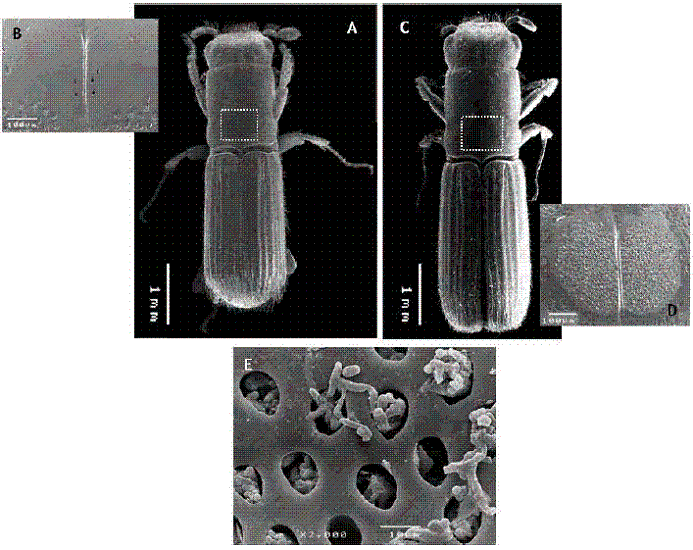
	    <p>Observations of adults confirmed the presence of mycangia, ovoid in shape, located in both sexes on the flat middle upper part of the prothorax. This cuticular plate was perforated by numerous pits and the male has a less developed mycangium with 15&plusmn;11 integumentary pits (min = 0; max = 53) separated by the straight cuticular line. In <i>P. cylindrus</i> females, 370&plusmn;26 cavities were observed (min = 326; max = 406) (Figure 1A&#45;D). In both sexes, perforations were apparently filled with the same type of fungal structures. On a specimen, a growing mycelium expanding on the cuticular surface and protruding from the perforations was observed (Figure 1E).</p>

	    <p>&nbsp;</p>

	    <p><img width="693" height="550" src="/img/revistas/slu/v19nespecial/19a11f1.gif"></p>	

	    
<p><b>Figure 1</b> &#45; Scanning electron micrographs of <i>Platypus</i> <i>cylindrus</i> adults. A. Male. B. Male mycangia. C. Female. D. Female mycangia. E. Growing mycelium and spores on female mycangia cavities</p>

	    <p>&nbsp;</p>

	    <p><i>Fungal isolation and identification</i></p>

	    ]]></body>
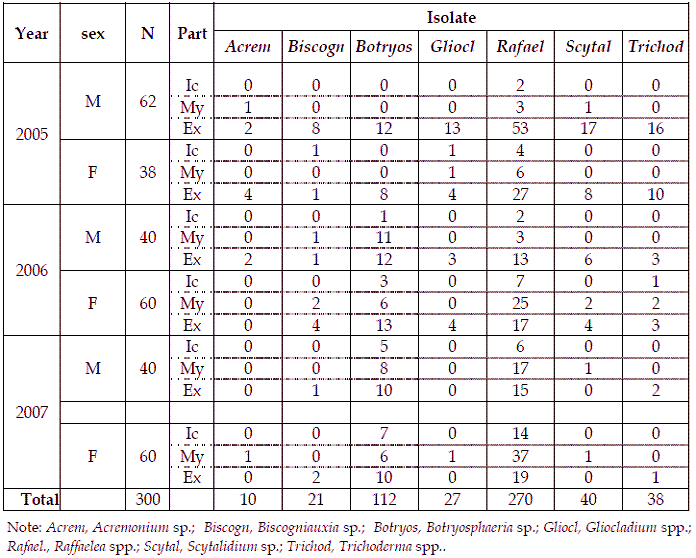
<body><![CDATA[<p>Out of the 300 insects observed (142 males and 158 females), 258 yielded at least one fungal isolate in any insect's body location. From this 86% that contained fungi, 116 were male and 142 were female. Fungi belonging to seven genera were obtained: <i>Acremonium, Biscogniauxia, Botryosphaeria, Gliocladium,</i> <i>Raffaelea</i><i>, Scytalidium and Trichoderma.</i> More than one species was isolated from the genera <i>Gliocladium,</i> <i>Raffaelea</i> and <i>Trichoderma.</i> Phoretic, intestinal and mycangial fungi obtained from individual <i>P. cylindrus</i> are summarized in Table 1.</p>

	    <p>&nbsp;</p>

	    <p><b>Table 1</b> &#45; Fungal isolates from the intestinal content (Ic), mycangia (My) and exoskeleton (Ex) of <i>Platypus cylindrus</i> males (M) and females (F)</p>

	    <p><img width="696" height="558" src="/img/revistas/slu/v19nespecial/19a11t1.gif"></p>	

	    
<p>&nbsp;</p>

	    <p>The mycobiota obtained from individual <i>P. cylindrus</i> did not significantly differ in the three years of fungal isolation (F<sub>2.123</sub> = 0.2255; p = 0.7985).</p>

	    <p>Although females may transport large amounts of fungal propagules, in terms of frequency of vectored fungi there were no statistically significant differences between males and females (F<sub>1.124</sub> = 0.0708; p = 0.7906). Therefore, results for both sexes were pooled. &nbsp;</p>

	    <p>The ophiostomatoid <i>Raffaelea</i>genus was the most frequently isolated, in particular from the mycangia and the intestinal content. Different putative species of <i>Raffaelea</i> were obtained but their identification requires a multigene phylogeny and will be the subject of a future work.</p>

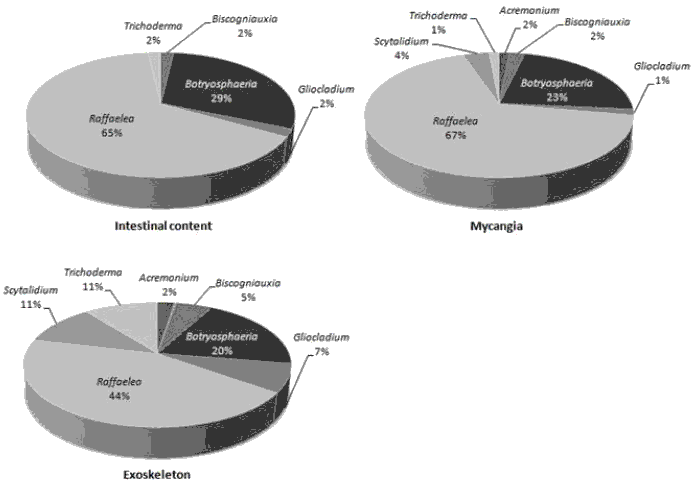
	    <p>The second most frequent genera was <i>Botryosphaeria</i> which together with <i>Raffaelea</i> species scored more than 90% of presence in the gut and in mycangia of the insects (Figure 2).</p>

	    <p>&nbsp;</p>

	    ]]></body>
<body><![CDATA[<p><img width="693" height="486" src="/img/revistas/slu/v19nespecial/19a11f2.gif"></p>	

	    
<p><b>Figure 2</b>&#45; Genera of fungi (%) isolated from the intestine, mycangia and exoskeleton of <i>Platypus</i> <i>cylindrus</i></p>

	    <p>&nbsp;</p>

	    <p>The proportions of fungi found in mycangia and in the intestine versus phoretic on the exoskeleton were significantly different (F<sub>2.123</sub> = 16.5784;p &lt; 0.001). Besides <i>Botryosphaeria</i> sp. several non&#45;ophiostomatoid fungi were isolated mainly from exoskeleton surfaces. In the mycangia these fungi were the rarest and the insects&rsquo; gut showed lower diversity of fungi. Species of <i>Biscogniauxia</i>, <i>Gliocladium</i> and <i>Trichoderma</i> genera were found in all the insect organs. <i>Scytalidium</i> sp. and <i>Acremonium</i> sp. were not found in the intestinal content.</p>

	    <p>Several saprobes fungi of the genera <i>Alternaria</i>, <i>Aspergillus</i>, <i>Geotrichum</i>, <i>Paecylomyces</i> and <i>Penicillium</i> were frequently isolated as well as species of <i>Streptomyces</i> and Mucorales but they fall outside the scope of this paper.</p>

	    <p>&nbsp;</p>

	    <p><b>Discussion</b></p>

	    <p>In this study <i>Platypus cylindrus</i> was found to transport several fungi, out of which the most frequent was the ophiostomatoid species of <i>Raffaelea</i>.&nbsp; <i>Raffaelea</i> <i>ambrosiae</i> was considered the main ambrosia fungi and several authors reported this species as the principal symbiont of the oak pinhole borer (BAKER, 1963; ARX and HENNEBERT, 1965; SOUSA <i>et al.,</i> 1995). However, and according to more recent work, <i>P. cylindrus</i> is associated with other <i>Raffaelea</i> species namely <i>R. montetyi,</i> an ambrosia fungus that decays wood (MORELET, 1998; IN&Aacute;CIO <i>et al.,</i> 2008), and <i>R. canadensis</i> (IN&Aacute;CIO <i>et al.,</i> 2008). The Ophiostomatales are economically important sapstaining fungi that occur worldwide on hardwoods. Moreover, some species of <i>Raffaelea</i> that are closely associated with ambrosia insects cause serious outbreaks in healthy trees (KUBONO and ITO, 2002; MURATA <i>et al.,</i> 2005; FRAEDRICH <i>et al.,</i> 2008; KIM <i>et al.,</i> 2009; HARRINGTON <i>et al.,</i> 2010).</p>

	    <p><i>P. cylindrus</i>, although a wood borer, is not a wood feeder. Our results clearly show that adults feed on fungi, mainly on <i>Raffaelea</i> species thus confirming them as the primary ambrosia fungi. <i>Botryosphaeria</i> sp. is also very frequent in all the isolations, even from the intestine. This genus comprises the widespread and virulent species, <i>B. corticola</i> (ALVES <i>et al.</i>, 2004; LUQUE <i>et al.,</i> 2008; LINALDEDDU <i>et al.,</i> 2009)<i>.</i> The ingested thick&#45;walled spores may pass through the gut unchanged and germinate on the walls of the galleries, but the hyphae are digested by the beetles and their larvae, hence providing a richer source of protein than wood (BEAVER, 1989).</p>

	    <p>Aside from these two most frequent fungi, others were isolated either from the exoskeleton or from the mycangia. Although these fungi may be significant components of the insect fungal flora, they were usually considered to be weed fungi with no more than a commensal relationship with the insects (HARRINGTON, 2005). Nevertheless, <i>Biscogniauxia</i> sp. and specifically <i>B. mediterranea</i> (HENRIQUES, 2007)<i>,</i> the causal agent of cork oak charcoal canker (COLLADO <i>et al.,</i> 2001; LINALDEDDU <i>et al.,</i> 2010), was consistently present in all the insect organs, even if in small fractions. Given both its epizoic and endozoic dispersal by the insect, it could be hypothesized that <i>P. cylindrus</i> contributes to the spreading of its spores in cork oak stands. Likewise, <i>Acremonium</i> sp. and in particular <i>A. crotocinigenum</i> has shown to be pathogenic towards cork oak seedlings (IN&Aacute;CIO <i>et al.,</i> 2010a).</p>

	    ]]></body>
<body><![CDATA[<p>The association of <i>P. cylindrus</i> with cosmopolitan fungi is well documented by others (BAKER, 1963; CASSIER <i>et al.,</i> 1996; SOUSA <i>et al.,</i> 1997). In the present study, they were consistently isolated from the exoskeleton and mycangia, even after an accurate and thorough disinfection by fractional sterilization (FRANCKE&#45;GROSMANN, 1956) to avoid saprobes growth (data not shown). It is possible that they might play a role in the insect&#45;fungi interaction and thus in the establishment of the insect. It has been emphasized that these secondary symbionts may act as wood degrading agents to facilitate galleries excavation. <i>Gliocladium</i> sp., <i>Trichoderma</i> sp. and <i>Scytalidium</i> sp., as producers of lignocellulolytic enzymes might have this pioneer role (KIFFER and MORELET, 1997; SZAKACS and TENGERDY, 1997; MADDAU <i>et al.,</i> 2009; IN&Aacute;CIO <i>et al.,</i> 2010b). Moreover, species of <i>Trichoderma</i> and <i>Gliocladium</i> are known for their antagonistic activity and may possibly control fungal growth inside the galleries (HENRIQUES, 2007).</p>

	    <p>The increase of <i>P. cylindrus</i> attacks in Portuguese cork oak stands suggests that behaviour changes may have happened and new strategies of host colonization may have arisen. The identification of chemical attractants such as kairomones and aggregation pheromones and possibly sexual pheromones mediating <i>P. cylindrus</i> attraction to host explains the massive attacks of the insect (ALGARVIO <i>et al.,</i> 2002; TEIXEIRA <i>et al.,</i> 2003; HENRIQUES <i>et al.,</i> 2010). Our studies confirmed the phoretic transportation of fungi on the exoskeleton surfaces and the intimate association with fungi housed in the insect&rsquo;s mycangia. The final role of the ambrosia fungi, which is the base of this insect&#45;fungi interaction, is the nourishment of the larvae and adults. In fact, a more restrict range of fungi was found associated with <i>P. cylindrus</i> feeding habits. Future work will be carried out in order to identify the several fungal species isolated within each genus.</p>

	    <p>&nbsp;</p>

	    <p><b>References</b></p>

	    <!-- ref --><p>ALGARVIO, R., TEIXEIRA, C., BARATA, E., PICKETT, J., CASAS&#45;NOVAS, P., FIGUEIREDO, D., 2002. Identification of a putative aggregation pheromone from males <i>Platypus cylindrus</i> (Coleoptera: Platypodidae). <i>In Proceedings of the 19th Annual Meeting International Society of Chemical Ecology</i>, Univ. Hamburg, Germany: 151.    &nbsp;&nbsp;&nbsp;&nbsp;&nbsp;&nbsp;&nbsp;&nbsp;[&#160;<a href="javascript:void(0);" onclick="javascript: window.open('/scielo.php?script=sci_nlinks&ref=000067&pid=S0870-6352201100020001100001&lng=','','width=640,height=500,resizable=yes,scrollbars=1,menubar=yes,');">Links</a>&#160;]<!-- end-ref --></p>

	    <!-- ref --><p>ALLEGRO, G., DELLA BEFFA, G., 2001. Un nuovo problema entomologico per la pioppicoltura italiana: <i>Platypus mutatus</i> (Chapuis) (Coleoptera, Platypodidae). Sherwood &#150; <i>Foresti ed Alberi Oggi</i> <b>66</b>: 31&#45;34.    &nbsp;&nbsp;&nbsp;&nbsp;&nbsp;&nbsp;&nbsp;&nbsp;[&#160;<a href="javascript:void(0);" onclick="javascript: window.open('/scielo.php?script=sci_nlinks&ref=000069&pid=S0870-6352201100020001100002&lng=','','width=640,height=500,resizable=yes,scrollbars=1,menubar=yes,');">Links</a>&#160;]<!-- end-ref --></p>

	    <!-- ref --><p>ALVES, A., LUQUE, J., PHILLIPS, A., 2004. <i>Botryosphaeria</i> <i>corticola</i> sp. nov. on <i>Quercus</i> species, with notes and description of <i>Botryosphaeria</i> <i>stevensii</i> and its anamorph, <i>Diplodia</i> <i>mutila</i>. <i>Mycologia</i> <b>96</b>: 598&#45;613.    &nbsp;&nbsp;&nbsp;&nbsp;&nbsp;&nbsp;&nbsp;&nbsp;[&#160;<a href="javascript:void(0);" onclick="javascript: window.open('/scielo.php?script=sci_nlinks&ref=000071&pid=S0870-6352201100020001100003&lng=','','width=640,height=500,resizable=yes,scrollbars=1,menubar=yes,');">Links</a>&#160;]<!-- end-ref --></p>

	    ]]></body>
<body><![CDATA[<!-- ref --><p>ARX, VON, H., HENNEBERT, G.L., 1965. Deux champignons ambrosia. <i>Mycopathol</i>. <i>Mycol. Appl.</i> <b>25</b>: 309&#45;315.    &nbsp;&nbsp;&nbsp;&nbsp;&nbsp;&nbsp;&nbsp;&nbsp;[&#160;<a href="javascript:void(0);" onclick="javascript: window.open('/scielo.php?script=sci_nlinks&ref=000073&pid=S0870-6352201100020001100004&lng=','','width=640,height=500,resizable=yes,scrollbars=1,menubar=yes,');">Links</a>&#160;]<!-- end-ref --></p>

	    <!-- ref --><p>ATKINSON, T.H., 2004. Ambrosia Beetles. <i>Platypus</i> spp. (Insecta: Coleoptera: Platypodidae) Univ. Florida, Gainsville, FL. (available on line at <a href="http://edis.ifas.ufl.edu/IN331" target="_blank"> http://edis.ifas.ufl.edu/IN331</a>, accessed 22.10.2010).    &nbsp;&nbsp;&nbsp;&nbsp;&nbsp;&nbsp;&nbsp;&nbsp;[&#160;<a href="javascript:void(0);" onclick="javascript: window.open('/scielo.php?script=sci_nlinks&ref=000075&pid=S0870-6352201100020001100005&lng=','','width=640,height=500,resizable=yes,scrollbars=1,menubar=yes,');">Links</a>&#160;]<!-- end-ref --></p>

	    <p>BAETA&#45;NEVES, C., 1950. <i>Introdu&ccedil;&atilde;o &agrave; Entomologia Florestal Portuguesa. A Serra e o Homem</i>. Lisboa.</p>

	    <!-- ref --><p>BAKER, J.M., 1963. Ambrosia beetle and their fungi, with particular reference to <i>Platypus</i> <i>cylindrus</i> Fab. <i>Symp. Soc. General Microbiol</i>. <b>13</b>: 323&#45;354.    &nbsp;&nbsp;&nbsp;&nbsp;&nbsp;&nbsp;&nbsp;&nbsp;[&#160;<a href="javascript:void(0);" onclick="javascript: window.open('/scielo.php?script=sci_nlinks&ref=000078&pid=S0870-6352201100020001100007&lng=','','width=640,height=500,resizable=yes,scrollbars=1,menubar=yes,');">Links</a>&#160;]<!-- end-ref --></p>

	    <!-- ref --><p>BALACHOWSKY, A.S., 1949. <i>Faune de France: col&eacute;opt&egrave;res scolytides</i>. Lechevalier Ed., Paris, 320 pp.    &nbsp;&nbsp;&nbsp;&nbsp;&nbsp;&nbsp;&nbsp;&nbsp;[&#160;<a href="javascript:void(0);" onclick="javascript: window.open('/scielo.php?script=sci_nlinks&ref=000080&pid=S0870-6352201100020001100008&lng=','','width=640,height=500,resizable=yes,scrollbars=1,menubar=yes,');">Links</a>&#160;]<!-- end-ref --></p>

	    <!-- ref --><p>BALACHOWSKY, A.S., CHEVALIER, M., CUILLE, J., GRISON, P., HOFFMANN, A., JOURDHEUIL, P., LABEYRIE, V., REMAUDIERE, G., STEFFAN, J.R., TOUZEAU, J., VILARDEBO, A., 1963. Famille des Platypodidae<i>. In</i> Balachowsky AS (Ed.), <i>Entomologie appliqu&eacute;e &agrave; l'agriculture".</i> <i>Tome II. Coleopt&egrave;res.</i> Ed. Masson et Cie, Paris, pp. 1289&#45;1291.    &nbsp;&nbsp;&nbsp;&nbsp;&nbsp;&nbsp;&nbsp;&nbsp;[&#160;<a href="javascript:void(0);" onclick="javascript: window.open('/scielo.php?script=sci_nlinks&ref=000082&pid=S0870-6352201100020001100009&lng=','','width=640,height=500,resizable=yes,scrollbars=1,menubar=yes,');">Links</a>&#160;]<!-- end-ref --></p>

	    <!-- ref --><p>BARNETT, H.L., HUNTER, B.B., 1998. <i>Illustrated</i> <i>Genera of Imperfect Fungi</i>. APS Press, Minnesota, USA, 218 pp.    &nbsp;&nbsp;&nbsp;&nbsp;&nbsp;&nbsp;&nbsp;&nbsp;[&#160;<a href="javascript:void(0);" onclick="javascript: window.open('/scielo.php?script=sci_nlinks&ref=000084&pid=S0870-6352201100020001100010&lng=','','width=640,height=500,resizable=yes,scrollbars=1,menubar=yes,');">Links</a>&#160;]<!-- end-ref --></p>

	    <!-- ref --><p>BATRA, L.R., 1963. Ecology of ambrosia fungi and their dissemination by beetles. <i>Trans. Kansas Acad. Sci</i>. <b>66</b>: 213&#150;236.    &nbsp;&nbsp;&nbsp;&nbsp;&nbsp;&nbsp;&nbsp;&nbsp;[&#160;<a href="javascript:void(0);" onclick="javascript: window.open('/scielo.php?script=sci_nlinks&ref=000086&pid=S0870-6352201100020001100011&lng=','','width=640,height=500,resizable=yes,scrollbars=1,menubar=yes,');">Links</a>&#160;]<!-- end-ref --></p>

	    <!-- ref --><p>BATRA, L.R., 1967. Ambrosia fungi: A taxonomic revision and nutritional studies of some species. <i>Mycologia</i> <b>59</b>: 976&#150;1017.    &nbsp;&nbsp;&nbsp;&nbsp;&nbsp;&nbsp;&nbsp;&nbsp;[&#160;<a href="javascript:void(0);" onclick="javascript: window.open('/scielo.php?script=sci_nlinks&ref=000088&pid=S0870-6352201100020001100012&lng=','','width=640,height=500,resizable=yes,scrollbars=1,menubar=yes,');">Links</a>&#160;]<!-- end-ref --></p>

	    <!-- ref --><p>BEAVER, R.A., 1989. Insect&#45;fungus relationships in the bark and ambrosia beetles. <i>In</i> Wilding N, Collins, NM, Hammond, PM, Webber, JF (Eds.), <i>Insect&#45;Fungus Interactions</i>. Academic Press, London, pp. 121&#45;143.    &nbsp;&nbsp;&nbsp;&nbsp;&nbsp;&nbsp;&nbsp;&nbsp;[&#160;<a href="javascript:void(0);" onclick="javascript: window.open('/scielo.php?script=sci_nlinks&ref=000090&pid=S0870-6352201100020001100013&lng=','','width=640,height=500,resizable=yes,scrollbars=1,menubar=yes,');">Links</a>&#160;]<!-- end-ref --></p>

	    <!-- ref --><p>CASSIER, P., L&Eacute;VIEUX, J., MORELET, M., ROUGON, D., 1996. The Mycangia of <i>Platypus cylindrus</i> Fab. and <i>P. oxyurus</i> Dufour (Coleoptera: Platypodidae). Structure and associated fungi. <i>J. Insect Physiol.</i> <b>42</b>: 171&#45;179.    &nbsp;&nbsp;&nbsp;&nbsp;&nbsp;&nbsp;&nbsp;&nbsp;[&#160;<a href="javascript:void(0);" onclick="javascript: window.open('/scielo.php?script=sci_nlinks&ref=000092&pid=S0870-6352201100020001100014&lng=','','width=640,height=500,resizable=yes,scrollbars=1,menubar=yes,');">Links</a>&#160;]<!-- end-ref --></p>

	    <!-- ref --><p>CHARARAS, C., 1979. <i>&Eacute;cophysiologie des insectes parasites des for&ecirc;ts</i><i>.</i> Chararas C. (Ed.), Paris, 297 pp.    &nbsp;&nbsp;&nbsp;&nbsp;&nbsp;&nbsp;&nbsp;&nbsp;[&#160;<a href="javascript:void(0);" onclick="javascript: window.open('/scielo.php?script=sci_nlinks&ref=000094&pid=S0870-6352201100020001100015&lng=','','width=640,height=500,resizable=yes,scrollbars=1,menubar=yes,');">Links</a>&#160;]<!-- end-ref --></p>

	    <!-- ref --><p>COLLADO, J., PLATAS, G., PEL&Aacute;EZ, F., 2001. Identification of an endophytic <i>Nodulisporium</i> sp. from <i>Quercus ilex</i> in central Spain as the anamorph of <i>Biscogniauxia mediterranea</i> by rDNA sequence analysis and effect of different ecological factors on distribution of the fungus. <i>Mycologia</i> <b>93</b>: 875&#45;886.    &nbsp;&nbsp;&nbsp;&nbsp;&nbsp;&nbsp;&nbsp;&nbsp;[&#160;<a href="javascript:void(0);" onclick="javascript: window.open('/scielo.php?script=sci_nlinks&ref=000096&pid=S0870-6352201100020001100016&lng=','','width=640,height=500,resizable=yes,scrollbars=1,menubar=yes,');">Links</a>&#160;]<!-- end-ref --></p>

	    <!-- ref --><p>ELLIS, M.B., 1971. Dematiaceous <i>Hyphomycetes</i>. CAB, England, 609 pp.    &nbsp;&nbsp;&nbsp;&nbsp;&nbsp;&nbsp;&nbsp;&nbsp;[&#160;<a href="javascript:void(0);" onclick="javascript: window.open('/scielo.php?script=sci_nlinks&ref=000098&pid=S0870-6352201100020001100017&lng=','','width=640,height=500,resizable=yes,scrollbars=1,menubar=yes,');">Links</a>&#160;]<!-- end-ref --></p>

	    <!-- ref --><p>ELLIS, M.B., 1976. <i>More Dematiaceous Hyphomycetes</i>. CAB, England, 507 pp.    &nbsp;&nbsp;&nbsp;&nbsp;&nbsp;&nbsp;&nbsp;&nbsp;[&#160;<a href="javascript:void(0);" onclick="javascript: window.open('/scielo.php?script=sci_nlinks&ref=000100&pid=S0870-6352201100020001100018&lng=','','width=640,height=500,resizable=yes,scrollbars=1,menubar=yes,');">Links</a>&#160;]<!-- end-ref --></p>

	    <!-- ref --><p>ESPA&Ntilde;OL, F., 1964. Los Platipodidos de Catalu&ntilde;a (Col. Phytophagoidea). <i>Bol. Ser. Plagas For.</i> <b>7</b>: 115&#45;117.    &nbsp;&nbsp;&nbsp;&nbsp;&nbsp;&nbsp;&nbsp;&nbsp;[&#160;<a href="javascript:void(0);" onclick="javascript: window.open('/scielo.php?script=sci_nlinks&ref=000102&pid=S0870-6352201100020001100019&lng=','','width=640,height=500,resizable=yes,scrollbars=1,menubar=yes,');">Links</a>&#160;]<!-- end-ref --></p>

	    <!-- ref --><p>FRAEDRICH, S.W., HARRINGTON, T.C., RABAGLIA, R.J., ULYSHEN, M.D., MAYFIELD, A.E., HANULA, J.L., EICKWORT, J.M., MILLER, D.R., 2008. A fungal symbiont of the redbay ambrosia beetle causes a lethal wilt in redbay and other <i>Lauraceae</i> in the southeastern United States. <i>Plant Dis.</i> <b>92</b>: 215&#150;224.    &nbsp;&nbsp;&nbsp;&nbsp;&nbsp;&nbsp;&nbsp;&nbsp;[&#160;<a href="javascript:void(0);" onclick="javascript: window.open('/scielo.php?script=sci_nlinks&ref=000104&pid=S0870-6352201100020001100020&lng=','','width=640,height=500,resizable=yes,scrollbars=1,menubar=yes,');">Links</a>&#160;]<!-- end-ref --></p>

	    <!-- ref --><p>FRANCKE&#45;GROSMANN, H., 1956. Hautdr&uuml;sen als Tr&auml;ger der Pilzsymbiose bei Ambrosiak&auml;fern. <i>Z. Morphol. &Ouml;ekol. Tiere</i> <b>45</b>: 275&#45;308.    &nbsp;&nbsp;&nbsp;&nbsp;&nbsp;&nbsp;&nbsp;&nbsp;[&#160;<a href="javascript:void(0);" onclick="javascript: window.open('/scielo.php?script=sci_nlinks&ref=000106&pid=S0870-6352201100020001100021&lng=','','width=640,height=500,resizable=yes,scrollbars=1,menubar=yes,');">Links</a>&#160;]<!-- end-ref --></p>

	    <!-- ref --><p>FRANCKE&#45;GROSMANN, H., 1963. Some New Aspects in Forest Entomology. <i>Ann. Rev. Entomol.</i> <b>8</b>: 415&#45;438.    &nbsp;&nbsp;&nbsp;&nbsp;&nbsp;&nbsp;&nbsp;&nbsp;[&#160;<a href="javascript:void(0);" onclick="javascript: window.open('/scielo.php?script=sci_nlinks&ref=000108&pid=S0870-6352201100020001100022&lng=','','width=640,height=500,resizable=yes,scrollbars=1,menubar=yes,');">Links</a>&#160;]<!-- end-ref --></p>

	    <!-- ref --><p>GRAHAM, K., 1967. Fungal&#45;insect mutualism in trees and timber. <i>Ann. Rev. Entomol.</i> <b>12</b>: 105&#45;126.    &nbsp;&nbsp;&nbsp;&nbsp;&nbsp;&nbsp;&nbsp;&nbsp;[&#160;<a href="javascript:void(0);" onclick="javascript: window.open('/scielo.php?script=sci_nlinks&ref=000110&pid=S0870-6352201100020001100023&lng=','','width=640,height=500,resizable=yes,scrollbars=1,menubar=yes,');">Links</a>&#160;]<!-- end-ref --></p>

	    <!-- ref --><p>HARRINGTON, T.C., 1981. Cycloheximide sensitivity as a taxonomic character in <i>Ceratocystis</i>. <i>Mycologia</i> <b>73</b>: 1123&#45;1129.    &nbsp;&nbsp;&nbsp;&nbsp;&nbsp;&nbsp;&nbsp;&nbsp;[&#160;<a href="javascript:void(0);" onclick="javascript: window.open('/scielo.php?script=sci_nlinks&ref=000112&pid=S0870-6352201100020001100024&lng=','','width=640,height=500,resizable=yes,scrollbars=1,menubar=yes,');">Links</a>&#160;]<!-- end-ref --></p>

	    <!-- ref --><p>HARRINGTON, T.C., 1992. <i>Leptographium.</i> <i>In</i> Singleton LL, Mihail, JD, Rush, CM (Eds.), <i>Methods for Research on Soilborne Phytopathogenic Fungi</i>. APS Press, St. Paul, Minnesota, pp. 129&#150;133.    &nbsp;&nbsp;&nbsp;&nbsp;&nbsp;&nbsp;&nbsp;&nbsp;[&#160;<a href="javascript:void(0);" onclick="javascript: window.open('/scielo.php?script=sci_nlinks&ref=000114&pid=S0870-6352201100020001100025&lng=','','width=640,height=500,resizable=yes,scrollbars=1,menubar=yes,');">Links</a>&#160;]<!-- end-ref --></p>

	    <!-- ref --><p>HARRINGTON, T.C., 2005. Ecology and evolution of mycophagous bark beetles and their fungal partners. <i>In</i> Vega FE, Blackwell, M. (Eds.), <i>Insect&#45;Fungal Associations: Ecology and Evolution</i>. Oxford University Press, Inc. New York, pp. 257&#150;292.    &nbsp;&nbsp;&nbsp;&nbsp;&nbsp;&nbsp;&nbsp;&nbsp;[&#160;<a href="javascript:void(0);" onclick="javascript: window.open('/scielo.php?script=sci_nlinks&ref=000116&pid=S0870-6352201100020001100026&lng=','','width=640,height=500,resizable=yes,scrollbars=1,menubar=yes,');">Links</a>&#160;]<!-- end-ref --></p>

	    <!-- ref --><p>HARRINGTON, T.C., AGHAYEVA, D.A., FRAEDRICH, S.W., 2010. New combinations in <i>Raffaelea, Ambrosiella</i> and <i>Hyalorhinocladiella</i>, and four new species from the red&#45;bay ambrosia beetle, <i>Xyleborus</i> <i>glabratus</i>. <i>Mycotaxon</i> <b>111</b>: 337&#150;361.    &nbsp;&nbsp;&nbsp;&nbsp;&nbsp;&nbsp;&nbsp;&nbsp;[&#160;<a href="javascript:void(0);" onclick="javascript: window.open('/scielo.php?script=sci_nlinks&ref=000118&pid=S0870-6352201100020001100027&lng=','','width=640,height=500,resizable=yes,scrollbars=1,menubar=yes,');">Links</a>&#160;]<!-- end-ref --></p>

	    <!-- ref --><p>HAWKSWORTH, D.L., KIRK, P.M., SUTTON, B.C., PEGLER, D.N., 1995. <i>Ainsworth &amp;</i> <i>Bisby's Dictionary of the Fungi</i>. CAB International, England, 616 pp.    &nbsp;&nbsp;&nbsp;&nbsp;&nbsp;&nbsp;&nbsp;&nbsp;[&#160;<a href="javascript:void(0);" onclick="javascript: window.open('/scielo.php?script=sci_nlinks&ref=000120&pid=S0870-6352201100020001100028&lng=','','width=640,height=500,resizable=yes,scrollbars=1,menubar=yes,');">Links</a>&#160;]<!-- end-ref --></p>

	    <!-- ref --><p>HENRIQUES, J., 2007. <i>Fungos associados a Platypus cylindrus Fab. (Coleoptera: Platypodidae e sua rela&ccedil;&atilde;o com o decl&iacute;nio do sobreiro em Portugal</i>. Disserta&ccedil;&atilde;o de mestrado, Universidade de &Eacute;vora, &Eacute;vora, Portugal<i>,</i>188 pp.    &nbsp;&nbsp;&nbsp;&nbsp;&nbsp;&nbsp;&nbsp;&nbsp;[&#160;<a href="javascript:void(0);" onclick="javascript: window.open('/scielo.php?script=sci_nlinks&ref=000122&pid=S0870-6352201100020001100029&lng=','','width=640,height=500,resizable=yes,scrollbars=1,menubar=yes,');">Links</a>&#160;]<!-- end-ref --></p>

	    <!-- ref --><p>HENRIQUES, J., IN&Aacute;CIO, M.L., PIRES, S., SOUSA, E., 2010. <i>Platypus</i> <i>cylindrus</i> Fab. (Coleoptera: Platypodidae) control strategies. <i>IOBC/wprs Bulletin</i> <b>57</b>: 103&#45;106.    &nbsp;&nbsp;&nbsp;&nbsp;&nbsp;&nbsp;&nbsp;&nbsp;[&#160;<a href="javascript:void(0);" onclick="javascript: window.open('/scielo.php?script=sci_nlinks&ref=000124&pid=S0870-6352201100020001100030&lng=','','width=640,height=500,resizable=yes,scrollbars=1,menubar=yes,');">Links</a>&#160;]<!-- end-ref --></p>

	    <!-- ref --><p>HENRIQUES, J., IN&Aacute;CIO, M.L., SOUSA, E., 2006. Ambrosia fungi in the insect&#45;fungi symbiosis in relation to cork oak decline. <i>Rev. Iberoam. Micol</i>. <b>23</b>: 185&#45;188.    &nbsp;&nbsp;&nbsp;&nbsp;&nbsp;&nbsp;&nbsp;&nbsp;[&#160;<a href="javascript:void(0);" onclick="javascript: window.open('/scielo.php?script=sci_nlinks&ref=000126&pid=S0870-6352201100020001100031&lng=','','width=640,height=500,resizable=yes,scrollbars=1,menubar=yes,');">Links</a>&#160;]<!-- end-ref --></p>

	    <p>IN&Aacute;CIO, M.L., HENRIQUES, J., GUIMAR&Atilde;ES, L., AZINHEIRA, H., LIMA, A., SOUSA E., 2010a. The symbiotic fungus <i>Acremonium</i> <i>crotocinigenum</i> causes canker on cork oak. I<i>n Actas do VI Congresso da Sociedade Portuguesa de Fitopatologia.</i> Univ. &Eacute;vora, &Eacute;vora, Portugal: 191.</p>

	    <!-- ref --><p>IN&Aacute;CIO, M.L., HENRIQUES, J., LIMA, A., SOUSA, E., 2008. Fungi of <i>Raffaelea</i> genus (Ascomycota: Ophiostomatales) associated to <i>Platypus</i> <i>cylindrus</i> (Coleoptera: Platypodidae) in Portugal. <i>Rev. de Ci&ecirc;ncias Agr&aacute;rias</i> <b>31</b>: 96&#45;104.    &nbsp;&nbsp;&nbsp;&nbsp;&nbsp;&nbsp;&nbsp;&nbsp;[&#160;<a href="javascript:void(0);" onclick="javascript: window.open('/scielo.php?script=sci_nlinks&ref=000129&pid=S0870-6352201100020001100033&lng=','','width=640,height=500,resizable=yes,scrollbars=1,menubar=yes,');">Links</a>&#160;]<!-- end-ref --></p>

	    <!-- ref --><p>IN&Aacute;CIO, M.L., HENRIQUES, J., SOUSA, E., 2010b. Mycobiota associated with <i>Platypus</i> <i>cylindrus</i> Fab. (Coleoptera: Platypodidae) on cork oak in Portugal. <i>IOBC/wprs Bulletin</i> <b>57</b>: 87&#45;95.    &nbsp;&nbsp;&nbsp;&nbsp;&nbsp;&nbsp;&nbsp;&nbsp;[&#160;<a href="javascript:void(0);" onclick="javascript: window.open('/scielo.php?script=sci_nlinks&ref=000131&pid=S0870-6352201100020001100034&lng=','','width=640,height=500,resizable=yes,scrollbars=1,menubar=yes,');">Links</a>&#160;]<!-- end-ref --></p>

	    ]]></body>
<body><![CDATA[<!-- ref --><p>KIFFER, E., MORELET, M., 1997. <i>Les Deut&egrave;romycetes &#150; classification et cl&eacute;s d&acute;identification g&eacute;n&eacute;riques.</i> INRA Editions,Paris, 306 pp.    &nbsp;&nbsp;&nbsp;&nbsp;&nbsp;&nbsp;&nbsp;&nbsp;[&#160;<a href="javascript:void(0);" onclick="javascript: window.open('/scielo.php?script=sci_nlinks&ref=000133&pid=S0870-6352201100020001100035&lng=','','width=640,height=500,resizable=yes,scrollbars=1,menubar=yes,');">Links</a>&#160;]<!-- end-ref --></p>

	    <!-- ref --><p>KIM, K.H., CHOI, Y.J., SEO, S.T., SHIN, H.D., 2009. <i>Raffaelea quercus&#45;mongolicae</i> sp. nov. associated with <i>Platypus koryoensis</i> on oak in Korea. <i>Mycotaxon</i> <b>110</b>: 189&#150;197.    &nbsp;&nbsp;&nbsp;&nbsp;&nbsp;&nbsp;&nbsp;&nbsp;[&#160;<a href="javascript:void(0);" onclick="javascript: window.open('/scielo.php?script=sci_nlinks&ref=000135&pid=S0870-6352201100020001100036&lng=','','width=640,height=500,resizable=yes,scrollbars=1,menubar=yes,');">Links</a>&#160;]<!-- end-ref --></p>

	    <!-- ref --><p>KUBONO, T., ITO, S., 2002. <i>Raffaelea quercivora</i> sp. nov. associated with mass mortality of Japanese oak, and the ambrosia beetle (<i>Platypus quercivorus</i>). <i>Mycoscience</i> <b>43</b>: 255&#45;260.    &nbsp;&nbsp;&nbsp;&nbsp;&nbsp;&nbsp;&nbsp;&nbsp;[&#160;<a href="javascript:void(0);" onclick="javascript: window.open('/scielo.php?script=sci_nlinks&ref=000137&pid=S0870-6352201100020001100037&lng=','','width=640,height=500,resizable=yes,scrollbars=1,menubar=yes,');">Links</a>&#160;]<!-- end-ref --></p>

	    <!-- ref --><p>K&Uuml;LNHOLZ, S., BORDEN, J.H., UZONOVIC, A., 2003. Secondary ambrosia beetles in apparently healthy trees: Adaptations, potential causes and suggested research. <i>Integrated Pest Management Reviews</i> <b>6</b>: 209&#45;219.    &nbsp;&nbsp;&nbsp;&nbsp;&nbsp;&nbsp;&nbsp;&nbsp;[&#160;<a href="javascript:void(0);" onclick="javascript: window.open('/scielo.php?script=sci_nlinks&ref=000139&pid=S0870-6352201100020001100038&lng=','','width=640,height=500,resizable=yes,scrollbars=1,menubar=yes,');">Links</a>&#160;]<!-- end-ref --></p>

	    <!-- ref --><p>LINALDEDDU, B.T., SIRCA, C., SPANO, D., FRANCESCHINI, A., 2009. Physiological responses of cork oak and holm oak to infection by fungal pathogens involved in oak decline. <i>For. Path.</i> <b>39</b>: 232&#150;238.    &nbsp;&nbsp;&nbsp;&nbsp;&nbsp;&nbsp;&nbsp;&nbsp;[&#160;<a href="javascript:void(0);" onclick="javascript: window.open('/scielo.php?script=sci_nlinks&ref=000141&pid=S0870-6352201100020001100039&lng=','','width=640,height=500,resizable=yes,scrollbars=1,menubar=yes,');">Links</a>&#160;]<!-- end-ref --></p>

	    ]]></body>
<body><![CDATA[<!-- ref --><p>LINALDEDDU, B.T., SIRCA, C., SPANO, D., FRANCESCHINI, A., 2010. Variation of endophytic cork oak&#45;associated fungal communities in relation to plant health and water stress. <i>Forest Pathology,</i> 2010, <i>on line early,</i> doi: 10.1111/j.1439&#45;0329. 2010.00652.x.    &nbsp;&nbsp;&nbsp;&nbsp;&nbsp;&nbsp;&nbsp;&nbsp;[&#160;<a href="javascript:void(0);" onclick="javascript: window.open('/scielo.php?script=sci_nlinks&ref=000143&pid=S0870-6352201100020001100040&lng=','','width=640,height=500,resizable=yes,scrollbars=1,menubar=yes,');">Links</a>&#160;]<!-- end-ref --></p>

	    <!-- ref --><p>LUQUE, J., PERA, J., PARLAD&Eacute;, J., 2008. Evaluation of fungicides for the control of <i>Botryosphaeria corticola</i> on cork oak in Catalania (NE Spain). <i>For. Path.</i> <b>38</b>: 147&#45;155.    &nbsp;&nbsp;&nbsp;&nbsp;&nbsp;&nbsp;&nbsp;&nbsp;[&#160;<a href="javascript:void(0);" onclick="javascript: window.open('/scielo.php?script=sci_nlinks&ref=000145&pid=S0870-6352201100020001100041&lng=','','width=640,height=500,resizable=yes,scrollbars=1,menubar=yes,');">Links</a>&#160;]<!-- end-ref --></p>

	    <!-- ref --><p>MADDAU, L., CABRAS, A., FRANCESCHINI, A., LINALDEDDU, B.T., CROBU, S., ROGGIO, T., PAGNOZZI, D., 2009. Occurrence and characterization of peptaibols from<i>Trichoderma</i> <i>citrinoviride</i>, an endophytic fungus of cork oak, using electrospray ionization quadrupole time&#45;of&#45;flight mass spectrometry. <i>Microbiology</i> <b>155</b>: 3371&#150;3381.    &nbsp;&nbsp;&nbsp;&nbsp;&nbsp;&nbsp;&nbsp;&nbsp;[&#160;<a href="javascript:void(0);" onclick="javascript: window.open('/scielo.php?script=sci_nlinks&ref=000147&pid=S0870-6352201100020001100042&lng=','','width=640,height=500,resizable=yes,scrollbars=1,menubar=yes,');">Links</a>&#160;]<!-- end-ref --></p>

	    <!-- ref --><p>MILLIGAN, R.H., OSBORNE, G.O., YTSMA, G., 1988. Evidence for an aggregation pheromone in <i>Platypus gracilis</i> (Coleoptera: Platypodidae). <i>J. Appl. Entomol.</i> <b>106</b>: 20&#45;24.    &nbsp;&nbsp;&nbsp;&nbsp;&nbsp;&nbsp;&nbsp;&nbsp;[&#160;<a href="javascript:void(0);" onclick="javascript: window.open('/scielo.php?script=sci_nlinks&ref=000149&pid=S0870-6352201100020001100043&lng=','','width=640,height=500,resizable=yes,scrollbars=1,menubar=yes,');">Links</a>&#160;]<!-- end-ref --></p>

	    <p>MORELET, M., 1998. Une esp&egrave;ce nouvelle de <i>Raffaelea</i>, isol&eacute;e de <i>Platypus cylindrus</i>, col&eacute;opt&egrave;re xylomyc&eacute;tophage des ch&ecirc;nes. <i>Extrait des Annales de la Soci&eacute;t&eacute; des</i> <i>Sciences Naturelles et d&rsquo;Archeologie de</i> <i>Toulon et du Var</i> <b>50</b>: 185&#45;193.</p>

	    <!-- ref --><p>MURATA, M., YAMADA, T., ITO, S., 2005. Changes in water status in seedlings of six species in the Fagaceae after inoculation with <i>Raffaelea</i> <i>quercivora</i> Kubono et Shin&#45;Ito. <i>J. For. Res.</i> <b>10</b>: 251&#150;255.    &nbsp;&nbsp;&nbsp;&nbsp;&nbsp;&nbsp;&nbsp;&nbsp;[&#160;<a href="javascript:void(0);" onclick="javascript: window.open('/scielo.php?script=sci_nlinks&ref=000152&pid=S0870-6352201100020001100045&lng=','','width=640,height=500,resizable=yes,scrollbars=1,menubar=yes,');">Links</a>&#160;]<!-- end-ref --></p>

	    <!-- ref --><p>RENWICK, J.A., VIT&Eacute;, J.P., BILLINGS, R.F., 1977. Aggregation pheromones in the ambrosia beetle <i>Platypus flavicornis</i>. <i>Naturwissenschaften</i> <b>64</b>: 226.    &nbsp;&nbsp;&nbsp;&nbsp;&nbsp;&nbsp;&nbsp;&nbsp;[&#160;<a href="javascript:void(0);" onclick="javascript: window.open('/scielo.php?script=sci_nlinks&ref=000154&pid=S0870-6352201100020001100046&lng=','','width=640,height=500,resizable=yes,scrollbars=1,menubar=yes,');">Links</a>&#160;]<!-- end-ref --></p>

	    <!-- ref --><p>SEABRA, A.F., 1939. Contribui&ccedil;&atilde;o para a hist&oacute;ria de Entomologia em Portugal. <i>Publica&ccedil;&otilde;es</i> <i>D.G.S.F.A<b>.</b></i> <b>6</b>: 1&#45;20.    &nbsp;&nbsp;&nbsp;&nbsp;&nbsp;&nbsp;&nbsp;&nbsp;[&#160;<a href="javascript:void(0);" onclick="javascript: window.open('/scielo.php?script=sci_nlinks&ref=000156&pid=S0870-6352201100020001100047&lng=','','width=640,height=500,resizable=yes,scrollbars=1,menubar=yes,');">Links</a>&#160;]<!-- end-ref --></p>

	    <!-- ref --><p>SHORE, T.L., MCLEAN, J.A., 1983. Attraction of <i>Platypus wilsoni</i> Swaine (Coleoptera: Platypodidae) to traps baited with sulcatol, ethanol and a&#45;pinene. <i>Can. For. Serv. Bi&#45;Mon. Res. Notes</i> <b>3</b>: 24&#45;25.    &nbsp;&nbsp;&nbsp;&nbsp;&nbsp;&nbsp;&nbsp;&nbsp;[&#160;<a href="javascript:void(0);" onclick="javascript: window.open('/scielo.php?script=sci_nlinks&ref=000158&pid=S0870-6352201100020001100048&lng=','','width=640,height=500,resizable=yes,scrollbars=1,menubar=yes,');">Links</a>&#160;]<!-- end-ref --></p>

	    <!-- ref --><p>SOUSA, E., 1992. Alguns dos factores respons&aacute;veis pelo decl&iacute;nio do montado de sobro na Herdade da Chamin&eacute;. <i>In Actas do 2&ordm; Encontro sobre os Montados de Sobro e Azinho</i>, &Eacute;vora, pp. 324&#45;335.    &nbsp;&nbsp;&nbsp;&nbsp;&nbsp;&nbsp;&nbsp;&nbsp;[&#160;<a href="javascript:void(0);" onclick="javascript: window.open('/scielo.php?script=sci_nlinks&ref=000160&pid=S0870-6352201100020001100049&lng=','','width=640,height=500,resizable=yes,scrollbars=1,menubar=yes,');">Links</a>&#160;]<!-- end-ref --></p>

	    <!-- ref --><p>SOUSA, E., DEBOUZIE, D., 1999. Spatio&#45;temporal distribution <i>of Platypus cylindrus</i> F. attacks in cork oak stands in Portugal. <i>IOBC</i>/ <i>wprs Bull.</i> <b>22</b>: 47&#45;58.    &nbsp;&nbsp;&nbsp;&nbsp;&nbsp;&nbsp;&nbsp;&nbsp;[&#160;<a href="javascript:void(0);" onclick="javascript: window.open('/scielo.php?script=sci_nlinks&ref=000162&pid=S0870-6352201100020001100050&lng=','','width=640,height=500,resizable=yes,scrollbars=1,menubar=yes,');">Links</a>&#160;]<!-- end-ref --></p>

	    <!-- ref --><p>SOUSA, E., DEBOUZIE, D., 2002. Contribution &agrave; la bioecologie <i>de Platypus cylindrus</i> F. au Portugal. <i>IOBC</i>/ <i>wprs Bull.</i> <b>25</b>: 75&#45;83.    &nbsp;&nbsp;&nbsp;&nbsp;&nbsp;&nbsp;&nbsp;&nbsp;[&#160;<a href="javascript:void(0);" onclick="javascript: window.open('/scielo.php?script=sci_nlinks&ref=000164&pid=S0870-6352201100020001100051&lng=','','width=640,height=500,resizable=yes,scrollbars=1,menubar=yes,');">Links</a>&#160;]<!-- end-ref --></p>

	    <!-- ref --><p>SOUSA, E., DEBOUZIE, D., PEREIRA, H., 1995. Le r&ocirc;le de l'insecte <i>Platypus cylindrus</i> F. (Coleoptera, Platypodidae) dans le processus de d&eacute;p&eacute;rissement des peuplements de ch&ecirc;ne&#45;li&egrave;ge au Portugal. <i>IOBC</i>/ <i>wprs Bull</i>. <b>18</b>: 24&#45;37.    &nbsp;&nbsp;&nbsp;&nbsp;&nbsp;&nbsp;&nbsp;&nbsp;[&#160;<a href="javascript:void(0);" onclick="javascript: window.open('/scielo.php?script=sci_nlinks&ref=000166&pid=S0870-6352201100020001100052&lng=','','width=640,height=500,resizable=yes,scrollbars=1,menubar=yes,');">Links</a>&#160;]<!-- end-ref --></p>

	    <!-- ref --><p>SOUSA, E., IN&Aacute;CIO, M.L., 2005. New Aspects of <i>Platypus cylindrus</i> Fab. (Coleoptera: Platypodidae): Life History on Cork Oak Stands in Portugal. <i>In</i> Lieutier F, Ghaioule, D. (Eds.), <i>Entomological Research in Mediterranean Forest Ecosystems,</i> INRA Editions, pp. 147&#45;168.    &nbsp;&nbsp;&nbsp;&nbsp;&nbsp;&nbsp;&nbsp;&nbsp;[&#160;<a href="javascript:void(0);" onclick="javascript: window.open('/scielo.php?script=sci_nlinks&ref=000168&pid=S0870-6352201100020001100053&lng=','','width=640,height=500,resizable=yes,scrollbars=1,menubar=yes,');">Links</a>&#160;]<!-- end-ref --></p>

	    <!-- ref --><p>SOUSA, E., IN&Aacute;CIO, M.L., EL ANTRY, S., BAKRY, M., KADIRI, Z.A., 2005. Comparaison de la bio&#45;&eacute;cologie de l'insecte <i>Platypus cylindrus</i> Fab. (Col., Platypodidae) dans les sub&eacute;raies portugaises et marocaines. <i>IOBC</i>/ <i>wprs Bull</i> <b>28</b>: 137&#45;144.    &nbsp;&nbsp;&nbsp;&nbsp;&nbsp;&nbsp;&nbsp;&nbsp;[&#160;<a href="javascript:void(0);" onclick="javascript: window.open('/scielo.php?script=sci_nlinks&ref=000170&pid=S0870-6352201100020001100054&lng=','','width=640,height=500,resizable=yes,scrollbars=1,menubar=yes,');">Links</a>&#160;]<!-- end-ref --></p>

	    <!-- ref --><p>SOUSA, E., TOMAZ, I.L., MONIZ, F.A., BASTO, S., 1997. La r&eacute;partition spatiale des champignons associ&eacute;s &agrave; <i>Platypus cylindrus</i> Fab. (Coleoptera: Platypodidae<i>)</i>. <i>Phytopath. Me</i><i>dit.</i> <b>36</b>: 145&#45;153.    &nbsp;&nbsp;&nbsp;&nbsp;&nbsp;&nbsp;&nbsp;&nbsp;[&#160;<a href="javascript:void(0);" onclick="javascript: window.open('/scielo.php?script=sci_nlinks&ref=000172&pid=S0870-6352201100020001100055&lng=','','width=640,height=500,resizable=yes,scrollbars=1,menubar=yes,');">Links</a>&#160;]<!-- end-ref --></p>

	    <!-- ref --><p>SZAKACS, G., TENGERDY, R.P., 1997. Lignocellulotytic enzyme production on pretreated poplar wood by filamentous fungi. <i>World Journal of Microbiology &amp; Biotechnology</i> <b>13</b>: 487&#45;490.    &nbsp;&nbsp;&nbsp;&nbsp;&nbsp;&nbsp;&nbsp;&nbsp;[&#160;<a href="javascript:void(0);" onclick="javascript: window.open('/scielo.php?script=sci_nlinks&ref=000174&pid=S0870-6352201100020001100056&lng=','','width=640,height=500,resizable=yes,scrollbars=1,menubar=yes,');">Links</a>&#160;]<!-- end-ref --></p>

	    <!-- ref --><p>TEIXEIRA, C., ALGARVIO, R.M., CASAS&#45;NOVAS, P., BARATA, E.N., 2003. Actividade biol&oacute;gica de an&aacute;logos de tr&ecirc;s componentes da putativa feromona de agrega&ccedil;&atilde;o de <i>Platypus cylindrus</i> (Coleoptera: Platypodidae). <i>In Actas V Congresso Nacional de Etologia</i>. Universidade do Algarve, Faro, 29.    &nbsp;&nbsp;&nbsp;&nbsp;&nbsp;&nbsp;&nbsp;&nbsp;[&#160;<a href="javascript:void(0);" onclick="javascript: window.open('/scielo.php?script=sci_nlinks&ref=000176&pid=S0870-6352201100020001100057&lng=','','width=640,height=500,resizable=yes,scrollbars=1,menubar=yes,');">Links</a>&#160;]<!-- end-ref --></p>

	    <!-- ref --><p>TOKORO, M., KOBAYASHI, M., SAITO S., KINUURA, H., NAKASHIMA, T., SHODA&#45;KAGAYA, E., KASHIWAGI, T., TEBAYASHI, S., KIM, C.S., MORI, K., 2007. Novel aggregation pheromone, (1<i>S</i>,4<i>R</i>)&#45;<i>p</i>&#45;menth&#45;2&#45;en&#45;1&#45;ol, of the ambrosia beetle, <i>Platypus quercivorus</i> (Coleoptera: Platypodidae). <i>Bull. For. For. Prod. Res. Inst.</i> <b>6</b>: 49&#150;57.    &nbsp;&nbsp;&nbsp;&nbsp;&nbsp;&nbsp;&nbsp;&nbsp;[&#160;<a href="javascript:void(0);" onclick="javascript: window.open('/scielo.php?script=sci_nlinks&ref=000178&pid=S0870-6352201100020001100058&lng=','','width=640,height=500,resizable=yes,scrollbars=1,menubar=yes,');">Links</a>&#160;]<!-- end-ref --></p>

	    <!-- ref --><p>UCHASTNOVA, L.N., 1985. The Complex of fungi associated with the galleries of <i>Platypus cylindriformis</i> (Coleoptera, Platypodidae) and <i>Xyleborus monographus</i> (Coleoptera, Scolytidae). <i>Biol. Nauki.</i> <b>2</b>: 47&#45;50.    &nbsp;&nbsp;&nbsp;&nbsp;&nbsp;&nbsp;&nbsp;&nbsp;[&#160;<a href="javascript:void(0);" onclick="javascript: window.open('/scielo.php?script=sci_nlinks&ref=000180&pid=S0870-6352201100020001100059&lng=','','width=640,height=500,resizable=yes,scrollbars=1,menubar=yes,');">Links</a>&#160;]<!-- end-ref --></p>

	    <!-- ref --><p>VILLEMANT, C., FRAVAL, A., 1993. La faune entomologique du ch&ecirc;ne&#45;li&egrave;ge en for&ecirc;t de la Mamora (Maroc). <i>Ecol. Mediterr</i>. <b>19</b>: 89&#45;98.    &nbsp;&nbsp;&nbsp;&nbsp;&nbsp;&nbsp;&nbsp;&nbsp;[&#160;<a href="javascript:void(0);" onclick="javascript: window.open('/scielo.php?script=sci_nlinks&ref=000182&pid=S0870-6352201100020001100060&lng=','','width=640,height=500,resizable=yes,scrollbars=1,menubar=yes,');">Links</a>&#160;]<!-- end-ref --></p>

	    <!-- ref --><p>YAMASAKI, M., FUTAI, K., 2008. Host selection by <i>Platypus</i> <i>quercivorus</i> (Murayama) (Coleoptera: Platypodidae) before and after flying to trees. <i>Appl. Entomol. Zool</i>. <b>43</b>: 249&#150;257.    &nbsp;&nbsp;&nbsp;&nbsp;&nbsp;&nbsp;&nbsp;&nbsp;[&#160;<a href="javascript:void(0);" onclick="javascript: window.open('/scielo.php?script=sci_nlinks&ref=000184&pid=S0870-6352201100020001100061&lng=','','width=640,height=500,resizable=yes,scrollbars=1,menubar=yes,');">Links</a>&#160;]<!-- end-ref --></p>

	    <!-- ref --><p>YTSMA, G., 1986. Inducing attack by male <i>Platypus</i> (Col.: Platypodidae) on wood billets in the laboratory. <i>J. Appl. Entomol.</i> <b>102</b>: 210&#45;212.    &nbsp;&nbsp;&nbsp;&nbsp;&nbsp;&nbsp;&nbsp;&nbsp;[&#160;<a href="javascript:void(0);" onclick="javascript: window.open('/scielo.php?script=sci_nlinks&ref=000186&pid=S0870-6352201100020001100062&lng=','','width=640,height=500,resizable=yes,scrollbars=1,menubar=yes,');">Links</a>&#160;]<!-- end-ref --></p>

	    <p>&nbsp;</p>
	
	    <p><b>Acknowledgements</b></p>

	    <p>We thank Doctor Maria Costa Ferreira (INRB, I.P.) for reviewing the manuscript and Oct&aacute;vio Chaveiro for the technical assistance in SEM photos. This research was supported in part by a grant from the Funda&ccedil;&atilde;o para a Ci&ecirc;ncia e a Tecnologia BD/26033/2005.</p>
	
     ]]></body><back>
<ref-list>
<ref id="B1">
<nlm-citation citation-type="confpro">
<person-group person-group-type="author">
<name>
<surname><![CDATA[ALGARVIO]]></surname>
<given-names><![CDATA[R.]]></given-names>
</name>
<name>
<surname><![CDATA[TEIXEIRA]]></surname>
<given-names><![CDATA[C.]]></given-names>
</name>
<name>
<surname><![CDATA[BARATA]]></surname>
<given-names><![CDATA[E.]]></given-names>
</name>
<name>
<surname><![CDATA[PICKETT]]></surname>
<given-names><![CDATA[J.]]></given-names>
</name>
<name>
<surname><![CDATA[CASAS-NOVAS]]></surname>
<given-names><![CDATA[P.]]></given-names>
</name>
<name>
<surname><![CDATA[FIGUEIREDO]]></surname>
<given-names><![CDATA[D.]]></given-names>
</name>
</person-group>
<article-title xml:lang="en"><![CDATA[Identification of a putative aggregation pheromone from males Platypus cylindrus (Coleoptera: Platypodidae)]]></article-title>
<source><![CDATA[Proceedings of the]]></source>
<year>2002</year>
<conf-name><![CDATA[19 Annual Meeting]]></conf-name>
<conf-loc> </conf-loc>
<page-range>151</page-range><publisher-name><![CDATA[Univ. Hamburg]]></publisher-name>
</nlm-citation>
</ref>
<ref id="B2">
<nlm-citation citation-type="journal">
<person-group person-group-type="author">
<name>
<surname><![CDATA[ALLEGRO]]></surname>
<given-names><![CDATA[G.]]></given-names>
</name>
<name>
<surname><![CDATA[DELLA BEFFA]]></surname>
<given-names><![CDATA[G.]]></given-names>
</name>
</person-group>
<article-title xml:lang="it"><![CDATA[Un nuovo problema entomologico per la pioppicoltura italiana: Platypus mutatus (Chapuis) (Coleoptera, Platypodidae)]]></article-title>
<source><![CDATA[Sherwood - Foresti ed Alberi Oggi]]></source>
<year>2001</year>
<volume>66</volume>
<page-range>31-34</page-range></nlm-citation>
</ref>
<ref id="B3">
<nlm-citation citation-type="journal">
<person-group person-group-type="author">
<name>
<surname><![CDATA[ALVES]]></surname>
<given-names><![CDATA[A.]]></given-names>
</name>
<name>
<surname><![CDATA[LUQUE]]></surname>
<given-names><![CDATA[J.]]></given-names>
</name>
<name>
<surname><![CDATA[PHILLIPS]]></surname>
<given-names><![CDATA[A.]]></given-names>
</name>
</person-group>
<article-title xml:lang="en"><![CDATA[Botryosphaeria corticola sp. nov. on Quercus species, with notes and description of Botryosphaeria stevensii and its anamorph, Diplodia mutila]]></article-title>
<source><![CDATA[Mycologia]]></source>
<year>2004</year>
<volume>96</volume>
<page-range>598-613</page-range></nlm-citation>
</ref>
<ref id="B4">
<nlm-citation citation-type="journal">
<person-group person-group-type="author">
<name>
<surname><![CDATA[ARX VON]]></surname>
<given-names><![CDATA[H.]]></given-names>
</name>
<name>
<surname><![CDATA[HENNEBERT]]></surname>
<given-names><![CDATA[G.L.]]></given-names>
</name>
</person-group>
<article-title xml:lang="en"><![CDATA[Deux champignons ambrosia. Mycopathol]]></article-title>
<source><![CDATA[Mycol. Appl.]]></source>
<year>1965</year>
<volume>25</volume>
<page-range>309-315</page-range></nlm-citation>
</ref>
<ref id="B5">
<nlm-citation citation-type="book">
<person-group person-group-type="author">
<name>
<surname><![CDATA[ATKINSON]]></surname>
<given-names><![CDATA[T.H.]]></given-names>
</name>
</person-group>
<source><![CDATA[Ambrosia Beetles. Platypus spp. (Insecta: Coleoptera: Platypodidae)]]></source>
<year>2004</year>
<publisher-loc><![CDATA[Gainsville^eFL FL]]></publisher-loc>
<publisher-name><![CDATA[Univ. Florida]]></publisher-name>
</nlm-citation>
</ref>
<ref id="B6">
<nlm-citation citation-type="">
<person-group person-group-type="author">
<name>
<surname><![CDATA[BAETA-NEVES]]></surname>
<given-names><![CDATA[C.]]></given-names>
</name>
</person-group>
<source><![CDATA[Introdução à Entomologia Florestal Portuguesa.]]></source>
<year>1950</year>
<publisher-loc><![CDATA[Lisboa ]]></publisher-loc>
</nlm-citation>
</ref>
<ref id="B7">
<nlm-citation citation-type="journal">
<person-group person-group-type="author">
<name>
<surname><![CDATA[BAKER]]></surname>
<given-names><![CDATA[J.M.]]></given-names>
</name>
</person-group>
<article-title xml:lang="en"><![CDATA[Ambrosia beetle and their fungi, with particular reference to Platypus cylindrus Fab.]]></article-title>
<source><![CDATA[Symp. Soc. General Microbiol.]]></source>
<year>1963</year>
<volume>13</volume>
<page-range>323-354</page-range></nlm-citation>
</ref>
<ref id="B8">
<nlm-citation citation-type="book">
<person-group person-group-type="author">
<name>
<surname><![CDATA[BALACHOWSKY]]></surname>
<given-names><![CDATA[A.S.]]></given-names>
</name>
</person-group>
<source><![CDATA[Faune de France: coléoptères scolytides.]]></source>
<year>1949</year>
<page-range>320</page-range><publisher-loc><![CDATA[Paris ]]></publisher-loc>
<publisher-name><![CDATA[Lechevalier Ed.]]></publisher-name>
</nlm-citation>
</ref>
<ref id="B9">
<nlm-citation citation-type="book">
<person-group person-group-type="author">
<name>
<surname><![CDATA[BALACHOWSKY]]></surname>
<given-names><![CDATA[A.S.]]></given-names>
</name>
<name>
<surname><![CDATA[CHEVALIER]]></surname>
<given-names><![CDATA[M.]]></given-names>
</name>
<name>
<surname><![CDATA[CUILLE]]></surname>
<given-names><![CDATA[J.]]></given-names>
</name>
<name>
<surname><![CDATA[GRISON]]></surname>
<given-names><![CDATA[P.]]></given-names>
</name>
<name>
<surname><![CDATA[HOFFMANN]]></surname>
<given-names><![CDATA[A.]]></given-names>
</name>
<name>
<surname><![CDATA[JOURDHEUIL]]></surname>
<given-names><![CDATA[P.]]></given-names>
</name>
<name>
<surname><![CDATA[LABEYRIE]]></surname>
<given-names><![CDATA[V.]]></given-names>
</name>
<name>
<surname><![CDATA[REMAUDIERE]]></surname>
<given-names><![CDATA[G.]]></given-names>
</name>
<name>
<surname><![CDATA[STEFFAN]]></surname>
<given-names><![CDATA[J.R.]]></given-names>
</name>
<name>
<surname><![CDATA[TOUZEAU]]></surname>
<given-names><![CDATA[J.]]></given-names>
</name>
<name>
<surname><![CDATA[VILARDEBO]]></surname>
<given-names><![CDATA[A.]]></given-names>
</name>
</person-group>
<article-title xml:lang="fr"><![CDATA[Famille des Platypodidae]]></article-title>
<person-group person-group-type="editor">
<name>
<surname><![CDATA[Balachowsky]]></surname>
<given-names><![CDATA[AS]]></given-names>
</name>
</person-group>
<source><![CDATA[Entomologie appliquée à l'agriculture]]></source>
<year>1963</year>
<page-range>1289-1291</page-range><publisher-loc><![CDATA[Paris ]]></publisher-loc>
<publisher-name><![CDATA[Ed. Masson et Cie]]></publisher-name>
</nlm-citation>
</ref>
<ref id="B10">
<nlm-citation citation-type="book">
<person-group person-group-type="author">
<name>
<surname><![CDATA[BARNETT]]></surname>
<given-names><![CDATA[H.L]]></given-names>
</name>
<name>
<surname><![CDATA[HUNTER]]></surname>
<given-names><![CDATA[B.B.]]></given-names>
</name>
</person-group>
<source><![CDATA[Illustrated Genera of Imperfect Fungi]]></source>
<year>1998</year>
<page-range>218</page-range><publisher-loc><![CDATA[Minnesota ]]></publisher-loc>
<publisher-name><![CDATA[APS Press]]></publisher-name>
</nlm-citation>
</ref>
<ref id="B11">
<nlm-citation citation-type="journal">
<person-group person-group-type="author">
<name>
<surname><![CDATA[BATRA]]></surname>
<given-names><![CDATA[L.R.]]></given-names>
</name>
</person-group>
<article-title xml:lang="en"><![CDATA[Ecology of ambrosia fungi and their dissemination by beetles]]></article-title>
<source><![CDATA[Trans. Kansas Acad. Sci.]]></source>
<year>1963</year>
<volume>66</volume>
<page-range>213-236</page-range></nlm-citation>
</ref>
<ref id="B12">
<nlm-citation citation-type="journal">
<person-group person-group-type="author">
<name>
<surname><![CDATA[BATRA]]></surname>
<given-names><![CDATA[L.R.]]></given-names>
</name>
</person-group>
<article-title xml:lang="en"><![CDATA[Ambrosia fungi: A taxonomic revision and nutritional studies of some species]]></article-title>
<source><![CDATA[Mycologia]]></source>
<year>1967</year>
<volume>59</volume>
<page-range>976-1017</page-range></nlm-citation>
</ref>
<ref id="B13">
<nlm-citation citation-type="book">
<person-group person-group-type="author">
<name>
<surname><![CDATA[BEAVER]]></surname>
<given-names><![CDATA[R.A.]]></given-names>
</name>
</person-group>
<article-title xml:lang="en"><![CDATA[Insect-fungus relationships in the bark and ambrosia beetles]]></article-title>
<person-group person-group-type="editor">
<name>
<surname><![CDATA[Wilding]]></surname>
<given-names><![CDATA[N]]></given-names>
</name>
<name>
<surname><![CDATA[Collins]]></surname>
<given-names><![CDATA[NM]]></given-names>
</name>
<name>
<surname><![CDATA[Hammond]]></surname>
<given-names><![CDATA[PM]]></given-names>
</name>
<name>
<surname><![CDATA[Webber]]></surname>
<given-names><![CDATA[JF]]></given-names>
</name>
</person-group>
<source><![CDATA[Insect-Fungus Interactions]]></source>
<year>1989</year>
<page-range>121-143</page-range><publisher-loc><![CDATA[London ]]></publisher-loc>
<publisher-name><![CDATA[Academic Press]]></publisher-name>
</nlm-citation>
</ref>
<ref id="B14">
<nlm-citation citation-type="journal">
<person-group person-group-type="author">
<name>
<surname><![CDATA[CASSIER]]></surname>
<given-names><![CDATA[P.]]></given-names>
</name>
<name>
<surname><![CDATA[LÉVIEUX]]></surname>
<given-names><![CDATA[J.]]></given-names>
</name>
<name>
<surname><![CDATA[MORELET]]></surname>
<given-names><![CDATA[M.]]></given-names>
</name>
<name>
<surname><![CDATA[ROUGON]]></surname>
<given-names><![CDATA[D.]]></given-names>
</name>
</person-group>
<article-title xml:lang="en"><![CDATA[The Mycangia of Platypus cylindrus Fab. and P. oxyurus Dufour (Coleoptera: Platypodidae). Structure and associated fungi]]></article-title>
<source><![CDATA[J. Insect Physiol.]]></source>
<year>1996</year>
<volume>42</volume>
<page-range>171-179</page-range></nlm-citation>
</ref>
<ref id="B15">
<nlm-citation citation-type="book">
<person-group person-group-type="author">
<name>
<surname><![CDATA[CHARARAS]]></surname>
<given-names><![CDATA[C.]]></given-names>
</name>
</person-group>
<source><![CDATA[Écophysiologie des insectes parasites des forêts]]></source>
<year>1979</year>
<page-range>297</page-range><publisher-loc><![CDATA[Paris ]]></publisher-loc>
<publisher-name><![CDATA[Chararas C. (Ed.)]]></publisher-name>
</nlm-citation>
</ref>
<ref id="B16">
<nlm-citation citation-type="journal">
<person-group person-group-type="author">
<name>
<surname><![CDATA[COLLADO]]></surname>
<given-names><![CDATA[J.]]></given-names>
</name>
<name>
<surname><![CDATA[PLATAS]]></surname>
<given-names><![CDATA[G.]]></given-names>
</name>
<name>
<surname><![CDATA[PELÁEZ]]></surname>
<given-names><![CDATA[F.]]></given-names>
</name>
</person-group>
<article-title xml:lang="fr"><![CDATA[Identification of an endophytic Nodulisporium sp. from Quercus ilex in central Spain as the anamorph of Biscogniauxia mediterranea by rDNA sequence analysis and effect of different ecological factors on distribution of the fungus.]]></article-title>
<source><![CDATA[Mycologia]]></source>
<year>2001</year>
<volume>93</volume>
<page-range>875-886</page-range></nlm-citation>
</ref>
<ref id="B17">
<nlm-citation citation-type="book">
<person-group person-group-type="author">
<name>
<surname><![CDATA[ELLIS]]></surname>
<given-names><![CDATA[M.B.]]></given-names>
</name>
</person-group>
<source><![CDATA[Dematiaceous Hyphomycetes]]></source>
<year>1971</year>
<page-range>609</page-range><publisher-name><![CDATA[CAB]]></publisher-name>
</nlm-citation>
</ref>
<ref id="B18">
<nlm-citation citation-type="book">
<person-group person-group-type="author">
<name>
<surname><![CDATA[ELLIS]]></surname>
<given-names><![CDATA[M.B.]]></given-names>
</name>
</person-group>
<source><![CDATA[More Dematiaceous Hyphomycetes.]]></source>
<year>1976</year>
<page-range>507</page-range><publisher-name><![CDATA[CAB]]></publisher-name>
</nlm-citation>
</ref>
<ref id="B19">
<nlm-citation citation-type="journal">
<person-group person-group-type="author">
<name>
<surname><![CDATA[ESPAÑOL]]></surname>
<given-names><![CDATA[F.]]></given-names>
</name>
</person-group>
<article-title xml:lang="es"><![CDATA[Los Platipodidos de Cataluña (Col. Phytophagoidea)]]></article-title>
<source><![CDATA[Bol. Ser. Plagas For.]]></source>
<year>1964</year>
<volume>7</volume>
<page-range>115-117</page-range></nlm-citation>
</ref>
<ref id="B20">
<nlm-citation citation-type="journal">
<person-group person-group-type="author">
<name>
<surname><![CDATA[FRAEDRICH]]></surname>
<given-names><![CDATA[S.W.]]></given-names>
</name>
<name>
<surname><![CDATA[HARRINGTON]]></surname>
<given-names><![CDATA[T.C.]]></given-names>
</name>
<name>
<surname><![CDATA[RABAGLIA]]></surname>
<given-names><![CDATA[R.J.]]></given-names>
</name>
<name>
<surname><![CDATA[ULYSHEN]]></surname>
<given-names><![CDATA[M.D.]]></given-names>
</name>
<name>
<surname><![CDATA[MAYFIELD]]></surname>
<given-names><![CDATA[A.E.]]></given-names>
</name>
<name>
<surname><![CDATA[HANULA]]></surname>
<given-names><![CDATA[J.L.]]></given-names>
</name>
<name>
<surname><![CDATA[EICKWORT]]></surname>
<given-names><![CDATA[J.M.]]></given-names>
</name>
<name>
<surname><![CDATA[MILLER]]></surname>
<given-names><![CDATA[D.R.]]></given-names>
</name>
</person-group>
<article-title xml:lang="en"><![CDATA[A fungal symbiont of the redbay ambrosia beetle causes a lethal wilt in redbay and other Lauraceae in the southeastern United States]]></article-title>
<source><![CDATA[Plant Dis.]]></source>
<year>2008</year>
<volume>92</volume>
<page-range>215-224</page-range></nlm-citation>
</ref>
<ref id="B21">
<nlm-citation citation-type="journal">
<person-group person-group-type="author">
<name>
<surname><![CDATA[FRANCKE-GROSMANN]]></surname>
<given-names><![CDATA[H.]]></given-names>
</name>
</person-group>
<article-title xml:lang="de"><![CDATA[Hautdrüsen als Träger der Pilzsymbiose bei Ambrosiakäfern]]></article-title>
<source><![CDATA[Z. Morphol. Öekol. Tiere]]></source>
<year>1956</year>
<volume>45</volume>
<page-range>275-308</page-range></nlm-citation>
</ref>
<ref id="B22">
<nlm-citation citation-type="journal">
<person-group person-group-type="author">
<name>
<surname><![CDATA[FRANCKE-GROSMANN]]></surname>
<given-names><![CDATA[H.]]></given-names>
</name>
</person-group>
<article-title xml:lang="en"><![CDATA[Some New Aspects in Forest Entomology]]></article-title>
<source><![CDATA[Ann. Rev. Entomol.]]></source>
<year>1963</year>
<volume>8</volume>
<page-range>415-438</page-range></nlm-citation>
</ref>
<ref id="B23">
<nlm-citation citation-type="journal">
<person-group person-group-type="author">
<name>
<surname><![CDATA[GRAHAM]]></surname>
<given-names><![CDATA[K.]]></given-names>
</name>
</person-group>
<article-title xml:lang="en"><![CDATA[Fungal-insect mutualism in trees and timber]]></article-title>
<source><![CDATA[Ann. Rev. Entomol.]]></source>
<year>1967</year>
<volume>12</volume>
<page-range>105-126</page-range></nlm-citation>
</ref>
<ref id="B24">
<nlm-citation citation-type="journal">
<person-group person-group-type="author">
<name>
<surname><![CDATA[HARRINGTON]]></surname>
<given-names><![CDATA[T.C.]]></given-names>
</name>
</person-group>
<article-title xml:lang="en"><![CDATA[Cycloheximide sensitivity as a taxonomic character in Ceratocystis]]></article-title>
<source><![CDATA[Mycologia]]></source>
<year>1981</year>
<volume>73</volume>
<page-range>1123-1129</page-range></nlm-citation>
</ref>
<ref id="B25">
<nlm-citation citation-type="book">
<person-group person-group-type="author">
<name>
<surname><![CDATA[HARRINGTON]]></surname>
<given-names><![CDATA[T.C.]]></given-names>
</name>
</person-group>
<article-title xml:lang="en"><![CDATA[Leptographium]]></article-title>
<person-group person-group-type="editor">
<name>
<surname><![CDATA[Singleton]]></surname>
<given-names><![CDATA[LL]]></given-names>
</name>
<name>
<surname><![CDATA[Mihail]]></surname>
<given-names><![CDATA[JD]]></given-names>
</name>
<name>
<surname><![CDATA[Rush]]></surname>
<given-names><![CDATA[CM]]></given-names>
</name>
</person-group>
<source><![CDATA[Methods for Research on Soilborne Phytopathogenic Fungi]]></source>
<year>1992</year>
<page-range>129-133</page-range><publisher-loc><![CDATA[St. Paul^eMinnesota Minnesota]]></publisher-loc>
<publisher-name><![CDATA[APS Press]]></publisher-name>
</nlm-citation>
</ref>
<ref id="B26">
<nlm-citation citation-type="book">
<person-group person-group-type="author">
<name>
<surname><![CDATA[HARRINGTON]]></surname>
<given-names><![CDATA[T.C.]]></given-names>
</name>
</person-group>
<article-title xml:lang="en"><![CDATA[Ecology and evolution of mycophagous bark beetles and their fungal partners]]></article-title>
<person-group person-group-type="editor">
<name>
<surname><![CDATA[Vega]]></surname>
<given-names><![CDATA[FE]]></given-names>
</name>
<name>
<surname><![CDATA[Blackwell]]></surname>
<given-names><![CDATA[M.]]></given-names>
</name>
</person-group>
<source><![CDATA[Insect-Fungal Associations: Ecology and Evolution]]></source>
<year>2005</year>
<page-range>257-292</page-range><publisher-loc><![CDATA[New York ]]></publisher-loc>
<publisher-name><![CDATA[Oxford University Press]]></publisher-name>
</nlm-citation>
</ref>
<ref id="B27">
<nlm-citation citation-type="journal">
<person-group person-group-type="author">
<name>
<surname><![CDATA[HARRINGTON]]></surname>
<given-names><![CDATA[T.C.]]></given-names>
</name>
<name>
<surname><![CDATA[AGHAYEVA]]></surname>
<given-names><![CDATA[D.A.]]></given-names>
</name>
<name>
<surname><![CDATA[FRAEDRICH]]></surname>
<given-names><![CDATA[S.W.]]></given-names>
</name>
</person-group>
<article-title xml:lang="en"><![CDATA[New combinations in Raffaelea, Ambrosiella and Hyalorhinocladiella, and four new species from the red-bay ambrosia beetle, Xyleborus glabratus]]></article-title>
<source><![CDATA[Mycotaxon]]></source>
<year>2010</year>
<volume>111</volume>
<page-range>337-361</page-range></nlm-citation>
</ref>
<ref id="B28">
<nlm-citation citation-type="book">
<person-group person-group-type="author">
<name>
<surname><![CDATA[HAWKSWORTH]]></surname>
<given-names><![CDATA[D.L.]]></given-names>
</name>
<name>
<surname><![CDATA[KIRK]]></surname>
<given-names><![CDATA[P.M.]]></given-names>
</name>
<name>
<surname><![CDATA[SUTTON]]></surname>
<given-names><![CDATA[B.C.]]></given-names>
</name>
<name>
<surname><![CDATA[PEGLER]]></surname>
<given-names><![CDATA[D.N.]]></given-names>
</name>
</person-group>
<source><![CDATA[Ainsworth & Bisby's Dictionary of the Fungi]]></source>
<year>1995</year>
<page-range>616</page-range><publisher-name><![CDATA[CAB International]]></publisher-name>
</nlm-citation>
</ref>
<ref id="B29">
<nlm-citation citation-type="">
<person-group person-group-type="author">
<name>
<surname><![CDATA[HENRIQUES]]></surname>
<given-names><![CDATA[J.]]></given-names>
</name>
</person-group>
<source><![CDATA[Fungos associados a Platypus cylindrus Fab. (Coleoptera: Platypodidae e sua relação com o declínio do sobreiro em Portugal]]></source>
<year>2007</year>
<page-range>188</page-range></nlm-citation>
</ref>
<ref id="B30">
<nlm-citation citation-type="journal">
<person-group person-group-type="author">
<name>
<surname><![CDATA[HENRIQUES]]></surname>
<given-names><![CDATA[J.]]></given-names>
</name>
<name>
<surname><![CDATA[INÁCIO]]></surname>
<given-names><![CDATA[M.L.]]></given-names>
</name>
<name>
<surname><![CDATA[PIRES]]></surname>
<given-names><![CDATA[S.]]></given-names>
</name>
<name>
<surname><![CDATA[SOUSA]]></surname>
<given-names><![CDATA[E.]]></given-names>
</name>
</person-group>
<article-title xml:lang="en"><![CDATA[Platypus cylindrus Fab. (Coleoptera: Platypodidae) control strategies]]></article-title>
<source><![CDATA[IOBC/wprs Bulletin]]></source>
<year>2010</year>
<volume>57</volume>
<page-range>103-106</page-range></nlm-citation>
</ref>
<ref id="B31">
<nlm-citation citation-type="journal">
<person-group person-group-type="author">
<name>
<surname><![CDATA[HENRIQUES]]></surname>
<given-names><![CDATA[J.]]></given-names>
</name>
<name>
<surname><![CDATA[INÁCIO]]></surname>
<given-names><![CDATA[M.L.]]></given-names>
</name>
<name>
<surname><![CDATA[SOUSA]]></surname>
<given-names><![CDATA[E.]]></given-names>
</name>
</person-group>
<article-title xml:lang="en"><![CDATA[Ambrosia fungi in the insect-fungi symbiosis in relation to cork oak decline]]></article-title>
<source><![CDATA[Rev. Iberoam. Micol.]]></source>
<year>2006</year>
<volume>23</volume>
<page-range>185-188</page-range></nlm-citation>
</ref>
<ref id="B32">
<nlm-citation citation-type="confpro">
<person-group person-group-type="author">
<name>
<surname><![CDATA[INÁCIO]]></surname>
<given-names><![CDATA[M.L.]]></given-names>
</name>
<name>
<surname><![CDATA[HENRIQUES]]></surname>
<given-names><![CDATA[J.]]></given-names>
</name>
<name>
<surname><![CDATA[GUIMARÃES]]></surname>
<given-names><![CDATA[L.]]></given-names>
</name>
<name>
<surname><![CDATA[AZINHEIRA]]></surname>
<given-names><![CDATA[H.]]></given-names>
</name>
<name>
<surname><![CDATA[LIMA]]></surname>
<given-names><![CDATA[A.]]></given-names>
</name>
<name>
<surname><![CDATA[SOUSA]]></surname>
<given-names><![CDATA[E.]]></given-names>
</name>
</person-group>
<article-title xml:lang="en"><![CDATA[The symbiotic fungus Acremonium crotocinigenum causes canker on cork oak]]></article-title>
<source><![CDATA[]]></source>
<year>2010</year>
<conf-name><![CDATA[VI Congresso da]]></conf-name>
<conf-loc> </conf-loc>
<page-range>191</page-range><publisher-loc><![CDATA[Évora ]]></publisher-loc>
<publisher-name><![CDATA[Univ. Évora]]></publisher-name>
</nlm-citation>
</ref>
<ref id="B33">
<nlm-citation citation-type="journal">
<person-group person-group-type="author">
<name>
<surname><![CDATA[INÁCIO]]></surname>
<given-names><![CDATA[M.L.]]></given-names>
</name>
<name>
<surname><![CDATA[HENRIQUES]]></surname>
<given-names><![CDATA[J.]]></given-names>
</name>
<name>
<surname><![CDATA[LIMA]]></surname>
<given-names><![CDATA[A.]]></given-names>
</name>
<name>
<surname><![CDATA[SOUSA]]></surname>
<given-names><![CDATA[E.]]></given-names>
</name>
</person-group>
<article-title xml:lang="en"><![CDATA[Fungi of Raffaelea genus (Ascomycota: Ophiostomatales) associated to Platypus cylindrus (Coleoptera: Platypodidae) in Portugal]]></article-title>
<source><![CDATA[Rev. de Ciências Agrárias]]></source>
<year>2008</year>
<volume>31</volume>
<page-range>96-104</page-range></nlm-citation>
</ref>
<ref id="B34">
<nlm-citation citation-type="journal">
<person-group person-group-type="author">
<name>
<surname><![CDATA[INÁCIO]]></surname>
<given-names><![CDATA[M.L.]]></given-names>
</name>
<name>
<surname><![CDATA[HENRIQUES]]></surname>
<given-names><![CDATA[J.]]></given-names>
</name>
<name>
<surname><![CDATA[SOUSA]]></surname>
<given-names><![CDATA[E.]]></given-names>
</name>
</person-group>
<article-title xml:lang="en"><![CDATA[Mycobiota associated with Platypus cylindrus Fab. (Coleoptera: Platypodidae) on cork oak in Portugal]]></article-title>
<source><![CDATA[IOBC/wprs Bulletin]]></source>
<year>2010</year>
<volume>57</volume>
<page-range>87-95</page-range></nlm-citation>
</ref>
<ref id="B35">
<nlm-citation citation-type="book">
<person-group person-group-type="author">
<name>
<surname><![CDATA[KIFFER]]></surname>
<given-names><![CDATA[E.]]></given-names>
</name>
<name>
<surname><![CDATA[MORELET]]></surname>
<given-names><![CDATA[M.]]></given-names>
</name>
</person-group>
<source><![CDATA[Les Deutèromycetes: classification et clés d´identification génériques]]></source>
<year>1997</year>
<page-range>306</page-range><publisher-loc><![CDATA[Paris ]]></publisher-loc>
<publisher-name><![CDATA[INRA Editions]]></publisher-name>
</nlm-citation>
</ref>
<ref id="B36">
<nlm-citation citation-type="journal">
<person-group person-group-type="author">
<name>
<surname><![CDATA[KIM]]></surname>
<given-names><![CDATA[K.H.]]></given-names>
</name>
<name>
<surname><![CDATA[CHOI]]></surname>
<given-names><![CDATA[Y.J.]]></given-names>
</name>
<name>
<surname><![CDATA[SEO]]></surname>
<given-names><![CDATA[S.T.]]></given-names>
</name>
<name>
<surname><![CDATA[SHIN]]></surname>
<given-names><![CDATA[H.D.]]></given-names>
</name>
</person-group>
<article-title xml:lang="fr"><![CDATA[Raffaelea quercus-mongolicae sp. nov. associated with Platypus koryoensis on oak in Korea]]></article-title>
<source><![CDATA[Mycotaxon]]></source>
<year>2009</year>
<volume>110</volume>
<page-range>189-197</page-range></nlm-citation>
</ref>
<ref id="B37">
<nlm-citation citation-type="journal">
<person-group person-group-type="author">
<name>
<surname><![CDATA[KUBONO]]></surname>
<given-names><![CDATA[T.]]></given-names>
</name>
<name>
<surname><![CDATA[ITO]]></surname>
<given-names><![CDATA[S.]]></given-names>
</name>
</person-group>
<article-title xml:lang="en"><![CDATA[Raffaelea quercivora sp. nov. associated with mass mortality of Japanese oak, and the ambrosia beetle (Platypus quercivorus)]]></article-title>
<source><![CDATA[Mycoscience]]></source>
<year>2002</year>
<volume>43</volume>
<page-range>255-260</page-range></nlm-citation>
</ref>
<ref id="B38">
<nlm-citation citation-type="journal">
<person-group person-group-type="author">
<name>
<surname><![CDATA[KÜLNHOLZ]]></surname>
<given-names><![CDATA[S.]]></given-names>
</name>
<name>
<surname><![CDATA[BORDEN]]></surname>
<given-names><![CDATA[J.H.]]></given-names>
</name>
<name>
<surname><![CDATA[UZONOVIC]]></surname>
<given-names><![CDATA[A.]]></given-names>
</name>
</person-group>
<article-title xml:lang="en"><![CDATA[Secondary ambrosia beetles in apparently healthy trees: Adaptations, potential causes and suggested research]]></article-title>
<source><![CDATA[Integrated Pest Management Reviews]]></source>
<year>2003</year>
<volume>6</volume>
<page-range>209-219</page-range></nlm-citation>
</ref>
<ref id="B39">
<nlm-citation citation-type="journal">
<person-group person-group-type="author">
<name>
<surname><![CDATA[LINALDEDDU]]></surname>
<given-names><![CDATA[B.T.]]></given-names>
</name>
<name>
<surname><![CDATA[SIRCA]]></surname>
<given-names><![CDATA[C.]]></given-names>
</name>
<name>
<surname><![CDATA[SPANO]]></surname>
<given-names><![CDATA[D.]]></given-names>
</name>
<name>
<surname><![CDATA[FRANCESCHINI]]></surname>
<given-names><![CDATA[A.]]></given-names>
</name>
</person-group>
<article-title xml:lang="en"><![CDATA[Physiological responses of cork oak and holm oak to infection by fungal pathogens involved in oak decline]]></article-title>
<source><![CDATA[For. Path.]]></source>
<year>2009</year>
<volume>39</volume>
<page-range>232-238</page-range></nlm-citation>
</ref>
<ref id="B40">
<nlm-citation citation-type="journal">
<person-group person-group-type="author">
<name>
<surname><![CDATA[LINALDEDDU]]></surname>
<given-names><![CDATA[B.T.]]></given-names>
</name>
<name>
<surname><![CDATA[SIRCA]]></surname>
<given-names><![CDATA[C.]]></given-names>
</name>
<name>
<surname><![CDATA[SPANO]]></surname>
<given-names><![CDATA[D.]]></given-names>
</name>
<name>
<surname><![CDATA[FRANCESCHINI]]></surname>
<given-names><![CDATA[A.]]></given-names>
</name>
</person-group>
<article-title xml:lang="en"><![CDATA[Variation of endophytic cork oak-associated fungal communities in relation to plant health and water stress]]></article-title>
<source><![CDATA[Forest Pathology]]></source>
<year>2010</year>
<month>20</month>
<day>10</day>
</nlm-citation>
</ref>
<ref id="B41">
<nlm-citation citation-type="journal">
<person-group person-group-type="author">
<name>
<surname><![CDATA[LUQUE]]></surname>
<given-names><![CDATA[J.]]></given-names>
</name>
<name>
<surname><![CDATA[PERA]]></surname>
<given-names><![CDATA[J.]]></given-names>
</name>
<name>
<surname><![CDATA[PARLADÉ]]></surname>
<given-names><![CDATA[J.]]></given-names>
</name>
</person-group>
<article-title xml:lang="en"><![CDATA[Evaluation of fungicides for the control of Botryosphaeria corticola on cork oak in Catalania (NE Spain)]]></article-title>
<source><![CDATA[For. Path.]]></source>
<year>2008</year>
<volume>38</volume>
<page-range>147-155</page-range></nlm-citation>
</ref>
<ref id="B42">
<nlm-citation citation-type="journal">
<person-group person-group-type="author">
<name>
<surname><![CDATA[MADDAU]]></surname>
<given-names><![CDATA[L.]]></given-names>
</name>
<name>
<surname><![CDATA[CABRAS]]></surname>
<given-names><![CDATA[A.]]></given-names>
</name>
<name>
<surname><![CDATA[FRANCESCHINI]]></surname>
<given-names><![CDATA[A.]]></given-names>
</name>
<name>
<surname><![CDATA[LINALDEDDU]]></surname>
<given-names><![CDATA[B.T.]]></given-names>
</name>
<name>
<surname><![CDATA[CROBU]]></surname>
<given-names><![CDATA[S.]]></given-names>
</name>
<name>
<surname><![CDATA[ROGGIO]]></surname>
<given-names><![CDATA[T.]]></given-names>
</name>
<name>
<surname><![CDATA[PAGNOZZI]]></surname>
<given-names><![CDATA[D.]]></given-names>
</name>
</person-group>
<article-title xml:lang="en"><![CDATA[Occurrence and characterization of peptaibols fromTrichoderma citrinoviride, an endophytic fungus of cork oak, using electrospray ionization quadrupole time-of-flight mass spectrometry]]></article-title>
<source><![CDATA[Microbiology]]></source>
<year>2009</year>
<volume>155</volume>
<page-range>3371-3381</page-range></nlm-citation>
</ref>
<ref id="B43">
<nlm-citation citation-type="journal">
<person-group person-group-type="author">
<name>
<surname><![CDATA[MILLIGAN]]></surname>
<given-names><![CDATA[R.H.]]></given-names>
</name>
<name>
<surname><![CDATA[OSBORNE]]></surname>
<given-names><![CDATA[G.O.]]></given-names>
</name>
<name>
<surname><![CDATA[YTSMA]]></surname>
<given-names><![CDATA[G.]]></given-names>
</name>
</person-group>
<article-title xml:lang="en"><![CDATA[Evidence for an aggregation pheromone in Platypus gracilis (Coleoptera: Platypodidae)]]></article-title>
<source><![CDATA[J. Appl. Entomol]]></source>
<year>1988</year>
<volume>106</volume>
<page-range>20-24</page-range></nlm-citation>
</ref>
<ref id="B44">
<nlm-citation citation-type="journal">
<person-group person-group-type="author">
<name>
<surname><![CDATA[MORELET]]></surname>
<given-names><![CDATA[M.]]></given-names>
</name>
</person-group>
<article-title xml:lang="fr"><![CDATA[Une espèce nouvelle de Raffaelea, isolée de Platypus cylindrus, coléoptère xylomycétophage des chênes]]></article-title>
<source><![CDATA[Annales de la Société des Sciences Naturelles et d&#8217;Archeologie de Toulon et du Var]]></source>
<year>1998</year>
<volume>50</volume>
<page-range>185-193</page-range></nlm-citation>
</ref>
<ref id="B45">
<nlm-citation citation-type="journal">
<person-group person-group-type="author">
<name>
<surname><![CDATA[MURATA]]></surname>
<given-names><![CDATA[M.]]></given-names>
</name>
<name>
<surname><![CDATA[YAMADA]]></surname>
<given-names><![CDATA[T.]]></given-names>
</name>
<name>
<surname><![CDATA[ITO]]></surname>
<given-names><![CDATA[S.]]></given-names>
</name>
</person-group>
<article-title xml:lang="en"><![CDATA[Changes in water status in seedlings of six species in the Fagaceae after inoculation with Raffaelea quercivora Kubono et Shin-Ito]]></article-title>
<source><![CDATA[J. For. Res.]]></source>
<year>2005</year>
<volume>10</volume>
<page-range>251-255</page-range></nlm-citation>
</ref>
<ref id="B46">
<nlm-citation citation-type="journal">
<person-group person-group-type="author">
<name>
<surname><![CDATA[RENWICK]]></surname>
<given-names><![CDATA[J.A.]]></given-names>
</name>
<name>
<surname><![CDATA[VITÉ]]></surname>
<given-names><![CDATA[J.P.]]></given-names>
</name>
<name>
<surname><![CDATA[BILLINGS]]></surname>
<given-names><![CDATA[R.F.]]></given-names>
</name>
</person-group>
<article-title xml:lang="en"><![CDATA[Aggregation pheromones in the ambrosia beetle Platypus flavicornis]]></article-title>
<source><![CDATA[Naturwissenschaften]]></source>
<year>1977</year>
<volume>64</volume>
<page-range>226</page-range></nlm-citation>
</ref>
<ref id="B47">
<nlm-citation citation-type="journal">
<person-group person-group-type="author">
<name>
<surname><![CDATA[SEABRA]]></surname>
<given-names><![CDATA[A.F.]]></given-names>
</name>
</person-group>
<article-title xml:lang="pt"><![CDATA[Contribuição para a história de Entomologia em Portugal]]></article-title>
<source><![CDATA[Publicações D.G.S.F.A.]]></source>
<year>1939</year>
<volume>6</volume>
<page-range>1-20</page-range></nlm-citation>
</ref>
<ref id="B48">
<nlm-citation citation-type="journal">
<person-group person-group-type="author">
<name>
<surname><![CDATA[SHORE]]></surname>
<given-names><![CDATA[T.L.]]></given-names>
</name>
<name>
<surname><![CDATA[MCLEAN]]></surname>
<given-names><![CDATA[J.A.]]></given-names>
</name>
</person-group>
<article-title xml:lang="en"><![CDATA[Attraction of Platypus wilsoni Swaine (Coleoptera: Platypodidae) to traps baited with sulcatol, ethanol and a-pinene]]></article-title>
<source><![CDATA[Can. For. Serv. Bi-Mon. Res. Notes]]></source>
<year>1983</year>
<volume>3</volume>
<page-range>24-25</page-range></nlm-citation>
</ref>
<ref id="B49">
<nlm-citation citation-type="confpro">
<person-group person-group-type="author">
<name>
<surname><![CDATA[SOUSA]]></surname>
<given-names><![CDATA[E.]]></given-names>
</name>
</person-group>
<article-title xml:lang="pt"><![CDATA[Alguns dos factores responsáveis pelo declínio do montado de sobro na Herdade da Chaminé]]></article-title>
<source><![CDATA[Actas]]></source>
<year>1992</year>
<conf-name><![CDATA[2º Encontro sobre os Montados de Sobro e Azinho]]></conf-name>
<conf-loc> </conf-loc>
<page-range>324-335</page-range><publisher-loc><![CDATA[Évora ]]></publisher-loc>
</nlm-citation>
</ref>
<ref id="B50">
<nlm-citation citation-type="journal">
<person-group person-group-type="author">
<name>
<surname><![CDATA[SOUSA]]></surname>
<given-names><![CDATA[E.]]></given-names>
</name>
<name>
<surname><![CDATA[DEBOUZIE]]></surname>
<given-names><![CDATA[D.]]></given-names>
</name>
</person-group>
<article-title xml:lang="en"><![CDATA[Spatio-temporal distribution of Platypus cylindrus F. attacks in cork oak stands in Portugal]]></article-title>
<source><![CDATA[IOBC/ wprs Bull]]></source>
<year>1999</year>
<volume>22</volume>
<page-range>47-58</page-range></nlm-citation>
</ref>
<ref id="B51">
<nlm-citation citation-type="journal">
<person-group person-group-type="author">
<name>
<surname><![CDATA[SOUSA]]></surname>
<given-names><![CDATA[E.]]></given-names>
</name>
<name>
<surname><![CDATA[DEBOUZIE]]></surname>
<given-names><![CDATA[D.]]></given-names>
</name>
</person-group>
<article-title xml:lang="fr"><![CDATA[Contribution à la bioecologie de Platypus cylindrus F. au Portugal]]></article-title>
<source><![CDATA[IOBC/ wprs Bull.]]></source>
<year>2002</year>
<volume>25</volume>
<page-range>75-83</page-range></nlm-citation>
</ref>
<ref id="B52">
<nlm-citation citation-type="journal">
<person-group person-group-type="author">
<name>
<surname><![CDATA[SOUSA]]></surname>
<given-names><![CDATA[E.]]></given-names>
</name>
<name>
<surname><![CDATA[DEBOUZIE]]></surname>
<given-names><![CDATA[D.]]></given-names>
</name>
<name>
<surname><![CDATA[PEREIRA]]></surname>
<given-names><![CDATA[H.]]></given-names>
</name>
</person-group>
<article-title xml:lang="fr"><![CDATA[Le rôle de l'insecte Platypus cylindrus F. (Coleoptera, Platypodidae) dans le processus de dépérissement des peuplements de chêne-liège au Portugal]]></article-title>
<source><![CDATA[IOBC/ wprs Bull]]></source>
<year>1995</year>
<volume>18</volume>
<page-range>24-37</page-range></nlm-citation>
</ref>
<ref id="B53">
<nlm-citation citation-type="book">
<person-group person-group-type="author">
<name>
<surname><![CDATA[SOUSA]]></surname>
<given-names><![CDATA[E.]]></given-names>
</name>
<name>
<surname><![CDATA[INÁCIO]]></surname>
<given-names><![CDATA[M.L.]]></given-names>
</name>
</person-group>
<article-title xml:lang="en"><![CDATA[New Aspects of Platypus cylindrus Fab. (Coleoptera: Platypodidae): Life History on Cork Oak Stands in Portugal]]></article-title>
<person-group person-group-type="editor">
<name>
<surname><![CDATA[Lieutier]]></surname>
<given-names><![CDATA[F]]></given-names>
</name>
<name>
<surname><![CDATA[Ghaioule]]></surname>
<given-names><![CDATA[D.]]></given-names>
</name>
</person-group>
<source><![CDATA[Entomological Research in Mediterranean Forest Ecosystems]]></source>
<year>2005</year>
<page-range>147-168</page-range><publisher-name><![CDATA[INRA Editions]]></publisher-name>
</nlm-citation>
</ref>
<ref id="B54">
<nlm-citation citation-type="journal">
<person-group person-group-type="author">
<name>
<surname><![CDATA[SOUSA]]></surname>
<given-names><![CDATA[E.]]></given-names>
</name>
<name>
<surname><![CDATA[INÁCIO]]></surname>
<given-names><![CDATA[M.L.]]></given-names>
</name>
<name>
<surname><![CDATA[EL ANTRY]]></surname>
<given-names><![CDATA[S.]]></given-names>
</name>
<name>
<surname><![CDATA[BAKRY]]></surname>
<given-names><![CDATA[M.]]></given-names>
</name>
<name>
<surname><![CDATA[KADIRI]]></surname>
<given-names><![CDATA[Z.A.]]></given-names>
</name>
</person-group>
<article-title xml:lang="fr"><![CDATA[Comparaison de la bio-écologie de l'insecte Platypus cylindrus Fab. (Col., Platypodidae) dans les subéraies portugaises et marocaines]]></article-title>
<source><![CDATA[IOBC/ wprs Bull]]></source>
<year>2005</year>
<volume>28</volume>
<page-range>137-144</page-range></nlm-citation>
</ref>
<ref id="B55">
<nlm-citation citation-type="journal">
<person-group person-group-type="author">
<name>
<surname><![CDATA[SOUSA]]></surname>
<given-names><![CDATA[E.]]></given-names>
</name>
<name>
<surname><![CDATA[TOMAZ]]></surname>
<given-names><![CDATA[I.L.]]></given-names>
</name>
<name>
<surname><![CDATA[MONIZ]]></surname>
<given-names><![CDATA[F.A.]]></given-names>
</name>
<name>
<surname><![CDATA[BASTO]]></surname>
<given-names><![CDATA[S.]]></given-names>
</name>
</person-group>
<article-title xml:lang="fr"><![CDATA[La répartition spatiale des champignons associés à Platypus cylindrus Fab. (Coleoptera: Platypodidae)]]></article-title>
<source><![CDATA[Phytopath. Medit.]]></source>
<year>1997</year>
<volume>36</volume>
<page-range>145-153</page-range></nlm-citation>
</ref>
<ref id="B56">
<nlm-citation citation-type="journal">
<person-group person-group-type="author">
<name>
<surname><![CDATA[SZAKACS]]></surname>
<given-names><![CDATA[G.]]></given-names>
</name>
<name>
<surname><![CDATA[TENGERDY]]></surname>
<given-names><![CDATA[R.P.]]></given-names>
</name>
</person-group>
<article-title xml:lang="en"><![CDATA[Lignocellulotytic enzyme production on pretreated poplar wood by filamentous fungi]]></article-title>
<source><![CDATA[World Journal of Microbiology & Biotechnology]]></source>
<year>1997</year>
<volume>13</volume>
<page-range>487-490</page-range></nlm-citation>
</ref>
<ref id="B57">
<nlm-citation citation-type="confpro">
<person-group person-group-type="author">
<name>
<surname><![CDATA[TEIXEIRA]]></surname>
<given-names><![CDATA[C.]]></given-names>
</name>
<name>
<surname><![CDATA[ALGARVIO]]></surname>
<given-names><![CDATA[R.M.]]></given-names>
</name>
<name>
<surname><![CDATA[CASAS-NOVAS]]></surname>
<given-names><![CDATA[P.]]></given-names>
</name>
<name>
<surname><![CDATA[BARATA]]></surname>
<given-names><![CDATA[E.N.]]></given-names>
</name>
</person-group>
<article-title xml:lang="pt"><![CDATA[Actividade biológica de análogos de três componentes da putativa feromona de agregação de Platypus cylindrus (Coleoptera: Platypodidae)]]></article-title>
<source><![CDATA[Actas]]></source>
<year>2003</year>
<conf-name><![CDATA[V Congresso Nacional de Etologia]]></conf-name>
<conf-loc> </conf-loc>
<page-range>29</page-range><publisher-loc><![CDATA[Faro ]]></publisher-loc>
<publisher-name><![CDATA[Universidade do Algarve]]></publisher-name>
</nlm-citation>
</ref>
<ref id="B58">
<nlm-citation citation-type="journal">
<person-group person-group-type="author">
<name>
<surname><![CDATA[TOKORO]]></surname>
<given-names><![CDATA[M.]]></given-names>
</name>
<name>
<surname><![CDATA[KOBAYASHI]]></surname>
<given-names><![CDATA[M.]]></given-names>
</name>
<name>
<surname><![CDATA[SAITO]]></surname>
<given-names><![CDATA[S.]]></given-names>
</name>
<name>
<surname><![CDATA[KINUURA]]></surname>
<given-names><![CDATA[H.]]></given-names>
</name>
<name>
<surname><![CDATA[NAKASHIMA]]></surname>
<given-names><![CDATA[T.]]></given-names>
</name>
<name>
<surname><![CDATA[SHODA-KAGAYA]]></surname>
<given-names><![CDATA[E.]]></given-names>
</name>
<name>
<surname><![CDATA[KASHIWAGI]]></surname>
<given-names><![CDATA[T.]]></given-names>
</name>
<name>
<surname><![CDATA[TEBAYASHI]]></surname>
<given-names><![CDATA[S.]]></given-names>
</name>
<name>
<surname><![CDATA[KIM]]></surname>
<given-names><![CDATA[C.S.]]></given-names>
</name>
<name>
<surname><![CDATA[MORI]]></surname>
<given-names><![CDATA[K.]]></given-names>
</name>
</person-group>
<article-title xml:lang="en"><![CDATA[Novel aggregation pheromone, (1S,4R)-p-menth-2-en-1-ol, of the ambrosia beetle, Platypus quercivorus (Coleoptera: Platypodidae)]]></article-title>
<source><![CDATA[Bull. For. For. Prod. Res. Inst.]]></source>
<year>2007</year>
<volume>6</volume>
<page-range>49-57</page-range></nlm-citation>
</ref>
<ref id="B59">
<nlm-citation citation-type="journal">
<person-group person-group-type="author">
<name>
<surname><![CDATA[UCHASTNOVA]]></surname>
<given-names><![CDATA[L.N.]]></given-names>
</name>
</person-group>
<article-title xml:lang="en"><![CDATA[The Complex of fungi associated with the galleries of Platypus cylindriformis (Coleoptera, Platypodidae) and Xyleborus monographus (Coleoptera, Scolytidae)]]></article-title>
<source><![CDATA[Biol. Nauki.]]></source>
<year>1985</year>
<volume>2</volume>
<page-range>47-50</page-range></nlm-citation>
</ref>
<ref id="B60">
<nlm-citation citation-type="journal">
<person-group person-group-type="author">
<name>
<surname><![CDATA[VILLEMANT]]></surname>
<given-names><![CDATA[C.]]></given-names>
</name>
<name>
<surname><![CDATA[FRAVAL]]></surname>
<given-names><![CDATA[A.]]></given-names>
</name>
</person-group>
<article-title xml:lang="fr"><![CDATA[La faune entomologique du chêne-liège en forêt de la Mamora (Maroc)]]></article-title>
<source><![CDATA[Ecol. Mediterr.]]></source>
<year>1993</year>
<volume>19</volume>
<page-range>89-98</page-range></nlm-citation>
</ref>
<ref id="B61">
<nlm-citation citation-type="journal">
<person-group person-group-type="author">
<name>
<surname><![CDATA[YAMASAKI]]></surname>
<given-names><![CDATA[M.]]></given-names>
</name>
<name>
<surname><![CDATA[FUTAI]]></surname>
<given-names><![CDATA[K.]]></given-names>
</name>
</person-group>
<article-title xml:lang="en"><![CDATA[Host selection by Platypus quercivorus (Murayama) (Coleoptera: Platypodidae) before and after flying to trees]]></article-title>
<source><![CDATA[Appl. Entomol. Zool.]]></source>
<year>2008</year>
<volume>43</volume>
<page-range>249-257</page-range></nlm-citation>
</ref>
<ref id="B62">
<nlm-citation citation-type="journal">
<person-group person-group-type="author">
<name>
<surname><![CDATA[YTSMA]]></surname>
<given-names><![CDATA[G.]]></given-names>
</name>
</person-group>
<article-title xml:lang="en"><![CDATA[Inducing attack by male Platypus (Col.: Platypodidae) on wood billets in the laboratory]]></article-title>
<source><![CDATA[J. Appl. Entomol.]]></source>
<year>1986</year>
<volume>102</volume>
<page-range>210-212</page-range></nlm-citation>
</ref>
</ref-list>
</back>
</article>