<?xml version="1.0" encoding="ISO-8859-1"?><article xmlns:mml="http://www.w3.org/1998/Math/MathML" xmlns:xlink="http://www.w3.org/1999/xlink" xmlns:xsi="http://www.w3.org/2001/XMLSchema-instance">
<front>
<journal-meta>
<journal-id>0870-6352</journal-id>
<journal-title><![CDATA[Silva Lusitana]]></journal-title>
<abbrev-journal-title><![CDATA[Silva Lus.]]></abbrev-journal-title>
<issn>0870-6352</issn>
<publisher>
<publisher-name><![CDATA[Unidade de Silvicultura e Produtos Florestais]]></publisher-name>
</publisher>
</journal-meta>
<article-meta>
<article-id>S0870-63522012000100003</article-id>
<title-group>
<article-title xml:lang="en"><![CDATA[Trapping Monochamus galloprovincialis (Coleoptera: Cerambycidae), Vector of the Pine Wood Nematode, with Pine Allelochemicals, in Portugal]]></article-title>
<article-title xml:lang="pt"><![CDATA[Desenvolvimento de Métodos para a Captura de Monochamus galloprovincialis (Coleoptera: Cerambycidae), Vetor do Nemátode da Madeira do Pinheiro, com Compostos Aleloquímicos do Pinheiro Bravo, em Portugal]]></article-title>
<article-title xml:lang="fr"><![CDATA[Développment de Méthodes pour la Capture de Monochamus galloprovincialis (Coleoptera: Cerambycidae), Vecteur du Nématode du Pin, avec des Composants Alelochimiques du Pin Maritime au Portugal]]></article-title>
</title-group>
<contrib-group>
<contrib contrib-type="author">
<name>
<surname><![CDATA[Bonifácio]]></surname>
<given-names><![CDATA[Luis]]></given-names>
</name>
<xref ref-type="aff" rid="A01"/>
</contrib>
<contrib contrib-type="author">
<name>
<surname><![CDATA[Praias]]></surname>
<given-names><![CDATA[Fernando]]></given-names>
</name>
<xref ref-type="aff" rid="A02"/>
</contrib>
<contrib contrib-type="author">
<name>
<surname><![CDATA[Sousa]]></surname>
<given-names><![CDATA[Edmundo]]></given-names>
</name>
<xref ref-type="aff" rid="A01"/>
</contrib>
</contrib-group>
<aff id="A01">
<institution><![CDATA[,Instituto Nacional de Investigação Agrária e Veterinária  ]]></institution>
<addr-line><![CDATA[OEIRAS ]]></addr-line>
</aff>
<aff id="A02">
<institution><![CDATA[,Escola Superior Agrária de Castelo Branco  ]]></institution>
<addr-line><![CDATA[CASTELO BRANCO ]]></addr-line>
</aff>
<pub-date pub-type="pub">
<day>00</day>
<month>12</month>
<year>2012</year>
</pub-date>
<pub-date pub-type="epub">
<day>00</day>
<month>12</month>
<year>2012</year>
</pub-date>
<volume>20</volume>
<numero>1-2</numero>
<fpage>39</fpage>
<lpage>53</lpage>
<copyright-statement/>
<copyright-year/>
<self-uri xlink:href="http://scielo.pt/scielo.php?script=sci_arttext&amp;pid=S0870-63522012000100003&amp;lng=en&amp;nrm=iso"></self-uri><self-uri xlink:href="http://scielo.pt/scielo.php?script=sci_abstract&amp;pid=S0870-63522012000100003&amp;lng=en&amp;nrm=iso"></self-uri><self-uri xlink:href="http://scielo.pt/scielo.php?script=sci_pdf&amp;pid=S0870-63522012000100003&amp;lng=en&amp;nrm=iso"></self-uri><abstract abstract-type="short" xml:lang="en"><p><![CDATA[Seven different trap models or variations and ten different chemical lures or combinations thereof were compared as to their efficiency to attract and capture the pine sawyer Monochamus galloprovincialis, vector of the Pine Wood Nematode (PWN) (Bursaphelenchus xylophilus) in Portugal, between 2001 and 2004. Traps were made at the INRB laboratories (former EFN), with and without a visual silhouette, with chemical lures (ethanol, &#945;-pinene and/or turpentine) from the maritime pine (Pinus pinaster), the only host of the PWN and its vector in Portugal. They were tested in four successive assays on pine stands; the less efficient were eliminated and the best were accepted for subsequent tests. The best combination was a transparent cross-vane interception trap lured with ethanol and turpentine in separate vials. The implications of the results for control of M. galloprovincialis are discussed.]]></p></abstract>
<abstract abstract-type="short" xml:lang="pt"><p><![CDATA[Diferentes armadilhas e variações (sete), iscadas com atraentes químicos, foram testadas em Portugal entre 2001 e 2004. O objetivo era verificar a eficiência na atração e captura do longicórnio do pinheiro, Monochamus galloprovincialis. Este é o inseto vetor do nemátodo da madeira do pinheiro (NMP) (Bursaphelenchus xylophilus). Todas as armadilhas testadas foram construídas no laboratório do INRB (ex-Estação Florestal Nacional), sendo algumas de interceção enquanto outras apresentavam silhueta visual. Em todas foram colocados atraentes químicos (etanol, aguarrás e &#945;-pineno) originários do hospedeiro do NMP, o pinheiro-bravo. Foram testadas em quatro ensaios realizados de modo sucessivo, em que as piores combinações foram eliminadas e as melhores admitidas no ensaio seguinte. A melhor combinação era constituída por uma armadilha de painéis cruzados transparentes com um conjunto atrativo constituído por etanol e aguarrás, apresentados em recipientes separados. Finalmente são discutidas as implicações dos resultados obtidos no controlo das populações de M. galloprovincialis.]]></p></abstract>
<abstract abstract-type="short" xml:lang="fr"><p><![CDATA[Différentes pièges et variations (sept), avec des attractives chimiques, ont été testés entre 2001 et 2004 pour leur efficacité à attirer et capturer Monochamus galloprovincialis, insecte vecteur du nématode du pin (PWN) (Bursaphelenchus xylophilus) au Portugal. Toutes les pièges ont était fabriquées dans le laboratoire de l'INRB(anciennement Station Forestière Nationale), quelques-unes d'interception tandis que d'autres avaient silhouette pour contact visuel de l'insecte. Toutes avaient des produits chimiques attractifs (éthanol, essence de térébenthine et &#945;-pinène) provenant de l'hôte du nématode de pin, le pin maritime, et ont été testées dans quatre essais réalisés en succession, dans laquelle la pire des combinaisons a été éliminée et la meilleure admis à l'essai suivante. La meilleure combinaison finale était composée d'un piège à panneaux transparents plié avec des attractantes constitué d'éthanol et essence de térébenthine dans des conteneurs individuels.]]></p></abstract>
<kwd-group>
<kwd lng="en"><![CDATA[Pine wilts disease]]></kwd>
<kwd lng="en"><![CDATA[maritime pine]]></kwd>
<kwd lng="en"><![CDATA[pine sawyer]]></kwd>
<kwd lng="en"><![CDATA[traps]]></kwd>
<kwd lng="en"><![CDATA[lures]]></kwd>
<kwd lng="pt"><![CDATA[Bursaphelenchus xylophilus]]></kwd>
<kwd lng="pt"><![CDATA[armadilhas]]></kwd>
<kwd lng="pt"><![CDATA[atraentes químicos]]></kwd>
<kwd lng="pt"><![CDATA[pinheiro-bravo]]></kwd>
<kwd lng="fr"><![CDATA[Maladie du nématode du pin]]></kwd>
<kwd lng="fr"><![CDATA[longicorne du pin]]></kwd>
<kwd lng="fr"><![CDATA[pin maritime]]></kwd>
<kwd lng="fr"><![CDATA[piège]]></kwd>
<kwd lng="fr"><![CDATA[attractante chimique]]></kwd>
</kwd-group>
</article-meta>
</front><body><![CDATA[ 
	    <p><b>Trapping <i>Monochamus galloprovincialis</i> (Coleoptera: Cerambycidae), Vector of the Pine Wood Nematode, with Pine Allelochemicals, in Portugal</b></p>
    
	    <p><b>Desenvolvimento de M&eacute;todos para a Captura de <i>Monochamus galloprovincialis</i> (Coleoptera: 
	Cerambycidae), Vetor do Nem&aacute;tode da Madeira do Pinheiro, com Compostos Aleloqu&iacute;micos do Pinheiro 
	Bravo, em Portugal</b></p>
	
	    <p><b>D&eacute;veloppment de M&eacute;thodes pour la Capture de <i>Monochamus galloprovincialis</i> (Coleoptera: 
	Cerambycidae), Vecteur du N&eacute;matode du Pin, avec des Composants Alelochimiques du Pin Maritime au 
	Portugal</b></p>
	
	    <p>&nbsp;</p>

	    <p><b><sup>1</sup> Luis Bonif&aacute;cio*, <sup>2</sup> Fernando Praias** and <sup>1</sup> Edmundo Sousa***</b></p>

	    <p>*Bolseiro de Investiga&ccedil;&atilde;o Doutorado</p>

	    <p>**Estagi&aacute;rio do curso de Engenharia Florestal</p>

	    <p>***Investigador Auxiliar</p>

	    <p><sup>1</sup> INIAV, IP &#150; Instituto Nacional de Investiga&ccedil;&atilde;o Agr&aacute;ria e Veterin&aacute;ria. Quinta do Marqu&ecirc;s, Av. da Rep&uacute;blica, 2780&#45;159 OEIRAS</p>

	    ]]></body>
<body><![CDATA[<p><sup>2</sup> Escola Superior Agr&aacute;ria de Castelo Branco. Quinta da Senhora de M&eacute;rcules. Apartado 119, 6001&#45;909 CASTELO BRANCO</p>

	    <p>&nbsp;</p>

	    <p><b>Abstract</b></p>

	    <p>Seven different trap models or variations and ten different chemical lures or combinations thereof were compared as to their efficiency to attract and capture the pine sawyer <i>Monochamus galloprovincialis</i>, vector of the Pine Wood Nematode (PWN) (<i>Bursaphelenchus xylophilus</i>) in Portugal, between 2001 and 2004. Traps were made at the INRB laboratories (former EFN), with and without a visual silhouette, with chemical lures (ethanol, &#945;&#45;pinene and/or turpentine) from the maritime pine (<i>Pinus pinaster</i>), the only host of the PWN and its vector in Portugal. They were tested in four successive assays on pine stands; the less efficient were eliminated and the best were accepted for subsequent tests. The best combination was a transparent cross&#45;vane interception trap lured with ethanol and turpentine in separate vials. The implications of the results for control of <i>M. galloprovincialis</i> are discussed.</p>

	    <p><b>Key words:</b> Pine wilts disease; maritime pine; pine sawyer; traps; lures</p>

	    <p>&nbsp;</p>

	    <p><b>Sum&aacute;rio</b></p>

	    <p>Diferentes armadilhas e varia&ccedil;&otilde;es (sete), iscadas com atraentes qu&iacute;micos, foram testadas em Portugal entre 2001 e 2004. O objetivo era verificar a efici&ecirc;ncia na atra&ccedil;&atilde;o e captura do longic&oacute;rnio do pinheiro, <i>Monochamus galloprovincialis</i>. Este &eacute; o inseto vetor do nem&aacute;todo da madeira do pinheiro (NMP) (<i>Bursaphelenchus xylophilus</i>). Todas as armadilhas testadas foram constru&iacute;das no laborat&oacute;rio do INRB (ex&#45;Esta&ccedil;&atilde;o Florestal Nacional), sendo algumas de interce&ccedil;&atilde;o enquanto outras apresentavam silhueta visual. Em todas foram colocados atraentes qu&iacute;micos (etanol, aguarr&aacute;s e &#945;&#45;pineno) origin&aacute;rios do hospedeiro do NMP, o pinheiro&#45;bravo. Foram testadas em quatro ensaios realizados de modo sucessivo, em que as piores combina&ccedil;&otilde;es foram eliminadas e as melhores admitidas no ensaio seguinte. A melhor combina&ccedil;&atilde;o era constitu&iacute;da por uma armadilha de pain&eacute;is cruzados transparentes com um conjunto atrativo constitu&iacute;do por etanol e aguarr&aacute;s, apresentados em recipientes separados. Finalmente s&atilde;o discutidas as implica&ccedil;&otilde;es dos resultados obtidos no controlo das popula&ccedil;&otilde;es de <i>M. galloprovincialis</i>.</p>

	    <p><b>Palavras&#45;chave:</b> <i>Bursaphelenchus xylophilus</i>; armadilhas; atraentes qu&iacute;micos; pinheiro&#45;bravo</p>

	    <p>&nbsp;</p>

	    ]]></body>
<body><![CDATA[<p><b>R&eacute;sum&eacute;</b></p>

	    <p>Diff&eacute;rentes pi&egrave;ges et variations (sept), avec des attractives chimiques, ont &eacute;t&eacute; test&eacute;s entre 2001 et 2004 pour leur efficacit&eacute; &agrave; attirer et capturer <i>Monochamus galloprovincialis</i>, insecte vecteur du n&eacute;matode du pin (PWN) (<i>Bursaphelenchus xylophilus</i>) au Portugal. Toutes les pi&egrave;ges ont &eacute;tait fabriqu&eacute;es dans le laboratoire de l'INRB(anciennement Station Foresti&egrave;re Nationale), quelques&#45;unes d'interception tandis que d'autres avaient silhouette pour contact visuel de l'insecte. Toutes avaient des produits chimiques attractifs (&eacute;thanol, essence de t&eacute;r&eacute;benthine et &#945;&#45;pin&egrave;ne) provenant de l'h&ocirc;te du n&eacute;matode de pin, le pin maritime, et ont &eacute;t&eacute; test&eacute;es dans quatre essais r&eacute;alis&eacute;s en succession, dans laquelle la pire des combinaisons a &eacute;t&eacute; &eacute;limin&eacute;e et la meilleure admis &agrave; l'essai suivante. La meilleure combinaison finale &eacute;tait compos&eacute;e d'un pi&egrave;ge &agrave; panneaux transparents pli&eacute; avec des attractantes constitu&eacute; d'&eacute;thanol et essence de t&eacute;r&eacute;benthine dans des conteneurs individuels.</p>

	    <p><b>Mots cl&eacute;s</b>: Maladie du n&eacute;matode du pin; longicorne du pin; pin maritime; pi&egrave;ge; attractante chimique</p>

	    <p>&nbsp;</p>

	    <p><b>Introduction</b></p>

	    <p>The pine wood nematode (PWN) <i>Bursaphelenchus xylophilus</i> (Steiner &amp; B&uuml;hrer) Nickle, the causal agent of pine wilt disease (MOTA <i>et al.</i>, 1999), was discovered in Portugal in 1999. Soon after, the main study allowed identification of its unique vector, the native secondary forest insect <i>Monochamus galloprovincialis</i> (Olivier) (SOUSA <i>et al.</i>, 2001).</p>

	    <p>Since the detection of the first infected pines, enormous efforts have been made to control the disease, namely by cutting and destroying the infested trees before the exit of the insect vector and by capturing the insect vector during its flight period.</p>

	    <p>For this last purpose, early assays used traps, made at the INRB Laboratory based on descriptions from publications, with kairomone lures from the maritime pine tree host (ethanol, turpentine and &#945;&#45;pinene), as tested in other countries where PWN causes mortality: Asia (Japan) and exotic pines in the USA.</p>

	    <p>Many traps were developed to catch conifer bark and wood&#45;boring beetles. They can be divided into four different types: transparent flight interception (i.e. cross&#45;vane traps) (BILLINGS and CAMERON, 1984), silhouette or barrier traps (i.e. multi&#45;funnel traps) (LINDGREN, 1983; FATZINGER, 1985), sticky traps (IKEDA <i>et al.</i>, 1980) and vertical stove&#45;pipe traps (CH&Eacute;NIER and PHILOG&Egrave;NE, 1989b).</p>

	    <p>Different traps and lures to catch the PWN <i>Monochamus</i> vector have already been studied, mainly in USA and Japan. As is the case with most cerambicids, communication in the <i>Monochamus</i> genus is based on chemical stimuli, flying in the host volatiles' plume (TUNSET <i>et al.</i>, 1988; ALLISON <i>et al</i>., 2004). These are namely terpenes (CH&Eacute;NIER and PHILOG&Egrave;NE, 1989a; DYER and SEABROOK, 1978; ZHANG <i>et al</i>., 1993) and ethanol (CH&Eacute;NIER and PHILOG&Egrave;NE, 1989b). Sometimes they also need visual clues (SEYBERT and GARA, 1970; VASECHKO, 1978; NIEMEYER, 1985) and mechanical search after landing (DICKE and GROSTAL, 2001).</p>

	    ]]></body>
<body><![CDATA[<p>Cerambicids are sensitive to volatiles produced by the host, using the chemical clues for feeding, mating and egg&#45;laying. Host selection might initially be based on chemical odors and its acceptance regulated by tasting, all depending on the volatile terpene content of the wood (HANKS, 1999; FACCOLI <i>et al.</i>, 2005; GINZEL and HANKS, 2003).</p>

	    <p>The objectives of this paper are to study the response of <i>M. galloprovincialis</i> to the host semiochemical odors, to turpentine and ethanol and to test several trap designs (LINDGREN, 1983; FATZINGER, 1985).</p>

	    <p>&nbsp;</p>

	    <p><b>Materials and methods</b></p>

	    <p>Traps and lures developed to catch <i>M. galloprovincialis</i> were tested in the initially affected area of Set&uacute;bal Pen&iacute;nsula, at Tr&oacute;ia (2001 and 2002) and Comporta (2004). It was necessary to displace the assays further south from Comporta because the insect population levels at Tr&oacute;ia decreased due to the success of eradication procedures, with an impact on trap captures.</p>

	    <p>All assays occurred from July to September, in order to overlap with the flight period of <i>M. galloprovincialis</i> adults (NAVES <i>et al.</i>, 2008). Traps were visited weekly to collect captured bark beetles and wood borers and lures were renewed when vials were found to be almost empty.</p>

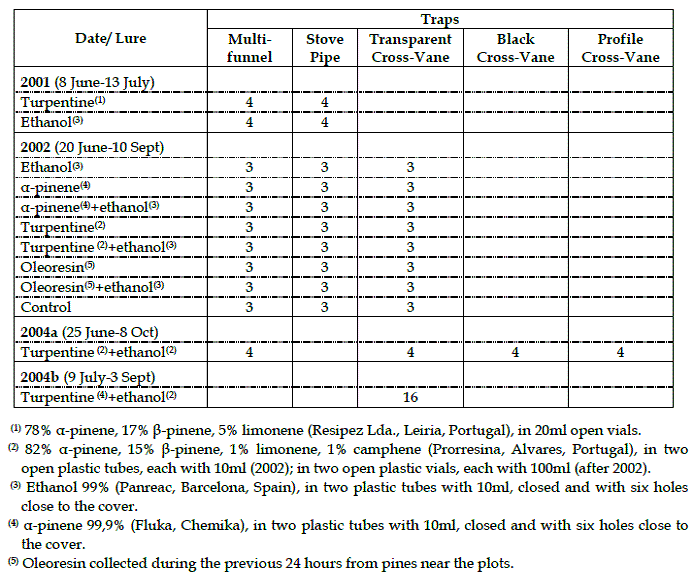
	    <p>Traps and/or lures with the best results in one assay were used again in the following assay against new sets. Table 1 presents the list of materials used in the different assays. All traps used in the work described in this paper were built at the INRB Laboratory. In the field, traps were hung high in the lower canopy of adult pines. This procedure was followed in order to improve trapping efficiency by placing them at the height of <i>M. galloprovincialis</i> flight and trunk colonization.</p>

	    <p>&nbsp;</p>

	    <p><b>Table 1</b> &#150; Traps and lures used in assays for the capture of <i>Monochamus galloprovincialis</i></p>

	    <p><img width="694" height="577" src="/img/revistas/slu/v20n1-2/20n1-2a03t1.gif"></p>
	
	    
]]></body>
<body><![CDATA[<p>&nbsp;</p>

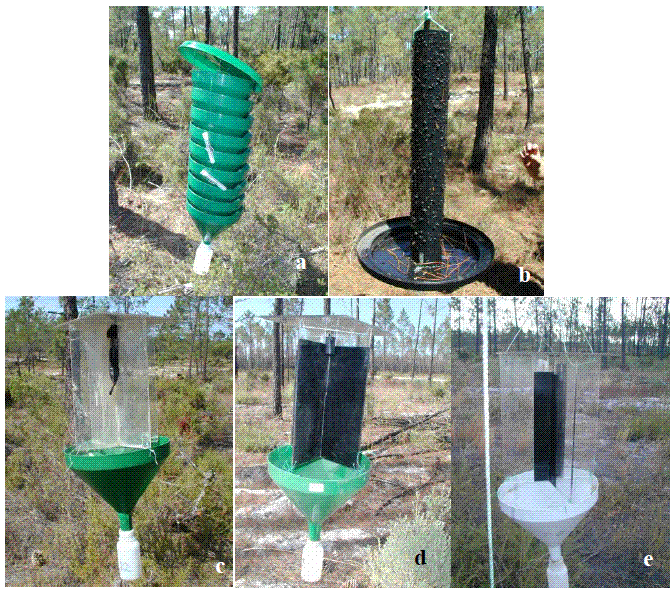
	    <p>The multi&#45;funnel trap was based on Lindgren's trap (1983) using nine green plastic funnels (16cm high and 20cm wide) with a narrow end cut. The bottom funnel was glued to a 50cl plastic cup containing a DDVP insecticide strip (Figure 1a).</p>

	    <p>&nbsp;</p>
	
	    <p><a name="f1"></a></p>

	    <p><img width="672" height="590" src="/img/revistas/slu/v20n1-2/20n1-2a03f1.gif"></p>
	
	    
<p><b><a href="#topf1">Figure 1</a></b> &#150; Traps used in assays to capture <i>Monochamus galloprovincialis</i> at Tr&oacute;ia and Comporta. a&#45; multi&#45;funnel; b&#45; stove pipe; c to e &#150; cross vane traps</p>

	    <p>&nbsp;</p>

	    <p>The stove pipe trap was based on the Fatzinger trap (1985), using a black PVC pipe 80cm high and 15cm wide, attached on the bottom to a black, round 50cm&#45;wide trash bin cover. The whole setup was covered with the entomologic glue <i>Temocid</i> (Quelmer, Lisboa, Portugal). Attractants were hung inside the tube and to allow dispersal of odors, two rings of holes were drilled into the tube at 25cm from each end. To prevent the capture of small birds or bats in the glue a 5cm&#45;wide metallic net was attached to the border of the trash bin cover (Figure 1b).</p>

	    <p>The transparent cross vane trap was based on traps described by WILKENING <i>et al.</i> (1981) and a Japanese 
	commercial trap for <i>M. alternatus</i> (NAKAMURA <i>et al.</i>, 1999). The trap consisted of two acrylic 
	plates, 30cm wide and 40cm high, cross&#45;connected in the center through 15cm slits. A 30cm funnel was hung 
	under the vanes to lead the insect that crashed into them to a 50cl plastic vial glued at the funnel end and 
	containing a DDVP insecticide strip (<a href="#f1">Figure 1c</a><a name="topf1"></a>).</p>

	    <p>The first variation of the cross vane trap was completely black, as described by McIntosh <i>et al.</i> 
	(2001) (<a href="#f1">Figure 1d</a>), and the second had a 10cm vertical black band at the middle, where the 
	vanes cross (GROOT and NOTT, 2001) (<a href="#f1">Figure 1e</a>).</p>

	    ]]></body>
<body><![CDATA[<p>&nbsp;</p>

	    <p><b>Experimental design</b></p>

	    <p>The assay done in 2002, in Tr&oacute;ia pine stands, compared three different traps (multi&#45;funnel, stove pipe and transparent cross vane), seven allelochemical combinations (oleoresin, turpentine, &#945;&#45;pinene) and a control (no lure).</p>

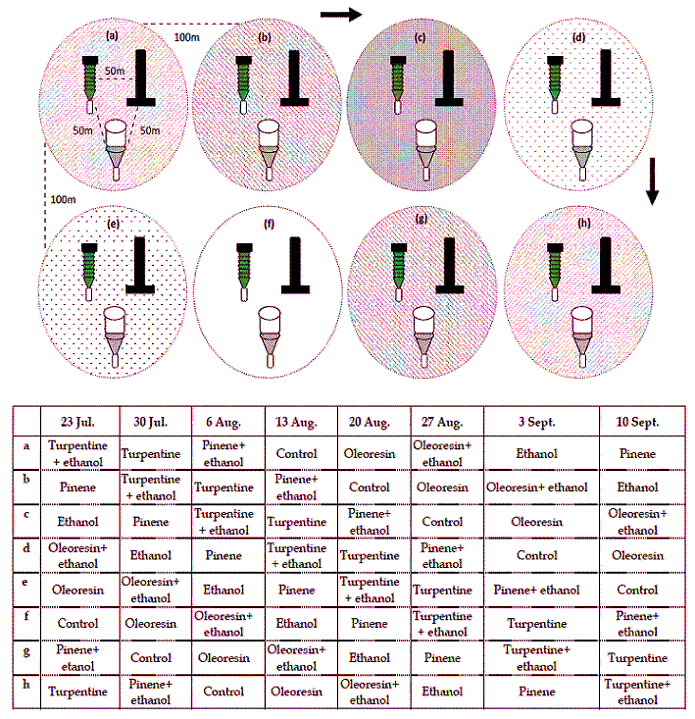
	    <p>Eight groups were established with 100m between them, with one trap of each type having the same attractant, placed 50m apart. Every week attractants were replaced by new ones of a different kind following a clockwise order (Figure 2).</p>

	    <p>&nbsp;</p>

	    <p><img width="695" height="719" src="/img/revistas/slu/v20n1-2/20n1-2a03f2.gif"></p>
	
	    
<p><b>Figure 2</b> &#150; Experimental design used to test traps and chemical lures to capture <i>Monochamus galloprovincialis</i>, with 3 simultaneous replications on the field. Arrows indicate the direction of clockwise rotation of the lures between groups of traps, according to the time sequence described in the table</p>

	    <p>&nbsp;</p>

	    <p>This way, after eight weeks all lures had been used in all traps and the assay ended. This design was repeated three times and as a result this assay used 72 traps simultaneously.</p>

	    <p>In all the other experiments the design used was the Latin square, with traps placed 100m from each other and, in each line or column of traps, all tested variables were represented without repetition.</p>

	    ]]></body>
<body><![CDATA[<p>In 2001 multi&#45;funnel and stove pipe traps were tested, lured with turpentine+ethanol and pinene+ethanol. In a first assay in 2004 the three variations of the cross&#45;vane and multi&#45;funnel traps were compared, all lured with turpentine+ethanol. Finally, in a second 2004 assay, 16 transparent cross vane traps were used to test four combinations of turpentine and ethanol, mixed at different ratios (1:1, 1:2 and 2:1) as well as in separate vials.</p>

	    <p>&nbsp;</p>

	    <p><b>Statistical analysis</b></p>

	    <p>In all the assays' results one&#45;way ANOVA was applied to assess the effect of each variable: chemical lure, trap and time. Afterward, variables were tested together using multiple ANOVA, where interaction between fixed (trap and lure) and random (time) factors was evaluated for its effectiveness in attracting and capturing <i>M. galloprovincialis</i> adults.</p>

	    <p>Since frequently less than 10 beetles were captured and some traps did not even capture a single insect, results were transformed by <sub><img width="93" height="33" src="/img/revistas/slu/v20n1-2/20n1-2a03e1.gif"></sub>, also used to assure data normality and homocedasticity (ROELOFS and CARDE, 1977; ZAR, 1984).</p>

	    
<p>When statistically significant differences were obtained a post&#45;hoc Fisher <i>Least Square Difference</i> was adjusted, because it is considered to be more robust than other available tests such as <i>Tukey</i> <i>HSD</i>, Newman&#45;Keuls, Bonferroni, Scheff&eacute; and Duncan (ZAR, 1984).</p>

	    <p>&nbsp;</p>

	    <p><b>Results</b></p>

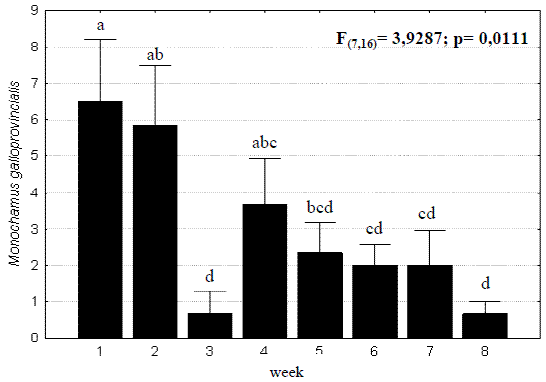
	    <p>The time pattern of <i>M. galloprovincialis</i> captures was studied for the 2002 assay and a concentration was observed in the first two weeks, with 18 and 17 beetles respectively (79,5% of 44 insects caught during the whole test). Variance analysis revealed significant concentration during these weeks and a weak contribution during the third and eighth weeks (Figure 3). The reason for the sudden decrease during the third week was due to unstable weather observed (rain and strong winds) that surely conditioned the beetles' activity. Disregarding this week the pattern showed a slow decrease towards the end of the assay, in late September, when the emergence period of <i>M. galloprovincialis</i> ends.</p>

	    <p>&nbsp;</p>

	    ]]></body>
<body><![CDATA[<p><img width="546" height="382" src="/img/revistas/slu/v20n1-2/20n1-2a03f3.gif"></p>
	
	    
<p><b>Figure 3</b> &#150; Weekly pattern of total <i>Monochamus galloprovincialis</i> captures observed in the 2002 assay. Lines are standard errors associated to means (in black bars) and letters are Homogeneous LSD groups</p>

	    <p>&nbsp;</p>

	    <p><b>Traps</b></p>

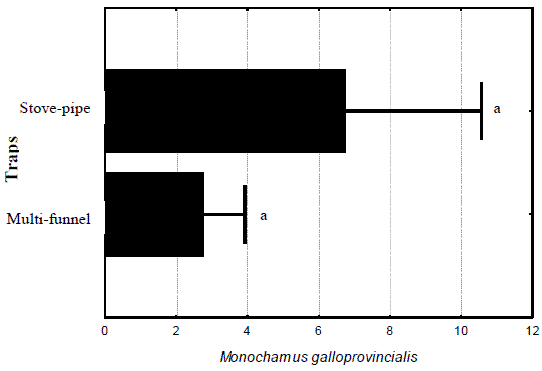
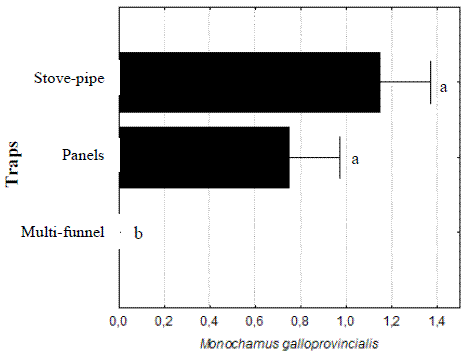
	    <p>The first assay to study the effect of trap design was conducted in 2001, when 38 adult <i>M. galloprovincialis</i> were captured by two kinds of traps, mainly the stove&#45;pipe trap (27 specimens against 11 in the multi&#45;funnel trap) but no significant statistical difference was found (F<sub>(6,1)</sub>= 0,3139; p= 0,5956) (Figure 4).</p>

	    <p>&nbsp;</p>

	    <p><img width="542" height="371" src="/img/revistas/slu/v20n1-2/20n1-2a03f4.gif"></p>
	
	    
<p><b>Figure 4</b> &#150; Total captures of <i>Monochamus galloprovincialis</i> adults obtained per trap in two different traps tested in 2001. Lines are standard errors associated to means (in black bars) and letters are Homogeneous LSD groups</p>

	    <p>&nbsp;</p>

	    <p>In the 2002 assay, concerning the performance of different traps, the multi&#45;funnel traps did not catch any <i>M. galloprovincialis</i>, therefore the ANOVA analysis showed significant differences in relation to the other two trap types, that showed similar capabilities (F<sub>(2,69)</sub>= 11,2129, p&lt; 0,0001) (Figure 5).</p>

	    ]]></body>
<body><![CDATA[<p>&nbsp;</p>

	    <p><img width="468" height="356" src="/img/revistas/slu/v20n1-2/20n1-2a03f5.gif"></p>
	
	    
<p><b>Figure 5</b> &#150; Total numbers of <i>Monochamus galloprovincialis</i> caught per trap and per week in assay of 2002. Lines are standard errors associated to means (in black bars) and letters are Homogeneous LSD groups</p>

	    <p>&nbsp;</p>

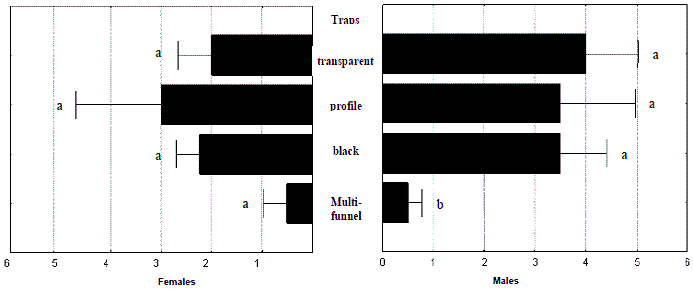
	    <p>In the trap assay done in 2004 the introduction of a visual effect in cross&#45;vane traps was tested. Once again the multi&#45;funnel trap gave the worst results (though having captured four beetles during the 16 weeks of the test period).</p>

	    <p>Transparent cross&#45;vane traps captured 24 <i>M. galloprovincialis</i> beetles, followed by the completely black traps with 23 beetles; profile traps caught 26 beetles (although almost half of them were caught during the first week in a single trap). Transparent cross&#45;vane traps showed more constant captures distributed between the four traps used and along the weeks of the assay.</p>

	    <p>One&#45;way ANOVA analysis reported statistically significant differences in total captures (F<sub>(3,12)</sub>= 2,7594; p= 0,0882) and of males (F<sub>(3,12)</sub>= 3,6371; p= 0,0449), with negative displacement of multi&#45;funnel in relation to cross&#45;vane traps (Figure 6). Females were captured in lesser numbers (n = 31) and equally in all kinds of traps (F<sub>(3,12)</sub>= 1,4412; p= 0,2796).</p>

	    <p>&nbsp;</p>

	    <p><img width="693" height="294" src="/img/revistas/slu/v20n1-2/20n1-2a03f6.gif"></p>
	
	    
<p><b>Figure 6</b> &#150; Total numbers of <i>Monochamus galloprovincialis</i> caught per trap and per week in assay of 2004a. Lines are standard errors associated to means (in black bars) and letters are Homogeneous LSD groups</p>

	    ]]></body>
<body><![CDATA[<p>&nbsp;</p>

	    <p><b>Lures</b></p>

	    <p>During the 2001 assay, <i>M. galloprovincialis</i> were only caught in traps lured with ethanol and pinene; none were caught in traps with turpentine.</p>

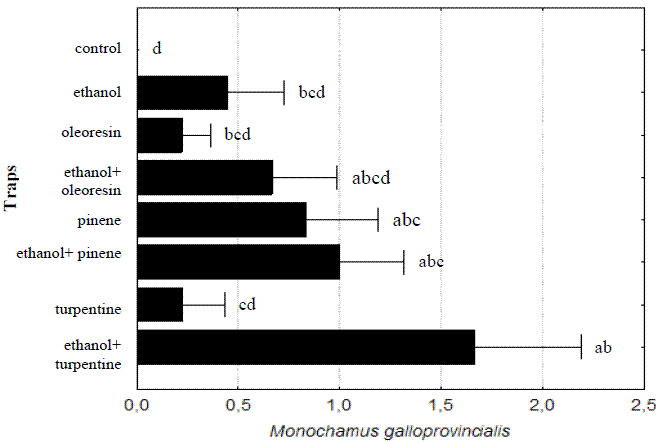
	    <p>The most consistent result obtained in the 2002 assay was the synergistic effect of ethanol when combined with other compounds; the <i>M. galloprovincialis</i> captures obtained were multiplied by 1,7 with &#945;&#45;pinene, by 2,3 with oleoresin and by 7,7 when combined with turpentine, giving a strong contribution to the statistical differences observed with ANOVA analysis (F<sub>(7,64)</sub>= 2,9065, p= 0,0106). Ethanol alone proved to be more attractive than turpentine or oleoresin placed in isolation (Figure 7).</p>

	    <p>&nbsp;</p>

	    <p><img width="660" height="445" src="/img/revistas/slu/v20n1-2/20n1-2a03f7.gif"></p>
	
	    
<p><b>Figure 7</b> &#45; Total numbers of <i>Monochamus galloprovincialis</i> caught per trap and per week in the 2002 assay. Lines are standard errors associated to means (in black bars) and letters are Homogeneous LSD groups</p>

	    <p>&nbsp;</p>

	    <p>The combined effects of traps and lures decreased previous observed differences (F<sub>(14,48)</sub>= 1,3116; p= 0,2359). However, the best results of all traps were always obtained when used with ethanol and turpentine (a total of eight beetles in transparent panels and seven beetles in stove&#45;pipe).</p>

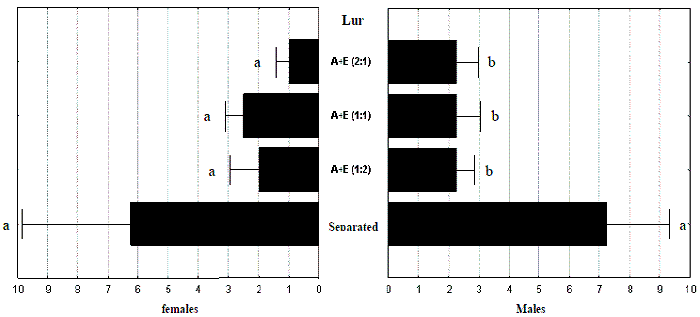
	    <p>In the other assay done in 2004 with the purpose of clarifying the best way to present ethanol and turpentine, when these attractants were placed separately, more than half of the total <i>M. galloprovincialis</i> beetles were caught (54 of 103 beetles).</p>

	    ]]></body>
<body><![CDATA[<p>Statistical differences were only found with trapped males (F<sub>(3,12)</sub>= 3,3813; p= 0,0543) because there was a concentration of females in one trap with separated chemicals (17 out of 25 total females caught), resulting in a big standard error, either in relation to female trapping (F<sub>(3,12)</sub>= 1,3619; p= 0,3013) or total trapping (F<sub>(3,12)</sub>= 2,5865; p= 0,1016).</p>

	    <p>Different mixtures of ethanol and turpentine gave similar results (Figure 8).</p>

	    <p>&nbsp;</p>

	    <p><img width="700" height="317" src="/img/revistas/slu/v20n1-2/20n1-2a03f8.gif"></p>
	
	    
<p><b>Figure 8</b> &#150; Total numbers of <i>Monochamus galloprovincialis</i> caught per trap and per week in the 2004b assay. Turpentine (A) and Ethanol (E) were placed separately and in mixtures at different proportions (2:1; 1:2 and 1:1). Lines are standard errors associated to means (in black bars) and letters are Homogeneous LSD groups</p>

	    <p>&nbsp;</p>

	    <p>Considering other wood&#45;boring species, in the 2002 assay a total of 240 cerambicids, 47 buprestids and 20 curculionids were caught. Besides the 44 <i>M. galloprovincialis</i> specimens, the other cerambicids caught were 95 <i>Ahropalus syriacus</i>, 7 <i>A. ferus</i>, 32 <i>S. buprestoides</i>, 50 <i>P. perroudi</i>, 11 <i>A. griseus</i> and 1 <i>Trichoferus</i> sp..</p>

	    <p>In our assays most of the <i>M. galloprovincialis</i> beetles were captured in transparent cross&#45;vane traps, so a visual stimulus is not important for catching <i>M. galloprovincialis</i>; odors therefore play the major role, as referred by PAJARES <i>et al</i>. (2004).</p>

	    <p>Silhouette and stove&#45;pipe traps have a strong visual effect which is important to many species that need visual stimuli to stop their flight and land. Flight interception traps only rely on the attractive ability of the lure and have proven to be efficient in catching large forest insects (YOUNAN and HAIN, 1982). Most North American <i>Monochamus</i> species such as <i>M. titillator</i>, <i>M. carolinensis</i> (FATZINGER, 1985) and <i>M. notatus</i> (CHENI&Eacute;R and PHILOG&Egrave;NE, 1989b) were caught in higher numbers in traps with a black vertical silhouette than in interception or multi&#45;funnel traps, although in some situations no statistical differences were found (CH&Eacute;NIER and PHILOG&Egrave;NE, 1989a; GROOT and NOTT, 2001; 2003; MOREWOOD<i>et al.</i>, 2002). On the other hand, GROOT and NOTT (2001; 2003) and McINTOSH <i>et al</i>. (2001) found differences between <i>Monochamus</i> species, where visual stimuli is important for <i>M. scutellatus</i> but not for <i>M. mutator</i>.</p>

	    <p>In our assays, multi&#45;funnel traps always showed the worst results when compared with the others. Multi&#45;funnel traps are useful for monitoring but not efficient for pine sawyer population limitation (NAKAMURA, 2003; LOYD <i>et al.</i>, 2004), as the Japanese trap for <i>M. alternatus</i> (SHIBATA <i>et al.</i>, 1996; SAKAKIBARA <i>et al.</i>, 1998; NAKAMURA <i>et al.</i>, 1999; NAKAMURA and SON&Eacute;, 2004). The use of sticky traps, such as the stove&#45;pipe, although they had proven to be efficient in catching <i>M. galloprovincialis</i>, is not practical for large&#45;scale trapping and it is impossible to extract nematodes, needed for infestation assessment within the affected area.</p>

	    ]]></body>
<body><![CDATA[<p>Since in many of the assays no statistical differences were found between the traps used, the attractive effect of chemical compounds is apparently the most important variable for catching <i>M. galloprovincialis</i>.</p>

	    <p>The first two assays used different turpentines and the 2001 turpentine was produced from a mixture of oleoresin from <i>P. pinaster</i> and<i>P.</i> <i>pinea</i> with higher limonene content. This difference must have had a strong repellent effect on <i>M. galloprovincialis</i>. Several studies report that limonene has an opposite effect to the attraction produced by &#945;&#45;pinene on <i>H. abietis</i> (LINDGREN <i>et al.</i>, 1996; KLEPZIG and SCHLYTER, 1999), inhibits egg&#45;laying of pine processionay moth (TIBERI <i>et al.</i>, 1999; ZHANG <i>et al.</i>, 2003), is toxic to many bark beetles (BYERS, 1995) and is a feeding deterrent for the larvae of <i>M. alternatus</i> (FAN and SUN, 2006).</p>

	    <p>The strong synergistic effect of ethanol when combined with oleoresin compounds found in our results was also reported by other authors and may be related to the fact that ethanol is a subproduct of microbial activity inside tree hosts and is interpreted by secondary insects as a sign of a weakened host (IKEDA and ODA, 1980; BYERS, 1989a; b; SATO and MAETO, 2006).</p>

	    <p>The most abundant terpene of the pines' oleoresin is &#945;&#45;pinene (around 80% in Portuguese <i>P. pinaster</i>) (PESTANA, 1993); when combined with ethanol, it has proven to be very attractive to bark and wood&#45;boring beetles (BORDEN <i>et al.</i>, 1982; SCHROEDER and LINDELOW, 1989; BYERS, 1992).</p>

	    <p>This time pattern observed in our assays, with a strong effect in the first two weeks, was also reported for <i>M. alternatus</i> adults and related to high initial sensitivity to &#945;&#45;pinene, becoming less effective as the insect matures sexually (SAKAI <i>et al.</i>, 1992).</p>

	    <p>However, we obtained better results with turpentine than with &#945;&#45;pinene alone, as in other studies with wood&#45;boring beetles (FATZINGER, 1985; IKEDA <i>et al.</i>, 1986; PHILLIPS <i>et al.</i>, 1988; CH&Eacute;NIER and PHILOG&Egrave;NE, 1989b; ALLISON <i>et al.</i>, 2001) and pine processionary moth (ZHANG <i>et al.</i>, 2003). This reveals that <i>M. galloprovincialis</i> may be sensitive to a minor compound of oleoresin, still to be isolated.</p>

	    <p>The trapping of <i>M. galloprovincialis</i> with lures based on allelochemicals produced by the pine tree host, inside the area affected by the pine wood nematode, has a limited effect because all year round many diseased trees can be found highly attractive to beetles.</p>

	    <p>To improve the efficiency of traps in capturing <i>M. galloprovincialis</i> in order to serve as an important tool for pine sawyer population regulation and therefore reduce contamination by the pine wood nematode <i>B. xylophilus</i>, it is essential to find non&#45;tree host odors that would easily be detected by the beetles, even in a high&#45;mortality pine stand.</p>

	    <p>&nbsp;</p>

	    <p><b>References</b></p>

	    ]]></body>
<body><![CDATA[<!-- ref --><p>ALLISON, J.D., BORDEN, J.H., McINTOSH, R.L., GROOT, P., GRIES, R., 2001. Kairomonal responses by four <i>Monochamus</i> species (Coleoptera: Cerambycidae) to bark beetle pheromones. <i>J. Chem. Ecol.</i> <b>27</b>: 633&#45;646.    &nbsp;&nbsp;&nbsp;&nbsp;&nbsp;&nbsp;&nbsp;&nbsp;[&#160;<a href="javascript:void(0);" onclick="javascript: window.open('/scielo.php?script=sci_nlinks&ref=000123&pid=S0870-6352201200010000300001&lng=','','width=640,height=500,resizable=yes,scrollbars=1,menubar=yes,');">Links</a>&#160;]<!-- end-ref --></p>

	    <!-- ref --><p>ALLISON, J.D., BORDEN, J.H., SEYBOLD, S.J., 2004. A review of the chemical ecology of the Cerambycidae (Coleoptera). <i>Chemoecology</i> <b>14</b>: 123&#150;150.    &nbsp;&nbsp;&nbsp;&nbsp;&nbsp;&nbsp;&nbsp;&nbsp;[&#160;<a href="javascript:void(0);" onclick="javascript: window.open('/scielo.php?script=sci_nlinks&ref=000125&pid=S0870-6352201200010000300002&lng=','','width=640,height=500,resizable=yes,scrollbars=1,menubar=yes,');">Links</a>&#160;]<!-- end-ref --></p>

	    <!-- ref --><p>BILLINGS, R.F., CAMERON, R.S., 1984. Kairomonal responses of Coleoptera, <i>Monochamus titilator</i> (Cerambycidae), <i>Thanasimus dubius</i> (Cleridae), and <i>Temnochila virescens</i> (Trogositidae) to behavioural chemicals of southern pine bark beetles (Coleoptera: Scolytidae). <i>Environ. Entomol.</i> <b>13</b>: 1542&#45;1548.    &nbsp;&nbsp;&nbsp;&nbsp;&nbsp;&nbsp;&nbsp;&nbsp;[&#160;<a href="javascript:void(0);" onclick="javascript: window.open('/scielo.php?script=sci_nlinks&ref=000127&pid=S0870-6352201200010000300003&lng=','','width=640,height=500,resizable=yes,scrollbars=1,menubar=yes,');">Links</a>&#160;]<!-- end-ref --></p>

	    <!-- ref --><p>BORDEN, J.H., KING, C.J., LINDGREN, S., CHONG, L., GRAY, D.R., OEHLSCHLAGER, A.C., SLESSOR, K.L., PIERCE JR., H.D., 1982. Variation in response of <i>Trypodendron lineatum</i> from two continents to semiochemicals and trap form. <i>Environ. Entomol.</i> <b>11</b>: 403&#45;408.    &nbsp;&nbsp;&nbsp;&nbsp;&nbsp;&nbsp;&nbsp;&nbsp;[&#160;<a href="javascript:void(0);" onclick="javascript: window.open('/scielo.php?script=sci_nlinks&ref=000129&pid=S0870-6352201200010000300004&lng=','','width=640,height=500,resizable=yes,scrollbars=1,menubar=yes,');">Links</a>&#160;]<!-- end-ref --></p>

	    <!-- ref --><p>BYERS, J.A., 1989a. Chemical ecology of bark beetles. <i>Experientia</i> <b>45</b>: 271&#45;283.    &nbsp;&nbsp;&nbsp;&nbsp;&nbsp;&nbsp;&nbsp;&nbsp;[&#160;<a href="javascript:void(0);" onclick="javascript: window.open('/scielo.php?script=sci_nlinks&ref=000131&pid=S0870-6352201200010000300005&lng=','','width=640,height=500,resizable=yes,scrollbars=1,menubar=yes,');">Links</a>&#160;]<!-- end-ref --></p>

	    ]]></body>
<body><![CDATA[<!-- ref --><p>BYERS, J.A., 1989b. Behavioural mechanisms involved in reducing competition in bark beetles. <i>Holartic Ecology</i> <b>12</b>: 466&#45;476.    &nbsp;&nbsp;&nbsp;&nbsp;&nbsp;&nbsp;&nbsp;&nbsp;[&#160;<a href="javascript:void(0);" onclick="javascript: window.open('/scielo.php?script=sci_nlinks&ref=000133&pid=S0870-6352201200010000300006&lng=','','width=640,height=500,resizable=yes,scrollbars=1,menubar=yes,');">Links</a>&#160;]<!-- end-ref --></p>

	    <!-- ref --><p>BYERS, J.A., 1992. Attraction of bark beetles, <i>Tomicus piniperda</i>, <i>Hylurgops palliatus</i> and <i>Trypodendron domesticum</i> and other insects to short&#45;chain alcohols and monoterpenes. <i>J. Chem. Ecol.</i> <b>18</b>(12): 2385&#45;2402.    &nbsp;&nbsp;&nbsp;&nbsp;&nbsp;&nbsp;&nbsp;&nbsp;[&#160;<a href="javascript:void(0);" onclick="javascript: window.open('/scielo.php?script=sci_nlinks&ref=000135&pid=S0870-6352201200010000300007&lng=','','width=640,height=500,resizable=yes,scrollbars=1,menubar=yes,');">Links</a>&#160;]<!-- end-ref --></p>

	    <!-- ref --><p>BYERS, J.A., 1995. Host&#45;tree chemistry affecting colonization in bark beetles. <i>in <b>Card&eacute; &amp; Bell Eds. Chemical ecology of insects</b></i> <b>2</b><b>: 154&#45;213.    &nbsp;&nbsp;&nbsp;&nbsp;&nbsp;&nbsp;&nbsp;&nbsp;[&#160;<a href="javascript:void(0);" onclick="javascript: window.open('/scielo.php?script=sci_nlinks&ref=000137&pid=S0870-6352201200010000300008&lng=','','width=640,height=500,resizable=yes,scrollbars=1,menubar=yes,');">Links</a>&#160;]<!-- end-ref --></b></p>

	    <!-- ref --><p>CH&Eacute;NIER, J.V.R., PHILOG&Egrave;NE, B.J.R., 1989a. Field responses of certain forest Coleoptera to conifer monoterpenes and ethanol. <i>J. Chem. Ecology</i> <b>15</b>(6):1729&#45;1745.    &nbsp;&nbsp;&nbsp;&nbsp;&nbsp;&nbsp;&nbsp;&nbsp;[&#160;<a href="javascript:void(0);" onclick="javascript: window.open('/scielo.php?script=sci_nlinks&ref=000139&pid=S0870-6352201200010000300009&lng=','','width=640,height=500,resizable=yes,scrollbars=1,menubar=yes,');">Links</a>&#160;]<!-- end-ref --></p>

	    <!-- ref --><p>CH&Eacute;NIER, J.V.R., PHILOG&Egrave;NE, B.J.R., 1989b. Evaluation of three trap designs for the capture of conifer&#45;feeding beetles and other forest Coleoptera. <i>Can. Ent</i>. <b>121</b>: 159&#45;167.    &nbsp;&nbsp;&nbsp;&nbsp;&nbsp;&nbsp;&nbsp;&nbsp;[&#160;<a href="javascript:void(0);" onclick="javascript: window.open('/scielo.php?script=sci_nlinks&ref=000141&pid=S0870-6352201200010000300010&lng=','','width=640,height=500,resizable=yes,scrollbars=1,menubar=yes,');">Links</a>&#160;]<!-- end-ref --></p>

	    ]]></body>
<body><![CDATA[<!-- ref --><p>DICKE, M., GROSTAL, P., 2001. Chemical detection of natural enemies by arthropods: an ecological perspective. <i>Ann. Rev. Ecol. Syst.</i> <b>32</b>: 1&#45;23.    &nbsp;&nbsp;&nbsp;&nbsp;&nbsp;&nbsp;&nbsp;&nbsp;[&#160;<a href="javascript:void(0);" onclick="javascript: window.open('/scielo.php?script=sci_nlinks&ref=000143&pid=S0870-6352201200010000300011&lng=','','width=640,height=500,resizable=yes,scrollbars=1,menubar=yes,');">Links</a>&#160;]<!-- end-ref --></p>

	    <!-- ref --><p>DYER, L.J., SEABROOK, W.D., 1978. Some aspects of oviposition site selection in <i>Monochamus notatus</i> e <i>M. scutellatus</i> (Coleoptera: Cerambycidae). <i>J. Chem.</i> <i>Ecology</i> <b>4</b>(2): 199&#150;210.    &nbsp;&nbsp;&nbsp;&nbsp;&nbsp;&nbsp;&nbsp;&nbsp;[&#160;<a href="javascript:void(0);" onclick="javascript: window.open('/scielo.php?script=sci_nlinks&ref=000145&pid=S0870-6352201200010000300012&lng=','','width=640,height=500,resizable=yes,scrollbars=1,menubar=yes,');">Links</a>&#160;]<!-- end-ref --></p>

	    <!-- ref --><p>FACCOLI, M., BLAZENEC, M., SCHLYTER, F., 2005. Feeding responses to host and nonhost compounds by males and females of the spruce bark beetle <i>Ips typographus</i> in a tunnelling microassay. <i>J. Chem. Ecol.</i> <b>31</b>(4): 745&#45;759.    &nbsp;&nbsp;&nbsp;&nbsp;&nbsp;&nbsp;&nbsp;&nbsp;[&#160;<a href="javascript:void(0);" onclick="javascript: window.open('/scielo.php?script=sci_nlinks&ref=000147&pid=S0870-6352201200010000300013&lng=','','width=640,height=500,resizable=yes,scrollbars=1,menubar=yes,');">Links</a>&#160;]<!-- end-ref --></p>

	    <!-- ref --><p>FAN, J.T., SUN, J.H., 2006. Influences of host volatiles on feeding behaviour of the Japanese pine sawyer, <i>Monochamus alternatus</i>. <i>J. Appl. Entomol.</i> <b>130</b>(4): 238&#45;244.    &nbsp;&nbsp;&nbsp;&nbsp;&nbsp;&nbsp;&nbsp;&nbsp;[&#160;<a href="javascript:void(0);" onclick="javascript: window.open('/scielo.php?script=sci_nlinks&ref=000149&pid=S0870-6352201200010000300014&lng=','','width=640,height=500,resizable=yes,scrollbars=1,menubar=yes,');">Links</a>&#160;]<!-- end-ref --></p>

	    <!-- ref --><p>FATZINGER, C.W., 1985. Attraction of black turpentine beetle (Coleoptera: Scolytidae) and other forest Coleoptera to turpentine&#45;baited traps. <i>Environ. Entomol.</i> <b>14</b>(6): 768&#45;775.    &nbsp;&nbsp;&nbsp;&nbsp;&nbsp;&nbsp;&nbsp;&nbsp;[&#160;<a href="javascript:void(0);" onclick="javascript: window.open('/scielo.php?script=sci_nlinks&ref=000151&pid=S0870-6352201200010000300015&lng=','','width=640,height=500,resizable=yes,scrollbars=1,menubar=yes,');">Links</a>&#160;]<!-- end-ref --></p>

	    ]]></body>
<body><![CDATA[<!-- ref --><p>GINZEL, M.D., HANKS, L.M., 2003. Contact pheromones as mate recognition cues of four species of Longhorned beetles (Coleoptera: Cerambycidae). <i>J. Insect Behaviour</i> <b>16</b>(2): 181&#45;186.    &nbsp;&nbsp;&nbsp;&nbsp;&nbsp;&nbsp;&nbsp;&nbsp;[&#160;<a href="javascript:void(0);" onclick="javascript: window.open('/scielo.php?script=sci_nlinks&ref=000153&pid=S0870-6352201200010000300016&lng=','','width=640,height=500,resizable=yes,scrollbars=1,menubar=yes,');">Links</a>&#160;]<!-- end-ref --></p>

	    <!-- ref --><p>GROOT, P., NOTT, R., 2001. Evaluation of traps of six different designs to capture pine sawyer beetles (Coleoptera: Cerambycidae). <i>Agric. For. Entomol</i>. <b>3</b>: 107&#45;111.    &nbsp;&nbsp;&nbsp;&nbsp;&nbsp;&nbsp;&nbsp;&nbsp;[&#160;<a href="javascript:void(0);" onclick="javascript: window.open('/scielo.php?script=sci_nlinks&ref=000155&pid=S0870-6352201200010000300017&lng=','','width=640,height=500,resizable=yes,scrollbars=1,menubar=yes,');">Links</a>&#160;]<!-- end-ref --></p>

	    <!-- ref --><p>GROOT, P., NOTT, R., 2003. Response of <i>Monochamus</i> (Col., Cerambycidae) and some Buprestidae to flight intercept traps. <i>J. Appl. Entomol.</i> <b>127</b>: 548&#45;552.    &nbsp;&nbsp;&nbsp;&nbsp;&nbsp;&nbsp;&nbsp;&nbsp;[&#160;<a href="javascript:void(0);" onclick="javascript: window.open('/scielo.php?script=sci_nlinks&ref=000157&pid=S0870-6352201200010000300018&lng=','','width=640,height=500,resizable=yes,scrollbars=1,menubar=yes,');">Links</a>&#160;]<!-- end-ref --></p>

	    <!-- ref --><p>HANKS, L.M., 1999. Influence of the larval host plant on reproductive strategies of cerambycid beetles. <i>Annu. Rev. Entomol.</i> <b>44</b>: 483&#45;505.    &nbsp;&nbsp;&nbsp;&nbsp;&nbsp;&nbsp;&nbsp;&nbsp;[&#160;<a href="javascript:void(0);" onclick="javascript: window.open('/scielo.php?script=sci_nlinks&ref=000159&pid=S0870-6352201200010000300019&lng=','','width=640,height=500,resizable=yes,scrollbars=1,menubar=yes,');">Links</a>&#160;]<!-- end-ref --></p>

	    <!-- ref --><p>IKEDA, T., ODA, K., 1980. The occurrence of attractiveness for <i>Monochamus alternatus</i> Hope (Coleoptera: Cerambycidae) in nematode&#45;infected pine trees. <i>J. Jap. For. Soc.</i> <b>62</b>(11): 432&#45;434.    &nbsp;&nbsp;&nbsp;&nbsp;&nbsp;&nbsp;&nbsp;&nbsp;[&#160;<a href="javascript:void(0);" onclick="javascript: window.open('/scielo.php?script=sci_nlinks&ref=000161&pid=S0870-6352201200010000300020&lng=','','width=640,height=500,resizable=yes,scrollbars=1,menubar=yes,');">Links</a>&#160;]<!-- end-ref --></p>

	    ]]></body>
<body><![CDATA[<!-- ref --><p>IKEDA, T., ODA, K., YAMANE, A., ENDA, N., 1980. Volatiles from pine logs as the attractants for the Japanese Pine Sawyer <i>Monochamus alternatus</i> Hope (Coleoptera: Cerambycidae). <i>J. Jap. For. Soc</i>. <b>62</b>(4): 150&#45;152.    &nbsp;&nbsp;&nbsp;&nbsp;&nbsp;&nbsp;&nbsp;&nbsp;[&#160;<a href="javascript:void(0);" onclick="javascript: window.open('/scielo.php?script=sci_nlinks&ref=000163&pid=S0870-6352201200010000300021&lng=','','width=640,height=500,resizable=yes,scrollbars=1,menubar=yes,');">Links</a>&#160;]<!-- end-ref --></p>

	    <!-- ref --><p>IKEDA, T., YAMANE, A., ENDA, N., ODA, K., MAKIHARA, H., ITO, K., &Ocirc;KOCHI, I., 1986. Attractiveness of each volatile components of felled pine trees for <i>Monochamus alternatus</i> (Coleoptera: Cerambycidae). <i>J. Jap. For. Soc</i>. <b>68</b>: 15&#45;19.    &nbsp;&nbsp;&nbsp;&nbsp;&nbsp;&nbsp;&nbsp;&nbsp;[&#160;<a href="javascript:void(0);" onclick="javascript: window.open('/scielo.php?script=sci_nlinks&ref=000165&pid=S0870-6352201200010000300022&lng=','','width=640,height=500,resizable=yes,scrollbars=1,menubar=yes,');">Links</a>&#160;]<!-- end-ref --></p>

	    <!-- ref --><p>KLEPZIG, K.D., SCHLYTER, F., 1999. Laboratory evaluation of plant&#45;derived antifeedants against the pine weevil <i>Hylobius abietis</i> (Coleoptera: Curculionidae). J. Econ. Entomol. <b>92</b>(3): 644&#45;650.    &nbsp;&nbsp;&nbsp;&nbsp;&nbsp;&nbsp;&nbsp;&nbsp;[&#160;<a href="javascript:void(0);" onclick="javascript: window.open('/scielo.php?script=sci_nlinks&ref=000167&pid=S0870-6352201200010000300023&lng=','','width=640,height=500,resizable=yes,scrollbars=1,menubar=yes,');">Links</a>&#160;]<!-- end-ref --></p>

	    <!-- ref --><p>LINDGREN, B.S., 1983. A multiple funnel trap for Scolitid beetles (Coleoptera). <i>Can. Ent.</i> <b>115</b>: 299&#45;302.    &nbsp;&nbsp;&nbsp;&nbsp;&nbsp;&nbsp;&nbsp;&nbsp;[&#160;<a href="javascript:void(0);" onclick="javascript: window.open('/scielo.php?script=sci_nlinks&ref=000169&pid=S0870-6352201200010000300024&lng=','','width=640,height=500,resizable=yes,scrollbars=1,menubar=yes,');">Links</a>&#160;]<!-- end-ref --></p>

	    <!-- ref --><p>LINDGREN, B.S., NORDLANDER, G., BIRGERSSON, G., 1996. Feeding deterrence of verbenone to the pine weevil, <i>Hylobius abietis</i> (L.) (Col., Curculionidae). <i>J. Appl. Entomol.</i> <b>120</b>: 397&#150;403.    &nbsp;&nbsp;&nbsp;&nbsp;&nbsp;&nbsp;&nbsp;&nbsp;[&#160;<a href="javascript:void(0);" onclick="javascript: window.open('/scielo.php?script=sci_nlinks&ref=000171&pid=S0870-6352201200010000300025&lng=','','width=640,height=500,resizable=yes,scrollbars=1,menubar=yes,');">Links</a>&#160;]<!-- end-ref --></p>

	    ]]></body>
<body><![CDATA[<!-- ref --><p>LLODY, F., NAKAMURA, K., LINIT, M., 2004. Seasonality of forest pest and beneficial insects attracted to alpha&#150;pinene / ethanol baited Lindgren traps in a study to monitor <i>Monochamus carolinensis</i> in Missouri pine stands. <i>in Proc. Entomol. Soc. America Ann. Meeting</i>: 1 pp.    &nbsp;&nbsp;&nbsp;&nbsp;&nbsp;&nbsp;&nbsp;&nbsp;[&#160;<a href="javascript:void(0);" onclick="javascript: window.open('/scielo.php?script=sci_nlinks&ref=000173&pid=S0870-6352201200010000300026&lng=','','width=640,height=500,resizable=yes,scrollbars=1,menubar=yes,');">Links</a>&#160;]<!-- end-ref -->.</p>

	    <!-- ref --><p>McINTOSH, R.L., KATINIC, P.J., ALLISON, J.D., BORDEN, J.H., DOWNEY, D.L., 2001. Comparative efficacy of five types of trap for woodborers in the Cerambycidae, Buprestidae and Siricidae. <i>Agricultural and Forest Entomology</i> <b>3</b>: 113&#45;120.    &nbsp;&nbsp;&nbsp;&nbsp;&nbsp;&nbsp;&nbsp;&nbsp;[&#160;<a href="javascript:void(0);" onclick="javascript: window.open('/scielo.php?script=sci_nlinks&ref=000175&pid=S0870-6352201200010000300027&lng=','','width=640,height=500,resizable=yes,scrollbars=1,menubar=yes,');">Links</a>&#160;]<!-- end-ref --></p>

	    <!-- ref --><p>MOREWOOD, W.D., HELN, K.E., KATANIC, P.J., BORDEN, J.H., 2002. An improved trap for large wood&#45;boring insects with special reference to <i>Monochamus scutellatus</i> (Coleoptera: Cerambycidae). <i>Can. J. For. Res.</i> <b>32</b>: 519&#45;525.    &nbsp;&nbsp;&nbsp;&nbsp;&nbsp;&nbsp;&nbsp;&nbsp;[&#160;<a href="javascript:void(0);" onclick="javascript: window.open('/scielo.php?script=sci_nlinks&ref=000177&pid=S0870-6352201200010000300028&lng=','','width=640,height=500,resizable=yes,scrollbars=1,menubar=yes,');">Links</a>&#160;]<!-- end-ref --></p>

	    <!-- ref --><p>MOTA, M.M., BRAASCH, H., BRAVO, M.A., PENAS, A.C., BURGERMEISTER, W., METGE, K., SOUSA, E., 1999. First report of <i>Bursaphelenchus xylophilus</i> in Portugal and in Europe. <i>Nematology</i> <b>1</b>(7&#45;8): 727&#45;734.    &nbsp;&nbsp;&nbsp;&nbsp;&nbsp;&nbsp;&nbsp;&nbsp;[&#160;<a href="javascript:void(0);" onclick="javascript: window.open('/scielo.php?script=sci_nlinks&ref=000179&pid=S0870-6352201200010000300029&lng=','','width=640,height=500,resizable=yes,scrollbars=1,menubar=yes,');">Links</a>&#160;]<!-- end-ref --></p>

	    <!-- ref --><p>NAKAMURA, K., 2003. Monitoring of the Japanese pine sawyer, <i>Monochamus alternatus</i> and its load of the pinewood nematode, <i>Bursaphelenchus xylophilus</i>, with a commercial attraction trap modified for live capture. <i>in Korea&#45;Japan Joint Conf. Appl. Entomol. Zool.</i>: 180.    &nbsp;&nbsp;&nbsp;&nbsp;&nbsp;&nbsp;&nbsp;&nbsp;[&#160;<a href="javascript:void(0);" onclick="javascript: window.open('/scielo.php?script=sci_nlinks&ref=000181&pid=S0870-6352201200010000300030&lng=','','width=640,height=500,resizable=yes,scrollbars=1,menubar=yes,');">Links</a>&#160;]<!-- end-ref --></p>

	    ]]></body>
<body><![CDATA[<!-- ref --><p>NAKAMURA, K., SONE, K., 2004. Modification of capturing bucket of the attraction trap for live trapping of <i>Monochamus alternatus</i> adults to prevent escaping beetles. <i>Kyushu J. Forest. Res.</i> <b>57</b>: 110&#45;112.    &nbsp;&nbsp;&nbsp;&nbsp;&nbsp;&nbsp;&nbsp;&nbsp;[&#160;<a href="javascript:void(0);" onclick="javascript: window.open('/scielo.php?script=sci_nlinks&ref=000183&pid=S0870-6352201200010000300031&lng=','','width=640,height=500,resizable=yes,scrollbars=1,menubar=yes,');">Links</a>&#160;]<!-- end-ref --></p>

	    <!-- ref --><p>NAKAMURA, K., SON&Eacute;, K., OOKUMA, H., 1999. Modification of a commercial attraction trap for live trapping of <i>Monochamus alternatus</i> (Hope) adults (Coleoptera; Cerambycidae). <i>Appl. Entomol. Zool.</i> <b>43</b>: 55&#45;59.    &nbsp;&nbsp;&nbsp;&nbsp;&nbsp;&nbsp;&nbsp;&nbsp;[&#160;<a href="javascript:void(0);" onclick="javascript: window.open('/scielo.php?script=sci_nlinks&ref=000185&pid=S0870-6352201200010000300032&lng=','','width=640,height=500,resizable=yes,scrollbars=1,menubar=yes,');">Links</a>&#160;]<!-- end-ref --></p>

	    <!-- ref --><p>NAVES, P.M., SOUSA, E., RODRIGUES, J.M., 2008. Biology of <i>Monochamus galloprovincialis</i> (Coleoptera: Cerambycidae) in the pine wilt disease affected zone, Southern Portugal. <i>Silva Lusitana</i> <b>16</b>(2): 133&#45;148.    &nbsp;&nbsp;&nbsp;&nbsp;&nbsp;&nbsp;&nbsp;&nbsp;[&#160;<a href="javascript:void(0);" onclick="javascript: window.open('/scielo.php?script=sci_nlinks&ref=000187&pid=S0870-6352201200010000300033&lng=','','width=640,height=500,resizable=yes,scrollbars=1,menubar=yes,');">Links</a>&#160;]<!-- end-ref --></p>

	    <!-- ref --><p>NIEMEYER, H., 1985. Field response of <i>Ips typographus</i> (Col., Scolytidae) to different trap structures and white versus black flight barriers. <i>Z. Ang. Ent.</i> <b>99</b>: 44&#45;51.    &nbsp;&nbsp;&nbsp;&nbsp;&nbsp;&nbsp;&nbsp;&nbsp;[&#160;<a href="javascript:void(0);" onclick="javascript: window.open('/scielo.php?script=sci_nlinks&ref=000189&pid=S0870-6352201200010000300034&lng=','','width=640,height=500,resizable=yes,scrollbars=1,menubar=yes,');">Links</a>&#160;]<!-- end-ref --></p>

	    <!-- ref --><p>PAJARES, J.A., IBEAS, F., DIEZ, J.J., GALLEGO, D., 2004. Attractive responses by <i>Monochamus galloprovinciallis</i> (Col., Cerambycidae) to host and bark beetle semiochemicals. <i>J. Appl. Entomol</i>. <b>128</b>: 633&#45;638.    &nbsp;&nbsp;&nbsp;&nbsp;&nbsp;&nbsp;&nbsp;&nbsp;[&#160;<a href="javascript:void(0);" onclick="javascript: window.open('/scielo.php?script=sci_nlinks&ref=000191&pid=S0870-6352201200010000300035&lng=','','width=640,height=500,resizable=yes,scrollbars=1,menubar=yes,');">Links</a>&#160;]<!-- end-ref --></p>

	    ]]></body>
<body><![CDATA[<!-- ref --><p>PESTANA, M., 1993. Caracteriza&ccedil;&atilde;o da aguarr&aacute;s proveniente de cinco esp&eacute;cies de pinheiro. <i>Silva Lusitana</i> <b>1</b>(1): 109&#45;112.    &nbsp;&nbsp;&nbsp;&nbsp;&nbsp;&nbsp;&nbsp;&nbsp;[&#160;<a href="javascript:void(0);" onclick="javascript: window.open('/scielo.php?script=sci_nlinks&ref=000193&pid=S0870-6352201200010000300036&lng=','','width=640,height=500,resizable=yes,scrollbars=1,menubar=yes,');">Links</a>&#160;]<!-- end-ref --></p>

	    <!-- ref --><p>PHILLIPS, T.W., WILKENING, A.J., ATKINSON, T.H., NATION, J.L., WILKINSON, R.C., FOLTZ, J.L., 1988. Synergism of turpentine and ethanol as attractants for certain pine&#45;feeding beetles (Coleoptera). <i>Environ. Entomol.</i> <b>17</b>(3): 456&#45;462.    &nbsp;&nbsp;&nbsp;&nbsp;&nbsp;&nbsp;&nbsp;&nbsp;[&#160;<a href="javascript:void(0);" onclick="javascript: window.open('/scielo.php?script=sci_nlinks&ref=000195&pid=S0870-6352201200010000300037&lng=','','width=640,height=500,resizable=yes,scrollbars=1,menubar=yes,');">Links</a>&#160;]<!-- end-ref --></p>

	    <!-- ref --><p>ROELOFS, W.L., CARDE, R.T., 1977. Responses of Lepidoptera to synthetic sex phero&#45;mone chemicals and their analogues. <i>Ann. Rev. Entomol.</i> <b>22</b>: 377&#45;405.    &nbsp;&nbsp;&nbsp;&nbsp;&nbsp;&nbsp;&nbsp;&nbsp;[&#160;<a href="javascript:void(0);" onclick="javascript: window.open('/scielo.php?script=sci_nlinks&ref=000197&pid=S0870-6352201200010000300038&lng=','','width=640,height=500,resizable=yes,scrollbars=1,menubar=yes,');">Links</a>&#160;]<!-- end-ref --></p>

	    <!-- ref --><p>SAKAI, M., KOYAMA, T., OHARA, T., HONDA, Y., YAMAMOTO, H., YAMASAKI, T., 1992. Host plant terpenes affecting age&#45;related differences in olfactory orientation of the cerambycid beetle <i>Monochamus alternatus</i> Hope. <i>Tech. Bull. Fac. Agr. Kagawa Univ.</i> <b>44</b>: 107&#150;112.    &nbsp;&nbsp;&nbsp;&nbsp;&nbsp;&nbsp;&nbsp;&nbsp;[&#160;<a href="javascript:void(0);" onclick="javascript: window.open('/scielo.php?script=sci_nlinks&ref=000199&pid=S0870-6352201200010000300039&lng=','','width=640,height=500,resizable=yes,scrollbars=1,menubar=yes,');">Links</a>&#160;]<!-- end-ref --></p>

	    <!-- ref --><p>SAKAKIBARA, Y., KIKUMA, A., IWATA, R., YAMANE, A., 1998. Performances of four chemicals with floral scents as attractants for longicorn beetles (Coleoptera: Cerambycidae) in a broadleaved forest<i>. J. For. Res.</i> <b>3</b>: 221&#150;224.    &nbsp;&nbsp;&nbsp;&nbsp;&nbsp;&nbsp;&nbsp;&nbsp;[&#160;<a href="javascript:void(0);" onclick="javascript: window.open('/scielo.php?script=sci_nlinks&ref=000201&pid=S0870-6352201200010000300040&lng=','','width=640,height=500,resizable=yes,scrollbars=1,menubar=yes,');">Links</a>&#160;]<!-- end-ref --></p>

	    ]]></body>
<body><![CDATA[<!-- ref --><p>SATO, S., MAETO, K., 2006. Attraction of female Japanese horntail <i>Urocerus japonicus</i> (Hymenoptera: Siricidae) to &#945;&#45;pinene. <i>Appl. Entomol. Zool.</i> <b>41</b>(2): 317&#45;323.    &nbsp;&nbsp;&nbsp;&nbsp;&nbsp;&nbsp;&nbsp;&nbsp;[&#160;<a href="javascript:void(0);" onclick="javascript: window.open('/scielo.php?script=sci_nlinks&ref=000203&pid=S0870-6352201200010000300041&lng=','','width=640,height=500,resizable=yes,scrollbars=1,menubar=yes,');">Links</a>&#160;]<!-- end-ref --></p>

	    <!-- ref --><p>SCHROEDER, L.M., LINDELOW, A., 1989. Attraction of scolitids and associated beetles by different absolute amounts and proportions of &#945;&#45;pinene and ethanol. <i>J. Chem. Ecology</i>. <b>15</b>(3): 807&#45;817.    &nbsp;&nbsp;&nbsp;&nbsp;&nbsp;&nbsp;&nbsp;&nbsp;[&#160;<a href="javascript:void(0);" onclick="javascript: window.open('/scielo.php?script=sci_nlinks&ref=000205&pid=S0870-6352201200010000300042&lng=','','width=640,height=500,resizable=yes,scrollbars=1,menubar=yes,');">Links</a>&#160;]<!-- end-ref --></p>

	    <!-- ref --><p>SEYBERT, J.P., GARA, R.I., 1970. Notes on flight and host&#45;selection behaviour of the pine engraver, <i>Ips pini</i> (Coleoptera: Scolytidae). <i>Ann. Entomol. Soc. Am.</i> <b>63</b>: 947&#45;950.    &nbsp;&nbsp;&nbsp;&nbsp;&nbsp;&nbsp;&nbsp;&nbsp;[&#160;<a href="javascript:void(0);" onclick="javascript: window.open('/scielo.php?script=sci_nlinks&ref=000207&pid=S0870-6352201200010000300043&lng=','','width=640,height=500,resizable=yes,scrollbars=1,menubar=yes,');">Links</a>&#160;]<!-- end-ref --></p>

	    <!-- ref --><p>SHIBATA, E., SATO, S., SAKURATANI, Y., SUGIMOTO, T., KIMURA, F., ITO, F., 1996. <i>Cerambycid beetles</i> (Coleoptera) lured to chemicals in the forests of Nara Prefecture, central Japan. <i>Ann. Entomol. Soc. Am.</i><b>89</b>: 835&#45;842.    &nbsp;&nbsp;&nbsp;&nbsp;&nbsp;&nbsp;&nbsp;&nbsp;[&#160;<a href="javascript:void(0);" onclick="javascript: window.open('/scielo.php?script=sci_nlinks&ref=000209&pid=S0870-6352201200010000300044&lng=','','width=640,height=500,resizable=yes,scrollbars=1,menubar=yes,');">Links</a>&#160;]<!-- end-ref --></p>

	    <!-- ref --><p>SOUSA, E., BRAVO, M.A., PIRES, J., NAVES, P., PENAS, A.C., BONIF&Aacute;CIO, L., MOTA, M., 2001. <i>Bursaphelenchus xyliphilus</i> (Nematoda; Aphelenchoididae) associated with <i>Monochamus galloprovincialis</i> (Coleoptera; Cerambycidae) in Portugal<i>. Nematology</i>. <b>3</b>(1): 89&#45;91.    &nbsp;&nbsp;&nbsp;&nbsp;&nbsp;&nbsp;&nbsp;&nbsp;[&#160;<a href="javascript:void(0);" onclick="javascript: window.open('/scielo.php?script=sci_nlinks&ref=000211&pid=S0870-6352201200010000300045&lng=','','width=640,height=500,resizable=yes,scrollbars=1,menubar=yes,');">Links</a>&#160;]<!-- end-ref --></p>

	    ]]></body>
<body><![CDATA[<!-- ref --><p>TIBERI, R., NICCOLI, A., CURINI, M., EPIFANO, F., MARCOTULLIO, M.C., ROSATI, O., 1999. The role of the monoterpene composition in <i>Pinus</i> spp. Needles, in host selection by the pine processionary caterpillar, <i>Thaumetopoea pityocampa</i>. <i>Phytoparasitica</i> <b>27</b>(4): 263&#45;272.    &nbsp;&nbsp;&nbsp;&nbsp;&nbsp;&nbsp;&nbsp;&nbsp;[&#160;<a href="javascript:void(0);" onclick="javascript: window.open('/scielo.php?script=sci_nlinks&ref=000213&pid=S0870-6352201200010000300046&lng=','','width=640,height=500,resizable=yes,scrollbars=1,menubar=yes,');">Links</a>&#160;]<!-- end-ref --></p>

	    <!-- ref --><p>TUNSET, K., NILSSEN, A.C., ANDERSEN, J., 1988. A new trap design for primary attraction of bark beetles and bark weevils (Col., Scolytidae and Curculionidae). <i>J. Appl. Entomol.</i> <b>106</b>: 226&#45;269.    &nbsp;&nbsp;&nbsp;&nbsp;&nbsp;&nbsp;&nbsp;&nbsp;[&#160;<a href="javascript:void(0);" onclick="javascript: window.open('/scielo.php?script=sci_nlinks&ref=000215&pid=S0870-6352201200010000300047&lng=','','width=640,height=500,resizable=yes,scrollbars=1,menubar=yes,');">Links</a>&#160;]<!-- end-ref --></p>

	    <!-- ref --><p>VASECHKO, G.I., 1978. Host selection by some bark beetles (Coleoptera: Scolytidae). I &#45; Studies of primary attraction with chemical stimuli<i>. J. Appl. Ent.</i> <b>85</b>: 66&#45;76.    &nbsp;&nbsp;&nbsp;&nbsp;&nbsp;&nbsp;&nbsp;&nbsp;[&#160;<a href="javascript:void(0);" onclick="javascript: window.open('/scielo.php?script=sci_nlinks&ref=000217&pid=S0870-6352201200010000300048&lng=','','width=640,height=500,resizable=yes,scrollbars=1,menubar=yes,');">Links</a>&#160;]<!-- end-ref -->&nbsp;</p>

	    <!-- ref --><p>WILKENING, A.J., FOLTZ, J.L., ATKINSON, T.H., CONNOR, M.D., 1981. An omnidirectional flight trap for ascending and descending insects. <i>Can. Ent.</i> <b>113</b>: 453&#45;455.    &nbsp;&nbsp;&nbsp;&nbsp;&nbsp;&nbsp;&nbsp;&nbsp;[&#160;<a href="javascript:void(0);" onclick="javascript: window.open('/scielo.php?script=sci_nlinks&ref=000219&pid=S0870-6352201200010000300049&lng=','','width=640,height=500,resizable=yes,scrollbars=1,menubar=yes,');">Links</a>&#160;]<!-- end-ref --></p>

	    <!-- ref --><p>YOUNAN, E.G., HAIN, F.P., 1982. Evaluation of five trap designs for sampling insects associated with severed pines. <i>Can. Ent.</i> <b>114</b>: 789&#45;796.    &nbsp;&nbsp;&nbsp;&nbsp;&nbsp;&nbsp;&nbsp;&nbsp;[&#160;<a href="javascript:void(0);" onclick="javascript: window.open('/scielo.php?script=sci_nlinks&ref=000221&pid=S0870-6352201200010000300050&lng=','','width=640,height=500,resizable=yes,scrollbars=1,menubar=yes,');">Links</a>&#160;]<!-- end-ref --></p>

	    ]]></body>
<body><![CDATA[<!-- ref --><p>ZAR, J.H., 1984. <i>Biostatistical analysis</i>. 2<sup>nd</sup> Edition. Prentice&#45;Hall Int. Inc., New Jersey.    &nbsp;&nbsp;&nbsp;&nbsp;&nbsp;&nbsp;&nbsp;&nbsp;[&#160;<a href="javascript:void(0);" onclick="javascript: window.open('/scielo.php?script=sci_nlinks&ref=000223&pid=S0870-6352201200010000300051&lng=','','width=640,height=500,resizable=yes,scrollbars=1,menubar=yes,');">Links</a>&#160;]<!-- end-ref --></p>

	    <!-- ref --><p>ZHANG, Q.H., BYERS, J., ZHANG, X.D., 1993. Influence of bark thickness, trunk diameter and height on reproduction of the Longhorned beetle <i>Monochamus sutor</i> (Col., Cerambycidae) in burned larch and pine. <i>J. Appl. Entomol.</i> <b>115</b>: 145&#45;154.    &nbsp;&nbsp;&nbsp;&nbsp;&nbsp;&nbsp;&nbsp;&nbsp;[&#160;<a href="javascript:void(0);" onclick="javascript: window.open('/scielo.php?script=sci_nlinks&ref=000225&pid=S0870-6352201200010000300052&lng=','','width=640,height=500,resizable=yes,scrollbars=1,menubar=yes,');">Links</a>&#160;]<!-- end-ref --></p>

	    <!-- ref --><p>ZHANG, Q.H., SCHLYTER, F., BATTISTI, A., BIRGERSSON, G., ANDERSON, P., 2003. Electrophysiological responses of <i>Thaumetopoea pityocampa</i> females to host volatiles: implications for host selection of active and inactive terpenes. <i>J. Pest Science</i> <b>76</b>: 103&#45;107.    &nbsp;&nbsp;&nbsp;&nbsp;&nbsp;&nbsp;&nbsp;&nbsp;[&#160;<a href="javascript:void(0);" onclick="javascript: window.open('/scielo.php?script=sci_nlinks&ref=000227&pid=S0870-6352201200010000300053&lng=','','width=640,height=500,resizable=yes,scrollbars=1,menubar=yes,');">Links</a>&#160;]<!-- end-ref --></p>

	    <p>&nbsp;</p>

	    <p><b>Acknowledgements</b></p>

	    <p>The work presented was partially funded by the European Union Fifth Framework, project QLK5&#45;CT&#45;2002&#45;00672&#45;PHRAME (Development of improved pest risk analysis techniques for quarantine pests, using pinewood nematode, <i>B. xylophilus</i>, in Portugal as a model system). We thank Eng.&ordf; C&eacute;lia Ferreira of Tr&oacute;iaResort and Eng. Jos&eacute; Manuel Rodrigues of ICNF (Instituto da Conserva&ccedil;&atilde;o da Natureza e Florestas) for their assistance in establishing the traps at Tr&oacute;ia and Comporta, respectively.</p>

	    <p>The author would like to acknowledge Dr. Pedro Naves for critical review of the final draft.</p>
	
	    ]]></body>
<body><![CDATA[<p>&nbsp;</p>

	    <p><i>(MEDINSECT, 2008)</i></p>
     ]]></body><back>
<ref-list>
<ref id="B1">
<nlm-citation citation-type="journal">
<person-group person-group-type="author">
<name>
<surname><![CDATA[ALLISON]]></surname>
<given-names><![CDATA[J.D.]]></given-names>
</name>
<name>
<surname><![CDATA[BORDEN]]></surname>
<given-names><![CDATA[J.H.]]></given-names>
</name>
<name>
<surname><![CDATA[McINTOSH]]></surname>
<given-names><![CDATA[R.L.]]></given-names>
</name>
<name>
<surname><![CDATA[GROOT]]></surname>
<given-names><![CDATA[P.]]></given-names>
</name>
<name>
<surname><![CDATA[GRIES]]></surname>
<given-names><![CDATA[R.]]></given-names>
</name>
</person-group>
<article-title xml:lang="en"><![CDATA[Kairomonal responses by four Monochamus species (Coleoptera: Cerambycidae) to bark beetle pheromones]]></article-title>
<source><![CDATA[J. Chem. Ecol.]]></source>
<year>2001</year>
<volume>27</volume>
<page-range>633-646</page-range></nlm-citation>
</ref>
<ref id="B2">
<nlm-citation citation-type="journal">
<person-group person-group-type="author">
<name>
<surname><![CDATA[ALLISON]]></surname>
<given-names><![CDATA[J.D.]]></given-names>
</name>
<name>
<surname><![CDATA[BORDEN]]></surname>
<given-names><![CDATA[J.H.]]></given-names>
</name>
<name>
<surname><![CDATA[SEYBOLD]]></surname>
<given-names><![CDATA[S.J.]]></given-names>
</name>
</person-group>
<article-title xml:lang="en"><![CDATA[A review of the chemical ecology of the Cerambycidae (Coleoptera).]]></article-title>
<source><![CDATA[Chemoecology]]></source>
<year>2004</year>
<volume>14</volume>
<page-range>123-150</page-range></nlm-citation>
</ref>
<ref id="B3">
<nlm-citation citation-type="journal">
<person-group person-group-type="author">
<name>
<surname><![CDATA[BILLINGS]]></surname>
<given-names><![CDATA[R.F.]]></given-names>
</name>
<name>
<surname><![CDATA[CAMERON]]></surname>
<given-names><![CDATA[R.S.]]></given-names>
</name>
</person-group>
<article-title xml:lang="en"><![CDATA[Kairomonal responses of Coleoptera, Monochamus titilator (Cerambycidae), Thanasimus dubius (Cleridae), and Temnochila virescens (Trogositidae) to behavioural chemicals of southern pine bark beetles (Coleoptera: Scolytidae).]]></article-title>
<source><![CDATA[Environ. Entomol.]]></source>
<year>1984</year>
<volume>13</volume>
<page-range>1542-1548</page-range></nlm-citation>
</ref>
<ref id="B4">
<nlm-citation citation-type="journal">
<person-group person-group-type="author">
<name>
<surname><![CDATA[BORDEN]]></surname>
<given-names><![CDATA[J.H.]]></given-names>
</name>
<name>
<surname><![CDATA[KING]]></surname>
<given-names><![CDATA[C.J.]]></given-names>
</name>
<name>
<surname><![CDATA[LINDGREN]]></surname>
<given-names><![CDATA[S.]]></given-names>
</name>
<name>
<surname><![CDATA[CHONG]]></surname>
<given-names><![CDATA[L.]]></given-names>
</name>
<name>
<surname><![CDATA[GRAY]]></surname>
<given-names><![CDATA[D.R.]]></given-names>
</name>
<name>
<surname><![CDATA[OEHLSCHLAGER]]></surname>
<given-names><![CDATA[A.C.]]></given-names>
</name>
<name>
<surname><![CDATA[SLESSOR]]></surname>
<given-names><![CDATA[K.L.]]></given-names>
</name>
<name>
<surname><![CDATA[PIERCEJR]]></surname>
<given-names><![CDATA[H.D.]]></given-names>
</name>
</person-group>
<article-title xml:lang="en"><![CDATA[Variation in response of Trypodendron lineatum from two continents to semiochemicals and trap form]]></article-title>
<source><![CDATA[Environ. Entomol.]]></source>
<year>1982</year>
<volume>11</volume>
<page-range>403-408</page-range></nlm-citation>
</ref>
<ref id="B5">
<nlm-citation citation-type="journal">
<person-group person-group-type="author">
<name>
<surname><![CDATA[BYERS]]></surname>
<given-names><![CDATA[J.A.]]></given-names>
</name>
</person-group>
<article-title xml:lang="en"><![CDATA[Chemical ecology of bark beetles.]]></article-title>
<source><![CDATA[Experientia]]></source>
<year>1989</year>
<month>a</month>
<volume>45</volume>
<page-range>271-283</page-range></nlm-citation>
</ref>
<ref id="B6">
<nlm-citation citation-type="journal">
<person-group person-group-type="author">
<name>
<surname><![CDATA[BYERS]]></surname>
<given-names><![CDATA[J.A.]]></given-names>
</name>
</person-group>
<article-title xml:lang="en"><![CDATA[Behavioural mechanisms involved in reducing competition in bark beetles.]]></article-title>
<source><![CDATA[Holartic Ecology]]></source>
<year>1989</year>
<month>b</month>
<volume>12</volume>
<page-range>466-476</page-range></nlm-citation>
</ref>
<ref id="B7">
<nlm-citation citation-type="journal">
<person-group person-group-type="author">
<name>
<surname><![CDATA[BYERS]]></surname>
<given-names><![CDATA[J.A.]]></given-names>
</name>
</person-group>
<article-title xml:lang="en"><![CDATA[Attraction of bark beetles, Tomicus piniperda, Hylurgops palliatus and Trypodendron domesticum and other insects to short-chain alcohols and monoterpenes.]]></article-title>
<source><![CDATA[J. Chem. Ecol.]]></source>
<year>1992</year>
<volume>18</volume>
<numero>12</numero>
<issue>12</issue>
<page-range>2385-2402</page-range></nlm-citation>
</ref>
<ref id="B8">
<nlm-citation citation-type="">
<person-group person-group-type="author">
<name>
<surname><![CDATA[BYERS]]></surname>
<given-names><![CDATA[J.A.]]></given-names>
</name>
</person-group>
<article-title xml:lang="en"><![CDATA[Host-tree chemistry affecting colonization in bark beetles.]]></article-title>
<person-group person-group-type="editor">
<name>
<surname><![CDATA[Cardé]]></surname>
</name>
<name>
<surname><![CDATA[Bell]]></surname>
</name>
</person-group>
<source><![CDATA[Chemical ecology of insects]]></source>
<year>1995</year>
<edition>2</edition>
<page-range>154-213</page-range></nlm-citation>
</ref>
<ref id="B9">
<nlm-citation citation-type="journal">
<person-group person-group-type="author">
<name>
<surname><![CDATA[CHÉNIER]]></surname>
<given-names><![CDATA[J.V.R.]]></given-names>
</name>
<name>
<surname><![CDATA[PHILOGÈNE]]></surname>
<given-names><![CDATA[B.J.R.]]></given-names>
</name>
</person-group>
<article-title xml:lang="en"><![CDATA[Field responses of certain forest Coleoptera to conifer monoterpenes and ethanol.]]></article-title>
<source><![CDATA[J. Chem. Ecology]]></source>
<year>1989</year>
<month>a</month>
<volume>15</volume>
<numero>6</numero>
<issue>6</issue>
<page-range>1729-1745</page-range></nlm-citation>
</ref>
<ref id="B10">
<nlm-citation citation-type="journal">
<person-group person-group-type="author">
<name>
<surname><![CDATA[CHÉNIER]]></surname>
<given-names><![CDATA[J.V.R.]]></given-names>
</name>
<name>
<surname><![CDATA[PHILOGÈNE]]></surname>
<given-names><![CDATA[B.J.R.]]></given-names>
</name>
</person-group>
<article-title xml:lang="en"><![CDATA[Evaluation of three trap designs for the capture of conifer-feeding beetles and other forest Coleoptera.]]></article-title>
<source><![CDATA[Can. Ent.]]></source>
<year>1989</year>
<month>b</month>
<volume>121</volume>
<page-range>159-167</page-range></nlm-citation>
</ref>
<ref id="B11">
<nlm-citation citation-type="journal">
<person-group person-group-type="author">
<name>
<surname><![CDATA[DICKE]]></surname>
<given-names><![CDATA[M.]]></given-names>
</name>
<name>
<surname><![CDATA[GROSTAL]]></surname>
<given-names><![CDATA[P.]]></given-names>
</name>
</person-group>
<article-title xml:lang="en"><![CDATA[Chemical detection of natural enemies by arthropods: an ecological perspective]]></article-title>
<source><![CDATA[Ann. Rev. Ecol. Syst.]]></source>
<year>2001</year>
<volume>32</volume>
<page-range>1-23</page-range></nlm-citation>
</ref>
<ref id="B12">
<nlm-citation citation-type="journal">
<person-group person-group-type="author">
<name>
<surname><![CDATA[DYER]]></surname>
<given-names><![CDATA[L.J.]]></given-names>
</name>
<name>
<surname><![CDATA[SEABROOK]]></surname>
<given-names><![CDATA[W.D.]]></given-names>
</name>
</person-group>
<article-title xml:lang="en"><![CDATA[Some aspects of oviposition site selection in Monochamus notatus e M. scutellatus (Coleoptera: Cerambycidae).]]></article-title>
<source><![CDATA[J. Chem. Ecology]]></source>
<year>1978</year>
<volume>4</volume>
<numero>2</numero>
<issue>2</issue>
<page-range>199-210.</page-range></nlm-citation>
</ref>
<ref id="B13">
<nlm-citation citation-type="journal">
<person-group person-group-type="author">
<name>
<surname><![CDATA[FACCOLI]]></surname>
<given-names><![CDATA[M.]]></given-names>
</name>
<name>
<surname><![CDATA[BLAZENEC]]></surname>
<given-names><![CDATA[M.]]></given-names>
</name>
<name>
<surname><![CDATA[SCHLYTER]]></surname>
<given-names><![CDATA[F.]]></given-names>
</name>
</person-group>
<article-title xml:lang="en"><![CDATA[Feeding responses to host and nonhost compounds by males and females of the spruce bark beetle Ips typographus in a tunnelling microassay.]]></article-title>
<source><![CDATA[J. Chem. Ecol.]]></source>
<year>2005</year>
<volume>31</volume>
<numero>4</numero>
<issue>4</issue>
<page-range>745-759.</page-range></nlm-citation>
</ref>
<ref id="B14">
<nlm-citation citation-type="journal">
<person-group person-group-type="author">
<name>
<surname><![CDATA[FAN]]></surname>
<given-names><![CDATA[J.T.]]></given-names>
</name>
<name>
<surname><![CDATA[SUN]]></surname>
<given-names><![CDATA[J.H.]]></given-names>
</name>
</person-group>
<article-title xml:lang="en"><![CDATA[Influences of host volatiles on feeding behaviour of the Japanese pine sawyer, Monochamus alternatus.]]></article-title>
<source><![CDATA[J. Appl. Entomol.]]></source>
<year>2006</year>
<volume>130</volume>
<numero>4</numero>
<issue>4</issue>
<page-range>238-244.</page-range></nlm-citation>
</ref>
<ref id="B15">
<nlm-citation citation-type="journal">
<person-group person-group-type="author">
<name>
<surname><![CDATA[FATZINGER]]></surname>
<given-names><![CDATA[C.W.]]></given-names>
</name>
</person-group>
<article-title xml:lang="en"><![CDATA[Attraction of black turpentine beetle (Coleoptera: Scolytidae) and other forest Coleoptera to turpentine-baited traps.]]></article-title>
<source><![CDATA[Environ. Entomol.]]></source>
<year>1985</year>
<volume>14</volume>
<numero>6</numero>
<issue>6</issue>
<page-range>768-775</page-range></nlm-citation>
</ref>
<ref id="B16">
<nlm-citation citation-type="journal">
<person-group person-group-type="author">
<name>
<surname><![CDATA[GINZEL]]></surname>
<given-names><![CDATA[M.D.]]></given-names>
</name>
<name>
<surname><![CDATA[HANKS]]></surname>
<given-names><![CDATA[L.M.]]></given-names>
</name>
</person-group>
<article-title xml:lang="en"><![CDATA[Contact pheromones as mate recognition cues of four species of Longhorned beetles (Coleoptera: Cerambycidae).]]></article-title>
<source><![CDATA[J. Insect Behaviour]]></source>
<year>2003</year>
<volume>16</volume>
<numero>2</numero>
<issue>2</issue>
<page-range>181-186</page-range></nlm-citation>
</ref>
<ref id="B17">
<nlm-citation citation-type="journal">
<person-group person-group-type="author">
<name>
<surname><![CDATA[GROOT]]></surname>
<given-names><![CDATA[P.]]></given-names>
</name>
<name>
<surname><![CDATA[NOTT]]></surname>
<given-names><![CDATA[R.]]></given-names>
</name>
</person-group>
<article-title xml:lang="en"><![CDATA[Evaluation of traps of six different designs to capture pine sawyer beetles (Coleoptera: Cerambycidae).]]></article-title>
<source><![CDATA[Agric. For. Entomol.]]></source>
<year>2001</year>
<volume>3</volume>
<page-range>107-111</page-range></nlm-citation>
</ref>
<ref id="B18">
<nlm-citation citation-type="journal">
<person-group person-group-type="author">
<name>
<surname><![CDATA[GROOT]]></surname>
<given-names><![CDATA[P.]]></given-names>
</name>
<name>
<surname><![CDATA[NOTT]]></surname>
<given-names><![CDATA[R.]]></given-names>
</name>
</person-group>
<article-title xml:lang="en"><![CDATA[Response of Monochamus (Col., Cerambycidae) and some Buprestidae to flight intercept traps.]]></article-title>
<source><![CDATA[J. Appl. Entomol.]]></source>
<year>2003</year>
<volume>127</volume>
<page-range>548-552</page-range></nlm-citation>
</ref>
<ref id="B19">
<nlm-citation citation-type="journal">
<person-group person-group-type="author">
<name>
<surname><![CDATA[HANKS]]></surname>
<given-names><![CDATA[L.M.]]></given-names>
</name>
</person-group>
<article-title xml:lang="en"><![CDATA[Influence of the larval host plant on reproductive strategies of cerambycid beetles.]]></article-title>
<source><![CDATA[Annu. Rev. Entomol.]]></source>
<year>1999</year>
<volume>44</volume>
<page-range>483-505</page-range></nlm-citation>
</ref>
<ref id="B20">
<nlm-citation citation-type="journal">
<person-group person-group-type="author">
<name>
<surname><![CDATA[IKEDA]]></surname>
<given-names><![CDATA[T.]]></given-names>
</name>
<name>
<surname><![CDATA[ODA]]></surname>
<given-names><![CDATA[K.]]></given-names>
</name>
</person-group>
<article-title xml:lang="en"><![CDATA[The occurrence of attractiveness for Monochamus alternatus Hope (Coleoptera: Cerambycidae) in nematode-infected pine trees.]]></article-title>
<source><![CDATA[J. Jap. For. Soc.]]></source>
<year>1980</year>
<volume>62</volume>
<numero>11</numero>
<issue>11</issue>
<page-range>432-434</page-range></nlm-citation>
</ref>
<ref id="B21">
<nlm-citation citation-type="journal">
<person-group person-group-type="author">
<name>
<surname><![CDATA[IKEDA]]></surname>
<given-names><![CDATA[T.]]></given-names>
</name>
<name>
<surname><![CDATA[ODA]]></surname>
<given-names><![CDATA[K.]]></given-names>
</name>
<name>
<surname><![CDATA[YAMANE]]></surname>
<given-names><![CDATA[A.]]></given-names>
</name>
<name>
<surname><![CDATA[ENDA]]></surname>
<given-names><![CDATA[N.]]></given-names>
</name>
</person-group>
<article-title xml:lang="en"><![CDATA[Volatiles from pine logs as the attractants for the Japanese Pine Sawyer Monochamus alternatus Hope (Coleoptera: Cerambycidae).]]></article-title>
<source><![CDATA[J. Jap. For. Soc.]]></source>
<year>1980</year>
<volume>62</volume>
<numero>4</numero>
<issue>4</issue>
<page-range>150-152</page-range></nlm-citation>
</ref>
<ref id="B22">
<nlm-citation citation-type="journal">
<person-group person-group-type="author">
<name>
<surname><![CDATA[IKEDA]]></surname>
<given-names><![CDATA[T.]]></given-names>
</name>
<name>
<surname><![CDATA[YAMANE]]></surname>
<given-names><![CDATA[A.]]></given-names>
</name>
<name>
<surname><![CDATA[ENDA]]></surname>
<given-names><![CDATA[N.]]></given-names>
</name>
<name>
<surname><![CDATA[ODA]]></surname>
<given-names><![CDATA[K.]]></given-names>
</name>
<name>
<surname><![CDATA[MAKIHARA]]></surname>
<given-names><![CDATA[H.]]></given-names>
</name>
<name>
<surname><![CDATA[ITO]]></surname>
<given-names><![CDATA[K.]]></given-names>
</name>
<name>
<surname><![CDATA[ÔKOCHI]]></surname>
<given-names><![CDATA[I.]]></given-names>
</name>
</person-group>
<article-title xml:lang="en"><![CDATA[Attractiveness of each volatile components of felled pine trees for Monochamus alternatus (Coleoptera: Cerambycidae).]]></article-title>
<source><![CDATA[J. Jap. For. Soc.]]></source>
<year>1986</year>
<volume>68</volume>
<page-range>15-19</page-range></nlm-citation>
</ref>
<ref id="B23">
<nlm-citation citation-type="journal">
<person-group person-group-type="author">
<name>
<surname><![CDATA[KLEPZIG]]></surname>
<given-names><![CDATA[K.D.]]></given-names>
</name>
<name>
<surname><![CDATA[SCHLYTER]]></surname>
<given-names><![CDATA[F.]]></given-names>
</name>
</person-group>
<article-title xml:lang="en"><![CDATA[Laboratory evaluation of plant-derived antifeedants against the pine weevil Hylobius abietis (Coleoptera: Curculionidae).]]></article-title>
<source><![CDATA[J. Econ. Entomol.]]></source>
<year>1999</year>
<volume>92</volume>
<numero>3</numero>
<issue>3</issue>
<page-range>644-650</page-range></nlm-citation>
</ref>
<ref id="B24">
<nlm-citation citation-type="journal">
<person-group person-group-type="author">
<name>
<surname><![CDATA[LINDGREN]]></surname>
<given-names><![CDATA[B.S.]]></given-names>
</name>
</person-group>
<article-title xml:lang="en"><![CDATA[A multiple funnel trap for Scolitid beetles (Coleoptera).]]></article-title>
<source><![CDATA[Can. Ent.]]></source>
<year>1983</year>
<volume>115</volume>
<page-range>299-302</page-range></nlm-citation>
</ref>
<ref id="B25">
<nlm-citation citation-type="journal">
<person-group person-group-type="author">
<name>
<surname><![CDATA[LINDGREN]]></surname>
<given-names><![CDATA[B.S.]]></given-names>
</name>
<name>
<surname><![CDATA[NORDLANDER]]></surname>
<given-names><![CDATA[G.]]></given-names>
</name>
<name>
<surname><![CDATA[BIRGERSSON]]></surname>
<given-names><![CDATA[G.]]></given-names>
</name>
</person-group>
<article-title xml:lang="en"><![CDATA[Feeding deterrence of verbenone to the pine weevil, Hylobius abietis (L.) (Col., Curculionidae).]]></article-title>
<source><![CDATA[J. Appl. Entomol.]]></source>
<year>1996</year>
<volume>120</volume>
<page-range>397-403</page-range></nlm-citation>
</ref>
<ref id="B26">
<nlm-citation citation-type="confpro">
<person-group person-group-type="author">
<name>
<surname><![CDATA[LLODY]]></surname>
<given-names><![CDATA[F.]]></given-names>
</name>
<name>
<surname><![CDATA[NAKAMURA]]></surname>
<given-names><![CDATA[K.]]></given-names>
</name>
<name>
<surname><![CDATA[LINIT]]></surname>
<given-names><![CDATA[M.]]></given-names>
</name>
</person-group>
<article-title xml:lang="en"><![CDATA[Seasonality of forest pest and beneficial insects attracted to alpha-pinene / ethanol baited Lindgren traps in a study to monitor Monochamus carolinensis in Missouri pine stands.]]></article-title>
<source><![CDATA[]]></source>
<year>2004</year>
<conf-name><![CDATA[ Proc. Entomol. Soc. America Ann. Meeting]]></conf-name>
<conf-loc> </conf-loc>
</nlm-citation>
</ref>
<ref id="B27">
<nlm-citation citation-type="journal">
<person-group person-group-type="author">
<name>
<surname><![CDATA[McINTOSH]]></surname>
<given-names><![CDATA[R.L.]]></given-names>
</name>
<name>
<surname><![CDATA[KATINIC]]></surname>
<given-names><![CDATA[P.J.]]></given-names>
</name>
<name>
<surname><![CDATA[ALLISON]]></surname>
<given-names><![CDATA[J.D.]]></given-names>
</name>
<name>
<surname><![CDATA[BORDEN]]></surname>
<given-names><![CDATA[J.H.]]></given-names>
</name>
<name>
<surname><![CDATA[DOWNEY]]></surname>
<given-names><![CDATA[D.L.]]></given-names>
</name>
</person-group>
<article-title xml:lang="en"><![CDATA[Comparative efficacy of five types of trap for woodborers in the Cerambycidae, Buprestidae and Siricidae.]]></article-title>
<source><![CDATA[Agricultural and Forest Entomology]]></source>
<year>2001</year>
<volume>3</volume>
<page-range>113-120</page-range></nlm-citation>
</ref>
<ref id="B28">
<nlm-citation citation-type="journal">
<person-group person-group-type="author">
<name>
<surname><![CDATA[MOREWOOD]]></surname>
<given-names><![CDATA[W.D.]]></given-names>
</name>
<name>
<surname><![CDATA[HELN]]></surname>
<given-names><![CDATA[K.E.]]></given-names>
</name>
<name>
<surname><![CDATA[KATANIC]]></surname>
<given-names><![CDATA[P.J.]]></given-names>
</name>
<name>
<surname><![CDATA[BORDEN]]></surname>
<given-names><![CDATA[J.H.]]></given-names>
</name>
</person-group>
<article-title xml:lang="en"><![CDATA[An improved trap for large wood-boring insects with special reference to Monochamus scutellatus (Coleoptera: Cerambycidae).]]></article-title>
<source><![CDATA[Can. J. For. Res.]]></source>
<year>2002</year>
<volume>32</volume>
<page-range>519-525</page-range></nlm-citation>
</ref>
<ref id="B29">
<nlm-citation citation-type="journal">
<person-group person-group-type="author">
<name>
<surname><![CDATA[MOTA]]></surname>
<given-names><![CDATA[M.M.]]></given-names>
</name>
<name>
<surname><![CDATA[BRAASCH]]></surname>
<given-names><![CDATA[H.]]></given-names>
</name>
<name>
<surname><![CDATA[BRAVO]]></surname>
<given-names><![CDATA[M.A.]]></given-names>
</name>
<name>
<surname><![CDATA[PENAS]]></surname>
<given-names><![CDATA[A.C.]]></given-names>
</name>
<name>
<surname><![CDATA[BURGERMEISTER]]></surname>
<given-names><![CDATA[W.]]></given-names>
</name>
<name>
<surname><![CDATA[METGE]]></surname>
<given-names><![CDATA[K.]]></given-names>
</name>
<name>
<surname><![CDATA[SOUSA]]></surname>
<given-names><![CDATA[E.]]></given-names>
</name>
</person-group>
<article-title xml:lang="en"><![CDATA[First report of Bursaphelenchus xylophilus in Portugal and in Europe]]></article-title>
<source><![CDATA[Nematology]]></source>
<year>1999</year>
<volume>1</volume>
<numero>7-8</numero>
<issue>7-8</issue>
<page-range>727-734</page-range></nlm-citation>
</ref>
<ref id="B30">
<nlm-citation citation-type="confpro">
<person-group person-group-type="author">
<name>
<surname><![CDATA[NAKAMURA]]></surname>
<given-names><![CDATA[K.]]></given-names>
</name>
</person-group>
<article-title xml:lang="en"><![CDATA[Monitoring of the Japanese pine sawyer, Monochamus alternatus and its load of the pinewood nematode, Bursaphelenchus xylophilus, with a commercial attraction trap modified for live capture]]></article-title>
<source><![CDATA[]]></source>
<year>2003</year>
<conf-name><![CDATA[180 Korea-Japan Joint Conf. Appl. Entomol. Zool.]]></conf-name>
<conf-loc> </conf-loc>
</nlm-citation>
</ref>
<ref id="B31">
<nlm-citation citation-type="journal">
<person-group person-group-type="author">
<name>
<surname><![CDATA[NAKAMURA]]></surname>
<given-names><![CDATA[K.]]></given-names>
</name>
<name>
<surname><![CDATA[SONE]]></surname>
<given-names><![CDATA[K.]]></given-names>
</name>
</person-group>
<article-title xml:lang="en"><![CDATA[Modification of capturing bucket of the attraction trap for live trapping of Monochamus alternatus adults to prevent escaping beetles]]></article-title>
<source><![CDATA[Kyushu J. Forest. Res.]]></source>
<year>2004</year>
<volume>57</volume>
<page-range>110-112</page-range></nlm-citation>
</ref>
<ref id="B32">
<nlm-citation citation-type="journal">
<person-group person-group-type="author">
<name>
<surname><![CDATA[NAKAMURA]]></surname>
<given-names><![CDATA[K.]]></given-names>
</name>
<name>
<surname><![CDATA[SONÉ]]></surname>
<given-names><![CDATA[K.]]></given-names>
</name>
<name>
<surname><![CDATA[OOKUMA]]></surname>
<given-names><![CDATA[H.]]></given-names>
</name>
</person-group>
<article-title xml:lang="en"><![CDATA[Modification of a commercial attraction trap for live trapping of Monochamus alternatus (Hope) adults (Coleoptera; Cerambycidae)]]></article-title>
<source><![CDATA[Appl. Entomol. Zool.]]></source>
<year>1999</year>
<volume>43</volume>
<page-range>55-59</page-range></nlm-citation>
</ref>
<ref id="B33">
<nlm-citation citation-type="journal">
<person-group person-group-type="author">
<name>
<surname><![CDATA[NAVES]]></surname>
<given-names><![CDATA[P.M.]]></given-names>
</name>
<name>
<surname><![CDATA[SOUSA]]></surname>
<given-names><![CDATA[E.]]></given-names>
</name>
<name>
<surname><![CDATA[RODRIGUES]]></surname>
<given-names><![CDATA[J.M.]]></given-names>
</name>
</person-group>
<article-title xml:lang="en"><![CDATA[Biology of Monochamus galloprovincialis (Coleoptera: Cerambycidae) in the pine wilt disease affected zone, Southern Portugal]]></article-title>
<source><![CDATA[Silva Lusitana]]></source>
<year>2008</year>
<volume>16</volume>
<numero>2</numero>
<issue>2</issue>
<page-range>133-148</page-range></nlm-citation>
</ref>
<ref id="B34">
<nlm-citation citation-type="journal">
<person-group person-group-type="author">
<name>
<surname><![CDATA[NIEMEYER]]></surname>
<given-names><![CDATA[H.]]></given-names>
</name>
</person-group>
<article-title xml:lang="en"><![CDATA[Field response of Ips typographus (Col., Scolytidae) to different trap structures and white versus black flight barriers]]></article-title>
<source><![CDATA[Z. Ang. Ent.]]></source>
<year>1985</year>
<volume>99</volume>
<page-range>44-51</page-range></nlm-citation>
</ref>
<ref id="B35">
<nlm-citation citation-type="journal">
<person-group person-group-type="author">
<name>
<surname><![CDATA[PAJARES]]></surname>
<given-names><![CDATA[J.A.]]></given-names>
</name>
<name>
<surname><![CDATA[IBEAS]]></surname>
<given-names><![CDATA[F.]]></given-names>
</name>
<name>
<surname><![CDATA[DIEZ]]></surname>
<given-names><![CDATA[J.J.]]></given-names>
</name>
<name>
<surname><![CDATA[GALLEGO]]></surname>
<given-names><![CDATA[D.]]></given-names>
</name>
</person-group>
<article-title xml:lang="en"><![CDATA[Attractive responses by Monochamus galloprovinciallis (Col., Cerambycidae) to host and bark beetle semiochemicals]]></article-title>
<source><![CDATA[J. Appl. Entomol.]]></source>
<year>2004</year>
<volume>128</volume>
<page-range>633-638</page-range></nlm-citation>
</ref>
<ref id="B36">
<nlm-citation citation-type="journal">
<person-group person-group-type="author">
<name>
<surname><![CDATA[PESTANA]]></surname>
<given-names><![CDATA[M.]]></given-names>
</name>
</person-group>
<article-title xml:lang="pt"><![CDATA[Caracterização da aguarrás proveniente de cinco espécies de pinheiro]]></article-title>
<source><![CDATA[Silva Lusitana]]></source>
<year>1993</year>
<volume>1</volume>
<numero>1</numero>
<issue>1</issue>
<page-range>109-112</page-range></nlm-citation>
</ref>
<ref id="B37">
<nlm-citation citation-type="journal">
<person-group person-group-type="author">
<name>
<surname><![CDATA[PHILLIPS]]></surname>
<given-names><![CDATA[T.W.]]></given-names>
</name>
<name>
<surname><![CDATA[WILKENING]]></surname>
<given-names><![CDATA[A.J.]]></given-names>
</name>
<name>
<surname><![CDATA[ATKINSON]]></surname>
<given-names><![CDATA[T.H.]]></given-names>
</name>
<name>
<surname><![CDATA[NATION]]></surname>
<given-names><![CDATA[J.L.]]></given-names>
</name>
<name>
<surname><![CDATA[WILKINSON]]></surname>
<given-names><![CDATA[R.C.]]></given-names>
</name>
<name>
<surname><![CDATA[FOLTZ]]></surname>
<given-names><![CDATA[J.L.]]></given-names>
</name>
</person-group>
<article-title xml:lang="en"><![CDATA[Synergism of turpentine and ethanol as attractants for certain pine-feeding beetles (Coleoptera).]]></article-title>
<source><![CDATA[Environ. Entomol.]]></source>
<year>1988</year>
<volume>17</volume>
<numero>3</numero>
<issue>3</issue>
<page-range>456-462.</page-range></nlm-citation>
</ref>
<ref id="B38">
<nlm-citation citation-type="journal">
<person-group person-group-type="author">
<name>
<surname><![CDATA[ROELOFS]]></surname>
<given-names><![CDATA[W.L.]]></given-names>
</name>
<name>
<surname><![CDATA[CARDE]]></surname>
<given-names><![CDATA[R.T.]]></given-names>
</name>
</person-group>
<article-title xml:lang="en"><![CDATA[Responses of Lepidoptera to synthetic sex phero-mone chemicals and their analogues]]></article-title>
<source><![CDATA[Ann. Rev. Entomol.]]></source>
<year>1977</year>
<volume>22</volume>
<page-range>377-405</page-range></nlm-citation>
</ref>
<ref id="B39">
<nlm-citation citation-type="journal">
<person-group person-group-type="author">
<name>
<surname><![CDATA[SAKAI]]></surname>
<given-names><![CDATA[M.]]></given-names>
</name>
<name>
<surname><![CDATA[KOYAMA]]></surname>
<given-names><![CDATA[T.]]></given-names>
</name>
<name>
<surname><![CDATA[OHARA]]></surname>
<given-names><![CDATA[T.]]></given-names>
</name>
<name>
<surname><![CDATA[HONDA]]></surname>
<given-names><![CDATA[Y.]]></given-names>
</name>
<name>
<surname><![CDATA[YAMAMOTO]]></surname>
<given-names><![CDATA[H.]]></given-names>
</name>
<name>
<surname><![CDATA[YAMASAKI]]></surname>
<given-names><![CDATA[T.]]></given-names>
</name>
</person-group>
<article-title xml:lang="en"><![CDATA[Host plant terpenes affecting age-related differences in olfactory orientation of the cerambycid beetle Monochamus alternatus Hope]]></article-title>
<source><![CDATA[Tech. Bull. Fac. Agr. Kagawa Univ.]]></source>
<year>1992</year>
<volume>44</volume>
<page-range>107-112</page-range></nlm-citation>
</ref>
<ref id="B40">
<nlm-citation citation-type="journal">
<person-group person-group-type="author">
<name>
<surname><![CDATA[SAKAKIBARA]]></surname>
<given-names><![CDATA[Y.]]></given-names>
</name>
<name>
<surname><![CDATA[KIKUMA]]></surname>
<given-names><![CDATA[A.]]></given-names>
</name>
<name>
<surname><![CDATA[IWATA]]></surname>
<given-names><![CDATA[R.]]></given-names>
</name>
<name>
<surname><![CDATA[YAMANE]]></surname>
<given-names><![CDATA[A.]]></given-names>
</name>
</person-group>
<article-title xml:lang="en"><![CDATA[Performances of four chemicals with floral scents as attractants for longicorn beetles (Coleoptera: Cerambycidae) in a broadleaved forest]]></article-title>
<source><![CDATA[J. For. Res.]]></source>
<year>1998</year>
<volume>3</volume>
<page-range>221-224</page-range></nlm-citation>
</ref>
<ref id="B41">
<nlm-citation citation-type="journal">
<person-group person-group-type="author">
<name>
<surname><![CDATA[SATO]]></surname>
<given-names><![CDATA[S.]]></given-names>
</name>
<name>
<surname><![CDATA[MAETO]]></surname>
<given-names><![CDATA[K.]]></given-names>
</name>
</person-group>
<article-title xml:lang="en"><![CDATA[Attraction of female Japanese horntail Urocerus japonicus (Hymenoptera: Siricidae) to &#945;-pinene]]></article-title>
<source><![CDATA[Appl. Entomol. Zool.]]></source>
<year>2006</year>
<volume>41</volume>
<numero>2</numero>
<issue>2</issue>
<page-range>317-323</page-range></nlm-citation>
</ref>
<ref id="B42">
<nlm-citation citation-type="journal">
<person-group person-group-type="author">
<name>
<surname><![CDATA[SCHROEDER]]></surname>
<given-names><![CDATA[L.M.]]></given-names>
</name>
<name>
<surname><![CDATA[LINDELOW]]></surname>
<given-names><![CDATA[A.]]></given-names>
</name>
</person-group>
<article-title xml:lang="en"><![CDATA[Attraction of scolitids and associated beetles by different absolute amounts and proportions of &#945;-pinene and ethanol]]></article-title>
<source><![CDATA[J. Chem. Ecology.]]></source>
<year>1989</year>
<volume>15</volume>
<numero>3</numero>
<issue>3</issue>
<page-range>807-817</page-range></nlm-citation>
</ref>
<ref id="B43">
<nlm-citation citation-type="journal">
<person-group person-group-type="author">
<name>
<surname><![CDATA[SEYBERT]]></surname>
<given-names><![CDATA[J.P.]]></given-names>
</name>
<name>
<surname><![CDATA[GARA]]></surname>
<given-names><![CDATA[R.I.]]></given-names>
</name>
</person-group>
<article-title xml:lang="en"><![CDATA[Notes on flight and host-selection behaviour of the pine engraver, Ips pini (Coleoptera: Scolytidae)]]></article-title>
<source><![CDATA[Ann. Entomol. Soc. Am.]]></source>
<year>1970</year>
<volume>63</volume>
<page-range>947-950</page-range></nlm-citation>
</ref>
<ref id="B44">
<nlm-citation citation-type="journal">
<person-group person-group-type="author">
<name>
<surname><![CDATA[SHIBATA]]></surname>
<given-names><![CDATA[E.]]></given-names>
</name>
<name>
<surname><![CDATA[SATO]]></surname>
<given-names><![CDATA[S.]]></given-names>
</name>
<name>
<surname><![CDATA[SAKURATANI]]></surname>
<given-names><![CDATA[Y.]]></given-names>
</name>
<name>
<surname><![CDATA[SUGIMOTO]]></surname>
<given-names><![CDATA[T.]]></given-names>
</name>
<name>
<surname><![CDATA[KIMURA]]></surname>
<given-names><![CDATA[F.]]></given-names>
</name>
<name>
<surname><![CDATA[ITO]]></surname>
<given-names><![CDATA[F.]]></given-names>
</name>
</person-group>
<article-title xml:lang="en"><![CDATA[Cerambycid beetles (Coleoptera) lured to chemicals in the forests of Nara Prefecture, central Japan]]></article-title>
<source><![CDATA[Ann. Entomol. Soc. Am.]]></source>
<year>1996</year>
<volume>89</volume>
<page-range>835-842</page-range></nlm-citation>
</ref>
<ref id="B45">
<nlm-citation citation-type="journal">
<person-group person-group-type="author">
<name>
<surname><![CDATA[SOUSA]]></surname>
<given-names><![CDATA[E.]]></given-names>
</name>
<name>
<surname><![CDATA[BRAVO]]></surname>
<given-names><![CDATA[M.A.]]></given-names>
</name>
<name>
<surname><![CDATA[PIRES]]></surname>
<given-names><![CDATA[J.]]></given-names>
</name>
<name>
<surname><![CDATA[NAVES]]></surname>
<given-names><![CDATA[P.]]></given-names>
</name>
<name>
<surname><![CDATA[PENAS]]></surname>
<given-names><![CDATA[A.C.]]></given-names>
</name>
<name>
<surname><![CDATA[BONIFÁCIO]]></surname>
<given-names><![CDATA[L.]]></given-names>
</name>
<name>
<surname><![CDATA[MOTA]]></surname>
<given-names><![CDATA[M.]]></given-names>
</name>
</person-group>
<article-title xml:lang="en"><![CDATA[Bursaphelenchus xyliphilus (Nematoda; Aphelenchoididae) associated with Monochamus galloprovincialis (Coleoptera; Cerambycidae) in Portugal]]></article-title>
<source><![CDATA[Nematology]]></source>
<year>2001</year>
<volume>3</volume>
<numero>1</numero>
<issue>1</issue>
<page-range>89-91</page-range></nlm-citation>
</ref>
<ref id="B46">
<nlm-citation citation-type="journal">
<person-group person-group-type="author">
<name>
<surname><![CDATA[TIBERI]]></surname>
<given-names><![CDATA[R.]]></given-names>
</name>
<name>
<surname><![CDATA[NICCOLI]]></surname>
<given-names><![CDATA[A.]]></given-names>
</name>
<name>
<surname><![CDATA[CURINI]]></surname>
<given-names><![CDATA[M.]]></given-names>
</name>
<name>
<surname><![CDATA[EPIFANO]]></surname>
<given-names><![CDATA[F.]]></given-names>
</name>
<name>
<surname><![CDATA[MARCOTULLIO]]></surname>
<given-names><![CDATA[M.C.]]></given-names>
</name>
<name>
<surname><![CDATA[ROSATI]]></surname>
<given-names><![CDATA[O.]]></given-names>
</name>
</person-group>
<article-title xml:lang="en"><![CDATA[The role of the monoterpene composition in Pinus spp. Needles, in host selection by the pine processionary caterpillar, Thaumetopoea pityocampa]]></article-title>
<source><![CDATA[Phytoparasitica]]></source>
<year>1999</year>
<volume>27</volume>
<numero>4</numero>
<issue>4</issue>
<page-range>263-272</page-range></nlm-citation>
</ref>
<ref id="B47">
<nlm-citation citation-type="journal">
<person-group person-group-type="author">
<name>
<surname><![CDATA[TUNSET]]></surname>
<given-names><![CDATA[K.]]></given-names>
</name>
<name>
<surname><![CDATA[NILSSEN]]></surname>
<given-names><![CDATA[A.C.]]></given-names>
</name>
<name>
<surname><![CDATA[ANDERSEN]]></surname>
<given-names><![CDATA[J.]]></given-names>
</name>
</person-group>
<article-title xml:lang="en"><![CDATA[A new trap design for primary attraction of bark beetles and bark weevils (Col., Scolytidae and Curculionidae)]]></article-title>
<source><![CDATA[J. Appl. Entomol.]]></source>
<year>1988</year>
<volume>106</volume>
<page-range>226-269</page-range></nlm-citation>
</ref>
<ref id="B48">
<nlm-citation citation-type="journal">
<person-group person-group-type="author">
<name>
<surname><![CDATA[VASECHKO]]></surname>
<given-names><![CDATA[G.I]]></given-names>
</name>
</person-group>
<article-title xml:lang="en"><![CDATA[Host selection by some bark beetles (Coleoptera: Scolytidae). I - Studies of primary attraction with chemical stimuli]]></article-title>
<source><![CDATA[J. Appl. Ent.]]></source>
<year>1978</year>
<volume>85</volume>
<page-range>66-76</page-range></nlm-citation>
</ref>
<ref id="B49">
<nlm-citation citation-type="journal">
<person-group person-group-type="author">
<name>
<surname><![CDATA[WILKENING]]></surname>
<given-names><![CDATA[A.J.]]></given-names>
</name>
<name>
<surname><![CDATA[FOLTZ]]></surname>
<given-names><![CDATA[J.L.]]></given-names>
</name>
<name>
<surname><![CDATA[ATKINSON]]></surname>
<given-names><![CDATA[T.H.]]></given-names>
</name>
<name>
<surname><![CDATA[CONNOR]]></surname>
<given-names><![CDATA[M.D.]]></given-names>
</name>
</person-group>
<article-title xml:lang="en"><![CDATA[An omnidirectional flight trap for ascending and descending insects]]></article-title>
<source><![CDATA[Can. Ent.]]></source>
<year>1981</year>
<volume>113</volume>
<page-range>453-455</page-range></nlm-citation>
</ref>
<ref id="B50">
<nlm-citation citation-type="journal">
<person-group person-group-type="author">
<name>
<surname><![CDATA[YOUNAN]]></surname>
<given-names><![CDATA[E.G.]]></given-names>
</name>
<name>
<surname><![CDATA[HAIN]]></surname>
<given-names><![CDATA[F.P.]]></given-names>
</name>
</person-group>
<article-title xml:lang="en"><![CDATA[Evaluation of five trap designs for sampling insects associated with severed pines]]></article-title>
<source><![CDATA[Can. Ent.]]></source>
<year>1982</year>
<volume>114</volume>
<page-range>789-796</page-range></nlm-citation>
</ref>
<ref id="B51">
<nlm-citation citation-type="book">
<person-group person-group-type="author">
<name>
<surname><![CDATA[ZAR]]></surname>
<given-names><![CDATA[J.H.]]></given-names>
</name>
</person-group>
<source><![CDATA[Biostatistical analysis]]></source>
<year>1984</year>
<edition>2nd</edition>
<publisher-loc><![CDATA[New Jersey ]]></publisher-loc>
<publisher-name><![CDATA[Prentice-Hall Int. Inc.]]></publisher-name>
</nlm-citation>
</ref>
<ref id="B52">
<nlm-citation citation-type="journal">
<person-group person-group-type="author">
<name>
<surname><![CDATA[ZHANG]]></surname>
<given-names><![CDATA[Q.H.]]></given-names>
</name>
<name>
<surname><![CDATA[BYERS]]></surname>
<given-names><![CDATA[J.]]></given-names>
</name>
<name>
<surname><![CDATA[ZHANG]]></surname>
<given-names><![CDATA[X.D.]]></given-names>
</name>
</person-group>
<article-title xml:lang="en"><![CDATA[Influence of bark thickness, trunk diameter and height on reproduction of the Longhorned beetle Monochamus sutor (Col., Cerambycidae) in burned larch and pine]]></article-title>
<source><![CDATA[J. Appl. Entomol.]]></source>
<year>1993</year>
<volume>115</volume>
<page-range>145-154</page-range></nlm-citation>
</ref>
<ref id="B53">
<nlm-citation citation-type="journal">
<person-group person-group-type="author">
<name>
<surname><![CDATA[ZHANG]]></surname>
<given-names><![CDATA[Q.H.]]></given-names>
</name>
<name>
<surname><![CDATA[SCHLYTER]]></surname>
<given-names><![CDATA[F.]]></given-names>
</name>
<name>
<surname><![CDATA[BATTISTI]]></surname>
<given-names><![CDATA[A.]]></given-names>
</name>
<name>
<surname><![CDATA[BIRGERSSON]]></surname>
<given-names><![CDATA[G.]]></given-names>
</name>
<name>
<surname><![CDATA[ANDERSON]]></surname>
<given-names><![CDATA[P.]]></given-names>
</name>
</person-group>
<article-title xml:lang="en"><![CDATA[Electrophysiological responses of Thaumetopoea pityocampa females to host volatiles: implications for host selection of active and inactive terpenes]]></article-title>
<source><![CDATA[J. Pest Science]]></source>
<year>2003</year>
<volume>76</volume>
<page-range>103-107</page-range></nlm-citation>
</ref>
</ref-list>
</back>
</article>