<?xml version="1.0" encoding="ISO-8859-1"?><article xmlns:mml="http://www.w3.org/1998/Math/MathML" xmlns:xlink="http://www.w3.org/1999/xlink" xmlns:xsi="http://www.w3.org/2001/XMLSchema-instance">
<front>
<journal-meta>
<journal-id>0870-6352</journal-id>
<journal-title><![CDATA[Silva Lusitana]]></journal-title>
<abbrev-journal-title><![CDATA[Silva Lus.]]></abbrev-journal-title>
<issn>0870-6352</issn>
<publisher>
<publisher-name><![CDATA[Unidade de Silvicultura e Produtos Florestais]]></publisher-name>
</publisher>
</journal-meta>
<article-meta>
<article-id>S0870-63522012000100006</article-id>
<title-group>
<article-title xml:lang="en"><![CDATA[The Global Yield, and Allometry of Self-Thinned Mixed Forests: A Theoretical and Simulative Inquiry]]></article-title>
<article-title xml:lang="pt"><![CDATA[Produção Total e Alometria de Povoamentos Mistos Auto-Desbastados: Uma Inquirição Teórica e Simulada]]></article-title>
<article-title xml:lang="fr"><![CDATA[Production et Allométrie Globales des Peuplements Mixtes Auto Éclaircis: Une Enquête Théorique et Simulatrice]]></article-title>
</title-group>
<contrib-group>
<contrib contrib-type="author">
<name>
<surname><![CDATA[Barreto]]></surname>
<given-names><![CDATA[Luís Soares]]></given-names>
</name>
</contrib>
</contrib-group>
<aff id="A">
<institution><![CDATA[,  ]]></institution>
<addr-line><![CDATA[ ]]></addr-line>
</aff>
<pub-date pub-type="pub">
<day>00</day>
<month>12</month>
<year>2012</year>
</pub-date>
<pub-date pub-type="epub">
<day>00</day>
<month>12</month>
<year>2012</year>
</pub-date>
<volume>20</volume>
<numero>1-2</numero>
<fpage>83</fpage>
<lpage>103</lpage>
<copyright-statement/>
<copyright-year/>
<self-uri xlink:href="http://scielo.pt/scielo.php?script=sci_arttext&amp;pid=S0870-63522012000100006&amp;lng=en&amp;nrm=iso"></self-uri><self-uri xlink:href="http://scielo.pt/scielo.php?script=sci_abstract&amp;pid=S0870-63522012000100006&amp;lng=en&amp;nrm=iso"></self-uri><self-uri xlink:href="http://scielo.pt/scielo.php?script=sci_pdf&amp;pid=S0870-63522012000100006&amp;lng=en&amp;nrm=iso"></self-uri><abstract abstract-type="short" xml:lang="en"><p><![CDATA[The author uses his theory for mixed stands, and his model BACO2 for tree competition to clarify the global yield, and allometry of self-thinned even-aged mixed stands with two species. He analyses the effects of the competitive hierarchy, initial proportions of the species, and the relative size of the trees of the two competitors. He extends the results to self-thinned uneven-aged mixed stands.]]></p></abstract>
<abstract abstract-type="short" xml:lang="pt"><p><![CDATA[O autor recorre à sua teoria para os povoamentos mistos e ao seu modelo BACO2 para clarificar a produção e alometria globais de povoamentos auto-desbastados mistos regulares com duas espécies. Analisa o efeito da hierarquia competitiva, proporções iniciais das duas populações e do tamanho relativo das suas árvores. Estende os resultados obtidos aos povoamentos auto-desbastados mistos irregulares.]]></p></abstract>
<abstract abstract-type="short" xml:lang="fr"><p><![CDATA[L'auteur utilise sa théorie pour les peuplements mixtes et son modèle BACO2 pour clarifier la production et la allométrie globales des peuplements mixtes auto éclaircis avec deux espèces. Il analyse les effets de la hiérarchie compétitive, les proportions initiales des populations, et les dimensions relatives des arbres de chaque espèce.]]></p></abstract>
<kwd-group>
<kwd lng="en"><![CDATA[Allometry]]></kwd>
<kwd lng="en"><![CDATA[competitive hierarchy]]></kwd>
<kwd lng="en"><![CDATA[global stand biomass]]></kwd>
<kwd lng="en"><![CDATA[self-thinned mixed stands]]></kwd>
<kwd lng="pt"><![CDATA[Alometria]]></kwd>
<kwd lng="pt"><![CDATA[biomassa global]]></kwd>
<kwd lng="pt"><![CDATA[hierarquia competitiva]]></kwd>
<kwd lng="pt"><![CDATA[povoamentos auto-desbastados mistos]]></kwd>
<kwd lng="fr"><![CDATA[Allométrie]]></kwd>
<kwd lng="fr"><![CDATA[biomasse totale]]></kwd>
<kwd lng="fr"><![CDATA[hiérarchie compétitive]]></kwd>
<kwd lng="fr"><![CDATA[peuplements auto éclaircis mixtes et réguliers]]></kwd>
</kwd-group>
</article-meta>
</front><body><![CDATA[ 
	    <p><b>The Global Yield, and Allometry of Self&#45;Thinned Mixed Forests.</b> <b>A Theoretical and Simulative Inquiry</b></p>

	    <p><b>Produ&ccedil;&atilde;o Total e Alometria de Povoamentos Mistos Auto&#45;Desbastados. Uma 
	Inquiri&ccedil;&atilde;o Te&oacute;rica e Simulada</b></p>
	
	    <p><b>Production et Allom&eacute;trie Globales des Peuplements Mixtes Auto &Eacute;claircis. Une Enqu&ecirc;te 
	Th&eacute;orique et Simulatrice</b></p>
	    <p>&nbsp;</p>

	    <p><b>Lu&iacute;s Soares Barreto</b></p>

	    <p>Jubilee Professor of Forestry</p>

	    <p>Av. do M.F.A., 41&#45;3D, 2825&#45;372 COSTA DA CAPARICA</p>

	    <p>&nbsp;</p>

	    <p><b>Abstract</b></p>

	    ]]></body>
<body><![CDATA[<p>The author uses his theory for mixed stands, and his model BACO2 for tree competition to clarify the global yield, and allometry of self&#45;thinned even&#45;aged mixed stands with two species. He analyses the effects of the competitive hierarchy, initial proportions of the species, and the relative size of the trees of the two competitors. He extends the results to self&#45;thinned uneven&#45;aged mixed stands.</p>

	    <p><b>Key words:</b> Allometry; competitive hierarchy; global stand biomass; self&#45;thinned mixed stands</p>

	    <p>&nbsp;</p>

	    <p><b>Sum&aacute;rio</b></p>

	    <p>O autor recorre &agrave; sua teoria para os povoamentos mistos e ao seu modelo BACO2 para clarificar a produ&ccedil;&atilde;o e alometria globais de povoamentos auto&#45;desbastados mistos regulares com duas esp&eacute;cies. Analisa o efeito da hierarquia competitiva, propor&ccedil;&otilde;es iniciais das duas popula&ccedil;&otilde;es e do tamanho relativo das suas &aacute;rvores. Estende os resultados obtidos aos povoamentos auto&#45;desbastados mistos irregulares.</p>

	    <p><b>Palavras&#45;chave</b>: Alometria; biomassa global; hierarquia competitiva; povoamentos auto&#45;desbastados mistos</p>

	    <p><b>&nbsp;</b></p>

	    <p><b>R&eacute;sum&eacute;</b></p>

	    <p>L'auteur utilise sa th&eacute;orie pour les peuplements mixtes et son mod&egrave;le BACO2 pour clarifier la production et la allom&eacute;trie globales des peuplements mixtes auto &eacute;claircis avec deux esp&egrave;ces. Il analyse les effets de la hi&eacute;rarchie comp&eacute;titive, les proportions initiales des populations, et les dimensions relatives des arbres de chaque esp&egrave;ce.</p>

	    <p><b>Mots cl&eacute;s</b>: Allom&eacute;trie; biomasse totale; hi&eacute;rarchie comp&eacute;titive; peuplements auto &eacute;claircis mixtes et r&eacute;guliers</p>

	    ]]></body>
<body><![CDATA[<p>&nbsp;</p>

	    <p><b>Introduction</b></p>

	    <p>This paper continues my previous theoretical and simulative quest on interspecific tree competition, the structure, and dynamics of mixed stands (BARRETO, 1997, 1999, 2001, 2003a,b 2004a,b, 2007, 2010). I already accomplished the following:</p>

	    <p>&#149; I showed that the total biomass of self&#45;thinned even&#45;aged mixed stands is simultaneously deter&#45;mined by: a) the competitive hierarchy associated to the species present; b) the initial proportions of the species; c) the relative sizes of the trees of the competitors (BARRETO, 2004b, 2010).</p>

	    <p>&#149; There is empirical evidence that supports my simulations with model BACO2 with trees (BARRETO, 2010), and with flagellates (BARRETO, 2005a).</p>

	    <p>&#149; The simulations with this model abide the accepted ecological tenets about the life&#45;history strategies of the competitors (BARRETO, 1999, 2010).</p>

	    <p>&#149; The allometry of each population in mixed stands changes with age, and mirror the existent competitive hierarchy (BARRETO, 2004b, 2007).</p>

	    <p>&#149; The variability of the coefficients of competition (BARRETO, 1999).</p>

	    <p>&#149; Self&#45;thinned uneven&#45;aged mixed stands has a blended geometry (BARRETO, 2003a).</p>

	    <p>Until now, I had been mainly concentrated in the populations of the mixed stands considered each one <i>per se.</i> Now, my purpose is to clarify the global allometry, and yield of self&#45;thinned even&#45;aged mixed stands (sems).</p>

	    ]]></body>
<body><![CDATA[<p>From here on, I consider sems with 2 species, and the initial proportions of the species are defined at age 10, and are relative to the number of trees of each species, unless a change is stated.</p>

	    <p>A description of my theory for tree competition and model BACO2 can be found, for instance, in BARRETO (1997, 2004a, 2010).</p>

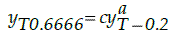
	    <p>The best way to achieve my purpose is to consider the following allometric equation:</p>
	
	    <p>&nbsp;&nbsp;&nbsp;<img width="177" height="39" src="/img/revistas/slu/v20n1-2/20n1-2a06e1.gif">&nbsp;&nbsp;&nbsp;&nbsp;&nbsp;&nbsp;&nbsp;&nbsp;&nbsp;<sup>(1)</sup></p>

	    
<p>where: y<sub>T0.6666</sub>=total biomass of SEMS per area unit; c= constant; y<sub>T&#45;0.2</sub>= total density of the SEMS; a=allometric power</p>

	    <p>In pure stands, this power is equal to &#45;0.33333 (a=0.66666/&#45;2; BARRETO, 2003c).</p>

	    <p>For the elaboration of this paper, I used Scilab 5.2.2 (CONSORTIUM SCILAB, 2009) as a simulation platform. All graphics are pasted from Scilab.</p>

	    <p>&nbsp;</p>

	    <p><b>The Characterization of the Species</b></p>

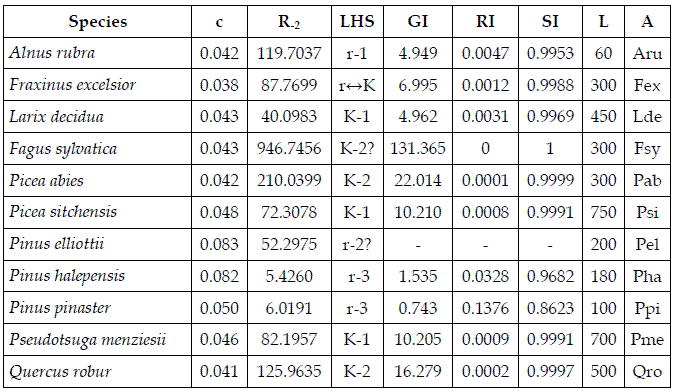
	    <p>Given the unified structure of my theory for pure, and mixed stands, and its agreement with the main concepts of ecology, for a better understanding of the elaborations here presented, I characterize the species used, in Table 1. I had already established the growth patterns of all species here simulated, but <i>Pinus elliottii</i>. To complement the displayed information see BARRETO (2008, 2009).</p>

	    ]]></body>
<body><![CDATA[<p>&nbsp;</p>

	    <p><b><a name="t0"></a><a href="#topt0">Table 1</a></b> &#45; Characterization of the species here considered. LHS=life&#45;history strategy; GI= growth index; RI=regeneration index; SI=survival index; L=longevity, years; A=acronym; R<sub>&#45;2</sub>=density at age 10/final or asymptotic density</p>

	    <p><img width="677" height="391" src="/img/revistas/slu/v20n1-2/20n1-2a06t1.gif"></p>

	    
<p>&nbsp;</p>

	    <p><b>A Procedure of Analysis</b></p>

	    <p>My aim is to clarify the effects of the competitive hierarchy, the relative size of the final biomass of the average trees of the competitors, and of the proportion of the species at initial age 10, upon the power of eq. (1), and the global yield of the stand, comparing the sum of the yields of both species, in pure stands, in the same site. I will use a simulative approach, with model BACO2.</p>

	    <p>To characterize the relative size of the trees I define the ratio Rt as follows:</p>

	    <p>Rt=(Final or asymptotic total biomass of the mean tree of the dominant species)/(Final total biomass of the mean tree of the dominated species)</p>

	    <p>For instance, in a SEMS of <i>Q. robur</i>, and <i>P. pinaster</i> the former is the dominant species.</p>

	    <p>For comparative purposes, given the different longevities of the species used, the simulations are from age 10 to 90 years. Exceptionally, the longevity of Aru can attain this age.</p>

	    ]]></body>
<body><![CDATA[<p>The relative yield is described as:</p>

	    <p>RY=(Global biomass of the SEMS, at age 90)/(Sum of the biomasses of self&#45;thinned even&#45;aged pure stands of the same species, at age 90)</p>

	    <p>To characterize the initial proportions of the species, I will refer the one of the dominant species (Pi), at age 10 years.</p>

	    <p>The values used in the simulations are: Pi=0.1, 0.2, 0.3,...0.9; Rt=0.5, 1.0, 1.5, ....5.0.</p>

	    <p>I will consider the six competitive hierarchies related do the types of tree interaction depicted in BARRETO (1999). The sems are: Qro+Pi; Fsy+Lde; Pel+Pha; Ppi+Pha; Aru+Pme; Pme+Psi. I will also simulate the sems Fsy+Pab, and Pab+Lde. The first species is the dominant, in the mixture.</p>

	    <p>For each one of the 90 simulations, of each mixture, I fitted eq. (1), to estimate the power e.</p>

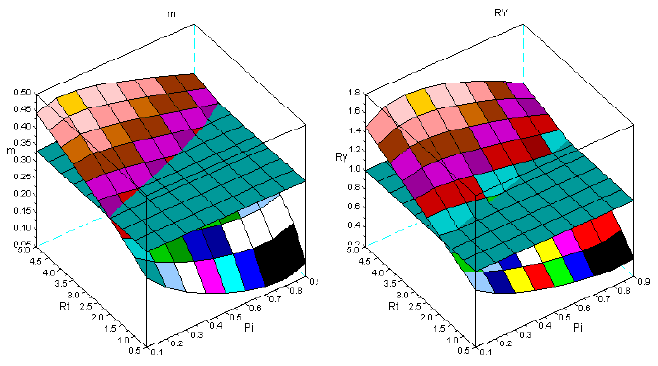
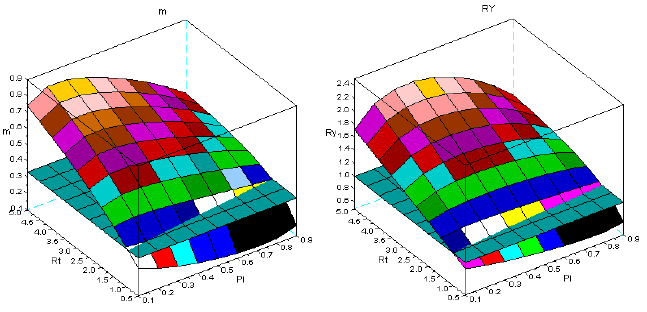
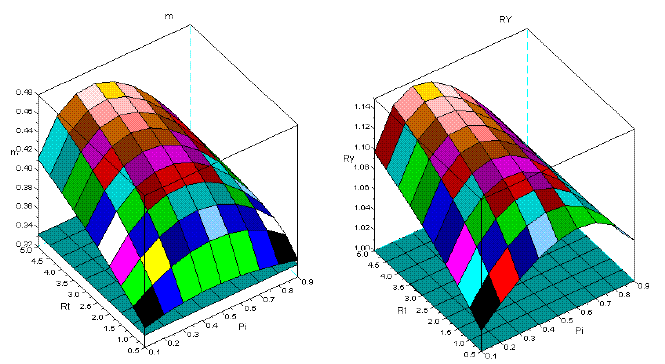
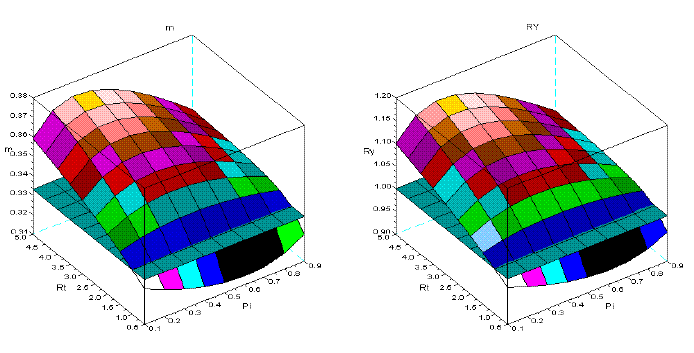
	    <p>Also, for each one of these simulations, I calculated RY. I present the results in graphical form. Thus, for each mixture I present two graphics. For easier comparison with the graphic of RY, instead of plotting a, I plotted its absolute value m (m=&#9474;a&#9474;).</p>

	    <p>In the graphics of m, and RY, I inserted the two planes related to pure stands, respectively, m=0.3333, and RY=1.</p>

	    <p>To isolate the effects of Rt, and Pi, I consider stands with the total density of 10000 trees, at age 10, and variable area.</p>

	    <p>&nbsp;</p>

	    ]]></body>
<body><![CDATA[<p><b>The Global Yield, and Allometry of SEMS</b></p>

	    <p>The values of m&gt;0.333 suggests that the global production of the sems is greater than the sum of the production of the two separated populations in pure stands. The same occurs when RY&gt;1. Below, it will be seen that there is a consistent coherence between the two graphics of each mixture, although a perfect isomorphism between them is highly unexpected.</p>

	    <p>First, I will present the results for the sems Fsy+Pab, and Pab+Lde.</p>

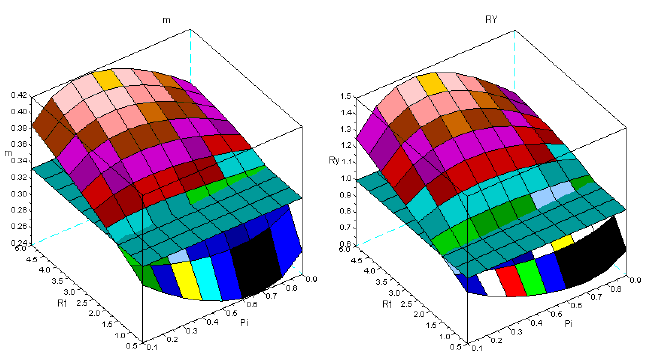
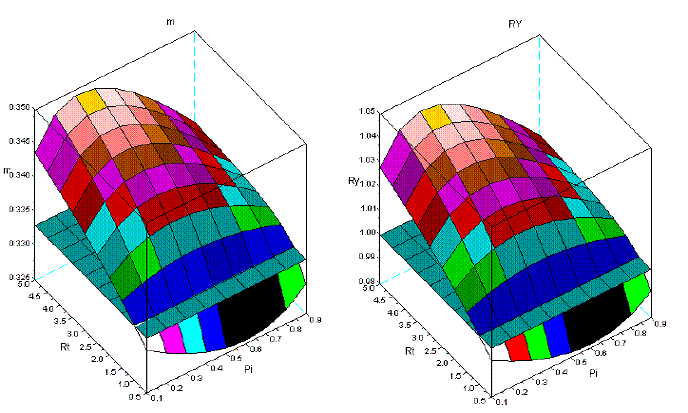
	    <p>Figure 1 is consistent with the empirical results presented in PRETZSCH (2009: figure 9.9(a)). Manipulating the perspective of the graphic for m, I estimate the value of Rt in the measured stands as close to 1.5.</p>

	    <p>&nbsp;</p>

	    <p><a name="topf5"></a></p>
	
	    <p><img width="648" height="356" src="/img/revistas/slu/v20n1-2/20n1-2a06f1.gif"></p>
	
	    
<p><b><a href="#f5">Figure 1</a></b> &#45; Sems Fsy+Pab. For the symbols see the text</p>

	    <p>&nbsp;</p>

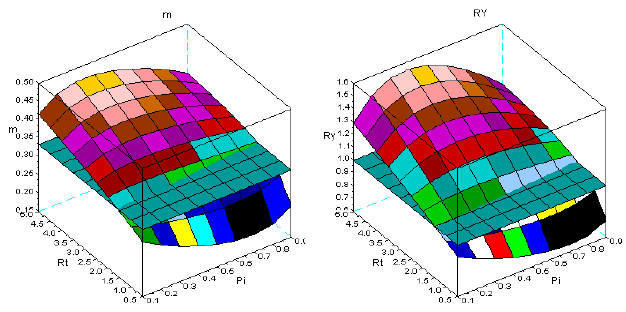
	    <p>Figure 2 is supported by figure 9.9(b) in PRETZSCH (2009), and confirms the overyielding depicted in the measured stands, in Germany (PRETZSCH, 2009:352).</p>

	    ]]></body>
<body><![CDATA[<p>&nbsp;</p>

	    <p><img width="626" height="312" src="/img/revistas/slu/v20n1-2/20n1-2a06f2.gif"></p>

	    
<p><b><a href="#f5">Figure 2</a></b> &#45; Sems Pab+Lde. For the symbols see the text</p>

	    <p>&nbsp;</p>

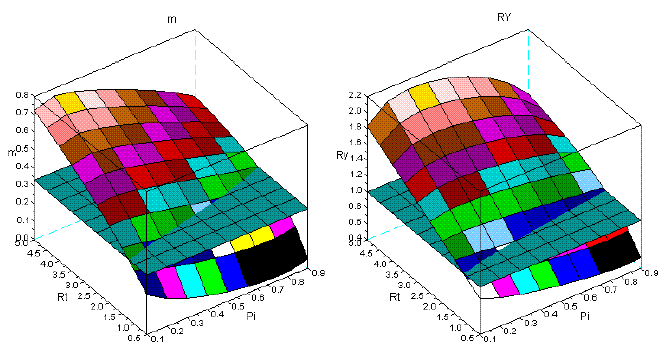
	    <p>The description of the six patterns of competitive interactions between two tree species was first described in BARRETO (1999). In Figures 3 to 8, I present the results of my simulations for the six sems.</p>

	    <p>&nbsp;</p>

	    <p><img width="665" height="348" src="/img/revistas/slu/v20n1-2/20n1-2a06f3.gif"></p>

	    
<p><b><a href="#f5">Figure 3</a></b> &#45; Tree interaction of type I: sems Qro+Ppi. For the symbols see the text</p>

	    <p>&nbsp;</p>

	    <p><img width="658" height="336" src="/img/revistas/slu/v20n1-2/20n1-2a06f4.gif"></p>

	    
]]></body>
<body><![CDATA[<p><b><a href="#f5">Figure 4</a></b> &#45; Tree interaction of type II: sems Fsy+Lde. For the symbols see the text</p>

	    <p>&nbsp;</p>

	    <p><img width="647" height="312" src="/img/revistas/slu/v20n1-2/20n1-2a06f5.gif"></p>

	    
<p><b><a href="#f5">Figure 5</a></b> &#45; Tree interaction of type III: sems Pel+Pha. For the symbols see the text</p>

	    <p>&nbsp;</p>

	    <p><a name="topf8"></a></p>
	
	    <p><img width="665" height="364" src="/img/revistas/slu/v20n1-2/20n1-2a06f6.gif"></p>
	
	    
<p><b><a href="#f8">Figure 6</a></b> &#45; Tree interaction of type IV: sems Ppi+Pha. For the symbols see the text</p>

	    <p>&nbsp;</p>

	    <p><img width="694" height="353" src="/img/revistas/slu/v20n1-2/20n1-2a06f7.gif"></p>

	    
]]></body>
<body><![CDATA[<p><b><a href="#f5">Figure 7</a></b> &#45; Tree interaction of type V: sems Aru+Pme. For the symbols see the text</p>

	    <p>&nbsp;</p>

	    <p><img width="688" height="413" src="/img/revistas/slu/v20n1-2/20n1-2a06f8.gif"></p>

	    
<p><b><a href="#f5">Figure 8</a></b> &#45; Tree interaction of type VI: sems Pme+Psi. For the symbols see the text</p>

	    <p>&nbsp;</p>

	    <p><b>The Dynamics of m, and RY</b></p>

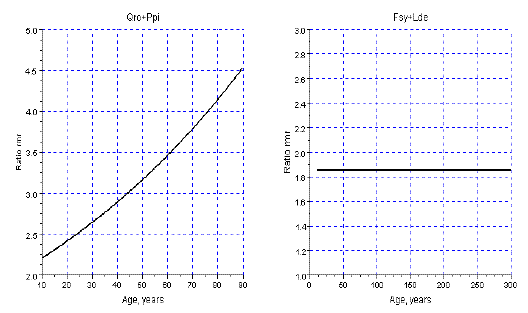
	    <p>In this section I illustrate the effect of the variation of the dominance upon the dynamics of m, and RY. To estimate the intensity of dominance I consider the ratio of the relative mortality rates of the dominator over the same ratio of the dominated species (Rm), as I accept the Grime's hypothesis. For more details about this issue see, for instance, BARRETO (1997). I choose the sems Qro+Ppi with a steep increase of dominance, and for comparison the sems Fsy+Lde, with constant intensity of dominance. I exhibit their ratios of relative mortality rates in Figure 9.</p>

	    <p>&nbsp;</p>

	    <p><a name="topf1"></a></p>
	
	    <p><img width="528" height="313" src="/img/revistas/slu/v20n1-2/20n1-2a06f9.gif"></p>
	
	    
]]></body>
<body><![CDATA[<p><b><a href="#f1">Figure 9</a></b> &#45; Ratios of the relative mortality rates in the sems Qro+Ppi, and Fsy+Lde. The relative mortality rate of dominant species is the numerator (Qro/Ppi; Fsy/Lde)</p>

	    <p>&nbsp;</p>

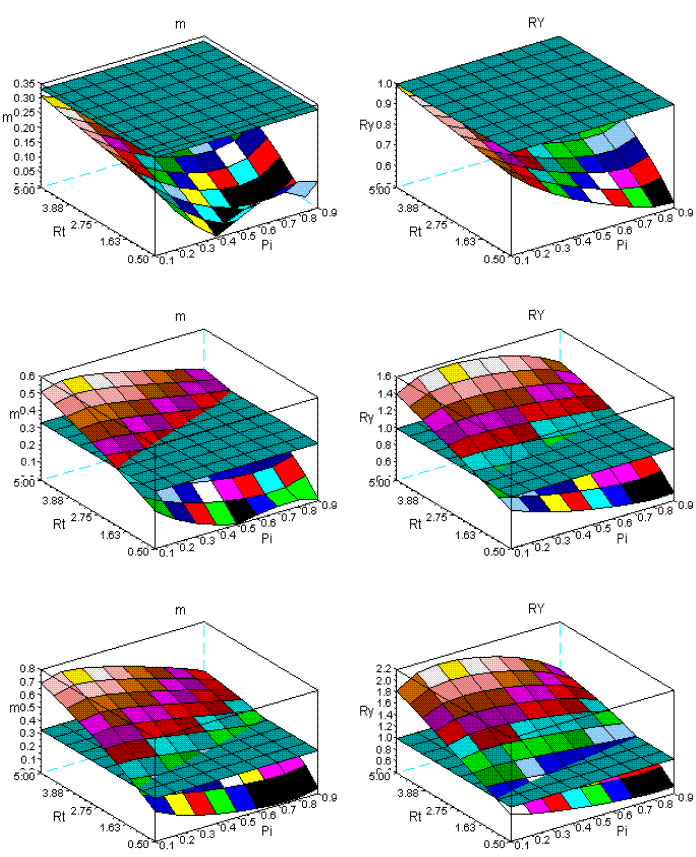
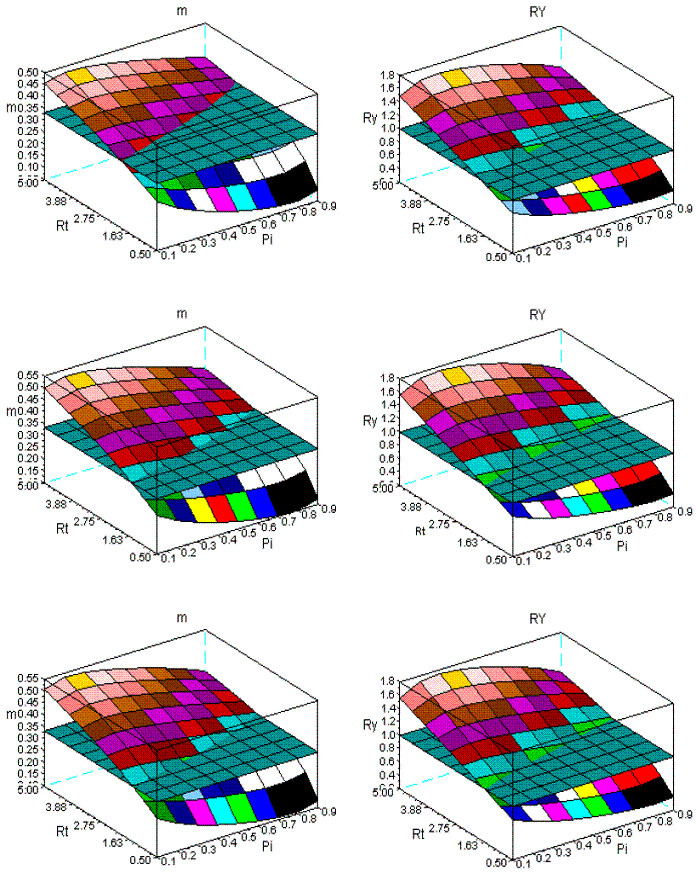
	    <p>In Figure 10, I present the results of my simulation for the sems Qro+Ppi. The effect of the variation of the intensity of dominance is conspicuous. Bellow a critical value of the Rm (and thus age) overyielding does not occur, as shown in the first row of this figure. The surfaces at early ages are also more complex to m, and both are completely different from the surfaces obtained with longer time series.</p>

	    <p>&nbsp;</p>

	    <p><a name="topf6"></a></p>
	
	    <p><img width="696" height="857" src="/img/revistas/slu/v20n1-2/20n1-2a06f10.gif"></p>
	
	    
<p><b><a href="#f6">Figure 10</a></b> &#45; The dynamics of m and RY in sems Qro+Ppi. First row: ages 10&#45;30; second row: ages 10&#45;60; third row: ages 10&#45;90</p>

	    <p>&nbsp;</p>

	    <p><a name="topf7"></a></p>
	
	    <p><img width="673" height="704" src="/img/revistas/slu/v20n1-2/20n1-2a06f11.gif"></p>

	    
]]></body>
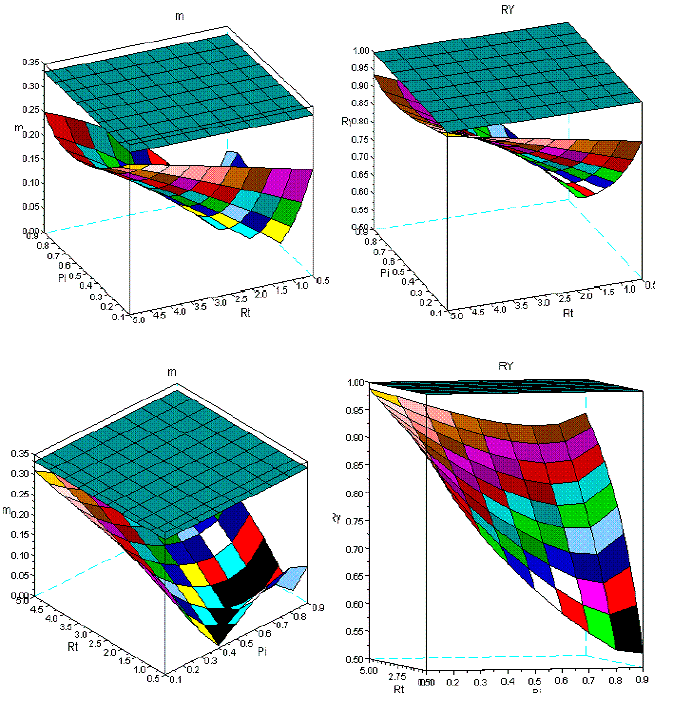
<body><![CDATA[<p><b><a href="#f7">Figure 11</a></b> &#45; Two different perspectives of the dynamics of m and RY in sems Qro+Ppi, covering ages from 10 to 30</p>

	    <p>&nbsp;</p>

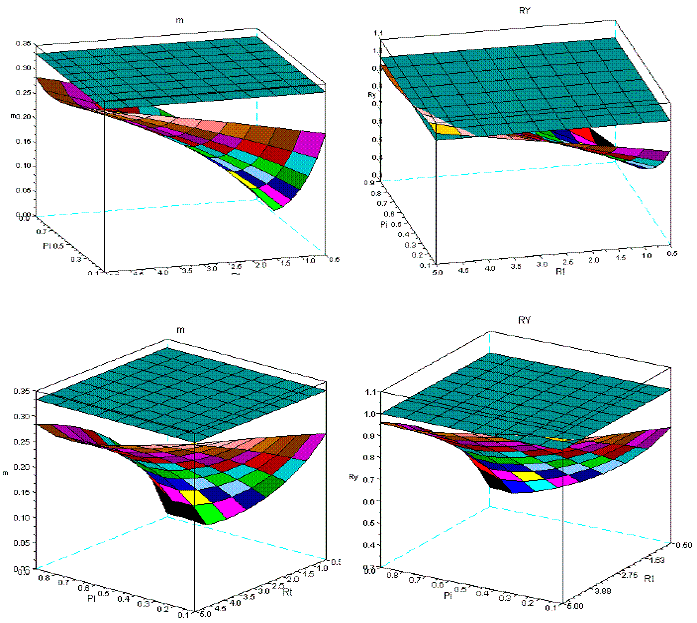
	    <p>In Figure 12, for the same age spans, I present the simulations for the sems Fsy+Lde. The change of the geometry of the surfaces is less conspicuous, as Figure 13, also confirms for the range 10&#45;30. Given the longevities of Fsy, and Lde, I also introduce Figure 14, for the spans: 10&#45;100, 10&#45;200, 10&#45;300 years. The variation of the geometry of the surfaces is negligible.</p>

	    <p>&nbsp;</p>

	    <p><img width="684" height="839" src="/img/revistas/slu/v20n1-2/20n1-2a06f12.gif"></p>

	    
<p><b>Figure 12</b> &#45; The dynamics of m and RY in sems Fsy+Lde. First row: ages 10&#45;30; second row: ages 10&#45;60; third row: ages 10&#45;90</p>

	    <p>&nbsp;</p>

	    <p><img width="697" height="623" src="/img/revistas/slu/v20n1-2/20n1-2a06f13.gif"></p>

	    
<p><b>Figure 13</b> &#45; Two different perspectives of the dynamics of m and RY in sems Fsy+Lde, covering ages from 10 to 30</p>

	    <p>&nbsp;</p>
	
	    ]]></body>
<body><![CDATA[<p><img width="696" height="873" src="/img/revistas/slu/v20n1-2/20n1-2a06f14.gif"></p>

	    
<p><b>Figure 14</b> &#45;The dynamics of m and RY in sems Fsy+Lde. First row: ages 10&#45;100; second row: ages 10&#45;200; third row: ages 10&#45;300</p>

	    <p>&nbsp;</p>

	    <p><b>The Global Dynamics of sems</b></p>

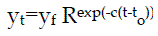
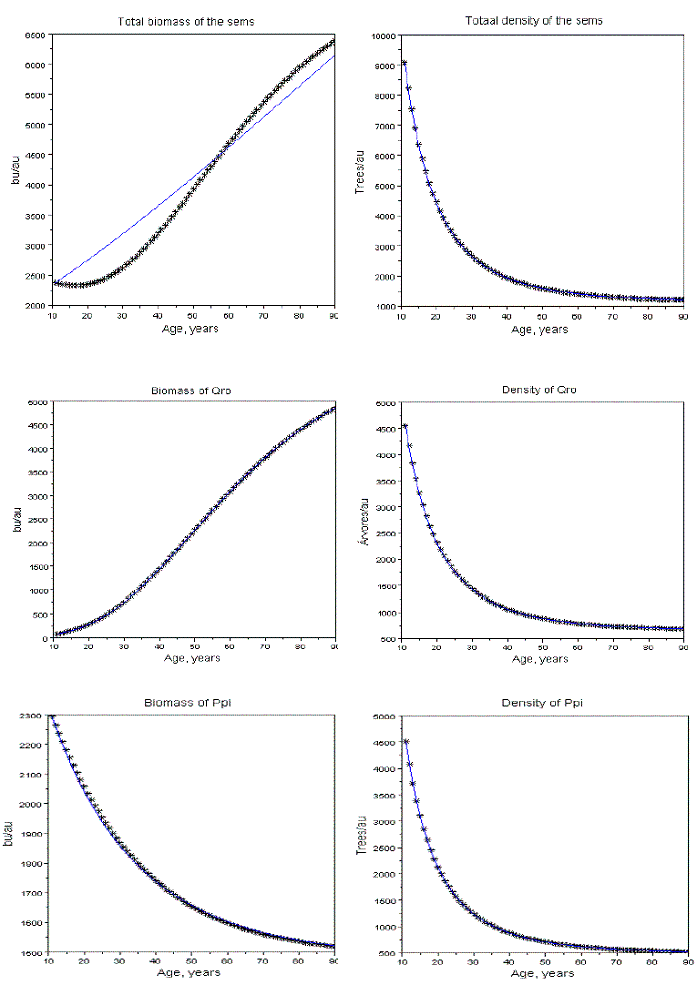
	    <p>The purpose of this section is two fold: a) To illustrate the transference of self&#45;thinning from the dominant competitor to the dominated one; b) to obtain some insight in the behaviour of the dynamics of the biomass of the populations. I will use sems of type I (Qro+Ppi, <a href="#topf1">figure 9</a><a name="f1">), to fit Gompertz equations to the total biomass, and total density of the forests, and the same dynamics for each population. The results are displayed in Figures 15 to 17, Tables 2, and 3. I will fit the following form of the mentioned equation:</p>

	    <p>&nbsp;&nbsp;&nbsp;<img width="158" height="36" src="/img/revistas/slu/v20n1-2/20n1-2a06e2.gif">&nbsp;&nbsp;&nbsp;&nbsp;&nbsp;&nbsp;&nbsp;&nbsp;&nbsp;<sup>(2)</sup></p>
	
	    
<p>where y<sub>f</sub> is the final or asymptotic value of y, R=y<sub>o</sub>/y<sub>f</sub>, y<sub>0</sub> is the value of the variable at age t<sub>0</sub>, here admitted to be equal to 10 years, c&gt;0.</p>

	    <p>&nbsp;</p>

	    <p><a name="topf2"></a></p>
	
	    <p><img width="697" height="985" src="/img/revistas/slu/v20n1-2/20n1-2a06f15.gif"></p>
	
	    
]]></body>
<body><![CDATA[<p><b><a href="#f2">Figure 15</a></b> &#45; Fitting of the Gompertz equation to the biomass and density of sems with Qro+Ppi, with Rt=3 e Pi=0.5, bu= biomass units; au=area unit. Total biomass of the sems does not abide the&nbsp; Gompertz equation. Data to be fitted represented by asterisk, fitted values by a line. Absolute mean relative errors of the fittings of the biomasses of Qro e Ppi, respectively, equal to 0.0015, and 0,0037</p>

	    <p>&nbsp;</p>

	    <p><a name="topf3"></a></p>
	
	    <p><img width="691" height="290" src="/img/revistas/slu/v20n1-2/20n1-2a06f16.gif"></p>
	
	    
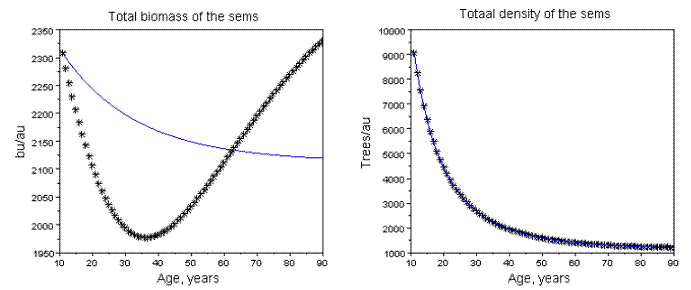
<p><b><a href="#f3">Figure 16</a></b> &#45; Dynamics of the global biomass, and density of the sems with Qro+Ppi. Rt=0.5, Pi=0.5</p>

	    <p>&nbsp;</p>

	    <p><a name="topf4"></a></p>
	
	    <p><img width="693" height="330" src="/img/revistas/slu/v20n1-2/20n1-2a06f17.gif"></p>
	
	    
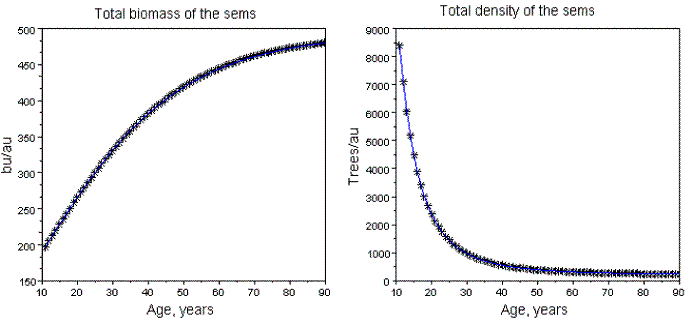
<p><b><a href="#f4">Figure 17</a></b> &#45; Dynamics of the global biomass, and density of the sems with Pme+Psi. Rt=0.5, Pi=0.5</p>

	    <p>&nbsp;</p>

	    ]]></body>
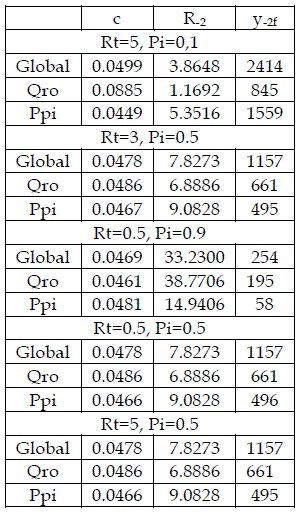
<body><![CDATA[<p><b><a name="t1"></a><a href="#topt1">Table 2</a></b> &#45; The fittings of the Gompertz equations to the density of the sems with Qro+Ppi, with several values of Rt, and Pi</p>

	    <p><img width="301" height="512" src="/img/revistas/slu/v20n1-2/20n1-2a06t2.gif"></p>

	    
<p>&nbsp;</p>

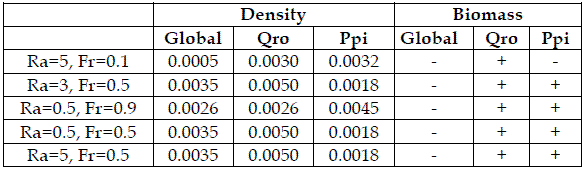
	    <p><b>Table 3</b> &#45; Absolute mean relative errors of the fittings in <a href="#t1">table 2</a><a name="topt1"></a>.&nbsp; In the columns "Biomass" the signal + indicates that the dynamic abides the Gompertz equation, and the symbol &#150; a non Gompertzian pattern</p>

	    <p><img width="588" height="173" src="/img/revistas/slu/v20n1-2/20n1-2a06t3.gif"></p>

	    
<p>&nbsp;</p>
	
	    <p>To fit the Gompertz equations, I used the method described in KHILMI, (1962:112). This method is very accurate, and avoids the guessing of 
	trial values. This algorithm is also described in BARRETO (2005b: Chap. 4).</p>

	    <p>The sems simulated: a) at age 10 years have total density of 10000 trees, and variable area; b) the area of each stand is its area unit 
	(au); c) the biomass units (bu) are also arbitrary. Operationally, these assumptions are more convenient to isolate the effects of Rt, and Pi.
	The simulations and fittings I made are described in Tables <a href="#t1">2</a>, and 3. In <a href="#topf2">Figure 15</a><a name="#f2"></a>, I exhibit the graphics related to sems with Rt=3, Pi=0.5. The effect of the mortality increasing of the dominated species is the existence of a critical value of Pi (Pi<sub>c</sub>), such that for values of Pi&gt; Pi<sub>c</sub>, the total biomass of the populations decreases. In these situations, (simultaneous increasing of the biomass of the dominant competitor, and decreasing of the dominated one) the global biomass of the sems does not abide the Gompertzian pattern, as exhibited in <a href="#topf2">Figure 15</a>. The pattern of growth of the global biomass can also exhibit a non monotonic variation as displayed in <a href="#topf3">Figure 16</a><a name="#f3"></a>. The sems with two species that coevolved show always a Gompertzian pattern for all three biomasse dynamics, as shown in <a href="#topf4">Figure 17</a><a name="#f4"></a>.</p>

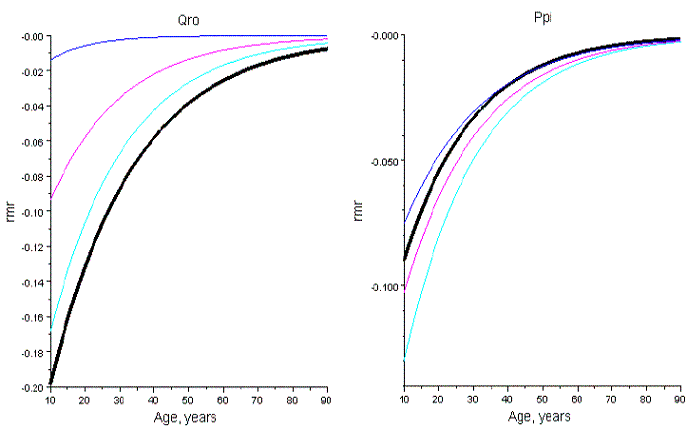
	    <p>The decreasing of mortality of Qro is translated in values of R<sub>&#45;2</sub> smaller then 125.9635, in <a href="#t1">table 2</a>. Conversely, the increasing of mortality of Ppi is depicted by values of R<sub>&#45;2</sub>&gt;6.109. These statements are illustrated in Figure 18.</p>

	    <p>&nbsp;</p>

	    ]]></body>
<body><![CDATA[<p><img width="697" height="430" src="/img/revistas/slu/v20n1-2/20n1-2a06f18.gif"></p>

	    
<p><b>Figure 18</b> &#45; Relative mortality rates of the sems in <a href="#t1">table 2</a>, and of the species in pure stand (thickest line). Qro has less intense self&#45;thinning in sems then in pure stand; the reverse happens in all sems of Ppi but one</p>

	    <p>&nbsp;</p>

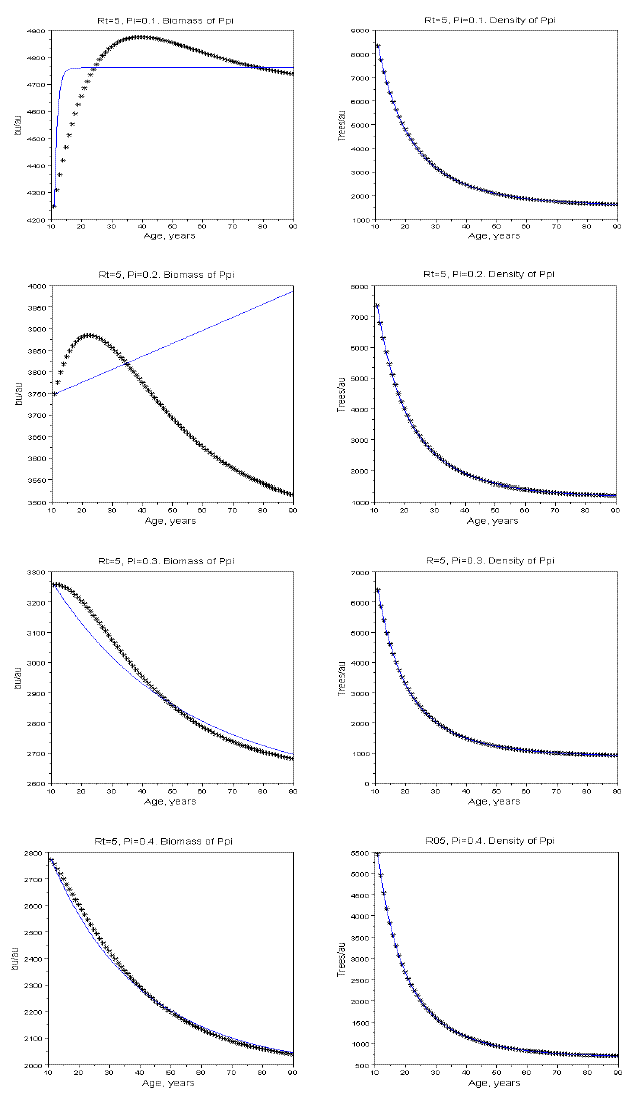
	    <p>The total biomass of Ppi can also have a non monotonic pattern of variation, as shown in Figure 19.</p>

	    <p>&nbsp;</p>

	    <p><a name="topf9"></a></p>
	
	    <p><img width="700" height="1093" src="/img/revistas/slu/v20n1-2/20n1-2a06f19.gif"></p>

	    
<p><b><a href="#f9">Figure 19</a></b> &#45; The effect of Pi upon the pattern of growth of the biomass of Ppi. Rt=5, and Pi equal to 0.1, 0.2, 0.3, 0.4</p>

	    <p>&nbsp;</p>

	    <p><b>Interpretation of the Results</b></p>

	    ]]></body>
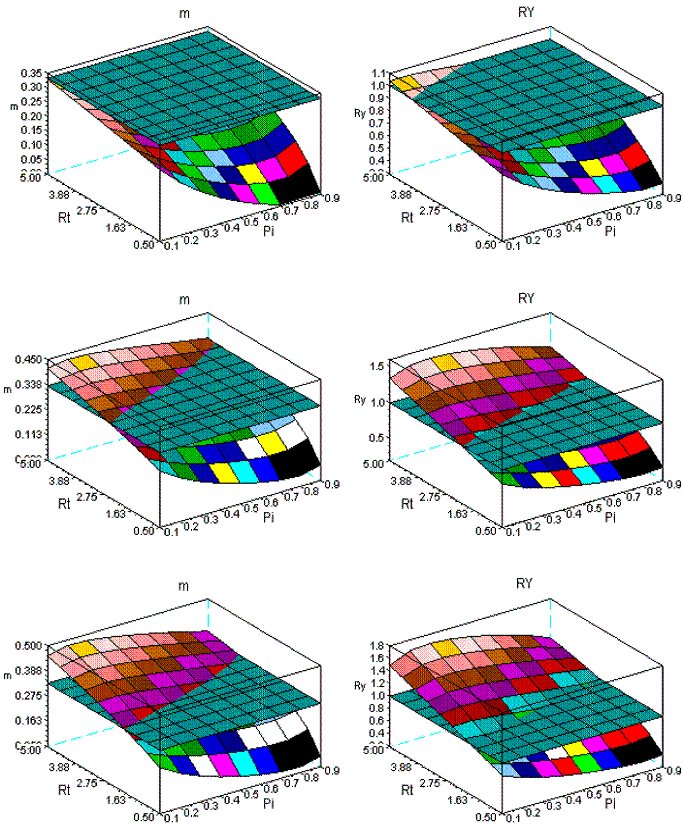
<body><![CDATA[<p><a href="#topf5">Figures 1&#45;8</a><a name="#f5"></a> show that there is a value of Pi that promotes the maximum production of biomass. The response of the yield to the proportions of the dominant species depends on the value of Rt. The greater is this value Rt the greater is the production of biomass. I explain this situation as follows: &nbsp;the self&#45;thinning of sems is more intense for the trees of the dominated species. The trees of the dominant species have less self&#45;thinning then in pure stand. The high values of Rt, guarantee that the larger trees, and with faster growth are preserved from mortality. They support the overyielding. In the same figures, it is also conspicuous that Rt&lt;1 favours underyielding.</p>

	    <p>In <a href="#topf6">Figure 10</a><a name="#f6"></a>, the values of Rm &#45; a measure of the transference of mortality from Qro to Ppi &#45; increases with age. Before a critical age, this transference is not sufficient to sustain overyielding. In <a href="#topf7">Figure 11</a><a name="#f7"></a>, it is shown that the value of m, instead of a maximum has a minimum for Rt=5. For Rt=0.5, there is a minimum, and a maximum. The surface for RY has a less variable shape, and there is a minimum for each value of Rt. The shape of the surfaces are profoundly sensitive to age, and thus to Rm.</p>

	    <p>Also, the graphics are consistent with the competitive hierarchy characteristic of each type of interaction. For instance, types IV, V, and VI have species that coevolved and coexist in natural stands. Here, the values of m are close to 0.3333, and the values of RY are close to one. Underyielding is non&#45;existent in the stands with the two Mediterranean pines (<a href="#topf8">Figure 6</a><a name="#f8"></a>, type IV). Empirical evidence can be found in VILA <i>et al.</i> (2001).</p>

	    <p>In the sems of a given mixture, the presence of overyielding depends on the possibility of the natural occurrence of high values of Rt. High values of Rt are controlled by the autoecology of the competitors, and the site quality, for each one of the competitors, of the places where they met.</p>

	    <p>Probably, for some sems, the necessary combinations of Rt, and Pi, for overyielding, never happen, in nature.</p>

	    <p>&nbsp;</p>

	    <p><b>Conclusive Comments</b></p>

	    <p>I admit that my clarification of the global yield and allometry is coherent with my theory for mixed stands, in its total extension, and with its previous applications in simulations. Also it does not conflict with the applicable ecological concepts, and regularities related to this area.&nbsp;</p>

	    <p>The supporting empirical evidence displayed in PRETZSCH (2009), already mentioned, for the sems Fsy+Pab, and Pab+Lde confer a high level of verisimilitude to the six other simulations.</p>

	    <p>I already presented the formalizations of my theory for pure and mixed stands in BARRETO (2003c, 2004b). This formalizations or reconstructions (BUNGE, 2005:548&#45;558) show the integral deducibility of my theory for forest stands. This property of my theory implies that my results for mixed stands can only be correct if both my theory for pure stands and the characterization of the dynamics of the species are also acceptable.</p>

	    ]]></body>
<body><![CDATA[<p><a href="#topf3">Figure 16</a> and <a href="#topf9">19</a><a name="#f9"></a> also show that the projection of the pattern of variation of the biomass of the populations and the all stand from the early ages can be misleading.</p>

	    <p>As I admit the time&#45;space symmetry of sems and self&#45;thinned uneven&#45;aged mixed stands, the results here presented for the former stands are applicable to the standing biomass of the latter stands with stable age structure, in a given instant.</p>

	    <p><i>Mutatis mutandis</i>, the analysis here presented is also applicable to standing merchantable volume measured in m<sup>3</sup>, as it is roughly equal to the total biomass expressed in Mg (e.g., PRETZSCH, 2009: eqs. (2.23), and (2.30)).</p>

	    <p>It is conspicuous the relevant role played by growth rates of forest variables, and associated relative (or per capita) growth rates in my constructs, since I started my approach to mixed stands (e.g., BARRETO, 1997), and in the life history strategies of the tree species (upper <a href="#t0">table 1</a><a name="topt0"></a>; BARRETO, 2003d). I am not alone in this position. The Royal Society, in 2002, dedicated an issue of its <i>Philosophical Transactions</i> to a sole subject &#150; population growth rates. In the introduction to this issue, it can be red "The thesis put forward in this issue of <i>Philosophical Transactions</i> is that population growth rate is the key unifying variable linking the various facets in population ecology". (SIBLY, HONE, CLUTTON&#45;BROCK, 2002:1149). This unifying function implies the existence of one basic pattern for biological growth, evincing some versatility. The Gompertz equation satisfies these requirements.</p>

	    <p>Under an extensive perspective, this paper completes my analysis of mixed forests.</p>

	    <p>&nbsp;</p>

	    <p><b>References</b></p>

	    <!-- ref --><p>BARRETO, L.S., 1994.The Clarification of Self&#45;Thinning and Thinning. A Simulation Approach. <i>Silva Lusitana</i> <b>2</b>(2): 233&#45;238.    &nbsp;&nbsp;&nbsp;&nbsp;&nbsp;&nbsp;&nbsp;&nbsp;[&#160;<a href="javascript:void(0);" onclick="javascript: window.open('/scielo.php?script=sci_nlinks&ref=000180&pid=S0870-6352201200010000600001&lng=','','width=640,height=500,resizable=yes,scrollbars=1,menubar=yes,');">Links</a>&#160;]<!-- end-ref --></p>

	    <!-- ref --><p>BARRETO, L.S. 1996. <i>Coexistence and competitive ability of tree species. Elaborations on Grime's theory.</i> <b>&nbsp;</b>Departamento de Engenharia Florestal, Instituto Superior de Agronomia. Revised version published in <i>Silva Lusitana</i> <b>5</b>(1): 79&#45;93.    &nbsp;&nbsp;&nbsp;&nbsp;&nbsp;&nbsp;&nbsp;&nbsp;[&#160;<a href="javascript:void(0);" onclick="javascript: window.open('/scielo.php?script=sci_nlinks&ref=000182&pid=S0870-6352201200010000600002&lng=','','width=640,height=500,resizable=yes,scrollbars=1,menubar=yes,');">Links</a>&#160;]<!-- end-ref --></p>

	    <!-- ref --><p>BARRETO, L.S., 1997. Coexistence and Competitive Ability of Tree Species. Elaborations on Grime's Theory. <i>Silva Lusitana</i> <b>5</b>(1): 79&#45;93.    &nbsp;&nbsp;&nbsp;&nbsp;&nbsp;&nbsp;&nbsp;&nbsp;[&#160;<a href="javascript:void(0);" onclick="javascript: window.open('/scielo.php?script=sci_nlinks&ref=000184&pid=S0870-6352201200010000600003&lng=','','width=640,height=500,resizable=yes,scrollbars=1,menubar=yes,');">Links</a>&#160;]<!-- end-ref --></p>

	    <!-- ref --><p>BARRETO, L.S., 1999. A tentative typification of the patterns interaction with models BACO2 and BACO3. <i>Silva Lusitana</i> <b>7(</b>1): 117&#45;125.    &nbsp;&nbsp;&nbsp;&nbsp;&nbsp;&nbsp;&nbsp;&nbsp;[&#160;<a href="javascript:void(0);" onclick="javascript: window.open('/scielo.php?script=sci_nlinks&ref=000186&pid=S0870-6352201200010000600004&lng=','','width=640,height=500,resizable=yes,scrollbars=1,menubar=yes,');">Links</a>&#160;]<!-- end-ref --></p>

	    <!-- ref --><p>BARRETO, L.S., 2001. <i>O Modelo</i> <i>BACO</i><i>3 para a Competi&ccedil;&atilde;o entre Plantas.</i> Research Paper SB&#45;02/01. Departamento de Engenharia Florestal, Instituto Superior de Agronomia.    &nbsp;&nbsp;&nbsp;&nbsp;&nbsp;&nbsp;&nbsp;&nbsp;[&#160;<a href="javascript:void(0);" onclick="javascript: window.open('/scielo.php?script=sci_nlinks&ref=000188&pid=S0870-6352201200010000600005&lng=','','width=640,height=500,resizable=yes,scrollbars=1,menubar=yes,');">Links</a>&#160;]<!-- end-ref --></p>

	    <!-- ref --><p>BARRETO, L.S., 2003a. <i>The Blended Geometry of Self&#45;Thinned Uneven&#45;Aged Mixed Stands.</i> Research Paper SB&#45;04/03. Departamento de Engenharia Florestal, Instituto Superior de Agronomia. Revised version submitted to <i>Silva Lusitana.    &nbsp;&nbsp;&nbsp;&nbsp;&nbsp;&nbsp;&nbsp;&nbsp;[&#160;<a href="javascript:void(0);" onclick="javascript: window.open('/scielo.php?script=sci_nlinks&ref=000190&pid=S0870-6352201200010000600006&lng=','','width=640,height=500,resizable=yes,scrollbars=1,menubar=yes,');">Links</a>&#160;]<!-- end-ref --></i></p>

	    <!-- ref --><p>BARRETO, L.S., 2003b. SB&#45;BACO4. A Gompertzian Discrete Model for Tree Competition. <i>Silva Lusitana</i> <b>11</b>(1): 77&#45;89.    &nbsp;&nbsp;&nbsp;&nbsp;&nbsp;&nbsp;&nbsp;&nbsp;[&#160;<a href="javascript:void(0);" onclick="javascript: window.open('/scielo.php?script=sci_nlinks&ref=000192&pid=S0870-6352201200010000600007&lng=','','width=640,height=500,resizable=yes,scrollbars=1,menubar=yes,');">Links</a>&#160;]<!-- end-ref --></p>

	    <!-- ref --><p>BARRETO, L.S., 2003c. <i>A Unified Theory for Self&#45;Thinned Pure Stands.</i> <i>A Synoptic Presentation.</i> Research Paper SB&#45;03/03. Departamento de Engenharia Florestal, Instituto Superior de Agronomia. Revised version submitted to <i>Silva Lusitana</i>.    &nbsp;&nbsp;&nbsp;&nbsp;&nbsp;&nbsp;&nbsp;&nbsp;[&#160;<a href="javascript:void(0);" onclick="javascript: window.open('/scielo.php?script=sci_nlinks&ref=000194&pid=S0870-6352201200010000600008&lng=','','width=640,height=500,resizable=yes,scrollbars=1,menubar=yes,');">Links</a>&#160;]<!-- end-ref --></p>

	    <!-- ref --><p>BARRETO, L.S., 2003d. <i>Growth, Regeneration, and Survival Indices for Tree Species.</i> Research Paper SB&#45;02/03. Departamento de Engenharia Florestal, Instituto Superior de Agronomia. Vers&atilde;o revista publicada na <i>Silva Lusitana</i> <b>17</b>(1): 83&#45;95.    &nbsp;&nbsp;&nbsp;&nbsp;&nbsp;&nbsp;&nbsp;&nbsp;[&#160;<a href="javascript:void(0);" onclick="javascript: window.open('/scielo.php?script=sci_nlinks&ref=000196&pid=S0870-6352201200010000600009&lng=','','width=640,height=500,resizable=yes,scrollbars=1,menubar=yes,');">Links</a>&#160;]<!-- end-ref --></p>

	    <!-- ref --><p>BARRETO, L.S., 2004a. <i>Tree Competition: Concepts, Models, and Patterns.</i> Research Paper SB&#45;01/04. Departamento de Engenharia Florestal, Instituto Superior de Agronomia.    &nbsp;&nbsp;&nbsp;&nbsp;&nbsp;&nbsp;&nbsp;&nbsp;[&#160;<a href="javascript:void(0);" onclick="javascript: window.open('/scielo.php?script=sci_nlinks&ref=000198&pid=S0870-6352201200010000600010&lng=','','width=640,height=500,resizable=yes,scrollbars=1,menubar=yes,');">Links</a>&#160;]<!-- end-ref --></p>

	    <!-- ref --><p>BARRETO, L.S., 2004b. <i>A Unified Theory for Self&#45;Thinned Mixed Stands.</i> <i>A Synoptic Presentation.</i> Research Paper SB&#45;02/04. Departamento de Engenharia Florestal, Instituto Superior de Agronomia.    &nbsp;&nbsp;&nbsp;&nbsp;&nbsp;&nbsp;&nbsp;&nbsp;[&#160;<a href="javascript:void(0);" onclick="javascript: window.open('/scielo.php?script=sci_nlinks&ref=000200&pid=S0870-6352201200010000600011&lng=','','width=640,height=500,resizable=yes,scrollbars=1,menubar=yes,');">Links</a>&#160;]<!-- end-ref --> Revised version submitted to <i>Silva Lusitana</i>.</p>

	    <!-- ref --><p>BARRETO, L.S., 2005a. Gause's Competition Experiments with Paramecium sps. Revisited. Research Paper SB&#45;01/05. Departamento de Engenharia Florestal, Instituto Superior de Agronomia.    &nbsp;&nbsp;&nbsp;&nbsp;&nbsp;&nbsp;&nbsp;&nbsp;[&#160;<a href="javascript:void(0);" onclick="javascript: window.open('/scielo.php?script=sci_nlinks&ref=000202&pid=S0870-6352201200010000600012&lng=','','width=640,height=500,resizable=yes,scrollbars=1,menubar=yes,');">Links</a>&#160;]<!-- end-ref --> Revised version submitted to <i>Silva Lusitana</i>.</p>

	    <!-- ref --><p>BARRETO, L.S., 2005b. <i>Theoretical Ecology. A Unified Approach.</i> Author's edition. E&#45;book disseminated as PDF file. Lisbon.    &nbsp;&nbsp;&nbsp;&nbsp;&nbsp;&nbsp;&nbsp;&nbsp;[&#160;<a href="javascript:void(0);" onclick="javascript: window.open('/scielo.php?script=sci_nlinks&ref=000204&pid=S0870-6352201200010000600013&lng=','','width=640,height=500,resizable=yes,scrollbars=1,menubar=yes,');">Links</a>&#160;]<!-- end-ref --></p>

	    <!-- ref --><p>BARRETO, L.S., 2007. The Changing Geometry of Self&#45;Thinned Mixed Stands. A Simulative Quest. <i>Silva Lusitana</i> <b>15</b>(1): 119&#45;132.    &nbsp;&nbsp;&nbsp;&nbsp;&nbsp;&nbsp;&nbsp;&nbsp;[&#160;<a href="javascript:void(0);" onclick="javascript: window.open('/scielo.php?script=sci_nlinks&ref=000206&pid=S0870-6352201200010000600014&lng=','','width=640,height=500,resizable=yes,scrollbars=1,menubar=yes,');">Links</a>&#160;]<!-- end-ref --></p>

	    <!-- ref --><p>BARRETO, L.S., 2008. The Reconciliation of the r&#45;K, and C&#45;S&#45;R Models for Life&#45;History Strategies. <i>Silva Lusitana</i> <b>16</b>(1): 97&#45;103.    &nbsp;&nbsp;&nbsp;&nbsp;&nbsp;&nbsp;&nbsp;&nbsp;[&#160;<a href="javascript:void(0);" onclick="javascript: window.open('/scielo.php?script=sci_nlinks&ref=000208&pid=S0870-6352201200010000600015&lng=','','width=640,height=500,resizable=yes,scrollbars=1,menubar=yes,');">Links</a>&#160;]<!-- end-ref --></p>

	    <!-- ref --><p>BARRETO, L.S., 2009. Growth, Regeneration, and Survival Indices for Tree Species. <i>Silva Lusitana</i> <b>17</b>(1): 83&#45;95.    &nbsp;&nbsp;&nbsp;&nbsp;&nbsp;&nbsp;&nbsp;&nbsp;[&#160;<a href="javascript:void(0);" onclick="javascript: window.open('/scielo.php?script=sci_nlinks&ref=000210&pid=S0870-6352201200010000600016&lng=','','width=640,height=500,resizable=yes,scrollbars=1,menubar=yes,');">Links</a>&#160;]<!-- end-ref --></p>

	    <!-- ref --><p>BARRETO, L.S., 2010. <i>The Total Biomass of Self&#45;Thinned Mixed Forests. A Theoretical and Simulative Inquiry.</i> Preprint 01/10.    &nbsp;&nbsp;&nbsp;&nbsp;&nbsp;&nbsp;&nbsp;&nbsp;[&#160;<a href="javascript:void(0);" onclick="javascript: window.open('/scielo.php?script=sci_nlinks&ref=000212&pid=S0870-6352201200010000600017&lng=','','width=640,height=500,resizable=yes,scrollbars=1,menubar=yes,');">Links</a>&#160;]<!-- end-ref --> Revised version submitted to <i>Silva Lusitana</i>.</p>

	    <!-- ref --><p>BUNGE, M., 2005. <i>Philosophy of Science. From Problem to Theory.</i> Volume I. Transaction Publishers, New Brunswick.    &nbsp;&nbsp;&nbsp;&nbsp;&nbsp;&nbsp;&nbsp;&nbsp;[&#160;<a href="javascript:void(0);" onclick="javascript: window.open('/scielo.php?script=sci_nlinks&ref=000214&pid=S0870-6352201200010000600018&lng=','','width=640,height=500,resizable=yes,scrollbars=1,menubar=yes,');">Links</a>&#160;]<!-- end-ref --></p>

	    <!-- ref --><p>Consortium Scilab (DIGITEO), 2009. Scilab&#45;5.2. <a href="http://www.scilab.org/" target="_blank">www.scilab.org</a>&nbsp;&nbsp;&nbsp;&nbsp;&nbsp;&nbsp;&nbsp;&nbsp;[&#160;<a href="javascript:void(0);" onclick="javascript: window.open('/scielo.php?script=sci_nlinks&ref=000216&pid=S0870-6352201200010000600019&lng=','','width=640,height=500,resizable=yes,scrollbars=1,menubar=yes,');">Links</a>&#160;]<!-- end-ref --><!-- ref --><p>KHILMI, G.F., 1962. <i>Theoretical Forest Biophysics.</i> National Science Foundation, Washington, D.C.    &nbsp;&nbsp;&nbsp;&nbsp;&nbsp;&nbsp;&nbsp;&nbsp;[&#160;<a href="javascript:void(0);" onclick="javascript: window.open('/scielo.php?script=sci_nlinks&ref=000217&pid=S0870-6352201200010000600020&lng=','','width=640,height=500,resizable=yes,scrollbars=1,menubar=yes,');">Links</a>&#160;]<!-- end-ref --></p>

	    <!-- ref --><p>PRETZSCH, H., 2009. <i>Forest Dynamics, Growth and Yield. From Measurements to Model.</i> Springer, Berlin.    &nbsp;&nbsp;&nbsp;&nbsp;&nbsp;&nbsp;&nbsp;&nbsp;[&#160;<a href="javascript:void(0);" onclick="javascript: window.open('/scielo.php?script=sci_nlinks&ref=000219&pid=S0870-6352201200010000600021&lng=','','width=640,height=500,resizable=yes,scrollbars=1,menubar=yes,');">Links</a>&#160;]<!-- end-ref --></p>

	    <!-- ref --><p>SIBLY, R. M., J. HONE, T. H. CLUTTON&#45;BROCK, 2002. Introduction. <i>Phil. Trans. R. Soc.</i> <i>London B</i> 2002 357:1149&#45;1151.    &nbsp;&nbsp;&nbsp;&nbsp;&nbsp;&nbsp;&nbsp;&nbsp;[&#160;<a href="javascript:void(0);" onclick="javascript: window.open('/scielo.php?script=sci_nlinks&ref=000221&pid=S0870-6352201200010000600022&lng=','','width=640,height=500,resizable=yes,scrollbars=1,menubar=yes,');">Links</a>&#160;]<!-- end-ref --></p>

	    ]]></body>
<body><![CDATA[<!-- ref --><p>VILA, M., VAYREDA, J., COMAS, L., IB&Aacute;&Ntilde;EZ, J., OB&Oacute;N, B., 2007. Species Richness and Wood Production: a Positive Association in Mediterranean Forest. Ecology Letters 10: 241&#45;250.    &nbsp;&nbsp;&nbsp;&nbsp;&nbsp;&nbsp;&nbsp;&nbsp;[&#160;<a href="javascript:void(0);" onclick="javascript: window.open('/scielo.php?script=sci_nlinks&ref=000223&pid=S0870-6352201200010000600023&lng=','','width=640,height=500,resizable=yes,scrollbars=1,menubar=yes,');">Links</a>&#160;]<!-- end-ref --></p>

	    <p>&nbsp;</p>

	    <p><i>Entregue para publica&ccedil;&atilde;o em Junho de 2010</i></p>

	    <p><i>Aceite para publica&ccedil;&atilde;o em Abril de 2012</i></p>
     ]]></body><back>
<ref-list>
<ref id="B1">
<nlm-citation citation-type="journal">
<person-group person-group-type="author">
<name>
<surname><![CDATA[BARRETO]]></surname>
<given-names><![CDATA[L.S.]]></given-names>
</name>
</person-group>
<article-title xml:lang="en"><![CDATA[The Clarification of Self-Thinning and Thinning: A Simulation Approach]]></article-title>
<source><![CDATA[Silva Lusitana]]></source>
<year>1994</year>
<volume>2</volume>
<numero>2</numero>
<issue>2</issue>
<page-range>233-238</page-range></nlm-citation>
</ref>
<ref id="B2">
<nlm-citation citation-type="journal">
<person-group person-group-type="author">
<name>
<surname><![CDATA[BARRETO]]></surname>
<given-names><![CDATA[L.S.]]></given-names>
</name>
</person-group>
<article-title xml:lang="en"><![CDATA[Coexistence and competitive ability of tree species: Elaborations on Grime's theory]]></article-title>
<source><![CDATA[Silva Lusitana]]></source>
<year>1996</year>
<volume>5</volume>
<numero>1</numero>
<issue>1</issue>
<page-range>79-93</page-range></nlm-citation>
</ref>
<ref id="B3">
<nlm-citation citation-type="journal">
<person-group person-group-type="author">
<name>
<surname><![CDATA[BARRETO]]></surname>
<given-names><![CDATA[L.S.]]></given-names>
</name>
</person-group>
<article-title xml:lang="en"><![CDATA[Coexistence and Competitive Ability of Tree Species: Elaborations on Grime's Theory]]></article-title>
<source><![CDATA[Silva Lusitana]]></source>
<year>1997</year>
<volume>5</volume>
<numero>1</numero>
<issue>1</issue>
<page-range>79-93</page-range></nlm-citation>
</ref>
<ref id="B4">
<nlm-citation citation-type="journal">
<person-group person-group-type="author">
<name>
<surname><![CDATA[BARRETO]]></surname>
<given-names><![CDATA[L.S.]]></given-names>
</name>
</person-group>
<article-title xml:lang="en"><![CDATA[A tentative typification of the patterns interaction with models BACO2 and BACO3]]></article-title>
<source><![CDATA[Silva Lusitana]]></source>
<year>1999</year>
<volume>7</volume>
<numero>1</numero>
<issue>1</issue>
<page-range>117-125</page-range></nlm-citation>
</ref>
<ref id="B5">
<nlm-citation citation-type="book">
<person-group person-group-type="author">
<name>
<surname><![CDATA[BARRETO]]></surname>
<given-names><![CDATA[L.S.]]></given-names>
</name>
</person-group>
<source><![CDATA[O Modelo BACO3 para a Competição entre Plantas]]></source>
<year>2001</year>
<publisher-name><![CDATA[Departamento de Engenharia Florestal, Instituto Superior de Agronomia]]></publisher-name>
</nlm-citation>
</ref>
<ref id="B6">
<nlm-citation citation-type="book">
<person-group person-group-type="author">
<name>
<surname><![CDATA[BARRETO]]></surname>
<given-names><![CDATA[L.S.]]></given-names>
</name>
</person-group>
<source><![CDATA[The Blended Geometry of Self-Thinned Uneven-Aged Mixed Stands]]></source>
<year>2003</year>
<publisher-name><![CDATA[Departamento de Engenharia Florestal, Instituto Superior de Agronomia]]></publisher-name>
</nlm-citation>
</ref>
<ref id="B7">
<nlm-citation citation-type="journal">
<person-group person-group-type="author">
<name>
<surname><![CDATA[BARRETO]]></surname>
<given-names><![CDATA[L.S.]]></given-names>
</name>
</person-group>
<article-title xml:lang="en"><![CDATA[SB-BACO4. A Gompertzian Discrete Model for Tree Competition]]></article-title>
<source><![CDATA[Silva Lusitana]]></source>
<year>2003</year>
<volume>11</volume>
<numero>1</numero>
<issue>1</issue>
<page-range>77-89</page-range></nlm-citation>
</ref>
<ref id="B8">
<nlm-citation citation-type="book">
<person-group person-group-type="author">
<name>
<surname><![CDATA[BARRETO]]></surname>
<given-names><![CDATA[L.S.]]></given-names>
</name>
</person-group>
<source><![CDATA[A Unified Theory for Self-Thinned Pure Stands: A Synoptic Presentation]]></source>
<year>2003</year>
<publisher-name><![CDATA[Departamento de Engenharia Florestal, Instituto Superior de Agronomia]]></publisher-name>
</nlm-citation>
</ref>
<ref id="B9">
<nlm-citation citation-type="journal">
<person-group person-group-type="author">
<name>
<surname><![CDATA[BARRETO]]></surname>
<given-names><![CDATA[L.S.]]></given-names>
</name>
</person-group>
<article-title xml:lang="en"><![CDATA[Growth, Regeneration, and Survival Indices for Tree Species]]></article-title>
<source><![CDATA[Silva Lusitana]]></source>
<year>2003</year>
<volume>17</volume>
<numero>1</numero>
<issue>1</issue>
<page-range>83-95</page-range></nlm-citation>
</ref>
<ref id="B10">
<nlm-citation citation-type="book">
<person-group person-group-type="author">
<name>
<surname><![CDATA[BARRETO]]></surname>
<given-names><![CDATA[L.S.]]></given-names>
</name>
</person-group>
<source><![CDATA[Tree Competition: Concepts, Models, and Patterns]]></source>
<year>2004</year>
<publisher-name><![CDATA[Departamento de Engenharia Florestal, Instituto Superior de Agronomia]]></publisher-name>
</nlm-citation>
</ref>
<ref id="B11">
<nlm-citation citation-type="book">
<person-group person-group-type="author">
<name>
<surname><![CDATA[BARRETO]]></surname>
<given-names><![CDATA[L.S.]]></given-names>
</name>
</person-group>
<source><![CDATA[A Unified Theory for Self-Thinned Mixed Stands: A Synoptic Presentation]]></source>
<year>2004</year>
<publisher-name><![CDATA[Departamento de Engenharia Florestal, Instituto Superior de Agronomia]]></publisher-name>
</nlm-citation>
</ref>
<ref id="B12">
<nlm-citation citation-type="book">
<person-group person-group-type="author">
<name>
<surname><![CDATA[BARRETO]]></surname>
<given-names><![CDATA[L.S.]]></given-names>
</name>
</person-group>
<source><![CDATA[Gause's Competition Experiments with Paramecium sps. Revisited]]></source>
<year>2005</year>
<publisher-name><![CDATA[Departamento de Engenharia Florestal, Instituto Superior de Agronomia]]></publisher-name>
</nlm-citation>
</ref>
<ref id="B13">
<nlm-citation citation-type="">
<person-group person-group-type="author">
<name>
<surname><![CDATA[BARRETO]]></surname>
<given-names><![CDATA[L.S.]]></given-names>
</name>
</person-group>
<source><![CDATA[Theoretical Ecology: A Unified Approach]]></source>
<year>2005</year>
<publisher-loc><![CDATA[Lisbon ]]></publisher-loc>
</nlm-citation>
</ref>
<ref id="B14">
<nlm-citation citation-type="journal">
<person-group person-group-type="author">
<name>
<surname><![CDATA[BARRETO]]></surname>
<given-names><![CDATA[L.S.]]></given-names>
</name>
</person-group>
<article-title xml:lang="en"><![CDATA[The Changing Geometry of Self-Thinned Mixed Stands: A Simulative Quest]]></article-title>
<source><![CDATA[Silva Lusitana]]></source>
<year>2007</year>
<volume>15</volume>
<numero>1</numero>
<issue>1</issue>
<page-range>119-132</page-range></nlm-citation>
</ref>
<ref id="B15">
<nlm-citation citation-type="journal">
<person-group person-group-type="author">
<name>
<surname><![CDATA[BARRETO]]></surname>
<given-names><![CDATA[L.S.]]></given-names>
</name>
</person-group>
<article-title xml:lang="en"><![CDATA[The Reconciliation of the r-K, and C-S-R Models for Life-History Strategies]]></article-title>
<source><![CDATA[Silva Lusitana]]></source>
<year>2008</year>
<volume>16</volume>
<numero>1</numero>
<issue>1</issue>
<page-range>97-103</page-range></nlm-citation>
</ref>
<ref id="B16">
<nlm-citation citation-type="journal">
<person-group person-group-type="author">
<name>
<surname><![CDATA[BARRETO]]></surname>
<given-names><![CDATA[L.S.]]></given-names>
</name>
</person-group>
<article-title xml:lang="en"><![CDATA[Growth, Regeneration, and Survival Indices for Tree Species]]></article-title>
<source><![CDATA[Silva Lusitana]]></source>
<year>2009</year>
<volume>17</volume>
<numero>1</numero>
<issue>1</issue>
<page-range>83-95</page-range></nlm-citation>
</ref>
<ref id="B17">
<nlm-citation citation-type="">
<person-group person-group-type="author">
<name>
<surname><![CDATA[BARRETO]]></surname>
<given-names><![CDATA[L.S.]]></given-names>
</name>
</person-group>
<source><![CDATA[The Total Biomass of Self-Thinned Mixed Forests: A Theoretical and Simulative Inquiry]]></source>
<year>2010</year>
</nlm-citation>
</ref>
<ref id="B18">
<nlm-citation citation-type="book">
<person-group person-group-type="author">
<name>
<surname><![CDATA[BUNGE]]></surname>
<given-names><![CDATA[M.]]></given-names>
</name>
</person-group>
<source><![CDATA[Philosophy of Science: From Problem to Theory]]></source>
<year>2005</year>
<volume>I</volume>
<publisher-loc><![CDATA[New Brunswick ]]></publisher-loc>
<publisher-name><![CDATA[Transaction Publishers]]></publisher-name>
</nlm-citation>
</ref>
<ref id="B19">
<nlm-citation citation-type="">
<source><![CDATA[Consortium Scilab: DIGITEO]]></source>
<year>2009</year>
</nlm-citation>
</ref>
<ref id="B20">
<nlm-citation citation-type="book">
<person-group person-group-type="author">
<name>
<surname><![CDATA[KHILMI]]></surname>
<given-names><![CDATA[G.F.]]></given-names>
</name>
</person-group>
<source><![CDATA[Theoretical Forest Biophysics]]></source>
<year>1962</year>
<publisher-loc><![CDATA[Washington^eD.C. D.C.]]></publisher-loc>
<publisher-name><![CDATA[National Science Foundation]]></publisher-name>
</nlm-citation>
</ref>
<ref id="B21">
<nlm-citation citation-type="book">
<person-group person-group-type="author">
<name>
<surname><![CDATA[PRETZSCH]]></surname>
<given-names><![CDATA[H.]]></given-names>
</name>
</person-group>
<source><![CDATA[Forest Dynamics, Growth and Yield: From Measurements to Model]]></source>
<year>2009</year>
<publisher-loc><![CDATA[Berlin ]]></publisher-loc>
<publisher-name><![CDATA[Springer]]></publisher-name>
</nlm-citation>
</ref>
<ref id="B22">
<nlm-citation citation-type="journal">
<person-group person-group-type="author">
<name>
<surname><![CDATA[SIBLY]]></surname>
<given-names><![CDATA[R. M.]]></given-names>
</name>
<name>
<surname><![CDATA[HONE]]></surname>
<given-names><![CDATA[J.]]></given-names>
</name>
<name>
<surname><![CDATA[CLUTTON-BROCK]]></surname>
<given-names><![CDATA[T. H.]]></given-names>
</name>
</person-group>
<article-title xml:lang="en"><![CDATA[Introduction]]></article-title>
<source><![CDATA[Phil. Trans. R. Soc. London B]]></source>
<year>2002</year>
<month>20</month>
<day>02</day>
<volume>357</volume>
<page-range>1149-1151</page-range></nlm-citation>
</ref>
<ref id="B23">
<nlm-citation citation-type="journal">
<person-group person-group-type="author">
<name>
<surname><![CDATA[VILA]]></surname>
<given-names><![CDATA[M.]]></given-names>
</name>
<name>
<surname><![CDATA[VAYREDA]]></surname>
<given-names><![CDATA[J.]]></given-names>
</name>
<name>
<surname><![CDATA[COMAS]]></surname>
<given-names><![CDATA[L.]]></given-names>
</name>
<name>
<surname><![CDATA[IBÁÑEZ]]></surname>
<given-names><![CDATA[J.]]></given-names>
</name>
<name>
<surname><![CDATA[OBÓN]]></surname>
<given-names><![CDATA[B.]]></given-names>
</name>
</person-group>
<article-title xml:lang="en"><![CDATA[Species Richness and Wood Production: a Positive Association in Mediterranean Forest]]></article-title>
<source><![CDATA[Ecology Letters]]></source>
<year>2007</year>
<volume>10</volume>
<page-range>241-250</page-range></nlm-citation>
</ref>
</ref-list>
</back>
</article>