<?xml version="1.0" encoding="ISO-8859-1"?><article xmlns:mml="http://www.w3.org/1998/Math/MathML" xmlns:xlink="http://www.w3.org/1999/xlink" xmlns:xsi="http://www.w3.org/2001/XMLSchema-instance">
<front>
<journal-meta>
<journal-id>0870-6352</journal-id>
<journal-title><![CDATA[Silva Lusitana]]></journal-title>
<abbrev-journal-title><![CDATA[Silva Lus.]]></abbrev-journal-title>
<issn>0870-6352</issn>
<publisher>
<publisher-name><![CDATA[Unidade de Silvicultura e Produtos Florestais]]></publisher-name>
</publisher>
</journal-meta>
<article-meta>
<article-id>S0870-63522014000100004</article-id>
<title-group>
<article-title xml:lang="en"><![CDATA[Distribution, Hosts and Parasitoids of Monochamus galloprovincialis (Coleoptera: Cerambycidae) in Portugal Mainland]]></article-title>
<article-title xml:lang="pt"><![CDATA[Distribuição, hospedeiros e parasitóides de Monochamus galloprovincialis em Portugal Continental]]></article-title>
<article-title xml:lang="fr"><![CDATA[Distribution des hôtes et parasitoïdes de Monochamus galloprovincialis (Coleoptera: Cerambycidae) au Portugal continental]]></article-title>
</title-group>
<contrib-group>
<contrib contrib-type="author">
<name>
<surname><![CDATA[Petersen-Silva]]></surname>
<given-names><![CDATA[Ricardo]]></given-names>
</name>
</contrib>
<contrib contrib-type="author">
<name>
<surname><![CDATA[Naves]]></surname>
<given-names><![CDATA[Pedro]]></given-names>
</name>
</contrib>
<contrib contrib-type="author">
<name>
<surname><![CDATA[Godinho]]></surname>
<given-names><![CDATA[Paulo]]></given-names>
</name>
<xref ref-type="aff" rid="A01"/>
</contrib>
<contrib contrib-type="author">
<name>
<surname><![CDATA[Sousa]]></surname>
<given-names><![CDATA[Edmundo]]></given-names>
</name>
<xref ref-type="aff" rid="A01"/>
</contrib>
<contrib contrib-type="author">
<name>
<surname><![CDATA[Pujade-Villar]]></surname>
<given-names><![CDATA[Juli]]></given-names>
</name>
<xref ref-type="aff" rid="A02"/>
</contrib>
</contrib-group>
<aff id="A01">
<institution><![CDATA[,Instituto Nacional de Investigação Agrária e Veterinária Unidade Estratégica de Investigação de Sistemas Agrários e Florestais e Sanidade Vegetal ]]></institution>
<addr-line><![CDATA[Oeiras ]]></addr-line>
<country>PORTUGAL</country>
</aff>
<aff id="A02">
<institution><![CDATA[,Universitat de Barcelona Facultat de Biologia Departament de Biología Animal]]></institution>
<addr-line><![CDATA[Barcelona ]]></addr-line>
<country>SPAIN</country>
</aff>
<pub-date pub-type="pub">
<day>00</day>
<month>06</month>
<year>2014</year>
</pub-date>
<pub-date pub-type="epub">
<day>00</day>
<month>06</month>
<year>2014</year>
</pub-date>
<volume>22</volume>
<numero>1</numero>
<fpage>67</fpage>
<lpage>82</lpage>
<copyright-statement/>
<copyright-year/>
<self-uri xlink:href="http://scielo.pt/scielo.php?script=sci_arttext&amp;pid=S0870-63522014000100004&amp;lng=en&amp;nrm=iso"></self-uri><self-uri xlink:href="http://scielo.pt/scielo.php?script=sci_abstract&amp;pid=S0870-63522014000100004&amp;lng=en&amp;nrm=iso"></self-uri><self-uri xlink:href="http://scielo.pt/scielo.php?script=sci_pdf&amp;pid=S0870-63522014000100004&amp;lng=en&amp;nrm=iso"></self-uri><abstract abstract-type="short" xml:lang="en"><p><![CDATA[The geographic distribution of the pine sawyer (Monochamus galloprovincialis), vector of the pine wood nematode (Bursaphelenchus xylophilus), is presented for Portugal mainland, according to the UTM 10x10km square grid. Field surveys were conducted in an area of approximately 15% of the maritime pine (Pinus pinaster) forested area. Simultaneously, a literature review was made for the previous references on the insect in Portugal. The insect vector was found in 94% of the surveyed locations, suggesting a widespread distribution. A total of eight forest and ornamental conifers were sampled, and for the first time the pine sawyer was detected in Portugal in two of them, namely Pinus sylvestris and Pinus halepensis. The beetle was not found associated with Pinus pinea, Pinus radiata, Cupressus lusitanica, Larix decidua and Chamaecyparis lawsoniana. The parasitoid guild associated with the pine sawyerin Portugal was reviewed and updated, with new geographic locations for a total of seven species.]]></p></abstract>
<abstract abstract-type="short" xml:lang="pt"><p><![CDATA[É apresentada e discutida a distribuição geográfica em Portugal Continental do cerambicídeo Monochamus galloprovincialis, vetor do nemátode da madeira do pinheiro (Bursaphelenchus xylophilus), baseada na grelha UTM 10x10km. Foram realizadas prospeções em aproximadamente 15% da área florestal de pinheiro-bravo (Pinus pinaster). Simultaneamente, foi efetuada uma extensa revisão bibliográfica sobre as referências existentes para este cerambicídeo em Portugal. Foi confirmada a sua presença em 94% dos locais estudados, sugerindo uma distribuição alargada e generalizada. Foram prospetadas um total de oito espécies florestais e ornamentais, tendo-se encontrado pela primeira vez em Portugal a associação do inseto vetor com outros hospedeiros, nomeadamente com Pinus sylvestris e Pinus halepensis. Não se detetou a presença do inseto em Pinus pinea, Pinus radiata, Cupressus lusitanica, Larix decidua e Chamaecyparis lawsoniana. Adicionalmente, foi também revista e atualizada a comunidade de parasitóides associada a este cerambicídeo, num total de sete espécies, para as quais são apresentadas novas localizações geográficas.]]></p></abstract>
<abstract abstract-type="short" xml:lang="fr"><p><![CDATA[La répartition géographique du scieur du pin (Monochamus galloprovincialis), vecteur du nématode du bois de pin (Bursaphelenchus xylophilus), est présentée au niveau du territoire continental portugais selon le quadrillage UTM 10x10km. Sur le terrain les études ont été menées en 15% environ de la surface forestière de pin maritime (Pinus pinaster). Simultanément a été faite une révision bibliographique des références précédentes de l'insecte au Portugal. Sa présence a été confirmée en 94% des endroits étudiés, ce qui suggère une répartition généralisée. Un total de huit conifères forestières et ornementales ont été échantillonnés, et le scieur de pin a été détecté pour la première fois au Portugal sur deux d'entre eux, a savoir Pinus sylvestris et Pinus halepensis. Le coléoptère n'a pas été trouvé associé à Pinus pinea, Pinus radiata, Cupressus lusitanica, Larix decidua et Chamaecyparis lawsoniana. La guilde des parasitoïdes associés au scieur de pin au Portugal a été revue et mise à jour, avec de nouvelles zones géographiques pour un total de sept espèces.]]></p></abstract>
<kwd-group>
<kwd lng="en"><![CDATA[Cerambycidae]]></kwd>
<kwd lng="en"><![CDATA[Pinus pinaster]]></kwd>
<kwd lng="en"><![CDATA[Pine Wood Nematode]]></kwd>
<kwd lng="en"><![CDATA[Cyanopterus flavator]]></kwd>
<kwd lng="en"><![CDATA[geographic distribution]]></kwd>
<kwd lng="pt"><![CDATA[Cerambycidae]]></kwd>
<kwd lng="pt"><![CDATA[Pinus pinaster]]></kwd>
<kwd lng="pt"><![CDATA[Nemátode da Madeira do Pinheiro]]></kwd>
<kwd lng="pt"><![CDATA[Cyanopterus flavator]]></kwd>
<kwd lng="pt"><![CDATA[distribuição geográfica]]></kwd>
<kwd lng="fr"><![CDATA[Cerambycidae]]></kwd>
<kwd lng="fr"><![CDATA[Pinus pinaster]]></kwd>
<kwd lng="fr"><![CDATA[Nématode du Bois de Pin]]></kwd>
<kwd lng="fr"><![CDATA[Cyanopterus flavator]]></kwd>
<kwd lng="fr"><![CDATA[répartition géographique]]></kwd>
</kwd-group>
</article-meta>
</front><body><![CDATA[ <p align="right"><b>ARTIGOS</b></p>     <p>&nbsp;</p>     <p><b>Distribution, Hosts and Parasitoids of <i>Monochamus galloprovincialis</i> (Coleoptera: Cerambycidae) in Portugal Mainland</b></p>     <p><b>Distribuição, hospedeiros e parasitóides de <i>Monochamus galloprovincialis</i> em Portugal Continental</b></p>     <p><b>Distribution des hôtes et parasitoïdes de <i>Monochamus galloprovincialis </i>(Coleoptera: Cerambycidae) au Portugal continental</b></p>     <p>&nbsp;</p>     <p><b>*Ricardo Petersen-Silva, **Pedro Naves, ***Paulo Godinho, ***Edmundo Sousa and ****Juli Pujade-Villar</b></p>     <p> *Research grant-holder E-mail: <a href="mailto:ricardo.petersen@iniav.pt">ricardo.petersen@iniav.pt</a></p>     <p>**Researcher FCT E-mail: <a href="mailto:pedro.naves@iniav.pt">pedro.naves@iniav.pt</a></p>     <p>***Senior Researcher, Instituto Nacional de Investigação Agrária e Veterinária, IP., Unidade Estratégica de Investigação de Sistemas Agrários e Florestais e Sanidade Vegetal. Quinta do Marquês, 2780-159 Oeiras, PORTUGAL. E-mail: <a href="mailto:paulo.godinho@iniav.pt">paulo.godinho@iniav.pt</a>, <a href="mailto:edmundo.sousa@iniav.pt">edmundo.sousa@iniav.pt</a></p>     ]]></body>
<body><![CDATA[<p>****Professor, Universitat de Barcelona, Facultat de Biologia, Departament de Biología Animal. Avda. Diagonal 643, 08028-Barcelona, SPAIN. E-mails: <a href="mailto:rnpetersen@netcabo.pt">rnpetersen@netcabo.pt</a>, <a href="mailto:jpujade@ub.edu">jpujade@ub.edu</a></p>     <p>&nbsp;</p>     <p><b>ABSTRACT</b></p>     <p>The geographic distribution of the pine sawyer (<i>Monochamus galloprovincialis</i>), vector of the pine wood nematode (<i>Bursaphelenchus xylophilus</i>), is presented for Portugal mainland, according to the UTM 10x10km square grid. Field surveys were conducted in an area of approximately 15% of the maritime pine (<i>Pinus pinaster</i>) forested area. Simultaneously, a literature review was made for the previous references on the insect in Portugal. The insect vector was found in 94% of the surveyed locations, suggesting a widespread distribution. A total of eight forest and ornamental conifers were sampled, and for the first time the pine sawyer was detected in Portugal in two of them, namely <i>Pinus sylvestris</i> and <i>Pinus halepensis</i>. The beetle was not found associated with <i>Pinus pinea</i>, <i>Pinus radiata</i>, <i>Cupressus lusitanica</i>, <i>Larix decidua</i> and <i>Chamaecyparis</i> <i>lawsoniana</i>. The parasitoid guild associated with the pine sawyerin Portugal was reviewed and updated, with new geographic locations for a total of seven species.</p>     <p><b>Key words: </b>Cerambycidae, <i>Pinus pinaster</i>; Pine Wood Nematode, <i>Cyanopterus flavator, </i>geographic distribution</p>     <p>&nbsp;</p>     <p><b>RESUMO</b></p>     <p>É apresentada e discutida a distribuição geográfica em Portugal Continental do cerambicídeo <i>Monochamus galloprovincialis</i>, vetor do nemátode da madeira do pinheiro (<i>Bursaphelenchus xylophilus</i>)<i>,</i> baseada na grelha UTM 10x10km. Foram realizadas prospeções em aproximadamente 15% da área florestal de pinheiro-bravo (<i>Pinus pinaster</i>). Simultaneamente, foi efetuada uma extensa revisão bibliográfica sobre as referências existentes para este cerambicídeo em Portugal. Foi confirmada a sua presença em 94% dos locais estudados, sugerindo uma distribuição alargada e generalizada. Foram prospetadas um total de oito espécies florestais e ornamentais, tendo-se encontrado pela primeira vez em Portugal a associação do inseto vetor com outros hospedeiros, nomeadamente com <i>Pinus sylvestris</i> e <i>Pinus halepensis.</i> Não se detetou a presença do inseto em <i>Pinus pinea</i>, <i>Pinus radiata</i>, <i>Cupressus lusitanica</i>, <i>Larix decidua</i> e <i>Chamaecyparis</i> <i>lawsoniana</i>. Adicionalmente, foi também revista e atualizada a comunidade de parasitóides associada a este cerambicídeo, num total de sete espécies, para as quais são apresentadas novas localizações geográficas.</p>     <p><b>Palavras-chave: </b>Cerambycidae, <i>Pinus pinaster</i>, Nemátode da Madeira do Pinheiro, <i>Cyanopterus flavator, </i>distribuição geográfica</p>     <p>&nbsp;</p>     ]]></body>
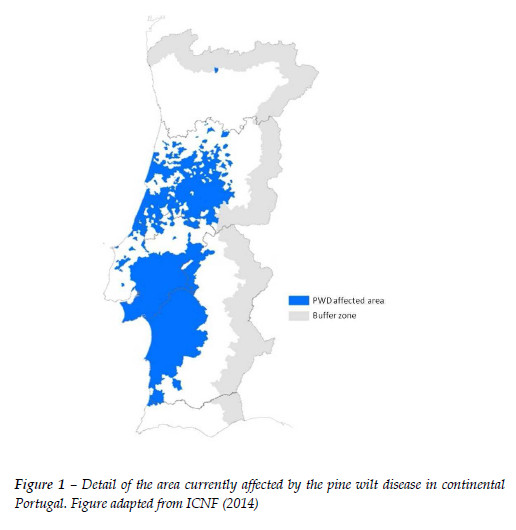
<body><![CDATA[<p><b>RÉSUMÉ</b></p>     <p>La répartition géographique du scieur du pin (<i>Monochamus galloprovincialis</i>), vecteur du nématode du bois de pin (<i>Bursaphelenchus xylophilus</i>),<i> </i>est présentée au niveau du territoire continental portugais selon le quadrillage UTM 10x10km. Sur le terrain les études ont été menées en 15% environ de la surface forestière de pin maritime (<i>Pinus pinaster</i>). Simultanément a été faite une révision bibliographique des références précédentes de l'insecte au Portugal. Sa présence a été confirmée en 94% des endroits étudiés, ce qui suggère une répartition généralisée. Un total de huit conifères forestières et ornementales ont été échantillonnés, et le scieur de pin a été détecté pour la première fois au Portugal sur deux d'entre eux, a savoir <i>Pinus sylvestris</i> et <i>Pinus halepensis</i>. Le coléoptère n'a pas été trouvé associé à<i> Pinus pinea,</i> <i>Pinus radiata,</i> <i>Cupressus lusitanica</i>, <i>Larix decidua</i> et <i>Chamaecyparis lawsoniana</i>. La guilde des parasitoïdes associés au scieur de pin au Portugal a été revue et mise à jour, avec de nouvelles zones géographiques pour un total de sept espèces.</p>     <p><b>Mots-clés: </b>Cerambycidae, <i>Pinus pinaster</i>, Nématode du Bois de Pin, <i>Cyanopterus flavator, </i>répartition géographique</p>     <p>&nbsp;</p>     <p><b>Introduction</b></p>     <p>One of the most important sanitary problems affecting the maritime pine (<i>Pinus pinaster </i>Aiton) is the pine wilt disease (PWD). The causal agent is the pine wood nematode (PWN) <i>Bursaphelenchus xylophilus</i> (Steiner and Buhrer) Nickle (Nematoda: Tylenchida: Aphelenchoididae), which was first reported in Portugal by MOTA <i>et al</i>. in 1999. To be dispersed the PWN requires a vector insect, being the most effective the beetles of the genus <i>Monochamus </i>Dejan (Coleoptera: Cerambycidae) (KOBAYASHI <i>et al</i>., 1984; LINIT 1988; KISHI 1995; NAVES <i>et al</i>., 2007). In Portugal, the sole vector of the PWN is the pine sawyer <i>Monochamus galloprovincialis </i>(Olivier) (SOUSA <i>et al</i>., 2001). This beetle was firstly reported in the end of the XIX<sup>th</sup> century by OLIVEIRA (1894), who collected specimens from the Leiria region which he erroneously identified as <i>Monochamus sutor</i> Linnaeus. The species remains absent in subsequent catalogues and collection during the XX<sup>th</sup> century (CORRÊA DE BARROS, 1916; NEVES, 1950), until it was collected by NEVES <i>et al</i>. (1978) in burned <i>P. pinaster</i> trees near Arganil, central Portugal.</p>     <p>The pine sawyer is widely distributed in Europe (except in the United Kingdom, Ireland and Cyprus), being common in the Mediterranean area, namely in Italy, France, Spain, and Portugal (FRANCARDI and PENNACCHIO, 1996; VIVES, 2000; BRUSTEL <i>et al.</i>, 2002; KOUTROUMPA, 2007). Outside of Europe, <i>M. galloprovincialis</i> can also be found in North Africa, the Caucasus, Russia, China and Mongolia (HELLRIGL, 1971).</p>     <p>Due to the increasing importance of this species as vector of the PWN, several recent studies have detailed various aspects of its biology and ecology (e.g. KOUTROUMPA <i>et al</i>., 2008; NAVES <i>et al.,</i> 2008; AKBULUT, 2009), the application of chemical substances to control it (SOUSA <i>et al.,</i> 2013) and its natural enemies (NAVES <i>et al.,</i> 2005; PETERSEN-SILVA <i>et al.,</i> 2012). Despite the recently-acquired knowledge, the PWN has continued to spread and is now causing mortality on pine forests in central and northern Portugal (SOUSA <i>et al</i>., 2011), (<a href="#f1">Figure 1</a>). Even though the human transport of infested wood is responsible for long-distance dispersal of the disease, the beetle's flight activity and dispersal is also important when considering the spreading of PWD at a local scale. A detailed knowledge on the distribution and hosts of the vector beetle is important to understand the establishment and incidence of wilt disease in the terrain, and is lacking for Portugal. In this paper we present the first mapping of the distribution and hosts of <i>M. galloprovincialis </i>in continental Portugal, and review the parasitoid guild with new geographic records. A detailed bibliographic review on <i>M. galloprovincialis </i>distribution in Portugal was conducted.</p>     <p>&nbsp;</p> <a name="f1"> <img src="/img/revistas/slu/v22n1/22n1a04f1.jpg">     
<p>&nbsp;</p>     ]]></body>
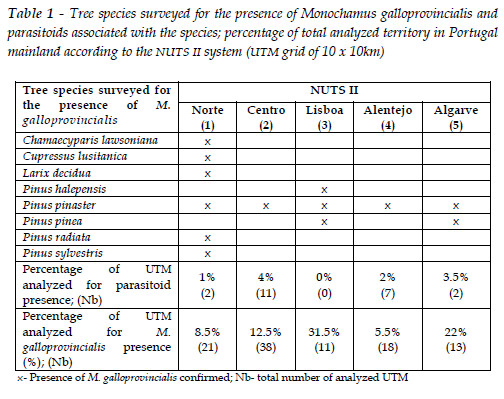
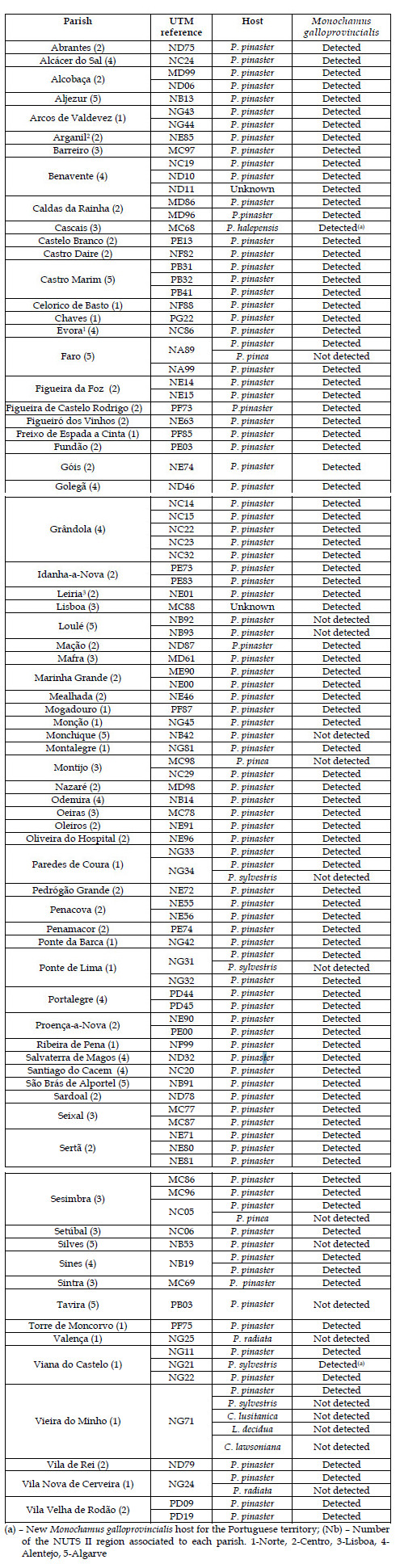
<body><![CDATA[<p><b>Materials and methods</b></p>     <p><i>Geographic distribution and hosts of Monochamus galloprovincialis</i></p>     <p>Surveys in the terrain were conducted by the INIAV (Instituto Nacional de Investigação Agrária e Veterinária, Oeiras, Portugal) entomological team. The surveys were mostly directed to areas where <i>P. pinaster</i> is the dominant tree species (ICNF, 2010), recording the locations in the UTM 10x10 km coordinates system (Universal Transverse Mercator coordinate system) and on the NUTS II system (Nomenclature of Territorial Units for Statistics). Surveys braced approximately 15% of the <i>P. pinaster</i> forested area. The surveyed areas were chosen based on the current distribution of the zones affected by the pine wilt disease (<a href="#f1">Figure 1</a>, <a href="#a1">Annex 1</a>), and on the proximity with Spain (buffer zone). The distribution of <i>M. galloprovincialis</i> was assessed by the presence of adult insects or larval instars inside decaying or dead trees. The characteristic round emergence holes made by the adults also allowed identifying past presence of the pine sawyer, but wood dissection was necessary to distinguish from similar holes made by carpenter bees of the genus <i>Xylocopa </i>Latreille or by wood wasps of the genus<i> Sirex</i> Linnaeus.</p>     <p>Although the majority of the survey was carried on <i>P. pinaster</i>, other conifers were also sporadically sampled, namely <i>Pinus halepensis </i>Mill., <i>Pinus pinea</i> L., <i>Pinus sylvestris</i> L., <i>Pinus radiata</i> Don, <i>Cupressus lusitanica</i> Mill., <i>Larix decidua </i>Mill. and <i>Chamaecyparis</i> <i>lawsoniana</i> (A. Murraybis) Parl.</p>     <p><i>Parasitoid guild associated with Monochamus galloprovincialis</i></p>     <p>The parasitoid guild distribution was studied from 2002 to 2003 and from 2011 to 2014. Locations where the surveys were conducted were randomly chosen among the locations surveyed for <i>M. galloprovincialis</i> distribution (<a href="#t1">Table 1</a>, <a href="#a2">Annex 2</a>). Field methods were based in the felling of trees with <i>M. galloprovincialis</i> presence and the creation of trap trees in the field. Collected wood was transported and reared at the INIAV laboratory, as described in NAVES <i>el al</i>. (2005) and PETERSEN-SILVA <i>et al</i>. (2012). The identification of parasitoid specimens was confirmed by Dr. Sergey Belokobylskij (Polish Academy of Sciences, Warszawa, Poland) and Dr. Dmitri Kasparyan (St. Petersburg, Russia).</p>     <p>&nbsp;</p> <a name="t1"> <img src="/img/revistas/slu/v22n1/22n1a04t1.jpg">     
<p>&nbsp;</p>     <p><u>Distribution data</u></p>     <p>Maps were created with the ESRI® ArcMap<sup>TM</sup> 10.0 program, and the presence/absence of <i>M. galloprovincialis</i> and the parasitoid guild was recorded in the UTM square grid (10 x 10 km) for continental Portugal. New records are signaled in the tables.</p>     ]]></body>
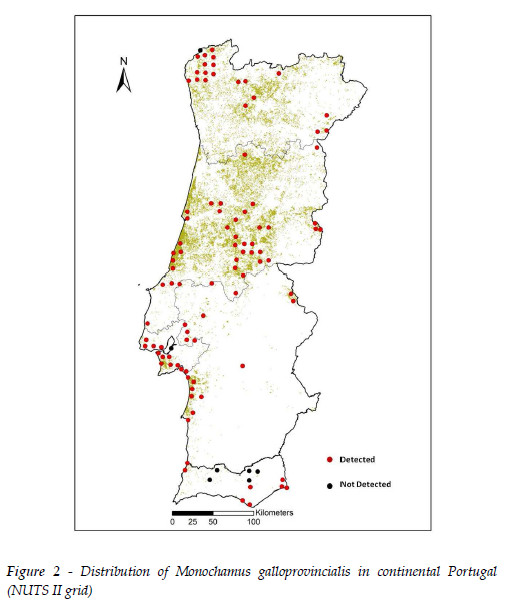
<body><![CDATA[<p>&nbsp;</p>     <p><b>Results</b></p>     <p><i>Geographic distribution and hosts of Monochamus galloprovincialis</i></p>     <p>A total of 96 UTM squares with dominant forest cover of <i>Pinus pinaster</i> were surveyed over the years (<a href="#t1">Table 1</a>, <a href="#f2">Figure 2</a>, and <a href="#a1">Annex 1</a>). The pine sawyer <i>M. galloprovincialis </i>was found in 90 of them (93.8%), being widely distributed in the Portuguese continental territory. This cerambycidae showed an obvious preference for the maritime pine, although it was also found associated with other hosts such as <i>P. sylvestris </i>in Viana do Castelo (UTM NG21), and <i>Pinus halepensis</i> in Cascais (UTM MC68). All of these are new host records for Portugal. The pine sawyer was not detected in other surveyed conifers, such as <i>Pinus pinea</i>, <i>Cupressus lusitanica</i>, <i>Larix decidua </i>and <i>Chamaecyparis lawsoniana.</i></p>     <p>&nbsp;</p> <a name="f2"> <img src="/img/revistas/slu/v22n1/22n1a04f2.jpg">     
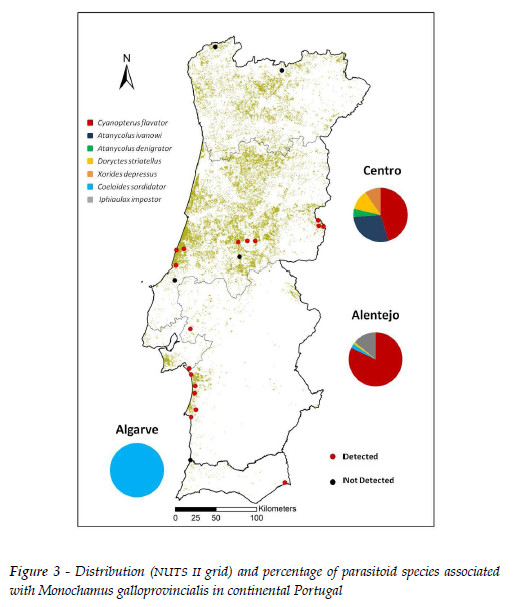
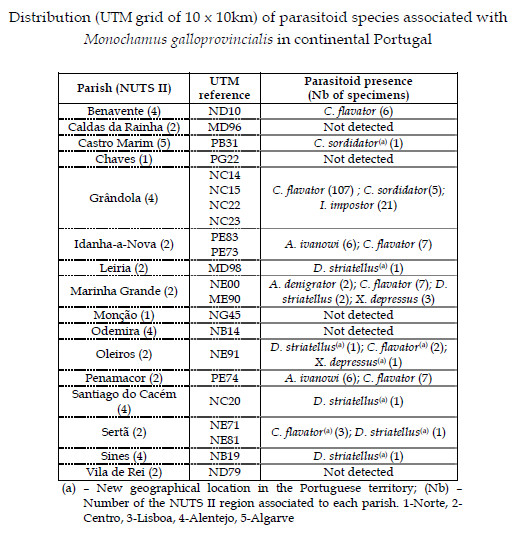
<p>&nbsp;</p>     <p><i>Parasitoid guild associated with Monochamus galloprovincialis</i></p>     <p>The surveys lead to the collection of 188 parasitoid specimens found associated with <i>M. galloprovincialis </i>larvae. Specimens belong to the families Ichneumonidae and Braconidae and include seven species, namely: <i>Atanycolus denigrator</i> (L.); <i>Atanycolus ivanowi</i> (Kokujev); <i>Cyanopterus flavator</i> (Fabricius); <i>Coeloides sordidator </i>Ratzeburg; <i>Doryctes striatellus</i> (Nees); <i>Iphiaulax impostor </i>(Scopoli) and <i>Xorides depressus</i> (Holmgren). Their distribution, percentage of species and the UTM grid reference can be found in <a href="#t1">Table 1</a>, <a href="#f3">Figure 3</a><i>, </i>and <a href="#a2">Annex 2</a>,of which most are new distribution localities for Portugal. <i>Cyanopterus</i><i> flavator</i> is the more frequently detected species, being found in seven of the 15 locations analyzed.</p>     <p>&nbsp;</p> <a name="f3"> <img src="/img/revistas/slu/v22n1/22n1a04f3.jpg">     
<p>&nbsp;</p>     ]]></body>
<body><![CDATA[<p><b>Conclusions/ Discussion </b></p>     <p>The pine sawyer was found to be widely distributed on most of the Portuguese territory where pine forests are abundant, not being conditioned by edapho-climatic variations of the different localities, which was to be expected considering its vast distribution range (HELLRIGL, 1971). The absence of this widespread and conspicuous species from the previous catalogues of OLIVEIRA (1894), CORRÊA DE BARROS (1916), NEVES (1950) and SERRANO (1983) is somewhat intriguing, although these authors were not specifically looking for this beetle, unlike the surveys conducted by the INIAV team. It is also possible that the pine sawyer may have benefited from the great campaigns of forestation with <i>P. pinaster</i> that occurred in Portugal during the XX<sup>th</sup> century, experiencing a distribution expansion due to the higher availability of hosts. Insect populations may have also benefited from the sanitary problems and forest fires which occurred after this forest expansion, as the dead and scorcher pines tend to attract <i>Monochamus </i>beetles for breeding (BYERS, 1989a; b; SATO and MAETO, 2006; BONIFÁCIO <i>et al</i>., 2012).</p>     <p>Although maritime pine is clearly the preferred host in Portugal, the association of <i>M. galloprovincialis </i>with other hosts such as <i>P. sylvestris</i> and <i>P. halepensis</i>is is not surprising, as these are very frequent hosts all over the Mediterranean basin (HELLRIGL, 1971; EVANS <i>et al</i>., 1996; FRANCARDI and PENNACCHIO, 1996).Other unusual hosts include <i>Pinus strobus</i> (VINCENT, 2007), <i>Pinus uncinata</i> (BEHALOVÁ, 2006) and even <i>Picea abies </i>(L.) H. Karst.and <i>Picea orientalis</i> (L.) Peterm. (YUKSEL, 1998), although all of these species are inexistent or rare in Portugal. </p>     <p>Regarding the parasitoids associated with the insect vector, a fairly diverse guild was detected over the years, being dominated by <i>Cyanopterus flavator</i>, the most abundant species and with the widest distribution. Nevertheless and as already mentioned by NAVES <i>et al</i>. (2005) and PETERSEN-SILVA <i>et al</i>. (2012), these are all generalist species which attack a vast array of Cerambycidae and even other coleopteran, and therefore, their use as biological control agents seems ineffective and unlikely. Future samplings should focus on other natural enemies, such as bacteria or fungi, which have been found to affect other <i>Monochamus</i> species elsewhere, and have not yet been studied in detail in Portugal.</p>     <p>This is a first approach to elaborate a detailed mapping on the distribution range and hosts of <i>M. galloprovincialis </i>in Portugal, and may constitute an important tool for future assessments of pine wilt disease distribution and dispersal, and for the implementation of management and control strategies of this complex forest sanitary problem.</p>     <p>&nbsp;</p>     <p><b>References</b></p>     <!-- ref --><p>Akbulut, S., 2009. Comparison of the reproductive potential of <i>Monochamus galloprovincialis</i> on two pine species under laboratory conditions. <i>Phytoparasitica </i><b>37</b>: 125–135.    &nbsp;&nbsp;&nbsp;&nbsp;&nbsp;&nbsp;&nbsp;&nbsp;[&#160;<a href="javascript:void(0);" onclick="javascript: window.open('/scielo.php?script=sci_nlinks&ref=000060&pid=S0870-6352201400010000400001&lng=','','width=640,height=500,resizable=yes,scrollbars=1,menubar=yes,');">Links</a>&#160;]<!-- end-ref --></p>     <!-- ref --><p>Behalová, M., 2006. Recent surveys for <i>Bursaphelenchus xylophilus</i> in the Czech Republic. <i>Bull </i><i>EPPO </i><b>36</b>(3): 467-469.    &nbsp;&nbsp;&nbsp;&nbsp;&nbsp;&nbsp;&nbsp;&nbsp;[&#160;<a href="javascript:void(0);" onclick="javascript: window.open('/scielo.php?script=sci_nlinks&ref=000062&pid=S0870-6352201400010000400002&lng=','','width=640,height=500,resizable=yes,scrollbars=1,menubar=yes,');">Links</a>&#160;]<!-- end-ref --></p>     <!-- ref --><p>Bonifácio, L., Praias, F., Sousa, E., 2012. Trapping <i>Monochamus galloprovincialis</i> (Coleoptera: Cerambycidae), Vector of the Pine Wood Nematode, with Pine Allelochemicals, in Portugal. <i>Silva Lusitana </i><b>20</b>(1/2): 39-53.    &nbsp;&nbsp;&nbsp;&nbsp;&nbsp;&nbsp;&nbsp;&nbsp;[&#160;<a href="javascript:void(0);" onclick="javascript: window.open('/scielo.php?script=sci_nlinks&ref=000064&pid=S0870-6352201400010000400003&lng=','','width=640,height=500,resizable=yes,scrollbars=1,menubar=yes,');">Links</a>&#160;]<!-- end-ref --></p>     <!-- ref --><p>Brustel, H., Berger, P., Cocquempot, C., 2002. Catalogue des Vesperidae et des Cerambycidae de la faune de France (Coleoptera). <i>Ann. Soc.</i><i> Entomol. Fr</i>. <b>38</b>(4): 443-461.    &nbsp;&nbsp;&nbsp;&nbsp;&nbsp;&nbsp;&nbsp;&nbsp;[&#160;<a href="javascript:void(0);" onclick="javascript: window.open('/scielo.php?script=sci_nlinks&ref=000066&pid=S0870-6352201400010000400004&lng=','','width=640,height=500,resizable=yes,scrollbars=1,menubar=yes,');">Links</a>&#160;]<!-- end-ref --></p>     <!-- ref --><p>Byers, J.A., 1989a. Chemical ecology of bark beetles. <i>Experientia </i><b>45</b>: 271-283.    &nbsp;&nbsp;&nbsp;&nbsp;&nbsp;&nbsp;&nbsp;&nbsp;[&#160;<a href="javascript:void(0);" onclick="javascript: window.open('/scielo.php?script=sci_nlinks&ref=000068&pid=S0870-6352201400010000400005&lng=','','width=640,height=500,resizable=yes,scrollbars=1,menubar=yes,');">Links</a>&#160;]<!-- end-ref --></p>     <!-- ref --><p>Byers, J.A., 1989b. Behavioural mechanisms involved in reducing competition in bark beetles. <i>Holart Ecol </i><b>12</b>: 466-476.    &nbsp;&nbsp;&nbsp;&nbsp;&nbsp;&nbsp;&nbsp;&nbsp;[&#160;<a href="javascript:void(0);" onclick="javascript: window.open('/scielo.php?script=sci_nlinks&ref=000070&pid=S0870-6352201400010000400006&lng=','','width=640,height=500,resizable=yes,scrollbars=1,menubar=yes,');">Links</a>&#160;]<!-- end-ref --></p>     <!-- ref --><p>Corrêa de Barros, J.M., 1916. Suplemento ao estudo sinóptico sobre os Cerambycidae de Portugal. <i>Broteria </i><b>14</b>: 147-150.    &nbsp;&nbsp;&nbsp;&nbsp;&nbsp;&nbsp;&nbsp;&nbsp;[&#160;<a href="javascript:void(0);" onclick="javascript: window.open('/scielo.php?script=sci_nlinks&ref=000072&pid=S0870-6352201400010000400007&lng=','','width=640,height=500,resizable=yes,scrollbars=1,menubar=yes,');">Links</a>&#160;]<!-- end-ref --></p>     <!-- ref --><p>Evans, H.F., McNamara, D.G., Braasch, H., Chadoeuf, J., Magnusson, C., 1996. Pest risk analysis (PRA) for the territories of the european union (as PRA area) on <i>Bursaphelenchus xylophilus</i> and its vectors in the genus Monochamus. <i>Bull </i><i>OEPP </i><b>26</b>: 199-249.    &nbsp;&nbsp;&nbsp;&nbsp;&nbsp;&nbsp;&nbsp;&nbsp;[&#160;<a href="javascript:void(0);" onclick="javascript: window.open('/scielo.php?script=sci_nlinks&ref=000074&pid=S0870-6352201400010000400008&lng=','','width=640,height=500,resizable=yes,scrollbars=1,menubar=yes,');">Links</a>&#160;]<!-- end-ref --></p>     <!-- ref --><p>Francardi, V., Pennacchio, F., 1996. Note sulla bioecologia di <i>Monochamus galloprovincialis galloprovincialis</i> (Olivier) in Toscana e in Liguria (Coleoptera Cerambycidae). <i>Redia </i><b>79</b>: 153–169.    &nbsp;&nbsp;&nbsp;&nbsp;&nbsp;&nbsp;&nbsp;&nbsp;[&#160;<a href="javascript:void(0);" onclick="javascript: window.open('/scielo.php?script=sci_nlinks&ref=000076&pid=S0870-6352201400010000400009&lng=','','width=640,height=500,resizable=yes,scrollbars=1,menubar=yes,');">Links</a>&#160;]<!-- end-ref --></p>     <!-- ref --><p>Hellrigl, K.G., 1971. The bionomics of the European genera of Monochamus (Coleoptera, Cerambycidae) and their significance to the forest and lumber economy. <i>Redia </i><b>52</b>: 367–509.    &nbsp;&nbsp;&nbsp;&nbsp;&nbsp;&nbsp;&nbsp;&nbsp;[&#160;<a href="javascript:void(0);" onclick="javascript: window.open('/scielo.php?script=sci_nlinks&ref=000078&pid=S0870-6352201400010000400010&lng=','','width=640,height=500,resizable=yes,scrollbars=1,menubar=yes,');">Links</a>&#160;]<!-- end-ref --></p>     <!-- ref --><p>ICNF, 2010. IFN5 – <i>Áreas dos usos do solo e das espécies florestais de Portugal continental. Relatório Final</i>. Instituto da Conservação da Natureza e das Florestas, Lisboa.    &nbsp;&nbsp;&nbsp;&nbsp;&nbsp;&nbsp;&nbsp;&nbsp;[&#160;<a href="javascript:void(0);" onclick="javascript: window.open('/scielo.php?script=sci_nlinks&ref=000080&pid=S0870-6352201400010000400011&lng=','','width=640,height=500,resizable=yes,scrollbars=1,menubar=yes,');">Links</a>&#160;]<!-- end-ref --></p>     <p>ICNF, 2014. <a href="http://www.icnf.pt/portal/florestas/prag-doe/ag-bn/nmp/infgeo" target="_blank">http://www.icnf.pt/portal/florestas/prag-doe/ag-bn/nmp/infgeo</a> (Consulted on16th May, 2014)</p>     ]]></body>
<body><![CDATA[<!-- ref --><p>Kishi, Y., 1995. <i>The pine wood nematode and the Japanese pine sawyer</i>. Thomas Company Limited, Tokyo, Japan. 302 pp.    &nbsp;&nbsp;&nbsp;&nbsp;&nbsp;&nbsp;&nbsp;&nbsp;[&#160;<a href="javascript:void(0);" onclick="javascript: window.open('/scielo.php?script=sci_nlinks&ref=000083&pid=S0870-6352201400010000400012&lng=','','width=640,height=500,resizable=yes,scrollbars=1,menubar=yes,');">Links</a>&#160;]<!-- end-ref --></p>     <!-- ref --><p>Kobayashi, F., Yamane, A., Ikeda, T., 1984. The Japanese pine sawyer beetle as the vector of pine wilt disease. <i>Ann Rev Entomol </i><b>29</b>:115-135&nbsp;&nbsp;&nbsp;&nbsp;&nbsp;&nbsp;&nbsp;&nbsp;[&#160;<a href="javascript:void(0);" onclick="javascript: window.open('/scielo.php?script=sci_nlinks&ref=000085&pid=S0870-6352201400010000400013&lng=','','width=640,height=500,resizable=yes,scrollbars=1,menubar=yes,');">Links</a>&#160;]<!-- end-ref --><!-- ref --><p>Koutroumpa, F., 2007. <i>Biologie et phylogeographie de </i>Monochamus galloprovincialis<i> (Coleoptera, Cerambycidae) vecteur du nematode du pin en Europe</i>, Thesis in L'Université d'Orléans, France, 188 pp.    &nbsp;&nbsp;&nbsp;&nbsp;&nbsp;&nbsp;&nbsp;&nbsp;[&#160;<a href="javascript:void(0);" onclick="javascript: window.open('/scielo.php?script=sci_nlinks&ref=000086&pid=S0870-6352201400010000400014&lng=','','width=640,height=500,resizable=yes,scrollbars=1,menubar=yes,');">Links</a>&#160;]<!-- end-ref --></p>     <!-- ref --><p>Koutroumpa, F., Vincent, B., Roux-Morabito, G., Martin, C., Lieutier, F., 2008. Fecundity and larval development of <i>Monochamus galloprovincialis</i> (Coleoptera Cerambycidae) in experimental breeding. <i>Ann of For Sci </i><b>65</b>: 707-717.    &nbsp;&nbsp;&nbsp;&nbsp;&nbsp;&nbsp;&nbsp;&nbsp;[&#160;<a href="javascript:void(0);" onclick="javascript: window.open('/scielo.php?script=sci_nlinks&ref=000088&pid=S0870-6352201400010000400015&lng=','','width=640,height=500,resizable=yes,scrollbars=1,menubar=yes,');">Links</a>&#160;]<!-- end-ref --></p>     <!-- ref --><p>Linit, M.J., 1988. Nematode-Vector Relationships in the pine wilt disease system. <i>J Nematol </i><b>20</b>: 227-235.    &nbsp;&nbsp;&nbsp;&nbsp;&nbsp;&nbsp;&nbsp;&nbsp;[&#160;<a href="javascript:void(0);" onclick="javascript: window.open('/scielo.php?script=sci_nlinks&ref=000090&pid=S0870-6352201400010000400016&lng=','','width=640,height=500,resizable=yes,scrollbars=1,menubar=yes,');">Links</a>&#160;]<!-- end-ref --></p>     <!-- ref --><p>Mota, M., Braasch, H., Bravo, M.A., Penas, A.C., Burgermeister, W., Metge, K., Sousa, E., 1999. First report of <i>Bursaphelenchus xylophilus</i> in Portugal and in Europe. <i>Nematology </i><b>1</b>: 727-734.    &nbsp;&nbsp;&nbsp;&nbsp;&nbsp;&nbsp;&nbsp;&nbsp;[&#160;<a href="javascript:void(0);" onclick="javascript: window.open('/scielo.php?script=sci_nlinks&ref=000092&pid=S0870-6352201400010000400017&lng=','','width=640,height=500,resizable=yes,scrollbars=1,menubar=yes,');">Links</a>&#160;]<!-- end-ref --></p>     <!-- ref --><p>Naves, P., Kenis, M., Sousa, E., 2005. Parasitoids associated with <i>Monochamus galloprovincialis</i> (Olivier) (Coleoptera: Cerambycidae) within the pine wilt nematode-affected zone in Portugal. <i>J Pest Sci </i><b>78</b>: 57–62.    &nbsp;&nbsp;&nbsp;&nbsp;&nbsp;&nbsp;&nbsp;&nbsp;[&#160;<a href="javascript:void(0);" onclick="javascript: window.open('/scielo.php?script=sci_nlinks&ref=000094&pid=S0870-6352201400010000400018&lng=','','width=640,height=500,resizable=yes,scrollbars=1,menubar=yes,');">Links</a>&#160;]<!-- end-ref --></p>     <!-- ref --><p>Naves, P., Camacho, S., Sousa, E., Quartau, J., 2007. Transmission of the pine wood nematode <i>Bursaphelenchus xylophilus</i> through feeding activity of <i>Monochamus galloprovincialis</i> (Coleoptera; Cerambycidae). <i>J Appl Entomol </i><b>131</b>: 21-25<i>.    &nbsp;&nbsp;&nbsp;&nbsp;&nbsp;&nbsp;&nbsp;&nbsp;[&#160;<a href="javascript:void(0);" onclick="javascript: window.open('/scielo.php?script=sci_nlinks&ref=000096&pid=S0870-6352201400010000400019&lng=','','width=640,height=500,resizable=yes,scrollbars=1,menubar=yes,');">Links</a>&#160;]<!-- end-ref --></i></p>     <!-- ref --><p>Naves, P., Sousa, E., Rodrigues, J.M., 2008. Biology of <i>Monochamus galloprovincialis</i> (Coleoptera: Cerambycidae) in the pine wilt disease affected zone, Southern Portugal. <i>Silva Lusitana </i><b>16</b>: 133-148.    &nbsp;&nbsp;&nbsp;&nbsp;&nbsp;&nbsp;&nbsp;&nbsp;[&#160;<a href="javascript:void(0);" onclick="javascript: window.open('/scielo.php?script=sci_nlinks&ref=000098&pid=S0870-6352201400010000400020&lng=','','width=640,height=500,resizable=yes,scrollbars=1,menubar=yes,');">Links</a>&#160;]<!-- end-ref --></p>     <!-- ref --><p>Neves, C.B., 1950. <i>Introdução à Entomologia Florestal Portuguesa</i>. Livraria Sá da Costa, Lisboa, Portugal. 225 pp.    &nbsp;&nbsp;&nbsp;&nbsp;&nbsp;&nbsp;&nbsp;&nbsp;[&#160;<a href="javascript:void(0);" onclick="javascript: window.open('/scielo.php?script=sci_nlinks&ref=000100&pid=S0870-6352201400010000400021&lng=','','width=640,height=500,resizable=yes,scrollbars=1,menubar=yes,');">Links</a>&#160;]<!-- end-ref --></p>     <!-- ref --><p>NEVES, C.B., NOGUEIRA, C.S., CABRAL, M.T., FERREIRA, L.C., 1978. Sobre o ataque dos insectos em pinheiros (<i>Pinus pinaster</i> Sol.) queimados. <i>Bol Inst Produtos Florestais Resinosos </i><b>22</b>: 1-6.    &nbsp;&nbsp;&nbsp;&nbsp;&nbsp;&nbsp;&nbsp;&nbsp;[&#160;<a href="javascript:void(0);" onclick="javascript: window.open('/scielo.php?script=sci_nlinks&ref=000102&pid=S0870-6352201400010000400022&lng=','','width=640,height=500,resizable=yes,scrollbars=1,menubar=yes,');">Links</a>&#160;]<!-- end-ref --></p>     <!-- ref --><p>Oliveira, M.P., 1894. <i>Catalogue des insects du Portugal – Coleópteres</i>. Imprensa da Universidade de Coimbra, Coimbra, Portugal, 393 pp.    &nbsp;&nbsp;&nbsp;&nbsp;&nbsp;&nbsp;&nbsp;&nbsp;[&#160;<a href="javascript:void(0);" onclick="javascript: window.open('/scielo.php?script=sci_nlinks&ref=000104&pid=S0870-6352201400010000400023&lng=','','width=640,height=500,resizable=yes,scrollbars=1,menubar=yes,');">Links</a>&#160;]<!-- end-ref --></p>     <!-- ref --><p>Petersen-Silva, R., Pujade-Villar, J., Naves, P., Sousa, E., Belokobylskij, S., 2012. Parasitoids of <i>Monochamus galloprovincialis</i> (Coleoptera: Cerambycidae), vector of the pine wood nematode, with identification key for the Palaearctic region. <i>ZooKeys </i><b>251</b>: 29–48.    &nbsp;&nbsp;&nbsp;&nbsp;&nbsp;&nbsp;&nbsp;&nbsp;[&#160;<a href="javascript:void(0);" onclick="javascript: window.open('/scielo.php?script=sci_nlinks&ref=000106&pid=S0870-6352201400010000400024&lng=','','width=640,height=500,resizable=yes,scrollbars=1,menubar=yes,');">Links</a>&#160;]<!-- end-ref --></p>     <!-- ref --><p>Ribeiro, M.A.S.V., 1992. <i>Bio-Ecologia de </i>Pissodes castaneus <i>DeGeer, 1775 (Coleoptera: Curculionidae)</i>. Relatório de estágio da Licenciatura em Recursos Faunísticos e Ambiente, Faculdade de Ciências da Universidade de Lisboa, 103 pp.    &nbsp;&nbsp;&nbsp;&nbsp;&nbsp;&nbsp;&nbsp;&nbsp;[&#160;<a href="javascript:void(0);" onclick="javascript: window.open('/scielo.php?script=sci_nlinks&ref=000108&pid=S0870-6352201400010000400025&lng=','','width=640,height=500,resizable=yes,scrollbars=1,menubar=yes,');">Links</a>&#160;]<!-- end-ref --></p>     <!-- ref --><p>Sato, S., Maeto, K., 2006. Attraction of female Japanese horntail <i>Urocerus japonicus </i>(Hymenoptera: Siricidae) to a-pinene. <i>Appl Entomol Zool </i><b>41</b>(2): 317-323.    &nbsp;&nbsp;&nbsp;&nbsp;&nbsp;&nbsp;&nbsp;&nbsp;[&#160;<a href="javascript:void(0);" onclick="javascript: window.open('/scielo.php?script=sci_nlinks&ref=000110&pid=S0870-6352201400010000400026&lng=','','width=640,height=500,resizable=yes,scrollbars=1,menubar=yes,');">Links</a>&#160;]<!-- end-ref --></p>     <!-- ref --><p>Serrano, A.M.R., 1983. <i>Contribuição para o inventário dos Coleópteros em Portugal</i>. Estação Agronómica Nacional, INIAP, Oeiras. 265pp.    &nbsp;&nbsp;&nbsp;&nbsp;&nbsp;&nbsp;&nbsp;&nbsp;[&#160;<a href="javascript:void(0);" onclick="javascript: window.open('/scielo.php?script=sci_nlinks&ref=000112&pid=S0870-6352201400010000400027&lng=','','width=640,height=500,resizable=yes,scrollbars=1,menubar=yes,');">Links</a>&#160;]<!-- end-ref --></p>     <!-- ref --><p>Sousa, E., Bravo, M., Pires, J., Naves, P., Penas, A., Bonifácio, L., Mota, M., 2001. <i>Bursaphelenchus xylophilus</i> (Nematoda; Aphelenchoididae) associated with <i>Monochamus galloprovincialis</i> (Coleoptera; Cerambycidae) in Portugal. <i>Nematology</i> <b>3</b>: 89–91.    &nbsp;&nbsp;&nbsp;&nbsp;&nbsp;&nbsp;&nbsp;&nbsp;[&#160;<a href="javascript:void(0);" onclick="javascript: window.open('/scielo.php?script=sci_nlinks&ref=000114&pid=S0870-6352201400010000400028&lng=','','width=640,height=500,resizable=yes,scrollbars=1,menubar=yes,');">Links</a>&#160;]<!-- end-ref --></p>     <!-- ref --><p>Sousa, E., Rodrigues, J., Bonifácio, L., Naves, P., Rodrigues, A., 2011. Management and control of the Pine Wood Nematode, <i>Bursaphelenchus xylophilus</i>, in Portugal. In <i>Nematodes: Morphology, Functions and Management Strategies</i> (Boeri F &amp; Chung J Eds.). Nova Science Publishers, New York, USA.    &nbsp;&nbsp;&nbsp;&nbsp;&nbsp;&nbsp;&nbsp;&nbsp;[&#160;<a href="javascript:void(0);" onclick="javascript: window.open('/scielo.php?script=sci_nlinks&ref=000116&pid=S0870-6352201400010000400029&lng=','','width=640,height=500,resizable=yes,scrollbars=1,menubar=yes,');">Links</a>&#160;]<!-- end-ref --></p>     <!-- ref --><p>Sousa, E., Naves, P., Vieira, M., 2013. Prevention of pine wilt disease induced by <i>Bursaphelenchus xylophilus</i> and <i>Monochamus galloprovincialis</i> by trunk injection of emamectin benzoate. <i>Phytoparasitica </i><b>41</b>: 143–148.    &nbsp;&nbsp;&nbsp;&nbsp;&nbsp;&nbsp;&nbsp;&nbsp;[&#160;<a href="javascript:void(0);" onclick="javascript: window.open('/scielo.php?script=sci_nlinks&ref=000118&pid=S0870-6352201400010000400030&lng=','','width=640,height=500,resizable=yes,scrollbars=1,menubar=yes,');">Links</a>&#160;]<!-- end-ref --></p>     <!-- ref --><p>Vincent, B., 2007. <i>Relations entre les nematodes du genre Bursaphelenchus le insecte vecteur </i>Monochamus galloprovincialis<i> et leurs arbres hotes.</i> Thèse, pour obtenir le grade de Docteur en Physiologie et Biologie des Organismes et des Populations, Université d'Orléans: 142 pp.    &nbsp;&nbsp;&nbsp;&nbsp;&nbsp;&nbsp;&nbsp;&nbsp;[&#160;<a href="javascript:void(0);" onclick="javascript: window.open('/scielo.php?script=sci_nlinks&ref=000120&pid=S0870-6352201400010000400031&lng=','','width=640,height=500,resizable=yes,scrollbars=1,menubar=yes,');">Links</a>&#160;]<!-- end-ref --></p>     <!-- ref --><p>VIVES, E., 2000. <i>Fauna Ibérica. Coleoptera, Cerambycidae</i>. 12. Museo Nac. Ciencias Naturals/CSIC, Madrid: 716 pp.    &nbsp;&nbsp;&nbsp;&nbsp;&nbsp;&nbsp;&nbsp;&nbsp;[&#160;<a href="javascript:void(0);" onclick="javascript: window.open('/scielo.php?script=sci_nlinks&ref=000122&pid=S0870-6352201400010000400032&lng=','','width=640,height=500,resizable=yes,scrollbars=1,menubar=yes,');">Links</a>&#160;]<!-- end-ref --></p>     <!-- ref --><p>Yuksel, B., 1998. <i>The damaging insects at Oriental spruce (</i>Picea orientalis<i> (L.) Link) forests and their predators and parasites-1 (Pest Insects)</i>. Eastern Black Sea Forestry Research Institute, <i>Technical Bulletin</i>  <b>4</b>: 1-143.    &nbsp;&nbsp;&nbsp;&nbsp;&nbsp;&nbsp;&nbsp;&nbsp;[&#160;<a href="javascript:void(0);" onclick="javascript: window.open('/scielo.php?script=sci_nlinks&ref=000124&pid=S0870-6352201400010000400033&lng=','','width=640,height=500,resizable=yes,scrollbars=1,menubar=yes,');">Links</a>&#160;]<!-- end-ref --></p>     <p>&nbsp;</p>     <p><i>Submitted for publication in April 2014</i></p>     <p><i>Accepted in May 2014</i></p>     <p>&nbsp;</p>     <p><b>Acknowledgments </b></p>     <p>We would like to thank the colleagues of Instituto Nacional de Investigação Agrária e Veterinária, Mr. Adérito Matos, Dr. Luis Bonifácio and Mr. Victor Gonçalves for assistance in the field surveys and <i>M. galloprovincialis</i> laboratory handling, and Drª Lurdes Inácio for her comments and valuable text revision. We are also grateful to Dr. Sergey Belokobylskij of the Polish Academy of Sciences, Warszawa (Poland) and Dr. Dmitri Kasparyan (St. Petersburg, Russia) for confirming the identification of some parasitoid specimens. We would also like to thank Dr. José Manuel Rodrigues for the map presenting the current area affected by the pine wilt disease. This work was partially funded by the project REPHRAME Development of improved methods for detection, control and eradication of pine wood nematode in support of European Union Plant Health policy.</p>     <p>&nbsp;</p>     ]]></body>
<body><![CDATA[<p><b>Annexes</b></p>     <p><b>Annex 1</b></p>     <p>Distribution of <i>Monochamus galloprovincialis</i> in continental Portugal (UTM grid of 10 x 10km) and hosts</p>     <p>(a) – New host for <i>M. galloprovincialis</i> in Portugal; 1- Ribeiro, 1992; 2- Neves, et al., 1978; 3- Oliveira, 1894; Unknown – <i>M. galloprovincialis</i> adult specimens collected outside the host.</p>     <p>&nbsp;</p> <a name="a1"> <img src="/img/revistas/slu/v22n1/22n1a04a1.jpg">     
<p>&nbsp;</p> <a name="a2"> <img src="/img/revistas/slu/v22n1/22n1a04a2.jpg">     
<p>&nbsp;</p>      ]]></body><back>
<ref-list>
<ref id="B1">
<nlm-citation citation-type="journal">
<person-group person-group-type="author">
<name>
<surname><![CDATA[Akbulut]]></surname>
<given-names><![CDATA[S.]]></given-names>
</name>
</person-group>
<article-title xml:lang="en"><![CDATA[Comparison of the reproductive potential of Monochamus galloprovincialis on two pine species under laboratory conditions]]></article-title>
<source><![CDATA[Phytoparasitica]]></source>
<year>2009</year>
<volume>37</volume>
<page-range>125-135</page-range></nlm-citation>
</ref>
<ref id="B2">
<nlm-citation citation-type="journal">
<person-group person-group-type="author">
<name>
<surname><![CDATA[Behalová]]></surname>
<given-names><![CDATA[M.]]></given-names>
</name>
</person-group>
<article-title xml:lang="en"><![CDATA[Recent surveys for Bursaphelenchus xylophilus in the Czech Republic]]></article-title>
<source><![CDATA[Bull EPPO]]></source>
<year>2006</year>
<volume>36</volume>
<numero>3</numero>
<issue>3</issue>
<page-range>467-469</page-range></nlm-citation>
</ref>
<ref id="B3">
<nlm-citation citation-type="journal">
<person-group person-group-type="author">
<name>
<surname><![CDATA[Bonifácio]]></surname>
<given-names><![CDATA[L.]]></given-names>
</name>
<name>
<surname><![CDATA[Praias]]></surname>
<given-names><![CDATA[F.]]></given-names>
</name>
<name>
<surname><![CDATA[Sousa]]></surname>
<given-names><![CDATA[E.]]></given-names>
</name>
</person-group>
<article-title xml:lang="en"><![CDATA[Trapping Monochamus galloprovincialis (Coleoptera: Cerambycidae), Vector of the Pine Wood Nematode, with Pine Allelochemicals, in Portugal]]></article-title>
<source><![CDATA[Silva Lusitana]]></source>
<year>2012</year>
<volume>20</volume>
<numero>1/2</numero>
<issue>1/2</issue>
<page-range>39-53</page-range></nlm-citation>
</ref>
<ref id="B4">
<nlm-citation citation-type="journal">
<person-group person-group-type="author">
<name>
<surname><![CDATA[Brustel]]></surname>
<given-names><![CDATA[H.]]></given-names>
</name>
<name>
<surname><![CDATA[Berger]]></surname>
<given-names><![CDATA[P.]]></given-names>
</name>
<name>
<surname><![CDATA[Cocquempot]]></surname>
<given-names><![CDATA[C.]]></given-names>
</name>
</person-group>
<article-title xml:lang="fr"><![CDATA[Catalogue des Vesperidae et des Cerambycidae de la faune de France (Coleoptera)]]></article-title>
<source><![CDATA[Ann. Soc. Entomol. Fr.]]></source>
<year>2002</year>
<volume>38</volume>
<numero>4</numero>
<issue>4</issue>
<page-range>443-461</page-range></nlm-citation>
</ref>
<ref id="B5">
<nlm-citation citation-type="journal">
<person-group person-group-type="author">
<name>
<surname><![CDATA[Byers]]></surname>
<given-names><![CDATA[J.A.]]></given-names>
</name>
</person-group>
<article-title xml:lang="en"><![CDATA[Chemical ecology of bark beetles]]></article-title>
<source><![CDATA[Experientia]]></source>
<year>1989</year>
<volume>45</volume>
<page-range>271-283</page-range></nlm-citation>
</ref>
<ref id="B6">
<nlm-citation citation-type="journal">
<person-group person-group-type="author">
<name>
<surname><![CDATA[Byers]]></surname>
<given-names><![CDATA[J.A.]]></given-names>
</name>
</person-group>
<article-title xml:lang="en"><![CDATA[Behavioural mechanisms involved in reducing competition in bark beetles]]></article-title>
<source><![CDATA[Holart Ecol]]></source>
<year>1989</year>
<volume>12</volume>
<page-range>466-476</page-range></nlm-citation>
</ref>
<ref id="B7">
<nlm-citation citation-type="journal">
<person-group person-group-type="author">
<name>
<surname><![CDATA[Corrêa de Barros]]></surname>
<given-names><![CDATA[J.M.]]></given-names>
</name>
</person-group>
<article-title xml:lang="pt"><![CDATA[Suplemento ao estudo sinóptico sobre os Cerambycidae de Portugal]]></article-title>
<source><![CDATA[Broteria]]></source>
<year>1916</year>
<volume>14</volume>
<page-range>147-150</page-range></nlm-citation>
</ref>
<ref id="B8">
<nlm-citation citation-type="journal">
<person-group person-group-type="author">
<name>
<surname><![CDATA[Evans]]></surname>
<given-names><![CDATA[H.F.]]></given-names>
</name>
<name>
<surname><![CDATA[McNamara]]></surname>
<given-names><![CDATA[D.G.]]></given-names>
</name>
<name>
<surname><![CDATA[Braasch]]></surname>
<given-names><![CDATA[H.]]></given-names>
</name>
<name>
<surname><![CDATA[Chadoeuf]]></surname>
<given-names><![CDATA[J.]]></given-names>
</name>
<name>
<surname><![CDATA[Magnusson]]></surname>
<given-names><![CDATA[C.]]></given-names>
</name>
</person-group>
<article-title xml:lang="en"><![CDATA[Pest risk analysis (PRA) for the territories of the european union (as PRA area) on Bursaphelenchus xylophilus and its vectors in the genus Monochamus]]></article-title>
<source><![CDATA[Bull OEPP]]></source>
<year>1996</year>
<volume>26</volume>
<page-range>199-249</page-range></nlm-citation>
</ref>
<ref id="B9">
<nlm-citation citation-type="journal">
<person-group person-group-type="author">
<name>
<surname><![CDATA[Francardi]]></surname>
<given-names><![CDATA[V.]]></given-names>
</name>
<name>
<surname><![CDATA[Pennacchio]]></surname>
<given-names><![CDATA[F.]]></given-names>
</name>
</person-group>
<article-title xml:lang="fr"><![CDATA[Note sulla bioecologia di Monochamus galloprovincialis galloprovincialis (Olivier) in Toscana e in Liguria (Coleoptera Cerambycidae)]]></article-title>
<source><![CDATA[Redia]]></source>
<year>1996</year>
<volume>79</volume>
<page-range>153-169</page-range></nlm-citation>
</ref>
<ref id="B10">
<nlm-citation citation-type="journal">
<person-group person-group-type="author">
<name>
<surname><![CDATA[Hellrigl]]></surname>
<given-names><![CDATA[K.G.]]></given-names>
</name>
</person-group>
<article-title xml:lang="en"><![CDATA[The bionomics of the European genera of Monochamus (Coleoptera, Cerambycidae) and their significance to the forest and lumber economy]]></article-title>
<source><![CDATA[Redia]]></source>
<year>1971</year>
<volume>52</volume>
<page-range>367-509</page-range></nlm-citation>
</ref>
<ref id="B11">
<nlm-citation citation-type="book">
<collab>ICNF</collab>
<source><![CDATA[IFN5 - Áreas dos usos do solo e das espécies florestais de Portugal continental. Relatório Final]]></source>
<year>2010</year>
<publisher-loc><![CDATA[Lisboa ]]></publisher-loc>
<publisher-name><![CDATA[Instituto da Conservação da Natureza e das Florestas]]></publisher-name>
</nlm-citation>
</ref>
<ref id="B12">
<nlm-citation citation-type="book">
<person-group person-group-type="author">
<name>
<surname><![CDATA[Kishi]]></surname>
<given-names><![CDATA[Y.]]></given-names>
</name>
</person-group>
<source><![CDATA[The pine wood nematode and the Japanese pine sawyer]]></source>
<year>1995</year>
<page-range>302</page-range><publisher-loc><![CDATA[Tokyo ]]></publisher-loc>
<publisher-name><![CDATA[Thomas Company Limited]]></publisher-name>
</nlm-citation>
</ref>
<ref id="B13">
<nlm-citation citation-type="journal">
<person-group person-group-type="author">
<name>
<surname><![CDATA[Kobayashi]]></surname>
<given-names><![CDATA[F.]]></given-names>
</name>
<name>
<surname><![CDATA[Yamane]]></surname>
<given-names><![CDATA[A.]]></given-names>
</name>
<name>
<surname><![CDATA[Ikeda]]></surname>
<given-names><![CDATA[T.]]></given-names>
</name>
</person-group>
<article-title xml:lang="en"><![CDATA[The Japanese pine sawyer beetle as the vector of pine wilt disease]]></article-title>
<source><![CDATA[Ann Rev Entomol]]></source>
<year>1984</year>
<volume>29</volume>
<page-range>115-135</page-range></nlm-citation>
</ref>
<ref id="B14">
<nlm-citation citation-type="">
<person-group person-group-type="author">
<name>
<surname><![CDATA[Koutroumpa]]></surname>
<given-names><![CDATA[F.]]></given-names>
</name>
</person-group>
<source><![CDATA[Biologie et phylogeographie de Monochamus galloprovincialis (Coleoptera, Cerambycidae) vecteur du nematode du pin en Europe]]></source>
<year>2007</year>
<page-range>188</page-range></nlm-citation>
</ref>
<ref id="B15">
<nlm-citation citation-type="journal">
<person-group person-group-type="author">
<name>
<surname><![CDATA[Koutroumpa]]></surname>
<given-names><![CDATA[F.]]></given-names>
</name>
<name>
<surname><![CDATA[Vincent]]></surname>
<given-names><![CDATA[B.]]></given-names>
</name>
<name>
<surname><![CDATA[Roux-Morabito]]></surname>
<given-names><![CDATA[G.]]></given-names>
</name>
<name>
<surname><![CDATA[Martin]]></surname>
<given-names><![CDATA[C.]]></given-names>
</name>
<name>
<surname><![CDATA[Lieutier]]></surname>
<given-names><![CDATA[F.]]></given-names>
</name>
</person-group>
<article-title xml:lang="en"><![CDATA[Fecundity and larval development of Monochamus galloprovincialis (Coleoptera Cerambycidae) in experimental breeding]]></article-title>
<source><![CDATA[Ann of For Sci]]></source>
<year>2008</year>
<volume>65</volume>
<page-range>707-717</page-range></nlm-citation>
</ref>
<ref id="B16">
<nlm-citation citation-type="journal">
<person-group person-group-type="author">
<name>
<surname><![CDATA[Linit]]></surname>
<given-names><![CDATA[M.J.]]></given-names>
</name>
</person-group>
<article-title xml:lang="en"><![CDATA[Nematode-Vector Relationships in the pine wilt disease system]]></article-title>
<source><![CDATA[J Nematol]]></source>
<year>1988</year>
<volume>20</volume>
<page-range>227-235</page-range></nlm-citation>
</ref>
<ref id="B17">
<nlm-citation citation-type="journal">
<person-group person-group-type="author">
<name>
<surname><![CDATA[Mota]]></surname>
<given-names><![CDATA[M.]]></given-names>
</name>
<name>
<surname><![CDATA[Braasch]]></surname>
<given-names><![CDATA[H.]]></given-names>
</name>
<name>
<surname><![CDATA[Bravo]]></surname>
<given-names><![CDATA[M.A.]]></given-names>
</name>
<name>
<surname><![CDATA[Penas]]></surname>
<given-names><![CDATA[A.C.]]></given-names>
</name>
<name>
<surname><![CDATA[Burgermeister]]></surname>
<given-names><![CDATA[W.]]></given-names>
</name>
<name>
<surname><![CDATA[Metge]]></surname>
<given-names><![CDATA[K.]]></given-names>
</name>
<name>
<surname><![CDATA[Sousa]]></surname>
<given-names><![CDATA[E.]]></given-names>
</name>
</person-group>
<article-title xml:lang="en"><![CDATA[First report of Bursaphelenchus xylophilus in Portugal and in Europe]]></article-title>
<source><![CDATA[Nematology]]></source>
<year>1999</year>
<volume>1</volume>
<page-range>727-734</page-range></nlm-citation>
</ref>
<ref id="B18">
<nlm-citation citation-type="journal">
<person-group person-group-type="author">
<name>
<surname><![CDATA[Naves]]></surname>
<given-names><![CDATA[P.]]></given-names>
</name>
<name>
<surname><![CDATA[Kenis]]></surname>
<given-names><![CDATA[M.]]></given-names>
</name>
<name>
<surname><![CDATA[Sousa]]></surname>
<given-names><![CDATA[E.]]></given-names>
</name>
</person-group>
<article-title xml:lang="en"><![CDATA[Parasitoids associated with Monochamus galloprovincialis (Olivier) (Coleoptera: Cerambycidae) within the pine wilt nematode-affected zone in Portugal]]></article-title>
<source><![CDATA[J Pest Sci]]></source>
<year>2005</year>
<volume>78</volume>
<page-range>57-62</page-range></nlm-citation>
</ref>
<ref id="B19">
<nlm-citation citation-type="journal">
<person-group person-group-type="author">
<name>
<surname><![CDATA[Naves]]></surname>
<given-names><![CDATA[P.]]></given-names>
</name>
<name>
<surname><![CDATA[Camacho]]></surname>
<given-names><![CDATA[S.]]></given-names>
</name>
<name>
<surname><![CDATA[Sousa]]></surname>
<given-names><![CDATA[E.]]></given-names>
</name>
<name>
<surname><![CDATA[Quartau]]></surname>
<given-names><![CDATA[J.]]></given-names>
</name>
</person-group>
<article-title xml:lang="en"><![CDATA[Transmission of the pine wood nematode Bursaphelenchus xylophilus through feeding activity of Monochamus galloprovincialis (Coleoptera; Cerambycidae)]]></article-title>
<source><![CDATA[J Appl Entomol]]></source>
<year>2007</year>
<volume>131</volume>
<page-range>21-25</page-range></nlm-citation>
</ref>
<ref id="B20">
<nlm-citation citation-type="journal">
<person-group person-group-type="author">
<name>
<surname><![CDATA[Naves]]></surname>
<given-names><![CDATA[P.]]></given-names>
</name>
<name>
<surname><![CDATA[Sousa]]></surname>
<given-names><![CDATA[E.]]></given-names>
</name>
<name>
<surname><![CDATA[Rodrigues]]></surname>
<given-names><![CDATA[J.M.]]></given-names>
</name>
</person-group>
<article-title xml:lang="en"><![CDATA[Biology of Monochamus galloprovincialis (Coleoptera: Cerambycidae) in the pine wilt disease affected zone, Southern Portugal]]></article-title>
<source><![CDATA[Silva Lusitana]]></source>
<year>2008</year>
<volume>16</volume>
<page-range>133-148</page-range></nlm-citation>
</ref>
<ref id="B21">
<nlm-citation citation-type="book">
<person-group person-group-type="author">
<name>
<surname><![CDATA[Neves]]></surname>
<given-names><![CDATA[C.B.]]></given-names>
</name>
</person-group>
<source><![CDATA[Introdução à Entomologia Florestal Portuguesa]]></source>
<year>1950</year>
<page-range>225</page-range><publisher-loc><![CDATA[Lisboa ]]></publisher-loc>
<publisher-name><![CDATA[Livraria Sá da Costa]]></publisher-name>
</nlm-citation>
</ref>
<ref id="B22">
<nlm-citation citation-type="journal">
<person-group person-group-type="author">
<name>
<surname><![CDATA[NEVES]]></surname>
<given-names><![CDATA[C.B.]]></given-names>
</name>
<name>
<surname><![CDATA[NOGUEIRA]]></surname>
<given-names><![CDATA[C.S.]]></given-names>
</name>
<name>
<surname><![CDATA[CABRAL]]></surname>
<given-names><![CDATA[M.T.]]></given-names>
</name>
<name>
<surname><![CDATA[FERREIRA]]></surname>
<given-names><![CDATA[L.C.]]></given-names>
</name>
</person-group>
<article-title xml:lang="pt"><![CDATA[Sobre o ataque dos insectos em pinheiros (Pinus pinaster Sol.) queimados]]></article-title>
<source><![CDATA[Bol Inst Produtos Florestais Resinosos]]></source>
<year>1978</year>
<volume>22</volume>
<page-range>1-6</page-range></nlm-citation>
</ref>
<ref id="B23">
<nlm-citation citation-type="book">
<person-group person-group-type="author">
<name>
<surname><![CDATA[Oliveira]]></surname>
<given-names><![CDATA[M.P.]]></given-names>
</name>
</person-group>
<source><![CDATA[Catalogue des insects du Portugal - Coleópteres]]></source>
<year>1894</year>
<page-range>393</page-range><publisher-loc><![CDATA[Coimbra ]]></publisher-loc>
<publisher-name><![CDATA[Imprensa da Universidade de Coimbra]]></publisher-name>
</nlm-citation>
</ref>
<ref id="B24">
<nlm-citation citation-type="journal">
<person-group person-group-type="author">
<name>
<surname><![CDATA[Petersen-Silva]]></surname>
<given-names><![CDATA[R.]]></given-names>
</name>
<name>
<surname><![CDATA[Pujade-Villar]]></surname>
<given-names><![CDATA[J.]]></given-names>
</name>
<name>
<surname><![CDATA[Naves]]></surname>
<given-names><![CDATA[P.]]></given-names>
</name>
<name>
<surname><![CDATA[Sousa]]></surname>
<given-names><![CDATA[E.]]></given-names>
</name>
<name>
<surname><![CDATA[Belokobylskij]]></surname>
<given-names><![CDATA[S.]]></given-names>
</name>
</person-group>
<article-title xml:lang="en"><![CDATA[Parasitoids of Monochamus galloprovincialis (Coleoptera: Cerambycidae), vector of the pine wood nematode, with identification key for the Palaearctic region]]></article-title>
<source><![CDATA[ZooKeys]]></source>
<year>2012</year>
<volume>251</volume>
<page-range>29-48</page-range></nlm-citation>
</ref>
<ref id="B25">
<nlm-citation citation-type="">
<person-group person-group-type="author">
<name>
<surname><![CDATA[Ribeiro]]></surname>
<given-names><![CDATA[M.A.S.V.]]></given-names>
</name>
</person-group>
<source><![CDATA[Bio-Ecologia de Pissodes castaneus DeGeer, 1775 (Coleoptera: Curculionidae)]]></source>
<year>1992</year>
<page-range>103</page-range></nlm-citation>
</ref>
<ref id="B26">
<nlm-citation citation-type="journal">
<person-group person-group-type="author">
<name>
<surname><![CDATA[Sato]]></surname>
<given-names><![CDATA[S.]]></given-names>
</name>
<name>
<surname><![CDATA[Maeto]]></surname>
<given-names><![CDATA[K.]]></given-names>
</name>
</person-group>
<article-title xml:lang="en"><![CDATA[Attraction of female Japanese horntail Urocerus japonicus (Hymenoptera: Siricidae) to a-pinene]]></article-title>
<source><![CDATA[Appl Entomol Zool]]></source>
<year>2006</year>
<volume>41</volume>
<numero>2</numero>
<issue>2</issue>
<page-range>317-323</page-range></nlm-citation>
</ref>
<ref id="B27">
<nlm-citation citation-type="book">
<person-group person-group-type="author">
<name>
<surname><![CDATA[Serrano]]></surname>
<given-names><![CDATA[A.M.R.]]></given-names>
</name>
</person-group>
<source><![CDATA[Contribuição para o inventário dos Coleópteros em Portugal]]></source>
<year>1983</year>
<page-range>265</page-range><publisher-loc><![CDATA[Oeiras ]]></publisher-loc>
<publisher-name><![CDATA[Estação Agronómica Nacional, INIAP]]></publisher-name>
</nlm-citation>
</ref>
<ref id="B28">
<nlm-citation citation-type="journal">
<person-group person-group-type="author">
<name>
<surname><![CDATA[Sousa]]></surname>
<given-names><![CDATA[E.]]></given-names>
</name>
<name>
<surname><![CDATA[Bravo]]></surname>
<given-names><![CDATA[M.]]></given-names>
</name>
<name>
<surname><![CDATA[Pires]]></surname>
<given-names><![CDATA[J.]]></given-names>
</name>
<name>
<surname><![CDATA[Naves]]></surname>
<given-names><![CDATA[P.]]></given-names>
</name>
<name>
<surname><![CDATA[Penas]]></surname>
<given-names><![CDATA[A.]]></given-names>
</name>
<name>
<surname><![CDATA[Bonifácio]]></surname>
<given-names><![CDATA[L.]]></given-names>
</name>
<name>
<surname><![CDATA[Mota]]></surname>
<given-names><![CDATA[M.]]></given-names>
</name>
</person-group>
<article-title xml:lang="en"><![CDATA[Bursaphelenchus xylophilus (Nematoda; Aphelenchoididae) associated with Monochamus galloprovincialis (Coleoptera; Cerambycidae) in Portugal]]></article-title>
<source><![CDATA[Nematology]]></source>
<year>2001</year>
<volume>3</volume>
<page-range>89-91</page-range></nlm-citation>
</ref>
<ref id="B29">
<nlm-citation citation-type="book">
<person-group person-group-type="author">
<name>
<surname><![CDATA[Sousa]]></surname>
<given-names><![CDATA[E.]]></given-names>
</name>
<name>
<surname><![CDATA[Rodrigues]]></surname>
<given-names><![CDATA[J.]]></given-names>
</name>
<name>
<surname><![CDATA[Bonifácio]]></surname>
<given-names><![CDATA[L.]]></given-names>
</name>
<name>
<surname><![CDATA[Naves]]></surname>
<given-names><![CDATA[P.]]></given-names>
</name>
<name>
<surname><![CDATA[Rodrigues]]></surname>
<given-names><![CDATA[A.]]></given-names>
</name>
</person-group>
<article-title xml:lang="en"><![CDATA[Management and control of the Pine Wood Nematode, Bursaphelenchus xylophilus, in Portugal]]></article-title>
<person-group person-group-type="editor">
<name>
<surname><![CDATA[Boeri]]></surname>
<given-names><![CDATA[F]]></given-names>
</name>
<name>
<surname><![CDATA[Chung]]></surname>
<given-names><![CDATA[J]]></given-names>
</name>
</person-group>
<source><![CDATA[Nematodes: Morphology, Functions and Management Strategies]]></source>
<year>2011</year>
<publisher-loc><![CDATA[New York ]]></publisher-loc>
<publisher-name><![CDATA[Nova Science Publishers]]></publisher-name>
</nlm-citation>
</ref>
<ref id="B30">
<nlm-citation citation-type="journal">
<person-group person-group-type="author">
<name>
<surname><![CDATA[Sousa]]></surname>
<given-names><![CDATA[E.]]></given-names>
</name>
<name>
<surname><![CDATA[Naves]]></surname>
<given-names><![CDATA[P.]]></given-names>
</name>
<name>
<surname><![CDATA[Vieira]]></surname>
<given-names><![CDATA[M.]]></given-names>
</name>
</person-group>
<article-title xml:lang="en"><![CDATA[Prevention of pine wilt disease induced by Bursaphelenchus xylophilus and Monochamus galloprovincialis by trunk injection of emamectin benzoate]]></article-title>
<source><![CDATA[Phytoparasitica]]></source>
<year>2013</year>
<volume>41</volume>
<page-range>143-148</page-range></nlm-citation>
</ref>
<ref id="B31">
<nlm-citation citation-type="">
<person-group person-group-type="author">
<name>
<surname><![CDATA[Vincent]]></surname>
<given-names><![CDATA[B.]]></given-names>
</name>
</person-group>
<source><![CDATA[Relations entre les nematodes du genre Bursaphelenchus le insecte vecteur Monochamus galloprovincialis et leurs arbres hotes]]></source>
<year>2007</year>
<page-range>142</page-range></nlm-citation>
</ref>
<ref id="B32">
<nlm-citation citation-type="book">
<person-group person-group-type="author">
<name>
<surname><![CDATA[VIVES]]></surname>
<given-names><![CDATA[E.]]></given-names>
</name>
</person-group>
<source><![CDATA[Fauna Ibérica. Coleoptera, Cerambycidae]]></source>
<year>2000</year>
<page-range>716</page-range><publisher-loc><![CDATA[Madrid ]]></publisher-loc>
<publisher-name><![CDATA[Museo Nac. Ciencias Naturals/CSIC]]></publisher-name>
</nlm-citation>
</ref>
<ref id="B33">
<nlm-citation citation-type="journal">
<person-group person-group-type="author">
<name>
<surname><![CDATA[Yuksel]]></surname>
<given-names><![CDATA[B.]]></given-names>
</name>
</person-group>
<article-title xml:lang="en"><![CDATA[The damaging insects at Oriental spruce (Picea orientalis (L.) Link) forests and their predators and parasites-1 (Pest Insects).]]></article-title>
<source><![CDATA[Technical Bulletin]]></source>
<year>1998</year>
<volume>4</volume>
<page-range>1-143</page-range></nlm-citation>
</ref>
</ref-list>
</back>
</article>