<?xml version="1.0" encoding="ISO-8859-1"?><article xmlns:mml="http://www.w3.org/1998/Math/MathML" xmlns:xlink="http://www.w3.org/1999/xlink" xmlns:xsi="http://www.w3.org/2001/XMLSchema-instance">
<front>
<journal-meta>
<journal-id>0870-6352</journal-id>
<journal-title><![CDATA[Silva Lusitana]]></journal-title>
<abbrev-journal-title><![CDATA[Silva Lus.]]></abbrev-journal-title>
<issn>0870-6352</issn>
<publisher>
<publisher-name><![CDATA[Unidade de Silvicultura e Produtos Florestais]]></publisher-name>
</publisher>
</journal-meta>
<article-meta>
<article-id>S0870-63522014000100006</article-id>
<title-group>
<article-title xml:lang="en"><![CDATA[Presence of Glycaspis brimblecombei and its Parasitoid Psyllaephagus bliteus in Tunisia and Portugal]]></article-title>
<article-title xml:lang="pt"><![CDATA[Presença do Glycaspis brimblecombeie e do parasitoide Psyllaephagus bliteus na Tunísia e em Portugal]]></article-title>
<article-title xml:lang="fr"><![CDATA[Présence de Glycaspis brimblecombei et son parasitoïde Psyllaephagus bliteus en Tunisie et au Portugal]]></article-title>
</title-group>
<contrib-group>
<contrib contrib-type="author">
<name>
<surname><![CDATA[Dhahri]]></surname>
<given-names><![CDATA[S.]]></given-names>
</name>
</contrib>
<contrib contrib-type="author">
<name>
<surname><![CDATA[Jamaa]]></surname>
<given-names><![CDATA[M.L. Ben]]></given-names>
</name>
<xref ref-type="aff" rid="A01"/>
</contrib>
<contrib contrib-type="author">
<name>
<surname><![CDATA[Garcia]]></surname>
<given-names><![CDATA[A.]]></given-names>
</name>
</contrib>
<contrib contrib-type="author">
<name>
<surname><![CDATA[Boavida]]></surname>
<given-names><![CDATA[C.]]></given-names>
</name>
<xref ref-type="aff" rid="A02"/>
</contrib>
<contrib contrib-type="author">
<name>
<surname><![CDATA[Branco]]></surname>
<given-names><![CDATA[M.]]></given-names>
</name>
<xref ref-type="aff" rid="A03"/>
</contrib>
</contrib-group>
<aff id="A01">
<institution><![CDATA[,Laboratoire de Gestion et de Valorisation des Ressources Forestieres  ]]></institution>
<addr-line><![CDATA[Ariana ]]></addr-line>
<country>TUNISIE</country>
</aff>
<aff id="A02">
<institution><![CDATA[,Universidade de Lisboa Instituto Superior de Agronomia ]]></institution>
<addr-line><![CDATA[Lisboa ]]></addr-line>
<country>PORTUGAL</country>
</aff>
<aff id="A03">
<institution><![CDATA[,Instituto Nacional de Investigação Agrária e Veterinária  ]]></institution>
<addr-line><![CDATA[Lisboa ]]></addr-line>
<country>PORTUGAL</country>
</aff>
<pub-date pub-type="pub">
<day>00</day>
<month>06</month>
<year>2014</year>
</pub-date>
<pub-date pub-type="epub">
<day>00</day>
<month>06</month>
<year>2014</year>
</pub-date>
<volume>22</volume>
<numero>1</numero>
<fpage>99</fpage>
<lpage>105</lpage>
<copyright-statement/>
<copyright-year/>
<self-uri xlink:href="http://scielo.pt/scielo.php?script=sci_arttext&amp;pid=S0870-63522014000100006&amp;lng=en&amp;nrm=iso"></self-uri><self-uri xlink:href="http://scielo.pt/scielo.php?script=sci_abstract&amp;pid=S0870-63522014000100006&amp;lng=en&amp;nrm=iso"></self-uri><self-uri xlink:href="http://scielo.pt/scielo.php?script=sci_pdf&amp;pid=S0870-63522014000100006&amp;lng=en&amp;nrm=iso"></self-uri><abstract abstract-type="short" xml:lang="en"><p><![CDATA[We report here for the first time the presence of Glycaspis brimblecombei Moore (Hemiptera: Psyllidae) and its parasitoid Psyllaephagus bliteus Riek (Hymenoptera: Encyrtidae) in Tunisia, as well as the first record of the presence of P. bliteus in Portugal. Data regarding their geographical distribution, host plants and parasitism rates in Tunisia and Portugal, were collected. G. brimblecombei was observed for the first time in Tunisia in 2010 in the North coastal regions where it was found only on Eucalyptus camaldulensis Dehnh. Main host species in Portugal were E. camaldulensis, E. tereticornis Sm., E. rudis Endl. and E. ovata Labill.. Nine other species, including E. globulus Labill. were found to be resistant. In Tunisia, infestation levels were higher on the West regions (80.5%±4.0) compared to those on the East (8.8% ±4.4). Overall, parasitism rates were found to be low, on average 6.5%±0.8. In Portugal infestation levels varied from 5 to 75% but no geographical pattern emerged. Parasitism rates varied seasonally, from 1% in May to 35% in October, corresponding to the period of build-up and collapse of G. brimblecombei population. A density-dependence pattern is suggested by three weeks delay on the parasitized nymphs in relation to the total nymphs of G. brimblecombei. Further work will be needed to evaluate the efficacy of the parasitoid in controlling this psyllid.]]></p></abstract>
<abstract abstract-type="short" xml:lang="pt"><p><![CDATA[Descreve-se aqui pela primeira vez a presença de Glycaspis brimblecombei Moore (Hemiptera: Psyllidae) e do seu parasitóide Psyllaephagus bliteus Riek (Hymenoptera: Encyrtidae) na Tunísia, assim como a presença de P. bliteus em Portugal. Foram recolhidos dados relativos à sua distribuição geográfica, plantas hospedeiras e taxas de parasitismo. G. brimblecombei foi observado pela primeira vez na Tunísia em 2010 nas regiões costeiras do norte, tendo sido observado unicamente em Eucalyptus camaldulensis Dehnh.. As principais plantas hospedeiras em Portugal são E. camaldulensis, E. tereticornis Sm., E. rudis Endl. e E. ovata Labill. Nove outras espécies amostradas, incluindo E. globulus Labill., mostraram-se resistentes. Na Tunísia, as taxas de infestação foram superiores na região ocidental (80,5%±4,0) por comparação com a região oriental (8,8% ±4,4). Em geral, as taxas de parasitismo encontradas foram fracas, em média 6,5%±0,8. Em Portugal, as taxas de infestação variaram de 5 a 75%, mas sem uma tendência geográfica notória. As taxas de parasitismo variaram em função da estação, de 1% em Maio até 35% em Outubro, correspondendo ao período de desenvolvimento e colapso da população de G. brimblecombei. Um modelo de resposta dependente da densidade é sugerido pelo atraso de três semanas entre o pico de parasitismo das ninfas em relação ao número total de ninfas de G. brimblecombei. Serão necessários trabalhos adicionais para avaliar a eficácia deste parasitóide no controlo da psila do eucalipto.]]></p></abstract>
<abstract abstract-type="short" xml:lang="fr"><p><![CDATA[Nous signalons la présence, pour la première fois, de Glycaspis brimblecombei Moore (Hemiptera: Psyllidae) et son parasitoïde Psyllaephagus bliteus Riek (Hymenoptera: Encyrtidae) en Tunisie et, également, la présence pour la première fois de P. bliteus au Portugal. Des données relatives à leur distribution géographique, leurs plantes hôtes et les taux de parasitisme son collectées. G. brimblecombei a été observé pour la première fois en Tunisie en 2010 dans les régions côtières du Nord où il a été noté, uniquement, sur Eucalyptus camaldulensis Dehnh.. Ses principales espèces hôtes au Portugal sont E. camaldulensis, E. tereticornis Sm., E. rudis Endl. et E. ovata Labill.. Neuf autres espèces, incluant E. globulus Labill., semblent être résistantes. En Tunisie, les taux d'infestation sont élevés dans les régions de l'Ouest (80,5%±4,0) comparés à ceux des régions de l'Est (8,8% ±4,4). En général, les taux de parasitisme trouvés sont faibles, avec une moyenne de 6,5%±0,8. Au Portugal, les niveaux d'infestation varient de 5 à 75% mais aucune tendance géographique n'émerge. Les taux de parasitisme varient en fonction de la saison, de 1% en Mai à 35% en Octobre, correspondant à la période de formation et celle de l'effondrement de la population de G. brimblecombei. Un modèle de densité-dépendance, d'une durée de trois semaines, est suggéré pour le parasitisme des nymphes en relation avec le nombre total des nymphes de G. brimblecombei. D'autres travaux seront nécessaires pour évaluer l'efficacité du parasitoïde dans le contrôle de ce psylle.]]></p></abstract>
<kwd-group>
<kwd lng="en"><![CDATA[Eucalyptus]]></kwd>
<kwd lng="en"><![CDATA[biological control]]></kwd>
<kwd lng="en"><![CDATA[biological invasions]]></kwd>
<kwd lng="en"><![CDATA[Red Gum Lerp]]></kwd>
<kwd lng="en"><![CDATA[Psyllid]]></kwd>
<kwd lng="pt"><![CDATA[Eucalyptus]]></kwd>
<kwd lng="pt"><![CDATA[luta biológica]]></kwd>
<kwd lng="pt"><![CDATA[invasões biológicas]]></kwd>
<kwd lng="pt"><![CDATA[Psila do Eucalipto]]></kwd>
<kwd lng="pt"><![CDATA[Psyllidae]]></kwd>
<kwd lng="fr"><![CDATA[Eucalyptus]]></kwd>
<kwd lng="fr"><![CDATA[lutte biologique]]></kwd>
<kwd lng="fr"><![CDATA[invasions biologiques]]></kwd>
<kwd lng="fr"><![CDATA[Psylle du Gommier Rouge]]></kwd>
<kwd lng="fr"><![CDATA[Psyllidae]]></kwd>
</kwd-group>
</article-meta>
</front><body><![CDATA[ <p align="right"><b>ARTIGOS</b></p>     <p>&nbsp;</p>     <p><b>Presence of <i>Glycaspis brimblecombei</i> and its Parasitoid<i> Psyllaephagus</i> <i>bliteus</i> in Tunisia and Portugal</b></p>     <p><b>Presença do <i>Glycaspis brimblecombeie </i>e do parasitoide <i>Psyllaephagus bliteus </i>na Tunísia e em Portugal</b></p>     <p><b>Présence de <i>Glycaspis brimblecombei</i> et son parasitoïde <i>Psyllaephagus bliteus</i> en Tunisie et au Portugal</b></p>     <p>&nbsp;</p>     <p><b>*S. Dhahri, **M.L. Ben Jamaa, ***A. Garcia, ****C. Boavida and *****M. Branco</b></p>     <p>*Master E-mail: <a href="mailto:dhahrisamir@yahoo.fr">dhahrisamir@yahoo.fr</a></p>     <p>**PhD, Laboratoire de Gestion et de Valorisation des Ressources Forestieres, INRGREF. 2080 Ariana, TUNISIE. E-mail: <a href="mailto:benjamaami@gmail.com">benjamaami@gmail.com</a></p>     <p>***Master E-mail: <a href="mailto:andregarcia@isa.ulisboa.pt">andregarcia@isa.ulisboa.pt</a></p>     ]]></body>
<body><![CDATA[<p>*****PhD, Universidade de Lisboa, Instituto Superior de Agronomia, CEF. Tapada da Ajuda, 1349-017 Lisboa, PORTUGAL. E-mail: <a href="mailto:conceicao.boavida@iniav.pt">conceicao.boavida@iniav.pt</a> </p>     <p>****PhD, Instituto Nacional de Investigação Agrária e Veterinária, IP (INIAV). Tapada da Ajuda, Edificio 1, 1349-018 Lisboa, PORTUGAL. E-mail: <a href="mailto:mrbranco@isa.ulisboa.pt">mrbranco@isa.ulisboa.pt</a></p>     <p>&nbsp;</p>     <p><b>ABSTRACT</b></p>     <p>We report here for the first time the presence of <i>Glycaspis brimblecombei</i> Moore (Hemiptera: Psyllidae) and its parasitoid<i> Psyllaephagus bliteus</i> Riek (Hymenoptera: Encyrtidae) in Tunisia, as well as the first record of the presence of <i>P. bliteus</i> in Portugal. Data regarding their geographical distribution, host plants and parasitism rates in Tunisia and Portugal, were collected. <i>G. brimblecombei</i> was observed for the first time in Tunisia in 2010 in the North coastal regions where it was found only on <i>Eucalyptus</i> <i>camaldulensis</i> Dehnh. Main host species in Portugal were <i>E. camaldulensis</i>, <i>E. tereticornis </i>Sm., <i>E. rudis</i> Endl. and <i>E. ovata</i> Labill.. Nine other species, including <i>E. globulus</i> Labill. were found to be resistant. In Tunisia, infestation levels were higher on the West regions (80.5%±4.0) compared to those on the East (8.8% ±4.4). Overall, parasitism rates were found to be low, on average 6.5%±0.8. In Portugal infestation levels varied from 5 to 75% but no geographical pattern emerged. Parasitism rates varied seasonally, from 1% in May to 35% in October, corresponding to the period of build-up and collapse of <i>G. brimblecombei</i> population. A density-dependence pattern is suggested by three weeks delay on the parasitized nymphs in relation to the total nymphs of <i>G. brimblecombei</i>. Further work will be needed to evaluate the efficacy of the parasitoid in controlling this psyllid.</p>     <p><b>Key words:</b><i>Eucalyptus</i>, biological control, biological invasions, Red Gum Lerp, Psyllid</p>     <p>&nbsp;</p>     <p><b>RESUMO</b></p>     <p>Descreve-se aqui pela primeira vez a presença de <i>Glycaspis brimblecombei</i> Moore (Hemiptera: Psyllidae) e do seu parasitóide <i>Psyllaephagus bliteus</i> Riek (Hymenoptera: Encyrtidae) na Tunísia, assim como a presença de <i>P. bliteus</i> em Portugal. Foram recolhidos dados relativos à sua distribuição geográfica, plantas hospedeiras e taxas de parasitismo. <i>G. brimblecombei</i> foi observado pela primeira vez na Tunísia em 2010 nas regiões costeiras do norte, tendo sido observado unicamente em <i>Eucalyptus camaldulensis </i>Dehnh.. As principais plantas hospedeiras em Portugal são <i>E. camaldulensis</i>, <i>E. tereticornis </i>Sm., <i>E. rudis </i>Endl. e <i>E. ovata </i>Labill. Nove outras espécies amostradas, incluindo <i>E. globulus </i>Labill., mostraram-se resistentes. Na Tunísia, as taxas de infestação foram superiores na região ocidental (80,5%±4,0) por comparação com a região oriental (8,8% ±4,4). Em geral, as taxas de parasitismo encontradas foram fracas, em média 6,5%±0,8. Em Portugal, as taxas de infestação variaram de 5 a 75%, mas sem uma tendência geográfica notória. As taxas de parasitismo variaram em função da estação, de 1% em Maio até 35% em Outubro, correspondendo ao período de desenvolvimento e colapso da população de <i>G. brimblecombei</i>. Um modelo de resposta dependente da densidade é sugerido pelo atraso de três semanas entre o pico de parasitismo das ninfas em relação ao número total de ninfas de <i>G. brimblecombei</i>. Serão necessários trabalhos adicionais para avaliar a eficácia deste parasitóide no controlo da psila do eucalipto.</p>     <p><b>Palavras-chave</b>: Eucalyptus, luta biológica, invasões biológicas, Psila do Eucalipto, Psyllidae</p>     ]]></body>
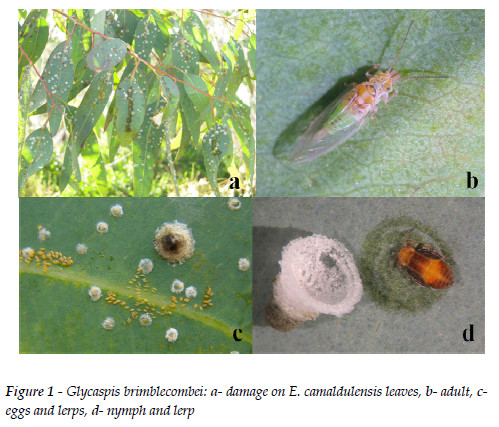
<body><![CDATA[<p>&nbsp;</p>     <p><b>RÉSUMÉ</b></p>     <p>Nous signalons la présence, pour la première fois, de <i>Glycaspis brimblecombei</i> Moore (Hemiptera: Psyllidae) et son parasitoïde <i>Psyllaephagus bliteus</i> Riek (Hymenoptera: Encyrtidae) en Tunisie et, également, la présence pour la première fois de <i>P. bliteus</i> au Portugal. Des données relatives à leur distribution géographique, leurs plantes hôtes et les taux de parasitisme son collectées. <i>G. brimblecombei</i> a été observé pour la première fois en Tunisie en 2010 dans les régions côtières du Nord où il a été noté, uniquement, sur  <i>Eucalyptus camaldulensis </i>Dehnh.. Ses principales espèces hôtes au Portugal sont <i>E. camaldulensis</i>, <i>E. tereticornis </i>Sm., <i>E. rudis</i> Endl. et <i>E. ovata </i>Labill.. Neuf autres espèces, incluant <i>E. globulus </i>Labill., semblent être résistantes. En Tunisie, les taux d'infestation sont élevés dans les régions de l'Ouest (80,5%±4,0) comparés à ceux des régions de l'Est (8,8% ±4,4). En général, les taux de parasitisme trouvés sont faibles, avec une moyenne de 6,5%±0,8. Au Portugal, les niveaux d'infestation varient de 5 à 75% mais aucune tendance géographique n'émerge. Les taux de parasitisme varient en fonction de la saison, de 1% en Mai à 35% en Octobre, correspondant à la période de formation et celle de l'effondrement de la population de <i>G. brimblecombei</i>. Un modèle de densité-dépendance, d'une durée de trois semaines, est suggéré pour le parasitisme des nymphes en relation avec le nombre total des nymphes de <i>G. brimblecombei</i>. D'autres travaux seront nécessaires pour évaluer l'efficacité du parasitoïde dans le contrôle de ce psylle.</p>     <p><b>Mots-clés</b>: Eucalyptus, lutte biologique, invasions biologiques, Psylle du Gommier Rouge, Psyllidae</p>     <p>&nbsp;</p>     <p><b>Introduction</b></p>     <p>Originating from Australia, <i>Eucalyptus</i> are one of the most used trees worldwide for forest plantations, mainly for wood, pulp, biomass, ornamental foliage, soil conservation and honey production. In Tunisia, <i>Eucalyptus</i> plantations were introduced in the thirties, with 117 <i>Eucalyptus</i> species planted in different climatic areas (KHOUJA <i>et al.</i>, 2001). Currently, <i>Eucalyptus</i> plantations in Tunisia comprise 41000 ha (DGF, 2010), mainly in the North of Tunisia with two main species, <i>E. camaldulensis</i> Dehnh. and <i>E. gomphocephala </i>DC. (DGF, 2005). In Portugal, <i>E. globulus</i> Labill. is the main species used in forest plantations, occupying about 26% of the country forest area (ICNF, 2013). Other species, mainly <i>E. camaldulensis</i> are used mostly for amenity purposes in urban parks and road sides.</p>     <p>In both regions the number of alien insect pests in <i>Eucalyptus</i> trees has increased steeply in the last 50 years (KENIS and BRANCO, 2010; DHAHRI and BEN JAMÂA, 2008). Understanding possible pathways, susceptibility of <i>Eucalyptus </i>species and management strategies to deal with these new problems has become a major concern.</p>     <p>The red gum lerp psyllid <i>Glycaspis brimblecombei</i> Moore was one of the most recent introductions in both countries. This psyllid is distinguished by two cephalic projections between the eyes of the adult (LAUDONIA and GARONNA, 2010) and the protective conical white covers made by the nymphs on the leaves (<a href="#f1">Figures 1a and 1c</a>). Females deposit the eggs on the leaf surface, attached to the leaf (<a href="#f1">Figure 1b</a>). The nymphs feed, grow and develop under a conical white waxy cover. The last moult occurs outside the cover, originating the adult (<a href="#f1">Figure 1c</a>). Both nymphs and adults are phloem feeders. Heavy attacks result on the production of copious amounts of honeydew and premature leaf shedding, leading to loss of tree vigour and growth (BRENNAN <i>et al</i>., 1999).</p>     <p>&nbsp;</p> <a name="f1"> <img src="/img/revistas/slu/v22n1/22n1a06f1.jpg">     
]]></body>
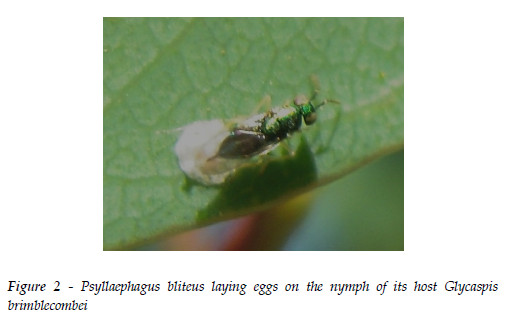
<body><![CDATA[<p>&nbsp;</p>     <p><i>Glycaspis brimblecombei</i> was detected outside Australia for the first time in North America, in California in 1998, where it was considered the most damaging psyllid introduced in the country (BRENNAN <i>et al.</i>, 1999; 2001). In 2001, it was detected for the first time in Chile in the vicinity of the International Airport of Santiago (SANDOVAL and ROTHMANN, 2002). It was included in the Alert List of the European and Mediterranean Plant Protection Organization (EPPO) between 2002 and 2006, when it was deleted. In 2003 was first detected in Brazil (SANTANA and BURCKHARDT, 2007) and in 2005 in Argentina (BOUVET <i>et</i> <i>al.</i>, 2005). In Europe, it occurred for the first time in the Iberian Peninsula in 2007 (BORRAJO <i>et al.</i>, 2009; VALENTE and HODKINSON, 2009). In Morocco it was first found in 2009 (MAATOUF and LUMARET, 2012) and in Italy in 2010 (LAUDONIA and GARONNA, 2010; PERIS-FELIPO <i>et al.</i>, 2011; LO VERDE <i>et al.</i>, 2011). This historical sequence of events suggests a first introduction outside Australia in North America or Chile, a subsequent spread to other countries in South America, Brazil and Argentina, where Eucalyptus plantations represent a significant part of the forest plantations, and then to Europe and North Africa.</p>     <p>In the present work we analyze the geographical distribution of the red gum lerp psyllid in the two countries and the occurrence and parasitism rates of its exotic natural enemy  <i>Psyllaephagus bliteus</i> Riek (Hymenoptera: Encyrtidae) (<a href="#f2">Figure 2</a>).InPortugal we further analyze differences between <i>Eucalyptus</i> species susceptibility.</p>     <p>&nbsp;</p> <a name="f2"> <img src="/img/revistas/slu/v22n1/22n1a06f2.jpg">     
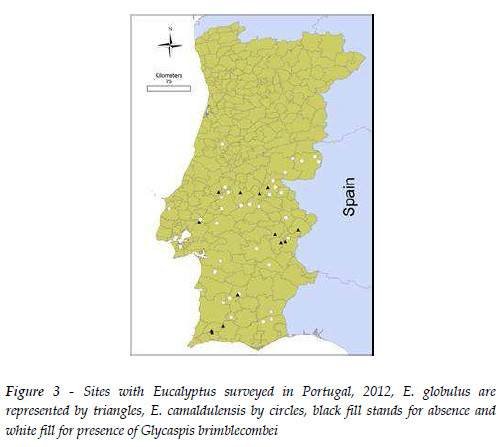
<p>&nbsp;</p>     <p><b>Material and methods</b></p>     <p><i>Field surveys</i></p>     <p><u>Portugal </u></p>     <p>In Portugal, the geographical distribution and infestation levels of <i>G. brimblecombei</i>, were evaluated in 37 sites with <i>E. camaldulensis</i>, plus 16 sites with <i>E. globulus</i>, located along coastal and interior zones of mainland Portugal, in June 2012 (<a href="#f3">Figure 3</a>). As the <i>Eucalyptus</i> species most susceptible to <i>G. brimblecombei</i> are <i>E. camaldulensis</i> and <i>E. tereticornis </i>Sm., found in Portugal along road sides and in city parks, these were the sites and tree species chosen for the surveys. At each site, four trees were evaluated for the presence or absence of <i>G. brimblecombei. </i>When the insect was found the infestation level was evaluated by sampling on each tree, at observer height (1.5-2m), four branches, one in each cardinal direction: North, South, East and West. The infestation level on each branch was estimated visually on four categories (0; 1-20%; 20-50%; &gt;50%) and then mid-classes infestation levels were assigned as follow: 0; 10%, 35% and 75%.</p>     <p>&nbsp;</p> <a name="f3"> <img src="/img/revistas/slu/v22n1/22n1a06f3.jpg">     
]]></body>
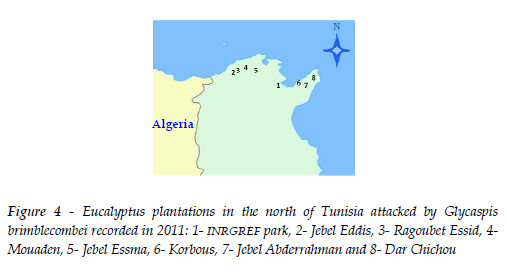
<body><![CDATA[<p>&nbsp;</p>     <p><u>Tunisia</u></p>     <p>In Tunisia samplings were conducted in eight eucalyptus forest located from 10 to 228 m above sea level, near the Mediterranean Sea (<a href="#f4">Figure 4</a>): INRGREF Park, Jbel Eddis and Dar Chichou on <i>E. camaldulensis</i> and <i>E. gomphocephala</i> DC. trees, Moauden on <i>E. camaldulensis</i> and <i>E. astringens</i> (Maiden) trees, Ragoubet Essid and Jebel Essma on<i> E. camaldulensis</i>, Korbous on<i> E. camaldulensis</i> and <i>E. rudis</i> Endl. trees and Jebel Abderrahman on <i>E. camaldulensis</i> and <i>E. tereticornis</i>. In August 2012, ten trees of each <i>Eucalyptus</i> species present in each site were evaluated except for the INRGREF Park where only three trees of each species were evaluated. To estimate the presence and the intensity of the attack, from each tree four attacked branches of 70 cm in length were cut, one of each cardinal direction, and brought to the laboratory where the number of total and attacked leaves were counted.</p>     <p>&nbsp;</p> <a name="f4"> <img src="/img/revistas/slu/v22n1/22n1a06f4.jpg">     
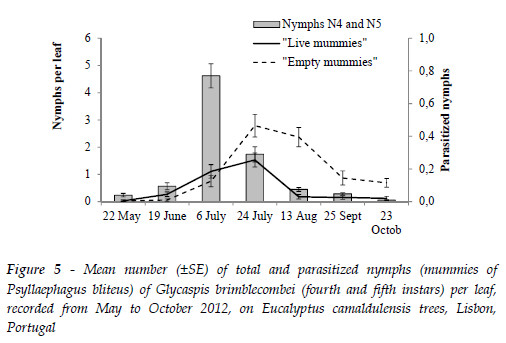
<p>&nbsp;</p>     <p><i>Host range</i></p>     <p>In Portugal an additional survey was conducted in August 2012 to assess susceptibility of different <i>Eucalyptus </i>species planted in a <i>Eucalyptus</i> <i>arboretum</i> located in the campus of the Faculty of Agronomy (ISA), Lisbon. The infestation level of <i>G. brimblecombei</i> was assessed in 30 <i>Eucalyptus</i> species that are present at ISA's arboretum. For each <i>Eucalyptus </i>species four trees were selected, at 10 m distance along a line, whenever possible. In each tree four branches were selected, from each cardinal direction and the infestation level was determined as described above, for the field surveys in Portugal.</p>     <p><i>Parasitism rates</i></p>     <p><u>Portugal</u></p>     <p>The seasonal evolution of the populations of <i>G. brimblecombei</i> and its parasitoid <i>P. bliteus</i> was followed by monthly sampling on <i>E. camaldulensis</i> trees in the ISA's <i>arboretum</i>. This study was conducted between May and October 2012.</p>     ]]></body>
<body><![CDATA[<p>On each month 40 leaves per tree were collected, at about 1.5-3m height, from five trees. The leaves were placed into separate paper bags by tree. In the same day, the leaves were inspected in the laboratory and the immature stages of <i>G. brimblecombei</i> were identified and counted separately by the following groups of developmental stages: i) eggs; ii) young nymphs: first, second and third instars; ii) fourth instar nymphs (N4); iii) fifth instar nymphs (N5); iv) parasitized alive nymphs, "live mummies" and v) parasitized nymphs with exit hole from where a parasitoid had already emerged "empty mummies". The nymphal stages were determined by the number of antennal segments, according to FIRMINO-WINCKLER (2009). The "live mummies" were placed separately, inside gelatine capsules for posterior identification of the emerged parasitoids. The sex ratio of <i>P. bliteus</i> emerged from the mummies was calculated.</p>     <p>To estimate parasitism, it was considered that the alive N4 and N5 were the fraction of the nymphal population that survived to the parasitoid attack. The parasitism rate was then calculated by the formula:</p>     <p>Parasitism rate = number of "<i>live</i> <i>mummies</i>" / (number of "<i>live</i> <i>mummies</i>" + number of nymphs N4+N5 belonging to the same cohort of the mummies) x 100</p>     <p><u>Tunisia</u></p>     <p>In Tunisia, samplings of parasitism rates were conducted on two sites, Moauden and Jbel Eddis, and on two years, August 2012 and July 2013. In each site, on four <i>E. camaldulensis</i> trees,four attacked branches of 50 cm in length were covered with screen bags (60 cm x 45 cm and less than 1 mm mesh size). After 30 days, all emerged insects were counted under binocular. The number of parasitoids and of adult <i>G. brimblecombei</i> was registered. The parasitism rate was determined by the following expression: (Total number of parasitoids emerged per bag/ (Total number of adult psyllid + total number of parasitoids)) x 100.</p>     <p><i>Data analysis</i></p>     <p>Data is presented in average values ± standard error (SE). Relationship of infestation levels with latitude and longitude were assessed by using Pearson correlation. A two-way ANOVA, considering the factors year and site was performed to assess differences on the percentage parasitism, as dependent variable, in Tunisia. Statistical analyses were performed using IBM SPSS statistic 21 (MORGAN <i>et al</i>., 2011).</p>     <p>&nbsp;</p>     <p><b>Results</b></p>     <p><i>Distribution of Glycaspis brimblecombei in Portugal and Tunisia</i></p>     ]]></body>
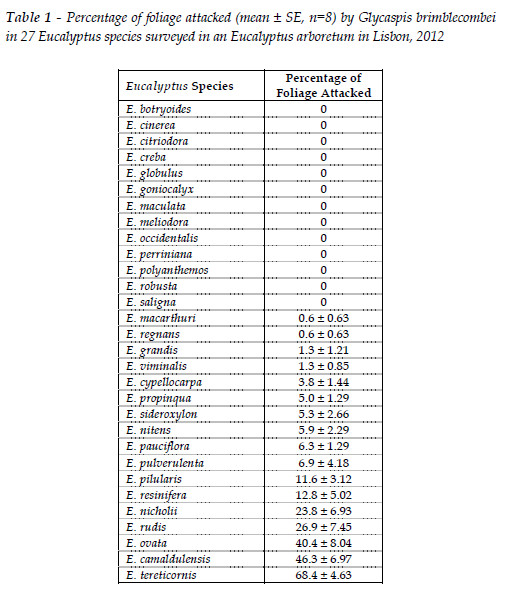
<body><![CDATA[<p><u>Portugal</u></p>     <p>In the field survey conducted in 2012, the red gum lerp psyllid was found on all regions where <i>E. camaldulensis</i> was present, whereas it was never observed on <i>E. globulus</i> (<a href="#f3">Figure 3</a>). The mean percentage leaves (±SE) infested on each site varied from 5.0% ± 1.5 to 75.0% ± 0.0. No relationship with latitude or with longitude emerged significant as determined by the Pearson correlation, <i>r </i>=0.328, <i>p</i> =0.051 and <i>r </i>=-0.103, <i>p</i>=0.550, respectively.</p>     <p><u>Tunisia</u></p>     <p>In Tunisia, the red gum lerp psyllid <i>G. brimblecombei</i> was first observed in September 2010 on the foliage of <i>E. camaldulensis</i> in the Park of INRGREF in Tunis. In a survey conducted in 2012, the psyllid was found present all over the North of Tunisia (<a href="#f4">Figure 4</a>). The proportion of attacked leaves varied from 4.9%±2.6 to 95.4%±1.1. Infestation level was not correlated with latitude, r= 0.63, <i>p</i> = 0.092, but was significantly correlated with longitude, r= -0.93, <i>p</i> &lt; 0.001. The percentage of attacked leaves was highest on the West sites: Jebel Eddis, 72.6%±1.2, Ragoubet Essid, 95.4% ±1.1, Mouaden, 87.3%±9.7 and Jebel Essma, 66.7%±12.3. Defoliation due to severe sap sucking activity was recorded in all these localities. Yet, on the East sites, infestation level was about ten times lower: Dar Chichou 13.5% ±4.3), INRGREF, 9.7% ±1.2, Korbous, 7.7% ± 3.2, Jbel Abderrahmane, 4.9% ± 2.5. </p>     <p>&nbsp;</p>     <p><b>Host plants </b></p>     <p>According to the infestation levels observed on an arboretum in Lisbon, <i>E. tereticornis,</i> <i>E. camaldulensis</i> and <i>E. ovata</i> were the most susceptible Eucalyptus species to <i>G. brimblecombei</i> (<a href="#t1">Table 1</a>). <i>E. globulus</i>, which is the most important planted species in Portugal, was observed to be resistant to <i>G. brimblecombei</i> as well as other 12 species (<a href="#t1">Table 1</a>). The species <i>E. nitens</i> (Deane &amp; Maiden) Maiden also used for forestry purposes and from the same Botanical section as <i>E. globulus</i> showed an intermediate susceptibility. Other 13 species of Eucalyptus also exhibited the presence of the psyllid at low or intermediate densities (<a href="#t1">Table 1</a>).</p>     <p>&nbsp;</p> <a name="t1"> <img src="/img/revistas/slu/v22n1/22n1a06t1.jpg">     
<p>&nbsp;</p>     <p><i>Parasitism by Psyllaephagus bliteus</i></p>     ]]></body>
<body><![CDATA[<p><u>Portugal</u></p>     <p>From the study conducted in 2012 at ISA's arboretum the parasitism rate was low in May at the beginning of the study, 1.0±1.0%, when the population of the psyllid started to build up, and attained a maximum of 35±15.0% in October, when the population of the psyllid collapsed. The peak of parasitized nymphs followed with about three weeks delay the peak of total nymphs (<a href="#f5">Figure 5</a>).</p>     <p>&nbsp;</p> <a name="f5"> <img src="/img/revistas/slu/v22n1/22n1a06f5.jpg">     
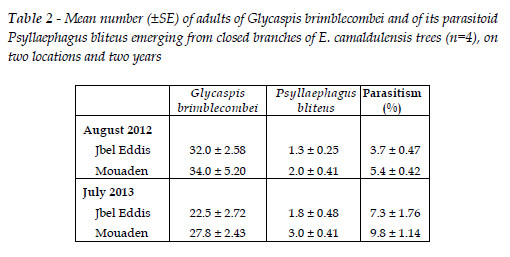
<p>&nbsp;</p>     <p>From the collected "<i>live mummies</i>" only <i>P. bliteus</i> emerged (43 males and 54 females). No other parasitoid or hyper-parasitoid was observed.</p>     <p>Mean monthly air temperatures during the observed months varied between 19ºC in May and 23ºC in August. Within the observed period rainfall occurred in May (50 mm), August (8 mm), September (50 mm) and October (110 mm). The collapse of <i>G. brimblecombei</i> started between July and August, before any rainfall occurred.</p>     <p><u>Tunisia</u></p>     <p>In 2011, a team of researchers prospecting the eucalyptus plantation attacked by <i>G. brimblecombei</i> found nymphs parasitized by<i> P. bliteus</i> in the north of Tunisia. In the evaluations made in 2012 and 2013 in two sites, the proportion of <i>P. bliteus</i> emerging in relation to adult psyllids was found to be low, overall mean 6.5%±0.8 (<a href="#t2">Table 2</a>). Results from the ANOVA show significant differences between the two years (F<sub>1,12 </sub>=13.00, <i>p</i> =0.004) but not  between sites (F<sub>1,12 </sub>=3.85, <i>p</i> =0.073) and no interaction site*year (F<sub>1,12 </sub>=0.133, <i>p</i> =0.721). Parasitism was higher on 2013 in comparison with 2012 (<a href="#t2">Table 2</a>).</p>     <p>&nbsp;</p> <a name="t2"> <img src="/img/revistas/slu/v22n1/22n1a06t2.jpg">     
<p>&nbsp;</p>     ]]></body>
<body><![CDATA[<p><b>Discussion</b></p>     <p>In this work the first record of <i>G. brimblecombei</i> in Tunisia and its parasitoid <i>P. bliteus</i> in Portugal and Tunisia is presented. The spatial and temporal sequence of events suggests a possible introduction of <i>G. brimblecombei</i> into Western Europe from North or South America, where the species was present since the nineteens' (BRENNAN <i>et al</i>., 1999) and subsequent spread to eastern Mediterranean countries. In Tunisia higher densities were found on the West region compared to those on the East, which might be related with the invasion process starting from West.</p>     <p>A rapid spread of the red gum psyllid was observed in Portugal and Tunisia following its introduction. In Portugal, five years after its first detection in 2007 (VALENTE and HODKINSON, 2008), the psyllid was now found on all the sites surveyed. The most susceptible <i>Eucalyptus</i> species were found to be <i>E. camaldulensis</i>, <i>E. tereticornis, E. rudis </i>and <i>E. ovata </i>as reported by previous works (BRENNAN <i>et al.</i>, 2001). Yet, the presence of the pysllid was here recorded in 11 other species, including <i>E. nitens</i>, one important planted species in Portugal in use to replace <i>E. globulus</i> in areas where <i>Eucalyptus</i> plantations are severely affected by the <i>Eucalyptus</i> weevil <i>Gonipterus platensis</i> Marelli (Coleoptera: Curculionidae) (REIS <i>et al</i>., 2012). Still, <i>E. globulus</i> was found to be resistant to <i>G. brimblecombei,</i> which implies a lower concern about the economic impact of the pest species in Portugal. In Tunisia as well as in other North African countries, <i>E. camaldulensis</i> and <i>E. rudis</i> are among the most used trees for soil protection, biomass and firewood production. Thus higher social and economic impacts of this psyllid may occur in these countries, comparatively to Portugal.</p>     <p>The parasitoid <i>P. bliteus</i> was observed in both countries although it was not imported or released in neither of them. The presence of <i>P. bliteus</i> in Portugal, which is reported here for the first time, was first noticed in June 2011, in Coimbra and Lisbon area (CARLOS VALENTE and CONCEIÇÃO BOAVIDA, pers. communication). In Spain it was detected, in 2010, in the region of Huelva (PÉREZ-OTERO <i>et al.,</i> 2011). In 2011, <i>P. bliteus</i> was also detected in Italy without being intentionally imported and released (CALECA <i>et al.</i>, 2011). Altogether these observations suggest that some individuals of the parasitoid might have arrived together with the psyllid, accompanying its spread. In some regions, namely in California (EUA) and Brazil, this biological control agent was considered of great interest to control the populations of <i>G. brimblecombei</i> and was mass reared and released (DAHLSTEN <i>et al.</i>, 2005; SANTANA and BURCKHARDT, 2007). The parasitism rates found in both Tunisia and Portugal were relatively low. In Portugal, as expected, it was observed that the parasitism rates changed through time and season with the host population dynamics, showing a density-dependent relationship, slightly delayed in time. As a consequence, the calculated parasitism rates were lowest in the beginning of the season, when the psyllid population density was highest but the parasitoid population was still developing. Conversely, the parasitism rates were highest at the end of the season, contributing for the collapse of the psyllid population, together with climate and plant quality. Therefore, present data shows high seasonal variability on the parasitism rate and a density-dependence pattern. As a consequence, during six sampling months, the parasitized mummies represented 1 to 35% of total nymphs. The method used is not as precise as dissecting live psyllids, and might slightly underestimate the total parasitism. A relationship of the parasitism rates with the climate were found by DAANE <i>et al.</i> (2012) in California, with lower parasitism rates observed on drier and hot continental sites (1.2%) than the average parasitism rate at coastal sites (29.7%). Lisbon is located near the coast, as well as the surveyed regions in Tunisia, thus, according to the climate hypothesis, higher parasitism rates are expected to occur in the surveyed regions compared to those in the interior regions of both countries. It is also possible that due to its recent introduction the populations are still increasing.</p>     <p>In Portugal, the intensity of tree infestation was not related with longitude, thus a coastal-inland gradient was not observed. Further studies will be needed to confirm the effect of climate and parasitism rates on these Mediterranean regions and in order to fully understand the population dynamics of <i>G</i>.<i> brimblecombei</i> and the impact of <i>P. bliteus</i>. In both Tunisia and Portugal, a national survey program to estimate the evolution of the infestation and to evaluate the impact of the parasitoid <i>P. bliteus</i> on the <i>G</i>.<i> brimblecombei</i> population is being prepared which will help to clarify the relevance of this natural enemy.</p>     <p>&nbsp;</p>     <p><b>References</b></p>     <!-- ref --><p>BRENNAN, E.B., GILL, R.J., HRUSA, G.F., WEINBAUM, S.A., 1999. First record of <i>Glycaspis brimblecombei </i>(Moore) (Homoptera: Psyllidae) in North America: initial observationsand predator associations of a potentially serious new pest of <i>Eucalyptus </i>in California. <i>Pan-Pacific Entomol</i> <b>75</b>: 55-57.    &nbsp;&nbsp;&nbsp;&nbsp;&nbsp;&nbsp;&nbsp;&nbsp;[&#160;<a href="javascript:void(0);" onclick="javascript: window.open('/scielo.php?script=sci_nlinks&ref=000090&pid=S0870-6352201400010000600001&lng=','','width=640,height=500,resizable=yes,scrollbars=1,menubar=yes,');">Links</a>&#160;]<!-- end-ref --></p>     <!-- ref --><p>BRENNAN, E.B., HRUSA, G.F., WEINBAUM, S.A., LEVISON, W.J., 2001. Resistance of <i>Eucalyptus</i> species to <i>Glycaspis brimblecombei</i> (Homoptera: Psyllidae) in the San Francisco bay area. <i>Pan-Pac Entomol</i> <b>77</b>: 249–253.    &nbsp;&nbsp;&nbsp;&nbsp;&nbsp;&nbsp;&nbsp;&nbsp;[&#160;<a href="javascript:void(0);" onclick="javascript: window.open('/scielo.php?script=sci_nlinks&ref=000092&pid=S0870-6352201400010000600002&lng=','','width=640,height=500,resizable=yes,scrollbars=1,menubar=yes,');">Links</a>&#160;]<!-- end-ref --></p>     <!-- ref --><p>BORRAJO, P., LOPEZ, G., RUIZ, F., 2009. Primera cita de <i>Glycaspis brimblecombei </i>Moore (Homoptera: Psyllidae) en SO de España. <i>Bol Sanidad Veg Plagas</i> <b>35</b>: 355-361.    &nbsp;&nbsp;&nbsp;&nbsp;&nbsp;&nbsp;&nbsp;&nbsp;[&#160;<a href="javascript:void(0);" onclick="javascript: window.open('/scielo.php?script=sci_nlinks&ref=000094&pid=S0870-6352201400010000600003&lng=','','width=640,height=500,resizable=yes,scrollbars=1,menubar=yes,');">Links</a>&#160;]<!-- end-ref --></p>     <!-- ref --><p>BOUVET, J.P.R., HARRAND, L., BURCKHARDT, D., 2005. Primera cita de <i>Blastopsylla occidentalis </i>y <i>Glycaspis brimblecombei </i>(Hemiptera: Psyllidae) para la República Argentina <i>Rev Soc Entomol Argent </i><b>64</b>: 99-102.    &nbsp;&nbsp;&nbsp;&nbsp;&nbsp;&nbsp;&nbsp;&nbsp;[&#160;<a href="javascript:void(0);" onclick="javascript: window.open('/scielo.php?script=sci_nlinks&ref=000096&pid=S0870-6352201400010000600004&lng=','','width=640,height=500,resizable=yes,scrollbars=1,menubar=yes,');">Links</a>&#160;]<!-- end-ref --></p>     <!-- ref --><p>CALECA, V., LO VERDE, G., MALTESE, M., 2011. First record in Italy of <i>Psyllaephagus bliteus </i>Riek (<i>Hymenoptera Encyrtidae</i>) parasitoid of <i>Glycaspis brimblecombei </i>Moore (<i>Hemiptera: Psyllidae</i>). <i>Naturalista Sicil</i> <b>37</b>: 435-444.    &nbsp;&nbsp;&nbsp;&nbsp;&nbsp;&nbsp;&nbsp;&nbsp;[&#160;<a href="javascript:void(0);" onclick="javascript: window.open('/scielo.php?script=sci_nlinks&ref=000098&pid=S0870-6352201400010000600005&lng=','','width=640,height=500,resizable=yes,scrollbars=1,menubar=yes,');">Links</a>&#160;]<!-- end-ref --></p>     <!-- ref --><p>DAANE, K.M., SIME, K.R., PAINE, T.D., 2012. Climate and the effectiveness of <i>Psyllaephagus bliteus</i> as a parasitoid of the red gum lerp psyllid. <i>Biocont Sci Technol</i> <b>22</b>(11): 1305-1320.    &nbsp;&nbsp;&nbsp;&nbsp;&nbsp;&nbsp;&nbsp;&nbsp;[&#160;<a href="javascript:void(0);" onclick="javascript: window.open('/scielo.php?script=sci_nlinks&ref=000100&pid=S0870-6352201400010000600006&lng=','','width=640,height=500,resizable=yes,scrollbars=1,menubar=yes,');">Links</a>&#160;]<!-- end-ref --></p>     <!-- ref --><p>DAHLSTEN, D., DAANE, K., PAINE, T., SIME, K., LAWSON, A., ROWNEY, D., ROLTSCH, W., JOHN, A., KABASHIMA, J., SHAW, D., ROBB, K., GEISEL, P. CHANEY, EMERITUS, W., INGELS, C., VARELA, L., BIANCHI, M., TAYLOR, G., 2005. Imported parasitoid helps control red gum lerp psyllid. <i>Calif Agric</i><i>.</i> <b>59</b>: 229-234.    &nbsp;&nbsp;&nbsp;&nbsp;&nbsp;&nbsp;&nbsp;&nbsp;[&#160;<a href="javascript:void(0);" onclick="javascript: window.open('/scielo.php?script=sci_nlinks&ref=000102&pid=S0870-6352201400010000600007&lng=','','width=640,height=500,resizable=yes,scrollbars=1,menubar=yes,');">Links</a>&#160;]<!-- end-ref --></p>     <!-- ref --><p>DHAHRI, S., BEN JAMAA, M.L., 2008. Les insectes ravageurs des eucalyptus en Tunisie. <i>Ann. INRGREF</i> <b>12</b>(2) NS: 363-372.    &nbsp;&nbsp;&nbsp;&nbsp;&nbsp;&nbsp;&nbsp;&nbsp;[&#160;<a href="javascript:void(0);" onclick="javascript: window.open('/scielo.php?script=sci_nlinks&ref=000104&pid=S0870-6352201400010000600008&lng=','','width=640,height=500,resizable=yes,scrollbars=1,menubar=yes,');">Links</a>&#160;]<!-- end-ref --></p>     <!-- ref --><p>DGF - Direction Générale des Forêts, 2005. Résultats du Deuxième Inventaire Forestier et Pastoral National, Ministère de l'Agriculture, des ressources en Eau et de la Pêche. Tunisie, 129 pp.    &nbsp;&nbsp;&nbsp;&nbsp;&nbsp;&nbsp;&nbsp;&nbsp;[&#160;<a href="javascript:void(0);" onclick="javascript: window.open('/scielo.php?script=sci_nlinks&ref=000106&pid=S0870-6352201400010000600009&lng=','','width=640,height=500,resizable=yes,scrollbars=1,menubar=yes,');">Links</a>&#160;]<!-- end-ref --></p>     <!-- ref --><p>DGF - Direction Générale des Forêts, 2010. Résultats du deuxième inventaire forestier et pastoral national. Ministère de l'Agriculture de Tunisie, 180 p + annexes.    &nbsp;&nbsp;&nbsp;&nbsp;&nbsp;&nbsp;&nbsp;&nbsp;[&#160;<a href="javascript:void(0);" onclick="javascript: window.open('/scielo.php?script=sci_nlinks&ref=000108&pid=S0870-6352201400010000600010&lng=','','width=640,height=500,resizable=yes,scrollbars=1,menubar=yes,');">Links</a>&#160;]<!-- end-ref --></p>     <!-- ref --><p>FIRMINO-WINCKLER, D.C., WILCKEN, C.F., de OLIVEIRA, N.C., de MATOS, C.A.O., 2009. Biologia do psilídeo-de-concha <i>Glycaspis brimblecombei</i> Moore (Hemiptera, Psyllidae) em Eucalyptus spp. <i>Rev Bras Entomol</i> <b>53</b>(1): 144-146.    &nbsp;&nbsp;&nbsp;&nbsp;&nbsp;&nbsp;&nbsp;&nbsp;[&#160;<a href="javascript:void(0);" onclick="javascript: window.open('/scielo.php?script=sci_nlinks&ref=000110&pid=S0870-6352201400010000600011&lng=','','width=640,height=500,resizable=yes,scrollbars=1,menubar=yes,');">Links</a>&#160;]<!-- end-ref --></p>     <!-- ref --><p>PERIS-FELIPO, F.J., MANCUSI, G., TURRISI, G.F., JIMENEZ-PYEDRO, R., 2011. New corological and biological data of the Red Gum Lerp Psyllid, <i>Glycaspis brimblecombei </i>Moore, 1964 in Italy (Hemiptera, Psyllidae) <i>Biodiv Jour</i> <b>2</b>(1): 13-17.    &nbsp;&nbsp;&nbsp;&nbsp;&nbsp;&nbsp;&nbsp;&nbsp;[&#160;<a href="javascript:void(0);" onclick="javascript: window.open('/scielo.php?script=sci_nlinks&ref=000112&pid=S0870-6352201400010000600012&lng=','','width=640,height=500,resizable=yes,scrollbars=1,menubar=yes,');">Links</a>&#160;]<!-- end-ref --></p>     <!-- ref --><p>ICNF, 2013. IFN6 -Áreas dos usos do solo e das espécies florestais de Portugal continental. Resultados preliminares. Instituto da Conservação da Natureza e das Florestas, Lisboa, pp. 33.    &nbsp;&nbsp;&nbsp;&nbsp;&nbsp;&nbsp;&nbsp;&nbsp;[&#160;<a href="javascript:void(0);" onclick="javascript: window.open('/scielo.php?script=sci_nlinks&ref=000114&pid=S0870-6352201400010000600013&lng=','','width=640,height=500,resizable=yes,scrollbars=1,menubar=yes,');">Links</a>&#160;]<!-- end-ref --></p>     <!-- ref --><p>KENIS, M., BRANCO, M., 2010. Impact of alien terrestrial arthropods in Europe. Chapter 5. <i>BioRisk</i> <b>4</b>: 51-71.    &nbsp;&nbsp;&nbsp;&nbsp;&nbsp;&nbsp;&nbsp;&nbsp;[&#160;<a href="javascript:void(0);" onclick="javascript: window.open('/scielo.php?script=sci_nlinks&ref=000116&pid=S0870-6352201400010000600014&lng=','','width=640,height=500,resizable=yes,scrollbars=1,menubar=yes,');">Links</a>&#160;]<!-- end-ref --></p>     <!-- ref --><p>KHOUJA, M.L., KHALDI, A., RJEB, M.N., 2001. Results of the eucalyptus introduction trials in Tunisia. Pages 163-168. Proceeding of the International conference; <i>Eucalyptus in the Mediterranean basin: perspectives and new utilization.</i> October 15-19, 2000, Centro Promozione Pubblicità, Florence, Taormina- Italy.    &nbsp;&nbsp;&nbsp;&nbsp;&nbsp;&nbsp;&nbsp;&nbsp;[&#160;<a href="javascript:void(0);" onclick="javascript: window.open('/scielo.php?script=sci_nlinks&ref=000118&pid=S0870-6352201400010000600015&lng=','','width=640,height=500,resizable=yes,scrollbars=1,menubar=yes,');">Links</a>&#160;]<!-- end-ref --></p>     <!-- ref --><p>LAUDONIA, S., GARONNA, A.P., 2010. The red gum lerp psyllid, <i>Glycaspis brimblecombei</i>, a new exotic pest of <i>Eucalyptus camaldulensis </i>in Italy. <i>Bull Insectol</i> <b>63</b>: 233-236.    &nbsp;&nbsp;&nbsp;&nbsp;&nbsp;&nbsp;&nbsp;&nbsp;[&#160;<a href="javascript:void(0);" onclick="javascript: window.open('/scielo.php?script=sci_nlinks&ref=000120&pid=S0870-6352201400010000600016&lng=','','width=640,height=500,resizable=yes,scrollbars=1,menubar=yes,');">Links</a>&#160;]<!-- end-ref --></p>     <!-- ref --><p>LO VERDE, G., BELLA, S., CALECA, V., RAPISARDA, C., SIDOTI, A., 2011. Presenza in Sicilia di <i>Glycaspis brimblecombei </i>Moore (<i>Hemiptera Psyllidae</i>) su <i>Eucalyptus camaldulensis </i>Dehnh. <i>Naturalista Sicil</i> <b>35</b>: 425-434.    &nbsp;&nbsp;&nbsp;&nbsp;&nbsp;&nbsp;&nbsp;&nbsp;[&#160;<a href="javascript:void(0);" onclick="javascript: window.open('/scielo.php?script=sci_nlinks&ref=000122&pid=S0870-6352201400010000600017&lng=','','width=640,height=500,resizable=yes,scrollbars=1,menubar=yes,');">Links</a>&#160;]<!-- end-ref --></p>     <!-- ref --><p>MAATOUF, N., LUMARET, J.P., 2012. Eco-ethologie des nouveaux ravageurs invasifs des eucalyptus du Maroc<i>.</i><i>Ann Soc Entomol Fr </i><b>48</b>: 289-297.    &nbsp;&nbsp;&nbsp;&nbsp;&nbsp;&nbsp;&nbsp;&nbsp;[&#160;<a href="javascript:void(0);" onclick="javascript: window.open('/scielo.php?script=sci_nlinks&ref=000124&pid=S0870-6352201400010000600018&lng=','','width=640,height=500,resizable=yes,scrollbars=1,menubar=yes,');">Links</a>&#160;]<!-- end-ref --></p>     <!-- ref --><p>MORGAN, G.A., LEECH, N.L., GLOECKNER, G.W., BARRETT, K.C., 2011. IBM SPSS for introductory statistics: Use and interpretation. Taylor &amp; Francis.    &nbsp;&nbsp;&nbsp;&nbsp;&nbsp;&nbsp;&nbsp;&nbsp;[&#160;<a href="javascript:void(0);" onclick="javascript: window.open('/scielo.php?script=sci_nlinks&ref=000126&pid=S0870-6352201400010000600019&lng=','','width=640,height=500,resizable=yes,scrollbars=1,menubar=yes,');">Links</a>&#160;]<!-- end-ref --></p>     <!-- ref --><p>PÉREZ-OTERO, R., BORRAJO, P., MANSILLA, J.P., RUIZ, F., 2011. Primera cita en España de <i>Psyllaephagus bliteus</i> Riek (Hymenoptera, Encyrtidae), parasitoide de <i>Glycaspis brimblecombei </i>Moore (Hemiptera, Psyllidae). <i>Bol Sanidad Veg Plagas</i> <b>37</b>: 37-44.    &nbsp;&nbsp;&nbsp;&nbsp;&nbsp;&nbsp;&nbsp;&nbsp;[&#160;<a href="javascript:void(0);" onclick="javascript: window.open('/scielo.php?script=sci_nlinks&ref=000128&pid=S0870-6352201400010000600020&lng=','','width=640,height=500,resizable=yes,scrollbars=1,menubar=yes,');">Links</a>&#160;]<!-- end-ref --></p>     <!-- ref --><p>REIS, A.R., FERREIRA, L., TOMÉ, M., ARAUJO, C., BRANCO, M., 2012. Efficiency of biological control of <i>Gonipterus platensis</i> (Coleoptera: Curculionidae) by <i>Anaphes nitens </i>(Hymenoptera: Mymaridae) in cold areas of the Iberian Peninsula: Implications for defoliation and wood production in <i>Eucalyptus globulus</i>. <i>Forest Ecol Manag</i> <b>270</b>: 216-222.    &nbsp;&nbsp;&nbsp;&nbsp;&nbsp;&nbsp;&nbsp;&nbsp;[&#160;<a href="javascript:void(0);" onclick="javascript: window.open('/scielo.php?script=sci_nlinks&ref=000130&pid=S0870-6352201400010000600021&lng=','','width=640,height=500,resizable=yes,scrollbars=1,menubar=yes,');">Links</a>&#160;]<!-- end-ref --></p>     <!-- ref --><p>SANDOVAL, A., ROTHMANN, S., 2002. Detección del psílido de los eucaliptos rojos, Glycaspis brimblecombei Moore 1964, en Chile (Homoptera: Psyllidae). <i>XXIV Congreso Nacional de Entomología</i>. Santiago, Chile (Abstract).    &nbsp;&nbsp;&nbsp;&nbsp;&nbsp;&nbsp;&nbsp;&nbsp;[&#160;<a href="javascript:void(0);" onclick="javascript: window.open('/scielo.php?script=sci_nlinks&ref=000132&pid=S0870-6352201400010000600022&lng=','','width=640,height=500,resizable=yes,scrollbars=1,menubar=yes,');">Links</a>&#160;]<!-- end-ref --></p>     <!-- ref --><p>SANTANA, D.L.Q., BURCKHARDT, D., 2007. Introduced Eucalyptus psyllids in Brazil. <i>J For Res </i><b>12</b>: 337–344.    &nbsp;&nbsp;&nbsp;&nbsp;&nbsp;&nbsp;&nbsp;&nbsp;[&#160;<a href="javascript:void(0);" onclick="javascript: window.open('/scielo.php?script=sci_nlinks&ref=000134&pid=S0870-6352201400010000600023&lng=','','width=640,height=500,resizable=yes,scrollbars=1,menubar=yes,');">Links</a>&#160;]<!-- end-ref --></p>     <!-- ref --><p>VALENTE, C., HODKINSON, I., 2009. First record of the Red Gum Lerp Psyllid, <i>Glycaspis brimblecombei </i>Moore (Hym.: Psyllidae) in Europe. <i>J </i><i>App Entomol </i><b>133</b>: 315-315.    &nbsp;&nbsp;&nbsp;&nbsp;&nbsp;&nbsp;&nbsp;&nbsp;[&#160;<a href="javascript:void(0);" onclick="javascript: window.open('/scielo.php?script=sci_nlinks&ref=000136&pid=S0870-6352201400010000600024&lng=','','width=640,height=500,resizable=yes,scrollbars=1,menubar=yes,');">Links</a>&#160;]<!-- end-ref --></p>     <p>&nbsp;</p>     <p><i>Submitted for publication in November 2013</i></p>     <p><i>Accepted in January 2014</i></p>     <p>&nbsp;</p>     <p><b>Acknowledgements</b></p>     ]]></body>
<body><![CDATA[<p>This study was funded in Portugal by National Funding through FCT- Fundação para a Ciência e a Tecnologia, National Project PTDC/AGR-CFL/111877/2009 and a bilateral cooperation Project Portugal-Tunisia, 43/TP/09. This work was also supported by the 2<sup>nd</sup> Project 'Integrated management of Forest' TS-P33 financed by JICA.</p>      ]]></body><back>
<ref-list>
<ref id="B1">
<nlm-citation citation-type="journal">
<person-group person-group-type="author">
<name>
<surname><![CDATA[BRENNAN]]></surname>
<given-names><![CDATA[E.B.]]></given-names>
</name>
<name>
<surname><![CDATA[GILL]]></surname>
<given-names><![CDATA[R.J.]]></given-names>
</name>
<name>
<surname><![CDATA[HRUSA]]></surname>
<given-names><![CDATA[G.F.]]></given-names>
</name>
<name>
<surname><![CDATA[WEINBAUM]]></surname>
<given-names><![CDATA[S.A.]]></given-names>
</name>
</person-group>
<article-title xml:lang="en"><![CDATA[First record of Glycaspis brimblecombei (Moore) (Homoptera: Psyllidae) in North America: initial observationsand predator associations of a potentially serious new pest of Eucalyptus in California]]></article-title>
<source><![CDATA[Pan-Pacific Entomol]]></source>
<year>1999</year>
<volume>75</volume>
<page-range>55-57</page-range></nlm-citation>
</ref>
<ref id="B2">
<nlm-citation citation-type="journal">
<person-group person-group-type="author">
<name>
<surname><![CDATA[BRENNAN]]></surname>
<given-names><![CDATA[E.B.]]></given-names>
</name>
<name>
<surname><![CDATA[HRUSA]]></surname>
<given-names><![CDATA[G.F.]]></given-names>
</name>
<name>
<surname><![CDATA[WEINBAUM]]></surname>
<given-names><![CDATA[S.A.]]></given-names>
</name>
<name>
<surname><![CDATA[LEVISON]]></surname>
<given-names><![CDATA[W.J.]]></given-names>
</name>
</person-group>
<article-title xml:lang="en"><![CDATA[Resistance of Eucalyptus species to Glycaspis brimblecombei (Homoptera: Psyllidae) in the San Francisco bay area]]></article-title>
<source><![CDATA[Pan-Pac Entomol]]></source>
<year>2001</year>
<volume>77</volume>
<page-range>249-253</page-range></nlm-citation>
</ref>
<ref id="B3">
<nlm-citation citation-type="journal">
<person-group person-group-type="author">
<name>
<surname><![CDATA[BORRAJO]]></surname>
<given-names><![CDATA[P.]]></given-names>
</name>
<name>
<surname><![CDATA[LOPEZ]]></surname>
<given-names><![CDATA[G.]]></given-names>
</name>
<name>
<surname><![CDATA[RUIZ]]></surname>
<given-names><![CDATA[F.]]></given-names>
</name>
</person-group>
<article-title xml:lang="es"><![CDATA[Primera cita de Glycaspis brimblecombei Moore (Homoptera: Psyllidae) en SO de España]]></article-title>
<source><![CDATA[Bol Sanidad Veg Plagas]]></source>
<year>2009</year>
<volume>35</volume>
<page-range>355-361</page-range></nlm-citation>
</ref>
<ref id="B4">
<nlm-citation citation-type="journal">
<person-group person-group-type="author">
<name>
<surname><![CDATA[BOUVET]]></surname>
<given-names><![CDATA[J.P.R.]]></given-names>
</name>
<name>
<surname><![CDATA[HARRAND]]></surname>
<given-names><![CDATA[L.]]></given-names>
</name>
<name>
<surname><![CDATA[BURCKHARDT]]></surname>
<given-names><![CDATA[D.]]></given-names>
</name>
</person-group>
<article-title xml:lang="es"><![CDATA[Primera cita de Blastopsylla occidentalis y Glycaspis brimblecombei (Hemiptera: Psyllidae) para la República Argentina]]></article-title>
<source><![CDATA[Rev Soc Entomol Argent]]></source>
<year>2005</year>
<volume>64</volume>
<page-range>99-102</page-range></nlm-citation>
</ref>
<ref id="B5">
<nlm-citation citation-type="journal">
<person-group person-group-type="author">
<name>
<surname><![CDATA[CALECA]]></surname>
<given-names><![CDATA[V.]]></given-names>
</name>
<name>
<surname><![CDATA[LO VERDE]]></surname>
<given-names><![CDATA[G.]]></given-names>
</name>
<name>
<surname><![CDATA[MALTESE]]></surname>
<given-names><![CDATA[M.]]></given-names>
</name>
</person-group>
<article-title xml:lang="en"><![CDATA[First record in Italy of Psyllaephagus bliteus Riek (Hymenoptera Encyrtidae) parasitoid of Glycaspis brimblecombei Moore (Hemiptera: Psyllidae)]]></article-title>
<source><![CDATA[Naturalista Sicil]]></source>
<year>2011</year>
<volume>37</volume>
<page-range>435-444</page-range></nlm-citation>
</ref>
<ref id="B6">
<nlm-citation citation-type="journal">
<person-group person-group-type="author">
<name>
<surname><![CDATA[DAANE]]></surname>
<given-names><![CDATA[K.M.]]></given-names>
</name>
<name>
<surname><![CDATA[SIME]]></surname>
<given-names><![CDATA[K.R.]]></given-names>
</name>
<name>
<surname><![CDATA[PAINE]]></surname>
<given-names><![CDATA[T.D.]]></given-names>
</name>
</person-group>
<article-title xml:lang="en"><![CDATA[Climate and the effectiveness of Psyllaephagus bliteus as a parasitoid of the red gum lerp psyllid]]></article-title>
<source><![CDATA[Biocont Sci Technol]]></source>
<year>2012</year>
<volume>22</volume>
<numero>11</numero>
<issue>11</issue>
<page-range>1305-1320</page-range></nlm-citation>
</ref>
<ref id="B7">
<nlm-citation citation-type="journal">
<person-group person-group-type="author">
<name>
<surname><![CDATA[DAHLSTEN]]></surname>
<given-names><![CDATA[D.]]></given-names>
</name>
<name>
<surname><![CDATA[DAANE]]></surname>
<given-names><![CDATA[K.]]></given-names>
</name>
<name>
<surname><![CDATA[PAINE]]></surname>
<given-names><![CDATA[T.]]></given-names>
</name>
<name>
<surname><![CDATA[SIME]]></surname>
<given-names><![CDATA[K.]]></given-names>
</name>
<name>
<surname><![CDATA[LAWSON]]></surname>
<given-names><![CDATA[A.]]></given-names>
</name>
<name>
<surname><![CDATA[ROWNEY]]></surname>
<given-names><![CDATA[D.]]></given-names>
</name>
<name>
<surname><![CDATA[ROLTSCH]]></surname>
<given-names><![CDATA[W.]]></given-names>
</name>
<name>
<surname><![CDATA[JOHN]]></surname>
<given-names><![CDATA[A.]]></given-names>
</name>
<name>
<surname><![CDATA[KABASHIMA]]></surname>
<given-names><![CDATA[J.]]></given-names>
</name>
<name>
<surname><![CDATA[SHAW]]></surname>
<given-names><![CDATA[D.]]></given-names>
</name>
<name>
<surname><![CDATA[ROBB]]></surname>
<given-names><![CDATA[K.]]></given-names>
</name>
<name>
<surname><![CDATA[GEISEL]]></surname>
<given-names><![CDATA[P. CHANEY]]></given-names>
</name>
<name>
<surname><![CDATA[EMERITUS]]></surname>
<given-names><![CDATA[W.]]></given-names>
</name>
<name>
<surname><![CDATA[INGELS]]></surname>
<given-names><![CDATA[C.]]></given-names>
</name>
<name>
<surname><![CDATA[VARELA]]></surname>
<given-names><![CDATA[L.]]></given-names>
</name>
<name>
<surname><![CDATA[BIANCHI]]></surname>
<given-names><![CDATA[M.]]></given-names>
</name>
<name>
<surname><![CDATA[TAYLOR]]></surname>
<given-names><![CDATA[G.]]></given-names>
</name>
</person-group>
<article-title xml:lang="en"><![CDATA[Imported parasitoid helps control red gum lerp psyllid]]></article-title>
<source><![CDATA[Calif Agric.]]></source>
<year>2005</year>
<volume>59</volume>
<page-range>229-234</page-range></nlm-citation>
</ref>
<ref id="B8">
<nlm-citation citation-type="journal">
<person-group person-group-type="author">
<name>
<surname><![CDATA[DHAHRI]]></surname>
<given-names><![CDATA[S.]]></given-names>
</name>
<name>
<surname><![CDATA[BEN JAMAA]]></surname>
<given-names><![CDATA[M.L.]]></given-names>
</name>
</person-group>
<article-title xml:lang="fr"><![CDATA[Les insectes ravageurs des eucalyptus en Tunisie]]></article-title>
<source><![CDATA[Ann. INRGREF]]></source>
<year>2008</year>
<volume>12</volume>
<numero>2</numero>
<issue>2</issue>
<page-range>363-372</page-range></nlm-citation>
</ref>
<ref id="B9">
<nlm-citation citation-type="book">
<collab>Direction Générale des Forêts</collab>
<source><![CDATA[Résultats du Deuxième Inventaire Forestier et Pastoral National]]></source>
<year>2005</year>
<page-range>129</page-range><publisher-name><![CDATA[Ministère de l'Agriculture, des ressources en Eau et de la Pêche]]></publisher-name>
</nlm-citation>
</ref>
<ref id="B10">
<nlm-citation citation-type="book">
<collab>Direction Générale des Forêts</collab>
<source><![CDATA[Résultats du deuxième inventaire forestier et pastoral national]]></source>
<year>2010</year>
<page-range>180</page-range><publisher-name><![CDATA[Ministère de l'Agriculture de Tunisie]]></publisher-name>
</nlm-citation>
</ref>
<ref id="B11">
<nlm-citation citation-type="journal">
<person-group person-group-type="author">
<name>
<surname><![CDATA[FIRMINO-WINCKLER]]></surname>
<given-names><![CDATA[D.C.]]></given-names>
</name>
<name>
<surname><![CDATA[WILCKEN]]></surname>
<given-names><![CDATA[C.F.]]></given-names>
</name>
<name>
<surname><![CDATA[de OLIVEIRA]]></surname>
<given-names><![CDATA[N.C.]]></given-names>
</name>
<name>
<surname><![CDATA[de MATOS]]></surname>
<given-names><![CDATA[C.A.O.]]></given-names>
</name>
</person-group>
<article-title xml:lang="pt"><![CDATA[Biologia do psilídeo-de-concha Glycaspis brimblecombei Moore (Hemiptera, Psyllidae) em Eucalyptus spp.]]></article-title>
<source><![CDATA[Rev Bras Entomol]]></source>
<year>2009</year>
<volume>53</volume>
<numero>1</numero>
<issue>1</issue>
<page-range>144-146</page-range></nlm-citation>
</ref>
<ref id="B12">
<nlm-citation citation-type="journal">
<person-group person-group-type="author">
<name>
<surname><![CDATA[PERIS-FELIPO]]></surname>
<given-names><![CDATA[F.J.]]></given-names>
</name>
<name>
<surname><![CDATA[MANCUSI]]></surname>
<given-names><![CDATA[G.]]></given-names>
</name>
<name>
<surname><![CDATA[TURRISI]]></surname>
<given-names><![CDATA[G.F.]]></given-names>
</name>
<name>
<surname><![CDATA[JIMENEZ-PYEDRO]]></surname>
<given-names><![CDATA[R.]]></given-names>
</name>
</person-group>
<article-title xml:lang="en"><![CDATA[New corological and biological data of the Red Gum Lerp Psyllid, Glycaspis brimblecombei Moore, 1964 in Italy (Hemiptera, Psyllidae)]]></article-title>
<source><![CDATA[Biodiv Jour]]></source>
<year>2011</year>
<volume>2</volume>
<numero>1</numero>
<issue>1</issue>
<page-range>13-17</page-range></nlm-citation>
</ref>
<ref id="B13">
<nlm-citation citation-type="book">
<collab>ICNF</collab>
<source><![CDATA[IFN6 -Áreas dos usos do solo e das espécies florestais de Portugal continental. Resultados preliminares]]></source>
<year>2013</year>
<page-range>33</page-range><publisher-loc><![CDATA[Lisboa ]]></publisher-loc>
<publisher-name><![CDATA[Instituto da Conservação da Natureza e das Florestas]]></publisher-name>
</nlm-citation>
</ref>
<ref id="B14">
<nlm-citation citation-type="journal">
<person-group person-group-type="author">
<name>
<surname><![CDATA[KENIS]]></surname>
<given-names><![CDATA[M.]]></given-names>
</name>
<name>
<surname><![CDATA[BRANCO]]></surname>
<given-names><![CDATA[M.]]></given-names>
</name>
</person-group>
<article-title xml:lang="en"><![CDATA[Impact of alien terrestrial arthropods in Europe. Chapter 5]]></article-title>
<source><![CDATA[BioRisk]]></source>
<year>2010</year>
<volume>4</volume>
<page-range>51-71</page-range></nlm-citation>
</ref>
<ref id="B15">
<nlm-citation citation-type="confpro">
<person-group person-group-type="author">
<name>
<surname><![CDATA[KHOUJA]]></surname>
<given-names><![CDATA[M.L.]]></given-names>
</name>
<name>
<surname><![CDATA[KHALDI]]></surname>
<given-names><![CDATA[A.]]></given-names>
</name>
<name>
<surname><![CDATA[RJEB]]></surname>
<given-names><![CDATA[M.N.]]></given-names>
</name>
</person-group>
<source><![CDATA[Results of the eucalyptus introduction trials in Tunisia]]></source>
<year>2001</year>
<conf-name><![CDATA[ Eucalyptus in the Mediterranean basin: perspectives and new utilization]]></conf-name>
<conf-date>October 15-19, 2000</conf-date>
<conf-loc> </conf-loc>
<page-range>163-168</page-range><publisher-loc><![CDATA[Florence^eTaormina Taormina]]></publisher-loc>
</nlm-citation>
</ref>
<ref id="B16">
<nlm-citation citation-type="journal">
<person-group person-group-type="author">
<name>
<surname><![CDATA[LAUDONIA]]></surname>
<given-names><![CDATA[S.]]></given-names>
</name>
<name>
<surname><![CDATA[GARONNA]]></surname>
<given-names><![CDATA[A.P.]]></given-names>
</name>
</person-group>
<article-title xml:lang="en"><![CDATA[The red gum lerp psyllid, Glycaspis brimblecombei, a new exotic pest of Eucalyptus camaldulensis in Italy]]></article-title>
<source><![CDATA[Bull Insectol]]></source>
<year>2010</year>
<volume>63</volume>
<page-range>233-236</page-range></nlm-citation>
</ref>
<ref id="B17">
<nlm-citation citation-type="journal">
<person-group person-group-type="author">
<name>
<surname><![CDATA[LO VERDE]]></surname>
<given-names><![CDATA[G.]]></given-names>
</name>
<name>
<surname><![CDATA[BELLA]]></surname>
<given-names><![CDATA[S.]]></given-names>
</name>
<name>
<surname><![CDATA[CALECA]]></surname>
<given-names><![CDATA[V.]]></given-names>
</name>
<name>
<surname><![CDATA[RAPISARDA]]></surname>
<given-names><![CDATA[C.]]></given-names>
</name>
<name>
<surname><![CDATA[SIDOTI]]></surname>
<given-names><![CDATA[A.]]></given-names>
</name>
</person-group>
<article-title xml:lang="it"><![CDATA[Presenza in Sicilia di Glycaspis brimblecombei Moore (Hemiptera Psyllidae) su Eucalyptus camaldulensis Dehnh]]></article-title>
<source><![CDATA[Naturalista Sicil]]></source>
<year>2011</year>
<volume>35</volume>
<page-range>425-434</page-range></nlm-citation>
</ref>
<ref id="B18">
<nlm-citation citation-type="journal">
<person-group person-group-type="author">
<name>
<surname><![CDATA[MAATOUF]]></surname>
<given-names><![CDATA[N.]]></given-names>
</name>
<name>
<surname><![CDATA[LUMARET]]></surname>
<given-names><![CDATA[J.P.]]></given-names>
</name>
</person-group>
<article-title xml:lang="fr"><![CDATA[Eco-ethologie des nouveaux ravageurs invasifs des eucalyptus du Maroc]]></article-title>
<source><![CDATA[Ann Soc Entomol Fr]]></source>
<year>2012</year>
<volume>48</volume>
<page-range>289-297</page-range></nlm-citation>
</ref>
<ref id="B19">
<nlm-citation citation-type="book">
<person-group person-group-type="author">
<name>
<surname><![CDATA[MORGAN]]></surname>
<given-names><![CDATA[G.A.]]></given-names>
</name>
<name>
<surname><![CDATA[LEECH]]></surname>
<given-names><![CDATA[N.L.]]></given-names>
</name>
<name>
<surname><![CDATA[GLOECKNER]]></surname>
<given-names><![CDATA[G.W.]]></given-names>
</name>
<name>
<surname><![CDATA[BARRETT]]></surname>
<given-names><![CDATA[K.C.]]></given-names>
</name>
</person-group>
<source><![CDATA[IBM SPSS for introductory statistics: Use and interpretation]]></source>
<year>2011</year>
<publisher-name><![CDATA[Taylor & Francis]]></publisher-name>
</nlm-citation>
</ref>
<ref id="B20">
<nlm-citation citation-type="journal">
<person-group person-group-type="author">
<name>
<surname><![CDATA[PÉREZ-OTERO]]></surname>
<given-names><![CDATA[R.]]></given-names>
</name>
<name>
<surname><![CDATA[BORRAJO]]></surname>
<given-names><![CDATA[P.]]></given-names>
</name>
<name>
<surname><![CDATA[MANSILLA]]></surname>
<given-names><![CDATA[J.P.]]></given-names>
</name>
<name>
<surname><![CDATA[RUIZ]]></surname>
<given-names><![CDATA[F.]]></given-names>
</name>
</person-group>
<article-title xml:lang="es"><![CDATA[Primera cita en España de Psyllaephagus bliteus Riek (Hymenoptera, Encyrtidae), parasitoide de Glycaspis brimblecombei Moore (Hemiptera, Psyllidae)]]></article-title>
<source><![CDATA[Bol Sanidad Veg Plagas]]></source>
<year>2011</year>
<volume>37</volume>
<page-range>37-44</page-range></nlm-citation>
</ref>
<ref id="B21">
<nlm-citation citation-type="journal">
<person-group person-group-type="author">
<name>
<surname><![CDATA[REIS]]></surname>
<given-names><![CDATA[A.R.]]></given-names>
</name>
<name>
<surname><![CDATA[FERREIRA]]></surname>
<given-names><![CDATA[L.]]></given-names>
</name>
<name>
<surname><![CDATA[TOMÉ]]></surname>
<given-names><![CDATA[M.]]></given-names>
</name>
<name>
<surname><![CDATA[ARAUJO]]></surname>
<given-names><![CDATA[C.]]></given-names>
</name>
<name>
<surname><![CDATA[BRANCO]]></surname>
<given-names><![CDATA[M.]]></given-names>
</name>
</person-group>
<article-title xml:lang="en"><![CDATA[Efficiency of biological control of Gonipterus platensis (Coleoptera: Curculionidae) by Anaphes nitens (Hymenoptera: Mymaridae) in cold areas of the Iberian Peninsula: Implications for defoliation and wood production in Eucalyptus globulus]]></article-title>
<source><![CDATA[Forest Ecol Manag]]></source>
<year>2012</year>
<volume>270</volume>
<page-range>216-222</page-range></nlm-citation>
</ref>
<ref id="B22">
<nlm-citation citation-type="">
<person-group person-group-type="author">
<name>
<surname><![CDATA[SANDOVAL]]></surname>
<given-names><![CDATA[A.]]></given-names>
</name>
<name>
<surname><![CDATA[ROTHMANN]]></surname>
<given-names><![CDATA[S.]]></given-names>
</name>
</person-group>
<source><![CDATA[Detección del psílido de los eucaliptos rojos, Glycaspis brimblecombei Moore 1964, en Chile (Homoptera: Psyllidae). XXIV Congreso Nacional de Entomología]]></source>
<year>2002</year>
<publisher-loc><![CDATA[Santiago ]]></publisher-loc>
</nlm-citation>
</ref>
<ref id="B23">
<nlm-citation citation-type="journal">
<person-group person-group-type="author">
<name>
<surname><![CDATA[SANTANA]]></surname>
<given-names><![CDATA[D.L.Q.]]></given-names>
</name>
<name>
<surname><![CDATA[BURCKHARDT]]></surname>
<given-names><![CDATA[D.]]></given-names>
</name>
</person-group>
<article-title xml:lang="en"><![CDATA[Introduced Eucalyptus psyllids in Brazil]]></article-title>
<source><![CDATA[J For Res]]></source>
<year>2007</year>
<volume>12</volume>
<page-range>337-344</page-range></nlm-citation>
</ref>
<ref id="B24">
<nlm-citation citation-type="journal">
<person-group person-group-type="author">
<name>
<surname><![CDATA[VALENTE]]></surname>
<given-names><![CDATA[C.]]></given-names>
</name>
<name>
<surname><![CDATA[HODKINSON]]></surname>
<given-names><![CDATA[I.]]></given-names>
</name>
</person-group>
<article-title xml:lang="en"><![CDATA[First record of the Red Gum Lerp Psyllid, Glycaspis brimblecombei Moore (Hym.: Psyllidae) in Europe]]></article-title>
<source><![CDATA[J App Entomol]]></source>
<year>2009</year>
<volume>133</volume>
<page-range>315-315</page-range></nlm-citation>
</ref>
</ref-list>
</back>
</article>