<?xml version="1.0" encoding="ISO-8859-1"?><article xmlns:mml="http://www.w3.org/1998/Math/MathML" xmlns:xlink="http://www.w3.org/1999/xlink" xmlns:xsi="http://www.w3.org/2001/XMLSchema-instance">
<front>
<journal-meta>
<journal-id>0870-8231</journal-id>
<journal-title><![CDATA[Análise Psicológica]]></journal-title>
<abbrev-journal-title><![CDATA[Aná. Psicológica]]></abbrev-journal-title>
<issn>0870-8231</issn>
<publisher>
<publisher-name><![CDATA[ISPA-Instituto Universitário]]></publisher-name>
</publisher>
</journal-meta>
<article-meta>
<article-id>S0870-82312014000100004</article-id>
<article-id pub-id-type="doi">10.14417/ap.720</article-id>
<title-group>
<article-title xml:lang="en"><![CDATA[Relationship between socio-demographic, clinical and psychosocial variables in patients with Type 2 Diabetes]]></article-title>
</title-group>
<contrib-group>
<contrib contrib-type="author">
<name>
<surname><![CDATA[Costa]]></surname>
<given-names><![CDATA[Elisabete Gomes]]></given-names>
</name>
<xref ref-type="aff" rid="A01"/>
</contrib>
<contrib contrib-type="author">
<name>
<surname><![CDATA[Campos]]></surname>
<given-names><![CDATA[Ricardo Pereira]]></given-names>
</name>
<xref ref-type="aff" rid="A02"/>
</contrib>
<contrib contrib-type="author">
<name>
<surname><![CDATA[Costa]]></surname>
<given-names><![CDATA[Eleonora Cunha]]></given-names>
</name>
<xref ref-type="aff" rid="A01"/>
</contrib>
</contrib-group>
<aff id="A01">
<institution><![CDATA[,Universidade Católica Portuguesa  ]]></institution>
<addr-line><![CDATA[Braga ]]></addr-line>
</aff>
<aff id="A02">
<institution><![CDATA[,Casa de Saúde S. José  ]]></institution>
<addr-line><![CDATA[Barcelos ]]></addr-line>
</aff>
<pub-date pub-type="pub">
<day>00</day>
<month>03</month>
<year>2014</year>
</pub-date>
<pub-date pub-type="epub">
<day>00</day>
<month>03</month>
<year>2014</year>
</pub-date>
<volume>32</volume>
<numero>1</numero>
<fpage>63</fpage>
<lpage>77</lpage>
<copyright-statement/>
<copyright-year/>
<self-uri xlink:href="http://scielo.pt/scielo.php?script=sci_arttext&amp;pid=S0870-82312014000100004&amp;lng=en&amp;nrm=iso"></self-uri><self-uri xlink:href="http://scielo.pt/scielo.php?script=sci_abstract&amp;pid=S0870-82312014000100004&amp;lng=en&amp;nrm=iso"></self-uri><self-uri xlink:href="http://scielo.pt/scielo.php?script=sci_pdf&amp;pid=S0870-82312014000100004&amp;lng=en&amp;nrm=iso"></self-uri><abstract abstract-type="short" xml:lang="en"><p><![CDATA[The aim of this study is to analyze the relationship between socio-demographic, clinical and psychosocial variables in patients with Type 2 Diabetes and to establish comparative patterns between genders with this disorder. Patients from a primary care center were assessed through a researcher design form and through the HADS, the ESSS and the PSQI. A total of 90 patients with Type 2 Diabetes were enrolled in this study (50% women), with a mean age of 56.67±6.41 years. The HADS depression presented a score of 3.77±2.98 and 6.70% of the sample revealed depression symptoms. As to anxiety, the HADS presented scores of 7.27±5.07 with 36.60% of the subjects revealing anxiety symptoms. Regarding social support, the results were positive and similar between genders. When it comes to sleep, the sample presented a PSQI of 8.68±2.87, with 73.30% of patients revealing poor sleep quality and 24.40% showing a sleep disorder. When comparing genders, women had higher anxiety (&#9792; 9.73±5.58; &#9794; 4.80±2.91; p=0.000) and depression scores (&#9792; 4.26±2.69; &#9794; 3.26±3.19; p=0.026), and worse sleep quality (&#9792; 9.88±7.46; &#9794; 7.46±2.34; p=0.000). In conclusion, we can state that anxiety symptoms are very prevalent in patients with Type 2 Diabetes and women are more vulnerable to anxiety, depression symptoms and poor sleep quality.]]></p></abstract>
<abstract abstract-type="short" xml:lang="pt"><p><![CDATA[Com este estudo pretende-se analisar a relação entre variáveis sociodemográficas, clínicas e psicossociais em doentes com Diabetes Tipo 2 bem como estabelecer padrões comparativos entre géneros. Foram avaliados pacientes de uma Unidade de Cuidados Primários através de um formulário próprio de recolha de informação, da HADS, da ESSS e do PSQI. A amostra consistiu num total de 90 pacientes com Diabetes Tipo 2 (50% mulheres), com idade média de 56.67±6.41 anos. A subescala depressão da HADS apresentou um score de 3.77±2.98 e 6.70% da amostra revelou sintomatologia depressiva. Quanto à ansiedade a HADS apresentou scores de 7.27±5.07 com 36.60% dos sujeitos a manifestarem sintomatologia ansiosa. No que se reporta ao suporte social, os resultados foram positivos e similares entre géneros. Em relação ao sono, a amostra apresentou um PSQI de 8.68±2.87, com 73.30% dos pacientes a manifestarem uma pobre qualidade do sono e 24.40% a manifestarem uma perturbação do sono. Ao comparar-se géneros, verificou-se que as mulheres apresentavam maiores scores de ansiedade (&#9792; 9.73±5.58; &#9794; 4.80±2.91; p=0.000) e depressão (&#9792; 4.26±2.69; &#9794; 3.26±3.19; p=0.026), e pior qualidade do sono (&#9792; 9.88±7.46; &#9794; 7.46±2.34; p=0.000). Em conclusão, a sintomatologia ansiosa apresenta uma elevada prevalência em doentes com Diabetes Tipo 2 e as mulheres são mais vulneráveis à ansiedade, depressão e pior qualidade do sono.]]></p></abstract>
<kwd-group>
<kwd lng="en"><![CDATA[Type 2 Diabetes]]></kwd>
<kwd lng="en"><![CDATA[Anxiety]]></kwd>
<kwd lng="en"><![CDATA[Depression]]></kwd>
<kwd lng="en"><![CDATA[Social support]]></kwd>
<kwd lng="en"><![CDATA[Sleep]]></kwd>
<kwd lng="pt"><![CDATA[Diabetes Tipo 2]]></kwd>
<kwd lng="pt"><![CDATA[Ansiedade]]></kwd>
<kwd lng="pt"><![CDATA[Depressão]]></kwd>
<kwd lng="pt"><![CDATA[Suporte social]]></kwd>
<kwd lng="pt"><![CDATA[Sono]]></kwd>
</kwd-group>
</article-meta>
</front><body><![CDATA[ <p><b>Relationship between socio-demographic, clinical and psychosocial variables    in patients with Type 2 Diabetes </b></p>     <p><b>Elisabete Gomes Costa*, Ricardo Pereira Campos**, Eleonora Cunha Costa*</b></p>     <p>* Universidade Católica Portuguesa, Braga; </p>     <p>** Casa de Saúde S. José, Barcelos</p>     <p><a name="top0"></a><a href="#0">Correspond&ecirc;ncia</a></p>     <P>&nbsp;</p>     <P><b>ABSTRACT</b></p>     <p>The aim of this study is to analyze the relationship between socio-demographic,    clinical and psychosocial variables in patients with Type 2 Diabetes and to    establish comparative patterns between genders with this disorder.</p>     <p>Patients from a primary care center were assessed through a researcher design    form and through the HADS, the ESSS and the PSQI.</p>     <p>A total of 90 patients with Type 2 Diabetes were enrolled in this study (50%    women), with a mean age of 56.67±6.41 years. The HADS depression presented a    score of 3.77±2.98 and 6.70% of the sample revealed depression symptoms. As    to anxiety, the HADS presented scores of 7.27±5.07 with 36.60% of the subjects    revealing anxiety symptoms. Regarding social support, the results were positive    and similar between genders. When it comes to sleep, the sample presented a    PSQI of 8.68±2.87, with 73.30% of patients revealing poor sleep quality and    24.40% showing a sleep disorder. When comparing genders, women had higher anxiety    (&#9792; 9.73±5.58; &#9794; 4.80±2.91; <i>p</i>=0.000) and depression scores (&#9792; 4.26±2.69;    &#9794; 3.26±3.19; <i>p</i>=0.026), and worse sleep quality (&#9792; 9.88±7.46; &#9794; 7.46±2.34;    <i>p</i>=0.000).</p>     ]]></body>
<body><![CDATA[<p>In conclusion, we can state that anxiety symptoms are very prevalent in patients    with Type 2 Diabetes and women are more vulnerable to anxiety, depression symptoms    and poor sleep quality.</p>     <p><b>Key-words:</b> Type 2 Diabetes, Anxiety, Depression, Social support, Sleep.</p>     <p>&nbsp;</p>     <p><b>RESUMO</b></p>     <p>Com este estudo pretende-se analisar a relação entre variáveis sociodemográficas,    clínicas e psicossociais em doentes com Diabetes Tipo 2 bem como estabelecer    padrões comparativos entre géneros. Foram avaliados pacientes de uma Unidade    de Cuidados Primários através de um formulário próprio de recolha de informação,    da HADS, da ESSS e do PSQI.</p>     <p>A amostra consistiu num total de 90 pacientes com Diabetes Tipo 2 (50% mulheres),    com idade média de 56.67±6.41 anos. A subescala depressão da HADS apresentou    um score de 3.77±2.98 e 6.70% da amostra revelou sintomatologia depressiva.    Quanto à ansiedade a HADS apresentou scores de 7.27±5.07 com 36.60% dos sujeitos    a manifestarem sintomatologia ansiosa. No que se reporta ao suporte social,    os resultados foram positivos e similares entre géneros. Em relação ao sono,    a amostra apresentou um PSQI de 8.68±2.87, com 73.30% dos pacientes a manifestarem    uma pobre qualidade do sono e 24.40% a manifestarem uma perturbação do sono.    Ao comparar-se géneros, verificou-se que as mulheres apresentavam maiores scores    de ansiedade (&#9792; 9.73±5.58; &#9794; 4.80±2.91; <i>p</i>=0.000) e depressão (&#9792; 4.26±2.69;    &#9794; 3.26±3.19; <i>p</i>=0.026), e pior qualidade do sono (&#9792; 9.88±7.46; &#9794; 7.46±2.34;    <i>p</i>=0.000). Em conclusão, a sintomatologia ansiosa apresenta uma elevada    prevalência em doentes com Diabetes Tipo 2 e as mulheres são mais vulneráveis    à ansiedade, depressão e pior qualidade do sono.</p>     <p><b>Palavras-chave</b>: Diabetes Tipo 2, Ansiedade, Depressão, Suporte social,    Sono.</p>     <p>&nbsp;</p>     <p>INTRODUCTION</p>     <p>Type 2 Diabetes is a metabolic disorder with multiple etiologies marked by    chronic hyper-glycemia with carbohydrates metabolic disorders, lipid and protein    resulting from deficiencies in the secretion or action of insulin, or both (Zimmernan    &amp; Walker, 2002). It is estimated that approximately 52 million of Europeans    live with Diabetes with similar numbers of men and women (8.40% <i>vs. </i>7.80%)    between 20-79 years of age (Jakab, 2010), and approximately 12.30% of Portugal’s    population has Diabetes with 90% having Type 2 Diabetes. This can be attributed    to rapid social and cultural changes, population ageing, increasing urbanization,    modification of alimentary habits, physical activity reduction and increased    unhealthy life styles (Observatório Nacional da Diabetes, 2010). Furthermore,    Type 2 Diabetes is strongly associated with obesity (Fagot-Campagna et al.,    1998), and obesity stands out as a risk factor for DM2 (Hussain, Hydrie, Claussen,    &amp; Asghar, 2010).</p>     ]]></body>
<body><![CDATA[<p>We thank the patient for their participation and the Extensão de Saúde Dr.    Vale Lima do ACES Cávado III Barcelos / Esposende staff for the valuable support.</p>     <p>When considering the relationship between Type 2 Diabetes and psychosocial    factors, the studies are unanimous in pointing to a high association of anxiety/depression    symptoms and these being more prevalent than in normal populations (Amorim &amp;    Coelho, 2008; Zimmernan &amp; Walker, 2002) and recurring over time (Peyrot,    2003; Peyrot &amp; Rubin, 1999). Anxiety/depression symptoms in Type 2 Diabetes    can be associated with a poor glycemia control, low adherence to the therapeutic    regimen, disorder aggravation in the long run (Amorim &amp; Coelho, 2008) and    quality of life decrease (Goldney, Phillips, Fisher, &amp; Wilson, 2004). Studies    suggest that individuals with low economic income (Nascimento, Chaves, &amp;    Grossi, 2009), older patients (Ricco, Miyazaki, &amp; Silva, 2004), and those    with less social support (Amorim &amp; Coelho, 2008), poor glycemia control    (Tellez-Zenteno &amp; Cardiel, 2002), and inactivity (Amorim &amp; Coelho, 2008)    are more vulnerable to depression symptoms. There is no agreement regarding    the relationship between depression symptoms and educational level (Amorim &amp;    Coelho, 2008; Nascimento et al., 2009; Ricco et al., 2004) or marital status    (Amorim &amp; Coelho, 2008; Nascimento et al., 2009; Tellez-Zenteno &amp; Cardiel,    2002). However education level and marital status do not reveal any association    with anxiety symptoms in patients with Diabetes (Amorim &amp; Coelho, 2008).    Literature points to an association of bad alimentary habits (Papelbaum et al.,    2005) and low social support as causes of anxiety symptoms (Amorim &amp; Coelho,    2008).</p>     <p>When it comes to comparisons between genders, some studies show no differences    regarding depression (Ramos &amp; Ferreira, 2011) and anxiety symptoms (Khuwaja    &amp; Kadir, 2010; Ramos &amp; Ferreira, 2011), while the majority of the authors    suggest a higher prevalence of depression (Amorim &amp; Coelho, 2008; Gucciardi,    Wang, DeMelo, Amaral, &amp; Stewart, 2008; Khuwaja &amp; Kadir, 2010; Roupa    et al., 2009), as well as a higher prevalence of anxiety in women (Amorim &amp;    Coelho, 2008; Roupa et al., 2009). The studies also suggest that women have    a higher probability of having a family history of Diabetes and of having a    better social support system from care givers (Gucciardi et al., 2008).</p>     <p>The literature highlights a significant association between a good social support    system and behaviors that promote health and well-being in patients with Type    2 Diabetes (Schiotz, Bogelund, Almdal, Jensen, &amp; Willaing, 2012), positive    associations with self-efficiency (Park &amp; Kim, 2012), and negative associations    with depression symptoms and the adhesion to the therapeutic regimen (Osborn    &amp; Egede, 2012).</p>     <p>Data suggests a poor sleep quality in patients with Type 2 Diabetes with PSQI    scores =5, with a high prevalence of sleep disturbances ranging from 52-71%    (Barone &amp; Menna-Barreto, 2011; Knutson, Ryden, Mander, &amp; Van Cauter,    2006).</p>     <p>Taking into account the bibliographic research that focuses predominantly on    the analysis of depression and anxiety, evidence suggests a high prevalence    in patients with Type 2 Diabetes. Differences between sexes have been sometimes    contradictory or inconclusive, and the same happens with the analysis of the    social support, sleep quality, and its relationship with several socio-demographic,    clinical and psychosocial variables. The aim of this study is to analyze the    relationship between socio demographic, clinical and psychosocial variables    and to establish comparative patterns between the gender of patients with Type    2 Diabetes.</p>     <p>RESEARCH DESIGN AND METHODS</p>     <p><i>Subjects</i></p>     <p>The selection of the sample was based on the convenience sampling method. The    patients were recruited in the primary care center <i>Extensão de Saúde Dr.    Vale Lima </i>from the <i>ACES Cávado III</i> <i>Barcelos / Esposende, Portugal</i>.    The primary care center covers a region classified as predominantly rural, with    about 5.300 users, of which 300 are patients with type 1 and Type 2 Diabetes.    Inclusion criteria were predefined as follows: (1) established diagnosis of    Type 2 Diabetes for more than 1 year; (2) age between 18-65 years; (3) absence    of cancer problems; and (4) informed consent to participate in the study. The    sample was reduced from 300 to 125 patients, which culminated in 90 subjects    (50% women) that agreed to take part in the study. The investigation followed    the ethics and deontological principles required on scientific research.</p>     <p>METHODS</p>     ]]></body>
<body><![CDATA[<p><i>Socio demographic and clinical characteristics</i></p>     <p>Using a researcher-design form, participants gave information about their age,    gender, studies (=1st degree; and =2nd degree), marital status (married / common    law marriage; unmarried), professional status (employed; unemployed; retired),    and household (living with partner; living with restricted family – sons and    partner; living with extended family – sons, partners and others). In the same    way, a clinical data sheet was designed to collect information about the number    of years with Type 2 Diabetes, number of years in pharmacological treatment,    and family with Type 2 Diabetes.</p>     <p><i>Psychosocial characteristics</i></p>     <p>Anxiety and depression symptoms were assessed using the Hospital Anxiety and    Depression Scale (HADS) (Pais-Ribeiro et al., 2007; Zigmond &amp; Snaith, 1983),    that consists of 14 items divided into two subscales of seven items. Each subscale    ranges from 0-21, and a score between 0-7 points is within normal values. Values    between 8-10 indicate possible anxiety / depression, and =11 suggests clinical    anxiety / depression (Snaith &amp; Zigmond, 1994).</p>     <p>Social support was evaluated with the Satisfaction with Social Support Scale    (ESSS) (Pais-Ribeiro, 1999) and it consists of 15 items divided into four dimensions:    satisfaction with friends, intimacy, satisfaction with family and social activities.    Each item is scored from 1 (totally agree) to 5 (totally disagree). A global    score can also be obtained (total ESSS), between 15-75 points, with high scores    indicating higher levels of perceived social support, and scores =51 suggesting    a good social support.</p>     <p>Sleep was assessed through the Pittsburgh Sleep Quality Index (PSQI) (Buysse,    Reynolds, Monk, Berman, &amp; Kupfer, 1986) and measured both its qualitative    and quantitative aspects in the last month, and comprises seven dimensions:    overall sleep quality, sleep latency, duration of sleep, sleep efficiency, sleep    disturbance, need meds to sleep, day dysfunction due to sleepiness, and a total    score. Each dimension is scored from 0-3 and the total score varies from 0-21,    with 21 being the worse quality of sleep possible. Scores &gt;5 suggest a poor    sleep quality and &gt;10 determine the presence of a sleep disorder (Buysse,    Reynolds, Monk, Berman, &amp; Kupfer, 1989).</p>     <p>The original and Portuguese version of the instruments had adequate psychometric    properties: HADS (Pais-Ribeiro et al., 2007; Zigmond &amp; Snaith, 1983); ESSS    (Pais-Ribeiro, 1999); PSQI (Bertolazi et al., 2011; Buysse et al., 1986).</p>     <p><i>Procedures</i></p>     <p>The assessment was performed in a single moment. The subjects of the sample    fulfilled the evaluation protocol that was composed by the researcher-design    form regarding the socio demographic and clinical variables and the HADS, the    ESSS and the PSQI.</p>     <p><i>Statistical analysis</i></p>     ]]></body>
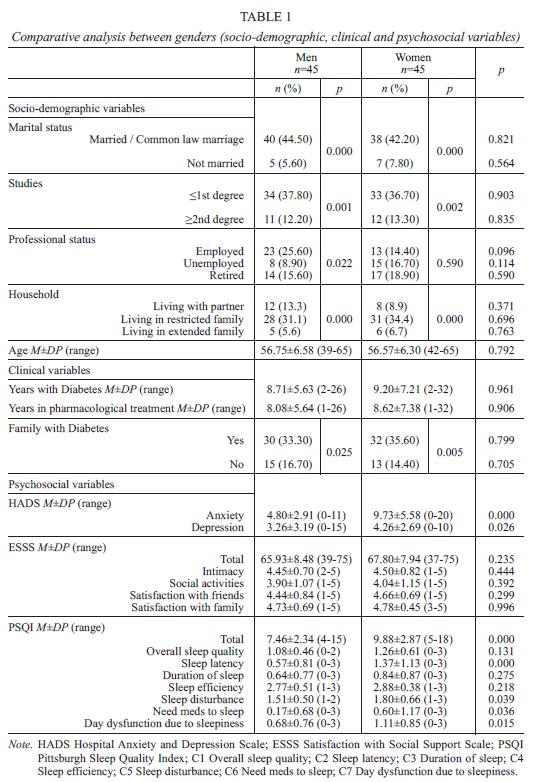
<body><![CDATA[<p>The presentation of socio demographic, clinical and psychosocial variables    was based on observed frequencies and percentages in the case of categorized    / ordinal variables, and the mean and standard deviation in the case of quantitative    variables. The internal consistency was assessed using the Cronbach’s Alpha,    considering acceptable values =0.70 (Nunnally &amp; Bernstein, 1994). The bivariate    relationships between socio demographic, clinical and psychosocial variables    were calculated by the <i>U </i>Mann-Whintey, the Chi-Square test and the <i>r    </i>Spearman.</p>     <p>The statistical significance level was <i>p</i>&lt;0.05, and the statistical    analysis was made using the SPSS version 17.0 for Windows.</p>     <p>RESULTS</p>     <p>The sample studied was formed by 90 patients with Type 2 Diabetes, with a mean    age of 56.67 years (<i>SD</i>=6.41), and 50% were women. The sample majority    was married / common law marriage (86.70%), had studies =1st degree (74.40%),    and living with restricted family (65.60%). When it comes to the employment    status a homogeneous distribution was observed between employed (40%), unemployed    (25.60%) and retired patients (34.40%).</p>     <p>Data regarding clinical variables, revealed that the sample presented a mean    of 8.96 years with Type 2 Diabetes (<i>SD</i>=6.44; range between 2-32 years),    a mean of 8.36 years on pharmacological treatment (<i>SD</i>=5.54; range between    1-32 years), and the majority of sample patients had relatives with Type 2 Diabetes    (68.90%).</p>     <p>When considering the psychosocial variables, it should be mentioned that the    HADS depression (a=0.632), the ESSS intimacy (a=0.568) and the total PSQI (a=0.555)    revealed scores of internal consistency &lt;0.70. It should be stressed that    the sample presented low levels of anxiety and depression symptoms (scores &lt;8    points), with the HADS anxiety revealing mean scores of 7.27 (<i>SD</i>=5.07)    and the HADS depression reporting mean scores of 3.77 (<i>SD</i>=2.98). Considering    that the HADS score was above 8 points, suggests the presence of anxiety / depression    symptoms. It was verified that 35.60% of the sample (<i>n</i>=32) revealed anxiety    symptoms and 6.70% presented depression symptoms (<i>n</i>=6). For social support,    it was observed scores of 66.87 in the total ESSS (<i>SD</i>=8.22) and scores    =3.97 in its sub scales. For sleep quality, the total PSQI score was 8.68 (<i>SD</i>=2.87),    73.30% (<i>n</i>=66) had poor sleep quality (total PSQI scores between 5-10),    and 24.40% (<i>n</i>=22) revealed sleep disorder (total PSQI score &gt;10).</p>     <p>The results show, by assessing males, that the sample had a mean age of 56.75    years (<i>SD</i>=6.58), mostly married (<i>n</i>=40), with low educational levels    (34 with studies =1st degree). The majority were employed (<i>n</i>=23), living    in restricted families (<i>n</i>=28), and had relatives with Type 2 Diabetes    (<i>n</i>=30). As to the female patients, they had a mean age of 56.57 years    (<i>SD</i>=6.30), were mostly married (<i>n</i>=38), with low study levels (33    with studies =1st degree), living in restricted families (<i>n</i>=31), and    they had relatives with Type 2 Diabetes (n=32). However, as far as professional    status is concerned, women presented a homogeneous distribution (<a href="#t1">Table    1</a>).</p>     <p>&nbsp;</p>     <p><a name="t1"></a></p>     <p><img src="/img/revistas/aps/v32n1/32n1a04t1.jpg" width="535" height="782"></p>     
]]></body>
<body><![CDATA[<p>&nbsp;</p>     <p>When gender-related outcomes were compared, significant statistical differences    weren’t found regarding the clinical variables and the psychosocial variables    such as social support, overall sleep quality, duration of sleep, and sleep    efficiency (PSQI). Nevertheless, women revealed higher depression symptoms scores    (<i>M</i>=9.73; <i>p</i>=0.000), in anxiety symptoms (<i>M</i>=4.26; <i>p</i>=0.026)    and in the PSQI scores as follows: total PSQI (<i>M</i>=9.88; <i>p</i>=0.000);    sleep latency (<i>M</i>=1.37; <i>p</i>=0.000); sleep disturbance (<i>M</i>=1.80;    <i>p</i>=0.039); need meds to sleep (<i>M</i>=0.60; <i>p</i>=0.036); and day    dysfunction due to sleepiness (<i>M</i>=1.11; <i>p</i>=0.015) (<a href="#t1">Table    1</a>).</p>     <p>By proceeding to the analysis of the relationship between the anxiety and depression    symptoms, with the socio-demographic and clinical variables, it was only observed    that unemployed patients presented significantly higher levels of depression    symptoms when compared with employed ones (5.03±3.42 <i>vs. </i>2.92±2.66; <i>p</i>&lt;0.050).</p>     <p>By examining the relationship between the social support indicators and the    socio-demographic and clinical variables, the employed patients presented significantly    lower scores than unemployed patients in the total ESSS (<i>p</i>&lt;0.050).    The patients with family with Type 2 Diabetes revealed lower scores in the ESSS    intimacy (<i>p</i>&lt;0.050). The patients living with partners presented higher    satisfaction with social activities than patients living with restricted families    (<i>p</i>&lt;0.050). Employed patients had lower satisfaction with family than    unemployed and retired patients (<i>p</i>&lt;0.050) (<a href="/img/revistas/aps/v32n1/32n1a04t2.jpg" target="_blank">Table 2</a>).</p>      
<p>As to the relationship between the PSQI and the studied variables, the employed    subjects revealed a better quality of sleep than unemployed subjects in the    dimensions as follow: total PSQI (<i>M</i>=7.50 <i>vs. M</i>=10.30; <i>p</i>&lt;0.050);    overall sleep quality (<i>M</i>=0.97 <i>vs. M</i>=1.39; <i>p</i>&lt;0.050);    sleep latency (<i>M</i>=0.58 <i>vs. M</i>=1.48; <i>p</i>&lt;0.050); day dysfunction    due to sleepiness (<i>M</i>=0.72 <i>vs. M</i>=1.26; <i>p</i>&lt;0.050). The    employed patients also presented better quality of sleep scores when compared    with retired patients in the dimensions: overall sleep quality (<i>M</i>=0.97    <i>vs. M</i>=1.26; <i>p</i>&lt;0.050); need meds to sleep (<i>M</i>=0.11 <i>vs.    M</i>=0.74; <i>p</i>&lt;0.050). Retired patients presented a better sleep efficiency    than employed (<i>M</i>=2.55 <i>vs. M</i>=2.97; <i>p</i>&lt;0.050) and unemployed    patients (<i>M</i>=2.55 <i>vs. M</i>=3.00; <i>p</i>&lt;0.050). For the relationship    between sleep quality and the household, it was only observed that subjects    living with partners had a better sleep efficiency than subjects living in restricted    families (<i>M</i>=2.60 <i>vs. M</i>=2.92; <i>p</i>&lt;0.050) (<a href="/img/revistas/aps/v32n1/32n1a04t3.jpg" target="_blank">Table    3</a>).</p>      
<p>When the correlation analysis between variables was made (Spearman R), the    results revealed that the anxiety symptoms were positively correlated with depression    symptoms (<i>r</i>=0.411; <i>p</i>&lt;0.010) and all sleep quality indicators,    with the exception of need meds to sleep. As far as depression symptoms is concerned,    besides positively correlating with anxiety symptoms, as it was mentioned before,    it was also positively correlated with all sleep quality indicators, except    that of duration and efficiency of sleep. A positive correlation between depression    symptoms and the age of patients was also observed (<i>r</i>=0.254; <i>p</i>&lt;0.050),    and a negative correlation with satisfaction with friends (<i>r</i>=-0.240;    <i>p</i>&lt;0.050). Besides being correlated with depression symptoms, social    support presented positive correlations between the satisfaction with family    and the overall sleep quality (<i>r</i>=0.384; <i>p</i>&lt;0.010) and with age    (<i>r</i>=0.232; <i>p</i>&lt;0.050). As to sleep quality, negative correlations    were observed between the efficiency of sleep and the variables as follows:    number of years with Type 2 Diabetes (<i>r</i>=-0.213); number of years on pharmacological    treatment (<i>r</i>=-0.228); and the patients’ age (<i>r</i>=-0.244) for a <i>p</i>&lt;0.050.    Sleep disturbance revealed positive correlations with the number of years on    pharmacological treatment (<i>r</i>=0.218; <i>p</i>&lt;0.050). Positive correlations    between a high number of PSQI indicators was also noted (<a href="/img/revistas/aps/v32n1/32n1a04t4.jpg" target="_blank">Table 4</a>). To conclude,    the number of years with Type 2 Diabetes was positively correlated with the    number of years in pharmacological treatment (<i>r</i>=0.938; <i>p</i>&lt;0.010)    and with patient’s age (<i>r</i>=0.261; <i>p</i>&lt;0.050), and the number of    years in pharmacological treatment was positively correlated with the age of    the subjects from the sample (<i>r</i>=0.293; <i>p</i>&lt;0.010) (<a href="/img/revistas/aps/v32n1/32n1a04t4.jpg" target="_blank">Table 4</a>).</p>     
<p>DISCUSSION</p>     <p>Global sample results revealed a higher prevalence of anxiety than depression    symptoms (36.60% <i>vs. </i>6.70%) and the anxiety symptoms were related to    a worse sleep quality with the exception of need meds to sleep. For its part    the depression symptoms were associated with low satisfaction with friends,    with a worse sleep quality, and affected more retired and unemployed patients.    Both anxiety and depression symptoms, and sleep quality aspects, affected significantly    more women than men.</p>     <p>Our findings presented a high prevalence of patients with family with Type    2 Diabetes (68.90%). In fact, the high prevalence of Type 2 Diabetes within    family could be explained by the sharing of the same genetic predispositions    and similar lifestyle habits as their relatives (Kuzuya &amp; Matsuda, 1982),    with some studies suggesting that individuals with an affected first-degree    relative have a 2.3 to 5.5 fold higher risk of developing Type 2 Diabetes, independent    of gender, age, race, body mass index (BMI) and other demographic variables    (Valdez, Yoon, Liu, &amp; Khoury, 2007). Unlike Gucciardi et al. (2008), that    suggests that women have a higher prevalence of relatives with a history of    Type 2 Diabetes, our data did not found differences between genders.</p>     <p>Our results also contradict the literature, revealing low depression symptoms    scores (3.77±2.98), and taking into consideration the normative data, the scores    were within normal values (Zigmond &amp; Snaith, 1983). As it can be observed,    6.70% of the sample presented depression symptoms (HADS depression scores =8),    parameters close to 9.20% reported by Amorim and Coelho (2008) and in contrast    with the studies that presented rates between 43.50 and 68.12% (Khuwaja, Lalani,    et al., 2010; Ramos &amp; Ferreira, 2011; Ricco et al., 2004; Roupa et al.,    2009). The anxiety symptoms scores were higher than the depression symptoms    scores (7.27±5.07 <i>vs. </i>3.77±2.98), but still, as it happens with the depression    symptoms, the scores are within normal values (HADS scores &#60;8). Nonetheless,    it should be stated that 36.6% of the sample presented anxiety symptoms (HADS    scores =8). Our findings are consistent with the literature that points to a    high prevalence of anxiety symptoms in patients with Type 2 Diabetes, with rates    around 57.9% (Khuwaja, Lalani, et al., 2010).</p>     ]]></body>
<body><![CDATA[<p>Nevertheless, when comparative parameters between genders are established,    women revealed significantly higher scores of depression (&#9792;=4.26 <i>vs. </i>&#9794;=3.26;    <i>p</i>=0.026) and anxiety symptoms (&#9792;=9.73 <i>vs. </i>&#9794;=4.80; <i>p</i>=0.000).    These gender differences, which support a higher prevalence of depression symptoms    in women with Type 2 Diabetes, have been mentioned in previous studies that    pointed out rates twice as high when compared with men (Amorim &amp; Coelho,    2008; Gucciardi et al., 2008; Khuwaja, Lalani, et al., 2010; Roupa et al., 2009).    It is that known that women are significantly associated with depression in    the general populations (Khuwaja &amp; Kadir, 2010) and among people with Diabetes    (Collins, Corcoran, &amp; Perry, 2009). A possible explanation is that women    play gender specific roles, which exposes them to increased work demands and    responsibilities, and the social rule attributed to women allows them to be    more emotional and extroversive (Khuwaja, Lalani, et al., 2010). As mentioned    before, women also scored higher than men on anxiety symptoms, revealing the    presence of anxiety which is consistent with the study of Amorim and Coelho    (2008). In this context, it should be mentioned Roupa et al. (2009) that assessed    310 patients with Type 2 Diabetes (56% women) and women presented anxiety symptoms    scores 3 times higher than men, with HADS scores =8 in about 62% female patients.    On the other hand, men had HADS scores =8 in only 21% of cases (<i>p</i>&lt;0.001).</p>     <p>When it comes to the relationship between the depression symptoms and the socio    demographic variables, it was only found that employed patients presented significant    lower depression scores (2.92±2.66) than retired ones (5.03±3.42). Amorim and    Coelho (2008) had similar results by assessing a sample of 304 patients with    Type 2 Diabetes (186 women) with a mean age of 59.25 years (<i>SD</i>=8.56).    Mostly were married and retired and with low study levels. In this study, active    patients revealed significant lower scores in depression symptoms assessed through    the HADS (<i>p</i>&lt;0.001), which suggests work as a protective factor of    the mental area.</p>     <p>Relating to the association between depression symptoms and the psychosocial    variables, data pointed to an association between higher levels of depression    symptoms, a lower satisfaction with friends (<i>r</i>=-0.240; <i>p</i>&lt;0.050),    a worse sleep quality assessed through the total PSQI (<i>r</i>=0.404; <i>p</i>&lt;0.001),    a worse overall sleep quality (<i>r</i>=0.263; <i>p</i>&lt;0.050), a worse sleep    latency (<i>r</i>=0.300; <i>p</i>&lt;0.001), higher levels of sleep disturbance    (<i>r</i>=0.327; <i>p</i>&lt;0.001), and higher levels of day dysfunction due    to sleepiness (<i>r</i>=0.266; <i>p</i>&lt;0.001). Positive correlations were    also observed between the depression symptoms scores and patient’s age (<i>r</i>=0.254;    <i>p</i>&lt;0.050), suggesting higher levels of depression in elderly patients,    which is in line with Tellez-Zenteno and Cardiel (2002), and represents a negative    interference of depression in the psychological functioning of patients with    Type 2 Diabetes .</p>     <p>The social support results, in the present sample, revealed normal scores pointing    to satisfactory outcomes in all the ESSS domains. In a maximum score of 75 points,    our sample presented mean scores of 66.87 (<i>DP</i>=8.22) suggesting high levels    of social support satisfaction. One possible explanation for these findings    are the socio-demographic characteristics of the sample, as 78% of patients    were married and 70 % were living with restricted / extended family, which indicates    an extended family support. There were no differences between genders on social    support, even though some studies suggesting better social support by formal    caregivers in women with Type 2 Diabetes (Gucciardi et al., 2008). However,    employed patients revealed a worse total social support and a lower family satisfaction    than unemployed patients with Type 2 Diabetes (<i>p</i>&lt;0.050). In the case    of satisfaction with family, it was also observed that employed patients revealed    less satisfaction than retired ones (<i>p</i>&lt;0.05), and as patients get    older, they perceive higher levels of satisfaction with family (<i>r</i>=0.232;    <i>p</i>&lt;0.050). These findings seem to suggest that being employed contributes    to a worse social support perception, which can be better explained by the labor    demands, limited family lifetime and therefore a smaller social network than    unemployed and retired patients. It is also possible that as patients with Type    2 Diabetes get older, they come to recognize and appreciate family ties, hence    the positive correlation between age and satisfaction with family assessed through    the ESSS.</p>     <p>Almost all sleep quality indicators (with the exception of need meds to sleep)    showed positive correlations with the anxiety symptoms. In the general adult    population, the prevalence of sleep disorders are between 10-20% (Roth, 2008),    and sleep disorders coexist with a number of physical and psychiatric conditions,    including anxiety disorders (Walsh, 2004). Moreover, when examining the sleeping    patterns, 90 patients revealed disturbed sleep indices with mean scores above    5 (8.68±2.87), which suggests poor sleep quality and, near the limit of 10 points,    suggests the presence of a sleep disorder (Buysse et al., 1989). Cunha, Zanetti    and Hass (2008), in one of the scarce studies that assessed sleep in Type 2    Diabetes, analyzed 50 patients, 76% women, 52% married, with ages between 44-79    years, and through the PSQI concluded that the majority (52%) had a poor sleep    quality (score =5). Likewise, Knutson et al. (2006) assessed 161 subjects and    Vigg (2003) assessed 220 subjects, both with patients with Type 2 Diabetes,    concluded that 71% presented a PSQI score =5, showing that Type 2 Diabetes is    associated with sleeping problems (Barone &amp; Menna-Barreto, 2011). Rajendran    et al. (Rajendran, Parthsarathy, Tamilselvan, Seshadri, &amp; Shuaib, 2012)    evaluated 120 patients with Type 2 Diabetes (55 women), with a mean age of 53.9    years (<i>SD</i>=9.20) and concluded that the average length of Diabetes diagnosis    (7.41±5.90) was positively correlated with the total PSQI score (<i>r</i>=0.181;    <i>p</i>&lt;0.050), suggesting that Diabetes duration has a strong influence    on patient’s sleep (the data was independent of variables as age, gender, body    mass index or meds). As in our study, the sample revealed a total PSQI score    of 7.08 and 69% presented a total PSQI score =5. This data became even more    troubling in unemployed patients with Type 2 Diabetes with average total PSQI    scores of 10.30, <i>versus </i>the score of 7.50 in employed patients. The literature    suggests that groups from low socio-economic status have less sleep duration    and lower sleep quality (Gellis et al., 2005). Qualified employees have better    sleep levels (Sekine et al., 2006), and unemployed men had a higher prevalence    of sleep-related complaints (Grandner et al., 2010). The results from our study    are partially in accordance with the literature. Our data supports a worse sleep    quality in unemployed patients, no comparative analysis between genders was    taken regarding the relationship between professional status and sleep. Nevertheless,    in our study, the employed patients had better sleep patterns than the unemployed    ones in the total PSQI, the overall sleep quality, sleep latency, and in day    dysfunction due to sleepiness (<i>p</i>&lt;0.050). The employed patients also    presented a better overall sleep quality when compared to retired patients (<i>p</i>&lt;0.050).    For sleep efficiency, the retired patients revealed the best scores (<i>p</i>&lt;0.050),    with employed and unemployed patients presenting similar results. On the other    hand, the retired patients presented a higher need for sleep medication than    employed patients. It was also observed that women had worse sleep patterns    in the total PSQI, sleep latency, sleep disturbance, need meds to sleep and    day dysfunction due to sleepiness (<i>p</i>&lt;0.039), which is in line with    the results from the general female population (Collop, Adkins, &amp; Phillips,    2004).</p>     <p>When analyzing the relationship between the PSQI and the ESSS, only positive    correlations were observed between overall sleep quality and satisfaction with    family (<i>r</i>=0.384; <i>p</i>&lt;0.010). In other words, patients with worse    overall sleep quality expressed a better family social support. However, as    far as sleep efficiency is concerned, patients with more years with Diabetes    (<i>r</i>=-0.231; <i>p</i>&lt;0.050), with more years in pharmacological treatment    (<i>r</i>=-0.228; <i>p</i>&lt;0.050), and older patients (<i>r</i>=-0.244; <i>p</i>&lt;0.050)    revealed better results, which can suggest a positive adaptation process to    Type 2 Diabetes and aging. When it comes to sleep disturbance, patients with    more years in pharmacological treatment had worse scores (<i>r</i>=0.218; <i>p</i>&lt;0.050).</p>     <p>The data observed in this study suggests that, when treating patients with    Type 2 Diabetes, a broad assessment approach should be applied, taking into    account factors such as professional status, gender, age, anxiety/depression    symptoms, social support and sleep patterns perception. Identifying factors    that determine the extent of the impact of Type 2 Diabetes will allow the detection    of vulnerable groups/individuals and the design of more effective interventions.</p>     <p>However, this data presents some limitations. Firstly, future studies should    include larger populations for a greater data generalization. Secondly, as coping    strategies are important factors to understand how patients deal with disease    and their health in general, these areas should be taken into account. Thirdly,    there’s an important association between obesity and Type 2 Diabetes. The relative    risk of Type 2 Diabetes increases as BMI increases above 23, and association    is stronger in young age groups (Colditz et al., 1990; Ni Mhurchu et al., 2006):    the prevalence increases from 2% in those with BMI of 25 to 29,9kg/m2, to 8%    in those with a BMI of 30 to 34,9 kg/m2, and to 13% in those with a BMI greater    than 35 kg/m2 (Harris et al., 1998). Investigations focusing on weight change    and Type 2 Diabetes showed that an increase in body weight of 3-20 kg was associated    with an elevated risk of incident Type 2 Diabetes, and early obesity and almost    any weight gain after adolescence were risk factors for Type 2 Diabetes (Schienkiewitz,    Schulze, Hoffmann, Kroke, &amp; Boeing, 2006). In fact, Type 2 Diabetes in children    and adolescents is an important public health problem directly related to the    epidemic of childhood obesity (Tfayli &amp; Arslanian, 2009). Moreover, the    duration of obesity seems to be a significant risk factor for Type 2 Diabetes,    independently of current degree of obesity (Schienkiewitz et al., 2006). For    these reasons, future studies should also include the BMI. Finally, it would    be of interest to measure the impact of Type 2 Diabetes on patient’s health    related quality of life.</p>     <p>In conclusion, we can state that anxiety symptoms are very prevalent in patients    with Type 2 Diabetes and women are more vulnerable to anxiety, depression symptoms    and poor sleep quality.</p>     <p>&nbsp;</p>     ]]></body>
<body><![CDATA[<p>REFERENCES</p>     <!-- ref --><p>Amorim, I. L., &amp; Coelho, R. (2008). Diabetes Mellitus Tipo 2 e sintomas    psicopatológicos. <i>Psicologia, Saúde &amp; Doenças</i>, 9(2), 319-333.    &nbsp;&nbsp;&nbsp;&nbsp;&nbsp;&nbsp;&nbsp;&nbsp;[&#160;<a href="javascript:void(0);" onclick="javascript: window.open('/scielo.php?script=sci_nlinks&ref=000074&pid=S0870-8231201400010000400001&lng=','','width=640,height=500,resizable=yes,scrollbars=1,menubar=yes,');">Links</a>&#160;]<!-- end-ref --></p>     <!-- ref --><p>Barone, M. T., &amp; Menna-Barreto, L. (2011). Diabetes and sleep: A complex    cause-and-effect relationship.<i>Diabetes Res Clin Pract</i>, 91(2), 129-137.    doi: 10.1016/j.diabres.2010.07.011; S0168-8227(10)00388-8 [pii]&nbsp;&nbsp;&nbsp;&nbsp;&nbsp;&nbsp;&nbsp;&nbsp;[&#160;<a href="javascript:void(0);" onclick="javascript: window.open('/scielo.php?script=sci_nlinks&ref=000076&pid=S0870-8231201400010000400002&lng=','','width=640,height=500,resizable=yes,scrollbars=1,menubar=yes,');">Links</a>&#160;]<!-- end-ref --><!-- ref --><p>Bertolazi, A. N., Fagondes, S. C., Hoff, L. S., Dartora, E. G., Miozzo, I.    C., de Barba, M. E., &amp; Barreto, S. S. (2011). Validation of the Brazilian    Portuguese version of the Pittsburgh Sleep Quality Index. <i>Sleep Med, 12</i>(1),    70-75. doi: 10.1016/j.sleep.2010.04.020; S1389-9457(10)00380-1 [pii]&nbsp;&nbsp;&nbsp;&nbsp;&nbsp;&nbsp;&nbsp;&nbsp;[&#160;<a href="javascript:void(0);" onclick="javascript: window.open('/scielo.php?script=sci_nlinks&ref=000077&pid=S0870-8231201400010000400003&lng=','','width=640,height=500,resizable=yes,scrollbars=1,menubar=yes,');">Links</a>&#160;]<!-- end-ref --><!-- ref --><p>Buysse, D. J., Reynolds, C. F., Monk, T. H., Berman, S. R., &amp; Kupfer, D.    J. (1986). The Pittsburgh Sleep Quality Index (PSQI): A new instrument for psychiatric    research and practice. <i>Psychiatry Research, 28</i>(2), 193-213.    &nbsp;&nbsp;&nbsp;&nbsp;&nbsp;&nbsp;&nbsp;&nbsp;[&#160;<a href="javascript:void(0);" onclick="javascript: window.open('/scielo.php?script=sci_nlinks&ref=000078&pid=S0870-8231201400010000400004&lng=','','width=640,height=500,resizable=yes,scrollbars=1,menubar=yes,');">Links</a>&#160;]<!-- end-ref --></p>     <!-- ref --><p>Buysse, D. J., Reynolds, C. F., Monk, T. H., Berman, S. R., &amp; Kupfer, D.    J. (1989). The Pittsburgh Sleep Quality Index: A new instrument for psychiatric    practice and research. <i>Psychiatry Res, 28</i>(2), 193-213.    &nbsp;&nbsp;&nbsp;&nbsp;&nbsp;&nbsp;&nbsp;&nbsp;[&#160;<a href="javascript:void(0);" onclick="javascript: window.open('/scielo.php?script=sci_nlinks&ref=000080&pid=S0870-8231201400010000400005&lng=','','width=640,height=500,resizable=yes,scrollbars=1,menubar=yes,');">Links</a>&#160;]<!-- end-ref --></p>     <!-- ref --><p>Colditz, G. A., Willett, W. C., Stampfer, M. J., Manson, J. E., Hennekens,    C. H., Arky, R. A., &amp; Speizer, F. E. (1990). Weight as a risk factor for    clinical diabetes in women. <i>Am J Epidemiol, 132</i>(3), 501-513.    &nbsp;&nbsp;&nbsp;&nbsp;&nbsp;&nbsp;&nbsp;&nbsp;[&#160;<a href="javascript:void(0);" onclick="javascript: window.open('/scielo.php?script=sci_nlinks&ref=000082&pid=S0870-8231201400010000400006&lng=','','width=640,height=500,resizable=yes,scrollbars=1,menubar=yes,');">Links</a>&#160;]<!-- end-ref --></p>     <!-- ref --><p>Collins, M. M., Corcoran, P., &amp; Perry, I. J. (2009). Anxiety and depression    symptoms in patients with diabetes. <i>Diabet Med</i>, 26(2), 153-161. doi:    10.1111/j.1464-5491.2008.02648.x; DME2648 [pii]&nbsp;&nbsp;&nbsp;&nbsp;&nbsp;&nbsp;&nbsp;&nbsp;[&#160;<a href="javascript:void(0);" onclick="javascript: window.open('/scielo.php?script=sci_nlinks&ref=000084&pid=S0870-8231201400010000400007&lng=','','width=640,height=500,resizable=yes,scrollbars=1,menubar=yes,');">Links</a>&#160;]<!-- end-ref --><!-- ref --><p>Collop, N. A., Adkins, D., &amp; Phillips, B. A. (2004). Gender differences    in sleep and sleep-disordered breathing. <i>Clin Chest Med</i>, 25(2), 257-268.    doi: 10.1016/j.ccm.2004.01.002; S0272523104000164 [pii]&nbsp;&nbsp;&nbsp;&nbsp;&nbsp;&nbsp;&nbsp;&nbsp;[&#160;<a href="javascript:void(0);" onclick="javascript: window.open('/scielo.php?script=sci_nlinks&ref=000085&pid=S0870-8231201400010000400008&lng=','','width=640,height=500,resizable=yes,scrollbars=1,menubar=yes,');">Links</a>&#160;]<!-- end-ref --><!-- ref --><p>Cunha, M. C. B., Zanetti, M. L., &amp; Hass, V. J. (2008). Sleep quality in    type 2 diabetics. <i>Revista Latino-Americana de Enfermagem, 16</i>, 850-855.    &nbsp;&nbsp;&nbsp;&nbsp;&nbsp;&nbsp;&nbsp;&nbsp;[&#160;<a href="javascript:void(0);" onclick="javascript: window.open('/scielo.php?script=sci_nlinks&ref=000086&pid=S0870-8231201400010000400009&lng=','','width=640,height=500,resizable=yes,scrollbars=1,menubar=yes,');">Links</a>&#160;]<!-- end-ref --></p>     <!-- ref --><p>Fagot-Campagna, A., Balkau, B., Simon, D., Warnet, J. M., Claude, J. R., Ducimetiere,    P., &amp; Eschwege, E. (1998). High free fatty acid concentration: An independent    risk factor for hypertension in the Paris Prospective Study. <i>Int J Epidemiol,    27</i>(5), 808-813.    &nbsp;&nbsp;&nbsp;&nbsp;&nbsp;&nbsp;&nbsp;&nbsp;[&#160;<a href="javascript:void(0);" onclick="javascript: window.open('/scielo.php?script=sci_nlinks&ref=000088&pid=S0870-8231201400010000400010&lng=','','width=640,height=500,resizable=yes,scrollbars=1,menubar=yes,');">Links</a>&#160;]<!-- end-ref --></p>     <!-- ref --><p>Gellis, L. A., Lichstein, K. L., Scarinci, I. C., Durence, H. H., Raylor, D.    J., Bush, A. J., &amp; Riedel, B. W. (2005). Socioeconomic status and insomnia.    <i>Journal of Abnormal Psychology, 114</i>(2), 111-118.    &nbsp;&nbsp;&nbsp;&nbsp;&nbsp;&nbsp;&nbsp;&nbsp;[&#160;<a href="javascript:void(0);" onclick="javascript: window.open('/scielo.php?script=sci_nlinks&ref=000090&pid=S0870-8231201400010000400011&lng=','','width=640,height=500,resizable=yes,scrollbars=1,menubar=yes,');">Links</a>&#160;]<!-- end-ref --></p>     <!-- ref --><p>Goldney, R. D., Phillips, P. J., Fisher, L. J., &amp; Wilson, D. H. (2004).    Diabetes, depression, and quality of life: A population study. <i>Diabetes Care,    27</i>(5), 1066-1070.    &nbsp;&nbsp;&nbsp;&nbsp;&nbsp;&nbsp;&nbsp;&nbsp;[&#160;<a href="javascript:void(0);" onclick="javascript: window.open('/scielo.php?script=sci_nlinks&ref=000092&pid=S0870-8231201400010000400012&lng=','','width=640,height=500,resizable=yes,scrollbars=1,menubar=yes,');">Links</a>&#160;]<!-- end-ref --></p>     <!-- ref --><p>Grandner, M. A., Patel, N. P., Gehrman, P. R., Xie, D., Sha, D., Weaver, T.,    &amp; Gooneratne, N. (2010). Who gets the best sleep? Ethnic and socioeconomic    factors related to sleep complaints. <i>Sleep Med, 11</i>(5), 470-478. doi:    10.1016/j.sleep.2009.10.006; S1389-9457(10)00096-1 [pii]&nbsp;&nbsp;&nbsp;&nbsp;&nbsp;&nbsp;&nbsp;&nbsp;[&#160;<a href="javascript:void(0);" onclick="javascript: window.open('/scielo.php?script=sci_nlinks&ref=000094&pid=S0870-8231201400010000400013&lng=','','width=640,height=500,resizable=yes,scrollbars=1,menubar=yes,');">Links</a>&#160;]<!-- end-ref --><!-- ref --><p>Gucciardi, E., Wang, S. C., DeMelo, M., Amaral, L., &amp; Stewart, D. E. (2008).    Characteristics of men and women with diabetes: Observations during patients’    initial visit to a diabetes education centre. <i>Can Fam Physician, 54</i>(2),    219-227.    &nbsp;&nbsp;&nbsp;&nbsp;&nbsp;&nbsp;&nbsp;&nbsp;[&#160;<a href="javascript:void(0);" onclick="javascript: window.open('/scielo.php?script=sci_nlinks&ref=000095&pid=S0870-8231201400010000400014&lng=','','width=640,height=500,resizable=yes,scrollbars=1,menubar=yes,');">Links</a>&#160;]<!-- end-ref --></p>     <!-- ref --><p>Harris, M. I., Flegal, K. M., Cowie, C. C., Eberhardt, M. S., Goldstein, D.    E., Little, R. R., . . . Byrd-Holt, D. D. (1998). Prevalence of diabetes, impaired    fasting glucose, and impaired glucose tolerance in U.S. adults. The Third National    Health and Nutrition Examination Survey, 1988-1994. <i>Diabetes Care, 21</i>(4),    518-524.    &nbsp;&nbsp;&nbsp;&nbsp;&nbsp;&nbsp;&nbsp;&nbsp;[&#160;<a href="javascript:void(0);" onclick="javascript: window.open('/scielo.php?script=sci_nlinks&ref=000097&pid=S0870-8231201400010000400015&lng=','','width=640,height=500,resizable=yes,scrollbars=1,menubar=yes,');">Links</a>&#160;]<!-- end-ref --></p>     <!-- ref --><p>Hussain, A., Hydrie, M. Z. I., Claussen, B., &amp; Asghar, S. (2010). Type    2 Diabetes: A review article. <i>Journal of Diabetology, 2</i>(1), 1-7.    &nbsp;&nbsp;&nbsp;&nbsp;&nbsp;&nbsp;&nbsp;&nbsp;[&#160;<a href="javascript:void(0);" onclick="javascript: window.open('/scielo.php?script=sci_nlinks&ref=000099&pid=S0870-8231201400010000400016&lng=','','width=640,height=500,resizable=yes,scrollbars=1,menubar=yes,');">Links</a>&#160;]<!-- end-ref --></p>     <p>Jakab, Z. (2010). <i>Delivering for Diabetes in Europe</i>. Paper presented    at the Plenary Meeting of the European Parliament’s EU Diabetes Working Group,    Brussels, Belgium. <a href="http://www.euro.who.int/data/assets/pdf_file/0007/128059/RD_speech_Diabetes_Brussels_Dec_2010.pdf" target="_blank">http://www.euro.who.int/data/assets/    pdf_file/0007/128059/RD_speech_Diabetes_Brussels_Dec_2010.pdf</a></p>     <!-- ref --><p>Khuwaja, A. K., &amp; Kadir, M. M. (2010). Gender differences and clustering    pattern of behavioural risk factors for chronic non-communicable diseases: Community-based    study from a developing country. <i>Chronic Illn, 6</i>(3), 163-170. doi: 10.1177/1742395309352255;    1742395309352255 [pii]&nbsp;&nbsp;&nbsp;&nbsp;&nbsp;&nbsp;&nbsp;&nbsp;[&#160;<a href="javascript:void(0);" onclick="javascript: window.open('/scielo.php?script=sci_nlinks&ref=000102&pid=S0870-8231201400010000400018&lng=','','width=640,height=500,resizable=yes,scrollbars=1,menubar=yes,');">Links</a>&#160;]<!-- end-ref --><!-- ref --><p>Khuwaja, A. K., Lalani, S., Dhanani, R., Azam, I. S., Rafique, G., &amp; White,    F. (2010). Anxiety and depression among outpatients with type 2 diabetes: A    multi-centre study of prevalence and associated factors. <i>Diabetol Metab Syndr,    2</i>, 72. doi: 10.1186/1758-5996-2-72; 1758-5996-2-72 [pii]&nbsp;&nbsp;&nbsp;&nbsp;&nbsp;&nbsp;&nbsp;&nbsp;[&#160;<a href="javascript:void(0);" onclick="javascript: window.open('/scielo.php?script=sci_nlinks&ref=000103&pid=S0870-8231201400010000400019&lng=','','width=640,height=500,resizable=yes,scrollbars=1,menubar=yes,');">Links</a>&#160;]<!-- end-ref --><!-- ref --><p>Knutson, K. L., Ryden, A. M., Mander, B. A., &amp; Van Cauter, E. (2006). Role    of sleep duration and quality in the risk and severity of type 2 diabetes mellitus.    <i>Arch Intern Med, 166</i>(16), 1768-1774. doi: 10.1001/archinte. 166.16.1768;    166/16/1768 [pii]&nbsp;&nbsp;&nbsp;&nbsp;&nbsp;&nbsp;&nbsp;&nbsp;[&#160;<a href="javascript:void(0);" onclick="javascript: window.open('/scielo.php?script=sci_nlinks&ref=000104&pid=S0870-8231201400010000400020&lng=','','width=640,height=500,resizable=yes,scrollbars=1,menubar=yes,');">Links</a>&#160;]<!-- end-ref --><!-- ref --><p>Kuzuya, T., &amp; Matsuda, A. (1982). Family histories of diabetes among Japanese    patients with type 1 (insulin-dependent) and type 2 (non-insulin-dependent)    diabetes. <i>Diabetologia, 22</i>(5), 372-374.    &nbsp;&nbsp;&nbsp;&nbsp;&nbsp;&nbsp;&nbsp;&nbsp;[&#160;<a href="javascript:void(0);" onclick="javascript: window.open('/scielo.php?script=sci_nlinks&ref=000105&pid=S0870-8231201400010000400021&lng=','','width=640,height=500,resizable=yes,scrollbars=1,menubar=yes,');">Links</a>&#160;]<!-- end-ref --></p>     <!-- ref --><p>Nascimento, A. B., Chaves, E. C., &amp; Grossi, S. A. A. (2009). Depressão,    cortisol urinário e perfil sócio-demográfico de portadores de Diabetes Mellitus    Tipo 2. <i>Revista da Escola de Enfermagem da USP, 43</i>(2), 1272-1276.    &nbsp;&nbsp;&nbsp;&nbsp;&nbsp;&nbsp;&nbsp;&nbsp;[&#160;<a href="javascript:void(0);" onclick="javascript: window.open('/scielo.php?script=sci_nlinks&ref=000107&pid=S0870-8231201400010000400022&lng=','','width=640,height=500,resizable=yes,scrollbars=1,menubar=yes,');">Links</a>&#160;]<!-- end-ref --></p>     <!-- ref --><p>Ni Mhurchu, C., Parag, V., Nakamura, M., Patel, A., Rodgers, A., &amp; Lam,    T. H. (2006). Body mass index and risk of diabetes mellitus in the Asia-Pacific    region. <i>Asia Pac J Clin Nutr, 15</i>(2), 127-133.    &nbsp;&nbsp;&nbsp;&nbsp;&nbsp;&nbsp;&nbsp;&nbsp;[&#160;<a href="javascript:void(0);" onclick="javascript: window.open('/scielo.php?script=sci_nlinks&ref=000109&pid=S0870-8231201400010000400023&lng=','','width=640,height=500,resizable=yes,scrollbars=1,menubar=yes,');">Links</a>&#160;]<!-- end-ref --></p>     <!-- ref --><p>Nunnally, J. C., &amp; Bernstein, I. H. (1994). <i>Psychometric theory </i>(3rd    ed.). New York: McGraw-Hill.    &nbsp;&nbsp;&nbsp;&nbsp;&nbsp;&nbsp;&nbsp;&nbsp;[&#160;<a href="javascript:void(0);" onclick="javascript: window.open('/scielo.php?script=sci_nlinks&ref=000111&pid=S0870-8231201400010000400024&lng=','','width=640,height=500,resizable=yes,scrollbars=1,menubar=yes,');">Links</a>&#160;]<!-- end-ref --></p>     ]]></body>
<body><![CDATA[<!-- ref --><p>Observatório Nacional da Diabetes. (2010). <i>Diabetes: factos e números 2010    – Relatório anual do observatório nacional da Diabetes</i>. Lisboa: Ministério    da Saúde de Portugal.    &nbsp;&nbsp;&nbsp;&nbsp;&nbsp;&nbsp;&nbsp;&nbsp;[&#160;<a href="javascript:void(0);" onclick="javascript: window.open('/scielo.php?script=sci_nlinks&ref=000113&pid=S0870-8231201400010000400025&lng=','','width=640,height=500,resizable=yes,scrollbars=1,menubar=yes,');">Links</a>&#160;]<!-- end-ref --></p>     <!-- ref --><p>Osborn, C. Y., &amp; Egede, L. E. (2012). The relationship between depressive    symptoms and medication nonadherence in type 2 diabetes: The role of social    support. <i>Gen Hosp Psychiatry, 34</i>(3), 249-253. doi: 10.1016/j. genhosppsych.2012.01.015;    S0163-8343(12)00030-8 [pii]&nbsp;&nbsp;&nbsp;&nbsp;&nbsp;&nbsp;&nbsp;&nbsp;[&#160;<a href="javascript:void(0);" onclick="javascript: window.open('/scielo.php?script=sci_nlinks&ref=000115&pid=S0870-8231201400010000400026&lng=','','width=640,height=500,resizable=yes,scrollbars=1,menubar=yes,');">Links</a>&#160;]<!-- end-ref --><!-- ref --><p>Pais-Ribeiro, J. L. (1999). Escala de Satisfação com o Suporte Social (ESSS).    <i>Análise Psicológica, XVII</i>(3), 547-558.    &nbsp;&nbsp;&nbsp;&nbsp;&nbsp;&nbsp;&nbsp;&nbsp;[&#160;<a href="javascript:void(0);" onclick="javascript: window.open('/scielo.php?script=sci_nlinks&ref=000116&pid=S0870-8231201400010000400027&lng=','','width=640,height=500,resizable=yes,scrollbars=1,menubar=yes,');">Links</a>&#160;]<!-- end-ref --></p>     <!-- ref --><p>Pais-Ribeiro, J. L., Silva, I., Ferreira, T., Martins, A., Meneses, R., &amp;    Baltar, M. (2007). Validation study of a Portuguese version of the Hospital    Anxiety and Depression Scale. <i>Psychol Health Med, 12</i>(2), 225-235.    &nbsp;&nbsp;&nbsp;&nbsp;&nbsp;&nbsp;&nbsp;&nbsp;[&#160;<a href="javascript:void(0);" onclick="javascript: window.open('/scielo.php?script=sci_nlinks&ref=000118&pid=S0870-8231201400010000400028&lng=','','width=640,height=500,resizable=yes,scrollbars=1,menubar=yes,');">Links</a>&#160;]<!-- end-ref --></p>     <!-- ref --><p>Papelbaum, M., Appolinario, J. C., Moreira Rde, O., Ellinger, V. C., Kupfer,    R., &amp; Coutinho, W. F. (2005). Prevalence of eating disorders and psychiatric    comorbidity in a clinical sample of type 2 diabetes mellitus patients. <i>Rev    Bras Psiquiatr, 27</i>(2), 135-138.    &nbsp;&nbsp;&nbsp;&nbsp;&nbsp;&nbsp;&nbsp;&nbsp;[&#160;<a href="javascript:void(0);" onclick="javascript: window.open('/scielo.php?script=sci_nlinks&ref=000120&pid=S0870-8231201400010000400029&lng=','','width=640,height=500,resizable=yes,scrollbars=1,menubar=yes,');">Links</a>&#160;]<!-- end-ref --></p>     <!-- ref --><p>Park, H., &amp; Kim, M. T. (2012). Impact of social role strain, depression,    social support and age on diabetes self-efficacy in Korean women with type 2    diabetes. <i>J Cardiovasc Nurs, 27</i>(1), 76-83.    &nbsp;&nbsp;&nbsp;&nbsp;&nbsp;&nbsp;&nbsp;&nbsp;[&#160;<a href="javascript:void(0);" onclick="javascript: window.open('/scielo.php?script=sci_nlinks&ref=000122&pid=S0870-8231201400010000400030&lng=','','width=640,height=500,resizable=yes,scrollbars=1,menubar=yes,');">Links</a>&#160;]<!-- end-ref --> doi: 10.1097/JCN. 0b013e318214d9d9</p>     <!-- ref --><p>Peyrot, M. (2003). Depression: A quiet killer by any name. <i>Diabetes Care,    26</i>(10), 2952-2953.    &nbsp;&nbsp;&nbsp;&nbsp;&nbsp;&nbsp;&nbsp;&nbsp;[&#160;<a href="javascript:void(0);" onclick="javascript: window.open('/scielo.php?script=sci_nlinks&ref=000124&pid=S0870-8231201400010000400031&lng=','','width=640,height=500,resizable=yes,scrollbars=1,menubar=yes,');">Links</a>&#160;]<!-- end-ref --></p>     <!-- ref --><p>Peyrot, M., &amp; Rubin, R. R. (1999). Persistence of depressive symptoms in    diabetic adults. <i>Diabetes Care, 22</i>(3), 448-452.    &nbsp;&nbsp;&nbsp;&nbsp;&nbsp;&nbsp;&nbsp;&nbsp;[&#160;<a href="javascript:void(0);" onclick="javascript: window.open('/scielo.php?script=sci_nlinks&ref=000126&pid=S0870-8231201400010000400032&lng=','','width=640,height=500,resizable=yes,scrollbars=1,menubar=yes,');">Links</a>&#160;]<!-- end-ref --></p>     <!-- ref --><p>Rajendran, A., Parthsarathy, S., Tamilselvan, B., Seshadri, K. G., &amp; Shuaib,    M. (2012). Prevalence and correlates of disordered sleep in southeast asian    indians with type 2 diabetes. <i>Diabetes Metab J, 36</i>(1), 70-76. doi: 10.4093/dmj.2012.36.1.70&nbsp;&nbsp;&nbsp;&nbsp;&nbsp;&nbsp;&nbsp;&nbsp;[&#160;<a href="javascript:void(0);" onclick="javascript: window.open('/scielo.php?script=sci_nlinks&ref=000128&pid=S0870-8231201400010000400033&lng=','','width=640,height=500,resizable=yes,scrollbars=1,menubar=yes,');">Links</a>&#160;]<!-- end-ref --><!-- ref --><p>Ramos, L., &amp; Ferreira, E. A. P. (2011). Fatores emocionais, qualidade de    vida e adesão ao tratamento em adultos com Diabetes Tipo 2. <i>Revista Brasileira    de Crescimento e Desenvolvimento Humano, 21</i>(3), 867-877.    &nbsp;&nbsp;&nbsp;&nbsp;&nbsp;&nbsp;&nbsp;&nbsp;[&#160;<a href="javascript:void(0);" onclick="javascript: window.open('/scielo.php?script=sci_nlinks&ref=000129&pid=S0870-8231201400010000400034&lng=','','width=640,height=500,resizable=yes,scrollbars=1,menubar=yes,');">Links</a>&#160;]<!-- end-ref --></p>     <!-- ref --><p>Ricco, R. C., Miyazaki, M. C. O. S., &amp; Silva, R. C. M. A. (2004). Depressão    em pacientes adultos portadores de doenças crónicas: Diabetes mellitus e hepatites    virais. <i>Arquivos de Ciências da Saúde, 7</i>(9), 156-160.    &nbsp;&nbsp;&nbsp;&nbsp;&nbsp;&nbsp;&nbsp;&nbsp;[&#160;<a href="javascript:void(0);" onclick="javascript: window.open('/scielo.php?script=sci_nlinks&ref=000131&pid=S0870-8231201400010000400035&lng=','','width=640,height=500,resizable=yes,scrollbars=1,menubar=yes,');">Links</a>&#160;]<!-- end-ref --></p>     ]]></body>
<body><![CDATA[<!-- ref --><p>Roth, T. (2008). Novel outcome measures of sleep, sleep loss and insomnia.    <i>Sleep Med, 9</i>(Suppl. 1), S1-2. doi: 10.1016/S1389-9457(08)70009-1; S1389-9457(08)70009-1    [pii]&nbsp;&nbsp;&nbsp;&nbsp;&nbsp;&nbsp;&nbsp;&nbsp;[&#160;<a href="javascript:void(0);" onclick="javascript: window.open('/scielo.php?script=sci_nlinks&ref=000133&pid=S0870-8231201400010000400036&lng=','','width=640,height=500,resizable=yes,scrollbars=1,menubar=yes,');">Links</a>&#160;]<!-- end-ref --><!-- ref --><p>Roupa, Z., Koulouri, A., P, S., Makrinika, E., Marneras, X., Lahana, I., &amp;    Gourni, M. (2009). Anxiety and depression in patients with type 2 diabetes mellitus,    depending on sex and body mass index. <i>Health Science Journal, 3</i>(1), 32-40.    &nbsp;&nbsp;&nbsp;&nbsp;&nbsp;&nbsp;&nbsp;&nbsp;[&#160;<a href="javascript:void(0);" onclick="javascript: window.open('/scielo.php?script=sci_nlinks&ref=000134&pid=S0870-8231201400010000400037&lng=','','width=640,height=500,resizable=yes,scrollbars=1,menubar=yes,');">Links</a>&#160;]<!-- end-ref --></p>     <!-- ref --><p>Schienkiewitz, A., Schulze, M. B., Hoffmann, K., Kroke, A., &amp; Boeing, H.    (2006). Body mass index history and risk of type 2 diabetes: Results from the    European Prospective Investigation into Cancer and Nutrition (EPIC) – Potsdam    Study. <i>The American Journal of Clinical Nutrition, 84</i>(2), 427-433.    &nbsp;&nbsp;&nbsp;&nbsp;&nbsp;&nbsp;&nbsp;&nbsp;[&#160;<a href="javascript:void(0);" onclick="javascript: window.open('/scielo.php?script=sci_nlinks&ref=000136&pid=S0870-8231201400010000400038&lng=','','width=640,height=500,resizable=yes,scrollbars=1,menubar=yes,');">Links</a>&#160;]<!-- end-ref --></p>     <!-- ref --><p>Schiotz, M. L., Bogelund, M., Almdal, T., Jensen, B. B., &amp; Willaing, I.    (2012). Social support and self-management behaviour among patients with Type    2 diabetes. <i>Diabet Med, 29</i>(5), 654-661. doi: 10.1111/j.1464-5491. 2011.03485.x&nbsp;&nbsp;&nbsp;&nbsp;&nbsp;&nbsp;&nbsp;&nbsp;[&#160;<a href="javascript:void(0);" onclick="javascript: window.open('/scielo.php?script=sci_nlinks&ref=000138&pid=S0870-8231201400010000400039&lng=','','width=640,height=500,resizable=yes,scrollbars=1,menubar=yes,');">Links</a>&#160;]<!-- end-ref --><!-- ref --><p>Sekine, M., Chandola, T., Martikainen, P., McGeoghegan, D., Marmot, M., &amp;    Kagamimori, S. (2006). Explaining social inequalities in health by sleep: The    Japanese civil servants study. <i>Journal of Public Health (Oxford), 28</i>(1),    63-70.    &nbsp;&nbsp;&nbsp;&nbsp;&nbsp;&nbsp;&nbsp;&nbsp;[&#160;<a href="javascript:void(0);" onclick="javascript: window.open('/scielo.php?script=sci_nlinks&ref=000139&pid=S0870-8231201400010000400040&lng=','','width=640,height=500,resizable=yes,scrollbars=1,menubar=yes,');">Links</a>&#160;]<!-- end-ref --></p>     <!-- ref --><p>Snaith, R. P., &amp; Zigmond, A. S. (1994). <i>HADS: Hospital Anxiety and Depression    Scale</i>. Windsor: NFER Nelson.    &nbsp;&nbsp;&nbsp;&nbsp;&nbsp;&nbsp;&nbsp;&nbsp;[&#160;<a href="javascript:void(0);" onclick="javascript: window.open('/scielo.php?script=sci_nlinks&ref=000141&pid=S0870-8231201400010000400041&lng=','','width=640,height=500,resizable=yes,scrollbars=1,menubar=yes,');">Links</a>&#160;]<!-- end-ref --></p>     ]]></body>
<body><![CDATA[<!-- ref --><p>Tellez-Zenteno, J. F., &amp; Cardiel, M. H. (2002). Risk factors associated    with depression in patients with type 2 diabetes mellitus. <i>Arch Med Res,    33</i>(1), 53-60.    &nbsp;&nbsp;&nbsp;&nbsp;&nbsp;&nbsp;&nbsp;&nbsp;[&#160;<a href="javascript:void(0);" onclick="javascript: window.open('/scielo.php?script=sci_nlinks&ref=000143&pid=S0870-8231201400010000400042&lng=','','width=640,height=500,resizable=yes,scrollbars=1,menubar=yes,');">Links</a>&#160;]<!-- end-ref --></p>     <!-- ref --><p>Tfayli, H., &amp; Arslanian, S. (2009). Pathophysiology of type 2 diabetes    mellitus in youth: The evolving chameleon. <i>Arq Bras Endocrinol Metabol, 53</i>(2),    165-174. doi: S0004-27302009000200008 [pii]&nbsp;&nbsp;&nbsp;&nbsp;&nbsp;&nbsp;&nbsp;&nbsp;[&#160;<a href="javascript:void(0);" onclick="javascript: window.open('/scielo.php?script=sci_nlinks&ref=000145&pid=S0870-8231201400010000400043&lng=','','width=640,height=500,resizable=yes,scrollbars=1,menubar=yes,');">Links</a>&#160;]<!-- end-ref --><!-- ref --><p>Valdez, R., Yoon, P. W., Liu, T., &amp; Khoury, M. J. (2007). Family history    and prevalence of diabetes in the U.S. population: The 6-year results from the    National Health and Nutrition Examination Survey (1999-2004). <i>Diabetes Care,    30</i>(10), 2517-2522. doi: 10.2337/dc07-0720; dc07-0720 [pii]&nbsp;&nbsp;&nbsp;&nbsp;&nbsp;&nbsp;&nbsp;&nbsp;[&#160;<a href="javascript:void(0);" onclick="javascript: window.open('/scielo.php?script=sci_nlinks&ref=000146&pid=S0870-8231201400010000400044&lng=','','width=640,height=500,resizable=yes,scrollbars=1,menubar=yes,');">Links</a>&#160;]<!-- end-ref --><!-- ref --><p>Vigg, A. (2003). Sleep in Type 2 diabetes. <i>J Assoc Physicians India, 51</i>,    479-481.    &nbsp;&nbsp;&nbsp;&nbsp;&nbsp;&nbsp;&nbsp;&nbsp;[&#160;<a href="javascript:void(0);" onclick="javascript: window.open('/scielo.php?script=sci_nlinks&ref=000147&pid=S0870-8231201400010000400045&lng=','','width=640,height=500,resizable=yes,scrollbars=1,menubar=yes,');">Links</a>&#160;]<!-- end-ref --></p>     <!-- ref --><p>Walsh, J. K. (2004). Clinical and socioeconomic correlates of insomnia. <i>Journal    of Clinical Psychiatry, 659</i>(Suppl. 8), 13-19.    &nbsp;&nbsp;&nbsp;&nbsp;&nbsp;&nbsp;&nbsp;&nbsp;[&#160;<a href="javascript:void(0);" onclick="javascript: window.open('/scielo.php?script=sci_nlinks&ref=000149&pid=S0870-8231201400010000400046&lng=','','width=640,height=500,resizable=yes,scrollbars=1,menubar=yes,');">Links</a>&#160;]<!-- end-ref --></p>     <!-- ref --><p>Zigmond, A. S., &amp; Snaith, R. P. (1983). The hospital anxiety and depression    scale. <i>Acta Psychiatr Scand, 67</i>(6), 361-370.    &nbsp;&nbsp;&nbsp;&nbsp;&nbsp;&nbsp;&nbsp;&nbsp;[&#160;<a href="javascript:void(0);" onclick="javascript: window.open('/scielo.php?script=sci_nlinks&ref=000151&pid=S0870-8231201400010000400047&lng=','','width=640,height=500,resizable=yes,scrollbars=1,menubar=yes,');">Links</a>&#160;]<!-- end-ref --></p>     ]]></body>
<body><![CDATA[<!-- ref --><p>Zimmernan, B. R., &amp; Walker, E. A. (2002). <i>Guia completo sobre Diabetes</i>.    Rio de Janeiro: Anima Editora.    &nbsp;&nbsp;&nbsp;&nbsp;&nbsp;&nbsp;&nbsp;&nbsp;[&#160;<a href="javascript:void(0);" onclick="javascript: window.open('/scielo.php?script=sci_nlinks&ref=000153&pid=S0870-8231201400010000400048&lng=','','width=640,height=500,resizable=yes,scrollbars=1,menubar=yes,');">Links</a>&#160;]<!-- end-ref --></p>     <p>&nbsp;</p>     <p>Submissão: 09/07/2013 Aceitação: 22/10/2013</p>     <p>&nbsp;</p>     <p><a name="0"></a><a href="#top0">Correspond&ecirc;ncia</a></p>     <p>A correspondência relativa a este artigo deverá ser enviada para: Elisabete    Gomes Costa, Universidade Católica Portuguesa, Praça da Faculdade de Filosofia,    4710-297 Braga. E-mail: <a href="mailto:famgomescosta@sapo.pt">famgomescosta@sapo.pt</a></p>      ]]></body><back>
<ref-list>
<ref id="B1">
<nlm-citation citation-type="journal">
<person-group person-group-type="author">
<name>
<surname><![CDATA[Amorim]]></surname>
<given-names><![CDATA[I. L.]]></given-names>
</name>
<name>
<surname><![CDATA[Coelho]]></surname>
<given-names><![CDATA[R.]]></given-names>
</name>
</person-group>
<article-title xml:lang="pt"><![CDATA[Diabetes Mellitus Tipo 2 e sintomas psicopatológicos]]></article-title>
<source><![CDATA[Psicologia, Saúde & Doenças]]></source>
<year>2008</year>
<volume>9</volume>
<numero>2</numero>
<issue>2</issue>
<page-range>319-333</page-range></nlm-citation>
</ref>
<ref id="B2">
<nlm-citation citation-type="journal">
<person-group person-group-type="author">
<name>
<surname><![CDATA[Barone]]></surname>
<given-names><![CDATA[M. T.]]></given-names>
</name>
<name>
<surname><![CDATA[Menna-Barreto]]></surname>
<given-names><![CDATA[L.]]></given-names>
</name>
</person-group>
<article-title xml:lang="en"><![CDATA[Diabetes and sleep: A complex cause-and-effect relationship]]></article-title>
<source><![CDATA[Diabetes Res Clin Pract]]></source>
<year>2011</year>
<volume>91</volume>
<numero>2</numero>
<issue>2</issue>
<page-range>129-137</page-range></nlm-citation>
</ref>
<ref id="B3">
<nlm-citation citation-type="journal">
<person-group person-group-type="author">
<name>
<surname><![CDATA[Bertolazi]]></surname>
<given-names><![CDATA[A. N.]]></given-names>
</name>
<name>
<surname><![CDATA[Fagondes]]></surname>
<given-names><![CDATA[S. C.]]></given-names>
</name>
<name>
<surname><![CDATA[Hoff]]></surname>
<given-names><![CDATA[L. S.]]></given-names>
</name>
<name>
<surname><![CDATA[Dartora]]></surname>
<given-names><![CDATA[E. G.]]></given-names>
</name>
<name>
<surname><![CDATA[Miozzo]]></surname>
<given-names><![CDATA[I. C.]]></given-names>
</name>
<name>
<surname><![CDATA[de Barba]]></surname>
<given-names><![CDATA[M. E.]]></given-names>
</name>
<name>
<surname><![CDATA[Barreto]]></surname>
<given-names><![CDATA[S. S.]]></given-names>
</name>
</person-group>
<article-title xml:lang="en"><![CDATA[Validation of the Brazilian Portuguese version of the Pittsburgh Sleep Quality Index]]></article-title>
<source><![CDATA[Sleep Med]]></source>
<year>2011</year>
<volume>12</volume>
<numero>1</numero>
<issue>1</issue>
<page-range>70-75</page-range></nlm-citation>
</ref>
<ref id="B4">
<nlm-citation citation-type="journal">
<person-group person-group-type="author">
<name>
<surname><![CDATA[Buysse]]></surname>
<given-names><![CDATA[D. J.]]></given-names>
</name>
<name>
<surname><![CDATA[Reynolds]]></surname>
<given-names><![CDATA[C. F.]]></given-names>
</name>
<name>
<surname><![CDATA[Monk]]></surname>
<given-names><![CDATA[T. H.]]></given-names>
</name>
<name>
<surname><![CDATA[Berman]]></surname>
<given-names><![CDATA[S. R.]]></given-names>
</name>
<name>
<surname><![CDATA[Kupfer]]></surname>
<given-names><![CDATA[D. J.]]></given-names>
</name>
</person-group>
<article-title xml:lang="en"><![CDATA[The Pittsburgh Sleep Quality Index (PSQI): A new instrument for psychiatric research and practice]]></article-title>
<source><![CDATA[Psychiatry Research]]></source>
<year>1986</year>
<volume>28</volume>
<numero>2</numero>
<issue>2</issue>
<page-range>193-213</page-range></nlm-citation>
</ref>
<ref id="B5">
<nlm-citation citation-type="journal">
<person-group person-group-type="author">
<name>
<surname><![CDATA[Buysse]]></surname>
<given-names><![CDATA[D. J.]]></given-names>
</name>
<name>
<surname><![CDATA[Reynolds]]></surname>
<given-names><![CDATA[C. F.]]></given-names>
</name>
<name>
<surname><![CDATA[Monk]]></surname>
<given-names><![CDATA[T. H.]]></given-names>
</name>
<name>
<surname><![CDATA[Berman]]></surname>
<given-names><![CDATA[S. R.]]></given-names>
</name>
<name>
<surname><![CDATA[Kupfer]]></surname>
<given-names><![CDATA[D. J.]]></given-names>
</name>
</person-group>
<article-title xml:lang="en"><![CDATA[The Pittsburgh Sleep Quality Index: A new instrument for psychiatric practice and research]]></article-title>
<source><![CDATA[Psychiatry Res]]></source>
<year>1989</year>
<volume>28</volume>
<numero>2</numero>
<issue>2</issue>
<page-range>193-213</page-range></nlm-citation>
</ref>
<ref id="B6">
<nlm-citation citation-type="journal">
<person-group person-group-type="author">
<name>
<surname><![CDATA[Colditz]]></surname>
<given-names><![CDATA[G. A.]]></given-names>
</name>
<name>
<surname><![CDATA[Willett]]></surname>
<given-names><![CDATA[W. C.]]></given-names>
</name>
<name>
<surname><![CDATA[Stampfer]]></surname>
<given-names><![CDATA[M. J.]]></given-names>
</name>
<name>
<surname><![CDATA[Manson]]></surname>
<given-names><![CDATA[J. E.]]></given-names>
</name>
<name>
<surname><![CDATA[Hennekens]]></surname>
<given-names><![CDATA[C. H.]]></given-names>
</name>
<name>
<surname><![CDATA[Arky]]></surname>
<given-names><![CDATA[R. A.]]></given-names>
</name>
<name>
<surname><![CDATA[Speizer]]></surname>
<given-names><![CDATA[F. E.]]></given-names>
</name>
</person-group>
<article-title xml:lang="en"><![CDATA[Weight as a risk factor for clinical diabetes in women]]></article-title>
<source><![CDATA[Am J Epidemiol]]></source>
<year>1990</year>
<volume>132</volume>
<numero>3</numero>
<issue>3</issue>
<page-range>501-513</page-range></nlm-citation>
</ref>
<ref id="B7">
<nlm-citation citation-type="journal">
<person-group person-group-type="author">
<name>
<surname><![CDATA[Collins]]></surname>
<given-names><![CDATA[M. M.]]></given-names>
</name>
<name>
<surname><![CDATA[Corcoran]]></surname>
<given-names><![CDATA[P.]]></given-names>
</name>
<name>
<surname><![CDATA[Perry]]></surname>
<given-names><![CDATA[I. J.]]></given-names>
</name>
</person-group>
<article-title xml:lang="en"><![CDATA[Anxiety and depression symptoms in patients with diabetes]]></article-title>
<source><![CDATA[Diabet Med]]></source>
<year>2009</year>
<volume>26</volume>
<numero>2</numero>
<issue>2</issue>
<page-range>153-161</page-range></nlm-citation>
</ref>
<ref id="B8">
<nlm-citation citation-type="journal">
<person-group person-group-type="author">
<name>
<surname><![CDATA[Collop]]></surname>
<given-names><![CDATA[N. A.]]></given-names>
</name>
<name>
<surname><![CDATA[Adkins]]></surname>
<given-names><![CDATA[D.]]></given-names>
</name>
<name>
<surname><![CDATA[Phillips]]></surname>
<given-names><![CDATA[B. A.]]></given-names>
</name>
</person-group>
<article-title xml:lang="en"><![CDATA[Gender differences in sleep and sleep-disordered breathing]]></article-title>
<source><![CDATA[Clin Chest Med]]></source>
<year>2004</year>
<volume>25</volume>
<numero>2</numero>
<issue>2</issue>
<page-range>257-268</page-range></nlm-citation>
</ref>
<ref id="B9">
<nlm-citation citation-type="journal">
<person-group person-group-type="author">
<name>
<surname><![CDATA[Cunha]]></surname>
<given-names><![CDATA[M. C. B.]]></given-names>
</name>
<name>
<surname><![CDATA[Zanetti]]></surname>
<given-names><![CDATA[M. L.]]></given-names>
</name>
<name>
<surname><![CDATA[Hass]]></surname>
<given-names><![CDATA[V. J.]]></given-names>
</name>
</person-group>
<article-title xml:lang="en"><![CDATA[Sleep quality in type 2 diabetics]]></article-title>
<source><![CDATA[Revista Latino-Americana de Enfermagem]]></source>
<year>2008</year>
<volume>16</volume>
<page-range>850-855</page-range></nlm-citation>
</ref>
<ref id="B10">
<nlm-citation citation-type="journal">
<person-group person-group-type="author">
<name>
<surname><![CDATA[Fagot-Campagna]]></surname>
<given-names><![CDATA[A.]]></given-names>
</name>
<name>
<surname><![CDATA[Balkau]]></surname>
<given-names><![CDATA[B.]]></given-names>
</name>
<name>
<surname><![CDATA[Simon]]></surname>
<given-names><![CDATA[D.]]></given-names>
</name>
<name>
<surname><![CDATA[Warnet]]></surname>
<given-names><![CDATA[J. M.]]></given-names>
</name>
<name>
<surname><![CDATA[Claude]]></surname>
<given-names><![CDATA[J. R.]]></given-names>
</name>
<name>
<surname><![CDATA[Ducimetiere]]></surname>
<given-names><![CDATA[P.]]></given-names>
</name>
<name>
<surname><![CDATA[Eschwege]]></surname>
<given-names><![CDATA[E.]]></given-names>
</name>
</person-group>
<article-title xml:lang="en"><![CDATA[High free fatty acid concentration: An independent risk factor for hypertension in the Paris Prospective Study]]></article-title>
<source><![CDATA[Int J Epidemiol]]></source>
<year>1998</year>
<volume>27</volume>
<numero>5</numero>
<issue>5</issue>
<page-range>808-813</page-range></nlm-citation>
</ref>
<ref id="B11">
<nlm-citation citation-type="journal">
<person-group person-group-type="author">
<name>
<surname><![CDATA[Gellis]]></surname>
<given-names><![CDATA[L. A.]]></given-names>
</name>
<name>
<surname><![CDATA[Lichstein]]></surname>
<given-names><![CDATA[K. L.]]></given-names>
</name>
<name>
<surname><![CDATA[Scarinci]]></surname>
<given-names><![CDATA[I. C.]]></given-names>
</name>
<name>
<surname><![CDATA[Durence]]></surname>
<given-names><![CDATA[H. H.]]></given-names>
</name>
<name>
<surname><![CDATA[Raylor]]></surname>
<given-names><![CDATA[D. J.]]></given-names>
</name>
<name>
<surname><![CDATA[Bush]]></surname>
<given-names><![CDATA[A. J.]]></given-names>
</name>
<name>
<surname><![CDATA[Riedel]]></surname>
<given-names><![CDATA[B. W.]]></given-names>
</name>
</person-group>
<article-title xml:lang="en"><![CDATA[Socioeconomic status and insomnia]]></article-title>
<source><![CDATA[Journal of Abnormal Psychology]]></source>
<year>2005</year>
<volume>114</volume>
<numero>2</numero>
<issue>2</issue>
<page-range>111-118</page-range></nlm-citation>
</ref>
<ref id="B12">
<nlm-citation citation-type="journal">
<person-group person-group-type="author">
<name>
<surname><![CDATA[Goldney]]></surname>
<given-names><![CDATA[R. D.]]></given-names>
</name>
<name>
<surname><![CDATA[Phillips]]></surname>
<given-names><![CDATA[P. J.]]></given-names>
</name>
<name>
<surname><![CDATA[Fisher]]></surname>
<given-names><![CDATA[L. J.]]></given-names>
</name>
<name>
<surname><![CDATA[Wilson]]></surname>
<given-names><![CDATA[D. H.]]></given-names>
</name>
</person-group>
<article-title xml:lang="en"><![CDATA[Diabetes, depression, and quality of life: A population study]]></article-title>
<source><![CDATA[Diabetes Care]]></source>
<year>2004</year>
<volume>27</volume>
<numero>5</numero>
<issue>5</issue>
<page-range>1066-1070</page-range></nlm-citation>
</ref>
<ref id="B13">
<nlm-citation citation-type="journal">
<person-group person-group-type="author">
<name>
<surname><![CDATA[Grandner]]></surname>
<given-names><![CDATA[M. A.]]></given-names>
</name>
<name>
<surname><![CDATA[Patel]]></surname>
<given-names><![CDATA[N. P.]]></given-names>
</name>
<name>
<surname><![CDATA[Gehrman]]></surname>
<given-names><![CDATA[P. R.]]></given-names>
</name>
<name>
<surname><![CDATA[Xie]]></surname>
<given-names><![CDATA[D.]]></given-names>
</name>
<name>
<surname><![CDATA[Sha]]></surname>
<given-names><![CDATA[D.]]></given-names>
</name>
<name>
<surname><![CDATA[Weaver]]></surname>
<given-names><![CDATA[T.]]></given-names>
</name>
<name>
<surname><![CDATA[Gooneratne]]></surname>
<given-names><![CDATA[N.]]></given-names>
</name>
</person-group>
<article-title xml:lang="en"><![CDATA[Who gets the best sleep? Ethnic and socioeconomic factors related to sleep complaints]]></article-title>
<source><![CDATA[Sleep Med]]></source>
<year>2010</year>
<volume>11</volume>
<numero>5</numero>
<issue>5</issue>
<page-range>470-478</page-range></nlm-citation>
</ref>
<ref id="B14">
<nlm-citation citation-type="journal">
<person-group person-group-type="author">
<name>
<surname><![CDATA[Gucciardi]]></surname>
<given-names><![CDATA[E.]]></given-names>
</name>
<name>
<surname><![CDATA[Wang]]></surname>
<given-names><![CDATA[S. C.]]></given-names>
</name>
<name>
<surname><![CDATA[DeMelo]]></surname>
<given-names><![CDATA[M.]]></given-names>
</name>
<name>
<surname><![CDATA[Amaral]]></surname>
<given-names><![CDATA[L.]]></given-names>
</name>
<name>
<surname><![CDATA[Stewart]]></surname>
<given-names><![CDATA[D. E.]]></given-names>
</name>
</person-group>
<article-title xml:lang="en"><![CDATA[Characteristics of men and women with diabetes: Observations during patients’ initial visit to a diabetes education centre]]></article-title>
<source><![CDATA[Can Fam Physician]]></source>
<year>2008</year>
<volume>54</volume>
<numero>2</numero>
<issue>2</issue>
<page-range>219-227</page-range></nlm-citation>
</ref>
<ref id="B15">
<nlm-citation citation-type="journal">
<person-group person-group-type="author">
<name>
<surname><![CDATA[Harris]]></surname>
<given-names><![CDATA[M. I.]]></given-names>
</name>
<name>
<surname><![CDATA[Flegal]]></surname>
<given-names><![CDATA[K. M.]]></given-names>
</name>
<name>
<surname><![CDATA[Cowie]]></surname>
<given-names><![CDATA[C. C.]]></given-names>
</name>
<name>
<surname><![CDATA[Eberhardt]]></surname>
<given-names><![CDATA[M. S.]]></given-names>
</name>
<name>
<surname><![CDATA[Goldstein]]></surname>
<given-names><![CDATA[D. E.]]></given-names>
</name>
<name>
<surname><![CDATA[Little]]></surname>
<given-names><![CDATA[R. R.]]></given-names>
</name>
<name>
<surname><![CDATA[Byrd-Holt]]></surname>
<given-names><![CDATA[D. D.]]></given-names>
</name>
</person-group>
<article-title xml:lang="en"><![CDATA[Prevalence of diabetes, impaired fasting glucose, and impaired glucose tolerance in U.S adults. The Third National Health and Nutrition Examination Survey 1988-1994]]></article-title>
<source><![CDATA[Diabetes Care]]></source>
<year>1998</year>
<volume>21</volume>
<numero>4</numero>
<issue>4</issue>
<page-range>518-524</page-range></nlm-citation>
</ref>
<ref id="B16">
<nlm-citation citation-type="journal">
<person-group person-group-type="author">
<name>
<surname><![CDATA[Hussain]]></surname>
<given-names><![CDATA[A.]]></given-names>
</name>
<name>
<surname><![CDATA[Hydrie]]></surname>
<given-names><![CDATA[M. Z. I.]]></given-names>
</name>
<name>
<surname><![CDATA[Claussen]]></surname>
<given-names><![CDATA[B.]]></given-names>
</name>
<name>
<surname><![CDATA[Asghar]]></surname>
<given-names><![CDATA[S.]]></given-names>
</name>
</person-group>
<article-title xml:lang="en"><![CDATA[Type 2 Diabetes: A review article]]></article-title>
<source><![CDATA[Journal of Diabetology]]></source>
<year>2010</year>
<volume>2</volume>
<numero>1</numero>
<issue>1</issue>
<page-range>1-7</page-range></nlm-citation>
</ref>
<ref id="B17">
<nlm-citation citation-type="">
<person-group person-group-type="author">
<name>
<surname><![CDATA[Jakab]]></surname>
<given-names><![CDATA[Z.]]></given-names>
</name>
</person-group>
<source><![CDATA[Delivering for Diabetes in Europe]]></source>
<year>2010</year>
</nlm-citation>
</ref>
<ref id="B18">
<nlm-citation citation-type="journal">
<person-group person-group-type="author">
<name>
<surname><![CDATA[Khuwaja]]></surname>
<given-names><![CDATA[A. K.]]></given-names>
</name>
<name>
<surname><![CDATA[Kadir]]></surname>
<given-names><![CDATA[M. M.]]></given-names>
</name>
</person-group>
<article-title xml:lang="en"><![CDATA[Gender differences and clustering pattern of behavioural risk factors for chronic non-communicable diseases: Community-based study from a developing country]]></article-title>
<source><![CDATA[Chronic Illn]]></source>
<year>2010</year>
<volume>6</volume>
<numero>3</numero>
<issue>3</issue>
<page-range>163-170</page-range></nlm-citation>
</ref>
<ref id="B19">
<nlm-citation citation-type="journal">
<person-group person-group-type="author">
<name>
<surname><![CDATA[Khuwaja]]></surname>
<given-names><![CDATA[A. K.]]></given-names>
</name>
<name>
<surname><![CDATA[Lalani]]></surname>
<given-names><![CDATA[S.]]></given-names>
</name>
<name>
<surname><![CDATA[Dhanani]]></surname>
<given-names><![CDATA[R.]]></given-names>
</name>
<name>
<surname><![CDATA[Azam]]></surname>
<given-names><![CDATA[I. S.]]></given-names>
</name>
<name>
<surname><![CDATA[Rafique]]></surname>
<given-names><![CDATA[G.]]></given-names>
</name>
<name>
<surname><![CDATA[White]]></surname>
<given-names><![CDATA[F.]]></given-names>
</name>
</person-group>
<article-title xml:lang="en"><![CDATA[Anxiety and depression among outpatients with type 2 diabetes: A multi-centre study of prevalence and associated factors]]></article-title>
<source><![CDATA[Diabetol Metab Syndr]]></source>
<year>2010</year>
<volume>2</volume>
<page-range>72</page-range></nlm-citation>
</ref>
<ref id="B20">
<nlm-citation citation-type="journal">
<person-group person-group-type="author">
<name>
<surname><![CDATA[Knutson]]></surname>
<given-names><![CDATA[K. L.]]></given-names>
</name>
<name>
<surname><![CDATA[Ryden]]></surname>
<given-names><![CDATA[A. M.]]></given-names>
</name>
<name>
<surname><![CDATA[Mander]]></surname>
<given-names><![CDATA[B. A.]]></given-names>
</name>
<name>
<surname><![CDATA[Van Cauter]]></surname>
<given-names><![CDATA[E.]]></given-names>
</name>
</person-group>
<article-title xml:lang="en"><![CDATA[Role of sleep duration and quality in the risk and severity of type 2 diabetes mellitus]]></article-title>
<source><![CDATA[Arch Intern Med]]></source>
<year>2006</year>
<volume>166</volume>
<numero>16</numero>
<issue>16</issue>
<page-range>1768-1774</page-range></nlm-citation>
</ref>
<ref id="B21">
<nlm-citation citation-type="journal">
<person-group person-group-type="author">
<name>
<surname><![CDATA[Kuzuya]]></surname>
<given-names><![CDATA[T.]]></given-names>
</name>
<name>
<surname><![CDATA[Matsuda]]></surname>
<given-names><![CDATA[A.]]></given-names>
</name>
</person-group>
<article-title xml:lang="en"><![CDATA[Family histories of diabetes among Japanese patients with type 1 (insulin-dependent) and type 2 (non-insulin-dependent) diabetes]]></article-title>
<source><![CDATA[Diabetologia]]></source>
<year>1982</year>
<volume>22</volume>
<numero>5</numero>
<issue>5</issue>
<page-range>372-374</page-range></nlm-citation>
</ref>
<ref id="B22">
<nlm-citation citation-type="journal">
<person-group person-group-type="author">
<name>
<surname><![CDATA[Nascimento]]></surname>
<given-names><![CDATA[A. B.]]></given-names>
</name>
<name>
<surname><![CDATA[Chaves]]></surname>
<given-names><![CDATA[E. C.]]></given-names>
</name>
<name>
<surname><![CDATA[Grossi]]></surname>
<given-names><![CDATA[S. A. A.]]></given-names>
</name>
</person-group>
<article-title xml:lang="pt"><![CDATA[Depressão, cortisol urinário e perfil sócio-demográfico de portadores de Diabetes Mellitus Tipo 2]]></article-title>
<source><![CDATA[Revista da Escola de Enfermagem da USP]]></source>
<year>2009</year>
<volume>43</volume>
<numero>2</numero>
<issue>2</issue>
<page-range>1272-1276</page-range></nlm-citation>
</ref>
<ref id="B23">
<nlm-citation citation-type="journal">
<person-group person-group-type="author">
<name>
<surname><![CDATA[Ni Mhurchu]]></surname>
<given-names><![CDATA[C.]]></given-names>
</name>
<name>
<surname><![CDATA[Parag]]></surname>
<given-names><![CDATA[V.]]></given-names>
</name>
<name>
<surname><![CDATA[Nakamura]]></surname>
<given-names><![CDATA[M.]]></given-names>
</name>
<name>
<surname><![CDATA[Patel]]></surname>
<given-names><![CDATA[A.]]></given-names>
</name>
<name>
<surname><![CDATA[Rodgers]]></surname>
<given-names><![CDATA[A.]]></given-names>
</name>
<name>
<surname><![CDATA[Lam]]></surname>
<given-names><![CDATA[T. H.]]></given-names>
</name>
</person-group>
<article-title xml:lang="en"><![CDATA[Body mass index and risk of diabetes mellitus in the Asia-Pacific region]]></article-title>
<source><![CDATA[Asia Pac J Clin Nutr]]></source>
<year>2006</year>
<volume>15</volume>
<numero>2</numero>
<issue>2</issue>
<page-range>127-133</page-range></nlm-citation>
</ref>
<ref id="B24">
<nlm-citation citation-type="book">
<person-group person-group-type="author">
<name>
<surname><![CDATA[Nunnally]]></surname>
<given-names><![CDATA[J. C.]]></given-names>
</name>
<name>
<surname><![CDATA[Bernstein]]></surname>
<given-names><![CDATA[I. H.]]></given-names>
</name>
</person-group>
<source><![CDATA[Psychometric theory]]></source>
<year>1994</year>
<edition>3</edition>
<publisher-loc><![CDATA[New York ]]></publisher-loc>
<publisher-name><![CDATA[McGraw-Hill]]></publisher-name>
</nlm-citation>
</ref>
<ref id="B25">
<nlm-citation citation-type="book">
<collab>Observatório Nacional da Diabetes</collab>
<source><![CDATA[Diabetes: factos e números 2010 - Relatório anual do observatório nacional da Diabetes]]></source>
<year>2010</year>
<publisher-loc><![CDATA[Lisboa ]]></publisher-loc>
<publisher-name><![CDATA[Ministério da Saúde de Portugal]]></publisher-name>
</nlm-citation>
</ref>
<ref id="B26">
<nlm-citation citation-type="journal">
<person-group person-group-type="author">
<name>
<surname><![CDATA[Osborn]]></surname>
<given-names><![CDATA[C. Y.]]></given-names>
</name>
<name>
<surname><![CDATA[Egede]]></surname>
<given-names><![CDATA[L. E.]]></given-names>
</name>
</person-group>
<article-title xml:lang="en"><![CDATA[The relationship between depressive symptoms and medication nonadherence in type 2 diabetes: The role of social support]]></article-title>
<source><![CDATA[Gen Hosp Psychiatry]]></source>
<year>2012</year>
<volume>34</volume>
<numero>3</numero>
<issue>3</issue>
<page-range>249-253</page-range></nlm-citation>
</ref>
<ref id="B27">
<nlm-citation citation-type="journal">
<person-group person-group-type="author">
<name>
<surname><![CDATA[Pais-Ribeiro]]></surname>
<given-names><![CDATA[J. L.]]></given-names>
</name>
</person-group>
<article-title xml:lang="pt"><![CDATA[Escala de Satisfação com o Suporte Social (ESSS)]]></article-title>
<source><![CDATA[Análise Psicológica]]></source>
<year>1999</year>
<volume>XVII</volume>
<numero>3</numero>
<issue>3</issue>
<page-range>547-558</page-range></nlm-citation>
</ref>
<ref id="B28">
<nlm-citation citation-type="journal">
<person-group person-group-type="author">
<name>
<surname><![CDATA[Pais-Ribeiro]]></surname>
<given-names><![CDATA[J. L.]]></given-names>
</name>
<name>
<surname><![CDATA[Silva]]></surname>
<given-names><![CDATA[I.]]></given-names>
</name>
<name>
<surname><![CDATA[Ferreira]]></surname>
<given-names><![CDATA[T.]]></given-names>
</name>
<name>
<surname><![CDATA[Martins]]></surname>
<given-names><![CDATA[A.]]></given-names>
</name>
<name>
<surname><![CDATA[Meneses]]></surname>
<given-names><![CDATA[R.]]></given-names>
</name>
<name>
<surname><![CDATA[Baltar]]></surname>
<given-names><![CDATA[M.]]></given-names>
</name>
</person-group>
<article-title xml:lang="en"><![CDATA[Validation study of a Portuguese version of the Hospital Anxiety and Depression Scale]]></article-title>
<source><![CDATA[Psychol Health Med]]></source>
<year>2007</year>
<volume>12</volume>
<numero>2</numero>
<issue>2</issue>
<page-range>225-235</page-range></nlm-citation>
</ref>
<ref id="B29">
<nlm-citation citation-type="journal">
<person-group person-group-type="author">
<name>
<surname><![CDATA[Papelbaum]]></surname>
<given-names><![CDATA[M.]]></given-names>
</name>
<name>
<surname><![CDATA[Appolinario]]></surname>
<given-names><![CDATA[J. C.]]></given-names>
</name>
<name>
<surname><![CDATA[Moreira Rde]]></surname>
<given-names><![CDATA[O.]]></given-names>
</name>
<name>
<surname><![CDATA[Ellinger]]></surname>
<given-names><![CDATA[V. C.]]></given-names>
</name>
<name>
<surname><![CDATA[Kupfer]]></surname>
<given-names><![CDATA[R.]]></given-names>
</name>
<name>
<surname><![CDATA[Coutinho]]></surname>
<given-names><![CDATA[W. F.]]></given-names>
</name>
</person-group>
<article-title xml:lang="en"><![CDATA[Prevalence of eating disorders and psychiatric comorbidity in a clinical sample of type 2 diabetes mellitus patients]]></article-title>
<source><![CDATA[Rev Bras Psiquiatr]]></source>
<year>2005</year>
<volume>27</volume>
<numero>2</numero>
<issue>2</issue>
<page-range>135-138</page-range></nlm-citation>
</ref>
<ref id="B30">
<nlm-citation citation-type="journal">
<person-group person-group-type="author">
<name>
<surname><![CDATA[Park]]></surname>
<given-names><![CDATA[H.]]></given-names>
</name>
<name>
<surname><![CDATA[Kim]]></surname>
<given-names><![CDATA[M. T.]]></given-names>
</name>
</person-group>
<article-title xml:lang="en"><![CDATA[Impact of social role strain, depression, social support and age on diabetes self-efficacy in Korean women with type 2 diabetes]]></article-title>
<source><![CDATA[J Cardiovasc Nurs]]></source>
<year>2012</year>
<volume>27</volume>
<numero>1</numero>
<issue>1</issue>
<page-range>76-83</page-range></nlm-citation>
</ref>
<ref id="B31">
<nlm-citation citation-type="journal">
<person-group person-group-type="author">
<name>
<surname><![CDATA[Peyrot]]></surname>
<given-names><![CDATA[M.]]></given-names>
</name>
</person-group>
<article-title xml:lang="en"><![CDATA[Depression: A quiet killer by any name]]></article-title>
<source><![CDATA[Diabetes Care]]></source>
<year>2003</year>
<volume>26</volume>
<numero>10</numero>
<issue>10</issue>
<page-range>2952-2953</page-range></nlm-citation>
</ref>
<ref id="B32">
<nlm-citation citation-type="journal">
<person-group person-group-type="author">
<name>
<surname><![CDATA[Peyrot]]></surname>
<given-names><![CDATA[M.]]></given-names>
</name>
<name>
<surname><![CDATA[Rubin]]></surname>
<given-names><![CDATA[R. R.]]></given-names>
</name>
</person-group>
<article-title xml:lang="en"><![CDATA[Persistence of depressive symptoms in diabetic adults]]></article-title>
<source><![CDATA[Diabetes Care]]></source>
<year>1999</year>
<volume>22</volume>
<numero>3</numero>
<issue>3</issue>
<page-range>448-452</page-range></nlm-citation>
</ref>
<ref id="B33">
<nlm-citation citation-type="journal">
<person-group person-group-type="author">
<name>
<surname><![CDATA[Rajendran]]></surname>
<given-names><![CDATA[A.]]></given-names>
</name>
<name>
<surname><![CDATA[Parthsarathy]]></surname>
<given-names><![CDATA[S.]]></given-names>
</name>
<name>
<surname><![CDATA[Tamilselvan]]></surname>
<given-names><![CDATA[B.]]></given-names>
</name>
<name>
<surname><![CDATA[Seshadri]]></surname>
<given-names><![CDATA[K. G.]]></given-names>
</name>
<name>
<surname><![CDATA[Shuaib]]></surname>
<given-names><![CDATA[M.]]></given-names>
</name>
</person-group>
<article-title xml:lang="en"><![CDATA[Prevalence and correlates of disordered sleep in southeast asian indians with type 2 diabetes]]></article-title>
<source><![CDATA[Diabetes Metab J]]></source>
<year>2012</year>
<volume>36</volume>
<numero>1</numero>
<issue>1</issue>
<page-range>70-76</page-range></nlm-citation>
</ref>
<ref id="B34">
<nlm-citation citation-type="journal">
<person-group person-group-type="author">
<name>
<surname><![CDATA[Ramos]]></surname>
<given-names><![CDATA[L.]]></given-names>
</name>
<name>
<surname><![CDATA[Ferreira]]></surname>
<given-names><![CDATA[E. A. P.]]></given-names>
</name>
</person-group>
<article-title xml:lang="pt"><![CDATA[Fatores emocionais, qualidade de vida e adesão ao tratamento em adultos com Diabetes Tipo 2]]></article-title>
<source><![CDATA[Revista Brasileira de Crescimento e Desenvolvimento Humano]]></source>
<year>2011</year>
<volume>21</volume>
<numero>3</numero>
<issue>3</issue>
<page-range>867-877</page-range></nlm-citation>
</ref>
<ref id="B35">
<nlm-citation citation-type="journal">
<person-group person-group-type="author">
<name>
<surname><![CDATA[Ricco]]></surname>
<given-names><![CDATA[R. C.]]></given-names>
</name>
<name>
<surname><![CDATA[Miyazaki]]></surname>
<given-names><![CDATA[M. C. O. S.]]></given-names>
</name>
<name>
<surname><![CDATA[Silva]]></surname>
<given-names><![CDATA[R. C. M. A.]]></given-names>
</name>
</person-group>
<article-title xml:lang="pt"><![CDATA[Depressão em pacientes adultos portadores de doenças crónicas: Diabetes mellitus e hepatites virais]]></article-title>
<source><![CDATA[Arquivos de Ciências da Saúde]]></source>
<year>2004</year>
<volume>7</volume>
<numero>9</numero>
<issue>9</issue>
<page-range>156-160</page-range></nlm-citation>
</ref>
<ref id="B36">
<nlm-citation citation-type="journal">
<person-group person-group-type="author">
<name>
<surname><![CDATA[Roth]]></surname>
<given-names><![CDATA[T.]]></given-names>
</name>
</person-group>
<article-title xml:lang="en"><![CDATA[Novel outcome measures of sleep, sleep loss and insomnia]]></article-title>
<source><![CDATA[Sleep Med]]></source>
<year>2008</year>
<volume>9</volume>
<numero>^s1</numero>
<issue>^s1</issue>
<supplement>1</supplement>
<page-range>S1-2</page-range></nlm-citation>
</ref>
<ref id="B37">
<nlm-citation citation-type="journal">
<person-group person-group-type="author">
<name>
<surname><![CDATA[Roupa]]></surname>
<given-names><![CDATA[Z.]]></given-names>
</name>
<name>
<surname><![CDATA[Koulouri]]></surname>
<given-names><![CDATA[A.]]></given-names>
</name>
<name>
<surname><![CDATA[P]]></surname>
<given-names><![CDATA[S.]]></given-names>
</name>
<name>
<surname><![CDATA[Makrinika]]></surname>
<given-names><![CDATA[E.]]></given-names>
</name>
<name>
<surname><![CDATA[Marneras]]></surname>
<given-names><![CDATA[X.]]></given-names>
</name>
<name>
<surname><![CDATA[Lahana]]></surname>
<given-names><![CDATA[I.]]></given-names>
</name>
<name>
<surname><![CDATA[Gourni]]></surname>
<given-names><![CDATA[M.]]></given-names>
</name>
</person-group>
<article-title xml:lang="en"><![CDATA[Anxiety and depression in patients with type 2 diabetes mellitus, depending on sex and body mass index]]></article-title>
<source><![CDATA[Health Science Journal]]></source>
<year>2009</year>
<volume>3</volume>
<numero>1</numero>
<issue>1</issue>
<page-range>32-40</page-range></nlm-citation>
</ref>
<ref id="B38">
<nlm-citation citation-type="journal">
<person-group person-group-type="author">
<name>
<surname><![CDATA[Schienkiewitz]]></surname>
<given-names><![CDATA[A.]]></given-names>
</name>
<name>
<surname><![CDATA[Schulze]]></surname>
<given-names><![CDATA[M. B.]]></given-names>
</name>
<name>
<surname><![CDATA[Hoffmann]]></surname>
<given-names><![CDATA[K.]]></given-names>
</name>
<name>
<surname><![CDATA[Kroke]]></surname>
<given-names><![CDATA[A.]]></given-names>
</name>
<name>
<surname><![CDATA[Boeing]]></surname>
<given-names><![CDATA[H.]]></given-names>
</name>
</person-group>
<article-title xml:lang="en"><![CDATA[Body mass index history and risk of type 2 diabetes: Results from the European Prospective Investigation into Cancer and Nutrition (EPIC) - Potsdam Study]]></article-title>
<source><![CDATA[The American Journal of Clinical Nutrition]]></source>
<year>2006</year>
<volume>84</volume>
<numero>2</numero>
<issue>2</issue>
<page-range>427-433</page-range></nlm-citation>
</ref>
<ref id="B39">
<nlm-citation citation-type="journal">
<person-group person-group-type="author">
<name>
<surname><![CDATA[Schiotz]]></surname>
<given-names><![CDATA[M. L.]]></given-names>
</name>
<name>
<surname><![CDATA[Bogelund]]></surname>
<given-names><![CDATA[M.]]></given-names>
</name>
<name>
<surname><![CDATA[Almdal]]></surname>
<given-names><![CDATA[T.]]></given-names>
</name>
<name>
<surname><![CDATA[Jensen]]></surname>
<given-names><![CDATA[B. B.]]></given-names>
</name>
<name>
<surname><![CDATA[Willaing]]></surname>
<given-names><![CDATA[I.]]></given-names>
</name>
</person-group>
<article-title xml:lang="en"><![CDATA[Social support and self-management behaviour among patients with Type 2 diabetes]]></article-title>
<source><![CDATA[Diabet Med]]></source>
<year>2012</year>
<volume>29</volume>
<numero>5</numero>
<issue>5</issue>
<page-range>654-661</page-range></nlm-citation>
</ref>
<ref id="B40">
<nlm-citation citation-type="journal">
<person-group person-group-type="author">
<name>
<surname><![CDATA[Sekine]]></surname>
<given-names><![CDATA[M.]]></given-names>
</name>
<name>
<surname><![CDATA[Chandola]]></surname>
<given-names><![CDATA[T.]]></given-names>
</name>
<name>
<surname><![CDATA[Martikainen]]></surname>
<given-names><![CDATA[P.]]></given-names>
</name>
<name>
<surname><![CDATA[McGeoghegan]]></surname>
<given-names><![CDATA[D.]]></given-names>
</name>
<name>
<surname><![CDATA[Marmot]]></surname>
<given-names><![CDATA[M.]]></given-names>
</name>
<name>
<surname><![CDATA[Kagamimori]]></surname>
<given-names><![CDATA[S.]]></given-names>
</name>
</person-group>
<article-title xml:lang="en"><![CDATA[Explaining social inequalities in health by sleep: The Japanese civil servants study]]></article-title>
<source><![CDATA[Journal of Public Health (Oxford)]]></source>
<year>2006</year>
<volume>28</volume>
<numero>1</numero>
<issue>1</issue>
<page-range>63-70</page-range></nlm-citation>
</ref>
<ref id="B41">
<nlm-citation citation-type="book">
<person-group person-group-type="author">
<name>
<surname><![CDATA[Snaith]]></surname>
<given-names><![CDATA[R. P.]]></given-names>
</name>
<name>
<surname><![CDATA[Zigmond]]></surname>
<given-names><![CDATA[A. S.]]></given-names>
</name>
</person-group>
<source><![CDATA[HADS: Hospital Anxiety and Depression Scale]]></source>
<year>1994</year>
<publisher-loc><![CDATA[Windsor ]]></publisher-loc>
<publisher-name><![CDATA[NFER Nelson]]></publisher-name>
</nlm-citation>
</ref>
<ref id="B42">
<nlm-citation citation-type="journal">
<person-group person-group-type="author">
<name>
<surname><![CDATA[Tellez-Zenteno]]></surname>
<given-names><![CDATA[J. F.]]></given-names>
</name>
<name>
<surname><![CDATA[Cardiel]]></surname>
<given-names><![CDATA[M. H.]]></given-names>
</name>
</person-group>
<article-title xml:lang="en"><![CDATA[Risk factors associated with depression in patients with type 2 diabetes mellitus]]></article-title>
<source><![CDATA[Arch Med Res]]></source>
<year>2002</year>
<volume>33</volume>
<numero>1</numero>
<issue>1</issue>
<page-range>53-60</page-range></nlm-citation>
</ref>
<ref id="B43">
<nlm-citation citation-type="journal">
<person-group person-group-type="author">
<name>
<surname><![CDATA[Tfayli]]></surname>
<given-names><![CDATA[H.]]></given-names>
</name>
<name>
<surname><![CDATA[Arslanian]]></surname>
<given-names><![CDATA[S.]]></given-names>
</name>
</person-group>
<article-title xml:lang="en"><![CDATA[Pathophysiology of type 2 diabetes mellitus in youth: The evolving chameleon]]></article-title>
<source><![CDATA[Arq Bras Endocrinol Metabol]]></source>
<year>2009</year>
<volume>53</volume>
<numero>2</numero>
<issue>2</issue>
<page-range>165-174</page-range></nlm-citation>
</ref>
<ref id="B44">
<nlm-citation citation-type="journal">
<person-group person-group-type="author">
<name>
<surname><![CDATA[Valdez]]></surname>
<given-names><![CDATA[R.]]></given-names>
</name>
<name>
<surname><![CDATA[Yoon]]></surname>
<given-names><![CDATA[P. W.]]></given-names>
</name>
<name>
<surname><![CDATA[Liu]]></surname>
<given-names><![CDATA[T.]]></given-names>
</name>
<name>
<surname><![CDATA[Khoury]]></surname>
<given-names><![CDATA[M. J.]]></given-names>
</name>
</person-group>
<article-title xml:lang="en"><![CDATA[Family history and prevalence of diabetes in the U.S. population: The 6-year results from the National Health and Nutrition Examination Survey (1999-2004)]]></article-title>
<source><![CDATA[Diabetes Care]]></source>
<year>2007</year>
<volume>30</volume>
<numero>10</numero>
<issue>10</issue>
<page-range>2517-2522</page-range></nlm-citation>
</ref>
<ref id="B45">
<nlm-citation citation-type="journal">
<person-group person-group-type="author">
<name>
<surname><![CDATA[Vigg]]></surname>
<given-names><![CDATA[A.]]></given-names>
</name>
</person-group>
<article-title xml:lang="en"><![CDATA[Sleep in Type 2 diabetes]]></article-title>
<source><![CDATA[J Assoc Physicians India]]></source>
<year>2003</year>
<volume>51</volume>
<page-range>479-481</page-range></nlm-citation>
</ref>
<ref id="B46">
<nlm-citation citation-type="journal">
<person-group person-group-type="author">
<name>
<surname><![CDATA[Walsh]]></surname>
<given-names><![CDATA[J. K.]]></given-names>
</name>
</person-group>
<article-title xml:lang="en"><![CDATA[Clinical and socioeconomic correlates of insomnia]]></article-title>
<source><![CDATA[Journal of Clinical Psychiatry]]></source>
<year>2004</year>
<volume>659</volume>
<numero>^s8</numero>
<issue>^s8</issue>
<supplement>8</supplement>
<page-range>13-19</page-range></nlm-citation>
</ref>
<ref id="B47">
<nlm-citation citation-type="journal">
<person-group person-group-type="author">
<name>
<surname><![CDATA[Zigmond]]></surname>
<given-names><![CDATA[A. S.]]></given-names>
</name>
<name>
<surname><![CDATA[Snaith]]></surname>
<given-names><![CDATA[R. P.]]></given-names>
</name>
</person-group>
<article-title xml:lang="en"><![CDATA[The hospital anxiety and depression scale]]></article-title>
<source><![CDATA[Acta Psychiatr Scand]]></source>
<year>1983</year>
<volume>67</volume>
<numero>6</numero>
<issue>6</issue>
<page-range>361-370</page-range></nlm-citation>
</ref>
<ref id="B48">
<nlm-citation citation-type="book">
<person-group person-group-type="author">
<name>
<surname><![CDATA[Zimmernan]]></surname>
<given-names><![CDATA[B. R.]]></given-names>
</name>
<name>
<surname><![CDATA[Walker]]></surname>
<given-names><![CDATA[E. A.]]></given-names>
</name>
</person-group>
<source><![CDATA[Guia completo sobre Diabetes]]></source>
<year>2002</year>
<publisher-loc><![CDATA[Rio de Janeiro ]]></publisher-loc>
<publisher-name><![CDATA[Anima Editora]]></publisher-name>
</nlm-citation>
</ref>
</ref-list>
</back>
</article>
