<?xml version="1.0" encoding="ISO-8859-1"?><article xmlns:mml="http://www.w3.org/1998/Math/MathML" xmlns:xlink="http://www.w3.org/1999/xlink" xmlns:xsi="http://www.w3.org/2001/XMLSchema-instance">
<front>
<journal-meta>
<journal-id>0870-8231</journal-id>
<journal-title><![CDATA[Análise Psicológica]]></journal-title>
<abbrev-journal-title><![CDATA[Aná. Psicológica]]></abbrev-journal-title>
<issn>0870-8231</issn>
<publisher>
<publisher-name><![CDATA[ISPA-Instituto Universitário]]></publisher-name>
</publisher>
</journal-meta>
<article-meta>
<article-id>S0870-82312014000400004</article-id>
<article-id pub-id-type="doi">1014417/ap.32.3.698</article-id>
<title-group>
<article-title xml:lang="pt"><![CDATA[Pais e mães protegem, acarinham e brincam de formas diferentes]]></article-title>
</title-group>
<contrib-group>
<contrib contrib-type="author">
<name>
<surname><![CDATA[Faria]]></surname>
<given-names><![CDATA[Anabela]]></given-names>
</name>
<xref ref-type="aff" rid="A01"/>
</contrib>
<contrib contrib-type="author">
<name>
<surname><![CDATA[Santos]]></surname>
<given-names><![CDATA[Pedro Lopes dos]]></given-names>
</name>
<xref ref-type="aff" rid="A02"/>
</contrib>
<contrib contrib-type="author">
<name>
<surname><![CDATA[Fuertes]]></surname>
<given-names><![CDATA[Marina]]></given-names>
</name>
<xref ref-type="aff" rid="A03"/>
<xref ref-type="aff" rid="A04"/>
</contrib>
</contrib-group>
<aff id="A01">
<institution><![CDATA[,Hospital de Santo Espírito de Angra do Heroísmo  ]]></institution>
<addr-line><![CDATA[ ]]></addr-line>
</aff>
<aff id="A02">
<institution><![CDATA[,Universidade do Porto Faculdade de Psicologia e de Ciências da Educação ]]></institution>
<addr-line><![CDATA[ ]]></addr-line>
</aff>
<aff id="A03">
<institution><![CDATA[,Instituto Politécnico de Lisboa Escola Superior de Educação ]]></institution>
<addr-line><![CDATA[ ]]></addr-line>
</aff>
<aff id="A04">
<institution><![CDATA[,Faculdade de Psicologia do Porto Centro de Psicologia ]]></institution>
<addr-line><![CDATA[ ]]></addr-line>
</aff>
<pub-date pub-type="pub">
<day>00</day>
<month>12</month>
<year>2014</year>
</pub-date>
<pub-date pub-type="epub">
<day>00</day>
<month>12</month>
<year>2014</year>
</pub-date>
<volume>32</volume>
<numero>4</numero>
<fpage>419</fpage>
<lpage>437</lpage>
<copyright-statement/>
<copyright-year/>
<self-uri xlink:href="http://scielo.pt/scielo.php?script=sci_arttext&amp;pid=S0870-82312014000400004&amp;lng=en&amp;nrm=iso"></self-uri><self-uri xlink:href="http://scielo.pt/scielo.php?script=sci_abstract&amp;pid=S0870-82312014000400004&amp;lng=en&amp;nrm=iso"></self-uri><self-uri xlink:href="http://scielo.pt/scielo.php?script=sci_pdf&amp;pid=S0870-82312014000400004&amp;lng=en&amp;nrm=iso"></self-uri><abstract abstract-type="short" xml:lang="pt"><p><![CDATA[No presente artigo de revisão quisemos explorar os papéis maternos e paternos no estabelecimento da vinculação e na qualidade da interação entre pais (pais e mães) e filhos nos primeiros dois anos de vida. Vários estudos recorrendo à Situação Estranha indicam que a vinculação segura é mais frequente em díades mãe-filho do que em díades pai-filho, e que as mães em média são mais sensíveis do que os pais. No entanto, a diversidade de estudos, metodologias e resultados permitem-nos reinterpretar o papel paterno. Adicionalmente, as medidas de avaliação da sensibilidade foram, na maioria dos casos, aferidas em estudos da relação mãe-filho(a) e não sabemos se integram a diversidade de comportamentos da relação pai-filho(a). Importa compreender e discutir as diferenças da vinculação com a mãe e com o pai no quadro mais amplo das relações da família.]]></p></abstract>
<abstract abstract-type="short" xml:lang="en"><p><![CDATA[In this revision, we aim to explore the maternal and paternal roles in the establishment of attachment and in the quality of interaction between parents (mothers and fathers) and children in the first two years of their lives. Several studies using the Strange Situation indicate that secure attachment is more frequent in mother-child dyads than in parent-child dyads, and that mothers tend to be more sensitive than parents in free play interactions. However, a variety of studies, methods and results allow us reinterpret fathers performance. Additionally, most of the sensitivity measures were developed in studies with mother-child dyads. Therefore, one can wonder if the diversity of parents’ behavior and parent-child relationship are described in such scales. In order to understand and discuss maternal and paternal differences we need to take in consideration the broader context of family relationships.]]></p></abstract>
<kwd-group>
<kwd lng="pt"><![CDATA[Vinculação]]></kwd>
<kwd lng="pt"><![CDATA[Jogo]]></kwd>
<kwd lng="pt"><![CDATA[Mãe-filho(a)]]></kwd>
<kwd lng="pt"><![CDATA[Pai-filho(a)]]></kwd>
<kwd lng="pt"><![CDATA[Interações]]></kwd>
<kwd lng="en"><![CDATA[Attachment]]></kwd>
<kwd lng="en"><![CDATA[Play]]></kwd>
<kwd lng="en"><![CDATA[Mother-infant and father]]></kwd>
<kwd lng="en"><![CDATA[Interactions]]></kwd>
</kwd-group>
</article-meta>
</front><body><![CDATA[ <p><b>Pais e m&atilde;es protegem, acarinham e brincam de formas diferentes</b>    <p>     <p>&nbsp;</p>     <p><b>Anabela Faria<sup>*</sup>, Pedro Lopes dos Santos<sup>**</sup>, Marina Fuertes<sup>***</sup></b></p>     <p><sup>*</sup> Hospital de Santo Esp&iacute;rito de Angra do Hero&iacute;smo;</p>     <p><sup>**</sup> FPCE, Universidade do Porto; </p>     <p><sup>***</sup> Escola Superior de Educa&ccedil;&atilde;o do IPL e Centro de Psicologia da Faculdade de Psicologia do Porto </p>     <p><a name="topc0"></a><a href="#c0">Correspondência</a></p>     <p>&nbsp;</p>     <p><b>RESUMO</b></p>No presente artigo de revis&atilde;o quisemos explorar os pap&eacute;is maternos e paternos no estabelecimento da  vincula&ccedil;&atilde;o e na qualidade da intera&ccedil;&atilde;o entre pais (pais e m&atilde;es) e filhos nos primeiros dois anos de vida.  V&aacute;rios estudos recorrendo &agrave; Situa&ccedil;&atilde;o Estranha indicam que a vincula&ccedil;&atilde;o segura &eacute; mais frequente em  d&iacute;ades m&atilde;e-filho do que em d&iacute;ades pai-filho, e que as m&atilde;es em m&eacute;dia s&atilde;o mais sens&iacute;veis do que os  pais. No entanto, a diversidade de estudos, metodologias e resultados permitem-nos reinterpretar o papel paterno. Adicionalmente, as medidas de  avalia&ccedil;&atilde;o da sensibilidade foram, na maioria dos casos, aferidas em estudos da rela&ccedil;&atilde;o m&atilde;e-filho(a) e n&atilde;o  sabemos se integram a diversidade de comportamentos da rela&ccedil;&atilde;o pai-filho(a). Importa compreender e discutir as diferen&ccedil;as da  vincula&ccedil;&atilde;o com a m&atilde;e e com o pai no quadro mais amplo das rela&ccedil;&otilde;es da fam&iacute;lia. </p>     ]]></body>
<body><![CDATA[<p><b>Palavras-chave:</b> Vincula&ccedil;&atilde;o, Jogo, M&atilde;e-filho(a), Pai-filho(a), Intera&ccedil;&otilde;es. </p>     <p>&nbsp;</p>     <p><b>ABSTRACT</b></p>In this revision, we aim to explore the maternal and paternal roles in the establishment of attachment and in the quality of  interaction between parents (mothers and fathers) and children in the first two years of their lives. Several studies using the Strange Situation  indicate that secure attachment is more frequent in mother-child dyads than in parent-child dyads, and that mothers tend to be more sensitive than  parents in free play interactions. However, a variety of studies, methods and results allow us reinterpret fathers performance. Additionally, most  of the sensitivity measures were developed in studies with mother-child dyads. Therefore, one can wonder if the diversity of parents&rsquo;  behavior and parent-child relationship are described in such scales. In order to understand and discuss maternal and paternal differences we need  to take in consideration the broader context of family relationships. </p>     <p><b>Key-words:</b> Attachment, Play, Mother-infant and father, Interactions. </p>     <p>&nbsp;</p>     <p>INTRODU&Ccedil;&Atilde;O </p>     <p>A vincula&ccedil;&atilde;o &eacute; a rela&ccedil;&atilde;o preferencial entre a crian&ccedil;a e a(s) sua(s) figura(s) materna(s), n&atilde;o  necessariamente a m&atilde;e biol&oacute;gica mas quem lhe presta cuidados, oferece prote&ccedil;&atilde;o e com quem desenvolve uma  rela&ccedil;&atilde;o afetiva de refer&ecirc;ncia (Bowlby, 1969/1982). Tradicionalmente, no seio da investiga&ccedil;&atilde;o sobre a  vincula&ccedil;&atilde;o a rela&ccedil;&atilde;o m&atilde;e-filho(a) tem sido mais estudada do que a rela&ccedil;&atilde;o pai-filho(a) (e.g.,  Frodi &amp; Thompson, 1985; Huth-Boks, Levendosky, Bogat, &amp; von Eye, 2004; Mills-Koonce et al., 2007; Pederson &amp; Moran, 1996; Pederson,  Gleason, Moran, &amp; Bento, 1998; Poehlmann &amp; Fiese, 2001; Raikes &amp; Thompson, 2005; Slade, 1987; Tarabulsy et al., 2005). Contudo, o pai  &eacute; uma figura de vincula&ccedil;&atilde;o (e.g., Belsky, Gilstrap, &amp; Rovine, 1984; Braungart-Rieker et al., 2001; Schoppe-Sullivan, 2006;  Volling, McElwain, Notaro, &amp; Herrea, 2002) e nas sociedades ocidentais verifica-se o aumento da implica&ccedil;&atilde;o do pai na  presta&ccedil;&atilde;o de cuidados &agrave; crian&ccedil;a (Coleman, Garfield, &amp; Committee on Psychosocial Aspects of Child and Family  Health, 2004; Pordata, 2014). Assim, como se caracterizam os pais enquanto figuras de vincula&ccedil;&atilde;o em compara&ccedil;&atilde;o com as  m&atilde;es? E como cuidador? Que fatores explicam as poss&iacute;veis diferen&ccedil;as? A presente revis&atilde;o de literatura pretende reunir  dados sobre a qualidade da vincula&ccedil;&atilde;o entre pais e filhos e entre m&atilde;es e filhos tentando evocar alguns elementos explicativos  da vincula&ccedil;&atilde;o com a figura materna e com a figura paterna. </p>     <p>Ao longo de mais de 40 anos, o campo de estudo da vincula&ccedil;&atilde;o tem sido um dos mais produtivos da hist&oacute;ria da psicologia (em  n&uacute;mero de publica&ccedil;&otilde;es e cita&ccedil;&otilde;es) e o ritmo n&atilde;o parece abrandar. Possivelmente, porque para al&eacute;m  da organiza&ccedil;&atilde;o dos comportamentos da vincula&ccedil;&atilde;o, por serem complexos (integrando <i>nature </i>e <i>nurture </i>numa  m&uacute;tua influ&ecirc;ncia) ainda estejam por deslindar (e.g., Bakermans-Kranenburg, van IJzendoorn, Bokhorst, &amp; Schuengel, 2004; Bokhorst  et al., 2003; Fearon et al., 2006). Da nuvem de dados, resultam interpreta&ccedil;&otilde;es e abordagens te&oacute;ricas distintas que  coabitam e enriquecem a compreens&atilde;o deste fen&oacute;meno. Esperamos com esta reuni&atilde;o e discuss&atilde;o de informa&ccedil;&atilde;o  contribuir tamb&eacute;m para esta compreens&atilde;o<sup><a href="#1">1</a></sup><a name="top1"></a>. </p>     <p>&nbsp;</p>     <p><i>Rela&ccedil;&otilde;es de vincula&ccedil;&atilde;o </i></p>     ]]></body>
<body><![CDATA[<p>Segundo Bowbly (1969/1982) o estabelecimento de rela&ccedil;&otilde;es de vincula&ccedil;&atilde;o &eacute;, em si, um fen&oacute;meno  normativo e universal na esp&eacute;cie humana. As crian&ccedil;as desenvolvem um la&ccedil;o afetivo com as figuras que lhes dispensam cuidados  maternos. As figuras maternas s&atilde;o procuradas para obter conforto e seguran&ccedil;a, em situa&ccedil;&otilde;es que a crian&ccedil;a  interpreta como amea&ccedil;antes bem como s&atilde;o uma retaguarda para explorar o meio (f&iacute;sico e social) quando o perigo n&atilde;o se  avizinha<sup><a href="#2">2</a></sup><a name="top2"></a>. O modo como a crian&ccedil;a utiliza essas figuras enquanto fonte de seguran&ccedil;a  diferencia-se entre as d&iacute;ades (Ainsworth, 1965). Tais varia&ccedil;&otilde;es s&atilde;o concebidas como diferen&ccedil;as individuais da  vincula&ccedil;&atilde;o. </p>     <p>Sob o ponto de vista metodol&oacute;gico t&ecirc;m sido propostas v&aacute;rias abordagens, para estudar a qualidade da  vincula&ccedil;&atilde;o em diferentes per&iacute;odos do desenvolvimento dos indiv&iacute;duos (cf., Crowell, Fraley, &amp; Shaver, 2008; George,  Kaplan, &amp; Main, 1996; Solomon &amp; George, 2008). Mary Ainsworth foi a primeira autora a propor um sistema destinado a avaliar a qualidade da  vincula&ccedil;&atilde;o. Apresentou, assim, um procedimento laboratorial conhecido pelo nome de <i>Situa&ccedil;&atilde;o Estranha </i>(Ainsworth,  Blehar, Waters, &amp; Wall, 1978) voltado para o estudo do comportamento da crian&ccedil;a entre os 12 e os 20 meses. Este procedimento procura  apreender a rela&ccedil;&atilde;o entre as respostas infantis de vincula&ccedil;&atilde;o e de explora&ccedil;&atilde;o ao longo de 8  epis&oacute;dios que instituem, progressivamente, condi&ccedil;&otilde;es de <i>stress </i>moderado, mediante manipula&ccedil;&atilde;o da  presen&ccedil;a ou aus&ecirc;ncia de uma pessoa desconhecida (a Estranha) e a cria&ccedil;&atilde;o de momentos de separa&ccedil;&atilde;o da  figura de vincula&ccedil;&atilde;o. </p>     <p>Interpretados &agrave; luz das assun&ccedil;&otilde;es te&oacute;ricas de Bowlby (1969/1982), os dados obtidos no contexto dos  epis&oacute;dios da <i>Situa&ccedil;&atilde;o Estranha</i><sup><a href="#3">3</a></sup><a name="top3"></a> permitem verificar as diferentes maneiras  como as crian&ccedil;as utilizam a figura de vincula&ccedil;&atilde;o enquanto base de explora&ccedil;&atilde;o ou &ldquo;porto de abrigo&rdquo;.  Ainsworth e colegas (1978) identificaram e tipificaram tr&ecirc;s grandes padr&otilde;es de vincula&ccedil;&atilde;o: o B (<i>seguro</i>), o A  (<i>inseguro-evitante</i>) e o C (<i>inseguro-resistente/ambivalente</i>). Dentro de cada um destes padr&otilde;es s&atilde;o descritos  v&aacute;rios subgrupos: A1 e A2; B1, B2, B3 e B4; C1 e C2. </p>     <p>O grupo da vincula&ccedil;&atilde;o <i>segura </i>(padr&atilde;o B) &eacute; o que possui uma preval&ecirc;ncia maior na generalidade das  amostras internacionais estudadas: oscilando os 50% e 75% (e.g., van IJzendoorn &amp; Kroonenberg, 1988) e entre os 45-58% nas amostras nacionais  (revis&atilde;o em Fuertes, 2005). O beb&eacute; seguro &eacute; ativo nas brincadeiras, procura contacto quando se sente mais ansioso (mas  ap&oacute;s ser confortado retoma a explora&ccedil;&atilde;o), partilha atitudes de afeto positivo &agrave; dist&acirc;ncia e pode chorar em caso  de afli&ccedil;&atilde;o sendo facilmente acalmado pela figura de vincula&ccedil;&atilde;o. </p>     <p>Na vincula&ccedil;&atilde;o denominada de <i>insegura/evitante </i>(padr&atilde;o A), as crian&ccedil;as evitam a m&atilde;e nos  epis&oacute;dios de reuni&atilde;o (Bowlby, 1969/1982), principalmente ap&oacute;s a sua segunda breve aus&ecirc;ncia, e comportam-se, sobretudo  durante as separa&ccedil;&otilde;es, de modo mais amig&aacute;vel com a estranha do que com a pr&oacute;pria m&atilde;e. Neste grupo o evitamento  da proximidade e do contacto ocorre principalmente nos epis&oacute;dios de reuni&atilde;o. O evitamento geralmente &eacute; expresso pela  aus&ecirc;ncia de procura de contacto ou por subtis comportamentos de distanciamento. A crian&ccedil;a pode atrasar-se em responder  &agrave; m&atilde;e, pode ignor&aacute;-la olhando para o lado oposto, passar perto dela sem se aproximar, dedicar-se exclusivamente &agrave;  explora&ccedil;&atilde;o dos brinquedos, rejeitar o contato f&iacute;sico (Ainsworth et al., 1978) ou, simplesmente mostrar um comportamento  &ldquo;<i>pressed lip</i>&rdquo;, que se traduz numa express&atilde;o muito subtil de raiva (Malatesta, Culver, Tesman, &amp; Shepard, 1989).  Quando a m&atilde;e estabelece contacto f&iacute;sico com a crian&ccedil;a, esta tende a evitar olhar para ela, n&atilde;o fazendo qualquer  esfor&ccedil;o para manter o contato. </p>     <p>No tipo de vincula&ccedil;&atilde;o <i>inseguro resistente/ambivalente </i>(padr&atilde;o C) as crian&ccedil;as oscilam a procura da proximidade  e contacto com a m&atilde;e e a resist&ecirc;ncia a esse mesmo contato (Bowlby, 1969/1982). Estas crian&ccedil;as n&atilde;o usam a m&atilde;e como  base segura para explorar o novo espa&ccedil;o e podem iniciar a procura do contacto antes da m&atilde;e se ausentar. Quando o adulto cuidador se  ausenta, as crian&ccedil;as podem ficar irritadas e ansiosas, n&atilde;o sendo f&aacute;cil para a figura de vincula&ccedil;&atilde;o  acalm&aacute;-las. </p>     <p>V&aacute;rios estudos verificaram que nem todas as crian&ccedil;as observadas, no &acirc;mbito da Situa&ccedil;&atilde;o Estranha, se  enquadravam dentro da tipologia A/B/C e geraram novas tipologias (e.g., Crittenden, 1985; Lyons-Ruth, Connell, Zoll, &amp; Stahl, 1997; Main &amp;  Weston, 1981; Radke-Yarrow, Cummings, Kuckzinsky, &amp; Chapman, 1985). Previamente, Ainsworth e colegas (1978) tinham relatado a dificuldade ou,  at&eacute;, a impossibilidade de classificarem cerca de 5% dos casos nas amostras n&atilde;o cl&iacute;nicas. Nestes casos as crian&ccedil;as  exibem elevada perturba&ccedil;&atilde;o e comportamentos at&iacute;picos, desorientados ou sem aparente coer&ecirc;ncia. Mais tarde, van  IJzendoorn (1992) assinala em revis&atilde;o metanal&iacute;tica da literatura uma percentagem tr&ecirc;s vezes superior (m&eacute;dia de cerca  de 15%). A incid&ecirc;ncia de casos inclassific&aacute;veis revelava-se particularmente elevada quando as amostras inclu&iacute;am crian&ccedil;as  assinaladas com situa&ccedil;&otilde;es de maltrato ou outras condi&ccedil;&otilde;es de risco psicossocial. Assim, desenvolvimentos posteriores na  classifica&ccedil;&atilde;o da vincula&ccedil;&atilde;o viram surgir novas propostas de classifica&ccedil;&atilde;o que expandiam o n&uacute;mero  dos padr&otilde;es originalmente descritos tais como o padr&atilde;o D-Desorganizado/Desorientado proposto por Main e Solomon (1986), U-A  identificado por Lyons-Ruth e colegas (1997), A+, C+ e A/C proposto por Crittenden (ver revis&atilde;o em Fuertes, 2011). </p>     <p>No entanto, n&atilde;o trataremos neste artigo dessas propostas e procuraremos circunscrever a revis&atilde;o a estudos realizados com a  situa&ccedil;&atilde;o estranha (embora existam outras metodologias validadas como o Q-Sort), por facilitar a compara&ccedil;&atilde;o dos  resultados dos estudos limitando a diversidade dos contextos de recolha de dados. Tentamos, igualmente, limitar a revis&atilde;o sobre a  vincula&ccedil;&atilde;o a estudos que incluam amostras paternas e maternas. </p>     <p>O estudo da qualidade da vincula&ccedil;&atilde;o assumiu marcada influ&ecirc;ncia na psicologia do desenvolvimento, com o acumular de  evid&ecirc;ncias que consistentemente apontam para uma rela&ccedil;&atilde;o entre a seguran&ccedil;a da vincula&ccedil;&atilde;o estabelecida no  primeiro ano de vida e o desenvolvimento subsequente (infantil e juvenil) (em termos de <i>desempenhos </i>ver revis&atilde;o em Sigelman, 1999,  van IJzendoorn, Juffer, &amp; Klein Poelhuis, 2005 <i>e para compet&ecirc;ncias sociais </i>ver Weinfield, Sroufe, Egeland, &amp; Carlson, 2008). </p>     <p>&nbsp;</p>     ]]></body>
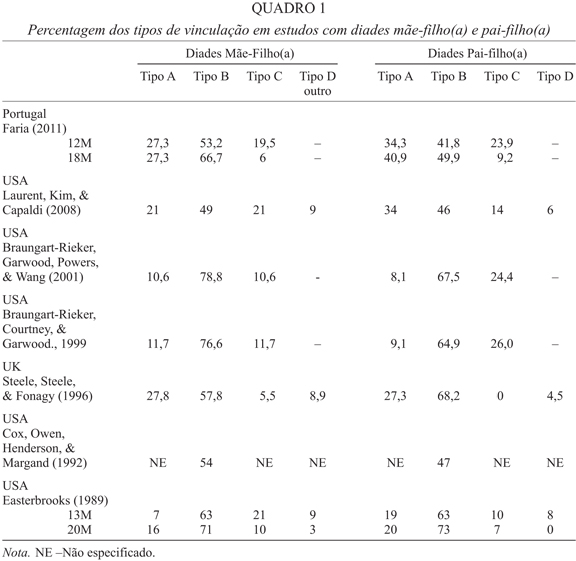
<body><![CDATA[<p><i>Pais e m&atilde;es enquanto figuras de vincula&ccedil;&atilde;o </i></p>     <p>Bowlby (1969) postulou a teoria da vincula&ccedil;&atilde;o recorrendo a uma perspetiva evolutiva e etol&oacute;gica da rela&ccedil;&atilde;o  m&atilde;e-filho. Contudo, posteriormente Bowlby (1982) referiu que esta figura materna n&atilde;o tinha de ser necessariamente a m&atilde;e  biol&oacute;gica, admitindo que o pai pode desempenhar este papel. Ainsworth (1967), enfatizando que a m&atilde;e n&atilde;o constitui a  &uacute;nica pessoa com quem a crian&ccedil;a estabelece rela&ccedil;&otilde;es de vincula&ccedil;&atilde;o, observou fortes liga&ccedil;&otilde;es  entre o beb&eacute; e o pai ao longo do seu estudo efectuado no Uganda, mesmo quando os contactos eram pouco frequentes: &ldquo;<i>It seemed to be  especially to the father that these other attachments were formed, even in the cases of babies who saw their fathers relatively infrequently.  One can only assume that there was some special quality in the father&rsquo;s interaction with his child &ndash; whether of tenderness or intense  delight &ndash; which evoked in turn a strength of attachment disproportionate to the frequency of his interaction with the baby</i>&rdquo; (p. 352). </p>     <p>Estas ideias ganham fundamento emp&iacute;rico em v&aacute;rios estudos sobre a vincula&ccedil;&atilde;o pai-filho que recorrendo &agrave;  Situa&ccedil;&atilde;o Estranha conseguem a identifica&ccedil;&atilde;o de padr&otilde;es de seguran&ccedil;a ou inseguran&ccedil;a como nas  d&iacute;ades m&atilde;e-filho (para revis&atilde;o ver Lucassen et al., 2011). N&atilde;o obstante, os estudos comparativos entre a qualidade da  vincula&ccedil;&atilde;o m&atilde;e-filho e pai-filho revelam que o padr&atilde;o de relacionamento seguro &eacute; mais prov&aacute;vel nas  d&iacute;ades m&atilde;e-filho (consultar <a href="#q1">Quadro 1</a>). Contudo, a introdu&ccedil;&atilde;o da classifica&ccedil;&atilde;o D parece  atenuar ou mesmo alterar as diferen&ccedil;as na incid&ecirc;ncia da seguran&ccedil;a com a m&atilde;e e com o pai. </p>      <p>&nbsp;</p>     <p><a name="q1"></a></p>     <p><img src="/img/revistas/aps/v32n4/32n4a04q1.jpg"></p>     
<p>&nbsp;</p>     <p>Se existem diferen&ccedil;as entre a qualidade da vincula&ccedil;&atilde;o m&atilde;e-filho(a) e pai-filho(a), que fatores poder&atilde;o  contribuir para estas diferen&ccedil;as entre pais e m&atilde;es? </p>     <p>&nbsp;</p>     <p><i>Sensibilidade materna e paterna </i></p>     ]]></body>
<body><![CDATA[<p>Embora a vincula&ccedil;&atilde;o tenha de ser entendida num quadro compreensivo sist&eacute;mico resultando de m&uacute;ltiplos fatores e  intera&ccedil;&otilde;es, o antecedente isolado mais fortemente associado &agrave; qualidade da vincula&ccedil;&atilde;o segura &eacute; a  <i>sensibilidade materna </i>(De Wolf &amp; van IJzendoorn, 1997). A sensibilidade foi definida como a capacidade do adulto &ldquo;<i>(...) to  perceive and to interpret accurately the signals and communications implicit in her infant&rsquo;s behavior, and given this understanding, to  respond to them appropriately and promptly</i>&rdquo; (Ainsworth, Bell, &amp; Stayton, 1974, p. 127). Segundo a autora a sensibilidade comporta  quatro aspectos fundamentais: (i) capacidade para perceber os sinais exteriorizados pela crian&ccedil;a; (ii) capacidade para os interpretar  correctamente; (iii) adequa&ccedil;&atilde;o das respostas dadas; (iv) prontid&atilde;o dessas mesmas respostas. Ser&aacute; diferente a  sensibilidade materna da sensibilidade paterna? </p>     <p>A literatura indica que, em m&eacute;dia, a sensibilidade materna &eacute; superior &agrave; paterna (Volling, McElwain, Notaro, &amp; Herrera,  2002). At&eacute; recentemente, era d&uacute;bia a rela&ccedil;&atilde;o entre sensibilidade paterna e seguran&ccedil;a na vincula&ccedil;&atilde;o  infantil. De facto, alguns estudos n&atilde;o encontraram resultados significativos entre a qualidade da intera&ccedil;&atilde;o dos pais e a  seguran&ccedil;a da vincula&ccedil;&atilde;o com o pai (Caldera, Huston, &amp; O&rsquo;Brien, 1995; Grossmann &amp; Grossmann, 1992; Schneider,  Rosen, &amp; Rothbaum, 1993). Outras investiga&ccedil;&otilde;es, pelo contr&aacute;rio, indicam uma correla&ccedil;&atilde;o significativa entre  a sensibilidade paterna e seguran&ccedil;a da vincula&ccedil;&atilde;o (Cox, Owen, Henderson, &amp; Margand, 1992; Goossens &amp; van IJzendoorn,  1990). </p>     <p>Em 2011, mais uma meta-an&aacute;lise de van IJzendoorn e a sua equipa, reunindo tr&ecirc;s d&eacute;cadas de investiga&ccedil;&atilde;o, desfez  a d&uacute;vida ao encontrar uma associa&ccedil;&atilde;o (ainda que fraca) entre a qualidade de resposta dos pais e a vincula&ccedil;&atilde;o  (Lucassen et al., 2011). No entanto, a associa&ccedil;&atilde;o entre a sensibilidade materna e a seguran&ccedil;a da vincula&ccedil;&atilde;o  &eacute; moderada (<i>r</i>=.23) enquanto esta associa&ccedil;&atilde;o em d&iacute;ades paternas &eacute; fraca (<i>r=</i>.13). </p>     <p>As diferen&ccedil;as entre os pais e as m&atilde;es s&atilde;o corroboradas pela fraca associa&ccedil;&atilde;o entre a qualidade da  vincula&ccedil;&atilde;o m&atilde;e-filho e pai-filho (<i>r</i>=.17). Por outras palavras, &eacute; poss&iacute;vel (e prov&aacute;vel) que uma  crian&ccedil;a possa ter um relacionamento seguro com um dos pais e inseguro com o outro (de Wolf &amp; van IJzendoorn, 1997). </p>     <p>Contudo, a qualidade da vincula&ccedil;&atilde;o pai-filho parece ser um fator importante para o desenvolvimento e bem estar infantil (e.g.,  Lamb, 1997; Lamb &amp; Lewis, 2004). Alguns estudos indicam que as crian&ccedil;as que estabelecem rela&ccedil;&otilde;es seguras com os seus pais  tendem a apresentar menos problemas de comportamento (Vershueren &amp; Marcoen, 1999), maior sociabilidade (Sagi et al., 1985) e  rela&ccedil;&otilde;es mais rec&iacute;procas com os seus pares (Ver&iacute;ssimo et al., 2011). Por outro lado, a literatura indica que a  aus&ecirc;ncia do pai ou que a rela&ccedil;&atilde;o pai-filho(a) insens&iacute;vel afetam o desenvolvimento socioemocional da crian&ccedil;a e do  jovem (Grossmann, Grossmann, &amp; Kindler, 2005 para uma revis&atilde;o). Outros autores, como Lamb (2012) sugerem que o g&eacute;nero dos pais  n&atilde;o &eacute; uma variavel cr&iacute;tica no bem estar (&ldquo;adjusment&rdquo;) dos filhos. Enquanto a qualidade das rela&ccedil;&otilde;es  entre pais e filhos e entre os pr&oacute;prios pais e adultos significativos na vida das crian&ccedil;as, tendo em conta os recursos  s&oacute;cio-econ&oacute;micos dispon&iacute;veis, t&ecirc;m um papel determinante. </p>     <p>Um estudo realizado pela equipa de Grossmans e colegas (2002) indicou que o impacto do comportamento parental &eacute; maior a longo prazo (aos  10 anos de idade) abrindo a porta &agrave; compreens&atilde;o do papel do pai como din&acirc;mico mas crucial. </p>     <p>Em suma, os pap&eacute;is dos pais e das m&atilde;es podem ser diferentes mas s&atilde;o complementares e igualmente relevantes para o  desenvolvimento infantil! </p>     <p>&nbsp;</p>     <p><i>Tarefas e pap&eacute;is maternos e paternos </i></p>     <p>Parke e Sawin (1976) observaram as m&atilde;es e os pais enquanto estes alimentavam os seus filhos e conclu&iacute;ram que os pais eram capazes  de realizar esta tarefa com a mesma efici&ecirc;ncia e sensibilidade que as m&atilde;es. Igualmente, outras investiga&ccedil;&otilde;es indicam que  os pais que participam (e escolhem participar) nas rotinas familiares realizam com a mesma profici&ecirc;ncia a presta&ccedil;&atilde;o de cuidados  &agrave;s crian&ccedil;as (Belsky, Gistrap, &amp; Rovine, 1984; Lamb, 1981; Parke &amp; Tinsley, 1981). Com efeito, a quest&atilde;o colocada por  alguns autores &eacute; qual das seguintes vari&aacute;veis mais pesa na organiza&ccedil;&atilde;o da vincula&ccedil;&atilde;o: o tempo dedicado  pelo pai e pela m&atilde;e nos cuidados e intera&ccedil;&atilde;o com os filhos ou o g&eacute;nero dos pais? </p>     ]]></body>
<body><![CDATA[<p>Na maioria das culturas, constata-se que as m&atilde;es passam mais tempo com os filhos do que os pais (Hewlett, 1992; Parke &amp; Buriel, 2006;  Phares, 1996), embora, os pais comecem a passar mais tempo a brincar com os filhos (Coleman, Garfield, &amp; Committee on Psychosocial Aspects of  Child and Family Health, 2004; Prodata, 2014), principalmente quando se trata do primeiro filho (Michale, 2007). Quando comparados com as  m&atilde;es, os pais, ainda continuam a passar menos tempo com os filhos, principalmente dos 0 aos 2 anos (Yeung, Sandberg, Davis-Kean, &amp;  Hofferth, 2001) e a ter menor responsabilidade nos cuidados infantis (Lamb &amp; Oppenheim, 1989), principalmente nas culturas ocidentais (Cooksey  &amp; Fondell, 1996; Yeung et al., 2001). </p>     <p>Alguns trabalhos compararam pais &ldquo;cuidadores prim&aacute;rios&rdquo; (definidos como aqueles que atribu&iacute;am 20 ou mais horas por  semana de cuidados &agrave; crian&ccedil;a) <i>versus </i>pais que n&atilde;o desempenham cuidados prim&aacute;rios &agrave; crian&ccedil;a. Os  resultados indicam que os pais que assumem o papel de cuidador prim&aacute;rio apresentam intera&ccedil;&otilde;es igualmente positivas e com a  mesma atmosfera de prazer comparativamente &agrave;s m&atilde;es (Lewis et al., 2009; Yogman, 1982). </p>     <p>Em 2010, uma investiga&ccedil;&atilde;o realizada em Portugal, por Monteiro e colegas, indicou que a  participa&ccedil;&atilde;o dos pais na presta&ccedil;&atilde;o de cuidados e em atividades de jogo e lazer estava associada a scores mais elevados  de seguran&ccedil;a avaliados atrav&eacute;s do Attachment Q-sort (AQS; Waters, Vaughn, &amp; Egeland, 1980). Posteriormente, outra  investiga&ccedil;&atilde;o nacional (desenvolvida com a Situa&ccedil;&atilde;o Estranha) indicou que a qualidade do tempo passado com a  crian&ccedil;a foi mais importante do que a quantidade do tempo (Faria, Lopes-dos-Santos, Beeghly, &amp; Fuertes, in press). Este &uacute;ltimo  estudo indicou que as m&atilde;es mais dedicadas a brincar e a passear com os filhos (em oposi&ccedil;&atilde;o &agrave;s m&atilde;es menos  dedicadas a estas tarefas<sup><a href="#4">4</a></sup><a name="top4"></a>) tendiam a estabelecer uma vincula&ccedil;&atilde;o segura e uma  intera&ccedil;&atilde;o positiva com as crian&ccedil;as. No grupo dos pais, aqueles que passavam mais tempo a prestar cuidados b&aacute;sicos aos  filhos tendiam a obter scores mais elevados na qualidade da intera&ccedil;&atilde;o e os filhos a desenvolverem com eles uma rela&ccedil;&atilde;o  segura. </p>     <p>&nbsp;</p>     <p><i>Comportamentos maternos e paternos de acordo com o g&eacute;nero da crian&ccedil;a </i></p>     <p>Parecem existir diferen&ccedil;as no modo como os pais interagem com os filhos e as filhas. Alguns autores relatam que os pais encorajam mais os  filhos a participar em brincadeiras masculinas (t&iacute;picas dos rapazes) e as filhas em brincadeiras femininas (t&iacute;picas das raparigas)  (Snow, Jacklin, &amp; Maccoby, 1983). As m&atilde;es tendem a tratar igualitariamente os filhos e as filhas, enquanto os pais adaptam o seu estilo  parental, aos filhos e &agrave;s filhas (Brundin, Rodholm, &amp; Larsson, 1988; Lytton &amp; Romney, 1991). De facto, os pais interagem em jogos e  brincadeiras mais f&iacute;sicas, ativas (Feldman, 2003; Rohner &amp; Veneziano, 2001) e imprevis&iacute;veis (Parke, 1995) com os filhos do que  com as filhas (Jacklin, DiePietro, &amp; Maccoby, 1984; MacDonald &amp; Parke, 1986), e t&ecirc;m uma maior satisfa&ccedil;&atilde;o parental,  ap&oacute;s 12 a 16 semanas do nascimento, com os filhos (Hudson, Elek, &amp; Ofe Fleck, 2001). Por seu lado, as m&atilde;es interagem em mais  jogos simb&oacute;licos (Langlois &amp; Downs, 1980; Tamis-LeMonda &amp; Bornstein, 1991) e est&atilde;o mais dispon&iacute;veis emocionalmente  (Volling et al., 2002) com as filhas. </p>     <p>Weinberg, Tronick, Cohn e Olson (1998) verificaram que era mais f&aacute;cil reparar a intera&ccedil;&atilde;o nas d&iacute;ades  m&atilde;e-filha do que nas d&iacute;ades m&atilde;e-filho. Apesar dos rapazes estarem inicialmente mais sincronizados com a m&atilde;e durante o  jogo do que as raparigas, quando a m&atilde;e se tornava n&atilde;o responsiva, os rapazes mostravam-se bastante reativos exibindo mais afeto  negativo. Ao contr&aacute;rio, as raparigas evidenciavam maior capacidade de auto-regula&ccedil;&atilde;o na aus&ecirc;ncia de resposta materna  (<i>op. cit.</i>). Alguns estudos referem maior sincronia nas d&iacute;ades do mesmo g&eacute;nero (e.g., pai-filho ou m&atilde;e-filha) (Manlove  &amp; Vernon-Feagans, 2002). Outros estudos mostram que as raparigas s&atilde;o significativamente mais responsivas &agrave;s  vocaliza&ccedil;&otilde;es maternas do que os rapazes (Gumnar &amp; Donahue, 1980). Por seu lado, as m&atilde;es s&atilde;o mais r&aacute;pidas a  responder &agrave;s express&otilde;es faciais das raparigas (Haviland, 1977). </p>     <p>Assim, o conjunto dos estudos sobre a qualidade de intera&ccedil;&atilde;o m&atilde;e-filho/filha e pai-filho/filha revela que existem  diferen&ccedil;as nos comportamentos dos pais e das m&atilde;es mediadas pelo g&eacute;nero da crian&ccedil;a. No entanto, no que respeita &agrave;  vincula&ccedil;&atilde;o o g&eacute;nero da crian&ccedil;a tem sido pouco discutido como vari&aacute;vel relevante. Com efeito, a maioria dos  estudos com a m&atilde;e ou com o pai como figura de vincula&ccedil;&atilde;o n&atilde;o t&ecirc;m indicado diferen&ccedil;as significativas  consoante o g&eacute;nero da crian&ccedil;a (para revis&atilde;o ver, Grossman, Grossman, Kindler, &amp; Zimmermann, 2008). </p>     <p>&nbsp;</p>     <p><i>Contexto das rela&ccedil;&otilde;es de vincula&ccedil;&atilde;o </i></p>     ]]></body>
<body><![CDATA[<p>Posterior a Bowbly e Ainsworth, os te&oacute;ricos da vincula&ccedil;&atilde;o recorrem cada vez mais a abordagens multisist&eacute;micas,  ecol&oacute;gicas e transacionais para explicar a qualidade da vincula&ccedil;&atilde;o longe de uma causalidade direta, apenas, centrada na  sensibilidade materna (e.g., Belsky, 2005; Cicchetti &amp; Barnett, 1991; Crittenden, 2000; Sroufe, 1996). Entre as v&aacute;rias causas aduzidas  para explicar a qualidade do relacionamento entre as figuras maternas e a crian&ccedil;a contam-se as <i>experi&ecirc;ncias de  vincula&ccedil;&atilde;o da m&atilde;e </i>(Benoit &amp; Parker, 1994; Fonagy, Steele, &amp; Steele, 1991; Fonagy, Steele, Moran, Steele, &amp;  Higgitt, 1993; Levine, Tuber, Slade, &amp; Ward, 1991; Slade &amp; Cohen, 1996; Ward &amp; Carlson, 1995), <i>e do pai </i>(Grossmann et al., 2002)  vividas durante as suas inf&acirc;ncias. Os pais que se lembram de terem tido pais atenciosos (Sagi, 1982) e implicados nos cuidados b&aacute;sicos  (Cabrera, Tamis-LeMonda, Bradley, Hofferth, &amp; Lamb, 2000) mostraram-se mais envolvidos nos cuidados parentais (Cohn, Cowan, Cowan, &amp;  Pearson, 1992). O mesmo foi observado com as m&atilde;es, isto &eacute;, as m&atilde;es que referiram terem tido m&atilde;es est&aacute;veis,  dispon&iacute;veis, carinhosas e competentes nos cuidados, mostraram uma maior tend&ecirc;ncia para terem vincula&ccedil;&otilde;es seguras com  os(as) seus(suas) filhos(as) (Morris, 1980). </p>     <p>Outro elemento importante na seguran&ccedil;a da vincula&ccedil;&atilde;o mas, apenas, com um impato indireto &eacute; a  <i>rela&ccedil;&atilde;o marital </i>dos pais. Com efeito, o conflito entre pais e m&atilde;es parece afetar o comportamento materno e paterno  (e.g., Tarabulsy et al., 2005; Tomlinson, Cooper, &amp; Murray, 2005). Tal reflete-se, posteriormente, na qualidade da vincula&ccedil;&atilde;o  (e.g., Cowan et al., 2005; Edwards, Eiden, &amp; Leonard, 2006; Solomon &amp; George, 1999). Igualmente, a participa&ccedil;&atilde;o dos pais nas  tarefas di&aacute;rias e nos cuidados &agrave; crian&ccedil;a parece ser um factor mediador da sensibilidade materna (e.g., Barnett &amp; Baruch,  1987; Neville &amp; Parke, 1979; Parke &amp; Buriel, 1998). </p>     <p>Igualmente importante &eacute; a <i>satisfa&ccedil;&atilde;o profissional </i>dos pais. As m&atilde;es que indicam ter muito stress profissional  ou m&aacute;s condi&ccedil;&otilde;es profissionais como hor&aacute;rios irregulares (Parke et al., 2004; Raver, 2003; Repetti &amp; Wood, 1997),  ou que identificam o trabalho como pouco reconhecido socialmente (Menaghan, 1983; Raver, 2003; Repetti &amp; Wood, 1997) t&ecirc;m maior  dificuldade em desenvolverem rela&ccedil;&otilde;es positivas com os seus filhos e estes tendem a apresentar um desenvolvimento menos ajustado  (Felfe &amp; Hsin, 2012). Pelo contr&aacute;rio, as m&atilde;es com maior satisfa&ccedil;&atilde;o profissional s&atilde;o descritas na literatura  como mais &ldquo;divertidas&rdquo; nas brincadeiras, entregues no relacionamento com os filhos, descontra&iacute;das e alegres (National Institute  of Child Health and Human Development [NICHD] Early Child Care Research Network, 2000; ver tamb&eacute;m Horn, 2000, para revis&atilde;o). No caso  dos pais, o n&uacute;mero de horas de trabalho medeia o envolvimento parental (Barnett &amp; Baruch, 1987; Brown, McBride, Bost, &amp; Shin, 2011). </p>     <p>A <i>depress&atilde;o </i>materna tanto como a depress&atilde;o paterna afetam significativamente o relacionamento afetivo dos pais e das  m&atilde;es com os filhos (e.g., Wilson &amp; Durbin, 2010). Um vasto corpo de literatura indica que a depress&atilde;o materna &eacute; fator de  risco para a seguran&ccedil;a na vincula&ccedil;&atilde;o e que est&aacute; associada a piores desempenhos desenvolvimentais (meta-an&aacute;lises:  Atkison, Atkison, Smith, Bem, &amp; Nolen-Hocksema, 2000; Belsky &amp; Jaffe, 2006 para revis&atilde;o; Martins &amp; Graffan, 2000). Alguma  literatura indica que a depress&atilde;o materna &eacute; um fator de maior adversidade do que a depress&atilde;o paterna (e.g., Connell &amp;  Goodman, 2002; Kane &amp; Garber, 2004; Klein, Astrachan, &amp; Smyrnios, 2005; Ramchandani, Stein, Evans, &amp; O&rsquo;Connor, 2005). Contudo,  pais deprimidos em compara&ccedil;&atilde;o com pais sem depress&atilde;o diagnosticada tendem a apresentar mais altera&ccedil;&otilde;es de humor,  comportamentos negativos, intrusividade e afastamento psicol&oacute;gico (Wilson &amp; Durbin, 2010). </p>     <p>Outro fator que poder&aacute; influenciar a seguran&ccedil;a na vincula&ccedil;&atilde;o prende-se com o <i>estatuto socioecon&oacute;mico da  fam&iacute;lia </i>(Braungart-Rieker, Courtmey, &amp; Garwood, 1999; Chase-Lansdale &amp; Owen, 1987; Rooparine, Fouts, Lamb, &amp; Lewis-Elligan,  2005; Volling &amp; Belsky, 1992). Fuertes, Faria, Soares e Crittenden (2008) referem que esta condi&ccedil;&atilde;o pode ter um poderoso impacto  na qualidade da intera&ccedil;&atilde;o m&atilde;e-filho(a), ainda maior que a prematuridade ou problemas de sa&uacute;de. Possivelmente, porque a  condi&ccedil;&atilde;o de pobreza est&aacute; associada a v&aacute;rias adversidades como a baixa escolaridade, problemas de sa&uacute;de,  desemprego e outras. </p>     <p>No que concerne &agrave; <i>escolaridade dos pais (pais e m&atilde;es) </i>verifica-se que o aumento de anos de escolaridade dos pais  est&aacute; associado a rela&ccedil;&otilde;es seguras (Pederson &amp; Moran, 1996). As m&atilde;es com mais anos de escolaridade s&atilde;o  tendencialmente mais sens&iacute;veis e perspicazes em interpretar os sinais emitidos pela crian&ccedil;a (Fuertes, Faria, Oliveira-Costa, Corval,  &amp; Figueiredo, 2009), dedicam mais tempo a cuidar e a brincar com os filhos (Pederson, Gleason, Moran, &amp; Bento, 1998), tendem a ser mais  r&aacute;pidas e eficientes nas respostas prestadas &agrave;s solicita&ccedil;&otilde;es das crian&ccedil;as (Silva, Del Prette, &amp; Del Prette,  2002). Por outro lado, as m&atilde;es com menos anos de escolaridade podem ser mais controladoras interferindo com maior frequ&ecirc;ncia nas  a&ccedil;&otilde;es das crian&ccedil;as (Silva et al., 2002). </p>     <p>Nesta revis&atilde;o n&atilde;o exaustiva dos fatores que podem condicionar o comportamento dos pais verificamos que fatores ligados &agrave;  fam&iacute;lia como a rela&ccedil;&atilde;o marital, a satisfa&ccedil;&atilde;o profissional, o n&iacute;vel s&oacute;cioecon&oacute;mico ou a  escolaridade das m&atilde;es contribuem para a parentalidade em geral e para a qualidade da vincula&ccedil;&atilde;o. Igualmente, fatores  associados aos pais como a depress&atilde;o, a idade das m&atilde;es (especialmente m&atilde;es adolescentes; e.g., Moran, Forbes, Evans,  Tarabulsy, &amp; Madigan, 2008), fatores associados &agrave; crian&ccedil;a como a prematuridade (e.g., Fuertes, Lopes dos Santos, Beeghly, &amp;  Tronick, 2006, 2009), problemas graves de sa&uacute;de ou alguns tipos de incapacidade podem contribuir para a diferencia&ccedil;&atilde;o (e.g.,  Olrick, Pianta, &amp; Marvin, 2002) da parentalidade e o aumento da preval&ecirc;ncia da vincula&ccedil;&atilde;o insegura (ver revis&atilde;o em  Lopes dos Santos &amp; Fuertes, 2005). Em s&iacute;ntese, a parentalidade &eacute; o produto das rela&ccedil;&otilde;es estabelecidas no seio da  fam&iacute;lia e da ecologia de multi-influ&ecirc;ncias que a afetam e, a parentalidade &eacute; o contexto onde as rela&ccedil;&otilde;es da  vincula&ccedil;&atilde;o se estabelecem. </p>     <p>&nbsp;</p>     <p>DISCUSS&Atilde;O FINAL </p>     <p>Nos &uacute;ltimos anos os investigadores e desenvolvimentalistas tomaram em conta o facto da fam&iacute;lia ser um sistema no qual todos  contribuem para a sua homeostasia (incluindo o pai). Um vasto corpo de literatura indica que o papel do pai ou da m&atilde;e, n&atilde;o pode ser  apenas explicado pela atua&ccedil;&atilde;o direta com a crian&ccedil;a (revis&atilde;o em George &amp; Solomon, 2008; Monteiro &amp;  Ver&iacute;ssimo, 2010). Com efeito, a rela&ccedil;&atilde;o conjugal, suporte formal e informal dado &agrave; fam&iacute;lia bem como fatores  pessoais e sociais s&atilde;o importantes mediadores e moderadores da sensibilidade dos adultos. </p>     ]]></body>
<body><![CDATA[<p>Para al&eacute;m dos dados da vincula&ccedil;&atilde;o em que se encontram diferen&ccedil;as entre pais e m&atilde;es (ainda por explicar),  a literatura tem caraterizado as m&atilde;es e os pais como parceiros distintos de intera&ccedil;&atilde;o. Geiger (1996) refere que as m&atilde;es  usam com maior frequ&ecirc;ncia o contacto f&iacute;sico, as demonstra&ccedil;&otilde;es afetivas expl&iacute;citas e a verbaliza&ccedil;&atilde;o nas  intera&ccedil;&otilde;es com os filhos, enquanto as intera&ccedil;&otilde;es pais-filhos revestem-se tipicamente de brincadeiras  emocionantes, divertidas, robustas e fisicamente estimulantes (Clarke-Stewart, 1978; Crawley &amp; Sherrod, 1984; Lamb, 1977). Os pais foram  descritos como mais assertivos (Leaper, 2000) e menos responsivos aos desejos dos filhos (Power, 1985; Power &amp; Parke, 1983). Na  comunica&ccedil;&atilde;o, os pais parecem ser mais diretos quando pedem algo aos filhos (e.g., d&aacute;-me o carro), enquanto as m&atilde;es  optam pela <i>negocia&ccedil;&atilde;o </i>(e.g., se comeres tudo deixo-te ver televis&atilde;o), pelo <i>afeto </i>(e.g., querido d&aacute;s a  m&atilde;o &agrave; mam&atilde;?) ou pela <i>justifica&ccedil;&atilde;o </i>(e.g., come tudo para poderes ir brincar mais depressa) (Power,  McGrath, Hughes, &amp; Manire, 1994). N&atilde;o obstante, os pap&eacute;is maternos e paternos est&atilde;o em mudan&ccedil;a, com a  altera&ccedil;&atilde;o do papel da mulher na sociedade ocidental e os dados que tipificam os pap&eacute;is maternos e paternos podem vir a ganhar  novos contornos (Biller, 1993; Lamb 1992; Parke, 1996; Prado &amp; Vieira, 2003). Desta altera&ccedil;&atilde;o de pap&eacute;is, especulamos que  resultem mudan&ccedil;as para a parentalidade e para a qualidade interativa dos pais, e subsequentemente para a qualidade da  vincula&ccedil;&atilde;o. </p>     <p>Numa pequena investiga&ccedil;&atilde;o explorat&oacute;ria desenvolvida em Portugal (Alves, Fuertes, &amp; Sousa, 2014, in press) com as  m&atilde;es e pais de crian&ccedil;as com 15 meses, as m&atilde;es exibiam quase cerca de 5 vezes mais comportamentos verbais (significando,  expandindo e reelaborando as verbaliza&ccedil;&otilde;es da crian&ccedil;a), o dobro do toque e dos comportamentos afetivos. Os pais, por seu lado,  seguiram com maior frequ&ecirc;ncia os interesses da crian&ccedil;a e aceitaram mais as suas escolhas de atividade (ao contr&aacute;rio do descrito  anteriormente na literatura). Na Alemanha, um grupo de investigadores na &aacute;rea da educa&ccedil;&atilde;o de inf&acirc;ncia quis estudar se o  g&eacute;nero tinha impacto na qualidade de intera&ccedil;&atilde;o de educadores e de educadoras com as crian&ccedil;as (Brandes, Andra, Roseler,  &amp; Schneider-Andrich, 2012). Educadores e educadoras (com a mesma experi&ecirc;ncia e forma&ccedil;&atilde;o profissional) eram convidados a  brincarem em laborat&oacute;rio com crian&ccedil;as entre os 3 e os 6 anos. Os resultados indicaram que os educadores e educadoras escolheram os  mesmos materiais e desenvolveram com as crian&ccedil;as projetos semelhantes. Na verdade, n&atilde;o se encontraram diferen&ccedil;as  significativas entre estes profissionais. Os autores sugerem que a forma&ccedil;&atilde;o profissional teria um papel dissuasor das  diferen&ccedil;as de g&eacute;nero, considerando que elas se devem mais a fatores sociais e culturalmente &ldquo;aprendidos&rdquo;. </p>     <p>Colocam-se, naturalmente, quest&otilde;es metodol&oacute;gicas que importam ainda discutir especialmente no seio da Situa&ccedil;&atilde;o  Estranha. Alguns estudos aplicam o procedimento experimental aos 12 meses com um dos pais e com o outro passados 13 meses, quando n&atilde;o  est&aacute; demonstrado que a crian&ccedil;a n&atilde;o recorde (ao longo da segunda situa&ccedil;&atilde;o experimental) a experi&ecirc;ncia  pr&eacute;via vivida um m&ecirc;s antes. Noutros estudos s&atilde;o usadas amostras independentes e ainda outros recorrem a pequenas  adapta&ccedil;&otilde;es da Situa&ccedil;&atilde;o Estranha com maior ou menor valida&ccedil;&atilde;o. Esta diversidade metodol&oacute;gica no  seio da Situa&ccedil;&atilde;o Estranha pode contribuir para o conhecimento da vincula&ccedil;&atilde;o em diversas condi&ccedil;&otilde;es. Com  efeito, a maioria dos estudos independentemente da metodologia aplicada indicam diferen&ccedil;as na vincula&ccedil;&atilde;o &agrave; m&atilde;e  e ao pai mas n&atilde;o em todos. Por&eacute;m, para acumular um corpo de conhecimento robusto e consistente que nos permita avan&ccedil;ar para  fases mais complexas de an&aacute;lise, por ventura ser&atilde;o necess&aacute;rias novas reformula&ccedil;&otilde;es metodol&oacute;gicas capazes  de responder &agrave;s limita&ccedil;&otilde;es atuais. </p>     <p>Nos estudos das intera&ccedil;&otilde;es pais-crian&ccedil;a a diversidade metodol&oacute;gica &eacute; enorme partindo de conceitos e  construtos distintos, recolhida em situa&ccedil;&otilde;es laboratoriais, de jogo livre ou em contexto natural, e com sistemas de  cota&ccedil;&atilde;o muito diversos. Faria, Lopes-dos-Santos, Beeghly e Fuertes (in press) questionam a adequa&ccedil;&atilde;o destes sistemas de  cota&ccedil;&atilde;o para avaliar a rela&ccedil;&atilde;o pai-filho que foram desenvolvidos originalmente a partir de observa&ccedil;&otilde;es da  rela&ccedil;&atilde;o m&atilde;e-filho. N&atilde;o sabemos se estas escalas integram a diversidade de comportamentos dos pais com as  crian&ccedil;as e das crian&ccedil;as com os pais. </p>     <p>A investiga&ccedil;&atilde;o da vincula&ccedil;&atilde;o com o pai e com a m&atilde;e tem, entre outros, o m&eacute;rito de indicar que a mesma  crian&ccedil;a pode estabelecer uma rela&ccedil;&atilde;o segura com um pai e insegura com outro pai, comprovando a flexibilidade e labilidade da  organiza&ccedil;&atilde;o dos processos de vincula&ccedil;&atilde;o prevista por Bowbly (1969/1982). Para os profissionais da  interven&ccedil;&atilde;o precoce esta &eacute; tamb&eacute;m uma informa&ccedil;&atilde;o valiosa! Os t&eacute;cnicos n&atilde;o devem, apenas,  recolher informa&ccedil;&atilde;o sobre a rela&ccedil;&atilde;o m&atilde;e-filho mas tamb&eacute;m pai-filho. Mais, com base nos estudos  desenvolvidos por Ver&iacute;ssimo, Monteiro e Santos (2006) devem observar e descrever o funcionamento da tr&iacute;ade (pai e m&atilde;e em  intera&ccedil;&atilde;o conjunta com a crian&ccedil;a). </p>     <p>Longe de encontrarmos respostas, ficam perguntas que podem estimular novos estudos: Em que medida as diferen&ccedil;as da  vincula&ccedil;&atilde;o associadas ao g&eacute;nero dos pais s&atilde;o afetadas pela cultura? Em que medida os fatores de risco afetam a  vincula&ccedil;&atilde;o com o pai e a intera&ccedil;&atilde;o pai-filho? Qual a natureza espec&iacute;fica das rela&ccedil;&otilde;es e  intera&ccedil;&otilde;es entre pais com as filhas e com os filhos? </p>     <p>&nbsp;</p>     <p>REFER&Ecirc;NCIAS </p>     <!-- ref --><p>Ainsworth, M. D. (1965). Further research into the adverse effects of maternal deprivation. In J. Bowlby (Ed.), <i>Child care and growth of  love</i> (pp. 191-235). London: Penguin Book.    &nbsp;&nbsp;&nbsp;&nbsp;&nbsp;&nbsp;&nbsp;&nbsp;[&#160;<a href="javascript:void(0);" onclick="javascript: window.open('/scielo.php?script=sci_nlinks&ref=000081&pid=S0870-8231201400040000400001&lng=','','width=640,height=500,resizable=yes,scrollbars=1,menubar=yes,');">Links</a>&#160;]<!-- end-ref --> </p>     ]]></body>
<body><![CDATA[<!-- ref --><p>Ainsworth, M. D. (1967). <i>Infancy in Uganda: Infant care and growth of love</i>. Baltimore: Johns Hopkins University Press.    &nbsp;&nbsp;&nbsp;&nbsp;&nbsp;&nbsp;&nbsp;&nbsp;[&#160;<a href="javascript:void(0);" onclick="javascript: window.open('/scielo.php?script=sci_nlinks&ref=000083&pid=S0870-8231201400040000400002&lng=','','width=640,height=500,resizable=yes,scrollbars=1,menubar=yes,');">Links</a>&#160;]<!-- end-ref --> </p>     <p>Ainsworth, M. D., Bell, S., &amp; Stayton, D. (1974). Infant mother attachment and social development: &ldquo;Socialization&rdquo; as a product  reciprocal responsiveness to signals. In M. P. Richards (Ed.), <i>The integration of a child into a social world</i> (pp. 99-135). London: Cambridge  University Press. </p>     <p>Ainsworth, M. D., Blehar, M., Waters, E., &amp; Wall, S. (1978). <i>Patterns of attachment &ndash; A psychological study of the strange  situation. </i>New Jersey: Lawrence Erlbaum Associates. </p>     <!-- ref --><p>Alves, M. J., Fuertes, M., &amp; Sousa, O. (2014). Estudo da qualidade da intera&ccedil;&atilde;o e da fala dirigida por pais e m&atilde;es.  <i>Atas do VII Encontro Nacional da L&iacute;ngua Portuguesa, 7</i>, 16-17.    &nbsp;&nbsp;&nbsp;&nbsp;&nbsp;&nbsp;&nbsp;&nbsp;[&#160;<a href="javascript:void(0);" onclick="javascript: window.open('/scielo.php?script=sci_nlinks&ref=000087&pid=S0870-8231201400040000400005&lng=','','width=640,height=500,resizable=yes,scrollbars=1,menubar=yes,');">Links</a>&#160;]<!-- end-ref --> </p>     <p>Atkison, R. L., Atkison, R. C., Smith, E. C., Bem, D. J., &amp; Nolen-Hocksema, S. (2000). <i>Hilgard&rsquo;s introduction to psychology</i>.  New York: Harcourt College Publishers. </p>     <!-- ref --><p>Bakermans-Kranenburg, M. J., van IJzendoorn, M. H., Bokhorst, C. L., &amp; Schuengel, C. (2004). The importance of shared environment in  infant-father attachment: A behavioral genetic study on the Attachment Q-Sort. <i>Journal of Family Psychology, 18</i>, 545-549. doi:  10.1037/0893-3200.18.3.545 &nbsp;&nbsp;&nbsp;&nbsp;&nbsp;&nbsp;&nbsp;&nbsp;[&#160;<a href="javascript:void(0);" onclick="javascript: window.open('/scielo.php?script=sci_nlinks&ref=000090&pid=S0870-8231201400040000400007&lng=','','width=640,height=500,resizable=yes,scrollbars=1,menubar=yes,');">Links</a>&#160;]<!-- end-ref --><p>Barnett, R. C., &amp; Baruch, G. K. (1987). Determinants of fathers&rsquo; participation in family work. <i>Journal of Marriage and the Family,  47</i>, 29-40. doi: 10.2307/352667 </p>     <!-- ref --><p>Belsky, J. (2005). Attachment theory and research in ecological perspective. In K. E. Grossmann, K. Grossmann, &amp; E. Waters (Eds.),  <i>Attachment from infancy to adulthood: The major longitudinal studies </i>(pp. 71-97). New York: Guilford Press.    &nbsp;&nbsp;&nbsp;&nbsp;&nbsp;&nbsp;&nbsp;&nbsp;[&#160;<a href="javascript:void(0);" onclick="javascript: window.open('/scielo.php?script=sci_nlinks&ref=000092&pid=S0870-8231201400040000400009&lng=','','width=640,height=500,resizable=yes,scrollbars=1,menubar=yes,');">Links</a>&#160;]<!-- end-ref --> </p>     <!-- ref --><p>Belsky, J., Gilstrap, B., &amp; Rovine, M. (1984). The Pennsylvania infant and family development project: I. Stability and change in  mother-infant and father-infant interaction in a family setting at one, three, and nine months. <i>Child Development, 55</i>, 692-705. doi:  10.1111/j.1467-8624.1984.tb03808.x &nbsp;&nbsp;&nbsp;&nbsp;&nbsp;&nbsp;&nbsp;&nbsp;[&#160;<a href="javascript:void(0);" onclick="javascript: window.open('/scielo.php?script=sci_nlinks&ref=000094&pid=S0870-8231201400040000400010&lng=','','width=640,height=500,resizable=yes,scrollbars=1,menubar=yes,');">Links</a>&#160;]<!-- end-ref --><!-- ref --><p>Belsky, J., &amp; Jaffe, S. R. (2006). The multiple determinants of parenting. In D. Cicchetti &amp; D. J. Cohen (Eds.), <i>Developmental  psychopathology. Vol. 3: Risk, disorder, and adaptation </i>(pp. 38-85). Hoboken, NJ: John Wiley.    &nbsp;&nbsp;&nbsp;&nbsp;&nbsp;&nbsp;&nbsp;&nbsp;[&#160;<a href="javascript:void(0);" onclick="javascript: window.open('/scielo.php?script=sci_nlinks&ref=000095&pid=S0870-8231201400040000400011&lng=','','width=640,height=500,resizable=yes,scrollbars=1,menubar=yes,');">Links</a>&#160;]<!-- end-ref --> </p>     <!-- ref --><p>Benoit, D., &amp; Parker, K. (1994). Stability and transmission of attachment across generations. <i>Child Development, 65</i>, 1444-1456. doi:  10.1111/j.1467-8624.1994.tb00828.x &nbsp;&nbsp;&nbsp;&nbsp;&nbsp;&nbsp;&nbsp;&nbsp;[&#160;<a href="javascript:void(0);" onclick="javascript: window.open('/scielo.php?script=sci_nlinks&ref=000097&pid=S0870-8231201400040000400012&lng=','','width=640,height=500,resizable=yes,scrollbars=1,menubar=yes,');">Links</a>&#160;]<!-- end-ref --><!-- ref --><p>Biller, H. B. (1993). <i>Fathers and families. </i>Westport, CT: Aubum House.    &nbsp;&nbsp;&nbsp;&nbsp;&nbsp;&nbsp;&nbsp;&nbsp;[&#160;<a href="javascript:void(0);" onclick="javascript: window.open('/scielo.php?script=sci_nlinks&ref=000098&pid=S0870-8231201400040000400013&lng=','','width=640,height=500,resizable=yes,scrollbars=1,menubar=yes,');">Links</a>&#160;]<!-- end-ref --> </p>     <!-- ref --><p>Bokhorst, C. L., Bakermans-Kranenburg, M. J., Fearon, R. M., van IJzendoorn, M. H., Fonagy, P., &amp; Schuengel, C. (2003). The importance of  shared environment in mother-infant attachment security: A behavioral genetic study. <i>Child Development, 74</i>, 1769-1782.    &nbsp;&nbsp;&nbsp;&nbsp;&nbsp;&nbsp;&nbsp;&nbsp;[&#160;<a href="javascript:void(0);" onclick="javascript: window.open('/scielo.php?script=sci_nlinks&ref=000100&pid=S0870-8231201400040000400014&lng=','','width=640,height=500,resizable=yes,scrollbars=1,menubar=yes,');">Links</a>&#160;]<!-- end-ref --> </p>     <p>Bowlby, J. (1969/1982). <i>Attachment and loss </i>(Vol. I). London: Penguin Book. </p>     ]]></body>
<body><![CDATA[<!-- ref --><p>Brandes, H., Andra, M., Roseler, W., &amp; Schneider-Andrich, P. (2012). <i>Does the gender make a difference? Tandem study on pedagogical  activity of female and male ECE workers</i>.    &nbsp;&nbsp;&nbsp;&nbsp;&nbsp;&nbsp;&nbsp;&nbsp;[&#160;<a href="javascript:void(0);" onclick="javascript: window.open('/scielo.php?script=sci_nlinks&ref=000103&pid=S0870-8231201400040000400016&lng=','','width=640,height=500,resizable=yes,scrollbars=1,menubar=yes,');">Links</a>&#160;]<!-- end-ref --> Comunica&ccedil;&atilde;o apresentada no 22<sup>th </sup>EECERA Conference, Porto, Portugal. </p>     <!-- ref --><p>Braungart-Rieker, J., Courtney, S., &amp; Garwood, M. M. (1999). Mother-and-father-infant attachment families in context. <i>Journal of Family  Psychology, 13</i>, 535-553. doi: 10.1037/0893-3200.13.4.535 &nbsp;&nbsp;&nbsp;&nbsp;&nbsp;&nbsp;&nbsp;&nbsp;[&#160;<a href="javascript:void(0);" onclick="javascript: window.open('/scielo.php?script=sci_nlinks&ref=000105&pid=S0870-8231201400040000400017&lng=','','width=640,height=500,resizable=yes,scrollbars=1,menubar=yes,');">Links</a>&#160;]<!-- end-ref --><!-- ref --><p>Braungart-Rieker, J. M., Garwood, M. M., Powers, B. P., &amp; Wang, X. (2001). Parental sensitivity, infant affect, and affect regulation:  Predictors of later attachment. <i>Child Development, 72</i>, 252-270. doi: 10.1111/1467-8624.00277/abstract &nbsp;&nbsp;&nbsp;&nbsp;&nbsp;&nbsp;&nbsp;&nbsp;[&#160;<a href="javascript:void(0);" onclick="javascript: window.open('/scielo.php?script=sci_nlinks&ref=000106&pid=S0870-8231201400040000400018&lng=','','width=640,height=500,resizable=yes,scrollbars=1,menubar=yes,');">Links</a>&#160;]<!-- end-ref --><p>Brown, G. L., McBride, B. A., Bost, K. K., &amp; Shin, N. (2011). Parental involvement, child temperament, and parents&rsquo; work hours: Differential  relations for mothers and fathers. <i>Journal of Applied Developmental Psychology, 32</i>, 313-322. doi: 10.1016/j.appdev.2011.08.004 </p>     <!-- ref --><p>Brundin, K., Rodholm, M., &amp; Larsson, K. (1988). Vocal communication between parents and infants. <i>Early Human Development, 16</i>, 35-53.  doi: 10.1016/0378-3782(88)90085-0 &nbsp;&nbsp;&nbsp;&nbsp;&nbsp;&nbsp;&nbsp;&nbsp;[&#160;<a href="javascript:void(0);" onclick="javascript: window.open('/scielo.php?script=sci_nlinks&ref=000108&pid=S0870-8231201400040000400020&lng=','','width=640,height=500,resizable=yes,scrollbars=1,menubar=yes,');">Links</a>&#160;]<!-- end-ref --><!-- ref --><p>Cabrera, N. J., Tamis-LeMonda, C. S., Bradley, R. H., Hofferth, S., &amp; Lamb, M. E. (2000). Fatherhood in the twenty-first century. <i>Child  Development, 71</i>, 127-136. doi: 10.1111/1467-8624.00126 &nbsp;&nbsp;&nbsp;&nbsp;&nbsp;&nbsp;&nbsp;&nbsp;[&#160;<a href="javascript:void(0);" onclick="javascript: window.open('/scielo.php?script=sci_nlinks&ref=000109&pid=S0870-8231201400040000400021&lng=','','width=640,height=500,resizable=yes,scrollbars=1,menubar=yes,');">Links</a>&#160;]<!-- end-ref --><p>Caldera, Y., Huston, A., &amp; O&rsquo;Brian, M. (1995). <i>Antecedents of father-infant attachment: A longitudinal study. </i>Paper presented  at the biennial meeting of the Society for Research in Child Development. Indianapolis, IN. </p>     <!-- ref --><p>Chase-Lansdale, L., &amp; Owen, M. T. (1987). Maternal employment in a family context: Effects on infant-mother and infant-father attachments.  <i>Child Development, 58</i>, 1505-1512. doi: 10.2307/1130690 &nbsp;&nbsp;&nbsp;&nbsp;&nbsp;&nbsp;&nbsp;&nbsp;[&#160;<a href="javascript:void(0);" onclick="javascript: window.open('/scielo.php?script=sci_nlinks&ref=000111&pid=S0870-8231201400040000400023&lng=','','width=640,height=500,resizable=yes,scrollbars=1,menubar=yes,');">Links</a>&#160;]<!-- end-ref --><p>Clarke-Stewart, K. A. (1978). And daddy makes three: The father&rsquo;s impact on mother and young children. <i>Child Development, 49</i>,  466-478. doi: 10.2307/1128712 </p>     ]]></body>
<body><![CDATA[<!-- ref --><p>Cicchetti, D., &amp; Barnett, D. (1991). Attachment organization in maltreated preschoolers. <i>Development and Psychopathology, 3</i>, 397-411.  doi: org/10.1017/S0954579400007598 &nbsp;&nbsp;&nbsp;&nbsp;&nbsp;&nbsp;&nbsp;&nbsp;[&#160;<a href="javascript:void(0);" onclick="javascript: window.open('/scielo.php?script=sci_nlinks&ref=000113&pid=S0870-8231201400040000400025&lng=','','width=640,height=500,resizable=yes,scrollbars=1,menubar=yes,');">Links</a>&#160;]<!-- end-ref --><p>Cohn, D. A., Cowan, P. A., Cowan, C. P., &amp; Pearson, J. (1992). Mothers&rsquo; and fathers&rsquo; working models of childhood attachment  relationships, parenting styles, and child behavior. <i>Development and Psychopathology, 4</i>, 417-431. doi: 10.1017/S0954579400000870 </p>     <p>Coleman, W. L., Garfield, C., &amp; Committee on Psychosocial Aspects of Child and Family Health. (2004). Fathers and pediatricians: Enhancing  men&rsquo;s roles in the care and development of their children. <i>Pediatrics, 5</i>, 1406-1411. doi: 10.1542/peds.113.5.1406 </p>     <p>Connell, A. M., &amp; Goodman, S. H. (2002). The association between psychopathology in fathers versus mothers and children&rsquo;s  internalizing and externalizing behavior problems: A meta-analysis. <i>Psychological Bulletin, 128</i>, 746-773. doi: 10.1037/0033-2909.128.5.746 </p>     <p>Cooksey, E. C., &amp; Fondell, M. M. (1996). Spending time with his kids: Effects of family structure on fathers and children&rsquo;s lives.  <i>Journal of Marriage Family, 58, </i>693-707. doi: 10.2307/353729 </p>     <!-- ref --><p>Cowan, N., Elliott, E., Saultsa, J. S., Moreya, C. C., Mattox, S., Hismjatullinaa, A., &amp; Conway, A. R. A. (2005). On the capacity of  attention: Its estimation and its role in working memory and cognitive aptitudes. <i>Cognitive Psychology, 51</i>, 42-100. doi:  10.1016/j.cogpsych.2004.12.001 &nbsp;&nbsp;&nbsp;&nbsp;&nbsp;&nbsp;&nbsp;&nbsp;[&#160;<a href="javascript:void(0);" onclick="javascript: window.open('/scielo.php?script=sci_nlinks&ref=000118&pid=S0870-8231201400040000400030&lng=','','width=640,height=500,resizable=yes,scrollbars=1,menubar=yes,');">Links</a>&#160;]<!-- end-ref --><!-- ref --><p>Cox, M. J., Owen, M. T., Henderson, V. K., &amp; Margand, N. A. (1992). Prediction of infant-father and infant-mother attachment.  <i>Developmental Psychology, 28</i>, 474-483. doi: 10.1037/0012-1649.28.3.474 &nbsp;&nbsp;&nbsp;&nbsp;&nbsp;&nbsp;&nbsp;&nbsp;[&#160;<a href="javascript:void(0);" onclick="javascript: window.open('/scielo.php?script=sci_nlinks&ref=000119&pid=S0870-8231201400040000400031&lng=','','width=640,height=500,resizable=yes,scrollbars=1,menubar=yes,');">Links</a>&#160;]<!-- end-ref --><!-- ref --><p>Crawley, S. B., &amp; Sherrod, R. B. (1984). Parent-infant play during the first year of life. <i>Infant Behavior and Development, 7</i>,  65-75. doi: 10.1016/S063-6383(84)80023-5&nbsp;&nbsp;&nbsp;&nbsp;&nbsp;&nbsp;&nbsp;&nbsp;[&#160;<a href="javascript:void(0);" onclick="javascript: window.open('/scielo.php?script=sci_nlinks&ref=000120&pid=S0870-8231201400040000400032&lng=','','width=640,height=500,resizable=yes,scrollbars=1,menubar=yes,');">Links</a>&#160;]<!-- end-ref --><!-- ref --><p>Crittenden, P. (1985). Social networks, quality of child rearing, and child development. <i>Child Development, 56</i>, 1299-1313. doi:  10.1111/j.1467-8624.1985.tb00198.x &nbsp;&nbsp;&nbsp;&nbsp;&nbsp;&nbsp;&nbsp;&nbsp;[&#160;<a href="javascript:void(0);" onclick="javascript: window.open('/scielo.php?script=sci_nlinks&ref=000121&pid=S0870-8231201400040000400033&lng=','','width=640,height=500,resizable=yes,scrollbars=1,menubar=yes,');">Links</a>&#160;]<!-- end-ref --><!-- ref --><p>Crittenden, P. M. (2000). A dynamic-maturational exploration of the meaning of security and adaptation: Empirical, cultural and theoretical  considerations. In P. M. Crittenden & A. H. Claussen (Eds.), <i>The organization of attachment relationships: Maturation, culture and context </i> (pp. 358-384). New York: Cambridge University Press.    &nbsp;&nbsp;&nbsp;&nbsp;&nbsp;&nbsp;&nbsp;&nbsp;[&#160;<a href="javascript:void(0);" onclick="javascript: window.open('/scielo.php?script=sci_nlinks&ref=000122&pid=S0870-8231201400040000400034&lng=','','width=640,height=500,resizable=yes,scrollbars=1,menubar=yes,');">Links</a>&#160;]<!-- end-ref --> </p>     <!-- ref --><p>Crowell, J. A., Fraley, R. C., &amp; Shaver, P. R. (2008). Measures of individual differences in adolescent and adult attachment. In J. Cassidy  &amp; P. R. Shaver (Eds.), <i>Handbook of attachment: Theory, research, and clinical applications </i>(2<sup>nd </sup>ed., pp. 599-634). New York:  Guildford Press.    &nbsp;&nbsp;&nbsp;&nbsp;&nbsp;&nbsp;&nbsp;&nbsp;[&#160;<a href="javascript:void(0);" onclick="javascript: window.open('/scielo.php?script=sci_nlinks&ref=000124&pid=S0870-8231201400040000400035&lng=','','width=640,height=500,resizable=yes,scrollbars=1,menubar=yes,');">Links</a>&#160;]<!-- end-ref --> </p>     <!-- ref --><p>De Wolff, M. S., &amp; van IJzendoorn, M. H. (1997). Sensitivity and attachment: A meta-analysis on parental antecedents of infant attachment.  <i>Child Development, 68</i>, 571-591. doi: 10.2307/1132107 &nbsp;&nbsp;&nbsp;&nbsp;&nbsp;&nbsp;&nbsp;&nbsp;[&#160;<a href="javascript:void(0);" onclick="javascript: window.open('/scielo.php?script=sci_nlinks&ref=000126&pid=S0870-8231201400040000400036&lng=','','width=640,height=500,resizable=yes,scrollbars=1,menubar=yes,');">Links</a>&#160;]<!-- end-ref --><!-- ref --><p>Easterbrooks, M. A. (1989). Quality of attachment to mother and to father: Effets of perinatal risk status. <i>Child Development, 60</i>,  825-830.    &nbsp;&nbsp;&nbsp;&nbsp;&nbsp;&nbsp;&nbsp;&nbsp;[&#160;<a href="javascript:void(0);" onclick="javascript: window.open('/scielo.php?script=sci_nlinks&ref=000127&pid=S0870-8231201400040000400037&lng=','','width=640,height=500,resizable=yes,scrollbars=1,menubar=yes,');">Links</a>&#160;]<!-- end-ref --> </p>     <!-- ref --><p>Edwards, E. P., Eiden, R. D., &amp; Leonard, K. E. (2006). Behavior problems in 18 to 36 month old children of alcoholic fathers: Secure  mother-infant attachment as a protective factor. <i>Development and Psychopathology, 18</i>, 395-407. doi: 10.1017/S0954579406060214 &nbsp;&nbsp;&nbsp;&nbsp;&nbsp;&nbsp;&nbsp;&nbsp;[&#160;<a href="javascript:void(0);" onclick="javascript: window.open('/scielo.php?script=sci_nlinks&ref=000129&pid=S0870-8231201400040000400038&lng=','','width=640,height=500,resizable=yes,scrollbars=1,menubar=yes,');">Links</a>&#160;]<!-- end-ref --><!-- ref --><p>Faria, A. (2011). <i>Continuidade e desenvolvimento dos processos de vincula&ccedil;&atilde;o &agrave; m&atilde;e e ao pai durante os primeiros  18 meses de vida</i>. Tese de Doutoramento. Universidade do Porto, Faculdade de Psicologia e de Ci&ecirc;ncias de Educa&ccedil;&atilde;o.    &nbsp;&nbsp;&nbsp;&nbsp;&nbsp;&nbsp;&nbsp;&nbsp;[&#160;<a href="javascript:void(0);" onclick="javascript: window.open('/scielo.php?script=sci_nlinks&ref=000130&pid=S0870-8231201400040000400039&lng=','','width=640,height=500,resizable=yes,scrollbars=1,menubar=yes,');">Links</a>&#160;]<!-- end-ref --> </p>     <!-- ref --><p>Faria, A., Lopes dos Santos, P., Beeghly, M., &amp; Fuertes, M. (in press). <i>The effects of parental sensitivity and involvement in caregiving on  mother-infant and father-infant attachment in a Portuguese sample</i>.    &nbsp;&nbsp;&nbsp;&nbsp;&nbsp;&nbsp;&nbsp;&nbsp;[&#160;<a href="javascript:void(0);" onclick="javascript: window.open('/scielo.php?script=sci_nlinks&ref=000132&pid=S0870-8231201400040000400040&lng=','','width=640,height=500,resizable=yes,scrollbars=1,menubar=yes,');">Links</a>&#160;]<!-- end-ref --> </p>     <!-- ref --><p>Fearon, R. M. P., van IJzendoorn, M. H., Fonagy, P., Bakermans-Kranenburg, M. J., Schuengel, C., &amp; Bokhorst, C. L. (2006). In search of  shared and nonshared environmental factors in security of attachment: A behavior-genetic study of the association between sensitivity on attachment  security. <i>Developmental Psychology, 42</i>, 1026-1040.    &nbsp;&nbsp;&nbsp;&nbsp;&nbsp;&nbsp;&nbsp;&nbsp;[&#160;<a href="javascript:void(0);" onclick="javascript: window.open('/scielo.php?script=sci_nlinks&ref=000134&pid=S0870-8231201400040000400041&lng=','','width=640,height=500,resizable=yes,scrollbars=1,menubar=yes,');">Links</a>&#160;]<!-- end-ref --> </p>     <!-- ref --><p>Feldman, R. (2003). Infant-mother and infant-father synchrony: The regulation of positive arousal. <i>Infant Mental Health Journal,  24</i>, 1-23. doi: 10.1002/imhj.10041/abstract &nbsp;&nbsp;&nbsp;&nbsp;&nbsp;&nbsp;&nbsp;&nbsp;[&#160;<a href="javascript:void(0);" onclick="javascript: window.open('/scielo.php?script=sci_nlinks&ref=000136&pid=S0870-8231201400040000400042&lng=','','width=640,height=500,resizable=yes,scrollbars=1,menubar=yes,');">Links</a>&#160;]<!-- end-ref --><!-- ref --><p>Felfe, A. C., &amp; Hsin, A. (2012). Maternal work conditions and child development. <i>Economics of Education Review, 31</i>, 1037-1057.  doi: 10.1016/j.earlhumdev.2013.01.012 &nbsp;&nbsp;&nbsp;&nbsp;&nbsp;&nbsp;&nbsp;&nbsp;[&#160;<a href="javascript:void(0);" onclick="javascript: window.open('/scielo.php?script=sci_nlinks&ref=000137&pid=S0870-8231201400040000400043&lng=','','width=640,height=500,resizable=yes,scrollbars=1,menubar=yes,');">Links</a>&#160;]<!-- end-ref --><!-- ref --><p>Fonagy, P., Steele, H., &amp; Steele, M. (1991). Maternal representation of attachment during pregnancy predict the organization of  infant-mother attachment at one year of age. <i>Child Development, 62</i>, 891-905. doi: 10.1111/j.1467-8624.1991.tb01578.x &nbsp;&nbsp;&nbsp;&nbsp;&nbsp;&nbsp;&nbsp;&nbsp;[&#160;<a href="javascript:void(0);" onclick="javascript: window.open('/scielo.php?script=sci_nlinks&ref=000138&pid=S0870-8231201400040000400044&lng=','','width=640,height=500,resizable=yes,scrollbars=1,menubar=yes,');">Links</a>&#160;]<!-- end-ref --><p>Fonagy, P., Steele, M., Moran, G., Steele, H., &amp; Higgitt, M. D. (1993). Measuring the ghost in the nursery: An empirical study of the  relation between parents&rsquo; mental representation of childhood experiences and their infants&rsquo; security of attachment. <i>Journal of the  American Psychoanalytic Association, 41</i>, 957-989. </p>     <p>Frodi, A., &amp; Thompson, R. (1985). Infants&rsquo; Responses in the strange situation: Effects of prematurity and quality of attachment.  <i>Child Development, 56, </i>1280-1290. doi: 10.1111/j.1467-8624.1985.tb00196.x </p>     <p>Fuertes, M. (2005). <i>Rotas da Vincula&ccedil;&atilde;o &ndash; O desenvolvimento do comportamento interativo e a organiza&ccedil;&atilde;o da  vincula&ccedil;&atilde;o no primeiro ano de vida do beb&eacute; prematuro. </i>Tese de Doutoramento. Faculdade de Psicologia e Ci&ecirc;ncias da  Educa&ccedil;&atilde;o da Universidade do Porto: Porto. </p>     <!-- ref --><p>Fuertes, M. (2011). Estudo explorat&oacute;rio sobre a classifica&ccedil;&atilde;o da vincula&ccedil;&atilde;o at&iacute;pica:  Desorganiza&ccedil;&atilde;o ou adapta&ccedil;&atilde;o? <i>Psychologica, 52</i>, 349-370.    &nbsp;&nbsp;&nbsp;&nbsp;&nbsp;&nbsp;&nbsp;&nbsp;[&#160;<a href="javascript:void(0);" onclick="javascript: window.open('/scielo.php?script=sci_nlinks&ref=000142&pid=S0870-8231201400040000400048&lng=','','width=640,height=500,resizable=yes,scrollbars=1,menubar=yes,');">Links</a>&#160;]<!-- end-ref --> </p>     <!-- ref --><p>Fuertes, M., Faria, A., Soares, H., &amp; Crittenden, P. (2008). Mother-child patterns of interaction: The impact of premature birth and social  economical background<i>. Actha Ethologica, 12</i>, 1-11. doi: 10.1027/1016-9040.14.4.320 &nbsp;&nbsp;&nbsp;&nbsp;&nbsp;&nbsp;&nbsp;&nbsp;[&#160;<a href="javascript:void(0);" onclick="javascript: window.open('/scielo.php?script=sci_nlinks&ref=000144&pid=S0870-8231201400040000400049&lng=','','width=640,height=500,resizable=yes,scrollbars=1,menubar=yes,');">Links</a>&#160;]<!-- end-ref --><p>Fuertes, M., Faria, A., Soares, H., Oliveira-Costa, A., Corval, R., &amp; Figueiredo, S. (2009). Dois parceiros, uma s&oacute; dan&ccedil;a:  Contributos do estudo da interac&ccedil;&atilde;o m&atilde;e-filho para a interven&ccedil;&atilde;o precoce. In G. Portugal (Ed.), <i>Ideias,  projectos e inova&ccedil;&atilde;o no mundo das inf&acirc;ncias &ndash; O percurso e a presen&ccedil;a de Joaquim Bairr&atilde;o </i>(pp. 127-140).  Aveiro: Universidade de Aveiro. </p>     <!-- ref --><p>Fuertes, M., Lopes dos Santos, P., Beeghly, M., &amp; Tronick, E. (2006). More than maternal sensitivity shapes attachment: Infant coping and  temperament. <i>Annals New York Academy of Science, 1094</i>, 292-296. doi: 10.1196/annals.1376.037 &nbsp;&nbsp;&nbsp;&nbsp;&nbsp;&nbsp;&nbsp;&nbsp;[&#160;<a href="javascript:void(0);" onclick="javascript: window.open('/scielo.php?script=sci_nlinks&ref=000146&pid=S0870-8231201400040000400051&lng=','','width=640,height=500,resizable=yes,scrollbars=1,menubar=yes,');">Links</a>&#160;]<!-- end-ref --><!-- ref --><p>Fuertes, M., Lopes-dos-Santos, P., Beeghly, M., &amp; Tronick, E. (2009). Infant coping and maternal interactive behavior predict attachment in  a Portuguese sample of healthy preterm infants. <i>European Psychologist, 4</i>, 320-331. doi: 10.1027/1016-9040.14.4.320 &nbsp;&nbsp;&nbsp;&nbsp;&nbsp;&nbsp;&nbsp;&nbsp;[&#160;<a href="javascript:void(0);" onclick="javascript: window.open('/scielo.php?script=sci_nlinks&ref=000147&pid=S0870-8231201400040000400052&lng=','','width=640,height=500,resizable=yes,scrollbars=1,menubar=yes,');">Links</a>&#160;]<!-- end-ref --><!-- ref --><p>Geiger, B. (1996). <i>Fathers as primary caregivers. </i>Westport, CT: Greenwood.    &nbsp;&nbsp;&nbsp;&nbsp;&nbsp;&nbsp;&nbsp;&nbsp;[&#160;<a href="javascript:void(0);" onclick="javascript: window.open('/scielo.php?script=sci_nlinks&ref=000148&pid=S0870-8231201400040000400053&lng=','','width=640,height=500,resizable=yes,scrollbars=1,menubar=yes,');">Links</a>&#160;]<!-- end-ref --> </p>     <!-- ref --><p>George, C., Kaplan, N., &amp; Main, M. (1996). <i>Adult attachment interview. </i>Manuscrito n&atilde;o publicado. University of California at  Berkeley.    &nbsp;&nbsp;&nbsp;&nbsp;&nbsp;&nbsp;&nbsp;&nbsp;[&#160;<a href="javascript:void(0);" onclick="javascript: window.open('/scielo.php?script=sci_nlinks&ref=000150&pid=S0870-8231201400040000400054&lng=','','width=640,height=500,resizable=yes,scrollbars=1,menubar=yes,');">Links</a>&#160;]<!-- end-ref --> </p>     <!-- ref --><p>George, C., &amp; Solomon, J. (2008). The caregiving behavioral system: A behavioral system approach to parenting. In J. Cassidy &amp; P. Shaver  (Eds.), <i>Handbook of attachment: Theory, research, and clinical application </i>(2<sup>nd </sup>ed., pp. 833-856). New York: Guilford Press.    &nbsp;&nbsp;&nbsp;&nbsp;&nbsp;&nbsp;&nbsp;&nbsp;[&#160;<a href="javascript:void(0);" onclick="javascript: window.open('/scielo.php?script=sci_nlinks&ref=000152&pid=S0870-8231201400040000400055&lng=','','width=640,height=500,resizable=yes,scrollbars=1,menubar=yes,');">Links</a>&#160;]<!-- end-ref --> </p>     <p>Goossens, F. A., &amp; van IJzendoorn, M. H. (1990). Quality of infants&rsquo; attachments to professional caregivers: Relation to infant-parent  and day-care characteristics. <i>Child Development, 61</i>, 832-837. doi: 113BCE7C324D5DE3C55D3F7D873D901?sequence=1 </p>     <!-- ref --><p>Grossmann, K., &amp; Grossmann, K. E. (1992). Newborn behavior, the quality of early parenting and later toddler-parent relationships in a group  of German infants. In J. K. Nugent, B. M. Lester, &amp; T. B. Brazelton (Eds.), <i>The cultural context of infancy </i>(pp. 3-38). Norwood, NJ:  Ablex.    &nbsp;&nbsp;&nbsp;&nbsp;&nbsp;&nbsp;&nbsp;&nbsp;[&#160;<a href="javascript:void(0);" onclick="javascript: window.open('/scielo.php?script=sci_nlinks&ref=000155&pid=S0870-8231201400040000400057&lng=','','width=640,height=500,resizable=yes,scrollbars=1,menubar=yes,');">Links</a>&#160;]<!-- end-ref --> </p>     <p>Grossmann, K., Grossmann, K. E., Fremmer-Bombik, E., Kindler, H., Scheuerer-Englisch, H., &amp; Zimmermann, P. (2002). The uniqueness of the  child-father attachment relationship: Fathers&rsquo; sensitive and challenging play as the pivotal variable in a 16-year longitudinal study.  <i>Social Development, 11</i>, 307-331. doi: 10.1111/1467-9507.00202</p>     <!-- ref --><p>Grossmann, K., Grossmann, K. E., Kindler, H., &amp; Zimmermann, P. (2008). A wider view of attachment and exploration: The influence of mothers  and fathers on the development of psychological security from infancy to young adulthood. In J. Cassidy &amp; P. R. Shaver (Eds.), <i>Handbook of  attachment: Theory, research, and clinical applications </i>(pp. 857-879). New York: Guilford Press.    &nbsp;&nbsp;&nbsp;&nbsp;&nbsp;&nbsp;&nbsp;&nbsp;[&#160;<a href="javascript:void(0);" onclick="javascript: window.open('/scielo.php?script=sci_nlinks&ref=000158&pid=S0870-8231201400040000400059&lng=','','width=640,height=500,resizable=yes,scrollbars=1,menubar=yes,');">Links</a>&#160;]<!-- end-ref --> </p>     <!-- ref --><p>Grossmann, K. E., Grossmann, K., &amp; Kindler, H. (2005). Early care and the roots of attachment and partnership representations: The Bielefeld  and Regensburg longitudinal studies. In K. E. Grossmann, K. Grossmann, &amp; E. Waters (Eds.), <i>Attachment from infancy to adulthood: The major  longitudinal studies </i>(pp. 98-136). New York: Guilford Press.    &nbsp;&nbsp;&nbsp;&nbsp;&nbsp;&nbsp;&nbsp;&nbsp;[&#160;<a href="javascript:void(0);" onclick="javascript: window.open('/scielo.php?script=sci_nlinks&ref=000160&pid=S0870-8231201400040000400060&lng=','','width=640,height=500,resizable=yes,scrollbars=1,menubar=yes,');">Links</a>&#160;]<!-- end-ref --> </p>     <!-- ref --><p>Gunnar, M., &amp; Donahue, M. (1980). Sex differences in social responsiveness between six months and twelve months. <i>Child Development,  51</i>, 262-265. doi: 10.1111/j.1467-8624.1980.tb02538.x &nbsp;&nbsp;&nbsp;&nbsp;&nbsp;&nbsp;&nbsp;&nbsp;[&#160;<a href="javascript:void(0);" onclick="javascript: window.open('/scielo.php?script=sci_nlinks&ref=000162&pid=S0870-8231201400040000400061&lng=','','width=640,height=500,resizable=yes,scrollbars=1,menubar=yes,');">Links</a>&#160;]<!-- end-ref --><!-- ref --><p>Haviland, J. (1977). Gender-related pragmatics in infants. <i>Journal of Communication, 27</i>, 80-84.    &nbsp;&nbsp;&nbsp;&nbsp;&nbsp;&nbsp;&nbsp;&nbsp;[&#160;<a href="javascript:void(0);" onclick="javascript: window.open('/scielo.php?script=sci_nlinks&ref=000163&pid=S0870-8231201400040000400062&lng=','','width=640,height=500,resizable=yes,scrollbars=1,menubar=yes,');">Links</a>&#160;]<!-- end-ref --> </p>     <!-- ref --><p>Hewlett, B. S. (1992). <i>Father-child relations: Cultural and biosocial context</i>. New Jersey: New Brunswick.    &nbsp;&nbsp;&nbsp;&nbsp;&nbsp;&nbsp;&nbsp;&nbsp;[&#160;<a href="javascript:void(0);" onclick="javascript: window.open('/scielo.php?script=sci_nlinks&ref=000165&pid=S0870-8231201400040000400063&lng=','','width=640,height=500,resizable=yes,scrollbars=1,menubar=yes,');">Links</a>&#160;]<!-- end-ref --> </p>     <!-- ref --><p>Horn, W. F. (2000). Fathering infants. In J. D. Osofsky &amp; H. E. Fitzgerald (Eds.), <i>WAIMH handbook of infant mental health: Vol. 3.  Parenting and child care </i>(pp. 270-297). New York: Wiley.    &nbsp;&nbsp;&nbsp;&nbsp;&nbsp;&nbsp;&nbsp;&nbsp;[&#160;<a href="javascript:void(0);" onclick="javascript: window.open('/scielo.php?script=sci_nlinks&ref=000167&pid=S0870-8231201400040000400064&lng=','','width=640,height=500,resizable=yes,scrollbars=1,menubar=yes,');">Links</a>&#160;]<!-- end-ref --> </p>     <p>Hudson, D. B., Elek, S. M., &amp; Fleck, M. O. (2001). First-time mothers&rsquo; and fathers&rsquo; transition to parenthood: Infant care  self-efficacy, parenting satisfaction, and infant sex. <i>Issues in Comprehensive Pediatric Nursing, 24</i>, 31-43. </p>     <!-- ref --><p>Huth-Boks, A. C., Levendosky, A. A., Bogat, G. A., &amp; von Eye, A. (2004). The impact of maternal characteristics and contextual variables on  infant-mother attachment. <i>Child Development, 75</i>, 480-496. doi: 10.1111/j.1467-8624.2004.00688.x &nbsp;&nbsp;&nbsp;&nbsp;&nbsp;&nbsp;&nbsp;&nbsp;[&#160;<a href="javascript:void(0);" onclick="javascript: window.open('/scielo.php?script=sci_nlinks&ref=000170&pid=S0870-8231201400040000400066&lng=','','width=640,height=500,resizable=yes,scrollbars=1,menubar=yes,');">Links</a>&#160;]<!-- end-ref --><!-- ref --><p>Jacklin, C. N., DiePietro, J. A., &amp; Maccoby, E. E. (1984). Sex-typing behaviour and sex-typing pressurein child/parent interaction.  <i>Archives of Sexual Behavior, 13</i>, 413-425. doi: 10.1007/BF01541427 &nbsp;&nbsp;&nbsp;&nbsp;&nbsp;&nbsp;&nbsp;&nbsp;[&#160;<a href="javascript:void(0);" onclick="javascript: window.open('/scielo.php?script=sci_nlinks&ref=000171&pid=S0870-8231201400040000400067&lng=','','width=640,height=500,resizable=yes,scrollbars=1,menubar=yes,');">Links</a>&#160;]<!-- end-ref --><p>Kane, P., &amp; Garber, J. (2004). The relations among depression in fathers, children&rsquo;s psychopathology, and father-child conflict: A  meta-analysis. <i>Clinical Psychology Review, 24</i>, 339-360. doi: 10.1016/j.cpr.2004.03.004 </p>     ]]></body>
<body><![CDATA[<!-- ref --><p>Klein, S. B., Astrachan, J. H., &amp; Smyrnios, K. X. (2005). The F-PEC scale of family influence: Construction, validation, and further  implication for theory. <i>Entrepreneurship Theory &amp; Practice, 29</i>, 321-339.    &nbsp;&nbsp;&nbsp;&nbsp;&nbsp;&nbsp;&nbsp;&nbsp;[&#160;<a href="javascript:void(0);" onclick="javascript: window.open('/scielo.php?script=sci_nlinks&ref=000173&pid=S0870-8231201400040000400069&lng=','','width=640,height=500,resizable=yes,scrollbars=1,menubar=yes,');">Links</a>&#160;]<!-- end-ref --> </p>     <!-- ref --><p>Lamb, M. E. (1977). Father-infant and mother-infant interaction in the first year of life. <i>Child Development, 18</i>, 167-181. doi:  10.1111/j.1469-7610.1982.tb00063.x &nbsp;&nbsp;&nbsp;&nbsp;&nbsp;&nbsp;&nbsp;&nbsp;[&#160;<a href="javascript:void(0);" onclick="javascript: window.open('/scielo.php?script=sci_nlinks&ref=000175&pid=S0870-8231201400040000400070&lng=','','width=640,height=500,resizable=yes,scrollbars=1,menubar=yes,');">Links</a>&#160;]<!-- end-ref --><!-- ref --><p>Lamb, M. E. (1981). The development of infant-father relationships. In M. E. Lamb (Ed.), <i>The role of the father in child development  </i>(pp. 458-488). New York: Wiley.    &nbsp;&nbsp;&nbsp;&nbsp;&nbsp;&nbsp;&nbsp;&nbsp;[&#160;<a href="javascript:void(0);" onclick="javascript: window.open('/scielo.php?script=sci_nlinks&ref=000176&pid=S0870-8231201400040000400071&lng=','','width=640,height=500,resizable=yes,scrollbars=1,menubar=yes,');">Links</a>&#160;]<!-- end-ref --> </p>     <!-- ref --><p>Lamb, M. E. (1992). O papel do pai em mudan&ccedil;a. <i>An&aacute;lise Psicol&oacute;gica, 10</i>, 19-34.    &nbsp;&nbsp;&nbsp;&nbsp;&nbsp;&nbsp;&nbsp;&nbsp;[&#160;<a href="javascript:void(0);" onclick="javascript: window.open('/scielo.php?script=sci_nlinks&ref=000178&pid=S0870-8231201400040000400072&lng=','','width=640,height=500,resizable=yes,scrollbars=1,menubar=yes,');">Links</a>&#160;]<!-- end-ref --> </p>     <!-- ref --><p>Lamb, M. E. (Ed.). (1997). <i>The role of the father in child development</i>. New York: Wiley.    &nbsp;&nbsp;&nbsp;&nbsp;&nbsp;&nbsp;&nbsp;&nbsp;[&#160;<a href="javascript:void(0);" onclick="javascript: window.open('/scielo.php?script=sci_nlinks&ref=000180&pid=S0870-8231201400040000400073&lng=','','width=640,height=500,resizable=yes,scrollbars=1,menubar=yes,');">Links</a>&#160;]<!-- end-ref --> </p>     <p>Lamb, M. E. (2012). Mothers, fathers, families, and circumstances: Factors affecting children&rsquo;s adjustment. <i>Applied Developmental  Science, 16</i>, 98-111. doi: 10.1080/10888691.2012.667344 </p>     ]]></body>
<body><![CDATA[<!-- ref --><p>Lamb, M. E., &amp; Lewis, C. (2004). The development and significance of father-child relationships in two-parent families. In M. E. Lamb (Ed.),  <i>The role of the father in child development </i>(4<sup>th </sup>ed., pp. 272-306). Hoboken, NJ: Wiley.    &nbsp;&nbsp;&nbsp;&nbsp;&nbsp;&nbsp;&nbsp;&nbsp;[&#160;<a href="javascript:void(0);" onclick="javascript: window.open('/scielo.php?script=sci_nlinks&ref=000183&pid=S0870-8231201400040000400075&lng=','','width=640,height=500,resizable=yes,scrollbars=1,menubar=yes,');">Links</a>&#160;]<!-- end-ref --> </p>     <!-- ref --><p>Lamb, M. E., &amp; Oppenheim, D. (1989). Fatherhood and father-child relationships: Five years of research. In S. H. Cath, A. Gurwitt, &amp; L.  Gunsberg (Eds.), <i>Fathers and their families </i>(pp. 11-26). Hillsdale, NJ: Erlbaum.    &nbsp;&nbsp;&nbsp;&nbsp;&nbsp;&nbsp;&nbsp;&nbsp;[&#160;<a href="javascript:void(0);" onclick="javascript: window.open('/scielo.php?script=sci_nlinks&ref=000185&pid=S0870-8231201400040000400076&lng=','','width=640,height=500,resizable=yes,scrollbars=1,menubar=yes,');">Links</a>&#160;]<!-- end-ref --> </p>     <!-- ref --><p>Langlois, J. H., &amp; Downs, A. C. (1980). Mothers, fathers, and peers as socialization agents in sex-type play behaviors in young children.  <i>Child Development, 51</i>, 1217-1247.    &nbsp;&nbsp;&nbsp;&nbsp;&nbsp;&nbsp;&nbsp;&nbsp;[&#160;<a href="javascript:void(0);" onclick="javascript: window.open('/scielo.php?script=sci_nlinks&ref=000187&pid=S0870-8231201400040000400077&lng=','','width=640,height=500,resizable=yes,scrollbars=1,menubar=yes,');">Links</a>&#160;]<!-- end-ref --> </p>     <p>Laurent, H. K., Kim, H. K., &amp; Capaldi, D. M. (2008). Prospective effects of interparental conflict on child attachment security and the  moderating role of parents&rsquo; romantic attachment. <i>Journal of Family Psychology, 22</i>, 377-388. doi: 10.1037/0893-3200.22.3.377</p>     <!-- ref --><p>Leaper, C. (2000). Gender, affiliation, assertion, and the interactive context of parent-child play. <i>Developmental Psychology, 36</i>,  381-393. doi: 10.1037/0012-1649.36.3.381 &nbsp;&nbsp;&nbsp;&nbsp;&nbsp;&nbsp;&nbsp;&nbsp;[&#160;<a href="javascript:void(0);" onclick="javascript: window.open('/scielo.php?script=sci_nlinks&ref=000190&pid=S0870-8231201400040000400079&lng=','','width=640,height=500,resizable=yes,scrollbars=1,menubar=yes,');">Links</a>&#160;]<!-- end-ref --><p>Levine, L. V., Tuber, S. B., Slade, A., &amp; Ward, M. J. (1991). Mothers&rsquo; mental representations and their relationship to mother-infant  attachment. <i>Bulletin of the Menninger Clinic, 55</i>, 454-469. </p>     <!-- ref --><p>Lewis, S. N., West, A. F., Stein, A., Malmberg, L.-E., Bethell, K., Barnes, J., Sylva, K., Leach, P., &amp; The Families, Children and Child  Care (FCCC) project team. (2009). A comparison of father-infant interaction between primary and non-primary care giving fathers. <i>Child:  Care, Health and Development, 35</i>, 199-207. doi: 10.1111/j.1365-2214.2008.00913.x &nbsp;&nbsp;&nbsp;&nbsp;&nbsp;&nbsp;&nbsp;&nbsp;[&#160;<a href="javascript:void(0);" onclick="javascript: window.open('/scielo.php?script=sci_nlinks&ref=000192&pid=S0870-8231201400040000400081&lng=','','width=640,height=500,resizable=yes,scrollbars=1,menubar=yes,');">Links</a>&#160;]<!-- end-ref --><!-- ref --><p>Lopes dos Santos, P., &amp; Fuertes, M. (2005). Vincula&ccedil;&atilde;o em popula&ccedil;&otilde;es especiais. In J. Bairr&atilde;o (Coord.),  <i>Desenvolvimento: Contextos familiares e educativos </i>(pp. 172-199). Porto: Livpsi.    &nbsp;&nbsp;&nbsp;&nbsp;&nbsp;&nbsp;&nbsp;&nbsp;[&#160;<a href="javascript:void(0);" onclick="javascript: window.open('/scielo.php?script=sci_nlinks&ref=000193&pid=S0870-8231201400040000400082&lng=','','width=640,height=500,resizable=yes,scrollbars=1,menubar=yes,');">Links</a>&#160;]<!-- end-ref --> </p>     <!-- ref --><p>Lucassen, N., Tharner, A., Van IJzendoorn, M. H., Bakermans-Kranenburg, M. J., Volling, B. L., Verhulst, F. C., &amp; Tiemeier, H. (2011). The  association between paternal sensitivity and infant father attachment security: A meta-analysis of three decades of research. <i>Journal of Family  Psychology, 25</i>, 986-992. doi: 10.1037/a0025855 &nbsp;&nbsp;&nbsp;&nbsp;&nbsp;&nbsp;&nbsp;&nbsp;[&#160;<a href="javascript:void(0);" onclick="javascript: window.open('/scielo.php?script=sci_nlinks&ref=000195&pid=S0870-8231201400040000400083&lng=','','width=640,height=500,resizable=yes,scrollbars=1,menubar=yes,');">Links</a>&#160;]<!-- end-ref --><!-- ref --><p>Lyons-Ruth, K., Connell, D., Zoll, D., &amp; Stahl, J. (1997). Infants at social risk: Relations among infant maltreatment, maternal behavior,  and infant attachment behavior. <i>Developmental Psychology, 23</i>, 223-232. doi: 10.1037/0012-1649.23.2.223 &nbsp;&nbsp;&nbsp;&nbsp;&nbsp;&nbsp;&nbsp;&nbsp;[&#160;<a href="javascript:void(0);" onclick="javascript: window.open('/scielo.php?script=sci_nlinks&ref=000196&pid=S0870-8231201400040000400084&lng=','','width=640,height=500,resizable=yes,scrollbars=1,menubar=yes,');">Links</a>&#160;]<!-- end-ref --><p>Lytton, H., &amp; Romney, D. M. (1991). Parents&rsquo; differential socialization of boys and girls: A meta-analysis. <i>Psychological Bulletin,  109</i>, 267-296. doi: 10.1093/jpepsy/9.2.131 </p>     <!-- ref --><p>MacDonald, K., &amp; Parke, R. (1986). Parent-child physical play: The effects of sex and age of children and parents. <i>Sex Roles, 15</i>,  367-378. doi: 10.1007/BF00287978 &nbsp;&nbsp;&nbsp;&nbsp;&nbsp;&nbsp;&nbsp;&nbsp;[&#160;<a href="javascript:void(0);" onclick="javascript: window.open('/scielo.php?script=sci_nlinks&ref=000198&pid=S0870-8231201400040000400086&lng=','','width=640,height=500,resizable=yes,scrollbars=1,menubar=yes,');">Links</a>&#160;]<!-- end-ref --><!-- ref --><p>Main, M., &amp; Solomon, J. (1986). Discovery of a new, insecure-disorganized/disoriented attachment pattern. In T. B. Brazelton &amp;  M. Yogman (Eds.), <i>Affective development in infancy </i>(pp. 95-124). Norwood, NJ: Ablex.    &nbsp;&nbsp;&nbsp;&nbsp;&nbsp;&nbsp;&nbsp;&nbsp;[&#160;<a href="javascript:void(0);" onclick="javascript: window.open('/scielo.php?script=sci_nlinks&ref=000199&pid=S0870-8231201400040000400087&lng=','','width=640,height=500,resizable=yes,scrollbars=1,menubar=yes,');">Links</a>&#160;]<!-- end-ref --> </p>     <p>Main, M., &amp; Weston, D. (1981). The quality of the toddler&rsquo;s relationship to mother and father: Related to conflict behavior and the  readiness to establish new relationships. <i>Child Development, 52</i>, 932-940. doi: 10.2307/1129097 </p>     <!-- ref --><p>Malatesta, C. Z., Culver, C., Tesman, J. R., &amp; Shepard, B. (1989). The development of emotion expression during the first two years of  life. <i>Monographs of the Society for Research in Child Development, 54</i>, 1-103.    &nbsp;&nbsp;&nbsp;&nbsp;&nbsp;&nbsp;&nbsp;&nbsp;[&#160;<a href="javascript:void(0);" onclick="javascript: window.open('/scielo.php?script=sci_nlinks&ref=000202&pid=S0870-8231201400040000400089&lng=','','width=640,height=500,resizable=yes,scrollbars=1,menubar=yes,');">Links</a>&#160;]<!-- end-ref --></p>     <!-- ref --><p>Manlove, E. E., &amp; Verno-Feagans, L. (2002). Caring for infants, daughters and sons in dual-earner households: Maternal reports of father  involvement in weekday time and tasks. <i>Infant and Child Development, 11</i>, 305-320. doi: 10.1002/icd.260 &nbsp;&nbsp;&nbsp;&nbsp;&nbsp;&nbsp;&nbsp;&nbsp;[&#160;<a href="javascript:void(0);" onclick="javascript: window.open('/scielo.php?script=sci_nlinks&ref=000204&pid=S0870-8231201400040000400090&lng=','','width=640,height=500,resizable=yes,scrollbars=1,menubar=yes,');">Links</a>&#160;]<!-- end-ref --><!-- ref --><p>Martins, C., &amp; Graffan, E. A. (2000). Effects of early maternal depression on infant-mother attachment: A meta-analytic investigation.  <i>Journal of Child Psychiatry and Psychiatry, 41</i>, 737-746. doi: 10.1017/S0021963099005958 &nbsp;&nbsp;&nbsp;&nbsp;&nbsp;&nbsp;&nbsp;&nbsp;[&#160;<a href="javascript:void(0);" onclick="javascript: window.open('/scielo.php?script=sci_nlinks&ref=000205&pid=S0870-8231201400040000400091&lng=','','width=640,height=500,resizable=yes,scrollbars=1,menubar=yes,');">Links</a>&#160;]<!-- end-ref --><!-- ref --><p>Menaghan, E. G. (1983). Individual coping efforts: Moderators of the relationship between life stress and mental health outcomes. In  H. B. Kaplan (Ed.), <i>Psychosocial stress: Trends in theory and research </i>(pp. 157-191). New York: Academic Press.    &nbsp;&nbsp;&nbsp;&nbsp;&nbsp;&nbsp;&nbsp;&nbsp;[&#160;<a href="javascript:void(0);" onclick="javascript: window.open('/scielo.php?script=sci_nlinks&ref=000206&pid=S0870-8231201400040000400092&lng=','','width=640,height=500,resizable=yes,scrollbars=1,menubar=yes,');">Links</a>&#160;]<!-- end-ref --> </p>     <!-- ref --><p>Michale, J. P. (2007). When infants grow up in multiperson relationship system. <i>Infant Mental Health Journal, 28</i>, 370-392. doi:  10.1002/imhj.20142 &nbsp;&nbsp;&nbsp;&nbsp;&nbsp;&nbsp;&nbsp;&nbsp;[&#160;<a href="javascript:void(0);" onclick="javascript: window.open('/scielo.php?script=sci_nlinks&ref=000208&pid=S0870-8231201400040000400093&lng=','','width=640,height=500,resizable=yes,scrollbars=1,menubar=yes,');">Links</a>&#160;]<!-- end-ref --><!-- ref --><p>Mills-Konce, W. R., Gari&eacute;py, J., Propper, C., Sutton, K., Calkins, S., Moore, G., &amp; Cox, M. (2007). Infant and parent factors  associated with early maternal sensitivity: A caregiver-attachment systems approach. <i>Infant Behavior &amp; Development, 30</i>, 114-126. doi:  10.1016/j.infbeh.2006.11.010 &nbsp;&nbsp;&nbsp;&nbsp;&nbsp;&nbsp;&nbsp;&nbsp;[&#160;<a href="javascript:void(0);" onclick="javascript: window.open('/scielo.php?script=sci_nlinks&ref=000209&pid=S0870-8231201400040000400094&lng=','','width=640,height=500,resizable=yes,scrollbars=1,menubar=yes,');">Links</a>&#160;]<!-- end-ref --><!-- ref --><p>Monteiro, L., &amp; Ver&iacute;ssimo, M. (2010). <i>An&aacute;lise do fen&oacute;meno de base segura em contexto familiar: A especificidade das  rela&ccedil;&otilde;es crian&ccedil;a/m&atilde;e e crian&ccedil;a/pai</i>. Lisboa: FCT / Gulbenkian.    &nbsp;&nbsp;&nbsp;&nbsp;&nbsp;&nbsp;&nbsp;&nbsp;[&#160;<a href="javascript:void(0);" onclick="javascript: window.open('/scielo.php?script=sci_nlinks&ref=000210&pid=S0870-8231201400040000400095&lng=','','width=640,height=500,resizable=yes,scrollbars=1,menubar=yes,');">Links</a>&#160;]<!-- end-ref --> </p>     <p>Monteiro, L., Ver&iacute;ssimo, M., Vaughn, B. E., Santos, A. J., Torres, N., &amp; Fernandes, M. (2009). The organization of children&rsquo;s  secure base behaviour in two-parent Portuguese families and father&rsquo;s participation in child-related activities. <i>European Journal of  Developmental Psychology, 7</i>, 545-560. doi: 10.1080/17405620902823855 </p>     ]]></body>
<body><![CDATA[<!-- ref --><p>Moran, G., Forbes, L., Evans, E., Tarabulsy, G. M., &amp; Madigan, S. (2008). Both maternal sensitivity and atypical maternal behavior  independently predict attachment security and disorganization in adolescent mother-infant relationships. <i>Infant Behavior &amp; Development,  31</i>, 321-325. doi: 10.1016/j.infbeh.2007.12.012&nbsp;&nbsp;&nbsp;&nbsp;&nbsp;&nbsp;&nbsp;&nbsp;[&#160;<a href="javascript:void(0);" onclick="javascript: window.open('/scielo.php?script=sci_nlinks&ref=000213&pid=S0870-8231201400040000400097&lng=','','width=640,height=500,resizable=yes,scrollbars=1,menubar=yes,');">Links</a>&#160;]<!-- end-ref --><p>Morris, D. (1980). <i>Infant attachment and problem solving in the toddler: Relations to mother&rsquo;s family history</i>. Unpublished doctoral  dissertation, University of Minnesota. </p>     <!-- ref --><p>National Institute of Child Health and Human Development (NICHD) Early Child Care Research Network. (2000). The relation of child care to  cognitive and language development. <i>Child Development, 71</i>, 960-980.    &nbsp;&nbsp;&nbsp;&nbsp;&nbsp;&nbsp;&nbsp;&nbsp;[&#160;<a href="javascript:void(0);" onclick="javascript: window.open('/scielo.php?script=sci_nlinks&ref=000215&pid=S0870-8231201400040000400099&lng=','','width=640,height=500,resizable=yes,scrollbars=1,menubar=yes,');">Links</a>&#160;]<!-- end-ref --> </p>     <!-- ref --><p>Neville, B., &amp; Parke, R. D. (1979). Waiting for paternity: Interpersonal and contextual implications of the timing of fatherhood. <i>Sex  Roles, 37</i>, 45-59. doi: 10.1023/A:1025636619455 &nbsp;&nbsp;&nbsp;&nbsp;&nbsp;&nbsp;&nbsp;&nbsp;[&#160;<a href="javascript:void(0);" onclick="javascript: window.open('/scielo.php?script=sci_nlinks&ref=000217&pid=S0870-8231201400040000400100&lng=','','width=640,height=500,resizable=yes,scrollbars=1,menubar=yes,');">Links</a>&#160;]<!-- end-ref --><p>Olrick, J. T., Pianta, R. C., &amp; Marvin, R. S. (2002). Mother&rsquo;s and father&rsquo;s responses to signals of children with cerebral palsy  during feeding. <i>Journal of Developmental and Physical Disabilities, 14</i>, 1-17. doi: 10.1023/A:1013537528167 </p>     <p>Parke, R. D. (1995). Fathers and families. In M. H. Bornstein (Ed.), <i>Handbook of parenting: Status and social conditions of  parenting </i>(vol. 3, pp. 27-63). Hillsdale, NJ: Lawrence Erlbaum Associates. </p>     <!-- ref --><p>Parke, R. D. (1996). <i>Fatherhood</i>. Cambridge, MA: Harvard University Press.    &nbsp;&nbsp;&nbsp;&nbsp;&nbsp;&nbsp;&nbsp;&nbsp;[&#160;<a href="javascript:void(0);" onclick="javascript: window.open('/scielo.php?script=sci_nlinks&ref=000220&pid=S0870-8231201400040000400103&lng=','','width=640,height=500,resizable=yes,scrollbars=1,menubar=yes,');">Links</a>&#160;]<!-- end-ref --> </p>     <!-- ref --><p>Parke, R. D., &amp; Buriel, R. (1998). Socialization in the family: Ethnic and ecological perspectives. In N. Eisenberg (Vol. Ed.) &amp;  W. Damon (Series Ed.), <i>Handbook of child psychology. Vol. 3: Social, emotional, and personality development </i>(5<sup>th </sup>ed., pp.  463-552). New York: Wiley.    &nbsp;&nbsp;&nbsp;&nbsp;&nbsp;&nbsp;&nbsp;&nbsp;[&#160;<a href="javascript:void(0);" onclick="javascript: window.open('/scielo.php?script=sci_nlinks&ref=000222&pid=S0870-8231201400040000400104&lng=','','width=640,height=500,resizable=yes,scrollbars=1,menubar=yes,');">Links</a>&#160;]<!-- end-ref --> </p>     <!-- ref --><p>Parke, R. D., &amp; Buriel, R. (2006). Socialization in the family: Ethnic and ecological perspectives. In W. Damon, R. M. Lerner (Series  Eds.), &amp; N. Eisenberg (Vol. Ed.), <i>Handbook of child psychology. Social, emotional, and personality development </i>(pp. 429-504). New York:  Wiley.    &nbsp;&nbsp;&nbsp;&nbsp;&nbsp;&nbsp;&nbsp;&nbsp;[&#160;<a href="javascript:void(0);" onclick="javascript: window.open('/scielo.php?script=sci_nlinks&ref=000224&pid=S0870-8231201400040000400105&lng=','','width=640,height=500,resizable=yes,scrollbars=1,menubar=yes,');">Links</a>&#160;]<!-- end-ref --> </p>     <!-- ref --><p>Parke, R. D., Coltrane, S., Duffy, S., Burriel, R., Dennis, J., Powers, J. et al<i>. </i>(2004). Economic stress, parenting and child  adjustment in Mexican American and European American families. <i>Child Development, 75</i>, 1632-1656. doi: 10.1111/j.1467-8624.2004.00807.x &nbsp;&nbsp;&nbsp;&nbsp;&nbsp;&nbsp;&nbsp;&nbsp;[&#160;<a href="javascript:void(0);" onclick="javascript: window.open('/scielo.php?script=sci_nlinks&ref=000226&pid=S0870-8231201400040000400106&lng=','','width=640,height=500,resizable=yes,scrollbars=1,menubar=yes,');">Links</a>&#160;]<!-- end-ref --><p>Parke, R. D., &amp; Sawin, D. B. (1976). The father&rsquo;s role in infancy: A reevaluation. <i>The Family Coordinator, 25</i>, 365-379. </p>     <p>Parke, R. D., &amp; Tinsley, B. R. (1981). The father&rsquo;s role in infancy: Determinants of involvement in caregiving and play. In M. E.  Lamb (Ed.), <i>The role of the father in child development </i>(2<sup>nd </sup>ed., pp. 429-457). New York: Wiley. </p>     <!-- ref --><p>Pederson, D. R., Gleason, K. E., Moran, G., &amp; Bento, S. (1998). Maternal attachment representations, maternal sensitivity, and the  infant-mother attachment relationship. <i>Developmental Psychology, 34</i>, 925-933. doi: 10.1037//0012-1649.34.5.925 &nbsp;&nbsp;&nbsp;&nbsp;&nbsp;&nbsp;&nbsp;&nbsp;[&#160;<a href="javascript:void(0);" onclick="javascript: window.open('/scielo.php?script=sci_nlinks&ref=000229&pid=S0870-8231201400040000400109&lng=','','width=640,height=500,resizable=yes,scrollbars=1,menubar=yes,');">Links</a>&#160;]<!-- end-ref --><!-- ref --><p>Pederson, D. R., &amp; Moran, G. (1996). Expressions of the attachment relationship outside of the strange situation. <i>Child Development,  67</i>, 915-927. doi: 10.1111/j.1467-8624.1996.tb01773.x/abstract &nbsp;&nbsp;&nbsp;&nbsp;&nbsp;&nbsp;&nbsp;&nbsp;[&#160;<a href="javascript:void(0);" onclick="javascript: window.open('/scielo.php?script=sci_nlinks&ref=000230&pid=S0870-8231201400040000400110&lng=','','width=640,height=500,resizable=yes,scrollbars=1,menubar=yes,');">Links</a>&#160;]<!-- end-ref --><!-- ref --><p>Phares, V. (1996). <i>Fathers and developmental psychopathology</i>. New York: Wiley.    &nbsp;&nbsp;&nbsp;&nbsp;&nbsp;&nbsp;&nbsp;&nbsp;[&#160;<a href="javascript:void(0);" onclick="javascript: window.open('/scielo.php?script=sci_nlinks&ref=000231&pid=S0870-8231201400040000400111&lng=','','width=640,height=500,resizable=yes,scrollbars=1,menubar=yes,');">Links</a>&#160;]<!-- end-ref --> </p>     ]]></body>
<body><![CDATA[<!-- ref --><p>Poehlmann, J., &amp; Fiese, B. H. (2001). The interaction of maternal and infant vulnerabilities on developing attachment relationships.  <i>Development and Psychopathology, 13</i>, 1-11. doi: 10.1017/S0954579401001018 &nbsp;&nbsp;&nbsp;&nbsp;&nbsp;&nbsp;&nbsp;&nbsp;[&#160;<a href="javascript:void(0);" onclick="javascript: window.open('/scielo.php?script=sci_nlinks&ref=000233&pid=S0870-8231201400040000400112&lng=','','width=640,height=500,resizable=yes,scrollbars=1,menubar=yes,');">Links</a>&#160;]<!-- end-ref --><!-- ref --><p>Pordata. (2014). <i>Portuguese National Statitics</i>. Web site. Acedido Abril, 12, 2012 em <a href="http://www.pordata.pt/Portugal" target="_blank">http://www.pordata.pt/Portugal</a>&nbsp;&nbsp;&nbsp;&nbsp;&nbsp;&nbsp;&nbsp;&nbsp;[&#160;<a href="javascript:void(0);" onclick="javascript: window.open('/scielo.php?script=sci_nlinks&ref=000234&pid=S0870-8231201400040000400113&lng=','','width=640,height=500,resizable=yes,scrollbars=1,menubar=yes,');">Links</a>&#160;]<!-- end-ref --><!-- ref --><p>Power, T. G. (1985). Mother- and father-infant play. A developmental analysis. <i>Child Development, 56</i>, 1514-1524. doi: 10.1111/1467-8624.ep7252411&nbsp;&nbsp;&nbsp;&nbsp;&nbsp;&nbsp;&nbsp;&nbsp;[&#160;<a href="javascript:void(0);" onclick="javascript: window.open('/scielo.php?script=sci_nlinks&ref=000235&pid=S0870-8231201400040000400114&lng=','','width=640,height=500,resizable=yes,scrollbars=1,menubar=yes,');">Links</a>&#160;]<!-- end-ref --><p>Power, T. G., McGrath, M. P., Hughes, S. O., &amp; Manire, S. H. (1994). Compliance and self-assertion: Young children&rsquo;s responses to  mothers <i>versus </i>fathers. <i>Developmental Psychology, 30</i>, 980-989. doi: 10.1016/S0163-6383(83)90256-4 </p>     <!-- ref --><p>Power, T. G., &amp; Parke, R. D. (1983). Patterns of mother and father play with their 8 month old infant: A multiple analysis approach.  <i>Infant Behavior and Development, 6</i>, 453-459. doi: 10.1016/S0163-6383(83)90256-4 &nbsp;&nbsp;&nbsp;&nbsp;&nbsp;&nbsp;&nbsp;&nbsp;[&#160;<a href="javascript:void(0);" onclick="javascript: window.open('/scielo.php?script=sci_nlinks&ref=000237&pid=S0870-8231201400040000400116&lng=','','width=640,height=500,resizable=yes,scrollbars=1,menubar=yes,');">Links</a>&#160;]<!-- end-ref --><!-- ref --><p>Prado, A. B., &amp; Vieira, M. L. (2003). Bases biol&oacute;gicas e influ&ecirc;ncias culturais relacionadas ao comportamento parental.  <i>Revista de Ci&ecirc;ncias Humanas, 34</i>, 313-334.    &nbsp;&nbsp;&nbsp;&nbsp;&nbsp;&nbsp;&nbsp;&nbsp;[&#160;<a href="javascript:void(0);" onclick="javascript: window.open('/scielo.php?script=sci_nlinks&ref=000238&pid=S0870-8231201400040000400117&lng=','','width=640,height=500,resizable=yes,scrollbars=1,menubar=yes,');">Links</a>&#160;]<!-- end-ref --> </p>     <!-- ref --><p>Radke-Yarrow, M., Cummings, E., Kuckzinsky, L., &amp; Chapman, M. (1985). Patterns of attachment in two and three year olds in normal families  and families with parental depression. <i>Child Development, 56</i>, 884-893.    &nbsp;&nbsp;&nbsp;&nbsp;&nbsp;&nbsp;&nbsp;&nbsp;[&#160;<a href="javascript:void(0);" onclick="javascript: window.open('/scielo.php?script=sci_nlinks&ref=000240&pid=S0870-8231201400040000400118&lng=','','width=640,height=500,resizable=yes,scrollbars=1,menubar=yes,');">Links</a>&#160;]<!-- end-ref --> </p>     <!-- ref --><p>Raikes, H. A., &amp; Thompson, R. A. (2005). Links between risk and attachment security: Models of influence. <i>Applied Developmental  Psychology, 26</i>, 440-455. doi: 10.1016/j.appdev.2005.04.003 &nbsp;&nbsp;&nbsp;&nbsp;&nbsp;&nbsp;&nbsp;&nbsp;[&#160;<a href="javascript:void(0);" onclick="javascript: window.open('/scielo.php?script=sci_nlinks&ref=000242&pid=S0870-8231201400040000400119&lng=','','width=640,height=500,resizable=yes,scrollbars=1,menubar=yes,');">Links</a>&#160;]<!-- end-ref --><p>Ramchandani, P., Stein, A., Evans, J., &amp; O&rsquo;Connor, T. G. (2005). Paternal depression in the postnatal period and child development:  A prospective population study. <i>Lancet, 365</i>, 2201-2205. doi: 10.1016/S0140-6736(05)66778-5 </p>     <!-- ref --><p>Raver, C. C. (2003). Does work pay psychologically as well as economically? The role of employment in predicting depressive symptoms and  parenting among low-income families. <i>Child Development, 74</i>, 1720-1736. doi: 10.1046/j.1467-8624.2003.00634.x &nbsp;&nbsp;&nbsp;&nbsp;&nbsp;&nbsp;&nbsp;&nbsp;[&#160;<a href="javascript:void(0);" onclick="javascript: window.open('/scielo.php?script=sci_nlinks&ref=000244&pid=S0870-8231201400040000400121&lng=','','width=640,height=500,resizable=yes,scrollbars=1,menubar=yes,');">Links</a>&#160;]<!-- end-ref --><p>Repetti, R. L., &amp; Wood, J. (1997). Effects of daily stress at work on mothers&rsquo; interactions with preschoolers. <i>Journal of Family  Psychology, 11</i>, 90-108. doi: 10.1037/0893-3200.11.1.90 </p>     <!-- ref --><p>Rohner, R. P., &amp; Veneziano, R. A. (2001). The importance of father love: History and contemporary evidence. <i>Review of General Psychology,  5</i>, 382-405.    &nbsp;&nbsp;&nbsp;&nbsp;&nbsp;&nbsp;&nbsp;&nbsp;[&#160;<a href="javascript:void(0);" onclick="javascript: window.open('/scielo.php?script=sci_nlinks&ref=000246&pid=S0870-8231201400040000400123&lng=','','width=640,height=500,resizable=yes,scrollbars=1,menubar=yes,');">Links</a>&#160;]<!-- end-ref --> </p>     <p>Rooparine, J. L., Fouts, H. N., Lamb, M. E., &amp; Lewis-Elligan, T. Y. (2005). Mothers&rsquo; and fathers&rsquo; behavior toward their 3-to-4  month-old infants in lower, middle, and upper socioeconomic African American families. <i>Developmental Psychology, 41</i>, 723-732. doi:  10.1037/0012-1649.41.5.723 </p>     <!-- ref --><p>Sagi, A. (1982). Antecedents and consequences of various degrees of paternal involvement in child rearing: The Israeli Project. In M. E. Lamb  (Ed.), <i>Nontraditional families: Parenting and child development </i>(pp. 205-232). Hillsdale, NJ: Erlbaum.    &nbsp;&nbsp;&nbsp;&nbsp;&nbsp;&nbsp;&nbsp;&nbsp;[&#160;<a href="javascript:void(0);" onclick="javascript: window.open('/scielo.php?script=sci_nlinks&ref=000249&pid=S0870-8231201400040000400125&lng=','','width=640,height=500,resizable=yes,scrollbars=1,menubar=yes,');">Links</a>&#160;]<!-- end-ref --> </p>     <!-- ref --><p>Sagi, A., Lamb, M. E., Lewkowicz, K. S., Shoham, R., Dvir, R., &amp; Estes, D. (1985). Security of infant-mother, -father, and -metapelet  attachments among kibbutz-reared Israeli children. <i>Monographs of the Society for Research on Child Development, 50</i>, 257-275.    &nbsp;&nbsp;&nbsp;&nbsp;&nbsp;&nbsp;&nbsp;&nbsp;[&#160;<a href="javascript:void(0);" onclick="javascript: window.open('/scielo.php?script=sci_nlinks&ref=000251&pid=S0870-8231201400040000400126&lng=','','width=640,height=500,resizable=yes,scrollbars=1,menubar=yes,');">Links</a>&#160;]<!-- end-ref --> </p>     ]]></body>
<body><![CDATA[<!-- ref --><p>Schneider Rosen, K., &amp; Rothbaum, F. (1993). Quality of parental caregiving and security of attachment. <i>Developmental Psychology,  29</i>, 358-367. doi: 10.1037/0012-1649.29.2.358 &nbsp;&nbsp;&nbsp;&nbsp;&nbsp;&nbsp;&nbsp;&nbsp;[&#160;<a href="javascript:void(0);" onclick="javascript: window.open('/scielo.php?script=sci_nlinks&ref=000253&pid=S0870-8231201400040000400127&lng=','','width=640,height=500,resizable=yes,scrollbars=1,menubar=yes,');">Links</a>&#160;]<!-- end-ref --><!-- ref --><p>Shoppe-Sullivan, S., Diener, M. L., Mangelsdorf, S. C., Brown, G. L., McHale, J. L., &amp; Frosh, C. A. (2006). Attachment and sensitivity in  family context: The roles of parent and infant gender. <i>Infant and Child Development, 15</i>, 367-385. doi: 10.1002/icd.449 &nbsp;&nbsp;&nbsp;&nbsp;&nbsp;&nbsp;&nbsp;&nbsp;[&#160;<a href="javascript:void(0);" onclick="javascript: window.open('/scielo.php?script=sci_nlinks&ref=000254&pid=S0870-8231201400040000400128&lng=','','width=640,height=500,resizable=yes,scrollbars=1,menubar=yes,');">Links</a>&#160;]<!-- end-ref --><!-- ref --><p>Sigelman, C. K. (1999). <i>Life-span human development</i> (3<sup>rd </sup>ed.). Pacific Grove, CA, USA: Brooks/Cole.    &nbsp;&nbsp;&nbsp;&nbsp;&nbsp;&nbsp;&nbsp;&nbsp;[&#160;<a href="javascript:void(0);" onclick="javascript: window.open('/scielo.php?script=sci_nlinks&ref=000255&pid=S0870-8231201400040000400129&lng=','','width=640,height=500,resizable=yes,scrollbars=1,menubar=yes,');">Links</a>&#160;]<!-- end-ref --> </p>     <!-- ref --><p>Silva, A. T. B., Del Prette, A., &amp; Del Prette, Z. A. P. (2002). Relacionamento pais-filhos: Um programa de desenvolvimento interpessoal em  grupo. <i>Psicologia Escolar e Educacional, 3</i>, 203-215.    &nbsp;&nbsp;&nbsp;&nbsp;&nbsp;&nbsp;&nbsp;&nbsp;[&#160;<a href="javascript:void(0);" onclick="javascript: window.open('/scielo.php?script=sci_nlinks&ref=000257&pid=S0870-8231201400040000400130&lng=','','width=640,height=500,resizable=yes,scrollbars=1,menubar=yes,');">Links</a>&#160;]<!-- end-ref --> </p>     <!-- ref --><p>Slade, A. (1987). Quality of attachment and early symbolic play. <i>Developmental Psychology, 23</i>, 78-85. doi: 10.1037/0012-1649.23.1.78 &nbsp;&nbsp;&nbsp;&nbsp;&nbsp;&nbsp;&nbsp;&nbsp;[&#160;<a href="javascript:void(0);" onclick="javascript: window.open('/scielo.php?script=sci_nlinks&ref=000259&pid=S0870-8231201400040000400131&lng=','','width=640,height=500,resizable=yes,scrollbars=1,menubar=yes,');">Links</a>&#160;]<!-- end-ref --><!-- ref --><p>Slade, A., &amp; Cohen, L. J. (1996). The process of parenting and the remembrance of things past. <i>Infant Mental Health Journal, 17</i>,  217-238. doi: 10.1002/(SICI)1097-0355(199623)17:3&lt;217::AID-IMHJ3&gt;3.0.CO;2-L &nbsp;&nbsp;&nbsp;&nbsp;&nbsp;&nbsp;&nbsp;&nbsp;[&#160;<a href="javascript:void(0);" onclick="javascript: window.open('/scielo.php?script=sci_nlinks&ref=000260&pid=S0870-8231201400040000400132&lng=','','width=640,height=500,resizable=yes,scrollbars=1,menubar=yes,');">Links</a>&#160;]<!-- end-ref --><!-- ref --><p>Snow, M. E., Jacklin, C., &amp; Maccoby, E. E. (1983). Sex-of-child differences in father-child interaction at one year of age. <i>Child  Development, 54</i>, 227-232. doi: 10.1111/j.1467-8624.1983.tb00352.x &nbsp;&nbsp;&nbsp;&nbsp;&nbsp;&nbsp;&nbsp;&nbsp;[&#160;<a href="javascript:void(0);" onclick="javascript: window.open('/scielo.php?script=sci_nlinks&ref=000261&pid=S0870-8231201400040000400133&lng=','','width=640,height=500,resizable=yes,scrollbars=1,menubar=yes,');">Links</a>&#160;]<!-- end-ref --><!-- ref --><p>Solomon, J., &amp; George, C. (1999). The place of disorganization in attachment theory: Linking classic observations with contemporary findings.  In J. Solomon &amp; C. George (Eds.), <i>Attachment disorganization </i>(pp. 3-32). New York: Guilford.    &nbsp;&nbsp;&nbsp;&nbsp;&nbsp;&nbsp;&nbsp;&nbsp;[&#160;<a href="javascript:void(0);" onclick="javascript: window.open('/scielo.php?script=sci_nlinks&ref=000262&pid=S0870-8231201400040000400134&lng=','','width=640,height=500,resizable=yes,scrollbars=1,menubar=yes,');">Links</a>&#160;]<!-- end-ref --> </p>     <!-- ref --><p>Solomon, J., &amp; George, C. (2008). The measurement of attachment security and related constructs in infancy and early childhood. In  J. Cassidy &amp; P. R. Shaver (Eds.), <i>Handbook of attachment: Theory, research, and clinical applications </i>(pp. 383-416). New York:  Guilford Press.    &nbsp;&nbsp;&nbsp;&nbsp;&nbsp;&nbsp;&nbsp;&nbsp;[&#160;<a href="javascript:void(0);" onclick="javascript: window.open('/scielo.php?script=sci_nlinks&ref=000264&pid=S0870-8231201400040000400135&lng=','','width=640,height=500,resizable=yes,scrollbars=1,menubar=yes,');">Links</a>&#160;]<!-- end-ref --> </p>     <!-- ref --><p>Sroufe, L. A. (1996). <i>Emotional development: The organization of emotional life in the early years. </i>Cambridge: Cambridge Studies in  Social and Emotional World.    &nbsp;&nbsp;&nbsp;&nbsp;&nbsp;&nbsp;&nbsp;&nbsp;[&#160;<a href="javascript:void(0);" onclick="javascript: window.open('/scielo.php?script=sci_nlinks&ref=000266&pid=S0870-8231201400040000400136&lng=','','width=640,height=500,resizable=yes,scrollbars=1,menubar=yes,');">Links</a>&#160;]<!-- end-ref --> </p>     <!-- ref --><p>Steele, H., Steele, M., &amp; Fonagy, P. (1996). Associations among attachment classifications. <i>Child Development, 67</i>, 541-555.  doi: 10.1111/1467-8624.tb01750.x&nbsp;&nbsp;&nbsp;&nbsp;&nbsp;&nbsp;&nbsp;&nbsp;[&#160;<a href="javascript:void(0);" onclick="javascript: window.open('/scielo.php?script=sci_nlinks&ref=000268&pid=S0870-8231201400040000400137&lng=','','width=640,height=500,resizable=yes,scrollbars=1,menubar=yes,');">Links</a>&#160;]<!-- end-ref --><!-- ref --><p>Tamis-LeMonda, C. S., &amp; Bornstein, M. H. (1991). Social pretense play in toddlers: Parallels with social play and with solitary pretense.  <i>Child Development, 60</i>, 77-84.    &nbsp;&nbsp;&nbsp;&nbsp;&nbsp;&nbsp;&nbsp;&nbsp;[&#160;<a href="javascript:void(0);" onclick="javascript: window.open('/scielo.php?script=sci_nlinks&ref=000269&pid=S0870-8231201400040000400138&lng=','','width=640,height=500,resizable=yes,scrollbars=1,menubar=yes,');">Links</a>&#160;]<!-- end-ref --> </p>     <!-- ref --><p>Tarabulsy, G. M., Bernier, A., Provost, M. A., Maranda, J., Larose, S., Moss, E., Larose, M., &amp; Tessier, R. (2005). Another look inside the  gap: Ecological contributions to the transmission of attachment in a sample of adolescent mother-infant dyads. <i>Development Psychology, 41</i>,  212-224. doi: 10.1037/0012-1649.41.1.212 &nbsp;&nbsp;&nbsp;&nbsp;&nbsp;&nbsp;&nbsp;&nbsp;[&#160;<a href="javascript:void(0);" onclick="javascript: window.open('/scielo.php?script=sci_nlinks&ref=000271&pid=S0870-8231201400040000400139&lng=','','width=640,height=500,resizable=yes,scrollbars=1,menubar=yes,');">Links</a>&#160;]<!-- end-ref --><!-- ref --><p>Tomlinson, M., Cooper, P., &amp; Murray, L. (2005). The mother-infant relationship and infant attachment in a South African peri-urban  settlement. <i>Child Development, 76</i>, 1044-1054. doi: 10.1111/j.1467-8624.2005.00896.x &nbsp;&nbsp;&nbsp;&nbsp;&nbsp;&nbsp;&nbsp;&nbsp;[&#160;<a href="javascript:void(0);" onclick="javascript: window.open('/scielo.php?script=sci_nlinks&ref=000272&pid=S0870-8231201400040000400140&lng=','','width=640,height=500,resizable=yes,scrollbars=1,menubar=yes,');">Links</a>&#160;]<!-- end-ref --><!-- ref --><p>van IJzendoorn, M. H. (1992). Intergenerational transmission of parenting: A review of studies in nonclinical populations. <i>Developmental  Review, 12</i>, 76-99. doi: 10.1016/0273-2297(92)90004-L &nbsp;&nbsp;&nbsp;&nbsp;&nbsp;&nbsp;&nbsp;&nbsp;[&#160;<a href="javascript:void(0);" onclick="javascript: window.open('/scielo.php?script=sci_nlinks&ref=000273&pid=S0870-8231201400040000400141&lng=','','width=640,height=500,resizable=yes,scrollbars=1,menubar=yes,');">Links</a>&#160;]<!-- end-ref --><p>van Ijzendoorn, M. H., Juffer, F., &amp; Klein Poelhuis, C. V. (2005). Adoption and cognitive development: A meta-analytic comparison of adopted  and non-adopted children&rsquo;s IQ and school performance. <i>Psychological Bulletin, 131, </i>301-316. doi: 10.1037/0033-2909.131.2.301 </p>     <!-- ref --><p>van IJzendoorn, M. H., &amp; Kroonenberg, P. (1988). Cross-cultural patterns of attachment: A meta-analysis of the strange situation. <i>Child  Development, 59</i>, 147-156. doi: 10.2307/1130396 &nbsp;&nbsp;&nbsp;&nbsp;&nbsp;&nbsp;&nbsp;&nbsp;[&#160;<a href="javascript:void(0);" onclick="javascript: window.open('/scielo.php?script=sci_nlinks&ref=000275&pid=S0870-8231201400040000400143&lng=','','width=640,height=500,resizable=yes,scrollbars=1,menubar=yes,');">Links</a>&#160;]<!-- end-ref --><!-- ref --><p>van IJzendoorn, M. H., &amp; Sagi, A. (2008). Cross-cultural patterns of attachment: Universal and contextual dimensions. In J. Cassidy &amp;  P. R. Shaver (Eds.), <i>Handbook of attachment: Theory, research, and clinical applications </i>(pp. 880-905). New York: Guilford Press.    &nbsp;&nbsp;&nbsp;&nbsp;&nbsp;&nbsp;&nbsp;&nbsp;[&#160;<a href="javascript:void(0);" onclick="javascript: window.open('/scielo.php?script=sci_nlinks&ref=000276&pid=S0870-8231201400040000400144&lng=','','width=640,height=500,resizable=yes,scrollbars=1,menubar=yes,');">Links</a>&#160;]<!-- end-ref --> </p>     <!-- ref --><p>Ver&iacute;ssimo, M., Monteiro, L., &amp; Santos, A. J. (2006). Para al&eacute;m da m&atilde;e: A vincula&ccedil;&atilde;o na tr&iacute;ade  m&atilde;e-pai-crian&ccedil;a. In J. C. Coelho Rosa &amp; S. Sousa (Eds.), <i>O caderno do beb&eacute; </i>(pp. 73-85). Lisboa: Fim de  S&eacute;culo.    &nbsp;&nbsp;&nbsp;&nbsp;&nbsp;&nbsp;&nbsp;&nbsp;[&#160;<a href="javascript:void(0);" onclick="javascript: window.open('/scielo.php?script=sci_nlinks&ref=000278&pid=S0870-8231201400040000400145&lng=','','width=640,height=500,resizable=yes,scrollbars=1,menubar=yes,');">Links</a>&#160;]<!-- end-ref --> </p>     <!-- ref --><p>Ver&iacute;ssimo, M., Santos, A. J., Vaughn, B. E., Torres, N., Monteiro, L., &amp; Santos, O. (2011). Quality of attachment to father and  mother and number of reciprocal friends. <i>Early Child Development and Care, 181</i>, 27-38. doi: 10.1080/03004430903211208 &nbsp;&nbsp;&nbsp;&nbsp;&nbsp;&nbsp;&nbsp;&nbsp;[&#160;<a href="javascript:void(0);" onclick="javascript: window.open('/scielo.php?script=sci_nlinks&ref=000280&pid=S0870-8231201400040000400146&lng=','','width=640,height=500,resizable=yes,scrollbars=1,menubar=yes,');">Links</a>&#160;]<!-- end-ref --><!-- ref --><p>Vershueren, K., &amp; Marcoen, A. (1999). Representation of self and socioemotional competence in kindergartners: Differential and combined  effects of attachment to mother and father. <i>Child Development, 70</i>, 183-201. doi: 10.1111/1467-8624.00014 &nbsp;&nbsp;&nbsp;&nbsp;&nbsp;&nbsp;&nbsp;&nbsp;[&#160;<a href="javascript:void(0);" onclick="javascript: window.open('/scielo.php?script=sci_nlinks&ref=000281&pid=S0870-8231201400040000400147&lng=','','width=640,height=500,resizable=yes,scrollbars=1,menubar=yes,');">Links</a>&#160;]<!-- end-ref --><!-- ref --><p>Volling, B. L., &amp; Belsky, J. (1992). Infant father and marital antecedents of infant-father attachment security in dual-earner and  single-earner families. <i>International Journal of Behavioral Development, 15</i>, 83-100. doi: 10.1177/016502549201500105 &nbsp;&nbsp;&nbsp;&nbsp;&nbsp;&nbsp;&nbsp;&nbsp;[&#160;<a href="javascript:void(0);" onclick="javascript: window.open('/scielo.php?script=sci_nlinks&ref=000282&pid=S0870-8231201400040000400148&lng=','','width=640,height=500,resizable=yes,scrollbars=1,menubar=yes,');">Links</a>&#160;]<!-- end-ref --><p>Volling, B. L., McElwain, N. L., Notaro, P. C., &amp; Herrea, C. (2002). Parents&rsquo; emotions availability and infant emotional competence:  Predictors of parent-infant attachment and emerging self-regulation. <i>Journal of Family Psychology, 16</i>, 447-465. doi:  10.1037/0893-3200.16.4.447 </p>     <!-- ref --><p>Ward, M. J., &amp; Carlson, E. A. (1995). Associations among adult attachment representations, maternal sensitivity, and infant mother  attachment in a sample of adolescent mothers. <i>Child Development, 66</i>, 69-79. doi: 10.1111/j.1467-8624.1995.tb00856.x &nbsp;&nbsp;&nbsp;&nbsp;&nbsp;&nbsp;&nbsp;&nbsp;[&#160;<a href="javascript:void(0);" onclick="javascript: window.open('/scielo.php?script=sci_nlinks&ref=000284&pid=S0870-8231201400040000400150&lng=','','width=640,height=500,resizable=yes,scrollbars=1,menubar=yes,');">Links</a>&#160;]<!-- end-ref --><!-- ref --><p>Waters, E., Vaughn, B. E., &amp; Egeland, B. R. (1980). Individual differences in infant-mother attachment relationships at age one:  Antecedents in neonatal behavior in an urban, economically disadvantaged sample. <i>Chid Development, 51</i>, 208-215.    &nbsp;&nbsp;&nbsp;&nbsp;&nbsp;&nbsp;&nbsp;&nbsp;[&#160;<a href="javascript:void(0);" onclick="javascript: window.open('/scielo.php?script=sci_nlinks&ref=000285&pid=S0870-8231201400040000400151&lng=','','width=640,height=500,resizable=yes,scrollbars=1,menubar=yes,');">Links</a>&#160;]<!-- end-ref --> </p>     <!-- ref --><p>Weinberg, M. K., Tronick, E. Z., Cohn, J. F., &amp; Olson, K. L. (1998). <i>Gender differences in synchrony, and rate of repair in mother-infant  interaction</i>.    &nbsp;&nbsp;&nbsp;&nbsp;&nbsp;&nbsp;&nbsp;&nbsp;[&#160;<a href="javascript:void(0);" onclick="javascript: window.open('/scielo.php?script=sci_nlinks&ref=000287&pid=S0870-8231201400040000400152&lng=','','width=640,height=500,resizable=yes,scrollbars=1,menubar=yes,');">Links</a>&#160;]<!-- end-ref --> Conference of Infant Studies, Atlanta, Georgia, April 2. </p>     <!-- ref --><p>Weinfield, N. S., Sroufe, L. A., Egeland, B., &amp; Carlson, E. (2008). Individual differences in infant-caregiver attachment: Conceptual and  empirical aspects of security. In J. Cassidy &amp; P. R. Shaver (Eds.), <i>Handbook of attachment: Theory, research, and clinical  applications </i>(pp. 78-101). New York: Guilford Press.    &nbsp;&nbsp;&nbsp;&nbsp;&nbsp;&nbsp;&nbsp;&nbsp;[&#160;<a href="javascript:void(0);" onclick="javascript: window.open('/scielo.php?script=sci_nlinks&ref=000289&pid=S0870-8231201400040000400153&lng=','','width=640,height=500,resizable=yes,scrollbars=1,menubar=yes,');">Links</a>&#160;]<!-- end-ref --> </p>     <p>Wilson, S. B., &amp; Durbin, C. E. (2010). Effects of paternal depression on fathers&rsquo; parenting behaviors: A meta-analytic review.  <i>Clinical Psychology Review, 30</i>, 167-180. doi: 10.1016/j.cpr.2009.10.007 </p>     <p>Yeung, W. J., Sanderberg, J. F., Davis-Kean, P. E., &amp; Hofferth, S. L. (2001). Children&rsquo;s time with fathers in intact families.  <i>Journal Marriage Family, 63</i>, 136-154. doi: 10.1111/j.1741-3737.2001.00136.x </p>     ]]></body>
<body><![CDATA[<!-- ref --><p>Yogman, M. W. (1982). Observations on the father-infant relationships. In S. H. Cath, A. Burwitt, &amp; J. M. Ross (Eds.), <i>Father and  child </i>(pp. 101-122). Boston: Little, Brown.    &nbsp;&nbsp;&nbsp;&nbsp;&nbsp;&nbsp;&nbsp;&nbsp;[&#160;<a href="javascript:void(0);" onclick="javascript: window.open('/scielo.php?script=sci_nlinks&ref=000293&pid=S0870-8231201400040000400156&lng=','','width=640,height=500,resizable=yes,scrollbars=1,menubar=yes,');">Links</a>&#160;]<!-- end-ref --> </p>     <p>&nbsp;</p>     <p><b><a name="c0" id="c0"></a><a href="#topc0">CORRESPONDÊNCIA</a></b></p>     <p>A correspond&ecirc;ncia relativa a este artigo dever&aacute; ser enviada para: Marina Fuertes, Escola Superior de Educa&ccedil;&atilde;o do  IPL, Campus de Benfica do IPL, 1549-003 Lisboa; E-mail: <a href="mailto:marinaf@eselx.ipl.pt">marinaf@eselx.ipl.pt</a></p>     <p>&nbsp;</p>     <p>Este estudo foi financiado pela Funda&ccedil;&atilde;o para a Ci&ecirc;ncia e Tecnologia (Bolsa de Investiga&ccedil;&atilde;o  SFRH/BD/43549/2008 e pelo projeto PTDC/PSI_EDD/110682/2009) e comparticipado pelo Fundo Social Europeu e por fundos nacionais do Minist&eacute;rio  da Ci&ecirc;ncia, Tecnologia e Ensino Superior.</p>     <p>&nbsp;</p> <i>Submiss&atilde;o: </i>27/04/2014 <i>Aceita&ccedil;&atilde;o: </i>26/06/2014 </p>     <p>&nbsp;</p>     <p>NOTAS</p>     ]]></body>
<body><![CDATA[<p><Sup><a name="1"></a><a href="#top1">1</a></Sup> Clarificamos que usaremos a express&atilde;o &ldquo;pais&rdquo; ou &ldquo;pai&rdquo; para  designar os pais do g&eacute;nero masculino e quando usarmos o plural de pais ser&aacute; apresentada a seguinte designa&ccedil;&atilde;o  &ldquo;pais e m&atilde;es&rdquo;.</p>     <p><Sup><a name="2"></a><a href="#top2">2</a></Sup> &Agrave; excep&ccedil;&atilde;o, apenas, de perturba&ccedil;&otilde;es graves de  altera&ccedil;&atilde;o do desenvolvimento como nalguns casos do espectro do autismo ou situa&ccedil;&otilde;es muito graves de defici&ecirc;ncia  cognitiva.</p>     <p><Sup><a name="3"></a><a href="#top3">3</a></Sup> Esta metodologia tem sido validada atrav&eacute;s de outros estudos com amostras diversificadas  e em contextos culturais diferentes (e.g., Solomon &amp; George, 1999; van IJzendoorn &amp; Kroonenberg, 1988; van IJzendoorn &amp; Sagi, 2008).</p>     <p><Sup><a name="4"></a><a href="#top4">4</a></Sup> Tendo havido uma grande preval&ecirc;ncia de m&atilde;es desempregadas, o estatuto de estar ou  n&atilde;o empregada (ter ou n&atilde;o tempo para brincar com a crian&ccedil;a) n&atilde;o afetou os resultados. Assim, n&atilde;o foram  necessariamente as m&atilde;es com mais tempo que brincaram com os seus filhos.</p>      ]]></body><back>
<ref-list>
<ref id="B1">
<nlm-citation citation-type="book">
<person-group person-group-type="author">
<name>
<surname><![CDATA[Ainsworth]]></surname>
<given-names><![CDATA[M. D.]]></given-names>
</name>
</person-group>
<article-title xml:lang="en"><![CDATA[Further research into the adverse effects of maternal deprivation]]></article-title>
<person-group person-group-type="editor">
<name>
<surname><![CDATA[Bowlby]]></surname>
<given-names><![CDATA[J.]]></given-names>
</name>
</person-group>
<source><![CDATA[Child care and growth of love]]></source>
<year>1965</year>
<page-range>191-235</page-range><publisher-loc><![CDATA[London ]]></publisher-loc>
<publisher-name><![CDATA[Penguin Book]]></publisher-name>
</nlm-citation>
</ref>
<ref id="B2">
<nlm-citation citation-type="book">
<person-group person-group-type="author">
<name>
<surname><![CDATA[Ainsworth]]></surname>
<given-names><![CDATA[M. D.]]></given-names>
</name>
</person-group>
<source><![CDATA[Infancy in Uganda: Infant care and growth of love]]></source>
<year>1967</year>
<publisher-loc><![CDATA[Baltimore ]]></publisher-loc>
<publisher-name><![CDATA[Johns Hopkins University Press]]></publisher-name>
</nlm-citation>
</ref>
<ref id="B3">
<nlm-citation citation-type="book">
<person-group person-group-type="author">
<name>
<surname><![CDATA[Ainsworth]]></surname>
<given-names><![CDATA[M. D.]]></given-names>
</name>
<name>
<surname><![CDATA[Bell]]></surname>
<given-names><![CDATA[S.]]></given-names>
</name>
<name>
<surname><![CDATA[Stayton]]></surname>
<given-names><![CDATA[D.]]></given-names>
</name>
</person-group>
<article-title xml:lang="en"><![CDATA[Infant mother attachment and social development: “Socialization” as a product reciprocal responsiveness to signals]]></article-title>
<person-group person-group-type="editor">
<name>
<surname><![CDATA[Richards]]></surname>
<given-names><![CDATA[M. P.]]></given-names>
</name>
</person-group>
<source><![CDATA[The integration of a child into a social world]]></source>
<year>1974</year>
<page-range>99-135</page-range><publisher-loc><![CDATA[London ]]></publisher-loc>
<publisher-name><![CDATA[Cambridge University Press]]></publisher-name>
</nlm-citation>
</ref>
<ref id="B4">
<nlm-citation citation-type="book">
<person-group person-group-type="author">
<name>
<surname><![CDATA[Ainsworth]]></surname>
<given-names><![CDATA[M. D.]]></given-names>
</name>
<name>
<surname><![CDATA[Blehar]]></surname>
<given-names><![CDATA[M.]]></given-names>
</name>
<name>
<surname><![CDATA[Waters]]></surname>
<given-names><![CDATA[E.]]></given-names>
</name>
<name>
<surname><![CDATA[Wall]]></surname>
<given-names><![CDATA[S.]]></given-names>
</name>
</person-group>
<source><![CDATA[Patterns of attachment - A psychological study of the strange situation]]></source>
<year>1978</year>
<publisher-loc><![CDATA[New Jersey ]]></publisher-loc>
<publisher-name><![CDATA[Lawrence Erlbaum Associates]]></publisher-name>
</nlm-citation>
</ref>
<ref id="B5">
<nlm-citation citation-type="journal">
<person-group person-group-type="author">
<name>
<surname><![CDATA[Alves]]></surname>
<given-names><![CDATA[M. J.]]></given-names>
</name>
<name>
<surname><![CDATA[Fuertes]]></surname>
<given-names><![CDATA[M.]]></given-names>
</name>
<name>
<surname><![CDATA[Sousa]]></surname>
<given-names><![CDATA[O.]]></given-names>
</name>
</person-group>
<article-title xml:lang="pt"><![CDATA[Estudo da qualidade da interação e da fala dirigida por pais e mães]]></article-title>
<source><![CDATA[Atas do VII Encontro Nacional da Língua Portuguesa]]></source>
<year>2014</year>
<volume>7</volume>
<page-range>16-17</page-range></nlm-citation>
</ref>
<ref id="B6">
<nlm-citation citation-type="book">
<person-group person-group-type="author">
<name>
<surname><![CDATA[Atkison]]></surname>
<given-names><![CDATA[R. L.]]></given-names>
</name>
<name>
<surname><![CDATA[Atkison]]></surname>
<given-names><![CDATA[R. C.]]></given-names>
</name>
<name>
<surname><![CDATA[Smith]]></surname>
<given-names><![CDATA[E. C.]]></given-names>
</name>
<name>
<surname><![CDATA[Bem]]></surname>
<given-names><![CDATA[D. J.]]></given-names>
</name>
<name>
<surname><![CDATA[Nolen-Hocksema]]></surname>
<given-names><![CDATA[S.]]></given-names>
</name>
</person-group>
<source><![CDATA[Hilgard’s introduction to psychology]]></source>
<year>2000</year>
<publisher-loc><![CDATA[New York ]]></publisher-loc>
<publisher-name><![CDATA[Harcourt College Publishers]]></publisher-name>
</nlm-citation>
</ref>
<ref id="B7">
<nlm-citation citation-type="journal">
<person-group person-group-type="author">
<name>
<surname><![CDATA[Bakermans-Kranenburg]]></surname>
<given-names><![CDATA[M. J.]]></given-names>
</name>
<name>
<surname><![CDATA[van IJzendoorn]]></surname>
<given-names><![CDATA[M. H.]]></given-names>
</name>
<name>
<surname><![CDATA[Bokhorst]]></surname>
<given-names><![CDATA[C. L.]]></given-names>
</name>
<name>
<surname><![CDATA[Schuengel]]></surname>
<given-names><![CDATA[C.]]></given-names>
</name>
</person-group>
<article-title xml:lang="en"><![CDATA[The importance of shared environment in infant-father attachment: A behavioral genetic study on the Attachment Q-Sort]]></article-title>
<source><![CDATA[Journal of Family Psychology]]></source>
<year>2004</year>
<volume>18</volume>
<page-range>545-549</page-range></nlm-citation>
</ref>
<ref id="B8">
<nlm-citation citation-type="journal">
<person-group person-group-type="author">
<name>
<surname><![CDATA[Barnett]]></surname>
<given-names><![CDATA[R. C.]]></given-names>
</name>
<name>
<surname><![CDATA[Baruch]]></surname>
<given-names><![CDATA[G. K.]]></given-names>
</name>
</person-group>
<article-title xml:lang="en"><![CDATA[Determinants of fathers’ participation in family work]]></article-title>
<source><![CDATA[Journal of Marriage and the Family]]></source>
<year>1987</year>
<volume>47</volume>
<page-range>29-40</page-range></nlm-citation>
</ref>
<ref id="B9">
<nlm-citation citation-type="book">
<person-group person-group-type="author">
<name>
<surname><![CDATA[Belsky]]></surname>
<given-names><![CDATA[J.]]></given-names>
</name>
</person-group>
<article-title xml:lang="en"><![CDATA[Attachment theory and research in ecological perspective]]></article-title>
<person-group person-group-type="editor">
<name>
<surname><![CDATA[Grossmann]]></surname>
<given-names><![CDATA[K. E.]]></given-names>
</name>
<name>
<surname><![CDATA[Grossmann]]></surname>
<given-names><![CDATA[K.]]></given-names>
</name>
<name>
<surname><![CDATA[Waters]]></surname>
<given-names><![CDATA[E.]]></given-names>
</name>
</person-group>
<source><![CDATA[Attachment from infancy to adulthood: The major longitudinal studies]]></source>
<year>2005</year>
<page-range>71-97</page-range><publisher-loc><![CDATA[New York ]]></publisher-loc>
<publisher-name><![CDATA[Guilford Press]]></publisher-name>
</nlm-citation>
</ref>
<ref id="B10">
<nlm-citation citation-type="journal">
<person-group person-group-type="author">
<name>
<surname><![CDATA[Belsky]]></surname>
<given-names><![CDATA[J.]]></given-names>
</name>
<name>
<surname><![CDATA[Gilstrap]]></surname>
<given-names><![CDATA[B.]]></given-names>
</name>
<name>
<surname><![CDATA[Rovine]]></surname>
<given-names><![CDATA[M.]]></given-names>
</name>
</person-group>
<article-title xml:lang="en"><![CDATA[The Pennsylvania infant and family development project: Stability and change in mother-infant and father-infant interaction in a family setting at one, three, and nine months]]></article-title>
<source><![CDATA[Child Development]]></source>
<year>1984</year>
<volume>55</volume>
<page-range>692-705</page-range></nlm-citation>
</ref>
<ref id="B11">
<nlm-citation citation-type="book">
<person-group person-group-type="author">
<name>
<surname><![CDATA[Belsky]]></surname>
<given-names><![CDATA[J.]]></given-names>
</name>
<name>
<surname><![CDATA[Jaffe]]></surname>
<given-names><![CDATA[S. R.]]></given-names>
</name>
</person-group>
<article-title xml:lang="en"><![CDATA[The multiple determinants of parenting]]></article-title>
<person-group person-group-type="editor">
<name>
<surname><![CDATA[Cicchetti]]></surname>
<given-names><![CDATA[D.]]></given-names>
</name>
<name>
<surname><![CDATA[Cohen]]></surname>
<given-names><![CDATA[D. J.]]></given-names>
</name>
</person-group>
<source><![CDATA[Developmental psychopathology: Risk, disorder, and adaptation]]></source>
<year>2006</year>
<page-range>38-85</page-range><publisher-loc><![CDATA[Hoboken ]]></publisher-loc>
<publisher-name><![CDATA[John Wiley]]></publisher-name>
</nlm-citation>
</ref>
<ref id="B12">
<nlm-citation citation-type="journal">
<person-group person-group-type="author">
<name>
<surname><![CDATA[Benoit]]></surname>
<given-names><![CDATA[D., & Parker, K.]]></given-names>
</name>
</person-group>
<article-title xml:lang="en"><![CDATA[Stability and transmission of attachment across generations]]></article-title>
<source><![CDATA[Child Development]]></source>
<year>1994</year>
<volume>65</volume>
<page-range>1444-1456</page-range></nlm-citation>
</ref>
<ref id="B13">
<nlm-citation citation-type="book">
<person-group person-group-type="author">
<name>
<surname><![CDATA[Biller]]></surname>
<given-names><![CDATA[H. B.]]></given-names>
</name>
</person-group>
<source><![CDATA[Fathers and families]]></source>
<year>1993</year>
<publisher-loc><![CDATA[Westport ]]></publisher-loc>
<publisher-name><![CDATA[Aubum House]]></publisher-name>
</nlm-citation>
</ref>
<ref id="B14">
<nlm-citation citation-type="journal">
<person-group person-group-type="author">
<name>
<surname><![CDATA[Bokhorst]]></surname>
<given-names><![CDATA[C. L.]]></given-names>
</name>
<name>
<surname><![CDATA[Bakermans-Kranenburg]]></surname>
<given-names><![CDATA[M. J.]]></given-names>
</name>
<name>
<surname><![CDATA[Fearon]]></surname>
<given-names><![CDATA[R. M.]]></given-names>
</name>
<name>
<surname><![CDATA[van IJzendoorn]]></surname>
<given-names><![CDATA[M. H.]]></given-names>
</name>
<name>
<surname><![CDATA[Fonagy]]></surname>
<given-names><![CDATA[P.]]></given-names>
</name>
<name>
<surname><![CDATA[Schuengel]]></surname>
<given-names><![CDATA[C.]]></given-names>
</name>
</person-group>
<article-title xml:lang="en"><![CDATA[The importance of shared environment in mother-infant attachment security: A behavioral genetic study]]></article-title>
<source><![CDATA[Child Development]]></source>
<year>2003</year>
<volume>74</volume>
<page-range>1769-1782</page-range></nlm-citation>
</ref>
<ref id="B15">
<nlm-citation citation-type="book">
<person-group person-group-type="author">
<name>
<surname><![CDATA[Bowlby]]></surname>
<given-names><![CDATA[J.]]></given-names>
</name>
</person-group>
<source><![CDATA[Attachment and loss]]></source>
<year>1969</year>
<month>/1</month>
<day>98</day>
<publisher-loc><![CDATA[London ]]></publisher-loc>
<publisher-name><![CDATA[Penguin Book]]></publisher-name>
</nlm-citation>
</ref>
<ref id="B16">
<nlm-citation citation-type="">
<person-group person-group-type="author">
<name>
<surname><![CDATA[Brandes]]></surname>
<given-names><![CDATA[H.]]></given-names>
</name>
<name>
<surname><![CDATA[Andra]]></surname>
<given-names><![CDATA[M.]]></given-names>
</name>
<name>
<surname><![CDATA[Roseler]]></surname>
<given-names><![CDATA[W.]]></given-names>
</name>
<name>
<surname><![CDATA[Schneider-Andrich]]></surname>
<given-names><![CDATA[P.]]></given-names>
</name>
</person-group>
<source><![CDATA[Does the gender make a difference: Tandem study on pedagogical activity of female and male ECE workers]]></source>
<year>2012</year>
</nlm-citation>
</ref>
<ref id="B17">
<nlm-citation citation-type="journal">
<person-group person-group-type="author">
<name>
<surname><![CDATA[Braungart-Rieker]]></surname>
<given-names><![CDATA[J.]]></given-names>
</name>
<name>
<surname><![CDATA[Courtney]]></surname>
<given-names><![CDATA[S.]]></given-names>
</name>
<name>
<surname><![CDATA[Garwood]]></surname>
<given-names><![CDATA[M. M.]]></given-names>
</name>
</person-group>
<article-title xml:lang="en"><![CDATA[Mother-and-father-infant attachment families in context]]></article-title>
<source><![CDATA[Journal of Family Psychology]]></source>
<year>1999</year>
<volume>13</volume>
<page-range>535-553</page-range></nlm-citation>
</ref>
<ref id="B18">
<nlm-citation citation-type="journal">
<person-group person-group-type="author">
<name>
<surname><![CDATA[Braungart-Rieker]]></surname>
<given-names><![CDATA[J. M.]]></given-names>
</name>
<name>
<surname><![CDATA[Garwood]]></surname>
<given-names><![CDATA[M. M.]]></given-names>
</name>
<name>
<surname><![CDATA[Powers]]></surname>
<given-names><![CDATA[B. P.]]></given-names>
</name>
<name>
<surname><![CDATA[Wang]]></surname>
<given-names><![CDATA[X.]]></given-names>
</name>
</person-group>
<article-title xml:lang="en"><![CDATA[Parental sensitivity, infant affect, and affect regulation: Predictors of later attachment]]></article-title>
<source><![CDATA[Child Development]]></source>
<year>2001</year>
<volume>72</volume>
<page-range>252-270</page-range></nlm-citation>
</ref>
<ref id="B19">
<nlm-citation citation-type="journal">
<person-group person-group-type="author">
<name>
<surname><![CDATA[Brown]]></surname>
<given-names><![CDATA[G. L.]]></given-names>
</name>
<name>
<surname><![CDATA[McBride]]></surname>
<given-names><![CDATA[B. A.]]></given-names>
</name>
<name>
<surname><![CDATA[Bost]]></surname>
<given-names><![CDATA[K. K.]]></given-names>
</name>
<name>
<surname><![CDATA[Shin]]></surname>
<given-names><![CDATA[N.]]></given-names>
</name>
</person-group>
<article-title xml:lang="en"><![CDATA[Parental involvement, child temperament, and parents’ work hours: Differential relations for mothers and fathers]]></article-title>
<source><![CDATA[Journal of Applied Developmental Psychology]]></source>
<year>2011</year>
<volume>32</volume>
<page-range>313-322</page-range></nlm-citation>
</ref>
<ref id="B20">
<nlm-citation citation-type="journal">
<person-group person-group-type="author">
<name>
<surname><![CDATA[Brundin]]></surname>
<given-names><![CDATA[K.]]></given-names>
</name>
<name>
<surname><![CDATA[Rodholm]]></surname>
<given-names><![CDATA[M.]]></given-names>
</name>
<name>
<surname><![CDATA[Larsson]]></surname>
<given-names><![CDATA[K.]]></given-names>
</name>
</person-group>
<article-title xml:lang="en"><![CDATA[Vocal communication between parents and infants]]></article-title>
<source><![CDATA[Early Human Development]]></source>
<year>1988</year>
<volume>16</volume>
<page-range>35-53</page-range></nlm-citation>
</ref>
<ref id="B21">
<nlm-citation citation-type="journal">
<person-group person-group-type="author">
<name>
<surname><![CDATA[Cabrera]]></surname>
<given-names><![CDATA[N. J.]]></given-names>
</name>
<name>
<surname><![CDATA[Tamis-LeMonda]]></surname>
<given-names><![CDATA[C. S.]]></given-names>
</name>
<name>
<surname><![CDATA[Bradley]]></surname>
<given-names><![CDATA[R. H.]]></given-names>
</name>
<name>
<surname><![CDATA[Hofferth]]></surname>
<given-names><![CDATA[S.]]></given-names>
</name>
<name>
<surname><![CDATA[Lamb]]></surname>
<given-names><![CDATA[M. E.]]></given-names>
</name>
</person-group>
<article-title xml:lang="en"><![CDATA[Fatherhood in the twenty-first century]]></article-title>
<source><![CDATA[Child Development]]></source>
<year>2000</year>
<volume>71</volume>
<page-range>127-136</page-range></nlm-citation>
</ref>
<ref id="B22">
<nlm-citation citation-type="">
<person-group person-group-type="author">
<name>
<surname><![CDATA[Caldera]]></surname>
<given-names><![CDATA[Y.]]></given-names>
</name>
<name>
<surname><![CDATA[Huston]]></surname>
<given-names><![CDATA[A.]]></given-names>
</name>
<name>
<surname><![CDATA[O’Brian]]></surname>
<given-names><![CDATA[M.]]></given-names>
</name>
</person-group>
<source><![CDATA[Antecedents of father-infant attachment: A longitudinal study]]></source>
<year>1995</year>
</nlm-citation>
</ref>
<ref id="B23">
<nlm-citation citation-type="journal">
<person-group person-group-type="author">
<name>
<surname><![CDATA[Chase-Lansdale]]></surname>
<given-names><![CDATA[L.]]></given-names>
</name>
<name>
<surname><![CDATA[Owen]]></surname>
<given-names><![CDATA[M. T.]]></given-names>
</name>
</person-group>
<article-title xml:lang="en"><![CDATA[Maternal employment in a family context: Effects on infant-mother and infant-father attachments]]></article-title>
<source><![CDATA[Child Development]]></source>
<year>1987</year>
<volume>58</volume>
<page-range>1505-1512</page-range></nlm-citation>
</ref>
<ref id="B24">
<nlm-citation citation-type="journal">
<person-group person-group-type="author">
<name>
<surname><![CDATA[Clarke-Stewart]]></surname>
<given-names><![CDATA[K. A.]]></given-names>
</name>
</person-group>
<article-title xml:lang="en"><![CDATA[And daddy makes three: The father’s impact on mother and young children]]></article-title>
<source><![CDATA[Child Development]]></source>
<year>1978</year>
<volume>49</volume>
<page-range>466-478</page-range></nlm-citation>
</ref>
<ref id="B25">
<nlm-citation citation-type="journal">
<person-group person-group-type="author">
<name>
<surname><![CDATA[Cicchetti]]></surname>
<given-names><![CDATA[D.]]></given-names>
</name>
<name>
<surname><![CDATA[Barnett]]></surname>
<given-names><![CDATA[D.]]></given-names>
</name>
</person-group>
<article-title xml:lang="en"><![CDATA[Attachment organization in maltreated preschoolers]]></article-title>
<source><![CDATA[Development and Psychopathology]]></source>
<year>1991</year>
<volume>3</volume>
<page-range>397-411</page-range></nlm-citation>
</ref>
<ref id="B26">
<nlm-citation citation-type="journal">
<person-group person-group-type="author">
<name>
<surname><![CDATA[Cohn]]></surname>
<given-names><![CDATA[D. A.]]></given-names>
</name>
<name>
<surname><![CDATA[Cowan]]></surname>
<given-names><![CDATA[P. A.]]></given-names>
</name>
<name>
<surname><![CDATA[Cowan]]></surname>
<given-names><![CDATA[C. P.]]></given-names>
</name>
<name>
<surname><![CDATA[Pearson]]></surname>
<given-names><![CDATA[J.]]></given-names>
</name>
</person-group>
<article-title xml:lang="en"><![CDATA[Mothers’ and fathers’ working models of childhood attachment relationships, parenting styles, and child behavior]]></article-title>
<source><![CDATA[Development and Psychopathology]]></source>
<year>1992</year>
<volume>4</volume>
<page-range>417-431</page-range></nlm-citation>
</ref>
<ref id="B27">
<nlm-citation citation-type="journal">
<person-group person-group-type="author">
<name>
<surname><![CDATA[Coleman]]></surname>
<given-names><![CDATA[W. L.]]></given-names>
</name>
<name>
<surname><![CDATA[Garfield]]></surname>
<given-names><![CDATA[C.]]></given-names>
</name>
</person-group>
<collab>Committee on Psychosocial Aspects of Child and Family Health</collab>
<article-title xml:lang="en"><![CDATA[Fathers and Pediatricians: Enhancing men’s roles in the care and development of their children]]></article-title>
<source><![CDATA[Pediatrics]]></source>
<year>2004</year>
<volume>5</volume>
<page-range>1406-1411</page-range></nlm-citation>
</ref>
<ref id="B28">
<nlm-citation citation-type="journal">
<person-group person-group-type="author">
<name>
<surname><![CDATA[Connell]]></surname>
<given-names><![CDATA[A. M.]]></given-names>
</name>
<name>
<surname><![CDATA[Goodman]]></surname>
<given-names><![CDATA[S. H.]]></given-names>
</name>
</person-group>
<article-title xml:lang="en"><![CDATA[The association between psychopathology in fathers versus mothers and children’s internalizing and externalizing behavior problems: A meta-analysis]]></article-title>
<source><![CDATA[Psychological Bulletin]]></source>
<year>2002</year>
<volume>128</volume>
<page-range>746-773</page-range></nlm-citation>
</ref>
<ref id="B29">
<nlm-citation citation-type="journal">
<person-group person-group-type="author">
<name>
<surname><![CDATA[Cooksey]]></surname>
<given-names><![CDATA[E. C.]]></given-names>
</name>
<name>
<surname><![CDATA[Fondell]]></surname>
<given-names><![CDATA[M. M.]]></given-names>
</name>
</person-group>
<article-title xml:lang="en"><![CDATA[Spending time with his kids: Effects of family structure on fathers and children’s lives]]></article-title>
<source><![CDATA[Journal of Marriage Family]]></source>
<year>1996</year>
<volume>58</volume>
<page-range>693-707</page-range></nlm-citation>
</ref>
<ref id="B30">
<nlm-citation citation-type="journal">
<person-group person-group-type="author">
<name>
<surname><![CDATA[Cowan]]></surname>
<given-names><![CDATA[N.]]></given-names>
</name>
<name>
<surname><![CDATA[Elliott]]></surname>
<given-names><![CDATA[E.]]></given-names>
</name>
<name>
<surname><![CDATA[Saultsa]]></surname>
<given-names><![CDATA[J. S.]]></given-names>
</name>
<name>
<surname><![CDATA[Moreya]]></surname>
<given-names><![CDATA[C. C.]]></given-names>
</name>
<name>
<surname><![CDATA[Mattox]]></surname>
<given-names><![CDATA[S.]]></given-names>
</name>
<name>
<surname><![CDATA[Hismjatullinaa]]></surname>
<given-names><![CDATA[A.]]></given-names>
</name>
<name>
<surname><![CDATA[Conway]]></surname>
<given-names><![CDATA[A. R. A.]]></given-names>
</name>
</person-group>
<article-title xml:lang="en"><![CDATA[On the capacity of attention: Its estimation and its role in working memory and cognitive aptitudes]]></article-title>
<source><![CDATA[Cognitive Psychology]]></source>
<year>2005</year>
<volume>51</volume>
<page-range>42-100</page-range></nlm-citation>
</ref>
<ref id="B31">
<nlm-citation citation-type="journal">
<person-group person-group-type="author">
<name>
<surname><![CDATA[Cox]]></surname>
<given-names><![CDATA[M. J.]]></given-names>
</name>
<name>
<surname><![CDATA[Owen]]></surname>
<given-names><![CDATA[M. T.]]></given-names>
</name>
<name>
<surname><![CDATA[Henderson]]></surname>
<given-names><![CDATA[V. K.]]></given-names>
</name>
<name>
<surname><![CDATA[Margand]]></surname>
<given-names><![CDATA[N. A.]]></given-names>
</name>
</person-group>
<article-title xml:lang="en"><![CDATA[Prediction of infant-father and infant-mother attachment]]></article-title>
<source><![CDATA[Developmental Psychology]]></source>
<year>1992</year>
<volume>28</volume>
<page-range>474-483</page-range></nlm-citation>
</ref>
<ref id="B32">
<nlm-citation citation-type="journal">
<person-group person-group-type="author">
<name>
<surname><![CDATA[Crawley]]></surname>
<given-names><![CDATA[S. B.]]></given-names>
</name>
<name>
<surname><![CDATA[Sherrod]]></surname>
<given-names><![CDATA[R. B.]]></given-names>
</name>
</person-group>
<article-title xml:lang="en"><![CDATA[Parent-infant play during the first year of life]]></article-title>
<source><![CDATA[Infant Behavior and Development]]></source>
<year>1984</year>
<volume>7</volume>
<page-range>65-75</page-range></nlm-citation>
</ref>
<ref id="B33">
<nlm-citation citation-type="journal">
<person-group person-group-type="author">
<name>
<surname><![CDATA[Crittenden]]></surname>
<given-names><![CDATA[P.]]></given-names>
</name>
</person-group>
<article-title xml:lang="en"><![CDATA[Social networks, quality of child rearing, and child development]]></article-title>
<source><![CDATA[Child Development]]></source>
<year>1985</year>
<volume>56</volume>
<page-range>1299-1313</page-range></nlm-citation>
</ref>
<ref id="B34">
<nlm-citation citation-type="book">
<person-group person-group-type="author">
<name>
<surname><![CDATA[Crittenden]]></surname>
<given-names><![CDATA[P. M.]]></given-names>
</name>
</person-group>
<article-title xml:lang="en"><![CDATA[A dynamic-maturational exploration of the meaning of security and adaptation: Empirical, cultural and theoretical considerations]]></article-title>
<person-group person-group-type="editor">
<name>
<surname><![CDATA[Crittenden]]></surname>
<given-names><![CDATA[P. M.]]></given-names>
</name>
<name>
<surname><![CDATA[Claussen]]></surname>
<given-names><![CDATA[A. H.]]></given-names>
</name>
</person-group>
<source><![CDATA[The organization of attachment relationships: Maturation, culture and context]]></source>
<year>2000</year>
<page-range>358-384</page-range><publisher-loc><![CDATA[New York ]]></publisher-loc>
<publisher-name><![CDATA[Cambridge University Press]]></publisher-name>
</nlm-citation>
</ref>
<ref id="B35">
<nlm-citation citation-type="book">
<person-group person-group-type="author">
<name>
<surname><![CDATA[Crowell]]></surname>
<given-names><![CDATA[J. A.]]></given-names>
</name>
<name>
<surname><![CDATA[Fraley]]></surname>
<given-names><![CDATA[R. C.]]></given-names>
</name>
<name>
<surname><![CDATA[Shaver]]></surname>
<given-names><![CDATA[P. R.]]></given-names>
</name>
</person-group>
<article-title xml:lang="en"><![CDATA[Measures of individual differences in adolescent and adult attachment]]></article-title>
<person-group person-group-type="editor">
<name>
<surname><![CDATA[Cassidy]]></surname>
<given-names><![CDATA[J.]]></given-names>
</name>
<name>
<surname><![CDATA[Shaver]]></surname>
<given-names><![CDATA[P. R.]]></given-names>
</name>
</person-group>
<source><![CDATA[Handbook of attachment: Theory, research, and clinical applications]]></source>
<year>2008</year>
<edition>2</edition>
<page-range>599-634</page-range><publisher-loc><![CDATA[New York ]]></publisher-loc>
<publisher-name><![CDATA[Guildford Press]]></publisher-name>
</nlm-citation>
</ref>
<ref id="B36">
<nlm-citation citation-type="journal">
<person-group person-group-type="author">
<name>
<surname><![CDATA[De Wolff]]></surname>
<given-names><![CDATA[M. S.]]></given-names>
</name>
<name>
<surname><![CDATA[van IJzendoorn]]></surname>
<given-names><![CDATA[M. H.]]></given-names>
</name>
</person-group>
<article-title xml:lang="en"><![CDATA[Sensitivity and attachment: A meta-analysis on parental antecedents of infant attachment]]></article-title>
<source><![CDATA[Child Development]]></source>
<year>1997</year>
<volume>68</volume>
<page-range>571-591</page-range></nlm-citation>
</ref>
<ref id="B37">
<nlm-citation citation-type="journal">
<person-group person-group-type="author">
<name>
<surname><![CDATA[Easterbrooks]]></surname>
<given-names><![CDATA[M. A.]]></given-names>
</name>
</person-group>
<article-title xml:lang="en"><![CDATA[Quality of attachment to mother and to father: Effets of perinatal risk status]]></article-title>
<source><![CDATA[Child Development]]></source>
<year>1989</year>
<volume>60</volume>
<page-range>825-830</page-range></nlm-citation>
</ref>
<ref id="B38">
<nlm-citation citation-type="journal">
<person-group person-group-type="author">
<name>
<surname><![CDATA[Edwards]]></surname>
<given-names><![CDATA[E. P.]]></given-names>
</name>
<name>
<surname><![CDATA[Eiden]]></surname>
<given-names><![CDATA[R. D.]]></given-names>
</name>
<name>
<surname><![CDATA[Leonard]]></surname>
<given-names><![CDATA[K. E.]]></given-names>
</name>
</person-group>
<article-title xml:lang="en"><![CDATA[Behavior problems in 18 to 36 month old children of alcoholic fathers: Secure mother-infant attachment as a protective factor]]></article-title>
<source><![CDATA[Development and Psychopathology]]></source>
<year>2006</year>
<volume>18</volume>
<page-range>395-407</page-range></nlm-citation>
</ref>
<ref id="B39">
<nlm-citation citation-type="">
<person-group person-group-type="author">
<name>
<surname><![CDATA[Faria]]></surname>
<given-names><![CDATA[A.]]></given-names>
</name>
</person-group>
<source><![CDATA[Continuidade e desenvolvimento dos processos de vinculação à mãe e ao pai durante os primeiros 18 meses de vida]]></source>
<year>2011</year>
</nlm-citation>
</ref>
<ref id="B40">
<nlm-citation citation-type="">
<person-group person-group-type="author">
<name>
<surname><![CDATA[Faria]]></surname>
<given-names><![CDATA[A.]]></given-names>
</name>
<name>
<surname><![CDATA[Lopes dos Santos]]></surname>
<given-names><![CDATA[P.]]></given-names>
</name>
<name>
<surname><![CDATA[Beeghly]]></surname>
<given-names><![CDATA[M.]]></given-names>
</name>
<name>
<surname><![CDATA[Fuertes]]></surname>
<given-names><![CDATA[M.]]></given-names>
</name>
</person-group>
<source><![CDATA[The effects of parental sensitivity and involvement in caregiving on mother-infant and father-infant attachment in a Portuguese sample]]></source>
<year>in p</year>
<month>re</month>
<day>ss</day>
</nlm-citation>
</ref>
<ref id="B41">
<nlm-citation citation-type="journal">
<person-group person-group-type="author">
<name>
<surname><![CDATA[Fearon]]></surname>
<given-names><![CDATA[R. M. P.]]></given-names>
</name>
<name>
<surname><![CDATA[van IJzendoorn]]></surname>
<given-names><![CDATA[M. H.]]></given-names>
</name>
<name>
<surname><![CDATA[Fonagy]]></surname>
<given-names><![CDATA[P.]]></given-names>
</name>
<name>
<surname><![CDATA[Bakermans-Kranenburg]]></surname>
<given-names><![CDATA[M. J.]]></given-names>
</name>
<name>
<surname><![CDATA[Schuengel]]></surname>
<given-names><![CDATA[C.]]></given-names>
</name>
<name>
<surname><![CDATA[Bokhorst]]></surname>
<given-names><![CDATA[C. L.]]></given-names>
</name>
</person-group>
<article-title xml:lang="en"><![CDATA[In search of shared and nonshared environmental factors in security of attachment: A behavior-genetic study of the association between sensitivity on attachment security]]></article-title>
<source><![CDATA[Developmental Psychology]]></source>
<year>2006</year>
<volume>42</volume>
<page-range>1026-1040</page-range></nlm-citation>
</ref>
<ref id="B42">
<nlm-citation citation-type="journal">
<person-group person-group-type="author">
<name>
<surname><![CDATA[Feldman]]></surname>
<given-names><![CDATA[R.]]></given-names>
</name>
</person-group>
<article-title xml:lang="en"><![CDATA[Infant-mother and infant-father synchrony: The regulation of positive arousal]]></article-title>
<source><![CDATA[Infant Mental Health Journal]]></source>
<year>2003</year>
<volume>24</volume>
<page-range>1-23</page-range></nlm-citation>
</ref>
<ref id="B43">
<nlm-citation citation-type="journal">
<person-group person-group-type="author">
<name>
<surname><![CDATA[Felfe]]></surname>
<given-names><![CDATA[A. C.]]></given-names>
</name>
<name>
<surname><![CDATA[Hsin]]></surname>
<given-names><![CDATA[A.]]></given-names>
</name>
</person-group>
<article-title xml:lang="en"><![CDATA[Maternal work conditions and child development]]></article-title>
<source><![CDATA[Economics of Education Review]]></source>
<year>2012</year>
<volume>31</volume>
<page-range>1037-1057</page-range></nlm-citation>
</ref>
<ref id="B44">
<nlm-citation citation-type="journal">
<person-group person-group-type="author">
<name>
<surname><![CDATA[Fonagy]]></surname>
<given-names><![CDATA[P.]]></given-names>
</name>
<name>
<surname><![CDATA[Steele]]></surname>
<given-names><![CDATA[H.]]></given-names>
</name>
<name>
<surname><![CDATA[Steele]]></surname>
<given-names><![CDATA[M.]]></given-names>
</name>
</person-group>
<article-title xml:lang="en"><![CDATA[Maternal representation of attachment during pregnancy predict the organization of infant-mother attachment at one year of age]]></article-title>
<source><![CDATA[Child Development]]></source>
<year>1991</year>
<volume>62</volume>
<page-range>891-905</page-range></nlm-citation>
</ref>
<ref id="B45">
<nlm-citation citation-type="journal">
<person-group person-group-type="author">
<name>
<surname><![CDATA[Fonagy]]></surname>
<given-names><![CDATA[P.]]></given-names>
</name>
<name>
<surname><![CDATA[Steele]]></surname>
<given-names><![CDATA[M.]]></given-names>
</name>
<name>
<surname><![CDATA[Moran]]></surname>
<given-names><![CDATA[G.]]></given-names>
</name>
<name>
<surname><![CDATA[Steele]]></surname>
<given-names><![CDATA[H.]]></given-names>
</name>
<name>
<surname><![CDATA[Higgitt]]></surname>
<given-names><![CDATA[M. D.]]></given-names>
</name>
</person-group>
<article-title xml:lang="en"><![CDATA[Measuring the ghost in the nursery: An empirical study of the relation between parents’ mental representation of childhood experiences and their infants’ security of attachment]]></article-title>
<source><![CDATA[Journal of the American Psychoanalytic Association]]></source>
<year>1993</year>
<volume>41</volume>
<page-range>957-989</page-range></nlm-citation>
</ref>
<ref id="B46">
<nlm-citation citation-type="journal">
<person-group person-group-type="author">
<name>
<surname><![CDATA[Frodi]]></surname>
<given-names><![CDATA[A.]]></given-names>
</name>
<name>
<surname><![CDATA[Thompson]]></surname>
<given-names><![CDATA[R.]]></given-names>
</name>
</person-group>
<article-title xml:lang="en"><![CDATA[Infants’ responses in the strange situation: Effects of prematurity and quality of attachment]]></article-title>
<source><![CDATA[Child Development]]></source>
<year>1985</year>
<volume>56</volume>
<page-range>1280-1290</page-range></nlm-citation>
</ref>
<ref id="B47">
<nlm-citation citation-type="">
<person-group person-group-type="author">
<name>
<surname><![CDATA[Fuertes]]></surname>
<given-names><![CDATA[M.]]></given-names>
</name>
</person-group>
<source><![CDATA[Rotas da Vinculação: O desenvolvimento do comportamento interativo e a organização da vinculação no primeiro ano de vida do bebé prematuro]]></source>
<year>2005</year>
</nlm-citation>
</ref>
<ref id="B48">
<nlm-citation citation-type="journal">
<person-group person-group-type="author">
<name>
<surname><![CDATA[Fuertes]]></surname>
<given-names><![CDATA[M.]]></given-names>
</name>
</person-group>
<article-title xml:lang="pt"><![CDATA[Estudo exploratório sobre a classificação da vinculação atípica: Desorganização ou adaptação]]></article-title>
<source><![CDATA[Psychologica]]></source>
<year>2011</year>
<volume>52</volume>
<page-range>349-370</page-range></nlm-citation>
</ref>
<ref id="B49">
<nlm-citation citation-type="journal">
<person-group person-group-type="author">
<name>
<surname><![CDATA[Fuertes]]></surname>
<given-names><![CDATA[M.]]></given-names>
</name>
<name>
<surname><![CDATA[Faria]]></surname>
<given-names><![CDATA[A.]]></given-names>
</name>
<name>
<surname><![CDATA[Soares]]></surname>
<given-names><![CDATA[H.]]></given-names>
</name>
<name>
<surname><![CDATA[Crittenden]]></surname>
<given-names><![CDATA[P.]]></given-names>
</name>
</person-group>
<article-title xml:lang="en"><![CDATA[Mother-child patterns of interaction: The impact of premature birth and social economical background]]></article-title>
<source><![CDATA[Actha Ethologica]]></source>
<year>2008</year>
<volume>12</volume>
<page-range>1-11</page-range></nlm-citation>
</ref>
<ref id="B50">
<nlm-citation citation-type="book">
<person-group person-group-type="author">
<name>
<surname><![CDATA[Fuertes]]></surname>
<given-names><![CDATA[M.]]></given-names>
</name>
<name>
<surname><![CDATA[Faria]]></surname>
<given-names><![CDATA[A.]]></given-names>
</name>
<name>
<surname><![CDATA[Soares]]></surname>
<given-names><![CDATA[H.]]></given-names>
</name>
<name>
<surname><![CDATA[Oliveira-Costa]]></surname>
<given-names><![CDATA[A.]]></given-names>
</name>
<name>
<surname><![CDATA[Corval]]></surname>
<given-names><![CDATA[R.]]></given-names>
</name>
<name>
<surname><![CDATA[Figueiredo]]></surname>
<given-names><![CDATA[S.]]></given-names>
</name>
</person-group>
<article-title xml:lang="pt"><![CDATA[Dois parceiros, uma só dança: Contributos do estudo da interacção mãe-filho para a intervenção precoce]]></article-title>
<person-group person-group-type="editor">
<name>
<surname><![CDATA[Portugal]]></surname>
<given-names><![CDATA[G.]]></given-names>
</name>
</person-group>
<source><![CDATA[Ideias, projectos e inovação no mundo das infâncias: O percurso e a presença de Joaquim Bairrão]]></source>
<year>2009</year>
<page-range>127-140</page-range><publisher-loc><![CDATA[Aveiro ]]></publisher-loc>
<publisher-name><![CDATA[Universidade de Aveiro]]></publisher-name>
</nlm-citation>
</ref>
<ref id="B51">
<nlm-citation citation-type="journal">
<person-group person-group-type="author">
<name>
<surname><![CDATA[Fuertes]]></surname>
<given-names><![CDATA[M.]]></given-names>
</name>
<name>
<surname><![CDATA[Lopes dos Santos]]></surname>
<given-names><![CDATA[P.]]></given-names>
</name>
<name>
<surname><![CDATA[Beeghly]]></surname>
<given-names><![CDATA[M.]]></given-names>
</name>
<name>
<surname><![CDATA[Tronick]]></surname>
<given-names><![CDATA[E.]]></given-names>
</name>
</person-group>
<article-title xml:lang="en"><![CDATA[More than maternal sensitivity shapes attachment: Infant coping and temperament]]></article-title>
<source><![CDATA[Annals New York Academy of Science]]></source>
<year>2006</year>
<volume>1094</volume>
<page-range>292-296</page-range></nlm-citation>
</ref>
<ref id="B52">
<nlm-citation citation-type="journal">
<person-group person-group-type="author">
<name>
<surname><![CDATA[Fuertes]]></surname>
<given-names><![CDATA[M.]]></given-names>
</name>
<name>
<surname><![CDATA[Lopes-dos-Santos]]></surname>
<given-names><![CDATA[P.]]></given-names>
</name>
<name>
<surname><![CDATA[Beeghly]]></surname>
<given-names><![CDATA[M.]]></given-names>
</name>
<name>
<surname><![CDATA[Tronick]]></surname>
<given-names><![CDATA[E.]]></given-names>
</name>
</person-group>
<article-title xml:lang="en"><![CDATA[Infant coping and maternal interactive behavior predict attachment in a Portuguese sample of healthy preterm infants]]></article-title>
<source><![CDATA[European Psychologist]]></source>
<year>2009</year>
<volume>4</volume>
<page-range>320-331</page-range></nlm-citation>
</ref>
<ref id="B53">
<nlm-citation citation-type="book">
<person-group person-group-type="author">
<name>
<surname><![CDATA[Geiger]]></surname>
<given-names><![CDATA[B.]]></given-names>
</name>
</person-group>
<source><![CDATA[Fathers as primary caregivers]]></source>
<year>1996</year>
<publisher-loc><![CDATA[Westport ]]></publisher-loc>
<publisher-name><![CDATA[Greenwood]]></publisher-name>
</nlm-citation>
</ref>
<ref id="B54">
<nlm-citation citation-type="book">
<person-group person-group-type="author">
<name>
<surname><![CDATA[George]]></surname>
<given-names><![CDATA[C.]]></given-names>
</name>
<name>
<surname><![CDATA[Kaplan]]></surname>
<given-names><![CDATA[N.]]></given-names>
</name>
<name>
<surname><![CDATA[Main]]></surname>
<given-names><![CDATA[M.]]></given-names>
</name>
</person-group>
<source><![CDATA[Adult attachment interview]]></source>
<year>1996</year>
<publisher-name><![CDATA[University of California at Berkeley]]></publisher-name>
</nlm-citation>
</ref>
<ref id="B55">
<nlm-citation citation-type="book">
<person-group person-group-type="author">
<name>
<surname><![CDATA[George]]></surname>
<given-names><![CDATA[C.]]></given-names>
</name>
<name>
<surname><![CDATA[Solomon]]></surname>
<given-names><![CDATA[J.]]></given-names>
</name>
</person-group>
<article-title xml:lang="en"><![CDATA[The caregiving behavioral system: A behavioral system approach to parenting]]></article-title>
<person-group person-group-type="editor">
<name>
<surname><![CDATA[Cassidy]]></surname>
<given-names><![CDATA[J.]]></given-names>
</name>
<name>
<surname><![CDATA[Shaver]]></surname>
<given-names><![CDATA[P.]]></given-names>
</name>
</person-group>
<source><![CDATA[Handbook of attachment: Theory, research, and clinical application]]></source>
<year>2008</year>
<edition>2</edition>
<page-range>833-856</page-range><publisher-loc><![CDATA[New York ]]></publisher-loc>
<publisher-name><![CDATA[Guilford Press]]></publisher-name>
</nlm-citation>
</ref>
<ref id="B56">
<nlm-citation citation-type="journal">
<person-group person-group-type="author">
<name>
<surname><![CDATA[Goossens]]></surname>
<given-names><![CDATA[F. A.]]></given-names>
</name>
<name>
<surname><![CDATA[van IJzendoorn]]></surname>
<given-names><![CDATA[M. H.]]></given-names>
</name>
</person-group>
<article-title xml:lang="en"><![CDATA[Quality of infants’ attachments to professional caregivers: Relation to infant-parent and day-care characteristics]]></article-title>
<source><![CDATA[Child Development]]></source>
<year>1990</year>
<volume>61</volume>
<page-range>832-837</page-range></nlm-citation>
</ref>
<ref id="B57">
<nlm-citation citation-type="book">
<person-group person-group-type="author">
<name>
<surname><![CDATA[Grossmann]]></surname>
<given-names><![CDATA[K.]]></given-names>
</name>
<name>
<surname><![CDATA[Grossmann]]></surname>
<given-names><![CDATA[K. E.]]></given-names>
</name>
</person-group>
<article-title xml:lang="en"><![CDATA[Newborn behavior, the quality of early parenting and later toddler-parent relationships in a group of German infants]]></article-title>
<person-group person-group-type="editor">
<name>
<surname><![CDATA[Nugent]]></surname>
<given-names><![CDATA[J. K.]]></given-names>
</name>
<name>
<surname><![CDATA[Lester]]></surname>
<given-names><![CDATA[B. M.]]></given-names>
</name>
<name>
<surname><![CDATA[Brazelton]]></surname>
<given-names><![CDATA[T. B.]]></given-names>
</name>
</person-group>
<source><![CDATA[The cultural context of infancy]]></source>
<year>1992</year>
<page-range>3-38</page-range><publisher-loc><![CDATA[Norwood ]]></publisher-loc>
<publisher-name><![CDATA[Ablex]]></publisher-name>
</nlm-citation>
</ref>
<ref id="B58">
<nlm-citation citation-type="journal">
<person-group person-group-type="author">
<name>
<surname><![CDATA[Grossmann]]></surname>
<given-names><![CDATA[K.]]></given-names>
</name>
<name>
<surname><![CDATA[Grossmann]]></surname>
<given-names><![CDATA[K. E.]]></given-names>
</name>
<name>
<surname><![CDATA[Fremmer-Bombik]]></surname>
<given-names><![CDATA[E.]]></given-names>
</name>
<name>
<surname><![CDATA[Kindler]]></surname>
<given-names><![CDATA[H.]]></given-names>
</name>
<name>
<surname><![CDATA[Scheuerer-Englisch]]></surname>
<given-names><![CDATA[H.]]></given-names>
</name>
<name>
<surname><![CDATA[Zimmermann]]></surname>
<given-names><![CDATA[P.]]></given-names>
</name>
</person-group>
<article-title xml:lang="en"><![CDATA[The uniqueness of the child-father attachment relationship: Fathers’ sensitive and challenging play as the pivotal variable in a 16-year longitudinal study]]></article-title>
<source><![CDATA[Social Development]]></source>
<year>2002</year>
<volume>11</volume>
<page-range>307-331</page-range></nlm-citation>
</ref>
<ref id="B59">
<nlm-citation citation-type="book">
<person-group person-group-type="author">
<name>
<surname><![CDATA[Grossmann]]></surname>
<given-names><![CDATA[K.]]></given-names>
</name>
<name>
<surname><![CDATA[Grossmann]]></surname>
<given-names><![CDATA[K. E.]]></given-names>
</name>
<name>
<surname><![CDATA[Kindler]]></surname>
<given-names><![CDATA[H.]]></given-names>
</name>
<name>
<surname><![CDATA[Zimmermann]]></surname>
<given-names><![CDATA[P.]]></given-names>
</name>
</person-group>
<article-title xml:lang="en"><![CDATA[A wider view of attachment and exploration: The influence of mothers and fathers on the development of psychological security from infancy to young adulthood]]></article-title>
<person-group person-group-type="editor">
<name>
<surname><![CDATA[Cassidy]]></surname>
<given-names><![CDATA[J.]]></given-names>
</name>
<name>
<surname><![CDATA[Shaver]]></surname>
<given-names><![CDATA[P. R.]]></given-names>
</name>
</person-group>
<source><![CDATA[Handbook of attachment: Theory, research, and clinical applications]]></source>
<year>2008</year>
<page-range>857-879</page-range><publisher-loc><![CDATA[New York ]]></publisher-loc>
<publisher-name><![CDATA[Guilford Press]]></publisher-name>
</nlm-citation>
</ref>
<ref id="B60">
<nlm-citation citation-type="book">
<person-group person-group-type="author">
<name>
<surname><![CDATA[Grossmann]]></surname>
<given-names><![CDATA[K. E.]]></given-names>
</name>
<name>
<surname><![CDATA[Grossmann]]></surname>
<given-names><![CDATA[K.]]></given-names>
</name>
<name>
<surname><![CDATA[Kindler]]></surname>
<given-names><![CDATA[H.]]></given-names>
</name>
</person-group>
<article-title xml:lang="en"><![CDATA[Early care and the roots of attachment and partnership representations: The Bielefeld and Regensburg longitudinal studies]]></article-title>
<person-group person-group-type="editor">
<name>
<surname><![CDATA[Grossmann]]></surname>
<given-names><![CDATA[K. E.]]></given-names>
</name>
<name>
<surname><![CDATA[Grossmann]]></surname>
<given-names><![CDATA[K.]]></given-names>
</name>
<name>
<surname><![CDATA[Waters]]></surname>
<given-names><![CDATA[E.]]></given-names>
</name>
</person-group>
<source><![CDATA[Attachment from infancy to adulthood: The major longitudinal studies]]></source>
<year>2005</year>
<page-range>98-136</page-range><publisher-loc><![CDATA[New York ]]></publisher-loc>
<publisher-name><![CDATA[Guilford Press]]></publisher-name>
</nlm-citation>
</ref>
<ref id="B61">
<nlm-citation citation-type="journal">
<person-group person-group-type="author">
<name>
<surname><![CDATA[Gunnar]]></surname>
<given-names><![CDATA[M.]]></given-names>
</name>
<name>
<surname><![CDATA[Donahue]]></surname>
<given-names><![CDATA[M.]]></given-names>
</name>
</person-group>
<article-title xml:lang="en"><![CDATA[Sex differences in social responsiveness between six months and twelve months]]></article-title>
<source><![CDATA[Child Development]]></source>
<year>1980</year>
<volume>51</volume>
<page-range>262-265</page-range></nlm-citation>
</ref>
<ref id="B62">
<nlm-citation citation-type="journal">
<person-group person-group-type="author">
<name>
<surname><![CDATA[Haviland]]></surname>
<given-names><![CDATA[J.]]></given-names>
</name>
</person-group>
<article-title xml:lang="en"><![CDATA[Gender-related pragmatics in infants]]></article-title>
<source><![CDATA[Journal of Communication]]></source>
<year>1977</year>
<volume>27</volume>
<page-range>80-84</page-range></nlm-citation>
</ref>
<ref id="B63">
<nlm-citation citation-type="book">
<person-group person-group-type="author">
<name>
<surname><![CDATA[Hewlett]]></surname>
<given-names><![CDATA[B. S.]]></given-names>
</name>
</person-group>
<source><![CDATA[Father-child relations: Cultural and biosocial context]]></source>
<year>1992</year>
<publisher-loc><![CDATA[New Jersey ]]></publisher-loc>
<publisher-name><![CDATA[New Brunswick]]></publisher-name>
</nlm-citation>
</ref>
<ref id="B64">
<nlm-citation citation-type="book">
<person-group person-group-type="author">
<name>
<surname><![CDATA[Horn]]></surname>
<given-names><![CDATA[W. F.]]></given-names>
</name>
</person-group>
<article-title xml:lang="en"><![CDATA[Fathering infants]]></article-title>
<person-group person-group-type="editor">
<name>
<surname><![CDATA[Osofsky]]></surname>
<given-names><![CDATA[J. D.]]></given-names>
</name>
<name>
<surname><![CDATA[Fitzgerald]]></surname>
<given-names><![CDATA[H. E.]]></given-names>
</name>
</person-group>
<source><![CDATA[WAIMH handbook of infant mental health: Parenting and child care]]></source>
<year>2000</year>
<page-range>270-297</page-range><publisher-loc><![CDATA[New York ]]></publisher-loc>
<publisher-name><![CDATA[Wiley]]></publisher-name>
</nlm-citation>
</ref>
<ref id="B65">
<nlm-citation citation-type="journal">
<person-group person-group-type="author">
<name>
<surname><![CDATA[Hudson]]></surname>
<given-names><![CDATA[D. B.]]></given-names>
</name>
<name>
<surname><![CDATA[Elek]]></surname>
<given-names><![CDATA[S. M.]]></given-names>
</name>
<name>
<surname><![CDATA[Fleck]]></surname>
<given-names><![CDATA[M. O.]]></given-names>
</name>
</person-group>
<article-title xml:lang="en"><![CDATA[First-time mothers’ and fathers’ transition to parenthood: Infant care self-efficacy, parenting satisfaction, and infant sex]]></article-title>
<source><![CDATA[Issues in Comprehensive Pediatric Nursing]]></source>
<year>2001</year>
<volume>24</volume>
<page-range>31-43</page-range></nlm-citation>
</ref>
<ref id="B66">
<nlm-citation citation-type="journal">
<person-group person-group-type="author">
<name>
<surname><![CDATA[Huth-Boks]]></surname>
<given-names><![CDATA[A. C.]]></given-names>
</name>
<name>
<surname><![CDATA[Levendosky]]></surname>
<given-names><![CDATA[A. A.]]></given-names>
</name>
<name>
<surname><![CDATA[Bogat]]></surname>
<given-names><![CDATA[G. A.]]></given-names>
</name>
<name>
<surname><![CDATA[von Eye]]></surname>
<given-names><![CDATA[A.]]></given-names>
</name>
</person-group>
<article-title xml:lang="en"><![CDATA[The impact of maternal characteristics and contextual variables on infant-mother attachment]]></article-title>
<source><![CDATA[Child Development]]></source>
<year>2004</year>
<volume>75</volume>
<page-range>480-496</page-range></nlm-citation>
</ref>
<ref id="B67">
<nlm-citation citation-type="journal">
<person-group person-group-type="author">
<name>
<surname><![CDATA[Jacklin]]></surname>
<given-names><![CDATA[C. N.]]></given-names>
</name>
<name>
<surname><![CDATA[DiePietro]]></surname>
<given-names><![CDATA[J. A.]]></given-names>
</name>
<name>
<surname><![CDATA[Maccoby]]></surname>
<given-names><![CDATA[E. E.]]></given-names>
</name>
</person-group>
<article-title xml:lang="en"><![CDATA[Sex-typing behaviour and sex-typing pressurein child/parent interaction]]></article-title>
<source><![CDATA[Archives of Sexual Behavior]]></source>
<year>1984</year>
<volume>13</volume>
<page-range>413-425</page-range></nlm-citation>
</ref>
<ref id="B68">
<nlm-citation citation-type="journal">
<person-group person-group-type="author">
<name>
<surname><![CDATA[Kane]]></surname>
<given-names><![CDATA[P.]]></given-names>
</name>
<name>
<surname><![CDATA[Garber]]></surname>
<given-names><![CDATA[J.]]></given-names>
</name>
</person-group>
<article-title xml:lang="en"><![CDATA[The relations among depression in fathers, children’s psychopathology, and father-child conflict: A meta-analysis]]></article-title>
<source><![CDATA[Clinical Psychology Review]]></source>
<year>2004</year>
<volume>24</volume>
<page-range>339-360</page-range></nlm-citation>
</ref>
<ref id="B69">
<nlm-citation citation-type="journal">
<person-group person-group-type="author">
<name>
<surname><![CDATA[Klein]]></surname>
<given-names><![CDATA[S. B.]]></given-names>
</name>
<name>
<surname><![CDATA[Astrachan]]></surname>
<given-names><![CDATA[J. H.]]></given-names>
</name>
<name>
<surname><![CDATA[Smyrnios]]></surname>
<given-names><![CDATA[K. X.]]></given-names>
</name>
</person-group>
<article-title xml:lang="en"><![CDATA[The F-PEC scale of family influence: Construction, validation, and further implication for theory]]></article-title>
<source><![CDATA[Entrepreneurship Theory & Practice]]></source>
<year>2005</year>
<volume>29</volume>
<page-range>321-339</page-range></nlm-citation>
</ref>
<ref id="B70">
<nlm-citation citation-type="journal">
<person-group person-group-type="author">
<name>
<surname><![CDATA[Lamb]]></surname>
<given-names><![CDATA[M. E.]]></given-names>
</name>
</person-group>
<article-title xml:lang="en"><![CDATA[Father-infant and mother-infant interaction in the first year of life]]></article-title>
<source><![CDATA[Child Development]]></source>
<year>1977</year>
<volume>18</volume>
<page-range>167-181</page-range></nlm-citation>
</ref>
<ref id="B71">
<nlm-citation citation-type="book">
<person-group person-group-type="author">
<name>
<surname><![CDATA[Lamb]]></surname>
<given-names><![CDATA[M. E.]]></given-names>
</name>
</person-group>
<article-title xml:lang="en"><![CDATA[The development of infant-father relationships]]></article-title>
<person-group person-group-type="editor">
<name>
<surname><![CDATA[Lamb]]></surname>
<given-names><![CDATA[M. E.]]></given-names>
</name>
</person-group>
<source><![CDATA[The role of the father in child development]]></source>
<year>1981</year>
<page-range>458-488</page-range><publisher-loc><![CDATA[New York ]]></publisher-loc>
<publisher-name><![CDATA[Wiley]]></publisher-name>
</nlm-citation>
</ref>
<ref id="B72">
<nlm-citation citation-type="journal">
<person-group person-group-type="author">
<name>
<surname><![CDATA[Lamb]]></surname>
<given-names><![CDATA[M. E.]]></given-names>
</name>
</person-group>
<article-title xml:lang="pt"><![CDATA[O papel do pai em mudança]]></article-title>
<source><![CDATA[Análise Psicológica]]></source>
<year>1992</year>
<volume>10</volume>
<page-range>19-34</page-range></nlm-citation>
</ref>
<ref id="B73">
<nlm-citation citation-type="book">
<person-group person-group-type="author">
<name>
<surname><![CDATA[Lamb]]></surname>
<given-names><![CDATA[M. E.]]></given-names>
</name>
</person-group>
<source><![CDATA[The role of the father in child development]]></source>
<year>1997</year>
<publisher-loc><![CDATA[New York ]]></publisher-loc>
<publisher-name><![CDATA[Wiley]]></publisher-name>
</nlm-citation>
</ref>
<ref id="B74">
<nlm-citation citation-type="journal">
<person-group person-group-type="author">
<name>
<surname><![CDATA[Lamb]]></surname>
<given-names><![CDATA[M. E.]]></given-names>
</name>
</person-group>
<article-title xml:lang="en"><![CDATA[Mothers, fathers, families, and circumstances: Factors affecting children’s adjustment]]></article-title>
<source><![CDATA[Applied Developmental Science]]></source>
<year>2012</year>
<volume>16</volume>
<page-range>98-111</page-range></nlm-citation>
</ref>
<ref id="B75">
<nlm-citation citation-type="book">
<person-group person-group-type="author">
<name>
<surname><![CDATA[Lamb]]></surname>
<given-names><![CDATA[M. E.]]></given-names>
</name>
<name>
<surname><![CDATA[Lewis]]></surname>
<given-names><![CDATA[C.]]></given-names>
</name>
</person-group>
<article-title xml:lang="en"><![CDATA[The development and significance of father-child relationships in two-parent families]]></article-title>
<person-group person-group-type="editor">
<name>
<surname><![CDATA[Lamb]]></surname>
<given-names><![CDATA[M. E.]]></given-names>
</name>
</person-group>
<source><![CDATA[The role of the father in child development]]></source>
<year>2004</year>
<edition>4</edition>
<page-range>272-306</page-range><publisher-loc><![CDATA[Hoboken ]]></publisher-loc>
<publisher-name><![CDATA[Wiley]]></publisher-name>
</nlm-citation>
</ref>
<ref id="B76">
<nlm-citation citation-type="book">
<person-group person-group-type="author">
<name>
<surname><![CDATA[Lamb]]></surname>
<given-names><![CDATA[M. E.]]></given-names>
</name>
<name>
<surname><![CDATA[Oppenheim]]></surname>
<given-names><![CDATA[D.]]></given-names>
</name>
</person-group>
<article-title xml:lang="en"><![CDATA[Fatherhood and father-child relationships: Five years of research]]></article-title>
<person-group person-group-type="editor">
<name>
<surname><![CDATA[Cath]]></surname>
<given-names><![CDATA[S. H.]]></given-names>
</name>
<name>
<surname><![CDATA[Gurwitt]]></surname>
<given-names><![CDATA[A.]]></given-names>
</name>
<name>
<surname><![CDATA[Gunsberg]]></surname>
<given-names><![CDATA[L.]]></given-names>
</name>
</person-group>
<source><![CDATA[Fathers and their families]]></source>
<year>1989</year>
<page-range>11-26</page-range><publisher-loc><![CDATA[Hillsdale ]]></publisher-loc>
<publisher-name><![CDATA[Erlbaum]]></publisher-name>
</nlm-citation>
</ref>
<ref id="B77">
<nlm-citation citation-type="journal">
<person-group person-group-type="author">
<name>
<surname><![CDATA[Langlois]]></surname>
<given-names><![CDATA[J. H.]]></given-names>
</name>
<name>
<surname><![CDATA[Downs]]></surname>
<given-names><![CDATA[A. C.]]></given-names>
</name>
</person-group>
<article-title xml:lang="en"><![CDATA[Mothers, fathers, and peers as socialization agents in sex-type play behaviors in young children]]></article-title>
<source><![CDATA[Child Development]]></source>
<year>1980</year>
<volume>51</volume>
<page-range>1217-1247</page-range></nlm-citation>
</ref>
<ref id="B78">
<nlm-citation citation-type="journal">
<person-group person-group-type="author">
<name>
<surname><![CDATA[Laurent]]></surname>
<given-names><![CDATA[H. K.]]></given-names>
</name>
<name>
<surname><![CDATA[Kim]]></surname>
<given-names><![CDATA[H. K.]]></given-names>
</name>
<name>
<surname><![CDATA[Capaldi]]></surname>
<given-names><![CDATA[D. M.]]></given-names>
</name>
</person-group>
<article-title xml:lang="en"><![CDATA[Prospective effects of interparental conflict on child attachment security and the moderating role of parents’ romantic attachment]]></article-title>
<source><![CDATA[Journal of Family Psychology]]></source>
<year>2008</year>
<volume>22</volume>
<page-range>377-388</page-range></nlm-citation>
</ref>
<ref id="B79">
<nlm-citation citation-type="journal">
<person-group person-group-type="author">
<name>
<surname><![CDATA[Leaper]]></surname>
<given-names><![CDATA[C.]]></given-names>
</name>
</person-group>
<article-title xml:lang="en"><![CDATA[Gender, affiliation, assertion, and the interactive context of parent-child play]]></article-title>
<source><![CDATA[Developmental Psychology]]></source>
<year>2000</year>
<volume>36</volume>
<page-range>381-393</page-range></nlm-citation>
</ref>
<ref id="B80">
<nlm-citation citation-type="journal">
<person-group person-group-type="author">
<name>
<surname><![CDATA[Levine]]></surname>
<given-names><![CDATA[L. V.]]></given-names>
</name>
<name>
<surname><![CDATA[Tuber]]></surname>
<given-names><![CDATA[S. B.]]></given-names>
</name>
<name>
<surname><![CDATA[Slade]]></surname>
<given-names><![CDATA[A.]]></given-names>
</name>
<name>
<surname><![CDATA[Ward]]></surname>
<given-names><![CDATA[M. J.]]></given-names>
</name>
</person-group>
<article-title xml:lang="en"><![CDATA[Mothers’ mental representations and their relationship to mother-infant attachment]]></article-title>
<source><![CDATA[Bulletin of the Menninger Clinic]]></source>
<year>1991</year>
<volume>55</volume>
<page-range>454-469</page-range></nlm-citation>
</ref>
<ref id="B81">
<nlm-citation citation-type="journal">
<person-group person-group-type="author">
<name>
<surname><![CDATA[Lewis]]></surname>
<given-names><![CDATA[S. N.]]></given-names>
</name>
<name>
<surname><![CDATA[West]]></surname>
<given-names><![CDATA[A. F.]]></given-names>
</name>
<name>
<surname><![CDATA[Stein]]></surname>
<given-names><![CDATA[A.]]></given-names>
</name>
<name>
<surname><![CDATA[Malmberg]]></surname>
<given-names><![CDATA[L.-E.]]></given-names>
</name>
<name>
<surname><![CDATA[Bethell]]></surname>
<given-names><![CDATA[K.]]></given-names>
</name>
<name>
<surname><![CDATA[Barnes]]></surname>
<given-names><![CDATA[J.]]></given-names>
</name>
<name>
<surname><![CDATA[Sylva]]></surname>
<given-names><![CDATA[K.]]></given-names>
</name>
<name>
<surname><![CDATA[Leach]]></surname>
<given-names><![CDATA[P.]]></given-names>
</name>
</person-group>
<collab>The Families, Children and Child Care^dproject team</collab>
<article-title xml:lang="en"><![CDATA[A comparison of father-infant interaction between primary and non-primary care giving fathers]]></article-title>
<source><![CDATA[Child: Care, Health and Development]]></source>
<year>2009</year>
<volume>35</volume>
<page-range>199-207</page-range></nlm-citation>
</ref>
<ref id="B82">
<nlm-citation citation-type="book">
<person-group person-group-type="author">
<name>
<surname><![CDATA[Lopes dos Santos]]></surname>
<given-names><![CDATA[P.]]></given-names>
</name>
<name>
<surname><![CDATA[Fuertes]]></surname>
<given-names><![CDATA[M.]]></given-names>
</name>
</person-group>
<article-title xml:lang="pt"><![CDATA[Vinculação em populações especiais]]></article-title>
<person-group person-group-type="editor">
<name>
<surname><![CDATA[Bairrão]]></surname>
<given-names><![CDATA[J.]]></given-names>
</name>
</person-group>
<source><![CDATA[Desenvolvimento: Contextos familiares e educativos]]></source>
<year>2005</year>
<page-range>172-199</page-range><publisher-loc><![CDATA[Porto ]]></publisher-loc>
<publisher-name><![CDATA[Livpsi]]></publisher-name>
</nlm-citation>
</ref>
<ref id="B83">
<nlm-citation citation-type="journal">
<person-group person-group-type="author">
<name>
<surname><![CDATA[Lucassen]]></surname>
<given-names><![CDATA[N.]]></given-names>
</name>
<name>
<surname><![CDATA[Tharner]]></surname>
<given-names><![CDATA[A.]]></given-names>
</name>
<name>
<surname><![CDATA[Van IJzendoorn]]></surname>
<given-names><![CDATA[M. H.]]></given-names>
</name>
<name>
<surname><![CDATA[Bakermans-Kranenburg]]></surname>
<given-names><![CDATA[M. J.]]></given-names>
</name>
<name>
<surname><![CDATA[Volling]]></surname>
<given-names><![CDATA[B. L.]]></given-names>
</name>
<name>
<surname><![CDATA[Verhulst]]></surname>
<given-names><![CDATA[F. C.]]></given-names>
</name>
<name>
<surname><![CDATA[Tiemeier]]></surname>
<given-names><![CDATA[H.]]></given-names>
</name>
</person-group>
<article-title xml:lang="en"><![CDATA[The association between paternal sensitivity and infant father attachment security: A meta-analysis of three decades of research]]></article-title>
<source><![CDATA[Journal of Family Psychology]]></source>
<year>2011</year>
<volume>25</volume>
<page-range>986-992</page-range></nlm-citation>
</ref>
<ref id="B84">
<nlm-citation citation-type="journal">
<person-group person-group-type="author">
<name>
<surname><![CDATA[Lyons-Ruth]]></surname>
<given-names><![CDATA[K.]]></given-names>
</name>
<name>
<surname><![CDATA[Connell]]></surname>
<given-names><![CDATA[D.]]></given-names>
</name>
<name>
<surname><![CDATA[Zoll]]></surname>
<given-names><![CDATA[D.]]></given-names>
</name>
<name>
<surname><![CDATA[Stahl]]></surname>
<given-names><![CDATA[J.]]></given-names>
</name>
</person-group>
<article-title xml:lang="en"><![CDATA[Infants at social risk: Relations among infant maltreatment, maternal behavior, and infant attachment behavior]]></article-title>
<source><![CDATA[Developmental Psychology]]></source>
<year>1997</year>
<volume>23</volume>
<page-range>223-232</page-range></nlm-citation>
</ref>
<ref id="B85">
<nlm-citation citation-type="journal">
<person-group person-group-type="author">
<name>
<surname><![CDATA[Lytton]]></surname>
<given-names><![CDATA[H.]]></given-names>
</name>
<name>
<surname><![CDATA[Romney]]></surname>
<given-names><![CDATA[D. M.]]></given-names>
</name>
</person-group>
<article-title xml:lang="en"><![CDATA[Parents’ differential socialization of boys and girls: A meta-analysis]]></article-title>
<source><![CDATA[Psychological Bulletin]]></source>
<year>1991</year>
<volume>109</volume>
<page-range>267-296</page-range></nlm-citation>
</ref>
<ref id="B86">
<nlm-citation citation-type="journal">
<person-group person-group-type="author">
<name>
<surname><![CDATA[MacDonald]]></surname>
<given-names><![CDATA[K.]]></given-names>
</name>
<name>
<surname><![CDATA[Parke]]></surname>
<given-names><![CDATA[R.]]></given-names>
</name>
</person-group>
<article-title xml:lang="en"><![CDATA[Parent-child physical play: The effects of sex and age of children and parents]]></article-title>
<source><![CDATA[Sex Roles]]></source>
<year>1986</year>
<volume>15</volume>
<page-range>367-378</page-range></nlm-citation>
</ref>
<ref id="B87">
<nlm-citation citation-type="book">
<person-group person-group-type="author">
<name>
<surname><![CDATA[Main]]></surname>
<given-names><![CDATA[M.]]></given-names>
</name>
<name>
<surname><![CDATA[Solomon]]></surname>
<given-names><![CDATA[J.]]></given-names>
</name>
</person-group>
<article-title xml:lang="en"><![CDATA[Discovery of a new, insecure-disorganized/disoriented attachment pattern]]></article-title>
<person-group person-group-type="editor">
<name>
<surname><![CDATA[Brazelton]]></surname>
<given-names><![CDATA[T. B.]]></given-names>
</name>
<name>
<surname><![CDATA[Yogman]]></surname>
<given-names><![CDATA[M.]]></given-names>
</name>
</person-group>
<source><![CDATA[Affective development in infancy]]></source>
<year>1986</year>
<page-range>95-124</page-range><publisher-loc><![CDATA[Norwood ]]></publisher-loc>
<publisher-name><![CDATA[Ablex]]></publisher-name>
</nlm-citation>
</ref>
<ref id="B88">
<nlm-citation citation-type="journal">
<person-group person-group-type="author">
<name>
<surname><![CDATA[Main]]></surname>
<given-names><![CDATA[M.]]></given-names>
</name>
<name>
<surname><![CDATA[Weston]]></surname>
<given-names><![CDATA[D.]]></given-names>
</name>
</person-group>
<article-title xml:lang="en"><![CDATA[The quality of the toddler’s relationship to mother and father: Related to conflict behavior and the readiness to establish new relationships]]></article-title>
<source><![CDATA[Child Development]]></source>
<year>1981</year>
<volume>52</volume>
<page-range>932-940</page-range></nlm-citation>
</ref>
<ref id="B89">
<nlm-citation citation-type="journal">
<person-group person-group-type="author">
<name>
<surname><![CDATA[Malatesta]]></surname>
<given-names><![CDATA[C. Z.]]></given-names>
</name>
<name>
<surname><![CDATA[Culver]]></surname>
<given-names><![CDATA[C.]]></given-names>
</name>
<name>
<surname><![CDATA[Tesman]]></surname>
<given-names><![CDATA[J. R.]]></given-names>
</name>
<name>
<surname><![CDATA[Shepard]]></surname>
<given-names><![CDATA[B.]]></given-names>
</name>
</person-group>
<article-title xml:lang="en"><![CDATA[The development of emotion expression during the first two years of life]]></article-title>
<source><![CDATA[Monographs of the Society for Research in Child Development]]></source>
<year>1989</year>
<volume>54</volume>
<page-range>1-103</page-range></nlm-citation>
</ref>
<ref id="B90">
<nlm-citation citation-type="journal">
<person-group person-group-type="author">
<name>
<surname><![CDATA[Manlove]]></surname>
<given-names><![CDATA[E. E.]]></given-names>
</name>
<name>
<surname><![CDATA[Verno-Feagans]]></surname>
<given-names><![CDATA[L.]]></given-names>
</name>
</person-group>
<article-title xml:lang="en"><![CDATA[Caring for infants, daughters and sons in dual-earner households: Maternal reports of father involvement in weekday time and tasks]]></article-title>
<source><![CDATA[Infant and Child Development]]></source>
<year>2002</year>
<volume>11</volume>
<page-range>305-320</page-range></nlm-citation>
</ref>
<ref id="B91">
<nlm-citation citation-type="journal">
<person-group person-group-type="author">
<name>
<surname><![CDATA[Martins]]></surname>
<given-names><![CDATA[C.]]></given-names>
</name>
<name>
<surname><![CDATA[Graffan]]></surname>
<given-names><![CDATA[E. A.]]></given-names>
</name>
</person-group>
<article-title xml:lang="en"><![CDATA[Effects of early maternal depression on infant-mother attachment: A meta-analytic investigation]]></article-title>
<source><![CDATA[Journal of Child Psychiatry and Psychiatry]]></source>
<year>2000</year>
<volume>41</volume>
<page-range>737-746</page-range></nlm-citation>
</ref>
<ref id="B92">
<nlm-citation citation-type="book">
<person-group person-group-type="author">
<name>
<surname><![CDATA[Menaghan]]></surname>
<given-names><![CDATA[E. G.]]></given-names>
</name>
</person-group>
<article-title xml:lang="en"><![CDATA[Individual coping efforts: Moderators of the relationship between life stress and mental health outcomes]]></article-title>
<person-group person-group-type="editor">
<name>
<surname><![CDATA[Kaplan]]></surname>
<given-names><![CDATA[H. B.]]></given-names>
</name>
</person-group>
<source><![CDATA[Psychosocial stress: Trends in theory and research]]></source>
<year>1983</year>
<page-range>157-191</page-range><publisher-loc><![CDATA[New York ]]></publisher-loc>
<publisher-name><![CDATA[Academic Press]]></publisher-name>
</nlm-citation>
</ref>
<ref id="B93">
<nlm-citation citation-type="journal">
<person-group person-group-type="author">
<name>
<surname><![CDATA[Michale]]></surname>
<given-names><![CDATA[J. P.]]></given-names>
</name>
</person-group>
<article-title xml:lang="en"><![CDATA[When infants grow up in multiperson relationship system]]></article-title>
<source><![CDATA[Infant Mental Health Journal]]></source>
<year>2007</year>
<volume>28</volume>
<page-range>370-392</page-range></nlm-citation>
</ref>
<ref id="B94">
<nlm-citation citation-type="journal">
<person-group person-group-type="author">
<name>
<surname><![CDATA[Mills-Konce]]></surname>
<given-names><![CDATA[W. R.]]></given-names>
</name>
<name>
<surname><![CDATA[Gariépy]]></surname>
<given-names><![CDATA[J.]]></given-names>
</name>
<name>
<surname><![CDATA[Propper]]></surname>
<given-names><![CDATA[C.]]></given-names>
</name>
<name>
<surname><![CDATA[Sutton]]></surname>
<given-names><![CDATA[K.]]></given-names>
</name>
<name>
<surname><![CDATA[Calkins]]></surname>
<given-names><![CDATA[S.]]></given-names>
</name>
<name>
<surname><![CDATA[Moore]]></surname>
<given-names><![CDATA[G.]]></given-names>
</name>
<name>
<surname><![CDATA[Cox]]></surname>
<given-names><![CDATA[M.]]></given-names>
</name>
</person-group>
<article-title xml:lang="en"><![CDATA[Infant and parent factors associated with early maternal sensitivity: A caregiver-attachment systems approach]]></article-title>
<source><![CDATA[Infant Behavior & Development]]></source>
<year>2007</year>
<volume>30</volume>
<page-range>114-126</page-range></nlm-citation>
</ref>
<ref id="B95">
<nlm-citation citation-type="book">
<person-group person-group-type="author">
<name>
<surname><![CDATA[Monteiro]]></surname>
<given-names><![CDATA[L.]]></given-names>
</name>
<name>
<surname><![CDATA[Veríssimo]]></surname>
<given-names><![CDATA[M.]]></given-names>
</name>
</person-group>
<source><![CDATA[Análise do fenómeno de base segura em contexto familiar: A especificidade das relações criança/mãe e criança/pai]]></source>
<year>2010</year>
<publisher-loc><![CDATA[Lisboa ]]></publisher-loc>
<publisher-name><![CDATA[FCT / Gulbenkian]]></publisher-name>
</nlm-citation>
</ref>
<ref id="B96">
<nlm-citation citation-type="journal">
<person-group person-group-type="author">
<name>
<surname><![CDATA[Monteiro]]></surname>
<given-names><![CDATA[L.]]></given-names>
</name>
<name>
<surname><![CDATA[Veríssimo]]></surname>
<given-names><![CDATA[M.]]></given-names>
</name>
<name>
<surname><![CDATA[Vaughn]]></surname>
<given-names><![CDATA[B. E.]]></given-names>
</name>
<name>
<surname><![CDATA[Santos]]></surname>
<given-names><![CDATA[A. J.]]></given-names>
</name>
<name>
<surname><![CDATA[Torres]]></surname>
<given-names><![CDATA[N.]]></given-names>
</name>
<name>
<surname><![CDATA[Fernandes]]></surname>
<given-names><![CDATA[M.]]></given-names>
</name>
</person-group>
<article-title xml:lang="en"><![CDATA[The organization of children’s secure base behaviour in two-parent Portuguese families and father’s participation in child-related activities]]></article-title>
<source><![CDATA[European Journal of Developmental Psychology]]></source>
<year>2010</year>
<volume>7</volume>
<page-range>545-560</page-range></nlm-citation>
</ref>
<ref id="B97">
<nlm-citation citation-type="journal">
<person-group person-group-type="author">
<name>
<surname><![CDATA[Moran]]></surname>
<given-names><![CDATA[G.]]></given-names>
</name>
<name>
<surname><![CDATA[Forbes]]></surname>
<given-names><![CDATA[L.]]></given-names>
</name>
<name>
<surname><![CDATA[Evans]]></surname>
<given-names><![CDATA[E.]]></given-names>
</name>
<name>
<surname><![CDATA[Tarabulsy]]></surname>
<given-names><![CDATA[G. M.]]></given-names>
</name>
<name>
<surname><![CDATA[Madigan]]></surname>
<given-names><![CDATA[S.]]></given-names>
</name>
</person-group>
<article-title xml:lang="en"><![CDATA[Both maternal sensitivity and atypical maternal behavior independently predict attachment security and disorganization in adolescent mother-infant relationships]]></article-title>
<source><![CDATA[Infant Behavior & Development]]></source>
<year>2008</year>
<volume>31</volume>
<page-range>321-325</page-range></nlm-citation>
</ref>
<ref id="B98">
<nlm-citation citation-type="">
<person-group person-group-type="author">
<name>
<surname><![CDATA[Morris]]></surname>
<given-names><![CDATA[D.]]></given-names>
</name>
</person-group>
<source><![CDATA[Infant attachment and problem solving in the toddler: Relations to mother’s family history]]></source>
<year>1980</year>
</nlm-citation>
</ref>
<ref id="B99">
<nlm-citation citation-type="journal">
<collab>National Institute of Child Health and Human Development (NICHD) Early Child Care Research Network</collab>
<article-title xml:lang="en"><![CDATA[The relation of child care to cognitive and language development]]></article-title>
<source><![CDATA[Child Development]]></source>
<year>2000</year>
<volume>71</volume>
<page-range>960-980</page-range></nlm-citation>
</ref>
<ref id="B100">
<nlm-citation citation-type="journal">
<person-group person-group-type="author">
<name>
<surname><![CDATA[Neville]]></surname>
<given-names><![CDATA[B.]]></given-names>
</name>
<name>
<surname><![CDATA[Parke]]></surname>
<given-names><![CDATA[R. D.]]></given-names>
</name>
</person-group>
<article-title xml:lang="en"><![CDATA[Waiting for paternity: Interpersonal and contextual implications of the timing of fatherhood]]></article-title>
<source><![CDATA[Sex Roles]]></source>
<year>1979</year>
<volume>37</volume>
<page-range>45-59</page-range></nlm-citation>
</ref>
<ref id="B101">
<nlm-citation citation-type="journal">
<person-group person-group-type="author">
<name>
<surname><![CDATA[Olrick]]></surname>
<given-names><![CDATA[J. T.]]></given-names>
</name>
<name>
<surname><![CDATA[Pianta]]></surname>
<given-names><![CDATA[R. C.]]></given-names>
</name>
<name>
<surname><![CDATA[Marvin]]></surname>
<given-names><![CDATA[R. S.]]></given-names>
</name>
</person-group>
<article-title xml:lang="en"><![CDATA[Mother’s and father’s responses to signals of children with cerebral palsy during feeding]]></article-title>
<source><![CDATA[Journal of Developmental and Physical Disabilities]]></source>
<year>2002</year>
<volume>14</volume>
<page-range>1-17</page-range></nlm-citation>
</ref>
<ref id="B102">
<nlm-citation citation-type="book">
<person-group person-group-type="author">
<name>
<surname><![CDATA[Parke]]></surname>
<given-names><![CDATA[R. D.]]></given-names>
</name>
</person-group>
<article-title xml:lang="en"><![CDATA[Fathers and families]]></article-title>
<person-group person-group-type="editor">
<name>
<surname><![CDATA[Bornstein]]></surname>
<given-names><![CDATA[M. H.]]></given-names>
</name>
</person-group>
<source><![CDATA[Handbook of parenting: Status and social conditions of parenting]]></source>
<year>1995</year>
<page-range>27-63</page-range><publisher-loc><![CDATA[Hillsdale ]]></publisher-loc>
<publisher-name><![CDATA[Lawrence Erlbaum Associates]]></publisher-name>
</nlm-citation>
</ref>
<ref id="B103">
<nlm-citation citation-type="book">
<person-group person-group-type="author">
<name>
<surname><![CDATA[Parke]]></surname>
<given-names><![CDATA[R. D.]]></given-names>
</name>
</person-group>
<source><![CDATA[Fatherhood]]></source>
<year>1996</year>
<publisher-loc><![CDATA[Cambridge ]]></publisher-loc>
<publisher-name><![CDATA[Harvard University Press]]></publisher-name>
</nlm-citation>
</ref>
<ref id="B104">
<nlm-citation citation-type="book">
<person-group person-group-type="author">
<name>
<surname><![CDATA[Parke]]></surname>
<given-names><![CDATA[R. D.]]></given-names>
</name>
<name>
<surname><![CDATA[Buriel]]></surname>
<given-names><![CDATA[R.]]></given-names>
</name>
</person-group>
<article-title xml:lang="en"><![CDATA[Socialization in the family: Ethnic and ecological perspectives]]></article-title>
<person-group person-group-type="editor">
<name>
<surname><![CDATA[Eisenberg]]></surname>
<given-names><![CDATA[N.]]></given-names>
</name>
<name>
<surname><![CDATA[Damon]]></surname>
<given-names><![CDATA[W.]]></given-names>
</name>
</person-group>
<source><![CDATA[Handbook of child psychology: Social, emotional, and personality development]]></source>
<year>1998</year>
<edition>5</edition>
<page-range>463-552</page-range><publisher-loc><![CDATA[New York ]]></publisher-loc>
<publisher-name><![CDATA[Wiley]]></publisher-name>
</nlm-citation>
</ref>
<ref id="B105">
<nlm-citation citation-type="book">
<person-group person-group-type="author">
<name>
<surname><![CDATA[Parke]]></surname>
<given-names><![CDATA[R. D.]]></given-names>
</name>
<name>
<surname><![CDATA[Buriel]]></surname>
<given-names><![CDATA[R.]]></given-names>
</name>
</person-group>
<article-title xml:lang="en"><![CDATA[Socialization in the family: Ethnic and ecological perspectives]]></article-title>
<person-group person-group-type="editor">
<name>
<surname><![CDATA[Damon]]></surname>
<given-names><![CDATA[W.]]></given-names>
</name>
<name>
<surname><![CDATA[Lerner]]></surname>
<given-names><![CDATA[R. M.]]></given-names>
</name>
<name>
<surname><![CDATA[Eisenberg]]></surname>
<given-names><![CDATA[N.]]></given-names>
</name>
</person-group>
<source><![CDATA[Handbook of child psychology: Social, emotional, and personality development]]></source>
<year>2006</year>
<page-range>429-504</page-range><publisher-loc><![CDATA[New York ]]></publisher-loc>
<publisher-name><![CDATA[Wiley]]></publisher-name>
</nlm-citation>
</ref>
<ref id="B106">
<nlm-citation citation-type="journal">
<person-group person-group-type="author">
<name>
<surname><![CDATA[Parke]]></surname>
<given-names><![CDATA[R. D.]]></given-names>
</name>
<name>
<surname><![CDATA[Coltrane]]></surname>
<given-names><![CDATA[S.]]></given-names>
</name>
<name>
<surname><![CDATA[Duffy]]></surname>
<given-names><![CDATA[S.]]></given-names>
</name>
<name>
<surname><![CDATA[Burriel]]></surname>
<given-names><![CDATA[R.]]></given-names>
</name>
<name>
<surname><![CDATA[Dennis]]></surname>
<given-names><![CDATA[J.]]></given-names>
</name>
<name>
<surname><![CDATA[Powers]]></surname>
<given-names><![CDATA[J.]]></given-names>
</name>
</person-group>
<article-title xml:lang="en"><![CDATA[Economic stress, parenting and child adjustment in Mexican American and European American families]]></article-title>
<source><![CDATA[Child Development]]></source>
<year>2004</year>
<volume>75</volume>
<page-range>1632-1656</page-range></nlm-citation>
</ref>
<ref id="B107">
<nlm-citation citation-type="journal">
<person-group person-group-type="author">
<name>
<surname><![CDATA[Parke]]></surname>
<given-names><![CDATA[R. D.]]></given-names>
</name>
<name>
<surname><![CDATA[Sawin]]></surname>
<given-names><![CDATA[D. B.]]></given-names>
</name>
</person-group>
<article-title xml:lang="en"><![CDATA[The father’s role in infancy: A reevaluation]]></article-title>
<source><![CDATA[The Family Coordinator]]></source>
<year>1976</year>
<volume>25</volume>
<page-range>365-379</page-range></nlm-citation>
</ref>
<ref id="B108">
<nlm-citation citation-type="book">
<person-group person-group-type="author">
<name>
<surname><![CDATA[Parke]]></surname>
<given-names><![CDATA[R. D.]]></given-names>
</name>
<name>
<surname><![CDATA[Tinsley]]></surname>
<given-names><![CDATA[B. R.]]></given-names>
</name>
</person-group>
<article-title xml:lang="en"><![CDATA[The father’s role in infancy: Determinants of involvement in caregiving and play]]></article-title>
<person-group person-group-type="editor">
<name>
<surname><![CDATA[Lamb]]></surname>
<given-names><![CDATA[M. E.]]></given-names>
</name>
</person-group>
<source><![CDATA[The role of the father in child development]]></source>
<year>1981</year>
<edition>2</edition>
<page-range>429-457</page-range><publisher-loc><![CDATA[New York ]]></publisher-loc>
<publisher-name><![CDATA[Wiley]]></publisher-name>
</nlm-citation>
</ref>
<ref id="B109">
<nlm-citation citation-type="journal">
<person-group person-group-type="author">
<name>
<surname><![CDATA[Pederson]]></surname>
<given-names><![CDATA[D. R.]]></given-names>
</name>
<name>
<surname><![CDATA[Gleason]]></surname>
<given-names><![CDATA[K. E.]]></given-names>
</name>
<name>
<surname><![CDATA[Moran]]></surname>
<given-names><![CDATA[G.]]></given-names>
</name>
<name>
<surname><![CDATA[Bento]]></surname>
<given-names><![CDATA[S.]]></given-names>
</name>
</person-group>
<article-title xml:lang="en"><![CDATA[Maternal attachment representations, maternal sensitivity, and the infant-mother attachment relationship]]></article-title>
<source><![CDATA[Developmental Psychology]]></source>
<year>1998</year>
<volume>34</volume>
<page-range>925-933</page-range></nlm-citation>
</ref>
<ref id="B110">
<nlm-citation citation-type="journal">
<person-group person-group-type="author">
<name>
<surname><![CDATA[Pederson]]></surname>
<given-names><![CDATA[D. R.]]></given-names>
</name>
<name>
<surname><![CDATA[Moran]]></surname>
<given-names><![CDATA[G.]]></given-names>
</name>
</person-group>
<article-title xml:lang="en"><![CDATA[Expressions of the attachment relationship outside of the strange situation]]></article-title>
<source><![CDATA[Child Development]]></source>
<year>1996</year>
<volume>67</volume>
<page-range>915-927</page-range></nlm-citation>
</ref>
<ref id="B111">
<nlm-citation citation-type="book">
<person-group person-group-type="author">
<name>
<surname><![CDATA[Phares]]></surname>
<given-names><![CDATA[V.]]></given-names>
</name>
</person-group>
<source><![CDATA[Fathers and developmental psychopathology]]></source>
<year>1996</year>
<publisher-loc><![CDATA[New York ]]></publisher-loc>
<publisher-name><![CDATA[Wiley]]></publisher-name>
</nlm-citation>
</ref>
<ref id="B112">
<nlm-citation citation-type="journal">
<person-group person-group-type="author">
<name>
<surname><![CDATA[Poehlmann]]></surname>
<given-names><![CDATA[J.]]></given-names>
</name>
<name>
<surname><![CDATA[Fiese]]></surname>
<given-names><![CDATA[B. H.]]></given-names>
</name>
</person-group>
<article-title xml:lang="en"><![CDATA[The interaction of maternal and infant vulnerabilities on developing attachment relationships]]></article-title>
<source><![CDATA[Development and Psychopathology]]></source>
<year>2001</year>
<volume>13</volume>
<page-range>1-11</page-range></nlm-citation>
</ref>
<ref id="B113">
<nlm-citation citation-type="">
<collab>Pordata</collab>
<source><![CDATA[Portuguese National Statitics]]></source>
<year>2014</year>
</nlm-citation>
</ref>
<ref id="B114">
<nlm-citation citation-type="journal">
<person-group person-group-type="author">
<name>
<surname><![CDATA[Power]]></surname>
<given-names><![CDATA[T. G.]]></given-names>
</name>
</person-group>
<article-title xml:lang="en"><![CDATA[Mother- and father-infant play: A developmental analysis]]></article-title>
<source><![CDATA[Child Development]]></source>
<year>1985</year>
<volume>56</volume>
<page-range>1514-1524</page-range></nlm-citation>
</ref>
<ref id="B115">
<nlm-citation citation-type="journal">
<person-group person-group-type="author">
<name>
<surname><![CDATA[Power]]></surname>
<given-names><![CDATA[T. G.]]></given-names>
</name>
<name>
<surname><![CDATA[McGrath]]></surname>
<given-names><![CDATA[M. P.]]></given-names>
</name>
<name>
<surname><![CDATA[Hughes]]></surname>
<given-names><![CDATA[S. O.]]></given-names>
</name>
<name>
<surname><![CDATA[Manire]]></surname>
<given-names><![CDATA[S. H.]]></given-names>
</name>
</person-group>
<article-title xml:lang="en"><![CDATA[Compliance and self-assertion: Young children’s responses to mothers versus fathers]]></article-title>
<source><![CDATA[Developmental Psychology]]></source>
<year>1994</year>
<volume>30</volume>
<page-range>980-989</page-range></nlm-citation>
</ref>
<ref id="B116">
<nlm-citation citation-type="journal">
<person-group person-group-type="author">
<name>
<surname><![CDATA[Power]]></surname>
<given-names><![CDATA[T. G.]]></given-names>
</name>
<name>
<surname><![CDATA[Parke]]></surname>
<given-names><![CDATA[R. D.]]></given-names>
</name>
</person-group>
<article-title xml:lang="en"><![CDATA[Patterns of mother and father play with their 8 month old infant: A multiple analysis approach]]></article-title>
<source><![CDATA[Infant Behavior and Development]]></source>
<year>1983</year>
<volume>6</volume>
<page-range>453-459</page-range></nlm-citation>
</ref>
<ref id="B117">
<nlm-citation citation-type="journal">
<person-group person-group-type="author">
<name>
<surname><![CDATA[Prado]]></surname>
<given-names><![CDATA[A. B.]]></given-names>
</name>
<name>
<surname><![CDATA[Vieira]]></surname>
<given-names><![CDATA[M. L.]]></given-names>
</name>
</person-group>
<article-title xml:lang="pt"><![CDATA[Bases biológicas e influências culturais relacionadas ao comportamento parental]]></article-title>
<source><![CDATA[Revista de Ciências Humanas]]></source>
<year>2003</year>
<volume>34</volume>
<page-range>313-334</page-range></nlm-citation>
</ref>
<ref id="B118">
<nlm-citation citation-type="journal">
<person-group person-group-type="author">
<name>
<surname><![CDATA[Radke-Yarrow]]></surname>
<given-names><![CDATA[M.]]></given-names>
</name>
<name>
<surname><![CDATA[Cummings]]></surname>
<given-names><![CDATA[E.]]></given-names>
</name>
<name>
<surname><![CDATA[Kuckzinsky]]></surname>
<given-names><![CDATA[L.]]></given-names>
</name>
<name>
<surname><![CDATA[Chapman]]></surname>
<given-names><![CDATA[M.]]></given-names>
</name>
</person-group>
<article-title xml:lang="en"><![CDATA[Patterns of attachment in two and three year olds in normal families and families with parental depression]]></article-title>
<source><![CDATA[Child Development]]></source>
<year>1985</year>
<volume>56</volume>
<page-range>884-893</page-range></nlm-citation>
</ref>
<ref id="B119">
<nlm-citation citation-type="journal">
<person-group person-group-type="author">
<name>
<surname><![CDATA[Raikes]]></surname>
<given-names><![CDATA[H. A.]]></given-names>
</name>
<name>
<surname><![CDATA[Thompson]]></surname>
<given-names><![CDATA[R. A.]]></given-names>
</name>
</person-group>
<article-title xml:lang="en"><![CDATA[Links between risk and attachment security: Models of influence]]></article-title>
<source><![CDATA[Applied Developmental Psychology]]></source>
<year>2005</year>
<volume>26</volume>
<page-range>440-455</page-range></nlm-citation>
</ref>
<ref id="B120">
<nlm-citation citation-type="journal">
<person-group person-group-type="author">
<name>
<surname><![CDATA[Ramchandani]]></surname>
<given-names><![CDATA[P.]]></given-names>
</name>
<name>
<surname><![CDATA[Stein]]></surname>
<given-names><![CDATA[A.]]></given-names>
</name>
<name>
<surname><![CDATA[Evans]]></surname>
<given-names><![CDATA[J.]]></given-names>
</name>
<name>
<surname><![CDATA[O’Connor]]></surname>
<given-names><![CDATA[T. G.]]></given-names>
</name>
</person-group>
<article-title xml:lang="en"><![CDATA[Paternal depression in the postnatal period and child development: A prospective population study]]></article-title>
<source><![CDATA[Lancet]]></source>
<year>2005</year>
<volume>365</volume>
<page-range>2201-2205</page-range></nlm-citation>
</ref>
<ref id="B121">
<nlm-citation citation-type="journal">
<person-group person-group-type="author">
<name>
<surname><![CDATA[Raver]]></surname>
<given-names><![CDATA[C. C.]]></given-names>
</name>
</person-group>
<article-title xml:lang="en"><![CDATA[Does work pay psychologically as well as economically? The role of employment in predicting depressive symptoms and parenting among low-income families]]></article-title>
<source><![CDATA[Child Development]]></source>
<year>2003</year>
<volume>74</volume>
<page-range>1720-1736</page-range></nlm-citation>
</ref>
<ref id="B122">
<nlm-citation citation-type="journal">
<person-group person-group-type="author">
<name>
<surname><![CDATA[Repetti]]></surname>
<given-names><![CDATA[R. L.]]></given-names>
</name>
<name>
<surname><![CDATA[Wood]]></surname>
<given-names><![CDATA[J.]]></given-names>
</name>
</person-group>
<article-title xml:lang="en"><![CDATA[Effects of daily stress at work on mothers’ interactions with preschoolers]]></article-title>
<source><![CDATA[Journal of Family Psychology]]></source>
<year>1997</year>
<volume>11</volume>
<page-range>90-108</page-range></nlm-citation>
</ref>
<ref id="B123">
<nlm-citation citation-type="journal">
<person-group person-group-type="author">
<name>
<surname><![CDATA[Rohner]]></surname>
<given-names><![CDATA[R. P.]]></given-names>
</name>
<name>
<surname><![CDATA[Veneziano]]></surname>
<given-names><![CDATA[R. A.]]></given-names>
</name>
</person-group>
<article-title xml:lang="en"><![CDATA[The importance of father love: History and contemporary evidence]]></article-title>
<source><![CDATA[Review of General Psychology]]></source>
<year>2001</year>
<volume>5</volume>
<page-range>382-405</page-range></nlm-citation>
</ref>
<ref id="B124">
<nlm-citation citation-type="journal">
<person-group person-group-type="author">
<name>
<surname><![CDATA[Rooparine]]></surname>
<given-names><![CDATA[J. L.]]></given-names>
</name>
<name>
<surname><![CDATA[Fouts]]></surname>
<given-names><![CDATA[H. N.]]></given-names>
</name>
<name>
<surname><![CDATA[Lamb]]></surname>
<given-names><![CDATA[M. E.]]></given-names>
</name>
<name>
<surname><![CDATA[Lewis-Elligan]]></surname>
<given-names><![CDATA[T. Y.]]></given-names>
</name>
</person-group>
<article-title xml:lang="en"><![CDATA[Mothers’ and fathers’ behavior toward their 3-to-4 month-old infants in lower, middle, and upper socioeconomic African American families]]></article-title>
<source><![CDATA[Developmental Psychology]]></source>
<year>2005</year>
<volume>41</volume>
<page-range>723-732</page-range></nlm-citation>
</ref>
<ref id="B125">
<nlm-citation citation-type="book">
<person-group person-group-type="author">
<name>
<surname><![CDATA[Sagi]]></surname>
<given-names><![CDATA[A.]]></given-names>
</name>
</person-group>
<article-title xml:lang="en"><![CDATA[Antecedents and consequences of various degrees of paternal involvement in child rearing: The Israeli Project]]></article-title>
<person-group person-group-type="editor">
<name>
<surname><![CDATA[Lamb]]></surname>
<given-names><![CDATA[M. E.]]></given-names>
</name>
</person-group>
<source><![CDATA[Nontraditional families: Parenting and child development]]></source>
<year>1982</year>
<page-range>205-232</page-range><publisher-loc><![CDATA[Hillsdale ]]></publisher-loc>
<publisher-name><![CDATA[Erlbaum]]></publisher-name>
</nlm-citation>
</ref>
<ref id="B126">
<nlm-citation citation-type="journal">
<person-group person-group-type="author">
<name>
<surname><![CDATA[Sagi]]></surname>
<given-names><![CDATA[A.]]></given-names>
</name>
<name>
<surname><![CDATA[Lamb]]></surname>
<given-names><![CDATA[M. E.]]></given-names>
</name>
<name>
<surname><![CDATA[Lewkowicz]]></surname>
<given-names><![CDATA[K. S.]]></given-names>
</name>
<name>
<surname><![CDATA[Shoham]]></surname>
<given-names><![CDATA[R.]]></given-names>
</name>
<name>
<surname><![CDATA[Dvir]]></surname>
<given-names><![CDATA[R.]]></given-names>
</name>
<name>
<surname><![CDATA[Estes]]></surname>
<given-names><![CDATA[D.]]></given-names>
</name>
</person-group>
<article-title xml:lang="en"><![CDATA[Security of infant-mother, -father, and -metapelet attachments among kibbutz-reared Israeli children]]></article-title>
<source><![CDATA[Monographs of the Society for Research on Child Development]]></source>
<year>1985</year>
<volume>50</volume>
<page-range>257-275</page-range></nlm-citation>
</ref>
<ref id="B127">
<nlm-citation citation-type="journal">
<person-group person-group-type="author">
<name>
<surname><![CDATA[Schneider Rosen]]></surname>
<given-names><![CDATA[K.]]></given-names>
</name>
<name>
<surname><![CDATA[Rothbaum]]></surname>
<given-names><![CDATA[F.]]></given-names>
</name>
</person-group>
<article-title xml:lang="en"><![CDATA[Quality of parental caregiving and security of attachment]]></article-title>
<source><![CDATA[Developmental Psychology]]></source>
<year>1993</year>
<volume>29</volume>
<page-range>358-367</page-range></nlm-citation>
</ref>
<ref id="B128">
<nlm-citation citation-type="journal">
<person-group person-group-type="author">
<name>
<surname><![CDATA[Shoppe-Sullivan]]></surname>
<given-names><![CDATA[S.]]></given-names>
</name>
<name>
<surname><![CDATA[Diener]]></surname>
<given-names><![CDATA[M. L.]]></given-names>
</name>
<name>
<surname><![CDATA[Mangelsdorf]]></surname>
<given-names><![CDATA[S. C.]]></given-names>
</name>
<name>
<surname><![CDATA[Brown]]></surname>
<given-names><![CDATA[G. L.]]></given-names>
</name>
<name>
<surname><![CDATA[McHale]]></surname>
<given-names><![CDATA[J. L.]]></given-names>
</name>
<name>
<surname><![CDATA[Frosh]]></surname>
<given-names><![CDATA[C. A.]]></given-names>
</name>
</person-group>
<article-title xml:lang="en"><![CDATA[Attachment and sensitivity in family context: The roles of parent and infant gender]]></article-title>
<source><![CDATA[Infant and Child Development]]></source>
<year>2006</year>
<volume>15</volume>
<page-range>367-385</page-range></nlm-citation>
</ref>
<ref id="B129">
<nlm-citation citation-type="book">
<person-group person-group-type="author">
<name>
<surname><![CDATA[Sigelman]]></surname>
<given-names><![CDATA[C. K.]]></given-names>
</name>
</person-group>
<source><![CDATA[Life-span human development]]></source>
<year>1999</year>
<edition>3</edition>
<publisher-loc><![CDATA[Pacific Grove ]]></publisher-loc>
<publisher-name><![CDATA[Brooks/Cole]]></publisher-name>
</nlm-citation>
</ref>
<ref id="B130">
<nlm-citation citation-type="journal">
<person-group person-group-type="author">
<name>
<surname><![CDATA[Silva]]></surname>
<given-names><![CDATA[A. T. B.]]></given-names>
</name>
<name>
<surname><![CDATA[Del Prette]]></surname>
<given-names><![CDATA[A.]]></given-names>
</name>
<name>
<surname><![CDATA[Del Prette]]></surname>
<given-names><![CDATA[Z. A. P.]]></given-names>
</name>
</person-group>
<article-title xml:lang="pt"><![CDATA[Relacionamento pais-filhos: Um programa de desenvolvimento interpessoal em grupo]]></article-title>
<source><![CDATA[Psicologia Escolar e Educacional]]></source>
<year>2002</year>
<volume>3</volume>
<page-range>203-215</page-range></nlm-citation>
</ref>
<ref id="B131">
<nlm-citation citation-type="journal">
<person-group person-group-type="author">
<name>
<surname><![CDATA[Slade]]></surname>
<given-names><![CDATA[A.]]></given-names>
</name>
</person-group>
<article-title xml:lang="en"><![CDATA[Quality of attachment and early symbolic play]]></article-title>
<source><![CDATA[Developmental Psychology]]></source>
<year>1987</year>
<volume>23</volume>
<page-range>78-85</page-range></nlm-citation>
</ref>
<ref id="B132">
<nlm-citation citation-type="journal">
<person-group person-group-type="author">
<name>
<surname><![CDATA[Slade]]></surname>
<given-names><![CDATA[A.]]></given-names>
</name>
<name>
<surname><![CDATA[Cohen]]></surname>
<given-names><![CDATA[L. J.]]></given-names>
</name>
</person-group>
<article-title xml:lang="en"><![CDATA[The process of parenting and the remembrance of things past]]></article-title>
<source><![CDATA[Infant Mental Health Journal]]></source>
<year>1996</year>
<volume>17</volume>
<page-range>217-238</page-range></nlm-citation>
</ref>
<ref id="B133">
<nlm-citation citation-type="journal">
<person-group person-group-type="author">
<name>
<surname><![CDATA[Snow]]></surname>
<given-names><![CDATA[M. E.]]></given-names>
</name>
<name>
<surname><![CDATA[Jacklin]]></surname>
<given-names><![CDATA[C.]]></given-names>
</name>
<name>
<surname><![CDATA[Maccoby]]></surname>
<given-names><![CDATA[E. E.]]></given-names>
</name>
</person-group>
<article-title xml:lang="en"><![CDATA[Sex-of-child differences in father-child interaction at one year of age]]></article-title>
<source><![CDATA[Child Development]]></source>
<year>1983</year>
<volume>54</volume>
<page-range>227-232</page-range></nlm-citation>
</ref>
<ref id="B134">
<nlm-citation citation-type="book">
<person-group person-group-type="author">
<name>
<surname><![CDATA[Solomon]]></surname>
<given-names><![CDATA[J.]]></given-names>
</name>
<name>
<surname><![CDATA[George]]></surname>
<given-names><![CDATA[C.]]></given-names>
</name>
</person-group>
<article-title xml:lang="en"><![CDATA[The place of disorganization in attachment theory: Linking classic observations with contemporary findings]]></article-title>
<person-group person-group-type="editor">
<name>
<surname><![CDATA[Solomon]]></surname>
<given-names><![CDATA[J.]]></given-names>
</name>
<name>
<surname><![CDATA[George]]></surname>
<given-names><![CDATA[C.]]></given-names>
</name>
</person-group>
<source><![CDATA[Attachment disorganization]]></source>
<year>1999</year>
<page-range>3-32</page-range><publisher-loc><![CDATA[New York ]]></publisher-loc>
<publisher-name><![CDATA[Guilford]]></publisher-name>
</nlm-citation>
</ref>
<ref id="B135">
<nlm-citation citation-type="book">
<person-group person-group-type="author">
<name>
<surname><![CDATA[Solomon]]></surname>
<given-names><![CDATA[J.]]></given-names>
</name>
<name>
<surname><![CDATA[George]]></surname>
<given-names><![CDATA[C.]]></given-names>
</name>
</person-group>
<article-title xml:lang="en"><![CDATA[The measurement of attachment security and related constructs in infancy and early childhood]]></article-title>
<person-group person-group-type="editor">
<name>
<surname><![CDATA[Cassidy]]></surname>
<given-names><![CDATA[J.]]></given-names>
</name>
<name>
<surname><![CDATA[Shaver]]></surname>
<given-names><![CDATA[P. R.]]></given-names>
</name>
</person-group>
<source><![CDATA[Handbook of attachment: Theory, research, and clinical applications]]></source>
<year>2008</year>
<page-range>383-416</page-range><publisher-loc><![CDATA[New York ]]></publisher-loc>
<publisher-name><![CDATA[Guilford Press]]></publisher-name>
</nlm-citation>
</ref>
<ref id="B136">
<nlm-citation citation-type="book">
<person-group person-group-type="author">
<name>
<surname><![CDATA[Sroufe]]></surname>
<given-names><![CDATA[L. A.]]></given-names>
</name>
</person-group>
<source><![CDATA[Emotional development: The organization of emotional life in the early years]]></source>
<year>1996</year>
<publisher-loc><![CDATA[Cambridge ]]></publisher-loc>
<publisher-name><![CDATA[Cambridge Studies in Social and Emotional World]]></publisher-name>
</nlm-citation>
</ref>
<ref id="B137">
<nlm-citation citation-type="journal">
<person-group person-group-type="author">
<name>
<surname><![CDATA[Steele]]></surname>
<given-names><![CDATA[H.]]></given-names>
</name>
<name>
<surname><![CDATA[Steele]]></surname>
<given-names><![CDATA[M.]]></given-names>
</name>
<name>
<surname><![CDATA[Fonagy]]></surname>
<given-names><![CDATA[P.]]></given-names>
</name>
</person-group>
<article-title xml:lang="en"><![CDATA[Associations among attachment classifications]]></article-title>
<source><![CDATA[Child Development]]></source>
<year>1996</year>
<volume>67</volume>
<page-range>541-555</page-range></nlm-citation>
</ref>
<ref id="B138">
<nlm-citation citation-type="journal">
<person-group person-group-type="author">
<name>
<surname><![CDATA[Tamis-LeMonda]]></surname>
<given-names><![CDATA[C. S.]]></given-names>
</name>
<name>
<surname><![CDATA[Bornstein]]></surname>
<given-names><![CDATA[M. H.]]></given-names>
</name>
</person-group>
<article-title xml:lang="en"><![CDATA[Social pretense play in toddlers: Parallels with social play and with solitary pretense]]></article-title>
<source><![CDATA[Child Development]]></source>
<year>1991</year>
<volume>60</volume>
<page-range>77-84</page-range></nlm-citation>
</ref>
<ref id="B139">
<nlm-citation citation-type="journal">
<person-group person-group-type="author">
<name>
<surname><![CDATA[Tarabulsy]]></surname>
<given-names><![CDATA[G. M.]]></given-names>
</name>
<name>
<surname><![CDATA[Bernier]]></surname>
<given-names><![CDATA[A.]]></given-names>
</name>
<name>
<surname><![CDATA[Provost]]></surname>
<given-names><![CDATA[M. A.]]></given-names>
</name>
<name>
<surname><![CDATA[Maranda]]></surname>
<given-names><![CDATA[J.]]></given-names>
</name>
<name>
<surname><![CDATA[Larose]]></surname>
<given-names><![CDATA[S.]]></given-names>
</name>
<name>
<surname><![CDATA[Moss]]></surname>
<given-names><![CDATA[E.]]></given-names>
</name>
<name>
<surname><![CDATA[Larose]]></surname>
<given-names><![CDATA[M.]]></given-names>
</name>
<name>
<surname><![CDATA[Tessier]]></surname>
<given-names><![CDATA[R.]]></given-names>
</name>
</person-group>
<article-title xml:lang="en"><![CDATA[Another look inside the gap: Ecological contributions to the transmission of attachment in a sample of adolescent mother-infant dyads]]></article-title>
<source><![CDATA[Development Psychology]]></source>
<year>2005</year>
<volume>41</volume>
<page-range>212-224</page-range></nlm-citation>
</ref>
<ref id="B140">
<nlm-citation citation-type="journal">
<person-group person-group-type="author">
<name>
<surname><![CDATA[Tomlinson]]></surname>
<given-names><![CDATA[M.]]></given-names>
</name>
<name>
<surname><![CDATA[Cooper]]></surname>
<given-names><![CDATA[P.]]></given-names>
</name>
<name>
<surname><![CDATA[Murray]]></surname>
<given-names><![CDATA[L.]]></given-names>
</name>
</person-group>
<article-title xml:lang="en"><![CDATA[The mother-infant relationship and infant attachment in a South African peri-urban settlement]]></article-title>
<source><![CDATA[Child Development]]></source>
<year>2005</year>
<volume>76</volume>
<page-range>1044-1054</page-range></nlm-citation>
</ref>
<ref id="B141">
<nlm-citation citation-type="journal">
<person-group person-group-type="author">
<name>
<surname><![CDATA[van IJzendoorn]]></surname>
<given-names><![CDATA[M. H.]]></given-names>
</name>
</person-group>
<article-title xml:lang="en"><![CDATA[Intergenerational transmission of parenting: A review of studies in nonclinical populations]]></article-title>
<source><![CDATA[Developmental Review]]></source>
<year>1992</year>
<volume>12</volume>
<page-range>76-99</page-range></nlm-citation>
</ref>
<ref id="B142">
<nlm-citation citation-type="journal">
<person-group person-group-type="author">
<name>
<surname><![CDATA[van Ijzendoorn]]></surname>
<given-names><![CDATA[M. H.]]></given-names>
</name>
<name>
<surname><![CDATA[Juffer]]></surname>
<given-names><![CDATA[F.]]></given-names>
</name>
<name>
<surname><![CDATA[Klein Poelhuis]]></surname>
<given-names><![CDATA[C. V.]]></given-names>
</name>
</person-group>
<article-title xml:lang="en"><![CDATA[Adoption and cognitive development: A meta-analytic comparison of adopted and non-adopted children’s IQ and school performance]]></article-title>
<source><![CDATA[Psychological Bulletin]]></source>
<year>2005</year>
<volume>131</volume>
<page-range>301-316</page-range></nlm-citation>
</ref>
<ref id="B143">
<nlm-citation citation-type="journal">
<person-group person-group-type="author">
<name>
<surname><![CDATA[van IJzendoorn]]></surname>
<given-names><![CDATA[M. H.]]></given-names>
</name>
<name>
<surname><![CDATA[Kroonenberg]]></surname>
<given-names><![CDATA[P.]]></given-names>
</name>
</person-group>
<article-title xml:lang="en"><![CDATA[Cross-cultural patterns of attachment: A meta-analysis of the strange situation]]></article-title>
<source><![CDATA[Child Development]]></source>
<year>1988</year>
<volume>59</volume>
<page-range>147-156</page-range></nlm-citation>
</ref>
<ref id="B144">
<nlm-citation citation-type="book">
<person-group person-group-type="author">
<name>
<surname><![CDATA[van IJzendoorn]]></surname>
<given-names><![CDATA[M. H.]]></given-names>
</name>
<name>
<surname><![CDATA[Sagi]]></surname>
<given-names><![CDATA[A.]]></given-names>
</name>
</person-group>
<article-title xml:lang="en"><![CDATA[Cross-cultural patterns of attachment: Universal and contextual dimensions]]></article-title>
<person-group person-group-type="editor">
<name>
<surname><![CDATA[Cassidy]]></surname>
<given-names><![CDATA[J.]]></given-names>
</name>
<name>
<surname><![CDATA[Shaver]]></surname>
<given-names><![CDATA[P. R.]]></given-names>
</name>
</person-group>
<source><![CDATA[Handbook of attachment: Theory, research, and clinical applications]]></source>
<year>2008</year>
<page-range>880-905</page-range><publisher-loc><![CDATA[New York ]]></publisher-loc>
<publisher-name><![CDATA[Guilford Press]]></publisher-name>
</nlm-citation>
</ref>
<ref id="B145">
<nlm-citation citation-type="book">
<person-group person-group-type="author">
<name>
<surname><![CDATA[Veríssimo]]></surname>
<given-names><![CDATA[M.]]></given-names>
</name>
<name>
<surname><![CDATA[Monteiro]]></surname>
<given-names><![CDATA[L.]]></given-names>
</name>
<name>
<surname><![CDATA[Santos]]></surname>
<given-names><![CDATA[A. J.]]></given-names>
</name>
</person-group>
<article-title xml:lang="pt"><![CDATA[Para além da mãe: A vinculação na tríade mãe-pai-criança]]></article-title>
<person-group person-group-type="editor">
<name>
<surname><![CDATA[Rosa]]></surname>
<given-names><![CDATA[J. C. Coelho]]></given-names>
</name>
<name>
<surname><![CDATA[Sousa]]></surname>
<given-names><![CDATA[S.]]></given-names>
</name>
</person-group>
<source><![CDATA[O caderno do bebé]]></source>
<year>2006</year>
<page-range>73-85</page-range><publisher-loc><![CDATA[Lisboa ]]></publisher-loc>
<publisher-name><![CDATA[Fim de Século]]></publisher-name>
</nlm-citation>
</ref>
<ref id="B146">
<nlm-citation citation-type="journal">
<person-group person-group-type="author">
<name>
<surname><![CDATA[Veríssimo]]></surname>
<given-names><![CDATA[M.]]></given-names>
</name>
<name>
<surname><![CDATA[Santos]]></surname>
<given-names><![CDATA[A. J.]]></given-names>
</name>
<name>
<surname><![CDATA[Vaughn]]></surname>
<given-names><![CDATA[B. E.]]></given-names>
</name>
<name>
<surname><![CDATA[Torres]]></surname>
<given-names><![CDATA[N.]]></given-names>
</name>
<name>
<surname><![CDATA[Monteiro]]></surname>
<given-names><![CDATA[L.]]></given-names>
</name>
<name>
<surname><![CDATA[Santos]]></surname>
<given-names><![CDATA[O.]]></given-names>
</name>
</person-group>
<article-title xml:lang="en"><![CDATA[Quality of attachment to father and mother and number of reciprocal friends]]></article-title>
<source><![CDATA[Early Child Development and Care]]></source>
<year>2011</year>
<volume>181</volume>
<page-range>27-38</page-range></nlm-citation>
</ref>
<ref id="B147">
<nlm-citation citation-type="journal">
<person-group person-group-type="author">
<name>
<surname><![CDATA[Vershueren]]></surname>
<given-names><![CDATA[K.]]></given-names>
</name>
<name>
<surname><![CDATA[Marcoen]]></surname>
<given-names><![CDATA[A.]]></given-names>
</name>
</person-group>
<article-title xml:lang="en"><![CDATA[Representation of self and socioemotional competence in kindergartners: Differential and combined effects of attachment to mother and father]]></article-title>
<source><![CDATA[Child Development]]></source>
<year>1999</year>
<volume>70</volume>
<page-range>183-201</page-range></nlm-citation>
</ref>
<ref id="B148">
<nlm-citation citation-type="journal">
<person-group person-group-type="author">
<name>
<surname><![CDATA[Volling]]></surname>
<given-names><![CDATA[B. L.]]></given-names>
</name>
<name>
<surname><![CDATA[Belsky]]></surname>
<given-names><![CDATA[J.]]></given-names>
</name>
</person-group>
<article-title xml:lang="en"><![CDATA[Infant father and marital antecedents of infant-father attachment security in dual-earner and single-earner families]]></article-title>
<source><![CDATA[International Journal of Behavioral Development]]></source>
<year>1992</year>
<volume>15</volume>
<page-range>83-100</page-range></nlm-citation>
</ref>
<ref id="B149">
<nlm-citation citation-type="journal">
<person-group person-group-type="author">
<name>
<surname><![CDATA[Volling]]></surname>
<given-names><![CDATA[B. L.]]></given-names>
</name>
<name>
<surname><![CDATA[McElwain]]></surname>
<given-names><![CDATA[N. L.]]></given-names>
</name>
<name>
<surname><![CDATA[Notaro]]></surname>
<given-names><![CDATA[P. C.]]></given-names>
</name>
<name>
<surname><![CDATA[Herrea]]></surname>
<given-names><![CDATA[C.]]></given-names>
</name>
</person-group>
<article-title xml:lang="en"><![CDATA[Parents’ emotions availability and infant emotional competence: Predictors of parent-infant attachment and emerging self-regulation]]></article-title>
<source><![CDATA[Journal of Family Psychology]]></source>
<year>2002</year>
<volume>16</volume>
<page-range>447-465</page-range></nlm-citation>
</ref>
<ref id="B150">
<nlm-citation citation-type="journal">
<person-group person-group-type="author">
<name>
<surname><![CDATA[Ward]]></surname>
<given-names><![CDATA[M. J.]]></given-names>
</name>
<name>
<surname><![CDATA[Carlson]]></surname>
<given-names><![CDATA[E. A.]]></given-names>
</name>
</person-group>
<article-title xml:lang="en"><![CDATA[Associations among adult attachment representations, maternal sensitivity, and infant mother attachment in a sample of adolescent mothers]]></article-title>
<source><![CDATA[Child Development]]></source>
<year>1995</year>
<volume>66</volume>
<page-range>69-79</page-range></nlm-citation>
</ref>
<ref id="B151">
<nlm-citation citation-type="journal">
<person-group person-group-type="author">
<name>
<surname><![CDATA[Waters]]></surname>
<given-names><![CDATA[E.]]></given-names>
</name>
<name>
<surname><![CDATA[Vaughn]]></surname>
<given-names><![CDATA[B. E.]]></given-names>
</name>
<name>
<surname><![CDATA[Egeland]]></surname>
<given-names><![CDATA[B. R.]]></given-names>
</name>
</person-group>
<article-title xml:lang="en"><![CDATA[Individual differences in infant-mother attachment relationships at age one: Antecedents in neonatal behavior in an urban, economically disadvantaged sample]]></article-title>
<source><![CDATA[Chid Development]]></source>
<year>1980</year>
<volume>51</volume>
<page-range>208-215</page-range></nlm-citation>
</ref>
<ref id="B152">
<nlm-citation citation-type="">
<person-group person-group-type="author">
<name>
<surname><![CDATA[Weinberg]]></surname>
<given-names><![CDATA[M. K.]]></given-names>
</name>
<name>
<surname><![CDATA[Tronick]]></surname>
<given-names><![CDATA[E. Z.]]></given-names>
</name>
<name>
<surname><![CDATA[Cohn]]></surname>
<given-names><![CDATA[J. F.]]></given-names>
</name>
<name>
<surname><![CDATA[Olson]]></surname>
<given-names><![CDATA[K. L.]]></given-names>
</name>
</person-group>
<source><![CDATA[Gender differences in synchrony, and rate of repair in mother-infant interaction]]></source>
<year>1998</year>
</nlm-citation>
</ref>
<ref id="B153">
<nlm-citation citation-type="book">
<person-group person-group-type="author">
<name>
<surname><![CDATA[Weinfield]]></surname>
<given-names><![CDATA[N. S.]]></given-names>
</name>
<name>
<surname><![CDATA[Sroufe]]></surname>
<given-names><![CDATA[L. A.]]></given-names>
</name>
<name>
<surname><![CDATA[Egeland]]></surname>
<given-names><![CDATA[B.]]></given-names>
</name>
<name>
<surname><![CDATA[Carlson]]></surname>
<given-names><![CDATA[E.]]></given-names>
</name>
</person-group>
<article-title xml:lang="en"><![CDATA[Individual differences in infant-caregiver attachment: Conceptual and empirical aspects of security]]></article-title>
<person-group person-group-type="editor">
<name>
<surname><![CDATA[Cassidy]]></surname>
<given-names><![CDATA[J.]]></given-names>
</name>
<name>
<surname><![CDATA[Shaver]]></surname>
<given-names><![CDATA[P. R.]]></given-names>
</name>
</person-group>
<source><![CDATA[Handbook of attachment: Theory, research, and clinical applications]]></source>
<year>2008</year>
<page-range>78-101</page-range><publisher-loc><![CDATA[New York ]]></publisher-loc>
<publisher-name><![CDATA[Guilford Press]]></publisher-name>
</nlm-citation>
</ref>
<ref id="B154">
<nlm-citation citation-type="journal">
<person-group person-group-type="author">
<name>
<surname><![CDATA[Wilson]]></surname>
<given-names><![CDATA[S. B.]]></given-names>
</name>
<name>
<surname><![CDATA[Durbin]]></surname>
<given-names><![CDATA[C. E.]]></given-names>
</name>
</person-group>
<article-title xml:lang="en"><![CDATA[Effects of paternal depression on fathers’ parenting behaviors: A meta-analytic review]]></article-title>
<source><![CDATA[Clinical Psychology Review]]></source>
<year>2010</year>
<volume>30</volume>
<page-range>167-180</page-range></nlm-citation>
</ref>
<ref id="B155">
<nlm-citation citation-type="journal">
<person-group person-group-type="author">
<name>
<surname><![CDATA[Yeung]]></surname>
<given-names><![CDATA[W. J.]]></given-names>
</name>
<name>
<surname><![CDATA[Sanderberg]]></surname>
<given-names><![CDATA[J. F.]]></given-names>
</name>
<name>
<surname><![CDATA[Davis-Kean]]></surname>
<given-names><![CDATA[P. E.]]></given-names>
</name>
<name>
<surname><![CDATA[Hofferth]]></surname>
<given-names><![CDATA[S. L.]]></given-names>
</name>
</person-group>
<article-title xml:lang="en"><![CDATA[Children’s time with fathers in intact families]]></article-title>
<source><![CDATA[Journal Marriage Family]]></source>
<year>2001</year>
<volume>63</volume>
<page-range>136-154</page-range></nlm-citation>
</ref>
<ref id="B156">
<nlm-citation citation-type="book">
<person-group person-group-type="author">
<name>
<surname><![CDATA[Yogman]]></surname>
<given-names><![CDATA[M. W.]]></given-names>
</name>
</person-group>
<article-title xml:lang="en"><![CDATA[Observations on the father-infant relationships]]></article-title>
<person-group person-group-type="editor">
<name>
<surname><![CDATA[Cath]]></surname>
<given-names><![CDATA[S. H.]]></given-names>
</name>
<name>
<surname><![CDATA[Burwitt]]></surname>
<given-names><![CDATA[A.]]></given-names>
</name>
<name>
<surname><![CDATA[Ross]]></surname>
<given-names><![CDATA[J. M.]]></given-names>
</name>
</person-group>
<source><![CDATA[Father and child]]></source>
<year>1982</year>
<page-range>101-122</page-range><publisher-loc><![CDATA[Boston ]]></publisher-loc>
<publisher-name><![CDATA[Little, Brown]]></publisher-name>
</nlm-citation>
</ref>
</ref-list>
</back>
</article>
