<?xml version="1.0" encoding="ISO-8859-1"?><article xmlns:mml="http://www.w3.org/1998/Math/MathML" xmlns:xlink="http://www.w3.org/1999/xlink" xmlns:xsi="http://www.w3.org/2001/XMLSchema-instance">
<front>
<journal-meta>
<journal-id>0870-8231</journal-id>
<journal-title><![CDATA[Análise Psicológica]]></journal-title>
<abbrev-journal-title><![CDATA[Aná. Psicológica]]></abbrev-journal-title>
<issn>0870-8231</issn>
<publisher>
<publisher-name><![CDATA[ISPA-Instituto Universitário]]></publisher-name>
</publisher>
</journal-meta>
<article-meta>
<article-id>S0870-82312015000100007</article-id>
<article-id pub-id-type="doi">10.14417/ap.953</article-id>
<title-group>
<article-title xml:lang="en"><![CDATA[The relationship of personality, study practice and learning environments on excelent engineering students]]></article-title>
</title-group>
<contrib-group>
<contrib contrib-type="author">
<name>
<surname><![CDATA[Monteiro]]></surname>
<given-names><![CDATA[Sílvia]]></given-names>
</name>
<xref ref-type="aff" rid="A01"/>
</contrib>
<contrib contrib-type="author">
<name>
<surname><![CDATA[Almeida]]></surname>
<given-names><![CDATA[Leandro de]]></given-names>
</name>
<xref ref-type="aff" rid="A01"/>
</contrib>
<contrib contrib-type="author">
<name>
<surname><![CDATA[Cruz]]></surname>
<given-names><![CDATA[José]]></given-names>
</name>
<xref ref-type="aff" rid="A01"/>
</contrib>
<contrib contrib-type="author">
<name>
<surname><![CDATA[Franco]]></surname>
<given-names><![CDATA[Amanda]]></given-names>
</name>
<xref ref-type="aff" rid="A01"/>
</contrib>
</contrib-group>
<aff id="A01">
<institution><![CDATA[,Universidade do Minho  ]]></institution>
<addr-line><![CDATA[Braga ]]></addr-line>
</aff>
<pub-date pub-type="pub">
<day>00</day>
<month>03</month>
<year>2015</year>
</pub-date>
<pub-date pub-type="epub">
<day>00</day>
<month>03</month>
<year>2015</year>
</pub-date>
<volume>33</volume>
<numero>1</numero>
<fpage>97</fpage>
<lpage>111</lpage>
<copyright-statement/>
<copyright-year/>
<self-uri xlink:href="http://scielo.pt/scielo.php?script=sci_arttext&amp;pid=S0870-82312015000100007&amp;lng=en&amp;nrm=iso"></self-uri><self-uri xlink:href="http://scielo.pt/scielo.php?script=sci_abstract&amp;pid=S0870-82312015000100007&amp;lng=en&amp;nrm=iso"></self-uri><self-uri xlink:href="http://scielo.pt/scielo.php?script=sci_pdf&amp;pid=S0870-82312015000100007&amp;lng=en&amp;nrm=iso"></self-uri><abstract abstract-type="short" xml:lang="en"><p><![CDATA[In the present study, a group of high-achieving students is characterized, and the relationship between personality traits, study practices and learning environments is explored. Thirty three engineering students with outstanding academic achievement were assessed using a mixed method approach, consisting of a semi-structured interview and two questionnaires: the NEO-PI-R (Portuguese version) and the Study Skills Scale. The resulting data indicates a convergence between qualitative and quantitative data, associating study practices with personality traits, namely consciousness and deep approach to learning and learning motivation. Participants also revealed to be work oriented, self-disciplined, determined and highly involved with their academic work.]]></p></abstract>
<abstract abstract-type="short" xml:lang="pt"><p><![CDATA[O presente estudo pretende caracterizar um grupo de alunos de elevado rendimento académico e explorar a relação entre traços de personalidade, práticas de estudo e ambientes de aprendizagem. Participaram 33 alunos de engenharia com desempenhos elevados, utilizando-se uma metodologia mista que combinou uma entrevista semi-estruturada e dois questionários: O NEO-PI-R (versão portuguesa) e a Escala de Competências de Estudo. Os resultados obtidos apontam para uma convergência entre os dados qualitativos e quantitativos. As práticas de estudo surgem associadas aos traços de personalidade, verificando-se uma associação entre a conscienciosidade e a abordagem profunda e a motivação para a aprendizagem. Os participantes manifestam-se ainda orientados para o trabalho, auto-disciplinados, determinados e com um envolvimento profundo com o trabalho académico.]]></p></abstract>
<kwd-group>
<kwd lng="en"><![CDATA[Academic excellence]]></kwd>
<kwd lng="en"><![CDATA[Personality]]></kwd>
<kwd lng="en"><![CDATA[Study practice]]></kwd>
<kwd lng="en"><![CDATA[Learning environment]]></kwd>
<kwd lng="pt"><![CDATA[Excelência académica]]></kwd>
<kwd lng="pt"><![CDATA[Personalidade]]></kwd>
<kwd lng="pt"><![CDATA[Práticas de estudo]]></kwd>
<kwd lng="pt"><![CDATA[Ambiente de aprendizagem]]></kwd>
</kwd-group>
</article-meta>
</front><body><![CDATA[ <p><b>The relationship of personality, study practice and learning environments on excelent engineering students</b></p>     <p><b>S&iacute;lvia Monteiro<sup>1</sup>, Leandro de Almeida<sup>1</sup>, Jos&eacute; Cruz<sup>1</sup>, Amanda Franco<sup>1</sup></b></p>     <p><sup>1</sup>Universidade do Minho, Braga</p>     <p><a name="topc0"></a><a href="#c0">Correspondência</a></p>     <p>&nbsp;</p>     <p><b>ABSTRACT</b></p>     <p>In the present study, a group of high-achieving students is characterized, and the relationship between personality traits, study practices  and learning environments is explored. Thirty three engineering students with outstanding academic achievement were assessed using a mixed method  approach, consisting of a semi-structured interview and two questionnaires: the NEO-PI-R (Portuguese version) and the Study Skills Scale. The  resulting data indicates a convergence between qualitative and quantitative data, associating study practices with personality traits, namely  consciousness and deep approach to learning and learning motivation. Participants also revealed to be work oriented, self-disciplined, determined  and highly involved with their academic work. </p>     <p><b>Key-words: </b>Academic excellence, Personality, Study practice, Learning environment. </p>     <p>&nbsp;</p>     <p><b>RESUMO</b></p>     ]]></body>
<body><![CDATA[<p>O presente estudo pretende caracterizar um grupo de alunos de elevado rendimento acad&eacute;mico e explorar a rela&ccedil;&atilde;o entre  tra&ccedil;os de personalidade, pr&aacute;ticas de estudo e ambientes de aprendizagem. Participaram 33 alunos de engenharia com desempenhos  elevados, utilizando-se uma metodologia mista que combinou uma entrevista semi-estruturada e dois question&aacute;rios: O NEO-PI-R (vers&atilde;o  portuguesa) e a Escala de Compet&ecirc;ncias de Estudo. Os resultados obtidos apontam para uma converg&ecirc;ncia entre os dados qualitativos e  quantitativos. As pr&aacute;ticas de estudo surgem associadas aos tra&ccedil;os de personalidade, verificando-se uma associa&ccedil;&atilde;o entre  a conscienciosidade e a abordagem profunda e a motiva&ccedil;&atilde;o para a aprendizagem. Os participantes manifestam-se ainda orientados para o  trabalho, auto-disciplinados, determinados e com um envolvimento profundo com o trabalho acad&eacute;mico. </p>     <p><b>Palavras-chave: </b>Excel&ecirc;ncia acad&eacute;mica, Personalidade, Pr&aacute;ticas de estudo, Ambiente de aprendizagem. </p>     <p>&nbsp;</p>     <p><b>Introduction</b></p>     <p>Over the past decades, a significant amount of research concerning learning and academic achievement in higher education has been developed.  Such endeavour seems to result, at least in part, from the need to deal with global changes occurring in higher education in Europe. The  democratization of the access to higher education led to an increasing heterogeneity of students. As a result, it became more and more important to  understand the individual differences of students, such as psychological characteristics and study skills, in particular of those students who  reach high achievement levels. As Shushok and Hulme (2006) state, &ldquo;if you want to produce excellence, you have to study excellence.  Consequently, I shifted my focus to try to understand what made top achievers tick&rdquo; (p. 5). </p>     <p>The concept of excellence, which translates the idea of superior performance in a specific field, has been studied through different approaches  in the literature. Each approach presents a specific key-concept according to its respective framework; some approaches give emphasis to the  psychological characteristics of excellent individuals, others are mainly focused on the behaviors and contexts of practice related with  outstanding performance. There is also some divergence regarding the identification criteria, with some authors considering the performance or  achievement situations (e.g., Ara&uacute;jo, Cruz, &amp; Almeida, 2009; Pearse, 2000; S&#281;kowski &amp; Sieka&#324;ska, 2008; Taylor, Gould,  &amp; Rolo, 2008), and other authors stressing the concept of talent or potential, and using cognitive measures such as the IQ (e.g., Gagn&eacute;,  2004; Heller, 2004) Therefore, there is still some controversy in relation to the factors determining outstanding performance: on the one hand,  there are authors who defend the role of deliberate practice and training (Ericsson, Nandagopal, &amp; Roring, 2009; Nandagopal &amp; Ericsson,  2012); on the other hand, there are authors who emphasize the role of several personal factors, and their interaction with environmental  conditions (Gagn&eacute;, 2009; Heller, 2004; Renzulli, 2010). Overall, from the literature that has been produced about this topic, it is possible  to associate excellence, not only with personal factors, including personality traits, cognitive and emotional processes, motivational dispositions  or practice behaviors (e.g., self-regulation, deliberate practice), but also with contextual factors, including the impact of the significant  others (e.g., family, teachers), or the opportunity to engage in meaningful experiences. The complexity inherent to the interaction between these  factors makes it impossible, in the meantime, to nominate or even elect one single variable capable of explaining outstanding academic performance. </p>     <p>Likewise, considering the &ldquo;traditional&rdquo; literature about academic achievement, two important factors have been empirically related  to students&rsquo; performance in university. The first one is study practice, which integrates models of self-regulation with the expert  performance approaches. In this research line, students&rsquo; individual profiles have been explored as well as the strategies related to  different performance levels (Nandagopal &amp; Ericsson, 2012; Zimmerman, 2006). For example, Zimmerman (2002) found that high  achievers use self-regulatory techniques that are both more diverse and frequent when compared to low achievers, and this difference is related,  not only to the quantity, but also to the quality of self-regulation (Plant, Ericsson, Hill, &amp; Asberg, 2005). Self-regulated learning is, thus,  an important process to understand students&rsquo; study, defined as &ldquo;a self-directed process and sel-beliefs that enable learners to  transform their mental skills (...) into a an academic performance skill&rdquo; (Zimmerman, 2008, p. 166), with cognitive, motivational and  behavioral implications. </p>     <p>A second factor that has received attention is personality. Indeed, the role of personality in the prediction of academic achievement has been  empirically demonstrated (e.g., Chamorro-Premuzic &amp; Furnham, 2008; O&rsquo;Connor &amp; Paunonen, 2007). One of the most used models in  research about personality is the &ldquo;Big Five&rdquo; personality framework (Costa &amp; McCrae, 2000; Goldberg, 1990). According to that model,  individual differences can be conceptualized according to five basic dimensions: extraversion (E), neuroticism (N), openness to experience (O),  agreeableness (A), and conscientiousness (C). Of the five, conscientiousness represents the dimension with higher consensus among researchers  concerning its predictive value to academic performance (Bauer &amp; Liang, 2003; Chamorro-Premuzic &amp; Furnham, 2004, 2008; Connor &amp;  Paunonen, 2007; Furnham, Chamorro-Premuzic, &amp; McDougall, 2002; Phillips, Abraham, &amp; Bond, 2003). The remaining domains of personality are  more controversial regarding their impact. In a few studies, it is possible to identify a positive association between openness to experience and  academic performance (Chamorro-Premuzic &amp; Furnham, 2008; Farsides &amp; Woodfield, 2003; O&rsquo;Connor &amp; Paunonen, 2007); extraversion, on  the other hand, has already been negatively associated with academic performance (Bauer &amp; Liang, 2003; Busato, Prins, Elshout, &amp; Hamaker,  2000; O&rsquo;Connor &amp; Paunonen, 2007). </p>     <p>At the same time, and besides associating personality and academic achievement, several lines of research have been relating personality traits  to the way students deal with and perform their learning tasks (Chamorro-Premuzic &amp; Furnham, 2008; Connor &amp; Paunonen, 2007; Trapmann, Hell,  Hirn, &amp; Schuler, 2007; Zhang, 2003). Although conscientiousness emerges as the &ldquo;best&rdquo; predictor of performance, there are also some  studies pointing to the impact of its combination with other variables related to learning, namely the approaches to learning. Two approaches to  learning are highlighted in the literature (Entwistle, 2009): (a) deep approach &ndash; learners are intrinsically motivated and enjoy exploring  the subject that is being learned, which gains personal meaning; (b) surface approach &ndash; learners are extrinsically motivated, and their  strategy is oriented towards the accumulation, storage and reproduction of knowledge, reason why they make a minimum effort to achieve.  Conscientiousness and openness to experience appear to make the greater contribution for the prediction of individual differences, proving to be  good predictors for deep approaches (Busato et al., 2000; Farsides &amp; Woodfield, 2003; Lievens, Ones, &amp; Dilchert, 2009). In turn, openness  to experience has a positive predictive value for deep approaches, while neuroticism presents itself as a good predictor for the surface approaches (Chamorro-Premuzic &amp; Furnham, 2003; Zhang, 2003). When considered together, openness to experience, conscientiousness, deep approach, all emerge as being positively related to academic performance (Chamorro-Premuzic &amp; Furnham, 2008), strengthening the importance of the combination of cognitive and non-cognitive variables to the prediction of academic performance. </p>     <p>Different learning approaches reflect different ways to learn and understand curricular contents, but they also seem to be related to different  contexts of learning and academic performance. Seeing that students&rsquo; strategies involve a personal assessment about teaching or instruction  contexts and teachers&rsquo; evaluation methods, as well as about the type of course and learning tasks (Biggs &amp; Tang, 2011; Endedijk &amp;  Vermunt, 2013; Vermunt, 2005), the learning environment seems to play an important role in the way students engage with learning tasks (Monteiro,  Almeida, &amp; Vasconcelos, 2012; Valadas, Gon&ccedil;alves, &amp; Fa&iacute;sca, 2011). </p>     ]]></body>
<body><![CDATA[<p>In order to have a good grasp of the links connecting academic high achievement to personality traits and/or approach to learning, the present  study aims to characterize college high-achievers, focusing on their personality traits and on the features that &ldquo;define&rdquo; their  practice. In addition, the association between practice and personality will be explored, as well as the interaction between personal and  contextual factors. </p>     <p>&nbsp;</p>     <p><b>Method </b></p>     <p>&nbsp;</p>     <p><i>Participants </i></p>     <p>Participants are 33 students from four Portuguese public universities, attending the 3<Sup>rd </Sup>or 4<Sup>th </Sup>year of engineering  courses with high achieving grades. The mean age of this group is 20.85 years (<i>SD</i>=1.2), and 81.7% of the participants (<i>n</i>=27) were  male. The criterion of excellence was based on students&rsquo; average course grades; to be considered high-achievers, their average course grade  had to be equal or higher than 16 values (in Portugal, the grade system in higher education ranges from 0 to 20 values). The course grade mean of  these students was 17.4 values (min.=16 values; max.=19 values). The number of students in this cohort represents one to two percent of the total  number of students in the 3<Sup>rd </Sup>and 4<Sup>th </Sup>years of engineering courses. </p>     <p>A second group of 113 &ldquo;average-achieving&rdquo; engineering students attending the 3<Sup>rd</Sup>, 4<Sup>th </Sup>or 5<Sup>th </Sup>year  was formed in order to obtain the distribution values to compare the study skills of high and average achievers. The mean age of this group is  22.18 (<i>SD</I>=3.8) and 75.4% (85) were male. Their course grade mean was 12.3 values (min.=10 values; max.=16 values). The data was collected  in a classroom context, and participants voluntarily signed an informed consent form, after being informed of the aims of the study. The anonymity  and confidentiality of the collected information was assured. </p>     <p>&nbsp;</p>     <p><i>Design </i></p>     <p>The present study uses a mixed method design, combining elements of both qualitative and quantitative research approaches, for the broad  purposes of breadth and depth of understanding and corroboration (Johnson, Onwuegbuzie, &amp; Turner, 2007). This option was based on our research  questions, which imply a combination of both methods &ndash; to identify the factors associated with high achieving (quantitative methods) and to  understand how the identified factors developed and how they interact with each other along the participants&rsquo; pathways (qualitative methods). </p>     ]]></body>
<body><![CDATA[<p>Concerning the qualitative section, 33 semi-structured interviews were conducted individually with the group of higher achievers, taking  approximately one hour each. The interviews were taperecorded with the permission of the participants, and then transcribed verbatim to ensure that  the conversation was fully and precisely recorded. </p>     <p>As for the quantitative part, it consisted of two questionnaires, which are described in the next section: NEO-PI-R (Costa &amp; McCrae, 2000),  administered to the high achiever group of 33 students, and the SSS (Monteiro, Almeida, &amp; Vasconcelos, 2010), administered to the high achiever  group of 33 students, and also, in a comparative group of 113 students, with average achievement. Both instruments were administered to the  participants after the interview. </p>     <p>&nbsp;</p>     <p><i>Measures </i></p>     <p>&nbsp;</p>     <p>The <i>NEO-PI-R </i>(Costa &amp; McCrae, 2000; Lima &amp; Sim&otilde;es, 2006) assesses the &ldquo;Big Five&rdquo; personality traits and  includes 240 items (48 items per factor), organized in five domains: Neuroticism, Extraversion, Openness, Agreeableness and Conscientiousness. It  comprises a 5-point Likert scale (ranging from &ldquo;strongly disagree&rdquo; to &ldquo;strongly agree&rdquo;). This instrument was applied to the  high achieving group, and results were compared with the national sample of measurement of the NEO-PI-R. This instrument has good indicators of  accuracy and validity in Portugal (Lima &amp; Sim&otilde;es, 2000, 2006). Particularly, and concerning the dimensionality of the 30 facets of the  NEO-PI-R through a principal component analysis, the authors of the instrument found support to the five descriptive factors of personality. The  reliability study of the five domains points to a Cronbach&rsquo;s alpha coefficient ranging between .79 and .86. </p>     <p>&nbsp;</p>     <p>The <i>Study Skills Scale </i>(SSS) used in this study resulted from a previous research project, where the psychometric characteristics of this  scale were analyzed, and the predictive power of the items for academic performance in higher education were explored (Monteiro et al., 2010).  Afterwards, the validation study was conducted, taking exclusively engineering students, who represent the second group of participants, previously  classified as &ldquo;average achievers&rdquo;. The resulting scale was composed of 19 items, to be answered in a 6 point Likert scale, ranging from  &lsquo;&lsquo;strongly disagree&rdquo; to &lsquo;&lsquo;strongly agree&rdquo;. Four subscales emerged from the confirmatory factor analysis: SSS1  &ndash; Learning motivation and deep approach to study, composed of 9 items (&alpha;=.81) and with 51,24% of the explained variance, refers to the  kind of study that is oriented towards learning, and describes students as active agents in their learning process (&ldquo;I relate classroom  contents with prior learning, in order to have a better understanding of the concepts&rdquo;); SSS2 &ndash; Study behaviors, consisting of 4 items  (&alpha;=.74) and with 10.09% of the explained variance, defines specific behaviors applied during study sessions to encode, organize and  apprehend information units (&ldquo;I underline the important parts of a text during the study session&rdquo;); SSS3 &ndash; Planning and time  management, with 3 items (&alpha;=.63), and with 9,13% of the explained variance, describes behaviors oriented to prepare and organize study time  (&ldquo;I have a study schedule that I follow daily&rdquo;); and SSS4 &ndash; Evaluation, with 3 items (&alpha;=.56) and with 6,66% of the  explained variance, concerns study regulation in face of the students&rsquo; evaluation about their learning (&ldquo;I ask about teachers&rsquo;  evaluation to adapt my study to that&rdquo;). The Cronbach&rsquo;s alpha value of the total scale was .82. This instrument was applied to both high  and average achieving groups. </p>     <p>&nbsp;</p>     <p>As measures of <i>academic achievement </i>the application grade at the university and the mean grade at the moment of collaboration of the  participants were considered. </p>     ]]></body>
<body><![CDATA[<p>Interview guides were used to help standardize all interviews across high achieving participants. The guide was adapted from one developed by  Ara&uacute;jo, Cruz and Almeida (2011), originally constructed to assess and explore excellence paths in the fields of sciences and performative  arts. The guide was analyzed by supervisors in order to secure the validity and clarity of its questions. The final version of the interview guide  was composed of eight major topics, exploring students&rsquo; past and current academic pathways: (a) previous educational pathway (&ldquo;tell me  about your academic pathway up until college&rdquo;); (b) current performance (&ldquo;please describe a typical workweek of yours&rdquo;); (c)  task involvement &ndash; practice (&ldquo;imagine that you have an important assignment to present; how do you prepare it?&rdquo;); (d) personal  characteristics (&ldquo;what do you think are the ingredients for your success?&rdquo;); (e) significant others (&ldquo;who do you consider had a  significant impact in your life?&rdquo;); (f) interpersonal relations (&ldquo;how would you describe your friends?&rdquo;); (g) inter-relationships  with teachers and peers (&ldquo;what is it like to be an excellent student taking an engineering course?&rdquo;); (h) projects and professional  aspirations (&ldquo;what are your main goals or professional aspirations?&rdquo;). Besides these topics, participants were asked about other  aspects they considered important, for a better understanding of the foundations of their high achievement. </p>     <p>&nbsp;</p>     <p><i>Qualitative data analysis </i></p>     <p>The first step of the qualitative data analysis was the development of a preliminary categorizing system, guided by a review of the literature  (Schilling, 2006). This preliminary categorization was tested with 10% of the total material, and subject to minor adjustments resulting in the  revision of the categories (formative check of reliability). The grid resulting from that preliminary category system was then applied by three  different researchers, who proceeded with an independent analysis. After that procedure, the inter-coder agreement was calculated using  <i>Cohen&rsquo;s kappa</I>. A value of .65 and an average percentage of agreement of 93.1% was obtained. </p>     <p>Regarding the process of content analysis, it was performed with the support of the qualitative research software NVivo 8.0, an open coding  that decomposes data into units of analysis. According to its content, a code was assigned to each segment, summarizing its meaning. Subsequently,  a systematic comparison between the information not yet coded and the information already coded was performed (Schilling, 2006). </p>     <p>&nbsp;</p>     <p><b>Results </b></p>     <p>&nbsp;</p>     <p><i>Qualitative results </i></p>     <p>In the next section, we present the process of content analysis of the 33 interviews, and the emergent categories for this study. This analysis  was guided by a few exploratory questions: Which are the personality characteristics of high-achieving students? Which characteristics do  high-achieving students show in their work? How are these factors interrelated? </p>     ]]></body>
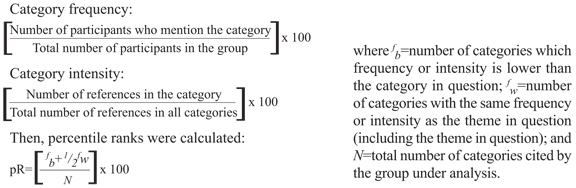
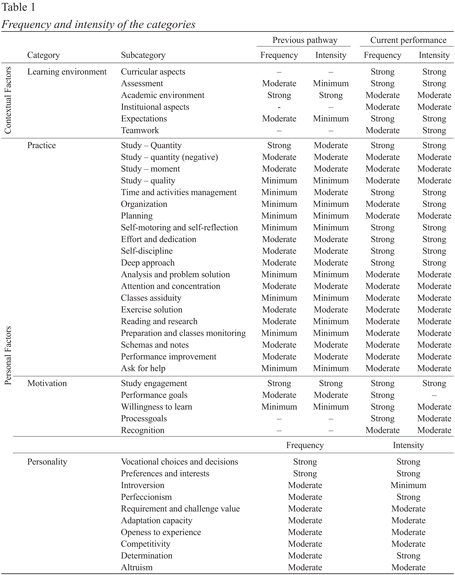
<body><![CDATA[<p>For each one of the categories and subcategories under review, a synthesis of the information derived from the coding process is presented  (see <a href="#t1">Table 1</a>), based on the classification of frequency and intensity. This classification system follows the procedure presented  by Wao, Dedrick and Ferron (2011). This <a href="#f1">formula</a> is based on the number of participants who referred to a category (frequency) and  the number of references in each category (intensity): </p>     <p>&nbsp;</p>     <p><a name="f1"></a></p>     <p><img src="/img/revistas/aps/v33n1/33n1a07f1.jpg"></p>     
<p>&nbsp;</p>     <p>&nbsp;</p>     <p><a name="t1"></a></p>     <p><img src="/img/revistas/aps/v33n1/33n1a07t1.jpg"></p>     
<p>&nbsp;</p>     <p>Finally, each category was classified in relation to its frequency and intensity, depending on their place in the rank: &ldquo;Minimum&rdquo;  &ndash; 0% to 24%; &ldquo;Moderate&rdquo; &ndash; 25% to 74%; &ldquo;Strong&rdquo; to 75% &ndash; 100%.</p>     ]]></body>
<body><![CDATA[<p><a href="#t1">Table 1</a> presents the categories that were extracted from the process of content analysis. </p>     <p>In order to complement the provided information, some excerpts from the interviews are presented based on their representativeness. The quotes  are assigned by a code (e.g., PM-B) that link back anonymously to specific sources of data and specific individuals. </p>     <p>Analyzing <a href="#t1">Table 1</a>, it is possible to verify that most categories and subcategories have a higher frequency and intensity when  concerning current performance than when related to students&rsquo; previous pathway. The exception are the subcategories concerning academic  environment, which have a higher classification in both frequency and intensity in the previous pathway, suggesting the power and presence that  educational experiences have during early stages. Four categories justify a short description in the attempt to answer our research questions:  learning environment, practice and motivation towards practice, and personality. </p>     <p>Concerning <i>learning environment</i>, the participants manifested different educative experiences. Some of them attended &ldquo;top  colleges&rdquo;, seeming to have been &ldquo;guided towards success&rdquo;, while others seem to have flourished more naturally, standing out  from heterogeneous groups of young students. In spite of the divergence of pathways and experiences, all participants demonstrated the capacity to  cope and to adapt to different contexts. In general, students demonstrate a preference for more demanding contexts, as well as for experiences that  promote their autonomy. These preferences are related to their concern to develop skills that will make them more prepared for future professional  demands. </p>     <p>I believe that now, you have to... now you really have to learn. Up to middle school, you didn&rsquo;t necessarily have to... it was enough for  you to just get things done... because, good or bad, perhaps things just got done, right? Here, you really have to... know things, because you will  need it. And I think that this demand is a good thing. This effort will help a lot in the future. I think it will give... you start to gain  experience... of course, that is nothing compared to working outside here, right... but it is a preparation. (PM-B) </p>     <p>Study strategies are closely related to the evaluation that students make about curricular demands, or teachers&rsquo; approaches and assessment  methods. These seem to be adaptable students who continuously regulate and adjust strategies in order to overcome difficulties that arise  throughout the learning process. </p>     <p>Concerning <i>practice, </i>students revealed a general attitude of effort and persistence towards work. These characteristics were mainly  associated with earlier experiences, during students&rsquo; childhood or adolescence, such as doing sports, attending music lessons, or  participating in mathematics or programming contests. Parents and teachers seem to have had a fundamental role here, not only in the promotion of  opportunities for students to explore parallel activities to school, but also by passing on values related to work, which became internalized  throughout students&rsquo; growth. </p>     <p>(...) my mother is also a bit like me regarding her will to be the best and I probably inherited that from her, and also a bit from my father,  in the sense of being stubborn and persistent. I think these are the traits I inherited from them, but not in the sense to teach me something.  I&rsquo;ve always been autonomous. They do not have sufficient knowledge to teach me. (PM-C) </p>     <p>One of the most emphasized aspects of participants&rsquo; practice is the capacity to structure and premeditate learning. These students  describe purposeful study behaviors, and attitudes characterized by the questioning of the purpose of their work (&ldquo;What do I want to  understand?&rdquo;). Participants are also generally interested and involved with learning contents, are focused on the course of their study, and  adapt their study to the demands or features of the learning environment. In other words, they fit their strategies to the different situations and  demands of the context, expressing a strong self-monitoring ability, as well as the tendency to reflect about the results that were achieved,  ensuring that efforts are oriented towards the achievement of their goals. In general, participants demonstrate a high metacognitive awareness, and  the ability to overcome difficulties. </p>     <p>I think that was the problem, to have too much time and to not have managed well the time with breaks for Christmas and New Year, because  obviously I would not study during those periods, I stipulated &lsquo;stop here&rsquo;. But even so, with these breaks, I did not manage well the  time, I&rsquo;m aware of that. And that was reflected in the results I achieved. (PP-H) </p>     ]]></body>
<body><![CDATA[<p>In relation to study organization, it is possible to find some divergence between participants. Aspects such as the ability to manage time and  activities, or study environment organization, do not emerge as essential conditions for success for all the participants. Students describe  different organization strategies, which seem, in some situations, to be related to the adaptation to different contextual characteristics. </p>     <p>About <i>motivation </i>towards practice<i>, </i>different types of motivation seem to be harmoniously integrated, becoming increasingly evident  as students advance in their academic pathway. In earlier years, it can be identified as an attitude of general curiosity, which is encouraged by  parents (&ldquo;you learn something in everything you do&rdquo;), becoming progressively more focused on specific fields throughout students&rsquo;  educational development. In general, participants are motivated towards learning in general, manifesting passion for knowledge, and ambition to  learn more and more. They also manifest a strong interest towards content learning, enjoying to solve logical problems or to develop projects,  often going beyond what is requested by their teachers. The enjoyment that is aroused from what students are doing at a specific moment in time  transforms the learning process into something easier, deeper and more comprehensive. </p>     <p>[What makes you engage in your study or work?]</p>     <p>It is essentially to enjoy what I&rsquo;m studying or what I&rsquo;m working on (...) If I am studying something just because I will be taking a  test, it may be &ldquo;the later the better&rdquo;. Whereas, if it is something, even when not part of the evaluation, but I do have... I am  curious about it, and I start reading, even with no purpose besides learning, knowing. It is more curiosity. (PM-A) </p>     <p>However it is not enough to understand these students&rsquo; practice. In fact, there seems to be an additional factor involved: students  activate self-discipline strategies and establish rules toward learning contents whenever the learning process is, for some reason, less agreeable  to them. At higher education level, learning seems to acquire a more conscious sense, because students realize that the skills they are developing  can be useful in the future. Frequently, students admit to define performance goals, which seem to work as a starting point for the definition of a  specific plan (&ldquo;What do I need to do to achieve that goal?&rdquo;). Students &lsquo;grades seem to work as an aid in the process of obtaining  short-term goals; they allow them to keep focused in the attainment of long-term goals, such as achieving excellent final grades or becoming  excellent professionals. </p>     <p>In the case of subjects that did not arouse much interest in me, I study because I know it&rsquo;s important, it&rsquo;s like a school  obligation. In any kind of learning there are things that are more interesting and others that are less interesting. Or I study because... I  remotely think that it may be important for me in the future. Or just because of the grade, and I study because I have to and so there is no  objective reason. (PP-G) </p>     <p>Concerning <i>personality, </i>some characteristics were identified, namely, &ldquo;healthy&rdquo; perfectionism and determination, which seem  to be pillars of students&rsquo; personality, helping them to overcome obstacles along the way. These characteristics reflect a generally positive  attitude of self-confidence in face of most adverse situations. Moreover, the interviewed students manifested strong interests and vocational  choices (all the participants manifested the enjoyment for sciences and technology), which seem to nourish their general motivation and the  quality of their practice. These interests and vocational decisions were directly associated by students with experiences lived in the very  beginning of their academic pathway. </p>     <p>I always had some interest in technological stuff, as computers, games (...) Then, I always liked Maths. It was always something I... I found it  easier than everything else and I always loved it. Then, the passion for Physics arose at the time of the Olympiads. (PL-B) </p>     <p>&nbsp;</p>     <p><i>Quantitative data analysis </i></p>     ]]></body>
<body><![CDATA[<p>Firstly, a correlation analysis was performed, in order to understand the association between the different variables under study: personality,  study skills, and academic achievement. Secondly, the personality traits of the higher achievement participants were analysed, comparing the scores  of this group with the Portuguese young adult population, performing a T-Test. Thirdly, the high achievers were compared with a random sample of  the group of average achievement engineering students regarding their study skills. The analyses were performed with the software IBM SPSS (version  22.0). </p>     <p>&nbsp;</p>     <p><i>Quantitative results </i></p>     <p>&nbsp;</p>     <p><i>Correlations between NEO-PI-R, SSS and academic achievement. </i><a href="#t2">Table 2</a> reports the correlations between NEO-PI-R, SSS,  and academic achievement scores. The correlations&rsquo; intervariables suggest a negative relation (-.493) between neuroticism (N) and the  motivation towards learning and deep approach to study subscale (SSS1), and a positive association (.397) between that subscale and  conscientiousness (C). These results corroborate findings in other studies (Chamorro-Premuzic &amp; Furnham, 2008; Trapmann et al., 2007). Also, a  positive association (.480) was found between study behaviors (SSS2) and conscientiousness (C). In turn, openness to experience (O) is negatively  associated (-.455) with study behaviors (SSS2), and positively related (.366) to the evaluation subscale (SSS4). However, there was no relation  between consciousness (C) and achievement, as suggested in previous research assessing average population samples of university students (Trapmann  et al., 2007), possibly because of the low variability between students&rsquo; achievement. As a matter of fact, it was one of the personality  domains that differentiated our participants from young adults of the Portuguese population. </p>     <p>&nbsp;</p>     <p><a name="t2"></a></p>     <p><img src="/img/revistas/aps/v33n1/33n1a07t2.jpg"></p>     
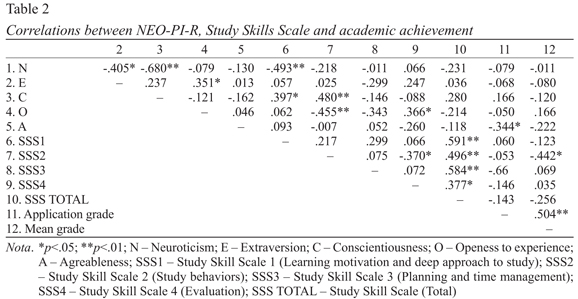
<p>&nbsp;</p>     <p>Lastly, a few associations between NEO-PI-R scores and performance were identified: agreeableness (A) is negatively related (-.344) to  students&rsquo; college application grade. A possible explanation to such an association is the highly competitive environment involving grades to  access higher education, which can be, in part, contrary to characteristics related to agreeableness. The negative association (-.442) between  study behaviors (SSS2) and students&rsquo; grade in that course may suggest that specific study behaviors, such as the organization of study  according to the teachers&rsquo; guidelines, have a detrimental effect on the ability to achieve high performance, as opposed to a more autonomous  approach that characterizes deep approaches towards learning. </p>     ]]></body>
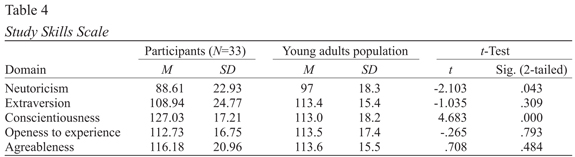
<body><![CDATA[<p>Students&rsquo; admission grade is also strongly associated with their course grade, demonstrating a tendency to maintain a high performance  starting with the admission to college. </p>     <p>&nbsp;</p>     <p><i>NEO-PI-R. </i>The t-test results for students&rsquo; personality are presented in </i><a href="#t3">Table 3</a>. The comparison measure of  the NEO-PI-R were the norms obtained for the young adult Portuguese population (Lima, 1997). A significant difference between participants in this  study and young adults&rsquo; population in general is identified, concerning neuroticism (<i>t</i>=-2.103, <i>p</i>&lt;.05) and conscientiousness  (<i>t</i>=.4.683, <i>p</i>=.00). Lower scores in neuroticism characterize participants as emotionally stable, self-confidant and able to cope with  stress, among other aspects that seem coherent with academic requirements. On the other hand, the differences in conscientiousness seem to  differentiate participants in terms of their capacity to plan, organizer and pursue tasks (Costa &amp; McCrae, 2000). </p>     <p>&nbsp;</p>     <p><a name="t3"></a></p>     <p><img src="/img/revistas/aps/v33n1/33n1a07t3.jpg"></p>     
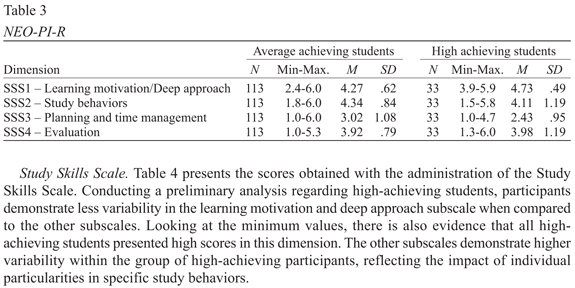
<p>&nbsp;</p>     <p>&nbsp;</p>     <p><i>Study Skills Scale. </i><a href="#t4">Table 4</a> presents the scores obtained with the administration of the Study Skills Scale.  Conducting a preliminary analysis regarding high-achieving students, participants demonstrate less variability in the learning motivation and deep  approach subscale when compared to the other subscales. Looking at the minimum values, there is also evidence that all high-achieving students  presented high scores in this dimension. The other subscales demonstrate higher variability within the group of high-achieving participants,  reflecting the impact of individual particularities in specific study behaviors. </p>     <p>&nbsp;</p>     ]]></body>
<body><![CDATA[<p><a name="t4"></a></p>     <p><img src="/img/revistas/aps/v33n1/33n1a07t4.jpg"></p>     
<p>&nbsp;</p>     <p>In order to obtain a comparison group to further analyze the study skills of the higher achievement participants, a second group of 40%  (<i>n</i>=35 cases) of the average achievement participants was randomly selected using the function of the random sample of cases of the SPSS  software. Then, a multivariate data analysis (F-Manova) was performed comparing the two groups. </p>     <p>Statistical differences were found concerning the learning motivation and deep approach dimension, with higher values for high-achieving  students [<i>F</I>(1,68)=7.56, <i>p</I>=.000; eta square=.093] and the planning and time management dimension, in favor of the group of engineering  students in general [<i>F</i>(1,68)=5.32, <i>p</i>=.024; eta square=.067]. The results obtained for the first subscale confirm what was expected  given previous research, associating deep approaches with higher academic rates (Chamorro-Premuzic &amp; Furnham, 2008; Diseth, 2003; Duff, Boyle,  Dunleavy, &amp; Ferguson, 2004; Entwistle, 1998; Marton &amp; S&auml;lj&ouml;, 1997; Ramsden, 1992). On the other hand, the high variability of  scores of high-achieving students in the other subscales suggests that further study skills (study organization according to teachers&rsquo;  orientation, planning and time management, and study oriented towards evaluation) do not seem to represent characteristics to which these  participants identify their study practice. </p>     <p>&nbsp;</p>     <p><b>Discussion and conclusions </b></p>     <p>When analyzing data resulting from this study, it is possible to notice that the quantitative and qualitative data converge and complement each  other to answer the questions guiding our study. The contextual factors, identified from the interviews, help to understand and frame the more  personal characteristics, namely, personality, motivation and learning approaches. Previous opportunities and experiences, promoted by both parents  and educators, seem to have a core role, not only in the development of important skills, but also to create students&rsquo; practices, and to  shape traits of their personality. Also, participants described their study practices as being closely related to learning environments,  demonstrating to be able to adapt the strategies they use according to the evaluation they make about curricular demands: available time, content  difficulty, evaluation process, and teachers&rsquo; methodology. At the same time, these high-achieving students revealed to be highly aware of the  goals and forces driving their work. In his recent work, Zimmerman (2013) provides a multilevel sequence of self-regulatory development that, in  our opinion, strongly support our findings. In this model, the self-regulation (and master performance), represents a continuous process that  begins with social guidance at a first level, and finishes at a fourth level when learners can systematically adapt their performance to change  personal and contextual conditions that are present in naturalistic settings, and also to vary the use of task strategies and make adjustments  based on outcomes. In our viewpoint, this perspective represents an important advancement in the understanding of the underlying processes of  self-regulatory learning. On the other hand, this interplay between individual and contextual factors that operate since earlier stages,  strengthens the recent theory presented by Ziegler and Phillipson (2012) about gifted education, which conceive the development of an action  repertoire capable of producing excellence as a very successful adaptation to specific environments (Ara&uacute;jo &amp; Davids, 2011). </p>     <p>In addition, the &ldquo;power&rdquo; of personality traits seems particularly evident in situations of higher difficulty, namely when students  experience lower motivation levels; here, characteristics such as self-discipline and determination seem to become more salient. In other words,  personality seems to compensate the &ldquo;moments of weakness&rdquo;: trough an appropriate emotional regulation, students keep focused on their  goals. These characteristics are consistent with the higher scores obtained in consciousness and the lower scores in neuroticism. Hence the clear  the association between personality traits and study practices is evident, in both quantitative and qualitative results. Consciousness seems to  represent a key personal characteristic, which differentiates the group of high achievement participants, and it is associated with basic study  behaviors, such as taking notes or solving exercises suggested by teachers. This characteristic is complemented by emotional control, which helps  students to keep focused on their goals, and to cope with stress and difficulties. These results are consistent with an extensive literature  review in this area (Chamorro-Premuzic &amp; Furnham, 2008; Connor &amp; Paunonen, 2007; Duff et al., 2004; Trapmann et al., 2007). </p>     <p>But this personality trait is also related to more sophisticated skills, such as self-monitoring or orientation towards goals, and combined with  a high motivation towards learning, aspects that are characteristic of deep approaches to learning. This kind of learning orientation represents an  aspect differentiating high-achievers from average students. On the contrary, organization strategies, as well as strategies that depend on the  teacher&rsquo;s evaluation methods, seem to result in a higher variance between high-achieving students, and do not represent a core factor to  understand high performance of our participants. This set of results helps to demonstrate the power of &ldquo;non-intellectual&rdquo; variables to  understand educative pathways (Chamorro-Premuzic &amp; Furnham, 2008; O&rsquo;Connor &amp; Paunonen, 2007). </p>     ]]></body>
<body><![CDATA[<p>Some limitations of this study also need to be considered. The small sample number does not allow any kind of generalisation of the results. A  higher number of cases in future studies would provide more reliable data concerning personality traits and study skills. On the other hand, and in  order to increase the significance of the qualitative results, it would be advantageous to combine multiple points of view about this research  topic, using data triangulation, with interviews to parents and teachers, besides the interviews we conducted to students. </p>     <p>Beyond the intention of gaining a better understanding of the profile of high-achieving college students, this study represents a first attempt  to develop measures to capture the singularities of top students. Although this first version of the <i>Study Skills Scale </i>has been able to  capture skills of students in general, it seems to be less effective when attempting to capture more specific skills that also characterize  high-achieving engineering students. However, the interviews that were conducted open a door to the development of more &ldquo;refined&rdquo;  instruments, allowing to obtain a new and more complete profile of the skills of high-achievers. When identifying the aspect that differentiated  excellent students the most, it was the deep approach to learning; here, it would be important to add new items to discriminate more explicitly  students&rsquo; study behaviors, according to the different types of learning approaches (deep and surface approaches). Moreover, and based on the  information collected from the interviews, it would also be appropriate to explore the metacognitive strategies, as well as the relationship  between emotional and cognitive components, especially during task execution. Seeing that students seem to depend on cues from their surrounding  environments to organize and motivate them, it would also be interesting to create new items assessing the specificities of engineering learning  contexts. These improvements would offer a deeper understanding of the relationship between personality factors, and both cognitive and emotional  components present in learning and performance situations. </p>     <p>Lastly, this study offers some valuable insights about the role of parents and teachers as the first agents of education in students&rsquo;  lives. Students&rsquo; interests, practices, and personality seem to be nourished since earlier opportunities and experiences, revealing a  determinant role to understand how they deal with learning tasks and react to difficulties. In addition, despite the power that personality traits  seem to have in academic achievement in higher education, students seem to be very reactive to learning contexts, i.e., very responsive to the  stimulus that the context provides and that can potentiate the development of excellence skills. This way, curriculum demands can help to drive  students&rsquo; practice, becoming not only an opportunity to push forward those students who possess strong working skills and a high motivation  to strive for goals, but also as a stimulus to somehow compensate the weaknesses of students who do not (yet or ever will) possess characteristics  related to excellence. Not all students will become excellent, but the ones who have that &ldquo;chance&rdquo;, should be given the opportunities  to become so. </p>     <p>&nbsp;</p>     <p><b>References </b></p>     <!-- ref --><p>Ara&uacute;jo, L. S., Cruz, J. F., &amp; Almeida, L. S. (2009). Pathways of excellence in science and dance: Lessons learned from a Portuguese  case study. In A. Williamon, S. Pretty, &amp; R. Buck (Eds.), <i>Proceedings of the International Symposium on Performance Science</i>  (pp. 139-144). Utrecht, The Netherlands: EAC.    &nbsp;&nbsp;&nbsp;&nbsp;&nbsp;&nbsp;&nbsp;&nbsp;[&#160;<a href="javascript:void(0);" onclick="javascript: window.open('/scielo.php?script=sci_nlinks&ref=000118&pid=S0870-8231201500010000700001&lng=','','width=640,height=500,resizable=yes,scrollbars=1,menubar=yes,');">Links</a>&#160;]<!-- end-ref --> </p>     <!-- ref --><p>Ara&uacute;jo, L. S., Cruz, J. F., &amp; Almeida, L. S. (2011). A entrevista no estudo da excel&ecirc;ncia: Uma proposta. <i>Psychologica,  52</i>, 253-280.    &nbsp;&nbsp;&nbsp;&nbsp;&nbsp;&nbsp;&nbsp;&nbsp;[&#160;<a href="javascript:void(0);" onclick="javascript: window.open('/scielo.php?script=sci_nlinks&ref=000120&pid=S0870-8231201500010000700002&lng=','','width=640,height=500,resizable=yes,scrollbars=1,menubar=yes,');">Links</a>&#160;]<!-- end-ref --> </p>     <!-- ref --><p>Ara&uacute;jo, D., &amp; Davids, K. (2011). Talent development: From possessing gifts to functional environmental interactions. <i>Talent  Development and Excellence, 3</i>, 23-25.    &nbsp;&nbsp;&nbsp;&nbsp;&nbsp;&nbsp;&nbsp;&nbsp;[&#160;<a href="javascript:void(0);" onclick="javascript: window.open('/scielo.php?script=sci_nlinks&ref=000122&pid=S0870-8231201500010000700003&lng=','','width=640,height=500,resizable=yes,scrollbars=1,menubar=yes,');">Links</a>&#160;]<!-- end-ref --> </p>     <!-- ref --><p>Bauer, K. W., &amp; Liang, Q. (2003). The Effect of Personality and Precollege Characteristics on First-Year Activities and Academic  Performance. <i>Journal of College Student Development, 44</i>, 277-290. doi: 10.1353/csd.2003.0023 &nbsp;&nbsp;&nbsp;&nbsp;&nbsp;&nbsp;&nbsp;&nbsp;[&#160;<a href="javascript:void(0);" onclick="javascript: window.open('/scielo.php?script=sci_nlinks&ref=000124&pid=S0870-8231201500010000700004&lng=','','width=640,height=500,resizable=yes,scrollbars=1,menubar=yes,');">Links</a>&#160;]<!-- end-ref --><!-- ref --><p>Biggs, J., &amp; Tang, C. (2011). <i>Teaching for quality learning at university: What the student does. </i>United Kingdom: McGraw-Hill  Education.    &nbsp;&nbsp;&nbsp;&nbsp;&nbsp;&nbsp;&nbsp;&nbsp;[&#160;<a href="javascript:void(0);" onclick="javascript: window.open('/scielo.php?script=sci_nlinks&ref=000125&pid=S0870-8231201500010000700005&lng=','','width=640,height=500,resizable=yes,scrollbars=1,menubar=yes,');">Links</a>&#160;]<!-- end-ref --> </p>     <!-- ref --><p>Busato, V. V., Prins, F. J., Elshout, J. J., &amp; Hamaker, C. (2000). Intellectual ability, learning style, personality, achievement motivation  and academic success of psychology students in higher education. <i>Personality and Individual Differences, 29</i>, 1057-1068. Retrieved from  <a href="http://www.sciencedirect.com/science/article/B6V9F-412RS3P-4/2/fbe7824b4430dbb955abf865f68002ea"  target="_blank">http://www.sciencedirect.com/science/article/B6V9F-412RS3P-4/2/fbe7824b4430dbb955abf865f68002ea </a>&nbsp;&nbsp;&nbsp;&nbsp;&nbsp;&nbsp;&nbsp;&nbsp;[&#160;<a href="javascript:void(0);" onclick="javascript: window.open('/scielo.php?script=sci_nlinks&ref=000127&pid=S0870-8231201500010000700006&lng=','','width=640,height=500,resizable=yes,scrollbars=1,menubar=yes,');">Links</a>&#160;]<!-- end-ref --><!-- ref --><p>Chamorro-Premuzic, T., &amp; Furnham, A. (2003). Personality traits and academic examination performance. <i>European Journal of Personality,  17</i>, 237-250. doi: 10.1002/per.473 &nbsp;&nbsp;&nbsp;&nbsp;&nbsp;&nbsp;&nbsp;&nbsp;[&#160;<a href="javascript:void(0);" onclick="javascript: window.open('/scielo.php?script=sci_nlinks&ref=000128&pid=S0870-8231201500010000700007&lng=','','width=640,height=500,resizable=yes,scrollbars=1,menubar=yes,');">Links</a>&#160;]<!-- end-ref --><!-- ref --><p>Chamorro-premuzic, T., &amp; Furnham, A. (2004). A possible model for explaining the personality-intelligence interface. <i>British Journal of  Psychology, 95</i>, 249-264.    &nbsp;&nbsp;&nbsp;&nbsp;&nbsp;&nbsp;&nbsp;&nbsp;[&#160;<a href="javascript:void(0);" onclick="javascript: window.open('/scielo.php?script=sci_nlinks&ref=000129&pid=S0870-8231201500010000700008&lng=','','width=640,height=500,resizable=yes,scrollbars=1,menubar=yes,');">Links</a>&#160;]<!-- end-ref --> </p>     <!-- ref --><p>Chamorro-Premuzic, T., &amp; Furnham, A. (2008). Personality, intelligence and approaches to learning as predictors of academic performance.  <i>Personality and Individual Differences, 44</i>, 1596-1603. doi: 10.1016/j.paid.2008.01.003 &nbsp;&nbsp;&nbsp;&nbsp;&nbsp;&nbsp;&nbsp;&nbsp;[&#160;<a href="javascript:void(0);" onclick="javascript: window.open('/scielo.php?script=sci_nlinks&ref=000131&pid=S0870-8231201500010000700009&lng=','','width=640,height=500,resizable=yes,scrollbars=1,menubar=yes,');">Links</a>&#160;]<!-- end-ref --><!-- ref --><p>Connor, M. C. O., &amp; Paunonen, S. V. (2007). Big Five personality predictors of post-secondary academic performance. <i>Personality and  Individual Differences, 43</i>, 971-990. doi: 10.1016/j.paid.2007.03.017 &nbsp;&nbsp;&nbsp;&nbsp;&nbsp;&nbsp;&nbsp;&nbsp;[&#160;<a href="javascript:void(0);" onclick="javascript: window.open('/scielo.php?script=sci_nlinks&ref=000132&pid=S0870-8231201500010000700010&lng=','','width=640,height=500,resizable=yes,scrollbars=1,menubar=yes,');">Links</a>&#160;]<!-- end-ref --><p>Costa, P. T., &amp; McCrae, R. R. (2000). <i>NEO PI &ndash; R &ndash; Manual Profissional </i>(1<Sup>a </Sup>ed.). Lisboa: Cegoc. </p>     <!-- ref --><p>Diseth, &Aring;. (2003). Personality and approaches to learning as predictors of academic achievement. <i>European Journal of Personality,  17</i>, 143-155. doi: 10.1002/per.469 &nbsp;&nbsp;&nbsp;&nbsp;&nbsp;&nbsp;&nbsp;&nbsp;[&#160;<a href="javascript:void(0);" onclick="javascript: window.open('/scielo.php?script=sci_nlinks&ref=000134&pid=S0870-8231201500010000700012&lng=','','width=640,height=500,resizable=yes,scrollbars=1,menubar=yes,');">Links</a>&#160;]<!-- end-ref --><!-- ref --><p>Duff, A., Boyle, E., Dunleavy, K., &amp; Ferguson, J. (2004). The relationship between personality, approach to learning and academic  performance. <i>Personality and Individual Differences, 36</i>, 1907-1920. doi: 10.1016/j.paid.2003.08.020 &nbsp;&nbsp;&nbsp;&nbsp;&nbsp;&nbsp;&nbsp;&nbsp;[&#160;<a href="javascript:void(0);" onclick="javascript: window.open('/scielo.php?script=sci_nlinks&ref=000135&pid=S0870-8231201500010000700013&lng=','','width=640,height=500,resizable=yes,scrollbars=1,menubar=yes,');">Links</a>&#160;]<!-- end-ref --><p>Endedijk, M. D., &amp; Vermunt, J. D. (2013). Relations between student teachers&rsquo; learning patterns and their concrete learning  activities. <i>Studies in Educational Evaluation, 39</i>, 56-65. doi: 10.1016/j.stueduc.2012.10.001 </p>     <!-- ref --><p>Entwistle, N. J. (1998). Understanding academic performance at university: A research retrospective. In D. Shorrocks-Taylor (Ed.),  <i>Directions in educational psychology </i>(pp. 106-127). London, England: Whurr Publishers.    &nbsp;&nbsp;&nbsp;&nbsp;&nbsp;&nbsp;&nbsp;&nbsp;[&#160;<a href="javascript:void(0);" onclick="javascript: window.open('/scielo.php?script=sci_nlinks&ref=000137&pid=S0870-8231201500010000700015&lng=','','width=640,height=500,resizable=yes,scrollbars=1,menubar=yes,');">Links</a>&#160;]<!-- end-ref --> </p>     <!-- ref --><p>Entwistle, N. J. (2009). <i>Teaching for understanding at University: Deep approaches and distinctive ways of thinking</i>. Basingstoke, UK:  Palgrave Macmillan.    &nbsp;&nbsp;&nbsp;&nbsp;&nbsp;&nbsp;&nbsp;&nbsp;[&#160;<a href="javascript:void(0);" onclick="javascript: window.open('/scielo.php?script=sci_nlinks&ref=000139&pid=S0870-8231201500010000700016&lng=','','width=640,height=500,resizable=yes,scrollbars=1,menubar=yes,');">Links</a>&#160;]<!-- end-ref --> </p>     <!-- ref --><p>Ericsson, K., Nandagopal, K., &amp; Roring, R. W. (2009). Toward a science of exceptional achievement: Attaining superior performance through  deliberate practice. <i>Annals of the New York Academy of Sciences, 1172</i>, 199-217. doi: 10.1196/annals.1393.001 &nbsp;&nbsp;&nbsp;&nbsp;&nbsp;&nbsp;&nbsp;&nbsp;[&#160;<a href="javascript:void(0);" onclick="javascript: window.open('/scielo.php?script=sci_nlinks&ref=000141&pid=S0870-8231201500010000700017&lng=','','width=640,height=500,resizable=yes,scrollbars=1,menubar=yes,');">Links</a>&#160;]<!-- end-ref --><!-- ref --><p>Farsides, T., &amp; Woodfield, R. (2003). Individual differences and undergraduate academic success: The roles of personality, intelligence, and  application. <i>Personality and Individual Differences, 34</i>, 1225-1243. doi: 10.1016/S0191-8869(02)00111-3 &nbsp;&nbsp;&nbsp;&nbsp;&nbsp;&nbsp;&nbsp;&nbsp;[&#160;<a href="javascript:void(0);" onclick="javascript: window.open('/scielo.php?script=sci_nlinks&ref=000142&pid=S0870-8231201500010000700018&lng=','','width=640,height=500,resizable=yes,scrollbars=1,menubar=yes,');">Links</a>&#160;]<!-- end-ref --><!-- ref --><p>Furnham, A., Chamorro-Premuzic, T., &amp; McDougall, F. (2002). Personality, cognitive ability, and beliefs about intelligence as predictors of  academic performance. <i>Learning and Individual Differences, 14</i>, 49-66. doi: 10.1016/j.lindif.2003.08.002 &nbsp;&nbsp;&nbsp;&nbsp;&nbsp;&nbsp;&nbsp;&nbsp;[&#160;<a href="javascript:void(0);" onclick="javascript: window.open('/scielo.php?script=sci_nlinks&ref=000143&pid=S0870-8231201500010000700019&lng=','','width=640,height=500,resizable=yes,scrollbars=1,menubar=yes,');">Links</a>&#160;]<!-- end-ref --><!-- ref --><p>Gagn&eacute;, F. (2004). Transforming gifts into talents: The DMGT as a developmental theory. <i>High Ability Studies, 15</i>, 119-147.    &nbsp;&nbsp;&nbsp;&nbsp;&nbsp;&nbsp;&nbsp;&nbsp;[&#160;<a href="javascript:void(0);" onclick="javascript: window.open('/scielo.php?script=sci_nlinks&ref=000144&pid=S0870-8231201500010000700020&lng=','','width=640,height=500,resizable=yes,scrollbars=1,menubar=yes,');">Links</a>&#160;]<!-- end-ref --> </p>     <p>Gagn&eacute;, F. (2009). Debating giftedness: Pronat <i>vs. </i>antinat. In L. Shavinina (Ed.), <i>International handbook on giftedness SE  &ndash; 7 </i>(pp. 155-204). Springer Netherlands. doi: 10.1007/978-1-4020-6162-2_7 </p>     <p>Goldberg, L. R. (1990). An alternative &ldquo;description of personality&rdquo;: The big-five factor structure. <i>Journal of Personality and  Social Psychology, 59</i>, 1216-1229. doi: 10.1037/0022-3514.59.6.1216 </p>     <!-- ref --><p>Heller, K. A. (2004). Identification of gifted and talented students. <i>Psychological Science, 46</i>, 302-323.    &nbsp;&nbsp;&nbsp;&nbsp;&nbsp;&nbsp;&nbsp;&nbsp;[&#160;<a href="javascript:void(0);" onclick="javascript: window.open('/scielo.php?script=sci_nlinks&ref=000148&pid=S0870-8231201500010000700023&lng=','','width=640,height=500,resizable=yes,scrollbars=1,menubar=yes,');">Links</a>&#160;]<!-- end-ref --> </p>     <!-- ref --><p>Johnson, R. B., Onwuegbuzie, A. J., &amp; Turner, L. A. (2007). Toward a definition of mixed methods research. <i>Journal of Mixed Methods  Research, 1</i>, 112-133. doi: 10.1177/1558689806298224 &nbsp;&nbsp;&nbsp;&nbsp;&nbsp;&nbsp;&nbsp;&nbsp;[&#160;<a href="javascript:void(0);" onclick="javascript: window.open('/scielo.php?script=sci_nlinks&ref=000150&pid=S0870-8231201500010000700024&lng=','','width=640,height=500,resizable=yes,scrollbars=1,menubar=yes,');">Links</a>&#160;]<!-- end-ref --><!-- ref --><p>Lievens, F., Ones, D. S., &amp; Dilchert, S. (2009). Personality scale validities increase throughout medical school. <i>The Journal of Applied  Psychology, 94</i>, 1514-1535. doi: 10.1037/a0016137 &nbsp;&nbsp;&nbsp;&nbsp;&nbsp;&nbsp;&nbsp;&nbsp;[&#160;<a href="javascript:void(0);" onclick="javascript: window.open('/scielo.php?script=sci_nlinks&ref=000151&pid=S0870-8231201500010000700025&lng=','','width=640,height=500,resizable=yes,scrollbars=1,menubar=yes,');">Links</a>&#160;]<!-- end-ref --><p>Lima, M. P. (1997). <i>NEO-PI-R &ndash; Contextos te&oacute;ricos e psicom&eacute;tricos &ldquo;OCEAN&rdquo; ou &ldquo;iceberg&rdquo;?. </i>Tese  de doutoramento n&atilde;o publicada. Universidade de Coimbra. </p>     ]]></body>
<body><![CDATA[<!-- ref --><p>Lima, M. P., &amp; Sim&otilde;es, A. (2000). <i>NEO-PI-R: Manual profissional. </i>Lisboa: Cegoc.    &nbsp;&nbsp;&nbsp;&nbsp;&nbsp;&nbsp;&nbsp;&nbsp;[&#160;<a href="javascript:void(0);" onclick="javascript: window.open('/scielo.php?script=sci_nlinks&ref=000153&pid=S0870-8231201500010000700027&lng=','','width=640,height=500,resizable=yes,scrollbars=1,menubar=yes,');">Links</a>&#160;]<!-- end-ref --> </p>     <p>Lima, M. P., &amp; Sim&otilde;es, A. (2006). Invent&aacute;rio de personalidade NEO revisto (NEO-PI-R). In M. Gon&ccedil;alves, L. Almeida, M.  Sim&otilde;es, &amp; C. Machado (Eds.), <i>Avalia&ccedil;&atilde;o Psicol&oacute;gica &ndash; Instrumentos validados para a popula&ccedil;&atilde;o  portuguesa </i>(Vol. I, 2&ordf; ed., pp. 15-32). Coimbra: Quarteto. </p>     <!-- ref --><p>Marton, F., &amp; S&auml;lj&ouml;, R. (1997). Approaches to learning. In N. Marton, F. Hounsell, &amp; D. Entwistle (Eds.), <i>The experience  of learning: Implications for teaching and studying in higher education </i>(2<Sup>nd </Sup>ed., pp. 39-58). Edinburgh: Scottish Academic Press.    &nbsp;&nbsp;&nbsp;&nbsp;&nbsp;&nbsp;&nbsp;&nbsp;[&#160;<a href="javascript:void(0);" onclick="javascript: window.open('/scielo.php?script=sci_nlinks&ref=000156&pid=S0870-8231201500010000700029&lng=','','width=640,height=500,resizable=yes,scrollbars=1,menubar=yes,');">Links</a>&#160;]<!-- end-ref --> </p>     <p>Monteiro, S., Almeida, L. S., &amp; Vasconcelos, R. M. (2010). Adapta&ccedil;&atilde;o e valida&ccedil;&atilde;o de uma escala de  compet&ecirc;ncias de estudo para alunos de engenharia e tecnologias: Uma an&aacute;lise em alunos de engenharia com desempenho excelente. <i>I  Semin&aacute;rio Internacional &ldquo;Contributos da Psicologia em Contextos Educativos&rdquo; </i>(pp. 302-314). Braga: Universidade do Minho. </p>     <!-- ref --><p>Monteiro, S., Almeida, L. S., &amp; Vasconcelos, R. M. (2012). The role of teachers at university: What do high achiever students look for?.  <i>Journal of the Scholarship of Teaching and Learning, 12</i>, 65-77.    &nbsp;&nbsp;&nbsp;&nbsp;&nbsp;&nbsp;&nbsp;&nbsp;[&#160;<a href="javascript:void(0);" onclick="javascript: window.open('/scielo.php?script=sci_nlinks&ref=000159&pid=S0870-8231201500010000700031&lng=','','width=640,height=500,resizable=yes,scrollbars=1,menubar=yes,');">Links</a>&#160;]<!-- end-ref --> </p>     <!-- ref --><p>Nandagopal, K., &amp; Ericsson, K. (2012). An expert performance approach to the study of individual differences in self-regulated learning  activities in upper-level college students. <i>Learning and Individual Differences, 22</i>, 597-609. doi: 10.1016/j.lindif.2011.11.018 &nbsp;&nbsp;&nbsp;&nbsp;&nbsp;&nbsp;&nbsp;&nbsp;[&#160;<a href="javascript:void(0);" onclick="javascript: window.open('/scielo.php?script=sci_nlinks&ref=000161&pid=S0870-8231201500010000700032&lng=','','width=640,height=500,resizable=yes,scrollbars=1,menubar=yes,');">Links</a>&#160;]<!-- end-ref --><!-- ref --><p>O&rsquo;Connor, M. C., &amp; Paunonen, S. V. (2007). Big Five personality predictors of post-secondary academic performance. <i>Personality and  Individual Differences, 43</i>, 971-990. doi: 10.1016/j.paid.2007.03.017 &nbsp;&nbsp;&nbsp;&nbsp;&nbsp;&nbsp;&nbsp;&nbsp;[&#160;<a href="javascript:void(0);" onclick="javascript: window.open('/scielo.php?script=sci_nlinks&ref=000162&pid=S0870-8231201500010000700033&lng=','','width=640,height=500,resizable=yes,scrollbars=1,menubar=yes,');">Links</a>&#160;]<!-- end-ref --><!-- ref --><p>Pearse, R. F. (2000). Developing your career success skills. <i>Compensation and Benefits Management, 16</i>, 15-26.    &nbsp;&nbsp;&nbsp;&nbsp;&nbsp;&nbsp;&nbsp;&nbsp;[&#160;<a href="javascript:void(0);" onclick="javascript: window.open('/scielo.php?script=sci_nlinks&ref=000163&pid=S0870-8231201500010000700034&lng=','','width=640,height=500,resizable=yes,scrollbars=1,menubar=yes,');">Links</a>&#160;]<!-- end-ref --> </p>     <p>Phillips, P., Abraham, C., &amp; Bond, R. (2003). Personality, Cognition, and University Students&rsquo; Examination Performance. <i>European  Journal of Personality, 17</i>, 435-448. doi: 10.1002/per.488 </p>     <!-- ref --><p>Plant, E. A., Ericsson, K., Hill, L., &amp; Asberg, K. (2005). Why study time does not predict grade point average across college students:  Implications of deliberate practice for academic performance. <i>Contemporary Educational Psychology, 30</i>, 96-116.  doi: 10.1016/j.cedpsych.2004.06.001 &nbsp;&nbsp;&nbsp;&nbsp;&nbsp;&nbsp;&nbsp;&nbsp;[&#160;<a href="javascript:void(0);" onclick="javascript: window.open('/scielo.php?script=sci_nlinks&ref=000166&pid=S0870-8231201500010000700036&lng=','','width=640,height=500,resizable=yes,scrollbars=1,menubar=yes,');">Links</a>&#160;]<!-- end-ref --><!-- ref --><p>Ramsden, P. (1992). <i>Learning to Teach in Higher Education</i>. London: Routledge.    &nbsp;&nbsp;&nbsp;&nbsp;&nbsp;&nbsp;&nbsp;&nbsp;[&#160;<a href="javascript:void(0);" onclick="javascript: window.open('/scielo.php?script=sci_nlinks&ref=000167&pid=S0870-8231201500010000700037&lng=','','width=640,height=500,resizable=yes,scrollbars=1,menubar=yes,');">Links</a>&#160;]<!-- end-ref --> </p>     <!-- ref --><p>Renzulli, J. S. (2010). The schoolwide enrichment model: A focus on student strengths and interests. <i>Gifted Education International, 26</i>,  140-156. doi: 10.1177/026142941002600303 &nbsp;&nbsp;&nbsp;&nbsp;&nbsp;&nbsp;&nbsp;&nbsp;[&#160;<a href="javascript:void(0);" onclick="javascript: window.open('/scielo.php?script=sci_nlinks&ref=000169&pid=S0870-8231201500010000700038&lng=','','width=640,height=500,resizable=yes,scrollbars=1,menubar=yes,');">Links</a>&#160;]<!-- end-ref --><!-- ref --><p>Schilling, J. (2006). On the pragmatics of qualitative assessment designing the process for content analysis. <i>European Journal of  Psychological Assessment, 22</i>, 28-37. doi: 10.1027/1015-5759.22.1.28 &nbsp;&nbsp;&nbsp;&nbsp;&nbsp;&nbsp;&nbsp;&nbsp;[&#160;<a href="javascript:void(0);" onclick="javascript: window.open('/scielo.php?script=sci_nlinks&ref=000170&pid=S0870-8231201500010000700039&lng=','','width=640,height=500,resizable=yes,scrollbars=1,menubar=yes,');">Links</a>&#160;]<!-- end-ref --><!-- ref --><p>S&#281;kowski, A., &amp; Sieka&#324;ska, M. (2008). National academic award winners over time: Their family situation, education and  interpersonal relations. <i>High Ability Studies, 19</i>, 155-171. doi: 10.1080/13598130802504270 &nbsp;&nbsp;&nbsp;&nbsp;&nbsp;&nbsp;&nbsp;&nbsp;[&#160;<a href="javascript:void(0);" onclick="javascript: window.open('/scielo.php?script=sci_nlinks&ref=000171&pid=S0870-8231201500010000700040&lng=','','width=640,height=500,resizable=yes,scrollbars=1,menubar=yes,');">Links</a>&#160;]<!-- end-ref --><p>Shushok, F., &amp; Hulme, E. (2006). What&rsquo;s right with you: Helping students find and use their personal strengths. <i>About  Campus, 11</i>, 2-8. </p>     ]]></body>
<body><![CDATA[<!-- ref --><p>Taylor, M. K., Gould, D., &amp; Rolo, C. (2008). Performance strategies of US Olympians in practice and competition. <i>High Ability Studies,  19</i>, 19-36.    &nbsp;&nbsp;&nbsp;&nbsp;&nbsp;&nbsp;&nbsp;&nbsp;[&#160;<a href="javascript:void(0);" onclick="javascript: window.open('/scielo.php?script=sci_nlinks&ref=000173&pid=S0870-8231201500010000700042&lng=','','width=640,height=500,resizable=yes,scrollbars=1,menubar=yes,');">Links</a>&#160;]<!-- end-ref --> </p>     <!-- ref --><p>Trapmann, S., Hell, B., Hirn, J. W., &amp; Schuler, H. (2007). Meta-analysis of the relationship between the Big Five and academic success at  university. <i>Journal of Psychology, 215</i>, 132-151. doi: 10.1027/0044-3409.215.2.132 &nbsp;&nbsp;&nbsp;&nbsp;&nbsp;&nbsp;&nbsp;&nbsp;[&#160;<a href="javascript:void(0);" onclick="javascript: window.open('/scielo.php?script=sci_nlinks&ref=000175&pid=S0870-8231201500010000700043&lng=','','width=640,height=500,resizable=yes,scrollbars=1,menubar=yes,');">Links</a>&#160;]<!-- end-ref --><!-- ref --><p>Valadas, S. C. A. T., Gon&ccedil;alves, F. R., &amp; Fa&iacute;sca, L. M. M. (2011). Perfis de aprendizagem de estudantes do ensino superior:  Abordagens ao estudo, concep&ccedil;&otilde;es de aprendizagem e prefer&ecirc;ncias por diferentes tipos de ensino. <i>An&aacute;lise  Psicol&oacute;gica, XXIX</i>, 369-389.    &nbsp;&nbsp;&nbsp;&nbsp;&nbsp;&nbsp;&nbsp;&nbsp;[&#160;<a href="javascript:void(0);" onclick="javascript: window.open('/scielo.php?script=sci_nlinks&ref=000176&pid=S0870-8231201500010000700044&lng=','','width=640,height=500,resizable=yes,scrollbars=1,menubar=yes,');">Links</a>&#160;]<!-- end-ref --> </p>     <!-- ref --><p>Vermunt, J. A. N. D. (2005). Relations between student learning patterns and personal and contextual factors and academic performance.  <i>Higher Education, 49</i>, 205-234. doi: 10.1007/s10734-004-6664-2 &nbsp;&nbsp;&nbsp;&nbsp;&nbsp;&nbsp;&nbsp;&nbsp;[&#160;<a href="javascript:void(0);" onclick="javascript: window.open('/scielo.php?script=sci_nlinks&ref=000178&pid=S0870-8231201500010000700045&lng=','','width=640,height=500,resizable=yes,scrollbars=1,menubar=yes,');">Links</a>&#160;]<!-- end-ref --><!-- ref --><p>Wao, H. O., Dedrick, R. F., &amp; Ferron, J. M. (2011). Quantitizing text: Using theme frequency and theme intensity to describe factors  influencing time-to-doctorate. <i>Quality &amp; Quantity, 45</i>, 923-934. doi: 10.1007/s11135-010-9404-y &nbsp;&nbsp;&nbsp;&nbsp;&nbsp;&nbsp;&nbsp;&nbsp;[&#160;<a href="javascript:void(0);" onclick="javascript: window.open('/scielo.php?script=sci_nlinks&ref=000179&pid=S0870-8231201500010000700046&lng=','','width=640,height=500,resizable=yes,scrollbars=1,menubar=yes,');">Links</a>&#160;]<!-- end-ref --><!-- ref --><p>Zhang, L. (2003). Does the Big Five predict learning approaches?. <i>Personality and Individual Differences, 34</i>, 1431-1446. doi:  10.1016/S0191-8869(02)00125-3 &nbsp;&nbsp;&nbsp;&nbsp;&nbsp;&nbsp;&nbsp;&nbsp;[&#160;<a href="javascript:void(0);" onclick="javascript: window.open('/scielo.php?script=sci_nlinks&ref=000180&pid=S0870-8231201500010000700047&lng=','','width=640,height=500,resizable=yes,scrollbars=1,menubar=yes,');">Links</a>&#160;]<!-- end-ref --><!-- ref --><p>Ziegler, A., &amp; Phillipson, S. N. (2012). Towards a systemic theory of gifted education. <i>High Ability Studies, 23</i>, 3-30. doi:  10.1080/13598139.2012.679085 &nbsp;&nbsp;&nbsp;&nbsp;&nbsp;&nbsp;&nbsp;&nbsp;[&#160;<a href="javascript:void(0);" onclick="javascript: window.open('/scielo.php?script=sci_nlinks&ref=000181&pid=S0870-8231201500010000700048&lng=','','width=640,height=500,resizable=yes,scrollbars=1,menubar=yes,');">Links</a>&#160;]<!-- end-ref --><!-- ref --><p>Zimmerman, B. J., (2002). Achieving academic excellence: A self-regulatory perspective. In M. Ferrari (Ed.), <i>The pursuit of  excellence through education </i>(pp. 85-110). Mahwah, NJ: Lawrence Erlbaum Associates Publishers.    &nbsp;&nbsp;&nbsp;&nbsp;&nbsp;&nbsp;&nbsp;&nbsp;[&#160;<a href="javascript:void(0);" onclick="javascript: window.open('/scielo.php?script=sci_nlinks&ref=000182&pid=S0870-8231201500010000700049&lng=','','width=640,height=500,resizable=yes,scrollbars=1,menubar=yes,');">Links</a>&#160;]<!-- end-ref --> </p>     <p>Zimmerman, B. J. (2006). Development and adaptation of expertise: The role of self-regulatory processes and beliefs. In K. A. Ericsson, N.  Charness, P. J. Feltovich, &amp; R. R. Hoffman (Eds.), <i>The Cambridge handbook of expertise and expert performance </i>(pp. 705-722). Cambridge:  Cambridge University Press. </p>     <p>Zimmerman, B. J. (2008). Investigating self-regulation and motivation: Historical background, methodological developments, and future prospects.  <i>American Educational Research Journal, 45</i>, 166-183. doi: 10.3102/0002831207312909 </p>     <p>Zimmerman, B. J. (2013). From cognitive modeling to self-regulation: A social cognitive career path. <i>Educational Psychologist, 48</i>,  135-147. doi: 10.1080/00461520.2013.794676 </p>     <p>&nbsp;</p>     <p><b><a name="c0" id="c0"></a><a href="#topc0">CORRESPONDÊNCIA</a></b></p>     <p>A correspond&ecirc;ncia relativa a este artigo dever&aacute; ser enviada para: Leandro Almeida, Departamento de Psicologia, Instituto de  Educa&ccedil;&atilde;o e Psicologia, Universidade do Minho, Campus de Gualtar, 4710 Braga, Portugal. E-mail:  <a href="mailto:leandro@iep.uminho.pt">leandro@iep.uminho.pt</a></p>     <p>&nbsp;</p>     <p>Submiss&atilde;o: 26/06/2014 Aceita&ccedil;&atilde;o: 23/11/2014 </p>      ]]></body><back>
<ref-list>
<ref id="B1">
<nlm-citation citation-type="book">
<person-group person-group-type="author">
<name>
<surname><![CDATA[Araújo]]></surname>
<given-names><![CDATA[L. S.]]></given-names>
</name>
<name>
<surname><![CDATA[Cruz]]></surname>
<given-names><![CDATA[J. F.]]></given-names>
</name>
<name>
<surname><![CDATA[Almeida]]></surname>
<given-names><![CDATA[L. S.]]></given-names>
</name>
</person-group>
<article-title xml:lang="en"><![CDATA[Pathways of excellence in science and dance: Lessons learned from a Portuguese case study]]></article-title>
<person-group person-group-type="editor">
<name>
<surname><![CDATA[Williamon]]></surname>
<given-names><![CDATA[A.]]></given-names>
</name>
<name>
<surname><![CDATA[Pretty]]></surname>
<given-names><![CDATA[S.]]></given-names>
</name>
<name>
<surname><![CDATA[Buck]]></surname>
<given-names><![CDATA[R.]]></given-names>
</name>
</person-group>
<source><![CDATA[Proceedings of the International Symposium on Performance Science]]></source>
<year>2009</year>
<page-range>139-144</page-range><publisher-loc><![CDATA[Utrecht ]]></publisher-loc>
<publisher-name><![CDATA[EAC]]></publisher-name>
</nlm-citation>
</ref>
<ref id="B2">
<nlm-citation citation-type="journal">
<person-group person-group-type="author">
<name>
<surname><![CDATA[Araújo]]></surname>
<given-names><![CDATA[L. S.]]></given-names>
</name>
<name>
<surname><![CDATA[Cruz]]></surname>
<given-names><![CDATA[J. F.]]></given-names>
</name>
<name>
<surname><![CDATA[Almeida]]></surname>
<given-names><![CDATA[L. S.]]></given-names>
</name>
</person-group>
<article-title xml:lang="pt"><![CDATA[A entrevista no estudo da excelência: Uma proposta]]></article-title>
<source><![CDATA[Psychologica]]></source>
<year>2011</year>
<volume>52</volume>
<page-range>253-280</page-range></nlm-citation>
</ref>
<ref id="B3">
<nlm-citation citation-type="journal">
<person-group person-group-type="author">
<name>
<surname><![CDATA[Araújo]]></surname>
<given-names><![CDATA[D.]]></given-names>
</name>
<name>
<surname><![CDATA[Davids]]></surname>
<given-names><![CDATA[K.]]></given-names>
</name>
</person-group>
<article-title xml:lang="en"><![CDATA[Talent development: From possessing gifts to functional environmental interactions]]></article-title>
<source><![CDATA[Talent Development and Excellence]]></source>
<year>2011</year>
<volume>3</volume>
<page-range>23-25</page-range></nlm-citation>
</ref>
<ref id="B4">
<nlm-citation citation-type="journal">
<person-group person-group-type="author">
<name>
<surname><![CDATA[Bauer]]></surname>
<given-names><![CDATA[K. W.]]></given-names>
</name>
<name>
<surname><![CDATA[Liang]]></surname>
<given-names><![CDATA[Q.]]></given-names>
</name>
</person-group>
<article-title xml:lang="en"><![CDATA[The Effect of Personality and Precollege Characteristics on First-Year Activities and Academic Performance]]></article-title>
<source><![CDATA[Journal of College Student Development]]></source>
<year>2003</year>
<volume>44</volume>
<page-range>277-290</page-range></nlm-citation>
</ref>
<ref id="B5">
<nlm-citation citation-type="book">
<person-group person-group-type="author">
<name>
<surname><![CDATA[Biggs]]></surname>
<given-names><![CDATA[J.]]></given-names>
</name>
<name>
<surname><![CDATA[Tang]]></surname>
<given-names><![CDATA[C.]]></given-names>
</name>
</person-group>
<source><![CDATA[Teaching for quality learning at university: What the student does]]></source>
<year>2011</year>
<publisher-loc><![CDATA[United Kingdom ]]></publisher-loc>
<publisher-name><![CDATA[McGraw-Hill Education]]></publisher-name>
</nlm-citation>
</ref>
<ref id="B6">
<nlm-citation citation-type="journal">
<person-group person-group-type="author">
<name>
<surname><![CDATA[Busato]]></surname>
<given-names><![CDATA[V. V]]></given-names>
</name>
<name>
<surname><![CDATA[Prins]]></surname>
<given-names><![CDATA[F. J.]]></given-names>
</name>
<name>
<surname><![CDATA[Elshout]]></surname>
<given-names><![CDATA[J. J.]]></given-names>
</name>
<name>
<surname><![CDATA[Hamaker]]></surname>
<given-names><![CDATA[C.]]></given-names>
</name>
</person-group>
<article-title xml:lang="en"><![CDATA[Intellectual ability, learning style, personality, achievement motivation and academic success of psychology students in higher education]]></article-title>
<source><![CDATA[Personality and Individual Differences]]></source>
<year>2000</year>
<volume>29</volume>
<page-range>1057-1068</page-range></nlm-citation>
</ref>
<ref id="B7">
<nlm-citation citation-type="journal">
<person-group person-group-type="author">
<name>
<surname><![CDATA[Chamorro-Premuzic]]></surname>
<given-names><![CDATA[T.]]></given-names>
</name>
<name>
<surname><![CDATA[Furnham]]></surname>
<given-names><![CDATA[A.]]></given-names>
</name>
</person-group>
<article-title xml:lang="en"><![CDATA[Personality traits and academic examination performance]]></article-title>
<source><![CDATA[European Journal of Personality]]></source>
<year>2003</year>
<volume>17</volume>
<page-range>237-250</page-range></nlm-citation>
</ref>
<ref id="B8">
<nlm-citation citation-type="journal">
<person-group person-group-type="author">
<name>
<surname><![CDATA[Chamorro-premuzic]]></surname>
<given-names><![CDATA[T.]]></given-names>
</name>
<name>
<surname><![CDATA[Furnham]]></surname>
<given-names><![CDATA[A.]]></given-names>
</name>
</person-group>
<article-title xml:lang="en"><![CDATA[A possible model for explaining the personality-intelligence interface]]></article-title>
<source><![CDATA[British Journal of Psychology]]></source>
<year>2004</year>
<volume>95</volume>
<page-range>249-264</page-range></nlm-citation>
</ref>
<ref id="B9">
<nlm-citation citation-type="journal">
<person-group person-group-type="author">
<name>
<surname><![CDATA[Chamorro-Premuzic]]></surname>
<given-names><![CDATA[T.]]></given-names>
</name>
<name>
<surname><![CDATA[Furnham]]></surname>
<given-names><![CDATA[A.]]></given-names>
</name>
</person-group>
<article-title xml:lang="en"><![CDATA[Personality, intelligence and approaches to learning as predictors of academic performance]]></article-title>
<source><![CDATA[Personality and Individual Differences]]></source>
<year>2008</year>
<volume>44</volume>
<page-range>1596-1603</page-range></nlm-citation>
</ref>
<ref id="B10">
<nlm-citation citation-type="journal">
<person-group person-group-type="author">
<name>
<surname><![CDATA[Connor]]></surname>
<given-names><![CDATA[M. C. O.]]></given-names>
</name>
<name>
<surname><![CDATA[Paunonen]]></surname>
<given-names><![CDATA[S. V.]]></given-names>
</name>
</person-group>
<article-title xml:lang="en"><![CDATA[Big Five personality predictors of post-secondary academic performance]]></article-title>
<source><![CDATA[Personality and Individual Differences]]></source>
<year>2007</year>
<volume>43</volume>
<page-range>971-990</page-range></nlm-citation>
</ref>
<ref id="B11">
<nlm-citation citation-type="book">
<person-group person-group-type="author">
<name>
<surname><![CDATA[Costa]]></surname>
<given-names><![CDATA[P. T.]]></given-names>
</name>
<name>
<surname><![CDATA[McCrae]]></surname>
<given-names><![CDATA[R. R.]]></given-names>
</name>
</person-group>
<source><![CDATA[NEO PI - R - Manual Profissional]]></source>
<year>2000</year>
<edition>1</edition>
<publisher-loc><![CDATA[Lisboa ]]></publisher-loc>
<publisher-name><![CDATA[Cegoc]]></publisher-name>
</nlm-citation>
</ref>
<ref id="B12">
<nlm-citation citation-type="journal">
<person-group person-group-type="author">
<name>
<surname><![CDATA[Diseth]]></surname>
<given-names><![CDATA[Å.]]></given-names>
</name>
</person-group>
<article-title xml:lang="en"><![CDATA[Personality and approaches to learning as predictors of academic achievement]]></article-title>
<source><![CDATA[European Journal of Personality]]></source>
<year>2003</year>
<volume>17</volume>
<page-range>143-155</page-range></nlm-citation>
</ref>
<ref id="B13">
<nlm-citation citation-type="journal">
<person-group person-group-type="author">
<name>
<surname><![CDATA[Duff]]></surname>
<given-names><![CDATA[A.]]></given-names>
</name>
<name>
<surname><![CDATA[Boyle]]></surname>
<given-names><![CDATA[E.]]></given-names>
</name>
<name>
<surname><![CDATA[Dunleavy]]></surname>
<given-names><![CDATA[K.]]></given-names>
</name>
<name>
<surname><![CDATA[Ferguson]]></surname>
<given-names><![CDATA[J.]]></given-names>
</name>
</person-group>
<article-title xml:lang="en"><![CDATA[The relationship between personality, approach to learning and academic performance]]></article-title>
<source><![CDATA[Personality and Individual Differences]]></source>
<year>2004</year>
<volume>36</volume>
<page-range>1907-1920</page-range></nlm-citation>
</ref>
<ref id="B14">
<nlm-citation citation-type="journal">
<person-group person-group-type="author">
<name>
<surname><![CDATA[Endedijk]]></surname>
<given-names><![CDATA[M. D.]]></given-names>
</name>
<name>
<surname><![CDATA[Vermunt]]></surname>
<given-names><![CDATA[J. D.]]></given-names>
</name>
</person-group>
<article-title xml:lang="en"><![CDATA[Relations between student teachers’ learning patterns and their concrete learning activities]]></article-title>
<source><![CDATA[Studies in Educational Evaluation]]></source>
<year>2013</year>
<volume>39</volume>
<page-range>56-65</page-range></nlm-citation>
</ref>
<ref id="B15">
<nlm-citation citation-type="book">
<person-group person-group-type="author">
<name>
<surname><![CDATA[Entwistle]]></surname>
<given-names><![CDATA[N. J.]]></given-names>
</name>
</person-group>
<article-title xml:lang="en"><![CDATA[Understanding academic performance at university: A research retrospective]]></article-title>
<person-group person-group-type="editor">
<name>
<surname><![CDATA[Shorrocks-Taylor]]></surname>
<given-names><![CDATA[D.]]></given-names>
</name>
</person-group>
<source><![CDATA[Directions in educational psychology]]></source>
<year>1998</year>
<page-range>106-127</page-range><publisher-loc><![CDATA[London ]]></publisher-loc>
<publisher-name><![CDATA[Whurr Publishers]]></publisher-name>
</nlm-citation>
</ref>
<ref id="B16">
<nlm-citation citation-type="book">
<person-group person-group-type="author">
<name>
<surname><![CDATA[Entwistle]]></surname>
<given-names><![CDATA[N. J.]]></given-names>
</name>
</person-group>
<source><![CDATA[Teaching for understanding at University: Deep approaches and distinctive ways of thinking]]></source>
<year>2009</year>
<publisher-loc><![CDATA[Basingstoke ]]></publisher-loc>
<publisher-name><![CDATA[Palgrave Macmillan]]></publisher-name>
</nlm-citation>
</ref>
<ref id="B17">
<nlm-citation citation-type="journal">
<person-group person-group-type="author">
<name>
<surname><![CDATA[Ericsson]]></surname>
<given-names><![CDATA[K.]]></given-names>
</name>
<name>
<surname><![CDATA[Nandagopal]]></surname>
<given-names><![CDATA[K.]]></given-names>
</name>
<name>
<surname><![CDATA[Roring]]></surname>
<given-names><![CDATA[R. W.]]></given-names>
</name>
</person-group>
<article-title xml:lang="en"><![CDATA[Toward a science of exceptional achievement: Attaining superior performance through deliberate practice]]></article-title>
<source><![CDATA[Annals of the New York Academy of Sciences]]></source>
<year>2009</year>
<volume>1172</volume>
<page-range>199-217</page-range></nlm-citation>
</ref>
<ref id="B18">
<nlm-citation citation-type="journal">
<person-group person-group-type="author">
<name>
<surname><![CDATA[Farsides]]></surname>
<given-names><![CDATA[T.]]></given-names>
</name>
<name>
<surname><![CDATA[Woodfield]]></surname>
<given-names><![CDATA[R.]]></given-names>
</name>
</person-group>
<article-title xml:lang="en"><![CDATA[Individual differences and undergraduate academic success: The roles of personality, intelligence, and application]]></article-title>
<source><![CDATA[Personality and Individual Differences]]></source>
<year>2003</year>
<volume>34</volume>
<page-range>1225-1243</page-range></nlm-citation>
</ref>
<ref id="B19">
<nlm-citation citation-type="journal">
<person-group person-group-type="author">
<name>
<surname><![CDATA[Furnham]]></surname>
<given-names><![CDATA[A.]]></given-names>
</name>
<name>
<surname><![CDATA[Chamorro-Premuzic]]></surname>
<given-names><![CDATA[T.]]></given-names>
</name>
<name>
<surname><![CDATA[McDougall]]></surname>
<given-names><![CDATA[F.]]></given-names>
</name>
</person-group>
<article-title xml:lang="en"><![CDATA[Personality, cognitive ability, and beliefs about intelligence as predictors of academic performance]]></article-title>
<source><![CDATA[Learning and Individual Differences]]></source>
<year>2002</year>
<volume>14</volume>
<page-range>49-66</page-range></nlm-citation>
</ref>
<ref id="B20">
<nlm-citation citation-type="journal">
<person-group person-group-type="author">
<name>
<surname><![CDATA[Gagné]]></surname>
<given-names><![CDATA[F.]]></given-names>
</name>
</person-group>
<article-title xml:lang="en"><![CDATA[Transforming gifts into talents: The DMGT as a developmental theory]]></article-title>
<source><![CDATA[High Ability Studies]]></source>
<year>2004</year>
<volume>15</volume>
<page-range>119-147</page-range></nlm-citation>
</ref>
<ref id="B21">
<nlm-citation citation-type="book">
<person-group person-group-type="author">
<name>
<surname><![CDATA[Gagné]]></surname>
<given-names><![CDATA[F.]]></given-names>
</name>
</person-group>
<article-title xml:lang="en"><![CDATA[Debating giftedness: Pronat vs. antinat]]></article-title>
<person-group person-group-type="editor">
<name>
<surname><![CDATA[Shavinina]]></surname>
<given-names><![CDATA[L.]]></given-names>
</name>
</person-group>
<source><![CDATA[International handbook on giftedness SE - 7]]></source>
<year>2009</year>
<page-range>155-204</page-range><publisher-name><![CDATA[Springer Netherlands]]></publisher-name>
</nlm-citation>
</ref>
<ref id="B22">
<nlm-citation citation-type="journal">
<person-group person-group-type="author">
<name>
<surname><![CDATA[Goldberg]]></surname>
<given-names><![CDATA[L. R.]]></given-names>
</name>
</person-group>
<article-title xml:lang="en"><![CDATA[An alternative “description of personality”: The big-five factor structure]]></article-title>
<source><![CDATA[Journal of Personality and Social Psychology]]></source>
<year>1990</year>
<volume>59</volume>
<page-range>1216-1229</page-range></nlm-citation>
</ref>
<ref id="B23">
<nlm-citation citation-type="journal">
<person-group person-group-type="author">
<name>
<surname><![CDATA[Heller]]></surname>
<given-names><![CDATA[K. A.]]></given-names>
</name>
</person-group>
<article-title xml:lang="en"><![CDATA[Identification of gifted and talented students]]></article-title>
<source><![CDATA[Psychological Science]]></source>
<year>2004</year>
<volume>46</volume>
<page-range>302-323</page-range></nlm-citation>
</ref>
<ref id="B24">
<nlm-citation citation-type="journal">
<person-group person-group-type="author">
<name>
<surname><![CDATA[Johnson]]></surname>
<given-names><![CDATA[R. B.]]></given-names>
</name>
<name>
<surname><![CDATA[Onwuegbuzie]]></surname>
<given-names><![CDATA[A. J.]]></given-names>
</name>
<name>
<surname><![CDATA[Turner]]></surname>
<given-names><![CDATA[L. A.]]></given-names>
</name>
</person-group>
<article-title xml:lang="en"><![CDATA[Toward a definition of mixed methods research]]></article-title>
<source><![CDATA[Journal of Mixed Methods Research]]></source>
<year>2007</year>
<volume>1</volume>
<page-range>112-133</page-range></nlm-citation>
</ref>
<ref id="B25">
<nlm-citation citation-type="journal">
<person-group person-group-type="author">
<name>
<surname><![CDATA[Lievens]]></surname>
<given-names><![CDATA[F.]]></given-names>
</name>
<name>
<surname><![CDATA[Ones]]></surname>
<given-names><![CDATA[D. S.]]></given-names>
</name>
<name>
<surname><![CDATA[Dilchert]]></surname>
<given-names><![CDATA[S.]]></given-names>
</name>
</person-group>
<article-title xml:lang="en"><![CDATA[Personality scale validities increase throughout medical school]]></article-title>
<source><![CDATA[The Journal of Applied Psychology]]></source>
<year>2009</year>
<volume>94</volume>
<page-range>1514-1535</page-range></nlm-citation>
</ref>
<ref id="B26">
<nlm-citation citation-type="">
<person-group person-group-type="author">
<name>
<surname><![CDATA[Lima]]></surname>
<given-names><![CDATA[M. P.]]></given-names>
</name>
</person-group>
<source><![CDATA[NEO-PI-R: Contextos teóricos e psicométricos “OCEAN” ou “iceberg”?]]></source>
<year>1997</year>
</nlm-citation>
</ref>
<ref id="B27">
<nlm-citation citation-type="book">
<person-group person-group-type="author">
<name>
<surname><![CDATA[Lima]]></surname>
<given-names><![CDATA[M. P.]]></given-names>
</name>
<name>
<surname><![CDATA[Simões]]></surname>
<given-names><![CDATA[A.]]></given-names>
</name>
</person-group>
<source><![CDATA[NEO-PI-R: Manual profissional]]></source>
<year>2000</year>
<publisher-loc><![CDATA[Lisboa ]]></publisher-loc>
<publisher-name><![CDATA[Cegoc]]></publisher-name>
</nlm-citation>
</ref>
<ref id="B28">
<nlm-citation citation-type="book">
<person-group person-group-type="author">
<name>
<surname><![CDATA[Lima]]></surname>
<given-names><![CDATA[M. P.]]></given-names>
</name>
<name>
<surname><![CDATA[Simões]]></surname>
<given-names><![CDATA[A.]]></given-names>
</name>
</person-group>
<article-title xml:lang="pt"><![CDATA[Inventário de personalidade NEO revisto]]></article-title>
<person-group person-group-type="editor">
<name>
<surname><![CDATA[Gonçalves]]></surname>
<given-names><![CDATA[M.]]></given-names>
</name>
<name>
<surname><![CDATA[Almeida]]></surname>
<given-names><![CDATA[L.]]></given-names>
</name>
<name>
<surname><![CDATA[Simões]]></surname>
<given-names><![CDATA[M.]]></given-names>
</name>
<name>
<surname><![CDATA[Machado]]></surname>
<given-names><![CDATA[C.]]></given-names>
</name>
</person-group>
<source><![CDATA[Avaliação Psicológica: Instrumentos validados para a população portuguesa]]></source>
<year>2006</year>
<edition>2</edition>
<page-range>15-32</page-range><publisher-loc><![CDATA[Coimbra ]]></publisher-loc>
<publisher-name><![CDATA[Quarteto]]></publisher-name>
</nlm-citation>
</ref>
<ref id="B29">
<nlm-citation citation-type="book">
<person-group person-group-type="author">
<name>
<surname><![CDATA[Marton]]></surname>
<given-names><![CDATA[F.]]></given-names>
</name>
<name>
<surname><![CDATA[Säljö]]></surname>
<given-names><![CDATA[R.]]></given-names>
</name>
</person-group>
<article-title xml:lang="en"><![CDATA[Approaches to learning]]></article-title>
<person-group person-group-type="editor">
<name>
<surname><![CDATA[Marton]]></surname>
<given-names><![CDATA[N.]]></given-names>
</name>
<name>
<surname><![CDATA[Hounsell]]></surname>
<given-names><![CDATA[F.]]></given-names>
</name>
<name>
<surname><![CDATA[Entwistle]]></surname>
<given-names><![CDATA[D.]]></given-names>
</name>
</person-group>
<source><![CDATA[The experience of learning: Implications for teaching and studying in higher education]]></source>
<year>1997</year>
<edition>2</edition>
<page-range>39-58</page-range><publisher-loc><![CDATA[Edinburgh ]]></publisher-loc>
<publisher-name><![CDATA[Scottish Academic Press]]></publisher-name>
</nlm-citation>
</ref>
<ref id="B30">
<nlm-citation citation-type="book">
<person-group person-group-type="author">
<name>
<surname><![CDATA[Monteiro]]></surname>
<given-names><![CDATA[S.]]></given-names>
</name>
<name>
<surname><![CDATA[Almeida]]></surname>
<given-names><![CDATA[L. S.]]></given-names>
</name>
<name>
<surname><![CDATA[Vasconcelos]]></surname>
<given-names><![CDATA[R. M.]]></given-names>
</name>
</person-group>
<article-title xml:lang="pt"><![CDATA[Adaptação e validação de uma escala de competências de estudo para alunos de engenharia e tecnologias: Uma análise em alunos de engenharia com desempenho excelente]]></article-title>
<source><![CDATA[I Seminário Internacional “Contributos da Psicologia em Contextos Educativos”]]></source>
<year>2010</year>
<page-range>302-314</page-range><publisher-loc><![CDATA[Braga ]]></publisher-loc>
<publisher-name><![CDATA[Universidade do Minho]]></publisher-name>
</nlm-citation>
</ref>
<ref id="B31">
<nlm-citation citation-type="journal">
<person-group person-group-type="author">
<name>
<surname><![CDATA[Monteiro]]></surname>
<given-names><![CDATA[S.]]></given-names>
</name>
<name>
<surname><![CDATA[Almeida]]></surname>
<given-names><![CDATA[L. S.]]></given-names>
</name>
<name>
<surname><![CDATA[Vasconcelos]]></surname>
<given-names><![CDATA[R. M.]]></given-names>
</name>
</person-group>
<article-title xml:lang="en"><![CDATA[The role of teachers at university: What do high achiever students look for?]]></article-title>
<source><![CDATA[Journal of the Scholarship of Teaching and Learning]]></source>
<year>2012</year>
<volume>12</volume>
<page-range>65-77</page-range></nlm-citation>
</ref>
<ref id="B32">
<nlm-citation citation-type="journal">
<person-group person-group-type="author">
<name>
<surname><![CDATA[Nandagopal]]></surname>
<given-names><![CDATA[K.]]></given-names>
</name>
<name>
<surname><![CDATA[Ericsson]]></surname>
<given-names><![CDATA[K.]]></given-names>
</name>
</person-group>
<article-title xml:lang="en"><![CDATA[An expert performance approach to the study of individual differences in self-regulated learning activities in upper-level college students]]></article-title>
<source><![CDATA[Learning and Individual Differences]]></source>
<year>2012</year>
<volume>22</volume>
<page-range>597-609</page-range></nlm-citation>
</ref>
<ref id="B33">
<nlm-citation citation-type="journal">
<person-group person-group-type="author">
<name>
<surname><![CDATA[O’Connor]]></surname>
<given-names><![CDATA[M. C.]]></given-names>
</name>
<name>
<surname><![CDATA[Paunonen]]></surname>
<given-names><![CDATA[S. V.]]></given-names>
</name>
</person-group>
<article-title xml:lang="en"><![CDATA[Big Five personality predictors of post-secondary academic performance]]></article-title>
<source><![CDATA[Personality and Individual Differences]]></source>
<year>2007</year>
<volume>43</volume>
<page-range>971-990</page-range></nlm-citation>
</ref>
<ref id="B34">
<nlm-citation citation-type="journal">
<person-group person-group-type="author">
<name>
<surname><![CDATA[Pearse]]></surname>
<given-names><![CDATA[R. F.]]></given-names>
</name>
</person-group>
<article-title xml:lang="en"><![CDATA[Developing your career success skills]]></article-title>
<source><![CDATA[Compensation and Benefits Management]]></source>
<year>2000</year>
<volume>16</volume>
<page-range>15-26</page-range></nlm-citation>
</ref>
<ref id="B35">
<nlm-citation citation-type="journal">
<person-group person-group-type="author">
<name>
<surname><![CDATA[Phillips]]></surname>
<given-names><![CDATA[P.]]></given-names>
</name>
<name>
<surname><![CDATA[Abraham]]></surname>
<given-names><![CDATA[C.]]></given-names>
</name>
<name>
<surname><![CDATA[Bond]]></surname>
<given-names><![CDATA[R.]]></given-names>
</name>
</person-group>
<article-title xml:lang="en"><![CDATA[Personality, Cognition, and University Students’ Examination Performance]]></article-title>
<source><![CDATA[European Journal of Personality]]></source>
<year>2003</year>
<volume>17</volume>
<page-range>435-448</page-range></nlm-citation>
</ref>
<ref id="B36">
<nlm-citation citation-type="journal">
<person-group person-group-type="author">
<name>
<surname><![CDATA[Plant]]></surname>
<given-names><![CDATA[E. A.]]></given-names>
</name>
<name>
<surname><![CDATA[Ericsson]]></surname>
<given-names><![CDATA[K.]]></given-names>
</name>
<name>
<surname><![CDATA[Hill]]></surname>
<given-names><![CDATA[L.]]></given-names>
</name>
<name>
<surname><![CDATA[Asberg]]></surname>
<given-names><![CDATA[K.]]></given-names>
</name>
</person-group>
<article-title xml:lang="en"><![CDATA[Why study time does not predict grade point average across college students: Implications of deliberate practice for academic performance]]></article-title>
<source><![CDATA[Contemporary Educational Psychology]]></source>
<year>2005</year>
<volume>30</volume>
<page-range>96-116</page-range></nlm-citation>
</ref>
<ref id="B37">
<nlm-citation citation-type="book">
<person-group person-group-type="author">
<name>
<surname><![CDATA[Ramsden]]></surname>
<given-names><![CDATA[P.]]></given-names>
</name>
</person-group>
<source><![CDATA[Learning to Teach in Higher Education]]></source>
<year>1992</year>
<publisher-loc><![CDATA[London ]]></publisher-loc>
<publisher-name><![CDATA[Routledge]]></publisher-name>
</nlm-citation>
</ref>
<ref id="B38">
<nlm-citation citation-type="journal">
<person-group person-group-type="author">
<name>
<surname><![CDATA[Renzulli]]></surname>
<given-names><![CDATA[J. S.]]></given-names>
</name>
</person-group>
<article-title xml:lang="en"><![CDATA[The schoolwide enrichment model: A focus on student strengths and interests]]></article-title>
<source><![CDATA[Gifted Education International]]></source>
<year>2010</year>
<volume>26</volume>
<page-range>140-156</page-range></nlm-citation>
</ref>
<ref id="B39">
<nlm-citation citation-type="journal">
<person-group person-group-type="author">
<name>
<surname><![CDATA[Schilling]]></surname>
<given-names><![CDATA[J.]]></given-names>
</name>
</person-group>
<article-title xml:lang="en"><![CDATA[On the pragmatics of qualitative assessment designing the process for content analysis]]></article-title>
<source><![CDATA[European Journal of Psychological Assessment]]></source>
<year>2006</year>
<volume>22</volume>
<page-range>28-37</page-range></nlm-citation>
</ref>
<ref id="B40">
<nlm-citation citation-type="journal">
<person-group person-group-type="author">
<name>
<surname><![CDATA[S&#281;kowski]]></surname>
<given-names><![CDATA[A.]]></given-names>
</name>
<name>
<surname><![CDATA[Sieka&#324;ska]]></surname>
<given-names><![CDATA[M.]]></given-names>
</name>
</person-group>
<article-title xml:lang="en"><![CDATA[National academic award winners over time: Their family situation, education and interpersonal relations]]></article-title>
<source><![CDATA[High Ability Studies]]></source>
<year>2008</year>
<volume>19</volume>
<page-range>155-171</page-range></nlm-citation>
</ref>
<ref id="B41">
<nlm-citation citation-type="journal">
<person-group person-group-type="author">
<name>
<surname><![CDATA[Shushok]]></surname>
<given-names><![CDATA[F.]]></given-names>
</name>
<name>
<surname><![CDATA[Hulme]]></surname>
<given-names><![CDATA[E.]]></given-names>
</name>
</person-group>
<article-title xml:lang="en"><![CDATA[What’s right with you: Helping students find and use their personal strengths]]></article-title>
<source><![CDATA[About Campus]]></source>
<year>2006</year>
<volume>11</volume>
<page-range>2-8</page-range></nlm-citation>
</ref>
<ref id="B42">
<nlm-citation citation-type="journal">
<person-group person-group-type="author">
<name>
<surname><![CDATA[Taylor]]></surname>
<given-names><![CDATA[M. K.]]></given-names>
</name>
<name>
<surname><![CDATA[Gould]]></surname>
<given-names><![CDATA[D.]]></given-names>
</name>
<name>
<surname><![CDATA[Rolo]]></surname>
<given-names><![CDATA[C.]]></given-names>
</name>
</person-group>
<article-title xml:lang="en"><![CDATA[Performance strategies of US Olympians in practice and competition]]></article-title>
<source><![CDATA[High Ability Studies]]></source>
<year>2008</year>
<volume>19</volume>
<page-range>19-36</page-range></nlm-citation>
</ref>
<ref id="B43">
<nlm-citation citation-type="journal">
<person-group person-group-type="author">
<name>
<surname><![CDATA[Trapmann]]></surname>
<given-names><![CDATA[S.]]></given-names>
</name>
<name>
<surname><![CDATA[Hell]]></surname>
<given-names><![CDATA[B.]]></given-names>
</name>
<name>
<surname><![CDATA[Hirn]]></surname>
<given-names><![CDATA[J. W.]]></given-names>
</name>
<name>
<surname><![CDATA[Schuler]]></surname>
<given-names><![CDATA[H.]]></given-names>
</name>
</person-group>
<article-title xml:lang="en"><![CDATA[Meta-analysis of the relationship between the Big Five and academic success at university]]></article-title>
<source><![CDATA[Journal of Psychology]]></source>
<year>2007</year>
<volume>215</volume>
<page-range>132-151</page-range></nlm-citation>
</ref>
<ref id="B44">
<nlm-citation citation-type="journal">
<person-group person-group-type="author">
<name>
<surname><![CDATA[Valadas]]></surname>
<given-names><![CDATA[S. C. A. T.]]></given-names>
</name>
<name>
<surname><![CDATA[Gonçalves]]></surname>
<given-names><![CDATA[F. R.]]></given-names>
</name>
<name>
<surname><![CDATA[Faísca]]></surname>
<given-names><![CDATA[L. M. M.]]></given-names>
</name>
</person-group>
<article-title xml:lang="pt"><![CDATA[Perfis de aprendizagem de estudantes do ensino superior: Abordagens ao estudo, concepções de aprendizagem e preferências por diferentes tipos de ensino]]></article-title>
<source><![CDATA[Análise Psicológica]]></source>
<year>2011</year>
<volume>XXIX</volume>
<page-range>369-389</page-range></nlm-citation>
</ref>
<ref id="B45">
<nlm-citation citation-type="journal">
<person-group person-group-type="author">
<name>
<surname><![CDATA[Vermunt]]></surname>
<given-names><![CDATA[J. A. N. D.]]></given-names>
</name>
</person-group>
<article-title xml:lang="en"><![CDATA[Relations between student learning patterns and personal and contextual factors and academic performance]]></article-title>
<source><![CDATA[Higher Education]]></source>
<year>2005</year>
<volume>49</volume>
<page-range>205-234</page-range></nlm-citation>
</ref>
<ref id="B46">
<nlm-citation citation-type="journal">
<person-group person-group-type="author">
<name>
<surname><![CDATA[Wao]]></surname>
<given-names><![CDATA[H. O.]]></given-names>
</name>
<name>
<surname><![CDATA[Dedrick]]></surname>
<given-names><![CDATA[R. F.]]></given-names>
</name>
<name>
<surname><![CDATA[Ferron]]></surname>
<given-names><![CDATA[J. M.]]></given-names>
</name>
</person-group>
<article-title xml:lang="en"><![CDATA[Quantitizing text: Using theme frequency and theme intensity to describe factors influencing time-to-doctorate]]></article-title>
<source><![CDATA[Quality & Quantity]]></source>
<year>2011</year>
<volume>45</volume>
<page-range>923-934</page-range></nlm-citation>
</ref>
<ref id="B47">
<nlm-citation citation-type="journal">
<person-group person-group-type="author">
<name>
<surname><![CDATA[Zhang]]></surname>
<given-names><![CDATA[L.]]></given-names>
</name>
</person-group>
<article-title xml:lang="en"><![CDATA[Does the Big Five predict learning approaches?]]></article-title>
<source><![CDATA[Personality and Individual Differences]]></source>
<year>2003</year>
<volume>34</volume>
<page-range>1431-1446</page-range></nlm-citation>
</ref>
<ref id="B48">
<nlm-citation citation-type="journal">
<person-group person-group-type="author">
<name>
<surname><![CDATA[Ziegler]]></surname>
<given-names><![CDATA[A.]]></given-names>
</name>
<name>
<surname><![CDATA[Phillipson]]></surname>
<given-names><![CDATA[S. N.]]></given-names>
</name>
</person-group>
<article-title xml:lang="en"><![CDATA[Towards a systemic theory of gifted education]]></article-title>
<source><![CDATA[High Ability Studies]]></source>
<year>2012</year>
<volume>23</volume>
<page-range>3-30</page-range></nlm-citation>
</ref>
<ref id="B49">
<nlm-citation citation-type="book">
<person-group person-group-type="author">
<name>
<surname><![CDATA[Zimmerman]]></surname>
<given-names><![CDATA[B. J.]]></given-names>
</name>
</person-group>
<article-title xml:lang="en"><![CDATA[Achieving academic excellence: A self-regulatory perspective]]></article-title>
<person-group person-group-type="editor">
<name>
<surname><![CDATA[Ferrari]]></surname>
<given-names><![CDATA[M.]]></given-names>
</name>
</person-group>
<source><![CDATA[The pursuit of excellence through education]]></source>
<year>2002</year>
<page-range>85-110</page-range><publisher-loc><![CDATA[Mahwah ]]></publisher-loc>
<publisher-name><![CDATA[Lawrence Erlbaum Associates Publishers]]></publisher-name>
</nlm-citation>
</ref>
</ref-list>
</back>
</article>