<?xml version="1.0" encoding="ISO-8859-1"?><article xmlns:mml="http://www.w3.org/1998/Math/MathML" xmlns:xlink="http://www.w3.org/1999/xlink" xmlns:xsi="http://www.w3.org/2001/XMLSchema-instance">
<front>
<journal-meta>
<journal-id>0870-8231</journal-id>
<journal-title><![CDATA[Análise Psicológica]]></journal-title>
<abbrev-journal-title><![CDATA[Aná. Psicológica]]></abbrev-journal-title>
<issn>0870-8231</issn>
<publisher>
<publisher-name><![CDATA[ISPA-Instituto Universitário]]></publisher-name>
</publisher>
</journal-meta>
<article-meta>
<article-id>S0870-82312015000200002</article-id>
<article-id pub-id-type="doi">10.14417/ap.922</article-id>
<title-group>
<article-title xml:lang="en"><![CDATA[Attributions of causes for unemployment by unemployed workers]]></article-title>
</title-group>
<contrib-group>
<contrib contrib-type="author">
<name>
<surname><![CDATA[Bendassolli]]></surname>
<given-names><![CDATA[Pedro F.]]></given-names>
</name>
<xref ref-type="aff" rid="A01"/>
</contrib>
<contrib contrib-type="author">
<name>
<surname><![CDATA[Gondim]]></surname>
<given-names><![CDATA[Sonia Maria Guedes]]></given-names>
</name>
<xref ref-type="aff" rid="A01"/>
</contrib>
<contrib contrib-type="author">
<name>
<surname><![CDATA[Coelho-Lima]]></surname>
<given-names><![CDATA[Fellipe]]></given-names>
</name>
<xref ref-type="aff" rid="A01"/>
</contrib>
</contrib-group>
<aff id="A01">
<institution><![CDATA[,Universidade Federal do Rio Grande do Norte  ]]></institution>
<addr-line><![CDATA[ ]]></addr-line>
<country>Brasil</country>
</aff>
<aff id="A02">
<institution><![CDATA[,Universidade Federal da Bahia  ]]></institution>
<addr-line><![CDATA[ ]]></addr-line>
<country>Brasil</country>
</aff>
<pub-date pub-type="pub">
<day>00</day>
<month>06</month>
<year>2015</year>
</pub-date>
<pub-date pub-type="epub">
<day>00</day>
<month>06</month>
<year>2015</year>
</pub-date>
<volume>33</volume>
<numero>2</numero>
<fpage>153</fpage>
<lpage>164</lpage>
<copyright-statement/>
<copyright-year/>
<self-uri xlink:href="http://scielo.pt/scielo.php?script=sci_arttext&amp;pid=S0870-82312015000200002&amp;lng=en&amp;nrm=iso"></self-uri><self-uri xlink:href="http://scielo.pt/scielo.php?script=sci_abstract&amp;pid=S0870-82312015000200002&amp;lng=en&amp;nrm=iso"></self-uri><self-uri xlink:href="http://scielo.pt/scielo.php?script=sci_pdf&amp;pid=S0870-82312015000200002&amp;lng=en&amp;nrm=iso"></self-uri><abstract abstract-type="short" xml:lang="en"><p><![CDATA[This study investigated the assignment of causes for unemployment by unemployed workers, with a view to analyzing the predictive power of sociodemographic variables for the assignment. A scale of causal attribution of unemployment, originally developed by Furnham, was applied to 376 unemployed people. After confirmatory factor analysis (CFA), the scale factors were used in a regression model containing sociodemographic variables as predictors. The CFA results support Furnham’s original three-factor model of unemployment causes (individualistic, societal, and fatalistic; &#967;2(100)=261.53, p<0.001; &#967;2/gl=2.61; CFI=0.91, TLI=0.90; RMSEA=0.06). Regression analysis identified significant prediction for only the income variable and individualistic causes factor (&#946;=0.15, p<0.01), the income variable and societal causes factor (&#946;=0.10, p<0.001), and the educational level variable and societal causes factor (&#946;=-0.15, p<0.01). Societal causes presented the highest average score, which was significantly (p<0.001) different than the scores for the other two factors. The study concludes that educational level does not seem to have a linear impact on beliefs regarding the causes for unemployment, nor does gender have a significant influence on these beliefs.]]></p></abstract>
<abstract abstract-type="short" xml:lang="pt"><p><![CDATA[Investiga-se o processo de atribuição de causas para o desemprego por trabalhadores desempregados, buscando analisar o poder preditivo de variáveis sociodemográficas sobre esse processo. Foi empregada escala de atribuição de causas do desemprego originalmente desenvolvida por Furnham e aplicada a 376 pessoas desempregadas. Após análise fatorial confirmatória, os fatores da escala foram utilizados em um modelo de regressão contendo variáveis sociodemográficas como preditoras. Os resultados da AFC dão suporte ao modelo original de três fatores de causas do desemprego (individualistas, societais e fatalistas; &#967;²(100)=261.53, p<0.001; &#967;²/gl=2.61; CFI=0.91, TLI=0.90; RMSEA=0.06). A análise de regressão identificou uma predição significativa apenas com a variável renda e o fator de causas individualistas (&#946;=0.15, p<0.01); e as variáveis renda (&#946;=0.10, p<0.001) e escolaridade (&#946;=-0.15, p<0.01) e o fator de causas societais. Causas societais apresentaram as maiores médias, sendo significativamente (p<0.001) diferentes das médias dos outros dois fatores. O estudo conclui referindo-se ao fato de que o nível de escolarização não tem um impacto direto (quanto mais aumenta ou diminui um, mais aumenta ou diminui o outro) na formação de crenças sobre as causas do desemprego.]]></p></abstract>
<kwd-group>
<kwd lng="en"><![CDATA[Unemployment]]></kwd>
<kwd lng="en"><![CDATA[Attributing causes]]></kwd>
<kwd lng="en"><![CDATA[Furnham’s scale]]></kwd>
<kwd lng="pt"><![CDATA[Desemprego]]></kwd>
<kwd lng="pt"><![CDATA[Atribuição de causas]]></kwd>
<kwd lng="pt"><![CDATA[Escala de Furnham]]></kwd>
</kwd-group>
</article-meta>
</front><body><![CDATA[ <p><b>Attributions of causes for unemployment by unemployed workers</b></p>     <p><b>Pedro F. Bendassolli<sup>1</sup>, Sonia Maria Guedes Gondim<sup>2</sup>, Fellipe Coelho-Lima<sup>1</sup></b></p>     <p><sup>1</sup>Universidade Federal do Rio Grande do Norte, Brasil</p>     <p><sup>2</sup>Universidade Federal da Bahia, Brasil</p>     <p><a name="topc0"></a><a href="#c0">Correspondência</a></p>     <p>&nbsp;</p>     <p><b>ABSTRACT</b></p>     <p>This study investigated the assignment of causes for unemployment by unemployed workers, with a view to analyzing the predictive power of  sociodemographic variables for the assignment. A scale of causal attribution of unemployment, originally developed by Furnham, was applied to 376  unemployed people. After confirmatory factor analysis (CFA), the scale factors were used in a regression model containing sociodemographic  variables as predictors. The CFA results support Furnham&rsquo;s original three-factor model of unemployment causes (individualistic, societal, and  fatalistic; <i>&chi;<Sup>2</i></Sup><Sub>(100)</Sub>=261.53, <i>p</i>&lt;0.001; <i>&chi;<Sup>2</Sup>/gl</i>=2.61; CFI=0.91, TLI=0.90; RMSEA=0.06).  Regression analysis identified significant prediction for only the income variable and individualistic causes factor (<i>&beta;</i>=0.15,  <i>p</i>&lt;0.01), the income variable and societal causes factor (<i>&beta;</i>=0.10, <i>p</i>&lt;0.001), and the educational level variable and  societal causes factor (<i>&beta;</i>=-0.15, <i>p</i>&lt;0.01). Societal causes presented the highest average score, which was significantly  (<i>p</i>&lt;0.001) different than the scores for the other two factors. The study concludes that educational level does not seem to have a linear  impact on beliefs regarding the causes for unemployment, nor does gender have a significant influence on these beliefs. </p>     <p><b>Key-words: </b>Unemployment, Attributing causes, Furnham&rsquo;s scale. </p>     <p>&nbsp;</p>     ]]></body>
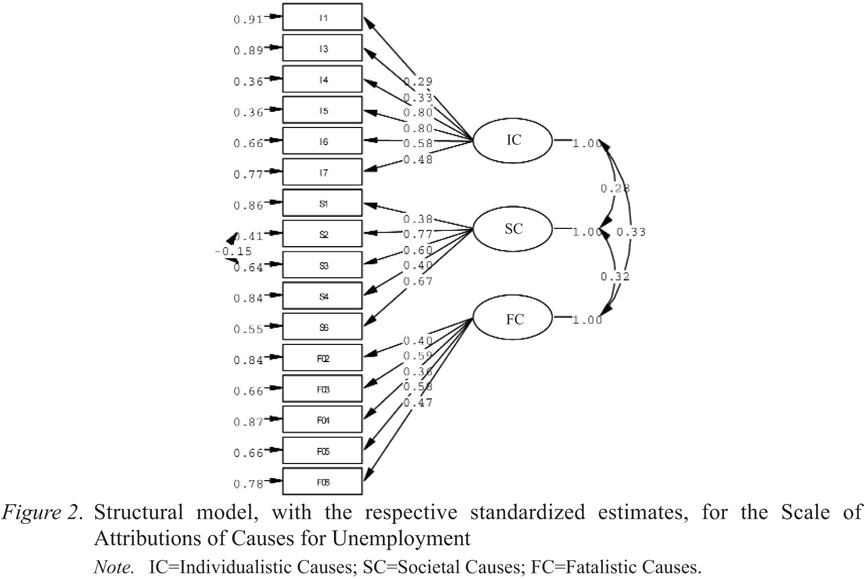
<body><![CDATA[<p><b>RESUMO</b></p>     <p>Investiga-se o processo de atribui&ccedil;&atilde;o de causas para o desemprego por trabalhadores desempregados, buscando analisar o poder  preditivo de vari&aacute;veis sociodemogr&aacute;ficas sobre esse processo. Foi empregada escala de atribui&ccedil;&atilde;o de causas do  desemprego originalmente desenvolvida por Furnham e aplicada a 376 pessoas desempregadas. Ap&oacute;s an&aacute;lise fatorial confirmat&oacute;ria,  os fatores da escala foram utilizados em um modelo de regress&atilde;o contendo vari&aacute;veis sociodemogr&aacute;ficas como preditoras. Os  resultados da AFC d&atilde;o suporte ao modelo original de tr&ecirc;s fatores de causas do desemprego (individualistas, societais e fatalistas;  <i>&chi;<Sup>2</i></Sup><Sub>(100)</Sub>=261.53, <i>p</i>&lt;0.001; <i>&chi;<Sup>2</Sup>/gl</i>=2.61; CFI=0.91, TLI=0.90; RMSEA=0.06). A an&aacute;lise de  regress&atilde;o identificou uma predi&ccedil;&atilde;o significativa apenas com a vari&aacute;vel renda e o fator de causas individualistas  (<i>&beta;=</i>0.15, <i>p&lt;</i>0.01); e as vari&aacute;veis renda (<i>&beta;=</i>0.10, <i>p&lt;</i>0.001) e escolaridade (<i>&beta;=</i>-0.15,  <i>p</i>&lt;0.01) e o fator de causas societais. Causas societais apresentaram as maiores m&eacute;dias, sendo significativamente  (<i>p&lt;</i>0.001) diferentes das m&eacute;dias dos outros dois fatores. O estudo conclui referindo-se ao fato de que o n&iacute;vel de  escolariza&ccedil;&atilde;o n&atilde;o tem um impacto direto (quanto mais aumenta ou diminui um, mais aumenta ou diminui o outro) na  forma&ccedil;&atilde;o de cren&ccedil;as sobre as causas do desemprego. </p>     <p><b>Palavras-chave: </b>Desemprego, Atribui&ccedil;&atilde;o de causas, Escala de Furnham. </p>     <p>&nbsp;</p>     <p>The importance of understanding socioeconomic and psychological factors related to unemployment has grown throughout the world, particularly  since the global financial crisis of 2007. Eurostat (February 2014) reported EU unemployment rates above 10% &ndash; for example, in Spain (25.6%),  France (10.4%), Italy (13.0%), and Portugal (15.3%). Brazil has had similar unemployment rates, such as 18.7% according to DIEESE (2006), and only  recently has Brazil managed to reduce and stabilize unemployment rates around 10% (<a href="#f1">Figure 1</a>). </p>     <p>&nbsp;</p>     <p><a name="f1"></a></p>     <p><img src="/img/revistas/aps/v33n2/33n2a02f1.jpg" width="575" height="228"></p>     
<p>&nbsp;</p>     <p>Two of the ways in which unemployment causes damage to a society are the permanent loss of human capital in the medium and long term, especially  for the young, and the negative impact on people&rsquo;s health and well-being (Choudhry, Marelli, &amp; Signorelli, 2013). With regard to the  former, the International Labor Organization special report on Trends in Global Employment 2013 stated that globally, 197 million people were  unemployed in 2012, and that young people were especially prominent among the groups most affected by the financial crises (International Labour  Organization [ILO], 2013). People with little work experience and less developed skills, as is the case with young people, offer a lower human  capital than adult workers and are thus more vulnerable. With regard to the negative impacts of unemployment on health and well-being, Boyce, Wood,  Daly, and Sedikides (in press) conducted a longitudinal study of employment, following the occupational history of more than 6,000 people, and they  found strong evidence that the unemployment experience is associated with personality changes, with repercussions for ways of thinking, feeling,  and behaving. </p>     ]]></body>
<body><![CDATA[<p>While acknowledging that the problems of unemployment must be addressed by studies and by economic, political, and social actions that are  complex at the macro level (e.g., Blustein, Medvide, &amp; Wan, 2012; Kapuv&aacute;ri, 2011), we believe that analyses of personal beliefs  regarding the causes of unemployment can ultimately contribute to the development of public policies on psychosocial support for the unemployed. </p>     <p>According to Feather (1985), attributions of causes for events are strongly based on people&rsquo;s values and attitudes. People who are  conservative tend to attribute internal and individualistic causes to the unemployment condition more than societal ones. Public policies focused  on actions at the macroeconomic level should recognize that socialization processes interfere with attribution processes and that they impact  motivational levels and strategies for dealing with unemployment. Thus, studies on causal attributions made by unemployed workers with regard to  unemployment are of great importance. </p>     <p>One of the basic premises of common sense psychology is that people act as naive scientists and try to explain events in the world, giving them  meaning, which leads to a greater sense of control over the events (e.g., Crittiden, 1983; Martinko, Douglas, &amp; Harvey, 2006). The classical  authors who have studied the process of psychological attribution (e.g., Heider, 1958; Kelley, 1973; Weiner, 1986) have suggested that the  following are important ingredients for understanding this phenomenon: (i) the person making the attribution of cause (the actor of the action or  its observer), (ii) the source of the cause (internal or external to the person making the attribution), (iii) the level of control over the cause  (modifiable or not), and (iv) the stability of the cause over time (mutable or immutable). </p>     <p>Empirical studies over the years have indicated that individual variables are correlated with an individualistic style of assigning causes to  successes or failures in one&rsquo;s personal life, for example, gender (e.g., Campbell &amp; Henry, 1999) and motivational values profile (e.g.,  Gondim, &Aacute;lvaro-Estramiana, Luna, Oliveira, &amp; Souza, 2010). In the case of unemployment, which is generally considered a failure event,  empirical evidence suggests that one&rsquo;s attributional style (with respect to its causes) can have a negative impact on self-esteem and  psychological well-being (e.g., &Aacute;lvaro-Estramiana, Gondim, Garrido-Luque, Luna, &amp; Dessen, 2012; Guimar&atilde;es, Demazi&egrave;re,  &amp; Sugita, 2010; Jahoda, 1979; Moyano-D&iacute;az, Guti&eacute;rrez-Pe&ntilde;a, Z&uacute;&ntilde;iga-Cabrera, &amp; Cornejo, 2013). </p>     <p>One of the first researchers to study and create a questionnaire for measuring attributions of unemployment causes was Furnham (1982). The  findings of his study, which was conducted in the UK, corroborated the role of the actor or observer in causal attributions for unemployment. He  found that employees tend to blame the individual for unemployment more than do unemployed people, who attribute unemployment to external causes  (society, economy, and technology). Another conclusion of Furnham&rsquo;s study was that although a high educational level increases an  individual&rsquo;s chances of attributing unemployment to external causes &ndash; since we can presume that in this case the individual has  acquired a more critical stance on the society, thanks to the education &ndash; the attributor&rsquo;s role as observer (employee) or actor  (unemployed) influences whether the attribution identifies internal or external causes. Observers tend to attribute unemployment to individualistic  causes rather than societal factors &ndash; an &ldquo;attribution bias&rdquo; phenomenon that has been pointed out by Jones and Davis (1965). </p>     <p>Furnham (1988) and Furnham and Rawles (1996) proposed that there are three main types of reasons given for unemployment: (a) individualistic  reasons related to dispositional and personal factors (internal causes), (b) societal reasons involving policies and organizations (external and  structural), and (c) fatalistic reasons related to technological developments whose inevitability brings about negative consequences. Gondim et al.  (2010) subsequently attempted to validate Furnham&rsquo;s (1988) model in Brazil. To this end, they used a sample of employed and unemployed  individuals from the northeast region of the country, and they analyzed the obtained data with exploratory analytical processes. Their analysis  identified several problems in adapting the measure to the Brazilian reality, as will be described below. Thus, the primary objective of the  present study is to conduct a confirmatory factor analysis (CFA) of Furnham&rsquo;s model with the aim of contributing to the cultural adaptation  of this instrument and its psychometric development. </p>     <p>Additionally, this study has a second objective, which is to analyze the explanatory power of some sociodemographic variables in attributions of  fatalistic, societal, and individualistic causes, with a view to testing some suggestions that have been made in the literature in this regard. For  example, studies have suggested that men and women react differently to job loss (e.g., Burke, 1985) and that women tend to make more external  attributions of causes for job loss than do men (Feather &amp; O&rsquo;Brien, 1986). This can happen because women do not see their work as a core  value or because their earnings would be secondary for the family income. However, a study by Leana and Feldman (1991) concluded that men and women  employ different strategies to deal with job loss and that this is probably because of their socialization processes. Men engage in more active job  search strategies, while women tend to seek social support. Additionally, Wooten and Valentin (2008) found gender differences in causal  attributions concerning job loss (women attribute it to more external causes) and in emotional reactions to it (women become more depressed, while  men express more anger). But these authors concluded that these gender differences practically disappear when age, ethnicity, marital status,  education, employment status, and income were controlled for. It is this theoretical context that situates the second objective of the present  study. </p>     <p>&nbsp;    <p>     <p><b>Method </b></p>     ]]></body>
<body><![CDATA[<p>&nbsp;    <p>     <p><i>Participant </i></p>     <p>Three hundred and seventy-six (376) unemployed people living in a northeast Brazilian municipality and attending local units of the National  System of Labor Intermediation (SINE, in Portuguese) &ndash; which is linked to the Brazilian Federal Government&rsquo;s Ministry of Labor &ndash;  participated in the accidental sampling. SINE aims to integrate policies on the routing of workers for available job positions. Therefore, it acts  as a labor broker, connecting potential employees to potential employers (as a kind of public employment agency). In addition, its mission is to  support the generation of employment and income, professional training, and access to unemployment insurance &ndash; which is paid to an employee,  provisionally, when the employee loses his or her job due to dismissal and is seeking a new job. SINE was established by Brazilian Law (Law,  n&ordm; 8.019/1990). </p>     <p>The sample was evenly distributed between the two sexes (50.7% men), with a predominance of people with an incomplete higher education (53.1%),  followed by those with a complete secondary school education (13.3%), a complete higher education (10.3%), a complete postgraduate education  (8.5%), a complete basic education (8.0%), and an incomplete secondary education (6.4%). More than half of the workers were youth between the ages  of 15 and 29 years (55.8%), with a majority of the youths between 18 and 24 years of age (30.8%). For most (86.7%), personal income from their last  jobs did not exceed twice the minimum wage (at the time R$678.00 monthly, about &euro;250.00), with nine people (2.4%) earning more than five times  the minimum wage. No participant had been unemployed for more than six months, and more than half (59.8%) had held only one job in the past two  years, suggesting a reduced turnover among these workers. Only those who had not entered into any formal or informal employment participated in the  survey. </p>     <p>&nbsp;    <p>     <p><i>Instrument </i></p>     <p>The instrument used in this study evolved from Furnham&rsquo;s (1988) model, which was described in the introduction. In an attempt to enhance  Furnham&rsquo;s scale of causal attributions for unemployment and also to find evidence of cross-cultural validation of the three factorial  dimensions of Furnham&rsquo;s model, Mylonas (2007) developed an instrument of 44 items that included 20 items from the original scale and applied  it to a sample of 250 people. The results offered support for a triarchic model with 19 items constituting the three dimensions (7 items for  individualistic causes, 6 for societal causes, and 6 for fatalistic causes), with only 8 items coming from the original scale. Mylonas and Furnham  (2014) subsequently confirmed the new measure in a cross-cultural study of samples from eight countries. </p>     <p>Gondim et al. (2010) adapted Mylonas and Furnham&rsquo;s questionnaire to Portuguese and attempted to confirm the triarchic solution for Brazil  &ndash; but they were not able to do so, in part because Brazilians ascribe unemployment to multiple causes. The authors used an exploratory factor  analysis, and this revealed three factors (KMO=0.68), each of which merged individualistic, societal, and fatalistic causes, with factor loadings  ranging from 0.35 to 0.68 for the first factor (8 items, Cronbach&rsquo;s alpha 0.65), 0.36 to 0.62 for the second factor (8 items,  Cronbach&rsquo;s alpha 0.75) and 0.58 to 0.77 for the third factor (3 items, Cronbach&rsquo;s alpha 0.65). The first two factors jointly explain  13% of the variance, and the third explains 9%. According to Gondim et al., this mix of items reveals some measurement problems when applied to the  Brazilian sample. </p>     ]]></body>
<body><![CDATA[<p>The present study uses Gondim et al. (2010)&rsquo;s adaption of Mylonas and Furnham&rsquo;s questionnaire for assigning causes for unemployment.  Each item is a judgment on the cause for unemployment: individualistic (e.g., &ldquo;Lack of effort and laziness among unemployed people&rdquo;),  societal (e.g., &ldquo;The educational system does not correspond to the current job market&rdquo;), or fatalistic (e.g., &ldquo;Demographic and  population changes&rdquo;). To answer the items, participants used a 4-point Likert scale ranging from 1 (<i>not at all related to  unemployment</i>) to 4 (<i>extremely related to unemployment</i>). A section was added to the questionnaire to collect demographic information from  the participants, including gender, number of formal jobs in the last two years, age, education, and income. </p>     <p>&nbsp;    <p>     <p><i>Data collection procedures. </i>The instrument was applied presentially in an assisted form to unemployed workers who were using four local  units of SINE in 2013-2014. After obtaining authorization from the Office of the Secretary of State, the applicators&rsquo; visits to the SINE  units commenced. These visits occurred two to three times per week in intercalated shifts, during the periods from November 2013 to February 2014  and April 2014 to May 2014. </p>     <p>The unemployed workers who participated in this research were approached while they were waiting to be served at the SINE agency. The  researchers presented the objective of the research and the ethical aspects involved in their participation and then, with the consent of the  worker, they applied the instrument on the attribution of causes. The total time for application of the questionnaire ranged between 30 and 60 min.  In the case of respondents who had a lower educational level, we opted to base the application on a strategy of presenting each item with cards of  different colors and shades to differentiate the intensity of the response, from the brightest (<i>not at all related to unemployment</i>) to the  darkest (<i>extremely related to unemployment</i>). </p>     <p>&nbsp;    <p>     <p><i>Data analysis procedures. </i>First, we examined the database to identify incomplete questionnaires. We found that there were very few of  these (less than 1%), and we decided to exclude them (listwise). There were no univariate extreme cases (based on z-scores). However, we excluded  eight multivariable extreme cases (based on the Mahalanobis distance, <i>p</i>&lt;0.01). The asymmetry indices of the variables ranged from |0.02|  to |0.98| and had a kurtosis of |0.02| to |1.30|. </p>     <p>Given the two objectives of this study, we submitted the data to two types of analysis. The first was a confirmatory factor analysis (CFA).  Considering that the variables were measured at ordinal levels (four classes), and to minimize the effects of the distribution of the data (for  example, a possible nonnormal distribution), we used the robust maximum likelihood extraction method, with Satorra-Bentler correction. We conducted  the analysis with a polychoric correlation matrix. The indices we used to assess the goodness of fit were the difference in the chi-square for  degrees of freedom (<i>&chi;<Sup>2</i></Sup>/gl), whose expected value is less than 2 (Arbuckle, 2008), and the comparative fit index (CFI) and  Tucker-Lewis index (TLI), whose values  are both expected to be greater than or equal to 0.90 (Bollen, 1989; Byrne, 2010; Kline, 2011). We also  used the root mean square error of approximation (RMSEA), whose expected value is less than 0.06 (Brown, 2006), and we assessed the degree of  reliability of the factors using Cronbach&rsquo;s alpha. Finally, we used LISREL software (v. 8.80) for the analysis. </p>     <p>After validation of the model, we conducted the second analysis, related to the second purpose of this article: we took the three belief factors  concerning the causes for unemployment as dependent variables and inserted them into a regression model to determine the effect of the  sociodemographic (independent) variables on these factors. First, we reclassified the initial six levels of education in order to facilitate the  analysis and also in view of theoretical considerations that we address in the discussion section. Then we converted schooling (which is  categorical) into three dummy variables. Because of the exploratory nature of our investigation of the relationship between these variables and the  attributions of causality, as described in the introduction, we carried out an inspection of the correlation matrix. Only sociodemographic  variables that correlated significantly (<i>p</i>&lt;0.05) with some factor of causality attribution were included in the model. We conducted the  regression analysis (linear multivariate) itself with SPSS software (v. 20), using the stepwise (exploratory) method. </p>     ]]></body>
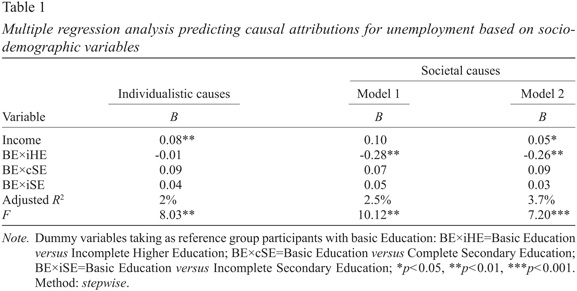
<body><![CDATA[<p>&nbsp;    <p>     <p><b>Results </b></p>     <p>Initially, the CFA resulted in a model that was poorly fitted to the data. Using the 19 original questions, provided to saturate the three  factors, we obtained the following indicators: <i>&chi;<Sup>2</i></Sup><Sub>(149)</Sub>=490.53, <i>p</i>&lt;0.001;  <i>&chi;<Sup>2</i></Sup>/gl=3.29; CFI=0.84, TLI=0.84; RMSEA=0.07 (IC of 90%=0.07, 0.08), <i>P</i>[RMSEA&le;0.05]=0.001. Based on this initial  model, we proceeded to respecify some parameters. </p>     <p>First, we retained in the model only those items whose factorial weight was greater than or equal to 0.30. Based on this criterion, three items,  all of which were causal factors of unemployment, were excluded: &ldquo;Inability of unemployed people to adapt to new conditions&rdquo;  (individualistic cause), &ldquo;Production facilities and enterprises have been relocated to other areas or even to other countries&rdquo;  (societal cause), and &ldquo;The introduction of widespread automation&rdquo; (fatalistic cause). </p>     <p>Then we considered suggestions for modification (modification indices) that were given by the software itself &ndash; taking into account,  however, their consistency with the theoretical basis of reference. We therefore decided to allow the errors of two items to co-vary with each  other, both factors being societal causes: &ldquo;The educational system does not correspond to the current job market&rdquo; and &ldquo;Unemployed  people do not qualify for contemporary market needs&rdquo;, as the semantic formulations for these two items are close to each other (at least in  the Portuguese version of the questionnaire). </p>     <p>As a result of these respecifications, the new model, consisting of 16 items, presented better fit indices:  <i>&chi;<Sup>2</i></Sup><Sub>(100)</Sub>=261.53, <i>p</i>&lt;0.001; <i>&chi;<Sup>2</i></Sup>/df=2.61; CFI=0.91, TLI=0.90; RMSEA=0.06 (90% CI=0.05,  0.07), <i>P</i>[RMSEA&le;0.05]=0.004. Concerning the reliability of the three factors, Cronbach&rsquo;s alpha was 0.68 for individualistic causes,  0.61 for societal causes, and 0.55 for fatalistic causes. These rates are slightly lower than those found in the previous study in Brazil using the  same instrument (Gondim et al., 2010). The weight factor for each item is shown in <a href="#f2">Figure 2</a>, as well as the correlations between  factors (all significant, <i>p</i>&lt;0.001). </p>     <p>&nbsp;</p>     <p><a name="f2"></a></p>     <p><img src="/img/revistas/aps/v33n2/33n2a02f2.jpg" width="865" height="579"></p>     
]]></body>
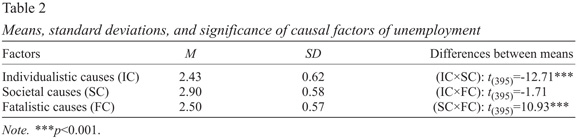
<body><![CDATA[<p>&nbsp;</p>     <p>Turning to the results of the regression analysis, inspection of the correlation matrix composed of the sociodemographic variables reveals that  only two variables were correlated (although weakly) with two factors of unemployment causes: individualistic causes and income (<i>r</i>=0.14,  <i>p</i>&lt;0.01), societal causes and income (<i>r</i>=0.12, <i>p</i>&lt;0.01), and societal causes and education (incomplete higher education,  <i>r</i>=-0.16, <i>p</i>&lt;0.01; complete secondary education, <i>r</i>=0.13, <i>p</i>&lt;0.01; incomplete secondary education, <i>r</i>=0.08,  <i>p</i>&lt;0.04). We then included these variables in the regression models, leading to the indicators shown in <a href="#t1">Table 1</a>. </p>     <p>&nbsp;</p>     <p><a name="t1"></a></p>     <p><img src="/img/revistas/aps/v33n2/33n2a02t1.jpg" width="577" height="291"></p>     
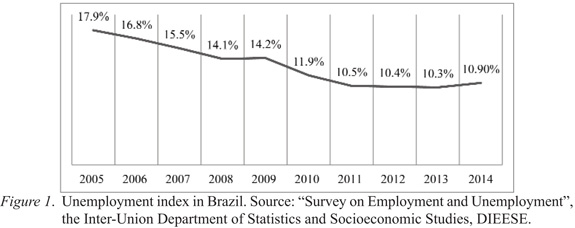
<p>&nbsp;</p>     <p>As can be seen in <a href="#t1">Table 1</a>, the predictive power of only two of the sociodemographic variables used in the analysis is  significant, albeit very low &ndash; they account for only 2% of the observed variability in the individualistic causes factor and 3.7% of the  variability in the societal causes factor (Model 2: <i>F</i><Sub>(1,358)</Sub>=3.88, <i>p</i>&lt;0.05). Note that an increase in income slightly  increases the attribution of individualistic causes (<i>&beta;</i>=0.15, <i>p</i>&lt;0.01) and societal causes (<i>&beta;</i>=0.10,  <i>p</i>&lt;0.001). Turning to educational level, we noted a negative effect on the scores of societal causes when going from participants with a  basic education (baseline group) to those with an incomplete higher education (<i>&beta;</i>=-0.15, <i>p</i>&lt;0.01). That is, participants with a  higher level of schooling (in this case, incomplete higher education) tended to ascribe lower scores to societal causes for unemployment. </p>     <p>Finally, <a href="#t2">Table 2</a> shows the means of each of the three factors of attribution of causality for unemployment and their differences. As can be seen, the social causes factor exhibits significantly higher scores than the individualistic and fatalistic causes for unemployment. </p>     <p>&nbsp;</p>     <p><a name="t2"></a></p>     ]]></body>
<body><![CDATA[<p><img src="/img/revistas/aps/v33n2/33n2a02t2.jpg" width="577" height="140"></p>     
<p>&nbsp;</p>     <p>&nbsp;    <p>     <p><b>Discussion </b></p>     <p>The objective of this paper was twofold: to confirm the structure of Furnham&rsquo;s model of attribution of causes for unemployment and to  investigate the predictive role of sociodemographic variables for the components of this model. </p>     <p>With regard to the first objective, although the model was confirmed as a whole (structural confirmation, since we found the same number of  factors and the same pattern of saturation of the items in the factors), some aspects of our findings deserve to be mentioned. Firstly, not all  items were confirmed. Only 16 out of the 19 items of the original version were retained based on the weight factors for the items  (<i>&lambda;~</i>0.30). This suggests that the deleted items may not be good representatives of latent variables for the Brazilian sample. </p>     <p>Secondly, the introduction of a trajectory between two items that are a part of the societal cause factor suggests that there may be a problem  of semantic overlap between these (the items are supposed to evaluate different facets of the latent variable, but the proximity of the writing  leads to a similar interpretation). </p>     <p>Thirdly, inspection of the model residues revealed that several other items (at least three with an high impact on respecification of the model)  have their errors correlated, which suggests that a fraction of the behavior of these items that is not explained by the respective factors can be  explained by other factors not provided for in the model. This strengthens the argument that unemployment has multiple causes, and this should be  considered in addition to the three dimensions contained in the Furnham (1982) model. In their cross-cultural research, &Aacute;lvaro-Estramiana et  al. (2012) compared Brazilian and Spanish samples and found that Brazilians attribute unemployment to multiple causes, unlike Spaniards, who follow  tendencies similar to samples from other countries (see also Mylonas et al., 2010, 2014). </p>     <p>Also in this connection, looking at the scale items that were excluded in this study, the possible influence of context can be perceived. Two of  these items (&ldquo;Production facilities and enterprises have been relocated to other areas or even to other countries&rdquo; and &ldquo;The  introduction of widespread automation&rdquo;) refer to elements that are not found in the local reality of the current sample of participants.  Unlike the reality for which this instrument was originally designed and implemented (European countries), the context of insertion for the  participants in the present study is newly industrialized and lies primarily in the services sector. </p>     ]]></body>
<body><![CDATA[<p>Concerning the second objective, in which we tested the weight of sociodemographic variables in the attributions of causes for unemployment, the  results suggest that there are no differences in the variance of responses to attributions in terms of age or gender. In the sample for this study,  the only connections that were found were between education and income and attributions of cause. These results seem to corroborate Wooten and  Valentin&rsquo;s (2008) findings that the impact of certain sociodemographic variables on causal attributions for unemployment is spurious &ndash;  for example, the gender variable that has been extensively studied in the literature on unemployment (e.g., Burker, 1985; Feather &amp;  O&rsquo;Brien, 1986; Leana &amp; Feldman, 1991). </p>     <p>The positive association found between attributions of individualistic causes and income may be explained by attribution theory from social  psychology (Heider, 1958; Kelley, 1973; Weiner, 1986). This theory suggests that a person who is successful tends to ascribe merit for this to  him- or herself, but an unsuccessful person will ascribe responsibility for failure to contextual factors, which strengthens the assumption that  one&rsquo;s success depends on oneself while failure (unemployment) depends on a lack of effort and dedication on the part of others. This  reinforces the individualistic culture that believes that unemployment can be combated through entrepreneurial attitudes. This way of thinking has  been linked to a stratum of the population in ascendancy, who tend to adhere to liberal values with a more individualistic emphasis (Estanque,  2003; Pochmann, 2012), as well as conservatives (Feather, 1985). </p>     <p>An understanding of the predictive behavior of the educational level variable must take into account the characteristics of the sample used and  the method employed. In the regression models we tested, the only portions of the sample whose behavior influenced the dependent variable (in this  case, the societal causes factor) were participants with a basic education and those with an incomplete higher education (the latter comprised  about 50% of the sample). </p>     <p>We have no evidence to believe that this finding can be generalized. For this reason, further studies should test the relationship between  different schooling levels and attributions of causality. One question we can formulate based on our finding concerning the role of schooling in  the attributional styles is: Why didn&rsquo;t the intermediate level of schooling (in our case, secondary education) affect the mechanisms of  causal attributions? Could this result be related to our sample characteristics? In any case, it would be interesting, for example, to control new  samples in terms of schooling (there is an imbalance in the present sample since 50% of the participants were at the incomplete higher education  level) to investigate the assumption that the transition between different levels of schooling could indeed influence the breadth of personal  backgrounds and consequently affect the patterns of attribution of causes of unemployment. </p>     <p>A finding that is worth further exploration using different set of samples is that societal causes for unemployment had a comparatively higher  overall score (<i>M</i>=2.90, <i>SD</i>=0.58; <a href="#t2">Table 2</a>) than did individualistic and fatalistic causes, and this difference was  statistically significant in relation to the other averages (see <a href="#t2">Table 2</a>). A plausible explanation is that the government is  viewed as responsible for the unemployment situation, since it controls the educational system. Another possible explanation is that the  participants in some way understand that unemployment is a temporary situation that can be surmounted provided that conditions for better training  are met. This result may be associated with the belief in the importance of training, as advocated by the theory of human capital, according to  which the level of training or qualification for work has a positive impact on the achievement of better jobs, wages, and employability (Saul,  2004; Vatin, 1999). However, the theory of human capital has recently been criticized (e.g., Adamson, 2009; Br&ouml;ckling, 2011; Frigotto, 2010,  2011) and has also been challenged by what Chroudhly et al. (2013) noted concerning the loss of human capital that is associated with high rates of  unemployment, especially among young people, who supposedly are more informed and ready for the demands of work. </p>     <p>In conclusion, it is worth pointing out that the results presented in this paper confirm that an instrument for measuring attributions of  causality based on the separation of causes into individualistic, fatalistic, and societal is problematic &ndash; at least with respect to the  Brazilian reality. Additionally, and this may have something to do with the previous point, there was no clear evidence of the role of  sociodemographic variables in understanding how people attribute causes for unemployment. </p>     <p>The results of this study have generated several issues that deserve further study. For example, they indicate that the influence of schooling  on the assignment of causes for unemployment is not evident. However, as mentioned above, this study&rsquo;s understanding of the role of  educational level could have been hampered by the sample characteristics and methodological decisions adopted. Concerning the former, the sample is  composed mainly of young people (55% below the age of 29 years), and is characterized by short periods of unemployment (88% were unemployed for two  months or less). Even the relationships found between income and individualistic and societal causal attributions needs some qualification, because  the income variability within the sample is small, considering that 86% of the participants earned no more than twice the minimum monthly wage.  Again, this limitation indicates the need for further research on this important issue. </p>     <p>&nbsp;    <p>     <p><b>References </b></p>     ]]></body>
<body><![CDATA[<!-- ref --><p>&Aacute;lvaro-Estramiana, J. L., Gondim, S. M. G. G., Garrido-Duque, A., Luna, A. F., &amp; Dessen, M. (2012). Desempleo y bienestar  psicol&oacute;gico en Brasil y Espa&ntilde;a: Un estudio comparativo. <i>Revista Psicologia: Organiza&ccedil;&otilde;es e Trabalho, 12</i>, 1-12.    &nbsp;&nbsp;&nbsp;&nbsp;&nbsp;&nbsp;&nbsp;&nbsp;[&#160;<a href="javascript:void(0);" onclick="javascript: window.open('/scielo.php?script=sci_nlinks&ref=000093&pid=S0870-8231201500020000200001&lng=','','width=640,height=500,resizable=yes,scrollbars=1,menubar=yes,');">Links</a>&#160;]<!-- end-ref --> </p>     <!-- ref --><p>Adamson, M. (2009). The human capital strategy. <i>Ephemera: Theory &amp; Politics in Organization, 9</i>, 271-284.    &nbsp;&nbsp;&nbsp;&nbsp;&nbsp;&nbsp;&nbsp;&nbsp;[&#160;<a href="javascript:void(0);" onclick="javascript: window.open('/scielo.php?script=sci_nlinks&ref=000095&pid=S0870-8231201500020000200002&lng=','','width=640,height=500,resizable=yes,scrollbars=1,menubar=yes,');">Links</a>&#160;]<!-- end-ref --> </p>     <p>Arbuckle, J. L. (2008). <i>AMOS 17 users&rsquo; guide</i>. Chicago: SPSS. </p>     <!-- ref --><p>Blustein, D. L., Medvide, M. B., &amp; Wan, C. M. (2012). A critical perspective of contemporary unemployment policy and practices.  <i>Journal of Career Development, 39</i>, 341-356.    &nbsp;&nbsp;&nbsp;&nbsp;&nbsp;&nbsp;&nbsp;&nbsp;[&#160;<a href="javascript:void(0);" onclick="javascript: window.open('/scielo.php?script=sci_nlinks&ref=000098&pid=S0870-8231201500020000200004&lng=','','width=640,height=500,resizable=yes,scrollbars=1,menubar=yes,');">Links</a>&#160;]<!-- end-ref --> </p>     <!-- ref --><p>Bollen, K. A. (1989). <i>Structural equations with latent variables</i>. New York: John Willey.    &nbsp;&nbsp;&nbsp;&nbsp;&nbsp;&nbsp;&nbsp;&nbsp;[&#160;<a href="javascript:void(0);" onclick="javascript: window.open('/scielo.php?script=sci_nlinks&ref=000100&pid=S0870-8231201500020000200005&lng=','','width=640,height=500,resizable=yes,scrollbars=1,menubar=yes,');">Links</a>&#160;]<!-- end-ref --> </p>     <!-- ref --><p>Boyce, C. J., Wood, A. M., Daly, M., &amp; Sedikides, C. (in press). Personality change following unemployment. <i>Journal of Applied  Psychology</i>.    &nbsp;&nbsp;&nbsp;&nbsp;&nbsp;&nbsp;&nbsp;&nbsp;[&#160;<a href="javascript:void(0);" onclick="javascript: window.open('/scielo.php?script=sci_nlinks&ref=000102&pid=S0870-8231201500020000200006&lng=','','width=640,height=500,resizable=yes,scrollbars=1,menubar=yes,');">Links</a>&#160;]<!-- end-ref --> </p>     <!-- ref --><p>Br&ouml;ckling, U. (2011). Human economy, human capital. A critique of biopolitical economy. In U. Br&ouml;ckling, S. Krasmann, &amp; T. Lemke  (Orgs.), <i>Governmentality: Current issues and future challenges </i>(pp. 247-268). New York: Routledge.    &nbsp;&nbsp;&nbsp;&nbsp;&nbsp;&nbsp;&nbsp;&nbsp;[&#160;<a href="javascript:void(0);" onclick="javascript: window.open('/scielo.php?script=sci_nlinks&ref=000104&pid=S0870-8231201500020000200007&lng=','','width=640,height=500,resizable=yes,scrollbars=1,menubar=yes,');">Links</a>&#160;]<!-- end-ref --> </p>     <!-- ref --><p>Brown, T. A. (2006). <i>Confirmatory factor analysis for applied research</i>. New York: The Guilford Press.    &nbsp;&nbsp;&nbsp;&nbsp;&nbsp;&nbsp;&nbsp;&nbsp;[&#160;<a href="javascript:void(0);" onclick="javascript: window.open('/scielo.php?script=sci_nlinks&ref=000106&pid=S0870-8231201500020000200008&lng=','','width=640,height=500,resizable=yes,scrollbars=1,menubar=yes,');">Links</a>&#160;]<!-- end-ref --> </p>     <!-- ref --><p>Burke, R. (1985). Comparison of experiences of men and women following a plant shutdown. <i>Psychogical Reports, 57</i>, 59-66.    &nbsp;&nbsp;&nbsp;&nbsp;&nbsp;&nbsp;&nbsp;&nbsp;[&#160;<a href="javascript:void(0);" onclick="javascript: window.open('/scielo.php?script=sci_nlinks&ref=000108&pid=S0870-8231201500020000200009&lng=','','width=640,height=500,resizable=yes,scrollbars=1,menubar=yes,');">Links</a>&#160;]<!-- end-ref --> </p>     <!-- ref --><p>Byrne, B. M. (2010). <i>Structural equation modeling with AMOS</i>. New York: Routledge.    &nbsp;&nbsp;&nbsp;&nbsp;&nbsp;&nbsp;&nbsp;&nbsp;[&#160;<a href="javascript:void(0);" onclick="javascript: window.open('/scielo.php?script=sci_nlinks&ref=000110&pid=S0870-8231201500020000200010&lng=','','width=640,height=500,resizable=yes,scrollbars=1,menubar=yes,');">Links</a>&#160;]<!-- end-ref --> </p>     <!-- ref --><p>Campbell, C. R., &amp; Henry, J. W. (1999). Gender differences in self-attributions: Relationship of gender to attributional consistency, style,  and expectations for performance in a college course. <i>Sex Roles, 41</i>, 95-104.    &nbsp;&nbsp;&nbsp;&nbsp;&nbsp;&nbsp;&nbsp;&nbsp;[&#160;<a href="javascript:void(0);" onclick="javascript: window.open('/scielo.php?script=sci_nlinks&ref=000112&pid=S0870-8231201500020000200011&lng=','','width=640,height=500,resizable=yes,scrollbars=1,menubar=yes,');">Links</a>&#160;]<!-- end-ref --> </p>     <!-- ref --><p>Choudhry, M., Marelli, E., &amp; Signorelli, M. (2013). Youth and total unemployment rate: The impact of policies and institutions. <i>Rivista  Internazionale di Scienze Sociali, 121</i>, 63-86.    &nbsp;&nbsp;&nbsp;&nbsp;&nbsp;&nbsp;&nbsp;&nbsp;[&#160;<a href="javascript:void(0);" onclick="javascript: window.open('/scielo.php?script=sci_nlinks&ref=000114&pid=S0870-8231201500020000200012&lng=','','width=640,height=500,resizable=yes,scrollbars=1,menubar=yes,');">Links</a>&#160;]<!-- end-ref --> </p>     <!-- ref --><p>Crittiden, K. S. (1983). Sociological aspects of attribution. <i>Annual Review of Sociology, 9</i>, 425-446.    &nbsp;&nbsp;&nbsp;&nbsp;&nbsp;&nbsp;&nbsp;&nbsp;[&#160;<a href="javascript:void(0);" onclick="javascript: window.open('/scielo.php?script=sci_nlinks&ref=000116&pid=S0870-8231201500020000200013&lng=','','width=640,height=500,resizable=yes,scrollbars=1,menubar=yes,');">Links</a>&#160;]<!-- end-ref --> </p>     <p>Departamento Intersindical de Estat&iacute;stica e Estudos Socioecon&ocirc;micos &ndash; DIEESE. (2006). <i>Pesquisa de emprego e desemprego:  Mercado de trabalho metropolitano</i>. S&atilde;o Paulo, SP: DIEESE. </p>     <!-- ref --><p>Estanque, E. (2003). O efeito classe m&eacute;dia: Desigualdades e oportunidades no limiar do s&eacute;culo XXI. In M. V. Cabral, J. Vala, &amp;  A. Freire (Orgs.), <i>Atitudes sociais dos portugueses: Desigualdades sociais e percep&ccedil;&otilde;es de justi&ccedil;a </i>(pp. 69-105).  Lisboa: Imprensa de Ci&ecirc;ncias Sociais.    &nbsp;&nbsp;&nbsp;&nbsp;&nbsp;&nbsp;&nbsp;&nbsp;[&#160;<a href="javascript:void(0);" onclick="javascript: window.open('/scielo.php?script=sci_nlinks&ref=000119&pid=S0870-8231201500020000200015&lng=','','width=640,height=500,resizable=yes,scrollbars=1,menubar=yes,');">Links</a>&#160;]<!-- end-ref --> </p>     <!-- ref --><p>Feather, N. T. (1985). Attitudes, values, and attributions: Explanations of unemployment. <i>Journal of Personality and Social Psychology,  48</i>, 876-889.    &nbsp;&nbsp;&nbsp;&nbsp;&nbsp;&nbsp;&nbsp;&nbsp;[&#160;<a href="javascript:void(0);" onclick="javascript: window.open('/scielo.php?script=sci_nlinks&ref=000121&pid=S0870-8231201500020000200016&lng=','','width=640,height=500,resizable=yes,scrollbars=1,menubar=yes,');">Links</a>&#160;]<!-- end-ref --> </p>     ]]></body>
<body><![CDATA[<p>Feather, N. T., &amp; O&rsquo;Brien, G. E. (1986). A longitudinal analysis of the effects of different patterns of employment and unemployment  on school leavers. <i>British Journal of Psychology, 77</i>, 459-479. </p>     <!-- ref --><p>Frigotto, G. (2010). <i>A produtividade da escola improdutiva </i>(9&ordf; ed.). S&atilde;o Paulo: Cortez.    &nbsp;&nbsp;&nbsp;&nbsp;&nbsp;&nbsp;&nbsp;&nbsp;[&#160;<a href="javascript:void(0);" onclick="javascript: window.open('/scielo.php?script=sci_nlinks&ref=000124&pid=S0870-8231201500020000200018&lng=','','width=640,height=500,resizable=yes,scrollbars=1,menubar=yes,');">Links</a>&#160;]<!-- end-ref --> </p>     <!-- ref --><p>Frigotto, G. (2011). Novos fetiches da pseudoteoria do capital humano no contexto do capitalismo tardio. In J. De Andrade &amp; L. G. De Paiva  (Orgs.), <i>As pol&iacute;ticas p&uacute;blicas para a educa&ccedil;&atilde;o no Brasil contempor&acirc;neo </i>(pp. 18-35). Juiz de Fora: Editora  da Universidade Federal de Juiz de Fora.    &nbsp;&nbsp;&nbsp;&nbsp;&nbsp;&nbsp;&nbsp;&nbsp;[&#160;<a href="javascript:void(0);" onclick="javascript: window.open('/scielo.php?script=sci_nlinks&ref=000126&pid=S0870-8231201500020000200019&lng=','','width=640,height=500,resizable=yes,scrollbars=1,menubar=yes,');">Links</a>&#160;]<!-- end-ref --> </p>     <!-- ref --><p>Furnham, A. (1982). Explanations for unemployment in Britain. <i>European Journal of Social Psychology, 12</i>, 335-352.    &nbsp;&nbsp;&nbsp;&nbsp;&nbsp;&nbsp;&nbsp;&nbsp;[&#160;<a href="javascript:void(0);" onclick="javascript: window.open('/scielo.php?script=sci_nlinks&ref=000128&pid=S0870-8231201500020000200020&lng=','','width=640,height=500,resizable=yes,scrollbars=1,menubar=yes,');">Links</a>&#160;]<!-- end-ref --> </p>     <!-- ref --><p>Furnham, A. (1988). <i>Lay theories: Everyday understanding of problems in the social sciences. </i>Oxford: Pergamon Press.    &nbsp;&nbsp;&nbsp;&nbsp;&nbsp;&nbsp;&nbsp;&nbsp;[&#160;<a href="javascript:void(0);" onclick="javascript: window.open('/scielo.php?script=sci_nlinks&ref=000130&pid=S0870-8231201500020000200021&lng=','','width=640,height=500,resizable=yes,scrollbars=1,menubar=yes,');">Links</a>&#160;]<!-- end-ref --> </p>     <!-- ref --><p>Furnham, A., &amp; Rawles, R. (1996). Job search strategies, attitudes to school and attribution about unemployment. <i>Journal of Adolescence,  19</i>, 355-369.    &nbsp;&nbsp;&nbsp;&nbsp;&nbsp;&nbsp;&nbsp;&nbsp;[&#160;<a href="javascript:void(0);" onclick="javascript: window.open('/scielo.php?script=sci_nlinks&ref=000132&pid=S0870-8231201500020000200022&lng=','','width=640,height=500,resizable=yes,scrollbars=1,menubar=yes,');">Links</a>&#160;]<!-- end-ref --> </p>     <!-- ref --><p>Gondim, S. M. G., &Aacute;lvaro, J. L., Luna, A. F., Oliveira, T., &amp; Souza, G. C. (2010). Atribui&ccedil;&otilde;es de causas do desemprego  e valores pessoais. <i>Estudos de Psicologia (UFRN), 15</i>, 309-317.    &nbsp;&nbsp;&nbsp;&nbsp;&nbsp;&nbsp;&nbsp;&nbsp;[&#160;<a href="javascript:void(0);" onclick="javascript: window.open('/scielo.php?script=sci_nlinks&ref=000134&pid=S0870-8231201500020000200023&lng=','','width=640,height=500,resizable=yes,scrollbars=1,menubar=yes,');">Links</a>&#160;]<!-- end-ref --> </p>     <!-- ref --><p>Guimar&atilde;es, N., Demazi&egrave;re, D., &amp; Sugita, K. (2010). O desemprego como experi&ecirc;ncia biogr&aacute;fica: S&atilde;o Paulo,  Paris, T&oacute;quio. In N. Guimar&atilde;es (Org.), <i>Desemprego, uma constru&ccedil;&atilde;o social: S&atilde;o Paulo, Paris e  T&oacute;quio </i>(pp. 87-201). Belo Horizonte: Argvmentvm.    &nbsp;&nbsp;&nbsp;&nbsp;&nbsp;&nbsp;&nbsp;&nbsp;[&#160;<a href="javascript:void(0);" onclick="javascript: window.open('/scielo.php?script=sci_nlinks&ref=000136&pid=S0870-8231201500020000200024&lng=','','width=640,height=500,resizable=yes,scrollbars=1,menubar=yes,');">Links</a>&#160;]<!-- end-ref --> </p>     <!-- ref --><p>Heider, F. (1958). <i>The psychology of interpersonal relations</i>. New York: Wiley and Sons.    &nbsp;&nbsp;&nbsp;&nbsp;&nbsp;&nbsp;&nbsp;&nbsp;[&#160;<a href="javascript:void(0);" onclick="javascript: window.open('/scielo.php?script=sci_nlinks&ref=000138&pid=S0870-8231201500020000200025&lng=','','width=640,height=500,resizable=yes,scrollbars=1,menubar=yes,');">Links</a>&#160;]<!-- end-ref --> </p>     <!-- ref --><p>Holmqvist, M. (2009). Medicalization of unemployment: Individualizing social issues as personal problems in the Swedish welfare state.  <i>Work Employment &amp; Society, 23</i>, 405-421.    &nbsp;&nbsp;&nbsp;&nbsp;&nbsp;&nbsp;&nbsp;&nbsp;[&#160;<a href="javascript:void(0);" onclick="javascript: window.open('/scielo.php?script=sci_nlinks&ref=000140&pid=S0870-8231201500020000200026&lng=','','width=640,height=500,resizable=yes,scrollbars=1,menubar=yes,');">Links</a>&#160;]<!-- end-ref --> </p>     <!-- ref --><p>International Labour Organization (ILO). (2013). <i>Tendencias mundiales del empleo 2013. Resumen Ejecutivo</i>. Dispon&iacute;vel em  <a href="http://www.oit.org.br/sites/default/files/topic/gender/doc/tendenciasmundiaisdempregoresumoespanhol_974.pdf"  target="_blank">http://www.oit.org.br/sites/default/files/topic/gender/doc/tendenciasmundiaisdempregoresumoespanhol_974.pdf</a> &nbsp;&nbsp;&nbsp;&nbsp;&nbsp;&nbsp;&nbsp;&nbsp;[&#160;<a href="javascript:void(0);" onclick="javascript: window.open('/scielo.php?script=sci_nlinks&ref=000142&pid=S0870-8231201500020000200027&lng=','','width=640,height=500,resizable=yes,scrollbars=1,menubar=yes,');">Links</a>&#160;]<!-- end-ref --><p>Jahoda, M. (1979). The impact of unemployment in the 1930&rsquo;s and the 1970&rsquo;s. <i>Bulletin of British Psychological Society, 32</i>,  309-314. </p>     <!-- ref --><p>Jones, E. E., &amp; Davis, K. E. (1965). From acts to dispositions: The attribution process in person perception. <i>Advances in Experimental  Social Psychology, 2</i>, 219-266.    &nbsp;&nbsp;&nbsp;&nbsp;&nbsp;&nbsp;&nbsp;&nbsp;[&#160;<a href="javascript:void(0);" onclick="javascript: window.open('/scielo.php?script=sci_nlinks&ref=000144&pid=S0870-8231201500020000200029&lng=','','width=640,height=500,resizable=yes,scrollbars=1,menubar=yes,');">Links</a>&#160;]<!-- end-ref --> </p>     <!-- ref --><p>Kapuv&aacute;ri, V. (2011). Psychological effects of economic recession and unemployment. <i>European Journal of Mental Health, 6</i>, 83-93.    &nbsp;&nbsp;&nbsp;&nbsp;&nbsp;&nbsp;&nbsp;&nbsp;[&#160;<a href="javascript:void(0);" onclick="javascript: window.open('/scielo.php?script=sci_nlinks&ref=000146&pid=S0870-8231201500020000200030&lng=','','width=640,height=500,resizable=yes,scrollbars=1,menubar=yes,');">Links</a>&#160;]<!-- end-ref --> </p>     <!-- ref --><p>Kelley, H. H. (1973). The processes of causal attribution process. <i>American Psychologist, 28</i>, 107-128.    &nbsp;&nbsp;&nbsp;&nbsp;&nbsp;&nbsp;&nbsp;&nbsp;[&#160;<a href="javascript:void(0);" onclick="javascript: window.open('/scielo.php?script=sci_nlinks&ref=000148&pid=S0870-8231201500020000200031&lng=','','width=640,height=500,resizable=yes,scrollbars=1,menubar=yes,');">Links</a>&#160;]<!-- end-ref --> </p>     <!-- ref --><p>Kline, R. B. (2011). <i>Principles and practice of structural equation modelling</i>. New York: The Guilford Press.    &nbsp;&nbsp;&nbsp;&nbsp;&nbsp;&nbsp;&nbsp;&nbsp;[&#160;<a href="javascript:void(0);" onclick="javascript: window.open('/scielo.php?script=sci_nlinks&ref=000150&pid=S0870-8231201500020000200032&lng=','','width=640,height=500,resizable=yes,scrollbars=1,menubar=yes,');">Links</a>&#160;]<!-- end-ref --> </p>     <!-- ref --><p>Leana, C. R., &amp; Feldman, D. C. (1991). Gender differences in responses to unemployment. <i>Journal of Vocational Behavior, 38</i>, 65-77.    &nbsp;&nbsp;&nbsp;&nbsp;&nbsp;&nbsp;&nbsp;&nbsp;[&#160;<a href="javascript:void(0);" onclick="javascript: window.open('/scielo.php?script=sci_nlinks&ref=000152&pid=S0870-8231201500020000200033&lng=','','width=640,height=500,resizable=yes,scrollbars=1,menubar=yes,');">Links</a>&#160;]<!-- end-ref --> </p>     <p>Law n&ordm; 8.019, de 11 de abril de 1990. Altera a legisla&ccedil;&atilde;o do Fundo de Amparo ao Trabalhador (FAT), e d&aacute; outras  provid&ecirc;ncias. Bras&iacute;lia. Dispon&iacute;vel em <a href="http://www.planalto.gov.br/ccivil_03/leis/L8019.htm"  target="_blank">http://www.planalto.gov.br/ccivil_03/leis/L8019.htm</a> </p>     <!-- ref --><p>Martinko, M. J., Douglas, S. C., &amp; Harvey, P. (2006). Attribution theory in industrial and organizational psychology: A review.  <i>International Review of Industrial and Organizational Psychology, 21</i>, 127-188.    &nbsp;&nbsp;&nbsp;&nbsp;&nbsp;&nbsp;&nbsp;&nbsp;[&#160;<a href="javascript:void(0);" onclick="javascript: window.open('/scielo.php?script=sci_nlinks&ref=000155&pid=S0870-8231201500020000200034&lng=','','width=640,height=500,resizable=yes,scrollbars=1,menubar=yes,');">Links</a>&#160;]<!-- end-ref --> </p>     <!-- ref --><p>Moyano-D&iacute;az, E., Guti&eacute;rrez Pe&ntilde;a, D., Z&uacute;&ntilde;iga Cabrera, K., &amp; Cornejo, F. A. (2013). Employees and  unemployed, causal attributions and subjective well-being. <i>Psicologia &amp; Sociedade, 25</i>, 440-450.    &nbsp;&nbsp;&nbsp;&nbsp;&nbsp;&nbsp;&nbsp;&nbsp;[&#160;<a href="javascript:void(0);" onclick="javascript: window.open('/scielo.php?script=sci_nlinks&ref=000157&pid=S0870-8231201500020000200035&lng=','','width=640,height=500,resizable=yes,scrollbars=1,menubar=yes,');">Links</a>&#160;]<!-- end-ref --> </p>     <p>Mylonas, K. (2007). <i>Psychometric adaptation of the Furnham &ldquo;Reasons of Unemployment&rdquo; questionnaire for the Greek population</i>.  Paper presented at the 9<Sup>th </Sup>European Conference on Psychological Assessment, Thessaloniki, Greece. </p>     <!-- ref --><p>Mylonas, K., Furnham, A., &amp; country collaborators. (2014). Bias in terms of culture and a method for reducing it: An eight-country  explanations of unemployment scale study. <i>Educational and Psychological Measurement, 74</i>, 77-96.    &nbsp;&nbsp;&nbsp;&nbsp;&nbsp;&nbsp;&nbsp;&nbsp;[&#160;<a href="javascript:void(0);" onclick="javascript: window.open('/scielo.php?script=sci_nlinks&ref=000160&pid=S0870-8231201500020000200037&lng=','','width=640,height=500,resizable=yes,scrollbars=1,menubar=yes,');">Links</a>&#160;]<!-- end-ref --> </p>     <!-- ref --><p>Mylonas, K., Furnham, A., Konstantinidis, E., Papazoglou, S., Divale, W., Leblebici, C., . . . &amp; Boski, P. (2010). <i>The explanations of  unemployment scale: An eight-country study on factor equivalence</i>.    &nbsp;&nbsp;&nbsp;&nbsp;&nbsp;&nbsp;&nbsp;&nbsp;[&#160;<a href="javascript:void(0);" onclick="javascript: window.open('/scielo.php?script=sci_nlinks&ref=000162&pid=S0870-8231201500020000200038&lng=','','width=640,height=500,resizable=yes,scrollbars=1,menubar=yes,');">Links</a>&#160;]<!-- end-ref --> Comunica&ccedil;&atilde;o apresentada no XX Congress of the International  Association for Cross Cultural Psychology, Melbourne. </p>     <!-- ref --><p>Pochmann, M. (2012). <i>Nova classe m&eacute;dia?. O trabalho na base da pir&acirc;mide social brasileira</i>. S&atilde;o Paulo: Boitempo.    &nbsp;&nbsp;&nbsp;&nbsp;&nbsp;&nbsp;&nbsp;&nbsp;[&#160;<a href="javascript:void(0);" onclick="javascript: window.open('/scielo.php?script=sci_nlinks&ref=000164&pid=S0870-8231201500020000200039&lng=','','width=640,height=500,resizable=yes,scrollbars=1,menubar=yes,');">Links</a>&#160;]<!-- end-ref --> </p>     <!-- ref --><p>Saul, R. P. (2004). As ra&iacute;zes renegadas da teoria do capital humano. <i>Sociologias, 6</i>, 230-273.    &nbsp;&nbsp;&nbsp;&nbsp;&nbsp;&nbsp;&nbsp;&nbsp;[&#160;<a href="javascript:void(0);" onclick="javascript: window.open('/scielo.php?script=sci_nlinks&ref=000166&pid=S0870-8231201500020000200040&lng=','','width=640,height=500,resizable=yes,scrollbars=1,menubar=yes,');">Links</a>&#160;]<!-- end-ref --> </p>     <p>Vatin, F. (1999). <i>Le travail, sciences et soci&eacute;t&eacute;</i>. Bruxelles: Ed. de l&rsquo;Universit&eacute; de Bruxelles. </p>     <!-- ref --><p>Weiner, B. (1986). <i>An attribution theory of motivation and emotion</i>. New York: Spring-Verlag.    &nbsp;&nbsp;&nbsp;&nbsp;&nbsp;&nbsp;&nbsp;&nbsp;[&#160;<a href="javascript:void(0);" onclick="javascript: window.open('/scielo.php?script=sci_nlinks&ref=000169&pid=S0870-8231201500020000200042&lng=','','width=640,height=500,resizable=yes,scrollbars=1,menubar=yes,');">Links</a>&#160;]<!-- end-ref --> </p>     <!-- ref --><p>Wooten, K. C., &amp; Valenti, A. M. (2008). The questionable impact of gender on job loss reactions: Implications for employment counseling.  <i>Journal of Employment Counseling, 45</i>, 146-155.    &nbsp;&nbsp;&nbsp;&nbsp;&nbsp;&nbsp;&nbsp;&nbsp;[&#160;<a href="javascript:void(0);" onclick="javascript: window.open('/scielo.php?script=sci_nlinks&ref=000171&pid=S0870-8231201500020000200043&lng=','','width=640,height=500,resizable=yes,scrollbars=1,menubar=yes,');">Links</a>&#160;]<!-- end-ref --> </p>     ]]></body>
<body><![CDATA[<p>&nbsp;    <p>     <p><b><a name="c0" id="c0"></a><a href="#topc0">CORRESPONDÊNCIA</a></b></p>    <p>     <p>A correspond&ecirc;ncia relativa a este artigo dever&aacute; ser enviada para: Pedro F. Bendassolli, Departamento de Psicologia, Universidade  Federal do Rio Grande do Norte - Campus Universit&aacute;rio Central, Caixa Postal 1524, Campus Universit&aacute;rio Lagoa Nova, CEP 59078-900,  Natal/RN, Brasil. E-mail: <a href="mailto:pbendassolli@gmail.com">pbendassolli@gmail.com</a>    <p>     <p>&nbsp;    <p>     <p>Agradecemos o apoio da Secretaria do Estado de Trabalho, Habita&ccedil;&atilde;o e Assist&ecirc;ncia Social do Rio Grande do Norte.</p>     <p>&nbsp;</p>    ]]></body>
<body><![CDATA[<p>Submiss&atilde;o: 01/07/2014 Aceita&ccedil;&atilde;o: 24/02/2015     <p>      ]]></body><back>
<ref-list>
<ref id="B1">
<nlm-citation citation-type="journal">
<person-group person-group-type="author">
<name>
<surname><![CDATA[Álvaro-Estramiana]]></surname>
<given-names><![CDATA[J. L.]]></given-names>
</name>
<name>
<surname><![CDATA[Gondim]]></surname>
<given-names><![CDATA[S. M. G. G.]]></given-names>
</name>
<name>
<surname><![CDATA[Garrido-Duque]]></surname>
<given-names><![CDATA[A.]]></given-names>
</name>
<name>
<surname><![CDATA[Luna]]></surname>
<given-names><![CDATA[A. F.]]></given-names>
</name>
<name>
<surname><![CDATA[Dessen]]></surname>
<given-names><![CDATA[M.]]></given-names>
</name>
</person-group>
<article-title xml:lang="es"><![CDATA[Desempleo y bienestar psicológico en Brasil y España: Un estudio comparativo]]></article-title>
<source><![CDATA[Revista Psicologia: Organizações e Trabalho]]></source>
<year>2012</year>
<volume>12</volume>
<page-range>1-12</page-range></nlm-citation>
</ref>
<ref id="B2">
<nlm-citation citation-type="journal">
<person-group person-group-type="author">
<name>
<surname><![CDATA[Adamson]]></surname>
<given-names><![CDATA[M.]]></given-names>
</name>
</person-group>
<article-title xml:lang="en"><![CDATA[The human capital strategy]]></article-title>
<source><![CDATA[Ephemera: Theory & Politics in Organization]]></source>
<year>2009</year>
<volume>9</volume>
<page-range>271-284</page-range></nlm-citation>
</ref>
<ref id="B3">
<nlm-citation citation-type="book">
<person-group person-group-type="author">
<name>
<surname><![CDATA[Arbuckle]]></surname>
<given-names><![CDATA[J. L.]]></given-names>
</name>
</person-group>
<source><![CDATA[AMOS 17 users’ guide]]></source>
<year>2008</year>
<publisher-loc><![CDATA[Chicago ]]></publisher-loc>
<publisher-name><![CDATA[SPSS]]></publisher-name>
</nlm-citation>
</ref>
<ref id="B4">
<nlm-citation citation-type="journal">
<person-group person-group-type="author">
<name>
<surname><![CDATA[Blustein]]></surname>
<given-names><![CDATA[D. L.]]></given-names>
</name>
<name>
<surname><![CDATA[Medvide]]></surname>
<given-names><![CDATA[M. B.]]></given-names>
</name>
<name>
<surname><![CDATA[Wan]]></surname>
<given-names><![CDATA[C. M.]]></given-names>
</name>
</person-group>
<article-title xml:lang="en"><![CDATA[A critical perspective of contemporary unemployment policy and practices]]></article-title>
<source><![CDATA[Journal of Career Development]]></source>
<year>2012</year>
<volume>39</volume>
<page-range>341-356</page-range></nlm-citation>
</ref>
<ref id="B5">
<nlm-citation citation-type="book">
<person-group person-group-type="author">
<name>
<surname><![CDATA[Bollen]]></surname>
<given-names><![CDATA[K. A.]]></given-names>
</name>
</person-group>
<source><![CDATA[Structural equations with latent variables]]></source>
<year>1989</year>
<publisher-loc><![CDATA[New York ]]></publisher-loc>
<publisher-name><![CDATA[John Willey]]></publisher-name>
</nlm-citation>
</ref>
<ref id="B6">
<nlm-citation citation-type="journal">
<person-group person-group-type="author">
<name>
<surname><![CDATA[Boyce]]></surname>
<given-names><![CDATA[C. J.]]></given-names>
</name>
<name>
<surname><![CDATA[Wood]]></surname>
<given-names><![CDATA[A. M.]]></given-names>
</name>
<name>
<surname><![CDATA[Daly]]></surname>
<given-names><![CDATA[M.]]></given-names>
</name>
<name>
<surname><![CDATA[Sedikides]]></surname>
<given-names><![CDATA[C.]]></given-names>
</name>
</person-group>
<article-title xml:lang="en"><![CDATA[Personality change following unemployment]]></article-title>
<source><![CDATA[Journal of Applied Psychology]]></source>
<year></year>
</nlm-citation>
</ref>
<ref id="B7">
<nlm-citation citation-type="book">
<person-group person-group-type="author">
<name>
<surname><![CDATA[Bröckling]]></surname>
<given-names><![CDATA[U.]]></given-names>
</name>
</person-group>
<article-title xml:lang="en"><![CDATA[Human economy, human capital: A critique of biopolitical economy]]></article-title>
<person-group person-group-type="editor">
<name>
<surname><![CDATA[Bröckling]]></surname>
<given-names><![CDATA[U.]]></given-names>
</name>
<name>
<surname><![CDATA[Krasmann]]></surname>
<given-names><![CDATA[S.]]></given-names>
</name>
<name>
<surname><![CDATA[Lemke]]></surname>
<given-names><![CDATA[T.]]></given-names>
</name>
</person-group>
<source><![CDATA[Governmentality: Current issues and future challenges]]></source>
<year>2011</year>
<page-range>247-268</page-range><publisher-loc><![CDATA[New York ]]></publisher-loc>
<publisher-name><![CDATA[Routledge]]></publisher-name>
</nlm-citation>
</ref>
<ref id="B8">
<nlm-citation citation-type="book">
<person-group person-group-type="author">
<name>
<surname><![CDATA[Brown]]></surname>
<given-names><![CDATA[T. A.]]></given-names>
</name>
</person-group>
<source><![CDATA[Confirmatory factor analysis for applied research]]></source>
<year>2006</year>
<publisher-loc><![CDATA[New York ]]></publisher-loc>
<publisher-name><![CDATA[The Guilford Press]]></publisher-name>
</nlm-citation>
</ref>
<ref id="B9">
<nlm-citation citation-type="journal">
<person-group person-group-type="author">
<name>
<surname><![CDATA[Burke]]></surname>
<given-names><![CDATA[R.]]></given-names>
</name>
</person-group>
<article-title xml:lang="en"><![CDATA[Comparison of experiences of men and women following a plant shutdown]]></article-title>
<source><![CDATA[Psychogical Reports]]></source>
<year>1985</year>
<volume>57</volume>
<page-range>59-66</page-range></nlm-citation>
</ref>
<ref id="B10">
<nlm-citation citation-type="book">
<person-group person-group-type="author">
<name>
<surname><![CDATA[Byrne]]></surname>
<given-names><![CDATA[B. M.]]></given-names>
</name>
</person-group>
<source><![CDATA[Structural equation modeling with AMOS]]></source>
<year>2010</year>
<publisher-loc><![CDATA[New York ]]></publisher-loc>
<publisher-name><![CDATA[Routledge]]></publisher-name>
</nlm-citation>
</ref>
<ref id="B11">
<nlm-citation citation-type="journal">
<person-group person-group-type="author">
<name>
<surname><![CDATA[Campbell]]></surname>
<given-names><![CDATA[C. R.]]></given-names>
</name>
<name>
<surname><![CDATA[Henry]]></surname>
<given-names><![CDATA[J. W.]]></given-names>
</name>
</person-group>
<article-title xml:lang="en"><![CDATA[Gender differences in self-attributions: Relationship of gender to attributional consistency, style, and expectations for performance in a college course]]></article-title>
<source><![CDATA[Sex Roles]]></source>
<year>1999</year>
<volume>41</volume>
<page-range>95-104</page-range></nlm-citation>
</ref>
<ref id="B12">
<nlm-citation citation-type="journal">
<person-group person-group-type="author">
<name>
<surname><![CDATA[Choudhry]]></surname>
<given-names><![CDATA[M.]]></given-names>
</name>
<name>
<surname><![CDATA[Marelli]]></surname>
<given-names><![CDATA[E.]]></given-names>
</name>
<name>
<surname><![CDATA[Signorelli]]></surname>
<given-names><![CDATA[M.]]></given-names>
</name>
</person-group>
<article-title xml:lang="en"><![CDATA[Youth and total unemployment rate: The impact of policies and institutions]]></article-title>
<source><![CDATA[Rivista Internazionale di Scienze Sociali]]></source>
<year>2013</year>
<volume>121</volume>
<page-range>63-86</page-range></nlm-citation>
</ref>
<ref id="B13">
<nlm-citation citation-type="journal">
<person-group person-group-type="author">
<name>
<surname><![CDATA[Crittiden]]></surname>
<given-names><![CDATA[K. S.]]></given-names>
</name>
</person-group>
<article-title xml:lang="en"><![CDATA[Sociological aspects of attribution]]></article-title>
<source><![CDATA[Annual Review of Sociology]]></source>
<year>1983</year>
<volume>9</volume>
<page-range>425-446</page-range></nlm-citation>
</ref>
<ref id="B14">
<nlm-citation citation-type="book">
<collab>Departamento Intersindical de Estatística e Estudos Socioeconômicos</collab>
<source><![CDATA[Pesquisa de emprego e desemprego: Mercado de trabalho metropolitano]]></source>
<year>2006</year>
<publisher-loc><![CDATA[São Paulo ]]></publisher-loc>
<publisher-name><![CDATA[DIEESE]]></publisher-name>
</nlm-citation>
</ref>
<ref id="B15">
<nlm-citation citation-type="book">
<person-group person-group-type="author">
<name>
<surname><![CDATA[Estanque]]></surname>
<given-names><![CDATA[E.]]></given-names>
</name>
</person-group>
<article-title xml:lang="pt"><![CDATA[O efeito classe média: Desigualdades e oportunidades no limiar do século XXI]]></article-title>
<person-group person-group-type="editor">
<name>
<surname><![CDATA[Cabral]]></surname>
<given-names><![CDATA[M. V.]]></given-names>
</name>
<name>
<surname><![CDATA[Vala]]></surname>
<given-names><![CDATA[J.]]></given-names>
</name>
<name>
<surname><![CDATA[Freire]]></surname>
<given-names><![CDATA[A.]]></given-names>
</name>
</person-group>
<source><![CDATA[Atitudes sociais dos portugueses: Desigualdades sociais e percepções de justiça]]></source>
<year>2003</year>
<page-range>69-105</page-range><publisher-loc><![CDATA[Lisboa ]]></publisher-loc>
<publisher-name><![CDATA[Imprensa de Ciências Sociais]]></publisher-name>
</nlm-citation>
</ref>
<ref id="B16">
<nlm-citation citation-type="journal">
<person-group person-group-type="author">
<name>
<surname><![CDATA[Feather]]></surname>
<given-names><![CDATA[N. T.]]></given-names>
</name>
</person-group>
<article-title xml:lang="en"><![CDATA[Attitudes, values, and attributions: Explanations of unemployment]]></article-title>
<source><![CDATA[Journal of Personality and Social Psychology]]></source>
<year>1985</year>
<volume>48</volume>
<page-range>876-889</page-range></nlm-citation>
</ref>
<ref id="B17">
<nlm-citation citation-type="journal">
<person-group person-group-type="author">
<name>
<surname><![CDATA[Feather]]></surname>
<given-names><![CDATA[N. T.]]></given-names>
</name>
<name>
<surname><![CDATA[O’Brien]]></surname>
<given-names><![CDATA[G. E.]]></given-names>
</name>
</person-group>
<article-title xml:lang="en"><![CDATA[A longitudinal analysis of the effects of different patterns of employment and unemployment on school leavers]]></article-title>
<source><![CDATA[British Journal of Psychology]]></source>
<year>1986</year>
<volume>77</volume>
<page-range>459-479</page-range></nlm-citation>
</ref>
<ref id="B18">
<nlm-citation citation-type="book">
<person-group person-group-type="author">
<name>
<surname><![CDATA[Frigotto]]></surname>
<given-names><![CDATA[G.]]></given-names>
</name>
</person-group>
<source><![CDATA[A produtividade da escola improdutiva]]></source>
<year>2010</year>
<edition>9</edition>
<publisher-loc><![CDATA[São Paulo ]]></publisher-loc>
<publisher-name><![CDATA[Cortez]]></publisher-name>
</nlm-citation>
</ref>
<ref id="B19">
<nlm-citation citation-type="book">
<person-group person-group-type="author">
<name>
<surname><![CDATA[Frigotto]]></surname>
<given-names><![CDATA[G.]]></given-names>
</name>
</person-group>
<article-title xml:lang="pt"><![CDATA[Novos fetiches da pseudoteoria do capital humano no contexto do capitalismo tardio]]></article-title>
<person-group person-group-type="editor">
<name>
<surname><![CDATA[De Andrade]]></surname>
<given-names><![CDATA[J.]]></given-names>
</name>
<name>
<surname><![CDATA[De Paiva]]></surname>
<given-names><![CDATA[L. G.]]></given-names>
</name>
</person-group>
<source><![CDATA[As políticas públicas para a educação no Brasil contemporâne]]></source>
<year>2011</year>
<page-range>18-35</page-range><publisher-loc><![CDATA[Juiz de Fora ]]></publisher-loc>
<publisher-name><![CDATA[Editora da Universidade Federal de Juiz de Fora]]></publisher-name>
</nlm-citation>
</ref>
<ref id="B20">
<nlm-citation citation-type="journal">
<person-group person-group-type="author">
<name>
<surname><![CDATA[Furnham]]></surname>
<given-names><![CDATA[A.]]></given-names>
</name>
</person-group>
<article-title xml:lang="en"><![CDATA[Explanations for unemployment in Britain]]></article-title>
<source><![CDATA[European Journal of Social Psychology]]></source>
<year>1982</year>
<volume>12</volume>
<page-range>335-352</page-range></nlm-citation>
</ref>
<ref id="B21">
<nlm-citation citation-type="book">
<person-group person-group-type="author">
<name>
<surname><![CDATA[Furnham]]></surname>
<given-names><![CDATA[A.]]></given-names>
</name>
</person-group>
<source><![CDATA[Lay theories: Everyday understanding of problems in the social sciences]]></source>
<year>1988</year>
<publisher-loc><![CDATA[Oxford ]]></publisher-loc>
<publisher-name><![CDATA[Pergamon Press]]></publisher-name>
</nlm-citation>
</ref>
<ref id="B22">
<nlm-citation citation-type="journal">
<person-group person-group-type="author">
<name>
<surname><![CDATA[Furnham]]></surname>
<given-names><![CDATA[A.]]></given-names>
</name>
<name>
<surname><![CDATA[Rawles]]></surname>
<given-names><![CDATA[R.]]></given-names>
</name>
</person-group>
<article-title xml:lang="en"><![CDATA[Job search strategies, attitudes to school and attribution about unemployment]]></article-title>
<source><![CDATA[Journal of Adolescence]]></source>
<year>1996</year>
<volume>19</volume>
<page-range>355-369</page-range></nlm-citation>
</ref>
<ref id="B23">
<nlm-citation citation-type="journal">
<person-group person-group-type="author">
<name>
<surname><![CDATA[Gondim]]></surname>
<given-names><![CDATA[S. M. G.]]></given-names>
</name>
<name>
<surname><![CDATA[Álvaro]]></surname>
<given-names><![CDATA[J. L.]]></given-names>
</name>
<name>
<surname><![CDATA[Luna]]></surname>
<given-names><![CDATA[A. F.]]></given-names>
</name>
<name>
<surname><![CDATA[Oliveira]]></surname>
<given-names><![CDATA[T.]]></given-names>
</name>
<name>
<surname><![CDATA[Souza]]></surname>
<given-names><![CDATA[G. C.]]></given-names>
</name>
</person-group>
<article-title xml:lang="pt"><![CDATA[Atribuições de causas do desemprego e valores pessoais]]></article-title>
<source><![CDATA[Estudos de Psicologia (UFRN)]]></source>
<year>2010</year>
<volume>15</volume>
<page-range>309-317</page-range></nlm-citation>
</ref>
<ref id="B24">
<nlm-citation citation-type="book">
<person-group person-group-type="author">
<name>
<surname><![CDATA[Guimarães]]></surname>
<given-names><![CDATA[N.]]></given-names>
</name>
<name>
<surname><![CDATA[Demazière]]></surname>
<given-names><![CDATA[D.]]></given-names>
</name>
<name>
<surname><![CDATA[Sugita]]></surname>
<given-names><![CDATA[K.]]></given-names>
</name>
</person-group>
<article-title xml:lang="pt"><![CDATA[O desemprego como experiência biográfica: São Paulo, Paris, Tóquio]]></article-title>
<person-group person-group-type="editor">
<name>
<surname><![CDATA[Guimarães]]></surname>
<given-names><![CDATA[N.]]></given-names>
</name>
</person-group>
<source><![CDATA[Desemprego, uma construção social: São Paulo, Paris e Tóquio]]></source>
<year>2010</year>
<page-range>87-201</page-range><publisher-loc><![CDATA[Belo Horizonte ]]></publisher-loc>
<publisher-name><![CDATA[Argvmentvm]]></publisher-name>
</nlm-citation>
</ref>
<ref id="B25">
<nlm-citation citation-type="book">
<person-group person-group-type="author">
<name>
<surname><![CDATA[Heider]]></surname>
<given-names><![CDATA[F.]]></given-names>
</name>
</person-group>
<source><![CDATA[The psychology of interpersonal relations]]></source>
<year>1958</year>
<publisher-loc><![CDATA[New York ]]></publisher-loc>
<publisher-name><![CDATA[Wiley and Sons]]></publisher-name>
</nlm-citation>
</ref>
<ref id="B26">
<nlm-citation citation-type="journal">
<person-group person-group-type="author">
<name>
<surname><![CDATA[Holmqvist]]></surname>
<given-names><![CDATA[M.]]></given-names>
</name>
</person-group>
<article-title xml:lang="en"><![CDATA[Medicalization of unemployment: Individualizing social issues as personal problems in the Swedish welfare state]]></article-title>
<source><![CDATA[Work Employment & Society]]></source>
<year>2009</year>
<volume>23</volume>
<page-range>405-421</page-range></nlm-citation>
</ref>
<ref id="B27">
<nlm-citation citation-type="">
<collab>International Labour Organization</collab>
<source><![CDATA[Tendencias mundiales del empleo 2013: Resumen Ejecutivo]]></source>
<year>2013</year>
</nlm-citation>
</ref>
<ref id="B28">
<nlm-citation citation-type="journal">
<person-group person-group-type="author">
<name>
<surname><![CDATA[Jahoda]]></surname>
<given-names><![CDATA[M.]]></given-names>
</name>
</person-group>
<article-title xml:lang="en"><![CDATA[The impact of unemployment in the 1930’s and the 1970’s]]></article-title>
<source><![CDATA[Bulletin of British Psychological Society]]></source>
<year>1979</year>
<volume>32</volume>
<page-range>309-314</page-range></nlm-citation>
</ref>
<ref id="B29">
<nlm-citation citation-type="journal">
<person-group person-group-type="author">
<name>
<surname><![CDATA[Jones]]></surname>
<given-names><![CDATA[E. E.]]></given-names>
</name>
<name>
<surname><![CDATA[Davis]]></surname>
<given-names><![CDATA[K. E.]]></given-names>
</name>
</person-group>
<article-title xml:lang="en"><![CDATA[From acts to dispositions: The attribution process in person perception]]></article-title>
<source><![CDATA[Advances in Experimental Social Psychology]]></source>
<year>1965</year>
<volume>2</volume>
<page-range>219-266</page-range></nlm-citation>
</ref>
<ref id="B30">
<nlm-citation citation-type="journal">
<person-group person-group-type="author">
<name>
<surname><![CDATA[Kapuvári]]></surname>
<given-names><![CDATA[V.]]></given-names>
</name>
</person-group>
<article-title xml:lang="en"><![CDATA[Psychological effects of economic recession and unemployment]]></article-title>
<source><![CDATA[European Journal of Mental Health]]></source>
<year>2011</year>
<volume>6</volume>
<page-range>83-93</page-range></nlm-citation>
</ref>
<ref id="B31">
<nlm-citation citation-type="journal">
<person-group person-group-type="author">
<name>
<surname><![CDATA[Kelley]]></surname>
<given-names><![CDATA[H. H.]]></given-names>
</name>
</person-group>
<article-title xml:lang="en"><![CDATA[The processes of causal attribution process]]></article-title>
<source><![CDATA[American Psychologist]]></source>
<year>1973</year>
<volume>28</volume>
<page-range>107-128</page-range></nlm-citation>
</ref>
<ref id="B32">
<nlm-citation citation-type="book">
<person-group person-group-type="author">
<name>
<surname><![CDATA[Kline]]></surname>
<given-names><![CDATA[R. B.]]></given-names>
</name>
</person-group>
<source><![CDATA[Principles and practice of structural equation modelling]]></source>
<year>2011</year>
<publisher-loc><![CDATA[New York ]]></publisher-loc>
<publisher-name><![CDATA[The Guilford Press]]></publisher-name>
</nlm-citation>
</ref>
<ref id="B33">
<nlm-citation citation-type="journal">
<person-group person-group-type="author">
<name>
<surname><![CDATA[Leana]]></surname>
<given-names><![CDATA[C. R.]]></given-names>
</name>
<name>
<surname><![CDATA[Feldman]]></surname>
<given-names><![CDATA[D. C.]]></given-names>
</name>
</person-group>
<article-title xml:lang="en"><![CDATA[Gender differences in responses to unemployment]]></article-title>
<source><![CDATA[Journal of Vocational Behavior]]></source>
<year>1991</year>
<volume>38</volume>
<page-range>65-77</page-range></nlm-citation>
</ref>
<ref id="B34">
<nlm-citation citation-type="journal">
<person-group person-group-type="author">
<name>
<surname><![CDATA[Martinko]]></surname>
<given-names><![CDATA[M. J.]]></given-names>
</name>
<name>
<surname><![CDATA[Douglas]]></surname>
<given-names><![CDATA[S. C.]]></given-names>
</name>
<name>
<surname><![CDATA[Harvey]]></surname>
<given-names><![CDATA[P.]]></given-names>
</name>
</person-group>
<article-title xml:lang="en"><![CDATA[Attribution theory in industrial and organizational psychology: A review]]></article-title>
<source><![CDATA[International Review of Industrial and Organizational Psychology]]></source>
<year>2006</year>
<volume>21</volume>
<page-range>127-188</page-range></nlm-citation>
</ref>
<ref id="B35">
<nlm-citation citation-type="journal">
<person-group person-group-type="author">
<name>
<surname><![CDATA[Moyano-Díaz]]></surname>
<given-names><![CDATA[E.]]></given-names>
</name>
<name>
<surname><![CDATA[Gutiérrez Peña]]></surname>
<given-names><![CDATA[D.]]></given-names>
</name>
<name>
<surname><![CDATA[Zúñiga Cabrera]]></surname>
<given-names><![CDATA[K.]]></given-names>
</name>
<name>
<surname><![CDATA[Cornejo]]></surname>
<given-names><![CDATA[F. A.]]></given-names>
</name>
</person-group>
<article-title xml:lang="en"><![CDATA[Employees and unemployed, causal attributions and subjective well-being]]></article-title>
<source><![CDATA[Psicologia & Sociedade]]></source>
<year>2013</year>
<volume>25</volume>
<page-range>440-450</page-range></nlm-citation>
</ref>
<ref id="B36">
<nlm-citation citation-type="">
<person-group person-group-type="author">
<name>
<surname><![CDATA[Mylonas]]></surname>
<given-names><![CDATA[K.]]></given-names>
</name>
</person-group>
<source><![CDATA[Psychometric adaptation of the Furnham “Reasons of Unemployment” questionnaire for the Greek population]]></source>
<year>2007</year>
</nlm-citation>
</ref>
<ref id="B37">
<nlm-citation citation-type="journal">
<person-group person-group-type="author">
<name>
<surname><![CDATA[Mylonas]]></surname>
<given-names><![CDATA[K.]]></given-names>
</name>
<name>
<surname><![CDATA[Furnham]]></surname>
<given-names><![CDATA[A.]]></given-names>
</name>
</person-group>
<article-title xml:lang="en"><![CDATA[Bias in terms of culture and a method for reducing it: An eight-country explanations of unemployment scale study]]></article-title>
<source><![CDATA[Educational and Psychological Measurement]]></source>
<year>2014</year>
<volume>74</volume>
<page-range>77-96</page-range></nlm-citation>
</ref>
<ref id="B38">
<nlm-citation citation-type="">
<person-group person-group-type="author">
<name>
<surname><![CDATA[Mylonas]]></surname>
<given-names><![CDATA[K.]]></given-names>
</name>
<name>
<surname><![CDATA[Furnham]]></surname>
<given-names><![CDATA[A.]]></given-names>
</name>
<name>
<surname><![CDATA[Konstantinidis]]></surname>
<given-names><![CDATA[E.]]></given-names>
</name>
<name>
<surname><![CDATA[Papazoglou]]></surname>
<given-names><![CDATA[S.]]></given-names>
</name>
<name>
<surname><![CDATA[Divale]]></surname>
<given-names><![CDATA[W.]]></given-names>
</name>
<name>
<surname><![CDATA[Leblebici]]></surname>
<given-names><![CDATA[C.]]></given-names>
</name>
<name>
<surname><![CDATA[Boski]]></surname>
<given-names><![CDATA[P.]]></given-names>
</name>
</person-group>
<source><![CDATA[The explanations of unemployment scale: An eight-country study on factor equivalence]]></source>
<year>2010</year>
</nlm-citation>
</ref>
<ref id="B39">
<nlm-citation citation-type="book">
<person-group person-group-type="author">
<name>
<surname><![CDATA[Pochmann]]></surname>
<given-names><![CDATA[M.]]></given-names>
</name>
</person-group>
<source><![CDATA[Nova classe média?: O trabalho na base da pirâmide social brasileira]]></source>
<year>2012</year>
<publisher-loc><![CDATA[São Paulo ]]></publisher-loc>
<publisher-name><![CDATA[Boitempo]]></publisher-name>
</nlm-citation>
</ref>
<ref id="B40">
<nlm-citation citation-type="journal">
<person-group person-group-type="author">
<name>
<surname><![CDATA[Saul]]></surname>
<given-names><![CDATA[R. P.]]></given-names>
</name>
</person-group>
<article-title xml:lang="pt"><![CDATA[As raízes renegadas da teoria do capital humano]]></article-title>
<source><![CDATA[Sociologias]]></source>
<year>2004</year>
<volume>6</volume>
<page-range>230-273</page-range></nlm-citation>
</ref>
<ref id="B41">
<nlm-citation citation-type="book">
<person-group person-group-type="author">
<name>
<surname><![CDATA[Vatin]]></surname>
<given-names><![CDATA[F.]]></given-names>
</name>
</person-group>
<source><![CDATA[Le travail, sciences et société]]></source>
<year>1999</year>
<publisher-loc><![CDATA[Bruxelles ]]></publisher-loc>
<publisher-name><![CDATA[Ed. de l’Université de Bruxelles]]></publisher-name>
</nlm-citation>
</ref>
<ref id="B42">
<nlm-citation citation-type="book">
<person-group person-group-type="author">
<name>
<surname><![CDATA[Weiner]]></surname>
<given-names><![CDATA[B.]]></given-names>
</name>
</person-group>
<source><![CDATA[An attribution theory of motivation and emotion]]></source>
<year>1986</year>
<publisher-loc><![CDATA[New York ]]></publisher-loc>
<publisher-name><![CDATA[Spring-Verlag]]></publisher-name>
</nlm-citation>
</ref>
<ref id="B43">
<nlm-citation citation-type="journal">
<person-group person-group-type="author">
<name>
<surname><![CDATA[Wooten]]></surname>
<given-names><![CDATA[K. C.]]></given-names>
</name>
<name>
<surname><![CDATA[Valenti]]></surname>
<given-names><![CDATA[A. M.]]></given-names>
</name>
</person-group>
<article-title xml:lang="en"><![CDATA[The questionable impact of gender on job loss reactions: Implications for employment counseling]]></article-title>
<source><![CDATA[Journal of Employment Counseling]]></source>
<year>2008</year>
<volume>45</volume>
<page-range>146-155</page-range></nlm-citation>
</ref>
</ref-list>
</back>
</article>