<?xml version="1.0" encoding="ISO-8859-1"?><article xmlns:mml="http://www.w3.org/1998/Math/MathML" xmlns:xlink="http://www.w3.org/1999/xlink" xmlns:xsi="http://www.w3.org/2001/XMLSchema-instance">
<front>
<journal-meta>
<journal-id>0870-8231</journal-id>
<journal-title><![CDATA[Análise Psicológica]]></journal-title>
<abbrev-journal-title><![CDATA[Aná. Psicológica]]></abbrev-journal-title>
<issn>0870-8231</issn>
<publisher>
<publisher-name><![CDATA[ISPA-Instituto Universitário]]></publisher-name>
</publisher>
</journal-meta>
<article-meta>
<article-id>S0870-82312015000300003</article-id>
<article-id pub-id-type="doi">10.14417/ap.975</article-id>
<title-group>
<article-title xml:lang="en"><![CDATA[The prevalence of personality disorders in Portuguese male prison inmates: Implications for penitentiary treatment]]></article-title>
</title-group>
<contrib-group>
<contrib contrib-type="author">
<name>
<surname><![CDATA[Brazão]]></surname>
<given-names><![CDATA[Nélio]]></given-names>
</name>
<xref ref-type="aff" rid="A01"/>
</contrib>
<contrib contrib-type="author">
<name>
<surname><![CDATA[Motta]]></surname>
<given-names><![CDATA[Carolina da]]></given-names>
</name>
<xref ref-type="aff" rid="A01"/>
</contrib>
<contrib contrib-type="author">
<name>
<surname><![CDATA[Rijo]]></surname>
<given-names><![CDATA[Daniel]]></given-names>
</name>
<xref ref-type="aff" rid="A01"/>
</contrib>
<contrib contrib-type="author">
<name>
<surname><![CDATA[Pinto-Gouveia]]></surname>
<given-names><![CDATA[José]]></given-names>
</name>
<xref ref-type="aff" rid="A01"/>
</contrib>
</contrib-group>
<aff id="A01">
<institution><![CDATA[,Universidade de Coimbra Faculdade de Psicologia e de Ciências da Educação Centro de Investigação do Núcleo de Estudos e Intervenção Cognitivo-Comportamental]]></institution>
<addr-line><![CDATA[ ]]></addr-line>
</aff>
<pub-date pub-type="pub">
<day>00</day>
<month>09</month>
<year>2015</year>
</pub-date>
<pub-date pub-type="epub">
<day>00</day>
<month>09</month>
<year>2015</year>
</pub-date>
<volume>33</volume>
<numero>3</numero>
<fpage>279</fpage>
<lpage>290</lpage>
<copyright-statement/>
<copyright-year/>
<self-uri xlink:href="http://scielo.pt/scielo.php?script=sci_arttext&amp;pid=S0870-82312015000300003&amp;lng=en&amp;nrm=iso"></self-uri><self-uri xlink:href="http://scielo.pt/scielo.php?script=sci_abstract&amp;pid=S0870-82312015000300003&amp;lng=en&amp;nrm=iso"></self-uri><self-uri xlink:href="http://scielo.pt/scielo.php?script=sci_pdf&amp;pid=S0870-82312015000300003&amp;lng=en&amp;nrm=iso"></self-uri><abstract abstract-type="short" xml:lang="en"><p><![CDATA[Prison inmates are known to be a population with a high prevalence of mental disorders. Most of these disorders are chronic and difficult to treat, particularly in what concerns Cluster B Personality Disorders, which prevalence in forensic samples are even higher than in the general population. This study assesses the prevalence of Personality Disorders in a sample of 294 Portuguese male prison inmates, interviewed with the Structured Clinical Interview for DSM-IV Axis II Personality Disorders (SCID-II). The results showed a global prevalence rate of 79.9%, with 42.8% of the participants diagnosed with Antisocial Personality Disorder as the main diagnosis. Paranoid, Passive-Aggressive, Borderline, and Narcissistic Personality Disorders were the most common comorbid diagnosis associated with Antisocial Personality Disorder. These results strongly suggest that Personality Disorders should be taken into account when deciding and planning the intervention inside prison.]]></p></abstract>
<abstract abstract-type="short" xml:lang="pt"><p><![CDATA[A população reclusa é conhecida pela elevada prevalência de perturbações mentais, muitas delas crónicas e difíceis de tratar, sobretudo no que se refere às Perturbações da Personalidade do Grupo B, cuja prevalência em contextos forenses é superior à observada na população geral. Este estudo avaliou a prevalência das Perturbações da Personalidade numa amostra de 294 reclusos Portugueses do sexo masculino. Os participantes foram avaliados com a Entrevista Clínica Estruturada para as Perturbações da Personalidade do Eixo II do DSM-IV (SCID-II). Os resultados mostraram uma elevada prevalência global de 79.9%, sendo que a Perturbação de Personalidade Anti-Social foi identificada em 42.8% dos participantes como o diagnóstico principal. As Perturbações de Personalidade Paranóide, Passivo-Agressiva, Borderline e Narcísica foram os diagnósticos comórbidos mais frequentemente associados à Perturbação de Personalidade Anti-Social. Estes resultados sugerem que a patologia da personalidade é uma variável que deve ser tida em conta na decisão e na definição da intervenção em contexto de reclusão.]]></p></abstract>
<kwd-group>
<kwd lng="en"><![CDATA[Prevalence]]></kwd>
<kwd lng="en"><![CDATA[Personality disorders]]></kwd>
<kwd lng="en"><![CDATA[Male prison inmates]]></kwd>
<kwd lng="en"><![CDATA[Penitentiary treatment]]></kwd>
<kwd lng="pt"><![CDATA[Prevalência]]></kwd>
<kwd lng="pt"><![CDATA[Perturbações da personalidade]]></kwd>
<kwd lng="pt"><![CDATA[Reclusos do sexo masculino]]></kwd>
<kwd lng="pt"><![CDATA[Tratamento penitenciário]]></kwd>
</kwd-group>
</article-meta>
</front><body><![CDATA[ <p><b>The prevalence of personality disorders in Portuguese male prison inmates: Implications for penitentiary treatment</b></p>     <p><b>N&eacute;lio Braz&atilde;o<sup>1</sup>, Carolina da Motta<sup>1</sup>, Daniel Rijo<sup>1</sup>, Jos&eacute; Pinto-Gouveia<sup>1</sup></b></p>     <p><sup>1</sup>CINEICC &ndash; Centro de Investiga&ccedil;&atilde;o do N&uacute;cleo de Estudos e Interven&ccedil;&atilde;o Cognitivo-Comportamental,  Faculdade de Psicologia e de Ci&ecirc;ncias da Educa&ccedil;&atilde;o da Universidade de Coimbra</p>     <p><a name="topc0"></a><a href="#c0">Correspondência</a></p>     <p>&nbsp;</p>     <p><b>ABSTRACT</b></p>     <p>Prison inmates are known to be a population with a high prevalence of mental disorders. Most of these disorders are chronic and difficult to  treat, particularly in what concerns Cluster B Personality Disorders, which prevalence in forensic samples are even higher than in the general  population. This study assesses the prevalence of Personality Disorders in a sample of 294 Portuguese male prison inmates, interviewed with the  Structured Clinical Interview for DSM-IV Axis II Personality Disorders (SCID-II). The results showed a global prevalence rate of 79.9%, with 42.8%  of the participants diagnosed with Antisocial Personality Disorder as the main diagnosis. Paranoid, Passive-Aggressive, Borderline, and  Narcissistic Personality Disorders were the most common comorbid diagnosis associated with Antisocial Personality Disorder. These results strongly  suggest that Personality Disorders should be taken into account when deciding and planning the intervention inside prison.     <p>     <p><b>Key-words: </b>Prevalence, Personality disorders, Male prison inmates, Penitentiary treatment. </p>     <p>&nbsp;</p>     ]]></body>
<body><![CDATA[<p><b>RESUMO</b></p>     <p>A popula&ccedil;&atilde;o reclusa &eacute; conhecida pela elevada preval&ecirc;ncia de perturba&ccedil;&otilde;es mentais, muitas delas  cr&oacute;nicas e dif&iacute;ceis de tratar, sobretudo no que se refere &agrave;s Perturba&ccedil;&otilde;es da Personalidade do Grupo B, cuja  preval&ecirc;ncia em contextos forenses &eacute; superior &agrave; observada na popula&ccedil;&atilde;o geral. Este estudo avaliou a  preval&ecirc;ncia das Perturba&ccedil;&otilde;es da Personalidade numa amostra de 294 reclusos Portugueses do sexo masculino. Os participantes  foram avaliados com a Entrevista Cl&iacute;nica Estruturada para as Perturba&ccedil;&otilde;es da Personalidade do Eixo II do DSM-IV (SCID-II). Os  resultados mostraram uma elevada preval&ecirc;ncia global de 79.9%, sendo que a Perturba&ccedil;&atilde;o de Personalidade Anti-Social foi  identificada em 42.8% dos participantes como o diagn&oacute;stico principal. As Perturba&ccedil;&otilde;es de Personalidade Paran&oacute;ide,  Passivo-Agressiva, Borderline e Narc&iacute;sica foram os diagn&oacute;sticos com&oacute;rbidos mais frequentemente associados &agrave;  Perturba&ccedil;&atilde;o de Personalidade Anti-Social. Estes resultados sugerem que a patologia da personalidade &eacute; uma vari&aacute;vel  que deve ser tida em conta na decis&atilde;o e na defini&ccedil;&atilde;o da interven&ccedil;&atilde;o em contexto de reclus&atilde;o. </p>     <p><b>Palavras-chave: </b>Preval&ecirc;ncia, Perturba&ccedil;&otilde;es da personalidade, Reclusos do sexo masculino, Tratamento  penitenci&aacute;rio. </p>     <p>&nbsp;</p>     <p><b>Introduction</b></p>     <p>Personality Disorders are severe forms of a psychological disturbance affecting 9.1% of the general population (American Psychiatric  Association, 2013). Data from the 2001-2002 US Epidemiologic Survey on Alcohol and Related Conditions suggests that approximately 15% of adults  have at least one Personality Disorder. Over the past decades, interest in offender&rsquo;s mental health has increased enormously and a  considerable amount of research has focused on the prevalence rates of Personality Disorders in prison inmates. Nonetheless, no prevalence studies  have been carried out in Portuguese prisons to assess offender&rsquo;s psychopathology rates and mental health intervention needs. </p>     <p>International studies have shown that the prevalence rate of Personality Disorders among incarcerated individuals is high, reaching up to 80%  (Black et al., 2007; de Ruiter &amp; Trestman, 2006; Fazel &amp; Danesh, 2002; Roberts &amp; Coid, 2010; Teplin, 1994). As expected, the most  prevalent DSM diagnosis among prison inmates is Antisocial Personality Disorder, with prevalence rates between 46 and 84% (Coid, 2002; Fazel &amp;  Danesh, 2002; Kjelberg et al., 2006). Other Cluster B Disorders, especially Borderline Personality Disorder, are also prevalent in prison inmates  (Black et al., 2007; Coid, 2002; Coid, Kahtan, Gault, &amp; Jarman, 1999; de Ruiter &amp; Trestman, 2006; Johnson et al., 2000; Sansone &amp;  Sansone, 2009; Teplin, 1994; Warren et al., 2002). </p>     <p>The association between Personality Disorders and violent offenses is widely known and reported in several studies (Duggan &amp; Howard, 2009;  Gilbert &amp; Daffern, 2011; Roberts &amp; Coid, 2010; Short, Lennox, Stevenson, Senior, &amp; Shaw, 2012; Warren &amp; South, 2009; Yu, Geddes,  &amp; Fazel, 2012). Research with clinical and forensic samples has found that Personality Disorders are predictors of violent behavior (e.g.,  Hiscoke, L&aring;ngstr&ouml;m, Ottosson, &amp; Grann, 2003; Thornton, Graham-Kevan, &amp; Archer, 2010). Nonetheless, some Personality Disorders  are more strongly associated than others with violent behavior, namely Antisocial and Borderline Personality Disorders, the only two of the ten  listed in the DSM-5 (APA, 2013), which explicitly includes diagnostic criteria addressing aggression. In a study by Gandhi and colleagues (2001),  subjects diagnosed with Antisocial and/or Borderline Personality Disorder presented more violent and criminal behavior after discharge from a  psychiatric hospital. Longitudinal research also suggests that antisocial and impulsive personality features are substantial risk factors for  criminal recidivism among adult offenders in the criminal justice system (Hiscoke et al., 2003; Warren et al., 2002). </p>     <p>Another related and relevant issue is that the incarcerated population presents complex problems and high rates of psychiatric comorbidity.  Teplin (1994) found that, although 50% of 728 male inmates were diagnosed with Antisocial Personality Disorder, 30% still presented severe mental  disorders and high rates of substance abuse/dependence after excluding Antisocial Personality Disorder. Hiscoke and colleagues (2003) observed a  similar tendency, with 51% of 168 inmates fulfilling criteria for at least one Cluster A Personality Disorder, 43% for at least one Cluster B  Personality Disorder, and 49% for one or more Cluster C Personality Disorder. Multiple diagnoses were the rule rather than the exception: 74% of  participants were diagnosed with more than one Personality Disorder, with subjects meeting criteria for at least two Personality Disorders. </p>     <p>The importance of DSM Personality Disorders for the assessment of risk for violent behavior is emphasized in current clinical recommendations  and checklists (Kropp, Hart, Webster, &amp; Eaves, 1995; Tardiff, 2001; Webster, Douglas, Eaves, &amp; Hart, 1997). However, it is still unclear to  what extent mental disorders are acknowledged and recognized by prison health care services. In prisons, abnormal behavior is often tolerated or  perceived as a disciplinary problem, often dealt with punitively, while the &ldquo;quietly mad&rdquo; are ignored (Birmingham, Mason, &amp; Grubin,  1996). Consequently, the opportunity to treat and rehabilitate personality-disordered individuals is often lost as a consequence of the lack of  effective screening procedures or failure to provide an adequate intervention to inmate&rsquo;s mental health problems (Birmingham et al., 1996;  Woolf, 2006). Current rehabilitation procedures and case management practices in Portuguese prisons are primarily aimed to increase educational and  professional qualifications; there is no standardized screening for Personality Disorders or psychotherapeutic interventions available in prisons  nationwide. Until now, no systematic evaluation or screening of Personality Disorders was carried out in Portuguese prisons. This study&rsquo;s  main goal was, therefore, to determine the prevalence rates of Personality Disorders in male prison inmates through a structured clinical interview  for Personality Disorders. </p>     ]]></body>
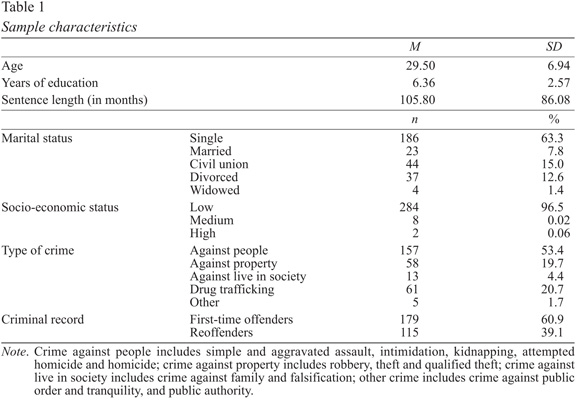
<body><![CDATA[<p>&nbsp;</p>     <p><b>Method </b></p>     <p>&nbsp;</p>     <p><i>Participants </i></p>     <p>Participants in this study were male prison inmates from 11 Portuguese prisons, with a minimum age of 18 years old and, at least, with  elementary education. Participants were recruited within a wider research project with the purpose of testing the efficacy of a  cognitive-behavioral program (GPS &ndash; Growing Pro-Social; Rijo et al., 2007) for adult offenders. Due to the nature of this program, the  selection of participants obeyed a set of exclusion criteria: (1) presence of cognitive impairment (given that the GPS program is not suitable for  the cognitively-impaired) or psychotic disorders (experiential strategies used in GPS are contraindicated for psychotic patients); (2) active  substance use (cessation or at least substantial reduction of drug or alcohol use must precede the GPS treatment); and (3) being sentenced  exclusively for sexual offenses (sex offenders would benefit from more specific intervention programs). </p>     <p>Female prison inmates were also excluded from the sample because women represent less than 6% of the total prisoners, and any possible  idiosyncrasies from this cohort would be underrepresented. In order to allow a period of adjustment to the prison environment and to avoid any  evaluation bias from incarceration stress, all participants were assessed with a minimum interval of one month after prison intake. </p>     <p>A sample of 330 male prison inmates (30 for each prison) who did not meet the exclusion criteria was randomly selected. Following this  selection, 36 (11%) inmates declined to participate. A total of 294 (89%) inmates were then assessed with a structured clinical interview for  Personality Disorders (for a description of the interview, see the Measure section). </p>     <p><a href="#t1">Table 1</a> presents the main demographic and legal features of the sample. Participants were between 18 and 55 years old, mostly  single, with a low socioeconomic status, and with elementary education. The length of the sentence ranged between 7 and 867 months, with an average  of 105.80 months (approximately 9 years), and most participants were first-time offenders. Crimes were predominantly against people, followed by  drug-related offences and crimes against property. </p>     <p>&nbsp;</p>     <p><a name="t1"></a></p>     ]]></body>
<body><![CDATA[<p><img src="/img/revistas/aps/v33n3/33n3a03t1.jpg" width="577" height="400"></p>     
<p>&nbsp;</p>     <p>&nbsp;</p>     <p><i>Measure </i></p>     <p>Participants were interviewed with the SCID-II &ndash; Structured Clinical Interview for DSM-IV Axis II Personality Disorders (First, Gibbon,  Spitzer, Williams, &amp; Benjamim, 1997; Portuguese version by Pinto-Gouveia, Matos, Rijo, Castilho, &amp; Salvador, unpublished), a widely known  semi-structured diagnostic interview which assesses 10 Axis II Personality Disorders from the DSMIV (APA, 2000), and the Depressive and  Passive-Aggressive Personality Disorders (included in DSM-IV&rsquo;s appendix). It can be used to diagnose Axis II Disorders categorically (present  or absent) and dimensionally (according to the number of criteria met for each diagnosis) and is considered the &ldquo;gold standard&rdquo; for  Personality Disorders diagnosis. The SCID-II also provides a summary with a pathology profile of scores over the assessed Personality Disorders,  allowing the interviewer to decide which disorder should be the major focus of clinical attention (main diagnosis). </p>     <p>&nbsp;</p>     <p><i>Procedures </i></p>     <p>This study was approved by the Head of of the General Directorship of Social Reinsertion and Prison Services of the Portuguese Ministry of  Justice. Data was collected between 2012 and 2014, and was carried out by three clinical psychologists of the national prison system who had  special training in the diagnosis of Personality Disorders, and by the authors of this paper who had previous experience administering the SCID-II  interview. The goals of the research were explained and inmates were invited to participate voluntarily. All participants signed an Informed  Consent Form prior to the administration of the interview. All participants responded fully to the SCID-II interview. Personality Disorders  prevalence rates were then analyzed categorically (i.e., participants met all criteria for a given personality disorder) and prevalence rates were  calculated with a 95% Confidence Interval using PASW (Predictive Analytics Software), version 20 (SPSS, Chicago, IL, USA). </p>     <p>&nbsp;</p>     <p><b>Results </b></p>     ]]></body>
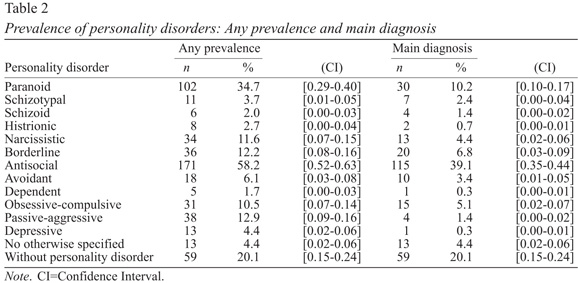
<body><![CDATA[<p>Results showed a very high prevalence of Personality Disorders, with 79.9% of the participants fulfilling criteria for, at least, one  Personality Disorder. Only 20.1% of the participants did not meet enough criteria for any Personality Disorder. The prevalence rates and the  frequency used to classify each Personality Disorder as the main diagnosis are reported in <a href="#t2">Table 2</a>. The most frequently diagnosed  Personality Disorders as the main diagnosis were Antisocial and Paranoid Personality Disorders, with prevalence rates of 39.1% and 10.2%,  respectively. Although not accounted as the main diagnosis, Passive-Aggressive, Borderline, Narcissistic and Obsessive-Compulsive Personality  Disorders were also prevalent. </p>     <p>&nbsp;</p>     <p><a name="t2"></a></p>     <p><img src="/img/revistas/aps/v33n3/33n3a03t2.jpg" width="578" height="283"></p>     
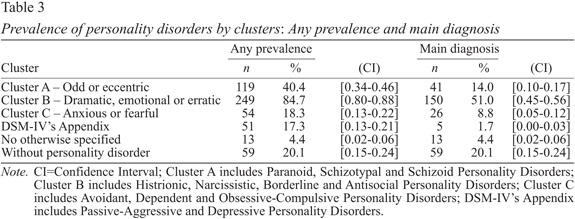
<p>&nbsp;</p>     <p>As presented in <a href="#t3">Table 3</a>, current prevalence rates showed that Cluster B Personality Disorders were the most prevalent  (with Antisocial and Borderline Personality Disorders as the more frequent diagnosis), followed by Cluster A Disorders (mainly due to the high  rates of Paranoid Personality Disorder). </p>     <p>&nbsp;</p>     <p><a name="t3"></a></p>     <p><img src="/img/revistas/aps/v33n3/33n3a03t3.jpg" width="575" height="219"></p>     
<p>&nbsp;</p>     ]]></body>
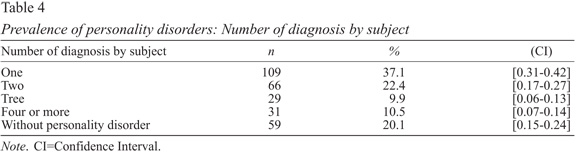
<body><![CDATA[<p>The number of Personality Disorders diagnosed was explored to account for comorbidity rates (see <a href="#t4">Table 4</a>). Multiple diagnoses  were frequent, with 42.8% of participants meeting enough criteria for two or more Personality Disorder diagnosis simultaneously. </p>     <p>&nbsp;</p>     <p><a name="t4"></a></p>     <p><img src="/img/revistas/aps/v33n3/33n3a03t4.jpg" width="576" height="153"></p>     
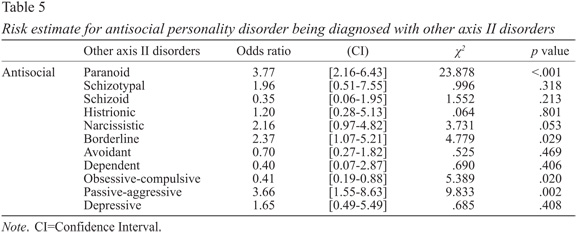
<p>&nbsp;</p>     <p>Additionally, first-time offenders were compared with re-offenders for the main diagnosis and number of diagnoses. Concerning the main diagnosis, no significant differences were found between sub-groups (<i>&chi;</i><Sup><i>2</i></Sup>=11.352; <i>p</i>=.571): the most frequently main diagnosis was Antisocial Personality Disorder in both sub-groups (35.6% in first-time offenders and 45.5% in reoffenders). In both sub-groups comorbidity rates was high (39.0% of first-time offenders met criteria for two or more Personality Disorders and 45.5% of reoffenders met criteria for more than one Personality Disorder) and no significant differences were observed (<i>&chi;</i><Sup><i>2</i></Sup>=9.162; <i>p</i>=.240). </p>     <p>Because a high prevalence of Antisocial Personality Disorder was observed, chi-square tests with odds ratio was computed to assess the risk of  antisocial individuals being diagnosed with other Axis II Disorders (see <a href="#t5">Table 5</a>). There was a significant high risk of  co-occurrence of Antisocial and Paranoid, Borderline, and Passive-Aggressive Personality Disorders. Antisocial and Narcissistic Personality  Disorder odds ratio was high, but did not reach statistical significance. Obsessive-Compulsive Personality Disorder presented a significant low  risk of co-occurrence with Antisocial Personality Disorder. </p>     <p>&nbsp;</p>     <p><a name="t5"></a></p>     <p><img src="/img/revistas/aps/v33n3/33n3a03t5.jpg" width="578" height="234"></p>     
]]></body>
<body><![CDATA[<p>&nbsp;</p>     <p>&nbsp;</p>     <p><b>Discussion </b></p>     <p>Despite the international data available on the high prevalence of Personality Disorders in offenders, no systematic evaluation or screening of  Personality Disorders was carried out in Portuguese prisons. This study&rsquo;s main goal was, therefore, to assess the prevalence rates of  Personality Disorders in a sample of male prison inmates, in order to identify the mental health intervention needs of this population. </p>     <p>Results showed that 80% of male prison inmates had a full-blown Personality Disorder, and more than half of the participants met the criteria  for Antisocial Personality Disorder. Approximately half of the participants presented comorbid Personality Disorders, with 10% of the sample  meeting sufficient criteria to be diagnosed with four or more Personality Disorders. Results also showed that the majority of participants met  criteria for Antisocial and Paranoid Personality Disorder as the main diagnosis, similarly to what has been observed in studies from different  countries (de Ruiter &amp; Trestman, 2006; Fazel &amp; Danesh, 2002; Teplin, 1994). </p>     <p>Almost half of the crimes, by which participants from this sample were sentenced to prison, were crimes against people, which is in accordance  with studies showing an association of violence and aggressive behavior with Cluster A and B Disorders (Coid, 2002; Johnson et al., 2000; Roberts  &amp; Coid, 2010; Warren et al., 2002; Warren &amp; South, 2009). Borderline, Passive-Aggressive, Narcissistic, and Obsessive-Compulsive  Personality Disorders were the most frequently diagnosed disorders, after Antisocial and Paranoid Personality Disorders, which is also in line with  previous findings (Black et al., 2007; Coid et al., 1999). This further emphasizes that most inmates present highly complex treatment needs and  should receive mental health care from specially trained staff (Steadman, Osher, Clark-Robbins, Case, &amp; Samuels, 2009). </p>     <p>When studying the association between Antisocial Personality Disorder and other Axis II Disorders, antisocial inmates were over three times more  likely to have a Paranoid and/or Passive-Aggressive Personality Disorder. The odds of having a Borderline Personality Disorder were twice as high  in antisocial inmates. Although under the significance threshold, Narcissistic Personality Disorder is also often diagnosed in antisocial inmates.  According to DSM-5 (APA, 2013), these disorders share features relating to dysfunctional interpersonal patterns characterized by lack of empathy  and connection with others, intolerance to criticism, anger and counterattacking, low impulse control and emotional instability, which makes this  set of personality traits very common in most inmates. </p>     <p>Participants suffering from Obsessive-Compulsive Personality Disorder were those less likely to be diagnosed with Antisocial Personality  Disorder. Taking into account that the main feature of Antisocial Personality Disorder is a pattern of violation and disregard for the rights of  others, and Obsessive-Compulsive Personality Disorder relates to hyperconsciousness, excessive scrupulousness, mental and interpersonal control,  and high moral or ethical standards (APA, 2013), a higher comorbidity between these two Personality Disorders would be unlikely and, thus,  unexpected. </p>     <p>This is the first study on the prevalence of Personality Disorders in Portuguese male prison inmates, using a structured clinical interview for  Personality Disorders. The use of structured interviews over self-report measures presented several advantages, such as allowing the assessment of  maladaptive patterns that may not be recognized or endorsed in self-report measures due to their egosyntonic nature. Furthermore, interviews allow  Personality Disorders to be assessed both categorically (disorders are either present or absent) and dimensionally (number of criteria that an  individual meets for a given disorder). Structured interview formats can also make the assessment procedures more standardized, guiding the  evaluation of the criteria needed to assign a particular diagnosis and preventing interpersonal biases from different interviewers or from  professionals with different theoretical backgrounds. </p>     <p>While a considerable amount of studies focused on samples of convenience or on individuals already referred as having mental health problems  (Penner, Roesch, &amp; Viljoen, 2011), the sample of the current study was randomly selected. However, one major limitation of this study was  closely related to the sample exclusion criteria. Since subjects were attending a cognitive-behavioral program, which is contraindicated for  individuals with active substance abuse or sentenced exclusively for sexual offences, inmates presenting these features were not assessed for  Personality Disorders. Nonetheless, the co-occurrence of substance abuse/dependence and personality pathology is common and important (Grella,  Grenwell, Prendergast, Sacks, &amp; Melnick, 2008; Zlotnick et al., 2008), and the rates of Personality Disorders in sex offenders is high (e.g.,  Schroeder, Iffland, Hill, Berner, &amp; Briken, 2013). Female offenders were also excluded from this study (due to the low number of female  offenders in Portuguese prisons). Thus, further research should assess the prevalence of Personality Disorders in these three sub-groups: inmates  with substance abuse/dependence, sexual offenders and female inmates. The relationship between Axis I and Axis II diagnosis in prison inmates, as  well as the link between Personality Disorders, violent behavior, adjustment/disciplinary infractions and recidivism should also be tested. </p>     ]]></body>
<body><![CDATA[<p>The effect of incarceration in previously existing personality disorder traits should be explored as well, assessing whether the prison  environment maintains or exacerbates traits or pre-existing disorders. As a controlling environment aimed primarily at security, in which  adaptation to prison culture may overlap and reinforce symptom-like patterns, prison environment could possibly act as a confounding variable, and  may increase the frequency of symptoms relating to suspiciousness, social withdrawal and/or interpersonal hostility (Rotter, Way, Steinbacher,  Sawyer, &amp; Smith, 2002). </p>     <p>Considering the high prevalence rates of Personality Disorders associated with more serious and violent offences, penitentiary services should  provide systematic and effective screening procedures for proper assessment of Personality Disorders at prison intake (Birmingham et al., 1996;  Black et al., 2007; Roberts &amp; Coid, 2010; Watzke, Ulrich, Marneros, 2006; Woolf, 2006). The high prevalence of Personality Disorders and  comorbidity rates in incarcerated men represents a highly significant level of clinical and functional impairment, which may cause disruption  within and beyond prison settings, having a significant impact on all the domains of the individual&rsquo;s life (Black et al., 2007; Gilbert &amp;  Daffern, 2011). High levels of emotional and behavioral dysregulation presented by most personality-disordered inmates may compromise adhesion to  penitentiary treatment. It is then justifiable that treatment of Personality Disorders should be addressed in forensic case management procedures  as a focus of intervention. </p>     <p>Forensic mental health professionals should be prepared and available to respond to the complex needs presented by most subjects in contact with  the justice system (Brooke, Taylor, Gunn, &amp; Madden, 1996; Fazel &amp; Danesh, 2002). The developments in effective therapies for Personality  Disorders (Bernstein, Arntz, &amp; Vos, 2007; Farrell, Shaw, &amp; Webber, 2009; Nadort et al., 2009; van Asselt et al., 2008) suggest that  psychotherapeutic interventions reducing factors underlying antisocial behavior should be a key area of investment when dealing with  personality-disordered inmates (Gilbert &amp; Daffern, 2011; Kjelsberg et al., 2006). Similarly to what is done in the case of substance  dependence/abuse, differential treatment for subjects with severe personality pathology should be provided to ensure adequate treatment and  rehabilitation. All of these implications are relevant for first-time offenders and reoffenders, due to the high prevalence of Personality  Disorders observed in both sub-groups. </p>     <p>Overall, our findings pointed out the need to take into account specific mental health intervention needs in adult offenders when deciding and  planning the forensic intervention. It also stressed the importance of proper screening procedures of Personality Disorders at prison intake, as  well as the need for psychotherapeutic interventions specifically focused in the reduction of dysfunctional personality traits, which may  contribute to a better interpersonal adjustment during inmates&rsquo; imprisonment and after release. </p>     <p>&nbsp;</p>     <p><b>References </b></p>     <!-- ref --><p>American Psychiatric Association (APA). (2000). <i>Diagnostic and statistical manual of mental disorders (DSM-IV)</i>. Washington, DC: American  Psychiatric Association.    &nbsp;&nbsp;&nbsp;&nbsp;&nbsp;&nbsp;&nbsp;&nbsp;[&#160;<a href="javascript:void(0);" onclick="javascript: window.open('/scielo.php?script=sci_nlinks&ref=000079&pid=S0870-8231201500030000300001&lng=','','width=640,height=500,resizable=yes,scrollbars=1,menubar=yes,');">Links</a>&#160;]<!-- end-ref --> </p>     <!-- ref --><p>American Psychiatric Association (APA). (2013). <i>Diagnostic and statistical manual of mental disorders (DSM-5)</i>. Washington, DC: American  Psychiatric Association.    &nbsp;&nbsp;&nbsp;&nbsp;&nbsp;&nbsp;&nbsp;&nbsp;[&#160;<a href="javascript:void(0);" onclick="javascript: window.open('/scielo.php?script=sci_nlinks&ref=000081&pid=S0870-8231201500030000300002&lng=','','width=640,height=500,resizable=yes,scrollbars=1,menubar=yes,');">Links</a>&#160;]<!-- end-ref --> </p>     ]]></body>
<body><![CDATA[<!-- ref --><p>Bernstein, D., Arntz, A., &amp; Vos, M. (2007). Schema focused therapy in forensic settings: Theoretical model and recommendations for best  clinical practice. <i>International Journal of Forensic Mental Health, 6</i>, 169-183. doi: 10.1080/14999013.2007.10471261 &nbsp;&nbsp;&nbsp;&nbsp;&nbsp;&nbsp;&nbsp;&nbsp;[&#160;<a href="javascript:void(0);" onclick="javascript: window.open('/scielo.php?script=sci_nlinks&ref=000083&pid=S0870-8231201500030000300003&lng=','','width=640,height=500,resizable=yes,scrollbars=1,menubar=yes,');">Links</a>&#160;]<!-- end-ref --><!-- ref --><p>Birmingham, L., Mason, D., &amp; Grubin, D. (1996). Prevalence of mental disorder in remand prisoners: Consecutive case study. <i>British  Medical Journal, 313</i>, 1521-1524. doi: 10.1136/bmj.313.7071.1521 &nbsp;&nbsp;&nbsp;&nbsp;&nbsp;&nbsp;&nbsp;&nbsp;[&#160;<a href="javascript:void(0);" onclick="javascript: window.open('/scielo.php?script=sci_nlinks&ref=000084&pid=S0870-8231201500030000300004&lng=','','width=640,height=500,resizable=yes,scrollbars=1,menubar=yes,');">Links</a>&#160;]<!-- end-ref --><!-- ref --><p>Black, D. W., Gunter, T., Allen, J., Blum, N., Arndt, S., Wenman, G., &amp; Sieleni, B. (2007). Borderline personality disorder in male and  female offenders newly committed to prison. <i>Comprehensive Psychiatry, 48</i>, 400-405. doi: 10.1016/j.comppsych.2007.04.0 06 &nbsp;&nbsp;&nbsp;&nbsp;&nbsp;&nbsp;&nbsp;&nbsp;[&#160;<a href="javascript:void(0);" onclick="javascript: window.open('/scielo.php?script=sci_nlinks&ref=000085&pid=S0870-8231201500030000300005&lng=','','width=640,height=500,resizable=yes,scrollbars=1,menubar=yes,');">Links</a>&#160;]<!-- end-ref --><!-- ref --><p>Brooke, D., Taylor, C., Gunn, J., &amp; Maden, A. (1996). Point prevalence of mental disorder in unconvicted male prisoners in England and  Wales. <i>British Medical Journal, 313</i>, 1524-1527. Retrieved from  <a href="http://europepmc.org/backend/ptpmcrender.fcgi?accid=PMC2353052&amp;blobtype=pdf"  target="_blank">http://europepmc.org/backend/ptpmcrender.fcgi?accid=PMC2353052&amp;blobtype=pdf</a>&nbsp;&nbsp;&nbsp;&nbsp;&nbsp;&nbsp;&nbsp;&nbsp;[&#160;<a href="javascript:void(0);" onclick="javascript: window.open('/scielo.php?script=sci_nlinks&ref=000086&pid=S0870-8231201500030000300006&lng=','','width=640,height=500,resizable=yes,scrollbars=1,menubar=yes,');">Links</a>&#160;]<!-- end-ref --><!-- ref --><p>Coid, J. W. (2002). Personality disorders in prisoners and their motivation for dangerous and disruptive behaviour. <i>Criminal Behavior and  Mental Health, 12</i>, 209-226. Retrieved from  <a href="http://onlinelibrary.wiley.com/doi/10.1002/cbm.497/pdf" target="_blank">http://onlinelibrary.wiley.com/doi/10.1002/cbm.497/pdf</a>&nbsp;&nbsp;&nbsp;&nbsp;&nbsp;&nbsp;&nbsp;&nbsp;[&#160;<a href="javascript:void(0);" onclick="javascript: window.open('/scielo.php?script=sci_nlinks&ref=000087&pid=S0870-8231201500030000300007&lng=','','width=640,height=500,resizable=yes,scrollbars=1,menubar=yes,');">Links</a>&#160;]<!-- end-ref --><!-- ref --><p>Coid, J., Kahtan, N., Gault, S., &amp; Jarman, S. (1999). Patients with personality disorder admitted to secure forensic psychiatry services.  <i>British Journal of Psychiatry, 175</i>, 528-36. doi: 10.1192/bjp.175.6.528 &nbsp;&nbsp;&nbsp;&nbsp;&nbsp;&nbsp;&nbsp;&nbsp;[&#160;<a href="javascript:void(0);" onclick="javascript: window.open('/scielo.php?script=sci_nlinks&ref=000088&pid=S0870-8231201500030000300008&lng=','','width=640,height=500,resizable=yes,scrollbars=1,menubar=yes,');">Links</a>&#160;]<!-- end-ref --><!-- ref --><p>de Ruiter, C. D., &amp; Trestman, R. L. (2006). Prevalence and treatment of personality disorders in Dutch forensic mental health services.  <i>Journal of the American Academy of Psychiatry and the Law, 35</i>, 92-97. Retrieved from  <a href="http://www.jaapl.org/content/35/1/92.full.pdf+html" target="_blank">http://www.jaapl.org/content/35/1/92.full.pdf+html</a>&nbsp;&nbsp;&nbsp;&nbsp;&nbsp;&nbsp;&nbsp;&nbsp;[&#160;<a href="javascript:void(0);" onclick="javascript: window.open('/scielo.php?script=sci_nlinks&ref=000089&pid=S0870-8231201500030000300009&lng=','','width=640,height=500,resizable=yes,scrollbars=1,menubar=yes,');">Links</a>&#160;]<!-- end-ref --><p>Duggan, C., &amp; Howard, R. (2009). The &lsquo;functional link&rsquo; between personality disorder and violence: A critical appraisal. In M.  McMurran &amp; R. Howard (Eds.), <i>Personality, personality disorder, and violence: An evidence based approach </i>(pp. 19-37). New York:  Wiley-Blackweel. </p>     <!-- ref --><p>Farrell, J. M., Shaw, I. A., &amp; Webber, M. A. (2009). A schema-focused approach to group psychotherapy for outpatients with borderline  personality disorder: A randomized clinical trial. <i>Journal of Behavior Therapy and Experimental Psychiatry, 40</i>, 317-328.  doi: 10.1016/j.jbtep.2009.01.002 &nbsp;&nbsp;&nbsp;&nbsp;&nbsp;&nbsp;&nbsp;&nbsp;[&#160;<a href="javascript:void(0);" onclick="javascript: window.open('/scielo.php?script=sci_nlinks&ref=000091&pid=S0870-8231201500030000300011&lng=','','width=640,height=500,resizable=yes,scrollbars=1,menubar=yes,');">Links</a>&#160;]<!-- end-ref --><!-- ref --><p>Fazel, S., &amp; Danesh, J. (2002). Serious mental disorder in 23000 prisoners: A systematic review of 62 surveys. <i>Lancet, 359</i>, 545-550.  doi: 10.1016/S0140-6736(02)07740-1 &nbsp;&nbsp;&nbsp;&nbsp;&nbsp;&nbsp;&nbsp;&nbsp;[&#160;<a href="javascript:void(0);" onclick="javascript: window.open('/scielo.php?script=sci_nlinks&ref=000092&pid=S0870-8231201500030000300012&lng=','','width=640,height=500,resizable=yes,scrollbars=1,menubar=yes,');">Links</a>&#160;]<!-- end-ref --><p>First, M. B., Gibbon, M., Spitzer, R. L., Williams, J. B. W., &amp; Benjamin, L. S. (1997). <i>Structured Clinical Interview for DSM-IV Axis II  Personality Disorders (SCID-II)</i>. Washington, DC: American Psychiatric Press, Inc. [Portuguese version by J. Pinto Gouveia, A. P. Matos,  D. Rijo, P. Castilho, &amp; M. C. Salvador, 1999]. </p>     <!-- ref --><p>Gandhi, N., Tyrer, P., Evans, K., McGee, A., Lamont, A., &amp; Harrison-Read, P. (2001). A randomized controlled trial of community-oriented and  hospital-oriented care of discharged psychiatric patients. Influence of personality disorder on police contacts. <i>Journal of Personality  Disorders, 15</i>, 94-102. doi: 10.1521/pedi.15.1.94.18644 &nbsp;&nbsp;&nbsp;&nbsp;&nbsp;&nbsp;&nbsp;&nbsp;[&#160;<a href="javascript:void(0);" onclick="javascript: window.open('/scielo.php?script=sci_nlinks&ref=000094&pid=S0870-8231201500030000300014&lng=','','width=640,height=500,resizable=yes,scrollbars=1,menubar=yes,');">Links</a>&#160;]<!-- end-ref --><!-- ref --><p>Gilbert, F., &amp; Daffern, M. (2011). Illuminating the relationship between personality disorder and violence: Contributions of the General  Aggression Model. <i>Psychology of Violence, 1</i>, 230-244. doi: 10.1037/a0024089 &nbsp;&nbsp;&nbsp;&nbsp;&nbsp;&nbsp;&nbsp;&nbsp;[&#160;<a href="javascript:void(0);" onclick="javascript: window.open('/scielo.php?script=sci_nlinks&ref=000095&pid=S0870-8231201500030000300015&lng=','','width=640,height=500,resizable=yes,scrollbars=1,menubar=yes,');">Links</a>&#160;]<!-- end-ref --><!-- ref --><p>Grella, C. E., Greenwell, L., Prendergast, M., Sacks, S., &amp; Melnick, G. (2008). Diagnostic profiles of offenders in substance abuse  treatment programs. <i>Behavioral Sciences &amp; the Law, 26</i>, 369-388. doi: 10.1002/bsl.825 &nbsp;&nbsp;&nbsp;&nbsp;&nbsp;&nbsp;&nbsp;&nbsp;[&#160;<a href="javascript:void(0);" onclick="javascript: window.open('/scielo.php?script=sci_nlinks&ref=000096&pid=S0870-8231201500030000300016&lng=','','width=640,height=500,resizable=yes,scrollbars=1,menubar=yes,');">Links</a>&#160;]<!-- end-ref --><!-- ref --><p>Hiscoke, U. L., L&aring;ngstr&ouml;m, N., Ottosson, H., &amp; Grann, M. (2003). Self-reported personality traits and disorders (DSM-IV) and risk  of criminal recidivism: A prospective study. <i>Journal of Personality Disorders, 17</i>, 293-305. doi: 10.1521/pedi.17.4.293.23966 &nbsp;&nbsp;&nbsp;&nbsp;&nbsp;&nbsp;&nbsp;&nbsp;[&#160;<a href="javascript:void(0);" onclick="javascript: window.open('/scielo.php?script=sci_nlinks&ref=000097&pid=S0870-8231201500030000300017&lng=','','width=640,height=500,resizable=yes,scrollbars=1,menubar=yes,');">Links</a>&#160;]<!-- end-ref --><!-- ref --><p>Johnson, J., Cohen, P., Smailes, E., Kasen, S., Oldham, J., Skodol, A., &amp; Brook, J. (2000). Adolescent personality disorders associated with  violence and criminal behaviour during adolescence and early adulthood. <i>American Journal of Psychiatry, 157</i>, 1406-1412.  doi: 10.1176/appi.ajp.157.9.1406 &nbsp;&nbsp;&nbsp;&nbsp;&nbsp;&nbsp;&nbsp;&nbsp;[&#160;<a href="javascript:void(0);" onclick="javascript: window.open('/scielo.php?script=sci_nlinks&ref=000098&pid=S0870-8231201500030000300018&lng=','','width=640,height=500,resizable=yes,scrollbars=1,menubar=yes,');">Links</a>&#160;]<!-- end-ref --><!-- ref --><p>Kjelsberg, E., Harting, P., Bowitz, H., Kuisma, I., Norbech, P., Rustad, A., . . . Vik, T. (2006). Mental health consultations in a prison  population: A descriptive study. <i>BMC Psychiatry, 6</i>, 1-9. doi: 10.1186/1471-244X-6-27 &nbsp;&nbsp;&nbsp;&nbsp;&nbsp;&nbsp;&nbsp;&nbsp;[&#160;<a href="javascript:void(0);" onclick="javascript: window.open('/scielo.php?script=sci_nlinks&ref=000099&pid=S0870-8231201500030000300019&lng=','','width=640,height=500,resizable=yes,scrollbars=1,menubar=yes,');">Links</a>&#160;]<!-- end-ref --><!-- ref --><p>Kropp, P. R., Hart, S. D., Webster, C. D., &amp; Eaves, D. (1995). <i>Manual for the spousal assault risk assessment guide</i>. Vancouver, BC,  Canada: The British Columbia Institute on Family Violence.    &nbsp;&nbsp;&nbsp;&nbsp;&nbsp;&nbsp;&nbsp;&nbsp;[&#160;<a href="javascript:void(0);" onclick="javascript: window.open('/scielo.php?script=sci_nlinks&ref=000100&pid=S0870-8231201500030000300020&lng=','','width=640,height=500,resizable=yes,scrollbars=1,menubar=yes,');">Links</a>&#160;]<!-- end-ref --> </p>     <!-- ref --><p>Nadort, M., Arntz, A., Smit, J. H., Giesen-Bloo, J., Eikelenboom, M., Spinhoven, P., . . . van Dyck, R. (2009). Implementation of outpatient  schema therapy for borderline personality disorder with <i>versus </i>without crisis support by the therapist outside office hours: A randomized  trial. <i>Behavior Research and Therapy, 47</i>, 961-973. doi: 10.1016/j.brat.2009.07.013 &nbsp;&nbsp;&nbsp;&nbsp;&nbsp;&nbsp;&nbsp;&nbsp;[&#160;<a href="javascript:void(0);" onclick="javascript: window.open('/scielo.php?script=sci_nlinks&ref=000102&pid=S0870-8231201500030000300021&lng=','','width=640,height=500,resizable=yes,scrollbars=1,menubar=yes,');">Links</a>&#160;]<!-- end-ref --><!-- ref --><p>Penner, E., Roesch, R., &amp; Viljoen, J. (2011). Young offenders in custody: An international comparison of mental health services.  <i>International Journal of Forensic Mental Health, 10</i>, 215-232. doi: 10.1080/14999013.2011.598427 &nbsp;&nbsp;&nbsp;&nbsp;&nbsp;&nbsp;&nbsp;&nbsp;[&#160;<a href="javascript:void(0);" onclick="javascript: window.open('/scielo.php?script=sci_nlinks&ref=000103&pid=S0870-8231201500030000300022&lng=','','width=640,height=500,resizable=yes,scrollbars=1,menubar=yes,');">Links</a>&#160;]<!-- end-ref --><!-- ref --><p>Rijo, D., Sousa, M. N., Lopes, J., Pereira, J., Vasconcelos, J., Mendon&ccedil;a, M. C., . . . Massa, S. (2007). <i>Gerar Percursos Sociais:  Programa de preven&ccedil;&atilde;o e reabilita&ccedil;&atilde;o para jovens com comportamento social desviante </i>[Growing Pro-Social: Prevention  and rehabilitation program for youths with deviant social behavior]. Ponta Delgada: EQUAL.    &nbsp;&nbsp;&nbsp;&nbsp;&nbsp;&nbsp;&nbsp;&nbsp;[&#160;<a href="javascript:void(0);" onclick="javascript: window.open('/scielo.php?script=sci_nlinks&ref=000104&pid=S0870-8231201500030000300023&lng=','','width=640,height=500,resizable=yes,scrollbars=1,menubar=yes,');">Links</a>&#160;]<!-- end-ref --> </p>     <!-- ref --><p>Roberts, A., &amp; Coid, J. (2010). Personality disorder and offending behaviour: Findings from the national survey of male prisoners in England  and Wales. <i>Journal of Forensic Psychiatry &amp; Psychology, 21</i>, 221-237. doi: 10.1080/14789940903303811 &nbsp;&nbsp;&nbsp;&nbsp;&nbsp;&nbsp;&nbsp;&nbsp;[&#160;<a href="javascript:void(0);" onclick="javascript: window.open('/scielo.php?script=sci_nlinks&ref=000106&pid=S0870-8231201500030000300024&lng=','','width=640,height=500,resizable=yes,scrollbars=1,menubar=yes,');">Links</a>&#160;]<!-- end-ref --><p>Rotter, M., Way, B., Steinbacher, M., Sawyer, D., &amp; Smith, H. (2002). Personality disorders in prison: Aren&rsquo;t they all antisocial?.  <i>Psychiatric Quarterly, 73</i>, 337-349. Retrieved from  <a href="http://link.springer.com/article/10.1023%2FA%3A1020468117930" target="_blank">http://link.springer.com/article/10.1023%2FA%3A1020468117930</a></p>     <!-- ref --><p>Sansone, R. A., &amp; Sansone, L. A. (2009). Borderline personality and criminality. <i>Psychiatry, 6</i>, 16-20. Retrieved from  <a href="http://www.ncbi.nlm.nih.gov/pmc/articles/PMC2790397/" target="_blank">http://www.ncbi.nlm.nih.gov/pmc/articles/PMC2790397/</a>&nbsp;&nbsp;&nbsp;&nbsp;&nbsp;&nbsp;&nbsp;&nbsp;[&#160;<a href="javascript:void(0);" onclick="javascript: window.open('/scielo.php?script=sci_nlinks&ref=000108&pid=S0870-8231201500030000300026&lng=','','width=640,height=500,resizable=yes,scrollbars=1,menubar=yes,');">Links</a>&#160;]<!-- end-ref --><!-- ref --><p>Schroeder, M., Iffland, J. S., Hill, A., Berner, W., &amp; Briken, P. (2013). Personality disorders in men with sexual and violent criminal  offenses histories. <i>Journal of Personality Disorders, 27</i>, 519-530. doi: 10.1521/pedi_2012_26_050 &nbsp;&nbsp;&nbsp;&nbsp;&nbsp;&nbsp;&nbsp;&nbsp;[&#160;<a href="javascript:void(0);" onclick="javascript: window.open('/scielo.php?script=sci_nlinks&ref=000109&pid=S0870-8231201500030000300027&lng=','','width=640,height=500,resizable=yes,scrollbars=1,menubar=yes,');">Links</a>&#160;]<!-- end-ref --><!-- ref --><p>Short, V., Lennox, C., Stevenson, C., Senior, J., &amp; Shaw, J. (2012). <i>Mental illness, personality disorder and violence: A scoping  review</i>. Manchester: Offender Health Research Network.    &nbsp;&nbsp;&nbsp;&nbsp;&nbsp;&nbsp;&nbsp;&nbsp;[&#160;<a href="javascript:void(0);" onclick="javascript: window.open('/scielo.php?script=sci_nlinks&ref=000110&pid=S0870-8231201500030000300028&lng=','','width=640,height=500,resizable=yes,scrollbars=1,menubar=yes,');">Links</a>&#160;]<!-- end-ref --> </p>     <!-- ref --><p>Steadman, A. J., Osher, F. C., Clark-Robbins, P., Case, B., &amp; Samuels, S. (2009). Prevalence of serious mental illness among jail inmates.  <i>Psychiatric Services, 60</i>, 761-765. doi: 10.1176/ps.2009.60.6.761 &nbsp;&nbsp;&nbsp;&nbsp;&nbsp;&nbsp;&nbsp;&nbsp;[&#160;<a href="javascript:void(0);" onclick="javascript: window.open('/scielo.php?script=sci_nlinks&ref=000112&pid=S0870-8231201500030000300029&lng=','','width=640,height=500,resizable=yes,scrollbars=1,menubar=yes,');">Links</a>&#160;]<!-- end-ref --><!-- ref --><p>Tardiff, K. (2001). Axis II disorders and dangerousness. In G. F. Pinard &amp; L. Paganini (Eds.), <i>Clinical assessment of dangerousness:  Emprical contributions </i>(pp. 103-120). New York: Cambridge University Press.    &nbsp;&nbsp;&nbsp;&nbsp;&nbsp;&nbsp;&nbsp;&nbsp;[&#160;<a href="javascript:void(0);" onclick="javascript: window.open('/scielo.php?script=sci_nlinks&ref=000113&pid=S0870-8231201500030000300030&lng=','','width=640,height=500,resizable=yes,scrollbars=1,menubar=yes,');">Links</a>&#160;]<!-- end-ref --> </p>     <!-- ref --><p>Teplin, L. (1994). Psychiatric and substance abuse disorders among male urban jail detainees. <i>American Journal of Public Health, 84</i>,  290-293. doi: 10.2105/AJPH.84.2.290 &nbsp;&nbsp;&nbsp;&nbsp;&nbsp;&nbsp;&nbsp;&nbsp;[&#160;<a href="javascript:void(0);" onclick="javascript: window.open('/scielo.php?script=sci_nlinks&ref=000115&pid=S0870-8231201500030000300031&lng=','','width=640,height=500,resizable=yes,scrollbars=1,menubar=yes,');">Links</a>&#160;]<!-- end-ref --><!-- ref --><p>Thornton, A. J. V., Graham-Kevan, N., &amp; Archer, J. (2010). Adaptive and maladaptive personality traits as predictors of violent and  nonviolent offending behavior in men and women. <i>Aggressive Behavior, 36</i>, 177-186. doi: 10.1002/ab.20340 &nbsp;&nbsp;&nbsp;&nbsp;&nbsp;&nbsp;&nbsp;&nbsp;[&#160;<a href="javascript:void(0);" onclick="javascript: window.open('/scielo.php?script=sci_nlinks&ref=000116&pid=S0870-8231201500030000300032&lng=','','width=640,height=500,resizable=yes,scrollbars=1,menubar=yes,');">Links</a>&#160;]<!-- end-ref --><!-- ref --><p>van Asselt, A. D., Dirksen, C. D., Arntz, A., Giesen-Bloo, J. H., van Dijk, R., Spinhoven, P., . . . Severens, J. L. (2008). Outpatient  psychotherapy for borderline personality disorder: Cost-effectiveness of schema-focused therapy <i>versus </i>transference-focused therapy.  <i>British Journal of Psychiatry, 192</i>, 450-457. doi: 10.1192/bjp.bp.106.033597 &nbsp;&nbsp;&nbsp;&nbsp;&nbsp;&nbsp;&nbsp;&nbsp;[&#160;<a href="javascript:void(0);" onclick="javascript: window.open('/scielo.php?script=sci_nlinks&ref=000117&pid=S0870-8231201500030000300033&lng=','','width=640,height=500,resizable=yes,scrollbars=1,menubar=yes,');">Links</a>&#160;]<!-- end-ref --><!-- ref --><p>Warren, J. I., Burnette, M., South, S. C., Chauhan, P., Bale, R., &amp; Friend, R. (2002). Personality disorders and violence among female  prison inmates. <i>The Journal of the American Academy of Psychiatry and the Law, 30</i>, 502-509. Retrieved from  <a href="http://www.jaapl.org/content/30/4/502.full.pdf" target="_blank">http://www.jaapl.org/content/30/4/502.full.pdf</a>&nbsp;&nbsp;&nbsp;&nbsp;&nbsp;&nbsp;&nbsp;&nbsp;[&#160;<a href="javascript:void(0);" onclick="javascript: window.open('/scielo.php?script=sci_nlinks&ref=000118&pid=S0870-8231201500030000300034&lng=','','width=640,height=500,resizable=yes,scrollbars=1,menubar=yes,');">Links</a>&#160;]<!-- end-ref --><!-- ref --><p>Warren, J. I., &amp; South, S. C. (2009). A symptom level examination of the relationship between cluster B personality disorders and patterns  of criminality and violence in women. <i>International Journal of Law and Psychiatry, 32</i>, 10-17. doi: 10.1016/j.ijlp.2008.11.005 &nbsp;&nbsp;&nbsp;&nbsp;&nbsp;&nbsp;&nbsp;&nbsp;[&#160;<a href="javascript:void(0);" onclick="javascript: window.open('/scielo.php?script=sci_nlinks&ref=000119&pid=S0870-8231201500030000300035&lng=','','width=640,height=500,resizable=yes,scrollbars=1,menubar=yes,');">Links</a>&#160;]<!-- end-ref --><!-- ref --><p>Watzke, S., Ulrich, S., &amp; Marneros, A. (2006). Gender- and violence-related prevalence of mental disorders in prisoners. <i>European  Archives of Psychiatry and Neurosciences, 256</i>, 414-421. doi: 10.1007/s00406-006-0656-4 &nbsp;&nbsp;&nbsp;&nbsp;&nbsp;&nbsp;&nbsp;&nbsp;[&#160;<a href="javascript:void(0);" onclick="javascript: window.open('/scielo.php?script=sci_nlinks&ref=000120&pid=S0870-8231201500030000300036&lng=','','width=640,height=500,resizable=yes,scrollbars=1,menubar=yes,');">Links</a>&#160;]<!-- end-ref --><!-- ref --><p>Webster, C. D., Douglas, K. S., Eaves, D., &amp; Hart, S. D. (1997). <i>HCR-20. Assessing risk for violence. Version 2</i>. Vancouver, BC,  Canada: Simon Fraser University, Mental Health, Law and Police Institute.    &nbsp;&nbsp;&nbsp;&nbsp;&nbsp;&nbsp;&nbsp;&nbsp;[&#160;<a href="javascript:void(0);" onclick="javascript: window.open('/scielo.php?script=sci_nlinks&ref=000121&pid=S0870-8231201500030000300037&lng=','','width=640,height=500,resizable=yes,scrollbars=1,menubar=yes,');">Links</a>&#160;]<!-- end-ref --> </p>     ]]></body>
<body><![CDATA[<!-- ref --><p>Wolf, N. (2006). Interven&ccedil;&atilde;o em sa&uacute;de mental para pessoas com comportamento anti-social: 10 pontos de interface. [Mental  health intervention for individuals with antisocial behavior: 10 point of interface] (D. Rijo, Trans.). In A. C. Fonseca, M. Sim&otilde;es,  M. C. T. Sim&otilde;es, &amp; M. S. Pinho (Eds.), <i>Psicologia Forense </i>(pp. 559-582). Coimbra: Nova Almedina.    &nbsp;&nbsp;&nbsp;&nbsp;&nbsp;&nbsp;&nbsp;&nbsp;[&#160;<a href="javascript:void(0);" onclick="javascript: window.open('/scielo.php?script=sci_nlinks&ref=000123&pid=S0870-8231201500030000300038&lng=','','width=640,height=500,resizable=yes,scrollbars=1,menubar=yes,');">Links</a>&#160;]<!-- end-ref --> </p>     <!-- ref --><p>Yu, R., Geddes, J. R., &amp; Fazel, S. (2012). Personality disorders, violence and antisocial behavior: A systematic review and meta-regression  analyses. <i>Journal of Personality Disorders</i>, <i>26, </i>775-792. doi: 10.1521/pedi.2012.26.5.775 &nbsp;&nbsp;&nbsp;&nbsp;&nbsp;&nbsp;&nbsp;&nbsp;[&#160;<a href="javascript:void(0);" onclick="javascript: window.open('/scielo.php?script=sci_nlinks&ref=000125&pid=S0870-8231201500030000300039&lng=','','width=640,height=500,resizable=yes,scrollbars=1,menubar=yes,');">Links</a>&#160;]<!-- end-ref --><!-- ref --><p>Zlotnick, C., Clarke, J. G., Friedmann, P. D., Roberts, M. B., Sacks, S., &amp; Melnick, G. (2008). Gender differences in comorbid disorders  among offenders in prison substance abuse treatment programs. <i>Behavioral Sciences &amp; The Law, 26</i>, 403-412. doi: 10.1002/bsl.831 &nbsp;&nbsp;&nbsp;&nbsp;&nbsp;&nbsp;&nbsp;&nbsp;[&#160;<a href="javascript:void(0);" onclick="javascript: window.open('/scielo.php?script=sci_nlinks&ref=000126&pid=S0870-8231201500030000300040&lng=','','width=640,height=500,resizable=yes,scrollbars=1,menubar=yes,');">Links</a>&#160;]<!-- end-ref --><p>&nbsp;</p>     <p><b><a name="c0" id="c0"></a><a href="#topc0">CORRESPONDÊNCIA</a></b></p>     <p>A correspond&ecirc;ncia relativa a este artigo dever&aacute; ser enviada para: N&eacute;lio Braz&atilde;o, CINEICC &ndash; Centro de  Investiga&ccedil;&atilde;o do N&uacute;cleo de Estudos e Interven&ccedil;&atilde;o Cognitivo-Comportamental, Faculdade de Psicologia e de  Ci&ecirc;ncias da Educa&ccedil;&atilde;o da Universidade de Coimbra, Rua do Col&eacute;gio Novo, 3000-115 Coimbra.  E-mail: <a href="mailto:nelio-brazao@hotmail.com">nelio-brazao@hotmail.com</a></p>     <p>&nbsp;</p>     <p>This paper is a part of the Project &ldquo;GPS &ndash; Growing Pro-Social, a prevention and rehabilitation program for individuals with  antisocial behavior: Efficacy studies in forensic samples&rdquo; (PTDC/PSI-PCL/102165/2008). This project is supported by the Foundation for  Science and Technology, and it is a partnership between the Research Unit of the Cognitive-Behavioral Research and Intervention Center and the  General Directorship of Social Reinsertion and Prison Services of the Portuguese Ministry of Justice. </p>     <p>The authors would like to thank Jorge Monteiro and colleagues from the national prison system for collaborating in this research, as well as  Maria do Natal Sousa and Filipe Fernandes for helping in the assessment in the Azores Island. The authors would also like to thank Ana  Lu&iacute;sa Rosa for proof-reading the manuscript.</p>     ]]></body>
<body><![CDATA[<p>&nbsp;</p>     <p>Submiss&atilde;o: 05/11/2014 Aceita&ccedil;&atilde;o: 28/04/2015 </p>      ]]></body><back>
<ref-list>
<ref id="B1">
<nlm-citation citation-type="book">
<collab>American Psychiatric Association</collab>
<source><![CDATA[Diagnostic and statistical manual of mental disorders (DSM-IV)]]></source>
<year>2000</year>
<publisher-loc><![CDATA[Washington ]]></publisher-loc>
<publisher-name><![CDATA[American Psychiatric Association]]></publisher-name>
</nlm-citation>
</ref>
<ref id="B2">
<nlm-citation citation-type="book">
<collab>American Psychiatric Association</collab>
<source><![CDATA[Diagnostic and statistical manual of mental disorders (DSM-5)]]></source>
<year>2013</year>
<publisher-loc><![CDATA[Washington, DC ]]></publisher-loc>
<publisher-name><![CDATA[American Psychiatric Association]]></publisher-name>
</nlm-citation>
</ref>
<ref id="B3">
<nlm-citation citation-type="journal">
<person-group person-group-type="author">
<name>
<surname><![CDATA[Bernstein]]></surname>
<given-names><![CDATA[D.]]></given-names>
</name>
<name>
<surname><![CDATA[Arntz]]></surname>
<given-names><![CDATA[A.]]></given-names>
</name>
<name>
<surname><![CDATA[Vos]]></surname>
<given-names><![CDATA[M.]]></given-names>
</name>
</person-group>
<article-title xml:lang="en"><![CDATA[Schema focused therapy in forensic settings: Theoretical model and recommendations for best clinical practice]]></article-title>
<source><![CDATA[International Journal of Forensic Mental Health]]></source>
<year>2007</year>
<volume>6</volume>
<page-range>169-183</page-range></nlm-citation>
</ref>
<ref id="B4">
<nlm-citation citation-type="journal">
<person-group person-group-type="author">
<name>
<surname><![CDATA[Birmingham]]></surname>
<given-names><![CDATA[L.]]></given-names>
</name>
<name>
<surname><![CDATA[Mason]]></surname>
<given-names><![CDATA[D.]]></given-names>
</name>
<name>
<surname><![CDATA[Grubin]]></surname>
<given-names><![CDATA[D.]]></given-names>
</name>
</person-group>
<article-title xml:lang="en"><![CDATA[Prevalence of mental disorder in remand prisoners: Consecutive case study]]></article-title>
<source><![CDATA[British Medical Journal]]></source>
<year>1996</year>
<volume>313</volume>
<page-range>1521-1524</page-range></nlm-citation>
</ref>
<ref id="B5">
<nlm-citation citation-type="journal">
<person-group person-group-type="author">
<name>
<surname><![CDATA[Black]]></surname>
<given-names><![CDATA[D. W.]]></given-names>
</name>
<name>
<surname><![CDATA[Gunter]]></surname>
<given-names><![CDATA[T.]]></given-names>
</name>
<name>
<surname><![CDATA[Allen]]></surname>
<given-names><![CDATA[J.]]></given-names>
</name>
<name>
<surname><![CDATA[Blum]]></surname>
<given-names><![CDATA[N.]]></given-names>
</name>
<name>
<surname><![CDATA[Arndt]]></surname>
<given-names><![CDATA[S.]]></given-names>
</name>
<name>
<surname><![CDATA[Wenman]]></surname>
<given-names><![CDATA[G.]]></given-names>
</name>
<name>
<surname><![CDATA[Sieleni]]></surname>
<given-names><![CDATA[B.]]></given-names>
</name>
</person-group>
<article-title xml:lang="en"><![CDATA[Borderline personality disorder in male and female offenders newly committed to prison]]></article-title>
<source><![CDATA[Comprehensive Psychiatry]]></source>
<year>2007</year>
<volume>48</volume>
<page-range>400-405</page-range></nlm-citation>
</ref>
<ref id="B6">
<nlm-citation citation-type="journal">
<person-group person-group-type="author">
<name>
<surname><![CDATA[Brooke]]></surname>
<given-names><![CDATA[D.]]></given-names>
</name>
<name>
<surname><![CDATA[Taylor]]></surname>
<given-names><![CDATA[C.]]></given-names>
</name>
<name>
<surname><![CDATA[Gunn]]></surname>
<given-names><![CDATA[J.]]></given-names>
</name>
<name>
<surname><![CDATA[Maden]]></surname>
<given-names><![CDATA[A.]]></given-names>
</name>
</person-group>
<article-title xml:lang="en"><![CDATA[Point prevalence of mental disorder in unconvicted male prisoners in England and Wales]]></article-title>
<source><![CDATA[British Medical Journal]]></source>
<year>1996</year>
<volume>313</volume>
<page-range>1524-1527</page-range></nlm-citation>
</ref>
<ref id="B7">
<nlm-citation citation-type="journal">
<person-group person-group-type="author">
<name>
<surname><![CDATA[Coid]]></surname>
<given-names><![CDATA[J. W.]]></given-names>
</name>
</person-group>
<article-title xml:lang="en"><![CDATA[Personality disorders in prisoners and their motivation for dangerous and disruptive behaviour]]></article-title>
<source><![CDATA[Criminal Behavior and Mental Health]]></source>
<year>2002</year>
<volume>12</volume>
<page-range>209-226</page-range></nlm-citation>
</ref>
<ref id="B8">
<nlm-citation citation-type="journal">
<person-group person-group-type="author">
<name>
<surname><![CDATA[Coid]]></surname>
<given-names><![CDATA[J.]]></given-names>
</name>
<name>
<surname><![CDATA[Kahtan]]></surname>
<given-names><![CDATA[N.]]></given-names>
</name>
<name>
<surname><![CDATA[Gault]]></surname>
<given-names><![CDATA[S.]]></given-names>
</name>
<name>
<surname><![CDATA[Jarman]]></surname>
<given-names><![CDATA[S.]]></given-names>
</name>
</person-group>
<article-title xml:lang="en"><![CDATA[Patients with personality disorder admitted to secure forensic psychiatry services]]></article-title>
<source><![CDATA[British Journal of Psychiatry]]></source>
<year>1999</year>
<volume>175</volume>
<page-range>528-36</page-range></nlm-citation>
</ref>
<ref id="B9">
<nlm-citation citation-type="journal">
<person-group person-group-type="author">
<name>
<surname><![CDATA[de Ruiter]]></surname>
<given-names><![CDATA[C. D.]]></given-names>
</name>
<name>
<surname><![CDATA[Trestman]]></surname>
<given-names><![CDATA[R. L.]]></given-names>
</name>
</person-group>
<article-title xml:lang="en"><![CDATA[Prevalence and treatment of personality disorders in Dutch forensic mental health services]]></article-title>
<source><![CDATA[Journal of the American Academy of Psychiatry and the Law]]></source>
<year>2006</year>
<volume>35</volume>
<page-range>92-97</page-range></nlm-citation>
</ref>
<ref id="B10">
<nlm-citation citation-type="book">
<person-group person-group-type="author">
<name>
<surname><![CDATA[Duggan]]></surname>
<given-names><![CDATA[C.]]></given-names>
</name>
<name>
<surname><![CDATA[Howard]]></surname>
<given-names><![CDATA[R.]]></given-names>
</name>
</person-group>
<article-title xml:lang="en"><![CDATA[The ‘functional link’ between personality disorder and violence: A critical appraisal]]></article-title>
<person-group person-group-type="editor">
<name>
<surname><![CDATA[McMurran]]></surname>
<given-names><![CDATA[M.]]></given-names>
</name>
<name>
<surname><![CDATA[Howard]]></surname>
<given-names><![CDATA[R.]]></given-names>
</name>
</person-group>
<source><![CDATA[Personality, personality disorder, and violence: An evidence based approach]]></source>
<year>2009</year>
<page-range>19-37</page-range><publisher-loc><![CDATA[New York ]]></publisher-loc>
<publisher-name><![CDATA[Wiley-Blackweel]]></publisher-name>
</nlm-citation>
</ref>
<ref id="B11">
<nlm-citation citation-type="journal">
<person-group person-group-type="author">
<name>
<surname><![CDATA[Farrell]]></surname>
<given-names><![CDATA[J. M.]]></given-names>
</name>
<name>
<surname><![CDATA[Shaw]]></surname>
<given-names><![CDATA[I. A.]]></given-names>
</name>
<name>
<surname><![CDATA[Webber]]></surname>
<given-names><![CDATA[M. A.]]></given-names>
</name>
</person-group>
<article-title xml:lang="en"><![CDATA[A schema-focused approach to group psychotherapy for outpatients with borderline personality disorder: A randomized clinical trial]]></article-title>
<source><![CDATA[Journal of Behavior Therapy and Experimental Psychiatry]]></source>
<year>2009</year>
<volume>40</volume>
<page-range>317-328</page-range></nlm-citation>
</ref>
<ref id="B12">
<nlm-citation citation-type="journal">
<person-group person-group-type="author">
<name>
<surname><![CDATA[Fazel]]></surname>
<given-names><![CDATA[S.]]></given-names>
</name>
<name>
<surname><![CDATA[Danesh]]></surname>
<given-names><![CDATA[J.]]></given-names>
</name>
</person-group>
<article-title xml:lang="en"><![CDATA[Serious mental disorder in 23000 prisoners: A systematic review of 62 surveys]]></article-title>
<source><![CDATA[Lancet]]></source>
<year>2002</year>
<volume>359</volume>
<page-range>545-550</page-range></nlm-citation>
</ref>
<ref id="B13">
<nlm-citation citation-type="book">
<person-group person-group-type="author">
<name>
<surname><![CDATA[First]]></surname>
<given-names><![CDATA[M. B.]]></given-names>
</name>
<name>
<surname><![CDATA[Gibbon]]></surname>
<given-names><![CDATA[M.]]></given-names>
</name>
<name>
<surname><![CDATA[Spitzer]]></surname>
<given-names><![CDATA[R. L.]]></given-names>
</name>
<name>
<surname><![CDATA[Williams]]></surname>
<given-names><![CDATA[J. B. W.]]></given-names>
</name>
<name>
<surname><![CDATA[Benjamin]]></surname>
<given-names><![CDATA[L. S.]]></given-names>
</name>
</person-group>
<source><![CDATA[Structured Clinical Interview for DSM-IV Axis II Personality Disorders (SCID-II)]]></source>
<year>1997</year>
<publisher-loc><![CDATA[Washington, DC ]]></publisher-loc>
<publisher-name><![CDATA[American Psychiatric Press, Inc]]></publisher-name>
</nlm-citation>
</ref>
<ref id="B14">
<nlm-citation citation-type="journal">
<person-group person-group-type="author">
<name>
<surname><![CDATA[Gandhi]]></surname>
<given-names><![CDATA[N.]]></given-names>
</name>
<name>
<surname><![CDATA[Tyrer]]></surname>
<given-names><![CDATA[P.]]></given-names>
</name>
<name>
<surname><![CDATA[Evans]]></surname>
<given-names><![CDATA[K.]]></given-names>
</name>
<name>
<surname><![CDATA[McGee]]></surname>
<given-names><![CDATA[A.]]></given-names>
</name>
<name>
<surname><![CDATA[Lamont]]></surname>
<given-names><![CDATA[A.]]></given-names>
</name>
<name>
<surname><![CDATA[Harrison-Read]]></surname>
<given-names><![CDATA[P.]]></given-names>
</name>
</person-group>
<article-title xml:lang="en"><![CDATA[A randomized controlled trial of community-oriented and hospital-oriented care of discharged psychiatric patients]]></article-title>
<source><![CDATA[Influence of personality disorder on police contacts. Journal of Personality Disorders]]></source>
<year>2001</year>
<volume>15</volume>
<page-range>94-102</page-range></nlm-citation>
</ref>
<ref id="B15">
<nlm-citation citation-type="journal">
<person-group person-group-type="author">
<name>
<surname><![CDATA[Gilbert]]></surname>
<given-names><![CDATA[F.]]></given-names>
</name>
<name>
<surname><![CDATA[Daffern]]></surname>
<given-names><![CDATA[M.]]></given-names>
</name>
</person-group>
<article-title xml:lang="en"><![CDATA[Illuminating the relationship between personality disorder and violence: Contributions of the General Aggression Model]]></article-title>
<source><![CDATA[Psychology of Violence]]></source>
<year>2011</year>
<volume>1</volume>
<page-range>230-244</page-range></nlm-citation>
</ref>
<ref id="B16">
<nlm-citation citation-type="journal">
<person-group person-group-type="author">
<name>
<surname><![CDATA[Grella]]></surname>
<given-names><![CDATA[C. E.]]></given-names>
</name>
<name>
<surname><![CDATA[Greenwell]]></surname>
<given-names><![CDATA[L.]]></given-names>
</name>
<name>
<surname><![CDATA[Prendergast]]></surname>
<given-names><![CDATA[M.]]></given-names>
</name>
<name>
<surname><![CDATA[Sacks]]></surname>
<given-names><![CDATA[S.]]></given-names>
</name>
<name>
<surname><![CDATA[Melnick]]></surname>
<given-names><![CDATA[G.]]></given-names>
</name>
</person-group>
<article-title xml:lang="en"><![CDATA[Diagnostic profiles of offenders in substance abuse treatment programs]]></article-title>
<source><![CDATA[Behavioral Sciences & the Law]]></source>
<year>2008</year>
<volume>26</volume>
<page-range>369-388</page-range></nlm-citation>
</ref>
<ref id="B17">
<nlm-citation citation-type="journal">
<person-group person-group-type="author">
<name>
<surname><![CDATA[Hiscoke]]></surname>
<given-names><![CDATA[U. L.]]></given-names>
</name>
<name>
<surname><![CDATA[Långström]]></surname>
<given-names><![CDATA[N.]]></given-names>
</name>
<name>
<surname><![CDATA[Ottosson]]></surname>
<given-names><![CDATA[H.]]></given-names>
</name>
<name>
<surname><![CDATA[Grann]]></surname>
<given-names><![CDATA[M.]]></given-names>
</name>
</person-group>
<article-title xml:lang="en"><![CDATA[Self-reported personality traits and disorders (DSM-IV) and risk of criminal recidivism: A prospective study]]></article-title>
<source><![CDATA[Journal of Personality Disorders]]></source>
<year>2003</year>
<volume>17</volume>
<page-range>293-305</page-range></nlm-citation>
</ref>
<ref id="B18">
<nlm-citation citation-type="journal">
<person-group person-group-type="author">
<name>
<surname><![CDATA[Johnson]]></surname>
<given-names><![CDATA[J.]]></given-names>
</name>
<name>
<surname><![CDATA[Cohen]]></surname>
<given-names><![CDATA[P.]]></given-names>
</name>
<name>
<surname><![CDATA[Smailes]]></surname>
<given-names><![CDATA[E.]]></given-names>
</name>
<name>
<surname><![CDATA[Kasen]]></surname>
<given-names><![CDATA[S.]]></given-names>
</name>
<name>
<surname><![CDATA[Oldham]]></surname>
<given-names><![CDATA[J.]]></given-names>
</name>
<name>
<surname><![CDATA[Skodol]]></surname>
<given-names><![CDATA[A.]]></given-names>
</name>
<name>
<surname><![CDATA[Brook]]></surname>
<given-names><![CDATA[J.]]></given-names>
</name>
</person-group>
<article-title xml:lang="en"><![CDATA[Adolescent personality disorders associated with violence and criminal behaviour during adolescence and early adulthood]]></article-title>
<source><![CDATA[American Journal of Psychiatry]]></source>
<year>2000</year>
<volume>157</volume>
<page-range>1406-1412</page-range></nlm-citation>
</ref>
<ref id="B19">
<nlm-citation citation-type="journal">
<person-group person-group-type="author">
<name>
<surname><![CDATA[Kjelsberg]]></surname>
<given-names><![CDATA[E.]]></given-names>
</name>
<name>
<surname><![CDATA[Harting]]></surname>
<given-names><![CDATA[P.]]></given-names>
</name>
<name>
<surname><![CDATA[Bowitz]]></surname>
<given-names><![CDATA[H.]]></given-names>
</name>
<name>
<surname><![CDATA[Kuisma]]></surname>
<given-names><![CDATA[I.]]></given-names>
</name>
<name>
<surname><![CDATA[Norbech]]></surname>
<given-names><![CDATA[P.]]></given-names>
</name>
<name>
<surname><![CDATA[Rustad]]></surname>
<given-names><![CDATA[A.]]></given-names>
</name>
<name>
<surname><![CDATA[Vik]]></surname>
<given-names><![CDATA[T.]]></given-names>
</name>
</person-group>
<article-title xml:lang="en"><![CDATA[Mental health consultations in a prison population: A descriptive study]]></article-title>
<source><![CDATA[BMC Psychiatry]]></source>
<year>2006</year>
<volume>6</volume>
<page-range>1-9</page-range></nlm-citation>
</ref>
<ref id="B20">
<nlm-citation citation-type="book">
<person-group person-group-type="author">
<name>
<surname><![CDATA[Kropp]]></surname>
<given-names><![CDATA[P. R.]]></given-names>
</name>
<name>
<surname><![CDATA[Hart]]></surname>
<given-names><![CDATA[S. D.]]></given-names>
</name>
<name>
<surname><![CDATA[Webster]]></surname>
<given-names><![CDATA[C. D.]]></given-names>
</name>
<name>
<surname><![CDATA[Eaves]]></surname>
<given-names><![CDATA[D.]]></given-names>
</name>
</person-group>
<source><![CDATA[Manual for the spousal assault risk assessment guide]]></source>
<year>1995</year>
<publisher-loc><![CDATA[Vancouver ]]></publisher-loc>
<publisher-name><![CDATA[The British Columbia Institute on Family Violence]]></publisher-name>
</nlm-citation>
</ref>
<ref id="B21">
<nlm-citation citation-type="journal">
<person-group person-group-type="author">
<name>
<surname><![CDATA[Nadort]]></surname>
<given-names><![CDATA[M.]]></given-names>
</name>
<name>
<surname><![CDATA[Arntz]]></surname>
<given-names><![CDATA[A.]]></given-names>
</name>
<name>
<surname><![CDATA[Smit]]></surname>
<given-names><![CDATA[J. H.]]></given-names>
</name>
<name>
<surname><![CDATA[Giesen-Bloo]]></surname>
<given-names><![CDATA[J.]]></given-names>
</name>
<name>
<surname><![CDATA[Eikelenboom]]></surname>
<given-names><![CDATA[M.]]></given-names>
</name>
<name>
<surname><![CDATA[Spinhoven]]></surname>
<given-names><![CDATA[P.]]></given-names>
</name>
<name>
<surname><![CDATA[van Dyck]]></surname>
<given-names><![CDATA[R.]]></given-names>
</name>
</person-group>
<article-title xml:lang="en"><![CDATA[Implementation of outpatient schema therapy for borderline personality disorder with versus without crisis support by the therapist outside office hours: A randomized trial]]></article-title>
<source><![CDATA[Behavior Research and Therapy]]></source>
<year>2009</year>
<volume>47</volume>
<page-range>961-973</page-range></nlm-citation>
</ref>
<ref id="B22">
<nlm-citation citation-type="journal">
<person-group person-group-type="author">
<name>
<surname><![CDATA[Penner]]></surname>
<given-names><![CDATA[E.]]></given-names>
</name>
<name>
<surname><![CDATA[Roesch]]></surname>
<given-names><![CDATA[R.]]></given-names>
</name>
<name>
<surname><![CDATA[Viljoen]]></surname>
<given-names><![CDATA[J.]]></given-names>
</name>
</person-group>
<article-title xml:lang="en"><![CDATA[Young offenders in custody: An international comparison of mental health services]]></article-title>
<source><![CDATA[International Journal of Forensic Mental Health]]></source>
<year>2011</year>
<volume>10</volume>
<page-range>215-232</page-range></nlm-citation>
</ref>
<ref id="B23">
<nlm-citation citation-type="book">
<person-group person-group-type="author">
<name>
<surname><![CDATA[Rijo]]></surname>
<given-names><![CDATA[D.]]></given-names>
</name>
<name>
<surname><![CDATA[Sousa]]></surname>
<given-names><![CDATA[M. N.]]></given-names>
</name>
<name>
<surname><![CDATA[Lopes]]></surname>
<given-names><![CDATA[J.]]></given-names>
</name>
<name>
<surname><![CDATA[Pereira]]></surname>
<given-names><![CDATA[J.]]></given-names>
</name>
<name>
<surname><![CDATA[Vasconcelos]]></surname>
<given-names><![CDATA[J.]]></given-names>
</name>
<name>
<surname><![CDATA[Mendonça]]></surname>
<given-names><![CDATA[M. C.]]></given-names>
</name>
<name>
<surname><![CDATA[Massa]]></surname>
<given-names><![CDATA[S.]]></given-names>
</name>
</person-group>
<source><![CDATA[Gerar Percursos Sociais: Programa de prevenção e reabilitação para jovens com comportamento social desviante]]></source>
<year>2007</year>
<publisher-loc><![CDATA[Ponta Delgada ]]></publisher-loc>
<publisher-name><![CDATA[EQUAL]]></publisher-name>
</nlm-citation>
</ref>
<ref id="B24">
<nlm-citation citation-type="journal">
<person-group person-group-type="author">
<name>
<surname><![CDATA[Roberts]]></surname>
<given-names><![CDATA[A.]]></given-names>
</name>
<name>
<surname><![CDATA[Coid]]></surname>
<given-names><![CDATA[J.]]></given-names>
</name>
</person-group>
<article-title xml:lang="en"><![CDATA[Personality disorder and offending behaviour: Findings from the national survey of male prisoners in England and Wales]]></article-title>
<source><![CDATA[Journal of Forensic Psychiatry & Psychology]]></source>
<year>2010</year>
<volume>21</volume>
<page-range>221-237</page-range></nlm-citation>
</ref>
<ref id="B25">
<nlm-citation citation-type="journal">
<person-group person-group-type="author">
<name>
<surname><![CDATA[Rotter]]></surname>
<given-names><![CDATA[M.]]></given-names>
</name>
<name>
<surname><![CDATA[Way]]></surname>
<given-names><![CDATA[B.]]></given-names>
</name>
<name>
<surname><![CDATA[Steinbacher]]></surname>
<given-names><![CDATA[M.]]></given-names>
</name>
<name>
<surname><![CDATA[Sawyer]]></surname>
<given-names><![CDATA[D.]]></given-names>
</name>
<name>
<surname><![CDATA[Smith]]></surname>
<given-names><![CDATA[H.]]></given-names>
</name>
</person-group>
<article-title xml:lang="en"><![CDATA[Personality disorders in prison: Aren’t they all antisocial?]]></article-title>
<source><![CDATA[Psychiatric Quarterly]]></source>
<year>2002</year>
<volume>73</volume>
<page-range>337-349</page-range></nlm-citation>
</ref>
<ref id="B26">
<nlm-citation citation-type="journal">
<person-group person-group-type="author">
<name>
<surname><![CDATA[Sansone]]></surname>
<given-names><![CDATA[R. A.]]></given-names>
</name>
<name>
<surname><![CDATA[Sansone]]></surname>
<given-names><![CDATA[L. A.]]></given-names>
</name>
</person-group>
<article-title xml:lang="en"><![CDATA[Borderline personality and criminality]]></article-title>
<source><![CDATA[Psychiatry]]></source>
<year>2009</year>
<volume>6</volume>
<page-range>16-20</page-range></nlm-citation>
</ref>
<ref id="B27">
<nlm-citation citation-type="journal">
<person-group person-group-type="author">
<name>
<surname><![CDATA[Schroeder]]></surname>
<given-names><![CDATA[M.]]></given-names>
</name>
<name>
<surname><![CDATA[Iffland]]></surname>
<given-names><![CDATA[J. S.]]></given-names>
</name>
<name>
<surname><![CDATA[Hill]]></surname>
<given-names><![CDATA[A.]]></given-names>
</name>
<name>
<surname><![CDATA[Berner]]></surname>
<given-names><![CDATA[W.]]></given-names>
</name>
<name>
<surname><![CDATA[Briken]]></surname>
<given-names><![CDATA[P.]]></given-names>
</name>
</person-group>
<article-title xml:lang="en"><![CDATA[Personality disorders in men with sexual and violent criminal offenses histories]]></article-title>
<source><![CDATA[Journal of Personality Disorders]]></source>
<year>2013</year>
<volume>27</volume>
<page-range>519-530</page-range></nlm-citation>
</ref>
<ref id="B28">
<nlm-citation citation-type="book">
<person-group person-group-type="author">
<name>
<surname><![CDATA[Short]]></surname>
<given-names><![CDATA[V.]]></given-names>
</name>
<name>
<surname><![CDATA[Lennox]]></surname>
<given-names><![CDATA[C.]]></given-names>
</name>
<name>
<surname><![CDATA[Stevenson]]></surname>
<given-names><![CDATA[C.]]></given-names>
</name>
<name>
<surname><![CDATA[Senior]]></surname>
<given-names><![CDATA[J.]]></given-names>
</name>
<name>
<surname><![CDATA[Shaw]]></surname>
<given-names><![CDATA[J.]]></given-names>
</name>
</person-group>
<source><![CDATA[Mental illness, personality disorder and violence: A scoping review]]></source>
<year>2012</year>
<publisher-loc><![CDATA[Manchester ]]></publisher-loc>
<publisher-name><![CDATA[Offender Health Research Network]]></publisher-name>
</nlm-citation>
</ref>
<ref id="B29">
<nlm-citation citation-type="journal">
<person-group person-group-type="author">
<name>
<surname><![CDATA[Steadman]]></surname>
<given-names><![CDATA[A. J.]]></given-names>
</name>
<name>
<surname><![CDATA[Osher]]></surname>
<given-names><![CDATA[F. C.]]></given-names>
</name>
<name>
<surname><![CDATA[Clark-Robbins]]></surname>
<given-names><![CDATA[P.]]></given-names>
</name>
<name>
<surname><![CDATA[Case]]></surname>
<given-names><![CDATA[B.]]></given-names>
</name>
<name>
<surname><![CDATA[Samuels]]></surname>
<given-names><![CDATA[S.]]></given-names>
</name>
</person-group>
<article-title xml:lang="en"><![CDATA[Prevalence of serious mental illness among jail inmates]]></article-title>
<source><![CDATA[Psychiatric Services]]></source>
<year>2009</year>
<volume>60</volume>
<page-range>761-765</page-range></nlm-citation>
</ref>
<ref id="B30">
<nlm-citation citation-type="book">
<person-group person-group-type="author">
<name>
<surname><![CDATA[Tardiff]]></surname>
<given-names><![CDATA[K.]]></given-names>
</name>
</person-group>
<article-title xml:lang="en"><![CDATA[Axis II disorders and dangerousness]]></article-title>
<person-group person-group-type="editor">
<name>
<surname><![CDATA[Pinard]]></surname>
<given-names><![CDATA[G. F.]]></given-names>
</name>
<name>
<surname><![CDATA[Paganini]]></surname>
<given-names><![CDATA[L.]]></given-names>
</name>
</person-group>
<source><![CDATA[Clinical assessment of dangerousness: Emprical contributions]]></source>
<year>2001</year>
<page-range>103-120</page-range><publisher-loc><![CDATA[New York ]]></publisher-loc>
<publisher-name><![CDATA[Cambridge University Press]]></publisher-name>
</nlm-citation>
</ref>
<ref id="B31">
<nlm-citation citation-type="journal">
<person-group person-group-type="author">
<name>
<surname><![CDATA[Teplin]]></surname>
<given-names><![CDATA[L.]]></given-names>
</name>
</person-group>
<article-title xml:lang="en"><![CDATA[Psychiatric and substance abuse disorders among male urban jail detainees]]></article-title>
<source><![CDATA[American Journal of Public Health]]></source>
<year>1994</year>
<volume>84</volume>
<page-range>290-293</page-range></nlm-citation>
</ref>
<ref id="B32">
<nlm-citation citation-type="journal">
<person-group person-group-type="author">
<name>
<surname><![CDATA[Thornton]]></surname>
<given-names><![CDATA[A. J. V.]]></given-names>
</name>
<name>
<surname><![CDATA[Graham-Kevan]]></surname>
<given-names><![CDATA[N.]]></given-names>
</name>
<name>
<surname><![CDATA[Archer]]></surname>
<given-names><![CDATA[J.]]></given-names>
</name>
</person-group>
<article-title xml:lang="en"><![CDATA[Adaptive and maladaptive personality traits as predictors of violent and nonviolent offending behavior in men and women]]></article-title>
<source><![CDATA[Aggressive Behavior]]></source>
<year>2010</year>
<volume>36</volume>
<page-range>177-186</page-range></nlm-citation>
</ref>
<ref id="B33">
<nlm-citation citation-type="journal">
<person-group person-group-type="author">
<name>
<surname><![CDATA[van Asselt]]></surname>
<given-names><![CDATA[A. D.]]></given-names>
</name>
<name>
<surname><![CDATA[Dirksen]]></surname>
<given-names><![CDATA[C. D.]]></given-names>
</name>
<name>
<surname><![CDATA[Arntz]]></surname>
<given-names><![CDATA[A.]]></given-names>
</name>
<name>
<surname><![CDATA[Giesen-Bloo]]></surname>
<given-names><![CDATA[J. H.]]></given-names>
</name>
<name>
<surname><![CDATA[van Dijk]]></surname>
<given-names><![CDATA[R.]]></given-names>
</name>
<name>
<surname><![CDATA[Spinhoven]]></surname>
<given-names><![CDATA[P.]]></given-names>
</name>
<name>
<surname><![CDATA[Severens]]></surname>
<given-names><![CDATA[J. L.]]></given-names>
</name>
</person-group>
<article-title xml:lang="en"><![CDATA[Outpatient psychotherapy for borderline personality disorder: Cost-effectiveness of schema-focused therapy versus transference-focused therapy]]></article-title>
<source><![CDATA[British Journal of Psychiatry]]></source>
<year>2008</year>
<volume>192</volume>
<page-range>450-457</page-range></nlm-citation>
</ref>
<ref id="B34">
<nlm-citation citation-type="journal">
<person-group person-group-type="author">
<name>
<surname><![CDATA[Warren]]></surname>
<given-names><![CDATA[J. I.]]></given-names>
</name>
<name>
<surname><![CDATA[Burnette]]></surname>
<given-names><![CDATA[M.]]></given-names>
</name>
<name>
<surname><![CDATA[South]]></surname>
<given-names><![CDATA[S. C.]]></given-names>
</name>
<name>
<surname><![CDATA[Chauhan]]></surname>
<given-names><![CDATA[P.]]></given-names>
</name>
<name>
<surname><![CDATA[Bale]]></surname>
<given-names><![CDATA[R.]]></given-names>
</name>
<name>
<surname><![CDATA[Friend]]></surname>
<given-names><![CDATA[R.]]></given-names>
</name>
</person-group>
<article-title xml:lang="en"><![CDATA[Personality disorders and violence among female prison inmates]]></article-title>
<source><![CDATA[The Journal of the American Academy of Psychiatry and the Law]]></source>
<year>2002</year>
<volume>30</volume>
<page-range>502-509</page-range></nlm-citation>
</ref>
<ref id="B35">
<nlm-citation citation-type="journal">
<person-group person-group-type="author">
<name>
<surname><![CDATA[Warren]]></surname>
<given-names><![CDATA[J. I.]]></given-names>
</name>
<name>
<surname><![CDATA[South]]></surname>
<given-names><![CDATA[S. C.]]></given-names>
</name>
</person-group>
<article-title xml:lang="en"><![CDATA[A symptom level examination of the relationship between cluster B personality disorders and patterns of criminality and violence in women]]></article-title>
<source><![CDATA[International Journal of Law and Psychiatry]]></source>
<year>2009</year>
<volume>32</volume>
<page-range>10-17</page-range></nlm-citation>
</ref>
<ref id="B36">
<nlm-citation citation-type="journal">
<person-group person-group-type="author">
<name>
<surname><![CDATA[Watzke]]></surname>
<given-names><![CDATA[S.]]></given-names>
</name>
<name>
<surname><![CDATA[Ulrich]]></surname>
<given-names><![CDATA[S.]]></given-names>
</name>
<name>
<surname><![CDATA[Marneros]]></surname>
<given-names><![CDATA[A.]]></given-names>
</name>
</person-group>
<article-title xml:lang="en"><![CDATA[Gender- and violence-related prevalence of mental disorders in prisoners]]></article-title>
<source><![CDATA[European Archives of Psychiatry and Neurosciences]]></source>
<year>2006</year>
<volume>256</volume>
<page-range>414-421</page-range></nlm-citation>
</ref>
<ref id="B37">
<nlm-citation citation-type="book">
<person-group person-group-type="author">
<name>
<surname><![CDATA[Webster]]></surname>
<given-names><![CDATA[C. D.]]></given-names>
</name>
<name>
<surname><![CDATA[Douglas]]></surname>
<given-names><![CDATA[K. S.]]></given-names>
</name>
<name>
<surname><![CDATA[Eaves]]></surname>
<given-names><![CDATA[D.]]></given-names>
</name>
<name>
<surname><![CDATA[Hart]]></surname>
<given-names><![CDATA[S. D.]]></given-names>
</name>
</person-group>
<source><![CDATA[HCR-20: Assessing risk for violence]]></source>
<year>1997</year>
<publisher-loc><![CDATA[Vancouver ]]></publisher-loc>
<publisher-name><![CDATA[Simon Fraser University, Mental Health, Law and Police Institute]]></publisher-name>
</nlm-citation>
</ref>
<ref id="B38">
<nlm-citation citation-type="book">
<person-group person-group-type="author">
<name>
<surname><![CDATA[Wolf]]></surname>
<given-names><![CDATA[N.]]></given-names>
</name>
</person-group>
<article-title xml:lang="pt"><![CDATA[Intervenção em saúde mental para pessoas com comportamento anti-social: 10 pontos de interface]]></article-title>
<person-group person-group-type="editor">
<name>
<surname><![CDATA[Fonseca]]></surname>
<given-names><![CDATA[A. C.]]></given-names>
</name>
<name>
<surname><![CDATA[Simões]]></surname>
<given-names><![CDATA[M.]]></given-names>
</name>
<name>
<surname><![CDATA[Simões]]></surname>
<given-names><![CDATA[M. C. T.]]></given-names>
</name>
<name>
<surname><![CDATA[Pinho]]></surname>
<given-names><![CDATA[M. S.]]></given-names>
</name>
</person-group>
<source><![CDATA[Psicologia Forense]]></source>
<year>2006</year>
<page-range>559-582</page-range><publisher-loc><![CDATA[Coimbra ]]></publisher-loc>
<publisher-name><![CDATA[Nova Almedina]]></publisher-name>
</nlm-citation>
</ref>
<ref id="B39">
<nlm-citation citation-type="journal">
<person-group person-group-type="author">
<name>
<surname><![CDATA[Yu]]></surname>
<given-names><![CDATA[R.]]></given-names>
</name>
<name>
<surname><![CDATA[Geddes]]></surname>
<given-names><![CDATA[J. R.]]></given-names>
</name>
<name>
<surname><![CDATA[Fazel]]></surname>
<given-names><![CDATA[S.]]></given-names>
</name>
</person-group>
<article-title xml:lang="en"><![CDATA[Personality disorders, violence and antisocial behavior: A systematic review and meta-regression analyses]]></article-title>
<source><![CDATA[Journal of Personality Disorders]]></source>
<year>2012</year>
<volume>26</volume>
<page-range>775-792</page-range></nlm-citation>
</ref>
<ref id="B40">
<nlm-citation citation-type="journal">
<person-group person-group-type="author">
<name>
<surname><![CDATA[Zlotnick]]></surname>
<given-names><![CDATA[C.]]></given-names>
</name>
<name>
<surname><![CDATA[Clarke]]></surname>
<given-names><![CDATA[J. G.]]></given-names>
</name>
<name>
<surname><![CDATA[Friedmann]]></surname>
<given-names><![CDATA[P. D.]]></given-names>
</name>
<name>
<surname><![CDATA[Roberts]]></surname>
<given-names><![CDATA[M. B.]]></given-names>
</name>
<name>
<surname><![CDATA[Sacks]]></surname>
<given-names><![CDATA[S.]]></given-names>
</name>
<name>
<surname><![CDATA[Melnick]]></surname>
<given-names><![CDATA[G.]]></given-names>
</name>
</person-group>
<article-title xml:lang="en"><![CDATA[Gender differences in comorbid disorders among offenders in prison substance abuse treatment programs]]></article-title>
<source><![CDATA[Behavioral Sciences & The Law]]></source>
<year>2008</year>
<volume>26</volume>
<page-range>403-412</page-range></nlm-citation>
</ref>
</ref-list>
</back>
</article>