<?xml version="1.0" encoding="ISO-8859-1"?><article xmlns:mml="http://www.w3.org/1998/Math/MathML" xmlns:xlink="http://www.w3.org/1999/xlink" xmlns:xsi="http://www.w3.org/2001/XMLSchema-instance">
<front>
<journal-meta>
<journal-id>0870-8231</journal-id>
<journal-title><![CDATA[Análise Psicológica]]></journal-title>
<abbrev-journal-title><![CDATA[Aná. Psicológica]]></abbrev-journal-title>
<issn>0870-8231</issn>
<publisher>
<publisher-name><![CDATA[ISPA-Instituto Universitário]]></publisher-name>
</publisher>
</journal-meta>
<article-meta>
<article-id>S0870-82312015000400008</article-id>
<article-id pub-id-type="doi">10.14417/ap.1052</article-id>
<title-group>
<article-title xml:lang="en"><![CDATA[Pretest of images for the beauty dimension]]></article-title>
</title-group>
<contrib-group>
<contrib contrib-type="author">
<name>
<surname><![CDATA[Mello]]></surname>
<given-names><![CDATA[Joana]]></given-names>
</name>
<xref ref-type="aff" rid="A01"/>
</contrib>
<contrib contrib-type="author">
<name>
<surname><![CDATA[Loureiro]]></surname>
<given-names><![CDATA[Filipe]]></given-names>
</name>
<xref ref-type="aff" rid="A01"/>
</contrib>
</contrib-group>
<aff id="A01">
<institution><![CDATA[,ISPA - Instituto Universitário  ]]></institution>
<addr-line><![CDATA[ ]]></addr-line>
</aff>
<pub-date pub-type="pub">
<day>00</day>
<month>12</month>
<year>2015</year>
</pub-date>
<pub-date pub-type="epub">
<day>00</day>
<month>12</month>
<year>2015</year>
</pub-date>
<volume>33</volume>
<numero>4</numero>
<fpage>453</fpage>
<lpage>466</lpage>
<copyright-statement/>
<copyright-year/>
<self-uri xlink:href="http://scielo.pt/scielo.php?script=sci_arttext&amp;pid=S0870-82312015000400008&amp;lng=en&amp;nrm=iso"></self-uri><self-uri xlink:href="http://scielo.pt/scielo.php?script=sci_abstract&amp;pid=S0870-82312015000400008&amp;lng=en&amp;nrm=iso"></self-uri><self-uri xlink:href="http://scielo.pt/scielo.php?script=sci_pdf&amp;pid=S0870-82312015000400008&amp;lng=en&amp;nrm=iso"></self-uri><abstract abstract-type="short" xml:lang="en"><p><![CDATA[In this work, we present norms concerning the perceived association of two sets of image stimuli with the concept of “beauty”: 40 objects (Study 1) and 40 photos of human faces (Study 2). Participants were presented with a set of words associated with the construct of “beauty” and were subsequently asked to judge each image on how much they considered them to be related with this construct on a 7-point scale (1 - Not at all related; 7 - Very related). The interpretation of means’ confidence intervals distinguish between 40 images, evaluated as “ugly” - with low scores on the beauty dimension - (20 objects and 20 faces), and 28 images evaluated as “beautiful” - with high scores on the beauty dimension - (12 objects and 16 faces). Results are summarized and photos made available to support future research requiring beauty and/or ugly stimulus.]]></p></abstract>
<abstract abstract-type="short" xml:lang="pt"><p><![CDATA[Neste trabalho apresentamos normas da associação percebida de dois conjuntos de estímulos com o constructo de “beleza”: 40 objetos (Estudo 1) e 40 fotografias de faces (Estudo 2). Os participantes foram expostos a um conjunto de palavras associadas com o constructo de “beleza” e foi pedido que avaliassem em cada imagem o quanto consideravam ser relacionada com esse mesmo constructo numa escala 7 pontos (1 - Nada relacionada; 7 - Totalmente relacionada). A interpretação dos intervalos de confiança das médias distinguem 40 imagens avaliadas como “feias” - com baixas pontuações na dimensão de beleza - (20 objetos e 20 faces), e 28 imagens avaliadas como “bonitas” - com elevadas pontuações na dimensão de beleza - (12 objetos e 16 faces). Os resultados das avaliações, e as respectivas imagens, são sumarizados como normas de suporte a futuras investigações que requerem estímulos bonitos e/ou feios.]]></p></abstract>
<kwd-group>
<kwd lng="en"><![CDATA[Norms]]></kwd>
<kwd lng="en"><![CDATA[Beauty]]></kwd>
<kwd lng="en"><![CDATA[Ugly]]></kwd>
<kwd lng="en"><![CDATA[People]]></kwd>
<kwd lng="en"><![CDATA[Objects]]></kwd>
<kwd lng="pt"><![CDATA[Normas]]></kwd>
<kwd lng="pt"><![CDATA[Beleza]]></kwd>
<kwd lng="pt"><![CDATA[Feio]]></kwd>
<kwd lng="pt"><![CDATA[Pessoas]]></kwd>
<kwd lng="pt"><![CDATA[Objetos]]></kwd>
</kwd-group>
</article-meta>
</front><body><![CDATA[ <p><b>Pretest of images for the beauty dimension</b></p>     <p><b>Joana Mello<sup>1</sup>, Filipe Loureiro<sup>1</sup></b></p>     <p><sup>1</sup>ISPA &ndash; Instituto Universit&aacute;rio</p>     <p><a name="topc0"></a><a href="#c0">Correspondência</a></p>     <p>&nbsp;</p>     <p><b>ABSTRACT</b></p>     <p>In this work, we present norms concerning the perceived association of two sets of image stimuli with the concept of &ldquo;beauty&rdquo;: 40  objects (Study 1) and 40 photos of human faces (Study 2). Participants were presented with a set of words associated with the construct  of &ldquo;beauty&rdquo; and were subsequently asked to judge each image on how much they considered them to be related with this construct on a  7-point scale (1 &ndash; Not at all related; 7 &ndash; Very related). The interpretation of means&rsquo; confidence intervals distinguish between  40 images, evaluated as &ldquo;ugly&rdquo; &ndash; with low scores on the beauty dimension &ndash; (20 objects and 20 faces), and 28 images  evaluated as &ldquo;beautiful&rdquo; &ndash; with high scores on the beauty dimension &ndash; (12 objects and 16 faces). Results are summarized and  photos made available to support future research requiring beauty and/or ugly stimulus.    <p>     <p><b>Key words</b>: Norms, Beauty, Ugly, People, Objects.</p>     <p>&nbsp;</p>     ]]></body>
<body><![CDATA[<p><b>RESUMO</b></p>     <p>Neste trabalho apresentamos normas da associa&ccedil;&atilde;o percebida de dois conjuntos de est&iacute;mulos com o constructo de  &ldquo;beleza&rdquo;: 40 objetos (Estudo 1) e 40 fotografias de faces (Estudo 2). Os participantes foram expostos a um conjunto de palavras  associadas com o constructo de &ldquo;beleza&rdquo; e foi pedido que avaliassem em cada imagem o quanto consideravam ser relacionada com esse  mesmo constructo numa escala 7 pontos (1 &ndash; Nada relacionada; 7 &ndash; Totalmente relacionada). A interpreta&ccedil;&atilde;o dos intervalos  de confian&ccedil;a das m&eacute;dias distinguem 40 imagens avaliadas como &ldquo;feias&rdquo; &ndash; com baixas pontua&ccedil;&otilde;es na  dimens&atilde;o de beleza &ndash; (20 objetos e 20 faces), e 28 imagens avaliadas como &ldquo;bonitas&rdquo; &ndash; com elevadas  pontua&ccedil;&otilde;es na dimens&atilde;o de beleza &ndash; (12 objetos e 16 faces). Os resultados das avalia&ccedil;&otilde;es, e as  respectivas imagens, s&atilde;o sumarizados como normas de suporte a futuras investiga&ccedil;&otilde;es que requerem est&iacute;mulos bonitos  e/ou feios.</p>     <p><b>Palavras-chave</b>: Normas, Beleza, Feio, Pessoas, Objetos.</p>     <p>&nbsp;</p>     <p><b>Introduction</b></p>     <p>The objective of this work consists on the presentation of beauty norms of a set of images from two categories (people and objects) for further  use in different contexts and experimental settings. Our main purpose was to present norms of a set of updated to present-days photos of faces and  objects regarding its level of activation of the &ldquo;beauty&rdquo; construct, i.e., of the perceived association of each stimuli with the  construct of beauty. The existence of this type of material, translating the perceived activation of this construct, could be of great interest,  especially to experimental studies aiming the test of the direct or indirect effects of beauty.</p>     <p>Beauty can be defined as a &ldquo;pleasurable subjective experience that is directed toward an object and not mediated by intervening  reasoning&rdquo; (Reber, Schwarz, &amp; Winkielman, 2004, p. 365). This theoretical approach proposes that judgments of beauty are affected by the  processing experience of the perceiver that is, in part, function of stimulus proprieties such as symmetry, contrast and clarity. Previous research  has measured beauty indirectly by asking participants to make other types of judgments (figural contrast, pleasantness, liking and preference) and  in some cases this seems to be sufficient to capture the process of the beauty judgments (see Reber et al., 2004).</p>     <p>It appears that some objects&rsquo; objective features can affect judgments of beauty/attractiveness. For example, research has shown that  symmetrical patterns tend to be perceived as more attractive than asymmetrical ones (Enquist &amp; Arak, 1994). This hypothesis has been tested in  stimuli other than judgments of physical attractiveness of people, such as objects, geometrical forms, structures, mathematical equations among  others. Tuch, Bargas-Avila and Opwis (2010) tested the impact of vertical symmetry on a website and showed that asymmetrically designed web pages  were evaluated as less beautiful compared to symmetric ones. In fact, symmetry appears to affect the processing of the perceiver leading to other  judgments. As an example, Reber, Brun and Mitterndorfer (2008) tested the impact of dot pattern addition equations and showed that people seem to  use symmetry as a cue for judgments of correctness.</p>     <p>Another objective feature of the stimuli is the figure-ground contrast. Just as an example, Reber, Winkielman and Schawrz (1998) manipulated the  figure-ground contrast of circles and showed that participants judged circles presented with a high contrast as prettier (or less ugly) than those  presented with a low-contrast.</p>     <p>Beauty, particularly regarding people physical attractiveness, has been studied with different aims especially in the Social Psychology domain,  mainly due to its positive impact. The idea that beauty is linked with positivity was empirically tested by Dion, Berscheid and Walsters (1972)  that refer to &ldquo;what is beautiful is good&rdquo; as a stereotype in which positive personality qualities and life outcomes are more associated  with beauty, measured by the level of face&rsquo; attractiveness. After that, much research has tested the positive effects of beauty on judgments,  attributions and stereotypes (see Eagly, Ashmore, Makhijani, &amp; Longo, 1991; Langlois et al., 2000 for a review).</p>     ]]></body>
<body><![CDATA[<p>Research has focused beauty, especially facial attractiveness, due to its positive impact on judgments, in the formation of impressions about  others, attitudes and behavior. The majority of research on beauty, especially in the Social Psychology and Social Cognition domains, has studied  the use of the beauty stereotype that seems to convey an advantage for attractive people (e.g., Eagly &amp; Chaiken, 1975; Puckett, Petty,  Cacioppo, &amp; Fischer, 1983; Shavit, Swan, Lowrey, &amp; W&#1235;nke, 1994). The outcome of the use of this stereotype, especially in the process  of forming and changing attitudes toward an attractive person, has been the focus of attention in the persuasion field. It has been shown that the  presence of an attractive source affects attitude towards a product (Kahle &amp; Homer, 1985; Kamins; 1990; Praxmarer, 2011; Till &amp; Busler,  2000) or a persuasive message (Chaiken, 1979; Eagly &amp; Chaiken, 1975), and this association can sometimes be based on an implicit association  with validity through an automatic pathway (Mello, 2011).</p>     <p>The impact of physical attractiveness has also been studied in other areas of research, such as the impact of beauty in the labor-market (e.g.,  Hamermesh &amp; Biddle, 1993) or employment suitability (e.g., Tews, Stafford, &amp; Zhu, 2009).</p>     <p>Research that aims to study the automatic or propositional impact in attitudes derived from beauty of objects and/or people could benefit from  materials tested for its association with the &ldquo;beauty&rdquo; construct. Physical attractiveness appears to be associated with  positivity/goodness (e.g., Dion, Berscheid, &amp; Walters, 1972) that could lead to a use of this variable to manipulate positive valence. This  positivity associated with beauty also reflects in a perception of processing fluency (e.g., Monin, 2003), and can be used as a tool to study the  impact of fluency promoted by a face or object in attitudes in a specific context.</p>     <p>Previous research has already provided sets of materials tested for beauty. However, in these cases, the trait accessed is the perceived level  of beauty of the stimuli (i.e., ratings of perceived beauty) and not necessarily its level of activation of this construct (i.e., ratings of  perceived association with the &ldquo;beauty&rdquo; construct (e.g., Attractive model database; Todorov, Dotsch, Porter, Oostorhof, &amp; Falvello,  2013). In addition, the few stimuli available that could be used to test this do not support experiments, especially those that require a  significant number of trials. This is due to several reasons such as: (a) the procedure used a reduced number of stimulus (e.g., Praxmarer, 2011;  Till &amp; Busler, 2000); (b) the procedure consists on the presentation of faces with no previous tests of beauty, since the purpose was not to  manipulate but to evaluate the relation between judgments such as physical attractiveness (e.g., Oosterhof &amp; Todorov, 2008); (c) the methods  mentioned pretests of beauty/facial attractiveness but the stimulus are not available (e.g., van Leeuwen &amp; Neil Macrae, 2004); (d) facial  attractiveness was manipulated through the use of photos of celebrities (e.g., Kahle &amp; Homer, 1985); (e) facial attractiveness was manipulated  in the extreme attractiveness pole, such as the use of photographs of a model agency (e.g., Solomon, Ashmore, &amp; Longo, 1992) and finally; (f)  the face database is mentioned but in some cases the use of this type of materials is inadequate to its use. The last reason is mainly due to the  fact that, in some databases, from those accessible by request, facial stimuli could not be appropriate for some specific experimental studies. For  instance, some of these images consisted of faces cropped by an oval figure (e.g., Symmetry database, Rhodes, Proffitt, Grady, &amp; Sumich, 1998),  with a black and dark background (e.g., Psychological Image Collection at Stirling &ndash; PICS) or by faces compounded only by a computer software  and no &ldquo;real&rdquo; traces can be identify (e.g., Attractive model database; Todorov et al., 2013) which could unfit the purpose of a study  where the image could be perceived as &ldquo;unrealistic&rdquo; and not what people see on a daily basis (e.g., when studying the impact of beauty  in persuasion, such as in a publicity ad).</p>     <p>In the present research, we also present images of objects in order to test for its level of activation of the &ldquo;beauty&rdquo; construct.  We expect to show that photos of objects are also able to activate this construct, giving support to research that do not aim to use faces as  stimuli. The use of objects as experimental stimuli has several advantages, being one of them the fact that these have ecological validity (Bradley  &amp; Lang, 1999) which processing of affective meaning appears to be fast (Carr, McCauley, Sperber, &amp; Parmalee, 1982).</p>     <p>As mentioned before, there is already research focusing the impact of specific features (e.g., symmetry) of non-human stimuli, such as objects  in judgments of beauty. As it is with facial beauty research, the use of these materials has focused on judgments of perceived beauty. However, the  stimuli used in these studies, when available, are not necessarily adequate to the purpose of testing its level of activation of the construct  using photos of objects. This is, in the majority of cases, due to the fact that: (a) the study used drawings and not real images encountered on a  daily basis (Halberstadt &amp; Rhodes, 2000; Reber et al., 1998, Exp. 1, with the use of images from Snodgrass &amp; Vanderwart, 1980); (b) used  outdated stimuli (e.g., Outdated telephones) (Hekkert, Snelders, &amp; Wieringen,2003); and (c) used other types of non-human images such as  animals (Halberstadt &amp; Rhodes, 2000) or geometrical figures (Reber et al., 1998, Exp. 2). On the other side, sets of images tested for the  Portuguese population (e.g., Ficheiro de Imagens Multicategoriais, Prada, Cunha, Garcia-Marques, &amp; Rodrigues, 2010; Prada &amp; Garcia-Marques,  2006) did not focused the beauty dimension nor the specific categories of stimuli aimed in this paper.</p>     <p>&nbsp;</p>     <p>STUDY 1</p>     <p>&nbsp;</p>     <p><b>Method</b></p>     ]]></body>
<body><![CDATA[<p>&nbsp;</p>     <p><i>Sample</i></p>     <p>Ninety-one undergraduate Psychology students participated in this study (79 females), with ages between 17 and 49 years-old (<i>M=</i>21.68,  <i>SD=</i>6.17).</p>     <p>&nbsp;</p>     <p><i>Material</i></p>     <p>Images of objects were selected from an online image bank (Google images) having as criteria the presence of one object per image, represented  on a white background and with no copyright of open access.</p>     <p>After selected, the images were digitally edited and standardized regarding their dimension, resolution and color scale. Specifically, the  resulting images are in grayscale, and with a resolution of 800x800 pixels.</p>     <p>We included in this study 40 images of objects that resulted from an evaluation by 10 judges of a larger set as not included in the  &ldquo;beauty category&rdquo; (e.g., objects that were not beauty/cosmetic products) but clearly perceived as &ldquo;this is beautiful&rdquo; or  &ldquo;this is ugly&rdquo;. A set of 20 images for each of the two pre-defined categories (&ldquo;Beautiful objects&rdquo; and &ldquo;Ugly  objects&rdquo;) was used.</p>     <p>In this study it was also presented to participants 12 words representing the construct of &ldquo;beauty&rdquo;. These words were selected from  a larger set of words evaluated by 10 judges as those that best describe this construct: Pleasant, Elegant, Slender, Graceful, Appealing,  Beautiful, Showy, Charming, Handsome, Pretty, Lovely and Attractive<sup><a href="#1">1</a></sup><a name="top1"></a>.</p>     <p>This study was conducted in a laboratory context using the E-prime software (Schneider, Eschman, &amp; Zuccolotto, 2002) v.2.0 for the  presentation of the stimuli and recollection of responses.</p>     ]]></body>
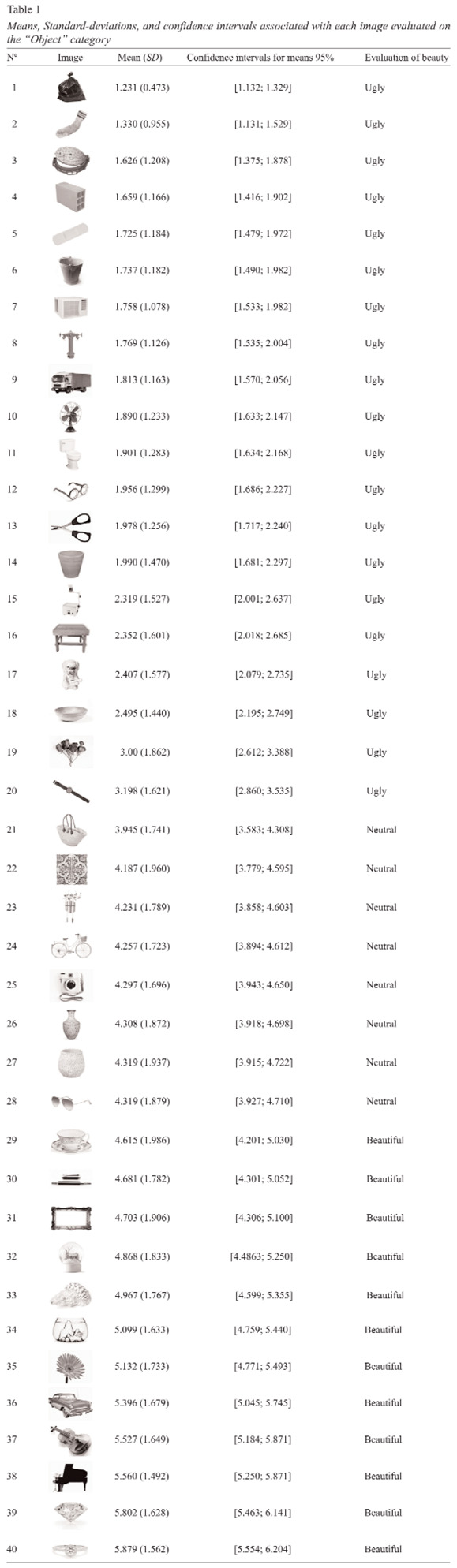
<body><![CDATA[<p>&nbsp;</p>     <p><i>Measures and procedure</i></p>     <p>Participants were invited to participate in a study about &ldquo;Evaluation of Images&rdquo; in a laboratory context, with a mean duration of 10  minutes. Anonymity and confidentiality were assured.</p>     <p>The first task consisted on learning the construct. To this end, participants were asked to read the 12 words in order to learn the construct  that they represent. After, they were instructed to evaluate a set of images based on this previous learned construct. Participants were also  informed that this evaluation task would only begin when they felt that they had completely learned/comprehended the construct and pressed one  specific keyboard key to start the task.</p>     <p>In the image evaluation task all 40 images were randomly and individually presented. Along with each image the set of Beauty-related words  appeared on the superior section and the 7-point scale, ranging from 1 (Not at all related) to 7 (very related), on the lower section of the  screen.</p>     <p>To provide their answers participants pressed one of the 7 number keys corresponding to the scale.</p>     <p>After finishing, participants were thanked for their participating and eventual questions were answered.</p>     <p>&nbsp;</p>     <p><b>Results</b></p>     <p>Obtained results are summarized on <a href="#t1">Table 1</a>. Data for evaluation means (construct-image association), respective  standard-deviations (translating the evaluations consensus), and confidence intervals of means are presented. The interpretation of confidence  intervals allows the selection of images that do not contain the mean point of the scale (4), which translates a neutral evaluation. With this  criteria we identified 20 objects as &ldquo;ugly&rdquo; &ndash; with low scores on the association with the beauty construct &ndash; (from the  object number 1 to 20), 8 as &ldquo;neutral&rdquo; &ndash; with average scores on the association with the beauty construct &ndash; (from the  object number 21 to 28) and 12 as &ldquo;beautiful&rdquo; &ndash; with high scores on the association with the beauty construct &ndash; (from  object number 29 to 40). The images are ascendingly ordered according to the evaluation means<sup><a href="#2">2</a></sup><a name="top2"></a>.</p>     ]]></body>
<body><![CDATA[<p>&nbsp;</p>     <p><a name="t1"></a></p>     <p><img src="/img/revistas/aps/v33n4/33n4a08t1.jpg"></p>     
<p>&nbsp;</p>     <p>&nbsp;</p>     <p>STUDY 2</p>     <p>&nbsp;</p>     <p><b>Method</b></p>     <p>&nbsp;</p>     <p><i>Sample</i></p>     ]]></body>
<body><![CDATA[<p>Forty-four people recruited online (31 females) were invited to participate in an online study, with ages between 17 and 42 years-old  (<i>M=</i>20.04; <i>SD=</i>7.47).</p>     <p>&nbsp;</p>     <p><i>Material</i></p>     <p>Images of 40 people were categorized by 10 judges as belonging to &ldquo;beautiful&rdquo; and &ldquo;ugly&rdquo; categories resulting in 20  images for each of the two pre-defined categories (&ldquo;Beautiful faces&rdquo; and &ldquo;Ugly faces&rdquo;).</p>     <p>Images of people were selected from the Chicago Face Database (Ma, Correll, &amp; Wittenbrink, 2015) having as criteria the following: gender  was counterbalanced for the category and only neutral faces, i.e., showing no emotion, were selected. Due to a lack of consensus within judges  regarding the level of beauty of some faces, 20 of the selected images were morphed, using Abrosoft Phantamorph Software version 5.4.2, with  another image build on FaceGen Modeller Software version 3.5. This last was created using some specific parameters to enhance beauty. More  specifically, accordingly with the specification of this software, the 10 female faces have an appearance of 17 years-old, in which the degree of  femininity was exaggerated about 25% and the 10 male faces shown an appearance of 25 years-old with a slight amount (5%) of femininity. Both types  of faces were close to the parameters of symmetry.</p>     <p>The same digitally edition of photos from Study 1 was conducted and in addition the images were cropped so that only the face and neck were  presented.</p>     <p>This study was conducted using an online survey (Qualtrics).</p>     <p>&nbsp;</p>     <p><i>Measures and procedure</i></p>     <p>Participants were invited to participate in a study named as &ldquo;Evaluation of images&rdquo; with a mean duration of 10 minutes. Anonymity  and confidentiality were assured to participants.</p>     ]]></body>
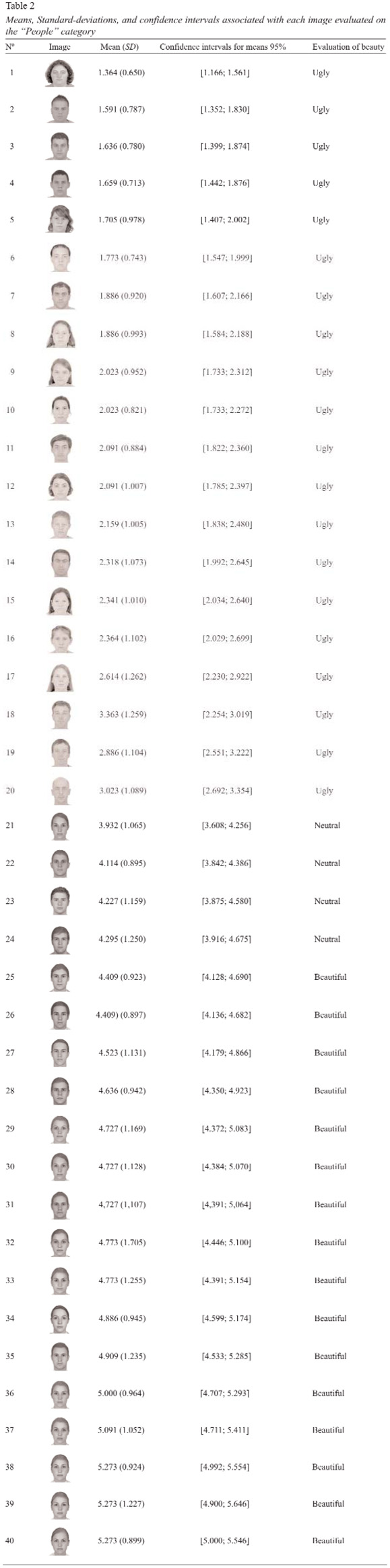
<body><![CDATA[<p>The same instructions from Study 1 were given to participants and were also randomly presented on the screen to the set of 40 images, along with  the set of Beauty-related words on the superior section and the 7-point scale on the lower section of the screen.</p>     <p>To provide their answers participants selected one of the 7 points of the scale and pressed &ldquo;next page&rdquo; to evaluate the next image.</p>     <p>After finishing, participants were thanked for their participation.</p>     <p>&nbsp;</p>     <p><b>Results</b></p>     <p>Obtained results of faces&rsquo; evaluations are summarized on <a href="#t2">Table 2</a> with the same variables and schematic representation as  in Study 1. Through the interpretation of confidence intervals of means, it is possible to select faces which do not contain the mean point of the  scale (4), thus translating a neutral evaluation. Using this criteria we identified 20 faces as &ldquo;ugly&rdquo; &ndash; with low scores on the  association with the beauty construct &ndash; (from the face number 1 to 20), 4 as &ldquo;neutral&rdquo; &ndash; with average scores on the  association with the beauty construct &ndash; (from the face number 21 to 24) and 16 as &ldquo;beautiful&rdquo; &ndash; with high scores on the  association with the beauty construct &ndash; (from face number 25 to 40). The images are ascendingly ordered according to the evaluation  means<sup><a href="#3">3</a></sup><a name="top3"></a>.</p>     <p>&nbsp;</p>     <p><a name="t2"></a></p>     <p><img src="/img/revistas/aps/v33n4/33n4a08t2.jpg"></p>     
<p>&nbsp;</p>     ]]></body>
<body><![CDATA[<p>&nbsp;</p>     <p><b>Discussion</b></p>     <p>The material here tested aimed to provide support for research carried out with the use of images, and reduce the effort necessary to test this  type of stimuli, in this case regarding norms of beauty.</p>     <p>The results obtained suggest a differentiation between images, of people and objects, regarding its associating with the construct of beauty  translated by the means&rsquo; confidence intervals. With this, it is possible to identify a significant number of stimuli evaluated as  &ldquo;beautiful&rdquo;, &ldquo;ugly&rdquo; and &ldquo;neutral&rdquo; which can be an advantage in research that aims to study this variable.  However, it seems relevant to focus that the evaluation of some images, especially of faces, does not contain the extreme pole of beauty. We do not  consider this as a disadvantage to the future use of these images, especially with faces. On one hand, some of previous research on beauty appears  to report extreme negative poles for &ldquo;ugly&rdquo; but neutral or close to neutral scale points for &ldquo;beautiful&rdquo;, with significant  differences and effects between both types of faces (e.g., Dion et al., 1972; Griffin &amp; Langlois, 2006). On the other hand, previous research  has shown that high levels of attractiveness could have a reverse impact than those with medium levels. An example, Bower and Landreth (2001)  showed that highly attractive models (<i>vs. </i>moderately attractive) are not the most effective choice for all categories of  attractiveness-relevant products. In this context, we believe that the use of material that is considered to be more beautiful (or less ugly) than  other are valid to research on the impact of different levels of beauty.</p>     <p>As one limitation of these studies, we assume that the modification of some faces in Study 1, in order to enhance the levels of beauty, may have  caused a homogenization between these altered images and the presence of some &ldquo;unrealistic&rdquo; facial traces (but not a total unrealistic  appearance). However, we believe that the rating of some images as &ldquo;beautiful&rdquo; &ndash; using the pole that associates with the  construct of beauty &ndash; and others as &ldquo;ugly &ndash; using the pole that do not associates with the construct &ndash; suits our purposes.  Another limitation relates with the measure used to make participants learn the construct of &ldquo;beauty&rdquo;. Our purpose was to use a measure  that did not directly asked participants to make judgments of &ldquo;beauty&rdquo;, &ldquo;attractive&rdquo;, &ldquo;pleasant&rdquo; etc., but  judgments based on a general construct of beauty. With this, our aim was also to use this same measure for both studies in order to have a set of  words that relates with beauty regardless of the stimuli presented, i.e., common to both studies. However, it could be the case that, with this  method, there might have been some words that could be more related and applicable to people than objects (e.g., &ldquo;Handsome&rdquo;). In these  cases, it is possible that such words could have conceptually distanced themselves from the rest. However, we do not believe that this affected the  ratings and lead participants to not use the construct since results show a clear differentiation of ratings between images, faces or objects,  translating different associations with the construct between stimuli.</p>     <p>The norms here presented do not take into account different sample characteristics such as age and gender, since our sample consisted mostly of  female participants. However, research on the evaluation of beauty shows that participants&rsquo; gender and age are not expected to affect ratings  of beauty regardless of the gender present in the images (see Langlois et al., 2000 for a review).</p>     <p>We consider this work highly relevant for research in different fields with the main purpose of studying the impact of variables such as general  beauty, physical attractiveness, liking or positive (<i>vs. </i>negative) valence in experimental studies.</p>     <p>&nbsp;</p>     <p><b>References</b></p>     <!-- ref --><p>Bower, A. B., &amp; Landreth, S. (2001). Is beauty best?. Highly <i>versus</i> normally attractive models in advertising. <i>Journal of  Advertising, 30</i>, 1-12. doi: 10.1080/00913367.2001.10673627&nbsp;&nbsp;&nbsp;&nbsp;&nbsp;&nbsp;&nbsp;&nbsp;[&#160;<a href="javascript:void(0);" onclick="javascript: window.open('/scielo.php?script=sci_nlinks&ref=000092&pid=S0870-8231201500040000800001&lng=','','width=640,height=500,resizable=yes,scrollbars=1,menubar=yes,');">Links</a>&#160;]<!-- end-ref --><!-- ref --><p>Bradley, M. M., &amp; Lang, P. J. (1999). Fearfulness and affective evaluations of pictures. <i>Motivation and Emotion, 23</i>, 1-13.    &nbsp;&nbsp;&nbsp;&nbsp;&nbsp;&nbsp;&nbsp;&nbsp;[&#160;<a href="javascript:void(0);" onclick="javascript: window.open('/scielo.php?script=sci_nlinks&ref=000093&pid=S0870-8231201500040000800002&lng=','','width=640,height=500,resizable=yes,scrollbars=1,menubar=yes,');">Links</a>&#160;]<!-- end-ref --></p>     <!-- ref --><p>Carr, T. H., McCauley, C., Sperber, R. D., &amp; Parmelee, C. M. (1982). Words, pictures, and priming: On semantic activation, conscious  identification, and the automaticity of information processing. <i>Journal of Experimental Psychology: Human Perception and Performance, 8</i>,  757-777. doi: 10.1037//0096-1523.8.6.757&nbsp;&nbsp;&nbsp;&nbsp;&nbsp;&nbsp;&nbsp;&nbsp;[&#160;<a href="javascript:void(0);" onclick="javascript: window.open('/scielo.php?script=sci_nlinks&ref=000095&pid=S0870-8231201500040000800003&lng=','','width=640,height=500,resizable=yes,scrollbars=1,menubar=yes,');">Links</a>&#160;]<!-- end-ref --><!-- ref --><p>Chaiken, S. (1979). Communicator physical attractiveness and persuasion. <i>Journal of Personality and Social Psychology, 37</i>, 1387. doi:  10.1037//0022-3514.37.8.1387&nbsp;&nbsp;&nbsp;&nbsp;&nbsp;&nbsp;&nbsp;&nbsp;[&#160;<a href="javascript:void(0);" onclick="javascript: window.open('/scielo.php?script=sci_nlinks&ref=000096&pid=S0870-8231201500040000800004&lng=','','width=640,height=500,resizable=yes,scrollbars=1,menubar=yes,');">Links</a>&#160;]<!-- end-ref --><!-- ref --><p>Dion, K., Berscheid, E., &amp; Walster, E. (1972). What is beautiful is good. <i>Journal of Personality and Social Psychology, 24</i>, 285-290.  doi: 10.1037/h0033731&nbsp;&nbsp;&nbsp;&nbsp;&nbsp;&nbsp;&nbsp;&nbsp;[&#160;<a href="javascript:void(0);" onclick="javascript: window.open('/scielo.php?script=sci_nlinks&ref=000097&pid=S0870-8231201500040000800005&lng=','','width=640,height=500,resizable=yes,scrollbars=1,menubar=yes,');">Links</a>&#160;]<!-- end-ref --><p>Eagly, A. H., Ashmore, R. D., Makhijani, M. G., &amp; Longo, L. C. (1991). What is beautiful is good, but&hellip; A meta-analytic review of  research on the physical attractiveness stereotype. <i>Psychological Bulletin, 110</i>, 109-128.</p>     <!-- ref --><p>Eagly, A. H., &amp; Chaiken, S. (1975). An attribution analysis of the effect of communicator characteristics on opinion change: The case of  communicator attractiveness<i>. Journal of Personality and Social Psychology, 32</i>, 136-144. doi: 10.1037/h0076850&nbsp;&nbsp;&nbsp;&nbsp;&nbsp;&nbsp;&nbsp;&nbsp;[&#160;<a href="javascript:void(0);" onclick="javascript: window.open('/scielo.php?script=sci_nlinks&ref=000099&pid=S0870-8231201500040000800007&lng=','','width=640,height=500,resizable=yes,scrollbars=1,menubar=yes,');">Links</a>&#160;]<!-- end-ref --><!-- ref --><p>Enquist, M., &amp; Arak, A. (1994). Symmetry, beauty and evolution. <i>Nature, 372</i>, 169-172. doi: 10.1038/372169a0&nbsp;&nbsp;&nbsp;&nbsp;&nbsp;&nbsp;&nbsp;&nbsp;[&#160;<a href="javascript:void(0);" onclick="javascript: window.open('/scielo.php?script=sci_nlinks&ref=000100&pid=S0870-8231201500040000800008&lng=','','width=640,height=500,resizable=yes,scrollbars=1,menubar=yes,');">Links</a>&#160;]<!-- end-ref --><!-- ref --><p>Griffin, A. M., &amp; Langlois, J. H. (2006). Stereotype directionality and attractiveness stereotyping: Is beauty good or is ugly bad?.  <i>Social Cognition, 24</i>, 187-206. doi: 10.1521/soco.2006.24.2.187&nbsp;&nbsp;&nbsp;&nbsp;&nbsp;&nbsp;&nbsp;&nbsp;[&#160;<a href="javascript:void(0);" onclick="javascript: window.open('/scielo.php?script=sci_nlinks&ref=000101&pid=S0870-8231201500040000800009&lng=','','width=640,height=500,resizable=yes,scrollbars=1,menubar=yes,');">Links</a>&#160;]<!-- end-ref --><!-- ref --><p>Halberstadt, J., &amp; Rhodes, G. (2000). The attractiveness of nonface averages: Implications for an evolutionary explanation of the  attractiveness of average faces. <i>Psychological Science, 11</i>, 285-289. doi: 10.1111/1467-9280.00257&nbsp;&nbsp;&nbsp;&nbsp;&nbsp;&nbsp;&nbsp;&nbsp;[&#160;<a href="javascript:void(0);" onclick="javascript: window.open('/scielo.php?script=sci_nlinks&ref=000102&pid=S0870-8231201500040000800010&lng=','','width=640,height=500,resizable=yes,scrollbars=1,menubar=yes,');">Links</a>&#160;]<!-- end-ref --><!-- ref --><p>Hamermesh, D. S., &amp; Biddle, J. E. (1993). <i>Beauty and the labor market</i> (working paper 4518). Cambridge, MA: National Bureau of  Economic Research.    &nbsp;&nbsp;&nbsp;&nbsp;&nbsp;&nbsp;&nbsp;&nbsp;[&#160;<a href="javascript:void(0);" onclick="javascript: window.open('/scielo.php?script=sci_nlinks&ref=000103&pid=S0870-8231201500040000800011&lng=','','width=640,height=500,resizable=yes,scrollbars=1,menubar=yes,');">Links</a>&#160;]<!-- end-ref --></p>     <p>Hekkert, P., Snelders, D., &amp; Wieringen, P. C. (2003). &lsquo;Most advanced, yet acceptable&rsquo;: Typicality and novelty as joint  predictors of aesthetic preference in industrial design. <i>British Journal of Psychology, 94</i>, 111-124.</p>     <!-- ref --><p>Kahle, L. R., &amp; Homer, P. M. (1985). Physical attractiveness of the celebrity endorser: A social adaptation perspective. <i>Journal of  Consumer Research, 11</i>, 954-961. doi: 10.1086/209029&nbsp;&nbsp;&nbsp;&nbsp;&nbsp;&nbsp;&nbsp;&nbsp;[&#160;<a href="javascript:void(0);" onclick="javascript: window.open('/scielo.php?script=sci_nlinks&ref=000106&pid=S0870-8231201500040000800013&lng=','','width=640,height=500,resizable=yes,scrollbars=1,menubar=yes,');">Links</a>&#160;]<!-- end-ref --><p>Kamins, M. A. (1990). An investigation into the &ldquo;match-up&rdquo; hypothesis in celebrity advertising: When beauty may be only skin deep.  <i>Journal of Advertising, 19</i>, 4-13. doi: 10.1080/00913367.1990.106773175</p>     <!-- ref --><p>Langlois, J. H., Kalakanis, L., Rubenstein, A. J., Larson, A., Hallam, M., &amp; Smoot, M. (2000). Maxims or myths of beauty?. A meta-analytic  and theoretical review. <i>Psychological Bulletin, 12</i>6, 390-493. doi: 10.1037/0033-2909.126.3.390&nbsp;&nbsp;&nbsp;&nbsp;&nbsp;&nbsp;&nbsp;&nbsp;[&#160;<a href="javascript:void(0);" onclick="javascript: window.open('/scielo.php?script=sci_nlinks&ref=000108&pid=S0870-8231201500040000800015&lng=','','width=640,height=500,resizable=yes,scrollbars=1,menubar=yes,');">Links</a>&#160;]<!-- end-ref --><!-- ref --><p>Ma, D. S., Correll, J., &amp; Wittenbrink, B. (2015). The Chicago face database: A free stimulus set of faces and norming data. <i>Behavior  Research Methods</i>, 1-14. doi: 10.3758/s13428-014-0532-5&nbsp;&nbsp;&nbsp;&nbsp;&nbsp;&nbsp;&nbsp;&nbsp;[&#160;<a href="javascript:void(0);" onclick="javascript: window.open('/scielo.php?script=sci_nlinks&ref=000109&pid=S0870-8231201500040000800016&lng=','','width=640,height=500,resizable=yes,scrollbars=1,menubar=yes,');">Links</a>&#160;]<!-- end-ref --><p>Mello, J. (2011). <i>Beauty and credibility: The relation at implicit and explicit level</i>. Master Thesis in Social and Organizational  Psychology, ISPA &ndash; Instituto Universit&aacute;rio, Lisboa. Retrieved from <a href="http://repositorio.ispa.pt/handle/10400.12/3833"  target="_blank">http://repositorio.ispa.pt/handle/10400.12/3833</a></p>     <!-- ref --><p>Monin, B. (2003). The warm glow heuristic: when liking leads to familiarity. <i>Journal of Personality and Social Psychology, 85</i>, 1035-1048.  doi: 10.1037/0022-3514.85.6.1035&nbsp;&nbsp;&nbsp;&nbsp;&nbsp;&nbsp;&nbsp;&nbsp;[&#160;<a href="javascript:void(0);" onclick="javascript: window.open('/scielo.php?script=sci_nlinks&ref=000111&pid=S0870-8231201500040000800018&lng=','','width=640,height=500,resizable=yes,scrollbars=1,menubar=yes,');">Links</a>&#160;]<!-- end-ref --><!-- ref --><p>Oosterhof, N. N., &amp; Todorov, A. (2008). The functional basis of face evaluation. <i>Proceedings of the National Academy of Sciences,  105</i>, 11087-11092. doi: 10.1073/pnas.0805664105&nbsp;&nbsp;&nbsp;&nbsp;&nbsp;&nbsp;&nbsp;&nbsp;[&#160;<a href="javascript:void(0);" onclick="javascript: window.open('/scielo.php?script=sci_nlinks&ref=000112&pid=S0870-8231201500040000800019&lng=','','width=640,height=500,resizable=yes,scrollbars=1,menubar=yes,');">Links</a>&#160;]<!-- end-ref --><p>Prada, M., Cunha, C., Garcia-Marques, T., &amp; Rodrigues, D. (2010). Continua&ccedil;&atilde;o do FIM &ndash; Normas de val&ecirc;ncia e  familiaridade das imagens do Ficheiro de Imagens Multicategoriais. <i>Laborat&oacute;rio de Psicologia, 8</i>, 185-211.</p>     <!-- ref --><p>Prada, M., &amp; Garcia-Marques, T. (2006). Normas da val&ecirc;ncia das imagens do Ficheiro de Imagens Multicategoriais (FIM).  <i>Laborat&oacute;rio de Psicologia, 4</i>, 109-137. doi: 10.14417/lp.765&nbsp;&nbsp;&nbsp;&nbsp;&nbsp;&nbsp;&nbsp;&nbsp;[&#160;<a href="javascript:void(0);" onclick="javascript: window.open('/scielo.php?script=sci_nlinks&ref=000114&pid=S0870-8231201500040000800021&lng=','','width=640,height=500,resizable=yes,scrollbars=1,menubar=yes,');">Links</a>&#160;]<!-- end-ref --><p>Praxmarer, S. (2011). How a presenter&rsquo;s perceived attractiveness affects persuasion for attractiveness-unrelated products.  <i>International Journal of Advertising, 30</i>, 839-865. doi: 10.2501/IJA-30-5-839-865</p>     <!-- ref --><p>Psychological Image Collection at Stirling (PICS). URL: <a href="http://pics.stir.ac.uk" target="_blank">http://pics.stir.ac.uk</a>&nbsp;&nbsp;&nbsp;&nbsp;&nbsp;&nbsp;&nbsp;&nbsp;[&#160;<a href="javascript:void(0);" onclick="javascript: window.open('/scielo.php?script=sci_nlinks&ref=000116&pid=S0870-8231201500040000800023&lng=','','width=640,height=500,resizable=yes,scrollbars=1,menubar=yes,');">Links</a>&#160;]<!-- end-ref --><!-- ref --><p>Puckett, J. M., Petty, R. E., Cacioppo, J. T., &amp; Fischer, D. L. (1983). The relative impact of age and attractiveness stereotypes on  persuasion. <i>Journal of Gerontology, 38</i>, 340-343. doi: 10.1093/geronj/38.3.340&nbsp;&nbsp;&nbsp;&nbsp;&nbsp;&nbsp;&nbsp;&nbsp;[&#160;<a href="javascript:void(0);" onclick="javascript: window.open('/scielo.php?script=sci_nlinks&ref=000117&pid=S0870-8231201500040000800024&lng=','','width=640,height=500,resizable=yes,scrollbars=1,menubar=yes,');">Links</a>&#160;]<!-- end-ref --><!-- ref --><p>Reber, R., Brun, M., &amp; Mitterndorfer, K. (2008). The use of heuristics in intuitive mathematical judgment. <i>Psychonomic Bulletin &amp;  Review, 15</i>, 1174-1178. doi: 10.3758/PBR.15.6.1174&nbsp;&nbsp;&nbsp;&nbsp;&nbsp;&nbsp;&nbsp;&nbsp;[&#160;<a href="javascript:void(0);" onclick="javascript: window.open('/scielo.php?script=sci_nlinks&ref=000118&pid=S0870-8231201500040000800025&lng=','','width=640,height=500,resizable=yes,scrollbars=1,menubar=yes,');">Links</a>&#160;]<!-- end-ref --><p>Reber, R., Schwarz, N., &amp; Winkielman, P. (2004). Processing fluency and aesthetic pleasure: Is beauty in the perceiver&rsquo;s processing  experience?. <i>Personality and Social Psychology Review, 8</i>, 364-382. doi: 10.1207/s15327957pspr0804_3</p>     <!-- ref --><p>Reber, R., Winkielman, P., &amp; Schwarz, N. (1998). Effects of perceptual fluency on affective judgments. <i>Psychological Science, 9</i>,  45-48. doi: 10.1111/1467-9280.00008&nbsp;&nbsp;&nbsp;&nbsp;&nbsp;&nbsp;&nbsp;&nbsp;[&#160;<a href="javascript:void(0);" onclick="javascript: window.open('/scielo.php?script=sci_nlinks&ref=000120&pid=S0870-8231201500040000800027&lng=','','width=640,height=500,resizable=yes,scrollbars=1,menubar=yes,');">Links</a>&#160;]<!-- end-ref --><!-- ref --><p>Rhodes, G., Proffitt, F., Grady, J. M., &amp; Sumich, A. (1998). Facial symmetry and the perception of beauty. <i>Psychonomic Bulletin &amp;  Review, 5</i>, 659-669. doi: 10.3758/BF03208842&nbsp;&nbsp;&nbsp;&nbsp;&nbsp;&nbsp;&nbsp;&nbsp;[&#160;<a href="javascript:void(0);" onclick="javascript: window.open('/scielo.php?script=sci_nlinks&ref=000121&pid=S0870-8231201500040000800028&lng=','','width=640,height=500,resizable=yes,scrollbars=1,menubar=yes,');">Links</a>&#160;]<!-- end-ref --><p>Schneider, W., Eschman, A., &amp; Zuccolotto, A. (2002). <i>E-Prime user&rsquo;s guide</i>. Pittsburgh: Psychology Software Tools, Inc.</p>     ]]></body>
<body><![CDATA[<!-- ref --><p>Shavitt, S., Swan, S., Lowrey, T. M., &amp; W&auml;nke, M. (1994). The interaction of endorser attractiveness and involvement in persuasion  depends on the goal that guides message processing. <i>Journal of Consumer Psychology, 3</i>, 137-162. doi: 10.1207/s15327663jcp0302_02&nbsp;&nbsp;&nbsp;&nbsp;&nbsp;&nbsp;&nbsp;&nbsp;[&#160;<a href="javascript:void(0);" onclick="javascript: window.open('/scielo.php?script=sci_nlinks&ref=000123&pid=S0870-8231201500040000800030&lng=','','width=640,height=500,resizable=yes,scrollbars=1,menubar=yes,');">Links</a>&#160;]<!-- end-ref --><!-- ref --><p>Solomon, M. R., Ashmore, R. D., &amp; Longo, L. C. (1992). The beauty match-up hypothesis: Congruence between types of beauty and product images  in advertising. <i>Journal of Advertising, 21</i>, 23-34. doi: 10.1080/00913367.1992.10673383&nbsp;&nbsp;&nbsp;&nbsp;&nbsp;&nbsp;&nbsp;&nbsp;[&#160;<a href="javascript:void(0);" onclick="javascript: window.open('/scielo.php?script=sci_nlinks&ref=000124&pid=S0870-8231201500040000800031&lng=','','width=640,height=500,resizable=yes,scrollbars=1,menubar=yes,');">Links</a>&#160;]<!-- end-ref --><!-- ref --><p>Snodgrass, J. G., &amp; Vanderwart, M. (1980). A standardized set of 260 pictures: Norms for name agreement, image agreement, familiarity, and  visual complexity. <i>Journal of Experimental Psychology: Human Learning and Memory, 6</i>, 174. doi: 10.1037/0278-7393.6.2.174&nbsp;&nbsp;&nbsp;&nbsp;&nbsp;&nbsp;&nbsp;&nbsp;[&#160;<a href="javascript:void(0);" onclick="javascript: window.open('/scielo.php?script=sci_nlinks&ref=000125&pid=S0870-8231201500040000800032&lng=','','width=640,height=500,resizable=yes,scrollbars=1,menubar=yes,');">Links</a>&#160;]<!-- end-ref --><!-- ref --><p>Tews, M. J., Stafford, K., &amp; Zhu, J. (2009). Beauty revisited: The impact of attractiveness, ability, and personality in the assessment of  employment suitability. <i>International Journal of Selection and Assessment, 17</i>, 92-100. doi: 10.1111/j.1468-2389.2009.00454&nbsp;&nbsp;&nbsp;&nbsp;&nbsp;&nbsp;&nbsp;&nbsp;[&#160;<a href="javascript:void(0);" onclick="javascript: window.open('/scielo.php?script=sci_nlinks&ref=000126&pid=S0870-8231201500040000800033&lng=','','width=640,height=500,resizable=yes,scrollbars=1,menubar=yes,');">Links</a>&#160;]<!-- end-ref --><!-- ref --><p>Till, B. D., &amp; Busler, M. (2000). The match-up hypothesis: Physical attractiveness, expertise, and the role of fit on brand attitude,  purchase intent and brand beliefs. <i>Journal of Advertising, 29</i>, 1-13. doi: 10.1080/00913367.2000.10673613&nbsp;&nbsp;&nbsp;&nbsp;&nbsp;&nbsp;&nbsp;&nbsp;[&#160;<a href="javascript:void(0);" onclick="javascript: window.open('/scielo.php?script=sci_nlinks&ref=000127&pid=S0870-8231201500040000800034&lng=','','width=640,height=500,resizable=yes,scrollbars=1,menubar=yes,');">Links</a>&#160;]<!-- end-ref --><!-- ref --><p>Todorov, A., Dotsch, R., Porter, J. M., Oosterhof, N. N., &amp; Falvello, V. B. (2013). Validation of data-driven computational models of social  perception of faces. <i>Emotion, 13</i>, 724-738. doi: 10.1037/a0032335&nbsp;&nbsp;&nbsp;&nbsp;&nbsp;&nbsp;&nbsp;&nbsp;[&#160;<a href="javascript:void(0);" onclick="javascript: window.open('/scielo.php?script=sci_nlinks&ref=000128&pid=S0870-8231201500040000800035&lng=','','width=640,height=500,resizable=yes,scrollbars=1,menubar=yes,');">Links</a>&#160;]<!-- end-ref --><p>Tuch, A. N., Bargas-Avila, J. A., &amp; Opwis, K. (2010). Symmetry and aesthetics in website design: It&rsquo;s a man&rsquo;s business.  <i>Computers in Human Behavior, 26, </i>1831-1837. doi: 10.1016/j.chb.2010.07.016</p>     <!-- ref --><p>van Leeuwen, M. L., &amp; Neil Macrae, C. (2004). Is beautiful always good?. Implicit benefits of facial attractiveness. <i>Social Cognition,  22</i>, 637-649. doi: 10.1521/soco.22.6.637.54819&nbsp;&nbsp;&nbsp;&nbsp;&nbsp;&nbsp;&nbsp;&nbsp;[&#160;<a href="javascript:void(0);" onclick="javascript: window.open('/scielo.php?script=sci_nlinks&ref=000130&pid=S0870-8231201500040000800037&lng=','','width=640,height=500,resizable=yes,scrollbars=1,menubar=yes,');">Links</a>&#160;]<!-- end-ref --><p>&nbsp;</p>     <p><b><a name="c0" id="c0"></a><a href="#topc0">CORRESPONDÊNCIA</a></b></p>     ]]></body>
<body><![CDATA[<p>A correspond&ecirc;ncia relativa a este artigo dever&aacute; ser enviada para: Joana Mello, ISPA &ndash; Instituto Universit&aacute;rio,  Rua Jardim do Tabaco, 34, 1149-041 Lisboa. E-mail: <a href="mailto:jmello@ispa.pt">jmello@ispa.pt</a></p>     <p>&nbsp;</p>     <p>The images pretested in this work are available in the archive of the psychology lab of ISPA &ndash; Instituto Universit&aacute;rio. Email:  <a href="mailto:labpsicologia@ispa.pt">labpsicologia@ispa.pt</a></p>     <p>&nbsp;</p>     <p>Submiss&atilde;o: 02/04/2015 Aceita&ccedil;&atilde;o: 15/07/2015</p>     <p>&nbsp;</p>     <p>NOTAS</p>     <p><Sup><a name="1"></a><a href="#top1">1</a></Sup> Original words, as presented in Portuguese: <i>Agrad&aacute;vel, Elegante, Esbelto, Gracioso,  Atraente, Belo, Vistoso, Encanto, Formoso, Bonito, Encantador, Atractivo</i>.</p>     <p><Sup><a name="2"></a><a href="#top2">2</a></Sup> Additional analyses of the obtained evaluations showed that images previously classified as  belonging to the &ldquo;beautiful&rdquo; category were, indeed, perceived by participants as more related to this dimension compared to the  images classified as belonging to the &ldquo;ugly&rdquo; category (Beautiful: <i>M</i>=4.79, <i>SD</i>=1.18; Ugly: <i>M</i>=2.01, <i>SD</i>=.79;  <i>t</i>(90)=22.783, <i>p</i>&lt;.001, <i>d</i>=2.77).</p>     <p><Sup><a name="3"></a><a href="#top3">3</a></Sup> Additional analyses of the obtained evaluations showed that images previously classified as  belonging to the &ldquo;beautiful&rdquo; category were, indeed, perceived by participants as more related to this dimension compared to the images  classified as belonging to the &ldquo;ugly&rdquo; category (Beautiful: <i>M</i>=4.66, <i>SD</i>=.70; Ugly: <i>M</i>=2.10, <i>SD</i>=.67;  <i>t</i>(43)=21.711, <i>p</i>&lt;.001, <i>d</i>=3.74).</a></p>     ]]></body>
<body><![CDATA[ ]]></body><back>
<ref-list>
<ref id="B1">
<nlm-citation citation-type="journal">
<person-group person-group-type="author">
<name>
<surname><![CDATA[Bower]]></surname>
<given-names><![CDATA[A. B.]]></given-names>
</name>
<name>
<surname><![CDATA[Landreth]]></surname>
<given-names><![CDATA[S.]]></given-names>
</name>
</person-group>
<article-title xml:lang="en"><![CDATA[Is beauty best?]]></article-title>
<source><![CDATA[Highly versus normally attractive models in advertising. Journal of Advertising]]></source>
<year>2001</year>
<volume>30</volume>
<page-range>1-12</page-range></nlm-citation>
</ref>
<ref id="B2">
<nlm-citation citation-type="journal">
<person-group person-group-type="author">
<name>
<surname><![CDATA[Bradley]]></surname>
<given-names><![CDATA[M. M.]]></given-names>
</name>
<name>
<surname><![CDATA[Lang]]></surname>
<given-names><![CDATA[P. J.]]></given-names>
</name>
</person-group>
<article-title xml:lang="en"><![CDATA[Fearfulness and affective evaluations of pictures]]></article-title>
<source><![CDATA[Motivation and Emotion]]></source>
<year>1999</year>
<volume>23</volume>
<page-range>1-13</page-range></nlm-citation>
</ref>
<ref id="B3">
<nlm-citation citation-type="journal">
<person-group person-group-type="author">
<name>
<surname><![CDATA[Carr]]></surname>
<given-names><![CDATA[T. H.]]></given-names>
</name>
<name>
<surname><![CDATA[McCauley]]></surname>
<given-names><![CDATA[C.]]></given-names>
</name>
<name>
<surname><![CDATA[Sperber]]></surname>
<given-names><![CDATA[R. D.]]></given-names>
</name>
<name>
<surname><![CDATA[Parmelee]]></surname>
<given-names><![CDATA[C. M.]]></given-names>
</name>
</person-group>
<article-title xml:lang="en"><![CDATA[Words, pictures, and priming: On semantic activation, conscious identification, and the automaticity of information processing]]></article-title>
<source><![CDATA[Journal of Experimental Psychology: Human Perception and Performance]]></source>
<year>1982</year>
<volume>8</volume>
<page-range>757-777</page-range></nlm-citation>
</ref>
<ref id="B4">
<nlm-citation citation-type="journal">
<person-group person-group-type="author">
<name>
<surname><![CDATA[Chaiken]]></surname>
<given-names><![CDATA[S.]]></given-names>
</name>
</person-group>
<article-title xml:lang="en"><![CDATA[Communicator physical attractiveness and persuasion]]></article-title>
<source><![CDATA[Journal of Personality and Social Psychology]]></source>
<year>1979</year>
<volume>37</volume>
<page-range>1387</page-range></nlm-citation>
</ref>
<ref id="B5">
<nlm-citation citation-type="journal">
<person-group person-group-type="author">
<name>
<surname><![CDATA[Dion]]></surname>
<given-names><![CDATA[K.]]></given-names>
</name>
<name>
<surname><![CDATA[Berscheid]]></surname>
<given-names><![CDATA[E.]]></given-names>
</name>
<name>
<surname><![CDATA[Walster]]></surname>
<given-names><![CDATA[E.]]></given-names>
</name>
</person-group>
<article-title xml:lang="en"><![CDATA[What is beautiful is good]]></article-title>
<source><![CDATA[Journal of Personality and Social Psychology]]></source>
<year>1972</year>
<volume>24</volume>
<page-range>285-290</page-range></nlm-citation>
</ref>
<ref id="B6">
<nlm-citation citation-type="journal">
<person-group person-group-type="author">
<name>
<surname><![CDATA[Eagly]]></surname>
<given-names><![CDATA[A. H.]]></given-names>
</name>
<name>
<surname><![CDATA[Ashmore]]></surname>
<given-names><![CDATA[R. D.]]></given-names>
</name>
<name>
<surname><![CDATA[Makhijani]]></surname>
<given-names><![CDATA[M. G.]]></given-names>
</name>
<name>
<surname><![CDATA[Longo]]></surname>
<given-names><![CDATA[L. C.]]></given-names>
</name>
</person-group>
<article-title xml:lang="en"><![CDATA[What is beautiful is good, but… A meta-analytic review of research on the physical attractiveness stereotype]]></article-title>
<source><![CDATA[Psychological Bulletin]]></source>
<year>1991</year>
<volume>110</volume>
<page-range>109-128</page-range></nlm-citation>
</ref>
<ref id="B7">
<nlm-citation citation-type="journal">
<person-group person-group-type="author">
<name>
<surname><![CDATA[Eagly]]></surname>
<given-names><![CDATA[A. H.]]></given-names>
</name>
<name>
<surname><![CDATA[Chaiken]]></surname>
<given-names><![CDATA[S.]]></given-names>
</name>
</person-group>
<article-title xml:lang="en"><![CDATA[An attribution analysis of the effect of communicator characteristics on opinion change: The case of communicator attractiveness]]></article-title>
<source><![CDATA[Journal of Personality and Social Psychology]]></source>
<year>1975</year>
<volume>32</volume>
<page-range>136-144</page-range></nlm-citation>
</ref>
<ref id="B8">
<nlm-citation citation-type="journal">
<person-group person-group-type="author">
<name>
<surname><![CDATA[Enquist]]></surname>
<given-names><![CDATA[M.]]></given-names>
</name>
<name>
<surname><![CDATA[Arak]]></surname>
<given-names><![CDATA[A.]]></given-names>
</name>
</person-group>
<article-title xml:lang="en"><![CDATA[Symmetry, beauty and evolution]]></article-title>
<source><![CDATA[Nature]]></source>
<year>1994</year>
<volume>372</volume>
<page-range>169-172</page-range></nlm-citation>
</ref>
<ref id="B9">
<nlm-citation citation-type="journal">
<person-group person-group-type="author">
<name>
<surname><![CDATA[Griffin]]></surname>
<given-names><![CDATA[A. M.]]></given-names>
</name>
<name>
<surname><![CDATA[Langlois]]></surname>
<given-names><![CDATA[J. H.]]></given-names>
</name>
</person-group>
<article-title xml:lang="en"><![CDATA[Stereotype directionality and attractiveness stereotyping: Is beauty good or is ugly bad?]]></article-title>
<source><![CDATA[Social Cognition]]></source>
<year>2006</year>
<volume>24</volume>
<page-range>187-206</page-range></nlm-citation>
</ref>
<ref id="B10">
<nlm-citation citation-type="journal">
<person-group person-group-type="author">
<name>
<surname><![CDATA[Halberstadt]]></surname>
<given-names><![CDATA[J.]]></given-names>
</name>
<name>
<surname><![CDATA[Rhodes]]></surname>
<given-names><![CDATA[G.]]></given-names>
</name>
</person-group>
<article-title xml:lang="en"><![CDATA[The attractiveness of nonface averages: Implications for an evolutionary explanation of the attractiveness of average faces]]></article-title>
<source><![CDATA[Psychological Science]]></source>
<year>2000</year>
<volume>11</volume>
<page-range>285-289</page-range></nlm-citation>
</ref>
<ref id="B11">
<nlm-citation citation-type="book">
<person-group person-group-type="author">
<name>
<surname><![CDATA[Hamermesh]]></surname>
<given-names><![CDATA[D. S.]]></given-names>
</name>
<name>
<surname><![CDATA[Biddle]]></surname>
<given-names><![CDATA[J. E.]]></given-names>
</name>
</person-group>
<source><![CDATA[Beauty and the labor market]]></source>
<year>1993</year>
<publisher-loc><![CDATA[Cambridge ]]></publisher-loc>
<publisher-name><![CDATA[National Bureau of Economic Research]]></publisher-name>
</nlm-citation>
</ref>
<ref id="B12">
<nlm-citation citation-type="journal">
<person-group person-group-type="author">
<name>
<surname><![CDATA[Hekkert]]></surname>
<given-names><![CDATA[P.]]></given-names>
</name>
<name>
<surname><![CDATA[Snelders]]></surname>
<given-names><![CDATA[D.]]></given-names>
</name>
<name>
<surname><![CDATA[Wieringen]]></surname>
<given-names><![CDATA[P. C.]]></given-names>
</name>
</person-group>
<article-title xml:lang="en"><![CDATA[‘Most advanced, yet acceptable’: Typicality and novelty as joint predictors of aesthetic preference in industrial design]]></article-title>
<source><![CDATA[British Journal of Psychology]]></source>
<year>2003</year>
<volume>94</volume>
<page-range>111-124</page-range></nlm-citation>
</ref>
<ref id="B13">
<nlm-citation citation-type="journal">
<person-group person-group-type="author">
<name>
<surname><![CDATA[Kahle]]></surname>
<given-names><![CDATA[L. R.]]></given-names>
</name>
<name>
<surname><![CDATA[Homer]]></surname>
<given-names><![CDATA[P. M.]]></given-names>
</name>
</person-group>
<article-title xml:lang="en"><![CDATA[Physical attractiveness of the celebrity endorser: A social adaptation perspective]]></article-title>
<source><![CDATA[Journal of Consumer Research]]></source>
<year>1985</year>
<volume>11</volume>
<page-range>954-961</page-range></nlm-citation>
</ref>
<ref id="B14">
<nlm-citation citation-type="journal">
<person-group person-group-type="author">
<name>
<surname><![CDATA[Kamins]]></surname>
<given-names><![CDATA[M. A.]]></given-names>
</name>
</person-group>
<article-title xml:lang="en"><![CDATA[An investigation into the “match-up” hypothesis in celebrity advertising: When beauty may be only skin deep]]></article-title>
<source><![CDATA[Journal of Advertising]]></source>
<year>1990</year>
<volume>19</volume>
<page-range>4-13</page-range></nlm-citation>
</ref>
<ref id="B15">
<nlm-citation citation-type="journal">
<person-group person-group-type="author">
<name>
<surname><![CDATA[Langlois]]></surname>
<given-names><![CDATA[J. H.]]></given-names>
</name>
<name>
<surname><![CDATA[Kalakanis]]></surname>
<given-names><![CDATA[L.]]></given-names>
</name>
<name>
<surname><![CDATA[Rubenstein]]></surname>
<given-names><![CDATA[A. J.]]></given-names>
</name>
<name>
<surname><![CDATA[Larson]]></surname>
<given-names><![CDATA[A.]]></given-names>
</name>
<name>
<surname><![CDATA[Hallam]]></surname>
<given-names><![CDATA[M.]]></given-names>
</name>
<name>
<surname><![CDATA[Smoot]]></surname>
<given-names><![CDATA[M.]]></given-names>
</name>
</person-group>
<article-title xml:lang="en"><![CDATA[Maxims or myths of beauty?]]></article-title>
<source><![CDATA[A meta-analytic and theoretical review. Psychological Bulletin]]></source>
<year>2000</year>
<volume>126</volume>
<page-range>390-493</page-range></nlm-citation>
</ref>
<ref id="B16">
<nlm-citation citation-type="journal">
<person-group person-group-type="author">
<name>
<surname><![CDATA[Ma]]></surname>
<given-names><![CDATA[D. S.]]></given-names>
</name>
<name>
<surname><![CDATA[Correll]]></surname>
<given-names><![CDATA[J.]]></given-names>
</name>
<name>
<surname><![CDATA[Wittenbrink]]></surname>
<given-names><![CDATA[B.]]></given-names>
</name>
</person-group>
<article-title xml:lang="en"><![CDATA[The Chicago face database: A free stimulus set of faces and norming data]]></article-title>
<source><![CDATA[Behavior Research Methods]]></source>
<year>2015</year>
<page-range>1-14</page-range></nlm-citation>
</ref>
<ref id="B17">
<nlm-citation citation-type="">
<person-group person-group-type="author">
<name>
<surname><![CDATA[Mello]]></surname>
<given-names><![CDATA[J.]]></given-names>
</name>
</person-group>
<source><![CDATA[Beauty and credibility: The relation at implicit and explicit level]]></source>
<year>2011</year>
</nlm-citation>
</ref>
<ref id="B18">
<nlm-citation citation-type="journal">
<person-group person-group-type="author">
<name>
<surname><![CDATA[Monin]]></surname>
<given-names><![CDATA[B.]]></given-names>
</name>
</person-group>
<article-title xml:lang="en"><![CDATA[The warm glow heuristic: when liking leads to familiarity]]></article-title>
<source><![CDATA[Journal of Personality and Social Psychology]]></source>
<year>2003</year>
<volume>85</volume>
<page-range>1035-1048</page-range></nlm-citation>
</ref>
<ref id="B19">
<nlm-citation citation-type="journal">
<person-group person-group-type="author">
<name>
<surname><![CDATA[Oosterhof]]></surname>
<given-names><![CDATA[N. N.]]></given-names>
</name>
<name>
<surname><![CDATA[Todorov]]></surname>
<given-names><![CDATA[A.]]></given-names>
</name>
</person-group>
<article-title xml:lang="en"><![CDATA[The functional basis of face evaluation]]></article-title>
<source><![CDATA[Proceedings of the National Academy of Sciences]]></source>
<year>2008</year>
<volume>105</volume>
<page-range>11087-11092</page-range></nlm-citation>
</ref>
<ref id="B20">
<nlm-citation citation-type="journal">
<person-group person-group-type="author">
<name>
<surname><![CDATA[Prada]]></surname>
<given-names><![CDATA[M.]]></given-names>
</name>
<name>
<surname><![CDATA[Cunha]]></surname>
<given-names><![CDATA[C.]]></given-names>
</name>
<name>
<surname><![CDATA[Garcia-Marques]]></surname>
<given-names><![CDATA[T.]]></given-names>
</name>
<name>
<surname><![CDATA[Rodrigues]]></surname>
<given-names><![CDATA[D.]]></given-names>
</name>
</person-group>
<article-title xml:lang="pt"><![CDATA[Continuação do FIM: Normas de valência e familiaridade das imagens do Ficheiro de Imagens Multicategoriais]]></article-title>
<source><![CDATA[Laboratório de Psicologia]]></source>
<year>2010</year>
<volume>8</volume>
<page-range>185-211</page-range></nlm-citation>
</ref>
<ref id="B21">
<nlm-citation citation-type="journal">
<person-group person-group-type="author">
<name>
<surname><![CDATA[Prada]]></surname>
<given-names><![CDATA[M.]]></given-names>
</name>
<name>
<surname><![CDATA[Garcia-Marques]]></surname>
<given-names><![CDATA[T.]]></given-names>
</name>
</person-group>
<article-title xml:lang="pt"><![CDATA[Normas da valência das imagens do Ficheiro de Imagens Multicategoriais (FIM)]]></article-title>
<source><![CDATA[Laboratório de Psicologia]]></source>
<year>2006</year>
<volume>4</volume>
<page-range>109-137</page-range></nlm-citation>
</ref>
<ref id="B22">
<nlm-citation citation-type="journal">
<person-group person-group-type="author">
<name>
<surname><![CDATA[Praxmarer]]></surname>
<given-names><![CDATA[S.]]></given-names>
</name>
</person-group>
<article-title xml:lang="en"><![CDATA[How a presenter’s perceived attractiveness affects persuasion for attractiveness-unrelated products]]></article-title>
<source><![CDATA[International Journal of Advertising]]></source>
<year>2011</year>
<volume>30</volume>
<page-range>839-865</page-range></nlm-citation>
</ref>
<ref id="B23">
<nlm-citation citation-type="">
<collab>Psychological Image Collection at Stirling (PICS)</collab>
<source><![CDATA[]]></source>
<year></year>
</nlm-citation>
</ref>
<ref id="B24">
<nlm-citation citation-type="journal">
<person-group person-group-type="author">
<name>
<surname><![CDATA[Puckett]]></surname>
<given-names><![CDATA[J. M.]]></given-names>
</name>
<name>
<surname><![CDATA[Petty]]></surname>
<given-names><![CDATA[R. E.]]></given-names>
</name>
<name>
<surname><![CDATA[Cacioppo]]></surname>
<given-names><![CDATA[J. T.]]></given-names>
</name>
<name>
<surname><![CDATA[Fischer]]></surname>
<given-names><![CDATA[D. L.]]></given-names>
</name>
</person-group>
<article-title xml:lang="en"><![CDATA[The relative impact of age and attractiveness stereotypes on persuasion]]></article-title>
<source><![CDATA[Journal of Gerontology]]></source>
<year>1983</year>
<volume>38</volume>
<page-range>340-343</page-range></nlm-citation>
</ref>
<ref id="B25">
<nlm-citation citation-type="journal">
<person-group person-group-type="author">
<name>
<surname><![CDATA[Reber]]></surname>
<given-names><![CDATA[R.]]></given-names>
</name>
<name>
<surname><![CDATA[Brun]]></surname>
<given-names><![CDATA[M.]]></given-names>
</name>
<name>
<surname><![CDATA[Mitterndorfer]]></surname>
<given-names><![CDATA[K.]]></given-names>
</name>
</person-group>
<article-title xml:lang="en"><![CDATA[The use of heuristics in intuitive mathematical judgment]]></article-title>
<source><![CDATA[Psychonomic Bulletin & Review]]></source>
<year>2008</year>
<volume>15</volume>
<page-range>1174-1178</page-range></nlm-citation>
</ref>
<ref id="B26">
<nlm-citation citation-type="journal">
<person-group person-group-type="author">
<name>
<surname><![CDATA[Reber]]></surname>
<given-names><![CDATA[R.]]></given-names>
</name>
<name>
<surname><![CDATA[Schwarz]]></surname>
<given-names><![CDATA[N.]]></given-names>
</name>
<name>
<surname><![CDATA[Winkielman]]></surname>
<given-names><![CDATA[P.]]></given-names>
</name>
</person-group>
<article-title xml:lang="en"><![CDATA[Processing fluency and aesthetic pleasure: Is beauty in the perceiver’s processing experience?]]></article-title>
<source><![CDATA[Personality and Social Psychology Review]]></source>
<year>2004</year>
<volume>8</volume>
<page-range>364-382</page-range></nlm-citation>
</ref>
<ref id="B27">
<nlm-citation citation-type="journal">
<person-group person-group-type="author">
<name>
<surname><![CDATA[Reber]]></surname>
<given-names><![CDATA[R.]]></given-names>
</name>
<name>
<surname><![CDATA[Winkielman]]></surname>
<given-names><![CDATA[P.]]></given-names>
</name>
<name>
<surname><![CDATA[Schwarz]]></surname>
<given-names><![CDATA[N.]]></given-names>
</name>
</person-group>
<article-title xml:lang="en"><![CDATA[Effects of perceptual fluency on affective judgments]]></article-title>
<source><![CDATA[Psychological Science]]></source>
<year>1998</year>
<volume>9</volume>
<page-range>45-48</page-range></nlm-citation>
</ref>
<ref id="B28">
<nlm-citation citation-type="journal">
<person-group person-group-type="author">
<name>
<surname><![CDATA[Rhodes]]></surname>
<given-names><![CDATA[G.]]></given-names>
</name>
<name>
<surname><![CDATA[Proffitt]]></surname>
<given-names><![CDATA[F.]]></given-names>
</name>
<name>
<surname><![CDATA[Grady]]></surname>
<given-names><![CDATA[J. M.]]></given-names>
</name>
<name>
<surname><![CDATA[Sumich]]></surname>
<given-names><![CDATA[A.]]></given-names>
</name>
</person-group>
<article-title xml:lang="en"><![CDATA[Facial symmetry and the perception of beauty]]></article-title>
<source><![CDATA[Psychonomic Bulletin & Review]]></source>
<year>1998</year>
<volume>5</volume>
<page-range>659-669</page-range></nlm-citation>
</ref>
<ref id="B29">
<nlm-citation citation-type="book">
<person-group person-group-type="author">
<name>
<surname><![CDATA[Schneider]]></surname>
<given-names><![CDATA[W.]]></given-names>
</name>
<name>
<surname><![CDATA[Eschman]]></surname>
<given-names><![CDATA[A.]]></given-names>
</name>
<name>
<surname><![CDATA[Zuccolotto]]></surname>
<given-names><![CDATA[A.]]></given-names>
</name>
</person-group>
<source><![CDATA[E-Prime user’s guide]]></source>
<year>2002</year>
<publisher-loc><![CDATA[Pittsburgh ]]></publisher-loc>
<publisher-name><![CDATA[Psychology Software Tools, Inc]]></publisher-name>
</nlm-citation>
</ref>
<ref id="B30">
<nlm-citation citation-type="journal">
<person-group person-group-type="author">
<name>
<surname><![CDATA[Shavitt]]></surname>
<given-names><![CDATA[S.]]></given-names>
</name>
<name>
<surname><![CDATA[Swan]]></surname>
<given-names><![CDATA[S.]]></given-names>
</name>
<name>
<surname><![CDATA[Lowrey]]></surname>
<given-names><![CDATA[T. M.]]></given-names>
</name>
<name>
<surname><![CDATA[Wänke]]></surname>
<given-names><![CDATA[M.]]></given-names>
</name>
</person-group>
<article-title xml:lang="en"><![CDATA[The interaction of endorser attractiveness and involvement in persuasion depends on the goal that guides message processing]]></article-title>
<source><![CDATA[Journal of Consumer Psychology]]></source>
<year>1994</year>
<volume>3</volume>
<page-range>137-162</page-range></nlm-citation>
</ref>
<ref id="B31">
<nlm-citation citation-type="journal">
<person-group person-group-type="author">
<name>
<surname><![CDATA[Solomon]]></surname>
<given-names><![CDATA[M. R.]]></given-names>
</name>
<name>
<surname><![CDATA[Ashmore]]></surname>
<given-names><![CDATA[R. D.]]></given-names>
</name>
<name>
<surname><![CDATA[Longo]]></surname>
<given-names><![CDATA[L. C.]]></given-names>
</name>
</person-group>
<article-title xml:lang="en"><![CDATA[The beauty match-up hypothesis: Congruence between types of beauty and product images in advertising]]></article-title>
<source><![CDATA[Journal of Advertising]]></source>
<year>1992</year>
<volume>21</volume>
<page-range>23-34</page-range></nlm-citation>
</ref>
<ref id="B32">
<nlm-citation citation-type="journal">
<person-group person-group-type="author">
<name>
<surname><![CDATA[Snodgrass]]></surname>
<given-names><![CDATA[J. G.]]></given-names>
</name>
<name>
<surname><![CDATA[Vanderwart]]></surname>
<given-names><![CDATA[M.]]></given-names>
</name>
</person-group>
<article-title xml:lang="en"><![CDATA[A standardized set of 260 pictures: Norms for name agreement, image agreement, familiarity, and visual complexity]]></article-title>
<source><![CDATA[Journal of Experimental Psychology: Human Learning and Memory]]></source>
<year>1980</year>
<volume>6</volume>
<page-range>174</page-range></nlm-citation>
</ref>
<ref id="B33">
<nlm-citation citation-type="journal">
<person-group person-group-type="author">
<name>
<surname><![CDATA[Tews]]></surname>
<given-names><![CDATA[M. J.]]></given-names>
</name>
<name>
<surname><![CDATA[Stafford]]></surname>
<given-names><![CDATA[K.]]></given-names>
</name>
<name>
<surname><![CDATA[Zhu]]></surname>
<given-names><![CDATA[J.]]></given-names>
</name>
</person-group>
<article-title xml:lang="en"><![CDATA[Beauty revisited: The impact of attractiveness, ability, and personality in the assessment of employment suitability]]></article-title>
<source><![CDATA[International Journal of Selection and Assessment]]></source>
<year>2009</year>
<volume>17</volume>
<page-range>92-100</page-range></nlm-citation>
</ref>
<ref id="B34">
<nlm-citation citation-type="journal">
<person-group person-group-type="author">
<name>
<surname><![CDATA[Till]]></surname>
<given-names><![CDATA[B. D.]]></given-names>
</name>
<name>
<surname><![CDATA[Busler]]></surname>
<given-names><![CDATA[M.]]></given-names>
</name>
</person-group>
<article-title xml:lang="en"><![CDATA[The match-up hypothesis: Physical attractiveness, expertise, and the role of fit on brand attitude, purchase intent and brand beliefs]]></article-title>
<source><![CDATA[Journal of Advertising]]></source>
<year>2000</year>
<volume>29</volume>
<page-range>1-13</page-range></nlm-citation>
</ref>
<ref id="B35">
<nlm-citation citation-type="journal">
<person-group person-group-type="author">
<name>
<surname><![CDATA[Todorov]]></surname>
<given-names><![CDATA[A.]]></given-names>
</name>
<name>
<surname><![CDATA[Dotsch]]></surname>
<given-names><![CDATA[R.]]></given-names>
</name>
<name>
<surname><![CDATA[Porter]]></surname>
<given-names><![CDATA[J. M.]]></given-names>
</name>
<name>
<surname><![CDATA[Oosterhof]]></surname>
<given-names><![CDATA[N. N.]]></given-names>
</name>
<name>
<surname><![CDATA[Falvello]]></surname>
<given-names><![CDATA[V. B.]]></given-names>
</name>
</person-group>
<article-title xml:lang="en"><![CDATA[Validation of data-driven computational models of social perception of faces]]></article-title>
<source><![CDATA[Emotion]]></source>
<year>2013</year>
<volume>13</volume>
<page-range>724-738</page-range></nlm-citation>
</ref>
<ref id="B36">
<nlm-citation citation-type="journal">
<person-group person-group-type="author">
<name>
<surname><![CDATA[Tuch]]></surname>
<given-names><![CDATA[A. N.]]></given-names>
</name>
<name>
<surname><![CDATA[Bargas-Avila]]></surname>
<given-names><![CDATA[J. A.]]></given-names>
</name>
<name>
<surname><![CDATA[Opwis]]></surname>
<given-names><![CDATA[K.]]></given-names>
</name>
</person-group>
<article-title xml:lang="en"><![CDATA[Symmetry and aesthetics in website design: It’s a man’s business]]></article-title>
<source><![CDATA[Computers in Human Behavior]]></source>
<year>2010</year>
<volume>26</volume>
<page-range>1831-1837</page-range></nlm-citation>
</ref>
<ref id="B37">
<nlm-citation citation-type="journal">
<person-group person-group-type="author">
<name>
<surname><![CDATA[van Leeuwen]]></surname>
<given-names><![CDATA[M. L.]]></given-names>
</name>
<name>
<surname><![CDATA[Neil Macrae]]></surname>
<given-names><![CDATA[C.]]></given-names>
</name>
</person-group>
<article-title xml:lang="en"><![CDATA[Is beautiful always good?]]></article-title>
<source><![CDATA[Implicit benefits of facial attractiveness. Social Cognition]]></source>
<year>2004</year>
<volume>22</volume>
<page-range>637-649</page-range></nlm-citation>
</ref>
</ref-list>
</back>
</article>