<?xml version="1.0" encoding="ISO-8859-1"?><article xmlns:mml="http://www.w3.org/1998/Math/MathML" xmlns:xlink="http://www.w3.org/1999/xlink" xmlns:xsi="http://www.w3.org/2001/XMLSchema-instance">
<front>
<journal-meta>
<journal-id>0870-8231</journal-id>
<journal-title><![CDATA[Análise Psicológica]]></journal-title>
<abbrev-journal-title><![CDATA[Aná. Psicológica]]></abbrev-journal-title>
<issn>0870-8231</issn>
<publisher>
<publisher-name><![CDATA[ISPA-Instituto Universitário]]></publisher-name>
</publisher>
</journal-meta>
<article-meta>
<article-id>S0870-82312016000100006</article-id>
<article-id pub-id-type="doi">10.14417/ap.1098</article-id>
<title-group>
<article-title xml:lang="en"><![CDATA[Dispositional beliefs regarding “affect as information” determine the perception of persuasive self-efficacy]]></article-title>
</title-group>
<contrib-group>
<contrib contrib-type="author">
<name>
<surname><![CDATA[Garcia-Marques]]></surname>
<given-names><![CDATA[Teresa]]></given-names>
</name>
<xref ref-type="aff" rid="A01"/>
</contrib>
<contrib contrib-type="author">
<name>
<surname><![CDATA[Loureiro]]></surname>
<given-names><![CDATA[Filipe]]></given-names>
</name>
<xref ref-type="aff" rid="A01"/>
</contrib>
</contrib-group>
<aff id="A01">
<institution><![CDATA[,ISPA - Instituto Universitário WJCR ]]></institution>
<addr-line><![CDATA[ ]]></addr-line>
</aff>
<pub-date pub-type="pub">
<day>00</day>
<month>03</month>
<year>2016</year>
</pub-date>
<pub-date pub-type="epub">
<day>00</day>
<month>03</month>
<year>2016</year>
</pub-date>
<volume>34</volume>
<numero>1</numero>
<fpage>73</fpage>
<lpage>86</lpage>
<copyright-statement/>
<copyright-year/>
<self-uri xlink:href="http://scielo.pt/scielo.php?script=sci_arttext&amp;pid=S0870-82312016000100006&amp;lng=en&amp;nrm=iso"></self-uri><self-uri xlink:href="http://scielo.pt/scielo.php?script=sci_abstract&amp;pid=S0870-82312016000100006&amp;lng=en&amp;nrm=iso"></self-uri><self-uri xlink:href="http://scielo.pt/scielo.php?script=sci_pdf&amp;pid=S0870-82312016000100006&amp;lng=en&amp;nrm=iso"></self-uri><abstract abstract-type="short" xml:lang="en"><p><![CDATA[In this paper, we approach the relationship between believing that affect informs about the validity of a claim and believing that one persuasive strategy will be more or less efficient in changing one’s own attitude. In one study, participants were asked to select from a set of features of a persuasive context those they perceived to have more persuasive power. Results showed that these selections were clearly clustered in two groups, suggesting that individuals tend to select either more cognitive features or more experiential affective features. Individual measures regarding participants’ need for cognition and faith in intuition did not explain the tendency to select more one type of cluster or another, but this selection was determined by how much people generally believe that affect informs about the validity or goodness of a claim.]]></p></abstract>
<abstract abstract-type="short" xml:lang="pt"><p><![CDATA[Este artigo aborda a relação entre a crença de que os sentimentos nos informam sobre a validade de uma reivindicação/afirmação e a crença da eficácia de uma estratégia persuasiva sobre o próprio. O estudo apresentado pediu aos participantes que selecionassem de um conjunto de características de um contexto persuasivo as que poderiam ter capacidade de os persuadir. A análise dos resultados demostra que as seleções dos participantes agruparam as características persuasivas em características de foro cognitivo e características de foro afetivo ou experiencial. Medidas individuais quer de necessidade de cognição quer de fé na intuição não explicaram a tendência dos participantes em escolher mais um tipo de características do que outro. Esta seleção parece, antes, ser determinada pela crença manifestada pelos participantes de que os nossos sentimentos e afetos nos informam sobre a validade ou qualidade da reivindicação/afirmação persuasiva.]]></p></abstract>
<kwd-group>
<kwd lng="en"><![CDATA[Affect as information]]></kwd>
<kwd lng="en"><![CDATA[Persuasion]]></kwd>
<kwd lng="en"><![CDATA[Rational-experiential personalities]]></kwd>
<kwd lng="pt"><![CDATA[Afeto como informação]]></kwd>
<kwd lng="pt"><![CDATA[Persuasão]]></kwd>
<kwd lng="pt"><![CDATA[Personalidade racional e experiencial]]></kwd>
</kwd-group>
</article-meta>
</front><body><![CDATA[ <p><b>Dispositional beliefs regarding &ldquo;affect as information&rdquo; determine the perception of persuasive self-efficacy</b></p>     <p><b>Teresa Garcia-Marques<sup>1</sup>, Filipe Loureiro<sup>1</sup></b></p>     <p><sup>1</sup>WJCR, ISPA &ndash; Instituto Universit&aacute;rio, Lisboa</p>     <p><a name="topc0"></a><a href="#c0">Correspondência</a></p>     <p>&nbsp;</p>     <p><b>ABSTRACT</b></p>     <p>In this paper, we approach the relationship between believing that affect informs about the validity of a claim and believing that one persuasive  strategy will be more or less efficient in changing one&rsquo;s own attitude. In one study, participants were asked to select from a set of  features of a persuasive context those they perceived to have more persuasive power. Results showed that these selections were clearly clustered in  two groups, suggesting that individuals tend to select either more cognitive features or more experiential affective features. Individual measures  regarding participants&rsquo; need for cognition and faith in intuition did not explain the tendency to select more one type of cluster or another,  but this selection was determined by how much people generally believe that affect informs about the validity or goodness of a claim.    <p>     <p><b>Key words</b>: Affect as information, Persuasion, Rational-experiential personalities.</p>     <p>&nbsp;</p>     ]]></body>
<body><![CDATA[<p><b>RESUMO</b></p>     <p>Este artigo aborda a rela&ccedil;&atilde;o entre a cren&ccedil;a de que os sentimentos nos informam sobre a validade de uma  reivindica&ccedil;&atilde;o/afirma&ccedil;&atilde;o e a cren&ccedil;a da efic&aacute;cia de uma estrat&eacute;gia persuasiva sobre o  pr&oacute;prio. O estudo apresentado pediu aos participantes que selecionassem de um conjunto de caracter&iacute;sticas de um contexto persuasivo  as que poderiam ter capacidade de os persuadir. A an&aacute;lise dos resultados demostra que as sele&ccedil;&otilde;es dos participantes agruparam  as caracter&iacute;sticas persuasivas em caracter&iacute;sticas de foro cognitivo e caracter&iacute;sticas de foro afetivo ou experiencial.  Medidas individuais quer de necessidade de cogni&ccedil;&atilde;o quer de f&eacute; na intui&ccedil;&atilde;o n&atilde;o explicaram a  tend&ecirc;ncia dos participantes em escolher mais um tipo de caracter&iacute;sticas do que outro. Esta sele&ccedil;&atilde;o parece, antes, ser  determinada pela cren&ccedil;a manifestada pelos participantes de que os nossos sentimentos e afetos nos informam sobre a validade ou qualidade da  reivindica&ccedil;&atilde;o/afirma&ccedil;&atilde;o persuasiva.</p>     <p><b>Palavras-chave</b>: Afeto como informa&ccedil;&atilde;o, Persuas&atilde;o, Personalidade racional e experiencial.</p>     <p>&nbsp;</p>     <p>Everywhere we look, we are constantly submitted to different types of advertisements. This makes us all feel like experts regarding what may  influence our own and others&rsquo; attitudes and what is less likely to be relevant in promoting such influences. Those introspections may not  allow us to access what, in fact, impacts our behaviors and what doesn&rsquo;t, but they seem to be relevant in our social interactions. In fact,  there are several contexts in which we act as na&iuml;ve marketers and advertisers, given our opinions regarding what may be, or not, convincing in  an ad.    <p>     <p>This paper approaches how the individual differences in perceived affect as information relates with how people believe to be influenced by  different ad features. More specifically, we test if individuals&rsquo; beliefs regarding affect as informing about the validity of a claim is  related with their beliefs that one affective persuasive strategy will be more efficient in changing one&rsquo;s own attitude. Additionally, we  test how these differences relate with how participants process information, either more rationally or intuitively.    <p>     <p>&nbsp;</p>     <p><i>Feelings as information</i></p>     ]]></body>
<body><![CDATA[<p>The approach to feelings as information has been developed to explain why and how our feelings impact our judgments (see Schwarz &amp; Clore,  1996, for a review). It states that individuals &ldquo;attempt to determine the informational value of their affective reactions to the judgment at  hand&rdquo; and that &ldquo;if they believe that their feelings are a sound basis for judgment, they use them in forming their attitudes. If they  believe that these feelings are irrelevant, they exclude them from consideration&rdquo; (p. 453, Albarrac&iacute;n &amp; Kumkale, 2003).    <p>     <p>This approach predicts that individuals&rsquo; attitudes in a persuasion setting are more or less influenced by their emotions as a function of  their perceived informational value. Most research has, however, been more concerned with the development of misconceptions of the &ldquo;affect  perceived value&rdquo;. That is, research has focused contexts that promote individuals to erroneously perceive affect as having an informative  value and how these misbeliefs affect their attitudes (misattributions; e.g., Chaiken &amp; Stangor, 1987; Petty &amp; Cacioppo, 1983; Schwarz  &amp; Clore, 1983). For example, Albarrac&iacute;n et al. (2003) showed that it is a bias in the process by which individuals attempt to determine  the informational value of their affective reactions to a judgment that leads affect to influence individuals&rsquo; judgments. This occurs because  the affective reaction that should be attributed to external causes is not. The effect seems to occur especially in conditions that do not lead  participants to elaborate the content of the information received (conditions of low motivation or low capacity). Supposedly because of that low  level of elaboration, individuals fail to determine the extraneous source of their feelings and thus fail to discount their affect, being  influenced by it (Albarrac&iacute;n et al., 2003).    <p>     <p>This and other evidence that also does not directly access individuals&rsquo; beliefs but manipulate conditions that favor the development of  those believes (e.g., Schwarz &amp; Clore, 1983), indicate that individuals attend to their feelings as information for their judgments. This  occurs supposedly because they metacognitively assess their feelings&rsquo; perceived informational value (e.g., Avnet &amp; Pham, 2007;  Greifeneder, 2007; Schwarz, 2004).    <p>     <p>&nbsp;</p>     <p><i>Individual differences in attending to affective cues</i></p>     <p>The assumption that individuals may have a false belief that their feelings are informative of their judgments (Albarrac&iacute;n et al., 2003)  suggests that they are likely to differ in such belief, being some individuals more prone to base their attitudes in affective related features  than others.    <p>     ]]></body>
<body><![CDATA[<p>This assumption is similar to the one made by Gasper and Clore (1998), which suggests that the perceived informational value of affective cues  is likely to be influenced by individual characteristics such as chronic affective differences (e.g., Smith &amp; Petty, 1995). But more relevant  was the fact that in their empirical approach they showed that not only appeals to either fact-based or feelings-based judgments but also the  dispositional attention to emotion, affected the degree to which trait anxiety was used as an informational source in estimating risk (Gasper &amp;  Clore, 1998, Experiment 3). These findings suggest that &ldquo;dispositional preference for feelings&rdquo; may moderate the use of affect as a  source of information. Several experiments corroborate this hypothesis showing dispositional moderations of affect as information effects (see  Greifender, Bless, &amp; Pham, 2011 for a review) when assessing different individuals&rsquo; dispositional features. For example, Pham (1998)  categorized individuals as visualizers as opposed to verbalizers (determined via the 22-item Style of Processing Scale; Childers, Houston, &amp;  Heckler, 1985), assuming visualizers to be more prone &ldquo;to see how it feels&rdquo; (Pham, 1998, p. 147). Ciarrochi and Forgas (2000)  categorized individuals in how high or low in openness to feelings (determined via the eight-item Openness-to Feelings Scale; Costa &amp; McCrae,  1985). Shiv and Fedorikhin (1999) categorized individuals as impulsive <i>versus</i> prudent (based on three items from the Consumer Impulsiveness  Scale; Puri, 1996). Gasper and Clore (2000, Exp. 1) assessed individuals&rsquo; &ldquo;tendency to pay attention to their feelings&rdquo; using a  short version of the Trait Meta-Mood Scale (Salovey, Mayer, Goldman, Turvey, &amp; Palfai, 1995). And Haddock, Zanna and Esses (1994) assessed this  tendency based on a 40-item measure reflecting dispositional differences in the strength with which individuals experience affective feelings  (Larsen &amp; Diener, 1987). All these individual features seem to capture a common latent variable that reflects individuals&rsquo; belief that  their feelings are or not a sound basis for judgment.    <p>     <p>&nbsp;</p>     <p><i>Dispositional differences in processing style</i></p>     <p>The assumption that individuals assess feelings&rsquo; perceived informational value in the moment they have to make a judgment (e.g., Avnet  &amp; Pham, 2007; Greifeneder, 2007; Schwarz, 2004) has support in the experiments that show that individuals in low motivation or low capacity  conditions are less likely to discount irrelevant affective features in their judgments (Albarrac&iacute;n et al., 2003). Research has also shown  that reliance on the affect as information heuristic in misattributional contexts are more common in participants with low need for cognition  (Batra &amp; Stayman, 1990; Petty et al., 1993). This suggests that individual differences in processing (<i>as differences in need for cognition  and faith in intuition</i>) may moderate the way individuals report their feelings as a sound basis for judgments.    <p>     <p>This is already an assumption underlying Epstein&rsquo;s cognitive-experiential self-theory (Epstein, 1994). The cognitive-experiential self  theory assumes the existence of different personalities reflecting processing styles that map a preference for using one of two different process  tendencies, one that is more experiential/affective or another that is more rational. The experiential processing is guided by our emotions and  past experiences, and because of that it offers quicker responses and relies in fewer cognitive resources. The rational processing, by contrast,  requires more cognitive resources and anchors in analytic logical thinking. Individual differences map greater preferences for either experiential  or rational processing which are usually not correlated. Research has suggested that those using experiential thinking provide judgments that are  more informed by affective features and heuristics and those using more rational thinking provide judgments informed more by propositional logical  principles (see Epstein, Pacini, Denes-Raj, &amp; Heier, 1996; Pacini &amp; Epstein, 1999).    <p>     <p>Rational and experiential processing styles can thus be though to impact how much individuals believe in affect as information. High Faith in  Intuition (FI) participants, being expected to rely on experiential processing styles, are more likely to believe that affect is a good source of  information than low FI participants. And this is expected to occur especially when those low FI participants are also high in Need for Cognition  (NFC), because these are the ones that rely more in a rational processing style.    <p>     ]]></body>
<body><![CDATA[<p>&nbsp;</p>     <p><i>The current experiment</i></p>     <p>In this experiment, we promoted a context were participants could freely select from a pool of persuasive features those they believed to have  greater persuasive power in an advertisement. Without restricting their selection, we assumed this selection to be guided by participants&rsquo;  tendency to rely more on an experiential or rational processing mode and by their beliefs about how affect informs the validity of a claim  signaling the goodness of a product.    <p>     <p>Six persuasive features (associated with what are usually defined as peripheral cues; Petty &amp; Cacioppo, 1986) were presented to participants  (along with a set of other features that do not have an explicit cue role). These features were pre-selected as representing possible less or more  experiential <i>versus</i> less or more cognitive features. The more experiential features to be included in the ad were: the use of an  <i>attractive</i> or a <i>likeable source</i> and <i>any other features that intend to make the perceiver to feel good</i>. The more cognitive  features were the <i>use of details suggesting expertise of the source</i>, the <i>use of a great number of good arguments</i> and the <i>reference  to statistics regarding the fact that the product was the best seller in its category</i>.    <p>     <p>We expected that differences in belief in affect as information will promote differences in the way individuals selected the persuasive features  as having the power of convincing the self. Those who believe in affect as more informative should report to be more influenced by experiential  features than those that do not believe.    <p>     <p>To frame the effect as associated with the self, we also included measures regarding &lsquo;others&rsquo;, expecting self-others differences to  emerge (see also Garcia-Marques &amp; Loureiro, 2015). These differences may occur either as a result of a bias blind spot (see Pronin, Gilovich,  &amp; Ross, 2004; Pronin, Lin, &amp; Ross, 2002), suggesting that others are perceived as more biased by persuasive cues than the self, or a third  person effect (see Davison, 1983) suggesting that people tend to see others are more susceptible to persuasive appeals.    <p>     ]]></body>
<body><![CDATA[<p>Additionally, and relevant to what was previously stressed in the introduction, we tested if individuals&rsquo; processing styles moderate the  influence of individuals&rsquo; dispositional beliefs in their ratings. Processing styles were measured via the Rational-Experiential Inventory  (REI; Pacini &amp; Epstein, 1999). This measure integrates the concepts of Need for Cognition and Faith in Intuition. Need for cognition reflects  differences between individuals in the extent to which they like to think, differences in how they engage in and enjoy effortful thought (e.g.,  Brin&otilde;l &amp; Petty, 2005). On the other hand, Faith in Intuition (FI; Epstein et al., 1996) reflects individuals&rsquo; tendency to rely on  and trust their first, quick, more experiential responses to different contexts.    <p>     <p>&nbsp;</p>     <p><b>Method</b></p>     <p>&nbsp;</p>     <p><i>Participants and design</i></p>     <p>A total of 55 university students (45 woman and 11 men) from ISPA &ndash; Instituto Universit&aacute;rio, aged between 18 and 31 years old  (<i>M</i>=20.05, <i>SD</i>=2.61), participated in this study, in return for a 5 euro payment.    <p>     <p>All participants evaluated 6 Advertisement Cues (Expertise <i>vs.</i> Support <i>vs.</i> Consensus <i>vs.</i> Attractiveness <i>vs.</i>  Likeability <i>vs.</i> Affect) and rated their relevance for persuading the Self <i>versus</i> Others in a counterbalanced order.    <p>     ]]></body>
<body><![CDATA[<p>&nbsp;</p>     <p><i>Material and procedure</i></p>     <p>After arriving at the Psychology laboratory, participants provided informed consent and were seated in front of a computer screen where all  instructions and measures were presented and collected. Participants were presented with a fictional scenario where a product advertisement was to  be made. For that advertisement (for which no specific product was defined), participants selected a set of advertisement cues from a list  provided. Participants were instructed to focus on how truly convincing/persuasive those features were. The list defined six target features:  &ldquo;<i>An expert presenting the product, wearing a suit or a lab coat or other indicators that show that this person is an expert</i>&rdquo;,  &ldquo;<i>A great number of good arguments that show the quality of the product</i>&rdquo;, &ldquo;<i>Reference to information showing that the  product is the best seller in its category</i>&rdquo;, &ldquo;<i>An attractive person presenting the product</i>&rdquo;, &ldquo;<i>A nice and warm  person presenting the product</i>&rdquo;, &ldquo;<i>A set of positive features that leave the person who watches the ad in a good mood</i>&rdquo;;  and three filler features: &ldquo;<i>Use of some terms in a foreign language</i>&rdquo;, &ldquo;<i>Use of information easily understood</i>&rdquo;,  and &ldquo;<i>Use of numbers and graphics</i>&rdquo;.</p>     <p>After selecting the persuasive features they considered to have greater persuasive power, participants were presented again with all the  features. Their task was then to rate the relevance of each of this persuasive features (selected or not) for convincing the self or others, using  a 5-point scale (1-Not at all relevant; 5-Very relevant). Participants completed these ratings thinking first about the self and then about others  in general, or in the inverse order.    <p>     <p>After, participants were thanked for their participation and invited to participate in a different task, framed as a pre-testing of several  scales. In this new task, participants completed a set of individual measures including the Need for Cognition (NFC; Cacioppo &amp; Petty &amp;  1982) and the Faith in Intuition (FI; Pacini &amp; Epstein, 1999) scales, adapted to the Portuguese population by Silva and Garcia-Marques (2006).  This Portuguese version translated and adapted the 18-item NFC version and the 5-item FI version, requesting participants to indicate how much they  agree or disagree with each item on a 5-point rating scale (1 &ndash; Totally disagree; 5 &ndash; Totally agree). Results from this adaptation  showed that the Portuguese version of the NFC confirmed the presence of a single-factorial structure, with Cronbach&rsquo;s alphas of between .80  and .84. The Faith in Intuition scale adaptation also confirmed a single-factorial structure, with Cronbach&rsquo;s alphas of between .64 and .81.  After completing the NFC and FI scales, participants rated their agreement with the statement &ldquo;Something that makes us feel good is good for  us&rdquo;, on a 7-point rating scale (1 &ndash; Totally Disagree; 7 &ndash; Totally Agree).    <p>     <p>Finally, participants were thanked for their participation and properly debriefed.    <p>     <p>&nbsp;</p>     ]]></body>
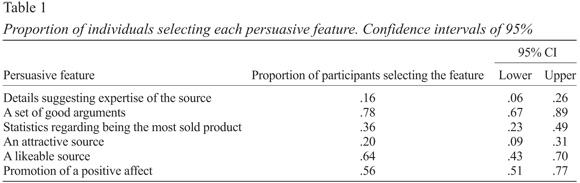
<body><![CDATA[<p><b>Results</b></p>     <p>We first analyze participants&rsquo; selection of the most persuasive features to understand if their preference distinguishes between more  experiential <i>versus</i> more cognitive persuasive features.    <p>     <p>&nbsp;</p>     <p><i>Preference for persuasive features</i></p>     <p>Participants varied in the number of selections made, being the minimum 1 and maximum 6. On average, participants selected around 3 features  (<i>M</i>=2.67, <i>SD</i>=1.45).    <p>     <p>The proportion with which participants selected these features suggests that some might have more persuasive power than others. As  <a href="#t1">Table 1</a> shows, the &ldquo;<i>A set of good arguments</i>&rdquo; was the most chosen one. However, despite the fact that 78% of  participants chose this feature, it is relevant to keep in mind that 22% of participants did not choose this feature. The next ad features  perceived as more relevant were both &ldquo;<i>A likeable person presenting the product</i>&rdquo; and the fact that the &ldquo;<i>ad made people  feel good</i>&rdquo;.    <p>     <p>&nbsp;</p>     ]]></body>
<body><![CDATA[<p><a name="t1"></a></p>     <p><img src="/img/revistas/aps/v34n1/34n1a06t1.jpg" width="580" height="183"></p>     
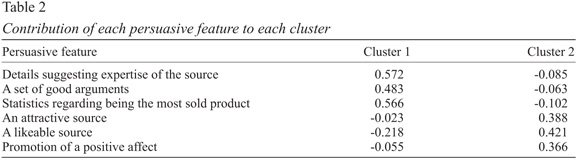
<p>&nbsp;</p>     <p>To understand if these selections translated differences in the experiential <i>versus</i> cognitive nature of each persuasive feature, we  analyzed if participants clustered their selections in those two groups. A <i>k</i>-means clustering analysis was performed in the Statistica  software, over the matrix of Euclidean distances of these data to understand if the persuasive features divided into groups that provide  categorical structure to participants&rsquo; selections. The analysis revealed that participants tended to jointly select the first three features  and the last two features presented on <a href="#t2">Table 2</a>, corroborating their different nature. The two clusters match our hypothetical  cognitive (Cluster 1) <i>versus </i>experiential dimension (Cluster 2). Because of that, we named cluster 1 as &ldquo;cognitive features&rdquo; and  cluster 2 as &ldquo;experiential features&rdquo;.    <p>     <p>&nbsp;</p>     <p><a name="t2"></a></p>     <p><img src="/img/revistas/aps/v34n1/34n1a06t2.jpg" width="578" height="160"></p>     
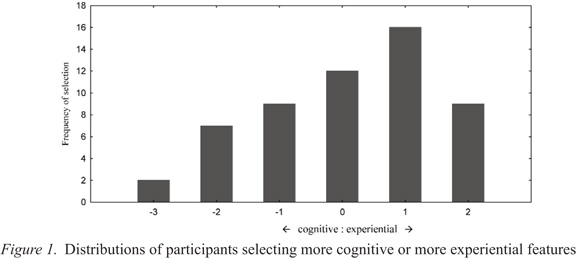
<p>&nbsp;</p>     <p>The derivation of clusters was followed by statistical comparisons of each cluster using each of the variables that support their separation.  None of those tests was statistically significant (all .06&lt;<i>p</i>&lt;.30) suggesting that participants did not use a pure strategy of agreeing  with a set of features and disagreeing with the other set. Because of that, we created an individual variable representing the discrepancy between  the strategy each individual followed as one that relies more on one type or another type of items. This was done by subtracting the selected  number of experiential features from the number of more objective features. A score of -3 states that the participant only selected features from  cluster 1 (cognitive), a score of 3 states that participants only selected features from cluster 2 (experiential) and a score of zero that they  equilibrated their selection along both clusters. <a href="#f1">Figure 1</a> makes clear the previous selection distribution, showing that more  participants perceived experiential features to be powerful persuasive tools than more cognitive features.    ]]></body>
<body><![CDATA[<p>     <p>&nbsp;</p>     <p><a name="f1"></a></p>     <p><img src="/img/revistas/aps/v34n1/34n1a06f1.jpg" width="577" height="259"></p>     
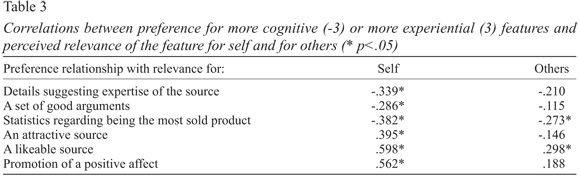
<p>&nbsp;</p>     <p>The relevance of this new variable in representing <i>preference for one type or another type of features</i> is attested by its relationship  with how participants rated their relevance in influencing both the self and other people. <a href="#t3">Table 3</a> shows that the preference for  more experiential or more cognitive feature is congruently related with the ratings of perceived relevance of each strategy for self: reflecting  the clustering, the relationship is negative for the first set of items and positive for the second set. Participants&rsquo; preference for one or  another type of features is not reflected in what they perceived as relevant to convince others. These data reflect typical self-others differences  that are discussed bellow.    <p>     <p>&nbsp;</p>     <p><a name="t3"></a></p>     <p><img src="/img/revistas/aps/v34n1/34n1a06t3.jpg" width="580" height="176"></p>     
]]></body>
<body><![CDATA[<p>&nbsp;</p>     <p>&nbsp;</p>     <p><i>Dispositional differences in processing style and beliefs in affect as information</i></p>     <p>Individual differences in processing styles were represented by separate means computed for NFC and FI. These indexes demonstrated good internal  consistency (NFC: Cronbach&rsquo;s alpha=.82; FI: Cronbach&rsquo;s alpha=.77). The highest score is 5 and the lowest is 1, with higher scores in  the NFC scale indicative of higher levels of rationality, and higher scores in the FI scale indicative of higher levels of intuition. The general  mean of NFC was 3.54 (<i>SD</i>=0.49) and for FI was 3.41 (<i>SD</i>=0.72). As expected (e.g., Pacini &amp; Epstein, 1999), the two constructs  showed no significant correlation (<i>r</i>=.02, <i>p</i>&gt;.50).    <p>     <p>We found also variability (<i>SD</i>=1.74) in the ratings of how much participants believed that affect informs about goodness, being the  general mean above the middle point of the scale (<i>M</i>=4.70). Although it could be expected that beliefs in affect as information were  independent of individuals&rsquo; NFC (<i>r</i>=.09, <i>p</i>&gt;.50.) we also found them to be independent of FI scores (<i>r</i>=.16,  <i>p</i>&gt;.50). This suggests that the tendency to rely on intuition (measured through the FI scale), and hence on experiential processing, may  not be the determinant of how much affect is thought to inform about goodness. To state this, we have to consider that perhaps the dispositional  tendency of participants is a compound of the two processing modes, and consequently that only participants with high FI and low NFC would endorse  such type of belief. To understand if this is the case, we computed a regression model where not only NFC and FI were predictors of belief  regarding affect as information, but also the interaction between the two variables (NFC x FI). Again, this component did not show a relationship  with such belief [&beta;=-1.10, <i>SD</i>=.58, <i>t</i>(53)=-.70, <i>p</i>=.50], suggesting that those beliefs are independent of any processing  tendencies people have.    <p>     <p>&nbsp;</p>     <p><i>Relationship between dispositional features and preference for persuasive features</i></p>     <p>To test our hypothesis, we correlated participants&rsquo; dispositional processing tendencies and beliefs about affect as information with their  preferences for more cognitive or experiential persuasive features.    ]]></body>
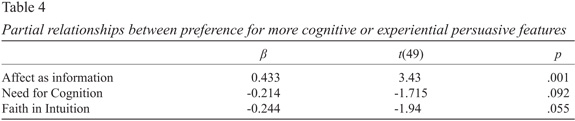
<body><![CDATA[<p>     <p>Results regarding the relationship between the three characteristics and preference for experiential and objective features were only clear for  the belief in &ldquo;affect as information&rdquo;. As expected, participants with higher belief in affect as information were more likely to  endorse the experiential set of persuasive features (<i>r</i>=.375, <i>p</i>&lt;.05). No significant relationship was found regarding NFC  (<i>r</i>=-.182, <i>p</i>&gt;.05) and, surprisingly, FI (<i>r</i>=-.180, <i>p</i>&gt;.05) and the interaction between the two factors  (<i>r</i><Sub><i>p</i></Sub>=-.25, <i>p</i>&gt;.05).    <p>     <p>We further explored these relations with all the predictors associated with a same regression model. The partial relationship of NFC and FI with  preference for persuasive features, was marginally significant (see <a href="#t4">Table 4</a>). Those relationships suggest that not only those  with high NFC prefer more cognitive features as also those with high FI.    <p>     <p>&nbsp;</p>     <p><a name="t4"></a></p>     <p><img src="/img/revistas/aps/v34n1/34n1a06t4.jpg" width="575" height="121"></p>     
<p>&nbsp;</p>     <p>&nbsp;</p>     ]]></body>
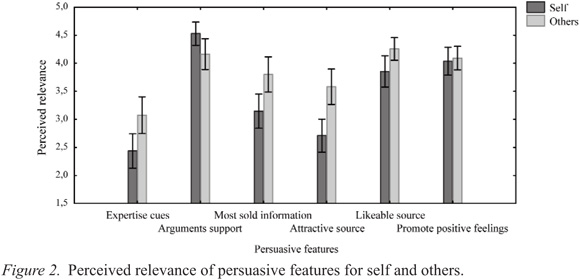
<body><![CDATA[<p><i>Self-others differences in perceived relevance of persuasive features</i></p>     <p>Our hypothesis framed the effect of participants&rsquo; beliefs on the ratings regarding the self. However, because the effect can be more  general, ratings of self and others were compared. As reported in the introduction, we also expect general self-others differences to occur,  reflecting bias blind spots and/third person effects.    <p>     <p>Ratings of relevance of each feature for self and others were analyzed within a repeated-measures ANOVA 2 (self-others) x 6 (persuasive  features). A self-others difference effect was found, <i>F</i>(1,54)=22.19, <i>p</i>&lt;.001, <i>&eta;<Sup>2</Sup><Sub>p</i></Sub>=0.30, showing  that all features were perceived to be more relevant to convince others [<i>M</i>=3.83, 95% CI(3.49, 4.16)] than the self [<i>M</i>=3.45, 95%  CI(3.12, 3.78)]. The different perceived relevance of each persuasive feature, <i>F</i>(5,270)=33.38, <i>p</i>&lt;.001,  <i>&eta;<Sup>2</Sup><Sub>p</i></Sub>=0.38, impacted self-others differences, promoting an interaction between the two factors,  <i>F</i>(5,270)=8.64, <i>p</i>&lt;.001, <i>&eta;<Sup>2</Sup><Sub>p</i></Sub>=0.14 (see <a href="#f2">Figure 2</a>). Replicating previous results  (Garcia-Marques &amp; Loureiro, 2015), self-others differences were only found regarding features with which people disagree, decreasing for  features they do not disagree with. The two clusters of persuasive features did not explain any variance of self-others differences (contrasts:  <i>p</i>&gt;.05).    <p>     <p>&nbsp;</p>     <p><a name="f2"></a></p>     <p><img src="/img/revistas/aps/v34n1/34n1a06f2.jpg" width="580" height="280"></p>     
<p>&nbsp;</p>     <p>But all individual features impacted the magnitude of the self-others difference. When introduced as continuous predictors of the perceived  relevance of each persuasive feature in the previous ANOVA, results suggest that each individual characteristic modulates self-others difference.  Belief in affect as information interacted with the self <i>versus</i> others factor, <i>F</i>(49)=6.14, <i>p</i>=.020,  <i>&eta;<Sup>2</Sup><Sub>p</i></Sub>=0.11, in the way that those who believe more in affect as information reported less self-others differences.  Regarding NFC and FI, the NFC interaction, <i>F</i>(49)=15.63, <i>p</i>&lt;.001, <i>&eta;<Sup>2</Sup><Sub>p</i></Sub>=0.24, suggests that  participants higher in NFC showed greater self-others differences, and the FI interaction, <i>F</i>(49)=6.13, <i>p</i>=.020,  <i>&eta;<Sup>2</Sup><Sub>p</i></Sub>=0.11, suggests that participants with more FI showed greater self-others differences. No other effects  regarding these variables were significant in this analysis.    ]]></body>
<body><![CDATA[<p>     <p>&nbsp;</p>     <p><b>Discussion</b></p>     <p>The purpose of this study was to investigate the relevance of individual differences in the belief that affect informs about the goodness of a  product or a claim. In particular, we aimed to investigate whether this belief impacts the perceived power of more cognitive <i>versus</i> more  experiential persuasive features. Further, we aimed to investigate the role of personality, regarding processing styles, in these effects.    <p>     <p>Results showed that, as expected, persuasive features were perceived to be either more cognitive or more experiential leading participants to  prefer either more one or another set. This preference was mainly determined by the belief in how much affect informs about the goodness of a  claim.    <p>     <p>Unexpectedly, processing styles did not influence how much participants believed in affect as information. And when this belief was controlled  for its influence in features&rsquo; selection, both high FI and high NFC participants seemed to show a higher preference for more cognitive  features than for experiential features.    <p>     <p>The literature has systematically shown that people use affect as information especially when they lack the ability and motivation to think  about the issues being considered (Albarrac&iacute;n et al., 2003; Clore, Schwarz, &amp; Conway, 1994; Petty, Schumann, Richman, &amp; Strathman,  1993). Thus low NFC participants are expected to use more the affect as information heuristic compared to high NFC participants (Batra &amp;  Stayman, 1990; Petty et al., 1993). However, what our data seem to suggest is that such effect does not occur because low NFC participants vary in  the way they believe their feelings are a sound basis for their judgment. Consequently, and conversely, what may happen is that a set of high NFC  participants (those who believe in affect as information) are the ones who are more likely to be influenced by affect when it is not attributed to  an irrelevant cause.    ]]></body>
<body><![CDATA[<p>     <p>Because participants who have more faith in intuition are the ones expected to engage in a processing that anchors on affect, we hypothesized  that this dispositional feature would predict how much participants believe in affect as information. However, this was not the case, suggesting  that the implicit nature of processing on the basis of affect does not necessarily translate in an explicit recognition that that is happening (see  Hofmann, Gawronski, Gschwendner, Le, &amp; Schmitt, 2005 for a meta-analysis of the dissociation between implicit and explicit process and  measures). Future studies should address if conditions that favor the link between implicit and explicit measures moderate this effect.    <p>     <p>Here we made clear that, as suggested by Gasper and Clore (1998), the perceived informational value of affective cues is likely to be a highly  relevant individual variable. In our experiment, this individual difference predicted how participants evaluated the efficiency of more or less  experiential persuasive features, suggesting that in conditions where people have the capacity to engage in the metacognitive process of deciding  about the informativeness of an affective experience, only those how belief in affect as information will rely on it. Future research should,  however, address this hypothesis overcoming some limitations of our own. We suggest those future studies to develop a more reliable measure of  belief in affect as information; to manipulation processing conditions (instead of merely measuring participants&rsquo; individual tendencies) and  to pre-test each persuasive cue in how they are perceived, as more affect/experiential or more cognitive/rational.    <p>     <p>It is relevant to clarify that the construct of believing in affect as information is different from the construct of Need for Affect (Maio  &amp; Esses, 2001) or Need for Emotion (Raman, Chattopadhyay, &amp; Hoyer, 1995; Sojka &amp; Giese, 1997) in the way that it does not focus a  &ldquo;motivation to approach or avoid emotion-inducing situations&rdquo; nor a &ldquo;tendency of individuals to seek and enjoy emotional  situations&rdquo;, respectively. It simple states how much informativity about the goodness of stimuli people expect to be extracted from their  subjective affective experiences. However, it will be a future direction to address how these and other concepts that grasp emotional ability  (Mayer &amp; Salovey, 1993; Salovey &amp; Mayer, 1990) can relate with this belief. It could be hypothesized that people with more skills to  perceive, regulate, utilize, and express emotions are also those who believe more that affect has an informative power.    <p>     <p>&nbsp;</p>     <p><i>Na&iuml;ve theories of persuasion</i></p>     <p>Our data is also relevant to the persuasion field in the sense that it informs about variables that are likely to impact our na&iuml;ve or  personal theories of persuasion. These theories encompass individuals&rsquo; beliefs about persuasion and how persuasive strategies impact their  and others&rsquo; attitudes and should be distinguished from the implicit theories that rule individuals&rsquo; judgments and decisions in a  persuasive setting (see Wegener &amp; Petty, 1998 for a discussion). Na&iuml;ve theories have a more explicit nature in the sense that they are the  ones that are able to be communicated to others, reflecting how we consciously understand the impact of a set of variables in a persuasive context  (Friestad &amp; Wright, 1994).    ]]></body>
<body><![CDATA[<p>     <p>Roskos-Ewoldsen (1997) addressed social shared structures of perceived efficiency of different persuasive tactics or strategies. He concluded  these are cognitively represented along two dimensions: (1) association strategies (e.g., appeals to consensus, reference to a trustworthy person)  <i>versus</i> message oriented strategies (e.g., using high quality arguments, use of rhetorical questions); and (2) the social acceptability of a  persuasive strategy (e.g., fear appeal, insult <i>versus</i> self as an expert, reference to empirical studies). The social acceptability of a  strategy can be understood as overlapping with the more experiential <i>versus</i> more cognitive dimensions that we assumed to underlie the  persuasive features presented in our experiment. This overlap should be addressed in future studies having in mind the fact that beliefs about  affect as information can create differences in how individuals structure those strategies.    <p>     <p>Knowledge about persuasive intents are likely to activate our na&iuml;ve theories, modulating our reactions to persuasive contexts. For example,  Campbell and Kirmani (2000) showed that the likeability of a salesperson is interpreted either as a tactic designed to persuade the consumer or a  sincere comment, dependent upon the knowledge about the persuasive intent. Wilson, Houston and Meyers (1998) showed that our beliefs about being  more or less successful in resisting supra <i>versus</i> subliminal messages can lead people to be differently exposed to them. And Bri&ntilde;ol,  Rucker and Petty (2015) showed that the perceived general meaning of persuasion as something good (e.g., information, democracy) or bad (e.g.,  deception, propaganda) modulates persuasion, influencing the amount of message elaboration consumers engage in. The evidence provided here, that  beliefs about affect as information are able to modulate what we perceive as efficient or inefficient in changing our attitudes, offer a new factor  able to explain some of the observed variance associated with those effects.    <p>     <p>&nbsp;</p>     <p><i>Self-others differences</i></p>     <p>A last reference regarding the evidence found in our data about differences between the persuasive features&rsquo; perceived relevance in  convincing the self and others is necessary.    <p>     <p>Perceived differences between self and others in their susceptibility to persuasion have been detected in several studies and are known as the  third person effect (see Paul, Salwen, &amp; Dupagne, 2000; Perloff, 1993, 1996, 2002). In a previous study, we (Garcia-Marques &amp; Loureiro,  2015) showed these differences to occur when participants were asked about how much they agreed with being influenced by a set of persuasive  features. Results showed that self-others differences were only found for features which people disagree with, decreasing for features they do not  disagree with. Here, we replicate those results having as a dependent measure the relevance participants perceived for each feature to convince the  self and others. In some way, these self-others differences seem to occur as bias blind-spot effects, suggesting that individuals perceive  themselves to be less biased by some persuasive features than others.    ]]></body>
<body><![CDATA[<p>     <p>The impact of individual differences in NFC and FI over self-others perceived differences, suggests that the mechanism through which these  differences occur may be a complex one. Both people who like to think as well as those who trust their intuitions report ratings that reflect  self-others differences. Interestingly, they occur more in people who do not rely on affect as information. This may suggest that the observed  differences may themselves translate differences in perceiving others as relying more in affect as information than the self. A hypothesis that is  worthwhile to be explored in future studies.    <p>     <p>&nbsp;</p>     <p><b>References</b></p>     <!-- ref --><p>Albarrac&iacute;n, D., &amp; Kumkale, G. T. (2003). Affect as information in persuasion: Influences on attitudes and beliefs. <i>Journal of  Personality and Social Psychology, 84</i>, 453-469.    &nbsp;&nbsp;&nbsp;&nbsp;&nbsp;&nbsp;&nbsp;&nbsp;[&#160;<a href="javascript:void(0);" onclick="javascript: window.open('/scielo.php?script=sci_nlinks&ref=019702&pid=S0870-8231201600010000600001&lng=','','width=640,height=500,resizable=yes,scrollbars=1,menubar=yes,');">Links</a>&#160;]<!-- end-ref --><p>     <!-- ref --><p>Albarrac&iacute;n, D., McNatt, P. S., Klein, C., Ho, R., Mitchell, A., &amp; Kumkale, G. T. (2003). Persuasive communications to change actions:  An analysis of behavioral and cognitive impact in HIV prevention. <i>Health Psychology, 22</i>, 166-177.    &nbsp;&nbsp;&nbsp;&nbsp;&nbsp;&nbsp;&nbsp;&nbsp;[&#160;<a href="javascript:void(0);" onclick="javascript: window.open('/scielo.php?script=sci_nlinks&ref=019704&pid=S0870-8231201600010000600002&lng=','','width=640,height=500,resizable=yes,scrollbars=1,menubar=yes,');">Links</a>&#160;]<!-- end-ref --><p>     <!-- ref --><p>Avnet, T., &amp; Pham, M. T. (2007). <i>Should I trust my feelings or not?. The metacognition of affect as information in judgment</i>.  Unpublished manuscript, Columbia University, New York.    &nbsp;&nbsp;&nbsp;&nbsp;&nbsp;&nbsp;&nbsp;&nbsp;[&#160;<a href="javascript:void(0);" onclick="javascript: window.open('/scielo.php?script=sci_nlinks&ref=019706&pid=S0870-8231201600010000600003&lng=','','width=640,height=500,resizable=yes,scrollbars=1,menubar=yes,');">Links</a>&#160;]<!-- end-ref --><p>     <!-- ref --><p>Batra, R., &amp; Stayman, D. M. (1990). The role of mood in advertising effectiveness. <i>Journal of Consumer Research, 17</i>, 203-214.    &nbsp;&nbsp;&nbsp;&nbsp;&nbsp;&nbsp;&nbsp;&nbsp;[&#160;<a href="javascript:void(0);" onclick="javascript: window.open('/scielo.php?script=sci_nlinks&ref=019708&pid=S0870-8231201600010000600004&lng=','','width=640,height=500,resizable=yes,scrollbars=1,menubar=yes,');">Links</a>&#160;]<!-- end-ref --><p>     <!-- ref --><p>Bri&ntilde;ol, P., &amp; Petty, R. E. (2005). Individual differences in persuasion. In D. Albarrac&iacute;n, B. T. Johnson, &amp; M. P. Zanna  (Eds.), <i>The handbook of attitudes and attitude change</i> (pp. 575-616). Hillsdale, NJ: Erlbaum.    &nbsp;&nbsp;&nbsp;&nbsp;&nbsp;&nbsp;&nbsp;&nbsp;[&#160;<a href="javascript:void(0);" onclick="javascript: window.open('/scielo.php?script=sci_nlinks&ref=019710&pid=S0870-8231201600010000600005&lng=','','width=640,height=500,resizable=yes,scrollbars=1,menubar=yes,');">Links</a>&#160;]<!-- end-ref --><p>     <!-- ref --><p>Bri&ntilde;ol, P., Rucker, D. D., &amp; Petty, R. E. (2015). Na&iuml;ve theories about persuasion: Implication for information processing and  consumer attitude change. <i>International Journal of Advertising, 34</i>, 85-106.    &nbsp;&nbsp;&nbsp;&nbsp;&nbsp;&nbsp;&nbsp;&nbsp;[&#160;<a href="javascript:void(0);" onclick="javascript: window.open('/scielo.php?script=sci_nlinks&ref=019712&pid=S0870-8231201600010000600006&lng=','','width=640,height=500,resizable=yes,scrollbars=1,menubar=yes,');">Links</a>&#160;]<!-- end-ref --><p>     <!-- ref --><p>Cacioppo, J., &amp; Petty, R. (1982). The need for cognition. <i>Journal of Personality and Social Psychology, 42</i>, 116-131.    &nbsp;&nbsp;&nbsp;&nbsp;&nbsp;&nbsp;&nbsp;&nbsp;[&#160;<a href="javascript:void(0);" onclick="javascript: window.open('/scielo.php?script=sci_nlinks&ref=019714&pid=S0870-8231201600010000600007&lng=','','width=640,height=500,resizable=yes,scrollbars=1,menubar=yes,');">Links</a>&#160;]<!-- end-ref --><p>     <p>Campbell, M., &amp; Kirmani, A. (2000). Consumers&rsquo; use of persuasion knowledge: The effects of accessibility and cognitive capacity on  perceptions of an influence agent. <i>Journal of Consumer Research, 27</i>, 69-83.    ]]></body>
<body><![CDATA[<p>     <!-- ref --><p>Chaiken, S., &amp; Stangor, C. (1987). Attitudes and attitude change. <i>Annual Review of Psychology, 38</i>, 575-630.    &nbsp;&nbsp;&nbsp;&nbsp;&nbsp;&nbsp;&nbsp;&nbsp;[&#160;<a href="javascript:void(0);" onclick="javascript: window.open('/scielo.php?script=sci_nlinks&ref=019718&pid=S0870-8231201600010000600009&lng=','','width=640,height=500,resizable=yes,scrollbars=1,menubar=yes,');">Links</a>&#160;]<!-- end-ref --><p>     <!-- ref --><p>Childers, T., Houston, M., &amp; Heckler, S. (1985). Measurement of individual differences in visual <i>versus </i>verbal information  processing. <i>Journal of Consumer Behavior, 12</i>, 125-134.    &nbsp;&nbsp;&nbsp;&nbsp;&nbsp;&nbsp;&nbsp;&nbsp;[&#160;<a href="javascript:void(0);" onclick="javascript: window.open('/scielo.php?script=sci_nlinks&ref=019720&pid=S0870-8231201600010000600010&lng=','','width=640,height=500,resizable=yes,scrollbars=1,menubar=yes,');">Links</a>&#160;]<!-- end-ref --><p>     <!-- ref --><p>Ciarrochi, J., &amp; Forgas, J. (2000). The pleasure of possessions: Affective influences and personality in the evaluation of consumer items.  <i>European Journal of Social Psychology, 30</i>, 631-649.    &nbsp;&nbsp;&nbsp;&nbsp;&nbsp;&nbsp;&nbsp;&nbsp;[&#160;<a href="javascript:void(0);" onclick="javascript: window.open('/scielo.php?script=sci_nlinks&ref=019722&pid=S0870-8231201600010000600011&lng=','','width=640,height=500,resizable=yes,scrollbars=1,menubar=yes,');">Links</a>&#160;]<!-- end-ref --><p>     <p>Clore, G., Schwarz, N., &amp; Conway, M. (1994). Affective causes and consequences of social information processing. In R. S. Wyer &amp; T. K.  Srull (Eds.), <i>Handbook of social cognition</i> (2<Sup>nd</Sup> ed., Vol. 1, pp. 323-418). Hillsdale, NJ: Erlbaum.    <p>     <!-- ref --><p>Costa, P., &amp; McCrae, R. (1985). <i>The NEO Personality Inventory manual</i>. Odessa, FL: Psychological Assessment Resources.    &nbsp;&nbsp;&nbsp;&nbsp;&nbsp;&nbsp;&nbsp;&nbsp;[&#160;<a href="javascript:void(0);" onclick="javascript: window.open('/scielo.php?script=sci_nlinks&ref=019726&pid=S0870-8231201600010000600013&lng=','','width=640,height=500,resizable=yes,scrollbars=1,menubar=yes,');">Links</a>&#160;]<!-- end-ref --><p>     <!-- ref --><p>Davison, W. P. (1983). The third-person effect in communication. <i>Public Opinion Quaterly, 47</i>, 1-15.    &nbsp;&nbsp;&nbsp;&nbsp;&nbsp;&nbsp;&nbsp;&nbsp;[&#160;<a href="javascript:void(0);" onclick="javascript: window.open('/scielo.php?script=sci_nlinks&ref=019728&pid=S0870-8231201600010000600014&lng=','','width=640,height=500,resizable=yes,scrollbars=1,menubar=yes,');">Links</a>&#160;]<!-- end-ref --><p>     <!-- ref --><p>Epstein, S. (1994). Integration of the cognitive and the psychodynamic unconscious. <i>American Psychologist, 49</i>, 709-724.    &nbsp;&nbsp;&nbsp;&nbsp;&nbsp;&nbsp;&nbsp;&nbsp;[&#160;<a href="javascript:void(0);" onclick="javascript: window.open('/scielo.php?script=sci_nlinks&ref=019730&pid=S0870-8231201600010000600015&lng=','','width=640,height=500,resizable=yes,scrollbars=1,menubar=yes,');">Links</a>&#160;]<!-- end-ref --><p>     <!-- ref --><p>Epstein, S., Pacini, R., Denes-Raj, V., &amp; Heier, H. (1996). Individual differences in Intuitive-Experiential and Analytical-Rational  Thinking Styles. <i>Journal of Personality and Social Psychology, 71</i>, 390-405.    &nbsp;&nbsp;&nbsp;&nbsp;&nbsp;&nbsp;&nbsp;&nbsp;[&#160;<a href="javascript:void(0);" onclick="javascript: window.open('/scielo.php?script=sci_nlinks&ref=019732&pid=S0870-8231201600010000600016&lng=','','width=640,height=500,resizable=yes,scrollbars=1,menubar=yes,');">Links</a>&#160;]<!-- end-ref --><p>     <!-- ref --><p>Friestad, M., &amp; Wright, P. (1994). The persuasion knowledge model: How people cope with persuasion attempts. <i>Journal of Consumer  Research, 21</i>, 1-31.    &nbsp;&nbsp;&nbsp;&nbsp;&nbsp;&nbsp;&nbsp;&nbsp;[&#160;<a href="javascript:void(0);" onclick="javascript: window.open('/scielo.php?script=sci_nlinks&ref=019734&pid=S0870-8231201600010000600017&lng=','','width=640,height=500,resizable=yes,scrollbars=1,menubar=yes,');">Links</a>&#160;]<!-- end-ref --><p>     <p>Garcia-Marques, T., &amp; Loureiro, F. (2015). <i>Explicit agreement with the use of persuasion heuristics</i>. Poster presented at the  16<Sup>th</Sup> Annual Meeting of the Society for Personality and Social Psychology (SPSP), Long Beach, USA.    ]]></body>
<body><![CDATA[<p>     <!-- ref --><p>Gasper, K., &amp; Clore, G. (1998). The persistent use of negative affect by anxious individuals to estimate risk. <i>Journal of Personality and  Social Psychology, 74</i>, 1350-1363.    &nbsp;&nbsp;&nbsp;&nbsp;&nbsp;&nbsp;&nbsp;&nbsp;[&#160;<a href="javascript:void(0);" onclick="javascript: window.open('/scielo.php?script=sci_nlinks&ref=019738&pid=S0870-8231201600010000600019&lng=','','width=640,height=500,resizable=yes,scrollbars=1,menubar=yes,');">Links</a>&#160;]<!-- end-ref --><p>     <!-- ref --><p>Gasper, K., &amp; Clore, G. (2000). Do you have to pay attention to your feelings to be influenced by them?. <i>Personality and Social  Psychology Bulletin, 26</i>, 698-711.    &nbsp;&nbsp;&nbsp;&nbsp;&nbsp;&nbsp;&nbsp;&nbsp;[&#160;<a href="javascript:void(0);" onclick="javascript: window.open('/scielo.php?script=sci_nlinks&ref=019740&pid=S0870-8231201600010000600020&lng=','','width=640,height=500,resizable=yes,scrollbars=1,menubar=yes,');">Links</a>&#160;]<!-- end-ref --><p>     <!-- ref --><p>Greifeneder, R. (2007). <i>Reliance on accessibility experiences in judgment and decision making</i>. Lengerich: Pabst Science Publishers.    &nbsp;&nbsp;&nbsp;&nbsp;&nbsp;&nbsp;&nbsp;&nbsp;[&#160;<a href="javascript:void(0);" onclick="javascript: window.open('/scielo.php?script=sci_nlinks&ref=019742&pid=S0870-8231201600010000600021&lng=','','width=640,height=500,resizable=yes,scrollbars=1,menubar=yes,');">Links</a>&#160;]<!-- end-ref --><p>     <!-- ref --><p>Greifeneder, R., Bless, H., &amp; Pham, M. (2011). When do people rely on affective and cognitive feelings in judgment?. A review.  <i>Personality and Social Psychology Review, 15</i>, 107-141.    &nbsp;&nbsp;&nbsp;&nbsp;&nbsp;&nbsp;&nbsp;&nbsp;[&#160;<a href="javascript:void(0);" onclick="javascript: window.open('/scielo.php?script=sci_nlinks&ref=019744&pid=S0870-8231201600010000600022&lng=','','width=640,height=500,resizable=yes,scrollbars=1,menubar=yes,');">Links</a>&#160;]<!-- end-ref --><p>     <!-- ref --><p>Haddock, G., Zanna, M., &amp; Esses, V. (1994). Mood and the expression of intergroup attitudes: The moderating effect of affect intensity.  <i>European Journal of Social Psychology, 24</i>, 189-205.    &nbsp;&nbsp;&nbsp;&nbsp;&nbsp;&nbsp;&nbsp;&nbsp;[&#160;<a href="javascript:void(0);" onclick="javascript: window.open('/scielo.php?script=sci_nlinks&ref=019746&pid=S0870-8231201600010000600023&lng=','','width=640,height=500,resizable=yes,scrollbars=1,menubar=yes,');">Links</a>&#160;]<!-- end-ref --><p>     <!-- ref --><p>Hofmann, W., Gawronski, B., Gschwendner, T., Le, H., &amp; Schmitt, M. (2005). A meta-analysis on the correlation between the Implicit  Association Test and explicit self-report measures. <i>Personality and Social Psychology Bulletin, 31</i>, 1369-1385.    &nbsp;&nbsp;&nbsp;&nbsp;&nbsp;&nbsp;&nbsp;&nbsp;[&#160;<a href="javascript:void(0);" onclick="javascript: window.open('/scielo.php?script=sci_nlinks&ref=019748&pid=S0870-8231201600010000600024&lng=','','width=640,height=500,resizable=yes,scrollbars=1,menubar=yes,');">Links</a>&#160;]<!-- end-ref --><p>     <!-- ref --><p>Larsen, R., &amp; Diener, E. (1987). Affect intensity as an individual difference characteristic: A review. <i>Journal of Research in  Personality, 21</i>, 1-39.    &nbsp;&nbsp;&nbsp;&nbsp;&nbsp;&nbsp;&nbsp;&nbsp;[&#160;<a href="javascript:void(0);" onclick="javascript: window.open('/scielo.php?script=sci_nlinks&ref=019750&pid=S0870-8231201600010000600025&lng=','','width=640,height=500,resizable=yes,scrollbars=1,menubar=yes,');">Links</a>&#160;]<!-- end-ref --><p>     <!-- ref --><p>Maio, G. R., &amp; Esses, V. M. (2001). The need for affect: Individual differences in the motivation to approach and avoid emotions. <i>Journal  of Personality, 69</i>, 583-614.    &nbsp;&nbsp;&nbsp;&nbsp;&nbsp;&nbsp;&nbsp;&nbsp;[&#160;<a href="javascript:void(0);" onclick="javascript: window.open('/scielo.php?script=sci_nlinks&ref=019752&pid=S0870-8231201600010000600026&lng=','','width=640,height=500,resizable=yes,scrollbars=1,menubar=yes,');">Links</a>&#160;]<!-- end-ref --><p>     <!-- ref --><p>Mayer, J., &amp; Salovey, P. (1993). The intelligence of emotional intelligence. <i>Intelligence, 17</i>, 433-442.    &nbsp;&nbsp;&nbsp;&nbsp;&nbsp;&nbsp;&nbsp;&nbsp;[&#160;<a href="javascript:void(0);" onclick="javascript: window.open('/scielo.php?script=sci_nlinks&ref=019754&pid=S0870-8231201600010000600027&lng=','','width=640,height=500,resizable=yes,scrollbars=1,menubar=yes,');">Links</a>&#160;]<!-- end-ref --><p>     <!-- ref --><p>Pacini, R., &amp; Epstein, S. (1999). The relation of rational and experiential information processing styles to personality, basic beliefs, and  the ratio-bias phenomenon. <i>Journal of Personality and Social Psychology, 76</i>, 972-987.    &nbsp;&nbsp;&nbsp;&nbsp;&nbsp;&nbsp;&nbsp;&nbsp;[&#160;<a href="javascript:void(0);" onclick="javascript: window.open('/scielo.php?script=sci_nlinks&ref=019756&pid=S0870-8231201600010000600028&lng=','','width=640,height=500,resizable=yes,scrollbars=1,menubar=yes,');">Links</a>&#160;]<!-- end-ref --><p>     <!-- ref --><p>Paul, B., Salwen, M., &amp; Dupagne, M. (2000). The third-person effect: A meta-analysis of the perceptual hypothesis. <i>Mass Communication  &amp; Society, 3</i>, 57-85.    &nbsp;&nbsp;&nbsp;&nbsp;&nbsp;&nbsp;&nbsp;&nbsp;[&#160;<a href="javascript:void(0);" onclick="javascript: window.open('/scielo.php?script=sci_nlinks&ref=019758&pid=S0870-8231201600010000600029&lng=','','width=640,height=500,resizable=yes,scrollbars=1,menubar=yes,');">Links</a>&#160;]<!-- end-ref --><p>     <!-- ref --><p>Perloff, R. (1993). Third-person effect research 1983-1992: A review and synthesis. <i>International Journal of Public Opinion Research,  7</i>, 167-184.    &nbsp;&nbsp;&nbsp;&nbsp;&nbsp;&nbsp;&nbsp;&nbsp;[&#160;<a href="javascript:void(0);" onclick="javascript: window.open('/scielo.php?script=sci_nlinks&ref=019760&pid=S0870-8231201600010000600030&lng=','','width=640,height=500,resizable=yes,scrollbars=1,menubar=yes,');">Links</a>&#160;]<!-- end-ref --><p>     <!-- ref --><p>Perloff, R. (1996). Perceptions and conceptions of political media impact: The third-person effect and beyond. In A. N. Crigler (Ed.),  <i>The psychology of political communication</i>. Ann Arbor: Michigan University Press.    &nbsp;&nbsp;&nbsp;&nbsp;&nbsp;&nbsp;&nbsp;&nbsp;[&#160;<a href="javascript:void(0);" onclick="javascript: window.open('/scielo.php?script=sci_nlinks&ref=019762&pid=S0870-8231201600010000600031&lng=','','width=640,height=500,resizable=yes,scrollbars=1,menubar=yes,');">Links</a>&#160;]<!-- end-ref --><p>     <!-- ref --><p>Perloff, R. (2002). The Third-person Effect. In B. Jennings &amp; D. Zillman (Eds.), <i>Media effects: Advances in theory and research</i>.  Mahwah, NJ: Lawrence Erlbaum Associates.    &nbsp;&nbsp;&nbsp;&nbsp;&nbsp;&nbsp;&nbsp;&nbsp;[&#160;<a href="javascript:void(0);" onclick="javascript: window.open('/scielo.php?script=sci_nlinks&ref=019764&pid=S0870-8231201600010000600032&lng=','','width=640,height=500,resizable=yes,scrollbars=1,menubar=yes,');">Links</a>&#160;]<!-- end-ref --><p>     <!-- ref --><p>Petty, R., &amp; Cacioppo, J. (1983). Central and peripheral routes to persuasion: Application to advertising. In L. Percy &amp; A. Woodside  (Eds.), <i>Advertising and consumer psychology</i> (pp. 3-23). Lexington, MA: Lexington Books.    &nbsp;&nbsp;&nbsp;&nbsp;&nbsp;&nbsp;&nbsp;&nbsp;[&#160;<a href="javascript:void(0);" onclick="javascript: window.open('/scielo.php?script=sci_nlinks&ref=019766&pid=S0870-8231201600010000600033&lng=','','width=640,height=500,resizable=yes,scrollbars=1,menubar=yes,');">Links</a>&#160;]<!-- end-ref --><p>     <!-- ref --><p>Petty, R., &amp; Cacioppo, J. (1986). <i>Communication and persuasion: Central and peripheral routes to attitude change</i>. New York:  Springer-Verlag.    &nbsp;&nbsp;&nbsp;&nbsp;&nbsp;&nbsp;&nbsp;&nbsp;[&#160;<a href="javascript:void(0);" onclick="javascript: window.open('/scielo.php?script=sci_nlinks&ref=019768&pid=S0870-8231201600010000600034&lng=','','width=640,height=500,resizable=yes,scrollbars=1,menubar=yes,');">Links</a>&#160;]<!-- end-ref --><p>     <!-- ref --><p>Petty, R., Schumann, D., Richman, S., &amp; Strathman, A. (1993). Positive mood and persuasion: Different roles for affect under high and low  elaboration conditions. <i>Journal of Personality and Social Psychology, 64</i>, 5-20.    &nbsp;&nbsp;&nbsp;&nbsp;&nbsp;&nbsp;&nbsp;&nbsp;[&#160;<a href="javascript:void(0);" onclick="javascript: window.open('/scielo.php?script=sci_nlinks&ref=019770&pid=S0870-8231201600010000600035&lng=','','width=640,height=500,resizable=yes,scrollbars=1,menubar=yes,');">Links</a>&#160;]<!-- end-ref --><p>     <!-- ref --><p>Pham, M. (1998). Representativeness, relevance, and the use of feelings in decision-making. <i>Journal of Consumer Research, 25</i>, 144-159.    &nbsp;&nbsp;&nbsp;&nbsp;&nbsp;&nbsp;&nbsp;&nbsp;[&#160;<a href="javascript:void(0);" onclick="javascript: window.open('/scielo.php?script=sci_nlinks&ref=019772&pid=S0870-8231201600010000600036&lng=','','width=640,height=500,resizable=yes,scrollbars=1,menubar=yes,');">Links</a>&#160;]<!-- end-ref --><p>     <!-- ref --><p>Pronin, E., Gilovich, T., &amp; Ross, L. (2004). Objectivity in the eye of the beholder: Divergent perceptions of bias in self <i>versus</i>  others. <i>Psychological Review, 111</i>, 781-799.    &nbsp;&nbsp;&nbsp;&nbsp;&nbsp;&nbsp;&nbsp;&nbsp;[&#160;<a href="javascript:void(0);" onclick="javascript: window.open('/scielo.php?script=sci_nlinks&ref=019774&pid=S0870-8231201600010000600037&lng=','','width=640,height=500,resizable=yes,scrollbars=1,menubar=yes,');">Links</a>&#160;]<!-- end-ref --><p>     <!-- ref --><p>Pronin, E., Lin, D. Y., &amp; Ross, L. (2002). The bias blind-spot: Perceptions of bias in self <i>versus</i> others. <i>Personality and Social  Psychology Bulletin, 28</i>, 369-381.    &nbsp;&nbsp;&nbsp;&nbsp;&nbsp;&nbsp;&nbsp;&nbsp;[&#160;<a href="javascript:void(0);" onclick="javascript: window.open('/scielo.php?script=sci_nlinks&ref=019776&pid=S0870-8231201600010000600038&lng=','','width=640,height=500,resizable=yes,scrollbars=1,menubar=yes,');">Links</a>&#160;]<!-- end-ref --><p>     <!-- ref --><p>Puri, R. (1996). Measuring and modifying consumer impulsiveness: A cost-benefit accessibility framework. <i>Journal of Consumer Psychology,  5</i>, 87-114.    &nbsp;&nbsp;&nbsp;&nbsp;&nbsp;&nbsp;&nbsp;&nbsp;[&#160;<a href="javascript:void(0);" onclick="javascript: window.open('/scielo.php?script=sci_nlinks&ref=019778&pid=S0870-8231201600010000600039&lng=','','width=640,height=500,resizable=yes,scrollbars=1,menubar=yes,');">Links</a>&#160;]<!-- end-ref --><p>     <!-- ref --><p>Raman, N., Chattopadhyay, P., &amp; Hoyer, W. (1995). Do consumers seek emotional situations: The need for emotion scale. <i>Advances in  Consumer Research, 22</i>, 537-537.    &nbsp;&nbsp;&nbsp;&nbsp;&nbsp;&nbsp;&nbsp;&nbsp;[&#160;<a href="javascript:void(0);" onclick="javascript: window.open('/scielo.php?script=sci_nlinks&ref=019780&pid=S0870-8231201600010000600040&lng=','','width=640,height=500,resizable=yes,scrollbars=1,menubar=yes,');">Links</a>&#160;]<!-- end-ref --><p>     <!-- ref --><p>Roskos-Ewoldsen, D. (1997). Attitude accessibility and persuasion: Review and a transactive model. In B. Burleson (Ed.), <i>Communication  yearbook 20</i> (pp. 185-225). Beverly Hills, CA: Sage.    &nbsp;&nbsp;&nbsp;&nbsp;&nbsp;&nbsp;&nbsp;&nbsp;[&#160;<a href="javascript:void(0);" onclick="javascript: window.open('/scielo.php?script=sci_nlinks&ref=019782&pid=S0870-8231201600010000600041&lng=','','width=640,height=500,resizable=yes,scrollbars=1,menubar=yes,');">Links</a>&#160;]<!-- end-ref --><p>     <!-- ref --><p>Salovey, P., &amp; Mayer, J. (1990). Emotional intelligence. <i>Imagination, Cognition, and Personality, 9</i>, 185-211.    &nbsp;&nbsp;&nbsp;&nbsp;&nbsp;&nbsp;&nbsp;&nbsp;[&#160;<a href="javascript:void(0);" onclick="javascript: window.open('/scielo.php?script=sci_nlinks&ref=019784&pid=S0870-8231201600010000600042&lng=','','width=640,height=500,resizable=yes,scrollbars=1,menubar=yes,');">Links</a>&#160;]<!-- end-ref --><p>     <!-- ref --><p>Salovey, P., Mayer, J., Goldman, S., Turvey, C., &amp; Palfai, T. (1995). Emotional attention, clarity, and repair: Exploring emotional  intelligence using the Trait Meta-Mood Scale. In J. W. Pennebaker (Ed.), <i>Emotion, disclosure, and health</i> (pp. 125-154). Washington, DC:  American Psychological Association.    &nbsp;&nbsp;&nbsp;&nbsp;&nbsp;&nbsp;&nbsp;&nbsp;[&#160;<a href="javascript:void(0);" onclick="javascript: window.open('/scielo.php?script=sci_nlinks&ref=019786&pid=S0870-8231201600010000600043&lng=','','width=640,height=500,resizable=yes,scrollbars=1,menubar=yes,');">Links</a>&#160;]<!-- end-ref --><p>     <!-- ref --><p>Schwarz, N. (2004). Metacognitive experiences in consumer judgment and decision making. <i>Journal of Consumer Psychology, 14</i>, 332-348.    &nbsp;&nbsp;&nbsp;&nbsp;&nbsp;&nbsp;&nbsp;&nbsp;[&#160;<a href="javascript:void(0);" onclick="javascript: window.open('/scielo.php?script=sci_nlinks&ref=019788&pid=S0870-8231201600010000600044&lng=','','width=640,height=500,resizable=yes,scrollbars=1,menubar=yes,');">Links</a>&#160;]<!-- end-ref --><p>     <!-- ref --><p>Schwarz, N., &amp; Clore, G. (1983). Mood, misattribution, and judgments of well-being: Informative and directive functions of affective states.  <i>Journal of Personality and Social Psychology, 45</i>, 513-523.    &nbsp;&nbsp;&nbsp;&nbsp;&nbsp;&nbsp;&nbsp;&nbsp;[&#160;<a href="javascript:void(0);" onclick="javascript: window.open('/scielo.php?script=sci_nlinks&ref=019790&pid=S0870-8231201600010000600045&lng=','','width=640,height=500,resizable=yes,scrollbars=1,menubar=yes,');">Links</a>&#160;]<!-- end-ref --><p>     <!-- ref --><p>Schwarz, N., &amp; Clore, G. (1996). Feelings and phenomenal experiences. In E. T. Higgins &amp; A. Kruglanski (Eds.), <i>Social psychology:  Handbook of basic principles</i> (pp. 433-465). New York: Guilford.    &nbsp;&nbsp;&nbsp;&nbsp;&nbsp;&nbsp;&nbsp;&nbsp;[&#160;<a href="javascript:void(0);" onclick="javascript: window.open('/scielo.php?script=sci_nlinks&ref=019792&pid=S0870-8231201600010000600046&lng=','','width=640,height=500,resizable=yes,scrollbars=1,menubar=yes,');">Links</a>&#160;]<!-- end-ref --><p>     <!-- ref --><p>Shiv, B., &amp; Fedorikhin, A. (1999). Heart and mind in conflict: The interplay of affect and cognition in consumer decision making. <i>Journal  of Consumer Research, 26</i>, 278-292.    &nbsp;&nbsp;&nbsp;&nbsp;&nbsp;&nbsp;&nbsp;&nbsp;[&#160;<a href="javascript:void(0);" onclick="javascript: window.open('/scielo.php?script=sci_nlinks&ref=019794&pid=S0870-8231201600010000600047&lng=','','width=640,height=500,resizable=yes,scrollbars=1,menubar=yes,');">Links</a>&#160;]<!-- end-ref --><p>     <!-- ref --><p>Silva, J., &amp; Garcia-Marques, T. (2006). Medindo necessidade de cogni&ccedil;&atilde;o e f&eacute; na intui&ccedil;&atilde;o:  Tradu&ccedil;&atilde;o e adapta&ccedil;&atilde;o das duas escalas &agrave; popula&ccedil;&atilde;o portuguesa. <i>Laborat&oacute;rio de  Psicologia, 4</i>, 29-43.    &nbsp;&nbsp;&nbsp;&nbsp;&nbsp;&nbsp;&nbsp;&nbsp;[&#160;<a href="javascript:void(0);" onclick="javascript: window.open('/scielo.php?script=sci_nlinks&ref=019796&pid=S0870-8231201600010000600048&lng=','','width=640,height=500,resizable=yes,scrollbars=1,menubar=yes,');">Links</a>&#160;]<!-- end-ref --><p>     <!-- ref --><p>Smith, S. M., &amp; Petty, R. E. (1995). Personality moderators of mood congruency effects on cognition: The role of self-esteem and negative  mood regulation. <i>Journal of Personality and social Psychology, 68</i>, 1092-1107.    &nbsp;&nbsp;&nbsp;&nbsp;&nbsp;&nbsp;&nbsp;&nbsp;[&#160;<a href="javascript:void(0);" onclick="javascript: window.open('/scielo.php?script=sci_nlinks&ref=019798&pid=S0870-8231201600010000600049&lng=','','width=640,height=500,resizable=yes,scrollbars=1,menubar=yes,');">Links</a>&#160;]<!-- end-ref --><p>     <!-- ref --><p>Sojka, J., &amp; Giese, J. (1997). Thinking and/or feeling: An examination of interaction between processing styles. <i>Advances in Consumer  Research, 24</i>, 438-442.    &nbsp;&nbsp;&nbsp;&nbsp;&nbsp;&nbsp;&nbsp;&nbsp;[&#160;<a href="javascript:void(0);" onclick="javascript: window.open('/scielo.php?script=sci_nlinks&ref=019800&pid=S0870-8231201600010000600050&lng=','','width=640,height=500,resizable=yes,scrollbars=1,menubar=yes,');">Links</a>&#160;]<!-- end-ref --><p>     <!-- ref --><p>Wegener, D., &amp; Petty, R. (1998). The naive scientist revisited: Naive theories and social judgment. <i>Social Cognition, 16</i>, 1-7.    &nbsp;&nbsp;&nbsp;&nbsp;&nbsp;&nbsp;&nbsp;&nbsp;[&#160;<a href="javascript:void(0);" onclick="javascript: window.open('/scielo.php?script=sci_nlinks&ref=019802&pid=S0870-8231201600010000600051&lng=','','width=640,height=500,resizable=yes,scrollbars=1,menubar=yes,');">Links</a>&#160;]<!-- end-ref --><p>     <!-- ref --><p>Wilson, T., Houston, C., Etling, K., &amp; Brekke, N. (1996). A new look at anchoring effects: Basic anchoring and its antecedents. <i>Journal  of Experimental Psychology: General, 125</i>, 387-402.    &nbsp;&nbsp;&nbsp;&nbsp;&nbsp;&nbsp;&nbsp;&nbsp;[&#160;<a href="javascript:void(0);" onclick="javascript: window.open('/scielo.php?script=sci_nlinks&ref=019804&pid=S0870-8231201600010000600052&lng=','','width=640,height=500,resizable=yes,scrollbars=1,menubar=yes,');">Links</a>&#160;]<!-- end-ref --><p>     <!-- ref --><p>Wilson, T. D., Houston, C. E., &amp; Meyers, J. M. (1998). Choose your poison: Effects of lay beliefs about mental processes on attitude change.  <i>Social Cognition, 16</i>, 114-132.    &nbsp;&nbsp;&nbsp;&nbsp;&nbsp;&nbsp;&nbsp;&nbsp;[&#160;<a href="javascript:void(0);" onclick="javascript: window.open('/scielo.php?script=sci_nlinks&ref=019806&pid=S0870-8231201600010000600053&lng=','','width=640,height=500,resizable=yes,scrollbars=1,menubar=yes,');">Links</a>&#160;]<!-- end-ref --><p>     <p>&nbsp;</p>     <p><b><a name="c0" id="c0"></a><a href="#topc0">CORRESPONDÊNCIA</a></b></p>     <p>A correspond&ecirc;ncia relativa a este artigo dever&aacute; ser enviada para: Teresa Garcia-Marques, ISPA &ndash; Instituto  Universit&aacute;rio, Rua Jardim do Tabaco, 34, 1149-041, Lisboa, Portugal. E-mail: <a href="mailto:gmarques@ispa.pt">gmarques@ispa.pt</a></p>     <p>&nbsp;</p>     <p>This article was supported by FCT &ndash; Funda&ccedil;&atilde;o Portuguesa de Ci&ecirc;ncia e Tecnologia (project PTDC/PSI-PCO/121925/2010)</p>     <p>&nbsp;</p>     <p>Submiss&atilde;o: 02/07/2015 Aceita&ccedil;&atilde;o: 20/09/2015</p>      ]]></body><back>
<ref-list>
<ref id="B1">
<nlm-citation citation-type="journal">
<person-group person-group-type="author">
<name>
<surname><![CDATA[Albarracín]]></surname>
<given-names><![CDATA[D.]]></given-names>
</name>
<name>
<surname><![CDATA[Kumkale]]></surname>
<given-names><![CDATA[G. T.]]></given-names>
</name>
</person-group>
<article-title xml:lang="en"><![CDATA[Affect as information in persuasion: Influences on attitudes and beliefs]]></article-title>
<source><![CDATA[Journal of Personality and Social Psychology]]></source>
<year>2003</year>
<volume>84</volume>
<page-range>453-469</page-range></nlm-citation>
</ref>
<ref id="B2">
<nlm-citation citation-type="journal">
<person-group person-group-type="author">
<name>
<surname><![CDATA[Albarracín]]></surname>
<given-names><![CDATA[D.]]></given-names>
</name>
<name>
<surname><![CDATA[McNatt]]></surname>
<given-names><![CDATA[P. S.]]></given-names>
</name>
<name>
<surname><![CDATA[Klein]]></surname>
<given-names><![CDATA[C.]]></given-names>
</name>
<name>
<surname><![CDATA[Ho]]></surname>
<given-names><![CDATA[R.]]></given-names>
</name>
<name>
<surname><![CDATA[Mitchell]]></surname>
<given-names><![CDATA[A.]]></given-names>
</name>
<name>
<surname><![CDATA[Kumkale]]></surname>
<given-names><![CDATA[G. T.]]></given-names>
</name>
</person-group>
<article-title xml:lang="en"><![CDATA[Persuasive communications to change actions: An analysis of behavioral and cognitive impact in HIV prevention]]></article-title>
<source><![CDATA[Health Psychology]]></source>
<year>2003</year>
<volume>22</volume>
<page-range>166-177</page-range></nlm-citation>
</ref>
<ref id="B3">
<nlm-citation citation-type="book">
<person-group person-group-type="author">
<name>
<surname><![CDATA[Avnet]]></surname>
<given-names><![CDATA[T.]]></given-names>
</name>
<name>
<surname><![CDATA[Pham]]></surname>
<given-names><![CDATA[M. T.]]></given-names>
</name>
</person-group>
<source><![CDATA[Should I trust my feelings or not?: The metacognition of affect as information in judgment]]></source>
<year>2007</year>
<publisher-loc><![CDATA[New York ]]></publisher-loc>
<publisher-name><![CDATA[Columbia University]]></publisher-name>
</nlm-citation>
</ref>
<ref id="B4">
<nlm-citation citation-type="journal">
<person-group person-group-type="author">
<name>
<surname><![CDATA[Batra]]></surname>
<given-names><![CDATA[R.]]></given-names>
</name>
<name>
<surname><![CDATA[Stayman]]></surname>
<given-names><![CDATA[D. M.]]></given-names>
</name>
</person-group>
<article-title xml:lang="en"><![CDATA[The role of mood in advertising effectiveness]]></article-title>
<source><![CDATA[Journal of Consumer Research]]></source>
<year>1990</year>
<volume>17</volume>
<page-range>203-214</page-range></nlm-citation>
</ref>
<ref id="B5">
<nlm-citation citation-type="book">
<person-group person-group-type="author">
<name>
<surname><![CDATA[Briñol]]></surname>
<given-names><![CDATA[P.]]></given-names>
</name>
<name>
<surname><![CDATA[Petty]]></surname>
<given-names><![CDATA[R. E.]]></given-names>
</name>
</person-group>
<article-title xml:lang="en"><![CDATA[Individual differences in persuasion]]></article-title>
<person-group person-group-type="editor">
<name>
<surname><![CDATA[Albarracín]]></surname>
<given-names><![CDATA[D.]]></given-names>
</name>
<name>
<surname><![CDATA[Johnson]]></surname>
<given-names><![CDATA[B. T.]]></given-names>
</name>
<name>
<surname><![CDATA[Zanna]]></surname>
<given-names><![CDATA[M. P.]]></given-names>
</name>
</person-group>
<source><![CDATA[The handbook of attitudes and attitude change]]></source>
<year>2005</year>
<page-range>575-616</page-range><publisher-loc><![CDATA[Hillsdale ]]></publisher-loc>
<publisher-name><![CDATA[Erlbaum]]></publisher-name>
</nlm-citation>
</ref>
<ref id="B6">
<nlm-citation citation-type="journal">
<person-group person-group-type="author">
<name>
<surname><![CDATA[Briñol]]></surname>
<given-names><![CDATA[P.]]></given-names>
</name>
<name>
<surname><![CDATA[Rucker]]></surname>
<given-names><![CDATA[D. D.]]></given-names>
</name>
<name>
<surname><![CDATA[Petty]]></surname>
<given-names><![CDATA[R. E.]]></given-names>
</name>
</person-group>
<article-title xml:lang="en"><![CDATA[Naïve theories about persuasion: Implication for information processing and consumer attitude change]]></article-title>
<source><![CDATA[International Journal of Advertising]]></source>
<year>2015</year>
<volume>34</volume>
<page-range>85-106</page-range></nlm-citation>
</ref>
<ref id="B7">
<nlm-citation citation-type="journal">
<person-group person-group-type="author">
<name>
<surname><![CDATA[Cacioppo]]></surname>
<given-names><![CDATA[J.]]></given-names>
</name>
<name>
<surname><![CDATA[Petty]]></surname>
<given-names><![CDATA[R.]]></given-names>
</name>
</person-group>
<article-title xml:lang="en"><![CDATA[The need for cognition]]></article-title>
<source><![CDATA[Journal of Personality and Social Psychology]]></source>
<year>1982</year>
<volume>42</volume>
<page-range>116-131</page-range></nlm-citation>
</ref>
<ref id="B8">
<nlm-citation citation-type="journal">
<person-group person-group-type="author">
<name>
<surname><![CDATA[Campbell]]></surname>
<given-names><![CDATA[M.]]></given-names>
</name>
<name>
<surname><![CDATA[Kirmani]]></surname>
<given-names><![CDATA[A.]]></given-names>
</name>
</person-group>
<article-title xml:lang="en"><![CDATA[Consumers’ use of persuasion knowledge: The effects of accessibility and cognitive capacity on perceptions of an influence agent]]></article-title>
<source><![CDATA[Journal of Consumer Research]]></source>
<year>2000</year>
<volume>27</volume>
<page-range>69-83</page-range></nlm-citation>
</ref>
<ref id="B9">
<nlm-citation citation-type="journal">
<person-group person-group-type="author">
<name>
<surname><![CDATA[Chaiken]]></surname>
<given-names><![CDATA[S.]]></given-names>
</name>
<name>
<surname><![CDATA[Stangor]]></surname>
<given-names><![CDATA[C.]]></given-names>
</name>
</person-group>
<article-title xml:lang="en"><![CDATA[Attitudes and attitude change]]></article-title>
<source><![CDATA[Annual Review of Psychology]]></source>
<year>1987</year>
<volume>38</volume>
<page-range>575-630</page-range></nlm-citation>
</ref>
<ref id="B10">
<nlm-citation citation-type="journal">
<person-group person-group-type="author">
<name>
<surname><![CDATA[Childers]]></surname>
<given-names><![CDATA[T.]]></given-names>
</name>
<name>
<surname><![CDATA[Houston]]></surname>
<given-names><![CDATA[M.]]></given-names>
</name>
<name>
<surname><![CDATA[Heckler]]></surname>
<given-names><![CDATA[S.]]></given-names>
</name>
</person-group>
<article-title xml:lang="en"><![CDATA[Measurement of individual differences in visual versus verbal information processing]]></article-title>
<source><![CDATA[Journal of Consumer Behavior]]></source>
<year>1985</year>
<volume>12</volume>
<page-range>125-134</page-range></nlm-citation>
</ref>
<ref id="B11">
<nlm-citation citation-type="journal">
<person-group person-group-type="author">
<name>
<surname><![CDATA[Ciarrochi]]></surname>
<given-names><![CDATA[J.]]></given-names>
</name>
<name>
<surname><![CDATA[Forgas]]></surname>
<given-names><![CDATA[J.]]></given-names>
</name>
</person-group>
<article-title xml:lang="en"><![CDATA[The pleasure of possessions: Affective influences and personality in the evaluation of consumer items]]></article-title>
<source><![CDATA[European Journal of Social Psychology]]></source>
<year>2000</year>
<volume>30</volume>
<page-range>631-649</page-range></nlm-citation>
</ref>
<ref id="B12">
<nlm-citation citation-type="book">
<person-group person-group-type="author">
<name>
<surname><![CDATA[Clore]]></surname>
<given-names><![CDATA[G.]]></given-names>
</name>
<name>
<surname><![CDATA[Schwarz]]></surname>
<given-names><![CDATA[N.]]></given-names>
</name>
<name>
<surname><![CDATA[Conway]]></surname>
<given-names><![CDATA[M.]]></given-names>
</name>
</person-group>
<article-title xml:lang="en"><![CDATA[Affective causes and consequences of social information processing]]></article-title>
<person-group person-group-type="editor">
<name>
<surname><![CDATA[Wyer]]></surname>
<given-names><![CDATA[R. S.]]></given-names>
</name>
<name>
<surname><![CDATA[Srull]]></surname>
<given-names><![CDATA[T. K.]]></given-names>
</name>
</person-group>
<source><![CDATA[Handbook of social cognition]]></source>
<year>1994</year>
<edition>2</edition>
<page-range>323-418</page-range><publisher-loc><![CDATA[Hillsdale ]]></publisher-loc>
<publisher-name><![CDATA[Erlbaum]]></publisher-name>
</nlm-citation>
</ref>
<ref id="B13">
<nlm-citation citation-type="book">
<person-group person-group-type="author">
<name>
<surname><![CDATA[Costa]]></surname>
<given-names><![CDATA[P.]]></given-names>
</name>
<name>
<surname><![CDATA[McCrae]]></surname>
<given-names><![CDATA[R.]]></given-names>
</name>
</person-group>
<source><![CDATA[The NEO Personality Inventory manual]]></source>
<year>1985</year>
<publisher-loc><![CDATA[Odessa ]]></publisher-loc>
<publisher-name><![CDATA[Psychological Assessment Resources]]></publisher-name>
</nlm-citation>
</ref>
<ref id="B14">
<nlm-citation citation-type="journal">
<person-group person-group-type="author">
<name>
<surname><![CDATA[Davison]]></surname>
<given-names><![CDATA[W. P.]]></given-names>
</name>
</person-group>
<article-title xml:lang="en"><![CDATA[The third-person effect in communication]]></article-title>
<source><![CDATA[Public Opinion Quaterly]]></source>
<year>1983</year>
<volume>47</volume>
<page-range>1-15</page-range></nlm-citation>
</ref>
<ref id="B15">
<nlm-citation citation-type="journal">
<person-group person-group-type="author">
<name>
<surname><![CDATA[Epstein]]></surname>
<given-names><![CDATA[S.]]></given-names>
</name>
</person-group>
<article-title xml:lang="en"><![CDATA[Integration of the cognitive and the psychodynamic unconscious]]></article-title>
<source><![CDATA[American Psychologist]]></source>
<year>1994</year>
<volume>49</volume>
<page-range>709-724</page-range></nlm-citation>
</ref>
<ref id="B16">
<nlm-citation citation-type="journal">
<person-group person-group-type="author">
<name>
<surname><![CDATA[Epstein]]></surname>
<given-names><![CDATA[S.]]></given-names>
</name>
<name>
<surname><![CDATA[Pacini]]></surname>
<given-names><![CDATA[R.]]></given-names>
</name>
<name>
<surname><![CDATA[Denes-Raj]]></surname>
<given-names><![CDATA[V.]]></given-names>
</name>
<name>
<surname><![CDATA[Heier]]></surname>
<given-names><![CDATA[H.]]></given-names>
</name>
</person-group>
<article-title xml:lang="en"><![CDATA[Individual differences in Intuitive-Experiential and Analytical-Rational Thinking Styles]]></article-title>
<source><![CDATA[Journal of Personality and Social Psychology]]></source>
<year>1996</year>
<volume>71</volume>
<page-range>390-405</page-range></nlm-citation>
</ref>
<ref id="B17">
<nlm-citation citation-type="journal">
<person-group person-group-type="author">
<name>
<surname><![CDATA[Friestad]]></surname>
<given-names><![CDATA[M.]]></given-names>
</name>
<name>
<surname><![CDATA[Wright]]></surname>
<given-names><![CDATA[P.]]></given-names>
</name>
</person-group>
<article-title xml:lang="en"><![CDATA[The persuasion knowledge model: How people cope with persuasion attempts]]></article-title>
<source><![CDATA[Journal of Consumer Research]]></source>
<year>1994</year>
<volume>21</volume>
<page-range>1-31</page-range></nlm-citation>
</ref>
<ref id="B18">
<nlm-citation citation-type="">
<person-group person-group-type="author">
<name>
<surname><![CDATA[Garcia-Marques]]></surname>
<given-names><![CDATA[T.]]></given-names>
</name>
<name>
<surname><![CDATA[Loureiro]]></surname>
<given-names><![CDATA[F.]]></given-names>
</name>
</person-group>
<source><![CDATA[Explicit agreement with the use of persuasion heuristics]]></source>
<year>2015</year>
<publisher-loc><![CDATA[Long Beach ]]></publisher-loc>
</nlm-citation>
</ref>
<ref id="B19">
<nlm-citation citation-type="journal">
<person-group person-group-type="author">
<name>
<surname><![CDATA[Gasper]]></surname>
<given-names><![CDATA[K.]]></given-names>
</name>
<name>
<surname><![CDATA[Clore]]></surname>
<given-names><![CDATA[G.]]></given-names>
</name>
</person-group>
<article-title xml:lang="en"><![CDATA[The persistent use of negative affect by anxious individuals to estimate risk]]></article-title>
<source><![CDATA[Journal of Personality and Social Psychology]]></source>
<year>1998</year>
<volume>74</volume>
<page-range>1350-1363</page-range></nlm-citation>
</ref>
<ref id="B20">
<nlm-citation citation-type="journal">
<person-group person-group-type="author">
<name>
<surname><![CDATA[Gasper]]></surname>
<given-names><![CDATA[K.]]></given-names>
</name>
<name>
<surname><![CDATA[Clore]]></surname>
<given-names><![CDATA[G.]]></given-names>
</name>
</person-group>
<article-title xml:lang="en"><![CDATA[Do you have to pay attention to your feelings to be influenced by them?]]></article-title>
<source><![CDATA[Personality and Social Psychology Bulletin]]></source>
<year>2000</year>
<volume>26</volume>
<page-range>698-711</page-range></nlm-citation>
</ref>
<ref id="B21">
<nlm-citation citation-type="book">
<person-group person-group-type="author">
<name>
<surname><![CDATA[Greifeneder]]></surname>
<given-names><![CDATA[R.]]></given-names>
</name>
</person-group>
<source><![CDATA[Reliance on accessibility experiences in judgment and decision making]]></source>
<year>2007</year>
<publisher-loc><![CDATA[Lengerich ]]></publisher-loc>
<publisher-name><![CDATA[Pabst Science Publishers]]></publisher-name>
</nlm-citation>
</ref>
<ref id="B22">
<nlm-citation citation-type="journal">
<person-group person-group-type="author">
<name>
<surname><![CDATA[Greifeneder]]></surname>
<given-names><![CDATA[R.]]></given-names>
</name>
<name>
<surname><![CDATA[Bless]]></surname>
<given-names><![CDATA[H.]]></given-names>
</name>
<name>
<surname><![CDATA[Pham]]></surname>
<given-names><![CDATA[M.]]></given-names>
</name>
</person-group>
<article-title xml:lang="en"><![CDATA[When do people rely on affective and cognitive feelings in judgment?]]></article-title>
<source><![CDATA[A review. Personality and Social Psychology Review]]></source>
<year>2011</year>
<volume>15</volume>
<page-range>107-141</page-range></nlm-citation>
</ref>
<ref id="B23">
<nlm-citation citation-type="journal">
<person-group person-group-type="author">
<name>
<surname><![CDATA[Haddock]]></surname>
<given-names><![CDATA[G.]]></given-names>
</name>
<name>
<surname><![CDATA[Zanna]]></surname>
<given-names><![CDATA[M.]]></given-names>
</name>
<name>
<surname><![CDATA[Esses]]></surname>
<given-names><![CDATA[V.]]></given-names>
</name>
</person-group>
<article-title xml:lang="en"><![CDATA[Mood and the expression of intergroup attitudes: The moderating effect of affect intensity]]></article-title>
<source><![CDATA[European Journal of Social Psychology]]></source>
<year>1994</year>
<volume>24</volume>
<page-range>189-205</page-range></nlm-citation>
</ref>
<ref id="B24">
<nlm-citation citation-type="journal">
<person-group person-group-type="author">
<name>
<surname><![CDATA[Hofmann]]></surname>
<given-names><![CDATA[W.]]></given-names>
</name>
<name>
<surname><![CDATA[Gawronski]]></surname>
<given-names><![CDATA[B.]]></given-names>
</name>
<name>
<surname><![CDATA[Gschwendner]]></surname>
<given-names><![CDATA[T.]]></given-names>
</name>
<name>
<surname><![CDATA[Le]]></surname>
<given-names><![CDATA[H.]]></given-names>
</name>
<name>
<surname><![CDATA[Schmitt]]></surname>
<given-names><![CDATA[M.]]></given-names>
</name>
</person-group>
<article-title xml:lang="en"><![CDATA[A meta-analysis on the correlation between the Implicit Association Test and explicit self-report measures]]></article-title>
<source><![CDATA[Personality and Social Psychology Bulletin]]></source>
<year>2005</year>
<volume>31</volume>
<page-range>1369-1385</page-range></nlm-citation>
</ref>
<ref id="B25">
<nlm-citation citation-type="journal">
<person-group person-group-type="author">
<name>
<surname><![CDATA[Larsen]]></surname>
<given-names><![CDATA[R.]]></given-names>
</name>
<name>
<surname><![CDATA[Diener]]></surname>
<given-names><![CDATA[E.]]></given-names>
</name>
</person-group>
<article-title xml:lang="en"><![CDATA[Affect intensity as an individual difference characteristic: A review]]></article-title>
<source><![CDATA[Journal of Research in Personality]]></source>
<year>1987</year>
<volume>21</volume>
<page-range>1-39</page-range></nlm-citation>
</ref>
<ref id="B26">
<nlm-citation citation-type="journal">
<person-group person-group-type="author">
<name>
<surname><![CDATA[Maio]]></surname>
<given-names><![CDATA[G. R.]]></given-names>
</name>
<name>
<surname><![CDATA[Esses]]></surname>
<given-names><![CDATA[V. M.]]></given-names>
</name>
</person-group>
<article-title xml:lang="en"><![CDATA[The need for affect: Individual differences in the motivation to approach and avoid emotions]]></article-title>
<source><![CDATA[Journal of Personality]]></source>
<year>2001</year>
<volume>69</volume>
<page-range>583-614</page-range></nlm-citation>
</ref>
<ref id="B27">
<nlm-citation citation-type="journal">
<person-group person-group-type="author">
<name>
<surname><![CDATA[Mayer]]></surname>
<given-names><![CDATA[J.]]></given-names>
</name>
<name>
<surname><![CDATA[Salovey]]></surname>
<given-names><![CDATA[P.]]></given-names>
</name>
</person-group>
<article-title xml:lang="en"><![CDATA[The intelligence of emotional intelligence]]></article-title>
<source><![CDATA[Intelligence]]></source>
<year>1993</year>
<volume>17</volume>
<page-range>433-442</page-range></nlm-citation>
</ref>
<ref id="B28">
<nlm-citation citation-type="journal">
<person-group person-group-type="author">
<name>
<surname><![CDATA[Pacini]]></surname>
<given-names><![CDATA[R.]]></given-names>
</name>
<name>
<surname><![CDATA[Epstein]]></surname>
<given-names><![CDATA[S.]]></given-names>
</name>
</person-group>
<article-title xml:lang="en"><![CDATA[The relation of rational and experiential information processing styles to personality, basic beliefs, and the ratio-bias phenomenon]]></article-title>
<source><![CDATA[Journal of Personality and Social Psychology]]></source>
<year>1999</year>
<volume>76</volume>
<page-range>972-987</page-range></nlm-citation>
</ref>
<ref id="B29">
<nlm-citation citation-type="journal">
<person-group person-group-type="author">
<name>
<surname><![CDATA[Paul]]></surname>
<given-names><![CDATA[B.]]></given-names>
</name>
<name>
<surname><![CDATA[Salwen]]></surname>
<given-names><![CDATA[M.]]></given-names>
</name>
<name>
<surname><![CDATA[Dupagne]]></surname>
<given-names><![CDATA[M.]]></given-names>
</name>
</person-group>
<article-title xml:lang="en"><![CDATA[The third-person effect: A meta-analysis of the perceptual hypothesis]]></article-title>
<source><![CDATA[Mass Communication & Society]]></source>
<year>2000</year>
<volume>3</volume>
<page-range>57-85</page-range></nlm-citation>
</ref>
<ref id="B30">
<nlm-citation citation-type="journal">
<person-group person-group-type="author">
<name>
<surname><![CDATA[Perloff]]></surname>
<given-names><![CDATA[R.]]></given-names>
</name>
</person-group>
<article-title xml:lang="en"><![CDATA[Third-person effect research 1983-1992: A review and synthesis]]></article-title>
<source><![CDATA[International Journal of Public Opinion Research]]></source>
<year>1993</year>
<volume>7</volume>
<page-range>167-184</page-range></nlm-citation>
</ref>
<ref id="B31">
<nlm-citation citation-type="book">
<person-group person-group-type="author">
<name>
<surname><![CDATA[Perloff]]></surname>
<given-names><![CDATA[R.]]></given-names>
</name>
</person-group>
<article-title xml:lang="en"><![CDATA[Perceptions and conceptions of political media impact: The third-person effect and beyond]]></article-title>
<person-group person-group-type="editor">
<name>
<surname><![CDATA[Crigler]]></surname>
<given-names><![CDATA[A. N.]]></given-names>
</name>
</person-group>
<source><![CDATA[The psychology of political communication]]></source>
<year>1996</year>
<publisher-loc><![CDATA[Ann Arbor ]]></publisher-loc>
<publisher-name><![CDATA[Michigan University Press]]></publisher-name>
</nlm-citation>
</ref>
<ref id="B32">
<nlm-citation citation-type="book">
<person-group person-group-type="author">
<name>
<surname><![CDATA[Perloff]]></surname>
<given-names><![CDATA[R.]]></given-names>
</name>
</person-group>
<article-title xml:lang="en"><![CDATA[The Third-person Effect]]></article-title>
<person-group person-group-type="editor">
<name>
<surname><![CDATA[Jennings]]></surname>
<given-names><![CDATA[B.]]></given-names>
</name>
<name>
<surname><![CDATA[Zillman]]></surname>
<given-names><![CDATA[D.]]></given-names>
</name>
</person-group>
<source><![CDATA[Media effects: Advances in theory and research]]></source>
<year>2002</year>
<publisher-loc><![CDATA[Mahwah ]]></publisher-loc>
<publisher-name><![CDATA[Lawrence Erlbaum Associates]]></publisher-name>
</nlm-citation>
</ref>
<ref id="B33">
<nlm-citation citation-type="book">
<person-group person-group-type="author">
<name>
<surname><![CDATA[Petty]]></surname>
<given-names><![CDATA[R.]]></given-names>
</name>
<name>
<surname><![CDATA[Cacioppo]]></surname>
<given-names><![CDATA[J.]]></given-names>
</name>
</person-group>
<article-title xml:lang="en"><![CDATA[Central and peripheral routes to persuasion: Application to advertising]]></article-title>
<person-group person-group-type="editor">
<name>
<surname><![CDATA[Percy]]></surname>
<given-names><![CDATA[L.]]></given-names>
</name>
<name>
<surname><![CDATA[Woodside]]></surname>
<given-names><![CDATA[A.]]></given-names>
</name>
</person-group>
<source><![CDATA[Advertising and consumer psychology]]></source>
<year>1983</year>
<page-range>3-23</page-range><publisher-loc><![CDATA[Lexington ]]></publisher-loc>
<publisher-name><![CDATA[Lexington Books]]></publisher-name>
</nlm-citation>
</ref>
<ref id="B34">
<nlm-citation citation-type="book">
<person-group person-group-type="author">
<name>
<surname><![CDATA[Petty]]></surname>
<given-names><![CDATA[R.]]></given-names>
</name>
<name>
<surname><![CDATA[Cacioppo]]></surname>
<given-names><![CDATA[J.]]></given-names>
</name>
</person-group>
<source><![CDATA[Communication and persuasion: Central and peripheral routes to attitude change]]></source>
<year>1986</year>
<publisher-loc><![CDATA[New York ]]></publisher-loc>
<publisher-name><![CDATA[Springer-Verlag]]></publisher-name>
</nlm-citation>
</ref>
<ref id="B35">
<nlm-citation citation-type="journal">
<person-group person-group-type="author">
<name>
<surname><![CDATA[Petty]]></surname>
<given-names><![CDATA[R.]]></given-names>
</name>
<name>
<surname><![CDATA[Schumann]]></surname>
<given-names><![CDATA[D.]]></given-names>
</name>
<name>
<surname><![CDATA[Richman]]></surname>
<given-names><![CDATA[S.]]></given-names>
</name>
<name>
<surname><![CDATA[Strathman]]></surname>
<given-names><![CDATA[A.]]></given-names>
</name>
</person-group>
<article-title xml:lang="en"><![CDATA[Positive mood and persuasion: Different roles for affect under high and low elaboration conditions]]></article-title>
<source><![CDATA[Journal of Personality and Social Psychology]]></source>
<year>1993</year>
<volume>64</volume>
<page-range>5-20</page-range></nlm-citation>
</ref>
<ref id="B36">
<nlm-citation citation-type="journal">
<person-group person-group-type="author">
<name>
<surname><![CDATA[Pham]]></surname>
<given-names><![CDATA[M.]]></given-names>
</name>
</person-group>
<article-title xml:lang="en"><![CDATA[Representativeness, relevance, and the use of feelings in decision-making]]></article-title>
<source><![CDATA[Journal of Consumer Research]]></source>
<year>1998</year>
<volume>25</volume>
<page-range>144-159</page-range></nlm-citation>
</ref>
<ref id="B37">
<nlm-citation citation-type="journal">
<person-group person-group-type="author">
<name>
<surname><![CDATA[Pronin]]></surname>
<given-names><![CDATA[E.]]></given-names>
</name>
<name>
<surname><![CDATA[Gilovich]]></surname>
<given-names><![CDATA[T.]]></given-names>
</name>
<name>
<surname><![CDATA[Ross]]></surname>
<given-names><![CDATA[L.]]></given-names>
</name>
</person-group>
<article-title xml:lang="en"><![CDATA[Objectivity in the eye of the beholder: Divergent perceptions of bias in self versus others]]></article-title>
<source><![CDATA[Psychological Review]]></source>
<year>2004</year>
<volume>111</volume>
<page-range>781-799</page-range></nlm-citation>
</ref>
<ref id="B38">
<nlm-citation citation-type="journal">
<person-group person-group-type="author">
<name>
<surname><![CDATA[Pronin]]></surname>
<given-names><![CDATA[E.]]></given-names>
</name>
<name>
<surname><![CDATA[Lin]]></surname>
<given-names><![CDATA[D. Y.]]></given-names>
</name>
<name>
<surname><![CDATA[Ross]]></surname>
<given-names><![CDATA[L.]]></given-names>
</name>
</person-group>
<article-title xml:lang="en"><![CDATA[The bias blind-spot: Perceptions of bias in self versus others]]></article-title>
<source><![CDATA[Personality and Social Psychology Bulletin]]></source>
<year>2002</year>
<volume>28</volume>
<page-range>369-381</page-range></nlm-citation>
</ref>
<ref id="B39">
<nlm-citation citation-type="journal">
<person-group person-group-type="author">
<name>
<surname><![CDATA[Puri]]></surname>
<given-names><![CDATA[R.]]></given-names>
</name>
</person-group>
<article-title xml:lang="en"><![CDATA[Measuring and modifying consumer impulsiveness: A cost-benefit accessibility framework]]></article-title>
<source><![CDATA[Journal of Consumer Psychology]]></source>
<year>1996</year>
<volume>5</volume>
<page-range>87-114</page-range></nlm-citation>
</ref>
<ref id="B40">
<nlm-citation citation-type="journal">
<person-group person-group-type="author">
<name>
<surname><![CDATA[Raman]]></surname>
<given-names><![CDATA[N.]]></given-names>
</name>
<name>
<surname><![CDATA[Chattopadhyay]]></surname>
<given-names><![CDATA[P.]]></given-names>
</name>
<name>
<surname><![CDATA[Hoyer]]></surname>
<given-names><![CDATA[W.]]></given-names>
</name>
</person-group>
<article-title xml:lang="en"><![CDATA[Do consumers seek emotional situations: The need for emotion scale]]></article-title>
<source><![CDATA[Advances in Consumer Research]]></source>
<year>1995</year>
<volume>22</volume>
<page-range>537-537</page-range></nlm-citation>
</ref>
<ref id="B41">
<nlm-citation citation-type="book">
<person-group person-group-type="author">
<name>
<surname><![CDATA[Roskos-Ewoldsen]]></surname>
<given-names><![CDATA[D.]]></given-names>
</name>
</person-group>
<article-title xml:lang="en"><![CDATA[Attitude accessibility and persuasion: Review and a transactive model]]></article-title>
<person-group person-group-type="editor">
<name>
<surname><![CDATA[Burleson]]></surname>
<given-names><![CDATA[B.]]></given-names>
</name>
</person-group>
<source><![CDATA[Communication yearbook 20]]></source>
<year>1997</year>
<page-range>185-225</page-range><publisher-loc><![CDATA[Beverly Hills ]]></publisher-loc>
<publisher-name><![CDATA[Sage]]></publisher-name>
</nlm-citation>
</ref>
<ref id="B42">
<nlm-citation citation-type="journal">
<person-group person-group-type="author">
<name>
<surname><![CDATA[Salovey]]></surname>
<given-names><![CDATA[P.]]></given-names>
</name>
<name>
<surname><![CDATA[Mayer]]></surname>
<given-names><![CDATA[J.]]></given-names>
</name>
</person-group>
<article-title xml:lang="en"><![CDATA[Emotional intelligence]]></article-title>
<source><![CDATA[Imagination]]></source>
<year>1990</year>
<volume>Cognition</volume>
<page-range>and Personality, 9, 185-211</page-range></nlm-citation>
</ref>
<ref id="B43">
<nlm-citation citation-type="book">
<person-group person-group-type="author">
<name>
<surname><![CDATA[Salovey]]></surname>
<given-names><![CDATA[P.]]></given-names>
</name>
<name>
<surname><![CDATA[Mayer]]></surname>
<given-names><![CDATA[J.]]></given-names>
</name>
<name>
<surname><![CDATA[Goldman]]></surname>
<given-names><![CDATA[S.]]></given-names>
</name>
<name>
<surname><![CDATA[Turvey]]></surname>
<given-names><![CDATA[C.]]></given-names>
</name>
<name>
<surname><![CDATA[Palfai]]></surname>
<given-names><![CDATA[T.]]></given-names>
</name>
</person-group>
<article-title xml:lang="en"><![CDATA[Emotional attention, clarity, and repair: Exploring emotional intelligence using the Trait Meta-Mood Scale]]></article-title>
<person-group person-group-type="editor">
<name>
<surname><![CDATA[Pennebaker]]></surname>
<given-names><![CDATA[J. W.]]></given-names>
</name>
</person-group>
<source><![CDATA[Emotion, disclosure, and health]]></source>
<year>1995</year>
<page-range>125-154</page-range><publisher-loc><![CDATA[Washington ]]></publisher-loc>
<publisher-name><![CDATA[American Psychological Association]]></publisher-name>
</nlm-citation>
</ref>
<ref id="B44">
<nlm-citation citation-type="journal">
<person-group person-group-type="author">
<name>
<surname><![CDATA[Schwarz]]></surname>
<given-names><![CDATA[N.]]></given-names>
</name>
</person-group>
<article-title xml:lang="en"><![CDATA[Metacognitive experiences in consumer judgment and decision making]]></article-title>
<source><![CDATA[Journal of Consumer Psychology]]></source>
<year>2004</year>
<volume>14</volume>
<page-range>332-348</page-range></nlm-citation>
</ref>
<ref id="B45">
<nlm-citation citation-type="journal">
<person-group person-group-type="author">
<name>
<surname><![CDATA[Schwarz]]></surname>
<given-names><![CDATA[N.]]></given-names>
</name>
<name>
<surname><![CDATA[Clore]]></surname>
<given-names><![CDATA[G.]]></given-names>
</name>
</person-group>
<article-title xml:lang="en"><![CDATA[Mood, misattribution, and judgments of well-being: Informative and directive functions of affective states]]></article-title>
<source><![CDATA[Journal of Personality and Social Psychology]]></source>
<year>1983</year>
<volume>45</volume>
<page-range>513-523</page-range></nlm-citation>
</ref>
<ref id="B46">
<nlm-citation citation-type="book">
<person-group person-group-type="author">
<name>
<surname><![CDATA[Schwarz]]></surname>
<given-names><![CDATA[N.]]></given-names>
</name>
<name>
<surname><![CDATA[Clore]]></surname>
<given-names><![CDATA[G.]]></given-names>
</name>
</person-group>
<article-title xml:lang="en"><![CDATA[Feelings and phenomenal experiences]]></article-title>
<person-group person-group-type="editor">
<name>
<surname><![CDATA[Higgins]]></surname>
<given-names><![CDATA[E. T.]]></given-names>
</name>
<name>
<surname><![CDATA[Kruglanski]]></surname>
<given-names><![CDATA[A.]]></given-names>
</name>
</person-group>
<source><![CDATA[Social psychology: Handbook of basic principles]]></source>
<year>1996</year>
<page-range>433-465</page-range><publisher-loc><![CDATA[New York ]]></publisher-loc>
<publisher-name><![CDATA[Guilford]]></publisher-name>
</nlm-citation>
</ref>
<ref id="B47">
<nlm-citation citation-type="journal">
<person-group person-group-type="author">
<name>
<surname><![CDATA[Shiv]]></surname>
<given-names><![CDATA[B.]]></given-names>
</name>
<name>
<surname><![CDATA[Fedorikhin]]></surname>
<given-names><![CDATA[A.]]></given-names>
</name>
</person-group>
<article-title xml:lang="en"><![CDATA[Heart and mind in conflict: The interplay of affect and cognition in consumer decision making]]></article-title>
<source><![CDATA[Journal of Consumer Research]]></source>
<year>1999</year>
<volume>26</volume>
<page-range>278-292</page-range></nlm-citation>
</ref>
<ref id="B48">
<nlm-citation citation-type="journal">
<person-group person-group-type="author">
<name>
<surname><![CDATA[Silva]]></surname>
<given-names><![CDATA[J.]]></given-names>
</name>
<name>
<surname><![CDATA[Garcia-Marques]]></surname>
<given-names><![CDATA[T.]]></given-names>
</name>
</person-group>
<article-title xml:lang="pt"><![CDATA[Medindo necessidade de cognição e fé na intuição: Tradução e adaptação das duas escalas à população portuguesa]]></article-title>
<source><![CDATA[Laboratório de Psicologia]]></source>
<year>2006</year>
<volume>4</volume>
<page-range>29-43</page-range></nlm-citation>
</ref>
<ref id="B49">
<nlm-citation citation-type="journal">
<person-group person-group-type="author">
<name>
<surname><![CDATA[Smith]]></surname>
<given-names><![CDATA[S. M.]]></given-names>
</name>
<name>
<surname><![CDATA[Petty]]></surname>
<given-names><![CDATA[R. E.]]></given-names>
</name>
</person-group>
<article-title xml:lang="en"><![CDATA[Personality moderators of mood congruency effects on cognition: The role of self-esteem and negative mood regulation]]></article-title>
<source><![CDATA[Journal of Personality and social Psychology]]></source>
<year>1995</year>
<volume>68</volume>
<page-range>1092-1107</page-range></nlm-citation>
</ref>
<ref id="B50">
<nlm-citation citation-type="journal">
<person-group person-group-type="author">
<name>
<surname><![CDATA[Sojka]]></surname>
<given-names><![CDATA[J.]]></given-names>
</name>
<name>
<surname><![CDATA[Giese]]></surname>
<given-names><![CDATA[J.]]></given-names>
</name>
</person-group>
<article-title xml:lang="en"><![CDATA[Thinking and/or feeling: An examination of interaction between processing styles]]></article-title>
<source><![CDATA[Advances in Consumer Research]]></source>
<year>1997</year>
<volume>24</volume>
<page-range>438-442</page-range></nlm-citation>
</ref>
<ref id="B51">
<nlm-citation citation-type="journal">
<person-group person-group-type="author">
<name>
<surname><![CDATA[Wegener]]></surname>
<given-names><![CDATA[D.]]></given-names>
</name>
<name>
<surname><![CDATA[Petty]]></surname>
<given-names><![CDATA[R.]]></given-names>
</name>
</person-group>
<article-title xml:lang="en"><![CDATA[The naive scientist revisited: Naive theories and social judgment]]></article-title>
<source><![CDATA[Social Cognition]]></source>
<year>1998</year>
<volume>16</volume>
<page-range>1-7</page-range></nlm-citation>
</ref>
<ref id="B52">
<nlm-citation citation-type="journal">
<person-group person-group-type="author">
<name>
<surname><![CDATA[Wilson]]></surname>
<given-names><![CDATA[T.]]></given-names>
</name>
<name>
<surname><![CDATA[Houston]]></surname>
<given-names><![CDATA[C.]]></given-names>
</name>
<name>
<surname><![CDATA[Etling]]></surname>
<given-names><![CDATA[K.]]></given-names>
</name>
<name>
<surname><![CDATA[Brekke]]></surname>
<given-names><![CDATA[N.]]></given-names>
</name>
</person-group>
<article-title xml:lang="en"><![CDATA[A new look at anchoring effects: Basic anchoring and its antecedents]]></article-title>
<source><![CDATA[Journal of Experimental Psychology: General]]></source>
<year>1996</year>
<volume>125</volume>
<page-range>387-402</page-range></nlm-citation>
</ref>
<ref id="B53">
<nlm-citation citation-type="journal">
<person-group person-group-type="author">
<name>
<surname><![CDATA[Wilson]]></surname>
<given-names><![CDATA[T. D.]]></given-names>
</name>
<name>
<surname><![CDATA[Houston]]></surname>
<given-names><![CDATA[C. E.]]></given-names>
</name>
<name>
<surname><![CDATA[Meyers]]></surname>
<given-names><![CDATA[J. M.]]></given-names>
</name>
</person-group>
<article-title xml:lang="en"><![CDATA[Choose your poison: Effects of lay beliefs about mental processes on attitude change]]></article-title>
<source><![CDATA[Social Cognition]]></source>
<year>1998</year>
<volume>16</volume>
<page-range>114-132</page-range></nlm-citation>
</ref>
</ref-list>
</back>
</article>