<?xml version="1.0" encoding="ISO-8859-1"?><article xmlns:mml="http://www.w3.org/1998/Math/MathML" xmlns:xlink="http://www.w3.org/1999/xlink" xmlns:xsi="http://www.w3.org/2001/XMLSchema-instance">
<front>
<journal-meta>
<journal-id>0870-8231</journal-id>
<journal-title><![CDATA[Análise Psicológica]]></journal-title>
<abbrev-journal-title><![CDATA[Aná. Psicológica]]></abbrev-journal-title>
<issn>0870-8231</issn>
<publisher>
<publisher-name><![CDATA[ISPA-Instituto Universitário]]></publisher-name>
</publisher>
</journal-meta>
<article-meta>
<article-id>S0870-82312016000300002</article-id>
<article-id pub-id-type="doi">1014417/ap.1123</article-id>
<title-group>
<article-title xml:lang="en"><![CDATA[Pretest of images associated with the expertise dimension]]></article-title>
</title-group>
<contrib-group>
<contrib contrib-type="author">
<name>
<surname><![CDATA[Loureiro]]></surname>
<given-names><![CDATA[Filipe]]></given-names>
</name>
<xref ref-type="aff" rid="A01"/>
</contrib>
<contrib contrib-type="author">
<name>
<surname><![CDATA[Mello]]></surname>
<given-names><![CDATA[Joana]]></given-names>
</name>
<xref ref-type="aff" rid="A01"/>
</contrib>
</contrib-group>
<aff id="A01">
<institution><![CDATA[,ISPA - Instituto Universitário William James Center for Research ]]></institution>
<addr-line><![CDATA[ ]]></addr-line>
</aff>
<pub-date pub-type="pub">
<day>00</day>
<month>09</month>
<year>2016</year>
</pub-date>
<pub-date pub-type="epub">
<day>00</day>
<month>09</month>
<year>2016</year>
</pub-date>
<volume>34</volume>
<numero>3</numero>
<fpage>219</fpage>
<lpage>233</lpage>
<copyright-statement/>
<copyright-year/>
<self-uri xlink:href="http://scielo.pt/scielo.php?script=sci_arttext&amp;pid=S0870-82312016000300002&amp;lng=en&amp;nrm=iso"></self-uri><self-uri xlink:href="http://scielo.pt/scielo.php?script=sci_abstract&amp;pid=S0870-82312016000300002&amp;lng=en&amp;nrm=iso"></self-uri><self-uri xlink:href="http://scielo.pt/scielo.php?script=sci_pdf&amp;pid=S0870-82312016000300002&amp;lng=en&amp;nrm=iso"></self-uri><abstract abstract-type="short" xml:lang="en"><p><![CDATA[In this paper, we present norms concerning the perceived association that two sets of stimuli (photos of people and photos of objects) establish with the concept of expertise. Participants were presented with a set of words associated with the expertise dimension and subsequently asked to judge each stimulus on how much it related with the learned (expertise) dimension on a 7-point scale (1 - Not at all related; 7 - Very related). The interpretation of means’ confidence intervals allowed us to distinguish between images highly related with the expertise dimension and images highly unrelated with this dimension. Summarized results are presented and photos made available to support future research requiring stimuli associated with the expertise dimension.]]></p></abstract>
<abstract abstract-type="short" xml:lang="pt"><p><![CDATA[Neste trabalho apresentamos normas de associação percebida de dois tipos de estímulos (imagens de pessoas e imagens de objectos) com o constructo de “perícia” (expertise). Os participantes foram expostos a um conjunto de palavras associadas com o constructo de perícia e subsequentemente avaliaram cada imagem relativamente ao quanto estas se relacionam com o constructo aprendido numa escala de 7 pontos (1 - Nada relacionada; 7 - Muito relacionada). A interpretação dos intervalos de confiança das médias permitiu distinguir entre imagens altamente relacionadas com o constructo de perícia e imagens não relacionadas com este constructo. Os resultados obtidos são apresentados e discutidos e as imagens testadas são disponibilizadas de forma a apoiar futuros estudos que requisitem estímulos associados ao constructo de perícia.]]></p></abstract>
<kwd-group>
<kwd lng="en"><![CDATA[Expertise]]></kwd>
<kwd lng="en"><![CDATA[People]]></kwd>
<kwd lng="en"><![CDATA[Objects]]></kwd>
<kwd lng="en"><![CDATA[Norms]]></kwd>
<kwd lng="pt"><![CDATA[Perícia]]></kwd>
<kwd lng="pt"><![CDATA[Pessoas]]></kwd>
<kwd lng="pt"><![CDATA[Objectos]]></kwd>
<kwd lng="pt"><![CDATA[Normas]]></kwd>
</kwd-group>
</article-meta>
</front><body><![CDATA[ <p><b>Pretest of images associated with the expertise dimension</b></p>     <p><b>Filipe Loureiro<sup>1</sup>, Joana Mello<sup>1</sup></b></p>     <p><sup>1</sup>William James Center for Research, ISPA &ndash; Instituto Universit&aacute;rio</p>     <p><a name="topc0"></a><a href="#c0">Correspondência</a></p>     <p>&nbsp;</p>     <p><b>ABSTRACT</b></p>     <p>In this paper, we present norms concerning the perceived association that two sets of stimuli (photos of people and photos of objects)  establish with the concept of expertise. Participants were presented with a set of words associated with the expertise dimension  and subsequently asked to judge each stimulus on how much it related with the learned (expertise) dimension on a 7-point scale (1 &ndash; Not at  all related; 7 &ndash; Very related). The interpretation of means&rsquo; confidence intervals allowed us to distinguish between images highly  related with the expertise dimension and images highly unrelated with this dimension. Summarized results are presented and photos made available  to support future research requiring stimuli associated with the expertise dimension.    <p>     <p><b>Key words</b>: Expertise, People, Objects, Norms.</p>     <p>&nbsp;</p>     ]]></body>
<body><![CDATA[<p><b>RESUMO</b></p>     <p>Neste trabalho apresentamos normas de associa&ccedil;&atilde;o percebida de dois tipos de est&iacute;mulos (imagens de pessoas e imagens de  objectos) com o constructo de &ldquo;per&iacute;cia&rdquo; <i>(expertise)</i>. Os participantes foram expostos a um conjunto de palavras associadas  com o constructo de per&iacute;cia e subsequentemente avaliaram cada imagem relativamente ao quanto estas se relacionam com o constructo aprendido  numa escala de 7 pontos (1 &ndash; Nada relacionada; 7 &ndash; Muito relacionada). A interpreta&ccedil;&atilde;o dos intervalos de confian&ccedil;a  das m&eacute;dias permitiu distinguir entre imagens altamente relacionadas com o constructo de per&iacute;cia e imagens n&atilde;o relacionadas com  este constructo. Os resultados obtidos s&atilde;o apresentados e discutidos e as imagens testadas s&atilde;o disponibilizadas de forma a apoiar  futuros estudos que requisitem est&iacute;mulos associados ao constructo de per&iacute;cia.</p>     <p><b>Palavras-chave</b>: Per&iacute;cia, Pessoas, Objectos, Normas.</p>     <p>&nbsp;</p>     <p><b>Introduction</b></p>     <p>Human beings are particularly good at perceiving someone&rsquo;s level of expertise and, more importantly, basing their decisions on such  perception. We start by presenting the relevance of the expertise dimension on the persuasion literature, its persuasive mechanisms, the methods by  which it has been and can be manipulated in a persuasive communication, and the relevance of the validation of images associated with this  dimension. With this work, we aim at offering the scientific community material to support research that needs to manipulate the level of perceived  expertise. We test images from two categories (people and objects) for further use in different contexts and experimental settings. We thus aim at  presenting norms for a set of contemporary images of people and objects regarding their perceived level of association with the expertise  dimension.</p>     <p>&nbsp;</p>     <p><i>Expertise and persuasion</i></p>     <p>The manipulation and activation of the expertise dimension may be relevant to areas of research such as impression formation and perceived  power, among others. However, the field that has most studied this feature is communication, and especially persuasive communication.</p>     <p>Research on persuasion has revealed several processes through which attitudes form and change, and a substantial amount of work aims at  identifying the factors that determine how people process persuasive messages (Clark, 2014). Source expertise is one of such factors and has been  one of the most widely studied factors in persuasion. This line of research has predominantly shown that people are more persuaded by experts than  by non-experts (e.g., Chaiken &amp; Maheswaran, 1994; Heesacker, Petty, &amp; Cacioppo, 1983; Hovland &amp; Weiss, 1951; Petty, Cacioppo, &amp;  Goldman, 1981). In fact, from a set of persuasive sources found in the literature, expertise seems to be the one that tends to have the greatest  effect on persuasive communication, with the greatest average of the explained variance being due to the expertise manipulation (Wilson &amp;  Sherrell, 1993).</p>     ]]></body>
<body><![CDATA[<p>The mechanism through which this influence is exerted seems to be held at people&rsquo;s belief that &ldquo;experts&rsquo; statements are  valid&rdquo;. People tend to act as they &ldquo;endorse&rdquo; the association of expertise with credibility (e.g., Gotlieb &amp; Sarel, 1991;  Hovland &amp; Weiss, 1951; Maddux &amp; Rogers, 1980; McGinnies &amp; Ward, 1980). This association may then guide judgments whenever information  regarding a source&rsquo;s expertise is present, offering a heuristic route that supports those judgments.</p>     <p>Because expertise provides a direct link to attitude change (e.g., Chaiken, 1987; Eagly &amp; Chaiken, 1993; Petty &amp; Cacioppo, 1981, 1986),  when individuals have low motivation and low resources to process the content of the persuasive message, the manipulation of this feature informs  about its persuasive processing. However, this as other variables of the persuasive context may also influence other persuasion routes, depending  on the motivation and capacity to process a persuasive message. Specifically, persuasive cues like expertise can also: (a) bias thoughts related  with a persuasive message (e.g., Chaiken &amp; Maheswaran, 1994): (b) influence the degree of confidence people hold in their thoughts (e.g.,  Tormala, Bri&ntilde;ol, &amp; Petty, 2006); (c) determine the extent to which people scrutinize (e.g., Debono &amp; Harnish, 1988; Heesacker,  Petty, &amp; Cacioppo, 1983; Tobin &amp; Raymundo, 2009) and pay attention to persuasive appeals (Debono &amp; Harnish, 1988; Heesacker et al.,  1983; Moore, Hausknecht, &amp; Thamodaran, 1986; Tobin &amp; Raymundo, 2009).</p>     <p>&nbsp;</p>     <p><i>Expertise manipulation</i></p>     <p>Research on the persuasion field has often relied on providing participants with biographical information about the persuasive source (see Eagly  &amp; Chaiken, 1993). As discussed, providing information in form of a short description of source expertise may promote attitude change either  directly or indirectly by affecting the interpretation or the evaluation of the message.</p>     <p>However, impressions of a source can be also shaped in more ecological and spontaneous ways, such as through visual cueing. In order to affect  ads&rsquo; perceived credibility, advertisers commonly make use of source expertise through, for example, the use of white lab coats, making one a  &ldquo;doctor&rdquo; or a &ldquo;scientist&rdquo;, or tidy black suits, making one a &ldquo;financial expert&rdquo;.</p>     <p>It is of common sense, and acknowledged, that a way used to judge a source&rsquo;s expertise is through his or her appearance (e.g., Aronson,  2004; Boucher, 2011; Brownlow, 1992; Nguyen &amp; Masthoff, 2007). Although perceived expertise is of particular interest in experimental contexts,  researchers have long manipulated this peripheral cue by simply selecting pictures in how prototypical they appear in regard to the expertise  dimension. Manipulation of source clothing (e.g., semi-formal clothing <i>vs. </i>mechanic uniforms; Boucher, 2011), use of doctors as expert  sources (Nguyen &amp; Masthoff, 2007), or manipulating the presence of medical equipment in these images (Jiwa, Millet, Meng, &amp; Hewitt, 2012),  constitute examples of such operationalization.</p>     <p>However, methods through which expertise is visually manipulated scarce necessary validation. Consequently, with this work, we aim at providing  the scientific community material to support research that needs to manipulate the level of perceived expertise.</p>     <p>&nbsp;</p>     <p><i>Objective</i></p>     ]]></body>
<body><![CDATA[<p>Our objective with the present work is to provide material facilitating the research on this field, by analyzing the perceived association of  (1) potential source images and (2) familiar objects with the expertise dimension. We expect to show that objects are also associated with the  expertise dimension, supporting studies that do not want to use either images of people, nor words, or short descriptions. As shown by Jiwa et al.  (2012), objects such as medical instruments exert a positive influence on the depicted person&rsquo;s perceived trustworthiness, which relates with  the expertise dimension (Pornpitakpan, 2004). Here, we aim at showing that such expert-related objects are also associated with the expertise  dimension when presented by themselves. One of the main advantages associated with the use of objects as experimental stimuli is the fact that  these have ecological validity (Bradley &amp; Lang, 1999) whose processing of semantic meaning appears to be fast (Carr, McCauley, Sperber, &amp;  Parmalee, 1982).</p>     <p>We aim at finding a subset of images with good inter-subject agreement, which can be used in future experiments.</p>     <p>&nbsp;</p>     <p><b>Method</b></p>     <p>&nbsp;</p>     <p><i>Sample</i></p>     <p>Seventy three Portuguese undergraduate Psychology students (57 females), with ages between 17 and 42 years-old (<i>M</i>=20.04; <i>SD</i>=3.50),  participated in this laboratory study.</p>     <p>&nbsp;</p>     <p><i>Material</i></p>     <p>Images of people and objects were selected from online image banks (e.g., <i>Google images</i>), having as criteria: (1) the presence of only  one object/person for image; (2) the objects are represented in a white background; and (3) images have no copyright and are open access.</p>     ]]></body>
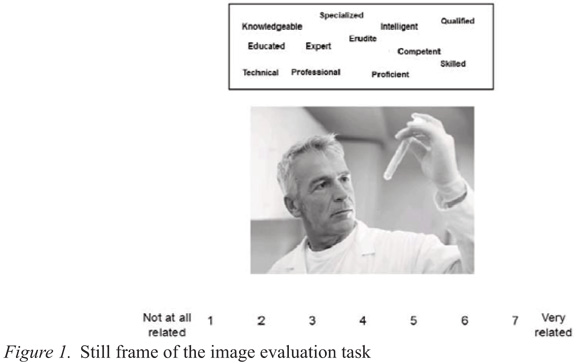
<body><![CDATA[<p>After selected, the images were digitally edited and standardized regarding their dimension, resolution and color scale. Specifically, resulting  images are in grayscale, with a resolution of 800x800 pixels.</p>     <p>Resulting stimuli consisted on a total of 80 images subdivided in two categories: 40 images of objects and 40 images of people. These images  were selected from a larger set, being pre-categorized by 10 judges as belonging to an Expert and Non-Expert categories. The judged images that  gathered stronger consensus regarding their classification were selected for the final sample, resulting in 20 images for each of the 4 categories  (Expert/Non-Expert objects, and Expert/Non-Expert people).</p>     <p>In order to study the association with expertise, we used a set of 12 words representing this dimension. These words were selected from a larger  set by 10 judges who evaluated them as those best representing the expertise dimension. The words selected were: Specialized; Knowledgeable;  Intelligent; Qualified; Educated; Expert; Erudite; Competent; Skilled; Technical; Professional; and  Proficient<sup><a href="#1">1</a></sup><a name="top1"></a>.</p>     <p>&nbsp;</p>     <p><i>Measure and procedure</i></p>     <p>This study was conducted in a laboratory context using the E-prime software (Schneider, Eschman, &amp; Zuccolotto, 2002) v.2.0 for the  presentation of the stimuli and data collection.</p>     <p>Participants were invited to participate in a study about &ldquo;Evaluation of Images&rdquo; with a mean duration of 10 minutes. Participants  provided informed consent, and anonymity and confidentiality of data were assured.</p>     <p>Participants&rsquo; first task consisted on learning the expertise dimension. To this end, participants were told they would be presented with a  set of words with the objective of learning the construct they represent. Instructions requested particular attention to these words and indicated  that after their presentation, the next task would consist on indicating for different images how these related with the learned construct.  Participants were instructed to press the Space tab and move on to the subsequent task once they felt they had completely learned/comprehended the  construct. In the image evaluation task, participants evaluated a set of images according to the previously learned construct, on a 7-point scale  ranging from 1 (Not at all related) to 7 (Very related).</p>     <p>In the image evaluation task, all images were randomly and individually presented on the screen, along with the set of expert-related words on  the superior section of the screen and the 7-point scale on the lower section of the screen (see <a href="#f1">Figure 1</a>). With this procedure,  we aimed that each image was evaluated for the expertise dimension without necessarily being evaluated for the concept of expertise. This way,  ratings based on a general and standardized expertise dimension were obtained.</p>     <p>&nbsp;</p>     ]]></body>
<body><![CDATA[<p><a name="f1"></a></p>     <p><img src="/img/revistas/aps/v34n3/34n3a02f1.jpg"></p>     
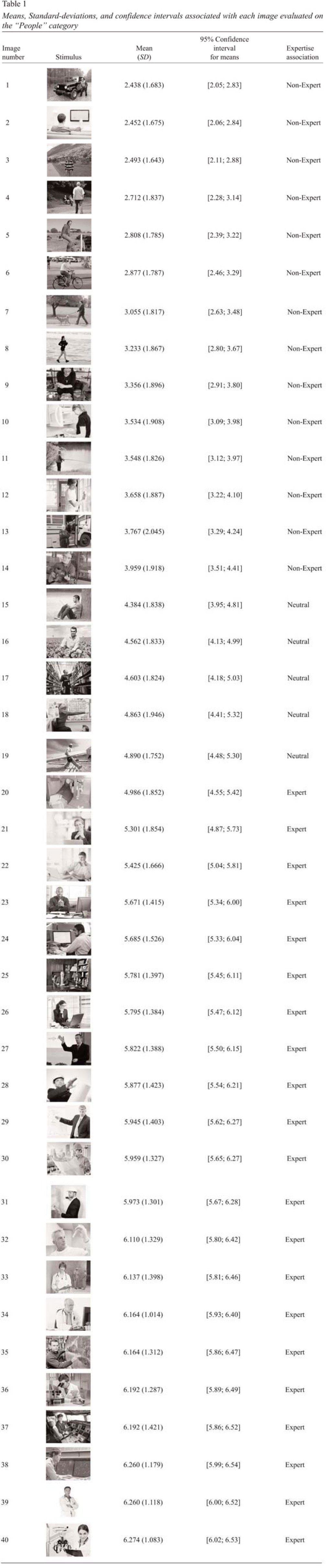
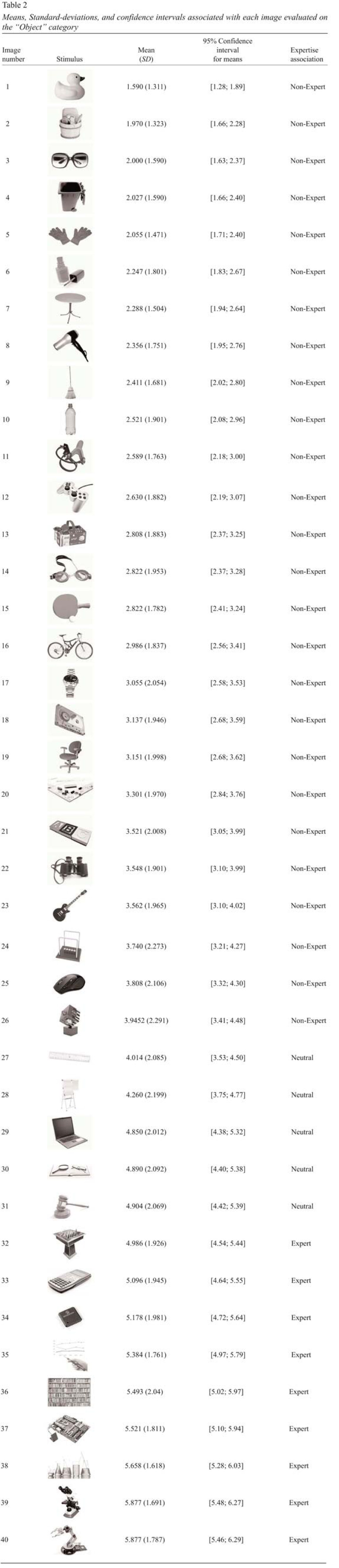
<p>&nbsp;</p>     <p>To provide their answers, participants pressed one of the 7 number keys corresponding to the scale. After finishing, participants were thanked  for their participation and properly debriefed.</p>     <p>&nbsp;</p>     <p><b>Results</b></p>     <p>Obtained results are summarized on <a href ="/img/revistas/aps/v34n3/34n3a02t1.jpg">Table 1</a> and  <a href ="/img/revistas/aps/v34n3/34n3a02t2.jpg">Table 2</a>. Data for evaluation means (construct-image association), respective  standard-deviations  (translating the evaluations consensus), and confidence intervals are presented. The images on  <a href ="/img/revistas/aps/v34n3/34n3a02t1.jpg">Tables 1</a> and  <a href ="/img/revistas/aps/v34n3/34n3a02t2.jpg">2</a> are ascendingly ordered according to the evaluation means.</p>     
<p>Through the analysis of the ratings confidence intervals, we were able to categorize the images regarding their association with the Expertise  dimension. To this end, images containing the mean point of the scale (4) were classified as neutral (considering as neutral limits [3.5&ge;4.5]).  Following this criteria, we identified 11 images of people with low scores on the association with the expertise dimension (from image 1 to 11), 8  images identified as neutral on this dimension (image 12-19), and 21 images identified as high on the association with the expertise dimension  (image 20-40; <a href ="/img/revistas/aps/v34n3/34n3a02t1.jpg">Table 1</a>).</p>     
<p>Regarding the images of objects, we identified 26 images of objects with low scores on the association with the expertise dimension (from image  1 to 26), 5 images identified as neutral on this dimension (image 27-31), and 9 images identified as high on the association with the expertise  dimension (image 32-40; <a href ="/img/revistas/aps/v34n3/34n3a02t2.jpg">Table 2</a>)<sup><a href="#2">2</a></sup><a name="top2"></a>.</p>     
<p>&nbsp;</p>     ]]></body>
<body><![CDATA[<p><b>Discussion</b></p>     <p>The aim of this work consisted on the presentation of norms for a set of updated pictures for the expertise dimension from two categories  (people and objects). With the material here tested, we hope to provide support for research carried out with the use of images that aim to  manipulate the expertise dimension, reducing the effort necessary to collect this type of stimuli.</p>     <p>Obtained results suggest a differentiation between images regarding their association with the expertise dimension translated by the  means&rsquo; confidence intervals, for both people and object categories. As proposed, we were able to identify a set of images of objects  associated with the expertise dimension, providing support to studies that do not want to use either images of people nor written descriptions in  order to cue the expertise dimension.</p>     <p>However, it is important to keep in mind possible existing cultural differences regarding the effects of source expertise. Research has provided  evidence for cultural differences for the persuasiveness of this cue, not only between Western and Eastern cultures (Pornpitakpan &amp; Francis,  2001), but also among Western cultures, between European countries (Hornikx &amp; Hoeken, 2007). This way, it is important to test and to adapt  these materials to confirm the norms here present among different cultures.</p>     <p>Additionally, when using the material here tested, it should be kept in mind that a source&rsquo;s perceived expertise can also be topic  dependent. That is, when presenting information about a topic, a communicator might cue a higher expertise regarding some aspects but a lower  expertise on others. That would mean that a doctor might be more persuasive than an athlete when presenting information regarding the benefits of  exercise on health, but an athlete might have an advantage over a doctor when presenting information about fitness programs, as shown by Nguyen and  Masthoff (2007). Consequently, the selected images and their respective scores on the association with the expertise dimension, although effective  in representing the association with expertise on a general sense, does not take into account these different persuasive contexts, which should be  taken into account when using this material in future studies.</p>     <p>We should also point out a possible limitation regarding the measure used to make participants apprehend the expertise dimension. Our purpose  was to use a measure that did not directly ask participants to make judgments of &ldquo;Expert&rdquo;, &ldquo;Specialized&rdquo;,  &ldquo;Knowledgeable&rdquo;, etc., but judgments based on a general construct of expertise. Aiming to use this same measure for both people and  objects in order to have a set of words related with expertise regardless of the stimuli present, there might have been some words that could be  more related and applicable to people than objects. Consequently, it is possible that such words could have conceptually distanced themselves from  the others. However, we do not believe that such operationalization affected the ratings leading participants to misuse the learned construct,  since the results show a clear significant differentiation between images in their associations with the expertise dimension for both people and  object categories. The words elected by the judges as best representing the expertise dimension were selected independently of a specific  persuasive context. With this, we aimed at using a set of words reflecting the general dimension of expertise. However, words such as  &ldquo;Erudite&rdquo; or &ldquo;Educated&rdquo; might refer to expertise domains in which a formal education can be perceived as necessary. If such  was the case, images reflecting expertise domains that do not necessarily require a formal education might have been perceived as less associated  with the expertise dimension. Again, this emphasizes the need to take into consideration possible differences between persuasive contexts when  using the material here tested.</p>     <p>Overall, we provide here a subset of images with good inter-subject agreement, which can be used in future different contexts and settings, with  particular focus on experimental studies aiming to study the direct or indirect effects of expertise-related images.</p>     <p>&nbsp;</p>     <p><b>References</b></p>     <!-- ref --><p>Aronson, E. (2004). <i>The social animal </i>(9<sup>th </sup>ed.). New York: Worth.    &nbsp;&nbsp;&nbsp;&nbsp;&nbsp;&nbsp;&nbsp;&nbsp;[&#160;<a href="javascript:void(0);" onclick="javascript: window.open('/scielo.php?script=sci_nlinks&ref=022009&pid=S0870-8231201600030000200001&lng=','','width=640,height=500,resizable=yes,scrollbars=1,menubar=yes,');">Links</a>&#160;]<!-- end-ref --></p>     <!-- ref --><p>Boucher, L. (2011). <i>Individual differences influence the degree of source expertise bias in syllogistic reasoning</i>. Thesis submitted to  the Faculty of Graduate and Postdoctoral Affairs in partial fulfillment of the requirements for the degree of Master of Arts in Psychology.  Carleton University, Ottawa, Canada.    &nbsp;&nbsp;&nbsp;&nbsp;&nbsp;&nbsp;&nbsp;&nbsp;[&#160;<a href="javascript:void(0);" onclick="javascript: window.open('/scielo.php?script=sci_nlinks&ref=022011&pid=S0870-8231201600030000200002&lng=','','width=640,height=500,resizable=yes,scrollbars=1,menubar=yes,');">Links</a>&#160;]<!-- end-ref --></p>     <!-- ref --><p>Bradley, M. M., &amp; Lang, P. J. (1999). Fearfulness and affective evaluations of pictures. <i>Motivation and Emotion, 23</i>, 1-13.  doi: 10.1023/A:1021375216854&nbsp;&nbsp;&nbsp;&nbsp;&nbsp;&nbsp;&nbsp;&nbsp;[&#160;<a href="javascript:void(0);" onclick="javascript: window.open('/scielo.php?script=sci_nlinks&ref=022013&pid=S0870-8231201600030000200003&lng=','','width=640,height=500,resizable=yes,scrollbars=1,menubar=yes,');">Links</a>&#160;]<!-- end-ref --><!-- ref --><p>Brownlow, S. (1992). Seeing is believing: Facial appearance, credibility, and attitude change. <i>Journal of Nonverbal Behavior, 16</i>,  101-115. doi: 10.1007/BF00990325&nbsp;&nbsp;&nbsp;&nbsp;&nbsp;&nbsp;&nbsp;&nbsp;[&#160;<a href="javascript:void(0);" onclick="javascript: window.open('/scielo.php?script=sci_nlinks&ref=022014&pid=S0870-8231201600030000200004&lng=','','width=640,height=500,resizable=yes,scrollbars=1,menubar=yes,');">Links</a>&#160;]<!-- end-ref --><!-- ref --><p>Carr, T. H., McCauley, C., Sperber, R. D., &amp; Parmelee, C. M. (1982). Words, pictures, and priming: On semantic activation, conscious  identification, and the automaticity of information processing. <i>Journal of Experimental Psychology: Human Perception and Performance, 8</i>,  757-777. doi: 10.1037//0096-1523.8.6.757&nbsp;&nbsp;&nbsp;&nbsp;&nbsp;&nbsp;&nbsp;&nbsp;[&#160;<a href="javascript:void(0);" onclick="javascript: window.open('/scielo.php?script=sci_nlinks&ref=022015&pid=S0870-8231201600030000200005&lng=','','width=640,height=500,resizable=yes,scrollbars=1,menubar=yes,');">Links</a>&#160;]<!-- end-ref --><p>Chaiken, S. (1987). The heuristic model of persuasion. In M. P. Zanna, J. M. Olson, &amp; C. P. Herman (Eds.), <i>Social influence: The Ontario  symposium</i> (Vol. 5, pp. 3-39). Hillsdale, NJ: Erlbaum.</p>     <!-- ref --><p>Chaiken, S., &amp; Maheswaran, D. (1994). Heuristic processing can bias systematic processing: Effects of source credibility, argument  ambiguity, and task importance on attitude judgment. <i>Journal of Personality and Social Psychology, 66</i>, 460-473.  doi: 10.1037/0022-3514.66.3.460&nbsp;&nbsp;&nbsp;&nbsp;&nbsp;&nbsp;&nbsp;&nbsp;[&#160;<a href="javascript:void(0);" onclick="javascript: window.open('/scielo.php?script=sci_nlinks&ref=022017&pid=S0870-8231201600030000200007&lng=','','width=640,height=500,resizable=yes,scrollbars=1,menubar=yes,');">Links</a>&#160;]<!-- end-ref --><!-- ref --><p>Clark, J. K. (2014). Antecedents of message processing in persuasion: Traditional and emergent perspectives. <i>Social and Personality  Psychology Compass, 8</i>, 595-607. doi: 10.1111/spc3.12140&nbsp;&nbsp;&nbsp;&nbsp;&nbsp;&nbsp;&nbsp;&nbsp;[&#160;<a href="javascript:void(0);" onclick="javascript: window.open('/scielo.php?script=sci_nlinks&ref=022018&pid=S0870-8231201600030000200008&lng=','','width=640,height=500,resizable=yes,scrollbars=1,menubar=yes,');">Links</a>&#160;]<!-- end-ref --><!-- ref --><p>DeBono, K. G., &amp; Harnish, R. (1988). Source expertise, source attractiveness, and the processing of persuasive information: A functional  approach. <i>Journal of Personality and Social Psychology, 55</i>, 541-546. doi: 10.1037/0022-3514.55.4.541&nbsp;&nbsp;&nbsp;&nbsp;&nbsp;&nbsp;&nbsp;&nbsp;[&#160;<a href="javascript:void(0);" onclick="javascript: window.open('/scielo.php?script=sci_nlinks&ref=022019&pid=S0870-8231201600030000200009&lng=','','width=640,height=500,resizable=yes,scrollbars=1,menubar=yes,');">Links</a>&#160;]<!-- end-ref --><!-- ref --><p>Eagly, A., &amp; Chaiken, S. (1993). <i>The psychology of attitudes</i>. Fort Worth, TX: Harcourt Brace Jovanovich.    &nbsp;&nbsp;&nbsp;&nbsp;&nbsp;&nbsp;&nbsp;&nbsp;[&#160;<a href="javascript:void(0);" onclick="javascript: window.open('/scielo.php?script=sci_nlinks&ref=022020&pid=S0870-8231201600030000200010&lng=','','width=640,height=500,resizable=yes,scrollbars=1,menubar=yes,');">Links</a>&#160;]<!-- end-ref --></p>     <!-- ref --><p>Gottlieb, J. B., &amp; Sarel, D. (1991). Comparing advertising effectiveness: The role of involvement and source credibility. <i>Journal of  Advertising, 20</i>, 38-45. doi: 10.1080/00913367.1991.10673205&nbsp;&nbsp;&nbsp;&nbsp;&nbsp;&nbsp;&nbsp;&nbsp;[&#160;<a href="javascript:void(0);" onclick="javascript: window.open('/scielo.php?script=sci_nlinks&ref=022022&pid=S0870-8231201600030000200011&lng=','','width=640,height=500,resizable=yes,scrollbars=1,menubar=yes,');">Links</a>&#160;]<!-- end-ref --><!-- ref --><p>Heesacker, M. H., Petty, R. E., &amp; Cacioppo, J. T. (1983). Field dependence and attitude change: Source credibility can alter persuasion by  affecting message-relevant thinking. <i>Journal of Personality, 51</i>, 653-666. doi: 10.1111/j.1467-6494.1983.tb00872.x&nbsp;&nbsp;&nbsp;&nbsp;&nbsp;&nbsp;&nbsp;&nbsp;[&#160;<a href="javascript:void(0);" onclick="javascript: window.open('/scielo.php?script=sci_nlinks&ref=022023&pid=S0870-8231201600030000200012&lng=','','width=640,height=500,resizable=yes,scrollbars=1,menubar=yes,');">Links</a>&#160;]<!-- end-ref --><!-- ref --><p>Hornikx, J., &amp; Hoeken, H. (2007). Cultural differences in the persuasiveness of evidence types and evidence quality. <i>Communication  Monographs, 74</i>, 443-463. doi: 10.1080/03637750701716578&nbsp;&nbsp;&nbsp;&nbsp;&nbsp;&nbsp;&nbsp;&nbsp;[&#160;<a href="javascript:void(0);" onclick="javascript: window.open('/scielo.php?script=sci_nlinks&ref=022024&pid=S0870-8231201600030000200013&lng=','','width=640,height=500,resizable=yes,scrollbars=1,menubar=yes,');">Links</a>&#160;]<!-- end-ref --><!-- ref --><p>Hovland, C. I., &amp; Weiss, W. (1951). The influence of source credibility on communication effectiveness. <i>Public Opinion Quarterly, 15</i>,  635-650.    &nbsp;&nbsp;&nbsp;&nbsp;&nbsp;&nbsp;&nbsp;&nbsp;[&#160;<a href="javascript:void(0);" onclick="javascript: window.open('/scielo.php?script=sci_nlinks&ref=022025&pid=S0870-8231201600030000200014&lng=','','width=640,height=500,resizable=yes,scrollbars=1,menubar=yes,');">Links</a>&#160;]<!-- end-ref --> doi: 10.1086/266350</p>     <p>Jiwa, M., Millett, S., Meng, X., &amp; Hewitt, V. M. (2012). Impact of the presence of medical equipment in images on viewers&rsquo; perceptions  of the trustworthiness of an individual on-screen. <i>Journal of Medical Internet Research, 14</i>, e100. doi: 10.2196/jmir.1986</p>     <!-- ref --><p>Maddux, J. E., &amp; Rogers, R. W. (1980). Effects of source expertness, physical attractiveness, and supporting arguments on persuasion: A case  of brains over beauty. <i>Journal of Personality and Social Psychology, 39</i>, 235-244. doi: 10.1037/0022-3514.39.2.235&nbsp;&nbsp;&nbsp;&nbsp;&nbsp;&nbsp;&nbsp;&nbsp;[&#160;<a href="javascript:void(0);" onclick="javascript: window.open('/scielo.php?script=sci_nlinks&ref=022028&pid=S0870-8231201600030000200016&lng=','','width=640,height=500,resizable=yes,scrollbars=1,menubar=yes,');">Links</a>&#160;]<!-- end-ref --><!-- ref --><p>McGinnies, E., &amp; Ward, C. D. (1980). Better liked than right: Trustworthiness and expertise as factors in credibility. <i>Personality and  Social Psychology Bulletin, 6</i>, 467-472. doi: 10.1177/014616728063023&nbsp;&nbsp;&nbsp;&nbsp;&nbsp;&nbsp;&nbsp;&nbsp;[&#160;<a href="javascript:void(0);" onclick="javascript: window.open('/scielo.php?script=sci_nlinks&ref=022029&pid=S0870-8231201600030000200017&lng=','','width=640,height=500,resizable=yes,scrollbars=1,menubar=yes,');">Links</a>&#160;]<!-- end-ref --><!-- ref --><p>Moore, D. L., Hausknecht, D., &amp; Thamodaran, K. (1986). Time compression, response opportunity, and persuasion. <i>Journal of Consumer  Research, 13</i>, 85-99. doi: 10.1086/209049&nbsp;&nbsp;&nbsp;&nbsp;&nbsp;&nbsp;&nbsp;&nbsp;[&#160;<a href="javascript:void(0);" onclick="javascript: window.open('/scielo.php?script=sci_nlinks&ref=022030&pid=S0870-8231201600030000200018&lng=','','width=640,height=500,resizable=yes,scrollbars=1,menubar=yes,');">Links</a>&#160;]<!-- end-ref --><p>Nguyen, H., &amp; Masthoff, J. (2007). Is it me or is it what I say?. Source image and persuasion. In Y. de Kort, W. IJsselsteijn, C. Midden,  B. Eggen, &amp; B. J. Fogg (Eds.), <i>PERSUASIVE 2007 &ndash; Persuasive technology</i> (pp. 231-242) (2<sup>nd</sup>International Conference on  Persuasive Technology, Palo Alto, CA, USA, April, 26-27, 2007). Heidelberg, Germany: Springer-Verlag. doi:  10.1007/978-3-540-77006-0_29</p>     <!-- ref --><p>Petty, R. E., &amp; Cacioppo, J. T. (1981). <i>Attitudes and persuasion: Classic and contemporary approaches</i>. Dubuque, IA: William C. Brown.    &nbsp;&nbsp;&nbsp;&nbsp;&nbsp;&nbsp;&nbsp;&nbsp;[&#160;<a href="javascript:void(0);" onclick="javascript: window.open('/scielo.php?script=sci_nlinks&ref=022032&pid=S0870-8231201600030000200020&lng=','','width=640,height=500,resizable=yes,scrollbars=1,menubar=yes,');">Links</a>&#160;]<!-- end-ref --></p>     <!-- ref --><p>Petty, R. E., &amp; Cacioppo, J. T. (1986). <i>Communication and persuasion: Central and peripheral routes to attitude change</i>. New York:  Springer-Verlag.    &nbsp;&nbsp;&nbsp;&nbsp;&nbsp;&nbsp;&nbsp;&nbsp;[&#160;<a href="javascript:void(0);" onclick="javascript: window.open('/scielo.php?script=sci_nlinks&ref=022034&pid=S0870-8231201600030000200021&lng=','','width=640,height=500,resizable=yes,scrollbars=1,menubar=yes,');">Links</a>&#160;]<!-- end-ref --></p>     <!-- ref --><p>Petty, R. E., Cacioppo, J. T., &amp; Goldman, R. (1981). Personal involvement as a determinant of argument-based persuasion. <i>Journal of  Personality and Social Psychology, 41</i>, 847-855. doi: 10.1037/0022-3514.41.5.847&nbsp;&nbsp;&nbsp;&nbsp;&nbsp;&nbsp;&nbsp;&nbsp;[&#160;<a href="javascript:void(0);" onclick="javascript: window.open('/scielo.php?script=sci_nlinks&ref=022036&pid=S0870-8231201600030000200022&lng=','','width=640,height=500,resizable=yes,scrollbars=1,menubar=yes,');">Links</a>&#160;]<!-- end-ref --><!-- ref --><p>Pornpitakpan, C. (2004). The persuasiveness of source credibility: A critical review of five decades evidence. <i>Journal of Applied Social  Psychology, 34</i>, 243-281. doi: 10.1111/j.1559-1816.2004.tb02547.x&nbsp;&nbsp;&nbsp;&nbsp;&nbsp;&nbsp;&nbsp;&nbsp;[&#160;<a href="javascript:void(0);" onclick="javascript: window.open('/scielo.php?script=sci_nlinks&ref=022037&pid=S0870-8231201600030000200023&lng=','','width=640,height=500,resizable=yes,scrollbars=1,menubar=yes,');">Links</a>&#160;]<!-- end-ref --><!-- ref --><p>Pornpitakpan, C., &amp; Francis, J. N. P. (2001). The effect of cultural differences, source expertise, and argument strength on persuasion: An  experiment with Canadians and Thais. <i>Journal of International Consumer Marketing, 13</i>, 77-101. doi: 10.1300/J046v13n01_06&nbsp;&nbsp;&nbsp;&nbsp;&nbsp;&nbsp;&nbsp;&nbsp;[&#160;<a href="javascript:void(0);" onclick="javascript: window.open('/scielo.php?script=sci_nlinks&ref=022038&pid=S0870-8231201600030000200024&lng=','','width=640,height=500,resizable=yes,scrollbars=1,menubar=yes,');">Links</a>&#160;]<!-- end-ref --><p>Schneider, W., Eschman, A., &amp; Zuccolotto, A. (2002). <i>E-prime user&rsquo;s guide. </i>Pittsburgh: Psychology Software Tools, Inc.</p>     ]]></body>
<body><![CDATA[<!-- ref --><p>Tobin, S. J., &amp; Raymundo, M. M. (2009). Persuasion by causal arguments: The motivating role of perceived causal expertise. <i>Social  Cognition, 27</i>, 105-127. doi: 10.1521/soco.2009.27.1.105&nbsp;&nbsp;&nbsp;&nbsp;&nbsp;&nbsp;&nbsp;&nbsp;[&#160;<a href="javascript:void(0);" onclick="javascript: window.open('/scielo.php?script=sci_nlinks&ref=022040&pid=S0870-8231201600030000200026&lng=','','width=640,height=500,resizable=yes,scrollbars=1,menubar=yes,');">Links</a>&#160;]<!-- end-ref --><!-- ref --><p>Tormala, Z. L., Bri&ntilde;ol, P., &amp; Petty, R. E. (2006). When credibility attacks: The reverse impact of source credibility on persuasion.  <i>Journal of Experimental Social Psychology, 42</i>, 684-691. doi: 10.1016/j.jesp.2005.10.005&nbsp;&nbsp;&nbsp;&nbsp;&nbsp;&nbsp;&nbsp;&nbsp;[&#160;<a href="javascript:void(0);" onclick="javascript: window.open('/scielo.php?script=sci_nlinks&ref=022041&pid=S0870-8231201600030000200027&lng=','','width=640,height=500,resizable=yes,scrollbars=1,menubar=yes,');">Links</a>&#160;]<!-- end-ref --><!-- ref --><p>Wilson, E. J., &amp; Sherrell, D. L. (1993). Source effects in communication and persuasion research: A meta-analysis of effect size.  <i>Journal of the Academy of Marketing Science, 21</i>, 101-112. doi: 10.1007/BF02894421&nbsp;&nbsp;&nbsp;&nbsp;&nbsp;&nbsp;&nbsp;&nbsp;[&#160;<a href="javascript:void(0);" onclick="javascript: window.open('/scielo.php?script=sci_nlinks&ref=022042&pid=S0870-8231201600030000200028&lng=','','width=640,height=500,resizable=yes,scrollbars=1,menubar=yes,');">Links</a>&#160;]<!-- end-ref --><p>&nbsp;</p>     <p><b><a name="c0" id="c0"></a><a href="#topc0">CORRESPONDÊNCIA</a></b></p>     <p>A correspond&ecirc;ncia relativa a este artigo dever&aacute; ser enviada para: Filipe Loureiro, William James Center for Research, ISPA &ndash;  Instituto Universit&aacute;rio, Rua Jardim do Tabaco, 34, 1149-041 Lisboa, Portugal. E-mail:  <a href="mailto:floureiro@ispa.pt">floureiro@ispa.pt</a></p>     <p>&nbsp;</p>     <p>The images pretested in this work are available in the archive of the psychology lab of ISPA &ndash; Instituto Universit&aacute;rio.  E-mail: <a href="mailto:labpsicologia@ispa.pt">labpsicologia@ispa.pt</a></p>     <p>&nbsp;</p>     <p>Submiss&atilde;o: 28/07/2015 Aceita&ccedil;&atilde;o: 09/10/2015</p>     ]]></body>
<body><![CDATA[<p>&nbsp;</p>     <p>NOTES</p>     <p><sup><a name="1"></a><a href="#top1">1</a></sup> Original words, as presented in Portuguese: <i>Especializado, Conhecedor, Inteligente, Qualificado, Instru&iacute;do, Perito, Erudito,  Competente, H&aacute;bil, T&eacute;cnico, Profissional</i> and <i>Proficiente</i>.</p>     <p><sup><a name="2"></a><a href="#top2">2</a></sup> Additional analyses of the obtained evaluations showed that images previously classified as belonging to the Expertise  category were, indeed, perceived by participants as more related to this dimension compared to the Non-Expert images, for both people category  [Expert: <i>M</i>=5.95, <i>SD</i>=.98; Non-Expert: <i>M</i>=3.61, <i>SD</i>=.99; <i>t</i>(72)=18.525, <i>p</i>&lt;.001, <i>d</i>=2.37] and objects  category [Expert: <i>M</i>=4.66, <i>SD</i>=1.23; Non-Expert: <i>M</i>=2.58, <i>SD</i>=1.14; <i>t</i>(72)=18.402, <i>p</i>&lt;.001,  <i>d</i>=1.75].</p>      ]]></body><back>
<ref-list>
<ref id="B1">
<nlm-citation citation-type="book">
<person-group person-group-type="author">
<name>
<surname><![CDATA[Aronson]]></surname>
<given-names><![CDATA[E.]]></given-names>
</name>
</person-group>
<source><![CDATA[The social animal]]></source>
<year>2004</year>
<edition>9</edition>
<publisher-loc><![CDATA[New York ]]></publisher-loc>
<publisher-name><![CDATA[Worth]]></publisher-name>
</nlm-citation>
</ref>
<ref id="B2">
<nlm-citation citation-type="">
<person-group person-group-type="author">
<name>
<surname><![CDATA[Boucher]]></surname>
<given-names><![CDATA[L.]]></given-names>
</name>
</person-group>
<source><![CDATA[Individual differences influence the degree of source expertise bias in syllogistic reasoning]]></source>
<year>2011</year>
</nlm-citation>
</ref>
<ref id="B3">
<nlm-citation citation-type="journal">
<person-group person-group-type="author">
<name>
<surname><![CDATA[Bradley]]></surname>
<given-names><![CDATA[M. M.]]></given-names>
</name>
<name>
<surname><![CDATA[Lang]]></surname>
<given-names><![CDATA[P. J.]]></given-names>
</name>
</person-group>
<article-title xml:lang="en"><![CDATA[Fearfulness and affective evaluations of pictures]]></article-title>
<source><![CDATA[Motivation and Emotion]]></source>
<year>1999</year>
<volume>23</volume>
<page-range>1-13</page-range></nlm-citation>
</ref>
<ref id="B4">
<nlm-citation citation-type="journal">
<person-group person-group-type="author">
<name>
<surname><![CDATA[Brownlow]]></surname>
<given-names><![CDATA[S.]]></given-names>
</name>
</person-group>
<article-title xml:lang="en"><![CDATA[Seeing is believing: Facial appearance, credibility, and attitude change]]></article-title>
<source><![CDATA[Journal of Nonverbal Behavior]]></source>
<year>1992</year>
<volume>16</volume>
<page-range>101-115</page-range></nlm-citation>
</ref>
<ref id="B5">
<nlm-citation citation-type="journal">
<person-group person-group-type="author">
<name>
<surname><![CDATA[Carr]]></surname>
<given-names><![CDATA[T. H.]]></given-names>
</name>
<name>
<surname><![CDATA[McCauley]]></surname>
<given-names><![CDATA[C.]]></given-names>
</name>
<name>
<surname><![CDATA[Sperber]]></surname>
<given-names><![CDATA[R. D.]]></given-names>
</name>
<name>
<surname><![CDATA[Parmelee]]></surname>
<given-names><![CDATA[C. M.]]></given-names>
</name>
</person-group>
<article-title xml:lang="en"><![CDATA[Words, pictures, and priming: On semantic activation, conscious identification, and the automaticity of information processing]]></article-title>
<source><![CDATA[Journal of Experimental Psychology: Human Perception and Performance]]></source>
<year>1982</year>
<volume>8</volume>
<page-range>757-777</page-range></nlm-citation>
</ref>
<ref id="B6">
<nlm-citation citation-type="book">
<person-group person-group-type="author">
<name>
<surname><![CDATA[Chaiken]]></surname>
<given-names><![CDATA[S.]]></given-names>
</name>
</person-group>
<article-title xml:lang="en"><![CDATA[The heuristic model of persuasion]]></article-title>
<person-group person-group-type="editor">
<name>
<surname><![CDATA[Zanna]]></surname>
<given-names><![CDATA[M. P.]]></given-names>
</name>
<name>
<surname><![CDATA[Olson]]></surname>
<given-names><![CDATA[J. M.]]></given-names>
</name>
<name>
<surname><![CDATA[Herman]]></surname>
<given-names><![CDATA[C. P.]]></given-names>
</name>
</person-group>
<source><![CDATA[Social influence: The Ontario symposium]]></source>
<year>1987</year>
<page-range>3-39</page-range><publisher-loc><![CDATA[Hillsdale ]]></publisher-loc>
<publisher-name><![CDATA[Erlbaum]]></publisher-name>
</nlm-citation>
</ref>
<ref id="B7">
<nlm-citation citation-type="journal">
<person-group person-group-type="author">
<name>
<surname><![CDATA[Chaiken]]></surname>
<given-names><![CDATA[S.]]></given-names>
</name>
<name>
<surname><![CDATA[Maheswaran]]></surname>
<given-names><![CDATA[D.]]></given-names>
</name>
</person-group>
<article-title xml:lang="en"><![CDATA[Heuristic processing can bias systematic processing: Effects of source credibility, argument ambiguity, and task importance on attitude judgment]]></article-title>
<source><![CDATA[Journal of Personality and Social Psychology]]></source>
<year>1994</year>
<volume>66</volume>
<page-range>460-473</page-range></nlm-citation>
</ref>
<ref id="B8">
<nlm-citation citation-type="journal">
<person-group person-group-type="author">
<name>
<surname><![CDATA[Clark]]></surname>
<given-names><![CDATA[J. K.]]></given-names>
</name>
</person-group>
<article-title xml:lang="en"><![CDATA[Antecedents of message processing in persuasion: Traditional and emergent perspectives]]></article-title>
<source><![CDATA[Social and Personality Psychology Compass]]></source>
<year>2014</year>
<volume>8</volume>
<page-range>595-607</page-range></nlm-citation>
</ref>
<ref id="B9">
<nlm-citation citation-type="journal">
<person-group person-group-type="author">
<name>
<surname><![CDATA[DeBono]]></surname>
<given-names><![CDATA[K. G.]]></given-names>
</name>
<name>
<surname><![CDATA[Harnish]]></surname>
<given-names><![CDATA[R.]]></given-names>
</name>
</person-group>
<article-title xml:lang="en"><![CDATA[Source expertise, source attractiveness, and the processing of persuasive information: A functional approach]]></article-title>
<source><![CDATA[Journal of Personality and Social Psychology]]></source>
<year>1988</year>
<volume>55</volume>
<page-range>541-546</page-range></nlm-citation>
</ref>
<ref id="B10">
<nlm-citation citation-type="book">
<person-group person-group-type="author">
<name>
<surname><![CDATA[Eagly]]></surname>
<given-names><![CDATA[A.]]></given-names>
</name>
<name>
<surname><![CDATA[Chaiken]]></surname>
<given-names><![CDATA[S.]]></given-names>
</name>
</person-group>
<source><![CDATA[The psychology of attitudes]]></source>
<year>1993</year>
<publisher-loc><![CDATA[Fort Worth ]]></publisher-loc>
<publisher-name><![CDATA[Harcourt Brace Jovanovich]]></publisher-name>
</nlm-citation>
</ref>
<ref id="B11">
<nlm-citation citation-type="journal">
<person-group person-group-type="author">
<name>
<surname><![CDATA[Gottlieb]]></surname>
<given-names><![CDATA[J. B.]]></given-names>
</name>
<name>
<surname><![CDATA[Sarel]]></surname>
<given-names><![CDATA[D.]]></given-names>
</name>
</person-group>
<article-title xml:lang="en"><![CDATA[Comparing advertising effectiveness: The role of involvement and source credibility]]></article-title>
<source><![CDATA[Journal of Advertising]]></source>
<year>1991</year>
<volume>20</volume>
<page-range>38-45</page-range></nlm-citation>
</ref>
<ref id="B12">
<nlm-citation citation-type="journal">
<person-group person-group-type="author">
<name>
<surname><![CDATA[Heesacker]]></surname>
<given-names><![CDATA[M. H.]]></given-names>
</name>
<name>
<surname><![CDATA[Petty]]></surname>
<given-names><![CDATA[R. E.]]></given-names>
</name>
<name>
<surname><![CDATA[Cacioppo]]></surname>
<given-names><![CDATA[J. T.]]></given-names>
</name>
</person-group>
<article-title xml:lang="en"><![CDATA[Field dependence and attitude change: Source credibility can alter persuasion by affecting message-relevant thinking]]></article-title>
<source><![CDATA[Journal of Personality]]></source>
<year>1983</year>
<volume>51</volume>
<page-range>653-666</page-range></nlm-citation>
</ref>
<ref id="B13">
<nlm-citation citation-type="journal">
<person-group person-group-type="author">
<name>
<surname><![CDATA[Hornikx]]></surname>
<given-names><![CDATA[J.]]></given-names>
</name>
<name>
<surname><![CDATA[Hoeken]]></surname>
<given-names><![CDATA[H.]]></given-names>
</name>
</person-group>
<article-title xml:lang="en"><![CDATA[Cultural differences in the persuasiveness of evidence types and evidence quality]]></article-title>
<source><![CDATA[Communication Monographs]]></source>
<year>2007</year>
<volume>74</volume>
<page-range>443-463</page-range></nlm-citation>
</ref>
<ref id="B14">
<nlm-citation citation-type="journal">
<person-group person-group-type="author">
<name>
<surname><![CDATA[Hovland]]></surname>
<given-names><![CDATA[C. I.]]></given-names>
</name>
<name>
<surname><![CDATA[Weiss]]></surname>
<given-names><![CDATA[W.]]></given-names>
</name>
</person-group>
<article-title xml:lang="en"><![CDATA[The influence of source credibility on communication effectiveness]]></article-title>
<source><![CDATA[Public Opinion Quarterly]]></source>
<year>1951</year>
<volume>15</volume>
<page-range>635-650</page-range></nlm-citation>
</ref>
<ref id="B15">
<nlm-citation citation-type="journal">
<person-group person-group-type="author">
<name>
<surname><![CDATA[Jiwa]]></surname>
<given-names><![CDATA[M.]]></given-names>
</name>
<name>
<surname><![CDATA[Millett]]></surname>
<given-names><![CDATA[S.]]></given-names>
</name>
<name>
<surname><![CDATA[Meng]]></surname>
<given-names><![CDATA[X.]]></given-names>
</name>
<name>
<surname><![CDATA[Hewitt]]></surname>
<given-names><![CDATA[V. M.]]></given-names>
</name>
</person-group>
<article-title xml:lang="en"><![CDATA[Impact of the presence of medical equipment in images on viewers’ perceptions of the trustworthiness of an individual on-screen]]></article-title>
<source><![CDATA[Journal of Medical Internet Research]]></source>
<year>2012</year>
<volume>14</volume>
<page-range>e100</page-range></nlm-citation>
</ref>
<ref id="B16">
<nlm-citation citation-type="journal">
<person-group person-group-type="author">
<name>
<surname><![CDATA[Maddux]]></surname>
<given-names><![CDATA[J. E.]]></given-names>
</name>
<name>
<surname><![CDATA[Rogers]]></surname>
<given-names><![CDATA[R. W.]]></given-names>
</name>
</person-group>
<article-title xml:lang="en"><![CDATA[Effects of source expertness, physical attractiveness, and supporting arguments on persuasion: A case of brains over beauty]]></article-title>
<source><![CDATA[Journal of Personality and Social Psychology]]></source>
<year>1980</year>
<volume>39</volume>
<page-range>235-244</page-range></nlm-citation>
</ref>
<ref id="B17">
<nlm-citation citation-type="journal">
<person-group person-group-type="author">
<name>
<surname><![CDATA[McGinnies]]></surname>
<given-names><![CDATA[E.]]></given-names>
</name>
<name>
<surname><![CDATA[Ward]]></surname>
<given-names><![CDATA[C. D.]]></given-names>
</name>
</person-group>
<article-title xml:lang="en"><![CDATA[Better liked than right: Trustworthiness and expertise as factors in credibility]]></article-title>
<source><![CDATA[Personality and Social Psychology Bulletin]]></source>
<year>1980</year>
<volume>6</volume>
<page-range>467-472</page-range></nlm-citation>
</ref>
<ref id="B18">
<nlm-citation citation-type="journal">
<person-group person-group-type="author">
<name>
<surname><![CDATA[Moore]]></surname>
<given-names><![CDATA[D. L.]]></given-names>
</name>
<name>
<surname><![CDATA[Hausknecht]]></surname>
<given-names><![CDATA[D.]]></given-names>
</name>
<name>
<surname><![CDATA[Thamodaran]]></surname>
<given-names><![CDATA[K.]]></given-names>
</name>
</person-group>
<article-title xml:lang="en"><![CDATA[Time compression, response opportunity, and persuasion]]></article-title>
<source><![CDATA[Journal of Consumer Research]]></source>
<year>1986</year>
<volume>13</volume>
<page-range>85-99</page-range></nlm-citation>
</ref>
<ref id="B19">
<nlm-citation citation-type="book">
<person-group person-group-type="author">
<name>
<surname><![CDATA[Nguyen]]></surname>
<given-names><![CDATA[H.]]></given-names>
</name>
<name>
<surname><![CDATA[Masthoff]]></surname>
<given-names><![CDATA[J.]]></given-names>
</name>
</person-group>
<article-title xml:lang="en"><![CDATA[Is it me or is it what I say?: Source image and persuasion]]></article-title>
<person-group person-group-type="editor">
<name>
<surname><![CDATA[de Kort]]></surname>
<given-names><![CDATA[Y.]]></given-names>
</name>
<name>
<surname><![CDATA[IJsselsteijn]]></surname>
<given-names><![CDATA[W.]]></given-names>
</name>
<name>
<surname><![CDATA[Midden]]></surname>
<given-names><![CDATA[C.]]></given-names>
</name>
<name>
<surname><![CDATA[Eggen]]></surname>
<given-names><![CDATA[B.]]></given-names>
</name>
<name>
<surname><![CDATA[Fogg]]></surname>
<given-names><![CDATA[B. J.]]></given-names>
</name>
</person-group>
<source><![CDATA[PERSUASIVE 2007: Persuasive technology]]></source>
<year>2007</year>
<page-range>231-242</page-range><publisher-loc><![CDATA[Heidelberg ]]></publisher-loc>
<publisher-name><![CDATA[Springer-Verlag]]></publisher-name>
</nlm-citation>
</ref>
<ref id="B20">
<nlm-citation citation-type="book">
<person-group person-group-type="author">
<name>
<surname><![CDATA[Petty]]></surname>
<given-names><![CDATA[R. E.]]></given-names>
</name>
<name>
<surname><![CDATA[Cacioppo]]></surname>
<given-names><![CDATA[J. T.]]></given-names>
</name>
</person-group>
<source><![CDATA[Attitudes and persuasion: Classic and contemporary approaches]]></source>
<year>1981</year>
<publisher-loc><![CDATA[Dubuque, IA ]]></publisher-loc>
<publisher-name><![CDATA[William C. Brown]]></publisher-name>
</nlm-citation>
</ref>
<ref id="B21">
<nlm-citation citation-type="book">
<person-group person-group-type="author">
<name>
<surname><![CDATA[Petty]]></surname>
<given-names><![CDATA[R. E.]]></given-names>
</name>
<name>
<surname><![CDATA[Cacioppo]]></surname>
<given-names><![CDATA[J. T.]]></given-names>
</name>
</person-group>
<source><![CDATA[Communication and persuasion: Central and peripheral routes to attitude change]]></source>
<year>1986</year>
<publisher-loc><![CDATA[New York ]]></publisher-loc>
<publisher-name><![CDATA[Springer-Verlag]]></publisher-name>
</nlm-citation>
</ref>
<ref id="B22">
<nlm-citation citation-type="journal">
<person-group person-group-type="author">
<name>
<surname><![CDATA[Petty]]></surname>
<given-names><![CDATA[R. E.]]></given-names>
</name>
<name>
<surname><![CDATA[Cacioppo]]></surname>
<given-names><![CDATA[J. T.]]></given-names>
</name>
<name>
<surname><![CDATA[Goldman]]></surname>
<given-names><![CDATA[R.]]></given-names>
</name>
</person-group>
<article-title xml:lang="en"><![CDATA[Personal involvement as a determinant of argument-based persuasion]]></article-title>
<source><![CDATA[Journal of Personality and Social Psychology]]></source>
<year>1981</year>
<volume>41</volume>
<page-range>847-855</page-range></nlm-citation>
</ref>
<ref id="B23">
<nlm-citation citation-type="journal">
<person-group person-group-type="author">
<name>
<surname><![CDATA[Pornpitakpan]]></surname>
<given-names><![CDATA[C.]]></given-names>
</name>
</person-group>
<article-title xml:lang="en"><![CDATA[The persuasiveness of source credibility: A critical review of five decades evidence]]></article-title>
<source><![CDATA[Journal of Applied Social Psychology]]></source>
<year>2004</year>
<volume>34</volume>
<page-range>243-281</page-range></nlm-citation>
</ref>
<ref id="B24">
<nlm-citation citation-type="journal">
<person-group person-group-type="author">
<name>
<surname><![CDATA[Pornpitakpan]]></surname>
<given-names><![CDATA[C.]]></given-names>
</name>
<name>
<surname><![CDATA[Francis]]></surname>
<given-names><![CDATA[J. N. P.]]></given-names>
</name>
</person-group>
<article-title xml:lang="en"><![CDATA[The effect of cultural differences, source expertise, and argument strength on persuasion: An experiment with Canadians and Thais]]></article-title>
<source><![CDATA[Journal of International Consumer Marketing]]></source>
<year>2001</year>
<volume>13</volume>
<page-range>77-101</page-range></nlm-citation>
</ref>
<ref id="B25">
<nlm-citation citation-type="book">
<person-group person-group-type="author">
<name>
<surname><![CDATA[Schneider]]></surname>
<given-names><![CDATA[W.]]></given-names>
</name>
<name>
<surname><![CDATA[Eschman]]></surname>
<given-names><![CDATA[A.]]></given-names>
</name>
<name>
<surname><![CDATA[Zuccolotto]]></surname>
<given-names><![CDATA[A.]]></given-names>
</name>
</person-group>
<source><![CDATA[E-prime user’s guide]]></source>
<year>2002</year>
<publisher-loc><![CDATA[Pittsburgh ]]></publisher-loc>
<publisher-name><![CDATA[Psychology Software Tools, Inc]]></publisher-name>
</nlm-citation>
</ref>
<ref id="B26">
<nlm-citation citation-type="journal">
<person-group person-group-type="author">
<name>
<surname><![CDATA[Tobin]]></surname>
<given-names><![CDATA[S. J.]]></given-names>
</name>
<name>
<surname><![CDATA[Raymundo]]></surname>
<given-names><![CDATA[M. M.]]></given-names>
</name>
</person-group>
<article-title xml:lang="en"><![CDATA[Persuasion by causal arguments: The motivating role of perceived causal expertise]]></article-title>
<source><![CDATA[Social Cognition]]></source>
<year>2009</year>
<volume>27</volume>
<page-range>105-127</page-range></nlm-citation>
</ref>
<ref id="B27">
<nlm-citation citation-type="journal">
<person-group person-group-type="author">
<name>
<surname><![CDATA[Tormala]]></surname>
<given-names><![CDATA[Z. L.]]></given-names>
</name>
<name>
<surname><![CDATA[Briñol]]></surname>
<given-names><![CDATA[P.]]></given-names>
</name>
<name>
<surname><![CDATA[Petty]]></surname>
<given-names><![CDATA[R. E.]]></given-names>
</name>
</person-group>
<article-title xml:lang="en"><![CDATA[When credibility attacks: The reverse impact of source credibility on persuasion]]></article-title>
<source><![CDATA[Journal of Experimental Social Psychology]]></source>
<year>2006</year>
<volume>42</volume>
<page-range>684-691</page-range></nlm-citation>
</ref>
<ref id="B28">
<nlm-citation citation-type="journal">
<person-group person-group-type="author">
<name>
<surname><![CDATA[Wilson]]></surname>
<given-names><![CDATA[E. J.]]></given-names>
</name>
<name>
<surname><![CDATA[Sherrell]]></surname>
<given-names><![CDATA[D. L.]]></given-names>
</name>
</person-group>
<article-title xml:lang="en"><![CDATA[Source effects in communication and persuasion research: A meta-analysis of effect size]]></article-title>
<source><![CDATA[Journal of the Academy of Marketing Science]]></source>
<year>1993</year>
<volume>21</volume>
<page-range>101-112</page-range></nlm-citation>
</ref>
</ref-list>
</back>
</article>