<?xml version="1.0" encoding="ISO-8859-1"?><article xmlns:mml="http://www.w3.org/1998/Math/MathML" xmlns:xlink="http://www.w3.org/1999/xlink" xmlns:xsi="http://www.w3.org/2001/XMLSchema-instance">
<front>
<journal-meta>
<journal-id>0870-8231</journal-id>
<journal-title><![CDATA[Análise Psicológica]]></journal-title>
<abbrev-journal-title><![CDATA[Aná. Psicológica]]></abbrev-journal-title>
<issn>0870-8231</issn>
<publisher>
<publisher-name><![CDATA[ISPA-Instituto Universitário]]></publisher-name>
</publisher>
</journal-meta>
<article-meta>
<article-id>S0870-82312016000400003</article-id>
<article-id pub-id-type="doi">1014417/ap.1122</article-id>
<title-group>
<article-title xml:lang="en"><![CDATA[Coping as a moderator of the influence of economic stressors on psychological health]]></article-title>
</title-group>
<contrib-group>
<contrib contrib-type="author">
<name>
<surname><![CDATA[Jesus]]></surname>
<given-names><![CDATA[Saúl Neves]]></given-names>
</name>
<xref ref-type="aff" rid="A01"/>
<xref ref-type="aff" rid="A02"/>
</contrib>
<contrib contrib-type="author">
<name>
<surname><![CDATA[Leal]]></surname>
<given-names><![CDATA[Ana Rita]]></given-names>
</name>
<xref ref-type="aff" rid="A02"/>
</contrib>
<contrib contrib-type="author">
<name>
<surname><![CDATA[Viseu]]></surname>
<given-names><![CDATA[João Nuno]]></given-names>
</name>
<xref ref-type="aff" rid="A02"/>
</contrib>
<contrib contrib-type="author">
<name>
<surname><![CDATA[Valle]]></surname>
<given-names><![CDATA[Patrícia]]></given-names>
</name>
<xref ref-type="aff" rid="A02"/>
<xref ref-type="aff" rid="A03"/>
</contrib>
<contrib contrib-type="author">
<name>
<surname><![CDATA[Matavelli]]></surname>
<given-names><![CDATA[Rafaela Dias]]></given-names>
</name>
<xref ref-type="aff" rid="A02"/>
</contrib>
<contrib contrib-type="author">
<name>
<surname><![CDATA[Pereira]]></surname>
<given-names><![CDATA[Joana]]></given-names>
</name>
<xref ref-type="aff" rid="A01"/>
</contrib>
<contrib contrib-type="author">
<name>
<surname><![CDATA[Greenglass]]></surname>
<given-names><![CDATA[Esther]]></given-names>
</name>
<xref ref-type="aff" rid="A04"/>
</contrib>
</contrib-group>
<aff id="A01">
<institution><![CDATA[,Universidade do Algarve Faculdade de Ciências Humanas e Sociais ]]></institution>
<addr-line><![CDATA[ ]]></addr-line>
</aff>
<aff id="A02">
<institution><![CDATA[,Universidade do Algarve Centro de Investigação sobre o Espaço e as Organizações ]]></institution>
<addr-line><![CDATA[ ]]></addr-line>
</aff>
<aff id="A03">
<institution><![CDATA[,Universidade do Algarve Faculdade de Economia ]]></institution>
<addr-line><![CDATA[ ]]></addr-line>
</aff>
<aff id="A04">
<institution><![CDATA[,York University Department of Psychology ]]></institution>
<addr-line><![CDATA[ ]]></addr-line>
<country>Canada</country>
</aff>
<pub-date pub-type="pub">
<day>00</day>
<month>12</month>
<year>2016</year>
</pub-date>
<pub-date pub-type="epub">
<day>00</day>
<month>12</month>
<year>2016</year>
</pub-date>
<volume>34</volume>
<numero>4</numero>
<fpage>365</fpage>
<lpage>376</lpage>
<copyright-statement/>
<copyright-year/>
<self-uri xlink:href="http://scielo.pt/scielo.php?script=sci_arttext&amp;pid=S0870-82312016000400003&amp;lng=en&amp;nrm=iso"></self-uri><self-uri xlink:href="http://scielo.pt/scielo.php?script=sci_abstract&amp;pid=S0870-82312016000400003&amp;lng=en&amp;nrm=iso"></self-uri><self-uri xlink:href="http://scielo.pt/scielo.php?script=sci_pdf&amp;pid=S0870-82312016000400003&amp;lng=en&amp;nrm=iso"></self-uri><abstract abstract-type="short" xml:lang="en"><p><![CDATA[Since 2008, there has been a decline in the economy of several European countries, including Portugal. In the literature, it is emphasized that periods of economic uncertainty propitiate the appearance of mental health problems and diminish populations’ well-being. The aim of the present study, with 729 Portuguese participants, 33.9% (n=247) males and 66.1% (n=482) females with an average age of 37 years old (M=36.99; SD=12.81), was to examine the relationship between economic hardship, financial threat, and financial well-being (i.e., economic stressors) and stress, anxiety, and depression (i.e., psychological health indicators), as well as to test the moderation effect of coping in the aforementioned relationship. To achieve these goals, a cross-sectional design was implemented and structural equation modeling (SEM) was used to analyze the obtained data. Our results underline that coping affects the relationship between economic stressors and psychological health since subjects with lower coping levels are more vulnerable to economic stress factors than those with higher coping levels. The moderation effect was more evident in the relationships between economic hardship and stress, anxiety, and depression. The main implications of this study are presented, as well as its’ limitations and suggestions for future research.]]></p></abstract>
<abstract abstract-type="short" xml:lang="pt"><p><![CDATA[Desde 2008, tem havido um declínio na economia de vários países europeus, incluindo Portugal. Na literatura, enfatiza-se que períodos de incerteza económica propiciam o aparecimento de problemas de saúde mental e diminuem o bem-estar das populações. No presente estudo foram usados 729 participantes portugueses, 33,9% (n=247) homens e 66,1% (n=482) mulheres, com uma idade média de 37 anos (M=36,99, DP=12,81). Este estudo teve por objetivo analisar a relação entre as dificuldades económicas, a ameaça financeira e o bem-estar financeiro (stressores económicos) e os níveis de stresse, ansiedade e depressão (ou seja, indicadores de saúde psicológica), bem como para testar o efeito de moderação do coping nesta relação. Este modelo foi analisado através de equações estruturais (SEM). Os resultados obtidos revelam que o coping afeta a relação entre os stressores económicos e a saúde psicológica, uma vez que os sujeitos com menores níveis de coping são mais vulneráveis a fatores de stresse económico do que aqueles com níveis de coping mais elevados. O efeito de moderação foi mais evidente nas relações entre as dificuldades económicas e o stresse, a ansiedade e a depressão. São apresentadas as principais implicações deste estudo, bem como as suas limitações e sugestões para futuras pesquisas.]]></p></abstract>
<kwd-group>
<kwd lng="en"><![CDATA[Anxiety]]></kwd>
<kwd lng="en"><![CDATA[Coping]]></kwd>
<kwd lng="en"><![CDATA[Depression]]></kwd>
<kwd lng="en"><![CDATA[Economic stressors]]></kwd>
<kwd lng="en"><![CDATA[Stress]]></kwd>
<kwd lng="pt"><![CDATA[Ansiedade]]></kwd>
<kwd lng="pt"><![CDATA[Coping]]></kwd>
<kwd lng="pt"><![CDATA[Depressão]]></kwd>
<kwd lng="pt"><![CDATA[Stressores económicos]]></kwd>
<kwd lng="pt"><![CDATA[Stresse]]></kwd>
</kwd-group>
</article-meta>
</front><body><![CDATA[ <p><b>Coping as a moderator of the influence of economic stressors on psychological health</b></p>     <p><b>Sa&uacute;l Neves Jesus<sup>1</sup>, Ana Rita Leal<sup>2</sup>, Jo&atilde;o Nuno Viseu<sup>2</sup>, Patr&iacute;cia Valle<sup>3</sup>,  Rafaela Dias Matavelli<sup>2</sup>, Joana Pereira<sup>4</sup>, Esther Greenglass<sup>5</sup></b></p>     <p><sup>1</sup>Faculdade de Ci&ecirc;ncias Humanas e Sociais, Universidade do Algarve / Centro de Investiga&ccedil;&atilde;o sobre o Espa&ccedil;o  e as Organiza&ccedil;&otilde;es, Universidade do Algarve</p>     <p><sup>2</sup>Centro de Investiga&ccedil;&atilde;o sobre o Espa&ccedil;o e as Organiza&ccedil;&otilde;es, Universidade do Algarve</p>     <p><sup>3</sup>Faculdade de Economia, Universidade do Algarve / Centro de Investiga&ccedil;&atilde;o sobre o Espa&ccedil;o e as  Organiza&ccedil;&otilde;es, Universidade do Algarve</p>     <p><sup>4</sup>Faculdade de Ci&ecirc;ncias Humanas e Sociais, Universidade do Algarve</p>     <p><sup>5</sup>Department of Psychology, York University, Canada</p>     <p><a name="topc0"></a><a href="#c0">Correspondência</a></p>     <p>&nbsp;</p>     <p><b>ABSTRACT</b></p>     ]]></body>
<body><![CDATA[<p>Since 2008, there has been a decline in the economy of several European countries, including Portugal. In the literature, it is emphasized that  periods of economic uncertainty propitiate the appearance of mental health problems and diminish populations&rsquo; well-being. The aim of the  present study, with 729 Portuguese participants, 33.9% (<i>n</i>=247) males and 66.1% (<i>n</i>=482) females with an average age of 37 years old  (<i>M</i>=36.99; SD=12.81), was to examine the relationship between economic hardship, financial threat, and financial well-being (i.e., economic  stressors) and stress, anxiety, and depression (i.e., psychological health indicators), as well as to test the moderation effect of coping in the  aforementioned relationship. To achieve these goals, a cross-sectional design was implemented and structural equation modeling (SEM) was used to  analyze the obtained data. Our results underline that coping affects the relationship between economic stressors and psychological health since  subjects with lower coping levels are more vulnerable to economic stress factors than those with higher coping levels. The moderation effect was  more evident in the relationships between economic hardship and stress, anxiety, and depression. The main implications of this study are presented,  as well as its&rsquo; limitations and suggestions for future research.    <p>     <p><b>Key words</b>: Anxiety, Coping, Depression, Economic stressors, Stress.</p>     <p>&nbsp;</p>     <p><b>RESUMO</b></p>     <p>Desde 2008, tem havido um decl&iacute;nio na economia de v&aacute;rios pa&iacute;ses europeus, incluindo Portugal. Na literatura, enfatiza-se que  per&iacute;odos de incerteza econ&oacute;mica propiciam o aparecimento de problemas de sa&uacute;de mental e diminuem o bem-estar das  popula&ccedil;&otilde;es. No presente estudo foram usados 729 participantes portugueses, 33,9% (<i>n</i>=247) homens e 66,1% (<i>n</i>=482)  mulheres, com uma idade m&eacute;dia de 37 anos (<i>M</i>=36,99, <i>DP</i>=12,81). Este estudo teve por objetivo analisar a rela&ccedil;&atilde;o  entre as dificuldades econ&oacute;micas, a amea&ccedil;a financeira e o bem-estar financeiro (stressores econ&oacute;micos) e os n&iacute;veis de  stresse, ansiedade e depress&atilde;o (ou seja, indicadores de sa&uacute;de psicol&oacute;gica), bem como para testar o efeito de  modera&ccedil;&atilde;o do <i>coping</i> nesta rela&ccedil;&atilde;o. Este modelo foi analisado atrav&eacute;s de equa&ccedil;&otilde;es  estruturais (SEM). Os resultados obtidos revelam que o <i>coping</i> afeta a rela&ccedil;&atilde;o entre os stressores econ&oacute;micos e a  sa&uacute;de psicol&oacute;gica, uma vez que os sujeitos com menores n&iacute;veis de <i>coping</i> s&atilde;o mais vulner&aacute;veis a fatores de  stresse econ&oacute;mico do que aqueles com n&iacute;veis de <i>coping</i> mais elevados. O efeito de modera&ccedil;&atilde;o foi mais evidente nas  rela&ccedil;&otilde;es entre as dificuldades econ&oacute;micas e o stresse, a ansiedade e a depress&atilde;o. S&atilde;o apresentadas as principais  implica&ccedil;&otilde;es deste estudo, bem como as suas limita&ccedil;&otilde;es e sugest&otilde;es para futuras pesquisas.</p>     <p><b>Palavras-chave</b>: Ansiedade, <i>Coping</i>, Depress&atilde;o, Stressores econ&oacute;micos, Stresse.</p>     <p>&nbsp;</p>     <p>Since 2008, several countries are facing the worse financial and economic crisis since the 1930s, particularly in Europe (e.g., Cyprus, Greece,  Italy, Ireland, Portugal, and Spain) (Yurtsever, 2011). Two major aspects have been pointed as the source of this period, problems in the banking  system, which led to the bankruptcy of numerous banks, and high levels of sovereign debt (Torres, 2009; Yurtsever, 2011). The main consequences of  adverse economic periods are the increase in: (a) job insecurity; (b) unemployment, predominantly youth unemployment; (c) families debt levels;  and (d) household costs (Boone, van Ours, Wuellrich, &amp; Zweimuller, 2011; Keegan, Thomas, Normand, &amp; Portela, 2013). Other aspects are worth  considering, namely: (a) decreases in wages; (b) loss of purchasing power; (c) reductions in social service benefits; (d) decline in healthcare  expenditures; and (e) reduced response capacity from social support nets (Boyd, Tuckey, &amp; Winefield, 2013; Keegan et al., 2013; Marjanovic,  Greenglass, Fiksenbaum, &amp; Bell, 2013).</p>     <p>Due the above mentioned aspects, it is possible to state that economic recessions generate uncertainty and threat perceptions in populations,  which may potentiate the appearance of mental health problems (Cooper, 2012). There is a substantial body of knowledge (e.g., Catalano et al.,  2011; Sociedad Espa&ntilde;ola de Salud P&uacute;blica y Administraci&oacute;n Sanit&aacute;ria, 2011) that points to the influence of economic  crises on populations&rsquo; physical and mental health, especially through the social and behavioral effects that these periods induce. Several  researches (e.g., Althouse, Allem, Childers, Dredze, &amp; Ayers, 2014; Catalano et al., 2011; Frank, Davis, &amp; Elgar, 2013; Norvilitis,  Szablicki, &amp; Wilson, 2003) demonstrated the relationship between financial problems and negative health-related consequences, such as (a)  psychological distress; (b) depression; (c) anxiety; (d) low life satisfaction; (e) dysfunctional impulsivity; (f) suicide; (g) hypertension; (h)  myocardial infarction; (i) diabetes; and (j) infections. Thus, we present below a set of studies that underlined the existence of a relationship  between anxiety, depression, and distress (i.e., psychological health indicators), and economic stressors (i.e., economic hardship, financial  threat, and financial well-being).</p>     ]]></body>
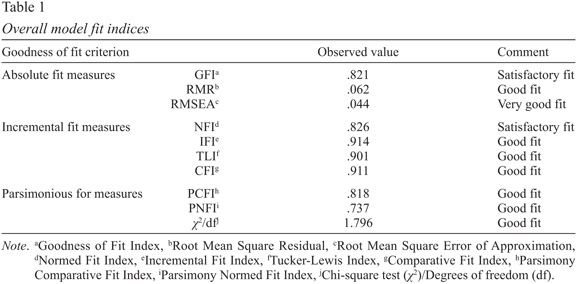
<body><![CDATA[<p>Economic hardship is associated with a variety of physical and psychological health problems (e.g., distress and depression) (Greenglass,  Marjanovic, &amp; Fiksenbaum, 2013; Sargent-Cox, Butterworth, &amp; Anstey, 2011). The combination of situations of economic hardship, financial  threat, and lack of financial well-being also contributed to the appearance of negative psychological outcomes (Kim, Garman, &amp; Sorhaindo, 2003;  Marjanovic et al., 2013; Norvilitis et al., 2003). Well-being can be affected by work-related aspects (Fenge et al., 2012), such as job  dissatisfaction and unemployment, two common situations in contexts of economic turmoil, which potentiate depressive symptoms. In turn, Prawitz et  al. (2006) observed that a perception of low financial well-being is responsible for an increase in distress levels.</p>     <p>The above mentioned studies emphasize the importance of analyzing the psychological impact of the current economic and financial crisis,  especially in countries like Portugal which requested extraordinary funding from the International Monetary Fund, European Central Bank, and  European Commission (Yurtsever, 2011). Despite this situation, Portugal was already implementing austerity measures before the request for  financial support, nevertheless they were considered insufficient (Torres, 2009). The Portuguese labor market suffered greatly with the austerity  measures implemented, in the second semester of 2014 the unemployment rate was 13.9% and in the second quarter of the same year the youth  unemployment rate was 35.6% (Statistics Portugal, 2014). According to the Portuguese Observatory of Health Systems (2014), the main consequences of  austerity were: (a) anxiety; (b) depression; (c) low self-esteem; (d) helplessness; and (e) suicide attempts, aspects that are mainly associated  with (a) unemployment; (b) unemployment threat; (c) indebtedness; and (d) sudden impoverishment (Falagas, Vouloumou, Mavros, &amp;  Karageorgopoulos, 2009). Thus, we can conclude that the current economic crisis and its&rsquo; relationship with unemployment may conduce to acute  states of distress and mental health problems, such as depression and anxiety (Almeida &amp; Xavier, 2013).</p>     <p>In order to deal with these negative outcomes, individuals must adapt coping behaviors. Lazarus and Folkman (1984) emphasized that coping  behaviors are used when a stressful event emerges, aiming to decrease the stressors&rsquo; intensity and preventing the appearance of  psychopathology. Numerous studies (e.g., Chen et al., 2012; Stein et al., 2013) highlighted that coping strategies moderate the effects of economic  stress on psychological health indicators. Therefore, coping behaviors are employed when stressful events (e.g., economic and financial crises)  arise and moderate their relationship with an individual&rsquo;s psychological health, reducing the negative impact of, for example, stress,  anxiety, and depression. The traditional approach to coping (Lazarus &amp; Folkman, 1984) views this concept as having a reactive nature, i.e., a  subject employs coping strategies in the presence of an adverse situation. However, Greenglass (2002) propose a different type of coping, proactive  coping, where coping strategies are implemented before the appearance of a stressful event (i.e., coping possesses a proactive nature). This type  of coping is future-oriented and closely related with the capacity to mobilize individual resources when a subject anticipates potential  threatening situations (Greenglass, 2002; Greenglass &amp; Fiksenbaum, 2009). In the opinion of Greenglass and Fiksenbaum (2009), proactive coping  contributes to psychological health and well-being. This was the coping approach adopted in the present study.</p>     <p>Based on the previous assumptions, the objective of this study was to analyze the impact of economic stressors, such as economic hardship,  financial threat, and financial well-being, on stress, anxiety, and depression, defined as psychological health indicators, as well as to test the  moderating effect of coping in the aforementioned relationship. <a href="#f1">Figure 1</a> presents the theoretical model with the respective research hypotheses.</p>     <p>&nbsp;</p>     <p><a name="f1"></a></p>     <p><img src="/img/revistas/aps/v34n4/34n4a03f1.jpg"></p>     
<p>&nbsp;</p>     <p>Overall, our model relies on the assumption that economic stress variables significantly influence the psychological health variables. So, we  are expecting that the relationships H1 to H9 are positive and statistically significant. Also, this study aimed to assess to what extent positive  coping strategies can affect the strength of these relationships. More specifically, we propose that the later are significantly lower within  individuals with good coping strategies. In accordance, hypotheses H1 to H9 state that coping moderates the causal relationships between economic  stressors and psychological health variables. For example, <a href="#f1">Figure 1</a> shows that the relationship between financial threat and  stress is moderated by the individuals&rsquo; coping levels. Overall, our hypotheses propose that individuals with worse coping strategies will  show a significantly stronger association between economic stressors and psychological health variables than those with better coping strategies.</p>     <p>&nbsp;</p>     ]]></body>
<body><![CDATA[<p><b>Method</b></p>     <p>&nbsp;</p>     <p><i>Participants</i></p>     <p>The sample was composed by 729 Portuguese participants (66.1% females: 482; 33.9% males: 247) with a mean age of 37 years old (<i>M</i>=36.99;  <i>SD</i>=12.81). Relatively to the marital status, 51.9% were married or living in common law, 40.6% were single, 6.5% were separated or divorced,  and 1% were widowed. In the case of employment status, 79.3% were employed, 4.7% were retired, and 16% were unemployed.</p>     <p>Regarding the average monthly income of the respondents, a value of 1254 euros (<i>M=</i>1254.36; <i>SD</i>=1758.45) was registered. In the case  of monthly expenses, on average, the participants spent 813 euros (<i>M=</i>813.52; <i>SD=</i>683.12). Also, 72.9% of the participants reported  that their financial condition worsened or greatly worsened between 2011 and 2013. Moreover, 56.4% of the respondents have the perception that, in  the future, their financial situation will worsen or greatly worsen.</p>     <p>&nbsp;</p>     <p><i>Measures</i></p>     <p>Economic hardship was assessed by the Economic Hardship Questionnaire (EHQ) (Lempers, Clark-Lempers, &amp; Simon, 1989) that included 10 items  (e.g., <i>During the last few years, did your family cut back on social activities and entertainment expenses?</i>) organized in a four-point  scale (<i>1 &ndash; Never</i>; <i>4 &ndash; Very often</i>). The EHQ evaluates the cutbacks that individuals and families have to make in contexts  of economic adversity. The Cronbach&rsquo;s Alpha value of this questionnaire in the present study was .85 (<i>M=</i>2.49; <i>SD=</i>.65).  Financial threat was evaluated with the Financial Threat Scale (FTS) (Marjanovic et al., 2013). This scale presented five items (e.g., <i>What is  the likelihood you will have to declare bankruptcy to manage your debt?</i>) with a five-point scale (<i>1 &ndash; Not at all</i>; <i>5 &ndash;  Extremely uncertain</i>) and analyzes the threat perceptions individuals feel regarding their financial situation. A Cronbach&rsquo;s Alpha value  of .91 (<i>M=</i>3.30; <i>SD=</i>.86) was registered in the current study. Financial well-being was measured by the Financial Well-Being Scale  (FWBS) (Norvilitis et al., 2003) that contained eight items (e.g., <i>I am uncomfortable with the amount of debt I am in.</i>) with five answer  options (<i>1 &ndash; Strongly disagree</i>; 5 <i>&ndash;</i> <i>Strongly agree</i>). The FWBS (Norvilitis et al., 2003) estimates one&rsquo;s  well-being concerning its&rsquo; financial status. This scale presented a Cronbach&rsquo;s Alpha value of .79 (<i>M=</i>24.77; <i>SD=</i>5.92).</p>     <p>Stress, anxiety, and depression were assessed with the Depression Anxiety Stress Scale 21-item version (DASS-21) (Lovibond &amp; Lovibond,  1995). This scale possessed 21 items (e.g., <i>I was unable to become enthusiastic about anything.</i>) that were divided in three dimensions, with  seven items each, which measured stress, anxiety, and depression. DASS-21 also presented a four-point response scale (<i>0 &ndash; Did not apply to me at all</i>; <i>3 &ndash; Applied to me very much, or most of the time &ndash; Almost always</i>). This scales&rsquo; three dimensions achieved  values of Cronbach&rsquo;s Alpha in this study of: (a) .92 (<i>M=</i>7.17; <i>SD=</i>5.39): stress; (b) .90 (<i>M=</i>4.06; <i>SD=</i>4.51):  anxiety; and (c) .86 (<i>M=</i>4.85; <i>SD=</i>4.84): depression.</p>     <p>Lastly, coping was evaluated by the Pro-Active Coping Scale (PACS) (Greenglass, Schwarzer, &amp; Taubert, 1999), one of the scales of the  Proactive Coping Inventory (PCI), which presented 14 items (e.g., <i>After attaining a goal, I look for another, more challenging one</i>)  organized in a four-point scale (<i>1 &ndash; Not at all true</i>; <i>4 &ndash; Completely true</i>). PACS refers to the coping strategies adopted  by an individual in the presence of potential stressful events and underlines the importance of adopting an active attitude towards those events.  The Cronbach&rsquo;s Alpha obtained in PACS was .75 (<i>M=</i>2; <i>SD=</i>.45).</p>     ]]></body>
<body><![CDATA[<p>&nbsp;</p>     <p><i>Procedures </i></p>     <p>A research protocol, that analyzed economic stressors and psychological health indicators, was administered between the months of March and June  2013 in Portugal. The application process occurred online, via email, where the participants were informed about the research objectives. Only the  questionnaires from participants over 18 years old were considered. The collected sample was part of a contact database designed through previous  research projects of a Portuguese research center. In order to reach the highest number of participants as possible, the contacted respondents were  asked to forward the received email to their contacts.</p>     <p>&nbsp;</p>     <p><i>Data analysis</i></p>     <p>As a first step in the analysis, the scale of some items was reverted with the purpose of ensuring that, regarding each construct, high values  in all items indicated a positive perception on that construct. According to this procedure, higher values on the scales imply higher levels of  economic stress (i.e., high perceptions of financial threat and economic difficulties, and low perception of financial well-being), psychological  malaise (i.e., high levels of stress, anxiety, and depression), and positive coping strategies. Then, the seven constructs (i.e., financial threat,  economic hardship, financial well-being, stress, anxiety, depression, and coping) and the corresponding items were subject to an exploratory  reliability analysis. In this analysis, only items with a Corrected Item-Total Correlation (CI-TC) coefficient higher than .3 were considered to  show enough correlation with the corresponding construct and, thus, remained in the study (Betz, 2000). Items measuring stress, anxiety, and  depression, which were not eliminated after the reliability analysis, were considered as indicators of these constructs in the structural equation  model (SEM) proposed in <a href="#f1">Figure 1</a>. Regarding coping, the items that remained after the reliability analysis were used to build a  coping score for each subject by summing the corresponding items. Then, for each subject the average coping score was computed. In this new  variable high values mean good coping strategies and vice-versa. Based on the mean of this variable the subjects were classified in two groups: (a)  those with low coping strategies (i.e., with a mean score less than or equal to 2 [<i>n</i>=409]); and (b) those with high coping strategies (i.e.,  with a mean score higher than 2 [<i>n</i>=322]).</p>     <p>The analysis proceeded by applying SEM to test the relationship between the economic stress variables, once moderated by the coping variable,  and the psychological health variables. The software AMOS 20 was applied to conduct the analysis and the maximum likelihood estimation (MLE) method  was used to estimate the model. The invariance of the measurement and structural models across the two groups was assessed in advance by comparing  the unconstrained model (allowing all parameters, loadings and path coefficients, to be different in the two groups) with a constrained model where  all the parameters were fixed to be equal across the two groups. The Chi-square statistic was used to test the significance of the difference  between the models. The analysis of the overall model fit relied on three types of measures: (a) absolute fit; (b) incremental fit; and (c)  parsimonious fit (Hair, Anderson, Tatham, &amp; Black, 1998). The measurement model was assessed in terms of reliability and validity. The  moderating effect of coping was tested using a multiple group analysis procedure. In particular, the <i>Z</i> statistics provided by AMOS allowed  us to test the significance of the differences between the pairs of path coefficients for the two groups. A significance level of .05 was used to  perform the analysis.</p>     <p>&nbsp;</p>     <p><b>Results</b></p>     <p>&nbsp;</p>     ]]></body>
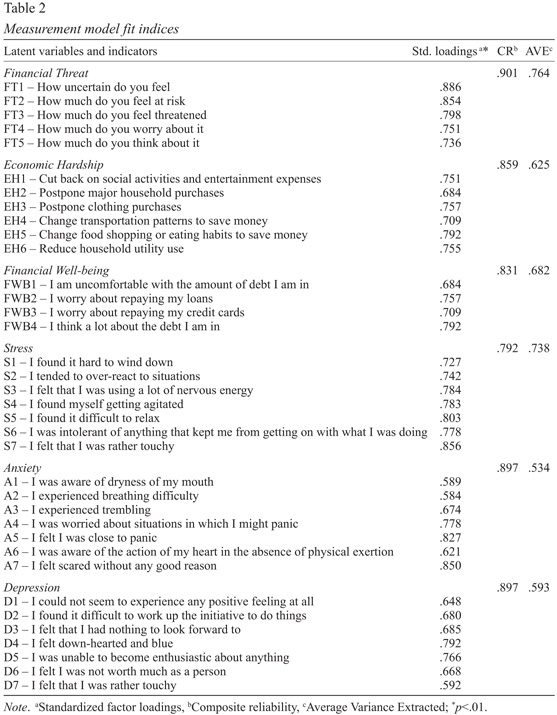
<body><![CDATA[<p><i>Testing the invariance of the model parameters</i></p>     <p>Before comparing the path coefficients between the two groups, measurement invariance was tested to identify if the measurement models were  invariant across groups. With this purpose, a constrained model where all the loadings were fixed to be equal across groups reported a  significantly better fit than an unconstrained model where all the loadings were allowed to be different in the two groups  (<i>&chi;<sup>2</i></sup>=41.252; <i>p</i>=.065). These results indicate that the measurement model can be assumed to be invariant across the two  groups: (a) those with better coping strategies; and (b) those with worse coping strategies. However, a structural model where all the path  coefficients were constrained to be equal for the two groups presents a significantly worse fit than an unconstrained model where the path  coefficients can be different in the two groups (<i>&chi;<sup>2</i></sup>=23.340; <i>p</i>=.005). This significant difference suggests that the  relationship pattern differs across groups.</p>     <p>&nbsp;</p>     <p><i>Overall model fit</i></p>     <p>The model assuming the same loadings across groups (measurement invariance) and free path coefficients across groups (structural variance) was  estimated using AMOS multiple-group analysis. Then, the model was assessed regarding the overall model fit which implies a threefold evaluation:  (a) absolute fit; (b) incremental fit; and (c) parsimonious fit. In terms of absolute fit, results show a high and statistically significant  Chi-square statistics (<i>&chi;<sup>2</i></sup>=1919.853; <i>p&lt;</i>.01), suggesting a significant difference between the actual and predicted  models. However, given that this test is too sensitive to large sample sizes, other absolute fit indexes should be observed (Anderson &amp;  Gerbing, 1982). In this regard, a good absolute fit was observed <a href="#t1">Table 1</a> giving the GFI (.821), RMR (.062), and the RMSEA values  (.044). In terms of incremental and parsimonious adjustment, results indicate a moderate to good model (NFI=.826; IFI=.914; TLI=.901; CFI=.911;  PCFI=.818; PNFI=.737; <i>&chi;<sup>2</sup>/df</i>=1.796). These results are also indicative of configurational invariance which means that the set  of items to measure the latent constructs is the same across the groups.</p>     <p>&nbsp;</p>     <p><a name="t1"></a></p>     <p><img src="/img/revistas/aps/v34n4/34n4a03t1.jpg"></p>     
<p>&nbsp;</p>     <p>&nbsp;</p>     ]]></body>
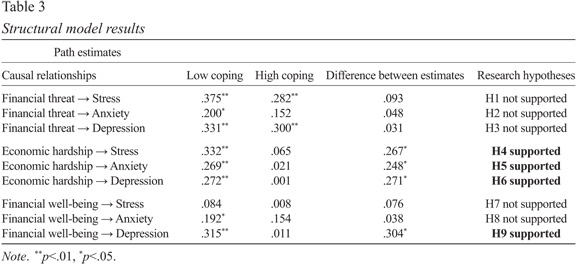
<body><![CDATA[<p><i>Measurement model fit</i></p>     <p>A suitable measurement model fit is required before the relationships between the latent variables can be assessed (Anderson &amp; Gerbing,  1982). The main results from the measurement model analysis are presented in <a href="#t2">Table 2</a>. As can be observed, all indicators report  individual reliability, since all standardized factor loadings surpass the threshold value of .5 and are statistically significant  (<i>p&lt;</i>.01). Construct reliability is also found as evidenced by a high Cronbach&rsquo;s Alpha value and Composite Reliability (CR)  coefficients (Kline, 1998). The model also reports good convergent validity given that all Average Variance Extracted (AVE) values are higher than  the threshold value of .5 (Fornell &amp; Larcker, 1981). Concerning discriminant validity, each AVE value should be higher than the squared  correlation between the corresponding construct and the other. This condition is applied to the six latent variables (i.e., financial threat,  financial well-being, economic hardship, stress, anxiety, and depression).</p>     <p>&nbsp;</p>     <p><a name="t2"></a></p>     <p><img src="/img/revistas/aps/v34n4/34n4a03t2.jpg"></p>     
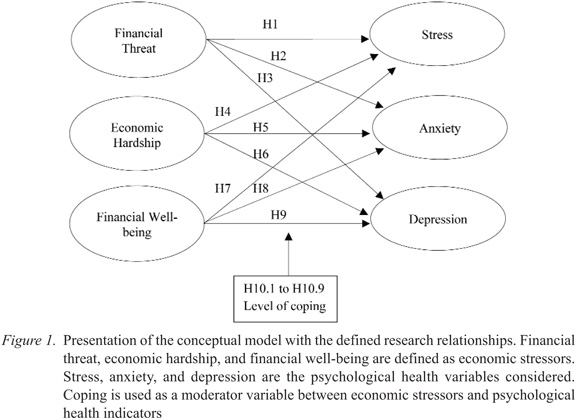
<p>&nbsp;</p>     <p>&nbsp;</p>     <p><i>Structural model parameters</i></p>     <p><a href="#t3">Table 3</a> shows the standardized path estimates of the structural model proposed in <a href="#f1">Figure 1</a> in the two  groups. In the group with high coping scores, all nine estimates are positive meaning that strong economic stress is associated with higher levels  of stress, anxiety, and depression. From these relations, only two are statistically significant: (a) the relationship between financial threat and  stress (standardized coefficient=.282; <i>p</i>&lt;.01); and (b) the relationship between financial threat and depression (standardized  coefficient=.300; <i>p</i>&lt;.01). The results are quite different in the group with low coping scores. In this group, the estimates are also  positive which underlines the existence of a positive association between economic stressors and psychological health problems. However, the number  of significant relationships is much larger in this group than in the group with high coping. Within individuals with low coping strategies, only  the relationship between financial well-being and stress is not significant (standardized coefficient=0.084; <i>p</i>=.294).</p>     <p>&nbsp;</p>     ]]></body>
<body><![CDATA[<p><a name="t3"></a></p>     <p><img src="/img/revistas/aps/v34n4/34n4a03t3.jpg"></p>     
<p>&nbsp;</p>     <p><a href="#t3">Table 3</a> also presents the differences between the pairs of coefficients. The differences are significant concerning the  relationships involving economic hardship and stress (H4), economic hardship and anxiety (H5), economic hardship and depression (H6), and also  between financial well-being and depression (H9) (Z scores of 1.851, 1.720, 2.17, and 2.11, respectively, all <i>p</i>&lt;.05). The significance of  the differences was assessed by comparing the <i>Z</i> scores for differences between the pairs of coefficients provided by AMOS with the critical  values for the <i>Z</i> distribution of 1.645 and 3.07, for a 5% and 1% significance level, respectively, and assuming one sided tests for the  research hypotheses. In short, coping significantly moderates the relationship between specific economic stressors, especially economic hardship,  and psychological health.</p>      <p><b>Discussion</b></p>     <p>Globally, our results show that coping affects the relationship between economic stress variables and psychological health variables. The effect  of economic stressors on psychological health variables is always positive in the two groups and, in general, the effects are significant within  individuals with low coping strategies. The obtained results allow us to draw some conclusions. It was observed that the stronger the coping  strategies employed by individuals are, the less vulnerable their psychological health will be to economic stress factors. In most cases, in the  high coping group, the effect of coping decreased the magnitude and statistical significance of the association between the economic stress and  psychological health variables. However, in the group with low coping values it was verified that, in most situations, individuals continued to  suffer a significant incidence of economic stress factors on their mental health. Except for one case (i.e., relationship between financial  well-being and stress), the effect of coping was not able to mitigate the adverse effects of economic stress on mental health. When comparing the  two groups (i.e., high coping scores vs. low coping scores) it was registered that coping strategies were more effective in the relationships  between economic hardship and stress (H4), anxiety (H5), and depression (H6), and between financial well-being and depression (H9). In sum, our  findings highlight that, despite the importance of coping strategies, their influence will be more effective when subjects present high coping  levels. In the presence of subjects with low coping levels, the moderation effect of this construct will not be able to attenuate the negative  impact of economic stress factors on mental health.</p>     <p>This is congruent with the assertions of Lazarus (1966) and Lazarus and Folkman (1984) when they affirm that the use of coping behaviors  &ldquo;protects&rdquo; individuals&rsquo; psychological health from potential menaces. However, if we consider the coping theoretical framework  used in this study, we can conclude that it may not be sufficient for individuals to adopt an active attitude in the anticipation of potential  threatening situations (e.g., economic and financial crises), they should also employ their individual resources in order to guarantee that the  coping strategies used are sufficiently robust to prevent that those negative situations affect their mental health.</p>     <p>This study possesses implications for the development of preventive measures that can be used in similar situations (e.g., future economic  crises). Intervention programs involving skill training, in particular those who teach how to use coping strategies, could avert mental health  deterioration in times of economic recession. Stress management interventions (e.g., Bjorn, Jesus, &amp; Casado-Morales, 2013; Jesus, Miguel-Tobal,  Rus, Viseu, &amp; Gamboa, 2014; Neto &amp; Marujo, 2007; Santos, Pais-Ribeiro, &amp; Guimar&atilde;es, 2003) may also be an important way to  prevent stress, anxiety, and depression, namely because they teach individuals to: (a) cope with potential stressors; (b) use adequate coping  strategies; (c) implement relaxation techniques; and (d) develop healthy lifestyles. Unemployed subjects might be the primary target of these  interventions, however these programs may be useful for adults in general, namely in organizations for workers and in universities for students.</p>     <p>The present study possesses limitations regarding the sampling process. Firstly, the collected sample should present a higher number of  participants, seeking to ensure the strength of the obtained results. Secondly, other type of participants could have been studied (e.g., children  and adolescents from families with economic difficulties) to analyze the importance of family coping strategies. The use of a cross-sectional  design may also be considered as a limitation, because data collection at one single moment does not allow the assessment of how different  variables relate with each other at different time-frames, inhibiting the realization of comparisons. Additionally, this type of design impedes the  inference of causality.</p>     <p>Future research should examine the hypothesized model using longitudinal data, in order to address conceptual and methodological issues  concerning inferences of causality. Furthermore, other moderator variables (e.g., social support) can be used, trying to understand their effect on  the relationship between economic stressors and psychological health indicators. Finally, it would be useful to realize similar studies in other  European countries (e.g., Greece) affected by the financial crisis, with the objective of comparing the obtained results.</p>     ]]></body>
<body><![CDATA[<p>&nbsp;</p>     <p><b>References</b></p>     <!-- ref --><p>Almeida, J. M. C., &amp; Xavier, M. (2013). <i>Estudo epidemiol&oacute;gico nacional de sa&uacute;de mental: 1&ordm; relat&oacute;rio [National  epidemiological study of mental health: 1<sup>st</sup> report]</i>. Lisboa: Faculdade de Ci&ecirc;ncias M&eacute;dicas, Universidade Nova de  Lisboa. Accessed from  <a href="http://www.fcm.unl.pt/main/alldoc/galeria_imagens/Relatorio_Estudo_Saude-Mental_2.pdf"  target="_blank">http://www.fcm.unl.pt/main/alldoc/galeria_imagens/Relatorio_Estudo_Saude-Mental_2.pdf</a>&nbsp;&nbsp;&nbsp;&nbsp;&nbsp;&nbsp;&nbsp;&nbsp;[&#160;<a href="javascript:void(0);" onclick="javascript: window.open('/scielo.php?script=sci_nlinks&ref=024521&pid=S0870-8231201600040000300001&lng=','','width=640,height=500,resizable=yes,scrollbars=1,menubar=yes,');">Links</a>&#160;]<!-- end-ref --><p>Althouse, B., Allem, J., Childers, M., Dredze, M., &amp; Ayers, J. (2014). Population health concerns during the United States&rsquo; great  recession. <i>American Journal of Preventive Medicine, 46</i>, 166-170. doi: 10.1016/j.amepre.2013.10.008</p>     <!-- ref --><p>Anderson, J., &amp; Gerbing, D. (1982). Some methods of respecifying measurement models to obtain unidimensional construct measurement.  <i>Journal of Marketing Research, 19</i>, 453-460. doi: 10.2307/3151719&nbsp;&nbsp;&nbsp;&nbsp;&nbsp;&nbsp;&nbsp;&nbsp;[&#160;<a href="javascript:void(0);" onclick="javascript: window.open('/scielo.php?script=sci_nlinks&ref=024523&pid=S0870-8231201600040000300003&lng=','','width=640,height=500,resizable=yes,scrollbars=1,menubar=yes,');">Links</a>&#160;]<!-- end-ref --><!-- ref --><p>Betz, N. (2000). Test construction. In F. Leong &amp; J. Austin (Eds.), <i>The psychology research handbook: A guide for graduate students and  research assistants</i> (pp. 239-250). Thousand Oaks, CA: Sage Publications.    &nbsp;&nbsp;&nbsp;&nbsp;&nbsp;&nbsp;&nbsp;&nbsp;[&#160;<a href="javascript:void(0);" onclick="javascript: window.open('/scielo.php?script=sci_nlinks&ref=024524&pid=S0870-8231201600040000300004&lng=','','width=640,height=500,resizable=yes,scrollbars=1,menubar=yes,');">Links</a>&#160;]<!-- end-ref --></p>     <!-- ref --><p>Bjorn, M., Jesus, S. N., &amp; Casado-Morales, M. (2013). Relaxation strategies during pregnancy: Health benefits. <i>Cl&iacute;nica y  Salud, 24</i>, 77-83. doi: 10.5093/cl2013a9&nbsp;&nbsp;&nbsp;&nbsp;&nbsp;&nbsp;&nbsp;&nbsp;[&#160;<a href="javascript:void(0);" onclick="javascript: window.open('/scielo.php?script=sci_nlinks&ref=024526&pid=S0870-8231201600040000300005&lng=','','width=640,height=500,resizable=yes,scrollbars=1,menubar=yes,');">Links</a>&#160;]<!-- end-ref --><!-- ref --><p>Boone, J., van Ours, J., Wuellrich, J., &amp; Zweimuller, J. (2011). Recessions are bad for workplace safety. <i>Journal of Health  Economics, 30</i>, 764-773. doi: 10.2139/ssrn.1816292&nbsp;&nbsp;&nbsp;&nbsp;&nbsp;&nbsp;&nbsp;&nbsp;[&#160;<a href="javascript:void(0);" onclick="javascript: window.open('/scielo.php?script=sci_nlinks&ref=024527&pid=S0870-8231201600040000300006&lng=','','width=640,height=500,resizable=yes,scrollbars=1,menubar=yes,');">Links</a>&#160;]<!-- end-ref --><!-- ref --><p>Boyd, C., Tuckey, M., &amp; Winefield, A. (2013). Perceived effects of organizational downsizing and staff cuts on the stress experience: The  role of resources. <i>Stress and Health, 30</i>, 53-64. doi: 10.1002/smi.2495&nbsp;&nbsp;&nbsp;&nbsp;&nbsp;&nbsp;&nbsp;&nbsp;[&#160;<a href="javascript:void(0);" onclick="javascript: window.open('/scielo.php?script=sci_nlinks&ref=024528&pid=S0870-8231201600040000300007&lng=','','width=640,height=500,resizable=yes,scrollbars=1,menubar=yes,');">Links</a>&#160;]<!-- end-ref --><!-- ref --><p>Catalano, R., Goldman-Mellor, S., Saxton, K., Margerison-Zilko, C., Subbaraman, LeWinn, K., &amp; Anderson, E. (2011). The health effects of  economic decline. <i>Annual Review of Public Health, 32</i>, 431-450. doi: 10.1146/annurev-publhealth&nbsp;&nbsp;&nbsp;&nbsp;&nbsp;&nbsp;&nbsp;&nbsp;[&#160;<a href="javascript:void(0);" onclick="javascript: window.open('/scielo.php?script=sci_nlinks&ref=024529&pid=S0870-8231201600040000300008&lng=','','width=640,height=500,resizable=yes,scrollbars=1,menubar=yes,');">Links</a>&#160;]<!-- end-ref --><!-- ref --><p>Chen, L., Li, W., He, J., Wu, L., Yan, Z., &amp; Tang, W. (2012). Mental health, duration of unemployment, and coping strategy: A  cross-sectional study of unemployed migrant workers in eastern China during the economic crisis. <i>BMC Public Health, 12</i>, 597. doi:  10.1186/1471-2458-12-597&nbsp;&nbsp;&nbsp;&nbsp;&nbsp;&nbsp;&nbsp;&nbsp;[&#160;<a href="javascript:void(0);" onclick="javascript: window.open('/scielo.php?script=sci_nlinks&ref=024530&pid=S0870-8231201600040000300009&lng=','','width=640,height=500,resizable=yes,scrollbars=1,menubar=yes,');">Links</a>&#160;]<!-- end-ref --><!-- ref --><p>Cooper, C. (2012). Stress in turbulent economic times. <i>Stress and Health, 28</i>, 177-178. doi: 10.1002/smi.2442&nbsp;&nbsp;&nbsp;&nbsp;&nbsp;&nbsp;&nbsp;&nbsp;[&#160;<a href="javascript:void(0);" onclick="javascript: window.open('/scielo.php?script=sci_nlinks&ref=024531&pid=S0870-8231201600040000300010&lng=','','width=640,height=500,resizable=yes,scrollbars=1,menubar=yes,');">Links</a>&#160;]<!-- end-ref --><!-- ref --><p>Falagas, M. E, Vouloumanou, E. K, Mavros, M. N., &amp; Karageorgopoulos, D. E. (2009). Economic crises and mortality: A review of literature.  <i>International Journal of Clinical Practice, 63</i>, 1128-1135. doi: 10.1111/j.1742-1241.2009.02124.x&nbsp;&nbsp;&nbsp;&nbsp;&nbsp;&nbsp;&nbsp;&nbsp;[&#160;<a href="javascript:void(0);" onclick="javascript: window.open('/scielo.php?script=sci_nlinks&ref=024532&pid=S0870-8231201600040000300011&lng=','','width=640,height=500,resizable=yes,scrollbars=1,menubar=yes,');">Links</a>&#160;]<!-- end-ref --><!-- ref --><p>Fenge, L., Hean, S., Worswick, L., Wilkinson, C., Fearnley, S., &amp; Ersser, S. (2012). The impact of the economic recession on well-being and  quality of life of older people. <i>Health and Social Care in the Community, 20</i>, 617-624. doi: 10.1111/j.1365-2524.2012.01077.x&nbsp;&nbsp;&nbsp;&nbsp;&nbsp;&nbsp;&nbsp;&nbsp;[&#160;<a href="javascript:void(0);" onclick="javascript: window.open('/scielo.php?script=sci_nlinks&ref=024533&pid=S0870-8231201600040000300012&lng=','','width=640,height=500,resizable=yes,scrollbars=1,menubar=yes,');">Links</a>&#160;]<!-- end-ref --><!-- ref --><p>Fornell, C., &amp; Larcker, D. F. (1981). Evaluating structural equation models with unobservable variables and measurement error. <i>Journal of  Marketing Research, 18</i>, 39-50. doi: 10.2307/3151312&nbsp;&nbsp;&nbsp;&nbsp;&nbsp;&nbsp;&nbsp;&nbsp;[&#160;<a href="javascript:void(0);" onclick="javascript: window.open('/scielo.php?script=sci_nlinks&ref=024534&pid=S0870-8231201600040000300013&lng=','','width=640,height=500,resizable=yes,scrollbars=1,menubar=yes,');">Links</a>&#160;]<!-- end-ref --><!-- ref --><p>Frank, C., Davis, C., &amp; Elgar, F. (2013). Financial strain, social capital, and perceived health during economic recession: A longitudinal  survey in rural Canada. <i>Anxiety, Stress, &amp; Coping, 27</i>, 422-438. doi: 10.1080/10615806.2013.864389&nbsp;&nbsp;&nbsp;&nbsp;&nbsp;&nbsp;&nbsp;&nbsp;[&#160;<a href="javascript:void(0);" onclick="javascript: window.open('/scielo.php?script=sci_nlinks&ref=024535&pid=S0870-8231201600040000300014&lng=','','width=640,height=500,resizable=yes,scrollbars=1,menubar=yes,');">Links</a>&#160;]<!-- end-ref --><!-- ref --><p>Greenglass, E. (2002). Proactive coping. In E. Frydenberg (Ed.), <i>Beyond coping: Meeting goals, vision, and challenges</i> (pp. 37-62).  London, United Kingdom: Oxford University Press.    &nbsp;&nbsp;&nbsp;&nbsp;&nbsp;&nbsp;&nbsp;&nbsp;[&#160;<a href="javascript:void(0);" onclick="javascript: window.open('/scielo.php?script=sci_nlinks&ref=024536&pid=S0870-8231201600040000300015&lng=','','width=640,height=500,resizable=yes,scrollbars=1,menubar=yes,');">Links</a>&#160;]<!-- end-ref --></p>     <!-- ref --><p>Greenglass, E., &amp; Fiksenbaum, L. (2009). Proactive coping, positive affect, and well-being: Testing for mediation using path analysis.  <i>European Psychologist, 14</i>, 29-39. doi: 10.1027/1016-9040.14.1.29&nbsp;&nbsp;&nbsp;&nbsp;&nbsp;&nbsp;&nbsp;&nbsp;[&#160;<a href="javascript:void(0);" onclick="javascript: window.open('/scielo.php?script=sci_nlinks&ref=024538&pid=S0870-8231201600040000300016&lng=','','width=640,height=500,resizable=yes,scrollbars=1,menubar=yes,');">Links</a>&#160;]<!-- end-ref --><!-- ref --><p>Greenglass, E., Marjanovic, Z., &amp; Fiksenbaum, L. (2013). The impact of the recession and its aftermath on individual health and well-being.  In A. Antoniou &amp; C. Cooper (Eds.), <i>The psychology of the recession on the workplace</i> (pp. 42-58). Cheltenham, United Kingdom: Edward  Elgar Publishing.    &nbsp;&nbsp;&nbsp;&nbsp;&nbsp;&nbsp;&nbsp;&nbsp;[&#160;<a href="javascript:void(0);" onclick="javascript: window.open('/scielo.php?script=sci_nlinks&ref=024539&pid=S0870-8231201600040000300017&lng=','','width=640,height=500,resizable=yes,scrollbars=1,menubar=yes,');">Links</a>&#160;]<!-- end-ref --></p>     <!-- ref --><p>Greenglass, E., Schwarzer, R., &amp; Taubert, S. (1999). <i>The Proactive Coping Inventory (PCI): A multidimensional research instrument</i>  [on-line publication]. Accessed from  <a href="http://www.psych.yorku.ca/greenglass/" target="_blank">http://www.psych.yorku.ca/greenglass/</a>&nbsp;&nbsp;&nbsp;&nbsp;&nbsp;&nbsp;&nbsp;&nbsp;[&#160;<a href="javascript:void(0);" onclick="javascript: window.open('/scielo.php?script=sci_nlinks&ref=024541&pid=S0870-8231201600040000300018&lng=','','width=640,height=500,resizable=yes,scrollbars=1,menubar=yes,');">Links</a>&#160;]<!-- end-ref --><!-- ref --><p>Hair, J. F., Anderson, R. E., Tatham, R. L., &amp; Black, W. C. (1998). <i>Multivariate data analysis with readings </i>(5<sup>th </sup>ed.).  Englewood Cliffs, NJ: Prentice-Hall International.    &nbsp;&nbsp;&nbsp;&nbsp;&nbsp;&nbsp;&nbsp;&nbsp;[&#160;<a href="javascript:void(0);" onclick="javascript: window.open('/scielo.php?script=sci_nlinks&ref=024542&pid=S0870-8231201600040000300019&lng=','','width=640,height=500,resizable=yes,scrollbars=1,menubar=yes,');">Links</a>&#160;]<!-- end-ref --></p>     <!-- ref --><p>Jesus, S. N., Miguel-Tobal, J., Rus, C., Viseu, J., &amp; Gamboa, V. (2014). Evaluating the effectiveness of a stress management training on  teachers and physicians stress related outcomes. <i>Cl&iacute;nica y Salud, 25</i>, 111-115. doi: 10.1016/j.clysa.2014.06.004&nbsp;&nbsp;&nbsp;&nbsp;&nbsp;&nbsp;&nbsp;&nbsp;[&#160;<a href="javascript:void(0);" onclick="javascript: window.open('/scielo.php?script=sci_nlinks&ref=024544&pid=S0870-8231201600040000300020&lng=','','width=640,height=500,resizable=yes,scrollbars=1,menubar=yes,');">Links</a>&#160;]<!-- end-ref --><!-- ref --><p>Keegan, C., Thomas, S., Normand, C., &amp; Portela, C. (2013). Measuring recession severity and its impact on health expenditure.  <i>International Journal of Health Care Finance and Economics, 13</i>, 139-155. doi: 10.1007/s10754-012-9121-2&nbsp;&nbsp;&nbsp;&nbsp;&nbsp;&nbsp;&nbsp;&nbsp;[&#160;<a href="javascript:void(0);" onclick="javascript: window.open('/scielo.php?script=sci_nlinks&ref=024545&pid=S0870-8231201600040000300021&lng=','','width=640,height=500,resizable=yes,scrollbars=1,menubar=yes,');">Links</a>&#160;]<!-- end-ref --><p>Kim, J., Garman, E. T., &amp; Sorhaindo, B. (2003). Relationship among credit counseling clients&rsquo; financial well-being, financial  behaviors, financial stressor events and health. <i>Journal of Financial Counseling and Planning, 14</i>, 75-87.</p>     <!-- ref --><p>Kline, R. B. (1998). Software review: Software programs for structural equation modeling: AMOS, EQS, and LISREL. <i>Journal of Psychoeducational  Assessment, 16</i>, 343-364. doi: 10.1177/073428299801600407&nbsp;&nbsp;&nbsp;&nbsp;&nbsp;&nbsp;&nbsp;&nbsp;[&#160;<a href="javascript:void(0);" onclick="javascript: window.open('/scielo.php?script=sci_nlinks&ref=024547&pid=S0870-8231201600040000300023&lng=','','width=640,height=500,resizable=yes,scrollbars=1,menubar=yes,');">Links</a>&#160;]<!-- end-ref --><!-- ref --><p>Lazarus, R. (1966). <i>Psychological stress and the coping process</i>. New York, NY: McGraw-Hill.    &nbsp;&nbsp;&nbsp;&nbsp;&nbsp;&nbsp;&nbsp;&nbsp;[&#160;<a href="javascript:void(0);" onclick="javascript: window.open('/scielo.php?script=sci_nlinks&ref=024548&pid=S0870-8231201600040000300024&lng=','','width=640,height=500,resizable=yes,scrollbars=1,menubar=yes,');">Links</a>&#160;]<!-- end-ref --></p>     <!-- ref --><p>Lazarus, R., &amp; Folkman, S. (1984). <i>Stress appraisal and coping</i>. New York, NY: Springer.    &nbsp;&nbsp;&nbsp;&nbsp;&nbsp;&nbsp;&nbsp;&nbsp;[&#160;<a href="javascript:void(0);" onclick="javascript: window.open('/scielo.php?script=sci_nlinks&ref=024550&pid=S0870-8231201600040000300025&lng=','','width=640,height=500,resizable=yes,scrollbars=1,menubar=yes,');">Links</a>&#160;]<!-- end-ref --></p>     <!-- ref --><p>Lempers, J., Clark-Lempers, D., &amp; Simons, R. (1989). Economic hardship, parenting, and distress in adolescence. <i>Child Development,  60</i>, 25-39. doi: 10.1111/j.1467-8624.1989.tb02692.x&nbsp;&nbsp;&nbsp;&nbsp;&nbsp;&nbsp;&nbsp;&nbsp;[&#160;<a href="javascript:void(0);" onclick="javascript: window.open('/scielo.php?script=sci_nlinks&ref=024552&pid=S0870-8231201600040000300026&lng=','','width=640,height=500,resizable=yes,scrollbars=1,menubar=yes,');">Links</a>&#160;]<!-- end-ref --><!-- ref --><p>Lovibond, S., &amp; Lovibond, P. (1995). <i>Manual for the depression anxiety stress scales </i>(2<sup>nd</sup> ed.). Sydney, Australia:  Psychology Foundation.    &nbsp;&nbsp;&nbsp;&nbsp;&nbsp;&nbsp;&nbsp;&nbsp;[&#160;<a href="javascript:void(0);" onclick="javascript: window.open('/scielo.php?script=sci_nlinks&ref=024553&pid=S0870-8231201600040000300027&lng=','','width=640,height=500,resizable=yes,scrollbars=1,menubar=yes,');">Links</a>&#160;]<!-- end-ref --></p>     <!-- ref --><p>Marjanovic, Z., Greenglass, E., Fiksenbaum, L., &amp; Bell, C. (2013). Psychometric evaluation of the Financial Threat Scale (FTS) in the  context of the great recession. <i>Journal of Economic Psychology, 36</i>, 1-10. doi: 10.1016/j.joep.2013.02.005&nbsp;&nbsp;&nbsp;&nbsp;&nbsp;&nbsp;&nbsp;&nbsp;[&#160;<a href="javascript:void(0);" onclick="javascript: window.open('/scielo.php?script=sci_nlinks&ref=024555&pid=S0870-8231201600040000300028&lng=','','width=640,height=500,resizable=yes,scrollbars=1,menubar=yes,');">Links</a>&#160;]<!-- end-ref --><!-- ref --><p>Neto, L., &amp; Marujo, H. (2007). Propostas estrat&eacute;gicas da psicologia positiva para a preven&ccedil;&atilde;o e regula&ccedil;&atilde;o  do stress. <i>An&aacute;lise Psicol&oacute;gica, XXV</i>, 585-593.    &nbsp;&nbsp;&nbsp;&nbsp;&nbsp;&nbsp;&nbsp;&nbsp;[&#160;<a href="javascript:void(0);" onclick="javascript: window.open('/scielo.php?script=sci_nlinks&ref=024556&pid=S0870-8231201600040000300029&lng=','','width=640,height=500,resizable=yes,scrollbars=1,menubar=yes,');">Links</a>&#160;]<!-- end-ref --></p>     <!-- ref --><p>Norvilitis, J. M., Szablicki, P. B., &amp; Wilson, S. D. (2003). Factors in&#64258;uencing levels of credit card debt in college students.  <i>Journal of Applied Social Psychology, 33</i>, 935-947. doi: 10.1111/j.1559-1816.2003.tb01932.x&nbsp;&nbsp;&nbsp;&nbsp;&nbsp;&nbsp;&nbsp;&nbsp;[&#160;<a href="javascript:void(0);" onclick="javascript: window.open('/scielo.php?script=sci_nlinks&ref=024558&pid=S0870-8231201600040000300030&lng=','','width=640,height=500,resizable=yes,scrollbars=1,menubar=yes,');">Links</a>&#160;]<!-- end-ref --><p>Prawitz, A., Garman, E. T., Sorhaindo, B., O&rsquo;Neill, B., Kim, J., &amp; Drentea, P. (2006). InCharge financial distress/financial  well-being scale: Development, administration, and score interpretation. <i>Journal of Financial Counseling and Planning, 17</i>, 34-50.</p>     <!-- ref --><p>Portuguese Observatory of Health Systems. (2014). <i>Relat&oacute;rio de primavera 2014 [Spring report 2014</i>]. Accessed from Sistemas de  Sa&uacute;de. Retirado de <a href="http://www.observaport.org/sites/observaport.org/files/RelatorioPrimavera2014.pdf"  target="_blank">http://www.observaport.org/sites/observaport.org/files/RelatorioPrimavera2014.pdf</a>&nbsp;&nbsp;&nbsp;&nbsp;&nbsp;&nbsp;&nbsp;&nbsp;[&#160;<a href="javascript:void(0);" onclick="javascript: window.open('/scielo.php?script=sci_nlinks&ref=024560&pid=S0870-8231201600040000300032&lng=','','width=640,height=500,resizable=yes,scrollbars=1,menubar=yes,');">Links</a>&#160;]<!-- end-ref --><!-- ref --><p>Santos, L., Pais-Ribeiro, J., &amp; Guimar&atilde;es, L. (2003). Estudo de uma escala de cren&ccedil;as e de estrat&eacute;gias de coping  atrav&eacute;s do lazer. <i>An&aacute;lise Psicol&oacute;gica, XXI</i>, 441-451.    &nbsp;&nbsp;&nbsp;&nbsp;&nbsp;&nbsp;&nbsp;&nbsp;[&#160;<a href="javascript:void(0);" onclick="javascript: window.open('/scielo.php?script=sci_nlinks&ref=024561&pid=S0870-8231201600040000300033&lng=','','width=640,height=500,resizable=yes,scrollbars=1,menubar=yes,');">Links</a>&#160;]<!-- end-ref --></p>     <!-- ref --><p>Sargent-Cox, K., Butterworth, P., &amp; Anstey, K. (2011). The global financial crisis and psychological health in a sample of Australian older  adults: A longitudinal study. <i>Social Science &amp; Medicine, 73</i>, 1105-1112. doi: 10.1016/j.socsimed.2011.06.063&nbsp;&nbsp;&nbsp;&nbsp;&nbsp;&nbsp;&nbsp;&nbsp;[&#160;<a href="javascript:void(0);" onclick="javascript: window.open('/scielo.php?script=sci_nlinks&ref=024563&pid=S0870-8231201600040000300034&lng=','','width=640,height=500,resizable=yes,scrollbars=1,menubar=yes,');">Links</a>&#160;]<!-- end-ref --><p>Sociedad Espa&ntilde;ola de Salud P&uacute;blica y Administraci&oacute;n Sanit&aacute;ria. (2011). <i>Comunicado de la sociedad espa&ntilde;ola  de salud p&uacute;blica y administraci&oacute;n sanitaria (sespas): El impacto en la salud de la poblaci&oacute;n de la crisis Econ&oacute;mica y  las pol&iacute;ticas para abordala [Statement from the Spanish society of public health administration (sespas): The impact of the economic  crisis on the populations&rsquo; health and the politics to face it]</i>. Barcelona, Espa&ntilde;a: SESPAS.</p>     <!-- ref --><p>Statistics Portugal. (2014). Estat&iacute;sticas do emprego: 2&ordm; trimestre de 2014 [Employment statistics: 2<sup>nd </sup>quarter of 2014].  <i>Statistics Portugal, 1</i>, 1-9.    &nbsp;&nbsp;&nbsp;&nbsp;&nbsp;&nbsp;&nbsp;&nbsp;[&#160;<a href="javascript:void(0);" onclick="javascript: window.open('/scielo.php?script=sci_nlinks&ref=024565&pid=S0870-8231201600040000300036&lng=','','width=640,height=500,resizable=yes,scrollbars=1,menubar=yes,');">Links</a>&#160;]<!-- end-ref --></p>     <p>Stein, C., Hoffmann, E., Bonar, E., Leith, J., Abraham, K., Hamill, A., . . . Fogo, W. (2013). The United States economic crisis: Young  adults&rsquo; reports of economic pressures, financial and religious coping and psychological well-being. <i>Journal of Family and Economic Issues,  34</i>, 200-210. doi: 10.1007/s10834-012-9328-x</p>     <!-- ref --><p>Torres, F. (2009). Back to external pressure: Policy responses to the financial crisis in Portugal. <i>South European Society and Politics,  14</i>, 55-70. doi: 10.1080/136008740902995851&nbsp;&nbsp;&nbsp;&nbsp;&nbsp;&nbsp;&nbsp;&nbsp;[&#160;<a href="javascript:void(0);" onclick="javascript: window.open('/scielo.php?script=sci_nlinks&ref=024568&pid=S0870-8231201600040000300038&lng=','','width=640,height=500,resizable=yes,scrollbars=1,menubar=yes,');">Links</a>&#160;]<!-- end-ref --><!-- ref --><p>Yurtsever, S. (2011). Investigating the recovery strategies of European Union from the global financial crisis. <i>Procedia Social and  Behavioral Sciences, 24</i>, 687-695. doi: 10.1016/j.sbspro.2011.09.132&nbsp;&nbsp;&nbsp;&nbsp;&nbsp;&nbsp;&nbsp;&nbsp;[&#160;<a href="javascript:void(0);" onclick="javascript: window.open('/scielo.php?script=sci_nlinks&ref=024569&pid=S0870-8231201600040000300039&lng=','','width=640,height=500,resizable=yes,scrollbars=1,menubar=yes,');">Links</a>&#160;]<!-- end-ref --><p>&nbsp;</p>     <p><b><a name="c0" id="c0"></a><a href="#topc0">CORRESPONDÊNCIA</a></b></p>     <p>A correspond&ecirc;ncia relativa a este artigo dever&aacute; ser enviada para: Sa&uacute;l Neves Jesus, Faculdade de Ci&ecirc;ncias Humanas  e Sociais (FCHS) &ndash; Universidade do Algarve, Campus de Gambelas, Edif&iacute;cio 1, 8005-139 Faro, Portugal. E-mail:  <a href="mailto:snjesus@ualg.pt">snjesus@ualg.pt</a></p>     <p>&nbsp;</p>     <p>Submiss&atilde;o: 28/07/2015 Aceita&ccedil;&atilde;o: 07/02/2016</p>      ]]></body><back>
<ref-list>
<ref id="B1">
<nlm-citation citation-type="book">
<person-group person-group-type="author">
<name>
<surname><![CDATA[Almeida]]></surname>
<given-names><![CDATA[J. M. C.]]></given-names>
</name>
<name>
<surname><![CDATA[Xavier]]></surname>
<given-names><![CDATA[M.]]></given-names>
</name>
</person-group>
<source><![CDATA[Estudo epidemiológico nacional de saúde mental: 1º relatório]]></source>
<year>2013</year>
<publisher-loc><![CDATA[Lisboa ]]></publisher-loc>
<publisher-name><![CDATA[Faculdade de Ciências Médicas, Universidade Nova de Lisboa]]></publisher-name>
</nlm-citation>
</ref>
<ref id="B2">
<nlm-citation citation-type="journal">
<person-group person-group-type="author">
<name>
<surname><![CDATA[Althouse]]></surname>
<given-names><![CDATA[B.]]></given-names>
</name>
<name>
<surname><![CDATA[Allem]]></surname>
<given-names><![CDATA[J.]]></given-names>
</name>
<name>
<surname><![CDATA[Childers]]></surname>
<given-names><![CDATA[M.]]></given-names>
</name>
<name>
<surname><![CDATA[Dredze]]></surname>
<given-names><![CDATA[M.]]></given-names>
</name>
<name>
<surname><![CDATA[Ayers]]></surname>
<given-names><![CDATA[J.]]></given-names>
</name>
</person-group>
<article-title xml:lang="en"><![CDATA[Population health concerns during the United States’ great recession]]></article-title>
<source><![CDATA[American Journal of Preventive Medicine]]></source>
<year>2014</year>
<volume>46</volume>
<page-range>166-170</page-range></nlm-citation>
</ref>
<ref id="B3">
<nlm-citation citation-type="journal">
<person-group person-group-type="author">
<name>
<surname><![CDATA[Anderson]]></surname>
<given-names><![CDATA[J.]]></given-names>
</name>
<name>
<surname><![CDATA[Gerbing]]></surname>
<given-names><![CDATA[D.]]></given-names>
</name>
</person-group>
<article-title xml:lang="en"><![CDATA[Some methods of respecifying measurement models to obtain unidimensional construct measurement]]></article-title>
<source><![CDATA[Journal of Marketing Research]]></source>
<year>1982</year>
<volume>19</volume>
<page-range>453-460</page-range></nlm-citation>
</ref>
<ref id="B4">
<nlm-citation citation-type="book">
<person-group person-group-type="author">
<name>
<surname><![CDATA[Betz]]></surname>
<given-names><![CDATA[N.]]></given-names>
</name>
</person-group>
<article-title xml:lang="en"><![CDATA[Test construction]]></article-title>
<person-group person-group-type="editor">
<name>
<surname><![CDATA[Leong]]></surname>
<given-names><![CDATA[F.]]></given-names>
</name>
<name>
<surname><![CDATA[Austin]]></surname>
<given-names><![CDATA[J.]]></given-names>
</name>
</person-group>
<source><![CDATA[The psychology research handbook: A guide for graduate students and research assistants]]></source>
<year>2000</year>
<publisher-loc><![CDATA[Thousand Oaks ]]></publisher-loc>
<publisher-name><![CDATA[Sage Publications]]></publisher-name>
</nlm-citation>
</ref>
<ref id="B5">
<nlm-citation citation-type="journal">
<person-group person-group-type="author">
<name>
<surname><![CDATA[Bjorn]]></surname>
<given-names><![CDATA[M.]]></given-names>
</name>
<name>
<surname><![CDATA[Jesus]]></surname>
<given-names><![CDATA[S. N.]]></given-names>
</name>
<name>
<surname><![CDATA[Casado-Morales]]></surname>
<given-names><![CDATA[M.]]></given-names>
</name>
</person-group>
<article-title xml:lang="en"><![CDATA[Relaxation strategies during pregnancy: Health benefits]]></article-title>
<source><![CDATA[Clínica y Salud]]></source>
<year>2013</year>
<volume>24</volume>
<page-range>77-83</page-range></nlm-citation>
</ref>
<ref id="B6">
<nlm-citation citation-type="journal">
<person-group person-group-type="author">
<name>
<surname><![CDATA[Boone]]></surname>
<given-names><![CDATA[J.]]></given-names>
</name>
<name>
<surname><![CDATA[van Ours]]></surname>
<given-names><![CDATA[J.]]></given-names>
</name>
<name>
<surname><![CDATA[Wuellrich]]></surname>
<given-names><![CDATA[J.]]></given-names>
</name>
<name>
<surname><![CDATA[Zweimuller]]></surname>
<given-names><![CDATA[J.]]></given-names>
</name>
</person-group>
<article-title xml:lang="en"><![CDATA[Recessions are bad for workplace safety]]></article-title>
<source><![CDATA[Journal of Health Economics]]></source>
<year>2011</year>
<volume>30</volume>
<page-range>764-773</page-range></nlm-citation>
</ref>
<ref id="B7">
<nlm-citation citation-type="journal">
<person-group person-group-type="author">
<name>
<surname><![CDATA[Boyd]]></surname>
<given-names><![CDATA[C.]]></given-names>
</name>
<name>
<surname><![CDATA[Tuckey]]></surname>
<given-names><![CDATA[M.]]></given-names>
</name>
<name>
<surname><![CDATA[Winefield]]></surname>
<given-names><![CDATA[A.]]></given-names>
</name>
</person-group>
<article-title xml:lang="en"><![CDATA[Perceived effects of organizational downsizing and staff cuts on the stress experience: The role of resources]]></article-title>
<source><![CDATA[Stress and Health]]></source>
<year>2013</year>
<volume>30</volume>
<page-range>53-64</page-range></nlm-citation>
</ref>
<ref id="B8">
<nlm-citation citation-type="journal">
<person-group person-group-type="author">
<name>
<surname><![CDATA[Catalano]]></surname>
<given-names><![CDATA[R.]]></given-names>
</name>
<name>
<surname><![CDATA[Goldman-Mellor]]></surname>
<given-names><![CDATA[S.]]></given-names>
</name>
<name>
<surname><![CDATA[Saxton]]></surname>
<given-names><![CDATA[K.]]></given-names>
</name>
<name>
<surname><![CDATA[Margerison-Zilko]]></surname>
<given-names><![CDATA[C.]]></given-names>
</name>
<name>
<surname><![CDATA[Subbaraman]]></surname>
<given-names><![CDATA[LeWinn, K.]]></given-names>
</name>
<name>
<surname><![CDATA[Anderson]]></surname>
<given-names><![CDATA[E.]]></given-names>
</name>
</person-group>
<article-title xml:lang="en"><![CDATA[The health effects of economic decline]]></article-title>
<source><![CDATA[Annual Review of Public Health]]></source>
<year>2011</year>
<volume>32</volume>
<page-range>431-450</page-range></nlm-citation>
</ref>
<ref id="B9">
<nlm-citation citation-type="journal">
<person-group person-group-type="author">
<name>
<surname><![CDATA[Chen]]></surname>
<given-names><![CDATA[L.]]></given-names>
</name>
<name>
<surname><![CDATA[Li]]></surname>
<given-names><![CDATA[W.]]></given-names>
</name>
<name>
<surname><![CDATA[He]]></surname>
<given-names><![CDATA[J.]]></given-names>
</name>
<name>
<surname><![CDATA[Wu]]></surname>
<given-names><![CDATA[L.]]></given-names>
</name>
<name>
<surname><![CDATA[Yan]]></surname>
<given-names><![CDATA[Z.]]></given-names>
</name>
<name>
<surname><![CDATA[Tang]]></surname>
<given-names><![CDATA[W.]]></given-names>
</name>
</person-group>
<article-title xml:lang="en"><![CDATA[Mental health, duration of unemployment, and coping strategy: A cross-sectional study of unemployed migrant workers in eastern China during the economic crisis]]></article-title>
<source><![CDATA[BMC Public Health]]></source>
<year>2012</year>
<volume>12</volume>
<page-range>597</page-range></nlm-citation>
</ref>
<ref id="B10">
<nlm-citation citation-type="journal">
<person-group person-group-type="author">
<name>
<surname><![CDATA[Cooper]]></surname>
<given-names><![CDATA[C.]]></given-names>
</name>
</person-group>
<article-title xml:lang="en"><![CDATA[Stress in turbulent economic times]]></article-title>
<source><![CDATA[Stress and Health]]></source>
<year>2012</year>
<volume>28</volume>
<page-range>177-178</page-range></nlm-citation>
</ref>
<ref id="B11">
<nlm-citation citation-type="journal">
<person-group person-group-type="author">
<name>
<surname><![CDATA[Falagas]]></surname>
<given-names><![CDATA[M. E]]></given-names>
</name>
<name>
<surname><![CDATA[Vouloumanou]]></surname>
<given-names><![CDATA[E. K]]></given-names>
</name>
<name>
<surname><![CDATA[Mavros]]></surname>
<given-names><![CDATA[M. N.]]></given-names>
</name>
<name>
<surname><![CDATA[Karageorgopoulos]]></surname>
<given-names><![CDATA[D. E.]]></given-names>
</name>
</person-group>
<article-title xml:lang="en"><![CDATA[Economic crises and mortality: A review of literature]]></article-title>
<source><![CDATA[International Journal of Clinical Practice]]></source>
<year>2009</year>
<volume>63</volume>
<page-range>1128-1135</page-range></nlm-citation>
</ref>
<ref id="B12">
<nlm-citation citation-type="journal">
<person-group person-group-type="author">
<name>
<surname><![CDATA[Fenge]]></surname>
<given-names><![CDATA[L.]]></given-names>
</name>
<name>
<surname><![CDATA[Hean]]></surname>
<given-names><![CDATA[S.]]></given-names>
</name>
<name>
<surname><![CDATA[Worswick]]></surname>
<given-names><![CDATA[L.]]></given-names>
</name>
<name>
<surname><![CDATA[Wilkinson]]></surname>
<given-names><![CDATA[C.]]></given-names>
</name>
<name>
<surname><![CDATA[Fearnley]]></surname>
<given-names><![CDATA[S.]]></given-names>
</name>
<name>
<surname><![CDATA[Ersser]]></surname>
<given-names><![CDATA[S.]]></given-names>
</name>
</person-group>
<article-title xml:lang="en"><![CDATA[The impact of the economic recession on well-being and quality of life of older people]]></article-title>
<source><![CDATA[Health and Social Care in the Community]]></source>
<year>2012</year>
<volume>20</volume>
<page-range>617-624</page-range></nlm-citation>
</ref>
<ref id="B13">
<nlm-citation citation-type="journal">
<person-group person-group-type="author">
<name>
<surname><![CDATA[Fornell]]></surname>
<given-names><![CDATA[C.]]></given-names>
</name>
<name>
<surname><![CDATA[Larcker]]></surname>
<given-names><![CDATA[D. F.]]></given-names>
</name>
</person-group>
<article-title xml:lang="en"><![CDATA[Evaluating structural equation models with unobservable variables and measurement error]]></article-title>
<source><![CDATA[Journal of Marketing Research]]></source>
<year>1981</year>
<volume>18</volume>
<page-range>39-50</page-range></nlm-citation>
</ref>
<ref id="B14">
<nlm-citation citation-type="journal">
<person-group person-group-type="author">
<name>
<surname><![CDATA[Frank]]></surname>
<given-names><![CDATA[C.]]></given-names>
</name>
<name>
<surname><![CDATA[Davis]]></surname>
<given-names><![CDATA[C.]]></given-names>
</name>
<name>
<surname><![CDATA[Elgar]]></surname>
<given-names><![CDATA[F.]]></given-names>
</name>
</person-group>
<article-title xml:lang="en"><![CDATA[Financial strain, social capital, and perceived health during economic recession: A longitudinal survey in rural Canada]]></article-title>
<source><![CDATA[Anxiety]]></source>
<year>2013</year>
<volume>Stress</volume>
<page-range>& Coping, 27, 422-438</page-range></nlm-citation>
</ref>
<ref id="B15">
<nlm-citation citation-type="book">
<person-group person-group-type="author">
<name>
<surname><![CDATA[Greenglass]]></surname>
<given-names><![CDATA[E.]]></given-names>
</name>
</person-group>
<article-title xml:lang="en"><![CDATA[Proactive coping]]></article-title>
<person-group person-group-type="editor">
<name>
<surname><![CDATA[Frydenberg]]></surname>
<given-names><![CDATA[E.]]></given-names>
</name>
</person-group>
<source><![CDATA[Beyond coping: Meeting goals, vision, and challenges]]></source>
<year>2002</year>
<page-range>37-62</page-range><publisher-loc><![CDATA[London ]]></publisher-loc>
<publisher-name><![CDATA[Oxford University Press]]></publisher-name>
</nlm-citation>
</ref>
<ref id="B16">
<nlm-citation citation-type="journal">
<person-group person-group-type="author">
<name>
<surname><![CDATA[Greenglass]]></surname>
<given-names><![CDATA[E.]]></given-names>
</name>
<name>
<surname><![CDATA[Fiksenbaum]]></surname>
<given-names><![CDATA[L.]]></given-names>
</name>
</person-group>
<article-title xml:lang="en"><![CDATA[Proactive coping, positive affect, and well-being: Testing for mediation using path analysis]]></article-title>
<source><![CDATA[European Psychologist]]></source>
<year>2009</year>
<volume>14</volume>
<page-range>29-39</page-range></nlm-citation>
</ref>
<ref id="B17">
<nlm-citation citation-type="book">
<person-group person-group-type="author">
<name>
<surname><![CDATA[Greenglass]]></surname>
<given-names><![CDATA[E.]]></given-names>
</name>
<name>
<surname><![CDATA[Marjanovic]]></surname>
<given-names><![CDATA[Z.]]></given-names>
</name>
<name>
<surname><![CDATA[Fiksenbaum]]></surname>
<given-names><![CDATA[L.]]></given-names>
</name>
</person-group>
<article-title xml:lang="en"><![CDATA[The impact of the recession and its aftermath on individual health and well-being]]></article-title>
<person-group person-group-type="editor">
<name>
<surname><![CDATA[Antoniou]]></surname>
<given-names><![CDATA[A.]]></given-names>
</name>
<name>
<surname><![CDATA[Cooper]]></surname>
<given-names><![CDATA[C.]]></given-names>
</name>
</person-group>
<source><![CDATA[The psychology of the recession on the workplace]]></source>
<year>2013</year>
<page-range>42-58</page-range><publisher-loc><![CDATA[Cheltenham ]]></publisher-loc>
<publisher-name><![CDATA[Edward Elgar Publishing]]></publisher-name>
</nlm-citation>
</ref>
<ref id="B18">
<nlm-citation citation-type="">
<person-group person-group-type="author">
<name>
<surname><![CDATA[Greenglass]]></surname>
<given-names><![CDATA[E.]]></given-names>
</name>
<name>
<surname><![CDATA[Schwarzer]]></surname>
<given-names><![CDATA[R.]]></given-names>
</name>
<name>
<surname><![CDATA[Taubert]]></surname>
<given-names><![CDATA[S.]]></given-names>
</name>
</person-group>
<source><![CDATA[The Proactive Coping Inventory: A multidimensional research instrument]]></source>
<year>1999</year>
</nlm-citation>
</ref>
<ref id="B19">
<nlm-citation citation-type="book">
<person-group person-group-type="author">
<name>
<surname><![CDATA[Hair]]></surname>
<given-names><![CDATA[J. F.]]></given-names>
</name>
<name>
<surname><![CDATA[Anderson]]></surname>
<given-names><![CDATA[R. E.]]></given-names>
</name>
<name>
<surname><![CDATA[Tatham]]></surname>
<given-names><![CDATA[R. L.]]></given-names>
</name>
<name>
<surname><![CDATA[Black]]></surname>
<given-names><![CDATA[W. C.]]></given-names>
</name>
</person-group>
<source><![CDATA[Multivariate data analysis with readings]]></source>
<year>1998</year>
<edition>5</edition>
<publisher-loc><![CDATA[Englewood Cliffs, NJ ]]></publisher-loc>
<publisher-name><![CDATA[Prentice-Hall International]]></publisher-name>
</nlm-citation>
</ref>
<ref id="B20">
<nlm-citation citation-type="journal">
<person-group person-group-type="author">
<name>
<surname><![CDATA[Jesus]]></surname>
<given-names><![CDATA[S. N.]]></given-names>
</name>
<name>
<surname><![CDATA[Miguel-Tobal]]></surname>
<given-names><![CDATA[J.]]></given-names>
</name>
<name>
<surname><![CDATA[Rus]]></surname>
<given-names><![CDATA[C.]]></given-names>
</name>
<name>
<surname><![CDATA[Viseu]]></surname>
<given-names><![CDATA[J.]]></given-names>
</name>
<name>
<surname><![CDATA[Gamboa]]></surname>
<given-names><![CDATA[V.]]></given-names>
</name>
</person-group>
<article-title xml:lang="en"><![CDATA[Evaluating the effectiveness of a stress management training on teachers and physicians stress related outcomes]]></article-title>
<source><![CDATA[Clínica y Salud]]></source>
<year>2014</year>
<volume>25</volume>
<page-range>111-115</page-range></nlm-citation>
</ref>
<ref id="B21">
<nlm-citation citation-type="journal">
<person-group person-group-type="author">
<name>
<surname><![CDATA[Keegan]]></surname>
<given-names><![CDATA[C.]]></given-names>
</name>
<name>
<surname><![CDATA[Thomas]]></surname>
<given-names><![CDATA[S.]]></given-names>
</name>
<name>
<surname><![CDATA[Normand]]></surname>
<given-names><![CDATA[C.]]></given-names>
</name>
<name>
<surname><![CDATA[Portela]]></surname>
<given-names><![CDATA[C.]]></given-names>
</name>
</person-group>
<article-title xml:lang="en"><![CDATA[Measuring recession severity and its impact on health expenditure]]></article-title>
<source><![CDATA[International Journal of Health Care Finance and Economics]]></source>
<year>2013</year>
<volume>13</volume>
<page-range>139-155</page-range></nlm-citation>
</ref>
<ref id="B22">
<nlm-citation citation-type="journal">
<person-group person-group-type="author">
<name>
<surname><![CDATA[Kim]]></surname>
<given-names><![CDATA[J.]]></given-names>
</name>
<name>
<surname><![CDATA[Garman]]></surname>
<given-names><![CDATA[E. T.]]></given-names>
</name>
<name>
<surname><![CDATA[Sorhaindo]]></surname>
<given-names><![CDATA[B.]]></given-names>
</name>
</person-group>
<article-title xml:lang="en"><![CDATA[Relationship among credit counseling clients’ financial well-being, financial behaviors, financial stressor events and health]]></article-title>
<source><![CDATA[Journal of Financial Counseling and Planning]]></source>
<year>2003</year>
<volume>14</volume>
<page-range>75-87</page-range></nlm-citation>
</ref>
<ref id="B23">
<nlm-citation citation-type="journal">
<person-group person-group-type="author">
<name>
<surname><![CDATA[Kline]]></surname>
<given-names><![CDATA[R. B.]]></given-names>
</name>
</person-group>
<article-title xml:lang="en"><![CDATA[Software review: Software programs for structural equation modeling: AMOS, EQS, and LISREL]]></article-title>
<source><![CDATA[Journal of Psychoeducational Assessment]]></source>
<year>1998</year>
<volume>16</volume>
<page-range>343-364</page-range></nlm-citation>
</ref>
<ref id="B24">
<nlm-citation citation-type="book">
<person-group person-group-type="author">
<name>
<surname><![CDATA[Lazarus]]></surname>
<given-names><![CDATA[R.]]></given-names>
</name>
</person-group>
<source><![CDATA[Psychological stress and the coping process]]></source>
<year>1966</year>
<publisher-loc><![CDATA[New York ]]></publisher-loc>
<publisher-name><![CDATA[McGraw-Hill]]></publisher-name>
</nlm-citation>
</ref>
<ref id="B25">
<nlm-citation citation-type="book">
<person-group person-group-type="author">
<name>
<surname><![CDATA[Lazarus]]></surname>
<given-names><![CDATA[R.]]></given-names>
</name>
<name>
<surname><![CDATA[Folkman]]></surname>
<given-names><![CDATA[S.]]></given-names>
</name>
</person-group>
<source><![CDATA[Stress appraisal and coping]]></source>
<year>1984</year>
<publisher-loc><![CDATA[New York ]]></publisher-loc>
<publisher-name><![CDATA[Springer]]></publisher-name>
</nlm-citation>
</ref>
<ref id="B26">
<nlm-citation citation-type="journal">
<person-group person-group-type="author">
<name>
<surname><![CDATA[Lempers]]></surname>
<given-names><![CDATA[J.]]></given-names>
</name>
<name>
<surname><![CDATA[Clark-Lempers]]></surname>
<given-names><![CDATA[D.]]></given-names>
</name>
<name>
<surname><![CDATA[Simons]]></surname>
<given-names><![CDATA[R.]]></given-names>
</name>
</person-group>
<article-title xml:lang="en"><![CDATA[Economic hardship, parenting, and distress in adolescence]]></article-title>
<source><![CDATA[Child Development]]></source>
<year>1989</year>
<volume>60</volume>
<page-range>25-39</page-range></nlm-citation>
</ref>
<ref id="B27">
<nlm-citation citation-type="book">
<person-group person-group-type="author">
<name>
<surname><![CDATA[Lovibond]]></surname>
<given-names><![CDATA[S.]]></given-names>
</name>
<name>
<surname><![CDATA[Lovibond]]></surname>
<given-names><![CDATA[P.]]></given-names>
</name>
</person-group>
<source><![CDATA[Manual for the depression anxiety stress scales]]></source>
<year>1995</year>
<edition>2</edition>
<publisher-loc><![CDATA[Sydney ]]></publisher-loc>
<publisher-name><![CDATA[Psychology Foundation]]></publisher-name>
</nlm-citation>
</ref>
<ref id="B28">
<nlm-citation citation-type="journal">
<person-group person-group-type="author">
<name>
<surname><![CDATA[Marjanovic]]></surname>
<given-names><![CDATA[Z.]]></given-names>
</name>
<name>
<surname><![CDATA[Greenglass]]></surname>
<given-names><![CDATA[E.]]></given-names>
</name>
<name>
<surname><![CDATA[Fiksenbaum]]></surname>
<given-names><![CDATA[L.]]></given-names>
</name>
<name>
<surname><![CDATA[Bell]]></surname>
<given-names><![CDATA[C.]]></given-names>
</name>
</person-group>
<article-title xml:lang="en"><![CDATA[Psychometric evaluation of the Financial Threat Scale (FTS) in the context of the great recession]]></article-title>
<source><![CDATA[Journal of Economic Psychology]]></source>
<year>2013</year>
<volume>36</volume>
<page-range>1-10</page-range></nlm-citation>
</ref>
<ref id="B29">
<nlm-citation citation-type="journal">
<person-group person-group-type="author">
<name>
<surname><![CDATA[Neto]]></surname>
<given-names><![CDATA[L.]]></given-names>
</name>
<name>
<surname><![CDATA[Marujo]]></surname>
<given-names><![CDATA[H.]]></given-names>
</name>
</person-group>
<article-title xml:lang="pt"><![CDATA[Propostas estratégicas da psicologia positiva para a prevenção e regulação do stress]]></article-title>
<source><![CDATA[Análise Psicológica]]></source>
<year>2007</year>
<volume>XXV</volume>
<page-range>585-593</page-range></nlm-citation>
</ref>
<ref id="B30">
<nlm-citation citation-type="journal">
<person-group person-group-type="author">
<name>
<surname><![CDATA[Norvilitis]]></surname>
<given-names><![CDATA[J. M.]]></given-names>
</name>
<name>
<surname><![CDATA[Szablicki]]></surname>
<given-names><![CDATA[P. B.]]></given-names>
</name>
<name>
<surname><![CDATA[Wilson]]></surname>
<given-names><![CDATA[S. D.]]></given-names>
</name>
</person-group>
<article-title xml:lang="en"><![CDATA[Factors in&#64258;uencing levels of credit card debt in college students]]></article-title>
<source><![CDATA[Journal of Applied Social Psychology]]></source>
<year>2003</year>
<volume>33</volume>
<page-range>935-947</page-range></nlm-citation>
</ref>
<ref id="B31">
<nlm-citation citation-type="journal">
<person-group person-group-type="author">
<name>
<surname><![CDATA[Prawitz]]></surname>
<given-names><![CDATA[A.]]></given-names>
</name>
<name>
<surname><![CDATA[Garman]]></surname>
<given-names><![CDATA[E. T.]]></given-names>
</name>
<name>
<surname><![CDATA[Sorhaindo]]></surname>
<given-names><![CDATA[B.]]></given-names>
</name>
<name>
<surname><![CDATA[O’Neill]]></surname>
<given-names><![CDATA[B.]]></given-names>
</name>
<name>
<surname><![CDATA[Kim]]></surname>
<given-names><![CDATA[J.]]></given-names>
</name>
<name>
<surname><![CDATA[Drentea]]></surname>
<given-names><![CDATA[P.]]></given-names>
</name>
</person-group>
<article-title xml:lang="en"><![CDATA[InCharge financial distress/financial well-being scale: Development, administration, and score interpretation]]></article-title>
<source><![CDATA[Journal of Financial Counseling and Planning]]></source>
<year>2006</year>
<volume>17</volume>
<page-range>34-50</page-range></nlm-citation>
</ref>
<ref id="B32">
<nlm-citation citation-type="">
<collab>Portuguese Observatory of Health Systems</collab>
<source><![CDATA[Relatório de primavera 2014]]></source>
<year>2014</year>
</nlm-citation>
</ref>
<ref id="B33">
<nlm-citation citation-type="journal">
<person-group person-group-type="author">
<name>
<surname><![CDATA[Santos]]></surname>
<given-names><![CDATA[L.]]></given-names>
</name>
<name>
<surname><![CDATA[Pais-Ribeiro]]></surname>
<given-names><![CDATA[J.]]></given-names>
</name>
<name>
<surname><![CDATA[Guimarães]]></surname>
<given-names><![CDATA[L.]]></given-names>
</name>
</person-group>
<article-title xml:lang="pt"><![CDATA[Estudo de uma escala de crenças e de estratégias de coping através do lazer]]></article-title>
<source><![CDATA[Análise Psicológica]]></source>
<year>2003</year>
<volume>XXI</volume>
<page-range>441-451</page-range></nlm-citation>
</ref>
<ref id="B34">
<nlm-citation citation-type="journal">
<person-group person-group-type="author">
<name>
<surname><![CDATA[Sargent-Cox]]></surname>
<given-names><![CDATA[K.]]></given-names>
</name>
<name>
<surname><![CDATA[Butterworth]]></surname>
<given-names><![CDATA[P.]]></given-names>
</name>
<name>
<surname><![CDATA[Anstey]]></surname>
<given-names><![CDATA[K.]]></given-names>
</name>
</person-group>
<article-title xml:lang="en"><![CDATA[The global financial crisis and psychological health in a sample of Australian older adults: A longitudinal study]]></article-title>
<source><![CDATA[Social Science & Medicine]]></source>
<year>2011</year>
<volume>73</volume>
<page-range>1105-1112</page-range></nlm-citation>
</ref>
<ref id="B35">
<nlm-citation citation-type="book">
<collab>Sociedad Española de Salud Pública y Administración Sanitária.</collab>
<source><![CDATA[Comunicado de la sociedad española de salud pública y administración sanitaria (sespas): El impacto en la salud de la población de la crisis Económica y las políticas para abordala]]></source>
<year>2011</year>
<publisher-loc><![CDATA[Barcelona ]]></publisher-loc>
<publisher-name><![CDATA[SESPAS]]></publisher-name>
</nlm-citation>
</ref>
<ref id="B36">
<nlm-citation citation-type="journal">
<collab>Statistics Portugal.</collab>
<article-title xml:lang="pt"><![CDATA[Estatísticas do emprego: 2º trimestre de 2014]]></article-title>
<source><![CDATA[Statistics Portugal]]></source>
<year>2014</year>
<volume>1</volume>
<page-range>1-9</page-range></nlm-citation>
</ref>
<ref id="B37">
<nlm-citation citation-type="journal">
<person-group person-group-type="author">
<name>
<surname><![CDATA[Stein]]></surname>
<given-names><![CDATA[C.]]></given-names>
</name>
<name>
<surname><![CDATA[Hoffmann]]></surname>
<given-names><![CDATA[E.]]></given-names>
</name>
<name>
<surname><![CDATA[Bonar]]></surname>
<given-names><![CDATA[E.]]></given-names>
</name>
<name>
<surname><![CDATA[Leith]]></surname>
<given-names><![CDATA[J.]]></given-names>
</name>
<name>
<surname><![CDATA[Abraham]]></surname>
<given-names><![CDATA[K.]]></given-names>
</name>
<name>
<surname><![CDATA[Hamill]]></surname>
<given-names><![CDATA[A.]]></given-names>
</name>
<name>
<surname><![CDATA[Fogo]]></surname>
<given-names><![CDATA[W.]]></given-names>
</name>
</person-group>
<article-title xml:lang="en"><![CDATA[The United States economic crisis: Young adults’ reports of economic pressures, financial and religious coping and psychological well-being]]></article-title>
<source><![CDATA[Journal of Family and Economic Issues]]></source>
<year>2013</year>
<volume>34</volume>
<page-range>200-210</page-range></nlm-citation>
</ref>
<ref id="B38">
<nlm-citation citation-type="journal">
<person-group person-group-type="author">
<name>
<surname><![CDATA[Torres]]></surname>
<given-names><![CDATA[F.]]></given-names>
</name>
</person-group>
<article-title xml:lang="en"><![CDATA[Back to external pressure: Policy responses to the financial crisis in Portugal]]></article-title>
<source><![CDATA[South European Society and Politics]]></source>
<year>2009</year>
<volume>14</volume>
<page-range>55-70</page-range></nlm-citation>
</ref>
<ref id="B39">
<nlm-citation citation-type="journal">
<person-group person-group-type="author">
<name>
<surname><![CDATA[Yurtsever]]></surname>
<given-names><![CDATA[S.]]></given-names>
</name>
</person-group>
<article-title xml:lang="en"><![CDATA[Investigating the recovery strategies of European Union from the global financial crisis]]></article-title>
<source><![CDATA[Procedia Social and Behavioral Sciences]]></source>
<year>2011</year>
<volume>24</volume>
<page-range>687-695</page-range></nlm-citation>
</ref>
</ref-list>
</back>
</article>