Henrique Duarte1, Diniz Lopes2
1ISCTE – Instituto Universitário de Lisboa, BRU-IUL
2ISCTE – Instituto Universitário de Lisboa, CIS-IUL
ABSTRACT
Power distance can produce contextual effects that surpass the cultural level of analysis, allowing predicting how the assimilation of these cultural values impacts individuals motivations to attain power positions and behaviors towards authorities. Power distance value can be conceived both at a micro and macro level of analysis. However existing measures used at a cultural level have been the object of several critics, and others applied at the individual level need further study in terms of their psychometric properties. This article presents the main psychometric properties of the Earley and Erez (1997) Power Differential Scale. This scale measures the acceptability of power and status differences both at micro and macro level. Two studies analyse the scale’s construct validity and its factorial invariance across groups of participants (Study 1); and its predictive validity at an individual level (Study 2). The results obtained support the proposed unidimensionality of the scale. Furthermore, it demonstrated predictive power by showing the role of power distance in the prediction of individual motivations to attain power and to respond to power situations using withdrawal or confrontational strategies. Future research is discussed, specifically the impact of power differential construct in individual attitudes and behavior.
Key words: Power Differential Scale, Power distance, Construct validity, Criterion-related validity.
]]>RESUMO
A distância ao poder pode induzir efeitos contextuais que ultrapassam o nível cultural de análise, permitindo prever como a assimilação deste valor cultural produz impacto nas motivações individuais para posições de poder e nos seus comportamentos perante figuras de autoridade. A distância ao poder pode ser concebida tanto ao nível macro como micro de análise. Contudo, as medidas existentes ao nível macro ou cultural têm sido objecto de muitas críticas, e outras utilizadas ao nível individual necessitam de estudos adicionais para determinar as suas qualidades psicométricas. Neste artigo, apresentamos as primeiras análises das características psicométricas da Escala de Diferenciais de Poder de Earley e Erez (1997). Esta escala mede a aceitação de diferenças percebidas de poder e estatuto, tanto a nível micro como macro de análise. Dois estudos analisaram a validade de construto desta escala, a congruência factorial em diferentes amostras (trabalhadores portugueses e ingleses e estudantes portugueses), bem como a sua invariância factorial em grupos diferentes de participantes (Estudo 1; N=1419); e a sua validade preditiva ao nível individual (Estudo 2; N=175). Os resultados obtidos suportaram a unidimensionalidade proposta para esta escala, e mostraram congruência factorial e invariância de pesos dos itens nas diferentes subamostras analisadas. Para além do mais, a escala demonstrou validade relativa a um critério ao mostrar o papel dos diferenciais de poder na previsão das motivações individuais para posições de poder, bem como nas intenções de utilização de estratégias comportamentais de retirada ou confrontação perante figuras de autoridade.
Palavras-chave: Escala de Diferenciais de Poder, Distância ao poder, Validade de construto, Validade relativa a um critério.
Introduction
Power distance values reflect the acceptance of inequality in society, be it at the national level, the organizational level or at the level of teams and individuals (Carl, Gupta, & Javidan, 2004; Hofstede, 1980). For example, at the organizational level the acceptance of differentials in power relationships explains the psychological distance separating power-holding individuals from those subject to them (Yilmaz, Alpkan, & Ergun, 2005). High levels of power distance lead to less participation, greater reliance on rules and procedures, as well as higher levels of submissiveness (Yilmaz et al., 2005), while low levels of power distance foster innovative individual practices (Cakar & Ertuk, 2010) and cooperation (Kopelman, 2009). Moreover, power distance has been shown to impact perceptions of subjective wellbeing, as it is the case for supervisor-subordinate abusive relationships (Lin, Wang, & Chen, 2013).
However, at the measurement level, the existing scales tapping power distance have been the object of several criticisms (see Spector, Coopers, & Sparks, 2001), namely that their construct validity is somehow unclear, and that items often fail to consistently correlate with each other penalizing on internal consistency. Also, an often-cited example in the literature of this current state of affairs concerns the capability of power distance measures to tap individual-level differences in power differentials. An excpetion of this is Tyler, Lind and Huo’s (2000) scale that follows Hofstede (1980) operationalization of power distance, i.e., the degree to which people prefer an autocratic or consultative style of authority. This is an individual level measurement, despite that it presents a suboptimal level of psychometric soundness.
In the present article, and in order to surpass the measurement problems presented in the literature and highlight the predictive value of the power distance construct, we aim at identifying the main psychometric properties of a scale to measure power distance – Earley and Erez (1997) Power Differential Scale (PDS) – and its capability for predicting individual motivations to exert power and other behavioural intentions involving daily confrontation with the decisions of superiors.
]]> The power distance construct
The study of power distance or power differentials constructs at an individual level may be traced back to Mauk Mulder’s works (1971, 1977), which coined this concept to represent the degree of power inequality perceived by individuals towards authorities. Mulder’s perspective proves especially interesting to the scale under analysis in this article, since it focuses on the role of power differentials within organizational hierarchies. Indeed, this is in clear agreement with the construct underlying Earley and Erez’s (1997) PDS.
Mulder’s (1977) individual level framework for power distance is based on the conceptualization of motivation for power reduction. Mulder argued that this motivational tendency might manifest both at the cognitive and behavioral levels (see also Bruins & Wilke, 1993). In cognitive terms, individuals identify more and show more sympathy towards powerful others, feel more motivated and evaluate themselves as equally able to perform the job of powerful individuals (Mulder, 1977).
At the behavioral level, individuals might attempt to actually take over the position of the powerful other (Mulder, 1977). The power reduction motivation predicts that the choice of behavioral strategies towards powerful individuals is influenced by perceived power distance, namely fostering direct confrontation with authorities decisions or avoiding direct confrontation and indirectly drawing on other authorities in order to oppose the decision of the authority in question.
However, there is an absence of empirical evidence testifying the main assumptions of Mulder’s founding theory of Power Distance (Mulder, 1971) at the individual level, namely understanding how the assimilation of power distance values at this level of analysis effectively predicts greater or lesser motivation to exert power, to confront power holders or present other attitudes and behavioral strategies towards authorities.
Despite the fact that this conceptualization of power distance points at individual differences in terms of perceived distance between the individual and authorities, contextual approaches to power distance and culture in general (e.g., Erez & Gati, 2004; Gelfand & Dyer, 2000) became more popular in this area of research, and opened a path for understanding how power distance values can be assimilated through group and organizational processes and the individual effects they might produce. Indeed, the power distance construct became quite popular in cultural and cross-cultural studies (e.g., Hofstede, 1980), and not many studies identified how this value is shared across societies.
In this sense, and although the arguably theoretical soundness of the power distance construct, studies on power distance generally adopted either a group or societal level of analysis. As a consequence, existing measures of power distance are designed mostly to access the power distance construct at the national or cultural level, and not on other levels of analysis, such as the individual or team levels (e.g., Carl et al., 2004; Hofstede, 1991). In this sense, few existing measures of power distance are actually applicable at an individual level (for an exception, see Dorfman & Howell, 1998; Schwartz, 1992; Tyler et al., 2000), and even fewer at both levels. As a result, the most popular measures of power distance drive us away from individual level conceptualizations of this construct (Mulder, 1977), and do not allow for the analysis of individual perceived positions within a society or organization hierarchy. Hence, the literature is lacking on effective and operational means of measuring power distance across different levels of analysis.
One exception to this state of the art is the PDS developed by Earley and Erez (1997). Following the premises of the multilevel model of culture (Erez & Gati, 2004), power distance and its operationalization via the PDS can be represented at all levels of analysis, from the most macro level of national culture down to the representation of cultural values in the self (Earley & Erez, 1997). This scale is described next.
The Power Differential Scale
]]> Based largely on Mulder (1977) power distance theory, the PDS (Earley & Erez, 1997) is composed by eight items measuring the acceptability of power and status differences, specifically in organizational settings (rated using a 7-point Likert-type scale ranging from 1=“totally disagree” to 7=“totally agree”; e.g., “In most situations, managers should make decisions without consulting their subordinates”). According to Earley and Erez (1997) these items form a single dimension of power differentials.Individuals with high scores on the PDS are likely to comply with their supervisors and not question authority; and to consider that hierarchies are an important and inevitable part of their work. On the contrary, low scores on this scale report preferences for the freedom to express one’s ideas regardless of the status hierarchy in the organization.
When aggregated at the organizational or national level, the individual scores of the PDS might be interpreted as an organizational cultural characteristic or as a national cultural characteristic. For example, employees in low-power-differential cultures expect to get access to information and be involved in the decision-making process, rather than simply following instructions given by their boss (Earley & Erez, 1997). Briefly, the PDS enables the assessment of the value at the individual level, and to aggregate it to the group, organization, and national level.
In this article we present the main psychometric properties of the PDS (Earley & Erez, 1997). Although the PDS has been used to assess power distance in a number of studies (e.g., Lam, Schaubroeck, & Aryee, 2002; Morrison, Chen, & Salgado, 2004; Vatrapu & Pérez-Quiñones, 2006), to the best of our knowledge no studies have been published depicting the psychometric properties of this scale. In Study 1, we will present the PDS construct validity and internal reliability in a sample of both, Portuguese and UK working citizens, as well as Portuguese university students. The analysis of invariance of the factorial structure of PDS across different samples will also be presented.
More importantly, another aim of this article is to demonstrate the predictive validity of the PDS, which contributes with empirical evidence at an individual level of analysis regarding the theoretical assumptions underlying this scale. In this sense, and following Mulder’s (1977) argumentation, in Study 2 we present evidence concerning the predictive power of the PDS regarding specific power attainment motivations and behavioral intention strategies towards authorities.
Ethical statement
The studies presented in this article were conducted in accordance with the Ethical Guidelines of the host institution. All studies were noninvasive, no deception was created on participants and all data were analyzed anonymously. All participants read the description and purpose of the study and were informed that by proceeding they consented to participating, but that they could withdraw at any stage of the study.
STUDY 1
]]>Overview
In this first study, we analyzed the construct validity of the PDS. The original scale was adapted for use with Portuguese speaking individuals. In this sense, the original 8 items were translated to Portuguese and back translated to English in order to verify inconsistencies. After this, the Portuguese version of the scale was applied to a sample of Portuguese workers and undergraduates. Standard procedures (Costello & Osborne, 2005) were adopted in order to determine the construct validity of the PDS, namely exploratory factorial analysis and congruency of factorial structures across different samples, since previous analyses of the psychometric characteristics of this scale are non-existing. Moreover, and to further test the construct validity of PDS, confirmatory factorial and invariance analyses were carried out in a separate sample in order to replicate the structure obtained in the exploratory analysis (Osborne & Fitzpatrick, 2012). Prior to these analyses, item distributions and item descriptive statistics were also carried out in order to verify for eventual bias.
The original scale (i.e., the English version) was equally tested with a UK sample. This allowed us to compare the structure obtained in this sample with the ones obtained with Portuguese speaking individuals using the adapted version of the PDS. Moreover and since the PDS is a scale originally created for use in organizational settings (Earley & Erez, 1997), we decided to further test it using a sample of non-workers (i.e., students) so that its applicability could be maximized outside working organizations contexts.
Method
Samples
The overall sample of this study consisted of 1,419 participants, 62.1% were females with an overall mean age of 24.58 (SD=10.74). This sample is comprised by different type of respondents:
]]> (a) 190 participants were UK employees and encompasses 13.4% of the total sample (18% professionals; 50% clerks; 6% semi-qualified; 26% other occupations/did not mention occupation) working in the private and public sectors (35% commercial and service sectors; 27% public administration sector; 4% industrial sector; 8% financial sector; 4% health services sector; 20% other sectors / did not mention sector). The mean age of the UK sample was 38.03 (SD=14.02; 23 participants did not reveal their age), with females representing 54.3% of respondents (15 participants did not reveal their gender);
(b) 264 Portuguese employees, comprising 18.6% of the total sample (31% professionals; 47% clerks; 7.4% semi-qualified; 14.6% other occupations / did not mention present occupation) working in the private and public sectors (31.5% commercial and service sectors; 25% public administration sector; 17% industrial sector; 11% financial sector; 5% health services sector; 10.5% other sectors / did not mention sector). The mean age of the PT sample was 35.21 (SD=10.01; 6 respondents did not reveal their age), with 62.6% of female respondents (2 participants did not reveal their gender);
(c) 965 undergraduate students of different public and private Portuguese universities comprising 68% of the total sample. The mean age of students was 19.34 (SD=3.96; 12 respondents did not reveal their age), with 63.4% of female respondents (3 respondents did not reveal their gender).
From this main sample, two sub-samples were randomly extracted. The first sub-sample (N=705) was used for principal axis factoring deployment. 473 undergraduate students, 132 Portuguese employees, and 100 UK employees compose this sub-sample. 59.7% of respondents are female, with a mean age of 25.23 (SD=11.53).
The second sub-sample (N=695) was used to run confirmatory factor and factorial invariance analyses. 480 undergraduate students, 118 Portuguese employees, and 85 UK employees compose this sub-sample. 61.6% of respondents are female, with a mean age of 24.12 (SD=10.21).
Procedure
All participants received the same questionnaire, which consisted of the PDS scale, some demographics, such as age and gender, and current organisational position in the employee sample. A covering letter assured anonymity and provided the instructions for responding to the questionnaire. Undergraduate students were asked to fill-in the questionnaire in classrooms, immediately before a class started or after a class ended. Employees were asked to participate in this study by members of the human resources departments of different organisations. They received the questionnaires and handed them back filled to the Human Resources Department staff in a closed envelope. All participants were debriefed and thanked.
]]>Power Differential Scale (PDS)
According to Earley and Erez (1997), the PDS is a single-factor scale, composed of eight items and measuring the importance of the power distance value and assessing whether the maintenance of asymmetrical relationships should be retained (e.g., “In most situations, managers should make decisions without consulting their subordinates”; “Managers who let their employees participate in decisions lose power”). Participants rated these items on a 7-point Likert-type scale ranging from 1=“totally disagree” to 7=“totally agree”. Higher scores on this scale represent higher levels of power differential.
Results
Item descriptive analyses
Descriptive analyses were performed with all items of the PDS. These analyses are shown in Table 1.
]]>
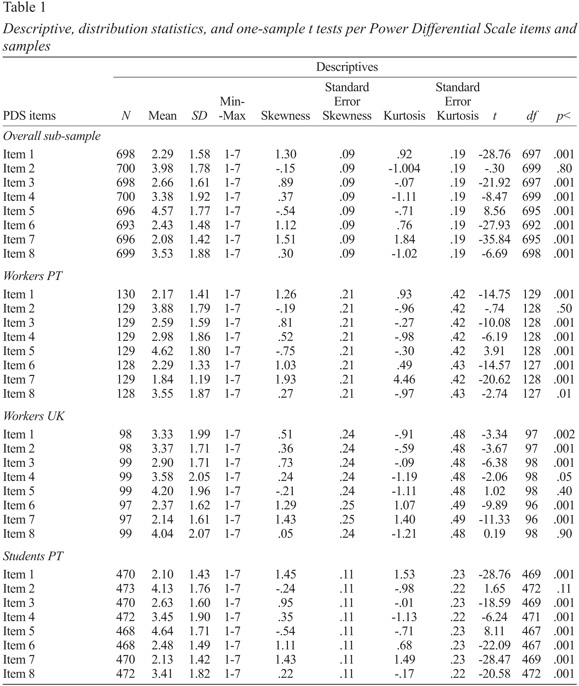
As it can be seen, in the overall sample all of the items had non-normal distributions. The majority of the items were positively skewed, excepting items 2 and 5 that had a negative skewed distribution. In terms of kurtosis, most of the items presented a platikurtic or a leptokurtic shape and one item presented a mesokurtic distribution.
In terms of groups of respondents, the majority of items responded by Portuguese workers presented a positively skewed distribution. Three items presented an approximately symmetric distribution, while item 1 presented a negatively skewed distribution. All items, with the exception of item 2, presented a mesokurtic shape.
In what concerns Portuguese students, the majority of the items had a positive skewed distribution, with the exception of items 1 and 8 that had a negative skew and a symmetric distribution respectively. In terms of kurtosis, the majority of the items had a platikurtic shape. Three items had a leptokurtic shape and item 8 had a mesokurtic kurtosis.
Items were also analysed regarding their mean deviation from the midpoint of the response scale (i.e., 4). In the overall sub-sample, most of the items tested significantly below the midpoint of the scale indicating that participants tended to disagree with the PDS items. An exception should be made to item 5 that showed a mean score significantly above the midpoint of the scale, and item 2 that scored on the midpoint.
A similar pattern of results was found on the groups of respondents. Indeed, Portuguese and UK workers mean scores of the PDS items were significantly below the midpoint of the scale, with the exception of item 5 in the Portuguese workers sample scoring above the midpoint, and items 5 and 8 of the UK workers sample scoring on the midpoint. Portuguese students scored the majority of the PDS items below the midpoint of the scale, with the exception of item 2 that scored on the midpoint, and item 5 that significantly scored above the midpoint of the scale.
Given that items present some bias regarding the normality of their distribution, a natural log-linear transformation was applied to all item scores in order to conduct the factorial analyses presented in the next section.
Principal axis factoring, reliability analysis, and factorial congruency analyses
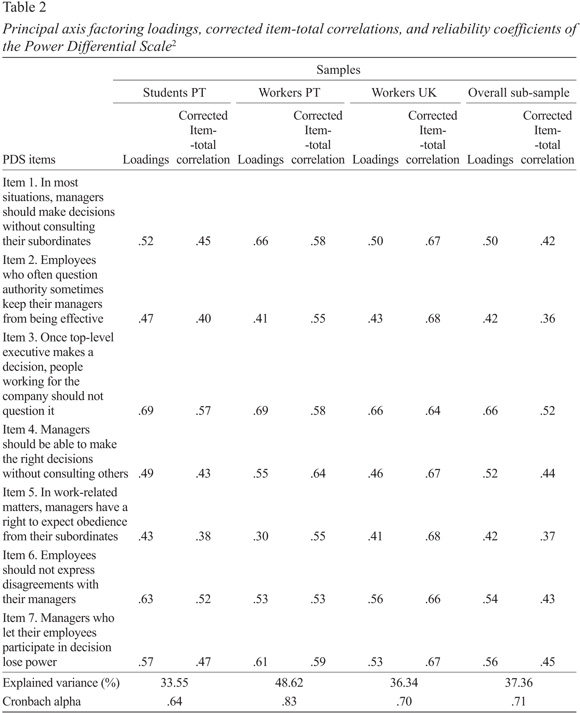
]]> Four principal axis factoring analyses with promax rotation were run, one for each group of participants (UK workers, Portuguese workers and Portuguese undergraduates) and an analysis with the whole sample. Principal axis factoring was the chosen extraction method, since the PDS is an already existing measure with a well-defined underlying theoretical structure, but also since PDS items demonstrated non-normal distributions in our sub-samples (Costello & Osborne, 2005). All analyses supported the predicted unidimensionality of the scale in seven out of the eight original items (Earley & Erez, 1997). The item “a company’s rules should not be broken, not even when the employee thinks it is in the company’s best interest” was dropped from these analyses since it loaded relatively low on the one-factor solutions1. These one-factor solutions accounted for 39.73% to 48.73% of the total variance with loadings varying between .69 and .30 (see Table 22). The KMO measure of sample adequacy to the factorial structure proved acceptable in all analyses (KMO varying from .82 to .74), and the internal consistency determined by Cronbach’s alpha yielded acceptable to good reliability (Cronbach alphas varying from .70 to .75). Furthermore, this scale also demonstrated reliability in all participants groups as measured by the corrected item-total correlations presented in Table 2.
More importantly, and in order to test if the factorial structures obtained in different participants groups were similar, we compared these factorial structures using the Tucker congruence coefficient (Lorenzo-Seva & ten Berge, 2006; Tucker, 1951; the higher the coefficient, the more similar the factorial structures; up to a maximum of 1.0). Pairwise congruence coefficients showed that when comparing Portuguese undergraduates and Portuguese workers structures yielded a score of .99; Portuguese undergraduates vs. UK workers yielded a score of .99; and finally Portuguese workers vs. UK workers yielded a score of .97. Accordingly, all structures presented high similarity assuring that the single-factor of power differential was equivalent across participants’ groups as measured by the PDS.
Confirmatory factor analysis and factor structure invariance across the samples
To further test our one-factor structure, we ran confirmatory factor analyses in the second sub-sample randomly extracted from our overall sample using MPlus 7 (Muthén & Muthén, 2012), and Maximum Likelihood Robust (MLR) estimation. Since the PDS items had non-normal distribution, MLR is particularly suitable to this type of date because it allows for parameter estimation with standard errors and a chi-square test statistic that are robust to non-normality and non-independence of observations (Yuan & Bentler, 2000). Moreover, MLR replaces the use of bootstrap procedures (Muthén & Muthén, 2012).
One analytical procedure tested the unidimensionality of the PDS measure on the total sample (the test of a configural model; Byrne, 2012), while a second tested the invariance of the one factor structure across the three sub-samples.
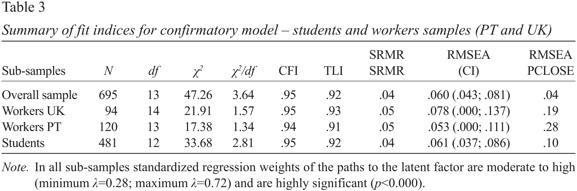
]]> To test the unidimensionality of the PDS measure some constraints were imposed so that the model identification and the general model specification requirements were met (cf. Byrne, 2012). Accordingly, one latent factor path-loading indicator was set to 1, with all measurement errors set to 1. Relative and absolute goodness of fit indexes were obtained: (a) the chi-squared statistic (χ2 and χ2/df), (b) the comparative fit index (CFI), (c) the Tucker-Lewis Index (TLI), (d) the root mean square error of approximation (RMSEA), and (e) the standardized root mean squared residual (SMSR).Based on the standards established in the literature for fit indexes (i.e., CFI and TLI indices greater than .90-.95; RMSEA lower than .08-.05; SRMR lower than .10-.08; Bentler, 1990; Browne & Cudeck, 1989; Hu & Bentler, 1999; Jöreskog & Sörbom, 1984; Stieger, 1990) and as expected, the model testing PDS unidimensionality received support from the confirmatory factorial analysis for the total sample [CFI=.95; TLI=.92; SRMR=.04; RMSEA=.06 (.043; .081); the remaining fit indices are presented in Table 2]. Furthermore, on average the standardized regression latent factor path weightings were moderate to high (ranging from λ=.41 to λ=.69; all p’s<.001). As can be seen in Table 3, PDS unidimensionality held in the three sub-samples, i.e., Portuguese undergraduates, Portuguese workers and British workers. Moreover, this one factor solution was supported in two culturally different samples as testified by the fit measures obtained in Portugal and in the UK3.
The invariance of the PDS unidimensional structure was tested across samples using a multi-group analysis. First, a configural model was set (Byrne, 2012) in order to determine the baseline model for comparison purposes. After, two invariance analyses were set out: one where the factor structure was analyzed with all the path loadings constrained to be equal across samples (i.e., students, PT workers and UK workers); another where all factor loadings as well as latent factor means were set as invariant across countries. The remaining constraints from previous analyses were retained in the present analysis.
Note that the configural model is equal to the CFA model obtained for the UK sample, i.e., with no error variances allowed to correlate between scale items. However, and due to fit increment, in a previous multi-group analysis a further constraint was suggested for UK workers: to set the invariance free for the first item of the PDS scale. As a consequence, mainly due to the mean of this specific item being much greater than in the remaining sub-samples, the invariance hypothesis of item 1 across sub-samples was not tested for this specific sub-sample.
At each step of the invariance analyses fit indices were obtained. Also, chi-square difference tests using the Satorra-Bentler scaled Chi-Square (Satorra & Bentler, 2010) were deployed between step 1 and the other two steps A non-significant chi-square difference between models means a stable model fit across samples, while significant chi-square difference between models means unstable model fits (cf. Byrne, 2012). Table 4 presents the results of the PDS invariance tests.
]]>
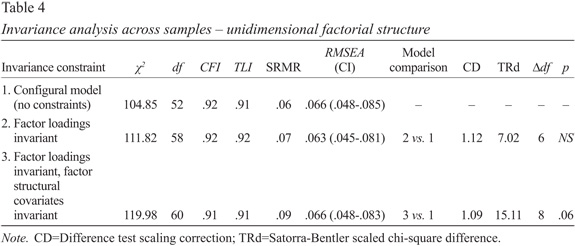
The results in Table 4 show that the difference between step 1 and step 2 is non-significant, suggesting that the invariance of factor loading imposed in step 2 held across sub-samples. However, we can only argue for partial invariance of factor structural covariates across sub-samples (p=.06).
Discussion
In this first study, we tested the construct validity of the PDS. The factorial structure proposed by Earley and Erez (1997) was tested with its original English version using a sample of UK workers. A translated version of this same scale was tested using a sample of Portuguese workers and undergraduates. In all samples, the proposed one-factor solution was obtained in our PAF analyses. Moreover, factorial congruency analyses showed that this one-factor solution held across samples.
The results of this first study also showed that the 7-item PDS measure returns a better psychometric fit to the data than the original 8-item PDS measure. These results were backed-up by confirmatory factor analyses. Moreover, this one-factor structure proved invariant across sub-samples, i.e., PT, UK, and undergraduates’ samples. Factor structural covariances however were only partially invariant. This last result is not surprising since factor mean scores are supposed to vary between countries, as empirical results in this area consistently show (e.g., Carl et al., 2004).
STUDY 2
]]>Overview
The purpose of this second study was to determine the criterion-related validity of the PDS measure and thereby to demonstrate its predictive value, and its relevance to gathering information allowing for more efficacious employee management. As argued previously, Mulder’s (1977) power distance theory served for generating two criteria that establish a framework for testing PDS criterion validity. One stems from the level of motivation to attain positions of power while the second represents the choice of behavioral strategies of confrontation – no confrontation with an authority. At the motivational level we expect participants with low PDS scores to show greater motivation to attain power positions. Inversely, participants returning high PDS scores will show lower levels of motivation for attaining positions of power. At the behavioral level, low PDS participants will tend to adopt behavioral intention strategies aimed at questioning the decisions of authority. High PDS participants will choose behavioral intention strategies that avoid direct or indirect confrontation with the authorities, i.e., opting for compliance with the authority’s decision or even preferring withdrawal strategies.
Method
Sample
175 undergraduates participated in this study. Their mean age was 22.05 years (SD=1.50), and 65.6% were female in gender.
Procedure and measures
]]> Undergraduate participants received a questionnaire, which consisted of the PDS scale, the completion of two tasks, and some demographics, such as age and gender. A covering letter granted anonymity, and provided instructions for responding to the questionnaire. Participants were asked to fill out the questionnaire in classrooms, either immediately before a class started or after a class ended. All participants were debriefed and thanked.The first task required participants to answer a questionnaire regarding their motivation to take on each one of five different hierarchical positions towards the university hierarchy, using a six-point Likert type scale ranging from 1=not motivated to 6=highly motivated: “University Dean”; “University Educational Council President”; “Member of the University’s Board of Directors”; “Manager of the University’s International Office”; “Member of the University’s Office for Assessment and Quality”. Although these different positions are not similar in terms of their status ranking, they do all represent senior positions in the university’s functional hierarchies. Moreover, students know these hierarchical positions, since they represent university services that can be easily assessed to by students.
The second task consisted of three dilemmas all related to day-to-day university matters. For each dilemma, participants were asked to choose from one of four alternative behavioral responses. Two of these choices represent behavioral strategies typical of low power differential individuals: indirect and direct confrontation (i.e., requesting the intervention of high hierarchical instances of the university to intervene and resolve the problem or directly confronting the power source depicted in the scenario); with the other two choices typical of high power differential individuals: withdrawal, i.e., avoid any form of direct dilemma resolution; acceptance, i.e., complying with the situation.
The dilemmas presented to participants were the following:
(1) “Suppose that your lecturer decides to alter the evaluation system of a specific course in the middle of the semester with no apparent reason for doing so. How would you react to this?” (a) “I would demand the intervention of the University’s Educational Council” (indirect confrontation); (b) “I would ask my colleagues to sign a petition and then present it and discuss this matter with the teacher” (direct confrontation); (c) “I would study harder to get a good evaluation” (acceptance); (d) “I would disinvest in this course and put more effort into other courses” (withdrawal).
(2) “Suppose that the Computer Centre at your University decided to restrict access to the wireless Internet access system, as well as the access to student computer rooms with no apparent justification. How would you react to this?” (a) I would search for the nearest alternative wireless Internet access system (for example, from a nearby university) and continue working, or I would prefer to work at home (acceptance); (b) I would downgrade the quality of my work assignments (withdrawal); (c) I would contest the decision through a written letter to the University Dean (indirect confrontation); (d) I would organise a protest with other colleague students and I would try to boycott the delivery of work assignments (direct confrontation).
(3) “Suppose that your lecturer decides to alter the class timetable in the middle of the term and reschedule for a new time that is not convenient to you. How would you react?” (a) I would skip classes if the time schedule is not convenient to me (withdrawal); (b) I would ask the Course Coordinator to request the lecturer to return to the previous schedule (indirect confrontation); (c) During a class, I would question the teacher regarding his/her unilateral decision and would try, alongside my colleagues, to alter the class time (direct confrontation); (d) I would go to the classes at the newly scheduled time (acceptance).
]]>The criterion measures were computed by counting participants behavioral intention choices of direct and indirect confrontation and by counting participant behavioral intention choices of acceptance and withdrawal. Descriptive statistics of these variables revealed median participant scores on the direct confrontation / indirect confrontation behavioral intentions to be approximately 2.00 (corresponding to 40.6% of the total sample), meaning that participants twice chose these behavioral intention strategies when answering the dilemmas. On the acceptance/withdrawal behavioral intentions the median was 1.00 (corresponding to 39.4% of the total sample), i.e., participants chose this behavioral intention strategy once when answering the dilemmas.
Note that in order to avoid common method bias (Podsakoff, MacKenzie, Lee, & Podsakoff, 2003) in the estimation of the criterion-related validity, the PDS measurement and criterion measures were methodologically separated by the deployment of different procedures and measurement scales. Indeed, the criterion measure used multiple-choice items or 6 points Lykert-type scales; PDS uses 7 points Lykert-type scales. The PDS measure has already been presented in Study 1.
Results
Principal-components factorial analysis and the reliability analysis of the measure of motivation to attain different positions in the university hierarchy
Principal-components analysis with promax rotation on all five items supported its unidimensionality. This one-factor solution accounted for 60.56% of total variance (eigenvalue: 3.03), and loadings varied between .88 and .52. The KMO measure of sample adequacy of the factorial structure proved acceptable (KMO=.80). This scale yielded good internal reliability (α=.83).
Criterion-related validity
]]> In order to test for the PDS criterion-related validity (or in the present case, concurrent validity) two structural models were deployed, one regressing the PDS on the motivation to attain positions of power scale, and another regressing the PDS on the direct/indirect confrontation measure and on the acceptance/withdrawal measure (for a similar procedure, see John & Benet-Martinez, 2000). As in the previous study, these models were run using MLR estimation.Both models present appropriate fits, respectively χ2=72.81, df=52, χ2/df=1.61, CFI=.92, TLI=.92, RMSEA=.05 (.02; .08; PCLOSE=.39), SRMR=.06, and χ2=30.18, df=25, χ2/df=1.60, CFI=.91, TLI=.94, RMSEA=.04 (.01; .08; PCLOSE=.62). PDS is significantly and negatively associated to participants scores on the motivation to attain power positions scale, γ=-.28, p=.02, and to the use of direct/indirect confrontation strategies, γ=-0.20, p=0.05, and positively associated to acceptance/withdrawal strategies, γ=0.29, p=0.002. This means that the higher the scores on the PDS, the lower the scores on the motivation to attain power positions scale. Additionally, the higher the score on the PDS, the less participants tended to solve the dilemmas through direct/indirect confrontation strategies and the more they tended to opt for acceptance/withdrawal strategies. As expected, both measures of behavioral intentions correlate negatively and significantly, r=-0.46, p<0.000.
Furthermore, the criterion-related model for motivation revealed that the standardized regression latent factor path weightings of the motivation scale, λ=.51 to λ=.90, all p’s<.000, and of the PDS, λ=.25 to λ=.77; all p’s<.01, were moderate to high testifying the psychometric adequacy of these scales. Also, in the criterion-related model for behavioral intentions, the PDS scale latent factor path weightings were equally moderate to high, λ=.23 to λ=.85; all p’s<.03.
Discussion
In this second study, we analyzed the criterion-related validity of the PDS. For this purpose, the predictive power of the PDS was tested with recourse of two independent measures specially created for this objective: a measure of motivations to attain power positions, and a measure of behavioral intentions towards power related situations. The measure of motivations to attain power positions revealed good psychometric properties. The behavioral intentions measure revealed that participants were more prompt to enact direct/indirect confrontation strategies than acceptance/withdrawal strategies.
The results regarding the criterion-related validity showed that the scores of the PDS were consistently associated with participants’ motivations to attain power positions in the university hierarchy. In line with Mulder (1977), individuals who scored high on power distance were less motivated to assume positions of power, compared to individuals with low power distance values. These last perceived themselves as similar to those holding powerful positions. Furthermore, individuals who valued power distance responded to power related situations through recourse to acceptance or withdrawal behavioral intentions strategies. In contrast, those scoring low on PDS chose behavioral intentions strategies that directly or indirectly confront the authorities.
Overall, the results of this second study allow us to argue for the predictive capability of the PDS especially by showing that power differential scores are associated to motivations to attain power positions and to behavioral intention strategies towards daily power situations.
Conclusions
]]> In the two studies presented above, we put forward empirical evidence that supports the psychometric soundness of PDS. Hence, we demonstrated its unidimensionality and its measurement equivalence across different samples, and pointed to the fact that seven out of the eight original items compose a highly reliable scale (Study 1). Also PDS proved to have criterion-related validity (i.e., concurrent validity) regarding two different criteria (Study 2), showing that this scale interlinks with participants motivations to attain positions of power in the university hierarchy, as well as behavioral intentions expressed by participants regarding day-to-day situations related to power issues.Our studies showed that PDS returns a suitable operationalization of the power differential (or power distance) construct at the individual level, inclusively for culturally diverse samples – undergraduates in Portugal, Portuguese employees and British employees. This is an important finding since both the Hofstede (1980) typology of cultural values and the GLOBE (cf., Carl et al., 2004) study typology of values frame power distance at a national or aggregate level, and warn against using these power distance measures at the individual level. The contribution of the present study and of the PDS measure is to show that it displays high validity and reliability for measuring the power distance construct at an individual level.
Moreover, the results of the second study add relevant evidence in demonstrating an association between high scores on the PDS measure and lower motivation to assume positions of power. Also, high scores on the PDS were associated to intentions of using acceptance or withdrawal behavioral intention strategies while dealing with power related situations. On the contrary, low scores on this same measure were associated with high motivation to attain powerful positions, and with behavioral intentions to use direct or indirect behavior strategies of confronting authorities. From a theoretical perspective, the results obtained in this last study proxy the framework proposed by Mulder’s (1977) Power Distance Theory, evidencing individuals who value power differentials are also those that do not strive to hold positions of power in the organizational hierarchy. Likewise, these individuals express greater intention of using strategies of authority acceptance rather than direct or indirect confrontational strategies in daily power situations.
Interestingly, criterion-related validity results also might lead us to speculate that the PDS might be more suitable for predicting power motivations and behavioral intentions of high rather than low-power differential individuals. Indeed, we found stronger associations for acceptance/withdrawal than for direct/indirect confrontation strategies. In this sense, we might speculate that the PDS is more suitable for discriminating individuals with high rather than low power distances, making it better applicable to contexts of unbalanced rather than balanced power situations.
In a broader sense, our results shed light on the fact that individual assimilation of higher power distance values can be associated to a vicious cycle of power asymmetries, since the promotion of these values might be related to a lower concern regarding the accountability of those who are in power positions. Simultaneously, lower motivation to reduce the distance or acceptance of power positions might prove unchallenging for power holders, or even question how authority lines are designed both on organizations and institutions. This in turn results in more unbalanced power structures with greater asymmetries on the access to power positions and on the exercise of authority. Conversely, adopting low power distance values induces greater conflict with decisions taken by power holders, and the greater motivation to accept power positions will result in more balanced organizational designs and maintenance of power structures of organizations and institutions.
Future research
Future research should address the differences between high and low power contexts through the use of experimental approaches, i.e., manipulating contexts that render power differentials salient and verify their impacts on workers’ attitudes and behaviours. In this vein, it could be interesting to evaluate how these contexts affect the relations with power holders or affect the ways people relate with each other, as well as the possibilities of building alliances to confront power holders or change power structures and forms of accountability. At an organizational level, it would also be interesting to analyze what types of variables that help the assimilation of power distance values and what are the contextual consequences that might hinder them.
Limitations
]]> The studies presented in this article are not without limitations. Firstly, in the first study we should have included another measure of power distance in order to determine the PDS convergent validity. In future studies, the psychometric properties of the PDS should be further tested and this criterion included. Secondly, in our second study one of the criteria for our analyses of criterion-related validity regarded participants’ behavioral intentions strategies and not their real behavior in power-related situations. Although intentions are hypothesized as predictors of behaviors (Azjen & Fishbein, 1980), we know that empirical evidence does not always follow this prediction (e.g., Azjen, 1987). In this sense, future studies should deploy a measurement strategy directly aiming at collecting participants’ behavior when faced with power dilemmas. Finally, a more diversified sample of workers and organizations could have been collected, so as to demonstrate the power of PDS to measure power differentials both at an individual as well as at an institutional level, contributing to further validate the PDS construct, an also its sensitivity to organizational contextual changes.
References
Ajzen, I. (1987). Attitudes, traits, and actions: Dispositional prediction of behavior in personality and social psychology. In L. Berkowitz (Ed.), Advances in experimental social psychology (Vol. 20, pp. 1-63). New York: Academic Press.
Ajzen, I., & Fishbein, M. (1980). Understanding attitudes and predicting social behavior. Englewood Cliffs, NJ: Prentice-Hall. [ Links ]
Bentler, P. M. (1990). Comparative fit indexes in structural models. Psychological Bulletin, 107, 238-246. doi: 10.1037/0033-2909.107.2.238 [ Links ]
Browne, M. W., & Cudeck, R. (1989). Single sample cross-validation indices for covariance structures. Multivariate Behavioral Research, 24, 445-455. doi: 10.1207/s15327906mbr2404_4 [ Links ]
Bruins, J. J., & Wilke, H. A. M. (1993). Upward power tendencies in a hierarchy: Power distance theory versus bureaucratic rule. European Journal of Social Psychology, 23, 239-254. doi: 10.1002/ejsp.2420230303 [ Links ]
Byrne, B. (2012). Structural equation modeling with Mplus: Basic concepts, applications, and programming. [ Links ] USA: Routledge.
Cakar, N. D., & Erturk, A. (2010). Comparing innovation capability of small and medium-sized enterprises: Examining the effects of organizational culture and empowerment. Journal of Small Business Management, 48, 325-359. doi: 10.1111/j.1540-627X.2010.00297.x [ Links ]
Carl, D., Gupta, V., & Javidan, M. (2004). Power distance. In R. J. House, P. J. Hanges, M. Javidan, P. W. Dorfman, & V. Gupta (Eds.), Culture, leadership, and organizations: The GLOBE study of 62 societies. Thousand Oaks, CA: Sage Publications. [ Links ]
Costello, A. B., & Osborne, J. W. (2005). Exploratory factor analysis: Four recommendations for getting the most from your analysis. Practical Assessment, Research, and Evaluation, 10, 1-9. [ Links ]
Dorfman, P. W., & Howell, J. P. (1988). Dimensions of national culture and effective leadership patterns: Hofstede revisited. Advances in International Comparative Management, 3, 127-150. [ Links ]
Earley, P. C., & Erez, M. (1997). The transplanted executive: Why you need to understand how workers in other countries see the world differently. New York: Oxford University Press. [ Links ]
]]>Erez, M., & Gati, E. (2004). A dynamic, multi-level model of culture: From the micro level of the individual to the macro level of a global culture. Applied Psychology: An International Review, 53, 583-598. doi: 10.1111/j.1464-0597.2004.00190.x [ Links ]
Gelfand, M. J., & Dyer, N. (2000). A cultural perspective on negotiation: Progress, pitfalls, and prospects. Applied Psychology, 49, 62-99. doi: 10.1111/1464-0597.00006 [ Links ]
Hofstede, G. (1980). Culture’s consequences: International differences in work-related values. Beverly Hills, CA: Sage.
Hu, L., & Bentler, P. M. (1999). Cutoff criteria for fit indexes in covariance structure analysis: Conventional criteria versus new alternatives. Structural Equation Modeling, 6, 1-55. [ Links ]
John, O. P., & Benet-Martinez, V. (2000). Measurement: Reliability, construct validation, and scale construction. In H. T. Reis & C. M. Judd (Eds.), Handbook of research methods in social personality psychology (pp. 339-369). Cambridge, UK: Cambridge University Press. [ Links ]
Jöreskog, K. G., & Sörbom, D. (1984). Lisrel VI: Analysis of linear structural relationships by maximum likelihood, instrumental variables, and least squares methods. Mooresville, IN: Scientific Software. [ Links ]
Kopelman, S. (2009). The effect of culture and power on cooperation in commons dilemmas: Implications for global resource management. Organizational Behavior and Human Decision Processes, 108, 153-163. doi: 10.1016/j.obhdp.2008.06.004 [ Links ]
Lam, S. S. K., Schaubroeck, J., & Aryee, S. (2002). Relationship between organizational justice and employee work outcomes: A cross-national study. Journal of Organizational Behavior, 23, 1-18. doi: 10.1002/job.131 [ Links ]
Lin, W., Wang, L., & Chen, S. (2013). Abusive supervision and employee well-being: The moderating effect of power distance orientation. Applied Psychology: An International Review, 62, 308-329. doi: 10.1111/j.1464-0597.2012.00520.x [ Links ]
Lorenzo-Seva, U., & ten Berge, J. M. F. (2006). Tucker’s congruence coefficient as a meaningful index of factor similarity. Methodology, 2, 57-64.
Morrison, E. W., Chen, Y. R., & Salgado, S. R. (2004). Cultural differences in newcomer feedback seeking: A comparison of the United States and Hong Kong. Applied Psychology: An International Review, 53, 1-22. doi: 10.1111/j.1464-0597.2004.00158.x [ Links ]
Mulder, M. (1971). Power equalization through participation. Administrative Science Quarterly, 16, 31-38. doi: 10.2307/2391284 [ Links ]
Mulder, M. (1977). Daily power game. Leiden: Martinus Nijhoff. [ Links ]
Muthén, L. K., & Muthén, B. O. (2012). Mplus user’s guide. Los Angeles, CA: Muthén & Muthén.
Osborne, J. W., & Fitzpatrick, D. C. (2012). Replication analysis in exploratory factor analysis: What it is and why it makes your analysis better. Practical Assessment, Research & Evaluation, 17, 1-8. [ Links ]
]]>Oofstede, G. (1991). Cultures and organizations: Software of the mind. New York: McGraw-Hill. [ Links ]
Podsakoff, P. M., MacKenzie, S. B., Lee, J.-Y., & Podsakoff, N. P. (2003). Common method bias in behavioral research: A critical review of the literature and recommended remedies. Journal of Applied Psychology, 88, 879-903. doi: 10.1037/0021-9010.88.5.879 [ Links ]
Satorra, A., & Bentler, P. M. (2010). Ensuring positiveness of the scaled difference chi-square test statistic. Psychometrika, 75, 243-248. doi: 10.1007/s11336-009-9135-y [ Links ]
Schwartz, S. H. (1992). Universals in the content and structure of values: Theory and empirical tests in 20 countries. In M. Zanna (Ed.), Advances in experimental social psychology (Vol. 25, pp. 1-65). New York: Academic Press. doi: 10.1016/S0065-2601(08)60281-6
Spector, P. E., Cooper, C. L., & Sparks, K. (2001). An international study of the psychometric properties of the Hofstede values survey module 1994: A comparison of individual and country/province level results. Applied Psychology: An International Review, 50, 269-281. doi: 10.1111/1464-0597.00058 [ Links ]
Steiger, J. H. (1990). Structural model evaluation and modification: An interval estimation approach. Multivariate Behavioural Research, 25, 173-180. [ Links ]
Tucker, L. R. (1951). A method for synthesis of factor analysis studies (Personnel Research Section Report No. 984). Washington, DC: Department of the Army. [ Links ]
]]>Tyler, T. R., Lind, E. A., & Huo, Y. J. (2000). Cultural values and authority relations: The psychology of conflict resolution across cultures. Psychology, Public Policy, and Law, 6, 1138-1163. doi: 10.1037//1076-8971.6.4.1138 [ Links ]
Vatrapu, R., & Pérez-Quiñones, M. A. (2006). Culture and usability evaluation: The effects of culture in structured interviews. Journal of Usability Studies, 1, 156-170. [ Links ]
Yilmaz, C., Alpkan, L., & Ergun, E. (2005). Cultural determinants of customer and learning-oriented value systems and their joint effects on firm performance. Journal of Business Research, 58, 1340-1352. doi: 10.1016/j.jbusres.2004.06.002 [ Links ]
Yuan, K.-H., & Bentler, P. M. (2000). Three likelihood-based methods for mean and covariance structure analysis with nonnormal missing data. Sociological Methodology, 30, 165-200. [ Links ]
A correspondência relativa a este artigo deverá ser enviada para: Henrique Duarte, ISCTE – Instituto Universitário de Lisboa, Avenida das Forças Armadas, 1649-026 Lisboa, Portugal. E-mail: henrique.duarte@iscte.pt
]]> Submissão: 21/07/2015 Aceitação: 18/03/2016
NOTES
1 In fact, it’s loading in this one-factor solution was 0.44. Additionally, Erez (personal communication 2008) argues that this item should actually be dropped from the PDS, since its content appeal to a slightly different construct – companies’ rules – and not to power differentials.
2 Portuguese version of the items: (Item 1. Na maior parte das situações, os dirigentes devem decidir sem consultar os seus subordinados; Item 2. Os empregados que questionam sistematicamente a autoridade por vezes impedem que os seus gestores sejam eficazes; Item 3. Uma vez que uma decisão tenha sido tomada por uma chefia superior, os empregados dessa organização não a devem questionar; Item 4. Os dirigentes devem ser capazes de tomar as decisões adequadas sem terem que consultar outras pessoas; Item 5. Em matérias de trabalho, os dirigentes têm o direito de esperar que os seus subordinados lhes obedeçam; Item 6. Os subordinados não devem expressar discordâncias aos seus dirigentes; Item 7. Os dirigentes que deixam os seus subordinados participar nas decisões, perdem poder)
3 In the overall sample, the error variances of items 5 and 7 were allowed to correlate in order to improve fit. In the Portuguese workers sample this same correlation was imposed. In the student sample, error variances of items 3 and 6 were also allowed to correlate in order to improve fit. These restrictions were not deployed in the UK sample.
]]>