<?xml version="1.0" encoding="ISO-8859-1"?><article xmlns:mml="http://www.w3.org/1998/Math/MathML" xmlns:xlink="http://www.w3.org/1999/xlink" xmlns:xsi="http://www.w3.org/2001/XMLSchema-instance">
<front>
<journal-meta>
<journal-id>0870-8231</journal-id>
<journal-title><![CDATA[Análise Psicológica]]></journal-title>
<abbrev-journal-title><![CDATA[Aná. Psicológica]]></abbrev-journal-title>
<issn>0870-8231</issn>
<publisher>
<publisher-name><![CDATA[ISPA-Instituto Universitário]]></publisher-name>
</publisher>
</journal-meta>
<article-meta>
<article-id>S0870-82312017000100006</article-id>
<article-id pub-id-type="doi">10.14417/ap.1121</article-id>
<title-group>
<article-title xml:lang="en"><![CDATA[Asking simultaneously about truth and familiarity may disrupt truth effects]]></article-title>
</title-group>
<contrib-group>
<contrib contrib-type="author">
<name>
<surname><![CDATA[Garcia-Marques]]></surname>
<given-names><![CDATA[Teresa]]></given-names>
</name>
<xref ref-type="aff" rid="A01"/>
</contrib>
<contrib contrib-type="author">
<name>
<surname><![CDATA[Silva]]></surname>
<given-names><![CDATA[Rita R.]]></given-names>
</name>
<xref ref-type="aff" rid="A01"/>
</contrib>
<contrib contrib-type="author">
<name>
<surname><![CDATA[Mello]]></surname>
<given-names><![CDATA[Joana]]></given-names>
</name>
<xref ref-type="aff" rid="A01"/>
</contrib>
</contrib-group>
<aff id="A01">
<institution><![CDATA[,ISPA - Instituto Universitário William James Center for Research ]]></institution>
<addr-line><![CDATA[ ]]></addr-line>
</aff>
<pub-date pub-type="pub">
<day>00</day>
<month>03</month>
<year>2017</year>
</pub-date>
<pub-date pub-type="epub">
<day>00</day>
<month>03</month>
<year>2017</year>
</pub-date>
<volume>35</volume>
<numero>1</numero>
<fpage>61</fpage>
<lpage>71</lpage>
<copyright-statement/>
<copyright-year/>
<self-uri xlink:href="http://scielo.pt/scielo.php?script=sci_arttext&amp;pid=S0870-82312017000100006&amp;lng=en&amp;nrm=iso"></self-uri><self-uri xlink:href="http://scielo.pt/scielo.php?script=sci_abstract&amp;pid=S0870-82312017000100006&amp;lng=en&amp;nrm=iso"></self-uri><self-uri xlink:href="http://scielo.pt/scielo.php?script=sci_pdf&amp;pid=S0870-82312017000100006&amp;lng=en&amp;nrm=iso"></self-uri><abstract abstract-type="short" xml:lang="en"><p><![CDATA[Tell me something that sounds familiar and I will believe it to be true. This is a statement that we should believe because it summarizes a well-documented and empirically supported effect: the illusion of truth effect (see Dechêne, Stahl, Hansen, & Wänke, 2010 for a review). The fact is we are more likely to believe in a statement if we have been previously exposed to it (e.g., Bacon, 1979; Hasher, Goldstein, & Toppino, 1977). Repetition increases truth-value, generating the illusion that repeated statements are more valid than information we never heard or read before. A general assumption of the explanations of the truth effect is that the subjective experience of processing a familiar statement is interpreted as informing about the validity of the statement (see Dechêne et al., 2010). This implies that a process of misattribution underlies repetition’s effect on judgments of truth (e.g., Bornstein & D’Agostino, 1994; Mandler, Nakamura, & Van Zandt, 1987; Schwarz & Clore, 1983). In this paper we present an experiment that tests such misattribution process by making more or less explicit the real source of the feeling of familiarity with the statements. In this way we test whether illusions of truth decrease when it is clear (vs. unclear) that familiarity is due to previous exposure.]]></p></abstract>
<abstract abstract-type="short" xml:lang="pt"><p><![CDATA[“Sim é verdade! Já ouvir em qualquer lado isso!”. E sim é verdade o que diz essa frase e devemos acreditar nisso porque ela resume um efeito muito bem documentado e com muito suporte empírica na literatura. Trata-se do efeito da ilusão de verdade (ver Dechêne, Stahl, Hansen, & Wänke, 2010 para uma revisão). Este efeito define que é mais provável que acreditemos que uma afirmação é verdadeira se esta nos for previamente apresentada (e.g., Bacon, 1979; Hasher, Goldstein, & Toppino, 1977). O que os estudos têm documentado é que a repetição aumenta o valor de verdade de qualquer afirmação, promovendo a ilusão de que as afirmações repetidas são mais válidas do que afirmações às quais não fomos anteriormente expostos. O pressuposto geral de todas as explicações deste efeito é o de que a experiência subjectiva associada ao modo como processamos uma afirmação familiar, fluentemente, é interpretada como informativa da sua validade (see Dechêne et al., 2010). Isto pressupõe que o efeito da repetição nos julgamentos de verdade tem subjacente um processo de atribuição errónea (misattribution) de um sentimento a uma causa que não o promoveu (e.g., Bornstein & D’Agostino, 1994; Mandler, Nakamura, & Van Zandt, 1987; Schwarz & Clore, 1983). Neste artigo apresentamos um estudo que testa estes processos de atribuição errónea, reduzindo-a por tornar a fonte do sentimento de familiaridade mais explícita para os participantes. Testamos se as ilusões de verdade diminuem quando se torna claro (vs. pouco claro) o facto da sensação de familiaridade é originada pela exposição prévia no contexto do estudo.]]></p></abstract>
<kwd-group>
<kwd lng="en"><![CDATA[Illusions of truth]]></kwd>
<kwd lng="en"><![CDATA[Repetition]]></kwd>
<kwd lng="en"><![CDATA[Memory]]></kwd>
<kwd lng="en"><![CDATA[Misattribution]]></kwd>
<kwd lng="pt"><![CDATA[Ilusões de verdade]]></kwd>
<kwd lng="pt"><![CDATA[Repetição]]></kwd>
<kwd lng="pt"><![CDATA[Memória]]></kwd>
<kwd lng="pt"><![CDATA[Atribuição errónea]]></kwd>
</kwd-group>
</article-meta>
</front><body><![CDATA[ <p><b>Asking simultaneously about truth and familiarity may disrupt truth effects</b></p>     <p><b>Teresa Garcia-Marques<sup>1</sup>, Rita R. Silva<sup>1</sup>, Joana Mello<sup>1</sup></b></p>     <p><sup>1</sup>William James Center for Research, ISPA &ndash; Instituto Universit&aacute;rio</p>     <p><a name="topc0"></a><a href="#c0">Correspondência</a></p>     <p>&nbsp;</p>     <p><b>ABSTRACT</b></p>     <p>Tell me something that sounds familiar and I will believe it to be true. This is a statement that we should believe because it summarizes a  well-documented and empirically supported effect: the illusion of truth effect (see Dech&ecirc;ne, Stahl, Hansen, &amp; W&auml;nke, 2010 for a  review). The fact is we are more likely to believe in a statement if we have been previously exposed to it (e.g., Bacon, 1979; Hasher, Goldstein,  &amp; Toppino, 1977). Repetition increases truth-value, generating the illusion that repeated statements are more valid than information we never  heard or read before. A general assumption of the explanations of the truth effect is that the subjective experience of processing a familiar  statement is interpreted as informing about the validity of the statement (see Dech&ecirc;ne et al., 2010). This implies that a process of  misattribution underlies repetition&rsquo;s effect on judgments of truth (e.g., Bornstein &amp; D&rsquo;Agostino, 1994; Mandler, Nakamura, &amp;  Van Zandt, 1987; Schwarz &amp; Clore, 1983). In this paper we present an experiment that tests such misattribution process by making more or less  explicit the real source of the feeling of familiarity with the statements. In this way we test whether illusions of truth decrease when it is  clear (<i>vs.</i> unclear) that familiarity is due to previous exposure.    <p>     <p><b>Key words</b>: Illusions of truth, Repetition, Memory, Misattribution.</p>     <p>&nbsp;</p>     ]]></body>
<body><![CDATA[<p><b>RESUMO</b></p>     <p>&ldquo;Sim &eacute; verdade! J&aacute; ouvir em qualquer lado isso!&rdquo;. E sim &eacute; verdade o que diz essa frase e devemos acreditar  nisso porque ela resume um efeito muito bem documentado e com muito suporte emp&iacute;rica na literatura. Trata-se do efeito da ilus&atilde;o de  verdade (ver Dech&ecirc;ne, Stahl, Hansen, &amp; W&auml;nke, 2010 para uma revis&atilde;o). Este efeito define que &eacute; mais prov&aacute;vel  que acreditemos que uma afirma&ccedil;&atilde;o &eacute; verdadeira se esta nos for previamente apresentada (e.g., Bacon, 1979; Hasher, Goldstein,  &amp; Toppino, 1977). O que os estudos t&ecirc;m documentado &eacute; que a repeti&ccedil;&atilde;o aumenta o valor de verdade de qualquer  afirma&ccedil;&atilde;o, promovendo a ilus&atilde;o de que as afirma&ccedil;&otilde;es repetidas s&atilde;o mais v&aacute;lidas do que  afirma&ccedil;&otilde;es &agrave;s quais n&atilde;o fomos anteriormente expostos. O pressuposto geral de todas as explica&ccedil;&otilde;es deste  efeito &eacute; o de que a experi&ecirc;ncia subjectiva associada ao modo como processamos uma afirma&ccedil;&atilde;o familiar, fluentemente,  &eacute; interpretada como informativa da sua validade (see Dech&ecirc;ne et al., 2010). Isto pressup&otilde;e que o efeito da  repeti&ccedil;&atilde;o nos julgamentos de verdade tem subjacente um processo de atribui&ccedil;&atilde;o err&oacute;nea (<i>misattribution</i>) de  um sentimento a uma causa que n&atilde;o o promoveu (e.g., Bornstein &amp; D&rsquo;Agostino, 1994; Mandler, Nakamura, &amp; Van Zandt, 1987;  Schwarz &amp; Clore, 1983). Neste artigo apresentamos um estudo que testa estes processos de atribui&ccedil;&atilde;o err&oacute;nea, reduzindo-a  por tornar a fonte do sentimento de familiaridade mais expl&iacute;cita para os participantes. Testamos se as ilus&otilde;es de verdade diminuem  quando se torna claro (<i>vs.</i> pouco claro) o facto da sensa&ccedil;&atilde;o de familiaridade &eacute; originada pela exposi&ccedil;&atilde;o  pr&eacute;via no contexto do estudo.</p>     <p><b>Palavras-chave</b>: Ilus&otilde;es de verdade, Repeti&ccedil;&atilde;o, Mem&oacute;ria, Atribui&ccedil;&atilde;o err&oacute;nea.</p>     <p>&nbsp;</p>     <p><b>Truth effect</b></p>     <p>The first evidence of a truth effect associated with previous exposure was provided by Hasher et al. (1977). The authors presented students with  a set of true and false statements of which they had no knowledge about. Part of the statements was repeated and part was new. The results showed  evidence of an increase in perceived validity of repeated statements. Since then, several papers have replicated the effect, and a recent  meta-analysis defined it as a well-replicated, medium-sized effect (Dech&ecirc;ne et al., 2010).</p>     <p>The relation between repetition and truth judgments suggests this effect to be related with memory features. For example Bacon (1979) and Begg  and Armour (1991) showed that not only repeated statements were judged truer than new ones but also statements judged to be repeated were rated as  more probably true than statements judged to be new. This association between recognition and truth was independent of the statements&rsquo; real  repetition status. The relation of memory with truth seems to be based especially on feelings of familiarity generated by previous exposure and not  necessarily on a conscious recollection or specific semantic knowledge about the statements. Assuming that the two components, familiarity and  recollection, contribute to recognition judgments, Begg, Anas and Farinaci (1992) used Jacoby&rsquo;s Process Dissociation Procedure (PDP; Jacoby,  1991) and showed that manipulations that undermine the controlled recollection process (e.g., divided attention) were associated with increased  illusions of truth, while processing conditions associated with optimal recollection reduced the effect.</p>     <p>The results described above were interpreted as evidence of a &ldquo;non-referential&rdquo; component of the truth effect (e.g., Unkelbach &amp;  Stahl, 2009) that arises from the subjective experience of ease associated with repeated stimuli, and which is also integrated in dual processes  models of memory regarding the way we recognize stimulus (e.g., Kelley &amp; Jacoby, 1998, 2000). The hypothesis that truth judgments may anchor in  the experience of processing fluency was tested by Reber and Schwarz (1999), who manipulated perceptual fluency (figure-ground contrast) of written  statements and asked participants to rate the truth of each one. Results showed that statements with high contrast were rated truer than statements  with low contrast, supposedly because they were easier to process.</p>     <p>But why do we rely on that subjective experience to make our judgments of truth? There are two possible answers to this question. One is that the  subjective experience reflects memory and therefore our knowledge about the world, offering a heuristic pathway about the validity of a statement  (e.g., Arkes, Boehm, &amp; Xu, 1991). This view finds support, for example, in Bacon&rsquo;s (1979) findings showing a high relationship between  memory and truth judgments, i.e., when participants recognized a statement as being repeated from previous sessions its truth-value increased. A  second possibility is that during our lifetime, and in many contexts, we learn to associate the subjective experience of ease with validity (e.g.,  Reber &amp; Unkelbach, 2010; Unkelbach, 2007; Unkelbach &amp; Greifeneder, 2013). This view anchors for example in the fact that perceptual fluency  association with truth can be experimentally reversed after a learning procedure reinforcing the fluency-falseness association, and which can be  generalized to other sources of experience such as familiarity (Unkelbach, 2007).</p>     <p>&nbsp;</p>     ]]></body>
<body><![CDATA[<p><i>Misattributions and illusions of truth</i></p>     <p>The misattribution approach to previous exposure effects (e.g., Bornstein &amp; D&rsquo;Agostino, 1994; Jacoby, Kelley, &amp; Dywan, 1989; Klinger  &amp; Greenwald, 1994) suggests that reencountering a stimulus promotes a global subjective experience that is misattributed to some features of  the stimulus itself. Specifically, this approach assumes that this subjective experience is relatively ambiguous and able to be attributed to any  salient feature of the stimulus that could be a probable cause for such experience (e.g., Jacoby, Allan, Collins, &amp; Larwill, 1988; Jacoby et  al., 1989b; Jacoby &amp; Kelley, 1987; Mandler et al., 1987; Reber, Winkielman, &amp; Schwarz, 1998; Schwarz &amp; Clore, 1983; Schwarz et al.,  1991; Zillman, Katcher, &amp; Milavsky, 1972). Thus the subjective experience of processing familiar stimuli can be (mis) attributed to features  such as duration of presentation (longer for familiar words, e.g., Witherspoon &amp; Allan, 1985) or level of background noise accompanying the  presentation of a sentence (lower for familiar sentences, e.g., Jacoby et al., 1988). Evidence of a misattribution process is usually obtained by  manipulating individuals&rsquo; access to the real source of the processing experience, with misattributions being more likely when  individuals&rsquo; have no knowledge about it. Thus memory misattributions, for example, are more likely to be found when memory is impaired,  because participants cannot recollect that they have encountered a stimulus before. For instance &ldquo;false fame&rdquo; attributions (familiarity  with names induces perceived fame of people) were shown to increase for participants in a divided attention condition, because the controlled  recollection process was impaired and they were more likely to rely on familiarity (making more errors, e.g., Dywan &amp; Jacoby, 1990; Jacoby et  al., 1989; Jennings &amp; Jacoby, 1993). This is why, for example, Bornstein&rsquo;s (1989) meta-analysis of mere-exposure research revealed an  inverse relationship between stimulus recognition accuracy and the magnitude of the effect.</p>     <p>If misattributions underlie illusions of truth, the effect should also be susceptible to such manipulations. As stated earlier, Begg and  collaborators (1992) showed that processing conditions that facilitated recollection were associated with a reduction of the truth effect,  supposedly because individuals can identify previous exposure as the probable source of the feeling of familiarity. Arkes and colleagues (Arkes,  Hackett, &amp; Boehm, 1989; Arkes, Boehm, &amp; Xu, 1991) found that the truth effect is stronger when the source of the feeling of familiarity is  dissociated from the experimental context. In addition, older adults seem to be more susceptible to the truth effect because they have impaired  source memory and so cannot recognize the real source of the subjective experience associated with familiarity (Law, Hawkins, &amp; Craik, 1998;  Skurnik, Yoon, Park, &amp; Schwarz, 2005). But Begg and Armour&rsquo;s (1991) study provide perhaps the most relevant finding for arguing about the  relevance of being aware of the source of the subjective experience of familiarity. In their study, while one group of participants only had to  rate the statements for truth, in another condition participants had to decide in each trial whether the statement was Old or New, and then rate it  for truth. When judgments of familiarity preceded judgments of truth the truth effect was significantly reduced. The authors explained this finding  simply as &ldquo;perhaps the demand to think about the past source of retrieved facts reduces the confirmatory value of those facts&rdquo; (p.  202).</p>     <p>&nbsp;</p>     <p><i>Present experiment</i></p>     <p>In this experiment we aim to conceptually replicate the results obtained by Begg and Armour (1991) but in a context where participants have no  information about the origin of the statement (in the original study statements were attributed to either a truthful or a deceiving source). Thus,  in our experiment, two groups of participants performed truth and recognition judgments, with one group making the two judgments sequentially  (i.e., first, all statements were judged for truth and only then they were judged for familiarity) and the other one simultaneously (i.e., in each  trial, participants judged the truth and familiarity of the statement). In this way we tested whether the &ldquo;demand to think about the past  source&rdquo; of the statements prevents feelings of familiarity to be misattributed to truth.</p>     <p>&nbsp;</p>     <p><b>Method</b></p>     <p>&nbsp;</p>     <p><i>Participants</i></p>     ]]></body>
<body><![CDATA[<p>Fifty two participants (48 women; age: <i>M</i>=22.15 years, <i>SD</i>=3.19) took part in the experiment in exchange for a 10&euro; voucher to  use at a store. Participants were randomly assigned to the four cells of a 2 (Recognition simultaneous to truth <i>vs.</i> Recognition sequential  to truth) x 2 (New <i>vs.</i> Repeated statements) design, with the last factor manipulated within-participants.</p>     <p>&nbsp;</p>     <p><i>Materials</i></p>     <p>A total of 112 neutral statements (i.e., statements that are not clearly identified as false or true) from different topics (e.g., geography,  science, general knowledge, etc.) were used. The statements, half true and half false, were gathered from a previous pre-test (see Garcia-Marques,  Silva, Reber, &amp; Unkelbach, 2015), Forty-eight of the neutral statements were randomly selected to be the repeated statements (i.e., presented  both in the exposure and in the test phase), and other 48 as the new statements in the truth ratings task (i.e., the test phase). The remaining 16  statements were used as new items in the recognition task of the &ldquo;recognition sequential to truth&rdquo; condition.</p>     <p>&nbsp;</p>     <p><i>Procedure</i></p>     <p>Participants arrived to the lab in groups of 6 to 9. After signing an informed consent they were seated in individual workstations (each  workstation was separated from the others by a tall, light-grey placard, assuring that participants could not see each other during the session to  minimize sources of distraction). The experimenter informed participants were going to participate in a study with different tasks, some related  with the reading of sentences in different colors and other related with the perception and evaluation of images. After this, participants started  the computer program (<i>e-prime</i>; Schneider, Eschman, &amp; Zuccolotto, 2002) and initiated the experiment.</p>     <p>&nbsp;</p>     <p><i>Exposure phase</i>. For their first task, participants were told they were going to read a list of statements, half true and half false, that  would appear rapidly on the screen. The list of 48 statements were presented in black letters (Arial font, size 28), one by one in the center of  the screen for 3 s, with a 500 ms blank screen between each statement. Order of presentation of the statements was randomly determined for each  participant.</p>     <p>&nbsp;</p>     ]]></body>
<body><![CDATA[<p><i>Distraction tasks</i>. In order to remove the statements presented in the exposure phase from working memory, participants performed two  filler tasks. To support the cover story, one of the tasks involved the evaluation of different images and the other involved the judgment of  sentences in different colors. Thus, participants were first asked to rate the pleasantness (in two 7-point rating scales anchored in Bad-Good and  Do not like it at all &ndash; Like it very much) of 35 images of different things (e.g., objects, food, people). Then, for the next task  participants had to decide if a group of statements were true or false as quickly as possible, receiving veridical feedback about their answer. A  set of 60 easy statements (e.g., &ldquo;A guitar is a string instrument&rdquo;), half true (presented in dark red or blue) and half false  (presented in light red or blue) were presented individually on the screen and participants pressed either the &ldquo;S&rdquo; or the  &ldquo;L&rdquo; key to indicate whether the statement was &ldquo;True&rdquo; or &ldquo;False&rdquo;, respectively. These tasks lasted approximately  15 minutes.</p>     <p>&nbsp;</p>     <p><i>Test phase.</i> After finishing the distraction tasks, participants were randomly assigned to the sequential <i>vs.</i> simultaneous  recognition conditions. Those in the recognition after truth judgments condition (sequential judgments condition) were told they were going to  perform the same task as before but with a new set of statements and without receiving feedback about their answers. Then the complete target list  of 96 ambiguous statements (48 repeated and 48 new) was randomly presented and participants had to rate each as &ldquo;true&rdquo; or  &ldquo;false&rdquo;. Statements were presented individually and remained on the screen until participants pressed either the &ldquo;S&rdquo; or the  &ldquo;L&rdquo; key to indicate whether the statement was &ldquo;True&rdquo; or &ldquo;False&rdquo;, respectively. The labels &ldquo;S &ndash;  True&rdquo; and &ldquo;L &ndash; False&rdquo; were presented with the statements, close to the lower left and lower right corners of the screen,  respectively. After this, another list of 48 statements was presented to participants and they were instructed to indicate which of those  statements had appeared in both the exposure and in the test phase of the experiment. One third of the statements were taken from the repeated  statements list, another third was taken from the new statements list, and the last 16 statements were completely new to the session (they had  never been presented before). Order of the statements was randomly determined. As in the previous phases of the experiment, statements were  presented one by one and remained on the screen until an answer was given. Above each statement was the question &ldquo;Did this statement appear  twice during the experiment?&rdquo; and participants were informed to press the &ldquo;S&rdquo; key to answer &ldquo;Yes&rdquo;, or the  &ldquo;L&rdquo; to answer &ldquo;No&rdquo;.</p>     <p>Participants in the condition of recognition simultaneous to truth (simultaneous judgments condition) were informed that they would see a  statement presented in the screen that could be true or false. They should perform two simultaneous tasks. First they should decide if the  statement was true or false and second if it was an old (presented in exposure phase) or new statement (not presented in exposure phase). Each  statement was presented individually and remained on the screen until the two answers were given (first the words &ldquo;True&rdquo; and  False&rdquo; appeared below the statement associated with the &ldquo;S&rdquo; and &ldquo;L&rdquo; keys; than the words &ldquo;Old&rdquo; and  &ldquo;New&rdquo; appeared associated with the same keys).</p>     <p>Depending on each participant a session lasted between 30 and 40 min. Upon completing the task participants were prompted to contact the  experimenter, who thanked, paid, and fully debriefed them.</p>     <p>&nbsp;</p>     <p><i>Dependent measures</i></p>     <p>As dependent measures we used the proportions of &ldquo;True&rdquo; responses to true statements (i.e., hit rate) and to false statements (i.e.,  false alarms, FA rate) of the test phase. From these, and following Unkelbach (2007), we derived signal detection theory (STD, see e.g., Macmillan  &amp; Creelman, 2005) estimates of <i>d&rsquo;</i> (discrimination ability; higher values of <i>d&rsquo;</i> represent better discrimination  between true and false statements) and <i>C</i> (criteria for answering &ldquo;True&rdquo;; <i>C</i>=0 represents the ideal, unbiased respondent;  negative values indicate a greater tendency to say True, and positive values indicate a greater tendency to say False). Participants&rsquo;  response times (RTs, in milliseconds) were also collected.</p>     <p>Recognition performance was analyzed using proportions of hits (saying &ldquo;Yes&rdquo; to statements that appeared in the exposure and test  phase of the experiment) and False alarms (saying &ldquo;Yes&rdquo; to statements that were new statements) and both <i>d&rsquo;</i> and <i>C</i>  SDT indexes.</p>     <p>&nbsp;</p>     ]]></body>
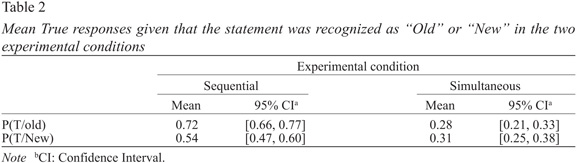
<body><![CDATA[<p><b>Results</b></p>     <p>&nbsp;</p>     <p><i>Truth decisions</i></p>     <p>Truth ratings of the test phase were analyzed with an ANOVA with the two recognition judgment conditions as a between-participants factor and  repetition of the statements as repeated measure.</p>     <p>Mean Hit rates, FA rates, and SDT <i>d&rsquo;</i> and <i>C</i> estimates for truth decisions in the two experimental conditions are provided in  <a href="#t1">Table 1</a>. For the sake of simplicity, only the analysis of SDT estimates are presented. The analysis of participants&rsquo; discrimination ability  (<i>d&rsquo;</i>) supports the ambiguity of the material regarding truth status. Mean <i>d&rsquo;</i> estimates were very low across all  conditions (all <i>d&rsquo;</i>s&lt;0.50; see <a href="#t1">Table 1</a>), suggesting that it was highly difficult for participants to distinguish  true from false facts, both for new and repeated statements [<i>F</i>(1,50)=1.13, <i>p</i>=.293] and in both experimental conditions (interaction:  <i>F</i>&lt;1). However, a main effect of experimental condition, <i>F</i>(1,50)=23.73, <i>p</i>&lt;.001,  <i>&eta;<sup>2</i></sup><sub>partial</sub>=0.34, suggests that the discrimination was better in the simultaneous condition (<i>M</i>=0.61; CI[0.44,  0.77]) than in the sequential condition (<i>M</i>=0.03; CI[-0.12, 0.19]).</p>     <p>&nbsp;</p>     <p><a name="t1"></a></p>     <p><img src="/img/revistas/aps/v35n1/35n1a06t1.jpg" width="576" height="241"></p>     
<p>The analysis of participants&rsquo; bias to answer &ldquo;True&rdquo; shows evidence of the truth effect. Although all <i>C</i>s estimates are  negative, reflecting liberal criteria across conditions, means were higher for new statements (<i>M=</i>-0.19; CI[-0.30, -0.07]) than for old  statements (<i>M=</i>-0.40; CI[-0.54, -0.25]), <i>F</i>(1,50)=13.55, <i>p</i>&lt;.001, <i>&eta;<sup>2</i></sup><sub>partial</sub>=0.21. Relevant to  our hypothesis, the effect was moderated by condition, <i>F</i>(1,50)=21.28, <i>p</i>&lt;.001, <i>&eta;<sup>2</i></sup><sub>partial</sub>=0.30. As  <a href="#t1">Table 1</a> shows, the truth effect is reduced in the condition where judgments of truth and familiarity were made simultaneously.  This suggests that having to provide simultaneously truth and recognition judgments decreased repetition&acute;s impact on perceived truth.</p>     <p>&nbsp;</p>     ]]></body>
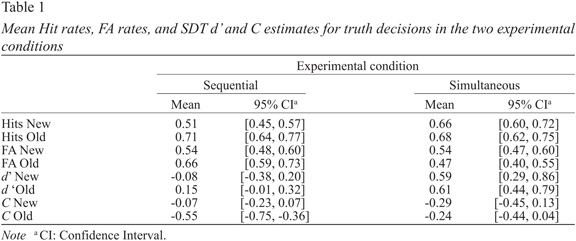
<body><![CDATA[<p><i>Recognition decisions</i></p>     <p>The analyses of the proportions of responses &ldquo;Old&rdquo; in the recognition test for old (Hits) and for new items (FA) showed that the two  experimental conditions differences were only marginally significant.</p>     <p>Regarding Hit rate, participants in the sequential judgments condition correctly remembered statements that had been previously presented more  (<i>M</i>=0.82; CI[0.75, 0.88]) than in the simultaneous condition (<i>M</i>=0.74; CI[0.67, 0.78]), <i>t</i>(50)=1.90, <i>p</i>=.060,  <i>d</i>=0.54. The two groups of participants also differed in the FA rate <i>t</i>(50)=1.70, <i>p</i>=.09, d=0.48, given that participants in the  simultaneous condition made more false recognitions (<i>M</i>=0.03; CI[0.01, 0.04]) than participants in the sequential condition (<i>M</i>=0.01;  CI[-0.01, 0.02]).</p>     <p>Because recognition performance was generally good, several participants had 100% of Hits and 0% of False alarms. In order to compound SDT  indexes to these indexes we performed a widely used correction suggested by Macmillan and Kaplan, (1985). Contrasts of the two conditions in  <i>d&rsquo;</i> show a clear better discrimination in the sequential judgment condition (<i>M</i>=7.55; CI[6.66, 8.45]) than in the simultaneous  one (<i>M</i>=4,19; CI[3.26, 5.12]), <i>t</i>(50)=5.24, <i>p</i>&lt;.001, <i>d</i>=1.48. However, analysis of C indexes show that participants in  the sequential judgment condition also have a greater bias to respond &ldquo;Old&rdquo; (<i>M</i>=-2.21; CI[-2.66, -1.71]) than participants in the  simultaneous condition (<i>M</i>=-1,37; CI[-1.83, -0.88], <i>t</i>(50)=2.60, <i>p</i>=.012, <i>d</i>=0.73).</p>     <p>&nbsp;</p>     <p><i>Conditional analysis</i></p>     <p>In order to understand how the two conditions impact the relation between truth and recognition decisions we computed the proportions of truth  decisions separated by items that individuals recognized as &ldquo;old&rdquo; and those they considered &ldquo;new&rdquo; (independently of the  real recognition status of the items). These two conditional probabilities were entered as a within-participants factor in an ANOVA, with the  experimental condition as a between-participants factor.</p>     <p>Results show a main effect of recognition decision, <i>F</i>(1,50)=6.31, <i>p</i>=.015, <i>&eta;<sup>2</i></sup><sub>partial</sub>=.11, in the  sense that a statement recognized as &ldquo;Old&rdquo; was more likely to be perceived as true (<i>M</i>=0.50; CI[.45, .54]) than a statement  considered &ldquo;New&rdquo; (<i>M</i>=0.43; CI[0.38, 0.47]). As <a href="#t2">Table 2</a> suggests this effect is stronger for the sequential than  for the simultaneous judgment condition (interaction: <i>F</i>(1,50)=16.45, <i>p</i>&lt;.001, <i>&eta;<sup>2</i></sup><sub>partial</sub>=0.25).</p>     <p>&nbsp;</p>     <p><a name="t2"></a></p>     ]]></body>
<body><![CDATA[<p><img src="/img/revistas/aps/v35n1/35n1a06t2.jpg" width="577" height="163"></p>     
<p>&nbsp;</p>     <p><i>RTs for truth ratings</i></p>     <p>Reaction times of the relevant items for the study, i.e. old and new) items were compared in both conditions. Thus mean reaction times of both  types of items were analyzed having the experimental condition as a between-subject factor. A main effect of type of item, <i>F</i>(1,50)=98.18,  <i>p</i>&lt;.001, <i>&eta;<sup>2</i></sup><sub>partial</sub>=0.69, suggests that new items took more time to be evaluated (<i>M</i>=5016 ms;  CI[4648, 5384]) than old items (<i>M</i>=4128ms; CI[3778, 4477]). A marginal main effect of condition occurred, <i>F</i>(1,50)=3.43, <i>p</i>=.069,  <i>&eta;<sup>2</i></sup><sub>partial</sub>=0.07, suggesting that when both judgments were simultaneous, participants took more time to provide an  answer (<i>M</i>=4892ms; CI[4392, 5393]) than when made sequentially (<i>M</i>=4251 ms; CI[3770, 4733]).</p>     <p>&nbsp;</p>     <p><b>Discussion</b></p>     <p>This experiment clearly shows that asking participants to simultaneously report their feelings of truth and familiarity with a statement  disrupts the truth effect. The typical truth effect was only found when individuals were asked to decide about the truth status of statements and  only afterwards inquired about the repetition status of those same statements. When an item is presented and the two judgments are asked  simultaneously the truth effect is not present. In this condition, comparatively with the sequential, we also observed that participants: (1) had  worse memory performance; (2) were less biased to answer &ldquo;Old&rdquo; ; (3) provided truth judgments independent of their memory and (4) show  a tendency to take more time to make any type of judgment.</p>     <p>This pattern of results seems to suggest that instead of anchoring their truth judgments in their memory, these participants dissociated it from  memory. In doing so, not only are they not using the subjective experience of familiarity in their judgments of truth, as they are also not using  that experience to help their memory performance, leading to worse performance. The fact that they are stricter to answer &ldquo;old&rdquo; and  that they take more time to evaluate these items, show evidence that they anchor their recognition judgments more in a control component of memory  and less in the familiarity component.</p>     <p>These results have theoretical and methodological implications. Theoretically, results inform about the mechanism by which repetition induces  perceived validity. The effect suggests that the subjective experience of familiarity is unlikely to be simultaneously perceived to inform about,  or to be attributed to, different sources. When that is made evident, participants seem to refuse familiarity as a source of information for any of  the two types of judgments and try to find an alternative basis for their judgments.</p>     <p>The fact that there is an association of recognition and truth judgments in the sequential condition and not in the simultaneous could be  understood as supporting a referential explanation of the truth effect (e.g., Arkes et al., 1991; Hasher et al., 1977). That is, truth is  referential to knowledge and when &ldquo;knowledge&rdquo; is attributed to previous exposure in the experimental setting, i.e., in the simultaneous  condition, that reference is lost. However, in our view this might not be necessarily so. Our results are also at odds with a non-referential  explanation of the truth effect, if we assume that the ecological validity of fluency association with truth can be undermined by a need to use  that fluency to inform about any other dimension of the stimuli.</p>     ]]></body>
<body><![CDATA[<p>However, our data is relevant to offer further support to the hypothesis that judgments of truth and recognition anchor in simple subjective  experiences. The results also make clear that if a misattribution process is occurring (e.g., Jacoby et al., 1989), it is disrupted by processing  conditions that call attention to it. In our experimental setting, processing fluency could be correctly attributed to memory and incorrectly to  truth. By being &ldquo;confronted&rdquo; with a situation in which an attribution could be made to two dimensions, participants did not choose one  in detriment to another. They did not seem to engage in a process that helped to define which meaning is the most appropriate for the subjective  experience. Instead participants seem to have acted as if they recognized their lack of information and anchoring their judgments in that clue.</p>     <p>The methodological relevance of our study lies in the fact that it calls attention to different effects promoted by how the two measures are  obtained. Unkelbach (2007) calls attention to this fact stating that &ldquo;It might seem problematic to elicit both kinds of judgments in close  succession, because there is the possibility of mutual dependencies (p. 226)&rdquo;. However in line with other authors (Bacon, 1979; Brown &amp;  Nix, 1996), his research did not show the effects to be disrupted by a simultaneous methodology. Also in a related field as the mere exposure  effects, the introduction of a simultaneous measurement of liking and recognition did not disrupt the effect, but it reduced it (see Brooks &amp;  Watkins, 1989). These effects contradict ours and Begg and Armour&rsquo;s (1991) results suggesting that calling attention to the repetition status  of a statement reduces its truth value. Thus a relevant question is why is simultaneous measurement so detrimental in our experiment and not in  others?</p>     <p>One possibility is that their conditions did not favor individuals to engage in more elaborative processing and ours did. Differences in  processing are signaled by the different reaction times we may find between our experiments and for example Unkelbach&rsquo;s (2007, Experiment 3).  In his experiment the mean of the evaluation of old items was 4750msec and new items 4285msec, whereas ours were evaluated in 4128msec and  5016msec. But why did our condition favor more controlled processes? One reason for this to occur may be the number of items to be evaluated,  whereas his participants evaluated 120 items, ours evaluated 96 items. Another reason may be the features of the distraction task of both studies,  since Unkelbach&rsquo;s task caused a break of between 25 and 30 minutes and ours of 15 minutes. The longer duration could have been more  disruptive and prevent individuals to disregard fluency as they seem to do in our experiment. In summary, the disruption we observed in our  experiment has not been obtained in all other experiments. However, this might suggest that there are conditions more prone to a disruption of  effects than others (see Garcia-Marques, Nunes, Marques, Carneiro, &amp; Weinstein, 2015).</p>     <p>In conclusion, this paper highlights the fact that the relation of truth with memory can favor or prevent illusions of truth. Repetition is  powerful in leading us to believe that a statement is true, but also leads us to categorize an item as new or old. Our data suggests that when  memory judgments are primed this will prevent the occurrence of the illusion of truth. To some extent, these data attest the wonderful capacity of  the human being: it develops efficiency by replacing complex judgments by easy ones (the heuristic approach, e.g., Kahneman, 2003), which can  induce illusions and biases, but also has ways of preventing them.</p>     <p>&nbsp;</p>     <p><b>References</b></p>     <!-- ref --><p>Arkes, H. R., Boehm, L. E., &amp; Xu, G. (1991). Determinants of judged validity. <i>Journal of Experimental Social Psychology, 27</i>,  576-605.    &nbsp;&nbsp;&nbsp;&nbsp;&nbsp;&nbsp;&nbsp;&nbsp;[&#160;<a href="javascript:void(0);" onclick="javascript: window.open('/scielo.php?script=sci_nlinks&ref=027186&pid=S0870-8231201700010000600001&lng=','','width=640,height=500,resizable=yes,scrollbars=1,menubar=yes,');">Links</a>&#160;]<!-- end-ref --></p>     <!-- ref --><p>Arkes, H. R., Hackett, C., &amp; Boehm, L. (1989). The generality of the relation between familiarity and judged validity<i>. Journal of  Behavioral Decision Making, 2</i>, 81-94.    &nbsp;&nbsp;&nbsp;&nbsp;&nbsp;&nbsp;&nbsp;&nbsp;[&#160;<a href="javascript:void(0);" onclick="javascript: window.open('/scielo.php?script=sci_nlinks&ref=027188&pid=S0870-8231201700010000600002&lng=','','width=640,height=500,resizable=yes,scrollbars=1,menubar=yes,');">Links</a>&#160;]<!-- end-ref --></p>     ]]></body>
<body><![CDATA[<!-- ref --><p>Bacon, F. (1979). Credibility of repeated statements: Memory for trivia. <i>Journal of Experimental Psychology: Human Learning and Memory,  5</i>, 241-252.    &nbsp;&nbsp;&nbsp;&nbsp;&nbsp;&nbsp;&nbsp;&nbsp;[&#160;<a href="javascript:void(0);" onclick="javascript: window.open('/scielo.php?script=sci_nlinks&ref=027190&pid=S0870-8231201700010000600003&lng=','','width=640,height=500,resizable=yes,scrollbars=1,menubar=yes,');">Links</a>&#160;]<!-- end-ref --></p>     <!-- ref --><p>Begg, I., Anas, A., &amp; Farinacci, S. (1992). Dissociation of processes in belief: Source recollection, statement familiarity, and the  illusion of truth. <i>Journal of Experimental Psychology: General, 121</i>, 446-458.    &nbsp;&nbsp;&nbsp;&nbsp;&nbsp;&nbsp;&nbsp;&nbsp;[&#160;<a href="javascript:void(0);" onclick="javascript: window.open('/scielo.php?script=sci_nlinks&ref=027192&pid=S0870-8231201700010000600004&lng=','','width=640,height=500,resizable=yes,scrollbars=1,menubar=yes,');">Links</a>&#160;]<!-- end-ref --></p>     <!-- ref --><p>Begg, I., &amp; Armour, V. (1991). Repetition and the ring of truth: Biasing comments. <i>Canadian Journal of Behavioural Science, 23</i>,  195-213.    &nbsp;&nbsp;&nbsp;&nbsp;&nbsp;&nbsp;&nbsp;&nbsp;[&#160;<a href="javascript:void(0);" onclick="javascript: window.open('/scielo.php?script=sci_nlinks&ref=027194&pid=S0870-8231201700010000600005&lng=','','width=640,height=500,resizable=yes,scrollbars=1,menubar=yes,');">Links</a>&#160;]<!-- end-ref --></p>     <!-- ref --><p>Bornstein, R. F. (1989). Exposure and affect: Overview and meta-analysis of research, 1968-1987. <i>Psychological bulletin, 106</i>, 265.    &nbsp;&nbsp;&nbsp;&nbsp;&nbsp;&nbsp;&nbsp;&nbsp;[&#160;<a href="javascript:void(0);" onclick="javascript: window.open('/scielo.php?script=sci_nlinks&ref=027196&pid=S0870-8231201700010000600006&lng=','','width=640,height=500,resizable=yes,scrollbars=1,menubar=yes,');">Links</a>&#160;]<!-- end-ref --></p>     <p>Bornstein, R. F., &amp; D&rsquo;Agostino, P. R. (1994). The attribution and discounting of perceptual fluency: Preliminary tests of a perceptual  fluency/attributional model of the mere exposure effect. <i>Social Cognition, 12</i>, 103-128.</p>     <!-- ref --><p>Brooks, J. O., &amp; Watkins, M. J. (1989). Recognition memory and the mere exposure effect. <i>Journal of Experimental Psychology: Learning,  Memory, and Cognition, 15</i>, 968-976.    &nbsp;&nbsp;&nbsp;&nbsp;&nbsp;&nbsp;&nbsp;&nbsp;[&#160;<a href="javascript:void(0);" onclick="javascript: window.open('/scielo.php?script=sci_nlinks&ref=027199&pid=S0870-8231201700010000600008&lng=','','width=640,height=500,resizable=yes,scrollbars=1,menubar=yes,');">Links</a>&#160;]<!-- end-ref --></p>     <!-- ref --><p>Brown, A. S., &amp; Nix, L. A. (1996). Turning lies into truths: Referential validation of falsehoods. <i>Journal of Experimental Psychology:  Learning, Memory, and Cognition, 22</i>, 1088-1100.    &nbsp;&nbsp;&nbsp;&nbsp;&nbsp;&nbsp;&nbsp;&nbsp;[&#160;<a href="javascript:void(0);" onclick="javascript: window.open('/scielo.php?script=sci_nlinks&ref=027201&pid=S0870-8231201700010000600009&lng=','','width=640,height=500,resizable=yes,scrollbars=1,menubar=yes,');">Links</a>&#160;]<!-- end-ref --></p>     <!-- ref --><p>Dech&ecirc;ne, A., Stahl, C., Hansen, J., &amp; W&auml;nke, M. (2010). The truth about the truth: A meta-analytic review of the truth effect.  <i>Personality and Social Psychology Review, 14</i>, 238-257.    &nbsp;&nbsp;&nbsp;&nbsp;&nbsp;&nbsp;&nbsp;&nbsp;[&#160;<a href="javascript:void(0);" onclick="javascript: window.open('/scielo.php?script=sci_nlinks&ref=027203&pid=S0870-8231201700010000600010&lng=','','width=640,height=500,resizable=yes,scrollbars=1,menubar=yes,');">Links</a>&#160;]<!-- end-ref --></p>     <!-- ref --><p>Dywan, J., &amp; Jacoby, L. (1990). Effects of aging on source monitoring: Differences in susceptibility to false fame. <i>Psychology and Aging,  5</i>, 379-387.    &nbsp;&nbsp;&nbsp;&nbsp;&nbsp;&nbsp;&nbsp;&nbsp;[&#160;<a href="javascript:void(0);" onclick="javascript: window.open('/scielo.php?script=sci_nlinks&ref=027205&pid=S0870-8231201700010000600011&lng=','','width=640,height=500,resizable=yes,scrollbars=1,menubar=yes,');">Links</a>&#160;]<!-- end-ref --></p>     <!-- ref --><p>Garcia-Marques, L., Nunes, L. D., Marques, P., Carneiro, P., &amp; Weinstein, Y. (2015). Adapting to test structure: Letting testing teach what  to learn. <i>Memory, 23</i>, 365-380.    &nbsp;&nbsp;&nbsp;&nbsp;&nbsp;&nbsp;&nbsp;&nbsp;[&#160;<a href="javascript:void(0);" onclick="javascript: window.open('/scielo.php?script=sci_nlinks&ref=027207&pid=S0870-8231201700010000600012&lng=','','width=640,height=500,resizable=yes,scrollbars=1,menubar=yes,');">Links</a>&#160;]<!-- end-ref --></p>     <!-- ref --><p>Garcia-Marques, T., Silva, R. R., Reber, R., &amp; Unkelbach, C. (2015). Hearing a statement now and believing the opposite later. <i>Journal of  Experimental Social Psychology, 56</i>, 126-129.    &nbsp;&nbsp;&nbsp;&nbsp;&nbsp;&nbsp;&nbsp;&nbsp;[&#160;<a href="javascript:void(0);" onclick="javascript: window.open('/scielo.php?script=sci_nlinks&ref=027209&pid=S0870-8231201700010000600013&lng=','','width=640,height=500,resizable=yes,scrollbars=1,menubar=yes,');">Links</a>&#160;]<!-- end-ref --></p>     <!-- ref --><p>Hasher, L., Goldstein, D., &amp; Toppino, T. (1977). Frequency and the conference of referential validity. <i>Journal of Verbal Learning and  Verbal Behavior, 16</i>, 107-112.    &nbsp;&nbsp;&nbsp;&nbsp;&nbsp;&nbsp;&nbsp;&nbsp;[&#160;<a href="javascript:void(0);" onclick="javascript: window.open('/scielo.php?script=sci_nlinks&ref=027211&pid=S0870-8231201700010000600014&lng=','','width=640,height=500,resizable=yes,scrollbars=1,menubar=yes,');">Links</a>&#160;]<!-- end-ref --></p>     <!-- ref --><p>Jacoby, L. L. (1991). A process dissociation framework: Separating automatic from intentional uses of memory<i>. Journal of memory and language,  30</i>, 513-541.    &nbsp;&nbsp;&nbsp;&nbsp;&nbsp;&nbsp;&nbsp;&nbsp;[&#160;<a href="javascript:void(0);" onclick="javascript: window.open('/scielo.php?script=sci_nlinks&ref=027213&pid=S0870-8231201700010000600015&lng=','','width=640,height=500,resizable=yes,scrollbars=1,menubar=yes,');">Links</a>&#160;]<!-- end-ref --></p>     <!-- ref --><p>Jacoby, L. L., Allan, L. G., Collins, J. C., &amp; Larwill, L. K. (1988). Memory influences subjective experience: Noise judgments. <i>Journal  of Experimental Psychology: Learning, Memory, and Cognition, 14</i>, 240-247.    &nbsp;&nbsp;&nbsp;&nbsp;&nbsp;&nbsp;&nbsp;&nbsp;[&#160;<a href="javascript:void(0);" onclick="javascript: window.open('/scielo.php?script=sci_nlinks&ref=027215&pid=S0870-8231201700010000600016&lng=','','width=640,height=500,resizable=yes,scrollbars=1,menubar=yes,');">Links</a>&#160;]<!-- end-ref --></p>     <!-- ref --><p>Jacoby, L. L., &amp; Kelley, C. M. (1987). Unconscious influences of memory for a prior event<i>. Personality and Social Psychology Bulletin,  13</i>, 314-336.    &nbsp;&nbsp;&nbsp;&nbsp;&nbsp;&nbsp;&nbsp;&nbsp;[&#160;<a href="javascript:void(0);" onclick="javascript: window.open('/scielo.php?script=sci_nlinks&ref=027217&pid=S0870-8231201700010000600017&lng=','','width=640,height=500,resizable=yes,scrollbars=1,menubar=yes,');">Links</a>&#160;]<!-- end-ref --></p>     <!-- ref --><p>Jacoby, L. L., Kelley, C. M., &amp; Dywan, J. (1989). Memory attributions. In H. L. Roediger &amp; F. I. M. Craik (Eds.), <i>Varieties of memory  and consciousness: Essays in honour of Endel Tulving</i> (pp. 391-422). Hillsdale, NJ: Erlbaum.    &nbsp;&nbsp;&nbsp;&nbsp;&nbsp;&nbsp;&nbsp;&nbsp;[&#160;<a href="javascript:void(0);" onclick="javascript: window.open('/scielo.php?script=sci_nlinks&ref=027219&pid=S0870-8231201700010000600018&lng=','','width=640,height=500,resizable=yes,scrollbars=1,menubar=yes,');">Links</a>&#160;]<!-- end-ref --></p>     <!-- ref --><p>Jennings, J. M., &amp; Jacoby, L. L. (1993). Automatic <i>versus</i> intentional uses of memory: Aging, attention, and control. <i>Psychology  and aging, 8</i>, 283-293.    &nbsp;&nbsp;&nbsp;&nbsp;&nbsp;&nbsp;&nbsp;&nbsp;[&#160;<a href="javascript:void(0);" onclick="javascript: window.open('/scielo.php?script=sci_nlinks&ref=027221&pid=S0870-8231201700010000600019&lng=','','width=640,height=500,resizable=yes,scrollbars=1,menubar=yes,');">Links</a>&#160;]<!-- end-ref --></p>     <!-- ref --><p>Kahneman, D. (2003). A perspective on judgment and choice: Mapping bounded rationality. <i>American psychologist, 58</i>, 697-720.    &nbsp;&nbsp;&nbsp;&nbsp;&nbsp;&nbsp;&nbsp;&nbsp;[&#160;<a href="javascript:void(0);" onclick="javascript: window.open('/scielo.php?script=sci_nlinks&ref=027223&pid=S0870-8231201700010000600020&lng=','','width=640,height=500,resizable=yes,scrollbars=1,menubar=yes,');">Links</a>&#160;]<!-- end-ref --></p>     <!-- ref --><p>Kelley, C. M., &amp; Jacoby, L. L. (1998). Subjective reports and process dissociation: Fluency, knowing, and feeling. <i>Acta Psychologica,  98</i>, 127-140.    &nbsp;&nbsp;&nbsp;&nbsp;&nbsp;&nbsp;&nbsp;&nbsp;[&#160;<a href="javascript:void(0);" onclick="javascript: window.open('/scielo.php?script=sci_nlinks&ref=027225&pid=S0870-8231201700010000600021&lng=','','width=640,height=500,resizable=yes,scrollbars=1,menubar=yes,');">Links</a>&#160;]<!-- end-ref --></p>     <!-- ref --><p>Kelley, C. M., &amp; Jacoby, L. L. (2000). Recollection and familiarity: Process-dissociation. In E. E. Tulving, E. Fergus, &amp; I. M. Craik  (Eds.), <i>The Oxford handbook of memory</i> (pp. 215-228). New York, NY: Oxford University Press.    &nbsp;&nbsp;&nbsp;&nbsp;&nbsp;&nbsp;&nbsp;&nbsp;[&#160;<a href="javascript:void(0);" onclick="javascript: window.open('/scielo.php?script=sci_nlinks&ref=027227&pid=S0870-8231201700010000600022&lng=','','width=640,height=500,resizable=yes,scrollbars=1,menubar=yes,');">Links</a>&#160;]<!-- end-ref --></p>     <p>Klinger, M. R., &amp; Greenwald, A. G. (1994). Preferences need no inferences?: The cognitive basis of unconscious emotional effects. In P. M.  Niedenthal &amp; S. Kitayama (Eds.), <i>The heart&rsquo;s eye: Emotional influences in perception and attention</i> (pp. 67-85). New York:  Academic.</p>     ]]></body>
<body><![CDATA[<!-- ref --><p>Law, S., Hawkins, S. A., &amp; Craik, F. I. (1998). Repetition-induced belief in the elderly: Rehabilitating age-related memory deficits.  <i>Journal of Consumer Research, 25</i>, 91-107.    &nbsp;&nbsp;&nbsp;&nbsp;&nbsp;&nbsp;&nbsp;&nbsp;[&#160;<a href="javascript:void(0);" onclick="javascript: window.open('/scielo.php?script=sci_nlinks&ref=027230&pid=S0870-8231201700010000600024&lng=','','width=640,height=500,resizable=yes,scrollbars=1,menubar=yes,');">Links</a>&#160;]<!-- end-ref --></p>     <p>Macmillan, N. A., &amp; Creelman, C. D. (2005). <i>Detection theory: A user&rsquo;s guide</i> (2<sup>nd</sup> ed.). Mahwah, New Jersey: Lawrence  Erlbaum Associates.</p>     <!-- ref --><p>Macmillan, N. A., &amp; Kaplan, H. L. (1985). Detection theory analysis of group data: Estimating sensitivity from average hit and false-alarm  rates. <i>Psychological bulletin, 98</i>, 185-1999.    &nbsp;&nbsp;&nbsp;&nbsp;&nbsp;&nbsp;&nbsp;&nbsp;[&#160;<a href="javascript:void(0);" onclick="javascript: window.open('/scielo.php?script=sci_nlinks&ref=027233&pid=S0870-8231201700010000600026&lng=','','width=640,height=500,resizable=yes,scrollbars=1,menubar=yes,');">Links</a>&#160;]<!-- end-ref --></p>     <!-- ref --><p>Mandler, G., Nakamura, Y., &amp; Van Zandt, B. J. (1987). Nonspecific effects of exposure on stimuli that cannot be recognized. <i>Journal of  Experimental Psychology: Learning, Memory, and Cognition, 13</i>, 646-648.    &nbsp;&nbsp;&nbsp;&nbsp;&nbsp;&nbsp;&nbsp;&nbsp;[&#160;<a href="javascript:void(0);" onclick="javascript: window.open('/scielo.php?script=sci_nlinks&ref=027235&pid=S0870-8231201700010000600027&lng=','','width=640,height=500,resizable=yes,scrollbars=1,menubar=yes,');">Links</a>&#160;]<!-- end-ref --></p>     <!-- ref --><p>Reber, R., &amp; Schwarz, N. (1999). Effects of perceptual fluency on judgments of truth. <i>Consciousness &amp; Cognition, 8</i>, 338-342.    &nbsp;&nbsp;&nbsp;&nbsp;&nbsp;&nbsp;&nbsp;&nbsp;[&#160;<a href="javascript:void(0);" onclick="javascript: window.open('/scielo.php?script=sci_nlinks&ref=027237&pid=S0870-8231201700010000600028&lng=','','width=640,height=500,resizable=yes,scrollbars=1,menubar=yes,');">Links</a>&#160;]<!-- end-ref --></p>     <!-- ref --><p>Reber, R., &amp; Unkelbach, C. (2010). The epistemic status of processing fluency as source for judgments of truth. <i>Review of philosophy and  psychology, 1</i>, 563-581.    &nbsp;&nbsp;&nbsp;&nbsp;&nbsp;&nbsp;&nbsp;&nbsp;[&#160;<a href="javascript:void(0);" onclick="javascript: window.open('/scielo.php?script=sci_nlinks&ref=027239&pid=S0870-8231201700010000600029&lng=','','width=640,height=500,resizable=yes,scrollbars=1,menubar=yes,');">Links</a>&#160;]<!-- end-ref --></p>     <!-- ref --><p>Reber, R., Winkielman, P., &amp; Schwarz, N. (1998). Effects of perceptual fluency on affective judgments. <i>Psychological science, 9</i>,  45-48.    &nbsp;&nbsp;&nbsp;&nbsp;&nbsp;&nbsp;&nbsp;&nbsp;[&#160;<a href="javascript:void(0);" onclick="javascript: window.open('/scielo.php?script=sci_nlinks&ref=027241&pid=S0870-8231201700010000600030&lng=','','width=640,height=500,resizable=yes,scrollbars=1,menubar=yes,');">Links</a>&#160;]<!-- end-ref --></p>     <p>Schneider, W., Eschman, A., &amp; Zuccolotto, A. (2002). <i>E-Prime user&rsquo;s guide</i>. Pittsburgh: Psychology Software Tools, Inc.</p>     <!-- ref --><p>Schwarz, N., Bless, H., Strack, F., Klumpp, G., Rittenauer-Schatka, H., &amp; Simons, A. (1991). Ease of retrieval as information: Another look  at the availability heuristic. <i>Journal of Personality and Social psychology, 61</i>, 195-202.    &nbsp;&nbsp;&nbsp;&nbsp;&nbsp;&nbsp;&nbsp;&nbsp;[&#160;<a href="javascript:void(0);" onclick="javascript: window.open('/scielo.php?script=sci_nlinks&ref=027244&pid=S0870-8231201700010000600032&lng=','','width=640,height=500,resizable=yes,scrollbars=1,menubar=yes,');">Links</a>&#160;]<!-- end-ref --></p>     <!-- ref --><p>Schwarz, N., &amp; Clore, G. L. (1983). Mood, misattribution, and judgments of well-being: Informative and directive functions of affective  states. <i>Journal of personality and social psychology, 45</i>, 513.    &nbsp;&nbsp;&nbsp;&nbsp;&nbsp;&nbsp;&nbsp;&nbsp;[&#160;<a href="javascript:void(0);" onclick="javascript: window.open('/scielo.php?script=sci_nlinks&ref=027246&pid=S0870-8231201700010000600033&lng=','','width=640,height=500,resizable=yes,scrollbars=1,menubar=yes,');">Links</a>&#160;]<!-- end-ref --></p>     <!-- ref --><p>Skurnik, I., Yoon, C., Park, D. C., &amp; Schwarz, N. (2005). How warnings about false claims become recommendations. <i>Journal of Consumer  Research, 31</i>, 713-724.    &nbsp;&nbsp;&nbsp;&nbsp;&nbsp;&nbsp;&nbsp;&nbsp;[&#160;<a href="javascript:void(0);" onclick="javascript: window.open('/scielo.php?script=sci_nlinks&ref=027248&pid=S0870-8231201700010000600034&lng=','','width=640,height=500,resizable=yes,scrollbars=1,menubar=yes,');">Links</a>&#160;]<!-- end-ref --></p>     ]]></body>
<body><![CDATA[<!-- ref --><p>Unkelbach, C. (2007). Reversing the truth effect: Learning the interpretation of processing fluency in judgments of truth. <i>Journal of  Experimental Psychology: Learning, Memory, &amp; Cognition, 33</i>, 219-230.    &nbsp;&nbsp;&nbsp;&nbsp;&nbsp;&nbsp;&nbsp;&nbsp;[&#160;<a href="javascript:void(0);" onclick="javascript: window.open('/scielo.php?script=sci_nlinks&ref=027250&pid=S0870-8231201700010000600035&lng=','','width=640,height=500,resizable=yes,scrollbars=1,menubar=yes,');">Links</a>&#160;]<!-- end-ref --></p>     <!-- ref --><p>Unkelbach, C., &amp; Greifeneder, R. (2013). A general model of fluency effects in judgment and decision making. In C. Unkelbach &amp; R.  Greifeneder (Eds.), <i>The experience of thinking</i> (pp. 11-32). New York: Psychology Press.    &nbsp;&nbsp;&nbsp;&nbsp;&nbsp;&nbsp;&nbsp;&nbsp;[&#160;<a href="javascript:void(0);" onclick="javascript: window.open('/scielo.php?script=sci_nlinks&ref=027252&pid=S0870-8231201700010000600036&lng=','','width=640,height=500,resizable=yes,scrollbars=1,menubar=yes,');">Links</a>&#160;]<!-- end-ref --></p>     <!-- ref --><p>Unkelbach, C., &amp; Stahl, C. (2009). A multinomial modeling approach to dissociate different components of the truth effect. <i>Consciousness  &amp; Cognition, 18</i>, 22-38.    &nbsp;&nbsp;&nbsp;&nbsp;&nbsp;&nbsp;&nbsp;&nbsp;[&#160;<a href="javascript:void(0);" onclick="javascript: window.open('/scielo.php?script=sci_nlinks&ref=027254&pid=S0870-8231201700010000600037&lng=','','width=640,height=500,resizable=yes,scrollbars=1,menubar=yes,');">Links</a>&#160;]<!-- end-ref --></p>     <!-- ref --><p>Witherspoon, D., &amp; Allan, L. G. (1985). The effect of a prior presentation on temporal judgments in a perceptual identification task.  <i>Memory &amp; Cognition, 13</i>, 101-111.    &nbsp;&nbsp;&nbsp;&nbsp;&nbsp;&nbsp;&nbsp;&nbsp;[&#160;<a href="javascript:void(0);" onclick="javascript: window.open('/scielo.php?script=sci_nlinks&ref=027256&pid=S0870-8231201700010000600038&lng=','','width=640,height=500,resizable=yes,scrollbars=1,menubar=yes,');">Links</a>&#160;]<!-- end-ref --></p>     <!-- ref --><p>Zillmann, D., Katcher, A. H., &amp; Milavsky, B. (1972). Excitation transfer from physical exercise to subsequent aggressive behavior.  <i>Journal of Experimental Social Psychology, 8</i>, 247-259.    &nbsp;&nbsp;&nbsp;&nbsp;&nbsp;&nbsp;&nbsp;&nbsp;[&#160;<a href="javascript:void(0);" onclick="javascript: window.open('/scielo.php?script=sci_nlinks&ref=027258&pid=S0870-8231201700010000600039&lng=','','width=640,height=500,resizable=yes,scrollbars=1,menubar=yes,');">Links</a>&#160;]<!-- end-ref --></p>     ]]></body>
<body><![CDATA[<p>&nbsp;</p>     <p><b><a name="c0" id="c0"></a><a href="#topc0">CORRESPONDÊNCIA</a></b></p>     <p>Correspondence concerning this article should be addressed to: Teresa Garcia-Marques ISPA &ndash; InstitutoUniversit&aacute;rio,   Rua do Jardim do Tabaco, 34, 1149-041 Lisboa, Portugal. E-mail: <a href="mailto:gmarques@ispa.pt">gmarques@ispa.pt</a></p>     <p>&nbsp;</p>     <p>Rita R. Silva: Now at the Social Cognition Center Cologne, University of Cologne.</p>     <p>&nbsp;</p>     <p>William James Center for Research, ISPA &ndash; Instituto Universit&aacute;rio: Supported by the FCT Grant No. UID/PSI/04810/2013.</p>     <p>&nbsp;</p>     <p>The writing of this article was supported by the Research and Development Project grant PTDC/PSI-PCO/121916/2010, awarded to Teresa  Garcia-Marques by the Portuguese Foundation for Science and Technology.</p>     <p>&nbsp;</p>     ]]></body>
<body><![CDATA[<p>Submitted: 27/7/2015 Accepted: 24/11/2015</p>      ]]></body><back>
<ref-list>
<ref id="B1">
<nlm-citation citation-type="journal">
<person-group person-group-type="author">
<name>
<surname><![CDATA[Arkes]]></surname>
<given-names><![CDATA[H. R.]]></given-names>
</name>
<name>
<surname><![CDATA[Boehm]]></surname>
<given-names><![CDATA[L. E.]]></given-names>
</name>
<name>
<surname><![CDATA[Xu]]></surname>
<given-names><![CDATA[G.]]></given-names>
</name>
</person-group>
<article-title xml:lang="en"><![CDATA[Determinants of judged validity]]></article-title>
<source><![CDATA[Journal of Experimental Social Psychology]]></source>
<year>1991</year>
<volume>27</volume>
<page-range>576-605</page-range></nlm-citation>
</ref>
<ref id="B2">
<nlm-citation citation-type="journal">
<person-group person-group-type="author">
<name>
<surname><![CDATA[Arkes]]></surname>
<given-names><![CDATA[H. R.]]></given-names>
</name>
<name>
<surname><![CDATA[Hackett]]></surname>
<given-names><![CDATA[C.]]></given-names>
</name>
<name>
<surname><![CDATA[Boehm]]></surname>
<given-names><![CDATA[L.]]></given-names>
</name>
</person-group>
<article-title xml:lang="en"><![CDATA[The generality of the relation between familiarity and judged validity]]></article-title>
<source><![CDATA[Journal of Behavioral Decision Making]]></source>
<year>1989</year>
<volume>2</volume>
<page-range>81-94</page-range></nlm-citation>
</ref>
<ref id="B3">
<nlm-citation citation-type="journal">
<person-group person-group-type="author">
<name>
<surname><![CDATA[Bacon]]></surname>
<given-names><![CDATA[F.]]></given-names>
</name>
</person-group>
<article-title xml:lang="en"><![CDATA[Credibility of repeated statements: Memory for trivia]]></article-title>
<source><![CDATA[Journal of Experimental Psychology: Human Learning and Memory]]></source>
<year>1979</year>
<volume>5</volume>
<page-range>241-252</page-range></nlm-citation>
</ref>
<ref id="B4">
<nlm-citation citation-type="journal">
<person-group person-group-type="author">
<name>
<surname><![CDATA[Begg]]></surname>
<given-names><![CDATA[I.]]></given-names>
</name>
<name>
<surname><![CDATA[Anas]]></surname>
<given-names><![CDATA[A.]]></given-names>
</name>
<name>
<surname><![CDATA[Farinacci]]></surname>
<given-names><![CDATA[S.]]></given-names>
</name>
</person-group>
<article-title xml:lang="en"><![CDATA[Dissociation of processes in belief: Source recollection, statement familiarity, and the illusion of truth]]></article-title>
<source><![CDATA[Journal of Experimental Psychology: General]]></source>
<year>1992</year>
<volume>121</volume>
<page-range>446-458</page-range></nlm-citation>
</ref>
<ref id="B5">
<nlm-citation citation-type="journal">
<person-group person-group-type="author">
<name>
<surname><![CDATA[Begg]]></surname>
<given-names><![CDATA[I.]]></given-names>
</name>
<name>
<surname><![CDATA[Armour]]></surname>
<given-names><![CDATA[V.]]></given-names>
</name>
</person-group>
<article-title xml:lang="en"><![CDATA[Repetition and the ring of truth: Biasing comments]]></article-title>
<source><![CDATA[Canadian Journal of Behavioural Science]]></source>
<year>1991</year>
<volume>23</volume>
<page-range>195-213</page-range></nlm-citation>
</ref>
<ref id="B6">
<nlm-citation citation-type="journal">
<person-group person-group-type="author">
<name>
<surname><![CDATA[Bornstein]]></surname>
<given-names><![CDATA[R. F.]]></given-names>
</name>
</person-group>
<article-title xml:lang="en"><![CDATA[Exposure and affect: Overview and meta-analysis of research, 1968-1987]]></article-title>
<source><![CDATA[Psychological bulletin]]></source>
<year>1989</year>
<volume>106</volume>
<page-range>265</page-range></nlm-citation>
</ref>
<ref id="B7">
<nlm-citation citation-type="journal">
<person-group person-group-type="author">
<name>
<surname><![CDATA[Bornstein]]></surname>
<given-names><![CDATA[R. F.]]></given-names>
</name>
<name>
<surname><![CDATA[D’Agostino]]></surname>
<given-names><![CDATA[P. R.]]></given-names>
</name>
</person-group>
<article-title xml:lang="en"><![CDATA[The attribution and discounting of perceptual fluency: Preliminary tests of a perceptual fluency/attributional model of the mere exposure effect]]></article-title>
<source><![CDATA[Social Cognition]]></source>
<year>1994</year>
<volume>12</volume>
<page-range>103-128</page-range></nlm-citation>
</ref>
<ref id="B8">
<nlm-citation citation-type="journal">
<person-group person-group-type="author">
<name>
<surname><![CDATA[Brooks]]></surname>
<given-names><![CDATA[J. O.]]></given-names>
</name>
<name>
<surname><![CDATA[Watkins]]></surname>
<given-names><![CDATA[M. J.]]></given-names>
</name>
</person-group>
<article-title xml:lang="en"><![CDATA[Recognition memory and the mere exposure effect]]></article-title>
<source><![CDATA[Journal of Experimental Psychology: Learning, Memory, and Cognition]]></source>
<year>1989</year>
<volume>15</volume>
<page-range>968-976</page-range></nlm-citation>
</ref>
<ref id="B9">
<nlm-citation citation-type="journal">
<person-group person-group-type="author">
<name>
<surname><![CDATA[Brown]]></surname>
<given-names><![CDATA[A. S.]]></given-names>
</name>
<name>
<surname><![CDATA[Nix]]></surname>
<given-names><![CDATA[L. A.]]></given-names>
</name>
</person-group>
<article-title xml:lang="en"><![CDATA[Turning lies into truths: Referential validation of falsehoods]]></article-title>
<source><![CDATA[Journal of Experimental Psychology: Learning, Memory, and Cognition]]></source>
<year>1996</year>
<volume>22</volume>
<page-range>1088-1100</page-range></nlm-citation>
</ref>
<ref id="B10">
<nlm-citation citation-type="journal">
<person-group person-group-type="author">
<name>
<surname><![CDATA[Dechêne]]></surname>
<given-names><![CDATA[A.]]></given-names>
</name>
<name>
<surname><![CDATA[Stahl]]></surname>
<given-names><![CDATA[C.]]></given-names>
</name>
<name>
<surname><![CDATA[Hansen]]></surname>
<given-names><![CDATA[J.]]></given-names>
</name>
<name>
<surname><![CDATA[Wänke]]></surname>
<given-names><![CDATA[M.]]></given-names>
</name>
</person-group>
<article-title xml:lang="en"><![CDATA[The truth about the truth: A meta-analytic review of the truth effect]]></article-title>
<source><![CDATA[Personality and Social Psychology Review]]></source>
<year>2010</year>
<volume>14</volume>
<page-range>238-257</page-range></nlm-citation>
</ref>
<ref id="B11">
<nlm-citation citation-type="journal">
<person-group person-group-type="author">
<name>
<surname><![CDATA[Dywan]]></surname>
<given-names><![CDATA[J.]]></given-names>
</name>
<name>
<surname><![CDATA[Jacoby]]></surname>
<given-names><![CDATA[L.]]></given-names>
</name>
</person-group>
<article-title xml:lang="en"><![CDATA[Effects of aging on source monitoring: Differences in susceptibility to false fame]]></article-title>
<source><![CDATA[Psychology and Aging]]></source>
<year>1990</year>
<volume>5</volume>
<page-range>379-387</page-range></nlm-citation>
</ref>
<ref id="B12">
<nlm-citation citation-type="journal">
<person-group person-group-type="author">
<name>
<surname><![CDATA[Garcia-Marques]]></surname>
<given-names><![CDATA[L.]]></given-names>
</name>
<name>
<surname><![CDATA[Nunes]]></surname>
<given-names><![CDATA[L. D.]]></given-names>
</name>
<name>
<surname><![CDATA[Marques]]></surname>
<given-names><![CDATA[P.]]></given-names>
</name>
<name>
<surname><![CDATA[Carneiro]]></surname>
<given-names><![CDATA[P.]]></given-names>
</name>
<name>
<surname><![CDATA[Weinstein]]></surname>
<given-names><![CDATA[Y.]]></given-names>
</name>
</person-group>
<article-title xml:lang="en"><![CDATA[Adapting to test structure: Letting testing teach what to learn]]></article-title>
<source><![CDATA[Memory]]></source>
<year>2015</year>
<volume>23</volume>
<page-range>365-380</page-range></nlm-citation>
</ref>
<ref id="B13">
<nlm-citation citation-type="journal">
<person-group person-group-type="author">
<name>
<surname><![CDATA[Garcia-Marques]]></surname>
<given-names><![CDATA[T.]]></given-names>
</name>
<name>
<surname><![CDATA[Silva]]></surname>
<given-names><![CDATA[R. R.]]></given-names>
</name>
<name>
<surname><![CDATA[Reber]]></surname>
<given-names><![CDATA[R.]]></given-names>
</name>
<name>
<surname><![CDATA[Unkelbach]]></surname>
<given-names><![CDATA[C.]]></given-names>
</name>
</person-group>
<article-title xml:lang="en"><![CDATA[Hearing a statement now and believing the opposite later]]></article-title>
<source><![CDATA[Journal of Experimental Social Psychology]]></source>
<year>2015</year>
<volume>56</volume>
<page-range>126-129</page-range></nlm-citation>
</ref>
<ref id="B14">
<nlm-citation citation-type="journal">
<person-group person-group-type="author">
<name>
<surname><![CDATA[Hasher]]></surname>
<given-names><![CDATA[L.]]></given-names>
</name>
<name>
<surname><![CDATA[Goldstein]]></surname>
<given-names><![CDATA[D.]]></given-names>
</name>
<name>
<surname><![CDATA[Toppino]]></surname>
<given-names><![CDATA[T.]]></given-names>
</name>
</person-group>
<article-title xml:lang="en"><![CDATA[Frequency and the conference of referential validity]]></article-title>
<source><![CDATA[Journal of Verbal Learning and Verbal Behavior]]></source>
<year>1977</year>
<volume>16</volume>
<page-range>107-112</page-range></nlm-citation>
</ref>
<ref id="B15">
<nlm-citation citation-type="journal">
<person-group person-group-type="author">
<name>
<surname><![CDATA[Jacoby]]></surname>
<given-names><![CDATA[L. L.]]></given-names>
</name>
</person-group>
<article-title xml:lang="en"><![CDATA[A process dissociation framework: Separating automatic from intentional uses of memory]]></article-title>
<source><![CDATA[Journal of memory and language]]></source>
<year>1991</year>
<volume>30</volume>
<page-range>513-541</page-range></nlm-citation>
</ref>
<ref id="B16">
<nlm-citation citation-type="journal">
<person-group person-group-type="author">
<name>
<surname><![CDATA[Jacoby]]></surname>
<given-names><![CDATA[L. L.]]></given-names>
</name>
<name>
<surname><![CDATA[Allan]]></surname>
<given-names><![CDATA[L. G.]]></given-names>
</name>
<name>
<surname><![CDATA[Collins]]></surname>
<given-names><![CDATA[J. C.]]></given-names>
</name>
<name>
<surname><![CDATA[Larwill]]></surname>
<given-names><![CDATA[L. K.]]></given-names>
</name>
</person-group>
<article-title xml:lang="en"><![CDATA[Memory influences subjective experience: Noise judgments]]></article-title>
<source><![CDATA[Journal of Experimental Psychology: Learning, Memory, and Cognition]]></source>
<year>1988</year>
<volume>14</volume>
<page-range>240-247</page-range></nlm-citation>
</ref>
<ref id="B17">
<nlm-citation citation-type="journal">
<person-group person-group-type="author">
<name>
<surname><![CDATA[Jacoby]]></surname>
<given-names><![CDATA[L. L.]]></given-names>
</name>
<name>
<surname><![CDATA[Kelley]]></surname>
<given-names><![CDATA[C. M.]]></given-names>
</name>
</person-group>
<article-title xml:lang="en"><![CDATA[Unconscious influences of memory for a prior event]]></article-title>
<source><![CDATA[Personality and Social Psychology Bulletin]]></source>
<year>1987</year>
<volume>13</volume>
<page-range>314-336</page-range></nlm-citation>
</ref>
<ref id="B18">
<nlm-citation citation-type="book">
<person-group person-group-type="author">
<name>
<surname><![CDATA[Jacoby]]></surname>
<given-names><![CDATA[L. L.]]></given-names>
</name>
<name>
<surname><![CDATA[Kelley]]></surname>
<given-names><![CDATA[C. M.]]></given-names>
</name>
<name>
<surname><![CDATA[Dywan]]></surname>
<given-names><![CDATA[J.]]></given-names>
</name>
</person-group>
<article-title xml:lang="en"><![CDATA[Memory attributions]]></article-title>
<person-group person-group-type="editor">
<name>
<surname><![CDATA[Roediger]]></surname>
<given-names><![CDATA[H. L.]]></given-names>
</name>
<name>
<surname><![CDATA[Craik]]></surname>
<given-names><![CDATA[F. I. M.]]></given-names>
</name>
</person-group>
<source><![CDATA[Varieties of memory and consciousness: Essays in honour of Endel Tulving]]></source>
<year>1989</year>
<page-range>391-422</page-range><publisher-loc><![CDATA[Hillsdale ]]></publisher-loc>
<publisher-name><![CDATA[Erlbaum]]></publisher-name>
</nlm-citation>
</ref>
<ref id="B19">
<nlm-citation citation-type="journal">
<person-group person-group-type="author">
<name>
<surname><![CDATA[Jennings]]></surname>
<given-names><![CDATA[J. M.]]></given-names>
</name>
<name>
<surname><![CDATA[Jacoby]]></surname>
<given-names><![CDATA[L. L.]]></given-names>
</name>
</person-group>
<article-title xml:lang="en"><![CDATA[Automatic versus intentional uses of memory: Aging, attention, and control]]></article-title>
<source><![CDATA[Psychology and aging]]></source>
<year>1993</year>
<volume>8</volume>
<page-range>283-293</page-range></nlm-citation>
</ref>
<ref id="B20">
<nlm-citation citation-type="journal">
<person-group person-group-type="author">
<name>
<surname><![CDATA[Kahneman]]></surname>
<given-names><![CDATA[D.]]></given-names>
</name>
</person-group>
<article-title xml:lang="en"><![CDATA[A perspective on judgment and choice: Mapping bounded rationality]]></article-title>
<source><![CDATA[American psychologist]]></source>
<year>2003</year>
<volume>58</volume>
<page-range>697-720</page-range></nlm-citation>
</ref>
<ref id="B21">
<nlm-citation citation-type="journal">
<person-group person-group-type="author">
<name>
<surname><![CDATA[Kelley]]></surname>
<given-names><![CDATA[C. M.]]></given-names>
</name>
<name>
<surname><![CDATA[Jacoby]]></surname>
<given-names><![CDATA[L. L.]]></given-names>
</name>
</person-group>
<article-title xml:lang="en"><![CDATA[Subjective reports and process dissociation: Fluency, knowing, and feeling]]></article-title>
<source><![CDATA[Acta Psychologica]]></source>
<year>1998</year>
<volume>98</volume>
<page-range>127-140</page-range></nlm-citation>
</ref>
<ref id="B22">
<nlm-citation citation-type="book">
<person-group person-group-type="author">
<name>
<surname><![CDATA[Kelley]]></surname>
<given-names><![CDATA[C. M.]]></given-names>
</name>
<name>
<surname><![CDATA[Jacoby]]></surname>
<given-names><![CDATA[L. L.]]></given-names>
</name>
</person-group>
<article-title xml:lang="en"><![CDATA[Recollection and familiarity: Process-dissociation]]></article-title>
<person-group person-group-type="editor">
<name>
<surname><![CDATA[Tulving]]></surname>
<given-names><![CDATA[E. E.]]></given-names>
</name>
<name>
<surname><![CDATA[Fergus]]></surname>
<given-names><![CDATA[E.]]></given-names>
</name>
<name>
<surname><![CDATA[Craik]]></surname>
<given-names><![CDATA[I. M.]]></given-names>
</name>
</person-group>
<source><![CDATA[The Oxford handbook of memory]]></source>
<year>2000</year>
<page-range>215-228</page-range><publisher-loc><![CDATA[New York ]]></publisher-loc>
<publisher-name><![CDATA[Oxford University Press]]></publisher-name>
</nlm-citation>
</ref>
<ref id="B23">
<nlm-citation citation-type="book">
<person-group person-group-type="author">
<name>
<surname><![CDATA[Klinger]]></surname>
<given-names><![CDATA[M. R.]]></given-names>
</name>
<name>
<surname><![CDATA[Greenwald]]></surname>
<given-names><![CDATA[A. G.]]></given-names>
</name>
</person-group>
<article-title xml:lang="en"><![CDATA[Preferences need no inferences?: The cognitive basis of unconscious emotional effects]]></article-title>
<person-group person-group-type="editor">
<name>
<surname><![CDATA[Niedenthal]]></surname>
<given-names><![CDATA[P. M.]]></given-names>
</name>
<name>
<surname><![CDATA[Kitayama]]></surname>
<given-names><![CDATA[S.]]></given-names>
</name>
</person-group>
<source><![CDATA[The heart’s eye: Emotional influences in perception and attention]]></source>
<year>1994</year>
<page-range>67-85</page-range><publisher-loc><![CDATA[New York ]]></publisher-loc>
<publisher-name><![CDATA[Academic]]></publisher-name>
</nlm-citation>
</ref>
<ref id="B24">
<nlm-citation citation-type="journal">
<person-group person-group-type="author">
<name>
<surname><![CDATA[Law]]></surname>
<given-names><![CDATA[S.]]></given-names>
</name>
<name>
<surname><![CDATA[Hawkins]]></surname>
<given-names><![CDATA[S. A.]]></given-names>
</name>
<name>
<surname><![CDATA[Craik]]></surname>
<given-names><![CDATA[F. I.]]></given-names>
</name>
</person-group>
<article-title xml:lang="en"><![CDATA[Repetition-induced belief in the elderly: Rehabilitating age-related memory deficits]]></article-title>
<source><![CDATA[Journal of Consumer Research]]></source>
<year>1998</year>
<volume>25</volume>
<page-range>91-107</page-range></nlm-citation>
</ref>
<ref id="B25">
<nlm-citation citation-type="book">
<person-group person-group-type="author">
<name>
<surname><![CDATA[Macmillan]]></surname>
<given-names><![CDATA[N. A.]]></given-names>
</name>
<name>
<surname><![CDATA[Creelman]]></surname>
<given-names><![CDATA[C. D.]]></given-names>
</name>
</person-group>
<source><![CDATA[Detection theory: A user’s guide]]></source>
<year>2005</year>
<edition>2</edition>
<publisher-loc><![CDATA[Mahwah ]]></publisher-loc>
<publisher-name><![CDATA[Lawrence Erlbaum Associates]]></publisher-name>
</nlm-citation>
</ref>
<ref id="B26">
<nlm-citation citation-type="journal">
<person-group person-group-type="author">
<name>
<surname><![CDATA[Macmillan]]></surname>
<given-names><![CDATA[N. A.]]></given-names>
</name>
<name>
<surname><![CDATA[Kaplan]]></surname>
<given-names><![CDATA[H. L.]]></given-names>
</name>
</person-group>
<article-title xml:lang="en"><![CDATA[Detection theory analysis of group data: Estimating sensitivity from average hit and false-alarm rates]]></article-title>
<source><![CDATA[Psychological bulletin]]></source>
<year>1985</year>
<volume>98</volume>
<page-range>185-1999</page-range></nlm-citation>
</ref>
<ref id="B27">
<nlm-citation citation-type="journal">
<person-group person-group-type="author">
<name>
<surname><![CDATA[Mandler]]></surname>
<given-names><![CDATA[G.]]></given-names>
</name>
<name>
<surname><![CDATA[Nakamura]]></surname>
<given-names><![CDATA[Y.]]></given-names>
</name>
<name>
<surname><![CDATA[Van Zandt]]></surname>
<given-names><![CDATA[B. J.]]></given-names>
</name>
</person-group>
<article-title xml:lang="en"><![CDATA[Nonspecific effects of exposure on stimuli that cannot be recognized]]></article-title>
<source><![CDATA[Journal of Experimental Psychology: Learning, Memory, and Cognition]]></source>
<year>1987</year>
<volume>13</volume>
<page-range>646-648</page-range></nlm-citation>
</ref>
<ref id="B28">
<nlm-citation citation-type="journal">
<person-group person-group-type="author">
<name>
<surname><![CDATA[Reber]]></surname>
<given-names><![CDATA[R.]]></given-names>
</name>
<name>
<surname><![CDATA[Schwarz]]></surname>
<given-names><![CDATA[N.]]></given-names>
</name>
</person-group>
<article-title xml:lang="en"><![CDATA[Effects of perceptual fluency on judgments of truth]]></article-title>
<source><![CDATA[Consciousness & Cognition]]></source>
<year>1999</year>
<volume>8</volume>
<page-range>338-342</page-range></nlm-citation>
</ref>
<ref id="B29">
<nlm-citation citation-type="journal">
<person-group person-group-type="author">
<name>
<surname><![CDATA[Reber]]></surname>
<given-names><![CDATA[R.]]></given-names>
</name>
<name>
<surname><![CDATA[Unkelbach]]></surname>
<given-names><![CDATA[C.]]></given-names>
</name>
</person-group>
<article-title xml:lang="en"><![CDATA[The epistemic status of processing fluency as source for judgments of truth]]></article-title>
<source><![CDATA[Review of philosophy and psychology]]></source>
<year>2010</year>
<volume>1</volume>
<page-range>563-581</page-range></nlm-citation>
</ref>
<ref id="B30">
<nlm-citation citation-type="journal">
<person-group person-group-type="author">
<name>
<surname><![CDATA[Reber]]></surname>
<given-names><![CDATA[R.]]></given-names>
</name>
<name>
<surname><![CDATA[Winkielman]]></surname>
<given-names><![CDATA[P.]]></given-names>
</name>
<name>
<surname><![CDATA[Schwarz]]></surname>
<given-names><![CDATA[N.]]></given-names>
</name>
</person-group>
<article-title xml:lang="en"><![CDATA[Effects of perceptual fluency on affective judgments]]></article-title>
<source><![CDATA[Psychological science]]></source>
<year>1998</year>
<volume>9</volume>
<page-range>45-48</page-range></nlm-citation>
</ref>
<ref id="B31">
<nlm-citation citation-type="book">
<person-group person-group-type="author">
<name>
<surname><![CDATA[Schneider]]></surname>
<given-names><![CDATA[W.]]></given-names>
</name>
<name>
<surname><![CDATA[Eschman]]></surname>
<given-names><![CDATA[A.]]></given-names>
</name>
<name>
<surname><![CDATA[Zuccolotto]]></surname>
<given-names><![CDATA[A.]]></given-names>
</name>
</person-group>
<source><![CDATA[E-Prime user’s guide]]></source>
<year>2002</year>
<publisher-loc><![CDATA[Pittsburgh ]]></publisher-loc>
<publisher-name><![CDATA[Psychology Software Tools, Inc]]></publisher-name>
</nlm-citation>
</ref>
<ref id="B32">
<nlm-citation citation-type="journal">
<person-group person-group-type="author">
<name>
<surname><![CDATA[Schwarz]]></surname>
<given-names><![CDATA[N.]]></given-names>
</name>
<name>
<surname><![CDATA[Bless]]></surname>
<given-names><![CDATA[H.]]></given-names>
</name>
<name>
<surname><![CDATA[Strack]]></surname>
<given-names><![CDATA[F.]]></given-names>
</name>
<name>
<surname><![CDATA[Klumpp]]></surname>
<given-names><![CDATA[G.]]></given-names>
</name>
<name>
<surname><![CDATA[Rittenauer-Schatka]]></surname>
<given-names><![CDATA[H.]]></given-names>
</name>
<name>
<surname><![CDATA[Simons]]></surname>
<given-names><![CDATA[A.]]></given-names>
</name>
</person-group>
<article-title xml:lang="en"><![CDATA[Ease of retrieval as information: Another look at the availability heuristic]]></article-title>
<source><![CDATA[Journal of Personality and Social psychology]]></source>
<year>1991</year>
<volume>61</volume>
<page-range>195-202</page-range></nlm-citation>
</ref>
<ref id="B33">
<nlm-citation citation-type="journal">
<person-group person-group-type="author">
<name>
<surname><![CDATA[Schwarz]]></surname>
<given-names><![CDATA[N.]]></given-names>
</name>
<name>
<surname><![CDATA[Clore]]></surname>
<given-names><![CDATA[G. L.]]></given-names>
</name>
</person-group>
<article-title xml:lang="en"><![CDATA[Mood, misattribution, and judgments of well-being: Informative and directive functions of affective states]]></article-title>
<source><![CDATA[Journal of personality and social psychology]]></source>
<year>1983</year>
<volume>45</volume>
<page-range>513</page-range></nlm-citation>
</ref>
<ref id="B34">
<nlm-citation citation-type="journal">
<person-group person-group-type="author">
<name>
<surname><![CDATA[Skurnik]]></surname>
<given-names><![CDATA[I.]]></given-names>
</name>
<name>
<surname><![CDATA[Yoon]]></surname>
<given-names><![CDATA[C.]]></given-names>
</name>
<name>
<surname><![CDATA[Park]]></surname>
<given-names><![CDATA[D. C.]]></given-names>
</name>
<name>
<surname><![CDATA[Schwarz]]></surname>
<given-names><![CDATA[N.]]></given-names>
</name>
</person-group>
<article-title xml:lang="en"><![CDATA[How warnings about false claims become recommendations]]></article-title>
<source><![CDATA[Journal of Consumer Research]]></source>
<year>2005</year>
<volume>31</volume>
<page-range>713-724</page-range></nlm-citation>
</ref>
<ref id="B35">
<nlm-citation citation-type="journal">
<person-group person-group-type="author">
<name>
<surname><![CDATA[Unkelbach]]></surname>
<given-names><![CDATA[C.]]></given-names>
</name>
</person-group>
<article-title xml:lang="en"><![CDATA[Reversing the truth effect: Learning the interpretation of processing fluency in judgments of truth]]></article-title>
<source><![CDATA[Journal of Experimental Psychology: Learning, Memory, & Cognition]]></source>
<year>2007</year>
<volume>33</volume>
<page-range>219-230</page-range></nlm-citation>
</ref>
<ref id="B36">
<nlm-citation citation-type="book">
<person-group person-group-type="author">
<name>
<surname><![CDATA[Unkelbach]]></surname>
<given-names><![CDATA[C.]]></given-names>
</name>
<name>
<surname><![CDATA[Greifeneder]]></surname>
<given-names><![CDATA[R.]]></given-names>
</name>
</person-group>
<article-title xml:lang="en"><![CDATA[A general model of fluency effects in judgment and decision making]]></article-title>
<person-group person-group-type="editor">
<name>
<surname><![CDATA[Unkelbach]]></surname>
<given-names><![CDATA[C.]]></given-names>
</name>
<name>
<surname><![CDATA[Greifeneder]]></surname>
<given-names><![CDATA[R.]]></given-names>
</name>
</person-group>
<source><![CDATA[The experience of thinking]]></source>
<year>2013</year>
<page-range>11-32</page-range><publisher-loc><![CDATA[New York ]]></publisher-loc>
<publisher-name><![CDATA[Psychology Press]]></publisher-name>
</nlm-citation>
</ref>
<ref id="B37">
<nlm-citation citation-type="journal">
<person-group person-group-type="author">
<name>
<surname><![CDATA[Unkelbach]]></surname>
<given-names><![CDATA[C.]]></given-names>
</name>
<name>
<surname><![CDATA[Stahl]]></surname>
<given-names><![CDATA[C.]]></given-names>
</name>
</person-group>
<article-title xml:lang="en"><![CDATA[A multinomial modeling approach to dissociate different components of the truth effect]]></article-title>
<source><![CDATA[Consciousness & Cognition]]></source>
<year>2009</year>
<volume>18</volume>
<page-range>22-38</page-range></nlm-citation>
</ref>
<ref id="B38">
<nlm-citation citation-type="journal">
<person-group person-group-type="author">
<name>
<surname><![CDATA[Witherspoon]]></surname>
<given-names><![CDATA[D.]]></given-names>
</name>
<name>
<surname><![CDATA[Allan]]></surname>
<given-names><![CDATA[L. G.]]></given-names>
</name>
</person-group>
<article-title xml:lang="en"><![CDATA[The effect of a prior presentation on temporal judgments in a perceptual identification task]]></article-title>
<source><![CDATA[Memory & Cognition]]></source>
<year>1985</year>
<volume>13</volume>
<page-range>101-111</page-range></nlm-citation>
</ref>
<ref id="B39">
<nlm-citation citation-type="journal">
<person-group person-group-type="author">
<name>
<surname><![CDATA[Zillmann]]></surname>
<given-names><![CDATA[D.]]></given-names>
</name>
<name>
<surname><![CDATA[Katcher]]></surname>
<given-names><![CDATA[A. H.]]></given-names>
</name>
<name>
<surname><![CDATA[Milavsky]]></surname>
<given-names><![CDATA[B.]]></given-names>
</name>
</person-group>
<article-title xml:lang="en"><![CDATA[Excitation transfer from physical exercise to subsequent aggressive behavior]]></article-title>
<source><![CDATA[Journal of Experimental Social Psychology]]></source>
<year>1972</year>
<volume>8</volume>
<page-range>247-259</page-range></nlm-citation>
</ref>
</ref-list>
</back>
</article>