<?xml version="1.0" encoding="ISO-8859-1"?><article xmlns:mml="http://www.w3.org/1998/Math/MathML" xmlns:xlink="http://www.w3.org/1999/xlink" xmlns:xsi="http://www.w3.org/2001/XMLSchema-instance">
<front>
<journal-meta>
<journal-id>0870-8231</journal-id>
<journal-title><![CDATA[Análise Psicológica]]></journal-title>
<abbrev-journal-title><![CDATA[Aná. Psicológica]]></abbrev-journal-title>
<issn>0870-8231</issn>
<publisher>
<publisher-name><![CDATA[ISPA-Instituto Universitário]]></publisher-name>
</publisher>
</journal-meta>
<article-meta>
<article-id>S0870-82312017000200004</article-id>
<article-id pub-id-type="doi">10.14417/ap.1219</article-id>
<title-group>
<article-title xml:lang="en"><![CDATA[Portuguese juvenile delinquents: An exploratory study from a sample of institutionalized young offenders]]></article-title>
</title-group>
<contrib-group>
<contrib contrib-type="author">
<name>
<surname><![CDATA[Morgado]]></surname>
<given-names><![CDATA[Alice Murteira]]></given-names>
</name>
<xref ref-type="aff" rid="A01"/>
<xref ref-type="aff" rid="A02"/>
</contrib>
<contrib contrib-type="author">
<name>
<surname><![CDATA[Dias]]></surname>
<given-names><![CDATA[Maria da Luz Vale]]></given-names>
</name>
<xref ref-type="aff" rid="A01"/>
</contrib>
</contrib-group>
<aff id="A01">
<institution><![CDATA[,Universidade de Coimbra Faculdade de Psicologia e de Ciências da Educação ]]></institution>
<addr-line><![CDATA[ ]]></addr-line>
</aff>
<aff id="A02">
<institution><![CDATA[,University of Northampton Faculty of Health and Society ]]></institution>
<addr-line><![CDATA[ ]]></addr-line>
</aff>
<pub-date pub-type="pub">
<day>00</day>
<month>06</month>
<year>2017</year>
</pub-date>
<pub-date pub-type="epub">
<day>00</day>
<month>06</month>
<year>2017</year>
</pub-date>
<volume>35</volume>
<numero>2</numero>
<fpage>157</fpage>
<lpage>170</lpage>
<copyright-statement/>
<copyright-year/>
<self-uri xlink:href="http://scielo.pt/scielo.php?script=sci_arttext&amp;pid=S0870-82312017000200004&amp;lng=en&amp;nrm=iso"></self-uri><self-uri xlink:href="http://scielo.pt/scielo.php?script=sci_abstract&amp;pid=S0870-82312017000200004&amp;lng=en&amp;nrm=iso"></self-uri><self-uri xlink:href="http://scielo.pt/scielo.php?script=sci_pdf&amp;pid=S0870-82312017000200004&amp;lng=en&amp;nrm=iso"></self-uri><abstract abstract-type="short" xml:lang="en"><p><![CDATA[Severe antisocial behaviour in adolescence is a matter of concern in every society, especially when it translates in juvenile delinquency that persists through adulthood. In this study, we asked a sample of 121 institutionalized male juvenile offenders (between 14 and 20 years old) to fill several self-report measures to understand young delinquents and their social and academic conditions, behaviour, and individual dispositions. Results reveal peculiarities on academic achievement, socioeconomic status and family size. Analysis confirmed the role of personality, self-concept, self-control and family environment on antisocial scores, especially psychoticism, neuroticism, social conformity, and family environment. Different behavioural subtypes reflect differences in psychoticism, antisocial behaviour and family environment. However, there were no correlations between antisocial tendency and age, school year or family size. Our paper contributes to existing knowledge that supports intervention approaches, stressing that, unlike age, school year or family size, different types of behaviour may require differentiated interventions.]]></p></abstract>
<abstract abstract-type="short" xml:lang="pt"><p><![CDATA[A questão dos comportamentos antissociais graves na adolescência é motivo de preocupação social, especialmente quanto se traduzem em delinquência juvenil que persiste pela idade adulta. No sentido de estudar as características de jovens delinquentes assim como as suas condições sociais e académicas e o seu comportamento e disposições individuais, foi solicitado o preenchimento de diversos questionários de autorrelato a uma amostra de 121 jovens delinquentes a cumprir medida de internamento em Centros Educativos (entre os 14 e os 20 anos de idade). Os resultados revelam particularidades relativamente ao percurso escolar, nível socioeconómico e estrutura familiar. As análises realizadas confirmaram o papel da personalidade, autoconceito, autocontrolo e ambiente familiar na tendência antissocial, destacando-se o papel do psicoticismo, neuroticismo, conformidade social e ambiente familiar. Foi ainda possível confirmar diferenças no psicoticismo, tendência antissocial e ambiente familiar entre jovens com diferentes tipos de comportamentos antissociais. Não foi, todavia, possível confirmar a existência de correlações entre tendências antissociais e idade, ano de escolaridade ou dimensão da fratria. Este estudo oferece um contributo adicional para defesa de diferentes abordagens interventivas, destacando que, apesar da uniformidade na tendência antissocial e disposições individuais em termos etários, escolares e familiares, indivíduos com comportamentos antissociais distintos poderão beneficiar de intervenções diferenciada.]]></p></abstract>
<kwd-group>
<kwd lng="en"><![CDATA[Antisocial behaviour]]></kwd>
<kwd lng="en"><![CDATA[Adolescence]]></kwd>
<kwd lng="en"><![CDATA[Delinquency]]></kwd>
<kwd lng="pt"><![CDATA[Comportamento antissocial]]></kwd>
<kwd lng="pt"><![CDATA[Adolescência]]></kwd>
<kwd lng="pt"><![CDATA[Delinquência]]></kwd>
</kwd-group>
</article-meta>
</front><body><![CDATA[ <p><b>Portuguese juvenile delinquents: An exploratory study from a sample of institutionalized young offenders</b></p>     <p><b>Alice Murteira Morgado<sup>1</sup>, Maria da Luz Vale Dias<sup>2</sup></b></p>     <p><sup>1</sup>Faculdade de Psicologia e de Ci&ecirc;ncias da Educa&ccedil;&atilde;o da Universidade de Coimbra / University of Northampton,  Faculty of Health and Society, UK</p>     <p><sup>2</sup>Faculdade de Psicologia e de Ci&ecirc;ncias da Educa&ccedil;&atilde;o da Universidade de Coimbra</p>     <p><a name="topc0"></a><a href="#c0">Correspondência</a></p>     <p>&nbsp;</p>     <p><b>ABSTRACT</b></p>     <p>Severe antisocial behaviour in adolescence is a matter of concern in every society, especially when it translates in juvenile delinquency that  persists through adulthood. In this study, we asked a sample of 121 institutionalized male juvenile offenders (between 14 and 20 years old) to fill  several self-report measures to understand young delinquents and their social and academic conditions, behaviour, and individual dispositions.  Results reveal peculiarities on academic achievement, socioeconomic status and family size. Analysis confirmed the role of personality,  self-concept, self-control and family environment on antisocial scores, especially psychoticism, neuroticism, social conformity, and family  environment. Different behavioural subtypes reflect differences in psychoticism, antisocial behaviour and family environment. However, there were  no correlations between antisocial tendency and age, school year or family size. Our paper contributes to existing knowledge that supports  intervention approaches, stressing that, unlike age, school year or family size, different types of behaviour may require differentiated  interventions.    <p>     <p><b>Key words</b>: Antisocial behaviour, Adolescence, Delinquency.</p>     ]]></body>
<body><![CDATA[<p>&nbsp;</p>     <p><b>RESUMO</b></p>     <p>A quest&atilde;o dos comportamentos antissociais graves na adolesc&ecirc;ncia &eacute; motivo de preocupa&ccedil;&atilde;o social,  especialmente quanto se traduzem em delinqu&ecirc;ncia juvenil que persiste pela idade adulta. No sentido de estudar as caracter&iacute;sticas de  jovens delinquentes assim como as suas condi&ccedil;&otilde;es sociais e acad&eacute;micas e o seu comportamento e disposi&ccedil;&otilde;es  individuais, foi solicitado o preenchimento de diversos question&aacute;rios de autorrelato a uma amostra de 121 jovens delinquentes a cumprir  medida de internamento em Centros Educativos (entre os 14 e os 20 anos de idade). Os resultados revelam particularidades relativamente ao percurso  escolar, n&iacute;vel socioecon&oacute;mico e estrutura familiar. As an&aacute;lises realizadas confirmaram o papel da personalidade,  autoconceito, autocontrolo e ambiente familiar na tend&ecirc;ncia antissocial, destacando-se o papel do psicoticismo, neuroticismo, conformidade  social e ambiente familiar. Foi ainda poss&iacute;vel confirmar diferen&ccedil;as no psicoticismo, tend&ecirc;ncia antissocial e ambiente familiar  entre jovens com diferentes tipos de comportamentos antissociais. N&atilde;o foi, todavia, poss&iacute;vel confirmar a exist&ecirc;ncia de  correla&ccedil;&otilde;es entre tend&ecirc;ncias antissociais e idade, ano de escolaridade ou dimens&atilde;o da fratria.</p>     <p>Este estudo oferece um contributo adicional para defesa de diferentes abordagens interventivas, destacando que, apesar da uniformidade na  tend&ecirc;ncia antissocial e disposi&ccedil;&otilde;es individuais em termos et&aacute;rios, escolares e familiares, indiv&iacute;duos com  comportamentos antissociais distintos poder&atilde;o beneficiar de interven&ccedil;&otilde;es diferenciada.</p>     <p><b>Palavras-chave</b>: Comportamento antissocial, Adolesc&ecirc;ncia, Delinqu&ecirc;ncia.</p>     <p>&nbsp;</p>     <p><b>Introduction</b></p>     <p>The term antisocial behaviour refers to a diversity of behaviours that violate social rules intended to promote respect and consideration  towards other people&rsquo;s life and property and &ldquo;must be interpreted as a social event, with meaningful subtypes, topographies,  antecedents, and functions&rdquo; (Dodge, Coie, &amp; Lynam, 2008, p. 437). Hence, by definition, its study carries an immeasurable complexity due  to the variability in antisocial manifestations, individuals, and trajectories. Such complex and heterogeneous nature, especially in adolescence,  is well acknowledged in literature regarding this issue, and many theories have attempted to describe and explain the antisocial phenomenon, its  origins, determinants, trajectories, manifestations, degrees of severity, and persistence mechanisms.</p>     <p>Particularly relevant to understanding the dynamics of adolescent delinquency (in opposition to adolescent deviant behaviours that are found in  the general population) is Moffitt&rsquo;s theory (1993, 2006). The author postulates the existence of two types of antisocial behaviour: the  life-course-persistent (LCP) and the adolescence-limited (AL). The latter, initiated in early adolescence, usually ceasing in young adulthood, is  considered to be generalized (almost normative), transient, and less severe, consisting mainly of non-violent acts that are instrumental for the  adolescent&rsquo;s desire for power and acknowledgement, such as theft, vandalism, substance abuse, etc. LCP, on the contrary, is rarer, more  severe and persistent across the lifespan. Moffitt postulates that LCP antisocial behaviour has its origins in very early individual  characteristics, such as neuropsychological health, that manifest as &ldquo;variability in infant temperament, developmental milestones and  cognitive abilities&rdquo; (Moffitt, 1993, p. 687), combined with environmental disadvantages that prevent the correction of the child&rsquo;s  individual problems, and may, in fact, contribute to exacerbate them: &ldquo;under such detrimental circumstances, difficult behaviour is gradually  elaborated into conduct problems and a dearth of prosocial skills (&hellip;), academic failure and a dearth of job skills. Over time, accumulating  consequences of the youngster&rsquo;s personality problems and academic problems prune away the options for change&rdquo; (Moffitt, 1993, p. 687).  In fact, also the Cambridge Study for Delinquent Development argues that &ldquo;the more persistent transgressors start early, have long criminal  careers and present difficulties in many aspects of their lives&rdquo; (Farrington, 2008, p. 242).</p>     <p>From this perspective, LCP antisocial individuals are somehow trapped by their circumstances, that is, at first by their characteristics and,  later, by their contexts. In fact, little opportunity is available for this group of individuals to learn prosocial alternatives to their  behaviours: &ldquo;deviant behaviours later in life may thus reflect early individual differences that are perpetuated or exacerbated by  interactions with the social environment: first at home, and later at school&rdquo; (Moffitt, 1993, p. 683).</p>     ]]></body>
<body><![CDATA[<p>A different, but equally important, framework for understanding adolescent antisocial behaviour is suggested by Tremblay (2010), placing the  focus on behavioural subtypes, rather than on age-of-onset. According to this author, diverse types of antisocial behaviour entail different  developmental trajectories as different resources and characteristics are involved in distinct types of antisocial behaviour. In fact, the  frequency of overt behaviours (like physical aggression) generally decreases with age, while the frequency of covert behaviours (such as rule  breaking) tends to increase.</p>     <p>In this context, a developmental perspective may provide important insight and valuable clues to understanding what needs to be addressed in  order to prevent and amend antisocial manifestations in adolescence, especially concerning specific contexts and individual characteristics  (Morgado &amp; Vale Dias, 2013).</p>     <p>There are several individual and contextual factors that have been mentioned to contribute to increasing the severity of antisocial behaviour to  the point where it is translated into long-term delinquency. Farrington (2007) argues that delinquency is an element of a bigger syndrome of  antisocial behaviour that tends to be persistent and relatively stable. Among others, the author refers to impulsivity, low intelligence (or poor  school performance), poor parental rearing practices, antisocial family, and poverty as factors involved in the development of delinquency.</p>     <p>A negative association between socioeconomic status and antisocial behaviours has been generally confirmed (Church II, Jaggers, &amp; Taylor,  2012; Rutter, Giller, &amp; Hagell, 1998; Tremblay, 2010). Yet, the effect of socioeconomic conditions on antisocial behaviours may not be direct  but mediated by other living conditions, such as family functioning (Rutter et al., 1998). Indeed, the family&rsquo;s role is crucial for the  development of social behaviours, since it is within the family that children will learn and rehearse social interactions, get reinforcements or  punishments according to the adjustment of their conducts, and, therefore, identify what sets of behaviours are acceptable and may be repeated and  what behaviours should be avoided. Hence, family structure factors (single parenting, divorce, family dimension, etc.) and the conflict that may be  involved have been identified as determinants of social conducts (Pardini, Waller, &amp; Hawes, 2015; Stadelmann, Perren, Groeben, &amp;  VonKlitzing, 2010). Family management practices, including control, discipline, supervision, and rejection (Farrington, 2007), as well the quality  of communication and relations within the family (Laub, Sampson, &amp; Sweeten, 2006; Tom&eacute;, Camacho, Matos, &amp; Sim&otilde;es, 2015) have  been mentioned as significant risk factors for involvement in violence, delinquency and other antisocial manifestations.</p>     <p>The importance of considering the role of individual dispositions in adolescent antisocial behaviour is also evident and has been previously  explored in the Portuguese context with juvenile delinquents, in particular regarding psychopathic, callous-unemotional and narcissistic traits,  and self-esteem (Pechorro, 2011; Pechorro, Ray, Barroso, Mar&ocirc;co, &amp; Gon&ccedil;alves, 2014; Pechorro, Silva, Mar&ocirc;co, Poiares, &amp;  Vieira, 2012).</p>     <p>One of the most solid theories on personality and antisocial behaviour (Eysenck &amp; Eysenck, 1985) &ndash; that has been widely tested and  discussed (e.g., Center &amp; Kemp, 2002) &ndash; suggests a specific profile consisting of high scores on the three Eysenck&rsquo;s personality  traits &ndash; extraversion (high energy, sociability, stimulation seeking, activity, assertiveness), neuroticism (susceptibility to anxiety and  quick emotional arouse), and psychoticism (aggressiveness, egocentrism, toughness, and impulsivity ) &ndash; and low scores on the Lie scale (L)  from the Eysenck&rsquo;s Personality Questionnaire (EPQ), which has been considered as a measure of socialization and social conformity.</p>     <p>In the scope of social functioning, self-concept is regarded both as risk factor and protective factor. Although the existing body of literature  has already explained some aspects of antisocial children and adolescents&rsquo; self-perceptions (Pechorro et al., 2012), research has not yet  allowed us to clarify if there is a particular self-concept pattern that defines a tendency of antisocial adolescents. Despite the uncertainties  around this matter, one aspect appears to be consensual: self-concept is entailed in adolescent development, has a significant role to play in the  development of social behaviours (Salmivalli, 2001; Torregrosa, Ingles, &amp; Garcia-Fernandez, 2011), and, consequently, in the development of  antisocial trajectories at this stage of the lifespan. In this sense, analysis regarding different components of self-concept appear to be  particularly, since research has been pointing out peculiarities when it comes to physical and social components of self-concept in antisocial  adolescents (Salmivalli, 2001; Torregrosa et al., 2011).</p>     <p>Likewise, social skills appear to be determinant &ndash; either as protective factors or risk factors &ndash; in guiding individual&rsquo;s  choices regarding social behaviours (Mota, Matos, &amp; Lemos, 2011; Selman &amp; Adalbjarnardottir, 2000). It is quite consensual that the  tendency to show altruism, sympathy, and respect may be determinant in preventing an antisocial trajectory (Batanova &amp; Loukas, 2011; Dodge et  al., 2008), whereas lack of social sensitivity, empathy and perspective-taking in social interactions may put individuals at higher risk of  engaging in antisocial behaviours (Jolliffe &amp; Farrington, 2004; Pechorro et al., 2014). In addition, social skills and antisocial behaviour  have an important impact on school achievement. Indeed, children who bring a limited behavioural repertoire or limited social skills by the time  they enter school may be more difficult to handle in the classroom, increasing the likelihood of poor academic performance, poor attachment to  teachers, lower school commitment and rejection by conventional peers (Payne &amp; Welch, 2015). Hence, adolescence, when social relations assume a  growing importance in the individuals&rsquo; lives, and when social skills are still far from being fully developed (Steinberg, 2009), may be a  critical stage to identify, prevent and/or compensate for psychosocial vulnerabilities.</p>     <p>In this paper we address individual dispositions and perceptions with focus on personality, self-concept, social skills and family environment.  Although such dimensions have been widely studied individually, their role on adolescent antisocial behaviour is still far from being fully  understood and explained (Morgado &amp; Vale Dias, 2013), especially when it comes to considering multiple dimensions in the same research design,  which may provide a more complete understanding of each dimension and, due to joint analysis, of their complementary contributions on the  explanation of adolescent antisocial behaviours.</p>     <p>With this study we intend to better understand a sample of institutionalized delinquent boys, namely their behavioural manifestations,  personality, self-concept, social skills, and perceived family environment. Hence, our hypothesis were developed with a descriptive and exploratory  purpose, in order to understand, on the one hand, if institutionalized adolescent delinquents would share some of LCP antisocial individuals&rsquo;  characteristics (Moffitt, 1993) and, on the other hand, if different behavioural manifestations in these same individuals would, as suggested by  Tremblay (2010), reflect distinct characteristics and resources:</p>     ]]></body>
<body><![CDATA[<p>&nbsp;</p>     <p>H1: Eysenck&rsquo;s personality traits (psychoticism, extraversion and neuroticism) are positively correlated with antisocial behaviour while  the &ldquo;lie&rdquo; scale of EPQ-J negatively correlates with antisocial behaviour;</p>     <p>&nbsp;</p>     <p>H2: Social skills, self-concept and perception of family environment are negatively correlated with antisocial behaviour;</p>     <p>&nbsp;</p>     <p>H3: Antisocial tendency and individual dispositions are related with age, school year and family size;</p>     <p>&nbsp;</p>     <p>H4: Juvenile delinquents with different behavioural subtypes present differences in antisocial behaviour scores and individual dispositions.</p>     <p>&nbsp;</p>     <p><b>Method</b></p>     ]]></body>
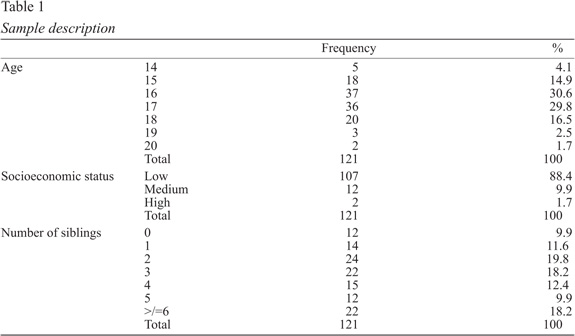
<body><![CDATA[<p>&nbsp;</p>     <p><i>Participants</i></p>     <p>The sample for this study included 121 boys with a history of delinquency institutionalized in five juvenile detention centres in different  Portuguese regions, originally coming from all the country and living in urban areas (mostly greater Lisbon and Porto). Regarding their  nationality, 86% were Portuguese, 13,2% came from African Portuguese Speaking Countries and only one individual was from another European country.  Participants were predominantly of low socioeconomic status (88.4%) and with an average of 3.5 siblings. The age range of our sample is from 14 to  20 years old (mean=16.54; std. deviation=1.22). In terms of education, participants were attending professional and technical courses corresponding  from the 5<sup>th</sup> to the 9<sup>th</sup> grade (45.5% were attending courses corresponding to the 2<sup>nd</sup> cycle: 5<sup>th</sup> and  6<sup>th</sup> grades). Almost half of our sample (46.3%) reported having been institutionalized due to both overt (i.e., aggression, threats) and  covert behaviours (i.e., theft, drug dealing, destruction), with 38% reporting only covert behaviours and 15,7% only overt behaviours.</p>     <p><a href="#t1">Table 1</a> shows some of the sample&rsquo;s sociodemographic characteristics.</p>     <p>&nbsp;</p>     <p><a name="t1"></a></p>     <p><img src="/img/revistas/aps/v35n2/35n2a04t1.jpg" width="575" height="336"></p>     
<p>&nbsp;</p>     <p>&nbsp;</p>     <p><i>Measures</i></p>     ]]></body>
<body><![CDATA[<p>The studied variables were measured through self-report questionnaires, selected based on their psychometric characteristics, filling conditions  (collectively and anonymously), and accessibility for individuals with basic reading skills.</p>     <p>Sociodemographic conditions were assessed with a Sociodemographic Questionnaire built specifically for this research, with open questions on the  individuals&rsquo; characteristics and living conditions, such as their age, school level, family size and socioeconomic status. Socioeconomic  status was determined based on families&rsquo; qualifications and occupations, following the criteria used by Sim&otilde;es (1994).</p>     <p>&nbsp;</p>     <p>Behavioural characteristics were assessed with the Portuguese version of Youth Self-Report (YSR; Achenbach, 1991; Fonseca &amp; Monteiro, 1999).  Although the questionnaire includes 6 scales, we only considered results from the &ldquo;antisocial&rdquo; scale, composed of items related to  cruelty, disobedience, fights and threats, which obtained a strong reliability score (&alpha;=.82).</p>     <p>&nbsp;</p>     <p>Personality was assessed through the Portuguese version of Eysenck&rsquo;s Personality Questionnaire for Children (EPQ-J; Fonseca, 1989),  organized in four scales: &ldquo;psychoticism&rdquo; (&alpha;=.66), &ldquo;extraversion&rdquo; (&alpha;=.72), &ldquo;neuroticism&rdquo;  (&alpha;=.71), and &ldquo;lie&rdquo; (&alpha;=.73) according to Eysenck&rsquo;s personality theory previously described.</p>     <p>&nbsp;</p>     <p>To measure self-concept, the Portuguese version of Piers-Harris Children&rsquo;s Self-Concept Scale-2 was used (PHCSCS-2; Piers &amp; Herzberg,  2002; Veiga, 2006). This reduced version includes 60 items that provide a global self-concept measure (&alpha;=.84), resulting from the sum of  scores from 6 factors: &ldquo;behavioural adjustment&rdquo; (&alpha;=.75), &ldquo;intellectual/school status&rdquo; (&alpha;=.68), &ldquo;physical  appearance and attributes&rdquo; (&alpha;=.63), &ldquo;anxiety&rdquo; (&alpha;=.67), &ldquo;popularity&rdquo; (&alpha;=.53), and &ldquo;happiness  and satisfaction&rdquo; (&alpha;=.59). The two last factors were not considered duo to low internal reliability (George &amp; Mallery, 2003).</p>     <p>&nbsp;</p>     <p>To assess social skills, we used the Portuguese version of Social Skills Questionnaire &ndash; Student From (SSQ; Gresham &amp; Elliot, 1990;  Mota et al., 2011), namely its &ldquo;empathy&rdquo; (&alpha;=.74), and &ldquo;self-control&rdquo; (&alpha;=.77) scales. Each item could be  answered according to its frequency and its considered importance. We used the answers regarding frequency since those are the only allowing  quantitative analysis.</p>     ]]></body>
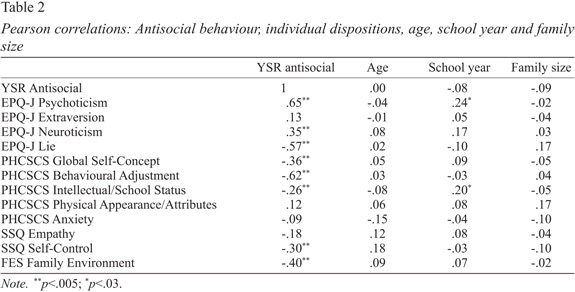
<body><![CDATA[<p>&nbsp;</p>     <p>Perception of family environment was measured with the Portuguese version of the Family Environment Scale (FES; Matos &amp; Fontaine, 1996; Moos  &amp; Moos, 1986), with 10 scales organized in three underlying dimensions: relationship &ndash; &ldquo;cohesion&rdquo; (&alpha;=.80),  &ldquo;expressiveness&rdquo; (&alpha;=.32), and &ldquo;conflict&rdquo; (&alpha;=.57) &ndash; personal growth &ndash; &ldquo;independence&rdquo;  (&alpha;=.22), &ldquo;achievement orientation&rdquo; (&alpha;=.39), &ldquo;intellectual/cultural orientation&rdquo; (&alpha;=.70),  &ldquo;active/recreational orientation&rdquo; (&alpha;=.47), and &ldquo;moral and religious emphasis&rdquo; (&alpha;=.75) &ndash; and system  maintenance &ndash; &ldquo;organization&rdquo; (&alpha;=.59), and &ldquo;control&rdquo; (&alpha;=.41). Due to the low internal reliability of most  scales (George &amp; Mallery, 2003), we chose to use only a global score of family environment (&alpha;=.88) consisting on all the 90 items in the  questionnaire (see, for example, Briere &amp; Elliott, 1993). Due to the nature of the &ldquo;conflict&rdquo; scale, we inverted its items for this  global score in order to assure that all items were in the same direction, that is, a higher score being equivalent to a general better perception  of the family environment.</p>     <p>&nbsp;</p>     <p><i>Procedures</i></p>     <p>Prior to the instruments&rsquo; application, permissions were asked to the Ministry of Justice as well as to the National Committee for Data  Protection (CNPD). After each juvenile detention centre agreed to collaborate, youths were asked to provide their informed and voluntary  collaboration, being assured of the confidentiality and anonymity of their answers. Our sample was occasional and included all the individuals who  agreed to participate from the 175 who were consulted (acceptance rate of 69%). The protocol was applied collectively and anonymously in two  sessions. Although it would have been beneficial to have access to the individuals&rsquo; formal reports regarding the conditions of their  institutionalization, the need to ensure anonymity prevented us from gathering that additional information. Data was, then, inserted on IBM SPSS  (v.22) and analysed with the same program.</p>     <p>&nbsp;</p>     <p><b>Results</b></p>     <p>A considerable percentage of our sample came from low socioeconomic status (88.4%) and 58.7% reported having 3 or more siblings. All individuals  were still at basic school levels, with almost half of the sample attending classes corresponding to the Portuguese 2<sup>nd </sup>cycle of basic  school (corresponding, on average, to ages 10-12).</p>     <p>To test the first three hypothesis, we performed Pearson correlations, as shown in <a href="#t2">Table 2</a>, to check for relations between  antisocial behaviour, individual dispositions, age, school year, and family size. Hypothesis concerning personality, self-concept, social skills  and family environment factors were generally confirmed with psychoticism (.65), lie (-.57), and behavioural adjustment (.62) showing the strongest  correlations with antisocial behaviour, followed by family environment (-.40) and global self-concept (-.36). The hypothesis regarding the relation  between antisocial tendency and age, school year and family size were refuted. Results only show significant (but modest) correlations between  school year and psychoticism (.24) and school year and intellectual/school status (.20).</p>     <p>&nbsp;</p>     ]]></body>
<body><![CDATA[<p><a name="t2"></a></p>     <p><img src="/img/revistas/aps/v35n2/35n2a04t2.jpg" width="575" height="292"></p>     
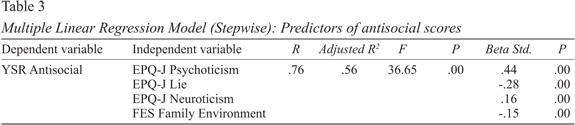
<p>&nbsp;</p>     <p>Taking into consideration these results, we tested a multiple regression model in order to verify, in all variables correlated with antisocial  behaviour, those that would stand out as its predictors. <a href="#t3">Table 3</a> shows that psychoticism, lie, neuroticism and family environment  revealed significant predictive value, accounting for 56% of the variance.</p>     <p>&nbsp;</p>     <p><a name="t3"></a></p>     <p><img src="/img/revistas/aps/v35n2/35n2a04t3.jpg" width="575" height="125"></p>     
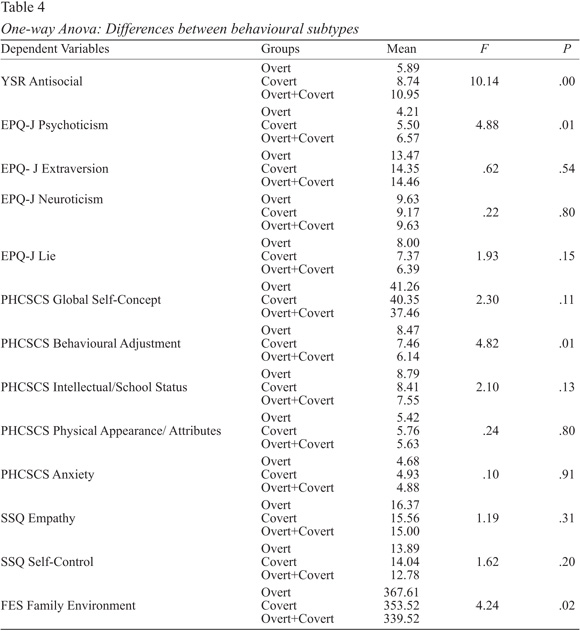
<p>&nbsp;</p>     <p>To test for differences according to behavioural subtypes, we performed One-Way ANOVA that revealed significant differences between groups in  antisocial behaviour, psychoticism, behavioural adjustment and family environment, as <a href="#t4">Table 4</a> demonstrates.</p>     <p>&nbsp;</p>     ]]></body>
<body><![CDATA[<p><a name="t4"></a></p>     <p><img src="/img/revistas/aps/v35n2/35n2a04t4.jpg" width="580" height="631"></p>     
<p>&nbsp;</p>     <p>&nbsp;</p>     <p><b>Discussion</b></p>     <p>This research intended to study a challenging phenomenon and sample, composed of a group of institutionalized delinquent boys that have  committed an offense before reaching the legal age to be trialled in adult courts. We hypothesized that personality, social skills, self-concept  and perception of family environment were correlated with antisocial behaviour. We also anticipated that antisocial behaviour and individual  dispositions were related with age, school year and family size and that juvenile delinquents with different behavioural subtypes would present  differences in antisocial behaviour scores and individual dispositions.</p>     <p>The majority of boys whose behaviour justified an institutionalization came from disadvantaged social contexts, suggesting, in line with  previous research (Farrington, 2007; Moffitt, 2006), that low socioeconomic status may place individuals at higher risk for antisocial conducts.  This confirms the need to direct our preventive efforts to youngsters living in disadvantaged social and economic contexts where boys are more  vulnerable to antisocial behaviours. Also noteworthy is the fact that a considerable amount of individuals in our sample had 3 or more siblings,  which is highly above average for the Portuguese population. In fact, although there is no official data on the number of siblings of Portuguese  adolescents, according to the population census, the fertility rate was 1.45 in 2001 and 1.35 in 2011. Furthermore, the rate of Portuguese families  with a total of 6 or more elements was only of 3% in 2001 and 2% in 2011. This reality in Portugal is in line with findings from the Cambridge  Study of Delinquent Development indicating a higher likelihood of convicted delinquents to have lived in poorer and larger families (Farrington,  2007).</p>     <p>Likewise, the fact that all boys over 15 years of age were still in basic school levels (when it is expected that, at 15, Portuguese students  are attending the first year of secondary education) indicates a prior unsuccessful academic trajectory with several retentions, since, in juvenile  detention centres, students have mandatory classes according to their school level at the moment of institutionalization. It is possible that, as  postulated by Moffitt (1993), these individuals have developmental and cognitive disadvantages that, combined with environmental disadvantages such  as those found in this study, may explain, at least partially, such academic failure. In fact, literature generally confirms the comorbidity  between conduct behaviors, developmental delays and consequent school failures and dropout (Farrington, 2007; Paterson &amp; Yoerger, 2002; Payne  &amp; Welch, 2015; Thornberry &amp; Krohn, 2004). The Cambridge Study of Delinquent Development has not only identified low intelligence and poor  school performance as some of the factors involved in the development of delinquency, but has also found that these dimensions may help to predict  delinquency in adulthood (Farrington, 2004). Indeed, together with results on the correlation between antisocial behaviour and academic  self-concept, this indicates the utmost importance of developing efforts towards preventing academic failure, for example, by empowering these  boy&rsquo;s roles as students, improving their academic self-concept with personalized and meaningful reinforcement systems in their school  achievements.</p>     <p>The hypothesis that Eysenck&rsquo;s personality traits were positively correlated with antisocial behaviour while the lie scale presented a  negative correlation was confirmed (except extraversion that did not show significant results). The same variables were also found to predict  antisocial scores, together with family environment, that was negatively correlated with antisocial behaviour. Connolly and O&rsquo;Moore (2003, p.  560), argue that &ldquo;a child&rsquo;s personality is greatly influenced by their upbringing and experiences. Therefore the experiences of  children who come from less cohesive or dysfunctional homes may be related to their personality type&rdquo;. Hence, these results reveal the  importance of a positive involvement of the family in juvenile offenders&rsquo; lives, in efforts to promote socially adjusted behaviours that can,  hopefully result in desistance from criminal trajectories. Thus, effective interventions should include families, capacitating their members to  create positive, harmonious relationships, coherent management practices and to stimulate personal growth, and prosocial interactions.</p>     <p>We found a significant correlation between antisocial behaviour and self-control, but the same did not occur with empathy. These results  highlight the particular relevance of a tendency for impulsivity, aggressiveness, emotional instability or tension in antisocial behaviours.</p>     ]]></body>
<body><![CDATA[<p>Results on behavioural and global self-concept suggest that delinquent boys with higher antisocial scores perceive themselves as less  behaviourally adjusted and in a more negative perspective. In other words, they appear to acknowledge the maladjustment of their behaviours,  suggesting a cognitive understanding of social rules, but do not show sensitivity to such rules (as illustrated by results on the lie scale &ndash;  negatively correlated with antisocial behaviour), possibly because they have not internalized them adequately. As the Cambridge Study for  Delinquent Development (Farrington, 2007) suggests, the occurrence of frequent offenses depend on the interaction between the individual (who has a  certain degree of antisocial tendency) and the social environment, as well as on a process of decision-making based on opportunities for deviancy:  there are motivational factors for an antisocial act and, if the methods chosen to satisfy such motivations are socially disapproved, then an  antisocial tendency may be strengthened. On the contrary, the same study suggests the existence of inhibiting factors, that is, if socially learned  attitudes and beliefs are internalized, antisocial tendencies can be reduced. In fact, when parents promote and value legal norms and adequately  supervise their children, practicing a discipline oriented by affection, children will understand that delinquency is wrong. However, impulsivity,  neurological dysfunctions and low intelligence may affect the development of such internal beliefs, even when adequate environments are provided.  In addition, also global self-concept was negatively correlated with antisocial behaviour which indicates, as expected, that individuals may  perceive themselves more negatively due to their predispositions to negatively relate with the surrounding environment. Indeed, an individual that  perceives himself poorly is less likely to adhere to social expectations due to the lower value attributed to others&rsquo; judgments. Thus, it  would be important to further analyse what motivates the perpetuation of antisocial conducts in individuals who have the ability to perceive their  behavioural adjustment as negative but may not be able to act accordingly, and to explore matters of social identity and adjustment as well as the  consideration towards others and the ability/motivation to say &ldquo;no&rdquo;.</p>     <p>Results point out to some differences between individuals who committed offenses of different natures. Such differences suggest that individuals  convicted due to both behavioural subtypes may be more vulnerable in terms of their individual conditions (poorer family environment, self-concept  and higher psychoticism) and may have a higher antisocial tendency when compared to those convicted due to one subtype of antisocial behaviour. In  fact, results indicate that juvenile delinquents manifesting both overt and covert forms of antisocial behaviour may have fewer resources to cope  with their circumstances when compared to other young offenders, and therefore, may be more vulnerable to follow a more persistent and severe  deviant trajectory. When individuals convicted due to overt and covert behaviours were compared, the latter appeared to be, in line with  Tremblay&rsquo;s assumptions (2010), more vulnerable. When compared to overt behaviours, individuals who engage solely in covert behaviours appear  to be more vulnerable in terms of impulsivity, toughness and egocentrism, behavioural self-concept, and family environment. It may be the case  that, due to the different characteristics of each behavioural subtype, individuals who exclusively engage in serious covert behaviours may exhibit  higher levels of defiance, general disregard for rules and hiding from authority figures. As Tremblay (2010, p. 347) postulates, &ldquo;one of the  major developmental challenges of a child is to learn to inhibit physical aggression and use other patterns of action in his attempts to achieve  his goals&rdquo;. In other words, covert behaviours, by nature, require higher levels of scheming, which is may be associated with higher  psychoticism, poorer behavioural self-concept and more negative family environments. The question that remains unanswered is: what triggers what?  Do individual dispositions make an individual more likely to engage in covert behaviours or is it that engaging in covert antisocial behaviour  makes individuals more vulnerable?</p>     <p>This calls our attention to the need for differentiated approaches according to behavioural subtypes, following Tremblay&rsquo;s argument that  &ldquo;it seems obvious that physical violence and theft require different bio-psycho-social skills and different interventions are needed to  prevent or correct these problems&rdquo; (2010, p. 352). Indeed, differences between groups show us that adolescents convicted due to covert and  overt behaviour may them more resistant to change when compared to those who were convicted due to one specific type of behaviour (the same occurs  when we compare those who were convicted due to covert behaviour in comparison with overt behaviour). In light of these results, if, on the one  hand, psychoticism, behavioural self-concept and family environment should be addressed in all groups, it would be important to work on the  specific skills/motivations involved in covert and overt behaviours according to the behavioural subtype displayed by each group (and on both  subtypes in the more vulnerable group).</p>     <p>There were no correlations between antisocial behaviour or individual dispositions and age or family size. Regarding school year, only  psychoticism and academic self-concept showed significant, but modest correlations. This may be explained by the fact that psychoticism is a trait  related to impulsivity (a characteristic that contributes negatively to academic achievement) and by the fact that academic failure highly  contributes to poorer academic self-concept. Such results lead to the conclusion that this particular population may be more homogeneous in terms  of antisocial behaviour and individual dispositions than we could anticipate. In fact, it appears that there are important vulnerabilities  concerning social, familial, and personal domains that cross the studied sample, regardless of their age, school year, and family size.</p>     <p>This study is not without limitations. Our sample is relatively small and occasional since we had to depend on the collaboration of all the  visited institutions and on voluntary participation from individuals. Some conditions (psychopathology, drug consumption, previous life  experiences) were not controlled because, to guarantee anonymity, we could not access legal, academic and/or medical reports from these  individuals. Moreover, the fact that participants were in a closed environment with significant restraint, away from their usual living environment  may have had some unaccounted influence on the results. Due to the limited number of girls in juvenile detention centres and to the unavailability  of institutions that include female sectors, our sample only included boys, leaving the important gender factor aside. Finally, it would have been  preferable to base our analysis on other measures besides self-report measures. However, due to the peculiarities of our sample (e.g., routines,  limited availability) and in order to preserve anonymity, it was impossible to recur to individual interviews. Furthermore, the access to families  was extremely difficult due to the geographic distance between the families&rsquo; homes and the juvenile detention centres and to the small  frequency of visits. This may, as well, hamper the implementation of an intervention program such as the one proposed, that would imply  families&rsquo; cooperation.</p>     <p>Nevertheless, we believe that this study has great value for understanding such a challenging population, highlighting the value of personal  dispositions and individual perceptions on the explanation of adolescent antisocial behaviours. Hence, due to its broad scope (considering multiple  sets of variables independently and taken together), our results deepen our knowledge of the variables in play in severe and persistent adolescent  antisocial behaviour. We were able to describe a particular sample of adolescents in terms of their personal, social and family conditions,  highlighting several important vulnerabilities in all the three aspects of their lives and according to behavioural manifestations. It is our  belief that this exploratory data offers new elements for understanding this challenging population, adding knowledge to the existing literature  and calling the community&rsquo;s attention to the need to further study juvenile delinquents&rsquo; vulnerabilities in the most important domains  of their lives. We recognize the importance of differentiated interventions according to behavioural subtypes and suggest that, in future studies  with these populations, research focuses on studying large datasets with both male and female offenders with longitudinal designs, to accompany and  study their trajectories as well as the variables highlighted in this study. We also believe that using qualitative data (e.g., focus groups,  observations) could complement what we already know about this population and provide some clarification on the cognitive and emotional aspects  underlying young offenders&rsquo; different behavioural choices.</p>     <p>&nbsp;</p>     <p><b>References</b></p>     <!-- ref --><p>Achenbach, T. M. (1991). <i>Manual for the youth self-report and 1991 profile</i>. Burlington, VT: University of Vermont Department of  Psychiatry.    &nbsp;&nbsp;&nbsp;&nbsp;&nbsp;&nbsp;&nbsp;&nbsp;[&#160;<a href="javascript:void(0);" onclick="javascript: window.open('/scielo.php?script=sci_nlinks&ref=028692&pid=S0870-8231201700020000400001&lng=','','width=640,height=500,resizable=yes,scrollbars=1,menubar=yes,');">Links</a>&#160;]<!-- end-ref --></p>     ]]></body>
<body><![CDATA[<!-- ref --><p>Batanova, M. D., &amp; Loukas, A. (2011). Social anxiety and aggression in early adolescents: Examining the moderating roles of empathic  concern and perspective taking. <i>Journal of Youth and Adolescence, 40</i>, 1534-1543. Retrieved from  <a href="http://dx.doi.org/10.1007/s10964-011-9634-x" target="_blank">http://dx.doi.org/10.1007/s10964-011-9634-x</a>&nbsp;&nbsp;&nbsp;&nbsp;&nbsp;&nbsp;&nbsp;&nbsp;[&#160;<a href="javascript:void(0);" onclick="javascript: window.open('/scielo.php?script=sci_nlinks&ref=028694&pid=S0870-8231201700020000400002&lng=','','width=640,height=500,resizable=yes,scrollbars=1,menubar=yes,');">Links</a>&#160;]<!-- end-ref --><!-- ref --><p>Briere, J., &amp; Elliott, D. M. (1993). Sexual abuse, family environment, and psychological symptoms: On the validity of statistical control.  <i>Journal of Consulting and Clinical Psychology, 61</i>, 284-288. Retrieved from <a href="http://dx.doi.org/10.1037/0022-006X.61.2.284"  target="_blank">http://dx.doi.org/10.1037/0022-006X.61.2.284</a>&nbsp;&nbsp;&nbsp;&nbsp;&nbsp;&nbsp;&nbsp;&nbsp;[&#160;<a href="javascript:void(0);" onclick="javascript: window.open('/scielo.php?script=sci_nlinks&ref=028695&pid=S0870-8231201700020000400003&lng=','','width=640,height=500,resizable=yes,scrollbars=1,menubar=yes,');">Links</a>&#160;]<!-- end-ref --><p>Center, D. B., &amp; Kemp, D. E. (2002). Antisocial behaviour in children and Eysenck&rsquo;s theory of personality: An evaluation.  <i>International Journal of Disability, Development and Education, 49</i>, 353-366. Retrieved from  <a href="http://dx.doi.org/10.1080/1034912022000028330" target="_blank">http://dx.doi.org/10.1080/1034912022000028330</a></p>     <!-- ref --><p>Church II, W. T., Jaggers, J. W., &amp; Taylor, J. K. (2012). Neighborhood, poverty, and negative behavior: An examination of differential  association and social control theory. <i>Children and Youth Services Review, 34</i>, 1035-1041. Retrieved from  <a href="http://dx.doi.org/10.1016/j.childyouth.2012.02.005" target="_blank">http://dx.doi.org/10.1016/j.childyouth.2012.02.005</a>&nbsp;&nbsp;&nbsp;&nbsp;&nbsp;&nbsp;&nbsp;&nbsp;[&#160;<a href="javascript:void(0);" onclick="javascript: window.open('/scielo.php?script=sci_nlinks&ref=028697&pid=S0870-8231201700020000400005&lng=','','width=640,height=500,resizable=yes,scrollbars=1,menubar=yes,');">Links</a>&#160;]<!-- end-ref --><p>Connolly, I., &amp; O&rsquo;Moore, M. (2003). Personality and family relations of children who bully. <i>Personality and Individual Differences,  35</i>, 559-567. doi: 10.1016/S0191-8869(02)00218-0</p>     <!-- ref --><p>Dodge, K. A., Coie, J. D., &amp; Lynam, D. (2008). Aggression and antisocial behavior in youth. In W. Damon &amp; R. M. Lerner (Eds.), <i>Child  and adolescent development: An advanced course</i> (pp. 437-472). Hoboken, NJ: Wiley. Retrieved from  <a href="http://dx.doi.org/10.1002/9780470147658.chpsy0312" target="_blank">http://dx.doi.org/10.1002/9780470147658.chpsy0312</a>&nbsp;&nbsp;&nbsp;&nbsp;&nbsp;&nbsp;&nbsp;&nbsp;[&#160;<a href="javascript:void(0);" onclick="javascript: window.open('/scielo.php?script=sci_nlinks&ref=028699&pid=S0870-8231201700020000400007&lng=','','width=640,height=500,resizable=yes,scrollbars=1,menubar=yes,');">Links</a>&#160;]<!-- end-ref --><!-- ref --><p>Eysenck, H. J., &amp; Eysenck, M. W. (1985). <i>Personality and individual differences: A natural science approach</i>. New York: Plenum Press.    &nbsp;&nbsp;&nbsp;&nbsp;&nbsp;&nbsp;&nbsp;&nbsp;[&#160;<a href="javascript:void(0);" onclick="javascript: window.open('/scielo.php?script=sci_nlinks&ref=028700&pid=S0870-8231201700020000400008&lng=','','width=640,height=500,resizable=yes,scrollbars=1,menubar=yes,');">Links</a>&#160;]<!-- end-ref --></p>     <!-- ref --><p>Farrington, D. P. (2004). O estudo do desenvolvimento da delinqu&ecirc;ncia de Cambridge: Principais resultados dos primeiros 40 anos. In A. C.  Fonseca (Ed.), <i>Comportamento anti-social e crime: Da inf&acirc;ncia &agrave; idade adulta</i> (pp. 73-132). Coimbra: Almedina.    &nbsp;&nbsp;&nbsp;&nbsp;&nbsp;&nbsp;&nbsp;&nbsp;[&#160;<a href="javascript:void(0);" onclick="javascript: window.open('/scielo.php?script=sci_nlinks&ref=028702&pid=S0870-8231201700020000400009&lng=','','width=640,height=500,resizable=yes,scrollbars=1,menubar=yes,');">Links</a>&#160;]<!-- end-ref --></p>     ]]></body>
<body><![CDATA[<!-- ref --><p>Farrington, D. P. (2007). Origins of violent behavior over the life span. In D. J. Flannery, A. T. Vazsonyi, &amp; I. D. Waldman (Eds.),  <i>The Cambridge handbook of violent behavior and aggression</i> (pp. 19-48). New York: Cambridge University Press. Retrieved from  <a href="http://dx.doi.org/10.1017/CBO9780511816840.003" target="_blank">http://dx.doi.org/10.1017/CBO9780511816840.003</a>&nbsp;&nbsp;&nbsp;&nbsp;&nbsp;&nbsp;&nbsp;&nbsp;[&#160;<a href="javascript:void(0);" onclick="javascript: window.open('/scielo.php?script=sci_nlinks&ref=028704&pid=S0870-8231201700020000400010&lng=','','width=640,height=500,resizable=yes,scrollbars=1,menubar=yes,');">Links</a>&#160;]<!-- end-ref --><!-- ref --><p>Farrington, D. P. (2008). O desenvolvimento do comportamento criminoso e anti-social da inf&acirc;ncia &agrave; idade adulta [Criminal and  antisocial behaviour development from childhood to adulthood]. In A. Matos, C. Vieira, S. Nogueira, J. Boavida, &amp; L. Alcoforado (Eds.),  <i>A maldade humana: Fatalidade ou educa&ccedil;&atilde;o?</i> (pp. 221-245). Coimbra: Almedina.    &nbsp;&nbsp;&nbsp;&nbsp;&nbsp;&nbsp;&nbsp;&nbsp;[&#160;<a href="javascript:void(0);" onclick="javascript: window.open('/scielo.php?script=sci_nlinks&ref=028705&pid=S0870-8231201700020000400011&lng=','','width=640,height=500,resizable=yes,scrollbars=1,menubar=yes,');">Links</a>&#160;]<!-- end-ref --></p>     <!-- ref --><p>Fonseca, A. C. (1989). Estudo intercultural da personalidade: Compara&ccedil;&atilde;o de crian&ccedil;as portuguesas e inglesas no  EPQ-J&uacute;nior [Intercultural study of personality: Comparison between Portuguese and English children]. <i>Revista Portuguesa de Pedagogia,  23</i>, 323-345.    &nbsp;&nbsp;&nbsp;&nbsp;&nbsp;&nbsp;&nbsp;&nbsp;[&#160;<a href="javascript:void(0);" onclick="javascript: window.open('/scielo.php?script=sci_nlinks&ref=028707&pid=S0870-8231201700020000400012&lng=','','width=640,height=500,resizable=yes,scrollbars=1,menubar=yes,');">Links</a>&#160;]<!-- end-ref --></p>     <p>Fonseca, A. C., &amp; Monteiro, C. M. (1999). Um invent&aacute;rio de problemas do comportamento para crian&ccedil;as e adolescentes: O Youth  Self-Report de Achenbach [An inventory of behavioural problems for children and adolescentes: Achenbach&rsquo;s Youth Self-Report].  <i>Psychologica, 21</i>, 79-96.</p>     <!-- ref --><p>George, D., &amp; Mallery, P. (2003). <i>SPSS for Windows step by step: A simple guide and reference. 11.0 update</i> (4<sup>th</sup> ed.).  Boston: Allyn &amp; Bacon.    &nbsp;&nbsp;&nbsp;&nbsp;&nbsp;&nbsp;&nbsp;&nbsp;[&#160;<a href="javascript:void(0);" onclick="javascript: window.open('/scielo.php?script=sci_nlinks&ref=028710&pid=S0870-8231201700020000400014&lng=','','width=640,height=500,resizable=yes,scrollbars=1,menubar=yes,');">Links</a>&#160;]<!-- end-ref --></p>     <!-- ref --><p>Gresham, F. M., &amp; Elliott, S. N. (1990). <i>Social skills rating system</i>. Circle Pines, MN: American Guidance Service.    &nbsp;&nbsp;&nbsp;&nbsp;&nbsp;&nbsp;&nbsp;&nbsp;[&#160;<a href="javascript:void(0);" onclick="javascript: window.open('/scielo.php?script=sci_nlinks&ref=028712&pid=S0870-8231201700020000400015&lng=','','width=640,height=500,resizable=yes,scrollbars=1,menubar=yes,');">Links</a>&#160;]<!-- end-ref --></p>     ]]></body>
<body><![CDATA[<!-- ref --><p>Jolliffe, D., &amp; Farrington, D. P. (2004). Empathy and offending: A systematic review and meta-analysis. <i>Aggression and Violent Behavior,  9</i>, 441-476. Retrieved from <a href="http://dx.doi.org/10.1016/j.avb.2003.03.001"  target="_blank">http://dx.doi.org/10.1016/j.avb.2003.03.001</a>&nbsp;&nbsp;&nbsp;&nbsp;&nbsp;&nbsp;&nbsp;&nbsp;[&#160;<a href="javascript:void(0);" onclick="javascript: window.open('/scielo.php?script=sci_nlinks&ref=028714&pid=S0870-8231201700020000400016&lng=','','width=640,height=500,resizable=yes,scrollbars=1,menubar=yes,');">Links</a>&#160;]<!-- end-ref --><p>Laub, J. H., Sampson, R. J., &amp; Sweeten, G. A. (2006). Assessing Sampson and Laub&rsquo;s life-course theory of crime. In F. T. Cullen, J. P.  Wright, &amp; K. R. Blevins (Eds.), <i>Taking stock: The status of criminological theory</i> (pp. 313-333). New Brunswick, NJ: Transaction  Publishers.</p>     <p>Matos, P. M., &amp; Fontaine, M. (1996). <i>Family Environment Scale &ndash; FES. Adapta&ccedil;&atilde;o portuguesa [Family Environment Scale  &ndash; FES. Portuguese adaptation]</i>. Manuscrito não publicado. Faculdade de Psicologia e de Ci&ecirc;ncias da Educa&ccedil;&atilde;o da  Universidade do Porto.</p>     <!-- ref --><p>Moffitt, T. E. (1993). Adolescence-limited and life-course persistent anti-social behavior: A developmental taxonomy. <i>Psychological Review,  100</i>, 674-701. Retrieved from <a href="http://psycnet.apa.org/journals/rev/100/4/674"  target="_blank">http://psycnet.apa.org/journals/rev/100/4/674</a>&nbsp;&nbsp;&nbsp;&nbsp;&nbsp;&nbsp;&nbsp;&nbsp;[&#160;<a href="javascript:void(0);" onclick="javascript: window.open('/scielo.php?script=sci_nlinks&ref=028717&pid=S0870-8231201700020000400019&lng=','','width=640,height=500,resizable=yes,scrollbars=1,menubar=yes,');">Links</a>&#160;]<!-- end-ref --><!-- ref --><p>Moffitt, T. E. (2006). A review of research on the taxonomy of life-course persistent <i>versus</i> adolescence-limited antisocial behavior. In  F. T. Cullen, J. P. Wright, &amp; K. R. Blevins (Eds.), <i>Taking stock: The status of criminological theory</i> (pp. 277-311). New Brunswick, NJ:  Transaction Publishers.    &nbsp;&nbsp;&nbsp;&nbsp;&nbsp;&nbsp;&nbsp;&nbsp;[&#160;<a href="javascript:void(0);" onclick="javascript: window.open('/scielo.php?script=sci_nlinks&ref=028718&pid=S0870-8231201700020000400020&lng=','','width=640,height=500,resizable=yes,scrollbars=1,menubar=yes,');">Links</a>&#160;]<!-- end-ref --></p>     <!-- ref --><p>Moos, R., &amp; Moos, B. (1986). <i>Family Environment Scale manual: Second edition</i>. Palo Alto, CA: Consulting Psychologists Press.    &nbsp;&nbsp;&nbsp;&nbsp;&nbsp;&nbsp;&nbsp;&nbsp;[&#160;<a href="javascript:void(0);" onclick="javascript: window.open('/scielo.php?script=sci_nlinks&ref=028720&pid=S0870-8231201700020000400021&lng=','','width=640,height=500,resizable=yes,scrollbars=1,menubar=yes,');">Links</a>&#160;]<!-- end-ref --></p>     <!-- ref --><p>Morgado, A. M., &amp; Vale Dias, M. L. (2013). The antisocial phenomenon in adolescence: What is literature telling us?. <i>Aggression and  Violent Behavior, 18</i>, 436-443. Retrieved from <a href="http://dx.doi.org/10.1016/j.avb.2013.05.004"  target="_blank">http://dx.doi.org/10.1016/j.avb.2013.05.004</a>&nbsp;&nbsp;&nbsp;&nbsp;&nbsp;&nbsp;&nbsp;&nbsp;[&#160;<a href="javascript:void(0);" onclick="javascript: window.open('/scielo.php?script=sci_nlinks&ref=028722&pid=S0870-8231201700020000400022&lng=','','width=640,height=500,resizable=yes,scrollbars=1,menubar=yes,');">Links</a>&#160;]<!-- end-ref --><!-- ref --><p>Mota, C. P., Matos, P. M., &amp; Lemos, M. S. (2011). Psychometric properties of the social skills questionnaire: Portuguese adaptation of the  student form (grades 7 to 12). <i>The Spanish Journal of Psychology, 14</i>, 486-499. Retrieved from  <a href="http://dx.doi.org/10.5209/rev_SJOP.2011.v14.n1.44" target="_blank">http://dx.doi.org/10.5209/rev_SJOP.2011.v14.n1.44</a>&nbsp;&nbsp;&nbsp;&nbsp;&nbsp;&nbsp;&nbsp;&nbsp;[&#160;<a href="javascript:void(0);" onclick="javascript: window.open('/scielo.php?script=sci_nlinks&ref=028723&pid=S0870-8231201700020000400023&lng=','','width=640,height=500,resizable=yes,scrollbars=1,menubar=yes,');">Links</a>&#160;]<!-- end-ref --><!-- ref --><p>Pardini, D., Waller, R., &amp; Hawes, S. (2015). Familial influences on the development of serious conduct problems and delinquency. In J.  Morizot &amp; L. Kazemian (Eds.), <i>The development of criminal and antisocial behavior</i> (pp. 201-220). Switzerland: Springer. Retrieved from  <a href="http://dx.doi.org/10.1007/978-3-319-08720-7_13" target="_blank">http://dx.doi.org/10.1007/978-3-319-08720-7_13</a>&nbsp;&nbsp;&nbsp;&nbsp;&nbsp;&nbsp;&nbsp;&nbsp;[&#160;<a href="javascript:void(0);" onclick="javascript: window.open('/scielo.php?script=sci_nlinks&ref=028724&pid=S0870-8231201700020000400024&lng=','','width=640,height=500,resizable=yes,scrollbars=1,menubar=yes,');">Links</a>&#160;]<!-- end-ref --><!-- ref --><p>Patterson, G. R., &amp; Yoerger, K. (2002). A developmental model for early- and late-onset delinquency. In J. B. Reid, G. R. Patterson, &amp;  J. Snyder (Eds.), <i>Antisocial behavior in children and adolescents: A developmental analysis and model for intervention</i> (pp. 147-172).  Washington, DC: American Psychological Association.    &nbsp;&nbsp;&nbsp;&nbsp;&nbsp;&nbsp;&nbsp;&nbsp;[&#160;<a href="javascript:void(0);" onclick="javascript: window.open('/scielo.php?script=sci_nlinks&ref=028725&pid=S0870-8231201700020000400025&lng=','','width=640,height=500,resizable=yes,scrollbars=1,menubar=yes,');">Links</a>&#160;]<!-- end-ref --></p>     <!-- ref --><p>Payne, A. A., &amp; Welch, K. (2015). How school and education impact the development of criminal and antisocial behavior. In J. Morizot &amp;  L. Kazemian (Eds.), <i>The development of criminal and antisocial behavior</i> (pp. 237-251). Switzerland: Springer. Retrieved from  <a href="http://dx.doi.org/10.1007/978-3-319-08720-7_15" target="_blank">http://dx.doi.org/10.1007/978-3-319-08720-7_15</a>&nbsp;&nbsp;&nbsp;&nbsp;&nbsp;&nbsp;&nbsp;&nbsp;[&#160;<a href="javascript:void(0);" onclick="javascript: window.open('/scielo.php?script=sci_nlinks&ref=028727&pid=S0870-8231201700020000400026&lng=','','width=640,height=500,resizable=yes,scrollbars=1,menubar=yes,');">Links</a>&#160;]<!-- end-ref --><!-- ref --><p>Pechorro, P. (2011). <i>Delinqu&ecirc;ncia juvenil: Estudo de algumas vari&aacute;veis psicol&oacute;gicas e relacionais com &ecirc;nfase nos  tra&ccedil;os psicop&aacute;ticos</i>. Tese de Doutoramento, Faculdade de Medicina da Universidade de Lisboa, Lisboa.    &nbsp;&nbsp;&nbsp;&nbsp;&nbsp;&nbsp;&nbsp;&nbsp;[&#160;<a href="javascript:void(0);" onclick="javascript: window.open('/scielo.php?script=sci_nlinks&ref=028728&pid=S0870-8231201700020000400027&lng=','','width=640,height=500,resizable=yes,scrollbars=1,menubar=yes,');">Links</a>&#160;]<!-- end-ref --></p>     <!-- ref --><p>Pechorro, P., Ray, J. V., Barroso, R., Mar&ocirc;co, J., &amp; Gon&ccedil;alves, R. A. (2014). Validation of the inventory of  callous-unemotional traits among a Portuguese sample of detained juvenile offenders. <i>International Journal of Offender Therapy and Comparative  Criminology, 60</i>, 349-365. Retrieved from <a href="http://dx.doi.org/10.1177/0306624X14551256"  target="_blank">http://dx.doi.org/10.1177/0306624X14551256</a>&nbsp;&nbsp;&nbsp;&nbsp;&nbsp;&nbsp;&nbsp;&nbsp;[&#160;<a href="javascript:void(0);" onclick="javascript: window.open('/scielo.php?script=sci_nlinks&ref=028730&pid=S0870-8231201700020000400028&lng=','','width=640,height=500,resizable=yes,scrollbars=1,menubar=yes,');">Links</a>&#160;]<!-- end-ref --><!-- ref --><p>Pechorro, P., Silva, R., Mar&ocirc;co, J., Poiares, C., &amp; Vieira, R. X. (2012). Auto-estima e narcisismo na adolesc&ecirc;ncia:  Rela&ccedil;&atilde;o com delinqu&ecirc;ncia relatada em contexto forense e escolar. <i>An&aacute;lise Psicol&oacute;gica, XXX</i>, 329-339.    &nbsp;&nbsp;&nbsp;&nbsp;&nbsp;&nbsp;&nbsp;&nbsp;[&#160;<a href="javascript:void(0);" onclick="javascript: window.open('/scielo.php?script=sci_nlinks&ref=028731&pid=S0870-8231201700020000400029&lng=','','width=640,height=500,resizable=yes,scrollbars=1,menubar=yes,');">Links</a>&#160;]<!-- end-ref --></p>     <p>Piers, E. V., &amp; Herzberg, D. S. (2002). <i>Piers-Harris Children&rsquo;s Self-Concept Scale &ndash; Second Edition Manual</i>.  Los Angeles, Ca: Western Psychological Services.</p>     ]]></body>
<body><![CDATA[<!-- ref --><p>Rutter, M., Giller, H., &amp; Hagell, A. (1998). <i>Antisocial behaviour by young people</i>. Cambridge: Cambridge University Press.    &nbsp;&nbsp;&nbsp;&nbsp;&nbsp;&nbsp;&nbsp;&nbsp;[&#160;<a href="javascript:void(0);" onclick="javascript: window.open('/scielo.php?script=sci_nlinks&ref=028734&pid=S0870-8231201700020000400031&lng=','','width=640,height=500,resizable=yes,scrollbars=1,menubar=yes,');">Links</a>&#160;]<!-- end-ref --></p>     <!-- ref --><p>Salmivalli, C. (2001). Feeling good about oneself, being bad to others? Remarks on self-esteem, hostility, and aggressive behavior.  <i>Aggression and Violent Behavior, 6</i>, 375-393. Retrieved from  <a href="http://dx.doi.org/10.1016/S1359-1789(00)00012-4" target="_blank">http://dx.doi.org/10.1016/S1359-1789(00)00012-4</a>&nbsp;&nbsp;&nbsp;&nbsp;&nbsp;&nbsp;&nbsp;&nbsp;[&#160;<a href="javascript:void(0);" onclick="javascript: window.open('/scielo.php?script=sci_nlinks&ref=028736&pid=S0870-8231201700020000400032&lng=','','width=640,height=500,resizable=yes,scrollbars=1,menubar=yes,');">Links</a>&#160;]<!-- end-ref --><p>Selman, R. L., &amp; Adalbjarnardottir, S. (2000). A developmental method to analyze the personal meaning adolescents make of risk and  relationship: The case of &ldquo;drinking&rdquo;. <i>Applied Developmental Science, 4</i>, 47-65. Retrieved from  <a href="http://dx.doi.org/10.1207/S1532480XADS0401_4" target="_blank">http://dx.doi.org/10.1207/S1532480XADS0401_4</a></p>     <!-- ref --><p>Sim&otilde;es, M. M. R. (1994). <i>Investiga&ccedil;&otilde;es no &acirc;mbito da aferi&ccedil;&atilde;o nacional do teste das matrizes  progressivas coloridas de Raven (M.P.C.R.)</i>. Tese de Doutoramento, Faculdade de Psicologia e de Ci&ecirc;ncias da  Educa&ccedil;&atilde;o da Universidade de Coimbra, Coimbra.    &nbsp;&nbsp;&nbsp;&nbsp;&nbsp;&nbsp;&nbsp;&nbsp;[&#160;<a href="javascript:void(0);" onclick="javascript: window.open('/scielo.php?script=sci_nlinks&ref=028738&pid=S0870-8231201700020000400034&lng=','','width=640,height=500,resizable=yes,scrollbars=1,menubar=yes,');">Links</a>&#160;]<!-- end-ref --></p>     <p>Stadelmann, S., Perren, S., Groeben, M., &amp; VonKlitzing, K. (2010). Parental separation and children&rsquo;s behavioral/emotional problems:  The impact of parental representations and family conflict. <i>Family Process, 49</i>, 92-108. Retrieved from  <a href="http://dx.doi.org/10.1111/j.1545-5300.2010.01310.x" target="_blank">http://dx.doi.org/10.1111/j.1545-5300.2010.01310.x</a></p>     <!-- ref --><p>Steinberg, L. (2009). Adolescent development and juvenile justice. <i>Annual Review of Clinical Psychology, 5</i>, 459-485. Retrieved from  <a href="http://dx.doi.org/10.1146/annurev.clinpsy.032408.153603" target="_blank">http://dx.doi.org/10.1146/annurev.clinpsy.032408.153603</a>&nbsp;&nbsp;&nbsp;&nbsp;&nbsp;&nbsp;&nbsp;&nbsp;[&#160;<a href="javascript:void(0);" onclick="javascript: window.open('/scielo.php?script=sci_nlinks&ref=028741&pid=S0870-8231201700020000400036&lng=','','width=640,height=500,resizable=yes,scrollbars=1,menubar=yes,');">Links</a>&#160;]<!-- end-ref --><!-- ref --><p>Thornberry, T. P., &amp; Krohn, M. D. (2004). O desenvolvimento da delinqu&ecirc;ncia: Uma perspectiva interaccionista. In A. C. Fonseca (Ed.),  <i>Comportamento anti-social e crime: Da inf&acirc;ncia &agrave; idade adulta</i> (pp. 133-160). Coimbra: Almedina.    &nbsp;&nbsp;&nbsp;&nbsp;&nbsp;&nbsp;&nbsp;&nbsp;[&#160;<a href="javascript:void(0);" onclick="javascript: window.open('/scielo.php?script=sci_nlinks&ref=028742&pid=S0870-8231201700020000400037&lng=','','width=640,height=500,resizable=yes,scrollbars=1,menubar=yes,');">Links</a>&#160;]<!-- end-ref --></p>     ]]></body>
<body><![CDATA[<p>Tom&eacute;, G., Camacho, I., Matos, M. G., &amp; Sim&otilde;es, C. (2015). Influ&ecirc;ncia da fam&iacute;lia e amigos no bem-estar e  comportamentos de risco &ndash; Modelo explicativo. <i>Psicologia, Sa&uacute;de e Doen&ccedil;as, 16</i>, 23-34. Retrieved from  <a href="http://dx.doi.org/10.15309/15psd160104" target="_blank">http://dx.doi.org/10.15309/15psd160104</a></p>     <!-- ref --><p>Torregrosa, M. S., Ingles, C. J., &amp; Garcia-Fernandez, J. M. (2011). Aggressive behavior as a predictor of self-concept: A study with a  sample of Spanish compulsory secondary education students. <i>Psychossocial Intervention, 20</i>, 201-212. Retrieved from  <a href="http://dx.doi.org/10.5093/in2011v20n2a8" target="_blank">http://dx.doi.org/10.5093/in2011v20n2a8</a>&nbsp;&nbsp;&nbsp;&nbsp;&nbsp;&nbsp;&nbsp;&nbsp;[&#160;<a href="javascript:void(0);" onclick="javascript: window.open('/scielo.php?script=sci_nlinks&ref=028745&pid=S0870-8231201700020000400039&lng=','','width=640,height=500,resizable=yes,scrollbars=1,menubar=yes,');">Links</a>&#160;]<!-- end-ref --><p>Tremblay, R. E. (2010). Developmental origins of disruptive behaviour problems: The &lsquo;original sin&rsquo; hypothesis, epigenetics and their  consequences for prevention. <i>Journal of Child Psychology and Psychiatry, 51</i>, 341-367. Retrieved from  <a href="http://dx.doi.org/10.1111/j.1469-7610.2010.02211.x" target="_blank">http://dx.doi.org/10.1111/j.1469-7610.2010.02211.x</a></p>     <p>Veiga, F. H. (2006). Uma nova vers&atilde;o da escala de autoconceito Piers-Harris Children&rsquo;s Self-Concept Scale (PHCSCS-2) [A new version  of Piers-Harris Children&rsquo;s Self-Concept Scale]. <i>Psicologia e Educa&ccedil;&atilde;o, 5</i>, 39-48.</p>     <p>&nbsp;</p>     <p><b><a name="c0" id="c0"></a><a href="#topc0">CORRESPONDÊNCIA</a></b></p>     <p>Correspondence concerning this article should be addressed to: Alice Murteira Morgado, University of Northampton, Faculty of Health and  Society, Psychology Division, Office F4, Park Campus, Boughton Green Road, NN2 7AL, Northampton, UK. E-mail:  <a href="mailto:alice.morgado@northampton.ac.uk">alice.morgado@northampton.ac.uk</a></p>     <p>&nbsp;</p>     <p>Supported by the FCT Grant No. SFRH/BD/77702/2011.</p>     <p>&nbsp;</p>     ]]></body>
<body><![CDATA[<p>Submitted: 25/01/2016 Accepted: 08/04/2016</p>      ]]></body><back>
<ref-list>
<ref id="B1">
<nlm-citation citation-type="book">
<person-group person-group-type="author">
<name>
<surname><![CDATA[Achenbach]]></surname>
<given-names><![CDATA[T. M.]]></given-names>
</name>
</person-group>
<source><![CDATA[Manual for the youth self-report and 1991 profile]]></source>
<year>1991</year>
<publisher-loc><![CDATA[Burlington ]]></publisher-loc>
<publisher-name><![CDATA[University of Vermont Department of Psychiatry]]></publisher-name>
</nlm-citation>
</ref>
<ref id="B2">
<nlm-citation citation-type="journal">
<person-group person-group-type="author">
<name>
<surname><![CDATA[Batanova]]></surname>
<given-names><![CDATA[M. D.]]></given-names>
</name>
<name>
<surname><![CDATA[Loukas]]></surname>
<given-names><![CDATA[A.]]></given-names>
</name>
</person-group>
<article-title xml:lang="en"><![CDATA[Social anxiety and aggression in early adolescents: Examining the moderating roles of empathic concern and perspective taking]]></article-title>
<source><![CDATA[Journal of Youth and Adolescence]]></source>
<year>2011</year>
<volume>40</volume>
<page-range>1534-1543</page-range></nlm-citation>
</ref>
<ref id="B3">
<nlm-citation citation-type="journal">
<person-group person-group-type="author">
<name>
<surname><![CDATA[Briere]]></surname>
<given-names><![CDATA[J.]]></given-names>
</name>
<name>
<surname><![CDATA[Elliott]]></surname>
<given-names><![CDATA[D. M.]]></given-names>
</name>
</person-group>
<article-title xml:lang="en"><![CDATA[Sexual abuse, family environment, and psychological symptoms: On the validity of statistical control]]></article-title>
<source><![CDATA[Journal of Consulting and Clinical Psychology]]></source>
<year>1993</year>
<volume>61</volume>
<page-range>284-288</page-range></nlm-citation>
</ref>
<ref id="B4">
<nlm-citation citation-type="journal">
<person-group person-group-type="author">
<name>
<surname><![CDATA[Center]]></surname>
<given-names><![CDATA[D. B.]]></given-names>
</name>
<name>
<surname><![CDATA[Kemp]]></surname>
<given-names><![CDATA[D. E.]]></given-names>
</name>
</person-group>
<article-title xml:lang="en"><![CDATA[Antisocial behaviour in children and Eysenck’s theory of personality: An evaluation]]></article-title>
<source><![CDATA[International Journal of Disability]]></source>
<year>2002</year>
<volume>Development and Education</volume>
<page-range>49, 353-366</page-range></nlm-citation>
</ref>
<ref id="B5">
<nlm-citation citation-type="journal">
<person-group person-group-type="author">
<name>
<surname><![CDATA[Church II]]></surname>
<given-names><![CDATA[W. T.]]></given-names>
</name>
<name>
<surname><![CDATA[Jaggers]]></surname>
<given-names><![CDATA[J. W.]]></given-names>
</name>
<name>
<surname><![CDATA[Taylor]]></surname>
<given-names><![CDATA[J. K.]]></given-names>
</name>
</person-group>
<article-title xml:lang="en"><![CDATA[Neighborhood, poverty, and negative behavior: An examination of differential association and social control theory]]></article-title>
<source><![CDATA[Children and Youth Services Review]]></source>
<year>2012</year>
<volume>34</volume>
<page-range>1035-1041</page-range></nlm-citation>
</ref>
<ref id="B6">
<nlm-citation citation-type="journal">
<person-group person-group-type="author">
<name>
<surname><![CDATA[Connolly]]></surname>
<given-names><![CDATA[I.]]></given-names>
</name>
<name>
<surname><![CDATA[O’Moore]]></surname>
<given-names><![CDATA[M.]]></given-names>
</name>
</person-group>
<article-title xml:lang="en"><![CDATA[Personality and family relations of children who bully]]></article-title>
<source><![CDATA[Personality and Individual Differences]]></source>
<year>2003</year>
<volume>35</volume>
<page-range>559-567</page-range></nlm-citation>
</ref>
<ref id="B7">
<nlm-citation citation-type="book">
<person-group person-group-type="author">
<name>
<surname><![CDATA[Dodge]]></surname>
<given-names><![CDATA[K. A.]]></given-names>
</name>
<name>
<surname><![CDATA[Coie]]></surname>
<given-names><![CDATA[J. D.]]></given-names>
</name>
<name>
<surname><![CDATA[Lynam]]></surname>
<given-names><![CDATA[D.]]></given-names>
</name>
</person-group>
<article-title xml:lang="en"><![CDATA[Aggression and antisocial behavior in youth]]></article-title>
<person-group person-group-type="editor">
<name>
<surname><![CDATA[Damon]]></surname>
<given-names><![CDATA[W.]]></given-names>
</name>
<name>
<surname><![CDATA[Lerner]]></surname>
<given-names><![CDATA[R. M.]]></given-names>
</name>
</person-group>
<source><![CDATA[Child and adolescent development: An advanced course]]></source>
<year>2008</year>
<page-range>437-472</page-range><publisher-loc><![CDATA[Hoboken ]]></publisher-loc>
<publisher-name><![CDATA[Wiley]]></publisher-name>
</nlm-citation>
</ref>
<ref id="B8">
<nlm-citation citation-type="book">
<person-group person-group-type="author">
<name>
<surname><![CDATA[Eysenck]]></surname>
<given-names><![CDATA[H. J.]]></given-names>
</name>
<name>
<surname><![CDATA[Eysenck]]></surname>
<given-names><![CDATA[M. W.]]></given-names>
</name>
</person-group>
<source><![CDATA[Personality and individual differences: A natural science approach]]></source>
<year>1985</year>
<publisher-loc><![CDATA[New York ]]></publisher-loc>
<publisher-name><![CDATA[Plenum Press]]></publisher-name>
</nlm-citation>
</ref>
<ref id="B9">
<nlm-citation citation-type="book">
<person-group person-group-type="author">
<name>
<surname><![CDATA[Farrington]]></surname>
<given-names><![CDATA[D. P.]]></given-names>
</name>
</person-group>
<article-title xml:lang="pt"><![CDATA[O estudo do desenvolvimento da delinquência de Cambridge: Principais resultados dos primeiros 40 anos]]></article-title>
<person-group person-group-type="editor">
<name>
<surname><![CDATA[Fonseca]]></surname>
<given-names><![CDATA[A. C.]]></given-names>
</name>
</person-group>
<source><![CDATA[Comportamento anti-social e crime: Da infância à idade adulta]]></source>
<year>2004</year>
<page-range>73-132</page-range><publisher-loc><![CDATA[Coimbra ]]></publisher-loc>
<publisher-name><![CDATA[Almedina]]></publisher-name>
</nlm-citation>
</ref>
<ref id="B10">
<nlm-citation citation-type="book">
<person-group person-group-type="author">
<name>
<surname><![CDATA[Farrington]]></surname>
<given-names><![CDATA[D. P.]]></given-names>
</name>
</person-group>
<article-title xml:lang="en"><![CDATA[Origins of violent behavior over the life span]]></article-title>
<person-group person-group-type="editor">
<name>
<surname><![CDATA[Flannery]]></surname>
<given-names><![CDATA[D. J.]]></given-names>
</name>
<name>
<surname><![CDATA[Vazsonyi]]></surname>
<given-names><![CDATA[A. T.]]></given-names>
</name>
<name>
<surname><![CDATA[Waldman]]></surname>
<given-names><![CDATA[I. D.]]></given-names>
</name>
</person-group>
<source><![CDATA[The Cambridge handbook of violent behavior and aggression]]></source>
<year>2007</year>
<page-range>19-48</page-range><publisher-loc><![CDATA[New York ]]></publisher-loc>
<publisher-name><![CDATA[Cambridge University Press]]></publisher-name>
</nlm-citation>
</ref>
<ref id="B11">
<nlm-citation citation-type="book">
<person-group person-group-type="author">
<name>
<surname><![CDATA[Farrington]]></surname>
<given-names><![CDATA[D. P.]]></given-names>
</name>
</person-group>
<article-title xml:lang="pt"><![CDATA[O desenvolvimento do comportamento criminoso e anti-social da infância à idade adulta]]></article-title>
<person-group person-group-type="editor">
<name>
<surname><![CDATA[Matos]]></surname>
<given-names><![CDATA[A.]]></given-names>
</name>
<name>
<surname><![CDATA[Vieira]]></surname>
<given-names><![CDATA[C.]]></given-names>
</name>
<name>
<surname><![CDATA[Nogueira]]></surname>
<given-names><![CDATA[S.]]></given-names>
</name>
<name>
<surname><![CDATA[Boavida]]></surname>
<given-names><![CDATA[J.]]></given-names>
</name>
<name>
<surname><![CDATA[Alcoforado]]></surname>
<given-names><![CDATA[L.]]></given-names>
</name>
</person-group>
<source><![CDATA[A maldade humana: Fatalidade ou educação?]]></source>
<year>2008</year>
<page-range>221-245</page-range><publisher-loc><![CDATA[Coimbra ]]></publisher-loc>
<publisher-name><![CDATA[Almedina]]></publisher-name>
</nlm-citation>
</ref>
<ref id="B12">
<nlm-citation citation-type="journal">
<person-group person-group-type="author">
<name>
<surname><![CDATA[Fonseca]]></surname>
<given-names><![CDATA[A. C.]]></given-names>
</name>
</person-group>
<article-title xml:lang="pt"><![CDATA[Estudo intercultural da personalidade: Comparação de crianças portuguesas e inglesas no EPQ-Júnior [Intercultural study of personality: Comparison between Portuguese and English children]]]></article-title>
<source><![CDATA[Revista Portuguesa de Pedagogia]]></source>
<year>1989</year>
<volume>23</volume>
<page-range>323-345</page-range></nlm-citation>
</ref>
<ref id="B13">
<nlm-citation citation-type="journal">
<person-group person-group-type="author">
<name>
<surname><![CDATA[Fonseca]]></surname>
<given-names><![CDATA[A. C.]]></given-names>
</name>
<name>
<surname><![CDATA[Monteiro]]></surname>
<given-names><![CDATA[C. M.]]></given-names>
</name>
</person-group>
<article-title xml:lang="pt"><![CDATA[Um inventário de problemas do comportamento para crianças e adolescentes: O Youth Self-Report de Achenbach]]></article-title>
<source><![CDATA[Psychologica]]></source>
<year>1999</year>
<volume>21</volume>
<page-range>79-96</page-range></nlm-citation>
</ref>
<ref id="B14">
<nlm-citation citation-type="book">
<person-group person-group-type="author">
<name>
<surname><![CDATA[George]]></surname>
<given-names><![CDATA[D.]]></given-names>
</name>
<name>
<surname><![CDATA[Mallery]]></surname>
<given-names><![CDATA[P.]]></given-names>
</name>
</person-group>
<source><![CDATA[SPSS for Windows step by step: A simple guide and reference. 11.0 update]]></source>
<year>2003</year>
<edition>4</edition>
<publisher-loc><![CDATA[Boston ]]></publisher-loc>
<publisher-name><![CDATA[Allyn & Bacon]]></publisher-name>
</nlm-citation>
</ref>
<ref id="B15">
<nlm-citation citation-type="book">
<person-group person-group-type="author">
<name>
<surname><![CDATA[Gresham]]></surname>
<given-names><![CDATA[F. M.]]></given-names>
</name>
<name>
<surname><![CDATA[Elliott]]></surname>
<given-names><![CDATA[S. N.]]></given-names>
</name>
</person-group>
<source><![CDATA[Social skills rating system]]></source>
<year>1990</year>
<publisher-loc><![CDATA[Circle Pines ]]></publisher-loc>
<publisher-name><![CDATA[American Guidance Service]]></publisher-name>
</nlm-citation>
</ref>
<ref id="B16">
<nlm-citation citation-type="journal">
<person-group person-group-type="author">
<name>
<surname><![CDATA[Jolliffe]]></surname>
<given-names><![CDATA[D.]]></given-names>
</name>
<name>
<surname><![CDATA[Farrington]]></surname>
<given-names><![CDATA[D. P.]]></given-names>
</name>
</person-group>
<article-title xml:lang="en"><![CDATA[Empathy and offending: A systematic review and meta-analysis]]></article-title>
<source><![CDATA[Aggression and Violent Behavior]]></source>
<year>2004</year>
<volume>9</volume>
<page-range>441-476</page-range></nlm-citation>
</ref>
<ref id="B17">
<nlm-citation citation-type="book">
<person-group person-group-type="author">
<name>
<surname><![CDATA[Laub]]></surname>
<given-names><![CDATA[J. H.]]></given-names>
</name>
<name>
<surname><![CDATA[Sampson]]></surname>
<given-names><![CDATA[R. J.]]></given-names>
</name>
<name>
<surname><![CDATA[Sweeten]]></surname>
<given-names><![CDATA[G. A.]]></given-names>
</name>
</person-group>
<article-title xml:lang="en"><![CDATA[Assessing Sampson and Laub’s life-course theory of crime]]></article-title>
<person-group person-group-type="editor">
<name>
<surname><![CDATA[Cullen]]></surname>
<given-names><![CDATA[F. T.]]></given-names>
</name>
<name>
<surname><![CDATA[Wright]]></surname>
<given-names><![CDATA[J. P.]]></given-names>
</name>
<name>
<surname><![CDATA[Blevins]]></surname>
<given-names><![CDATA[K. R.]]></given-names>
</name>
</person-group>
<source><![CDATA[Taking stock: The status of criminological theory]]></source>
<year>2006</year>
<page-range>313-333</page-range><publisher-loc><![CDATA[New Brunswick ]]></publisher-loc>
<publisher-name><![CDATA[Transaction Publishers]]></publisher-name>
</nlm-citation>
</ref>
<ref id="B18">
<nlm-citation citation-type="book">
<person-group person-group-type="author">
<name>
<surname><![CDATA[Matos]]></surname>
<given-names><![CDATA[P. M.]]></given-names>
</name>
<name>
<surname><![CDATA[Fontaine]]></surname>
<given-names><![CDATA[M.]]></given-names>
</name>
</person-group>
<source><![CDATA[Family Environment Scale - FES. Adaptação portuguesa]]></source>
<year>1996</year>
<publisher-name><![CDATA[Faculdade de Psicologia e de Ciências da Educação da Universidade do Porto]]></publisher-name>
</nlm-citation>
</ref>
<ref id="B19">
<nlm-citation citation-type="journal">
<person-group person-group-type="author">
<name>
<surname><![CDATA[Moffitt]]></surname>
<given-names><![CDATA[T. E.]]></given-names>
</name>
</person-group>
<article-title xml:lang="en"><![CDATA[Adolescence-limited and life-course persistent anti-social behavior: A developmental taxonomy]]></article-title>
<source><![CDATA[Psychological Review]]></source>
<year>1993</year>
<volume>100</volume>
<page-range>674-701</page-range></nlm-citation>
</ref>
<ref id="B20">
<nlm-citation citation-type="book">
<person-group person-group-type="author">
<name>
<surname><![CDATA[Moffitt]]></surname>
<given-names><![CDATA[T. E.]]></given-names>
</name>
</person-group>
<article-title xml:lang="en"><![CDATA[A review of research on the taxonomy of life-course persistent versus adolescence-limited antisocial behavior]]></article-title>
<person-group person-group-type="editor">
<name>
<surname><![CDATA[Cullen]]></surname>
<given-names><![CDATA[F. T.]]></given-names>
</name>
<name>
<surname><![CDATA[Wright]]></surname>
<given-names><![CDATA[J. P.]]></given-names>
</name>
<name>
<surname><![CDATA[Blevins]]></surname>
<given-names><![CDATA[K. R.]]></given-names>
</name>
</person-group>
<source><![CDATA[Taking stock: The status of criminological theory]]></source>
<year>2006</year>
<page-range>277-311</page-range><publisher-loc><![CDATA[New Brunswick ]]></publisher-loc>
<publisher-name><![CDATA[Transaction Publishers]]></publisher-name>
</nlm-citation>
</ref>
<ref id="B21">
<nlm-citation citation-type="book">
<person-group person-group-type="author">
<name>
<surname><![CDATA[Moos]]></surname>
<given-names><![CDATA[R.]]></given-names>
</name>
<name>
<surname><![CDATA[Moos]]></surname>
<given-names><![CDATA[B.]]></given-names>
</name>
</person-group>
<source><![CDATA[Family Environment Scale manual: Second edition]]></source>
<year>1986</year>
<publisher-loc><![CDATA[Palo Alto ]]></publisher-loc>
<publisher-name><![CDATA[Consulting Psychologists Press]]></publisher-name>
</nlm-citation>
</ref>
<ref id="B22">
<nlm-citation citation-type="journal">
<person-group person-group-type="author">
<name>
<surname><![CDATA[Morgado]]></surname>
<given-names><![CDATA[A. M.]]></given-names>
</name>
<name>
<surname><![CDATA[Vale Dias]]></surname>
<given-names><![CDATA[M. L.]]></given-names>
</name>
</person-group>
<article-title xml:lang="en"><![CDATA[The antisocial phenomenon in adolescence: What is literature telling us?]]></article-title>
<source><![CDATA[Aggression and Violent Behavior]]></source>
<year>2013</year>
<volume>18</volume>
<page-range>436-443</page-range></nlm-citation>
</ref>
<ref id="B23">
<nlm-citation citation-type="journal">
<person-group person-group-type="author">
<name>
<surname><![CDATA[Mota]]></surname>
<given-names><![CDATA[C. P.]]></given-names>
</name>
<name>
<surname><![CDATA[Matos]]></surname>
<given-names><![CDATA[P. M.]]></given-names>
</name>
<name>
<surname><![CDATA[Lemos]]></surname>
<given-names><![CDATA[M. S.]]></given-names>
</name>
</person-group>
<article-title xml:lang="en"><![CDATA[Psychometric properties of the social skills questionnaire: Portuguese adaptation of the student form (grades 7 to 12)]]></article-title>
<source><![CDATA[The Spanish Journal of Psychology]]></source>
<year>2011</year>
<volume>14</volume>
<page-range>486-499</page-range></nlm-citation>
</ref>
<ref id="B24">
<nlm-citation citation-type="book">
<person-group person-group-type="author">
<name>
<surname><![CDATA[Pardini]]></surname>
<given-names><![CDATA[D.]]></given-names>
</name>
<name>
<surname><![CDATA[Waller]]></surname>
<given-names><![CDATA[R.]]></given-names>
</name>
<name>
<surname><![CDATA[Hawes]]></surname>
<given-names><![CDATA[S.]]></given-names>
</name>
</person-group>
<article-title xml:lang="en"><![CDATA[Familial influences on the development of serious conduct problems and delinquency]]></article-title>
<person-group person-group-type="editor">
<name>
<surname><![CDATA[Morizot]]></surname>
<given-names><![CDATA[J.]]></given-names>
</name>
<name>
<surname><![CDATA[Kazemian]]></surname>
<given-names><![CDATA[L.]]></given-names>
</name>
</person-group>
<source><![CDATA[The development of criminal and antisocial behavior]]></source>
<year>2015</year>
<page-range>201-220</page-range><publisher-name><![CDATA[Springer]]></publisher-name>
</nlm-citation>
</ref>
<ref id="B25">
<nlm-citation citation-type="book">
<person-group person-group-type="author">
<name>
<surname><![CDATA[Patterson]]></surname>
<given-names><![CDATA[G. R.]]></given-names>
</name>
<name>
<surname><![CDATA[Yoerger]]></surname>
<given-names><![CDATA[K.]]></given-names>
</name>
</person-group>
<article-title xml:lang="en"><![CDATA[A developmental model for early- and late-onset delinquency]]></article-title>
<person-group person-group-type="editor">
<name>
<surname><![CDATA[Reid]]></surname>
<given-names><![CDATA[J. B.]]></given-names>
</name>
<name>
<surname><![CDATA[Patterson]]></surname>
<given-names><![CDATA[G. R.]]></given-names>
</name>
<name>
<surname><![CDATA[Snyder]]></surname>
<given-names><![CDATA[J.]]></given-names>
</name>
</person-group>
<source><![CDATA[Antisocial behavior in children and adolescents: A developmental analysis and model for intervention]]></source>
<year>2002</year>
<page-range>147-172</page-range><publisher-loc><![CDATA[Washington ]]></publisher-loc>
<publisher-name><![CDATA[American Psychological Association]]></publisher-name>
</nlm-citation>
</ref>
<ref id="B26">
<nlm-citation citation-type="book">
<person-group person-group-type="author">
<name>
<surname><![CDATA[Payne]]></surname>
<given-names><![CDATA[A. A.]]></given-names>
</name>
<name>
<surname><![CDATA[Welch]]></surname>
<given-names><![CDATA[K.]]></given-names>
</name>
</person-group>
<article-title xml:lang="en"><![CDATA[How school and education impact the development of criminal and antisocial behavior]]></article-title>
<person-group person-group-type="editor">
<name>
<surname><![CDATA[Morizot]]></surname>
<given-names><![CDATA[J.]]></given-names>
</name>
<name>
<surname><![CDATA[Kazemian]]></surname>
<given-names><![CDATA[L.]]></given-names>
</name>
</person-group>
<source><![CDATA[The development of criminal and antisocial behavior]]></source>
<year>2015</year>
<page-range>237-251</page-range><publisher-name><![CDATA[Springer]]></publisher-name>
</nlm-citation>
</ref>
<ref id="B27">
<nlm-citation citation-type="">
<person-group person-group-type="author">
<name>
<surname><![CDATA[Pechorro]]></surname>
<given-names><![CDATA[P.]]></given-names>
</name>
</person-group>
<source><![CDATA[Delinquência juvenil: Estudo de algumas variáveis psicológicas e relacionais com ênfase nos traços psicopáticos]]></source>
<year>2011</year>
</nlm-citation>
</ref>
<ref id="B28">
<nlm-citation citation-type="journal">
<person-group person-group-type="author">
<name>
<surname><![CDATA[Pechorro]]></surname>
<given-names><![CDATA[P.]]></given-names>
</name>
<name>
<surname><![CDATA[Ray]]></surname>
<given-names><![CDATA[J. V.]]></given-names>
</name>
<name>
<surname><![CDATA[Barroso]]></surname>
<given-names><![CDATA[R.]]></given-names>
</name>
<name>
<surname><![CDATA[Marôco]]></surname>
<given-names><![CDATA[J.]]></given-names>
</name>
<name>
<surname><![CDATA[Gonçalves]]></surname>
<given-names><![CDATA[R. A.]]></given-names>
</name>
</person-group>
<article-title xml:lang="en"><![CDATA[Validation of the inventory of callous-unemotional traits among a Portuguese sample of detained juvenile offenders]]></article-title>
<source><![CDATA[International Journal of Offender Therapy and Comparative Criminology]]></source>
<year>2014</year>
<volume>60</volume>
<page-range>349-365</page-range></nlm-citation>
</ref>
<ref id="B29">
<nlm-citation citation-type="journal">
<person-group person-group-type="author">
<name>
<surname><![CDATA[Pechorro]]></surname>
<given-names><![CDATA[P.]]></given-names>
</name>
<name>
<surname><![CDATA[Silva]]></surname>
<given-names><![CDATA[R.]]></given-names>
</name>
<name>
<surname><![CDATA[Marôco]]></surname>
<given-names><![CDATA[J.]]></given-names>
</name>
<name>
<surname><![CDATA[Poiares]]></surname>
<given-names><![CDATA[C.]]></given-names>
</name>
<name>
<surname><![CDATA[Vieira]]></surname>
<given-names><![CDATA[R. X.]]></given-names>
</name>
</person-group>
<article-title xml:lang="pt"><![CDATA[Auto-estima e narcisismo na adolescência: Relação com delinquência relatada em contexto forense e escolar]]></article-title>
<source><![CDATA[Análise Psicológica]]></source>
<year>2012</year>
<volume>XXX</volume>
<page-range>329-339</page-range></nlm-citation>
</ref>
<ref id="B30">
<nlm-citation citation-type="book">
<person-group person-group-type="author">
<name>
<surname><![CDATA[Piers]]></surname>
<given-names><![CDATA[E. V.]]></given-names>
</name>
<name>
<surname><![CDATA[Herzberg]]></surname>
<given-names><![CDATA[D. S.]]></given-names>
</name>
</person-group>
<source><![CDATA[Piers-Harris Children’s Self-Concept Scale - Second Edition Manual]]></source>
<year>2002</year>
<publisher-loc><![CDATA[Los Angeles, Ca ]]></publisher-loc>
<publisher-name><![CDATA[Western Psychological Services]]></publisher-name>
</nlm-citation>
</ref>
<ref id="B31">
<nlm-citation citation-type="book">
<person-group person-group-type="author">
<name>
<surname><![CDATA[Rutter]]></surname>
<given-names><![CDATA[M.]]></given-names>
</name>
<name>
<surname><![CDATA[Giller]]></surname>
<given-names><![CDATA[H.]]></given-names>
</name>
<name>
<surname><![CDATA[Hagell]]></surname>
<given-names><![CDATA[A.]]></given-names>
</name>
</person-group>
<source><![CDATA[Antisocial behaviour by young people]]></source>
<year>1998</year>
<publisher-loc><![CDATA[Cambridge ]]></publisher-loc>
<publisher-name><![CDATA[Cambridge University Press]]></publisher-name>
</nlm-citation>
</ref>
<ref id="B32">
<nlm-citation citation-type="journal">
<person-group person-group-type="author">
<name>
<surname><![CDATA[Salmivalli]]></surname>
<given-names><![CDATA[C.]]></given-names>
</name>
</person-group>
<article-title xml:lang="en"><![CDATA[Feeling good about oneself, being bad to others? Remarks on self-esteem, hostility, and aggressive behavior]]></article-title>
<source><![CDATA[Aggression and Violent Behavior]]></source>
<year>2001</year>
<volume>6</volume>
<page-range>375-393</page-range></nlm-citation>
</ref>
<ref id="B33">
<nlm-citation citation-type="journal">
<person-group person-group-type="author">
<name>
<surname><![CDATA[Selman]]></surname>
<given-names><![CDATA[R. L.]]></given-names>
</name>
<name>
<surname><![CDATA[Adalbjarnardottir]]></surname>
<given-names><![CDATA[S.]]></given-names>
</name>
</person-group>
<article-title xml:lang="en"><![CDATA[A developmental method to analyze the personal meaning adolescents make of risk and relationship: The case of “drinking”]]></article-title>
<source><![CDATA[Applied Developmental Science]]></source>
<year>2000</year>
<volume>4</volume>
<page-range>47-65</page-range></nlm-citation>
</ref>
<ref id="B34">
<nlm-citation citation-type="">
<person-group person-group-type="author">
<name>
<surname><![CDATA[Simões]]></surname>
<given-names><![CDATA[M. M. R.]]></given-names>
</name>
</person-group>
<source><![CDATA[Investigações no âmbito da aferição nacional do teste das matrizes progressivas coloridas de Raven]]></source>
<year>1994</year>
</nlm-citation>
</ref>
<ref id="B35">
<nlm-citation citation-type="journal">
<person-group person-group-type="author">
<name>
<surname><![CDATA[Stadelmann]]></surname>
<given-names><![CDATA[S.]]></given-names>
</name>
<name>
<surname><![CDATA[Perren]]></surname>
<given-names><![CDATA[S.]]></given-names>
</name>
<name>
<surname><![CDATA[Groeben]]></surname>
<given-names><![CDATA[M.]]></given-names>
</name>
<name>
<surname><![CDATA[VonKlitzing]]></surname>
<given-names><![CDATA[K.]]></given-names>
</name>
</person-group>
<article-title xml:lang="en"><![CDATA[Parental separation and children’s behavioral/emotional problems: The impact of parental representations and family conflict]]></article-title>
<source><![CDATA[Family Process]]></source>
<year>2010</year>
<volume>49</volume>
<page-range>92-108</page-range></nlm-citation>
</ref>
<ref id="B36">
<nlm-citation citation-type="journal">
<person-group person-group-type="author">
<name>
<surname><![CDATA[Steinberg]]></surname>
<given-names><![CDATA[L.]]></given-names>
</name>
</person-group>
<article-title xml:lang="en"><![CDATA[Adolescent development and juvenile justice]]></article-title>
<source><![CDATA[Annual Review of Clinical Psychology]]></source>
<year>2009</year>
<volume>5</volume>
<page-range>459-485</page-range></nlm-citation>
</ref>
<ref id="B37">
<nlm-citation citation-type="book">
<person-group person-group-type="author">
<name>
<surname><![CDATA[Thornberry]]></surname>
<given-names><![CDATA[T. P.]]></given-names>
</name>
<name>
<surname><![CDATA[Krohn]]></surname>
<given-names><![CDATA[M. D.]]></given-names>
</name>
</person-group>
<article-title xml:lang="pt"><![CDATA[O desenvolvimento da delinquência: Uma perspectiva interaccionista]]></article-title>
<person-group person-group-type="editor">
<name>
<surname><![CDATA[Fonseca]]></surname>
<given-names><![CDATA[A. C.]]></given-names>
</name>
</person-group>
<source><![CDATA[Comportamento anti-social e crime: Da infância à idade adulta]]></source>
<year>2004</year>
<page-range>133-160</page-range><publisher-loc><![CDATA[Coimbra ]]></publisher-loc>
<publisher-name><![CDATA[Almedina]]></publisher-name>
</nlm-citation>
</ref>
<ref id="B38">
<nlm-citation citation-type="journal">
<person-group person-group-type="author">
<name>
<surname><![CDATA[Tomé]]></surname>
<given-names><![CDATA[G.]]></given-names>
</name>
<name>
<surname><![CDATA[Camacho]]></surname>
<given-names><![CDATA[I.]]></given-names>
</name>
<name>
<surname><![CDATA[Matos]]></surname>
<given-names><![CDATA[M. G.]]></given-names>
</name>
<name>
<surname><![CDATA[Simões]]></surname>
<given-names><![CDATA[C.]]></given-names>
</name>
</person-group>
<article-title xml:lang="pt"><![CDATA[Influência da família e amigos no bem-estar e comportamentos de risco - Modelo explicativo]]></article-title>
<source><![CDATA[Psicologia]]></source>
<year>2015</year>
<volume>Saúde e Doenças</volume>
<page-range>16, 23-34</page-range></nlm-citation>
</ref>
<ref id="B39">
<nlm-citation citation-type="journal">
<person-group person-group-type="author">
<name>
<surname><![CDATA[Torregrosa]]></surname>
<given-names><![CDATA[M. S.]]></given-names>
</name>
<name>
<surname><![CDATA[Ingles]]></surname>
<given-names><![CDATA[C. J.]]></given-names>
</name>
<name>
<surname><![CDATA[Garcia-Fernandez]]></surname>
<given-names><![CDATA[J. M.]]></given-names>
</name>
</person-group>
<article-title xml:lang="en"><![CDATA[Aggressive behavior as a predictor of self-concept: A study with a sample of Spanish compulsory secondary education students]]></article-title>
<source><![CDATA[Psychossocial Intervention]]></source>
<year>2011</year>
<volume>20</volume>
<page-range>201-212</page-range></nlm-citation>
</ref>
<ref id="B40">
<nlm-citation citation-type="journal">
<person-group person-group-type="author">
<name>
<surname><![CDATA[Tremblay]]></surname>
<given-names><![CDATA[R. E.]]></given-names>
</name>
</person-group>
<article-title xml:lang="en"><![CDATA[Developmental origins of disruptive behaviour problems: The ‘original sin’ hypothesis, epigenetics and their consequences for prevention]]></article-title>
<source><![CDATA[Journal of Child Psychology and Psychiatry]]></source>
<year>2010</year>
<volume>51</volume>
<page-range>341-367</page-range></nlm-citation>
</ref>
<ref id="B41">
<nlm-citation citation-type="journal">
<person-group person-group-type="author">
<name>
<surname><![CDATA[Veiga]]></surname>
<given-names><![CDATA[F. H.]]></given-names>
</name>
</person-group>
<article-title xml:lang="pt"><![CDATA[Uma nova versão da escala de autoconceito Piers-Harris Children’s Self-Concept Scale]]></article-title>
<source><![CDATA[Psicologia e Educação]]></source>
<year>2006</year>
<volume>5</volume>
<page-range>39-48</page-range></nlm-citation>
</ref>
</ref-list>
</back>
</article>