<?xml version="1.0" encoding="ISO-8859-1"?><article xmlns:mml="http://www.w3.org/1998/Math/MathML" xmlns:xlink="http://www.w3.org/1999/xlink" xmlns:xsi="http://www.w3.org/2001/XMLSchema-instance">
<front>
<journal-meta>
<journal-id>0870-8231</journal-id>
<journal-title><![CDATA[Análise Psicológica]]></journal-title>
<abbrev-journal-title><![CDATA[Aná. Psicológica]]></abbrev-journal-title>
<issn>0870-8231</issn>
<publisher>
<publisher-name><![CDATA[ISPA-Instituto Universitário]]></publisher-name>
</publisher>
</journal-meta>
<article-meta>
<article-id>S0870-82312017000300003</article-id>
<article-id pub-id-type="doi">10.14417/ap.1156</article-id>
<title-group>
<article-title xml:lang="en"><![CDATA[Mathematics: I don’t like it! I like it! Very much, a little, not at all... Social support and emotions in students from 2nd and 3rd cycles of education]]></article-title>
</title-group>
<contrib-group>
<contrib contrib-type="author">
<name>
<surname><![CDATA[Monteiro]]></surname>
<given-names><![CDATA[Vera]]></given-names>
</name>
<xref ref-type="aff" rid="A01"/>
</contrib>
<contrib contrib-type="author">
<name>
<surname><![CDATA[Peixoto]]></surname>
<given-names><![CDATA[Francisco]]></given-names>
</name>
<xref ref-type="aff" rid="A01"/>
</contrib>
<contrib contrib-type="author">
<name>
<surname><![CDATA[Mata]]></surname>
<given-names><![CDATA[Lourdes]]></given-names>
</name>
<xref ref-type="aff" rid="A01"/>
</contrib>
<contrib contrib-type="author">
<name>
<surname><![CDATA[Sanches]]></surname>
<given-names><![CDATA[Cristina]]></given-names>
</name>
<xref ref-type="aff" rid="A01"/>
</contrib>
</contrib-group>
<aff id="A01">
<institution><![CDATA[,ISPA - Instituto Universitário Centro de Investigação em Educação ]]></institution>
<addr-line><![CDATA[ ]]></addr-line>
</aff>
<pub-date pub-type="pub">
<day>00</day>
<month>09</month>
<year>2017</year>
</pub-date>
<pub-date pub-type="epub">
<day>00</day>
<month>09</month>
<year>2017</year>
</pub-date>
<volume>35</volume>
<numero>3</numero>
<fpage>281</fpage>
<lpage>296</lpage>
<copyright-statement/>
<copyright-year/>
<self-uri xlink:href="http://scielo.pt/scielo.php?script=sci_arttext&amp;pid=S0870-82312017000300003&amp;lng=en&amp;nrm=iso"></self-uri><self-uri xlink:href="http://scielo.pt/scielo.php?script=sci_abstract&amp;pid=S0870-82312017000300003&amp;lng=en&amp;nrm=iso"></self-uri><self-uri xlink:href="http://scielo.pt/scielo.php?script=sci_pdf&amp;pid=S0870-82312017000300003&amp;lng=en&amp;nrm=iso"></self-uri><abstract abstract-type="short" xml:lang="en"><p><![CDATA[This research analyses achievement emotions and their relationship to perceived classroom support (teacher and peers) as well as the effects of grade, achievement and gender on emotions in a specific subject domain: mathematics. The participants were 1.494 Portuguese students from the sixth and eighth grades who were asked about their perceptions of teacher and peer support and their achievement emotions towards mathematics (Boredom, Hopelessness, Anger, Anxiety, Enjoyment, Pride and Relief) in two different settings (classroom and test). Results provide empirical evidence that student perceptions of classroom support were positively related to positive activating emotions and negatively related to negative emotions. Furthermore students with higher mathematics grades were found to have higher scores in positive emotions and lower scores in negative emotions in both classroom and test situations. A decrease in positive emotions and an increase of negative emotions in older students were also found. In regard to gender the analysis highlighted that positive class emotions were not significantly different, and show a significant effect on Anxiety with girls achieving higher scores than boys. In the test situation gender had a significant effect on Hopelessness, Anxiety and Relief, with girls showing higher scores than boys. For positive test emotions boys reported more Enjoyment and Pride than girls.]]></p></abstract>
<abstract abstract-type="short" xml:lang="pt"><p><![CDATA[Nesta investigação pretendeu-se analisar a relação entre as emoções de realização e a perceção de suporte em sala de aula (Professores e colegas), bem como os efeitos do ano de escolaridade, do desempenho e do género nas emoções em matemática. Participaram 1.494 estudantes portugueses do sexto e oitavo ano de escolaridade que foram questionados sobre as suas perceções relativamente ao apoio dos colegas e do professor de matemática e ainda, sobre as suas emoções em relação à matemática (aborrecimento, desânimo, raiva, ansiedade, prazer, orgulho e alívio), em dois contextos diferentes (sala de aula e teste). Os resultados colocaram em evidência que as perceções dos estudantes sobre o suporte em sala de aula estavam positivamente correlacionadas com as emoções ativadoras positivas e negativamente correlacionadas com as emoções negativas. Além disso, verificou-se que os alunos com notas mais elevadas a matemática apresentaram valores mais altos nas emoções positivas e pontuações mais baixas nas emoções negativas, quer na situação de sala de aula quer na de teste. Ao compararmos os valores obtidos pelos alunos de acordo com o ano de escolaridade, verificou-se uma diminuição das emoções positivas e um aumento das emoções negativas nos alunos do oitavo ano. Em relação ao género, constatou-se que as emoções positivas em sala de aula não eram significativamente diferentes, verificando-se um efeito significativo desta variável na Ansiedade com as meninas a apresentarem valores mais altos do que os rapazes. Na situação de teste, o género teve um efeito significativo no Desânimo, na Ansiedade e no Alívio, tendo as raparigas apresentado valores mais elevados do que os rapazes. Para as emoções positivas na situação de teste os rapazes revelaram ter mais Prazer e Orgulho do que meninas.]]></p></abstract>
<kwd-group>
<kwd lng="en"><![CDATA[Teacher support]]></kwd>
<kwd lng="en"><![CDATA[Peer support]]></kwd>
<kwd lng="en"><![CDATA[Emotions]]></kwd>
<kwd lng="en"><![CDATA[Mathematics]]></kwd>
<kwd lng="pt"><![CDATA[Suporte do professor]]></kwd>
<kwd lng="pt"><![CDATA[Suporte dos colegas]]></kwd>
<kwd lng="pt"><![CDATA[Emoções]]></kwd>
<kwd lng="pt"><![CDATA[Matemática]]></kwd>
</kwd-group>
</article-meta>
</front><body><![CDATA[ <p><b>Mathematics: I don&rsquo;t like it! I like it! Very much, a little, not at all... Social support and emotions in students from 2<sup>nd</sup>  and 3<sup>rd</sup> cycles of education</b></p>     <p><b>Vera Monteiro<sup>1</sup>, Francisco Peixoto<sup>1</sup>, Lourdes Mata<sup>1</sup>, Cristina Sanches<sup>1</sup></b></p>     <p><sup>1</sup>Centro de Investiga&ccedil;&atilde;o em Educa&ccedil;&atilde;o, ISPA &ndash; Instituto Universit&aacute;rio</p>     <p><a name="topc0"></a><a href="#c0">Correspondência</a></p>     <p>&nbsp;</p>     <p><b>ABSTRACT</b></p>     <p>This research analyses achievement emotions and their relationship to perceived classroom support (teacher and peers) as well as the effects  of grade, achievement and gender on emotions in a specific subject domain: mathematics. The participants were 1.494 Portuguese students from the  sixth and eighth grades who were asked about their perceptions of teacher and peer support and their achievement emotions towards mathematics  (Boredom, Hopelessness, Anger, Anxiety, Enjoyment, Pride and Relief) in two different settings (classroom and test). Results provide empirical  evidence that student perceptions of classroom support were positively related to positive activating emotions and negatively related to negative  emotions. Furthermore students with higher mathematics grades were found to have higher scores in positive emotions and lower scores in negative  emotions in both classroom and test situations. A decrease in positive emotions and an increase of negative emotions in older students were also  found. In regard to gender the analysis highlighted that positive class emotions were not significantly different, and show a significant effect on  Anxiety with girls achieving higher scores than boys. In the test situation gender had a significant effect on Hopelessness, Anxiety and Relief,  with girls showing higher scores than boys. For positive test emotions boys reported more Enjoyment and Pride than girls.    <p>     <p><b>Key words</b>: Teacher support, Peer support, Emotions, Mathematics.</p>     <p>&nbsp;</p>     ]]></body>
<body><![CDATA[<p><b>RESUMO</b></p>     <p>Nesta investiga&ccedil;&atilde;o pretendeu-se analisar a rela&ccedil;&atilde;o entre as emo&ccedil;&otilde;es de realiza&ccedil;&atilde;o e  a perce&ccedil;&atilde;o de suporte em sala de aula (Professores e colegas), bem como os efeitos do ano de escolaridade, do desempenho e do  g&eacute;nero nas emo&ccedil;&otilde;es em matem&aacute;tica. Participaram 1.494 estudantes portugueses do sexto e oitavo ano de escolaridade que  foram questionados sobre as suas perce&ccedil;&otilde;es relativamente ao apoio dos colegas e do professor de matem&aacute;tica e ainda, sobre as  suas emo&ccedil;&otilde;es em rela&ccedil;&atilde;o &agrave; matem&aacute;tica (aborrecimento, des&acirc;nimo, raiva, ansiedade, prazer, orgulho e  al&iacute;vio), em dois contextos diferentes (sala de aula e teste). Os resultados colocaram em evid&ecirc;ncia que as perce&ccedil;&otilde;es dos  estudantes sobre o suporte em sala de aula estavam positivamente correlacionadas com as emo&ccedil;&otilde;es ativadoras positivas e negativamente  correlacionadas com as emo&ccedil;&otilde;es negativas. Al&eacute;m disso, verificou-se que os alunos com notas mais elevadas a matem&aacute;tica  apresentaram valores mais altos nas emo&ccedil;&otilde;es positivas e pontua&ccedil;&otilde;es mais baixas nas emo&ccedil;&otilde;es negativas,  quer na situa&ccedil;&atilde;o de sala de aula quer na de teste. Ao compararmos os valores obtidos pelos alunos de acordo com o ano de  escolaridade, verificou-se uma diminui&ccedil;&atilde;o das emo&ccedil;&otilde;es positivas e um aumento das emo&ccedil;&otilde;es negativas nos  alunos do oitavo ano. Em rela&ccedil;&atilde;o ao g&eacute;nero, constatou-se que as emo&ccedil;&otilde;es positivas em sala de aula n&atilde;o eram  significativamente diferentes, verificando-se um efeito significativo desta vari&aacute;vel na Ansiedade com as meninas a apresentarem valores mais  altos do que os rapazes. Na situa&ccedil;&atilde;o de teste, o g&eacute;nero teve um efeito significativo no Des&acirc;nimo, na Ansiedade e no  Al&iacute;vio, tendo as raparigas apresentado valores mais elevados do que os rapazes. Para as emo&ccedil;&otilde;es positivas na  situa&ccedil;&atilde;o de teste os rapazes revelaram ter mais Prazer e Orgulho do que meninas.</p>     <p><b>Palavras-chave</b>: Suporte do professor, Suporte dos colegas, Emo&ccedil;&otilde;es, Matem&aacute;tica.</p>     <p>&nbsp;</p>     <p><b>Introduction</b></p>     <p>In recent years the literature concerning classroom atmosphere and social support from teacher and peers has shown that teacher-student and  student-student relationships are critical for their involvement in learning and subsequent academic performance (Ahmed, Minnaert, van der Werf,  &amp; Kuyper, 2010; Goetz, Ludtke, Nett, Keller, &amp; Lipnevich, 2013; Stephanou, 2011). The literature has stressed that the perception of  positive or negative social support in the classroom context may influence students&rsquo; affective and emotional experiences. Although there is a  great deal of literature on academic emotions, there are few empirical studies on the development of these emotions, their relation to achievement  (Ahmed, van der Werf, Kuyper, &amp; Minnaert, 2013) and to gender (Frenzel, Pekrun, &amp; Goetz, 2007). Nevertheless, research pointed to the  existence of different patterns in emotions for boys and girls (Frenzel et al., 2007), for students with high and low performance in mathematics  and also in the development of these emotions (Ahmed et al., 2013).</p>     <p>&nbsp;</p>     <p><i>Emotions and social support</i></p>     <p>According to Malecki and Demaray (2002), social support refers to supportive behaviour from people that promotes individuals development or help  them fight the difficulties they encounter. In terms of the classroom teachers and peers are the elements of the student social network that can  support them in emotional, motivational, instrumental, informative and evaluative terms.</p>     <p>Adelman and Taylor (2005) state that one of the dimensions of the classroom atmosphere are social relationships which, in association with  personal development and the system of maintenance and change regarding expectations and control, may contribute to a more hostile or a warmer  atmosphere. These authors believe that the classroom atmosphere is one of the greatest determinants of social and emotional development, as well as  of student involvement in learning. Thus, an intervention in these three areas of the classroom atmosphere is important in fostering a positive  learning environment. To Hamre and Pianta (2007) a positive emotional atmosphere is characterized by teacher pedagogical practices which show that  they are sensitive to student needs and interests. These teachers establish warm relations, take into account the students&rsquo; point of view and  do not use coercive or punitive disciplinary practices. They foster cooperation and respect among students and student autonomy which contributes  to Enjoyment in learning.</p>     ]]></body>
<body><![CDATA[<p>Our interest in understanding the relationship between the perception of classroom support and emotions in an academic context arises from  results obtained by Pekrun (2000) which show that the environment where the child is (which includes relationships with teachers, classmates, and  parents) will influence academic emotions. Pekrun&rsquo;s control-value theory (Pekrun, 2006) is based in the socio-cognitive approach which takes  the human context into consideration in teaching and learning (Dixon-Kraus, 1996). Following this, Pekrun (2006) posits that there are cognitive  appraisals, such as control-related cognitions and subjective values-related beliefs, that are precursors of student academic emotions and that  mediate the relationship between the social environment (e.g., teacher, peers) and academic emotions. Thus, Pekrun (2006; Pekrun, Goetz, Titz,  &amp; Perry, 2002) posits that in academic settings students can experience different emotions. These emotions can be considered in terms of their  valence: positive and negative. Positive emotions are emotions that are experienced as pleasant, while negative emotions are experienced as  unpleasant. The authors also classify these emotions according to the physiological and cognitive activation: Enjoyment, hope and Pride are  activating positive emotions, whereas relief and relaxation are deactivating positive emotions, Anxiety, Anger and shame are activating negative  emotions, whereas Boredom and Hopelessness are deactivating negative emotions.</p>     <p>Looking at the literature that relates the perception of social support to the academic emotions, we find that the perception of a positive  support from the teacher and from peers is positively correlated with the Enjoyment and negatively correlated to the Anxiety students experience in  learning situations (Ahmed et al., 2010; Frenzel et al., 2007; Stephanou, 2011).</p>     <p>Findings from Frenzel et al. (2007) indicate that Anxiety, Anger and Boredom related to math are influenced by how students perceive classroom  support.</p>     <p>Ahmed, Minnaert, van der Werf and Kuyper (2010) found that the perception of social support from teacher and peers is associated with student  emotional experiences. Those who describe their teachers as supportive feel less anxious towards mathematics, feel more Enjoyment in carrying out  mathematics activities, feel more competent and show more interest in this subject. It should be stressed that these authors have also found that  emotions were more strongly associated with the perception of teacher support (PTS) than to the perception of peer support (PPS).</p>     <p>These results are corroborated by Stephanou (2011), who found that positive perceptions of teacher and peer support, namely in terms of  task-value beliefs, achievement pressure, competence support and flow experience, were associated with positive emotions in mathematics classes.</p>     <p>Goetz et al. (2013) carried out a study to examine whether the characteristics of mathematics teachers, namely in terms of their supportive  presentation style (understandability, illustration, enthusiasm and fostering attention) and the excessive lesson demands (lack of clarity,  difficulty, pace, and level of expectation) were related to academic emotions. They found clear relationships between these two teacher  characteristics dimensions and student emotions. Thus, the supportive presentation style was positively correlated to positive activating emotions  (Enjoyment and Pride) and negatively correlated to Anger, and negative deactivating emotions (Boredom and Hopelessness), while no correlation was  found to Anxiety. Concerning the excessive lesson demands dimension, it was negatively related to positive activating emotions (Enjoyment and  Pride) and positively related to negative activating (Anxiety and Anger) and negative deactivating emotions (hopelessness and Boredom).</p>     <p>Research shows that students who present higher levels of school support (teachers and peers) are less vulnerable to stress and reveal higher  levels of academic motivation (DuBois, Felner, Brand, Adan, &amp; Evans, 1992). The perception of support from peers and teacher may therefore work  as a motivational source that helps students face challenges and stressful situations. If students feel the support of those who are most  significant to them in the classroom context, when facing a stressful situation they will feel more emotionally competent in solving it (Furrer  &amp; Skinner, 2003).</p>     <p>&nbsp;</p>     <p><i>Math achievement emotions and students&rsquo; performance</i></p>     <p>The positive and negative achievement emotions experienced in the school setting play a relevant role in student learning and performance.  According to the Control-Value Theory (Pekrun, 2006; Pekrun, Elliot, &amp; Maier, 2009; Pekrun et al., 2002) achievement emotions are related to  student performance through their influence on a set of motivational and cognitive mechanisms, namely student motivation and effort, their  self-regulation, the kind of learning strategies adopted, and the availability of the cognitive resources used in learning and achievement  tasks.</p>     ]]></body>
<body><![CDATA[<p>Generally research indicates that while positive and pleasant emotions exert a beneficial influence on student achievement and performance,  negative and unpleasant emotions produce an adverse effect (e.g., Goetz, Bieg, L&uuml;dtke, Pekrum, &amp; Hall, 2013; King &amp; Gaerlan, 2014;  Mega, Ronconi, &amp; De Beni, 2014; Pekrun, Elliot, &amp; Maier, 2009).</p>     <p>Taking into account the domain specificity of achievement emotions research findings on the relationship between students&rsquo; emotions  towards Mathematics and their performance have been showing that positive activating emotions such as math Enjoyment and Pride are positively  related to math achievement (Ahmed et al., 2010; Ahmed et al., 2013; Goetz, Frenzel, Hall, &amp; Pekrum, 2008), although Enjoyment has also been  found to be either negatively related (e.g., Luo, Lee, Ng, &amp; Ong, 2014) or not significantly related to student math achievement (e.g.,  Pinxten, Marsh, De Fraine, van den Noortgate, &amp; van Damme, 2014), namely when competence beliefs are considered simultaneously.</p>     <p>Overall, research also indicates that negative math achievement emotions, both activating (e.g., Anger, Anxiety) and deactivating (e.g.,  Hopelessness, Boredom), are negatively associated with math performance (e.g., Ahmed et al., 2013; Peixoto, Sanches, Mata, &amp; Monteiro, in  press). Most of the empirical evidence on achievement emotions has originated from the extensive research on Anxiety, and Mathematics Anxiety in  particular, which has typically been negatively associated to student math achievement and performance (Ahmed et al., 2010; Ahmed et al., 2013; Luo  et al., 2014; Radi&scaron;i&#263;, Vidennovi&#263;, &amp; Baucal, 2015; Ramirez, Gunderson, Levine, &amp; Beilock, 2013; Wu, Willcutt, Escovar,  &amp; Menon, 2014). There is however mixed evidence, since math Anxiety has also been either positively related (e.g., Macher et al., 2013), or  unrelated to students&rsquo; performance (e.g., Kyttala &amp; Bjorn, 2010), particularly when competence beliefs were taken into account (Erturan  &amp; Jansen, 2015). These results appear to corroborate one of the premises of the Control-value theory (Pekrun, 2006), according to which  negative activating emotions may sometimes be detrimental to achievement and performance, but at other times may be beneficial.</p>     <p>&nbsp;</p>     <p><i>Gender differences in student&rsquo;s achievement emotions</i></p>     <p>Despite the relationship between emotions and student achievement and performance in Mathematics and the empirical evidence of gender  differences on math achievement emotions, particularly on math Anxiety, these differences are not reflected in student achievement. Indeed,  although girls show higher levels of math Anxiety than boys (Erturan &amp; Jansen, 2015; Frenzel et al., 2007; Goetz et al., 2013), most studies  show that their performance in mathematics is not significantly different (Else-Quest, Hyde, &amp; Linn, 2010; Goetz et al., 2013; Hyde, Lindberg,  Linn, Ellis, &amp; Williams, 2008; Lindberg, Hyde, Petersen, &amp; Linn, 2010). These results suggest that girls tend to inaccurately exhibit low  outcome expectancies about their math performance or to overestimate their math Anxiety, probably due to their lower levels of math competence  beliefs (e.g., Else-Quest et al., 2010; Goetz et al., 2013; Huang, 2013) or to their endorsement of gender stereotypes (Goetz et al., 2013), such  as &ldquo;girls are not good at math&rdquo;.</p>     <p>Empirical evidence from meta-analysis on gender differences regarding math achievement emotions indicates that despite gender similarities in  achievement, girls usually report less positive math attitudes and emotions than boys (e.g., Else-Quest et al., 2010). Specifically, Frenzel et  al. (2007) have found that girls reported more math Anxiety, Hopelessness and shame and less math Enjoyment and Pride than boys. However, they have  also found that despite these strong gender mean differences on math emotions, the pattern of relationships between prior mathematics achievement,  competence and value appraisals, and emotions was very similar across genders (Frenzel et al., 2007).</p>     <p>&nbsp;</p>     <p><i>The developmental trend of achievement emotions</i></p>     <p>As children progress in their academic career, they face increasing demands and challenges that are likely to shape their emotional experiences.  However, empirical evidence on the developmental changes of achievement emotions is limited. Overall, the limited data available suggests a decline  in positive achievement emotions and an increase in negative emotions as students&rsquo; progress in their schooling (Ahmed et al., 2013;  Racanello, Brondino, &amp; De Bernardi, 2013).</p>     ]]></body>
<body><![CDATA[<p>Using a cross-sectional design, Racanello et al. (2013) compared the emotional experiences of elementary, middle and high school students and  found that younger students reported more intense positive emotions, while older students reported more intense negative emotions. A similar  pattern of results was found by Ahmed et al. (2013) in a one-year longitudinal study with 7<sup>th</sup> graders.</p>     <p>In particular, research on the development of negative math achievement emotions indicates that Boredom tends to increase with age and grade  level (e.g., Ahmed et al., 2013), as well as test Anxiety (e.g., Zeidner, 1998), while math Anxiety has instead been found to decrease (e.g.,  Wigfield &amp; Meece, 1988) or to stabilize (e.g., Ahmed et al., 2013) as students&rsquo; progress in their schooling. Considering the  developmental trend found for positive activating emotions, both math Enjoyment and Pride have been found to decrease with grade level (e.g.,  Ahmed et al., 2013; Frenzel, Goetz, L&uuml;dtke, Pekrun, &amp; Sutton, 2009).</p>     <p>These changes in the emotional experiences of students seem to follow the well documented decrease in competence and value-related beliefs as  well as of student motivation in early adolescence (e.g., Chouinard &amp; Roy, 2008; van der Werf, Opdenakker, &amp; Kuyper, 2008). Considering the  strong interrelations between these variables and their effects on achievement and performance, it is not surprising that changes in positive  (Enjoyment and Pride) or negative (Boredom and Anxiety) math emotions were also positively associated with changes in student math achievement and  performance, as Ahmed et al. (2013) have found in their longitudinal study.</p>     <p>&nbsp;</p>     <p><i>Current research</i></p>     <p>In the current study the relationship between classroom support and student achievement emotions in the domain of mathematics is analyzed. Our  research had two major aims:</p>     <p>&nbsp;</p>     <p>1)	Analyze how adolescents perception of peer and teacher support are related to their emotions &ndash; Pride, Relief, Enjoyment, Boredom,  Anxiety, Anger and Hopelessness &ndash; regarding mathematics, both in test and classroom situations.</p>     <p>&nbsp;</p>     <p>2)	Analyze the effects of grade, gender and prior achievement on student emotions in both settings (test and classroom).</p>     ]]></body>
<body><![CDATA[<p>&nbsp;</p>     <p><b>Method</b></p>     <p>&nbsp;</p>     <p><i>Participants</i></p>     <p>The current study involved 1494 students (55% sixth graders and 45% eighth graders; 49% male and 51% female) Portuguese students. The average  age was 12.6 years (<i>SD</i>=1.47). In terms of achievement in mathematics, three different groups based on the mean of the three mathematics  evaluations during school year were taken into consideration. The group of low achievers had students with marks lower than 2.51 (39.4%). Students  with results higher than 3.6, have been placed in the group of good achievers (23.4%). Fair achievers were all other students with intermediate  results (37.2%).</p>     <p>&nbsp;</p>     <p><i>Procedure</i></p>     <p>Data used in this study was collected at school. Written parental consent was obtained. Students were assured of the confidentiality of their  responses and participation was voluntary. Questionnaires were handed out and supervised in the classroom by a member of the research team.  Questionnaires were read aloud for younger students whenever it was thought necessary.</p>     <p>&nbsp;</p>     <p><i>Measures</i></p>     ]]></body>
<body><![CDATA[<p>&nbsp;</p>     <p><i>Classroom support</i>. Student perceptions of classroom support (Teacher and Peer Support) were measured by 11 items extracted from the  classroom climate scale &ldquo;In my Math class&rdquo; (Mata, Monteiro, &amp; Peixoto, 2013). Perception of Teacher Support (PTS) is a six item  dimension looking at the extent to which students feel that their math teacher supports them. Perception of Peer Support is (PPS) an index  calculated by means of five items related to how classmates care and support them. Students were asked to express the frequency of the item content  on a six-point Likert scale ranging from 1 (&ldquo;Never&rdquo;) to 6 (&ldquo;Always&rdquo;). Reliability coefficients were .92 for PTS and .84 for  PPS.</p>     <p>&nbsp;</p>     <p><i>Student emotions</i>. The Portuguese version of Achievement Emotions Questionnaire (AEQ-PA) was used to evaluate the academic emotions. The  AEQ-PA comprises two scales, each one with 24 items, assessing emotions in two different situations: classroom and tests. The classroom version  assesses Boredom, Hopelessness, Anger, Anxiety, Enjoyment and Pride. The test version assesses the same emotions but with Relief instead of  Boredom. For both versions items are ordered in three blocks (before, during, and after a class or test). Students responded on a 5-point Likert  scale (1=<i>completely disagree</i> to 5=<i>completely agree</i>). Cronbach&rsquo;s Alpha ranged from .78 for Anxiety to .93 for Boredom in the  classroom version, and from .84 for Enjoyment to .90 for Pride in the test version.</p>     <p>&nbsp;</p>     <p><i>Data analysis</i>. Descriptive statistics and correlation analyses were carried out using SPSS version 21. To test gender, school grade, and  math achievement effects on emotions a separate MANOVA analyses was undertaken taking into consideration the context (Class/Test) and the valence  of the emotions.</p>     <p>&nbsp;</p>     <p><b>Results</b></p>     <p>The presentation of results is organized into two main parts. Firstly the descriptive statistics of participants&rsquo; emotions towards  mathematics Classes and mathematics Tests taking into consideration their differences in gender, grade, and math performance. Secondly, an analysis  of the relationship between these perceived emotions in math (Classes and Tests), and student attitudes and social support provided by teacher and  peers.</p>     <p>&nbsp;</p>     ]]></body>
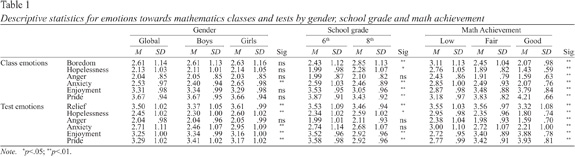
<body><![CDATA[<p><i>Student emotions toward mathematics</i></p>     <p>Descriptive statistics of students&rsquo; emotions toward mathematics are presented in <a href="#t1">Table 1</a> taking into consideration  gender, grades, and math performance. An initial look shows that regardless of the context (Class or Test), positive emotions (Enjoyment, Pride and  Relief) present higher scores than negative emotions (Boredom, Hopelessness, Anger, Anxiety) indicating that overall emotions toward mathematics  are more positive than negative. This idea is strengthened as scores can vary from 1 to 5 and considering Global scores, all positive emotions are  above and all negative emotions below the midpoint (3). Even when taking into account gender, school grade or math achievement the same pattern is  evident with the only exception of Enjoyment and Pride among low math achievers in Tests and Enjoyment in Class situation, as scores range from  2.72 to 2.87.</p>     <p>&nbsp;</p>     <p><a name="t1"></a></p>     <p><img src="/img/revistas/aps/v35n3/35n3a03t1.jpg" width="575" height="157"></p>     
<p>&nbsp;</p>     <p>&nbsp;</p>     <p><i>Classroom emotions (towards mathematics) and classroom support (teacher and peer)</i></p>     <p><a href="#t2">Table 2</a> presents the relationships between social support provided by the math&rsquo;s teacher and peers with positive and  negative emotions.</p>     <p>&nbsp;</p>     ]]></body>
<body><![CDATA[<p><a name="t2"></a></p>     <p><img src="/img/revistas/aps/v35n3/35n3a03t2.jpg" width="573" height="104"></p>     
<p>&nbsp;</p>     <p>In general, correlations between emotions and Teacher Support are stronger than those between emotions and Peer Support, not only for positive  emotions but also for negative emotions with the exception of Anxiety. In addition, correlations with positive emotions are always positive, mainly  strong and all significant while correlations with negative emotions are negative, with the exception of Anxiety, some are weak and some have no  statistical significance. Anxiety related to math Class shows a distinct pattern of correlations compared to the other negative emotions, as they  are mainly non-significant.</p>     <p>&nbsp;</p>     <p><i>Test related emotions and social support by teacher and peers</i></p>     <p><a href="#t3">Table 3</a> presents the correlations between test related emotions (positive and negative) and social support provided by  teachers and peers. Along similar lines to that occurring in Class related emotions, correlations between test related emotions and Teacher Support  are stronger than with Peer Support. There are two exceptions, one with Anxiety and another with Relief, where correlations with Peer Support are  stronger than with those with Teacher Support but scores are low and correlations are very weak and sometimes non-significant.</p>     <p>&nbsp;</p>     <p><a name="t3"></a></p>     <p><img src="/img/revistas/aps/v35n3/35n3a03t3.jpg" width="574" height="105"></p>     
]]></body>
<body><![CDATA[<p>&nbsp;</p>     <p>Data in <a href="#t3">Table 3</a> also shows that correlations with positive emotions are always positive and all significant, while  correlations with negative emotions are mainly negative, except for Anxiety, and weaker than those for positive emotions. Similarly to that which  was verified to Class related emotions, Anxiety related to math Tests shows a distinct pattern of correlations when compared to the other negative  emotions, as they are mainly non-significant and even positive in the correlation with Peer Support.</p>     <p>&nbsp;</p>     <p><i>Gender, grade and math achievement: Relations with math class emotions</i></p>     <p>The results of the MANOVA analysis taking into consideration gender, grades and math achievement as fixed factors in negative class emotions  show that all the variables introduce globally significant effects [Gender &ndash; Pillai&rsquo;s Trace=.027, <i>F</i>(4,1479)=10.113,  <i>p</i>&lt;.001, <i>&eta;<sup>2</sup></i>=.027; School Grade &ndash; Pillai&rsquo;s Trace=.039, <i>F</i>(4,1479)=14.834, <i>p</i>&lt;.001,   <i>&eta;<sup>2</sup></i>=.039; Math Achievement &ndash; Pillai&rsquo;s Trace=.278, <i>F</i>(8,2960)=59.724, <i>p</i>&lt;.001,   <i>&eta;<sup>2</sup></i>=.139].</p>     <p>The univariate analyses show that gender effect is only significant for Anxiety with girls (<i>M</i>=2.65) recording higher scores than boys  (<i>M</i>=2.40) [<i>F</i>(1,1482)=27.240, <i>p</i>&lt;.001, <i>&eta;<sup>2</sup></i>=.018]. School grade introduce significant differences for all  negative class emotions except for Anger [Boredom &ndash; <i>F</i>(1,1482)=29.998, <i>p</i>&lt;.001, <i>&eta;<sup>2</sup></i>=.020; Hopelessness  &ndash; <i>F</i>(1,1482)=8.705, <i>p</i>=.003, <i>&eta;<sup>2</sup></i>=.006; Anxiety &ndash; <i>F</i>(1,1482)=13.842, <i>p</i>&lt;.001,  <i>&eta;<sup>2</sup></i>=.009]. Boredom and Hopelessness in Class situations increase with school grade and Anxiety decreases. Math Achievement  effects are significant for all negative class emotions [Boredom &ndash; <i>F</i>(2,1482)=102.477, <i>p</i>&lt;.001, <i>&eta;<sup>2</sup></i>=.121;  Hopelessness &ndash; <i>F</i>(2,1482)=267.680, <i>p</i>&lt;.001, <i>&eta;<sup>2</sup></i>=.265; Anger &ndash; <i>F</i>(2,1482)=125.013,  <i>p</i>&lt;.001, <i>&eta;<sup>2</sup></i>=.144; Anxiety &ndash; <i>F</i>(2,1482)=78.143, <i>p</i>&lt;.001, <i>&eta;<sup>2</sup></i>=.095].  Multiple comparisons with the Tukey <i>post hoc</i> test show that all negative math class emotions decrease as math achievement increases  (low/fair achievers, <i>p</i>&lt;.001; low/good achievers, <i>p</i>&lt;.001; fair/good achievers, <i>p</i>&lt;.001). A global interaction effect  was identified for School Grade x Math Achievement [Pillai&rsquo;s Trace<i>=</i>.022, <i>F</i>(8,2960)=4.123, <i>p</i>&lt;.001,  <i>&eta;<sup>2</sup></i>=.011]. The univariate analyses were significant only for Anger [<i>F</i>(2,1482)=3.947, <i>p</i>=.020,  <i>&eta;<sup>2</sup></i>=.005] and for Anxiety [<i>F</i>(2,1482)=3.181, <i>p</i>=.042, <i>&eta;<sup>2</sup></i>=.004]. Anger scores are higher for  older students among fair and good achievers. However, low achievers from 8<sup>th</sup> grade show lower Anger scores in relation to math classes  than 6<sup>th</sup> graders. With regard to Anxiety, among low and fair math achievers, scores are higher for 6<sup>th</sup> graders than for  8<sup>th</sup> graders. However for good achievers scores are similarly low in the 6<sup>th</sup> and 8<sup>th</sup> grade.</p>     <p>Although Pillai&rsquo;s Trace for all others analysis about interaction effects were not significant, univariate analysis showed interaction  effects between gender and school grade for Hopelessness [<i>F</i>(1,1482)=4.863, <i>p</i>&lt;.028, <i>&eta;<sup>2</sup></i>=.003]. There is an  increase in Hopelessness when comparing students of the 6<sup>th</sup> and 8<sup>th</sup> grades but this is much stronger for girls than for  boys.</p>     <p>In regard to positive Class emotions, MANOVA analysis highlighted that gender effects were not significant. However school grade and math  achievement introduce some differences [School Grade &ndash; Pillai&rsquo;s Trace=.044, <i>F</i>(2,1482)=34.119, <i>p</i>&lt;.001,  <i>&eta;<sup>2</sup></i>=.044; Math Achievement &ndash; Pillai&rsquo;s Trace=.181, <i>F</i>(4,2964)=73.584, <i>p</i>&lt;.001,  <i>&eta;<sup>2</sup></i>=.090]. The univariate analyses show that school grade gives rise to significant differences for both positive Class  emotions [Enjoyment &ndash; <i>F</i>(1,1483)=62.064, <i>p</i>&lt;.001, <i>&eta;<sup>2</i>=.040; Pride &ndash; <i>F</i>(1,1483)=54.970,  <i>p</i>&lt;.001, <i>&eta;<sup>2</sup></i>=.036] resulting in a decrease in the emotion scores among older students. Math Achievement effects are  also significant for Enjoyment and Pride [Enjoyment &ndash; <i>F</i>(2,1483)=112.151, <i>p</i>&lt;.001, <i>&eta;<sup>2</sup></i>=.131; Pride  &ndash; <i>F</i>(2,1483)=158.154, <i>p</i>&lt;.001, <i>&eta;<sup>2</sup></i>=.176]. Multiple comparisons with the Tukey <i>post hoc</i> test show  that both positive math Class emotions increase as math achievement decreases (low/fair achievers, <i>p</i>&lt;.001; low/good achievers,  <i>p</i>&lt;.001; fair/good achievers, <i>p</i>&lt;.001). No interaction effects were identified for Class positive emotions.</p>     <p>&nbsp;</p></sup>     <p><i>Gender, grade and math achievement: Relations with math test emotions</i></p>     ]]></body>
<body><![CDATA[<p>With regard to negative emotions related to Test the MANOVA, analysis shows that all fixed factors (gender, school grade and math achievement)  introduce global significant effects on emotions [Gender &ndash; Pillai&rsquo;s Trace=.096, <i>F</i>(3,1436)=35.564, <i>p</i>&lt;.001,  <i>&eta;<sup>2</sup></i>=.069; School Grade &ndash; Pillai&rsquo;s Trace=.019, <i>F</i>(3,1436)=9.484, <i>p</i>&lt;.001,  <i>&eta;<sup>2</sup></i>=.019; Math Achievement &ndash; Pillai&rsquo;s Trace=.193, <i>F</i>(6,2874)=51.258, <i>p</i>&lt;.001,  <i>&eta;<sup>2</sup></i>=.097].</p>     <p>Considering the univariate analyses the gender effect is significant for Hopelessness and Anxiety related to Tests, with girls showing higher  scores than boys [Hopelessness &ndash; <i>F</i>(1,1438)=37.290, <i>p</i>&lt;.001, <i>&eta;<sup>2</sup></i>=.025; Anxiety-<i>F</i>(1,1438)=79.669,  <i>p</i>&lt;.001, <i>&eta;<sup>2</sup></i>=.052]. School grade introduces significant differences only for Hopelessness in Tests with older students showing higher scores [Hopelessness &ndash; <i>F</i>(1,1438)=5.973, <i>p</i>=.015, <i>&eta;</i><sup><i>2</i></sup>=.004]. Math Achievement effects are significant for all three negative emotions related to Tests [Hopelessness &ndash; <i>F</i>(2,1483)=160.238, <i>p</i>&lt;.001, <i>&eta;</i><sup><i>2</i></sup>=.182; Anger &ndash; <i>F</i>(2,1483)=72.225, <i>p</i>&lt;.001, <i>&eta;</i><sup><i>2</i></sup>=.091; Anxiety &ndash; <i>F</i>(2,1483)=57.735, <i>p</i>&lt;.001, <i>&eta;</i><sup><i>2</i></sup>=.074]. Multiple comparisons with the Tukey <i>post hoc </i>test show that the three negative math Test emotions decrease as math achievement increases (low/fair achievers, <i>p</i>&lt;.001; low/good achievers, <i>p</i>&lt;.001; fair/good achievers, <i>p</i>&lt;.001).</p>     <p>The MANOVA test also revealed a global interaction effect for School Grade*Math Achievement [Pillai&rsquo;s Trace=.014, <i>F</i>(6,2874)=3.480,  <i>p</i>=.002, <i>&eta;<sup>2</sup></i>=.007] and the univariate Tests highlight that the interaction effect is only Anxiety significant  [<i>F</i>(2,1438)=4.113, <i>p</i>=.017, <i>&eta;<sup>2</sup></i>=.006] in Anxiety. Anxiety decreases with school grade for low and fair math  achievers, but increases among good math achievers as 8<sup>th</sup> grade good math students show more Anxiety than 6<sup>th</sup> grade good math  students. Although Pillai&rsquo;s Trace concerning Gender*Math Achievement interaction effects was not significant, the univariate analysis for  each emotion shows a significant interaction for Anger related to Tests [<i>F</i>(2,1438)=3.083, <i>p</i>&lt;.046, <i>&eta;<sup>2</sup></i>=.004].  Among low math achievers, girls showed higher Anger test scores than boys and among good math achievers, girls present lower scores in Anger  related to Tests than boys. The Anger scores of girls and boys are similar for Fair math achievers.</p>     <p>When considering positive Test emotions (Enjoyment, Pride, Relief) the MANOVA test shows that gender, school grade and math achievement effects  were all statistically significant [Gender &ndash; Pillai&rsquo;s Trace=.036, <i>F</i>(3,1437)=17.921, <i>p</i>&lt;.001,  <i>&eta;<sup>2</sup></i>=.036; School Grade &ndash; Pillai&rsquo;s Trace=.083, <i>F</i>(3,1437)=43.274, <i>p</i>&lt;.001,  <i>&eta;<sup>2</sup></i>=.083; Math Achievement &ndash; Pillai&rsquo;s Trace g=.228, <i>F</i>(6,2666)=61.666, <i>p</i>&lt;.001,  <i>&eta;<sup>2</sup></i>=.114].</p>     <p>The univariate analyses show that gender has an effect on the three positive test emotions Enjoyment, Pride and Relief [Enjoyment &ndash;  <i>F</i>(1,1439)=17.536, <i>p</i>&lt;.001, <i>&eta;<sup>2</sup></i>=.012; Pride &ndash; <i>F</i>(1,1439)=26.275, <i>p</i>&lt;.001,  <i>&eta;<sup>2</sup></i>=.018; Relief &ndash; <i>F</i>(1,1439)=22.171, <i>p</i>&lt;.001, <i>&eta;<sup>2</sup></i>=.015] with boys experiencing  higher Enjoyment and Pride than girls and lower Relief scores. School grade introduces significant differences only in Enjoyment and Pride with  younger students (6<sup>th </sup>grade) showng higher scores for these positive test emotions [Enjoyment &ndash; <i>F</i>(1,1439)=101.716,  <i>p</i>&lt;.001, <i>&eta;<sup>2</sup></i>=.066; Pride &ndash; <i>F</i>(1,1439)=120.980, <i>p</i>&lt;.001, <i>&eta;<sup>2</sup></i>=.078]. Results  also highlight that Math Achievement effects are significant for the three positive test emotions with Enjoyment and Pride increasing with students  math achievement but with Relief decreasing as good math students show lower Relief scores than low math achievers [Enjoyment &ndash;  <i>F</i>(2,1439)=181.189, <i>p</i>&lt;.001, <i>&eta;<sup>2</sup></i>=.201; Pride &ndash; <i>F</i>(2,1439)=167.749, <i>p</i>&lt;.001,  <i>&eta;<sup>2</sup></i>=.189; Relief &ndash; <i>F</i>(2,1439)=4.976, <i>p</i>=.007, <i>&eta;<sup>2</sup></i>=.007]. Multiple comparisons with the  Tukey <i>post hoc</i> test show that for Enjoyment and Pride related to Tests, all the comparisons were significant and these emotions increase as  math achievement increases (low/fair achievers, <i>p</i>&lt;.001; low/good achievers, <i>p</i>&lt;.001; fair/good achievers, <i>p</i>&lt;.001). For  Relief, only the comparison between good math achievers and the other groups were significant as low and fair math achievers show very similar  Relief scores (low/good achievers, <i>p</i>=.003; fair/good achievers, <i>p</i>=.002). A global interaction effect between School Grade*Math  Achievement for positive math test emotions was identified [Pillai&rsquo;s Trace=.011, <i>F</i>(6,2876)=2.643, <i>p</i>=.015,  <i>&eta;<sup>2</sup></i>=.005]. This effect was only significant for Relief [<i>F</i>(2,1439)=5.672, <i>p</i>=.004, <i>&eta;<sup>2</sup></i>=.008]  and is highlighted by the different pattern presented by good achievers when compared to fair and low math achievers through schooling. For good  achievers relief increases in the test situation when comparing 6<sup>th</sup> and 8<sup>th</sup> graders, although among low and fair math  achievers, 8<sup>th</sup> grade students show lower Relief scores than their 6<sup>th</sup> grade colleagues.</p>     <p>&nbsp;</p>     <p><b>Discussion</b></b>     <p>One of the goals of the current study has been to investigate the links between teacher and peer support and student academic emotions in  different mathematics situations: Tests and Classroom. Consistent with previous findings, significant relationships between these variables were  recorded. When using each of the two mathematics situations separately associate classroom support (teacher and peers) with academic emotions, the  test situation teacher and peer support positively related to positive activating emotions (Enjoyment and Pride) and to positive deactivating  emotion (relief). Teacher support was also negatively related to deactivating negative emotion (Hopelessness) and to activating negative emotion  (Anger). In the Class situation teacher and peer support were negatively related to deactivating negative emotions (Boredom and Hopelessness), to  activating negative emotion (Anger) and positively related to positive activating emotions (Enjoyment and Pride). These correlations are stronger  in Teacher Support. However, teacher support was not related to Anxiety (activating negative emotion) in both situations, in contrast with peer  support where we found a positive relationship. These results are consistent with previous findings that reported that the perception of teacher  support reduces feelings of Boredom and Anger and enhances feelings of Enjoyment (Ahmed et al., 2010; Frenzel et al., 2007; Stephanou, 2011).</p>     <p>From an appraisal perspective and in taking into account the CVT framework (Pekrun, 2006), social support might indirectly affect emotions by  enhancing positive action values and control appraisals in students. If students feel that their teacher and peers are supportive this will  contribute to positive value appraisals of mathematics, focusing their attention on the activity of learning, which in turn enhances Enjoyment and  reduces Anger and Boredom. Furthermore, if students perceive a supportive classroom environment they feel more secure and more supported in  understanding the activities which leads to more individual positive control appraisals. Thus, perceiving positive support as arising mainly from  the teacher, but also from peers, increases Enjoyment and Pride and also reduces Boredom, Hopelessness and Anger towards mathematics (Frenzel et  al., 2007; Pekrun et al., 2009; Stephanou, 2011).</p>     <p>Classroom support (from teacher and peers), was negatively related to Boredom in the Class situation and positively related to relief in the  test situation. As above, from an appraisal perspective teacher and peer support might indirectly affect emotions (Pekrun, 2006). Taking  prospective failure-related emotions, if these students have high expectations of failure they focus their attention on the prevention of failure  in maths by working with their peers and teacher more, given the perception of a supportive classroom climate. This will enhance their perception  of competence and they anticipate that they probably are able to pass in Tests. If they succeed in the assessment situation they experience relief.  Concerning Boredom, the significant negative relation with supportive classroom support makes sense: It is possible that when students don&rsquo;t  value mathematics activities, Boredom related to those activities will be experienced. It is possible that when these students realize their  difficulties regarding mathematics, they do not feel very comfortable working with colleagues and the teacher collaboratively. They may feel bored  in this collaborative situation.</p>     ]]></body>
<body><![CDATA[<p>In the current research, positive emotions elicited the strongest values with both constructs (PTS and PPS) assessed in both situations  (Classroom and test). Therefore, if students see their teacher and peers as facilitators to reaching a better understanding of mathematics, to  solve problems, as warm, caring and friendly, this will foster Enjoyment in math&rsquo;s activities and make them feel proud of their performance  in mathematics.</p>     <p>The results obtained in the relation between Classroom support and Anxiety can be explained taking into consideration classroom composition,  dynamics and instruction. According to Pekrun (2006) lack of self-confidence and the perceived importance of failure contribute to negative  emotions, such as Anxiety. Thus, if some of these students have negative self-evaluations of competence in math&rsquo;s and if they emphasize the  value of grades in math&rsquo;s, these appraisals can highlight their Anxiety related to the fear of failure. Furthermore, if there is a  heterogeneous classroom climate these students can feel pressure from some of their classmates to perform better (thus reinforcing Anxiety) but  also support from other peers (positive effect on Anxiety), allowing for a medium of control of outcomes which can explain the positive low  relation between peer support and Anxiety (Boekaerts &amp; Pekrun, 2015). In the current study Anxiety was related less closely to Classroom  support than to Hopelessness, Boredom and Anger. As Pekrun and Stephens (2009) state, Anxiety can exert ambiguous effects. So, on the one hand  Classroom support can trigger tension towards failure but on the other hand it may be a motivating factor for learning depending on the mechanisms  and the interactions that the student has with the task that may facilitate or undermine the occurrence of a particular emotion. According to  Pekrun and Stephens (2009), the evidence shows that deactivating negative emotions, such as Boredom and Hopelessness, are expected to be negatively  associated with performance, motivation and the use of learning strategies.</p>     <p>In terms of the effect of achievement on emotions we found that students with higher mathematics grades had higher scores of positive activating  emotions and lower scores of negative emotions (activating and deactivating emotions) in both the Classroom and test setting. Our findings are in  line with those obtained by Pekrun et al. (2002, 2009) and Ahmed et al. (2010). According to CVT (Pekrun, 2006), students who feel Hopelessness and  Boredom do not feel personal control over the outcomes and the activity and this may lead to the avoidance of effort and engagement in activities,  resulting in low achievement. Equally, lower achievers show higher scores of activating negative emotions (Anger and Anxiety) than higher achievers  in both settings, but particularly in the test situation. These emotions induce pressure and tension that undermine engagement in mathematics  activities (Pekrun &amp; Stephens, 2009). On the other hand, if the students attribute success to internal causes and if they believe that they can  do even better in the future they have high self-control over the outcomes and over performing mathematics activities leading to high achievement  (Sakiz, Pape, &amp; Hoy, 2012). Hence, good achievers have higher scores of positive emotions than lower achievers except for relief where, as  expected, they recorded a lower score because they believe that they have high control over failure.</p>     <p>Another fundamental goal of our research was to understand if there were developmental changes in achievement emotions by comparing the changes  in academic emotions of 6<sup>th</sup> and 8<sup>th</sup> grade adolescents. We expected a decline for positive emotions (positive activating  emotions: Pride and Enjoyment) and an increase for negative emotions (Ahmed et al., 2013; Racanello et al., 2013) for both settings. The decrease  in positive emotions was confirmed and may be explained by the decrease in competence and value appraisals (Pekrun, 2006). CVT assumes that these  constructs are important antecedents of academic emotions and some research (e.g., Goetz, Frenzel, Pekrun, &amp; Hall, 2006) shows that there is an  association between these appraisals and academic emotions. Studies on the development of competence and value beliefs have reported a decline in  competence self-evaluations and value throughout schooling (e.g., Chouinard &amp; Roy, 2008; Mata, Monteiro, &amp; Peixoto, 2007; Monteiro, Mata,  &amp; Peixoto, 2011; van der Werf et al., 2008). Thus, we can argue that the decline for positive emotions, in both settings, is anchored in these  results in developmental research into adolescent motivation. In this study we found a global interaction effect between grade and achievement for  Relief (positive deactivating emotion) in the test situation, with good achievers showing higher scores in the 8th grade. However, Relief decreases  in low and fair maths achievers from 6<sup>th</sup> to 8<sup>th</sup> grade students. This emotion may give rise to ambiguous effects (Pekrun &amp;  Stephens, 2010). It seems that for good achievers there is no beneficial effect perhaps because as they feel the pressure of proximity of  math&rsquo;s exams they really are worried about failure in Tests. So as they are good students, the non-occurrence of expected failure instigates  Relief. In contrast, in low and fair achievers Relief decreases from the 6<sup>th</sup> to 8<sup>th</sup> grade because as they are not as good in  maths they do not expect to succeed. This process is more evident with the gradual accumulation of failure over the years (Pekrun &amp; Stephens,  2010).</p>     <p>The expected increase for older students in negative emotions was confirmed in the Class situation for Hopelessness and Boredom (negative  deactivating emotions) but not for Anxiety. These results are in line with those of Ahmed et al. (2013). The increase of Boredom can be explained  as a consequence of lack of value assigned to math tasks. It seems that as they progress in school over time students increasingly perceive  math&rsquo;s tasks as uninteresting and unchallenging, which leads to Boredom in the Classroom. We also found that 8<sup>th</sup> grade students  show less Anxiety than their 6<sup>th</sup> grade colleagues (similarly to the results of Wigfield &amp; Meece, 1988), especially for low and fair  achievers in both settings. Thus, if they are not interested in math&rsquo;s it is possible that they are not concerned with the possible  consequences of failure in mathematics (Frenzel et al., 2007). This may explain why they are not so anxious and the score decreases from  6<sup>th</sup> to 8<sup>th</sup> grade. Conversely, Hopelessness increases with school grade in both settings, particularly for girls (in  Classroom). As argued above, Hopelessness is an emotion experienced by students when they feel that they don&rsquo;t have control over the outcomes  (Pekrun, 2006) and as a result don&rsquo;t engage in math&rsquo;s and don&rsquo;t perform well. As they progress in school this process tends to be  more intense particularly for girls, who appear to have lower scores of perceived control than boys (Pekrun, Goetz, Daniels, Stupnisky, &amp;  Perry, 2010).</p>     <p>In terms of gender differences, CVT (Pekrun, 2006) posits that control-related appraisals (e.g., competence beliefs) and value appraisals are  important for provoking achievement emotions, that, high levels of perceived competence and high achievement values in math&rsquo;s will lead to  higher levels in positive emotions. The opposite will lead to higher levels in negative emotions. We also know from the literature that girls  usually perceive their competence in math&rsquo;s as lower than boys (e.g., Mata, Monteiro, &amp; Peixoto, 2007; Monteiro, Mata, &amp; Peixoto,  2011). Applying these principles we can understand why girls in our study show greater Anxiety (in both situations) and Hopelessness than boys in  mathematics and girls experience less Enjoyment and Pride in the test setting than boys. Our results are in line with those of Else-Quest et al.  (2010) and Frenzel et al. (2007).</p>     <p>Notwithstanding the above results, some limitations to this research and paths to future investigation must be mentioned. Firstly, this study  analyses relations between teacher and peer support and academic emotions, but not the causality of these relations. Secondly, only the mathematics  domain has been investigated, and, as we know, emotions are domain-specific (Goetz et al., 2006). Thirdly, in relation to the effects of appraisals  on achievement emotions, and given the linkages between emotions and environment (Frenzel et al., 2007), motivational variables such as  self-perception competence and value in the domain of mathematics should be included in future research.</p>     <p>Despite these limitations our study has shown that emotions in relation to mathematics are associated with the way that students perceive their  teacher and peers, by gender, grade and achievement. These findings are extremely pertinent for educators in understanding the relationship between  their teaching practices and their students&rsquo; achievement emotions by focusing on those interactions which give rise to a more positive  learning environment.</p>     <p>&nbsp;</p>     <p><b>References</b></p>     ]]></body>
<body><![CDATA[<!-- ref --><p>Adelman, H., &amp; Taylor, L. (2005). Classroom climate. In S. Lee (Ed.), <i>Encyclopedia of school psychology</i> (pp. 89-92). Thousand Oaks,  CA: SAGE Publications, Inc. doi: 10.4135/9781412952491.n43&nbsp;&nbsp;&nbsp;&nbsp;&nbsp;&nbsp;&nbsp;&nbsp;[&#160;<a href="javascript:void(0);" onclick="javascript: window.open('/scielo.php?script=sci_nlinks&ref=030447&pid=S0870-8231201700030000300001&lng=','','width=640,height=500,resizable=yes,scrollbars=1,menubar=yes,');">Links</a>&#160;]<!-- end-ref --><p>Ahmed, W., Minnaert, A., van der Werf, G., &amp; Kuyper, H. (2010). Perceived social support and early adolescents&rsquo; achievement: The  mediational roles of motivational beliefs and emotions. <i>Journal of Youth and Adolescence, 39</i>, 36-46. doi: 10.1007/s10964-008-9367-7</p>     <!-- ref --><p>Ahmed, W., van der Werf, G., Kuyper, H., &amp; Minnaert, A. (2013). Emotions, self-regulated learning, and achievement in mathematics: A growth  curve analysis. <i>Journal of Educational Psychology, 105</i>, 150-161. doi: 10.1037/a0030160&nbsp;&nbsp;&nbsp;&nbsp;&nbsp;&nbsp;&nbsp;&nbsp;[&#160;<a href="javascript:void(0);" onclick="javascript: window.open('/scielo.php?script=sci_nlinks&ref=030449&pid=S0870-8231201700030000300003&lng=','','width=640,height=500,resizable=yes,scrollbars=1,menubar=yes,');">Links</a>&#160;]<!-- end-ref --><!-- ref --><p>BoeKaerts, M., &amp; Pekrun, R. (2015). Emotions and emotion regulation in academic settings. In L. Corno &amp; E. Anderman (Eds.), <i>Handbook  of educational psychology</i> (3<sup>rd</sup> ed., pp. 76-90). New York: Routledge.    &nbsp;&nbsp;&nbsp;&nbsp;&nbsp;&nbsp;&nbsp;&nbsp;[&#160;<a href="javascript:void(0);" onclick="javascript: window.open('/scielo.php?script=sci_nlinks&ref=030450&pid=S0870-8231201700030000300004&lng=','','width=640,height=500,resizable=yes,scrollbars=1,menubar=yes,');">Links</a>&#160;]<!-- end-ref --></p>     <p>Chouinard, R., &amp; Roy, N. (2008). Changes in high-school students&rsquo; competence beliefs, utility value and achievement goals in  mathematics. <i>British Journal of Educational Psychology, 78</i>, 31-50. doi: 10.1348/000709907X197993</p>     <!-- ref --><p>Dixon-Krauss, L. (1996). <i>Vygotsky in the classroom: Mediated literacy instruction and assessment</i>. New York: Longman Publishers.    &nbsp;&nbsp;&nbsp;&nbsp;&nbsp;&nbsp;&nbsp;&nbsp;[&#160;<a href="javascript:void(0);" onclick="javascript: window.open('/scielo.php?script=sci_nlinks&ref=030453&pid=S0870-8231201700030000300006&lng=','','width=640,height=500,resizable=yes,scrollbars=1,menubar=yes,');">Links</a>&#160;]<!-- end-ref --></p>     <!-- ref --><p>DuBois, D., Felner, R., Brand, S., Adan, A., &amp; Evans, E. (1992). A prospective study of life stress, social support, and adaptation in early  adolescence. <i>Child Development, 63</i>, 542. doi: 10.2307/1131345&nbsp;&nbsp;&nbsp;&nbsp;&nbsp;&nbsp;&nbsp;&nbsp;[&#160;<a href="javascript:void(0);" onclick="javascript: window.open('/scielo.php?script=sci_nlinks&ref=030455&pid=S0870-8231201700030000300007&lng=','','width=640,height=500,resizable=yes,scrollbars=1,menubar=yes,');">Links</a>&#160;]<!-- end-ref --><!-- ref --><p>Else-Quest, N. M., Hyde, J. S., &amp; Linn, M. C. (2010). Cross-national patterns of gender differences in mathematics: A meta-analysis.  <i>Psychological Bulletin, 136</i>, 103-127. doi: 10.1037/a0018053&nbsp;&nbsp;&nbsp;&nbsp;&nbsp;&nbsp;&nbsp;&nbsp;[&#160;<a href="javascript:void(0);" onclick="javascript: window.open('/scielo.php?script=sci_nlinks&ref=030456&pid=S0870-8231201700030000300008&lng=','','width=640,height=500,resizable=yes,scrollbars=1,menubar=yes,');">Links</a>&#160;]<!-- end-ref --><p>Erturan, S., &amp; Jansen, B. (2015). An investigation of boys&rsquo; and girls&rsquo; emotional experience of math, their math performance, and  the relation between these variables. <i>European Journal of Psychology of Education, 30</i>, 421-435. doi: 10.1007/s10212-015-0248-7</p>     <!-- ref --><p>Frenzel, A. C., Goetz, T., L&uuml;dtke, O., Pekrun, R., &amp; Sutton, R. E. (2009). Emotional transmission in the classroom: Exploring the  relationship between teacher and student enjoyment. <i>Journal of Educational Psychology, 101</i>, 705. doi: 10.1037/a0014695&nbsp;&nbsp;&nbsp;&nbsp;&nbsp;&nbsp;&nbsp;&nbsp;[&#160;<a href="javascript:void(0);" onclick="javascript: window.open('/scielo.php?script=sci_nlinks&ref=030458&pid=S0870-8231201700030000300010&lng=','','width=640,height=500,resizable=yes,scrollbars=1,menubar=yes,');">Links</a>&#160;]<!-- end-ref --><!-- ref --><p>Frenzel, A., Pekrun, R., &amp; Goetz, T. (2007). Girls and mathematics hopeless issue? A control-value approach to gender differences in  emotions towards mathematics. <i>European Journal of Psychology of Education, 22</i>, 497-514. doi: 10.1007/bf03173468&nbsp;&nbsp;&nbsp;&nbsp;&nbsp;&nbsp;&nbsp;&nbsp;[&#160;<a href="javascript:void(0);" onclick="javascript: window.open('/scielo.php?script=sci_nlinks&ref=030459&pid=S0870-8231201700030000300011&lng=','','width=640,height=500,resizable=yes,scrollbars=1,menubar=yes,');">Links</a>&#160;]<!-- end-ref --><p>Furrer, C., &amp; Skinner, E. (2003). Sense of relatedness as a factor in children&rsquo;s academic engagement and performance. <i>Journal of  Educational Psychology, 95</i>, 148-162. doi: 10.1037/0022-0663.95.1.148</p>     <!-- ref --><p>Goetz, T., Frenzel, A. C., Pekrun, R., &amp; Hall, N. C. (2006). The domain specificity of academic emotional experiences. <i>The Journal of  Experimental Education, 75</i>, 5-29. doi: 10.3200/JEXE.75.1.1-29&nbsp;&nbsp;&nbsp;&nbsp;&nbsp;&nbsp;&nbsp;&nbsp;[&#160;<a href="javascript:void(0);" onclick="javascript: window.open('/scielo.php?script=sci_nlinks&ref=030461&pid=S0870-8231201700030000300013&lng=','','width=640,height=500,resizable=yes,scrollbars=1,menubar=yes,');">Links</a>&#160;]<!-- end-ref --><!-- ref --><p>Goetz, T., Frenzel, A. C., Hall, N. C., &amp; Pekrun, R. (2008). Antecedents of academic emotions: Testing the internal/external frame of  reference model for academic enjoyment. <i>Contemporary Educational Psychology, 33</i>, 9-33. doi: 10.1016/j.cedpsych.2006.12.002&nbsp;&nbsp;&nbsp;&nbsp;&nbsp;&nbsp;&nbsp;&nbsp;[&#160;<a href="javascript:void(0);" onclick="javascript: window.open('/scielo.php?script=sci_nlinks&ref=030462&pid=S0870-8231201700030000300014&lng=','','width=640,height=500,resizable=yes,scrollbars=1,menubar=yes,');">Links</a>&#160;]<!-- end-ref --><!-- ref --><p>Goetz, T., Bieg, M., L&uuml;dtke, O., Pekrun, R., &amp; Hall, N. C. (2013). Do girls really experience more anxiety in mathematics?.  <i>Psychological Science, 24</i>, 2079-2087. doi: 10.1177/0956797613486989&nbsp;&nbsp;&nbsp;&nbsp;&nbsp;&nbsp;&nbsp;&nbsp;[&#160;<a href="javascript:void(0);" onclick="javascript: window.open('/scielo.php?script=sci_nlinks&ref=030463&pid=S0870-8231201700030000300015&lng=','','width=640,height=500,resizable=yes,scrollbars=1,menubar=yes,');">Links</a>&#160;]<!-- end-ref --><p>Goetz, T., Ludtke, O., Nett, U., Keller, M., &amp; Lipnevich, A. (2013). Characteristics of teaching and students&rsquo; emotions in the  classroom: Investigating differences across domains. <i>Contemporary Educational Psychology, 38</i>, 383-394. doi: 10.1016/j.cedpsych.2013.08.001</p>     <!-- ref --><p>Hamre, B. K., &amp; Pianta, R. C. (2007). Learning opportunities in preschool and early elementary classrooms. In R. C. Pianta, M. J. Cox, &amp;  K. L. Snow (Eds.), <i>School readiness and the transition to kindergarten in the era of accountability</i> (pp. 49-83). Baltimore, MD: Brookes.    &nbsp;&nbsp;&nbsp;&nbsp;&nbsp;&nbsp;&nbsp;&nbsp;[&#160;<a href="javascript:void(0);" onclick="javascript: window.open('/scielo.php?script=sci_nlinks&ref=030465&pid=S0870-8231201700030000300017&lng=','','width=640,height=500,resizable=yes,scrollbars=1,menubar=yes,');">Links</a>&#160;]<!-- end-ref --></p>     ]]></body>
<body><![CDATA[<!-- ref --><p>Huang, C. (2013). Gender differences in academic self-efficacy: A meta-analysis. <i>European Journal of Psychology of Education, 28</i>, 1-35.  doi: 10.1007/s10212-011-0097-y&nbsp;&nbsp;&nbsp;&nbsp;&nbsp;&nbsp;&nbsp;&nbsp;[&#160;<a href="javascript:void(0);" onclick="javascript: window.open('/scielo.php?script=sci_nlinks&ref=030467&pid=S0870-8231201700030000300018&lng=','','width=640,height=500,resizable=yes,scrollbars=1,menubar=yes,');">Links</a>&#160;]<!-- end-ref --><!-- ref --><p>Hyde, J. S., Lindberg, S. M., Linn, M. C., Ellis, A. B., &amp; Williams, C. C. (2008). Gender similarities characterize math performance.  <i>Science, 321</i>(5888), 494-495.    &nbsp;&nbsp;&nbsp;&nbsp;&nbsp;&nbsp;&nbsp;&nbsp;[&#160;<a href="javascript:void(0);" onclick="javascript: window.open('/scielo.php?script=sci_nlinks&ref=030468&pid=S0870-8231201700030000300019&lng=','','width=640,height=500,resizable=yes,scrollbars=1,menubar=yes,');">Links</a>&#160;]<!-- end-ref --></p>     <!-- ref --><p>King, R. B., &amp; Gaerlan, M. J. M. (2014). High self-control predicts more positive emotions, better engagement, and higher achievement in  school. <i>European Journal of Psychology of Education, 29</i>, 81-100. doi: 10.1007/s10212-013-0188-z&nbsp;&nbsp;&nbsp;&nbsp;&nbsp;&nbsp;&nbsp;&nbsp;[&#160;<a href="javascript:void(0);" onclick="javascript: window.open('/scielo.php?script=sci_nlinks&ref=030470&pid=S0870-8231201700030000300020&lng=','','width=640,height=500,resizable=yes,scrollbars=1,menubar=yes,');">Links</a>&#160;]<!-- end-ref --><p>Kytt&auml;l&auml;, M., &amp; Bj&ouml;rn, P. M. (2010). Prior mathematics achievement, cognitive appraisals and anxiety as predictors of Finnish  students&rsquo; later mathematics performance and career orientation. <i>Educational Psychology, 30</i>, 431-448. doi: 10.1080/01443411003724491</p>     <!-- ref --><p>Lindberg, S. M., Hyde, J. S., Petersen, J. L., &amp; Linn, M. C. (2010). New trends in gender and mathematics performance: A meta-analysis.  <i>Psychological Bulletin, 136</i>, 1123-1135. doi: 10.1037/a0021276&nbsp;&nbsp;&nbsp;&nbsp;&nbsp;&nbsp;&nbsp;&nbsp;[&#160;<a href="javascript:void(0);" onclick="javascript: window.open('/scielo.php?script=sci_nlinks&ref=030472&pid=S0870-8231201700030000300022&lng=','','width=640,height=500,resizable=yes,scrollbars=1,menubar=yes,');">Links</a>&#160;]<!-- end-ref --><!-- ref --><p>Luo, W., Lee, K., Ng, P. T., &amp; Ong, J. W. (2014). Incremental beliefs of ability, achievement emotions and learning of Singapore students.  <i>Educational Psychology, 34</i>, 619-634. doi: 10.1080/01443410.2014.909008&nbsp;&nbsp;&nbsp;&nbsp;&nbsp;&nbsp;&nbsp;&nbsp;[&#160;<a href="javascript:void(0);" onclick="javascript: window.open('/scielo.php?script=sci_nlinks&ref=030473&pid=S0870-8231201700030000300023&lng=','','width=640,height=500,resizable=yes,scrollbars=1,menubar=yes,');">Links</a>&#160;]<!-- end-ref --><!-- ref --><p>Macher, D., Paechter, M., Papousek, I., Ruggeri, K., Freudenthaler, H. H., &amp; Arendasy, M. (2013). Statistics anxiety, state anxiety during  an examination, and academic achievement. <i>British Journal of Educational Psychology, 83</i>, 535-549. doi: 10.1111/j.2044-8279.2012.02081.x&nbsp;&nbsp;&nbsp;&nbsp;&nbsp;&nbsp;&nbsp;&nbsp;[&#160;<a href="javascript:void(0);" onclick="javascript: window.open('/scielo.php?script=sci_nlinks&ref=030474&pid=S0870-8231201700030000300024&lng=','','width=640,height=500,resizable=yes,scrollbars=1,menubar=yes,');">Links</a>&#160;]<!-- end-ref --><!-- ref --><p>Malecki, C. K., &amp; Demaray, M. K. (2002). Measuring perceived social support: Development of the Child and Adolescent Social Support Scale  (CASSS). <i>Psychology in the Schools, 39</i>, 1-18. doi: 10.1002/pits.10004&nbsp;&nbsp;&nbsp;&nbsp;&nbsp;&nbsp;&nbsp;&nbsp;[&#160;<a href="javascript:void(0);" onclick="javascript: window.open('/scielo.php?script=sci_nlinks&ref=030475&pid=S0870-8231201700030000300025&lng=','','width=640,height=500,resizable=yes,scrollbars=1,menubar=yes,');">Links</a>&#160;]<!-- end-ref --><p>Mata, L., Monteiro, V., &amp; Peixoto, F. (2007). Motiva&ccedil;&atilde;o para a leitura e para a matem&aacute;tica &ndash;  Caracter&iacute;sticas ao longo da escolaridade. In A. Barca, M. Peralbo, A. Porto, B. Silva, &amp; L. Almeida (Eds.), <i>Livro de actas do  Congresso Internacional Galego-Portugu&ecirc;s de Psicopedagoxia</i> (pp. 550-558). Coru&ntilde;a: Universidade da Coru&ntilde;a/Revista  Galego-Portuguesa de Psicoloxia e Educaci&oacute;n.</p>     ]]></body>
<body><![CDATA[<!-- ref --><p>Mata, L., Monteiro, V., &amp; Peixoto, F. (2013). Escala de clima de sala de aula. In C. Machado, M. M. Gon&ccedil;alves, M. R. Sim&otilde;es,  &amp; L. S. Almeida (Eds.), <i>Avalia&ccedil;&atilde;o psicol&oacute;gica: Instrumentos validados para a popula&ccedil;&atilde;o portuguesa</i>  (Vol. IV, pp. 121-133). Coimbra: Almedina.    &nbsp;&nbsp;&nbsp;&nbsp;&nbsp;&nbsp;&nbsp;&nbsp;[&#160;<a href="javascript:void(0);" onclick="javascript: window.open('/scielo.php?script=sci_nlinks&ref=030477&pid=S0870-8231201700030000300027&lng=','','width=640,height=500,resizable=yes,scrollbars=1,menubar=yes,');">Links</a>&#160;]<!-- end-ref --></p>     <!-- ref --><p>Mata, M., Monteiro, V., &amp; Peixoto, F. (2012). Attitudes towards mathematics: Effects of individual, motivational, and social support  factors. <i>Child Development Research, 2012</i>, 1-10. doi: 10.1155/2012/876028&nbsp;&nbsp;&nbsp;&nbsp;&nbsp;&nbsp;&nbsp;&nbsp;[&#160;<a href="javascript:void(0);" onclick="javascript: window.open('/scielo.php?script=sci_nlinks&ref=030479&pid=S0870-8231201700030000300028&lng=','','width=640,height=500,resizable=yes,scrollbars=1,menubar=yes,');">Links</a>&#160;]<!-- end-ref --><!-- ref --><p>Mega, C., Ronconi, L., &amp; De Beni, R. (2014). What makes a good student? How emotions, self-regulated learning, and motivation contribute to  academic achievement. <i>Journal of Educational Psychology, 106</i>, 121-131. doi: 10.1037/a0033546&nbsp;&nbsp;&nbsp;&nbsp;&nbsp;&nbsp;&nbsp;&nbsp;[&#160;<a href="javascript:void(0);" onclick="javascript: window.open('/scielo.php?script=sci_nlinks&ref=030480&pid=S0870-8231201700030000300029&lng=','','width=640,height=500,resizable=yes,scrollbars=1,menubar=yes,');">Links</a>&#160;]<!-- end-ref --><!-- ref --><p>Monteiro, V., Mata, L., &amp; Peixoto, F. (2011). Motiva&ccedil;&atilde;o e suporte social em matem&aacute;tica. In C. Sousa Reis &amp; F. Neves  (Coords.), <i>Actas do XI Congresso da Sociedade Portuguesa de Ci&ecirc;ncias da Educa&ccedil;&atilde;o</i> (Vol. III, pp. 389-394). Guarda:  Sociedade Portuguesa de Ci&ecirc;ncias da Educa&ccedil;&atilde;o, Instituto Polit&eacute;cnico da Guarda.    &nbsp;&nbsp;&nbsp;&nbsp;&nbsp;&nbsp;&nbsp;&nbsp;[&#160;<a href="javascript:void(0);" onclick="javascript: window.open('/scielo.php?script=sci_nlinks&ref=030481&pid=S0870-8231201700030000300030&lng=','','width=640,height=500,resizable=yes,scrollbars=1,menubar=yes,');">Links</a>&#160;]<!-- end-ref --></p>     <!-- ref --><p>Peixoto, F., Sanches, C., Mata, L., &amp; Monteiro, V. (in press). How do you feel about math?: Relationships between competence and value  appraisals, achievement emotions and academic achievement. <i>European Journal of Psychology of Education</i>.    &nbsp;&nbsp;&nbsp;&nbsp;&nbsp;&nbsp;&nbsp;&nbsp;[&#160;<a href="javascript:void(0);" onclick="javascript: window.open('/scielo.php?script=sci_nlinks&ref=030483&pid=S0870-8231201700030000300031&lng=','','width=640,height=500,resizable=yes,scrollbars=1,menubar=yes,');">Links</a>&#160;]<!-- end-ref --></p>     <!-- ref --><p>Pekrun, R. (2000). A social-cognitive, control-value theory of achievement emotions. In Jutta Heckhausen (Ed.), <i>Motivational psychology of human  development: Developing motivation and motivating development. Advances in psychology</i> (pp. 143-163). New York: Elsevier Science.    &nbsp;&nbsp;&nbsp;&nbsp;&nbsp;&nbsp;&nbsp;&nbsp;[&#160;<a href="javascript:void(0);" onclick="javascript: window.open('/scielo.php?script=sci_nlinks&ref=030485&pid=S0870-8231201700030000300032&lng=','','width=640,height=500,resizable=yes,scrollbars=1,menubar=yes,');">Links</a>&#160;]<!-- end-ref --></p>     ]]></body>
<body><![CDATA[<!-- ref --><p>Pekrun, R. (2006). The control-value theory of achievement emotions: Assumptions, corollaries, and implications for educational research and  practice. <i>Educational Psychology Review, 18</i>, 315-341. doi: 10.1007/s10648-006-9029-9&nbsp;&nbsp;&nbsp;&nbsp;&nbsp;&nbsp;&nbsp;&nbsp;[&#160;<a href="javascript:void(0);" onclick="javascript: window.open('/scielo.php?script=sci_nlinks&ref=030487&pid=S0870-8231201700030000300033&lng=','','width=640,height=500,resizable=yes,scrollbars=1,menubar=yes,');">Links</a>&#160;]<!-- end-ref --><!-- ref --><p>Pekrun, R., Elliot, A., &amp; Maier, M. (2009). Achievement goals and achievement emotions: Testing a model of their joint relations with  academic performance. <i>Journal of Educational Psychology, 101</i>, 115-135. doi: 10.1037/a0013383&nbsp;&nbsp;&nbsp;&nbsp;&nbsp;&nbsp;&nbsp;&nbsp;[&#160;<a href="javascript:void(0);" onclick="javascript: window.open('/scielo.php?script=sci_nlinks&ref=030488&pid=S0870-8231201700030000300034&lng=','','width=640,height=500,resizable=yes,scrollbars=1,menubar=yes,');">Links</a>&#160;]<!-- end-ref --><!-- ref --><p>Pekrun, R., Goetz, T., Daniels, L. M., Stupnisky, R. H., &amp; Perry, R. P. (2010). Boredom in achievement settings: Exploring control-value  antecedents and performance outcomes of a neglected emotion. <i>Journal of Educational Psychology, 102</i>, 531. doi: 10.1037/a0019243&nbsp;&nbsp;&nbsp;&nbsp;&nbsp;&nbsp;&nbsp;&nbsp;[&#160;<a href="javascript:void(0);" onclick="javascript: window.open('/scielo.php?script=sci_nlinks&ref=030489&pid=S0870-8231201700030000300035&lng=','','width=640,height=500,resizable=yes,scrollbars=1,menubar=yes,');">Links</a>&#160;]<!-- end-ref --><p>Pekrun, R., Goetz, T., Titz, W., &amp; Perry, R. (2002). Academic emotions in students&rsquo; self-regulated learning and achievement: A program  of qualitative and quantitative research. <i>Educational Psychologist, 37</i>, 91-105. doi: 10.1207/s15326985ep3702_4</p>     <!-- ref --><p>Pekrun, R., &amp; Stephens, E. J. (2009). Goals, emotions, and emotion regulation: Perspectives of the control-value theory of achievement  emotions. <i>Human Development, 52</i>, 357-365. doi: 10.1159/000242349&nbsp;&nbsp;&nbsp;&nbsp;&nbsp;&nbsp;&nbsp;&nbsp;[&#160;<a href="javascript:void(0);" onclick="javascript: window.open('/scielo.php?script=sci_nlinks&ref=030491&pid=S0870-8231201700030000300037&lng=','','width=640,height=500,resizable=yes,scrollbars=1,menubar=yes,');">Links</a>&#160;]<!-- end-ref --><!-- ref --><p>Pekrun, R., &amp; Stephens, E. (2010). Achievement emotions: A control-value approach. <i>Social and Personality Psychology Compass, 4</i>,  238-255. doi: 10.1111/j.1751-9004.2010.00259.x&nbsp;&nbsp;&nbsp;&nbsp;&nbsp;&nbsp;&nbsp;&nbsp;[&#160;<a href="javascript:void(0);" onclick="javascript: window.open('/scielo.php?script=sci_nlinks&ref=030492&pid=S0870-8231201700030000300038&lng=','','width=640,height=500,resizable=yes,scrollbars=1,menubar=yes,');">Links</a>&#160;]<!-- end-ref --><!-- ref --><p>Pintrich, P. R., &amp; Schunk, D. H. (2002). <i>Motivation in education: Theory, research, and applications</i> (2<sup>nd</sup> ed.). Upper  Saddle River, NJ: Prentice Hall.    &nbsp;&nbsp;&nbsp;&nbsp;&nbsp;&nbsp;&nbsp;&nbsp;[&#160;<a href="javascript:void(0);" onclick="javascript: window.open('/scielo.php?script=sci_nlinks&ref=030493&pid=S0870-8231201700030000300039&lng=','','width=640,height=500,resizable=yes,scrollbars=1,menubar=yes,');">Links</a>&#160;]<!-- end-ref --></p>     <!-- ref --><p>Pinxten, M., Marsh, H. W., De Fraine, B., Van Den Noortgate, W., &amp; Van Damme, J. (2014). Enjoying mathematics or feeling competent in  mathematics? Reciprocal effects on mathematics achievement and perceived math effort expenditure. <i>British Journal of Educational Psychology,  84</i>, 152-174. doi: 10.1111/bjep.12028&nbsp;&nbsp;&nbsp;&nbsp;&nbsp;&nbsp;&nbsp;&nbsp;[&#160;<a href="javascript:void(0);" onclick="javascript: window.open('/scielo.php?script=sci_nlinks&ref=030495&pid=S0870-8231201700030000300040&lng=','','width=640,height=500,resizable=yes,scrollbars=1,menubar=yes,');">Links</a>&#160;]<!-- end-ref --><!-- ref --><p>Raccanello, D., Brondino, M., &amp; De Bernardi, B. (2013). Achievement emotions in elementary, middle, and high school: How do students feel  about specific contexts in terms of settings and subject-domains?. <i>Scandinavian Journal of Psychology, 54</i>, 477-484. doi:  10.1111/sjop.12079&nbsp;&nbsp;&nbsp;&nbsp;&nbsp;&nbsp;&nbsp;&nbsp;[&#160;<a href="javascript:void(0);" onclick="javascript: window.open('/scielo.php?script=sci_nlinks&ref=030496&pid=S0870-8231201700030000300041&lng=','','width=640,height=500,resizable=yes,scrollbars=1,menubar=yes,');">Links</a>&#160;]<!-- end-ref --><p>Radi&scaron;i&#263;, J., Videnovi&#263;, M., &amp; Baucal, A. (2015). Math anxiety &ndash; Contributing school and individual level factors.  <i>European Journal of Psychology of Education, 30</i>, 1-20. doi: 10.1007/s10212-014-0224-7</p>     <!-- ref --><p>Ramirez, G., Gunderson, E. A., Levine, S. C., &amp; Beilock, S. L. (2013). Math anxiety, working memory, and math achievement in early  elementary school. <i>Journal of Cognition and Development, 14</i>, 187-202. doi: 10.1080/15248372.2012.664593&nbsp;&nbsp;&nbsp;&nbsp;&nbsp;&nbsp;&nbsp;&nbsp;[&#160;<a href="javascript:void(0);" onclick="javascript: window.open('/scielo.php?script=sci_nlinks&ref=030498&pid=S0870-8231201700030000300043&lng=','','width=640,height=500,resizable=yes,scrollbars=1,menubar=yes,');">Links</a>&#160;]<!-- end-ref --><!-- ref --><p>Sakiz, G., Pape, S., &amp; Hoy, A. (2012). Does perceived teacher affective support matter for middle school students in mathematics  classrooms?. <i>Journal of School Psychology, 50</i>, 235-255. doi: 10.1016/j.jsp.2011.10.005&nbsp;&nbsp;&nbsp;&nbsp;&nbsp;&nbsp;&nbsp;&nbsp;[&#160;<a href="javascript:void(0);" onclick="javascript: window.open('/scielo.php?script=sci_nlinks&ref=030499&pid=S0870-8231201700030000300044&lng=','','width=640,height=500,resizable=yes,scrollbars=1,menubar=yes,');">Links</a>&#160;]<!-- end-ref --><p>Stephanou, G. (2011). Students&rsquo; classroom emotions: Socio-cognitive antecedents and school performance. <i>Electronic Journal of Research  in Educational Psychology, 9</i>, 5-48.</p>     <!-- ref --><p>van der Werf, G., Opdenakker, M. C., &amp; Kuyper, H. (2008). Testing a dynamic model of student and school effectiveness with a multivariate  multilevel latent growth curve approach. <i>School Effectiveness and School Improvement, 19</i>, 447-462. doi: 10.1080/09243450802535216&nbsp;&nbsp;&nbsp;&nbsp;&nbsp;&nbsp;&nbsp;&nbsp;[&#160;<a href="javascript:void(0);" onclick="javascript: window.open('/scielo.php?script=sci_nlinks&ref=030501&pid=S0870-8231201700030000300046&lng=','','width=640,height=500,resizable=yes,scrollbars=1,menubar=yes,');">Links</a>&#160;]<!-- end-ref --><!-- ref --><p>Wigfield, A., &amp; Meece, J. L. (1988). Math anxiety in elementary and secondary school students. <i>Journal of Educational Psychology, 80</i>,  210-216. doi: 10.1037/0022-0663.80.2.210&nbsp;&nbsp;&nbsp;&nbsp;&nbsp;&nbsp;&nbsp;&nbsp;[&#160;<a href="javascript:void(0);" onclick="javascript: window.open('/scielo.php?script=sci_nlinks&ref=030502&pid=S0870-8231201700030000300047&lng=','','width=640,height=500,resizable=yes,scrollbars=1,menubar=yes,');">Links</a>&#160;]<!-- end-ref --><!-- ref --><p>Wu, S. S., Willcutt, E. G., Escovar, E., &amp; Menon, V. (2014). Mathematics achievement and anxiety and their relation to internalizing and  externalizing behaviors. <i>Journal of Learning Disabilities, 47</i>, 503-514. doi: 10.1177/0022219412473154&nbsp;&nbsp;&nbsp;&nbsp;&nbsp;&nbsp;&nbsp;&nbsp;[&#160;<a href="javascript:void(0);" onclick="javascript: window.open('/scielo.php?script=sci_nlinks&ref=030503&pid=S0870-8231201700030000300048&lng=','','width=640,height=500,resizable=yes,scrollbars=1,menubar=yes,');">Links</a>&#160;]<!-- end-ref --><!-- ref --><p>Zeidner, M. (1998). <i>Test anxiety: The state of the art</i>. New York: Plenum.    &nbsp;&nbsp;&nbsp;&nbsp;&nbsp;&nbsp;&nbsp;&nbsp;[&#160;<a href="javascript:void(0);" onclick="javascript: window.open('/scielo.php?script=sci_nlinks&ref=030504&pid=S0870-8231201700030000300049&lng=','','width=640,height=500,resizable=yes,scrollbars=1,menubar=yes,');">Links</a>&#160;]<!-- end-ref --></p>     <p>&nbsp;</p>     ]]></body>
<body><![CDATA[<p><b><a name="c0" id="c0"></a><a href="#topc0">CORRESPONDÊNCIA</a></b></p>     <p>Correspondence concerning this article should be addressed to: Vera Monteiro, CIE-ISPA, ISPA &ndash; Instituto Universit&aacute;rio, Rua Jardim  do Tabaco, 34, 1149-041 Lisboa, Portugal. E-mail: <a href="mailto:veram@ispa.pt">veram@ispa.pt</a></p>     <p>&nbsp;</p>     <p>Submitted: 06/09/2015 Accepted: 24/03/2016</p>      ]]></body><back>
<ref-list>
<ref id="B1">
<nlm-citation citation-type="book">
<person-group person-group-type="author">
<name>
<surname><![CDATA[Adelman]]></surname>
<given-names><![CDATA[H.]]></given-names>
</name>
<name>
<surname><![CDATA[Taylor]]></surname>
<given-names><![CDATA[L.]]></given-names>
</name>
</person-group>
<article-title xml:lang="en"><![CDATA[Classroom climate]]></article-title>
<person-group person-group-type="editor">
<name>
<surname><![CDATA[Lee]]></surname>
<given-names><![CDATA[S.]]></given-names>
</name>
</person-group>
<source><![CDATA[Encyclopedia of school psychology]]></source>
<year>2005</year>
<page-range>89-92</page-range><publisher-loc><![CDATA[Thousand Oaks ]]></publisher-loc>
<publisher-name><![CDATA[SAGE Publications, Inc]]></publisher-name>
</nlm-citation>
</ref>
<ref id="B2">
<nlm-citation citation-type="journal">
<person-group person-group-type="author">
<name>
<surname><![CDATA[Ahmed]]></surname>
<given-names><![CDATA[W.]]></given-names>
</name>
<name>
<surname><![CDATA[Minnaert]]></surname>
<given-names><![CDATA[A.]]></given-names>
</name>
<name>
<surname><![CDATA[van der Werf]]></surname>
<given-names><![CDATA[G.]]></given-names>
</name>
<name>
<surname><![CDATA[Kuyper]]></surname>
<given-names><![CDATA[H.]]></given-names>
</name>
</person-group>
<article-title xml:lang="en"><![CDATA[Perceived social support and early adolescents’ achievement: The mediational roles of motivational beliefs and emotions]]></article-title>
<source><![CDATA[Journal of Youth and Adolescence]]></source>
<year>2010</year>
<volume>39</volume>
<page-range>36-46</page-range></nlm-citation>
</ref>
<ref id="B3">
<nlm-citation citation-type="journal">
<person-group person-group-type="author">
<name>
<surname><![CDATA[Ahmed]]></surname>
<given-names><![CDATA[W.]]></given-names>
</name>
<name>
<surname><![CDATA[van der Werf]]></surname>
<given-names><![CDATA[G.]]></given-names>
</name>
<name>
<surname><![CDATA[Kuyper]]></surname>
<given-names><![CDATA[H.]]></given-names>
</name>
<name>
<surname><![CDATA[Minnaert]]></surname>
<given-names><![CDATA[A.]]></given-names>
</name>
</person-group>
<article-title xml:lang="en"><![CDATA[Emotions, self-regulated learning, and achievement in mathematics: A growth curve analysis]]></article-title>
<source><![CDATA[Journal of Educational Psychology]]></source>
<year>2013</year>
<volume>105</volume>
<page-range>150-161</page-range></nlm-citation>
</ref>
<ref id="B4">
<nlm-citation citation-type="book">
<person-group person-group-type="author">
<name>
<surname><![CDATA[BoeKaerts]]></surname>
<given-names><![CDATA[M.]]></given-names>
</name>
<name>
<surname><![CDATA[Pekrun]]></surname>
<given-names><![CDATA[R.]]></given-names>
</name>
</person-group>
<article-title xml:lang="en"><![CDATA[Emotions and emotion regulation in academic settings]]></article-title>
<person-group person-group-type="editor">
<name>
<surname><![CDATA[Corno]]></surname>
<given-names><![CDATA[L.]]></given-names>
</name>
<name>
<surname><![CDATA[Anderman]]></surname>
<given-names><![CDATA[E.]]></given-names>
</name>
</person-group>
<source><![CDATA[Handbook of educational psychology]]></source>
<year>2015</year>
<edition>3</edition>
<page-range>76-90</page-range><publisher-loc><![CDATA[New York ]]></publisher-loc>
<publisher-name><![CDATA[Routledge]]></publisher-name>
</nlm-citation>
</ref>
<ref id="B5">
<nlm-citation citation-type="journal">
<person-group person-group-type="author">
<name>
<surname><![CDATA[Chouinard]]></surname>
<given-names><![CDATA[R.]]></given-names>
</name>
<name>
<surname><![CDATA[Roy]]></surname>
<given-names><![CDATA[N.]]></given-names>
</name>
</person-group>
<article-title xml:lang="en"><![CDATA[Changes in high-school students’ competence beliefs, utility value and achievement goals in mathematics]]></article-title>
<source><![CDATA[British Journal of Educational Psychology]]></source>
<year>2008</year>
<volume>78</volume>
<page-range>31-50</page-range></nlm-citation>
</ref>
<ref id="B6">
<nlm-citation citation-type="book">
<person-group person-group-type="author">
<name>
<surname><![CDATA[Dixon-Krauss]]></surname>
<given-names><![CDATA[L.]]></given-names>
</name>
</person-group>
<source><![CDATA[Vygotsky in the classroom: Mediated literacy instruction and assessment]]></source>
<year>1996</year>
<publisher-loc><![CDATA[New York ]]></publisher-loc>
<publisher-name><![CDATA[Longman Publishers]]></publisher-name>
</nlm-citation>
</ref>
<ref id="B7">
<nlm-citation citation-type="journal">
<person-group person-group-type="author">
<name>
<surname><![CDATA[DuBois]]></surname>
<given-names><![CDATA[D.]]></given-names>
</name>
<name>
<surname><![CDATA[Felner]]></surname>
<given-names><![CDATA[R.]]></given-names>
</name>
<name>
<surname><![CDATA[Brand]]></surname>
<given-names><![CDATA[S.]]></given-names>
</name>
<name>
<surname><![CDATA[Adan]]></surname>
<given-names><![CDATA[A.]]></given-names>
</name>
<name>
<surname><![CDATA[Evans]]></surname>
<given-names><![CDATA[E.]]></given-names>
</name>
</person-group>
<article-title xml:lang="en"><![CDATA[A prospective study of life stress, social support, and adaptation in early adolescence]]></article-title>
<source><![CDATA[Child Development]]></source>
<year>1992</year>
<volume>63</volume>
<page-range>542</page-range></nlm-citation>
</ref>
<ref id="B8">
<nlm-citation citation-type="journal">
<person-group person-group-type="author">
<name>
<surname><![CDATA[Else-Quest]]></surname>
<given-names><![CDATA[N. M.]]></given-names>
</name>
<name>
<surname><![CDATA[Hyde]]></surname>
<given-names><![CDATA[J. S.]]></given-names>
</name>
<name>
<surname><![CDATA[Linn]]></surname>
<given-names><![CDATA[M. C.]]></given-names>
</name>
</person-group>
<article-title xml:lang="en"><![CDATA[Cross-national patterns of gender differences in mathematics: A meta-analysis]]></article-title>
<source><![CDATA[Psychological Bulletin]]></source>
<year>2010</year>
<volume>136</volume>
<page-range>103-127</page-range></nlm-citation>
</ref>
<ref id="B9">
<nlm-citation citation-type="journal">
<person-group person-group-type="author">
<name>
<surname><![CDATA[Erturan]]></surname>
<given-names><![CDATA[S.]]></given-names>
</name>
<name>
<surname><![CDATA[Jansen]]></surname>
<given-names><![CDATA[B.]]></given-names>
</name>
</person-group>
<article-title xml:lang="en"><![CDATA[An investigation of boys’ and girls’ emotional experience of math, their math performance, and the relation between these variables]]></article-title>
<source><![CDATA[European Journal of Psychology of Education]]></source>
<year>2015</year>
<volume>30</volume>
<page-range>421-435</page-range></nlm-citation>
</ref>
<ref id="B10">
<nlm-citation citation-type="journal">
<person-group person-group-type="author">
<name>
<surname><![CDATA[Frenzel]]></surname>
<given-names><![CDATA[A. C.]]></given-names>
</name>
<name>
<surname><![CDATA[Goetz]]></surname>
<given-names><![CDATA[T.]]></given-names>
</name>
<name>
<surname><![CDATA[Lüdtke]]></surname>
<given-names><![CDATA[O.]]></given-names>
</name>
<name>
<surname><![CDATA[Pekrun]]></surname>
<given-names><![CDATA[R.]]></given-names>
</name>
<name>
<surname><![CDATA[Sutton]]></surname>
<given-names><![CDATA[R. E.]]></given-names>
</name>
</person-group>
<article-title xml:lang="en"><![CDATA[Emotional transmission in the classroom: Exploring the relationship between teacher and student enjoyment]]></article-title>
<source><![CDATA[Journal of Educational Psychology]]></source>
<year>2009</year>
<volume>101</volume>
<page-range>705</page-range></nlm-citation>
</ref>
<ref id="B11">
<nlm-citation citation-type="journal">
<person-group person-group-type="author">
<name>
<surname><![CDATA[Frenzel]]></surname>
<given-names><![CDATA[A.]]></given-names>
</name>
<name>
<surname><![CDATA[Pekrun]]></surname>
<given-names><![CDATA[R.]]></given-names>
</name>
<name>
<surname><![CDATA[Goetz]]></surname>
<given-names><![CDATA[T.]]></given-names>
</name>
</person-group>
<article-title xml:lang="en"><![CDATA[Girls and mathematics hopeless issue? A control-value approach to gender differences in emotions towards mathematics]]></article-title>
<source><![CDATA[European Journal of Psychology of Education]]></source>
<year>2007</year>
<volume>22</volume>
<page-range>497-514</page-range></nlm-citation>
</ref>
<ref id="B12">
<nlm-citation citation-type="journal">
<person-group person-group-type="author">
<name>
<surname><![CDATA[Furrer]]></surname>
<given-names><![CDATA[C.]]></given-names>
</name>
<name>
<surname><![CDATA[Skinner]]></surname>
<given-names><![CDATA[E.]]></given-names>
</name>
</person-group>
<article-title xml:lang="en"><![CDATA[Sense of relatedness as a factor in children’s academic engagement and performance]]></article-title>
<source><![CDATA[Journal of Educational Psychology]]></source>
<year>2003</year>
<volume>95</volume>
<page-range>148-162</page-range></nlm-citation>
</ref>
<ref id="B13">
<nlm-citation citation-type="journal">
<person-group person-group-type="author">
<name>
<surname><![CDATA[Goetz]]></surname>
<given-names><![CDATA[T.]]></given-names>
</name>
<name>
<surname><![CDATA[Frenzel]]></surname>
<given-names><![CDATA[A. C.]]></given-names>
</name>
<name>
<surname><![CDATA[Pekrun]]></surname>
<given-names><![CDATA[R.]]></given-names>
</name>
<name>
<surname><![CDATA[Hall]]></surname>
<given-names><![CDATA[N. C.]]></given-names>
</name>
</person-group>
<article-title xml:lang="en"><![CDATA[The domain specificity of academic emotional experiences]]></article-title>
<source><![CDATA[The Journal of Experimental Education]]></source>
<year>2006</year>
<volume>75</volume>
<page-range>5-29</page-range></nlm-citation>
</ref>
<ref id="B14">
<nlm-citation citation-type="journal">
<person-group person-group-type="author">
<name>
<surname><![CDATA[Goetz]]></surname>
<given-names><![CDATA[T.]]></given-names>
</name>
<name>
<surname><![CDATA[Frenzel]]></surname>
<given-names><![CDATA[A. C.]]></given-names>
</name>
<name>
<surname><![CDATA[Hall]]></surname>
<given-names><![CDATA[N. C.]]></given-names>
</name>
<name>
<surname><![CDATA[Pekrun]]></surname>
<given-names><![CDATA[R.]]></given-names>
</name>
</person-group>
<article-title xml:lang="en"><![CDATA[Antecedents of academic emotions: Testing the internal/external frame of reference model for academic enjoyment]]></article-title>
<source><![CDATA[Contemporary Educational Psychology]]></source>
<year>2008</year>
<volume>33</volume>
<page-range>9-33</page-range></nlm-citation>
</ref>
<ref id="B15">
<nlm-citation citation-type="journal">
<person-group person-group-type="author">
<name>
<surname><![CDATA[Goetz]]></surname>
<given-names><![CDATA[T.]]></given-names>
</name>
<name>
<surname><![CDATA[Bieg]]></surname>
<given-names><![CDATA[M.]]></given-names>
</name>
<name>
<surname><![CDATA[Lüdtke]]></surname>
<given-names><![CDATA[O.]]></given-names>
</name>
<name>
<surname><![CDATA[Pekrun]]></surname>
<given-names><![CDATA[R.]]></given-names>
</name>
<name>
<surname><![CDATA[Hall]]></surname>
<given-names><![CDATA[N. C.]]></given-names>
</name>
</person-group>
<article-title xml:lang="en"><![CDATA[Do girls really experience more anxiety in mathematics?]]></article-title>
<source><![CDATA[Psychological Science]]></source>
<year>2013</year>
<volume>24</volume>
<page-range>2079-2087</page-range></nlm-citation>
</ref>
<ref id="B16">
<nlm-citation citation-type="journal">
<person-group person-group-type="author">
<name>
<surname><![CDATA[Goetz]]></surname>
<given-names><![CDATA[T.]]></given-names>
</name>
<name>
<surname><![CDATA[Ludtke]]></surname>
<given-names><![CDATA[O.]]></given-names>
</name>
<name>
<surname><![CDATA[Nett]]></surname>
<given-names><![CDATA[U.]]></given-names>
</name>
<name>
<surname><![CDATA[Keller]]></surname>
<given-names><![CDATA[M.]]></given-names>
</name>
<name>
<surname><![CDATA[Lipnevich]]></surname>
<given-names><![CDATA[A.]]></given-names>
</name>
</person-group>
<article-title xml:lang="en"><![CDATA[Characteristics of teaching and students’ emotions in the classroom: Investigating differences across domains]]></article-title>
<source><![CDATA[Contemporary Educational Psychology]]></source>
<year>2013</year>
<volume>38</volume>
<page-range>383-394</page-range></nlm-citation>
</ref>
<ref id="B17">
<nlm-citation citation-type="book">
<person-group person-group-type="author">
<name>
<surname><![CDATA[Hamre]]></surname>
<given-names><![CDATA[B. K.]]></given-names>
</name>
<name>
<surname><![CDATA[Pianta]]></surname>
<given-names><![CDATA[R. C.]]></given-names>
</name>
</person-group>
<article-title xml:lang="en"><![CDATA[Learning opportunities in preschool and early elementary classrooms]]></article-title>
<person-group person-group-type="editor">
<name>
<surname><![CDATA[Pianta]]></surname>
<given-names><![CDATA[R. C.]]></given-names>
</name>
<name>
<surname><![CDATA[Cox]]></surname>
<given-names><![CDATA[M. J.]]></given-names>
</name>
<name>
<surname><![CDATA[Snow]]></surname>
<given-names><![CDATA[K. L.]]></given-names>
</name>
</person-group>
<source><![CDATA[School readiness and the transition to kindergarten in the era of accountability]]></source>
<year>2007</year>
<page-range>49-83</page-range><publisher-loc><![CDATA[Baltimore ]]></publisher-loc>
<publisher-name><![CDATA[Brookes]]></publisher-name>
</nlm-citation>
</ref>
<ref id="B18">
<nlm-citation citation-type="journal">
<person-group person-group-type="author">
<name>
<surname><![CDATA[Huang]]></surname>
<given-names><![CDATA[C.]]></given-names>
</name>
</person-group>
<article-title xml:lang="en"><![CDATA[Gender differences in academic self-efficacy: A meta-analysis]]></article-title>
<source><![CDATA[European Journal of Psychology of Education]]></source>
<year>2013</year>
<volume>28</volume>
<page-range>1-35</page-range></nlm-citation>
</ref>
<ref id="B19">
<nlm-citation citation-type="journal">
<person-group person-group-type="author">
<name>
<surname><![CDATA[Hyde]]></surname>
<given-names><![CDATA[J. S.]]></given-names>
</name>
<name>
<surname><![CDATA[Lindberg]]></surname>
<given-names><![CDATA[S. M.]]></given-names>
</name>
<name>
<surname><![CDATA[Linn]]></surname>
<given-names><![CDATA[M. C.]]></given-names>
</name>
<name>
<surname><![CDATA[Ellis]]></surname>
<given-names><![CDATA[A. B.]]></given-names>
</name>
<name>
<surname><![CDATA[Williams]]></surname>
<given-names><![CDATA[C. C.]]></given-names>
</name>
</person-group>
<article-title xml:lang="en"><![CDATA[Gender similarities characterize math performance]]></article-title>
<source><![CDATA[Science]]></source>
<year>2008</year>
<volume>321</volume>
<numero>5888</numero>
<issue>5888</issue>
<page-range>494-495</page-range></nlm-citation>
</ref>
<ref id="B20">
<nlm-citation citation-type="journal">
<person-group person-group-type="author">
<name>
<surname><![CDATA[King]]></surname>
<given-names><![CDATA[R. B.]]></given-names>
</name>
<name>
<surname><![CDATA[Gaerlan]]></surname>
<given-names><![CDATA[M. J. M.]]></given-names>
</name>
</person-group>
<article-title xml:lang="en"><![CDATA[High self-control predicts more positive emotions, better engagement, and higher achievement in school]]></article-title>
<source><![CDATA[European Journal of Psychology of Education]]></source>
<year>2014</year>
<volume>29</volume>
<page-range>81-100</page-range></nlm-citation>
</ref>
<ref id="B21">
<nlm-citation citation-type="journal">
<person-group person-group-type="author">
<name>
<surname><![CDATA[Kyttälä]]></surname>
<given-names><![CDATA[M.]]></given-names>
</name>
<name>
<surname><![CDATA[Björn]]></surname>
<given-names><![CDATA[P. M.]]></given-names>
</name>
</person-group>
<article-title xml:lang="en"><![CDATA[Prior mathematics achievement, cognitive appraisals and anxiety as predictors of Finnish students’ later mathematics performance and career orientation]]></article-title>
<source><![CDATA[Educational Psychology]]></source>
<year>2010</year>
<volume>30</volume>
<page-range>431-448</page-range></nlm-citation>
</ref>
<ref id="B22">
<nlm-citation citation-type="journal">
<person-group person-group-type="author">
<name>
<surname><![CDATA[Lindberg]]></surname>
<given-names><![CDATA[S. M.]]></given-names>
</name>
<name>
<surname><![CDATA[Hyde]]></surname>
<given-names><![CDATA[J. S.]]></given-names>
</name>
<name>
<surname><![CDATA[Petersen]]></surname>
<given-names><![CDATA[J. L.]]></given-names>
</name>
<name>
<surname><![CDATA[Linn]]></surname>
<given-names><![CDATA[M. C.]]></given-names>
</name>
</person-group>
<article-title xml:lang="en"><![CDATA[New trends in gender and mathematics performance: A meta-analysis]]></article-title>
<source><![CDATA[Psychological Bulletin]]></source>
<year>2010</year>
<volume>136</volume>
<page-range>1123-1135</page-range></nlm-citation>
</ref>
<ref id="B23">
<nlm-citation citation-type="journal">
<person-group person-group-type="author">
<name>
<surname><![CDATA[Luo]]></surname>
<given-names><![CDATA[W.]]></given-names>
</name>
<name>
<surname><![CDATA[Lee]]></surname>
<given-names><![CDATA[K.]]></given-names>
</name>
<name>
<surname><![CDATA[Ng]]></surname>
<given-names><![CDATA[P. T.]]></given-names>
</name>
<name>
<surname><![CDATA[Ong]]></surname>
<given-names><![CDATA[J. W.]]></given-names>
</name>
</person-group>
<article-title xml:lang="en"><![CDATA[Incremental beliefs of ability, achievement emotions and learning of Singapore students]]></article-title>
<source><![CDATA[Educational Psychology]]></source>
<year>2014</year>
<volume>34</volume>
<page-range>619-634</page-range></nlm-citation>
</ref>
<ref id="B24">
<nlm-citation citation-type="journal">
<person-group person-group-type="author">
<name>
<surname><![CDATA[Macher]]></surname>
<given-names><![CDATA[D.]]></given-names>
</name>
<name>
<surname><![CDATA[Paechter]]></surname>
<given-names><![CDATA[M.]]></given-names>
</name>
<name>
<surname><![CDATA[Papousek]]></surname>
<given-names><![CDATA[I.]]></given-names>
</name>
<name>
<surname><![CDATA[Ruggeri]]></surname>
<given-names><![CDATA[K.]]></given-names>
</name>
<name>
<surname><![CDATA[Freudenthaler]]></surname>
<given-names><![CDATA[H. H.]]></given-names>
</name>
<name>
<surname><![CDATA[Arendasy]]></surname>
<given-names><![CDATA[M.]]></given-names>
</name>
</person-group>
<article-title xml:lang="en"><![CDATA[Statistics anxiety, state anxiety during an examination, and academic achievement]]></article-title>
<source><![CDATA[British Journal of Educational Psychology]]></source>
<year>2013</year>
<volume>83</volume>
<page-range>535-549</page-range></nlm-citation>
</ref>
<ref id="B25">
<nlm-citation citation-type="journal">
<person-group person-group-type="author">
<name>
<surname><![CDATA[Malecki]]></surname>
<given-names><![CDATA[C. K.]]></given-names>
</name>
<name>
<surname><![CDATA[Demaray]]></surname>
<given-names><![CDATA[M. K.]]></given-names>
</name>
</person-group>
<article-title xml:lang="en"><![CDATA[Measuring perceived social support: Development of the Child and Adolescent Social Support Scale (CASSS)]]></article-title>
<source><![CDATA[Psychology in the Schools]]></source>
<year>2002</year>
<volume>39</volume>
<page-range>1-18</page-range></nlm-citation>
</ref>
<ref id="B26">
<nlm-citation citation-type="book">
<person-group person-group-type="author">
<name>
<surname><![CDATA[Mata]]></surname>
<given-names><![CDATA[L.]]></given-names>
</name>
<name>
<surname><![CDATA[Monteiro]]></surname>
<given-names><![CDATA[V.]]></given-names>
</name>
<name>
<surname><![CDATA[Peixoto]]></surname>
<given-names><![CDATA[F.]]></given-names>
</name>
</person-group>
<article-title xml:lang="pt"><![CDATA[Motivação para a leitura e para a matemática - Características ao longo da escolaridade]]></article-title>
<person-group person-group-type="editor">
<name>
<surname><![CDATA[Barca]]></surname>
<given-names><![CDATA[A.]]></given-names>
</name>
<name>
<surname><![CDATA[Peralbo]]></surname>
<given-names><![CDATA[M.]]></given-names>
</name>
<name>
<surname><![CDATA[Porto]]></surname>
<given-names><![CDATA[A.]]></given-names>
</name>
<name>
<surname><![CDATA[Silva]]></surname>
<given-names><![CDATA[B.]]></given-names>
</name>
<name>
<surname><![CDATA[Almeida]]></surname>
<given-names><![CDATA[L.]]></given-names>
</name>
</person-group>
<source><![CDATA[Livro de actas do Congresso Internacional Galego-Português de Psicopedagoxia]]></source>
<year>2007</year>
<page-range>550-558</page-range><publisher-loc><![CDATA[Coruña ]]></publisher-loc>
<publisher-name><![CDATA[Universidade da Coruña/Revista Galego-Portuguesa de Psicoloxia e Educación]]></publisher-name>
</nlm-citation>
</ref>
<ref id="B27">
<nlm-citation citation-type="book">
<person-group person-group-type="author">
<name>
<surname><![CDATA[Mata]]></surname>
<given-names><![CDATA[L.]]></given-names>
</name>
<name>
<surname><![CDATA[Monteiro]]></surname>
<given-names><![CDATA[V.]]></given-names>
</name>
<name>
<surname><![CDATA[Peixoto]]></surname>
<given-names><![CDATA[F.]]></given-names>
</name>
</person-group>
<article-title xml:lang="pt"><![CDATA[Escala de clima de sala de aula]]></article-title>
<person-group person-group-type="editor">
<name>
<surname><![CDATA[Machado]]></surname>
<given-names><![CDATA[C.]]></given-names>
</name>
<name>
<surname><![CDATA[Gonçalves]]></surname>
<given-names><![CDATA[M. M.]]></given-names>
</name>
<name>
<surname><![CDATA[Simões]]></surname>
<given-names><![CDATA[M. R.]]></given-names>
</name>
<name>
<surname><![CDATA[Almeida]]></surname>
<given-names><![CDATA[L. S.]]></given-names>
</name>
</person-group>
<source><![CDATA[Avaliação psicológica: Instrumentos validados para a população portuguesa]]></source>
<year>2013</year>
<volume>IV</volume>
<page-range>121-133</page-range><publisher-loc><![CDATA[Coimbra ]]></publisher-loc>
<publisher-name><![CDATA[Almedina]]></publisher-name>
</nlm-citation>
</ref>
<ref id="B28">
<nlm-citation citation-type="journal">
<person-group person-group-type="author">
<name>
<surname><![CDATA[Mata]]></surname>
<given-names><![CDATA[M.]]></given-names>
</name>
<name>
<surname><![CDATA[Monteiro]]></surname>
<given-names><![CDATA[V.]]></given-names>
</name>
<name>
<surname><![CDATA[Peixoto]]></surname>
<given-names><![CDATA[F.]]></given-names>
</name>
</person-group>
<article-title xml:lang="en"><![CDATA[Attitudes towards mathematics: Effects of individual, motivational, and social support factors]]></article-title>
<source><![CDATA[Child Development Research]]></source>
<year>2012</year>
<volume>2012</volume>
<page-range>1-10</page-range></nlm-citation>
</ref>
<ref id="B29">
<nlm-citation citation-type="journal">
<person-group person-group-type="author">
<name>
<surname><![CDATA[Mega]]></surname>
<given-names><![CDATA[C.]]></given-names>
</name>
<name>
<surname><![CDATA[Ronconi]]></surname>
<given-names><![CDATA[L.]]></given-names>
</name>
<name>
<surname><![CDATA[De Beni]]></surname>
<given-names><![CDATA[R.]]></given-names>
</name>
</person-group>
<article-title xml:lang="en"><![CDATA[What makes a good student? How emotions, self-regulated learning, and motivation contribute to academic achievement]]></article-title>
<source><![CDATA[Journal of Educational Psychology]]></source>
<year>2014</year>
<volume>106</volume>
<page-range>121-131</page-range></nlm-citation>
</ref>
<ref id="B30">
<nlm-citation citation-type="book">
<person-group person-group-type="author">
<name>
<surname><![CDATA[Monteiro]]></surname>
<given-names><![CDATA[V.]]></given-names>
</name>
<name>
<surname><![CDATA[Mata]]></surname>
<given-names><![CDATA[L.]]></given-names>
</name>
<name>
<surname><![CDATA[Peixoto]]></surname>
<given-names><![CDATA[F.]]></given-names>
</name>
</person-group>
<article-title xml:lang="pt"><![CDATA[Motivação e suporte social em matemática]]></article-title>
<person-group person-group-type="editor">
<name>
<surname><![CDATA[Reis]]></surname>
<given-names><![CDATA[C. Sousa]]></given-names>
</name>
<name>
<surname><![CDATA[Neves]]></surname>
<given-names><![CDATA[F.]]></given-names>
</name>
</person-group>
<source><![CDATA[Actas do XI Congresso da Sociedade Portuguesa de Ciências da Educação]]></source>
<year>2011</year>
<volume>III</volume>
<page-range>389-394</page-range><publisher-loc><![CDATA[Guarda ]]></publisher-loc>
<publisher-name><![CDATA[Sociedade Portuguesa de Ciências da Educação, Instituto Politécnico da Guarda]]></publisher-name>
</nlm-citation>
</ref>
<ref id="B31">
<nlm-citation citation-type="journal">
<person-group person-group-type="author">
<name>
<surname><![CDATA[Peixoto]]></surname>
<given-names><![CDATA[F.]]></given-names>
</name>
<name>
<surname><![CDATA[Sanches]]></surname>
<given-names><![CDATA[C.]]></given-names>
</name>
<name>
<surname><![CDATA[Mata]]></surname>
<given-names><![CDATA[L.]]></given-names>
</name>
<name>
<surname><![CDATA[Monteiro]]></surname>
<given-names><![CDATA[V.]]></given-names>
</name>
</person-group>
<article-title xml:lang="en"><![CDATA[How do you feel about math?: Relationships between competence and value appraisals, achievement emotions and academic achievement]]></article-title>
<source><![CDATA[European Journal of Psychology of Education]]></source>
<year></year>
</nlm-citation>
</ref>
<ref id="B32">
<nlm-citation citation-type="book">
<person-group person-group-type="author">
<name>
<surname><![CDATA[Pekrun]]></surname>
<given-names><![CDATA[R.]]></given-names>
</name>
</person-group>
<article-title xml:lang="en"><![CDATA[A social-cognitive, control-value theory of achievement emotions]]></article-title>
<person-group person-group-type="editor">
<name>
<surname><![CDATA[Heckhausen]]></surname>
<given-names><![CDATA[Jutta]]></given-names>
</name>
</person-group>
<source><![CDATA[Motivational psychology of human development: Developing motivation and motivating development. Advances in psychology]]></source>
<year>2000</year>
<page-range>143-163</page-range><publisher-loc><![CDATA[New York ]]></publisher-loc>
<publisher-name><![CDATA[Elsevier Science]]></publisher-name>
</nlm-citation>
</ref>
<ref id="B33">
<nlm-citation citation-type="journal">
<person-group person-group-type="author">
<name>
<surname><![CDATA[Pekrun]]></surname>
<given-names><![CDATA[R.]]></given-names>
</name>
</person-group>
<article-title xml:lang="en"><![CDATA[The control-value theory of achievement emotions: Assumptions, corollaries, and implications for educational research and practice]]></article-title>
<source><![CDATA[Educational Psychology Review]]></source>
<year>2006</year>
<volume>18</volume>
<page-range>315-341</page-range></nlm-citation>
</ref>
<ref id="B34">
<nlm-citation citation-type="journal">
<person-group person-group-type="author">
<name>
<surname><![CDATA[Pekrun]]></surname>
<given-names><![CDATA[R.]]></given-names>
</name>
<name>
<surname><![CDATA[Elliot]]></surname>
<given-names><![CDATA[A.]]></given-names>
</name>
<name>
<surname><![CDATA[Maier]]></surname>
<given-names><![CDATA[M.]]></given-names>
</name>
</person-group>
<article-title xml:lang="en"><![CDATA[Achievement goals and achievement emotions: Testing a model of their joint relations with academic performance]]></article-title>
<source><![CDATA[Journal of Educational Psychology]]></source>
<year>2009</year>
<volume>101</volume>
<page-range>115-135</page-range></nlm-citation>
</ref>
<ref id="B35">
<nlm-citation citation-type="journal">
<person-group person-group-type="author">
<name>
<surname><![CDATA[Pekrun]]></surname>
<given-names><![CDATA[R.]]></given-names>
</name>
<name>
<surname><![CDATA[Goetz]]></surname>
<given-names><![CDATA[T.]]></given-names>
</name>
<name>
<surname><![CDATA[Daniels]]></surname>
<given-names><![CDATA[L. M.]]></given-names>
</name>
<name>
<surname><![CDATA[Stupnisky]]></surname>
<given-names><![CDATA[R. H.]]></given-names>
</name>
<name>
<surname><![CDATA[Perry]]></surname>
<given-names><![CDATA[R. P.]]></given-names>
</name>
</person-group>
<article-title xml:lang="en"><![CDATA[Boredom in achievement settings: Exploring control-value antecedents and performance outcomes of a neglected emotion]]></article-title>
<source><![CDATA[Journal of Educational Psychology]]></source>
<year>2010</year>
<volume>102</volume>
<page-range>531</page-range></nlm-citation>
</ref>
<ref id="B36">
<nlm-citation citation-type="journal">
<person-group person-group-type="author">
<name>
<surname><![CDATA[Pekrun]]></surname>
<given-names><![CDATA[R.]]></given-names>
</name>
<name>
<surname><![CDATA[Goetz]]></surname>
<given-names><![CDATA[T.]]></given-names>
</name>
<name>
<surname><![CDATA[Titz]]></surname>
<given-names><![CDATA[W.]]></given-names>
</name>
<name>
<surname><![CDATA[Perry]]></surname>
<given-names><![CDATA[R.]]></given-names>
</name>
</person-group>
<article-title xml:lang="en"><![CDATA[Academic emotions in students’ self-regulated learning and achievement: A program of qualitative and quantitative research]]></article-title>
<source><![CDATA[Educational Psychologist]]></source>
<year>2002</year>
<volume>37</volume>
<page-range>91-105</page-range></nlm-citation>
</ref>
<ref id="B37">
<nlm-citation citation-type="journal">
<person-group person-group-type="author">
<name>
<surname><![CDATA[Pekrun]]></surname>
<given-names><![CDATA[R.]]></given-names>
</name>
<name>
<surname><![CDATA[Stephens]]></surname>
<given-names><![CDATA[E. J.]]></given-names>
</name>
</person-group>
<article-title xml:lang="en"><![CDATA[Goals, emotions, and emotion regulation: Perspectives of the control-value theory of achievement emotions]]></article-title>
<source><![CDATA[Human Development]]></source>
<year>2009</year>
<volume>52</volume>
<page-range>357-365</page-range></nlm-citation>
</ref>
<ref id="B38">
<nlm-citation citation-type="journal">
<person-group person-group-type="author">
<name>
<surname><![CDATA[Pekrun]]></surname>
<given-names><![CDATA[R.]]></given-names>
</name>
<name>
<surname><![CDATA[Stephens]]></surname>
<given-names><![CDATA[E.]]></given-names>
</name>
</person-group>
<article-title xml:lang="en"><![CDATA[Achievement emotions: A control-value approach]]></article-title>
<source><![CDATA[Social and Personality Psychology Compass]]></source>
<year>2010</year>
<volume>4</volume>
<page-range>238-255</page-range></nlm-citation>
</ref>
<ref id="B39">
<nlm-citation citation-type="book">
<person-group person-group-type="author">
<name>
<surname><![CDATA[Pintrich]]></surname>
<given-names><![CDATA[P. R.]]></given-names>
</name>
<name>
<surname><![CDATA[Schunk]]></surname>
<given-names><![CDATA[D. H.]]></given-names>
</name>
</person-group>
<source><![CDATA[Motivation in education: Theory, research, and applications]]></source>
<year>2002</year>
<edition>2</edition>
<publisher-loc><![CDATA[Upper Saddle River ]]></publisher-loc>
<publisher-name><![CDATA[Prentice Hall]]></publisher-name>
</nlm-citation>
</ref>
<ref id="B40">
<nlm-citation citation-type="journal">
<person-group person-group-type="author">
<name>
<surname><![CDATA[Pinxten]]></surname>
<given-names><![CDATA[M.]]></given-names>
</name>
<name>
<surname><![CDATA[Marsh]]></surname>
<given-names><![CDATA[H. W.]]></given-names>
</name>
<name>
<surname><![CDATA[De Fraine]]></surname>
<given-names><![CDATA[B.]]></given-names>
</name>
<name>
<surname><![CDATA[Van Den Noortgate]]></surname>
<given-names><![CDATA[W.]]></given-names>
</name>
<name>
<surname><![CDATA[Van Damme]]></surname>
<given-names><![CDATA[J.]]></given-names>
</name>
</person-group>
<article-title xml:lang="en"><![CDATA[Enjoying mathematics or feeling competent in mathematics? Reciprocal effects on mathematics achievement and perceived math effort expenditure]]></article-title>
<source><![CDATA[British Journal of Educational Psychology]]></source>
<year>2014</year>
<volume>84</volume>
<page-range>152-174</page-range></nlm-citation>
</ref>
<ref id="B41">
<nlm-citation citation-type="journal">
<person-group person-group-type="author">
<name>
<surname><![CDATA[Raccanello]]></surname>
<given-names><![CDATA[D.]]></given-names>
</name>
<name>
<surname><![CDATA[Brondino]]></surname>
<given-names><![CDATA[M.]]></given-names>
</name>
<name>
<surname><![CDATA[De Bernardi]]></surname>
<given-names><![CDATA[B.]]></given-names>
</name>
</person-group>
<article-title xml:lang="en"><![CDATA[Achievement emotions in elementary, middle, and high school: How do students feel about specific contexts in terms of settings and subject-domains?]]></article-title>
<source><![CDATA[Scandinavian Journal of Psychology]]></source>
<year>2013</year>
<volume>54</volume>
<page-range>477-484</page-range></nlm-citation>
</ref>
<ref id="B42">
<nlm-citation citation-type="journal">
<person-group person-group-type="author">
<name>
<surname><![CDATA[Radiši&#263;]]></surname>
<given-names><![CDATA[J.]]></given-names>
</name>
<name>
<surname><![CDATA[Videnovi&#263;]]></surname>
<given-names><![CDATA[M.]]></given-names>
</name>
<name>
<surname><![CDATA[Baucal]]></surname>
<given-names><![CDATA[A.]]></given-names>
</name>
</person-group>
<article-title xml:lang="en"><![CDATA[Math anxiety - Contributing school and individual level factors]]></article-title>
<source><![CDATA[European Journal of Psychology of Education]]></source>
<year>2015</year>
<volume>30</volume>
<page-range>1-20</page-range></nlm-citation>
</ref>
<ref id="B43">
<nlm-citation citation-type="journal">
<person-group person-group-type="author">
<name>
<surname><![CDATA[Ramirez]]></surname>
<given-names><![CDATA[G.]]></given-names>
</name>
<name>
<surname><![CDATA[Gunderson]]></surname>
<given-names><![CDATA[E. A.]]></given-names>
</name>
<name>
<surname><![CDATA[Levine]]></surname>
<given-names><![CDATA[S. C.]]></given-names>
</name>
<name>
<surname><![CDATA[Beilock]]></surname>
<given-names><![CDATA[S. L.]]></given-names>
</name>
</person-group>
<article-title xml:lang="en"><![CDATA[Math anxiety, working memory, and math achievement in early elementary school]]></article-title>
<source><![CDATA[Journal of Cognition and Development]]></source>
<year>2013</year>
<volume>14</volume>
<page-range>187-202</page-range></nlm-citation>
</ref>
<ref id="B44">
<nlm-citation citation-type="journal">
<person-group person-group-type="author">
<name>
<surname><![CDATA[Sakiz]]></surname>
<given-names><![CDATA[G.]]></given-names>
</name>
<name>
<surname><![CDATA[Pape]]></surname>
<given-names><![CDATA[S.]]></given-names>
</name>
<name>
<surname><![CDATA[Hoy]]></surname>
<given-names><![CDATA[A.]]></given-names>
</name>
</person-group>
<article-title xml:lang="en"><![CDATA[Does perceived teacher affective support matter for middle school students in mathematics classrooms?]]></article-title>
<source><![CDATA[Journal of School Psychology]]></source>
<year>2012</year>
<volume>50</volume>
<page-range>235-255</page-range></nlm-citation>
</ref>
<ref id="B45">
<nlm-citation citation-type="journal">
<person-group person-group-type="author">
<name>
<surname><![CDATA[Stephanou]]></surname>
<given-names><![CDATA[G.]]></given-names>
</name>
</person-group>
<article-title xml:lang="en"><![CDATA[Students’ classroom emotions: Socio-cognitive antecedents and school performance]]></article-title>
<source><![CDATA[Electronic Journal of Research in Educational Psychology]]></source>
<year>2011</year>
<volume>9</volume>
<page-range>5-48</page-range></nlm-citation>
</ref>
<ref id="B46">
<nlm-citation citation-type="journal">
<person-group person-group-type="author">
<name>
<surname><![CDATA[van der Werf]]></surname>
<given-names><![CDATA[G.]]></given-names>
</name>
<name>
<surname><![CDATA[Opdenakker]]></surname>
<given-names><![CDATA[M. C.]]></given-names>
</name>
<name>
<surname><![CDATA[Kuyper]]></surname>
<given-names><![CDATA[H.]]></given-names>
</name>
</person-group>
<article-title xml:lang="en"><![CDATA[Testing a dynamic model of student and school effectiveness with a multivariate multilevel latent growth curve approach]]></article-title>
<source><![CDATA[School Effectiveness and School Improvement]]></source>
<year>2008</year>
<volume>19</volume>
<page-range>447-462</page-range></nlm-citation>
</ref>
<ref id="B47">
<nlm-citation citation-type="journal">
<person-group person-group-type="author">
<name>
<surname><![CDATA[Wigfield]]></surname>
<given-names><![CDATA[A.]]></given-names>
</name>
<name>
<surname><![CDATA[Meece]]></surname>
<given-names><![CDATA[J. L.]]></given-names>
</name>
</person-group>
<article-title xml:lang="en"><![CDATA[Math anxiety in elementary and secondary school students]]></article-title>
<source><![CDATA[Journal of Educational Psychology]]></source>
<year>1988</year>
<volume>80</volume>
<page-range>210-216</page-range></nlm-citation>
</ref>
<ref id="B48">
<nlm-citation citation-type="journal">
<person-group person-group-type="author">
<name>
<surname><![CDATA[Wu]]></surname>
<given-names><![CDATA[S. S.]]></given-names>
</name>
<name>
<surname><![CDATA[Willcutt]]></surname>
<given-names><![CDATA[E. G.]]></given-names>
</name>
<name>
<surname><![CDATA[Escovar]]></surname>
<given-names><![CDATA[E.]]></given-names>
</name>
<name>
<surname><![CDATA[Menon]]></surname>
<given-names><![CDATA[V.]]></given-names>
</name>
</person-group>
<article-title xml:lang="en"><![CDATA[Mathematics achievement and anxiety and their relation to internalizing and externalizing behaviors]]></article-title>
<source><![CDATA[Journal of Learning Disabilities]]></source>
<year>2014</year>
<volume>47</volume>
<page-range>503-514</page-range></nlm-citation>
</ref>
<ref id="B49">
<nlm-citation citation-type="book">
<person-group person-group-type="author">
<name>
<surname><![CDATA[Zeidner]]></surname>
<given-names><![CDATA[M.]]></given-names>
</name>
</person-group>
<source><![CDATA[Test anxiety: The state of the art]]></source>
<year>1998</year>
<publisher-loc><![CDATA[New York ]]></publisher-loc>
<publisher-name><![CDATA[Plenum]]></publisher-name>
</nlm-citation>
</ref>
</ref-list>
</back>
</article>

