<?xml version="1.0" encoding="ISO-8859-1"?><article xmlns:mml="http://www.w3.org/1998/Math/MathML" xmlns:xlink="http://www.w3.org/1999/xlink" xmlns:xsi="http://www.w3.org/2001/XMLSchema-instance">
<front>
<journal-meta>
<journal-id>0870-8231</journal-id>
<journal-title><![CDATA[Análise Psicológica]]></journal-title>
<abbrev-journal-title><![CDATA[Aná. Psicológica]]></abbrev-journal-title>
<issn>0870-8231</issn>
<publisher>
<publisher-name><![CDATA[ISPA-Instituto Universitário]]></publisher-name>
</publisher>
</journal-meta>
<article-meta>
<article-id>S0870-82312017000300007</article-id>
<article-id pub-id-type="doi">10.14417/ap.1055</article-id>
<title-group>
<article-title xml:lang="en"><![CDATA[A Kohutian approach to indecisiveness]]></article-title>
</title-group>
<contrib-group>
<contrib contrib-type="author">
<name>
<surname><![CDATA[Santos]]></surname>
<given-names><![CDATA[Paulo Jorge]]></given-names>
</name>
<xref ref-type="aff" rid="A01"/>
</contrib>
<contrib contrib-type="author">
<name>
<surname><![CDATA[Gonçalves]]></surname>
<given-names><![CDATA[Carlos]]></given-names>
</name>
<xref ref-type="aff" rid="A02"/>
</contrib>
</contrib-group>
<aff id="A01">
<institution><![CDATA[,Universidade do Porto Faculdade de Letras ]]></institution>
<addr-line><![CDATA[ ]]></addr-line>
</aff>
<aff id="A02">
<institution><![CDATA[,Universidade do Porto Faculdade de Psicologia e de Ciências da Educação ]]></institution>
<addr-line><![CDATA[ ]]></addr-line>
</aff>
<pub-date pub-type="pub">
<day>00</day>
<month>09</month>
<year>2017</year>
</pub-date>
<pub-date pub-type="epub">
<day>00</day>
<month>09</month>
<year>2017</year>
</pub-date>
<volume>35</volume>
<numero>3</numero>
<fpage>339</fpage>
<lpage>349</lpage>
<copyright-statement/>
<copyright-year/>
<self-uri xlink:href="http://scielo.pt/scielo.php?script=sci_arttext&amp;pid=S0870-82312017000300007&amp;lng=en&amp;nrm=iso"></self-uri><self-uri xlink:href="http://scielo.pt/scielo.php?script=sci_abstract&amp;pid=S0870-82312017000300007&amp;lng=en&amp;nrm=iso"></self-uri><self-uri xlink:href="http://scielo.pt/scielo.php?script=sci_pdf&amp;pid=S0870-82312017000300007&amp;lng=en&amp;nrm=iso"></self-uri><abstract abstract-type="short" xml:lang="en"><p><![CDATA[Career indecision is a classic topic in vocational psychology and presently it is regarded as a multidimensional construct. Career undecided individuals have been classified into two main categories. The first corresponds to a normal phase, in development terms, of career exploration of alternatives that precedes investment in a specific career option. The second, normally called indecisiveness, is of more structural nature. For indecisive individuals, and not simply undecided, the decision making process, including career choice, tends to be a difficult task. The identification of the determinants of indecisiveness has important implications for career counseling. Based on the self-psychology of Heinz Kohut, the primary purpose of this study was to analyze the role of goal instability and self-esteem, two markers of the self's maturity according to this psychological framework of psychoanalytical orientation, in the prediction of indecisiveness. A regression analysis was applied to a Portuguese high-school sample of 314 secondary school students. Overall, the regression equation accounted for 35% of indecisiveness scores. Implications for career theory and counseling are discussed.]]></p></abstract>
<abstract abstract-type="short" xml:lang="pt"><p><![CDATA[A indecisão vocacional é um tópico clássico da psicologia vocacional e é presentemente considerada um constructo multidimensional. Os indivíduos vocacionalmente indecisos podem ser classificados em duas categorias principais. A primeira corresponde a uma fase normal, ao nível do desenvolvimento, de exploração de alternativas vocacionais que precede o investimento numa opção de carreira específica. A segunda, normalmente designada de indecisão generalizada, tem uma natureza mais estrutural. Para os indivíduos cronicamente indecisos, e não simplesmente vocacionalmente indecisos, o processo de tomada de decisão, incluindo a escolha vocacional, tende a ser uma tarefa difícil. A identificação dos determinantes da indecisão generalizada tem importantes implicações para a consulta de carreira. Baseado na teoria da psicologia do self de Heinz Kohut, o objetivo principal deste estudo foi o de analisar o papel da instabilidade de objetivos e da autoestima, dois marcadores da maturidade do self de acordo com esta abordagem psicológica de orientação psicanalítica, na predição da indecisão generalizada. Uma análise de regressão foi aplicada a uma amostra de 314 estudantes do ensino secundário. A equação de regressão explicou 35% da variância dos resultados da indecisão generalizada. São abordadas implicações para a teoria e consulta vocacionais.]]></p></abstract>
<kwd-group>
<kwd lng="en"><![CDATA[Career indecision]]></kwd>
<kwd lng="en"><![CDATA[Indecisiveness]]></kwd>
<kwd lng="en"><![CDATA[Heinz Kohut]]></kwd>
<kwd lng="en"><![CDATA[Self-psychology]]></kwd>
<kwd lng="pt"><![CDATA[Indecisão vocacional]]></kwd>
<kwd lng="pt"><![CDATA[Indecisão generalizada]]></kwd>
<kwd lng="pt"><![CDATA[Heinz Kohut]]></kwd>
<kwd lng="pt"><![CDATA[Psicologia do self]]></kwd>
</kwd-group>
</article-meta>
</front><body><![CDATA[ <p><b>A Kohutian approach to indecisiveness</b></p>     <p><b>Paulo Jorge Santos<sup>1</sup>, Carlos Gon&ccedil;alves<sup>2</sup></b></p>     <p><sup>1</sup>Faculdade de Letras, Universidade do Porto</p>     <p><sup>2</sup>Faculdade de Psicologia e de Ci&ecirc;ncias da Educa&ccedil;&atilde;o, Universidade do Porto</p>     <p><a name="topc0"></a><a href="#c0">Correspondência</a></p>     <p>&nbsp;</p>     <p><b>ABSTRACT</b></p>     <p>Career indecision is a classic topic in vocational psychology and presently it is regarded as a multidimensional construct. Career undecided  individuals have been classified into two main categories. The first corresponds to a normal phase, in development terms, of career exploration of  alternatives that precedes investment in a specific career option. The second, normally called indecisiveness, is of more structural nature. For  indecisive individuals, and not simply undecided, the decision making process, including career choice, tends to be a difficult task. The  identification of the determinants of indecisiveness has important implications for career counseling. Based on the self-psychology of Heinz Kohut,  the primary purpose of this study was to analyze the role of goal instability and self-esteem, two markers of the self's maturity according to this  psychological framework of psychoanalytical orientation, in the prediction of indecisiveness. A regression analysis was applied to a Portuguese  high-school sample of 314 secondary school students. Overall, the regression equation accounted for 35% of indecisiveness scores. Implications for  career theory and counseling are discussed.    <p>     <p><b>Key words</b>: Career indecision, Indecisiveness, Heinz Kohut, Self-psychology.</p>     ]]></body>
<body><![CDATA[<p>&nbsp;</p>     <p><b>RESUMO</b></p>     <p>A indecis&atilde;o vocacional &eacute; um t&oacute;pico cl&aacute;ssico da psicologia vocacional e &eacute; presentemente considerada um  constructo multidimensional. Os indiv&iacute;duos vocacionalmente indecisos podem ser classificados em duas categorias principais. A primeira  corresponde a uma fase normal, ao n&iacute;vel do desenvolvimento, de explora&ccedil;&atilde;o de alternativas vocacionais que precede o  investimento numa op&ccedil;&atilde;o de carreira espec&iacute;fica. A segunda, normalmente designada de indecis&atilde;o generalizada, tem uma  natureza mais estrutural. Para os indiv&iacute;duos cronicamente indecisos, e n&atilde;o simplesmente vocacionalmente indecisos, o processo de  tomada de decis&atilde;o, incluindo a escolha vocacional, tende a ser uma tarefa dif&iacute;cil. A identifica&ccedil;&atilde;o dos determinantes da  indecis&atilde;o generalizada tem importantes implica&ccedil;&otilde;es para a consulta de carreira. Baseado na teoria da psicologia do self de  Heinz Kohut, o objetivo principal deste estudo foi o de analisar o papel da instabilidade de objetivos e da autoestima, dois marcadores da  maturidade do self de acordo com esta abordagem psicol&oacute;gica de orienta&ccedil;&atilde;o psicanal&iacute;tica, na predi&ccedil;&atilde;o da  indecis&atilde;o generalizada. Uma an&aacute;lise de regress&atilde;o foi aplicada a uma amostra de 314 estudantes do ensino secund&aacute;rio. A  equa&ccedil;&atilde;o de regress&atilde;o explicou 35% da vari&acirc;ncia dos resultados da indecis&atilde;o generalizada. S&atilde;o abordadas  implica&ccedil;&otilde;es para a teoria e consulta vocacionais.</p>     <p><b>Palavras-chave</b>: Indecis&atilde;o vocacional, Indecis&atilde;o generalizada, Heinz Kohut, Psicologia do self.</p>     <p>&nbsp;</p>     <p>Career indecision is, next to interests, the single most important construct in the field of vocational psychology (Kelly &amp; Lee, 2002) and a  classic topic of research (Borgen, 1991; Chartrand &amp; Camp, 1991). Initially, research on career indecision considered the latter a  unidimensional construct (decided versus undecided). However, since the 1960s, two basic types of indecision have been identified. The first was  <i>developmental indecision</i>, a normal phase of the vocational decision-making process according to classical theories of psychosocial  development, career development and choice (Erikson, 1968; Super, 1957; Tiedeman, 1961). This type of indecision could be considered a normal  period of development that is the result of a stage of identity and career exploration. The second, <i>indecisiveness</i>, resulted from a more  structural form of indecision, including decision-making difficulties in other domains of life. Indecisive individuals present a set of negative  psychological characteristics, namely high levels of anxiety, low self-esteem and vocational identity, an external locus of control, and a  diminished sense of their decision-making capacity (Fuqua &amp; Hartman, 1983; Hartman &amp; Fuqua, 1983; Heppner &amp; Hendricks, 1995; Salomone,  1982; Santos, 2001; Santos &amp; Ferreira, 2012).</p>     <p>Although the characterization of indecisiveness is now well established through the analysis of individual cases (e.g., Salomone, 1982) and of  cluster analysis studies (e.g., Santos &amp; Ferreira, 2012), it is important to expand these efforts linking indecisiveness to theories of human  development. To the best of our knowledge, only one study by Cohen, Chartrand and Jowdy (1995) has explored the associations between several career  decision groups and progress in the psychosocial development stages of Erik Erikson&rsquo;s theory. They conclude that indecisive individuals  showed the worst resolution of the first five stages of Erikson&rsquo;s theory, linking for the first time progress in developmental tasks related  to the stages of trust versus mistrust, autonomy versus shame and doubt, initiative versus guilt, industry versus inferiority, and identity versus  identity confusion and the difficulties related to indecisiveness.</p>     <p>We believe that is necessary to expand this line of research using other developmental theories to explore more deeply the roots of  indecisiveness. In this regard, we consider that the self-psychology of Heinz Kohut is a solid and promising theory to help us to understand the  development of the indecisive disposition.</p>     <p>&nbsp;</p>     <p><i>Heinz Kohut&rsquo;s theory</i></p>     ]]></body>
<body><![CDATA[<p>The self-psychology theory of Heinz Kohut (1971, 1977, 1984) is a relevant conceptual framework for the understanding of human development and  behavior (for a review, see Baker &amp; Baker, 1987; Banai, Mikulincer, &amp; Shaver, 2005; Kahn, 1985; Wolfe, 1989). Kohut developed a  psychoanalytical theory of self that departs from the classic psychoanalytical approach. For this author, the self-constitutes the center of the  person&rsquo;s psychological universe, being the psychological structure responsible for the individual&rsquo;s adjustment and well-being. The  process of maturation of the self has roots in infancy, during which the child uses the world around him/her, especially parental figures, as  elements that allow him/her to anchor his/her sense of self and develop healthy narcissism. Kohut designates as self-objects the result of the  relationships the child develops with others. Self-objects allow the child to develop and maintain self-cohesion and self-esteem, as well as  provide feelings of security and emotional stability in his/her relationship with him/herself and with the world. The parents&rsquo; response to  the child&rsquo;s self-object needs is never perfect, since it is inevitable that occasional lapses occur. An optimal level of frustration allows  the child to progressively incorporate the functions self-objects previously fulfilled through a process of internal psychological structuring that  Kohut designated transmuting internalization.</p>     <p>Maturation of the self occurs along three lines of development, which reflect the child&rsquo;s needs, and configure constituents or sectors of  the self. The child&rsquo;s exhibitionistic and grandiose needs are satisfied when self-objects mirror the child&rsquo;s sense of grandiosity, thus  strengthening his/her self-respect and self-worth. Idealizing needs are manifested through admiration and idealization of the parental figures,  which will later be translated into an internal system of principles, values, and goals. Finally, altered ego or twinship needs are related with  the search for a certain degree of alikeness and closeness with other people.</p>     <p>When parents manifest chronic empathic failures in satisfying these needs, namely through attitudes of indifference, excessive criticism, or  hostility, a greater vulnerability of the self is verified and difficulties in the development of internal regulatory and emotional control  mechanisms occur. According to Kohut, this is the main cause of failures in psychological adjustment and psychopathology.</p>     <p>&nbsp;</p>     <p><i>Kohut&rsquo;s self-psychology and goal instability</i></p>     <p>The idealizing need of the self seems particularly useful in analyzing several aspects of psychological development and behavior. Individuals  with healthy idealization should be able to develop a flexible but lasting set of ideals and goals in order to analyze alternatives and to make  investments, maintaining a sense of direction and continuity, especially in periods of change and life transitions (Lapan &amp; Patton, 1986).</p>     <p>Robbins and Patton (1985) created the Goal Instability Scale (GIS) in order to operationalize the assessment of a specific aspect of the  idealizing line of development, based on the principle that a person who experiences difficulties in the maturation of this sector of the self may  come to manifest &ldquo;... a lack of goal-directness, a sense of depletion, or fear of committing oneself to longer term goals&rdquo; (p. 223).  Research with this scale has shown the existence of theoretically consistent associations between personal adjustment indexes and goal instability.  Individuals with low scores on the GIS, which reflects unhealthy idealization, reveal lower levels of self-esteem (Robbins &amp; Patton, 1985;  Smith &amp; Robbins, 1988), personal competency (Scott &amp; Robbins, 1985), goal commitment (Lese &amp; Robbins, 1994), social satisfaction  (Smith &amp; Robbins, 1988) and self-efficacy (Multon, Heppner, &amp; Lapan, 1995), and higher levels of depression (Smith &amp; Robbins, 1988;  Watson, McKinney, Hawkins, &amp; Morris, 1988) and anxiety (Stark, Bentley, Lowther, &amp; Shaw, 1991; Watson et al., 1988). Furthermore, goal  instability is related to low school achievement, difficulties in adjustment to college (Lese &amp; Robbins, 1994; Robbins, Lese, &amp; Herrick,  1993; Robbins &amp; Schwitzer, 1988), and a reduced adjustment among individuals with a physical disability (Elliott, Uswatt, Lewis, &amp;  Palmatier, 2000).</p>     <p>In the career development domain, several studies have revealed that high-goal instability individuals are less involved in activities of career  exploration (Blustein, 1989), reveal lower levels of career decision-making self-efficacy (Blustein, 1989), are more career undecided (Chartrand,  Robbins, Morril, &amp; Boggs, 1990; Multon, Heppner, &amp; Lapan 1995; Robbins &amp; Patton, 1985), and are usually less satisfied with their  career choices (Robinson &amp; Cooper, 1988). More recently, a study by Bertoch et al. (2014) showed that the GIS scores were correlated with  several measures of readiness for career exploration and with performance in a career course. Individuals who scored higher on goal instability  revealed more dysfunctional career thoughts that inhibit career problem-solving and decision-making, were more dissatisfied with their career  choices, experienced higher levels of career decision stress, and exhibited poor performance in a career course.</p>     <p>As a whole, the results of these studies bestow the goal instability construct significant relevance for psychological research and intervention  in the field of career psychology. If a certain level of maturation in the idealizing line is necessary for the development of a set of values and  goals, then it can be expected that, in cases where this maturation process does not occur adequately, greater difficulties may arise in dealing  with career developmental tasks.</p>     <p>&nbsp;</p>     ]]></body>
<body><![CDATA[<p><i>Kohut&rsquo;s self-psychology and self-esteem</i></p>     <p>When the child&rsquo;s exhibitionistic and grandiose needs are not satisfied we can expect a diminished sense of self-esteem and self-worth. We  know that a high self-esteem is a vital ingredient for the career tasks that adolescents and young adults must fulfill to construct a vocational  identity, in particular in present times when the solid social markers of the past have been eroded (Bauman, 2000). Several studies have shown that  self-esteem is an important variable for career development and choice. Barret and Tinsley (1977) demonstrated that college students with high  self-esteem have more highly crystallized vocational self-concepts than low self-esteem individuals and perceived themselves as more competent and  need-satisfying decision makers. Munson (1992), using Donald Super&rsquo;s lifespan career development theory as theoretical framework, showed that  students with high self-esteem scored significantly higher on vocational identity and on several career salience variables (greater participation,  commitment, and values expectations in school and home/family roles). Salmela-Aro and Nurmi (2007) conducted a longitudinal study about the impact  of self-esteem on several outcomes of the transition to working life and on attitudes towards work. Their sample consisted of college students. The  results showed that the level of self-esteem predicted employment status 10 years after graduation. High levels of self-esteem during college  predicted being in a permanent job, experiencing higher job satisfaction and work engagement, and having a better salary. In contrast, low levels  of self-esteem predicted unemployment, high levels of burnout at work, and low levels of work engagement and job satisfaction.</p>     <p>&nbsp;</p>     <p><i>Aim of the study</i></p>     <p>The aim of this study was to analyze the influence of goal instability and self-esteem, two markers of the self&rsquo;s maturity according to  the self-psychology of Heinz Kohut on indecisiveness. More specifically, it was expected that higher levels of goal instability and lower levels of  self-esteem would be related to higher levels of indecisiveness.</p>     <p>&nbsp;</p>     <p><b>Method</b></p>     <p>&nbsp;</p>     <p><i>Participants</i></p>     <p>The sample consisted of 314 11<sup>th</sup> and 12<sup>th</sup> grade Portuguese students attending general courses. The participants were  recruited from classes selected in a non-random manner in 3 urban schools, two public and one private. Their ages ranged between 15 and 20 years,  with a mean age of 16.66 years (<i>SD</i>=0.90). There were 188 female students (59.9%) and 126 male students (40.1%).</p>     ]]></body>
<body><![CDATA[<p>Secondary education in the Portuguese educational system is structured into two basic types of courses: general courses, mainly directed  towards higher education, and vocational courses, aimed primarily at those seeking to enter the job market after the 12<sup>th</sup> grade. Any  student with a high school diploma can apply to higher education institutions. In order to apply to public universities, the most prestigious and  selective of the Portuguese educational system, students have to take national examinations, which bear significant weight in the admission  criteria. The great majority who are attending general courses intend to pursue their studies in higher education. However, they have to decide on  specific degrees (e.g., law, mechanical engineering, psychology, sociology, medicine, etc.) and, exclusively based on their grade point average,  are admitted or not to one of these options. In comparison to American college students, who usually choose a major during the first two years of  undergraduate studies in university, Portuguese students face two important points of vocational decision in their educational path much earlier:  at the end of basic education (9<sup>th</sup> grade) and after completing secondary education (12<sup>th</sup> grade).</p>     <p>We decided that our sample would only include students in general courses because we were interested in those individuals who intended to pursue  their studies in higher education. We did not include 10<sup>th</sup> grade students because of the high attrition rate in the first year of  secondary education.</p>     <p>&nbsp;</p>     <p><i>Procedure and instruments</i></p>     <p>Administration of the instruments took place in school, during class periods, after the participants were informed that the general purpose of  the research was to study several aspects of adolescent development. The voluntary nature of participation was emphasized and confidentiality of  the results guaranteed. Previously informed written consent was obtained from the parents of the students who agreed to take part in the study. The  measures were arranged in random order to control for order effects. After the administration of the instruments, the students were debriefed.</p>     <p>&nbsp;</p>     <p><i>Measurement of goal instability</i>. Goal instability was assessed with the Goal Instability Scale (GIS; Robbins &amp; Patton, 1985), a  10-item self-report instrument (e.g., &ldquo;After a while, I lose sight of my goals.&rdquo;) with a 6-point Likert-type scale (1=strongly agree to  6=strongly disagree) that measures &ldquo;... a general instability or absence of orienting goals&rdquo; (p. 226). <i>Higher scores indicate a  greater level of goal directedness</i>. A confirmatory factor analysis with a sample of college students suggested that this scale assesses one  unitary factor (Robbins, Payne, &amp; Chartrand, 1990). The internal consistency (Cronbach&rsquo;s alpha) of the scale ranged from .81 to .87  (Blustein &amp; Palladino, 1991; Multon et al., 1995; Robbins &amp; Patton, 1985; Smith &amp; Robbins, 1988; Stark et al., 1991) and the  test-retest reliability (two-week interval) was .76 (Robbins &amp; Patton, 1985). Evidence for the validity scale can be found in Robbins and  Patton (1985) and in other studies that were mentioned previously.</p>     <p>In this study, we used the Portuguese version of the GIS adapted by Santos, Casillas and Robbins (2004), with a sample of secondary school  students. A confirmatory factor analysis indicated that the GIS assesses one single factor. The internal consistency value (Cronbach&rsquo;s alpha)  was .81 and the test-retest reliability (two-week interval) was .95. High scores on the GIS were associated with psychological adjustment and  career certainty. Furthermore, students who wanted to apply to college after graduation from secondary school obtained higher levels on the GIS  than the group of students that were not sure of their decision. In this study, the GIS internal consistency value (Cronbach&rsquo;s alpha) was  .83.</p>     <p>&nbsp;</p>     <p><i>Measurement of self-esteem</i>. The Rosenberg Self-esteem Scale (RSES; Rosenberg, 1965) was employed to assess global self-esteem, defined as  &ldquo;... a positive or negative attitude toward a particular object, namely the self&rdquo; (p. 30). The RSES is a 10-item instrument, 5  positively-oriented (e.g., &ldquo;I have a positive attitude toward myself&rdquo;) and 5 negatively (e.g., &ldquo;All in all, I am inclined to feel  that I am a failure&rdquo;) answered on a 4-point Likert-type scale (<i>1=strongly disagree</i> to <i>4=strongly agree</i>). The  negatively-oriented items were reverse scored so that higher scores indicated higher levels of self-esteem. The RSES is the most widely-used scale  in psychological research aimed at evaluating self-esteem (Blascovich &amp; Tomaka, 1991). The psychometric characteristics of the RSES are  excellent: the internal consistency results (Cronbach&rsquo;s alpha) are higher than .80 (Gray-Little, Williams, &amp; Hancock, 1997; Hagborg,  1996) and Fleming and Courtney (1984) indicated a test-retest reliability, with a one-week interval between evaluations, of .82. The RSES&rsquo;s  construct validity has been evidenced by significant correlations with other instruments of assessment of self-esteem (e.g., McCurdy &amp; Kelly,  1997) and with a set of dimensions and psychological variables, such as depression, anxiety, and satisfaction with life (Diener &amp; Diener, 1995;  Fleming &amp; Courtney, 1984).</p>     ]]></body>
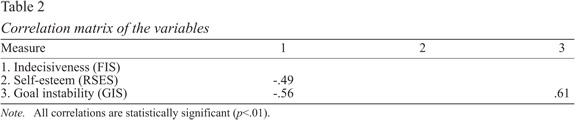
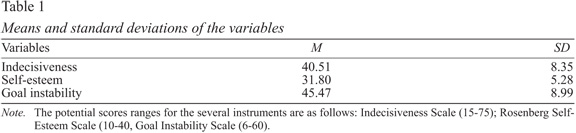
<body><![CDATA[<p>A confirmatory factor analysis of the Portuguese version of the RSES (Santos &amp; Maia, 2003) used in this study indicated that the scale  assessed one single factor and the internal consistency values (Cronbach&rsquo;s alpha) ranged from .84 to .90. High scores in the RSES were  positively correlated with satisfaction with life (Freire &amp; Tavares, 2011; Santos &amp; Maia, 2003), positive social and emotional aspects of  self-concept (Santos &amp; Maia, 2003), and feelings of happiness (Freire &amp; Tavares, 2011). In the present study, the internal consistency  value (Cronbach&rsquo;s alpha) was .88.</p>     <p>&nbsp;</p>     <p><i>Measurement of indecisiveness</i>. For the evaluation of indecisiveness, we used the Frost Indecisiveness Scale (FIS; Frost &amp; Shows,  1993), a 15-item scale that evaluates the degree of difficulty in making decisions. Nine items are worded negatively (e.g., &ldquo;I often worry  about making the wrong decision&rdquo;), and six positively (e.g., &ldquo;I like to be in a position to make decisions&rdquo;). A 5-point  Likert-type scale was used (<i>1=strongly disagree</i> to <i>5=strongly agree</i>). The positively worded items were reverse scored with higher  results reflecting a greater level of indecisiveness. College students with higher scores on FIS showed greater difficulties in making choices in  several aspects of their lives, including at the academic, social, and family levels (Frost &amp; Shows, 1993; Gayton, Clavin, Clavin, &amp;  Broida, 1994). Experimental research revealed that indecisive individuals search for more information before making a choice and take more time to  reach a decision (Frost &amp; Shows, 1993; Rassin, Muris, Booster, &amp; Kolsloot, 2008; Rassin, Muris, Franken, Smit, &amp; Wong, 2007). The  internal consistency (Cronbach&rsquo;s alpha) of FIS is high: in several studies, it ranged from .80 to .90 (Frost &amp; Gross, 1993; Frost &amp;  Shows, 1993; Gayton et al., 1994; Patalano &amp; Wengrovitz, 2007; Rassin &amp; Muris, 2005; Rassin et al., 2007). Rassin et al. (2007) found that  temporal stability is also adequate (correlation of .88 in a 1 month interval between evaluations).</p>     <p>The Portuguese version of the FIS employed in this study yielded suitable psychometric characteristics in several studies with secondary school  and college students: internal consistency coefficients (Cronbach&rsquo;s alphas) ranged from .77 to .83 and a .85 two-week test-retest coefficient  was obtained (Santos, 1997, 2001, 2007; Santos &amp; Ferreira, 2012). In addition, the scale scores were negatively correlated with the degree of  career certainty and positively correlated with personal-emotional and information dimensions of career indecision (Santos, 1997). In the present  study, the internal consistency reliability (Cronbach&rsquo;s alpha) was .80.</p>     <p>&nbsp;</p>     <p><b>Results</b></p>     <p>The means and standard deviations of the scores on each scale are provided in <a href="#t1">Table 1</a>. The correlation matrix of the variables  of the study is presented in <a href="#t2">Table 2</a>. The two measures of goal instability and self-esteem were correlated in the expected  directions with indecisiveness.</p>     <p>&nbsp;</p>     <p><a name="t1"></a></p>     <p><img src="/img/revistas/aps/v35n3/35n3a07t1.jpg" width="576" height="133"></p>     
]]></body>
<body><![CDATA[<p>&nbsp;</p>     <p>&nbsp;</p>     <p><a name="t2"></a></p>     <p><img src="/img/revistas/aps/v35n3/35n3a07t2.jpg" width="576" height="121"></p>     
<p>&nbsp;</p>     <p>To analyze the influence of goal instability and self-esteem in the manifestation of indecisiveness, we used simultaneous multiple regression,  which is, according to Wampold and Freund (1987), an appropriate strategy when there is no theoretical justification to order the entry of  variables. In the simultaneous regression analysis we performed, indecisiveness constituted the dependent variable, and goal instability and  self-esteem formed the set of independent variables. The overall equation was statistically significant, <i>F</i>(2,292)=81,136, <i>p</i>&lt;.0001,  and accounted for 35% of the variance (<i>R</i>=.60, adjusted <i>R</i><sup>2</sup>=.353). An analysis of the <i>t</i> tests for the individual  variables indicated that the two predictors were statistically significant (see <a href="#t3">Table 3</a>). Self-esteem and goal stability have a  negative linear relationship with indecisiveness. Inspection of the beta standardized coefficients showed that goal stability was a stronger  predictor (<i>&beta;</i>=-.42) than self-esteem (<i>&beta;</i>=-.24).</p>     <p>&nbsp;</p>     <p><a name="t3"></a></p>     <p><img src="/img/revistas/aps/v35n3/35n3a07t3.jpg" width="575" height="92"></p>     
<p>&nbsp;</p>     ]]></body>
<body><![CDATA[<p>&nbsp;</p>     <p><b>Discussion</b></b>     <p>The results of this study suggest that disturbances in the development of a child&rsquo;s idealizing, as well exhibitionistic and grandiose  needs are related with the development of indecisiveness. The negative psychological characteristics that indecisive individuals exhibit, as we  have already mentioned, could express a sense of a lack of self-cohesion of the self, according to the self-psychology of Heinz Kohut. This  interpretation proposes that dysfunction in cases of indecisiveness has roots in infancy. Caregivers of these individuals, when they were children,  were probably unable to function as good self-objects, with negative consequences on the development of global levels of affective regulation,  sense of self-worth, and a set of life goals.</p>     <p>Given the developmental situation of indecisive individuals, we would expect psychological interventions to be more extended than the usual  brief career interventions, a fact that has already received empirical support in a study by Heppner and Hendricks (1995). Interventions in cases  of indecisiveness should be prolonged, and expectedly difficult, because its causes are structural, intimately linked to the individuals&rsquo;  personality. Before dealing with the difficulties related with career choice, career counselors should be able to work with indecisive clients the  underlying causes of their problems in general, not only those circumscribed to the career domain. Until now, research on the efficacy of  psychotherapeutic interventions with indecisive clients is lacking and, consequently, guidelines that could help counselors in their work are  missing.</p>     <p>However, the psychotherapeutic intervention based on Kohut&rsquo;s self-psychology could be helpful in this regard. As in the person-centered  approach of Carl Rogers, Kohut believed that empathy was a vital ingredient in the psychotherapeutic process and change. He proposed that empathy  allows the therapist to function as a self-object for mirroring and idealizing the needs of his/her clients, reproducing the role that caregivers  did not fulfil in infancy. The emphatic process enables the process of transmuting internalization to occur and, as a consequence, clients  experience growth in self-esteem and in the establishment of life goals. It is important to test empirically this theoretical assumption using case  studies to explore the process and outcome of interventions targeted at overcoming indecisiveness, although we are aware of the difficulties of  this approach in long-term interventions.</p>     <p>This research used a psychological developmental framework to study indecisiveness. As already mentioned previously, this type of studies is  rare. However, we believe it is important to pursue this effort because it is vital to better understand the causes underlying the indecisive  disposition. Furthermore, the attachment theory (Bolwby, 1988) could be another potential theoretical framework to study indecisiveness. There is a  conceptual similarity between the works of Heinz Kohut and John Bowlby (see Banai et al., 2005), in the sense that both bestow the quality of  relationships caregivers develop during infancy with children a crucial role in their psychological adjustment and development. We believe an  insecure attachment to parents could be linked to indecisiveness, a fact that only future research can corroborate.</p>     <p>Although the results of this study were consistent with its theoretical assumptions, some limitations must be pointed out. First, because the  instruments used were self-report scales, social desirability processes may have influenced the results. Second, conclusions of a causal nature  cannot be drawn, as the relationships between variables are correlational. Finally, the sample used was urban and composed of adolescents. In  future studies, more diversified samples should be employed.</p>     <p>Despite these limitations, the present research reveals the pertinence of Kohut&rsquo;s theory for the understanding and intervention in  indecisiveness. A future path that may be followed consists in operationalizing other relevant constructs in this theory and more systematically  analyzing their relationship with several indicators of career development and behavior with indecisive individuals. Similarly, an analysis of the  effectiveness of the different types of career interventions (e.g., individual career counseling, group career counseling) according to the  clients&rsquo; specific characteristics, especially in relation to their level of maturation of the self, is an area that warrants further  study.</p>     <p>&nbsp;</p>     <p><b>References</b></p>     ]]></body>
<body><![CDATA[<p>Baker, H. S., &amp; Baker, M. N. (1987). Heinz Kohut&rsquo;s self-psychology: An overview. <i>American Journal of Psychiatry, 144</i>, 1-9.</p>     <p>Banai, E., Mikulincer, M., &amp; Shaver, P. R. (2005). &ldquo;Self-object&rdquo; needs in Kohut&rsquo;s self-psychology: Links with attachment,  self-cohesion, affect regulation, and adjustment. <i>Psychoanalytical Psychology, 22</i>, 224-260. doi: 10.1037/0736-9735.22.2.224</p>     <!-- ref --><p>Barret, T. C., &amp; Tinsley, H. E. A. (1977). Measuring vocational self-concept crystallization and vocational indecision. <i>Journal of  Vocational Behavior, 11</i>, 305-313. doi: 10.1016/0001-8791(77)90026-4&nbsp;&nbsp;&nbsp;&nbsp;&nbsp;&nbsp;&nbsp;&nbsp;[&#160;<a href="javascript:void(0);" onclick="javascript: window.open('/scielo.php?script=sci_nlinks&ref=031372&pid=S0870-8231201700030000700003&lng=','','width=640,height=500,resizable=yes,scrollbars=1,menubar=yes,');">Links</a>&#160;]<!-- end-ref --><!-- ref --><p>Bauman, Z. (2000). <i>Liquid modernity.</i> Cambridge: Polity.    &nbsp;&nbsp;&nbsp;&nbsp;&nbsp;&nbsp;&nbsp;&nbsp;[&#160;<a href="javascript:void(0);" onclick="javascript: window.open('/scielo.php?script=sci_nlinks&ref=031373&pid=S0870-8231201700030000700004&lng=','','width=640,height=500,resizable=yes,scrollbars=1,menubar=yes,');">Links</a>&#160;]<!-- end-ref --></p>     <!-- ref --><p>Bertoch, S. C., Lenz, J. G., Reardon, R. C., &amp; Peterson, G. W. (2014). Goal instability in relation to career thoughts, decision state, and  performance in a career course. <i>Journal of Career Development, 41</i>, 104-121. doi: 10.1177/0894845313482521&nbsp;&nbsp;&nbsp;&nbsp;&nbsp;&nbsp;&nbsp;&nbsp;[&#160;<a href="javascript:void(0);" onclick="javascript: window.open('/scielo.php?script=sci_nlinks&ref=031375&pid=S0870-8231201700030000700005&lng=','','width=640,height=500,resizable=yes,scrollbars=1,menubar=yes,');">Links</a>&#160;]<!-- end-ref --><!-- ref --><p>Blascovich, J., &amp; Tomaka, J. (1991). Measures of self-esteem. In J. P. Robinson, P. R. Shaver, &amp; L. S. Wrightsman (Eds.), <i>Measures of  personality and social psychological attitudes</i> (Vol. 1, pp. 115-160). San Diego, CA: Academic Press.    &nbsp;&nbsp;&nbsp;&nbsp;&nbsp;&nbsp;&nbsp;&nbsp;[&#160;<a href="javascript:void(0);" onclick="javascript: window.open('/scielo.php?script=sci_nlinks&ref=031376&pid=S0870-8231201700030000700006&lng=','','width=640,height=500,resizable=yes,scrollbars=1,menubar=yes,');">Links</a>&#160;]<!-- end-ref --></p>     <!-- ref --><p>Blustein, D. L. (1989). The role of goal instability and career self-efficacy in the career exploration process. <i>Journal of Vocational  Behavior, 35</i>, 194-203. doi: 10.1016/0001-8791(89)90040-7&nbsp;&nbsp;&nbsp;&nbsp;&nbsp;&nbsp;&nbsp;&nbsp;[&#160;<a href="javascript:void(0);" onclick="javascript: window.open('/scielo.php?script=sci_nlinks&ref=031378&pid=S0870-8231201700030000700007&lng=','','width=640,height=500,resizable=yes,scrollbars=1,menubar=yes,');">Links</a>&#160;]<!-- end-ref --><!-- ref --><p>Blustein, D. L., &amp; Palladino, D. E. (1991). Self and identity in late adolescence: A theoretical and empirical integration. <i>Journal of  Adolescent Research, 6</i>, 437-453. doi: 10.1177/074355489164005&nbsp;&nbsp;&nbsp;&nbsp;&nbsp;&nbsp;&nbsp;&nbsp;[&#160;<a href="javascript:void(0);" onclick="javascript: window.open('/scielo.php?script=sci_nlinks&ref=031379&pid=S0870-8231201700030000700008&lng=','','width=640,height=500,resizable=yes,scrollbars=1,menubar=yes,');">Links</a>&#160;]<!-- end-ref --><!-- ref --><p>Borgen, F. H. (1991). Megatrends and milestones in vocational behavior: A 20-year counseling psychology retrospective. <i>Journal of Vocational  Behavior, 39</i>, 263-290. doi: 10.1016/0001-8791(91)90037-M&nbsp;&nbsp;&nbsp;&nbsp;&nbsp;&nbsp;&nbsp;&nbsp;[&#160;<a href="javascript:void(0);" onclick="javascript: window.open('/scielo.php?script=sci_nlinks&ref=031380&pid=S0870-8231201700030000700009&lng=','','width=640,height=500,resizable=yes,scrollbars=1,menubar=yes,');">Links</a>&#160;]<!-- end-ref --><!-- ref --><p>Bowlby, J. (1988). <i>A secure base: Clinical applications of attachment theory.</i> London: Routledge.    &nbsp;&nbsp;&nbsp;&nbsp;&nbsp;&nbsp;&nbsp;&nbsp;[&#160;<a href="javascript:void(0);" onclick="javascript: window.open('/scielo.php?script=sci_nlinks&ref=031381&pid=S0870-8231201700030000700010&lng=','','width=640,height=500,resizable=yes,scrollbars=1,menubar=yes,');">Links</a>&#160;]<!-- end-ref --></p>     <!-- ref --><p>Chartrand, J. M., &amp; Camp, C. (1991). Advances in the measurement of career development constructs: A 20-year review. <i>Journal of  Vocational Behavior, 39</i>, 1-39. doi: 10.1016/0001-8791(91)90002-4&nbsp;&nbsp;&nbsp;&nbsp;&nbsp;&nbsp;&nbsp;&nbsp;[&#160;<a href="javascript:void(0);" onclick="javascript: window.open('/scielo.php?script=sci_nlinks&ref=031383&pid=S0870-8231201700030000700011&lng=','','width=640,height=500,resizable=yes,scrollbars=1,menubar=yes,');">Links</a>&#160;]<!-- end-ref --><!-- ref --><p>Chartrand, J. M., Robbins, S. B., Morrill, W. H., &amp; Boggs, K. (1990). Development and validation of the Career Factors Inventory. <i>Journal  of Counseling Psychology, 37</i>, 491-501. doi: 10.1037/0022-0167.37.4.491&nbsp;&nbsp;&nbsp;&nbsp;&nbsp;&nbsp;&nbsp;&nbsp;[&#160;<a href="javascript:void(0);" onclick="javascript: window.open('/scielo.php?script=sci_nlinks&ref=031384&pid=S0870-8231201700030000700012&lng=','','width=640,height=500,resizable=yes,scrollbars=1,menubar=yes,');">Links</a>&#160;]<!-- end-ref --><!-- ref --><p>Cohen, C. R., Chartrand, J. M., &amp; Jowdy, D. P. (1995). Relationships between career indecision subtypes and ego identity development.  <i>Journal of Counseling Psychology, 42</i>, 440-447. doi: 10.1037/0022-0167.42.4.440&nbsp;&nbsp;&nbsp;&nbsp;&nbsp;&nbsp;&nbsp;&nbsp;[&#160;<a href="javascript:void(0);" onclick="javascript: window.open('/scielo.php?script=sci_nlinks&ref=031385&pid=S0870-8231201700030000700013&lng=','','width=640,height=500,resizable=yes,scrollbars=1,menubar=yes,');">Links</a>&#160;]<!-- end-ref --><!-- ref --><p>Diener, E., &amp; Diener, M. (1995). Cross-cultural correlates of life satisfaction and self-esteem. <i>Journal of Personality and Social  Psychology, 68</i>, 653-663. doi: 10.1037/0022-3514.68.4.653&nbsp;&nbsp;&nbsp;&nbsp;&nbsp;&nbsp;&nbsp;&nbsp;[&#160;<a href="javascript:void(0);" onclick="javascript: window.open('/scielo.php?script=sci_nlinks&ref=031386&pid=S0870-8231201700030000700014&lng=','','width=640,height=500,resizable=yes,scrollbars=1,menubar=yes,');">Links</a>&#160;]<!-- end-ref --><!-- ref --><p>Elliott, T. R., Uswatte, G., Lewis, L., &amp; Palmatier, A. (2000). Goal instability and adjustment to physical disability. <i>Journal of  Counseling Psychology, 47</i>, 251-265. doi: 10.1037/0022-0167.47.2.251&nbsp;&nbsp;&nbsp;&nbsp;&nbsp;&nbsp;&nbsp;&nbsp;[&#160;<a href="javascript:void(0);" onclick="javascript: window.open('/scielo.php?script=sci_nlinks&ref=031387&pid=S0870-8231201700030000700015&lng=','','width=640,height=500,resizable=yes,scrollbars=1,menubar=yes,');">Links</a>&#160;]<!-- end-ref --><!-- ref --><p>Erikson, E. H. (1968). <i>Identity: Youth and crisis.</i> New York: Norton.    &nbsp;&nbsp;&nbsp;&nbsp;&nbsp;&nbsp;&nbsp;&nbsp;[&#160;<a href="javascript:void(0);" onclick="javascript: window.open('/scielo.php?script=sci_nlinks&ref=031388&pid=S0870-8231201700030000700016&lng=','','width=640,height=500,resizable=yes,scrollbars=1,menubar=yes,');">Links</a>&#160;]<!-- end-ref --></p>     ]]></body>
<body><![CDATA[<!-- ref --><p>Fleming, J. S., &amp; Courtney, B. E. (1984). The dimensionality of self-esteem: II. Hierarchical facet model for revised measurement scales.  <i>Journal of Personality and Social Psychology, 46</i>, 404-421. doi: 10.1037/0022-3514.46.2.404&nbsp;&nbsp;&nbsp;&nbsp;&nbsp;&nbsp;&nbsp;&nbsp;[&#160;<a href="javascript:void(0);" onclick="javascript: window.open('/scielo.php?script=sci_nlinks&ref=031390&pid=S0870-8231201700030000700017&lng=','','width=640,height=500,resizable=yes,scrollbars=1,menubar=yes,');">Links</a>&#160;]<!-- end-ref --><!-- ref --><p>Freire, T., &amp; Tavares, D. (2011). Influ&ecirc;ncia da autoestima, da regula&ccedil;&atilde;o emocional e do g&ecirc;nero no bem-estar  subjetivo e psicol&oacute;gico de adolescentes [Influence of self-esteem and emotion regulation in subjective and psychological well-being of  adolescents]. <i>Revista de Psiquiatria Cl&iacute;nica, 38</i>, 184-188.    &nbsp;&nbsp;&nbsp;&nbsp;&nbsp;&nbsp;&nbsp;&nbsp;[&#160;<a href="javascript:void(0);" onclick="javascript: window.open('/scielo.php?script=sci_nlinks&ref=031391&pid=S0870-8231201700030000700018&lng=','','width=640,height=500,resizable=yes,scrollbars=1,menubar=yes,');">Links</a>&#160;]<!-- end-ref --></p>     <!-- ref --><p>Frost, R. O., &amp; Gross, R. C. (1993). The hoarding of possessions. <i>Behavior Research Therapy, 31</i>, 367-381. doi:  10.1016/0005-7967(93)90094-B&nbsp;&nbsp;&nbsp;&nbsp;&nbsp;&nbsp;&nbsp;&nbsp;[&#160;<a href="javascript:void(0);" onclick="javascript: window.open('/scielo.php?script=sci_nlinks&ref=031393&pid=S0870-8231201700030000700019&lng=','','width=640,height=500,resizable=yes,scrollbars=1,menubar=yes,');">Links</a>&#160;]<!-- end-ref --><!-- ref --><p>Frost, R. O., &amp; Shows, D. L. (1993). The nature and measurement of compulsive indecisiveness. <i>Behavior Research Therapy, 31</i>, 683-692.  doi: 10.1016/0005-7967(93)90121-A&nbsp;&nbsp;&nbsp;&nbsp;&nbsp;&nbsp;&nbsp;&nbsp;[&#160;<a href="javascript:void(0);" onclick="javascript: window.open('/scielo.php?script=sci_nlinks&ref=031394&pid=S0870-8231201700030000700020&lng=','','width=640,height=500,resizable=yes,scrollbars=1,menubar=yes,');">Links</a>&#160;]<!-- end-ref --><!-- ref --><p>Fuqua, D. R., &amp; Hartman, B. W. (1983). Differential diagnosis and treatment of career indecision. <i>Personnel and Guidance Journal, 62</i>,  27-29. doi: 10.1111/j.2164-4918.1983.tb00112.x&nbsp;&nbsp;&nbsp;&nbsp;&nbsp;&nbsp;&nbsp;&nbsp;[&#160;<a href="javascript:void(0);" onclick="javascript: window.open('/scielo.php?script=sci_nlinks&ref=031395&pid=S0870-8231201700030000700021&lng=','','width=640,height=500,resizable=yes,scrollbars=1,menubar=yes,');">Links</a>&#160;]<!-- end-ref --><!-- ref --><p>Gayton, W. F., Clavin, R. H., Clavin, S. L., &amp; Broida, J. (1994). Further validation of the Indecisiveness Scale. <i>Psychological Reports,  75</i>, 1631-1634. doi: 10.2466/pr0.1994.75.3f.1631&nbsp;&nbsp;&nbsp;&nbsp;&nbsp;&nbsp;&nbsp;&nbsp;[&#160;<a href="javascript:void(0);" onclick="javascript: window.open('/scielo.php?script=sci_nlinks&ref=031396&pid=S0870-8231201700030000700022&lng=','','width=640,height=500,resizable=yes,scrollbars=1,menubar=yes,');">Links</a>&#160;]<!-- end-ref --><!-- ref --><p>Gray-Little, B., Williams, V. S. L., &amp; Hancock, T. D. (1997). An item response theory analysis of the Rosenberg Self-esteem Scale.  <i>Personality and Social Psychology Bulletin, 23</i>, 443-451. doi: 10.1177/0146167297235001&nbsp;&nbsp;&nbsp;&nbsp;&nbsp;&nbsp;&nbsp;&nbsp;[&#160;<a href="javascript:void(0);" onclick="javascript: window.open('/scielo.php?script=sci_nlinks&ref=031397&pid=S0870-8231201700030000700023&lng=','','width=640,height=500,resizable=yes,scrollbars=1,menubar=yes,');">Links</a>&#160;]<!-- end-ref --><!-- ref --><p>Hagborg, W. J. (1996). Scores of middle-school-age students on the Rosenberg Self-Esteem Scale. <i>Psychological Reports, 78</i>, 1071-1074.  doi: 10.2466/pr0.1996.78.3c.1071&nbsp;&nbsp;&nbsp;&nbsp;&nbsp;&nbsp;&nbsp;&nbsp;[&#160;<a href="javascript:void(0);" onclick="javascript: window.open('/scielo.php?script=sci_nlinks&ref=031398&pid=S0870-8231201700030000700024&lng=','','width=640,height=500,resizable=yes,scrollbars=1,menubar=yes,');">Links</a>&#160;]<!-- end-ref --><!-- ref --><p>Hartman, B. W., &amp; Fuqua, D. R. (1983). Career indecision from a multidimensional perspective: A reply to Grites. <i>School Counselor,  30</i>, 340-346.    &nbsp;&nbsp;&nbsp;&nbsp;&nbsp;&nbsp;&nbsp;&nbsp;[&#160;<a href="javascript:void(0);" onclick="javascript: window.open('/scielo.php?script=sci_nlinks&ref=031399&pid=S0870-8231201700030000700025&lng=','','width=640,height=500,resizable=yes,scrollbars=1,menubar=yes,');">Links</a>&#160;]<!-- end-ref --></p>     <!-- ref --><p>Heppner, M. J., &amp; Hendricks, F. (1995). A process and outcome study examining career indecision and indecisiveness. <i>Journal of Counseling  and Development, 73</i>, 426-437. doi: 10.1002/j.1556-6676.1995.tb01776.x&nbsp;&nbsp;&nbsp;&nbsp;&nbsp;&nbsp;&nbsp;&nbsp;[&#160;<a href="javascript:void(0);" onclick="javascript: window.open('/scielo.php?script=sci_nlinks&ref=031401&pid=S0870-8231201700030000700026&lng=','','width=640,height=500,resizable=yes,scrollbars=1,menubar=yes,');">Links</a>&#160;]<!-- end-ref --><!-- ref --><p>Kahn, E. (1985). Heinz Kohut and Carl Rogers: A timely comparison. <i>American Psychologist, 40</i>, 893-904. doi:  10.1037/0003-066X.40.8.893&nbsp;&nbsp;&nbsp;&nbsp;&nbsp;&nbsp;&nbsp;&nbsp;[&#160;<a href="javascript:void(0);" onclick="javascript: window.open('/scielo.php?script=sci_nlinks&ref=031402&pid=S0870-8231201700030000700027&lng=','','width=640,height=500,resizable=yes,scrollbars=1,menubar=yes,');">Links</a>&#160;]<!-- end-ref --><!-- ref --><p>Kelly, K. R., &amp; Lee, W.C. (2002). Mapping the domain of career indecision problems. <i>Journal of Vocational Behavior, 61</i>, 302-326.  Retrieved from <a href="http://dx.doi.org/10.1006/jvbe.2001.1858" target="_blank">http://dx.doi.org/10.1006/jvbe.2001.1858</a>&nbsp;&nbsp;&nbsp;&nbsp;&nbsp;&nbsp;&nbsp;&nbsp;[&#160;<a href="javascript:void(0);" onclick="javascript: window.open('/scielo.php?script=sci_nlinks&ref=031403&pid=S0870-8231201700030000700028&lng=','','width=640,height=500,resizable=yes,scrollbars=1,menubar=yes,');">Links</a>&#160;]<!-- end-ref --><!-- ref --><p>Kohut, H. (1971). <i>The analysis of the self</i>. New York: International Universities Press.    &nbsp;&nbsp;&nbsp;&nbsp;&nbsp;&nbsp;&nbsp;&nbsp;[&#160;<a href="javascript:void(0);" onclick="javascript: window.open('/scielo.php?script=sci_nlinks&ref=031404&pid=S0870-8231201700030000700029&lng=','','width=640,height=500,resizable=yes,scrollbars=1,menubar=yes,');">Links</a>&#160;]<!-- end-ref --></p>     <!-- ref --><p>Kohut, H. (1977). <i>The restoration of the self</i>. New York: International Universities Press.    &nbsp;&nbsp;&nbsp;&nbsp;&nbsp;&nbsp;&nbsp;&nbsp;[&#160;<a href="javascript:void(0);" onclick="javascript: window.open('/scielo.php?script=sci_nlinks&ref=031406&pid=S0870-8231201700030000700030&lng=','','width=640,height=500,resizable=yes,scrollbars=1,menubar=yes,');">Links</a>&#160;]<!-- end-ref --></p>     <!-- ref --><p>Kohut, H. (1984). <i>How does analysis cure?</i>. Chicago: University of Chicago Press.    &nbsp;&nbsp;&nbsp;&nbsp;&nbsp;&nbsp;&nbsp;&nbsp;[&#160;<a href="javascript:void(0);" onclick="javascript: window.open('/scielo.php?script=sci_nlinks&ref=031408&pid=S0870-8231201700030000700031&lng=','','width=640,height=500,resizable=yes,scrollbars=1,menubar=yes,');">Links</a>&#160;]<!-- end-ref --></p>     ]]></body>
<body><![CDATA[<!-- ref --><p>Lapan, R., &amp; Patton, M. J. (1986). Self-psychology and the adolescent process: Measures of pseudoautonomy and peer-group dependence.  <i>Journal of Counseling Psychology, 33</i>, 135-142. doi: 10.1037/0022-0167.33.2.136&nbsp;&nbsp;&nbsp;&nbsp;&nbsp;&nbsp;&nbsp;&nbsp;[&#160;<a href="javascript:void(0);" onclick="javascript: window.open('/scielo.php?script=sci_nlinks&ref=031410&pid=S0870-8231201700030000700032&lng=','','width=640,height=500,resizable=yes,scrollbars=1,menubar=yes,');">Links</a>&#160;]<!-- end-ref --><!-- ref --><p>Lese, K. S., &amp; Robbins, S. B. (1994). Relationship between goal attributes and the academic achievement of Southeast Asian adolescent  refugees. <i>Journal of Counseling Psychology, 41</i>, 45-52. doi: 10.1037/0022-0167.41.1.45&nbsp;&nbsp;&nbsp;&nbsp;&nbsp;&nbsp;&nbsp;&nbsp;[&#160;<a href="javascript:void(0);" onclick="javascript: window.open('/scielo.php?script=sci_nlinks&ref=031411&pid=S0870-8231201700030000700033&lng=','','width=640,height=500,resizable=yes,scrollbars=1,menubar=yes,');">Links</a>&#160;]<!-- end-ref --><!-- ref --><p>McCurdy, B. A., &amp; Kelly, D. B. (1997). Correlations of the MMPI-2 Low Self-Esteem Scale with two self-esteem measures. <i>Psychological  Reports, 81</i>, 826. doi: 10.2466/pr0.1997.81.3.826&nbsp;&nbsp;&nbsp;&nbsp;&nbsp;&nbsp;&nbsp;&nbsp;[&#160;<a href="javascript:void(0);" onclick="javascript: window.open('/scielo.php?script=sci_nlinks&ref=031412&pid=S0870-8231201700030000700034&lng=','','width=640,height=500,resizable=yes,scrollbars=1,menubar=yes,');">Links</a>&#160;]<!-- end-ref --><!-- ref --><p>Multon, K. D., Heppner, M. J., &amp; Lapan, R. T. (1995). An empirical derivation of career decision subtypes in a high school sample.  <i>Journal of Vocational Behavior, 47</i>, 76-92. doi: 10.1006/jvbe.1995.1030&nbsp;&nbsp;&nbsp;&nbsp;&nbsp;&nbsp;&nbsp;&nbsp;[&#160;<a href="javascript:void(0);" onclick="javascript: window.open('/scielo.php?script=sci_nlinks&ref=031413&pid=S0870-8231201700030000700035&lng=','','width=640,height=500,resizable=yes,scrollbars=1,menubar=yes,');">Links</a>&#160;]<!-- end-ref --><!-- ref --><p>Munson, W.W. (1992). Self-esteem, vocational identity, and career salience in high school students. <i>Career Development Quarterly, 40</i>,  361-368. doi: 10.1002/j.2161-0045.1992.tb00343.x&nbsp;&nbsp;&nbsp;&nbsp;&nbsp;&nbsp;&nbsp;&nbsp;[&#160;<a href="javascript:void(0);" onclick="javascript: window.open('/scielo.php?script=sci_nlinks&ref=031414&pid=S0870-8231201700030000700036&lng=','','width=640,height=500,resizable=yes,scrollbars=1,menubar=yes,');">Links</a>&#160;]<!-- end-ref --><!-- ref --><p>Patalano, A. L., &amp; Wengrovitz, S. M. (2007). Indecisiveness and response to risk in deciding when to decide. <i>Journal of Behavioral  Decision Making, 20</i>, 405-424. doi: 10.1002/bdm.560&nbsp;&nbsp;&nbsp;&nbsp;&nbsp;&nbsp;&nbsp;&nbsp;[&#160;<a href="javascript:void(0);" onclick="javascript: window.open('/scielo.php?script=sci_nlinks&ref=031415&pid=S0870-8231201700030000700037&lng=','','width=640,height=500,resizable=yes,scrollbars=1,menubar=yes,');">Links</a>&#160;]<!-- end-ref --><!-- ref --><p>Rassin, E., &amp; Muris, P. (2005). To be or not to be indecisive: Gender differences, correlations with obsessive-compulsive complaints, and  behavioural manifestation. <i>Personality and Individual Differences, 38</i>, 1175-1181. doi: 10.1016/j.paid.2004.07.014&nbsp;&nbsp;&nbsp;&nbsp;&nbsp;&nbsp;&nbsp;&nbsp;[&#160;<a href="javascript:void(0);" onclick="javascript: window.open('/scielo.php?script=sci_nlinks&ref=031416&pid=S0870-8231201700030000700038&lng=','','width=640,height=500,resizable=yes,scrollbars=1,menubar=yes,');">Links</a>&#160;]<!-- end-ref --><!-- ref --><p>Rassin, E., Muris, P., Booster, E., &amp; Kolsoot, I. (2008). Indecisiveness and informational tunnel vision. <i>Personality and Individual  Differences, 45</i>, 96-102. doi: 10.1016/j.paid.2008.03.006&nbsp;&nbsp;&nbsp;&nbsp;&nbsp;&nbsp;&nbsp;&nbsp;[&#160;<a href="javascript:void(0);" onclick="javascript: window.open('/scielo.php?script=sci_nlinks&ref=031417&pid=S0870-8231201700030000700039&lng=','','width=640,height=500,resizable=yes,scrollbars=1,menubar=yes,');">Links</a>&#160;]<!-- end-ref --><!-- ref --><p>Rassin, E., Muris, P., Franken, I., Smit, M., &amp; Wong, M. (2007). Measuring general indecisiveness. <i>Journal of Psychopathology and  Behavioral Assessment, 29</i>, 61-68. doi: 10.1007/s10862-006-9023-z&nbsp;&nbsp;&nbsp;&nbsp;&nbsp;&nbsp;&nbsp;&nbsp;[&#160;<a href="javascript:void(0);" onclick="javascript: window.open('/scielo.php?script=sci_nlinks&ref=031418&pid=S0870-8231201700030000700040&lng=','','width=640,height=500,resizable=yes,scrollbars=1,menubar=yes,');">Links</a>&#160;]<!-- end-ref --><!-- ref --><p>Robbins, S. B., Lese, K. S., &amp; Herrick, S. M. (1993). Interactions between goal instability and social support on college freshman  adjustment. <i>Journal of Counseling and Development, 71</i>, 343-348. doi: 10.1002/j.1556-6676.1993.tb02224.x&nbsp;&nbsp;&nbsp;&nbsp;&nbsp;&nbsp;&nbsp;&nbsp;[&#160;<a href="javascript:void(0);" onclick="javascript: window.open('/scielo.php?script=sci_nlinks&ref=031419&pid=S0870-8231201700030000700041&lng=','','width=640,height=500,resizable=yes,scrollbars=1,menubar=yes,');">Links</a>&#160;]<!-- end-ref --><!-- ref --><p>Robbins, S. B., &amp; Patton, M. J. (1985). Self-psychology and career development: Construction of the Superiority and Goal Instability  Scales. <i>Journal of Counseling Psychology, 32</i>, 221-231. doi: 10.1037/0022-0167.32.2.221&nbsp;&nbsp;&nbsp;&nbsp;&nbsp;&nbsp;&nbsp;&nbsp;[&#160;<a href="javascript:void(0);" onclick="javascript: window.open('/scielo.php?script=sci_nlinks&ref=031420&pid=S0870-8231201700030000700042&lng=','','width=640,height=500,resizable=yes,scrollbars=1,menubar=yes,');">Links</a>&#160;]<!-- end-ref --><!-- ref --><p>Robbins, S. B., Payne, E. C., &amp; Chartrand, J. M. (1990). Goal instability and later life adjustment. <i>Psychology and Aging, 5</i>,  447-450. doi: 10.1037/0882-7974.5.3.447&nbsp;&nbsp;&nbsp;&nbsp;&nbsp;&nbsp;&nbsp;&nbsp;[&#160;<a href="javascript:void(0);" onclick="javascript: window.open('/scielo.php?script=sci_nlinks&ref=031421&pid=S0870-8231201700030000700043&lng=','','width=640,height=500,resizable=yes,scrollbars=1,menubar=yes,');">Links</a>&#160;]<!-- end-ref --><p>Robbins, S. B., &amp; Schwitzer, A. M. (1988). Validity of the Superiority and Goal Instability Scales as predictors of women&rsquo;s adjustment  to college life. <i>Measurement and Evaluation in Counseling and Development, 21</i>, 117-123.</p>     <p>Robinson, D., &amp; Cooper, S. E. (1988). The relationship of Kohut&rsquo;s self-psychology to career choice certainty and satisfaction.  <i>Journal of College Student Development, 29</i>, 228-232.</p>     <!-- ref --><p>Rosenberg, M. (1965). <i>Society and the adolescent self-image</i>. Princeton: Princeton University Press.    &nbsp;&nbsp;&nbsp;&nbsp;&nbsp;&nbsp;&nbsp;&nbsp;[&#160;<a href="javascript:void(0);" onclick="javascript: window.open('/scielo.php?script=sci_nlinks&ref=031424&pid=S0870-8231201700030000700046&lng=','','width=640,height=500,resizable=yes,scrollbars=1,menubar=yes,');">Links</a>&#160;]<!-- end-ref --></p>     <!-- ref --><p>Salmela-Aro, K., &amp; Nurmi, J. E. (2007). Self-esteem during university studies predicts career characteristics 10 years later. <i>Journal of  Vocational Behavior, 70</i>, 463-477. doi: 10.1016/j.jvb.2007.01.006&nbsp;&nbsp;&nbsp;&nbsp;&nbsp;&nbsp;&nbsp;&nbsp;[&#160;<a href="javascript:void(0);" onclick="javascript: window.open('/scielo.php?script=sci_nlinks&ref=031426&pid=S0870-8231201700030000700047&lng=','','width=640,height=500,resizable=yes,scrollbars=1,menubar=yes,');">Links</a>&#160;]<!-- end-ref --><p>Salomone, P. R. (1982). Difficult cases in career counseling: II &ndash; The indecisive client. <i>Personnel and Guidance Journal, 60</i>,  496-500.</p>     <p>Santos, P. J. (1997). <i>Adolesc&ecirc;ncia e indecis&atilde;o vocacional</i> [Adolescence and career indecision]. Unpublished master&rsquo;s  thesis. Faculty of Psychology and Education, Porto University, Portugal.</p>     <!-- ref --><p>Santos, P. J. (2001). Predictors of generalized indecision among Portuguese secondary school students. <i>Journal of Career Assessment, 9</i>,  381-396. doi: 10.1177/106907270100900405&nbsp;&nbsp;&nbsp;&nbsp;&nbsp;&nbsp;&nbsp;&nbsp;[&#160;<a href="javascript:void(0);" onclick="javascript: window.open('/scielo.php?script=sci_nlinks&ref=031429&pid=S0870-8231201700030000700050&lng=','','width=640,height=500,resizable=yes,scrollbars=1,menubar=yes,');">Links</a>&#160;]<!-- end-ref --><!-- ref --><p>Santos, P. J. (2007). <i>Dificuldades de escolha vocacional</i> [Career decision making difficulties]. Coimbra: Almedina.    &nbsp;&nbsp;&nbsp;&nbsp;&nbsp;&nbsp;&nbsp;&nbsp;[&#160;<a href="javascript:void(0);" onclick="javascript: window.open('/scielo.php?script=sci_nlinks&ref=031430&pid=S0870-8231201700030000700051&lng=','','width=640,height=500,resizable=yes,scrollbars=1,menubar=yes,');">Links</a>&#160;]<!-- end-ref --></p>     <p>Santos, P. J., Casillas, A., &amp; Robbins, S. B. (2004). Motivational correlates of Portuguese high schoolers&rsquo; vocational identity:  Cultural validation of the Goal Instability Scale. <i>Journal of Career Assessment, 12</i>, 17-32. doi: 10.1177/1069072703257720</p>     <!-- ref --><p>Santos, P. J., &amp; Ferreira, J. A. (2012). Career decision statuses among Portuguese secondary school students. A cluster analytical approach.  <i>Journal of Career Assessment, 20</i>, 166-181. doi: 10.1177/1069072711420853&nbsp;&nbsp;&nbsp;&nbsp;&nbsp;&nbsp;&nbsp;&nbsp;[&#160;<a href="javascript:void(0);" onclick="javascript: window.open('/scielo.php?script=sci_nlinks&ref=031433&pid=S0870-8231201700030000700053&lng=','','width=640,height=500,resizable=yes,scrollbars=1,menubar=yes,');">Links</a>&#160;]<!-- end-ref --><!-- ref --><p>Santos, P. J., &amp; Maia, J. (2003). An&aacute;lise factorial confirmat&oacute;ria e valida&ccedil;&atilde;o preliminar de uma vers&atilde;o  portuguesa da Escala de Auto-Estima de Rosenberg [Confirmatory factor analysis and preliminary validation of a Portuguese version of Rosenberg  Self-esteem Scale ]. <i>Psicologia: Teoria, Investiga&ccedil;&atilde;o e Pr&aacute;tica, 8</i>, 253-268.    &nbsp;&nbsp;&nbsp;&nbsp;&nbsp;&nbsp;&nbsp;&nbsp;[&#160;<a href="javascript:void(0);" onclick="javascript: window.open('/scielo.php?script=sci_nlinks&ref=031434&pid=S0870-8231201700030000700054&lng=','','width=640,height=500,resizable=yes,scrollbars=1,menubar=yes,');">Links</a>&#160;]<!-- end-ref --></p>     <!-- ref --><p>Scott, K. J., &amp; Robbins, S. B. (1985). Goal instability: Implications for academic performance among students in learning skills courses.  <i>Journal of College Student Personnel, 26</i>, 129-133.    &nbsp;&nbsp;&nbsp;&nbsp;&nbsp;&nbsp;&nbsp;&nbsp;[&#160;<a href="javascript:void(0);" onclick="javascript: window.open('/scielo.php?script=sci_nlinks&ref=031436&pid=S0870-8231201700030000700055&lng=','','width=640,height=500,resizable=yes,scrollbars=1,menubar=yes,');">Links</a>&#160;]<!-- end-ref --></p>     <!-- ref --><p>Smith, L. C., &amp; Robbins, S. B. (1988). Validity of the Goal Instability Scale (modified) as a predictor of adjustment in retirement-age  adults. <i>Journal of Counseling Psychology, 35</i>, 325-329. doi: 10.1037/0022-0167.35.3.325&nbsp;&nbsp;&nbsp;&nbsp;&nbsp;&nbsp;&nbsp;&nbsp;[&#160;<a href="javascript:void(0);" onclick="javascript: window.open('/scielo.php?script=sci_nlinks&ref=031438&pid=S0870-8231201700030000700056&lng=','','width=640,height=500,resizable=yes,scrollbars=1,menubar=yes,');">Links</a>&#160;]<!-- end-ref --><!-- ref --><p>Stark, J. S., Bentley, R. J., Lowther, M. A., &amp; Shaw, K. M. (1991). The student goals exploration: Reliability and concurrent validity.  <i>Educational and Psychological Measurement, 51</i>, 413-422. doi: 10.1177/0013164491512015&nbsp;&nbsp;&nbsp;&nbsp;&nbsp;&nbsp;&nbsp;&nbsp;[&#160;<a href="javascript:void(0);" onclick="javascript: window.open('/scielo.php?script=sci_nlinks&ref=031439&pid=S0870-8231201700030000700057&lng=','','width=640,height=500,resizable=yes,scrollbars=1,menubar=yes,');">Links</a>&#160;]<!-- end-ref --><!-- ref --><p>Super, D. E. (1957). <i>The psychology of careers</i>. New York: Harper &amp; Row.    &nbsp;&nbsp;&nbsp;&nbsp;&nbsp;&nbsp;&nbsp;&nbsp;[&#160;<a href="javascript:void(0);" onclick="javascript: window.open('/scielo.php?script=sci_nlinks&ref=031440&pid=S0870-8231201700030000700058&lng=','','width=640,height=500,resizable=yes,scrollbars=1,menubar=yes,');">Links</a>&#160;]<!-- end-ref --></p>     <!-- ref --><p>Tiedeman, D. V. (1961). Decision and vocational development: A paradigm and its implications. <i>Personnel and Guidance Journal, 40</i>,  15-20.    &nbsp;&nbsp;&nbsp;&nbsp;&nbsp;&nbsp;&nbsp;&nbsp;[&#160;<a href="javascript:void(0);" onclick="javascript: window.open('/scielo.php?script=sci_nlinks&ref=031442&pid=S0870-8231201700030000700059&lng=','','width=640,height=500,resizable=yes,scrollbars=1,menubar=yes,');">Links</a>&#160;]<!-- end-ref --></p>     <!-- ref --><p>Wampold, B. E., &amp; Freund, R. D. (1987). Use of multiple regression in counseling psychology research: A flexible data-analytical strategy.  <i>Journal of Counseling Psychology, 34</i>, 372-382. doi: 10.1037/0022-0167.34.4.372&nbsp;&nbsp;&nbsp;&nbsp;&nbsp;&nbsp;&nbsp;&nbsp;[&#160;<a href="javascript:void(0);" onclick="javascript: window.open('/scielo.php?script=sci_nlinks&ref=031444&pid=S0870-8231201700030000700060&lng=','','width=640,height=500,resizable=yes,scrollbars=1,menubar=yes,');">Links</a>&#160;]<!-- end-ref --><!-- ref --><p>Watson, P. J., McKinney, J., Hawkins, C., &amp; Morris, R. J. (1988). Assertiveness and narcissism. <i>Psychotherapy, 25</i>, 125-131. doi:  10.1037/h0085308&nbsp;&nbsp;&nbsp;&nbsp;&nbsp;&nbsp;&nbsp;&nbsp;[&#160;<a href="javascript:void(0);" onclick="javascript: window.open('/scielo.php?script=sci_nlinks&ref=031445&pid=S0870-8231201700030000700061&lng=','','width=640,height=500,resizable=yes,scrollbars=1,menubar=yes,');">Links</a>&#160;]<!-- end-ref --><p>Wolfe, B. (1989). Heinz Kohut&rsquo;s psychology: A conceptual analysis. <i>Psychotherapy, 26</i>, 545-554. Retrieved from  <a href="http://dx.doi.org/10.1037/h0085475" target="_blank">http://dx.doi.org/10.1037/h0085475</a></p>     <p>&nbsp;</p>     <p><b><a name="c0" id="c0"></a><a href="#topc0">CORRESPONDÊNCIA</a></b></p>     <p>Correspondence concerning this article should be addressed to: Paulo Jorge Santos, Faculdade de Letras,Universidade do Porto,  Via Panor&acirc;mica, s/n, 4150-564 Porto, Portugal. E-mail: <a href="mailto:pjsosantos@sapo.pt">pjsosantos@sapo.pt</a></p>     ]]></body>
<body><![CDATA[<p>&nbsp;</p>     <p>This study was supported by FCT &ndash; Funda&ccedil;&atilde;o para a Ci&ecirc;ncia e Tecnologia, Project grant PEst-OE/PSI/UI0050/2014.</p>     <p>&nbsp;</p>     <p>Submitted: 09/04/2015 Accepted: 04/12/2016</p>      ]]></body><back>
<ref-list>
<ref id="B1">
<nlm-citation citation-type="journal">
<person-group person-group-type="author">
<name>
<surname><![CDATA[Baker]]></surname>
<given-names><![CDATA[H. S.]]></given-names>
</name>
<name>
<surname><![CDATA[Baker]]></surname>
<given-names><![CDATA[M. N.]]></given-names>
</name>
</person-group>
<article-title xml:lang="en"><![CDATA[Heinz Kohut’s self-psychology: An overview]]></article-title>
<source><![CDATA[American Journal of Psychiatry]]></source>
<year>1987</year>
<volume>144</volume>
<page-range>1-9</page-range></nlm-citation>
</ref>
<ref id="B2">
<nlm-citation citation-type="journal">
<person-group person-group-type="author">
<name>
<surname><![CDATA[Banai]]></surname>
<given-names><![CDATA[E.]]></given-names>
</name>
<name>
<surname><![CDATA[Mikulincer]]></surname>
<given-names><![CDATA[M.]]></given-names>
</name>
<name>
<surname><![CDATA[Shaver]]></surname>
<given-names><![CDATA[P. R.]]></given-names>
</name>
</person-group>
<article-title xml:lang="en"><![CDATA[“Self-object” needs in Kohut’s self-psychology: Links with attachment, self-cohesion, affect regulation, and adjustment]]></article-title>
<source><![CDATA[Psychoanalytical Psychology]]></source>
<year>2005</year>
<volume>22</volume>
<page-range>224-260</page-range></nlm-citation>
</ref>
<ref id="B3">
<nlm-citation citation-type="journal">
<person-group person-group-type="author">
<name>
<surname><![CDATA[Barret]]></surname>
<given-names><![CDATA[T. C.]]></given-names>
</name>
<name>
<surname><![CDATA[Tinsley]]></surname>
<given-names><![CDATA[H. E. A.]]></given-names>
</name>
</person-group>
<article-title xml:lang="en"><![CDATA[Measuring vocational self-concept crystallization and vocational indecision]]></article-title>
<source><![CDATA[Journal of Vocational Behavior]]></source>
<year>1977</year>
<volume>11</volume>
<page-range>305-313</page-range></nlm-citation>
</ref>
<ref id="B4">
<nlm-citation citation-type="book">
<person-group person-group-type="author">
<name>
<surname><![CDATA[Bauman]]></surname>
<given-names><![CDATA[Z.]]></given-names>
</name>
</person-group>
<source><![CDATA[Liquid modernity]]></source>
<year>2000</year>
<publisher-loc><![CDATA[Cambridge ]]></publisher-loc>
<publisher-name><![CDATA[Polity]]></publisher-name>
</nlm-citation>
</ref>
<ref id="B5">
<nlm-citation citation-type="journal">
<person-group person-group-type="author">
<name>
<surname><![CDATA[Bertoch]]></surname>
<given-names><![CDATA[S. C.]]></given-names>
</name>
<name>
<surname><![CDATA[Lenz]]></surname>
<given-names><![CDATA[J. G.]]></given-names>
</name>
<name>
<surname><![CDATA[Reardon]]></surname>
<given-names><![CDATA[R. C.]]></given-names>
</name>
<name>
<surname><![CDATA[Peterson]]></surname>
<given-names><![CDATA[G. W.]]></given-names>
</name>
</person-group>
<article-title xml:lang="en"><![CDATA[Goal instability in relation to career thoughts, decision state, and performance in a career course]]></article-title>
<source><![CDATA[Journal of Career Development]]></source>
<year>2014</year>
<volume>41</volume>
<page-range>104-121</page-range></nlm-citation>
</ref>
<ref id="B6">
<nlm-citation citation-type="book">
<person-group person-group-type="author">
<name>
<surname><![CDATA[Blascovich]]></surname>
<given-names><![CDATA[J.]]></given-names>
</name>
<name>
<surname><![CDATA[Tomaka]]></surname>
<given-names><![CDATA[J.]]></given-names>
</name>
</person-group>
<article-title xml:lang="en"><![CDATA[Measures of self-esteem]]></article-title>
<person-group person-group-type="editor">
<name>
<surname><![CDATA[Robinson]]></surname>
<given-names><![CDATA[J. P.]]></given-names>
</name>
<name>
<surname><![CDATA[Shaver]]></surname>
<given-names><![CDATA[P. R.]]></given-names>
</name>
<name>
<surname><![CDATA[Wrightsman]]></surname>
<given-names><![CDATA[L. S.]]></given-names>
</name>
</person-group>
<source><![CDATA[Measures of personality and social psychological attitudes]]></source>
<year>1991</year>
<volume>1</volume>
<page-range>115-160</page-range><publisher-loc><![CDATA[San Diego ]]></publisher-loc>
<publisher-name><![CDATA[Academic Press]]></publisher-name>
</nlm-citation>
</ref>
<ref id="B7">
<nlm-citation citation-type="journal">
<person-group person-group-type="author">
<name>
<surname><![CDATA[Blustein]]></surname>
<given-names><![CDATA[D. L.]]></given-names>
</name>
</person-group>
<article-title xml:lang="en"><![CDATA[The role of goal instability and career self-efficacy in the career exploration process]]></article-title>
<source><![CDATA[Journal of Vocational Behavior]]></source>
<year>1989</year>
<volume>35</volume>
<page-range>194-203</page-range></nlm-citation>
</ref>
<ref id="B8">
<nlm-citation citation-type="journal">
<person-group person-group-type="author">
<name>
<surname><![CDATA[Blustein]]></surname>
<given-names><![CDATA[D. L.]]></given-names>
</name>
<name>
<surname><![CDATA[Palladino]]></surname>
<given-names><![CDATA[D. E.]]></given-names>
</name>
</person-group>
<article-title xml:lang="en"><![CDATA[Self and identity in late adolescence: A theoretical and empirical integration]]></article-title>
<source><![CDATA[Journal of Adolescent Research]]></source>
<year>1991</year>
<volume>6</volume>
<page-range>437-453</page-range></nlm-citation>
</ref>
<ref id="B9">
<nlm-citation citation-type="journal">
<person-group person-group-type="author">
<name>
<surname><![CDATA[Borgen]]></surname>
<given-names><![CDATA[F. H.]]></given-names>
</name>
</person-group>
<article-title xml:lang="en"><![CDATA[Megatrends and milestones in vocational behavior: A 20-year counseling psychology retrospective]]></article-title>
<source><![CDATA[Journal of Vocational Behavior]]></source>
<year>1991</year>
<volume>39</volume>
<page-range>263-290</page-range></nlm-citation>
</ref>
<ref id="B10">
<nlm-citation citation-type="book">
<person-group person-group-type="author">
<name>
<surname><![CDATA[Bowlby]]></surname>
<given-names><![CDATA[J.]]></given-names>
</name>
</person-group>
<source><![CDATA[A secure base: Clinical applications of attachment theory]]></source>
<year>1988</year>
<publisher-loc><![CDATA[London ]]></publisher-loc>
<publisher-name><![CDATA[Routledge]]></publisher-name>
</nlm-citation>
</ref>
<ref id="B11">
<nlm-citation citation-type="journal">
<person-group person-group-type="author">
<name>
<surname><![CDATA[Chartrand]]></surname>
<given-names><![CDATA[J. M.]]></given-names>
</name>
<name>
<surname><![CDATA[Camp]]></surname>
<given-names><![CDATA[C.]]></given-names>
</name>
</person-group>
<article-title xml:lang="en"><![CDATA[Advances in the measurement of career development constructs: A 20-year review]]></article-title>
<source><![CDATA[Journal of Vocational Behavior]]></source>
<year>1991</year>
<volume>39</volume>
<page-range>1-39</page-range></nlm-citation>
</ref>
<ref id="B12">
<nlm-citation citation-type="journal">
<person-group person-group-type="author">
<name>
<surname><![CDATA[Chartrand]]></surname>
<given-names><![CDATA[J. M.]]></given-names>
</name>
<name>
<surname><![CDATA[Robbins]]></surname>
<given-names><![CDATA[S. B.]]></given-names>
</name>
<name>
<surname><![CDATA[Morrill]]></surname>
<given-names><![CDATA[W. H.]]></given-names>
</name>
<name>
<surname><![CDATA[Boggs]]></surname>
<given-names><![CDATA[K.]]></given-names>
</name>
</person-group>
<article-title xml:lang="en"><![CDATA[Development and validation of the Career Factors Inventory]]></article-title>
<source><![CDATA[Journal of Counseling Psychology]]></source>
<year>1990</year>
<volume>37</volume>
<page-range>491-501</page-range></nlm-citation>
</ref>
<ref id="B13">
<nlm-citation citation-type="journal">
<person-group person-group-type="author">
<name>
<surname><![CDATA[Cohen]]></surname>
<given-names><![CDATA[C. R.]]></given-names>
</name>
<name>
<surname><![CDATA[Chartrand]]></surname>
<given-names><![CDATA[J. M.]]></given-names>
</name>
<name>
<surname><![CDATA[Jowdy]]></surname>
<given-names><![CDATA[D. P.]]></given-names>
</name>
</person-group>
<article-title xml:lang="en"><![CDATA[Relationships between career indecision subtypes and ego identity development]]></article-title>
<source><![CDATA[Journal of Counseling Psychology]]></source>
<year>1995</year>
<volume>42</volume>
<page-range>440-447</page-range></nlm-citation>
</ref>
<ref id="B14">
<nlm-citation citation-type="journal">
<person-group person-group-type="author">
<name>
<surname><![CDATA[Diener]]></surname>
<given-names><![CDATA[E.]]></given-names>
</name>
<name>
<surname><![CDATA[Diener]]></surname>
<given-names><![CDATA[M.]]></given-names>
</name>
</person-group>
<article-title xml:lang="en"><![CDATA[Cross-cultural correlates of life satisfaction and self-esteem]]></article-title>
<source><![CDATA[Journal of Personality and Social Psychology]]></source>
<year>1995</year>
<volume>68</volume>
<page-range>653-663</page-range></nlm-citation>
</ref>
<ref id="B15">
<nlm-citation citation-type="journal">
<person-group person-group-type="author">
<name>
<surname><![CDATA[Elliott]]></surname>
<given-names><![CDATA[T. R.]]></given-names>
</name>
<name>
<surname><![CDATA[Uswatte]]></surname>
<given-names><![CDATA[G.]]></given-names>
</name>
<name>
<surname><![CDATA[Lewis]]></surname>
<given-names><![CDATA[L.]]></given-names>
</name>
<name>
<surname><![CDATA[Palmatier]]></surname>
<given-names><![CDATA[A.]]></given-names>
</name>
</person-group>
<article-title xml:lang="en"><![CDATA[Goal instability and adjustment to physical disability]]></article-title>
<source><![CDATA[Journal of Counseling Psychology]]></source>
<year>2000</year>
<volume>47</volume>
<page-range>251-265</page-range></nlm-citation>
</ref>
<ref id="B16">
<nlm-citation citation-type="book">
<person-group person-group-type="author">
<name>
<surname><![CDATA[Erikson]]></surname>
<given-names><![CDATA[E. H.]]></given-names>
</name>
</person-group>
<source><![CDATA[Identity: Youth and crisis]]></source>
<year>1968</year>
<publisher-loc><![CDATA[New York ]]></publisher-loc>
<publisher-name><![CDATA[Norton]]></publisher-name>
</nlm-citation>
</ref>
<ref id="B17">
<nlm-citation citation-type="journal">
<person-group person-group-type="author">
<name>
<surname><![CDATA[Fleming]]></surname>
<given-names><![CDATA[J. S.]]></given-names>
</name>
<name>
<surname><![CDATA[Courtney]]></surname>
<given-names><![CDATA[B. E.]]></given-names>
</name>
</person-group>
<article-title xml:lang="en"><![CDATA[The dimensionality of self-esteem: II]]></article-title>
<source><![CDATA[Hierarchical facet model for revised measurement scales. Journal of Personality and Social Psychology]]></source>
<year>1984</year>
<volume>46</volume>
<page-range>404-421</page-range></nlm-citation>
</ref>
<ref id="B18">
<nlm-citation citation-type="journal">
<person-group person-group-type="author">
<name>
<surname><![CDATA[Freire]]></surname>
<given-names><![CDATA[T.]]></given-names>
</name>
<name>
<surname><![CDATA[Tavares]]></surname>
<given-names><![CDATA[D.]]></given-names>
</name>
</person-group>
<article-title xml:lang="pt"><![CDATA[Influência da autoestima, da regulação emocional e do gênero no bem-estar subjetivo e psicológico de adolescentes]]></article-title>
<source><![CDATA[Revista de Psiquiatria Clínica]]></source>
<year>2011</year>
<volume>38</volume>
<page-range>184-188</page-range></nlm-citation>
</ref>
<ref id="B19">
<nlm-citation citation-type="journal">
<person-group person-group-type="author">
<name>
<surname><![CDATA[Frost]]></surname>
<given-names><![CDATA[R. O.]]></given-names>
</name>
<name>
<surname><![CDATA[Gross]]></surname>
<given-names><![CDATA[R. C.]]></given-names>
</name>
</person-group>
<article-title xml:lang="en"><![CDATA[The hoarding of possessions]]></article-title>
<source><![CDATA[Behavior Research Therapy]]></source>
<year>1993</year>
<volume>31</volume>
<page-range>367-381</page-range></nlm-citation>
</ref>
<ref id="B20">
<nlm-citation citation-type="journal">
<person-group person-group-type="author">
<name>
<surname><![CDATA[Frost]]></surname>
<given-names><![CDATA[R. O.]]></given-names>
</name>
<name>
<surname><![CDATA[Shows]]></surname>
<given-names><![CDATA[D. L.]]></given-names>
</name>
</person-group>
<article-title xml:lang="en"><![CDATA[The nature and measurement of compulsive indecisiveness]]></article-title>
<source><![CDATA[Behavior Research Therapy]]></source>
<year>1993</year>
<volume>31</volume>
<page-range>683-692</page-range></nlm-citation>
</ref>
<ref id="B21">
<nlm-citation citation-type="journal">
<person-group person-group-type="author">
<name>
<surname><![CDATA[Fuqua]]></surname>
<given-names><![CDATA[D. R.]]></given-names>
</name>
<name>
<surname><![CDATA[Hartman]]></surname>
<given-names><![CDATA[B. W.]]></given-names>
</name>
</person-group>
<article-title xml:lang="en"><![CDATA[Differential diagnosis and treatment of career indecision]]></article-title>
<source><![CDATA[Personnel and Guidance Journal]]></source>
<year>1983</year>
<volume>62</volume>
<page-range>27-29</page-range></nlm-citation>
</ref>
<ref id="B22">
<nlm-citation citation-type="journal">
<person-group person-group-type="author">
<name>
<surname><![CDATA[Gayton]]></surname>
<given-names><![CDATA[W. F.]]></given-names>
</name>
<name>
<surname><![CDATA[Clavin]]></surname>
<given-names><![CDATA[R. H.]]></given-names>
</name>
<name>
<surname><![CDATA[Clavin]]></surname>
<given-names><![CDATA[S. L.]]></given-names>
</name>
<name>
<surname><![CDATA[Broida]]></surname>
<given-names><![CDATA[J.]]></given-names>
</name>
</person-group>
<article-title xml:lang="en"><![CDATA[Further validation of the Indecisiveness Scale]]></article-title>
<source><![CDATA[Psychological Reports]]></source>
<year>1994</year>
<volume>75</volume>
<page-range>1631-1634</page-range></nlm-citation>
</ref>
<ref id="B23">
<nlm-citation citation-type="journal">
<person-group person-group-type="author">
<name>
<surname><![CDATA[Gray-Little]]></surname>
<given-names><![CDATA[B.]]></given-names>
</name>
<name>
<surname><![CDATA[Williams]]></surname>
<given-names><![CDATA[V. S. L.]]></given-names>
</name>
<name>
<surname><![CDATA[Hancock]]></surname>
<given-names><![CDATA[T. D.]]></given-names>
</name>
</person-group>
<article-title xml:lang="en"><![CDATA[An item response theory analysis of the Rosenberg Self-esteem Scale]]></article-title>
<source><![CDATA[Personality and Social Psychology Bulletin]]></source>
<year>1997</year>
<volume>23</volume>
<page-range>443-451</page-range></nlm-citation>
</ref>
<ref id="B24">
<nlm-citation citation-type="journal">
<person-group person-group-type="author">
<name>
<surname><![CDATA[Hagborg]]></surname>
<given-names><![CDATA[W. J.]]></given-names>
</name>
</person-group>
<article-title xml:lang="en"><![CDATA[Scores of middle-school-age students on the Rosenberg Self-Esteem Scale]]></article-title>
<source><![CDATA[Psychological Reports]]></source>
<year>1996</year>
<volume>78</volume>
<page-range>1071-1074</page-range></nlm-citation>
</ref>
<ref id="B25">
<nlm-citation citation-type="journal">
<person-group person-group-type="author">
<name>
<surname><![CDATA[Hartman]]></surname>
<given-names><![CDATA[B. W.]]></given-names>
</name>
<name>
<surname><![CDATA[Fuqua]]></surname>
<given-names><![CDATA[D. R.]]></given-names>
</name>
</person-group>
<article-title xml:lang="en"><![CDATA[Career indecision from a multidimensional perspective: A reply to Grites]]></article-title>
<source><![CDATA[School Counselor]]></source>
<year>1983</year>
<volume>30</volume>
<page-range>340-346</page-range></nlm-citation>
</ref>
<ref id="B26">
<nlm-citation citation-type="journal">
<person-group person-group-type="author">
<name>
<surname><![CDATA[Heppner]]></surname>
<given-names><![CDATA[M. J.]]></given-names>
</name>
<name>
<surname><![CDATA[Hendricks]]></surname>
<given-names><![CDATA[F.]]></given-names>
</name>
</person-group>
<article-title xml:lang="en"><![CDATA[A process and outcome study examining career indecision and indecisiveness]]></article-title>
<source><![CDATA[Journal of Counseling and Development]]></source>
<year>1995</year>
<volume>73</volume>
<page-range>426-437</page-range></nlm-citation>
</ref>
<ref id="B27">
<nlm-citation citation-type="journal">
<person-group person-group-type="author">
<name>
<surname><![CDATA[Kahn]]></surname>
<given-names><![CDATA[E.]]></given-names>
</name>
</person-group>
<article-title xml:lang="en"><![CDATA[Heinz Kohut and Carl Rogers: A timely comparison]]></article-title>
<source><![CDATA[American Psychologist]]></source>
<year>1985</year>
<volume>40</volume>
<page-range>893-904</page-range></nlm-citation>
</ref>
<ref id="B28">
<nlm-citation citation-type="journal">
<person-group person-group-type="author">
<name>
<surname><![CDATA[Kelly]]></surname>
<given-names><![CDATA[K. R.]]></given-names>
</name>
<name>
<surname><![CDATA[Lee]]></surname>
<given-names><![CDATA[W.C.]]></given-names>
</name>
</person-group>
<article-title xml:lang="en"><![CDATA[Mapping the domain of career indecision problems]]></article-title>
<source><![CDATA[Journal of Vocational Behavior]]></source>
<year>2002</year>
<volume>61</volume>
<page-range>302-326</page-range></nlm-citation>
</ref>
<ref id="B29">
<nlm-citation citation-type="book">
<person-group person-group-type="author">
<name>
<surname><![CDATA[Kohut]]></surname>
<given-names><![CDATA[H.]]></given-names>
</name>
</person-group>
<source><![CDATA[The analysis of the self]]></source>
<year>1971</year>
<publisher-loc><![CDATA[New York ]]></publisher-loc>
<publisher-name><![CDATA[International Universities Press]]></publisher-name>
</nlm-citation>
</ref>
<ref id="B30">
<nlm-citation citation-type="book">
<person-group person-group-type="author">
<name>
<surname><![CDATA[Kohut]]></surname>
<given-names><![CDATA[H.]]></given-names>
</name>
</person-group>
<source><![CDATA[The restoration of the self]]></source>
<year>1977</year>
<publisher-loc><![CDATA[New York ]]></publisher-loc>
<publisher-name><![CDATA[International Universities Press]]></publisher-name>
</nlm-citation>
</ref>
<ref id="B31">
<nlm-citation citation-type="book">
<person-group person-group-type="author">
<name>
<surname><![CDATA[Kohut]]></surname>
<given-names><![CDATA[H.]]></given-names>
</name>
</person-group>
<source><![CDATA[How does analysis cure?]]></source>
<year>1984</year>
<publisher-loc><![CDATA[Chicago ]]></publisher-loc>
<publisher-name><![CDATA[University of Chicago Press]]></publisher-name>
</nlm-citation>
</ref>
<ref id="B32">
<nlm-citation citation-type="journal">
<person-group person-group-type="author">
<name>
<surname><![CDATA[Lapan]]></surname>
<given-names><![CDATA[R.]]></given-names>
</name>
<name>
<surname><![CDATA[Patton]]></surname>
<given-names><![CDATA[M. J.]]></given-names>
</name>
</person-group>
<article-title xml:lang="en"><![CDATA[Self-psychology and the adolescent process: Measures of pseudoautonomy and peer-group dependence]]></article-title>
<source><![CDATA[Journal of Counseling Psychology]]></source>
<year>1986</year>
<volume>33</volume>
<page-range>135-142</page-range></nlm-citation>
</ref>
<ref id="B33">
<nlm-citation citation-type="journal">
<person-group person-group-type="author">
<name>
<surname><![CDATA[Lese]]></surname>
<given-names><![CDATA[K. S.]]></given-names>
</name>
<name>
<surname><![CDATA[Robbins]]></surname>
<given-names><![CDATA[S. B.]]></given-names>
</name>
</person-group>
<article-title xml:lang="en"><![CDATA[Relationship between goal attributes and the academic achievement of Southeast Asian adolescent refugees]]></article-title>
<source><![CDATA[Journal of Counseling Psychology]]></source>
<year>1994</year>
<volume>41</volume>
<page-range>45-52</page-range></nlm-citation>
</ref>
<ref id="B34">
<nlm-citation citation-type="journal">
<person-group person-group-type="author">
<name>
<surname><![CDATA[McCurdy]]></surname>
<given-names><![CDATA[B. A.]]></given-names>
</name>
<name>
<surname><![CDATA[Kelly]]></surname>
<given-names><![CDATA[D. B.]]></given-names>
</name>
</person-group>
<article-title xml:lang="en"><![CDATA[Correlations of the MMPI-2 Low Self-Esteem Scale with two self-esteem measures]]></article-title>
<source><![CDATA[Psychological Reports]]></source>
<year>1997</year>
<volume>81</volume>
<page-range>826</page-range></nlm-citation>
</ref>
<ref id="B35">
<nlm-citation citation-type="journal">
<person-group person-group-type="author">
<name>
<surname><![CDATA[Multon]]></surname>
<given-names><![CDATA[K. D.]]></given-names>
</name>
<name>
<surname><![CDATA[Heppner]]></surname>
<given-names><![CDATA[M. J.]]></given-names>
</name>
<name>
<surname><![CDATA[Lapan]]></surname>
<given-names><![CDATA[R. T.]]></given-names>
</name>
</person-group>
<article-title xml:lang="en"><![CDATA[An empirical derivation of career decision subtypes in a high school sample]]></article-title>
<source><![CDATA[Journal of Vocational Behavior]]></source>
<year>1995</year>
<volume>47</volume>
<page-range>76-92</page-range></nlm-citation>
</ref>
<ref id="B36">
<nlm-citation citation-type="journal">
<person-group person-group-type="author">
<name>
<surname><![CDATA[Munson]]></surname>
<given-names><![CDATA[W.W.]]></given-names>
</name>
</person-group>
<article-title xml:lang="en"><![CDATA[Self-esteem, vocational identity, and career salience in high school students]]></article-title>
<source><![CDATA[Career Development Quarterly]]></source>
<year>1992</year>
<volume>40</volume>
<page-range>361-368</page-range></nlm-citation>
</ref>
<ref id="B37">
<nlm-citation citation-type="journal">
<person-group person-group-type="author">
<name>
<surname><![CDATA[Patalano]]></surname>
<given-names><![CDATA[A. L.]]></given-names>
</name>
<name>
<surname><![CDATA[Wengrovitz]]></surname>
<given-names><![CDATA[S. M.]]></given-names>
</name>
</person-group>
<article-title xml:lang="en"><![CDATA[Indecisiveness and response to risk in deciding when to decide]]></article-title>
<source><![CDATA[Journal of Behavioral Decision Making]]></source>
<year>2007</year>
<volume>20</volume>
<page-range>405-424</page-range></nlm-citation>
</ref>
<ref id="B38">
<nlm-citation citation-type="journal">
<person-group person-group-type="author">
<name>
<surname><![CDATA[Rassin]]></surname>
<given-names><![CDATA[E.]]></given-names>
</name>
<name>
<surname><![CDATA[Muris]]></surname>
<given-names><![CDATA[P.]]></given-names>
</name>
</person-group>
<article-title xml:lang="en"><![CDATA[To be or not to be indecisive: Gender differences, correlations with obsessive-compulsive complaints, and behavioural manifestation]]></article-title>
<source><![CDATA[Personality and Individual Differences]]></source>
<year>2005</year>
<volume>38</volume>
<page-range>1175-1181</page-range></nlm-citation>
</ref>
<ref id="B39">
<nlm-citation citation-type="journal">
<person-group person-group-type="author">
<name>
<surname><![CDATA[Rassin]]></surname>
<given-names><![CDATA[E.]]></given-names>
</name>
<name>
<surname><![CDATA[Muris]]></surname>
<given-names><![CDATA[P.]]></given-names>
</name>
<name>
<surname><![CDATA[Booster]]></surname>
<given-names><![CDATA[E.]]></given-names>
</name>
<name>
<surname><![CDATA[Kolsoot]]></surname>
<given-names><![CDATA[I.]]></given-names>
</name>
</person-group>
<article-title xml:lang="en"><![CDATA[Indecisiveness and informational tunnel vision]]></article-title>
<source><![CDATA[Personality and Individual Differences]]></source>
<year>2008</year>
<volume>45</volume>
<page-range>96-102</page-range></nlm-citation>
</ref>
<ref id="B40">
<nlm-citation citation-type="journal">
<person-group person-group-type="author">
<name>
<surname><![CDATA[Rassin]]></surname>
<given-names><![CDATA[E.]]></given-names>
</name>
<name>
<surname><![CDATA[Muris]]></surname>
<given-names><![CDATA[P.]]></given-names>
</name>
<name>
<surname><![CDATA[Franken]]></surname>
<given-names><![CDATA[I.]]></given-names>
</name>
<name>
<surname><![CDATA[Smit]]></surname>
<given-names><![CDATA[M.]]></given-names>
</name>
<name>
<surname><![CDATA[Wong]]></surname>
<given-names><![CDATA[M.]]></given-names>
</name>
</person-group>
<article-title xml:lang="en"><![CDATA[Measuring general indecisiveness]]></article-title>
<source><![CDATA[Journal of Psychopathology and Behavioral Assessment]]></source>
<year>2007</year>
<volume>29</volume>
<page-range>61-68</page-range></nlm-citation>
</ref>
<ref id="B41">
<nlm-citation citation-type="journal">
<person-group person-group-type="author">
<name>
<surname><![CDATA[Robbins]]></surname>
<given-names><![CDATA[S. B.]]></given-names>
</name>
<name>
<surname><![CDATA[Lese]]></surname>
<given-names><![CDATA[K. S.]]></given-names>
</name>
<name>
<surname><![CDATA[Herrick]]></surname>
<given-names><![CDATA[S. M.]]></given-names>
</name>
</person-group>
<article-title xml:lang="en"><![CDATA[Interactions between goal instability and social support on college freshman adjustment]]></article-title>
<source><![CDATA[Journal of Counseling and Development]]></source>
<year>1993</year>
<volume>71</volume>
<page-range>343-348</page-range></nlm-citation>
</ref>
<ref id="B42">
<nlm-citation citation-type="journal">
<person-group person-group-type="author">
<name>
<surname><![CDATA[Robbins]]></surname>
<given-names><![CDATA[S. B.]]></given-names>
</name>
<name>
<surname><![CDATA[Patton]]></surname>
<given-names><![CDATA[M. J.]]></given-names>
</name>
</person-group>
<article-title xml:lang="en"><![CDATA[Self-psychology and career development: Construction of the Superiority and Goal Instability Scales]]></article-title>
<source><![CDATA[Journal of Counseling Psychology]]></source>
<year>1985</year>
<volume>32</volume>
<page-range>221-231</page-range></nlm-citation>
</ref>
<ref id="B43">
<nlm-citation citation-type="journal">
<person-group person-group-type="author">
<name>
<surname><![CDATA[Robbins]]></surname>
<given-names><![CDATA[S. B.]]></given-names>
</name>
<name>
<surname><![CDATA[Payne]]></surname>
<given-names><![CDATA[E. C.]]></given-names>
</name>
<name>
<surname><![CDATA[Chartrand]]></surname>
<given-names><![CDATA[J. M.]]></given-names>
</name>
</person-group>
<article-title xml:lang="en"><![CDATA[Goal instability and later life adjustment]]></article-title>
<source><![CDATA[Psychology and Aging]]></source>
<year>1990</year>
<volume>5</volume>
<page-range>447-450</page-range></nlm-citation>
</ref>
<ref id="B44">
<nlm-citation citation-type="journal">
<person-group person-group-type="author">
<name>
<surname><![CDATA[Robbins]]></surname>
<given-names><![CDATA[S. B.]]></given-names>
</name>
<name>
<surname><![CDATA[Schwitzer]]></surname>
<given-names><![CDATA[A. M.]]></given-names>
</name>
</person-group>
<article-title xml:lang="en"><![CDATA[Validity of the Superiority and Goal Instability Scales as predictors of women’s adjustment to college life]]></article-title>
<source><![CDATA[Measurement and Evaluation in Counseling and Development]]></source>
<year>1988</year>
<volume>21</volume>
<page-range>117-123</page-range></nlm-citation>
</ref>
<ref id="B45">
<nlm-citation citation-type="journal">
<person-group person-group-type="author">
<name>
<surname><![CDATA[Robinson]]></surname>
<given-names><![CDATA[D.]]></given-names>
</name>
<name>
<surname><![CDATA[Cooper]]></surname>
<given-names><![CDATA[S. E.]]></given-names>
</name>
</person-group>
<article-title xml:lang="en"><![CDATA[The relationship of Kohut’s self-psychology to career choice certainty and satisfaction]]></article-title>
<source><![CDATA[Journal of College Student Development]]></source>
<year>1988</year>
<volume>29</volume>
<page-range>228-232</page-range></nlm-citation>
</ref>
<ref id="B46">
<nlm-citation citation-type="book">
<person-group person-group-type="author">
<name>
<surname><![CDATA[Rosenberg]]></surname>
<given-names><![CDATA[M.]]></given-names>
</name>
</person-group>
<source><![CDATA[Society and the adolescent self-image]]></source>
<year>1965</year>
<publisher-loc><![CDATA[Princeton ]]></publisher-loc>
<publisher-name><![CDATA[Princeton University Press]]></publisher-name>
</nlm-citation>
</ref>
<ref id="B47">
<nlm-citation citation-type="journal">
<person-group person-group-type="author">
<name>
<surname><![CDATA[Salmela-Aro]]></surname>
<given-names><![CDATA[K.]]></given-names>
</name>
<name>
<surname><![CDATA[Nurmi]]></surname>
<given-names><![CDATA[J. E.]]></given-names>
</name>
</person-group>
<article-title xml:lang="en"><![CDATA[Self-esteem during university studies predicts career characteristics 10 years later]]></article-title>
<source><![CDATA[Journal of Vocational Behavior]]></source>
<year>2007</year>
<volume>70</volume>
<page-range>463-477</page-range></nlm-citation>
</ref>
<ref id="B48">
<nlm-citation citation-type="journal">
<person-group person-group-type="author">
<name>
<surname><![CDATA[Salomone]]></surname>
<given-names><![CDATA[P. R.]]></given-names>
</name>
</person-group>
<article-title xml:lang="en"><![CDATA[Difficult cases in career counseling: II - The indecisive client]]></article-title>
<source><![CDATA[Personnel and Guidance Journal]]></source>
<year>1982</year>
<volume>60</volume>
<page-range>496-500</page-range></nlm-citation>
</ref>
<ref id="B49">
<nlm-citation citation-type="">
<person-group person-group-type="author">
<name>
<surname><![CDATA[Santos]]></surname>
<given-names><![CDATA[P. J.]]></given-names>
</name>
</person-group>
<source><![CDATA[Adolescência e indecisão vocacional]]></source>
<year>1997</year>
</nlm-citation>
</ref>
<ref id="B50">
<nlm-citation citation-type="journal">
<person-group person-group-type="author">
<name>
<surname><![CDATA[Santos]]></surname>
<given-names><![CDATA[P. J.]]></given-names>
</name>
</person-group>
<article-title xml:lang="en"><![CDATA[Predictors of generalized indecision among Portuguese secondary school students]]></article-title>
<source><![CDATA[Journal of Career Assessment]]></source>
<year>2001</year>
<volume>9</volume>
<page-range>381-396</page-range></nlm-citation>
</ref>
<ref id="B51">
<nlm-citation citation-type="book">
<person-group person-group-type="author">
<name>
<surname><![CDATA[Santos]]></surname>
<given-names><![CDATA[P. J.]]></given-names>
</name>
</person-group>
<source><![CDATA[Dificuldades de escolha vocacional]]></source>
<year>2007</year>
<publisher-loc><![CDATA[Coimbra ]]></publisher-loc>
<publisher-name><![CDATA[Almedina]]></publisher-name>
</nlm-citation>
</ref>
<ref id="B52">
<nlm-citation citation-type="journal">
<person-group person-group-type="author">
<name>
<surname><![CDATA[Santos]]></surname>
<given-names><![CDATA[P. J.]]></given-names>
</name>
<name>
<surname><![CDATA[Casillas]]></surname>
<given-names><![CDATA[A.]]></given-names>
</name>
<name>
<surname><![CDATA[Robbins]]></surname>
<given-names><![CDATA[S. B.]]></given-names>
</name>
</person-group>
<article-title xml:lang="en"><![CDATA[Motivational correlates of Portuguese high schoolers’ vocational identity: Cultural validation of the Goal Instability Scale]]></article-title>
<source><![CDATA[Journal of Career Assessment]]></source>
<year>2004</year>
<volume>12</volume>
<page-range>17-32</page-range></nlm-citation>
</ref>
<ref id="B53">
<nlm-citation citation-type="journal">
<person-group person-group-type="author">
<name>
<surname><![CDATA[Santos]]></surname>
<given-names><![CDATA[P. J.]]></given-names>
</name>
<name>
<surname><![CDATA[Ferreira]]></surname>
<given-names><![CDATA[J. A.]]></given-names>
</name>
</person-group>
<article-title xml:lang="en"><![CDATA[Career decision statuses among Portuguese secondary school students]]></article-title>
<source><![CDATA[A cluster analytical approach. Journal of Career Assessment]]></source>
<year>2012</year>
<volume>20</volume>
<page-range>166-181</page-range></nlm-citation>
</ref>
<ref id="B54">
<nlm-citation citation-type="journal">
<person-group person-group-type="author">
<name>
<surname><![CDATA[Santos]]></surname>
<given-names><![CDATA[P. J.]]></given-names>
</name>
<name>
<surname><![CDATA[Maia]]></surname>
<given-names><![CDATA[J.]]></given-names>
</name>
</person-group>
<article-title xml:lang="pt"><![CDATA[Análise factorial confirmatória e validação preliminar de uma versão portuguesa da Escala de Auto-Estima de Rosenberg]]></article-title>
<source><![CDATA[Psicologia: Teoria]]></source>
<year>2003</year>
<volume>Investigação e Prática</volume>
<page-range>8, 253-268</page-range></nlm-citation>
</ref>
<ref id="B55">
<nlm-citation citation-type="journal">
<person-group person-group-type="author">
<name>
<surname><![CDATA[Scott]]></surname>
<given-names><![CDATA[K. J.]]></given-names>
</name>
<name>
<surname><![CDATA[Robbins]]></surname>
<given-names><![CDATA[S. B.]]></given-names>
</name>
</person-group>
<article-title xml:lang="en"><![CDATA[Goal instability: Implications for academic performance among students in learning skills courses]]></article-title>
<source><![CDATA[Journal of College Student Personnel]]></source>
<year>1985</year>
<volume>26</volume>
<page-range>129-133</page-range></nlm-citation>
</ref>
<ref id="B56">
<nlm-citation citation-type="journal">
<person-group person-group-type="author">
<name>
<surname><![CDATA[Smith]]></surname>
<given-names><![CDATA[L. C.]]></given-names>
</name>
<name>
<surname><![CDATA[Robbins]]></surname>
<given-names><![CDATA[S. B.]]></given-names>
</name>
</person-group>
<article-title xml:lang="en"><![CDATA[Validity of the Goal Instability Scale (modified) as a predictor of adjustment in retirement-age adults]]></article-title>
<source><![CDATA[Journal of Counseling Psychology]]></source>
<year>1988</year>
<volume>35</volume>
<page-range>325-329</page-range></nlm-citation>
</ref>
<ref id="B57">
<nlm-citation citation-type="journal">
<person-group person-group-type="author">
<name>
<surname><![CDATA[Stark]]></surname>
<given-names><![CDATA[J. S.]]></given-names>
</name>
<name>
<surname><![CDATA[Bentley]]></surname>
<given-names><![CDATA[R. J.]]></given-names>
</name>
<name>
<surname><![CDATA[Lowther]]></surname>
<given-names><![CDATA[M. A.]]></given-names>
</name>
<name>
<surname><![CDATA[Shaw]]></surname>
<given-names><![CDATA[K. M.]]></given-names>
</name>
</person-group>
<article-title xml:lang="en"><![CDATA[The student goals exploration: Reliability and concurrent validity]]></article-title>
<source><![CDATA[Educational and Psychological Measurement]]></source>
<year>1991</year>
<volume>51</volume>
<page-range>413-422</page-range></nlm-citation>
</ref>
<ref id="B58">
<nlm-citation citation-type="book">
<person-group person-group-type="author">
<name>
<surname><![CDATA[Super]]></surname>
<given-names><![CDATA[D. E.]]></given-names>
</name>
</person-group>
<source><![CDATA[The psychology of careers]]></source>
<year>1957</year>
<publisher-loc><![CDATA[New York ]]></publisher-loc>
<publisher-name><![CDATA[Harper & Row]]></publisher-name>
</nlm-citation>
</ref>
<ref id="B59">
<nlm-citation citation-type="journal">
<person-group person-group-type="author">
<name>
<surname><![CDATA[Tiedeman]]></surname>
<given-names><![CDATA[D. V.]]></given-names>
</name>
</person-group>
<article-title xml:lang="en"><![CDATA[Decision and vocational development: A paradigm and its implications]]></article-title>
<source><![CDATA[Personnel and Guidance Journal]]></source>
<year>1961</year>
<volume>40</volume>
<page-range>15-20</page-range></nlm-citation>
</ref>
<ref id="B60">
<nlm-citation citation-type="journal">
<person-group person-group-type="author">
<name>
<surname><![CDATA[Wampold]]></surname>
<given-names><![CDATA[B. E.]]></given-names>
</name>
<name>
<surname><![CDATA[Freund]]></surname>
<given-names><![CDATA[R. D.]]></given-names>
</name>
</person-group>
<article-title xml:lang="en"><![CDATA[Use of multiple regression in counseling psychology research: A flexible data-analytical strategy]]></article-title>
<source><![CDATA[Journal of Counseling Psychology]]></source>
<year>1987</year>
<volume>34</volume>
<page-range>372-382</page-range></nlm-citation>
</ref>
<ref id="B61">
<nlm-citation citation-type="journal">
<person-group person-group-type="author">
<name>
<surname><![CDATA[Watson]]></surname>
<given-names><![CDATA[P. J.]]></given-names>
</name>
<name>
<surname><![CDATA[McKinney]]></surname>
<given-names><![CDATA[J.]]></given-names>
</name>
<name>
<surname><![CDATA[Hawkins]]></surname>
<given-names><![CDATA[C.]]></given-names>
</name>
<name>
<surname><![CDATA[Morris]]></surname>
<given-names><![CDATA[R. J.]]></given-names>
</name>
</person-group>
<article-title xml:lang="en"><![CDATA[Assertiveness and narcissism]]></article-title>
<source><![CDATA[Psychotherapy]]></source>
<year>1988</year>
<volume>25</volume>
<page-range>125-131</page-range></nlm-citation>
</ref>
<ref id="B62">
<nlm-citation citation-type="journal">
<person-group person-group-type="author">
<name>
<surname><![CDATA[Wolfe]]></surname>
<given-names><![CDATA[B.]]></given-names>
</name>
</person-group>
<article-title xml:lang="en"><![CDATA[Heinz Kohut’s psychology: A conceptual analysis]]></article-title>
<source><![CDATA[Psychotherapy]]></source>
<year>1989</year>
<volume>26</volume>
<page-range>545-554</page-range></nlm-citation>
</ref>
</ref-list>
</back>
</article>