<?xml version="1.0" encoding="ISO-8859-1"?><article xmlns:mml="http://www.w3.org/1998/Math/MathML" xmlns:xlink="http://www.w3.org/1999/xlink" xmlns:xsi="http://www.w3.org/2001/XMLSchema-instance">
<front>
<journal-meta>
<journal-id>0870-8231</journal-id>
<journal-title><![CDATA[Análise Psicológica]]></journal-title>
<abbrev-journal-title><![CDATA[Aná. Psicológica]]></abbrev-journal-title>
<issn>0870-8231</issn>
<publisher>
<publisher-name><![CDATA[ISPA-Instituto Universitário]]></publisher-name>
</publisher>
</journal-meta>
<article-meta>
<article-id>S0870-82312017000300009</article-id>
<article-id pub-id-type="doi">10.14417/ap.1197</article-id>
<title-group>
<article-title xml:lang="en"><![CDATA[Translation and validation of two questionnaires assessing fear of flying for Portuguese language]]></article-title>
</title-group>
<contrib-group>
<contrib contrib-type="author">
<name>
<surname><![CDATA[Mestre]]></surname>
<given-names><![CDATA[Catarina]]></given-names>
</name>
<xref ref-type="aff" rid="A01"/>
<xref ref-type="aff" rid="A02"/>
</contrib>
<contrib contrib-type="author">
<name>
<surname><![CDATA[Lopes]]></surname>
<given-names><![CDATA[António]]></given-names>
</name>
<xref ref-type="aff" rid="A03"/>
</contrib>
<contrib contrib-type="author">
<name>
<surname><![CDATA[Reis]]></surname>
<given-names><![CDATA[Cátia]]></given-names>
</name>
<xref ref-type="aff" rid="A02"/>
<xref ref-type="aff" rid="A04"/>
</contrib>
<contrib contrib-type="author">
<name>
<surname><![CDATA[Costa]]></surname>
<given-names><![CDATA[Sara Lemos da]]></given-names>
</name>
<xref ref-type="aff" rid="A01"/>
</contrib>
<contrib contrib-type="author">
<name>
<surname><![CDATA[Albuquerque]]></surname>
<given-names><![CDATA[Cristina]]></given-names>
</name>
<xref ref-type="aff" rid="A01"/>
</contrib>
</contrib-group>
<aff id="A01">
<institution><![CDATA[,Voar Sem Medo  ]]></institution>
<addr-line><![CDATA[ ]]></addr-line>
</aff>
<aff id="A02">
<institution><![CDATA[,Centro de Medicina do Sono  ]]></institution>
<addr-line><![CDATA[ ]]></addr-line>
</aff>
<aff id="A03">
<institution><![CDATA[,BrainAlive - Ginásio da Matemática  ]]></institution>
<addr-line><![CDATA[ ]]></addr-line>
</aff>
<aff id="A04">
<institution><![CDATA[,Universidade de Lisboa Faculdade de Medicina ]]></institution>
<addr-line><![CDATA[ ]]></addr-line>
</aff>
<pub-date pub-type="pub">
<day>00</day>
<month>09</month>
<year>2017</year>
</pub-date>
<pub-date pub-type="epub">
<day>00</day>
<month>09</month>
<year>2017</year>
</pub-date>
<volume>35</volume>
<numero>3</numero>
<fpage>367</fpage>
<lpage>381</lpage>
<copyright-statement/>
<copyright-year/>
<self-uri xlink:href="http://scielo.pt/scielo.php?script=sci_arttext&amp;pid=S0870-82312017000300009&amp;lng=en&amp;nrm=iso"></self-uri><self-uri xlink:href="http://scielo.pt/scielo.php?script=sci_abstract&amp;pid=S0870-82312017000300009&amp;lng=en&amp;nrm=iso"></self-uri><self-uri xlink:href="http://scielo.pt/scielo.php?script=sci_pdf&amp;pid=S0870-82312017000300009&amp;lng=en&amp;nrm=iso"></self-uri><abstract abstract-type="short" xml:lang="en"><p><![CDATA[The present paper describes the translation process and psychometric properties of the Portuguese versions of two self-report scales for fear of flying assessment: FAS and FAM. Internal consistency and convergent and divergent validities were assessed in a sample of 960 Portuguese speaking population. Results confirmed FAS-PT as a 3 factor model and FAM-PT as a 2 factor model, like the original versions. Cronbach’s &#945; coefficient showed excellent values for FAS-PT (.99) and FAM-PT (.97). Convergent validity showed a strong correlation in both scales, with r values between .75 and .87. In opposite, divergent validity presented a poor correlation in both scales, with r values between .28 and .38. The study informs about the validity and reliability of these scales, enabling their use within Portuguese language speakers, for investigation and clinical settings. Nevertheless, this study should be replicated in other samples and other forms of validity should be explored.]]></p></abstract>
<abstract abstract-type="short" xml:lang="pt"><p><![CDATA[O presente artigo descreve o processo de tradução para Português e as propriedades psicométricas de duas escalas de fobia de voo: FAS e FAM. A consistência interna e as validades convergente e divergente foram avaliadas numa amostra de 960 indivíduos de língua portuguesa. Os resultados confirmaram a FAS-PT como um modelo de 3 fatores e a FAM-PT de 2 fatores, tal como nas suas versões originais. O coeficiente &#945; de Cronbach demonstrou valores excelentes tanto para a FAS-PT (.99) como para a FAM-PT (.97). A análise de validade convergente apresentou correlações fortes em ambas as escalas, com valores de r a variar entre .28 e .38. A análise de validade divergente apresentou correlações fracas em ambas as escalas, com valores de r a variar entre .28 e .38. Este estudo dá informações sobre a validade e fiabilidade destas escalas, permitindo a sua utilização com populações de língua portuguesa, em contexto de investigação e clínico. Contudo, este estudo deverá ser replicado noutras populações e novas formas de validade deverão ser exploradas.]]></p></abstract>
<kwd-group>
<kwd lng="en"><![CDATA[Flight anxiety situations questionnaire]]></kwd>
<kwd lng="en"><![CDATA[Flight anxiety modality questionnaire]]></kwd>
<kwd lng="en"><![CDATA[Translation]]></kwd>
<kwd lng="en"><![CDATA[Validation]]></kwd>
<kwd lng="en"><![CDATA[Portuguese]]></kwd>
<kwd lng="pt"><![CDATA[Questionário de situações de ansiedade de voo]]></kwd>
<kwd lng="pt"><![CDATA[Questionário de modalidades de ansiedade de voo]]></kwd>
<kwd lng="pt"><![CDATA[Tradução]]></kwd>
<kwd lng="pt"><![CDATA[Validação]]></kwd>
<kwd lng="pt"><![CDATA[Português]]></kwd>
</kwd-group>
</article-meta>
</front><body><![CDATA[ <p><b>Translation and validation of two questionnaires assessing fear of flying for Portuguese language</b></p>     <p><b>Catarina Mestre<sup>1</sup>, Ant&oacute;nio Lopes<sup>2</sup>, C&aacute;tia Reis<sup>3</sup>, Sara Lemos da Costa<sup>4</sup>,  Cristina Albuquerque<sup>4</sup></b></p>     <p><sup>1</sup>Voar Sem Medo / CENC &ndash; Centro de Medicina do Sono</p>     <p><sup>2</sup>BrainAlive &ndash; Gin&aacute;sio da Matem&aacute;tica</p>     <p><sup>3</sup>ISAMB &ndash; Faculdade de Medicina da Universidade de Lisboa / CENC &ndash; Centro de Medicina do Sono</p>     <p><sup>4</sup>Voar Sem Medo</p>     <p><a name="topc0"></a><a href="#c0">Correspondência</a></p>     <p>&nbsp;</p>     <p><b>ABSTRACT</b></p>     <p>The present paper describes the translation process and psychometric properties of the Portuguese versions of two self-report scales for fear of  flying assessment: FAS and FAM. Internal consistency and convergent and divergent validities were assessed in a sample of 960 Portuguese speaking  population. Results confirmed FAS-PT as a 3 factor model and FAM-PT as a 2 factor model, like the original versions. Cronbach&rsquo;s &alpha;  coefficient showed excellent values for FAS-PT (.99) and FAM-PT (.97). Convergent validity showed a strong correlation in both scales, with  <i>r</i> values between .75 and .87. In opposite, divergent validity presented a poor correlation in both scales, with <i>r</i> values between .28  and .38. The study informs about the validity and reliability of these scales, enabling their use within Portuguese language speakers, for  investigation and clinical settings. Nevertheless, this study should be replicated in other samples and other forms of validity should be  explored.    ]]></body>
<body><![CDATA[<p>     <p><b>Key words</b>: Flight anxiety situations questionnaire, Flight anxiety modality questionnaire, Translation, Validation, Portuguese.</p>     <p>&nbsp;</p>     <p><b>RESUMO</b></p>     <p>O presente artigo descreve o processo de tradu&ccedil;&atilde;o para Portugu&ecirc;s e as propriedades psicom&eacute;tricas de duas escalas  de fobia de voo: FAS e FAM. A consist&ecirc;ncia interna e as validades convergente e divergente foram avaliadas numa amostra de 960  indiv&iacute;duos de l&iacute;ngua portuguesa. Os resultados confirmaram a FAS-PT como um modelo de 3 fatores e a FAM-PT de 2 fatores, tal como  nas suas vers&otilde;es originais. O coeficiente &alpha; de Cronbach demonstrou valores excelentes tanto para a FAS-PT (.99) como para a FAM-PT  (.97). A an&aacute;lise de validade convergente apresentou correla&ccedil;&otilde;es fortes em ambas as escalas, com valores de <i>r</i> a variar  entre .28 e .38. A an&aacute;lise de validade divergente apresentou correla&ccedil;&otilde;es fracas em ambas as escalas, com valores de <i>r</i>  a variar entre .28 e .38. Este estudo d&aacute; informa&ccedil;&otilde;es sobre a validade e fiabilidade destas escalas, permitindo a sua  utiliza&ccedil;&atilde;o com popula&ccedil;&otilde;es de l&iacute;ngua portuguesa, em contexto de investiga&ccedil;&atilde;o e cl&iacute;nico.  Contudo, este estudo dever&aacute; ser replicado noutras popula&ccedil;&otilde;es e novas formas de validade dever&atilde;o ser exploradas.</p>     <p><b>Palavras-chave</b>: Question&aacute;rio de situa&ccedil;&otilde;es de ansiedade de voo, Question&aacute;rio de modalidades de ansiedade de  voo, Tradu&ccedil;&atilde;o, Valida&ccedil;&atilde;o, Portugu&ecirc;s.</p>     <p>&nbsp;</p>     <p><b>Introduction</b></p>     <p>Fear of flying or flight anxiety is an increasingly common problem in modern society and research interest in this topic had considerable  increased during the last decades. Despite air transport is the safer, faster and most used transport in the world, flying is still perceived as an  anti-natural and threatening situation for an increasing number of people who report worry and fear from the moment they know they have to fly.</p>     <p>According to International Civil Aviation Organization, in the last few years requests for fear of flying treatments have been growing  (3<sup>rd</sup> International Fear of Flying Conference &ndash; ICAO, 2007). Fear of flying affects an estimated 10 to 35% of the general  population from Northern American and Western European countries (Oakes &amp; Bor, 2010b).</p>     ]]></body>
<body><![CDATA[<p>Fear of flying is as a specific situational phobia, where the individual experience an unreasonably amount of anxiety regarding a particular  object or situation and causing the stimuli to be avoided or endured with intense anxiety. Three kinds of symptoms are generally reported  (physiological, psychological and behavioural reactions) and the distress caused by specific phobias may lead to daily functioning impairments in  social, occupational, or other important areas of life (APA, 2013). Fear of flying may be a specific situational phobia in itself, or it may be  an indirect combination of one or more other disorders, such as claustrophobia, acrophobia or agoraphobia (McNally &amp; Louro, 1992; Oakes &amp;  Bor, 2010 b; Van Gerwen, Spinhoven, Diekstra, &amp; Van Dick, 1997; Wilhelm &amp; Roth, 1997). Fear of loss control and the need to be in control  over a situation also appears to be determinants in fear of flying (Van Gerwen et al., 1997; Wilhelm &amp; Roth, 1997).</p>     <p>Intensity of flight anxiety may range from mild or moderated apprehension to a considerable discomfort up to an incapacitating phobia &ndash;  when anxiety effects can impair subjects personal and professional life, leading to daily functioning impairments, such as being unable to maintain  a job and social/family embarrassment and restrictions (Bor, 2007; Van Gerwen, Diekstra, Arondeus, &amp; Wolfger, 2004).</p>     <p>Fear of flying is diagnostically complex, presenting as a psychological disorder in its own right or as a symptom or co-morbid factor of a  primary psychological diagnosis (Oakes &amp; Bor, 2010a), thus reliable and validated measures that reflects its complex structure is necessary.</p>     <p>The Flight Anxiety Situation Questionnaire (FAS) and the Flight Anxiety Modality Questionnaire (FAM) (Van Gerwen, Spinhoven, Van Dick, &amp;  Diekstra, 1999) are the most commonly used questionnaires to assess different aspects of fear of flying (Nousi, Van Gerwen, &amp; Spinhoven, 2008),  being widely used both for clinical and research purposes.</p>     <p>The FAS comprises 32 questions rated on a five point answering scale, ranging from 1 to 5 (1=<i>no anxiety</i> to 5=<i>overwhelming  anxiety</i>).</p>     <p>The questionnaire assesses anxiety related to flying experienced in different flight or flight-related situations, and consists of three  subscales: (a) an anticipatory flight anxiety scale (FAS-AFA), containing 14 items that pertain to anxiety experienced when anticipating a flight;  (b) an in-flight anxiety scale (FAS-IFA), consisting of 11 items pertaining to anxiety experienced during a flight; and (c) a generalized flight  anxiety scale (FAS-GFA), consisting of 7 items referring to anxiety experienced in connection to airplanes in general, regardless of personal  involvement in a flight situation. The subscale scores can be obtained by adding up the items belonging to the subscale.</p>     <p>The FAM comprises 18 questions rated on a five point answering scale, ranging from 1 to 5 (1=<i>not at all</i> to 5=<i>very intensely</i>). The  questionnaire comprises two sub-scales, measuring the modalities in which anxiety in flight situations is express: (a) Somatic modality  (FAM-SOMATIC), consisting of 11 items pertaining to physical symptoms; and (b) Cognitive modality (FAM-COGNITIVE), consisting of 7 items related to  the presence of distressing cognitions. The subscale scores can be obtained by adding up the items belonging to the subscale. Besides the English  and Dutch versions (Van Gerwen et al., 1999), these instruments have been validated to the Italian language. The factorial structures were  consistent to the original scales and good internal consistency values were found for FAS and FAM respectively &ndash; &alpha;=0.97; &alpha;=0.96.  (Francis, Triscari, D&rsquo;Angelo, &amp; Urso, 2011). Both scales have also been translated into many other languages (French, German, Hebrew,  Icelandic, Korean, Turkish, Greek, Swedish and Spanish), however none of these translated versions have psychometric properties or normative data  published.</p>     <p>Responding to the increasing demand for treatment of fearful flyers in Portugal, the use of validated and well-established assessment tools is  essential and, consequently the establishment of Portuguese norms and psychometric properties are of major importance.</p>     <p>FAS and FAM are excellent measures, covering different type of responses to flight anxiety (physiological, psychological and behavioural  reactions), and recording subjects&rsquo; reactions at various stages of the trip, from the preliminary phase (planning the trip, boarding) to the  actual flight. These characteristics of the instruments allow a detailed assessment of the relevant phobic stimuli for each individual. The aim of  this study was to translate FAS and FAM into Portuguese language and to assess its stability, internal consistency, convergent and divergent  validities in a sample of Portuguese speaking population.</p>     <p>&nbsp;</p>     ]]></body>
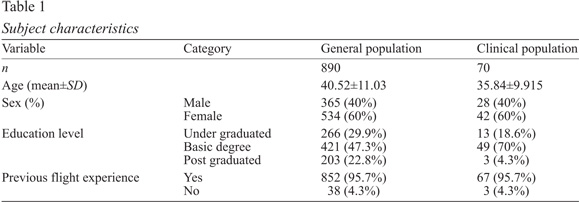
<body><![CDATA[<p><b>Method</b></p>     <p>&nbsp;</p>     <p><i>Subjects</i></p>     <p>A total of 960 individuals constituted by two samples: one from the general population (<i>n</i>=890) and the other from a clinical population  (<i>n</i>=70).</p>     <p>The sample from the Portuguese general population was obtained by self-response questionnaires collected through an on-line platform  questionnaire blocked for multiple answers via Internet Protocol (IP).</p>     <p>The inclusion criteria were being an adult (&gt;18), live and born in Portugal.</p>     <p>Mean age for general population sample was 40. 52 (<i>SD</i>&plusmn;11.03) years for a minimum of 18 and a maximum of 78 years; 534 (60%)  respondents were woman and 365 (40%) were men. Regarding education level, 266 (29.9%) of the participants were Under Graduated, 421 (47.3%) had a  Basic Degree and 203 (22.8%) were Post Graduated. Regarding previous flight experience, 852 (95.7%) of the inquired had at least one flight  experience and 38 (4.3%) never flew before.</p>     <p>The clinical sample (<i>N</i>=70) consisted of people consecutively referred to the <i>Voar Sem Medo</i>, a specialized center on the research,  prevention and treatment of fear of flying, located in Lisbon, Portugal. Mean age was 35.84 (<i>SD</i>&plusmn;9.915) years for a minimum age of 16  and a maximum of 62 years; 42 (60%) of the inquired were woman and 28 (40%) were men. Regarding education level, 13 (18. 6%) of the participants  were Under Graduated, 49 (70%) had a Basic Degree and 3 (4.3%) were Post Graduated. With respect to previous flight experience, 67 (95.7%) of the  inquired had at least one flight experience and 3 (4.3%) never flew (<a href="#t1">Table 1</a>).</p>     <p>&nbsp;</p>     <p><a name="t1"></a></p>     ]]></body>
<body><![CDATA[<p><img src="/img/revistas/aps/v35n3/35n3a09t1.jpg" width="579" height="203"></p>     
<p>&nbsp;</p>     <p>&nbsp;</p>     <p><i>Instruments</i></p>     <p>The Portuguese version of State-Trait Anxiety Inventory &ndash; Y (STAI-Y) (Santos &amp; Silva, 1997) was used to test divergent validity.  STAI-Y comprises 40 items, organized in 2 sub-scales (State-Anxiety and Trait-Anxiety) rated on a four point scale. State-Anxiety sub-scale  evaluates the situational anxiety and respondents are asked to describe the way they feel at a particular moment. Trait-Anxiety sub-scale evaluates  the enduring anxiety and respondents are asked to describe the way they generally feel. STAI-Y was selected to assess divergent validity because it  is a wellknown and generalist measure for anxiety and considering that flight anxiety is a very specific form of anxiety, which differs from  generalized anxiety disorder.</p>     <p>&nbsp;</p>     <p>Visual Analogue Flight Anxiety Scale (VAFAS) was used to assess the level of anxiety related to flight experiences during the last year.  Participants were requested to answer the following question using a one-tailed VAFAS, ranging from 0 (no anxiety) to 10 (terrified)  <i>&ldquo;Please indicate how anxious you were about flying during the last year&rdquo;</i>. A single-item scale (VAFAS) was used as criterion in  the validation procedure because, to our knowledge, until now, no other validated multi-item scales are available.</p>     <p>This investigation team uses a quick screen test for a preliminary diagnosis of flight anxiety (Screen Test for FA) in its clinical and research  practice. It is constituted by a small group of questions, with a dichotomical (<i>yes or no</i>) answering format, which has proved to be a very  useful preliminary diagnosis tool. Exploratory Factorial Analysis (EFA) was performed to assess its internal consistency and to verify if all  questions were positively correlated to the total scale. This analysis can be found in &lsquo;Results&rsquo; section. The questions composing the  scale are as follows:</p>     <p>&nbsp;</p>     <p>1) Do you prefer other means of transportation besides the airplane, even if the trip takes longer?</p>     ]]></body>
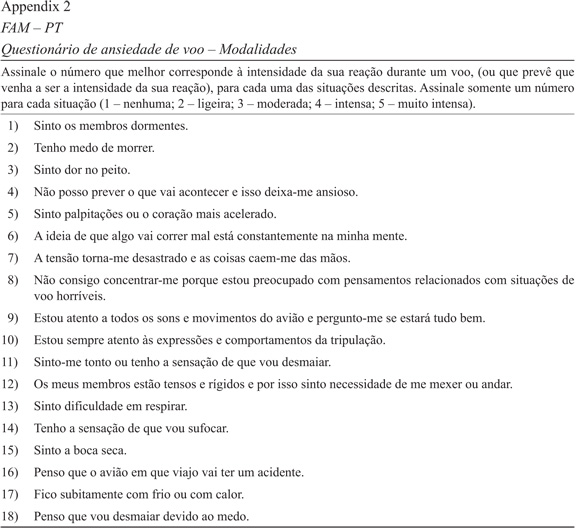
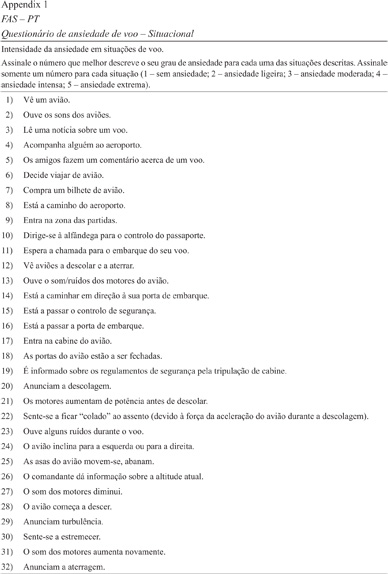
<body><![CDATA[<p>2) Do you usually sweat, get nauseated, heart palpitations, feel breathless or unwell before or during a flight?</p>     <p>3) Do you take medication to prevent discomfort during a flight?</p>     <p>4) Do you drink alcoholic beverages to prevent discomfort during a flight?</p>     <p>5) Are you afraid of riding an elevator?</p>     <p>6) When traveling by plane, do you go as relaxed as in any other means of transportation?</p>     <p>7) Are you afraid of being in enclosed places (Claustrophobia)?</p>     <p>8) Are you afraid of being in a situation which you can&rsquo;t control?</p>     <p>&nbsp;</p>     <p>The FAS and FAM were translated to the Portuguese language and recommended procedures proposed by Beaton and Bombardier were used (Beaton,  Bombardier, Guillemin &amp; Ferraz, 2000). Following their guidelines, both scales were translated to Portuguese and back translated to English by  independent translators. Once the pre-final versions of the FAS-PT and FAM-PT were established, they were applied in an interview context to 30  subjects, to confirm if each participant understood the questions and chosen answers. Interviews content were examined and none of the participants  had any difficulty understanding any particular item or answer. This procedure ensured that the adapted versions retained its equivalence in an  applied situation, thus the final versions were established (<a href="#a1">Appendix 1</a> and <a href="#a2">2</a>).</p>     <p>&nbsp;</p>     ]]></body>
<body><![CDATA[<p><a name="a1"></a></p>     <p><img src="/img/revistas/aps/v35n3/35n3a09a1.jpg" width="388" height="574"></p>     
<p>&nbsp;</p>     <p>&nbsp;</p>     <p><a name="a2"></a></p>     <p><img src="/img/revistas/aps/v35n3/35n3a09a2.jpg" width="576" height="528"></p>     
<p>&nbsp;</p>     <p>&nbsp;</p>     <p><i>Procedure</i></p>     <p>The study was performed in two stages. In the first one, the scales were translated into Portuguese language and in the second, the two scales were tested in a sample of Portuguese population to assess internal consistency, factorial, convergent and divergent validities.</p>     ]]></body>
<body><![CDATA[<p>Permission to use FAS and FAM and translate them to Portuguese was obtained from their author.</p>     <p>The clinical sample was collected from patients consecutively referred to the <i>Voar Sem Medo</i> Center. During clinical interviews patients were invited to participate in the study. A link to the on-line questionnaire was given to those who accepted to participate in the study. During the clinical interviews, all the instructions were explained, objectives of the study were clarified and participants gave their informed consent.</p>     <p>Regarding the general population sample, responses were collected through on-line questionnaires, blocked for multiple answers via Internet Protocol (IP). <i>Voar Sem Medo</i>&rsquo; social networks were used to disseminate the study, where it was asked for people the spread the link among their friends and family. The questionnaire had brief instructions explaining how to answer it and clarifying the objectives of the study. The participants could only proceed to the questionnaire itself after gave their informed consent.</p>     <p>Privacy and confidentiality of data were ensured by data encryption and all participants gave their informed consent before the study according to the good ethical practices.</p>     <p>Database was constructed in SPSS (v.22; SPSS IBM Corp., Armonk, NY). Factorial validity was tested with confirmatory factor analysis (CFA), conducted by using a robust maximum likelihood method with EQS 6.1 (Bentler, 2005) and AMOS&trade; (Arbuckle, 2015). Sensibility of items was analyzed graphically and recurring to median (Me), skewness (Sk) and kurtosis (Ku) coefficients. Items with Sk&gt;|3| and Ku&gt;|8| stray from a normal distribution and should be eliminated from the scale before performing factor analysis (Kline, 2010). For a frequency rating scale of 1 to 5, an acceptable median would be 3. Reliability was analyzed recurring to Cronbach &alpha;. CFA test the hypothesized, underlying model, and is considered a robust test of factorial validity. To identify the scale of a measurement model, one of the factor loadings was &#64257;xed to 1.0. No cross-loading of items were postulated and all factors were allowed to correlate freely. Overall &#64257;t of the models with the data was evaluated by using multiple absolute &#64257;t indices, such as the Satorra and Bentler Chi-Squared test (SB&chi;<sup><i>2</i></sup>; Satorra &amp; Bentler, 2001), overall Chi-Squared test (&chi;<sup><i>2</i></sup>/<i>df</i>; Gatignon, 2010), the minimum discrepancy index (CMIN; Wheaton, Muthen, Alwin, &amp; Summers, 1977), the comparative &#64257;t index (CFI; Bentler, 2005), the goodness of fit index (GFI; Baumgartner &amp; Hombur, 1996), the standardized root mean residual (SRMR; Hu &amp; Bentler, 1999) and the root mean square error of approximation (RMSEA; Steiger, 1990).</p>     <p>Values on the CFI and GFI greater than 0.90 and 0.95 will be considered to re&#64258;ect acceptable and excellent &#64257;ts to the data,  respectively (Bentler, 2005; Baumgartner &amp; Hombur, 1996). Regarding the RMSEA, values of 0. 05 or less will be considered to indicate a close  &#64257;t, and 0.08 or lessan adequate &#64257;t (Browne &amp; Cudeck, 1993). For completeness, the 90% con&#64257;dence interval will also provide  for RMSEA. Values on the SRMR lower than 0. 08 will be considered to indicate an adequate &#64257;t (Hu &amp; Bentler, 1999). The model will be  considered to have a good fit when SRMR value is less than 0.05 or close to zero (Byrne, 2006). Additionally <i>&chi;<sup>2</sup></i>/<i>df</i>  lower than 2 will be considered adequate (Gatignon, 2010). In what concerns CMIN/<i>df</i>, it is not clear how far from 1is acceptable to let the  ratio get, before concluding that a model is unsatisfactoryspecially when the sample size exceeds 200 (Raykov, 2000).</p>     <p>Convergent and divergent validities were tested using SPSS (v.22; SPSS IBM Corp., Armonk, NY). Convergent validity was assessed by computing the  correlation (Frost, Reeve, Liepa, Stauffer, &amp; Hays, 2007) between the FAS-PT, FAM-PT and Screen Test for FA and VAFAS scale. Divergent validity  was tested performing correlation between FAS-PT, FAM-PT and STAI-Y.</p>     <p>&nbsp;</p>     <p><b>Results</b></p>     <p>&nbsp;</p>     ]]></body>
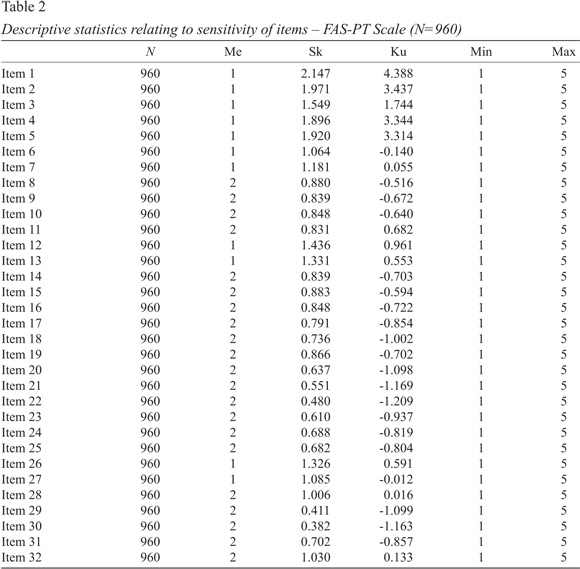
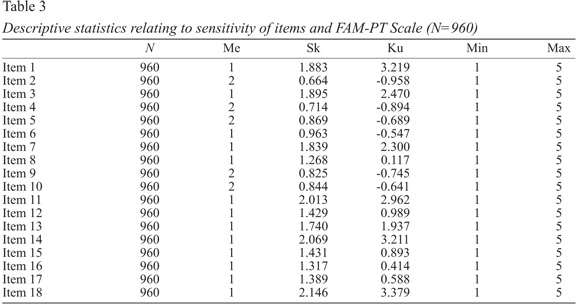
<body><![CDATA[<p><i>Screen test for FA</i></p>     <p>Exploratory factorial analysis was performed for this group of questions and results showed that only one factor was extracted, explaining 50.4%  of the total variance (KMO=.89).</p>     <p>Reliability analysis showed a Cronbach&alpha; of .84, with Inter Class Correlation (ICC) stretching within a range of .5 and a mean value of  .41. These results showed a good consistency of the scale, with a good ICC mean value.</p>     <p>The only variable poor correlated with the total scale was <i>&ldquo;Do you drink alcoholic beverages to prevent discomfort during a  flight?&rdquo;</i> (<i>r</i>=.25, <i>p</i>&lt;0.01). This result could eventually be explained by the fact that most of the times people are not  comfortable in admitting that they use alcohol to cope with flight anxiety. Nevertheless, the item contributes to the total variance of the scale  and it is consensual in literature that alcohol is used by fearful flyers (Van Gerwen et al., 1997; Foreman, Bor, &amp; Van Gerwen, 2006a,b).</p>     <p>&nbsp;</p>     <p><i>Sensitivity &ndash; FAS-PT and FAM-PT</i></p>     <p>Regarding FAS-PT (<a href="#t2">Table 2</a>) and FAM-PT (<a href="#t3">Table 3</a>) the items distribution is asymmetrically positive, with Me  values between 1 and 2.</p>     <p>&nbsp;</p>     <p><a name="t2"></a></p>     <p><img src="/img/revistas/aps/v35n3/35n3a09t2.jpg" width="580" height="569"></p>     
]]></body>
<body><![CDATA[<p>&nbsp;</p>     <p>&nbsp;</p>     <p><a name="t3"></a></p>     <p><img src="/img/revistas/aps/v35n3/35n3a09t3.jpg" width="577" height="304"></p>     
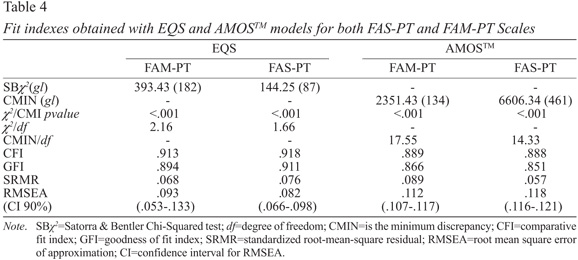
<p>&nbsp;</p>     <p>&nbsp;</p>     <p><i>Confirmatory factor analysis &ndash; FAS-PT and FAM-PT</i></p>     <p>The results for the FAS-PT scale as hypothesized with 3 factors (Van Gerwen, 1999) present adequate fit indexes:  SB<i>&chi;<sup>2</sup></i>=144.25 (87) (<i>p</i>&lt;.001), <i>&chi;<sup>2</sup></i>/<i>df</i>=1.66, CFI=.918 (.888 with AMOS), GFI=.911 (.851 with  AMOS), SRMR=.076 (.057 with AMOS), and RMSEA=.082 (.118 with AMOS) with lower and upper limits for CI 90% of .066 and .098, respectively (.116-.121  with AMOS). The only doubt concerns CMIN/<i>df</i>=14.33, but as stated before, it is not clear how far from 1it is acceptable to let the ratio get  before concluding that a model is unsatisfactory. All factorial loading present adequate values (<i>p</i>&lt;.001).</p>     <p>Similarly the results for the FAM-PT scale as hypothesized with 2 factors (Van Gerwen, 1999) present adequate fit indexes:  SB<i>&chi;<sup>2</sup></i>=393.43 (182) (<i>p</i>&lt;.001), <i>&chi;<sup>2</sup></i>/<i>df</i>=2.16, CFI=.913 (.889 with AMOS), GFI=.894 (.866 with  AMOS), SRMR=.068 (.089 with AMOS), and RMSEA=.093 (.112 with AMOS) with lower and upper limits for CI 90% of .053 and .133, respectively (.107-.117  with AMOS). All factorial loading present adequate values (<i>p</i>&lt;.001) (<a href="#t4">Table 4</a>).</p>     <p>&nbsp;</p>     ]]></body>
<body><![CDATA[<p><a name="t4"></a></p>     <p><img src="/img/revistas/aps/v35n3/35n3a09t4.jpg" width="578" height="260"></p>     
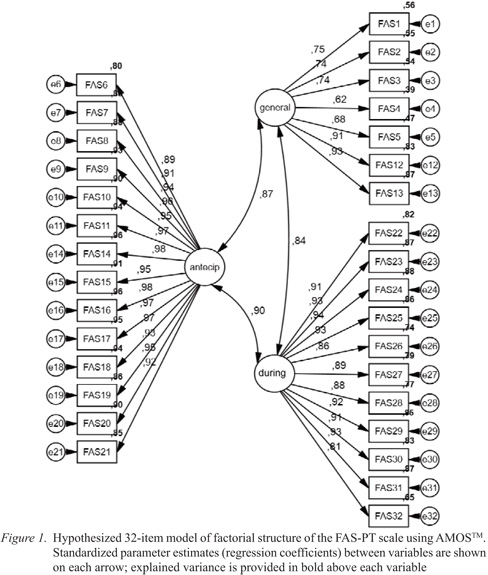
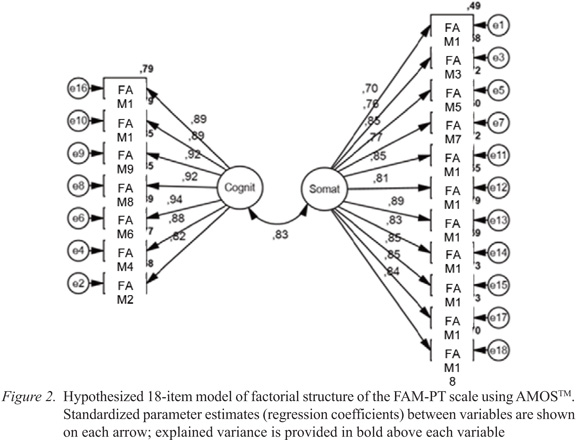
<p>&nbsp;</p>     <p>AMOS<sup>TM </sup>also allow to draw the hypothesized models of factorial structure of both FAS-PT and FAM-PT scales optimizing the standardized  parameter estimates (regression coefficients) between variables, the explained variance for each variable and the co-variances between latent  variables. Only 2 (out of the 32) standardized parameters in FAS-PT scale score below .70, and 22 (out of the 32) score above .90. On the same way  there are no standardized parameters in FAM-PT scale that scores below .70, and 3 (out of the 18) score above .90. These results allow to conclude  that, based upon the present sample, the translated scales of Van Gerwen &ndash; FAS-PT, and FAM-PT &ndash; on the overall can be regarded as  behaving adequately on the Portuguese population (<a href="#f1">Figure 1</a> and <a href="#f2">2</a>).</p>     <p>&nbsp;</p>     <p><a name="f1"></a></p>     <p><img src="/img/revistas/aps/v35n3/35n3a09f1.jpg" width="488" height="575"></p>     
<p>&nbsp;</p>     <p>&nbsp;</p>     <p><a name="f2"></a></p>     ]]></body>
<body><![CDATA[<p><img src="/img/revistas/aps/v35n3/35n3a09f2.jpg" width="576" height="442"></p>     
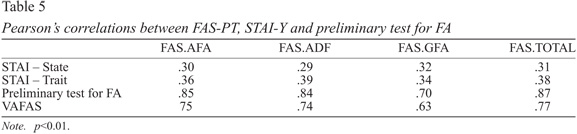
<p>&nbsp;</p>     <p>&nbsp;</p>     <p><i>Internal consistency &ndash; FAS-PT and FAM-PT</i></p>     <p>The reliability of the scale was assessed by measuring internal consistency with Cronbach &alpha;. Results showed that FAS-PT is a reliable  measure of flight anxiety situations, in the studied population, presenting excellent Cronbach &alpha; values (.99 for the total scale; .99 for  Anticipatory Flight Anxiety subscale; .98 for In-Flight Anxiety subscale and .91 for Generalized Flight Anxiety subscale).</p>     <p>The reliability value for FAM-PT is very good (Cronbach &alpha;=.97) namely for the total scale; .97 for Cognitive Symptoms subscale; and .96  for Somatic Symptoms subscale, we can infer that FAM-PT is a reliable measure of flight anxiety modalities in the present population.</p>     <p>&nbsp;</p>     <p><i>Convergent Validity &ndash; FAS-PT and FAM-PT</i></p>     <p>Convergent validity was tested through correlation between FAS-PT, Preliminary Test for FA and VAFAS. Results showed strong to very strong  correlations between all FAS-PT Subscales and Screen Test for FA: FAS. AFA (<i>r</i>=.85, <i>p</i>&lt;0.01), FAS.IFA (<i>r</i>=.84,  <i>p</i>&lt;0.01), FAS.GFA (<i>r</i>=.70, <i>p</i>&lt;0.01), FAS.TOTAL (<i>r</i>=.87, <i>p</i>&lt;0.01). Regarding VAFAS, showed strong  correlations for all FAS-PT Subscales: FAS.AFA (<i>r</i>=.75, <i>p</i>&lt;0.01), FAS.IFA (<i>r</i>=.74, <i>p</i>&lt;0.01), FAS.GFA (<i>r</i>=.63,  <i>p</i>&lt;0.01), FAS.TOTAL (<i>r</i>=.77, <i>p</i>&lt;0.01).</p>     <p>Convergent validity was tested through correlation between FAM-PT, Preliminary Test for FA and VAFAS. Results showed strong to very strong  correlations between all FAM-PT Subscales and Screen Test for FA: FAM.COGNITIVE (<i>r</i>=.82, <i>p</i>&lt;0.01) and FAM.SOMATIC (<i>r</i>=.75,  <i>p</i>&lt;0.01). Regarding VAFAS, showed strong correlations for all FAM-PT Subscales: FAM.COGNITIVE (<i>r</i>=.75, <i>p</i>&lt;0.01) and  FAM.SOMATIC (<i>r</i>=.67, <i>p</i>&lt;0.01).</p>     ]]></body>
<body><![CDATA[<p>&nbsp;</p>     <p><i>Divergent Validity &ndash; FAS-PT and FAM-PT</i></p>     <p>Divergent validity was tested recurring to correlations between FAS-PT, FAM-PT and STAI-Y.</p>     <p>Results showed weak correlations between FAS. AFA and STAI-State (<i>r</i>=.30, <i>p</i>&lt;0.01) and STAI-Trait (<i>r</i>=.36,  <i>p</i>&lt;0.01); FAS.IFA and STAI-State (<i>r</i>=.29, <i>p</i>&lt;0.01) and STAI-Trait (<i>r</i>=.39, <i>p</i>&lt;0.01); FAS.GFA and STAI-State  (<i>r</i>=.32, <i>p</i>&lt;0.01) and STAI-Trait (<i>r</i>=.34, <i>p</i>&lt;0.01); FAS.TOTAL and STAI-State (<i>r</i>=.31, <i>p</i>&lt;0.01) and  STAI-Trait (<i>r</i>=.38, <i>p</i>&lt;0.01) (<a href="#t5">Table 5</a>).</p>     <p>&nbsp;</p>     <p><a name="t5"></a></p>     <p><img src="/img/revistas/aps/v35n3/35n3a09t5.jpg" width="577" height="134"></p>     
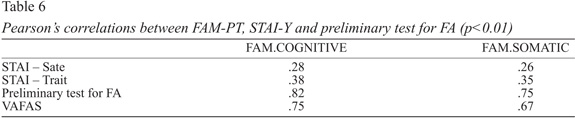
<p>&nbsp;</p>     <p>Regarding FAM-PT, results showed very low correlations between COGNITIVE Subscale and STAI-State (<i>r</i>=.28, <i>p</i>&lt;0.01) and STAI-Trait  (<i>r</i>=. 38, <i>p</i>&lt;0.01); as well as between SOMATIC subscale and STAI-State (<i>r</i>=.26, <i>p</i>&lt;0.01) and STAI-Trait  (<i>r</i>=.35, <i>p</i>&lt;0.01).</p>     <p>When comparing mean ranks between clinical and general population samples, results showed statistical significant differences in mean scores,  between groups for FAM.COGNITE (<i>Z</i>=-10.62, <i>p</i>&lt;0.01) and FAM.SOMATIC (<i>Z</i=-10. 42, <i>p</i>&lt;0.01) (<a href="#t6">Table  6</a>).</p>     ]]></body>
<body><![CDATA[<p>&nbsp;</p>     <p><a name="t6"></a></p>     <p><img src="/img/revistas/aps/v35n3/35n3a09t6.jpg" width="575" height="118"></p>     
<p>&nbsp;</p>     <p>&nbsp;</p>     <p><b>Discussion</b></b>     <p>The main objective of this study was to adapt two self-report instruments for measuring different aspects of fear of flying for the Portuguese  language and to establish their psychometric properties in a Portuguese sample. The FAS, related to the level of anxiety produced by different  situations related to air-travel, distinguishing between the preliminary phase and the actual flight; and the FAM, focused on anxiety reactions,  thoughts related to the danger of flying and on the physiological sensations of anxiety while flying.</p>     <p>The obtained results showed that the FAS-PT and FAM-PT has suitable psychometric qualities, notably factorial, convergent and divergent  validities. From a reliability point of view, the scales met the criteria for internal consistency.</p>     <p>The Portuguese language versions of FAS and FAM appeared to be equivalent to the original versions, presenting a factorial structure of 3 and 2  factors, respectively (Van Gerwen et al., 1999).</p>     <p>Cronbach&rsquo;s alpha values were higher in the present study, for almost all FAS subscales, comparing to the original validation study.  FAS.AFA (.99 and .88), FAS.IFA (.95 and .98), FAS.GFA (.97 and .91) (Van Gerwen et al., 1999). Regarding FAM scale, all Cronbach&rsquo;s alpha  values were higher in the present study, comparing to the original one. FAM.COGNITIVE (.97 and .89) and FAM.SOMATIC (.96 and .89) (Van Gerwen et  al., 1999).</p>     ]]></body>
<body><![CDATA[<p>In other studies using the FAS the Cronbach&rsquo;s alpha values ranged from 0.86 to 0.98 in a 127 general population sample from Dutch  (Busscher, Van Gerwen, Spinhoven, &amp; de Geus, 2010), from 0.86 to 0.95 in a 150 flying phobic sample from Dutch (Busscher, Van Gerwen,  Spinhoven, &amp; de Geus, 2013), from 0.89 to 0.98 in a 109 university students sample from Chicago (Hawkings-Gilligan, Dygdon, &amp; Conger, 2011)  and from 0.94 to 0.99 in a 572 general population sample from New York (Skolnick, Schare, Wyatt, &amp; Tillman, 2012).</p>     <p>In other studies using FAM, the Cronbach&rsquo;s alpha values ranged from 0.88 to 0.89 in a 127 general population sample from Dutch (Busscher  et al., 2010) and from 0.85 to 0.90 in a 150 flying phobic sample from Dutch (Busscher et al., 2013).</p>     <p>The FAS-PT and FAM-PT showed notably results regarding convergent and divergent validities, in both analysis (Screen Test for FA and VAFAS and  STAI-Y confirming that both scales measure what they were supposed to and low correlations values between FAS-PT, FAM-PT and STAI-Y suggest that  the studied scales are not simply measuring anxiety, but flying anxiety.</p>     <p>We can conclude that FAS-PT and FAM-PT are reliable measures to assess self-reported fear of flying in the Portuguese speaking population.</p>     <p>This study allows future clinical and research uses of FAS-PT and FAM-PT for Portuguese speakers, as well as cross-culture research projects  (monitoring treatment outcome, clinical trials and prevalence studies).</p>     <p>Further investigation is needed to confirm these findings, namely the establishment of cut-off values. Temporal stability and pre/post treatment  outcomes should also be investigated as well as comparisons between clinical and non-clinical groups.</p>     <p>&nbsp;</p>     <p><b>References</b></p>     <!-- ref --><p>American Psychiatric Association. (2013). <i>Diagnostic and statistical manual of mental disorders</i> (5<sup>th</sup> ed.). Arlington, VA:  Author.    &nbsp;&nbsp;&nbsp;&nbsp;&nbsp;&nbsp;&nbsp;&nbsp;[&#160;<a href="javascript:void(0);" onclick="javascript: window.open('/scielo.php?script=sci_nlinks&ref=031884&pid=S0870-8231201700030000900001&lng=','','width=640,height=500,resizable=yes,scrollbars=1,menubar=yes,');">Links</a>&#160;]<!-- end-ref --></p>     ]]></body>
<body><![CDATA[<p>Arbuckle, J. L. (2015). <i>IBM&reg; SPSS&reg; Amos&trade; 20 user&rsquo;s guide</i>. Chicago, IL: IBM Corporation.</p>     <!-- ref --><p>Baumgartner, H., &amp; Hombur, C. (1996). Applications of structural equation modeling in marketing and consumer research: A review.  <i>International Journal of Research in Marketing, 13</i>, 139-161.    &nbsp;&nbsp;&nbsp;&nbsp;&nbsp;&nbsp;&nbsp;&nbsp;[&#160;<a href="javascript:void(0);" onclick="javascript: window.open('/scielo.php?script=sci_nlinks&ref=031887&pid=S0870-8231201700030000900003&lng=','','width=640,height=500,resizable=yes,scrollbars=1,menubar=yes,');">Links</a>&#160;]<!-- end-ref --></p>     <!-- ref --><p>Beaton, D. E., Bombardier, C., Guillemin, F., &amp; Ferraz, M. B. (2000). Guidelines for the process of cross-cultural adaptation of  self-report measures. <i>Spine, 25</i>, 3186-3191.    &nbsp;&nbsp;&nbsp;&nbsp;&nbsp;&nbsp;&nbsp;&nbsp;[&#160;<a href="javascript:void(0);" onclick="javascript: window.open('/scielo.php?script=sci_nlinks&ref=031889&pid=S0870-8231201700030000900004&lng=','','width=640,height=500,resizable=yes,scrollbars=1,menubar=yes,');">Links</a>&#160;]<!-- end-ref --></p>     <!-- ref --><p>Bentler, P. M. (2005). EQS 6.1: <i>Structural equations program manual</i>. Encino, CA: Multivariate Software Inc.    &nbsp;&nbsp;&nbsp;&nbsp;&nbsp;&nbsp;&nbsp;&nbsp;[&#160;<a href="javascript:void(0);" onclick="javascript: window.open('/scielo.php?script=sci_nlinks&ref=031891&pid=S0870-8231201700030000900005&lng=','','width=640,height=500,resizable=yes,scrollbars=1,menubar=yes,');">Links</a>&#160;]<!-- end-ref --></p>     <!-- ref --><p>Bor, R. (2007). Psychological factors in airline passenger and crew behavior: A clinical overview. <i>Travel Medicine and Infectious Diseases,  5</i>, 207-216. Retrieved from <a href="http://dx.doi.org/10.1016/j.tmaid.2007.03.003"  target="_blank">http://dx.doi.org/10.1016/j.tmaid.2007.03.003</a>&nbsp;&nbsp;&nbsp;&nbsp;&nbsp;&nbsp;&nbsp;&nbsp;[&#160;<a href="javascript:void(0);" onclick="javascript: window.open('/scielo.php?script=sci_nlinks&ref=031893&pid=S0870-8231201700030000900006&lng=','','width=640,height=500,resizable=yes,scrollbars=1,menubar=yes,');">Links</a>&#160;]<!-- end-ref --><!-- ref --><p>Browne, M. W., &amp; Cudeck, R. (1993). Alternative ways of assessing model &#64257;t. In K. A. Bollen &amp; J. S. Long (Eds.),  <i>Testing structural equation models</i> (pp. 136-162). Newbury, CA: Sage.    &nbsp;&nbsp;&nbsp;&nbsp;&nbsp;&nbsp;&nbsp;&nbsp;[&#160;<a href="javascript:void(0);" onclick="javascript: window.open('/scielo.php?script=sci_nlinks&ref=031894&pid=S0870-8231201700030000900007&lng=','','width=640,height=500,resizable=yes,scrollbars=1,menubar=yes,');">Links</a>&#160;]<!-- end-ref --></p>     ]]></body>
<body><![CDATA[<!-- ref --><p>Busscher, B., van Gerven, L. J., Spinhoven, P., &amp; de Geus, E. J. C. (2010). Physiological reactivity to phobic stimuli in people with fear  of flying. <i>Journal of Psychomatic Research, 69</i>, 309-317. doi: 10.1016/j.jpsychores.2009.12.005&nbsp;&nbsp;&nbsp;&nbsp;&nbsp;&nbsp;&nbsp;&nbsp;[&#160;<a href="javascript:void(0);" onclick="javascript: window.open('/scielo.php?script=sci_nlinks&ref=031896&pid=S0870-8231201700030000900008&lng=','','width=640,height=500,resizable=yes,scrollbars=1,menubar=yes,');">Links</a>&#160;]<!-- end-ref --><!-- ref --><p>Busscher, B., van Gerven, L. J., Spinhoven, P., &amp; de Geus, E. J. C. (2013). Anxiety sensitivity moderates the relationship of changes in  physiological arousal with flight anxiety during in vivo exposure therapy. <i>Behaviour Research and Therapy, 51</i>, 98-105. doi:  10.1016/j.brat.2012.10.009&nbsp;&nbsp;&nbsp;&nbsp;&nbsp;&nbsp;&nbsp;&nbsp;[&#160;<a href="javascript:void(0);" onclick="javascript: window.open('/scielo.php?script=sci_nlinks&ref=031897&pid=S0870-8231201700030000900009&lng=','','width=640,height=500,resizable=yes,scrollbars=1,menubar=yes,');">Links</a>&#160;]<!-- end-ref --><!-- ref --><p>Byrne, B. M. (2006). <i>Structural equation modeling with EQS: Basic concepts, applications, and programming</i> (2<sup>nd</sup> ed.). Mahwah,  NJ: Lawrence Erlbaum Associates.    &nbsp;&nbsp;&nbsp;&nbsp;&nbsp;&nbsp;&nbsp;&nbsp;[&#160;<a href="javascript:void(0);" onclick="javascript: window.open('/scielo.php?script=sci_nlinks&ref=031898&pid=S0870-8231201700030000900010&lng=','','width=640,height=500,resizable=yes,scrollbars=1,menubar=yes,');">Links</a>&#160;]<!-- end-ref --></p>     <!-- ref --><p>Foreman, I., Bor, R., &amp; Van Gerwen, L. J. (2006a). The nature, characteristics, impact and personal implications of fear of flying. In R.  Bor &amp; T. Hubbard (Eds.), <i>Aviation mental health</i> (pp. 53-68). Aldershot: Ashgate.    &nbsp;&nbsp;&nbsp;&nbsp;&nbsp;&nbsp;&nbsp;&nbsp;[&#160;<a href="javascript:void(0);" onclick="javascript: window.open('/scielo.php?script=sci_nlinks&ref=031900&pid=S0870-8231201700030000900011&lng=','','width=640,height=500,resizable=yes,scrollbars=1,menubar=yes,');">Links</a>&#160;]<!-- end-ref --></p>     <!-- ref --><p>Foreman, I., Bor, R., &amp; Van Gerwen, L. J. (2006b). Flight or fright? Psychological approaches to the treatment of fear of flying. In R. Bor  &amp; T. Hubbard (Eds.), <i>Aviation mental health</i> (pp. 69-82). Aldershot: Ashgate.    &nbsp;&nbsp;&nbsp;&nbsp;&nbsp;&nbsp;&nbsp;&nbsp;[&#160;<a href="javascript:void(0);" onclick="javascript: window.open('/scielo.php?script=sci_nlinks&ref=031902&pid=S0870-8231201700030000900012&lng=','','width=640,height=500,resizable=yes,scrollbars=1,menubar=yes,');">Links</a>&#160;]<!-- end-ref --></p>     <p>Francis, P., Triscari, T. M., D&rsquo;Angelo, V., &amp; Urso, V. (2011). Fear of flying assessment: A contribution to the Italian validation of  two self-report measures. <i>Review of Psychology, 18</i>, 91-100. Retrieved from  <a href="http://www.researchgate.net/publication/236679763_Fear_of_flying_assessment_A_contribution_to_the_ Italian_validation_of_two_self-report_measures"  target="_blank">http://www.researchgate.net/publication/236679763_Fear_of_flying_assessment_A_contribution_to_the_ Italian_validation_of_two_self-report_measures</a></p>     <!-- ref --><p>Frost, M. H., Reeve, B. B., Liepa, A. M., Stauffer, J. W., &amp; Hays, R. D. (2007). What is sufficient evidence for the reliability and  validity of patient-reported outcome measures?. <i>Value in Health: The Journal of the International Society for Pharmacoeconomics and Outcomes  Research, 10</i>, S94-S105. Retrieved from <a href="http://dx.doi.org/10.1111/j.1524-4733.2007.00272.x"  target="_blank">http://dx.doi.org/10.1111/j.1524-4733.2007.00272.x</a>&nbsp;&nbsp;&nbsp;&nbsp;&nbsp;&nbsp;&nbsp;&nbsp;[&#160;<a href="javascript:void(0);" onclick="javascript: window.open('/scielo.php?script=sci_nlinks&ref=031905&pid=S0870-8231201700030000900014&lng=','','width=640,height=500,resizable=yes,scrollbars=1,menubar=yes,');">Links</a>&#160;]<!-- end-ref --><p>Gatignon, H. (2010). Confirmatory factor analysis. In H. Gatignon (Ed.), <i>Statistical analysis of management data</i> (pp. 59-122).  Retrieved from  <a href="http://link.springer.com/10.1007/978-1-4419-1270-1_4" target="_blank">http://link.springer.com/10.1007/978-1-4419-1270-1_4</a></p>     <!-- ref --><p>Hawkings-Gilligan, J., Dygdon, J. A., &amp; Conger, A. J. (2011). Examining the nature of fear of flying. <i>Aviation, Space and Environmental  Medicine, 89</i>, 964-971. Retrieved from <a href="http://dx.doi.org/10.3357/ASEM.3062.2011"  target="_blank">http://dx.doi.org/10.3357/ASEM.3062.2011</a>&nbsp;&nbsp;&nbsp;&nbsp;&nbsp;&nbsp;&nbsp;&nbsp;[&#160;<a href="javascript:void(0);" onclick="javascript: window.open('/scielo.php?script=sci_nlinks&ref=031907&pid=S0870-8231201700030000900016&lng=','','width=640,height=500,resizable=yes,scrollbars=1,menubar=yes,');">Links</a>&#160;]<!-- end-ref --><!-- ref --><p>Hu, L. T., &amp; Bentler, P. (1999). Cut-off criteria for fit indexes in covariance structure analysis: Conventional criteria <i>versus</i> new  alternatives. <i>Structural Equation Modeling, 6,</i> 1-55. Retrieved from <a href="http://dx.doi.org/10.1080/10705519909540118"  target="_blank">http://dx.doi.org/10.1080/10705519909540118</a>&nbsp;&nbsp;&nbsp;&nbsp;&nbsp;&nbsp;&nbsp;&nbsp;[&#160;<a href="javascript:void(0);" onclick="javascript: window.open('/scielo.php?script=sci_nlinks&ref=031908&pid=S0870-8231201700030000900017&lng=','','width=640,height=500,resizable=yes,scrollbars=1,menubar=yes,');">Links</a>&#160;]<!-- end-ref --><!-- ref --><p>Kline, R. B. (2010). <i>Principles and practice of structural equation modeling</i> (3<sup>rd</sup> ed.). New York: Guilford Press. doi:  10.1038/156278a0&nbsp;&nbsp;&nbsp;&nbsp;&nbsp;&nbsp;&nbsp;&nbsp;[&#160;<a href="javascript:void(0);" onclick="javascript: window.open('/scielo.php?script=sci_nlinks&ref=031909&pid=S0870-8231201700030000900018&lng=','','width=640,height=500,resizable=yes,scrollbars=1,menubar=yes,');">Links</a>&#160;]<!-- end-ref --><!-- ref --><p>McNally, R. J., &amp; Louro, C. E. (1992). Fear of flying in agoraphobia and simple phobia: Distinguishing features. <i>Journal of Anxiety  Disorders, 6</i>, 319-324. doi: 10.1016/0887-6185(92)90003-P&nbsp;&nbsp;&nbsp;&nbsp;&nbsp;&nbsp;&nbsp;&nbsp;[&#160;<a href="javascript:void(0);" onclick="javascript: window.open('/scielo.php?script=sci_nlinks&ref=031910&pid=S0870-8231201700030000900019&lng=','','width=640,height=500,resizable=yes,scrollbars=1,menubar=yes,');">Links</a>&#160;]<!-- end-ref --><!-- ref --><p>Nousi, A., Van Gerwen, L., &amp; Spinhoven, P. (2008). The Flight Anxiety Situations Questionnaire and the Flight Anxiety Modality  Questionnaire: Norms for people with fear of flying. <i>Travel Medicine and Infectious Disease, 6</i>, 305-310. Retrieved from  <a href="http://dx.doi.org/10.1016/j.tmaid.2008.06.001" target="_blank">http://dx.doi.org/10.1016/j.tmaid.2008.06.001</a>&nbsp;&nbsp;&nbsp;&nbsp;&nbsp;&nbsp;&nbsp;&nbsp;[&#160;<a href="javascript:void(0);" onclick="javascript: window.open('/scielo.php?script=sci_nlinks&ref=031911&pid=S0870-8231201700030000900020&lng=','','width=640,height=500,resizable=yes,scrollbars=1,menubar=yes,');">Links</a>&#160;]<!-- end-ref --><!-- ref --><p>Oakes, M., &amp; Bor, R. (2010a). The psychology of fear of flying (part I): A critical evaluation of current perspectives on the natures,  prevalence and etiology of fear of flying. <i>Travel Medicine and Infectious Disease, 8</i>, 327-338. Retrieved from  <a href="http://dx.doi.org/10.1016/j.tmaid.2010.10.001" target="_blank">http://dx.doi.org/10.1016/j.tmaid.2010.10.001</a>&nbsp;&nbsp;&nbsp;&nbsp;&nbsp;&nbsp;&nbsp;&nbsp;[&#160;<a href="javascript:void(0);" onclick="javascript: window.open('/scielo.php?script=sci_nlinks&ref=031912&pid=S0870-8231201700030000900021&lng=','','width=640,height=500,resizable=yes,scrollbars=1,menubar=yes,');">Links</a>&#160;]<!-- end-ref --><!-- ref --><p>Oakes, M., &amp; Bor, R. (2010b). The psychology of fear of flying (part II): a critical evaluation of current perspectives on approaches to  treatment. <i>Travel Medicine and Infectious Disease, 8</i>, 339-363. Retrieved from  <a href="http://dx.doi.org/10.1016/j.tmaid.2010.10.002" target="_blank">http://dx.doi.org/10.1016/j.tmaid.2010.10.002</a>&nbsp;&nbsp;&nbsp;&nbsp;&nbsp;&nbsp;&nbsp;&nbsp;[&#160;<a href="javascript:void(0);" onclick="javascript: window.open('/scielo.php?script=sci_nlinks&ref=031913&pid=S0870-8231201700030000900022&lng=','','width=640,height=500,resizable=yes,scrollbars=1,menubar=yes,');">Links</a>&#160;]<!-- end-ref --><!-- ref --><p>Raykov, T. (2000). On the large-sample bias, variance, and mean squared error of the conventional noncentrality parameter estimator of  covariance structure models. <i>Structural Equation Modeling, 7</i>, 431-441.    &nbsp;&nbsp;&nbsp;&nbsp;&nbsp;&nbsp;&nbsp;&nbsp;[&#160;<a href="javascript:void(0);" onclick="javascript: window.open('/scielo.php?script=sci_nlinks&ref=031914&pid=S0870-8231201700030000900023&lng=','','width=640,height=500,resizable=yes,scrollbars=1,menubar=yes,');">Links</a>&#160;]<!-- end-ref --></p>     ]]></body>
<body><![CDATA[<p>Santos, S. C., &amp; Silva, D. (1997). Adapta&ccedil;&atilde;o do State-Trait Anxiety Inventory &ndash; Form Y para a popula&ccedil;&atilde;o  Portuguesa: Primeiros dados. <i>Revista Portuguesa de Psicologia, 32</i>, 58-98. Retrieved from  <a href="https://docs.google.com/file/d/0B0LP1bS3g1daNVJWTHZpU19MWk0/edit"  target="_blank">https://docs.google.com/file/d/0B0LP1bS3g1daNVJWTHZpU19MWk0/edit</a></p>     <!-- ref --><p>Satorra, A., &amp; Bentler, P. M. (2001). A scaled difference chi-square test statistic for moment structure analysis. <i>Psychometrika, 66</i>,  507-514.    &nbsp;&nbsp;&nbsp;&nbsp;&nbsp;&nbsp;&nbsp;&nbsp;[&#160;<a href="javascript:void(0);" onclick="javascript: window.open('/scielo.php?script=sci_nlinks&ref=031917&pid=S0870-8231201700030000900025&lng=','','width=640,height=500,resizable=yes,scrollbars=1,menubar=yes,');">Links</a>&#160;]<!-- end-ref --></p>     <!-- ref --><p>Skolnick, R. B., Schare, M. L., Wyatt, K. P., &amp; Tillman, M. A. (2012). Aviophobia assessment: Validating the Flight Anxiety Situations  Questionnaire as a clinical identification measure. <i>Journal of Anxiety Disorders, 26</i>, 779-784. doi: 10.1016/j.janxdis.2012.07.006&nbsp;&nbsp;&nbsp;&nbsp;&nbsp;&nbsp;&nbsp;&nbsp;[&#160;<a href="javascript:void(0);" onclick="javascript: window.open('/scielo.php?script=sci_nlinks&ref=031919&pid=S0870-8231201700030000900026&lng=','','width=640,height=500,resizable=yes,scrollbars=1,menubar=yes,');">Links</a>&#160;]<!-- end-ref --><!-- ref --><p>Steiger, J. H. (1990). Structural model evaluation and morti&#64257;cation: An interval estimation approach. <i>Multivariate Behavior  Research, 25</i>, 173-180.    &nbsp;&nbsp;&nbsp;&nbsp;&nbsp;&nbsp;&nbsp;&nbsp;[&#160;<a href="javascript:void(0);" onclick="javascript: window.open('/scielo.php?script=sci_nlinks&ref=031920&pid=S0870-8231201700030000900027&lng=','','width=640,height=500,resizable=yes,scrollbars=1,menubar=yes,');">Links</a>&#160;]<!-- end-ref --></p>     <!-- ref --><p>Van Gerwen, L. J., Diekstra, R. F., Arondeus, J. M., &amp; Wolfger, R. (2004). Fear of flying treatment programs for passengers: An  international update. <i>Aviation Space and Environmental Medicine, 2</i>, 27-35. doi: 10.1016/j.tmaid.2004.01.002&nbsp;&nbsp;&nbsp;&nbsp;&nbsp;&nbsp;&nbsp;&nbsp;[&#160;<a href="javascript:void(0);" onclick="javascript: window.open('/scielo.php?script=sci_nlinks&ref=031922&pid=S0870-8231201700030000900028&lng=','','width=640,height=500,resizable=yes,scrollbars=1,menubar=yes,');">Links</a>&#160;]<!-- end-ref --><!-- ref --><p>Van Gerwen, L. J., Spinhoven, P., Diekstra, R. F. W., &amp; Van Dick, R. (1997). People who seek help for fear of flying: Typology of flying  phobics. <i>Behavior Therapy, 28</i>, 237-251. Retrieved from <a href="http://dx.doi.org/10.1016/S0005-7894(97)80045-7"  target="_blank">http://dx.doi.org/10.1016/S0005-7894(97)80045-7</a>&nbsp;&nbsp;&nbsp;&nbsp;&nbsp;&nbsp;&nbsp;&nbsp;[&#160;<a href="javascript:void(0);" onclick="javascript: window.open('/scielo.php?script=sci_nlinks&ref=031923&pid=S0870-8231201700030000900029&lng=','','width=640,height=500,resizable=yes,scrollbars=1,menubar=yes,');">Links</a>&#160;]<!-- end-ref --><!-- ref --><p>Van Gerwen, L. J., Spinhoven, P., Van Dick, R., &amp; Diekstra, R. F. W. (1999). Construction and psychometric characteristics of two  self-reported questionnaires for the assessment of fear of flying. <i>Psychological Assessment, 11</i>, 146-158. Retrieved from  <a href="http://dx.doi.org/10.1037/1040-3590.11.2.146"  target="_blank">http://dx.doi.org/10.1037/1040-3590.11.2.146</a>&nbsp;&nbsp;&nbsp;&nbsp;&nbsp;&nbsp;&nbsp;&nbsp;[&#160;<a href="javascript:void(0);" onclick="javascript: window.open('/scielo.php?script=sci_nlinks&ref=031924&pid=S0870-8231201700030000900030&lng=','','width=640,height=500,resizable=yes,scrollbars=1,menubar=yes,');">Links</a>&#160;]<!-- end-ref --><!-- ref --><p>Wheaton, B., Muthen, B., Alwin, D. F., &amp; Summers, G. F. (1977). Assessing reliability and stability in panel models. In D. R. Heise (Ed.),  <i>Sociological methodology</i> (pp. 84-136). San Francisco: Jossey-Bass.    &nbsp;&nbsp;&nbsp;&nbsp;&nbsp;&nbsp;&nbsp;&nbsp;[&#160;<a href="javascript:void(0);" onclick="javascript: window.open('/scielo.php?script=sci_nlinks&ref=031925&pid=S0870-8231201700030000900031&lng=','','width=640,height=500,resizable=yes,scrollbars=1,menubar=yes,');">Links</a>&#160;]<!-- end-ref --></p>     <!-- ref --><p>Wilhelm, F. H., &amp; Roth, W. T. (1997). Clinical characteristics of flight phobia. <i>Journal of Anxiety Disorders, 11</i>, 241-261. Retrieved  from <a href="http://dx.doi.org/10.1016/S0887-6185(97)00009-1" target="_blank">http://dx.doi.org/10.1016/S0887-6185(97)00009-1</a>&nbsp;&nbsp;&nbsp;&nbsp;&nbsp;&nbsp;&nbsp;&nbsp;[&#160;<a href="javascript:void(0);" onclick="javascript: window.open('/scielo.php?script=sci_nlinks&ref=031927&pid=S0870-8231201700030000900032&lng=','','width=640,height=500,resizable=yes,scrollbars=1,menubar=yes,');">Links</a>&#160;]<!-- end-ref --><p>&nbsp;</p>     <p><b><a name="c0" id="c0"></a><a href="#topc0">CORRESPONDÊNCIA</a></b></p>     <p>Correspondence concerning this article should be addressed to: Catarina Mestre, Voar Sem Medo, Av. da Liberdade, 129, 7&ordm;A, 1250-140  Lisbon, Portugal. E-mail: <a href="mailto:catarinacmmestre@gmail.com">catarinacmmestre@gmail.com</a></p>     <p>&nbsp;</p>     <p>Submitted: 19/11/2015 Accepted: 29/12/2016</p>      ]]></body><back>
<ref-list>
<ref id="B1">
<nlm-citation citation-type="book">
<collab>American Psychiatric Association.</collab>
<source><![CDATA[Diagnostic and statistical manual of mental disorders]]></source>
<year>2013</year>
<edition>5</edition>
<publisher-loc><![CDATA[Arlington ]]></publisher-loc>
<publisher-name><![CDATA[Author]]></publisher-name>
</nlm-citation>
</ref>
<ref id="B2">
<nlm-citation citation-type="book">
<person-group person-group-type="author">
<name>
<surname><![CDATA[Arbuckle]]></surname>
<given-names><![CDATA[J. L.]]></given-names>
</name>
</person-group>
<source><![CDATA[IBM® SPSS® Amos™ 20 user’s guide]]></source>
<year>2015</year>
<publisher-loc><![CDATA[Chicago ]]></publisher-loc>
<publisher-name><![CDATA[IBM Corporation]]></publisher-name>
</nlm-citation>
</ref>
<ref id="B3">
<nlm-citation citation-type="journal">
<person-group person-group-type="author">
<name>
<surname><![CDATA[Baumgartner]]></surname>
<given-names><![CDATA[H.]]></given-names>
</name>
<name>
<surname><![CDATA[Hombur]]></surname>
<given-names><![CDATA[C.]]></given-names>
</name>
</person-group>
<article-title xml:lang="en"><![CDATA[Applications of structural equation modeling in marketing and consumer research: A review]]></article-title>
<source><![CDATA[International Journal of Research in Marketing]]></source>
<year>1996</year>
<volume>13</volume>
<page-range>139-161</page-range></nlm-citation>
</ref>
<ref id="B4">
<nlm-citation citation-type="journal">
<person-group person-group-type="author">
<name>
<surname><![CDATA[Beaton]]></surname>
<given-names><![CDATA[D. E.]]></given-names>
</name>
<name>
<surname><![CDATA[Bombardier]]></surname>
<given-names><![CDATA[C.]]></given-names>
</name>
<name>
<surname><![CDATA[Guillemin]]></surname>
<given-names><![CDATA[F.]]></given-names>
</name>
<name>
<surname><![CDATA[Ferraz]]></surname>
<given-names><![CDATA[M. B.]]></given-names>
</name>
</person-group>
<article-title xml:lang="en"><![CDATA[Guidelines for the process of cross-cultural adaptation of self-report measures]]></article-title>
<source><![CDATA[Spine]]></source>
<year>2000</year>
<volume>25</volume>
<page-range>3186-3191</page-range></nlm-citation>
</ref>
<ref id="B5">
<nlm-citation citation-type="book">
<person-group person-group-type="author">
<name>
<surname><![CDATA[Bentler]]></surname>
<given-names><![CDATA[P. M.]]></given-names>
</name>
</person-group>
<source><![CDATA[EQS 6.1: Structural equations program manual]]></source>
<year>2005</year>
<publisher-loc><![CDATA[Encino ]]></publisher-loc>
<publisher-name><![CDATA[Multivariate Software Inc]]></publisher-name>
</nlm-citation>
</ref>
<ref id="B6">
<nlm-citation citation-type="journal">
<person-group person-group-type="author">
<name>
<surname><![CDATA[Bor]]></surname>
<given-names><![CDATA[R.]]></given-names>
</name>
</person-group>
<article-title xml:lang="en"><![CDATA[Psychological factors in airline passenger and crew behavior: A clinical overview]]></article-title>
<source><![CDATA[Travel Medicine and Infectious Diseases]]></source>
<year>2007</year>
<volume>5</volume>
<page-range>207-216</page-range></nlm-citation>
</ref>
<ref id="B7">
<nlm-citation citation-type="book">
<person-group person-group-type="author">
<name>
<surname><![CDATA[Browne]]></surname>
<given-names><![CDATA[M. W.]]></given-names>
</name>
<name>
<surname><![CDATA[Cudeck]]></surname>
<given-names><![CDATA[R.]]></given-names>
</name>
</person-group>
<article-title xml:lang="en"><![CDATA[Alternative ways of assessing model &#64257;t]]></article-title>
<person-group person-group-type="editor">
<name>
<surname><![CDATA[Bollen]]></surname>
<given-names><![CDATA[K. A.]]></given-names>
</name>
<name>
<surname><![CDATA[Long]]></surname>
<given-names><![CDATA[J. S.]]></given-names>
</name>
</person-group>
<source><![CDATA[Testing structural equation models]]></source>
<year>1993</year>
<page-range>136-162</page-range><publisher-loc><![CDATA[Newbury ]]></publisher-loc>
<publisher-name><![CDATA[Sage]]></publisher-name>
</nlm-citation>
</ref>
<ref id="B8">
<nlm-citation citation-type="journal">
<person-group person-group-type="author">
<name>
<surname><![CDATA[Busscher]]></surname>
<given-names><![CDATA[B.]]></given-names>
</name>
<name>
<surname><![CDATA[van Gerven]]></surname>
<given-names><![CDATA[L. J.]]></given-names>
</name>
<name>
<surname><![CDATA[Spinhoven]]></surname>
<given-names><![CDATA[P.]]></given-names>
</name>
<name>
<surname><![CDATA[de Geus]]></surname>
<given-names><![CDATA[E. J. C.]]></given-names>
</name>
</person-group>
<article-title xml:lang="en"><![CDATA[Physiological reactivity to phobic stimuli in people with fear of flying]]></article-title>
<source><![CDATA[Journal of Psychomatic Research]]></source>
<year>2010</year>
<volume>69</volume>
<page-range>309-317</page-range></nlm-citation>
</ref>
<ref id="B9">
<nlm-citation citation-type="journal">
<person-group person-group-type="author">
<name>
<surname><![CDATA[Busscher]]></surname>
<given-names><![CDATA[B.]]></given-names>
</name>
<name>
<surname><![CDATA[van Gerven]]></surname>
<given-names><![CDATA[L. J.]]></given-names>
</name>
<name>
<surname><![CDATA[Spinhoven]]></surname>
<given-names><![CDATA[P.]]></given-names>
</name>
<name>
<surname><![CDATA[de Geus]]></surname>
<given-names><![CDATA[E. J. C.]]></given-names>
</name>
</person-group>
<article-title xml:lang="en"><![CDATA[Anxiety sensitivity moderates the relationship of changes in physiological arousal with flight anxiety during in vivo exposure therapy]]></article-title>
<source><![CDATA[Behaviour Research and Therapy]]></source>
<year>2013</year>
<volume>51</volume>
<page-range>98-105</page-range></nlm-citation>
</ref>
<ref id="B10">
<nlm-citation citation-type="book">
<person-group person-group-type="author">
<name>
<surname><![CDATA[Byrne]]></surname>
<given-names><![CDATA[B. M.]]></given-names>
</name>
</person-group>
<source><![CDATA[Structural equation modeling with EQS: Basic concepts, applications, and programming]]></source>
<year>2006</year>
<edition>2</edition>
<publisher-loc><![CDATA[Mahwah ]]></publisher-loc>
<publisher-name><![CDATA[Lawrence Erlbaum Associates]]></publisher-name>
</nlm-citation>
</ref>
<ref id="B11">
<nlm-citation citation-type="book">
<person-group person-group-type="author">
<name>
<surname><![CDATA[Foreman]]></surname>
<given-names><![CDATA[I.]]></given-names>
</name>
<name>
<surname><![CDATA[Bor]]></surname>
<given-names><![CDATA[R.]]></given-names>
</name>
<name>
<surname><![CDATA[Van Gerwen]]></surname>
<given-names><![CDATA[L. J.]]></given-names>
</name>
</person-group>
<article-title xml:lang="en"><![CDATA[The nature, characteristics, impact and personal implications of fear of flying]]></article-title>
<person-group person-group-type="editor">
<name>
<surname><![CDATA[Bor]]></surname>
<given-names><![CDATA[R.]]></given-names>
</name>
<name>
<surname><![CDATA[Hubbard]]></surname>
<given-names><![CDATA[T.]]></given-names>
</name>
</person-group>
<source><![CDATA[Aviation mental health]]></source>
<year>2006</year>
<page-range>53-68</page-range><publisher-loc><![CDATA[Aldershot ]]></publisher-loc>
<publisher-name><![CDATA[Ashgate]]></publisher-name>
</nlm-citation>
</ref>
<ref id="B12">
<nlm-citation citation-type="book">
<person-group person-group-type="author">
<name>
<surname><![CDATA[Foreman]]></surname>
<given-names><![CDATA[I.]]></given-names>
</name>
<name>
<surname><![CDATA[Bor]]></surname>
<given-names><![CDATA[R.]]></given-names>
</name>
<name>
<surname><![CDATA[Van Gerwen]]></surname>
<given-names><![CDATA[L. J.]]></given-names>
</name>
</person-group>
<article-title xml:lang="en"><![CDATA[Flight or fright? Psychological approaches to the treatment of fear of flying]]></article-title>
<person-group person-group-type="editor">
<name>
<surname><![CDATA[Bor]]></surname>
<given-names><![CDATA[R.]]></given-names>
</name>
<name>
<surname><![CDATA[Hubbard]]></surname>
<given-names><![CDATA[T.]]></given-names>
</name>
</person-group>
<source><![CDATA[Aviation mental health]]></source>
<year>2006</year>
<page-range>69-82</page-range><publisher-loc><![CDATA[Aldershot ]]></publisher-loc>
<publisher-name><![CDATA[Ashgate]]></publisher-name>
</nlm-citation>
</ref>
<ref id="B13">
<nlm-citation citation-type="journal">
<person-group person-group-type="author">
<name>
<surname><![CDATA[Francis]]></surname>
<given-names><![CDATA[P.]]></given-names>
</name>
<name>
<surname><![CDATA[Triscari]]></surname>
<given-names><![CDATA[T. M.]]></given-names>
</name>
<name>
<surname><![CDATA[D’Angelo]]></surname>
<given-names><![CDATA[V.]]></given-names>
</name>
<name>
<surname><![CDATA[Urso]]></surname>
<given-names><![CDATA[V.]]></given-names>
</name>
</person-group>
<article-title xml:lang="en"><![CDATA[Fear of flying assessment: A contribution to the Italian validation of two self-report measures]]></article-title>
<source><![CDATA[Review of Psychology]]></source>
<year>2011</year>
<volume>18</volume>
<page-range>91-100</page-range></nlm-citation>
</ref>
<ref id="B14">
<nlm-citation citation-type="journal">
<person-group person-group-type="author">
<name>
<surname><![CDATA[Frost]]></surname>
<given-names><![CDATA[M. H.]]></given-names>
</name>
<name>
<surname><![CDATA[Reeve]]></surname>
<given-names><![CDATA[B. B.]]></given-names>
</name>
<name>
<surname><![CDATA[Liepa]]></surname>
<given-names><![CDATA[A. M.]]></given-names>
</name>
<name>
<surname><![CDATA[Stauffer]]></surname>
<given-names><![CDATA[J. W.]]></given-names>
</name>
<name>
<surname><![CDATA[Hays]]></surname>
<given-names><![CDATA[R. D.]]></given-names>
</name>
</person-group>
<article-title xml:lang="en"><![CDATA[What is sufficient evidence for the reliability and validity of patient-reported outcome measures?]]></article-title>
<source><![CDATA[Value in Health: The Journal of the International Society for Pharmacoeconomics and Outcomes Research]]></source>
<year>2007</year>
<volume>10</volume>
<page-range>S94-S105</page-range></nlm-citation>
</ref>
<ref id="B15">
<nlm-citation citation-type="book">
<person-group person-group-type="author">
<name>
<surname><![CDATA[Gatignon]]></surname>
<given-names><![CDATA[H.]]></given-names>
</name>
</person-group>
<article-title xml:lang="en"><![CDATA[Confirmatory factor analysis]]></article-title>
<person-group person-group-type="editor">
<name>
<surname><![CDATA[Gatignon]]></surname>
<given-names><![CDATA[H.]]></given-names>
</name>
</person-group>
<source><![CDATA[Statistical analysis of management data]]></source>
<year>2010</year>
<page-range>59-122</page-range><publisher-loc><![CDATA[New York ]]></publisher-loc>
<publisher-name><![CDATA[Springer]]></publisher-name>
</nlm-citation>
</ref>
<ref id="B16">
<nlm-citation citation-type="journal">
<person-group person-group-type="author">
<name>
<surname><![CDATA[Hawkings-Gilligan]]></surname>
<given-names><![CDATA[J.]]></given-names>
</name>
<name>
<surname><![CDATA[Dygdon]]></surname>
<given-names><![CDATA[J. A.]]></given-names>
</name>
<name>
<surname><![CDATA[Conger]]></surname>
<given-names><![CDATA[A. J.]]></given-names>
</name>
</person-group>
<article-title xml:lang="en"><![CDATA[Examining the nature of fear of flying]]></article-title>
<source><![CDATA[Aviation]]></source>
<year>2011</year>
<volume>Space and Environmental Medicine</volume>
<page-range>89, 964-971</page-range></nlm-citation>
</ref>
<ref id="B17">
<nlm-citation citation-type="journal">
<person-group person-group-type="author">
<name>
<surname><![CDATA[Hu]]></surname>
<given-names><![CDATA[L. T.]]></given-names>
</name>
<name>
<surname><![CDATA[Bentler]]></surname>
<given-names><![CDATA[P.]]></given-names>
</name>
</person-group>
<article-title xml:lang="en"><![CDATA[Cut-off criteria for fit indexes in covariance structure analysis: Conventional criteria versus new alternatives]]></article-title>
<source><![CDATA[Structural Equation Modeling]]></source>
<year>1999</year>
<volume>6</volume>
<page-range>1-55</page-range></nlm-citation>
</ref>
<ref id="B18">
<nlm-citation citation-type="book">
<person-group person-group-type="author">
<name>
<surname><![CDATA[Kline]]></surname>
<given-names><![CDATA[R. B.]]></given-names>
</name>
</person-group>
<source><![CDATA[Principles and practice of structural equation modeling]]></source>
<year>2010</year>
<edition>3</edition>
<publisher-loc><![CDATA[New York ]]></publisher-loc>
<publisher-name><![CDATA[Guilford Press]]></publisher-name>
</nlm-citation>
</ref>
<ref id="B19">
<nlm-citation citation-type="journal">
<person-group person-group-type="author">
<name>
<surname><![CDATA[McNally]]></surname>
<given-names><![CDATA[R. J.]]></given-names>
</name>
<name>
<surname><![CDATA[Louro]]></surname>
<given-names><![CDATA[C. E.]]></given-names>
</name>
</person-group>
<article-title xml:lang="en"><![CDATA[Fear of flying in agoraphobia and simple phobia: Distinguishing features]]></article-title>
<source><![CDATA[Journal of Anxiety Disorders]]></source>
<year>1992</year>
<volume>6</volume>
<page-range>319-324</page-range></nlm-citation>
</ref>
<ref id="B20">
<nlm-citation citation-type="journal">
<person-group person-group-type="author">
<name>
<surname><![CDATA[Nousi]]></surname>
<given-names><![CDATA[A.]]></given-names>
</name>
<name>
<surname><![CDATA[Van Gerwen]]></surname>
<given-names><![CDATA[L.]]></given-names>
</name>
<name>
<surname><![CDATA[Spinhoven]]></surname>
<given-names><![CDATA[P.]]></given-names>
</name>
</person-group>
<article-title xml:lang="en"><![CDATA[The Flight Anxiety Situations Questionnaire and the Flight Anxiety Modality Questionnaire: Norms for people with fear of flying]]></article-title>
<source><![CDATA[Travel Medicine and Infectious Disease]]></source>
<year>2008</year>
<volume>6</volume>
<page-range>305-310</page-range></nlm-citation>
</ref>
<ref id="B21">
<nlm-citation citation-type="journal">
<person-group person-group-type="author">
<name>
<surname><![CDATA[Oakes]]></surname>
<given-names><![CDATA[M.]]></given-names>
</name>
<name>
<surname><![CDATA[Bor]]></surname>
<given-names><![CDATA[R.]]></given-names>
</name>
</person-group>
<article-title xml:lang="en"><![CDATA[The psychology of fear of flying (part I): A critical evaluation of current perspectives on the natures, prevalence and etiology of fear of flying]]></article-title>
<source><![CDATA[Travel Medicine and Infectious Disease]]></source>
<year>2010</year>
<volume>8</volume>
<page-range>327-338</page-range></nlm-citation>
</ref>
<ref id="B22">
<nlm-citation citation-type="journal">
<person-group person-group-type="author">
<name>
<surname><![CDATA[Oakes]]></surname>
<given-names><![CDATA[M.]]></given-names>
</name>
<name>
<surname><![CDATA[Bor]]></surname>
<given-names><![CDATA[R.]]></given-names>
</name>
</person-group>
<article-title xml:lang="en"><![CDATA[The psychology of fear of flying (part II): a critical evaluation of current perspectives on approaches to treatment]]></article-title>
<source><![CDATA[Travel Medicine and Infectious Disease]]></source>
<year>2010</year>
<volume>8</volume>
<page-range>339-363</page-range></nlm-citation>
</ref>
<ref id="B23">
<nlm-citation citation-type="journal">
<person-group person-group-type="author">
<name>
<surname><![CDATA[Raykov]]></surname>
<given-names><![CDATA[T.]]></given-names>
</name>
</person-group>
<article-title xml:lang="en"><![CDATA[On the large-sample bias, variance, and mean squared error of the conventional noncentrality parameter estimator of covariance structure models]]></article-title>
<source><![CDATA[Structural Equation Modeling]]></source>
<year>2000</year>
<volume>7</volume>
<page-range>431-441</page-range></nlm-citation>
</ref>
<ref id="B24">
<nlm-citation citation-type="journal">
<person-group person-group-type="author">
<name>
<surname><![CDATA[Santos]]></surname>
<given-names><![CDATA[S. C.]]></given-names>
</name>
<name>
<surname><![CDATA[Silva]]></surname>
<given-names><![CDATA[D.]]></given-names>
</name>
</person-group>
<article-title xml:lang="pt"><![CDATA[Adaptação do State-Trait Anxiety Inventory - Form Y para a população Portuguesa: Primeiros dados]]></article-title>
<source><![CDATA[Revista Portuguesa de Psicologia]]></source>
<year>1997</year>
<volume>32</volume>
<page-range>58-98</page-range></nlm-citation>
</ref>
<ref id="B25">
<nlm-citation citation-type="journal">
<person-group person-group-type="author">
<name>
<surname><![CDATA[Satorra]]></surname>
<given-names><![CDATA[A.]]></given-names>
</name>
<name>
<surname><![CDATA[Bentler]]></surname>
<given-names><![CDATA[P. M.]]></given-names>
</name>
</person-group>
<article-title xml:lang="en"><![CDATA[A scaled difference chi-square test statistic for moment structure analysis]]></article-title>
<source><![CDATA[Psychometrika]]></source>
<year>2001</year>
<volume>66</volume>
<page-range>507-514</page-range></nlm-citation>
</ref>
<ref id="B26">
<nlm-citation citation-type="journal">
<person-group person-group-type="author">
<name>
<surname><![CDATA[Skolnick]]></surname>
<given-names><![CDATA[R. B.]]></given-names>
</name>
<name>
<surname><![CDATA[Schare]]></surname>
<given-names><![CDATA[M. L.]]></given-names>
</name>
<name>
<surname><![CDATA[Wyatt]]></surname>
<given-names><![CDATA[K. P.]]></given-names>
</name>
<name>
<surname><![CDATA[Tillman]]></surname>
<given-names><![CDATA[M. A.]]></given-names>
</name>
</person-group>
<article-title xml:lang="en"><![CDATA[Aviophobia assessment: Validating the Flight Anxiety Situations Questionnaire as a clinical identification measure]]></article-title>
<source><![CDATA[Journal of Anxiety Disorders]]></source>
<year>2012</year>
<volume>26</volume>
<page-range>779-784</page-range></nlm-citation>
</ref>
<ref id="B27">
<nlm-citation citation-type="journal">
<person-group person-group-type="author">
<name>
<surname><![CDATA[Steiger]]></surname>
<given-names><![CDATA[J. H.]]></given-names>
</name>
</person-group>
<article-title xml:lang="en"><![CDATA[Structural model evaluation and morti&#64257;cation: An interval estimation approach]]></article-title>
<source><![CDATA[Multivariate Behavior Research]]></source>
<year>1990</year>
<volume>25</volume>
<page-range>173-180</page-range></nlm-citation>
</ref>
<ref id="B28">
<nlm-citation citation-type="journal">
<person-group person-group-type="author">
<name>
<surname><![CDATA[Van Gerwen]]></surname>
<given-names><![CDATA[L. J.]]></given-names>
</name>
<name>
<surname><![CDATA[Diekstra]]></surname>
<given-names><![CDATA[R. F.]]></given-names>
</name>
<name>
<surname><![CDATA[Arondeus]]></surname>
<given-names><![CDATA[J. M.]]></given-names>
</name>
<name>
<surname><![CDATA[Wolfger]]></surname>
<given-names><![CDATA[R.]]></given-names>
</name>
</person-group>
<article-title xml:lang="en"><![CDATA[Fear of flying treatment programs for passengers: An international update]]></article-title>
<source><![CDATA[Aviation Space and Environmental Medicine]]></source>
<year>2004</year>
<volume>2</volume>
<page-range>27-35</page-range></nlm-citation>
</ref>
<ref id="B29">
<nlm-citation citation-type="journal">
<person-group person-group-type="author">
<name>
<surname><![CDATA[Van Gerwen]]></surname>
<given-names><![CDATA[L. J.]]></given-names>
</name>
<name>
<surname><![CDATA[Spinhoven]]></surname>
<given-names><![CDATA[P.]]></given-names>
</name>
<name>
<surname><![CDATA[Diekstra]]></surname>
<given-names><![CDATA[R. F. W.]]></given-names>
</name>
<name>
<surname><![CDATA[Van Dick]]></surname>
<given-names><![CDATA[R.]]></given-names>
</name>
</person-group>
<article-title xml:lang="en"><![CDATA[People who seek help for fear of flying: Typology of flying phobics]]></article-title>
<source><![CDATA[Behavior Therapy]]></source>
<year>1997</year>
<volume>28</volume>
<page-range>237-251</page-range></nlm-citation>
</ref>
<ref id="B30">
<nlm-citation citation-type="journal">
<person-group person-group-type="author">
<name>
<surname><![CDATA[Van Gerwen]]></surname>
<given-names><![CDATA[L. J.]]></given-names>
</name>
<name>
<surname><![CDATA[Spinhoven]]></surname>
<given-names><![CDATA[P.]]></given-names>
</name>
<name>
<surname><![CDATA[Van Dick]]></surname>
<given-names><![CDATA[R.]]></given-names>
</name>
<name>
<surname><![CDATA[Diekstra]]></surname>
<given-names><![CDATA[R. F. W.]]></given-names>
</name>
</person-group>
<article-title xml:lang="en"><![CDATA[Construction and psychometric characteristics of two self-reported questionnaires for the assessment of fear of flying]]></article-title>
<source><![CDATA[Psychological Assessment]]></source>
<year>1999</year>
<volume>11</volume>
<page-range>146-158</page-range></nlm-citation>
</ref>
<ref id="B31">
<nlm-citation citation-type="book">
<person-group person-group-type="author">
<name>
<surname><![CDATA[Wheaton]]></surname>
<given-names><![CDATA[B.]]></given-names>
</name>
<name>
<surname><![CDATA[Muthen]]></surname>
<given-names><![CDATA[B.]]></given-names>
</name>
<name>
<surname><![CDATA[Alwin]]></surname>
<given-names><![CDATA[D. F.]]></given-names>
</name>
<name>
<surname><![CDATA[Summers]]></surname>
<given-names><![CDATA[G. F.]]></given-names>
</name>
</person-group>
<article-title xml:lang="en"><![CDATA[Assessing reliability and stability in panel models]]></article-title>
<person-group person-group-type="editor">
<name>
<surname><![CDATA[Heise]]></surname>
<given-names><![CDATA[D. R.]]></given-names>
</name>
</person-group>
<source><![CDATA[Sociological methodology]]></source>
<year>1977</year>
<page-range>84-136</page-range><publisher-loc><![CDATA[San Francisco ]]></publisher-loc>
<publisher-name><![CDATA[Jossey-Bass]]></publisher-name>
</nlm-citation>
</ref>
<ref id="B32">
<nlm-citation citation-type="journal">
<person-group person-group-type="author">
<name>
<surname><![CDATA[Wilhelm]]></surname>
<given-names><![CDATA[F. H.]]></given-names>
</name>
<name>
<surname><![CDATA[Roth]]></surname>
<given-names><![CDATA[W. T.]]></given-names>
</name>
</person-group>
<article-title xml:lang="en"><![CDATA[Clinical characteristics of flight phobia]]></article-title>
<source><![CDATA[Journal of Anxiety Disorders]]></source>
<year>1997</year>
<volume>11</volume>
<page-range>241-261</page-range></nlm-citation>
</ref>
</ref-list>
</back>
</article>