<?xml version="1.0" encoding="ISO-8859-1"?><article xmlns:mml="http://www.w3.org/1998/Math/MathML" xmlns:xlink="http://www.w3.org/1999/xlink" xmlns:xsi="http://www.w3.org/2001/XMLSchema-instance">
<front>
<journal-meta>
<journal-id>0870-8231</journal-id>
<journal-title><![CDATA[Análise Psicológica]]></journal-title>
<abbrev-journal-title><![CDATA[Aná. Psicológica]]></abbrev-journal-title>
<issn>0870-8231</issn>
<publisher>
<publisher-name><![CDATA[ISPA-Instituto Universitário]]></publisher-name>
</publisher>
</journal-meta>
<article-meta>
<article-id>S0870-82312017000400010</article-id>
<article-id pub-id-type="doi">10.14417/ap.1267</article-id>
<title-group>
<article-title xml:lang="en"><![CDATA[Assessment of the affective and rational bases for urgent decision-making under extreme circumstances]]></article-title>
</title-group>
<contrib-group>
<contrib contrib-type="author">
<name>
<surname><![CDATA[Cosentino]]></surname>
<given-names><![CDATA[Alejandro César]]></given-names>
</name>
<xref ref-type="aff" rid="A01"/>
</contrib>
<contrib contrib-type="author">
<name>
<surname><![CDATA[Azzollini]]></surname>
<given-names><![CDATA[Susana Celeste]]></given-names>
</name>
<xref ref-type="aff" rid="A02"/>
<xref ref-type="aff" rid="A03"/>
<xref ref-type="aff" rid="A04"/>
</contrib>
<contrib contrib-type="author">
<name>
<surname><![CDATA[Depaula]]></surname>
<given-names><![CDATA[Pablo Domingo]]></given-names>
</name>
<xref ref-type="aff" rid="A01"/>
<xref ref-type="aff" rid="A03"/>
</contrib>
<contrib contrib-type="author">
<name>
<surname><![CDATA[Castillo]]></surname>
<given-names><![CDATA[Sergio Edgardo]]></given-names>
</name>
<xref ref-type="aff" rid="A01"/>
</contrib>
</contrib-group>
<aff id="A01">
<institution><![CDATA[,Universidad de la Defensa Nacional Sede Colegio Militar de la Nación Centro de Investigaciones Sociales y Humanas para la Defensa]]></institution>
<addr-line><![CDATA[ ]]></addr-line>
<country>Argentina</country>
</aff>
<aff id="A02">
<institution><![CDATA[,Universidad de Buenos Aires  ]]></institution>
<addr-line><![CDATA[ ]]></addr-line>
<country>Argentina</country>
</aff>
<aff id="A03">
<institution><![CDATA[,Consejo Nacional de Investigaciones Científicas y Técnicas  ]]></institution>
<addr-line><![CDATA[ ]]></addr-line>
<country>Argentina</country>
</aff>
<aff id="A04">
<institution><![CDATA[,Universidad de la Defensa Nacional  ]]></institution>
<addr-line><![CDATA[ ]]></addr-line>
<country>Argentina</country>
</aff>
<pub-date pub-type="pub">
<day>00</day>
<month>12</month>
<year>2017</year>
</pub-date>
<pub-date pub-type="epub">
<day>00</day>
<month>12</month>
<year>2017</year>
</pub-date>
<volume>35</volume>
<numero>4</numero>
<fpage>543</fpage>
<lpage>556</lpage>
<copyright-statement/>
<copyright-year/>
<self-uri xlink:href="http://scielo.pt/scielo.php?script=sci_arttext&amp;pid=S0870-82312017000400010&amp;lng=en&amp;nrm=iso"></self-uri><self-uri xlink:href="http://scielo.pt/scielo.php?script=sci_abstract&amp;pid=S0870-82312017000400010&amp;lng=en&amp;nrm=iso"></self-uri><self-uri xlink:href="http://scielo.pt/scielo.php?script=sci_pdf&amp;pid=S0870-82312017000400010&amp;lng=en&amp;nrm=iso"></self-uri><abstract abstract-type="short" xml:lang="en"><p><![CDATA[In the framework of dual-type theories, decision making is based on two types of information processing: intuitive and rational. Inspired by this framework, our aims were to develop a brief self-rating measurement instrument to assess the affective and rational bases for urgent decision-making under extreme circumstances, and to study its psychometric properties. The samples comprised cadets from a military academy and participants from the general population. The results showed evidence of acceptable reliability as well as structural, convergent, and discriminant validity for the Bases for Urgent Decisions under Extreme Circumstances Inventory (BUDECI), the new 8-item inventory.]]></p></abstract>
<abstract abstract-type="short" xml:lang="pt"><p><![CDATA[No âmbito de teorias duales, a tomada de decisões baseia-se em dois tipos de processamento de informações: intuitivo e racional. Inspirados por este marco conceitual, nossos objetivos foram desenvolver um breve instrumento de medição de autoavaliação para avaliar as bases afetivas e racionais para a tomada de decisões urgentes em circunstâncias extremas e estudar suas propriedades psicométricas. As amostras incluíram cadetes de uma academia militar e participantes da população em geral. Os resultados mostraram evidências de confiabilidade aceitável, bem como validade estrutural, convergente e discriminante para as inventário Bases for Urgent Decisions under Extreme Circumstances inventory (BUDECI; Bases para Decisões Urgentes em Circunstâncias Extremas, português), o novo inventário de 8 itens.]]></p></abstract>
<kwd-group>
<kwd lng="en"><![CDATA[Decision making]]></kwd>
<kwd lng="en"><![CDATA[Dual-theory]]></kwd>
<kwd lng="en"><![CDATA[Test construction]]></kwd>
<kwd lng="en"><![CDATA[Psychometric properties]]></kwd>
<kwd lng="pt"><![CDATA[Tomada de decisão]]></kwd>
<kwd lng="pt"><![CDATA[Teorias duales]]></kwd>
<kwd lng="pt"><![CDATA[Construção de testes]]></kwd>
<kwd lng="pt"><![CDATA[Propriedades psicométricas]]></kwd>
</kwd-group>
</article-meta>
</front><body><![CDATA[ <p><b>Assessment of the affective and rational bases for urgent decision-making under extreme circumstances</b></p>     <p><b>Alejandro C&eacute;sar Cosentino<sup>1</sup>, Susana Celeste Azzollini<sup>2</sup>, Pablo Domingo Depaula<sup>3</sup>,  Sergio Edgardo Castillo<sup>1</sup></b></p>     <p><sup>1</sup>Centro de Investigaciones Sociales y Humanas para la Defensa, Sede Colegio Militar de la Naci&oacute;n, Universidad de la Defensa  Nacional, Argentina</p>     <p><sup>2</sup>Universidad de Buenos Aires / Consejo Nacional de Investigaciones Cient&iacute;ficas y T&eacute;cnicas (CONICET) / Universidad de la  Defensa Nacional, Argentina</p>     <p><sup>3</sup>Consejo Nacional de Investigaciones Cient&iacute;ficas y T&eacute;cnicas (CONICET) / Centro de Investigaciones Sociales y Humanas  para la Defensa, Sede Colegio Militar de la Naci&oacute;n, Universidad de la Defensa Nacional, Argentina</p>     <p><a name="topc0"></a><a href="#c0">Correspondência</a></p>     <p>&nbsp;</p>     <p><b>ABSTRACT</b></p>     <p>In the framework of dual-type theories, decision making is based on two types of information processing: intuitive and rational. Inspired by  this framework, our aims were to develop a brief self-rating measurement instrument to assess the affective and rational bases for urgent  decision-making under extreme circumstances, and to study its psychometric properties. The samples comprised cadets from a military academy and  participants from the general population. The results showed evidence of acceptable reliability as well as structural, convergent, and discriminant  validity for the Bases for Urgent Decisions under Extreme Circumstances Inventory (BUDECI), the new 8-item inventory.    <p>     ]]></body>
<body><![CDATA[<p><b>Key words</b>: Decision making, Dual-theory, Test construction, Psychometric properties.</p>     <p>&nbsp;</p>     <p><b>RESUMO</b></p>     <p>No &acirc;mbito de teorias duales, a tomada de decis&otilde;es baseia-se em dois tipos de processamento de informa&ccedil;&otilde;es: intuitivo  e racional. Inspirados por este marco conceitual, nossos objetivos foram desenvolver um breve instrumento de medi&ccedil;&atilde;o de  autoavalia&ccedil;&atilde;o para avaliar as bases afetivas e racionais para a tomada de decis&otilde;es urgentes em circunst&acirc;ncias extremas e  estudar suas propriedades psicom&eacute;tricas. As amostras inclu&iacute;ram cadetes de uma academia militar e participantes da  popula&ccedil;&atilde;o em geral. Os resultados mostraram evid&ecirc;ncias de confiabilidade aceit&aacute;vel, bem como validade estrutural,  convergente e discriminante para as invent&aacute;rio Bases for Urgent Decisions under Extreme Circumstances inventory (BUDECI; Bases para  Decis&otilde;es Urgentes em Circunst&acirc;ncias Extremas, portugu&ecirc;s), o novo invent&aacute;rio de 8 itens.</p>     <p><b>Palavras-chave</b>: Tomada de decis&atilde;o, Teorias duales, Constru&ccedil;&atilde;o de testes, Propriedades psicom&eacute;tricas.</p>     <p>&nbsp;</p>     <p>Rationality and emotion are important concepts in human psychology. To refer to these abstract concepts, ordinary people use very simple words.  They use words like <i>head</i>, <i>brain</i>, <i>up</i>, or <i>higher </i>to refer to rationality, and words such as <i>heart</i>, <i>down</i>, or  <i>lower </i>to refer to emotion (Cian, Krishna, &amp; Schwarz, 2015). In addition, metaphors like &ldquo;listen to your heart&rdquo; and  &ldquo;use your head&rdquo; are used by people to refer to the intervention of emotions or rationality in their decision-making (Lakoff &amp;  Johnson, 1999).</p>     <p>Recent studies have shown that locating the self in the heart as opposed to locating it in the brain, has relevance to various psychological  phenomena (Adam, Obodaru, &amp; Galinsky, 2015; Fetterman &amp; Robinson, 2013). Specifically, its effects are shown on judgment and  decision-making. In this sense, Fetterman and Robinson showed that participants who considered their self was in the heart took emotional decisions  in scenarios of moral dilemmas, as compared to those who located it in the brain. In these scenarios, an emotional decision avoided hurting an  affectively close individual, but caused serious harm to a large number of innocent individuals.</p>     <p>Ordinary people are not the only ones who make rational or emotional decisions. Individuals who work in high-risk environments with  rapidly-evolving situations, such as police officers, military personnel, and rescue workers, along with ordinary people facing unexpected extreme  situations, must make fast decisions. When faced with these types of situations, individuals may follow a hunch or analytically evaluate and  calculate alternatives in order to decide how to respond to or behave in such circumstances.</p>     <p>According to Grandori (2015) decision-making must be quick, rational and reliable in activities such as first aid to victims of disasters and  military or police operations, where the consequences of errors can be fatal and irreversible. This author argues that professionals working in  environments involving uncertainty and risk, in which unforeseen and abnormal situations may appear, should give fast effective responses to  problems that have not been previously classified and for which effective response models are not available. In other words, procedures,  instructions or training manuals cannot include all situations because the rules of action of such manuals may provide the best responses to most  scenarios, but may not anticipate all cases, and particularly may not include specific procedures for exceptional and unforeseen circumstances,  some of which must be resolved within a short time.</p>     ]]></body>
<body><![CDATA[<p>Grandori (2015) has argued that the generation and testing of hypotheses occur in real time in contexts involving uncertainty and risk that  require quick decisions, as compared to contexts where decisions can be taken over a longer period of time, such as in the development of  scientific knowledge. Thus, rational heuristics like analogies, asking why and checking the data, or searching for counterfactual elements may be  included in quick and correct decision-making. According to this author, robust action heuristics may also be used, including multiple options or  solutions that depend on the circumstances and whose effects are reversible. One possible result of applying these heuristics involves responses  that break or modify the rules established in instruction or training manuals, but these responses succeed in avoiding serious irreversible  consequences.</p>     <p>Intuitively based decision-making and reflectively based decision-making are two ways of thinking when making judgments about uncertainty that  are a subject of much theoretical interest in psychology (Kahneman, 2003) and its popularity has steadily increased over time (Betsch &amp;  Iannello, 2010; Evans &amp; Stanovich, 2013).These two types of thought or information processing (Betsch, 2008) are related to the so-called  dual-process or dual-type models or theories, which differentiate between two types of processing and which Stanovich (1999) has called System 1  (or Type 1, i.e., intuition) and System 2 (or Type 2, i.e., rationality).</p>     <p>The framework of dual-model theories includes approximately 30 theoretical versions (Fiedler &amp; von Sydow, 2015; Frankish &amp; Evans,  2009). In these versions of the received dual-model theory, Type 1 and Type 2 processing include opposite characteristics. Among other features,  Type 1 processing is assumed to be rapid and emotional while Type 2 processing is assumed to be slow and analytic (Evans, 2012; Evans &amp;  Stanovich, 2013; Haidt, 2001; Zimmerman &amp; Pretz, 2012).</p>     <p>However, Evans (2012) argues that the received versions of the dual-model theories include fallacies. One of these fallacies is that Type 1  processing leads to erroneous responses (due to cognitive biases), while Type 2 processing leads to correct responses. Another fallacy mentioned by  this author, which may be associated with the great variety of definitions of the construct intuition (Epstein, 2010; a list of definitions of  intuition may be seen in Dane &amp; Pratt, 2007), is that Type 1 processing is used when the judgments are made rapidly. By contrast, this author  holds that rapid judgments may correspond both to Type 1 and Type 2 processing. Furthermore, different theorists agree that correct and quick  decisions may result from processing large amounts of information, even larger than the amount used in sequential processing, because of the  advantage gained from parallel processing (Betsch, 2008; Eisenhardt, 1989; Evans, 2012; Grandori, 2015). However, this proposal does not oppose the  idea that simple heuristics can be used in correct and quick decision-making.</p>     <p>According to Betsch and Iannello (2010), there are a number of measurement instruments to assess individual inclination (tendency) to decide,  based on intuition or on deliberation (i.e., rationality), such as the General Decision Making Style (GDMS; Scott &amp; Bruce, 1995), the Rational  Experiential Inventory (REI; Pacini &amp; Epstein, 1999), and the Preference for Intuition and Deliberation (PID; Betsch, 2004). According to their  authors, GDMS measures intuition and rationality, among other decision-making styles; REI measures rational and experiential (i.e., intuition)  thought styles; and PID measures preference for intuition and deliberation. Measurement instruments for assessing individual differences in  intuition and deliberation or similar constructs usually aim at evaluating generalized preferences across situations (Appelt, Milch, Handgraaf,  &amp; Weber, 2011; Betsch &amp; Iannello, 2010). However, no instruments are available for specifically evaluating quick rational or emotional  decision-making in extreme situations.</p>     <p>We define extreme situations as new, surprising and very important scenarios.Ordinary situations (e.g., buying things in a shopping mall) are  qualitatively different from extreme situations (e.g., being trapped in a car in flames). Such extreme situations require quick and correct  decisions that avoid serious consequences. We understand that these urgent decisions may be based on affect and rationality.</p>     <p>Rapid emotional or rational decisions in extreme situations are not validly evaluated by instruments that were developed for other purposes,  such as evaluating decision-making in ordinary situations. By way of example, we will focus on the PID as an instrument to assess decision-making  in ordinary situations. This instrument asks participants to respond to the items according to &ldquo;your life in general.&rdquo; Some items are  &ldquo;I like emotional situations, discussions, and movies&rdquo; and &ldquo;I am a perfectionist.&rdquo; Thus, it seems apparent that the PID  instructions and items present a low validity to evaluate rapid rational or emotional decision-making under extreme situations.</p>     <p>Firstly, we assume that the concept of rapid decisions in extreme situations is associated with the concept of generalized tendency to make  decisions in ordinary situations based on Types 1 or Type 2 processing. As a result, the availability of a measurement instrument specifically  developed to evaluate decision-making in extreme situations will test the hypothesis about the relationship between both concepts: rapid  decision-making facing extreme situations and generalized decision-making facing ordinary situations.</p>     <p>Secondly, we suppose that some individuals take rational decisions and shift to emotional decisions depending on the type of situation, extreme  or ordinary. For example, some individuals make rational decisions in ordinary situations (e.g., selecting the best course at a University), but  emotional decisions in extreme situations (e.g., defending oneself from an unforeseen street attack). Again, we propose that the best approach to  analyze this psychological phenomenon is to use an instrument to evaluate rapid decisions in extreme situations together with a scale to assess  decision-making in ordinary situations. Consequently, having a specific instrument to assess decision-making in extreme situations would be useful  to investigate several hypotheses of interest.</p>     <p>Accordingly, the practical objective of this research was to design and validate a measuring instrument based on the framework of dual-type  theories in order to measure the affective and rational underpinning for fast decision-making in very important situations that arise quickly and  unexpectedly, and for which the individual has no prior knowledge of how to react. This new instrument will make it possible to begin to study the  theoretical relationships between urgent decisions under extreme circumstances and new variables of interest. Two studies were conducted to achieve  these goals.</p>     ]]></body>
<body><![CDATA[<p>&nbsp;</p>     <p><b>Study 1: Calibration of the new measurement instrument</b></p>     <p>This study aimed to provide an initial pool of items to develop a measurement instrument for assessing the affective and rational bases for fast  decision-making under extreme circumstances. The final aim was to obtain an assessment instrument with a clean factorial structure (i.e., a factor  structure mostly with small or few cross-loadings; Schmitt, 2011) and a pure measure of factors (Comrey &amp; Lee, 1992).Therefore, an exploratory  factor analysis (EFA) was conducted with the initial pool of items in order to explore its factorial structure and reduce the number of items to  only a few but no less than three items per factor (Costello &amp; Osbourne, 2005), with Cronbach alpha reliability higher than .70 for each  factor.</p>     <p>The data were analysed following the classical test theory approach. In order to determine the number of factors that should be extracted from  the initial pool of items, a parallel analysis based on a polychoric matrix of correlations was chosen because it is a robust option to determine  the number of factors in scales consisting of ordered polytomous items (Crawford et al., 2010; Holgado-Tello, Chac&oacute;n-Moscoso,  Barbero-Garc&iacute;a, &amp; Vila-Abad, 2010; Lorenzo-Seva, Timmerman, &amp; Kiers, 2011; Timmerman &amp; Lorenzo-Seva, 2011). A polychoric  correlation matrix of the initial set of items to be responded on a 7-point scale was subjected to an EFA performed with the extraction method of  ordinary least squares. The factors extracted were rotated in order to foster their interpretability (Brown, 2006), and oblique rotations were  conducted because not only is it frequent to find correlated dimensions in psychology (Schmitt, 2011), but empirical studies have also shown that  Type 1 and Type 2 decision-making general tendencies are associated with each other (Betsch, 2004; Novak &amp; Hoffman, 2009; Scott &amp; Bruce,  1995). Due to the variety of oblique rotations available (Browne, 2001; Sass &amp; Schmitt, 2010), geomin and Crawford-Ferguson (CF) quartimax  rotations were performed as they provide factor structures similar to the confirmatory factor analysis (CFA) results, and this approach was meant  to be used later with the scores of the new instrument. Additionally, a CF-equamax rotation was conducted because it produces larger  cross-loadings, and it was suggested for the development of new scales (Schmitt &amp; Sass, 2011). Finally, the results of the different rotation  methods were analysed.</p>     <p>&nbsp;</p>     <p><b>Method</b></p>     <p>&nbsp;</p>     <p><i>Participants</i></p>     <p>Sample 1 was a convenience sample of 190 male university students from Argentina with a mean age of 22.0 years (<i>SD</i>=2.4, age range: 17  [one participant] to 29) who were attending classes from first to fourth years at a military academy (<i>ns</i>=50, 45, 47, 48, respectively). The  authorities of the military academy allowed us to carry out this research in the military institution. This permission included the approval of  ethical issues of this study. The individuals were recruited by military personnel. The military students gave their free and informed consent for  their participation after they were informed about the research objectives. The participants have not received any compensation for responding to  inventories.</p>     <p>&nbsp;</p>     ]]></body>
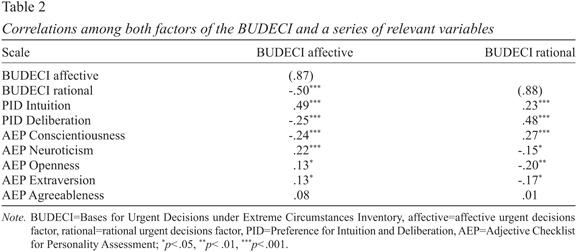
<body><![CDATA[<p><i>Materials and proceduress</i></p>     <p><i>Items description</i>. The items were developed in a theory-driven way (Burisch, 1984). Consequently, several items were inspired by the  dual-type models of information processing (and its measurement instruments) and by the naturalistic idea of following one&rsquo;s <i>heart</i>  (i.e., affect, Type 1 processing) or one&rsquo;s <i>head </i>(i.e., rationality, Type 2 processing) for decision-making. The rationale behind this  strategy was to subsequently reduce the number of items to an acceptable minimum, by conducting a factor analysis (Costello &amp; Osborne, 2005).  All the items were written in Argentinean Spanish and they inquired into how the participants would make their decisions (i.e., whether guided by  affect or rationality). A pool of 14 items, in a paper-and-pencil format, was provided to participants, who were instructed to indicate the degree  of agreement with each item (see <a href="#t1">Table 1</a>). A sample item from decision making based on affection is &ldquo;what my heart  dictates&rdquo; (&ldquo;lo que dicta mi coraz&oacute;n,&rdquo; in Argentinean Spanish). A sample item from decision making based on rationality is  &ldquo;evaluating pros and cons&rdquo; (&ldquo;evaluar pros y contras,&rdquo; in Argentinean Spanish). Responses were given on a scale rating from  1 (<i>totally false</i>) to 7 (<i>totally true</i>).</p>     <p>&nbsp;</p>     <p><a name="t1"></a></p>     <p><img src="/img/revistas/aps/v35n4/35n4a10t1.jpg" width="577" height="344"></p>     
<p>&nbsp;</p>     <p>&nbsp;</p>     <p><i>Procedure</i>. The participants responded to the inventories in group sessions. In order for the participants to understand the  characteristics of the extreme situations, written instructions in Argentinean Spanish were supplied before the presentation of the items. The  respondents were instructed to think about a putative extreme situation in which they must make a very fast decision (i.e., in less than one  second). The participants were told that an extreme situation included the following characteristics: they are completely new, fully unexpected,  and very important (possibly a life-or-death situation). Directions asked the participants to imagine that they were in an extreme situation  &ndash; not in the sense of a specific situation but rather a general one with the characteristics mentioned above &ndash; and to respond also in a  general way, by stating what they would prefer to do in this type of situation. Finally, directions asked the participants to imagine that they  respond to the urgent situation in less than a second so that they would clearly understand that the response should be very fast. Following the  presentation of instructions, the items were presented in a paper and pencil format. Participants reported demographic data, such as sex and age.</p>     <p>&nbsp;</p>     <p><b>Results</b></p>     ]]></body>
<body><![CDATA[<p>The Kaiser-Meyer-Olkin (KMO) test was 0.80 and the Bartlett&rsquo;s statistic (<i>df</i>=91) was 986, <i>p</i>&lt;.001. The results of the  parallel analysis based on minimum rank factor analysis (Timmerman &amp; Lorenzo-Seva, 2011) implemented on polychoric correlation matrices  suggested retaining two factors (eigenvalues 3.97 and 2.69; proportion of explained variance based on eigenvalues, .28 and .19, respectively). The  three oblique rotations were analysed. Items that loaded on each factor were the same in all the rotations (see <a href="#t1">Table 1</a>). We only  retained items with an item-to-factor loading on a specific factor that could be classified as excellent (loadings &gt;.71) or very good (loadings  &gt;.63) according to the Comrey and Lee (1992) guidelines, so as to achieve a more definitive and pure measure of factors (Pett, Lackey, &amp;  Sullivan, 2003; Tabachnick &amp; Fidell, 2006).</p>     <p>The retained items loaded lower than |.13| onto the other factor, indicating no salient cross-loadings (Brown, 2006; Costello &amp; Osborne,  2005; Tabachnick &amp; Fidell, 2006). Consequently, Factor 1 (Cronbach alpha=.82) and Factor 2 (Cronbach alpha=.82) were composed of 4 items,  respectively.</p>     <p>Regarding item content, it was observed that Factor 1 captured the concept of urgent decision-making based on affect under extreme  circumstances (i.e., Type 1 processing), named <i>affective urgent decision</i>. Factor 2 captured the concept of urgent decision-making based on  rationality under extreme circumstances (i.e., Type 2 processing), named <i>rational urgent decision</i>. These two factors or dimensions were of  substantial theoretical interest because they were consistent with the framework of the dual-type models of decision making.</p>     <p>The measurement instrument was named <i>Bases for Urgent Decisions under Extreme Circumstances Inventory</i> (BUDECI). The Argentinean Spanish  items were translated into English by a professional translator and reviewed by the authors. BUDECI includes the following items corresponding to  affective urgent decisions were <i>whatever my heart tells me, what I feel in my soul, what my heart dictates, a hunch</i>, whereas items  representing the rational urgent decisions were <i>planning, evaluating pros and cons, information processing, calculating probabilities</i> (items  were translated from Argentinean Spanish to English; for original items see <a href="#t1">Table 1</a>).</p>     <p>&nbsp;</p>     <p><b>Study 2: Validity of the BUDECI</b></p>     <p>The aims of this study were to analyse the psychometric properties, to test the two-factor model by means of a CFA, and to determine the face,  convergent and discriminant validity of the BUDECI. With respect to the CFA, we expected to confirm the presence of two factors, one corresponding  to urgent affective decisions and the other one corresponding to urgent rational decisions under extreme circumstances. About face validity, we  expected some psychologists who were doing psychological research to classify each item in the proper dimension. Regarding convergent validity, the  most important hypothesis was that the tendency towards urgent affective decisions under extreme situations was positively associated with the  general tendency towards intuitive (i.e., emotional) decisions in ordinary situations and that the tendency towards urgent rational decisions under  extreme situations was positively associated with the general tendency towards reflective decisions in ordinary situation. Regarding discriminant  validity, the Big Five model is associated with measures of generalized reasoning dispositions. A meta-analysis showed the confidence intervals of  the correlations of intuition and rationality with the Big Five, and showed that, in general, both decision-making tendencies are positively  associated with four of the factors of the Big Five, respectively, but not with emotional stability (Wang, Highhouse, Lake, Petersen, &amp; Rada,  2015). According to the same study, intuition tends to have higher correlations with extraversion, while rationality tends to have higher  correlations with conscientiousness and openness. Therefore, given that the general tendencies to make intuitive and reflective decisions are  associated with the Big Five personality traits, we expected the BUDECI to be related to the Big Five.</p>     <p>&nbsp;</p>     <p><b>Method</b></p>     <p>&nbsp;</p>     ]]></body>
<body><![CDATA[<p><i>Participants</i></p>     <p>Sample 2 was a convenience sample of the general population from Argentina consisting of 240 participants (120 women) with a mean age of 39.2  years (<i>SD</i>=14.7, age range: 17 [one participant] to 89). Respondents did not receive any compensation for their participation. The  &ldquo;snowball&rdquo; sampling technique was used for data collecting. Undergraduate students of Psychology received academic credits for  incorporating participants into this sample. Individuals gave their free and informed consent for their participation after they were informed  about the study objectives. The individuals have not received any form of compensation for their participation.</p>     <p>&nbsp;</p>     <p><i>Materials and proceduress</i></p>     <p>The assessment instruments included in this study are presented below.</p>     <p>&nbsp;</p>     <p><i>BUDECI</i>. It is the new 8-item self-report measurement instrument developed by the authors to assess urgent decision making under extreme  circumstances. The BUDECI evaluates two factors concerning the bases for decision making in new, unexpected and very important situations. The  <i>affective urgent decision </i>factor is characterized by subjective reaction related mainly to the emotional/affective state of the individual.  In contrast, the <i>rational urgent decision</i> factor is characterized by cognitive processing of information, which includes weighing pros and  cons, calculating probabilities, and planning responses, among other processes. This instrument includes written directions before presenting the  items (see Procedure section of Study 1). We used the BUDECI Argentinean Spanish version.</p>     <p>&nbsp;</p>     <p><i>Adjective Checklist for Personality Assessment (AEP)</i>. The Argentinean Spanish AEP version (Ledesma, S&aacute;nchez, &amp;  D&iacute;az-L&aacute;zaro, 2011) is a 67-item measurement instrument for assessing the Big Five personality model including agreeableness,  conscientiousness, neuroticism, extraversion, and openness to experience factors. The items consisted of adjectives associated with each Big Five  factor. The respondents indicated the degree of self-description of each personality adjective by means of a 5-point scale ranging from 1 (<i>does  not describe me at all</i>) to 5 (<i>totally describes me</i>). In our sample, the Cronbach alpha internal consistencies were .86 for  agreeableness (16 items), .86 for conscientiousness (13 items), .85 for neuroticism (18 items), .79 for extraversion (10 items), and .68 for  openness (10 items).</p>     <p>&nbsp;</p>     ]]></body>
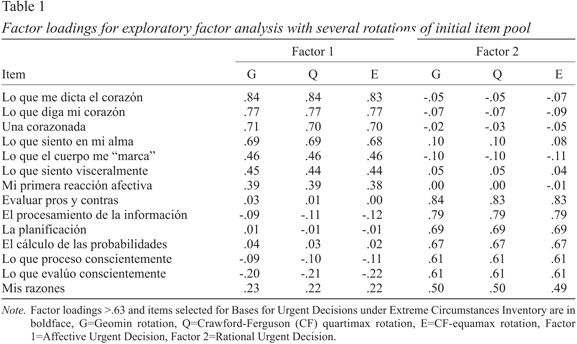
<body><![CDATA[<p><i>Preference for Intuition and Deliberation</i>. The PID (Betsch, 2004) is a measure of the individual inclination to the basic modes of  decision-making (Betsch &amp; Kunz, 2008) based on intuition (i.e., Type 1 processing), or on cognition (i.e., deliberation, Type 2 processing;  Betsch &amp; Kunz, 2008; Betsch &amp; Iannello, 2010). The PID conceptual definition of intuition is decision-making based on affect, and  deliberation is defined as decision making based on cognition (Betsch, 2008). Both PID factors are negatively associated and a model of two  correlated factors provided the best fit to the data (Betsch, 2004). In the development of PID, other previous similar instruments, particularly  REI (Raffaldi, Iannello, Vittani, &amp; Antonietti, 2012), were taken into account. PID and REI are strongly associated with one another, in such a  way that the preference scale for intuition of PID and the experiential scale of REI can be used interchangeably (Witteman, van den Bercken, Claes,  &amp; Godoy, 2009). We used an Argentinean Spanish adaptation of PID (Cosentino &amp; Azzollini, 2014) consisting of 8 items to measure preference  for intuition and 8 items to measure preference for deliberation. The items consist of positive statements, and the participants must indicate  their agreement using a 5-point scale ranging from 1 (<i>I very much disagree</i>) to 5 (<i>I very much agree</i>). In this research, internal  consistencies for the PID were Cronbach alpha=.85 for deliberation preference, and Cronbach alpha=.82 for intuition preference.</p>     <p>&nbsp;</p>     <p><i>Procedure</i>. Participants individually responded to the instruments. The administration order was: BUDECI, PID, AES. Finally, participants  reported demographic data, such as sex and age.</p>     <p>&nbsp;</p>     <p><b>Results</b></p>     <p>&nbsp;</p>     <p><i>Descriptive statistics and reliability</i></p>     <p>The internal consistencies of the BUDECI were acceptable for both scales, and these scales negatively correlated with each other (see  <a href="#t2">Table 2</a>). The mean score for the affective urgent decision scale was 17.2, <i>SD</i>=6.2, and the mean score for the rational  urgent decision scale was 16.2, <i>SD</i>=6.3. Men scored higher than women did on the rational urgent decision factor, <i>t</i>(238)=3.19,  <i>p</i>=.002.</p>     <p>&nbsp;</p>     <p><a name="t2"></a></p>     ]]></body>
<body><![CDATA[<p><img src="/img/revistas/aps/v35n4/35n4a10t2.jpg" width="576" height="252"></p>     
<p>&nbsp;</p>     <p>&nbsp;</p>     <p><i>CFA of BUDECI</i></p>     <p>For the purposes of assessing the two-factor model, a polychoric correlation was used with diagonally weighted least squares (DWLS) to estimate  the CFA of the BUDECI items, which had been responded to in an ordered categorical scale (Yang-Wallentin, J&ouml;reskog, &amp; Luo, 2010). Due to  the small sample size, we included the Satorra-Bentler chi-square statistic to test model fit (J&ouml;reskog, 2005). A series of fit indices were  considered (Schweizer, 2010). The CFA results for the BUDECI were Satorra-Bentler <i>&chi;<sup>2</i></sup>(19)=21.97, <i>ns</i>; normed  S-B<i>&chi;<sup>2</i></sup>=1.15; TLI=.994; CFI=.996; and RMSEA=.07. The previous results were interpreted as a good model fit of the data for the  BUDECI, which consisted of the affective urgent decision factor and the rational urgent decision factor as found in the EFA.</p>     <p>&nbsp;</p>     <p><i>Face validity</i></p>     <p>The face validity of BUDECI items was evaluated by 11 independent judges (8 women, 3 men) who conduct psychological research. We asked the  judges to categorize each of the BUDECI items on one of two dimensions: affective or rational urgent decision-making. Each judge correctly  classified all the BUDECI items in the proper dimension.</p>     <p>&nbsp;</p>     <p><i>Convergent and discriminant validity</i></p>     ]]></body>
<body><![CDATA[<p>For the purposes of assessing convergent and discriminant validity, the associations with scores from the theoretically relevant inventories  were analysed. In general, the associative hypotheses were confirmed for urgent decisions and generalized preference variables for decision-making  and the Big Five personality model (see <a href="#t2">Table 2</a>). Firstly, taking into account that the BUDECI assesses the affective and  rational bases for urgent decision-making under extreme circumstances, the scores of the affective urgent decision factor and the scores of the  rational urgent decision factor were positively associated with the scores of PID tendency to intuition and the scores of PID tendency to  deliberation, respectively. Secondly, on the whole, the affective urgent decision and rational urgent decision factors were associated with the Big  Five factors similarly to the way the Big Five factors were associated with the generalized disposition to intuition and to rationality (Wang et  al., 2015). However, it is noteworthy that other associations were found between urgent decisions and the Big Five. Specifically, the affective  urgent decision factor was found to be negatively associated with the conscientiousness factor, whereas the rational urgent decision factor was  found to be negatively associated with openness to experience and extraversion.</p>     <p>&nbsp;</p>     <p><b>Discussion</b></b>     <p>This study presents the development of a self-report measure for assessing the affective and rational bases for urgent decision making under  extreme circumstances. It also provides evidence of acceptable reliability, and structural, face, convergent, and divergent validity for the  BUDECI. The bases for the decision-making construct applied to this study rely on two dimensions: the affective urgent decisions and the rational  urgent decisions. With respect to the aforementioned dimensions, an EFA on an initial pool of items yielded a two-factor structure; and a  subsequent CFA on BUDECI scores from another sample yielded the same structure.</p>     <p>The BUDECI is based on the framework of dual-process or dual-type models or theories (Evans &amp; Stanovich, 2013). This previous framework  differentiates between two types of processing: Type 1 (i.e., intuition) and Type 2 (i.e., reflection/deliberation). The affective urgent decision  factor is associated with Type 1 processing, and the rational urgent decision factor is related to Type 2 processing.</p>     <p>The two factors, affective and rational urgent decisions, were found to be associated with each other. This result was expectable because the  association between the generalized dispositions to intuition and reflection has been reported in the literature on judgment and decision making  (Betsch, 2004; Novak &amp; Hoffman, 2009; Scott &amp; Bruce, 1995).</p>     <p>The correlations between the urgent decision factors and each of the relevant variables always presented the opposite sign, that is, if a  BUDECI factor was positively correlated with one of the relevant variables, the other factor was negatively correlated. In short, the association  of the BUDECI factors with the relevant variables showed exactly the reverse sign.</p>     <p>The BUDECI factors predict the generalized preference for intuition and for deliberation. The affectively based urgent decision making under  extreme circumstances was positively associated with preference for intuition, but negatively related to preference for deliberation. By contrast,  the rationally based urgent decision making under extreme circumstances was positively related to preference for deliberation, but negatively  related to preference for intuition.</p>     <p>The BUDECI factors are associated with the Big Five. The affective urgent decision factor was positively associated with neuroticism, openness  to experience, and extraversion, and negatively associated with conscientiousness. Conversely, the rational urgent decision factor was positively  associated with conscientiousness, and negatively associated with neuroticism, openness to experience, and extraversion. Finally, the differences  in the associations between urgent decisions and the Big Five and between generalized decision making tendencies and the Big Five (Wang et al.,  2015) support the notion that the construct urgent decision making under extreme circumstances and the construct generalized preference for  decision making are different from each other. In this sense, these differences show that the hypothesized need for an instrument to measure urgent  decisions is well-founded.</p>     <p>It may be concluded that the BUDECI is an instrument for measuring the construct bases for urgent decision making under extreme conditions, and  that it has adequate psychometric properties.</p>     ]]></body>
<body><![CDATA[<p>&nbsp;</p>     <p><b>Limitations</b></p>     <p>An important and noteworthy limitation for the validation of the new instrument was the lack of a published psychometric study on a reliable and  valid measuring instruments adapted to the Argentine population for assessing Types 1 and 2 processing. Therefore, for practical reasons the PID  was selected for this research: It is a measuring instrument that evaluates the tendency towards Types 1 and 2 processing, which has been adapted  to the population and has good psychometric properties. Undoubtedly, it would also have been interesting for us to use adapted measurements such as  the Situation-Specific Thinking Style (SSTS; Novak &amp; Hoffman, 2009), the GDMS (Scott &amp; Bruce, 1995), the REI (Pacini &amp; Epstein, 1999),  when they become available in Argentina, so as to be able to validate the new scale.</p>     <p>&nbsp;</p>     <p><b>Future studies</b></p>     <p>We consider it important to focus on the nomological network of the BUDECI factors, in order to determine whether they are associated with other  types of decision making, intelligence, or working memory.</p>     <p>Although the results of this study showed that the BUDECI is a reliable and valid scale, several studies could be performed to continue  exploring its psychometric properties. For example, it would be relevant to conduct a multiple-group confirmatory factor analysis across groups in  order to study the measurement invariance of this new scale.</p>     <p>To conclude, although the aim of developing the BUDECI was to design a short inventory, we consider that the same dimensions could be measured  by an instrument with a larger number of items to be administered in research settings where there were no time constraints for data collection,  and where a higher level of accuracy and attention to detail may be considered useful.</p>     <p>&nbsp;</p>     <p><b>References</b></p>     ]]></body>
<body><![CDATA[<!-- ref --><p>Adam, H., Obodaru, O., &amp; Galinsky, A. D. (2015). Who you are is where you are: Antecedents and consequences of locating the self in the  brain or the heart. <i>Organizational Behavior and Human Decision Processes, 128</i>, 74-83. Retrieved from  <a href="http://dx.doi.org/10.1016/j.obhdp.2015.03.004" target="_blank">http://dx.doi.org/10.1016/j.obhdp.2015.03.004</a>&nbsp;&nbsp;&nbsp;&nbsp;&nbsp;&nbsp;&nbsp;&nbsp;[&#160;<a href="javascript:void(0);" onclick="javascript: window.open('/scielo.php?script=sci_nlinks&ref=034653&pid=S0870-8231201700040001000001&lng=','','width=640,height=500,resizable=yes,scrollbars=1,menubar=yes,');">Links</a>&#160;]<!-- end-ref --><!-- ref --><p>Appelt, K. C., Milch, K. F., Handgraaf, M. J., &amp; Weber, E. U. (2011). The Decision Making Individual Differences Inventory and guidelines  for the study of individual differences in judgment and decision-making research. <i>Judgment and Decision Making, 6</i>, 252-262.    &nbsp;&nbsp;&nbsp;&nbsp;&nbsp;&nbsp;&nbsp;&nbsp;[&#160;<a href="javascript:void(0);" onclick="javascript: window.open('/scielo.php?script=sci_nlinks&ref=034654&pid=S0870-8231201700040001000002&lng=','','width=640,height=500,resizable=yes,scrollbars=1,menubar=yes,');">Links</a>&#160;]<!-- end-ref --></p>     <!-- ref --><p>Betsch, C. (2004). Pr&auml;ferenzf&uuml;r Intuition und Deliberation (PID). Inventar zur erfassung von affekt- und kognitionsbasiertem  entscheiden [Preference for Intuition and Deliberation (PID): An inventory for assessing affect- and cognition-based decision-making].  <i>Zeitschrift f&uuml;r Differentielle und Diagnostische Psychologie, 25</i>, 179-197. Retrieved from  <a href="http://dx.doi.org/10.1024/0170-1789.25.4.179" target="_blank">http://dx.doi.org/10.1024/0170-1789.25.4.179</a>&nbsp;&nbsp;&nbsp;&nbsp;&nbsp;&nbsp;&nbsp;&nbsp;[&#160;<a href="javascript:void(0);" onclick="javascript: window.open('/scielo.php?script=sci_nlinks&ref=034656&pid=S0870-8231201700040001000003&lng=','','width=640,height=500,resizable=yes,scrollbars=1,menubar=yes,');">Links</a>&#160;]<!-- end-ref --><!-- ref --><p>Betsch, C. (2008). Chronic preferences for intuition and deliberation in decision making: Lessons learned about intuition from an individual  differences approach. In H. Plessner, C. Betsch, &amp; T. Betsch (Eds.), <i>Intuition in judgment and decision making </i>(pp. 231-248). Mahwah,  NJ, US: Lawrence Erlbaum Associates Publishers.    &nbsp;&nbsp;&nbsp;&nbsp;&nbsp;&nbsp;&nbsp;&nbsp;[&#160;<a href="javascript:void(0);" onclick="javascript: window.open('/scielo.php?script=sci_nlinks&ref=034657&pid=S0870-8231201700040001000004&lng=','','width=640,height=500,resizable=yes,scrollbars=1,menubar=yes,');">Links</a>&#160;]<!-- end-ref --></p>     <!-- ref --><p>Betsch, C., &amp; Iannello, P. (2010). Measuring individual differences in intuitive and deliberate decision making styles: A comparison of  different measures. In A. Gl&ouml;ckner &amp; C. Witteman (Eds.), <i>Tracing intuition: Recent methods in measuring intuitive and deliberate  processes in decision making </i>(pp. 251-267). London: Psychology Press.    &nbsp;&nbsp;&nbsp;&nbsp;&nbsp;&nbsp;&nbsp;&nbsp;[&#160;<a href="javascript:void(0);" onclick="javascript: window.open('/scielo.php?script=sci_nlinks&ref=034659&pid=S0870-8231201700040001000005&lng=','','width=640,height=500,resizable=yes,scrollbars=1,menubar=yes,');">Links</a>&#160;]<!-- end-ref --></p>     <!-- ref --><p>Betsch, C., &amp; Kunz, J. J. (2008). Individual strategy preferences and decisional fit. <i>Journal of Behavioral Decision Making, 21</i>,  532-555. Retrieved from <a href="http://dx.doi.org/10.1002/bdm.600" target="_blank">http://dx.doi.org/10.1002/bdm.600</a>&nbsp;&nbsp;&nbsp;&nbsp;&nbsp;&nbsp;&nbsp;&nbsp;[&#160;<a href="javascript:void(0);" onclick="javascript: window.open('/scielo.php?script=sci_nlinks&ref=034661&pid=S0870-8231201700040001000006&lng=','','width=640,height=500,resizable=yes,scrollbars=1,menubar=yes,');">Links</a>&#160;]<!-- end-ref --><!-- ref --><p>Brown, T. A. (2006). <i>Confirmatory factor analysis for applied research</i>. New York, NY, US: Guilford Press.    &nbsp;&nbsp;&nbsp;&nbsp;&nbsp;&nbsp;&nbsp;&nbsp;[&#160;<a href="javascript:void(0);" onclick="javascript: window.open('/scielo.php?script=sci_nlinks&ref=034662&pid=S0870-8231201700040001000007&lng=','','width=640,height=500,resizable=yes,scrollbars=1,menubar=yes,');">Links</a>&#160;]<!-- end-ref --></p>     <!-- ref --><p>Browne, M. W. (2001). An overview of analytic rotation in exploratory factor analysis. <i>Multivariate Behavioral Research, 36</i>, 111-150.  Retrieved from <a href="http://dx.doi.org/10.1207/S15327906MBR3601_05" target="_blank">http://dx.doi.org/10.1207/S15327906MBR3601_05</a>&nbsp;&nbsp;&nbsp;&nbsp;&nbsp;&nbsp;&nbsp;&nbsp;[&#160;<a href="javascript:void(0);" onclick="javascript: window.open('/scielo.php?script=sci_nlinks&ref=034664&pid=S0870-8231201700040001000008&lng=','','width=640,height=500,resizable=yes,scrollbars=1,menubar=yes,');">Links</a>&#160;]<!-- end-ref --><!-- ref --><p>Burisch, M. (1984). Approaches to personality inventory construction: A comparison of merits. <i>American Psychologist, 39</i>, 214-227.  Retrieved from Retrieved from <a href="http://dx.doi.org/10.1037/0003-066X.39.3.214"  target="_blank">http://dx.doi.org/10.1037/0003-066X.39.3.214</a>&nbsp;&nbsp;&nbsp;&nbsp;&nbsp;&nbsp;&nbsp;&nbsp;[&#160;<a href="javascript:void(0);" onclick="javascript: window.open('/scielo.php?script=sci_nlinks&ref=034665&pid=S0870-8231201700040001000009&lng=','','width=640,height=500,resizable=yes,scrollbars=1,menubar=yes,');">Links</a>&#160;]<!-- end-ref --><!-- ref --><p>Cian, L., Krishna, A., &amp; Schwarz, N. (2015). Positioning rationality and emotion: Rationality is up and emotion is down. <i>Journal of  Consumer Research, 42</i>, 632-651. Retrieved from <a href="http://dx.doi.org/10.1093/jcr/ucv046"  target="_blank">http://dx.doi.org/10.1093/jcr/ucv046</a>&nbsp;&nbsp;&nbsp;&nbsp;&nbsp;&nbsp;&nbsp;&nbsp;[&#160;<a href="javascript:void(0);" onclick="javascript: window.open('/scielo.php?script=sci_nlinks&ref=034666&pid=S0870-8231201700040001000010&lng=','','width=640,height=500,resizable=yes,scrollbars=1,menubar=yes,');">Links</a>&#160;]<!-- end-ref --><!-- ref --><p>Comrey, A. L., &amp; Lee, H. B. (1992). <i>A first course in factor analysis </i>(2<sup>nd </sup>ed.). Hillsdale, NJ, US: Lawrence Erlbaum  Associates.    &nbsp;&nbsp;&nbsp;&nbsp;&nbsp;&nbsp;&nbsp;&nbsp;[&#160;<a href="javascript:void(0);" onclick="javascript: window.open('/scielo.php?script=sci_nlinks&ref=034667&pid=S0870-8231201700040001000011&lng=','','width=640,height=500,resizable=yes,scrollbars=1,menubar=yes,');">Links</a>&#160;]<!-- end-ref --></p>     <!-- ref --><p>Cosentino, A. C., &amp; Azzollini, S. C. (2014). <i>Latent means comparison and measurement invariance across gender of preference for  intuition and deliberation</i>. Manuscript submitted for publication.    &nbsp;&nbsp;&nbsp;&nbsp;&nbsp;&nbsp;&nbsp;&nbsp;[&#160;<a href="javascript:void(0);" onclick="javascript: window.open('/scielo.php?script=sci_nlinks&ref=034669&pid=S0870-8231201700040001000012&lng=','','width=640,height=500,resizable=yes,scrollbars=1,menubar=yes,');">Links</a>&#160;]<!-- end-ref --></p>     <!-- ref --><p>Costello, A., &amp; Osborne, J. (2005). Best practices in exploratory factor analysis: Four recommendations for getting the most from your  analysis. <i>Practical Assessment, Research &amp; Evaluation, 10</i>, 173-178.    &nbsp;&nbsp;&nbsp;&nbsp;&nbsp;&nbsp;&nbsp;&nbsp;[&#160;<a href="javascript:void(0);" onclick="javascript: window.open('/scielo.php?script=sci_nlinks&ref=034671&pid=S0870-8231201700040001000013&lng=','','width=640,height=500,resizable=yes,scrollbars=1,menubar=yes,');">Links</a>&#160;]<!-- end-ref --></p>     ]]></body>
<body><![CDATA[<!-- ref --><p>Crawford, A. V., Green, S. B., Levy, R., Lo, W.-J., Scott, L., Svetina, D., &amp; Thompson, M. S. (2010). Evaluation of parallel analysis  methods for determining the number of factors. <i>Educational and Psychological Measurement, 70</i>, 885-901. Retrieved from  <a href="http://dx.doi.org/10.1177/0013164410379332" target="_blank">http://dx.doi.org/10.1177/0013164410379332</a>&nbsp;&nbsp;&nbsp;&nbsp;&nbsp;&nbsp;&nbsp;&nbsp;[&#160;<a href="javascript:void(0);" onclick="javascript: window.open('/scielo.php?script=sci_nlinks&ref=034673&pid=S0870-8231201700040001000014&lng=','','width=640,height=500,resizable=yes,scrollbars=1,menubar=yes,');">Links</a>&#160;]<!-- end-ref --><!-- ref --><p>Dane, E., &amp; Pratt, M. G. (2007). Exploring intuition and its role in managerial decision making. <i>Academy of Management Review, 32</i>,  33-54. Retrieved from <a href="http://dx.doi.org/10.5465/AMR.2007.23463682" target="_blank">http://dx.doi.org/10.5465/AMR.2007.23463682</a>&nbsp;&nbsp;&nbsp;&nbsp;&nbsp;&nbsp;&nbsp;&nbsp;[&#160;<a href="javascript:void(0);" onclick="javascript: window.open('/scielo.php?script=sci_nlinks&ref=034674&pid=S0870-8231201700040001000015&lng=','','width=640,height=500,resizable=yes,scrollbars=1,menubar=yes,');">Links</a>&#160;]<!-- end-ref --><!-- ref --><p>Eisenhardt, K. M. (1989). Making fast strategic decisions in high-velocity environments. <i>The Academy of Management Journal, 32</i>, 543-576.  Retrieved from <a href="http://dx.doi.org/10.2307/256434" target="_blank">http://dx.doi.org/10.2307/256434</a>&nbsp;&nbsp;&nbsp;&nbsp;&nbsp;&nbsp;&nbsp;&nbsp;[&#160;<a href="javascript:void(0);" onclick="javascript: window.open('/scielo.php?script=sci_nlinks&ref=034675&pid=S0870-8231201700040001000016&lng=','','width=640,height=500,resizable=yes,scrollbars=1,menubar=yes,');">Links</a>&#160;]<!-- end-ref --><!-- ref --><p>Epstein, S. (2010). Demystifying intuition: What it is, what it does, and how it does it. <i>Psychological Inquiry, 21</i>, 295-312.  Retrieved from <a href="http://dx.doi.org/10.1080/1047840X.2010.523875" target="_blank">http://dx.doi.org/10.1080/1047840X.2010.523875</a>&nbsp;&nbsp;&nbsp;&nbsp;&nbsp;&nbsp;&nbsp;&nbsp;[&#160;<a href="javascript:void(0);" onclick="javascript: window.open('/scielo.php?script=sci_nlinks&ref=034676&pid=S0870-8231201700040001000017&lng=','','width=640,height=500,resizable=yes,scrollbars=1,menubar=yes,');">Links</a>&#160;]<!-- end-ref --><!-- ref --><p>Evans, J. S. B. T. (2012). Dual-Process theories of deductive reasoning: Facts and fallacies. In K. J. Holyoak &amp; R. G. Morrison (Eds.),  <i>The Oxford handbook of thinking and reasoning </i>(pp. 115-133). New York, NY, US: Oxford University Press.  Retrieved from <a href="http://dx.doi.org/10.1093/oxfordhb/9780199734689.013.0008"  target="_blank">http://dx.doi.org/10.1093/oxfordhb/9780199734689.013.0008</a>&nbsp;&nbsp;&nbsp;&nbsp;&nbsp;&nbsp;&nbsp;&nbsp;[&#160;<a href="javascript:void(0);" onclick="javascript: window.open('/scielo.php?script=sci_nlinks&ref=034677&pid=S0870-8231201700040001000018&lng=','','width=640,height=500,resizable=yes,scrollbars=1,menubar=yes,');">Links</a>&#160;]<!-- end-ref --><!-- ref --><p>Evans, J. S. B. T., &amp; Stanovich, K. E. (2013). Dual-process theories of higher cognition: Advancing the debate. <i>Perspectives on  Psychological Science, 8</i>, 223-241. Retrieved from <a href="http://dx.doi.org/10.1177/1745691612460685"  target="_blank">http://dx.doi.org/10.1177/1745691612460685</a>&nbsp;&nbsp;&nbsp;&nbsp;&nbsp;&nbsp;&nbsp;&nbsp;[&#160;<a href="javascript:void(0);" onclick="javascript: window.open('/scielo.php?script=sci_nlinks&ref=034678&pid=S0870-8231201700040001000019&lng=','','width=640,height=500,resizable=yes,scrollbars=1,menubar=yes,');">Links</a>&#160;]<!-- end-ref --><!-- ref --><p>Fetterman, A. K., &amp; Robinson, M. D. (2013). Do you use your head or follow your heart? Self-location predicts personality, emotion,  decision making, and performance. <i>Journal of Personality and Social Psychology, 105</i>, 316-334. Retrieved from  <a href="http://dx.doi.org/10.1037/a0033374" target="_blank">http://dx.doi.org/10.1037/a0033374</a>&nbsp;&nbsp;&nbsp;&nbsp;&nbsp;&nbsp;&nbsp;&nbsp;[&#160;<a href="javascript:void(0);" onclick="javascript: window.open('/scielo.php?script=sci_nlinks&ref=034679&pid=S0870-8231201700040001000020&lng=','','width=640,height=500,resizable=yes,scrollbars=1,menubar=yes,');">Links</a>&#160;]<!-- end-ref --><p>Fiedler, K., &amp; von Sydow, M. (2015). Heuristics and biases: Beyond Tversky and Kahneman&rsquo;s (1974) judgment under uncertainty. In  M. W. Eysenck &amp; D. Groome (Eds.), <i>Cognitive psychology: Revisiting the classical studies </i>(pp. 146-161). London, UK: Sage.</p>     <!-- ref --><p>Frankish, K., &amp; Evans, J. S. B. T. (2009). The duality of mind: An historical perspective. In J. Evans &amp; K. Frankish (Eds.), <i>In two  minds: Dual processes and beyond </i>(pp. 1-30). New York, NY, US: Oxford University Press.    &nbsp;&nbsp;&nbsp;&nbsp;&nbsp;&nbsp;&nbsp;&nbsp;[&#160;<a href="javascript:void(0);" onclick="javascript: window.open('/scielo.php?script=sci_nlinks&ref=034681&pid=S0870-8231201700040001000022&lng=','','width=640,height=500,resizable=yes,scrollbars=1,menubar=yes,');">Links</a>&#160;]<!-- end-ref --></p>     ]]></body>
<body><![CDATA[<!-- ref --><p>Grandori, A. (2015). Heuristics as methods: Validity, reliability and velocity. In E. Ippoliti (Ed.), <i>Heuristic reasoning </i>(pp. 147-161).  New York, NY, US: Springer. Retrieved from <a href="http://dx.doi.org/10.1007/978-3-319-09159-4_7"  target="_blank">http://dx.doi.org/10.1007/978-3-319-09159-4_7</a>&nbsp;&nbsp;&nbsp;&nbsp;&nbsp;&nbsp;&nbsp;&nbsp;[&#160;<a href="javascript:void(0);" onclick="javascript: window.open('/scielo.php?script=sci_nlinks&ref=034683&pid=S0870-8231201700040001000023&lng=','','width=640,height=500,resizable=yes,scrollbars=1,menubar=yes,');">Links</a>&#160;]<!-- end-ref --><!-- ref --><p>Haidt, J. (2001). The emotional dog and its rational tail: A social intuitionist approach to moral judgment. <i>Psychological Review, 108</i>,  814-834. Retrieved from <a href="http://dx.doi.org/10.1037/0033-295X.108.4.814" target="_blank">http://dx.doi.org/10.1037/0033-295X.108.4.814</a>&nbsp;&nbsp;&nbsp;&nbsp;&nbsp;&nbsp;&nbsp;&nbsp;[&#160;<a href="javascript:void(0);" onclick="javascript: window.open('/scielo.php?script=sci_nlinks&ref=034684&pid=S0870-8231201700040001000024&lng=','','width=640,height=500,resizable=yes,scrollbars=1,menubar=yes,');">Links</a>&#160;]<!-- end-ref --><!-- ref --><p>Holgado-Tello, F. P., Chac&oacute;n-Moscoso, S., Barbero-Garc&iacute;a, I., &amp; Vila-Abad, E. (2010). Polychoric versus Pearson correlations  in exploratory and confirmatory factor analysis of ordinal variables. <i>Quality &amp; Quantity: International Journal of Methodology, 44</i>,  153-166. Retrieved from <a href="http://dx.doi.org/10.1007/s11135-008-9190-y" target="_blank">http://dx.doi.org/10.1007/s11135-008-9190-y</a>&nbsp;&nbsp;&nbsp;&nbsp;&nbsp;&nbsp;&nbsp;&nbsp;[&#160;<a href="javascript:void(0);" onclick="javascript: window.open('/scielo.php?script=sci_nlinks&ref=034685&pid=S0870-8231201700040001000025&lng=','','width=640,height=500,resizable=yes,scrollbars=1,menubar=yes,');">Links</a>&#160;]<!-- end-ref --><!-- ref --><p>J&ouml;reskog, K. G. (2005). <i>Structural equation modeling with ordinal variables using LISREL</i>. Retrieved from  <a href="http://www.ssicentral.com/lisrel/techdocs/ordinal.pdf" target="_blank">http://www.ssicentral.com/lisrel/techdocs/ordinal.pdf</a>&nbsp;&nbsp;&nbsp;&nbsp;&nbsp;&nbsp;&nbsp;&nbsp;[&#160;<a href="javascript:void(0);" onclick="javascript: window.open('/scielo.php?script=sci_nlinks&ref=034686&pid=S0870-8231201700040001000026&lng=','','width=640,height=500,resizable=yes,scrollbars=1,menubar=yes,');">Links</a>&#160;]<!-- end-ref --><!-- ref --><p>Kahneman, D. (2003). A perspective on judgment and choice: mapping bounded rationality. <i>The American Psychologist, 58</i>, 697-720.  Retrieved from <a href="http://dx.doi.org/10.1037/0003-066X.58.9.697" target="_blank">http://dx.doi.org/10.1037/0003-066X.58.9.697</a>&nbsp;&nbsp;&nbsp;&nbsp;&nbsp;&nbsp;&nbsp;&nbsp;[&#160;<a href="javascript:void(0);" onclick="javascript: window.open('/scielo.php?script=sci_nlinks&ref=034687&pid=S0870-8231201700040001000027&lng=','','width=640,height=500,resizable=yes,scrollbars=1,menubar=yes,');">Links</a>&#160;]<!-- end-ref --><!-- ref --><p>Lakoff, G., &amp; Johnson, M. (1999). <i>Philosophy in the flesh: The embodied mind and its challenge to western thought</i>. New York, NY, US:  Basic Books.    &nbsp;&nbsp;&nbsp;&nbsp;&nbsp;&nbsp;&nbsp;&nbsp;[&#160;<a href="javascript:void(0);" onclick="javascript: window.open('/scielo.php?script=sci_nlinks&ref=034688&pid=S0870-8231201700040001000028&lng=','','width=640,height=500,resizable=yes,scrollbars=1,menubar=yes,');">Links</a>&#160;]<!-- end-ref --></p>     <!-- ref --><p>Ledesma, R. D., S&aacute;nchez, R., &amp; D&iacute;az-L&aacute;zaro, C. M. (2011). Adjective checklist to assess the big five personality  factors in the Argentine population. <i>Journal of Personality Assessment, 93</i>, 46-55. Retrieved from  <a href="http://dx.doi.org/10.1080/00223891.2010.513708" target="_blank">http://dx.doi.org/10.1080/00223891.2010.513708</a>&nbsp;&nbsp;&nbsp;&nbsp;&nbsp;&nbsp;&nbsp;&nbsp;[&#160;<a href="javascript:void(0);" onclick="javascript: window.open('/scielo.php?script=sci_nlinks&ref=034690&pid=S0870-8231201700040001000029&lng=','','width=640,height=500,resizable=yes,scrollbars=1,menubar=yes,');">Links</a>&#160;]<!-- end-ref --><!-- ref --><p>Lorenzo-Seva, U., Timmerman, M. E., &amp; Kiers, H. A. L. (2011). The Hull method for selecting the number of common factors. <i>Multivariate  Behavioral Research, 46</i>, 340-364. Retrieved from <a href="http://dx.doi.org/10.1080/00273171.2011.564527"  target="_blank">http://dx.doi.org/10.1080/00273171.2011.564527</a>&nbsp;&nbsp;&nbsp;&nbsp;&nbsp;&nbsp;&nbsp;&nbsp;[&#160;<a href="javascript:void(0);" onclick="javascript: window.open('/scielo.php?script=sci_nlinks&ref=034691&pid=S0870-8231201700040001000030&lng=','','width=640,height=500,resizable=yes,scrollbars=1,menubar=yes,');">Links</a>&#160;]<!-- end-ref --><!-- ref --><p>Novak, T. P., &amp; Hoffman, D. L. (2009). The fit of thinking style and situation: New measures of situation-specific experiential and  rational cognition. <i>Journal of Consumer Research, 36</i>, 56-72. Retrieved from <a href="http://dx.doi.org/10.1086/596026"  target="_blank">http://dx.doi.org/10.1086/596026</a>&nbsp;&nbsp;&nbsp;&nbsp;&nbsp;&nbsp;&nbsp;&nbsp;[&#160;<a href="javascript:void(0);" onclick="javascript: window.open('/scielo.php?script=sci_nlinks&ref=034692&pid=S0870-8231201700040001000031&lng=','','width=640,height=500,resizable=yes,scrollbars=1,menubar=yes,');">Links</a>&#160;]<!-- end-ref --><!-- ref --><p>Pacini, R., &amp; Epstein, S. (1999). The relation of rational and experiential information processing styles to personality, basic beliefs,  and the ratio-bias phenomenon. <i>Journal of Personality and Social Psychology, 76</i>, 972-987. Retrieved from  <a href="http://dx.doi.org/10.1037/0022-3514.76.6.972" target="_blank">http://dx.doi.org/10.1037/0022-3514.76.6.972</a>&nbsp;&nbsp;&nbsp;&nbsp;&nbsp;&nbsp;&nbsp;&nbsp;[&#160;<a href="javascript:void(0);" onclick="javascript: window.open('/scielo.php?script=sci_nlinks&ref=034693&pid=S0870-8231201700040001000032&lng=','','width=640,height=500,resizable=yes,scrollbars=1,menubar=yes,');">Links</a>&#160;]<!-- end-ref --><!-- ref --><p>Pett, M. A., Lackey, N. R., &amp; Sullivan, J. J. (2003). <i>Making sense of factor analysis: The use of factor analysis for instrument  development in health care research</i>. Thousand Oaks, CA, US: Sage Publications.    &nbsp;&nbsp;&nbsp;&nbsp;&nbsp;&nbsp;&nbsp;&nbsp;[&#160;<a href="javascript:void(0);" onclick="javascript: window.open('/scielo.php?script=sci_nlinks&ref=034694&pid=S0870-8231201700040001000033&lng=','','width=640,height=500,resizable=yes,scrollbars=1,menubar=yes,');">Links</a>&#160;]<!-- end-ref --></p>     <!-- ref --><p>Raffaldi, S., Iannello, P., Vittani, L., &amp; Antonietti, A. (2012). Decision-making styles in the workplace. Relationships between  self-report questionnaires and a contextualized measure of the analytical-systematic <i>versus</i> global-intuitive approach. <i>SAGE Open, 2</i>,  1-11. Retrieved from <a href="http://dx.doi.org/10.1177/2158244012448082" target="_blank">http://dx.doi.org/10.1177/2158244012448082</a>&nbsp;&nbsp;&nbsp;&nbsp;&nbsp;&nbsp;&nbsp;&nbsp;[&#160;<a href="javascript:void(0);" onclick="javascript: window.open('/scielo.php?script=sci_nlinks&ref=034696&pid=S0870-8231201700040001000034&lng=','','width=640,height=500,resizable=yes,scrollbars=1,menubar=yes,');">Links</a>&#160;]<!-- end-ref --><!-- ref --><p>Sass, D. A., &amp; Schmitt, T. A. (2010). A comparative investigation of rotation criteria within exploratory factor analysis. <i>Multivariate  Behavioral Research, 45</i>, 73-103. Retrieved from <a href="http://dx.doi.org/10.1080/00273170903504810"  target="_blank">http://dx.doi.org/10.1080/00273170903504810</a>&nbsp;&nbsp;&nbsp;&nbsp;&nbsp;&nbsp;&nbsp;&nbsp;[&#160;<a href="javascript:void(0);" onclick="javascript: window.open('/scielo.php?script=sci_nlinks&ref=034697&pid=S0870-8231201700040001000035&lng=','','width=640,height=500,resizable=yes,scrollbars=1,menubar=yes,');">Links</a>&#160;]<!-- end-ref --><!-- ref --><p>Schmitt, T. A. (2011). Current methodological considerations in exploratory and confirmatory factor analysis. <i>Journal of Psychoeducational  Assessment, 29</i>, 304-321. Retrieved from <a href="http://dx.doi.org/10.1177/0734282911406653"  target="_blank">http://dx.doi.org/10.1177/0734282911406653</a>&nbsp;&nbsp;&nbsp;&nbsp;&nbsp;&nbsp;&nbsp;&nbsp;[&#160;<a href="javascript:void(0);" onclick="javascript: window.open('/scielo.php?script=sci_nlinks&ref=034698&pid=S0870-8231201700040001000036&lng=','','width=640,height=500,resizable=yes,scrollbars=1,menubar=yes,');">Links</a>&#160;]<!-- end-ref --><!-- ref --><p>Schmitt, T. A., &amp; Sass, D. A. (2011). Rotation criteria and hypothesis testing for exploratory factor analysis: Implications for factor  pattern loadings and interfactor correlations. <i>Educational and Psychological Measurement, 71</i>, 95-113. Retrieved from  <a href="http://dx.doi.org/10.1177/0013164410387348"  target="_blank">http://dx.doi.org/10.1177/0013164410387348</a>&nbsp;&nbsp;&nbsp;&nbsp;&nbsp;&nbsp;&nbsp;&nbsp;[&#160;<a href="javascript:void(0);" onclick="javascript: window.open('/scielo.php?script=sci_nlinks&ref=034699&pid=S0870-8231201700040001000037&lng=','','width=640,height=500,resizable=yes,scrollbars=1,menubar=yes,');">Links</a>&#160;]<!-- end-ref --><!-- ref --><p>Schweizer, K. (2010). Some guidelines concerning the modeling of traits and abilities in test construction. <i>European Journal of  Psychological Assessment, 26</i>, 1-2. Retrieved from <a href="http://dx.doi.org/10.1027/1015-5759/a000001"  target="_blank">http://dx.doi.org/10.1027/1015-5759/a000001</a>&nbsp;&nbsp;&nbsp;&nbsp;&nbsp;&nbsp;&nbsp;&nbsp;[&#160;<a href="javascript:void(0);" onclick="javascript: window.open('/scielo.php?script=sci_nlinks&ref=034700&pid=S0870-8231201700040001000038&lng=','','width=640,height=500,resizable=yes,scrollbars=1,menubar=yes,');">Links</a>&#160;]<!-- end-ref --><!-- ref --><p>Scott, S. G., &amp; Bruce, R. A. (1995). Decision-making style: The development and assessment of a new measure. <i>Educational and  Psychological Measurement, 55</i>, 818-831. Retrieved from <a href="http://dx.doi.org/10.1177/0013164495055005017"  target="_blank">http://dx.doi.org/10.1177/0013164495055005017</a>&nbsp;&nbsp;&nbsp;&nbsp;&nbsp;&nbsp;&nbsp;&nbsp;[&#160;<a href="javascript:void(0);" onclick="javascript: window.open('/scielo.php?script=sci_nlinks&ref=034701&pid=S0870-8231201700040001000039&lng=','','width=640,height=500,resizable=yes,scrollbars=1,menubar=yes,');">Links</a>&#160;]<!-- end-ref --><!-- ref --><p>Stanovich, K. E. (1999). <i>Who is rational? Studies of individual differences in reasoning</i>. Mahwah, NJ, US: Lawrence Erlbaum Associates  Publishers.    &nbsp;&nbsp;&nbsp;&nbsp;&nbsp;&nbsp;&nbsp;&nbsp;[&#160;<a href="javascript:void(0);" onclick="javascript: window.open('/scielo.php?script=sci_nlinks&ref=034702&pid=S0870-8231201700040001000040&lng=','','width=640,height=500,resizable=yes,scrollbars=1,menubar=yes,');">Links</a>&#160;]<!-- end-ref --></p>     <!-- ref --><p>Tabachnick, B. G., &amp; Fidell, L. S. (2006). <i>Using multivariate statistics </i>(5<sup>th </sup>ed.). Boston, MA, US: Allyn &amp;  Bacon-Pearson Education.    &nbsp;&nbsp;&nbsp;&nbsp;&nbsp;&nbsp;&nbsp;&nbsp;[&#160;<a href="javascript:void(0);" onclick="javascript: window.open('/scielo.php?script=sci_nlinks&ref=034704&pid=S0870-8231201700040001000041&lng=','','width=640,height=500,resizable=yes,scrollbars=1,menubar=yes,');">Links</a>&#160;]<!-- end-ref --></p>     <!-- ref --><p>Timmerman, M. E., &amp; Lorenzo-Seva, U. (2011). Dimensionality assessment of ordered polytomous items with parallel analysis. <i>Psychological  Methods, 16</i>, 209-220. Retrieved from <a href="http://dx.doi.org/10.1037/a0023353" target="_blank">http://dx.doi.org/10.1037/a0023353</a>&nbsp;&nbsp;&nbsp;&nbsp;&nbsp;&nbsp;&nbsp;&nbsp;[&#160;<a href="javascript:void(0);" onclick="javascript: window.open('/scielo.php?script=sci_nlinks&ref=034706&pid=S0870-8231201700040001000042&lng=','','width=640,height=500,resizable=yes,scrollbars=1,menubar=yes,');">Links</a>&#160;]<!-- end-ref --><!-- ref --><p>Wang, Y., Highhouse, S., Lake, C. J., Petersen, N. L., &amp; Rada, T. B. (2015). Meta-analytic investigations of the relation between intuition  and analysis. <i>Journal of Behavioral Decision Making</i>. Advance online publication. Retrieved from  <a href="http://dx.doi.org/10.1002/bdm.1903" target="_blank">http://dx.doi.org/10.1002/bdm.1903</a>&nbsp;&nbsp;&nbsp;&nbsp;&nbsp;&nbsp;&nbsp;&nbsp;[&#160;<a href="javascript:void(0);" onclick="javascript: window.open('/scielo.php?script=sci_nlinks&ref=034707&pid=S0870-8231201700040001000043&lng=','','width=640,height=500,resizable=yes,scrollbars=1,menubar=yes,');">Links</a>&#160;]<!-- end-ref --><!-- ref --><p>Witteman, C., van den Bercken, J., Claes, L., &amp; Godoy, A. (2009). Assessing rational and intuitive thinking styles. <i>European Journal of  Psychological Assessment, 25</i>, 39-47. Retrieved from <a href="http://dx.doi.org/10.1027/1015-5759.25.1.39"  target="_blank">http://dx.doi.org/10.1027/1015-5759.25.1.39</a>&nbsp;&nbsp;&nbsp;&nbsp;&nbsp;&nbsp;&nbsp;&nbsp;[&#160;<a href="javascript:void(0);" onclick="javascript: window.open('/scielo.php?script=sci_nlinks&ref=034708&pid=S0870-8231201700040001000044&lng=','','width=640,height=500,resizable=yes,scrollbars=1,menubar=yes,');">Links</a>&#160;]<!-- end-ref --><!-- ref --><p>Yang-Wallentin, F., J&ouml;reskog, K. G., &amp; Luo, H. (2010). Confirmatory factor analysis of ordinal variables with misspecified models.  <i>Structural Equation Modeling, 17</i>, 392-423. Retrieved from <a href="http://dx.doi.org/10.1080/10705511.2010.489003"  target="_blank">http://dx.doi.org/10.1080/10705511.2010.489003</a>&nbsp;&nbsp;&nbsp;&nbsp;&nbsp;&nbsp;&nbsp;&nbsp;[&#160;<a href="javascript:void(0);" onclick="javascript: window.open('/scielo.php?script=sci_nlinks&ref=034709&pid=S0870-8231201700040001000045&lng=','','width=640,height=500,resizable=yes,scrollbars=1,menubar=yes,');">Links</a>&#160;]<!-- end-ref --><!-- ref --><p>Zimmerman, C., &amp; Pretz, J. E. (2012). The interaction of implicit versus explicit processing and problem difficulty in a scientific  discovery task. In R. W. Proctor &amp; E. J. Capaldi (Eds.), <i>Psychology of science: Implicit and explicit processes </i>(pp. 228-252). New York,  NY, US: Oxford University Press. Retrieved from <a href="http://dx.doi.org/10.1093/acprof:oso/9780199753628.003.0010"  target="_blank">http://dx.doi.org/10.1093/acprof:oso/9780199753628.003.0010</a>&nbsp;&nbsp;&nbsp;&nbsp;&nbsp;&nbsp;&nbsp;&nbsp;[&#160;<a href="javascript:void(0);" onclick="javascript: window.open('/scielo.php?script=sci_nlinks&ref=034710&pid=S0870-8231201700040001000046&lng=','','width=640,height=500,resizable=yes,scrollbars=1,menubar=yes,');">Links</a>&#160;]<!-- end-ref --><p>&nbsp;</p>     <p><b><a name="c0" id="c0"></a><a href="#topc0">CORRESPONDÊNCIA</a></b></p>     ]]></body>
<body><![CDATA[<p>Correspondence concerning this article should be addressed to: Alejandro C&eacute;sar Cosentino, Centro de Investigaciones Sociales y  Humanas para la Defensa, Sede Colegio Militar de la Naci&oacute;n, Universidad de la Defensa Nacional, Aviador Matienzo y Ruta 201 (1684),  El Palomar, Buenos Aires, Argentina. E-mail:  <a href="mailto:acosentino@outlook.com">acosentino@outlook.com</a></p>     <p>&nbsp;</p>     <p>Submitted: 15/09/2016 Accepted: 05/04/2017</p>      ]]></body><back>
<ref-list>
<ref id="B1">
<nlm-citation citation-type="journal">
<person-group person-group-type="author">
<name>
<surname><![CDATA[Adam]]></surname>
<given-names><![CDATA[H.]]></given-names>
</name>
<name>
<surname><![CDATA[Obodaru]]></surname>
<given-names><![CDATA[O.]]></given-names>
</name>
<name>
<surname><![CDATA[Galinsky]]></surname>
<given-names><![CDATA[A. D.]]></given-names>
</name>
</person-group>
<article-title xml:lang="en"><![CDATA[Who you are is where you are: Antecedents and consequences of locating the self in the brain or the heart]]></article-title>
<source><![CDATA[Organizational Behavior and Human Decision Processes]]></source>
<year>2015</year>
<volume>128</volume>
<page-range>74-83</page-range></nlm-citation>
</ref>
<ref id="B2">
<nlm-citation citation-type="journal">
<person-group person-group-type="author">
<name>
<surname><![CDATA[Appelt]]></surname>
<given-names><![CDATA[K. C.]]></given-names>
</name>
<name>
<surname><![CDATA[Milch]]></surname>
<given-names><![CDATA[K. F.]]></given-names>
</name>
<name>
<surname><![CDATA[Handgraaf]]></surname>
<given-names><![CDATA[M. J.]]></given-names>
</name>
<name>
<surname><![CDATA[Weber]]></surname>
<given-names><![CDATA[E. U.]]></given-names>
</name>
</person-group>
<article-title xml:lang="en"><![CDATA[The Decision Making Individual Differences Inventory and guidelines for the study of individual differences in judgment and decision-making research]]></article-title>
<source><![CDATA[Judgment and Decision Making]]></source>
<year>2011</year>
<volume>6</volume>
<page-range>252-262</page-range></nlm-citation>
</ref>
<ref id="B3">
<nlm-citation citation-type="journal">
<person-group person-group-type="author">
<name>
<surname><![CDATA[Betsch]]></surname>
<given-names><![CDATA[C.]]></given-names>
</name>
</person-group>
<article-title xml:lang="de"><![CDATA[Präferenzfür Intuition und Deliberation (PID): Inventar zur erfassung von affekt- und kognitionsbasiertem entscheiden]]></article-title>
<source><![CDATA[Zeitschrift für Differentielle und Diagnostische Psychologie]]></source>
<year>2004</year>
<volume>25</volume>
<page-range>179-197</page-range></nlm-citation>
</ref>
<ref id="B4">
<nlm-citation citation-type="book">
<person-group person-group-type="author">
<name>
<surname><![CDATA[Betsch]]></surname>
<given-names><![CDATA[C.]]></given-names>
</name>
</person-group>
<article-title xml:lang="en"><![CDATA[Chronic preferences for intuition and deliberation in decision making: Lessons learned about intuition from an individual differences approach]]></article-title>
<person-group person-group-type="editor">
<name>
<surname><![CDATA[Plessner]]></surname>
<given-names><![CDATA[H.]]></given-names>
</name>
<name>
<surname><![CDATA[Betsch]]></surname>
<given-names><![CDATA[C.]]></given-names>
</name>
<name>
<surname><![CDATA[Betsch]]></surname>
<given-names><![CDATA[T.]]></given-names>
</name>
</person-group>
<source><![CDATA[Intuition in judgment and decision making]]></source>
<year>2008</year>
<page-range>231-248</page-range><publisher-loc><![CDATA[Mahwah ]]></publisher-loc>
<publisher-name><![CDATA[Lawrence Erlbaum Associates Publishers]]></publisher-name>
</nlm-citation>
</ref>
<ref id="B5">
<nlm-citation citation-type="book">
<person-group person-group-type="author">
<name>
<surname><![CDATA[Betsch]]></surname>
<given-names><![CDATA[C.]]></given-names>
</name>
<name>
<surname><![CDATA[Iannello]]></surname>
<given-names><![CDATA[P.]]></given-names>
</name>
</person-group>
<article-title xml:lang="en"><![CDATA[Measuring individual differences in intuitive and deliberate decision making styles: A comparison of different measures]]></article-title>
<person-group person-group-type="editor">
<name>
<surname><![CDATA[Glöckner]]></surname>
<given-names><![CDATA[A.]]></given-names>
</name>
<name>
<surname><![CDATA[Witteman]]></surname>
<given-names><![CDATA[C.]]></given-names>
</name>
</person-group>
<source><![CDATA[Tracing intuition: Recent methods in measuring intuitive and deliberate processes in decision making]]></source>
<year>2010</year>
<page-range>251-267</page-range><publisher-loc><![CDATA[London ]]></publisher-loc>
<publisher-name><![CDATA[Psychology Press]]></publisher-name>
</nlm-citation>
</ref>
<ref id="B6">
<nlm-citation citation-type="journal">
<person-group person-group-type="author">
<name>
<surname><![CDATA[Betsch]]></surname>
<given-names><![CDATA[C.]]></given-names>
</name>
<name>
<surname><![CDATA[Kunz]]></surname>
<given-names><![CDATA[J. J.]]></given-names>
</name>
</person-group>
<article-title xml:lang="en"><![CDATA[Individual strategy preferences and decisional fit]]></article-title>
<source><![CDATA[Journal of Behavioral Decision Making]]></source>
<year>2008</year>
<volume>21</volume>
<page-range>532-555</page-range></nlm-citation>
</ref>
<ref id="B7">
<nlm-citation citation-type="book">
<person-group person-group-type="author">
<name>
<surname><![CDATA[Brown]]></surname>
<given-names><![CDATA[T. A.]]></given-names>
</name>
</person-group>
<source><![CDATA[Confirmatory factor analysis for applied research]]></source>
<year>2006</year>
<publisher-loc><![CDATA[New York ]]></publisher-loc>
<publisher-name><![CDATA[Guilford Press]]></publisher-name>
</nlm-citation>
</ref>
<ref id="B8">
<nlm-citation citation-type="journal">
<person-group person-group-type="author">
<name>
<surname><![CDATA[Browne]]></surname>
<given-names><![CDATA[M. W.]]></given-names>
</name>
</person-group>
<article-title xml:lang="en"><![CDATA[An overview of analytic rotation in exploratory factor analysis]]></article-title>
<source><![CDATA[Multivariate Behavioral Research]]></source>
<year>2001</year>
<volume>36</volume>
<page-range>111-150</page-range></nlm-citation>
</ref>
<ref id="B9">
<nlm-citation citation-type="journal">
<person-group person-group-type="author">
<name>
<surname><![CDATA[Burisch]]></surname>
<given-names><![CDATA[M.]]></given-names>
</name>
</person-group>
<article-title xml:lang="en"><![CDATA[Approaches to personality inventory construction: A comparison of merits]]></article-title>
<source><![CDATA[American Psychologist]]></source>
<year>1984</year>
<volume>39</volume>
<page-range>214-227</page-range></nlm-citation>
</ref>
<ref id="B10">
<nlm-citation citation-type="journal">
<person-group person-group-type="author">
<name>
<surname><![CDATA[Cian]]></surname>
<given-names><![CDATA[L.]]></given-names>
</name>
<name>
<surname><![CDATA[Krishna]]></surname>
<given-names><![CDATA[A.]]></given-names>
</name>
<name>
<surname><![CDATA[Schwarz]]></surname>
<given-names><![CDATA[N.]]></given-names>
</name>
</person-group>
<article-title xml:lang="en"><![CDATA[Positioning rationality and emotion: Rationality is up and emotion is down]]></article-title>
<source><![CDATA[Journal of Consumer Research]]></source>
<year>2015</year>
<volume>42</volume>
<page-range>632-651</page-range></nlm-citation>
</ref>
<ref id="B11">
<nlm-citation citation-type="book">
<person-group person-group-type="author">
<name>
<surname><![CDATA[Comrey]]></surname>
<given-names><![CDATA[A. L.]]></given-names>
</name>
<name>
<surname><![CDATA[Lee]]></surname>
<given-names><![CDATA[H. B.]]></given-names>
</name>
</person-group>
<source><![CDATA[A first course in factor analysis]]></source>
<year>1992</year>
<edition>2</edition>
<publisher-loc><![CDATA[Hillsdale ]]></publisher-loc>
<publisher-name><![CDATA[Lawrence Erlbaum Associates]]></publisher-name>
</nlm-citation>
</ref>
<ref id="B12">
<nlm-citation citation-type="">
<person-group person-group-type="author">
<name>
<surname><![CDATA[Cosentino]]></surname>
<given-names><![CDATA[A. C.]]></given-names>
</name>
<name>
<surname><![CDATA[Azzollini]]></surname>
<given-names><![CDATA[S. C.]]></given-names>
</name>
</person-group>
<source><![CDATA[Latent means comparison and measurement invariance across gender of preference for intuition and deliberation]]></source>
<year>2014</year>
</nlm-citation>
</ref>
<ref id="B13">
<nlm-citation citation-type="journal">
<person-group person-group-type="author">
<name>
<surname><![CDATA[Costello]]></surname>
<given-names><![CDATA[A.]]></given-names>
</name>
<name>
<surname><![CDATA[Osborne]]></surname>
<given-names><![CDATA[J.]]></given-names>
</name>
</person-group>
<article-title xml:lang="en"><![CDATA[Best practices in exploratory factor analysis: Four recommendations for getting the most from your analysis]]></article-title>
<source><![CDATA[Practical Assessment]]></source>
<year>2005</year>
<volume>10</volume>
<page-range>173-178</page-range></nlm-citation>
</ref>
<ref id="B14">
<nlm-citation citation-type="journal">
<person-group person-group-type="author">
<name>
<surname><![CDATA[Crawford]]></surname>
<given-names><![CDATA[A. V.]]></given-names>
</name>
<name>
<surname><![CDATA[Green]]></surname>
<given-names><![CDATA[S. B.]]></given-names>
</name>
<name>
<surname><![CDATA[Levy]]></surname>
<given-names><![CDATA[R.]]></given-names>
</name>
<name>
<surname><![CDATA[Lo]]></surname>
<given-names><![CDATA[W.-J.]]></given-names>
</name>
<name>
<surname><![CDATA[Scott]]></surname>
<given-names><![CDATA[L.]]></given-names>
</name>
<name>
<surname><![CDATA[Svetina]]></surname>
<given-names><![CDATA[D.]]></given-names>
</name>
<name>
<surname><![CDATA[Thompson]]></surname>
<given-names><![CDATA[M. S.]]></given-names>
</name>
</person-group>
<article-title xml:lang="en"><![CDATA[Evaluation of parallel analysis methods for determining the number of factors]]></article-title>
<source><![CDATA[Educational and Psychological Measurement]]></source>
<year>2010</year>
<volume>70</volume>
<page-range>885-901</page-range></nlm-citation>
</ref>
<ref id="B15">
<nlm-citation citation-type="journal">
<person-group person-group-type="author">
<name>
<surname><![CDATA[Dane]]></surname>
<given-names><![CDATA[E.]]></given-names>
</name>
<name>
<surname><![CDATA[Pratt]]></surname>
<given-names><![CDATA[M. G.]]></given-names>
</name>
</person-group>
<article-title xml:lang="en"><![CDATA[Exploring intuition and its role in managerial decision making]]></article-title>
<source><![CDATA[Academy of Management Review]]></source>
<year>2007</year>
<volume>32</volume>
<page-range>33-54</page-range></nlm-citation>
</ref>
<ref id="B16">
<nlm-citation citation-type="journal">
<person-group person-group-type="author">
<name>
<surname><![CDATA[Eisenhardt]]></surname>
<given-names><![CDATA[K. M.]]></given-names>
</name>
</person-group>
<article-title xml:lang="en"><![CDATA[Making fast strategic decisions in high-velocity environments]]></article-title>
<source><![CDATA[The Academy of Management Journal]]></source>
<year>1989</year>
<volume>32</volume>
<page-range>543-576</page-range></nlm-citation>
</ref>
<ref id="B17">
<nlm-citation citation-type="journal">
<person-group person-group-type="author">
<name>
<surname><![CDATA[Epstein]]></surname>
<given-names><![CDATA[S.]]></given-names>
</name>
</person-group>
<article-title xml:lang="en"><![CDATA[Demystifying intuition: What it is, what it does, and how it does it]]></article-title>
<source><![CDATA[Psychological Inquiry]]></source>
<year>2010</year>
<volume>21</volume>
<page-range>295-312</page-range></nlm-citation>
</ref>
<ref id="B18">
<nlm-citation citation-type="book">
<person-group person-group-type="author">
<name>
<surname><![CDATA[Evans]]></surname>
<given-names><![CDATA[J. S. B. T.]]></given-names>
</name>
</person-group>
<article-title xml:lang="en"><![CDATA[Dual-Process theories of deductive reasoning: Facts and fallacies]]></article-title>
<person-group person-group-type="editor">
<name>
<surname><![CDATA[Holyoak]]></surname>
<given-names><![CDATA[K. J.]]></given-names>
</name>
<name>
<surname><![CDATA[Morrison]]></surname>
<given-names><![CDATA[R. G.]]></given-names>
</name>
</person-group>
<source><![CDATA[The Oxford handbook of thinking and reasoning]]></source>
<year>2012</year>
<page-range>115-133</page-range><publisher-loc><![CDATA[New York ]]></publisher-loc>
<publisher-name><![CDATA[Oxford University Press]]></publisher-name>
</nlm-citation>
</ref>
<ref id="B19">
<nlm-citation citation-type="journal">
<person-group person-group-type="author">
<name>
<surname><![CDATA[Evans]]></surname>
<given-names><![CDATA[J. S. B. T.]]></given-names>
</name>
<name>
<surname><![CDATA[Stanovich]]></surname>
<given-names><![CDATA[K. E.]]></given-names>
</name>
</person-group>
<article-title xml:lang="en"><![CDATA[Dual-process theories of higher cognition: Advancing the debate]]></article-title>
<source><![CDATA[Perspectives on Psychological Science]]></source>
<year>2013</year>
<volume>8</volume>
<page-range>223-241</page-range></nlm-citation>
</ref>
<ref id="B20">
<nlm-citation citation-type="journal">
<person-group person-group-type="author">
<name>
<surname><![CDATA[Fetterman]]></surname>
<given-names><![CDATA[A. K.]]></given-names>
</name>
<name>
<surname><![CDATA[Robinson]]></surname>
<given-names><![CDATA[M. D.]]></given-names>
</name>
</person-group>
<article-title xml:lang="en"><![CDATA[Do you use your head or follow your heart? Self-location predicts personality, emotion, decision making, and performance]]></article-title>
<source><![CDATA[Journal of Personality and Social Psychology]]></source>
<year>2013</year>
<volume>105</volume>
<page-range>316-334</page-range></nlm-citation>
</ref>
<ref id="B21">
<nlm-citation citation-type="book">
<person-group person-group-type="author">
<name>
<surname><![CDATA[Fiedler]]></surname>
<given-names><![CDATA[K.]]></given-names>
</name>
<name>
<surname><![CDATA[von Sydow]]></surname>
<given-names><![CDATA[M.]]></given-names>
</name>
</person-group>
<article-title xml:lang="en"><![CDATA[Heuristics and biases: Beyond Tversky and Kahneman’s (1974) judgment under uncertainty]]></article-title>
<person-group person-group-type="editor">
<name>
<surname><![CDATA[Eysenck]]></surname>
<given-names><![CDATA[M. W.]]></given-names>
</name>
<name>
<surname><![CDATA[Groome]]></surname>
<given-names><![CDATA[D.]]></given-names>
</name>
</person-group>
<source><![CDATA[Cognitive psychology: Revisiting the classical studies]]></source>
<year>2015</year>
<page-range>146-161</page-range><publisher-loc><![CDATA[London ]]></publisher-loc>
<publisher-name><![CDATA[Sage]]></publisher-name>
</nlm-citation>
</ref>
<ref id="B22">
<nlm-citation citation-type="book">
<person-group person-group-type="author">
<name>
<surname><![CDATA[Frankish]]></surname>
<given-names><![CDATA[K.]]></given-names>
</name>
<name>
<surname><![CDATA[Evans]]></surname>
<given-names><![CDATA[J. S. B. T.]]></given-names>
</name>
</person-group>
<article-title xml:lang="en"><![CDATA[The duality of mind: An historical perspective]]></article-title>
<person-group person-group-type="editor">
<name>
<surname><![CDATA[Evans]]></surname>
<given-names><![CDATA[J.]]></given-names>
</name>
<name>
<surname><![CDATA[Frankish]]></surname>
<given-names><![CDATA[K.]]></given-names>
</name>
</person-group>
<source><![CDATA[In two minds: Dual processes and beyond]]></source>
<year>2009</year>
<page-range>1-30</page-range><publisher-loc><![CDATA[New York ]]></publisher-loc>
<publisher-name><![CDATA[Oxford University Press]]></publisher-name>
</nlm-citation>
</ref>
<ref id="B23">
<nlm-citation citation-type="book">
<person-group person-group-type="author">
<name>
<surname><![CDATA[Grandori]]></surname>
<given-names><![CDATA[A.]]></given-names>
</name>
</person-group>
<article-title xml:lang="en"><![CDATA[Heuristics as methods: Validity, reliability and velocity]]></article-title>
<person-group person-group-type="editor">
<name>
<surname><![CDATA[Ippoliti]]></surname>
<given-names><![CDATA[E.]]></given-names>
</name>
</person-group>
<source><![CDATA[Heuristic reasoning]]></source>
<year>2015</year>
<page-range>147-161</page-range><publisher-loc><![CDATA[New York ]]></publisher-loc>
<publisher-name><![CDATA[Springer]]></publisher-name>
</nlm-citation>
</ref>
<ref id="B24">
<nlm-citation citation-type="journal">
<person-group person-group-type="author">
<name>
<surname><![CDATA[Haidt]]></surname>
<given-names><![CDATA[J.]]></given-names>
</name>
</person-group>
<article-title xml:lang="en"><![CDATA[The emotional dog and its rational tail: A social intuitionist approach to moral judgment]]></article-title>
<source><![CDATA[Psychological Review]]></source>
<year>2001</year>
<volume>108</volume>
<page-range>814-834</page-range></nlm-citation>
</ref>
<ref id="B25">
<nlm-citation citation-type="journal">
<person-group person-group-type="author">
<name>
<surname><![CDATA[Holgado-Tello]]></surname>
<given-names><![CDATA[F. P.]]></given-names>
</name>
<name>
<surname><![CDATA[Chacón-Moscoso]]></surname>
<given-names><![CDATA[S.]]></given-names>
</name>
<name>
<surname><![CDATA[Barbero-García]]></surname>
<given-names><![CDATA[I.]]></given-names>
</name>
<name>
<surname><![CDATA[Vila-Abad]]></surname>
<given-names><![CDATA[E.]]></given-names>
</name>
</person-group>
<article-title xml:lang="en"><![CDATA[Polychoric versus Pearson correlations in exploratory and confirmatory factor analysis of ordinal variables]]></article-title>
<source><![CDATA[Quality & Quantity: International Journal of Methodology]]></source>
<year>2010</year>
<volume>44</volume>
<page-range>153-166</page-range></nlm-citation>
</ref>
<ref id="B26">
<nlm-citation citation-type="">
<person-group person-group-type="author">
<name>
<surname><![CDATA[Jöreskog]]></surname>
<given-names><![CDATA[K. G.]]></given-names>
</name>
</person-group>
<source><![CDATA[Structural equation modeling with ordinal variables using LISREL]]></source>
<year>2005</year>
</nlm-citation>
</ref>
<ref id="B27">
<nlm-citation citation-type="journal">
<person-group person-group-type="author">
<name>
<surname><![CDATA[Kahneman]]></surname>
<given-names><![CDATA[D.]]></given-names>
</name>
</person-group>
<article-title xml:lang="en"><![CDATA[A perspective on judgment and choice: mapping bounded rationality]]></article-title>
<source><![CDATA[The American Psychologist]]></source>
<year>2003</year>
<volume>58</volume>
<page-range>697-720</page-range></nlm-citation>
</ref>
<ref id="B28">
<nlm-citation citation-type="book">
<person-group person-group-type="author">
<name>
<surname><![CDATA[Lakoff]]></surname>
<given-names><![CDATA[G.]]></given-names>
</name>
<name>
<surname><![CDATA[Johnson]]></surname>
<given-names><![CDATA[M.]]></given-names>
</name>
</person-group>
<source><![CDATA[Philosophy in the flesh: The embodied mind and its challenge to western thought]]></source>
<year>1999</year>
<publisher-loc><![CDATA[New York ]]></publisher-loc>
<publisher-name><![CDATA[Basic Books]]></publisher-name>
</nlm-citation>
</ref>
<ref id="B29">
<nlm-citation citation-type="journal">
<person-group person-group-type="author">
<name>
<surname><![CDATA[Ledesma]]></surname>
<given-names><![CDATA[R. D.]]></given-names>
</name>
<name>
<surname><![CDATA[Sánchez]]></surname>
<given-names><![CDATA[R.]]></given-names>
</name>
<name>
<surname><![CDATA[Díaz-Lázaro]]></surname>
<given-names><![CDATA[C. M.]]></given-names>
</name>
</person-group>
<article-title xml:lang="en"><![CDATA[Adjective checklist to assess the big five personality factors in the Argentine population]]></article-title>
<source><![CDATA[Journal of Personality Assessment]]></source>
<year>2011</year>
<volume>93</volume>
<page-range>46-55</page-range></nlm-citation>
</ref>
<ref id="B30">
<nlm-citation citation-type="journal">
<person-group person-group-type="author">
<name>
<surname><![CDATA[Lorenzo-Seva]]></surname>
<given-names><![CDATA[U.]]></given-names>
</name>
<name>
<surname><![CDATA[Timmerman]]></surname>
<given-names><![CDATA[M. E.]]></given-names>
</name>
<name>
<surname><![CDATA[Kiers]]></surname>
<given-names><![CDATA[H. A. L.]]></given-names>
</name>
</person-group>
<article-title xml:lang="en"><![CDATA[The Hull method for selecting the number of common factors]]></article-title>
<source><![CDATA[Multivariate Behavioral Research]]></source>
<year>2011</year>
<volume>46</volume>
<page-range>340-364</page-range></nlm-citation>
</ref>
<ref id="B31">
<nlm-citation citation-type="journal">
<person-group person-group-type="author">
<name>
<surname><![CDATA[Novak]]></surname>
<given-names><![CDATA[T. P.]]></given-names>
</name>
<name>
<surname><![CDATA[Hoffman]]></surname>
<given-names><![CDATA[D. L.]]></given-names>
</name>
</person-group>
<article-title xml:lang="en"><![CDATA[The fit of thinking style and situation: New measures of situation-specific experiential and rational cognition]]></article-title>
<source><![CDATA[Journal of Consumer Research]]></source>
<year>2009</year>
<volume>36</volume>
<page-range>56-72</page-range></nlm-citation>
</ref>
<ref id="B32">
<nlm-citation citation-type="journal">
<person-group person-group-type="author">
<name>
<surname><![CDATA[Pacini]]></surname>
<given-names><![CDATA[R.]]></given-names>
</name>
<name>
<surname><![CDATA[Epstein]]></surname>
<given-names><![CDATA[S.]]></given-names>
</name>
</person-group>
<article-title xml:lang="en"><![CDATA[The relation of rational and experiential information processing styles to personality, basic beliefs, and the ratio-bias phenomenon]]></article-title>
<source><![CDATA[Journal of Personality and Social Psychology]]></source>
<year>1999</year>
<volume>76</volume>
<page-range>972-987</page-range></nlm-citation>
</ref>
<ref id="B33">
<nlm-citation citation-type="book">
<person-group person-group-type="author">
<name>
<surname><![CDATA[Pett]]></surname>
<given-names><![CDATA[M. A.]]></given-names>
</name>
<name>
<surname><![CDATA[Lackey]]></surname>
<given-names><![CDATA[N. R.]]></given-names>
</name>
<name>
<surname><![CDATA[Sullivan]]></surname>
<given-names><![CDATA[J. J.]]></given-names>
</name>
</person-group>
<source><![CDATA[Making sense of factor analysis: The use of factor analysis for instrument development in health care research]]></source>
<year>2003</year>
<publisher-loc><![CDATA[Thousand Oaks ]]></publisher-loc>
<publisher-name><![CDATA[Sage Publications]]></publisher-name>
</nlm-citation>
</ref>
<ref id="B34">
<nlm-citation citation-type="journal">
<person-group person-group-type="author">
<name>
<surname><![CDATA[Raffaldi]]></surname>
<given-names><![CDATA[S.]]></given-names>
</name>
<name>
<surname><![CDATA[Iannello]]></surname>
<given-names><![CDATA[P.]]></given-names>
</name>
<name>
<surname><![CDATA[Vittani]]></surname>
<given-names><![CDATA[L.]]></given-names>
</name>
<name>
<surname><![CDATA[Antonietti]]></surname>
<given-names><![CDATA[A.]]></given-names>
</name>
</person-group>
<article-title xml:lang="en"><![CDATA[Decision-making styles in the workplace]]></article-title>
<source><![CDATA[Relationships between self-report questionnaires and a contextualized measure of the analytical-systematic versus global-intuitive approach. SAGE Open]]></source>
<year>2012</year>
<volume>2</volume>
<page-range>1-11</page-range></nlm-citation>
</ref>
<ref id="B35">
<nlm-citation citation-type="journal">
<person-group person-group-type="author">
<name>
<surname><![CDATA[Sass]]></surname>
<given-names><![CDATA[D. A.]]></given-names>
</name>
<name>
<surname><![CDATA[Schmitt]]></surname>
<given-names><![CDATA[T. A.]]></given-names>
</name>
</person-group>
<article-title xml:lang="en"><![CDATA[A comparative investigation of rotation criteria within exploratory factor analysis]]></article-title>
<source><![CDATA[Multivariate Behavioral Research]]></source>
<year>2010</year>
<volume>45</volume>
<page-range>73-103</page-range></nlm-citation>
</ref>
<ref id="B36">
<nlm-citation citation-type="journal">
<person-group person-group-type="author">
<name>
<surname><![CDATA[Schmitt]]></surname>
<given-names><![CDATA[T. A.]]></given-names>
</name>
</person-group>
<article-title xml:lang="en"><![CDATA[Current methodological considerations in exploratory and confirmatory factor analysis]]></article-title>
<source><![CDATA[Journal of Psychoeducational Assessment]]></source>
<year>2011</year>
<volume>29</volume>
<page-range>304-321</page-range></nlm-citation>
</ref>
<ref id="B37">
<nlm-citation citation-type="journal">
<person-group person-group-type="author">
<name>
<surname><![CDATA[Schmitt]]></surname>
<given-names><![CDATA[T. A.]]></given-names>
</name>
<name>
<surname><![CDATA[Sass]]></surname>
<given-names><![CDATA[D. A.]]></given-names>
</name>
</person-group>
<article-title xml:lang="en"><![CDATA[Rotation criteria and hypothesis testing for exploratory factor analysis: Implications for factor pattern loadings and interfactor correlations]]></article-title>
<source><![CDATA[Educational and Psychological Measurement]]></source>
<year>2011</year>
<volume>71</volume>
<page-range>95-113</page-range></nlm-citation>
</ref>
<ref id="B38">
<nlm-citation citation-type="journal">
<person-group person-group-type="author">
<name>
<surname><![CDATA[Schweizer]]></surname>
<given-names><![CDATA[K.]]></given-names>
</name>
</person-group>
<article-title xml:lang="en"><![CDATA[Some guidelines concerning the modeling of traits and abilities in test construction]]></article-title>
<source><![CDATA[European Journal of Psychological Assessment]]></source>
<year>2010</year>
<volume>26</volume>
<page-range>1-2</page-range></nlm-citation>
</ref>
<ref id="B39">
<nlm-citation citation-type="journal">
<person-group person-group-type="author">
<name>
<surname><![CDATA[Scott]]></surname>
<given-names><![CDATA[S. G.]]></given-names>
</name>
<name>
<surname><![CDATA[Bruce]]></surname>
<given-names><![CDATA[R. A.]]></given-names>
</name>
</person-group>
<article-title xml:lang="en"><![CDATA[Decision-making style: The development and assessment of a new measure]]></article-title>
<source><![CDATA[Educational and Psychological Measurement]]></source>
<year>1995</year>
<volume>55</volume>
<page-range>818-831</page-range></nlm-citation>
</ref>
<ref id="B40">
<nlm-citation citation-type="book">
<person-group person-group-type="author">
<name>
<surname><![CDATA[Stanovich]]></surname>
<given-names><![CDATA[K. E.]]></given-names>
</name>
</person-group>
<source><![CDATA[Who is rational? Studies of individual differences in reasoning]]></source>
<year>1999</year>
<publisher-loc><![CDATA[Mahwah ]]></publisher-loc>
<publisher-name><![CDATA[Lawrence Erlbaum Associates Publishers]]></publisher-name>
</nlm-citation>
</ref>
<ref id="B41">
<nlm-citation citation-type="book">
<person-group person-group-type="author">
<name>
<surname><![CDATA[Tabachnick]]></surname>
<given-names><![CDATA[B. G.]]></given-names>
</name>
<name>
<surname><![CDATA[Fidell]]></surname>
<given-names><![CDATA[L. S.]]></given-names>
</name>
</person-group>
<source><![CDATA[Using multivariate statistics]]></source>
<year>2006</year>
<edition>5</edition>
<publisher-loc><![CDATA[Boston ]]></publisher-loc>
<publisher-name><![CDATA[Allyn & Bacon-Pearson Education]]></publisher-name>
</nlm-citation>
</ref>
<ref id="B42">
<nlm-citation citation-type="journal">
<person-group person-group-type="author">
<name>
<surname><![CDATA[Timmerman]]></surname>
<given-names><![CDATA[M. E.]]></given-names>
</name>
<name>
<surname><![CDATA[Lorenzo-Seva]]></surname>
<given-names><![CDATA[U.]]></given-names>
</name>
</person-group>
<article-title xml:lang="en"><![CDATA[Dimensionality assessment of ordered polytomous items with parallel analysis]]></article-title>
<source><![CDATA[Psychological Methods]]></source>
<year>2011</year>
<volume>16</volume>
<page-range>209-220</page-range></nlm-citation>
</ref>
<ref id="B43">
<nlm-citation citation-type="journal">
<person-group person-group-type="author">
<name>
<surname><![CDATA[Wang]]></surname>
<given-names><![CDATA[Y.]]></given-names>
</name>
<name>
<surname><![CDATA[Highhouse]]></surname>
<given-names><![CDATA[S.]]></given-names>
</name>
<name>
<surname><![CDATA[Lake]]></surname>
<given-names><![CDATA[C. J.]]></given-names>
</name>
<name>
<surname><![CDATA[Petersen]]></surname>
<given-names><![CDATA[N. L.]]></given-names>
</name>
<name>
<surname><![CDATA[Rada]]></surname>
<given-names><![CDATA[T. B.]]></given-names>
</name>
</person-group>
<article-title xml:lang="en"><![CDATA[Meta-analytic investigations of the relation between intuition and analysis]]></article-title>
<source><![CDATA[Journal of Behavioral Decision Making]]></source>
<year>2015</year>
</nlm-citation>
</ref>
<ref id="B44">
<nlm-citation citation-type="journal">
<person-group person-group-type="author">
<name>
<surname><![CDATA[Witteman]]></surname>
<given-names><![CDATA[C.]]></given-names>
</name>
<name>
<surname><![CDATA[van den Bercken]]></surname>
<given-names><![CDATA[J.]]></given-names>
</name>
<name>
<surname><![CDATA[Claes]]></surname>
<given-names><![CDATA[L.]]></given-names>
</name>
<name>
<surname><![CDATA[Godoy]]></surname>
<given-names><![CDATA[A.]]></given-names>
</name>
</person-group>
<article-title xml:lang="en"><![CDATA[Assessing rational and intuitive thinking styles]]></article-title>
<source><![CDATA[European Journal of Psychological Assessment]]></source>
<year>2009</year>
<volume>25</volume>
<page-range>39-47</page-range></nlm-citation>
</ref>
<ref id="B45">
<nlm-citation citation-type="journal">
<person-group person-group-type="author">
<name>
<surname><![CDATA[Yang-Wallentin]]></surname>
<given-names><![CDATA[F.]]></given-names>
</name>
<name>
<surname><![CDATA[Jöreskog]]></surname>
<given-names><![CDATA[K. G.]]></given-names>
</name>
<name>
<surname><![CDATA[Luo]]></surname>
<given-names><![CDATA[H.]]></given-names>
</name>
</person-group>
<article-title xml:lang="en"><![CDATA[Confirmatory factor analysis of ordinal variables with misspecified models]]></article-title>
<source><![CDATA[Structural Equation Modeling]]></source>
<year>2010</year>
<volume>17</volume>
<page-range>392-423</page-range></nlm-citation>
</ref>
<ref id="B46">
<nlm-citation citation-type="book">
<person-group person-group-type="author">
<name>
<surname><![CDATA[Zimmerman]]></surname>
<given-names><![CDATA[C.]]></given-names>
</name>
<name>
<surname><![CDATA[Pretz]]></surname>
<given-names><![CDATA[J. E.]]></given-names>
</name>
</person-group>
<article-title xml:lang="en"><![CDATA[The interaction of implicit versus explicit processing and problem difficulty in a scientific discovery task]]></article-title>
<person-group person-group-type="editor">
<name>
<surname><![CDATA[Proctor]]></surname>
<given-names><![CDATA[R. W.]]></given-names>
</name>
<name>
<surname><![CDATA[Capaldi]]></surname>
<given-names><![CDATA[E. J.]]></given-names>
</name>
</person-group>
<source><![CDATA[Psychology of science: Implicit and explicit processes]]></source>
<year>2012</year>
<page-range>228-252</page-range><publisher-loc><![CDATA[New York ]]></publisher-loc>
<publisher-name><![CDATA[Oxford University Press]]></publisher-name>
</nlm-citation>
</ref>
</ref-list>
</back>
</article>