Ana Sofia Santos1, Filipa de Almeida1, Tomás A. Palma1, Manuel Oliveira1, Leonel Garcia-Marques1
1CICPSI, Faculdade de Psicologia, Universidade de Lisboa
ABSTRACT
The purpose of the present work was to measure the stereotypic content of several professional groups in a Portuguese sample, by determining the culturally shared stereotypic attributes, their accessibility and typicality. Study 1 used a spontaneous attribute-generation-task to collect the stereotypic content of 28 professional groups. The frequency of generation was used to measure consensus on the attributes generated. The order of generated attributes was used to determine their accessibility. To further explore the link between attributes and the professional group, a new sample (Study 2) rated how typical each attribute was of the professional group. We map out the usefulness of studying professional stereotype’s content.
Key words: Professional stereotypes, Shared content of stereotypes, Attribute generation task, Attributes accessibility, Attributes typicality.
]]> RESUMO
Este trabalho teve como objetivo medir o conteúdo estereotípico de vários grupos profissionais numa amostra Portuguesa, através da determinação dos atributos estereotípicos partilhados culturalmente, da sua acessibilidade e tipicidade. No Estudo 1 o conteúdo estereotípico de 28 grupos profissionais foi medido através duma tarefa de geração espontânea de atributos. A frequência de geração dos atributos foi usada para medir o consenso sobre os atributos gerados. A ordem em que os atributos foram gerados foi usada para determinar a sua acessibilidade. Adicionalmente, para explorar ainda mais a ligação entre os atributos gerados e o grupo profissional, uma nova amostra (Estudo 2) avaliou a tipicidade de cada atributo para o grupo profissional. Discute-se em detalhe a utilidade de estudar os conteúdos estereotípicos de grupos profissionais.
Palavras-chave: Estereótipos profissionais, Consenso social sobre conteúdos estereotípicos, Tarefa de geração de atributos, Acessibilidade de atributos, Tipicidade de atributos.
Introduction
Knowing the content of stereotypes about different social groups is central to the study of stereotypes and stereotyping. This information has been either used in simply determining the stereotypes of social groups (e.g., Devine & Elliot, 1995; Katz & Braly, 1933) or as stimuli to study the cognitive processes underlying the use of stereotypes (e.g., Devine, 1989; Garcia-Marques, Santos, & Mackie, 2006; Macrae, Milne, & Bodenhausen, 1994).
The majority of the first empirical studies concerned trait attributions particularly to ethnic groups (Katz & Braly, 1933); those traits with considerable consensus of endorsement for a particular group were seen as stereotypic of that group. For instance, in the Katz and Braly study (1933), 75% of the sample chose “lazy” to describe the Niger group and 78% of the sample chose “scientific” to describe the German group. Both attributes were considered as stereotypic of the respective groups.
But, in the past few decades, there has been a major change in the cast of the research. Emphasis has shifted from studying the content of stereotypes through trait ascriptions to studying the cognitive processes underlying the categorization of individuals with regard to race, gender, sexual orientation, political affiliation, attractiveness, professional activity and other factors (e.g., Bessenoff & Sherman, 2000; Macrae, Mitchell, & Pendry, 2002; Mather, Johnson, & De Leonardis, 1999; McGarty, Yzerbyt, & Spears, 2002). As so, understanding the content of cognitions related to social groups is important because, along with assumptions on how stereotypes are structured in memory, activated and operated by mental processes, provides the basis for understanding the nature of stereotypes and stereotyping (Cox & Devine, 2015, for a review, see Hamilton & Sherman, 1994).
One of the challenges facing researchers in studies involving stereotypes is developing an extensive list of stereotypical items that can be used for additional investigations. It requires a considerable amount of time and effort generating and pre-testing a large number of personality traits, and behavior statements representative of stereotypic content, counter-stereotypic information or even information non-related to the stereotype, before conducting the actual study.
Despite the importance of professional stereotyping, very few recent publications appear associated with search terms such as professional stereotypes, workers stereotypes, labor or occupational stereotypes (for an exception, see, Moreira, Garcia-Marques, & Santos, 2008). This is because most research using professional stereotypes is usually interested in studying the effect of these stereotypes in some outcome variable and not in exploring professional stereotypes per se (e.g., Garcia-Marques et al., 2006; Santos et al., 2012; but see, Cox & Devine, 2015).
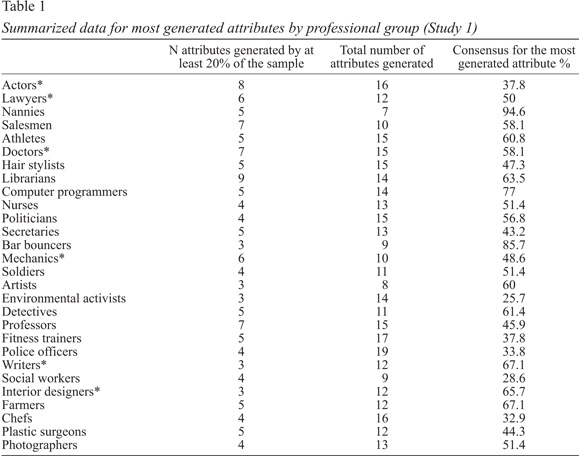
]]> Thus, the primary goal of the present work is to assess what are the culturally shared stereotypic attributes of various professions. In previous work, we (Moreira et al., 2008) focused on the stereotypic content of 32 professional groups, in the Portuguese context. Although the present work resembles in purpose and method our previous work, it extends its findings as it includes 22 new professional groups that were not studied in our previous work (the six professional groups assessed by both work are signalized with an asterisk, see Table 1). The current work further extends previous work by assessing the accessibility of generated stereotypic attributes and by providing typicality judgments of the generated attributes provided by an independent sample.
We believe that the current study will contribute to the stereotypes literature in some ways: (1) it provides the systematic generated stereotypic content and association data for several professional groups; (2) it informs on the consensual ‘cultural’ nature of representations about professions, that is, on the shared ideas about the attributes associated to those professions; and (3) it creates an available resource and tool for other researchers to explore questions related to professional stereotypes and stereotyping.
The present work
Study 1 mapped the stereotypic content, and its consensus, of 28 professional groups, using a spontaneous generation task (Katz & Braly, 1933). This task further allowed us to identify that certain attributes are highly accessible and therefore occur early in participants’ protocols, as the order in which the attributes were generated can be used as a measure of their accessibility. Literature of nonsocial categorization has been referring to attributes that are context-independent (Barsalou, 1989) and that, rather than being definitional, are properties that simply have been processed frequently with the category. In a similar vein, the literature of social categorization suggests that the more high central is a attribute for an individual the more earlier it will be spontaneously generated by him and the earlier will be its ordinal output position (Garcia-Marques et al., 2006). Following this reasoning, we assumed that these highly accessible attributes have been processed frequently within the professional category and therefore occur early in participants’ protocols (their ordinal output position), informing about their centrality for the category.
In Study 2, an independent sample provided typicality judgments of the previously generated attributes, as a second measure of stereotypic content.
]]>Study 1
In Study 1 we explored the stereotypic content of 28 professional groups, its consensus and the attributes’ level of accessibility.
In previous research (e.g., Garcia-Marques et al., 2006; Moreira et al., 2008) professional groups (medical doctors, computer programmers, professors, bar bouncers, salesmen, librarians and so on) were used as targets. They were consensually identified by pretest participants as familiar, and clear-cut professional groups in Portuguese society and therefore provided an appropriate test of the shared stereotypic beliefs hypothesis. From these, we randomly selected the following 28 professional groups: actors, lawyers, nannies, salesmen, athletes, doctors, hair stylists, professors, librarians, computer programmers, nurses, fitness trainers, politicians, secretaries, police officers, bar bouncers, mechanics, soldiers, writers, social workers, artists, interior designers, environmental activists, farmers, chefs, detectives, plastic surgeons and photographers. Given the time necessary to complete the task, we limited the professional groups to a feasible number and we divided the set of 28 professional groups in two halves, which allowed us to minimize the task’s completion time as well as its predictable dropout rate.
Method
Participants
One hundred and forty four undergraduate students (86,1% females, Mage=20.6, SD=5.10, Range=18-51) from the Department of Psychology (University of Lisbon, Portugal) participated voluntarily for partial course credit. Two blocks of 14 professional groups were created and subjects were randomly assigned to one of them. Seventy-four subjects received block 1.
]]> Procedure
Participants were tested in small group sessions of up to 10 people in individual workstations. They received the task instructions through Qualtrics Online Survey Software. On each screen, participants saw a single label for each professional group and were asked to list typical attributes of that group without restriction in number and type. It was explicitly told that those attributes could be like short descriptions of typical behaviors by the group, feelings or personality traits they think “people in general” attributes to those groups. Professional groups by block were randomly assigned to the participants. Instructions directed participants to provide their gut responses and not to censor themselves, and assured the anonymity of responses, attempting to minimize social desirability bias. Further, instructions told respondents to consider what “people in general” think rather than asking about individual commitment to the stereotype (see Garcia-Marques, et al., 2006). Data was collected in Portuguese language.
Results and discussion
Coding
One pair of independent coders coded the attributes generated for each professional group and sorted the extensive list into clusters of direct synonyms. The coders then identified the item that was the most representative of each cluster. They also eliminated any synonyms generated by the same participant for the same group. This procedure brought a more intelligible and clear meaning to the lists of attributes for each professional group. The list initially composed of 1264 attributes generated, resulted in two different groupings for the different coders (350 clusters for coder A and 348 clusters for coder B). Each cluster was constituted by a variable number of exclusive synonymous attributes and was represented by only one synonymous attribute (also exclusive) for each coder. We evaluated the agreement between coders in two indexes: (1) agreement between the content of the clusters, calculated by counting the number of clusters between coders that matched in at least 90% of the attributes included; (2) agreement between attributes chosen as representative of each cluster.
The results revealed coders agreement in 320 clusters, a high index of accordance at the level of 91.4%. The interrater reliability for the attributes representative of each cluster was calculated on those remaining 320 clusters and revealed an accordance of 89.4%.
Most generated attributes, by professional group
]]> The coding yields data documenting how often each professional group name brought to mind each of the attributes. For example, in the Nannies professional group, 60.8% of participants generated caring, 21.6% of participants generated nice, and 94.6% of participants generated sweet. To avoid an exhaustive description, Appendix 1 lists the attributes generated by at least 20% of the sample. We dropped the characteristics rarely mentioned to avoid placing undue emphasis on idiosyncratic responses and to make the presentation more readable.Percentages were used to address the level of consensus (see compiled data in Table 1, column 3). It evidenced that only three professional groups – nannies, computer programmers and bar bouncers – showed a high consensus (up to 70%) for the attribute most generated. Eleven professional groups showed a consensus slightly below the 50% for the attribute most generated. But four of those professional groups showed a much lower consensus, environmental activists (25.7%), social workers (28.6%), chefs (32.9%), but also, police officers (33.8%).
Table 1 provides also (see second column) information about the number of attributes generated by at least 20% of the sample. For five of the professional groups (bar bouncers, artists, environmental activists, writers, and interior designers), the sample agrees on two to three attributes to describe the group, and the consensus for the most generated attribute was always up to 60%, except for the environmental activists. The agreement on seven or more attributes also occurs for five of the professional groups.
The case of stereotypic content shared by professional groups
One aspect of the data worth mentioning is that several professional groups share the same stereotypic content. For example, actors made accessible creative, but hair stylists, artists, writers, and chefs have also generated that same attribute. In those cases, we advise to consider other important dimensions of the information that might distinguish those professional groups. On one hand, the level of consensus for each attribute can be different. See, for instance, that the level of consensus (see Appendix 1, third column) is quite different for chefs (32.9%) in comparison with writers (67.1%). But even when it is similar (hair stylists and chefs), the other attributes most generated substantially differ (creative, chatty, gossipy and friendly versus creative, professional, fat and talented).
We also find it quite important to consider the information related to the output position of those shared attributes to fully understand the whole picture of the stereotype generated (see the Output position of attributes generated, by professional group section, for more details), because its level of accessibility may diverge for the several groups.
Output position of attributes generated, by professional group
The order of attributes generated by professional group was determined by first calculating a median order position for each attribute generated by the total sample. Based on those medians for each attribute, attributes were ordered from the ones listed temporally earlier to those appearing later (see the Appendix, fourth column).
]]> With this measure, we expected to identify that certain attributes are highly accessible and therefore occur early in participants’ protocols. The rationale behind this is that some attributes are simply properties that have been processed frequently within a group, being highly accessible. Those attributes promptly coming to participants’ minds may fairly be considered the attributes that strongly validate, sustain and perpetuate the stereotypic beliefs, as they can be considered more context-independent stereotypic content (but see, Santos et al., 2012).
Study 2
Determining that certain attributes describe professional groups among individuals sharing the same culture is important to establish the existence of stereotypes and their content. Typicality rating scales can be usefully added to this procedure. Theoretically, such measures seem to probe fairly directly the associations between groups and features that are the hallmarks of stereotypes. We cannot be exactly sure of how people make these judgments. Possibly subjects use some sort of salience criterion — what most easily springs to mind — as a rough guide to likelihood. They might use a sort of exemplar availability (Tversky & Kanheman, 1974): if they can easily think of several smart lawyers, they rate lawyers as being likely to be smart. Or perhaps they are making an implicit probability judgment: “I think 60% of lawyers are smart, and therefore I will rate lawyers as 5 points smart on a 7-point scale.” Krueger (1996) took a measure of typicality of the attribute for the group as his standard measure and then investigated the predictive power of various percentage measures. Generally, the attribute typicality ratings were well predicted by the percentage of trait attributions (r=.68). So, typicality ratings as a stereotype measure may fairly be, in any event, another way of asking what percentage of a group has a particular feature.
We asked a new sample of participants to rate the typicality of the attributes generated in Study 1, for each professional group. As conceptually sustained, results should provide convergent evidence for the attributes stereotypic of a group, expected to be rated as the most typical of that group in Study 2, further validating the stereotypes provided by the attributes generated in Study 1.
Method
Participants
Forty-eight undergraduate students (77% females, Mage=25.5, SD=14.48, Range=18-62) from the Department of Psychology (University of Lisbon, Portugal) participated voluntarily. Two blocks of 14 professional groups were created and subjects were randomly assigned to one of them. Twenty-four participants received block 1, the other 24 participants received the 14 professional groups of block 2.
]]>Procedure
Instructions were given through Qualtrics Online Survey Software, in a data collection context similar to the one from Study 1. Participants evaluated each professional group on several attributes (generated by at least 10% of the total sample from Study 1), using a 7-point rating scale ranging from 1 (extremely atypical of the group) to 7 (extremely typical of the group). Each pair of attribute – professional group appeared on each page and were randomly ordered. The total number of attributes evaluated by each participant surrounded the 137 attributes.
Results
Mean typicality of attributes generated, by professional group
Mean (and SD) typicality judgments for each attribute by professional group are presented in Appendix 1. Again, to avoid an exhaustive description, the attributes listed are the ones generated by at least 20% of the sample.
A superficial analysis of both percentages for generated traits (Study 1) and the trait’s typicality judgments (Study 2) seems to suggest that in most of the professional groups (with the exception of actors, secretaries and environmental activists) traits most generated are consistently judged as most typical by an independent sample.
In a similar vein, a comparison of both trait’s typicality judgments (Study 2) and the order in which traits were generated in Study 1 seems to suggest that in most professional groups highly typical traits are generated earlier.
]]>General discussion
Study 1 used a spontaneous attribute generation task to collect the culturally shared stereotypes of 28 professional groups in a Portuguese sample. The inference percentages of each attribute by professional group were used to measure consensus for the stereotypic attributes. We further looked at the order of generated attributes to help determine their accessibility.
To additionally explore the connection between each attribute and the professional group it was linked to, a new sample (Study 2) rated how typical each attribute was for the respective professional group.
These data constitute essential information for any examination of stereotypes and stereotyping. The compound evidence provided by these several measures can be further use as an indicator of how valid these items are for the explored professional groups1. Besides, it informs about some properties of the link between each item and the professional group it was attach to. In what follows, we exemplify some ways in which these data can be useful to inform empirical, theoretical and practical questions about stereotypes.
By looking at the order of generated attributes, it is possible to test more specific hypotheses about how the activation of an attribute follows immediately the activation of the group name or, instead, implies the activation of a previous attribute. For example, participants in the salesmen condition only generate annoying as a response after they generate liar and talkative, implying that the path of activation may be salesmen →liar →talkative →annoying. This is especially relevant in the case of professional groups that seem to overlap in the same most consensual attributes, but that might differentiate in the paths of activation among those attributes. Knowing, for instance, how often participants responded with strong for the bar bouncers and that, in the output position order, intimidating only appeared after mean being generated, gives one some indication of how bar bouncers may be indirectly linked to intimidating through mean. So, this research can provide a tool that researchers in various fields might use to further our knowledge on stereotypes.
Also, some stereotypes are more salient than others. That potentially increases the chances for the stereotypes to be activated and reinforced, and consequently harder to change. The use, in the present work, of a measure as the spontaneous attribute generation task informed us that professional groups vary in the extent they have a salient consensual stereotype, that is to say, a reportable shared stereotype. At the limit, such a direct measure may well be taken as a measure of the existence of a reportable-shared stereotype. The more a stereotype is salient, the more prone people are to report information that is associated with the stereotype. And it can also inform us of professional groups with less salient consensual stereotypes.
Furthermore, the level of consensus shared by some attributes and their accessibility may be a particularly useful cue when trying to change stereotype concepts. If we conceive an intervention as a way of trying to change Group →Attribute associations, or to focus in regulating the inferences people draw from those associations, knowing a priori the attributes with higher levels of consensus that simultaneously are the most accessible, as informed by the output position analysis, would predictably constitute an advantage. Presumably, these two parameters (consensus and order of output position) will focus stereotype change programs more directly on the best directions for increasing efficacy. Nonetheless, even if, for example, people start to dismiss as inadequate the idea that most lawyers are liars, they may continue to believe that most lawyers are intelligent and hardworking, because it will likely not change those links and inferences (see Cox & Devine, 2015). But those are the associations, one could argue, that would be beneficial to maintain.
Last but not least, the data provided about professional stereotype content could also be used in other areas. Think, for instance, of the study by Bogart, Bird, Walt, Delahanty e Figler (2004), which showed that the stereotype people hold of physicians is affecting people’s health behavior in a negative way. Looking at our data, one could wonder whether part of the content of some of the stereotypes assessed could help explain some societal issues. For example, the group of politicians is described as deceptive, liar and corrupts. Could it be that such a stereotype contributes towards the relatively low voter turnout of Portugal?
Although we believe the current research lays important groundwork for further study of professional stereotypes, there are some limitations to our methodology. The measures applied do not easily measure the intensity of the association of features for individual perceivers, as they never capture the strength of association of the attribute to the group (Schneider, 2003), and they fail to measure the speed with which attributes come to the individuals’ minds (e.g. Fazio, Jackson, Dunton, & Williams1995). For example, if we find that 188 of 259 subjects describe Professors as intelligent, we have some sense that this attribute is collectively a part of the stereotype. However, we probably cannot easily make assertions about whether this really represents strong associations for individual subjects. Does the fact that more people mention intelligence as an attribute-describing Professors than any other attribute, mean that this is the strongest feature in most individuals’ stereotypes? One corollary is that, within attributes with limited consensus, there might be attributes strongly associated to the group that, because of some contextual factor, were not more frequently generated in the spontaneous generation task (Schneider, 2003). Still, in our favor we can say that salience of stereotypes should affect not only the speed of accessing information, but also what people can report, in that when stereotypes are salient, people are more prone to report information that is associated with the stereotype. And such a direct measure can be taken as a measure of the existence of stereotypes.
]]>References
Barsalou, L. W. (1989). Intraconcept similarity and its implications for interconcept similarity. In S. Vosniadou & A. Ortony (Eds.), Similarity and analogical reasoning (pp. 76-121). Cambridge, UK: Cambridge University Press. [ Links ]
Bessenoff, G. R., & Sherman, J. W. (2000). Automatic and controlled components of prejudice toward fat people: Evaluation versus stereotype activation. Social Cognition, 18, 329-353. doi: 10.1521/soco.2000.18.4.329 [ Links ]
Bogart, L. M., Bird, S. T., Walt, L. C., Delahanty, D. L., & Figler, J. L. (2004). Association of stereotypes about physicians to health care satisfaction, help-seeking behavior, and adherence to treatment. Social Science & Medicine, 58, 1049-1058. doi: 10.1016/S0277-9536(03)00277-6 [ Links ]
Cox, W. T. L., & Devine, P. G. (2015). Stereotypes possess heterogeneous directionality: A theoretical and empirical exploration of stereotype structure and content. PLoS ONE, 10, e0122292. doi: 10.1371/journal.pone.0122292 [ Links ]
Devine, P. (1989). Stereotypes and prejudice: Their automatic and controlled components. Journal of Personality and Social Psychology, 56, 5-18. doi: 10.1037/0022-3514.56.1.5 [ Links ]
Devine, P. G., & Elliot, A. (1995). Are racial stereotypes really fading? The Princeton trilogy revisited. Personality and Social Psychology Bulletin, 21, 1139-1150. doi: 10.1177/01461672952111002 [ Links ]
Fazio, R. H., Jackson, J. R., Dunton, B. C., & Williams, C. J. (1995). Variability in automatic activation as an unobtrusive measure of racial attitudes: A bona fide pipeline?. Journal of Personality and Social Psychology, 69, 1013-1027. doi: 10.1037/0022-3514.69.6.1013 [ Links ]
Garcia-Marques, L., Santos, A. S., & Mackie, D. M. (2006). Stereotypes: Static abstractions or dynamic knowledge structures?. Journal of Personality and Social Psychology, 91, 814-831. doi: 10.1037/0022-3514.91.5.814 [ Links ]
Hamilton, D. L., & Sherman, J. (1994). Stereotypes. In R. Wyer & T. Srull (Eds.), Handbook of social cognition (2nd ed., Vol. 2, pp. 1-68). Hillsdale, NJ: Erlbaum. [ Links ]
Katz, D., & Braly, K. W. (1933). Racial stereotypes in one hundred college students. Journal of Abnormal and Social Psychology, 28, 280-290. doi: 10.1037/h0074049 [ Links ]
Krueger, J. (1996). Personal beliefs and cultural stereotypes about racial characteristics. Journal of Personality and Social Psychology, 71, 536-548. doi: 10.1037/0022-3514.71.3.536 [ Links ]
Macrae, C. N., Milne, A. B., & Bodenhausen, G. V. (1994). Stereotypes as energy-saving devices: A peek inside the cognitive toolbox. Journal of Personality and Social Psychology, 66, 37-47. doi: 10.1037/0022-3514.66.1.37 [ Links ]
Macrae, C. N., Mitchell, J. P., & Pendry, L. F. (2002). What’s in a forename? Cue familiarity and stereotypical thinking. Journal of Experimental Social Psychology, 38, 186-193. doi: 10.1006/jesp.2001.1496
Mather, M., Johnson, M. K., & De Leonardis, D. M. (1999). Stereotype reliance in source monitoring: Age differences and neuropsychological test correlates. Cognitive Neuropsychology, 16, 437-458. doi: 10.1080/026432999380870 [ Links ]
McGarty, C., Yzerbyt, V. Y., & Spears, R. (Eds.). (2002). Stereotypes as explanations: The formation of meaningful believes about groups. Cambridge, UK: Cambridge University Press. [ Links ]
]]>Moreira, S., Garcia-Marques, L., & Santos, A. S. (2008). Traços estereotípicos associados a 32 grupos profissionais. Laboratório de Psicologia, 6, 3-14. doi: 10.14417/lp.690 [ Links ]
Santos, A. S., Garcia-Marques, L., Mackie, D. M., Ferreira, M. B., Payne, B. K., & Moreira, S. (2012). Implicit open-mindedness: Evidence for and limits on stereotype malleability. Journal of Experimental Social Psychology, 48, 1257-1266. doi: 10.1016/j.jesp.2012.05.013 [ Links ]
Schneider, D. J. (2003). The psychology of stereotyping. New York, NY: Guilford Press. [ Links ]
Tversky, A., & Kahneman, D. (1974). Judgment under Uncertainty: Heuristics and Biases. Science, 185, 1124-1131. doi: 10.1126/science.185.4157.1124 [ Links ]
Correspondence concerning this article should be addressed to: Ana Sofia Santos, Faculdade de Psicologia, Universidade de Lisboa, Alameda da Universidade, 1648-013 Lisboa, Portugal. Email: sosantos@fp.ul.pt
The research was supported in part by Portuguese Science and Technology Foundation under the grant to the first author (PTDC/PSI-PSO/111992/2009); and with support from the Department of Psychology, University of North Carolina at Chapel Hill, United States.
]]>Submitted: 09/02/2017 Accepted: 17/04/2017
NOTES
1 Note however that, results from typicality ratings (Study 2) and inference percentages (Study 1) among professional groups may differ as the nature of the two measures is, in some ways rather distinct. According to some authors (Cox et al., 2015) for some stereotypes the probability that an attribute brings to mind the group can be higher than the probability of the group bringing to mind the attribute. In fact, some stereotypes develop to link group membership to visible attributes that can serve as categorization cues. Measures such as the spontaneous generation task (Study 1), in which participants report the associates that come to mind by the name of a stereotyped group, don’t capture the stereotypes that have high probabilities of being activated in the Attribute ® Group direction, because it is the Group ® Attribute direction that is always being evaluated. Nonetheless, in the attribute typicality measure (Study 2), all the attributes generated are available to be rated, in spite of the level of consensus obtained; and such attributes might be rated as highly typical on the basis of being a categorization cue.
]]>