<?xml version="1.0" encoding="ISO-8859-1"?><article xmlns:mml="http://www.w3.org/1998/Math/MathML" xmlns:xlink="http://www.w3.org/1999/xlink" xmlns:xsi="http://www.w3.org/2001/XMLSchema-instance">
<front>
<journal-meta>
<journal-id>0870-8231</journal-id>
<journal-title><![CDATA[Análise Psicológica]]></journal-title>
<abbrev-journal-title><![CDATA[Aná. Psicológica]]></abbrev-journal-title>
<issn>0870-8231</issn>
<publisher>
<publisher-name><![CDATA[ISPA-Instituto Universitário]]></publisher-name>
</publisher>
</journal-meta>
<article-meta>
<article-id>S0870-82312018000200003</article-id>
<article-id pub-id-type="doi">10.14417/ap.1345</article-id>
<title-group>
<article-title xml:lang="en"><![CDATA[Testing age as a moderator of the relationship between depression and healthy functioning in breast and gynecologic cancer patients]]></article-title>
<article-title xml:lang="pt"><![CDATA[Será a idade um moderador da relação entre depressão e funcionamento saudável em pacientes com cancro da mama e ginecológico?]]></article-title>
</title-group>
<contrib-group>
<contrib contrib-type="author">
<name>
<surname><![CDATA[Bártolo]]></surname>
<given-names><![CDATA[Ana]]></given-names>
</name>
<xref ref-type="aff" rid="A01"/>
<xref ref-type="aff" rid="A02"/>
</contrib>
<contrib contrib-type="author">
<name>
<surname><![CDATA[Monteiro]]></surname>
<given-names><![CDATA[Sara]]></given-names>
</name>
<xref ref-type="aff" rid="A01"/>
<xref ref-type="aff" rid="A02"/>
</contrib>
<contrib contrib-type="author">
<name>
<surname><![CDATA[Aires]]></surname>
<given-names><![CDATA[Filipa]]></given-names>
</name>
<xref ref-type="aff" rid="A01"/>
</contrib>
<contrib contrib-type="author">
<name>
<surname><![CDATA[Branco]]></surname>
<given-names><![CDATA[Elizabeth Castelo]]></given-names>
</name>
<xref ref-type="aff" rid="A03"/>
</contrib>
<contrib contrib-type="author">
<name>
<surname><![CDATA[Pinho]]></surname>
<given-names><![CDATA[Ana Catarina]]></given-names>
</name>
<xref ref-type="aff" rid="A01"/>
</contrib>
<contrib contrib-type="author">
<name>
<surname><![CDATA[Pereira]]></surname>
<given-names><![CDATA[Anabela]]></given-names>
</name>
<xref ref-type="aff" rid="A01"/>
<xref ref-type="aff" rid="A04"/>
</contrib>
</contrib-group>
<aff id="A01">
<institution><![CDATA[,Universidade de Aveiro Departamento de Educação e Psicologia ]]></institution>
<addr-line><![CDATA[Aveiro ]]></addr-line>
<country>Portugal</country>
</aff>
<aff id="A02">
<institution><![CDATA[,Universidade do Porto Faculdade de Medicina Centro de Investigação em Tecnologias e Serviços de Saúde]]></institution>
<addr-line><![CDATA[Porto ]]></addr-line>
<country>Portugal</country>
</aff>
<aff id="A03">
<institution><![CDATA[,Instituto Português de Oncologia de Coimbra Francisco Gentil  ]]></institution>
<addr-line><![CDATA[Coimbra ]]></addr-line>
<country>Portugal</country>
</aff>
<aff id="A04">
<institution><![CDATA[,Universidade de Aveiro Centro de Investigação em Didática e Tecnologia na Formação de Formadores ]]></institution>
<addr-line><![CDATA[Aveiro ]]></addr-line>
<country>Portugal</country>
</aff>
<pub-date pub-type="pub">
<day>00</day>
<month>06</month>
<year>2018</year>
</pub-date>
<pub-date pub-type="epub">
<day>00</day>
<month>06</month>
<year>2018</year>
</pub-date>
<volume>36</volume>
<numero>2</numero>
<fpage>159</fpage>
<lpage>168</lpage>
<copyright-statement/>
<copyright-year/>
<self-uri xlink:href="http://scielo.pt/scielo.php?script=sci_arttext&amp;pid=S0870-82312018000200003&amp;lng=en&amp;nrm=iso"></self-uri><self-uri xlink:href="http://scielo.pt/scielo.php?script=sci_abstract&amp;pid=S0870-82312018000200003&amp;lng=en&amp;nrm=iso"></self-uri><self-uri xlink:href="http://scielo.pt/scielo.php?script=sci_pdf&amp;pid=S0870-82312018000200003&amp;lng=en&amp;nrm=iso"></self-uri><abstract abstract-type="short" xml:lang="en"><p><![CDATA[This cross-sectional study aims to explore age as a moderator of the association between emotional distress and functional scales of health-related quality of life. The sample includes 106 outpatients with active breast and gynecologic cancers recruited at the Gynecology Department of the Instituto Português de Oncologia de Coimbra Francisco Gentil. Cancer patients were divided into two groups: younger women <50 years and older women &#8805;50 years. Participants completed a socio-demographic questionnaire and self-report measures, namely Hospital Anxiety Depression Scale (HADS) and the six functional scales of the European Organization for Research and Treatment of Cancer Quality of Life Questionnaire Core-30 (EORTC QLQ-C30). Our results show that the older group reported higher depressive symptoms than younger patients. Depressive symptoms influenced healthy functioning, defined by indicators such as physical, emotional and cognitive functioning, similarly in younger and older age groups.]]></p></abstract>
<abstract abstract-type="short" xml:lang="pt"><p><![CDATA[Este estudo transversal objetivou explorar o efeito moderador da idade na relação entre o distress emocional e domínios da qualidade de vida relacionada com a saúde. A amostra incluiu 106 mulheres, com diagnóstico de cancro da mama ou ginecológico em fase ativa, recrutadas no Serviço de Ginecologia do Instituto Português de Oncologia de Coimbra Francisco Gentil. Foram incluídos dois grupos: mulheres com menos de 50 anos de idade e mulheres com 50 anos ou mais. As participantes completaram um questionário sociodemográfico e medidas de auto-relato, nomeadamente a Escala de Ansiedade e Depressão Hospitalar (EADH) e as seis escalas funcionais do European Organization for Research and Treatment of Cancer Quality of Life Questionnaire Core-30 (EORTC QLQ-C30). Os nossos resultados mostraram que o grupo de mulheres com idade igual ou superior a 50 anos reportou mais sintomas depressivos do que o grupo de pacientes mais jovem. Os sintomas depressivos reportados influenciaram o funcionamento saudável, definido por indicadores como o funcionamento físico, emocional e cognitivo, similarmente dentro dos dois grupos.]]></p></abstract>
<kwd-group>
<kwd lng="en"><![CDATA[Age]]></kwd>
<kwd lng="en"><![CDATA[Functioning]]></kwd>
<kwd lng="en"><![CDATA[Depression]]></kwd>
<kwd lng="en"><![CDATA[Gynecologic cancer]]></kwd>
<kwd lng="en"><![CDATA[Breast cancer]]></kwd>
<kwd lng="pt"><![CDATA[Idade]]></kwd>
<kwd lng="pt"><![CDATA[Funcionamento]]></kwd>
<kwd lng="pt"><![CDATA[Depressão]]></kwd>
<kwd lng="pt"><![CDATA[Cancro ginecológico]]></kwd>
<kwd lng="pt"><![CDATA[Cancro da mama]]></kwd>
</kwd-group>
</article-meta>
</front><body><![CDATA[ <p><b>Testing age as a moderator of the relationship between depression and healthy functioning in breast and gynecologic cancer patients</b></p>     <p><b>Ser&aacute; a idade um moderador da rela&ccedil;&atilde;o entre depress&atilde;o e funcionamento saud&aacute;vel em pacientes com cancro da  mama e ginecol&oacute;gico?</b></p>     <p><b>Ana B&aacute;rtolo<sup>1</sup>, Sara Monteiro<sup>1</sup>, Filipa Aires<sup>2</sup>, Elizabeth Castelo Branco<sup>3</sup>,  Ana Catarina Pinho<sup>2</sup>, Anabela Pereira<sup>4</sup></b></p>     <p><sup>1</sup>Departamento de Educa&ccedil;&atilde;o e Psicologia, Universidade de Aveiro, Aveiro, Portugal / Centro de Investiga&ccedil;&atilde;o  em Tecnologias e Servi&ccedil;os de Sa&uacute;de, Faculdade de Medicina, Universidade do Porto, Porto, Portugal</p>     <p><sup>2</sup>Departamento de Educa&ccedil;&atilde;o e Psicologia, Universidade de Aveiro, Aveiro, Portugal</p>     <p><sup>3</sup>Instituto Portugu&ecirc;s de Oncologia de Coimbra Francisco Gentil, Coimbra, Portugal</p>     <p><sup>4</sup>Departamento de Educa&ccedil;&atilde;o e Psicologia, Universidade de Aveiro, Aveiro, Portugal / Centro de Investiga&ccedil;&atilde;o  em Did&aacute;tica e Tecnologia na Forma&ccedil;&atilde;o de Formadores, Universidade de Aveiro, Aveiro, Portugal</p>     <p><a name="topc0"></a><a href="#c0">Correspondência</a></p>     <p>&nbsp;</p>     <p><b>ABSTRACT</b></p>     ]]></body>
<body><![CDATA[<p>This cross-sectional study aims to explore age as a moderator of the association between emotional distress and functional scales of  health-related quality of life. The sample includes 106 outpatients with active breast and gynecologic cancers recruited at the Gynecology  Department of the Instituto Portugu&ecirc;s de Oncologia de Coimbra Francisco Gentil. Cancer patients were divided into two groups: younger women  &lt;50 years and older women &ge;50 years. Participants completed a socio-demographic questionnaire and self-report measures, namely Hospital  Anxiety Depression Scale (HADS) and the six functional scales of the European Organization for Research and Treatment of Cancer Quality of Life  Questionnaire Core-30 (EORTC QLQ-C30). Our results show that the older group reported higher depressive symptoms than younger patients. Depressive  symptoms influenced healthy functioning, defined by indicators such as physical, emotional and cognitive functioning, similarly in younger and  older age groups.    <p>     <p><b>Key words</b>: Age, Functioning, Depression, Gynecologic cancer, Breast cancer.</p>     <p>&nbsp;</p>     <p><b>RESUMO</b></p>     <p>Este estudo transversal objetivou explorar o efeito moderador da idade na rela&ccedil;&atilde;o entre o <i>distress</i> emocional e  dom&iacute;nios da qualidade de vida relacionada com a sa&uacute;de. A amostra incluiu 106 mulheres, com diagn&oacute;stico de cancro da mama ou  ginecol&oacute;gico em fase ativa, recrutadas no Servi&ccedil;o de Ginecologia do Instituto Portugu&ecirc;s de Oncologia de Coimbra Francisco  Gentil. Foram inclu&iacute;dos dois grupos: mulheres com menos de 50 anos de idade e mulheres com 50 anos ou mais. As participantes completaram um  question&aacute;rio sociodemogr&aacute;fico e medidas de auto-relato, nomeadamente a Escala de Ansiedade e Depress&atilde;o Hospitalar (EADH) e as  seis escalas funcionais do <i>European Organization for Research and Treatment of Cancer Quality of Life Questionnaire</i> Core-30 (EORTC QLQ-C30).  Os nossos resultados mostraram que o grupo de mulheres com idade igual ou superior a 50 anos reportou mais sintomas depressivos do que o grupo de  pacientes mais jovem. Os sintomas depressivos reportados influenciaram o funcionamento saud&aacute;vel, definido por indicadores como o  funcionamento f&iacute;sico, emocional e cognitivo, similarmente dentro dos dois grupos.</p>     <p><b>Palavras-chave</b>: Idade, Funcionamento, Depress&atilde;o, Cancro ginecol&oacute;gico, Cancro da mama.</p>     <p>&nbsp;</p>     <p>Cancer is a serious public health problem and according to GLOBOCAN 2012 breast cancer was the most frequent malignancy diagnosed among women in  Europe (28.3%); corpus uteri cancer was the gynecologic cancer type presenting the highest crude rate per 100.00 (13.6), followed by cervix uteri  cancer (11.2) and ovary cancer (9.4) (Ferlay et al., 2013). With scientific and technological advances in early detection and treatment improving  survival time results (Sant et al., 2001), concentrating on understanding behavior outcomes associated with cancer is increasingly important  (Bower, 2008).</p>     <p>Cancer patients are forced to change their routine and habits and worry about the progression and/or recurrence of the disease (Baker,  Denniston, Smith, &amp; West, 2005), and significant psychological adjustment is required. Emotional distress, namely depressive and anxiety  symptoms (Cardoso, Graca, Klut, Trancas, &amp; Papoila, 2015), and the loss of health-related quality of life (HRQOL) are common among female  cancer patients as a reaction to diagnosis, treatment and the physical consequences (Carter, Stabile, Gunn, &amp; Sonoda, 2013) and may endure even  in long-term survival (Bradley, Rose, Lutgendorf, Costanzo, &amp; Anderson, 2006). However, there is variability in these patients&rsquo; emotional  reaction related to exogenous variables such as age (Costanzo, Ryff, &amp; Singer, 2009), occupational status and size of collateral effects  (G&otilde;mez-Campelo, Bragado-&Aacute;lvarez, &amp; Hern&aacute;ndez-Lloreda, 2014).</p>     ]]></body>
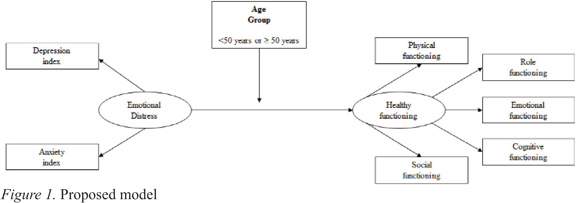
<body><![CDATA[<p>Age has been the most explored socio-demographic characteristic in studies with cancer samples and the research by Jadoon, Munir, Shanzad and  Choudhry (2010) showed that at a younger age there is a higher risk of psychological morbidity. 50 years of age is the cut-off point most used to  define younger or older age groups in this setting. Specifically, female cancer patients younger than 50 seem to present more depressive symptoms  than the older group (G&otilde;mez-Campelo et al., 2014). In contrast, in other cancer samples there seems to be a tendency for depression to  increase with age (Nelson et al., 2009).</p>     <p>In HRQOL, age-related differences are also reported, but here, Park, Lee, Lee, Lee and Hwang (2011), considering a sample of 1094 breast cancer  patients, found a worse perceived quality of life in women over 50. In their recent study, Quinten et al. (2015) added that the domains of HRQOL  affected vary with age, that is: older groups can present deteriorated physical functioning and better social functioning than younger groups, for  example. Despite this, distress and HRQOL are not independent constructs (McMillan &amp; Small, 2002) and the role of age in this relationship  should also be tested. Consensual in the literature is the negative relationship between functional scales of HRQOL and distress, particularly  depression symptoms (Montazeri, 2008; Reyes-Gibby, Anderson, Morrow, Shete, &amp; Hassan, 2012) in oncological samples. Costa-Requena,  Rodr&iacute;guez and Fern&aacute;ndez-Ortega (2013) concluded that, mainly after oncological treatment, psychological distress accounts for 62.6%  of the variance in HRQOL.</p>     <p>Based on these findings, we examined the anxiety and depression symptoms and functionality of two groups of cancer patients: women younger and  older than 50. Firstly we aimed to compare the two groups regarding depression, anxiety and physical, role, emotional, cognitive and social  functioning. Second, we aimed to test the model shown in <a href="#f1">Figure 1</a> to evaluate the moderating effect of age in the association  between emotional distress and healthy functioning of women with active cancer. Thus, we defined our hypothesis as follows:</p>     <p>&nbsp;</p>     <p><a name="f1"></a></p>     <p><img src="/img/revistas/aps/v36n2/36n2a03f1.jpg" width="576" height="203"></p>     
<p>&nbsp;</p>     <p>&nbsp;</p>     <p>&ndash;	Younger women &lt;50 years will present greater anxiety and depression and worse results in functional scales of the HRQOL than older  cancer patients;</p>     <p>&nbsp;</p>     ]]></body>
<body><![CDATA[<p>&ndash;	Anxiety and depression symptoms will be associated with worse functioning of cancer patients;</p>     <p>&nbsp;</p>     <p>&ndash;	Age group will moderate this relationship between anxiety and depression symptoms and functioning in these patients.</p>     <p>&nbsp;</p>     <p><b>Materials and methods</b></p>     <p>&nbsp;</p>     <p><i>Participants and procedures</i></p>     <p>The sample of this cross-sectional study was collected at the Gynecology Department of the Instituto Portugu&ecirc;s de Oncologia de Coimbra  Francisco Gentil. The study was first presented and approved by the Ethics Committee of the Institute. The participants were recruited, in person,  at the time of external appointments in the Gynecology Unit. Informed consent was signed and self-report measures were completed. The sample  included women with breast and gynecologic cancers followed up as outpatients. Among the 153 women contacted only 106 participated in our study.  The inclusion criteria were: (i) active phase of the disease; (ii) 18 or older; and (iii) not having any addictive or severe psychiatric disorders.  The cancer patients belonged to two age groups, &lt;50 years (34.9%) and &ge;50 years (65.1%). We found that most subjects were married (74.5%)  and/or living with family (55.7%). Regarding educational status, 57.5% had completed basic education and 17.9% a college degree. Within cancer  types, 64.2% were diagnosed with breast cancer and 35.8% had gynecologic cancer, that is: 14.2% cervical cancer, 8.5% endometrial cancer and 2.8%  ovarian cancer. Only a small part of this sample (25.5%) had a family history of cancer. 83.1% of these patients underwent surgery and 68.9% had  adjuvant therapy. Among the participants, 13.2% had, at some stage of their life, psychological counseling motivated by depressive symptoms (6.6%)  and/or anxiety (22.6%). The socio-demographic and clinical characteristics were balanced between the two age groups, except for the level of  education. Women younger than 50 tended to be educated up to college degrees (<i>p</i>&lt;.001).</p>     <p>&nbsp;</p>     <p><i>Measures</i></p>     ]]></body>
<body><![CDATA[<p>A socio-demographic and clinical questionnaire was used. The measurements were composed of eight items related to socio-demographic  characteristics (e.g., age, civil status, nationality, education, household, etc.) and seven items with questions about clinical variables (e.g.,  type of cancer, family history, treatment type, previous psychological counseling, etc.).</p>     <p>&nbsp;</p>     <p>Levels of emotional distress in breast and gynecologic cancer were assessed using the <i>Portuguese version of the Hospital Anxiety Depression  Scale</i> (HADS; Zigmond &amp; Snaith, 1983; Portuguese version by Pais-Ribeiro et al., 2007). It is a 14-item scale consisting of two sub-scales  for the assessment of anxiety (HADS-A) and depression (HADS-D), both with seven items. The cancer patients were instructed to self-report their  symptoms on a 4-point scale (0-3). Total scores range from 0 to 21 for each sub-scale. High scores in these sub-scales relate to more severe  symptoms. In this sample, satisfactory internal consistence was obtained. The Cronbach&rsquo;s alpha coefficient was .72 for anxiety and .84 for  depression.</p>     <p>&nbsp;</p>     <p>Healthy functioning in the cancer patients was assessed using the five functional scales of the <i>Portuguese version of the European  Organization for Research and Treatment of Cancer Quality of Life Questionnaire Core-30</i> (EORTC QLQ-C30, Aaronson et al., 1993; Portuguese  version by Pais-Ribeiro, Pinto, &amp; Santos, 2008), namely physical functioning, role functioning, emotional functioning, cognitive functioning  and social functioning. Participants were asked to rate the items on a 4-point scale (1-4), ranging from &ldquo;not at all&rdquo; to &ldquo;very  much&rdquo;. High scores for functional scales of HRQOL represent healthier functioning. The Cronbach alpha value in our sample ranged between .92  for the role functioning sub-scale and .70 for the social functioning sub-scale.</p>     <p>&nbsp;</p>     <p><i>Statistical analysis</i></p>     <p>The Statistical Package for the Social Sciences, version 20 (SPSS Inc., Chicago) was used to perform descriptive and inferential statistics. The  t-student test for independent samples was conducted to determine whether there were age-related differences in depression and anxiety symptoms and  functional scales. As a preliminary analysis, bivariate correlations were obtained to examine the associations between anxiety, depression and  functional scales of HRQOL within each age group. Based on these results, a structural equation modeling (SEM) with maximum likelihood estimation  method using AMOS, version 24, was implemented to test the moderation model. This technique allowed structuring the model with latent and  single-indicator variables, that is: functional scales of HRQOL were specified as a single latent variable named for healthy functioning; and the  depression index (HADS-D scores) was introduced as a single-indicator. The direct effect between depression and healthy functioning was tested. To  determine whether the overall model presented a good fit, the following criteria were used: (i) chi-square (<i>&chi;<sup>2</i></sup>) value close  to zero and non-significant; (ii) the comparative fit index (CFI) value equal to or greater than .95; and (iii) the Root Mean Square Error of  Approximation (RMSEA) value of .06 or less (Hu &amp; Bentler, 1999). In addition, for a mediocre fit, RMSEA in the range of .08 to 0.1 was  accepted (MacCallum, Browne, &amp; Sugawara, 1996). Multi-group modeling was used to evaluate the role of age-groups as moderators. Separate models  for &lt;50 years and &ge;50 years groups were specified simultaneously, and unconstrained and equality constrained models were compared. More  specifically, differences between <i>&chi;<sup>2</i></sup> indicated whether the models were non-invariant for the two age groups.</p>     <p>&nbsp;</p>     <p><b>Results</b></p>     ]]></body>
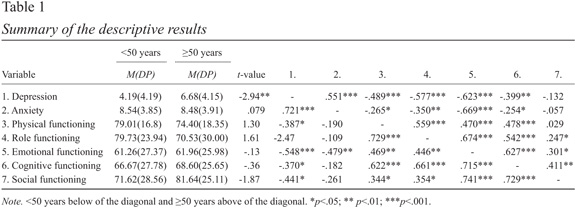
<body><![CDATA[<p>&nbsp;</p>     <p><i>Descriptive results</i></p>     <p>Results indicate that the &ge;50 years group presented higher scores in HADS-D than the younger group as shown in <a href="#t1">Table 1</a>.  Bivariate analysis for the two age groups showed that in both groups, depression was associated with functional scales such as physical  functioning, emotional functioning and cognitive functioning. In the &ge;50 years group, but not in the younger group, a strong association was  found between depression and the role functioning scale. In the &lt;50 years group, anxiety was only associated with emotional functioning.  Regarding the older age group, this variable was associated with physical functioning, role functioning, emotional functioning and cognitive  functioning. All functional scales were inter-correlated in both groups (<i>r</i>&gt;.40, <i>p</i>&lt;.01), with the exception of the social  functioning scale, which was not associated with physical functioning in the &ge;50 years group (see <a href="#t1">Table 1</a>).</p>     <p>&nbsp;</p>     <p><a name="t1"></a></p>     <p><img src="/img/revistas/aps/v36n2/36n2a03t1.jpg" width="575" height="208"></p>     
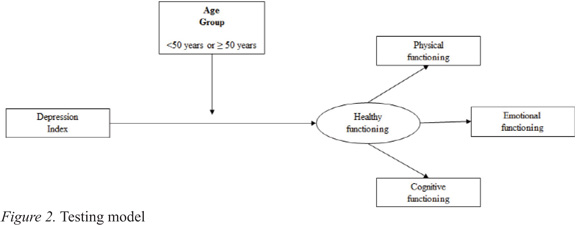
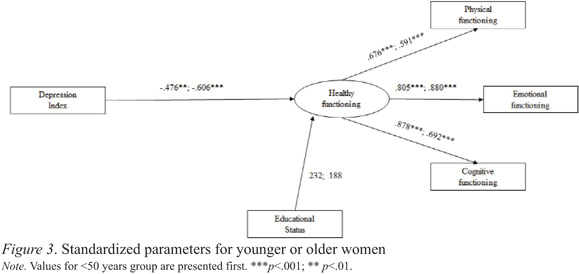
<p>&nbsp;</p>     <p>&nbsp;</p>     <p><i>Testing moderating effect of age group</i></p>     <p>Based on preliminary analysis, a path model, shown in <a href="#f2">Figure 2</a>, was elaborated. In this model, the anxiety index was not  included as a single-indicator because these symptoms were not associated with all functional scales in the &lt;50 years group. Nor were social and  role functioning considered in the tested model because these variables did not show a direct association with depression in either group. As there  were differences between the age groups regarding level of education, the effect of this variable was controlled. Thus, the depression index was  represented by a single indicator (HADS-D total score) and physical, emotional and cognitive functioning were specified as indicators of the single  latent variable designated by healthy functioning, as referred to in the statistical analysis section. The direct effect between depression and  healthy functioning was tested and multi-group modeling was used to evaluate age group differences. The chi-square was not significant  [<i>&chi;<sup>2</i></sup><sub>(8)</sub>=14.96, <i>p</i>=.06] and additional fit indexes (CFI=.95, RMSEA=.09) showed an acceptable fit of the  baseline model (unconstrained). Standardized parameters by age groups are presented in <a href="#f3">Figure 3</a>. A significant direct effect was  found between depression and the healthy functioning latent variable for the two groups. Thus, depression was shown to be a significant predictor  of less healthy functioning.</p>     ]]></body>
<body><![CDATA[<p>&nbsp;</p>     <p><a name="f2"></a></p>     <p><img src="/img/revistas/aps/v36n2/36n2a03f2.jpg"></p>     
<p>&nbsp;</p>     <p>&nbsp;</p>     <p><a name="f3"></a></p>     <p><img src="/img/revistas/aps/v36n2/36n2a03f3.jpg" width="579" height="274"></p>     
<p>&nbsp;</p>     <p>Considering the equally constrained model on the paths from depression symptoms to healthy functioning, the model fit was invariant for women  &lt;50 years and &ge;50 years. The fit indexes were slightly better [<i>&chi;<sup>2</i></sup><sub>(12)</sub>=16.97, <i>p</i>=.151; CFI=.97;  RMSEA=.06] in the equality constrained model, but the difference between models was not significant [<i>&chi;<sup>2</i></sup><sub>(4)</sub>=2.01,  <i>p</i>&gt;.05] indicating that age group did not moderate this relationship. However, for women &lt;50 years, the model accounted for 32% (.324)  of variance in healthy functioning and for women &ge;50 years 51% (.513) of variance of this predictive variable.</p>     <p>&nbsp;</p>     ]]></body>
<body><![CDATA[<p><b>Discussion</b></p>     <p>In this cross-sectional study, one path model using SEM was proposed. Our main objective was to examine the direct effect of emotional distress  on the functioning of cancer patients in an active phase of the disease and the moderator role of age in this relationship. An empirical model  including only depression symptoms provided a good fit with the data, suggesting that this contextual approach was valid.</p>     <p>More specifically, our study presented three hypotheses that were only partially confirmed:</p>     <p>Our first hypothesis focused on age-related differences in the distress and functional scales of HRQOL was not supported. Globally, younger  cancer patients presented similar psychosocial outcomes to the women &ge;50 years. However, contradicting other research (Costanzo et al., 2009;  Gomez-Campelo et al., 2014; Jaddon et al., 2010), the older age group &ge;50 years, and not the younger women, reported higher scores on the  depression index.</p>     <p>Considering that depressive symptoms are relatively common in aging (Fiske, Wetherell, &amp; Gatz, 2009) the above results are not a surprise. A  recent study by Leach, Bellizzi, Hurria and Reeve (2016) shows that having cancer increased the risk of depression in a sample of older adults. The  diagnosis, by itself, is emotionally demanding (Hong, Zhang, Song, Xie, &amp; Wang, 2015) combining at this stage of the life cycle with physical  vulnerabilities (Leach, Bellizzi, Hurria, &amp; Reeve, 2016), reduced life-expectancy and poor support (Schapmire &amp; Faul, in press) frequent in  the aging process. These patients are exposed to a double risk of suffering from depressive symptoms presenting specific concerns namely with the  loss of autonomy (Hurria et al., 2009). All these factors may overload the coping mechanisms of older cancer patients resulting in significant  depressive symptoms. Thus, although younger patients appear in the literature as more distressed (Krok, Baker, &amp; MacMillan, 2013), there may be  a unique tendency for the increase of depressive symptoms in response to the disease in older patients, as suggested by Nelson et al. (2009).</p>     <p>At the same time, the menopause as a natural process occurs in the 50s. The associated hormonal imbalance may contribute to the presence of more  depressive symptoms in older adults. A longitudinal study by Bromberger et al. (2007), using a sample of 3302 women, illustrates this even when  reporting the increased risk of high depressive symptoms with the start of the transition to the menopause and their association with the  menopausal condition over time. Nevertheless, as shown in the review by Rosenberg and Partridge (2013), some younger women also face physical and  emotional challenges of the menopause earlier than would otherwise be expected as a result of cancer and its treatment and this question cannot be  disregarded when evaluating this group.</p>     <p>To test our second and third hypotheses, we conducted a preliminary correlational analysis and it was necessary to adjust the hypothesized  overall model. When we analyze the relationship between emotional distress and functional scales of HRQOL, we found that anxiety was not associated  with most of the scales in the &lt;50 years group and was therefore not included in the model. This is in line with the literature that reports,  more recurrently, associations between depression and quality of life (Montazeri, 2008) within this setting.</p>     <p>We also verified that not all functional scales showed a significant association with depression in both groups, for example: depression was  negatively associated with role functioning in the older group, but not for the &lt;50 years group; and a negative relationship between depression  and social functioning was found in the younger group, but not in the &ge;50 years group. This result seemed to point to some age-specific  variations in the relationship between depression and HRQOL, which should be explored later. However, the association between depression and  functional indicators such as cognitive, emotional and physical functioning was consensual in both groups. Based on the result of this analysis,  the tested model explored the unique effect of depression on a latent variable integrating the three functional scales.</p>     <p>With the framework tested, our most important finding was that healthy functioning was impacted by depression, partially confirming our second  hypothesis. However, age group did not moderate this relationship as predicted in our third hypothesis. The strongest associations between  depression and functioning for the &ge;50 years group were not retained in SEM. The comparison between unconstrained and equality constrained  models did not confirm a significant improvement or deterioration in model fit. Thus, the direct effect of depression on the latent variable shown  in other studies (Costa-Requena et al., 2013; McMillan &amp; Small, 2002) seems to endure independently of age groups.</p>     <p>Lastly, the overall model shows a higher percentage of variance in healthy functioning encompassing cognitive, emotional and physical  functioning (51%) in breast and gynecological cancer patients &ge;50 years in comparison with the younger group. This fact reinforces the disabling  role of depressive symptoms in this age group.</p>     ]]></body>
<body><![CDATA[<p>It should not be forgotten that the manifestation of depressive symptoms in older adults differs from younger ages. Older people are more likely  to show somatic and cognitive symptoms of depression (Fiske et al., 2009) that may explain its greater predictive effect on perceived impairment of  healthy functioning in our cancer patients. It remains to be seen whether other variables influence the functional scales of the HRQOL, especially  in the younger group in which 68% of the variance is yet to be explained. In particular, concerns about reproductive issues and parental projects  are additional factors of wear that have been shown to undermine the dimensions of quality of life (Wenzel et al., 2005) and may be an element to  be explored in future studies with this age group.</p>     <p>Our research should be interpreted with caution since we conducted a cross-sectional study with a small sample. Thus, it is not possible to  determine causal relationships between variables, and generalization of the results to other samples with different characteristics is limited. In  addition, the effect of differences in the level of education between the age groups was not controlled for the test of the first hypothesis  proposed. For this reason, the results regarding depressive symptoms may have been influenced by this factor. In the tested model, we considered a  single effect of age, but controlling for the level of education. However, other age-related aspects and clinical characteristics may also lie at  the basis of variations in the reaction to cancer, including cancer type and stage, previous treatment and the collateral effects of cancer, namely  reproductive consequences (Gorman, Malcarne, Roesch, Madlensky, &amp; Pierce, 2010).</p>     <p>Further research should be concerned with testing other contextual approaches that explain impairment in overall quality of life, but this time,  within each age group during the active phase of the disease and long-term survival. Depression should be an element to consider in future  approaches, which in our study was shown to affect the functioning of both age groups, as well as specific concerns for each chronological age.  Summarizing, we also emphasize the need to develop and adjust intervention programs focused on decreasing depressive symptoms for breast and  gynecologic cancer patients in order to enhance their quality of life and this is common to women &lt;50 years and &ge;50 years.</p>     <p>&nbsp;</p>     <p><b>References</b></p>     <!-- ref --><p>Aaronson, N. K., Ahmedzai, S., Bergman, B., Bullinger, M., Cull, A., Duez, N. J., . . . Haes, J. C. (1993). The European Organization for  Research and Treatment of Cancer QLQ-C30: A quality-of life-instrument for use in international clinical trials in oncology. <i>Journal of the  National Cancer Institute, 85</i>, 365-375.    &nbsp;&nbsp;&nbsp;&nbsp;&nbsp;&nbsp;&nbsp;&nbsp;[&#160;<a href="javascript:void(0);" onclick="javascript: window.open('/scielo.php?script=sci_nlinks&ref=038426&pid=S0870-8231201800020000300001&lng=','','width=640,height=500,resizable=yes,scrollbars=1,menubar=yes,');">Links</a>&#160;]<!-- end-ref --></p>     <!-- ref --><p>Baker, F., Denniston, M., Smith, T., &amp; West, M. M. (2005). Adult cancer survivors: How are they faring?. <i>Cancer, 104</i>, 2565-2576. doi:  10.1002/cncr.21488&nbsp;&nbsp;&nbsp;&nbsp;&nbsp;&nbsp;&nbsp;&nbsp;[&#160;<a href="javascript:void(0);" onclick="javascript: window.open('/scielo.php?script=sci_nlinks&ref=038428&pid=S0870-8231201800020000300002&lng=','','width=640,height=500,resizable=yes,scrollbars=1,menubar=yes,');">Links</a>&#160;]<!-- end-ref --><!-- ref --><p>Bower, J. E. (2008). Behavioral symptoms in patients with breast cancer and survivors. <i>Journal of Clinical Oncology, 26</i>, 768-777. doi:  10.1200/JCO.2007.14.3248&nbsp;&nbsp;&nbsp;&nbsp;&nbsp;&nbsp;&nbsp;&nbsp;[&#160;<a href="javascript:void(0);" onclick="javascript: window.open('/scielo.php?script=sci_nlinks&ref=038429&pid=S0870-8231201800020000300003&lng=','','width=640,height=500,resizable=yes,scrollbars=1,menubar=yes,');">Links</a>&#160;]<!-- end-ref --><!-- ref --><p>Bradley, S., Rose, S., Lutgendorf, S., Costanzo, E., &amp; Anderson, B. (2006). Quality of life and mental health in cervical and endometrial  cancer survivors. <i>Gynecologic Oncology, 100</i>, 479-486. <a href="http://dx.doi.org/10.1016/j.ygyno.2005.08.023"  target="_blank">http://dx.doi.org/10.1016/j.ygyno.2005.08.023</a>&nbsp;&nbsp;&nbsp;&nbsp;&nbsp;&nbsp;&nbsp;&nbsp;[&#160;<a href="javascript:void(0);" onclick="javascript: window.open('/scielo.php?script=sci_nlinks&ref=038430&pid=S0870-8231201800020000300004&lng=','','width=640,height=500,resizable=yes,scrollbars=1,menubar=yes,');">Links</a>&#160;]<!-- end-ref --><p>Bromberger, J. T., Matthews, K. A., Schott, L. L., Brockwell, S., Avis, N. E., Kravitz, H. M., . . . Randolph Jr, J. F. (2007). Depressive  symptoms during the menopausal transition: The Study of Women&rsquo;s Health Across the Nation (SWAN). <i>Journal of Affective Disorders, 103</i>,  267-272. doi: 10.1016/j.jad.2007.01.034</p>     <!-- ref --><p>Cardoso, G., Graca, J., Klut, C., Trancas, B., &amp; Papoila, A. (2015). Depression and anxiety symptoms following cancer diagnosis:  A cross-sectional study. <i>Psychology, Health &amp; Medicine, 21</i>, 562-570. doi: 10.1080/13548506.2015.1125006&nbsp;&nbsp;&nbsp;&nbsp;&nbsp;&nbsp;&nbsp;&nbsp;[&#160;<a href="javascript:void(0);" onclick="javascript: window.open('/scielo.php?script=sci_nlinks&ref=038432&pid=S0870-8231201800020000300006&lng=','','width=640,height=500,resizable=yes,scrollbars=1,menubar=yes,');">Links</a>&#160;]<!-- end-ref --><!-- ref --><p>Carter, J., Stabile, C., Gunn, A., &amp; Sonoda, Y. (2013). The physical consequences of gynecologic cancer sugery and their impact on sexual,  emotional and quality of life issues. <i>The Journal of Sexual Medicine, 10</i>, 21-34. doi: 10.1111/jsm.12002&nbsp;&nbsp;&nbsp;&nbsp;&nbsp;&nbsp;&nbsp;&nbsp;[&#160;<a href="javascript:void(0);" onclick="javascript: window.open('/scielo.php?script=sci_nlinks&ref=038433&pid=S0870-8231201800020000300007&lng=','','width=640,height=500,resizable=yes,scrollbars=1,menubar=yes,');">Links</a>&#160;]<!-- end-ref --><!-- ref --><p>Costa-Requena, G., Rodr&iacute;guez, A., &amp; Fern&aacute;ndez-Ortega, P. (2013). Longitudinal assessment of distress and quality of life in  the early stages of breast cancer treatment. <i>Scandinavian Journal of Caring Sciences, 27</i>, 77-83. doi: 10.1111/j.1471-6712.2012.01003.x&nbsp;&nbsp;&nbsp;&nbsp;&nbsp;&nbsp;&nbsp;&nbsp;[&#160;<a href="javascript:void(0);" onclick="javascript: window.open('/scielo.php?script=sci_nlinks&ref=038434&pid=S0870-8231201800020000300008&lng=','','width=640,height=500,resizable=yes,scrollbars=1,menubar=yes,');">Links</a>&#160;]<!-- end-ref --><!-- ref --><p>Costanzo, E. S., Ryff, C. D., &amp; Singer, B. H. (2009). Psychosocial adjustment among cancer survivors: Findings from a national survey of  health and well-being. <i>Health Psychology, 28</i>, 147-156. doi: 10.1037/a0013221&nbsp;&nbsp;&nbsp;&nbsp;&nbsp;&nbsp;&nbsp;&nbsp;[&#160;<a href="javascript:void(0);" onclick="javascript: window.open('/scielo.php?script=sci_nlinks&ref=038435&pid=S0870-8231201800020000300009&lng=','','width=640,height=500,resizable=yes,scrollbars=1,menubar=yes,');">Links</a>&#160;]<!-- end-ref --><!-- ref --><p>Ferlay, J., Soerjomataram, I., Ervik, M., Dikshit, R., Eser, S., Mathers, C., . . . Bray, F. (2013). <i>GLOBOCAN 2012 v1.0, Cancer Incidence and  Mortality Worldwide: IARC CancerBase No. 11</i> [Internet]. Lyon, France: International Agency for Research on Cancer.    &nbsp;&nbsp;&nbsp;&nbsp;&nbsp;&nbsp;&nbsp;&nbsp;[&#160;<a href="javascript:void(0);" onclick="javascript: window.open('/scielo.php?script=sci_nlinks&ref=038436&pid=S0870-8231201800020000300010&lng=','','width=640,height=500,resizable=yes,scrollbars=1,menubar=yes,');">Links</a>&#160;]<!-- end-ref -->  <a href="http://globocan.iarc.fr" target="_blank">http://globocan.iarc.fr</a></p>     <!-- ref --><p>Fiske, A., Wetherell, J. L., &amp; Gatz, M. (2009). Depression in older adults. <i>Annual Review of Clinical Psychology, 5</i>, 363-389. doi:  10.1146/annurev.clinpsy.032408.153621&nbsp;&nbsp;&nbsp;&nbsp;&nbsp;&nbsp;&nbsp;&nbsp;[&#160;<a href="javascript:void(0);" onclick="javascript: window.open('/scielo.php?script=sci_nlinks&ref=038438&pid=S0870-8231201800020000300011&lng=','','width=640,height=500,resizable=yes,scrollbars=1,menubar=yes,');">Links</a>&#160;]<!-- end-ref --><!-- ref --><p>G&otilde;mez-Campelo, P., Bragado-&Aacute;lvarez, C., &amp; Hern&aacute;ndez-LIoreda, M. J. (2014). Psychological distress in women with breast  and gynecological cancer treated with radical surgery. <i>Psycho-Oncology, 23</i>, 459-466. doi: 10.1002/pon.3439&nbsp;&nbsp;&nbsp;&nbsp;&nbsp;&nbsp;&nbsp;&nbsp;[&#160;<a href="javascript:void(0);" onclick="javascript: window.open('/scielo.php?script=sci_nlinks&ref=038439&pid=S0870-8231201800020000300012&lng=','','width=640,height=500,resizable=yes,scrollbars=1,menubar=yes,');">Links</a>&#160;]<!-- end-ref --><!-- ref --><p>Gorman, J., Malcarne, V., Roesch, S., Madlensky, L., &amp; Pierce, J. (2010). Depressive symptoms among young breast cancer survivors: The  importance of reproductive concerns. <i>Breast Cancer Research and treatment, 123</i>, 477-485. doi: 10.1007/s10549-010-0768-4&nbsp;&nbsp;&nbsp;&nbsp;&nbsp;&nbsp;&nbsp;&nbsp;[&#160;<a href="javascript:void(0);" onclick="javascript: window.open('/scielo.php?script=sci_nlinks&ref=038440&pid=S0870-8231201800020000300013&lng=','','width=640,height=500,resizable=yes,scrollbars=1,menubar=yes,');">Links</a>&#160;]<!-- end-ref --><!-- ref --><p>Hong, J. F., Zhang, W., Song, Y. X., Xie, L. F., &amp; Wang, W. L. (2015). Psychological distress in elderly cancer patients. <i>International  Journal of Nursing Sciences, 2</i>, 23-27. <a href="http://dx.doi.org/10.1016/j.ijnss.2015.02.006"  target="_blank">http://dx.doi.org/10.1016/j.ijnss.2015.02.006</a>&nbsp;&nbsp;&nbsp;&nbsp;&nbsp;&nbsp;&nbsp;&nbsp;[&#160;<a href="javascript:void(0);" onclick="javascript: window.open('/scielo.php?script=sci_nlinks&ref=038441&pid=S0870-8231201800020000300014&lng=','','width=640,height=500,resizable=yes,scrollbars=1,menubar=yes,');">Links</a>&#160;]<!-- end-ref --><!-- ref --><p>Hu, L., &amp; Bentler, P. M. (1999). Cutoff criteria for fit indexes in covariance structure analysis: Conventional criteria versus new  alternatives. <i>Structural Equation Modeling, 6</i>, 1-55.    &nbsp;&nbsp;&nbsp;&nbsp;&nbsp;&nbsp;&nbsp;&nbsp;[&#160;<a href="javascript:void(0);" onclick="javascript: window.open('/scielo.php?script=sci_nlinks&ref=038442&pid=S0870-8231201800020000300015&lng=','','width=640,height=500,resizable=yes,scrollbars=1,menubar=yes,');">Links</a>&#160;]<!-- end-ref --></p>     <!-- ref --><p>Hurria, A., Li, D., Hansen, K., Patil, S., Gupta, R., Nelson, C., . . . Kelly, E. (2009). Distress in older patients with cancer. <i>Journal of  Clinical Oncology, 27</i>, 4346-4351. doi: 10.1200/JCO.2008.19.9463&nbsp;&nbsp;&nbsp;&nbsp;&nbsp;&nbsp;&nbsp;&nbsp;[&#160;<a href="javascript:void(0);" onclick="javascript: window.open('/scielo.php?script=sci_nlinks&ref=038444&pid=S0870-8231201800020000300016&lng=','','width=640,height=500,resizable=yes,scrollbars=1,menubar=yes,');">Links</a>&#160;]<!-- end-ref --><!-- ref --><p>Jadoon, N. A., Munir, W., Shahzad, M. A., &amp; Choudhry, Z. S. (2010). Assessment of depression and anxiety in adult cancer outpatients: A  cross sectional study. <i>BMC Cancer, 10</i>. doi: 10.1186/1471-2407-10-594&nbsp;&nbsp;&nbsp;&nbsp;&nbsp;&nbsp;&nbsp;&nbsp;[&#160;<a href="javascript:void(0);" onclick="javascript: window.open('/scielo.php?script=sci_nlinks&ref=038445&pid=S0870-8231201800020000300017&lng=','','width=640,height=500,resizable=yes,scrollbars=1,menubar=yes,');">Links</a>&#160;]<!-- end-ref --><!-- ref --><p>Krok, J. L., Baker, T. A., &amp; McMillan, S. C. (2013). Age differences in the presence of pain and psychological distress in younger and older  cancer patients. <i>Journal of Hospice &amp; Palliative Nursing, 15</i>, 107-113. doi: 10.1097/NJH.0b013e31826bfb63&nbsp;&nbsp;&nbsp;&nbsp;&nbsp;&nbsp;&nbsp;&nbsp;[&#160;<a href="javascript:void(0);" onclick="javascript: window.open('/scielo.php?script=sci_nlinks&ref=038446&pid=S0870-8231201800020000300018&lng=','','width=640,height=500,resizable=yes,scrollbars=1,menubar=yes,');">Links</a>&#160;]<!-- end-ref --><!-- ref --><p>Leach, C. R., Bellizzi, K. M., Hurria, A., &amp; Reeve, B. B. (2016). Is it my cancer or am I just getting older?: Impact of cancer on  age-related health conditions of older cancer survivors. <i>Cancer, 122</i>, 1946-1953. doi: 10.1002/cncr.29914&nbsp;&nbsp;&nbsp;&nbsp;&nbsp;&nbsp;&nbsp;&nbsp;[&#160;<a href="javascript:void(0);" onclick="javascript: window.open('/scielo.php?script=sci_nlinks&ref=038447&pid=S0870-8231201800020000300019&lng=','','width=640,height=500,resizable=yes,scrollbars=1,menubar=yes,');">Links</a>&#160;]<!-- end-ref --><!-- ref --><p>MacCallum, R. C., Browne, M. W., &amp; Sugawara, H. M. (1996). Power analysis and determination of sample size for covariance structure  modeling. <i>Psychological Methods, 1</i>, 130-149.    &nbsp;&nbsp;&nbsp;&nbsp;&nbsp;&nbsp;&nbsp;&nbsp;[&#160;<a href="javascript:void(0);" onclick="javascript: window.open('/scielo.php?script=sci_nlinks&ref=038448&pid=S0870-8231201800020000300020&lng=','','width=640,height=500,resizable=yes,scrollbars=1,menubar=yes,');">Links</a>&#160;]<!-- end-ref --></p>     <!-- ref --><p>McMillan, S. C., &amp; Small, B. J. (2002). Symptom distress and quality of life in patients with cancer newly admitted to hospice home care.  <i>Oncology Nursing Forum, 29</i>, 1421-1428. doi: 10.1188/02.ONF.1421-1428&nbsp;&nbsp;&nbsp;&nbsp;&nbsp;&nbsp;&nbsp;&nbsp;[&#160;<a href="javascript:void(0);" onclick="javascript: window.open('/scielo.php?script=sci_nlinks&ref=038450&pid=S0870-8231201800020000300021&lng=','','width=640,height=500,resizable=yes,scrollbars=1,menubar=yes,');">Links</a>&#160;]<!-- end-ref --><!-- ref --><p>Montazeri, A. (2008). Health-related quality of life in breast cancer patients: A bibliographic review of the literature from 1974 to 2007.  <i>Journal of experimental &amp; Clinical Cancer Research, 29</i>, 32. doi: 10.1186/1756-9966-27-32&nbsp;&nbsp;&nbsp;&nbsp;&nbsp;&nbsp;&nbsp;&nbsp;[&#160;<a href="javascript:void(0);" onclick="javascript: window.open('/scielo.php?script=sci_nlinks&ref=038451&pid=S0870-8231201800020000300022&lng=','','width=640,height=500,resizable=yes,scrollbars=1,menubar=yes,');">Links</a>&#160;]<!-- end-ref --><!-- ref --><p>Nelson, C. J., Weinberger, M. I., Balk, E., Holland, J., Breitbart, W., &amp; Roth, A. J. (2009). The chronology of distress, anxiety, and  depression in older prostate cancer patients. <i>The oncologist, 14</i>, 891-899. doi: 10.1634/theoncologist.2009-0059&nbsp;&nbsp;&nbsp;&nbsp;&nbsp;&nbsp;&nbsp;&nbsp;[&#160;<a href="javascript:void(0);" onclick="javascript: window.open('/scielo.php?script=sci_nlinks&ref=038452&pid=S0870-8231201800020000300023&lng=','','width=640,height=500,resizable=yes,scrollbars=1,menubar=yes,');">Links</a>&#160;]<!-- end-ref --><!-- ref --><p>Pais-Ribeiro, J., Pinto, C., &amp; Santos, C. (2008). Estudo de valida&ccedil;&atilde;o da vers&atilde;o portuguesa do QLQ-C30-V.3.  <i>Psicologia, Sa&uacute;de &amp; Doen&ccedil;as, 9</i>, 89-102.    &nbsp;&nbsp;&nbsp;&nbsp;&nbsp;&nbsp;&nbsp;&nbsp;[&#160;<a href="javascript:void(0);" onclick="javascript: window.open('/scielo.php?script=sci_nlinks&ref=038453&pid=S0870-8231201800020000300024&lng=','','width=640,height=500,resizable=yes,scrollbars=1,menubar=yes,');">Links</a>&#160;]<!-- end-ref --></p>     <!-- ref --><p>Pais-Ribeiro, J., Silva, I., Ferreira, T., Martins, A., Meneses, R., &amp; Baltar, M. (2007). Validation study of a Portuguese version of the  Hospital Anxiety and Depression Scale. <i>Psychology, Healthy &amp; Medicine, 12</i>, 225-237. doi: 10.1080/13548500500524088&nbsp;&nbsp;&nbsp;&nbsp;&nbsp;&nbsp;&nbsp;&nbsp;[&#160;<a href="javascript:void(0);" onclick="javascript: window.open('/scielo.php?script=sci_nlinks&ref=038455&pid=S0870-8231201800020000300025&lng=','','width=640,height=500,resizable=yes,scrollbars=1,menubar=yes,');">Links</a>&#160;]<!-- end-ref --><!-- ref --><p>Park, B. W., Lee, S., Lee, A. R., Lee, K. H., &amp; Hwang, S. Y. (2011). Quality of life differences between younger and older breast cancer  patients. <i>Journal of Breast Cancer, 14</i>, 112-118. doi: 10.4048/jbc.2011.14.2.112&nbsp;&nbsp;&nbsp;&nbsp;&nbsp;&nbsp;&nbsp;&nbsp;[&#160;<a href="javascript:void(0);" onclick="javascript: window.open('/scielo.php?script=sci_nlinks&ref=038456&pid=S0870-8231201800020000300026&lng=','','width=640,height=500,resizable=yes,scrollbars=1,menubar=yes,');">Links</a>&#160;]<!-- end-ref --><!-- ref --><p>Quinten, C., Coens, C., Ghislain, I., Zikos, E., Sprangers, M. A., Ringash, J., . . . Bottomlev, A. (2015). The effects of age on health-related  quality of life in cancer populations: A pooled analysis of randomized controlled trials using the European Organization for Research and Treatment  of Cancer (EORTC) QLQ-C30 involving 6024 cancer patients. <i>European Journal of Cancer, 51</i>, 2808-2819. doi: 10.1016/j.ejca.2015.08.027&nbsp;&nbsp;&nbsp;&nbsp;&nbsp;&nbsp;&nbsp;&nbsp;[&#160;<a href="javascript:void(0);" onclick="javascript: window.open('/scielo.php?script=sci_nlinks&ref=038457&pid=S0870-8231201800020000300027&lng=','','width=640,height=500,resizable=yes,scrollbars=1,menubar=yes,');">Links</a>&#160;]<!-- end-ref --><p>Reyes-Gibby, C. C., Anderson, K. O., Morrow, P. K., Shete, S., &amp; Hassan, S. (2012). Depressive symptoms and health-related quality of life  in breast cancer survivors. <i>Journal of Women&rsquo;s Health, 21</i>, 311-318. doi: 10.1089/jwh.2011.2852</p>     <!-- ref --><p>Rosenberg, S. M., &amp; Patridge, A. H. (2013). Premature menopause in young breast cancer: Effects on quality of life and treatment  interventions. <i>Journal of Thoracic Disease, 5</i>, S55-S61. doi: 10.3978/j.issn.2072-1439.2013.06.20&nbsp;&nbsp;&nbsp;&nbsp;&nbsp;&nbsp;&nbsp;&nbsp;[&#160;<a href="javascript:void(0);" onclick="javascript: window.open('/scielo.php?script=sci_nlinks&ref=038459&pid=S0870-8231201800020000300029&lng=','','width=640,height=500,resizable=yes,scrollbars=1,menubar=yes,');">Links</a>&#160;]<!-- end-ref --><!-- ref --><p>Sant, M., Capocaccia, R., Coleman, M. P., Berrino, F., Gatta, G., Micheli, A., Verdecchia, A., . . . EROCARE Working Group. (2001). Cancer  survival increases in Europe, but international differences remain wide. <i>European Journal of Cancer, 37</i>, 1659-1667.    &nbsp;&nbsp;&nbsp;&nbsp;&nbsp;&nbsp;&nbsp;&nbsp;[&#160;<a href="javascript:void(0);" onclick="javascript: window.open('/scielo.php?script=sci_nlinks&ref=038460&pid=S0870-8231201800020000300030&lng=','','width=640,height=500,resizable=yes,scrollbars=1,menubar=yes,');">Links</a>&#160;]<!-- end-ref --></p>     <!-- ref --><p>Schapmire, T. J., &amp; Faul, A. C. (in press). Depression symptoms in older adults with cancer: A multilevel longitudinal study. <i>Journal of  Psychosocial Oncology</i>. doi: 10.1080/07347332.2017&nbsp;&nbsp;&nbsp;&nbsp;&nbsp;&nbsp;&nbsp;&nbsp;[&#160;<a href="javascript:void(0);" onclick="javascript: window.open('/scielo.php?script=sci_nlinks&ref=038462&pid=S0870-8231201800020000300031&lng=','','width=640,height=500,resizable=yes,scrollbars=1,menubar=yes,');">Links</a>&#160;]<!-- end-ref --><!-- ref --><p>Wenzel, L., Dogan-Ates, A., Habbal, R., Berkowitz, R., Goldstein, D. P., Bernstein, M., . . . Cella, D. (2005). Defining and measuring  reproductive concerns of female cancer survivors. <i>Jornal of the National Cancer Institute Monographs, 34</i>, 94-98. doi:  10.1093/jncimonographs/lgi017&nbsp;&nbsp;&nbsp;&nbsp;&nbsp;&nbsp;&nbsp;&nbsp;[&#160;<a href="javascript:void(0);" onclick="javascript: window.open('/scielo.php?script=sci_nlinks&ref=038463&pid=S0870-8231201800020000300032&lng=','','width=640,height=500,resizable=yes,scrollbars=1,menubar=yes,');">Links</a>&#160;]<!-- end-ref --><!-- ref --><p>Zigmond, A. P., &amp; Snaith, R. P. (1983). The Hospital Anxiety and Depression Scale. <i>Acta Psychiatrica Scandinavica, 67</i>, 361-370.    &nbsp;&nbsp;&nbsp;&nbsp;&nbsp;&nbsp;&nbsp;&nbsp;[&#160;<a href="javascript:void(0);" onclick="javascript: window.open('/scielo.php?script=sci_nlinks&ref=038464&pid=S0870-8231201800020000300033&lng=','','width=640,height=500,resizable=yes,scrollbars=1,menubar=yes,');">Links</a>&#160;]<!-- end-ref --></p>     <p>&nbsp;</p>     <p><b><a name="c0" id="c0"></a><a href="#topc0">CORRESPONDÊNCIA</a></b></p>     <p>Correspondence concerning this article should be addressed to: Ana B&aacute;rtolo, Departamento de Educa&ccedil;&atilde;o e Psicologia,  Universidade de Aveiro, Campus Universit&aacute;rio de Santiago, 3810-193 Aveiro, Portugal. E-mail:  <a href="mailto:anabartolo@ua.pt ">anabartolo@ua.pt </a></p>     <p>&nbsp;</p>     <p>Submitted: 23/11/2016  Accepted: 26/04/2017</p>     ]]></body>
<body><![CDATA[ ]]></body><back>
<ref-list>
<ref id="B1">
<nlm-citation citation-type="journal">
<person-group person-group-type="author">
<name>
<surname><![CDATA[Aaronson]]></surname>
<given-names><![CDATA[N. K.]]></given-names>
</name>
<name>
<surname><![CDATA[Ahmedzai]]></surname>
<given-names><![CDATA[S.]]></given-names>
</name>
<name>
<surname><![CDATA[Bergman]]></surname>
<given-names><![CDATA[B.]]></given-names>
</name>
<name>
<surname><![CDATA[Bullinger]]></surname>
<given-names><![CDATA[M.]]></given-names>
</name>
<name>
<surname><![CDATA[Cull]]></surname>
<given-names><![CDATA[A.]]></given-names>
</name>
<name>
<surname><![CDATA[Duez]]></surname>
<given-names><![CDATA[N. J.]]></given-names>
</name>
<name>
<surname><![CDATA[Haes]]></surname>
<given-names><![CDATA[J. C.]]></given-names>
</name>
</person-group>
<article-title xml:lang="en"><![CDATA[The European Organization for Research and Treatment of Cancer QLQ-C30: A quality-of life-instrument for use in international clinical trials in oncology]]></article-title>
<source><![CDATA[Journal of the National Cancer Institute]]></source>
<year>1993</year>
<volume>85</volume>
<page-range>365-375</page-range></nlm-citation>
</ref>
<ref id="B2">
<nlm-citation citation-type="journal">
<person-group person-group-type="author">
<name>
<surname><![CDATA[Baker]]></surname>
<given-names><![CDATA[F.]]></given-names>
</name>
<name>
<surname><![CDATA[Denniston]]></surname>
<given-names><![CDATA[M.]]></given-names>
</name>
<name>
<surname><![CDATA[Smith]]></surname>
<given-names><![CDATA[T.]]></given-names>
</name>
<name>
<surname><![CDATA[West]]></surname>
<given-names><![CDATA[M. M.]]></given-names>
</name>
</person-group>
<article-title xml:lang="en"><![CDATA[Adult cancer survivors: How are they faring?]]></article-title>
<source><![CDATA[Cancer]]></source>
<year>2005</year>
<volume>104</volume>
<page-range>2565-2576</page-range></nlm-citation>
</ref>
<ref id="B3">
<nlm-citation citation-type="journal">
<person-group person-group-type="author">
<name>
<surname><![CDATA[Bower]]></surname>
<given-names><![CDATA[J. E.]]></given-names>
</name>
</person-group>
<article-title xml:lang="en"><![CDATA[Behavioral symptoms in patients with breast cancer and survivors]]></article-title>
<source><![CDATA[Journal of Clinical Oncology]]></source>
<year>2008</year>
<volume>26</volume>
<page-range>768-777</page-range></nlm-citation>
</ref>
<ref id="B4">
<nlm-citation citation-type="journal">
<person-group person-group-type="author">
<name>
<surname><![CDATA[Bradley]]></surname>
<given-names><![CDATA[S.]]></given-names>
</name>
<name>
<surname><![CDATA[Rose]]></surname>
<given-names><![CDATA[S.]]></given-names>
</name>
<name>
<surname><![CDATA[Lutgendorf]]></surname>
<given-names><![CDATA[S.]]></given-names>
</name>
<name>
<surname><![CDATA[Costanzo]]></surname>
<given-names><![CDATA[E.]]></given-names>
</name>
<name>
<surname><![CDATA[Anderson]]></surname>
<given-names><![CDATA[B.]]></given-names>
</name>
</person-group>
<article-title xml:lang="en"><![CDATA[Quality of life and mental health in cervical and endometrial cancer survivors]]></article-title>
<source><![CDATA[Gynecologic Oncology]]></source>
<year>2006</year>
<volume>100</volume>
<page-range>479-486</page-range></nlm-citation>
</ref>
<ref id="B5">
<nlm-citation citation-type="journal">
<person-group person-group-type="author">
<name>
<surname><![CDATA[Bromberger]]></surname>
<given-names><![CDATA[J. T.]]></given-names>
</name>
<name>
<surname><![CDATA[Matthews]]></surname>
<given-names><![CDATA[K. A.]]></given-names>
</name>
<name>
<surname><![CDATA[Schott]]></surname>
<given-names><![CDATA[L. L.]]></given-names>
</name>
<name>
<surname><![CDATA[Brockwell]]></surname>
<given-names><![CDATA[S.]]></given-names>
</name>
<name>
<surname><![CDATA[Avis]]></surname>
<given-names><![CDATA[N. E.]]></given-names>
</name>
<name>
<surname><![CDATA[Kravitz]]></surname>
<given-names><![CDATA[H. M.]]></given-names>
</name>
<name>
<surname><![CDATA[Randolph Jr]]></surname>
<given-names><![CDATA[J. F.]]></given-names>
</name>
</person-group>
<article-title xml:lang="en"><![CDATA[Depressive symptoms during the menopausal transition: The Study of Women’s Health Across the Nation (SWAN)]]></article-title>
<source><![CDATA[Journal of Affective Disorders]]></source>
<year>2007</year>
<volume>103</volume>
<page-range>267-272</page-range></nlm-citation>
</ref>
<ref id="B6">
<nlm-citation citation-type="journal">
<person-group person-group-type="author">
<name>
<surname><![CDATA[Cardoso]]></surname>
<given-names><![CDATA[G.]]></given-names>
</name>
<name>
<surname><![CDATA[Graca]]></surname>
<given-names><![CDATA[J.]]></given-names>
</name>
<name>
<surname><![CDATA[Klut]]></surname>
<given-names><![CDATA[C.]]></given-names>
</name>
<name>
<surname><![CDATA[Trancas]]></surname>
<given-names><![CDATA[B.]]></given-names>
</name>
<name>
<surname><![CDATA[Papoila]]></surname>
<given-names><![CDATA[A.]]></given-names>
</name>
</person-group>
<article-title xml:lang="en"><![CDATA[Depression and anxiety symptoms following cancer diagnosis: A cross-sectional study]]></article-title>
<source><![CDATA[Psychology]]></source>
<year>2015</year>
<volume>Health & Medicine</volume>
<page-range>21, 562-570</page-range></nlm-citation>
</ref>
<ref id="B7">
<nlm-citation citation-type="journal">
<person-group person-group-type="author">
<name>
<surname><![CDATA[Carter]]></surname>
<given-names><![CDATA[J.]]></given-names>
</name>
<name>
<surname><![CDATA[Stabile]]></surname>
<given-names><![CDATA[C.]]></given-names>
</name>
<name>
<surname><![CDATA[Gunn]]></surname>
<given-names><![CDATA[A.]]></given-names>
</name>
<name>
<surname><![CDATA[Sonoda]]></surname>
<given-names><![CDATA[Y.]]></given-names>
</name>
</person-group>
<article-title xml:lang="en"><![CDATA[The physical consequences of gynecologic cancer sugery and their impact on sexual, emotional and quality of life issues]]></article-title>
<source><![CDATA[The Journal of Sexual Medicine]]></source>
<year>2013</year>
<volume>10</volume>
<page-range>21-34</page-range></nlm-citation>
</ref>
<ref id="B8">
<nlm-citation citation-type="journal">
<person-group person-group-type="author">
<name>
<surname><![CDATA[Costa-Requena]]></surname>
<given-names><![CDATA[G.]]></given-names>
</name>
<name>
<surname><![CDATA[Rodríguez]]></surname>
<given-names><![CDATA[A.]]></given-names>
</name>
<name>
<surname><![CDATA[Fernández-Ortega]]></surname>
<given-names><![CDATA[P.]]></given-names>
</name>
</person-group>
<article-title xml:lang="en"><![CDATA[Longitudinal assessment of distress and quality of life in the early stages of breast cancer treatment]]></article-title>
<source><![CDATA[Scandinavian Journal of Caring Sciences]]></source>
<year>2013</year>
<volume>27</volume>
<page-range>77-83</page-range></nlm-citation>
</ref>
<ref id="B9">
<nlm-citation citation-type="journal">
<person-group person-group-type="author">
<name>
<surname><![CDATA[Costanzo]]></surname>
<given-names><![CDATA[E. S.]]></given-names>
</name>
<name>
<surname><![CDATA[Ryff]]></surname>
<given-names><![CDATA[C. D.]]></given-names>
</name>
<name>
<surname><![CDATA[Singer]]></surname>
<given-names><![CDATA[B. H.]]></given-names>
</name>
</person-group>
<article-title xml:lang="en"><![CDATA[Psychosocial adjustment among cancer survivors: Findings from a national survey of health and well-being]]></article-title>
<source><![CDATA[Health Psychology]]></source>
<year>2009</year>
<volume>28</volume>
<page-range>147-156</page-range></nlm-citation>
</ref>
<ref id="B10">
<nlm-citation citation-type="book">
<person-group person-group-type="author">
<name>
<surname><![CDATA[Ferlay]]></surname>
<given-names><![CDATA[J.]]></given-names>
</name>
<name>
<surname><![CDATA[Soerjomataram]]></surname>
<given-names><![CDATA[I.]]></given-names>
</name>
<name>
<surname><![CDATA[Ervik]]></surname>
<given-names><![CDATA[M.]]></given-names>
</name>
<name>
<surname><![CDATA[Dikshit]]></surname>
<given-names><![CDATA[R.]]></given-names>
</name>
<name>
<surname><![CDATA[Eser]]></surname>
<given-names><![CDATA[S.]]></given-names>
</name>
<name>
<surname><![CDATA[Mathers]]></surname>
<given-names><![CDATA[C.]]></given-names>
</name>
<name>
<surname><![CDATA[Bray]]></surname>
<given-names><![CDATA[F.]]></given-names>
</name>
</person-group>
<source><![CDATA[GLOBOCAN 2012 v1.0, Cancer Incidence and Mortality Worldwide: IARC CancerBase No. 11]]></source>
<year>2013</year>
<publisher-loc><![CDATA[Lyon ]]></publisher-loc>
<publisher-name><![CDATA[International Agency for Research on Cancer]]></publisher-name>
</nlm-citation>
</ref>
<ref id="B11">
<nlm-citation citation-type="journal">
<person-group person-group-type="author">
<name>
<surname><![CDATA[Fiske]]></surname>
<given-names><![CDATA[A.]]></given-names>
</name>
<name>
<surname><![CDATA[Wetherell]]></surname>
<given-names><![CDATA[J. L.]]></given-names>
</name>
<name>
<surname><![CDATA[Gatz]]></surname>
<given-names><![CDATA[M.]]></given-names>
</name>
</person-group>
<article-title xml:lang="en"><![CDATA[Depression in older adults]]></article-title>
<source><![CDATA[Annual Review of Clinical Psychology]]></source>
<year>2009</year>
<volume>5</volume>
<page-range>363-389</page-range></nlm-citation>
</ref>
<ref id="B12">
<nlm-citation citation-type="journal">
<person-group person-group-type="author">
<name>
<surname><![CDATA[Gõmez-Campelo]]></surname>
<given-names><![CDATA[P.]]></given-names>
</name>
<name>
<surname><![CDATA[Bragado-Álvarez]]></surname>
<given-names><![CDATA[C.]]></given-names>
</name>
<name>
<surname><![CDATA[Hernández-LIoreda]]></surname>
<given-names><![CDATA[M. J.]]></given-names>
</name>
</person-group>
<article-title xml:lang="en"><![CDATA[Psychological distress in women with breast and gynecological cancer treated with radical surgery]]></article-title>
<source><![CDATA[Psycho-Oncology]]></source>
<year>2014</year>
<volume>23</volume>
<page-range>459-466</page-range></nlm-citation>
</ref>
<ref id="B13">
<nlm-citation citation-type="journal">
<person-group person-group-type="author">
<name>
<surname><![CDATA[Gorman]]></surname>
<given-names><![CDATA[J.]]></given-names>
</name>
<name>
<surname><![CDATA[Malcarne]]></surname>
<given-names><![CDATA[V.]]></given-names>
</name>
<name>
<surname><![CDATA[Roesch]]></surname>
<given-names><![CDATA[S.]]></given-names>
</name>
<name>
<surname><![CDATA[Madlensky]]></surname>
<given-names><![CDATA[L.]]></given-names>
</name>
<name>
<surname><![CDATA[Pierce]]></surname>
<given-names><![CDATA[J.]]></given-names>
</name>
</person-group>
<article-title xml:lang="en"><![CDATA[Depressive symptoms among young breast cancer survivors: The importance of reproductive concerns]]></article-title>
<source><![CDATA[Breast Cancer Research and treatment]]></source>
<year>2010</year>
<volume>123</volume>
<page-range>477-485</page-range></nlm-citation>
</ref>
<ref id="B14">
<nlm-citation citation-type="journal">
<person-group person-group-type="author">
<name>
<surname><![CDATA[Hong]]></surname>
<given-names><![CDATA[J. F.]]></given-names>
</name>
<name>
<surname><![CDATA[Zhang]]></surname>
<given-names><![CDATA[W.]]></given-names>
</name>
<name>
<surname><![CDATA[Song]]></surname>
<given-names><![CDATA[Y. X.]]></given-names>
</name>
<name>
<surname><![CDATA[Xie]]></surname>
<given-names><![CDATA[L. F.]]></given-names>
</name>
<name>
<surname><![CDATA[Wang]]></surname>
<given-names><![CDATA[W. L.]]></given-names>
</name>
</person-group>
<article-title xml:lang="en"><![CDATA[Psychological distress in elderly cancer patients]]></article-title>
<source><![CDATA[International Journal of Nursing Sciences]]></source>
<year>2015</year>
<volume>2</volume>
<page-range>23-27</page-range></nlm-citation>
</ref>
<ref id="B15">
<nlm-citation citation-type="journal">
<person-group person-group-type="author">
<name>
<surname><![CDATA[Hu]]></surname>
<given-names><![CDATA[L.]]></given-names>
</name>
<name>
<surname><![CDATA[Bentler]]></surname>
<given-names><![CDATA[P. M.]]></given-names>
</name>
</person-group>
<article-title xml:lang="en"><![CDATA[Cutoff criteria for fit indexes in covariance structure analysis: Conventional criteria versus new alternatives]]></article-title>
<source><![CDATA[Structural Equation Modeling]]></source>
<year>1999</year>
<volume>6</volume>
<page-range>1-55</page-range></nlm-citation>
</ref>
<ref id="B16">
<nlm-citation citation-type="journal">
<person-group person-group-type="author">
<name>
<surname><![CDATA[Hurria]]></surname>
<given-names><![CDATA[A.]]></given-names>
</name>
<name>
<surname><![CDATA[Li]]></surname>
<given-names><![CDATA[D.]]></given-names>
</name>
<name>
<surname><![CDATA[Hansen]]></surname>
<given-names><![CDATA[K.]]></given-names>
</name>
<name>
<surname><![CDATA[Patil]]></surname>
<given-names><![CDATA[S.]]></given-names>
</name>
<name>
<surname><![CDATA[Gupta]]></surname>
<given-names><![CDATA[R.]]></given-names>
</name>
<name>
<surname><![CDATA[Nelson]]></surname>
<given-names><![CDATA[C.]]></given-names>
</name>
<name>
<surname><![CDATA[Kelly]]></surname>
<given-names><![CDATA[E.]]></given-names>
</name>
</person-group>
<article-title xml:lang="en"><![CDATA[Distress in older patients with cancer]]></article-title>
<source><![CDATA[Journal of Clinical Oncology]]></source>
<year>2009</year>
<volume>27</volume>
<page-range>4346-4351</page-range></nlm-citation>
</ref>
<ref id="B17">
<nlm-citation citation-type="journal">
<person-group person-group-type="author">
<name>
<surname><![CDATA[Jadoon]]></surname>
<given-names><![CDATA[N. A.]]></given-names>
</name>
<name>
<surname><![CDATA[Munir]]></surname>
<given-names><![CDATA[W.]]></given-names>
</name>
<name>
<surname><![CDATA[Shahzad]]></surname>
<given-names><![CDATA[M. A.]]></given-names>
</name>
<name>
<surname><![CDATA[Choudhry]]></surname>
<given-names><![CDATA[Z. S.]]></given-names>
</name>
</person-group>
<article-title xml:lang="en"><![CDATA[Assessment of depression and anxiety in adult cancer outpatients: A cross sectional study]]></article-title>
<source><![CDATA[BMC Cancer]]></source>
<year>2010</year>
<volume>10</volume>
</nlm-citation>
</ref>
<ref id="B18">
<nlm-citation citation-type="journal">
<person-group person-group-type="author">
<name>
<surname><![CDATA[Krok]]></surname>
<given-names><![CDATA[J. L.]]></given-names>
</name>
<name>
<surname><![CDATA[Baker]]></surname>
<given-names><![CDATA[T. A.]]></given-names>
</name>
<name>
<surname><![CDATA[McMillan]]></surname>
<given-names><![CDATA[S. C.]]></given-names>
</name>
</person-group>
<article-title xml:lang="en"><![CDATA[Age differences in the presence of pain and psychological distress in younger and older cancer patients]]></article-title>
<source><![CDATA[Journal of Hospice & Palliative Nursing]]></source>
<year>2013</year>
<volume>15</volume>
<page-range>107-113</page-range></nlm-citation>
</ref>
<ref id="B19">
<nlm-citation citation-type="journal">
<person-group person-group-type="author">
<name>
<surname><![CDATA[Leach]]></surname>
<given-names><![CDATA[C. R.]]></given-names>
</name>
<name>
<surname><![CDATA[Bellizzi]]></surname>
<given-names><![CDATA[K. M.]]></given-names>
</name>
<name>
<surname><![CDATA[Hurria]]></surname>
<given-names><![CDATA[A.]]></given-names>
</name>
<name>
<surname><![CDATA[Reeve]]></surname>
<given-names><![CDATA[B. B.]]></given-names>
</name>
</person-group>
<article-title xml:lang="en"><![CDATA[Is it my cancer or am I just getting older?: Impact of cancer on age-related health conditions of older cancer survivors]]></article-title>
<source><![CDATA[Cancer]]></source>
<year>2016</year>
<volume>122</volume>
<page-range>1946-1953</page-range></nlm-citation>
</ref>
<ref id="B20">
<nlm-citation citation-type="journal">
<person-group person-group-type="author">
<name>
<surname><![CDATA[MacCallum]]></surname>
<given-names><![CDATA[R. C.]]></given-names>
</name>
<name>
<surname><![CDATA[Browne]]></surname>
<given-names><![CDATA[M. W.]]></given-names>
</name>
<name>
<surname><![CDATA[Sugawara]]></surname>
<given-names><![CDATA[H. M.]]></given-names>
</name>
</person-group>
<article-title xml:lang="en"><![CDATA[Power analysis and determination of sample size for covariance structure modeling]]></article-title>
<source><![CDATA[Psychological Methods]]></source>
<year>1996</year>
<volume>1</volume>
<page-range>130-149</page-range></nlm-citation>
</ref>
<ref id="B21">
<nlm-citation citation-type="journal">
<person-group person-group-type="author">
<name>
<surname><![CDATA[McMillan]]></surname>
<given-names><![CDATA[S. C.]]></given-names>
</name>
<name>
<surname><![CDATA[Small]]></surname>
<given-names><![CDATA[B. J.]]></given-names>
</name>
</person-group>
<article-title xml:lang="en"><![CDATA[Symptom distress and quality of life in patients with cancer newly admitted to hospice home care]]></article-title>
<source><![CDATA[Oncology Nursing Forum]]></source>
<year>2002</year>
<volume>29</volume>
<page-range>1421-1428</page-range></nlm-citation>
</ref>
<ref id="B22">
<nlm-citation citation-type="journal">
<person-group person-group-type="author">
<name>
<surname><![CDATA[Montazeri]]></surname>
<given-names><![CDATA[A.]]></given-names>
</name>
</person-group>
<article-title xml:lang="en"><![CDATA[Health-related quality of life in breast cancer patients: A bibliographic review of the literature from 1974 to 2007]]></article-title>
<source><![CDATA[Journal of experimental & Clinical Cancer Research]]></source>
<year>2008</year>
<volume>29</volume>
<page-range>32</page-range></nlm-citation>
</ref>
<ref id="B23">
<nlm-citation citation-type="journal">
<person-group person-group-type="author">
<name>
<surname><![CDATA[Nelson]]></surname>
<given-names><![CDATA[C. J.]]></given-names>
</name>
<name>
<surname><![CDATA[Weinberger]]></surname>
<given-names><![CDATA[M. I.]]></given-names>
</name>
<name>
<surname><![CDATA[Balk]]></surname>
<given-names><![CDATA[E.]]></given-names>
</name>
<name>
<surname><![CDATA[Holland]]></surname>
<given-names><![CDATA[J.]]></given-names>
</name>
<name>
<surname><![CDATA[Breitbart]]></surname>
<given-names><![CDATA[W.]]></given-names>
</name>
<name>
<surname><![CDATA[Roth]]></surname>
<given-names><![CDATA[A. J.]]></given-names>
</name>
</person-group>
<article-title xml:lang="en"><![CDATA[The chronology of distress, anxiety, and depression in older prostate cancer patients]]></article-title>
<source><![CDATA[The oncologist]]></source>
<year>2009</year>
<volume>14</volume>
<page-range>891-899</page-range></nlm-citation>
</ref>
<ref id="B24">
<nlm-citation citation-type="journal">
<person-group person-group-type="author">
<name>
<surname><![CDATA[Pais-Ribeiro]]></surname>
<given-names><![CDATA[J.]]></given-names>
</name>
<name>
<surname><![CDATA[Pinto]]></surname>
<given-names><![CDATA[C.]]></given-names>
</name>
<name>
<surname><![CDATA[Santos]]></surname>
<given-names><![CDATA[C.]]></given-names>
</name>
</person-group>
<article-title xml:lang="pt"><![CDATA[Estudo de validação da versão portuguesa do QLQ-C30-V.3]]></article-title>
<source><![CDATA[Psicologia]]></source>
<year>2008</year>
<volume>Saúde & Doenças</volume>
<page-range>9, 89-102</page-range></nlm-citation>
</ref>
<ref id="B25">
<nlm-citation citation-type="journal">
<person-group person-group-type="author">
<name>
<surname><![CDATA[Pais-Ribeiro]]></surname>
<given-names><![CDATA[J.]]></given-names>
</name>
<name>
<surname><![CDATA[Silva]]></surname>
<given-names><![CDATA[I.]]></given-names>
</name>
<name>
<surname><![CDATA[Ferreira]]></surname>
<given-names><![CDATA[T.]]></given-names>
</name>
<name>
<surname><![CDATA[Martins]]></surname>
<given-names><![CDATA[A.]]></given-names>
</name>
<name>
<surname><![CDATA[Meneses]]></surname>
<given-names><![CDATA[R.]]></given-names>
</name>
<name>
<surname><![CDATA[Baltar]]></surname>
<given-names><![CDATA[M.]]></given-names>
</name>
</person-group>
<article-title xml:lang="en"><![CDATA[Validation study of a Portuguese version of the Hospital Anxiety and Depression Scale]]></article-title>
<source><![CDATA[Psychology, Healthy & Medicine]]></source>
<year>2007</year>
<volume>12</volume>
<page-range>225-237</page-range></nlm-citation>
</ref>
<ref id="B26">
<nlm-citation citation-type="journal">
<person-group person-group-type="author">
<name>
<surname><![CDATA[Park]]></surname>
<given-names><![CDATA[B. W.]]></given-names>
</name>
<name>
<surname><![CDATA[Lee]]></surname>
<given-names><![CDATA[S.]]></given-names>
</name>
<name>
<surname><![CDATA[Lee]]></surname>
<given-names><![CDATA[A. R.]]></given-names>
</name>
<name>
<surname><![CDATA[Lee]]></surname>
<given-names><![CDATA[K. H.]]></given-names>
</name>
<name>
<surname><![CDATA[Hwang]]></surname>
<given-names><![CDATA[S. Y.]]></given-names>
</name>
</person-group>
<article-title xml:lang="en"><![CDATA[Quality of life differences between younger and older breast cancer patients]]></article-title>
<source><![CDATA[Journal of Breast Cancer]]></source>
<year>2011</year>
<volume>14</volume>
<page-range>112-118</page-range></nlm-citation>
</ref>
<ref id="B27">
<nlm-citation citation-type="journal">
<person-group person-group-type="author">
<name>
<surname><![CDATA[Quinten]]></surname>
<given-names><![CDATA[C.]]></given-names>
</name>
<name>
<surname><![CDATA[Coens]]></surname>
<given-names><![CDATA[C.]]></given-names>
</name>
<name>
<surname><![CDATA[Ghislain]]></surname>
<given-names><![CDATA[I.]]></given-names>
</name>
<name>
<surname><![CDATA[Zikos]]></surname>
<given-names><![CDATA[E.]]></given-names>
</name>
<name>
<surname><![CDATA[Sprangers]]></surname>
<given-names><![CDATA[M. A.]]></given-names>
</name>
<name>
<surname><![CDATA[Ringash]]></surname>
<given-names><![CDATA[J.]]></given-names>
</name>
<name>
<surname><![CDATA[Bottomlev]]></surname>
<given-names><![CDATA[A.]]></given-names>
</name>
</person-group>
<article-title xml:lang="en"><![CDATA[The effects of age on health-related quality of life in cancer populations: A pooled analysis of randomized controlled trials using the European Organization for Research and Treatment of Cancer (EORTC) QLQ-C30 involving 6024 cancer patients]]></article-title>
<source><![CDATA[European Journal of Cancer]]></source>
<year>2015</year>
<volume>51</volume>
<page-range>2808-2819</page-range></nlm-citation>
</ref>
<ref id="B28">
<nlm-citation citation-type="journal">
<person-group person-group-type="author">
<name>
<surname><![CDATA[Reyes-Gibby]]></surname>
<given-names><![CDATA[C. C.]]></given-names>
</name>
<name>
<surname><![CDATA[Anderson]]></surname>
<given-names><![CDATA[K. O.]]></given-names>
</name>
<name>
<surname><![CDATA[Morrow]]></surname>
<given-names><![CDATA[P. K.]]></given-names>
</name>
<name>
<surname><![CDATA[Shete]]></surname>
<given-names><![CDATA[S.]]></given-names>
</name>
<name>
<surname><![CDATA[Hassan]]></surname>
<given-names><![CDATA[S.]]></given-names>
</name>
</person-group>
<article-title xml:lang="en"><![CDATA[Depressive symptoms and health-related quality of life in breast cancer survivors]]></article-title>
<source><![CDATA[Journal of Women’s Health]]></source>
<year>2012</year>
<volume>21</volume>
<page-range>311-318</page-range></nlm-citation>
</ref>
<ref id="B29">
<nlm-citation citation-type="journal">
<person-group person-group-type="author">
<name>
<surname><![CDATA[Rosenberg]]></surname>
<given-names><![CDATA[S. M.]]></given-names>
</name>
<name>
<surname><![CDATA[Patridge]]></surname>
<given-names><![CDATA[A. H.]]></given-names>
</name>
</person-group>
<article-title xml:lang="en"><![CDATA[Premature menopause in young breast cancer: Effects on quality of life and treatment interventions]]></article-title>
<source><![CDATA[Journal of Thoracic Disease]]></source>
<year>2013</year>
<volume>5</volume>
<page-range>S55-S61</page-range></nlm-citation>
</ref>
<ref id="B30">
<nlm-citation citation-type="journal">
<person-group person-group-type="author">
<name>
<surname><![CDATA[Sant]]></surname>
<given-names><![CDATA[M.]]></given-names>
</name>
<name>
<surname><![CDATA[Capocaccia]]></surname>
<given-names><![CDATA[R.]]></given-names>
</name>
<name>
<surname><![CDATA[Coleman]]></surname>
<given-names><![CDATA[M. P.]]></given-names>
</name>
<name>
<surname><![CDATA[Berrino]]></surname>
<given-names><![CDATA[F.]]></given-names>
</name>
<name>
<surname><![CDATA[Gatta]]></surname>
<given-names><![CDATA[G.]]></given-names>
</name>
<name>
<surname><![CDATA[Micheli]]></surname>
<given-names><![CDATA[A.]]></given-names>
</name>
<name>
<surname><![CDATA[Verdecchia]]></surname>
<given-names><![CDATA[A.]]></given-names>
</name>
</person-group>
<collab>EROCARE Working Group</collab>
<article-title xml:lang="en"><![CDATA[Cancer survival increases in Europe, but international differences remain wide]]></article-title>
<source><![CDATA[European Journal of Cancer]]></source>
<year>2001</year>
<volume>37</volume>
<page-range>1659-1667</page-range></nlm-citation>
</ref>
<ref id="B31">
<nlm-citation citation-type="journal">
<person-group person-group-type="author">
<name>
<surname><![CDATA[Schapmire]]></surname>
<given-names><![CDATA[T. J.]]></given-names>
</name>
<name>
<surname><![CDATA[Faul]]></surname>
<given-names><![CDATA[A. C.]]></given-names>
</name>
</person-group>
<article-title xml:lang="en"><![CDATA[Depression symptoms in older adults with cancer: A multilevel longitudinal study]]></article-title>
<source><![CDATA[Journal of Psychosocial Oncology]]></source>
<year></year>
</nlm-citation>
</ref>
<ref id="B32">
<nlm-citation citation-type="journal">
<person-group person-group-type="author">
<name>
<surname><![CDATA[Wenzel]]></surname>
<given-names><![CDATA[L.]]></given-names>
</name>
<name>
<surname><![CDATA[Dogan-Ates]]></surname>
<given-names><![CDATA[A.]]></given-names>
</name>
<name>
<surname><![CDATA[Habbal]]></surname>
<given-names><![CDATA[R.]]></given-names>
</name>
<name>
<surname><![CDATA[Berkowitz]]></surname>
<given-names><![CDATA[R.]]></given-names>
</name>
<name>
<surname><![CDATA[Goldstein]]></surname>
<given-names><![CDATA[D. P.]]></given-names>
</name>
<name>
<surname><![CDATA[Bernstein]]></surname>
<given-names><![CDATA[M.]]></given-names>
</name>
<name>
<surname><![CDATA[Cella]]></surname>
<given-names><![CDATA[D.]]></given-names>
</name>
</person-group>
<article-title xml:lang="en"><![CDATA[Defining and measuring reproductive concerns of female cancer survivors]]></article-title>
<source><![CDATA[Jornal of the National Cancer Institute Monographs]]></source>
<year>2005</year>
<volume>34</volume>
<page-range>94-98</page-range></nlm-citation>
</ref>
<ref id="B33">
<nlm-citation citation-type="journal">
<person-group person-group-type="author">
<name>
<surname><![CDATA[Zigmond]]></surname>
<given-names><![CDATA[A. P.]]></given-names>
</name>
<name>
<surname><![CDATA[Snaith]]></surname>
<given-names><![CDATA[R. P.]]></given-names>
</name>
</person-group>
<article-title xml:lang="en"><![CDATA[The Hospital Anxiety and Depression Scale]]></article-title>
<source><![CDATA[Acta Psychiatrica Scandinavica]]></source>
<year>1983</year>
<volume>67</volume>
<page-range>361-370</page-range></nlm-citation>
</ref>
</ref-list>
</back>
</article>