Inferências e transferências espontâneas de traço: Análise da ligação entre nomes e traços
Tânia Ramos1, Leonel Garcia-Marques2, David Hamilton3
1CICPSI, Faculdade de Psicologia, Universidade de Lisboa, Lisboa, Portugal
2Faculdade de Psicologia, Universidade de Lisboa, Lisboa, Portugal
3University of California, Santa Barbara, USA
ABSTRACT
Previous research has shown that spontaneous trait inferences (STI) made from behaviors are bound to actor’s faces. Additionally, research has shown that inferred traits can also become associated with the faces of communicators of the behaviors through spontaneous trait transference (STT). In this study, we replaced the actors’ pictures by actors’ names, in order to investigate whether names of actors and communicators (e.g., Carl Smith) can also become attached to inferred traits. Under these conditions, evidence of STIs was obtained, but not of STTs. These results show that the association between traits and communicators (STT) is highly dependent on the visual salience of the communicator. In contrast, STIs occur even when actors are not visually salient. Results are discussed in terms of the processes underlying STIs and STTs. ]]>
Key words: Spontaneous trait inference, Spontaneous trait transference, Names, Association, Gossipers.
RESUMO
Investigação passada demonstrou que as pessoas realizam inferências espontâneas de traços (IET) a partir de comportamentos e que esses traços de personalidade ficam ligados em memória às faces dos actores. A investigação demonstrou também que os traços inferidos podem ficar associados a faces de comunicadores dos comportamentos, através de um processo de transferência espontânea de traço (TET). No presente estudo, substituimos as faces dos indivíduos por nomes, de forma a investigar em que medida os nomes dos actores e comunicadores (e.g., Carl Smith) também ficam associados em memória aos traços inferidos. Nestas condições, obtivemos dados que comprovam a ocorrência de IETs, mas não de TETs. Estes resultados mostram que a associação entre traços e comunicadores (TET) é altamente dependente da saliência visual do comunicador. Em contraste, as IET ocorrem mesmo quando o actor não é visualmente saliente. Os resultados são discutidos em termos dos processos subjacentes às IETs e TETs.
Palavras-chave: Inferências espontâneas de traço, Transferências espontâneas de traço, Nomes, Associação, Comunicadores.
Spontaneous trait inferences (STI) occur when perceivers infer traits from others’ behaviors, without awareness or intention (for reviews see Skowronski, Carlston, & Harnett, 2008; Uleman, Rim, Saribay, & Kressel, 2012). For example, if we know that “John returned the wallet with all the money in it”, we may infer that John is “honest”, even if we have no intention of forming an impression of John, and even if we are not aware of having inferred a trait.
Much recent research on STI has used photographs of actors in the stimuli. This is the case both in the savings in relearning paradigm (Carlston & Skowronski, 1994) and in the false recognition paradigm (Todorov & Uleman, 2002), the two paradigms most prominently used in research on STI. Of course, there are solid reasons for the use of faces in this research. Observing real behavior usually includes the observation of the face of the actor who exhibits the behavior. Moreover, the introduction of faces in STI paradigms was important in solving the debate about whether trait inferences are about the behavior or about the actor (Bassili, 1989; Claeys, 1990; Whitney, Davis, & Waring, 1994). The absence of actor’s referents in previous studies made this debate impenetrable. By including the faces of the actors it was possible to access not only the link between the inferred trait and the behavior but also the more crucial link between the trait and the actor. Indeed, these studies confirmed that STIs are specifically bounded to actor’s faces in memory (Carlston & Skowronski, 1994; Todorov & Uleman, 2002).
But, one might ask, what if instead of faces of actors we present their names? Often we learn about others’ behaviors in situations in which their names are mentioned, without any visual information about them. For example, we can learn about a person’s behavior on the radio, in conversations, or in narratives of books. Would spontaneously inferred traits become associated with unknown actors when only their names are provided? In the present paper, we seek to understand whether an STI can form, as a property of the actor, without the visual presentation of his face. The “spontaneousness” of STIs is often referred to as something that happens as a part of the comprehension of behavior. If so, then we should be able to find evidence of STIs even in the absence of the visual representation of the actor’s face.
]]> A second reason why using names might be relevant in this research is a methodological one. A common criticism of STI studies is that participants might automatically activate explicit impression formation goals. The possibility of contamination by explicit processes might be especially likely when faces are presented, as is usually the case in STI paradigms. Faces convey very rich social information, which might easily induce participants to form impressions, even in the absence of instructions to do so (see Bargh, 1990; Chartrand & Bargh, 1996). Contrary to faces, which are rich in meaning and immediately provide social information (e.g., gender, ethnicity, and age), a name is a symbol that establishes an arbitrary association with its referent (the person). Given their arbitrary nature, names should be much less likely to automatically activate explicit impression formation goals. Thus, showing that a link between the actor and the trait is established even under these conditions would strengthen the notion that trait inferences occur independently of explicit impression formation processes.Finally, and perhaps even more important, the present research may provide some clues about the mechanisms underlying STIs and another related phenomenon, known as spontaneous trait transference (STT; Carlston, Skowronski, & Sparks, 1995; Skowronski, Carlston, Mae, & Crawford, 1998). Recently it was shown that traits spontaneously inferred from behaviors can became associated not only with the actor of the behavior (i.e., STI) but also with the face of someone who is merely communicating a behavior performed by someone else – a phenomenon known as spontaneous trait transference (STT). For example, if Mary states that her friend John returned the wallet with all the money in it, not only John but also Mary herself will be associated with the trait honest. Naturally, critics questioned whether the same effect could be obtained regardless of the content of the pictures initially paired with the behaviors. Brown and Bassili (2002) investigated this issue. They replaced the pictures of the faces by pictures of inanimate objects (e.g., banana) and reported a similar STT effect. That is, objects were associated with traits implied by behaviors previously paired with those objects.
The results obtained by Brown and Bassili (2002) deserve some attention as they show that, even when there is no room for person perception processes to intervene, a link between the picture and the inferred trait is established in memory. It seems that the existence of a specific link between the actor and the trait is not a sufficient criterion to assert that STI depends on attributional processes, as other authors have suggested (Carlston & Skowronski, 2005; Crawford, Skowronski, Stiff, & Scherer, 2007). An alternative view is that both STT and STI might be dependent on general associative processes that link elements in memory based on spacial and temporal contiguity (Brown & Bassili, 2002; Orghian, Garcia-Marques, Uleman, & Heinke, 2015). According to this view, if two elements are activated in the same encoding context, then an associative link is likely to be established in memory between the two.
However, even if it is possible to postulate that a single associative process underlies both STI and STT, it is likely that the trait-person association is dependent on very different factors in the two cases. Note that although STIs may not be surprising because they refer to the correct actor, that is, to the actor that actually performed the behavior, the link between the trait and the communicator (or object) seems less plausible. The communicator or object is merely being paired with a behavior that was performed by someone else. The reason for this association (STT) is simply the activation of two co-occurring constructs, the trait implied by the behavior, on one hand, and the person (or object) depicted in the photo, on the other. The activation of the trait and the visual salience of the picture may “trick” our mental system, signaling that the association should be stored in memory. In that sense, the association is unreasonable only for the inferential system, but not for the associative system, which is simply following its own internal rules. Therefore, in the case of STT, decreasing the visual salience of the person should also decrease the likelihood of forming the association between the trait and the photo. If this theoretical view is valid, replacing the picture of the communicator by his name should undermine the formation of the STT association.
In contrast, the STI link has clear advantages because the person in the photo is not only visually salient but also is highly relevant to the episode described. That is, the person in the photo is intrinsic to the meaning of the behavior, given that she is the agent of the behavior. There should be no doubts for the mental system that this association is to be formed. In this case, the actor-trait link is no longer reliant on salient perceptual cues, as it has a much more enduring substratum to be based upon – the intrinsic relevance of the actor. As a consequence, in the STI condition, presenting names instead of faces should not preclude occurrence of STI. The intrinsic relevance is preserved, and it stands independently of the visual salience of the picture. Thus, while we expect that STTs will not be observed when communicators are merely described by their names, STIs should still occur. Along these lines, a study conducted by Goren and Todorov (2009) reported that a perceptual separation between the photo and the behavior, a manipulation that interferes with perceptual binding, precluded the formation of STTs, but not of STIs (Goren & Todorov, 2009).
Present study
It is a well-established fact that both STI and STT occur when faces of individuals are presented as stimuli (Crawford & Skowronski, 2005; Skowronski et al., 1998; Todorov & Uleman, 2002, 2003, 2004). However, the question examined in the present study is, will STIs and STTs both be observed when, instead of pictures, names are presented as person’s referents? Only one study has explored trait inferences using names instead of faces (Wang, Bastiaansen, & Yang, 2015). Specifically, a name of an actor was introduced in a sentence that described a positive or a negative behavior of the actor. After that, participants were presented only with the names and were asked to evaluate them in terms of valence. During the evaluation, event-related potentials (ERPs) were recorded. Results showed that names previously associated with positive behaviors elicited higher late positive potential (LPP), an ERP component associated with positivity. However, in this study, only general valence effects were examined. In our case, we are interested in trait-specific effects, that is, in exploring whether people’s names can become spontaneously attached to specific traits in memory based on minimal behavioral information.
The experiment used the false recognition paradigm (Todorov & Uleman, 2002). In this paradigm, participants are initially presented with a series of photographs of faces, each one paired with a trait-implying behavior (“returned the wallet with all the money in it”). At test, the same faces are presented again, each one with a trait, and participants are asked whether the trait was part of the sentence previously paired with the actor. In some cases the trait presented was implied by the behavior of the actor (match condition) while in other cases the trait was implied by the behavior of a different actor (mismatch trials). In all these cases the correct answer is “No” because none of the trait words were included in stimulus sentences. Thus, a “Yes” response is a false recognition. If the trait was spontaneously inferred during encoding and was specifically linked with the actor of the behavior, the number of false recognitions of the trait should be higher in the match than in the mismatch condition. Several studies have reported such difference (Goren & Todorov, 2009; Todorov & Uleman, 2002, 2003, 2004).
We applied an adaptation of the false recognition paradigm by replacing the photos with names (surname and first name). In half of the trials, the sentence described a behavior performed by the actor identified by name (“Christopher Allen visited a sick friend in the hospital,” which implies the trait “friendly”). In the other half of the trials the named person was a communicator that described a behavior of a friend (“Paul Campbell said that his friend Isaac can speak three different languages”, a behavior that implies the trait “intelligent”). There were also sentences that actually included the trait in order to preclude participants from providing only “No” responses (“Edward Williams is so responsible that he paid his taxes early”). Finally, we manipulated processing goal. Half of the participants were given the usual memory instructions whereas the other half of the participants were given intentional trait inference instructions (i.e. impression formation). We know that under impression formation conditions, participants intentionally infer traits about actors. Previous studies have reported no differences between spontaneous and explicit trait inference conditions (Carlston & Skowronski, 1994; Todorov & Uleman, 2002). The authors generally interpret the absence of differences as an indication that spontaneous trait inferences are as strong as intentional trait inferences. However, an alternative explanation is that memory participants might actually be forming impressions about the actors. Seeing a face might be sufficient to trigger explicit impression processes because faces provide very rich social information. However, names should be less likely to trigger impression formation processes. Thus if, when names are presented, evidence for trait inferences is stronger under impression than under memory instructions, it would suggest that the absence of differences between memory and impression formation reported in previous studies might be due to a contamination effect from impression formation processes on the memory condition, triggered by the presentation of faces. However, if no differences are obtained between memory and impression conditions when faces are replaced by names, then this would provide further evidence that the trait-actor link that is established as a result of STI is ubiquitous and as strong as the one established under impression conditions.
]]> The main prediction for this experiment was that replacing pictures by names in the false recognition paradigm would undermine the occurrence of STTs, but not of STIs. Specifically, we predicted a higher rate of trait false recognitions in the match condition than in the mismatch condition in the actor condition, and but not in the communicator condition. Stimulus persons identified only by names lack the visual salience that, we argue, is essential for forming the associations represented in STTs. In contrast, lower visual salience should not preclude STIs because actors represent a relevant and intrinsic part of the behavior being described, something that is independent of perceptual aspects.
Method
Participants
52 students at the University of California, Santa Barbara participated in this study in exchange for course credit. Participants were randomly assigned to the conditions of a 2 (Processing Goal: impression formation vs. memory) x 2 (Condition: actor vs. communicator) x 2 (Type of Pair: match vs. mismatch) design. The first variable was manipulated between subjects and the last two variables were manipulated within subjects.
Material
12 behaviors were selected from existing norms compiled by Stroessner (1989). The behaviors implied different personality traits, half of which were positive and half of which were negative. Each sentence was paired with a different person’s name. Each individual was described by his first and last name (e.g., John Moore).
]]> Procedure
The experiment was run using E-prime software 2.0 (Schneider, Eschman, & Zuccolotto, 2012). Participants initially learned they would be presented with pairs of sentences and names. For half of the participants the study was presented as a memory test while for the other half it was presented as an impression formation task. It was explained that sometimes the sentence would make reference to the person named at the beginning of the sentence, while other times the person named at the beginning of the sentence would be describing a behavior of a friend. Sentences were said to have been selected from a longer list of statements that the named persons had provided in response to an interview. The correspondence between names and condition (actor vs. communicator) was counterbalanced between participants. In the memory conditions, participants were instructed to try to remember the material as well as they could. In the impression formation condition, participants were instructed to form an impression of the personality of the actor named at the beginning of each sentence.
The list of 12 behaviors was then randomly presented, each behavior for 5 seconds. 6 sentences described a behavior performed by the actor named at the beginning of the sentence (actor condition), and the other 6 sentences described a behavior performed by a friend of the person named at the beginning of the sentence (communicator condition). In both actor and communicator conditions, 4 of the behavioral sentences did not include the implied trait and 2 of the sentences included the implied trait. In order to avoid explicit retrieval processes, after the presentation of the behaviors participants were asked to complete an anagram filler task for 4 minutes. After that, participants were told that they would be presented with the names of the actors they had seen in the first part of the study, and that each name would be accompanied by a single word. The words were the traits implied by, or included in, the previous sentences. Participants’ task was to decide whether the presented word was part of the sentence previously paired with the name. Participants should press the “I” key on the keyboard if the exact word was in the sentence previously paired with the name shown, and press the “E” key on the keyboard if the word was not in the sentence previously paired with the name. Participants were instructed to respond as fast and accurately as possible. The 12 experimental pairs were randomly presented. Half of the names previously paired with trait-implying behaviors were paired with the trait implied by the correspondent behavior (match trials) and the other half were paired with the trait implied by the behavior performed by another actor (mismatch trials). The match and mismatch trials were counterbalanced between conditions. Actors previously paired with behaviors in which the trait was included were paired with the correspondent trait. At the end, participants were thanked and debriefed about the purpose of the study.
Results
Effects involving replication were not significant. The mean correct recognition of traits actually included in the sentences was .67 (SD=.21). Correct recognition of presented traits did not differ between processing goal conditions, nor between actor-communicator conditions, ps>.16. The absence of interaction differences with condition indicates that performance was approximately similar for both actors and communicators trials, regardless of the fact that the structure of the sentences was somewhat different.
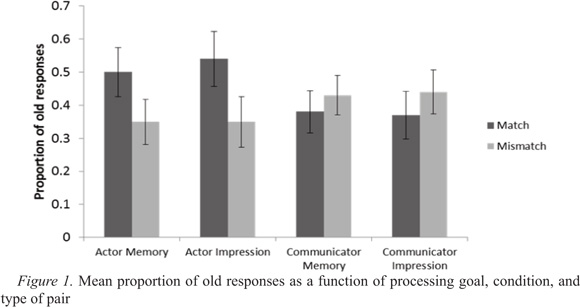
More important, we analyzed differences in the mean proportion of false recognitions as a function of the three independent variables. The interaction between actor-communicator condition and type of pair was significant, F(1,50)=7.25, p=.009, η2p=.13, 95% CI [0.02, 0.13] (see Figure 1). In the actor condition, participants were more likely to falsely recognize the trait in the match (M=.52) than in the mismatch condition (M=.35), t(46)=2.04, p=.03, d=.30. Thus, the typical false recognition (STI) effect was replicated, even when actors were referred to only by their names. By contrast, in the communicator condition (STT), no significant difference emerged between match (M=.37) and mismatch (M=.45) conditions, p=.21. These effects did not interact with processing goal. Thus, STIs were observed for actors, both under memory and impression conditions, as evidenced by the difference between match and mismatch trials. However, in the communicator condition the comparison between match and mismatch trials was not significant, neither under memory nor under impression instructions conditions.
Discussion
Previous research has demonstrated that trait inferences generated spontaneously from minimal behavioral information became specifically bounded to the actor of the behavior. These studies applied tasks in which photographs of the faces of the actors were presented. It is thus possible that the binding between STIs and actors is highly dependent on the visual presentation of faces. However, our results show that this is not the case. Even when faces are removed, and actors are only described by their names, evidence of a specific link between actor’s names and inferred traits was obtained. Inferred traits were attached to person’s names, even in the absence of any perceptual information being provided about them. These results suggest that trait inferences are ubiquitous and attest to the generality of the process. Making sense of others is probably so crucial to our navigation in the world that, even in contexts in which we know about other’s behaviors without directly observing them (e.g., in conversations, by listening to the radio, or by reading narratives in books) STIs become linked to actor representations.
The equivalent level of STI on memory and impression conditions also attests to the robustness of the STI process (see also Carlston & Skowronski, 1994). Previous studies have not found differences between memory and impression instructions which could indicate that the richness of the material prompts impression formation processes, independently of the actual instructions provided. But the fact that no differences were obtained in the present study, even when faces were not presented, and the information was thus much less likely to instigate deliberate trait inferences, suggests rather that the trait-actor binding process is highly routinized and occurs with equal magnitude under memory and impression conditions. However, we should be careful interpreting these null results.
By contrast, when the photograph of a communicator is replaced by its name, STTs are not observed. Contrary to previous findings (Carlston et al., 1995; Crawford et al., 2007; Skowronski et al., 1998), under these circumstances the trait implied by the behavior is not specifically transferred to the communicator of the behavior. This represents an important boundary condition on STT occurrence and has implications for understanding the conditions under which impressions of gossipers are affected by their messages. For example, imagine a situation where a politician wants to promote his campaign by describing a negative behavior of another candidate. If we observe him describing the behavior, it is likely that the trait implied by behavior will also become associated with his own image (STT), backfiring on him. However, if we listen to the politician describing the other’s candidate behavior without observing him (on the radio, for instance), then the negative trait will be connected to the actor, but probably will not get linked to the communicator of the message. In other words, in order to manage their own impressions, gossipers may want to show their face when describing another’s positive behaviors, so they become linked with the positive inferred traits, but they should be more cautious when describing another’s negative behaviors, since the negative inferred traits might became attached to themselves.
We stated that using names might be useful for STI research, mainly because their meaningfulness nature minimizes the activation of impression formation processes. However, it is important to note that sometimes names can be manipulated to transmit information about social dimensions, such as age, race, or social status (Joubert, 1993). In our study, common male American names were selected, in order to minimize the activation of specific stereotypes. However, in future studies the nature of the names may be purposely manipulated as a way of subtly activating certain stereotypes, and to determine whether the stereotype activation influences the likelihood of STI and STT formation (Ramos, Garcia-Marques, Hamilton, Ferreira, & Van Acker, 2012).
It is important to consider that our findings are based on a relatively low sample size. Thus, a replication with a larger sample size would be desirable. Another caveat of the present study is the fact that we did not include a condition with faces. However, it is a well-established fact in the literature that both STIs and STTs occur when faces are presented (Crawford & Skowronski, 2005; Skowronski et al., 1998; Todorov & Uleman, 2002, 2003, 2004). Thus, taken together, the results of previous studies and our own findings indicate that the visual distinctiveness of the actor during encoding is not crucial for STI occurrence. By contrast, the association between a communicator and the implied trait seems to be dependent on the visual salience of the communicator. This suggests that perceptual-based processes, that is, the processing of the visual features of the stimulus, play a major role on the occurrence of STT. In contrast, STIs are more dependent on conceptual-based processes.
An issue that remains uncertain in the literature is whether STIs and STTs entail a similar associative process or, on the other hand, entail qualitatively different cognitive processes. Specifically, while some authors defend the possibility that simple associative processes underlie both STI and STT (Brown & Bassili, 2002; Orghian et al., 2015), other authors argue that STI and STT involve different processes, attributions and associations respectively (Carlston & Skowronski, 2005; Crawford et al., 2007). The dualistic proposal was based on findings showing differences between STI and STT. For example: (1) STI are generally stronger than STT (Goren & Todorov, 2009; Skowronski et al., 1998); (2) some variables, as lie-detection instructions, interfere with STI but not with STT (Crawford et al., 2007); and (3) STIs are more likely to generalize to other traits than STTs (Carlston & Skowronski, 2005; Crawford et al., 2007) However, as Orghian et al. (2015) have demonstrated, the occurrence of such differences is compatible with a single associative process.
Although not decisive regarding this issue, our results show that STIs are not merely perceptually-based, semantically blind, associations. This fits well with the notion that STIs involve person-relevant inferential processes that establish the trait as an attribute of the person (Carlston & Skowronski, 2005; Crawford et al., 2007). However, there are other possible theoretical explanations. For example, a similar associative process might be postulated where both perceptual (visual) and semantic aspects (relevancy) contribute to the associative strength between trait and actor. In previous studies, communicators are usually visually salient, but are not semantically relevant, while actors are both visually salient and semantically relevant. This would explain why STIs tend to be stronger than STTs, and could also explain the occurrence of dissociations between the two (Crawford et al., 2007). The association between the actor and the trait is strong because the actor is both perceptually salient and semantically relevant in the context of the behavior presented. On the contrary, the association between the communicator and the trait is weaker because, despite its visual salience, the communicator is irrelevant to the behavior. In this case, it would thus be possible to postulate a single threshold model. That is, only when the association between the trait and the face reaches a certain level (depending on both perceptual salience and semantic relevancy) does it gain a more permanent status, and only at that point is it able to influence subsequent processing of information about the actor. The debate between theoretical perspectives is likely to remain open and is of great heuristic value. Independently of the specific nature of the processes involved, our results contribute to a better understanding of the conditions under which STIs and STTs occur.
]]>References
Bargh, J. (1990). Goal≠intent: Goal-directed thought and behavior are often unintentional. Psychological Inquiry, 1, 248-251.
Bassili, J. N. (1989). Trait encoding in behavior identification and dispositional inference. Personality and Social Psychology Bulletin, 15, 285-296. [ Links ]
Brown, R. D., & Bassili, J. N. (2002). Spontaneous trait associations and the case of the superstitious banana. Journal of Experimental Social Psychology, 38, 87-92. [ Links ]
Carlston, D. E., & Skowronski, J. J. (1994). Savings in the relearning of trait information as evidence for spontaneous inference generation. Journal of Personality and Social Psychology, 66, 840-880. [ Links ]
Carlston, D. E., & Skowronski, J. J. (2005). Linking versus thinking: Evidence for the different associative and attributional bases of spontaneous trait transference and spontaneous trait inference. Journal of Personality & Social Psychology, 89, 884-898. [ Links ]
Carlston, D. E., Skowronski, J. J., & Sparks, C. (1995). Savings in relearning: II. On the formation of behavior-based trait associations and inferences. Journal of Personality and Social Psychology, 69, 420-436. [ Links ]
Chartrand, T., & Bargh, J. A. (1996). Automatic activation of impression formation and memorization goals: Nonconscious goal priming reproduces effects of explicit task instructions. Journal of Personality and Social Psychology, 71, 464-478. [ Links ]
Claeys, W. (1990). On the spontaneity of behaviour categorization and its implications for personality measurement. European Journal of Personality, 4, 173-186. [ Links ]
Crawford, M. T., Skowronski, J. J., Stiff, C., & Scherer, C. R. (2007). Interfering with inferential, but not associative, processes underlying spontaneous trait inference. Personality and Social Psychology Bulletin, 33, 677-690. [ Links ]
Goren, A., & Todorov, A. (2009). Two faces are better than one: Eliminating false trait associations with faces. Social Cognition, 27, 222-248. [ Links ]
Joubert, C. E. (1993). Personal names as a psychological variable. Psychological Reports, 73, 1123-1145. [ Links ]
Orghian, D., Garcia-Marques, L., Uleman, J. S., & Heinke, D. (2015). A connectionist model of spontaneous trait inference and spontaneous trait transference: Do they have the same underlying processes?. Social Cognition, 33, 20-66. [ Links ]
Ramos, T., Garcia-Marques, L., Hamilton, D. L., Ferreira, M., & Van Acker, K. (2012). What I infer depends on who you are: The influence of stereotypes on trait and situational spontaneous inferences. Journal of Experimental Social Psychology, 48, 1247-1256. [ Links ]
Schneider, W., Eschman, A., & Zuccolotto, A. (2012). E-prime user’s guide. Pittsburgh: Psychology Software Tools, Inc.
Skowronski, J. J., Carlston, D. E., & Hartnett, J. L. (2008). Spontaneous impressions derived from observations of behavior: What a long, strange trip it’s been (and it’s not over yet). In N. Ambady & J. J. Skowronski (Eds.), First impressions (pp. 313-333). New York, NY: Guilford Press.
Skowronski, J. J., Carlston, D. E., Mae, L., & Crawford, M. T. (1998). Spontaneous trait transference: Communicators take on the qualities they describe in others. Journal of Personality and Social Psychology, 74, 837-848. [ Links ]
Stroessner, S. (1989). Behavior and ratings pool (compilation). Unpublished manuscript. Department of Psychology, Barnard College of Columbia University, New York. [ Links ]
Todorov, A., & Uleman, J. S. (2002). Spontaneous trait inferences are bound to actors’ faces: Evidence from a false recognition paradigm. Journal of Personality and Social Psychology, 83, 1051-1065.
Todorov, A., & Uleman, J. S. (2003). The efficiency of binding spontaneous trait inferences to actors’ faces. Journal of Experimental Social Psychology, 39, 549-562.
Todorov, A., & Uleman, J. S. (2004). The person reference process in spontaneous trait inferences. Journal of Personality and Social Psychology, 87, 482-493. [ Links ]
Uleman, J. S., Rim, S., Saribay, S. A., & Kressel, L. M. (2012). Controversies, questions, and prospects for spontaneous social inferences. Social and Personality Psychology Compass, 6, 657-673. [ Links ]
Wang, L., Bastiaansen, M., & Yang, Y. (2015). ERP responses to person names as a measure of trait inference in person perception. Social Neuroscience, 10, 89-99. [ Links ]
Whitney, P., Davis, P. A., & Waring, D. A. (1994). Task effects on trait inference: Distinguishing categorization from characterization. Social Cognition, 12, 19-35. [ Links ]
Correspondence concerning this article should be addressed to: Tânia Ramos, Faculdade de Psicologia, Universidade de Lisboa, Alameda da Universidade 1649-013 Lisboa, Portugal. E-mail: taniaramos@fp.ul.pt
The research was supported in part by a grant to the first author from Fundação para a Ciência e Tecnologia under grant SFRH/BPD/64826/2009.
Submitted: 04/08/2016 Accepted: 07/10/2017
]]>