<?xml version="1.0" encoding="ISO-8859-1"?><article xmlns:mml="http://www.w3.org/1998/Math/MathML" xmlns:xlink="http://www.w3.org/1999/xlink" xmlns:xsi="http://www.w3.org/2001/XMLSchema-instance">
<front>
<journal-meta>
<journal-id>0870-8231</journal-id>
<journal-title><![CDATA[Análise Psicológica]]></journal-title>
<abbrev-journal-title><![CDATA[Aná. Psicológica]]></abbrev-journal-title>
<issn>0870-8231</issn>
<publisher>
<publisher-name><![CDATA[ISPA-Instituto Universitário]]></publisher-name>
</publisher>
</journal-meta>
<article-meta>
<article-id>S0870-82312018000400008</article-id>
<article-id pub-id-type="doi">10.14417/ap.1544</article-id>
<title-group>
<article-title xml:lang="en"><![CDATA[Caregiving Helplessness Questionnaire (CHQ) applied to Portuguese mothers of preschool-aged children: A psychometric study]]></article-title>
<article-title xml:lang="pt"><![CDATA[Caregiving Helplessness Questionnaire (CHQ) aplicado a mães portuguesas de crianças em idade pré-escolar: Um estudo psicométrico]]></article-title>
</title-group>
<contrib-group>
<contrib contrib-type="author">
<name>
<surname><![CDATA[Toscano]]></surname>
<given-names><![CDATA[Carolina]]></given-names>
</name>
<xref ref-type="aff" rid="A01"/>
</contrib>
<contrib contrib-type="author">
<name>
<surname><![CDATA[Baptista]]></surname>
<given-names><![CDATA[Joana]]></given-names>
</name>
<xref ref-type="aff" rid="A02"/>
</contrib>
<contrib contrib-type="author">
<name>
<surname><![CDATA[Mesquita]]></surname>
<given-names><![CDATA[Ana]]></given-names>
</name>
<xref ref-type="aff" rid="A01"/>
</contrib>
<contrib contrib-type="author">
<name>
<surname><![CDATA[George]]></surname>
<given-names><![CDATA[Carol]]></given-names>
</name>
<xref ref-type="aff" rid="A03"/>
</contrib>
<contrib contrib-type="author">
<name>
<surname><![CDATA[Soares]]></surname>
<given-names><![CDATA[Isabel]]></given-names>
</name>
<xref ref-type="aff" rid="A01"/>
</contrib>
</contrib-group>
<aff id="A01">
<institution><![CDATA[,Universidade do Minho Escola de Psicologia Centro de Investigação em Psicologia]]></institution>
<addr-line><![CDATA[Braga ]]></addr-line>
<country>Portugal</country>
</aff>
<aff id="A02">
<institution><![CDATA[,ISCTE - Instituto Universitário de Lisboa  ]]></institution>
<addr-line><![CDATA[Lisboa ]]></addr-line>
<country>Portugal</country>
</aff>
<aff id="A03">
<institution><![CDATA[,Mills College  ]]></institution>
<addr-line><![CDATA[Oakland ]]></addr-line>
<country>USA</country>
</aff>
<pub-date pub-type="pub">
<day>00</day>
<month>12</month>
<year>2018</year>
</pub-date>
<pub-date pub-type="epub">
<day>00</day>
<month>12</month>
<year>2018</year>
</pub-date>
<volume>36</volume>
<numero>4</numero>
<fpage>501</fpage>
<lpage>514</lpage>
<copyright-statement/>
<copyright-year/>
<self-uri xlink:href="http://scielo.pt/scielo.php?script=sci_arttext&amp;pid=S0870-82312018000400008&amp;lng=en&amp;nrm=iso"></self-uri><self-uri xlink:href="http://scielo.pt/scielo.php?script=sci_abstract&amp;pid=S0870-82312018000400008&amp;lng=en&amp;nrm=iso"></self-uri><self-uri xlink:href="http://scielo.pt/scielo.php?script=sci_pdf&amp;pid=S0870-82312018000400008&amp;lng=en&amp;nrm=iso"></self-uri><abstract abstract-type="short" xml:lang="en"><p><![CDATA[The child’s attachment system is complemented by a separate and reciprocal caregiving system in the parent, which guides parents’ protective responses to the child. Disruptions in the caregiving system may lead to disorganized caregiving; however, the study and knowledge of disorganized caregiving is still very incomplete and has been limited to labor-intensive and costly interviews. This study aimed to examine the psychometric qualities of the Caregiving Helplessness Questionnaire (CHQ), a screening tool for disorganized caregiving, on a sample of 200 Portuguese mothers of preschool-aged children. Confirmatory factor analysis did not confirm the structure of the original CHQ version. A five-factor solution was found as a better solution, producing five scales that correspond conceptually to major dimensions of relationship disorganization at preschool-age: Mother Helpless, Mother Frightened, Child Frightened, Child Cheers Mothers, and Child Caregiving. Reliability analysis had satisfactory results and convergent and discriminant validity were confirmed. Concurrent validity was also established by finding significant associations between the CHQ scales with variables of maternal and child domains that have been conceptually and empirically associated with disorganization. In conclusion, results supported the validity of the CHQ for Portuguese mothers of preschoolers, as a promising screening tool for disorganized caregiving.]]></p></abstract>
<abstract abstract-type="short" xml:lang="pt"><p><![CDATA[O sistema de vinculação da criança é complementado por um sistema, separado e recíproco, de prestação de cuidados parentais, que guia as respostas de proteção do cuidador em relação à criança. Disrupções neste último sistema poderão conduzir a uma prestação de cuidados desorganizada; no entanto, o conhecimento acerca da desorganização da prestação de cuidados permanece incompleta, estando o seu estudo limitado a metodologias dispendiosas. O presente estudo pretendeu analisar as qualidades psicométricas do Caregiving Helplessness Questionnaire (CHQ), uma ferramenta de screening para a desorganização da prestação de cuidados, numa amostra de 200 mães portuguesas de crianças em idade pré-escolar. A análise factorial confirmatória não confirmou a estrutura da versão original do CHQ. Uma solução de cinco fatores verificou-se como sendo a melhor, produzindo cinco escalas conceptualmente correspondentes às principais dimensões da desorganização das relações em idade pré-escolar: Mother Helpless, Mother Frightened, Child Frightened, Child Cheers Mothers e Child Caregiving. O estudo da consistência interna obteve resultados satisfatórios e a validade convergente e discriminante foi confirmada. A validade concorrente também foi estabelecida através de associações significativas entre as escalas do CHQ e variáveis dos domínios materno e da criança que têm sido conceptual e empiricamente associadas com a desorganização. Em conclusão, os resultados suportam a validade do CHQ para mães portuguesas de crianças pré-escolares, como um instrumento de screening promissor desorganização da prestação de cuidados.]]></p></abstract>
<kwd-group>
<kwd lng="en"><![CDATA[Caregiving Helplessness Questionnaire (CHQ)]]></kwd>
<kwd lng="en"><![CDATA[Validation]]></kwd>
<kwd lng="en"><![CDATA[Caregiving system]]></kwd>
<kwd lng="en"><![CDATA[Disorganized caregiving]]></kwd>
<kwd lng="en"><![CDATA[Caregiving helplessness]]></kwd>
<kwd lng="pt"><![CDATA[Caregiving Helplessness Questionnaire (CHQ)]]></kwd>
<kwd lng="pt"><![CDATA[Validação]]></kwd>
<kwd lng="pt"><![CDATA[Sistema de prestação de cuidados]]></kwd>
<kwd lng="pt"><![CDATA[Desorganização da prestação de cuidados]]></kwd>
<kwd lng="pt"><![CDATA[Desamparo na prestação de cuidados]]></kwd>
</kwd-group>
</article-meta>
</front><body><![CDATA[ <p><b>Caregiving Helplessness Questionnaire (CHQ) applied to Portuguese mothers of preschool-aged children: A psychometric study</b></p>     <p><b>Caregiving Helplessness Questionnaire (CHQ) aplicado a m&atilde;es portuguesas de crian&ccedil;as em idade pr&eacute;-escolar: Um estudo  psicom&eacute;trico</b></p>     <p><b>Carolina Toscano<sup>1</sup>, Joana Baptista<sup>2</sup>, Ana Mesquita<sup>1</sup>, Carol George<sup>3</sup>,  Isabel Soares<sup>1</sup></b></p>     <p><sup>1</sup>Centro de Investiga&ccedil;&atilde;o em Psicologia, Escola de Psicologia, Universidade do Minho, Braga, Portugal</p>     <p><sup>2</sup>ISCTE &ndash; Instituto Universit&aacute;rio de Lisboa, Lisboa, Portugal</p>     <p><sup>3</sup>Mills College, Oakland, USA</p>     <p><a name="topc0"></a><a href="#c0">Correspondência</a></p>     <p>&nbsp;</p>     <p><b>ABSTRACT</b></p>     <p>The child&rsquo;s attachment system is complemented by a separate and reciprocal caregiving system in the parent, which guides parents&rsquo;  protective responses to the child. Disruptions in the caregiving system may lead to disorganized caregiving; however, the study and knowledge of  disorganized caregiving is still very incomplete and has been limited to labor-intensive and costly interviews. This study aimed to examine the  psychometric qualities of the Caregiving Helplessness Questionnaire (CHQ), a screening tool for disorganized caregiving, on a sample of 200  Portuguese mothers of preschool-aged children. Confirmatory factor analysis did not confirm the structure of the original CHQ version. A  five-factor solution was found as a better solution, producing five scales that correspond conceptually to major dimensions of relationship  disorganization at preschool-age: Mother Helpless, Mother Frightened, Child Frightened, Child Cheers Mothers, and Child Caregiving. Reliability  analysis had satisfactory results and convergent and discriminant validity were confirmed. Concurrent validity was also established by finding  significant associations between the CHQ scales with variables of maternal and child domains that have been conceptually and empirically  associated with disorganization. In conclusion, results supported the validity of the CHQ for Portuguese mothers of preschoolers, as a promising  screening tool for disorganized caregiving.    ]]></body>
<body><![CDATA[<p>     <p><b>Key words</b>: Caregiving Helplessness Questionnaire (CHQ), Validation, Caregiving system, Disorganized caregiving, Caregiving  helplessness.</p>     <p>&nbsp;</p>     <p><b>RESUMO</b></p>     <p>O sistema de vincula&ccedil;&atilde;o da crian&ccedil;a &eacute; complementado por um sistema, separado e rec&iacute;proco, de  presta&ccedil;&atilde;o de cuidados parentais, que guia as respostas de prote&ccedil;&atilde;o do cuidador em rela&ccedil;&atilde;o &agrave;  crian&ccedil;a. Disrup&ccedil;&otilde;es neste &uacute;ltimo sistema poder&atilde;o conduzir a uma presta&ccedil;&atilde;o de cuidados  desorganizada; no entanto, o conhecimento acerca da desorganiza&ccedil;&atilde;o da presta&ccedil;&atilde;o de cuidados permanece incompleta,  estando o seu estudo limitado a metodologias dispendiosas. O presente estudo pretendeu analisar as qualidades psicom&eacute;tricas do Caregiving  Helplessness Questionnaire (CHQ), uma ferramenta de <i>screening</i> para a desorganiza&ccedil;&atilde;o da presta&ccedil;&atilde;o de cuidados,  numa amostra de 200 m&atilde;es portuguesas de crian&ccedil;as em idade pr&eacute;-escolar. A an&aacute;lise factorial confirmat&oacute;ria  n&atilde;o confirmou a estrutura da vers&atilde;o original do CHQ. Uma solu&ccedil;&atilde;o de cinco fatores verificou-se como sendo a melhor,  produzindo cinco escalas conceptualmente correspondentes &agrave;s principais dimens&otilde;es da desorganiza&ccedil;&atilde;o das  rela&ccedil;&otilde;es em idade pr&eacute;-escolar: <i>Mother Helpless, Mother Frightened, Child Frightened, Child Cheers Mothers</i> e <i>Child  Caregiving</i>. O estudo da consist&ecirc;ncia interna obteve resultados satisfat&oacute;rios e a validade convergente e discriminante foi  confirmada. A validade concorrente tamb&eacute;m foi estabelecida atrav&eacute;s de associa&ccedil;&otilde;es significativas entre as escalas do  CHQ e vari&aacute;veis dos dom&iacute;nios materno e da crian&ccedil;a que t&ecirc;m sido conceptual e empiricamente associadas com a  desorganiza&ccedil;&atilde;o. Em conclus&atilde;o, os resultados suportam a validade do CHQ para m&atilde;es portuguesas de crian&ccedil;as  pr&eacute;-escolares, como um instrumento de <i>screening</i> promissor desorganiza&ccedil;&atilde;o da presta&ccedil;&atilde;o de cuidados.</p>     <p><b>Palavras-chave</b>: Caregiving Helplessness Questionnaire (CHQ), Valida&ccedil;&atilde;o, Sistema de presta&ccedil;&atilde;o de cuidados,  Desorganiza&ccedil;&atilde;o da presta&ccedil;&atilde;o de cuidados, Desamparo na presta&ccedil;&atilde;o de cuidados.</p>     <p>&nbsp;</p>     <p>The child&rsquo;s attachment behavioral system is complemented by a separate and reciprocal caregiving system in the parent, which organizes  parents&rsquo; caregiving behavior (Bowlby, 1982; George &amp; Solomon, 2008; Solomon &amp; George, 1996). However, historically, the emphasis in  theory and research has been focused on the child and his/her attachment system, and the knowledge about the caregiving system is still  incomplete (George &amp; Solomon, 2008; Solomon &amp; George, 1996). If we want to fully understand how child, parent, family, and cultural  contexts work together to influence the quality of parent-child relationship, a shift from the focus on the child&rsquo;s attachment system to  the study of the caregiving system is needed (Solomon &amp; George, 1996). Accordingly, the aim of the present study was to examine the  psychometric qualities of a screening tool for disorganized maternal caregiving &ndash; the Caregiving Helplessness Questionnaire (CHQ; George  &amp; Solomon, 2011) &ndash; on a sample of Portuguese mothers of preschool-aged children.</p>     <p>The caregiving system is a biologically based motivation system that guides parents&rsquo; protective responses to the child (Bowlby, 1982).  It is guided by internal working models of caregiving, which are representational processes that evaluate and organize parental behavior,  expectations and affects (George &amp; Solomon, 2011). With the ultimate goal of protecting the child, this system requires the mother to shift  from being the one who seeks protection and care from an attachment figure, towards becoming the one who provides protection and care for a child  (George &amp; Solomon, 2008). However, this shift appears to be disrupted in the case of mothers of children with disorganized attachment  (Lyons-Ruth &amp; Spielman, 2004), reflecting a disorganized caregiving (George &amp; Solomon, 1996, 2011; Lyons-Ruth &amp; Block, 1996).  Following George and Solomon (2011) conceptualization on disorganized caregiving, disruption of the system may develop on the context of  unresolved frightening painful attachment-related experiences of mothers. These experiences can include, for example, miscarriage and death of a  baby or experiences with the mother&rsquo;s own childhood attachment figures such as violence, loss, abuse or alcoholism (Lyons-Ruth &amp; Block,  1996; Solomon &amp; George, 2011). According to the authors, these experiences are barred from consciousness &ndash; defensive processes termed  segregated systems by Bowlby (1980) &ndash; and disrupt the organization of caregiving representations and caregiving behavior. The mother feels  helpless and/or frightened in relation to parenting the child, and may lash out, retreat or seek comfort and protection from the child, thus  abdicating of her caregiving role and failing to provide adequate protection for her child. Caregiving becomes inverted and/or incoherent and the  mother displays contradictory and inconsistent caregiving behaviors (George &amp; Solomon, 2008; Solomon &amp; George, 2011). George and Solomon  (2008) postulated that caregiving failures might take two representational forms: dysregulation or constriction, which have been shown to be  associated with qualitatively different perceptions of the child and his/her attachment needs. A dysregulated mother tends to portray her child  as out of control, thus abdicating caregiving by throwing her hands up in despair or evaluating herself as not being able to be involved. By  contrast, a constricted mother tends to portray her child as independent and capable of taking care of his/her own and others. Ultimately, the  constricted mother views herself as not really needed to provide protection and care, thus abdicates caregiving (George &amp; Solomon, 2008,  2011). Children of disorganized mothers are at high risk for adjustment problems, as demonstrated by research reporting a link between maternal  disorganized caregiving and childhood social, emotional and behavioral problems (George &amp; Solomon, 2011; Huth-Bocks, Guyon-Harris, Calvert,  Scott, &amp; Ahlfs-Dunn, 2016), and even adolescence and young adulthood psychopathology (Dutra, Bureau, Holmes, Lyubchik, &amp; Lyons-Ruth,  2009; Lyons-Ruth, Bureau, Holmes, Easterbrooks, &amp; Brooks, 2013).</p>     <p>Until 2011, the only instrument available to assess disorganized maternal caregiving was the Caregiving Interview (CI; George &amp; Solomon,  1989). However, completing the interview protocol and the rating system is labor-intensive and costly. Thus, based on common responses made by  mothers during the CI, George and Solomon (2011) developed the Caregiving Helplessness Questionnaire (CHQ), a self-report questionnaire designed  to measure disorganized caregiving. Comprising 26 items (see <a href="#a1">Appendix 1</a>), the CHQ aims to tap three core aspects of  disorganized caregiving: experiences of helplessness, fear and role-reversal in the parent-child relationship. In the CHQ development and  validation study, the questionnaire was administered to 208 low-risk North American mothers of children aged 3-11 years. Exploratory factor  analysis (EFA) using principal components and varimax rotation yielded a five-factor solution. The first factor included items pertaining to  caregiving helpless and was considered a scale labeled Mother Helpless. The second and the third factors, labeled Mother Frightened and Child  Frightened, represented fear in the relationship and therefore were combined to create a second scale named Mother-Child Frightened. The fourth  and the fifth factors, labeled Child Cheers Mother and Child Caregiving, represented role-reversal in the relationship and therefore were  combined to create a third scale named Child Caregiving. The study also provided evidence of divergent validity between the CHQ scales and  measures of maternal stress related to the affiliative, sexual and health domains. Significant positive correlations between the CI ratings and  the CHQ scales provided evidence of convergent validity for Mother Helpless and Mother-Child Frightened scales, but not for the Child Caregiving  scale. The authors also explored associations between the CHQ scales with variables that have been empirically associated with attachment  disorganization. Both Mother Helpless and Mother-Child Frightened scales were significantly, positively correlated with maternal depression,  parenting stress, number of attachment related life events and child externalizing problems. The Child Caregiving scale was only significantly,  positively associated with maternal depression. To our knowledge, until date, there are no other versions of the instrument. Huth-Bocks et al.  (2016) sought to replicate George and Solomon (2011) validity findings to a sample of mothers of infants, by examining associations between the  CHQ and maternal depression, parenting stress and infant social-emotional problems. Both Mother Helpless and Mother-Child Frightened scales were  positively associated with maternal depression, parenting stress and infant social-emotional problems. The Child Caregiving scale was positively  associated with infant social-emotional problems.</p>     ]]></body>
<body><![CDATA[<p>The aim of the current study was to validate the CHQ for use with Portuguese    mothers of preschool-aged children. More specifically, we examined the factor    structure of the CHQ and estimated the reliability of the instrument. We also    investigated discriminant and convergent validity. Finally, we explored concurrent    validity by assessing associations between the CHQ scales and maternal and child    variables that have been conceptually and empirically associated with attachment    disorganization. Maternal variables included maternal psychopathology (e.g.,    Lyons-Ruth &amp; Jacobvitz, 2008), maternal parenting stress (e.g., Moss, Bureau,    St-Laurent, &amp; Tarabulsky, 2011), and the quality of maternal interactive    behaviors in terms of sensitivity and cooperation with the child (e.g., Lyons-Ruth    et al., 2013). Child variables included behavioral and emotional problems (e.g.,    Carlson, 1998). Whereas the CHQ development and validity study (George &amp;    Solomon, 2011) also investigated associations with maternal depression, parenting    stress, and child&rsquo;s behavioral and emotional problems, the current study    makes an additional contribution, considering an observational measure of the    quality of maternal interactive behaviors.</p>     <p>&nbsp;</p>     <p><b>Method</b></p>     <p>&nbsp;</p>     <p><i>Participants</i></p>     <p>The sample of the current study consisted of 200 Portuguese mothers of preschool-aged children, recruited from public and private preschools  centers in the districts of Braga, Porto, and Aveiro. Inclusion criteria for participation in the study included Portuguese nationality, being 18  years old or older and having a child between the ages of 3 and 6 years old. Exclusion criteria included child not living with the mother, and  the presence of child&rsquo;s genetic syndromes or other serious diseases (e.g., hearing or vision loss). Mothers ranged in age from 21 to 48  years old (<i>M</i>=34.05, <i>SD</i>=5.18). One hundred fifty-seven were married or living in a civil union (78.5%), 25 were single (12.5%), 17  were divorced (8.5%) and 1 was widowed (0.5%). Concerning professional status, 143 were employed (71.5%), 54 were unemployed (27%) and 3 were  university students (1.5%). Sixty-nine mothers had a university degree (35%), 55 had graduated from high school (27%), 49 completed middle school  (24.5%), 19 completed 6<sup>th</sup> grade (9.5%), 6 completed primary school (3%) and 2 had no education (1%). The majority had more than one  child (<i>n</i>=113, 57%). Children&rsquo;s mean age was 4.26 years (<i>SD</i>=0.87, <i>range</i>=3 to 6 years old), and 50.5% were girls  (<i>n</i>=101).</p>     <p>&nbsp;</p>     <p><i>Procedure</i></p>     <p>Preschool centers were first contacted and the study was presented to the director or responsible person of each institution. After obtained  the authorization, mothers who met the inclusion criteria were contacted either by telephone, email or personally by the investigator. Mothers  willing to participate completed consent forms. All measures were administered in a private and quiet location at their child&rsquo;s preschool  or home. The study was approved by the Ethics Subcommittee for Human and Social Sciences (SECSH) of the University of Minho, and by the  Portuguese National Commission for Data Protection.</p>     <p>&nbsp;</p>     ]]></body>
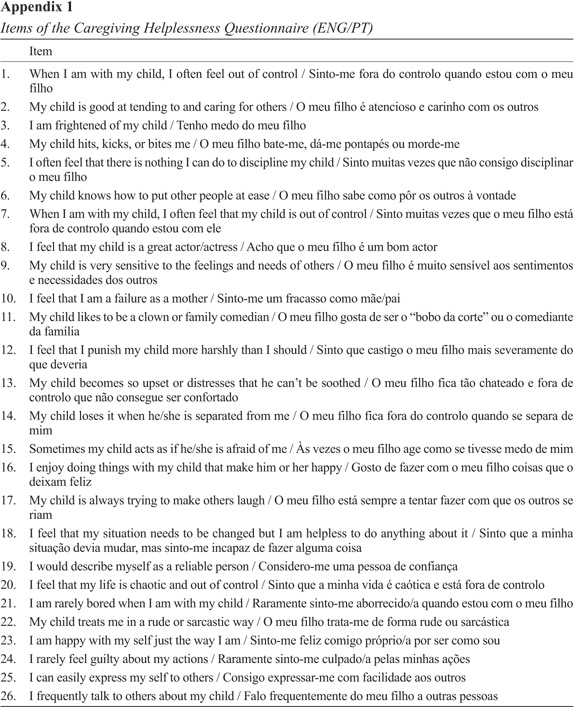
<body><![CDATA[<p><i>Measures</i></p>     <p>&nbsp;</p>     <p>Disorganized caregiving</i>. Mothers completed the Caregiving Helplessness Questionnaire (CHQ; George &amp; Solomon, 2011). It consists of 26  items (see <a href="#a1">Appendix 1</a>), including seven filler items, rated on a 5-point Likert scale ranging from 1 (<i>not characteristic at  all</i>) to 5 (<i>very characteristic)</i>. When completing the CHQ, mothers are instructed to think about the target child and evaluate the  extent to which each item is characteristic of their relationship with that specific child. On the CHQ development and validation study, three  scales were obtained: Mother Helpless (7 items; &alpha;=.85), assessing maternal perceptions of helplessness, Mother-Child Frightened (6 items;  &alpha;=.66), assessing maternal perceptions of fear in the relationship, and Child Caregiving (6 items; &alpha;=.64), assessing maternal  perceptions of role-reversal. The validity of the CHQ has been demonstrated in other studies with American samples of mothers of infants and  adolescents (Huth-Bocks et al., 2016; Vulliez-Coady, Obsuth, Torreiro-Casal, Ellertsdottir, &amp; Lyons-Ruth, 2013).</p>     <p>&nbsp;</p>     <p><i>Maternal psychopathology</i>. Mothers completed the Brief Symptom Inventory (BSI; Derogatis &amp; Melisaratos, 1983; Portuguese version by  Canavarro, 1999). It contains 53 self-report items, rated on a 5-point Likert scale ranging from 0 to 4, with higher scores reflecting higher  frequency of psychopathological symptoms. Three global indices of distress can be obtained: the Global Severity Scale (GSI), the Positive Symptom  Distress Index (PSDI), and the Positive Symptom Total (PST). The current study relied on the GSI, which is an indicator of the current overall  level of distress. Test-retest reliability of GSI was found to be strong (Derogatis &amp; Melisaratos, 1983).</p>     <p>&nbsp;</p>     <p><i>Maternal parenting stress</i>. Mothers completed the Daily Hassles Questionnaire (Kanner, Coyne, Schaefer, &amp; Lazarus, 1981; Portuguese  version by Negr&atilde;o, Pereira, &amp; Soares, 2009). It includes 45 items concerning stressors related to the individual&rsquo;s daily life,  rated on a 5-point Likert scale ranging from 0 (<i>no hassle</i>) to 4 (<i>big hassle</i>). Four subscales can be obtained: Individual Stress,  Parental Stress, Child Stress and Total Stress. For the current study only the Parental Stress subscale was used, which has been demonstrated to  have good internal consistency (Pereira, Negr&atilde;o, Soares, &amp; Mesman, 2015), similar to the present study (&alpha;=.82). Example items of  this scale are &lsquo;having to keep an eye on what my children are doing&rsquo; (Item 11) and &lsquo;plans changing because of my child&rsquo;s  needs&rsquo; (Item 13).</p>     <p>&nbsp;</p>     <p><i>Quality of maternal interactive behaviors</i>. The Ainsworth, Blehar, Waters, and Wall (1978) Sensitivity/Insensitivity and  Cooperation/Intrusiveness scales, adapted to the preschool years by our team, were used by trained raters to assess the quality of the  mothers&rsquo; behavior with the child during a 15 minutes videotaped task divided in three episodes: (1) child plays with an age-challenging  puzzle with the mother&rsquo;s guidance (5 minutes); (2) child plays with an uninteresting toy (a small block) but remains near more interesting  ones that s/he is instructed not to play with (e.g., a ball, cars, a doll), while the mother completes a sham questionnaire and monitors the  child (5 minutes); (3) free play with previous out-of-reach toys (2.5 minutes), followed by a clean-up task for the child (2.5 minutes). Both  scales were rated on a 9-point scale. Interrater reliability was more than adequate (for sensitivity, ICC <i>r<sub>ic</sub></i>=.92; for  cooperation, ICC <i>r<sub>ic</sub></i>=.88) and disagreements were discussed to obtain a consensus. As scores obtained on both scales were  significantly correlated (<i>r</i>=.73, <i>p</i>&lt;.001), a composite of the mean of the standardized scores was computed to obtain a global  measure of sensitive responsiveness.</p>     <p>&nbsp;</p>     ]]></body>
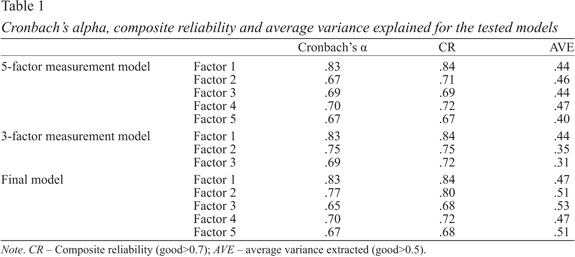
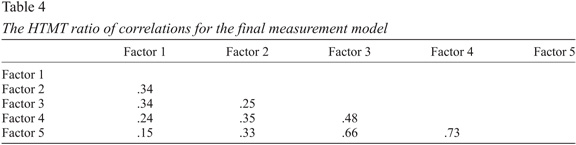
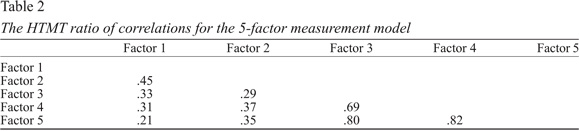
<body><![CDATA[<p><i>Child&rsquo;s behavioral and emotional problems</i>. Mothers completed the Child Behavior Checklist for Ages 1.5-5 (CBCL 1.5-5; Achenbach,  &amp; Rescorla, 2000; Portuguese version by Achenbach et al., 2014). It contains 100 items rated on a 3-point Likert scale ranging from 0  (<i>not true</i>) to 2 (<i>very/frequently true</i>). Besides the estimate of the total problems, the CBCL produces seven syndrome scales and two  broadband scales, internalizing and externalizing behaviors. Both scales have been demonstrated to have good internal consistency (Achenbach  &amp; Rescorla, 2000), similar to the present study (&alpha;=.88 for internalizing, and &alpha;=.89 for externalizing).</p>     <p>&nbsp;</p>     <p><b>Results</b></p>     <p>Excluding the 7 filler items (16, 19, 21, 23, 24, 25, 26), the 19 CHQ items were evaluated using confirmatory factorial analysis (CFA). The  statistical analyses were conducted using IBM SPPS Statistics 24.0 and RStudio 3.4.1. In RStudio, all analyses were performed using the <i>R</i>  packages lavaan, semTools, and semPlot. Since all variables were ordered, the WLSMV estimator was automatically selected by lavaan, using  diagonally weighted least squares (DWLS) to estimate the model parameters, and the full weight matrix to compute robust standard errors, and a  mean-and variance-adjusted test statistic.</p>     <p>In the factor analysis of the CHQ development and validity study, George and Solomon (2011) identified the following five factors: Factor 1  &ndash; &ldquo;Mother Helpless&rdquo; &ndash; including items 1, 5, 7, 10, 18, 20, 22; factor 2 &ndash; &ldquo;Mother Frightened&rdquo; &ndash;  including items 3, 4, 14; factor 3 &ndash; &ldquo;Child Frightened&rdquo; &ndash; including items 12, 13, 15; factor 4 &ndash; &ldquo;Child  Cheers Mother&rdquo; &ndash; including items 8, 11, 17; and factor 5 &ndash; &ldquo;Child Caregiving&rdquo; &ndash; including items 2, 6, 9.  After the identification of these factors, the authors produced two new scales by combining all items from factors 2 and 3, and from factors 4  and 5, which were named &ldquo;Mother-Child Frightened&rdquo; and &ldquo;Child Caregiving&rdquo;, respectively. In what follows, the validation  of this instrument to the Portuguese population was investigated considering first the 5-factor model and then the 3-factor model.</p>     <p>&nbsp;</p>     <p><i>The 5-factor measurement model</i></p>     <p>A CFA was applied to the 5-factor measurement model. SEM analysis revealed factor loadings with values between .46 and .80, including one  value smaller than .50 (however very close). The fit measures showed good fitting to the data, with a Chi-square (<i>&chi;<sup>2</sup></i>) of  323.79 (<i>df</i>=147), a Comparative Fit Index (CFI) of .96, a Tucker-Lewis index (TLI) of .95, a Non-normed Fit index (NNFI) of .95, and a Root  Mean Square Error of Approximation (RMSEA) of .06. As shown in <a href="#t1">Table 1</a>, each factor exhibited acceptable Cronbach&rsquo;s alpha  (from .67 to .83), good composite reliability (CR) and acceptable average variance extracted (AVE) values (Fornell &amp; Larcker, 1981).  Therefore, all five factors presented acceptable internal reliability, good composite reliability, and reasonable convergent validity. Recall  that the current recommended criteria for convergent validity are: all factor loadings&gt;.50, all AVE&gt;.50, and all CR&gt;.70 (Hair, Black,  Babin, &amp; Anderson, 2010). All values that lied outside these recommended cutoffs were, indeed, very close to the corresponding thresholds,  and thus the results generally showed acceptable convergent validity. The Heterotrait-monotrait (HTMT) matrix (<a href="#t2">Table 2</a>)  indicated that there were no discriminant validity problems according to the HTMT ratio of correlations criterion (Henseler, Ringlet &amp;  Sarstedt, 2015), considering a reasonable cutoff of .85.</p>     <p>&nbsp;</p>     <p><a name="t1"></a></p>     ]]></body>
<body><![CDATA[<p><img src="/img/revistas/aps/v36n4/36n4a08t1.jpg" width="575" height="257"></p>     
<p>&nbsp;</p>     <p>&nbsp;</p>     <p><a name="t2"></a></p>     <p><img src="/img/revistas/aps/v36n4/36n4a08t2.jpg" width="579" height="131"></p>     
<p>&nbsp;</p>     <p>&nbsp;</p>     <p><i>The 3-factor measurement model</i></p>     <p>A CFA was applied to the 3-factor measurement model. SEM analysis revealed factor loadings with values between .39 and .77, including five  values below .50. The fit measures didn&rsquo;t show good fitting to the data, with Chi-square=368.22, <i>df</i>=149, CFI=.90, TLI=.88, NNFI=.88,  and RMSEA=.09. As shown on <a href="#t1">Table 1</a>, although internal reliability and composite reliability have slightly improved, the  constructs&rsquo;AVE had worsened, yielding frailties in the convergent validity. Also, discriminant validity was not achieved; the HTMT matrix  (<a href="#t3">Table 3</a>) indicated discriminant validity problems in one of the values (F2 and F3), as it violated a reasonable cutoff of  .85.</p>     <p>&nbsp;</p>     ]]></body>
<body><![CDATA[<p><a name="t3"></a></p>     <p><img src="/img/revistas/aps/v36n4/36n4a08t3.jpg" width="579" height="104"></p>     
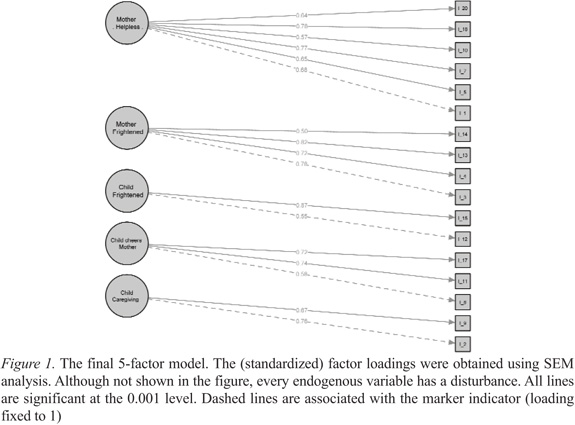
<p>&nbsp;</p>     <p>&nbsp;</p>     <p><i>The final measurement model</i></p>     <p>The CHQ showed acceptable fitting performance when comprising the five different scales initially proposed by George and Solomon (2011).  Nevertheless, since this model yielded some measures in the threshold limit, especially regarding validity concerns, a better fitting model to  this data was investigated. This search was based in the 5-measurement model, as it showed to be a reasonable model. All further attempts just  allowed small and theoretical meaningful changes. After some possible considerations, a final model was obtained by introducing the following  two changes: first, items 6 and 22 were eliminated from the corresponding constructs due to a significant improvement on the convergent validity  (AVE increased from 0.44 and 0.40, to 0.47 and 0.51, respectively &ndash; see <a href="#t1">Table 1</a>); second, item 13 moved from the Child  Frightened factor to the Mother Frightened factor. Theoretically, this shift doesn&rsquo;t seem problematic, since both of the factors pertain  to fear in the parent-child relationship. <a href="#f1">Figure 1</a> exhibits all factor loadings of the final model, showing that no factor  loading was below .50. The fit measures showed good fitting to the data, with Chi-square=169.55, <i>df</i>=109, CFI=.97, TLI=.96, NNFI=.96, and  RMSEA=.05. As summarized in <a href="#t1">Table 1</a>, the final model exhibited acceptable reliability and good convergent validity. Also,  discriminant validity was clearly established (see <a href="#t4">Table 4</a>).</p>     <p>&nbsp;</p>     <p><a name="f1"></a></p>     <p><img src="/img/revistas/aps/v36n4/36n4a08f1.jpg" width="575" height="425"></p>     
<p>&nbsp;</p>     ]]></body>
<body><![CDATA[<p>&nbsp;</p>     <p><a name="t4"></a></p>     <p><img src="/img/revistas/aps/v36n4/36n4a08t4.jpg" width="576" height="145"></p>     
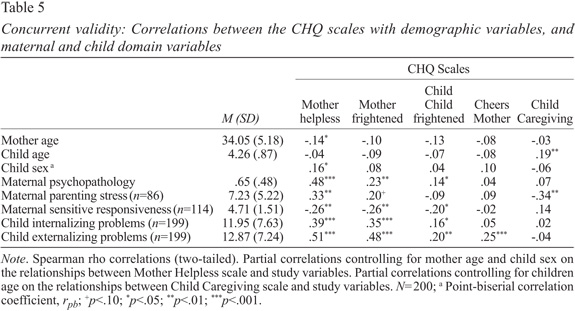
<p>&nbsp;</p>     <p>&nbsp;</p>     <p><i>Concurrent validity of the final model</i></p>     <p>Concurrent validity of the final retained model was investigated by examining correlations between the five CHQ scales with variables of  maternal and child domains that have been conceptually and empirically associated with attachment disorganization &ndash; maternal  psychopathology, parenting stress, maternal sensitive responsiveness and child&rsquo;s behavioral and emotional problems. We first examined the  associations between CHQ scales and demographic variables to determine covariates that would need to be controlled at testing the concurrent  validity, namely child sex, and child and maternal age. There was a positive significant correlation between Mother Helpless scale and child sex  (female=0; male=1), and a negative significant correlation between the same scale and mother age. Therefore, we controlled child sex and mother  age on the relationship between Mother Helpless scale and the study variables.</p>     <p>As shown in <a href="#t5">Table 5</a>, both Mother Helpless and Mother Frightened scales showed negative significant associations with  maternal sensitive responsiveness, and positive significant links with all the remaining study variables. Although, the correlation between the  Mother Frightened scale and parenting stress was marginally significant. The Child Frightened scale was also found to be negatively associated  with maternal sensitive responsiveness, and showed a positive significant link with maternal psychopathology and with child internalizing and  externalizing problems. Regarding Child Cheers Mothers scale, results revealed a positive significant association between this scale and child  externalizing problems. Finally, Child Caregiving scale was significantly, negatively correlated with parenting stress.</p>     <p>&nbsp;</p>     <p><a name="t5"></a></p>     ]]></body>
<body><![CDATA[<p><img src="/img/revistas/aps/v36n4/36n4a08t5.jpg" width="575" height="311"></p>     
<p>&nbsp;</p>     <p>&nbsp;</p>     <p><b>Discussion</b></p>     <p>The goal of this study was to adapt and validate the CHQ as a screening tool for disorganized maternal caregiving in a sample of Portuguese  mothers of preschool-aged children. Overall, the results of the study supported the validity of the CHQ Portuguese version as a promising  screening tool for disorganized caregiving.</p>     <p>In the CHQ development and validity study, George and Solomon (2011) performed an exploratory factor analysis that yielded a five-factor  solution. After combining all items from factors 2 and 3, and from factors 4 and 5, the authors proposed a final solution of three scales. On the  present study, confirmatory factorial analyses did not retain the 3-factor structure, while the 5-factor model showed a good model fit and  acceptable, thought poor, reliability and validity. The introduction of some minor changes in the 5-factor model resulted on a final model that  exhibited good reliability and validity, producing five scales that correspond conceptually to major dimensions of relationship disorganization  at preschool-age: (i) Mother Helpless scale (items 1, 5, 7, 10, 18, 20), pertaining to maternal helplessness; (ii) Mother Frightened (items 3, 4,  13, 14), concerning to mother fear in the relationship; (iii) Child Frightened (items 12, 15), pertaining to child fear in the relationship; (iv)  Child Cheers Mothers (items 8, 11, 17), pertaining to role-reversal in the relationship in terms of cheer provision and (v) Child Caregiving  (items 2, 9), pertaining to role-reversal in the relationship in terms of care provision. The values obtained for internal consistency were good  for Mother Helpless (0.9&gt;&alpha;&ge;.80) and acceptable for Mother Frightened and Child Caregiving (0.8&gt;&alpha;&ge;.70), but questionable  for Child Frightened and Child Cheers Mother (0.7&gt;&alpha;&ge;.60) (George &amp; Mallory, 2003). The values of these two last scales were not  desirable as they could be, however may be due to the limited number of two items included in each scale (Marsh, Hau, Balla, &amp; Grayson,  1998).</p>     <p>The concurrent validity of the CHQ retained final model was investigated by examining the associations between each of the five scales and  maternal and child variables that have been conceptually and empirically associated with attachment disorganization. Maternal domain variables  included maternal psychopathology, parenting stress and sensitive responsiveness, whereas child domain variables included child behavioral and  emotional problems.</p>     <p>Our data showed a strong and positive association between Mother Helpless, Mother Frightened and Child Frightened scales with maternal  psychopathology. Interestingly, these results are in line with findings from other studies that used observational measures of disorganized  caregiving behavior, linking anomalous forms of caregiving behavior with maternal psychopathology (e.g., Hobson et al., 2009). Therefore, our  study is innovative by similarly showing an association between maternal psychological symptoms and disorganized caregiving, now evaluated in a  representation level. Child Cheers Mother and Child Caregiving did not correlate significantly with maternal psychopathology, which might be  explained by the fact that the items of these scales, as opposed to the other three scales, are child-specific and not relationship-specific  (e.g., item 17, &ldquo;My child is always trying to make others laugh&rdquo;). Therefore, role-reversal might not be fully captured by these  scales. Role-reversal implies a relational dynamic so that in order to be truly captured the focus must be on dyadic processes instead of child  individual processes/characteristics. This may represent a limitation of the instrument. Consistently, on the CHQ development and validity study  (George &amp; Solomon, 2011), the correlation patterns of the Child Caregiving scale with criteria variables were, indeed, weak. Huth-Brooks et  al. (2016) also faced lack of associations of the Child Caregiving scores with variables that were expected to correlate.</p>     <p>Data also revealed significant positive associations between parenting stress and Mother Helpless and Mother Frightened scales. These  findings go in line with the theoretical idea that dysregulated mothers view their child as difficult and out of control, and therefore their  relationship represents a source of stress; constricted mothers perceive their child as highly competent and autonomous, so it would be expected  that their relationship would not represent a source of stress. Accordingly, the Child Caregiving scale showed a significant negative association  with parenting stress, indicating that mothers who reported more role-reversal in terms of care provision were simultaneously less stressful in  relation to parenting.</p>     <p>Mothers with higher scores on the Mother Helpless, Mother Frightened and Child Frightened scales were simultaneously less sensitivity and  more intrusive with their children. These findings are in line with previous research reporting that disorganized/controlling mother-child dyads  showed poorer and more dysfunctional free-play interactions, when compared with organized dyads, characterized by less coordination and  attunement (Moss, Cyr &amp; Dubois-Comtois, 2004). These results also seem to go in line with the theorical framework of our study, that  postulates the origin of disorganized caregiving as a failure to integrate painful attachment-related experiences on a representational level.  This failure seems to prevent the mother to detect and integrate signals associated with caregiving. Therefore, the painful unresolved  experiences may negatively affect the openness of the mother to perceive and respond to the child&rsquo;s signal in a responsive way (Lyons-Ruth,  Bronfman, &amp; Atwood, 1999). George and Solomon (2008) extended this idea, suggesting that in interaction with her child, the mother is  susceptible to be overwhelmed by helplessness and fear, desabling the caregiving function and becoming unavailable for child&rsquo;s attachment  cues. These findings are particularly important, as they are supported by an observational measure, instead of maternal report. The unexpected  lack of significant association between Child Cheers Mother and Child Caregiving scales with maternal sensitive responsiveness was surprising  and, once again, may be due to the child-specificity of these scales.</p>     ]]></body>
<body><![CDATA[<p>Moreover, previous research has shown associations between disrupted caregiving behaviors and child behavior and emotional problems (Madigan,  Moran, Schuengel, Pederson, &amp; Otten 2007). Our results expanded these observational findings to the representational level, showing strong  positive associations between Mother Helpless, Mother Frightened and Child Frightened scales with child internalizing and externalizing problems.  Since child&rsquo;s functioning was measured through maternal reports, these results also make sense considering the theoretical framework of our  study that postulates dysregulated mothers as perceiving their child as difficult and problematic. In the same way, the Child Caregiving scale  did not correlate with preschoolers&rsquo; adjustment problems, going in line with the idea that constricted mothers perceive their children as  developmentally supercompetent. However, in the light of this, the positive association between Child Cheers Mother scale and child&rsquo;s  externalizing problems was unexpected, and once again raises doubts about this scale concurrent validity.</p>     <p>While this study represents an important contribution to the measurement of disorganized caregiving, there are some limitations that should  be considered. First, test-retest reliability was not possible to determine because the assessment protocol was only administered once. Second,  because this was a cross-sectional study, predictive validity could not be determined. Third, 1% of our sample had no education and 3% only  completed primary school, which may undermine these mothers comprehension of the self-report measures and, consequently, their responses.  Finally, the Caregiving Interview would have been useful to investigate the convergent validity. However, this measure is not validated for the  Portuguese population, which also underlines the relevance of the present study by validating a screening-tool for disorganized caregiving.</p>     <p>Because we did not confirm the original CHQ structure, future research is needed to evaluate the stability of the retained CHQ structure in  other samples. Although the elimination of items 6 and 22 improved the validity of the CHQ in our sample, it does not mean that those items  should be unconsidered from prospective studies using this instrument. Only its future use with other samples may ultimately validate the  retained structure. Also, considering questionable internal consistency of the Child Frightened and Child Cheers Mother scales and questionable  concurrent validity of the Child Cheers Mother and Child Caregiving scales, further research is needed to deepen reliability and validity  information in other samples. For a better assessment of concurrent validity, future studies could benefit from using multiple sources of  information for child behavior and emotional problems (e.g. father, teacher). Furthermore, while the current study was conducted with low risk  sample, the study with high-risk dyads may reveal even more about disorganized caregiving correlates, given higher prevalence of disorganization  among children living in high-risk conditions (Cyr, Euser, Bakermans-Kranenburg, &amp; Van IJzendorn 2010). The association of the CHQ with an  observational measure of disorganized caregiving behavior, like the AMBIANCE coding system (Bronfman, Madigan, &amp; Lyons-Ruth, 2008), would  also be relevant to explore.</p>     <p>In conclusion, our study offers preliminary data of the validity of the CHQ as the first measure of disorganized caregiving for use with  Portuguese mothers of preschool-aged children. Implications of the study may reinforce the knowledge on the caregiving system, providing evidence  of the CHQ as a useful and easy tool for researchers seeking to understand disorganized caregiving.</p>     <p>&nbsp;</p>     <p><b>References</b></p>     <!-- ref --><p>Achenbach, T. M., &amp; Rescorla, L. A. (2000). <i>Manual for ASEBA Preschool Forms &amp; Profiles</i>. Burlington: University of Vermont.    &nbsp;&nbsp;&nbsp;&nbsp;&nbsp;&nbsp;&nbsp;&nbsp;[&#160;<a href="javascript:void(0);" onclick="javascript: window.open('/scielo.php?script=sci_nlinks&ref=043447&pid=S0870-8231201800040000800001&lng=','','width=640,height=500,resizable=yes,scrollbars=1,menubar=yes,');">Links</a>&#160;]<!-- end-ref --></p>     <!-- ref --><p>Achenbach, T., Rescorla, L., Dias, P., Ramalho, V., Lima, V. S., Machado, B. C., &amp; Gon&ccedil;alves, M. (2014). <i>Manual of the Achenbach  System of Empirically Based Assessment (ASEBA) to preschool and school ages</i>. Braga: Psiquil&iacute;brios.    &nbsp;&nbsp;&nbsp;&nbsp;&nbsp;&nbsp;&nbsp;&nbsp;[&#160;<a href="javascript:void(0);" onclick="javascript: window.open('/scielo.php?script=sci_nlinks&ref=043449&pid=S0870-8231201800040000800002&lng=','','width=640,height=500,resizable=yes,scrollbars=1,menubar=yes,');">Links</a>&#160;]<!-- end-ref --></p>     ]]></body>
<body><![CDATA[<!-- ref --><p>Ainsworth, M. D. S., Blehar, M. C., Waters, E., &amp; Wall, S. (1978). <i>Patterns of attachment: A psychological study of the strange  situation.</i> Hillsdale, NJ: Lawrence Erlbaum.    &nbsp;&nbsp;&nbsp;&nbsp;&nbsp;&nbsp;&nbsp;&nbsp;[&#160;<a href="javascript:void(0);" onclick="javascript: window.open('/scielo.php?script=sci_nlinks&ref=043451&pid=S0870-8231201800040000800003&lng=','','width=640,height=500,resizable=yes,scrollbars=1,menubar=yes,');">Links</a>&#160;]<!-- end-ref --></p>     <!-- ref --><p>Bowlby, J. (1980). <i>Attachment and loss: Vol. 3. Loss - Sadness and depression</i>. New York: Basic Books.    &nbsp;&nbsp;&nbsp;&nbsp;&nbsp;&nbsp;&nbsp;&nbsp;[&#160;<a href="javascript:void(0);" onclick="javascript: window.open('/scielo.php?script=sci_nlinks&ref=043453&pid=S0870-8231201800040000800004&lng=','','width=640,height=500,resizable=yes,scrollbars=1,menubar=yes,');">Links</a>&#160;]<!-- end-ref --></p>     <!-- ref --><p>Bowlby, J. (1982). <i>Attachment and loss: Vol. 1. Attachment</i>. New York: Basic Books.    &nbsp;&nbsp;&nbsp;&nbsp;&nbsp;&nbsp;&nbsp;&nbsp;[&#160;<a href="javascript:void(0);" onclick="javascript: window.open('/scielo.php?script=sci_nlinks&ref=043455&pid=S0870-8231201800040000800005&lng=','','width=640,height=500,resizable=yes,scrollbars=1,menubar=yes,');">Links</a>&#160;]<!-- end-ref --></p>     <!-- ref --><p>Bronfman, E., Madigan, S., &amp; Lyons-Ruth, K. (2008). <i>Atypical Maternal Behavior Instrument for Assessment and Classification (AMBIANCE):  Manual for coding disrupted affective communication</i> (2<sup>nd</sup> ed.). Unpublished manual, Harvard University Medical School.    &nbsp;&nbsp;&nbsp;&nbsp;&nbsp;&nbsp;&nbsp;&nbsp;[&#160;<a href="javascript:void(0);" onclick="javascript: window.open('/scielo.php?script=sci_nlinks&ref=043457&pid=S0870-8231201800040000800006&lng=','','width=640,height=500,resizable=yes,scrollbars=1,menubar=yes,');">Links</a>&#160;]<!-- end-ref --></p>     <!-- ref --><p>Canavarro, M. C. (1999). Invent&aacute;rio de sintomas psicopatol&oacute;gicos: BSI. In M. R. Sim&otilde;es, M. Gon&ccedil;alves, &amp;  L. S. Almeida (Eds.), <i>Testes e provas psicol&oacute;gicas em Portugal</i> (vol. II, pp. 87-109). Braga: SHO/APPORT.    &nbsp;&nbsp;&nbsp;&nbsp;&nbsp;&nbsp;&nbsp;&nbsp;[&#160;<a href="javascript:void(0);" onclick="javascript: window.open('/scielo.php?script=sci_nlinks&ref=043459&pid=S0870-8231201800040000800007&lng=','','width=640,height=500,resizable=yes,scrollbars=1,menubar=yes,');">Links</a>&#160;]<!-- end-ref --></p>     ]]></body>
<body><![CDATA[<!-- ref --><p>Carlson, E. (1998). A prospective longitudinal study of attachment disorganization/disorientation. <i>Child Development, 69</i>, 1197-1128.  doi: 10.2307/1132365&nbsp;&nbsp;&nbsp;&nbsp;&nbsp;&nbsp;&nbsp;&nbsp;[&#160;<a href="javascript:void(0);" onclick="javascript: window.open('/scielo.php?script=sci_nlinks&ref=043461&pid=S0870-8231201800040000800008&lng=','','width=640,height=500,resizable=yes,scrollbars=1,menubar=yes,');">Links</a>&#160;]<!-- end-ref --><!-- ref --><p>Cyr, C., Euser, E. M., Bakermans-Kranenburg, M. J., &amp; Van IJzendoorn, M. H. (2010). Attachment security and disorganization in  maltreating and high-risk families: A series of meta-analyses. <i>Development and Psychopathology, 22</i>, 87-108. doi:  10.1017/S0954579409990289&nbsp;&nbsp;&nbsp;&nbsp;&nbsp;&nbsp;&nbsp;&nbsp;[&#160;<a href="javascript:void(0);" onclick="javascript: window.open('/scielo.php?script=sci_nlinks&ref=043462&pid=S0870-8231201800040000800009&lng=','','width=640,height=500,resizable=yes,scrollbars=1,menubar=yes,');">Links</a>&#160;]<!-- end-ref --><!-- ref --><p>Derogatis, L. R., &amp; Melisaratos, N. (1983). The Brief Symptom Inventory: An introductory report. <i>Psychological Medicine, 13</i>,  595-605. doi: 10.1017/S0033291700048017&nbsp;&nbsp;&nbsp;&nbsp;&nbsp;&nbsp;&nbsp;&nbsp;[&#160;<a href="javascript:void(0);" onclick="javascript: window.open('/scielo.php?script=sci_nlinks&ref=043463&pid=S0870-8231201800040000800010&lng=','','width=640,height=500,resizable=yes,scrollbars=1,menubar=yes,');">Links</a>&#160;]<!-- end-ref --><!-- ref --><p>Dutra, L., Bureau, J., Holmes, B., Lyubchik, A., &amp; Lyons-Ruth, K. (2009). Quality of early care and childhood trauma: A prospective study  of developmental pathways to dissociation. <i>The Journal of Nervous and Mental Disease, 197</i>, 383-390. doi: 10.1097/NMD.0b013e3181a653b7&nbsp;&nbsp;&nbsp;&nbsp;&nbsp;&nbsp;&nbsp;&nbsp;[&#160;<a href="javascript:void(0);" onclick="javascript: window.open('/scielo.php?script=sci_nlinks&ref=043464&pid=S0870-8231201800040000800011&lng=','','width=640,height=500,resizable=yes,scrollbars=1,menubar=yes,');">Links</a>&#160;]<!-- end-ref --><!-- ref --><p>Fornell, C., &amp; Larcker, D. F. (1981). Evaluating structural equation models with unobservable variables and measurement errors. <i>Journal  of Marketing Research</i>, <i>18</i>, 39-50. doi: 10.2307/3151312&nbsp;&nbsp;&nbsp;&nbsp;&nbsp;&nbsp;&nbsp;&nbsp;[&#160;<a href="javascript:void(0);" onclick="javascript: window.open('/scielo.php?script=sci_nlinks&ref=043465&pid=S0870-8231201800040000800012&lng=','','width=640,height=500,resizable=yes,scrollbars=1,menubar=yes,');">Links</a>&#160;]<!-- end-ref --><!-- ref --><p>George, D., &amp; Mallery, P. (2003). <i>SPSS for Windows step by step: A simple guide and reference - 11.0 update</i> (4<sup>th</sup> ed.).  Boston: Allyn &amp; Bacon.    &nbsp;&nbsp;&nbsp;&nbsp;&nbsp;&nbsp;&nbsp;&nbsp;[&#160;<a href="javascript:void(0);" onclick="javascript: window.open('/scielo.php?script=sci_nlinks&ref=043466&pid=S0870-8231201800040000800013&lng=','','width=640,height=500,resizable=yes,scrollbars=1,menubar=yes,');">Links</a>&#160;]<!-- end-ref --></p>     <!-- ref --><p>George, C., &amp; Solomon, J. (1989). Internal working models of caregiving and security of attachment at age six. <i>Infant Mental Health  Journal, 10</i>, 222-237. Retrieved from <a href="http://dx.doi.org/10.1002/1097-0355(198923)10:3&lt;222::AID-IMHJ2280100308&gt;3.0.CO;2-6"  target="_blank">http://dx.doi.org/10.1002/1097-0355(198923)10:3&lt;222::AID-IMHJ2280100308&gt;3.0.CO;2-6</a>&nbsp;&nbsp;&nbsp;&nbsp;&nbsp;&nbsp;&nbsp;&nbsp;[&#160;<a href="javascript:void(0);" onclick="javascript: window.open('/scielo.php?script=sci_nlinks&ref=043468&pid=S0870-8231201800040000800014&lng=','','width=640,height=500,resizable=yes,scrollbars=1,menubar=yes,');">Links</a>&#160;]<!-- end-ref --><!-- ref --><p>George, C., &amp; Solomon, J. (1996). Representational models of relationships: Links between caregiving and attachment. <i>Infant Mental  Health Journal, 17</i>, 198-216. Retrieved from <a href="https://doi.org/10.1002/(SICI)1097-0355(199623)17:3&lt;198::AID-IMHJ2&gt;3.0.CO;2-L"  target="_blank">https://doi.org/10.1002/(SICI)1097-0355(199623)17:3&lt;198::AID-IMHJ2&gt;3.0.CO;2-L</a>&nbsp;&nbsp;&nbsp;&nbsp;&nbsp;&nbsp;&nbsp;&nbsp;[&#160;<a href="javascript:void(0);" onclick="javascript: window.open('/scielo.php?script=sci_nlinks&ref=043469&pid=S0870-8231201800040000800015&lng=','','width=640,height=500,resizable=yes,scrollbars=1,menubar=yes,');">Links</a>&#160;]<!-- end-ref --><!-- ref --><p>George, C., &amp; Solomon, J. (2008). The caregiving system: A behavioral systems approach to parenting. In J. Cassidy &amp; P. R. Shaver  (Eds.), <i>Handbook of attachment: Theory, research, and clinical applications</i> (2<sup>nd</sup> ed., pp. 833-856). New York: Guilford  Press.    &nbsp;&nbsp;&nbsp;&nbsp;&nbsp;&nbsp;&nbsp;&nbsp;[&#160;<a href="javascript:void(0);" onclick="javascript: window.open('/scielo.php?script=sci_nlinks&ref=043470&pid=S0870-8231201800040000800016&lng=','','width=640,height=500,resizable=yes,scrollbars=1,menubar=yes,');">Links</a>&#160;]<!-- end-ref --></p>     <!-- ref --><p>George, C., &amp; Solomon, J. (2011). Caregiving helplessness: The development of a screening measure for disorganized maternal caregiving. In  J. Solomon &amp; C. George (Eds.), <i>Disorganized attachment and caregiving</i> (pp. 133-166). New York: Guilford Press.    &nbsp;&nbsp;&nbsp;&nbsp;&nbsp;&nbsp;&nbsp;&nbsp;[&#160;<a href="javascript:void(0);" onclick="javascript: window.open('/scielo.php?script=sci_nlinks&ref=043472&pid=S0870-8231201800040000800017&lng=','','width=640,height=500,resizable=yes,scrollbars=1,menubar=yes,');">Links</a>&#160;]<!-- end-ref --></p>     <!-- ref --><p>Hair, J. F., Black, W. C., Babin, B. J., &amp; Anderson, R. E. (2010). <i>Multivariate data analysis</i> (7<sup>th</sup> ed.). Upper Saddle  River: Pearson Prentice Hall.    &nbsp;&nbsp;&nbsp;&nbsp;&nbsp;&nbsp;&nbsp;&nbsp;[&#160;<a href="javascript:void(0);" onclick="javascript: window.open('/scielo.php?script=sci_nlinks&ref=043474&pid=S0870-8231201800040000800018&lng=','','width=640,height=500,resizable=yes,scrollbars=1,menubar=yes,');">Links</a>&#160;]<!-- end-ref --></p>     <!-- ref --><p>Henseler, J., Ringle, C. M., &amp; Sarstedt, M. (2015). A new criterion for assessing discriminant validity in variance-based structural  equation modeling. <i>Journal of the Academy of Marketing Science, 43</i>, 115-135. doi: 10.1007/s11747-014-0403-8&nbsp;&nbsp;&nbsp;&nbsp;&nbsp;&nbsp;&nbsp;&nbsp;[&#160;<a href="javascript:void(0);" onclick="javascript: window.open('/scielo.php?script=sci_nlinks&ref=043476&pid=S0870-8231201800040000800019&lng=','','width=640,height=500,resizable=yes,scrollbars=1,menubar=yes,');">Links</a>&#160;]<!-- end-ref --><!-- ref --><p>Hobson, R. P., Patrick, M. P. H., Hobson, J. A., Crandell, L., Bronfman, E., &amp; Lyons-Ruth, K. (2009). How mothers with borderline  personality disorder relate to their year-old infants. <i>The British Journal of Psychiatry, 195</i>, 325-330. doi: 10.1192/bjb.bp.108.060624&nbsp;&nbsp;&nbsp;&nbsp;&nbsp;&nbsp;&nbsp;&nbsp;[&#160;<a href="javascript:void(0);" onclick="javascript: window.open('/scielo.php?script=sci_nlinks&ref=043477&pid=S0870-8231201800040000800020&lng=','','width=640,height=500,resizable=yes,scrollbars=1,menubar=yes,');">Links</a>&#160;]<!-- end-ref --><!-- ref --><p>Huth-Bocks, A. C., Guyon-Harris, K., Calvert, M., Scott, S., &amp; Ahlfs-Dunn, S. (2016). The Caregiving Helplessness Questionnaire: Evidence  for validity and utility with mothers of infants. <i>Infant Mental Health Journal, 37</i>, 208-221. doi: 10.1002/imhj.21559&nbsp;&nbsp;&nbsp;&nbsp;&nbsp;&nbsp;&nbsp;&nbsp;[&#160;<a href="javascript:void(0);" onclick="javascript: window.open('/scielo.php?script=sci_nlinks&ref=043478&pid=S0870-8231201800040000800021&lng=','','width=640,height=500,resizable=yes,scrollbars=1,menubar=yes,');">Links</a>&#160;]<!-- end-ref --><!-- ref --><p>Kanner, A. D., Coyne, J. C., Schaefer, C., &amp; Lazarus, R. S. (1981). Comparison of two modes of stress measurement, daily hassles and  uplifts <i>versus</i> major life events. <i>Journal of Behavioral Medicine, 4</i>, 1-39. doi: 10.1007/BF00844845&nbsp;&nbsp;&nbsp;&nbsp;&nbsp;&nbsp;&nbsp;&nbsp;[&#160;<a href="javascript:void(0);" onclick="javascript: window.open('/scielo.php?script=sci_nlinks&ref=043479&pid=S0870-8231201800040000800022&lng=','','width=640,height=500,resizable=yes,scrollbars=1,menubar=yes,');">Links</a>&#160;]<!-- end-ref --><!-- ref --><p>Lyons-Ruth, K., Bronfman, E., &amp; Atwood, G. (1999). A relational diathesis model of hostil-helpless states of mind: Expressions in  mother-infant interaction. In J. Solomon &amp; C. George (Eds.), <i>Attatchment disorganization</i> (pp. 33-70). New York: Guilford Press.    &nbsp;&nbsp;&nbsp;&nbsp;&nbsp;&nbsp;&nbsp;&nbsp;[&#160;<a href="javascript:void(0);" onclick="javascript: window.open('/scielo.php?script=sci_nlinks&ref=043480&pid=S0870-8231201800040000800023&lng=','','width=640,height=500,resizable=yes,scrollbars=1,menubar=yes,');">Links</a>&#160;]<!-- end-ref --></p>     <!-- ref --><p>Lyons-Ruth, K., &amp; Block, D. (1996). The disturbed caregiving system: Relations among childhood trauma, maternal caregiving, and infant  affect and attachment. <i>Infant Mental Health Journal, 17</i>, 257-275. Retrieved from  <a href="https://doi.org/10.1002/(SICI)1097-0355(199623)17:3&lt;257::AID-IMHJ5&gt;3.0.CO;2-L"  target="_blank">https://doi.org/10.1002/(SICI)1097-0355(199623)17:3&lt;257::AID-IMHJ5&gt;3.0.CO;2-L</a>&nbsp;&nbsp;&nbsp;&nbsp;&nbsp;&nbsp;&nbsp;&nbsp;[&#160;<a href="javascript:void(0);" onclick="javascript: window.open('/scielo.php?script=sci_nlinks&ref=043482&pid=S0870-8231201800040000800024&lng=','','width=640,height=500,resizable=yes,scrollbars=1,menubar=yes,');">Links</a>&#160;]<!-- end-ref --><!-- ref --><p>Lyons-Ruth, K., Bureau, J., Easterbrooks, M. A., Obsuth, I., Hennighausen, K., &amp; Vulliez-Coady, L. (2013). Parsing the construct of  maternal insensitivity: Distinct longitudinal pathways associated with early maternal withdrawal. <i>Attachment &amp; Human Development, 15</i>,  562-582. doi: 10.1080/15616734.2013.841051&nbsp;&nbsp;&nbsp;&nbsp;&nbsp;&nbsp;&nbsp;&nbsp;[&#160;<a href="javascript:void(0);" onclick="javascript: window.open('/scielo.php?script=sci_nlinks&ref=043483&pid=S0870-8231201800040000800025&lng=','','width=640,height=500,resizable=yes,scrollbars=1,menubar=yes,');">Links</a>&#160;]<!-- end-ref --><!-- ref --><p>Lyons-Ruth, K., Bureau, J.-F., Holmes, B., Easterbrooks, M., &amp; Brooks, N. H. (2013). Borderline symptoms and suicidality/self-injury in  late adolescence: Prospectively observed relationship correlates in infancy and childhood. <i>Psychiatry Research, 206</i>, 273-281. doi:  10.1016/j.psychres.2012.09.030&nbsp;&nbsp;&nbsp;&nbsp;&nbsp;&nbsp;&nbsp;&nbsp;[&#160;<a href="javascript:void(0);" onclick="javascript: window.open('/scielo.php?script=sci_nlinks&ref=043484&pid=S0870-8231201800040000800026&lng=','','width=640,height=500,resizable=yes,scrollbars=1,menubar=yes,');">Links</a>&#160;]<!-- end-ref --><!-- ref --><p>Lyons-Ruth, K., &amp; Jacobvitz, D. (2008). Attachment disorganization: Genetic factors, parenting contexts, and developmental transformation  from infancy to adulthood. In J. Cassidy &amp; P. R. Shaver (Eds.), <i>Handbook of attachment: Theory, research, and clinical applications</i>  (2<sup>nd</sup> ed., pp. 833-856). New York: Guilford Press.    &nbsp;&nbsp;&nbsp;&nbsp;&nbsp;&nbsp;&nbsp;&nbsp;[&#160;<a href="javascript:void(0);" onclick="javascript: window.open('/scielo.php?script=sci_nlinks&ref=043485&pid=S0870-8231201800040000800027&lng=','','width=640,height=500,resizable=yes,scrollbars=1,menubar=yes,');">Links</a>&#160;]<!-- end-ref --></p>     <!-- ref --><p>Lyons-Ruth, K., &amp; Spielman, E. (2004). Disorganized infant attachment strategies and helpless-fearful profiles of parenting: Integrating  attachment research with clinical intervention. <i>Infant Mental Health Journal, 25</i>, 318-335. doi: 10.1002/imhj.20008&nbsp;&nbsp;&nbsp;&nbsp;&nbsp;&nbsp;&nbsp;&nbsp;[&#160;<a href="javascript:void(0);" onclick="javascript: window.open('/scielo.php?script=sci_nlinks&ref=043487&pid=S0870-8231201800040000800028&lng=','','width=640,height=500,resizable=yes,scrollbars=1,menubar=yes,');">Links</a>&#160;]<!-- end-ref --><!-- ref --><p>Madigan, S., Moran, G., Schuengel, C., Pederson, D. R., &amp; Otten, R. (2007). Unresolved maternal attachment representations, disrupted  maternal behavior and disorganized attachment in infancy: Links to toddler behavior problems. <i>Journal of Child Psychology and Psychiatry,  48</i>, 1042-1050. doi: 10.1111/j.1469-7610.2007.01805.x&nbsp;&nbsp;&nbsp;&nbsp;&nbsp;&nbsp;&nbsp;&nbsp;[&#160;<a href="javascript:void(0);" onclick="javascript: window.open('/scielo.php?script=sci_nlinks&ref=043488&pid=S0870-8231201800040000800029&lng=','','width=640,height=500,resizable=yes,scrollbars=1,menubar=yes,');">Links</a>&#160;]<!-- end-ref --><!-- ref --><p>Marsh, H. W., Hau, K. T., Balla, J. R., &amp; Grayson, D. (1998). Is more ever too much? The number of indicators per factor in confirmatory  factor analysis. <i>Multivariate Behavioral Research, 33</i>, 181-220. doi: 10.1207/s15327906mbr3302_1&nbsp;&nbsp;&nbsp;&nbsp;&nbsp;&nbsp;&nbsp;&nbsp;[&#160;<a href="javascript:void(0);" onclick="javascript: window.open('/scielo.php?script=sci_nlinks&ref=043489&pid=S0870-8231201800040000800030&lng=','','width=640,height=500,resizable=yes,scrollbars=1,menubar=yes,');">Links</a>&#160;]<!-- end-ref --><!-- ref --><p>Moss, E., Bureau, J., St-Laurent, D., &amp; Tarabulsky, G. M. (2011). Understanding disorganized attachment at preschool and school age. In  J. Solomon &amp; C. George (Eds.), <i>Disorganized attachment and caregiving</i> (pp. 52-79). New York: Guilford Press.    &nbsp;&nbsp;&nbsp;&nbsp;&nbsp;&nbsp;&nbsp;&nbsp;[&#160;<a href="javascript:void(0);" onclick="javascript: window.open('/scielo.php?script=sci_nlinks&ref=043490&pid=S0870-8231201800040000800031&lng=','','width=640,height=500,resizable=yes,scrollbars=1,menubar=yes,');">Links</a>&#160;]<!-- end-ref --></p>     <p>Moss, E., Cyr, C., &amp; Dubois-Comtois, K. (2004). Attachment at early school age and developmental risk: Examining family contexts and  behavior problems of controlling&ndash;caregiving, controlling-punitive, and behaviorally disorganized children. <i>Developmental Psychology,  40</i>, 519-532. doi: 10.1037/0012-1649.40.4.519</p>     <!-- ref --><p>Negr&atilde;o, M., Pereira, M., &amp; Soares, I. (2009). <i>Question&aacute;rio de factores de stress quotidiano</i>. Unpublished manuscript,  Universidade do Minho, Braga, Portugal.    &nbsp;&nbsp;&nbsp;&nbsp;&nbsp;&nbsp;&nbsp;&nbsp;[&#160;<a href="javascript:void(0);" onclick="javascript: window.open('/scielo.php?script=sci_nlinks&ref=043493&pid=S0870-8231201800040000800033&lng=','','width=640,height=500,resizable=yes,scrollbars=1,menubar=yes,');">Links</a>&#160;]<!-- end-ref --></p>     <!-- ref --><p>Pereira, M., Negr&atilde;o, M., Soares, I., &amp; Mesman, J. (2015). Predicting harsh discipline in at-risk mothers: The moderating effect of  socioeconomic deprivation severity. <i>Journal of Child and Family Studies, 24</i>, 725-733. doi: 10.1007/s10826-013-9883-2&nbsp;&nbsp;&nbsp;&nbsp;&nbsp;&nbsp;&nbsp;&nbsp;[&#160;<a href="javascript:void(0);" onclick="javascript: window.open('/scielo.php?script=sci_nlinks&ref=043495&pid=S0870-8231201800040000800034&lng=','','width=640,height=500,resizable=yes,scrollbars=1,menubar=yes,');">Links</a>&#160;]<!-- end-ref --><!-- ref --><p>Solomon, J., &amp; George, C. (1996). Defining the caregiving system: Toward a theory of caregiving. <i>Infant Mental Health Journal, 17</i>,  198-216. Retrieved from <a href="https://doi.org/10.1002/(SICI)1097-0355(199623)17:3&lt;183::AID-IMHJ1&gt;3.0.CO;2-Q"  target="_blank">https://doi.org/10.1002/(SICI)1097-0355(199623)17:3&lt;183::AID-IMHJ1&gt;3.0.CO;2-Q</a>&nbsp;&nbsp;&nbsp;&nbsp;&nbsp;&nbsp;&nbsp;&nbsp;[&#160;<a href="javascript:void(0);" onclick="javascript: window.open('/scielo.php?script=sci_nlinks&ref=043496&pid=S0870-8231201800040000800035&lng=','','width=640,height=500,resizable=yes,scrollbars=1,menubar=yes,');">Links</a>&#160;]<!-- end-ref --><!-- ref --><p>Solomon, J., &amp; George, C. (2011). Disorganization of maternal caregiving across two generations: The origins of caregiving helplessness.  In J. Solomon &amp; C. George (Eds.), <i>Disorganized attachment and caregiving</i> (pp. 25-51). New York: Guilford Press.    &nbsp;&nbsp;&nbsp;&nbsp;&nbsp;&nbsp;&nbsp;&nbsp;[&#160;<a href="javascript:void(0);" onclick="javascript: window.open('/scielo.php?script=sci_nlinks&ref=043497&pid=S0870-8231201800040000800036&lng=','','width=640,height=500,resizable=yes,scrollbars=1,menubar=yes,');">Links</a>&#160;]<!-- end-ref --></p>     <!-- ref --><p>Vulliez-Coady, L., Obsuth, I., Torreiro-Casal, M., Ellertsdottir, L., &amp; Lyons-Ruth, K. (2013). Maternal role confusion: Relations to  maternal attachment and mother-child interaction from infancy to adolescence. <i>Infant Mental Health Journal, 34</i>, 117-131. doi:  10.1002/imhj.21379&nbsp;&nbsp;&nbsp;&nbsp;&nbsp;&nbsp;&nbsp;&nbsp;[&#160;<a href="javascript:void(0);" onclick="javascript: window.open('/scielo.php?script=sci_nlinks&ref=043499&pid=S0870-8231201800040000800037&lng=','','width=640,height=500,resizable=yes,scrollbars=1,menubar=yes,');">Links</a>&#160;]<!-- end-ref --><p>&nbsp;</p>     ]]></body>
<body><![CDATA[<p><b><a name="c0" id="c0"></a><a href="#topc0">CORRESPONDÊNCIA</a></b></p>     <p>Correspondence concerning this article should be addressed to: Isabel Soares, Centro de Investiga&ccedil;&atilde;o em Psicologia,  Universidade do Minho, Campus de Gualtar, 4710-057 Braga, Portugal. E-mail: <a href="mailto:isoares@psi.uminho.pt">isoares@psi.uminho.pt</a></p>     <p>&nbsp;</p>     <p>This work was supported by Funda&ccedil;&atilde;o para a Ci&ecirc;ncia e Tecnologia under grant PTDC/PSI-PCL/116897/2010. Also grant  SFRH/BPD/100994/2014 assigned to Joana Baptista.</p>     <p>&nbsp;</p>     <p>Submitted: 22/02/2018 Accepted: 29/05/2018</p>     <p>&nbsp;</p>     <p><a name="a1"></a></p>     <p><img src="/img/revistas/aps/v36n4/36n4a08a1.jpg" width="575" height="708"></p>     
 ]]></body><back>
<ref-list>
<ref id="B1">
<nlm-citation citation-type="book">
<person-group person-group-type="author">
<name>
<surname><![CDATA[Achenbach]]></surname>
<given-names><![CDATA[T. M.]]></given-names>
</name>
<name>
<surname><![CDATA[Rescorla]]></surname>
<given-names><![CDATA[L. A.]]></given-names>
</name>
</person-group>
<source><![CDATA[Manual for ASEBA Preschool Forms & Profiles]]></source>
<year>2000</year>
<publisher-loc><![CDATA[Burlington ]]></publisher-loc>
<publisher-name><![CDATA[University of Vermont]]></publisher-name>
</nlm-citation>
</ref>
<ref id="B2">
<nlm-citation citation-type="book">
<person-group person-group-type="author">
<name>
<surname><![CDATA[Achenbach]]></surname>
<given-names><![CDATA[T.]]></given-names>
</name>
<name>
<surname><![CDATA[Rescorla]]></surname>
<given-names><![CDATA[L.]]></given-names>
</name>
<name>
<surname><![CDATA[Dias]]></surname>
<given-names><![CDATA[P.]]></given-names>
</name>
<name>
<surname><![CDATA[Ramalho]]></surname>
<given-names><![CDATA[V.]]></given-names>
</name>
<name>
<surname><![CDATA[Lima]]></surname>
<given-names><![CDATA[V. S.]]></given-names>
</name>
<name>
<surname><![CDATA[Machado]]></surname>
<given-names><![CDATA[B. C.]]></given-names>
</name>
<name>
<surname><![CDATA[Gonçalves]]></surname>
<given-names><![CDATA[M.]]></given-names>
</name>
</person-group>
<source><![CDATA[Manual of the Achenbach System of Empirically Based Assessment (ASEBA) to preschool and school ages]]></source>
<year>2014</year>
<publisher-loc><![CDATA[Braga ]]></publisher-loc>
<publisher-name><![CDATA[Psiquilíbrios]]></publisher-name>
</nlm-citation>
</ref>
<ref id="B3">
<nlm-citation citation-type="book">
<person-group person-group-type="author">
<name>
<surname><![CDATA[Ainsworth]]></surname>
<given-names><![CDATA[M. D. S.]]></given-names>
</name>
<name>
<surname><![CDATA[Blehar]]></surname>
<given-names><![CDATA[M. C.]]></given-names>
</name>
<name>
<surname><![CDATA[Waters]]></surname>
<given-names><![CDATA[E.]]></given-names>
</name>
<name>
<surname><![CDATA[Wall]]></surname>
<given-names><![CDATA[S.]]></given-names>
</name>
</person-group>
<source><![CDATA[Patterns of attachment: A psychological study of the strange situation]]></source>
<year>1978</year>
<publisher-loc><![CDATA[Hillsdale ]]></publisher-loc>
<publisher-name><![CDATA[Lawrence Erlbaum]]></publisher-name>
</nlm-citation>
</ref>
<ref id="B4">
<nlm-citation citation-type="book">
<person-group person-group-type="author">
<name>
<surname><![CDATA[Bowlby]]></surname>
<given-names><![CDATA[J.]]></given-names>
</name>
</person-group>
<source><![CDATA[Attachment and loss: Loss - Sadness and depression]]></source>
<year>1980</year>
<volume>3</volume>
<publisher-loc><![CDATA[New York ]]></publisher-loc>
<publisher-name><![CDATA[Basic Books]]></publisher-name>
</nlm-citation>
</ref>
<ref id="B5">
<nlm-citation citation-type="book">
<person-group person-group-type="author">
<name>
<surname><![CDATA[Bowlby]]></surname>
<given-names><![CDATA[J.]]></given-names>
</name>
</person-group>
<source><![CDATA[Attachment and loss: Attachment]]></source>
<year>1982</year>
<volume>1</volume>
<publisher-loc><![CDATA[New York ]]></publisher-loc>
<publisher-name><![CDATA[Basic Books]]></publisher-name>
</nlm-citation>
</ref>
<ref id="B6">
<nlm-citation citation-type="book">
<person-group person-group-type="author">
<name>
<surname><![CDATA[Bronfman]]></surname>
<given-names><![CDATA[E.]]></given-names>
</name>
<name>
<surname><![CDATA[Madigan]]></surname>
<given-names><![CDATA[S.]]></given-names>
</name>
<name>
<surname><![CDATA[Lyons-Ruth]]></surname>
<given-names><![CDATA[K.]]></given-names>
</name>
</person-group>
<source><![CDATA[Atypical Maternal Behavior Instrument for Assessment and Classification (AMBIANCE): Manual for coding disrupted affective communication]]></source>
<year>2008</year>
<edition>2</edition>
<publisher-name><![CDATA[Harvard University Medical School]]></publisher-name>
</nlm-citation>
</ref>
<ref id="B7">
<nlm-citation citation-type="book">
<person-group person-group-type="author">
<name>
<surname><![CDATA[Canavarro]]></surname>
<given-names><![CDATA[M. C.]]></given-names>
</name>
</person-group>
<article-title xml:lang="pt"><![CDATA[Inventário de sintomas psicopatológicos: BSI]]></article-title>
<person-group person-group-type="editor">
<name>
<surname><![CDATA[Simões]]></surname>
<given-names><![CDATA[M. R.]]></given-names>
</name>
<name>
<surname><![CDATA[Gonçalves]]></surname>
<given-names><![CDATA[M.]]></given-names>
</name>
<name>
<surname><![CDATA[Almeida]]></surname>
<given-names><![CDATA[L. S.]]></given-names>
</name>
</person-group>
<source><![CDATA[Testes e provas psicológicas em Portugal]]></source>
<year>1999</year>
<volume>II</volume>
<page-range>87-109</page-range><publisher-loc><![CDATA[Braga ]]></publisher-loc>
<publisher-name><![CDATA[SHO/APPORT]]></publisher-name>
</nlm-citation>
</ref>
<ref id="B8">
<nlm-citation citation-type="journal">
<person-group person-group-type="author">
<name>
<surname><![CDATA[Carlson]]></surname>
<given-names><![CDATA[E.]]></given-names>
</name>
</person-group>
<article-title xml:lang="en"><![CDATA[A prospective longitudinal study of attachment disorganization/disorientation]]></article-title>
<source><![CDATA[Child Development]]></source>
<year>1998</year>
<volume>69</volume>
<page-range>1197-1128</page-range></nlm-citation>
</ref>
<ref id="B9">
<nlm-citation citation-type="journal">
<person-group person-group-type="author">
<name>
<surname><![CDATA[Cyr]]></surname>
<given-names><![CDATA[C.]]></given-names>
</name>
<name>
<surname><![CDATA[Euser]]></surname>
<given-names><![CDATA[E. M.]]></given-names>
</name>
<name>
<surname><![CDATA[Bakermans-Kranenburg]]></surname>
<given-names><![CDATA[M. J.]]></given-names>
</name>
<name>
<surname><![CDATA[Van IJzendoorn]]></surname>
<given-names><![CDATA[M. H.]]></given-names>
</name>
</person-group>
<article-title xml:lang="en"><![CDATA[Attachment security and disorganization in maltreating and high-risk families: A series of meta-analyses]]></article-title>
<source><![CDATA[Development and Psychopathology]]></source>
<year>2010</year>
<volume>22</volume>
<page-range>87-108</page-range></nlm-citation>
</ref>
<ref id="B10">
<nlm-citation citation-type="journal">
<person-group person-group-type="author">
<name>
<surname><![CDATA[Derogatis]]></surname>
<given-names><![CDATA[L. R.]]></given-names>
</name>
<name>
<surname><![CDATA[Melisaratos]]></surname>
<given-names><![CDATA[N.]]></given-names>
</name>
</person-group>
<article-title xml:lang="en"><![CDATA[The Brief Symptom Inventory: An introductory report]]></article-title>
<source><![CDATA[Psychological Medicine]]></source>
<year>1983</year>
<volume>13</volume>
<page-range>595-605</page-range></nlm-citation>
</ref>
<ref id="B11">
<nlm-citation citation-type="journal">
<person-group person-group-type="author">
<name>
<surname><![CDATA[Dutra]]></surname>
<given-names><![CDATA[L.]]></given-names>
</name>
<name>
<surname><![CDATA[Bureau]]></surname>
<given-names><![CDATA[J.]]></given-names>
</name>
<name>
<surname><![CDATA[Holmes]]></surname>
<given-names><![CDATA[B.]]></given-names>
</name>
<name>
<surname><![CDATA[Lyubchik]]></surname>
<given-names><![CDATA[A.]]></given-names>
</name>
<name>
<surname><![CDATA[Lyons-Ruth]]></surname>
<given-names><![CDATA[K.]]></given-names>
</name>
</person-group>
<article-title xml:lang="en"><![CDATA[Quality of early care and childhood trauma: A prospective study of developmental pathways to dissociation]]></article-title>
<source><![CDATA[The Journal of Nervous and Mental Disease]]></source>
<year>2009</year>
<volume>197</volume>
<page-range>383-390</page-range></nlm-citation>
</ref>
<ref id="B12">
<nlm-citation citation-type="journal">
<person-group person-group-type="author">
<name>
<surname><![CDATA[Fornell]]></surname>
<given-names><![CDATA[C.]]></given-names>
</name>
<name>
<surname><![CDATA[Larcker]]></surname>
<given-names><![CDATA[D. F.]]></given-names>
</name>
</person-group>
<article-title xml:lang="en"><![CDATA[Evaluating structural equation models with unobservable variables and measurement errors]]></article-title>
<source><![CDATA[Journal of Marketing Research]]></source>
<year>1981</year>
<volume>18</volume>
<page-range>39-50</page-range></nlm-citation>
</ref>
<ref id="B13">
<nlm-citation citation-type="book">
<person-group person-group-type="author">
<name>
<surname><![CDATA[George]]></surname>
<given-names><![CDATA[D.]]></given-names>
</name>
<name>
<surname><![CDATA[Mallery]]></surname>
<given-names><![CDATA[P.]]></given-names>
</name>
</person-group>
<source><![CDATA[SPSS for Windows step by step: A simple guide and reference - 11.0 update]]></source>
<year>2003</year>
<edition>4</edition>
<publisher-loc><![CDATA[Boston ]]></publisher-loc>
<publisher-name><![CDATA[Allyn & Bacon]]></publisher-name>
</nlm-citation>
</ref>
<ref id="B14">
<nlm-citation citation-type="journal">
<person-group person-group-type="author">
<name>
<surname><![CDATA[George]]></surname>
<given-names><![CDATA[C.]]></given-names>
</name>
<name>
<surname><![CDATA[Solomon]]></surname>
<given-names><![CDATA[J.]]></given-names>
</name>
</person-group>
<article-title xml:lang="en"><![CDATA[Internal working models of caregiving and security of attachment at age six]]></article-title>
<source><![CDATA[Infant Mental Health Journal]]></source>
<year>1989</year>
<volume>10</volume>
<page-range>222-237</page-range></nlm-citation>
</ref>
<ref id="B15">
<nlm-citation citation-type="journal">
<person-group person-group-type="author">
<name>
<surname><![CDATA[George]]></surname>
<given-names><![CDATA[C.]]></given-names>
</name>
<name>
<surname><![CDATA[Solomon]]></surname>
<given-names><![CDATA[J.]]></given-names>
</name>
</person-group>
<article-title xml:lang="en"><![CDATA[Representational models of relationships: Links between caregiving and attachment]]></article-title>
<source><![CDATA[Infant Mental Health Journal]]></source>
<year>1996</year>
<volume>17</volume>
<page-range>198-216</page-range></nlm-citation>
</ref>
<ref id="B16">
<nlm-citation citation-type="book">
<person-group person-group-type="author">
<name>
<surname><![CDATA[George]]></surname>
<given-names><![CDATA[C.]]></given-names>
</name>
<name>
<surname><![CDATA[Solomon]]></surname>
<given-names><![CDATA[J.]]></given-names>
</name>
</person-group>
<article-title xml:lang="en"><![CDATA[The caregiving system: A behavioral systems approach to parenting]]></article-title>
<person-group person-group-type="editor">
<name>
<surname><![CDATA[Cassidy]]></surname>
<given-names><![CDATA[J.]]></given-names>
</name>
<name>
<surname><![CDATA[Shaver]]></surname>
<given-names><![CDATA[P. R.]]></given-names>
</name>
</person-group>
<source><![CDATA[Handbook of attachment: Theory, research, and clinical applications]]></source>
<year>2008</year>
<edition>2</edition>
<page-range>833-856</page-range><publisher-loc><![CDATA[New York ]]></publisher-loc>
<publisher-name><![CDATA[Guilford Press]]></publisher-name>
</nlm-citation>
</ref>
<ref id="B17">
<nlm-citation citation-type="book">
<person-group person-group-type="author">
<name>
<surname><![CDATA[George]]></surname>
<given-names><![CDATA[C.]]></given-names>
</name>
<name>
<surname><![CDATA[Solomon]]></surname>
<given-names><![CDATA[J.]]></given-names>
</name>
</person-group>
<article-title xml:lang="en"><![CDATA[Caregiving helplessness: The development of a screening measure for disorganized maternal caregiving]]></article-title>
<person-group person-group-type="editor">
<name>
<surname><![CDATA[Solomon]]></surname>
<given-names><![CDATA[J.]]></given-names>
</name>
<name>
<surname><![CDATA[George]]></surname>
<given-names><![CDATA[C.]]></given-names>
</name>
</person-group>
<source><![CDATA[Disorganized attachment and caregiving]]></source>
<year>2011</year>
<page-range>133-166</page-range><publisher-loc><![CDATA[New York ]]></publisher-loc>
<publisher-name><![CDATA[Guilford Press]]></publisher-name>
</nlm-citation>
</ref>
<ref id="B18">
<nlm-citation citation-type="book">
<person-group person-group-type="author">
<name>
<surname><![CDATA[Hair]]></surname>
<given-names><![CDATA[J. F.]]></given-names>
</name>
<name>
<surname><![CDATA[Black]]></surname>
<given-names><![CDATA[W. C.]]></given-names>
</name>
<name>
<surname><![CDATA[Babin]]></surname>
<given-names><![CDATA[B. J.]]></given-names>
</name>
<name>
<surname><![CDATA[Anderson]]></surname>
<given-names><![CDATA[R. E.]]></given-names>
</name>
</person-group>
<source><![CDATA[Multivariate data analysis]]></source>
<year>2010</year>
<edition>7</edition>
<publisher-loc><![CDATA[Upper Saddle River ]]></publisher-loc>
<publisher-name><![CDATA[Pearson Prentice Hall]]></publisher-name>
</nlm-citation>
</ref>
<ref id="B19">
<nlm-citation citation-type="journal">
<person-group person-group-type="author">
<name>
<surname><![CDATA[Henseler]]></surname>
<given-names><![CDATA[J.]]></given-names>
</name>
<name>
<surname><![CDATA[Ringle]]></surname>
<given-names><![CDATA[C. M.]]></given-names>
</name>
<name>
<surname><![CDATA[Sarstedt]]></surname>
<given-names><![CDATA[M.]]></given-names>
</name>
</person-group>
<article-title xml:lang="en"><![CDATA[A new criterion for assessing discriminant validity in variance-based structural equation modeling]]></article-title>
<source><![CDATA[Journal of the Academy of Marketing Science]]></source>
<year>2015</year>
<volume>43</volume>
<page-range>115-135</page-range></nlm-citation>
</ref>
<ref id="B20">
<nlm-citation citation-type="journal">
<person-group person-group-type="author">
<name>
<surname><![CDATA[Hobson]]></surname>
<given-names><![CDATA[R. P.]]></given-names>
</name>
<name>
<surname><![CDATA[Patrick]]></surname>
<given-names><![CDATA[M. P. H.]]></given-names>
</name>
<name>
<surname><![CDATA[Hobson]]></surname>
<given-names><![CDATA[J. A.]]></given-names>
</name>
<name>
<surname><![CDATA[Crandell]]></surname>
<given-names><![CDATA[L.]]></given-names>
</name>
<name>
<surname><![CDATA[Bronfman]]></surname>
<given-names><![CDATA[E.]]></given-names>
</name>
<name>
<surname><![CDATA[Lyons-Ruth]]></surname>
<given-names><![CDATA[K.]]></given-names>
</name>
</person-group>
<article-title xml:lang="en"><![CDATA[How mothers with borderline personality disorder relate to their year-old infants]]></article-title>
<source><![CDATA[The British Journal of Psychiatry]]></source>
<year>2009</year>
<volume>195</volume>
<page-range>325-330</page-range></nlm-citation>
</ref>
<ref id="B21">
<nlm-citation citation-type="journal">
<person-group person-group-type="author">
<name>
<surname><![CDATA[Huth-Bocks]]></surname>
<given-names><![CDATA[A. C.]]></given-names>
</name>
<name>
<surname><![CDATA[Guyon-Harris]]></surname>
<given-names><![CDATA[K.]]></given-names>
</name>
<name>
<surname><![CDATA[Calvert]]></surname>
<given-names><![CDATA[M.]]></given-names>
</name>
<name>
<surname><![CDATA[Scott]]></surname>
<given-names><![CDATA[S.]]></given-names>
</name>
<name>
<surname><![CDATA[Ahlfs-Dunn]]></surname>
<given-names><![CDATA[S.]]></given-names>
</name>
</person-group>
<article-title xml:lang="en"><![CDATA[The Caregiving Helplessness Questionnaire: Evidence for validity and utility with mothers of infants]]></article-title>
<source><![CDATA[Infant Mental Health Journal]]></source>
<year>2016</year>
<volume>37</volume>
<page-range>208-221</page-range></nlm-citation>
</ref>
<ref id="B22">
<nlm-citation citation-type="journal">
<person-group person-group-type="author">
<name>
<surname><![CDATA[Kanner]]></surname>
<given-names><![CDATA[A. D.]]></given-names>
</name>
<name>
<surname><![CDATA[Coyne]]></surname>
<given-names><![CDATA[J. C.]]></given-names>
</name>
<name>
<surname><![CDATA[Schaefer]]></surname>
<given-names><![CDATA[C.]]></given-names>
</name>
<name>
<surname><![CDATA[Lazarus]]></surname>
<given-names><![CDATA[R. S.]]></given-names>
</name>
</person-group>
<article-title xml:lang="en"><![CDATA[Comparison of two modes of stress measurement, daily hassles and uplifts versus major life events]]></article-title>
<source><![CDATA[Journal of Behavioral Medicine]]></source>
<year>1981</year>
<volume>4</volume>
<page-range>1-39</page-range></nlm-citation>
</ref>
<ref id="B23">
<nlm-citation citation-type="book">
<person-group person-group-type="author">
<name>
<surname><![CDATA[Lyons-Ruth]]></surname>
<given-names><![CDATA[K.]]></given-names>
</name>
<name>
<surname><![CDATA[Bronfman]]></surname>
<given-names><![CDATA[E.]]></given-names>
</name>
<name>
<surname><![CDATA[Atwood]]></surname>
<given-names><![CDATA[G.]]></given-names>
</name>
</person-group>
<article-title xml:lang="en"><![CDATA[A relational diathesis model of hostil-helpless states of mind: Expressions in mother-infant interaction]]></article-title>
<person-group person-group-type="editor">
<name>
<surname><![CDATA[Solomon]]></surname>
<given-names><![CDATA[J.]]></given-names>
</name>
<name>
<surname><![CDATA[George]]></surname>
<given-names><![CDATA[C.]]></given-names>
</name>
</person-group>
<source><![CDATA[Attatchment disorganization]]></source>
<year>1999</year>
<page-range>33-70</page-range><publisher-loc><![CDATA[New York ]]></publisher-loc>
<publisher-name><![CDATA[Guilford Press]]></publisher-name>
</nlm-citation>
</ref>
<ref id="B24">
<nlm-citation citation-type="journal">
<person-group person-group-type="author">
<name>
<surname><![CDATA[Lyons-Ruth]]></surname>
<given-names><![CDATA[K.]]></given-names>
</name>
<name>
<surname><![CDATA[Block]]></surname>
<given-names><![CDATA[D.]]></given-names>
</name>
</person-group>
<article-title xml:lang="en"><![CDATA[The disturbed caregiving system: Relations among childhood trauma, maternal caregiving, and infant affect and attachment]]></article-title>
<source><![CDATA[Infant Mental Health Journal]]></source>
<year>1996</year>
<volume>17</volume>
<page-range>257-275</page-range></nlm-citation>
</ref>
<ref id="B25">
<nlm-citation citation-type="journal">
<person-group person-group-type="author">
<name>
<surname><![CDATA[Lyons-Ruth]]></surname>
<given-names><![CDATA[K.]]></given-names>
</name>
<name>
<surname><![CDATA[Bureau]]></surname>
<given-names><![CDATA[J.]]></given-names>
</name>
<name>
<surname><![CDATA[Easterbrooks]]></surname>
<given-names><![CDATA[M. A.]]></given-names>
</name>
<name>
<surname><![CDATA[Obsuth]]></surname>
<given-names><![CDATA[I.]]></given-names>
</name>
<name>
<surname><![CDATA[Hennighausen]]></surname>
<given-names><![CDATA[K.]]></given-names>
</name>
<name>
<surname><![CDATA[Vulliez-Coady]]></surname>
<given-names><![CDATA[L.]]></given-names>
</name>
</person-group>
<article-title xml:lang="en"><![CDATA[Parsing the construct of maternal insensitivity: Distinct longitudinal pathways associated with early maternal withdrawal]]></article-title>
<source><![CDATA[Attachment & Human Development]]></source>
<year>2013</year>
<volume>15</volume>
<page-range>562-582</page-range></nlm-citation>
</ref>
<ref id="B26">
<nlm-citation citation-type="journal">
<person-group person-group-type="author">
<name>
<surname><![CDATA[Lyons-Ruth]]></surname>
<given-names><![CDATA[K.]]></given-names>
</name>
<name>
<surname><![CDATA[Bureau]]></surname>
<given-names><![CDATA[J.-F.]]></given-names>
</name>
<name>
<surname><![CDATA[Holmes]]></surname>
<given-names><![CDATA[B.]]></given-names>
</name>
<name>
<surname><![CDATA[Easterbrooks]]></surname>
<given-names><![CDATA[M.]]></given-names>
</name>
<name>
<surname><![CDATA[Brooks]]></surname>
<given-names><![CDATA[N. H.]]></given-names>
</name>
</person-group>
<article-title xml:lang="en"><![CDATA[Borderline symptoms and suicidality/self-injury in late adolescence: Prospectively observed relationship correlates in infancy and childhood]]></article-title>
<source><![CDATA[Psychiatry Research]]></source>
<year>2013</year>
<volume>206</volume>
<page-range>273-281</page-range></nlm-citation>
</ref>
<ref id="B27">
<nlm-citation citation-type="book">
<person-group person-group-type="author">
<name>
<surname><![CDATA[Lyons-Ruth]]></surname>
<given-names><![CDATA[K.]]></given-names>
</name>
<name>
<surname><![CDATA[Jacobvitz]]></surname>
<given-names><![CDATA[D.]]></given-names>
</name>
</person-group>
<article-title xml:lang="en"><![CDATA[Attachment disorganization: Genetic factors, parenting contexts, and developmental transformation from infancy to adulthood]]></article-title>
<person-group person-group-type="editor">
<name>
<surname><![CDATA[Cassidy]]></surname>
<given-names><![CDATA[J.]]></given-names>
</name>
<name>
<surname><![CDATA[Shaver]]></surname>
<given-names><![CDATA[P. R.]]></given-names>
</name>
</person-group>
<source><![CDATA[Handbook of attachment: Theory, research, and clinical applications]]></source>
<year>2008</year>
<edition>2</edition>
<page-range>833-856</page-range><publisher-loc><![CDATA[New York ]]></publisher-loc>
<publisher-name><![CDATA[Guilford Press]]></publisher-name>
</nlm-citation>
</ref>
<ref id="B28">
<nlm-citation citation-type="journal">
<person-group person-group-type="author">
<name>
<surname><![CDATA[Lyons-Ruth]]></surname>
<given-names><![CDATA[K.]]></given-names>
</name>
<name>
<surname><![CDATA[Spielman]]></surname>
<given-names><![CDATA[E.]]></given-names>
</name>
</person-group>
<article-title xml:lang="en"><![CDATA[Disorganized infant attachment strategies and helpless-fearful profiles of parenting: Integrating attachment research with clinical intervention]]></article-title>
<source><![CDATA[Infant Mental Health Journal]]></source>
<year>2004</year>
<volume>25</volume>
<page-range>318-335</page-range></nlm-citation>
</ref>
<ref id="B29">
<nlm-citation citation-type="journal">
<person-group person-group-type="author">
<name>
<surname><![CDATA[Madigan]]></surname>
<given-names><![CDATA[S.]]></given-names>
</name>
<name>
<surname><![CDATA[Moran]]></surname>
<given-names><![CDATA[G.]]></given-names>
</name>
<name>
<surname><![CDATA[Schuengel]]></surname>
<given-names><![CDATA[C.]]></given-names>
</name>
<name>
<surname><![CDATA[Pederson]]></surname>
<given-names><![CDATA[D. R.]]></given-names>
</name>
<name>
<surname><![CDATA[Otten]]></surname>
<given-names><![CDATA[R.]]></given-names>
</name>
</person-group>
<article-title xml:lang="en"><![CDATA[Unresolved maternal attachment representations, disrupted maternal behavior and disorganized attachment in infancy: Links to toddler behavior problems]]></article-title>
<source><![CDATA[Journal of Child Psychology and Psychiatry]]></source>
<year>2007</year>
<volume>48</volume>
<page-range>1042-1050</page-range></nlm-citation>
</ref>
<ref id="B30">
<nlm-citation citation-type="journal">
<person-group person-group-type="author">
<name>
<surname><![CDATA[Marsh]]></surname>
<given-names><![CDATA[H. W.]]></given-names>
</name>
<name>
<surname><![CDATA[Hau]]></surname>
<given-names><![CDATA[K. T.]]></given-names>
</name>
<name>
<surname><![CDATA[Balla]]></surname>
<given-names><![CDATA[J. R.]]></given-names>
</name>
<name>
<surname><![CDATA[Grayson]]></surname>
<given-names><![CDATA[D.]]></given-names>
</name>
</person-group>
<article-title xml:lang="en"><![CDATA[Is more ever too much? The number of indicators per factor in confirmatory factor analysis]]></article-title>
<source><![CDATA[Multivariate Behavioral Research]]></source>
<year>1998</year>
<volume>33</volume>
<page-range>181-220</page-range></nlm-citation>
</ref>
<ref id="B31">
<nlm-citation citation-type="book">
<person-group person-group-type="author">
<name>
<surname><![CDATA[Moss]]></surname>
<given-names><![CDATA[E.]]></given-names>
</name>
<name>
<surname><![CDATA[Bureau]]></surname>
<given-names><![CDATA[J.]]></given-names>
</name>
<name>
<surname><![CDATA[St-Laurent]]></surname>
<given-names><![CDATA[D.]]></given-names>
</name>
<name>
<surname><![CDATA[Tarabulsky]]></surname>
<given-names><![CDATA[G. M.]]></given-names>
</name>
</person-group>
<article-title xml:lang="en"><![CDATA[Understanding disorganized attachment at preschool and school age]]></article-title>
<person-group person-group-type="editor">
<name>
<surname><![CDATA[Solomon]]></surname>
<given-names><![CDATA[J.]]></given-names>
</name>
<name>
<surname><![CDATA[George]]></surname>
<given-names><![CDATA[C.]]></given-names>
</name>
</person-group>
<source><![CDATA[Disorganized attachment and caregiving]]></source>
<year>2011</year>
<page-range>52-79</page-range><publisher-loc><![CDATA[New York ]]></publisher-loc>
<publisher-name><![CDATA[Guilford Press]]></publisher-name>
</nlm-citation>
</ref>
<ref id="B32">
<nlm-citation citation-type="journal">
<person-group person-group-type="author">
<name>
<surname><![CDATA[Moss]]></surname>
<given-names><![CDATA[E.]]></given-names>
</name>
<name>
<surname><![CDATA[Cyr]]></surname>
<given-names><![CDATA[C.]]></given-names>
</name>
<name>
<surname><![CDATA[Dubois-Comtois]]></surname>
<given-names><![CDATA[K.]]></given-names>
</name>
</person-group>
<article-title xml:lang="en"><![CDATA[Attachment at early school age and developmental risk: Examining family contexts and behavior problems of controlling-caregiving, controlling-punitive, and behaviorally disorganized children]]></article-title>
<source><![CDATA[Developmental Psychology]]></source>
<year>2004</year>
<volume>40</volume>
<page-range>519-532</page-range></nlm-citation>
</ref>
<ref id="B33">
<nlm-citation citation-type="book">
<person-group person-group-type="author">
<name>
<surname><![CDATA[Negrão]]></surname>
<given-names><![CDATA[M.]]></given-names>
</name>
<name>
<surname><![CDATA[Pereira]]></surname>
<given-names><![CDATA[M.]]></given-names>
</name>
<name>
<surname><![CDATA[Soares]]></surname>
<given-names><![CDATA[I.]]></given-names>
</name>
</person-group>
<source><![CDATA[Questionário de factores de stress quotidiano]]></source>
<year>2009</year>
<publisher-loc><![CDATA[Braga ]]></publisher-loc>
<publisher-name><![CDATA[Universidade do Minho]]></publisher-name>
</nlm-citation>
</ref>
<ref id="B34">
<nlm-citation citation-type="journal">
<person-group person-group-type="author">
<name>
<surname><![CDATA[Pereira]]></surname>
<given-names><![CDATA[M.]]></given-names>
</name>
<name>
<surname><![CDATA[Negrão]]></surname>
<given-names><![CDATA[M.]]></given-names>
</name>
<name>
<surname><![CDATA[Soares]]></surname>
<given-names><![CDATA[I.]]></given-names>
</name>
<name>
<surname><![CDATA[Mesman]]></surname>
<given-names><![CDATA[J.]]></given-names>
</name>
</person-group>
<article-title xml:lang="en"><![CDATA[Predicting harsh discipline in at-risk mothers: The moderating effect of socioeconomic deprivation severity]]></article-title>
<source><![CDATA[Journal of Child and Family Studies]]></source>
<year>2015</year>
<volume>24</volume>
<page-range>725-733</page-range></nlm-citation>
</ref>
<ref id="B35">
<nlm-citation citation-type="journal">
<person-group person-group-type="author">
<name>
<surname><![CDATA[Solomon]]></surname>
<given-names><![CDATA[J.]]></given-names>
</name>
<name>
<surname><![CDATA[George]]></surname>
<given-names><![CDATA[C.]]></given-names>
</name>
</person-group>
<article-title xml:lang="en"><![CDATA[Defining the caregiving system: Toward a theory of caregiving]]></article-title>
<source><![CDATA[Infant Mental Health Journal]]></source>
<year>1996</year>
<volume>17</volume>
<page-range>198-216</page-range></nlm-citation>
</ref>
<ref id="B36">
<nlm-citation citation-type="book">
<person-group person-group-type="author">
<name>
<surname><![CDATA[Solomon]]></surname>
<given-names><![CDATA[J.]]></given-names>
</name>
<name>
<surname><![CDATA[George]]></surname>
<given-names><![CDATA[C.]]></given-names>
</name>
</person-group>
<article-title xml:lang="en"><![CDATA[Disorganization of maternal caregiving across two generations: The origins of caregiving helplessness]]></article-title>
<person-group person-group-type="editor">
<name>
<surname><![CDATA[Solomon]]></surname>
<given-names><![CDATA[J.]]></given-names>
</name>
<name>
<surname><![CDATA[George]]></surname>
<given-names><![CDATA[C.]]></given-names>
</name>
</person-group>
<source><![CDATA[Disorganized attachment and caregiving]]></source>
<year>2011</year>
<page-range>25-51</page-range><publisher-loc><![CDATA[New York ]]></publisher-loc>
<publisher-name><![CDATA[Guilford Press]]></publisher-name>
</nlm-citation>
</ref>
<ref id="B37">
<nlm-citation citation-type="journal">
<person-group person-group-type="author">
<name>
<surname><![CDATA[Vulliez-Coady]]></surname>
<given-names><![CDATA[L.]]></given-names>
</name>
<name>
<surname><![CDATA[Obsuth]]></surname>
<given-names><![CDATA[I.]]></given-names>
</name>
<name>
<surname><![CDATA[Torreiro-Casal]]></surname>
<given-names><![CDATA[M.]]></given-names>
</name>
<name>
<surname><![CDATA[Ellertsdottir]]></surname>
<given-names><![CDATA[L.]]></given-names>
</name>
<name>
<surname><![CDATA[Lyons-Ruth]]></surname>
<given-names><![CDATA[K.]]></given-names>
</name>
</person-group>
<article-title xml:lang="en"><![CDATA[Maternal role confusion: Relations to maternal attachment and mother-child interaction from infancy to adolescence]]></article-title>
<source><![CDATA[Infant Mental Health Journal]]></source>
<year>2013</year>
<volume>34</volume>
<page-range>117-131</page-range></nlm-citation>
</ref>
</ref-list>
</back>
</article>