<?xml version="1.0" encoding="ISO-8859-1"?><article xmlns:mml="http://www.w3.org/1998/Math/MathML" xmlns:xlink="http://www.w3.org/1999/xlink" xmlns:xsi="http://www.w3.org/2001/XMLSchema-instance">
<front>
<journal-meta>
<journal-id>0870-8231</journal-id>
<journal-title><![CDATA[Análise Psicológica]]></journal-title>
<abbrev-journal-title><![CDATA[Aná. Psicológica]]></abbrev-journal-title>
<issn>0870-8231</issn>
<publisher>
<publisher-name><![CDATA[ISPA-Instituto Universitário]]></publisher-name>
</publisher>
</journal-meta>
<article-meta>
<article-id>S0870-82312019000100004</article-id>
<article-id pub-id-type="doi">10.14417/ap.1519</article-id>
<title-group>
<article-title xml:lang="en"><![CDATA[How transactive memory systems and reflexivity relate with innovation in healthcare teams]]></article-title>
<article-title xml:lang="pt"><![CDATA[Como os sistemas de memória transitiva e a reflexividade se relacionam com a inovação em equipas hospitalares]]></article-title>
</title-group>
<contrib-group>
<contrib contrib-type="author">
<name>
<surname><![CDATA[Marques-Quinteiro]]></surname>
<given-names><![CDATA[Pedro]]></given-names>
</name>
<xref ref-type="aff" rid="A01"/>
</contrib>
<contrib contrib-type="author">
<name>
<surname><![CDATA[Curral]]></surname>
<given-names><![CDATA[Luís]]></given-names>
</name>
<xref ref-type="aff" rid="A02"/>
</contrib>
<contrib contrib-type="author">
<name>
<surname><![CDATA[Passos]]></surname>
<given-names><![CDATA[Ana]]></given-names>
</name>
<xref ref-type="aff" rid="A03"/>
</contrib>
<contrib contrib-type="author">
<name>
<surname><![CDATA[Lewis]]></surname>
<given-names><![CDATA[Kyle]]></given-names>
</name>
<xref ref-type="aff" rid="A04"/>
</contrib>
<contrib contrib-type="author">
<name>
<surname><![CDATA[Gomes]]></surname>
<given-names><![CDATA[Catarina]]></given-names>
</name>
<xref ref-type="aff" rid="A05"/>
</contrib>
</contrib-group>
<aff id="A01">
<institution><![CDATA[,ISPA - Instituto Universitário William James Center for Research ]]></institution>
<addr-line><![CDATA[Lisboa ]]></addr-line>
<country>Portugal</country>
</aff>
<aff id="A02">
<institution><![CDATA[,Universidade de Lisboa Faculdade de Psicologia CICPSI]]></institution>
<addr-line><![CDATA[Lisboa ]]></addr-line>
<country>Portugal</country>
</aff>
<aff id="A03">
<institution><![CDATA[,ISCTE - Instituto Universitário de Lisboa  ]]></institution>
<addr-line><![CDATA[Lisboa ]]></addr-line>
<country>Portugal</country>
</aff>
<aff id="A04">
<institution><![CDATA[,University of California Santa Barbara  ]]></institution>
<addr-line><![CDATA[California ]]></addr-line>
<country>USA</country>
</aff>
<aff id="A05">
<institution><![CDATA[,Universidade de Lisboa Instituto Superior de Ciências Sociais e Políticas Centro de Administração e Políticas Públicas]]></institution>
<addr-line><![CDATA[Lisboa ]]></addr-line>
<country>Portugal</country>
</aff>
<pub-date pub-type="pub">
<day>00</day>
<month>03</month>
<year>2019</year>
</pub-date>
<pub-date pub-type="epub">
<day>00</day>
<month>03</month>
<year>2019</year>
</pub-date>
<volume>37</volume>
<numero>1</numero>
<fpage>41</fpage>
<lpage>51</lpage>
<copyright-statement/>
<copyright-year/>
<self-uri xlink:href="http://scielo.pt/scielo.php?script=sci_arttext&amp;pid=S0870-82312019000100004&amp;lng=en&amp;nrm=iso"></self-uri><self-uri xlink:href="http://scielo.pt/scielo.php?script=sci_abstract&amp;pid=S0870-82312019000100004&amp;lng=en&amp;nrm=iso"></self-uri><self-uri xlink:href="http://scielo.pt/scielo.php?script=sci_pdf&amp;pid=S0870-82312019000100004&amp;lng=en&amp;nrm=iso"></self-uri><abstract abstract-type="short" xml:lang="en"><p><![CDATA[Transactive memory systems promote the effective exchange of diverse information, and may therefore contribute to healthcare teams innovation. Prior research on performance outcomes, however, suggests that transactive memory systems might be most useful for repetitive, rather than novel tasks. We reconcile these conflicting predictions by arguing that the information processing efficiencies of a transactive memory system will benefit innovation because transactive memory systems will help team members also reflecting on their processes and goals. We tested our hypotheses in a sample of 256 healthcare nurses (Nteams=54). Our findings support prior research showing that reflexivity is positively related to team innovation in teams. Furthermore, we found that reflexivity fully mediates the relationship between transactive memory systems and team innovation. This study contributes to the literature by addressing how team cognitive structures and processes combine to affect innovation. This study makes practical contributions by offering ideas for organizing in healthcare settings.]]></p></abstract>
<abstract abstract-type="short" xml:lang="pt"><p><![CDATA[Os sistemas de memória transitiva promovem a troca eficiente de informação, contribuindo para a inovação das equipas hospitalares. Estudos anteriores sugerem que os sistemas de memória transitiva podem ser mais úteis para tarefas repetitivas. Neste estudo, conciliamos estes resultados contraditórios argumentando que as eficiências de processamento dos sistemas de memória transitiva beneficiarão a inovação, porque os sistemas de memória transitiva ajudarão os membros da equipa a refletirem sobre os seus processos e metas. A amostra deste estudo incluiu 256 enfermeiros hospitalares (N=54 equipas). Os resultados sugerem que a reflexividade medeia positivamente a relação entre os sistemas de memória transitiva e a inovação das equipas. Este estudo contribui para a literatura ao clarificar de que forma é que as estruturas e processos cognitivos das equipas se combinam para influenciar a inovação das equipas hospitalares; e para a prática ao oferecer ideias para a gestão de equipas em ambiente hospitalar.]]></p></abstract>
<kwd-group>
<kwd lng="en"><![CDATA[Healthcare]]></kwd>
<kwd lng="en"><![CDATA[Team reflexivity]]></kwd>
<kwd lng="en"><![CDATA[Transactive memory systems]]></kwd>
<kwd lng="en"><![CDATA[Team innovation]]></kwd>
<kwd lng="pt"><![CDATA[Hospitais]]></kwd>
<kwd lng="pt"><![CDATA[Inovação da equipa]]></kwd>
<kwd lng="pt"><![CDATA[Reflexividade da equipa]]></kwd>
<kwd lng="pt"><![CDATA[Sistemas de memória transitiva]]></kwd>
</kwd-group>
</article-meta>
</front><body><![CDATA[ <p><b>How transactive memory systems and reflexivity relate with innovation in healthcare teams</b></p>     <p><b>Como os sistemas de mem&oacute;ria transitiva e a reflexividade se relacionam com a inova&ccedil;&atilde;o em equipas hospitalares</b></p>     <p><b>Pedro Marques-Quinteiro<sup>1</sup>, Lu&iacute;s Curral<sup>2</sup>, Ana Passos<sup>3</sup>, Kyle Lewis<sup>4</sup>,  Catarina Gomes<sup>5</sup></b></p>     <p><sup>1</sup>William James Center for Research, ISPA &ndash; Instituto Universit&aacute;rio, Lisboa, Portugal</p>     <p><sup>2</sup>CICPSI, Faculdade de Psicologia, Universidade de Lisboa, Lisboa, Portugal</p>     <p><sup>3</sup>ISCTE &ndash; Instituto Universit&aacute;rio de Lisboa, Lisboa, Portugal</p>     <p><sup>4</sup>Technology Management Program, University of California Santa Barbara, California, USA</p>     <p><sup>5</sup>Centro de Administra&ccedil;&atilde;o e Pol&iacute;ticas P&uacute;blicas, Instituto Superior de Ci&ecirc;ncias Sociais e  Pol&iacute;ticas, Universidade de Lisboa, Lisboa, Portugal</p>     <p><a name="topc0"></a><a href="#c0">Correspondência</a></p>     <p>&nbsp;</p>     ]]></body>
<body><![CDATA[<p><b>ABSTRACT</b></p>     <p>Transactive memory systems promote the effective exchange of diverse information, and may therefore contribute to healthcare teams innovation.  Prior research on performance outcomes, however, suggests that transactive memory systems might be most useful for repetitive, rather than novel  tasks. We reconcile these conflicting predictions by arguing that the information processing efficiencies of a transactive memory system will  benefit innovation because transactive memory systems will help team members also reflecting on their processes and goals. We tested our  hypotheses in a sample of 256 healthcare nurses (<i>N</i><sub>teams</sub>=54). Our findings support prior research showing that reflexivity is  positively related to team innovation in teams. Furthermore, we found that reflexivity fully mediates the relationship between transactive memory  systems and team innovation. This study contributes to the literature by addressing how team cognitive structures and processes combine to affect  innovation. This study makes practical contributions by offering ideas for organizing in healthcare settings.    <p>     <p><b>Key words</b>: Healthcare, Team reflexivity, Transactive memory systems, Team innovation.</p>     <p>&nbsp;</p>     <p><b>RESUMO</b></p>     <p>Os sistemas de mem&oacute;ria transitiva promovem a troca eficiente de informa&ccedil;&atilde;o, contribuindo para a inova&ccedil;&atilde;o  das equipas hospitalares. Estudos anteriores sugerem que os sistemas de mem&oacute;ria transitiva podem ser mais &uacute;teis para tarefas  repetitivas. Neste estudo, conciliamos estes resultados contradit&oacute;rios argumentando que as efici&ecirc;ncias de processamento dos sistemas  de mem&oacute;ria transitiva beneficiar&atilde;o a inova&ccedil;&atilde;o, porque os sistemas de mem&oacute;ria transitiva ajudar&atilde;o os  membros da equipa a refletirem sobre os seus processos e metas. A amostra deste estudo incluiu 256 enfermeiros hospitalares (<i>N</i>=54  equipas). Os resultados sugerem que a reflexividade medeia positivamente a rela&ccedil;&atilde;o entre os sistemas de mem&oacute;ria transitiva  e a inova&ccedil;&atilde;o das equipas. Este estudo contribui para a literatura ao clarificar de que forma &eacute; que as estruturas e processos  cognitivos das equipas se combinam para influenciar a inova&ccedil;&atilde;o das equipas hospitalares; e para a pr&aacute;tica ao oferecer ideias  para a gest&atilde;o de equipas em ambiente hospitalar.</p>     <p><b>Palavras-chave</b>: Hospitais, Inova&ccedil;&atilde;o da equipa, Reflexividade da equipa, Sistemas de mem&oacute;ria transitiva.</p>     <p>&nbsp;</p>     <p>There is growing interest in understanding the enabling conditions for team effectiveness in healthcare work environments (Bedwell, Ramsay,  &amp; Salas, 2012; Borrill, West, Shapiro, &amp; Rees, 2000; Ortega, Van den Bossche, S&aacute;nchez-Manzanares, Rico, &amp; Gil, 2013).  Healthcare contexts are complex, often requiring work groups to deliver effective solutions under stressful and changing conditions (West &amp;  Wallace, 1991). Of particular interest is understanding how healthcare teams can behave innovatively in response to novel problems that arise in  the workplace (Ortega et al., 2013; Tschan et al., 2009; West &amp; Wallace, 1991). Research has shown that individuals whose teams are more  innovative in healthcare contexts collaborate better, are more tolerant to a diversity of managerial approaches, and give greater support to the  development and implementation of new ideas (West &amp; Wallace, 1991). Research also suggests that team processes such as reflexivity are  paramount for innovation in healthcare teams (Schippers, West, &amp; Dawson, 2015). Reflexive teams are more aware of their task environment and  share a greater amount of task-relevant information (Carter &amp; West, 1998). A related stream of research on the effects of transactive memory  systems on innovation suggests that teams that develop a transactive memory systems might draw upon members&rsquo; knowledge resources to produce  creative outcomes (Gino, Argote, Miron-Spektor, &amp; Todorova, 2010). Such research is scarce, however, and the transactive memory systems  &ndash; innovation relationship has not to our knowledge been extensively tested with either organizational or healthcare teams.</p>     ]]></body>
<body><![CDATA[<p>A transactive memory systems is a shared cognitive system that combines each member&rsquo;s memory system with a shared understanding of  which members know, and are responsible for, what knowledge (Moreland, 1999; Wegner, 1987). Team cognition research suggests that by helping  teams integrate the diverse knowledge of members, a transactive memory systems may help teams adapt to novel situations (Marques-Quinteiro,  Curral, Passos, &amp; Lewis 2013) and develop innovative solutions to complex problems (Gino et al., 2010). Transactive memory systems research  also shows, however, that a transactive memory system benefits especially teams performing similar or identical tasks over time (Lewis, Lange,  &amp; Gillis, 2005), suggesting that a transactive memory systems may be less helpful when innovative problem solving is required. Motivated by  the little attention that transactive memory systems have received in the healthcare literature and by the few studies that present conclusive  evidence about the relationship between transactive memory systems and innovation, the objective of this study is to understand the combined  influence of reflexivity and transactive memory systems on innovation in healthcare teams. Specifically, we propose that the effects of  transactive memory systems on innovation are mediated by the extent to which team members engage in reflexive behaviors. We argue that  reflexivity will help the team making better use of the expert knowledge distributed within the team (Lewis, Belliveau, Herndon, &amp; Keller,  2007), and allow team members to innovate. This study contributes to the literature by resolving conflicting predictions about transactive memory  systems and innovation and by examining the precursors of innovation in real healthcare teams.</p>     <p>&nbsp;</p>     <p><i>Background and hypotheses</i></p>     <p>Hospitals are dynamic and fast changing work environments. Healthcare teams have to cope with unpredictability and find effective solutions  out of crisis (Ortega et al., 2013; Salas, DiazGranados, Weaver, &amp; King, 2008). Healthcare teams are expected to gather data about patients,  accurately diagnose illnesses and injuries, determine necessary procedures, and deliver patient care. Nevertheless it is often the case that  clinical standard procedures or hospital policies do not provide the necessary conditions for delivering the best patient outcomes (Donabedian,  2005; West, 2002). Specialized equipment might not be immediately accessible or nearby, or a patient might require a non-routine combination of  equipment or technologies. For example, an epileptic patient admitted for cardio-vascular distress would not only need an artificial respiratory  system, but also a bed with padded straps and lateral supports in case of an epileptic episode. In this real-life situation, the cardio-vascular  nursing team improvised a system of straps and supports using soft bandages, so that the patient did not need to be moved to a specially-equipped  bed. This lessened the risk of a life-threatening seizure that might otherwise be caused by moving the patient. Other, more systemic problems  (e.g., high wound reinfection rates) also require innovative thinking (e.g., developing new protocols for treating different types of wounds).</p>     <p>Situations such as these challenge healthcare teams to develop and implement innovative solutions. Team innovation can be regarded as the  intentional introduction and application within a role, group or organization, of ideas, processes, products or procedures that are new and  relevant to the team, and that significantly benefit the team and the systems in which it is embed (West &amp; Farr, 1990). Researchers and  practitioners have devoted considerable work identifying predictors of team innovation. For instance, findings point the roles of team size and  support for innovation (Curral, Forrester, Dawson, &amp; West, 2001), goal and task interdependence, and job-related diversity (H&uuml;lsheger,  Anderson, &amp; Salgado, 2009). There is also consistent evidence for the importance of team reflexivity in the prediction of innovation,  particularly in healthcare work environments (West &amp; Farr, 1990; West, 2002). Reflexivity is the extent to which team members collectively  reflect upon the team&rsquo;s objectives, strategies and processes, as well as their wider organizations and environments, and adapt them  accordingly (West &amp; Farr, 1990). Reflexivity incorporates the discussion of <i>metalevel</i> concerns and the elaboration of task-relevant  information to the team (Pieterse, van Knippenberg, &amp; van Ginkel, 2011). Reflexivity stimulates the discussion of topics that might otherwise  be ignored, and helps keep team members continuously updated regarding goal accomplishment, team strategy, and (un)anticipated change (Tjosvold,  Tang, &amp; West, 2004). We attempt to replicate research findings linking team reflexivity and innovation by testing the following hypothesis:</p>     <p>&nbsp;</p>     <p><i>Hypothesis 1:</i> Team reflexivity is positively related with team innovation in healthcare teams. According to Burke, Stagl, Salas, Pierce  and Kendal (2006) work teams&rsquo; characteristics leading to adaptive outcomes such as innovation can be predicted by team level emergent  cognitive structures like shared mental models (i.e., team members&rsquo; shared knowledge structures regarding task, equipment, time or  interpersonal relations) and transactive memory systems (DeChurch &amp; Mesmer-Magnus, 2010; Marques-Quinteiro et al., 2013). Burke et al. (2006)  further suggest that the ability of a team to deliver adaptive outcomes such as innovation depends on how team processes interact with group  emergent cognitive structures such as transactive memory systems.</p>     <p>Transactive memory systems concern how individualized knowledge is combined to influence team processes and team related outcomes  (Littlepage, Hollingshead, Drake, &amp; Littlepage; Moreland, 2008). A transactive memory system can develop from team members&rsquo; experience  when training or working together (Lewis, Lange, &amp; Gillis, 2005; Liang, Moreland, &amp; Argote, 1995). When collaborating, team members  implicitly divide the cognitive labor for a task such that different members become responsible for learning, remembering, and communicating  information from different aspects of the team&rsquo;s task (Marques-Quinteiro et al., 2013). Trusting other team members for certain  task-relevant knowledge frees up each member to deepen expertise in a specific area, rather than worry about learning new information that is  already possessed by other members. This gives the whole team greater access to a large amount of task-relevant knowledge that can be brought to  bear on team tasks (Moreland, 1999).</p>     <p>A transactive memory systems is also theorized to help generate new knowledge, built from the integration of members&rsquo; knowledge  (Wegner, 1987). While the relationship between transactive memory systems and team performance is well established, the relationship between  transactive memory systems and innovation is much less so (Ren &amp; Argote, 2011). Team innovation results from collaborative group processes  and is sensitive to a team&rsquo;s ability to adequately reflect about the groups&rsquo; priorities and ways of working (West, 2002). Transactive  memory systems have been shown to foster team member communication and collaboration in problem solving (Moreland &amp; Myaskovsky, 2000). A  transactive memory systems might not be sufficient, however, for producing team innovation. Indeed, relying on expertize might cause a reduction  in team members&rsquo; participation in decision making and innovative practices (Salas, Rosen, &amp; DiazGranados, 2010). In one of the few  studies examining transactive memory systems and creativity, Gino et al. (2010) found that laboratory teams with more developed transactive  memory systems produced more creative outcomes, presumably because knowing &lsquo;who knows what&rsquo; helps members envision how different  knowledge can be combined in new ways. On the one hand, the processes that are facilitated by a transactive memory systems &ndash; knowledge  exchange and access to divergent expertise possessed by different members that can be combined and recombined &ndash; are likely to lead to more  creative outcomes (Hargadon &amp; Bechky, 2006). On the other hand, the efficiencies that a transactive memory systems produces, in both  information exchange and task performance, may be most useful for tasks that are repetitive in nature (Lewis et al., 2005; Liang et al., 1995).  Indeed, once a team has developed a transactive memory systems, disruptions to established and otherwise effective routines can be extremely  detrimental to team performance (Lewis et al., 2007).</p>     <p>Together, these findings suggest that the relationship between transactive memory systems and innovation may depend on other factors related  to the team or team processes. We argue that reflexivity is one such teamwork factor. Given that a transactive memory system produces  efficiencies in information exchange, and that innovative solutions to novel problems may be thwarted by having developed a transactive memory  systems, it seems that teams would benefit from cognitive activities aimed at pausing and reflecting. Pausing and reflecting on the problem and  on members&rsquo; expertise may help a team overcome the inertial effects of a transactive memory systems by helping members recalibrate how  members&rsquo; expertise might be used and recombined in new ways. In support of this idea, Lewis et al. (2007) found that teams that experienced  partial turnover (a type of disruption) were less likely to rely on obsolete transactive memory systems knowledge when old-timers reflected about  their own expertise before a newcomer joined the team, and paused to consider how members&rsquo; knowledge might be combined to respond to novel  circumstances. Although we expect that transactive memory systems alone will not significantly predict innovation, we hypothesize that a  transactive memory systems in combination with reflexive processes will lead to innovative outcomes:</p>     ]]></body>
<body><![CDATA[<p>&nbsp;</p>     <p><i>Hypotheses 2:</i> Transactive memory systems are positively related with team innovation, through team reflexivity.</p>     <p>&nbsp;</p>     <p><b>Method</b></p>     <p>&nbsp;</p>     <p><i>Participants</i></p>     <p>Fifty-four healthcare hospital nursing teams (<i>N</i>=256 individuals) from an integrated health care unit in the Portuguese island of  Madeira participated in this study. Team membership and team structures were stable among these teams, and work was organized in shifts. Nursing  teams in this hospital were responsible for performing such tasks as taking patients&rsquo; clinical histories, measuring vital signs, verifying  heart rate and body temperature, administering medicine, performing cardio-pulmonary resuscitation, preparing patients for surgery, and assisting  in all medical interventions (e.g., surgery; checkup visits to patients; clinical analysis). Nursing teams were also expected to deliver social  care (e.g., providing emotional support to patients and their families), prepare patients for discharge, and arrange for patients to be  transferred to another facility (Silva et al., 2013). The size of the participating teams varied between 3 and 7 members, with an average of  4.98 individuals per team. The age average of team members was 35.89 years (<i>SD</i>=9.26 years) and 78% of the participants were female. On  average, participants had 8.89 years of experience working together in the same team, and worked an average of 37.20 hours per week.</p>     <p>&nbsp;</p>     <p><i>Procedure</i></p>     <p>After contacting the local Hospital Directorate, we presented a detailed description of the study&rsquo;s objectives and how we intended to  treat data to the hospital&rsquo;s ethics committee. As soon as we obtained authorization from the hospital&rsquo;s ethics committee, we emailed  each department&rsquo;s director to ask for his/her permission to collect data on site, by inviting nurses to collaborate in the study. Three  researchers visited the hospital on five occasions. Data were collected by visiting each sub-unit of the hospital and inviting each member of the  in-shift nursing team to complete an anonymous paper and pencil questionnaire. Team members responded to questions regarding transactive memory  systems, team reflexivity, and team innovation.</p>     ]]></body>
<body><![CDATA[<p>&nbsp;</p>     <p><i>Measures</i></p>     <p>&nbsp;</p>     <p>To evaluate <i>team reflexivity</i> we used the team reflexivity scale developed by Swift and West (1998), and adapted by Curral (2005). The  scale had 12 items (e.g., &ldquo;the team often reviews its approach to getting the job done&rdquo;) and participants gave their responses on a  5-point Likert type scale ranging from <i>totally disagree</i> (1) to <i>totally agree</i> (5). Cronbach &alpha;=.82.</p>     <p>&nbsp;</p>     <p><i>Transactive memory systems</i> were measured using Lewis&rsquo; (2003) transactive memory systems scale, adapted by Marques-Quinteiro et  al. (2013). The scale had 15 items (e.g., &ldquo;each team member has specialized knowledge of some aspect of our project&rdquo;). Participants  gave their answers on a 7-point scale Likert type scale, ranging from <i>totally disagree</i> (1) to <i>totally agree</i> (7).  Cronbach &alpha;=.71.</p>     <p>&nbsp;</p>     <p><i>Team innovation</i> was assessed using the work role innovation questionnaire (West, Shackleton, Hardy, &amp; Dawson, 2001), adapted by  Curral (2005). The scale had 5 items (e.g., &ldquo;to what extent did your teams introduce new methodologies to facilitate goal  accomplishment?&rdquo;). Participants gave their responses on a 5-point Likert type scale ranging from <i>never</i> (1) to <i>always</i> (5).  Cronbach &alpha;=.94.</p>     <p>&nbsp;</p>     <p>As <i>control measures</i> we used team size (i.e., the number of individuals in the team; Curral et al., 2001), and team tenure (i.e., the  time team members have been working together as a team; LePine, Piccolo, Jackson, Mathieu, &amp; Saul, 2008). While research by Curral et al.  (2001) suggests that team size is related to the extent to which teams engage in innovation processes, research by LePine et al. (2008) has shown  that previous experience working together can also influence team processes and team outcomes.</p>     ]]></body>
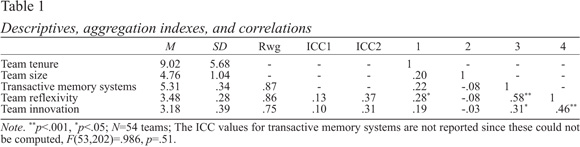
<body><![CDATA[<p>&nbsp;</p>     <p><i>Aggregation procedures</i></p>     <p>In this study we used a composition model to aggregate our variables to the team level (Costa et al., 2013). We followed Chan (1998)  recommendations regarding model specifications to assess higher level constructs using composition models. We used a referent-shift consensus  model to aggregate data because it allows assessing higher level constructs that are derived, yet different, from the consensus between lower  level units (Chan, 1998). To statistically justify the aggregation of variables, values concerning the inter-rater agreement, reliability and  consistency were obtained using <i>r</i><sub>wg(j)</sub> (James, Demaree, &amp; Wolf, 1984), ICC (1) and ICC (2) (Bliese, 2000), respectively.  Aggregation is considered deemed for <i>r</i><sub>wg(j)</sub> and ICC (2) when both indexes are &ge;.70, whereas ICC (1) values should range be  &ge;.05, .20&le; (Bliese, 2000; James et al., 1984).</p>     <p>&nbsp;</p>     <p><b>Results</b></p>     <p><a href="#t1">Table 1</a> provides the means and standard deviations, aggregation indexes, and correlations for the research variables. Team  innovation was positively and significantly correlated with team reflexivity, <i>r</i>=.46, <i>p</i>&lt;.001, and transactive memory systems,  <i>r</i>=.31, <i>p</i>&lt;.05. Team reflexivity and transactive memory systems were positively and significantly correlated as well,  <i>r</i>=.58, <i>p</i>&lt;.001.</p>     <p>&nbsp;</p>     <p><a name="t1"></a></p>     <p><img src="/img/revistas/aps/v37n1/37n1a04t1.jpg" width="580" height="147"></p>     
<p>&nbsp;</p>     ]]></body>
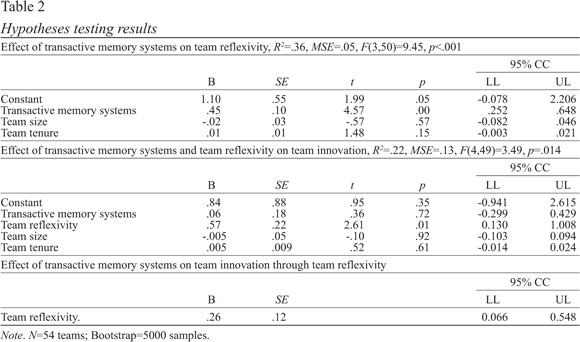
<body><![CDATA[<p>Regarding aggregation indexes, the inter-rater agreement index for transactive memory systems, <i>r</i><sub>wg(j)</sub>=.87, team reflexivity,  <i>r</i><sub>wg(j)</sub>=.86, and team innovation, <i>r</i><sub>wg(j)</sub>=.75, was satisfactory hence suggesting enough within team agreement  to consider participating teams as <i>real</i> teams (James et al., 1984). The ICC1 values for team reflexivity and team innovation suggest that  team members&rsquo; responses regarding both variables were more similar within teams, than between teams. Although the ICC2 values were below  the recommended threshold, such values can still be accepted (Bliese, 2000). Additionally, since the <i>r</i><sub>wg(j)</sub> and ICC1 indexes  were within standards aggregation was deemed as possible. Regarding transactive memory systems, the absence of a significant <i>F</i> value,  <i>F</i>(53,202)=0.99, <i>p</i>=.509, unable us to estimate both ICC1 and ICC2 values. The absence of a significant difference between team  members&rsquo; ratings of transactive memory systems suggests that these teams were homogenous in regard to their transactive memory system.  Thinking in terms of transactive memory systems theory (e.g., Lewis, 2003; Wegner, 1987), this finding is not surprising since the work that  healthcare nurse teams do requires them to know exactly which colleague is an expert on what topic and to be capable of using that unique  knowledge. Additionally, on average, team members had nine years of experience working together which is enough to allow transactive memory  systems to mature (Wegner, 1987). Therefore, relying on the <i>r</i><sub>wg(j)</sub> index only, we decided to aggregate individual team members  estimations of their team&rsquo;s transactive memory systems to the team level (<a href="#t2">Table 2</a>).</p>     <p>&nbsp;</p>     <p><a name="t2"></a></p>     <p><img src="/img/revistas/aps/v37n1/37n1a04t2.jpg" width="580" height="342"></p>     
<p>&nbsp;</p>     <p>To test the research hypotheses, we used PROCESS, which is a computational tool to analyze &ldquo;mediation process models&rdquo; that are  path analysis based (Hayes, 2013). PROCESS estimates the coefficients of a model using OLS regression (for continuous outcomes) and allows the  estimation of the mediation effects using bootstrap analysis.</p>     <p>Our findings suggest that team reflexivity is related with team innovation, B=.57, <i>SE</i>=.22, <i>t</i>=2.61, <i>p</i>=.01, 95% CI [0.130,  1.008]. This finding supports hypotheses 1 and replicates previous research in the teamwork literature (e.g., West &amp; Farr, 1990). The results  also suggest that transactive memory systems are positively related with team reflexivity, B=.45, <i>SE</i>=.10, <i>t</i>=4.57, <i>p</i>&lt;.001,  95% CI [0.252, 0.648], and that the relationship between TMS and team innovation is fully mediated by team reflexivity, B=.26, SE=.12, 95% CI  [0.066, 0.548]. These results support hypotheses 2.</p>     <p>&nbsp;</p>     <p><b>Discussion</b></p>     <p>Understanding team work dynamics in healthcare is fundamental for identifying the drivers and inhibitors of patient quality care service  (Donabedian, 2005). This study contributes to reinforce previous research regarding the relationship between reflexivity and innovation in teams.  Indeed, the results suggest that reflexivity positively predicts team ratings of innovation, thus replicating previous studies showing that team  reflexivity is important to understanding team innovation in healthcare (e.g., West, 2002).</p>     ]]></body>
<body><![CDATA[<p>Moreover, in examining how transactive memory systems and reflexivity relate to predict team innovation, this study contributes to the  innovation literature by bridging team process and team cognition research. Our findings highlight the importance of transactive memory systems  in helping to understand team innovation in healthcare. Our findings suggest that the relationship between transactive memory systems and team  innovation exists because transactive memory systems help team members engaging in reflexive action. Specifically, the fact that team members are  well aware of the distribution of expert knowledge within the team and are capable of using such knowledge seems to help team members reflecting,  and such reflection positively contributes to team innovation. Additionally, our findings suggest no direct influence of transactive memory  systems on innovation. This reinforces the importance of team reflexive strategies to help transferring collective knowledge structures into  day-to-day, innovation related behaviors.</p>     <p>These results also find explanation in previous research by van Ginkel, Tindale, and van Knippenberg (2009) suggesting that a constructive  dissent strategy such as the one implicit in reflexivity, may elicit new information necessary for a novel solution. According to van Ginkel et  al. (2009), team reflection has a stronger effect on group members&rsquo; task representations and group information elaboration in groups whose  members hold different task representations (or information). Having access to diverse knowledge such as the one in a transactive memory systems  is likely to facilitate the elaboration of information to produce creative ideas (Hargadon &amp; Bechky 2006). However, delivering innovation is  far more complex than simply having a creative idea (West, 2002). For instance, when a group of experts debates about clinical procedures to  diagnose cancer, it might happen that an idea for a new procedure emerges from the debate. This emergence might be facilitated by the fact that  this group of experts holds a well-developed transactive memory systems. However, the creative idea alone is not innovative in the sense that it  was not tested or implemented. As previously stated, innovation incorporates both the creation and implementation of ideas (and not the idea  alone) (West, 2002). The implementation of ideas is a rather complex process as individuals and teams are often challenged with obstacles that  prevent them to pursuit the innovative goal (e.g., organizational resistance; lack of resources). Whereas transactive memory systems imply the  identification and allocation of expert knowledge, reflexivity emphasizes the decision processes used to determine whether that knowledge is  useful and how it can the used. Additionally, reflexivity allows teams to identify alternative ways to implement new solutions, thus making  reflexivity a necessary requisite for team innovation.</p>     <p>&nbsp;</p>     <p><i>Theoretical and practical implications</i></p>     <p>There has been little attention given to how team cognitive structures such as transactive memory systems explain team innovation. Whether  transactive memory systems and reflexivity relate to predict team innovation has been equally neglected. This study addresses these gaps by  examining how transactive memory systems predict team innovation, through the level of reflexivity in healthcare nursing teams. Importantly, the  current study validates this finding in organizational, rather than laboratory teams.</p>     <p>Despite the fact this study was done within a specific work environment (i.e., healthcare hospital), and with a particular sample (i.e.,  nurses) our findings can be generalized to other teams operating in a variety of work environments. Indeed, organizations whose work teams  perform complex tasks can benefit from developing transactive memory systems and learning about how to implement effective reflexive processes.  Both might be accomplished with team-based training on team reflexivity, which will not only help members develop reflexivity processes but also  help create the structures and processes necessary to transactive memory systems development (Liang et al., 1995).</p>     <p>&nbsp;</p>     <p><i>Limitations and future research directions</i></p>     <p>One limitation of this study is its cross-sectional design. Although cross-sectional research is useful for examining the relationships  between constructs it gives a limited understanding of how the variables of interest influence each other over time or across levels of analysis.  Another limitation it&rsquo;s the fact that responses derived from the same informants, and all data were collected through self-report  questionnaires.</p>     <p>Future research should extend these findings within a longitudinal framework by dynamically examining the conditions under which reflexivity  and transactive memory systems interact over time. Indeed literature has provided research supporting that team processes and cognitions  influence each other over time (Santos &amp; Passos, 2013). Using a longitudinal approach, researchers could examine which factors trigger work  teams to engage in reflexive behavior and which factors trigger the use of transactive memory systems, and how does this combine to influence  team innovation over time.</p>     ]]></body>
<body><![CDATA[<p>&nbsp;</p>     <p><b>General conclusion</b></p>     <p>The study of team work innovation in healthcare is paramount to identify the key psychological factors that foster ongoing quality care.  Understanding the interactive dynamics between team processes and cognition is important for healthcare professionals and managers to think and  design the enabling conditions for reflexive action. Furthermore, facilitating expert location awareness can contribute to the mitigation of  healthcare problems that happen when teams lack the time, or conditions, to think about what they are doing and how to develop innovative  solutions.</p>     <p>&nbsp;</p>     <p><b>References</b></p>     <!-- ref --><p>Bedwell, W. L., Ramsay, P. S., &amp; Salas, E. (2012). Helping fluid teams work: A research agenda for effective team adaptation in  healthcare. <i>TBM, 2</i>, 504-509. doi: 10.1007/s13142-012-0177-9&nbsp;&nbsp;&nbsp;&nbsp;&nbsp;&nbsp;&nbsp;&nbsp;[&#160;<a href="javascript:void(0);" onclick="javascript: window.open('/scielo.php?script=sci_nlinks&ref=044499&pid=S0870-8231201900010000400001&lng=','','width=640,height=500,resizable=yes,scrollbars=1,menubar=yes,');">Links</a>&#160;]<!-- end-ref --><!-- ref --><p>Bliese, P. D. (2000). Within-group agreement, non-independence, and reliability: Implications for data aggregation and analysis. In J. Klein  &amp; S. W. J. Kozlowski (Eds.), <i>Multilevel theory, research, and methods in organizations: Foundations, extensions, and new  directions</i> (pp. 349-381). San Francisco, CA, US: Jossey-Bass.    &nbsp;&nbsp;&nbsp;&nbsp;&nbsp;&nbsp;&nbsp;&nbsp;[&#160;<a href="javascript:void(0);" onclick="javascript: window.open('/scielo.php?script=sci_nlinks&ref=044500&pid=S0870-8231201900010000400002&lng=','','width=640,height=500,resizable=yes,scrollbars=1,menubar=yes,');">Links</a>&#160;]<!-- end-ref --></p>     <!-- ref --><p>Borrill, C., West, M., Shapiro, D., &amp; Rees, A. (2000). Team working and effectiveness in health care. <i>British Journal of Healthcare  Management, 6</i>, 364-371. doi: 10.12968/bjhc.2000.6.8.19300&nbsp;&nbsp;&nbsp;&nbsp;&nbsp;&nbsp;&nbsp;&nbsp;[&#160;<a href="javascript:void(0);" onclick="javascript: window.open('/scielo.php?script=sci_nlinks&ref=044502&pid=S0870-8231201900010000400003&lng=','','width=640,height=500,resizable=yes,scrollbars=1,menubar=yes,');">Links</a>&#160;]<!-- end-ref --><!-- ref --><p>Burke, C. S., Stagl, K. C., Salas, E., Pierce, L., &amp; Kendal, D. (2006). Understanding team adaptation: A conceptual analysis and model.  <i>Journal of Applied Psychology, 91</i>, 1189-1207. doi: 10.1037/0021-9010.91.6.1189&nbsp;&nbsp;&nbsp;&nbsp;&nbsp;&nbsp;&nbsp;&nbsp;[&#160;<a href="javascript:void(0);" onclick="javascript: window.open('/scielo.php?script=sci_nlinks&ref=044503&pid=S0870-8231201900010000400004&lng=','','width=640,height=500,resizable=yes,scrollbars=1,menubar=yes,');">Links</a>&#160;]<!-- end-ref --><!-- ref --><p>Carter, S. M., &amp; West, M. A. (1998). Reflexivity, effectiveness, and mental health in BBC-TV production teams. <i>Small Group Research,  29</i>, 583-601. doi: 10.1177/1046496498295003&nbsp;&nbsp;&nbsp;&nbsp;&nbsp;&nbsp;&nbsp;&nbsp;[&#160;<a href="javascript:void(0);" onclick="javascript: window.open('/scielo.php?script=sci_nlinks&ref=044504&pid=S0870-8231201900010000400005&lng=','','width=640,height=500,resizable=yes,scrollbars=1,menubar=yes,');">Links</a>&#160;]<!-- end-ref --><!-- ref --><p>Chan, D. (1998). Functional relations among constructs in the same content domain at different levels of analysis: A typology of composition  models. <i>Journal of Applied Psychology, 83</i>, 234-246. doi: 10.1037/0021-9010.83.2.234&nbsp;&nbsp;&nbsp;&nbsp;&nbsp;&nbsp;&nbsp;&nbsp;[&#160;<a href="javascript:void(0);" onclick="javascript: window.open('/scielo.php?script=sci_nlinks&ref=044505&pid=S0870-8231201900010000400006&lng=','','width=640,height=500,resizable=yes,scrollbars=1,menubar=yes,');">Links</a>&#160;]<!-- end-ref --><p>Costa, P. L., Gra&ccedil;a, A. M., Marques-Quinteiro, P., Santos, C. M., Caetano, A., &amp; Passos, A. M. (2013). Multilevel research in the  field of organizational behavior: An empirical look at 10 years of theory and research. <i>SAGE Open, 3</i>. doi: 10.1177/2158244013498244</p>     <!-- ref --><p>Curral, L. A. (2005). <i>Sharedness in work team innovation: A process model of team regulation</i>. Disserta&ccedil;&atilde;o de  doutoramento n&atilde;o publicada, Faculdade de Psicologia, Lisboa, Portugal.    &nbsp;&nbsp;&nbsp;&nbsp;&nbsp;&nbsp;&nbsp;&nbsp;[&#160;<a href="javascript:void(0);" onclick="javascript: window.open('/scielo.php?script=sci_nlinks&ref=044507&pid=S0870-8231201900010000400007&lng=','','width=640,height=500,resizable=yes,scrollbars=1,menubar=yes,');">Links</a>&#160;]<!-- end-ref --></p>     <p>Curral, L. A., Forrester, R. H., Dawson, J. F., &amp; West, M. A. (2001). It&rsquo;s what you do and the way that you do it: Team task, team  size, and innovation-related group processes. <i>European Journal of Work and Organizational Psychology, 10</i>, 187-204. doi:  10.1080/13594320143000627</p>     <!-- ref --><p>DeChurch, L., &amp; Mesmer-Magnus, J. (2010). The cognitive underpinnings of effective teamwork: A meta-analysis. <i>Journal of Applied  Psychology, 95</i>, 32-53. doi: 10.1037/a0017328&nbsp;&nbsp;&nbsp;&nbsp;&nbsp;&nbsp;&nbsp;&nbsp;[&#160;<a href="javascript:void(0);" onclick="javascript: window.open('/scielo.php?script=sci_nlinks&ref=044510&pid=S0870-8231201900010000400010&lng=','','width=640,height=500,resizable=yes,scrollbars=1,menubar=yes,');">Links</a>&#160;]<!-- end-ref --><!-- ref --><p>Donabedian, A. (2005). Evaluating the quality of medical care. <i>The Milbank Quarterly, 83</i>, 691-729. doi:  10.1111/j.1468-0009.2005.00397.x&nbsp;&nbsp;&nbsp;&nbsp;&nbsp;&nbsp;&nbsp;&nbsp;[&#160;<a href="javascript:void(0);" onclick="javascript: window.open('/scielo.php?script=sci_nlinks&ref=044511&pid=S0870-8231201900010000400011&lng=','','width=640,height=500,resizable=yes,scrollbars=1,menubar=yes,');">Links</a>&#160;]<!-- end-ref --><!-- ref --><p>Gino, F., Argote, L., Miron-Spektor, E., &amp; Todorova, G. (2010). First, get your feet wet: The effects of learning from direct and  indirect experience on team creativity. <i>Organizational Behavior and Human Decision Processes, 111</i>, 102-115. doi:  10.1080/19416520.2011.590300&nbsp;&nbsp;&nbsp;&nbsp;&nbsp;&nbsp;&nbsp;&nbsp;[&#160;<a href="javascript:void(0);" onclick="javascript: window.open('/scielo.php?script=sci_nlinks&ref=044512&pid=S0870-8231201900010000400012&lng=','','width=640,height=500,resizable=yes,scrollbars=1,menubar=yes,');">Links</a>&#160;]<!-- end-ref --><!-- ref --><p>Hargadon, A. B., &amp; Bechky, B. A. (2006). When collections of creatives become creative collectives: A field study of problem solving at  work. <i>Organization Science, 17</i>, 484-500. doi: 10.1287/orsc.1060.0200&nbsp;&nbsp;&nbsp;&nbsp;&nbsp;&nbsp;&nbsp;&nbsp;[&#160;<a href="javascript:void(0);" onclick="javascript: window.open('/scielo.php?script=sci_nlinks&ref=044513&pid=S0870-8231201900010000400013&lng=','','width=640,height=500,resizable=yes,scrollbars=1,menubar=yes,');">Links</a>&#160;]<!-- end-ref --><!-- ref --><p>Hayes, A. F. (2013). <i>Introduction to mediation, moderation, and conditional process analysis: A regression-based approach</i>. New York,  NY: Guilford Press.    &nbsp;&nbsp;&nbsp;&nbsp;&nbsp;&nbsp;&nbsp;&nbsp;[&#160;<a href="javascript:void(0);" onclick="javascript: window.open('/scielo.php?script=sci_nlinks&ref=044514&pid=S0870-8231201900010000400014&lng=','','width=640,height=500,resizable=yes,scrollbars=1,menubar=yes,');">Links</a>&#160;]<!-- end-ref --></p>     <!-- ref --><p>H&uuml;lsheger, U. R., Anderson, N., &amp; Salgado, J. F. (2009). Team-level predictors of innovation at work: A comprehensive meta-analysis  spanning three decades of research. <i>Journal of Applied Psychology, 94</i>, 1128-1145. doi: 10.1037/a0015978&nbsp;&nbsp;&nbsp;&nbsp;&nbsp;&nbsp;&nbsp;&nbsp;[&#160;<a href="javascript:void(0);" onclick="javascript: window.open('/scielo.php?script=sci_nlinks&ref=044516&pid=S0870-8231201900010000400015&lng=','','width=640,height=500,resizable=yes,scrollbars=1,menubar=yes,');">Links</a>&#160;]<!-- end-ref --><!-- ref --><p>James, L. R., Demaree, R. G., &amp; Wolf, G. (1984). Estimating within-group interrater reliability with and without response bias.  <i>Journal of Applied Psychology, 69</i>, 85-98. doi: 10.1037/0021-9010.69.1.85&nbsp;&nbsp;&nbsp;&nbsp;&nbsp;&nbsp;&nbsp;&nbsp;[&#160;<a href="javascript:void(0);" onclick="javascript: window.open('/scielo.php?script=sci_nlinks&ref=044517&pid=S0870-8231201900010000400016&lng=','','width=640,height=500,resizable=yes,scrollbars=1,menubar=yes,');">Links</a>&#160;]<!-- end-ref --><!-- ref --><p>LePine, J. A., Piccolo, R. F., Jackson, C. L., Mathieu, J. E., &amp; Saul, J. R. (2008). A meta&#8208;analysis of teamwork processes: Tests  of a multidimensional model and relationships with team effectiveness criteria. <i>Personnel Psychology, 61</i>, 273-307. doi:  10.1111/j.1744-6570.2008.00114.x&nbsp;&nbsp;&nbsp;&nbsp;&nbsp;&nbsp;&nbsp;&nbsp;[&#160;<a href="javascript:void(0);" onclick="javascript: window.open('/scielo.php?script=sci_nlinks&ref=044518&pid=S0870-8231201900010000400017&lng=','','width=640,height=500,resizable=yes,scrollbars=1,menubar=yes,');">Links</a>&#160;]<!-- end-ref --><!-- ref --><p>Lewis, K. (2003). Measuring transactive memory systems in the field: Scale development and validation. <i>Journal of Applied Psychology,  88</i>, 587-604.    &nbsp;&nbsp;&nbsp;&nbsp;&nbsp;&nbsp;&nbsp;&nbsp;[&#160;<a href="javascript:void(0);" onclick="javascript: window.open('/scielo.php?script=sci_nlinks&ref=044519&pid=S0870-8231201900010000400018&lng=','','width=640,height=500,resizable=yes,scrollbars=1,menubar=yes,');">Links</a>&#160;]<!-- end-ref --></p>     <!-- ref --><p>Lewis, K., Belliveau, M., Herndon, B., &amp; Keller, J. (2007). Group cognition, membership change, and performance: Investigating the  benefits and detriments of collective knowledge. <i>Organizational Behavior and Human Decision Processes, 103</i>, 159-178.  doi: 10.1016/j.obhdp.2007.01.005&nbsp;&nbsp;&nbsp;&nbsp;&nbsp;&nbsp;&nbsp;&nbsp;[&#160;<a href="javascript:void(0);" onclick="javascript: window.open('/scielo.php?script=sci_nlinks&ref=044521&pid=S0870-8231201900010000400019&lng=','','width=640,height=500,resizable=yes,scrollbars=1,menubar=yes,');">Links</a>&#160;]<!-- end-ref --><!-- ref --><p>Lewis, K., Lange, D., &amp; Gillis, L. (2005). Transactive memory systems, learning, and learning transfer. <i>Organization Science, 16</i>,  581-598. doi: 10.1111/j.1744-6570.2008.00114.x&nbsp;&nbsp;&nbsp;&nbsp;&nbsp;&nbsp;&nbsp;&nbsp;[&#160;<a href="javascript:void(0);" onclick="javascript: window.open('/scielo.php?script=sci_nlinks&ref=044522&pid=S0870-8231201900010000400020&lng=','','width=640,height=500,resizable=yes,scrollbars=1,menubar=yes,');">Links</a>&#160;]<!-- end-ref --><!-- ref --><p>Liang, D.W., Moreland, R., &amp; Argote, L. (1995). Group versus individual training and group performance: The mediating role of transactive  memory. <i>Personality and Social Psychology Bulletin, 21</i>, 384-393. doi: 10.1177/0146167295214009&nbsp;&nbsp;&nbsp;&nbsp;&nbsp;&nbsp;&nbsp;&nbsp;[&#160;<a href="javascript:void(0);" onclick="javascript: window.open('/scielo.php?script=sci_nlinks&ref=044523&pid=S0870-8231201900010000400021&lng=','','width=640,height=500,resizable=yes,scrollbars=1,menubar=yes,');">Links</a>&#160;]<!-- end-ref --><!-- ref --><p>Littlepage, G. E., Hollingshead, A. B., Drake, L. R., &amp; Littlepage, A. M. (2008). Transactive memory systems and performance in work  groups: Specificity, communication, ability differences and work allocation. <i>Group Dynamics: Theory, Research and Practice, 12</i>, 223-241.  doi: 10.1037/1089-2699.12.3.223&nbsp;&nbsp;&nbsp;&nbsp;&nbsp;&nbsp;&nbsp;&nbsp;[&#160;<a href="javascript:void(0);" onclick="javascript: window.open('/scielo.php?script=sci_nlinks&ref=044524&pid=S0870-8231201900010000400022&lng=','','width=640,height=500,resizable=yes,scrollbars=1,menubar=yes,');">Links</a>&#160;]<!-- end-ref --><!-- ref --><p>Marques-Quinteiro, P., Curral, L., Passos, A. M., &amp; Lewis, K. (2013). And now what do we do? The role of transactive memory systems and  task coordination in action teams. <i>Group Dynamics: Theory, Research, and Practice, 17</i>, 194-206. doi: 10.1037/a0033304&nbsp;&nbsp;&nbsp;&nbsp;&nbsp;&nbsp;&nbsp;&nbsp;[&#160;<a href="javascript:void(0);" onclick="javascript: window.open('/scielo.php?script=sci_nlinks&ref=044525&pid=S0870-8231201900010000400023&lng=','','width=640,height=500,resizable=yes,scrollbars=1,menubar=yes,');">Links</a>&#160;]<!-- end-ref --><!-- ref --><p>Moreland, R. L. (1999). Transactive memory: Learning who knows what in work groups and organizations. In L. Thompson, D. Messick, &amp; J.  Levine (Eds.), <i>Shared cognition in organizations: The management of knowledge</i> (pp. 3-31). Mahwah, NJ: Lawrence Erlbaum.    &nbsp;&nbsp;&nbsp;&nbsp;&nbsp;&nbsp;&nbsp;&nbsp;[&#160;<a href="javascript:void(0);" onclick="javascript: window.open('/scielo.php?script=sci_nlinks&ref=044526&pid=S0870-8231201900010000400024&lng=','','width=640,height=500,resizable=yes,scrollbars=1,menubar=yes,');">Links</a>&#160;]<!-- end-ref --></p>     <!-- ref --><p>Moreland, R. L., &amp; Myaskovsky, L. (2000). Exploring the performance benefits of group training: Transactive memory or improved  communication?. <i>Organizational Behavior and Human Decision Processes, 82</i>, 117-133. doi: 10.1006/obhd.2000.2891&nbsp;&nbsp;&nbsp;&nbsp;&nbsp;&nbsp;&nbsp;&nbsp;[&#160;<a href="javascript:void(0);" onclick="javascript: window.open('/scielo.php?script=sci_nlinks&ref=044528&pid=S0870-8231201900010000400025&lng=','','width=640,height=500,resizable=yes,scrollbars=1,menubar=yes,');">Links</a>&#160;]<!-- end-ref --><!-- ref --><p>Ortega, A., Van den Bossche, P., S&aacute;nchez-Manzanares, M., Rico, R., &amp; Gil, F. (2013). The influence of change-oriented leadership  and psychological safety on team learning in healthcare teams. <i>Journal of Business and Psychology, 29</i>, 311-321. doi:  10.1007/s10869-013-9315-8&nbsp;&nbsp;&nbsp;&nbsp;&nbsp;&nbsp;&nbsp;&nbsp;[&#160;<a href="javascript:void(0);" onclick="javascript: window.open('/scielo.php?script=sci_nlinks&ref=044529&pid=S0870-8231201900010000400026&lng=','','width=640,height=500,resizable=yes,scrollbars=1,menubar=yes,');">Links</a>&#160;]<!-- end-ref --><!-- ref --><p>Pieterse, A. N., van Knippenberg, D., &amp; van Ginkel, W. P. (2011). Diversity in goal orientation, team reflexivity, and team performance.  <i>Organizational Behavior and Human Decision Processes, 114</i>, 153-164. doi: 10.1016/j.obhdp.2010.11.003&nbsp;&nbsp;&nbsp;&nbsp;&nbsp;&nbsp;&nbsp;&nbsp;[&#160;<a href="javascript:void(0);" onclick="javascript: window.open('/scielo.php?script=sci_nlinks&ref=044530&pid=S0870-8231201900010000400027&lng=','','width=640,height=500,resizable=yes,scrollbars=1,menubar=yes,');">Links</a>&#160;]<!-- end-ref --><!-- ref --><p>Ren, Y., &amp; Argote, L. (2011). Transactive memory systems 1985-2010: An integrative framework of key dimensions, antecedents, and  consequences. <i>The Academy of Management Annals, 5</i>, 189-229. doi: 10.1080/19416520.2011.590300&nbsp;&nbsp;&nbsp;&nbsp;&nbsp;&nbsp;&nbsp;&nbsp;[&#160;<a href="javascript:void(0);" onclick="javascript: window.open('/scielo.php?script=sci_nlinks&ref=044531&pid=S0870-8231201900010000400028&lng=','','width=640,height=500,resizable=yes,scrollbars=1,menubar=yes,');">Links</a>&#160;]<!-- end-ref --><!-- ref --><p>Salas, E., DiazGranados, D., Weaver, S. J., &amp; King, H. (2008). Does team training work? Principles for health care. <i>Academic Emergency  Medicine, 15</i>, 1002-1009. doi: 10.1111/j.1553-2712.2008.00254.x&nbsp;&nbsp;&nbsp;&nbsp;&nbsp;&nbsp;&nbsp;&nbsp;[&#160;<a href="javascript:void(0);" onclick="javascript: window.open('/scielo.php?script=sci_nlinks&ref=044532&pid=S0870-8231201900010000400029&lng=','','width=640,height=500,resizable=yes,scrollbars=1,menubar=yes,');">Links</a>&#160;]<!-- end-ref --><!-- ref --><p>Salas, E., Rosen, M. A., &amp; DiazGranados, D. (2010). Expertise-based intuition and decision making in organizations. <i>Journal of  Management, 36</i>, 941-973. doi: 10.1177/0149206309350084&nbsp;&nbsp;&nbsp;&nbsp;&nbsp;&nbsp;&nbsp;&nbsp;[&#160;<a href="javascript:void(0);" onclick="javascript: window.open('/scielo.php?script=sci_nlinks&ref=044533&pid=S0870-8231201900010000400030&lng=','','width=640,height=500,resizable=yes,scrollbars=1,menubar=yes,');">Links</a>&#160;]<!-- end-ref --><!-- ref --><p>Santos, C. M., &amp; Passos, A. M. (2013). Team mental models, relationship conflict and effectiveness over time. <i>Team Performance  Management, 19</i>, 5-5. doi: 10.1108/TPM-01-2013-0003&nbsp;&nbsp;&nbsp;&nbsp;&nbsp;&nbsp;&nbsp;&nbsp;[&#160;<a href="javascript:void(0);" onclick="javascript: window.open('/scielo.php?script=sci_nlinks&ref=044534&pid=S0870-8231201900010000400031&lng=','','width=640,height=500,resizable=yes,scrollbars=1,menubar=yes,');">Links</a>&#160;]<!-- end-ref --><!-- ref --><p>Schippers, M. C., West, M., &amp; Dawson, J. (2015). Team reflexivity and innovation: The moderating role of team context. <i>Journal of  Management, 41</i>, 769-788. doi: 10.1177/0149206312441210&nbsp;&nbsp;&nbsp;&nbsp;&nbsp;&nbsp;&nbsp;&nbsp;[&#160;<a href="javascript:void(0);" onclick="javascript: window.open('/scielo.php?script=sci_nlinks&ref=044535&pid=S0870-8231201900010000400032&lng=','','width=640,height=500,resizable=yes,scrollbars=1,menubar=yes,');">Links</a>&#160;]<!-- end-ref --><!-- ref --><p>Silva, S. A., Costa, P. L., Costa, R., Tavares, S. M., Leite, E. S., &amp; Passos, A. M. (2013). Meanings of quality of care: Perspectives of  Portuguese health professionals and patients. <i>British Journal of Health Psychology</i>. doi: 10.1111/bjhp.12031&nbsp;&nbsp;&nbsp;&nbsp;&nbsp;&nbsp;&nbsp;&nbsp;[&#160;<a href="javascript:void(0);" onclick="javascript: window.open('/scielo.php?script=sci_nlinks&ref=044536&pid=S0870-8231201900010000400033&lng=','','width=640,height=500,resizable=yes,scrollbars=1,menubar=yes,');">Links</a>&#160;]<!-- end-ref --><!-- ref --><p>Swift, T. A., &amp; West, M. A. (1998). <i>Reflexivity and group processes: Research and practice</i>. Sheffield: The ESRC Centre for  Organization and Innovation.    &nbsp;&nbsp;&nbsp;&nbsp;&nbsp;&nbsp;&nbsp;&nbsp;[&#160;<a href="javascript:void(0);" onclick="javascript: window.open('/scielo.php?script=sci_nlinks&ref=044537&pid=S0870-8231201900010000400034&lng=','','width=640,height=500,resizable=yes,scrollbars=1,menubar=yes,');">Links</a>&#160;]<!-- end-ref --></p>     <!-- ref --><p>Tjosvold, D., Tang, M. M., &amp; West, M. (2004). Reflexivity for team innovation in China The contribution of goal interdependence.  <i>Group &amp; Organization Management, 29</i>, 540-559. doi: 10.1177/1059601103254911&nbsp;&nbsp;&nbsp;&nbsp;&nbsp;&nbsp;&nbsp;&nbsp;[&#160;<a href="javascript:void(0);" onclick="javascript: window.open('/scielo.php?script=sci_nlinks&ref=044539&pid=S0870-8231201900010000400035&lng=','','width=640,height=500,resizable=yes,scrollbars=1,menubar=yes,');">Links</a>&#160;]<!-- end-ref --><!-- ref --><p>Tschan, F., Semmer, N. K., Gurtner, A., Bizzari, L., Spychiger, M., Breuer, M., &amp; Marsch, S. U. (2009). Diagnostic accuracy, explicit  reasoning, confirmation bias, and illusory transactive memroy: A simulation study of group decision making in medical teams. <i>Small Group  Research, 40</i>, 271-300. doi: 10.1177/1046496409332928&nbsp;&nbsp;&nbsp;&nbsp;&nbsp;&nbsp;&nbsp;&nbsp;[&#160;<a href="javascript:void(0);" onclick="javascript: window.open('/scielo.php?script=sci_nlinks&ref=044540&pid=S0870-8231201900010000400036&lng=','','width=640,height=500,resizable=yes,scrollbars=1,menubar=yes,');">Links</a>&#160;]<!-- end-ref --><!-- ref --><p>van Ginkel, W., Tindale, R. S., &amp; van Knippenberg, D. (2009). Team reflexivity, development of shared task representations, and the use  of distributed information in group decision making. <i>Group Dynamics: Theory, Research, and Practice, 13</i>, 265-280. doi:  10.1037/a0016045&nbsp;&nbsp;&nbsp;&nbsp;&nbsp;&nbsp;&nbsp;&nbsp;[&#160;<a href="javascript:void(0);" onclick="javascript: window.open('/scielo.php?script=sci_nlinks&ref=044541&pid=S0870-8231201900010000400037&lng=','','width=640,height=500,resizable=yes,scrollbars=1,menubar=yes,');">Links</a>&#160;]<!-- end-ref --><!-- ref --><p>Wegner, D. M. (1987). Transactive memory: A contemporary analysis of the group mind. In B. Mullen &amp; G. R. Goethals (Eds.), <i>Theories of  group behavior</i> (pp. 185-208). New York, NY: Springer-Verlag.    &nbsp;&nbsp;&nbsp;&nbsp;&nbsp;&nbsp;&nbsp;&nbsp;[&#160;<a href="javascript:void(0);" onclick="javascript: window.open('/scielo.php?script=sci_nlinks&ref=044542&pid=S0870-8231201900010000400038&lng=','','width=640,height=500,resizable=yes,scrollbars=1,menubar=yes,');">Links</a>&#160;]<!-- end-ref --></p>     ]]></body>
<body><![CDATA[<!-- ref --><p>West, M. A. (2002). Sparkling fountains or stagnant ponds: An integrative model of creativity and innovation implementation in work groups.  <i>Applied Psychology, 51</i>, 355-387. doi: 10.1111/1464-0597.00951&nbsp;&nbsp;&nbsp;&nbsp;&nbsp;&nbsp;&nbsp;&nbsp;[&#160;<a href="javascript:void(0);" onclick="javascript: window.open('/scielo.php?script=sci_nlinks&ref=044544&pid=S0870-8231201900010000400039&lng=','','width=640,height=500,resizable=yes,scrollbars=1,menubar=yes,');">Links</a>&#160;]<!-- end-ref --><!-- ref --><p>West, M. A., &amp; Farr, J. L. (1990). <i>Innovation and creativity at work: Psychological and organizational strategies</i>. Oxford, England:  John Wiley &amp; Sons.    &nbsp;&nbsp;&nbsp;&nbsp;&nbsp;&nbsp;&nbsp;&nbsp;[&#160;<a href="javascript:void(0);" onclick="javascript: window.open('/scielo.php?script=sci_nlinks&ref=044545&pid=S0870-8231201900010000400040&lng=','','width=640,height=500,resizable=yes,scrollbars=1,menubar=yes,');">Links</a>&#160;]<!-- end-ref --></p>     <!-- ref --><p>West, M. A., &amp; Shackleton, V. J., Hardy, G. E., &amp; Dawson, J. F. (2001). <i>Work role characteristics, job security and individual  innovation at work</i>. Unpublished manuscript, ABS, Birmingham, UK.    &nbsp;&nbsp;&nbsp;&nbsp;&nbsp;&nbsp;&nbsp;&nbsp;[&#160;<a href="javascript:void(0);" onclick="javascript: window.open('/scielo.php?script=sci_nlinks&ref=044547&pid=S0870-8231201900010000400041&lng=','','width=640,height=500,resizable=yes,scrollbars=1,menubar=yes,');">Links</a>&#160;]<!-- end-ref --></p>     <!-- ref --><p>West, M. A., &amp; Wallace, M. (1991). Innovation in health care teams. <i>European Journal of Social Psychology, 21</i>, 303-315. doi:  10.1002/ejsp.2420210404&nbsp;&nbsp;&nbsp;&nbsp;&nbsp;&nbsp;&nbsp;&nbsp;[&#160;<a href="javascript:void(0);" onclick="javascript: window.open('/scielo.php?script=sci_nlinks&ref=044549&pid=S0870-8231201900010000400042&lng=','','width=640,height=500,resizable=yes,scrollbars=1,menubar=yes,');">Links</a>&#160;]<!-- end-ref --><p>&nbsp;</p>     <p><b><a name="c0" id="c0"></a><a href="#topc0">CORRESPONDÊNCIA</a></b></p>     <p>Correspondence concerning this article should be addressed to: Pedro Marques Quinteiro, William James Center for Research, ISPA &ndash;  Instituto Universit&aacute;rio, Rua Jardim do Tabaco, 34, 1149-041 Lisboa, Portugal. E-mail:  <a href="mailto:pquinteiro@ispa.pt">pquinteiro@ispa.pt</a></p>     <p>&nbsp;</p>     ]]></body>
<body><![CDATA[<p>William James Center for Research, ISPA &ndash; Instituto Universit&aacute;rio, is financed by FCT (Ref. UID/PSI/04810/2013). Centro de  Administra&ccedil;&atilde;o e Politicas P&uacute;blicas, Instituto Superior de Ci&ecirc;ncias Sociais e Politicas, is financed by FCT  (Ref. UID/CPO/00713/2013).</p>     <p>&nbsp;</p>     <p>Submitted: 11/01/2018 Accepted: 29/04/2018</p>      ]]></body><back>
<ref-list>
<ref id="B1">
<nlm-citation citation-type="journal">
<person-group person-group-type="author">
<name>
<surname><![CDATA[Bedwell]]></surname>
<given-names><![CDATA[W. L.]]></given-names>
</name>
<name>
<surname><![CDATA[Ramsay]]></surname>
<given-names><![CDATA[P. S.]]></given-names>
</name>
<name>
<surname><![CDATA[Salas]]></surname>
<given-names><![CDATA[E.]]></given-names>
</name>
</person-group>
<article-title xml:lang="en"><![CDATA[Helping fluid teams work: A research agenda for effective team adaptation in healthcare]]></article-title>
<source><![CDATA[TBM]]></source>
<year>2012</year>
<volume>2</volume>
<page-range>504-509</page-range></nlm-citation>
</ref>
<ref id="B2">
<nlm-citation citation-type="book">
<person-group person-group-type="author">
<name>
<surname><![CDATA[Bliese]]></surname>
<given-names><![CDATA[P. D.]]></given-names>
</name>
</person-group>
<article-title xml:lang="en"><![CDATA[Within-group agreement, non-independence, and reliability: Implications for data aggregation and analysis]]></article-title>
<person-group person-group-type="editor">
<name>
<surname><![CDATA[Klein]]></surname>
<given-names><![CDATA[J.]]></given-names>
</name>
<name>
<surname><![CDATA[Kozlowski]]></surname>
<given-names><![CDATA[S. W. J.]]></given-names>
</name>
</person-group>
<source><![CDATA[Multilevel theory, research, and methods in organizations: Foundations, extensions, and new directions]]></source>
<year>2000</year>
<page-range>349-381</page-range><publisher-loc><![CDATA[San Francisco ]]></publisher-loc>
<publisher-name><![CDATA[Jossey-Bass]]></publisher-name>
</nlm-citation>
</ref>
<ref id="B3">
<nlm-citation citation-type="journal">
<person-group person-group-type="author">
<name>
<surname><![CDATA[Borrill]]></surname>
<given-names><![CDATA[C.]]></given-names>
</name>
<name>
<surname><![CDATA[West]]></surname>
<given-names><![CDATA[M.]]></given-names>
</name>
<name>
<surname><![CDATA[Shapiro]]></surname>
<given-names><![CDATA[D.]]></given-names>
</name>
<name>
<surname><![CDATA[Rees]]></surname>
<given-names><![CDATA[A.]]></given-names>
</name>
</person-group>
<article-title xml:lang="en"><![CDATA[Team working and effectiveness in health care]]></article-title>
<source><![CDATA[British Journal of Healthcare Management]]></source>
<year>2000</year>
<volume>6</volume>
<page-range>364-371</page-range></nlm-citation>
</ref>
<ref id="B4">
<nlm-citation citation-type="journal">
<person-group person-group-type="author">
<name>
<surname><![CDATA[Burke]]></surname>
<given-names><![CDATA[C. S.]]></given-names>
</name>
<name>
<surname><![CDATA[Stagl]]></surname>
<given-names><![CDATA[K. C.]]></given-names>
</name>
<name>
<surname><![CDATA[Salas]]></surname>
<given-names><![CDATA[E.]]></given-names>
</name>
<name>
<surname><![CDATA[Pierce]]></surname>
<given-names><![CDATA[L.]]></given-names>
</name>
<name>
<surname><![CDATA[Kendal]]></surname>
<given-names><![CDATA[D.]]></given-names>
</name>
</person-group>
<article-title xml:lang="en"><![CDATA[Understanding team adaptation: A conceptual analysis and model]]></article-title>
<source><![CDATA[Journal of Applied Psychology]]></source>
<year>2006</year>
<volume>91</volume>
<page-range>1189-1207</page-range></nlm-citation>
</ref>
<ref id="B5">
<nlm-citation citation-type="journal">
<person-group person-group-type="author">
<name>
<surname><![CDATA[Carter]]></surname>
<given-names><![CDATA[S. M.]]></given-names>
</name>
<name>
<surname><![CDATA[West]]></surname>
<given-names><![CDATA[M. A.]]></given-names>
</name>
</person-group>
<article-title xml:lang="en"><![CDATA[Reflexivity, effectiveness, and mental health in BBC-TV production teams]]></article-title>
<source><![CDATA[Small Group Research]]></source>
<year>1998</year>
<volume>29</volume>
<page-range>583-601</page-range></nlm-citation>
</ref>
<ref id="B6">
<nlm-citation citation-type="journal">
<person-group person-group-type="author">
<name>
<surname><![CDATA[Chan]]></surname>
<given-names><![CDATA[D.]]></given-names>
</name>
</person-group>
<article-title xml:lang="en"><![CDATA[Functional relations among constructs in the same content domain at different levels of analysis: A typology of composition models]]></article-title>
<source><![CDATA[Journal of Applied Psychology]]></source>
<year>1998</year>
<volume>83</volume>
<page-range>234-246</page-range></nlm-citation>
</ref>
<ref id="B7">
<nlm-citation citation-type="">
<person-group person-group-type="author">
<name>
<surname><![CDATA[Curral]]></surname>
<given-names><![CDATA[L. A.]]></given-names>
</name>
</person-group>
<source><![CDATA[Sharedness in work team innovation: A process model of team regulation]]></source>
<year>2005</year>
</nlm-citation>
</ref>
<ref id="B8">
<nlm-citation citation-type="journal">
<person-group person-group-type="author">
<name>
<surname><![CDATA[Costa]]></surname>
<given-names><![CDATA[P. L.]]></given-names>
</name>
<name>
<surname><![CDATA[Graça]]></surname>
<given-names><![CDATA[A. M.]]></given-names>
</name>
<name>
<surname><![CDATA[Marques-Quinteiro]]></surname>
<given-names><![CDATA[P.]]></given-names>
</name>
<name>
<surname><![CDATA[Santos]]></surname>
<given-names><![CDATA[C. M.]]></given-names>
</name>
<name>
<surname><![CDATA[Caetano]]></surname>
<given-names><![CDATA[A.]]></given-names>
</name>
<name>
<surname><![CDATA[Passos]]></surname>
<given-names><![CDATA[A. M.]]></given-names>
</name>
</person-group>
<article-title xml:lang="en"><![CDATA[Multilevel research in the field of organizational behavior: An empirical look at 10 years of theory and research]]></article-title>
<source><![CDATA[SAGE Open]]></source>
<year>2013</year>
<volume>3</volume>
</nlm-citation>
</ref>
<ref id="B9">
<nlm-citation citation-type="journal">
<person-group person-group-type="author">
<name>
<surname><![CDATA[Curral]]></surname>
<given-names><![CDATA[L. A.]]></given-names>
</name>
<name>
<surname><![CDATA[Forrester]]></surname>
<given-names><![CDATA[R. H.]]></given-names>
</name>
<name>
<surname><![CDATA[Dawson]]></surname>
<given-names><![CDATA[J. F.]]></given-names>
</name>
<name>
<surname><![CDATA[West]]></surname>
<given-names><![CDATA[M. A.]]></given-names>
</name>
</person-group>
<article-title xml:lang="en"><![CDATA[It’s what you do and the way that you do it: Team task, team size, and innovation-related group processes]]></article-title>
<source><![CDATA[European Journal of Work and Organizational Psychology]]></source>
<year>2001</year>
<volume>10</volume>
<page-range>187-204</page-range></nlm-citation>
</ref>
<ref id="B10">
<nlm-citation citation-type="journal">
<person-group person-group-type="author">
<name>
<surname><![CDATA[DeChurch]]></surname>
<given-names><![CDATA[L.]]></given-names>
</name>
<name>
<surname><![CDATA[Mesmer-Magnus]]></surname>
<given-names><![CDATA[J.]]></given-names>
</name>
</person-group>
<article-title xml:lang="en"><![CDATA[The cognitive underpinnings of effective teamwork: A meta-analysis]]></article-title>
<source><![CDATA[Journal of Applied Psychology]]></source>
<year>2010</year>
<volume>95</volume>
<page-range>32-53</page-range></nlm-citation>
</ref>
<ref id="B11">
<nlm-citation citation-type="journal">
<person-group person-group-type="author">
<name>
<surname><![CDATA[Donabedian]]></surname>
<given-names><![CDATA[A.]]></given-names>
</name>
</person-group>
<article-title xml:lang="en"><![CDATA[Evaluating the quality of medical care]]></article-title>
<source><![CDATA[The Milbank Quarterly]]></source>
<year>2005</year>
<volume>83</volume>
<page-range>691-729</page-range></nlm-citation>
</ref>
<ref id="B12">
<nlm-citation citation-type="journal">
<person-group person-group-type="author">
<name>
<surname><![CDATA[Gino]]></surname>
<given-names><![CDATA[F.]]></given-names>
</name>
<name>
<surname><![CDATA[Argote]]></surname>
<given-names><![CDATA[L.]]></given-names>
</name>
<name>
<surname><![CDATA[Miron-Spektor]]></surname>
<given-names><![CDATA[E.]]></given-names>
</name>
<name>
<surname><![CDATA[Todorova]]></surname>
<given-names><![CDATA[G.]]></given-names>
</name>
</person-group>
<article-title xml:lang="en"><![CDATA[First, get your feet wet: The effects of learning from direct and indirect experience on team creativity]]></article-title>
<source><![CDATA[Organizational Behavior and Human Decision Processes]]></source>
<year>2010</year>
<volume>111</volume>
<page-range>102-115</page-range></nlm-citation>
</ref>
<ref id="B13">
<nlm-citation citation-type="journal">
<person-group person-group-type="author">
<name>
<surname><![CDATA[Hargadon]]></surname>
<given-names><![CDATA[A. B.]]></given-names>
</name>
<name>
<surname><![CDATA[Bechky]]></surname>
<given-names><![CDATA[B. A.]]></given-names>
</name>
</person-group>
<article-title xml:lang="en"><![CDATA[When collections of creatives become creative collectives: A field study of problem solving at work]]></article-title>
<source><![CDATA[Organization Science]]></source>
<year>2006</year>
<volume>17</volume>
<page-range>484-500</page-range></nlm-citation>
</ref>
<ref id="B14">
<nlm-citation citation-type="book">
<person-group person-group-type="author">
<name>
<surname><![CDATA[Hayes]]></surname>
<given-names><![CDATA[A. F.]]></given-names>
</name>
</person-group>
<source><![CDATA[Introduction to mediation, moderation, and conditional process analysis: A regression-based approach]]></source>
<year>2013</year>
<publisher-loc><![CDATA[New York ]]></publisher-loc>
<publisher-name><![CDATA[Guilford Press]]></publisher-name>
</nlm-citation>
</ref>
<ref id="B15">
<nlm-citation citation-type="journal">
<person-group person-group-type="author">
<name>
<surname><![CDATA[Hülsheger]]></surname>
<given-names><![CDATA[U. R.]]></given-names>
</name>
<name>
<surname><![CDATA[Anderson]]></surname>
<given-names><![CDATA[N.]]></given-names>
</name>
<name>
<surname><![CDATA[Salgado]]></surname>
<given-names><![CDATA[J. F.]]></given-names>
</name>
</person-group>
<article-title xml:lang="en"><![CDATA[Team-level predictors of innovation at work: A comprehensive meta-analysis spanning three decades of research]]></article-title>
<source><![CDATA[Journal of Applied Psychology]]></source>
<year>2009</year>
<volume>94</volume>
<page-range>1128-1145</page-range></nlm-citation>
</ref>
<ref id="B16">
<nlm-citation citation-type="journal">
<person-group person-group-type="author">
<name>
<surname><![CDATA[James]]></surname>
<given-names><![CDATA[L. R.]]></given-names>
</name>
<name>
<surname><![CDATA[Demaree]]></surname>
<given-names><![CDATA[R. G.]]></given-names>
</name>
<name>
<surname><![CDATA[Wolf]]></surname>
<given-names><![CDATA[G.]]></given-names>
</name>
</person-group>
<article-title xml:lang="en"><![CDATA[Estimating within-group interrater reliability with and without response bias]]></article-title>
<source><![CDATA[Journal of Applied Psychology]]></source>
<year>1984</year>
<volume>69</volume>
<page-range>85-98</page-range></nlm-citation>
</ref>
<ref id="B17">
<nlm-citation citation-type="journal">
<person-group person-group-type="author">
<name>
<surname><![CDATA[LePine]]></surname>
<given-names><![CDATA[J. A.]]></given-names>
</name>
<name>
<surname><![CDATA[Piccolo]]></surname>
<given-names><![CDATA[R. F.]]></given-names>
</name>
<name>
<surname><![CDATA[Jackson]]></surname>
<given-names><![CDATA[C. L.]]></given-names>
</name>
<name>
<surname><![CDATA[Mathieu]]></surname>
<given-names><![CDATA[J. E.]]></given-names>
</name>
<name>
<surname><![CDATA[Saul]]></surname>
<given-names><![CDATA[J. R.]]></given-names>
</name>
</person-group>
<article-title xml:lang="en"><![CDATA[A meta&#8208;analysis of teamwork processes: Tests of a multidimensional model and relationships with team effectiveness criteria]]></article-title>
<source><![CDATA[Personnel Psychology]]></source>
<year>2008</year>
<volume>61</volume>
<page-range>273-307</page-range></nlm-citation>
</ref>
<ref id="B18">
<nlm-citation citation-type="journal">
<person-group person-group-type="author">
<name>
<surname><![CDATA[Lewis]]></surname>
<given-names><![CDATA[K.]]></given-names>
</name>
</person-group>
<article-title xml:lang="en"><![CDATA[Measuring transactive memory systems in the field: Scale development and validation]]></article-title>
<source><![CDATA[Journal of Applied Psychology]]></source>
<year>2003</year>
<volume>88</volume>
<page-range>587-604</page-range></nlm-citation>
</ref>
<ref id="B19">
<nlm-citation citation-type="journal">
<person-group person-group-type="author">
<name>
<surname><![CDATA[Lewis]]></surname>
<given-names><![CDATA[K.]]></given-names>
</name>
<name>
<surname><![CDATA[Belliveau]]></surname>
<given-names><![CDATA[M.]]></given-names>
</name>
<name>
<surname><![CDATA[Herndon]]></surname>
<given-names><![CDATA[B.]]></given-names>
</name>
<name>
<surname><![CDATA[Keller]]></surname>
<given-names><![CDATA[J.]]></given-names>
</name>
</person-group>
<article-title xml:lang="en"><![CDATA[Group cognition, membership change, and performance: Investigating the benefits and detriments of collective knowledge]]></article-title>
<source><![CDATA[Organizational Behavior and Human Decision Processes]]></source>
<year>2007</year>
<volume>103</volume>
<page-range>159-178</page-range></nlm-citation>
</ref>
<ref id="B20">
<nlm-citation citation-type="journal">
<person-group person-group-type="author">
<name>
<surname><![CDATA[Lewis]]></surname>
<given-names><![CDATA[K.]]></given-names>
</name>
<name>
<surname><![CDATA[Lange]]></surname>
<given-names><![CDATA[D.]]></given-names>
</name>
<name>
<surname><![CDATA[Gillis]]></surname>
<given-names><![CDATA[L.]]></given-names>
</name>
</person-group>
<article-title xml:lang="en"><![CDATA[Transactive memory systems, learning, and learning transfer]]></article-title>
<source><![CDATA[Organization Science]]></source>
<year>2005</year>
<volume>16</volume>
<page-range>581-598</page-range></nlm-citation>
</ref>
<ref id="B21">
<nlm-citation citation-type="journal">
<person-group person-group-type="author">
<name>
<surname><![CDATA[Liang]]></surname>
<given-names><![CDATA[D.W.]]></given-names>
</name>
<name>
<surname><![CDATA[Moreland]]></surname>
<given-names><![CDATA[R.]]></given-names>
</name>
<name>
<surname><![CDATA[Argote]]></surname>
<given-names><![CDATA[L.]]></given-names>
</name>
</person-group>
<article-title xml:lang="en"><![CDATA[Group versus individual training and group performance: The mediating role of transactive memory]]></article-title>
<source><![CDATA[Personality and Social Psychology Bulletin]]></source>
<year>1995</year>
<volume>21</volume>
<page-range>384-393</page-range></nlm-citation>
</ref>
<ref id="B22">
<nlm-citation citation-type="journal">
<person-group person-group-type="author">
<name>
<surname><![CDATA[Littlepage]]></surname>
<given-names><![CDATA[G. E.]]></given-names>
</name>
<name>
<surname><![CDATA[Hollingshead]]></surname>
<given-names><![CDATA[A. B.]]></given-names>
</name>
<name>
<surname><![CDATA[Drake]]></surname>
<given-names><![CDATA[L. R.]]></given-names>
</name>
<name>
<surname><![CDATA[Littlepage]]></surname>
<given-names><![CDATA[A. M.]]></given-names>
</name>
</person-group>
<article-title xml:lang="en"><![CDATA[Transactive memory systems and performance in work groups: Specificity, communication, ability differences and work allocation]]></article-title>
<source><![CDATA[Group Dynamics: Theory]]></source>
<year>2008</year>
<volume>Research and Practice</volume>
<page-range>12, 223-241</page-range></nlm-citation>
</ref>
<ref id="B23">
<nlm-citation citation-type="journal">
<person-group person-group-type="author">
<name>
<surname><![CDATA[Marques-Quinteiro]]></surname>
<given-names><![CDATA[P.]]></given-names>
</name>
<name>
<surname><![CDATA[Curral]]></surname>
<given-names><![CDATA[L.]]></given-names>
</name>
<name>
<surname><![CDATA[Passos]]></surname>
<given-names><![CDATA[A. M.]]></given-names>
</name>
<name>
<surname><![CDATA[Lewis]]></surname>
<given-names><![CDATA[K.]]></given-names>
</name>
</person-group>
<article-title xml:lang="en"><![CDATA[And now what do we do? The role of transactive memory systems and task coordination in action teams]]></article-title>
<source><![CDATA[Group Dynamics: Theory]]></source>
<year>2013</year>
<volume>Research</volume>
<page-range>and Practice, 17, 194-206</page-range></nlm-citation>
</ref>
<ref id="B24">
<nlm-citation citation-type="book">
<person-group person-group-type="author">
<name>
<surname><![CDATA[Moreland]]></surname>
<given-names><![CDATA[R. L.]]></given-names>
</name>
</person-group>
<article-title xml:lang="en"><![CDATA[Transactive memory: Learning who knows what in work groups and organizations]]></article-title>
<person-group person-group-type="editor">
<name>
<surname><![CDATA[Thompson]]></surname>
<given-names><![CDATA[L.]]></given-names>
</name>
<name>
<surname><![CDATA[Messick]]></surname>
<given-names><![CDATA[D.]]></given-names>
</name>
<name>
<surname><![CDATA[Levine]]></surname>
<given-names><![CDATA[J.]]></given-names>
</name>
</person-group>
<source><![CDATA[Shared cognition in organizations: The management of knowledge]]></source>
<year>1999</year>
<page-range>3-31</page-range><publisher-loc><![CDATA[Mahwah ]]></publisher-loc>
<publisher-name><![CDATA[Lawrence Erlbaum]]></publisher-name>
</nlm-citation>
</ref>
<ref id="B25">
<nlm-citation citation-type="journal">
<person-group person-group-type="author">
<name>
<surname><![CDATA[Moreland]]></surname>
<given-names><![CDATA[R. L.]]></given-names>
</name>
<name>
<surname><![CDATA[Myaskovsky]]></surname>
<given-names><![CDATA[L.]]></given-names>
</name>
</person-group>
<article-title xml:lang="en"><![CDATA[Exploring the performance benefits of group training: Transactive memory or improved communication?]]></article-title>
<source><![CDATA[Organizational Behavior and Human Decision Processes]]></source>
<year>2000</year>
<volume>82</volume>
<page-range>117-133</page-range></nlm-citation>
</ref>
<ref id="B26">
<nlm-citation citation-type="journal">
<person-group person-group-type="author">
<name>
<surname><![CDATA[Ortega]]></surname>
<given-names><![CDATA[A.]]></given-names>
</name>
<name>
<surname><![CDATA[Van den Bossche]]></surname>
<given-names><![CDATA[P.]]></given-names>
</name>
<name>
<surname><![CDATA[Sánchez-Manzanares]]></surname>
<given-names><![CDATA[M.]]></given-names>
</name>
<name>
<surname><![CDATA[Rico]]></surname>
<given-names><![CDATA[R.]]></given-names>
</name>
<name>
<surname><![CDATA[Gil]]></surname>
<given-names><![CDATA[F.]]></given-names>
</name>
</person-group>
<article-title xml:lang="en"><![CDATA[The influence of change-oriented leadership and psychological safety on team learning in healthcare teams]]></article-title>
<source><![CDATA[Journal of Business and Psychology]]></source>
<year>2013</year>
<volume>29</volume>
<page-range>311-321</page-range></nlm-citation>
</ref>
<ref id="B27">
<nlm-citation citation-type="journal">
<person-group person-group-type="author">
<name>
<surname><![CDATA[Pieterse]]></surname>
<given-names><![CDATA[A. N.]]></given-names>
</name>
<name>
<surname><![CDATA[van Knippenberg]]></surname>
<given-names><![CDATA[D.]]></given-names>
</name>
<name>
<surname><![CDATA[van Ginkel]]></surname>
<given-names><![CDATA[W. P.]]></given-names>
</name>
</person-group>
<article-title xml:lang="en"><![CDATA[Diversity in goal orientation, team reflexivity, and team performance]]></article-title>
<source><![CDATA[Organizational Behavior and Human Decision Processes]]></source>
<year>2011</year>
<volume>114</volume>
<page-range>153-164</page-range></nlm-citation>
</ref>
<ref id="B28">
<nlm-citation citation-type="journal">
<person-group person-group-type="author">
<name>
<surname><![CDATA[Ren]]></surname>
<given-names><![CDATA[Y.]]></given-names>
</name>
<name>
<surname><![CDATA[Argote]]></surname>
<given-names><![CDATA[L.]]></given-names>
</name>
</person-group>
<article-title xml:lang="en"><![CDATA[Transactive memory systems 1985-2010: An integrative framework of key dimensions, antecedents, and consequences]]></article-title>
<source><![CDATA[The Academy of Management Annals]]></source>
<year>2011</year>
<volume>5</volume>
<page-range>189-229</page-range></nlm-citation>
</ref>
<ref id="B29">
<nlm-citation citation-type="journal">
<person-group person-group-type="author">
<name>
<surname><![CDATA[Salas]]></surname>
<given-names><![CDATA[E.]]></given-names>
</name>
<name>
<surname><![CDATA[DiazGranados]]></surname>
<given-names><![CDATA[D.]]></given-names>
</name>
<name>
<surname><![CDATA[Weaver]]></surname>
<given-names><![CDATA[S. J.]]></given-names>
</name>
<name>
<surname><![CDATA[King]]></surname>
<given-names><![CDATA[H.]]></given-names>
</name>
</person-group>
<article-title xml:lang="en"><![CDATA[Does team training work? Principles for health care]]></article-title>
<source><![CDATA[Academic Emergency Medicine]]></source>
<year>2008</year>
<volume>15</volume>
<page-range>1002-1009</page-range></nlm-citation>
</ref>
<ref id="B30">
<nlm-citation citation-type="journal">
<person-group person-group-type="author">
<name>
<surname><![CDATA[Salas]]></surname>
<given-names><![CDATA[E.]]></given-names>
</name>
<name>
<surname><![CDATA[Rosen]]></surname>
<given-names><![CDATA[M. A.]]></given-names>
</name>
<name>
<surname><![CDATA[DiazGranados]]></surname>
<given-names><![CDATA[D.]]></given-names>
</name>
</person-group>
<article-title xml:lang="en"><![CDATA[Expertise-based intuition and decision making in organizations]]></article-title>
<source><![CDATA[Journal of Management]]></source>
<year>2010</year>
<volume>36</volume>
<page-range>941-973</page-range></nlm-citation>
</ref>
<ref id="B31">
<nlm-citation citation-type="journal">
<person-group person-group-type="author">
<name>
<surname><![CDATA[Santos]]></surname>
<given-names><![CDATA[C. M.]]></given-names>
</name>
<name>
<surname><![CDATA[Passos]]></surname>
<given-names><![CDATA[A. M.]]></given-names>
</name>
</person-group>
<article-title xml:lang="en"><![CDATA[Team mental models, relationship conflict and effectiveness over time]]></article-title>
<source><![CDATA[Team Performance Management]]></source>
<year>2013</year>
<volume>19</volume>
<page-range>5-5</page-range></nlm-citation>
</ref>
<ref id="B32">
<nlm-citation citation-type="journal">
<person-group person-group-type="author">
<name>
<surname><![CDATA[Schippers]]></surname>
<given-names><![CDATA[M. C.]]></given-names>
</name>
<name>
<surname><![CDATA[West]]></surname>
<given-names><![CDATA[M.]]></given-names>
</name>
<name>
<surname><![CDATA[Dawson]]></surname>
<given-names><![CDATA[J.]]></given-names>
</name>
</person-group>
<article-title xml:lang="en"><![CDATA[Team reflexivity and innovation: The moderating role of team context]]></article-title>
<source><![CDATA[Journal of Management]]></source>
<year>2015</year>
<volume>41</volume>
<page-range>769-788</page-range></nlm-citation>
</ref>
<ref id="B33">
<nlm-citation citation-type="journal">
<person-group person-group-type="author">
<name>
<surname><![CDATA[Silva]]></surname>
<given-names><![CDATA[S. A.]]></given-names>
</name>
<name>
<surname><![CDATA[Costa]]></surname>
<given-names><![CDATA[P. L.]]></given-names>
</name>
<name>
<surname><![CDATA[Costa]]></surname>
<given-names><![CDATA[R.]]></given-names>
</name>
<name>
<surname><![CDATA[Tavares]]></surname>
<given-names><![CDATA[S. M.]]></given-names>
</name>
<name>
<surname><![CDATA[Leite]]></surname>
<given-names><![CDATA[E. S.]]></given-names>
</name>
<name>
<surname><![CDATA[Passos]]></surname>
<given-names><![CDATA[A. M.]]></given-names>
</name>
</person-group>
<article-title xml:lang="en"><![CDATA[Meanings of quality of care: Perspectives of Portuguese health professionals and patients]]></article-title>
<source><![CDATA[British Journal of Health Psychology]]></source>
<year>2013</year>
</nlm-citation>
</ref>
<ref id="B34">
<nlm-citation citation-type="book">
<person-group person-group-type="author">
<name>
<surname><![CDATA[Swift]]></surname>
<given-names><![CDATA[T. A.]]></given-names>
</name>
<name>
<surname><![CDATA[West]]></surname>
<given-names><![CDATA[M. A.]]></given-names>
</name>
</person-group>
<source><![CDATA[Reflexivity and group processes: Research and practice]]></source>
<year>1998</year>
<publisher-loc><![CDATA[Sheffield ]]></publisher-loc>
<publisher-name><![CDATA[The ESRC Centre for Organization and Innovation]]></publisher-name>
</nlm-citation>
</ref>
<ref id="B35">
<nlm-citation citation-type="journal">
<person-group person-group-type="author">
<name>
<surname><![CDATA[Tjosvold]]></surname>
<given-names><![CDATA[D.]]></given-names>
</name>
<name>
<surname><![CDATA[Tang]]></surname>
<given-names><![CDATA[M. M.]]></given-names>
</name>
<name>
<surname><![CDATA[West]]></surname>
<given-names><![CDATA[M.]]></given-names>
</name>
</person-group>
<article-title xml:lang="en"><![CDATA[Reflexivity for team innovation in China The contribution of goal interdependence]]></article-title>
<source><![CDATA[Group & Organization Management]]></source>
<year>2004</year>
<volume>29</volume>
<page-range>540-559</page-range></nlm-citation>
</ref>
<ref id="B36">
<nlm-citation citation-type="journal">
<person-group person-group-type="author">
<name>
<surname><![CDATA[Tschan]]></surname>
<given-names><![CDATA[F.]]></given-names>
</name>
<name>
<surname><![CDATA[Semmer]]></surname>
<given-names><![CDATA[N. K.]]></given-names>
</name>
<name>
<surname><![CDATA[Gurtner]]></surname>
<given-names><![CDATA[A.]]></given-names>
</name>
<name>
<surname><![CDATA[Bizzari]]></surname>
<given-names><![CDATA[L.]]></given-names>
</name>
<name>
<surname><![CDATA[Spychiger]]></surname>
<given-names><![CDATA[M.]]></given-names>
</name>
<name>
<surname><![CDATA[Breuer]]></surname>
<given-names><![CDATA[M.]]></given-names>
</name>
<name>
<surname><![CDATA[Marsch]]></surname>
<given-names><![CDATA[S. U.]]></given-names>
</name>
</person-group>
<article-title xml:lang="en"><![CDATA[Diagnostic accuracy, explicit reasoning, confirmation bias, and illusory transactive memroy: A simulation study of group decision making in medical teams]]></article-title>
<source><![CDATA[Small Group Research]]></source>
<year>2009</year>
<volume>40</volume>
<page-range>271-300</page-range></nlm-citation>
</ref>
<ref id="B37">
<nlm-citation citation-type="journal">
<person-group person-group-type="author">
<name>
<surname><![CDATA[van Ginkel]]></surname>
<given-names><![CDATA[W.]]></given-names>
</name>
<name>
<surname><![CDATA[Tindale]]></surname>
<given-names><![CDATA[R. S.]]></given-names>
</name>
<name>
<surname><![CDATA[van Knippenberg]]></surname>
<given-names><![CDATA[D.]]></given-names>
</name>
</person-group>
<article-title xml:lang="en"><![CDATA[Team reflexivity, development of shared task representations, and the use of distributed information in group decision making]]></article-title>
<source><![CDATA[Group Dynamics: Theory]]></source>
<year>2009</year>
<volume>Research</volume>
<page-range>and Practice, 13, 265-280</page-range></nlm-citation>
</ref>
<ref id="B38">
<nlm-citation citation-type="book">
<person-group person-group-type="author">
<name>
<surname><![CDATA[Wegner]]></surname>
<given-names><![CDATA[D. M.]]></given-names>
</name>
</person-group>
<article-title xml:lang="en"><![CDATA[Transactive memory: A contemporary analysis of the group mind]]></article-title>
<person-group person-group-type="editor">
<name>
<surname><![CDATA[Mullen]]></surname>
<given-names><![CDATA[B.]]></given-names>
</name>
<name>
<surname><![CDATA[Goethals]]></surname>
<given-names><![CDATA[G. R.]]></given-names>
</name>
</person-group>
<source><![CDATA[Theories of group behavior]]></source>
<year>1987</year>
<page-range>185-208</page-range><publisher-loc><![CDATA[New York ]]></publisher-loc>
<publisher-name><![CDATA[Springer-Verlag]]></publisher-name>
</nlm-citation>
</ref>
<ref id="B39">
<nlm-citation citation-type="journal">
<person-group person-group-type="author">
<name>
<surname><![CDATA[West]]></surname>
<given-names><![CDATA[M. A.]]></given-names>
</name>
</person-group>
<article-title xml:lang="en"><![CDATA[Sparkling fountains or stagnant ponds: An integrative model of creativity and innovation implementation in work groups]]></article-title>
<source><![CDATA[Applied Psychology]]></source>
<year>2002</year>
<volume>51</volume>
<page-range>355-387</page-range></nlm-citation>
</ref>
<ref id="B40">
<nlm-citation citation-type="book">
<person-group person-group-type="author">
<name>
<surname><![CDATA[West]]></surname>
<given-names><![CDATA[M. A.]]></given-names>
</name>
<name>
<surname><![CDATA[Farr]]></surname>
<given-names><![CDATA[J. L.]]></given-names>
</name>
</person-group>
<source><![CDATA[Innovation and creativity at work: Psychological and organizational strategies]]></source>
<year>1990</year>
<publisher-loc><![CDATA[Oxford ]]></publisher-loc>
<publisher-name><![CDATA[John Wiley & Sons]]></publisher-name>
</nlm-citation>
</ref>
<ref id="B41">
<nlm-citation citation-type="">
<person-group person-group-type="author">
<name>
<surname><![CDATA[West]]></surname>
<given-names><![CDATA[M. A.]]></given-names>
</name>
<name>
<surname><![CDATA[Shackleton]]></surname>
<given-names><![CDATA[V. J.]]></given-names>
</name>
<name>
<surname><![CDATA[Hardy]]></surname>
<given-names><![CDATA[G. E.]]></given-names>
</name>
<name>
<surname><![CDATA[Dawson]]></surname>
<given-names><![CDATA[J. F.]]></given-names>
</name>
</person-group>
<source><![CDATA[Work role characteristics, job security and individual innovation at work]]></source>
<year>2001</year>
<publisher-loc><![CDATA[Birmingham ]]></publisher-loc>
</nlm-citation>
</ref>
<ref id="B42">
<nlm-citation citation-type="journal">
<person-group person-group-type="author">
<name>
<surname><![CDATA[West]]></surname>
<given-names><![CDATA[M. A.]]></given-names>
</name>
<name>
<surname><![CDATA[Wallace]]></surname>
<given-names><![CDATA[M.]]></given-names>
</name>
</person-group>
<article-title xml:lang="en"><![CDATA[Innovation in health care teams]]></article-title>
<source><![CDATA[European Journal of Social Psychology]]></source>
<year>1991</year>
<volume>21</volume>
<page-range>303-315</page-range></nlm-citation>
</ref>
</ref-list>
</back>
</article>