<?xml version="1.0" encoding="ISO-8859-1"?><article xmlns:mml="http://www.w3.org/1998/Math/MathML" xmlns:xlink="http://www.w3.org/1999/xlink" xmlns:xsi="http://www.w3.org/2001/XMLSchema-instance">
<front>
<journal-meta>
<journal-id>0870-8231</journal-id>
<journal-title><![CDATA[Análise Psicológica]]></journal-title>
<abbrev-journal-title><![CDATA[Aná. Psicológica]]></abbrev-journal-title>
<issn>0870-8231</issn>
<publisher>
<publisher-name><![CDATA[ISPA-Instituto Universitário]]></publisher-name>
</publisher>
</journal-meta>
<article-meta>
<article-id>S0870-82312019000200009</article-id>
<article-id pub-id-type="doi">10.14417/ap.1460</article-id>
<title-group>
<article-title xml:lang="en"><![CDATA[Humiliation Inventory: Adaptation study for Portuguese population]]></article-title>
<article-title xml:lang="pt"><![CDATA[Inventário de Humilhação: Estudo de adaptação para a população Portuguesa]]></article-title>
</title-group>
<contrib-group>
<contrib contrib-type="author">
<name>
<surname><![CDATA[Cardoso]]></surname>
<given-names><![CDATA[Francisco M. S.]]></given-names>
</name>
<xref ref-type="aff" rid="A01"/>
</contrib>
<contrib contrib-type="author">
<name>
<surname><![CDATA[Ramos]]></surname>
<given-names><![CDATA[Ana C. M.]]></given-names>
</name>
<xref ref-type="aff" rid="A01"/>
</contrib>
<contrib contrib-type="author">
<name>
<surname><![CDATA[Hartling]]></surname>
<given-names><![CDATA[Linda M.]]></given-names>
</name>
<xref ref-type="aff" rid="A02"/>
</contrib>
</contrib-group>
<aff id="A01">
<institution><![CDATA[,Universidade de Trás-os-Montes e Alto Douro Laboratório de Psicologia Experimental Clínica ]]></institution>
<addr-line><![CDATA[Vila Real ]]></addr-line>
<country>Portugal</country>
</aff>
<aff id="A02">
<institution><![CDATA[,Human Dignity and Humiliation Studies  ]]></institution>
<addr-line><![CDATA[Lake Oswego Oregon]]></addr-line>
<country>USA</country>
</aff>
<pub-date pub-type="pub">
<day>00</day>
<month>06</month>
<year>2019</year>
</pub-date>
<pub-date pub-type="epub">
<day>00</day>
<month>06</month>
<year>2019</year>
</pub-date>
<volume>37</volume>
<numero>2</numero>
<fpage>235</fpage>
<lpage>248</lpage>
<copyright-statement/>
<copyright-year/>
<self-uri xlink:href="http://scielo.pt/scielo.php?script=sci_arttext&amp;pid=S0870-82312019000200009&amp;lng=en&amp;nrm=iso"></self-uri><self-uri xlink:href="http://scielo.pt/scielo.php?script=sci_abstract&amp;pid=S0870-82312019000200009&amp;lng=en&amp;nrm=iso"></self-uri><self-uri xlink:href="http://scielo.pt/scielo.php?script=sci_pdf&amp;pid=S0870-82312019000200009&amp;lng=en&amp;nrm=iso"></self-uri><abstract abstract-type="short" xml:lang="en"><p><![CDATA[The objective is to present the adaptation study of the Humiliation Inventory for the Portuguese population. The starting point was Hartling and Luchetta’s version, composed of thirty-two items, distributed by two factors - cumulative humiliation and fear of humiliation. 1116 participants of the general population, Mage=32.25, DPage=11.5, took part in the study. The confirmatory factor analysis did not register satisfactory indexes for a two-factor composition. Consequently, we searched for the alternative models. First, with the principal component analysis, three factors were extracted, corresponding to cumulative humiliation, fear of humiliation and a third factor corresponding to concern/ worry about being a victim of humiliation. They explain approximately 72% of total variance and present good reliability. Subsequently, with the CFA we observed that the three-factor model, following respecification, had a very good fit, Satorra-Bentler(factor correction)=1.416, &#967;2(196)=570.766, &#967;2/df=2.91, CFI=.984, TLI=.981, RMSEA=.041, CI [.038, .045], SRMR=.028, as well as composite reliability and factorial, convergent and discriminating validities. In conclusion, this version puts forward an additional measure of concern/worry regarding humiliation, which, in the original version, was aggregated into the measure of fear of humiliation. We believe the distinction is due to sample and cultural characteristics.]]></p></abstract>
<abstract abstract-type="short" xml:lang="pt"><p><![CDATA[Temos como principal objetivo apresentar um estudo de adaptação de um inventário de humilhação para a população Portuguesa. Tivemos como ponto de partida a versão original do inventário de Hartling e Luchetta (1999) composto por trinta e dois itens distribuídos por dois fatores: humilhação cumulativa e medo da humilhação. Participaram 1116 respondentes da população geral, Midade= 32.25, DPidade=11.5. Procedemos a uma AFC que não confirmou a estrutura fatorial inicial. Por consequência, procurámos modelos alternativos. Em primeiro lugar, realizámos uma ACP da qual resultou a extração de três fatores, denominados por humilhação cumulativa, medo/receio de humilhação e preocupação para com a humilhação que explicam cerca de 72% da variância total e apresentam boa fiabilidade. Subsequentemente, realizámos uma AFC que, após reespecificação, confirmou o modelo de três fatores com muito bom ajustamento: Satorra-Bentler(factor correction)=1.416, &#967;²(196)=570.766, &#967;²/df=2.91, CFI=.984, TLI=.981, RMSEA=.041, CI [.038, .045], SRMR=.028. De modo semelhante, apresentou bons valores respeitantes à fiabilidade compósita e fatorial e boas validades convergente e discriminante. Em conclusão, o estudo de adaptação conferiu um bom instrumento de medida, realçando um novo fator - preocupação para com a humilhação - o qual, na versão original, estava agregado ao segundo fator, medo/receio de humilhação. Esta diferença encontrada dever-se-á à diferente composição da amostra e a diferenças culturais específicas.]]></p></abstract>
<kwd-group>
<kwd lng="en"><![CDATA[Humiliation]]></kwd>
<kwd lng="en"><![CDATA[Non-dignity]]></kwd>
<kwd lng="en"><![CDATA[Interpersonal conflict]]></kwd>
<kwd lng="en"><![CDATA[Violence]]></kwd>
<kwd lng="pt"><![CDATA[Humilhação]]></kwd>
<kwd lng="pt"><![CDATA[Dignidade]]></kwd>
<kwd lng="pt"><![CDATA[Conflitos interpessoais]]></kwd>
<kwd lng="pt"><![CDATA[Violência]]></kwd>
</kwd-group>
</article-meta>
</front><body><![CDATA[ <p><b>Humiliation Inventory: Adaptation study for Portuguese population</b></p>     <p><b>Invent&aacute;rio de Humilha&ccedil;&atilde;o: Estudo de adapta&ccedil;&atilde;o para a popula&ccedil;&atilde;o Portuguesa</b></p>     <p><b>Francisco M. S. Cardoso<sup>1</sup>, Ana C. M. Ramos<sup>1</sup>, Linda M. Hartling<sup>2</sup></b></p>     <p><sup>1</sup>Laborat&oacute;rio de Psicologia Experimental Cl&iacute;nica, UTAD &ndash; Universidade de Tr&aacute;s-os-Montes e Alto Douro,  Vila Real, Portugal</p>     <p><sup>2</sup>Director of Human Dignity and Humiliation Studies, Lake Oswego, Oregon, USA</p>     <p><a name="topc0"></a><a href="#c0">Correspondência</a></p>     <p>&nbsp;</p>     <p><b>ABSTRACT</b></p>     <p>The objective is to present the adaptation study of the Humiliation Inventory for the Portuguese population. The starting point was Hartling  and Luchetta&rsquo;s version, composed of thirty-two items, distributed by two factors &ndash; cumulative humiliation and fear of humiliation.  1116 participants of the general population, <i>M</i><sub>age</sub>=32.25, <i>DP</i><sub>age</sub>=11.5, took part in the study. The confirmatory  factor analysis did not register satisfactory indexes for a two-factor composition. Consequently, we searched for the alternative models. First,  with the principal component analysis, three factors were extracted, corresponding to cumulative humiliation, fear of humiliation and a third  factor corresponding to concern/ worry about being a victim of humiliation. They explain approximately 72% of total variance and present good  reliability. Subsequently, with the CFA we observed that the three-factor model, following respecification, had a very good fit,  Satorra-Bentler<sub>(factor correction)</sub>=1.416, <i>&chi;<sup>2</i></sup>(196)=570.766, <i>&chi;<sup>2</sup>/df</i>=2.91, CFI=.984, TLI=.981,  RMSEA=.041, CI [.038, .045], SRMR=.028, as well as composite reliability and factorial, convergent and discriminating validities. In conclusion,  this version puts forward an additional measure of concern/worry regarding humiliation, which, in the original version, was aggregated into the  measure of fear of humiliation. We believe the distinction is due to sample and cultural characteristics.    <p>     ]]></body>
<body><![CDATA[<p><b>Key words</b>: Humiliation, Non-dignity, Interpersonal conflict, Violence.</p>     <p>&nbsp;</p>     <p><b>RESUMO</b></p>     <p>Temos como principal objetivo apresentar um estudo de adapta&ccedil;&atilde;o de um invent&aacute;rio de humilha&ccedil;&atilde;o para a  popula&ccedil;&atilde;o Portuguesa. Tivemos como ponto de partida a vers&atilde;o original do invent&aacute;rio de Hartling e Luchetta (1999)  composto por trinta e dois itens distribu&iacute;dos por dois fatores: humilha&ccedil;&atilde;o cumulativa e medo da humilha&ccedil;&atilde;o.  Participaram 1116 respondentes da popula&ccedil;&atilde;o geral, <i>M</i><sub>idade</sub>= 32.25, <i>DP</i><sub>idade</sub>=11.5. Procedemos a  uma AFC que n&atilde;o confirmou a estrutura fatorial inicial. Por consequ&ecirc;ncia, procur&aacute;mos modelos alternativos. Em primeiro  lugar, realiz&aacute;mos uma ACP da qual resultou a extra&ccedil;&atilde;o de tr&ecirc;s fatores, denominados por humilha&ccedil;&atilde;o  cumulativa, medo/receio de humilha&ccedil;&atilde;o e preocupa&ccedil;&atilde;o para com a humilha&ccedil;&atilde;o que explicam cerca de 72% da  vari&acirc;ncia total e apresentam boa fiabilidade. Subsequentemente, realiz&aacute;mos uma AFC que, ap&oacute;s reespecifica&ccedil;&atilde;o,  confirmou o modelo de tr&ecirc;s fatores com muito bom ajustamento: Satorra-Bentler<sub>(factor correction)</sub>=1.416,  <i>&chi;<sup>2</i></sup>(196)=570.766, <i>&chi;<sup>2</sup>/df</i>=2.91, CFI=.984, TLI=.981, RMSEA=.041, CI [.038, .045], SRMR=.028. De modo  semelhante, apresentou bons valores respeitantes &agrave; fiabilidade comp&oacute;sita e fatorial e boas validades convergente e discriminante.  Em conclus&atilde;o, o estudo de adapta&ccedil;&atilde;o conferiu um bom instrumento de medida, real&ccedil;ando um novo fator -  preocupa&ccedil;&atilde;o para com a humilha&ccedil;&atilde;o - o qual, na vers&atilde;o original, estava agregado ao segundo fator, medo/receio  de humilha&ccedil;&atilde;o. Esta diferen&ccedil;a encontrada dever-se-&aacute; &agrave; diferente composi&ccedil;&atilde;o da amostra e a  diferen&ccedil;as culturais espec&iacute;ficas.</p>     <p><b>Palavras-chave</b>: Humilha&ccedil;&atilde;o, Dignidade, Conflitos interpessoais, Viol&ecirc;ncia.</p>     <p>&nbsp;</p>     <p>Experiences of humiliation penetrate the core of our identity that defines who we are and what we need to be, be it in one&rsquo;s  self-definition as an individual or assumptions about one&rsquo;s social roles and status, through emotional experiences lived in interaction  (Stets &amp; Trettevick, 2014). An identity process that has a long path of development is well supported by developmental psychology, with a  particular emphasis on motivation and affectivity theories that show that &ldquo;to be&rdquo; is being in personal expression, in authentic  engagement (Fineman, 2004; Jordan, Walker, &amp; Hartling, 2004; Miranda-Santos, 1972) with a sense of belonging (Deci &amp; Ryan, 2012;  Vansteenkiste &amp; Ryan, 2013). In this sense, humiliation also becomes the antithesis of <i>caring</i> value presented by Heidegger in <i>Being  and Time</i> (1927/2010), which we consider to be foundational of human dignity.</p>     <p>Concerned about the lack of research on the experience and consequences of humiliation, Hartling (1996; see also Hartling &amp; Luchetta 1999)  developed the first instrument to assess the impact of this experience, the <i>Humiliation Inventory</i> (HI). Since then, the HI has been  translated into Italian, French, Japanese, Korean, Russian, and Norwegian (the respective adaptations studies are in progress), extending the  study of humiliation around the world. We acknowledge and hope that this scale will continue as a useful instrument for the study of this  phenomenon across cultures and continents, but it has not been translated into Portuguese yet.</p>     <p>Recognizing that the predominant psychology theories focus on internal dynamics arising from Western psychology&rsquo;s  &ldquo;intrapsychic&rdquo; model (Cushman, 1995), the authors of this study emphasize that the experience of humiliation should be analysed and  considered within the context of a broader cultural and relational perspective (Jordan &amp; Hartling, 2002). In particular, we are concerned  about humiliation and the psychosocial dynamics associated with interpersonal aggression and violence, be it domestic, while dating, sexual,  mobbing, or bullying (Hollin, 2016; Lindner, 2010; Negr&atilde;o, Bonanno, Noll, Putnam, &amp; Trickett, 2005). When examining the psychosocial  dynamics associated with interpersonal violence, for example, one finds humiliation is a common characteristic, which materialises in the  devaluation, denigration, and negation of the other (Hartling &amp; Lindner, 2016; Leask, 2013). On a profound level, humiliation can inhibit,  obstruct, and even annihilate one&rsquo;s personal expression of <i>being a person</i> in the Rogerian expression. We suggest that humiliation is  pervasively present in these types of events; nevertheless, it is treated as a cameo subject of interest, not as the main character, and is  disregarded by legislators.</p>     <p>The global, transdisciplinary community of scholars has been striving to reverse the underestimation and misrecognition of the impact of  humiliation by studying micro and macro-social consequences of this experience, especially as it relates to the conflict between humans and  across different cultures (Lindner, 2013). The effort to draw attention to such a serious issue has been great, as underlined by Hartling and  Lindner (2017, p. 50): &ldquo;we cannot wait for our political leaders to address global social crises of humiliation. Everyone is called onto  help dismantle this dynamic starting today&rdquo;. Additionally, the United Nations must produce specific actions and to provide reports that  shed light on the human drama of the humiliation practice and its consequences such as violence, interpersonal and ethnic conflicts that dwells  in our daily life. A mission that is being taken by the Human Dignity and Humiliation Studies Organization led by Linda Hartling and Evelin  Lindner (humiliationstudies.org).</p>     ]]></body>
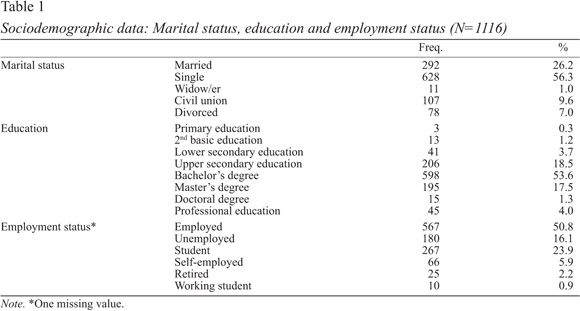
<body><![CDATA[<p>This is the time to question: Why has it taken so long for concerns about the impact of humiliation to come to the attention of scholars and  researchers?</p>     <p>One explanation of why humiliation has been neglected may be it&rsquo;s insidious and stealthy impact on its victims. Contrary to the visible  physical aspects of interpersonal violence, humiliation, as its etymology indicates, being derived from the Latin <i>humiliare</i>, relates to  inflicted &ldquo;wounds&rdquo; that are not observable. Perhaps the fact that the wounds of humiliation are not obvious explains why its  conceptualisation has only recently received due attention. The less invisible nature of humiliation requires that we listen closely to the  voices of the victims reflecting on their perceptions of being degraded or dehumanized by interpersonal mistreatment. Whether or not humiliating  mistreatment had been carried out through the interpersonal triptych referred to by Klein (1991) involving a humiliator, bystanders, and a  victim, or it occurs within more complex interpersonal conditions or occurs between groups (Leidner, Sheikh, &amp; Ginges, 2012), the invisible  nature of the wounds may have delayed progress toward fully conceptualizing this experience.</p>     <p>The second reason for such a late conceptualisation of the notion of humiliation lies in the understanding that humiliation is often confused  and conflated with the emotion of shame. There are, however, significant differences between these two experiences (Fern&aacute;ndez, Saguy,  &amp; Halperin, 2015); therefore, it is advantageous to distinguish the affective complexity resulting from humiliation, limiting the semantic  field to not only that of <i>shame</i>, but also the other emotions that trigger self-consciousness, among which are <i>embarrassment</i> and  <i>guilt</i>. In fact, although it may be said that these emotions are socially constructed, according to social dynamics, emotions that trigger  self-consciousness are still seen as being developmentally integrated into the subjects&rsquo; psychological organisation (Lewis, 2016a; Ryan,  2017; van Alphen, 2017; Vanderheiden &amp; Mayer, 2017), according to different aspects or themes of life (Lazarus, 1991), whether serving  one&rsquo;s self or serving social regulation (Frevert, 2016; Gilbert, 2003). As stated by Gilbert (2010), shame lies between our judgment of  ourselves and the judgment of others according to socially accepted standards; this transmutes into embarrassment if the emotion felt is of  lesser intensity, thus resembling shyness (Lewis, 2016b). Guilt calls for a reflection on responsibility and a reassessment of a given action  (Cohen, 2017); it may, as a consequence of such reassessment, provoke regret in the agent and compassion for those who suffered with the  agent&rsquo;s action. In fact, it is this hetero and self-regulatory dynamism that gives emotions an important developmental and societal utility  (Cardoso, 2015). On the other hand, the experience of humiliation, from humiliating-acts to the damages &ndash; embodied &ndash; produced and  observed through an analysis of the psychological experience of the humiliated-victim, surpass the definitional boundaries of shame (self/other  judgment), embarrassment (less intense self/other judgment), and guilt (a sense of responsibility for a specific harmful act).</p>     <p>Humiliation results from interpersonal, social, or systemic interactions that undermine, devalue, or destroy an individual&rsquo;s  psychological well-being and fundamental sense of dignity (worth), disrupting one&rsquo;s affective-emotional organisation (Hartling &amp;  Lindner, 2016; Leidner et al., 2012). A good example of this is found in the following sentence: &ldquo;The offender seeks to vent his anger  through injuring the victim by the use of excessive physical force: the rape may be a means of inflicting pain and humiliation rather than a  sexual act per se&rdquo; (Hollin, 2016, p. 138). Indeed, in the victim, the traumatically humiliating act of rape generates a tidal wave of  emotional phenomena such as anger, and the feeling of injustice, shame, or vengefulness; a fact that led Hartling, Lindner, Spalthoff and Britton  (2013) to consider humiliation as <i>a nuclear bomb of emotions</i>. In this sense, the lack of research conceptualising humiliation as a  profoundly damaging social and interpersonal phenomenon, may be equivalent to a concealment of dehumanizing practices that, in the subject who is  suffering, may produce devastating consequences, such as severe depression and suicide at one end of the scale (Collazzoni et al., 2015; Kendler,  Hetetma, Butera, Gardner, &amp; Prescot, 2003; Torres &amp; Bergner, 2010) and violent behaviour on other (Hartling, 2007; Jogdand &amp; Sinha,  2015; Silfver-Kuhalampi, Figueiredo, Sortheix, &amp; Fontaine, 2015).</p>     <p>In short, humiliation is an interpersonal or social act with cascading psychological ramifications. The act of humiliating, often an action of  someone who is exerting his dominion over others, may be analyzed from multiple levels, including psychosocial, political, and clinical levels.  It seems, therefore, important to provide an assessment instrument aimed at identifying humiliation experiences within a cultural context, that  will lead to effective clinical, educational, and political practices designed to effectively address the damaging consequences of this  experience. This is what we intend to accomplish with this article testing and analysing a Portuguese translation of the <i>Humiliation  Inventory</i> (Hartling, 1996). In summary, the structure of the original HI consists of a two-factor model: the cumulative humiliation factor,  with 12 observed variables, and the fear of humiliation factor, with 20 observed variables. These factors correlate with each other by a value of  .55.</p>     <p>&nbsp;</p>     <p><b>Method</b></p>     <p>&nbsp;</p>     <p><i>Participants</i></p>     <p>1116 members of the general population took part in the study and agreed to participate in a research protocol called &ldquo;Humiliation: From  actions to damages&rdquo;, complying with the inclusion criteria &ndash; being 18 years of age or older. Of these, 196 (17.6%) were male,  <i>M<sub>age</i></sub>=36.29, <i>SD<sub>age</i></sub>=14.34, and the remaining 920 (82.4%) were female, <i>M<sub>age</i></sub>=32.23,  <i>SD<sub>age</i></sub>=10.69. The remaining sociodemographic characteristics were the following: Prevalence of single status, 56%, compared to  married and civil partnership, 35.8%. Prevalence of higher education, 72.4%, against other levels of education; Prevalence of employed  participants, 56.7%, on students and working students, 24.8%, and on pensioners, 2.2% (<a href="#t1">Table 1</a>).</p>     ]]></body>
<body><![CDATA[<p>&nbsp;</p>     <p><a name="t1"></a></p>     <p><img src="/img/revistas/aps/v37n2/37n2a09t1.jpg"></p>     
<p>&nbsp;</p>     <p>&nbsp;</p>     <p><i>Instruments</i></p>     <p>The HI, original version, is composed of 32 items that must be rated on a five-interval Likert scale, from 1 (<i>Never</i>) to 5  (<i>Always</i>), the latter corresponding to the greatest degree of experienced humiliation. The inventory is divided into four sections: The  first section is composed of 12 items and aims to identify the severity with which the individuals felt affected by a given life event  (&ldquo;Throughout your life how seriously have you felt harmed by being&hellip;, e.g., scorned?&rdquo;); The second section intends to assess  the fear of being the object of humiliating behaviour (&ldquo;At this point in your life, how much do you fear being&hellip;, e.g.,  laughed at?&rdquo; (items 13 to 23); The third section intends to assess concerns, &ldquo;At this point in your life, how concerned are you about  being, e.g., discounted as a person?&rdquo; (items 24 to 30), and the fourth section aims to assess worries, &ldquo;How worried are you about  being&hellip; e.g., inadequate?&rdquo; (items 31 and 32).</p>     <p>After an exploratory factor analysis was applied, with an eigenvalue &lt;1 and oblimin rotation (item-total correlation &gt;.50; factors  loading &ge;.60 and &le;.2 in a second factor), two factors were retrieved: items 1 to 12 (factor 1), called &ldquo;cumulative  humiliation&rdquo;, Cronbach&rsquo;s alpha=.95, <i>M</i>=32, <i>SD=</i>10; and items 13 to 32 (factor 2), called &ldquo;fear of  humiliation&rdquo;, Cronbach&rsquo;s alpha=.94, <i>M</i>=46, <i>SD=</i>17. The total HI score was also conceptualised as a measure to be  considered, Cronbach&rsquo;s Alpha=.96; <i>M</i>=78, <i>DP=</i>25. This exploratory study was carried out using 253 respondents &ndash; primarily  university students, <i>M</i><sub><i>age</i></sub><i>=</i>20.66, <i>SD=</i>5.06 &ndash; from different educational institutions in the United  States.</p>     <p>&nbsp;</p>     <p><i>Procedure</i></p>     ]]></body>
<body><![CDATA[<p>The original version was independently translated by the first two authors and by an external collaborator, an expert in the English language  familiar with both cultures (The author of the original scale did not participate directly in the development of the translation but as an  adviser); subsequently, both versions were compared, gathering great consensus, and the final version was formed unanimously. The only  problematic issue was related to the translation of the vernacular word &ldquo;fear&rdquo; in the phrase &ldquo;How much do you fear  being&hellip;&rdquo;. Should it be translated by &ldquo;medo&rdquo; or by &ldquo;receio&rdquo;, a word of the same emotional category?  Consensually, we opted for the expression &ldquo;receio&rdquo; instead of &ldquo;medo&rdquo;, the direct equivalent of fear, with the purpose of,  by semantic approximation, grasping both factors, according to the original inventory. This theme will be addressed once again in the  discussion.</p>     <p>After that, the HI-Portuguese was integrated into a more extensive research protocol which was submitted to a pre-test, in a class of 56  university students. Afterward, these respondents were debriefing about the understanding of the items, including the translation issue  previously mentioned, the time needed for completing the protocol, and the level of fatigue experienced by respondents. The students&rsquo;  comments were all favourable to proceed.</p>     <p>&nbsp;</p>     <p><i>Data collection</i>: The HI-Portuguese and the respective informed consent were made available online, via the Google Docs platform, with  links being shared on several social media websites &ndash; <i>Facebook</i>, <i>Linkedin</i> &ndash; and higher education institutions. Answers  were automatically stored in the Google Docs database that only the researchers had access to. At the end of the research protocol, participants  were asked to express their opinions as well as the difficulties and doubts they had experienced during completion of the questionnaires. These  questions aimed to qualitatively assess the reliability of completion. Only three respondents claimed it was &ldquo;long&rdquo;, without any  other issues being highlighted.</p>     <p>For statistical analysis, we applied the SPSS-23/AMOS, and R-software. The R Foundation for Statistical Computing, Platform:  x86_64-apple-darwin15.6.0 (64-bit), and Lavaan package (Rosseell, 2018).</p>     <p>&nbsp;</p>     <p><i>Ethical Considerations</i>. The research was approved by the ethics committee of the institution of the first authors (Doc 16/CE/2017). The  filling protocol featured an informed consent at the beginning, explaining the objectives, filling conditions, identification of the institution  and contact information of the researchers. The data were collected anonymously.</p>     <p>&nbsp;</p>     <p><b>Results</b></p>     <p>&nbsp;</p>     ]]></body>
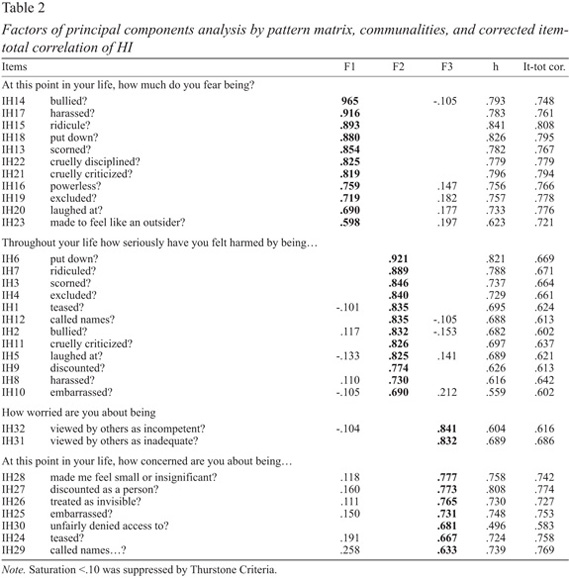
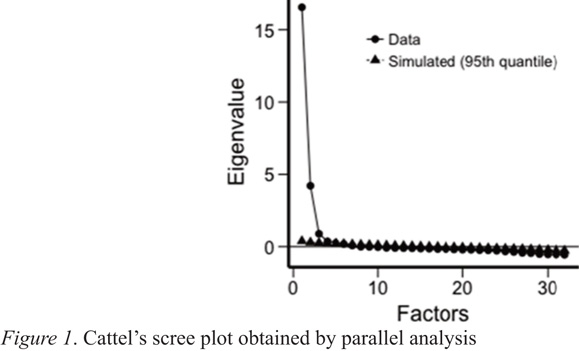
<body><![CDATA[<p><i>Confirmatory factor analysis (CFA) for the two-factor model</i></p>     <p>We applied the two-factor model test to the HI-Portuguese, using a confirmatory factor analysis (CFA). In previous analysis, no outliers had  been identified (Mahalanobis distance &ndash; p1 and p2&lt;.001) and the values of skewness and kurtosis indicate an univariate normal  distribution, |<i>Sk</i>|&lt;3 and |<i>Ku|</i>&lt;7, as suggested by Kline (2016); notwithstanding, given that the observed critical value (of  478,546) &ndash; equivalent to Mardia&rsquo;s standardised coefficient &ndash; may indicate a possible violation of the assumption of the  multivariate normal distribution since it is higher than 5 (Byrne 2010), we opted for the <i>asymptotic distribution-free (ADF) method</i>; we  were able to apply it because the sample was higher than 1000 individuals and because the proportion of 10 subjects per parameter to be estimated  was maintained. Reference values for the analysis of the quality of fit were taken from Mar&ocirc;co (2014), Brown (2006), and Schumacker and  Lomax (2004): <i>&chi;<sup>2</i></sup>/gl&lt;5 e <i>p</i>&lt;.05; comparative fit index (CFI), goodness of fit index (GFI), and Tucker-Lewis  index (TLI)&ge;0.95; Root Mean Square Error of Approximation (RMSEA)&le;.05, with CI (90%), and SRMSR&lt;.05.</p>     <p>All variables had high saturations (&lambda;&ge;0.5) and adequate reliability (<i>R<sup>2</i></sup>&gt;.25). Nevertheless, the goodness of fit  indexes obtained failed to prove the model (<i>&chi;<sup>2</i></sup>=4.78, <i>p</i>&lt;.05; CFI=0.75; GFI=0.84; RMSEA=.058, <i>p</i>&lt;.01).  Modification indexes (MI) point towards the existence of several correlations between errors. Subsequently, we carried out two model  modifications that resulted in an increased correlation between errors (between 10 pairs of errors). Regarding fit indicators from the final  model, only the <i>&chi;<sup>2</sup>/gl</i> and <i>RMSEA</i> ratio feature values that fall within the acceptance range  <i>&chi;<sup>2</sup>/gl=</i>2.92, <i>p</i>&lt;.05; RMSEA=.041, <i>p</i>(Close)<i>=</i>.99 (<i>&chi;<sup>2</i></sup>=2.92, <i>p</i>&lt;.05;  CFI=.88; GFI=.91.</p>     <p>&nbsp;</p>     <p><i>Searching for an alternative model</i></p>     <p><i>Factor analysis by the principal component analysis &ndash; PCA.</i> The search for an alternative solution was conditioned by observing  the non-compliance of the multivariate normal distribution parameters indicated above and because the value of the determinant of the correlation  matrix indicates possible multicollinearity, therefore discouraging the exploratory factor analysis (EFA) by the maximum-likelihood estimation  method (<i>reference determinant</i> &gt;1E-4; observed determinant=1.99E-15; Haitovsky=5.11291E-12, <i>gl</i>=496; &lt;.000). Therefore, EFA   was executed using the &ldquo;principal component analysis&rdquo; (PCA) extract method, with direct oblimin rotation (Delta 0), followed by the   analysis of the reliability of the HI and its factors, by calculating Alpha Cronbach indexes.</p>     <p>The sample had adequate values (Kaiser, Meyer, Olkin; KMO=.97; individual KMO&gt;.90) and was sufficiently wide enough (Bartlett  test=37913.5; gl=496; <i>p</i>&lt;.000) for being executed. The solution presented in <a href="#t2">Table 2</a> converged in 8 iteractions and  corresponds to a 3-factor solution (Kaiser&gt;1), confirmed by the indication of Cattell&rsquo;s scree test, obtained by parallel analysis  (<a href="#f1">Figure 1</a>).</p>     <p>&nbsp;</p>     <p><a name="t2"></a></p>     <p><img src="/img/revistas/aps/v37n2/37n2a09t2.jpg"></p>     
]]></body>
<body><![CDATA[<p>&nbsp;</p>     <p>&nbsp;</p>     <p><a name="f1"></a></p>     <p><img src="/img/revistas/aps/v37n2/37n2a09f1.jpg"></p>     
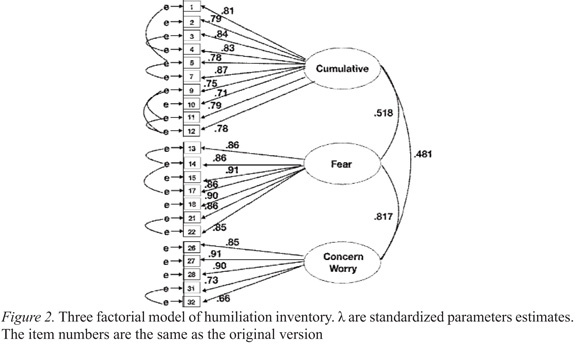
<p>&nbsp;</p>     <p>The three factors account for approximately 72% of total variance. Therefore, factor 1, fear of humiliation, items 13-23, explains about  53.12% of total variance (<i>eigen value</i>, 16.9), with &alpha;<sub>Cronbach</sub>=.97; factor 2, cumulative humiliation, items 1-12, explains  about 15% (<i>eigen value</i>, 4.8), with &alpha;<sub>Cronbach</sub>=.95, and factor 3, items 24-32, concern/worry about humiliation, explains  about 4% (<i>eigen value</i>, 1.3), with &alpha;<sub>Cronbach</sub>=.94. The average of commonalities is .72 and varies between .496 and .841.  Item saturation varies from .965 and .598 in factor 1; between .921 and .690 in factor 2 and between .841 and .630 in factor 3. In turn,  bivariate correlations between factors and between total inventory and factors are as follows: F<sub>1-12</sub>=&gt;F<sub>13-23</sub>=.506,  F<sub>13-23</sub>=&gt;F<sub>24-32</sub>=.83, F<sub>1-12</sub>=&gt;F<sub>24-32</sub>=.486, IHtot<sub>32it</sub>=&gt;F<sub>1-12</sub>=.87,  F<sub>13-23</sub>=.86; F<sub>24-32</sub>=.754. There were no crossed items worthy of registration, because the greater saturation of an item in  the competing factor (F1), specifically item 29, is .258, being .633 in the belonging factor (F3); which corresponds to a difference of .375  units.</p>     <p>&nbsp;</p>     <p><i>Confirmatory factor analysis for the three-factor model</i></p>     <p>Following the PCA indicators and to fully understand the structure of the measure we completed the CFA for a three-factor model with  R-software: Lavaan package, robust methods-MLM estimator (Yves Rosseel, 2018), with Satorra-Bentler (S-B) scaling correction factor=1.513. The  CFA produced a model that may be considered to have an acceptable fit: <i>&chi;<sup>2</i></sup>(461)=2780.970, <i>&chi;<sup>2</sup>/df</i>=6.03,  <i>p</i>=.000, CFI=.934, TLI=.929, SRMSR=.036; with the contrariety of RMSEA being of .067, CI [.065, .069], <i>p</i>=.000 and the  <i>&chi;<sup>2</sup>/df</i>&gt;5 ratio. Moreover, the current model does not report discriminant validity between the second and the third  factor, although it presents good values for all other parameters: Factorial validity, &lambda;&gt;.50, between .66 e .91; Composite reliability,  F1=.959, F2=.970, F3=.947, and average variance extracted &ndash; AVE, F1=.662, F2=.746, F3=.662, granting it convergent and discriminant  validity between F1&lt;=&gt;F2, <i>R<sup>2</i></sup>=.265, F1&lt;=&gt;F3, <i>R<sup>2</i></sup>=.498, but not between F2&lt;=&gt;F3,  <i>R<sup>2</i></sup>=.745.</p>     <p>Although the 32-item model could be considered acceptable with a broad criterion, we studied the possibility of increment verifying  modification indexes (MI) and expected parameters change (EPC). We took into consideration the indication of covariance between errors of the  same factor and suppressed the items related to covariance of inter-factor errors, respectively in the following factors: Cumulative humiliation  (CumH), items 6, 8; Fear of humiliation (FH), items 16, 19, 20; Concern/Worry about humiliation (C/W H), items 24, 25, 29, 30. For the model that  resulted from this respecification, very good fit indexes were verified: S-B<sub>scaling correction factor</sub>=1.416,  <i>&chi;<sup>2</i></sup>(196)=570.766, <i>&chi;<sup>2</sup>/df</i>=2.91, CFI=.984, TLI=.981, RMSEA=.041, CI[.038, .045], SRMR=.028  (<a href="#f2">Figure 2</a>).</p>     ]]></body>
<body><![CDATA[<p>&nbsp;</p>     <p><a name="f2"></a></p>     <p><img src="/img/revistas/aps/v37n2/37n2a09f2.jpg"></p>     
<p>&nbsp;</p>     <p>&nbsp;</p>     <p><i>Construct validity for the respecified model</i>. The three-factor model of the HI, reduced version, has good reliability and construct  validity, respectively: Composite reliability (CR&gt;.70, cutoff point) of .947 for &lsquo;CumH&rsquo;, of .959 for &lsquo;FH&rsquo; and of .911  for &lsquo;C/W H&rsquo;; factorial validity (&lambda;&gt;.50, cutoff point) between .66 and .91; Convergent validity (average variance extracted,  AVE&gt;.50, cutoff point), and discriminant validity (AVE&gt;<i>R</i><sup><i>2</i></sup>, square of the correlation between factors):  AVE<sub>Cum</sub>=.64&gt;<i>R<sup>2</i></sup><sub>Cum_F</sub>=.268; &gt;<i>R</i><sup><i>2</i></sup><sub>Cum_C/W</sub>=.231;  AVE<sub>F</sub>=.77&gt;<i>R</i><sup><i>2</i></sup><sub>F_C/W</sub>=667&lt;AVE<sub>C/W</sub>=.68.</p>     <p>&nbsp;</p>     <p><i>Descriptive values</i>. The three-factor model has the following structure and descriptive values: Cumulative humiliation factor (CH), 10  items, <i>M</i><sub>total</sub>=30.51; <i>SD</i><sub>total</sub>=11.17, &alpha;<sub>Cronbach</sub>=.94; fear factor (FH), 7 items,  <i>M</i><sub>total</sub>=15.68, <i>SD</i><sub>total</sub>=8.42, &alpha;<sub>Cronbach</sub>=.96; and concern/worry factor (C/WH), 5 items,  <i>M</i><sub>total</sub>=12.18, <i>SD</i><sub>total</sub>=6.07, &alpha;<sub>Cronbach</sub>=.91. Global Humiliation Inventory (22 items),  <i>M</i>=58.37, <i>SD=</i>21.58, &alpha;Cronbach=.956.</p>     <p>&nbsp;</p>     <p><b>Discussion</b></p>     ]]></body>
<body><![CDATA[<p>The main objective of this study was to create a Portuguese version the HI and verify whether or not the two-factor model found in the  original research fit in a study of a Portuguese population. Using this assessment instrument with this population may provide insights on  humiliation, an important phenomenon resulting from relations, both personal and institutional, which may cause severe psychological damage.</p>     <p>The linguistic adaptation was analysed and discussed between the two native Portuguese-speaking researchers and a specialist who is a native  English speaker and familiar with the Portuguese language and culture. This will have conferred a good understanding of the study by  participants, evaluated both during the pre-test phase and during the study itself. Notwithstanding, the two-factor model, as analysed by the  CFA, failed to fully explain the data correlation matrix observed. Furthermore, successive modifications produced a considerable increase in  correlations between errors without reaching a joint fit of the adopted indicators as regularly advised (Brown, 2006; Mar&ocirc;co, 2014). Due to  the setback of the increase in the number of correlations between errors sharing the variance explained (Brown, 2006), we opted to search for an  alternative model.</p>     <p>We first searched for an alternative model, as explained earlier, using the PCA, which produced a three-factor solution, differing in number  and order of extraction and with a good reliability, considering as global measurement. Furthermore, the CFA proved a tri-factorial solution with  an excellent adjustment, considering the twenty-two items with the advantage of registering factorial, convergent and discriminant validity.</p>     <p>Our explanation for the emergence of a third factor lies within the cultural and linguistic aspects linked to the different understanding of  the questions of the second and third sections. The second section is led by the expression-emotion <i>fear</i>, which was translated as  <i>receio</i>, an instance or subcategory &ndash; following prototypical analysis &ndash; of the emotional category of fear, but of low intensity  (Cardoso, 2008); in turn, the third and fourth sections are spearheaded by the terms <i>concern</i> and <i>worried</i> respectively and were  translated as <i>preocupar (praecupare, lat.)</i>, which echoed in the expression &ldquo;to become apprehensive&rdquo; (C&acirc;ndido Figueiredo  Dictionary). Furthermore, one should note that, for Portuguese people, concern and worry &ndash; preocupa&ccedil;&atilde;o &ndash; refers to the  cognitive aspect of persistent and recurrent thinking, being semantically distant from fear. In short, being concerned or worried may contain a  residual fear, but not an intense fear; and, perhaps due to this, was important enough to cause its appearance as a latent variable among the  participants of the Portuguese sample. Hence, forcing a solution to converge into two factors would obscure a highly important latent variable:  &lsquo;concern/worry about humiliation.&rsquo; In addition, recurrent and persistent &lsquo;concern/worry&rsquo; may stand out in some clinical  settings and prove to be an important factor contributing to the disturbance of psychological wellbeing.</p>     <p>The second reason may be related to the sociodemographic differences between the American and Portuguese samples. The original study was  carried out primarily with students from American university settings, while the adaptation study was carried out with a sample that encompasses  both university students and the general population, thus rising the average age. There may also be differences among the participants of both  samples, relating to their personal history of fears and concerns regarding the phenomenon under study.</p>     <p>The imbalance in the number of participants per gender is a problem we have experienced, which is increasingly identified as a problem in  other studies. This issue, in fact, deserves a research study of its own. The failure to obtain parameters that would have allowed for the use of  inferential analyses was another obstacle, having turned to PCA, an analysis that does not produce inferences for the population. In future  research, we hope to be able to overcome these constraints, as well as to assess the predictive power of the inventory regarding clinical  variables.</p>     <p>Two versions of the HI have been published recently, confirming and disconfirming the original version. A Korean version (Lee &amp; Shin,  2018) rejected the two-factor solution, putting forward a three-factor model adjusted in a sample of 253 respondents of the general population.  The authors justify the emergence of the third factor also due to cultural distinctions, such as the high competitiveness among the Korean  people, which would explain the distinction between &ldquo;fear of humiliation&rdquo; and &ldquo;humiliation of incompetence.&rdquo; This is the  reason why the third factor was termed &ldquo;humiliation of incompetence&rdquo;, composed of items 31 and 32. In fact, these items relate to  this semantical relation: &ldquo;viewed by others as inadequate&rdquo; and &ldquo;viewed by others as incompetent&rdquo;.</p>     <p>Notwithstanding, we consider that the name &ldquo;worry humiliation&rdquo; might be more appropriate, since it relates better to the context  created by the question: &ldquo;How worried are you about being...&rdquo;. Thus, the connection with the original version would be more precise,  as well as with the Portuguese version we presented. Another consideration that should be underlined is the adjustment degree, since the indexes  reported may only be acceptable by wide criteria, contrary to our version.</p>     <p>For their part, applying an exploratory factor analysis, Numata, Yutaka and Hartling (2016) reported a Japanese version confirming the  two-factor model.</p>     <p>We must emphasise that, while a growing body of research suggests that humiliation is a universal human experience, it is an experience that  is deeply influenced by the cultural context, involving many aspects such as internal experiences, external interactions, and systemic conditions  (Hartling &amp; Lindner, 2017). Thus, in addition to the explanations above, it is not surprising to us that our adaptation has a different  solution than the original. Notwithstanding, we also consider that, in the future, contributions should be made towards the search for  psychological invariants, expressed by latent variables, in order to offer inputs to the universal study of humiliation: as a personal experience  and as a result of offensive social interaction. So, besides the application of the item response theory (IRT), we expect the publication of  other results, as well as the collaborative implementation of procedures that lead to the analysis of the invariance of factors &ndash; with big  data &ndash; across different nationalities, and the application of multitrait-multimethod methodologies with multiple groups.</p>     ]]></body>
<body><![CDATA[<p>In summary, the Portuguese reduced version of the HI consists of three factors: the &ldquo;cumulative humiliation&rdquo; (CH) factor  comprising items 1, 2, 3, 4 , 5, 7, 9, 10, 11 and 12 (excluded items: 6 and 8) and matches the original factor (section I of the inventory); the  &ldquo;fear of humiliation&rdquo; factor, comprising items 13, 14, 15, 17, 18, 21, 22 (excluded items: 16, 19, and 20) corresponding of the  original &ldquo;fear of humiliation&rdquo; factor (half of section II of inventory); and, finally, the &ldquo;concern/worry about  humiliation&rdquo; factor, which encompasses items 26, 27, 28, 31, 32, and corresponds to sections 3 and 4 of the questionnaire, integrating  factor 2 of the original version (excluded items: 24, 25, 29, 30).</p>     <p>This version might offer a significant contribution to nomothetic studies. However, one must remember that the 32-item version reported  acceptable adjustment indexes and that it might be taken as a global and alternative measurement, provided that the psychometric values specific  to the ongoing researches allow this. For example, different studies have been conducted using it as a global measurement with satisfactory  results regarding clinical variables (Collazzoni et al., 2014), non-clinical individuals (Rudgiero, Veronese, Castiglioni, Procaccia, &amp;  Sassaroli, 2017), and into institutional contexts with immigrant populations (Janicka, 2009). Similarly, it may have an ideographic application  because it elicits a greater diversity of reactions (Hartling, 1996).</p>     <p>In conclusion, we consider this study puts forward good solutions to the extent that it maintains the measures of the original version and  adds the concern/worry about being humiliated as a discriminant measure related to humiliation.</p>     <p>With this instrument, our intention is to offer a support that extends the global study of humiliation as it increasingly gathers more  attention, be it from researchers, scholars, doctors, or policy-makers. By creating effective assessment tools for examining the impact of this  experience, we can formulate effective ways to address the actions and conditions that foster humiliation in different cultures, thus, fostering  the healthy growth and development of individuals while strengthening conditions that lead to conviviality between individuals from the same and  different cultures.</p>     <p>&nbsp;</p>     <p><b>References</b></p>     <!-- ref --><p>Brown, T. (2006). <i>Confirmatory factor analysis for applied research</i>. New York and London: Guilford Press.    &nbsp;&nbsp;&nbsp;&nbsp;&nbsp;&nbsp;&nbsp;&nbsp;[&#160;<a href="javascript:void(0);" onclick="javascript: window.open('/scielo.php?script=sci_nlinks&ref=047595&pid=S0870-8231201900020000900001&lng=','','width=640,height=500,resizable=yes,scrollbars=1,menubar=yes,');">Links</a>&#160;]<!-- end-ref --></p>     <!-- ref --><p>Byrne, B. (2010). <i>Structural equation modeling with AMOS: Basic concepts, applications, and programming</i> (2<sup>nd</sup> ed.). New York  and London: Routledge.    &nbsp;&nbsp;&nbsp;&nbsp;&nbsp;&nbsp;&nbsp;&nbsp;[&#160;<a href="javascript:void(0);" onclick="javascript: window.open('/scielo.php?script=sci_nlinks&ref=047597&pid=S0870-8231201900020000900002&lng=','','width=640,height=500,resizable=yes,scrollbars=1,menubar=yes,');">Links</a>&#160;]<!-- end-ref --></p>     ]]></body>
<body><![CDATA[<!-- ref --><p>Cardoso, F. (2008). <i>Estrutura e din&acirc;mica do sistema afectivo das dimens&otilde;es de avalia&ccedil;&atilde;o &agrave;s estruturas de  a&ccedil;&atilde;o: Emo&ccedil;&otilde;es (Structure and dynamic of affective system: From dimensions of evaluation to structures of  action: Emotions)</i>. Doctoral dissertation. Retrieved from <a href="http://repositorio.utad.pt/handle/10348/106"  target="_blank">http://repositorio.utad.pt/handle/10348/106</a>&nbsp;&nbsp;&nbsp;&nbsp;&nbsp;&nbsp;&nbsp;&nbsp;[&#160;<a href="javascript:void(0);" onclick="javascript: window.open('/scielo.php?script=sci_nlinks&ref=047599&pid=S0870-8231201900020000900003&lng=','','width=640,height=500,resizable=yes,scrollbars=1,menubar=yes,');">Links</a>&#160;]<!-- end-ref --><!-- ref --><p>Cardoso, F. (2015). Social regulation of emotion: A foray into the work of Catherine Lutz. <i>Revista E-Psi, 5</i>, 103-109.    &nbsp;&nbsp;&nbsp;&nbsp;&nbsp;&nbsp;&nbsp;&nbsp;[&#160;<a href="javascript:void(0);" onclick="javascript: window.open('/scielo.php?script=sci_nlinks&ref=047600&pid=S0870-8231201900020000900004&lng=','','width=640,height=500,resizable=yes,scrollbars=1,menubar=yes,');">Links</a>&#160;]<!-- end-ref --></p>     <!-- ref --><p>Cohen, T. (2017). The morality factor. <i>Scientific American-Mind, 28</i>, 32-38.    &nbsp;&nbsp;&nbsp;&nbsp;&nbsp;&nbsp;&nbsp;&nbsp;[&#160;<a href="javascript:void(0);" onclick="javascript: window.open('/scielo.php?script=sci_nlinks&ref=047602&pid=S0870-8231201900020000900005&lng=','','width=640,height=500,resizable=yes,scrollbars=1,menubar=yes,');">Links</a>&#160;]<!-- end-ref --></p>     <!-- ref --><p>Collazzoni, A., Capanna, C., Bustini, M., Marucci, C., Prescenzo, S., Ragusa, M., . . . Rossi, A. (2015). A comparison of humiliation  measurement in a depressive versus non-clinical sample: A possible clinical utility. <i>Journal of Clinical Psychology, 71,</i> 1218-1224.  Retrieved from <a href="http://doi.org/10.1002/jclp.22212" target="_blank">http://doi.org/10.1002/jclp.22212</a>&nbsp;&nbsp;&nbsp;&nbsp;&nbsp;&nbsp;&nbsp;&nbsp;[&#160;<a href="javascript:void(0);" onclick="javascript: window.open('/scielo.php?script=sci_nlinks&ref=047604&pid=S0870-8231201900020000900006&lng=','','width=640,height=500,resizable=yes,scrollbars=1,menubar=yes,');">Links</a>&#160;]<!-- end-ref --><!-- ref --><p>Collazzoni, A., Capanna, C., Bustini, M., Stratta, P., Ragusa, M., Marino, A., &amp; Rossi, A. (2014). Humiliation and interpersonal  sensitivity in depression. <i>Journal of Affective Disorders, 167</i>, 224-227. Retrieved from  <a href="http://doi.org/10.1016/j.jad.2014.06.008" target="_blank">http://doi.org/10.1016/j.jad.2014.06.008</a>&nbsp;&nbsp;&nbsp;&nbsp;&nbsp;&nbsp;&nbsp;&nbsp;[&#160;<a href="javascript:void(0);" onclick="javascript: window.open('/scielo.php?script=sci_nlinks&ref=047605&pid=S0870-8231201900020000900007&lng=','','width=640,height=500,resizable=yes,scrollbars=1,menubar=yes,');">Links</a>&#160;]<!-- end-ref --><p>Cushman, P. (1995). <i>Constructing the self, constructing America: A cultural history of psychotherapy</i>. Garden City, New York: Da Capo  Press.</p>     <!-- ref --><p>Deci, E. L., &amp; Ryan, R. M. (2012). Motivation, personality, and development within embedded social contexts: An overview of  self-determination theory. In R. M. Ryan (Ed.), <i>Oxford handbook of human motivation</i> (pp. 85-107). Oxford, UK: Oxford University Press.  doi: 10.1093/oxfordhb/9780195399820.001.0001&nbsp;&nbsp;&nbsp;&nbsp;&nbsp;&nbsp;&nbsp;&nbsp;[&#160;<a href="javascript:void(0);" onclick="javascript: window.open('/scielo.php?script=sci_nlinks&ref=047607&pid=S0870-8231201900020000900009&lng=','','width=640,height=500,resizable=yes,scrollbars=1,menubar=yes,');">Links</a>&#160;]<!-- end-ref --><!-- ref --><p>Fern&aacute;ndez, S., Saguy, T., &amp; Halperin, E. (2015). The paradox of humiliation. <i>Personality and Social Psychology Bulletin,  41</i>, 976-988. Retrieved from <a href="http://doi.org/10.1177/0146167215586195" target="_blank">http://doi.org/10.1177/0146167215586195</a>&nbsp;&nbsp;&nbsp;&nbsp;&nbsp;&nbsp;&nbsp;&nbsp;[&#160;<a href="javascript:void(0);" onclick="javascript: window.open('/scielo.php?script=sci_nlinks&ref=047608&pid=S0870-8231201900020000900010&lng=','','width=640,height=500,resizable=yes,scrollbars=1,menubar=yes,');">Links</a>&#160;]<!-- end-ref --><!-- ref --><p>Fineman, M. A. (2004). <i>The myth of autonomy: A theory of dependency</i>. New York: New Press.    &nbsp;&nbsp;&nbsp;&nbsp;&nbsp;&nbsp;&nbsp;&nbsp;[&#160;<a href="javascript:void(0);" onclick="javascript: window.open('/scielo.php?script=sci_nlinks&ref=047609&pid=S0870-8231201900020000900011&lng=','','width=640,height=500,resizable=yes,scrollbars=1,menubar=yes,');">Links</a>&#160;]<!-- end-ref --></p>     <!-- ref --><p>Frevert, U. (2016). The history of emotions. In L. F. Barrett, M. Lewis, &amp; J. Havilland-Jones (Eds.), <i>Handbook of emotions</i>  (4<sup>th</sup> ed., pp. 49-65). New York and London: Guilford Press.    &nbsp;&nbsp;&nbsp;&nbsp;&nbsp;&nbsp;&nbsp;&nbsp;[&#160;<a href="javascript:void(0);" onclick="javascript: window.open('/scielo.php?script=sci_nlinks&ref=047611&pid=S0870-8231201900020000900012&lng=','','width=640,height=500,resizable=yes,scrollbars=1,menubar=yes,');">Links</a>&#160;]<!-- end-ref --></p>     <!-- ref --><p>Gilbert, P. (2003). Evolution, social roles, and the differences in shame and guilt. <i>Social Research, 70</i>, 1205-1230. Retrieved from  <a href="http://www.jstor.org/stable/40971967" target="_blank">http://www.jstor.org/stable/40971967</a>&nbsp;&nbsp;&nbsp;&nbsp;&nbsp;&nbsp;&nbsp;&nbsp;[&#160;<a href="javascript:void(0);" onclick="javascript: window.open('/scielo.php?script=sci_nlinks&ref=047613&pid=S0870-8231201900020000900013&lng=','','width=640,height=500,resizable=yes,scrollbars=1,menubar=yes,');">Links</a>&#160;]<!-- end-ref --><!-- ref --><p>Gilbert, P. (2010). <i>The compassionate mind</i>. London: Constable &amp; Robinson Ltd.    &nbsp;&nbsp;&nbsp;&nbsp;&nbsp;&nbsp;&nbsp;&nbsp;[&#160;<a href="javascript:void(0);" onclick="javascript: window.open('/scielo.php?script=sci_nlinks&ref=047614&pid=S0870-8231201900020000900014&lng=','','width=640,height=500,resizable=yes,scrollbars=1,menubar=yes,');">Links</a>&#160;]<!-- end-ref --></p>     <!-- ref --><p>Hartling, L. M. (1996). <i>Humiliation: Assessing the specter of derision, degradation, and debasement</i>. Unpublished doctoral dissertation,  The Union Institute, Cincinnati, USA.    &nbsp;&nbsp;&nbsp;&nbsp;&nbsp;&nbsp;&nbsp;&nbsp;[&#160;<a href="javascript:void(0);" onclick="javascript: window.open('/scielo.php?script=sci_nlinks&ref=047616&pid=S0870-8231201900020000900015&lng=','','width=640,height=500,resizable=yes,scrollbars=1,menubar=yes,');">Links</a>&#160;]<!-- end-ref --></p>     <p>Hartling, L. M. (2007). Humiliation: Real pain, a pathway to violence. <i>RBSE &ndash; Brazilian Journal of Sociology of Emotion, 6</i>,  466-479.</p>     ]]></body>
<body><![CDATA[<!-- ref --><p>Hartling, L. M., &amp; Lindner, E. G. (2016). Healing humiliation: From reaction to creative action. <i>Journal of Counseling &amp;  Development, 94,</i> 383-390. Retrieved from <a href="http://doi.org/10.1002/jcad.12096" target="_blank">http://doi.org/10.1002/jcad.12096</a>&nbsp;&nbsp;&nbsp;&nbsp;&nbsp;&nbsp;&nbsp;&nbsp;[&#160;<a href="javascript:void(0);" onclick="javascript: window.open('/scielo.php?script=sci_nlinks&ref=047619&pid=S0870-8231201900020000900017&lng=','','width=640,height=500,resizable=yes,scrollbars=1,menubar=yes,');">Links</a>&#160;]<!-- end-ref --><!-- ref --><p>Hartling, L. M., &amp; Lindner, E. G. (2017). Toward a globally informed psychology of humiliation: Comment on McCauley. <i>American  Psychologist, 72</i>, 705-706.    &nbsp;&nbsp;&nbsp;&nbsp;&nbsp;&nbsp;&nbsp;&nbsp;[&#160;<a href="javascript:void(0);" onclick="javascript: window.open('/scielo.php?script=sci_nlinks&ref=047620&pid=S0870-8231201900020000900018&lng=','','width=640,height=500,resizable=yes,scrollbars=1,menubar=yes,');">Links</a>&#160;]<!-- end-ref --></p>     <!-- ref --><p>Hartling, L. M., Lindner, E. G., Spalthoff, U., &amp; Britton, M. (2013). Humiliation: A nuclear bomb of emotions?. <i>Psicolog&iacute;a  Pol&iacute;tica, 46</i>, 55-76.    &nbsp;&nbsp;&nbsp;&nbsp;&nbsp;&nbsp;&nbsp;&nbsp;[&#160;<a href="javascript:void(0);" onclick="javascript: window.open('/scielo.php?script=sci_nlinks&ref=047622&pid=S0870-8231201900020000900019&lng=','','width=640,height=500,resizable=yes,scrollbars=1,menubar=yes,');">Links</a>&#160;]<!-- end-ref --></p>     <!-- ref --><p>Hartling, L. M., &amp; Luchetta, T. (1999). Humiliation: Assessing the impact of derision, degradation, and debasement. <i>The Journal of  Primary Prevention, 19</i>, 259-278. doi: 10.1023/A:102262242251&nbsp;&nbsp;&nbsp;&nbsp;&nbsp;&nbsp;&nbsp;&nbsp;[&#160;<a href="javascript:void(0);" onclick="javascript: window.open('/scielo.php?script=sci_nlinks&ref=047624&pid=S0870-8231201900020000900020&lng=','','width=640,height=500,resizable=yes,scrollbars=1,menubar=yes,');">Links</a>&#160;]<!-- end-ref --><!-- ref --><p>Heidegger, M. (2010). <i>Being and time [Sein und zeit</i>] (Joan Stambaugh, trans.). Albany, New York: University of New York Press.  (original work publ. in 1927)&nbsp;&nbsp;&nbsp;&nbsp;&nbsp;&nbsp;&nbsp;&nbsp;[&#160;<a href="javascript:void(0);" onclick="javascript: window.open('/scielo.php?script=sci_nlinks&ref=047625&pid=S0870-8231201900020000900021&lng=','','width=640,height=500,resizable=yes,scrollbars=1,menubar=yes,');">Links</a>&#160;]<!-- end-ref --><!-- ref --><p>Hollin, C. (2016). <i>The psychology of interpersonal violence</i>. Chichester, West Sussex, UK and Hoboken, NJ, USA: John Wiley &amp; Sons,  Ltd.    &nbsp;&nbsp;&nbsp;&nbsp;&nbsp;&nbsp;&nbsp;&nbsp;[&#160;<a href="javascript:void(0);" onclick="javascript: window.open('/scielo.php?script=sci_nlinks&ref=047626&pid=S0870-8231201900020000900022&lng=','','width=640,height=500,resizable=yes,scrollbars=1,menubar=yes,');">Links</a>&#160;]<!-- end-ref --></p>     <!-- ref --><p>Janicka, A. (2009). <i>Humiliation in labor immigration</i>. Doctoral dissertation (prepared under the supervision of Marek Ok&oacute;lski),  University of Warsaw. Retrieved from   <a href="https://depot.ceon.pl/bitstream/handle/123456789/1313/Anna%20Janicka_shalm_intro_biblio.pdf?sequence=1"  target="_blank">https://depot.ceon.pl/bitstream/handle/123456789/1313/Anna%20Janicka_shalm_intro_biblio.pdf?sequence=1</a>&nbsp;&nbsp;&nbsp;&nbsp;&nbsp;&nbsp;&nbsp;&nbsp;[&#160;<a href="javascript:void(0);" onclick="javascript: window.open('/scielo.php?script=sci_nlinks&ref=047628&pid=S0870-8231201900020000900023&lng=','','width=640,height=500,resizable=yes,scrollbars=1,menubar=yes,');">Links</a>&#160;]<!-- end-ref --><!-- ref --><p>Jogdand, Y., &amp; Sinha, C. (2015). Can leaders transform humiliation into a creative force?. <i>Journal of Leadership Studies, 9</i>, 75-77.  Retrieved from <a href="http://doi.org/10.1002/jls.21413" target="_blank">http://doi.org/10.1002/jls.21413</a>&nbsp;&nbsp;&nbsp;&nbsp;&nbsp;&nbsp;&nbsp;&nbsp;[&#160;<a href="javascript:void(0);" onclick="javascript: window.open('/scielo.php?script=sci_nlinks&ref=047629&pid=S0870-8231201900020000900024&lng=','','width=640,height=500,resizable=yes,scrollbars=1,menubar=yes,');">Links</a>&#160;]<!-- end-ref --><!-- ref --><p>Jordan, J. V., &amp; Hartling, L. M. (2002). New developments in relational-cultural theory. In M. Ballou &amp; L. S. Brown (Eds.),  <i>Rethinking mental health and disorders: Feminist perspectives</i> (pp. 48-70). New York: Guilford Publications.    &nbsp;&nbsp;&nbsp;&nbsp;&nbsp;&nbsp;&nbsp;&nbsp;[&#160;<a href="javascript:void(0);" onclick="javascript: window.open('/scielo.php?script=sci_nlinks&ref=047630&pid=S0870-8231201900020000900025&lng=','','width=640,height=500,resizable=yes,scrollbars=1,menubar=yes,');">Links</a>&#160;]<!-- end-ref --></p>     <p>Jordan, J. V., Walker, M., &amp; Hartling, L. M. (Eds.). (2004). <i>The complexity of connection: Writings from the Stone Center&rsquo;s Jean  Baker Miller Training Institute</i>. New York: Guilford Press.</p>     <!-- ref --><p>Kendler, K., Hettema, J., Butera, F., Gardner, C., &amp; Prescott, C. (2003). Life event dimensions of loss, humiliation, entrapment, and  danger in the prediction of onsets of major depression and generalized anxiety. <i>Archive General Psychiatry, 60</i>, 789-796. doi:  10.1001/archpsyc.60.8.789x&nbsp;&nbsp;&nbsp;&nbsp;&nbsp;&nbsp;&nbsp;&nbsp;[&#160;<a href="javascript:void(0);" onclick="javascript: window.open('/scielo.php?script=sci_nlinks&ref=047633&pid=S0870-8231201900020000900027&lng=','','width=640,height=500,resizable=yes,scrollbars=1,menubar=yes,');">Links</a>&#160;]<!-- end-ref --><!-- ref --><p>Klein, D. C. (1991). The humiliation dynamic: An overview. <i>The Journal of Primary Prevention, 12</i>, 93-121. Retrieved from  <a href="http://doi.org/10.1007/BF02015214" target="_blank">http://doi.org/10.1007/BF02015214</a>&nbsp;&nbsp;&nbsp;&nbsp;&nbsp;&nbsp;&nbsp;&nbsp;[&#160;<a href="javascript:void(0);" onclick="javascript: window.open('/scielo.php?script=sci_nlinks&ref=047634&pid=S0870-8231201900020000900028&lng=','','width=640,height=500,resizable=yes,scrollbars=1,menubar=yes,');">Links</a>&#160;]<!-- end-ref --><!-- ref --><p>Kline, R. (2016). <i>Principles and practice of structural equation modeling</i> (4<sup>th</sup> ed.). New York and London: Guilford Press.    &nbsp;&nbsp;&nbsp;&nbsp;&nbsp;&nbsp;&nbsp;&nbsp;[&#160;<a href="javascript:void(0);" onclick="javascript: window.open('/scielo.php?script=sci_nlinks&ref=047635&pid=S0870-8231201900020000900029&lng=','','width=640,height=500,resizable=yes,scrollbars=1,menubar=yes,');">Links</a>&#160;]<!-- end-ref --></p>     <!-- ref --><p>Lazarus, R. S. (1991). <i>Emotion and adaptation</i>. New York: Oxford Press.    &nbsp;&nbsp;&nbsp;&nbsp;&nbsp;&nbsp;&nbsp;&nbsp;[&#160;<a href="javascript:void(0);" onclick="javascript: window.open('/scielo.php?script=sci_nlinks&ref=047637&pid=S0870-8231201900020000900030&lng=','','width=640,height=500,resizable=yes,scrollbars=1,menubar=yes,');">Links</a>&#160;]<!-- end-ref --></p>     ]]></body>
<body><![CDATA[<!-- ref --><p>Leask, P. (2013). Losing trust in the world: Humiliation and its consequences. <i>Psychodynamic Practice, 19</i>, 129-142. doi:  10.1080/14753634.2013.778485&nbsp;&nbsp;&nbsp;&nbsp;&nbsp;&nbsp;&nbsp;&nbsp;[&#160;<a href="javascript:void(0);" onclick="javascript: window.open('/scielo.php?script=sci_nlinks&ref=047639&pid=S0870-8231201900020000900031&lng=','','width=640,height=500,resizable=yes,scrollbars=1,menubar=yes,');">Links</a>&#160;]<!-- end-ref --><!-- ref --><p>Lee, S., &amp; Shin, H. (2018). Validation of the Korean version of the Humiliation Inventory. <i>Korean Journal of Clinical Psychology,  37</i>, 119-129. Retrieved from <a href="https://doi.org/10.15842/kjcp.2018.37.1.010"  target="_blank">https://doi.org/10.15842/kjcp.2018.37.1.010</a>&nbsp;&nbsp;&nbsp;&nbsp;&nbsp;&nbsp;&nbsp;&nbsp;[&#160;<a href="javascript:void(0);" onclick="javascript: window.open('/scielo.php?script=sci_nlinks&ref=047640&pid=S0870-8231201900020000900032&lng=','','width=640,height=500,resizable=yes,scrollbars=1,menubar=yes,');">Links</a>&#160;]<!-- end-ref --><!-- ref --><p>Leidner, B., Sheikh, H., &amp; Ginges, J. (2012). Affective dimensions of intergroup humiliation<i>. PLoS ONE, 7</i>(9).    &nbsp;&nbsp;&nbsp;&nbsp;&nbsp;&nbsp;&nbsp;&nbsp;[&#160;<a href="javascript:void(0);" onclick="javascript: window.open('/scielo.php?script=sci_nlinks&ref=047641&pid=S0870-8231201900020000900033&lng=','','width=640,height=500,resizable=yes,scrollbars=1,menubar=yes,');">Links</a>&#160;]<!-- end-ref --> Retrieved from  <a href="https://doi.org/10.1371/journal.pone.0046375" target="_blank">https://doi.org/10.1371/journal.pone.0046375</a></p>     <!-- ref --><p>Lewis, M. (2016a). Self-Conscious emotions: Embarrassment, pride, shame, guilt, and hubris. In L. F. Barrett, M. Lewis, &amp; J.  Havilland-Jones (Eds.), <i>Handbook of emotions</i> (4<sup>th</sup> ed., Cap. 45). New York and London: Guilford Press.    &nbsp;&nbsp;&nbsp;&nbsp;&nbsp;&nbsp;&nbsp;&nbsp;[&#160;<a href="javascript:void(0);" onclick="javascript: window.open('/scielo.php?script=sci_nlinks&ref=047643&pid=S0870-8231201900020000900034&lng=','','width=640,height=500,resizable=yes,scrollbars=1,menubar=yes,');">Links</a>&#160;]<!-- end-ref --></p>     <!-- ref --><p>Lewis, M. (2016b). The emergence of human emotions. In L. F. Barrett, M. Lewis, &amp; J. Havilland-Jones (Eds.), <i>Handbook of emotions</i>  (4<sup>th</sup> ed., Cap. 15). New York and London: Guilford Press.    &nbsp;&nbsp;&nbsp;&nbsp;&nbsp;&nbsp;&nbsp;&nbsp;[&#160;<a href="javascript:void(0);" onclick="javascript: window.open('/scielo.php?script=sci_nlinks&ref=047645&pid=S0870-8231201900020000900035&lng=','','width=640,height=500,resizable=yes,scrollbars=1,menubar=yes,');">Links</a>&#160;]<!-- end-ref --></p>     <!-- ref --><p>Lindner, E. G. (2010). <i>Gender, humiliation, and global security: Dignifying relationships from love, sex, and parenthood to world  affairs</i>. Santa Barbara, CA: Praeger.    &nbsp;&nbsp;&nbsp;&nbsp;&nbsp;&nbsp;&nbsp;&nbsp;[&#160;<a href="javascript:void(0);" onclick="javascript: window.open('/scielo.php?script=sci_nlinks&ref=047647&pid=S0870-8231201900020000900036&lng=','','width=640,height=500,resizable=yes,scrollbars=1,menubar=yes,');">Links</a>&#160;]<!-- end-ref --></p>     ]]></body>
<body><![CDATA[<!-- ref --><p>Lindner, E. G. (2013). Emotion and conflict: Why it is important to understand how emotions affect conflict and how conflict affects emotions.  In D. Morton, P. Coleman, &amp; E. Marcus (Eds.), <i>The handbook of conflict resolution: Theory and practice</i> (3<sup>rd </sup>ed.). San  Francisco, CA: Jossey-Bass.    &nbsp;&nbsp;&nbsp;&nbsp;&nbsp;&nbsp;&nbsp;&nbsp;[&#160;<a href="javascript:void(0);" onclick="javascript: window.open('/scielo.php?script=sci_nlinks&ref=047649&pid=S0870-8231201900020000900037&lng=','','width=640,height=500,resizable=yes,scrollbars=1,menubar=yes,');">Links</a>&#160;]<!-- end-ref --></p>     <!-- ref --><p>Mar&ocirc;co, J. (2014). <i>An&aacute;lise de equa&ccedil;&otilde;es estruturais. Fundamentos te&oacute;ricos, software e  aplica&ccedil;&otilde;es [Structural equations analysis: Theoretical foundations, software, and applications]</i> (2<sup>nd </sup>ed.). Lisboa:  ReportNumber.    &nbsp;&nbsp;&nbsp;&nbsp;&nbsp;&nbsp;&nbsp;&nbsp;[&#160;<a href="javascript:void(0);" onclick="javascript: window.open('/scielo.php?script=sci_nlinks&ref=047651&pid=S0870-8231201900020000900038&lng=','','width=640,height=500,resizable=yes,scrollbars=1,menubar=yes,');">Links</a>&#160;]<!-- end-ref --></p>     <!-- ref --><p>Miranda-Santos, A. (1972). <i>Expressividade e personalidade. Um s&eacute;culo de psicologia [Expressivity and personality: A century of  psychology]</i>. Coimbra: Atl&acirc;ntida.    &nbsp;&nbsp;&nbsp;&nbsp;&nbsp;&nbsp;&nbsp;&nbsp;[&#160;<a href="javascript:void(0);" onclick="javascript: window.open('/scielo.php?script=sci_nlinks&ref=047653&pid=S0870-8231201900020000900039&lng=','','width=640,height=500,resizable=yes,scrollbars=1,menubar=yes,');">Links</a>&#160;]<!-- end-ref --></p>     <!-- ref --><p>Negr&atilde;o, C., Bonanno, G. A., Noll, J. G., Putnam, F. W., &amp; Trickett, P. K. (2005). Shame, humiliation, and childhood sexual abuse:  Distinct contributions and emotional coherence. <i>Child Maltreatment, 10</i>, 350-363. Retrieved from  <a href="http://doi.org/10.1177/1077559505279366" target="_blank">http://doi.org/10.1177/1077559505279366</a>&nbsp;&nbsp;&nbsp;&nbsp;&nbsp;&nbsp;&nbsp;&nbsp;[&#160;<a href="javascript:void(0);" onclick="javascript: window.open('/scielo.php?script=sci_nlinks&ref=047655&pid=S0870-8231201900020000900040&lng=','','width=640,height=500,resizable=yes,scrollbars=1,menubar=yes,');">Links</a>&#160;]<!-- end-ref --><!-- ref --><p>Numata, M., Matsui, Y., &amp; Hartling, L. M. (2016). Development of the Japanese version of the Humiliation Inventory (HI-J).  <i>International Journal of Psychology, 5</i>, 550.    &nbsp;&nbsp;&nbsp;&nbsp;&nbsp;&nbsp;&nbsp;&nbsp;[&#160;<a href="javascript:void(0);" onclick="javascript: window.open('/scielo.php?script=sci_nlinks&ref=047656&pid=S0870-8231201900020000900041&lng=','','width=640,height=500,resizable=yes,scrollbars=1,menubar=yes,');">Links</a>&#160;]<!-- end-ref --></p>     <!-- ref --><p>Rosseel, Y. (2018, <i>Jul, 20</i>). <i>The lavaan tutorial</i>. Belgium: Department of Data Analysis, Ghent University. Retrieved from  <a href="http://lavaan.ugent.be/tutorial/tutorial.pdf" target="_blank">http://lavaan.ugent.be/tutorial/tutorial.pdf</a>&nbsp;&nbsp;&nbsp;&nbsp;&nbsp;&nbsp;&nbsp;&nbsp;[&#160;<a href="javascript:void(0);" onclick="javascript: window.open('/scielo.php?script=sci_nlinks&ref=047658&pid=S0870-8231201900020000900042&lng=','','width=640,height=500,resizable=yes,scrollbars=1,menubar=yes,');">Links</a>&#160;]<!-- end-ref --><!-- ref --><p>Ruggiero, G. M., Veronese, G., Castiglioni, M., Procaccia, R., &amp; Sassaroli, S. (2017). Cognitive avoidance, humiliation, and narcissism in  non-clinical individuals: An experimental study. In A. Collumbus (Ed.), <i>Advances in psychology research</i> (Vol. 128, pp. 1-16). New York:  Nova Science Publisher.    &nbsp;&nbsp;&nbsp;&nbsp;&nbsp;&nbsp;&nbsp;&nbsp;[&#160;<a href="javascript:void(0);" onclick="javascript: window.open('/scielo.php?script=sci_nlinks&ref=047659&pid=S0870-8231201900020000900043&lng=','','width=640,height=500,resizable=yes,scrollbars=1,menubar=yes,');">Links</a>&#160;]<!-- end-ref --></p>     <!-- ref --><p>Ryan, T. (2017). The positive function of shame: Moral and spiritual perspectives. In E. Vanderheiden &amp; C.-H. Mayer (Eds.), <i>The value  of shame, exploring a health resource in cultural contexts</i> (pp. 87-108). Switzerland: Springer.    &nbsp;&nbsp;&nbsp;&nbsp;&nbsp;&nbsp;&nbsp;&nbsp;[&#160;<a href="javascript:void(0);" onclick="javascript: window.open('/scielo.php?script=sci_nlinks&ref=047661&pid=S0870-8231201900020000900044&lng=','','width=640,height=500,resizable=yes,scrollbars=1,menubar=yes,');">Links</a>&#160;]<!-- end-ref --></p>     <p>Schumacker, R., &amp; Lomax, R. (2004). <i>A beginner&rsquo;s guide to structural equation modeling</i> (2<sup>nd</sup> ed.). New York:  Laurence Earlbaum.</p>     <!-- ref --><p>Silfver-Kuhalampi, M., Figueiredo, A., Sortheix, F., &amp; Fontaine, J. (2015). Humiliated self, bad self or bad behavior? The relations  between moral emotional appraisals and moral motivation. <i>Journal of Moral Education, 126</i>, 1-19. Retrieved from  <a href="http://doi.org/10.1080/03057240.2015.1043874" target="_blank">http://doi.org/10.1080/03057240.2015.1043874</a>&nbsp;&nbsp;&nbsp;&nbsp;&nbsp;&nbsp;&nbsp;&nbsp;[&#160;<a href="javascript:void(0);" onclick="javascript: window.open('/scielo.php?script=sci_nlinks&ref=047664&pid=S0870-8231201900020000900046&lng=','','width=640,height=500,resizable=yes,scrollbars=1,menubar=yes,');">Links</a>&#160;]<!-- end-ref --><!-- ref --><p>Stets, J. E., &amp; Trettevik, R. (2014). Emotions in identity theory. In J. E. Stets &amp; J. H. Turner (Eds.), <i>Handbook of the sociology  of emotions</i> (Vol. II, pp. 33-49). New York and London: Springer Dordrecht Heidelberg. Retrieved from  <a href="https://doi.org/10.1007/978-94-017-9130-4_3" target="_blank">https://doi.org/10.1007/978-94-017-9130-4_3</a>&nbsp;&nbsp;&nbsp;&nbsp;&nbsp;&nbsp;&nbsp;&nbsp;[&#160;<a href="javascript:void(0);" onclick="javascript: window.open('/scielo.php?script=sci_nlinks&ref=047665&pid=S0870-8231201900020000900047&lng=','','width=640,height=500,resizable=yes,scrollbars=1,menubar=yes,');">Links</a>&#160;]<!-- end-ref --><!-- ref --><p>Torres, W. J., &amp; Bergner, R. M. (2010). Humiliation: Its nature and consequences. <i>The Journal of the American Academy of Psychiatry and  the Law, 38</i>, 195-204.    &nbsp;&nbsp;&nbsp;&nbsp;&nbsp;&nbsp;&nbsp;&nbsp;[&#160;<a href="javascript:void(0);" onclick="javascript: window.open('/scielo.php?script=sci_nlinks&ref=047666&pid=S0870-8231201900020000900048&lng=','','width=640,height=500,resizable=yes,scrollbars=1,menubar=yes,');">Links</a>&#160;]<!-- end-ref --></p>     <!-- ref --><p>Van Alphen, M. (2017). Shame as a functional and adaptive emotion: A biopsychosocial perspective. In E. Vanderheiden &amp; C.-H. Mayer (Eds.),  <i>The value of shame, exploring a health resource in cultural contexts</i> (pp. 61-86). Switzerland: Springer.    &nbsp;&nbsp;&nbsp;&nbsp;&nbsp;&nbsp;&nbsp;&nbsp;[&#160;<a href="javascript:void(0);" onclick="javascript: window.open('/scielo.php?script=sci_nlinks&ref=047668&pid=S0870-8231201900020000900049&lng=','','width=640,height=500,resizable=yes,scrollbars=1,menubar=yes,');">Links</a>&#160;]<!-- end-ref --></p>     <!-- ref --><p>Vanderheiden, E., &amp; Mayer, C. (2017). An introduction to the value of shame. In E. Vanderheiden &amp; C.-H. Mayer (Eds.), <i>The value of  shame, exploring a health resource in cultural contexts</i> (pp. 1-42). Switzerland: Springer.    &nbsp;&nbsp;&nbsp;&nbsp;&nbsp;&nbsp;&nbsp;&nbsp;[&#160;<a href="javascript:void(0);" onclick="javascript: window.open('/scielo.php?script=sci_nlinks&ref=047670&pid=S0870-8231201900020000900050&lng=','','width=640,height=500,resizable=yes,scrollbars=1,menubar=yes,');">Links</a>&#160;]<!-- end-ref --></p>     <!-- ref --><p>Vansteenkiste, M., &amp; Ryan, R. (2013). On psychological growth and vulnerability: Basic psychological need satisfaction and need  frustration as a unifying principle. <i>Journal of Psychotherapy Integration, 23</i>, 263-280. Retrieved from  <a href="http://doi.org/10.1037/a0032359" target="_blank">http://doi.org/10.1037/a0032359</a>&nbsp;&nbsp;&nbsp;&nbsp;&nbsp;&nbsp;&nbsp;&nbsp;[&#160;<a href="javascript:void(0);" onclick="javascript: window.open('/scielo.php?script=sci_nlinks&ref=047672&pid=S0870-8231201900020000900051&lng=','','width=640,height=500,resizable=yes,scrollbars=1,menubar=yes,');">Links</a>&#160;]<!-- end-ref --><p>&nbsp;</p>     <p><b><a name="c0" id="c0"></a><a href="#topc0">CORRESPONDÊNCIA</a></b></p>     <p>Correspondence concerning this article should be addressed to: Francisco M. S. Cardoso, Laborat&oacute;rio de Psicologia Experimental  Cl&iacute;nica, UTAD &ndash; Universidade de Tr&aacute;s-os-Montes e Alto Douro, Quinta de Prados, 5001-801 Vila Real, Portugal. E-mail:  <a href="mailto:fcardoso@utad.pt">fcardoso@utad.pt</a></p>     <p>&nbsp;</p>     <p>Submitted: 01/08/2017 Accepted: 21/09/2018</p>      ]]></body><back>
<ref-list>
<ref id="B1">
<nlm-citation citation-type="book">
<person-group person-group-type="author">
<name>
<surname><![CDATA[Brown]]></surname>
<given-names><![CDATA[T.]]></given-names>
</name>
</person-group>
<source><![CDATA[Confirmatory factor analysis for applied research]]></source>
<year>2006</year>
<publisher-loc><![CDATA[New YorkLondon ]]></publisher-loc>
<publisher-name><![CDATA[Guilford Press]]></publisher-name>
</nlm-citation>
</ref>
<ref id="B2">
<nlm-citation citation-type="book">
<person-group person-group-type="author">
<name>
<surname><![CDATA[Byrne]]></surname>
<given-names><![CDATA[B.]]></given-names>
</name>
</person-group>
<source><![CDATA[Structural equation modeling with AMOS: Basic concepts, applications, and programming]]></source>
<year>2010</year>
<edition>2</edition>
<publisher-loc><![CDATA[New YorkLondon ]]></publisher-loc>
<publisher-name><![CDATA[Routledge]]></publisher-name>
</nlm-citation>
</ref>
<ref id="B3">
<nlm-citation citation-type="">
<person-group person-group-type="author">
<name>
<surname><![CDATA[Cardoso]]></surname>
<given-names><![CDATA[F.]]></given-names>
</name>
</person-group>
<source><![CDATA[Estrutura e dinâmica do sistema afectivo das dimensões de avaliação às estruturas de ação: Emoções]]></source>
<year>2008</year>
</nlm-citation>
</ref>
<ref id="B4">
<nlm-citation citation-type="journal">
<person-group person-group-type="author">
<name>
<surname><![CDATA[Cardoso]]></surname>
<given-names><![CDATA[F.]]></given-names>
</name>
</person-group>
<article-title xml:lang="en"><![CDATA[Social regulation of emotion: A foray into the work of Catherine Lutz]]></article-title>
<source><![CDATA[Revista E-Psi]]></source>
<year>2015</year>
<volume>5</volume>
<page-range>103-109</page-range></nlm-citation>
</ref>
<ref id="B5">
<nlm-citation citation-type="journal">
<person-group person-group-type="author">
<name>
<surname><![CDATA[Cohen]]></surname>
<given-names><![CDATA[T.]]></given-names>
</name>
</person-group>
<article-title xml:lang="en"><![CDATA[The morality factor]]></article-title>
<source><![CDATA[Scientific American-Mind]]></source>
<year>2017</year>
<volume>28</volume>
<page-range>32-38</page-range></nlm-citation>
</ref>
<ref id="B6">
<nlm-citation citation-type="journal">
<person-group person-group-type="author">
<name>
<surname><![CDATA[Collazzoni]]></surname>
<given-names><![CDATA[A.]]></given-names>
</name>
<name>
<surname><![CDATA[Capanna]]></surname>
<given-names><![CDATA[C.]]></given-names>
</name>
<name>
<surname><![CDATA[Bustini]]></surname>
<given-names><![CDATA[M.]]></given-names>
</name>
<name>
<surname><![CDATA[Marucci]]></surname>
<given-names><![CDATA[C.]]></given-names>
</name>
<name>
<surname><![CDATA[Prescenzo]]></surname>
<given-names><![CDATA[S.]]></given-names>
</name>
<name>
<surname><![CDATA[Ragusa]]></surname>
<given-names><![CDATA[M.]]></given-names>
</name>
<name>
<surname><![CDATA[Rossi]]></surname>
<given-names><![CDATA[A.]]></given-names>
</name>
</person-group>
<article-title xml:lang="en"><![CDATA[A comparison of humiliation measurement in a depressive versus non-clinical sample: A possible clinical utility]]></article-title>
<source><![CDATA[Journal of Clinical Psychology]]></source>
<year>2015</year>
<volume>71</volume>
<page-range>1218-1224</page-range></nlm-citation>
</ref>
<ref id="B7">
<nlm-citation citation-type="journal">
<person-group person-group-type="author">
<name>
<surname><![CDATA[Collazzoni]]></surname>
<given-names><![CDATA[A.]]></given-names>
</name>
<name>
<surname><![CDATA[Capanna]]></surname>
<given-names><![CDATA[C.]]></given-names>
</name>
<name>
<surname><![CDATA[Bustini]]></surname>
<given-names><![CDATA[M.]]></given-names>
</name>
<name>
<surname><![CDATA[Stratta]]></surname>
<given-names><![CDATA[P.]]></given-names>
</name>
<name>
<surname><![CDATA[Ragusa]]></surname>
<given-names><![CDATA[M.]]></given-names>
</name>
<name>
<surname><![CDATA[Marino]]></surname>
<given-names><![CDATA[A.]]></given-names>
</name>
<name>
<surname><![CDATA[Rossi]]></surname>
<given-names><![CDATA[A.]]></given-names>
</name>
</person-group>
<article-title xml:lang="en"><![CDATA[Humiliation and interpersonal sensitivity in depression]]></article-title>
<source><![CDATA[Journal of Affective Disorders]]></source>
<year>2014</year>
<volume>167</volume>
<page-range>224-227</page-range></nlm-citation>
</ref>
<ref id="B8">
<nlm-citation citation-type="book">
<person-group person-group-type="author">
<name>
<surname><![CDATA[Cushman]]></surname>
<given-names><![CDATA[P.]]></given-names>
</name>
</person-group>
<source><![CDATA[Constructing the self, constructing America: A cultural history of psychotherapy]]></source>
<year>1995</year>
<publisher-loc><![CDATA[Garden City ]]></publisher-loc>
<publisher-name><![CDATA[Da Capo Press]]></publisher-name>
</nlm-citation>
</ref>
<ref id="B9">
<nlm-citation citation-type="book">
<person-group person-group-type="author">
<name>
<surname><![CDATA[Deci]]></surname>
<given-names><![CDATA[E. L.]]></given-names>
</name>
<name>
<surname><![CDATA[Ryan]]></surname>
<given-names><![CDATA[R. M.]]></given-names>
</name>
</person-group>
<article-title xml:lang="en"><![CDATA[Motivation, personality, and development within embedded social contexts: An overview of self-determination theory]]></article-title>
<person-group person-group-type="editor">
<name>
<surname><![CDATA[Ryan]]></surname>
<given-names><![CDATA[R. M.]]></given-names>
</name>
</person-group>
<source><![CDATA[Oxford handbook of human motivation]]></source>
<year>2012</year>
<page-range>85-107</page-range><publisher-loc><![CDATA[Oxford ]]></publisher-loc>
<publisher-name><![CDATA[Oxford University Press]]></publisher-name>
</nlm-citation>
</ref>
<ref id="B10">
<nlm-citation citation-type="journal">
<person-group person-group-type="author">
<name>
<surname><![CDATA[Fernández]]></surname>
<given-names><![CDATA[S.]]></given-names>
</name>
<name>
<surname><![CDATA[Saguy]]></surname>
<given-names><![CDATA[T.]]></given-names>
</name>
<name>
<surname><![CDATA[Halperin]]></surname>
<given-names><![CDATA[E.]]></given-names>
</name>
</person-group>
<article-title xml:lang="en"><![CDATA[The paradox of humiliation]]></article-title>
<source><![CDATA[Personality and Social Psychology Bulletin]]></source>
<year>2015</year>
<volume>41</volume>
<page-range>976-988</page-range></nlm-citation>
</ref>
<ref id="B11">
<nlm-citation citation-type="book">
<person-group person-group-type="author">
<name>
<surname><![CDATA[Fineman]]></surname>
<given-names><![CDATA[M. A.]]></given-names>
</name>
</person-group>
<source><![CDATA[The myth of autonomy: A theory of dependency]]></source>
<year>2004</year>
<publisher-loc><![CDATA[New York ]]></publisher-loc>
<publisher-name><![CDATA[New Press]]></publisher-name>
</nlm-citation>
</ref>
<ref id="B12">
<nlm-citation citation-type="book">
<person-group person-group-type="author">
<name>
<surname><![CDATA[Frevert]]></surname>
<given-names><![CDATA[U.]]></given-names>
</name>
</person-group>
<article-title xml:lang="en"><![CDATA[The history of emotions]]></article-title>
<person-group person-group-type="editor">
<name>
<surname><![CDATA[Barrett]]></surname>
<given-names><![CDATA[L. F.]]></given-names>
</name>
<name>
<surname><![CDATA[Lewis]]></surname>
<given-names><![CDATA[M.]]></given-names>
</name>
<name>
<surname><![CDATA[Havilland-Jones]]></surname>
<given-names><![CDATA[J.]]></given-names>
</name>
</person-group>
<source><![CDATA[Handbook of emotions]]></source>
<year>2016</year>
<edition>4</edition>
<publisher-loc><![CDATA[New YorkLondon ]]></publisher-loc>
<publisher-name><![CDATA[Guilford Press]]></publisher-name>
</nlm-citation>
</ref>
<ref id="B13">
<nlm-citation citation-type="journal">
<person-group person-group-type="author">
<name>
<surname><![CDATA[Gilbert]]></surname>
<given-names><![CDATA[P.]]></given-names>
</name>
</person-group>
<article-title xml:lang="en"><![CDATA[Evolution, social roles, and the differences in shame and guilt]]></article-title>
<source><![CDATA[Social Research]]></source>
<year>2003</year>
<volume>70</volume>
<page-range>1205-1230</page-range></nlm-citation>
</ref>
<ref id="B14">
<nlm-citation citation-type="book">
<person-group person-group-type="author">
<name>
<surname><![CDATA[Gilbert]]></surname>
<given-names><![CDATA[P.]]></given-names>
</name>
</person-group>
<source><![CDATA[The compassionate mind]]></source>
<year>2010</year>
<publisher-loc><![CDATA[London ]]></publisher-loc>
<publisher-name><![CDATA[Constable & Robinson Ltd]]></publisher-name>
</nlm-citation>
</ref>
<ref id="B15">
<nlm-citation citation-type="">
<person-group person-group-type="author">
<name>
<surname><![CDATA[Hartling]]></surname>
<given-names><![CDATA[L. M.]]></given-names>
</name>
</person-group>
<source><![CDATA[Humiliation: Assessing the specter of derision, degradation, and debasement]]></source>
<year>1996</year>
</nlm-citation>
</ref>
<ref id="B16">
<nlm-citation citation-type="journal">
<person-group person-group-type="author">
<name>
<surname><![CDATA[Hartling]]></surname>
<given-names><![CDATA[L. M.]]></given-names>
</name>
</person-group>
<article-title xml:lang="en"><![CDATA[Humiliation: Real pain, a pathway to violence]]></article-title>
<source><![CDATA[RBSE - Brazilian Journal of Sociology of Emotion]]></source>
<year>2007</year>
<volume>6</volume>
<page-range>466-479</page-range></nlm-citation>
</ref>
<ref id="B17">
<nlm-citation citation-type="journal">
<person-group person-group-type="author">
<name>
<surname><![CDATA[Hartling]]></surname>
<given-names><![CDATA[L. M.]]></given-names>
</name>
<name>
<surname><![CDATA[Lindner]]></surname>
<given-names><![CDATA[E. G.]]></given-names>
</name>
</person-group>
<article-title xml:lang="en"><![CDATA[Healing humiliation: From reaction to creative action]]></article-title>
<source><![CDATA[Journal of Counseling & Development]]></source>
<year>2016</year>
<volume>94</volume>
<page-range>383-390</page-range></nlm-citation>
</ref>
<ref id="B18">
<nlm-citation citation-type="journal">
<person-group person-group-type="author">
<name>
<surname><![CDATA[Hartling]]></surname>
<given-names><![CDATA[L. M.]]></given-names>
</name>
<name>
<surname><![CDATA[Lindner]]></surname>
<given-names><![CDATA[E. G.]]></given-names>
</name>
</person-group>
<article-title xml:lang="en"><![CDATA[Toward a globally informed psychology of humiliation: Comment on McCauley]]></article-title>
<source><![CDATA[American Psychologist]]></source>
<year>2017</year>
<volume>72</volume>
<page-range>705-706</page-range></nlm-citation>
</ref>
<ref id="B19">
<nlm-citation citation-type="journal">
<person-group person-group-type="author">
<name>
<surname><![CDATA[Hartling]]></surname>
<given-names><![CDATA[L. M.]]></given-names>
</name>
<name>
<surname><![CDATA[Lindner]]></surname>
<given-names><![CDATA[E. G.]]></given-names>
</name>
<name>
<surname><![CDATA[Spalthoff]]></surname>
<given-names><![CDATA[U.]]></given-names>
</name>
<name>
<surname><![CDATA[Britton]]></surname>
<given-names><![CDATA[M.]]></given-names>
</name>
</person-group>
<article-title xml:lang="en"><![CDATA[Humiliation: A nuclear bomb of emotions?]]></article-title>
<source><![CDATA[Psicología Política]]></source>
<year>2013</year>
<volume>46</volume>
<page-range>55-76</page-range></nlm-citation>
</ref>
<ref id="B20">
<nlm-citation citation-type="journal">
<person-group person-group-type="author">
<name>
<surname><![CDATA[Hartling]]></surname>
<given-names><![CDATA[L. M.]]></given-names>
</name>
<name>
<surname><![CDATA[Luchetta]]></surname>
<given-names><![CDATA[T.]]></given-names>
</name>
</person-group>
<article-title xml:lang="en"><![CDATA[Humiliation: Assessing the impact of derision, degradation, and debasement]]></article-title>
<source><![CDATA[The Journal of Primary Prevention]]></source>
<year>1999</year>
<volume>19</volume>
<page-range>259-278</page-range></nlm-citation>
</ref>
<ref id="B21">
<nlm-citation citation-type="book">
<person-group person-group-type="author">
<name>
<surname><![CDATA[Heidegger]]></surname>
<given-names><![CDATA[M.]]></given-names>
</name>
<name>
<surname><![CDATA[Stambaugh]]></surname>
<given-names><![CDATA[Joan]]></given-names>
</name>
</person-group>
<source><![CDATA[Being and time [Sein und zeit]]]></source>
<year>2010</year>
<publisher-loc><![CDATA[Albany ]]></publisher-loc>
<publisher-name><![CDATA[University of New York Press]]></publisher-name>
</nlm-citation>
</ref>
<ref id="B22">
<nlm-citation citation-type="book">
<person-group person-group-type="author">
<name>
<surname><![CDATA[Hollin]]></surname>
<given-names><![CDATA[C.]]></given-names>
</name>
</person-group>
<source><![CDATA[The psychology of interpersonal violence]]></source>
<year>2016</year>
<publisher-loc><![CDATA[ChichesterHoboken ]]></publisher-loc>
<publisher-name><![CDATA[John Wiley & Sons, Ltd]]></publisher-name>
</nlm-citation>
</ref>
<ref id="B23">
<nlm-citation citation-type="">
<person-group person-group-type="author">
<name>
<surname><![CDATA[Janicka]]></surname>
<given-names><![CDATA[A.]]></given-names>
</name>
</person-group>
<source><![CDATA[Humiliation in labor immigration]]></source>
<year>2009</year>
</nlm-citation>
</ref>
<ref id="B24">
<nlm-citation citation-type="journal">
<person-group person-group-type="author">
<name>
<surname><![CDATA[Jogdand]]></surname>
<given-names><![CDATA[Y.]]></given-names>
</name>
<name>
<surname><![CDATA[Sinha]]></surname>
<given-names><![CDATA[C.]]></given-names>
</name>
</person-group>
<article-title xml:lang="en"><![CDATA[Can leaders transform humiliation into a creative force?]]></article-title>
<source><![CDATA[Journal of Leadership Studies]]></source>
<year>2015</year>
<volume>9</volume>
<page-range>75-77</page-range></nlm-citation>
</ref>
<ref id="B25">
<nlm-citation citation-type="book">
<person-group person-group-type="author">
<name>
<surname><![CDATA[Jordan]]></surname>
<given-names><![CDATA[J. V.]]></given-names>
</name>
<name>
<surname><![CDATA[Hartling]]></surname>
<given-names><![CDATA[L. M.]]></given-names>
</name>
</person-group>
<article-title xml:lang="en"><![CDATA[New developments in relational-cultural theory]]></article-title>
<person-group person-group-type="editor">
<name>
<surname><![CDATA[Ballou]]></surname>
<given-names><![CDATA[M.]]></given-names>
</name>
<name>
<surname><![CDATA[Brown]]></surname>
<given-names><![CDATA[L. S.]]></given-names>
</name>
</person-group>
<source><![CDATA[Rethinking mental health and disorders: Feminist perspectives]]></source>
<year>2002</year>
<page-range>48-70</page-range><publisher-loc><![CDATA[New York ]]></publisher-loc>
<publisher-name><![CDATA[Guilford Publications]]></publisher-name>
</nlm-citation>
</ref>
<ref id="B26">
<nlm-citation citation-type="book">
<person-group person-group-type="author">
<name>
<surname><![CDATA[Jordan]]></surname>
<given-names><![CDATA[J. V.]]></given-names>
</name>
<name>
<surname><![CDATA[Walker]]></surname>
<given-names><![CDATA[M.]]></given-names>
</name>
<name>
<surname><![CDATA[Hartling]]></surname>
<given-names><![CDATA[L. M.]]></given-names>
</name>
</person-group>
<source><![CDATA[The complexity of connection: Writings from the Stone Center’s Jean Baker Miller Training Institute]]></source>
<year>2004</year>
<publisher-loc><![CDATA[New York ]]></publisher-loc>
<publisher-name><![CDATA[Guilford Press]]></publisher-name>
</nlm-citation>
</ref>
<ref id="B27">
<nlm-citation citation-type="journal">
<person-group person-group-type="author">
<name>
<surname><![CDATA[Kendler]]></surname>
<given-names><![CDATA[K.]]></given-names>
</name>
<name>
<surname><![CDATA[Hettema]]></surname>
<given-names><![CDATA[J.]]></given-names>
</name>
<name>
<surname><![CDATA[Butera]]></surname>
<given-names><![CDATA[F.]]></given-names>
</name>
<name>
<surname><![CDATA[Gardner]]></surname>
<given-names><![CDATA[C.]]></given-names>
</name>
<name>
<surname><![CDATA[Prescott]]></surname>
<given-names><![CDATA[C.]]></given-names>
</name>
</person-group>
<article-title xml:lang="en"><![CDATA[Life event dimensions of loss, humiliation, entrapment, and danger in the prediction of onsets of major depression and generalized anxiety]]></article-title>
<source><![CDATA[Archive General Psychiatry]]></source>
<year>2003</year>
<volume>60</volume>
<page-range>789-796</page-range></nlm-citation>
</ref>
<ref id="B28">
<nlm-citation citation-type="journal">
<person-group person-group-type="author">
<name>
<surname><![CDATA[Klein]]></surname>
<given-names><![CDATA[D. C.]]></given-names>
</name>
</person-group>
<article-title xml:lang="en"><![CDATA[The humiliation dynamic: An overview]]></article-title>
<source><![CDATA[The Journal of Primary Prevention]]></source>
<year>1991</year>
<volume>12</volume>
<page-range>93-121</page-range></nlm-citation>
</ref>
<ref id="B29">
<nlm-citation citation-type="book">
<person-group person-group-type="author">
<name>
<surname><![CDATA[Kline]]></surname>
<given-names><![CDATA[R.]]></given-names>
</name>
</person-group>
<source><![CDATA[Principles and practice of structural equation modeling]]></source>
<year>2016</year>
<edition>4</edition>
<publisher-loc><![CDATA[New York and London ]]></publisher-loc>
<publisher-name><![CDATA[Guilford Press]]></publisher-name>
</nlm-citation>
</ref>
<ref id="B30">
<nlm-citation citation-type="book">
<person-group person-group-type="author">
<name>
<surname><![CDATA[Lazarus]]></surname>
<given-names><![CDATA[R. S.]]></given-names>
</name>
</person-group>
<source><![CDATA[Emotion and adaptation]]></source>
<year>1991</year>
<publisher-loc><![CDATA[New York ]]></publisher-loc>
<publisher-name><![CDATA[Oxford Press]]></publisher-name>
</nlm-citation>
</ref>
<ref id="B31">
<nlm-citation citation-type="journal">
<person-group person-group-type="author">
<name>
<surname><![CDATA[Leask]]></surname>
<given-names><![CDATA[P.]]></given-names>
</name>
</person-group>
<article-title xml:lang="en"><![CDATA[Losing trust in the world: Humiliation and its consequences]]></article-title>
<source><![CDATA[Psychodynamic Practice]]></source>
<year>2013</year>
<volume>19</volume>
<page-range>129-142</page-range></nlm-citation>
</ref>
<ref id="B32">
<nlm-citation citation-type="journal">
<person-group person-group-type="author">
<name>
<surname><![CDATA[Lee]]></surname>
<given-names><![CDATA[S.]]></given-names>
</name>
<name>
<surname><![CDATA[Shin]]></surname>
<given-names><![CDATA[H.]]></given-names>
</name>
</person-group>
<article-title xml:lang="en"><![CDATA[Validation of the Korean version of the Humiliation Inventory]]></article-title>
<source><![CDATA[Korean Journal of Clinical Psychology]]></source>
<year>2018</year>
<volume>37</volume>
<page-range>119-129</page-range></nlm-citation>
</ref>
<ref id="B33">
<nlm-citation citation-type="journal">
<person-group person-group-type="author">
<name>
<surname><![CDATA[Leidner]]></surname>
<given-names><![CDATA[B.]]></given-names>
</name>
<name>
<surname><![CDATA[Sheikh]]></surname>
<given-names><![CDATA[H.]]></given-names>
</name>
<name>
<surname><![CDATA[Ginges]]></surname>
<given-names><![CDATA[J.]]></given-names>
</name>
</person-group>
<article-title xml:lang="en"><![CDATA[Affective dimensions of intergroup humiliation]]></article-title>
<source><![CDATA[PLoS ONE]]></source>
<year>2012</year>
<volume>7</volume>
<numero>9</numero>
<issue>9</issue>
</nlm-citation>
</ref>
<ref id="B34">
<nlm-citation citation-type="book">
<person-group person-group-type="author">
<name>
<surname><![CDATA[Lewis]]></surname>
<given-names><![CDATA[M.]]></given-names>
</name>
</person-group>
<article-title xml:lang="en"><![CDATA[Self-Conscious emotions: Embarrassment, pride, shame, guilt, and hubris]]></article-title>
<person-group person-group-type="editor">
<name>
<surname><![CDATA[Barrett]]></surname>
<given-names><![CDATA[F.]]></given-names>
</name>
<name>
<surname><![CDATA[Lewis]]></surname>
<given-names><![CDATA[M.]]></given-names>
</name>
<name>
<surname><![CDATA[Havilland-Jones]]></surname>
<given-names><![CDATA[J.]]></given-names>
</name>
</person-group>
<source><![CDATA[Handbook of emotions]]></source>
<year>2016</year>
<edition>4</edition>
<publisher-loc><![CDATA[New YorkLondon ]]></publisher-loc>
<publisher-name><![CDATA[Guilford Press]]></publisher-name>
</nlm-citation>
</ref>
<ref id="B35">
<nlm-citation citation-type="book">
<person-group person-group-type="author">
<name>
<surname><![CDATA[Lewis]]></surname>
<given-names><![CDATA[M.]]></given-names>
</name>
</person-group>
<article-title xml:lang="en"><![CDATA[The emergence of human emotions]]></article-title>
<person-group person-group-type="editor">
<name>
<surname><![CDATA[Barrett]]></surname>
<given-names><![CDATA[L. F.]]></given-names>
</name>
<name>
<surname><![CDATA[Lewis]]></surname>
<given-names><![CDATA[M.]]></given-names>
</name>
<name>
<surname><![CDATA[Havilland-Jones]]></surname>
<given-names><![CDATA[J.]]></given-names>
</name>
</person-group>
<source><![CDATA[Handbook of emotions]]></source>
<year>2016</year>
<edition>4</edition>
<publisher-loc><![CDATA[New YorkLondon ]]></publisher-loc>
<publisher-name><![CDATA[Guilford Press]]></publisher-name>
</nlm-citation>
</ref>
<ref id="B36">
<nlm-citation citation-type="book">
<person-group person-group-type="author">
<name>
<surname><![CDATA[Lindner]]></surname>
<given-names><![CDATA[E. G.]]></given-names>
</name>
</person-group>
<source><![CDATA[Gender, humiliation, and global security: Dignifying relationships from love, sex, and parenthood to world affairs]]></source>
<year>2010</year>
<publisher-loc><![CDATA[Santa Barbara ]]></publisher-loc>
<publisher-name><![CDATA[Praeger]]></publisher-name>
</nlm-citation>
</ref>
<ref id="B37">
<nlm-citation citation-type="book">
<person-group person-group-type="author">
<name>
<surname><![CDATA[Lindner]]></surname>
<given-names><![CDATA[E. G.]]></given-names>
</name>
</person-group>
<article-title xml:lang="en"><![CDATA[Emotion and conflict: Why it is important to understand how emotions affect conflict and how conflict affects emotions]]></article-title>
<person-group person-group-type="editor">
<name>
<surname><![CDATA[Morton]]></surname>
<given-names><![CDATA[D.]]></given-names>
</name>
<name>
<surname><![CDATA[Coleman]]></surname>
<given-names><![CDATA[P.]]></given-names>
</name>
<name>
<surname><![CDATA[Marcus]]></surname>
<given-names><![CDATA[E.]]></given-names>
</name>
</person-group>
<source><![CDATA[The handbook of conflict resolution: Theory and practice]]></source>
<year>2013</year>
<edition>3</edition>
<publisher-loc><![CDATA[San Francisco ]]></publisher-loc>
<publisher-name><![CDATA[Jossey-Bass]]></publisher-name>
</nlm-citation>
</ref>
<ref id="B38">
<nlm-citation citation-type="book">
<person-group person-group-type="author">
<name>
<surname><![CDATA[Marôco]]></surname>
<given-names><![CDATA[J.]]></given-names>
</name>
</person-group>
<source><![CDATA[Análise de equações estruturais. Fundamentos teóricos, software e aplicações [Structural equations analysis: Theoretical foundations, software, and applications]]]></source>
<year>2014</year>
<edition>2</edition>
<publisher-loc><![CDATA[Lisboa ]]></publisher-loc>
<publisher-name><![CDATA[ReportNumber]]></publisher-name>
</nlm-citation>
</ref>
<ref id="B39">
<nlm-citation citation-type="book">
<person-group person-group-type="author">
<name>
<surname><![CDATA[Miranda-Santos]]></surname>
<given-names><![CDATA[A.]]></given-names>
</name>
</person-group>
<source><![CDATA[Expressividade e personalidade. Um século de psicologia [Expressivity and personality: A century of psychology]]]></source>
<year>1972</year>
<publisher-loc><![CDATA[Coimbra ]]></publisher-loc>
<publisher-name><![CDATA[Atlântida]]></publisher-name>
</nlm-citation>
</ref>
<ref id="B40">
<nlm-citation citation-type="journal">
<person-group person-group-type="author">
<name>
<surname><![CDATA[Negrão]]></surname>
<given-names><![CDATA[C.]]></given-names>
</name>
<name>
<surname><![CDATA[Bonanno]]></surname>
<given-names><![CDATA[G. A.]]></given-names>
</name>
<name>
<surname><![CDATA[Noll]]></surname>
<given-names><![CDATA[J. G.]]></given-names>
</name>
<name>
<surname><![CDATA[Putnam]]></surname>
<given-names><![CDATA[F. W.]]></given-names>
</name>
<name>
<surname><![CDATA[Trickett]]></surname>
<given-names><![CDATA[P. K.]]></given-names>
</name>
</person-group>
<article-title xml:lang="en"><![CDATA[Shame, humiliation, and childhood sexual abuse: Distinct contributions and emotional coherence]]></article-title>
<source><![CDATA[Child Maltreatment]]></source>
<year>2005</year>
<volume>10</volume>
<page-range>350-363</page-range></nlm-citation>
</ref>
<ref id="B41">
<nlm-citation citation-type="journal">
<person-group person-group-type="author">
<name>
<surname><![CDATA[Numata]]></surname>
<given-names><![CDATA[M.]]></given-names>
</name>
<name>
<surname><![CDATA[Matsui]]></surname>
<given-names><![CDATA[Y.]]></given-names>
</name>
<name>
<surname><![CDATA[Hartling]]></surname>
<given-names><![CDATA[L. M.]]></given-names>
</name>
</person-group>
<article-title xml:lang="en"><![CDATA[Development of the Japanese version of the Humiliation Inventory (HI-J)]]></article-title>
<source><![CDATA[International Journal of Psychology]]></source>
<year>2016</year>
<volume>5</volume>
<page-range>550</page-range></nlm-citation>
</ref>
<ref id="B42">
<nlm-citation citation-type="book">
<person-group person-group-type="author">
<name>
<surname><![CDATA[Rosseel]]></surname>
<given-names><![CDATA[Y.]]></given-names>
</name>
</person-group>
<source><![CDATA[The lavaan tutorial]]></source>
<year>2018</year>
<publisher-loc><![CDATA[Belgium ]]></publisher-loc>
<publisher-name><![CDATA[Department of Data Analysis, Ghent University]]></publisher-name>
</nlm-citation>
</ref>
<ref id="B43">
<nlm-citation citation-type="book">
<person-group person-group-type="author">
<name>
<surname><![CDATA[Ruggiero]]></surname>
<given-names><![CDATA[G. M.]]></given-names>
</name>
<name>
<surname><![CDATA[Veronese]]></surname>
<given-names><![CDATA[G.]]></given-names>
</name>
<name>
<surname><![CDATA[Castiglioni]]></surname>
<given-names><![CDATA[M.]]></given-names>
</name>
<name>
<surname><![CDATA[Procaccia]]></surname>
<given-names><![CDATA[R.]]></given-names>
</name>
<name>
<surname><![CDATA[Sassaroli]]></surname>
<given-names><![CDATA[S.]]></given-names>
</name>
</person-group>
<article-title xml:lang="en"><![CDATA[Cognitive avoidance, humiliation, and narcissism in non-clinical individuals: An experimental study]]></article-title>
<person-group person-group-type="editor">
<name>
<surname><![CDATA[Collumbus]]></surname>
<given-names><![CDATA[A.]]></given-names>
</name>
</person-group>
<source><![CDATA[Advances in psychology research]]></source>
<year>2017</year>
<volume>128</volume>
<page-range>1-16</page-range><publisher-loc><![CDATA[New York ]]></publisher-loc>
<publisher-name><![CDATA[Nova Science Publisher]]></publisher-name>
</nlm-citation>
</ref>
<ref id="B44">
<nlm-citation citation-type="book">
<person-group person-group-type="author">
<name>
<surname><![CDATA[Ryan]]></surname>
<given-names><![CDATA[T.]]></given-names>
</name>
</person-group>
<article-title xml:lang="en"><![CDATA[The positive function of shame: Moral and spiritual perspectives]]></article-title>
<person-group person-group-type="editor">
<name>
<surname><![CDATA[Vanderheiden]]></surname>
<given-names><![CDATA[E.]]></given-names>
</name>
<name>
<surname><![CDATA[Mayer]]></surname>
<given-names><![CDATA[C.-H.]]></given-names>
</name>
</person-group>
<source><![CDATA[The value of shame, exploring a health resource in cultural contexts]]></source>
<year>2017</year>
<page-range>87-108</page-range><publisher-name><![CDATA[Springer]]></publisher-name>
</nlm-citation>
</ref>
<ref id="B45">
<nlm-citation citation-type="book">
<person-group person-group-type="author">
<name>
<surname><![CDATA[Schumacker]]></surname>
<given-names><![CDATA[R.]]></given-names>
</name>
<name>
<surname><![CDATA[Lomax]]></surname>
<given-names><![CDATA[R.]]></given-names>
</name>
</person-group>
<source><![CDATA[A beginner’s guide to structural equation modeling]]></source>
<year>2004</year>
<edition>2</edition>
<publisher-loc><![CDATA[New York ]]></publisher-loc>
<publisher-name><![CDATA[Laurence Earlbaum]]></publisher-name>
</nlm-citation>
</ref>
<ref id="B46">
<nlm-citation citation-type="journal">
<person-group person-group-type="author">
<name>
<surname><![CDATA[Silfver-Kuhalampi]]></surname>
<given-names><![CDATA[M.]]></given-names>
</name>
<name>
<surname><![CDATA[Figueiredo]]></surname>
<given-names><![CDATA[A.]]></given-names>
</name>
<name>
<surname><![CDATA[Sortheix]]></surname>
<given-names><![CDATA[F.]]></given-names>
</name>
<name>
<surname><![CDATA[Fontaine]]></surname>
<given-names><![CDATA[J.]]></given-names>
</name>
</person-group>
<article-title xml:lang="en"><![CDATA[Humiliated self, bad self or bad behavior? The relations between moral emotional appraisals and moral motivation]]></article-title>
<source><![CDATA[Journal of Moral Education]]></source>
<year>2015</year>
<volume>126</volume>
<page-range>1-19</page-range></nlm-citation>
</ref>
<ref id="B47">
<nlm-citation citation-type="book">
<person-group person-group-type="author">
<name>
<surname><![CDATA[Stets]]></surname>
<given-names><![CDATA[J. E.]]></given-names>
</name>
<name>
<surname><![CDATA[Trettevik]]></surname>
<given-names><![CDATA[R.]]></given-names>
</name>
</person-group>
<article-title xml:lang="en"><![CDATA[Emotions in identity theory]]></article-title>
<person-group person-group-type="editor">
<name>
<surname><![CDATA[Stets]]></surname>
<given-names><![CDATA[J. E.]]></given-names>
</name>
<name>
<surname><![CDATA[Turner]]></surname>
<given-names><![CDATA[J. H.]]></given-names>
</name>
</person-group>
<source><![CDATA[Handbook of the sociology of emotions]]></source>
<year>2014</year>
<volume>II</volume>
<page-range>33-49</page-range><publisher-loc><![CDATA[New YorkLondon ]]></publisher-loc>
<publisher-name><![CDATA[Springer Dordrecht Heidelberg]]></publisher-name>
</nlm-citation>
</ref>
<ref id="B48">
<nlm-citation citation-type="journal">
<person-group person-group-type="author">
<name>
<surname><![CDATA[Torres]]></surname>
<given-names><![CDATA[W. J.]]></given-names>
</name>
<name>
<surname><![CDATA[Bergner]]></surname>
<given-names><![CDATA[R. M.]]></given-names>
</name>
</person-group>
<article-title xml:lang="en"><![CDATA[Humiliation: Its nature and consequences]]></article-title>
<source><![CDATA[The Journal of the American Academy of Psychiatry and the Law]]></source>
<year>2010</year>
<volume>38</volume>
<page-range>195-204</page-range></nlm-citation>
</ref>
<ref id="B49">
<nlm-citation citation-type="book">
<person-group person-group-type="author">
<name>
<surname><![CDATA[Van Alphen]]></surname>
<given-names><![CDATA[M.]]></given-names>
</name>
</person-group>
<article-title xml:lang="en"><![CDATA[Shame as a functional and adaptive emotion: A biopsychosocial perspective]]></article-title>
<person-group person-group-type="editor">
<name>
<surname><![CDATA[Vanderheiden]]></surname>
<given-names><![CDATA[E.]]></given-names>
</name>
<name>
<surname><![CDATA[Mayer]]></surname>
<given-names><![CDATA[C.-H.]]></given-names>
</name>
</person-group>
<source><![CDATA[The value of shame, exploring a health resource in cultural contexts]]></source>
<year>2017</year>
<page-range>61-86</page-range><publisher-name><![CDATA[Springer]]></publisher-name>
</nlm-citation>
</ref>
<ref id="B50">
<nlm-citation citation-type="book">
<person-group person-group-type="author">
<name>
<surname><![CDATA[Vanderheiden]]></surname>
<given-names><![CDATA[E.]]></given-names>
</name>
<name>
<surname><![CDATA[Mayer]]></surname>
<given-names><![CDATA[C.]]></given-names>
</name>
</person-group>
<article-title xml:lang="en"><![CDATA[An introduction to the value of shame]]></article-title>
<person-group person-group-type="editor">
<name>
<surname><![CDATA[Vanderheiden]]></surname>
<given-names><![CDATA[E.]]></given-names>
</name>
<name>
<surname><![CDATA[Mayer]]></surname>
<given-names><![CDATA[C.-H.]]></given-names>
</name>
</person-group>
<source><![CDATA[The value of shame, exploring a health resource in cultural context]]></source>
<year>2017</year>
<page-range>1-42</page-range><publisher-name><![CDATA[Springer]]></publisher-name>
</nlm-citation>
</ref>
<ref id="B51">
<nlm-citation citation-type="journal">
<person-group person-group-type="author">
<name>
<surname><![CDATA[Vansteenkiste]]></surname>
<given-names><![CDATA[M.]]></given-names>
</name>
<name>
<surname><![CDATA[Ryan]]></surname>
<given-names><![CDATA[R.]]></given-names>
</name>
</person-group>
<article-title xml:lang="en"><![CDATA[On psychological growth and vulnerability: Basic psychological need satisfaction and need frustration as a unifying principle]]></article-title>
<source><![CDATA[Journal of Psychotherapy Integration]]></source>
<year>2013</year>
<volume>23</volume>
<page-range>263-280</page-range></nlm-citation>
</ref>
</ref-list>
</back>
</article>