<?xml version="1.0" encoding="ISO-8859-1"?><article xmlns:mml="http://www.w3.org/1998/Math/MathML" xmlns:xlink="http://www.w3.org/1999/xlink" xmlns:xsi="http://www.w3.org/2001/XMLSchema-instance">
<front>
<journal-meta>
<journal-id>0870-8231</journal-id>
<journal-title><![CDATA[Análise Psicológica]]></journal-title>
<abbrev-journal-title><![CDATA[Aná. Psicológica]]></abbrev-journal-title>
<issn>0870-8231</issn>
<publisher>
<publisher-name><![CDATA[ISPA-Instituto Universitário]]></publisher-name>
</publisher>
</journal-meta>
<article-meta>
<article-id>S0870-82312019000300009</article-id>
<article-id pub-id-type="doi">10.14417/ap.1525</article-id>
<title-group>
<article-title xml:lang="en"><![CDATA[Perceptions of Portuguese psychologists about the acceptability of a child intervention targeted at inhibited preschoolers]]></article-title>
<article-title xml:lang="pt"><![CDATA[Perceções dos psicólogos portugueses acerca da aceitabilidade de uma intervenção dirigida a crianças inibidas em idade pré-escolar]]></article-title>
</title-group>
<contrib-group>
<contrib contrib-type="author">
<name>
<surname><![CDATA[Guedes]]></surname>
<given-names><![CDATA[Maryse]]></given-names>
</name>
<xref ref-type="aff" rid="A01"/>
</contrib>
<contrib contrib-type="author">
<name>
<surname><![CDATA[Alves]]></surname>
<given-names><![CDATA[Stephanie]]></given-names>
</name>
<xref ref-type="aff" rid="A01"/>
</contrib>
<contrib contrib-type="author">
<name>
<surname><![CDATA[Santos]]></surname>
<given-names><![CDATA[António J.]]></given-names>
</name>
<xref ref-type="aff" rid="A01"/>
</contrib>
<contrib contrib-type="author">
<name>
<surname><![CDATA[Veríssimo]]></surname>
<given-names><![CDATA[Manuela]]></given-names>
</name>
<xref ref-type="aff" rid="A01"/>
</contrib>
<contrib contrib-type="author">
<name>
<surname><![CDATA[Chronis-Tuscano]]></surname>
<given-names><![CDATA[Andrea]]></given-names>
</name>
<xref ref-type="aff" rid="A02"/>
</contrib>
<contrib contrib-type="author">
<name>
<surname><![CDATA[Danko]]></surname>
<given-names><![CDATA[Christina]]></given-names>
</name>
<xref ref-type="aff" rid="A02"/>
</contrib>
<contrib contrib-type="author">
<name>
<surname><![CDATA[Rubin]]></surname>
<given-names><![CDATA[Kenneth H.]]></given-names>
</name>
<xref ref-type="aff" rid="A03"/>
</contrib>
</contrib-group>
<aff id="A01">
<institution><![CDATA[,ISPA - Instituto Universitário William James Centre for Research ]]></institution>
<addr-line><![CDATA[Lisboa ]]></addr-line>
<country>Portugal</country>
</aff>
<aff id="A02">
<institution><![CDATA[,University of Maryland Department of Psychology ]]></institution>
<addr-line><![CDATA[College Park ]]></addr-line>
<country>USA</country>
</aff>
<aff id="A03">
<institution><![CDATA[,University of Maryland Department of Human Development & Quantitative Methodology ]]></institution>
<addr-line><![CDATA[College Park ]]></addr-line>
<country>USA</country>
</aff>
<pub-date pub-type="pub">
<day>00</day>
<month>06</month>
<year>2019</year>
</pub-date>
<pub-date pub-type="epub">
<day>00</day>
<month>06</month>
<year>2019</year>
</pub-date>
<volume>37</volume>
<numero>3</numero>
<fpage>371</fpage>
<lpage>390</lpage>
<copyright-statement/>
<copyright-year/>
<self-uri xlink:href="http://scielo.pt/scielo.php?script=sci_arttext&amp;pid=S0870-82312019000300009&amp;lng=en&amp;nrm=iso"></self-uri><self-uri xlink:href="http://scielo.pt/scielo.php?script=sci_abstract&amp;pid=S0870-82312019000300009&amp;lng=en&amp;nrm=iso"></self-uri><self-uri xlink:href="http://scielo.pt/scielo.php?script=sci_pdf&amp;pid=S0870-82312019000300009&amp;lng=en&amp;nrm=iso"></self-uri><abstract abstract-type="short" xml:lang="en"><p><![CDATA[High and stable behavioral inhibition (BI) during early childhood have been associated with an increased risk of later anxiety disorders and peer difficulties. Developing evidence-based early interventions to prevent these unhealthy developmental trajectories has become a major focus of interest. However, these interventions are not yet available in Europe. This study aimed to explore the perceptions of Portuguese psychologists about the acceptability of the child component of the Turtle Program, before its dissemination in Portugal. Eighteen psychologists were distributed into three focus groups. Each group was moderated by a trained psychologist, using a semi-structured interview guide. The thematic analysis revealed that Portuguese psychologists acknowledged that the intervention needs to go beyond social skills training and enhance children’s positive self-perceptions. Overall, psychologists perceived the structure, contents, activities, and materials of the intervention to be acceptable. However, participants recommended minor modifications to strengthen the connection with naturalistic contexts, broaden the focus on emotional expressiveness and social interaction, and introduce creative activities and materials. These findings are consistent with previous research with LatinX practitioners, who typically agree with the acceptability of evidence-based child intervention principles and only report the need to introduce minor changes related to the way how interventions are delivered to children.]]></p></abstract>
<abstract abstract-type="short" xml:lang="pt"><p><![CDATA[Níveis elevados e estáveis de inibição comportamental em idade pré-escolar associam-se a um risco acrescido de desenvolver perturbações de ansiedade e dificuldades com os pares. O desenvolvimento de intervenções baseadas na evidência para prevenir estas trajetórias inadaptativas têm merecido um interesse crescente. Todavia, estas intervenções ainda não se encontram disponíveis na Europa. Este estudo teve como objetivo explorar as perceções de aceitabilidade dos psicólogos portugueses acerca do componente para crianças do Turtle Program, antes da sua disseminação em Portugal. Dezoito psicólogos foram distribuídos em três grupos focais. Cada grupo foi moderado por um investigador treinado, com base num guião semiestruturado. A análise temática revelou que os psicólogos portugueses reconheceram a necessidade de ultrapassar o enfoque no treino de competências sociais e de promover auto-perceções positivas nas crianças. Globalmente, os psicólogos percecionaram a estrutura, os conteúdos, as atividades e os materiais de intervenção como aceitáveis. Todavia, os participantes recomendaram modificações menores ao nível da articulação com o contexto pré-escolar, do foco na expressão emocional e interação social, da introdução de atividades e materiais criativos. Estes resultados são consistentes com a investigação existente com profissionais oriundos de culturas latinas que apenas sugerem adaptações na forma como as intervenções são apresentadas às crianças.]]></p></abstract>
<kwd-group>
<kwd lng="en"><![CDATA[Behavioral inhibition]]></kwd>
<kwd lng="en"><![CDATA[Preschool years]]></kwd>
<kwd lng="en"><![CDATA[Social skills facilitated play]]></kwd>
<kwd lng="en"><![CDATA[Treatment acceptability]]></kwd>
<kwd lng="pt"><![CDATA[Inibição comportamental]]></kwd>
<kwd lng="pt"><![CDATA[Idade pré-escolar]]></kwd>
<kwd lng="pt"><![CDATA[Jogo supervisionado de promoção de competências sociais]]></kwd>
<kwd lng="pt"><![CDATA[Aceitabilidade da intervenção]]></kwd>
</kwd-group>
</article-meta>
</front><body><![CDATA[ <p><b>Perceptions of Portuguese psychologists about the acceptability of a child intervention targeted at inhibited preschoolers</b></p>     <p><b>Perce&ccedil;&otilde;es dos psic&oacute;logos portugueses acerca da aceitabilidade de uma interven&ccedil;&atilde;o dirigida a  crian&ccedil;as inibidas em idade pr&eacute;-escolar</b></p>     <p><b>Maryse Guedes<sup>1</sup>, Stephanie Alves<sup>1</sup>, Ant&oacute;nio J. Santos<sup>1</sup>, Manuela Ver&iacute;ssimo<sup>1</sup>,  Andrea Chronis-Tuscano<sup>2</sup>, Christina Danko<sup>2</sup>, Kenneth H. Rubin<sup>3</sup></b></p>     <p><sup>1</sup>William James Centre for Research, ISPA &ndash; Instituto Universit&aacute;rio, Lisboa, Portugal</p>     <p><sup>2</sup>Department of Psychology, University of Maryland, College Park, USA</p>     <p><sup>3</sup>Department of Human Development &amp; Quantitative Methodology, University of Maryland, College Park, USA</p>     <p><a name="topc0"></a><a href="#c0">Correspondência</a></p>     <p>&nbsp;</p>     <p><b>ABSTRACT</b></p>     <p>High and stable behavioral inhibition (BI) during early childhood have been associated with an increased risk of later anxiety disorders and  peer difficulties. Developing evidence-based early interventions to prevent these unhealthy developmental trajectories has become a major focus  of interest. However, these interventions are not yet available in Europe. This study aimed to explore the perceptions of Portuguese  psychologists about the acceptability of the child component of the <i>Turtle Program</i>, before its dissemination in Portugal. Eighteen  psychologists were distributed into three focus groups. Each group was moderated by a trained psychologist, using a semi-structured interview  guide. The thematic analysis revealed that Portuguese psychologists acknowledged that the intervention needs to go beyond social skills training  and enhance children&rsquo;s positive self-perceptions. Overall, psychologists perceived the structure, contents, activities, and materials of  the intervention to be acceptable. However, participants recommended minor modifications to strengthen the connection with naturalistic contexts,  broaden the focus on emotional expressiveness and social interaction, and introduce creative activities and materials. These findings are  consistent with previous research with LatinX practitioners, who typically agree with the acceptability of evidence-based child intervention  principles and only report the need to introduce minor changes related to the way how interventions are delivered to children.    ]]></body>
<body><![CDATA[<p>     <p><b>Key words</b>: Behavioral inhibition, Preschool years, Social skills facilitated play, Treatment acceptability.</p>     <p>&nbsp;</p>     <p><b>RESUMO</b></p>     <p>N&iacute;veis elevados e est&aacute;veis de inibi&ccedil;&atilde;o comportamental em idade pr&eacute;-escolar associam-se a um risco acrescido  de desenvolver perturba&ccedil;&otilde;es de ansiedade e dificuldades com os pares. O desenvolvimento de interven&ccedil;&otilde;es baseadas na  evid&ecirc;ncia para prevenir estas trajet&oacute;rias inadaptativas t&ecirc;m merecido um interesse crescente. Todavia, estas  interven&ccedil;&otilde;es ainda n&atilde;o se encontram dispon&iacute;veis na Europa. Este estudo teve como objetivo explorar as  perce&ccedil;&otilde;es de aceitabilidade dos psic&oacute;logos portugueses acerca do componente para crian&ccedil;as do <i>Turtle Program</i>,  antes da sua dissemina&ccedil;&atilde;o em Portugal. Dezoito psic&oacute;logos foram distribu&iacute;dos em tr&ecirc;s grupos focais. Cada grupo  foi moderado por um investigador treinado, com base num gui&atilde;o semiestruturado. A an&aacute;lise tem&aacute;tica revelou que os  psic&oacute;logos portugueses reconheceram a necessidade de ultrapassar o enfoque no treino de compet&ecirc;ncias sociais e de promover  auto-perce&ccedil;&otilde;es positivas nas crian&ccedil;as. Globalmente, os psic&oacute;logos percecionaram a estrutura, os conte&uacute;dos, as  atividades e os materiais de interven&ccedil;&atilde;o como aceit&aacute;veis. Todavia, os participantes recomendaram modifica&ccedil;&otilde;es  menores ao n&iacute;vel da articula&ccedil;&atilde;o com o contexto pr&eacute;-escolar, do foco na express&atilde;o emocional e  intera&ccedil;&atilde;o social, da introdu&ccedil;&atilde;o de atividades e materiais criativos. Estes resultados s&atilde;o consistentes com a  investiga&ccedil;&atilde;o existente com profissionais oriundos de culturas latinas que apenas sugerem adapta&ccedil;&otilde;es na forma como as  interven&ccedil;&otilde;es s&atilde;o apresentadas &agrave;s crian&ccedil;as.</p>     <p><b>Palavras-chave</b>: Inibi&ccedil;&atilde;o comportamental, Idade pr&eacute;-escolar, Jogo supervisionado de promo&ccedil;&atilde;o de  compet&ecirc;ncias sociais, Aceitabilidade da interven&ccedil;&atilde;o.</p>     <p>&nbsp;</p>     <p>Defined as a biologically-based wariness when exposed to novel people, situations and objects (Fox, Henderson, Marshall, Nichols, &amp; Ghera,  2005), behavioral inhibition (BI) has been identified as a key antecedent of anxious withdrawal (AW) in the presence of unfamiliar and familiar  peers at preschool (Rubin, Coplan, &amp; Bowker, 2009). High and stable BI/AW during the preschool years have been associated with a variety of  negative socioemotional consequences, namely with an increased risk of experiencing later anxiety disorders (especially, social anxiety), peer  victimization and exclusion (Chronis-Tuscano et al., 2009; Rubin, Bowker, Barstead, &amp; Coplan, 2018).</p>     <p>Rubin&rsquo;s developmental and transactional model establishes that high BI/AW can prevent children from developing age-appropriate social,  socio-cognitive and interpersonal negotiating skills (Rubin et al., 2009). The recognition of low social and socio-cognitive skills may evoke  negative peer responses and lead to the development of negative social self-perceptions (Rubin et al., 2018) that contribute to the maintenance  of BI/AW and increase the risk of later negative socioemotional outcomes (Rubin et al., 2009). In addition, research has shown that inhibited  children who display low emotion-regulation skills are at increased risk of later social maladjustment (Smith, Hastings, Henderson, &amp; Rubin,  2019). The unhealthy developmental pathways associated with high and stable BI/AW can be prevented, if child&rsquo;s social, socio-cognitive and  emotion-regulation skills are promoted during early childhood (Chronis-Tuscano et al., 2018).</p>     <p>Based on the knowledge of these transactional influences, there has been an increasing interest in multi-modal evidenced-based interventions  targeted at BI/AW during early childhood, like the <i>Turtle Program</i>, which has been recently developed in the USA (Chronis-Tuscano et al.,  2015).</p>     ]]></body>
<body><![CDATA[<p>&nbsp;</p>     <p><i>The child component of the Turtle Program</i></p>     <p>&nbsp;</p>     <p>The <i>Turtle Program</i> consists of eight group sessions of 90 minutes weekly, with five-six families (Chronis-Tuscano et al., 2015).  Contrary to previously available evidence-based interventions (Chronis-Tuscano et al., 2018), the <i>Turtle Program</i> includes not only a  parent component based on the principles of Parent-Child Interaction Therapy (Eyberg, Nelson, &amp; Boggs, 2008) adapted to anxiety problems  (Pincus, Eyberg, &amp; Choate, 2005), but also a child component aimed at teaching and practicing social and emotion-regulation skills  (Chronis-Tuscano et al., 2015). The child sessions are an extension of the Social Skills Facilitated Play Program, which combines the benefits of  systematic modelling, <i>in-vivo</i> coaching and reinforcement of social skills in a peer group context with those of specific training on  social, social problem-solving, emotion-regulation and relaxation strategies (Coplan, Schneider, Matheson, &amp; Graham, 2010).</p>     <p>The child component of the <i>Turtle Program</i> is fully described elsewhere (Danko, O&rsquo;Brien, Rubin, &amp; Chronis-Tuscano, 2018). The  general structure of each session is similar, with the exception of the last session that includes a final graduation party with parents, in  which children receive a bravery certificate. After child&rsquo;s arrival (10 minutes), each session begins with 10-15 minutes of non-facilitated  free play, in which the group leaders observe children&rsquo;s social and non-social activities and do not directly interact with them. During  the brief, didactic circle time (10 minutes), group leaders begin with a familiar and non-threatening activity (e.g., preschool calendar,  introductions) and, then, teach, model and practice a specific social, problem-solving or emotion-regulation skill, using puppets and  storytelling in consideration of the children&rsquo;s developmental level. The skills focused on the didactic circle time during the eight  sessions are, as follows: (1) introducing oneself; (2) making eye contact; (3) communicating to keep friends; (4) facing fears; (5) expressing  positive and negative emotions; (6) dealing with disappointment, when a peer refuses to play; (7) working together; and (8) review of the learned  skills. Thereafter the circle time, children are involved in facilitated free play (10-15 minutes) in which group leaders systematically  reinforce specific social skills (combining labeled praises and stickers) and promote social problem-solving. During snack time (10 minutes),  group leaders should let the children take the lead of the conversation, model pleasant social interaction and introduce games (e.g., share  personal interests) that may promote social interaction, if children are not initiating conversation spontaneously. Then, children are again  involved in facilitated free play. The session ends with a structured group activity (5 minutes) that promotes collaborative play (e.g.,  parachute or duck, duck, goose) or the exposure to feared situations (show and tell) during which children are praised for social-approach  behaviors. Mid-session activities take place during certain sessions, such as book read (session 1), balloon breathing (session 2), or scavenger  hunt (sessions 7 and 8) to practice the gradual exposure to social situations with unfamiliar adults. All the intervention sessions take place in  a playroom, which is equipped with play materials that can be used in a solitary, dyadic or group way to encourage dramatic (e.g., puppets, play  food,), constructive (e.g., Legos), and competitive play (e.g., basket-ball). At the end of each session, parents are given a handout with a  brief summary of the session content and child&rsquo;s main achievements.</p>     <p>A pilot randomized controlled trial has shown that US families assigned to the <i>Turtle Program</i> displayed significant improvements on  child BI, social anxiety symptoms (Chronis-Tuscano et al., 2015), and social interactions observed in preschool classrooms (Barstead et al.,  2018) when compared with families assigned to a waiting-list control condition. The Social Skills Facilitated Play Program, which has been  extended in the child component of the <i>Turtle Program</i>, has also shown promising results in Canada (Coplan et al., 2010), Australia (Lau,  Rapee, &amp; Coplan, 2017) and China (Li et al., 2016). However, these child interventions are not yet available in European countries, like  Portugal, where the prevalence rates of anxiety disorders are high (Caldas-Almeida &amp; Xavier, 2013) and concerns about peer victimization are  increasing (Comiss&atilde;o Nacional de Promo&ccedil;&atilde;o dos Direitos e Prote&ccedil;&atilde;o de Crian&ccedil;as e Jovens, 2018).</p>     <p>&nbsp;</p>     <p><i>The influence of culture on peer attitudes and responses toward BI/SW</i></p>     <p>Within an ecological framework (Bronfenbrenner &amp; Morris, 2006), cultural values, beliefs and practices influence how peers perceive,  evaluate and respond to social behaviors (Chen &amp; French, 2008), such as BI/AW. In Western individualistic cultures with a greater emphasis on  autonomy, sociability and assertiveness, social initiative is more likely to be viewed as an index of social maturity and accomplishment than in  Eastern and LatinX cultures valuing group harmony and cohesiveness (Chen, French, &amp; Schneider, 2006). Cross-cultural studies have shown that  inhibited/withdrawn children from cultures with a greater emphasis on social initiative (e.g., Italy, USA, Canada) are less likely to be accepted  and to experience positive responses from peers when initiating social interactions than inhibited/withdrawn children from cultures (e.g., China)  valuing group harmony and cohesiveness (Atilli, Vermigli, &amp; Schneider, 1997; Chen et al., 2004).</p>     <p>In Portugal, the LatinX tradition increasingly coexist with individualistic values (Wall &amp; Gouveia, 2014). Recent Portuguese empirical  studies (Santos et al., 2015) and US-Portugal comparisons (Vaughn et al., 2016) have shown that preschoolers who displayed low social engagement  were less visible for peers and less likely to be chosen as preferred playmates by peers. Associations between AW and sociometric measures of  negative peer outcomes have been also observed among Portuguese adolescents (Correia, Santos, Freitas, Ribeiro, &amp; Rubin, 2014). However,  prosocial behaviors have appeared to play an especially relevant protective role against the negative peer outcomes that have been typically  associated with AW (Freitas, Santos, Ribeiro, Daniel, &amp; Rubin, 2019), reflecting possibly the salience of values related to solidarity,  equality and support to others in Portugal (European Commission, 2012). Thus, the coexistence of collectivist and individualistic values in  Portugal may impact, in a specific way, on peer attitudes and responses toward BI/AW.</p>     ]]></body>
<body><![CDATA[<p>&nbsp;</p>     <p><i>Culture and treatment acceptability of evidence-based child interventions targeted at anxious children</i></p>     <p>Due to these cultural influences, the dissemination of evidence-based intervention programs in new contexts needs to be based on a prior  assessment of treatment acceptability (Barrera, Castro, Strycher, &amp; Tooberg, 2013), that is, of the extent to which intervention procedures  are perceived as socially appropriate (Wolf, 1978), fair and reasonable (Kazdin, 1980). Within comprehensive frameworks of treatment  acceptability (Carter, 2008; Lennox &amp; Miltenberger, 1999), the perspectives of practitioners working with the targeted groups needs to be  taken into account. In fact, these perspectives can influence treatment implementation and recommendation and, consequently, treatment integrity  and effectiveness (Chase &amp; Peacock, 2017; Reimers, Wacker, &amp; Koeppl, 1987).</p>     <p>Despite their relevance, the perspectives of practitioners about the acceptability of evidence-based child interventions targeted at BI/AW  during early childhood remains relatively unknown. Most evidence has been derived from the clinical descriptions of practitioners working  individually with LatinX school-aged children living in the USA, who were at higher risk of displaying or already displayed anxiety problems  (Pina, Holly, Zerr, &amp; River, 2014; Pina, Villalta, &amp; Zerr, 2009). Globally, the principles and objectives of psychoeducation,  social-emotional learning, relaxation and cognitive-behavioral exposure were perceived as consonant with the LatinX values and expectations (Pina  et al., 2009). However, LatinX practitioners acknowledged the need to tailor the intervention to child&rsquo;s individual needs, using culturally  relevant contents and strategies (Pina, Polo, &amp; Huey, 2019) to package and deliver the interventions (Pina et al., 2009). Suggested  modifications included: (1) enhancing the involvement of the family in the intervention goals, activities and home practice; (2) adding more  intervention sessions; (3) removing language associated with mental illness and normalizing the presented problems; (4) using facilitative  family-oriented strategies to enhance the engagement of children in home experiences; and (5) introducing cultural enrichments focused on  relevant sayings, metaphors and daily examples (Pina et al., 2009, 2014).</p>     <p>The perspectives of practitioners implementing the FRIENDS group anxiety intervention program targeted at school-aged children also appeared  to support that the previously described intervention principles, their related contents (i.e., social, emotional and problem-solving skills,  self-reward, support network identification) and activities (i.e., play-oriented techniques, like puppets, story books and colouring activities)  were transculturally relevant (Barrett, Cooper, &amp; Guarjado, 2014). This seemed to be also the case in Portugal, where practitioners also  reported a high involvement of highly anxious children in the intervention activities (Pereira, Marques, Russo, Barros, &amp; Barrett, 2014).  However, practitioners implementing the FRIENDS programs recognized that culturally-sensitive modifications may be needed, namely in: (1) the  contents related to self-esteem and establishing eye contact to be brave; (2) the involvement of family in the intervention; and (3) the use of  culturally-relevant examples, creative activities and materials (Barrett et al., 2014; Sonderegger &amp; Barrett, 2004).</p>     <p>To the best of our knowledge, the perceptions of practitioners about the acceptability of evidence-based child interventions targeted at  inhibited preschoolers, like the child component of the <i>Turtle Program</i>, have not been previously explored in Southern European countries,  in general, and in Portugal, in particular. Prior research has focused only on the perceptions of Portuguese practitioners about the  acceptability of the parent component of the <i>Turtle Program</i> (Guedes et al., 2019). This focus groups study has found that Portuguese  practitioners perceived the intervention objectives and contents as highly acceptable (except time-out) and recommended only minor changes in the  way how intervention activities and materials are presented to parents. Similar qualitative studies are needed about the acceptability of the  child component of the <i>Turtle Program</i> (Guedes et al., 2019) to shed light on practitioners&rsquo; views toward the original intervention  procedures and materials prior to their dissemination (Mejia, Calam, &amp; Sanders, 2015) and guide intervention development (Krueger &amp;  Casey, 2014) in new cultural contexts, like Portugal. Thus, the aim of the present study was to describe the perceptions of Portuguese  psychologists about the acceptability of the objectives, format, structure, contents, activities, and materials of the child component of the  <i>Turtle Program</i>.</p>     <p>&nbsp;</p>     <p><b>Method</b></p>     <p>&nbsp;</p>     <p><i>Participants</i></p>     ]]></body>
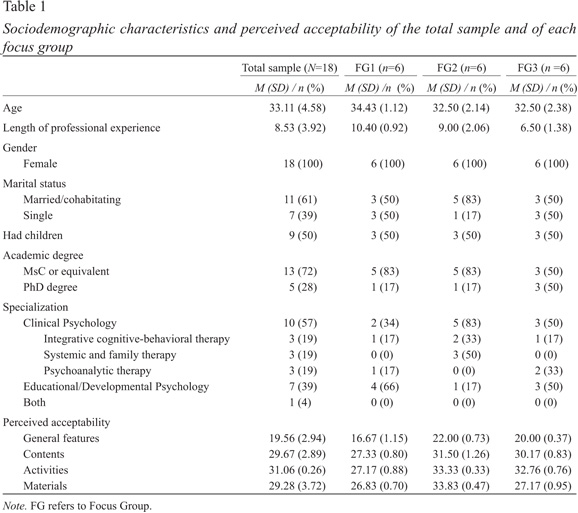
<body><![CDATA[<p>The sample consisted of 18 psychologists. For inclusion criteria, psychologists were required to be specialized in Clinical or  Educational/Developmental Psychology, have experience in working with children, and be able to speak and understand Portuguese.  <a href="#t1">Table 1</a> presents the sociodemographic characteristics of the participants. All participants were female and most of them held  an MsC or equivalent (i.e., had five years of college education) and were specialized in Clinical Psychology.</p>     <p>&nbsp;</p>     <p><a name="t1"></a></p>     <p><img src="/img/revistas/aps/v37n3/37n3a09t1.jpg" width="578" height="513"></p>     
<p>&nbsp;</p>     <p>Three groups, composed of six participants each, were constituted. Each group was constituted considering: (1) the availability of the  participants to attend the discussion; (2) the length of their professional experience to minimize the possibility that less experienced  participants felt intimidated of exposing their perspectives in front of more experienced participants; and (3) the proportion of participants  who worked together, to control the influence of the familiarity between participants and ensure group heterogeneity.</p>     <p>&nbsp;</p>     <p><i>Instruments</i></p>     <p>&nbsp;</p>     <p><i>Sociodemographic Questionnaire:</i> This questionnaire collected information about the sociodemographic characteristics of the  participants.</p>     ]]></body>
<body><![CDATA[<p>&nbsp;</p>     <p><i>Semi-Structured Interview Guide:</i> The interview guide was structured, following the recommendations of Krueger and Casey (2014). After  introducing focus groups objectives and procedures, participants were asked to introduce themselves and to define how they understood BI/AW  during early childhood (introductory question). Then, participants were questioned about the kind of interventions that can be helpful for  inhibited young children (transition question), before being invited to respond to key questions aimed at evaluating the acceptability of the  child component of the <i>Turtle Program</i>. Based on a written booklet that provided a brief summary about the intervention and its targeted  group, participants began to discuss their first impressions about the objectives, format and structure of the child component of the <i>Turtle  Program</i> and appraised its contents, activities and materials. At the end of the discussion, participants were asked to summarize what they  felt were the strengths of the intervention and the anticipated difficulties in its implementation in Portugal, and were given the opportunity to  make final comments.</p>     <p>&nbsp;</p>     <p><i>Perceived Acceptability Questionnaire:</i> A 25-items questionnaire was developed to assess the perceived acceptability of Portuguese  psychologists about the child component of the <i>Turtle Program</i>, based on four dimensions: General Features (e.g., objectives, format,  structure; 5 items), Contents (7 items), Activities (7 items), and Materials (7 items). Participants were asked to answer each of the presented  statements, using a Likert scale ranging from 1 &ndash; <i>Not Adequate at All</i> to 5 &ndash; <i>Extremely Adequate</i>. Higher mean values in  each dimension indicate a higher perceived acceptability. Cronbach&rsquo;s alfas ranged from .64 (Contents) to .79 (General Features).</p>     <p>&nbsp;</p>     <p><i>Procedures</i></p>     <p>This study is part of a larger research project, approved by the [Guedes et al., 2019] Ethics Committee. Psychologists from the contact  networks of the research group who met the inclusion criteria were initially contacted and informed about the study objectives and procedures.  Psychologists who agreed to participate signed an informed consent and completed a sociodemographic questionnaire. The focus groups were  scheduled, in accordance with the availability of the participants.</p>     <p>Each focus group lasted approximately two hours and was conducted by a trained moderator, in a quiet and comfortable location to ensure  confidentiality. After reviewing the study objectives and procedures, the moderator ensured that all the participants agreed to allow the group  discussion to be audio recorded. Then, the moderator conducted the discussion, using the semi-structured interview guide. At the end of the  discussion, participants were asked to complete a self-report questionnaire to assess their perceptions of acceptability about the intervention  program for triangulation purposes.</p>     <p>&nbsp;</p>     <p><i>Data analysis</i></p>     ]]></body>
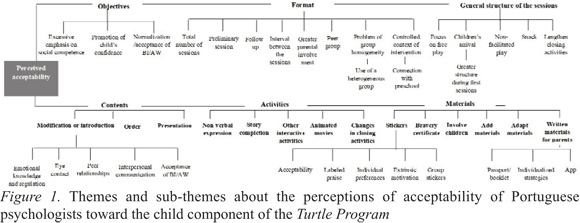
<body><![CDATA[<p>Qualitative data analysis was based on a continuous process of data collection, reduction, display and verification (Huberman &amp; Miles,  1994). Each focus group was transcribed verbatim. Fictional names were used for confidentiality purposes. Data were analyzed, using QSR NVivo Pro  12. Following an existentialist/realistic epistemological approach, a deductive thematic analysis was conducted to identify, analyze and report  patterns (themes) within data (Braun &amp;</p>     <p>&nbsp;</p>     <p><b>Results</b></p>     <p><a href="#t1">Table 1</a> presents the means and standard deviations of the perceived acceptability of the general features, contents,  activities and materials of the child component of the <i>Turtle Program</i> in each focus group. Globally, Focus Group 1 (FG1) perceived the  general features, contents, activities and materials of the child component of the <i>Turtle Program</i> as moderately to highly adequate,  whereas Focus Group 2 (FG2) and Focus Group 3 (FG3) globally perceived them as highly to extremely adequate.</p>     <p><a href="#f1">Figure 1</a> summarizes the themes and sub-themes that emerged from the thematic deductive analysis.</p>     <p>&nbsp;</p>     <p><a name="f1"></a></p>     <p><img src="/img/revistas/aps/v37n3/37n3a09f1.jpg" width="580" height="223"></p>     
<p>&nbsp;</p>     <p>&nbsp;</p>     ]]></body>
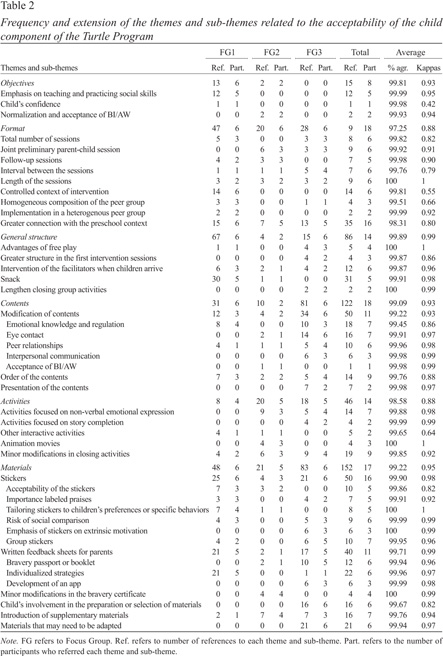
<body><![CDATA[<p><i>Objectives</i></p>     <p>The three focus groups perceived the intervention objectives as globally acceptable. However, <a href="#t2">Table 2</a> shows that most  participants from FG1 discussed the main <i>focus on teaching and practicing social skills</i>, because inhibited preschoolers often hold  appropriate social skills, but can be afraid to use them in social situations. FG1 suggested that the intervention may promote more directly  <i>child&rsquo;s self-confidence</i>, whereas FG2 recommended an objective focused on the <i>normalization and acceptance of BI/AW</i>. Isabelle  explained:</p>     <p>&nbsp;</p>     <p><a name="t2"></a></p>     <p><img src="/img/revistas/aps/v37n3/37n3a09t2.jpg" width="443" height="657"></p>     
<p>&nbsp;</p>     <p>&nbsp;</p>     <p><i>&ldquo;The advantage of a group format is the promotion of a sense of support. This can be very important for inhibited children (...). If  children understand that there are other children with the same difficulties, this can be helpful to normalize these difficulties. This could be  also the objective of the intervention: enhance the awareness that it is not so bad to be more inhibited.&rdquo;</i></p>     <p>&nbsp;</p>     <p><i>Format</i></p>     ]]></body>
<body><![CDATA[<p>Although FG1 was unsure about the adequacy of the <i>total number of sessions,</i> FG3 recommended a greater number of sessions to consolidate  the learned skills and promote their generalization to naturalistic contexts. In particular, FG2 and FG3 discussed the introduction of a <i>joint  preliminary parent-child session</i>, so that children can become familiar with the playroom, the facilitators and the peers. FG2 was more  specific and suggested possible formats for a preliminary session, such as: an individual session with each family; a welcoming party; or a  storytelling to prepare children for the transition to a novel situation.</p>     <p>Furthermore, FG1 and FG2 discussed the introduction of <i>follow-up sessions</i> to monitor the practice and generalization of the learned  skills. Alternatively, some participants from FG2 and FG3 suggested a <i>greater time interval</i> (bi-weekly) between the sessions to give more  time to families to practice the learned skills in naturalistic contexts. However, other participants from FG1 and FG3 agreed that weekly  sessions would be a more appropriate time interval for preschool children.</p>     <p>Some participants from FG2 and FG3 were concerned about the <i>length of the sessions</i>, especially at the beginning of the intervention  program. Heather explained:</p>     <p>&nbsp;</p>     <p><i>&ldquo;It would be important to start with shorter sessions and to gradually lengthen them over the eight weeks (...) Because it is  possible that inhibited children don&rsquo;t adhere to free play activities at the beginning of the intervention program.&rdquo;</i></p>     <p>Conversely, other participants from FG1 and FG3 argued that the predominance of free play activities would ensure the adequacy of the length  of the sessions.</p>     <p>The <i>controlled context of the intervention</i> and the <i>homogeneous composition of the peer group</i> were a major focus in FG1.  Participants anticipated that the practice of social skills in a clinical setting with a group of inhibited peers may not prepare children for  social interactions at preschool. To overcome anticipated difficulties, FG1 recommended the implementation of the intervention in a clinical  setting with a <i>heterogeneous peer group</i> (i.e., inhibited and non-inhibited children). Alternatively, all groups recommended a <i>greater  connection with the preschool context</i> to ensure that children continue to practice the learned skills in naturalistic contexts. Claire  explained:</p>     <p>&nbsp;</p>     <p><i>&ldquo;During the preschool years, we know that the learning experiences take place in naturalistic contexts. This doesn&rsquo;t invalidate  the importance of the intervention program to promote learning experiences in a secure context (...) But if there is a continuity between the  intervention program and the daily interactions with the child, the probability of success is substantially higher.&rdquo;</i></p>     <p>More specifically, FG1 and FG2 recommended to implement later and follow-up sessions at preschool or to develop an intervention component  targeted at preschool teachers. If not possible, all groups suggested alternative formats, such as: sharing interactive materials or activities  with preschool teachers; organizing workshops and regular meetings with preschool teachers to enhance the reinforcement of the learned skills; or  involving preschool teachers in the practice of home experiences.</p>     ]]></body>
<body><![CDATA[<p>&nbsp;</p>     <p><i>General structure</i></p>     <p>The <i>focus on</i> the advantages of <i>free play</i> for the intervention with preschool children was a major topic of discussion in FG3.  However, FG3 acknowledged that alternative activities with a <i>greater structure</i> may be needed during the first sessions, if inhibited  children did not adhere to free play. All groups also discussed the <i>intervention of the facilitators when children arrive</i>. In particular,  participants anticipated that the facilitators may need to guide the exploration behaviors of inhibited children during the first sessions and,  then, to gradually promote child&rsquo;s autonomy. Charlotte stated:</p>     <p>&nbsp;</p>     <p><i>&ldquo;When children arrive, exploring the playroom autonomously can be a blocking mechanism for inhibited children &ndash; it is an  unfamiliar situation, with unfamiliar adults and peers. I would recommend to adapt the intervention of the facilitators when children arrive  during the first weeks (...) Developing a trustful relationship with children is an important task. Without it, we will not be able to practice  anything with children.&rdquo;</i></p>     <p>The <i>snack</i> was a major focus of discussion in FG1. Due to the cultural relevance of meals, some participants from FG1 agreed that snack  time is a natural and important opportunity to model and promote social interactions. However, other participants suggested a greater focus on  non-verbal skills (e.g., observing or sharing) to model the balance between social conversation and silence during mealtimes. FG2 acknowledged  that moving snack time to the end of the session can contribute to promote a more continuous involvement of children in free play activities.</p>     <p>FG3 recommended to <i>lengthen the closing group activities</i> (such as parachute or duck-duck-goose), because these activities are typically  appreciated by children and may allow them to relax, after the exposure to challenging social interactions.</p>     <p>&nbsp;</p>     <p><i>Contents</i></p>     <p>With respect to the <i>modification of intervention contents</i>, FG1 and FG3 suggested a <i>greater focus on emotional knowledge and  regulation</i>. FG1 recommended a greater emphasis on the protective function of fear, on its manifestations in social contexts and on  alternative emotion-regulation strategies (instead of balloon breathing) that can be more tailored to the needs of Portuguese children. Beyond  the identification of facial expressions, FG3 suggested a greater emphasis on the behavioral cues related to different emotions, on individual  differences in emotional expression and on more advanced tasks related to emotion recognition and understanding. Relatedly, FG2 emphasized the  promotion of <i>child&rsquo;s acceptance toward BI/AW</i> to strengthen child&rsquo;s self-confidence.</p>     ]]></body>
<body><![CDATA[<p><i>Establishing eye contact</i> was a major topic of discussion in FG3. Participants agreed that eye contact can be invasive and anticipated  that the explanation provided during circle time (i.e., people might think that you are unfriendly or don&rsquo;t like them if you don&rsquo;t  look at them) can be blaming for children. To overcome anticipated difficulties, some participants considered that eye contact can be naturally  practiced during free play, instead of being focused on a single session. Alternatively, other participants recommended to normalize the  discomfort related to eye contact during circle time and to gradually practice it. Sabrina explained:</p>     <p>&nbsp;</p>     <p><i>&ldquo;I think it will be useful to normalize the discomfort related to eye contact &ndash; when we don&rsquo;t know people very well, it  is normal that we feel it is difficult to look at them and eye contact is more difficult for some people than others. The importance of eye  contact needs to be explained: it is more evident that we are interested in what people are saying when we look at them (...) And it can be  helpful to give children alternative strategies, like establishing intermittent eye contact or looking at one point of other&rsquo;s face instead  of looking directly to his/her eyes.&rdquo;</i></p>     <p>All groups recommended a greater focus on <i>peer relationships</i>. FG3 discussed the introduction of contents related to peers, group  pressure and peer exclusion to discuss daily negative peer situations, explore how children felt and how these situations can be solved in an  alternative way. FG1 and FG2 suggested to normalize the changeability of play preferences during the sixth session (e.g., playing alone, with  peers or adults) and to provide psychoeducation on the concept of friendship during the third session.</p>     <p><i>Interpersonal communication</i> was a major topic of discussion in FG3. Participants suggested focusing on active hearing (e.g., showing  interest, or asking questions) to enhance the communication with friends and on assertiveness to deal with negative peer reactions in  naturalistic contexts. Sabrina explained:</p>     <p>&nbsp;</p>     <p><i>&ldquo;A structured session on assertiveness can be important, because inhibited children may have experienced negative social interactions  and may become aware that they are not alone, that others have some similar situations and understand what they are able to do in these  situations (...) It is important to focus on challenging social situations that happen in naturalistic contexts.&rdquo;</i></p>     <p>With respect to the <i>order of the intervention contents</i>, FG2 and FG3 considered that the introduction of the concept of friendship in  the third session can be premature. FG1 recommended a first session focused on emotional expression and regulation (with a particular emphasis on  social anxiety) and considered that establishing eye contact and showing interest (session 2) precedes asking to play (session 1) in the  hierarchy of social fears. However, FG2 and FG3 anticipated that eye contact would be too invasive for the second session.</p>     <p>With respect to the <i>presentation of the intervention contents</i>, FG3 anticipated that some explanations about peer reactions to  child&rsquo;s behaviors may need to be reviewed (e.g., sharing emotions or dealing with peer rejection) to prepare children for challenging  social interactions and enhance their cognitive flexibility in naturalistic contexts.</p>     <p>&nbsp;</p>     ]]></body>
<body><![CDATA[<p><i>Activities</i></p>     <p>The <i>introduction of activities focused on non-verbal emotional expression</i> (e.g., drawing, body expression, or emotion labeling, using  images) was a major topic of discussion in FG2. These activities would be useful to convey the idea that the characteristics of inhibited  children are respected and valued. Claire explained:</p>     <p>&nbsp;</p>     <p><i>&ldquo;We want to promote the adaptation of the child to the challenges of the context, to promote social interaction. But we also want to  respect the characteristics of the child (...) The intervention program needs to create opportunities for the child to feel accepted, as he/she  chooses to express himself/herself, to feel that his/her opinion is valued. If he/she feels valued, the child will have the courage to try new  forms of emotional expression (...) that implies verbal communication.&rdquo;</i></p>     <p>Due to the acceptability of puppets among young children, FG3 recommended the <i>introduction of activities focused on story completion</i> . Charlotte explained:</p>     <p>&nbsp;</p>     <p><i>&ldquo;During the sessions on emotionally demanding contents, puppets could be used to simulate situations &ndash; for example, two  children who refuse to play with another child; then, we could ask children what they think that the child who was rejected by peers should do  (...). We could ask them to discover the end of the story (...). I believe that this can be tricky during the first sessions but introducing  gradually story completion (...) may be interesting.&rdquo;</i></p>     <p>FG1 and FG2 suggested <i>other interactive activities</i> to explain the contents related to emotion-regulation (going inside a shell to calm  down) or introducing oneself (remembering the names of each other&rsquo;s). The <i>use of animation movies</i> was recommended in FG2 to explain  the contents related to emotion expression and promote the identification of their body signs.</p>     <p>All groups suggested <i>minor modifications in closing activities</i>, such as introducing culturally-relevant games, changing the name of the  graduation party (e.g., bravery or turtle party), or including a relaxation ritual at the end of the sessions.</p>     <p>&nbsp;</p>     ]]></body>
<body><![CDATA[<p><i>Materials</i></p>     <p>FG1 and FG2 agreed with the <i>acceptability of stickers</i>, which are typically appreciated by young children. The two groups emphasized the  importance of <i>combining stickers with labeled praises</i> and <i>tailoring</i> them <i>to children&rsquo;s preferences or specific social  behaviors</i> to enhance their significance for children and minimize the <i>risk of social comparison</i>. Conversely, FG3 acknowledged the  efficacy of material reinforcement, but criticized its <i>emphasis on short-term extrinsic motivation</i>. Furthermore, FG3 was also concerned  with the <i>risk of social comparison</i> and anticipated its negative impact for inhibited children. For example, Rachel stated:</p>     <p>&nbsp;</p>     <p><i>&ldquo;I am a little bit worried that stickers may have a pervasive effect with inhibited children. Because there is a great pressure in  everything they do: they may think &ndash; I am here and I&rsquo;m not even able to receive a sticker. And the negative social comparison may  become more important for the child than the focus on what he/she is able to do.&rdquo;</i></p>     <p>FG3 agreed with that <i>labeled praise</i> for child&rsquo;s effort to approach social situations would be sufficient or suggested the  <i>introduction of a group sticker</i> for achieving common objectives or completing cooperative tasks. Charlotte explained:</p>     <p>&nbsp;</p>     <p><i>&ldquo;I like the idea that the group of children may receive a sticker (...). One of the developmental tasks during the preschool years is  the belonging to a group, for the first time (...) We may reinforce this sense of group belonging.&rdquo;</i></p>     <p>Instead of written feedback sheets for parents, FG2 and FG3 recommended the <i>development of a bravery passport or booklet</i>. This format  would allow a better understanding of child&rsquo;s progress and foster child&rsquo;s self-confidence. Audrey stated:</p>     <p>&nbsp;</p>     <p><i>&ldquo;We often use a passport. In this passport, children receive a stamp for their participation in each session (...) Then, we write  some feedback for parents (...) This passport may be important, so that children have something to show about their participation (...) and  foster their self-esteem&rdquo;.</i></p>     ]]></body>
<body><![CDATA[<p>Similarly, FG2 suggested <i>minor modifications in the bravery certificate</i>, such as the inclusion of a specific labeled praise or  child&rsquo;s individual strength in a group photography. In addition to written sheets, FG1 recommended the <i>use of individualized  strategies</i> to provide feedback to parents and encourage parent-child communication about the intervention program, such as a brief  conversation at the end of each session, a weekly telephone call, or an e-mail tailored to the specific needs of each family. These strategies  could be especially useful for families from low socioeconomic statuses. FG3 also discussed the <i>development of an app</i>, but some  participants anticipated difficulties related to conflicting parental views toward children&rsquo;s access to electronic devices.</p>     <p>FG3 recommended a <i>greater involvement of children in the preparation and selection of the materials</i> (e.g., drawing the playroom or  constructing their own puppets with parents). This would be helpful for inhibited children to feel more secure when exposed to unfamiliar  situations and activities during the first intervention sessions. Furthermore, all groups discussed <i>supplementary materials</i>, such as  books, family and superhero figures, rule games, or materials that can help children to remember the bravery story (fourth session). FG3  anticipated that <i>some materials may need to be adapted</i> (e.g., preschool calendar) to target the preferences of Portuguese children.</p>     <p>&nbsp;</p>     <p><b>Discussion</b></p>     <p>This focus group study extends prior research on the perceptions of Portuguese mental health practitioners about the parent component of the  <i>Turtle Program</i> (Guedes et al., 2019). Thus, the aim of the present study was to examine the perceptions of psychologists about the child  component of the <i>Turtle Program</i>, as a first step before its dissemination in Portugal. Overall, our findings show that psychologists also  perceived the intervention objectives, structure and contents of the child component of the <i>Turtle Program</i> as globally acceptable for the  Portuguese culture. Participants recommended only minor modifications to enhance children&rsquo;s acceptance toward BI/AW and positive  self-perceptions, give more time to children, strengthen the connection with the preschool context, broaden the focus on contents related to  emotional expressiveness and social interaction, and introduce other creative or dramatic play activities and materials.</p>     <p>With respect to the objectives, our findings reveal that Portuguese psychologists seem to be aware of the limitations related to social skills  training. In fact, the perspectives of practitioners are consistent with the idea that social skills training may not be necessary or sufficient  for all inhibited children, because these children are often able to behave in a socially competent way, but anxiety prevents them from  displaying proficient social behaviors (Greco &amp; Morris, 2001). According our theoretical framework (Rubin et al., 2009), participants  acknowledge that it is important to intervene on child&rsquo;s self-perceptions that can be negatively affected by the recognition of  child&rsquo;s less proficient social behaviors. Consistent with the recent integration of experiential approaches in interventions targeting  child anxiety (Barrett et al., 2014), participants recommended to combine social skills training and gradual exposure with the promotion of  child&rsquo;s emotional acceptance toward BI/AW. The suggestion to introduce acceptance-based intervention objectives and contents is also in  line with the idea that normalizing anxiety-related problems can be particularly relevant among LatinX populations to reduce the stigma related  to mental health issues (Pina et al., 2009).</p>     <p>In line with prior evidence on the perceived acceptability of the parent component of the <i>Turtle Program</i> in Portugal (Guedes et al.,  2019), Portuguese psychologists recommended the introduction of preliminary, additional and/or follow-up sessions or the enlargement of the time  interval between the sessions. This is consistent with the idea that practitioners typically value the importance of giving more time to LatinX  populations (Pina et al., 2009) for building rapport and personal discussion. The nature of children&rsquo;s difficulties focused on the  intervention program may have also influenced the findings. In fact, inhibited children typically display an increased emotional and  physiological reactivity when exposed to unfamiliar persons, situations and activities (Fox et al., 2005) and can benefit from the gradual  exposure to the feared situations (Chronis-Tuscano et al., 2015). The joint parent-child preliminary contact with the facilitators and the  gradual lengthening of the sessions over time can be helpful to build rapport and minimize child&rsquo;s discomfort when exposed to the novel  intervention context. With respect to the extension of the intervention sessions over time, the perspectives of Portuguese practitioners seem to  support the idea that booster sessions or training review sessions are important to enhance the generalization in naturalistic contexts (Greco  &amp; Morris, 2001).</p>     <p>More specifically, participants discussed the connection of the intervention with the preschool context. The higher representation of  developmental psychologists, who work in normative school contexts, may explain why the concerns related to the ecological validity of the  controlled intervention context and homogeneous peer group were more apparent in the first focus group. In line with previously identified  drawbacks in peer-mediated approaches targeted at social skills training (Greco &amp; Morris, 2001), participants anticipated that inhibited  preschoolers may experience difficulties in applying the learned skills at preschool and may be underprepared to cope with the negative reactions  of non-inhibited peers. The concerns related to the generalization of the intervention effects to the preschool context may be particularly  relevant in the Portuguese culture. In fact, Portugal is one of the Organisation for Economic Co-operation and Development [OECD] countries,  where young children spend more hours in early childhood care and education services, due to the high rate of full-time labor market  participation among mothers of children under five (OECD, 2016). Given that preschool is a major ecological context of development  (Bronfenbrenner &amp; Morris, 2006), the perspectives of Portuguese practitioners are in line with prior recommendations aimed at practicing  newly learned social skills in naturalistic settings (Greco &amp; Morris, 2001), such as introducing follow-up sessions at preschool, sharing  intervention activities and materials with preschool teachers, or prescribing home experiences. These findings support the idea that inhibited  children may be placed in a healthier developmental trajectory, when teacher-child relationships are positive, closer and less dependable (Sette,  Baumgartner, &amp; Schneider, 2014).</p>     <p>With respect to the structure of the intervention sessions, the views of Portuguese psychologists seem to support that play-oriented  techniques are transculturally relevant, especially for young children (Barrett et al., 2014). More specifically, participants acknowledged the  advantages of free play for child interest and tolerance toward session length. In fact, the principles of child-centered play have been found to  be consonant with LatinX preferences for person-centered, present-focused and spontaneous approaches that cultivate nurturing and proximal  interpersonal relationships (Garza &amp; Bratton, 2005). In spite of the advantages of free play, Portuguese psychologists anticipated that group  facilitators may need to assume a more active intervention (i.e., guide children to explore the playroom, or suggest play activities), when  children arrive during the first sessions. These perspectives are in line with the previously discussed findings, suggesting that inhibited  children need to be given more time to adapt to the novel intervention context. This may be especially important in LatinX cultures that are  typically less oriented toward the socialization of independence and encouragement of autonomy than North American cultures (Rubin, Oh, Menzer,  &amp; Ellison, 2011).</p>     <p>The introduction of snack time in the structure of the sessions was a major topic of discussion in the first focus group. The high proportion  of developmental psychologists working in schools may explain their interest on this topic in this group. In fact, mealtimes and other daily  routines at preschool have been increasingly recognized as central to promote rich interactions, build relationships and engage in social  conversations (Hallam, Fouts, Bargreen, &amp; Perkins, 2016). However, half of the participants recommended to build intervention opportunities  during snack time in a sensitive way, giving time to children to know each other and communicate non-verbally during the first sessions. This is  consistent with prior evidence, suggesting that non-verbal forms of social and affective communication (e.g., human touch) are frequently more  valued than verbal ones in the Portuguese context (Guedes et al., 2019). The perspectives of Portuguese practitioners also support the idea that  establishing eye contact to be brave can generate discomfort and need to be adapted in some cultural contexts (Barrett et al., 2014; Sonderreger  &amp; Barrett, 2004), using more natural and gradual practice approaches.</p>     ]]></body>
<body><![CDATA[<p>The balance between verbal and non-verbal forms of social communication was also discussed, when focusing on the acceptability of the  intervention activities and materials. In line with the idea that intervention programs need to build upon child&rsquo;s strengths (Barrett et  al., 2014), participants encouraged the introduction of artistic, body expression and dramatic play activities and materials to convey a sense of  acceptance toward BI/AW. Our findings also support that minor culturally-sensitive modifications are often needed in the way how intervention is  presented (Pina et al., 2009; Sonderreger &amp; Barrett, 2004) through the inclusion of activities, games and materials that are common in the  Portuguese context. The introduction of animation videos for psychoeducational purposes is consistent with prior recommendations to target the  preferences of LatinX and Southern European families (Guedes et al., 2019).</p>     <p>The greater emphasis on emotional knowledge and regulation was apparent in the perspectives of Portuguese psychologists, when discussing the  intervention contents and the introduction of relaxation activities at the end of the intervention sessions. This is in line with the recent  advances toward a transdiagnostic approach (Chronis-Tuscano et al., 2018) and with the salience of emotional expressiveness in Southern European  cultures (Casiglia, loCoco, &amp; Zappulla, 1998). More specifically, participants recommended to begin the intervention program with a broader  focus on emotion knowledge (e.g., connecting emotions to facial, body and behavioural cues, emotion identification, recognition and  understanding), with a particular emphasis on social anxiety. These recommendations are in line with the order and type of contents focused on  the FRIENDS intervention program (Barrett et al., 2014), which is currently available in Portugal for school-aged children (Pereira et al.,  2014). With respect to emotion regulation, participants anticipated the need to go beyond belly breathing training. The questionable efficacy of  relaxation training for young children (Comer, Hong, Poznanski, Silva, &amp; Wilson, 2019) and the recent integration of broader experiential  approaches (e.g., positive attention and awareness training) in evidence-based interventions targeted at child anxiety (Barrett et al., 2014) may  explain these findings.</p>     <p>In line with the salience of sociability in LatinX Southern European cultures, in general (Casiglia et al., 1998) and Portugal, in particular  (European Commission, 2012), participants suggested a broader focus on contents related to social interactions. Given that preschool is a major  ecological context of development (Bronfenbrenner &amp; Morris, 2006) for young children in Portugal (OECD, 2016), psychologists emphasized the  need to present these contents in a realistic manner, so that children can be prepared to cope with daily social interactions with non-inhibited  children in their naturalistic contexts. More specifically, participants anticipated that it would be useful to provide psychoeducation on the  typical peer group responses toward inhibited behaviors and to promote a realistic perspective about high-quality friendships. In fact, prior  evidence has shown that inhibited children are more likely to be perceived by peers as &ldquo;easy targets&rdquo; for victimization and to be  excluded from the peer group (Rubin et al., 2018). Within a developmental and transactional approach (Rubin et al., 2009), the development of  stable and high-quality friendships can protect inhibited children against unhealthy developmental trajectories. In addition, Portuguese  psychologists also recommended the practice of assertiveness and active-hearing skills, like in the FRIENDS program (Pereira et al., 2014). This  is consistent with the idea that inhibited children typically assume a passive, avoidant and submissive attitude toward peers that can contribute  to maintain the negative transactional cycle and increase the risk of later peer difficulties (Rubin et al., 2009).</p>     <p>With respect to the intervention materials, Portuguese psychologists were somewhat reticent toward the use of material reinforcement (i.e.,  stickers) during the intervention sessions. Prior research has also found that practitioners acknowledged that the use of tangible rewards is  relatively uncommon in the Portuguese culture (Guedes et al., 2019). Furthermore, inhibited children are more likely to think and feel poorly  about themselves when comparing themselves with their peers (Rubin et al., 2018). This may explain why Portuguese psychologists anticipated that  the use of stickers may increase the risk of negative social comparison between inhibited children, even though ensuring that all children  received some stickers based on their individual achievements. To overcome anticipated difficulties, the third focus group suggested the  exclusive use of labeled praise and, if needed, the introduction of group stickers. The suggestion to focus on collectivist achievements may  reflect the salience of values related to solidarity, equality and support to others in Portugal when compared with the European mean (European  Commission, 2012). Alternatively, the first and the second focus groups recommended to tailor stickers to children&rsquo;s specific preferences  or social achievements. These findings are consistent with prior research conducted with LatinX populations, showing the importance of tailoring  the intervention to child&rsquo;s individual needs (Pina et al., 2019). This was also apparent, when discussing the involvement of children in  the design of the playroom and the development of a bravery certificate targeted at each child&rsquo;s strengths.</p>     <p>Our findings also support the need to be mindful toward the use of written handouts for Portuguese parents and to assess literacy as a  potential barrier to adhere to this type of materials (Guedes et al., 2019). This may explain why Portuguese psychologists suggested the use of  more interactive written formats (e.g., bravery booklet or passport) that can enhance the awareness of children&rsquo;s progresses. More  experienced Portuguese psychologists suggested the use of interpersonal strategies (i.e., individualized e-mail or telephone call) to provide  feedback to parents. These interpersonal strategies were also reported as relevant strategies to enhance treatment engagement in prior research  conducted with LatinX families living in the USA (Huey &amp; Polo, 2010).</p>     <p>To the best of our knowledge, this is the first study that explored the perceptions of Portuguese psychologists about the acceptability of a  child intervention targeted at BI/AW during early childhood. However, some limitations need to be acknowledged. The sample only consisted of  female psychologists, who typically display more favourable attitudes toward manualized evidence-based interventions. The group format and the  familiarity of the moderator with some participants and between some participants may have contributed to the desirability or inhibition of some  responses. Given the purpose of the present study, we conducted a thematic analysis based on a descriptive approach (Braun &amp; Clarke, 2006)  and we did not analyse group interactions. The triangulation with other methods was limited to a self-report questionnaire, developed by the  research team. Despite their consistency with qualitative findings, individual responses to the questionnaire may have been influenced by the  timing of assessment (i.e., at the end of the group discussion).</p>     <p>Future studies need to overcome these limitations and to explore the perspectives of practitioners about the acceptability of the child  component of the <i>Turtle Program</i> in other Southern European countries. Furthermore, the perspectives of families about the intervention  program need to be collected and compared with those of practitioners. This can inform tailoring needed for implementing child intervention  targeted at BI/AW during early childhood in Southern European cultures.</p>     <p>&nbsp;</p>     <p><b>References</b></p>     <!-- ref --><p>Attili, G., Vermigli, P., &amp; Schneider, B. H. (1997). Peer acceptance and friendship patterns among Italian children within a  cross-cultural perspective. <i>International Journal of Behavioral Development, 21</i>, 277-288. Retrieved from  <a href="http://dx.doi.org/10.1080/016502597384866" target="_blank">http://dx.doi.org/10.1080/016502597384866</a>&nbsp;&nbsp;&nbsp;&nbsp;&nbsp;&nbsp;&nbsp;&nbsp;[&#160;<a href="javascript:void(0);" onclick="javascript: window.open('/scielo.php?script=sci_nlinks&ref=049804&pid=S0870-8231201900030000900001&lng=','','width=640,height=500,resizable=yes,scrollbars=1,menubar=yes,');">Links</a>&#160;]<!-- end-ref --><!-- ref --><p>Barrera, M., Castro, F. G., Strycker, L. A., &amp; Tooberg, D. J. (2013). Cultural adaptations of behavioral health interventions: A progress  report<i>. Journal of Clinical and Consulting Psychology, 81</i>, 196-205. Retrieved from  <a href="http://dx.doi.org/10.1037/a0027085" target="_blank">http://dx.doi.org/10.1037/a0027085</a>&nbsp;&nbsp;&nbsp;&nbsp;&nbsp;&nbsp;&nbsp;&nbsp;[&#160;<a href="javascript:void(0);" onclick="javascript: window.open('/scielo.php?script=sci_nlinks&ref=049805&pid=S0870-8231201900030000900002&lng=','','width=640,height=500,resizable=yes,scrollbars=1,menubar=yes,');">Links</a>&#160;]<!-- end-ref --><!-- ref --><p>Barrett, P. M., Cooper, M., &amp; Guarjado, J. G. (2014). Using the FRIENDS Programs to promote resilience in cross-cultural populations. In  S. Prince-Embury &amp; D. Saklofske (Eds.), <i>Resilience interventions for youth in diverse populations</i> (pp. 85-108). New York: Springer.    &nbsp;&nbsp;&nbsp;&nbsp;&nbsp;&nbsp;&nbsp;&nbsp;[&#160;<a href="javascript:void(0);" onclick="javascript: window.open('/scielo.php?script=sci_nlinks&ref=049806&pid=S0870-8231201900030000900003&lng=','','width=640,height=500,resizable=yes,scrollbars=1,menubar=yes,');">Links</a>&#160;]<!-- end-ref --></p>     <p>Barstead, M., Danko, C., Chronis-Tuscano, A., O&rsquo;Brien, K., Coplan, R., &amp; Rubin, K. H. (2018). Generalization of an early  intervention for inhibited preschoolers to the classroom setting. <i>Journal of Child and Family Studies, 27</i>, 2943-2953. Retrieved from  <a href="https://doi.org/10.1007/s10826-018-1142-0" target="_blank">https://doi.org/10.1007/s10826-018-1142-0</a></p>     <!-- ref --><p>Braun, V., &amp; Clarke, V. (2006). Using thematic analysis in psychology. <i>Qualitative Research in Psychology, 3</i>, 77-101. Retrieved from  <a href="http://dx.doi.org/10.1191/1478088706qp063oa" target="_blank">http://dx.doi.org/10.1191/1478088706qp063oa</a>&nbsp;&nbsp;&nbsp;&nbsp;&nbsp;&nbsp;&nbsp;&nbsp;[&#160;<a href="javascript:void(0);" onclick="javascript: window.open('/scielo.php?script=sci_nlinks&ref=049809&pid=S0870-8231201900030000900005&lng=','','width=640,height=500,resizable=yes,scrollbars=1,menubar=yes,');">Links</a>&#160;]<!-- end-ref --><!-- ref --><p>Bronfenbrenner, U., &amp; Morris, P. A. (2006). The bioecological model of human development. In R. M. Lerner &amp; W. Damon (Eds.),  <i>Handbook of child psychology: Theoretical models of human development</i> (pp. 793-828). Hoboken, NJ: John Wiley &amp; Sons Inc.    &nbsp;&nbsp;&nbsp;&nbsp;&nbsp;&nbsp;&nbsp;&nbsp;[&#160;<a href="javascript:void(0);" onclick="javascript: window.open('/scielo.php?script=sci_nlinks&ref=049810&pid=S0870-8231201900030000900006&lng=','','width=640,height=500,resizable=yes,scrollbars=1,menubar=yes,');">Links</a>&#160;]<!-- end-ref --></p>     <!-- ref --><p>Caldas-Almeida, J., &amp; Xavier, M. (2013). <i>Epidemiological national study about mental health: First report</i>. Lisboa: Faculdade de  Ci&ecirc;ncias M&eacute;dicas da Universidade de Lisboa.    &nbsp;&nbsp;&nbsp;&nbsp;&nbsp;&nbsp;&nbsp;&nbsp;[&#160;<a href="javascript:void(0);" onclick="javascript: window.open('/scielo.php?script=sci_nlinks&ref=049812&pid=S0870-8231201900030000900007&lng=','','width=640,height=500,resizable=yes,scrollbars=1,menubar=yes,');">Links</a>&#160;]<!-- end-ref --></p>     <!-- ref --><p>Carter, S. L. (2008). A distributive model of treatment acceptability. <i>Education and Training in Developmental Disabilities, 43</i>,  411-420. Retrieved from <a href="http://www.jstor.org/stable/23879672" target="_blank">http://www.jstor.org/stable/23879672</a>&nbsp;&nbsp;&nbsp;&nbsp;&nbsp;&nbsp;&nbsp;&nbsp;[&#160;<a href="javascript:void(0);" onclick="javascript: window.open('/scielo.php?script=sci_nlinks&ref=049814&pid=S0870-8231201900030000900008&lng=','','width=640,height=500,resizable=yes,scrollbars=1,menubar=yes,');">Links</a>&#160;]<!-- end-ref --><!-- ref --><p>Casiglia, A. C., LoCoco, A., &amp; Zappulla, C. (1998). Aspects of social reputation and peer relationships in Italian children: A  cross-cultural perspective. <i>Developmental Psychology, 34</i>, 723-730. Retrieved from <a href="http://dx.doi.org/10.1037/0012-1649.34.4.723"  target="_blank">http://dx.doi.org/10.1037/0012-1649.34.4.723</a>&nbsp;&nbsp;&nbsp;&nbsp;&nbsp;&nbsp;&nbsp;&nbsp;[&#160;<a href="javascript:void(0);" onclick="javascript: window.open('/scielo.php?script=sci_nlinks&ref=049815&pid=S0870-8231201900030000900009&lng=','','width=640,height=500,resizable=yes,scrollbars=1,menubar=yes,');">Links</a>&#160;]<!-- end-ref --><!-- ref --><p>Chase, T., &amp; Peacock, G. G. (2017). An investigation of factors that influence acceptability of parent training. <i>Journal of Child and  Family Studies, 26</i>, 1184-1195. Retrieved from <a href="http://dx.doi.org/10.1007/s10826-016-0644-x"  target="_blank">http://dx.doi.org/10.1007/s10826-016-0644-x</a>&nbsp;&nbsp;&nbsp;&nbsp;&nbsp;&nbsp;&nbsp;&nbsp;[&#160;<a href="javascript:void(0);" onclick="javascript: window.open('/scielo.php?script=sci_nlinks&ref=049816&pid=S0870-8231201900030000900010&lng=','','width=640,height=500,resizable=yes,scrollbars=1,menubar=yes,');">Links</a>&#160;]<!-- end-ref --><p>Chen, X., &amp; French, D. C. (2008). Children&rsquo;s social competence in cultural context. <i>Annual Review of Psychology, 59</i>, 591-616.  Retrieved from <a href="https://doi.org/10.1146/annurev.psych.59.103006.093606"  target="_blank">https://doi.org/10.1146/annurev.psych.59.103006.093606</a></p>     <!-- ref --><p>Chen, X., French, D. C., &amp; Schneider, B. H. (2006). Culture and peer relationships. In X. Chen, D. C. French, &amp; B. H. Schneider  (Eds.), <i>Peer relationships in cultural context</i>. New York: Cambridge University Press.    &nbsp;&nbsp;&nbsp;&nbsp;&nbsp;&nbsp;&nbsp;&nbsp;[&#160;<a href="javascript:void(0);" onclick="javascript: window.open('/scielo.php?script=sci_nlinks&ref=049818&pid=S0870-8231201900030000900012&lng=','','width=640,height=500,resizable=yes,scrollbars=1,menubar=yes,');">Links</a>&#160;]<!-- end-ref --></p>     <!-- ref --><p>Chen, X., He, Y., De Oliveira, A. M., lo Coco, A., Zappulla, C., Kaspar, V., . . . deSousa, A. (2004). Loneliness and social adaptation in  Brazilian, Canadian, Chinese and Italian children: A multi-national comparative study. <i>Journal of Child Psychology and Psychiatry, 45</i>,  1373-1384. Retrieved from <a href="https://doi.org/10.1111/j.1469-7610.2004.00329.x"  target="_blank">https://doi.org/10.1111/j.1469-7610.2004.00329.x</a>&nbsp;&nbsp;&nbsp;&nbsp;&nbsp;&nbsp;&nbsp;&nbsp;[&#160;<a href="javascript:void(0);" onclick="javascript: window.open('/scielo.php?script=sci_nlinks&ref=049820&pid=S0870-8231201900030000900013&lng=','','width=640,height=500,resizable=yes,scrollbars=1,menubar=yes,');">Links</a>&#160;]<!-- end-ref --><!-- ref --><p>Chronis-Tuscano, A., Danko, C., Rubin, K. H., Coplan, R. J., &amp; Novick, D. (2018). Future directions for research on early intervention for  young children at risk of social anxiety. <i>Journal of Clinical Child and Adolescent Psychology, 47</i>, 655-667. Retrieved from  <a href="https://doi.org/10.1080/15374416.2018.1426006" target="_blank">https://doi.org/10.1080/15374416.2018.1426006</a>&nbsp;&nbsp;&nbsp;&nbsp;&nbsp;&nbsp;&nbsp;&nbsp;[&#160;<a href="javascript:void(0);" onclick="javascript: window.open('/scielo.php?script=sci_nlinks&ref=049821&pid=S0870-8231201900030000900014&lng=','','width=640,height=500,resizable=yes,scrollbars=1,menubar=yes,');">Links</a>&#160;]<!-- end-ref --><!-- ref --><p>Chronis-Tuscano, A., Degnan, K. A., Pine, D. S., Perez-Edgar, K., Henderson, H. A., Diaz, Y., . . . Fox, N. A. (2009). Stable early maternal  report of behavioral inhibition predicts lifetime social anxiety disorder in adolescence. <i>Journal of the American Academy of Child &amp;  Adolescent Psychiatry, 48,</i> 928-935. Retrieved from <a href="https://doi.org/10.1097/CHI.0b013e3181ae09df"  target="_blank">https://doi.org/10.1097/CHI.0b013e3181ae09df</a>&nbsp;&nbsp;&nbsp;&nbsp;&nbsp;&nbsp;&nbsp;&nbsp;[&#160;<a href="javascript:void(0);" onclick="javascript: window.open('/scielo.php?script=sci_nlinks&ref=049822&pid=S0870-8231201900030000900015&lng=','','width=640,height=500,resizable=yes,scrollbars=1,menubar=yes,');">Links</a>&#160;]<!-- end-ref --><p>Chronis-Tuscano, A., Rubin, K. H., O&rsquo;Brien, K. A., Coplan, R. J., Thomas, R., Dougherty, L. R., . . . Wimsatt, M. (2015). Preliminary  evaluation of a multi-modal early intervention for inhibited preschoolers. <i>Journal of Consulting and Clinical Psychology, 83</i>, 534-540.  Retrieved from <a href="https://doi.org/10.1037/a0039043" target="_blank">https://doi.org/10.1037/a0039043</a></p>     <!-- ref --><p>Comer, J. S., Hong, N., Poznanski, B., Silva, K., &amp; Wilson, M. (2019). Evidence base update on the treatment of early childhood anxiety  and related problems. <i>Journal of Clinical Child and Adolescent Psychology, 48</i>, 1-15. Retrieved from  <a href="https://doi.org/10.1080/15374416.2018.1534208" target="_blank">https://doi.org/10.1080/15374416.2018.1534208</a>&nbsp;&nbsp;&nbsp;&nbsp;&nbsp;&nbsp;&nbsp;&nbsp;[&#160;<a href="javascript:void(0);" onclick="javascript: window.open('/scielo.php?script=sci_nlinks&ref=049824&pid=S0870-8231201900030000900017&lng=','','width=640,height=500,resizable=yes,scrollbars=1,menubar=yes,');">Links</a>&#160;]<!-- end-ref --><!-- ref --><p>Comiss&atilde;o Nacional de Promo&ccedil;&atilde;o dos Direitos e Prote&ccedil;&atilde;o de Crian&ccedil;as e Jovens. (2018). <i>Annual  evaluation report of the CPCJ activities</i>. Lisboa: Author.    &nbsp;&nbsp;&nbsp;&nbsp;&nbsp;&nbsp;&nbsp;&nbsp;[&#160;<a href="javascript:void(0);" onclick="javascript: window.open('/scielo.php?script=sci_nlinks&ref=049825&pid=S0870-8231201900030000900018&lng=','','width=640,height=500,resizable=yes,scrollbars=1,menubar=yes,');">Links</a>&#160;]<!-- end-ref --></p>     <!-- ref --><p>Coplan, R. J., Schneider, B. H., Matheson, A., &amp; Graham, A. (2010). Play skills for shy children: Development of a social facilitated play  early intervention program for extremely inhibited preschoolers. <i>Infant Child and Development, 19</i>, 223-237. Retrieved from  <a href="https://doi.org/10.1002/icd.668" target="_blank">https://doi.org/10.1002/icd.668</a>&nbsp;&nbsp;&nbsp;&nbsp;&nbsp;&nbsp;&nbsp;&nbsp;[&#160;<a href="javascript:void(0);" onclick="javascript: window.open('/scielo.php?script=sci_nlinks&ref=049827&pid=S0870-8231201900030000900019&lng=','','width=640,height=500,resizable=yes,scrollbars=1,menubar=yes,');">Links</a>&#160;]<!-- end-ref --><!-- ref --><p>Correia, J., Santos, A. J., Freitas, M., Ribeiro, O., &amp; Rubin, K. H. (2014). As rela&ccedil;&otilde;es de pares de jovens socialmente  retra&iacute;dos. <i>An&aacute;lise Psicol&oacute;gica, XXXII</i>, 467-479. Retrieved from <a href="https://doi.org/10.14417/ap.870"  target="_blank">https://doi.org/10.14417/ap.870</a>&nbsp;&nbsp;&nbsp;&nbsp;&nbsp;&nbsp;&nbsp;&nbsp;[&#160;<a href="javascript:void(0);" onclick="javascript: window.open('/scielo.php?script=sci_nlinks&ref=049828&pid=S0870-8231201900030000900020&lng=','','width=640,height=500,resizable=yes,scrollbars=1,menubar=yes,');">Links</a>&#160;]<!-- end-ref --><p>Danko, C. M., O&rsquo;Brien, K. A., Rubin, K. H., &amp; Chronis-Tuscano, A. (2018). The Turtle Program: PCIT for young children displaying  behavioral inhibition. In L. N. Niec (Ed.), <i>Handbook of parent-child interaction therapy: Innovations and applications for research and  practice</i> (pp. 85-98). New York: Springer. Retrieved from <a href="https://link.springer.com/chapter/10.1007/978-3-319-97698-3_6"  target="_blank">https://link.springer.com/chapter/10.1007/978-3-319-97698-3_6</a></p>     <!-- ref --><p>European Commission. (2012). <i>The values of European</i>. Brussels: Author.    &nbsp;&nbsp;&nbsp;&nbsp;&nbsp;&nbsp;&nbsp;&nbsp;[&#160;<a href="javascript:void(0);" onclick="javascript: window.open('/scielo.php?script=sci_nlinks&ref=049830&pid=S0870-8231201900030000900022&lng=','','width=640,height=500,resizable=yes,scrollbars=1,menubar=yes,');">Links</a>&#160;]<!-- end-ref --></p>     <!-- ref --><p>Eyberg, S. M., Nelson, M. M., &amp; Boggs, S. R. (2008). Evidence-based psychosocial treatments for children and adolescents with disruptive  behavior. <i>Journal of Clinical Child and Adolescent Psychology, 37</i>, 215-237. Retrieved from  <a href="https://doi.org/10.1080/15374410701820117" target="_blank">https://doi.org/10.1080/15374410701820117</a>&nbsp;&nbsp;&nbsp;&nbsp;&nbsp;&nbsp;&nbsp;&nbsp;[&#160;<a href="javascript:void(0);" onclick="javascript: window.open('/scielo.php?script=sci_nlinks&ref=049832&pid=S0870-8231201900030000900023&lng=','','width=640,height=500,resizable=yes,scrollbars=1,menubar=yes,');">Links</a>&#160;]<!-- end-ref --><!-- ref --><p>Fox, N., Henderson, H. A., Marshall, P. J., Nichols, K. E., &amp; Ghera, M. M. (2005). Behavioral inhibition: Linking biology and behavior  within a developmental framework. <i>Annual Review of Psychology, 56</i>, 235-262. Retrieved from  <a href="https://doi.org/10.1146/annurev.psych.55.090902.141532" target="_blank">https://doi.org/10.1146/annurev.psych.55.090902.141532</a>&nbsp;&nbsp;&nbsp;&nbsp;&nbsp;&nbsp;&nbsp;&nbsp;[&#160;<a href="javascript:void(0);" onclick="javascript: window.open('/scielo.php?script=sci_nlinks&ref=049833&pid=S0870-8231201900030000900024&lng=','','width=640,height=500,resizable=yes,scrollbars=1,menubar=yes,');">Links</a>&#160;]<!-- end-ref --><!-- ref --><p>Freitas, M., Santos, A. J., Ribeiro, O., Daniel, J., &amp; Rubin, K. H. (2019). Prosocial behavior and friendship quality as moderators of the  association between anxious withdrawal and peer experiences in Portuguese young adolescents. <i>Frontiers in Psychology, 9</i>, 2783. Retrieved  from <a href="https://doi.org/10.3389/fpsyg.2018.02783" target="_blank">https://doi.org/10.3389/fpsyg.2018.02783</a>&nbsp;&nbsp;&nbsp;&nbsp;&nbsp;&nbsp;&nbsp;&nbsp;[&#160;<a href="javascript:void(0);" onclick="javascript: window.open('/scielo.php?script=sci_nlinks&ref=049834&pid=S0870-8231201900030000900025&lng=','','width=640,height=500,resizable=yes,scrollbars=1,menubar=yes,');">Links</a>&#160;]<!-- end-ref --><!-- ref --><p>Garza, Y., &amp; Bratton, S. C. (2005). School-based child-centered play therapy with hispanic children: Outcomes and cultural consideration.  <i>International Journal of Play Therapy, 14</i>, 51-80. Retrieved from <a href="https://doi.org/10.1037/h0088896"  target="_blank">https://doi.org/10.1037/h0088896</a>&nbsp;&nbsp;&nbsp;&nbsp;&nbsp;&nbsp;&nbsp;&nbsp;[&#160;<a href="javascript:void(0);" onclick="javascript: window.open('/scielo.php?script=sci_nlinks&ref=049835&pid=S0870-8231201900030000900026&lng=','','width=640,height=500,resizable=yes,scrollbars=1,menubar=yes,');">Links</a>&#160;]<!-- end-ref --><!-- ref --><p>Guedes, M., Coelho, L., Santos, A. J., Ver&iacute;ssimo, M., Rubin, K. H., Danko, C., &amp; Chronis-Tuscano, A. (2019). Perceptions of  Portuguese psychologists about the acceptability of a parent intervention targeted at inhibited preschoolers. <i>Evidence-Based Practice in Child  and Adolescent Mental Health, 4</i>, 1-17. Retrieved from <a href="https://doi.org/10.1080/23794925.2018.1555443"  target="_blank">https://doi.org/10.1080/23794925.2018.1555443</a>&nbsp;&nbsp;&nbsp;&nbsp;&nbsp;&nbsp;&nbsp;&nbsp;[&#160;<a href="javascript:void(0);" onclick="javascript: window.open('/scielo.php?script=sci_nlinks&ref=049836&pid=S0870-8231201900030000900027&lng=','','width=640,height=500,resizable=yes,scrollbars=1,menubar=yes,');">Links</a>&#160;]<!-- end-ref --><!-- ref --><p>Greco, L. A., &amp; Morris, T. L. (2001). Treating childhood shyness and related behavior: Empirically evaluated approaches to promote  positive social interactions. <i>Clinical Child and Family Psychology Review, 4,</i> 299-318.    &nbsp;&nbsp;&nbsp;&nbsp;&nbsp;&nbsp;&nbsp;&nbsp;[&#160;<a href="javascript:void(0);" onclick="javascript: window.open('/scielo.php?script=sci_nlinks&ref=049837&pid=S0870-8231201900030000900028&lng=','','width=640,height=500,resizable=yes,scrollbars=1,menubar=yes,');">Links</a>&#160;]<!-- end-ref --> Retrieved from  <a href="https://link.springer.com/article/10.1023/A:1013543320648"  target="_blank">https://link.springer.com/article/10.1023/A:1013543320648</a></p>     <!-- ref --><p>Hallam, R. A., Fouts, H. N., Bargreen, K. N., &amp; Perkins, K. (2016). Teacher-child interactions during mealtimes: Observations of toddlers  in high subsidy child care settings. <i>Early Childhood Education Journal, 44</i>, 51-59. Retrieved from  <a href="https://doi.org/10.1007/s10643-014-0678-x" target="_blank">https://doi.org/10.1007/s10643-014-0678-x</a>&nbsp;&nbsp;&nbsp;&nbsp;&nbsp;&nbsp;&nbsp;&nbsp;[&#160;<a href="javascript:void(0);" onclick="javascript: window.open('/scielo.php?script=sci_nlinks&ref=049839&pid=S0870-8231201900030000900029&lng=','','width=640,height=500,resizable=yes,scrollbars=1,menubar=yes,');">Links</a>&#160;]<!-- end-ref --><p>Huberman, A. M., &amp; Miles, M. B. (1994). Data management and analysis method. In N. Denzin &amp; Y. Lincoln (Eds.), <i>Handbook of  qualitative research</i> (pp. 428-444). Thousand Oaks, California: Sage Publications.</p>     <!-- ref --><p>Huey, S. J., &amp; Polo, A. J. (2010). Assessing the effects of evidence-based psychotherapies with ethnic minority youths. In J. R. Weisz  &amp; E. Kazdin (Eds.), <i>Evidence-based psychotherapies for children and adolescents</i> (pp. 451-465). New York: Guilford Press.    &nbsp;&nbsp;&nbsp;&nbsp;&nbsp;&nbsp;&nbsp;&nbsp;[&#160;<a href="javascript:void(0);" onclick="javascript: window.open('/scielo.php?script=sci_nlinks&ref=049841&pid=S0870-8231201900030000900031&lng=','','width=640,height=500,resizable=yes,scrollbars=1,menubar=yes,');">Links</a>&#160;]<!-- end-ref --></p>     <!-- ref --><p>Kazdin, A. E. (1980). Acceptability of alternative treatments for deviant child behavior. <i>Journal of Applied Behavior Analysis, 13</i>,  259-273. Retrieved from <a href="https://doi.org/10.1901/jaba.1980.13-259" target="_blank">https://doi.org/10.1901/jaba.1980.13-259</a>&nbsp;&nbsp;&nbsp;&nbsp;&nbsp;&nbsp;&nbsp;&nbsp;[&#160;<a href="javascript:void(0);" onclick="javascript: window.open('/scielo.php?script=sci_nlinks&ref=049843&pid=S0870-8231201900030000900032&lng=','','width=640,height=500,resizable=yes,scrollbars=1,menubar=yes,');">Links</a>&#160;]<!-- end-ref --><!-- ref --><p>Krueger, R. A., &amp; Casey, M. A. (2014). <i>Focus groups: A practical guide for applied research</i> (5<sup>th</sup> ed.). New York:  Sage.    &nbsp;&nbsp;&nbsp;&nbsp;&nbsp;&nbsp;&nbsp;&nbsp;[&#160;<a href="javascript:void(0);" onclick="javascript: window.open('/scielo.php?script=sci_nlinks&ref=049844&pid=S0870-8231201900030000900033&lng=','','width=640,height=500,resizable=yes,scrollbars=1,menubar=yes,');">Links</a>&#160;]<!-- end-ref --></p>     <!-- ref --><p>Lau, E. X., Rapee, R. M., &amp; Coplan, R. J. (2017). Combining child social skills training with a parent early intervention program for  inhibited preschool children. <i>Journal of Anxiety Disorders, 51</i>, 32-38. Retrieved from  <a href="https://doi.org/10.1016/j.janxdis.2017.08.007" target="_blank">https://doi.org/10.1016/j.janxdis.2017.08.007</a>&nbsp;&nbsp;&nbsp;&nbsp;&nbsp;&nbsp;&nbsp;&nbsp;[&#160;<a href="javascript:void(0);" onclick="javascript: window.open('/scielo.php?script=sci_nlinks&ref=049846&pid=S0870-8231201900030000900034&lng=','','width=640,height=500,resizable=yes,scrollbars=1,menubar=yes,');">Links</a>&#160;]<!-- end-ref --><!-- ref --><p>Lennox, D. B., &amp; Miltenberger, R. G. (1990). On the conceptualization of treatment acceptability. <i>Education and Training in Mental  Retardation, 25</i>, 211-224. Retrieved from <a href="https://www.jstor.org/stable/pdf/23878597.pdf?seq=1#page_scan_tab_contents"  target="_blank">https://www.jstor.org/stable/pdf/23878597.pdf?seq=1#page_scan_tab_contents</a>&nbsp;&nbsp;&nbsp;&nbsp;&nbsp;&nbsp;&nbsp;&nbsp;[&#160;<a href="javascript:void(0);" onclick="javascript: window.open('/scielo.php?script=sci_nlinks&ref=049847&pid=S0870-8231201900030000900035&lng=','','width=640,height=500,resizable=yes,scrollbars=1,menubar=yes,');">Links</a>&#160;]<!-- end-ref --><!-- ref --><p>Li, Y., Coplan, R. J., Wang, Y., Yin, J., Zhu, J-J., Gao, Z., &amp; Li, L. (2016). Preliminary evaluation of a social skills training and  facilitated play early intervention programme for extremely shy young children in China. <i>Infant and Child Development, 25</i>, 565-574.  Retrieved from <a href="https://doi.org/10.1002/icd.1959" target="_blank">https://doi.org/10.1002/icd.1959</a>&nbsp;&nbsp;&nbsp;&nbsp;&nbsp;&nbsp;&nbsp;&nbsp;[&#160;<a href="javascript:void(0);" onclick="javascript: window.open('/scielo.php?script=sci_nlinks&ref=049848&pid=S0870-8231201900030000900036&lng=','','width=640,height=500,resizable=yes,scrollbars=1,menubar=yes,');">Links</a>&#160;]<!-- end-ref --><!-- ref --><p>Mejia, A., Calam, R., &amp; Sanders, M. R. (2015). Examining the fit of evidence-based parenting programs in low resources settings: A survey  of practitioners in Panama. <i>Journal of Child and Family Studies, 24</i>, 2262-2269. Retrieved from  <a href="https://doi.org/10.1007/s10826-014-0028-z" target="_blank">https://doi.org/10.1007/s10826-014-0028-z</a>&nbsp;&nbsp;&nbsp;&nbsp;&nbsp;&nbsp;&nbsp;&nbsp;[&#160;<a href="javascript:void(0);" onclick="javascript: window.open('/scielo.php?script=sci_nlinks&ref=049849&pid=S0870-8231201900030000900037&lng=','','width=640,height=500,resizable=yes,scrollbars=1,menubar=yes,');">Links</a>&#160;]<!-- end-ref --><!-- ref --><p>Organisation for Economic Co-operation and Development [OECD] (2016). <i>Society at a glance: OECD social indicators</i>. Paris: Author.    &nbsp;&nbsp;&nbsp;&nbsp;&nbsp;&nbsp;&nbsp;&nbsp;[&#160;<a href="javascript:void(0);" onclick="javascript: window.open('/scielo.php?script=sci_nlinks&ref=049850&pid=S0870-8231201900030000900038&lng=','','width=640,height=500,resizable=yes,scrollbars=1,menubar=yes,');">Links</a>&#160;]<!-- end-ref --></p>     <!-- ref --><p>Pereira, A. I., Marques, T., Russo, V., Barros, L., &amp; Barrett, P. (2014). Effectiveness of the FRIENDS for Life in Portuguese schools:  Study with a sample of highly anxious children. <i>Psychology in the Schools, 51</i>, 647-657. Retrieved from  <a href="https://doi.org/10.1002/pits.21767" target="_blank">https://doi.org/10.1002/pits.21767</a>&nbsp;&nbsp;&nbsp;&nbsp;&nbsp;&nbsp;&nbsp;&nbsp;[&#160;<a href="javascript:void(0);" onclick="javascript: window.open('/scielo.php?script=sci_nlinks&ref=049852&pid=S0870-8231201900030000900039&lng=','','width=640,height=500,resizable=yes,scrollbars=1,menubar=yes,');">Links</a>&#160;]<!-- end-ref --><!-- ref --><p>Pina, A., Holly, L. E., Zerr, A., &amp; Rivera, D. (2014). A personalized and control systems approach to target anxiety in the contexts of  cultural diversity. <i>Journal of Clinical Child &amp; Adolescent Psychology, 43</i>, 442-453. Retrieved from  <a href="https://doi.org/10.1080/15374416.2014.888667" target="_blank">https://doi.org/10.1080/15374416.2014.888667</a>&nbsp;&nbsp;&nbsp;&nbsp;&nbsp;&nbsp;&nbsp;&nbsp;[&#160;<a href="javascript:void(0);" onclick="javascript: window.open('/scielo.php?script=sci_nlinks&ref=049853&pid=S0870-8231201900030000900040&lng=','','width=640,height=500,resizable=yes,scrollbars=1,menubar=yes,');">Links</a>&#160;]<!-- end-ref --><!-- ref --><p>Pina, A., Polo, A. J., &amp; Huey, S. J. (2019). Evidence-based psychosocial interventions for ethnic minority youth: A 10-year update.  <i>Journal of Clinical Child &amp; Adolescent Psychology, 48</i>, 179-202. Retrieved from  <a href="https://doi.org/10.1080/15374416.2019.1567350" target="_blank">https://doi.org/10.1080/15374416.2019.1567350</a>&nbsp;&nbsp;&nbsp;&nbsp;&nbsp;&nbsp;&nbsp;&nbsp;[&#160;<a href="javascript:void(0);" onclick="javascript: window.open('/scielo.php?script=sci_nlinks&ref=049854&pid=S0870-8231201900030000900041&lng=','','width=640,height=500,resizable=yes,scrollbars=1,menubar=yes,');">Links</a>&#160;]<!-- end-ref --><!-- ref --><p>Pina, A., Villalta, I. K., &amp; Zerr, A. (2009). Exposure-based cognitive behavioral treatment of anxiety in youth: An emerging  culturally-prescriptive framework. <i>Behavioral Psychology/Psicologia Conductal, 25</i>, 111-135.    &nbsp;&nbsp;&nbsp;&nbsp;&nbsp;&nbsp;&nbsp;&nbsp;[&#160;<a href="javascript:void(0);" onclick="javascript: window.open('/scielo.php?script=sci_nlinks&ref=049855&pid=S0870-8231201900030000900042&lng=','','width=640,height=500,resizable=yes,scrollbars=1,menubar=yes,');">Links</a>&#160;]<!-- end-ref --></p>     <!-- ref --><p>Pincus, D. B., Eyberg, S. M., &amp; Choate, M. L. (2005). Adapting parent-child interaction therapy for young children with separation anxiety  disorders. <i>Education and Treatment of Children, 28</i>, 163-181. Retrieved from  <a href="https://www.jstor.org/stable/42899839" target="_blank">https://www.jstor.org/stable/42899839</a>&nbsp;&nbsp;&nbsp;&nbsp;&nbsp;&nbsp;&nbsp;&nbsp;[&#160;<a href="javascript:void(0);" onclick="javascript: window.open('/scielo.php?script=sci_nlinks&ref=049857&pid=S0870-8231201900030000900043&lng=','','width=640,height=500,resizable=yes,scrollbars=1,menubar=yes,');">Links</a>&#160;]<!-- end-ref --><!-- ref --><p>Reimers, T. M., Wacker, D. P., &amp; Koeppl, G. (1987). Acceptability if behavior interventions: A review of the literature. <i>School  Psychology Review, 26</i>, 212-227. Retrieved from <a href="https://eric.ed.gov/?id=EJ356304"  target="_blank">https://eric.ed.gov/?id=EJ356304</a>&nbsp;&nbsp;&nbsp;&nbsp;&nbsp;&nbsp;&nbsp;&nbsp;[&#160;<a href="javascript:void(0);" onclick="javascript: window.open('/scielo.php?script=sci_nlinks&ref=049858&pid=S0870-8231201900030000900044&lng=','','width=640,height=500,resizable=yes,scrollbars=1,menubar=yes,');">Links</a>&#160;]<!-- end-ref --><!-- ref --><p>Rubin, K. H., Bowker, J. C., Barstead, M. G., &amp; Coplan, R. J. (2018). Avoiding and withdrawing from the peer group. In W. M. Bukowski,  B. Laursen, &amp; K. H. Rubin (Eds.), <i>Handbook of peer interactions, relationships and groups</i> (2<sup>nd</sup> ed., pp. 322-346). New York:  The Guilford Press.    &nbsp;&nbsp;&nbsp;&nbsp;&nbsp;&nbsp;&nbsp;&nbsp;[&#160;<a href="javascript:void(0);" onclick="javascript: window.open('/scielo.php?script=sci_nlinks&ref=049859&pid=S0870-8231201900030000900045&lng=','','width=640,height=500,resizable=yes,scrollbars=1,menubar=yes,');">Links</a>&#160;]<!-- end-ref --></p>     <!-- ref --><p>Rubin, K. H., Coplan, R. J., &amp; Bowker, J. C. (2009). Social withdrawal in childhood. <i>Annual Review of Psychology, 60</i>, 141-171.  Retrieved from <a href="https://doi.org/10.1146/annurev.psych.60.110707.163642"  target="_blank">https://doi.org/10.1146/annurev.psych.60.110707.163642</a>&nbsp;&nbsp;&nbsp;&nbsp;&nbsp;&nbsp;&nbsp;&nbsp;[&#160;<a href="javascript:void(0);" onclick="javascript: window.open('/scielo.php?script=sci_nlinks&ref=049861&pid=S0870-8231201900030000900046&lng=','','width=640,height=500,resizable=yes,scrollbars=1,menubar=yes,');">Links</a>&#160;]<!-- end-ref --><!-- ref --><p>Rubin, K. H., Oh, W., Menzer, M. M., &amp; Ellison, K. (2011). Dyadic relationships from a cross-cultural perspective: Parent-child  relationships and friendship. In X. Chen &amp; K. H. Rubin (Eds.), <i>Socioemotional development in cultural context</i> (pp. 208-238). New York:  The Guilford Press.    &nbsp;&nbsp;&nbsp;&nbsp;&nbsp;&nbsp;&nbsp;&nbsp;[&#160;<a href="javascript:void(0);" onclick="javascript: window.open('/scielo.php?script=sci_nlinks&ref=049862&pid=S0870-8231201900030000900047&lng=','','width=640,height=500,resizable=yes,scrollbars=1,menubar=yes,');">Links</a>&#160;]<!-- end-ref --></p>     <!-- ref --><p>Santos, A. J., Monteiro, L., Sousa, T., Fernandes, C., Torres, N., &amp; Vaughn, B. (2015). Low social engagement: Implications for children  psychosocial adjustment in the preschool context. <i>Psicologia: Reflex&atilde;o e Cr&iacute;tica, 28</i>, 186-193. Retrieved from  <a href="https://doi.org/10.1590/1678-7153.201528120" target="_blank">https://doi.org/10.1590/1678-7153.201528120</a>&nbsp;&nbsp;&nbsp;&nbsp;&nbsp;&nbsp;&nbsp;&nbsp;[&#160;<a href="javascript:void(0);" onclick="javascript: window.open('/scielo.php?script=sci_nlinks&ref=049864&pid=S0870-8231201900030000900048&lng=','','width=640,height=500,resizable=yes,scrollbars=1,menubar=yes,');">Links</a>&#160;]<!-- end-ref --><!-- ref --><p>Sette, S., Baumgartner, E., &amp; Schneider, B. H. (2014). Shyness, child-teacher relationships and socio-emotional adjustment in a sample of  Italia preschool-aged children. <i>Infant and Child Development, 33</i>, 323-332. Retrieved from <a href="https://doi.org/10.1002/icd.1859"  target="_blank">https://doi.org/10.1002/icd.1859</a>&nbsp;&nbsp;&nbsp;&nbsp;&nbsp;&nbsp;&nbsp;&nbsp;[&#160;<a href="javascript:void(0);" onclick="javascript: window.open('/scielo.php?script=sci_nlinks&ref=049865&pid=S0870-8231201900030000900049&lng=','','width=640,height=500,resizable=yes,scrollbars=1,menubar=yes,');">Links</a>&#160;]<!-- end-ref --><!-- ref --><p>Smith, K. A., Hastings, P. D., Henderson, H. A., &amp; Rubin, K. H. (2019). Multidimensional emotion regulation moderates the relation between  behavioral inhibition at age 2 and social reticence with unfamiliar peers at age 4. <i>Journal of Abnormal Clinical Psychology, 47</i>,  1239-1251. Retrieved from <a href="https://doi.org/10.1007/s10802-018-00509-y" target="_blank">https://doi.org/10.1007/s10802-018-00509-y</a>&nbsp;&nbsp;&nbsp;&nbsp;&nbsp;&nbsp;&nbsp;&nbsp;[&#160;<a href="javascript:void(0);" onclick="javascript: window.open('/scielo.php?script=sci_nlinks&ref=049866&pid=S0870-8231201900030000900050&lng=','','width=640,height=500,resizable=yes,scrollbars=1,menubar=yes,');">Links</a>&#160;]<!-- end-ref --><!-- ref --><p>Sonderegger, R., &amp; Barrett, P. M. (2004). Assessment and treatment of ethnically diverse children and adolescents. In P. M. Barrett &amp;  T. H. Ollendick (Eds.), <i>Handbook of interventions that work with children and adolescents</i> (pp. 89-112). West Sussex, England: Wiley.    &nbsp;&nbsp;&nbsp;&nbsp;&nbsp;&nbsp;&nbsp;&nbsp;[&#160;<a href="javascript:void(0);" onclick="javascript: window.open('/scielo.php?script=sci_nlinks&ref=049867&pid=S0870-8231201900030000900051&lng=','','width=640,height=500,resizable=yes,scrollbars=1,menubar=yes,');">Links</a>&#160;]<!-- end-ref --></p>     <!-- ref --><p>Vaughn, B., Santos, A. J., Monteiro, L., Shin, N., Daniel, J. R., Krzysik, L., &amp; Pinto, A. (2016). Social engagement and adaptive  functioning during early childhood: Identifying and distinguishing among subgroups differing with regard to social engagement. <i>Developmental  Psychology, 52</i>, 1422-1434. Retrieved from <a href="http://dx.doi.org/10.1037/dev0000142"  target="_blank">http://dx.doi.org/10.1037/dev0000142</a>&nbsp;&nbsp;&nbsp;&nbsp;&nbsp;&nbsp;&nbsp;&nbsp;[&#160;<a href="javascript:void(0);" onclick="javascript: window.open('/scielo.php?script=sci_nlinks&ref=049869&pid=S0870-8231201900030000900052&lng=','','width=640,height=500,resizable=yes,scrollbars=1,menubar=yes,');">Links</a>&#160;]<!-- end-ref --><!-- ref --><p>Wall, K., &amp; Gouveia, R. (2014). Changing meanings of family in personal relationships. <i>Current Sociology, 62</i>, 352-373. Retrieved  from <a href="https://doi.org/10.1177/0011392113518779" target="_blank">https://doi.org/10.1177/0011392113518779</a>&nbsp;&nbsp;&nbsp;&nbsp;&nbsp;&nbsp;&nbsp;&nbsp;[&#160;<a href="javascript:void(0);" onclick="javascript: window.open('/scielo.php?script=sci_nlinks&ref=049870&pid=S0870-8231201900030000900053&lng=','','width=640,height=500,resizable=yes,scrollbars=1,menubar=yes,');">Links</a>&#160;]<!-- end-ref --><!-- ref --><p>Wolf, M. M. (1978). Social validity: The case for subjective measurement or how applied behavior analysis is finding its heart. <i>Journal of  Applied Behavioral Analysis, 11</i>, 203-214. Retrieved from <a href="https://doi.org/10.1901/jaba.1978.11-203"  target="_blank">https://doi.org/10.1901/jaba.1978.11-203</a>&nbsp;&nbsp;&nbsp;&nbsp;&nbsp;&nbsp;&nbsp;&nbsp;[&#160;<a href="javascript:void(0);" onclick="javascript: window.open('/scielo.php?script=sci_nlinks&ref=049871&pid=S0870-8231201900030000900054&lng=','','width=640,height=500,resizable=yes,scrollbars=1,menubar=yes,');">Links</a>&#160;]<!-- end-ref --><p>&nbsp;</p>     <p><b><a name="c0" id="c0"></a><a href="#topc0">CORRESPONDÊNCIA</a></b></p>     <p>Correspondence concerning this article should be addressed to: Maryse Guedes, William James Centre for Research, ISPA &ndash; Instituto  Universit&aacute;rio, Rua Jardim do Tabaco, 34, 1149-041 Lisboa, Portugal. E-mail:  <a href="mailto:maryseguedes@gmail.com">maryseguedes@gmail.com</a></p>     ]]></body>
<body><![CDATA[<p>&nbsp;</p>     <p>This study is part of the research project &ldquo;Adaptation and evaluation for Portugal of the early intervention multi-modal  intervention Turtle Program&rdquo;, conducted by the R&amp;D William James Center for Research, ISPA. This project is co-funded by the Foundation  Calouste Gulbenkian (Programa Academias Gulbenkian do Conhecimento, process n&ordm; 222926). Maryse Guedes, is supported by a scholarship from  the Portuguese Foundation for Science and Technology (SFRH/BPD/114846/2016).</p>     <p>&nbsp;</p>     <p>Submitted: 15/01/2018 Accepted: 26/06/2019</p>      ]]></body><back>
<ref-list>
<ref id="B1">
<nlm-citation citation-type="journal">
<person-group person-group-type="author">
<name>
<surname><![CDATA[Attili]]></surname>
<given-names><![CDATA[G.]]></given-names>
</name>
<name>
<surname><![CDATA[Vermigli]]></surname>
<given-names><![CDATA[P.]]></given-names>
</name>
<name>
<surname><![CDATA[Schneider]]></surname>
<given-names><![CDATA[B. H.]]></given-names>
</name>
</person-group>
<article-title xml:lang="en"><![CDATA[Peer acceptance and friendship patterns among Italian children within a cross-cultural perspective]]></article-title>
<source><![CDATA[International Journal of Behavioral Development]]></source>
<year>1997</year>
<volume>21</volume>
<page-range>277-288</page-range></nlm-citation>
</ref>
<ref id="B2">
<nlm-citation citation-type="journal">
<person-group person-group-type="author">
<name>
<surname><![CDATA[Barrera]]></surname>
<given-names><![CDATA[M.]]></given-names>
</name>
<name>
<surname><![CDATA[Castro]]></surname>
<given-names><![CDATA[F. G.]]></given-names>
</name>
<name>
<surname><![CDATA[Strycker]]></surname>
<given-names><![CDATA[L. A.]]></given-names>
</name>
<name>
<surname><![CDATA[Tooberg]]></surname>
<given-names><![CDATA[D. J.]]></given-names>
</name>
</person-group>
<article-title xml:lang="en"><![CDATA[Cultural adaptations of behavioral health interventions: A progress report]]></article-title>
<source><![CDATA[Journal of Clinical and Consulting Psychology]]></source>
<year>2013</year>
<volume>81</volume>
<page-range>196-205</page-range></nlm-citation>
</ref>
<ref id="B3">
<nlm-citation citation-type="book">
<person-group person-group-type="author">
<name>
<surname><![CDATA[Barrett]]></surname>
<given-names><![CDATA[P. M.]]></given-names>
</name>
<name>
<surname><![CDATA[Cooper]]></surname>
<given-names><![CDATA[M.]]></given-names>
</name>
<name>
<surname><![CDATA[Guarjado]]></surname>
<given-names><![CDATA[J. G.]]></given-names>
</name>
</person-group>
<article-title xml:lang="en"><![CDATA[Using the FRIENDS Programs to promote resilience in cross-cultural populations]]></article-title>
<person-group person-group-type="editor">
<name>
<surname><![CDATA[Prince-Embury]]></surname>
<given-names><![CDATA[S.]]></given-names>
</name>
<name>
<surname><![CDATA[Saklofske]]></surname>
<given-names><![CDATA[D.]]></given-names>
</name>
</person-group>
<source><![CDATA[Resilience interventions for youth in diverse populations]]></source>
<year>2014</year>
<page-range>85-108</page-range><publisher-loc><![CDATA[New York ]]></publisher-loc>
<publisher-name><![CDATA[Springer]]></publisher-name>
</nlm-citation>
</ref>
<ref id="B4">
<nlm-citation citation-type="journal">
<person-group person-group-type="author">
<name>
<surname><![CDATA[Barstead]]></surname>
<given-names><![CDATA[M.]]></given-names>
</name>
<name>
<surname><![CDATA[Danko]]></surname>
<given-names><![CDATA[C.]]></given-names>
</name>
<name>
<surname><![CDATA[Chronis-Tuscano]]></surname>
<given-names><![CDATA[A.]]></given-names>
</name>
<name>
<surname><![CDATA[O’Brien]]></surname>
<given-names><![CDATA[K.]]></given-names>
</name>
<name>
<surname><![CDATA[Coplan]]></surname>
<given-names><![CDATA[R.]]></given-names>
</name>
<name>
<surname><![CDATA[Rubin]]></surname>
<given-names><![CDATA[K. H.]]></given-names>
</name>
</person-group>
<article-title xml:lang="en"><![CDATA[Generalization of an early intervention for inhibited preschoolers to the classroom setting]]></article-title>
<source><![CDATA[Journal of Child and Family Studies]]></source>
<year>2018</year>
<volume>27</volume>
<page-range>2943-2953</page-range></nlm-citation>
</ref>
<ref id="B5">
<nlm-citation citation-type="journal">
<person-group person-group-type="author">
<name>
<surname><![CDATA[Braun]]></surname>
<given-names><![CDATA[V.]]></given-names>
</name>
<name>
<surname><![CDATA[Clarke]]></surname>
<given-names><![CDATA[V.]]></given-names>
</name>
</person-group>
<article-title xml:lang="en"><![CDATA[Using thematic analysis in psychology]]></article-title>
<source><![CDATA[Qualitative Research in Psychology]]></source>
<year>2006</year>
<volume>3</volume>
<page-range>77-101</page-range></nlm-citation>
</ref>
<ref id="B6">
<nlm-citation citation-type="book">
<person-group person-group-type="author">
<name>
<surname><![CDATA[Bronfenbrenner]]></surname>
<given-names><![CDATA[U.]]></given-names>
</name>
<name>
<surname><![CDATA[Morris]]></surname>
<given-names><![CDATA[P. A.]]></given-names>
</name>
</person-group>
<article-title xml:lang="en"><![CDATA[The bioecological model of human development]]></article-title>
<person-group person-group-type="editor">
<name>
<surname><![CDATA[Lerner]]></surname>
<given-names><![CDATA[R. M.]]></given-names>
</name>
<name>
<surname><![CDATA[Damon]]></surname>
<given-names><![CDATA[W.]]></given-names>
</name>
</person-group>
<source><![CDATA[Handbook of child psychology: Theoretical models of human development]]></source>
<year>2006</year>
<page-range>793-828</page-range><publisher-loc><![CDATA[Hoboken ]]></publisher-loc>
<publisher-name><![CDATA[John Wiley & Sons Inc]]></publisher-name>
</nlm-citation>
</ref>
<ref id="B7">
<nlm-citation citation-type="book">
<person-group person-group-type="author">
<name>
<surname><![CDATA[Caldas-Almeida]]></surname>
<given-names><![CDATA[J.]]></given-names>
</name>
<name>
<surname><![CDATA[Xavier]]></surname>
<given-names><![CDATA[M.]]></given-names>
</name>
</person-group>
<source><![CDATA[Epidemiological national study about mental health: First report]]></source>
<year>2013</year>
<publisher-loc><![CDATA[Lisboa ]]></publisher-loc>
<publisher-name><![CDATA[Faculdade de Ciências Médicas da Universidade de Lisboa]]></publisher-name>
</nlm-citation>
</ref>
<ref id="B8">
<nlm-citation citation-type="journal">
<person-group person-group-type="author">
<name>
<surname><![CDATA[Carter]]></surname>
<given-names><![CDATA[S. L.]]></given-names>
</name>
</person-group>
<article-title xml:lang="en"><![CDATA[A distributive model of treatment acceptability]]></article-title>
<source><![CDATA[Education and Training in Developmental Disabilities]]></source>
<year>2008</year>
<volume>43</volume>
<page-range>411-420</page-range></nlm-citation>
</ref>
<ref id="B9">
<nlm-citation citation-type="journal">
<person-group person-group-type="author">
<name>
<surname><![CDATA[Casiglia]]></surname>
<given-names><![CDATA[A. C.]]></given-names>
</name>
<name>
<surname><![CDATA[LoCoco]]></surname>
<given-names><![CDATA[A.]]></given-names>
</name>
<name>
<surname><![CDATA[Zappulla]]></surname>
<given-names><![CDATA[C.]]></given-names>
</name>
</person-group>
<article-title xml:lang="en"><![CDATA[Aspects of social reputation and peer relationships in Italian children: A cross-cultural perspective]]></article-title>
<source><![CDATA[Developmental Psychology]]></source>
<year>1998</year>
<volume>34</volume>
<page-range>723-730</page-range></nlm-citation>
</ref>
<ref id="B10">
<nlm-citation citation-type="journal">
<person-group person-group-type="author">
<name>
<surname><![CDATA[Chase]]></surname>
<given-names><![CDATA[T.]]></given-names>
</name>
<name>
<surname><![CDATA[Peacock]]></surname>
<given-names><![CDATA[G. G.]]></given-names>
</name>
</person-group>
<article-title xml:lang="en"><![CDATA[An investigation of factors that influence acceptability of parent training]]></article-title>
<source><![CDATA[Journal of Child and Family Studies]]></source>
<year>2017</year>
<volume>26</volume>
<page-range>1184-1195</page-range></nlm-citation>
</ref>
<ref id="B11">
<nlm-citation citation-type="journal">
<person-group person-group-type="author">
<name>
<surname><![CDATA[Chen]]></surname>
<given-names><![CDATA[X.]]></given-names>
</name>
<name>
<surname><![CDATA[French]]></surname>
<given-names><![CDATA[D. C.]]></given-names>
</name>
</person-group>
<article-title xml:lang="en"><![CDATA[Children’s social competence in cultural context]]></article-title>
<source><![CDATA[Annual Review of Psychology]]></source>
<year>2008</year>
<volume>59</volume>
<page-range>591-616</page-range></nlm-citation>
</ref>
<ref id="B12">
<nlm-citation citation-type="book">
<person-group person-group-type="author">
<name>
<surname><![CDATA[Chen]]></surname>
<given-names><![CDATA[X.]]></given-names>
</name>
<name>
<surname><![CDATA[French]]></surname>
<given-names><![CDATA[D. C.]]></given-names>
</name>
<name>
<surname><![CDATA[Schneider]]></surname>
<given-names><![CDATA[B. H.]]></given-names>
</name>
</person-group>
<article-title xml:lang="en"><![CDATA[Culture and peer relationships]]></article-title>
<person-group person-group-type="editor">
<name>
<surname><![CDATA[Chen]]></surname>
<given-names><![CDATA[X.]]></given-names>
</name>
<name>
<surname><![CDATA[French]]></surname>
<given-names><![CDATA[D. C.]]></given-names>
</name>
<name>
<surname><![CDATA[Schneider]]></surname>
<given-names><![CDATA[B. H.]]></given-names>
</name>
</person-group>
<source><![CDATA[Peer relationships in cultural context]]></source>
<year>2006</year>
<publisher-loc><![CDATA[New York ]]></publisher-loc>
<publisher-name><![CDATA[Cambridge University Press]]></publisher-name>
</nlm-citation>
</ref>
<ref id="B13">
<nlm-citation citation-type="journal">
<person-group person-group-type="author">
<name>
<surname><![CDATA[Chen]]></surname>
<given-names><![CDATA[X.]]></given-names>
</name>
<name>
<surname><![CDATA[He]]></surname>
<given-names><![CDATA[Y.]]></given-names>
</name>
<name>
<surname><![CDATA[De Oliveira]]></surname>
<given-names><![CDATA[A. M.]]></given-names>
</name>
<name>
<surname><![CDATA[lo Coco]]></surname>
<given-names><![CDATA[A.]]></given-names>
</name>
<name>
<surname><![CDATA[Zappulla]]></surname>
<given-names><![CDATA[C.]]></given-names>
</name>
<name>
<surname><![CDATA[Kaspar]]></surname>
<given-names><![CDATA[V.]]></given-names>
</name>
<name>
<surname><![CDATA[deSousa]]></surname>
<given-names><![CDATA[A.]]></given-names>
</name>
</person-group>
<article-title xml:lang="en"><![CDATA[Loneliness and social adaptation in Brazilian, Canadian, Chinese and Italian children: A multi-national comparative study]]></article-title>
<source><![CDATA[Journal of Child Psychology and Psychiatry]]></source>
<year>2004</year>
<volume>45</volume>
<page-range>1373-1384</page-range></nlm-citation>
</ref>
<ref id="B14">
<nlm-citation citation-type="journal">
<person-group person-group-type="author">
<name>
<surname><![CDATA[Chronis-Tuscano]]></surname>
<given-names><![CDATA[A.]]></given-names>
</name>
<name>
<surname><![CDATA[Danko]]></surname>
<given-names><![CDATA[C.]]></given-names>
</name>
<name>
<surname><![CDATA[Rubin]]></surname>
<given-names><![CDATA[K. H.]]></given-names>
</name>
<name>
<surname><![CDATA[Coplan]]></surname>
<given-names><![CDATA[R. J.]]></given-names>
</name>
<name>
<surname><![CDATA[Novick]]></surname>
<given-names><![CDATA[D.]]></given-names>
</name>
</person-group>
<article-title xml:lang="en"><![CDATA[Future directions for research on early intervention for young children at risk of social anxiety]]></article-title>
<source><![CDATA[Journal of Clinical Child and Adolescent Psychology]]></source>
<year>2018</year>
<volume>47</volume>
<page-range>655-667</page-range></nlm-citation>
</ref>
<ref id="B15">
<nlm-citation citation-type="journal">
<person-group person-group-type="author">
<name>
<surname><![CDATA[Chronis-Tuscano]]></surname>
<given-names><![CDATA[A.]]></given-names>
</name>
<name>
<surname><![CDATA[Degnan]]></surname>
<given-names><![CDATA[K. A.]]></given-names>
</name>
<name>
<surname><![CDATA[Pine]]></surname>
<given-names><![CDATA[D. S.]]></given-names>
</name>
<name>
<surname><![CDATA[Perez-Edgar]]></surname>
<given-names><![CDATA[K.]]></given-names>
</name>
<name>
<surname><![CDATA[Henderson]]></surname>
<given-names><![CDATA[H. A.]]></given-names>
</name>
<name>
<surname><![CDATA[Diaz]]></surname>
<given-names><![CDATA[Y.]]></given-names>
</name>
<name>
<surname><![CDATA[Fox]]></surname>
<given-names><![CDATA[N. A.]]></given-names>
</name>
</person-group>
<article-title xml:lang="en"><![CDATA[Stable early maternal report of behavioral inhibition predicts lifetime social anxiety disorder in adolescence]]></article-title>
<source><![CDATA[Journal of the American Academy of Child & Adolescent Psychiatry]]></source>
<year>2009</year>
<volume>48</volume>
<page-range>928-935</page-range></nlm-citation>
</ref>
<ref id="B16">
<nlm-citation citation-type="journal">
<person-group person-group-type="author">
<name>
<surname><![CDATA[Chronis-Tuscano]]></surname>
<given-names><![CDATA[A.]]></given-names>
</name>
<name>
<surname><![CDATA[Rubin]]></surname>
<given-names><![CDATA[K. H.]]></given-names>
</name>
<name>
<surname><![CDATA[O’Brien]]></surname>
<given-names><![CDATA[K. A.]]></given-names>
</name>
<name>
<surname><![CDATA[Coplan]]></surname>
<given-names><![CDATA[R. J.]]></given-names>
</name>
<name>
<surname><![CDATA[Thomas]]></surname>
<given-names><![CDATA[R.]]></given-names>
</name>
<name>
<surname><![CDATA[Dougherty]]></surname>
<given-names><![CDATA[L. R.]]></given-names>
</name>
<name>
<surname><![CDATA[Wimsatt]]></surname>
<given-names><![CDATA[M.]]></given-names>
</name>
</person-group>
<article-title xml:lang="en"><![CDATA[Preliminary evaluation of a multi-modal early intervention for inhibited preschoolers]]></article-title>
<source><![CDATA[Journal of Consulting and Clinical Psychology]]></source>
<year>2015</year>
<volume>83</volume>
<page-range>534-540</page-range></nlm-citation>
</ref>
<ref id="B17">
<nlm-citation citation-type="journal">
<person-group person-group-type="author">
<name>
<surname><![CDATA[Comer]]></surname>
<given-names><![CDATA[J. S.]]></given-names>
</name>
<name>
<surname><![CDATA[Hong]]></surname>
<given-names><![CDATA[N.]]></given-names>
</name>
<name>
<surname><![CDATA[Poznanski]]></surname>
<given-names><![CDATA[B.]]></given-names>
</name>
<name>
<surname><![CDATA[Silva]]></surname>
<given-names><![CDATA[K.]]></given-names>
</name>
<name>
<surname><![CDATA[Wilson]]></surname>
<given-names><![CDATA[M.]]></given-names>
</name>
</person-group>
<article-title xml:lang="en"><![CDATA[Evidence base update on the treatment of early childhood anxiety and related problems]]></article-title>
<source><![CDATA[Journal of Clinical Child and Adolescent Psychology]]></source>
<year>2019</year>
<volume>48</volume>
<page-range>1-15</page-range></nlm-citation>
</ref>
<ref id="B18">
<nlm-citation citation-type="book">
<collab>Comissão Nacional de Promoção dos Direitos e Proteção de Crianças e Jovens.</collab>
<source><![CDATA[Annual evaluation report of the CPCJ activities]]></source>
<year>2018</year>
<publisher-loc><![CDATA[Lisboa ]]></publisher-loc>
<publisher-name><![CDATA[Author]]></publisher-name>
</nlm-citation>
</ref>
<ref id="B19">
<nlm-citation citation-type="journal">
<person-group person-group-type="author">
<name>
<surname><![CDATA[Coplan]]></surname>
<given-names><![CDATA[R. J.]]></given-names>
</name>
<name>
<surname><![CDATA[Schneider]]></surname>
<given-names><![CDATA[B. H.]]></given-names>
</name>
<name>
<surname><![CDATA[Matheson]]></surname>
<given-names><![CDATA[A.]]></given-names>
</name>
<name>
<surname><![CDATA[Graham]]></surname>
<given-names><![CDATA[A.]]></given-names>
</name>
</person-group>
<article-title xml:lang="en"><![CDATA[Play skills for shy children: Development of a social facilitated play early intervention program for extremely inhibited preschoolers]]></article-title>
<source><![CDATA[Infant Child and Development]]></source>
<year>2010</year>
<volume>19</volume>
<page-range>223-237</page-range></nlm-citation>
</ref>
<ref id="B20">
<nlm-citation citation-type="journal">
<person-group person-group-type="author">
<name>
<surname><![CDATA[Correia]]></surname>
<given-names><![CDATA[J.]]></given-names>
</name>
<name>
<surname><![CDATA[Santos]]></surname>
<given-names><![CDATA[A. J.]]></given-names>
</name>
<name>
<surname><![CDATA[Freitas]]></surname>
<given-names><![CDATA[M.]]></given-names>
</name>
<name>
<surname><![CDATA[Ribeiro]]></surname>
<given-names><![CDATA[O.]]></given-names>
</name>
<name>
<surname><![CDATA[Rubin]]></surname>
<given-names><![CDATA[K. H.]]></given-names>
</name>
</person-group>
<article-title xml:lang="pt"><![CDATA[As relações de pares de jovens socialmente retraídos]]></article-title>
<source><![CDATA[Análise Psicológica]]></source>
<year>2014</year>
<volume>XXXII</volume>
<page-range>467-479</page-range></nlm-citation>
</ref>
<ref id="B21">
<nlm-citation citation-type="book">
<person-group person-group-type="author">
<name>
<surname><![CDATA[Danko]]></surname>
<given-names><![CDATA[C. M.]]></given-names>
</name>
<name>
<surname><![CDATA[O’Brien]]></surname>
<given-names><![CDATA[K. A.]]></given-names>
</name>
<name>
<surname><![CDATA[Rubin]]></surname>
<given-names><![CDATA[K. H.]]></given-names>
</name>
<name>
<surname><![CDATA[Chronis-Tuscano]]></surname>
<given-names><![CDATA[A.]]></given-names>
</name>
</person-group>
<article-title xml:lang="en"><![CDATA[The Turtle Program: PCIT for young children displaying behavioral inhibition]]></article-title>
<person-group person-group-type="editor">
<name>
<surname><![CDATA[Niec]]></surname>
<given-names><![CDATA[L. N.]]></given-names>
</name>
</person-group>
<source><![CDATA[Handbook of parent-child interaction therapy: Innovations and applications for research and practice]]></source>
<year>2018</year>
<page-range>85-98</page-range><publisher-loc><![CDATA[New York ]]></publisher-loc>
<publisher-name><![CDATA[Springer]]></publisher-name>
</nlm-citation>
</ref>
<ref id="B22">
<nlm-citation citation-type="book">
<collab>European Commission.</collab>
<source><![CDATA[The values of European]]></source>
<year>2012</year>
<publisher-loc><![CDATA[Brussels ]]></publisher-loc>
<publisher-name><![CDATA[Author]]></publisher-name>
</nlm-citation>
</ref>
<ref id="B23">
<nlm-citation citation-type="journal">
<person-group person-group-type="author">
<name>
<surname><![CDATA[Eyberg]]></surname>
<given-names><![CDATA[S. M.]]></given-names>
</name>
<name>
<surname><![CDATA[Nelson]]></surname>
<given-names><![CDATA[M. M.]]></given-names>
</name>
<name>
<surname><![CDATA[Boggs]]></surname>
<given-names><![CDATA[S. R.]]></given-names>
</name>
</person-group>
<article-title xml:lang="en"><![CDATA[Evidence-based psychosocial treatments for children and adolescents with disruptive behavior]]></article-title>
<source><![CDATA[Journal of Clinical Child and Adolescent Psychology]]></source>
<year>2008</year>
<volume>37</volume>
<page-range>215-237</page-range></nlm-citation>
</ref>
<ref id="B24">
<nlm-citation citation-type="journal">
<person-group person-group-type="author">
<name>
<surname><![CDATA[Fox]]></surname>
<given-names><![CDATA[N.]]></given-names>
</name>
<name>
<surname><![CDATA[Henderson]]></surname>
<given-names><![CDATA[H. A.]]></given-names>
</name>
<name>
<surname><![CDATA[Marshall]]></surname>
<given-names><![CDATA[P. J.]]></given-names>
</name>
<name>
<surname><![CDATA[Nichols]]></surname>
<given-names><![CDATA[K. E.]]></given-names>
</name>
<name>
<surname><![CDATA[Ghera]]></surname>
<given-names><![CDATA[M. M.]]></given-names>
</name>
</person-group>
<article-title xml:lang="en"><![CDATA[Behavioral inhibition: Linking biology and behavior within a developmental framework]]></article-title>
<source><![CDATA[Annual Review of Psychology]]></source>
<year>2005</year>
<volume>56</volume>
<page-range>235-262</page-range></nlm-citation>
</ref>
<ref id="B25">
<nlm-citation citation-type="journal">
<person-group person-group-type="author">
<name>
<surname><![CDATA[Freitas]]></surname>
<given-names><![CDATA[M.]]></given-names>
</name>
<name>
<surname><![CDATA[Santos]]></surname>
<given-names><![CDATA[A. J.]]></given-names>
</name>
<name>
<surname><![CDATA[Ribeiro]]></surname>
<given-names><![CDATA[O.]]></given-names>
</name>
<name>
<surname><![CDATA[Daniel]]></surname>
<given-names><![CDATA[J.]]></given-names>
</name>
<name>
<surname><![CDATA[Rubin]]></surname>
<given-names><![CDATA[K. H.]]></given-names>
</name>
</person-group>
<article-title xml:lang="en"><![CDATA[Prosocial behavior and friendship quality as moderators of the association between anxious withdrawal and peer experiences in Portuguese young adolescents]]></article-title>
<source><![CDATA[Frontiers in Psychology]]></source>
<year>2019</year>
<volume>9</volume>
<page-range>2783</page-range></nlm-citation>
</ref>
<ref id="B26">
<nlm-citation citation-type="journal">
<person-group person-group-type="author">
<name>
<surname><![CDATA[Garza]]></surname>
<given-names><![CDATA[Y.]]></given-names>
</name>
<name>
<surname><![CDATA[Bratton]]></surname>
<given-names><![CDATA[S. C.]]></given-names>
</name>
</person-group>
<article-title xml:lang="en"><![CDATA[School-based child-centered play therapy with hispanic children: Outcomes and cultural consideration]]></article-title>
<source><![CDATA[International Journal of Play Therapy]]></source>
<year>2005</year>
<volume>14</volume>
<page-range>51-80</page-range></nlm-citation>
</ref>
<ref id="B27">
<nlm-citation citation-type="journal">
<person-group person-group-type="author">
<name>
<surname><![CDATA[Guedes]]></surname>
<given-names><![CDATA[M.]]></given-names>
</name>
<name>
<surname><![CDATA[Coelho]]></surname>
<given-names><![CDATA[L.]]></given-names>
</name>
<name>
<surname><![CDATA[Santos]]></surname>
<given-names><![CDATA[A. J.]]></given-names>
</name>
<name>
<surname><![CDATA[Veríssimo]]></surname>
<given-names><![CDATA[M.]]></given-names>
</name>
<name>
<surname><![CDATA[Rubin]]></surname>
<given-names><![CDATA[K. H.]]></given-names>
</name>
<name>
<surname><![CDATA[Danko]]></surname>
<given-names><![CDATA[C.]]></given-names>
</name>
<name>
<surname><![CDATA[Chronis-Tuscano]]></surname>
<given-names><![CDATA[A.]]></given-names>
</name>
</person-group>
<article-title xml:lang="en"><![CDATA[Perceptions of Portuguese psychologists about the acceptability of a parent intervention targeted at inhibited preschoolers]]></article-title>
<source><![CDATA[Evidence-Based Practice in Child and Adolescent Mental Health]]></source>
<year>2019</year>
<volume>4</volume>
<page-range>1-17</page-range></nlm-citation>
</ref>
<ref id="B28">
<nlm-citation citation-type="journal">
<person-group person-group-type="author">
<name>
<surname><![CDATA[Greco]]></surname>
<given-names><![CDATA[L. A.]]></given-names>
</name>
<name>
<surname><![CDATA[Morris]]></surname>
<given-names><![CDATA[T. L.]]></given-names>
</name>
</person-group>
<article-title xml:lang="en"><![CDATA[Treating childhood shyness and related behavior: Empirically evaluated approaches to promote positive social interactions]]></article-title>
<source><![CDATA[Clinical Child and Family Psychology Review]]></source>
<year>2001</year>
<volume>4</volume>
<page-range>299-318</page-range></nlm-citation>
</ref>
<ref id="B29">
<nlm-citation citation-type="journal">
<person-group person-group-type="author">
<name>
<surname><![CDATA[Hallam]]></surname>
<given-names><![CDATA[R. A.]]></given-names>
</name>
<name>
<surname><![CDATA[Fouts]]></surname>
<given-names><![CDATA[H. N.]]></given-names>
</name>
<name>
<surname><![CDATA[Bargreen]]></surname>
<given-names><![CDATA[K. N.]]></given-names>
</name>
<name>
<surname><![CDATA[Perkins]]></surname>
<given-names><![CDATA[K.]]></given-names>
</name>
</person-group>
<article-title xml:lang="en"><![CDATA[Teacher-child interactions during mealtimes: Observations of toddlers in high subsidy child care settings]]></article-title>
<source><![CDATA[Early Childhood Education Journal]]></source>
<year>2016</year>
<volume>44</volume>
<page-range>51-59</page-range></nlm-citation>
</ref>
<ref id="B30">
<nlm-citation citation-type="book">
<person-group person-group-type="author">
<name>
<surname><![CDATA[Huberman]]></surname>
<given-names><![CDATA[A. M.]]></given-names>
</name>
<name>
<surname><![CDATA[Miles]]></surname>
<given-names><![CDATA[M. B.]]></given-names>
</name>
</person-group>
<article-title xml:lang="en"><![CDATA[Data management and analysis method]]></article-title>
<person-group person-group-type="editor">
<name>
<surname><![CDATA[Denzin]]></surname>
<given-names><![CDATA[N.]]></given-names>
</name>
<name>
<surname><![CDATA[Lincoln]]></surname>
<given-names><![CDATA[Y.]]></given-names>
</name>
</person-group>
<source><![CDATA[Handbook of qualitative research]]></source>
<year>1994</year>
<page-range>428-444</page-range><publisher-loc><![CDATA[Thousand Oaks ]]></publisher-loc>
<publisher-name><![CDATA[Sage Publications]]></publisher-name>
</nlm-citation>
</ref>
<ref id="B31">
<nlm-citation citation-type="book">
<person-group person-group-type="author">
<name>
<surname><![CDATA[Huey]]></surname>
<given-names><![CDATA[S. J.]]></given-names>
</name>
<name>
<surname><![CDATA[Polo]]></surname>
<given-names><![CDATA[A. J.]]></given-names>
</name>
</person-group>
<article-title xml:lang="en"><![CDATA[Assessing the effects of evidence-based psychotherapies with ethnic minority youths]]></article-title>
<person-group person-group-type="editor">
<name>
<surname><![CDATA[Weisz]]></surname>
<given-names><![CDATA[J. R.]]></given-names>
</name>
<name>
<surname><![CDATA[Kazdin]]></surname>
<given-names><![CDATA[E.]]></given-names>
</name>
</person-group>
<source><![CDATA[Evidence-based psychotherapies for children and adolescents]]></source>
<year>2010</year>
<page-range>451-465</page-range><publisher-loc><![CDATA[New York ]]></publisher-loc>
<publisher-name><![CDATA[Guilford Press]]></publisher-name>
</nlm-citation>
</ref>
<ref id="B32">
<nlm-citation citation-type="journal">
<person-group person-group-type="author">
<name>
<surname><![CDATA[Kazdin]]></surname>
<given-names><![CDATA[A. E.]]></given-names>
</name>
</person-group>
<article-title xml:lang="en"><![CDATA[Acceptability of alternative treatments for deviant child behavior]]></article-title>
<source><![CDATA[Journal of Applied Behavior Analysis]]></source>
<year>1980</year>
<volume>13</volume>
<page-range>259-273</page-range></nlm-citation>
</ref>
<ref id="B33">
<nlm-citation citation-type="book">
<person-group person-group-type="author">
<name>
<surname><![CDATA[Krueger]]></surname>
<given-names><![CDATA[R. A.]]></given-names>
</name>
<name>
<surname><![CDATA[Casey]]></surname>
<given-names><![CDATA[M. A.]]></given-names>
</name>
</person-group>
<source><![CDATA[Focus groups: A practical guide for applied research]]></source>
<year>2014</year>
<edition>5</edition>
<publisher-loc><![CDATA[New York ]]></publisher-loc>
<publisher-name><![CDATA[Sage]]></publisher-name>
</nlm-citation>
</ref>
<ref id="B34">
<nlm-citation citation-type="journal">
<person-group person-group-type="author">
<name>
<surname><![CDATA[Lau]]></surname>
<given-names><![CDATA[E. X.]]></given-names>
</name>
<name>
<surname><![CDATA[Rapee]]></surname>
<given-names><![CDATA[R. M.]]></given-names>
</name>
<name>
<surname><![CDATA[Coplan]]></surname>
<given-names><![CDATA[R. J.]]></given-names>
</name>
</person-group>
<article-title xml:lang="en"><![CDATA[Combining child social skills training with a parent early intervention program for inhibited preschool children]]></article-title>
<source><![CDATA[Journal of Anxiety Disorders]]></source>
<year>2017</year>
<volume>51</volume>
<page-range>32-38</page-range></nlm-citation>
</ref>
<ref id="B35">
<nlm-citation citation-type="journal">
<person-group person-group-type="author">
<name>
<surname><![CDATA[Lennox]]></surname>
<given-names><![CDATA[D. B.]]></given-names>
</name>
<name>
<surname><![CDATA[Miltenberger]]></surname>
<given-names><![CDATA[R. G.]]></given-names>
</name>
</person-group>
<article-title xml:lang="en"><![CDATA[On the conceptualization of treatment acceptability]]></article-title>
<source><![CDATA[Education and Training in Mental Retardation]]></source>
<year>1990</year>
<volume>25</volume>
<page-range>211-224</page-range></nlm-citation>
</ref>
<ref id="B36">
<nlm-citation citation-type="journal">
<person-group person-group-type="author">
<name>
<surname><![CDATA[Li]]></surname>
<given-names><![CDATA[Y.]]></given-names>
</name>
<name>
<surname><![CDATA[Coplan]]></surname>
<given-names><![CDATA[R. J.]]></given-names>
</name>
<name>
<surname><![CDATA[Wang]]></surname>
<given-names><![CDATA[Y.]]></given-names>
</name>
<name>
<surname><![CDATA[Yin]]></surname>
<given-names><![CDATA[J.]]></given-names>
</name>
<name>
<surname><![CDATA[Zhu]]></surname>
<given-names><![CDATA[J-J.]]></given-names>
</name>
<name>
<surname><![CDATA[Gao]]></surname>
<given-names><![CDATA[Z.]]></given-names>
</name>
<name>
<surname><![CDATA[Li]]></surname>
<given-names><![CDATA[L.]]></given-names>
</name>
</person-group>
<article-title xml:lang="en"><![CDATA[Preliminary evaluation of a social skills training and facilitated play early intervention programme for extremely shy young children in China]]></article-title>
<source><![CDATA[Infant and Child Development]]></source>
<year>2016</year>
<volume>25</volume>
<page-range>565-574</page-range></nlm-citation>
</ref>
<ref id="B37">
<nlm-citation citation-type="journal">
<person-group person-group-type="author">
<name>
<surname><![CDATA[Mejia]]></surname>
<given-names><![CDATA[A.]]></given-names>
</name>
<name>
<surname><![CDATA[Calam]]></surname>
<given-names><![CDATA[R.]]></given-names>
</name>
<name>
<surname><![CDATA[Sanders]]></surname>
<given-names><![CDATA[M. R.]]></given-names>
</name>
</person-group>
<article-title xml:lang="en"><![CDATA[Examining the fit of evidence-based parenting programs in low resources settings: A survey of practitioners in Panama]]></article-title>
<source><![CDATA[Journal of Child and Family Studies]]></source>
<year>2015</year>
<volume>24</volume>
<page-range>2262-2269</page-range></nlm-citation>
</ref>
<ref id="B38">
<nlm-citation citation-type="book">
<collab>Organisation for Economic Co-operation and Development</collab>
<source><![CDATA[Society at a glance: OECD social indicators]]></source>
<year>2016</year>
<publisher-loc><![CDATA[Paris ]]></publisher-loc>
<publisher-name><![CDATA[Author]]></publisher-name>
</nlm-citation>
</ref>
<ref id="B39">
<nlm-citation citation-type="journal">
<person-group person-group-type="author">
<name>
<surname><![CDATA[Pereira]]></surname>
<given-names><![CDATA[A. I.]]></given-names>
</name>
<name>
<surname><![CDATA[Marques]]></surname>
<given-names><![CDATA[T.]]></given-names>
</name>
<name>
<surname><![CDATA[Russo]]></surname>
<given-names><![CDATA[V.]]></given-names>
</name>
<name>
<surname><![CDATA[Barros]]></surname>
<given-names><![CDATA[L.]]></given-names>
</name>
<name>
<surname><![CDATA[Barrett]]></surname>
<given-names><![CDATA[P.]]></given-names>
</name>
</person-group>
<article-title xml:lang="en"><![CDATA[Effectiveness of the FRIENDS for Life in Portuguese schools: Study with a sample of highly anxious children]]></article-title>
<source><![CDATA[Psychology in the Schools]]></source>
<year>2014</year>
<volume>51</volume>
<page-range>647-657</page-range></nlm-citation>
</ref>
<ref id="B40">
<nlm-citation citation-type="journal">
<person-group person-group-type="author">
<name>
<surname><![CDATA[Pina]]></surname>
<given-names><![CDATA[A.]]></given-names>
</name>
<name>
<surname><![CDATA[Holly]]></surname>
<given-names><![CDATA[L. E.]]></given-names>
</name>
<name>
<surname><![CDATA[Zerr]]></surname>
<given-names><![CDATA[A.]]></given-names>
</name>
<name>
<surname><![CDATA[Rivera]]></surname>
<given-names><![CDATA[D.]]></given-names>
</name>
</person-group>
<article-title xml:lang="en"><![CDATA[A personalized and control systems approach to target anxiety in the contexts of cultural diversity]]></article-title>
<source><![CDATA[Journal of Clinical Child & Adolescent Psychology]]></source>
<year>2014</year>
<volume>43</volume>
<page-range>442-453</page-range></nlm-citation>
</ref>
<ref id="B41">
<nlm-citation citation-type="journal">
<person-group person-group-type="author">
<name>
<surname><![CDATA[Pina]]></surname>
<given-names><![CDATA[A.]]></given-names>
</name>
<name>
<surname><![CDATA[Polo]]></surname>
<given-names><![CDATA[A. J.]]></given-names>
</name>
<name>
<surname><![CDATA[Huey]]></surname>
<given-names><![CDATA[S. J.]]></given-names>
</name>
</person-group>
<article-title xml:lang="en"><![CDATA[Evidence-based psychosocial interventions for ethnic minority youth: A 10-year update]]></article-title>
<source><![CDATA[Journal of Clinical Child & Adolescent Psychology]]></source>
<year>2019</year>
<volume>48</volume>
<page-range>179-202</page-range></nlm-citation>
</ref>
<ref id="B42">
<nlm-citation citation-type="journal">
<person-group person-group-type="author">
<name>
<surname><![CDATA[Pina]]></surname>
<given-names><![CDATA[A.]]></given-names>
</name>
<name>
<surname><![CDATA[Villalta]]></surname>
<given-names><![CDATA[I. K.]]></given-names>
</name>
<name>
<surname><![CDATA[Zerr]]></surname>
<given-names><![CDATA[A.]]></given-names>
</name>
</person-group>
<article-title xml:lang="en"><![CDATA[Exposure-based cognitive behavioral treatment of anxiety in youth: An emerging culturally-prescriptive framework]]></article-title>
<source><![CDATA[Behavioral Psychology/Psicologia Conductal]]></source>
<year>2009</year>
<volume>25</volume>
<page-range>111-135</page-range></nlm-citation>
</ref>
<ref id="B43">
<nlm-citation citation-type="journal">
<person-group person-group-type="author">
<name>
<surname><![CDATA[Pincus]]></surname>
<given-names><![CDATA[D. B.]]></given-names>
</name>
<name>
<surname><![CDATA[Eyberg]]></surname>
<given-names><![CDATA[S. M.]]></given-names>
</name>
<name>
<surname><![CDATA[Choate]]></surname>
<given-names><![CDATA[M. L.]]></given-names>
</name>
</person-group>
<article-title xml:lang="en"><![CDATA[Adapting parent-child interaction therapy for young children with separation anxiety disorders]]></article-title>
<source><![CDATA[Education and Treatment of Children]]></source>
<year>2005</year>
<volume>28</volume>
<page-range>163-181</page-range></nlm-citation>
</ref>
<ref id="B44">
<nlm-citation citation-type="journal">
<person-group person-group-type="author">
<name>
<surname><![CDATA[Reimers]]></surname>
<given-names><![CDATA[T. M.]]></given-names>
</name>
<name>
<surname><![CDATA[Wacker]]></surname>
<given-names><![CDATA[D. P.]]></given-names>
</name>
<name>
<surname><![CDATA[Koeppl]]></surname>
<given-names><![CDATA[G.]]></given-names>
</name>
</person-group>
<article-title xml:lang="en"><![CDATA[Acceptability if behavior interventions: A review of the literature]]></article-title>
<source><![CDATA[School Psychology Review]]></source>
<year>1987</year>
<volume>26</volume>
<page-range>212-227</page-range></nlm-citation>
</ref>
<ref id="B45">
<nlm-citation citation-type="book">
<person-group person-group-type="author">
<name>
<surname><![CDATA[Rubin]]></surname>
<given-names><![CDATA[K. H.]]></given-names>
</name>
<name>
<surname><![CDATA[Bowker]]></surname>
<given-names><![CDATA[J. C.]]></given-names>
</name>
<name>
<surname><![CDATA[Barstead]]></surname>
<given-names><![CDATA[M. G.]]></given-names>
</name>
<name>
<surname><![CDATA[Coplan]]></surname>
<given-names><![CDATA[R. J.]]></given-names>
</name>
</person-group>
<article-title xml:lang="en"><![CDATA[Avoiding and withdrawing from the peer group]]></article-title>
<person-group person-group-type="editor">
<name>
<surname><![CDATA[Bukowski]]></surname>
<given-names><![CDATA[W. M.]]></given-names>
</name>
<name>
<surname><![CDATA[Laursen]]></surname>
<given-names><![CDATA[B.]]></given-names>
</name>
<name>
<surname><![CDATA[Rubin]]></surname>
<given-names><![CDATA[K. H.]]></given-names>
</name>
</person-group>
<source><![CDATA[Handbook of peer interactions, relationships and groups]]></source>
<year>2018</year>
<edition>2</edition>
<page-range>322-346</page-range><publisher-loc><![CDATA[New York ]]></publisher-loc>
<publisher-name><![CDATA[The Guilford Press]]></publisher-name>
</nlm-citation>
</ref>
<ref id="B46">
<nlm-citation citation-type="journal">
<person-group person-group-type="author">
<name>
<surname><![CDATA[Rubin]]></surname>
<given-names><![CDATA[K. H.]]></given-names>
</name>
<name>
<surname><![CDATA[Coplan]]></surname>
<given-names><![CDATA[R. J.]]></given-names>
</name>
<name>
<surname><![CDATA[Bowker]]></surname>
<given-names><![CDATA[J. C.]]></given-names>
</name>
</person-group>
<article-title xml:lang="en"><![CDATA[Social withdrawal in childhood]]></article-title>
<source><![CDATA[Annual Review of Psychology]]></source>
<year>2009</year>
<volume>60</volume>
<page-range>141-171</page-range></nlm-citation>
</ref>
<ref id="B47">
<nlm-citation citation-type="book">
<person-group person-group-type="author">
<name>
<surname><![CDATA[Rubin]]></surname>
<given-names><![CDATA[K. H.]]></given-names>
</name>
<name>
<surname><![CDATA[Oh]]></surname>
<given-names><![CDATA[W.]]></given-names>
</name>
<name>
<surname><![CDATA[Menzer]]></surname>
<given-names><![CDATA[M. M.]]></given-names>
</name>
<name>
<surname><![CDATA[Ellison]]></surname>
<given-names><![CDATA[K.]]></given-names>
</name>
</person-group>
<article-title xml:lang="en"><![CDATA[Dyadic relationships from a cross-cultural perspective: Parent-child relationships and friendship]]></article-title>
<person-group person-group-type="editor">
<name>
<surname><![CDATA[Chen]]></surname>
<given-names><![CDATA[X.]]></given-names>
</name>
<name>
<surname><![CDATA[Rubin]]></surname>
<given-names><![CDATA[K. H.]]></given-names>
</name>
</person-group>
<source><![CDATA[Socioemotional development in cultural context]]></source>
<year>2011</year>
<page-range>208-238</page-range><publisher-loc><![CDATA[New York ]]></publisher-loc>
<publisher-name><![CDATA[The Guilford Press]]></publisher-name>
</nlm-citation>
</ref>
<ref id="B48">
<nlm-citation citation-type="journal">
<person-group person-group-type="author">
<name>
<surname><![CDATA[Santos]]></surname>
<given-names><![CDATA[A. J.]]></given-names>
</name>
<name>
<surname><![CDATA[Monteiro]]></surname>
<given-names><![CDATA[L.]]></given-names>
</name>
<name>
<surname><![CDATA[Sousa]]></surname>
<given-names><![CDATA[T.]]></given-names>
</name>
<name>
<surname><![CDATA[Fernandes]]></surname>
<given-names><![CDATA[C.]]></given-names>
</name>
<name>
<surname><![CDATA[Torres]]></surname>
<given-names><![CDATA[N.]]></given-names>
</name>
<name>
<surname><![CDATA[Vaughn]]></surname>
<given-names><![CDATA[B.]]></given-names>
</name>
</person-group>
<article-title xml:lang="en"><![CDATA[Low social engagement: Implications for children psychosocial adjustment in the preschool context]]></article-title>
<source><![CDATA[Psicologia: Reflexão e Crítica]]></source>
<year>2015</year>
<volume>28</volume>
<page-range>186-193</page-range></nlm-citation>
</ref>
<ref id="B49">
<nlm-citation citation-type="journal">
<person-group person-group-type="author">
<name>
<surname><![CDATA[Sette]]></surname>
<given-names><![CDATA[S.]]></given-names>
</name>
<name>
<surname><![CDATA[Baumgartner]]></surname>
<given-names><![CDATA[E.]]></given-names>
</name>
<name>
<surname><![CDATA[Schneider]]></surname>
<given-names><![CDATA[B. H.]]></given-names>
</name>
</person-group>
<article-title xml:lang="en"><![CDATA[Shyness, child-teacher relationships and socio-emotional adjustment in a sample of Italia preschool-aged children]]></article-title>
<source><![CDATA[Infant and Child Development]]></source>
<year>2014</year>
<volume>33</volume>
<page-range>323-332</page-range></nlm-citation>
</ref>
<ref id="B50">
<nlm-citation citation-type="journal">
<person-group person-group-type="author">
<name>
<surname><![CDATA[Smith]]></surname>
<given-names><![CDATA[K. A.]]></given-names>
</name>
<name>
<surname><![CDATA[Hastings]]></surname>
<given-names><![CDATA[P. D.]]></given-names>
</name>
<name>
<surname><![CDATA[Henderson]]></surname>
<given-names><![CDATA[H. A.]]></given-names>
</name>
<name>
<surname><![CDATA[Rubin]]></surname>
<given-names><![CDATA[K. H.]]></given-names>
</name>
</person-group>
<article-title xml:lang="en"><![CDATA[Multidimensional emotion regulation moderates the relation between behavioral inhibition at age 2 and social reticence with unfamiliar peers at age 4]]></article-title>
<source><![CDATA[Journal of Abnormal Clinical Psychology]]></source>
<year>2019</year>
<volume>47</volume>
<page-range>1239-1251</page-range></nlm-citation>
</ref>
<ref id="B51">
<nlm-citation citation-type="book">
<person-group person-group-type="author">
<name>
<surname><![CDATA[Sonderegger]]></surname>
<given-names><![CDATA[R.]]></given-names>
</name>
<name>
<surname><![CDATA[Barrett]]></surname>
<given-names><![CDATA[P. M.]]></given-names>
</name>
</person-group>
<article-title xml:lang="en"><![CDATA[Assessment and treatment of ethnically diverse children and adolescents]]></article-title>
<person-group person-group-type="editor">
<name>
<surname><![CDATA[Barrett]]></surname>
<given-names><![CDATA[P. M.]]></given-names>
</name>
<name>
<surname><![CDATA[Ollendick]]></surname>
<given-names><![CDATA[T. H.]]></given-names>
</name>
</person-group>
<source><![CDATA[Handbook of interventions that work with children and adolescents]]></source>
<year>2004</year>
<page-range>89-112</page-range><publisher-loc><![CDATA[West Sussex ]]></publisher-loc>
<publisher-name><![CDATA[Wiley]]></publisher-name>
</nlm-citation>
</ref>
<ref id="B52">
<nlm-citation citation-type="journal">
<person-group person-group-type="author">
<name>
<surname><![CDATA[Vaughn]]></surname>
<given-names><![CDATA[B.]]></given-names>
</name>
<name>
<surname><![CDATA[Santos]]></surname>
<given-names><![CDATA[A. J.]]></given-names>
</name>
<name>
<surname><![CDATA[Monteiro]]></surname>
<given-names><![CDATA[L.]]></given-names>
</name>
<name>
<surname><![CDATA[Shin]]></surname>
<given-names><![CDATA[N.]]></given-names>
</name>
<name>
<surname><![CDATA[Daniel]]></surname>
<given-names><![CDATA[J. R.]]></given-names>
</name>
<name>
<surname><![CDATA[Krzysik]]></surname>
<given-names><![CDATA[L.]]></given-names>
</name>
<name>
<surname><![CDATA[Pinto]]></surname>
<given-names><![CDATA[A.]]></given-names>
</name>
</person-group>
<article-title xml:lang="en"><![CDATA[Social engagement and adaptive functioning during early childhood: Identifying and distinguishing among subgroups differing with regard to social engagement]]></article-title>
<source><![CDATA[Developmental Psychology]]></source>
<year>2016</year>
<volume>52</volume>
<page-range>1422-1434</page-range></nlm-citation>
</ref>
<ref id="B53">
<nlm-citation citation-type="journal">
<person-group person-group-type="author">
<name>
<surname><![CDATA[Wall]]></surname>
<given-names><![CDATA[K.]]></given-names>
</name>
<name>
<surname><![CDATA[Gouveia]]></surname>
<given-names><![CDATA[R.]]></given-names>
</name>
</person-group>
<article-title xml:lang="en"><![CDATA[Changing meanings of family in personal relationships]]></article-title>
<source><![CDATA[Current Sociology]]></source>
<year>2014</year>
<volume>62</volume>
<page-range>352-373</page-range></nlm-citation>
</ref>
<ref id="B54">
<nlm-citation citation-type="journal">
<person-group person-group-type="author">
<name>
<surname><![CDATA[Wolf]]></surname>
<given-names><![CDATA[M. M.]]></given-names>
</name>
</person-group>
<article-title xml:lang="en"><![CDATA[Social validity: The case for subjective measurement or how applied behavior analysis is finding its heart]]></article-title>
<source><![CDATA[Journal of Applied Behavioral Analysis]]></source>
<year>1978</year>
<volume>11</volume>
<page-range>203-214</page-range></nlm-citation>
</ref>
</ref-list>
</back>
</article>