Orientação para o trabalho: Dimensionalidade e modelo interno
Liliana Alexandra Pitacho1, Patrícia Palma1, Pedro Correia1
1CAPP – Centro de Administração e Políticas Públicas, Instituto Superior de Ciências Sociais e Políticas, Universidade de Lisboa, Lisboa, Portugal
ABSTRACT
In this study, we investigate the dimensionality of work orientation and propose an internal model. Our study considers the model of work orientation presented by Bellah et al. (1985). This model assumes that there are three types of work orientation: calling, career, and job. We undertook a transversal study of 959 Portuguese adults between the ages of 18 and 71, who were all currently working. We used confirmatory factor analysis to study the dimensionality of work orientation and, to study the internal model of work orientation, we used structural equation modelling. Together, the results of these analyses suggest that work orientation is indeed three-dimensional and, additionally, suggest that work orientation dimensions have a direct impact on each other. This study provides important contributions to the theory of work orientation and introduces for discussion and future research an even greater set of questions.
Key words: Work Orientation, Calling, Career, Job, Internal Model, SEM.
]]>RESUMO
Esta investigação tem como principal objetivo estudar a dimensionalidade da orientação para o trabalho e propor um modelo interno. O presente estudo teve em consideração o modelo de orientação para o trabalho proposto por Bellah et al. (1985). Este modelo assume que existem três tipos de orientação para o trabalho: chamamento, carreira e emprego. Tratou-se de um estudo transversal com 959 adultos portugueses entre os 18 e os 71 anos. Recorreu-se à análise fatorial confirmatória para estudar a dimensionalidade da orientação para o trabalho e, para o estudo do modelo interno da orientação para o trabalho recorreu-se à modelagem de equações estruturais. Complementarmente, os resultados destas análises sugerem que a orientação para o trabalho é realmente tridimensional e, adicionalmente, sugerem que as dimensões da orientação para o trabalho têm um impacto direto umas nas outras. Este estudo fornece contribuições importantes para a teoria da orientação para o trabalho e introduz para discussão e pesquisa um conjunto ainda maior de questões.
Palavras-chave: Orientação para o trabalho, Chamamento, Carreira, Emprego, Modelo interno, Modelagem de equações estruturais.
The chronology of work goes back to prehistory and its meaning has evolved through great metamorphoses throughout the human history. Initially seen as unworthy and divine punishment, work came to be seen as a form of redemption for sins, as something noble and even pleasurable (Lefranc, 1988). Although these changes may not be strictly relevant to our study, the meaning we assign to work seems to have a recurrent impact on the way we experience it, with personal and organizational consequences.
In the present study, we pay attention to Bellah, Madsen, Sullivan, Swidler and Tipton (1985) sociological model. This model considers that there are three different ways of experiencing work – as job, a career, or a calling. These types of work orientation reflect different motivations and relationships with work, ranging from a more intrinsic to a more instrumental perspective on work (Wrzesniewski, 2003).
Scientific research has focused mainly on the study of work as a calling, leaving behind unresolved questions about the model, particularly regarding its dimensionality. One unresolved question is whether work orientation is three-dimensional, as initially proposed by Bellah et al. (1985), or two-dimensional, as later suggested by Wrzesnieski, McCauley, Rozin and Schwartz (1997). This issue is the central question and object of this research. Moreover, we propose to study the internal model of work orientation. That is, in addition to determining whether orientation to work is two- or three-dimensional, we will study the relationships established between these dimensions.
If interest has mainly be concentrated on work as a calling it may be asked why it is valuable to return to the study of work orientation. This is because work orientation provides us with a useful framework to understand how individuals attribute meaning to their work, and also to understand and interpret how they perform their work and behave in an organizational context reflecting that meaning (Perterson, Pank, Hall, & Seligman, 2009).
]]> Theoretical background
Work orientation is, by definition, a construct that embraces the different purposes that work serves and includes the different meanings that individuals attribute to paid work (Bellah et al., 1985). More recently, Fossen and Vredenburgh (2014) defined work orientation as the fundamental purpose that paid work assumes in one’s life and a reflection of how one finds meaning in the work context.
In their book Habits of the Heart, Bellah et al. (1985) conceptualized a proposal for a tripartite model of work orientation and contemplated the existence of three possible orientations: job, career, and calling. Each one of these work orientations leads individuals to their basic goals, includes individual beliefs about the role of work in life, and reflects their feelings and behaviors within the organizational context.
People who see their work as a job focus on material benefits and see their work as a purely instrumental activity. Their work is not an end itself but is a means or an instrument to acquire financial resources that allow them to enjoy their leisure time, including hobbies, other interests, and activities (Rosso, Dekas, & Wrzesniewski, 2010; Wrzesniewski, 2003; Wrzesniewski et al., 1997). Job orientation, in this case, is clearly guided by extrinsic motivations, namely by financial reward.
People who see their work as a career focus on career advancement. Progress in the organizational structure is associated with increased pay, prestige, and status. For those who see their work as a career, such advancement provides increased power, higher social status, and higher self-esteem (Bellah et al., 1985; Wrzesniewski, 2003). As with job orientation, career orientation is also motivated extrinsically, but by prestige, status, career development and advancement.
Contrary to the experience of those with the first two work orientations, those who see their work as a calling do not work for career advancement or financial reward but for fulfilment through work. Those who see their work as a calling are essentially guided by intrinsic motivations. To illustrate this perspective, Wrzesniewski et al. (1997) argued that people who perceive their work as a calling consider it inseparable from their life, and more important than financial gain or recognition; they work for the self-fulfillment that comes from their service to the community, or humanity at large. Their work is viewed as an end in itself, is perceived as deeply meaningful, and is usually associated with the belief that the work contributes to the greater good and makes the world a better place (Rosso et al., 2010; Wrzesniewski et al., 1997).
Moreover, Bunderson and Thompson (2009) argues that a calling orientation means seeing work as a life mission for which someone was destined, with which he or she identifies him or herself, and for which he or she is willing to make personal and financial sacrifices. Furthermore, Dobrow (2013) argues that people who see their work as a calling seek to pursue from it a consuming and meaningful passion. This view argues that people with a calling orientation to work are more oriented towards the self, emphasizing the existence of internal forces from which derive happiness and a sense of self-fulfillment (Duffy & Dik, 2013).
Work orientation cannot be reduced to demographic or occupational differences and its dimensions are proportionally distributed in the population (Fossen & Vredenburgh, 2014; Wrzesniewski et al., 1997). Those who see their work as a calling felt more secure in their employment, while those who saw their work as a job tended to feel less secure. Moreover, perceiving their work as a calling or a career led to a preference for challenging work, and those persons tended to have a proactive personality. In addition, there was a positive and significant relationship between work enjoyment, calling and career orientation. In contrast, those with a career orientation to work were significantly less concerned with relationships with other people (Fossen & Vrendenburgh, 2014). Additionally, those who saw their work as a calling were significantly better paid and had occupations higher in both self-perceived status and levels of objective prestige, even if that was not their objective. They reported higher levels of satisfaction with life and work, as well as lower rates of absenteeism when compared with individuals who saw their work as a job or career (Wrzesniewski et al., 1997).
These results and difficulties in finding instruments that can measure job and career orientation with any consistency have led researchers to focus mainly on work as a calling. Wrzesniewski (2011, p. 45) assumes that “work can be experienced as an alienating grind, an opportunity for challenge and growth, or any number of other framings. But callings have stolen center stage in our imaginations as offering some sort of special gateway to fulfillment and meaning in work.” But this focus on the calling orientation to work has led to low investment in research into the remaining dimensions or the concept of work orientation as a whole. On the other hand, the results have shown the relationship of the calling orientation with important variables of organizational behavior, demonstrating the relevance of work orientation for understanding people’s behaviors in a work context, and their professional and career development, and suggesting a need to research further into the concept of work orientation. Additionality, the previous results showed that a calling orientation had a positive relationship with mental health and well-being in the organizational context (Duffy, Manuel, Borges, & Bott, 2011). Other authors found a positive relationship between a calling orientation to work and organizational commitment, and a negative relationship with absenteeism and turnover (Cardador, Dane, & Pratt, 2011; Duffy, Allan, & Dik, 2011). Furthermore, in relation to career development, studies have shown that a calling orientation promotes greater clear-sightedness in career choice and confidence and comfort in decision-making (Elangovan, Pinder, & McLean, 2010). These results, despite focusing on the calling orientation, show us that work orientation is an important variable for explaining differences in the behavior of individuals in an organizational context, but also in career counseling.
The present study intends to help to bridge this gap and as such looks at the construct of work orientation, where the literature has not been any less controversial.
]]> So, why to return to study work orientation and not focus the calling orientation only? Many authors argue that the calling orientation to work and consequently the work orientation has strong implications for individual and organizational outcomes (e.g., Dik & Duffy, 2009; Fossen & Vredenburgh, 2014). For example, Wrzesniewski et al. (1997) argued that personal and professional satisfaction depends more on the subjective experience of work than on remuneration or professional prestige. However, we believe that to perceive the relationship of the other two orientations to the different variables of organizational behavior, and to clarify the causes of some ambiguities in the results concerning the calling orientation, it is necessary to go back and study the work orientation dimensionality and the relationships between the different orientations.Bellah et al. (1985) proposed a tripartite model when they presented work orientation. However, current literature about the dimensionality of work orientation is inconsistent. This incongruence resulted from initial empirical studies in this area. Wrzesniewski (1997, 1999) has investigated the three-dimensionality of work orientation, but in his discussion, the author admits that his work orientation model can be bi-dimensional, where calling and job orientations are the extremes of the same dimension and career is the second dimension and is orthogonal to them. However, most recently and in alignment with the tripartite model, Fossen and Vredenburg (2014) used confirmatory factor analysis and affirmed that a three-factor model of work orientation has a better fit than one-factor and two-factor models. However, the instrument used had low consistency indices, especially with respect to the career dimension.
Additionally, those who view their work as a calling are intrinsically motived, while those who see their work as a job are extrinsically motived, and some authors verify that calling and job orientation are negatively related (e.g., Fossen & Vredenburg, 2014; Wrzesniewski et al., 1997). These findings are congruent with the opinions of those authors who argue that intrinsic and extrinsic motivations are distinct and function in opposition; that is when one increases the other diminishes (e.g., Lepper & Greene, 1978). However, early studies show that career orientation does not have a relationship with job or calling orientations. If those who see their work as a career are extrinsically motived, it would be expected that this dimension would arise in some way in relation to the others.
The present study
Work orientation has implications for individual and organizational outcomes, which is why some researchers have defended the need for greater precision in the conceptualization and operationalization of work orientation and the need for more studies about work orientation within the work environment (Dik & Duffy, 2009; Fossen & Vredenburgh, 2014).
With this study, we aim to contribute tothe discussion about work orientation. Furthermore, rather than simply discussing the number of dimensions within the concept of work orientation, we aim to create deeper knowledge about the relationship between these dimensions. This paper thus aims to study the dimensionality of work orientation and present an internal model of work orientation that explains how each dimension correlated and influences the others.
This objective will contribute to a greater understanding of not only work orientation, but also each of its dimensions. Additionally, it will also contribute to the literature about work motivation. And, finally, this study is intended to contribute to the understanding of the behavior of individuals in a work context.
In this study, we assume the existence of the tripartite model of work orientation as initially proposed by Bellah et al. (1985), and later defended by Fossen and Vredenburg (2014), who verified, using confirmatory factor analysis techniques, the existence of the three dimensions of work orientation: job, career, and calling.
As such, we can postulate that:
]]>H1: The work orientation is three-dimensional.
Fossen and Vredenburgh (2014) and Wrzesniewski et al. (1997) verified that calling and job orientations were strongly and inversely related. But there was no reference in either of these studies to the relationship between career orientation and calling or job orientation. However, if work orientation is three-dimensional, assuming the existence of three distinct dimensions, career orientation should be related to the other dimensions, just as the calling and job orientation dimensions are in this paper, besides assuming that orientation to work is three-dimensional, we propose that each of the three dimensions will have an impact on the others.
H2: Each of the three dimensions (job, career, and calling) are related to each other.
First, regarding the relationship between calling and job orientations, we propose that although calling and job orientations are not the same dimension as proposed by the bi-dimensional model (Wrzesniewski et al., 1997), they are negatively related. This assumption is supported by previous results presented by Fossen and Vredenburgh (2014) and by Wrzesniewski et al. (1997), and also by comparing their definitions. While calling orientation is marked by intrinsic motivation and focuses on fulfilment derived from working (Wrzesniewski, 2003), the job orientation is associated only with extrinsic motivation and is viewed as a purely instrumental activity (Wrzesniewski et al., 1997). Additionally, while people with calling orientations manifest a permanent will to be involved in work, job orientation is characterized by the desire for breaks or withdrawal from work. These differences mark the existence of quite different values and justify that their relationship is negative. Thus, we propose that a calling orientation to work has a negative impact on a job orientation to work; when the calling orientation increases, the job orientation decreases (H3a). On the other hand, when the job orientation goes up, the value of intrinsic gratification decreases, and this also results in the calling orientation decreasing (H5a). This hypothesis is justified because with an increase in passion, fulfilment, and intrinsic satisfaction with work, the value or the relevance attributed to material benefits decreases, and the opposite is also true. That is, when intrinsic gratification with work goes up, the importance attributed to financial resources decreases. This does not mean that people who see their work as a calling do not value material rewards, but that they pay more attention to intrinsic rewards, valuing them above all else. Likewise, people who see their work as a job do not have to be exempt from intrinsic motivations, but what they value most, to the detriment of everything else, are material rewards. This relationship, as we stated earlier in this article, is supported by the explanation that intrinsic and extrinsic motivation operate in opposite directions (Lepper & Greene, 1978).
When calling and career orientations are positively related, their values can be harmoniously conjugated. The characteristic ambition present in those with a career orientation (Wrzesniewsky et al., 1997) and the characteristic passion of those with a calling orientation to work (Dobrow, 2013) can reinforce one another and are related in a positive way, even though calling orientation is characterized by intrinsic motivation and career orientation by extrinsic motivation. Moreover, when an individual sees work as a calling, he or she seeks to contribute to the organization, and, to the best of the world, this activity can represent a desire for professional growth linked to career progression. This relationship between calling and career orientation values can explain the positive impact of the calling orientation on career orientation (H3b). If an individual has a personal objective that depends on his or her professional realization, he or she can be more predisposed to loving work and viewing work as an important part of oneself. This factor justifies the hypothesis that career orientation has a positive impact on calling orientation (H4a); that is, when career orientation increases, calling orientation increases too. Despite those who see their work as a career being extrinsically motived and those who see their work as a calling being intrinsically motived, we support our hypotheses in the idea that despite intrinsic and extrinsic motivation being distinct processes may have additional effects between them (e.g., Amabile, Hill, Hennessey, & Tighe, 1994).
Finally, for individuals who see their work as a job, the ambition of career progression does not make sense because their professional status is not a concern. On the contrary, the investment required to achieve higher status is not compatible with the secondary position that work occupies in the life of those who see their work as a job. For this reason, we propose that when career orientation grows, job orientation decreases (H4b), because the focus is on career progression and prestige, and these concerns require a large personal investment that in the first analysis is not compatible with a job orientation to work. On the other hand, emotional withdrawal and the desire to stop work, typically found in job orientation, are not compatible with the professional success sought by those who see their work as a career. This factor justifies the negative impact of job orientation on career orientation (H5b).
Focusing on this internal model of work orientation, the relationship between these three dimensions is explained by three independent models, expressed in the next six hypotheses:
]]> H3a: Calling orientation has a negative direct impact on job orientation.
H3b: Calling orientation has a positive direct impact on career orientation.
H4a: Career orientation has a positive direct impact on calling orientation
H4b: Career orientation has a negative direct impact on job orientation.
H5a: Job orientation has a negative direct impact on calling orientation.
H5b: Job orientation has a negative direct impact on career orientation.
Method
]]>Participants
Our sample was composed of 959 Portuguese adults (59.7% females and 39.5% males). The participants were between 18 and 71 years old and the mean age was 40.61 years old (SD=9.54 years). The mean professional experience was 14.87 years (SD=10.00 years). Regarding education levels, only 3.2% of the participants had only completed middle school, 24% had only completed high school, and 72% of the participants had some experience of higher education. Additionality, 34.9% of the participants held a leadership position, and 63.4% held a non-leadership position.
Concerning employment, 31.2% of the participants worked in the public sector, 56.2% in the private sector and 10.7% in social institutions. Only 1.1% of the participants worked in farming, 10.8% in industry, 8.7% in commerce, while 76.8% of the participants worked in service industries. Finally, with respect to organizational size, 57.3% of these participants worked in SMEs (15.8% in micro, 14.8% in small, and 26.7% in medium-sized organizations), while 40.5% of the participants worked in big or multinational organizations.
Instrument and procedures
The data for this study was collected using an online survey available on the Google Forms platform. The only requirement for the participants was to be professionally active. This collection took place between November 2016 and March 2017.
Work orientation was measured by work orientation questionnaire (WOQ) (Pitacho, Palma, & Correia, 2019) that included three independent scales: calling, job, and career. The calling scale had 15 items, which included “I’m in love with my job”, “I would sacrifice anything for my work”, “This job fulfills me 100%”, and “My job helps make the world a better place”. The job scale was composed of 14 items, which included “I refuse to be emotionally involved with my work” and “If I did not depend economically on my work, I would never do it again”. Finally, the career scale was composed of nine items, including “My happiness depends on my professional success” and “I struggle to be recognized”. All items were scored on a ten-point Likert scale ranging from 0 (“Completely Untrue of Me”) to 10 (“Completely True of Me”).
This questionnaire was developed by Pitacho et al. (2019) based on the model of Bellah et al. (1985). The authors undertook a small qualitative study, using the Ground theory in order to increase knowledge of the dimensions studied, thereby ensuring that this questionnaire would be an improvement on the already existing one.
In this study, Cronbach’s alpha was .87 for the calling orientation, .84 for the job orientation and .77 for the career orientation. Additionally, Dillon Goldstein’s rho for the calling orientation was .89, .87 for the job orientation, and finally .83 for the career orientation.
]]>Results
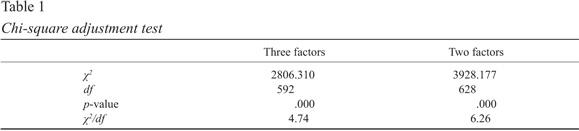
To test hypothesis H1 we developed a confirmatory factorial analysis and used a chi-square adjustment test to verify the best model between two or three factors. According to Marôco (2014), values below 5 (χ2/df<5) are acceptable and demonstrate the fit of the model. We verified that, as proposed initially and according to the data in Table 1, the three-dimensional model must be accepted (χ2/df=4.74), while the two-dimensional model presented adjustment values above 5 (χ2/df=6.26). Additionally, data from Bartlett sphericity tests [χ2(703)=12997.981; p<.000)] and from Kaiser-Meyer-Olkin statistics (KMO=.918), ensured the adequacy of the data for the assumptions underlying the analysis. Furthermore, the Dillon-Goldstein’s rho of all the three scales was superior to .7, confirming the internal consistency and one-dimensionality of the scales These statistical findings corroborate hypothesis 1 (H1).
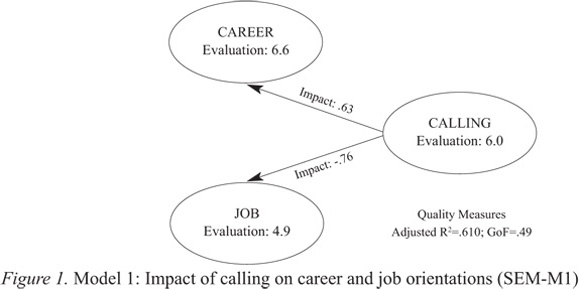
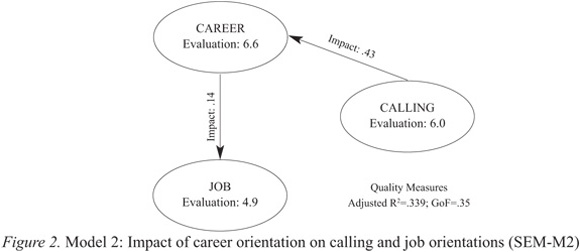
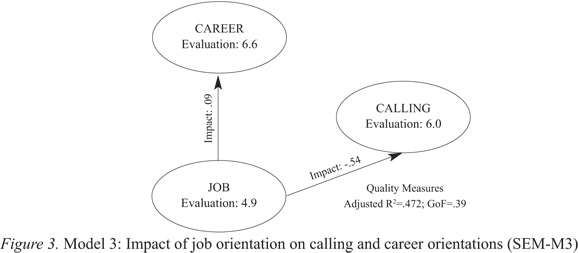
To test the three independent models, we used structural equation modeling (SEM). The first model (M1) assumed that calling orientation has a direct impact on job (H3a) and career (H3b) orientations. Therefore, the second model (M2) assumes that career orientation has a direct impact on calling (H4a) and job orientations (H4b). Finally, the third model (M3) assumes that job orientation has a direct impact on calling (H5a) and career orientations (H5b).
The quality of these models was measured through the coefficient of determination, adjusted-R2 and the goodness of fit index (GoF). To assess the direct impact of one latent variable on another, we used regression coefficients.
While looking for the direct impact of calling orientation on the other work orientations, we found that the data corroborated our hypotheses H3a and H3b (see Figure 1). Additionally, the quality measures used (adjusted-R2 and GoF) ensured that model 1 was of good quality. As proposed initially, calling orientation had a negative direct impact on job orientation (-.76), and a positive direct impact on career orientation (.63).
]]>
The next model, model 2 (H4a and H4b) was intended to assess the impact of career orientation on job and calling orientations and was partially corroborated (see Figure 2). Attending to the data, the direct impact of career orientation on calling orientation was confirmed (.43), and this result corroborated H4a. But, contrary to expectations and theoretical assumptions, career orientation had a small positive direct impact on job orientation (.14). This result means that H4b was rejected. As with model 1, the adjusted-R2 and GoF ensured good quality.
Finally, while considering the direct impact of job orientation on the other two work orientations, we confirmed that the adjusted-R2 and GoF ensured the good quality of model 3 too (see Figure 3). Furthermore, as expected, job orientation had a negative direct impact on calling orientation (-.54), so H5a was accepted. However, the H5b was rejected. Job orientation had a small positive impact (.09) on career orientation.
]]>
Finally, although hypotheses H4b and H5b were rejected, hypothesis 2 was corroborated. Regardless of the positive or negative impact, it was found that, as proposed, all dimensions have a direct impact on the other. In addition, H1 was corroborated.
Discussion
The primary goal of the current study was to revisit research into work orientation and clarify the dimensionality and organization of work orientation.
Firstly, we contributed to discussions about the dimensionality of work orientation. Through confirmatory factor analysis, it was found that the model with the best fit was three-dimensional rather than two-dimensional. So, we confirmed that work orientation is three-dimensional. This result supports a tripartite model initially proposed by Bellah et al. (1985) and it is consistent with results obtained by Fossen and Vredenburgh (2014). Consequently, the results showed that the two-dimensional model suggested by Wrzesniewski et al. (1997) cannot be accepted. That is, calling and job orientations are not the same dimension. In other words, work orientation is composed of three independent dimensions: calling, job and career.
However, although the value of the chi-square adjustment test was acceptable for the three-dimensional model (χ2/df=4.74), values below two are considered to be adjusted and desirable (Marôco, 2014). This suggests that there is a possibility for the model to be improved. We propose that it is necessary to test other models, namely models with a greater number of dimensions, or test the possibility of the existence of sub-dimensions within the calling, career and job orientations. Based on the different definitions of each of these dimensions and in the study previously carried out by the authors we propose some of these sub-dimensions. For example, job orientation may have three sub-dimensions: focus on financial reward (Pitacho et al., 2019; Wrzesniewski et al., 1997), lack of personal identification with work and desire for remoteness (physical and emotional) (Pitacho et al., 2019). For career orientation we propose three sub-dimensions as well as: focus on recognition and status (Pitacho et al., 2019; Wrzesniewski et al., 1997), personal fulfillment dependent on professional achievement (Bellah et al., 1985; Pitacho et al., 2019) and ambition for career progression (Pitacho et al., 2019; Wrzesniewski, 2003). There are many definitions of the calling dimension, and for this dimension we propose four sub-dimensions: a sense of personal passion, as advanced by Dobrow (2013); a sense of a mission in life more focused on others and on the community as defined by secular perspectives (e.g., Bunderson & Thompson, 2009; Wrzesniewski, 2003); intrinsic fulfillment (Pitacho et al., 2019; Rosso, Dekas, & Wrzesniewski, 2010); and finally, congruence or continuum between the personal and professional self as if the work or profession was an integral part of oneself (Pitacho et al., 2019).
]]> Additionally, we found that the three dimensions of work orientation have a direct impact on each other and have a significant correlation with each other. Beyond the known relationship between calling and job orientation, career orientation is also related to the other orientations. This is a new finding: In earlier studies (e.g., Fossen & Vredenburgh, 2014; Wrzesniewski et al., 1997) career orientation did not appear to be correlated with the other dimensions. We know that some research in the field of social psychology revealed that the motivational orientation of individuals can be influenced by the social context (Amabile, DeJong, & Lepper, 1976), and we believe that this finding can be explained by the fact that the data was collected after the economic and financial crisis. This context may have influenced, for example, the results of the career orientation, which is positively associated with the remaining dimensions. During the economic and financial crisis, people were deprived of career development and progression. Moreover, many people saw their salaries cut and wage increases frozen. As the sample studied included those with higher educational qualifications, all these facts may have led to an overvaluation of the career dimension. This overvaluation of the career dimension can explain the results that demonstrated the valorization of the career orientation in relation to the other dimensions.However, contrary to expectations, H4b (career orientation has a negative direct impact on job orientation) was refuted. Career orientation has a positive direct impact on job orientation, and not a negative impact as initially expected. According to several authors (e.g., Schreurs, Guenter, Schumacher, Emmerik, & Noteleaer, 2013; Vroom, 1964), the career rewards have in themselves important symbolic and emotional value. Thus, individuals who see their work as a career can associate financial reward with the symbols of social status, prestige and professional progression. This symbolism associated with financial reward may explain the interest of individuals who see their work as a career in monetary reward. Furthermore, Wrzesniewski (2003) argues that those with career orientation work for the rewards that accompany advancement through an organizational or occupational structure – progression is often accompanied by financial reward. This explains why a greater emphasis on career orientation can be associated with a greater appreciation of monetary reward. Thus, individuals with high scores on the career scale also have high scores on the items that refer to financial rewards which sit on the job scale. As a consequence, the model demonstrates a positive direct impact of career orientation on job orientation.
On the other hand, the hypothesis H5b (job orientation has a negative direct impact on career orientation) was also refuted. Job orientation has a direct impact on career orientation, but this impact is positive. Despite having a very low impact value, it exists, and it is positive and significant. As previously mentioned, advances in career are often accompanied by an increase in financial reward. The individuals who see their work as a job can associate career progression only with increasing financial reward. These individuals can increase their career orientation while seeking to extract from their work greater financial returns. This can explain the direct positive impact of job orientation on career orientation.
The models demonstrate that when calling orientation increases or decreases, career orientation increases or decreases; when career orientation increases or decreases, calling increases or decreases too. This finding of a positive relationship between calling and career orientation makes an important contribution to the theory of motivation. Contemporary theories assume that intrinsic and extrinsic motivation operate in opposition, where extrinsic motivation decreases as intrinsic motivation increases (Lepper & Greener, 1978). We verified this negative relationship between calling and job orientation. But we verified a positive relationship between calling and career orientation. This finding argues against the negative relationship and seems to support some researchers and theories (Amabile et al., 1994), arguing that under some circumstances, intrinsic and extrinsic motivation may work together, although they are in fact distinct processes. More studies are thus needed to shed light on the relationship between both intrinsic and extrinsic motivation.
Limitations and future research
Our study had some limitations. Our sample was composed of participants with a high level of education (72% had been to university) and additionally, our data collection took place after the economic and financial crisis experienced in Portugal. As mentioned above, both a high educational level and the economic and financial context can have a direct influence on participants’ work orientation. This makes clear the need to test the same models and relationships in other contexts with a more balanced sample in terms of education level.
This study provides insights for future investigations. First, as previously mentioned, we propose that in future studies it would be important to test models with a greater number of dimensions or test the possibility of there being three dimensions (calling, career and job) with sub-dimensions or sub-factors. When studying sub-dimensions, we consider it extremely important to carry out studies that are based on an interpretative paradigm in order to increase qualitative knowledge of the phenomena under investigation.
Furthermore, due to the relationship between the three dimensions, the possibility that there are work orientation profiles should be investigated. These profiles could combine different dimensions. In this study, there were profiles that combined dimensions with a direct positive relationship, whereas profiles that combined negative relationships did not exist. That is, there may be pure job, career and job orientation profiles, but also two mixed profiles, namely “career-calling” and “career-job” explained by positive relationships between these dimensions. It may also be possible to locate profiles combining the different possible sub-dimensions of calling, career and job orientations.
Additionally, future studies can investigate the possible existence of moderating variables that enhance or attenuate the direct impact among dimensions. Finally, and most important, studies should be carried out to relate the behavior of employees not only to the calling orientation to work but also to all three dimensions of work orientation.
]]>Conclusion
The present study responds to a question about the dimensionality of work orientation and reports the internal model of work orientation. Moreover, provides valuable insights for both theory and practice.
Our study contributes to the literature in several ways. This study has demonstrated that work orientation has a three-dimensional structure and that calling and job orientations have a negative relationship, although they are not the same dimension. Additionally, although researchers treat work orientation as having independent dimensions, they are directly related, and they influence each other, including the career dimension. Furthermore, this study makes a significant contribution to motivation theory. It shows that intrinsic and extrinsic motivations are distinct processes, which can operate in opposition but also in tandem.
This contribution to the clarification of work orientation mechanisms has a practical implication and can impact significantly on organizations and schools, having implications for career and academic selection. For example, these results may contribute to the improvement of counseling and career development procedures, since we perceive that by stimulating one of the dimensions studied, we may simultaneously be contributing to the increase or decrease of another. In an organizational context, these results may contribute to an increase in knowledge about the work orientation and motivation of employees.
References
Amabile, T. M., Hill, K. G., Hennessey, B. A., & Tighe, E. M. (1994). The work preference inventory: Assessing intrinsic and extrinsic motivational orientations. Journal of Personality and Social Psychology, 66, 950-967. Retrieved from http://dx.doi.org/10.1037/0022-3514.66.5.950 [ Links ]
Amabile, T. M., DeJong, W., & Lepper, M. (1976). Effects of externally imposed deadlines on subsequent intrinsic motivation. Journal of Personality and Social Psychology, 34, 92-98. Retrieved from http://dx.doi.org/10.1037/0022-3514.34.1.92 [ Links ]
Bellah, R. N., Madsen, R., Sullivan, W. M., Swidler, A., & Tipton, S. M. (1985). Habits of the heart. New York: Harper & Row. [ Links ]
Bunderson, J., & Thompson, J. (2009). The call of the wild: Zookeepers, callings, and the double-edged sword of deeply meaningful work. Administrative Science Quarterly, 54, 32-57. Retrieved from https://doi.org/10.2189/asqu.2009.54.1.32 [ Links ]
Cardador, M. T., Dane, R., & Pratt, M. G. (2011). Linking calling orientations to organizational attachment via organizational instrumentality. Journal of Vocational Behavior, 79, 367-378. Retrieved from https://doi.org/10.1016/j.jvb.2011.03.009 [ Links ]
Dik, B. J., & Duffy, R. D. (2009). Calling and vocation at work: Definitions and propects for research and practice. The Counseling Psychologist, 37, 424-450. Retrieved from https://doi.org/10.1177/0011000008316430 [ Links ]
Dobrow, S. R. (2013). Dynamics of calling: A longitudinal study of musicians. Journal of Organizational Behaviour, 34, 431-452. Retrieved from https://doi.org/10.1002/job.1808 [ Links ]
Duffy, R. D., Allan, B. A., & Dik, B. J. (2011). The presence of a calling and academic satisfaction: Exploring potential mediators. Journal of Vocational Behavior, 79, 74-80. Retrieved from https://doi.org/10.1016/j.jvb.2010.11.001 [ Links ]
Duffy, R., & Dik, B. (2013). Research on calling: What have we learned and where are we going?. Journal of Vocational Behavior, 83, 428-436. Retrieved from https://doi.org/10.1016/j.jvb.2013.06.006 [ Links ]
Duffy, R. D., Manuel, R. S., Borges, N. J., & Bott, E. M. (2011). Calling, vocational development, and well-being: A longitudinal study of medical students. Journal of Vocational Behavior, 79, 361-366. Retrieved from https://doi.org/10.1016/j.jvb.2011.03.023 [ Links ]
Elangovan, A. R., Pinder, C. C., & McLean, M. (2010). Callings and organizational behavior. Journal of Vocational Behavior, 76, 428-440. Retrieved from http://dx.doi.org/10.1016/j.jvb.2009.10.009 [ Links ]
Fossen, R. S., & Vredenburg, D. (2014). Exploring differences in work’s Meaning: An investigation of individual attributes associated with work orientations. Journal of Behavioral and Applied Management, 15, 101-120.
]]>Lefranc, G. (1988). História do trabalho e dos trabalhadores. Lisboa: Europress. [ Links ]
Lepper, M., & Greene, D. (1978). Over justification research and beyond: Toward a means-ends analysis of intrinsic and extrinsic motivation. In M. Lepper & D. Greene (Eds.), The hidden costs of reward (pp. 109-148). Hillsdale, NJ: Erlbaum. [ Links ]
Marôco, J. (2014). Análise de equações estruturais: Fundamentos teóricos, software e aplicações. Lisboa: ReportNumber. [ Links ]
Peterson, C., Park, N., Hall, N., & Seligman, M. E. (2009). Zest and work. Journal of Organizational Behavior, 30, 161-172. Retrieved from https://doi.org/10.1002/job.584 [ Links ]
Pitacho, L., Palma, P. J., & Correia, P. (2019). Construção e estudo psicométrico do Questionário de Orientação para o Trabalho (QOT). Análise Psicológica, XXXVII, 391-403. Retirado de https://doi.org/10.14417/ap.1502 [ Links ]
Rosso, B. D., Dekas, K. H., & Wrzesniewski, A. (2010). On the meaning of work: A theoretical integration and review. Research in Organizational Behavior, 30, 91-127. Retrieved from https://doi.org/10.1016/j.riob.2010.09.001 [ Links ]
Schreurs, B., Guenter, H., Schumacher, D., Van Emmerik, I. H., & Notelaers, G. (2013). Pay-level satisfaction and employee outcomes: The moderating effect of employee-involvement climate. Human Resources Management, 52, 399-421. Retrieved from https://doi.org/10.1002/hrm.21533 [ Links ]
Vroom, V. H. (1964). Work and motivation. New York: John Wiley. [ Links ]
Wrzesniewski, A. (1999). Jobs, careers, and callings: Work orientation and job transitions. Unpublished doctoral dissertation, University of Michigan, Ann Arbor. Retrieved from https://deepblue.lib.umich.edu/handle/2027.42/131818 [ Links ]
Wrzesniewski, A. (2003). Finding positive meaning at work. In K. Cameron, J. E. Dutton, & R. E. Quinn (Eds.), Positive organizational scholarship (pp. 296-308). San Francisco, CA: Berrett-Koehler Publishers. [ Links ]
Wrzesniewski, A. (2011). Callings. In K. Cameron & G. Spreitzer (Eds.), Oxford handbook of positive organizational scholarship (pp. 45-55). New York: Oxford. [ Links ]
Wrzesniewski, A., McCauley, C., Rozin, P., & Schwartz, B. (1997). Jobs, career, and calling: People’s relations to their work. Journal of Research in Personality, 31, 21-33. Retrieved from https://doi.org/10.1006/jrpe.1997.2162
]]> Correspondence concerning this article should be addressed to: Liliana Alexandra Pitacho, CAPP – Centro de Administração e Políticas Públicas, Instituto Superior de Ciências Sociais e Políticas, Universidade de Lisboa, R. Almerindo Lessa, 1300-666 Lisboa, Portugal. E-mail: lpitacho@gmail.com
This study was supported by University of Lisbon under Doctoral Scholarship (BD2015).
]]>