Desenvolvimento estético em crianças, adolescentes e adultos jovens
Teresa Almeida-Rocha1, Francisco Peixoto1, Saúl Neves Jesus2
1Centro de Investigação em Educação, ISPA – Instituto Universitário, Lisboa, Portugal
2Centro de Investigação em Turismo, Sustentabilidade e Bem-estar, Universidade do Algarve, Faro, Portugal
ABSTRACT
This paper focuses on aesthetic development in children, adolescents and young adults at a theoretical and empirical level. The most relevant theories in the area of aesthetic development are mentioned. The main goal of the study was to test Parsons’ theory, in an empirical and precise way, characterizing how aesthetic appreciation is developed. In terms of principal methodological assumptions there are two theoretical positions in current research into aesthetic development, those of Housen and Parsons. Parsons’ approach has been proven to be more effective when adapted to younger age groups (children). The empirical research undertaken in this paper uses his interview to understand the level of aesthetic development of 100 participants, divided into 5 age groups (from 4-5 years old, to 18-20 years old). Results of these individual interviews offer direct support to the idea that aesthetic develops naturally and is positively correlated to age. In addition to the findings on aesthetic development, data backs up the progressive descentration that underlies Parsons’ assertion that aesthetic stages depend “on our increasing ability to take on the points of view of others”.
]]>
Key words: Aesthetic development, Aesthetic experience, Arts, Developmental psychology, Painting.
RESUMO
Este artigo foca-se no desenvolvimento estético de crianças, adolescentes e adultos jovens, a um nível teórico e empírico. As teorias mais relevantes no domínio do desenvolvimento estético são mencionadas. O principal objetivo do estudo foi testar a teoria de Parsons, de maneira empírica e precisa, caracterizando como a apreciação estética é desenvolvida. Em termos dos principais pressupostos metodológicos, existem duas posições teóricas na pesquisa atual sobre desenvolvimento estético, as de Housen e Parsons. A abordagem de Parsons demonstrou ser mais eficaz quando adaptada a faixas etárias mais jovens (crianças). A pesquisa empírica realizada neste artigo utilizou a sua entrevista para entender o nível de desenvolvimento estético de 100 participantes, divididos em 5 faixas etárias (de 4-5 anos a 18-20 anos). Os resultados dessas entrevistas individuais suportam a ideia de que a estética se desenvolve naturalmente e se correlaciona positivamente com a idade. Além das descobertas sobre o desenvolvimento estético, os dados confirmam a ideia de descentração progressiva, sublinhada na afirmação de Parsons de que os estágios estéticos dependem “da nossa capacidade crescente de assumir os pontos de vista dos outros”.
Palavras-chave: Artes, Desenvolvimento estético, Experiência estética, Psicologia do desenvolvimento, Pintura.
The importance of studying aesthetic development relies on the understanding of one important dimension of being human; the way in which we see our world in relation to how we think and feel art (in this particular case, painting).
In research into aesthetic development two main theories have emerged that of Parsons (1987/ 1992) and that of Housen (1983). It is important to analyze how these theoretical perspectives can help us to define the direction of aesthetic development. Next, the concept of aesthetic development and the way it is processed is defined, mentioning the dimensions that compose it. The main authors who study aesthetic development will also be approached, comparing them according to the number of stages they advocate. Finally, a more detailed analysis is presented, stage by stage, between the two most relevant theories of aesthetic development, the theory of Parsons (1987/1992) and Housen (1983), referring to the aspects that bring them closer and further apart.
Aesthetics and aesthetic development
]]> Aesthetics is taken here to be the experiencing of works of art, in this particular case, painting. Aesthetics is composed of five dimensions: the theme, the emotion, the colour, form/style, and the judgment (Parsons, 1987/1992). In general, this experience encompasses aesthetic appreciation and judgment.Children have a particular way of appreciating and judging art that changes over the course of their development, presumably up until adulthood, as stages of aesthetic development where these dimensions are present. This study analysed these dimensions and observed the changes in the course of development as a function of age.
Stages of aesthetic development
Stages of aesthetic development occur according to changes in different dimensions. There is no consensus with regard to what the most relevant dimensions are and thus no consensus regarding the number of developmental levels or stages that should be taken into consideration in aesthetic development. For example, whereas Machotka (1963, 1966), Coffey (cited by Housen, 1983) and Rossi (2003) propose 3 levels or stages for aesthetic development, other authors propose 4 (Clayton, cited by Chen, 1997; Franz, 2002), 5 (Housen, 1983; Parsons, 1987/1992) or even 6 stages (Brunner, 1975).
When three levels or stages were taken into account, the authors took the first level as occurring up until 7/8 years of age, and being characterized by a general attraction for colour and theme (Machotka, 1963, 1966). Coffey (cited by Housen, 1983) in line with Parsons (1987/1992), defines this as a period of egocentrism, where the viewers assume the non-existence of points of view different from their own, and an inability to differentiate what they like: children like all paintings. Rossi (2003), called our attention to the fact that at this level, the interpretation of the artwork describes a narrative. The criteria used to judge a work of art are: colour, theme, realism, the artist’s mastery when executing the piece, and whether the piece is useful.
At around 8 years old, children develop to a second stage whose main feature is a unique preference for realistic paintings focusing on the relevance of the themes (Coffey, cited by Housen, 1983; Machotka, 1963, 1966). Rossi (2003) adds that at this level, the feeling that is apprehended from the artwork is a concrete feeling, and not a subjective one. A good painting is a morally correct painting. The expressivity gradually takes the place of realism, and creativity is valued.
At the third stage, during adolescence, the evaluation of paintings is grounded in the style, the composition, the luminosity and the emotional impact (Machotka, 1963, 1966). Coffey (cited by Housen, 1983) maintains that, at this stage, adolescents establish a relationship with the paintings and compare them to each other. Rossi (2003) tells us that, in this stage, the abstract thought is already mobilized. The subjectivity is inherent to the artist and to the observer, and the artist’s intentions are recognized. The artwork must allow for a reflection, and it must be the bearer of a message.
Those authors that establish four stages do it for different reasons. Clayton (cited by Chen, 1997) aim is to link aesthetic development with cognitive development, from the pre-operational stage to the stage of formal operations. In the first stage, the pre-conventional, the observers mention the details of the artwork, but cannot apprehend the entirety of the work, manifesting a difficulty in justifying their answers. In the second stage, the conventional, the observers accept various themes, including themes that mention more negative aspects. In the third post-conventional stage, the observers begin to apprehend the feeling expressed through the painting, whereas in the fourth stage, the Relative, the observers tend to understand the interrelation between the theme and the formal elements in the painting.
Franz (2002) objective is to detail the differences in how children comprehend an object of art. In naïve comprehension, the conceptions are intuitive. What is seen is what the painting shows, and the observers are acritical. In this level, it is believed that additional knowledge is not needed to be able to understand the piece. Following this, the stage is one of Beginner’s Comprehension, and it can already be said that there is an interrelation between some knowledge and the intuitive approach. Intuition is still manifested, but there is already some knowledge about the painting. However, the observers still demonstrate difficulty in mobilizing this knowledge to interpret the piece. It is only at the Apprentice’s Comprehension level that the knowledge is mobilized to interpret the artwork in a critical way. However, different points of view are still not taken into consideration, with the painting being seen as complex and involving explanations that exceed them. It is at the Specialist’s Comprehension level, that the acquired knowledge is mobilized to create a reflection about the artwork, establishing various discussable associations and interpretations.
]]> A different proposal is offered by Brunner (1975), who establishes six stages of aesthetic development, focusing on the way in which the perceiver conceives the art object. In the first stage, Object, the observers mention the particular colour or the object. In the second stage, Document, the observation is based on the theme. In the third stage, Message, the observer tends to discover the message of the painting. In the fourth stage, Structure, a shift from the content to the structure of the painting is manifested. And in the fifth stage, Response, the judgment is based on the evocation of the art object, while in the last stage, Re-Creation, the observer becomes entirely involved in the artwork, and takes the artist’s intentions into consideration (Brunner, 1975).
Housen and Parsons theoretical frameworks
The Parsons model is considered to have “played a major role in our thinking about aesthetic development” (Milbrath, 2008, p. 266) as the predominant model in aesthetic development research (Lachapelle, 1991). Several studies gave support to this model (e.g., Acer & Ömeroðlu, 2008; Augustin & Leder, 2006; D’Onofrio & Nodine, 1981; Jolley, Zhi, & Thomas, 1998). From these, only the study, by D’Onofrio and Nodine (1981) approached the sequence of stages proposed by Parsons (1987/1992). However, this study was carried out prior to the final structuration of this theory, contemplating only 4 stages of aesthetic development and not 5 as in the present study. Besides the important contribution of Parson’s model for the study of aesthetic development also Housen has been influential with his own approach. Because Housen (1983) and Parsons (1987/1992) offer the two most structured theories of aesthetic development it is productive to look at the contrasts between their frameworks and basic assumptions. Parsons’ view is based in two authors – Kohlberg and Piaget (Parsons, 1987/1992), while Housen is based in Baldwin (Housen, 1983).
The two models both assume that age is a relevant determinant of aesthetic development, but they also state that the experience in observing artwork and, necessarily, aesthetic education, is the most important factor in aesthetic development.
The two theories almost complement each other with regard to the stages of life in terms of age. Whereas, Parsons’ focus is on children from 4 year olds up, Housen only approaches development from adolescence to adulthood. Parsons defines stage I for pre-school children, stage II for primary school children, and stage III for adolescents. What is however challenging, is to see that their definition of the stages overlaps in some way. To Housen, 16-year-old adolescents use ideas from stage I/II, while ideas from stage III are, at times used around the 20 year old mark.
According to the Housen approach, in stage I, the Accountive Viewer, the observers tell stories, performing personal associations and concrete comments about the artwork that are interconnected with the narrative. In the same direction as Housen (1983), Parsons, states that in the first stage, Preference, the observers like almost all paintings, they privilege colour, and perform free associations. Small children believe the paintings to be perfect in most cases, and they prefer artwork that is colourful, holding colour in high regard. They often understand what is represented, creating free associations of ideas, anchored in the artwork.
Both authors converge in this first stage, maintaining that the viewers wander through innumerable free associations, starting with the artwork and moving onto their personal experiences. The artwork is a window into the interior of the viewer, bringing up memories of their relatively short life stories which they interconnect with what they observe.
In stage II of the Housen approach, the Constructive viewer, the observer begins to possess a structure with which to contemplate the paintings, utilizing logical instruments. Emotions are now a relevant aspect, and the observer distances themselves from the artwork, emphasizing the intentions of the artist. According to the Parsons model, stage II (Beauty and Realism) is related to the idea of representation. In this stage, the painting must represent something. Non-figurative paintings are devalued. The theme is very relevant, and the more realistic the representation of the object, the better the painting is. When something like a smile is represented in a painting, these emotional aspects are taken into account and are appreciated. The style is also appreciated due to the painting being realistic. The skill and meticulous work is admired. The judgment is, therefore, dependent on the beauty of the artwork and the competence of the artist to make it realistic.
At this stage both authors make a departure from personal experiences to see art as a form of communication in which the artist’s intention is valued.
]]> In stage III, Classifying viewer, Housen maintains that the classifying observers create an analysis and critique, in a way becoming closer to art critics. They want to classify the artwork into an art movement, a style, etc. These observers categorize the artwork and believe that, in this way, they can reveal what the painting truly intends to transmit. According to Parsons, the perspective around which the third stage is organized, is related to expressivity. If the paintings provide an intense experience, they are highly valued. The observers can center themselves on what the artist felt, on what they themselves felt, or both. The purpose of a painting is to express the experience of the artist. The beauty of the theme, and the realism, are not central, and the expression of the painting is more relevant. Creativity and originality are relevant aspects when it comes to the judgment of the piece.In this third stage, Housen focuses on the viewer as a classifier, and Parsons asserts that the more intense the experience towards the artwork, the more significant it becomes. Here, the underlying feelings leading to contemplation and the involvement of the viewer with the artwork are highlighted.
Housen’s Stage IV: The Interpretive Viewer, the observer tries to establish a relation with the artwork in a more personal way, by exploring the painting, which allows for a slow reveal of the artwork, by looking at its subtle and particular characteristics (form, colour, etc.). The painting reveals itself in new contemplations, changing meanings and senses in the way they observe the artwork. In Parsons’s Stage IV (Style and Form), the painting becomes more social, and fits in a historical context. Others have a central role in the analysis of the artworks, taking into consideration various perspectives, and the interest of a piece resides in these various perspectives that are coordinated, mentioning the means of expression, style, form, and techniques. These multiple interpretations are key to having a full apprehension of the totality of the piece. In this way, the artwork allows for various interpretations, surpassing a personal perspective. From a psychological standpoint, progress is related to the competence of integrating a painting in a historical and social context.
It is clear that Housen and Parsons define this fourth stage differently, although there are some similarities between Parsons stage IV and the third stage of Housen. Whereas in stage IV Housen refers to the viewers as interpretative, Parsons focuses on the importance of art history as a mediator for the analysis of the artwork.
In Housen’s Stage V (The Re-creative viewer), the observers are viewers who have a great aesthetic experience, and reflect on a vast number of artworks. The contemplation is both personal and framed in a historical context. In the fifth stage of Parsons (Autonomy), the subjects judge the values that tradition has built to comprehend the artwork. The judgment has become more personal and more social. We reflect on our own experience, with the values we transmit being of our own entire responsibility. The dialogue about the artwork becomes fundamental.
In this last stage, Housen and Parsons converge again to value the perspective of the personal, which uses theoretical knowledge, but elaborates a personal position and critique towards the piece, moving away from what is traditionally accepted and current.
The study
We have argued that there seems not to be the expected complementarity contribution of both models to the understanding of aesthetic development. Although the age groups identified by the two models differ, their stages constitute similar components. This suggests that there is a need to approach the features of aesthetic development through all periods of ages more closely, starting with pre-school children. In other words, we need to chart aesthetic development between the ages of 4 and 20.
In this regard the Parsons (1987/1992) methodology which has already been adapted for children, offers the most accurate model for these age groups. In this line, the main goal of this study was to characterize aesthetic development in regard to age, testing Parsons’ theory, in an empirical and precise way. In this study, a five-dimensional analysis instrument was structured, mentioning aesthetic development along the five stages, allowing a more systematic methodology, moving away from an exclusively qualitative analysis.
]]>Method
Participants
The participants were 100 people, divided into 5 age groups (20 subjects per age group: 4-5 years old (10 females; 10 males), 7-8 years old (9 females; 11 males), 11-12 years old (11 females and 9 males), 15-16 years old (13 females and 7 males), and 18-20 years old (15 females and 5 males). The sample was taken from private schools in Portugal, with the participants’ socio-economic status ranging from medium to high. We contacted the legal guardians of the first four age groups, who signed an authorization, and were explained the objectives of the study. The group of young adults also signed an informed consent letter, and the objectives of the study were also explained. Confidentiality was guaranteed, with voluntary participation.
Procedure and instruments
Participants were approached individually in different private schools. To measure aesthetic development, the Parsons (1987/1992) interview was applied individually, recorded and transcribed (Appendix 1). The translation of the Portuguese book interview by Parsons (1987/1992) was used. The first question of the interview is one that aims to mobilize the participants’ attention (the question is not scored). The second issue is related to the theme dimension; the third issue with the aesthetic emotion dimension; the fourth and fifth questions with the means of expression: dimensions, colour, shape and style; The sixth and seventh questions are related to the judgment dimension (Almeida-Rocha, Peixoto, & Neves de Jesus, 2014).
The average time of each interview was approximately 15 minutes. Each participant saw a series of 4 paintings (Appendix 2). The paintings were shown in random order for each participant. These 4 paintings were selected based on the fact that, in a previous study, 8 paintings used by Parsons were divided into two series, and presented no significant changes when it came to aesthetic development [U(N=50)=351.5, p=.433] (Almeida-Rocha et al., 2014).
]]> Data analysis
Content analysis was used to analyze interviews. The content analysis grid was structured based on the Parsons (1987/1992) theory. It consists of five stages of development with each stage having 5 dimensions (Theme, Emotion/Expression, Colour, Texture/Form, Judgment) (see Appendix 3). For example, for the colour dimension, in the first stage, the following characteristics were mentioned: Strong attraction to colour (the stronger the better), a preference for paintings that contain their favorite colour, intuitive liking for most colours, although preferring brighter colours. In the Second Stage, the colour is seen as a functional equivalent to the object, the colour is associated with the necessity of realism and the colour is associated with feelings. In the third stage, the colour is related to the expressiveness of the painting and the intentions of the artist are understood through the usage of colour. In the fourth stage, a historical importance is attributed to the colour, contextualizing it in a style or artistic movement. In the fifth stage, the colour reproduces the values and concepts of society, which are questionable. The colour relates itself to the artistic route and personal life of the artist, and the traditions and artistic movements are observable in the colour, and they are reevaluated.
The answers the participants gave to each of the five topics for each painting were globally classified according to the Parsons stages of aesthetic development. The global stage of aesthetic development was determined in terms of the most frequent stages present in the answers.
The precision of the instrument of aesthetic development was evaluated analyzing the level of agreement between inter-judges. This level of agreement was excellent (Fleiss, 1981), for all ages: 4-5 years old (κ=0.94); 7-8 years old (κ=0.86); 11-12 years old (κ=0.86); 15-16 years old (κ=0.78); 18-20 years old (κ=0.92).
Results
In order to analyze the differences in aesthetic development as a function of age we used the median test, due to the ordinal nature of the data. The results of the median test on the aesthetic development showed a significant effect of age, Median test (4)=100, p<.0001.
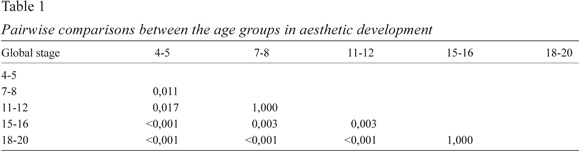
The analysis of Figure 1 shows a relation between developmental stages and age: the 4 to 5-year-old children give answers characteristic of the first stage, whereas the 7 to 8 and 11 to 12-year-old give answers characteristic of the second stage, the 15 to 16-year-old give answers characteristic of the third stage, and the 18 to 20-year-old give answers characteristic of the third and fourth stage. Pairwise comparisons were performed to evaluate differences between the age groups (Table 1) using the Kruskal-Wallis test, H(4, N=100)=96.61, p<0.001.
]]>
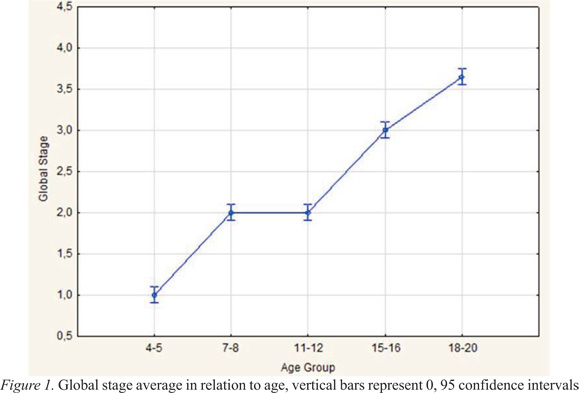
The 4-year-old group is less well developed aesthetically compared to all other age groups. The groups of the 7 and 11-year-old showed higher values, compared to the 4-year-old age group, but presented no differences between each other. The aesthetic development of the 7 and 11-year-old age groups is inferior to that of the 15 and 18 year olds. The 15-year-old age group is inferior to the 18 year olds and superior to all the previous groups. The 18-year-old age group is superior to all other age groups.
Discussion
Our aim was to provide data regarding the aesthetic development in relation to age within the framework provided by Parsons. As expected we found aesthetic development to be related to age.
]]> We found that at 4-5 years old, children create free associations which are related to their own personal experience and there is no outward manifestation of the awareness that there are other points of view besides their own. They integrate Parsons stage I, showing a genuine liking of most paintings. However, they show more interest towards more colourful artwork and artwork that uses their favorite colour. In addition to the characterization of Parsons, our results show a creativity in 4-5 years of age that is associated with free association. This association does not always center itself in a single aspect of the children’s life experiences, jumping from idea to idea, encompassing their rich universe of memories. This universe does not limit itself to real, lived facts – it also considers other aspects, like dreams and desires. In this stage of development, during pre-school, the centration is visible, as Parsons (1987/1992) maintains, decreasing throughout development. The author mentions that “the stages sit on our increasing ability to take on the points of view of others” (p. 38). This idea is supported by Piaget (1983), who mentions that cognitive development is a path from centration to decentration.From 7-8 to ages 11-12, we found a clear preference towards realistic paintings, where the artist’s skill is admired, as well as their patience and hard work. This is the pattern that Parson defines for stage II. At the same time, we found that what is morally correct is confused with the beauty of the artwork. Pieces that, for example, show any type of violence, are not appreciated at this stage. To the question “Is it a good painting? Why?”, 7-year-old children and 11-year-old adolescents observe that paintings which depict morally questionable aspects are not good paintings. For example, in painting 2, by Goya (Lo Mismo, of the series Disasters of War, 1810-1820) (see Appendix 2) children and adolescents say: “It’s bad because it has bad things” (7-year-old); “No, because war is not good” (11-year-old). This data seems to suggest that in this stage of development the aesthetic and moral domains are confused, and that the moral of the action is related to the aesthetic judgment of the artwork. Referring to aesthetic and moral judgments, Parsons maintains that “in the second stage we do not distinguish them: we make a single judgment” (p. 62) and “Violence is morally bad, and its contemplation is unpleasant” (p. 63). However, as in Parsons, these results are not found in later stages in our data. The Rabb et al. (2016) study shows us that in adults who have drunk a bitter liquid, moral evaluations are worse. However, evaluations of the paintings that represent morally negative scenes are not seen as negative in themselves, providing evidence that in adults there is a differentiation between these two types of judgment: aesthetic and moral. This differentiation is not present in children and pre-adolescents. Parsons tells us of the relation between levels and stages, stating that, in relation to judgment, the pre-conventional level covers stages 1 and 2 of aesthetic development, the conventional level covers stages 3 and 4 of aesthetic development, and the post-conventional level covers stage 5 of aesthetic development. The conditioning towards realism and representational art ostracizes a profusion of artwork. It is possible that this preference for what is realistic is related to a form of knowing reality as it is in its smallest details. Because of this, the artist’s minutia and skill are well valued. What is artistic, and what is valued, is related to a loyal copy of what we perceive. The similar the artwork is to reality, the more we like the artwork itself. On the other hand, the type of question asked, “Is it a good painting? Why?” can lead to this type of answer due to the type of question asked. However, in other age levels, in reply to the same question, this type of answer is not considered. But Gabellieri (2010) maintains that, at times, “a moral flaw diminishes the aesthetic value of the painting, and a moral merit can contribute to the increase in aesthetic value” (p. 1).
In the third group features of Parson’s III stage were found; the relevance of a piece is based on its expressivity, and the originality and creativity of the artist are valued. In this stage, the door to a wide array of works is open once again. We begin to value expressiveness: in fact, emotions embrace the being. The artwork that is valued is that which allows for an emotional experience. The quality of the emotional involvement we establish with the artwork reflects itself in the sense and meaning they hold for us. What is surprising is valued. Participants are touched by the unusual, the different, the original. The artworks they like the most are ones that awaken emotions and have value for their expressiveness, originality and creativity. Typical responses to painting 2, by Goya (Lo Mismo, of the series Disasters of War, 1810-1820) (see Appendix 2) are, for example: “I think it is a good topic to show people that it is good to be different, it’s good to innovate and show new things” (15 years old).
Our data in the 18-20-year-old group, show that adults use ideas from the third and fourth stages of Parsons. In stage four, artwork is considered as existing in a historical and social context and what others say about the artwork is highly relevant.
Historical context is relevant as it has an analysis matrix anchored in art history. The learning of art history reflects itself in aesthetic development. In the way the contemplated piece inserts itself into a historical and cultural context. This matrix allows us to learn the pieces in a more elaborate and structured way where we see how the learning of a specific content (art history) has relevance in aesthetic development. A typical response to the question “Is it a good painting? Why?”, while contemplating painting 3, by Renoir (Le Déjeneur des Canotiers, 1881) (See Appendix 2), is “Yes, the way it’s painted makes me think of a Monet painting. It doesn’t mean it’s an inherently good piece, but the artist has a different way of painting, giving it a perfect depth, and his lines create a perfect harmony between shapes” (19 years old).
Vygotsky (1979) addresses the relationship between development and learning, maintaining that learning is the engine of development. In other words, “the development processes do not coincide with the learning processes. On the contrary, the development processes depend on the learning processes” (p. 139), something that is clearly seen in this 4th stage of aesthetic development. The appreciation of the artwork is influenced by what we learn in the field of art history.
In summary, our current data (but see also Almeida-Rocha et al., 2014) suggests that Parsons’ (1987/1992) theory offers a sound approach to the features of aesthetic development through age. Thus even assuming the existence of other relevant variables that may interfere with aesthetic development, such as aesthetic education, exposure and reflection made in terms of the artwork, age is a relevant factor. Trautner (2008) contends that aesthetic development in terms of age “… is not necessarily a steady progression through the later stages. Where someone ends up is influenced by the personal experiences with artworks” (p. 240). The aesthetic experience is equally relevant for this author, this variable is key in aesthetic development. Our data shows that there is a higher aesthetic development in the later stages and also that they support Gardner’s (1994) suggestion that the stages “emerge from looking at a large number of paintings” (p. 223).
Some limitations should be acknowledged. One limitation was the absence of an assessment of familiarity with the artwork which can influences aesthetic development (Trautner, 2008). Because data were collected using interviews the absence of verbal competence assessment is another limitation. The socio-demographic characteristics of the participants precludes the generalization of the results and calls for future studies that analyze this development in populations from different socio-cultural background and from other cultures.
Despite these limitations, the findings of this study supports the Parsons theory of aesthetic development, challenging Housen’s (1983) view that sees some features of development occurring at a later stage in time.
In conclusion, we would like to underline that the present study validates Parsons’ theory (1987/1992) based on a methodology that can be considered to be more solid than the one presented by the author. On the other hand, as a practical implication we can mention the possibility of measuring aesthetic development namely in intervention studies.
]]>References
Acer, D., & Ömeroðlu, E. (2008). A study on the effect of aesthetic education on the development of aesthetic judgment of six-year-old children. Early Childhood Education Journal, 35, 335-342. Retrieved from https://doi.org/10.1007/s10643-007-0193-4 [ Links ]
Almeida-Rocha, T., Peixoto, F., & Neves de Jesus, S. (2014). Measuring aesthetic development. In M. Milcu, R. B. Wubbolding, & I. Testoni (Eds.), Proceedings of the 7th International Conference on Modern Research in Psychology: Modern research in health, education and social sciences (pp. 269-277). Bucareste: Editura Universitara. Retrieved from https://doi.org/10.5682/9786062801533 [ Links ]
Augustin, D., & Leder, H. (2006). Art expertise: A study of concepts and conceptual spaces. Science, 48, 135-156. [ Links ]
Brunner, C. (1975). Aesthetic judgment: Criteria used to evaluate representational art at different ages. Unpublished doctoral dissertation, Columbia University, New York. [ Links ]
Chen, J. (1997). An examination of theories of aesthetic development with implication for future research. Humanities & Social, 42, 13-27. [ Links ]
]]> D’Onofrio, A., & Nodine, C. F. (1981). Children’s responses to paintings. Studies in Art Education, 23, 14-23. Retrieved from https://doi.org/10.1080/00393541.1981.11650298Fleiss, J. L. (1981). Statistical methods for rates and proportions (2nd ed.). New York: John Wiley. [ Links ]
Franz, T. (2002). Educación para la comprensión crítica del arte: Un modelo de análisis [Education for the critical understanding of art: An analysis model]. Arte, Individuo y Sociedad, 14, 27-47. [ Links ]
Gabellieri, P. (2010). A relação entre arte e moral: O moralismo moderado de Nöel Caroll. [The relationship between art and morals: The moderate moralism of Nöel Caroll]. Tese de Mestrado, Departamento de Filosofia, Faculdade de Letras, Universidade de Lisboa, Lisboa. [ Links ]
Gardner, H. (1994). The arts and human development. London: BasicBooks. [ Links ]
Housen, A. (1983). The eye of the beholder: Measuring aesthetic development. Cambridge, MA: Library, Harvard University. [ Links ]
Jolley, R., Zhi, Z., & Thomas, G. (1998). How focus of interest in pictures changes with age: A cross-cultural comparison. International Journal of Behavioral Development, 22, 127-149. [ Links ]
Lachapelle, R. (1991). Aesthetic development theory and strategies for teaching contemporary art to adults. Canadian Review of Art Education, 18, 100-113. [ Links ]
Machotka, P. (1963). Le développement critères esthétiques chez l’enfant [The critical development of aesthetic in childhood]. Enfance, 16, 357-379.
Machotka, P. (1966). Aesthetic criteria in childhood: Justifications of preference. Child Development, 37(4), 21-28. [ Links ]
Milbrath, C. (2008). Developmental preferences and strategies for visual balance in aesthetic compositions. In C. Milbrath & H. M. Trautner (Eds.), Children’s understanding and production of pictures, drawings & art: Theoretical and empirical approaches (pp. 261-291). Cambridge, MA: Hogrefe.
Parsons, M. (1987/1992). Compreender a arte: Uma abordagem à experiência estética do ponto de vista do desenvolvimento cognitivo [How we understand art: A cognitive development account of aesthetic experience]. Lisboa: Editorial Presença. [ Links ]
Piaget, J. (1983). Piaget’s theory. In P. Mussen (Ed.), Handbook of child psychology (Vol. 1, pp. 103-128). New York: Wiley.
Rabb, N., Nissel, J., Alecci, A., Magid, L., Ambrosoli, J., & Winner, E. (2016). Truths about beauty and goodness: Disgust affects moral but not aesthetic judgments. Psychology of Aesthetics, Creativity, and the Arts, 10, 492-500. [ Links ]
Rossi, H. (2003). Imagens que falam: Leitura da arte na escola [Pictures that speak: Art reading at school]. Rio de Janeiro: Mediação. [ Links ]
Trautner, H. (2008). Children’s developing understanding and evaluation of aesthetic properties of drawings and art work. In C. Milbrath & H. M. Trautner (Eds.), Children’s understanding and production of pictures, drawing & art (pp. 237-259). Cambridge, MA: Hogrefe.
Vygotski, L. (1979). El desarrollo de los procesos psicológicos superiores [The development of higher psychological processes]. Barcelona: Editorial crítica. [ Links ]
]]> CORRESPONDÊNCIA
Correspondence concerning this article should be addressed to: Teresa Almeida-Rocha, Centro de Investigação em Psicologia Aplicada, Capacidades e Inclusão, ISPA – Instituto Universitário, Rua Jardim do Tabaco, 34,1149-041 Lisboa, Portugal. E-mail: terrocha@ispa.pt
Teresa Almeida-Rocha is currently a member of the Centro de Investigação em Psicologia Aplicada, Capacidades e Inclusão, ISPA – Instituto Universitário.
Submitted: 01/11/2018 Accepted: 17/11/2019
]]>