Estereótipos profissionais compósitos: Sobre a geração e teste de traços emergentes
Miguel F. Benrós1, André R. Vaz1, Hugo Assunção1, Ana Sofia Santos1, Tomás A. Palma1, Leonel Garcia-Marques1
1CICPSI, Faculdade de Psicologia, Universidade de Lisboa, Lisboa, Portugal
ABSTRACT
In daily interactions, we frequently meet people that belong to multiple categories, sometimes with conflicting stereotypical implications. Studies show that, when generating attributes for composite stereotypes, novel emergent attributes are created, derived from the constituent categories, but also from real world knowledge (e.g., Hastie, Schroeder, & Weber, 1990; Kunda, Miller, & Claire, 1990). In this work, in a similar vein as the work by Kunda and collaborators (1990), we test composite professional categories, and their simple constituents, in a Portuguese sample. To our knowledge, there is no evidence that, in Portuguese language, composite categories are able to generate emergent properties. We empirically explore the kind of content that is generated, and how the conflict between constituents is solved. In Experiment 1, participants described 24 pairs of composite categories and each constituent. In Experiment 2, we refined the identification of emergent attributes by asking participants to evaluate each previously generated attribute on a rating scale, for each category, constituent or composite, in a between-subject design. Results provide evidence that emergent attributes were generated and revealed a different mean rating in the composite categories that were not in their constituents. We discuss their contribution for future research delving into what kind of processes are at the basis of the creation of composite stereotypes, as well as what is the nature of its mental representation, how stable composite stereotypes are, and how consensual are they, given different possibilities in conflict resolution modes and models (e.g., Hastie et al., 1990; Kunda et al., 1990).
Key words: Composite stereotypes, Emergent attributes, Professional stereotypes.
]]>RESUMO
Somos frequentemente confrontados com pessoas que fazem parte de múltiplas categorias, por vezes com implicações que conflictuam no que respeita aos estereótipos que lhes estão associados. Investigação anterior demonstra que, quando são gerados atributos para estereótipos compósitos, são criados os chamados atributos novos e emergentes. Estes parecem derivar do conhecimento acerca das categorias constituintes, mas também do conhecimento acerca do mundo em geral (e.g., Hastie, Schroeder, & Weber, 1990; Kunda, Miller, & Claire, 1990). O presente trabalho, de forma semelhante a investigação anterior de Kunda e colaboradores (1990), testa categorias profissionais compósitas, e as suas constituintes simples, numa amostra Portuguesa. De acordo com o nosso conhecimento, não existe evidência anterior, em língua Portuguesa, de que as categorias compósitas conduzam à geração de propriedades emergentes. Neste artigo, explora-se empiricamente o tipo de conteúdos que são gerados, e como é resolvido o conflito entre constituintes. No Estudo 1, os participantes descrevem 24 pares de categorias compósitas e cada um dos constituintes. No Estudo 2, refinamos a identificação dos atributos emergentes solicitando aos participantes que avaliem cada atributo previamente gerado numa escala de avaliação, para cada categoria, constituinte ou compósita, num desenho experimental entre-sujeitos. Os resultados fornecem evidência de que atributos emergentes foram gerados e revelou uma avaliação média para as categorias compósitas diferente daquela obtida nas categorias constituintes. Discute-se a contribuição destes resultados para investigação futura que pretenda explorar o tipo de processos que estão na base da criação de estereótipos compósitos, assim como a natureza da sua representação mental, quão estável é, e quão consensual, dadas as possibilidades de modelos e modos de resolução de conflito (e.g., Hastie et al., 1990; Kunda et al., 1990).
Palavras-chave: Estereótipos compósitos, Atributos emergentes, Estereótipos profissionais.
Undoubtedly, belonging to a social category for which there is a well-developed representation, or stereotype, brings up expectations about the attributes of a typical member of that social category. When we think about a priest, for example, we may assume that person to be religious, moral, happy, kind and altruistic. But what do we think of the priest who is simultaneously a bouncer?
Until recently, most of the research on stereotypes has been somewhat limited to single category membership. However, one can’t help but notice how, in the “real” world, it is rather common for people to belong to multiple categories, sometimes with contradicting implications (i.e., contradicting stereotypical content).
The study of how social categories combine is still a relatively recent one. Previous investigations explored the manner in which people reason about combined social categories and how they construct a representation of a complex conjunction category from two simpler ingredient categories.
In one set of studies, Kunda et al. (1990) used spontaneous attribute generation tasks to examine how people combined social concepts with conflicting implications (e.g., Harvard educated and carpenter), and what kind of impressions and novel stereotypic content arose from such a combination. Their findings revealed the presence of certain attributes (deemed emergent) in the combined categories, that were absent in the descriptions of the constituent categories.
A subsequent experiment, from the same authors (Kunda et al., 1990), had participants rate the likelihood of a member of a given category (single or combined) possessing each of the attributes previously generated, on 7-point scales. Together, their results revealed participants used three distinct methods of conflict resolution: inheritance (e.g., Goffman, 1963), when the attribute in the composite is inherited from one of its constituents; averaging (e.g., Anderson, 1968), when the ratings of the composite fell between those of the constituents; and emergence, attributes absent from both constituents.
]]> Similarly, to Kunda and colleagues (1990), Hastie et al. (1990) studied which attributes were more frequently listed for conjunction social categories, as opposed to simple social categories (e.g., “female mechanics” vs. “mechanics”). Following their attribute generation task, a second experiment asked participants to express their judgments in ratings on bipolar trait-adjective rating scales. And much like Kunda and colleagues, Hastie and colleagues observed trait inheritance and emergence, as well as averaging, in the rating scales task.Since then, several studies have been conducted to describe the nature of the processes active in the emergence of these novel attributes (e.g., Groom, Sherman, Lu, Conrey, & Keijzer, 2005; Hutter & Crisp, 2005; Siebler, 2008). Either, with non-social (e.g., Estes & Ward, 2002; Wilkenfeld & Ward, 2001) and social categories (e.g., Hastie et al., 1990; Hutter & Crisp, 2005; Kunda et al., 1990; Siebler, 2008), those studies converge in reporting a greater proportion of emergent traits being generated when the conceptual combinations are atypical or unfamiliar in nature, or when the traits of both the simple categories have conflicting implications.
In this work, we aim to reproduce Kunda and colleagues’ (1990) and Hastie and colleagues’ (1990) work using for the first time composite professional stereotypes in a Portuguese sample. To our knowledge, until now, there is no evidence that in Portuguese language, composite categories are able to generate such emergent properties; as so it remains an empirical question to know if language moderates such effects. Most research in Portuguese language also tends to focus on single category membership stereotypes, dealing with already created and consolidated categories. Thus, these studies may provide new evidence on what kind of content is generated, how the conflict between constituents is resolved and if the nature of generated information matches that of emergent properties.
Another novel aspect of the studies presented here is that, apart from the work by previous authors (Hastie et al., 1990; Kunda et al., 1990), they can inform us about how people resolve conflict in composites when both categories are of the same type – i.e., both being professional categories with a consolidated stereotype, rather than mixing profession and adjective, as previous works did, like gender or condition (e.g., blind, Harvard-educated, etc.).
Furthermore, this work provides useful material for future studies; namely, the study of complex, new, maybe even surprising, categories may prove to be beneficial, to the extent that it can focus on conceptual processing in an earlier stage.
To accomplish these goals, when selecting which pairs of professional groups to first assess, our focus was in their apparent incongruence to create composite stereotypes rich in conflict and conflict resolution. Given the incongruent and atypical nature of these pairs of categories, we expected that most participants would not have exemplars stored in memory on which to base their answers, being thus forced to engage in different conflict resolution strategies. Kunda and colleagues (1990), for example, suggested people use causal reasoning and broader world knowledge to create narratives, in order to explain such surprising combinations of concepts/stereotypes. Hastie and colleagues (1990), on the other hand, proposed a 2-stage model of processing, with the second stage dealing with the difficulty created by the incongruences between parent categories. Whatever the explanations are, though, it is undeniable the complexity of such generation processes, when it comes to creating emergent attributes.
Both experiments, 1 and 2, used Kunda and colleagues’ (1990) procedure. The procedure of Experiment 2 complements the procedure of Experiment 1, as the outcome of both studies is a more restrictive measure of emergent attributes detection. Furthermore, this restrictive measure enabled us to categorize the way participants solved the conflict when rating the attributes previously generated.
As so, the Experiment 1 consisted of a spontaneous generation task for 24 composite professional categories, as well as their constituents, with the purpose of obtaining composite stereotypes rich with emergence. From these, we selected the ones with the lowest proportion of inherited attributes, and, like Kunda and colleagues (1990), asked participants in a second experiment to rate the likelihood of a typical member of each category (composite or constituent) possessing each of the attributes generated in Experiment 1. Since it was possible, in Experiment 1, that some emergent content might had only appeared to be so because participants in the single category condition did not think to use the specific attribute, Experiment 2 allowed us to identify and filter such cases.
In both experiments, to assess whether the order of the professional categories in the composite pair affected conflict resolution (for example, with one category dominating the other), we also manipulated category order.
]]> EXPERIMENT 1
The goal of Experiment 1 was to test whether emergent properties are generated when participants are presented with composite professional categories. To that end we presented participants and asked them to describe 24 pairs of composite categories and respective constituents, using a between-subject design when testing for composite and simple categories (since the composite groups were the result of bonding two different simple professional categories). The order of the professional categories in the composite was also manipulated between-subjects (A-B and B-A).
In Experiment 1 we present only the results for the categories that were tested in both experiments, 1 and 2, as only the conjunction of both procedures allows us the more precise identification of emergent attributes. The criteria used to determine which composite categories and respective constituents would be tested in Experiment 2 is detailed in Experiment 2’s Method section.
Method
Participants
Two hundred and fifty-three individuals (151 female and 44 male) participated in this experiment. Their mean age was 23.59 (SD=10.50). Since part of our sample was collected outside of the lab, 58 participants chose not to disclose their gender and age). Participants gave informed consent prior to participation. The Ethics Committee of the Faculty of Psychology of the University of Lisbon approved this research.
From the total sample, 120 participants were University of Lisbon students participating in return for course credit, 101 participants answered outside our lab via e-mail and social network distribution, and 32 participants answered on a paper and pencil format.
]]> Material
The composite categories used in this study were created by asking a small sample to spontaneously generate atypical or surprising professional group combinations. From these groups we used the experimenters’ criterion to choose 24 composite professional categories which led to 48 single stereotypical professional categories. The experimenters’ criterion was based on Kunda and colleagues’ (1990) criterion. Composite categories were neither impossible (e.g., a prime minister that is also street sweeper), nor contradictory (e.g., a butcher that is also a vegetarian) nor too frequently associated (e.g., a painter that is also a writer). So the categories were plausible but unlikely. The goal was to have categories that people would not have a model subject for this (e.g., a carpenter with a PhD).
Procedure
The data was collected using an online Qualtrics platform. Participants either received a questionnaire including six single professional categories or six composite professional categories.
For the 120 participants tested in the experimental lab, experiment was run in sessions of up to eight participants at a time. Participants were seated in front of 60 Hz CRT computer screen in individual workstations. They were instructed to generate traits, adjectives or brief descriptions that they thought people in general would use to describe each group (the instructions provided to the participants are presented in Appendix 1). Specifically, they were instructed to generate five to eight traits for each professional or composite professional group, depending on the questionnaire they had received. No minimum of generated answers per group was required, but we established a maximum of eight attributes. Due to the complexity of the task of generating traits for composite professional groups, instructions specified that they should think of persons that belong to both groups simultaneous. For the simple professional categories, instructions were the same, with the exception that they referred to single category members. Additionally, participants had to rate in a 5-point rating scale how difficult it was to generate traits and how surprised they were by each composite category.
Results
Coding
]]> Three coders evaluate the 24 groups of categories (each group composed of one composite, in both orders, and its two constituent categories). For each category, all its attributes were sorted into clusters of direct synonyms, with the most frequently generated item of each cluster being chosen as the most representative of the cluster. The most representative attribute for each cluster was the same in all four categories of each group, to better identify which attributes were emergent, and which were inherited. Each coder’s work was then evaluated by the other two, and any disagreements were marked and discussed until a consensus was obtained. If a synonym was generated by the same participant for the same group twice, it only counted once.Each trait for the composite categories was then coded either as emergent or inherited. Only traits generated by at least three participants for each composite category were considered as classifiable as either emergent or inherited. If a specific trait, generated (by three participants) for a composite category, had been generated by at least two subjects in one of the simple (parent) category, that trait was classified as inherited. If, however, that trait had not been generated for either of the simple (parent) categories, then it was considered as an emergent attribute. On average, 4.29 emergent attributes were generated, by composite category.
Emergent attributes
From this coding, we listed how frequently each attribute was generated for each composite category. To avoid an exhaustive presentation of these lists, all the emergent attributes generated for each composite category are included in Appendix 2 (though excluding attributes generated by less than three participants), as well as how many participants generated each attribute. Emergent attributes, on average, were generated by 4.61 participants.
Shared stereotypic content across both orders of the same composite category
For the most part, both orders of the same composite category seemed to share their most frequently occurring attributes, especially when in concerns the inherited attributes. However, when looking only to the emergent attributes that arose in both orders of each composite category, it appears that the order in which each constituent is presented is relevant. For example, while for Writers-Personal Trainers the emergent attributes were communicative, intelligent and demanding, Personal Trainers-Writers were described as methodical, active and strong.
This could suggest that, even though some core attributes may be the same for either order, the order of the professional categories affects the underlying reasoning during the generation of subsequent attributes. Experiment 2 will more accurately test for an order effect.
]]> Difficulty and surprise for each composite category
Average values on surprise and difficulty rating scales, for each composite category, are reported in Appendix 3, as well as standard-deviations. Although surprise and difficulty showed a high correlation (r=.96), correlations between each parameter and the number of emergent or inherited attributes generated were very low and not significant, opposed to the expected result from Kunda and colleagues (1990). Nevertheless, Kunda and colleagues correlated surprise with the number of subjects that used causal antecedents in their explanations, rather than the number of emergent attributes generated.
EXPERIMENT 2
The goal of Experiment 2 was to allow a more precise identification of emergent attributes obtained in Experiment 1. In fact, while the previous experiment’s results were very emergence-prone, we don’t mean to, as noted before, take them at face value. As Kunda and colleagues (1990) note, a spontaneous generation task to assess the creation of emergent attributes might suffer from some shortcomings. Namely, it thrives under the assumption that the emergent attributes generated were not part of the participants’ stored knowledge about the constituents. But the fact that participants did not generate certain attributes when describing the constituents does not necessarily imply that those attributes were not considered to be descriptive.
In Experiment 2, we sought to refine the process of identifying emergent attributes and obtain further clues as to how participants resolve conflict between two competing categories.
It is interesting to note that Kunda and colleagues (1990) were not the only ones to seek closer examination of the results obtained in the previous procedure. Hastie and colleagues (1990) conducted a similar second study, where the previously generated attributes were rated in relation to both the composites and the constituent categories. Both authors (Hastie et al., 1990; Kunda et al., 1990) used different procedures to approach the goal of refining the identification of emergent attributes. While Kunda and colleagues had a between-subjects design, Hastie and colleagues used a within-subjects one.
In this work, we chose to follow Kunda and colleagues’ (1990) procedure, asking different participants to evaluate the composite professional category and the respective constituent categories, as a between-subjects design gives rise to more independent between answers, and prevents anchoring and contrast effects (Krueger & Rothbart, 1990) between categories (simple and composite) from occurring.
To that end we presented participants with 12 pairs of composite categories and respective constituents and asked them to rate the likelihood that a member of a given category would possess each of the several traits provided, using a between-subject design when testing for composite and simple categories. The order of the professional categories in the composite was also manipulated between subjects (A-B and B-A).
]]> Method
Participants
One hundred and sixty-one students from the University of Lisbon (137 female, 22 male, 2 did not report their gender and age) participated in this experiment. They received credit in exchange for participation. Their mean age was 21.97 (SD=6.54). Participants gave informed consent prior to participation. The Ethics Committee of the Faculty of Psychology of the University of Lisbon approved this research.
Material
From the initial pool of composite professional categories from Experiment 1, we selected 12 and their respective single stereotypical professional categories, based on two criterions. We excluded the composite professional categories having more than 56% inherited traits or less than five generated traits in total for both orders. The rationale was that composite categories with a high percentage of inherited traits generated could easily be the result of an inability to produce emergent traits in the first place, leading participants to anchor to one of the single constituent categories to accomplish the spontaneous generation task from Experiment 1. The single stereotypical professional categories that were constituent of an excluded composite professional category were, by inherence, also excluded.
For each group of composite professional category and respective constituents, we constructed a list of traits. That list included all the traits generated to describe either the composite professional category or the respective single stereotypical professional constituents, by at least three participants.
Consequently, a composite professional category and its respective constituent categories shared the same list of traits.
]]> Procedure
The data was collected using an online Qualtrics platform. Participants either received a questionnaire including six single professional categories or six composite professional categories. Each questionnaire was answered by 20 or 21 participants. Participants task was to rate the likelihood that a member of a given category would possess each trait provided on a 7-point rating scale ranging from not at all likely to very likely (the instructions provided to the participants are presented in Appendix 4). Participants that evaluated a specific composite professional category were provided with the same traits to rate than the participants evaluating the constituents of that specific composite professional category.
The experiment was run in sessions of up to eight participants at a time. Participants were seated in front of 60 Hz CRT computer screen in individual workstations. Each participant saw a sequence of trials. Each trial paired a category along with a linked trait and a 7-point rating scale ranging from not at all likely to very likely, in which they had to rate how likely the presented trait was from the presented category. Categories were presented in blocks, meaning that participants saw a category and rated all the traits generated for that category before moving to the next category, and so on. The order of the category and the traits rated within each category were randomly presented.
Results
We started by obtaining the mean likelihood ratings of possessing each trait, by category. Then, for each of the 12 groups of categories (each group containing a composite category, in two orders, and its two constituent categories), we first tested each trait on whether an order effect could be observed, that is, if its mean likelihood ratings differed significantly between both orders. As, for most attributes in most categories, no significant difference was found, we considered the mean likelihood ratings of the aggregated answers from both orders. For the few attributes that did produce a significant difference between both orders, we considered both mean likelihood ratings separately.
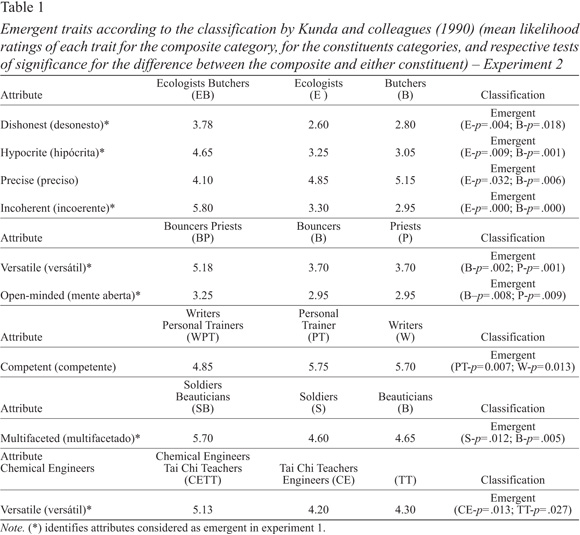
Following Kunda and colleagues’ (1990) procedure, we considered as emergent any attribute that produced a mean likelihood rating for the combination that was significantly higher or lower than both mean likelihood ratings produced for the constituents. Table 1 presents the mean likelihood ratings for each emergent attribute obtained in Experiment 2, and significance levels for the difference with each constituents’ mean ratings. In the cases where order effect was observed, comparisons with both orders are included, though only one gives rise to an emergent. Some of the emergent attributes generated seem to explicitly resonate the apparent infrequency of the composite and incongruency between the constituent categories, such as versatile, multifaceted, and incoherent. The other emergent attributes were: hypocrite and dishonest, for Ecologists-Butchers (with an higher mean likelihood rating than that obtained either for Ecologists or for Butchers), competent, for Writers-Personal Trainers (with a lower mean likelihood rating than that obtained either for Writers or for Personal Trainers), precise, for Ecologists-Butchers (also with a lower mean likelihood rating), and open-minded, for Priests-Bouncers (with an higher mean likelihood rating than that obtained for either Priests or for Bouncers).
In all, this substantial reduction in the number of emergent attributes from Experiment 1 to Experiment 2 was not surprising and goes as expected from Kunda and colleagues’ (1990) results. For all the remaining attributes, we classified them too according to Kunda and colleagues’ (1990) criteria, identifying two possible cases:
1)If a combination’s rating differed significantly from that of one of the constituents, but not the other, the attribute was defined as inherited: e.g., conservative showed a mean rating of 4.00 for Musicians-Soldiers, being inherited from Soldiers (M=4.60, p=.156) and not from Musicians (M=2.65, p=.003);
2)If the rating fell between the ratings of the constituents, and differed significantly from both or from neither, the attribute was defined as averaged across both constituents: e.g., patient, with a mean rating of 5.30 for Massage Therapists-Firefighters, produced mean ratings of 5.80 (p=.091) for Massage Therapists and 4.90 (p=.236) for Firefighters.
A comprehensive list of all attributes, their mean likelihood ratings, significance levels, and classification as to the mode of conflict resolution can be found in Appendix 5, which also signalises, with an asterisk (*), which attributes have been already generated as emergent in Experiment 1.
Finally, we again correlated Experiment 1’s mean surprise and difficulty with Experiment 2’s proportions of each different mode of conflict resolution, for each category. A moderate positive correlation (r=.47) was observed between mean difficulty and proportion of emergent attributes, only marginally significant (p=.060). The proportion of inherited attributes also showed a high negative correlation with the proportion of averaged attributes (r=-.73, p=.007).
General discussion
In two experiments, participants were asked to generate and rate the likelihood of certain traits for simple and composite professional categories. Given that the composite categories are combinations of incongruent and atypical simple categories, we did not expect participants to have exemplars stored in memory on which to base their responses.
In Experiment 1, participants generated traits for composite professional categories with relative ease, with 40% of participants rating the task of imagining composite stereotypes as having little to no difficulty. When describing these composite categories, participants relied mostly on the traits found in constituent categories, but also generated a significant percentage of emergent traits, not reported in either of the constituent categories. When data was aggregated, each composite category was described on average with 10 traits, with five of them being classified as emergent traits.
]]> In Experiment 2, following the method by Kunda and colleagues (1990), participants rated the likelihood of potentially emergent traits for both simple and composite categories. Here we tested, in a between-subjects design, if previously identified traits were significantly rated as more likely of the composite categories than their constituent categories, assuring their emergent qualities. Any attribute with a mean rating significantly higher (or lower) than both mean ratings obtained for the constituents was considered emergent. Of the 92 potential emergent traits, 39 were rated on average as more likely of the composite category than their constituent categories. And, of these 39 emergent traits, nine reached statistical significance levels.We found evidence that the order of presentation can play a role in how composite stereotypes are evaluated, namely by one of the orders generating more emergent traits than the other. A striking example is the case of the trait practical for Journalist-Bullfighter as opposed to the less practical Bullfighter-Journalist. Another example is the case of the Farmer-Programmer that was described as organized, brave, hardworking and independent as opposed to the Programmer-Farmer that was described as dedicated, honest, innovative and patient. One possible explanation for this effect is that the first social category has an anchoring effect over the second category, even when participants are instructed to attend both categories simultaneously. Future studies could test this hypothesis by asking participants to describe the reasoning process in an open-ended question format. If an anchoring effect exists, then participants should first imagine a person belonging to the first category and then adding the traits to the second category using causal reasoning, for instance, by generating causal antecedents (Kunda et al., 1990).
Some of the emergent traits, such as hypocrite and dishonest attributed to Ecologist-Butcher, and open minded attributed to Priest-Bouncer, reflected new valued judgments associated with the combination. Because the ideological beliefs associated with Ecologists and Priests contrasted with that associated to Butchers and Bouncers in such a strong way, new traits emerged and were associated with the combination. As Asch and Zukier (1984) put it, “traits actively transform each other in ways that permit a view of the person from a different and unified perspective”. In these cases, subjects acted not as mere combinators of already known stereotypes, but as active judges about the character of the member of these new combinations.
Surprisingly, data from Experiment 2 brought, as emergent information, some traits that we called “faded” emergent traits, as they were significantly less likely of describing the composite category than of its constituents. For instance, a Writer-Personal Trainer was rated as less competent than a Writer or a Personal Trainer. Or the Ecologist-Butcher, which was rated as less precise than an Ecologist or a Butcher. In both cases, the composite stereotypes are not evaluated as simple averaging of their constituent characteristics. Instead, the composite stereotypes are able to significantly decrease the attribution of certain traits characteristic of the constituent categories, as if a trait fades, dissipates and loses descriptive value within the composite category.
Conclusions, limitations, and future research
In the present data we found evidence, in Portuguese language, that emergent traits are used when participants describe people belonging to complex incongruent professional categories. By following the methods used by Kunda and colleagues (1990) we obtained emergency-rich material from the combination of conflicting professional categories. We found that, in some cases, the order of presentation of these combinations affects the probability of generating and rating traits as more likely of the combination of professional categories than its constituent categories. Finally, in Experiment 2, we found evidence for what we named “faded” emergent traits, being those less likely traits of the composite professional categories than of their constituent categories, as if during the process of conceptually combining the social categories some traits vanish. Why that happens and if the effect is due to inhibitory processes is a matter of further empirical questioning and experimental testing.
While, in Experiment 1, about half the traits generated were considered emergent, fewer traits in Experiment 2 were considered emergent. The discrepancy of results between the two experiments was also seen in the studies of Kunda and colleagues (1990). One likely explanation has to do with the differences between procedures. While in Experiment 1 participants were asked to generate novel traits, in Experiment 2 participants were asked to rate given traits. When we prompt participants to describe the traits of incongruent composite categories, they are likely to use causal reasoning (Kunda et al., 1990), which may promote the creation of novel emergent attributes. Because of the passive nature of the rating task, an internal narrative with causal reasoning may be less likely to happen, and therefore less emergent traits detected. Another possible explanation is that the rating task may prompt participants to rate the presented trait to only one of the categories. When participants are asked to imagine a person belonging to the composite categories such an anchoring effect (Strack & Mussweiler, 1997; Tversky & Kanheman, 1974) may be less frequent. Lastly, the difference in results may simply be due to design choice. The between-subjects design chosen by Kunda and collaborators (1990) may come at the cost of ignoring within-subject variance. This choice of design makes it harder to achieve statistical significance and demands a large sample of participants. An alternative method can be found in Hastie and colleagues (1990), where a within-subject design was chosen instead of a between-subject design. In this alternative design each participant rates the likelihood of a trait for both composite and simple categories. While this design is less demanding in terms of the sample size required to achieve statistical significance, it presents us with some challenges of its own when it comes to interpreting the results. Because each participant rates the trait likelihood for both simple and composite categories, part of the emergency effects may be due to anchoring and contrast (Krueger & Rothbart, 1990) between categories (simple and composite), a hypothesis ruled out by the between-subjects design used in our experiments. Therefore, a between-subjects approach, while more restrictive and conservative, can lead to more robust results by assuring that the responses are more independent from each other. Also, because of our choice of design, we have evidence that some level of consensus exists when people evaluate emergent traits in composite professional categories. Results obtained with a between-subject design are more representative of the shared nature of the emergent composite stereotypes instead of a personal nature of emergent composite stereotypes.
As so, because of our methods and sample size, it is possible that we are miscategorizing emergent traits as averaged or inherited simply because they fail to achieve statistically significant levels of emergence, according to Kunda and colleagues’ (1990) criteria. To overcome these difficulties, future research may use a middle-ground by adopting Hastie and colleagues’ (1990) within-subject methodology while at the same time mitigates possible anchoring and contrasting effects by randomizing the order of the rating task of traits for composite and single categories. This is a possibility that new studies are now exploring to reliably find trait emergency effects without requiring large participant sample sizes.
Regardless of the design used, future studies should also acknowledge the potential problem of multiple comparisons that arises from a statistical analysis that involves multiple simultaneous statistical tests. In fact, the more statistical inferences are made, the more likely erroneous inferences are to occur. Results from Experiment 2 were obtained from a statistical test which was repeated multiple times, bringing more likely the inflation of significance levels, and that some of the significant results obtained be due to chance. Preventing this inflation may require adoption of a stricter significance threshold so as to compensate for the number of comparisons being made (Benjamini, 2010).
]]> Finally, the study of how social categories combine, along with previous investigations on how people reason about combined social categories and how they construct a representation of a complex conjunction category from two simpler ingredient categories, addresses the important question of how emergent traits are generated.This is a matter of much debate and different authors propose different mechanisms to explain what processes are taking place. Anderson (1965) suggests that when we consider a trait for a composite category, we evaluate the trait of each category, weight the importance of each category and arrive at a response value for the composite category that is in between both values. This interpretation does not explain emergent traits, as all traits are considered averaged. Asch and Zukier (1984) suggest that instead of averaging the traits, the most frequent conflict resolution strategy is to subordinate one trait to another, where structural attributes, experienced as invariant, dominate over non-structural attributes, or when causal terms dominate in a cause-effect relation and inner attributes dominate over outer attributes. Rather than accumulating, combining traits actively transform each other in ways that permit a view of the person from a different and unified perspective. Hastie and colleagues (1990) suggest three strategies for solving the conflict: analogy with a matching example stored in long-term memory; use of general inferential rules based on personal experience; simulation based on constrains of many small premises, and traits would be chosen if they fit such constraints. Kunda and colleagues (1990) also suggest three strategies for resolving the conflict: an attribute can be inherited from one of the constituent categories, it can be averaged from both constituents, or, the use of causal reasoning and broader world knowledge to create narratives can create emergent attributes that are not directly derived from the constituent categories.
Whether emergent attributes are more causal in nature (see Kunda et al., 1990) or reflect a secondary stage social inference process with mental simulation (see Hastie et al., 1990), research on the representation of composite social categories, and the nature of inferences that are made to create descriptions of novel categories, reveals complex judgment processes. In fact, one thing that we know is that people do not ignore one or the other type of information when considering a member of both categories. When their beliefs or stereotypes about a category conflict with their beliefs about the other category, to which the member belongs too, our data suggest that both categories play a role in constructing a mental representation. People combine the types of information, tailoring the previous original stereotypes and bringing novel elements drawn from broader world knowledge.
It is our conviction that, in spite of the fact that emergent attributes have also been observed in nonsocial categories, reasoning about everyday social categories takes a more complex form and provides such evocative stimulus materials that challenges the theoretical explanations triggered by the combination of nonsocial categories. So, using these methodologies along with the scrutiny of subjects’ think-aloud within social categories can provide useful clues to advance our knowledge on how we generate, code, and recall information about complex composite categories. Future studies could test hypothesis about the nature of mental representations of this kind of attributes, along with the cognitive processes involved. For instance, because generating emergent traits may require elaboration and more complex cognitive processes, a better recall and a greater test-retest stability for such information might be expected, when compared to inherited information coming from constituent simple categories.
References
Anderson, N. H. (1965). Averaging versus adding as a stimulus-combination rule in impression formation. Journal of Experimental Psychology, 70, 394-400. Retrieved from https://doi.org/10.1037/h0022280 [ Links ]
Anderson, N. H. (1968). Likableness ratings of 555 personality-trait words. Journal of Personality and Social Psychology, 9, 272-279. Retrieved from https://doi.org/10.1037/h0025907 [ Links ]
Asch, S. E., & Zukier, H. (1984). Thinking about persons. Journal of Personality and Social Psychology, 46, 1230-1240. Retrieved from https://doi.org/10.1037/0022-3514.46.6.1230 [ Links ]
Benjamini, Y. (2010). Simultaneous and selective inference: Current successes and future challenges. Biometrical Journal, 52, 708-721. Retrieved from https://doi.org/10.1002/bimj.200900299 [ Links ]
Estes, Z., & Ward, T. B. (2002). The emergence of novel attributes in concept modification. Creativity Research Journal, 14, 149-156. Retrieved from https://doi.org/10.1207/s15326934crj1402_2 [ Links ]
Goffman, I. (1963). Stigma: Notes on the management of a spoiled identity. Englewood Cliffs, NJ: Prentice-Hall. [ Links ]
Groom, C. J., Sherman, J. W., Lu, L., Conrey, F. R., & Keijzer, B. S. (2005). Judging compound social categories: Compound familiarity and compatibility as determinants of processing mode. Social Cognition, 23, 291-323. Retrieved from https://doi.org/10.1521/soco.2005.23.4.291 [ Links ]
Hastie, R., Schroeder, C., & Weber, R. (1990). Creating complex social conjunction categories from simple categories. Bulletin of the Psychonomic Society, 28, 242-247. Retrieved from https://doi.org/10.3758/BF03334016 [ Links ]
Hutter, R. R., & Crisp, R. J. (2005). The composition of category conjunctions. Personality and Social Psychology Bulletin, 31, 647-657. Retrieved from https://doi.org/10.1177/0146167204271575 [ Links ]
Krueger, J., & Rothbart, M. (1990). Contrast and accentuation effects in category learning. Journal of Personality and Social Psychology, 59, 651-663. [ Links ]
Kunda, Z., Miller, D. T., & Claire, T. (1990). Combining social concepts: The role of causal reasoning. Cognitive Science, 14, 551-577. Retrieved from https://doi.org/10.1207/s15516709cog1404_3 [ Links ]
Siebler, F. (2008). Emergent attributes in person perception: A comparative test of response time predictions. Social Psychology, 39, 83-89. Retrieved from https://doi.org/10.1027/1864-9335.39.2.83 [ Links ]
Strack, F., & Mussweiler, T. (1997). Explaining the enigmatic anchoring effect: Mechanisms of selective accessibility. Journal of Personality and Social Psychology, 73, 437-446. Retrieved from https://doi.org/10.1037/0022-3514.73.3.437 [ Links ]
Tversky, A., & Kahneman, D. (1974). Judgment under uncertainty: Heuristics and biases. Science, 185(4157), 1124-1131. Retrieved from https://doi.org/10.1126/science.185.4157.1124 [ Links ]
Wilkenfeld, M. J., & Ward, T. B. (2001). Similarity and emergence in conceptual combination. Journal of Memory and Language, 45, 21-38. Retrieved from https://doi.org/10.1006/jmla.2000.2772 [ Links ]
Correspondence concerning this article should be addressed to: Ana Sofia Santos, CICPSI, Faculdade de Psicologia, Universidade de Lisboa, Alameda da Universidade, 1649-013 Lisboa, Portugal. E-mail: sosantos@psicologia.ulisboa.pt
Submitted: 20/07/2018 Accepted: 02/05/2019
]]>