<?xml version="1.0" encoding="ISO-8859-1"?><article xmlns:mml="http://www.w3.org/1998/Math/MathML" xmlns:xlink="http://www.w3.org/1999/xlink" xmlns:xsi="http://www.w3.org/2001/XMLSchema-instance">
<front>
<journal-meta>
<journal-id>0870-8231</journal-id>
<journal-title><![CDATA[Análise Psicológica]]></journal-title>
<abbrev-journal-title><![CDATA[Aná. Psicológica]]></abbrev-journal-title>
<issn>0870-8231</issn>
<publisher>
<publisher-name><![CDATA[ISPA-Instituto Universitário]]></publisher-name>
</publisher>
</journal-meta>
<article-meta>
<article-id>S0870-82312020000100009</article-id>
<article-id pub-id-type="doi">10.14417/ap.1671</article-id>
<title-group>
<article-title xml:lang="en"><![CDATA[Psychometric properties of the Portuguese version of the Achievement Emotions Questionnaire for Elementary School]]></article-title>
<article-title xml:lang="pt"><![CDATA[Propriedades psicométricas da versão portuguesa do Achievement Emotions Questionnaire para o 1º ciclo]]></article-title>
</title-group>
<contrib-group>
<contrib contrib-type="author">
<name>
<surname><![CDATA[Sanches]]></surname>
<given-names><![CDATA[Cristina]]></given-names>
</name>
<xref ref-type="aff" rid="A01"/>
</contrib>
<contrib contrib-type="author">
<name>
<surname><![CDATA[Monteiro]]></surname>
<given-names><![CDATA[Vera]]></given-names>
</name>
<xref ref-type="aff" rid="A01"/>
</contrib>
<contrib contrib-type="author">
<name>
<surname><![CDATA[Mata]]></surname>
<given-names><![CDATA[Lourdes]]></given-names>
</name>
<xref ref-type="aff" rid="A01"/>
</contrib>
<contrib contrib-type="author">
<name>
<surname><![CDATA[Santos]]></surname>
<given-names><![CDATA[Natalie]]></given-names>
</name>
<xref ref-type="aff" rid="A01"/>
</contrib>
<contrib contrib-type="author">
<name>
<surname><![CDATA[Gomes]]></surname>
<given-names><![CDATA[Marta]]></given-names>
</name>
<xref ref-type="aff" rid="A01"/>
</contrib>
</contrib-group>
<aff id="A01">
<institution><![CDATA[,ISPA - Instituto Universitário Centro de Investigação em Educação ]]></institution>
<addr-line><![CDATA[Lisboa ]]></addr-line>
<country>Portugal</country>
</aff>
<pub-date pub-type="pub">
<day>00</day>
<month>03</month>
<year>2020</year>
</pub-date>
<pub-date pub-type="epub">
<day>00</day>
<month>03</month>
<year>2020</year>
</pub-date>
<volume>38</volume>
<numero>1</numero>
<fpage>127</fpage>
<lpage>139</lpage>
<copyright-statement/>
<copyright-year/>
<self-uri xlink:href="http://scielo.pt/scielo.php?script=sci_arttext&amp;pid=S0870-82312020000100009&amp;lng=en&amp;nrm=iso"></self-uri><self-uri xlink:href="http://scielo.pt/scielo.php?script=sci_abstract&amp;pid=S0870-82312020000100009&amp;lng=en&amp;nrm=iso"></self-uri><self-uri xlink:href="http://scielo.pt/scielo.php?script=sci_pdf&amp;pid=S0870-82312020000100009&amp;lng=en&amp;nrm=iso"></self-uri><abstract abstract-type="short" xml:lang="en"><p><![CDATA[The main purposes of the current research were to translate and adapt the Achievement Emotions Questionnaire - Elementary School (AEQ-ES) into Portuguese and to analyze its psychometric properties. A sample of 350 Portuguese third and fourth graders (aged 7 to 12 years) completed the Portuguese version of the AEQ-ES (AEQ-ES-P). As does the original version, the AEQ-ES-P measures students’ enjoyment, boredom, and anxiety toward mathematics in three academic settings: attending class, doing homework, and taking tests. Confirmatory factor analysis corroborated the hierarchical structure of the AEQ-ES-P, which was also invariant across gender and grades. The instrument also showed good reliability and temporal stability. Significant correlations were found in the expected direction between enjoyment, anxiety, and boredom, as well as between these emotions, students’ perceptions of competence, and intrinsic motivation toward mathematics, thus supporting the internal and external validity of the questionnaire. These results indicate that the AEQ-ES-P presents good psychometric properties and is suitable to measure the achievement emotions of Portuguese elementary-school children of the third and fourth grades in the domain of mathematics.]]></p></abstract>
<abstract abstract-type="short" xml:lang="pt"><p><![CDATA[Os principais objetivos do corrente estudo consistiram na tradução e adaptação do Achievement Emotions Questionnaire - Elementary School (AEQ-ES) para Português e na análise das suas propriedades psicométricas. Uma amostra de 350 alunos portugueses do terceiro e quarto ano de escolaridade (com idades compreendidas entre os 7 e os 12 anos) completou a versão portuguesa do AEQ-ES (AEQ-ES-P). Tal como a versão original, o AEQ-ES-P mede o prazer, o aborrecimento e a ansiedade dos alunos em relação à matemática em três contextos académicos: assistir a aulas, fazer os trabalhos de casa e fazer testes. A análise fatorial confirmatória corroborou a estrutura hierárquica do AEQ-ES-P, que também se mostrou invariante entre géneros e anos de escolaridade. O instrumento mostrou também boa fiabilidade e estabilidade temporal. Foram encontradas correlações significativas na direção esperada entre o prazer, a ansiedade e o aborrecimento, bem como entre essas emoções, as perceções de competência dos alunos e a sua motivação intrínseca para a matemática, apoiando assim a validade interna e externa do questionário. Estes resultados indicam que o AEQ-ES-P apresenta boas propriedades psicométricas e é adequado para medir as emoções de realização de crianças portuguesas do terceiro e do quarto ano de escolaridade no domínio da matemática.]]></p></abstract>
<kwd-group>
<kwd lng="en"><![CDATA[Achievement emotions]]></kwd>
<kwd lng="en"><![CDATA[Anxiety]]></kwd>
<kwd lng="en"><![CDATA[Boredom]]></kwd>
<kwd lng="en"><![CDATA[Enjoyment]]></kwd>
<kwd lng="en"><![CDATA[Elementary students]]></kwd>
<kwd lng="pt"><![CDATA[Emoções de realização]]></kwd>
<kwd lng="pt"><![CDATA[Ansiedade]]></kwd>
<kwd lng="pt"><![CDATA[Aborrecimento]]></kwd>
<kwd lng="pt"><![CDATA[Prazer]]></kwd>
<kwd lng="pt"><![CDATA[Alunos do 1º ciclo]]></kwd>
</kwd-group>
</article-meta>
</front><body><![CDATA[ <p><b>Psychometric properties of the Portuguese version of the Achievement Emotions Questionnaire for Elementary School</b></p>     <p><b>Propriedades psicom&eacute;tricas da vers&atilde;o portuguesa do Achievement Emotions Questionnaire para o 1&ordm; ciclo</b></p>     <p><b>Cristina Sanches<sup>1</sup>, Vera Monteiro<sup>1</sup>, Lourdes Mata<sup>1</sup>, Natalie Santos<sup>1</sup>,  Marta Gomes<sup>1</sup></b></p>     <p><sup>1</sup>Centro de Investiga&ccedil;&atilde;o em Educa&ccedil;&atilde;o, ISPA &ndash; Instituto Universit&aacute;rio, Lisboa, Portugal</p>     <p><a name="topc0"></a><a href="#c0">Correspondência</a></p>     <p>&nbsp;</p>     <p><b>ABSTRACT</b></p>     <p>The main purposes of the current research were to translate and adapt the Achievement Emotions Questionnaire &ndash; Elementary School  (AEQ-ES) into Portuguese and to analyze its psychometric properties. A sample of 350 Portuguese third and fourth graders (aged 7 to 12 years)  completed the Portuguese version of the AEQ-ES (AEQ-ES-P). As does the original version, the AEQ-ES-P measures students&rsquo; enjoyment,  boredom, and anxiety toward mathematics in three academic settings: attending class, doing homework, and taking tests. Confirmatory factor  analysis corroborated the hierarchical structure of the AEQ-ES-P, which was also invariant across gender and grades. The instrument also showed  good reliability and temporal stability. Significant correlations were found in the expected direction between enjoyment, anxiety, and boredom,  as well as between these emotions, students&rsquo; perceptions of competence, and intrinsic motivation toward mathematics, thus supporting the  internal and external validity of the questionnaire. These results indicate that the AEQ-ES-P presents good psychometric properties and is  suitable to measure the achievement emotions of Portuguese elementary-school children of the third and fourth grades in the domain of  mathematics.    <p>     <p><b>Key words</b>: Achievement emotions, Anxiety, Boredom, Enjoyment, Elementary students.</p>     ]]></body>
<body><![CDATA[<p>&nbsp;</p>     <p><b>RESUMO</b></p>     <p>Os principais objetivos do corrente estudo consistiram na tradu&ccedil;&atilde;o e adapta&ccedil;&atilde;o do Achievement Emotions  Questionnaire &ndash; Elementary School (AEQ-ES) para Portugu&ecirc;s e na an&aacute;lise das suas propriedades psicom&eacute;tricas. Uma  amostra de 350 alunos portugueses do terceiro e quarto ano de escolaridade (com idades compreendidas entre os 7 e os 12 anos) completou a  vers&atilde;o portuguesa do AEQ-ES (AEQ-ES-P). Tal como a vers&atilde;o original, o AEQ-ES-P mede o prazer, o aborrecimento e a ansiedade dos  alunos em rela&ccedil;&atilde;o &agrave; matem&aacute;tica em tr&ecirc;s contextos acad&eacute;micos: assistir a aulas, fazer os trabalhos de  casa e fazer testes. A an&aacute;lise fatorial confirmat&oacute;ria corroborou a estrutura hier&aacute;rquica do AEQ-ES-P, que tamb&eacute;m se  mostrou invariante entre g&eacute;neros e anos de escolaridade. O instrumento mostrou tamb&eacute;m boa fiabilidade e estabilidade temporal.  Foram encontradas correla&ccedil;&otilde;es significativas na dire&ccedil;&atilde;o esperada entre o prazer, a ansiedade e o aborrecimento, bem  como entre essas emo&ccedil;&otilde;es, as perce&ccedil;&otilde;es de compet&ecirc;ncia dos alunos e a sua motiva&ccedil;&atilde;o  intr&iacute;nseca para a matem&aacute;tica, apoiando assim a validade interna e externa do question&aacute;rio. Estes resultados indicam que o  AEQ-ES-P apresenta boas propriedades psicom&eacute;tricas e &eacute; adequado para medir as emo&ccedil;&otilde;es de realiza&ccedil;&atilde;o de  crian&ccedil;as portuguesas do terceiro e do quarto ano de escolaridade no dom&iacute;nio da matem&aacute;tica.</p>     <p><b>Palavras-chave</b>: Emo&ccedil;&otilde;es de realiza&ccedil;&atilde;o; Ansiedade, Aborrecimento, Prazer, Alunos do 1&ordm; ciclo.</p>     <p>&nbsp;</p>     <p>Emotional experiences play a crucial role in peoples&rsquo; lives, strongly influencing their behavior and well-being. The control-value  theory of achievement emotions (CVT; Pekrun, 2006) explains the role of students&rsquo; emotions in achievement settings, identifying the factors  underlying different emotional experiences as well as their potential effects. Pekrun (2006) defines achievement emotions as prospective,  concurrent, or retrospective affective reactions directly linked to achievement activities (such as attending classes, studying, or doing  homework) or achievement outcomes (such as success or failure in tests, school performance, or grades). Achievement emotions can have a positive  <i>vs.</i> negative valence (e.g., enjoyment or pride <i>vs.</i> anger or boredom), and they can also be classified as physiologically activating  <i>vs.</i> deactivating (e.g., enjoyment, hope, or anxiety <i>vs.</i> relief, boredom, or hopelessness) (Pekrun, 2006; Pekrun &amp; Perry, 2014). Another  characteristic of achievement emotions is that they are domain- and context-specific (Pekrun, 2006). Students report differing emotional  experiences (e.g., enjoyment, pride, boredom, anxiety, or anger) towards different academic domains (e.g., English language, mathematics,  science), and when referring to different academic activities (e.g., attending classes, doing homework, taking tests) (e.g., Goetz, Nett,  Martiny, Hall, &amp; Pekrun, 2012; Pekrun, Goetz, Frenzel, Barchfeld, &amp; Perry, 2011; Raccanello, Brondino, Mo&egrave;, Stupnisky, &amp;  Lichtenfeld, 2018).</p>     <p>&nbsp;</p>     <p><i>The antecedents and consequences of achievement emotions</i></p>     <p>According to CVT (Pekrun, 2006; Pekrun &amp; Perry, 2014), achievement emotions are influenced by individual factors (e.g., personality) and  by contextual factors (e.g., classroom environment, teacher support), which are posited to affect two critical and more proximal antecedents of  the emotions experienced by students in academic settings: control appraisals (perceived competence, expectations, and attributions) and value  appraisals (the perceived value of activities or outcomes). Different combinations of control and value appraisals will therefore trigger  different achievement emotions (e.g., Putwain, Pekrun, et al., 2018). For example, research has shown that the perception of having high control  in a highly valued school task elicits positive emotions such as enjoyment (e.g., Buff, 2014; Putwain, Pekrun, et al., 2018) or pride (e.g.,  Peixoto, Sanches, Mata, &amp; Monteiro, 2017), while perceiving low control in an undervalued task is associated with hopelessness (e.g., Peixoto  et al., 2017). Boredom can arise from perceptions of either high or low control in undervalued tasks (e.g., Pekrun, Goetz, Daniels, Stupnisky,  &amp; Perry, 2010; Pekrun, Hall, Goetz, &amp; Perry, 2014; Putwain, Pekrun, et al., 2018), and anxiety can be elicited when students perceive low  control in a highly valued task (e.g., Henschel &amp; Roick, 2017; Lauermann, Eccles, &amp; Pekrun, 2017; Lohbeck, Nitkowski, &amp; Petermann,  2016).</p>     <p>According to CVT (Pekrun, 2006) and extensive supporting evidence, these different emotional experiences will in turn have a strong impact on  several achievement outcomes, such as students&rsquo; cognitive resources, motivation to learn, persistence, learning strategies,  self-regulation, achievement, and performance (e.g., Mouraditis &amp; Michou, 2011; Obergriesser &amp; Stoeger, 2016; Pekrun et al., 2010;  Pekrun, Lichtenfeld, Marsh, Murayama, &amp; Goetz, 2017; Putwain, Becker, Symes, &amp; Pekrun, 2018). Although in CVT contextual factors and  appraisals are considered antecedents of achievement emotions, which in turn are hypothesized to affect several academic outcomes, the  relationship between all these components is not considered unidirectional but bidirectional. Students&rsquo; achievement outcomes surely affect  their emotional experiences, and both of them certainly influence students&rsquo; appraisals and even contextual factors. Therefore, according to  Pekrun (2006), the various components of the CVT influence each other reciprocally over time, an assumption that has been receiving empirical  support (e.g., Henschel &amp; Roick, 2017; Pekrun et al., 2014, 2017; Putwain, Becker, et al., 2018; Putwain, Pekrun, et al., 2018).</p>     ]]></body>
<body><![CDATA[<p>Research on achievement emotions has grown tremendously in the last decade. However, most studies have focused on the achievement emotions of  university and secondary students and, to a lesser extent, of middle school students. Little is known about the emotional experiences of  elementary students in academic situations. In an attempt to address this gap, Lichtenfeld, Pekrun, Stupnisky, Reiss, and Murayama (2012)  developed a measurement instrument specifically designed for this age group &ndash; the Achievement Emotions Questionnaire for Elementary School  (AEQ-ES).</p>     <p>&nbsp;</p>     <p><i>Measuring the achievement emotions of elementary schoolchildren</i></p>     <p>The AEQ-ES (Lichtenfeld et al., 2012) is based on CVT (Pekrun, 2006) and measures three achievement emotions which, according to the authors,  are of primary importance and frequently experienced in achievement settings: enjoyment, anxiety, and boredom. Given the domain and context  specificity of achievement emotions, the AEQ-ES measures these three emotions in the domain of mathematics in three academic settings: attending  classes, doing homework, and taking tests. This questionnaire was tested using samples of German and American elementary students in the second  and third grades. The results of the CFA showed that a hierarchical model composed of eight first-order factors, representing the  setting-specific emotions, and three second-order factors, representing the three emotions globally, was the solution that best fit the data.  Moreover, this hierarchical structure was also found to be invariant across the German and American samples (Lichtenfeld et al., 2012). As in  previous studies with older students, Lichtenfeld et al. (2012) found that enjoyment was negatively related to anxiety and boredom, and  positively related to achievement. Boredom and anxiety were positively correlated with each other, and they were both negatively related to  achievement. These results corroborate both the internal and external validity of the AEQ-ES, which also displayed good to excellent reliability  in both German and American samples.</p>     <p>Recently, Raccanello et al. (2018) tested an Italian version of the AEQ-ES with a sample of second and fourth graders. The authors tested the  cross-cultural invariance of the hierarchical structure of the AEQ-ES by comparing their data from a sample of Italian students with the results  previously obtained by Lichtenfeld et al. (2012) from samples of German and American students. Raccanello et al. (2018) corroborated the  structural invariance of the questionnaire across the three countries, as well as across gender, grades, and two domains (mathematics and native  language).</p>     <p>In the Portuguese context, research on students&rsquo; achievement emotions is just taking its first steps (e.g., Mata, Peixoto, Monteiro,  &amp; Sanches, 2017; Peixoto et al., 2017) after the adaptation of the AEQ for Portuguese pre-adolescent students (Peixoto, Mata, Monteiro,  Sanches, &amp; Pekrun, 2015). Studies of the achievement emotions of Portuguese elementary students is thus far nonexistent, and in order to  reverse this situation valid and reliable measuring instruments are necessary. Therefore, the present study has two main goals: (1) to translate  and adapt the AEQ-ES (Lichtenfeld et al., 2012) into the Portuguese language, and (2) to analyze the psychometric properties of the adapted  version with a sample of Portuguese students.</p>     <p>&nbsp;</p>     <p><b>Method</b></p>     <p>&nbsp;</p>     <p><i>Participants</i></p>     ]]></body>
<body><![CDATA[<p>This study included a sample of 350 elementary school students, aged 7 to 12 years (52.3% male, <i>M<sub>age</sub></i>=8.81, <i>SD</i>=0.79),  from seven public and private schools of the Lisbon area and surroundings. The sample comprised two grade groups: 226 third-graders (56.6% male,  <i>M<sub>age</sub></i>=8.38; <i>SD</i>=0.52) and 124 fourth-graders (44.4% male, <i>M<sub>age</sub></i>=9.57; <i>SD</i>=0.61). For test-retest  purposes, data were collected four months later from a subsample (<i>n</i>=82, 57% male, <i>M<sub>age</sub></i>=8.07; <i>SD</i>=0.34) of students  who participated in a broader longitudinal research project.</p>     <p>&nbsp;</p>     <p><i>Measures</i></p>     <p>The original AEQ-ES was first translated into Portuguese by members of the research team fluent in English. The translated version was  reviewed by a bilingual translator and then back-translated into English to ensure that the original meaning of the items had not been lost. We  then proceed to the evaluation of the face validity of the translated version. A team member conducted group interviews with 8- and 9-year-old  children to ensure that the content and meaning of the items were easily understood by the children of these ages and did not generate  misunderstandings or erroneous interpretations. As some items generated doubts and were not fully understood by the children, we made some  adjustments to clarify their content, using terms more familiar to Portuguese children at that age, and simplifying the sentence structure. These  reformulations were made so that the new items remained equivalent to the originals from the point of view of their content/emotion addressed.  All the reformulated items were then evaluated by an expert in achievement emotions to ensure that they measured the same achievement emotion as  assessed by the original items (see <a href="/img/revistas/aps/v38n1/38n1a09a1.jpg" target="_blank">Appendix 1</a>).</p>     
<p>Just like the original AEQ-ES (Lichtenfeld et al., 2012), the AEQ-ES-P is composed of 28 items measuring students&rsquo; enjoyment (nine  items), boredom (seven items), and anxiety (12 items) toward mathematics in three different academic settings: while attending classes (e.g., &ldquo;<i>I find math classes so boring that I would rather do something else</i>&rdquo;), while doing homework (e.g., &ldquo;<i>I enjoy math  homework so much that I don&rsquo;t want to stop doing it</i>&rdquo;), and while taking tests (e.g., &ldquo;<i>I get very nervous during math  tests</i>&rdquo;). Boredom is only measured in class and homework settings since, according to the authors, this is not an emotion typically  experienced while taking tests (Lichtenfeld et al., 2012). The questionnaire is therefore composed of eight setting-specific scales, resulting  from the combination of the three achievement emotions and the different academic settings in which they are usually experienced (the complete  list of the items is provided in <a href="/img/revistas/aps/v38n1/38n1a09a1.jpg" target="_blank">Appendix 1</a>). Items are answered on a 5-point pictorial rating scale (1=not at all;  5=very much), anchored by graphical representations of faces showing various levels of emotional intensity. Therefore, the questionnaire has two  versions: one for male students (with boys&rsquo; faces) and another for female students (with girls&rsquo; faces), just as in the original  AEQ-ES (see Lichtenfeld et al., 2012).</p>     
<p>To examine the external validity of the scale, two additional measures were included: perceived competence and motivational orientations.  Perceived competence in mathematics was measured through the Math Competence Perception Scale (EPCM: Santos, Mata, Monteiro, Sanches, &amp;  Gomes, 2018), which is composed of five items (e.g., <i>&ldquo;I am good in Math&rdquo;</i>) answered on a 5-point Likert scale (1=never;  5=always). Students&rsquo; Motivational Orientations were measured using a Portuguese version of the Academic Self-Regulation Questionnaire  (SRQ-A; Gomes, Monteiro, Mata, Santos, &amp; Sanches, 2018), which is grounded on Self-Determination Theory (SDT; Deci &amp; Ryan, 2000; Ryan  &amp; Connell, 1989). This questionnaire comprises 24 items measuring four motivational orientations proposed by SDT, which correspond to four  regulatory styles: External regulation (e.g., &ldquo;<i>I do my math homework because I don&rsquo;t want to be punished&rdquo;</i>), introjected  regulation (e.g., &ldquo;<i>I do my math homework because I want the teacher to think I&rsquo;m a good student</i>&rdquo;), identified regulation  (e.g., &ldquo;<i>I do my math homework because it&rsquo;s important to me to do my math homework&rdquo;</i>), and intrinsic regulation (e.g.,  &ldquo;<i>I do my math homework because I enjoy doing it&rdquo;</i>). Answers to this questionnaire are given on a 5-point Likert scale (1=never;  5=always). From the scores obtained for the four regulatory styles it is possible to calculate the relative autonomy index (RAI) for each of the  participants (for instructions on how to calculate the RAI see Deci &amp; Ryan, 2000; Ryan &amp; Connell, 1989). The more positive the RAI, the  more autonomous the regulation and the more intrinsic the motivational orientation, while the more negative the RAI, the more controlled the  regulation and the more extrinsic the motivational orientation.</p>     <p>&nbsp;</p>     <p><i>Procedures</i></p>     <p>This study is part of a broader research project approved by the Research Ethics Committee of the authors&rsquo; research center, the  Portuguese Ministry of Education (DGE), and the National Commission for Data Protection (CNPD). After obtaining the consent of the school boards,  written consent was obtained from the parents. Confidentiality of the data collected was guaranteed and student participation was voluntary. All  measures were administered at once during regular classroom hours in the exclusive presence of trained assistants, and the process lasted between  30 and 40 minutes. Students were told that there were no &ldquo;right&rdquo; or &ldquo;wrong&rdquo; answers to this questionnaire. The items were  read aloud to avoid misinterpretation resulting from possible reading difficulties. Three sample items unrelated to the school setting, one for  each emotion, were also added so that students could train and become familiar with how to answer the questionnaire. The same questionnaire was  administered to a subsample (<i>n</i>=82) of the initial 350 participants four months later following the same procedures.</p>     <p>&nbsp;</p>     ]]></body>
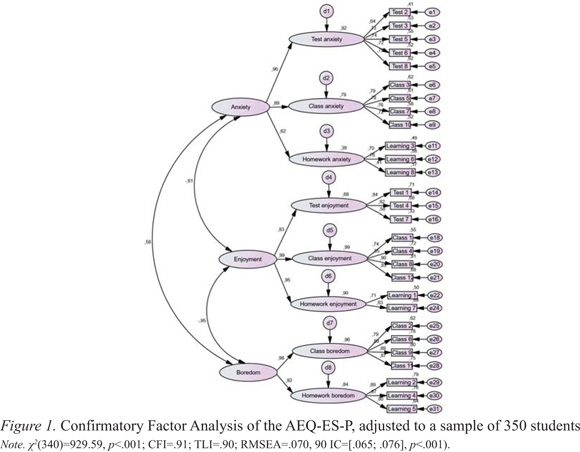
<body><![CDATA[<p><b>Results</b></p>     <p>&nbsp;</p>     <p><i>Factor structure</i></p>     <p>We tested the factor structure of the AEQ-ES-P according to the model proposed by Lichtenfeld et al. (2012). This model postulates a  hierarchical structure with eight latent first-order factors that correspond to the eight scales of the AEQ-ES-P measuring the three emotions  experienced in each academic setting (class, homework, and tests). It also posits three latent second-order factors corresponding to the three  global achievement emotions of enjoyment, boredom, and anxiety (<a href="#f1">Figure 1</a>). Also following the method used both by Lichtenfeld  et al. (2012) and Raccanello et al. (2018), we conducted confirmatory factor analysis (CFA) using the maximum likelihood estimation method, as  available in AMOS 24.0. The results of the CFA indicated that this model adequately fits the data (<i>&chi;<sup>2</sup></i>(340)=929.59,  <i>p</i>&lt;.001; CFI=.91; TLI=.90; RMSEA=.070, 90IC=[.065; .076], <i>p</i>&lt;.001), according to the criteria suggested by Hair, William,  Barry, Rolph, and Ronald (2010) and Kline (2011). All items displayed factor loadings higher than .50 except item eight of the scale homework  anxiety, which was, however, retained since its removal did not improve the model fit or the reliability of the scales.</p>     <p>&nbsp;</p>     <p><a name="f1"></a></p>     <p><img src="/img/revistas/aps/v38n1/38n1a09f1.jpg" width="580" height="452"></p>     
<p>&nbsp;</p>     <p>&nbsp;</p>     <p><i>Convergent and discriminant validity</i></p>     ]]></body>
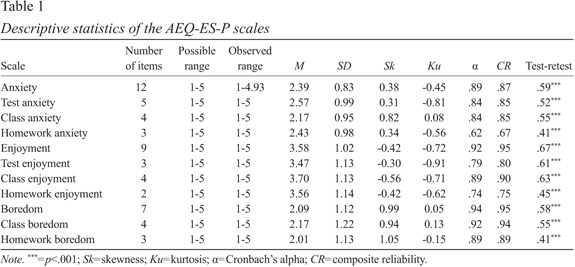
<body><![CDATA[<p>We analyzed the convergent validity of the scale by calculating the average variance extracted (AVE), whose values are considered adequate  when higher than .50 (Hair et al., 2010). Adequate values of AVE were found for anxiety (.70), enjoyment (.86), and boredom (.90). Discriminant  validity was analyzed by comparing the AVE scores with the maximum shared squared variance (MSV) and the average squared variance (ASV), whose  values should be lower than those of the AVE. While the ASV values were lower than those of the AVE for the three achievement emotions  (ASV<sub>Anxiety</sub>=.35; ASV<sub>Enjoyment</sub>=.64; ASV<sub>Boredom</sub>=.63), the MSV values were lower than those of the AVE for anxiety  (MSV=.38), equal for boredom (MSV=.90), and higher for enjoyment (MSV=.90). These results support the convergent validity of the AEQ-ES-P, but  its discriminant validity is somewhat compromised due to the weak discrimination between the boredom and enjoyment scales.</p>     <p>&nbsp;</p>     <p><i>Item statistics and reliability</i></p>     <p>Descriptive statistics of the AEQ-ES-P scales are shown in <a href="#t1">Table 1</a>. The distribution of the answers on all of the eight  scales covered the possible range of the scale, indicating that children of the third and fourth grades are able to distinguish between these  three emotions in different academic settings (classes, homework, and tests). Boredom, both global and setting-specific, as well as class  anxiety, presented positively asymmetric distributions, indicating that these achievement emotions are not common among third and fourth graders  in the domain of mathematics. Indeed, when we look at the mean values of the eight scales, we can clearly see that boredom was the emotion least  reported by students and enjoyment the most.</p>     <p>&nbsp;</p>     <p><a name="t1"></a></p>     <p><img src="/img/revistas/aps/v38n1/38n1a09t1.jpg" width="575" height="267"></p>     
<p>&nbsp;</p>     <p>To examine the reliability of the scale, we calculated Cronbach&rsquo;s alpha coefficients (&alpha;) and composite reliability (CR), where  values higher than .70 are considered adequate (Hair et al., 2010). As can be observed in <a href="#t1">Table 1</a>, both Cronbach&rsquo;s alpha  and CR displayed values higher than .80 on most scales. Only one scale, homework anxiety, displayed reliability scores below .70, which, however,  exceeds the minimal acceptable value of .60 (Loewenthal, 2004). The global scales (enjoyment, boredom, and anxiety) presented better reliability  indices than the scales measuring the achievement emotions in specific academic settings. However, all the reliability scores were between  acceptable and excellent, demonstrating the internal consistency of the AEQ-ES-P.</p>     <p>We examined the temporal stability of the instrument using test-retest Pearson correlations with a four-month interval calculated only for a  sub-sample of participants (<i>n</i>=82) who were part of a broader longitudinal study. The four-month test-retest correlations were moderate in  size (<i>r</i>=[.41&ndash;.67]), indicating that all the scales were relatively stable, with the homework scales being the least stable.</p>     ]]></body>
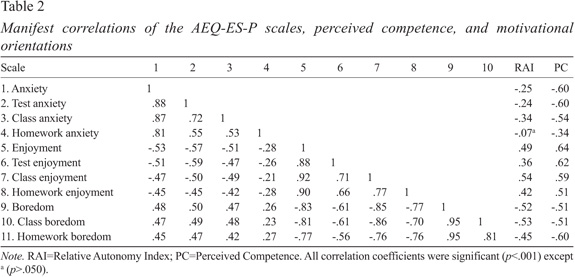
<body><![CDATA[<p>&nbsp;</p>     <p><i>Internal validity</i></p>     <p><a href="#t2">Table 2</a> presents Pearson correlation coefficients between the global scales, as well as between the scales measuring the  emotions in different academic settings. At the level of the global scales, we observed that enjoyment, a positive valence emotion, was  negatively correlated with both anxiety and boredom, negative valence emotions. These two negative emotions were in turn positively correlated  with each other.</p>     <p>&nbsp;</p>     <p><a name="t2"></a></p>     <p><img src="/img/revistas/aps/v38n1/38n1a09t2.jpg" width="575" height="277"></p>     
<p>&nbsp;</p>     <p>At the setting-specific level, correlations followed the same pattern: students&rsquo; reported enjoyment in class, homework, and test  settings was negatively correlated with both anxiety and boredom in those three settings. Negative valence emotions experienced in different  academic settings were in turn positively correlated. These correlations seem to corroborate the internal validity of the instrument.</p>     <p>&nbsp;</p>     <p><i>External validity</i></p>     ]]></body>
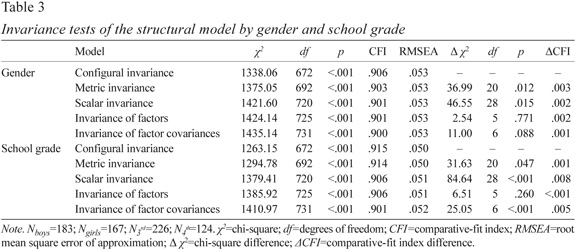
<body><![CDATA[<p>In order to examine the external validity of the AEQ-ES-P, we calculated Pearson correlation coefficients between the achievement emotions,  perceived competence, and motivational orientations reported by elementary students in the domain of mathematics (<a href="#t2">Table 2</a>).  Enjoyment was found to be positively associated with perceived competence, while anxiety and boredom were negatively associated with  students&rsquo; competence perception in math. A similar pattern of results was found for motivational orientations. Enjoyment was positively  related to the students&rsquo; RAI, while anxiety and boredom were negatively related. This indicates that the more intrinsic the students&rsquo;  motivational orientations (that is, the more autonomously regulated and less controlled), the more they report enjoyment and the less they report  anxiety and boredom toward math activities. These results highlight the link between achievement emotions, students&rsquo; perceived competence,  and their motivational orientations in the domain of mathematics.</p>     <p>&nbsp;</p>     <p><i>Measurement invariance</i></p>     <p>We tested the invariance of the measurement model by gender and school grade to ensure that the factor structure of AEQ-ES-P was equivalent  for boys and girls and for third and fourth graders. In both cases, we evaluated invariance by comparing a free model (with freely estimated  factor loadings, intercepts, and covariance of factors) with constrained models where factor loadings (&lambda;), intercepts (<i>i</i>), and  covariances were fixed. Significant changes were monitored by differences in chi-square values (&Delta;<i>&chi;<sup>2</sup></i>) as well as by  changes in CFI (&Delta;CFI), given that &Delta;<i>&chi;<sup>2</sup></i> is sensitive to sample size (Cheung &amp; Rensvold, 2002). The model is  considered invariant when &Delta;<i>&chi;<sup>2</sup></i> values are non-significant (<i>p</i>&ge;.05), or instead when &Delta;CFI values are  lower than .01.</p>     <p><a href="#t3">Table 3</a> presents the results of the invariance tests of the AEQ-ES-P. Although we found significant differences in  chi-square values for some of the compared models, the results confirmed the invariance of the structural models for both gender and grade, since  in both cases the adjustment of the data continued to be adequate in the model with free parameters (configurational invariance) and the values  of &Delta;CFI were always lower than .01. These results indicate that the AEQ-ES-P evaluated the same constructs in boys and girls and in  students of the third and fourth grades.</p>     <p>&nbsp;</p>     <p><a name="t3"></a></p>     <p><img src="/img/revistas/aps/v38n1/38n1a09t3.jpg" width="575" height="251"></p>     
<p>&nbsp;</p>     <p>&nbsp;</p>     ]]></body>
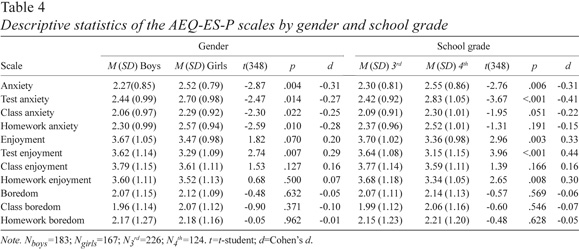
<body><![CDATA[<p><i>Gender and school grade differences</i></p>     <p>Once the invariance of the model was shown for gender and school grade, we examined whether there were significant differences in  students&rsquo; emotions toward mathematics by these two variables (<a href="#t4">Table 4</a>). The results of Student&rsquo;s <i>t</i>-test  showed significant gender differences in anxiety and enjoyment, although these effects were small to moderate. Girls reported more anxiety than  boys towards math, both in general and in setting-specific situations, and less enjoyment in test situations. The results also suggest the  existence of differences between girls and boys in general enjoyment, with girls reporting lower levels thereof, although this difference is only  marginally significant and the magnitude of the effect is small.</p>     <p>&nbsp;</p>     <p><a name="t4"></a></p>     <p><img src="/img/revistas/aps/v38n1/38n1a09t4.jpg" width="579" height="250"></p>     
<p>&nbsp;</p>     <p>Regarding school grade, the results of the <i>t</i>-tests showed significant moderate differences between third and fourth graders, once again  for anxiety and enjoyment. Overall, fourth graders reported feeling more anxiety and less enjoyment toward math than third graders. No  significant differences were found between students from the third and fourth grades on reported boredom, classroom enjoyment, or homework  anxiety.</p>     <p>&nbsp;</p>     <p><b>Discussion</b></p>     <p>The current study aimed to translate and adapt the AEQ-ES (Lichtenfeld et al., 2012) into Portuguese and to analyze its psychometric  properties. The results of the CFA confirmed the hierarchical structure proposed by Lichtenfeld et al. (2012), and also obtained in a recent  AEQ-ES validation study conducted by Raccanello et al. (2018). These results indicate that elementary school students are able to differentiate  between the feelings of enjoyment, anxiety, and boredom experienced in different academic settings, such as when attending classes, doing  homework, or taking tests. The invariance tests further showed that the AEQ-ES-P evaluates the same constructs across genders and grades. It is  therefore a suitable instrument to measure the enjoyment, anxiety, and boredom experienced by boys and girls and by students of the third and  fourth grades in math achievement situations.</p>     ]]></body>
<body><![CDATA[<p>The reliability of the AEQ-ES-P was supported by the good internal consistency scores, which were similar to those obtained by Lichtenfeld et  al. (2012) and Raccanello et al. (2018), as well as by the temporal stability observed. Although the convergent validity of the AEQ-ES-P was  confirmed, its discriminant validity was slightly compromised, given the strong associations between the enjoyment and boredom scales. However,  the manifest correlations reported in the studies of Lichtenfeld et al. (2012) and Raccanello et al. (2018) between the setting-specific  enjoyment and boredom scales are similar to those obtained in the present study, particularly those reported by Raccanello et al. (2018). These  high correlations seem to suggest that these two emotions are considered by children as two opposite poles of an emotional continuum between  enjoyment and boredom. It is nonetheless possible that these results are partly due to the method of analysis used, since in CFA the correlations  between factors tend to be positively skewed (Marsh, Morin, Parker, &amp; Kaur, 2014).</p>     <p>The internal validity of the AEQ-ES-P was supported by the pattern of correlations obtained between all the emotion scales, both global and  setting-specific: enjoyment was negatively correlated with anxiety and boredom, which were positively correlated with each other. This pattern  was consistent with that found by Lichtenfeld et al. (2012) and Raccanello et al. (2018), as well as with the results obtained in recent studies  using elementary school students (e.g., Pekrun et al., 2017).</p>     <p>The external validity of the instrument was evidenced through the correlations obtained between achievement emotions, competence perceptions,  and students&rsquo; motivational orientations. As in previous studies with elementary students, we found that perceived competence, a control  appraisal, was positively associated with enjoyment and negatively associated with anxiety and boredom (e.g., Henschel &amp; Roick, 2017;  Lauermann et al., 2017; Lichtenfeld et al., 2012; Pekrun et al., 2017; Putwain, Pekrun, et al., 2018; Raccanello et al., 2018). Regarding the  association between achievement emotions and motivational orientations, our results showed that a more intrinsic motivational orientation, which  corresponds to a more autonomous regulation, was positively associated with enjoyment and negatively associated with boredom and anxiety. These  findings align with those of previous studies conducted both with older students (e.g., Gonz&aacute;lez, Paoloni, &amp; Rinaudo, 2013; Mouratidis  &amp; Michou, 2011; Pekrun et al., 2010) and with elementary students (e.g., Obergriesser &amp; Stoeger, 2016). Finally, we found some gender and  grade differences among Portuguese elementary students similar to those reported in previous studies that included students of these ages (e.g.,  Lichtenfeld et al., 2012; Lohbeck et al., 2016; Raccanello, Brondino, &amp; De Bernardi, 2013; Raccanello et al., 2018; Vierhaus, Lohaus, &amp;  Wild, 2016), and even in studies of Portuguese students from fifth grade on (Mata et al., 2017). Although the differences were small to moderate  in size, our results generally point to the same negative emotional pattern found in the aforementioned studies: girls and fourth graders report  less enjoyment and more anxiety towards mathematics than boys and third graders. As with Raccanello et al. (2018), no significant gender and  grade differences were found regarding boredom in mathematics.</p>     <p>In order to overcome some of the limitations of the current study, future research should examine the discriminant validity of the instrument  regarding enjoyment and boredom in greater depth, for example using Exploratory Structural Equation Modeling (ESEM), as recommended by Marsh et  al. (2014). Since the AEQ-ES_P is a self-report instrument, it is also important for future studies to complement the data provided by Portuguese  students with data provided by their teachers. Data on students&rsquo; academic achievement and other academic outcomes should also be gathered,  and their reciprocal relationship with emotions should be examined longitudinally. Further, students&rsquo; achievement emotions in different  academic domains and in earlier grades should also be explored. Given the strong associations between students&rsquo; emotional experiences,  their control and value appraisals, and several academic outcomes (e.g., Pekrun et al., 2010, 2017; Putwain, Becker, et al., 2018; Putwain,  Pekrun, et al., 2018), our results highlight the importance of studying achievement emotions as soon as students enter formal schooling. The  sooner negative emotional patterns are identified, the greater the likelihood of an intervention to be effective in breaking down these cycles  or, ideally, in preventing them from even forming. A first step in that direction is to develop reliable and valid instruments specific to this  age group, which was the main contribution we intended to make in the current study. Our findings show that the AEQ-ES-P has good psychometric  properties and support the validity and adequacy of this instrument to measure Portuguese elementary students&rsquo; achievement emotions in the  domain of mathematics.</p>     <p>&nbsp;</p>     <p><b>References</b></p>     <!-- ref --><p>Buff, A. (2014). Enjoyment of learning and its personal antecedents: Testing the change-change assumption of the control-value theory of  achievement emotions. <i>Learning and Individual Differences, 31</i>, 21-29. Retrieved from  <a href="https://doi.org/10.1016/j.lindif.2013.12.007" target="_blank">https://doi.org/10.1016/j.lindif.2013.12.007</a>&nbsp;&nbsp;&nbsp;&nbsp;&nbsp;&nbsp;&nbsp;&nbsp;[&#160;<a href="javascript:void(0);" onclick="javascript: window.open('/scielo.php?script=sci_nlinks&ref=052174&pid=S0870-8231202000010000900001&lng=','','width=640,height=500,resizable=yes,scrollbars=1,menubar=yes,');">Links</a>&#160;]<!-- end-ref --><!-- ref --><p>Cheung, G. W., &amp; Rensvold, R. B. (2002). Evaluating goodness-of-fit indexes for testing measurement invariance. <i>Structural Equation  Modeling: A Multidisciplinary Journal, 9</i>, 233-255. Retrieved from <a href="https://doi.org/10.1207/S15328007SEM0902_5"  target="_blank">https://doi.org/10.1207/S15328007SEM0902_5</a>&nbsp;&nbsp;&nbsp;&nbsp;&nbsp;&nbsp;&nbsp;&nbsp;[&#160;<a href="javascript:void(0);" onclick="javascript: window.open('/scielo.php?script=sci_nlinks&ref=052175&pid=S0870-8231202000010000900002&lng=','','width=640,height=500,resizable=yes,scrollbars=1,menubar=yes,');">Links</a>&#160;]<!-- end-ref --><p>Deci, E. L., &amp; Ryan, R. M. (2000). The &ldquo;what&rdquo; and &ldquo;why&rdquo; of goal pursuits: Human needs and self-determination of  behavior<i>. Psychological Inquiry, 11</i>, 227-268. Retrieved from <a href="https://doi.org/10.1207/s15327965pli1104_01"  target="_blank">https://doi.org/10.1207/s15327965pli1104_01</a></p>     <p>Goetz, T., Nett, U. E., Martiny, S. E., Hall, N. C., &amp; Pekrun, R. (2012). Students&rsquo; emotions during homework: Structures,  self-concept antecedents, and achievement outcomes. <i>Learning and Individual Differences, 22</i>, 225-234. Retrieved from  <a href="https://doi.org/10.1016/j.lindif.2011.04.006" target="_blank">https://doi.org/10.1016/j.lindif.2011.04.006</a></p>     ]]></body>
<body><![CDATA[<!-- ref --><p>Gomes, M., Monteiro, V., Mata, L., Santos, F., &amp; Sanches, C. (2018, July). <i>Question&aacute;rio de Autorregula&ccedil;&atilde;o  Acad&eacute;mico (SRQ-A): Adapta&ccedil;&atilde;o para crian&ccedil;as do 1&ordm; ciclo</i>.    &nbsp;&nbsp;&nbsp;&nbsp;&nbsp;&nbsp;&nbsp;&nbsp;[&#160;<a href="javascript:void(0);" onclick="javascript: window.open('/scielo.php?script=sci_nlinks&ref=052178&pid=S0870-8231202000010000900005&lng=','','width=640,height=500,resizable=yes,scrollbars=1,menubar=yes,');">Links</a>&#160;]<!-- end-ref --> Paper presented at the XIV Col&oacute;quio  Internacional de Psicologia e Educa&ccedil;&atilde;o, ISPA - Instituto Universit&aacute;rio, Lisboa, Portugal.</p>     <!-- ref --><p>Gonz&aacute;lez, A., Paoloni, V., &amp; Rinaudo, C. (2013). Aburrimiento y disfrute en clase de Lengua espa&ntilde;ola en secundaria:  Predictores motivacionales y efectos sobre el rendimiento. <i>Anales de Psicolog&iacute;a, 29</i>, 426-434. Retrieved from  <a href="https://doi.org/10.6018/analesps.29.2.136401" target="_blank">https://doi.org/10.6018/analesps.29.2.136401</a>&nbsp;&nbsp;&nbsp;&nbsp;&nbsp;&nbsp;&nbsp;&nbsp;[&#160;<a href="javascript:void(0);" onclick="javascript: window.open('/scielo.php?script=sci_nlinks&ref=052180&pid=S0870-8231202000010000900006&lng=','','width=640,height=500,resizable=yes,scrollbars=1,menubar=yes,');">Links</a>&#160;]<!-- end-ref --><!-- ref --><p>Hair, J. F., William, C. B., Barry, J. B., Rolph, E. A., &amp; Ronald, L. T. (2010). <i>Multivariate data analysis</i> (7<sup>th</sup> ed.).  Upper-Saddle River, NJ: Pearson Education.    &nbsp;&nbsp;&nbsp;&nbsp;&nbsp;&nbsp;&nbsp;&nbsp;[&#160;<a href="javascript:void(0);" onclick="javascript: window.open('/scielo.php?script=sci_nlinks&ref=052181&pid=S0870-8231202000010000900007&lng=','','width=640,height=500,resizable=yes,scrollbars=1,menubar=yes,');">Links</a>&#160;]<!-- end-ref --></p>     <!-- ref --><p>Henschel, S., &amp; Roick, T. (2017). Relationships of mathematics performance, control and value beliefs with cognitive and affective math  anxiety. <i>Learning and Individual Differences, 55</i>, 97-107. Retrieved from <a href="https://doi.org/10.1016/j.lindif.2017.03.009"  target="_blank">https://doi.org/10.1016/j.lindif.2017.03.009</a>&nbsp;&nbsp;&nbsp;&nbsp;&nbsp;&nbsp;&nbsp;&nbsp;[&#160;<a href="javascript:void(0);" onclick="javascript: window.open('/scielo.php?script=sci_nlinks&ref=052183&pid=S0870-8231202000010000900008&lng=','','width=640,height=500,resizable=yes,scrollbars=1,menubar=yes,');">Links</a>&#160;]<!-- end-ref --><!-- ref --><p>Kline, R. B. (2011). <i>Principles and practice of structural equation modeling</i> (3<sup>rd</sup> ed.). New York, NY: Guilford Press.    &nbsp;&nbsp;&nbsp;&nbsp;&nbsp;&nbsp;&nbsp;&nbsp;[&#160;<a href="javascript:void(0);" onclick="javascript: window.open('/scielo.php?script=sci_nlinks&ref=052184&pid=S0870-8231202000010000900009&lng=','','width=640,height=500,resizable=yes,scrollbars=1,menubar=yes,');">Links</a>&#160;]<!-- end-ref --></p>     <p>Lauermann, F., Eccles, J. S., &amp; Pekrun, R. (2017). Why do children worry about their academic achievement? An expectancy-value  perspective on elementary students&rsquo; worries about their mathematics and reading performance. <i>ZDM, 49</i>, 339-354. Retrieved from  <a href="https://doi.org/10.1007/s11858-017-0832-1" target="_blank">https://doi.org/10.1007/s11858-017-0832-1</a></p>     <p>Lichtenfeld, S., Pekrun, R., Stupnisky, R. H., Reiss, K., &amp; Murayama, K. (2012). Measuring students&rsquo; emotions in the early years:  The Achievement Emotions Questionnaire-Elementary School (AEQ-ES). <i>Learning and Individual Differences, 22</i>, 190-201. Retrieved from  <a href="https://doi.org/10.1016/J.LINDIF.2011.04.009" target="_blank">https://doi.org/10.1016/J.LINDIF.2011.04.009</a></p>     ]]></body>
<body><![CDATA[<!-- ref --><p>Lohbeck, A., Nitkowski, D., &amp; Petermann, F. (2016). A control-value theory approach: Relationships between academic self-concept,  interest, and test anxiety in elementary school children. <i>Child &amp; Youth Care Forum, 45</i>, 887-904. Retrieved from  <a href="https://doi.org/10.1007/s10566-016-9362-1" target="_blank">https://doi.org/10.1007/s10566-016-9362-1</a>&nbsp;&nbsp;&nbsp;&nbsp;&nbsp;&nbsp;&nbsp;&nbsp;[&#160;<a href="javascript:void(0);" onclick="javascript: window.open('/scielo.php?script=sci_nlinks&ref=052188&pid=S0870-8231202000010000900012&lng=','','width=640,height=500,resizable=yes,scrollbars=1,menubar=yes,');">Links</a>&#160;]<!-- end-ref --><!-- ref --><p>Loewenthal, K. M. (2004). <i>An introduction to psychological tests and scales</i> (2<sup>nd</sup> ed.). Hove, UK: Psychology Press.    &nbsp;&nbsp;&nbsp;&nbsp;&nbsp;&nbsp;&nbsp;&nbsp;[&#160;<a href="javascript:void(0);" onclick="javascript: window.open('/scielo.php?script=sci_nlinks&ref=052189&pid=S0870-8231202000010000900013&lng=','','width=640,height=500,resizable=yes,scrollbars=1,menubar=yes,');">Links</a>&#160;]<!-- end-ref --></p>     <!-- ref --><p>Marsh, H. W., Morin, A. J. S., Parker, P. D., &amp; Kaur, G. (2014). Exploratory structural equation modeling: An integration of the best  features of exploratory and confirmatory factor analysis. <i>Annual Review of Clinical Psychology, 10</i>, 85-110. Retrieved from  <a href="https://doi.org/10.1146/annurev-clinpsy-032813-153700" target="_blank">https://doi.org/10.1146/annurev-clinpsy-032813-153700</a>&nbsp;&nbsp;&nbsp;&nbsp;&nbsp;&nbsp;&nbsp;&nbsp;[&#160;<a href="javascript:void(0);" onclick="javascript: window.open('/scielo.php?script=sci_nlinks&ref=052191&pid=S0870-8231202000010000900014&lng=','','width=640,height=500,resizable=yes,scrollbars=1,menubar=yes,');">Links</a>&#160;]<!-- end-ref --><!-- ref --><p>Mata, L., Peixoto, F., Monteiro, V., &amp; Sanches, C. (2017). Emo&ccedil;&otilde;es face &agrave; matem&aacute;tica e progress&atilde;o na  escolaridade: Estudo longitudinal com alunos do 5&ordm; e do 7&ordm; anos de escolaridade. <i>An&aacute;lise Psicol&oacute;gica, 35</i>,  125-144. Retrieved from <a href="https://doi.org/10.14417/ap.1227" target="_blank">https://doi.org/10.14417/ap.1227</a>&nbsp;&nbsp;&nbsp;&nbsp;&nbsp;&nbsp;&nbsp;&nbsp;[&#160;<a href="javascript:void(0);" onclick="javascript: window.open('/scielo.php?script=sci_nlinks&ref=052192&pid=S0870-8231202000010000900015&lng=','','width=640,height=500,resizable=yes,scrollbars=1,menubar=yes,');">Links</a>&#160;]<!-- end-ref --><p>Mouratidis, A., &amp; Michou, A. (2011). Self-determined motivation and social achievement goals in children&rsquo;s emotions. <i>Educational  Psychology, 31</i>, 67-86. Retrieved from <a href="https://doi.org/10.1080/01443410.2010.518595"  target="_blank">https://doi.org/10.1080/01443410.2010.518595</a></p>     <!-- ref --><p>Obergriesser, S., &amp; Stoeger, H. (2016). The influence of emotions and learning preferences on learning strategy use before transition  into high-achiever track secondary school. <i>High Ability Studies, 27</i>, 5-38. Retrieved from  <a href="https://doi.org/10.1080/13598139.2015.1100980" target="_blank">https://doi.org/10.1080/13598139.2015.1100980</a>&nbsp;&nbsp;&nbsp;&nbsp;&nbsp;&nbsp;&nbsp;&nbsp;[&#160;<a href="javascript:void(0);" onclick="javascript: window.open('/scielo.php?script=sci_nlinks&ref=052194&pid=S0870-8231202000010000900017&lng=','','width=640,height=500,resizable=yes,scrollbars=1,menubar=yes,');">Links</a>&#160;]<!-- end-ref --><!-- ref --><p>Peixoto, F., Mata, L., Monteiro, V., Sanches, C., &amp; Pekrun, R. (2015). The Achievement Emotions Questionnaire: Validation for  pre-adolescent students. <i>European Journal of Developmental Psychology, 12</i>, 472-481. Retrieved from  <a href="https://doi.org/10.1080/17405629.2015.1040757" target="_blank">https://doi.org/10.1080/17405629.2015.1040757</a>&nbsp;&nbsp;&nbsp;&nbsp;&nbsp;&nbsp;&nbsp;&nbsp;[&#160;<a href="javascript:void(0);" onclick="javascript: window.open('/scielo.php?script=sci_nlinks&ref=052195&pid=S0870-8231202000010000900018&lng=','','width=640,height=500,resizable=yes,scrollbars=1,menubar=yes,');">Links</a>&#160;]<!-- end-ref --><p>Peixoto, F., Sanches, C., Mata, L., &amp; Monteiro, V. (2017). &ldquo;How do you feel about math?&rdquo;: Relationships between competence  and value appraisals, achievement emotions and academic achievement. <i>European Journal of Psychology of Education, 32</i>, 385-405.  Retrieved from <a href="https://doi.org/10.1007/s10212-016-0299-4" target="_blank">https://doi.org/10.1007/s10212-016-0299-4</a></p>     <!-- ref --><p>Pekrun, R. (2006). The control-value theory of achievement emotions: Assumptions, corollaries, and implications for educational research and  practice. <i>Educational Psychology Review, 18</i>, 315-341. Retrieved from <a href="https://doi.org/10.1007/s10648-006-9029-9"  target="_blank">https://doi.org/10.1007/s10648-006-9029-9</a>&nbsp;&nbsp;&nbsp;&nbsp;&nbsp;&nbsp;&nbsp;&nbsp;[&#160;<a href="javascript:void(0);" onclick="javascript: window.open('/scielo.php?script=sci_nlinks&ref=052197&pid=S0870-8231202000010000900020&lng=','','width=640,height=500,resizable=yes,scrollbars=1,menubar=yes,');">Links</a>&#160;]<!-- end-ref --><!-- ref --><p>Pekrun, R., Goetz, T., Daniels, L. M., Stupnisky, R. H., &amp; Perry, R. P. (2010). Boredom in achievement settings: Exploring control-value  antecedents and performance outcomes of a neglected emotion. <i>Journal of Educational Psychology, 102</i>, 531-549. Retrieved from  <a href="https://doi.org/10.1037/a0019243" target="_blank">https://doi.org/10.1037/a0019243</a>&nbsp;&nbsp;&nbsp;&nbsp;&nbsp;&nbsp;&nbsp;&nbsp;[&#160;<a href="javascript:void(0);" onclick="javascript: window.open('/scielo.php?script=sci_nlinks&ref=052198&pid=S0870-8231202000010000900021&lng=','','width=640,height=500,resizable=yes,scrollbars=1,menubar=yes,');">Links</a>&#160;]<!-- end-ref --><p>Pekrun, R., Goetz, T., Frenzel, A., Barchfeld, P., &amp; Perry, R. (2011). Measuring emotions in students&rsquo; learning and performance:  The Achievement Emotions Questionnaire (AEQ). <i>Contemporary Educational Psychology, 36</i>, 36-48. Retrieved from  <a href="https://doi.org/10.1016/j.cedpsych.2010.10.002" target="_blank">https://doi.org/10.1016/j.cedpsych.2010.10.002</a></p>     <!-- ref --><p>Pekrun, R., Hall, N. C., Goetz, T., &amp; Perry, R. P. (2014). Boredom and academic achievement: Testing a model of reciprocal causation.  <i>Journal of Educational Psychology, 106</i>, 696. Retrieved from <a href="https://doi.org/10.1037/a0036006"  target="_blank">https://doi.org/10.1037/a0036006</a>&nbsp;&nbsp;&nbsp;&nbsp;&nbsp;&nbsp;&nbsp;&nbsp;[&#160;<a href="javascript:void(0);" onclick="javascript: window.open('/scielo.php?script=sci_nlinks&ref=052200&pid=S0870-8231202000010000900023&lng=','','width=640,height=500,resizable=yes,scrollbars=1,menubar=yes,');">Links</a>&#160;]<!-- end-ref --><!-- ref --><p>Pekrun, R., Lichtenfeld, S., Marsh, H. W., Murayama, K., &amp; Goetz, T. (2017). Achievement emotions and academic performance: Longitudinal  models of reciprocal effects. <i>Child Development, 88</i>, 1653-1670. Retrieved from <a href="https://doi.org/10.1111/cdev.12704"  target="_blank">https://doi.org/10.1111/cdev.12704</a>&nbsp;&nbsp;&nbsp;&nbsp;&nbsp;&nbsp;&nbsp;&nbsp;[&#160;<a href="javascript:void(0);" onclick="javascript: window.open('/scielo.php?script=sci_nlinks&ref=052201&pid=S0870-8231202000010000900024&lng=','','width=640,height=500,resizable=yes,scrollbars=1,menubar=yes,');">Links</a>&#160;]<!-- end-ref --><!-- ref --><p>Pekrun, R., &amp; Perry, R. P. (2014). Control-value theory of achievement emotions. In R. Pekrun &amp; L. Linnerbrink-Garcia (Eds.),  <i>International handbook of emotions in education</i> (pp. 120-141). New York, NY: Routledge.    &nbsp;&nbsp;&nbsp;&nbsp;&nbsp;&nbsp;&nbsp;&nbsp;[&#160;<a href="javascript:void(0);" onclick="javascript: window.open('/scielo.php?script=sci_nlinks&ref=052202&pid=S0870-8231202000010000900025&lng=','','width=640,height=500,resizable=yes,scrollbars=1,menubar=yes,');">Links</a>&#160;]<!-- end-ref --></p>     <p>Putwain, D. W., Becker, S., Symes, W., &amp; Pekrun, R. (2018). Reciprocal relations between students&rsquo; academic enjoyment, boredom, and  achievement over time. <i>Learning and Instruction, 54</i>, 73-81. Retrieved from <a href="https://doi.org/10.1016/j.learninstruc.2017.08.004"  target="_blank">https://doi.org/10.1016/j.learninstruc.2017.08.004</a></p>     <!-- ref --><p>Putwain, D. W., Pekrun, R., Nicholson, L. J., Symes, W., Becker, S., &amp; Marsh, H. W. (2018). Control-value appraisals, enjoyment, and  boredom in mathematics: A longitudinal latent interaction analysis. <i>American Educational Research Journal, 55</i>, 1339-1368. Retrieved  from <a href="https://doi.org/10.3102/0002831218786689" target="_blank">https://doi.org/10.3102/0002831218786689</a>&nbsp;&nbsp;&nbsp;&nbsp;&nbsp;&nbsp;&nbsp;&nbsp;[&#160;<a href="javascript:void(0);" onclick="javascript: window.open('/scielo.php?script=sci_nlinks&ref=052205&pid=S0870-8231202000010000900027&lng=','','width=640,height=500,resizable=yes,scrollbars=1,menubar=yes,');">Links</a>&#160;]<!-- end-ref --><!-- ref --><p>Raccanello, D., Brondino, M., &amp; De Bernardi, B. (2013). Achievement emotions in elementary, middle, and high school: How do students feel  about specific contexts in terms of settings and subject-domains?. <i>Scandinavian Journal of Psychology, 54</i>, 477-484. Retrieved from  <a href="https://doi.org/10.1111/sjop.12079" target="_blank">https://doi.org/10.1111/sjop.12079</a>&nbsp;&nbsp;&nbsp;&nbsp;&nbsp;&nbsp;&nbsp;&nbsp;[&#160;<a href="javascript:void(0);" onclick="javascript: window.open('/scielo.php?script=sci_nlinks&ref=052206&pid=S0870-8231202000010000900028&lng=','','width=640,height=500,resizable=yes,scrollbars=1,menubar=yes,');">Links</a>&#160;]<!-- end-ref --><!-- ref --><p>Raccanello, D., Brondino, M., Mo&egrave;, A., Stupnisky, R., &amp; Lichtenfeld, S. (2018). Enjoyment, boredom, anxiety in elementary schools  in two domains: Relations with achievement. <i>The Journal of Experimental Education</i>, Advanced online publication. Retrieved from  <a href="https://doi.org/10.1080/00220973.2018.1448747" target="_blank">https://doi.org/10.1080/00220973.2018.1448747</a>&nbsp;&nbsp;&nbsp;&nbsp;&nbsp;&nbsp;&nbsp;&nbsp;[&#160;<a href="javascript:void(0);" onclick="javascript: window.open('/scielo.php?script=sci_nlinks&ref=052207&pid=S0870-8231202000010000900029&lng=','','width=640,height=500,resizable=yes,scrollbars=1,menubar=yes,');">Links</a>&#160;]<!-- end-ref --><!-- ref --><p>Ryan, R. M., &amp; Connell, J. P. (1989). Perceived locus of causality and internalization: Examining reasons for acting in two domains.  <i>Journal of Personality and Social Psychology, 57,</i> 749-761. Retrieved from <a href="https://doi.org/10.1037/0022-3514.57.5.749"  target="_blank">https://doi.org/10.1037/0022-3514.57.5.749</a>&nbsp;&nbsp;&nbsp;&nbsp;&nbsp;&nbsp;&nbsp;&nbsp;[&#160;<a href="javascript:void(0);" onclick="javascript: window.open('/scielo.php?script=sci_nlinks&ref=052208&pid=S0870-8231202000010000900030&lng=','','width=640,height=500,resizable=yes,scrollbars=1,menubar=yes,');">Links</a>&#160;]<!-- end-ref --><!-- ref --><p>Santos, N. N., Mata, L., Monteiro, V., Sanches, C., &amp; Gomes, M. (2018, June). <i>Diferen&ccedil;as de g&eacute;nero na  perce&ccedil;&atilde;o de compet&ecirc;ncias e no desempenho a matem&aacute;tica em estudantes do ensino b&aacute;sico.    &nbsp;&nbsp;&nbsp;&nbsp;&nbsp;&nbsp;&nbsp;&nbsp;[&#160;<a href="javascript:void(0);" onclick="javascript: window.open('/scielo.php?script=sci_nlinks&ref=052209&pid=S0870-8231202000010000900031&lng=','','width=640,height=500,resizable=yes,scrollbars=1,menubar=yes,');">Links</a>&#160;]<!-- end-ref --></i> Paper presented at  the 6<sup>th</sup> Congresso Internacional de Ci&ecirc;ncias da Educa&ccedil;&atilde;o e do Desenvolvimento, Set&uacute;bal, Portugal.</p>     <!-- ref --><p>Vierhaus, M., Lohaus, A., &amp; Wild, E. (2016). The development of achievement emotions and coping/emotion regulation from primary to  secondary school. <i>Learning and Instruction, 42</i>, 12-21. Retrieved from <a href="https://doi.org/10.1016/j.learninstruc.2015.11.002"  target="_blank">https://doi.org/10.1016/j.learninstruc.2015.11.002</a>&nbsp;&nbsp;&nbsp;&nbsp;&nbsp;&nbsp;&nbsp;&nbsp;[&#160;<a href="javascript:void(0);" onclick="javascript: window.open('/scielo.php?script=sci_nlinks&ref=052211&pid=S0870-8231202000010000900032&lng=','','width=640,height=500,resizable=yes,scrollbars=1,menubar=yes,');">Links</a>&#160;]<!-- end-ref --><p>&nbsp;</p>     <p><b><a name="c0" id="c0"></a><a href="#topc0">CORRESPONDÊNCIA</a></b></p>     <p>Correspondence concerning this article should be addressed to: Cristina Sanches, Centro de Investiga&ccedil;&atilde;o em  Educa&ccedil;&atilde;o, ISPA &ndash; Instituto Universit&aacute;rio, Rua Jardim do Tabaco, 34, 1149-041 Lisboa, Portugal. E-mail:  <a href="mailto:sanches.acp@gmail.com">sanches.acp@gmail.com</a></p>     <p>&nbsp;</p>     <p>This study was supported by the FCT &ndash; Funda&ccedil;&atilde;o para a Ci&ecirc;ncia e a Tecnologia [Research project:  PTDC/MHCCED/1680/2014 &ndash; UID/CED/04853/2016].</p>     <p>&nbsp;</p>     ]]></body>
<body><![CDATA[<p>Submitted: 18/12/2018 Accepted: 04/04/2019</p>      ]]></body><back>
<ref-list>
<ref id="B1">
<nlm-citation citation-type="journal">
<person-group person-group-type="author">
<name>
<surname><![CDATA[Buff]]></surname>
<given-names><![CDATA[A.]]></given-names>
</name>
</person-group>
<article-title xml:lang="en"><![CDATA[Enjoyment of learning and its personal antecedents: Testing the change-change assumption of the control-value theory of achievement emotions]]></article-title>
<source><![CDATA[Learning and Individual Differences]]></source>
<year>2014</year>
<volume>31</volume>
<page-range>21-29</page-range></nlm-citation>
</ref>
<ref id="B2">
<nlm-citation citation-type="journal">
<person-group person-group-type="author">
<name>
<surname><![CDATA[Cheung]]></surname>
<given-names><![CDATA[G. W.]]></given-names>
</name>
<name>
<surname><![CDATA[Rensvold]]></surname>
<given-names><![CDATA[R. B.]]></given-names>
</name>
</person-group>
<article-title xml:lang="en"><![CDATA[Evaluating goodness-of-fit indexes for testing measurement invariance]]></article-title>
<source><![CDATA[Structural Equation Modeling: A Multidisciplinary Journal]]></source>
<year>2002</year>
<volume>9</volume>
<page-range>233-255</page-range></nlm-citation>
</ref>
<ref id="B3">
<nlm-citation citation-type="journal">
<person-group person-group-type="author">
<name>
<surname><![CDATA[Deci]]></surname>
<given-names><![CDATA[E. L.]]></given-names>
</name>
<name>
<surname><![CDATA[Ryan]]></surname>
<given-names><![CDATA[R. M.]]></given-names>
</name>
</person-group>
<article-title xml:lang="en"><![CDATA[The “what” and “why” of goal pursuits: Human needs and self-determination of behavior]]></article-title>
<source><![CDATA[Psychological Inquiry]]></source>
<year>2000</year>
<volume>11</volume>
<page-range>227-268</page-range></nlm-citation>
</ref>
<ref id="B4">
<nlm-citation citation-type="journal">
<person-group person-group-type="author">
<name>
<surname><![CDATA[Goetz]]></surname>
<given-names><![CDATA[T.]]></given-names>
</name>
<name>
<surname><![CDATA[Nett]]></surname>
<given-names><![CDATA[U. E.]]></given-names>
</name>
<name>
<surname><![CDATA[Martiny]]></surname>
<given-names><![CDATA[S. E.]]></given-names>
</name>
<name>
<surname><![CDATA[Hall]]></surname>
<given-names><![CDATA[N. C.]]></given-names>
</name>
<name>
<surname><![CDATA[Pekrun]]></surname>
<given-names><![CDATA[R.]]></given-names>
</name>
</person-group>
<article-title xml:lang="en"><![CDATA[Students’ emotions during homework: Structures, self-concept antecedents, and achievement outcomes]]></article-title>
<source><![CDATA[Learning and Individual Differences]]></source>
<year>2012</year>
<volume>22</volume>
<page-range>225-234</page-range></nlm-citation>
</ref>
<ref id="B5">
<nlm-citation citation-type="">
<person-group person-group-type="author">
<name>
<surname><![CDATA[Gomes]]></surname>
<given-names><![CDATA[M.]]></given-names>
</name>
<name>
<surname><![CDATA[Monteiro]]></surname>
<given-names><![CDATA[V.]]></given-names>
</name>
<name>
<surname><![CDATA[Mata]]></surname>
<given-names><![CDATA[L.]]></given-names>
</name>
<name>
<surname><![CDATA[Santos]]></surname>
<given-names><![CDATA[F.]]></given-names>
</name>
<name>
<surname><![CDATA[Sanches]]></surname>
<given-names><![CDATA[C.]]></given-names>
</name>
</person-group>
<source><![CDATA[Questionário de Autorregulação Académico (SRQ-A): Adaptação para crianças do 1.º ciclo]]></source>
<year>2018</year>
</nlm-citation>
</ref>
<ref id="B6">
<nlm-citation citation-type="journal">
<person-group person-group-type="author">
<name>
<surname><![CDATA[González]]></surname>
<given-names><![CDATA[A.]]></given-names>
</name>
<name>
<surname><![CDATA[Paoloni]]></surname>
<given-names><![CDATA[V.]]></given-names>
</name>
<name>
<surname><![CDATA[Rinaudo]]></surname>
<given-names><![CDATA[C.]]></given-names>
</name>
</person-group>
<article-title xml:lang="es"><![CDATA[Aburrimiento y disfrute en clase de Lengua española en secundaria: Predictores motivacionales y efectos sobre el rendimiento]]></article-title>
<source><![CDATA[Anales de Psicología]]></source>
<year>2013</year>
<volume>29</volume>
<page-range>426-434</page-range></nlm-citation>
</ref>
<ref id="B7">
<nlm-citation citation-type="book">
<person-group person-group-type="author">
<name>
<surname><![CDATA[Hair]]></surname>
<given-names><![CDATA[J. F.]]></given-names>
</name>
<name>
<surname><![CDATA[William]]></surname>
<given-names><![CDATA[C. B.]]></given-names>
</name>
<name>
<surname><![CDATA[Barry]]></surname>
<given-names><![CDATA[J. B.]]></given-names>
</name>
<name>
<surname><![CDATA[Rolph]]></surname>
<given-names><![CDATA[E. A.]]></given-names>
</name>
<name>
<surname><![CDATA[Ronald]]></surname>
<given-names><![CDATA[L. T.]]></given-names>
</name>
</person-group>
<source><![CDATA[Multivariate data analysis]]></source>
<year>2010</year>
<edition>7</edition>
<publisher-loc><![CDATA[Upper-Saddle River ]]></publisher-loc>
<publisher-name><![CDATA[Pearson Education]]></publisher-name>
</nlm-citation>
</ref>
<ref id="B8">
<nlm-citation citation-type="journal">
<person-group person-group-type="author">
<name>
<surname><![CDATA[Henschel]]></surname>
<given-names><![CDATA[S.]]></given-names>
</name>
<name>
<surname><![CDATA[Roick]]></surname>
<given-names><![CDATA[T.]]></given-names>
</name>
</person-group>
<article-title xml:lang="en"><![CDATA[Relationships of mathematics performance, control and value beliefs with cognitive and affective math anxiety]]></article-title>
<source><![CDATA[Learning and Individual Differences]]></source>
<year>2017</year>
<volume>55</volume>
<page-range>97-107</page-range></nlm-citation>
</ref>
<ref id="B9">
<nlm-citation citation-type="book">
<person-group person-group-type="author">
<name>
<surname><![CDATA[Kline]]></surname>
<given-names><![CDATA[R. B.]]></given-names>
</name>
</person-group>
<source><![CDATA[Principles and practice of structural equation modeling]]></source>
<year>2011</year>
<edition>3</edition>
<publisher-loc><![CDATA[New York ]]></publisher-loc>
<publisher-name><![CDATA[Guilford Press]]></publisher-name>
</nlm-citation>
</ref>
<ref id="B10">
<nlm-citation citation-type="journal">
<person-group person-group-type="author">
<name>
<surname><![CDATA[Lauermann]]></surname>
<given-names><![CDATA[F.]]></given-names>
</name>
<name>
<surname><![CDATA[Eccles]]></surname>
<given-names><![CDATA[J. S.]]></given-names>
</name>
<name>
<surname><![CDATA[Pekrun]]></surname>
<given-names><![CDATA[R.]]></given-names>
</name>
</person-group>
<article-title xml:lang="en"><![CDATA[Why do children worry about their academic achievement? An expectancy-value perspective on elementary students’ worries about their mathematics and reading performance]]></article-title>
<source><![CDATA[ZDM]]></source>
<year>2017</year>
<volume>49</volume>
<page-range>339-354</page-range></nlm-citation>
</ref>
<ref id="B11">
<nlm-citation citation-type="journal">
<person-group person-group-type="author">
<name>
<surname><![CDATA[Lichtenfeld]]></surname>
<given-names><![CDATA[S.]]></given-names>
</name>
<name>
<surname><![CDATA[Pekrun]]></surname>
<given-names><![CDATA[R.]]></given-names>
</name>
<name>
<surname><![CDATA[Stupnisky]]></surname>
<given-names><![CDATA[R. H.]]></given-names>
</name>
<name>
<surname><![CDATA[Reiss]]></surname>
<given-names><![CDATA[K.]]></given-names>
</name>
<name>
<surname><![CDATA[Murayama]]></surname>
<given-names><![CDATA[K.]]></given-names>
</name>
</person-group>
<article-title xml:lang="en"><![CDATA[Measuring students’ emotions in the early years: The Achievement Emotions Questionnaire-Elementary School (AEQ-ES)]]></article-title>
<source><![CDATA[Learning and Individual Differences]]></source>
<year>2012</year>
<volume>22</volume>
<page-range>190-201</page-range></nlm-citation>
</ref>
<ref id="B12">
<nlm-citation citation-type="journal">
<person-group person-group-type="author">
<name>
<surname><![CDATA[Lohbeck]]></surname>
<given-names><![CDATA[A.]]></given-names>
</name>
<name>
<surname><![CDATA[Nitkowski]]></surname>
<given-names><![CDATA[D.]]></given-names>
</name>
<name>
<surname><![CDATA[Petermann]]></surname>
<given-names><![CDATA[F.]]></given-names>
</name>
</person-group>
<article-title xml:lang="en"><![CDATA[A control-value theory approach: Relationships between academic self-concept, interest, and test anxiety in elementary school children]]></article-title>
<source><![CDATA[Child & Youth Care Forum]]></source>
<year>2016</year>
<volume>45</volume>
<page-range>887-904</page-range></nlm-citation>
</ref>
<ref id="B13">
<nlm-citation citation-type="book">
<person-group person-group-type="author">
<name>
<surname><![CDATA[Loewenthal]]></surname>
<given-names><![CDATA[K. M.]]></given-names>
</name>
</person-group>
<source><![CDATA[An introduction to psychological tests and scales]]></source>
<year>2004</year>
<edition>2</edition>
<publisher-loc><![CDATA[Hove ]]></publisher-loc>
<publisher-name><![CDATA[Psychology Press]]></publisher-name>
</nlm-citation>
</ref>
<ref id="B14">
<nlm-citation citation-type="journal">
<person-group person-group-type="author">
<name>
<surname><![CDATA[Marsh]]></surname>
<given-names><![CDATA[H. W.]]></given-names>
</name>
<name>
<surname><![CDATA[Morin]]></surname>
<given-names><![CDATA[A. J. S.]]></given-names>
</name>
<name>
<surname><![CDATA[Parker]]></surname>
<given-names><![CDATA[P. D.]]></given-names>
</name>
<name>
<surname><![CDATA[Kaur]]></surname>
<given-names><![CDATA[G.]]></given-names>
</name>
</person-group>
<article-title xml:lang="en"><![CDATA[Exploratory structural equation modeling: An integration of the best features of exploratory and confirmatory factor analysis]]></article-title>
<source><![CDATA[Annual Review of Clinical Psychology]]></source>
<year>2014</year>
<volume>10</volume>
<page-range>85-110</page-range></nlm-citation>
</ref>
<ref id="B15">
<nlm-citation citation-type="journal">
<person-group person-group-type="author">
<name>
<surname><![CDATA[Mata]]></surname>
<given-names><![CDATA[L.]]></given-names>
</name>
<name>
<surname><![CDATA[Peixoto]]></surname>
<given-names><![CDATA[F.]]></given-names>
</name>
<name>
<surname><![CDATA[Monteiro]]></surname>
<given-names><![CDATA[V.]]></given-names>
</name>
<name>
<surname><![CDATA[Sanches]]></surname>
<given-names><![CDATA[C.]]></given-names>
</name>
</person-group>
<article-title xml:lang="pt"><![CDATA[Emoções face à matemática e progressão na escolaridade: Estudo longitudinal com alunos do 5º e do 7º anos de escolaridade]]></article-title>
<source><![CDATA[Análise Psicológica]]></source>
<year>2017</year>
<volume>35</volume>
<page-range>125-144</page-range></nlm-citation>
</ref>
<ref id="B16">
<nlm-citation citation-type="journal">
<person-group person-group-type="author">
<name>
<surname><![CDATA[Mouratidis]]></surname>
<given-names><![CDATA[A.]]></given-names>
</name>
<name>
<surname><![CDATA[Michou]]></surname>
<given-names><![CDATA[A.]]></given-names>
</name>
</person-group>
<article-title xml:lang="en"><![CDATA[Self-determined motivation and social achievement goals in children’s emotions]]></article-title>
<source><![CDATA[Educational Psychology]]></source>
<year>2011</year>
<volume>31</volume>
<page-range>67-86</page-range></nlm-citation>
</ref>
<ref id="B17">
<nlm-citation citation-type="journal">
<person-group person-group-type="author">
<name>
<surname><![CDATA[Obergriesser]]></surname>
<given-names><![CDATA[S.]]></given-names>
</name>
<name>
<surname><![CDATA[Stoeger]]></surname>
<given-names><![CDATA[H.]]></given-names>
</name>
</person-group>
<article-title xml:lang="en"><![CDATA[The influence of emotions and learning preferences on learning strategy use before transition into high-achiever track secondary school]]></article-title>
<source><![CDATA[High Ability Studies]]></source>
<year>2016</year>
<volume>27</volume>
<page-range>5-38</page-range></nlm-citation>
</ref>
<ref id="B18">
<nlm-citation citation-type="journal">
<person-group person-group-type="author">
<name>
<surname><![CDATA[Peixoto]]></surname>
<given-names><![CDATA[F.]]></given-names>
</name>
<name>
<surname><![CDATA[Mata]]></surname>
<given-names><![CDATA[L.]]></given-names>
</name>
<name>
<surname><![CDATA[Monteiro]]></surname>
<given-names><![CDATA[V.]]></given-names>
</name>
<name>
<surname><![CDATA[Sanches]]></surname>
<given-names><![CDATA[C.]]></given-names>
</name>
<name>
<surname><![CDATA[Pekrun]]></surname>
<given-names><![CDATA[R.]]></given-names>
</name>
</person-group>
<article-title xml:lang="en"><![CDATA[The Achievement Emotions Questionnaire: Validation for pre-adolescent students]]></article-title>
<source><![CDATA[European Journal of Developmental Psychology]]></source>
<year>2015</year>
<volume>12</volume>
<page-range>472-481</page-range></nlm-citation>
</ref>
<ref id="B19">
<nlm-citation citation-type="journal">
<person-group person-group-type="author">
<name>
<surname><![CDATA[Peixoto]]></surname>
<given-names><![CDATA[F.]]></given-names>
</name>
<name>
<surname><![CDATA[Sanches]]></surname>
<given-names><![CDATA[C.]]></given-names>
</name>
<name>
<surname><![CDATA[Mata]]></surname>
<given-names><![CDATA[L.]]></given-names>
</name>
<name>
<surname><![CDATA[Monteiro]]></surname>
<given-names><![CDATA[V.]]></given-names>
</name>
</person-group>
<article-title xml:lang="en"><![CDATA[“How do you feel about math?”: Relationships between competence and value appraisals, achievement emotions and academic achievement]]></article-title>
<source><![CDATA[European Journal of Psychology of Education]]></source>
<year>2017</year>
<volume>32</volume>
<page-range>385-405</page-range></nlm-citation>
</ref>
<ref id="B20">
<nlm-citation citation-type="journal">
<person-group person-group-type="author">
<name>
<surname><![CDATA[Pekrun]]></surname>
<given-names><![CDATA[R.]]></given-names>
</name>
</person-group>
<article-title xml:lang="en"><![CDATA[The control-value theory of achievement emotions: Assumptions, corollaries, and implications for educational research and practice]]></article-title>
<source><![CDATA[Educational Psychology Review]]></source>
<year>2006</year>
<volume>18</volume>
<page-range>315-341</page-range></nlm-citation>
</ref>
<ref id="B21">
<nlm-citation citation-type="journal">
<person-group person-group-type="author">
<name>
<surname><![CDATA[Pekrun]]></surname>
<given-names><![CDATA[R.]]></given-names>
</name>
<name>
<surname><![CDATA[Goetz]]></surname>
<given-names><![CDATA[T.]]></given-names>
</name>
<name>
<surname><![CDATA[Daniels]]></surname>
<given-names><![CDATA[L. M.]]></given-names>
</name>
<name>
<surname><![CDATA[Stupnisky]]></surname>
<given-names><![CDATA[R. H.]]></given-names>
</name>
<name>
<surname><![CDATA[Perry]]></surname>
<given-names><![CDATA[R. P.]]></given-names>
</name>
</person-group>
<article-title xml:lang="en"><![CDATA[Boredom in achievement settings: Exploring control-value antecedents and performance outcomes of a neglected emotion]]></article-title>
<source><![CDATA[Journal of Educational Psychology]]></source>
<year>2010</year>
<volume>102</volume>
<page-range>531-549</page-range></nlm-citation>
</ref>
<ref id="B22">
<nlm-citation citation-type="journal">
<person-group person-group-type="author">
<name>
<surname><![CDATA[Pekrun]]></surname>
<given-names><![CDATA[R.]]></given-names>
</name>
<name>
<surname><![CDATA[Goetz]]></surname>
<given-names><![CDATA[T.]]></given-names>
</name>
<name>
<surname><![CDATA[Frenzel]]></surname>
<given-names><![CDATA[A.]]></given-names>
</name>
<name>
<surname><![CDATA[Barchfeld]]></surname>
<given-names><![CDATA[P.]]></given-names>
</name>
<name>
<surname><![CDATA[Perry]]></surname>
<given-names><![CDATA[R.]]></given-names>
</name>
</person-group>
<article-title xml:lang="en"><![CDATA[Measuring emotions in students’ learning and performance: The Achievement Emotions Questionnaire (AEQ)]]></article-title>
<source><![CDATA[Contemporary Educational Psychology]]></source>
<year>2011</year>
<volume>36</volume>
<page-range>36-48</page-range></nlm-citation>
</ref>
<ref id="B23">
<nlm-citation citation-type="journal">
<person-group person-group-type="author">
<name>
<surname><![CDATA[Pekrun]]></surname>
<given-names><![CDATA[R.]]></given-names>
</name>
<name>
<surname><![CDATA[Hall]]></surname>
<given-names><![CDATA[N. C.]]></given-names>
</name>
<name>
<surname><![CDATA[Goetz]]></surname>
<given-names><![CDATA[T.]]></given-names>
</name>
<name>
<surname><![CDATA[Perry]]></surname>
<given-names><![CDATA[R. P.]]></given-names>
</name>
</person-group>
<article-title xml:lang="en"><![CDATA[Boredom and academic achievement: Testing a model of reciprocal causation]]></article-title>
<source><![CDATA[Journal of Educational Psychology]]></source>
<year>2014</year>
<volume>106</volume>
<page-range>696</page-range></nlm-citation>
</ref>
<ref id="B24">
<nlm-citation citation-type="journal">
<person-group person-group-type="author">
<name>
<surname><![CDATA[Pekrun]]></surname>
<given-names><![CDATA[R.]]></given-names>
</name>
<name>
<surname><![CDATA[Lichtenfeld]]></surname>
<given-names><![CDATA[S.]]></given-names>
</name>
<name>
<surname><![CDATA[Marsh]]></surname>
<given-names><![CDATA[H. W.]]></given-names>
</name>
<name>
<surname><![CDATA[Murayama]]></surname>
<given-names><![CDATA[K.]]></given-names>
</name>
<name>
<surname><![CDATA[Goetz]]></surname>
<given-names><![CDATA[T.]]></given-names>
</name>
</person-group>
<article-title xml:lang="en"><![CDATA[Achievement emotions and academic performance: Longitudinal models of reciprocal effects]]></article-title>
<source><![CDATA[Child Development]]></source>
<year>2017</year>
<volume>88</volume>
<page-range>1653-1670</page-range></nlm-citation>
</ref>
<ref id="B25">
<nlm-citation citation-type="book">
<person-group person-group-type="author">
<name>
<surname><![CDATA[Pekrun]]></surname>
<given-names><![CDATA[R.]]></given-names>
</name>
<name>
<surname><![CDATA[Perry]]></surname>
<given-names><![CDATA[R. P.]]></given-names>
</name>
</person-group>
<article-title xml:lang="pt"><![CDATA[Control-value theory of achievement emotions]]></article-title>
<person-group person-group-type="editor">
<name>
<surname><![CDATA[Pekrun]]></surname>
<given-names><![CDATA[R.]]></given-names>
</name>
<name>
<surname><![CDATA[Linnerbrink-Garcia]]></surname>
<given-names><![CDATA[L.]]></given-names>
</name>
</person-group>
<source><![CDATA[International handbook of emotions in education]]></source>
<year>2014</year>
<page-range>120-141</page-range><publisher-loc><![CDATA[New York ]]></publisher-loc>
<publisher-name><![CDATA[Routledge]]></publisher-name>
</nlm-citation>
</ref>
<ref id="B26">
<nlm-citation citation-type="journal">
<person-group person-group-type="author">
<name>
<surname><![CDATA[Putwain]]></surname>
<given-names><![CDATA[D. W.]]></given-names>
</name>
<name>
<surname><![CDATA[Becker]]></surname>
<given-names><![CDATA[S.]]></given-names>
</name>
<name>
<surname><![CDATA[Symes]]></surname>
<given-names><![CDATA[W.]]></given-names>
</name>
<name>
<surname><![CDATA[Pekrun]]></surname>
<given-names><![CDATA[R.]]></given-names>
</name>
</person-group>
<article-title xml:lang="en"><![CDATA[Reciprocal relations between students’ academic enjoyment, boredom, and achievement over time]]></article-title>
<source><![CDATA[Learning and Instruction]]></source>
<year>2018</year>
<volume>54</volume>
<page-range>73-81</page-range></nlm-citation>
</ref>
<ref id="B27">
<nlm-citation citation-type="journal">
<person-group person-group-type="author">
<name>
<surname><![CDATA[Putwain]]></surname>
<given-names><![CDATA[D. W.]]></given-names>
</name>
<name>
<surname><![CDATA[Pekrun]]></surname>
<given-names><![CDATA[R.]]></given-names>
</name>
<name>
<surname><![CDATA[Nicholson]]></surname>
<given-names><![CDATA[L. J.]]></given-names>
</name>
<name>
<surname><![CDATA[Symes]]></surname>
<given-names><![CDATA[W.]]></given-names>
</name>
<name>
<surname><![CDATA[Becker]]></surname>
<given-names><![CDATA[S.]]></given-names>
</name>
<name>
<surname><![CDATA[Marsh]]></surname>
<given-names><![CDATA[H. W.]]></given-names>
</name>
</person-group>
<article-title xml:lang="en"><![CDATA[Control-value appraisals, enjoyment, and boredom in mathematics: A longitudinal latent interaction analysis]]></article-title>
<source><![CDATA[American Educational Research Journal]]></source>
<year>2018</year>
<volume>55</volume>
<page-range>1339-1368</page-range></nlm-citation>
</ref>
<ref id="B28">
<nlm-citation citation-type="journal">
<person-group person-group-type="author">
<name>
<surname><![CDATA[Raccanello]]></surname>
<given-names><![CDATA[D.]]></given-names>
</name>
<name>
<surname><![CDATA[Brondino]]></surname>
<given-names><![CDATA[M.]]></given-names>
</name>
<name>
<surname><![CDATA[De Bernardi]]></surname>
<given-names><![CDATA[B.]]></given-names>
</name>
</person-group>
<article-title xml:lang="en"><![CDATA[Achievement emotions in elementary, middle, and high school: How do students feel about specific contexts in terms of settings and subject-domains?]]></article-title>
<source><![CDATA[Scandinavian Journal of Psychology]]></source>
<year>2013</year>
<volume>54</volume>
<page-range>477-484</page-range></nlm-citation>
</ref>
<ref id="B29">
<nlm-citation citation-type="journal">
<person-group person-group-type="author">
<name>
<surname><![CDATA[Raccanello]]></surname>
<given-names><![CDATA[D.]]></given-names>
</name>
<name>
<surname><![CDATA[Brondino]]></surname>
<given-names><![CDATA[M.]]></given-names>
</name>
<name>
<surname><![CDATA[Moè]]></surname>
<given-names><![CDATA[A.]]></given-names>
</name>
<name>
<surname><![CDATA[Stupnisky]]></surname>
<given-names><![CDATA[R.]]></given-names>
</name>
<name>
<surname><![CDATA[Lichtenfeld]]></surname>
<given-names><![CDATA[S.]]></given-names>
</name>
</person-group>
<article-title xml:lang="en"><![CDATA[Enjoyment, boredom, anxiety in elementary schools in two domains: Relations with achievement]]></article-title>
<source><![CDATA[The Journal of Experimental Education]]></source>
<year>2018</year>
</nlm-citation>
</ref>
<ref id="B30">
<nlm-citation citation-type="journal">
<person-group person-group-type="author">
<name>
<surname><![CDATA[Ryan]]></surname>
<given-names><![CDATA[R. M.]]></given-names>
</name>
<name>
<surname><![CDATA[Connell]]></surname>
<given-names><![CDATA[J. P.]]></given-names>
</name>
</person-group>
<article-title xml:lang="en"><![CDATA[Perceived locus of causality and internalization: Examining reasons for acting in two domains]]></article-title>
<source><![CDATA[Journal of Personality and Social Psychology]]></source>
<year>1989</year>
<volume>57</volume>
<page-range>749-761</page-range></nlm-citation>
</ref>
<ref id="B31">
<nlm-citation citation-type="">
<person-group person-group-type="author">
<name>
<surname><![CDATA[Santos]]></surname>
<given-names><![CDATA[N. N.]]></given-names>
</name>
<name>
<surname><![CDATA[Mata]]></surname>
<given-names><![CDATA[L.]]></given-names>
</name>
<name>
<surname><![CDATA[Monteiro]]></surname>
<given-names><![CDATA[V.]]></given-names>
</name>
<name>
<surname><![CDATA[Sanches]]></surname>
<given-names><![CDATA[C.]]></given-names>
</name>
<name>
<surname><![CDATA[Gomes]]></surname>
<given-names><![CDATA[M.]]></given-names>
</name>
</person-group>
<source><![CDATA[Diferenças de género na perceção de competências e no desempenho a matemática em estudantes do ensino básico]]></source>
<year>2018</year>
</nlm-citation>
</ref>
<ref id="B32">
<nlm-citation citation-type="journal">
<person-group person-group-type="author">
<name>
<surname><![CDATA[Vierhaus]]></surname>
<given-names><![CDATA[M.]]></given-names>
</name>
<name>
<surname><![CDATA[Lohaus]]></surname>
<given-names><![CDATA[A.]]></given-names>
</name>
<name>
<surname><![CDATA[Wild]]></surname>
<given-names><![CDATA[E.]]></given-names>
</name>
</person-group>
<article-title xml:lang="en"><![CDATA[The development of achievement emotions and coping/emotion regulation from primary to secondary school]]></article-title>
<source><![CDATA[Learning and Instruction]]></source>
<year>2016</year>
<volume>42</volume>
<page-range>12-21</page-range></nlm-citation>
</ref>
</ref-list>
</back>
</article>