<?xml version="1.0" encoding="ISO-8859-1"?><article xmlns:mml="http://www.w3.org/1998/Math/MathML" xmlns:xlink="http://www.w3.org/1999/xlink" xmlns:xsi="http://www.w3.org/2001/XMLSchema-instance">
<front>
<journal-meta>
<journal-id>0870-8231</journal-id>
<journal-title><![CDATA[Análise Psicológica]]></journal-title>
<abbrev-journal-title><![CDATA[Aná. Psicológica]]></abbrev-journal-title>
<issn>0870-8231</issn>
<publisher>
<publisher-name><![CDATA[ISPA-Instituto Universitário]]></publisher-name>
</publisher>
</journal-meta>
<article-meta>
<article-id>S0870-82312020000200001</article-id>
<article-id pub-id-type="doi">10.14417/ap.1725</article-id>
<title-group>
<article-title xml:lang="en"><![CDATA[When does brand matter more than our senses?: The influence of touching or smelling experience on product evaluation]]></article-title>
<article-title xml:lang="pt"><![CDATA[Quando a marca é mais determinante do que os nossos sentidos?: A influência da experiência táctil e olfactiva na avaliação de produtos]]></article-title>
</title-group>
<contrib-group>
<contrib contrib-type="author">
<name>
<surname><![CDATA[Garcia-Marques]]></surname>
<given-names><![CDATA[Teresa]]></given-names>
</name>
<xref ref-type="aff" rid="A01"/>
</contrib>
<contrib contrib-type="author">
<name>
<surname><![CDATA[Prada]]></surname>
<given-names><![CDATA[Marília]]></given-names>
</name>
<xref ref-type="aff" rid="A02"/>
</contrib>
</contrib-group>
<aff id="A01">
<institution><![CDATA[,ISPA - Instituto Universitário William James Center for Research ]]></institution>
<addr-line><![CDATA[Lisboa ]]></addr-line>
<country>Portugal</country>
</aff>
<aff id="A02">
<institution><![CDATA[,ISCTE - Instituto Universitário de Lisboa CIS-IUL ]]></institution>
<addr-line><![CDATA[Lisboa ]]></addr-line>
<country>Portugal</country>
</aff>
<pub-date pub-type="pub">
<day>00</day>
<month>12</month>
<year>2020</year>
</pub-date>
<pub-date pub-type="epub">
<day>00</day>
<month>12</month>
<year>2020</year>
</pub-date>
<volume>38</volume>
<numero>2</numero>
<fpage>141</fpage>
<lpage>151</lpage>
<copyright-statement/>
<copyright-year/>
<self-uri xlink:href="http://scielo.pt/scielo.php?script=sci_arttext&amp;pid=S0870-82312020000200001&amp;lng=en&amp;nrm=iso"></self-uri><self-uri xlink:href="http://scielo.pt/scielo.php?script=sci_abstract&amp;pid=S0870-82312020000200001&amp;lng=en&amp;nrm=iso"></self-uri><self-uri xlink:href="http://scielo.pt/scielo.php?script=sci_pdf&amp;pid=S0870-82312020000200001&amp;lng=en&amp;nrm=iso"></self-uri><abstract abstract-type="short" xml:lang="en"><p><![CDATA[In this work we examine the interaction between brand and direct experience on product evaluation. Specifically, we selected two products (perfume and paper) whose intrinsic quality can be inferred directly through sensory experience (i.e., scent and writing experience, respectively). Results from one field and one laboratorial experiment showed that brand impacts the perception of a product, overriding the information offered by direct sensory experience with the product. Importantly, this was more likely to occur in processing conditions that induce low elaboration (e.g., low motivation). We further discuss how these results contribute to understand the effect as supported by having brand as a heuristic or promoting a belief that is able to bias our perceptions.]]></p></abstract>
<abstract abstract-type="short" xml:lang="pt"><p><![CDATA[Neste artigo examinamos de que forma a marca e a experiência direta influenciam a avaliação de produtos. Especificamente, selecionámos dois produtos (perfume e papel) cuja qualidade intrínseca pode ser inferida diretamente através da experiência sensorial (fragrância e experiência de escrita, respectivamente). Os resultados de um estudo de campo e de um experimento laboratorial demonstram que a marca influencia a percepção dos produtos, enviesando a informação diretamente acessível através dos sentidos. Os dados mostram ainda que este efeito ocorre principalmente em condições de processamento de baixa elaboração (e.g., baixa motivação). No artigo discutimos como estes resultados contribuem para entender o processo subjacente ao efeito da marca na avaliação de produtos, podendo a marca atuar por via heurística ou através da promoção de uma crença capaz de enviesar as nossas perceções.]]></p></abstract>
<kwd-group>
<kwd lng="en"><![CDATA[Direct experience]]></kwd>
<kwd lng="en"><![CDATA[Familiarity]]></kwd>
<kwd lng="en"><![CDATA[Product evaluation]]></kwd>
<kwd lng="en"><![CDATA[Brand]]></kwd>
<kwd lng="en"><![CDATA[Quality]]></kwd>
<kwd lng="en"><![CDATA[Touch]]></kwd>
<kwd lng="en"><![CDATA[Smell]]></kwd>
<kwd lng="pt"><![CDATA[Experiência directa]]></kwd>
<kwd lng="pt"><![CDATA[Familiaridade]]></kwd>
<kwd lng="pt"><![CDATA[Avaliação de produtos]]></kwd>
<kwd lng="pt"><![CDATA[Marca]]></kwd>
<kwd lng="pt"><![CDATA[Qualidade]]></kwd>
<kwd lng="pt"><![CDATA[Toque]]></kwd>
<kwd lng="pt"><![CDATA[Olfacto]]></kwd>
</kwd-group>
</article-meta>
</front><body><![CDATA[ <p><b>When does brand matter more than our senses?: The influence of touching or smelling experience on product evaluation</b></p>     <p><b>Quando a marca &eacute; mais determinante do que os nossos sentidos?: A influ&ecirc;ncia da experi&ecirc;ncia t&aacute;ctil  e olfactiva na avalia&ccedil;&atilde;o de produtos</b></p>     <p><b>Teresa Garcia-Marques<sup>1</sup>, Mar&iacute;lia Prada<sup>2</sup></b></p>     <p><sup>1</sup>William James Center for Research, ISPA &ndash; Instituto Universit&aacute;rio, Lisboa, Portugal</p>     <p><sup>2</sup>ISCTE &ndash; Instituto Universit&aacute;rio de Lisboa, CIS-IUL, Lisboa, Portugal</p>     <p><a name="topc0"></a><a href="#c0">Correspond&ecirc;ncia</a></p>     <p>&nbsp;</p>     <p><b>ABSTRACT</b></p>     <p>In this work we examine the interaction between brand and direct experience on product evaluation. Specifically, we selected  two products (perfume and paper) whose intrinsic quality can be inferred directly through sensory experience (i.e., scent and  writing experience, respectively). Results from one field and one laboratorial experiment showed that brand impacts the perception  of a product, overriding the information offered by direct sensory experience with the product. Importantly, this was more likely  to occur in processing conditions that induce low elaboration (e.g., low motivation). We further discuss how these results  contribute to understand the effect as supported by having brand as a heuristic or promoting a belief that is able to bias our  perceptions.    <p>     ]]></body>
<body><![CDATA[<p><b>Key words</b>: Direct experience, Familiarity, Product evaluation, Brand, Quality, Touch, Smell.</p>     <p>&nbsp;</p>     <p><b>RESUMO</b></p>     <p>Neste artigo examinamos de que forma a marca e a experi&ecirc;ncia direta influenciam a avalia&ccedil;&atilde;o de produtos.  Especificamente, selecion&aacute;mos dois produtos (perfume e papel) cuja qualidade intr&iacute;nseca pode ser inferida  diretamente atrav&eacute;s da experi&ecirc;ncia sensorial (fragr&acirc;ncia e experi&ecirc;ncia de escrita, respectivamente). Os  resultados de um estudo de campo e de um experimento laboratorial demonstram que a marca influencia a percep&ccedil;&atilde;o dos  produtos, enviesando a informa&ccedil;&atilde;o diretamente acess&iacute;vel atrav&eacute;s dos sentidos. Os dados mostram ainda  que este efeito ocorre principalmente em condi&ccedil;&otilde;es de processamento de baixa elabora&ccedil;&atilde;o (e.g., baixa  motiva&ccedil;&atilde;o). No artigo discutimos como estes resultados contribuem para entender o processo subjacente ao efeito da  marca na avalia&ccedil;&atilde;o de produtos, podendo a marca atuar por via heur&iacute;stica ou atrav&eacute;s da  promo&ccedil;&atilde;o de uma cren&ccedil;a capaz de enviesar as nossas perce&ccedil;&otilde;es.</p>     <p><b>Palavras-chave</b>: Experi&ecirc;ncia directa, Familiaridade, Avalia&ccedil;&atilde;o de produtos, Marca, Qualidade, Toque,  Olfacto.</p>     <p>&nbsp;</p>     <p>We all like to believe that our consumer choices are mostly influenced by the intrinsic qualities of a product rather than by  extrinsic cues such as their brands. At the very least, we would not like to believe that our sensory experiences with a product  are overridden by its brand. However, several studies suggested that &ldquo;label, not taste, prevails&rdquo; (Woolfolk,  Castellan, &amp; Brooks, 1983). This is illustrated by the so-called &ldquo;Pepsi paradox&rdquo;: although no overall preference  for Coke over Pepsi is found in blind taste tests, Coke outsells Pepsi. Both behavioral (e.g., Fornerino &amp; d&rsquo;Hauteville,  2010; Lee, Shimizu, Kniffin, &amp; Wansink, 2013) and neuropsychology (e.g., Koenigs  &amp; Tranel, 2007) approaches provide converging evidence that sensory information only plays a part in how individuals evaluate  a product. Indeed, our preferences are largely influenced by the product brand. In this paper, we examine in which processing  conditions the brand impacts how much we rely on our senses and modulate how we evaluate a product.</p>     <p>&nbsp;</p>     <p><i>When does brand override our senses?</i></p>     <p>Contemporary persuasion studies, guided by the Elaboration Likelihood Model (Petty &amp; Cacioppo, 1986; see also, Petty,  Bri&ntilde;ol, Teeny, &amp; Horcajo, 2018), suggest that both intrinsic and extrinsic product features may influence our  attitudes. However, these influences are dependent upon information processing conditions (i.e., motivation and ability to  process), that determine the levels with which individuals elaborate on those product features. Specifically, processing  conditions determine if individuals are more influenced by the thoughts they generate about those features (when highly motivated  and with available cognitive resources) or are simply influenced by the desirability of those features (when low motivated or with  lack of resources to think).</p>     ]]></body>
<body><![CDATA[<p>A brand is an extrinsic product feature with great persuasive power (e.g., Anees-ur-Rehman, Wong, &amp; Hossain, 2016), being  able to influence our attitudes by serving different roles depending on motivation and ability processing conditions.  Specifically, for individuals engaged in elaborative thinking (i.e., with both high motivation and ability), the brand supports  inferences about the quality of the product (e.g., Jacoby, Szybillo, &amp; Busato-Schach, 1977) affecting how individuals perceive  its features (e.g., Schifferstein, Kole, &amp; Mojet, 1999). In contrast, if conditions do not favor elaborative thinking (i.e.,  low motivation or lack of ability), the brand offers a quick substitute for the complex process of assessing product&rsquo;s  quality (e.g., Dawar &amp; Parker, 1994; Oxoby &amp; Finnigan, 2007). This substitution supposedly occurs because a well-known and  credible brand acts as an &ldquo;information chunk&rdquo; (Jacoby et al., 1977), acting as a heuristic that informs perceivers  about the quality of the product&rsquo;s intrinsic features (Erdem &amp; Swait, 1998; Rao &amp; Ruekert, 1994; Wernerfelt, 1988).  Alternatively, the brand may influence the evaluation of the product by adding a relevant feature, such as prestige (e.g., Bhat  &amp; Reddy, 1998) or a set of emotional experiences (e.g., Elliott, 1997; Shiv, Edell, &amp; Payne, 1997). In this case, the  brand is a product feature that has its own value (Tsai, 2005) and is considered independently of processing conditions. Even so,  it is able to bias either our thoughts about the product (Schifferstein et al., 1999) or our own experience with the product  (Woolfolk et al., 1983).</p>     <p>Overall, this research suggests that brand (as other persuasive variables) can perform multiple roles in a persuasive process  (e.g., Clark, Evans, &amp; Wegener, 2011), depending upon elaborative conditions. Here we approach these conditions defined either  by individuals&rsquo; levels of motivation to evaluate the product, as well as individual&rsquo;s previous experience with the  product (familiarity) and the complexity of the situation (which affects the ability of the individual to deal with it).</p>     <p>Elaborative conditions are directly related with how much the individual is motivated to attend to the attributes of the  product and engaged in the process of inferring its quality (for a review, see Petty &amp; Bri&ntilde;ol, 2010). However, research  has also shown that individuals are less likely to engage in elaborative process if they experience familiarity with the target of  their evaluation (Claypool, Mackie, Garcia-Marques, McIntosh, &amp; Udal, 2004; for reviews, see Claypool, Mackie, &amp;  Garcia-Marques, 2015; Johnston &amp; Hawley, 1994). Such effect is more likely to be detected when individuals are neither high  nor low motivated to make such evaluation (Claypool et al., 2004). Sampling a product can promote a feeling of familiarity with  the product, which is both able to increase liking (mere exposure effect, Zajonc, 1968) and to decrease subsequent elaboration of  incoming information.</p>     <p>But all these features impacting elaboration seems to be more determinant of processing outcomes when the evaluation of a  product entails a higher amount of information and attributes (i.e., complex products; see Dijksterhuis, 2004). In this case, the  process of inferring its quality is clearly complex as it involves more cognitive resources. Therefore, when conditions do not  favor elaboration, individuals are not able to integrate all relevant information about the product. Instead, it is possible that  they will rely on a quick substitute for the complex process of assessing that product quality &ndash; using the brand as a  heuristic to its evaluation (e.g., Maheswaran, Mackie, &amp; Chaiken, 1992; Oxoby &amp; Finnigan, 2007).</p>     <p>Because heuristics are shortcuts that support judgments when processing is highly demanding they are less likely to have such  relevance when judgments can easily rely on sensory experiences. In this case, the evaluation of a product in low elaborative  conditions is more likely to be supported by the direct processing of the product sensory attributes. As a result, we should  expect the reliance on the brand to infer the quality of a product to be reduced whenever the available direct information about  the product is enough to access its perceived quality. Yet, previous research has suggested that it may not be the case as there  is evidence that brand influences our attitudes even when the evaluation of the product could rely solely on sensory experience.  This data has been interpreted as supporting the view that beliefs in general are able to bias our experience of taste (e.g.,  Apaolaza, Hartmann, Echebarria, &amp; Barrutia, 2017; Bernard &amp; Liu, 2017; Bi, Gao, House, &amp; Hausmann, 2015) and that  senses may actually be overridden by brand name (LeClerc, Schmitt, &amp; Dub&eacute;, 1994). However, alternative interpretation  is that brand can influence quality perception by shaping/biasing the sensory experience itself or by informing participants about  the quality of the product.</p>     <p>This matter can be addressed if we attend to the processing conditions that support such brand effects; namely if conditions  are leading or not the brand to inform individuals&rsquo; thoughts about the product. If brand is supporting inferences about the  quality of the product, its impact would occur whenever individuals engage in more elaborative processing (either in conditions  that are highly motivated, or they are not familiarized with the product). But if brand effects are occurring only in the reduced  elaboration conditions (lower motivation or recent familiarization with the product), then we could assume that brand is  overcoming available information (i.e., our sensory perception), possibly even biasing our sensory experience (see Bernard &amp;  Liu, 2017; Bi et al., 2015).</p>     <p>In the current work, we present two experiments aiming to examine in which processing conditions the brand impacts the degree  of reliance on our senses during the evaluation of products for which sensory information is perceived as a relevant quality cue.  Experiment 1 is a field experiment that required clients of a trendy Parisian perfume shop to smell and to rate how much they  liked a fragrance. Experiment 2 was conducted on the laboratory and entailed asking participants to evaluate the quality of paper  through the experience of writing on it. Each study contrasts brand effects on product evaluations in two processing conditions:  low <i>versus</i> high motivated participants (Experiment 1) and familiarity <i>versus</i> no-familiarity (Experiment 2) with the  product (having familiarity reducing engagement on elaborative processes; Garcia-Marques, Fonseca, &amp; Blascovich, 2015;  Garcia-Marques &amp; Mackie, 2001).</p>     <p>We expected the brand to bias participants&rsquo; reports of sensory experiences with a product, and a moderation of these  effects by processing conditions. A fragrance is expected to smell better and a paper&rsquo;s touch to be more agreeable when  associated with a higher-status (<i>vs.</i> lower-status) brand. Moreover, by manipulating information processing conditions we  may disentangle the role played by brand in products evaluation. Specifically, if these effects occur in high elaborative  conditions, it is likely that brand is offering support for the inferential process that support individuals&rsquo; evaluations.  Alternatively, if brand is expected to shape individual&rsquo;s sensory experience the effects should occur in conditions that  favour low-elaboration processing.</p>     <p>&nbsp;</p>     <p><b>Experiment 1</b></p>     ]]></body>
<body><![CDATA[<p>&nbsp;</p>     <p><i>Participants and design</i></p>     <p>Female tourists (<i>n</i>=166, between 30 and 50 years old), clients of a high fashion perfume shop, volunteered to participate  in the study and were randomly allocated to the conditions defined by the first two factors of the design: 2 (Brand information:  present <i>vs.</i> absent) x 2 (Product quality: high <i>vs.</i> low) x 2 (Motivation: Low <i>vs.</i> High) between-participants  design. GPower analyses suggest as necessary a sample of 128 to detect an effect of moderate magnitude with alpha of .05 and a  power of .80.</p>     <p>&nbsp;</p>     <p><i>Materials</i></p>     <p>A pilot study (<i>n</i>=30) showed that the fragrance of perfume was unanimously defined as the most relevant feature of this  type of product (46,6% of the sample also reported other relevant features, such as price). The two selected perfumes are from a  very high-status French brand. One was their best-selling perfume (hereafter defined as high-quality), whereas the other was their  least-selling perfume (hereafter defined as low quality).</p>     <p>&nbsp;</p>     <p><i>Procedure</i></p>     <p>Female tourists were invited to evaluate a sample of perfume presented in a paper strip and to indicate how much they liked the  experience of smelling the fragrance (from 1=<i>Not a good olfactory experience</i> to 7=<i>Very good olfactory experience</i>).  The brand was either disclosed immediately prior to the experience or after the rating of the product. All participants reported  knowing the brand very well and perceiving it as a high-status brand.</p>     <p>Two independent judges, blind to the experimental conditions, observed the interaction between the experimenter and the  participants and estimated how motivated the participants were regarding the task, using a 5-point scale (from 1=<i>Not at all  motivated</i> to 5=<i>Highly motivated</i>). This estimation was based on several cues provided by participants&rsquo; behavior  (e.g., willingness to experience the product, number of times they smelled the sample, and number and type of questions asked  about the product)<sup><a href="#1">1</a></sup><a name="top1"></a>.</p>     ]]></body>
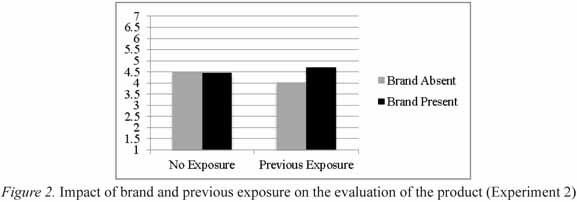
<body><![CDATA[<p>&nbsp;</p>     <p><b>Results</b></p>     <p>Three participants did not get full agreement between the two judges regarding their estimation of participant motivation  levels. As such, their data was excluded from our analysis. Participants&rsquo; evaluations were analyzed within an ANOVA, defined  by the full design. All three main effects were significant. Participants were sensitive to the quality of the fragrances, such  that higher liking was observed for the high-quality (<i>M</i>=4.17, <i>SD</i>=1.87) than for the low-quality perfume  (<i>M</i>=3.32, <i>SD</i>=1.49), <i>F</i>(1,156)=13.67, <i>p</i>&lt;.001, <i>&eta;<sub>p</sub><sup>2</i></sup>=.08. Less motivated  participants reported higher liking (<i>M</i>=4.03, <i>SD</i>=1.86) than those who were more motivated (<i>M</i>=3.46,  <i>SD</i>=1.49), <i>F</i>(1,156)=6.21, <i>p</i>=.014, <i>&eta;<sub>p</sub><sup>2</i></sup>=.04. Also, as expected, participants  who received information about the brand prior to product evaluation reported higher liking (<i>M</i>=4.43, <i>SD</i>=1.55) than  those who did not (<i>M</i>=3.05, <i>SD</i>=1.64), <i>F</i>(1,156)=35.75, <i>p</i>&lt;.001,  <i>&eta;<sub>p</sub><sup>2</i></sup>=.19. The comparison of the magnitude of the effects suggests that, although additive  (interaction <i>F</i>&lt;1), brand was more relevant than the quality of the fragrance itself.</p>     <p>We hypothesized that brand effects on product evaluation would depend on processing conditions. Indeed, a significant  interaction between brand information and motivation was found, <i>F</i>(1,156)<i>=</i>19.12, <i>p</i>&lt;.001,  <i>&eta;<sub>p</sub><sup>2</i></sup>=.10, such that brand effects were stronger for less motivated participants (<i>M</i>=5.22,  <i>SD</i>=1.13; <i>M<sub>absent</i></sub>=2.84, <i>SD</i>=1.58) than for the more motivated (<i>M<sub>present</i></sub>=3.64,  <i>SD</i>=1.49; <i>M<sub>absent</i></sub>=3.27, <i>SD=</i>1.72). This pattern is congruent with the idea that brand bias our  perceptions.</p>     <p>Level of motivation did not moderate the quality of the product effect (<i>F</i>&lt;1), and the three-way interaction was also  not significant, <i>F</i>(1,156)=1.37, <i>p</i>=.242 (see <a href="#f1">Figure 1</a>).</p>     <p>&nbsp;</p>     <p><a name="f1"></a></p>     <p><img src="/img/revistas/aps/v38n2/38n2a01f1.jpg" width="577" height="284"></p>     
<p>&nbsp;</p>     <p>&nbsp;</p>     ]]></body>
<body><![CDATA[<p><b>Experiment 2</b></p>     <p>&nbsp;</p>     <p><i>Participants and design</i></p>     <p>A sample of 91 high-school students (53.1% female, <i>M<sub>Age</i></sub>=17.5) volunteered to participate in this study and  were randomly allocated to the conditions defined by a 2 (Brand information: present <i>vs.</i> absent) x 2 (Product quality: low  <i>vs.</i> high) x 2 (Previous exposure to the product: yes <i>vs.</i> no) between-participants design. This sample size,  determined by the availability of participants, is lower than the number of 128 desired to detect an effect of moderate magnitude  with alpha of .05 and a power of .80.</p>     <p>&nbsp;</p>     <p><i>Materials</i></p>     <p>Products were samples of paper, presented as pages of a notebook available on the market. A pilot study showed that grammage  (paper density) is perceived as a relevant feature to evaluate the quality of paper. Specifically, there was consensus that the  experience of writing on paper with higher grammage (120g/m<sup>2</sup>) was more pleasant than writing on lightweight paper  (60g/m<sup>2</sup>). These types of paper are henceforth defined as high and low quality, respectively. Also, it was found that  this product was weakly associated with the expression of social status, and thus more dependent of its intrinsic sensory features  than perfume. The paper sample was associated with a brand, that was pre-tested as familiar, high-status and as plausible to be  associated with a notebook (i.e., as a plausible brand extension).</p>     <p>&nbsp;</p>     <p><i>Procedure</i></p>     <p>Each participant received a questionnaire and a pencil. Those in the &ldquo;previous experience with the product&rdquo;  condition also received a sample of the paper and were asked to write their gender and age on it before initiating the study. This  was the paper that they would evaluate later on. Participants in the &ldquo;no previous experience with the product&rdquo;  conditions were asked to write their gender and age on the first page of the questionnaire. Next, participants were told that the  study aimed to evaluate a new type of paper and that a sample would be provided. Brand information was either included in the  instructions (allegedly because there was a collaboration with the researchers) or absent. Participants had three minutes to  freely experience the low or high-quality paper, by writing whatever they wanted on it. Afterwards, they were asked to evaluate  their sensory experience with the paper, how much they liked how the paper feels, how much they liked to write on it, and how good  they felt the paper to be (7-point ratings scales).</p>     ]]></body>
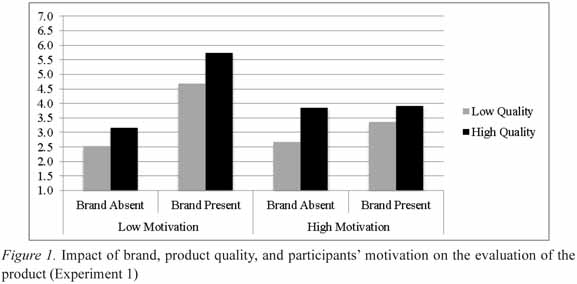
<body><![CDATA[<p>&nbsp;</p>     <p><b>Results</b></p>     <p>The three items used to evaluate the pleasure of the sensory aspects of the product (akin to the product evaluation) were  combined into an index (a single factor explained 79,61% of the variance; Cronbach&rsquo;s alpha=.87) that was analyzed in an  ANOVA defined by the full design.</p>     <p>Corroborating our manipulation, the low-quality product was evaluated less positively (<i>M</i>=3.55, <i>SD</i>=1.16) than the  high-quality product (<i>M</i>=5.43, <i>SD</i>=0.98), <i>F</i>(1,82)=68.79, <i>p</i>&lt;.001,  <i>&eta;<sub>p</sub><sup>2</i></sup>=.45.Also as expected, previous exposure with the product interacted with brand information  conditions, <i>F</i>(1,82)=4.55, <i>p</i>=.035, <i>&eta;<sub>p</sub><sup>2</i></sup>=.05 (see <a href="#f2">Figure 2</a>),  suggesting that brand effects were only found for some processing conditions (i.e., when participants experienced the paper prior  to its evaluation).</p>     <p>&nbsp;</p>     <p><a name="f2"></a></p>     <p><img src="/img/revistas/aps/v38n2/38n2a01f2.jpg" width="577" height="202"></p>     
<p>&nbsp;</p>     <p>All the other effects were non-significant (all <i>F</i>s&lt;1 with the exception of the main effect of previous exposure  <i>F</i>(1,82)=1.13, <i>p</i>=.290; and the three-way interaction, <i>F</i>(1,82)=1.55, <i>p</i>=.216).</p>     <p>&nbsp;</p>     ]]></body>
<body><![CDATA[<p><b>Discussion</b></p>     <p>Overall, results from two experiments support the hypothesis that brand biases how participants report their sensory  experiences with a product (e.g., Apaolaza et al., 2017; Bernard &amp; Liu, 2017; Bi et al., 2015). Specifically, a perfume is  said to smell better, and paper to provide a better writing experience if it is known to be of a high-status brand. Thus, when  reporting an evaluation, senses may be overridden by brand name (LeClerc et al., 1994). The results of these two experiments are  also in line with the literature by showing that sampling a branded product substantially increased evaluation if the brand was  high quality (Sprott &amp; Shimp, 2004), and that this sampling increases the choice of a known brand even when the product has  lower quality (Hoyer &amp; Brown, 1990). In doing so, we contribute to replication of those effects.</p>     <p>The novelty of our data stems from examining the conditions that favor (or counteract) such brand effects. Indeed, our data  adds to previous research, by clarifying that the effect of the brand over a product evaluation is more likely to occur when  motivation is low, and that the previously found sampling effect is also related with a decrease of elaboration. That is, these  brand effects emerged in conditions that favor low elaboration, either because participants did not look motivated to perform the  task (Experiment 1) or because they experience a feeling of familiarity when having such experiences (Experiment 2). This suggests  that individuals were not using the brand as a source of information that simply allows them to infer the quality of the product.  Instead, it seems more likely that the effect emerges because a brand can bias our experience with the product (e.g., Apaolaza et  al., 2017; Bernard &amp; Liu, 2017; Bi et al., 2015). However, it can also be the case that, even when the sensory experience is  informative about product quality, participants continue to rely on brand to assess the quality of the product. That is, the use  of the brand as a heuristic co-occurs with the direct inference made from our senses. Still, our studies do not offer evidence  that helps to clarify if in the low elaboration condition our potential consumers were relying on their senses (either smell or  touch) to form an impression of the product. Although we believe that is the case, this question should be empirical addressed in  future studies. In line with other authors (e.g., LeClerc et al., 1994), we can also argue that the most likely pathway of brand  influence is through biasing our senses. For instance, how much we desire chocolate should be less informed by how participants  perceive the chocolate brand than by individuals&rsquo; sensory experience. There are plenty examples of foods that are often  disliked when if recognized as high quality foods (e.g., caviar). As the popular proverb states &ldquo;every man to his  taste&rdquo; &ndash; taste is a personal feature, something you do not control, something you simply experience. So, the use of  brand as a cue about the quality of something we are tasting, does not seem as likely as the possibility that a bias is  occurring in the senses themselves. One way of approaching this possibility in the future is to address if the belief that  &ldquo;senses don&rsquo;t lie&rdquo;, is underlying these effects, by measuring the extent to which participants believe it, as a  potential moderator of the effect of brand on sensory experiences.</p>     <p>The assumption that a brand can bias our senses, is coherent with the literature that shows labels to influence our perception  of a product. Apaolaza et al. (2017) results indicates that sensory perception changes significantly when a wine carries an  organic label, compared with the same wine lacking the organic claim. In the same line, Shankar, Levitan, Prescott and Spence  (2009) showed that describing a chocolate as &lsquo;dark&rsquo; promote a different perception of the same chocolate described as  &lsquo;milk chocolate&rsquo;. Also, Meiselman and Bell (1991) showed that, by changing the name of a food product, the perceptions  of its ethnicity and taste features differed; and Morris (2018) showed that the name and the seasonal context of a beverage  impacts its sensory evaluation. To test if this is the type of bias we are promoting in our participants, future studies should  also address the perceptive features of the products and investigate how they change in function of being associated with a  high-status brand. An alternative avenue to clarify the pathway by which a brand is influencing a product evaluation is through  the selection of products whose general quality does not depend exclusively on sensory experience. By assessing those features  independently, it could be tested whether brand bias the sensory experience differently from the no sensory dimension.</p>     <p>Our first experiment was conducted on the field and we tried to be less intrusive as possible (given the setting where data was  being collected). As such, we could not directly manipulate or assess individual&rsquo;s motivation. This is a strong limitation  of this data, given that results would have been clearer if a high and low motivation condition was promoted experimentally. A  possible way of doing it in the future would be to present a product promotion where a correct evaluation of the product would  allow individuals to be selected for a random selection to winning a prize. Nevertheless, results of this experiment showed that  the cues that lead observers to classify them as less motivated covaried with conditions that favor brand to impact their  evaluations. However, those same conditions did not moderate the quality of the product effect, which is usually a result  associated with the manipulation of motivation (for a review, see Petty &amp; Bri&ntilde;ol, 2010). We interpret these results as  being related with the low complexity of the products, and the fact that the cue for quality is mostly of sensory nature and quick  to assess. No further information is necessary for distinguish what was considered a high and low product in these studies (e.g.,  Inbar, Cone, &amp; Gilovich, 2010). As such, a similar conclusion will be achieved through an elaborative or more superficial  processing of that information. In Experiment 2, we tested how promoting a feeling of familiarity with the product by sampling it,  decreased subsequent elaboration of incoming information (e.g., Claypool et al., 2015) having an effect on how we evaluate a  product. Tasting experiences were argued to be both able (e.g., Levin &amp; Gaeth, 1988) and not able (Roberts &amp; Taylor, 1975;  Scott &amp; Yalch, 1980) to change consumer&rsquo;s previously held perceptions; and so, the level of elaboration may be a  relevant moderator of the effect. In fact, Claypool et al. (2004) showed that only in moderate elaboration conditions, repeated  persuasive messages are more superficially processed than messages encountered for the first time. Thus, it is relevant to further  examine the specific processing conditions that favor attitude change through tasting experiences, and to explore the mechanism  underlying the effect of tasting reducing subsequent elaboration. We claim that it is the experience of familiarity activated with  the product, but other mechanisms may explain the effect, such as the increase of fluency in processing the product (e.g., Alter  &amp; Oppenheimer, 2006; Alter, Oppenheimer, Epley, &amp; Eyre, 2007) or the experience of a feeling of rightness with the  response that is provided by the brand (Thompson et al., 2013).</p>     <p>Besides the relevance for understanding the process by which a brand influences products&rsquo; evaluation, our results are  also relevant when thinking of practical issues. For instance, they inform about the mechanisms by which we can improve a  &ldquo;sensory brand experience&rdquo; (e.g., Goldkuhl &amp; Styv&eacute;n, 2007). Professionals have suggested the use of special  flagrances and flavor associated with different types of brand services (e.g., Iglesias, Markovic, &amp; Rialp, 2019; Moreira,  Fortes, &amp; Santiago, 2017). This proposal becomes even more relevant when realizing, as our studies show, that brand and  sensory experiences can be integrated. But it is also relevant to know that by increasing the familiarity with the product, such  assimilation is more likely to occur.</p>     <p>In sum, in the current work we provide field and laboratory evidence that brand impacts the evaluation of a sensory product,  overriding the information offered by direct sensory experience with the product. Importantly, this was more likely to occur in  processing conditions that induce low elaboration (e.g., low motivation).</p>     <p>&nbsp;</p>     <p><b>References</b></p>     <!-- ref --><p>Alter, A. L., &amp; Oppenheimer, D. M. (2006). Predicting short-term stock fluctuations using processing fluency.  <i>Proceedings of the National Academy of Sciences, U103</i>, 9369-9372. Retrieved from  <a href="https://doi.org/10.1073/pnas.0601071103" target="_blank">https://doi.org/10.1073/pnas.0601071103</a>&nbsp;&nbsp;&nbsp;&nbsp;&nbsp;&nbsp;&nbsp;&nbsp;[&#160;<a href="javascript:void(0);" onclick="javascript: window.open('/scielo.php?script=sci_nlinks&ref=054567&pid=S0870-8231202000020000100001&lng=','','width=640,height=500,resizable=yes,scrollbars=1,menubar=yes,');">Links</a>&#160;]<!-- end-ref --><!-- ref --><p>Alter, A. L., Oppenheimer, D. M., Epley, N., &amp; Eyre, R. N. (2007). Overcoming intuition: Metacognitive difficulty activates  analytic reasoning. <i>Journal of Experimental Psychology: General, 136</i>, 569-576. Retrieved from  <a href="https://doi.org/10.1037/0096-3445.136.4.569" target="_blank">https://doi.org/10.1037/0096-3445.136.4.569</a>&nbsp;&nbsp;&nbsp;&nbsp;&nbsp;&nbsp;&nbsp;&nbsp;[&#160;<a href="javascript:void(0);" onclick="javascript: window.open('/scielo.php?script=sci_nlinks&ref=054568&pid=S0870-8231202000020000100002&lng=','','width=640,height=500,resizable=yes,scrollbars=1,menubar=yes,');">Links</a>&#160;]<!-- end-ref --><!-- ref --><p>Anees-ur-Rehman, M., Wong, H. Y., &amp; Hossain, M. (2016). The progression of brand orientation literature in twenty years: A  systematic literature review. <i>Journal of Brand Management, 23</i>, 612-630. Retrieved from  <a href="https://doi.org/10.1057/s41262-016-0008-2" target="_blank">https://doi.org/10.1057/s41262-016-0008-2</a>&nbsp;&nbsp;&nbsp;&nbsp;&nbsp;&nbsp;&nbsp;&nbsp;[&#160;<a href="javascript:void(0);" onclick="javascript: window.open('/scielo.php?script=sci_nlinks&ref=054569&pid=S0870-8231202000020000100003&lng=','','width=640,height=500,resizable=yes,scrollbars=1,menubar=yes,');">Links</a>&#160;]<!-- end-ref --><p>Apaolaza, V., Hartmann, P., Echebarria, C., &amp; Barrutia, J. M. (2017). Organic label&rsquo;s halo effect on sensory and  hedonic experience of wine: A pilot study. <i>Journal of Sensory Studies, 32</i>, e12243. Retrieved from  <a href="https://doi.org/10.1111/joss.12243" target="_blank">https://doi.org/10.1111/joss.12243</a></p>     <!-- ref --><p>Bernard, J. C., &amp; Liu, Y. (2017). Are beliefs stronger than taste? A field experiment on organic and local apples. <i>Food  Quality and Preference, 61</i>, 55-62. Retrieved from <a href="https://doi.org/10.1016/j.foodqual.2017.05.005"  target="_blank">https://doi.org/10.1016/j.foodqual.2017.05.005</a>&nbsp;&nbsp;&nbsp;&nbsp;&nbsp;&nbsp;&nbsp;&nbsp;[&#160;<a href="javascript:void(0);" onclick="javascript: window.open('/scielo.php?script=sci_nlinks&ref=054571&pid=S0870-8231202000020000100005&lng=','','width=640,height=500,resizable=yes,scrollbars=1,menubar=yes,');">Links</a>&#160;]<!-- end-ref --><!-- ref --><p>Bhat, S., &amp; Reddy, S. K. (1998). Symbolic and functional positioning of brands. <i>Journal of Consumer Marketing, 15</i>,  32-43. Retrieved from <a href="https://doi.org/10.1108/07363769810202664"  target="_blank">https://doi.org/10.1108/07363769810202664</a>&nbsp;&nbsp;&nbsp;&nbsp;&nbsp;&nbsp;&nbsp;&nbsp;[&#160;<a href="javascript:void(0);" onclick="javascript: window.open('/scielo.php?script=sci_nlinks&ref=054572&pid=S0870-8231202000020000100006&lng=','','width=640,height=500,resizable=yes,scrollbars=1,menubar=yes,');">Links</a>&#160;]<!-- end-ref --><!-- ref --><p>Bi, X., Gao, Z., House, L. A., &amp; Hausmann, D. S. (2015). Tradeoffs between sensory attributes and organic labels: The case  of orange juice. <i>International Journal of Consumer Studies, 39</i>, 162-171. Retrieved from  <a href="https://doi.org/10.1111/ijcs.12164" target="_blank">https://doi.org/10.1111/ijcs.12164</a>&nbsp;&nbsp;&nbsp;&nbsp;&nbsp;&nbsp;&nbsp;&nbsp;[&#160;<a href="javascript:void(0);" onclick="javascript: window.open('/scielo.php?script=sci_nlinks&ref=054573&pid=S0870-8231202000020000100007&lng=','','width=640,height=500,resizable=yes,scrollbars=1,menubar=yes,');">Links</a>&#160;]<!-- end-ref --><!-- ref --><p>Clark, J. K., Evans, A. T., &amp; Wegener, D. T. (2011). Perceptions of source efficacy and persuasion: Multiple mechanisms for  source effects on attitudes. <i>European Journal of Social Psychology, 41</i>, 596-607. Retrieved from  <a href="https://doi.org/10.1002/ejsp.787" target="_blank">https://doi.org/10.1002/ejsp.787</a>&nbsp;&nbsp;&nbsp;&nbsp;&nbsp;&nbsp;&nbsp;&nbsp;[&#160;<a href="javascript:void(0);" onclick="javascript: window.open('/scielo.php?script=sci_nlinks&ref=054574&pid=S0870-8231202000020000100008&lng=','','width=640,height=500,resizable=yes,scrollbars=1,menubar=yes,');">Links</a>&#160;]<!-- end-ref --><!-- ref --><p>Claypool, H. M., Mackie, D. M., &amp; Garcia-Marques, T. (2015). Fluency and attitudes. <i>Social and Personality Psychology  Compass, 9</i>, 370-382. Retrieved from <a href="https://doi.org/10.1111/spc3.12179"  target="_blank">https://doi.org/10.1111/spc3.12179</a>&nbsp;&nbsp;&nbsp;&nbsp;&nbsp;&nbsp;&nbsp;&nbsp;[&#160;<a href="javascript:void(0);" onclick="javascript: window.open('/scielo.php?script=sci_nlinks&ref=054575&pid=S0870-8231202000020000100009&lng=','','width=640,height=500,resizable=yes,scrollbars=1,menubar=yes,');">Links</a>&#160;]<!-- end-ref --><!-- ref --><p>Claypool, H. M., Mackie, D. M., Garcia-Marques, T., McIntosh, A., &amp; Udal, A. (2004). The effects of personal relevance and  repetition on persuasive processing. <i>Social Cognition, 22</i>, 310-335. Retrieved from  <a href="https://doi.org/10.1521/soco.22.3.310.35970" target="_blank">https://doi.org/10.1521/soco.22.3.310.35970</a>&nbsp;&nbsp;&nbsp;&nbsp;&nbsp;&nbsp;&nbsp;&nbsp;[&#160;<a href="javascript:void(0);" onclick="javascript: window.open('/scielo.php?script=sci_nlinks&ref=054576&pid=S0870-8231202000020000100010&lng=','','width=640,height=500,resizable=yes,scrollbars=1,menubar=yes,');">Links</a>&#160;]<!-- end-ref --><p>Dawar, N., &amp; Parker, P. (1994). Marketing universals: Consumers&rsquo; use of brand name, price, physical appearance, and  retailer. <i>Journal of Marketing, 58</i>, 81-95. Retrieved from <a href="https://doi.org/10.2307/1252271"  target="_blank">https://doi.org/10.2307/1252271</a></p>     ]]></body>
<body><![CDATA[<!-- ref --><p>Dijksterhuis, A. (2004). Think different: The merits of unconscious thought in preference development and decision making.  <i>Journal of Personality and Social Psychology, 87</i>, 586-598. Retrieved from  <a href="https://doi.org/10.1037/0022-3514.87.5.586" target="_blank">https://doi.org/10.1037/0022-3514.87.5.586</a>&nbsp;&nbsp;&nbsp;&nbsp;&nbsp;&nbsp;&nbsp;&nbsp;[&#160;<a href="javascript:void(0);" onclick="javascript: window.open('/scielo.php?script=sci_nlinks&ref=054578&pid=S0870-8231202000020000100012&lng=','','width=640,height=500,resizable=yes,scrollbars=1,menubar=yes,');">Links</a>&#160;]<!-- end-ref --><!-- ref --><p>Elliott, R. (1997). Existential consumption and irrational desire. <i>European Journal of Marketing, 31</i>, 285-296. Retrieved  from <a href="https://doi.org/10.1108/03090569710162371" target="_blank">https://doi.org/10.1108/03090569710162371</a>&nbsp;&nbsp;&nbsp;&nbsp;&nbsp;&nbsp;&nbsp;&nbsp;[&#160;<a href="javascript:void(0);" onclick="javascript: window.open('/scielo.php?script=sci_nlinks&ref=054579&pid=S0870-8231202000020000100013&lng=','','width=640,height=500,resizable=yes,scrollbars=1,menubar=yes,');">Links</a>&#160;]<!-- end-ref --><!-- ref --><p>Erdem, T., &amp; Swait, J. (1998). Brand equity as a signaling phenomenon. <i>Journal of Consumer Psychology, 7</i>, 131-157.  Retrieved from <a href="https://doi.org/10.1207/s15327663jcp0702_02"  target="_blank">https://doi.org/10.1207/s15327663jcp0702_02</a>&nbsp;&nbsp;&nbsp;&nbsp;&nbsp;&nbsp;&nbsp;&nbsp;[&#160;<a href="javascript:void(0);" onclick="javascript: window.open('/scielo.php?script=sci_nlinks&ref=054580&pid=S0870-8231202000020000100014&lng=','','width=640,height=500,resizable=yes,scrollbars=1,menubar=yes,');">Links</a>&#160;]<!-- end-ref --><p>Fornerino, M., &amp; d&rsquo;Hauteville, F. (2010). How good does it taste? Is it the product or the brand? A contribution to  brand equity evaluation. <i>Journal of Product &amp; Brand Management, 19,</i> 34-43. Retrieved from  <a href="https://doi.org/10.1108/10610421011018374" target="_blank">https://doi.org/10.1108/10610421011018374</a></p>     <!-- ref --><p>Garcia-Marques, T., Fonseca, R., &amp; Blascovich, J. (2015). Familiarity, challenge, and processing of persuasion messages.  <i>Social Cognition, 33</i>, 585-604. Retrieved from <a href="https://doi.org/10.1521/soco.2015.33.6.585"  target="_blank">https://doi.org/10.1521/soco.2015.33.6.585</a>&nbsp;&nbsp;&nbsp;&nbsp;&nbsp;&nbsp;&nbsp;&nbsp;[&#160;<a href="javascript:void(0);" onclick="javascript: window.open('/scielo.php?script=sci_nlinks&ref=054582&pid=S0870-8231202000020000100016&lng=','','width=640,height=500,resizable=yes,scrollbars=1,menubar=yes,');">Links</a>&#160;]<!-- end-ref --><!-- ref --><p>Garcia-Marques, T., &amp; Mackie, D. M. (2001). The feeling of familiarity as a regulator of persuasive processing. <i>Social  Cognition, 19</i>, 9-34. Retrieved from <a href="https://doi.org/10.1521/soco.19.1.9.18959"  target="_blank">https://doi.org/10.1521/soco.19.1.9.18959</a>&nbsp;&nbsp;&nbsp;&nbsp;&nbsp;&nbsp;&nbsp;&nbsp;[&#160;<a href="javascript:void(0);" onclick="javascript: window.open('/scielo.php?script=sci_nlinks&ref=054583&pid=S0870-8231202000020000100017&lng=','','width=640,height=500,resizable=yes,scrollbars=1,menubar=yes,');">Links</a>&#160;]<!-- end-ref --><!-- ref --><p>Goldkuhl, L., &amp; Styv&eacute;n, M. (2007). Sensing the scent of service success. <i>European Journal of Marketing, 41</i>,  1297-1305. Retrieved from <a href="https://doi.org/10.1108/03090560710821189"  target="_blank">https://doi.org/10.1108/03090560710821189</a>&nbsp;&nbsp;&nbsp;&nbsp;&nbsp;&nbsp;&nbsp;&nbsp;[&#160;<a href="javascript:void(0);" onclick="javascript: window.open('/scielo.php?script=sci_nlinks&ref=054584&pid=S0870-8231202000020000100018&lng=','','width=640,height=500,resizable=yes,scrollbars=1,menubar=yes,');">Links</a>&#160;]<!-- end-ref --><!-- ref --><p>Hoyer, W. D., &amp; Brown, S. P. (1990). Effects of brand awareness on choice for a common, repeat-purchase product. <i>Journal  of Consumer Research, 17</i>, 141-148. Retrieved from <a href="https://doi.org/10.1086/208544"  target="_blank">https://doi.org/10.1086/208544</a>&nbsp;&nbsp;&nbsp;&nbsp;&nbsp;&nbsp;&nbsp;&nbsp;[&#160;<a href="javascript:void(0);" onclick="javascript: window.open('/scielo.php?script=sci_nlinks&ref=054585&pid=S0870-8231202000020000100019&lng=','','width=640,height=500,resizable=yes,scrollbars=1,menubar=yes,');">Links</a>&#160;]<!-- end-ref --><!-- ref --><p>Iglesias, O., Markovic, S., &amp; Rialp, J. (2019). How does sensory brand experience influence brand equity? Considering the  roles of customer satisfaction, customer affective commitment, and employee empathy. <i>Journal of Business Research, 96</i>,  343-354. Retrieved from <a href="https://doi.org/10.1016/j.jbusres.2018.05.043"  target="_blank">https://doi.org/10.1016/j.jbusres.2018.05.043</a>&nbsp;&nbsp;&nbsp;&nbsp;&nbsp;&nbsp;&nbsp;&nbsp;[&#160;<a href="javascript:void(0);" onclick="javascript: window.open('/scielo.php?script=sci_nlinks&ref=054586&pid=S0870-8231202000020000100020&lng=','','width=640,height=500,resizable=yes,scrollbars=1,menubar=yes,');">Links</a>&#160;]<!-- end-ref --><p>Inbar, Y., Cone, J., &amp; Gilovich, T. (2010). People&rsquo;s intuitions about intuitive insight and intuitive choice.  <i>Journal of Personality and Social Psychology, 99</i>, 232-247. Retrieved from <a href="https://doi.org/10.1037/a0020215"  target="_blank">https://doi.org/10.1037/a0020215</a></p>     ]]></body>
<body><![CDATA[<!-- ref --><p>Jacoby, J., Szybillo, G. J., &amp; Busato-Schach, J. (1977). Information acquisition behavior in brand choice situations.  <i>The Journal of Consumer Research, 3</i>, 209-216. Retrieved from <a href="https://doi.org/10.1086/208669"  target="_blank">https://doi.org/10.1086/208669</a>&nbsp;&nbsp;&nbsp;&nbsp;&nbsp;&nbsp;&nbsp;&nbsp;[&#160;<a href="javascript:void(0);" onclick="javascript: window.open('/scielo.php?script=sci_nlinks&ref=054588&pid=S0870-8231202000020000100022&lng=','','width=640,height=500,resizable=yes,scrollbars=1,menubar=yes,');">Links</a>&#160;]<!-- end-ref --><!-- ref --><p>Johnston, W. A., &amp; Hawley, K. J. (1994). Perceptual inhibition of expected inputs: The key that opens closed minds.  <i>Psychonomic Bulletin and Review, 1</i>, 56-72. Retrieved from <a href="https://doi.org/10.3758/BF03200761"  target="_blank">https://doi.org/10.3758/BF03200761</a>&nbsp;&nbsp;&nbsp;&nbsp;&nbsp;&nbsp;&nbsp;&nbsp;[&#160;<a href="javascript:void(0);" onclick="javascript: window.open('/scielo.php?script=sci_nlinks&ref=054589&pid=S0870-8231202000020000100023&lng=','','width=640,height=500,resizable=yes,scrollbars=1,menubar=yes,');">Links</a>&#160;]<!-- end-ref --><!-- ref --><p>Koenigs, M., &amp; Tranel, D. (2007). Irrational economic decision-making after ventromedial prefrontal damage: Evidence from  the ultimatum game. <i>Journal of Neuroscience, 27</i>, 951-956. Retrieved from  <a href="https://doi.org/10.1523/jneurosci.4606-06.2007" target="_blank">https://doi.org/10.1523/jneurosci.4606-06.2007</a>&nbsp;&nbsp;&nbsp;&nbsp;&nbsp;&nbsp;&nbsp;&nbsp;[&#160;<a href="javascript:void(0);" onclick="javascript: window.open('/scielo.php?script=sci_nlinks&ref=054590&pid=S0870-8231202000020000100024&lng=','','width=640,height=500,resizable=yes,scrollbars=1,menubar=yes,');">Links</a>&#160;]<!-- end-ref --><!-- ref --><p>LeClerc, F., Schmitt, B., &amp; Dub&eacute;, L. (1994). Foreign branding and its effects on product perceptions and attitudes.  <i>Journal of Marketing Research, 31</i>, 263-270. Retrieved from <a href="https://doi.org/10.1177/002224379403100209"  target="_blank">https://doi.org/10.1177/002224379403100209</a>&nbsp;&nbsp;&nbsp;&nbsp;&nbsp;&nbsp;&nbsp;&nbsp;[&#160;<a href="javascript:void(0);" onclick="javascript: window.open('/scielo.php?script=sci_nlinks&ref=054591&pid=S0870-8231202000020000100025&lng=','','width=640,height=500,resizable=yes,scrollbars=1,menubar=yes,');">Links</a>&#160;]<!-- end-ref --><!-- ref --><p>Lee, W. J., Shimizu, M., Kniffin, K. M., &amp; Wansink, B. (2013). You taste what you see: Do organic labels bias taste  perceptions?. <i>Food Quality and Preference, 29</i>, 33-39. Retrieved from  <a href="https://doi.org/10.1016/j.foodqual.2013.01.010" target="_blank">https://doi.org/10.1016/j.foodqual.2013.01.010</a>&nbsp;&nbsp;&nbsp;&nbsp;&nbsp;&nbsp;&nbsp;&nbsp;[&#160;<a href="javascript:void(0);" onclick="javascript: window.open('/scielo.php?script=sci_nlinks&ref=054592&pid=S0870-8231202000020000100026&lng=','','width=640,height=500,resizable=yes,scrollbars=1,menubar=yes,');">Links</a>&#160;]<!-- end-ref --><!-- ref --><p>Levin, I. P., &amp; Gaeth, G. J. (1988). How consumers are affected by the framing of attribute information before and after  consuming the product. <i>Journal of Consumer Research, 15</i>, 374-378. Retrieved from <a href="https://doi.org/10.1086/209174"  target="_blank">https://doi.org/10.1086/209174</a>&nbsp;&nbsp;&nbsp;&nbsp;&nbsp;&nbsp;&nbsp;&nbsp;[&#160;<a href="javascript:void(0);" onclick="javascript: window.open('/scielo.php?script=sci_nlinks&ref=054593&pid=S0870-8231202000020000100027&lng=','','width=640,height=500,resizable=yes,scrollbars=1,menubar=yes,');">Links</a>&#160;]<!-- end-ref --><!-- ref --><p>Maheswaran, D., Mackie, D. M., &amp; Chaiken, S. (1992). Brand name as a heuristic cue: The effects of task importance and  expectancy confirmation on consumer judgments. <i>Journal of Consumer Psychology, 1</i>, 317-336. Retrieved from  <a href="https://doi.org/10.1016/S1057-7408(08)80058-7" target="_blank">https://doi.org/10.1016/S1057-7408(08)80058-7</a>&nbsp;&nbsp;&nbsp;&nbsp;&nbsp;&nbsp;&nbsp;&nbsp;[&#160;<a href="javascript:void(0);" onclick="javascript: window.open('/scielo.php?script=sci_nlinks&ref=054594&pid=S0870-8231202000020000100028&lng=','','width=640,height=500,resizable=yes,scrollbars=1,menubar=yes,');">Links</a>&#160;]<!-- end-ref --><!-- ref --><p>Meiselman, H. L., &amp; Bell, R. (1991). The effects of name and recipe on the perceived ethnicity and acceptability of  selected Italian foods by British subjects. <i>Food Quality and Preference, 3</i>, 209-214. Retrieved from  <a href="https://doi.org/10.1016/0950-3293(91)90035-d" target="_blank">https://doi.org/10.1016/0950-3293(91)90035-d</a>&nbsp;&nbsp;&nbsp;&nbsp;&nbsp;&nbsp;&nbsp;&nbsp;[&#160;<a href="javascript:void(0);" onclick="javascript: window.open('/scielo.php?script=sci_nlinks&ref=054595&pid=S0870-8231202000020000100029&lng=','','width=640,height=500,resizable=yes,scrollbars=1,menubar=yes,');">Links</a>&#160;]<!-- end-ref --><!-- ref --><p>Morris, C. (2018). Impact of product name and seasonal context on the sensory evaluation of a seasonally themed beverage.  <i>Journal of Sensory Studies, 33</i>, e12320. Retrieved from <a href="https://doi.org/10.1111/joss.12320"  target="_blank">https://doi.org/10.1111/joss.12320</a>&nbsp;&nbsp;&nbsp;&nbsp;&nbsp;&nbsp;&nbsp;&nbsp;[&#160;<a href="javascript:void(0);" onclick="javascript: window.open('/scielo.php?script=sci_nlinks&ref=054596&pid=S0870-8231202000020000100030&lng=','','width=640,height=500,resizable=yes,scrollbars=1,menubar=yes,');">Links</a>&#160;]<!-- end-ref --><!-- ref --><p>Moreira, A. C., Fortes, N., &amp; Santiago, R. (2017). Influence of sensory stimuli on brand experience, brand equity and  purchase intention. <i>Journal of Business Economics and Management, 18</i>, 68-83. Retrieved from  <a href="https://doi.org/10.3846/16111699.2016.1252793" target="_blank">https://doi.org/10.3846/16111699.2016.1252793</a>&nbsp;&nbsp;&nbsp;&nbsp;&nbsp;&nbsp;&nbsp;&nbsp;[&#160;<a href="javascript:void(0);" onclick="javascript: window.open('/scielo.php?script=sci_nlinks&ref=054597&pid=S0870-8231202000020000100031&lng=','','width=640,height=500,resizable=yes,scrollbars=1,menubar=yes,');">Links</a>&#160;]<!-- end-ref --><!-- ref --><p>Oxoby, R. J., &amp; Finnigan, H. (2007). Developing heuristic-based quality judgments: Blocking in consumer choice.  <i>Psychology &amp; Marketing, 24</i>, 295-313. Retrieved from <a href="https://doi.org/10.1002/mar.20162"  target="_blank">https://doi.org/10.1002/mar.20162</a>&nbsp;&nbsp;&nbsp;&nbsp;&nbsp;&nbsp;&nbsp;&nbsp;[&#160;<a href="javascript:void(0);" onclick="javascript: window.open('/scielo.php?script=sci_nlinks&ref=054598&pid=S0870-8231202000020000100032&lng=','','width=640,height=500,resizable=yes,scrollbars=1,menubar=yes,');">Links</a>&#160;]<!-- end-ref --><!-- ref --><p>Petty, R. E., &amp; Bri&ntilde;ol, P. (2010). Attitude change. In R. F. Baumeister &amp; E. J. Finkel (Eds.), <i>Advanced  social psychology: The state of the science</i> (pp. 217-259). Oxford: Oxford University Press.    &nbsp;&nbsp;&nbsp;&nbsp;&nbsp;&nbsp;&nbsp;&nbsp;[&#160;<a href="javascript:void(0);" onclick="javascript: window.open('/scielo.php?script=sci_nlinks&ref=054599&pid=S0870-8231202000020000100033&lng=','','width=640,height=500,resizable=yes,scrollbars=1,menubar=yes,');">Links</a>&#160;]<!-- end-ref --></p>     <!-- ref --><p>Petty, R. E., Bri&ntilde;ol, P., Teeny, J., &amp; Horcajo, J. (2018). The elaboration likelihood model: Changing attitudes  toward exercising and doping. In B. Jackson, J. A. Dimmock, &amp; J. Compton (Eds.), <i>Persuasion and communication in sport,  exercise, and physical activity</i> (pp. 22-37). Abingdon: Routledge.    &nbsp;&nbsp;&nbsp;&nbsp;&nbsp;&nbsp;&nbsp;&nbsp;[&#160;<a href="javascript:void(0);" onclick="javascript: window.open('/scielo.php?script=sci_nlinks&ref=054601&pid=S0870-8231202000020000100034&lng=','','width=640,height=500,resizable=yes,scrollbars=1,menubar=yes,');">Links</a>&#160;]<!-- end-ref --></p>     <!-- ref --><p>Petty, R. E., &amp; Cacioppo, J. T. (1986). The elaboration likelihood model of persuasion. In L. Berkowitz (Ed.), <i>Advances  in experimental social psychology</i> (Vol. 19, pp. 123-205). New York, NY: Academic Press.    &nbsp;&nbsp;&nbsp;&nbsp;&nbsp;&nbsp;&nbsp;&nbsp;[&#160;<a href="javascript:void(0);" onclick="javascript: window.open('/scielo.php?script=sci_nlinks&ref=054603&pid=S0870-8231202000020000100035&lng=','','width=640,height=500,resizable=yes,scrollbars=1,menubar=yes,');">Links</a>&#160;]<!-- end-ref --></p>     <!-- ref --><p>Rao, A. R., &amp; Ruekert, R. W. (1994). Brand alliances as signals of product quality. <i>Sloan Management Review, 36</i>,  87-97.    &nbsp;&nbsp;&nbsp;&nbsp;&nbsp;&nbsp;&nbsp;&nbsp;[&#160;<a href="javascript:void(0);" onclick="javascript: window.open('/scielo.php?script=sci_nlinks&ref=054605&pid=S0870-8231202000020000100036&lng=','','width=640,height=500,resizable=yes,scrollbars=1,menubar=yes,');">Links</a>&#160;]<!-- end-ref --></p>     <!-- ref --><p>Roberts, M. L., &amp; Taylor, J. R. (1975). Analyzing proximity judgments in an experimental design. <i>Journal of Marketing  Research, 12</i>, 68-72. Retrieved from <a href="https://doi.org/10.2307/3150660"  target="_blank">https://doi.org/10.2307/3150660</a>&nbsp;&nbsp;&nbsp;&nbsp;&nbsp;&nbsp;&nbsp;&nbsp;[&#160;<a href="javascript:void(0);" onclick="javascript: window.open('/scielo.php?script=sci_nlinks&ref=054607&pid=S0870-8231202000020000100037&lng=','','width=640,height=500,resizable=yes,scrollbars=1,menubar=yes,');">Links</a>&#160;]<!-- end-ref --><!-- ref --><p>Schifferstein, H. N. J., Kole, A. P. W., &amp; Mojet, J. (1999). Asymmetry in the disconfirmation of expectations for natural  yogurt. <i>Appetite, 32</i>, 307-329. Retrieved from <a href="https://doi.org/10.1006/appe.1998.0208"  target="_blank">https://doi.org/10.1006/appe.1998.0208</a>&nbsp;&nbsp;&nbsp;&nbsp;&nbsp;&nbsp;&nbsp;&nbsp;[&#160;<a href="javascript:void(0);" onclick="javascript: window.open('/scielo.php?script=sci_nlinks&ref=054608&pid=S0870-8231202000020000100038&lng=','','width=640,height=500,resizable=yes,scrollbars=1,menubar=yes,');">Links</a>&#160;]<!-- end-ref --><!-- ref --><p>Scott, C. A., &amp; Yalch, R. F. (1980). Consumer response to initial product trial: A bayesian analysis. <i>Journal of  Consumer Research, 7</i>, 32-41. Retrieved from <a href="https://doi.org/10.1086/208790"  target="_blank">https://doi.org/10.1086/208790</a>&nbsp;&nbsp;&nbsp;&nbsp;&nbsp;&nbsp;&nbsp;&nbsp;[&#160;<a href="javascript:void(0);" onclick="javascript: window.open('/scielo.php?script=sci_nlinks&ref=054609&pid=S0870-8231202000020000100039&lng=','','width=640,height=500,resizable=yes,scrollbars=1,menubar=yes,');">Links</a>&#160;]<!-- end-ref --><!-- ref --><p>Shankar, M. U., Levitan, C. A., Prescott, J., &amp; Spence, C. (2009). The influence of color and label information on flavor  perception. <i>Chemosensory Perception, 2</i>, 53-58. Retrieved from <a href="https://doi.org/10.1007/s12078-009-9046-4"  target="_blank">https://doi.org/10.1007/s12078-009-9046-4</a>&nbsp;&nbsp;&nbsp;&nbsp;&nbsp;&nbsp;&nbsp;&nbsp;[&#160;<a href="javascript:void(0);" onclick="javascript: window.open('/scielo.php?script=sci_nlinks&ref=054610&pid=S0870-8231202000020000100040&lng=','','width=640,height=500,resizable=yes,scrollbars=1,menubar=yes,');">Links</a>&#160;]<!-- end-ref --><!-- ref --><p>Shiv, B., Edell, J. A., &amp; Payne, J. W. (1997). Factors affecting the impact of negatively and positively framed ad  messages. <i>Journal of Consumer Research, 24</i>, 285-294. Retrieved from <a href="https://doi.org/10.1086/209510"  target="_blank">https://doi.org/10.1086/209510</a>&nbsp;&nbsp;&nbsp;&nbsp;&nbsp;&nbsp;&nbsp;&nbsp;[&#160;<a href="javascript:void(0);" onclick="javascript: window.open('/scielo.php?script=sci_nlinks&ref=054611&pid=S0870-8231202000020000100041&lng=','','width=640,height=500,resizable=yes,scrollbars=1,menubar=yes,');">Links</a>&#160;]<!-- end-ref --><!-- ref --><p>Sprott, D. E., &amp; Shimp, T. A. (2004). Using product sampling to augment the perceived quality of store brands. <i>Journal  of Retailing, 80</i>, 305-315. Retrieved from <a href="https://doi.org/10.1016/j.jretai.2004.10.006"  target="_blank">https://doi.org/10.1016/j.jretai.2004.10.006</a>&nbsp;&nbsp;&nbsp;&nbsp;&nbsp;&nbsp;&nbsp;&nbsp;[&#160;<a href="javascript:void(0);" onclick="javascript: window.open('/scielo.php?script=sci_nlinks&ref=054612&pid=S0870-8231202000020000100042&lng=','','width=640,height=500,resizable=yes,scrollbars=1,menubar=yes,');">Links</a>&#160;]<!-- end-ref --><!-- ref --><p>Thompson, V. A., Turner, J. A. P., Pennycook, G., Ball, L. J., Brack, H., Ophir, Y., &amp; Ackerman, R. (2013). The role of  answer fluency and perceptual fluency as metacognitive cues for initiating analytic thinking. <i>Cognition, 128</i>, 237-251.  Retrieved from <a href="https://doi.org/10.1016/j.cognition.2012.09.012"  target="_blank">https://doi.org/10.1016/j.cognition.2012.09.012</a>&nbsp;&nbsp;&nbsp;&nbsp;&nbsp;&nbsp;&nbsp;&nbsp;[&#160;<a href="javascript:void(0);" onclick="javascript: window.open('/scielo.php?script=sci_nlinks&ref=054613&pid=S0870-8231202000020000100043&lng=','','width=640,height=500,resizable=yes,scrollbars=1,menubar=yes,');">Links</a>&#160;]<!-- end-ref --><!-- ref --><p>Tsai, S.-P. (2005). Utility, cultural symbolism and emotion: A comprehensive model of brand purchase value. <i>International  Journal of Research in Marketing, 22</i>, 277-291. Retrieved from <a href="https://doi.org/10.1016/j.ijresmar.2004.11.002"  target="_blank">https://doi.org/10.1016/j.ijresmar.2004.11.002</a>&nbsp;&nbsp;&nbsp;&nbsp;&nbsp;&nbsp;&nbsp;&nbsp;[&#160;<a href="javascript:void(0);" onclick="javascript: window.open('/scielo.php?script=sci_nlinks&ref=054614&pid=S0870-8231202000020000100044&lng=','','width=640,height=500,resizable=yes,scrollbars=1,menubar=yes,');">Links</a>&#160;]<!-- end-ref --><!-- ref --><p>Wernerfelt, B. (1988). Umbrella branding as a signal of new product quality: An example of signalling by posting a bond.  <i>RAND Journal of Economics, 19</i>, 458-466. Retrieved from <a href="https://www.jstor.org/stable/2555667"  target="_blank">https://www.jstor.org/stable/2555667</a>&nbsp;&nbsp;&nbsp;&nbsp;&nbsp;&nbsp;&nbsp;&nbsp;[&#160;<a href="javascript:void(0);" onclick="javascript: window.open('/scielo.php?script=sci_nlinks&ref=054615&pid=S0870-8231202000020000100045&lng=','','width=640,height=500,resizable=yes,scrollbars=1,menubar=yes,');">Links</a>&#160;]<!-- end-ref --><!-- ref --><p>Woolfolk, M. E., Castellan, W., &amp; Brooks, C. I. (1983). Pepsi <i>versus</i> Coke: Labels, not tastes, prevail.  <i>Psychological Reports, 52</i>, 185-186. Retrieved from <a href="https://doi.org/10.2466/pr0.1983.52.1.185"  target="_blank">https://doi.org/10.2466/pr0.1983.52.1.185</a>&nbsp;&nbsp;&nbsp;&nbsp;&nbsp;&nbsp;&nbsp;&nbsp;[&#160;<a href="javascript:void(0);" onclick="javascript: window.open('/scielo.php?script=sci_nlinks&ref=054616&pid=S0870-8231202000020000100046&lng=','','width=640,height=500,resizable=yes,scrollbars=1,menubar=yes,');">Links</a>&#160;]<!-- end-ref --><!-- ref --><p>Zajonc, R. B. (1968). Attitudinal effects of mere exposure. <i>Journal of Personality and Social Psychology, 9</i>, 1-27.  Retrieved from <a href="https://doi.org/10.1037/h0025848" target="_blank">https://doi.org/10.1037/h0025848</a>&nbsp;&nbsp;&nbsp;&nbsp;&nbsp;&nbsp;&nbsp;&nbsp;[&#160;<a href="javascript:void(0);" onclick="javascript: window.open('/scielo.php?script=sci_nlinks&ref=054617&pid=S0870-8231202000020000100047&lng=','','width=640,height=500,resizable=yes,scrollbars=1,menubar=yes,');">Links</a>&#160;]<!-- end-ref --><p>&nbsp;</p>     <p><b><a name="c0" id="c0"></a><a href="#topc0">CORRESPOND&Ecirc;NCIA</a></b></p>     <p>Correspondence concerning this article should be addressed to: Teresa Garcia-Marques, William James Center for Research, ISPA  &ndash; Instituto Universit&aacute;rio, Rua Jardim do Tabaco, 34, 1149-041 Lisboa, Portugal. Email:  <a href="mailto:gmarques@ispa.pt">gmarques@ispa.pt</a></p>     <p>&nbsp;</p>     <p>This research was funded by Funda&ccedil;&atilde;o para a Ci&ecirc;ncia e Tecnologia with the research grant UID/PSI/04810/2013  awarded to the first author.</p>     <p>The authors would like to thank Joana Costa and Filipa Guimar&atilde;es for collecting the data associated with the studies  presented in this paper.</p>     <p>&nbsp;</p>     <p>Submitted: 22/06/2019 Accepted: 26/11/2019</p>     <p>&nbsp;</p>     <p>NOTES</p>     ]]></body>
<body><![CDATA[<p><sup><a name="1"></a><a href="#top1">1</a></sup>In an evaluation of a subset of 15 participants, the frequency of these  behaviors was shown to be correlated with the ratings provided by the judges (all <i>r</i>&gt;.35).</p>      ]]></body><back>
<ref-list>
<ref id="B1">
<nlm-citation citation-type="journal">
<person-group person-group-type="author">
<name>
<surname><![CDATA[Alter]]></surname>
<given-names><![CDATA[A. L.]]></given-names>
</name>
<name>
<surname><![CDATA[Oppenheimer]]></surname>
<given-names><![CDATA[D. M.]]></given-names>
</name>
</person-group>
<article-title xml:lang="en"><![CDATA[Predicting short-term stock fluctuations using processing fluency]]></article-title>
<source><![CDATA[Proceedings of the National Academy of Sciences]]></source>
<year>2006</year>
<volume>U103</volume>
<page-range>9369-9372</page-range></nlm-citation>
</ref>
<ref id="B2">
<nlm-citation citation-type="journal">
<person-group person-group-type="author">
<name>
<surname><![CDATA[Alter]]></surname>
<given-names><![CDATA[A. L.]]></given-names>
</name>
<name>
<surname><![CDATA[Oppenheimer]]></surname>
<given-names><![CDATA[D. M.]]></given-names>
</name>
<name>
<surname><![CDATA[Epley]]></surname>
<given-names><![CDATA[N.]]></given-names>
</name>
<name>
<surname><![CDATA[Eyre]]></surname>
<given-names><![CDATA[R. N.]]></given-names>
</name>
</person-group>
<article-title xml:lang="en"><![CDATA[Overcoming intuition: Metacognitive difficulty activates analytic reasoning]]></article-title>
<source><![CDATA[Journal of Experimental Psychology: General]]></source>
<year>2007</year>
<volume>136</volume>
<page-range>569-576</page-range></nlm-citation>
</ref>
<ref id="B3">
<nlm-citation citation-type="journal">
<person-group person-group-type="author">
<name>
<surname><![CDATA[Anees-ur-Rehman]]></surname>
<given-names><![CDATA[M.]]></given-names>
</name>
<name>
<surname><![CDATA[Wong]]></surname>
<given-names><![CDATA[H. Y.]]></given-names>
</name>
<name>
<surname><![CDATA[Hossain]]></surname>
<given-names><![CDATA[M.]]></given-names>
</name>
</person-group>
<article-title xml:lang="en"><![CDATA[The progression of brand orientation literature in twenty years: A systematic literature review]]></article-title>
<source><![CDATA[Journal of Brand Management]]></source>
<year>2016</year>
<volume>23</volume>
<page-range>612-630</page-range></nlm-citation>
</ref>
<ref id="B4">
<nlm-citation citation-type="journal">
<person-group person-group-type="author">
<name>
<surname><![CDATA[Apaolaza]]></surname>
<given-names><![CDATA[V.]]></given-names>
</name>
<name>
<surname><![CDATA[Hartmann]]></surname>
<given-names><![CDATA[P.]]></given-names>
</name>
<name>
<surname><![CDATA[Echebarria]]></surname>
<given-names><![CDATA[C.]]></given-names>
</name>
<name>
<surname><![CDATA[Barrutia]]></surname>
<given-names><![CDATA[J. M.]]></given-names>
</name>
</person-group>
<article-title xml:lang="en"><![CDATA[Organic label’s halo effect on sensory and hedonic experience of wine: A pilot study]]></article-title>
<source><![CDATA[Journal of Sensory Studies]]></source>
<year>2017</year>
<volume>32</volume>
<page-range>e12243</page-range></nlm-citation>
</ref>
<ref id="B5">
<nlm-citation citation-type="journal">
<person-group person-group-type="author">
<name>
<surname><![CDATA[Bernard]]></surname>
<given-names><![CDATA[J. C.]]></given-names>
</name>
<name>
<surname><![CDATA[Liu]]></surname>
<given-names><![CDATA[Y.]]></given-names>
</name>
</person-group>
<article-title xml:lang="en"><![CDATA[Are beliefs stronger than taste? A field experiment on organic and local apples]]></article-title>
<source><![CDATA[Food Quality and Preference]]></source>
<year>2017</year>
<volume>61</volume>
<page-range>55-62</page-range></nlm-citation>
</ref>
<ref id="B6">
<nlm-citation citation-type="journal">
<person-group person-group-type="author">
<name>
<surname><![CDATA[Bhat]]></surname>
<given-names><![CDATA[S.]]></given-names>
</name>
<name>
<surname><![CDATA[Reddy]]></surname>
<given-names><![CDATA[S. K.]]></given-names>
</name>
</person-group>
<article-title xml:lang="en"><![CDATA[Symbolic and functional positioning of brands]]></article-title>
<source><![CDATA[Journal of Consumer Marketing]]></source>
<year>1998</year>
<volume>15</volume>
<page-range>32-43</page-range></nlm-citation>
</ref>
<ref id="B7">
<nlm-citation citation-type="journal">
<person-group person-group-type="author">
<name>
<surname><![CDATA[Bi]]></surname>
<given-names><![CDATA[X.]]></given-names>
</name>
<name>
<surname><![CDATA[Gao]]></surname>
<given-names><![CDATA[Z.]]></given-names>
</name>
<name>
<surname><![CDATA[House]]></surname>
<given-names><![CDATA[L. A.]]></given-names>
</name>
<name>
<surname><![CDATA[Hausmann]]></surname>
<given-names><![CDATA[D. S.]]></given-names>
</name>
</person-group>
<article-title xml:lang="en"><![CDATA[Tradeoffs between sensory attributes and organic labels: The case of orange juice]]></article-title>
<source><![CDATA[International Journal of Consumer Studies]]></source>
<year>2015</year>
<volume>39</volume>
<page-range>162-171</page-range></nlm-citation>
</ref>
<ref id="B8">
<nlm-citation citation-type="journal">
<person-group person-group-type="author">
<name>
<surname><![CDATA[Clark]]></surname>
<given-names><![CDATA[J. K.]]></given-names>
</name>
<name>
<surname><![CDATA[Evans]]></surname>
<given-names><![CDATA[A. T.]]></given-names>
</name>
<name>
<surname><![CDATA[Wegener]]></surname>
<given-names><![CDATA[D. T.]]></given-names>
</name>
</person-group>
<article-title xml:lang="en"><![CDATA[Perceptions of source efficacy and persuasion: Multiple mechanisms for source effects on attitudes]]></article-title>
<source><![CDATA[European Journal of Social Psychology]]></source>
<year>2011</year>
<volume>41</volume>
<page-range>596-607</page-range></nlm-citation>
</ref>
<ref id="B9">
<nlm-citation citation-type="journal">
<person-group person-group-type="author">
<name>
<surname><![CDATA[Claypool]]></surname>
<given-names><![CDATA[H. M.]]></given-names>
</name>
<name>
<surname><![CDATA[Mackie]]></surname>
<given-names><![CDATA[D. M.]]></given-names>
</name>
<name>
<surname><![CDATA[Garcia-Marques]]></surname>
<given-names><![CDATA[T.]]></given-names>
</name>
</person-group>
<article-title xml:lang="en"><![CDATA[Fluency and attitudes]]></article-title>
<source><![CDATA[Social and Personality Psychology Compass]]></source>
<year>2015</year>
<volume>9</volume>
<page-range>370-382</page-range></nlm-citation>
</ref>
<ref id="B10">
<nlm-citation citation-type="journal">
<person-group person-group-type="author">
<name>
<surname><![CDATA[Claypool]]></surname>
<given-names><![CDATA[H. M.]]></given-names>
</name>
<name>
<surname><![CDATA[Mackie]]></surname>
<given-names><![CDATA[D. M.]]></given-names>
</name>
<name>
<surname><![CDATA[Garcia-Marques]]></surname>
<given-names><![CDATA[T.]]></given-names>
</name>
<name>
<surname><![CDATA[McIntosh]]></surname>
<given-names><![CDATA[A.]]></given-names>
</name>
<name>
<surname><![CDATA[Udal]]></surname>
<given-names><![CDATA[A.]]></given-names>
</name>
</person-group>
<article-title xml:lang="en"><![CDATA[The effects of personal relevance and repetition on persuasive processing]]></article-title>
<source><![CDATA[Social Cognition]]></source>
<year>2004</year>
<volume>22</volume>
<page-range>310-335</page-range></nlm-citation>
</ref>
<ref id="B11">
<nlm-citation citation-type="journal">
<person-group person-group-type="author">
<name>
<surname><![CDATA[Dawar]]></surname>
<given-names><![CDATA[N.]]></given-names>
</name>
<name>
<surname><![CDATA[Parker]]></surname>
<given-names><![CDATA[P.]]></given-names>
</name>
</person-group>
<article-title xml:lang="en"><![CDATA[Marketing universals: Consumers’ use of brand name, price, physical appearance, and retailer]]></article-title>
<source><![CDATA[Journal of Marketing]]></source>
<year>1994</year>
<volume>58</volume>
<page-range>81-95</page-range></nlm-citation>
</ref>
<ref id="B12">
<nlm-citation citation-type="journal">
<person-group person-group-type="author">
<name>
<surname><![CDATA[Dijksterhuis]]></surname>
<given-names><![CDATA[A.]]></given-names>
</name>
</person-group>
<article-title xml:lang="en"><![CDATA[Think different: The merits of unconscious thought in preference development and decision making]]></article-title>
<source><![CDATA[Journal of Personality and Social Psychology]]></source>
<year>2004</year>
<volume>87</volume>
<page-range>586-598</page-range></nlm-citation>
</ref>
<ref id="B13">
<nlm-citation citation-type="journal">
<person-group person-group-type="author">
<name>
<surname><![CDATA[Elliott]]></surname>
<given-names><![CDATA[R.]]></given-names>
</name>
</person-group>
<article-title xml:lang="en"><![CDATA[Existential consumption and irrational desire]]></article-title>
<source><![CDATA[European Journal of Marketing]]></source>
<year>1997</year>
<volume>31</volume>
<page-range>285-296</page-range></nlm-citation>
</ref>
<ref id="B14">
<nlm-citation citation-type="journal">
<person-group person-group-type="author">
<name>
<surname><![CDATA[Erdem]]></surname>
<given-names><![CDATA[T.]]></given-names>
</name>
<name>
<surname><![CDATA[Swait]]></surname>
<given-names><![CDATA[J.]]></given-names>
</name>
</person-group>
<article-title xml:lang="en"><![CDATA[Brand equity as a signaling phenomenon]]></article-title>
<source><![CDATA[Journal of Consumer Psychology]]></source>
<year>1998</year>
<volume>7</volume>
<page-range>131-157</page-range></nlm-citation>
</ref>
<ref id="B15">
<nlm-citation citation-type="journal">
<person-group person-group-type="author">
<name>
<surname><![CDATA[Fornerino]]></surname>
<given-names><![CDATA[M.]]></given-names>
</name>
<name>
<surname><![CDATA[d’Hauteville]]></surname>
<given-names><![CDATA[F.]]></given-names>
</name>
</person-group>
<article-title xml:lang="en"><![CDATA[How good does it taste? Is it the product or the brand? A contribution to brand equity evaluation]]></article-title>
<source><![CDATA[Journal of Product & Brand Management]]></source>
<year>2010</year>
<volume>19</volume>
<page-range>34-43</page-range></nlm-citation>
</ref>
<ref id="B16">
<nlm-citation citation-type="journal">
<person-group person-group-type="author">
<name>
<surname><![CDATA[Garcia-Marques]]></surname>
<given-names><![CDATA[T.]]></given-names>
</name>
<name>
<surname><![CDATA[Fonseca]]></surname>
<given-names><![CDATA[R.]]></given-names>
</name>
<name>
<surname><![CDATA[Blascovich]]></surname>
<given-names><![CDATA[J.]]></given-names>
</name>
</person-group>
<article-title xml:lang="en"><![CDATA[Familiarity, challenge, and processing of persuasion messages]]></article-title>
<source><![CDATA[Social Cognition]]></source>
<year>2015</year>
<volume>33</volume>
<page-range>585-604</page-range></nlm-citation>
</ref>
<ref id="B17">
<nlm-citation citation-type="journal">
<person-group person-group-type="author">
<name>
<surname><![CDATA[Garcia-Marques]]></surname>
<given-names><![CDATA[T.]]></given-names>
</name>
<name>
<surname><![CDATA[Mackie]]></surname>
<given-names><![CDATA[D. M.]]></given-names>
</name>
</person-group>
<article-title xml:lang="en"><![CDATA[The feeling of familiarity as a regulator of persuasive processing]]></article-title>
<source><![CDATA[Social Cognition]]></source>
<year>2001</year>
<volume>19</volume>
<page-range>9-34</page-range></nlm-citation>
</ref>
<ref id="B18">
<nlm-citation citation-type="journal">
<person-group person-group-type="author">
<name>
<surname><![CDATA[Goldkuhl]]></surname>
<given-names><![CDATA[L.]]></given-names>
</name>
<name>
<surname><![CDATA[Styvén]]></surname>
<given-names><![CDATA[M.]]></given-names>
</name>
</person-group>
<article-title xml:lang="en"><![CDATA[Sensing the scent of service success]]></article-title>
<source><![CDATA[European Journal of Marketing]]></source>
<year>2007</year>
<volume>41</volume>
<page-range>1297-1305</page-range></nlm-citation>
</ref>
<ref id="B19">
<nlm-citation citation-type="journal">
<person-group person-group-type="author">
<name>
<surname><![CDATA[Hoyer]]></surname>
<given-names><![CDATA[W. D.]]></given-names>
</name>
<name>
<surname><![CDATA[Brown]]></surname>
<given-names><![CDATA[S. P.]]></given-names>
</name>
</person-group>
<article-title xml:lang="en"><![CDATA[Effects of brand awareness on choice for a common, repeat-purchase product]]></article-title>
<source><![CDATA[Journal of Consumer Research]]></source>
<year>1990</year>
<volume>17</volume>
<page-range>141-148</page-range></nlm-citation>
</ref>
<ref id="B20">
<nlm-citation citation-type="journal">
<person-group person-group-type="author">
<name>
<surname><![CDATA[Iglesias]]></surname>
<given-names><![CDATA[O.]]></given-names>
</name>
<name>
<surname><![CDATA[Markovic]]></surname>
<given-names><![CDATA[S.]]></given-names>
</name>
<name>
<surname><![CDATA[Rialp]]></surname>
<given-names><![CDATA[J.]]></given-names>
</name>
</person-group>
<article-title xml:lang="en"><![CDATA[How does sensory brand experience influence brand equity? Considering the roles of customer satisfaction, customer affective commitment, and employee empathy]]></article-title>
<source><![CDATA[Journal of Business Research]]></source>
<year>2019</year>
<volume>96</volume>
<page-range>343-354</page-range></nlm-citation>
</ref>
<ref id="B21">
<nlm-citation citation-type="journal">
<person-group person-group-type="author">
<name>
<surname><![CDATA[Inbar]]></surname>
<given-names><![CDATA[Y.]]></given-names>
</name>
<name>
<surname><![CDATA[Cone]]></surname>
<given-names><![CDATA[J.]]></given-names>
</name>
<name>
<surname><![CDATA[Gilovich]]></surname>
<given-names><![CDATA[T.]]></given-names>
</name>
</person-group>
<article-title xml:lang="en"><![CDATA[People’s intuitions about intuitive insight and intuitive choice]]></article-title>
<source><![CDATA[Journal of Personality and Social Psychology]]></source>
<year>2010</year>
<volume>99</volume>
<page-range>232-247</page-range></nlm-citation>
</ref>
<ref id="B22">
<nlm-citation citation-type="journal">
<person-group person-group-type="author">
<name>
<surname><![CDATA[Jacoby]]></surname>
<given-names><![CDATA[J.]]></given-names>
</name>
<name>
<surname><![CDATA[Szybillo]]></surname>
<given-names><![CDATA[G. J.]]></given-names>
</name>
<name>
<surname><![CDATA[Busato-Schach]]></surname>
<given-names><![CDATA[J.]]></given-names>
</name>
</person-group>
<article-title xml:lang="en"><![CDATA[Information acquisition behavior in brand choice situations]]></article-title>
<source><![CDATA[The Journal of Consumer Research]]></source>
<year>1977</year>
<volume>3</volume>
<page-range>209-216</page-range></nlm-citation>
</ref>
<ref id="B23">
<nlm-citation citation-type="journal">
<person-group person-group-type="author">
<name>
<surname><![CDATA[Johnston]]></surname>
<given-names><![CDATA[W. A.]]></given-names>
</name>
<name>
<surname><![CDATA[Hawley]]></surname>
<given-names><![CDATA[K. J.]]></given-names>
</name>
</person-group>
<article-title xml:lang="en"><![CDATA[Perceptual inhibition of expected inputs: The key that opens closed minds]]></article-title>
<source><![CDATA[Psychonomic Bulletin and Review]]></source>
<year>1994</year>
<volume>1</volume>
<page-range>56-72</page-range></nlm-citation>
</ref>
<ref id="B24">
<nlm-citation citation-type="journal">
<person-group person-group-type="author">
<name>
<surname><![CDATA[Koenigs]]></surname>
<given-names><![CDATA[M.]]></given-names>
</name>
<name>
<surname><![CDATA[Tranel]]></surname>
<given-names><![CDATA[D.]]></given-names>
</name>
</person-group>
<article-title xml:lang="en"><![CDATA[Irrational economic decision-making after ventromedial prefrontal damage: Evidence from the ultimatum game]]></article-title>
<source><![CDATA[Journal of Neuroscience]]></source>
<year>2007</year>
<volume>27</volume>
<page-range>951-956</page-range></nlm-citation>
</ref>
<ref id="B25">
<nlm-citation citation-type="journal">
<person-group person-group-type="author">
<name>
<surname><![CDATA[LeClerc]]></surname>
<given-names><![CDATA[F.]]></given-names>
</name>
<name>
<surname><![CDATA[Schmitt]]></surname>
<given-names><![CDATA[B.]]></given-names>
</name>
<name>
<surname><![CDATA[Dubé]]></surname>
<given-names><![CDATA[L.]]></given-names>
</name>
</person-group>
<article-title xml:lang="en"><![CDATA[Foreign branding and its effects on product perceptions and attitudes]]></article-title>
<source><![CDATA[Journal of Marketing Research]]></source>
<year>1994</year>
<volume>31</volume>
<page-range>263-270</page-range></nlm-citation>
</ref>
<ref id="B26">
<nlm-citation citation-type="journal">
<person-group person-group-type="author">
<name>
<surname><![CDATA[Lee]]></surname>
<given-names><![CDATA[W. J.]]></given-names>
</name>
<name>
<surname><![CDATA[Shimizu]]></surname>
<given-names><![CDATA[M.]]></given-names>
</name>
<name>
<surname><![CDATA[Kniffin]]></surname>
<given-names><![CDATA[K. M.]]></given-names>
</name>
<name>
<surname><![CDATA[Wansink]]></surname>
<given-names><![CDATA[B.]]></given-names>
</name>
</person-group>
<article-title xml:lang="en"><![CDATA[You taste what you see: Do organic labels bias taste perceptions?]]></article-title>
<source><![CDATA[Food Quality and Preference]]></source>
<year>2013</year>
<volume>29</volume>
<page-range>33-39</page-range></nlm-citation>
</ref>
<ref id="B27">
<nlm-citation citation-type="journal">
<person-group person-group-type="author">
<name>
<surname><![CDATA[Levin]]></surname>
<given-names><![CDATA[I. P.]]></given-names>
</name>
<name>
<surname><![CDATA[Gaeth]]></surname>
<given-names><![CDATA[G. J.]]></given-names>
</name>
</person-group>
<article-title xml:lang="en"><![CDATA[How consumers are affected by the framing of attribute information before and after consuming the product]]></article-title>
<source><![CDATA[Journal of Consumer Research]]></source>
<year>1988</year>
<volume>15</volume>
<page-range>374-378</page-range></nlm-citation>
</ref>
<ref id="B28">
<nlm-citation citation-type="journal">
<person-group person-group-type="author">
<name>
<surname><![CDATA[Maheswaran]]></surname>
<given-names><![CDATA[D.]]></given-names>
</name>
<name>
<surname><![CDATA[Mackie]]></surname>
<given-names><![CDATA[D. M.]]></given-names>
</name>
<name>
<surname><![CDATA[Chaiken]]></surname>
<given-names><![CDATA[S.]]></given-names>
</name>
</person-group>
<article-title xml:lang="en"><![CDATA[Brand name as a heuristic cue: The effects of task importance and expectancy confirmation on consumer judgments]]></article-title>
<source><![CDATA[Journal of Consumer Psychology]]></source>
<year>1992</year>
<volume>1</volume>
<page-range>317-336</page-range></nlm-citation>
</ref>
<ref id="B29">
<nlm-citation citation-type="journal">
<person-group person-group-type="author">
<name>
<surname><![CDATA[Meiselman]]></surname>
<given-names><![CDATA[H. L.]]></given-names>
</name>
<name>
<surname><![CDATA[Bell]]></surname>
<given-names><![CDATA[R.]]></given-names>
</name>
</person-group>
<article-title xml:lang="en"><![CDATA[The effects of name and recipe on the perceived ethnicity and acceptability of selected Italian foods by British subjects]]></article-title>
<source><![CDATA[Food Quality and Preference]]></source>
<year>1991</year>
<volume>3</volume>
<page-range>209-214</page-range></nlm-citation>
</ref>
<ref id="B30">
<nlm-citation citation-type="journal">
<person-group person-group-type="author">
<name>
<surname><![CDATA[Morris]]></surname>
<given-names><![CDATA[C.]]></given-names>
</name>
</person-group>
<article-title xml:lang="en"><![CDATA[Impact of product name and seasonal context on the sensory evaluation of a seasonally themed beverage]]></article-title>
<source><![CDATA[Journal of Sensory Studies]]></source>
<year>2018</year>
<volume>33</volume>
<page-range>e12320</page-range></nlm-citation>
</ref>
<ref id="B31">
<nlm-citation citation-type="journal">
<person-group person-group-type="author">
<name>
<surname><![CDATA[Moreira]]></surname>
<given-names><![CDATA[A. C.]]></given-names>
</name>
<name>
<surname><![CDATA[Fortes]]></surname>
<given-names><![CDATA[N.]]></given-names>
</name>
<name>
<surname><![CDATA[Santiago]]></surname>
<given-names><![CDATA[R.]]></given-names>
</name>
</person-group>
<article-title xml:lang="en"><![CDATA[Influence of sensory stimuli on brand experience, brand equity and purchase intention]]></article-title>
<source><![CDATA[Journal of Business Economics and Management]]></source>
<year>2017</year>
<volume>18</volume>
<page-range>68-83</page-range></nlm-citation>
</ref>
<ref id="B32">
<nlm-citation citation-type="journal">
<person-group person-group-type="author">
<name>
<surname><![CDATA[Oxoby]]></surname>
<given-names><![CDATA[R. J.]]></given-names>
</name>
<name>
<surname><![CDATA[Finnigan]]></surname>
<given-names><![CDATA[H.]]></given-names>
</name>
</person-group>
<article-title xml:lang="en"><![CDATA[Developing heuristic-based quality judgments: Blocking in consumer choice]]></article-title>
<source><![CDATA[Psychology & Marketing]]></source>
<year>2007</year>
<volume>24</volume>
<page-range>295-313</page-range></nlm-citation>
</ref>
<ref id="B33">
<nlm-citation citation-type="book">
<person-group person-group-type="author">
<name>
<surname><![CDATA[Petty]]></surname>
<given-names><![CDATA[R. E.]]></given-names>
</name>
<name>
<surname><![CDATA[Briñol]]></surname>
<given-names><![CDATA[P.]]></given-names>
</name>
</person-group>
<article-title xml:lang="en"><![CDATA[Attitude change]]></article-title>
<person-group person-group-type="editor">
<name>
<surname><![CDATA[Baumeister]]></surname>
<given-names><![CDATA[R. F.]]></given-names>
</name>
<name>
<surname><![CDATA[Finkel]]></surname>
<given-names><![CDATA[E. J.]]></given-names>
</name>
</person-group>
<source><![CDATA[Advanced social psychology: The state of the science]]></source>
<year>2010</year>
<page-range>217-259</page-range><publisher-loc><![CDATA[Oxford ]]></publisher-loc>
<publisher-name><![CDATA[Oxford University Press]]></publisher-name>
</nlm-citation>
</ref>
<ref id="B34">
<nlm-citation citation-type="book">
<person-group person-group-type="author">
<name>
<surname><![CDATA[Petty]]></surname>
<given-names><![CDATA[R. E.]]></given-names>
</name>
<name>
<surname><![CDATA[Briñol]]></surname>
<given-names><![CDATA[P.]]></given-names>
</name>
<name>
<surname><![CDATA[Teeny]]></surname>
<given-names><![CDATA[J.]]></given-names>
</name>
<name>
<surname><![CDATA[Horcajo]]></surname>
<given-names><![CDATA[J.]]></given-names>
</name>
</person-group>
<article-title xml:lang="en"><![CDATA[The elaboration likelihood model: Changing attitudes toward exercising and doping]]></article-title>
<person-group person-group-type="editor">
<name>
<surname><![CDATA[Jackson]]></surname>
<given-names><![CDATA[B.]]></given-names>
</name>
<name>
<surname><![CDATA[Dimmock]]></surname>
<given-names><![CDATA[J. A.]]></given-names>
</name>
<name>
<surname><![CDATA[Compton]]></surname>
<given-names><![CDATA[J.]]></given-names>
</name>
</person-group>
<source><![CDATA[Persuasion and communication in sport, exercise, and physical activity]]></source>
<year>2018</year>
<page-range>22-37</page-range><publisher-loc><![CDATA[Abingdon ]]></publisher-loc>
<publisher-name><![CDATA[Routledge]]></publisher-name>
</nlm-citation>
</ref>
<ref id="B35">
<nlm-citation citation-type="book">
<person-group person-group-type="author">
<name>
<surname><![CDATA[Petty]]></surname>
<given-names><![CDATA[R. E.]]></given-names>
</name>
<name>
<surname><![CDATA[Cacioppo]]></surname>
<given-names><![CDATA[J. T.]]></given-names>
</name>
</person-group>
<article-title xml:lang="en"><![CDATA[The elaboration likelihood model of persuasion]]></article-title>
<person-group person-group-type="editor">
<name>
<surname><![CDATA[Berkowitz]]></surname>
<given-names><![CDATA[L.]]></given-names>
</name>
</person-group>
<source><![CDATA[Advances in experimental social psychology]]></source>
<year>1986</year>
<volume>19</volume>
<page-range>123-205</page-range><publisher-loc><![CDATA[New York ]]></publisher-loc>
<publisher-name><![CDATA[Academic Press]]></publisher-name>
</nlm-citation>
</ref>
<ref id="B36">
<nlm-citation citation-type="journal">
<person-group person-group-type="author">
<name>
<surname><![CDATA[Rao]]></surname>
<given-names><![CDATA[A. R.]]></given-names>
</name>
<name>
<surname><![CDATA[Ruekert]]></surname>
<given-names><![CDATA[R. W.]]></given-names>
</name>
</person-group>
<article-title xml:lang="en"><![CDATA[Brand alliances as signals of product quality]]></article-title>
<source><![CDATA[Sloan Management Review]]></source>
<year>1994</year>
<volume>36</volume>
<page-range>87-97</page-range></nlm-citation>
</ref>
<ref id="B37">
<nlm-citation citation-type="journal">
<person-group person-group-type="author">
<name>
<surname><![CDATA[Roberts]]></surname>
<given-names><![CDATA[M. L.]]></given-names>
</name>
<name>
<surname><![CDATA[Taylor]]></surname>
<given-names><![CDATA[J. R.]]></given-names>
</name>
</person-group>
<article-title xml:lang="en"><![CDATA[Analyzing proximity judgments in an experimental design]]></article-title>
<source><![CDATA[Journal of Marketing Research]]></source>
<year>1975</year>
<volume>12</volume>
<page-range>68-72</page-range></nlm-citation>
</ref>
<ref id="B38">
<nlm-citation citation-type="journal">
<person-group person-group-type="author">
<name>
<surname><![CDATA[Schifferstein]]></surname>
<given-names><![CDATA[H. N. J.]]></given-names>
</name>
<name>
<surname><![CDATA[Kole]]></surname>
<given-names><![CDATA[A. P. W.]]></given-names>
</name>
<name>
<surname><![CDATA[Mojet]]></surname>
<given-names><![CDATA[J.]]></given-names>
</name>
</person-group>
<article-title xml:lang="en"><![CDATA[Asymmetry in the disconfirmation of expectations for natural yogurt]]></article-title>
<source><![CDATA[Appetite]]></source>
<year>1999</year>
<volume>32</volume>
<page-range>307-329</page-range></nlm-citation>
</ref>
<ref id="B39">
<nlm-citation citation-type="journal">
<person-group person-group-type="author">
<name>
<surname><![CDATA[Scott]]></surname>
<given-names><![CDATA[C. A.]]></given-names>
</name>
<name>
<surname><![CDATA[Yalch]]></surname>
<given-names><![CDATA[R. F.]]></given-names>
</name>
</person-group>
<article-title xml:lang="en"><![CDATA[Consumer response to initial product trial: A bayesian analysis]]></article-title>
<source><![CDATA[Journal of Consumer Research]]></source>
<year>1980</year>
<volume>7</volume>
<page-range>32-41</page-range></nlm-citation>
</ref>
<ref id="B40">
<nlm-citation citation-type="journal">
<person-group person-group-type="author">
<name>
<surname><![CDATA[Shankar]]></surname>
<given-names><![CDATA[M. U.]]></given-names>
</name>
<name>
<surname><![CDATA[Levitan]]></surname>
<given-names><![CDATA[C. A.]]></given-names>
</name>
<name>
<surname><![CDATA[Prescott]]></surname>
<given-names><![CDATA[J.]]></given-names>
</name>
<name>
<surname><![CDATA[Spence]]></surname>
<given-names><![CDATA[C.]]></given-names>
</name>
</person-group>
<article-title xml:lang="en"><![CDATA[The influence of color and label information on flavor perception]]></article-title>
<source><![CDATA[Chemosensory Perception]]></source>
<year>2009</year>
<volume>2</volume>
<page-range>53-58</page-range></nlm-citation>
</ref>
<ref id="B41">
<nlm-citation citation-type="journal">
<person-group person-group-type="author">
<name>
<surname><![CDATA[Shiv]]></surname>
<given-names><![CDATA[B.]]></given-names>
</name>
<name>
<surname><![CDATA[Edell]]></surname>
<given-names><![CDATA[J. A.]]></given-names>
</name>
<name>
<surname><![CDATA[Payne]]></surname>
<given-names><![CDATA[J. W.]]></given-names>
</name>
</person-group>
<article-title xml:lang="en"><![CDATA[Factors affecting the impact of negatively and positively framed ad messages]]></article-title>
<source><![CDATA[Journal of Consumer Research]]></source>
<year>1997</year>
<volume>24</volume>
<page-range>285-294</page-range></nlm-citation>
</ref>
<ref id="B42">
<nlm-citation citation-type="journal">
<person-group person-group-type="author">
<name>
<surname><![CDATA[Sprott]]></surname>
<given-names><![CDATA[D. E.]]></given-names>
</name>
<name>
<surname><![CDATA[Shimp]]></surname>
<given-names><![CDATA[T. A.]]></given-names>
</name>
</person-group>
<article-title xml:lang="en"><![CDATA[Using product sampling to augment the perceived quality of store brands]]></article-title>
<source><![CDATA[Journal of Retailing]]></source>
<year>2004</year>
<volume>80</volume>
<page-range>305-315</page-range></nlm-citation>
</ref>
<ref id="B43">
<nlm-citation citation-type="journal">
<person-group person-group-type="author">
<name>
<surname><![CDATA[Thompson]]></surname>
<given-names><![CDATA[V. A.]]></given-names>
</name>
<name>
<surname><![CDATA[Turner]]></surname>
<given-names><![CDATA[J. A. P.]]></given-names>
</name>
<name>
<surname><![CDATA[Pennycook]]></surname>
<given-names><![CDATA[G.]]></given-names>
</name>
<name>
<surname><![CDATA[Ball]]></surname>
<given-names><![CDATA[L. J.]]></given-names>
</name>
<name>
<surname><![CDATA[Brack]]></surname>
<given-names><![CDATA[H.]]></given-names>
</name>
<name>
<surname><![CDATA[Ophir]]></surname>
<given-names><![CDATA[Y.]]></given-names>
</name>
<name>
<surname><![CDATA[Ackerman]]></surname>
<given-names><![CDATA[R.]]></given-names>
</name>
</person-group>
<article-title xml:lang="en"><![CDATA[The role of answer fluency and perceptual fluency as metacognitive cues for initiating analytic thinking]]></article-title>
<source><![CDATA[Cognition]]></source>
<year>2013</year>
<volume>128</volume>
<page-range>237-251</page-range></nlm-citation>
</ref>
<ref id="B44">
<nlm-citation citation-type="journal">
<person-group person-group-type="author">
<name>
<surname><![CDATA[Tsai]]></surname>
<given-names><![CDATA[S.-P.]]></given-names>
</name>
</person-group>
<article-title xml:lang="en"><![CDATA[Utility, cultural symbolism and emotion: A comprehensive model of brand purchase value]]></article-title>
<source><![CDATA[International Journal of Research in Marketing]]></source>
<year>2005</year>
<volume>22</volume>
<page-range>277-291</page-range></nlm-citation>
</ref>
<ref id="B45">
<nlm-citation citation-type="journal">
<person-group person-group-type="author">
<name>
<surname><![CDATA[Wernerfelt]]></surname>
<given-names><![CDATA[B.]]></given-names>
</name>
</person-group>
<article-title xml:lang="en"><![CDATA[Umbrella branding as a signal of new product quality: An example of signalling by posting a bond]]></article-title>
<source><![CDATA[RAND Journal of Economics]]></source>
<year>1988</year>
<volume>19</volume>
<page-range>458-466</page-range></nlm-citation>
</ref>
<ref id="B46">
<nlm-citation citation-type="journal">
<person-group person-group-type="author">
<name>
<surname><![CDATA[Woolfolk]]></surname>
<given-names><![CDATA[M. E.]]></given-names>
</name>
<name>
<surname><![CDATA[Castellan]]></surname>
<given-names><![CDATA[W.]]></given-names>
</name>
<name>
<surname><![CDATA[Brooks]]></surname>
<given-names><![CDATA[C. I.]]></given-names>
</name>
</person-group>
<article-title xml:lang="en"><![CDATA[Pepsi versus Coke: Labels, not tastes, prevail]]></article-title>
<source><![CDATA[Psychological Reports]]></source>
<year>1983</year>
<volume>52</volume>
<page-range>185-186</page-range></nlm-citation>
</ref>
<ref id="B47">
<nlm-citation citation-type="journal">
<person-group person-group-type="author">
<name>
<surname><![CDATA[Zajonc]]></surname>
<given-names><![CDATA[R. B.]]></given-names>
</name>
</person-group>
<article-title xml:lang="en"><![CDATA[Attitudinal effects of mere exposure]]></article-title>
<source><![CDATA[Journal of Personality and Social Psychology]]></source>
<year>1968</year>
<volume>9</volume>
<page-range>1-27</page-range></nlm-citation>
</ref>
</ref-list>
</back>
</article>