<?xml version="1.0" encoding="ISO-8859-1"?><article xmlns:mml="http://www.w3.org/1998/Math/MathML" xmlns:xlink="http://www.w3.org/1999/xlink" xmlns:xsi="http://www.w3.org/2001/XMLSchema-instance">
<front>
<journal-meta>
<journal-id>0870-8231</journal-id>
<journal-title><![CDATA[Análise Psicológica]]></journal-title>
<abbrev-journal-title><![CDATA[Aná. Psicológica]]></abbrev-journal-title>
<issn>0870-8231</issn>
<publisher>
<publisher-name><![CDATA[ISPA-Instituto Universitário]]></publisher-name>
</publisher>
</journal-meta>
<article-meta>
<article-id>S0870-82312020000200002</article-id>
<article-id pub-id-type="doi">10.14417/ap.1726</article-id>
<title-group>
<article-title xml:lang="en"><![CDATA[Cognitive deficits, social support, depression and quality of life of post-stroke patients]]></article-title>
<article-title xml:lang="pt"><![CDATA[Défices cognitivos, suporte social, depressão e qualidade de vida após acidente vascular cerebral]]></article-title>
</title-group>
<contrib-group>
<contrib contrib-type="author">
<name>
<surname><![CDATA[Sousa]]></surname>
<given-names><![CDATA[Flávia]]></given-names>
</name>
<xref ref-type="aff" rid="A01"/>
</contrib>
<contrib contrib-type="author">
<name>
<surname><![CDATA[Rocha]]></surname>
<given-names><![CDATA[Vânia]]></given-names>
</name>
<xref ref-type="aff" rid="A02"/>
</contrib>
<contrib contrib-type="author">
<name>
<surname><![CDATA[Estima]]></surname>
<given-names><![CDATA[Clara]]></given-names>
</name>
<xref ref-type="aff" rid="A03"/>
</contrib>
<contrib contrib-type="author">
<name>
<surname><![CDATA[Castro]]></surname>
<given-names><![CDATA[São Luís]]></given-names>
</name>
<xref ref-type="aff" rid="A02"/>
</contrib>
<contrib contrib-type="author">
<name>
<surname><![CDATA[Guerra]]></surname>
<given-names><![CDATA[Marina Prista]]></given-names>
</name>
<xref ref-type="aff" rid="A02"/>
</contrib>
</contrib-group>
<aff id="A01">
<institution><![CDATA[,Universidade do Porto Faculdade de Psicologia e de Ciências da Educação ]]></institution>
<addr-line><![CDATA[Porto ]]></addr-line>
<country>Portugal</country>
</aff>
<aff id="A02">
<institution><![CDATA[,Universidade do Porto Faculdade de Psicologia e de Ciências da Educação Centro de Psicologia]]></institution>
<addr-line><![CDATA[Porto ]]></addr-line>
<country>Portugal</country>
</aff>
<aff id="A03">
<institution><![CDATA[,Hospital da Prelada  ]]></institution>
<addr-line><![CDATA[Porto ]]></addr-line>
<country>Portugal</country>
</aff>
<pub-date pub-type="pub">
<day>00</day>
<month>12</month>
<year>2020</year>
</pub-date>
<pub-date pub-type="epub">
<day>00</day>
<month>12</month>
<year>2020</year>
</pub-date>
<volume>38</volume>
<numero>2</numero>
<fpage>153</fpage>
<lpage>165</lpage>
<copyright-statement/>
<copyright-year/>
<self-uri xlink:href="http://scielo.pt/scielo.php?script=sci_arttext&amp;pid=S0870-82312020000200002&amp;lng=en&amp;nrm=iso"></self-uri><self-uri xlink:href="http://scielo.pt/scielo.php?script=sci_abstract&amp;pid=S0870-82312020000200002&amp;lng=en&amp;nrm=iso"></self-uri><self-uri xlink:href="http://scielo.pt/scielo.php?script=sci_pdf&amp;pid=S0870-82312020000200002&amp;lng=en&amp;nrm=iso"></self-uri><abstract abstract-type="short" xml:lang="en"><p><![CDATA[A stroke is a life-threatening event which has physical, emotional and cognitive consequences. This study aimed to identify differences between participants who suffered a stroke and healthy controls, concerning cognitive performance, depressive symptoms, social support and quality of life; to examine the associations between these variables among participants who suffered a stroke; and to identify the variables that best classify patients and controls. The sample included 30 patients who suffered a stroke and 30 healthy participants. Both groups presented similar sociodemographic characteristics. All participants were assessed with The Institute of Cognitive Neurology Frontal Screening, the Montreal Cognitive Assessment, the Hospital Anxiety and Depression Scale, the Instrumental-Expressive Social-Support Scale, and the Short Form Health Survey-36. Post-stroke patients had lower cognitive performance, lower social support, lower quality of life and higher depressive symptoms than the control group. Social support was positively related to quality of life and negatively related to depressive symptoms in the clinical group. Cognitive deficits and depressive symptoms correctly classified belonging to the clinical group in 85% of cases, and significantly predicted the stroke. This study underlines the importance of implementing psychological interventions addressing depressive symptoms and cognitive rehabilitation for post-stroke patients.]]></p></abstract>
<abstract abstract-type="short" xml:lang="pt"><p><![CDATA[Um acidente vascular cerebral (AVC) é um evento ameaçador à vida que provoca consequências físicas, emocionais e cognitivas. Este estudo apresenta como objectivos: identificar diferenças entre participantes que sofreram um AVC (grupo clínico) e participantes saudáveis (grupo de controlo) no que concerne ao desempenho cognitivo, sintomatologia depressiva, suporte social e qualidade de vida; examinar as associações entre as variáveis em estudo em participantes que sofreram AVC; e identificar as variáveis que melhor classificam os dois grupos de participantes. A amostra incluiu 30 pacientes que sofreram um AVC e 30 participantes saudáveis, com características sociodemográficas semelhantes. A todos os participantes foram aplicados os seguintes instrumentos: The Institute of Cognitive Neurology Frontal Screening, the Montreal Cognitive Assessment, the Hospital Anxiety and Depression Scale, the Instrumental-Expressive Social-Support Scale, e the Short Form Health Survey-36. Pacientes que sofreram um AVC apresentaram défices cognitivos mais significativos, menor suporte social, menor qualidade de vida e sintomatologia depressiva mais elevada comparativamente ao grupo de controlo. O suporte social encontra-se, no grupo clínico, positivamente correlacionado à qualidade de vida e negativamente correlacionado à sintomatologia depressiva. A sintomatologia depressiva e os défices cognitivos classificaram corretamente 85% dos casos do grupo clínico. Este estudo realça a importância de se implementar intervenções psicológicas que incidam na sintomatologia depressiva e na reabilitação cognitiva de pacientes que sofreram um AVC.]]></p></abstract>
<kwd-group>
<kwd lng="en"><![CDATA[Cognitive deficits]]></kwd>
<kwd lng="en"><![CDATA[Depression]]></kwd>
<kwd lng="en"><![CDATA[Social support]]></kwd>
<kwd lng="en"><![CDATA[Quality of life]]></kwd>
<kwd lng="pt"><![CDATA[Alterações cognitivas]]></kwd>
<kwd lng="pt"><![CDATA[Depressão]]></kwd>
<kwd lng="pt"><![CDATA[Suporte social]]></kwd>
<kwd lng="pt"><![CDATA[Qualidade de vida]]></kwd>
<kwd lng="pt"><![CDATA[AVC]]></kwd>
</kwd-group>
</article-meta>
</front><body><![CDATA[ <p><b>Cognitive deficits, social support, depression and quality of life of post-stroke patients</b></p>     <p><b>D&eacute;fices cognitivos, suporte social, depress&atilde;o e qualidade de vida ap&oacute;s acidente vascular  cerebral</b></p>     <p><b>Fl&aacute;via Sousa<sup>1</sup>, V&acirc;nia Rocha<sup>2</sup>, Clara Estima<sup>3</sup>, S&atilde;o Lu&iacute;s  Castro<sup>2</sup>, Marina Prista Guerra<sup>2</sup></b></p>     <p><sup>1</sup>Faculdade de Psicologia e de Ci&ecirc;ncias da Educa&ccedil;&atilde;o, Universidade do Porto, Porto, Portugal</p>     <p><sup>2</sup>Centro de Psicologia, Faculdade de Psicologia e de Ci&ecirc;ncias da Educa&ccedil;&atilde;o, Universidade do Porto,  Porto, Portugal</p>     <p><sup>3</sup>Hospital da Prelada, Porto, Portugal</p>     <p><a name="topc0"></a><a href="#c0">Correspond&ecirc;ncia</a></p>     <p>&nbsp;</p>     <p><b>ABSTRACT</b></p>     <p>A stroke is a life-threatening event which has physical, emotional and cognitive consequences. This study aimed to identify  differences between participants who suffered a stroke and healthy controls, concerning cognitive performance, depressive  symptoms, social support and quality of life; to examine the associations between these variables among participants who suffered  a stroke; and to identify the variables that best classify patients and controls. The sample included 30 patients who suffered a  stroke and 30 healthy participants. Both groups presented similar sociodemographic characteristics. All participants were assessed  with The Institute of Cognitive Neurology Frontal Screening, the Montreal Cognitive Assessment, the Hospital Anxiety and  Depression Scale, the Instrumental-Expressive Social-Support Scale, and the Short Form Health Survey-36. Post-stroke patients had  lower cognitive performance, lower social support, lower quality of life and higher depressive symptoms than the control group.  Social support was positively related to quality of life and negatively related to depressive symptoms in the clinical group.  Cognitive deficits and depressive symptoms correctly classified belonging to the clinical group in 85% of cases, and significantly  predicted the stroke. This study underlines the importance of implementing psychological interventions addressing depressive  symptoms and cognitive rehabilitation for post-stroke patients.    ]]></body>
<body><![CDATA[<p>     <p><b>Key words</b>: Cognitive deficits, Depression, Social support, Quality of life.</p>     <p>&nbsp;</p>     <p><b>RESUMO</b></p>     <p>Um acidente vascular cerebral (AVC) &eacute; um evento amea&ccedil;ador &agrave; vida que provoca consequ&ecirc;ncias  f&iacute;sicas, emocionais e cognitivas. Este estudo apresenta como objectivos: identificar diferen&ccedil;as entre participantes  que sofreram um AVC (grupo cl&iacute;nico) e participantes saud&aacute;veis (grupo de controlo) no que concerne ao desempenho  cognitivo, sintomatologia depressiva, suporte social e qualidade de vida; examinar as associa&ccedil;&otilde;es entre as  vari&aacute;veis em estudo em participantes que sofreram AVC; e identificar as vari&aacute;veis que melhor classificam os dois  grupos de participantes. A amostra incluiu 30 pacientes que sofreram um AVC e 30 participantes saud&aacute;veis, com  caracter&iacute;sticas sociodemogr&aacute;ficas semelhantes. A todos os participantes foram aplicados os seguintes instrumentos:   The Institute of Cognitive Neurology Frontal Screening, the Montreal Cognitive Assessment, the Hospital Anxiety and Depression  Scale, the Instrumental-Expressive Social-Support Scale, e the Short Form Health Survey-36. Pacientes que sofreram um AVC  apresentaram d&eacute;fices cognitivos mais significativos, menor suporte social, menor qualidade de vida e sintomatologia  depressiva mais elevada comparativamente ao grupo de controlo. O suporte social encontra-se, no grupo cl&iacute;nico,  positivamente correlacionado &agrave; qualidade de vida e negativamente correlacionado &agrave; sintomatologia depressiva. A  sintomatologia depressiva e os d&eacute;fices cognitivos classificaram corretamente 85% dos casos do grupo cl&iacute;nico. Este  estudo real&ccedil;a a import&acirc;ncia de se implementar interven&ccedil;&otilde;es psicol&oacute;gicas que incidam na  sintomatologia depressiva e na reabilita&ccedil;&atilde;o cognitiva de pacientes que sofreram um AVC.</p>     <p><b>Palavras-chave</b>: Altera&ccedil;&otilde;es cognitivas, Depress&atilde;o, Suporte social, Qualidade de vida, AVC.</p>     <p>&nbsp;</p>     <p><b>Introduction</b></p>     <p>Stroke is the second leading cause of death and the third leading cause of adult disability worldwide (World Health  Organization, 2016). Following a stroke, most patients suffer from physical, cognitive and emotional complications which can  negatively affect their recovery (Bour, Rasquin, Limburg, &amp; Verhey, 2011; Cookson &amp; Casey, 2013).</p>     <p>Cognitive deficits are one of the most common post-stroke complications (Xu, Ren, Prakash, Vijayadas, &amp; Kumar, 2013). They  can be caused by oxygen deprivation to brain tissue, and by increased pressure around the infarcted area. The damage effects are  influenced by the area of the brain that is injured (Madureira, Guerrero, &amp; Ferro, 2001). For example, in a study with 237  Portuguese patients Madureira et al. (2001) found that about half of the patients had cognitive impairment, and that memory,  attention and verbal fluency were the most affected domains in the post-stroke acute phase (up to twelve months after the stroke).  Deficits in memory, attention, and language were also the most affected domains one year after the stroke (L&eacute;sniak, Bak,  Czepiel, Seni&oacute;w, &amp; Czlonkowska, 2008). Five years after the stroke, impairment of processing speed and executive  functioning were the most impaired cognitive domains (Cumming, Marshall, &amp; Lazar, 2013). Cumming, Brodtmann, Darby and  Bernhardt (2014) showed that cognitive deficits negatively affected patients&rsquo; physical functioning, decreasing their quality  of life and increasing depressive symptoms.</p>     ]]></body>
<body><![CDATA[<p>According to Pfeil, Gray and Lindsay (2009) it is common for many patients to struggle with emotional side effects following a  stroke, such as depression. Em et al. (2015) indicated that patients who suffered a stroke reported more depressive symptoms than  participants from a non-clinical sample. In another study, 25% to 79% of patients experienced depressive symptoms after a stroke  (Gordon &amp; Hibbard, 1997). Depressive symptoms are more common in the first six months following a stroke, but they can persist  up to five years (Barker-Collo, 2007). Lincoln et al. (2013) found, in their study, that 33% patients reported depressive symptoms  five years after a stroke. Depression may act as an emotional response to a sudden and disabling illness (Huang et al., 2010), but  it can also result from the negative consequences of the stroke itself, such as the decrease of social activity and quality of  life (White, Attia, Sturm, Carter, &amp; Magin, 2014). White et al. (2014) followed 134 patients 3, 6, 9 and 12 months after a  stroke, and concluded that few patients showed a decrease in depressive symptoms over time. Patients with depressive symptoms also  reported lower quality of life, higher physical disability, and less social interactions; on the other hand, patients with less  depressive symptoms reported higher social support.</p>     <p>Some individuals may be unable to return to their activities and roles following a stroke, and often have to depend on friends  and family for support (O&rsquo;Sullivan &amp; Chard, 2010). Social support has been reported as an important factor that is  associated with a quicker and more extensive recovery of post-stroke patients (Glass, Matchar, Belyea, &amp; Feussner, 1993).  Thus, Elloker and Rhoda (2018) stated that post-stroke rehabilitation strategies and interventions could focus on incorporating  group activities, namely group sessions with family members and caregivers, as well as outdoor activities with support structures.  However, Glass and Maddox (1992) concluded that the impact of social support does not appear during the first month of  rehabilitation, indicating the importance of longitudinal designs. Huang et al. (2010) and Lewin, J&ouml;bges and Werheid (2013)  found that social support attenuated the depressive symptoms and improved the patients&rsquo; quality of life after a stroke by  reducing patients&rsquo; stress, and promoting self-esteem and social interactions. Social support appears to facilitate problem  solving skills and emotional expression, which helped to reduce depressive symptoms (Glymour, Weuve, Fay, Glass, &amp; Berkman,  2008).</p>     <p>Quality of life is a multidimensional concept that includes physical, social, and emotional well-being of individuals (Cumming  et al., 2014). Em et al. (2015) found that quality of life was lower among individuals who have suffered a stroke than among  healthy participants. Stroke consequences, such as physical disability and lack of social interactions, can lead to depressive  symptoms and to a low perceived quality of life (Dayapoglu &amp; Tan, 2010; Em et al., 2015). Furthermore, depression was a  significant negative predictor of quality of life in a sample of 50 patients who suffered a stroke (Kim, Warren, Madill, &amp;  Hadley, 1999).</p>     <p>The present study aimed: (1) to identify differences between participants who suffered a stroke and healthy controls,  concerning cognitive performance and psychosocial variables scores (depressive symptoms, social support and quality of life); (2)  to examine the associations between cognitive performance, depressive symptoms, social support and quality of life among  participants who suffered a stroke; and (3) to identify which variables best classify patients and controls.</p>     <p>Thus, this study contributes to determine if previously published findings regarding differences in cognitive performance,  depressive symptoms, social support and quality of life in a healthy sample compared to a sample of patients surviving a stroke  are relevant to a Portuguese population, and it also explores the relationship between these variables in a Portuguese sample.  This study can help to understand the patients&rsquo; experience after a stroke and to inform of potential intervention strategies  and factors to improve rehabilitation of post-stroke patients by exploring cognitive performance and its relationship to quality  of life, depressive symptoms, and social support in participants who suffered a stroke, and by identifying the variables that best  distinguish the clinical group and the control group.</p>     <p>&nbsp;</p>     <p><b>Methods</b></p>     <p>&nbsp;</p>     <p><i>Participants</i></p>     <p>The present study is an observational and correlational study, in which two groups (a clinical group that includes post-stroke  patients and a control group without clinical history of a stroke) are identified and compared, as one of the aims of this study  is to identify which variables best classify patients and controls.</p>     ]]></body>
<body><![CDATA[<p>Sixty participants were included in this study, 30 of which suffered a stroke, and 30 of which were healthy controls. The group  of patients who suffered a stroke (clinical group) was recruited from the Physical Medicine and Rehabilitation department of  <i>Hospital da Prelada</i> (Portugal). Patients were included in the study if they were 18 years of age or older and were  diagnosed with a stroke. Patients with altered states of consciousness, severe language disorders, and difficulties in  understanding spoken language or written words were excluded from the study. The control group was a convenience sample recruited  from <i>Universidade S&eacute;nior e do Autodidata de Lousada</i> and from <i>Movimento S&eacute;nior de Cristelos</i> (Portugal).  The control group and the clinical group presented similar socio-demographic characteristics. Participants were included in the  control group if they were 18 years of age or older and if they were healthy (participants were excluded if they presented  disability caused by a physical or psychiatric disorder, such as cancer, stroke, brain injuries, or dementia).</p>     <p>Of the 30 patients who suffered a stroke, 63% (<i>n</i>=19) were men, 73% (<i>n</i>=22) were diagnosed with ischemic stroke,  and 57% (<i>n</i>=17) had lesions in the right hemisphere. The mean age was 67.13 years (<i>SD</i>=10.85), with an age range of 47  to 89 years. The mean years of schooling was seven (<i>M</i>=7.00, <i>SD</i>=4.08). Most participants lived with their partner  (70%; <i>n</i>=21) and were retired (90%; <i>n</i>=27). Seventy-seven percent of participants (<i>n</i>=23) had no previous  history of stroke, and the mean of months elapsed between the last stroke and the data collection was approximately 54  (<i>M</i>=54.23; <i>SD</i>=59.85).</p>     <p>Of the 30 healthy controls, 60% (<i>n</i>=18) were men. The mean age was 66.90 (<i>SD</i>=10.27), with an age range of 48 to 86  The mean years of schooling was seven (<i>M</i>=7.00, <i>SD</i>=4.20). Most participants lived with their partner (86,7%;  <i>n</i>=26) and were retired (70%; <i>n</i>=21).</p>     <p>Control participants were matched for gender, age, and educational level with the clinical group. Thus, there were no  significant differences between both groups regarding age [<i>t</i>(58)=.086; <i>p</i>=.932], education [<i>t</i>(58)=-.125;  <i>p</i>=.901] and gender [<i>&chi;<Sup>2</i></Sup>(1, <i>n</i>=60)=.000; <i>p</i>=1.00], which means that both groups had similar  socio-demographic characteristics.</p>     <p>&nbsp;</p>     <p><i>Instruments</i></p>     <p>All participants were assessed with the Institute of Cognitive Neurology Frontal Screening, the Montreal Cognitive Assessment,  the Hospital Anxiety and Depression Scale, the Instrumental-Expressive Social-Support Scale, and the Short Form Health Survey-36.</p>     <p>&nbsp;</p>     <p>The Institute of Cognitive Neurology (INECO) Frontal Screening (IFS) was created by Torralva, Roca, Gleichgerrcht, L&oacute;pez  and Manes (2009) and validated for the Portuguese population by Moreira, Lima and Vicente (2014) to assess executive functioning.  IFS included eight subtests: motor programming, conflicting instructions, go-no go, backwards digit span, verbal working memory,  spatial working memory, proverb interpretation, and hayling test. Each subtest corresponds to a specific task and score. Total IFS  score was calculated as the sum of each of the eight subtests scores and it can vary between zero and 30 points, with higher  scores indicating better executive functioning. The cut-off point for the presence of deficits in executive functioning is a score  below 17 points. The Cronbach&rsquo;s alpha reported by Moreira et al. (2014) was .69. In the current study, the Cronbach&rsquo;s  alpha for this measure was .70.</p>     <p>&nbsp;</p>     ]]></body>
<body><![CDATA[<p>The Montreal Cognitive Assessment (MoCA) was created by Nasreddine et al. (2005) and validated for the Portuguese population by  Freitas, Sim&otilde;es, Alves and Santana (2011) as a cognitive screening tool for detecting mild cognitive impairment. MoCA  assessed the following eight cognitive domains: visuospatial and executive functions, naming, attention, language, abstraction,  memory, and orientation. Each domain corresponds to specific tasks and score. Total MoCA score was calculated as the sum of each  of the eight subtests scores and it can vary between zero and 30 points, with higher scores indicating better cognitive  performance. The cut-off point for the presence of cognitive deficits is a score below 26 points. The Cronbach&rsquo;s alpha  reported by Freitas et al. (2011) was .77. In the current study, the Cronbach&rsquo;s alpha for this measure was .72.</p>     <p>&nbsp;</p>     <p>The Hospital Anxiety and Depression Scale (HADS) was created by Zigmong and Snaith (1983) and validated for the Portuguese  population by Ribeiro et al. (2007) to assess anxiety and depressive symptoms. HADS includes 14 items: 7 items are included in the  anxiety subscale and 7 items are included in the depressive symptoms subscale. In this study, only the depression subscale was  administered. Responses were made on a four point Likert-type scale that ranged from zero to three. Total depression subscale  score was calculated as the sum of the 7 items scores and it can vary between zero and 21 points, with higher scores indicating  higher depressive symptoms. The cut-off point for the presence of depressive symptoms is a score above 7 points. The  Cronbach&rsquo;s alpha reported by Ribeiro et al. (2007) for the depression subscale was .81. In the current study, the  Cronbach&rsquo;s alpha for this measure was also .81.</p>     <p>&nbsp;</p>     <p>The Instrumental-Expressive Social-Support Scale (IESSS) was created by Lin, Dean and Ensel (1986) and was validated for the  Portuguese population by Guerra (1995) to assess social support. IESSS includes 20 items and responses were made on a five point  Likert-type scale that ranged from one (&ldquo;always&rdquo;) to five (&ldquo;never&rdquo;). Total IESSS score was calculated as  the sum of the 20 items scores and it can vary between 20 and 100 points, with higher scores indicating higher perceived social  support. The Cronbach&rsquo;s alpha reported by Guerra (1995) was .83. In the current study, the Cronbach&rsquo;s alpha for this  measure was .68.</p>     <p>&nbsp;</p>     <p>The Short-Form Health Survey (SF-36) was created by Ware, Snow, Kosinsky and Gandek (1993) and was validated by the Portuguese  population by Ribeiro (2005) to assess health-related quality of life. SF-36 includes 36 items distributed in eight subscales  (physical functioning, physical role functioning, bodily pain, general health perceptions, vitality, social role functioning,  emotional role functioning, and mental health) and two summary scores (physical component summary (PCS) and the mental component  summary (MCS), as there is no single overall score for the SF-36. PCS refers to physical quality of life, whereas MCS refers to  mental quality of life. SF-36 subscales scores can vary between zero and 100 points, with higher scores indicating better quality  of life, with exception to the bodily pain subscale whose higher scores indicate more bodily pain. The Cronbach&rsquo;s alpha  reported by Ribeiro (2005) ranged from .83 to .94 in the PCS subscales and from .69 to .87 in the MCS subscales. In the current  study, the Cronbach&rsquo;s alpha range from .77 to .95 in the PCS subscales and from .59 to .88 in the MCS subscales.</p>     <p>&nbsp;</p>     <p><i>Procedures</i></p>     <p>This study was approved by the <i>Faculdade de Psicologia e de Ci&ecirc;ncias da Educa&ccedil;&atilde;o da Universidade do  Porto</i> (FPCEUP) ethics committee and by the Hospital da Prelada ethics committee, in order to proceed to data collection.</p>     ]]></body>
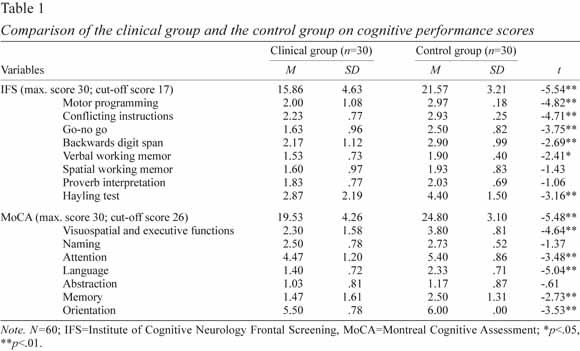
<body><![CDATA[<p>The present study included a convenience and non-probabilistic sample, as it did not involve random selection of the  participants. Thus, the clinical group&rsquo;s data was collected at the Physical Medicine and Rehabilitation department of  <i>Hospital da Prelada</i> during the internship of one of the researchers. The medical doctor at the hospital signalized the  patients who had conditions to participate (e.g., 18 years of age or older; at least three months after the stroke; not having  altered states of consciousness, severe language disorders, and difficulties in understanding spoken language or written words).  The patients were either hospitalized or had an outpatient medical appointment. All the participants included in the clinical  group completed the questionnaires in person, INECO and MoCA were administered by the researcher, and HADS, IESSS and SF-36 were  self-administered. Some patients asked the researcher for help to complete the questionnaires due to their functional impairment.  In these cases, the questions were asked verbally by the researcher. Participants of the control group were contacted and invited  to participate at a senior university (<i>Universidade S&eacute;nior e do Autodidata de Lousada</i>) and at an association for  elderly people (<i>Movimento S&eacute;nior de Cristelos</i>). For the subjects who agreed to be included in the control group, it  was scheduled a day and time at their convenience to answer the protocol, mainly at each institution (few participants asked the  researcher to administer the questionnaires at their homes). All the participants completed the questionnaires in person, INECO  and MoCA were administered by the researcher, and HADS, IESSS and SF-36 were self-administered. No one of the participants asked  the researcher for help to complete the questionnaires.</p>     <p>Data collection of both groups took place from January 2016 to May 2016 and were collected in quiet places without distracting  elements, in order to not interfere with the participants&rsquo; performance and with the institutions activities. The researcher  was available to clarify any doubts during the data collection, and to answer any questions about the study. Each participant was  informed about the aims of the study, the instruments, and the conditions for participation (e.g., voluntary participation,  confidentiality, etc.). If individuals agreed with the conditions and were available to participate in the study, they were asked  to sign an informed consent form. All participants included in the study signed an informed consent form based on the Helsinki  Declaration.</p>     <p>&nbsp;</p>     <p><i>Statistical analysis</i></p>     <p>Data were analyzed using the Statistical Package for the Social Sciences, 23.0 version for Windows (IBM SPSS <i>Statistics</i>  23). The Kolmogorov-Smirnov normality test was performed and results showed a normal distribution, thus parametric methods were  used. A significance level of .05 was considered, with a 95% confidence interval.</p>     <p>Descriptive analyses were performed to characterize the sample and the variables under study. Cronbach&rsquo;s alphas were  performed to assess the instruments internal consistency. Independent samples t-tests were conducted to compare the results of  both groups (clinical group and control group) concerning cognitive performance, depressive symptoms, social support and quality  of life. The homogeneity of variances was analyzed by Levine test when performing the t-tests. A Pearson&rsquo;s product-moment  correlations were also performed to examine the strength of the association between the variables included in the study, and a  logistic regression was performed to identify which of the main variables best classify patients and controls.</p>     <p>&nbsp;</p>     <p><b>Results</b></p>     <p>One of the aims of this study was to identify differences between participants who suffered a stroke and healthy controls  regarding cognitive performance and psychosocial variables (depressive symptoms, social support and quality of life).  <a href="#t1">Table 1</a> shows the results regarding the comparison between the clinical group and the control group on cognitive  performance scores (IFS and MoCA). <a href="#t1">Table 1</a> shows that the control group (<i>M</i>=21.57; <i>SD</i>=3.21)  exhibited a higher performance on the IFS than the clinical group (<i>M</i>=15.86; <i>SD</i>=4.63) [<i>t</i>(51.65)=-5.54;  <i>p</i>&lt;.01]. The control group also had higher scores than the clinical group in the following IFS subtests: motor  programming, conflicting instructions, go-no go, backwards digit span, verbal working memory, and hayling test. There were no  significant differences between both groups regarding proverb interpretation [<i>t</i>(58)=-1.06; <i>p</i>=.295] and spatial  working memory subtests [<i>t</i>(58)=-1.43; <i>p</i>=.157]. Among the clinical group, 66,7% participants presented executive  function deficits, as their IFS scores were below the cut-off point of 17 (Moreira et al., 2014).</p>     <p>&nbsp;</p>     ]]></body>
<body><![CDATA[<p><a name="t1"></a></p>     <p><img src="/img/revistas/aps/v38n2/38n2a02t1.jpg" width="580" height="351"></p>     
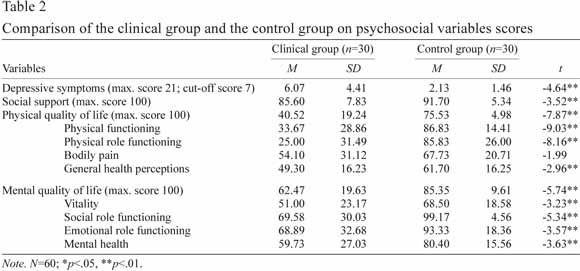
<p>&nbsp;</p>     <p><a href="#t1">Table 1</a> also shows that the control group (<i>M</i>=24.80; <i>SD</i>=3.10) exhibited a higher cognitive  performance on the MoCA than the clinical group (<i>M</i>=19.53; <i>SD</i>=4.26) [<i>t</i>(58)=-5.48; <i>p</i>&lt;.01]. The  control group also had higher scores than the clinical group in the following MoCA subtests: visuospatial and executive functions,  attention, language, memory, and orientation. There were no significant differences between both groups regarding naming  [<i>t</i>(50.69)=-1.37; <i>p</i>=.178] and abstraction subtests [<i>t</i>(58)=-.61; <i>p</i>=.542]. Among the clinical group,  86,7% participants showed cognitive deficits, assessed by MOCA. On the other hand, only 40% participants in the control group  scored below the cut-off point of 26, which reveals the presence of cognitive deficits. As shown in <a href="#t1">Table 1</a>,  patients differed from controls in the IFS and MoCA in almost all of the subscales.</p>     <p><a href="#t2">Table 2</a> shows that the clinical group reported higher depressive symptoms [clinical group: <i>M</i>=6.07;  <i>SD</i>=4.41; control group: <i>M</i>=2.13; <i>SD</i>=1.46; <i>t</i>(35.24)=-4.64; <i>p</i>&lt;.01], lower social support scores  [clinical group: <i>M</i>=85.60; <i>SD</i>=7.83; control group: <i>M</i>=91.70; <i>SD</i>=5.34; <i>t</i>(58)=-3.52;  <i>p</i>&lt;.01], lower physical quality of life (PCS score) [clinical group: <i>M</i>=40.52; <i>SD</i>=.19.24; control group:  <i>M</i>=75.53; <i>SD</i>=4.98; <i>t</i>(58)=-7.87; <i>p</i>&lt;.01], and lower mental quality of life (MCS score) [clinical  group: <i>M</i>=62.47; <i>SD</i>=19.63; control group: <i>M</i>=85.35; <i>SD</i>=9.61; <i>t</i>(43.13)=-5.74; <i>p</i>&lt;.01]  than the control group. The clinical group also reported lower scores in the following SF-36 subtests: physical functioning,  physical role functioning, general health perceptions, vitality, social role functioning, emotional role functioning, and mental  health. There were no significant differences between both groups regarding the bodily pain subscale [<i>t</i>(50.47)=-1.99;  <i>p</i>=.051]. In the clinical group, 33.4% patients reported depressive symptoms, although the mean score of depressive symptoms  in the clinical group was 6.07 (<i>SD</i>=4.41) and in the control group was 2.13 (<i>SD</i>=1.46), which stood below the  established cut-off point (7/21) for depression.</p>     <p>&nbsp;</p>     <p><a name="t2"></a></p>     <p><img src="/img/revistas/aps/v38n2/38n2a02t2.jpg" width="580" height="271"></p>     
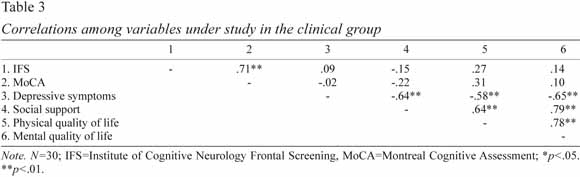
<p>&nbsp;</p>     <p>In order to examine the associations among the variables under study in the clinical group, Pearson&rsquo;s correlation  analysis between IFS scores, MoCA scores, depressive symptoms, social support, physical quality of life (PCS), and mental quality  of life (MCS) were collected. <a href="#t3">Table 3</a> shows that IFS scores and MoCA scores were positively correlated  (<i>r</i>=.71; <i>p</i>&lt;.01), but neither significantly correlated to depressive symptoms, social support or quality of life.  Depressive symptoms were negatively correlated to social support (<i>r</i>=-.64; <i>p</i>&lt;.01), physical quality of life  <i>r</i>=-.58; <i>p</i>&lt;.01) and mental quality of life (<i>r</i>=-.65; <i>p</i>&lt;.01). Social support was positively related  to physical quality of life (<i>r</i>=.64; <i>p</i>&lt;.01) and mental quality of life (<i>r</i>=.79; <i>p</i>&lt;.01).</p>     ]]></body>
<body><![CDATA[<p>&nbsp;</p>     <p><a name="t3"></a></p>     <p><img src="/img/revistas/aps/v38n2/38n2a02t3.jpg" width="580" height="177"></p>     
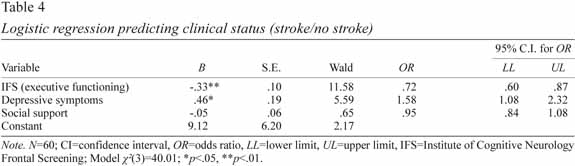
<p>&nbsp;</p>     <p>Another goal of our study was to identify the variables that best classify patients and controls. Due to their theoretical  relevance and to the study&rsquo;s sample-size, the logistic regression model contained three independent variables: IFS scores,  depressive symptoms, and social support. The IFS had a strong positive correlation with MoCA, thus IFS was included in the model,  as it was a more recent neurocognitive tool than MoCA. Depressive symptoms were also included in the model, thus MCS assesed by  SF-36 was not selected. Finally, the last variable included in the model was social support that individuals believe to have  received in the last 6 months.</p>     <p>A logistic regression was performed and the full model containing IFS scores, depressive symptoms and social support as  predictors was statistically significant, <i>&chi;&sup2;</i>(3, <i>n</i>=60)=40.01, <i>p</i>&lt;.01, indicating that the model was  able to distinguish between participants who suffered a stroke and healthy controls. The model as a whole explained between 49%  (Cox and Snell R square) and 65% (Nagelkerke R squared) of the variance in clinical status, and correctly classified 85% of cases.  IFS scores and depressive symptoms made a statistically significant contribution to the model (<a href="#t4">Table 4</a>). The  strongest significant predictor was IFS, recording an odds ratio of .72 (<i>B</i>=-.33; <i>p&lt;</i>.01; 95% IC [.60, .87]). This  indicated that participants who exhibited a more effective executive functioning performance were .72 times less likely to report  having suffered a stroke than those who did not present an effective executive functioning performance, controlling for all other  factors in the model. The odds ratio for depressive symptoms was 1.58 (<i>B=</i>.46; <i>p&lt;</i>.05; 95% IC [1.08, 2.32]),  indicating that participants who experienced depressive symptoms were over one time more likely to report having suffered a stroke  than those who did not experience depressive symptoms, controlling for all other factors in the model.</p>     <p>&nbsp;</p>     <p><a name="t4"></a></p>     <p><img src="/img/revistas/aps/v38n2/38n2a02t4.jpg" width="575" height="166"></p>     
<p>&nbsp;</p>     ]]></body>
<body><![CDATA[<p>&nbsp;</p>     <p><b>Discussion</b></p>     <p>The present study aimed to identify differences between participants who suffered a stroke and healthy controls, concerning  cognitive performance and psychosocial variables scores (depressive symptoms, social support and quality of life); to examine the  associations between the variables under study among participants who suffered a stroke; and to identify the variables that best  classify patients and controls. The results indicated that patients who suffered a stroke exhibited a lower cognitive performance  (both on the IFS and on the MoCA), a lower social support, a lower quality of life, and higher depressive symptoms than the  control group.</p>     <p>Several studies have concluded that cognitive deficits were one of the most common post-stroke complications, usually affecting  more than half of the patients (Cumming et al., 2013; Xu et al., 2013). Madureira et al. (2001) found that more than half of the  patients who suffered a stroke had cognitive impairment. The results of the present study revealed a much higher deficit  prevalence assessed by IFS and by MoCA among the clinical group. In this study, the clinical group exhibited a lower performance  on working memory, attention and language. Madureira et al. (2001) also found similar results among portuguese patients who  suffered a stroke. These authors stated that memory, attention and verbal fluency were the most affected cognitive domains  reported in the post-stroke acute phase. Lesniak et al. (2008) also concluded that deficits in memory, attention, and language  were most common one year after a stroke. These findings could also be explained due to the participants&rsquo; sociodemographic  and clinical characteristics: according to Madureira et al. (2001), older patients with a lower level of education present more  cognitive deficits, mainly in memory. No significant differences were found between both groups regarding abstraction, spatial  working memory, and naming tasks. According to Freitas et al. (2011) and Moreira et al. (2014), age is a risk factor for cognitive  impairment. The control group included mainly elderly people, which could explain the similar results found between the clinical  group and the control group in the subtests previously mentioned.</p>     <p>Depression can also influence cognitive performance. In this study, there were differences between groups regarding depressive  symptoms (one third of the participants who suffered a stroke reported depressive symptoms), but not clinically strong enough for  diagnostic. Our findings regarding depressive symptoms, social support, and quality of life among patients who suffered a stroke  were similar to the ones found by Gordon and Hibbard (1997), Pfeil et al. (2009), Dayapoglu and Tan (2010), and Em et al. (2015).  According to Amaricai and Poenaru (2016) and Lewin et al. (2013), post-stroke depression occurs more frequently in younger  patients, as elderly and retired patients experienced stroke as a less significant life-changing event than youngsters and adults.  Our sample included mainly elderly people, which may explain the observed low depressive symptoms scores in both groups. The  clinical group reported lower social support scores than the control group, but higher than general portuguese population (Guerra,  1995). The high perceived social support may have prevented the clinical group from developing post-stroke depression, and may  have also increased quality of life as sustained by literature (Haley, Roth, Kissela, Perkins, &amp; Howard, 2011; White et al.,  2014). In addition, there were more healthy controls living with a partner but fewer who were retired compared to the clinical  group, which can also help to explain the differences in depressive symptoms and social support scores between both groups. Em et  al. (2015) also found that stroke survivors reported a lower quality of life than healthy controls in all SF-36 subscales and  summary scores. In our study, all the SF-36 subscales were significant lower in the clinical group, except for the bodily pain  subscale. We believe that no significant difference was found in this particular subscale due to the osteoarticular pains often  experienced by healthy elderly people.</p>     <p>Social support scores were positively correlated with physical and mental quality of life, and negatively correlated with  depressive symptoms in the clinical group. These results were similar to the ones obtained by Huang et al. (2010) and Lewin et al.  (2013). Thus, social support can help patients to cope with an unexpected, negative and stress-inducing event such as stroke  (Salter, Foley, &amp; Teasell, 2010). We also concluded that post-stroke quality of life is positively related to social support  and negatively related to depressive symptoms. &#381;iki&#263; et al. (2014), and Em et al. (2015) reported similar findings in  their studies. In the present study, cognitive performance was not significantly correlated to post-stroke depressive symptoms,  although Nys et al. (2006) and Cumming et al. (2014) found a negative association between both variables in their  studies.</p>     <p>Cognitive deficits assessed by IFS and depressive symptoms were found to be significant predictors that best classify patients  and controls. Several studies indicated that cognitive deficits are one of the most significant post-stroke implications (Cumming  et al., 2013; Xu et al., 2013). According to Pfeil et al. (2009) and Gordon and Hibbard (1997), depression is the most common  post-stroke emotional implication. Although depressive symptoms are more intense in the post-stroke acute phase, they can still  remain up to five years after a stroke (Barker-Collo, 2007; Lincoln et al., 2013).</p>     <p>Some limitations of this study deserve mention. One limitation of the present study is that it included a non-probabilistic  convenience sample, and the clinical group was only recruited in one single hospital, which may limit the generalization of the  results to the Portuguese population of post-stroke patients. Thus, it would be important to collect a larger sample and to  include patients from other hospitals and from other Portuguese cities in order to achieve more reliable conclusions. The present  study is also an observational study, which do not provide the same level of evidence as other studies. Thus, a prospective study  design could contribute to assess cognitive deficits and psychosocial variables (such as depression and quality of life) over  time, and how they relate to suspected risk or protection factors. Another limitation was that the selected instruments only focus  on executive functioning and global cognitive performance. Thus, there was no specific measure to assess other post-stroke  impaired cognitive functions (e.g., memory, attention, language). Future studies should include more complex and specific tests to  examine the relationship between cognitive performance and post-stroke depression (Cumming et al., 2013; L&eacute;sniak et al.,  2008). It would also be useful to collect data about long-term hypertension in healthy controls, as it could help to understand  the presence of cognitive deficits in this group. The limitations of the sample (namely sample-size, the sampling method, and the  socio-demographic characteristics of the sample) may limit the generalization of the results to the Portuguese population of  post-stroke patients.</p>     <p>This study enhances the importance of addressing depressive symptoms and social support in psychological interventions.  Cognitive-behavioral therapy has shown effectiveness in the treatment of post-stroke depression (Gordon &amp; Hibbard, 1997), and  according to Doble, Shearer, Lall-Phillips and Jones (2009) faciliting a supportive communication between the patient, his family  and friends enhances perceived social support. Considering that the mean time elapsed between the stroke and the assessment was  almost 5 years (54 months), we find a relevant executive function deficit capable of distinguishing the clinical group and the  control group, which was also previously found by Cummings et al. (2013). Thus, it is also important to administer instruments to  assess patients&rsquo; post-stroke cognitive performance and to consequently identify the preserved and damaged cognitive  functions, in order to improve the effectiveness of neuropsychological rehabilitation interventions.</p>     <p>Few studies assessed post-stroke cognitive deficits and their association with depressive symptoms, social support, and quality  of life in Portugal. The strengths of the current study include the homogeneity of both samples in terms of group size, gender,  age and educational level, which allowed for a clearer analysis and minimized the influence of individual and methodological  variables. In addition, a recent neurocognitive tool (IFS) was administered, which was positively correlated with MoCA. MoCA has  proved to be a valid instrument for assessing cognitive deficits in patients who have had a stroke (Horstmann, Rizos, Rauch,  Arden, &amp; Veltkamp, 2014), whereas IFS focuses on executive functioning, and there are no studies to date on its validity in  portuguese patients who suffered a stroke. Therefore, the data of this study contribute to a more accurate assessment of  post-stroke patients&rsquo; cognitive impairment regarding executive functioning. This study can contribute to the development of  larger prospective studies in the future.</p>     ]]></body>
<body><![CDATA[<p>&nbsp;</p>     <p><b>References</b></p>     <!-- ref --><p>Amaricai, E., &amp; Poenaru, D. V. (2016). The post-stroke depression and its impact on functioning in young and adult stroke  patients of a rehabilitation unit. <i>Journal of Mental Health, 25</i>, 137-141.    &nbsp;&nbsp;&nbsp;&nbsp;&nbsp;&nbsp;&nbsp;&nbsp;[&#160;<a href="javascript:void(0);" onclick="javascript: window.open('/scielo.php?script=sci_nlinks&ref=054772&pid=S0870-8231202000020000200001&lng=','','width=640,height=500,resizable=yes,scrollbars=1,menubar=yes,');">Links</a>&#160;]<!-- end-ref --></p>     <!-- ref --><p>Barker-Collo, S. L. (2007). Depression and anxiety 3 months post stroke: Prevalence and correlates. <i>Archives of Clinical  Neuropsychology, 22</i>, 519-531.    &nbsp;&nbsp;&nbsp;&nbsp;&nbsp;&nbsp;&nbsp;&nbsp;[&#160;<a href="javascript:void(0);" onclick="javascript: window.open('/scielo.php?script=sci_nlinks&ref=054774&pid=S0870-8231202000020000200002&lng=','','width=640,height=500,resizable=yes,scrollbars=1,menubar=yes,');">Links</a>&#160;]<!-- end-ref --></p>     <!-- ref --><p>Bour, A., Rasquin, S., Limburg, M., &amp; Verhey, F. (2011). Depressive symptoms and executive functioning in stroke patients:  A follow-up study. <i>International Journal of Geriatric Psychiatry, 26</i>, 679-686. Retrieved from  <a href="https://doi.org/10.1002/gps.2581" target="_blank">https://doi.org/10.1002/gps.2581</a>&nbsp;&nbsp;&nbsp;&nbsp;&nbsp;&nbsp;&nbsp;&nbsp;[&#160;<a href="javascript:void(0);" onclick="javascript: window.open('/scielo.php?script=sci_nlinks&ref=054776&pid=S0870-8231202000020000200003&lng=','','width=640,height=500,resizable=yes,scrollbars=1,menubar=yes,');">Links</a>&#160;]<!-- end-ref --><!-- ref --><p>Cookson, C., &amp; Casey, J. (2013). Social support following stroke. <i>The Psychologist, 26</i>, 566-569.    &nbsp;&nbsp;&nbsp;&nbsp;&nbsp;&nbsp;&nbsp;&nbsp;[&#160;<a href="javascript:void(0);" onclick="javascript: window.open('/scielo.php?script=sci_nlinks&ref=054777&pid=S0870-8231202000020000200004&lng=','','width=640,height=500,resizable=yes,scrollbars=1,menubar=yes,');">Links</a>&#160;]<!-- end-ref --></p>     <!-- ref --><p>Cumming, T. B., Brodtmann, A., Darby, D., &amp; Bernhardt, J. (2014). The importance of cognition to quality of life after  stroke. <i>Journal of Psychosomatic Research, 77</i>, 374-379.    &nbsp;&nbsp;&nbsp;&nbsp;&nbsp;&nbsp;&nbsp;&nbsp;[&#160;<a href="javascript:void(0);" onclick="javascript: window.open('/scielo.php?script=sci_nlinks&ref=054779&pid=S0870-8231202000020000200005&lng=','','width=640,height=500,resizable=yes,scrollbars=1,menubar=yes,');">Links</a>&#160;]<!-- end-ref --></p>     <!-- ref --><p>Cumming, T. B., Marshall, R. S., &amp; Lazar, R. M. (2013). Stroke, cognitive deficits, and rehabilitation: Still an incomplete  picture. <i>International Journal of Stroke, 8</i>, 38-45. Retrieved from  <a href="https://doi.org/10.1111/j.1747-4949.2012.00972.x" target="_blank">https://doi.org/10.1111/j.1747-4949.2012.00972.x</a>&nbsp;&nbsp;&nbsp;&nbsp;&nbsp;&nbsp;&nbsp;&nbsp;[&#160;<a href="javascript:void(0);" onclick="javascript: window.open('/scielo.php?script=sci_nlinks&ref=054781&pid=S0870-8231202000020000200006&lng=','','width=640,height=500,resizable=yes,scrollbars=1,menubar=yes,');">Links</a>&#160;]<!-- end-ref --><!-- ref --><p>Dayapoglu, N., &amp; Tan, M. (2010). Quality of life in stroke patients. <i>Neurology India, 58</i>, 697-701. Retrieved from  <a href="https://doi.org/10.4103/0028-3886.72165" target="_blank">https://doi.org/10.4103/0028-3886.72165</a>&nbsp;&nbsp;&nbsp;&nbsp;&nbsp;&nbsp;&nbsp;&nbsp;[&#160;<a href="javascript:void(0);" onclick="javascript: window.open('/scielo.php?script=sci_nlinks&ref=054782&pid=S0870-8231202000020000200007&lng=','','width=640,height=500,resizable=yes,scrollbars=1,menubar=yes,');">Links</a>&#160;]<!-- end-ref --><!-- ref --><p>Doble, S. E., Shearer, C., Lall-Phillips, J., &amp; Jones, S. (2009). Relation between post-stroke satisfaction with time use,  perceived social support and depressive symptoms. <i>Disability &amp; Rehabilitation, 31</i>, 476-473. Retrieved from  <a href="https://doi.org/10.1080/09638280802168368" target="_blank">https://doi.org/10.1080/09638280802168368</a>&nbsp;&nbsp;&nbsp;&nbsp;&nbsp;&nbsp;&nbsp;&nbsp;[&#160;<a href="javascript:void(0);" onclick="javascript: window.open('/scielo.php?script=sci_nlinks&ref=054783&pid=S0870-8231202000020000200008&lng=','','width=640,height=500,resizable=yes,scrollbars=1,menubar=yes,');">Links</a>&#160;]<!-- end-ref --><!-- ref --><p>Em, S., Bozkurt, M., Karako&ccedil;, M., &Ccedil;aglayan, M., Akden&iacute;z, D., Oktayoglu, P., . . . Nas, K. (2015).  Determining quality of life and associated factors in patients with stroke. <i>Turkish Journal of Physical Medicine &amp;  Rehabilitation / Turkiye Fiziksel Tip Ve Rehabilitasyon Dergisi, 61</i>, 148-154.    &nbsp;&nbsp;&nbsp;&nbsp;&nbsp;&nbsp;&nbsp;&nbsp;[&#160;<a href="javascript:void(0);" onclick="javascript: window.open('/scielo.php?script=sci_nlinks&ref=054784&pid=S0870-8231202000020000200009&lng=','','width=640,height=500,resizable=yes,scrollbars=1,menubar=yes,');">Links</a>&#160;]<!-- end-ref --></p>     <!-- ref --><p>Elloker, T., &amp; Rhoda, A. (2018). The relationship between social support and participation in stroke: A systematic review.  <i>African Journal of Disability, 7</i>, a357. Retrieved from <a href="https://doi.org/10.4102/ajod.v7i0.357"  target="_blank">https://doi.org/10.4102/ajod.v7i0.357</a>&nbsp;&nbsp;&nbsp;&nbsp;&nbsp;&nbsp;&nbsp;&nbsp;[&#160;<a href="javascript:void(0);" onclick="javascript: window.open('/scielo.php?script=sci_nlinks&ref=054786&pid=S0870-8231202000020000200010&lng=','','width=640,height=500,resizable=yes,scrollbars=1,menubar=yes,');">Links</a>&#160;]<!-- end-ref --><!-- ref --><p>Freitas, S., Sim&otilde;es, M. R., Alves, L., &amp; Santana, I. (2011). Montreal Cognitive Assessment (MoCA): Normative study  for the Portuguese population. <i>Journal of Clinical and Experimental Neuropsychology, 33</i>, 989-996. Retrieved from  <a href="https://doi.org/10.1080/13803395.2011.589374" target="_blank">https://doi.org/10.1080/13803395.2011.589374</a>&nbsp;&nbsp;&nbsp;&nbsp;&nbsp;&nbsp;&nbsp;&nbsp;[&#160;<a href="javascript:void(0);" onclick="javascript: window.open('/scielo.php?script=sci_nlinks&ref=054787&pid=S0870-8231202000020000200011&lng=','','width=640,height=500,resizable=yes,scrollbars=1,menubar=yes,');">Links</a>&#160;]<!-- end-ref --><!-- ref --><p>Glass, T. A., &amp; Maddox, G. L. (1992). The quality and quantity of social support: Stroke recovery as psycho-social  transition. <i>Social Science &amp; Medicine, 34</i>, 1249-1261. Retrieved from  <a href="https://doi.org/10.1016/0277-9536(92)90317-J" target="_blank">https://doi.org/10.1016/0277-9536(92)90317-J</a>&nbsp;&nbsp;&nbsp;&nbsp;&nbsp;&nbsp;&nbsp;&nbsp;[&#160;<a href="javascript:void(0);" onclick="javascript: window.open('/scielo.php?script=sci_nlinks&ref=054788&pid=S0870-8231202000020000200012&lng=','','width=640,height=500,resizable=yes,scrollbars=1,menubar=yes,');">Links</a>&#160;]<!-- end-ref --><!-- ref --><p>Glass, T. A., Matchar, D. B., Belyea, M., &amp; Feussner, J. R. (1993). Impact of social support on outcome in first stroke.  <i>Stroke: A Journal of Cerebral Circulation, 24</i>, 64-70. Retrieved from <a href="https://doi.org/10.1161/01.STR.24.1.64"  target="_blank">https://doi.org/10.1161/01.STR.24.1.64</a>&nbsp;&nbsp;&nbsp;&nbsp;&nbsp;&nbsp;&nbsp;&nbsp;[&#160;<a href="javascript:void(0);" onclick="javascript: window.open('/scielo.php?script=sci_nlinks&ref=054789&pid=S0870-8231202000020000200013&lng=','','width=640,height=500,resizable=yes,scrollbars=1,menubar=yes,');">Links</a>&#160;]<!-- end-ref --><!-- ref --><p>Glymour, M. M., Weuve, J., Fay, M. E., Glass, T., &amp; Berkman, L. F. (2008). Social ties and cognitive recovery after stroke:  Does social integration promote cognitive resilience?. <i>Neuroepidemiology, 31</i>, 10-20. Retrieved from  <a href="https://doi.org/10.1159/000136646" target="_blank">https://doi.org/10.1159/000136646</a>&nbsp;&nbsp;&nbsp;&nbsp;&nbsp;&nbsp;&nbsp;&nbsp;[&#160;<a href="javascript:void(0);" onclick="javascript: window.open('/scielo.php?script=sci_nlinks&ref=054790&pid=S0870-8231202000020000200014&lng=','','width=640,height=500,resizable=yes,scrollbars=1,menubar=yes,');">Links</a>&#160;]<!-- end-ref --><!-- ref --><p>Gordon, W. A., &amp; Hibbard, M. R. (1997). Poststroke depression: An examination of the literature. <i>Archives of Physical  Medicine and Rehabilitation, 78</i>, 658-663.    &nbsp;&nbsp;&nbsp;&nbsp;&nbsp;&nbsp;&nbsp;&nbsp;[&#160;<a href="javascript:void(0);" onclick="javascript: window.open('/scielo.php?script=sci_nlinks&ref=054791&pid=S0870-8231202000020000200015&lng=','','width=640,height=500,resizable=yes,scrollbars=1,menubar=yes,');">Links</a>&#160;]<!-- end-ref --></p>     <!-- ref --><p>Guerra, M. (1995). Uma escala de avalia&ccedil;&atilde;o do suporte social: Sua aplica&ccedil;&atilde;o numa  popula&ccedil;&atilde;o seropositiva ao v&iacute;rus HIV. <i>Avalia&ccedil;&atilde;o Psicol&oacute;gica: Formas e Contextos,  3</i>, 25-34.    &nbsp;&nbsp;&nbsp;&nbsp;&nbsp;&nbsp;&nbsp;&nbsp;[&#160;<a href="javascript:void(0);" onclick="javascript: window.open('/scielo.php?script=sci_nlinks&ref=054793&pid=S0870-8231202000020000200016&lng=','','width=640,height=500,resizable=yes,scrollbars=1,menubar=yes,');">Links</a>&#160;]<!-- end-ref --></p>     <!-- ref --><p>Haley, W. E., Roth, D. L., Kissela, B., Perkins, M., &amp; Howard, G. (2011). Quality of life after stroke: A prospective  longitudinal study. <i>Quality of Life Research, 20</i>, 799-806.    &nbsp;&nbsp;&nbsp;&nbsp;&nbsp;&nbsp;&nbsp;&nbsp;[&#160;<a href="javascript:void(0);" onclick="javascript: window.open('/scielo.php?script=sci_nlinks&ref=054795&pid=S0870-8231202000020000200017&lng=','','width=640,height=500,resizable=yes,scrollbars=1,menubar=yes,');">Links</a>&#160;]<!-- end-ref --></p>     <!-- ref --><p>Horstmann, S., Rizos, T., Rauch, G., Arden, C., &amp; Veltkamp, R. (2014). Feasibility of the Montreal Cognitive Assessment in  acute stroke patients. <i>European Journal of Neurology, 21</i>, 1387-1393.    &nbsp;&nbsp;&nbsp;&nbsp;&nbsp;&nbsp;&nbsp;&nbsp;[&#160;<a href="javascript:void(0);" onclick="javascript: window.open('/scielo.php?script=sci_nlinks&ref=054797&pid=S0870-8231202000020000200018&lng=','','width=640,height=500,resizable=yes,scrollbars=1,menubar=yes,');">Links</a>&#160;]<!-- end-ref --></p>     <!-- ref --><p>Huang, C., Hsu, M., Hsu, S., Cheng, P., Lin, S., &amp; Chuang, C. (2010). Mediating roles of social support on poststroke  depression and quality of life in patients with ischemic stroke. <i>Journal of Clinical Nursing, 19</i>, 2752-2762. Retrieved from  <a href="https://doi.org/10.1111/j.1365-2702.2010.03327.x" target="_blank">https://doi.org/10.1111/j.1365-2702.2010.03327.x</a>&nbsp;&nbsp;&nbsp;&nbsp;&nbsp;&nbsp;&nbsp;&nbsp;[&#160;<a href="javascript:void(0);" onclick="javascript: window.open('/scielo.php?script=sci_nlinks&ref=054799&pid=S0870-8231202000020000200019&lng=','','width=640,height=500,resizable=yes,scrollbars=1,menubar=yes,');">Links</a>&#160;]<!-- end-ref --><!-- ref --><p>Kim, P., Warren, S., Madill, H., &amp; Hadley, M. (1999). Quality of life of stroke survivors. <i>Quality of Life Research: An  International Journal of Quality of Life Aspects of Treatment, Care &amp; Rehabilitation, 8</i>, 293-301.    &nbsp;&nbsp;&nbsp;&nbsp;&nbsp;&nbsp;&nbsp;&nbsp;[&#160;<a href="javascript:void(0);" onclick="javascript: window.open('/scielo.php?script=sci_nlinks&ref=054800&pid=S0870-8231202000020000200020&lng=','','width=640,height=500,resizable=yes,scrollbars=1,menubar=yes,');">Links</a>&#160;]<!-- end-ref --></p>     <!-- ref --><p>Le&#347;niak, M., Bak, T., Czepiel, W., Seni&oacute;w, J., &amp; Cz&#322;onkowska, A. (2008). Frequency and prognostic value of  cognitive disorders in stroke patients. <i>Dementia and Geriatric Cognitive Disorders, 26</i>, 356-363. Retrieved from  <a href="https://doi.org/10.1159/000162262" target="_blank">https://doi.org/10.1159/000162262</a>&nbsp;&nbsp;&nbsp;&nbsp;&nbsp;&nbsp;&nbsp;&nbsp;[&#160;<a href="javascript:void(0);" onclick="javascript: window.open('/scielo.php?script=sci_nlinks&ref=054802&pid=S0870-8231202000020000200021&lng=','','width=640,height=500,resizable=yes,scrollbars=1,menubar=yes,');">Links</a>&#160;]<!-- end-ref --><!-- ref --><p>Lewin, A., J&ouml;bges, M., &amp; Werheid, K. (2013). The influence of self-efficacy, pre-stroke depression and perceived  social support on self-reported depressive symptoms during stroke rehabilitation. <i>Neuropsychological Rehabilitation, 23</i>,  546-562. Retrieved from <a href="https://doi.org/10.1080/09602011.2013.794742"  target="_blank">https://doi.org/10.1080/09602011.2013.794742</a>&nbsp;&nbsp;&nbsp;&nbsp;&nbsp;&nbsp;&nbsp;&nbsp;[&#160;<a href="javascript:void(0);" onclick="javascript: window.open('/scielo.php?script=sci_nlinks&ref=054803&pid=S0870-8231202000020000200022&lng=','','width=640,height=500,resizable=yes,scrollbars=1,menubar=yes,');">Links</a>&#160;]<!-- end-ref --><!-- ref --><p>Lin, N., Dean, A., &amp; Ensel, W. M. (1986). <i>Social support, life events, and depression</i>. London: Academic Press.    &nbsp;&nbsp;&nbsp;&nbsp;&nbsp;&nbsp;&nbsp;&nbsp;[&#160;<a href="javascript:void(0);" onclick="javascript: window.open('/scielo.php?script=sci_nlinks&ref=054804&pid=S0870-8231202000020000200023&lng=','','width=640,height=500,resizable=yes,scrollbars=1,menubar=yes,');">Links</a>&#160;]<!-- end-ref --></p>     <!-- ref --><p>Lincoln, N. B., Brinkmann, N., Cunningham, S., Dejaeger, E., De Weerdt, W., Jenni, W., . . . De Wit, L. (2013). Anxiety  and depression after stroke: A 5 year follow-up. <i>Disability and Rehabilitation, 35</i>, 140-145. Retrieved from  <a href="https://doi.org/10.3109/09638288.2012.691939" target="_blank">https://doi.org/10.3109/09638288.2012.691939</a>&nbsp;&nbsp;&nbsp;&nbsp;&nbsp;&nbsp;&nbsp;&nbsp;[&#160;<a href="javascript:void(0);" onclick="javascript: window.open('/scielo.php?script=sci_nlinks&ref=054806&pid=S0870-8231202000020000200024&lng=','','width=640,height=500,resizable=yes,scrollbars=1,menubar=yes,');">Links</a>&#160;]<!-- end-ref --><!-- ref --><p>Madureira, S., Guerreiro, M., &amp; Ferro, J. M. (2001). Dementia and cognitive impairment three months after stroke.  <i>European Journal of Neurology, 8</i>, 621-627.    &nbsp;&nbsp;&nbsp;&nbsp;&nbsp;&nbsp;&nbsp;&nbsp;[&#160;<a href="javascript:void(0);" onclick="javascript: window.open('/scielo.php?script=sci_nlinks&ref=054807&pid=S0870-8231202000020000200025&lng=','','width=640,height=500,resizable=yes,scrollbars=1,menubar=yes,');">Links</a>&#160;]<!-- end-ref --></p>     <p>Moreira, H. S., Lima, C. F., &amp; Vicente, S. G. (2014). Examining executive dysfunction with the Institute of Cognitive  Neurology (INECO) Frontal Screening (IFS): Normative values from a healthy sample and clinical utility in Alzheimer&rsquo;s  disease. <i>Journal of Alzheimer&rsquo;s Disease, 42</i>, 261-273. Retrieved from <a href="https://doi.org/10.3233/JAD-132348"  target="_blank">https://doi.org/10.3233/JAD-132348</a></p>     ]]></body>
<body><![CDATA[<!-- ref --><p>Nasreddine, Z. S., Phillips, N. A., B&eacute;dirian, V., Charbonneau, S., Whitehead, V., Collin, I., . . . Chertkow, H. (2005).  The Montreal Cognitive Assessment, MoCA: A brief screening tool for Mild Cognitive Impairment. <i>Journal of the American  Geriatric Society, 53</i>, 695-699. Retrieved from <a href="https://doi.org/10.1111/j.1532-5415.2005.53221.x"  target="_blank">https://doi.org/10.1111/j.1532-5415.2005.53221.x</a>&nbsp;&nbsp;&nbsp;&nbsp;&nbsp;&nbsp;&nbsp;&nbsp;[&#160;<a href="javascript:void(0);" onclick="javascript: window.open('/scielo.php?script=sci_nlinks&ref=054810&pid=S0870-8231202000020000200027&lng=','','width=640,height=500,resizable=yes,scrollbars=1,menubar=yes,');">Links</a>&#160;]<!-- end-ref --><!-- ref --><p>Nys, G. S., van Zandvoort, M. E., van der Worp, H. B., de Haan, E. F., de Kort, P. M., Jansen, B. W., &amp; Kappelle, L. J.  (2006). Early cognitive impairment predicts long-term depressive symptoms and quality of life after stroke. <i>Journal of the  Neurological Sciences, 247</i>, 149-156.    &nbsp;&nbsp;&nbsp;&nbsp;&nbsp;&nbsp;&nbsp;&nbsp;[&#160;<a href="javascript:void(0);" onclick="javascript: window.open('/scielo.php?script=sci_nlinks&ref=054811&pid=S0870-8231202000020000200028&lng=','','width=640,height=500,resizable=yes,scrollbars=1,menubar=yes,');">Links</a>&#160;]<!-- end-ref --></p>     <!-- ref --><p>O&rsquo;Sullivan, C., &amp; Chard, G. (2010). An exploration of participation in leisure activities post stroke. <i>Australian  Occupational Therapy Journal, 57</i>, 159-166. Retrieved from <a href="https://doi.org/10.1111/j.1440-1630.2009.00833.x"  target="_blank">https://doi.org/10.1111/j.1440-1630.2009.00833.x</a>&nbsp;&nbsp;&nbsp;&nbsp;&nbsp;&nbsp;&nbsp;&nbsp;[&#160;<a href="javascript:void(0);" onclick="javascript: window.open('/scielo.php?script=sci_nlinks&ref=054813&pid=S0870-8231202000020000200029&lng=','','width=640,height=500,resizable=yes,scrollbars=1,menubar=yes,');">Links</a>&#160;]<!-- end-ref --><!-- ref --><p>Pfeil, M., Gray, R., &amp; Lindsay, B. (2009). Depression and stroke: A common but often unrecognized combination. <i>British  Journal of Nursing (Mark Allen Publishing), 18</i>, 365-369.    &nbsp;&nbsp;&nbsp;&nbsp;&nbsp;&nbsp;&nbsp;&nbsp;[&#160;<a href="javascript:void(0);" onclick="javascript: window.open('/scielo.php?script=sci_nlinks&ref=054814&pid=S0870-8231202000020000200030&lng=','','width=640,height=500,resizable=yes,scrollbars=1,menubar=yes,');">Links</a>&#160;]<!-- end-ref --></p>     <!-- ref --><p>Ribeiro, J. (2005). <i>O importante &eacute; a sa&uacute;de: Estudo de adapta&ccedil;&atilde;o de uma t&eacute;cnica de  avalia&ccedil;&atilde;o da percep&ccedil;&atilde;o do estado de sa&uacute;de</i>. Lisboa: Funda&ccedil;&atilde;o Merck.    &nbsp;&nbsp;&nbsp;&nbsp;&nbsp;&nbsp;&nbsp;&nbsp;[&#160;<a href="javascript:void(0);" onclick="javascript: window.open('/scielo.php?script=sci_nlinks&ref=054816&pid=S0870-8231202000020000200031&lng=','','width=640,height=500,resizable=yes,scrollbars=1,menubar=yes,');">Links</a>&#160;]<!-- end-ref --></p>     <!-- ref --><p>Ribeiro, J., Silva, I., Ferreira, T., Martins, A., Meneses, R., &amp; Baltar, M. (2007). Validation study of a Portuguese  version of the Hospital Anxiety and Depression Scale. <i>Psychology, Health &amp; Medicine, 12</i>, 225-237.    &nbsp;&nbsp;&nbsp;&nbsp;&nbsp;&nbsp;&nbsp;&nbsp;[&#160;<a href="javascript:void(0);" onclick="javascript: window.open('/scielo.php?script=sci_nlinks&ref=054818&pid=S0870-8231202000020000200032&lng=','','width=640,height=500,resizable=yes,scrollbars=1,menubar=yes,');">Links</a>&#160;]<!-- end-ref --></p>     ]]></body>
<body><![CDATA[<!-- ref --><p>Salter, K., Foley, N., &amp; Teasell, R. (2010). Social support interventions and mood status post stroke: A review.  <i>International Journal of Nursing Studies, 47</i>, 616-625. Retrieved from  <a href="https://doi.org/10.1016/j.ijnurstu.2009.12.002" target="_blank">https://doi.org/10.1016/j.ijnurstu.2009.12.002</a>&nbsp;&nbsp;&nbsp;&nbsp;&nbsp;&nbsp;&nbsp;&nbsp;[&#160;<a href="javascript:void(0);" onclick="javascript: window.open('/scielo.php?script=sci_nlinks&ref=054820&pid=S0870-8231202000020000200033&lng=','','width=640,height=500,resizable=yes,scrollbars=1,menubar=yes,');">Links</a>&#160;]<!-- end-ref --><!-- ref --><p>Torralva, T., Roca, M., Gleichgerrcht, E., L&oacute;pez, P., &amp; Manes, F. (2009). INECO Frontal Screening (IFS): A brief,  sensitive, and specific tool to assess executive functions in dementia. <i>Journal of International Neuropsychology Society,  15</i>, 777-786.    &nbsp;&nbsp;&nbsp;&nbsp;&nbsp;&nbsp;&nbsp;&nbsp;[&#160;<a href="javascript:void(0);" onclick="javascript: window.open('/scielo.php?script=sci_nlinks&ref=054821&pid=S0870-8231202000020000200034&lng=','','width=640,height=500,resizable=yes,scrollbars=1,menubar=yes,');">Links</a>&#160;]<!-- end-ref --></p>     <!-- ref --><p>Ware, J., Snow, K., Kosinski, M., &amp; Gandek, B. (1993). <i>SF-36 Health Survey: Manual and interpretation guide</i>. Boston:  The Health Institute, New England Medical Center.    &nbsp;&nbsp;&nbsp;&nbsp;&nbsp;&nbsp;&nbsp;&nbsp;[&#160;<a href="javascript:void(0);" onclick="javascript: window.open('/scielo.php?script=sci_nlinks&ref=054823&pid=S0870-8231202000020000200035&lng=','','width=640,height=500,resizable=yes,scrollbars=1,menubar=yes,');">Links</a>&#160;]<!-- end-ref --></p>     <!-- ref --><p>White, J. H., Attia, J., Sturm, J., Carter, G., &amp; Magin, P. (2014). Predictors of depression and anxiety in community  dwelling stroke survivors: A cohort study. <i>Disability and Rehabilitation, 36</i>, 1975-1982. Retrieved from  <a href="https://doi.org/10.3109/09638288.2014.884172" target="_blank">https://doi.org/10.3109/09638288.2014.884172</a>&nbsp;&nbsp;&nbsp;&nbsp;&nbsp;&nbsp;&nbsp;&nbsp;[&#160;<a href="javascript:void(0);" onclick="javascript: window.open('/scielo.php?script=sci_nlinks&ref=054825&pid=S0870-8231202000020000200036&lng=','','width=640,height=500,resizable=yes,scrollbars=1,menubar=yes,');">Links</a>&#160;]<!-- end-ref --><!-- ref --><p>World Health Organization. (2016). <i>Global health estimates 2015: Disease burden by cause, age, sex, by country and by  region, 2000-2015</i>. Geneva: WHO Press.    &nbsp;&nbsp;&nbsp;&nbsp;&nbsp;&nbsp;&nbsp;&nbsp;[&#160;<a href="javascript:void(0);" onclick="javascript: window.open('/scielo.php?script=sci_nlinks&ref=054826&pid=S0870-8231202000020000200037&lng=','','width=640,height=500,resizable=yes,scrollbars=1,menubar=yes,');">Links</a>&#160;]<!-- end-ref --></p>     <!-- ref --><p>Xu, X.-D., Ren, H.-Y., Prakash, R., Vijayadas, S. M., &amp; Kumar, R. (2013). Outcomes of neuropsychological interventions of  stroke. <i>Annals of Indian Academy of Neurology, 16</i>, 319-328. Retrieved from  <a href="https://doi.org/10.4103/0972-2327.116909" target="_blank">https://doi.org/10.4103/0972-2327.116909</a>&nbsp;&nbsp;&nbsp;&nbsp;&nbsp;&nbsp;&nbsp;&nbsp;[&#160;<a href="javascript:void(0);" onclick="javascript: window.open('/scielo.php?script=sci_nlinks&ref=054828&pid=S0870-8231202000020000200038&lng=','','width=640,height=500,resizable=yes,scrollbars=1,menubar=yes,');">Links</a>&#160;]<!-- end-ref --><!-- ref --><p>&#381;iki&#263;, T. R., Divjak, I., Jovi&#263;evi&#263;, M., Semnic, M., Slankamenac, P., &#381;arkov, M., &amp;  &#381;iki&#263;, M. (2014). The effect of post stroke depression on functional outcome and quality of life. <i>Acta Clinica  Croatica, 53</i>, 294-301.    &nbsp;&nbsp;&nbsp;&nbsp;&nbsp;&nbsp;&nbsp;&nbsp;[&#160;<a href="javascript:void(0);" onclick="javascript: window.open('/scielo.php?script=sci_nlinks&ref=054829&pid=S0870-8231202000020000200039&lng=','','width=640,height=500,resizable=yes,scrollbars=1,menubar=yes,');">Links</a>&#160;]<!-- end-ref --></p>     <!-- ref --><p>Zigmond, A. P., &amp; Snaith, R. P. (1983). The Hospital Anxiety and Depression Scale. <i>Acta Psychiatrica Scandinavica,  67</i>, 361-370.    &nbsp;&nbsp;&nbsp;&nbsp;&nbsp;&nbsp;&nbsp;&nbsp;[&#160;<a href="javascript:void(0);" onclick="javascript: window.open('/scielo.php?script=sci_nlinks&ref=054831&pid=S0870-8231202000020000200040&lng=','','width=640,height=500,resizable=yes,scrollbars=1,menubar=yes,');">Links</a>&#160;]<!-- end-ref --></p>     <p>&nbsp;</p>     <p><b><a name="c0" id="c0"></a><a href="#topc0">CORRESPOND&Ecirc;NCIA</a></b></p>     <p>Correspondence concerning this article should be addressed to: V&acirc;nia Rocha, Centro de Psicologia, Faculdadede Psicologia  e de Ci&ecirc;ncias da Educa&ccedil;&atilde;o, Universidade do Porto, Rua Alfredo Allen, 4200-135 Porto, Portugal. Email:  <a href="mailto:vmasrocha@gmail.com">vmasrocha@gmail.com</a></p>     <p>&nbsp;</p>     <p>Funded by the Portuguese Foundation for Science and Technology through grant UID/PSI/0050/2013 awarded to the Center for  Psychology of University of Porto.</p>     <p>&nbsp;</p>     <p>Submitted: 26/06/2019 Accepted: 05/02/2020</p>     ]]></body>
<body><![CDATA[ ]]></body><back>
<ref-list>
<ref id="B1">
<nlm-citation citation-type="journal">
<person-group person-group-type="author">
<name>
<surname><![CDATA[Amaricai]]></surname>
<given-names><![CDATA[E.]]></given-names>
</name>
<name>
<surname><![CDATA[Poenaru]]></surname>
<given-names><![CDATA[D. V.]]></given-names>
</name>
</person-group>
<article-title xml:lang="en"><![CDATA[The post-stroke depression and its impact on functioning in young and adult stroke patients of a rehabilitation unit]]></article-title>
<source><![CDATA[Journal of Mental Health]]></source>
<year>2016</year>
<volume>25</volume>
<page-range>137-141</page-range></nlm-citation>
</ref>
<ref id="B2">
<nlm-citation citation-type="journal">
<person-group person-group-type="author">
<name>
<surname><![CDATA[Barker-Collo]]></surname>
<given-names><![CDATA[S. L.]]></given-names>
</name>
</person-group>
<article-title xml:lang="en"><![CDATA[Depression and anxiety 3 months post stroke: Prevalence and correlates]]></article-title>
<source><![CDATA[Archives of Clinical Neuropsychology]]></source>
<year>2007</year>
<volume>22</volume>
<page-range>519-531</page-range></nlm-citation>
</ref>
<ref id="B3">
<nlm-citation citation-type="journal">
<person-group person-group-type="author">
<name>
<surname><![CDATA[Bour]]></surname>
<given-names><![CDATA[A.]]></given-names>
</name>
<name>
<surname><![CDATA[Rasquin]]></surname>
<given-names><![CDATA[S.]]></given-names>
</name>
<name>
<surname><![CDATA[Limburg]]></surname>
<given-names><![CDATA[M.]]></given-names>
</name>
<name>
<surname><![CDATA[Verhey]]></surname>
<given-names><![CDATA[F.]]></given-names>
</name>
</person-group>
<article-title xml:lang="en"><![CDATA[Depressive symptoms and executive functioning in stroke patients: A follow-up study]]></article-title>
<source><![CDATA[International Journal of Geriatric Psychiatry]]></source>
<year>2011</year>
<volume>26</volume>
<page-range>679-686</page-range></nlm-citation>
</ref>
<ref id="B4">
<nlm-citation citation-type="journal">
<person-group person-group-type="author">
<name>
<surname><![CDATA[Cookson]]></surname>
<given-names><![CDATA[C.]]></given-names>
</name>
<name>
<surname><![CDATA[Casey]]></surname>
<given-names><![CDATA[J.]]></given-names>
</name>
</person-group>
<article-title xml:lang="en"><![CDATA[Social support following stroke]]></article-title>
<source><![CDATA[The Psychologist]]></source>
<year>2013</year>
<volume>26</volume>
<page-range>566-569</page-range></nlm-citation>
</ref>
<ref id="B5">
<nlm-citation citation-type="journal">
<person-group person-group-type="author">
<name>
<surname><![CDATA[Cumming]]></surname>
<given-names><![CDATA[T. B.]]></given-names>
</name>
<name>
<surname><![CDATA[Brodtmann]]></surname>
<given-names><![CDATA[A.]]></given-names>
</name>
<name>
<surname><![CDATA[Darby]]></surname>
<given-names><![CDATA[D.]]></given-names>
</name>
<name>
<surname><![CDATA[Bernhardt]]></surname>
<given-names><![CDATA[J.]]></given-names>
</name>
</person-group>
<article-title xml:lang="en"><![CDATA[The importance of cognition to quality of life after stroke]]></article-title>
<source><![CDATA[Journal of Psychosomatic Research]]></source>
<year>2014</year>
<volume>77</volume>
<page-range>374-379</page-range></nlm-citation>
</ref>
<ref id="B6">
<nlm-citation citation-type="journal">
<person-group person-group-type="author">
<name>
<surname><![CDATA[Cumming]]></surname>
<given-names><![CDATA[T. B.]]></given-names>
</name>
<name>
<surname><![CDATA[Marshall]]></surname>
<given-names><![CDATA[R. S.]]></given-names>
</name>
<name>
<surname><![CDATA[Lazar]]></surname>
<given-names><![CDATA[R. M.]]></given-names>
</name>
</person-group>
<article-title xml:lang="en"><![CDATA[Stroke, cognitive deficits, and rehabilitation: Still an incomplete picture]]></article-title>
<source><![CDATA[International Journal of Stroke]]></source>
<year>2013</year>
<volume>8</volume>
<page-range>38-45</page-range></nlm-citation>
</ref>
<ref id="B7">
<nlm-citation citation-type="journal">
<person-group person-group-type="author">
<name>
<surname><![CDATA[Dayapoglu]]></surname>
<given-names><![CDATA[N.]]></given-names>
</name>
<name>
<surname><![CDATA[Tan]]></surname>
<given-names><![CDATA[M.]]></given-names>
</name>
</person-group>
<article-title xml:lang="en"><![CDATA[Quality of life in stroke patients]]></article-title>
<source><![CDATA[Neurology India]]></source>
<year>2010</year>
<volume>58</volume>
<page-range>697-701</page-range></nlm-citation>
</ref>
<ref id="B8">
<nlm-citation citation-type="journal">
<person-group person-group-type="author">
<name>
<surname><![CDATA[Doble]]></surname>
<given-names><![CDATA[S. E.]]></given-names>
</name>
<name>
<surname><![CDATA[Shearer]]></surname>
<given-names><![CDATA[C.]]></given-names>
</name>
<name>
<surname><![CDATA[Lall-Phillips]]></surname>
<given-names><![CDATA[J.]]></given-names>
</name>
<name>
<surname><![CDATA[Jones]]></surname>
<given-names><![CDATA[S.]]></given-names>
</name>
</person-group>
<article-title xml:lang="en"><![CDATA[Relation between post-stroke satisfaction with time use, perceived social support and depressive symptoms]]></article-title>
<source><![CDATA[Disability & Rehabilitation]]></source>
<year>2009</year>
<volume>31</volume>
<page-range>476-473</page-range></nlm-citation>
</ref>
<ref id="B9">
<nlm-citation citation-type="journal">
<person-group person-group-type="author">
<name>
<surname><![CDATA[Em]]></surname>
<given-names><![CDATA[S.]]></given-names>
</name>
<name>
<surname><![CDATA[Bozkurt]]></surname>
<given-names><![CDATA[M.]]></given-names>
</name>
<name>
<surname><![CDATA[Karakoç]]></surname>
<given-names><![CDATA[M.]]></given-names>
</name>
<name>
<surname><![CDATA[Çaglayan]]></surname>
<given-names><![CDATA[M.]]></given-names>
</name>
<name>
<surname><![CDATA[Akdeníz]]></surname>
<given-names><![CDATA[D.]]></given-names>
</name>
<name>
<surname><![CDATA[Oktayoglu]]></surname>
<given-names><![CDATA[P.]]></given-names>
</name>
<name>
<surname><![CDATA[Nas]]></surname>
<given-names><![CDATA[K.]]></given-names>
</name>
</person-group>
<article-title xml:lang="en"><![CDATA[Determining quality of life and associated factors in patients with stroke]]></article-title>
<source><![CDATA[Turkish Journal of Physical Medicine & Rehabilitation / Turkiye Fiziksel Tip Ve Rehabilitasyon Dergisi]]></source>
<year>2015</year>
<volume>61</volume>
<page-range>148-154</page-range></nlm-citation>
</ref>
<ref id="B10">
<nlm-citation citation-type="journal">
<person-group person-group-type="author">
<name>
<surname><![CDATA[Elloker]]></surname>
<given-names><![CDATA[T.]]></given-names>
</name>
<name>
<surname><![CDATA[Rhoda]]></surname>
<given-names><![CDATA[A.]]></given-names>
</name>
</person-group>
<article-title xml:lang="en"><![CDATA[The relationship between social support and participation in stroke: A systematic review]]></article-title>
<source><![CDATA[African Journal of Disability]]></source>
<year>2018</year>
<volume>7</volume>
<page-range>a357</page-range></nlm-citation>
</ref>
<ref id="B11">
<nlm-citation citation-type="journal">
<person-group person-group-type="author">
<name>
<surname><![CDATA[Freitas]]></surname>
<given-names><![CDATA[S.]]></given-names>
</name>
<name>
<surname><![CDATA[Simões]]></surname>
<given-names><![CDATA[M. R.]]></given-names>
</name>
<name>
<surname><![CDATA[Alves]]></surname>
<given-names><![CDATA[L.]]></given-names>
</name>
<name>
<surname><![CDATA[Santana]]></surname>
<given-names><![CDATA[I.]]></given-names>
</name>
</person-group>
<article-title xml:lang="en"><![CDATA[Montreal Cognitive Assessment (MoCA): Normative study for the Portuguese population]]></article-title>
<source><![CDATA[Journal of Clinical and Experimental Neuropsychology]]></source>
<year>2011</year>
<volume>33</volume>
<page-range>989-996</page-range></nlm-citation>
</ref>
<ref id="B12">
<nlm-citation citation-type="journal">
<person-group person-group-type="author">
<name>
<surname><![CDATA[Glass]]></surname>
<given-names><![CDATA[T. A.]]></given-names>
</name>
<name>
<surname><![CDATA[Maddox]]></surname>
<given-names><![CDATA[G. L.]]></given-names>
</name>
</person-group>
<article-title xml:lang="en"><![CDATA[The quality and quantity of social support: Stroke recovery as psycho-social transition]]></article-title>
<source><![CDATA[Social Science & Medicine]]></source>
<year>1992</year>
<volume>34</volume>
<page-range>1249-1261</page-range></nlm-citation>
</ref>
<ref id="B13">
<nlm-citation citation-type="journal">
<person-group person-group-type="author">
<name>
<surname><![CDATA[Glass]]></surname>
<given-names><![CDATA[T. A.]]></given-names>
</name>
<name>
<surname><![CDATA[Matchar]]></surname>
<given-names><![CDATA[D. B.]]></given-names>
</name>
<name>
<surname><![CDATA[Belyea]]></surname>
<given-names><![CDATA[M.]]></given-names>
</name>
<name>
<surname><![CDATA[Feussner]]></surname>
<given-names><![CDATA[J. R.]]></given-names>
</name>
</person-group>
<article-title xml:lang="en"><![CDATA[Impact of social support on outcome in first stroke]]></article-title>
<source><![CDATA[Stroke: A Journal of Cerebral Circulation]]></source>
<year>1993</year>
<volume>24</volume>
<page-range>64-70</page-range></nlm-citation>
</ref>
<ref id="B14">
<nlm-citation citation-type="journal">
<person-group person-group-type="author">
<name>
<surname><![CDATA[Glymour]]></surname>
<given-names><![CDATA[M. M.]]></given-names>
</name>
<name>
<surname><![CDATA[Weuve]]></surname>
<given-names><![CDATA[J.]]></given-names>
</name>
<name>
<surname><![CDATA[Fay]]></surname>
<given-names><![CDATA[M. E.]]></given-names>
</name>
<name>
<surname><![CDATA[Glass]]></surname>
<given-names><![CDATA[T.]]></given-names>
</name>
<name>
<surname><![CDATA[Berkman]]></surname>
<given-names><![CDATA[L. F.]]></given-names>
</name>
</person-group>
<article-title xml:lang="en"><![CDATA[Social ties and cognitive recovery after stroke: Does social integration promote cognitive resilience?]]></article-title>
<source><![CDATA[Neuroepidemiology]]></source>
<year>2008</year>
<volume>31</volume>
<page-range>10-20</page-range></nlm-citation>
</ref>
<ref id="B15">
<nlm-citation citation-type="journal">
<person-group person-group-type="author">
<name>
<surname><![CDATA[Gordon]]></surname>
<given-names><![CDATA[W. A.]]></given-names>
</name>
<name>
<surname><![CDATA[Hibbard]]></surname>
<given-names><![CDATA[M. R.]]></given-names>
</name>
</person-group>
<article-title xml:lang="en"><![CDATA[Poststroke depression: An examination of the literature]]></article-title>
<source><![CDATA[Archives of Physical Medicine and Rehabilitation]]></source>
<year>1997</year>
<volume>78</volume>
<page-range>658-663</page-range></nlm-citation>
</ref>
<ref id="B16">
<nlm-citation citation-type="journal">
<person-group person-group-type="author">
<name>
<surname><![CDATA[Guerra]]></surname>
<given-names><![CDATA[M.]]></given-names>
</name>
</person-group>
<article-title xml:lang="pt"><![CDATA[Uma escala de avaliação do suporte social: Sua aplicação numa população seropositiva ao vírus HIV]]></article-title>
<source><![CDATA[Avaliação Psicológica: Formas e Contextos]]></source>
<year>1995</year>
<volume>3</volume>
<page-range>25-34</page-range></nlm-citation>
</ref>
<ref id="B17">
<nlm-citation citation-type="journal">
<person-group person-group-type="author">
<name>
<surname><![CDATA[Haley]]></surname>
<given-names><![CDATA[W. E.]]></given-names>
</name>
<name>
<surname><![CDATA[Roth]]></surname>
<given-names><![CDATA[D. L.]]></given-names>
</name>
<name>
<surname><![CDATA[Kissela]]></surname>
<given-names><![CDATA[B.]]></given-names>
</name>
<name>
<surname><![CDATA[Perkins]]></surname>
<given-names><![CDATA[M.]]></given-names>
</name>
<name>
<surname><![CDATA[Howard]]></surname>
<given-names><![CDATA[G.]]></given-names>
</name>
</person-group>
<article-title xml:lang="en"><![CDATA[Quality of life after stroke: A prospective longitudinal study]]></article-title>
<source><![CDATA[Quality of Life Research]]></source>
<year>2011</year>
<volume>20</volume>
<page-range>799-806</page-range></nlm-citation>
</ref>
<ref id="B18">
<nlm-citation citation-type="journal">
<person-group person-group-type="author">
<name>
<surname><![CDATA[Horstmann]]></surname>
<given-names><![CDATA[S.]]></given-names>
</name>
<name>
<surname><![CDATA[Rizos]]></surname>
<given-names><![CDATA[T.]]></given-names>
</name>
<name>
<surname><![CDATA[Rauch]]></surname>
<given-names><![CDATA[G.]]></given-names>
</name>
<name>
<surname><![CDATA[Arden]]></surname>
<given-names><![CDATA[C.]]></given-names>
</name>
<name>
<surname><![CDATA[Veltkamp]]></surname>
<given-names><![CDATA[R.]]></given-names>
</name>
</person-group>
<article-title xml:lang="en"><![CDATA[Feasibility of the Montreal Cognitive Assessment in acute stroke patients]]></article-title>
<source><![CDATA[European Journal of Neurology]]></source>
<year>2014</year>
<volume>21</volume>
<page-range>1387-1393</page-range></nlm-citation>
</ref>
<ref id="B19">
<nlm-citation citation-type="journal">
<person-group person-group-type="author">
<name>
<surname><![CDATA[Huang]]></surname>
<given-names><![CDATA[C.]]></given-names>
</name>
<name>
<surname><![CDATA[Hsu]]></surname>
<given-names><![CDATA[M.]]></given-names>
</name>
<name>
<surname><![CDATA[Hsu]]></surname>
<given-names><![CDATA[S.]]></given-names>
</name>
<name>
<surname><![CDATA[Cheng]]></surname>
<given-names><![CDATA[P.]]></given-names>
</name>
<name>
<surname><![CDATA[Lin]]></surname>
<given-names><![CDATA[S.]]></given-names>
</name>
<name>
<surname><![CDATA[Chuang]]></surname>
<given-names><![CDATA[C.]]></given-names>
</name>
</person-group>
<article-title xml:lang="en"><![CDATA[Mediating roles of social support on poststroke depression and quality of life in patients with ischemic stroke]]></article-title>
<source><![CDATA[Journal of Clinical Nursing]]></source>
<year>2010</year>
<volume>19</volume>
<page-range>2752-2762</page-range></nlm-citation>
</ref>
<ref id="B20">
<nlm-citation citation-type="journal">
<person-group person-group-type="author">
<name>
<surname><![CDATA[Kim]]></surname>
<given-names><![CDATA[P.]]></given-names>
</name>
<name>
<surname><![CDATA[Warren]]></surname>
<given-names><![CDATA[S.]]></given-names>
</name>
<name>
<surname><![CDATA[Madill]]></surname>
<given-names><![CDATA[H.]]></given-names>
</name>
<name>
<surname><![CDATA[Hadley]]></surname>
<given-names><![CDATA[M.]]></given-names>
</name>
</person-group>
<article-title xml:lang="en"><![CDATA[Quality of life of stroke survivors]]></article-title>
<source><![CDATA[Quality of Life Research: An International Journal of Quality of Life Aspects of Treatment]]></source>
<year>1999</year>
<volume>Care & Rehabilitation</volume>
<page-range>8, 293-301</page-range></nlm-citation>
</ref>
<ref id="B21">
<nlm-citation citation-type="journal">
<person-group person-group-type="author">
<name>
<surname><![CDATA[Le&#347;niak]]></surname>
<given-names><![CDATA[M.]]></given-names>
</name>
<name>
<surname><![CDATA[Bak]]></surname>
<given-names><![CDATA[T.]]></given-names>
</name>
<name>
<surname><![CDATA[Czepiel]]></surname>
<given-names><![CDATA[W.]]></given-names>
</name>
<name>
<surname><![CDATA[Seniów]]></surname>
<given-names><![CDATA[J.]]></given-names>
</name>
<name>
<surname><![CDATA[Cz&#322;onkowska]]></surname>
<given-names><![CDATA[A.]]></given-names>
</name>
</person-group>
<article-title xml:lang="en"><![CDATA[Frequency and prognostic value of cognitive disorders in stroke patients]]></article-title>
<source><![CDATA[Dementia and Geriatric Cognitive Disorders]]></source>
<year>2008</year>
<volume>26</volume>
<page-range>356-363</page-range></nlm-citation>
</ref>
<ref id="B22">
<nlm-citation citation-type="journal">
<person-group person-group-type="author">
<name>
<surname><![CDATA[Lewin]]></surname>
<given-names><![CDATA[A.]]></given-names>
</name>
<name>
<surname><![CDATA[Jöbges]]></surname>
<given-names><![CDATA[M.]]></given-names>
</name>
<name>
<surname><![CDATA[Werheid]]></surname>
<given-names><![CDATA[K.]]></given-names>
</name>
</person-group>
<article-title xml:lang="en"><![CDATA[The influence of self-efficacy, pre-stroke depression and perceived social support on self-reported depressive symptoms during stroke rehabilitation]]></article-title>
<source><![CDATA[Neuropsychological Rehabilitation]]></source>
<year>2013</year>
<volume>23</volume>
<page-range>546-562</page-range></nlm-citation>
</ref>
<ref id="B23">
<nlm-citation citation-type="book">
<person-group person-group-type="author">
<name>
<surname><![CDATA[Lin]]></surname>
<given-names><![CDATA[N.]]></given-names>
</name>
<name>
<surname><![CDATA[Dean]]></surname>
<given-names><![CDATA[A.]]></given-names>
</name>
<name>
<surname><![CDATA[Ensel]]></surname>
<given-names><![CDATA[W. M.]]></given-names>
</name>
</person-group>
<source><![CDATA[Social support, life events, and depression]]></source>
<year>1986</year>
<publisher-loc><![CDATA[London ]]></publisher-loc>
<publisher-name><![CDATA[Academic Press]]></publisher-name>
</nlm-citation>
</ref>
<ref id="B24">
<nlm-citation citation-type="journal">
<person-group person-group-type="author">
<name>
<surname><![CDATA[Lincoln]]></surname>
<given-names><![CDATA[N. B.]]></given-names>
</name>
<name>
<surname><![CDATA[Brinkmann]]></surname>
<given-names><![CDATA[N.]]></given-names>
</name>
<name>
<surname><![CDATA[Cunningham]]></surname>
<given-names><![CDATA[S.]]></given-names>
</name>
<name>
<surname><![CDATA[Dejaeger]]></surname>
<given-names><![CDATA[E.]]></given-names>
</name>
<name>
<surname><![CDATA[De Weerdt]]></surname>
<given-names><![CDATA[W.]]></given-names>
</name>
<name>
<surname><![CDATA[Jenni]]></surname>
<given-names><![CDATA[W.]]></given-names>
</name>
<name>
<surname><![CDATA[De Wit]]></surname>
<given-names><![CDATA[L.]]></given-names>
</name>
</person-group>
<article-title xml:lang="en"><![CDATA[Anxiety and depression after stroke: A 5 year follow-up]]></article-title>
<source><![CDATA[Disability and Rehabilitation]]></source>
<year>2013</year>
<volume>35</volume>
<page-range>140-145</page-range></nlm-citation>
</ref>
<ref id="B25">
<nlm-citation citation-type="journal">
<person-group person-group-type="author">
<name>
<surname><![CDATA[Madureira]]></surname>
<given-names><![CDATA[S.]]></given-names>
</name>
<name>
<surname><![CDATA[Guerreiro]]></surname>
<given-names><![CDATA[M.]]></given-names>
</name>
<name>
<surname><![CDATA[Ferro]]></surname>
<given-names><![CDATA[J. M.]]></given-names>
</name>
</person-group>
<article-title xml:lang="en"><![CDATA[Dementia and cognitive impairment three months after stroke]]></article-title>
<source><![CDATA[European Journal of Neurology]]></source>
<year>2001</year>
<volume>8</volume>
<page-range>621-627</page-range></nlm-citation>
</ref>
<ref id="B26">
<nlm-citation citation-type="journal">
<person-group person-group-type="author">
<name>
<surname><![CDATA[Moreira]]></surname>
<given-names><![CDATA[H. S.]]></given-names>
</name>
<name>
<surname><![CDATA[Lima]]></surname>
<given-names><![CDATA[C. F.]]></given-names>
</name>
<name>
<surname><![CDATA[Vicente]]></surname>
<given-names><![CDATA[S. G.]]></given-names>
</name>
</person-group>
<article-title xml:lang="en"><![CDATA[Examining executive dysfunction with the Institute of Cognitive Neurology (INECO) Frontal Screening (IFS): Normative values from a healthy sample and clinical utility in Alzheimer’s disease]]></article-title>
<source><![CDATA[Journal of Alzheimer’s Disease]]></source>
<year>2014</year>
<volume>42</volume>
<page-range>261-273</page-range></nlm-citation>
</ref>
<ref id="B27">
<nlm-citation citation-type="journal">
<person-group person-group-type="author">
<name>
<surname><![CDATA[Nasreddine]]></surname>
<given-names><![CDATA[Z. S.]]></given-names>
</name>
<name>
<surname><![CDATA[Phillips]]></surname>
<given-names><![CDATA[N. A.]]></given-names>
</name>
<name>
<surname><![CDATA[Bédirian]]></surname>
<given-names><![CDATA[V.]]></given-names>
</name>
<name>
<surname><![CDATA[Charbonneau]]></surname>
<given-names><![CDATA[S.]]></given-names>
</name>
<name>
<surname><![CDATA[Whitehead]]></surname>
<given-names><![CDATA[V.]]></given-names>
</name>
<name>
<surname><![CDATA[Collin]]></surname>
<given-names><![CDATA[I.]]></given-names>
</name>
<name>
<surname><![CDATA[Chertkow]]></surname>
<given-names><![CDATA[H.]]></given-names>
</name>
</person-group>
<article-title xml:lang="en"><![CDATA[The Montreal Cognitive Assessment, MoCA: A brief screening tool for Mild Cognitive Impairment]]></article-title>
<source><![CDATA[Journal of the American Geriatric Society]]></source>
<year>2005</year>
<volume>53</volume>
<page-range>695-699</page-range></nlm-citation>
</ref>
<ref id="B28">
<nlm-citation citation-type="journal">
<person-group person-group-type="author">
<name>
<surname><![CDATA[Nys]]></surname>
<given-names><![CDATA[G. S.]]></given-names>
</name>
<name>
<surname><![CDATA[van Zandvoort]]></surname>
<given-names><![CDATA[M. E.]]></given-names>
</name>
<name>
<surname><![CDATA[van der Worp]]></surname>
<given-names><![CDATA[H. B.]]></given-names>
</name>
<name>
<surname><![CDATA[de Haan]]></surname>
<given-names><![CDATA[E. F.]]></given-names>
</name>
<name>
<surname><![CDATA[de Kort]]></surname>
<given-names><![CDATA[P. M.]]></given-names>
</name>
<name>
<surname><![CDATA[Jansen]]></surname>
<given-names><![CDATA[B. W.]]></given-names>
</name>
<name>
<surname><![CDATA[Kappelle]]></surname>
<given-names><![CDATA[L. J.]]></given-names>
</name>
</person-group>
<article-title xml:lang="en"><![CDATA[Early cognitive impairment predicts long-term depressive symptoms and quality of life after stroke]]></article-title>
<source><![CDATA[Journal of the Neurological Sciences]]></source>
<year>2006</year>
<volume>247</volume>
<page-range>149-156</page-range></nlm-citation>
</ref>
<ref id="B29">
<nlm-citation citation-type="journal">
<person-group person-group-type="author">
<name>
<surname><![CDATA[O’Sullivan]]></surname>
<given-names><![CDATA[C.]]></given-names>
</name>
<name>
<surname><![CDATA[Chard]]></surname>
<given-names><![CDATA[G.]]></given-names>
</name>
</person-group>
<article-title xml:lang="en"><![CDATA[An exploration of participation in leisure activities post stroke]]></article-title>
<source><![CDATA[Australian Occupational Therapy Journal]]></source>
<year>2010</year>
<volume>57</volume>
<page-range>159-166</page-range></nlm-citation>
</ref>
<ref id="B30">
<nlm-citation citation-type="journal">
<person-group person-group-type="author">
<name>
<surname><![CDATA[Pfeil]]></surname>
<given-names><![CDATA[M.]]></given-names>
</name>
<name>
<surname><![CDATA[Gray]]></surname>
<given-names><![CDATA[R.]]></given-names>
</name>
<name>
<surname><![CDATA[Lindsay]]></surname>
<given-names><![CDATA[B.]]></given-names>
</name>
</person-group>
<article-title xml:lang="en"><![CDATA[Depression and stroke: A common but often unrecognized combination]]></article-title>
<source><![CDATA[British Journal of Nursing (Mark Allen Publishing)]]></source>
<year>2009</year>
<volume>18</volume>
<page-range>365-369</page-range></nlm-citation>
</ref>
<ref id="B31">
<nlm-citation citation-type="book">
<person-group person-group-type="author">
<name>
<surname><![CDATA[Ribeiro]]></surname>
<given-names><![CDATA[J.]]></given-names>
</name>
</person-group>
<source><![CDATA[O importante é a saúde: Estudo de adaptação de uma técnica de avaliação da percepção do estado de saúde]]></source>
<year>2005</year>
<publisher-loc><![CDATA[Lisboa ]]></publisher-loc>
<publisher-name><![CDATA[Fundação Merck]]></publisher-name>
</nlm-citation>
</ref>
<ref id="B32">
<nlm-citation citation-type="journal">
<person-group person-group-type="author">
<name>
<surname><![CDATA[Ribeiro]]></surname>
<given-names><![CDATA[J.]]></given-names>
</name>
<name>
<surname><![CDATA[Silva]]></surname>
<given-names><![CDATA[I.]]></given-names>
</name>
<name>
<surname><![CDATA[Ferreira]]></surname>
<given-names><![CDATA[T.]]></given-names>
</name>
<name>
<surname><![CDATA[Martins]]></surname>
<given-names><![CDATA[A.]]></given-names>
</name>
<name>
<surname><![CDATA[Meneses]]></surname>
<given-names><![CDATA[R.]]></given-names>
</name>
<name>
<surname><![CDATA[Baltar]]></surname>
<given-names><![CDATA[M.]]></given-names>
</name>
</person-group>
<article-title xml:lang="en"><![CDATA[Validation study of a Portuguese version of the Hospital Anxiety and Depression Scale]]></article-title>
<source><![CDATA[Psychology]]></source>
<year>2007</year>
<volume>Health & Medicine</volume>
<page-range>12, 225-237</page-range></nlm-citation>
</ref>
<ref id="B33">
<nlm-citation citation-type="journal">
<person-group person-group-type="author">
<name>
<surname><![CDATA[Salter]]></surname>
<given-names><![CDATA[K.]]></given-names>
</name>
<name>
<surname><![CDATA[Foley]]></surname>
<given-names><![CDATA[N.]]></given-names>
</name>
<name>
<surname><![CDATA[Teasell]]></surname>
<given-names><![CDATA[R.]]></given-names>
</name>
</person-group>
<article-title xml:lang="en"><![CDATA[Social support interventions and mood status post stroke: A review]]></article-title>
<source><![CDATA[International Journal of Nursing Studies]]></source>
<year>2010</year>
<volume>47</volume>
<page-range>616-625</page-range></nlm-citation>
</ref>
<ref id="B34">
<nlm-citation citation-type="journal">
<person-group person-group-type="author">
<name>
<surname><![CDATA[Torralva]]></surname>
<given-names><![CDATA[T.]]></given-names>
</name>
<name>
<surname><![CDATA[Roca]]></surname>
<given-names><![CDATA[M.]]></given-names>
</name>
<name>
<surname><![CDATA[Gleichgerrcht]]></surname>
<given-names><![CDATA[E.]]></given-names>
</name>
<name>
<surname><![CDATA[López]]></surname>
<given-names><![CDATA[P.]]></given-names>
</name>
<name>
<surname><![CDATA[Manes]]></surname>
<given-names><![CDATA[F.]]></given-names>
</name>
</person-group>
<article-title xml:lang="en"><![CDATA[INECO Frontal Screening (IFS): A brief, sensitive, and specific tool to assess executive functions in dementia]]></article-title>
<source><![CDATA[Journal of International Neuropsychology Society]]></source>
<year>2009</year>
<volume>15</volume>
<page-range>777-786</page-range></nlm-citation>
</ref>
<ref id="B35">
<nlm-citation citation-type="book">
<person-group person-group-type="author">
<name>
<surname><![CDATA[Ware]]></surname>
<given-names><![CDATA[J.]]></given-names>
</name>
<name>
<surname><![CDATA[Snow]]></surname>
<given-names><![CDATA[K.]]></given-names>
</name>
<name>
<surname><![CDATA[Kosinski]]></surname>
<given-names><![CDATA[M.]]></given-names>
</name>
<name>
<surname><![CDATA[Gandek]]></surname>
<given-names><![CDATA[B.]]></given-names>
</name>
</person-group>
<source><![CDATA[SF-36 Health Survey: Manual and interpretation guide]]></source>
<year>1993</year>
<publisher-loc><![CDATA[Boston ]]></publisher-loc>
<publisher-name><![CDATA[The Health Institute, New England Medical Center]]></publisher-name>
</nlm-citation>
</ref>
<ref id="B36">
<nlm-citation citation-type="journal">
<person-group person-group-type="author">
<name>
<surname><![CDATA[White]]></surname>
<given-names><![CDATA[J. H.]]></given-names>
</name>
<name>
<surname><![CDATA[Attia]]></surname>
<given-names><![CDATA[J.]]></given-names>
</name>
<name>
<surname><![CDATA[Sturm]]></surname>
<given-names><![CDATA[J.]]></given-names>
</name>
<name>
<surname><![CDATA[Carter]]></surname>
<given-names><![CDATA[G.]]></given-names>
</name>
<name>
<surname><![CDATA[Magin]]></surname>
<given-names><![CDATA[P.]]></given-names>
</name>
</person-group>
<article-title xml:lang="en"><![CDATA[Predictors of depression and anxiety in community dwelling stroke survivors: A cohort study]]></article-title>
<source><![CDATA[Disability and Rehabilitation]]></source>
<year>2014</year>
<volume>36</volume>
<page-range>1975-1982</page-range></nlm-citation>
</ref>
<ref id="B37">
<nlm-citation citation-type="book">
<collab>World Health Organization.</collab>
<source><![CDATA[Global health estimates 2015: Disease burden by cause, age, sex, by country and by region, 2000-2015]]></source>
<year>2016</year>
<publisher-loc><![CDATA[Geneva ]]></publisher-loc>
<publisher-name><![CDATA[WHO Press]]></publisher-name>
</nlm-citation>
</ref>
<ref id="B38">
<nlm-citation citation-type="journal">
<person-group person-group-type="author">
<name>
<surname><![CDATA[Xu]]></surname>
<given-names><![CDATA[X.-D.]]></given-names>
</name>
<name>
<surname><![CDATA[Ren]]></surname>
<given-names><![CDATA[H.-Y.]]></given-names>
</name>
<name>
<surname><![CDATA[Prakash]]></surname>
<given-names><![CDATA[R.]]></given-names>
</name>
<name>
<surname><![CDATA[Vijayadas]]></surname>
<given-names><![CDATA[S. M.]]></given-names>
</name>
<name>
<surname><![CDATA[Kumar]]></surname>
<given-names><![CDATA[R.]]></given-names>
</name>
</person-group>
<article-title xml:lang="en"><![CDATA[Outcomes of neuropsychological interventions of stroke]]></article-title>
<source><![CDATA[Annals of Indian Academy of Neurology]]></source>
<year>2013</year>
<volume>16</volume>
<page-range>319-328</page-range></nlm-citation>
</ref>
<ref id="B39">
<nlm-citation citation-type="journal">
<person-group person-group-type="author">
<name>
<surname><![CDATA[Žiki&#263;]]></surname>
<given-names><![CDATA[T. R.]]></given-names>
</name>
<name>
<surname><![CDATA[Divjak]]></surname>
<given-names><![CDATA[I.]]></given-names>
</name>
<name>
<surname><![CDATA[Jovi&#263;evi&#263;]]></surname>
<given-names><![CDATA[M.]]></given-names>
</name>
<name>
<surname><![CDATA[Semnic]]></surname>
<given-names><![CDATA[M.]]></given-names>
</name>
<name>
<surname><![CDATA[Slankamenac]]></surname>
<given-names><![CDATA[P.]]></given-names>
</name>
<name>
<surname><![CDATA[Žarkov]]></surname>
<given-names><![CDATA[M.]]></given-names>
</name>
<name>
<surname><![CDATA[Žiki&#263;]]></surname>
<given-names><![CDATA[M.]]></given-names>
</name>
</person-group>
<article-title xml:lang="en"><![CDATA[The effect of post stroke depression on functional outcome and quality of life]]></article-title>
<source><![CDATA[Acta Clinica Croatica]]></source>
<year>2014</year>
<volume>53</volume>
<page-range>294-301</page-range></nlm-citation>
</ref>
<ref id="B40">
<nlm-citation citation-type="journal">
<person-group person-group-type="author">
<name>
<surname><![CDATA[Zigmond]]></surname>
<given-names><![CDATA[A. P.]]></given-names>
</name>
<name>
<surname><![CDATA[Snaith]]></surname>
<given-names><![CDATA[R. P.]]></given-names>
</name>
</person-group>
<article-title xml:lang="en"><![CDATA[The Hospital Anxiety and Depression Scale]]></article-title>
<source><![CDATA[Acta Psychiatrica Scandinavica]]></source>
<year>1983</year>
<volume>67</volume>
<page-range>361-370</page-range></nlm-citation>
</ref>
</ref-list>
</back>
</article>