<?xml version="1.0" encoding="ISO-8859-1"?><article xmlns:mml="http://www.w3.org/1998/Math/MathML" xmlns:xlink="http://www.w3.org/1999/xlink" xmlns:xsi="http://www.w3.org/2001/XMLSchema-instance">
<front>
<journal-meta>
<journal-id>0870-8231</journal-id>
<journal-title><![CDATA[Análise Psicológica]]></journal-title>
<abbrev-journal-title><![CDATA[Aná. Psicológica]]></abbrev-journal-title>
<issn>0870-8231</issn>
<publisher>
<publisher-name><![CDATA[ISPA-Instituto Universitário]]></publisher-name>
</publisher>
</journal-meta>
<article-meta>
<article-id>S0870-82312020000200009</article-id>
<article-id pub-id-type="doi">10.14417/ap.1690</article-id>
<title-group>
<article-title xml:lang="en"><![CDATA[Animacy norms for 224 European Portuguese concrete words]]></article-title>
<article-title xml:lang="pt"><![CDATA[Normas de animacidade para 224 palavras concretas do Português Europeu]]></article-title>
</title-group>
<contrib-group>
<contrib contrib-type="author">
<name>
<surname><![CDATA[Félix]]></surname>
<given-names><![CDATA[Sara B.]]></given-names>
</name>
<xref ref-type="aff" rid="A01"/>
</contrib>
<contrib contrib-type="author">
<name>
<surname><![CDATA[Pandeirada]]></surname>
<given-names><![CDATA[Josefa N. S.]]></given-names>
</name>
<xref ref-type="aff" rid="A01"/>
<xref ref-type="aff" rid="A02"/>
<xref ref-type="aff" rid="A03"/>
</contrib>
<contrib contrib-type="author">
<name>
<surname><![CDATA[Nairne]]></surname>
<given-names><![CDATA[James S.]]></given-names>
</name>
<xref ref-type="aff" rid="A03"/>
</contrib>
</contrib-group>
<aff id="A01">
<institution><![CDATA[,Universidade de Aveiro Departamento de Educação e Psicologia ]]></institution>
<addr-line><![CDATA[Aveiro ]]></addr-line>
<country>Portugal</country>
</aff>
<aff id="A02">
<institution><![CDATA[,Universidade de Aveiro William James Center for Research ]]></institution>
<addr-line><![CDATA[Aveiro ]]></addr-line>
<country>Portugal</country>
</aff>
<aff id="A03">
<institution><![CDATA[,Purdue University Department of Psychological Sciences ]]></institution>
<addr-line><![CDATA[West Lafayette ]]></addr-line>
<country>USA</country>
</aff>
<pub-date pub-type="pub">
<day>00</day>
<month>12</month>
<year>2020</year>
</pub-date>
<pub-date pub-type="epub">
<day>00</day>
<month>12</month>
<year>2020</year>
</pub-date>
<volume>38</volume>
<numero>2</numero>
<fpage>241</fpage>
<lpage>256</lpage>
<copyright-statement/>
<copyright-year/>
<self-uri xlink:href="http://scielo.pt/scielo.php?script=sci_arttext&amp;pid=S0870-82312020000200009&amp;lng=en&amp;nrm=iso"></self-uri><self-uri xlink:href="http://scielo.pt/scielo.php?script=sci_abstract&amp;pid=S0870-82312020000200009&amp;lng=en&amp;nrm=iso"></self-uri><self-uri xlink:href="http://scielo.pt/scielo.php?script=sci_pdf&amp;pid=S0870-82312020000200009&amp;lng=en&amp;nrm=iso"></self-uri><abstract abstract-type="short" xml:lang="en"><p><![CDATA[Words are frequently used, for example, as stimuli in cognitive and linguistic research. Considering that there are various psycholinguistic variables known to influence word processing (e.g., frequency, concreteness), it is important to control for those variables. Recently, it has been reported that animacy (the characteristic of being a living/animate or a non-living/inanimate entity) also affects various cognitive and linguistic processes. In fact, animacy has been found to be one of the best predictors of free recall. However, animacy is still an uncontrolled variable in most studies and information about this variable is still, for the most part, absent. In this study, we provide animacy norms for a set of 224 European Portuguese concrete words. Such data should provide Portuguese researchers a helpful tool to start considering this dimension in a systematic way in their research.]]></p></abstract>
<abstract abstract-type="short" xml:lang="pt"><p><![CDATA[Palavras são estímulos frequentemente usados em investigação, como por exemplo, nas áreas da cognição e da linguagem. Considerando que existem numerosas variáveis psicolinguísticas conhecidas por influenciar o processamento de palavras (e.g., frequência, concreteza), o controlo de tais variáveis em procedimentos experimentais é crucial. A variável animacidade (i.e., a característica que distingue seres animados, ou vivos, de entidades inanimadas, ou não-vivas), foi recentemente identificada como influenciadora de vários processos cognitivos e linguísticos. Inclusivamente, a animacidade foi considerada um dos melhores preditores da recordação livre. No entanto, a animacidade é ainda uma variável não controlada na maioria dos estudos, sendo que a informação sobre a mesma é ainda praticamente inexistente. Neste estudo, apresentamos normas de animacidade para um conjunto de 224 palavras concretas do Português Europeu. Estes dados constituem um recurso útil que permitirá aos investigadores portugueses considerar esta variável de forma sistemática nos seus estudos.]]></p></abstract>
<kwd-group>
<kwd lng="en"><![CDATA[Animacy]]></kwd>
<kwd lng="en"><![CDATA[Word norms]]></kwd>
<kwd lng="en"><![CDATA[European Portuguese]]></kwd>
<kwd lng="pt"><![CDATA[Animacidade]]></kwd>
<kwd lng="pt"><![CDATA[Normas]]></kwd>
<kwd lng="pt"><![CDATA[Português Europeu]]></kwd>
</kwd-group>
</article-meta>
</front><body><![CDATA[ <p><b>Animacy norms for 224 European Portuguese concrete words</b></p>     <p><b>Normas de animacidade para 224 palavras concretas do Portugu&ecirc;s Europeu</b></p>     <p><b>Sara B. F&eacute;lix<sup>1</sup>, Josefa N. S. Pandeirada<sup>2</sup>, James S. Nairne<sup>3</sup></b></p>     <p><sup>1</sup>Departamento de Educa&ccedil;&atilde;o e Psicologia, Universidade de Aveiro, Aveiro, Portugal</p>     <p><sup>2</sup>Departamento de Educa&ccedil;&atilde;o e Psicologia, Universidade de Aveiro, Aveiro, Portugal / William James Center for Research,  Universidade de Aveiro, Aveiro, Portugal / Department of Psychological Sciences, Purdue University, West Lafayette, USA</p>     <p><sup>3</sup>Department of Psychological Sciences, Purdue University, West Lafayette, USA</p>     <p><a name="topc0"></a><a href="#c0">Correspond&ecirc;ncia</a></p>     <p>&nbsp;</p>     <p><b>ABSTRACT</b></p>     <p>Words are frequently used, for example, as stimuli in cognitive and linguistic research. Considering that there are various psycholinguistic  variables known to influence word processing (e.g., frequency, concreteness), it is important to control for those variables. Recently, it has been  reported that animacy (the characteristic of being a living/animate or a non-living/inanimate entity) also affects various cognitive and linguistic  processes. In fact, animacy has been found to be one of the best predictors of free recall. However, animacy is still an uncontrolled variable in  most studies and information about this variable is still, for the most part, absent. In this study, we provide animacy norms for a set of 224  European Portuguese concrete words. Such data should provide Portuguese researchers a helpful tool to start considering this dimension in a  systematic way in their research.    ]]></body>
<body><![CDATA[<p>     <p><b>Key words</b>: Animacy, Word norms, European Portuguese.</p>     <p>&nbsp;</p>     <p><b>RESUMO</b></p>     <p>Palavras s&atilde;o est&iacute;mulos frequentemente usados em investiga&ccedil;&atilde;o, como por exemplo, nas &aacute;reas da  cogni&ccedil;&atilde;o e da linguagem. Considerando que existem numerosas vari&aacute;veis psicolingu&iacute;sticas conhecidas por influenciar o  processamento de palavras (e.g., frequ&ecirc;ncia, concreteza), o controlo de tais vari&aacute;veis em procedimentos experimentais &eacute;  crucial. A vari&aacute;vel animacidade (i.e., a caracter&iacute;stica que distingue seres animados, ou vivos, de entidades inanimadas, ou  n&atilde;o-vivas), foi recentemente identificada como influenciadora de v&aacute;rios processos cognitivos e lingu&iacute;sticos. Inclusivamente, a  animacidade foi considerada um dos melhores preditores da recorda&ccedil;&atilde;o livre. No entanto, a animacidade &eacute; ainda uma  vari&aacute;vel n&atilde;o controlada na maioria dos estudos, sendo que a informa&ccedil;&atilde;o sobre a mesma &eacute; ainda praticamente  inexistente. Neste estudo, apresentamos normas de animacidade para um conjunto de 224 palavras concretas do Portugu&ecirc;s Europeu. Estes dados  constituem um recurso &uacute;til que permitir&aacute; aos investigadores portugueses considerar esta vari&aacute;vel de forma sistem&aacute;tica  nos seus estudos.</p>     <p><b>Palavras-chave</b>: Animacidade, Normas, Portugu&ecirc;s Europeu.</p>     <p>&nbsp;</p>     <p><b>Introduction</b></p>     <p>Words are stimuli widely used in cognitive and linguistic research. To guarantee the methodological quality of such research one needs to control  the word characteristics that are known to affect the processes under scrutiny. Some databases of European Portuguese (EP) words have been developed  in recent years covering a wide range of psycholinguistic variables such as imageability, valence, concreteness, age of acquisition and arousal  (e.g., Cameir&atilde;o &amp; Vicente, 2010; Gomes &amp; Castro, 2003; Soares, Comesa&ntilde;a, Pinheiro, Sim&otilde;es, &amp; Frade, 2012; Soares, Costa, Machado,  Comesa&ntilde;a, &amp; Oliveira, 2017; Soares et al., 2014). However, none has yet considered animacy, a dimension that is implicated in various aspects of  our daily life and is of central importance to our survival; as noted by Opfer and Gelman (2011) &laquo;a creature incapable of distinguishing animates  from inanimates would be severely impaired&raquo; (p. 213). Nairne, VanArsdall and Cogdill (2017) further specified their evolutionary importance by noting  that animate entities can be, for example, preys, predators or potential mates.</p>     <p>In simple terms, animacy is the characteristic of a living being. Indeed, everything that surrounds us can be a living (animate) or a nonliving  (inanimate) entity. For example, an animal would be considered a living/animate entity, whereas an object would be considered nonliving/inanimate.  Some authors have noted that animacy is not a discrete variable, since entities are not just animate or inanimate but rather vary in a  spectrum ranging from totally inanimate to totally animate (Sha et al., 2015). There are also various definitions of animacy; whereas some refer to  living/nonliving characteristics, others focus on agency and patterns of movement (Kuzmanovic et al., 2014) or even humanity (Soares, Fraga,  Comesa&ntilde;a, &amp; Pi&ntilde;eiro, 2010). Other authors, such as Gelman and Spelke (1981) or Opfer and Gelman (2011), present more complex definitions of  animacy pointing to specific cues, such as feature structure, goal-directedness, motion patterns, agency, livingness and biological processes. As  Nairne and collaborators (2017) noted in a recent work: &laquo;The concept of animacy itself needs some finetuning as well. Although the distinction  between living and nonliving things seems simple enough, a number of stimuli fall into a gray area&raquo; (p. 26).</p>     ]]></body>
<body><![CDATA[<p>In spite of the vagaries surrounding the precise definition of this dimension, it has gained importance more recently in various domains.  For example, animates capture faster attention and hold it longer than inanimate items (Bugaiska et al., 2019; Calvillo &amp; Hawkins, 2016; New,  Cosmides, &amp; Tooby, 2007; Yang et al., 2012). The animate-inanimate distinction can also be observed early in development (Barrett &amp; Behne,  2005; Mandler &amp; McDonough, 1993) and affects many aspects of cognitive development (e.g., word meanings and classifications, and various forms  of reasoning; for an overview of this topic, see Opfer &amp; Gelman, 2011).</p>     <p>People also remember animate items more effectively than inanimate items, a finding described in the memory literature as the animacy effect  (Nairne, VanArsdall, Pandeirada, Cogdill, &amp; LeBreton, 2013). Using regression analyses, those authors found that animacy is one of the best  predictors of free recall, even when variables well-known to affect memory performance are considered (e.g., concreteness, frequency and imagery).  Further empirical data have confirmed the robustness of this effect under various encoding conditions, types of stimuli (e.g., words, pictures and  nonwords), and memory tests (e.g., Nairne et al., 2017). F&eacute;lix, Pandeirada and Nairne (2019) reported that this effect remains significant  even 48 hours after encoding, and that it is independent of the intentionality of learning (that is, it occurs in incidental as well as in  intentional learning; see also Gelin, Bugaiska, M&eacute;ot, &amp; Bonin, 2017). Some potential applications of this mnemonic tuning have also  recently been noted, such as in the teaching-learning process (Prokop &amp; Fan&ccaron;ovi&ccaron;ov&aacute;, 2014), and others await to be explored.</p>     <p>Animacy also plays an important role in linguistics. Researchers have reported the importance of animacy in grammar rules (Soares et al., 2010)  and verbal comprehension (Hung &amp; Schumacher, 2014) across various languages (Gennari, Mirkovi&cacute;, &amp; Macdonald, 2012). Furthermore, faster  decision times have been reported for animates in a task that involves deciding whether a presented word corresponds to a living or to a non-living  item (R&auml;ling, Hanne, Schr&ouml;der, Ke&beta;ler, &amp; Wartenburger, 2017). Hagen and Laeng (2017) have shown that animates have an advantage over artifacts  in rapid serial visual presentation tasks.</p>     <p>The animacy variable has also been considered in related literature. Some authors have proposed that living/nonliving (animate/inanimate)  categories may be crucial for the structure of semantic memory, that is, to the way our general knowledge is organized. Data from neurological  patients support the existence of category-specific deficits for animates and artifacts (Capitani, Laiacona, Mahon, &amp; Caramazza, 2003), and  cases of double dissociations in the capacity to name or provide semantic knowledge about these two categories have been reported (Hillis &amp;  Caramazza, 1991). There are several accounts for such deficits. For example, some argue for the existence of brain specialization for these  categories (e.g., Caramazza &amp; Shelton, 1998), and others focus on multidimensional feature-related factors (e.g., Taylor, Devereux, &amp;  Tyler, 2011). Overall, though, the demonstration that these categories &laquo;operate&raquo; in different ways is unequivocal. Even the experience  of animacy seems to involve specific brain areas commonly involved in social interactions (Santos et al., 2010).</p>     <p>Despite all the relevant domains in which animacy appears to have a great influence, this variable is still uncontrolled, for the most part, in  cognitive research (Nairne et al., 2013, 2017). Developing databases that include animacy is therefore of major importance to allow researchers to  consider it in their studies. To the best of our knowledge, there is only one unpublished American English animacy norm database collected by  VanArsdall (2016). The main aim of his work was to establish the underlying factors of the animacy construct. The author collected ratings for 1200  concrete words using six scales, one per each possible underlying factor of animacy: movement likelihood, ability to reproduce, goal-directedness,  ability to think, similarity to a person, and living/nonliving. He reported that many of these underlying constructs help to explain the animacy  norms variation, with ability to think (98%), ability to reproduce (89%) and similarity to a person (88%) as the three main variables.</p>     <p>Considering the growing relevance of animacy, and the lack of Portuguese data, the aim of this work was to collect animacy ratings for a set of  concrete words from European Portuguese participants. To this end, we adopted the definition of animacy that relies simply on the living/nonliving  distinction. This broad definition explains a great part of the animacy ratings variance according to the data reported by VanArsdall (2016).  Furthermore, this definition has been used in a variety of other studies (e.g., Bonin, Gelin, Laroche, M&eacute;ot, &amp; Bugaiska, 2015; Nairne et  al., 2017; Popp &amp; Serra, 2018). To this end, using an online questionnaire, participants were asked to rate a set of words on a 7-point animacy  scale, ranging from <i>totally nonliving/inanimate</i> to <i>totally living/animate</i> (labels for the values of 1 and 7, respectively). Finally,  considering that some of our words were words also rated in VanArsdall&rsquo;s study (2016), we present the correlations between our data and those  he reported in his study.</p>     <p>&nbsp;</p>     <p><b>Method</b></p>     <p>&nbsp;</p>     <p><i>Participants</i></p>     ]]></body>
<body><![CDATA[<p>Two hundred and eighty-six participants answered to an online animacy rating survey. From those, 38 were excluded because they were not EP native  speakers (<i>n</i>=3) or failed the attention check items (<i>n</i>=35; five and 30 participants failed the first and the second attention check,  respectively); no participants were excluded for giving a &laquo;no&raquo; answer to the final honesty question (see procedure details below). In  total, 248 participants (78.6% female) contributed to the data here reported (<i>M</i><sub>age</sub>=33.27; <i>SD</i>=14.05;  <i>M</i><sub>education years</sub>=16.53; <i>SD</i>=3.74). Most of the participants were from the academic field (48.0% were students and 26.2% were  teachers or researchers). This number of participants ensures a minimum number of 20 ratings per word (a typical measure in similar studies, cf.  Clark &amp; Paivio, 2004).</p>     <p>&nbsp;</p>     <p><i>Materials</i></p>     <p>We started by collecting information from norming studies that contained information on other psycholinguistic variables of relevance. This  resulted in an initial set of 406 words that were covered by several European Portuguese word databases (Cameir&atilde;o &amp; Vicente, 2010;  Marques, Fonseca, Morais, &amp; Pinto, 2007; Soares et al., 2012, 2017). Those databases were chosen because they contained a greater number of words  than other EP databases and included variables that are typically controlled for in memory studies on animacy, such as concreteness, age of  acquisition and frequency (e.g., Bonin et al., 2015; Nairne et al., 2013; VanArsdall, Nairne, Pandeirada &amp; Cogdill, 2016). From this initial set,  we selected 224 concrete words from the Minho Word Pool database (Soares et al., 2017) which were simultaneously present in at least two other  databases from the above identified; we considered as concrete all words rated above five on a 7-point concreteness scale on this database. Two  researchers then independently pre-classified those words as animate (e.g., animals and professions), inanimate (e.g., manmade objects and vehicles)  or ambiguous (e.g., body parts and plants). Based on their classification, the set of 224 words was distributed as follows: 64 animates, 139  inanimates, and 21 ambiguous. These were used in the online rating study to collect animacy ratings. Each participant rated a set of 112 words,  ensuring that each participant would always rate the same number of animates (<i>n</i>=32), inanimates (<i>n</i>=70), and ambiguous (<i>n</i>=10)  words (this distribution corresponded roughly to the overall distribution of each type in the initial pool of 224 words). The to-be-rated words, as  well as their order of presentation, were randomly selected by the program for each participant from the initial pool of 224 words. This method  ensured a more diverse mode of presentation of the words and prevented effects of ordering of the stimuli on the collected ratings. As a consequence  of this sampling method, words received between 97 and 148 ratings, as presented in  <a href="/img/revistas/aps/v38n2/38n2a09a1.pdf" target="_blank">Appendix 1</a>, a number that surpasses that usually collected in previous  norming studies (e.g., Clark &amp; Paivio, 2004).</p>     
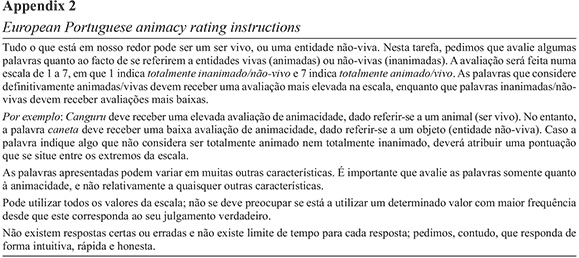
<p>&nbsp;</p>     <p><i>Procedure</i></p>     <p>Participants were contacted in person (students from the University of Aveiro) or via social networks and invited to participate in the online  survey. The survey was run using the Limesurvey platform housed at the University of Aveiro. After providing informed consent, participants were  asked to rate 112 words (from a pool of 224 concrete nouns). Similar to the rating instructions adopted by VanArsdall (2016) for his living/nonliving  scale, and by VanArsdall, Nairne, Pandeirada and Blunt (2013), participants were asked to rate each word using a 7-point scale ranging from  <i>totally nonliving/inanimate</i> (label for value of 1) to <i>totally living/animate</i> (label for value of 7) (see <a name="topa2"></a><a href="#a2">Appendix 2</a>  for the complete instructions). Words were presented in four groups of 28 while ensuring that a similar number of animates, inanimates and  ambiguous words were presented in each of these groups. Participants were required to provide a rating for each word before moving on to the next  page, as done by VanArsdall (2016); even though the task was self-paced, participants were asked to respond rapidly and based on their intuition.  To ensure the reliability of the online collected data, as suggested by Rouse (2015), two attention checks were presented during the questionnaire  as well as a final honesty question. The first attention check was presented at the halfway point, that is, after two sets of 28 items (&laquo;Have  you ever walked on the surface of Mars?&raquo;; participants could respond Yes or No). The second attention check was presented after the next two  sets of 28 items (&laquo;What is the second word in this question: How many colors are there in the Portuguese flag?&raquo;; participants typed  down the word into a textbox). Only the rating data from those participants who responded correctly to these attention check questions were  considered valid. At the end of the study, participants were asked if they paid attention and answered honestly; here, they were presented with a  forced choice between &laquo;Yes, keep my data&raquo;, and &laquo;No, delete my data&raquo;; if a &laquo;no&raquo; response occurred, their data  were not scored. Finally, sociodemographic data (age, gender, occupation, native language and education level) were also collected. At the end,  they were thanked for their participation. Each participant took approximately 32 minutes to complete the online survey.</p>     <p>&nbsp;</p>     <p><b>Results</b></p>     <p>Each word received, on average, 125 ratings (<i>SD</i>=8.70; <i>range</i>=97-148). The normative results per word (mean and standard deviations)  are available in the <a href="/img/revistas/aps/v38n2/38n2a09a1.pdf" target="_blank">Appendix 1</a>. All 224 words are listed in ascending order  of the obtained animacy ratings along with their English translation.</p>     
]]></body>
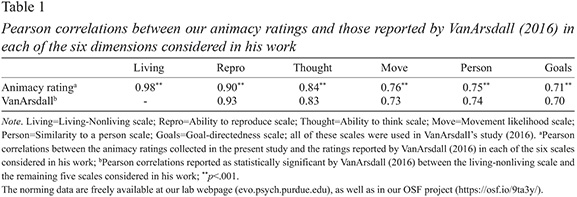
<body><![CDATA[<p>Considering our rating scale, we considered as animates those words that received classifications equal or above five (on a 7-point scale); words  receiving ratings equal or lower than three were considered inanimates; words rated between three and five (excluding these values) were not  considered in our analysis as these would be ambiguous with respect to animacy. Assuming these classification rules, we obtained a set of 82 animates  (<i>M</i>=6.35; <i>SD</i>=0.58) which includes all of our previously classified animates plus 18 of our previously classified ambiguous words. A set  of 138 inanimates was obtained (<i>M</i>=1.80; <i>SD</i>=0.31), including all of our previously considered inanimates (one word considered by us as  inanimate was, on average, classified as ambiguous by our participants; <i>M</i>=3.02; <i>SD</i>=2.27). Participants scored four other words from our  224-word pool as ambiguous (<i>M</i>=4.18; <i>SD</i>=0.84); three of these had been previously classified as ambiguous and one other as inanimate. As  expected, the ratings of animates and inanimates differed significantly on an independent samples <i>t</i>-test, <i>t</i>(110.06)=-65.87,  <i>p</i>&lt;.001, <i>d</i>=-9.19. In sum, we observed some discrepancy between our initial animacy classification and the data collected,  particularly with respect to the ambiguous words. These ambiguous words corresponded mostly to plants and body parts which had been classified in  such manner in previous studies (Nairne et al., 2013; VanArsdall, 2016); however, our participants tended to consider them more often as animates.  Such results are consistent with the idea that, the animate-inanimate distinction is far from trivial (Nairne et al., 2017). Some participants  reported finding the task complex and the rating of some of the ambiguous words [e.g., <i>sorriso</i> (smile)] difficult to make.</p>     <p>We also found other elements that introduced variability in our data and that relate to language regionalisms, as in the word <i>correio</i>,  which can be taken as <i>posto do correio</i> ([post office], an inanimate word) or <i>carteiro</i> ([postman], an animate word).</p>     <p>In order to explore the consistency between our animacy ratings and the living/nonliving ratings obtained by VanArsdall (2016) we conducted  further analyses. From the 224 words rated in our study, we were able to find 177 in his database. As shown in <a href="#t1">Table 1</a>, Pearson  correlations revealed that the animacy ratings obtained from our participants were significant and positively correlated with those reported by  VanArsdall. This correlation is particularly high with the ratings on the living-nonliving scale he reported. The correlations between our animacy  ratings and the data reported by VanArsdall on the remaining five scales considered in his work follow a pattern quite similar to the one he  reported.</p>     <p>&nbsp;</p>     <p><a name="t1"></a></p>     <p><img src="/img/revistas/aps/v38n2/38n2a09t1.jpg" width="577" height="197"></p>     
<p>&nbsp;</p>     <p>&nbsp;</p>     <p><b>Discussion</b></p>     <p>The animacy effect in memory was reported for the first time in 2013 (Nairne et al., 2013). Research projects on this topic are currently under  development in Portugal which creates the need to validate Portuguese stimuli on the animacy dimension. Furthermore, we aimed to collect animacy  ratings for a set of stimuli that have already been characterized in the Portuguese population on other dimensions of potential relevance in various  areas of research (e.g., concreteness, familiarity).</p>    ]]></body>
<body><![CDATA[<p>As far as we know, there is only one unpublished database reporting animacy values for  North America (VanArsdall, 2016); we were able to find 177 of our 224 normed words in this database. The analysis of the obtained results in the two  populations revealed a very high consistency, a result that is in agreement with the idea of the universality of the animacy conception across  cultures (Atran, 1999). This idea is commonly supported by studies using other types of procedure. For example, Barrett and Behne (2005) asked German  and Shuar children (the latter living in an Amazonian hunter-horticulturalist society) to decide whether animate items from photos were living, dead,  or sleeping and results from both groups of children were quite alike. The data and analysis here presented provide another form of evidence of this  cross-cultural agreement.</p>     <p>Animacy has been shown to be a dimension of importance across various domains such as attention, language and, more recently, memory (Nairne et  al., 2017). For example, it has been shown to be a significant predictor of free recall (Nairne et al., 2013). Still, most memory studies continue  not to consider it possibly due to the lack of normative information on this dimension.</p>     <p>This is the first database presenting EP data on the animacy dimension, containing ratings for 224 EP words. This is a relatively small number of  words considering that our lexicon includes thousands of concrete words and further research should expand the normative data collection of animacy  to more words. Still, the present database already represents an important resource, as it provides researchers a useful tool to consider and/or  manipulate animacy in their experiments. Furthermore, information on the variables of age of acquisition (Cameir&atilde;o &amp; Vicente, 2010;  Marques et al., 2007), emotional valence, arousal, dominance, written frequency (Soares et al., 2012), subjective frequency, imageability and  concreteness (Soares et al., 2017) for these same words can be obtained in other already existing EP word databases allowing researchers a higher  control over their stimuli.</p>     <p>&nbsp;</p>     <p><b>References</b></p>     <!-- ref --><p>Atran, S. (1999). Itzaj Maya folkbiological taxonomy: Cognitive universals and cultural particulars. In D. L. Medin &amp; S. Atran (Eds.),  <i>Folkbiology</i> (pp. 119-213). Cambridge: MIT Press.    &nbsp;&nbsp;&nbsp;&nbsp;&nbsp;&nbsp;&nbsp;&nbsp;[&#160;<a href="javascript:void(0);" onclick="javascript: window.open('/scielo.php?script=sci_nlinks&ref=056302&pid=S0870-8231202000020000900001&lng=','','width=640,height=500,resizable=yes,scrollbars=1,menubar=yes,');">Links</a>&#160;]<!-- end-ref --></p>     <p>Barrett, H. C., &amp; Behne, T. (2005). Children&rsquo;s understanding of death as the cessation of agency: A test using sleep <i>versus</i>  death. <i>Cognition, 96</i>, 93-108. Retrieved from <a href="https://doi.org/10.1016/j.cognition.2004.05.004" target="_blank">https://doi.org/10.1016/j.cognition.2004.05.004</a></p>     <!-- ref --><p>Bonin, P., Gelin, M., Laroche, B., M&eacute;ot, A., &amp; Bugaiska, A. (2015). The &laquo;how&raquo; of animacy effects in episodic memory.  <i>Experimental Psychology, 62</i>, 371-384. Retrieved from <a href="https://doi.org/10.1027/1618-3169/a000308"  target="_blank">https://doi.org/10.1027/1618-3169/a000308</a>&nbsp;&nbsp;&nbsp;&nbsp;&nbsp;&nbsp;&nbsp;&nbsp;[&#160;<a href="javascript:void(0);" onclick="javascript: window.open('/scielo.php?script=sci_nlinks&ref=056305&pid=S0870-8231202000020000900003&lng=','','width=640,height=500,resizable=yes,scrollbars=1,menubar=yes,');">Links</a>&#160;]<!-- end-ref --><!-- ref --><p>Bugaiska, A., Gr&eacute;goire, L., Camblats, A.-M., Gelin, M., M&eacute;ot, A., &amp; Bonin, P. (2019). Animacy and attentional processes:  Evidence from the Stroop task. <i>Quarterly Journal of Experimental Psychology, 72</i>, 882-889. Retrieved from  <a href="https://doi.org/10.1177/1747021818771514" target="_blank">https://doi.org/10.1177/1747021818771514</a>&nbsp;&nbsp;&nbsp;&nbsp;&nbsp;&nbsp;&nbsp;&nbsp;[&#160;<a href="javascript:void(0);" onclick="javascript: window.open('/scielo.php?script=sci_nlinks&ref=056306&pid=S0870-8231202000020000900004&lng=','','width=640,height=500,resizable=yes,scrollbars=1,menubar=yes,');">Links</a>&#160;]<!-- end-ref --><!-- ref --><p>Calvillo, D. P., &amp; Hawkins, W. C. (2016). Animate objects are detected more frequently than inanimate objects in inattentional blindness tasks  independently of threat. <i>Journal of General Psychology, 143</i>, 101-115. Retrieved from  <a href="https://doi.org/10.1080/00221309.2016.1163249" target="_blank">https://doi.org/10.1080/00221309.2016.1163249</a>&nbsp;&nbsp;&nbsp;&nbsp;&nbsp;&nbsp;&nbsp;&nbsp;[&#160;<a href="javascript:void(0);" onclick="javascript: window.open('/scielo.php?script=sci_nlinks&ref=056307&pid=S0870-8231202000020000900005&lng=','','width=640,height=500,resizable=yes,scrollbars=1,menubar=yes,');">Links</a>&#160;]<!-- end-ref --><!-- ref --><p>Cameir&atilde;o, M. L., &amp; Vicente, S. G. (2010). Age-of-acquisition norms for a set of 1749 Portuguese words. <i>Behavior Research  Methods, 42</i>, 474-480. Retrieved from <a href="https://doi.org/10.3758/BRM.42.2.474" target="_blank">https://doi.org/10.3758/BRM.42.2.474</a>&nbsp;&nbsp;&nbsp;&nbsp;&nbsp;&nbsp;&nbsp;&nbsp;[&#160;<a href="javascript:void(0);" onclick="javascript: window.open('/scielo.php?script=sci_nlinks&ref=056308&pid=S0870-8231202000020000900006&lng=','','width=640,height=500,resizable=yes,scrollbars=1,menubar=yes,');">Links</a>&#160;]<!-- end-ref --><!-- ref --><p>Capitani, E., Laiacona, M., Mahon, B., &amp; Caramazza, A. (2003). What are the facts of semantic category-specific deficits? A critical review of  the clinical evidence. <i>Cognitive Neuropsychology, 20</i>, 213-261. Retrieved from <a href="https://doi.org/10.1080/02643290244000266"  target="_blank">https://doi.org/10.1080/02643290244000266</a>&nbsp;&nbsp;&nbsp;&nbsp;&nbsp;&nbsp;&nbsp;&nbsp;[&#160;<a href="javascript:void(0);" onclick="javascript: window.open('/scielo.php?script=sci_nlinks&ref=056309&pid=S0870-8231202000020000900007&lng=','','width=640,height=500,resizable=yes,scrollbars=1,menubar=yes,');">Links</a>&#160;]<!-- end-ref --><!-- ref --><p>Caramazza, A., &amp; Shelton, J. R. (1998). Domain-specifc knowledge systems in the brain: The animate-inanimate distinction. <i>Journal of  Cognitive Neuroscience, 10</i>, 1-34. Retrieved from <a href="https://doi.org/10.1162/089892998563752"  target="_blank">https://doi.org/10.1162/089892998563752</a>&nbsp;&nbsp;&nbsp;&nbsp;&nbsp;&nbsp;&nbsp;&nbsp;[&#160;<a href="javascript:void(0);" onclick="javascript: window.open('/scielo.php?script=sci_nlinks&ref=056310&pid=S0870-8231202000020000900008&lng=','','width=640,height=500,resizable=yes,scrollbars=1,menubar=yes,');">Links</a>&#160;]<!-- end-ref --><!-- ref --><p>Clark, J. M., &amp; Paivio, A. (2004). Extensions of the Paivio, Yuille, and Madigan (1968) norms. <i>Behavior Research Methods, Instruments &amp;  Computers, 36</i>, 371-383. Retrieved from <a href="https://doi.org/10.3758/BF03195584"  target="_blank">https://doi.org/10.3758/BF03195584</a>&nbsp;&nbsp;&nbsp;&nbsp;&nbsp;&nbsp;&nbsp;&nbsp;[&#160;<a href="javascript:void(0);" onclick="javascript: window.open('/scielo.php?script=sci_nlinks&ref=056311&pid=S0870-8231202000020000900009&lng=','','width=640,height=500,resizable=yes,scrollbars=1,menubar=yes,');">Links</a>&#160;]<!-- end-ref --><!-- ref --><p>F&eacute;lix, S. B., Pandeirada, J. N. S., &amp; Nairne, J. S. (2019). Adaptive memory: Longevity and learning intentionality of the animacy  effect. <i>Journal of Cognitive Psychology, 31</i>, 251-260. Retrieved from <a href="https://doi.org/10.1080/20445911.2019.1586716"  target="_blank">https://doi.org/10.1080/20445911.2019.1586716</a>&nbsp;&nbsp;&nbsp;&nbsp;&nbsp;&nbsp;&nbsp;&nbsp;[&#160;<a href="javascript:void(0);" onclick="javascript: window.open('/scielo.php?script=sci_nlinks&ref=056312&pid=S0870-8231202000020000900010&lng=','','width=640,height=500,resizable=yes,scrollbars=1,menubar=yes,');">Links</a>&#160;]<!-- end-ref --><!-- ref --><p>Gelin, M., Bugaiska, A., M&eacute;ot, A., &amp; Bonin, P. (2017). Are animacy effects in episodic memory independent of encoding instructions?.  <i>Memory, 25</i>, 2-18. Retrieved from <a href="https://doi.org/10.1080/09658211.2015.1117643"  target="_blank">https://doi.org/10.1080/09658211.2015.1117643</a>&nbsp;&nbsp;&nbsp;&nbsp;&nbsp;&nbsp;&nbsp;&nbsp;[&#160;<a href="javascript:void(0);" onclick="javascript: window.open('/scielo.php?script=sci_nlinks&ref=056313&pid=S0870-8231202000020000900011&lng=','','width=640,height=500,resizable=yes,scrollbars=1,menubar=yes,');">Links</a>&#160;]<!-- end-ref --><!-- ref --><p>Gelman, R., &amp; Spelke, E. (1981). The development of thoughts about animate and inanimate objects: Implications for research on social  cognition. In J. H. Flavell &amp; L. Ross (Eds.), <i>Social cognitive development: Frontiers and possible futures</i> (pp. 43-66). London:  Cambridge University Press.    &nbsp;&nbsp;&nbsp;&nbsp;&nbsp;&nbsp;&nbsp;&nbsp;[&#160;<a href="javascript:void(0);" onclick="javascript: window.open('/scielo.php?script=sci_nlinks&ref=056314&pid=S0870-8231202000020000900012&lng=','','width=640,height=500,resizable=yes,scrollbars=1,menubar=yes,');">Links</a>&#160;]<!-- end-ref --></p>     <p>Gennari, S. P., Mirkovi&cacute;, J., &amp; Macdonald, M. C. (2012). Animacy and competition in relative clause production: A cross-linguistic  investigation. <i>Cognitive Psychology, 65</i>, 141-176. Retrieved from <a href="https://doi.org/10.1016/j.cogpsych.2012.03.002"  target="_blank">https://doi.org/10.1016/j.cogpsych.2012.03.002</a></p>     ]]></body>
<body><![CDATA[<!-- ref --><p>Gomes, I., &amp; Castro, S. L. (2003). Porlex, a lexical database in European Portuguese. <i>Psychologica, 32</i>, 91-108.    &nbsp;&nbsp;&nbsp;&nbsp;&nbsp;&nbsp;&nbsp;&nbsp;[&#160;<a href="javascript:void(0);" onclick="javascript: window.open('/scielo.php?script=sci_nlinks&ref=056317&pid=S0870-8231202000020000900014&lng=','','width=640,height=500,resizable=yes,scrollbars=1,menubar=yes,');">Links</a>&#160;]<!-- end-ref --></p>     <!-- ref --><p>Hagen, T., &amp; Laeng, B. (2017). Animals do not induce or reduce attentional blinking, but they are reported more accurately in a rapid serial  visual presentation task. <i>I-Perception, 8</i>. Retrieved from <a href="https://doi.org/10.1177/2041669517735542"  target="_blank">https://doi.org/10.1177/2041669517735542</a>&nbsp;&nbsp;&nbsp;&nbsp;&nbsp;&nbsp;&nbsp;&nbsp;[&#160;<a href="javascript:void(0);" onclick="javascript: window.open('/scielo.php?script=sci_nlinks&ref=056319&pid=S0870-8231202000020000900015&lng=','','width=640,height=500,resizable=yes,scrollbars=1,menubar=yes,');">Links</a>&#160;]<!-- end-ref --><!-- ref --><p>Hillis, A. E., &amp; Caramazza, A. (1991). Category-specific naming and comprehension impairment: A double dissociation. <i>Brain, 114</i>,  2081-2094. Retrieved from <a href="https://doi.org/10.1093/brain/114.5.2081" target="_blank">https://doi.org/10.1093/brain/114.5.2081</a>&nbsp;&nbsp;&nbsp;&nbsp;&nbsp;&nbsp;&nbsp;&nbsp;[&#160;<a href="javascript:void(0);" onclick="javascript: window.open('/scielo.php?script=sci_nlinks&ref=056320&pid=S0870-8231202000020000900016&lng=','','width=640,height=500,resizable=yes,scrollbars=1,menubar=yes,');">Links</a>&#160;]<!-- end-ref --><!-- ref --><p>Hung, Y.-C., &amp; Schumacher, P. B. (2014). Animacy matters: ERP evidence for the multi-dimensionality of topic-worthiness in Chinese. <i>Brain  Research, 1555</i>, 36-47. Retrieved from <a href="https://doi.org/10.1016/J.BRAINRES.2014.01.046"  target="_blank">https://doi.org/10.1016/J.BRAINRES.2014.01.046</a>&nbsp;&nbsp;&nbsp;&nbsp;&nbsp;&nbsp;&nbsp;&nbsp;[&#160;<a href="javascript:void(0);" onclick="javascript: window.open('/scielo.php?script=sci_nlinks&ref=056321&pid=S0870-8231202000020000900017&lng=','','width=640,height=500,resizable=yes,scrollbars=1,menubar=yes,');">Links</a>&#160;]<!-- end-ref --><!-- ref --><p>Kuzmanovic, B., Schilbach, L., Georgescu, A. L., Kockler, H., Santos, N. S., Shah, N. J., . . . Vogeley, K. (2014). Dissociating animacy  processing in high-functioning autism: Neural correlates of stimulus properties and subjective ratings. <i>Social Neuroscience, 9</i>, 309-325.  Retrieved from <a href="https://doi.org/10.1080/17470919.2014.886618" target="_blank">https://doi.org/10.1080/17470919.2014.886618</a>&nbsp;&nbsp;&nbsp;&nbsp;&nbsp;&nbsp;&nbsp;&nbsp;[&#160;<a href="javascript:void(0);" onclick="javascript: window.open('/scielo.php?script=sci_nlinks&ref=056322&pid=S0870-8231202000020000900018&lng=','','width=640,height=500,resizable=yes,scrollbars=1,menubar=yes,');">Links</a>&#160;]<!-- end-ref --><!-- ref --><p>Mandler, J. M., &amp; McDonough, L. (1993). Concept formation in infancy. <i>Cognitive Development, 8</i>, 291-318. Retrieved from  <a href="https://doi.org/10.1016/S0885-2014(93)80003-C" target="_blank">https://doi.org/10.1016/S0885-2014(93)80003-C</a>&nbsp;&nbsp;&nbsp;&nbsp;&nbsp;&nbsp;&nbsp;&nbsp;[&#160;<a href="javascript:void(0);" onclick="javascript: window.open('/scielo.php?script=sci_nlinks&ref=056323&pid=S0870-8231202000020000900019&lng=','','width=640,height=500,resizable=yes,scrollbars=1,menubar=yes,');">Links</a>&#160;]<!-- end-ref --><!-- ref --><p>Marques, J. F., Fonseca, F. L., Morais, S., &amp; Pinto, I. A. (2007). Estimated age of acquisition norms for 834 Portuguese nouns and their  relation with other psycholinguistic variables. <i>Behavior Research Methods, 39</i>, 439-444. Retrieved from  <a href="https://doi.org/10.3758/BF03193013" target="_blank">https://doi.org/10.3758/BF03193013</a>&nbsp;&nbsp;&nbsp;&nbsp;&nbsp;&nbsp;&nbsp;&nbsp;[&#160;<a href="javascript:void(0);" onclick="javascript: window.open('/scielo.php?script=sci_nlinks&ref=056324&pid=S0870-8231202000020000900020&lng=','','width=640,height=500,resizable=yes,scrollbars=1,menubar=yes,');">Links</a>&#160;]<!-- end-ref --><!-- ref --><p>Nairne, J. S., VanArsdall, J. E., &amp; Cogdill, M. (2017). Remembering the living: Episodic memory is tuned to animacy. <i>Current Directions  in Psychological Science, 26</i>, 22-27. Retrieved from <a href="https://doi.org/10.1177/0963721416667711"  target="_blank">https://doi.org/10.1177/0963721416667711</a>&nbsp;&nbsp;&nbsp;&nbsp;&nbsp;&nbsp;&nbsp;&nbsp;[&#160;<a href="javascript:void(0);" onclick="javascript: window.open('/scielo.php?script=sci_nlinks&ref=056325&pid=S0870-8231202000020000900021&lng=','','width=640,height=500,resizable=yes,scrollbars=1,menubar=yes,');">Links</a>&#160;]<!-- end-ref --><!-- ref --><p>Nairne, J. S., VanArsdall, J. E., Pandeirada, J. N. S., Cogdill, M., &amp; LeBreton, J. (2013). Adaptive memory: The mnemonic value of animacy.  <i>Psychological Science, 24</i>, 2099-2105. Retrieved from <a href="https://doi.org/10.1177/0956797613480803"  target="_blank">https://doi.org/10.1177/0956797613480803</a>&nbsp;&nbsp;&nbsp;&nbsp;&nbsp;&nbsp;&nbsp;&nbsp;[&#160;<a href="javascript:void(0);" onclick="javascript: window.open('/scielo.php?script=sci_nlinks&ref=056326&pid=S0870-8231202000020000900022&lng=','','width=640,height=500,resizable=yes,scrollbars=1,menubar=yes,');">Links</a>&#160;]<!-- end-ref --><!-- ref --><p>New, J., Cosmides, L., &amp; Tooby, J. (2007). Category-specific attention for animals reflects ancestral priorities, not expertise.  <i>Proceedings of the National Academy of Sciences, 104</i>, 16598-16603. Retrieved from  <a href="https://doi.org/10.1073/pnas.0703913104" target="_blank">https://doi.org/10.1073/pnas.0703913104</a>&nbsp;&nbsp;&nbsp;&nbsp;&nbsp;&nbsp;&nbsp;&nbsp;[&#160;<a href="javascript:void(0);" onclick="javascript: window.open('/scielo.php?script=sci_nlinks&ref=056327&pid=S0870-8231202000020000900023&lng=','','width=640,height=500,resizable=yes,scrollbars=1,menubar=yes,');">Links</a>&#160;]<!-- end-ref --><!-- ref --><p>Opfer, J. E., &amp; Gelman, S. A. (2011). Development of the animate-inanimate distinction. In U. Goswami (Ed.), <i>The Wiley-Blackwell handbook  of childhood cognitive development</i> (pp. 213-238). West Sussex: Wiley-Blackwell. Retrieved from  <a href="https://doi.org/10.1002/9781444325485" target="_blank">https://doi.org/10.1002/9781444325485</a>&nbsp;&nbsp;&nbsp;&nbsp;&nbsp;&nbsp;&nbsp;&nbsp;[&#160;<a href="javascript:void(0);" onclick="javascript: window.open('/scielo.php?script=sci_nlinks&ref=056328&pid=S0870-8231202000020000900024&lng=','','width=640,height=500,resizable=yes,scrollbars=1,menubar=yes,');">Links</a>&#160;]<!-- end-ref --><!-- ref --><p>Popp, E. Y., &amp; Serra, M. J. (2018). The animacy advantage for free-recall performance is not attributable to greater mental arousal.  <i>Memory, 26</i>, 89-95. Retrieved from <a href="https://doi.org/10.1080/09658211.2017.1326507"  target="_blank">https://doi.org/10.1080/09658211.2017.1326507</a>&nbsp;&nbsp;&nbsp;&nbsp;&nbsp;&nbsp;&nbsp;&nbsp;[&#160;<a href="javascript:void(0);" onclick="javascript: window.open('/scielo.php?script=sci_nlinks&ref=056329&pid=S0870-8231202000020000900025&lng=','','width=640,height=500,resizable=yes,scrollbars=1,menubar=yes,');">Links</a>&#160;]<!-- end-ref --><p>Prokop, P., &amp; Fan&ccaron;ovi&ccaron;ov&aacute;, J. (2014). Seeing coloured fruits: Utilisation of the theory of adaptive memory in teaching botany.  <i>Journal of Biological Education, 48</i>, 127-132. Retrieved from <a href="https://doi.org/10.1080/00219266.2013.837407"  target="_blank">https://doi.org/10.1080/00219266.2013.837407</a></p>     <p>R&auml;ling, R., Hanne, S., Schr&ouml;der, A., Ke&beta;ler, C., &amp; Wartenburger, I. (2017). Judging the animacy of words: The influence of typicality and  age of acquisition in a semantic decision task. <i>Quarterly Journal of Experimental Psychology, 70</i>, 2094-2104. Retrieved from  <a href="https://doi.org/10.1080/17470218.2016.1223704" target="_blank">https://doi.org/10.1080/17470218.2016.1223704</a></p>     <!-- ref --><p>Rouse, S. V. (2015). A reliability analysis of Mechanical Turk data. <i>Computers in Human Behavior, 43</i>, 304-307. Retrieved from  <a href="https://doi.org/10.1016/j.chb.2014.11.004" target="_blank">https://doi.org/10.1016/j.chb.2014.11.004</a>&nbsp;&nbsp;&nbsp;&nbsp;&nbsp;&nbsp;&nbsp;&nbsp;[&#160;<a href="javascript:void(0);" onclick="javascript: window.open('/scielo.php?script=sci_nlinks&ref=056332&pid=S0870-8231202000020000900028&lng=','','width=640,height=500,resizable=yes,scrollbars=1,menubar=yes,');">Links</a>&#160;]<!-- end-ref --><!-- ref --><p>Santos, N. S., Kuzmanovic, B., David, N., Rotarska-Jagiela, A., Eickhoff, S. B., Shah, J. N., . . . Vogeley, K. (2010). Animated brain: A  functional neuroimaging study on animacy experience. <i>NeuroImage, 53</i>, 291-302. Retrieved from  <a href="https://doi.org/10.1016/j.neuroimage.2010.05.080" target="_blank">https://doi.org/10.1016/j.neuroimage.2010.05.080</a>&nbsp;&nbsp;&nbsp;&nbsp;&nbsp;&nbsp;&nbsp;&nbsp;[&#160;<a href="javascript:void(0);" onclick="javascript: window.open('/scielo.php?script=sci_nlinks&ref=056333&pid=S0870-8231202000020000900029&lng=','','width=640,height=500,resizable=yes,scrollbars=1,menubar=yes,');">Links</a>&#160;]<!-- end-ref --><!-- ref --><p>Sha, L., Haxby, J. V., Abdi, H., Swaroop Guntupalli, J., Oosterhof, N. N., Halchenko, Y. O., &amp; Connolly, A. C. (2015). The animacy  continuum in the human ventral vision pathway. <i>Journal of Cognitive Neuroscience, 27</i>, 665-678. Retrieved from  <a href="https://doi.org/10.1162/jocn_a_00733" target="_blank">https://doi.org/10.1162/jocn_a_00733</a>&nbsp;&nbsp;&nbsp;&nbsp;&nbsp;&nbsp;&nbsp;&nbsp;[&#160;<a href="javascript:void(0);" onclick="javascript: window.open('/scielo.php?script=sci_nlinks&ref=056334&pid=S0870-8231202000020000900030&lng=','','width=640,height=500,resizable=yes,scrollbars=1,menubar=yes,');">Links</a>&#160;]<!-- end-ref --><!-- ref --><p>Soares, A. P., Comesa&ntilde;a, M., Pinheiro, A., Sim&otilde;es, A., &amp; Frade, C. (2012). The adaptation of the Affective Norms for English  words (ANEW) for European Portuguese. <i>Behavior Research Methods, 44</i>, 256-269. Retirado de  <a href="https://doi.org/10.3758/s13428-011-0131-7" target="_blank">https://doi.org/10.3758/s13428-011-0131-7</a>&nbsp;&nbsp;&nbsp;&nbsp;&nbsp;&nbsp;&nbsp;&nbsp;[&#160;<a href="javascript:void(0);" onclick="javascript: window.open('/scielo.php?script=sci_nlinks&ref=056335&pid=S0870-8231202000020000900031&lng=','','width=640,height=500,resizable=yes,scrollbars=1,menubar=yes,');">Links</a>&#160;]<!-- end-ref --><!-- ref --><p>Soares, A. P., Costa, A. S., Machado, J., Comesa&ntilde;a, M., &amp; Oliveira, H. (2017). The Minho word pool: Norms for imageability,  concreteness and subjective frequency for 3800 Portuguese words. <i>Behavior Research Methods, 49</i>, 1065-1081. Retrieved from  <a href="https://doi.org/10.3758/s13428-016-0767-4" target="_blank">https://doi.org/10.3758/s13428-016-0767-4</a>&nbsp;&nbsp;&nbsp;&nbsp;&nbsp;&nbsp;&nbsp;&nbsp;[&#160;<a href="javascript:void(0);" onclick="javascript: window.open('/scielo.php?script=sci_nlinks&ref=056336&pid=S0870-8231202000020000900032&lng=','','width=640,height=500,resizable=yes,scrollbars=1,menubar=yes,');">Links</a>&#160;]<!-- end-ref --><!-- ref --><p>Soares, A. P., Fraga, I., Comesa&ntilde;a, M., &amp; Pi&ntilde;eiro, A. (2010). El papel de la animacidad en la resoluci&oacute;n de  ambig&uuml;edades sint&aacute;cticas en portugu&eacute;s europeo: Evidencia en tareas de producci&oacute;n y comprensi&oacute;n. <i>Psicothema,  22</i>, 691-696.    &nbsp;&nbsp;&nbsp;&nbsp;&nbsp;&nbsp;&nbsp;&nbsp;[&#160;<a href="javascript:void(0);" onclick="javascript: window.open('/scielo.php?script=sci_nlinks&ref=056337&pid=S0870-8231202000020000900033&lng=','','width=640,height=500,resizable=yes,scrollbars=1,menubar=yes,');">Links</a>&#160;]<!-- end-ref --></p>     <!-- ref --><p>Soares, A. P., Iriarte, &Aacute;., Almeida, J. J. de, Sim&otilde;es, A., Costa, A., Fran&ccedil;a, P., . . . Comesa&ntilde;a, M. (2014).  Procura-PALavras (P-PAL): Uma nova medida de frequ&ecirc;ncia lexical do portugu&ecirc;s europeu contempor&acirc;neo. <i>Psicologia:  Reflex&atilde;o e Cr&iacute;tica, 27</i>,  110-123. Retrieved from <a href="https://doi.org/10.1590/S0102-79722014000100013"  target="_blank">https://doi.org/10.1590/S0102-79722014000100013</a>&nbsp;&nbsp;&nbsp;&nbsp;&nbsp;&nbsp;&nbsp;&nbsp;[&#160;<a href="javascript:void(0);" onclick="javascript: window.open('/scielo.php?script=sci_nlinks&ref=056339&pid=S0870-8231202000020000900034&lng=','','width=640,height=500,resizable=yes,scrollbars=1,menubar=yes,');">Links</a>&#160;]<!-- end-ref --><!-- ref --><p>Taylor, K. I., Devereux, B. J., &amp; Tyler, L. K. (2011). Conceptual structure: Towards an integrated neuro-cognitive account. <i>Language and  Cognitive Processes, 26</i>, 1368-1401. Retrieved from <a href="https://doi.org/10.1080/01690965.2011.568227"  target="_blank">https://doi.org/10.1080/01690965.2011.568227</a>&nbsp;&nbsp;&nbsp;&nbsp;&nbsp;&nbsp;&nbsp;&nbsp;[&#160;<a href="javascript:void(0);" onclick="javascript: window.open('/scielo.php?script=sci_nlinks&ref=056340&pid=S0870-8231202000020000900035&lng=','','width=640,height=500,resizable=yes,scrollbars=1,menubar=yes,');">Links</a>&#160;]<!-- end-ref --><!-- ref --><p>VanArsdall, J. E. (2016). <i>Exploring animacy as a mnemonic dimension</i>. Unpublished doctoral thesis, Purdue University, West Lafayette,  USA.    &nbsp;&nbsp;&nbsp;&nbsp;&nbsp;&nbsp;&nbsp;&nbsp;[&#160;<a href="javascript:void(0);" onclick="javascript: window.open('/scielo.php?script=sci_nlinks&ref=056341&pid=S0870-8231202000020000900036&lng=','','width=640,height=500,resizable=yes,scrollbars=1,menubar=yes,');">Links</a>&#160;]<!-- end-ref --></p>     <!-- ref --><p>VanArsdall, J. E., Nairne, J. S., Pandeirada, J. N. S., &amp; Blunt, J. R. (2013). Adaptive memory: Animacy processing produces mnemonic  advantages. <i>Experimental Psychology, 60</i>, 172-178. Retrieved from <a href="https://doi.org/10.1027/1618-3169/a000186"  target="_blank">https://doi.org/10.1027/1618-3169/a000186</a>&nbsp;&nbsp;&nbsp;&nbsp;&nbsp;&nbsp;&nbsp;&nbsp;[&#160;<a href="javascript:void(0);" onclick="javascript: window.open('/scielo.php?script=sci_nlinks&ref=056343&pid=S0870-8231202000020000900037&lng=','','width=640,height=500,resizable=yes,scrollbars=1,menubar=yes,');">Links</a>&#160;]<!-- end-ref --><!-- ref --><p>VanArsdall, J. E., Nairne, J. S., Pandeirada, J. N. S., &amp; Cogdill, M. (2016). A categorical recall strategy does not explain animacy effects  in episodic memory. <i>Quarterly Journal of Experimental Psychology, 70</i>, 761-771. Retrieved from  <a href="https://doi.org/10.1080/17470218.2016.1159707" target="_blank">https://doi.org/10.1080/17470218.2016.1159707</a>&nbsp;&nbsp;&nbsp;&nbsp;&nbsp;&nbsp;&nbsp;&nbsp;[&#160;<a href="javascript:void(0);" onclick="javascript: window.open('/scielo.php?script=sci_nlinks&ref=056344&pid=S0870-8231202000020000900038&lng=','','width=640,height=500,resizable=yes,scrollbars=1,menubar=yes,');">Links</a>&#160;]<!-- end-ref --><!-- ref --><p>Yang, J., Wang, A., Yan, M., Zhu, Z., Chen, C., &amp; Wang, Y. (2012). Distinct processing for pictures of animals and objects: Evidence from  eye movements. <i>Emotion, 12</i>, 540-551. Retrieved from <a href="https://doi.org/10.1037/a0026848"  target="_blank">https://doi.org/10.1037/a0026848</a>&nbsp;&nbsp;&nbsp;&nbsp;&nbsp;&nbsp;&nbsp;&nbsp;[&#160;<a href="javascript:void(0);" onclick="javascript: window.open('/scielo.php?script=sci_nlinks&ref=056345&pid=S0870-8231202000020000900039&lng=','','width=640,height=500,resizable=yes,scrollbars=1,menubar=yes,');">Links</a>&#160;]<!-- end-ref --><p>&nbsp;</p>     ]]></body>
<body><![CDATA[<p><b><a name="c0" id="c0"></a><a href="#topc0">CORRESPOND&Ecirc;NCIA</a></b></p>     <p>Correspondence concerning this article should be addressed to: Sara Brilhante F&eacute;lix, Departamento de Educa&ccedil;&atilde;o e Psicologia,  Campus Universit&aacute;rio de Santiago, 3810-193 Aveiro, Portugal. E-mail: <a href="mailto:sara.felix@ua.pt">sara.felix@ua.pt</a></p>     <p>&nbsp;</p>     <p>This work was conducted in the context of the Master&rsquo;s dissertation by Sara B. F&eacute;lix and some overlap exists with her thesis. The data here  reported were collected from an expanded sample of participants which includes the data reported in Sara&rsquo;s dissertation.</p>     <p>Preparation of this work was partially supported by National funds through the Portuguese Foundation for Science and Technology with a grant  awarded to JNSP (CEECIND/01914/2017).</p>     <p>&nbsp;</p>     <p>Submitted: 01/02/2019 Accepted: 10/06/2019</p>     <p>&nbsp;</p>     <p>&nbsp;</p>     <p><a href="#topa2">Appendix 2</a></p>     ]]></body>
<body><![CDATA[<p><a name="a2"></a></p>     <p><img src="/img/revistas/aps/v38n2/38n2a09a2.jpg" width="579" height="258"></p>     
 ]]></body><back>
<ref-list>
<ref id="B1">
<nlm-citation citation-type="book">
<person-group person-group-type="author">
<name>
<surname><![CDATA[Atran]]></surname>
<given-names><![CDATA[S.]]></given-names>
</name>
</person-group>
<article-title xml:lang="en"><![CDATA[Itzaj Maya folkbiological taxonomy:: Cognitive universals and cultural particulars]]></article-title>
<person-group person-group-type="editor">
<name>
<surname><![CDATA[Medin]]></surname>
<given-names><![CDATA[D. L.]]></given-names>
</name>
<name>
<surname><![CDATA[Atran]]></surname>
<given-names><![CDATA[S.]]></given-names>
</name>
</person-group>
<source><![CDATA[Folkbiology]]></source>
<year>1999</year>
<page-range>119-213</page-range><publisher-loc><![CDATA[Cambridge ]]></publisher-loc>
<publisher-name><![CDATA[MIT Press]]></publisher-name>
</nlm-citation>
</ref>
<ref id="B2">
<nlm-citation citation-type="journal">
<person-group person-group-type="author">
<name>
<surname><![CDATA[Barrett]]></surname>
<given-names><![CDATA[H. C.]]></given-names>
</name>
<name>
<surname><![CDATA[Behne]]></surname>
<given-names><![CDATA[T.]]></given-names>
</name>
</person-group>
<article-title xml:lang="en"><![CDATA[Children&#8217;s understanding of death as the cessation of agency: A test using sleep versus death]]></article-title>
<source><![CDATA[Cognition]]></source>
<year>2005</year>
<volume>96</volume>
<page-range>93-108</page-range></nlm-citation>
</ref>
<ref id="B3">
<nlm-citation citation-type="journal">
<person-group person-group-type="author">
<name>
<surname><![CDATA[Bonin]]></surname>
<given-names><![CDATA[P.]]></given-names>
</name>
<name>
<surname><![CDATA[Gelin]]></surname>
<given-names><![CDATA[M.]]></given-names>
</name>
<name>
<surname><![CDATA[Laroche]]></surname>
<given-names><![CDATA[B.]]></given-names>
</name>
<name>
<surname><![CDATA[Méot]]></surname>
<given-names><![CDATA[A.]]></given-names>
</name>
<name>
<surname><![CDATA[Bugaiska]]></surname>
<given-names><![CDATA[A.]]></given-names>
</name>
</person-group>
<article-title xml:lang="en"><![CDATA[The «how» of animacy effects in episodic memory]]></article-title>
<source><![CDATA[Experimental Psychology]]></source>
<year>2015</year>
<volume>62</volume>
<page-range>371-384</page-range></nlm-citation>
</ref>
<ref id="B4">
<nlm-citation citation-type="journal">
<person-group person-group-type="author">
<name>
<surname><![CDATA[Bugaiska]]></surname>
<given-names><![CDATA[A.]]></given-names>
</name>
<name>
<surname><![CDATA[Grégoire]]></surname>
<given-names><![CDATA[L.]]></given-names>
</name>
<name>
<surname><![CDATA[Camblats]]></surname>
<given-names><![CDATA[A.-M.]]></given-names>
</name>
<name>
<surname><![CDATA[Gelin]]></surname>
<given-names><![CDATA[M.]]></given-names>
</name>
<name>
<surname><![CDATA[Méot]]></surname>
<given-names><![CDATA[A.]]></given-names>
</name>
<name>
<surname><![CDATA[Bonin]]></surname>
<given-names><![CDATA[P.]]></given-names>
</name>
</person-group>
<article-title xml:lang="en"><![CDATA[Animacy and attentional processes: Evidence from the Stroop task]]></article-title>
<source><![CDATA[Quarterly Journal of Experimental Psychology]]></source>
<year>2019</year>
<volume>72</volume>
<page-range>882-889</page-range></nlm-citation>
</ref>
<ref id="B5">
<nlm-citation citation-type="journal">
<person-group person-group-type="author">
<name>
<surname><![CDATA[Calvillo]]></surname>
<given-names><![CDATA[D. P.]]></given-names>
</name>
<name>
<surname><![CDATA[Hawkins]]></surname>
<given-names><![CDATA[W. C.]]></given-names>
</name>
</person-group>
<article-title xml:lang="en"><![CDATA[Animate objects are detected more frequently than inanimate objects in inattentional blindness tasks independently of threat]]></article-title>
<source><![CDATA[Journal of General Psychology]]></source>
<year>2016</year>
<volume>143</volume>
<page-range>101-115</page-range></nlm-citation>
</ref>
<ref id="B6">
<nlm-citation citation-type="journal">
<person-group person-group-type="author">
<name>
<surname><![CDATA[Cameirão]]></surname>
<given-names><![CDATA[M. L.]]></given-names>
</name>
<name>
<surname><![CDATA[Vicente]]></surname>
<given-names><![CDATA[S. G.]]></given-names>
</name>
</person-group>
<article-title xml:lang="en"><![CDATA[Age-of-acquisition norms for a set of 1749 Portuguese words]]></article-title>
<source><![CDATA[Behavior Research Methods]]></source>
<year>2010</year>
<volume>42</volume>
<page-range>474-480</page-range></nlm-citation>
</ref>
<ref id="B7">
<nlm-citation citation-type="journal">
<person-group person-group-type="author">
<name>
<surname><![CDATA[Capitani]]></surname>
<given-names><![CDATA[E.]]></given-names>
</name>
<name>
<surname><![CDATA[Laiacona]]></surname>
<given-names><![CDATA[M.]]></given-names>
</name>
<name>
<surname><![CDATA[Mahon]]></surname>
<given-names><![CDATA[B.]]></given-names>
</name>
<name>
<surname><![CDATA[Caramazza]]></surname>
<given-names><![CDATA[A.]]></given-names>
</name>
</person-group>
<article-title xml:lang="en"><![CDATA[What are the facts of semantic category-specific deficits? A critical review of the clinical evidence]]></article-title>
<source><![CDATA[Cognitive Neuropsychology]]></source>
<year>2003</year>
<volume>20</volume>
<page-range>213-261</page-range></nlm-citation>
</ref>
<ref id="B8">
<nlm-citation citation-type="journal">
<person-group person-group-type="author">
<name>
<surname><![CDATA[Caramazza]]></surname>
<given-names><![CDATA[A.]]></given-names>
</name>
<name>
<surname><![CDATA[Shelton]]></surname>
<given-names><![CDATA[J. R.]]></given-names>
</name>
</person-group>
<article-title xml:lang="en"><![CDATA[Domain-specifc knowledge systems in the brain: The animate-inanimate distinction]]></article-title>
<source><![CDATA[Journal of Cognitive Neuroscience]]></source>
<year>1998</year>
<volume>10</volume>
<page-range>1-34</page-range></nlm-citation>
</ref>
<ref id="B9">
<nlm-citation citation-type="journal">
<person-group person-group-type="author">
<name>
<surname><![CDATA[Clark]]></surname>
<given-names><![CDATA[J. M.]]></given-names>
</name>
<name>
<surname><![CDATA[Paivio]]></surname>
<given-names><![CDATA[A.]]></given-names>
</name>
</person-group>
<article-title xml:lang="en"><![CDATA[Extensions of the Paivio, Yuille, and Madigan (1968) norms]]></article-title>
<source><![CDATA[Behavior Research Methods]]></source>
<year>2004</year>
<volume>Instruments & Computers</volume>
<page-range>36, 371-383</page-range></nlm-citation>
</ref>
<ref id="B10">
<nlm-citation citation-type="journal">
<person-group person-group-type="author">
<name>
<surname><![CDATA[Félix]]></surname>
<given-names><![CDATA[S. B.]]></given-names>
</name>
<name>
<surname><![CDATA[Pandeirada]]></surname>
<given-names><![CDATA[J. N. S.]]></given-names>
</name>
<name>
<surname><![CDATA[Nairne]]></surname>
<given-names><![CDATA[J. S.]]></given-names>
</name>
</person-group>
<article-title xml:lang="en"><![CDATA[Adaptive memory: Longevity and learning intentionality of the animacy effect]]></article-title>
<source><![CDATA[Journal of Cognitive Psychology]]></source>
<year>2019</year>
<volume>31</volume>
<page-range>251-260</page-range></nlm-citation>
</ref>
<ref id="B11">
<nlm-citation citation-type="journal">
<person-group person-group-type="author">
<name>
<surname><![CDATA[Gelin]]></surname>
<given-names><![CDATA[M.]]></given-names>
</name>
<name>
<surname><![CDATA[Bugaiska]]></surname>
<given-names><![CDATA[A.]]></given-names>
</name>
<name>
<surname><![CDATA[Méot]]></surname>
<given-names><![CDATA[A.]]></given-names>
</name>
<name>
<surname><![CDATA[Bonin]]></surname>
<given-names><![CDATA[P.]]></given-names>
</name>
</person-group>
<article-title xml:lang="en"><![CDATA[Are animacy effects in episodic memory independent of encoding instructions?]]></article-title>
<source><![CDATA[Memory]]></source>
<year>2017</year>
<volume>25</volume>
<page-range>2-18</page-range></nlm-citation>
</ref>
<ref id="B12">
<nlm-citation citation-type="book">
<person-group person-group-type="author">
<name>
<surname><![CDATA[Gelman]]></surname>
<given-names><![CDATA[R.]]></given-names>
</name>
<name>
<surname><![CDATA[Spelke]]></surname>
<given-names><![CDATA[E.]]></given-names>
</name>
</person-group>
<article-title xml:lang="en"><![CDATA[The development of thoughts about animate and inanimate objects: Implications for research on social cognition]]></article-title>
<person-group person-group-type="editor">
<name>
<surname><![CDATA[Flavell]]></surname>
<given-names><![CDATA[J. H.]]></given-names>
</name>
<name>
<surname><![CDATA[Ross]]></surname>
<given-names><![CDATA[L.]]></given-names>
</name>
</person-group>
<source><![CDATA[Social cognitive development: Frontiers and possible futures]]></source>
<year>1981</year>
<page-range>43-66</page-range><publisher-loc><![CDATA[London ]]></publisher-loc>
<publisher-name><![CDATA[Cambridge University Press]]></publisher-name>
</nlm-citation>
</ref>
<ref id="B13">
<nlm-citation citation-type="journal">
<person-group person-group-type="author">
<name>
<surname><![CDATA[Gennari]]></surname>
<given-names><![CDATA[S. P.]]></given-names>
</name>
<name>
<surname><![CDATA[Mirkovi&#263;]]></surname>
<given-names><![CDATA[J.]]></given-names>
</name>
<name>
<surname><![CDATA[Macdonald]]></surname>
<given-names><![CDATA[M. C.]]></given-names>
</name>
</person-group>
<article-title xml:lang="en"><![CDATA[Animacy and competition in relative clause production: A cross-linguistic investigation]]></article-title>
<source><![CDATA[Cognitive Psychology]]></source>
<year>2012</year>
<volume>65</volume>
<page-range>141-176</page-range></nlm-citation>
</ref>
<ref id="B14">
<nlm-citation citation-type="journal">
<person-group person-group-type="author">
<name>
<surname><![CDATA[Gomes]]></surname>
<given-names><![CDATA[I.]]></given-names>
</name>
<name>
<surname><![CDATA[Castro]]></surname>
<given-names><![CDATA[S. L.]]></given-names>
</name>
</person-group>
<article-title xml:lang="en"><![CDATA[Porlex, a lexical database in European Portuguese]]></article-title>
<source><![CDATA[Psychologica]]></source>
<year>2003</year>
<volume>32</volume>
<page-range>91-108</page-range></nlm-citation>
</ref>
<ref id="B15">
<nlm-citation citation-type="journal">
<person-group person-group-type="author">
<name>
<surname><![CDATA[Hagen]]></surname>
<given-names><![CDATA[T.]]></given-names>
</name>
<name>
<surname><![CDATA[Laeng]]></surname>
<given-names><![CDATA[B.]]></given-names>
</name>
</person-group>
<article-title xml:lang="en"><![CDATA[Animals do not induce or reduce attentional blinking, but they are reported more accurately in a rapid serial visual presentation task]]></article-title>
<source><![CDATA[I-Perception]]></source>
<year>2017</year>
<volume>8</volume>
</nlm-citation>
</ref>
<ref id="B16">
<nlm-citation citation-type="journal">
<person-group person-group-type="author">
<name>
<surname><![CDATA[Hillis]]></surname>
<given-names><![CDATA[A. E.]]></given-names>
</name>
<name>
<surname><![CDATA[Caramazza]]></surname>
<given-names><![CDATA[A.]]></given-names>
</name>
</person-group>
<article-title xml:lang="en"><![CDATA[Category-specific naming and comprehension impairment: A double dissociation]]></article-title>
<source><![CDATA[Brain]]></source>
<year>1991</year>
<volume>114</volume>
<page-range>2081-2094</page-range></nlm-citation>
</ref>
<ref id="B17">
<nlm-citation citation-type="journal">
<person-group person-group-type="author">
<name>
<surname><![CDATA[Hung]]></surname>
<given-names><![CDATA[Y.-C.]]></given-names>
</name>
<name>
<surname><![CDATA[Schumacher]]></surname>
<given-names><![CDATA[P. B.]]></given-names>
</name>
</person-group>
<article-title xml:lang="en"><![CDATA[Animacy matters: ERP evidence for the multi-dimensionality of topic-worthiness in Chinese]]></article-title>
<source><![CDATA[Brain Research]]></source>
<year>2014</year>
<volume>1555</volume>
<page-range>36-47</page-range></nlm-citation>
</ref>
<ref id="B18">
<nlm-citation citation-type="journal">
<person-group person-group-type="author">
<name>
<surname><![CDATA[Kuzmanovic]]></surname>
<given-names><![CDATA[B.]]></given-names>
</name>
<name>
<surname><![CDATA[Schilbach]]></surname>
<given-names><![CDATA[L.]]></given-names>
</name>
<name>
<surname><![CDATA[Georgescu]]></surname>
<given-names><![CDATA[A. L.]]></given-names>
</name>
<name>
<surname><![CDATA[Kockler]]></surname>
<given-names><![CDATA[H.]]></given-names>
</name>
<name>
<surname><![CDATA[Santos]]></surname>
<given-names><![CDATA[N. S.]]></given-names>
</name>
<name>
<surname><![CDATA[Shah]]></surname>
<given-names><![CDATA[N. J.]]></given-names>
</name>
<name>
<surname><![CDATA[Vogeley]]></surname>
<given-names><![CDATA[K.]]></given-names>
</name>
</person-group>
<article-title xml:lang="en"><![CDATA[Dissociating animacy processing in high-functioning autism: Neural correlates of stimulus properties and subjective ratings]]></article-title>
<source><![CDATA[Social Neuroscience]]></source>
<year>2014</year>
<volume>9</volume>
<page-range>309-325</page-range></nlm-citation>
</ref>
<ref id="B19">
<nlm-citation citation-type="journal">
<person-group person-group-type="author">
<name>
<surname><![CDATA[Mandler]]></surname>
<given-names><![CDATA[J. M.]]></given-names>
</name>
<name>
<surname><![CDATA[McDonough]]></surname>
<given-names><![CDATA[L.]]></given-names>
</name>
</person-group>
<article-title xml:lang="en"><![CDATA[Concept formation in infancy]]></article-title>
<source><![CDATA[Cognitive Development]]></source>
<year>1993</year>
<volume>8</volume>
<page-range>291-318</page-range></nlm-citation>
</ref>
<ref id="B20">
<nlm-citation citation-type="journal">
<person-group person-group-type="author">
<name>
<surname><![CDATA[Marques]]></surname>
<given-names><![CDATA[J. F.]]></given-names>
</name>
<name>
<surname><![CDATA[Fonseca]]></surname>
<given-names><![CDATA[F. L.]]></given-names>
</name>
<name>
<surname><![CDATA[Morais]]></surname>
<given-names><![CDATA[S.]]></given-names>
</name>
<name>
<surname><![CDATA[Pinto]]></surname>
<given-names><![CDATA[I. A.]]></given-names>
</name>
</person-group>
<article-title xml:lang="en"><![CDATA[Estimated age of acquisition norms for 834 Portuguese nouns and their relation with other psycholinguistic variables]]></article-title>
<source><![CDATA[Behavior Research Methods]]></source>
<year>2007</year>
<volume>39</volume>
<page-range>439-444</page-range></nlm-citation>
</ref>
<ref id="B21">
<nlm-citation citation-type="journal">
<person-group person-group-type="author">
<name>
<surname><![CDATA[Nairne]]></surname>
<given-names><![CDATA[J. S.]]></given-names>
</name>
<name>
<surname><![CDATA[VanArsdall]]></surname>
<given-names><![CDATA[J. E.]]></given-names>
</name>
<name>
<surname><![CDATA[Cogdill]]></surname>
<given-names><![CDATA[M.]]></given-names>
</name>
</person-group>
<article-title xml:lang="en"><![CDATA[Remembering the living: Episodic memory is tuned to animacy]]></article-title>
<source><![CDATA[Current Directions in Psychological Science]]></source>
<year>2017</year>
<volume>26</volume>
<page-range>22-27</page-range></nlm-citation>
</ref>
<ref id="B22">
<nlm-citation citation-type="journal">
<person-group person-group-type="author">
<name>
<surname><![CDATA[Nairne]]></surname>
<given-names><![CDATA[J. S.]]></given-names>
</name>
<name>
<surname><![CDATA[VanArsdall]]></surname>
<given-names><![CDATA[J. E.]]></given-names>
</name>
<name>
<surname><![CDATA[Pandeirada]]></surname>
<given-names><![CDATA[J. N. S.]]></given-names>
</name>
<name>
<surname><![CDATA[Cogdill]]></surname>
<given-names><![CDATA[M.]]></given-names>
</name>
<name>
<surname><![CDATA[LeBreton]]></surname>
<given-names><![CDATA[J.]]></given-names>
</name>
</person-group>
<article-title xml:lang="en"><![CDATA[Adaptive memory: The mnemonic value of animacy]]></article-title>
<source><![CDATA[Psychological Science]]></source>
<year>2013</year>
<volume>24</volume>
<page-range>2099-2105</page-range></nlm-citation>
</ref>
<ref id="B23">
<nlm-citation citation-type="journal">
<person-group person-group-type="author">
<name>
<surname><![CDATA[New]]></surname>
<given-names><![CDATA[J.]]></given-names>
</name>
<name>
<surname><![CDATA[Cosmides]]></surname>
<given-names><![CDATA[L.]]></given-names>
</name>
<name>
<surname><![CDATA[Tooby]]></surname>
<given-names><![CDATA[J.]]></given-names>
</name>
</person-group>
<article-title xml:lang="en"><![CDATA[Category-specific attention for animals reflects ancestral priorities, not expertise]]></article-title>
<source><![CDATA[Proceedings of the National Academy of Sciences]]></source>
<year>2007</year>
<volume>104</volume>
<page-range>16598-16603</page-range></nlm-citation>
</ref>
<ref id="B24">
<nlm-citation citation-type="book">
<person-group person-group-type="author">
<name>
<surname><![CDATA[Opfer]]></surname>
<given-names><![CDATA[J. E.]]></given-names>
</name>
<name>
<surname><![CDATA[Gelman]]></surname>
<given-names><![CDATA[S. A.]]></given-names>
</name>
</person-group>
<article-title xml:lang="en"><![CDATA[Development of the animate-inanimate distinction]]></article-title>
<person-group person-group-type="editor">
<name>
<surname><![CDATA[Goswami]]></surname>
<given-names><![CDATA[U.]]></given-names>
</name>
</person-group>
<source><![CDATA[The Wiley-Blackwell handbook of childhood cognitive development]]></source>
<year>2011</year>
<page-range>213-238</page-range><publisher-loc><![CDATA[West Sussex ]]></publisher-loc>
<publisher-name><![CDATA[Wiley-Blackwell]]></publisher-name>
</nlm-citation>
</ref>
<ref id="B25">
<nlm-citation citation-type="journal">
<person-group person-group-type="author">
<name>
<surname><![CDATA[Popp]]></surname>
<given-names><![CDATA[E. Y.]]></given-names>
</name>
<name>
<surname><![CDATA[Serra]]></surname>
<given-names><![CDATA[M. J.]]></given-names>
</name>
</person-group>
<article-title xml:lang="en"><![CDATA[The animacy advantage for free-recall performance is not attributable to greater mental arousal]]></article-title>
<source><![CDATA[Memory]]></source>
<year>2018</year>
<volume>26</volume>
<page-range>89-95</page-range></nlm-citation>
</ref>
<ref id="B26">
<nlm-citation citation-type="journal">
<person-group person-group-type="author">
<name>
<surname><![CDATA[Prokop]]></surname>
<given-names><![CDATA[P.]]></given-names>
</name>
<name>
<surname><![CDATA[Fan&#269;ovi&#269;ová]]></surname>
<given-names><![CDATA[J.]]></given-names>
</name>
</person-group>
<article-title xml:lang="en"><![CDATA[Seeing coloured fruits: Utilisation of the theory of adaptive memory in teaching botany]]></article-title>
<source><![CDATA[Journal of Biological Education]]></source>
<year>2014</year>
<volume>48</volume>
<page-range>127-132</page-range></nlm-citation>
</ref>
<ref id="B27">
<nlm-citation citation-type="journal">
<person-group person-group-type="author">
<name>
<surname><![CDATA[Räling]]></surname>
<given-names><![CDATA[R.]]></given-names>
</name>
<name>
<surname><![CDATA[Hanne]]></surname>
<given-names><![CDATA[S.]]></given-names>
</name>
<name>
<surname><![CDATA[Schröder]]></surname>
<given-names><![CDATA[A.]]></given-names>
</name>
<name>
<surname><![CDATA[Ke&#946;ler]]></surname>
<given-names><![CDATA[C.]]></given-names>
</name>
<name>
<surname><![CDATA[Wartenburger]]></surname>
<given-names><![CDATA[I.]]></given-names>
</name>
</person-group>
<article-title xml:lang="en"><![CDATA[Judging the animacy of words: The influence of typicality and age of acquisition in a semantic decision task]]></article-title>
<source><![CDATA[Quarterly Journal of Experimental Psychology]]></source>
<year>2017</year>
<volume>70</volume>
<page-range>2094-2104</page-range></nlm-citation>
</ref>
<ref id="B28">
<nlm-citation citation-type="journal">
<person-group person-group-type="author">
<name>
<surname><![CDATA[Rouse]]></surname>
<given-names><![CDATA[S. V.]]></given-names>
</name>
</person-group>
<article-title xml:lang="en"><![CDATA[A reliability analysis of Mechanical Turk data]]></article-title>
<source><![CDATA[Computers in Human Behavior]]></source>
<year>2015</year>
<volume>43</volume>
<page-range>304-307</page-range></nlm-citation>
</ref>
<ref id="B29">
<nlm-citation citation-type="journal">
<person-group person-group-type="author">
<name>
<surname><![CDATA[Santos]]></surname>
<given-names><![CDATA[N. S.]]></given-names>
</name>
<name>
<surname><![CDATA[Kuzmanovic]]></surname>
<given-names><![CDATA[B.]]></given-names>
</name>
<name>
<surname><![CDATA[David]]></surname>
<given-names><![CDATA[N.]]></given-names>
</name>
<name>
<surname><![CDATA[Rotarska-Jagiela]]></surname>
<given-names><![CDATA[A.]]></given-names>
</name>
<name>
<surname><![CDATA[Eickhoff]]></surname>
<given-names><![CDATA[S. B.]]></given-names>
</name>
<name>
<surname><![CDATA[Shah]]></surname>
<given-names><![CDATA[J. N.]]></given-names>
</name>
<name>
<surname><![CDATA[Vogeley]]></surname>
<given-names><![CDATA[K.]]></given-names>
</name>
</person-group>
<article-title xml:lang="en"><![CDATA[Animated brain: A functional neuroimaging study on animacy experience]]></article-title>
<source><![CDATA[NeuroImage]]></source>
<year>2010</year>
<volume>53</volume>
<page-range>291-302</page-range></nlm-citation>
</ref>
<ref id="B30">
<nlm-citation citation-type="journal">
<person-group person-group-type="author">
<name>
<surname><![CDATA[Sha]]></surname>
<given-names><![CDATA[L.]]></given-names>
</name>
<name>
<surname><![CDATA[Haxby]]></surname>
<given-names><![CDATA[J. V.]]></given-names>
</name>
<name>
<surname><![CDATA[Abdi]]></surname>
<given-names><![CDATA[H.]]></given-names>
</name>
<name>
<surname><![CDATA[Swaroop Guntupalli]]></surname>
<given-names><![CDATA[J.]]></given-names>
</name>
<name>
<surname><![CDATA[Oosterhof]]></surname>
<given-names><![CDATA[N. N.]]></given-names>
</name>
<name>
<surname><![CDATA[Halchenko]]></surname>
<given-names><![CDATA[Y. O.]]></given-names>
</name>
<name>
<surname><![CDATA[Connolly]]></surname>
<given-names><![CDATA[A. C.]]></given-names>
</name>
</person-group>
<article-title xml:lang="en"><![CDATA[The animacy continuum in the human ventral vision pathway]]></article-title>
<source><![CDATA[Journal of Cognitive Neuroscience]]></source>
<year>2015</year>
<volume>27</volume>
<page-range>665-678</page-range></nlm-citation>
</ref>
<ref id="B31">
<nlm-citation citation-type="journal">
<person-group person-group-type="author">
<name>
<surname><![CDATA[Soares]]></surname>
<given-names><![CDATA[A. P.]]></given-names>
</name>
<name>
<surname><![CDATA[Comesaña]]></surname>
<given-names><![CDATA[M.]]></given-names>
</name>
<name>
<surname><![CDATA[Pinheiro]]></surname>
<given-names><![CDATA[A.]]></given-names>
</name>
<name>
<surname><![CDATA[Simões]]></surname>
<given-names><![CDATA[A.]]></given-names>
</name>
<name>
<surname><![CDATA[Frade]]></surname>
<given-names><![CDATA[C.]]></given-names>
</name>
</person-group>
<article-title xml:lang="en"><![CDATA[The adaptation of the Affective Norms for English words (ANEW) for European Portuguese]]></article-title>
<source><![CDATA[Behavior Research Methods]]></source>
<year>2012</year>
<volume>44</volume>
<page-range>256-269</page-range></nlm-citation>
</ref>
<ref id="B32">
<nlm-citation citation-type="journal">
<person-group person-group-type="author">
<name>
<surname><![CDATA[Soares]]></surname>
<given-names><![CDATA[A. P.]]></given-names>
</name>
<name>
<surname><![CDATA[Costa]]></surname>
<given-names><![CDATA[A. S.]]></given-names>
</name>
<name>
<surname><![CDATA[Machado]]></surname>
<given-names><![CDATA[J.]]></given-names>
</name>
<name>
<surname><![CDATA[Comesaña]]></surname>
<given-names><![CDATA[M.]]></given-names>
</name>
<name>
<surname><![CDATA[Oliveira]]></surname>
<given-names><![CDATA[H.]]></given-names>
</name>
</person-group>
<article-title xml:lang="en"><![CDATA[The Minho word pool: Norms for imageability, concreteness and subjective frequency for 3800 Portuguese words]]></article-title>
<source><![CDATA[Behavior Research Methods]]></source>
<year>2017</year>
<volume>49</volume>
<page-range>1065-1081</page-range></nlm-citation>
</ref>
<ref id="B33">
<nlm-citation citation-type="journal">
<person-group person-group-type="author">
<name>
<surname><![CDATA[Soares]]></surname>
<given-names><![CDATA[A. P.]]></given-names>
</name>
<name>
<surname><![CDATA[Fraga]]></surname>
<given-names><![CDATA[I.]]></given-names>
</name>
<name>
<surname><![CDATA[Comesaña]]></surname>
<given-names><![CDATA[M.]]></given-names>
</name>
<name>
<surname><![CDATA[Piñeiro]]></surname>
<given-names><![CDATA[A.]]></given-names>
</name>
</person-group>
<article-title xml:lang="es"><![CDATA[El papel de la animacidad en la resolución de ambigüedades sintácticas en portugués europeo: Evidencia en tareas de producción y comprensión]]></article-title>
<source><![CDATA[Psicothema]]></source>
<year>2010</year>
<volume>22</volume>
<page-range>691-696</page-range></nlm-citation>
</ref>
<ref id="B34">
<nlm-citation citation-type="journal">
<person-group person-group-type="author">
<name>
<surname><![CDATA[Soares]]></surname>
<given-names><![CDATA[A. P.]]></given-names>
</name>
<name>
<surname><![CDATA[Iriarte]]></surname>
<given-names><![CDATA[Á.]]></given-names>
</name>
<name>
<surname><![CDATA[Almeida]]></surname>
<given-names><![CDATA[J. J. de]]></given-names>
</name>
<name>
<surname><![CDATA[Simões]]></surname>
<given-names><![CDATA[A.]]></given-names>
</name>
<name>
<surname><![CDATA[Costa]]></surname>
<given-names><![CDATA[A.]]></given-names>
</name>
<name>
<surname><![CDATA[França]]></surname>
<given-names><![CDATA[P.]]></given-names>
</name>
<name>
<surname><![CDATA[Comesaña]]></surname>
<given-names><![CDATA[M.]]></given-names>
</name>
</person-group>
<article-title xml:lang="pt"><![CDATA[Procura-PALavras (P-PAL): Uma nova medida de frequência lexical do português europeu contemporâneo]]></article-title>
<source><![CDATA[Psicologia: Reflexão e Crítica]]></source>
<year>2014</year>
<volume>27</volume>
<page-range>110-123</page-range></nlm-citation>
</ref>
<ref id="B35">
<nlm-citation citation-type="journal">
<person-group person-group-type="author">
<name>
<surname><![CDATA[Taylor]]></surname>
<given-names><![CDATA[K. I.]]></given-names>
</name>
<name>
<surname><![CDATA[Devereux]]></surname>
<given-names><![CDATA[B. J.]]></given-names>
</name>
<name>
<surname><![CDATA[Tyler]]></surname>
<given-names><![CDATA[L. K.]]></given-names>
</name>
</person-group>
<article-title xml:lang="en"><![CDATA[Conceptual structure: Towards an integrated neuro-cognitive account]]></article-title>
<source><![CDATA[Language and Cognitive Processes]]></source>
<year>2011</year>
<volume>26</volume>
<page-range>1368-1401</page-range></nlm-citation>
</ref>
<ref id="B36">
<nlm-citation citation-type="">
<person-group person-group-type="author">
<name>
<surname><![CDATA[VanArsdall]]></surname>
<given-names><![CDATA[J. E.]]></given-names>
</name>
</person-group>
<source><![CDATA[Exploring animacy as a mnemonic dimension]]></source>
<year>2016</year>
</nlm-citation>
</ref>
<ref id="B37">
<nlm-citation citation-type="journal">
<person-group person-group-type="author">
<name>
<surname><![CDATA[VanArsdall]]></surname>
<given-names><![CDATA[J. E.]]></given-names>
</name>
<name>
<surname><![CDATA[Nairne]]></surname>
<given-names><![CDATA[J. S.]]></given-names>
</name>
<name>
<surname><![CDATA[Pandeirada]]></surname>
<given-names><![CDATA[J. N. S.]]></given-names>
</name>
<name>
<surname><![CDATA[Blunt]]></surname>
<given-names><![CDATA[J. R.]]></given-names>
</name>
</person-group>
<article-title xml:lang="en"><![CDATA[Adaptive memory: Animacy processing produces mnemonic advantages]]></article-title>
<source><![CDATA[Experimental Psychology]]></source>
<year>2013</year>
<volume>60</volume>
<page-range>172-178</page-range></nlm-citation>
</ref>
<ref id="B38">
<nlm-citation citation-type="journal">
<person-group person-group-type="author">
<name>
<surname><![CDATA[VanArsdall]]></surname>
<given-names><![CDATA[J. E.]]></given-names>
</name>
<name>
<surname><![CDATA[Nairne]]></surname>
<given-names><![CDATA[J. S.]]></given-names>
</name>
<name>
<surname><![CDATA[Pandeirada]]></surname>
<given-names><![CDATA[J. N. S.]]></given-names>
</name>
<name>
<surname><![CDATA[Cogdill]]></surname>
<given-names><![CDATA[M.]]></given-names>
</name>
</person-group>
<article-title xml:lang="en"><![CDATA[A categorical recall strategy does not explain animacy effects in episodic memory]]></article-title>
<source><![CDATA[Quarterly Journal of Experimental Psychology]]></source>
<year>2016</year>
<volume>70</volume>
<page-range>761-771</page-range></nlm-citation>
</ref>
<ref id="B39">
<nlm-citation citation-type="journal">
<person-group person-group-type="author">
<name>
<surname><![CDATA[Yang]]></surname>
<given-names><![CDATA[J.]]></given-names>
</name>
<name>
<surname><![CDATA[Wang]]></surname>
<given-names><![CDATA[A.]]></given-names>
</name>
<name>
<surname><![CDATA[Yan]]></surname>
<given-names><![CDATA[M.]]></given-names>
</name>
<name>
<surname><![CDATA[Zhu]]></surname>
<given-names><![CDATA[Z.]]></given-names>
</name>
<name>
<surname><![CDATA[Chen]]></surname>
<given-names><![CDATA[C.]]></given-names>
</name>
<name>
<surname><![CDATA[Wang]]></surname>
<given-names><![CDATA[Y.]]></given-names>
</name>
</person-group>
<article-title xml:lang="en"><![CDATA[Distinct processing for pictures of animals and objects: Evidence from eye movements]]></article-title>
<source><![CDATA[Emotion]]></source>
<year>2012</year>
<volume>12</volume>
<page-range>540-551</page-range></nlm-citation>
</ref>
</ref-list>
</back>
</article>