J.F.P. Gomes1,2*; H. I. Mota1 ; J.C.M. Bordado1; M . Baião3; G.M. Sarmento3; J. Fernandes3; V. M. Pampulim4 ; M. L. Custódio4; I. Veloso4
1IBB/Centre for Chemical and Biological Engineering, Instituto Superior Técnico, Av. Rovisco Pais, 1049-001 Lisboa, Portugal
2Chemical Engineering Department, Instituto Superior de Engenharia de Lisboa, R. Conselheiro Emídio Navarro, 1959-007 Lisboa, Portugal
3LAIST, Instituto Superior Técnico, Av. Rovisco Pais, 1049-001 Lisboa, Portugal
4Recipneu, Parque Industrial de Sines, Apt. 26, 7521-901 Sines, Portugal
ABSTRACT
A test chamber was projected and built (according to ISO 16000-9 Standard) to simulate atmospheric conditions experienced by rubber infill (when applied in synthetic turf pitches) and measure accurately the different leachates as well as emission parameters. This procedure is to be considered as a technical option to the lysimeter “global turf system evaluation” when the rubber infill alone is to be evaluated. The advantage of the proposed option considering this “Test Chamber” is its simplicity and economy. This test chamber is actually installed and being used for tests in LAIST.
]]> Keywords: Artificial Turf ; Toxicological Assessment ; Test chamber
RESUMO
Neste artigo descreve-se uma câmara de ensaio que foi projectada e construída, de acordo com os requisitos da norma ISO 16000-9, para simular as condições atmosféricas a que são sujeitos os granulados de borracha, quando aplicados em campos de relva artificial. Este procedimento deve ser considerado como uma opção técnica ao método do lisímetro que é empregue na avaliação global das características da relva artificial, quando se pretende efectuar, apenas, a avaliação do granulado de borracha. As principais vantagens da câmara aqui descrita são a simplicidade de uso e consequente economia. Esta câmara de ensaio está actualmente instalada e em funcionamento no LAIST.
Palavras chave: Relva artificial ; Avaliação de toxicologia ; Câmara de Ensaio.
1. Introduction
Synthetic turf areas are, nowadays, well established in almost all sport facilities. Many synthetic turf fields consist not only of artificial grass but also rubber granulated material that is used as infill. In fact, disposal of used tires has been, since long, a major problem in solid waste management [1]. Thus, recovery and recycling of rubber from used tires is an important environmental protection measure, which lead to the development of processes capable of using the rubber contained in the tires. Several of these processes involve the conversion of the tire into more manageable physical materials, such as the manufacture of tire crumbs, or rubber granulates, from spent vehicle tires [2].
As recycled tires may contain several substances of high concern [3], such as Polycyclic Aromatic Hydrocarbons (PAHs) and heavy metal species; the environmental and health compatibility of the synthetic turf has to be guaranteed during its use. Environmental and health risks of loading in sports areas with used tires might be the possible release of dangerous particles to the air, contamination of soil and groundwater by soluble pollutants of the materials extracted by rain water and the health hazard for residents and users of sport areas by inhalation of pollutants [4].
This has led to the development of previous studies of environmental assessment concerning certain classes of pollutants, such as heavy metals [3], [5], [6], [7], inorganic species [8], from tire leachates [9], [10], as well as toxicity assessments using biological organisms [11-13]. However, full assessments for all involved potentially resulting pollutants have not been systematically performed so far.
]]> In a previous paper [14] the authors described a study which led to a more complete evaluation of the major potential critical factors related with the release of pollutants from coated rubber granulates by comparison with uncoated ones.
2. Description of the chamber
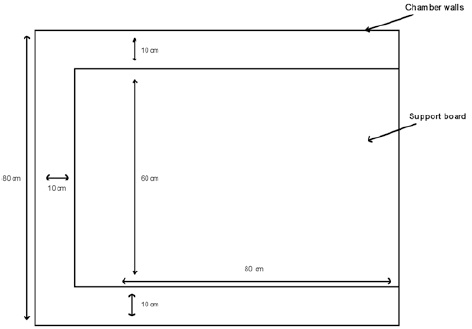
A test chamber was projected and but, according to the international standard ISO 16000-9 [15] to simulate atmospheric conditions experienced by rubber infill (when applied in synthetic turf pitches) and measure accurately the different leachates as well as emission parameters. The chamber consists of a Perspex® closed box where temperature, light and radiation exposure, “rain” exposure, and air circulation can be simulated and controlled, in order to simulate and reproduce different climacteric conditions. Inside, there is a board with a superficial area of 0.48 m2 that simulates the infill application in a football pitch (15 kg/m2 witch means 8.40 kg of sand and 7.2 kg of rubber infill).
To simulate an increasing temperature, up to a maximum of 40 ºC, as well as radiation there are 2 infrared lamps. To simulate the rain there is a shower with a controlled flow and to simulate the wind there are 2 blowers with controlled flow (1.25 m3/m2h). The produced leacheates are collected (0 h, 24 h, 72 h, 28 days) and analysed. The air inside the chamber is also collected and analysed, also according to ISO 16000-9 [15].
Figures 1 and 2 show the configuration and dimensions of the chamber:
Fig. 1: Test Chamber upright view
]]>
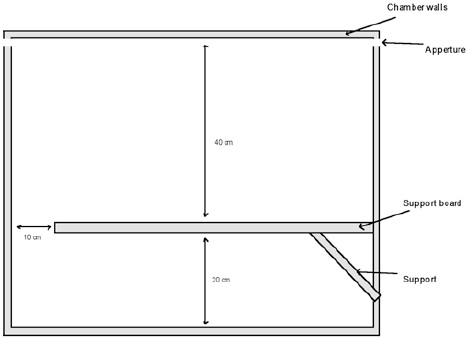
Fig. 2: Test Chamber lateral view
Figures 3 to 7 show the chamber and its auxiliary equipment.
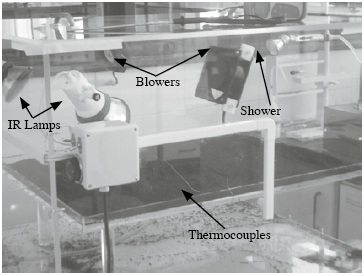
Fig. 3: Image of Test Chamber, showing details
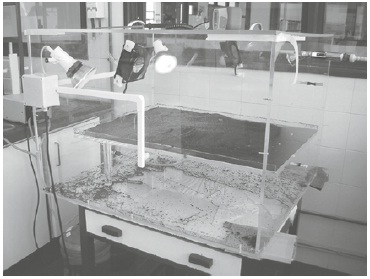
Fig. 4: Image of Test Chamber.
]]>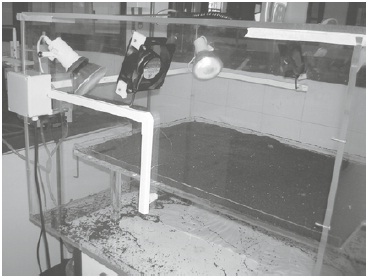
Fig. 5: Lateral image of Test Chamber
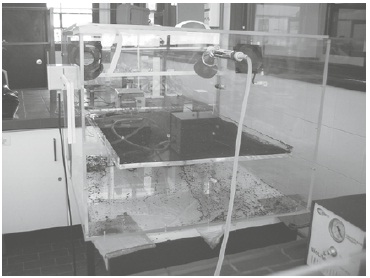
Fig. 6: Image of Test Chamber showing gas collecting device
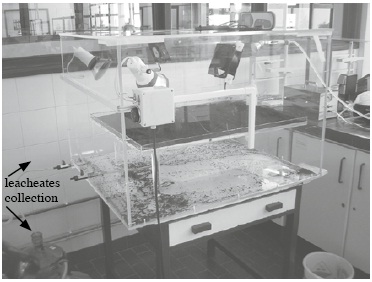
Fig. 7: Image of Test Chamber showing leacheates collecting device
]]> 3. Obtained results
In order to increase the utilization possibilities of the rubber granulates produced by Recipneu, studies were made aiming to obtain synthetic coatings for these granulates, in a colour (green) that would facilitate its incorporation in artificial turf to be used for sports facilities. The main requirements were to obtain a coating that would adhere efficiently to the rubber granules, maintaining its original elastic properties, colour stability, even when subjected to adverse weather conditions, resistance to wear and also temperature. It was also expected that this coating will be effective in reducing emissions of leachates, and airborne substances, thus being beneficial both in terms of the health of exposed individuals and also to the environment as a whole, as described elsewhere, designated as Grainbow® process and products [14].
Therefore, 4 samples of cryogenic rubber infill (references: DC-0814, DC-1430, DC-0102 and RA-1435), 2 kg each, where studied at two different temperatures: 25-30 ºC and 40 ºC, with constant air circulation, but without air renovation.
3.1. VOC determination
Once the desired temperature was achieved, the sample was exposed for about 1 hour, before the VOC determination was made. The measured VOC content is presented in table 1 and figure 8.
Table 1 – VOC content determination

]]>
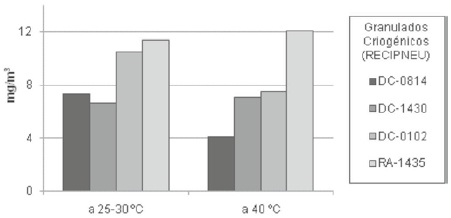
Fig. 8 – VOC content determination
3.2. Determination of particulate matter content
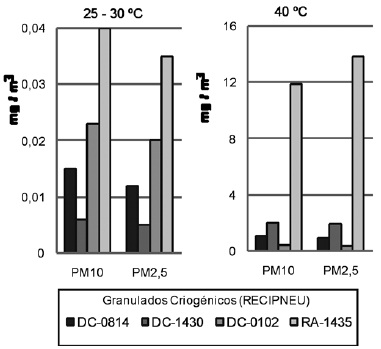
The PM10 and PM2.5 contents were measured, and the obtained results are shown on table 2 and figure 9, as well.
Table 2 – Particulate matter determination

3.3. Hydrocarbon content determination
In this test, a volume of air, circulated from the chamber, ranging between 12.5 and 18.75 L passed through hexane using a Biosampler. The collected sample was analysed by GC-FID (Gas Chromatography, using a Flame Ionization Detector), determining the content of hydrocarbons in the range C10–C40 (high molecular weight hydrocarbons).
The obtained results were lower than the detection limit of this method (4 mg/m3). For samples DC-0102 and RA-1435 the hydrocarbon determination took also place collecting 12.5 L of air in freon, which was later on analysed by FTIR. The results of these tests are shown on table 3.
Table 3 – Hydrocarbons content determination

It should be noted that the GC-FID method measures only the hydrocarbons having 10 or more carbon atoms and the FTIR method determines all types of hydrocarbons. Therefore, as the concentrations determined by FTIR are higher than the ones determined by GC-FID, we can conclude that the released hydrocarbons are mostly composed light hydrocarbons.
]]>3.4. Sulphide content determination
The air collected in the chamber passed through a cadmium acetate solution, using a biosampler, for fixing the cadmium sulphide ion (yellow). Using this method, the presence of sulphide ion was not detected.
3.5. Formaldehyde content determination
The samples were analysed using colorimetric tube detectors and a Gastec GV100 pump. The obtained concentrations were lower than the detection limit (<0,03 mg/m3).
3.6. Eco-toxicity analysis of leacheates
A leacheate was obtained by passing 70 L/m2 of water through the rubber infill sample, at 2 different temperatures, 25-30ºC and 40ºC. Eco-toxicity tests where performed, using Daphnia magna and microalgae Selenastrum capricornutum, according to the international standard ISO 8692:2004 [16]. Table 4 shows the obtained results in these tests.
]]> Table 4 – Toxicity (EC50) of the rubber infill aqueous leachates

Considering the results obtained in this test, we can conclude that the rubber infill leacheates cannot be considered as toxic both for Daphnia magna or microalgae Selenastrum capricornutum.
4. Conclusions
The study presented in this paper illustrates the use of the described test chamber as effective for simulating atmospheric conditions experienced by rubber infill (when applied in synthetic turf pitches) and measuring accurately the different leachates as well as emission parameters. Therefore, this procedure is to be considered as a technical option to the lysimeter “global turf system evaluation” when the rubber infill alone is to be evaluated. The advantage of the proposed option considering this “Test Chamber” is its simplicity and economy. This test chamber is actually installed and being used for tests in LAIST.
In the future, with proper modifications, this test chamber could also be employed for ageing tests. Other envisaged improvements which would allow the execution of more elaborated tests include water feed with and without recycling, consideration of different temperature stages. This will allow the execution of tests comprising the acceleration of ageing phenomena, and also focusing on potential environmental and safety issues such as emissions of leacheates, VOCs, suspended dust and PAHs emitted during these tests.
Acknowledgements
]]> Financial support by AdI - Agência de Inovação, through contracts IDEIA 70/00354 and 13-05-04-FDR-00045 is gratefully acknowledged.Grainbow® products and processes are protected by pending European and World Patents.
References
[1] U.S. Environmental Protection Agency. Manufacturing from Recyclables: 24 Case Studies of Successful Recycling Enterprises; EPA 530R95001; US Government Printing Office, Washington DC, 2000
[2] M. Wilczek, J. Berthig, D. Hintermann, Optimised technology for cryogenic production, Int. J. Mech. Proc., 74 (2004) 5425-5434
[3] B. Bocca, G. Forte, F. Petrucci, S. Costantini, P. Izzo, Metals contained and leached from rubber granulates used in synthetic turf areas, Sci. Tot. Env., 407-7 (2009), 2183-2190
[4] Swedish Chemicals Inspectorate, Kemi, Synthetic turf from a chemical perspective – a status report, Sundbyberg, Sweden, 2006
[5] J. Homer, Environmental health implications of heavy metal pollution from car tires, Rev. Env. Health, 11 (2006), 175-178
[6] T. Councell, K. Duckenfiled, E. Landa, E. Callender, Tire-wear particles as a source of zinc to the environment, Env. Sci. Tech., 38 (2004), 4206-4214
]]> [7] K. Adachi, Y. Tainosho, Characterization of heavy metal particles embedded in tire dust, Env. Int., 30 (2004), 1009-1017[8] G. San Miguel, G., Fowler, C. Sollars, The leaching of inorganic species from activated carbons produced from waste tire rubber, Wat. Res., 36 (2002), 1939-1946
[9] M. Gualteri, M. Andrioletti, C. Vismara, M. Milani, M. Camatini, Toxicity of tire debris leachates, Env. Int., 31 (2005), 723-730
[10] S. Nelson, G. Mueller, D. Hemphill, Identification of tire leachate toxicants and a risk assessment of water quality effects using tire reefs and canals, Bull. Env. Cont. Tox., 52 (1994), 574-581
[11] D. Birkholz, K. Belton, T. Guidotti, Toxicological evaluation for the hazard assessment of tire crumb for use in public playgrounds, J. Air Waste Man. Assoc., 53 (2003), 903-907
[12] K. Day, K. Holtze, S. Metcalfe, C. Bishop, B. Dukta, Toxicity of leachate from automobile tires to aquatic biota, Chemos., 27 (1993), 665-675
[13] A. Wik, G. Daves, Acute toxicity of leachates of tire wear material to Daphnia magna – variability and toxic components, Chemos., 64 (2006), 1777-1784
[14] Mota, H., Gomes, J., Bordado, J., Pereira, M., Felisberto, G., Ribeiro, A., Pampulim, V., Veloso, I., Custódio, M., Coated rubber granulates obtained from used tires for use in sport facilities, Ciência e Tecnologia dos Materiais, 21 (2009), 26-30 [ Links ]
[15] ISO 16000-9 - Indoor air: Determination of the emission of volatile organic compounds from building products and furnishing - Emission test chamber method, International Standards Organization, Geneva, 2006
[16] ISO 8692 - Water quality -- Freshwater algal growth inhibition test with unicellular green algae, International Standards Organization, Geneva, 2004
]]> ]]>