Ana Oliveira-Brochado 1; Fernando Oliveira-Brochado 2; Pedro Quelhas Brito 3
1 Professora visitante, Faculdade de Economia – Universidade do Porto.
2 Doutorando, Instituto de Ciências Biomédicas Abel Salazar – Universidade do Porto.
3 Professor auxiliar, Faculdade de Economia – Universidade do Porto.
Abstract
Despite the guidelines and the well-recognized benefits of regular physical activity, there is evidence that a large number of people is still reported to be inactive. Therefore, the need for interventions that can promote a healthier behavior has increased. As an understanding of the determinants of physical activity behavior by health professionals is an important prerequisite to designing effective interventions, studies on the identification of the determinants of physical activity are warranted. The purpose of this work is to review and update the research on determinants underlying physical activity behaviour in adults and to provide an overview of physical activity patterns among adult populations. The findings highlight the need for an evaluation of the interactive effects of psychosocial, cultural, environmental and public policy influences on physical activity forging a trans-disciplinary paradigm.
]]> Keywords: physical activity; correlates; social marketing; decision-making.
A influência de factores pessoais, sociais e ambientais na prática de actividade física dos adultos
Resumo
Apesar do reconhecimento dos benefícios de uma actividade física regular, vários estudos concluem que uma grande percentagem na população adulta permanece inactiva. Logo, revela-se importante o aumento de intervenções no sentido de promover um comportamento mais saudável. Dado que uma correcta compreensão das determinantes da actividade física por profissionais da área da saúde é um pré-requisito para a concepção de intervenções eficazes, são necessários estudos sobre as determinantes da actividade física. O presente trabalho propõe-se rever e actualizar os estudos efectuados sobre as determinantes da actividade física dos adultos, e fornecer uma perspectiva do padrão da actividade física deste grupo populacional. Os resultados sublinham a necessidade de uma avaliação da interacção entre factores psicossociais, culturais, ambientais e de programas de saúde pública e a definição de uma abordagem transdisciplinar.
Palavras-chave: actividade física; determinantes; marketing social; tomada de decisão.
1. Introduction
Physical activity is a well-established element of the public health agenda that has received increasing attention in recent years (Malina and Little, 2008). In fact, as physical activity benefits to mind and body have long been acknowledged by health professionals, regular participation in physical activity has become an important component of a healthy lifestyle. Among adults, moderate levels of physical activity (30 minutes on at least five days per week) and/or vigorous levels of physical activity (20 min on at least three times per week) are known to contribute to a reduced risk of coronary heart disease, to prevent or delay the development of high blood pressure and metabolic syndrome, to help to control diabetes, obesity, to reduce the risks of osteoporosis and certain cancers, as well as mental health problems (Vatten, Nilsen and Holmen, 2006; Kohl, 2001; Durstine and Thompson, 2001; Fagard, 2001; Rennie, Johnson and Jebb, 2005), and to promote longevity (Lee and Skerrett, 2001). It is also recognized that performance at work, cognitive function and overall self-esteem may be enhanced through exercise as well as the mental well-being (Cockerill, 1995; Fox, 1999). Emerging evidence indicates that physical activity is also beneficial to health during childhood and adolescence (Gilson, Cooke and Mahoney, 2005). Among young people, regular participation in physical activity has been suggested to contribute to optimum growth and development (Malina, Bouchard and Bar-Or, 2004), to reduce obesity, to develop and maintain optimal fitness and health (Davidson, 2007) and to positively influence activity participation across the life spam (Strong et al., 2005), as well as psychological and social wellbeing (Trost, 2002). Based on the results of several studies, a recommendation for increased physical activity has been integrated in many guidelines for better health. For example, the World Health Organization (WHO, 2003) developed the ‘Move for Health Program’, aiming at «increasing regular physical activity practices in the population, men and women, of all ages and conditions, in all domains (leisure time, transport, work) and settings (school, community, home, workplace)».
However, despite of these guidelines and the well-recognized benefits of regular physical activity, there is evidence that large numbers of people are still reported to be inactive. Sjöström et al. (2006) compared the physical activity prevalence across 15 European countries and concluded that two thirds of the adult populations are insufficiently active for optimal health benefits. Such results have important implications not only for the wellbeing of people, but also in terms of the related financial cost and resource implications to government in health care public policy (Lera-López and Rapún-Gárate, 2007).
]]> Collectively, these findings emphasize the need for physical-activity intervention programs that efficiently encourage participation and increase physical activity at the population level. However, as an understanding of the determinants of physical activity behavior by marketing professionals is an important prerequisite to designing effective interventions (De Bourdeaudhuij et al., 2005), studies on the identification of the determinants of physical activity are warranted.Consequently, over the last decades, different lines of research have been developed to address this issue (Sallis, Prochaska and Taylor, 2000; Buckworth and Dishman, 2002; Caspersen, Nixon, and Durant, 1998; Sallis and Owen, 1999) and a wide range of demographic, biological, psychological, cognitive, emotional, behavioural, social, cultural and environmental factors were associated with adults’ physical activity levels. Reviews of correlates of adults’ participation in physical activity include the works by Sallis and Owen (1997) and Trost et al. (2002).
The purpose of this work is to review and update the research on determinants underlying physical activity behaviour in adults, to provide an overview of physical activity patterns among adult populations. We also intend to provide an understanding of the factors that could be used to design successful interventions.
The next section discusses the physical activity concept and provides an overview of the available approaches to assess physical activity among adults. Afterwards, we intend to review the determinants underlying physical activity behaviour among adults and discuss how well they are linked to theories of behaviour change. We finish with a conclusion.
2. Physical activity assessment
Physical activity is a broad and complex concept that can be defined as any bodily movement produced by skeletal muscles which results in substantial increase of total daily energy expenditure (Caspersen, Powell and Christenson, 1985; Caspersen, Nixon and Durant, 1998). Physical activity encompasses activity arising at work, on household tasks, self-care, transportation and discretionary leisure time, including exercise and sports. Thus, under the broad concept of physical activity, it is important to understand the differences between leisure time physical activity, exercise, sport, and occupational physical activity. Occupational activity refers to the energy expenditure required to meet the demands of a job. Leisure time physical activity includes activities that increase total daily energy expenditure during an individual’s discretionary time, such as walking, climbing the stairs or cycling (Gilson, Cooke and Mahoney, 2005). When leisure time physical activity is performed repeatedly over an extended period of time with the intent to improve fitness, physical performance, or health, it is often called exercise. Sport/exercise consists of programmed structured activities, which are either competitive or uncompetitive. Accordingly, sport is considered a sub-component of exercise and exercise is a subset of physical activity.
The accurate measurement of physical activity in adults is a complex task (Melanson and Freedson, 1996). Techniques for assessing physical activity could be grouped into to broad categories (Livingstone et al., 2003): subjective, encompassing observation and questionnaires and objective, which include physiological indices such as heart rate, calorimetry, the doubly-labeled water method and electronic motor sensors. For reasons of feasibility and cost, recall questionnaires are a useful tool for assessing patterns, frequency, type and context of physical activity.
3. Determinants of physical activity
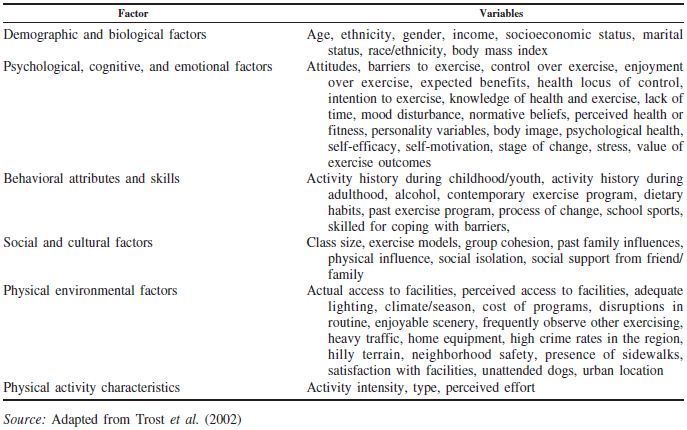
]]> Physical activity behavior is complex and multidimensional (Dishman, Sallis and Orenstein, 1985). Factors that influence physical activity behavior may be biologically determined, or may belong to the physical or social environment in which we live. Determinants of physical activity can also act as facilitators (those that promote physical activity) or barriers (those that act has an obstacle or impediment to physical activity participation) (Sallis and Owen, 1997). Several categories of determinants of physical activity exist; they are complex and multifactorial. The theoretical variables considered to be determinants of physical activity could be classified (Sallis, Prochaska and Taylor, 2000; Buckworth and Dishman, 2002; Caspersen, Nixon and Durant, 1998; Sallis and Owen, 1999; Trost et al., 2002) as either: (i) demographic and biological factors, (ii) psychological, cognitive, and emotional factors, (iii) behavioral attributes and skills, (iv) social and cultural factors, (v) physical environment factors and (vi) physical activity characteristics.There have been many studies of physical activity participation in adults that attempted to clarify patterns of participation and its determinants. These factors have been mainly investigated using correlation analysis and are therefore referred as correlates of physical activity. Most psychological and environmental factors are modifiable through intervention.
3.1. Demographic and biological factors
Among the many determinants of physical activity, associations with demographic and biological variables are well documented. Indeed, age and gender remain as the two most consistent demographic correlates of physical activity behavior in adults (Trost et al., 2002). Several studies revealed that men, in general, tend to be more active than women (Trost et al., 2002; Scheerder et al., 2002; Gratton and Taylor, 2000; Muntner et al., 2005; Sjöström et al., 2006; Santos et al., 2008). Nevertheless, in Maeda (2000) the relationship regarding sports in Japan was very weak.
Almeida et al. (1999) also observed gender differences concerning the type of activity in a sample of 15 European countries. According to their findings, in walking, keep fit, swimming and dancing there were more female participants, while in football and other team sports there were higher levels of participation among women compared with men. Livingstone et al. (2001) also found differences emerged in the type of leisure-time activities undertaken by men and women, despite walking for pleasure being by far the most important for both.
The likelihood of being sedentary increased with increasing of age (Livingstone et al., 2001, Muntner et al., 2005; Sjöström et al., 2006). Almeida et al. (2005) found that as age increased, the number of participants decreased for most activities, with the exception of walking and gardening. In addition, Sallis (2000) found that physical activity declines start earlier in females, mostly for vigorous activities. As concerning sports, Hunt, Ford and Mutrie (2001), based on a sample of Scotland’ adults also concluded that sporting and team activities are rarely undertaken throughout later adult life, especially amongst women and people from disadvantaged circumstances. The activities that are most commonly taken up and sustained through later adult life are walking, swimming, social dancing, keep fit/aerobics and golf. Findings of both cross-sectional (Leslie, Sparling and Oweb, 2001) and longitudinal data (Calfas et al., 2000) indicate a first steady decline in physical activity during young adulthood, that could be justified by changes in priorities, namely new time constraints as a consequence of entering the workforce or starting a family), by increased demands on time, or by the emergence of environmental barriers related to convenience, accessibility and cost.
Some studies found that married people are more active than single people (Lee and Bhargava, 2004), while others reported none (Booth et al., 2000; Brownson et al., 2000). King et al. (1998) found that the transition from a single to a married state had a positive influence in physical activity, while, the transition from a married to a single state did not change physical activity behavior.
Regarding socioeconomic status, income, occupation, and education were usually found to be positively related to physical activity participation (Trost et al., 2002). Almeida et al. (2005) found that there were more participants in most activities with the increased education and Scheerder et al. (2006) concludes that a lower social class background serves as a barrier to involvement in sport and the type of leisure-time activity practiced varies in function of the subject’s social class. Lera-López and Rapún-Gárate (2007) found a negative influence of some professional status categories on sport participation.
Overweight also emerged as a consistent negative influence on physical activity (Martinez-Gonzalez et al., 1999, Chen and Mao, 2006, Oppert et al., 2006). Nevertheless, in Almeida et al. (2005) the association between daily physical activity and Body Mass Index (BMI) was not strong, but there is a tendency for overweight subjects to be those less involved in the various activities.
]]>Table 1
Determinants of physical activity behavior among adults
3.2. Psychological, cognitive and emotional factors
Intrapersonal correlates of physical activity that tap into psychological, cognitive, and emotional drives have been included in many studies on the determinants of physical activity. These correlates include achievement orientation, self-esteem, perceived physical appearance/body image, self-efficacy, attitudes, perceived competence, intention, self-motivation, perceived benefits, enjoy exercise, stress, depression, general barriers, knowledge of exercise/health, stage of change (Trost et al., 2002). Most of these variables are derived from theoretical models such as the Health Belief Model (Becker and Maiman, 1975), Theory of Reasoned Action and Planed Behavior (Fishbein and Ajzen, 1975) and Transtheoretical Model (Prochaska, Redding and Evers, 1997).
According to the results provided by De Bourdeaudhuij et al. (2005), self-efficacy (a person’s confidence in his or her ability to be physically active on a regular basis) and perceived benefits (psychosocial, health, appearance, social, competition and pleasure) and barriers (lack of time, lack of interest, external, health problems and psychological problems) emerged as a powerful correlate of recreational physical activity behavior among Belgian and Portuguese adults.
Takamine (2001) found that positive attitudes toward physical activity were positively related to sport participation in Japan.
Barriers to physical activity emerged as a strong influence on leisure time activity. Brownson et al. (2001) concluded that, among US adults, the most commonly reported personal barriers were lack of time, feeling too tired, obtaining enough exercise at one’s job, and no motivation to exercise. Reichert et al. (2007) studied the perceived personal barriers to physical activity in Brazil and concluded that lack of time, dislike of exercising, feeling too tired, lack of company, and lack of money were the most frequently reported barriers to physical activity.
]]> Lera-López and Rapún-Gárate (2007) found that neither low levels of educational nor personal income are barriers to the practice of sport and time availability is a major barrier to expand the base of participants or increase the intensity of participation in Spain.Zunft et al. (1999) concluded in a cross sectional survey from 15 member states that the most important motivation for people to participate in physical activity is to maintain good health, to release tension and to get fit. The importance of the health argument is highest in older people.
Raviv and Netz (2001) examined the personal incentives to physical activity in Israel, namely affiliation, competition, appearance, mental benefits, social recognition, health benefits, flexibility, weight management, mastery and physical fitness and found a similar profile for men and woman except for competition and fitness, with men scoring more than did women.
3.3. Behavioural attributes and skills
There is now fairly general agreement that participation in sport, physical activity or leisure activity during youth is a good predictor of adults’ involvement in sports (Scheerder et al., 2006). Lifestyles characterized by certain types of consumptions as drinking, smoking and excessive TV viewing may adversely affect physical activity levels as well (Sale, Guppy and El-Sayed, 2000). However, Bertains et al. (2004) found no association between meeting the recommended activity levels and time spent watching television of a sample of adults in France. According to Vries et al. (2008) behaviors as nonsmoking and physical activity are associated with each other and being a smoker was inversely related to physical activity in Germany.
3.4. Social and cultural factors
According to many studies, there is a positive association between physical activity behavior and social support from family, friends, peers and program staff in supervised settings (Trost et al., 2002). The influence of social support on physical activity could be direct (such as exercising together or taking care of children for the spouse to exercise) or indirect (as encouraging a friend or family to be more active) (Sallis et al., 1987) and the preferred type of social support varies according to gender and age group. As patterns of behavior are often established in early life, parents play an important positive role especially in the early development of young children involved in sport. Boyfriends have, however, been reported as having a negative influence on the sport and leisure activities of young women (Coakley and White, 1992). Booth et al. (2000) found that Australian adults aged 60 years and over having friends who participated regularly in physical activity were more active.
]]> 3.5. Physical environmental factors
Taking a broader ecological approach to understand physical activity behavior (Trost et al., 2002), there is currently an increasing research emphasis on the role of the physical environment. For example, Sjöström et al. (2006) provided a cross-country comparisons of population levels of health-enhanced physical activity in 15 European countries and concluded that those countries with the best infrastructures for active commuting as part of active lifestyles (Netherlands, Denmark and Germany) were among the most active, indicating the possible influence of facilitatory environments on physical activity levels. In fact, physical environment provides cues and opportunities for physical activity and includes both natural (such as climate, weather, elevations and scenery) and built environments (buildings, availability of facilities, runways, workplaces, homes, access, convenience, safety, and urban planning and design) factors. There are also individual level influences (such as exercise equipment at home, access to facilities, and satisfaction with recreation facilities) and community level influences (such as neighborhood safety, hilly terrain, frequent observation of others engaging physical activity and enjoyable scenery) (Brownson et al., 2001; Santos et al., 2008). Berke et al. (2007) found a statistically significant association between neighborhood walkability and the frequency of walking for physical activity in older people. However, the importance of different physical environmental factors may differ according to the specific context. Indeed, De Bourdeaudhuij et al. (2005) concluded that leisure-time physical activity is enhanced by presence of recreational resources. For example, in Belgium leisure-time physical activity in adults was associated with presence of physical equipment at home while in Portugal it was mainly related with convenience of physical activity facilities.
The physical environment could be assessed by objective measures (e.g. number of parks) or by a perceived approach (e.g. an individual self-reported perception of availability of parks). Several studies have found that both actual and perceived physical environmental features are associated with engaging in physical activity (Booth et al., 2000; Brownson et al., 2004; Giles-Corti and Donovan, 2003, Hoehner et al., 2004; Humpel, Owen and Leslie, 2002).
Most of the studies that examined the influence of urban location on leisure physical activity participation concluded that adults living in rural locations are less likely to meet the recommended levels of physical activity than their urban counterparts (Brownson et al., 2000; Bertrains et al., 2004).
Finally, despite ecological models pointing to the fact that the combination of psychological and environmental variables will best explain physical activity (Sallis and Owen, 2002), some studies have found a non significant association between physical activity behavior and physical infra-structures after adjusting for individual ad social environmental factors (Troped et al., 2003). De Boudeaudhuij (2005), based on a study of Portuguese and Belgian adults, concluded that factors as social support, self-efficacy, perceived benefits and barriers are of higher importance, than physical environmental variables. Moreover, as the two samples in the present study were drawn from two cities with plenty of sports and exercise facilities, the absence of facilities, for example, in very rural areas might still have a negative impact on exercise.
4. Theoretical issues
As theories and models of human behavior can guide the development and refinement of intervention efforts, this section briefly examines elements of behavioral and social science theories and models that have been used to guide the research on physical activity. The main theories used in physical activity research have been the health belief model, the theory of planned behavior, the social cognitive theory and the transtheoretical model and ecological models (Bauman et al., 2002).
Some of these theories bring to light the role of the perceived outcomes of behavior, such as perceived benefits and barriers (health belief model) and outcome expectations (social cognitive theory and theory of planned behavior). Other theories and models highlight the influence of perceptions of control over behavior, namely thought the concepts of self-efficacy (health belief model, social cognitive theory) and perceived behavioral control (theory of planned behavior). Most of these theories also address the role of social influences in enhancing a health behavior, as in the concepts of observational learning (social cognitive theory), perceived norm (theory of reasoned action and theory of planned behavior), social support, and interpersonal influences (ecological perspective). Ecological models also emphasize the influence of the environment on physical activity behavior. In fact, as individuals are not isolated from the environments in which they live and work, combined with individual factors, social and physical environmental factors may provide more information to help better explain the variance in physical activity.
Table 2 synthesizes the literature describing factors and variables that are associated with physical activity among adults and specifies the theory or theories linked with each variable. The major finding in this literature describing factors that are associated with physical activity in adults was that many studies have been atheoretical. Although several theories have guided the design of correlates studies, a large number of variables that were not associated with a specific theory were still found to be consistently related to physical activity.
]]>Correlates of physical activity in adults and theories associated with each variable
5. Conclusion
Despite of the well-recognized benefits of regular physical activity, there is evidence that large numbers of people still reported to be inactive. Thus, it is utmost importance to address the promotion of physical activity among adult populations. Exploring and understanding factors that explain why people are active or inactive is of major importance in physical activity research. Effective intervention strategies aimed at increasing the prevalence of physical activity will be partly dependent on a good understanding of the factors that influence physical activity. Effectively, interventions targeted to strong correlates of behaviour should be more effective in changing behaviour, while variables that are consistently uncorrelated with physical activity seem to be poorer choices to target in studies designed to understand or to increase physical activity levels (Stead, Gordon and Angus, 2007). Correlates of physical activity could be classified as either: (i) demographic and biological factors, (ii) psychological, cognitive, and emotional factors, (iii) behavioral attributes and skills, (iv) social and cultural factors, (v) physical environment factors and (vi) physical activity characteristics. Correlates of physical activity are personal, social and environmental, have multiple dimensions and influence physical activity behavior in multiple ways. The non-modifiable demographic and biological variables suggest the existence of subgroups of relatively inactive adults that need to be target for special intervention programs. Modifiable variables identified in this review should guide the design of interventions. Psychological, cognitive, and emotional factors could be influenced through education and social marketing campaigns in order to promote physical activity. Environmental characteristics could be improved by means of policy change. Moreover, the literature reveals that multidisciplinary interventions are the most efficient to increase physical activity habits of a population (Kahn et al., 2002). This highlights the need for an evaluation of the interactive effects of psychosocial, cultural, environmental and public policy influences on physical activity forging a trans-disciplinary paradigm.
References
Almeida, M. D. et al. — Physical activity levels and body weight in a nationally representative sample in the European Union. Public Health Nutrition. 2 : 1A (1999) 105-113.
Bauman, A. et al. — Toward a better understanding of the influences on physical activity : the role of determinants, correlates, causal variables, mediators, moderators and confounders. American Journal of Preventive Medicine. 23 : 2 Suppl. 1 (2002) 5-14.
]]> Becker, M. H.; Maiman, L. A. — Sociobehavioral determinants of compliance with health care and medical care recommendations. Medical Care. 13 : 1 (1975) 10-24.Berke, E. et al. — Association of the built environment with physical activity and obesity in older persons. American Journal of Public Health. 97 : 3 (2007) 486-492.
Bertrais, S. et al. — Sociodemographic and geographic correlates of meeting current recommendations for physical activity in middle-age French adults : the Supplémentation en Vitamines et Minéraux Antioxydants (SUVIMAX) Study. American Journal of Public Health. 94 : 9 (2004) 1560-1566.
Booth, M. et al. — Social-cognitive and perceived environment influences associated with physical activity in older Australians. Preventive Medicine. 31 : 1 (2000) 15-22.
Brownson, R. C. et al. — Environmental and policy determinants of physical activity in the United States. American Journal of Public Health. 91 : 12 (2001) 1995-2003.
Brownson, R. C. et al. — Measuring the environment for friendliness toward physical activity : a comparison of the reliability of 3 questionnaires. American Journal of Public Health. 94 : 3 (2004) 473-483.
Brownson, R. C. et al. — Patterns and correlates of physical activity among US women 40 years and older. American Journal of Public Health. 90 : 2 (2000) 264-270.
Buckworth, J.; Dishman, R. K. — Determinants of exercise and psychological activity. In Bahrke, M., ed.lit. — Exercise psychology. Champaign : Human Kinetics, 2002. 191-209.
Calfas, K. J. et al. — Project GRAD : two-year outcomes of a randomized controlled physical activity intervention among young adults. American Journal of Preventive Medicine. 18 : 1 (2000) 28-37.
Caspersen, C. J.; Powell, K. E.; Christenson, G. M. — Physical activity, exercise and physical fitness : definitions and distinctions for health-related research. Public Health Reports. 100 : 2 (1985) 126-131.
]]> Caspersen, C. J.; Nixon, P. A.; Durant, R. H. — Physical activity epidemiology applied to children and adolescents. Exercise and Sports Science Reviews. 26 (1998) 341-403.Chen, Y.; Mao, Y. — Obesity and leisure time physical activity among Canadians. Preventive Medicine. 42 : 4 (2006) 261-265.
Coakley, J.; White, A. — Making decisions : gender and sport participation among British adolescents. Sociology Sport Journal. 9 : 1 (1992) 20-35.
Cockerill, I. — Self-esteem development through participation in physical activity. Employee Counseling Today. 7 : 7 (1995) 14-17.
Davidson, F. — Childhood obesity prevention and physical activity in schools. Health Education. 107 : 4 (2007) 377-395.
De Bourdeaudhuij, I. et al. — Environmental and psychological correlates of physical activity in Portuguese and Belgian adults. Public Health Nutrition. 8 : 7 (2005) 886-895.
Dishman, R. K.; Sallis, J.F.; Orenstein, D. R. — The determinants of physical activity and exercise. Public Health Reports. 100 : 2 (1985) 158-171.
Durstine, J. L.; Thompson, P. D. — Exercise in the treatment of lipid disorders. Cardiology Clinics. 19 : 3 (2001) 471-488.
Fagard, R. H. — Exercise characteristics and the blood pressure response to dynamic physical training. Medicine and Science in Sports and Exercise. 33 : 6 (2001) 484-492.
Fishbein, M.; Ajzen, I. — Belief, attitude, intention and behavior : an introduction to theory and research. Reading, MA : Addison-Wesley, 1975.
]]> Fox, K. — The influence of physical activity on mental well-being. Public Health Nutrition. 2 : 3A (1999) 411-418.Giles-Corti, B.; Donovan, R. J. — Relative influences of individual, social environmental, and physical environmental correlates of walking. American Journal of Public Health. 93 : 9 (2003) 1583-1589.
Gilson, N. D.; Cooke, C. B.; Mahoney, C. A. — Adolescent physical self-perceptions, sport/exercise and lifestyle physical activity. Health Education. 105 : 6 (2005) 437-450.
Gratton, C.; Taylor, P. — Economics of sport and recreation. London : Spon Press, 2000.
Hoehner, L. et al. — Perceived and objective environmental measures and physical activity among urban adults. American Journal of Preventive Medicine. 28 : 2 (2004) 105-116.
Humpel, N.; Owen, N.; Leslie, E. — Environmental factors associated with adults’ participation in physical activity : a review. American Journal of Preventive Medicine. 22 : 3 (2002) 188-199.
Hunt, K.; Ford, G.; Mutrie, N. — Is sport for all? : exercise and physical activity patterns in early and late middle age in the west of Scotland. Health Education. 101 : 4 (2001) 151-158.
Kahn, E. B. et al. — The effectiveness of interventions to increase physical activity : a systematic review. American Journal of Medicine. 22 : 4 Suppl. (2002) 73-107.
King, A. C. et al. — The effects of marital transitions on changes in physical activity : results from a 10-year community study. Annals of Behavioral Medicine. 20 : 2 (1998) 64-69.
Kohl, H. W. — Physical activity and cardiovascular disease : evidence for a dose response. Medicine and Science in Sports and Exercise. 33 : 6 (2001) 472-483.
]]> Lee, I. M.; Skerrett, P. J. — Physical activity and all-cause mortality : what is the dose-response relation? Medicine and Science in Sports and Exercise. 33 : 6 (2001) 459-471.Lee, Y. G.; Bhargava, V. — Leisure time : do married and single individuals spend it differently?, Family and Consumer Sciences Research Journal. 32 : 3 (2004) 254-274.
Lera-López, F.; Rapún-Gárate, M. — The demand for sport : sport consumption and participation models. Journal of Sport Management. 21 : 1 (2007) 103-122.
Leslie, E.; Sparling, P. B.; Oweb, N. — University campus settings and the promotion of physical activity in young adults : lessons from research in Australia and the USA. Health Education. 101 : 3 (2001) 116-125.
Livingstone, M. B. E. et al. — Physical activity patterns in a nationally representative sample of adults in Ireland. Public Health Nutrition. 4 : 5A (2001) 1107-1116.Maeda, H. — Prosperous middle-aged women’s in sports in Japan through some gender issues. International Review for the Sociology of Sport. 35 : 4 (2000) 487-494.
Malina, R. M.; Little, B. B. — Physical activity : the present in the context of the past. American Journal of Human Biology. 20 : 4 (2008) 373-391.Malina, R.; Bouchard, C.; Bar-Or, O. — Growth, maturation and physical activity. Human Kinetics, Champaign : IL, 2004.
Martinez-Gonzalez, M. A. et al. — Physical inactivity, sedentary lifestyle and obesity in the European Union. International Journal of Obesity. 23 : 11 (1999) 1192-1201.
Melanson, E. L.; Freedson, P. S. — Physical activity assessment : a review of methods. Critical Reviews in Food Science and Nutrition. 36 : 55 (1996) 385-396.
Muntner, P. et al. — Prevalence of physical activity among Chinese adults : results from the international collaborative study of cardiovascular disease in Asia. American Journal of Public Health. 95 : 9 (2005) 1631-1636.
Oppert, J.-M. et al. — Leisure-time and occupational physical activity in relation to cardiovascular risk factors and eating habits in French adults. Public Health Nutrition. 9 : 6 (2006) 746-754.
]]> Prochaska, J.O.; Redding, C. A.; Evers, K. E. — The transtheoretical model and stage of change. In Glanz, K.; Lewis, B.; Rimer, B. K. ed. lit. — Health behavior and health education : theory, research, and practice. San Francisco : Jossey-Bass Publishers, 1997. 60-84.Ravic, S.; Netz, Y. — Age, gender and level of activity as moderators of personal incentives to physical activity in Israel. The Journal of Phsychology. 141 : 3 (2007) 241-261.
Reichert, F. F. et al. — The role of perceived personal barriers to engagement in leisure-time physical activity. American Journal of Public Health. 97 : 3 (2007) 515-519.
Rennie, K. L.; Johnson, L.; Jebb, S. A. — Behavioral determinants of obesity. Best Practice and Research : Clinical Endocrinology and Metabolism. 19 : 3 (2005) 343-358.
Sale, C.; Guppy, A.; El-Sayed, M. — Individual differences, exercise and leisure activity in predicting affective well-being in young adults. Ergonomics. 43 : 10 (2000) 1689-1697.
Sallis, J. F. — Age-related decline in physical activity : a synthesis of human and animal studies. Medicine and Science in Sports and Exercise. 32 : 9 (2000) 1598-1600.
Sallis, J.; Owen, N. — Ecological models. In Glanz, K., Rimer, B. K., Lewis, F. M., ed lit. — Health behavior and health education : theory, research and practice. 2nd ed., San Francisco, CA : Jossey-Bass, 1997. 403-424.
Sallis, J.; Owen, N. — Ecological models of health behavior. In Glanz, K.; Rimer, B. K.; Lewis, F. M., ed lit. — Health behavior and health education : theory, research and practice. 3rd ed. San Francisco, CA : Jossey-Bass, 2002. 462-484.
Sallis, J.; Owen, N. — Physical activity and behavioral medicine. London : Sage Publications, 1999. [ Links ]
Sallis, J. F.; Prochaska, J. J.; Taylor, W. C. — A review of correlates of physical activity of children and adolescents. Medicine and Science in Sports and Exercise. 32 : 5 (2000) 963-975.
]]> Sallis, J. et al. — The development of scales to measure social support for diet and exercise behaviors. Preventive Medicine. 16 : 6 (1987) 825–836.Santos, R. et al. — Physical activity and perceived environment attributes in a sample of Portuguese adults : results from the Azorean physical activity and health study. Preventive Medicine. 47 : 1 (2008) 83-88.
Scheerder, J. et al. — Social sports stratification in Flanders 1969-99. International Review for Sociology of Sport. 37 : 2 (2002) 219-245.
Scheerder, J. et al. — Sports participation among females from adolescence to adulthood. International Review for the Sociology of Sport. 41 : 3 (2006) 413-430.
Sjöström, M. et al. — Health-enhancing physical activity across European Union countries : the Eurobarometer study. Journal of Public Health. 14 : 5 (2006) 291-300.
Stead, M.; Gordon, R.; Angus, K. — A systematic review of social marketing effectiveness. Health Education. 107 : 2 (2007) 126-191.
Strong, W. et al. — Evidence based physical activity for school-age youth. The Journal of Pediatrics. 146 : 6 (2005) 732-737.
Takamine, O. — Differences in characteristics between Japanese walkers and sport participants. International Journal for the Sociology of Sport. 36 : 4 (2001) 379-391.
Troped, P. J. et al. — Correlates of recreational and transportation physical activity among adults in a New England community. Preventive Medicine. 37 : 4 (2003) 304–310.
Trost, S. G. et al. — Correlates of adults’ participation in physical activity : review and update. Medicine and Science in Sports and Exercise. 34 : 12 (2002) 1996-2001.
]]> Vatten, L. J.; Nilsen, T. I.; Holmen, J. — Combined effects of blood pressure and physical activity on cardiovascular mortality. Journal of Hypertension. 24 : 10 (2006) 1939-1946.Vries, H. et al. — Clustering of diet, physical activity and smoking and a general willingness to change. Psychology and Health. 23 : 3 (2008) 265-278.
Zunft, H.-J. F. et al. — Perceived benefits and barriers to physical activity in a nationally representative sample in the European Union. Public Health Nutrition. 2 : Suppl. 1A (1999) 153-160.
Submetido à apreciação: 17 de Janeiro de 2008
Aceite para publicação: 26 de Janeiro de 2010
]]>