<?xml version="1.0" encoding="ISO-8859-1"?><article xmlns:mml="http://www.w3.org/1998/Math/MathML" xmlns:xlink="http://www.w3.org/1999/xlink" xmlns:xsi="http://www.w3.org/2001/XMLSchema-instance">
<front>
<journal-meta>
<journal-id>0870-9025</journal-id>
<journal-title><![CDATA[Revista Portuguesa de Saúde Pública]]></journal-title>
<abbrev-journal-title><![CDATA[Rev. Port. Sau. Pub.]]></abbrev-journal-title>
<issn>0870-9025</issn>
<publisher>
<publisher-name><![CDATA[Escola Nacional de Saúde Pública]]></publisher-name>
</publisher>
</journal-meta>
<article-meta>
<article-id>S0870-90252011000200006</article-id>
<title-group>
<article-title xml:lang="en"><![CDATA[Methicillin-Resistant Staphylococcus Aureus (MRSA) in a Portuguese hospital and its risk perception by health care professionals]]></article-title>
<article-title xml:lang="pt"><![CDATA[Staphylococcus Aureus Resistente à Meticilina (MRSA) num hospital distrital do Grande Porto e percepção do risco pelos profissionais de saúde]]></article-title>
</title-group>
<contrib-group>
<contrib contrib-type="author">
<name>
<surname><![CDATA[Peres]]></surname>
<given-names><![CDATA[David]]></given-names>
</name>
<xref ref-type="aff" rid="A01"/>
<xref ref-type="aff" rid="A02"/>
</contrib>
<contrib contrib-type="author">
<name>
<surname><![CDATA[Pina]]></surname>
<given-names><![CDATA[Elaine]]></given-names>
</name>
<xref ref-type="aff" rid="A03"/>
</contrib>
<contrib contrib-type="author">
<name>
<surname><![CDATA[Cardoso]]></surname>
<given-names><![CDATA[Margarida]]></given-names>
</name>
<xref ref-type="aff" rid="A04"/>
<xref ref-type="aff" rid="A05"/>
<xref ref-type="aff" rid="A06"/>
</contrib>
</contrib-group>
<aff id="A01">
<institution><![CDATA[,Hospital Pedro Hispano Infection Control Unit ]]></institution>
<addr-line><![CDATA[Matosinhos ]]></addr-line>
<country>Portugal</country>
</aff>
<aff id="A02">
<institution><![CDATA[,Administração Regional de Saúde do Norte Grupo Coordenador Regional de Controlo de Infecção ]]></institution>
<addr-line><![CDATA[Porto ]]></addr-line>
<country>Portugal</country>
</aff>
<aff id="A03">
<institution><![CDATA[,Direcção-Geral da Saúde Programa Nacional de Controlo de Infecção ]]></institution>
<addr-line><![CDATA[Lisboa ]]></addr-line>
<country>Portugal</country>
</aff>
<aff id="A04">
<institution><![CDATA[,Universidade do Porto Instituto de Ciências Biomédicas Abel Salazar ]]></institution>
<addr-line><![CDATA[Porto ]]></addr-line>
<country>Portugal</country>
</aff>
<aff id="A05">
<institution><![CDATA[,Centro interdisciplinar de Investigação Marinha e Ambiental  ]]></institution>
<addr-line><![CDATA[Porto ]]></addr-line>
<country>Portugal</country>
</aff>
<aff id="A06">
<institution><![CDATA[,Universidade do Porto Instituto de Saúde Pública ]]></institution>
<addr-line><![CDATA[Porto ]]></addr-line>
<country>Portugal</country>
</aff>
<pub-date pub-type="pub">
<day>00</day>
<month>07</month>
<year>2011</year>
</pub-date>
<pub-date pub-type="epub">
<day>00</day>
<month>07</month>
<year>2011</year>
</pub-date>
<volume>29</volume>
<numero>2</numero>
<fpage>132</fpage>
<lpage>139</lpage>
<copyright-statement/>
<copyright-year/>
<self-uri xlink:href="http://scielo.pt/scielo.php?script=sci_arttext&amp;pid=S0870-90252011000200006&amp;lng=en&amp;nrm=iso"></self-uri><self-uri xlink:href="http://scielo.pt/scielo.php?script=sci_abstract&amp;pid=S0870-90252011000200006&amp;lng=en&amp;nrm=iso"></self-uri><self-uri xlink:href="http://scielo.pt/scielo.php?script=sci_pdf&amp;pid=S0870-90252011000200006&amp;lng=en&amp;nrm=iso"></self-uri><abstract abstract-type="short" xml:lang="en"><p><![CDATA[Objective: To describe the epidemiology of methicillin-resistant Staphylococcus aureus (MRSA) and to assess its perception by healthcare professionals. Design: Survey, through a two-part questionnaire. Setting: A 441-bed district general hospital. Participants: Part I - Inpatients over 16 years of age, in whom a non-nasal MRSA was isolated between February and August of 2005. Part II - nurses and doctors responsible for these patients. Methods: Part I - Demographic and clinical data collected from medical notes. Part II - Perception of doctors and nurses. Observed agreement and "Kappa" statistic were used to compare perceptions. A P value lower than 0.05 was considered to be statistically significant. Results: Of the 111 patients identified, 50.9% had history of hospitalization during the previous year, with high exposure to antimicrobial therapy and invasive procedures. Hospital stay was 4.5 times higher than the average inpatients and mortality 5.5 times higher. Proportion of MRSA was 60.0%, with an incidence density of 1.66%. Although agreement between nurses and doctors was low, the majority admitted nosocomial origin of the MRSA and its transmission through the hands of professionals. Reinforcement of hand hygiene was considered important to manage these patients by 69.4% of nurses and 64.9% of doctors. Additionally, all nurses and 89.4% of doctors agreed on the need to isolate these patients. Conclusions: High endemic level of MRSA detected in a susceptible population, associated with a lower awareness of management of these patients by doctors, compared with nurses, justifies a global programme to control MRSA. This programme should include consensus-based measures for management of patients, rational use of antimicrobials, and dynamic and focused educational programmes.]]></p></abstract>
<abstract abstract-type="short" xml:lang="pt"><p><![CDATA[Objectivo: Descrever e analisar a epidemiologia do Staphyloccocus aureus resistente à meticilina (MRSA) num hospital distrital de 441 camas do Grande Porto, bem como a percepção que enfermeiros e médicos têm do problema. Desenho do estudo: Estudo transversal descritivo, através da aplicação de um inquérito de duas partes. Definição: Um hospital distrital de 441 camas. Participantes: Parte I - doentes internados com mais de 16 anos em que foi detectado MRSA não nasal, entre Fevereiro e Agosto de 2005. Parte II - enfermeiros e médicos responsáveis pela prestação de cuidados aos referidos doentes. Métodos: Parte I - recolha de dados demográficos, clínicos e factores de risco dos processos dos doentes. Parte II - aplicação de um inquérito a enfermeiros e médicos para análise das suas percepções. O acordo observado e a estatística "Kappa" foram utilizados para comparar as respostas entre classes de profissionais. O nível de significância adoptado foi de 5%. Resultados: Dos 111 casos estudados, 50,9% tinham historial de internamentos até há um ano atrás e 83,8% haviam estado expostos a antibioticoterapia prévia. O tempo de internamento foi 4,5 vezes maior que a média da população internada neste hospital, e a mortalidade 5,5 vezes maior. A prevalência de MRSA foi de 60,0% e a densidade de incidência de 1,66 casos por mil dias de internamento. A grande maioria dos profissionais admite que o MRSA é adquirido no ambiente hospitalar e que são as mãos dos profissionais de saúde a principal via de transmissão. Como medidas para gerir doentes com MRSA, 69,4% dos enfermeiros e 64,9% dos médicos referem o reforço da higienização das mãos, a totalidade dos enfermeiros e 89,4% dos médicos concordam com a necessidade de algum tipo de medidas de isolamento. Conclusões: Constatou-se a existência de altos valores endémicos de MRSA. Os profissionais têm a percepção da associação do MRSA aos cuidados de saúde, bem como a importância das mãos dos profissionais como veículo de transmissão, no entanto a classe médica está menos sensibilizada para as medidas de gestão para estes doentes. Parece justificar-se um programa global para controlo deste microrganismo, na gestão de doentes colonizados ou infectados por MRSA, na utilização racional dos antibióticos, bem como a formação dos profissionais de saúde, com um carácter mais dinâmico e dirigido.]]></p></abstract>
<kwd-group>
<kwd lng="en"><![CDATA[MRSA]]></kwd>
<kwd lng="en"><![CDATA[Infection control]]></kwd>
<kwd lng="en"><![CDATA[Risk perception]]></kwd>
<kwd lng="en"><![CDATA[Portugal]]></kwd>
<kwd lng="pt"><![CDATA[MRSA]]></kwd>
<kwd lng="pt"><![CDATA[Controlo da infecção]]></kwd>
<kwd lng="pt"><![CDATA[Percepção do risco]]></kwd>
<kwd lng="pt"><![CDATA[Portugal]]></kwd>
</kwd-group>
</article-meta>
</front><body><![CDATA[ <P><B>Methicillin–Resistant Staphylococcus Aureus (MRSA) in a Portuguese hospital  and its risk perception by health care professionals</B></P>     <p>&nbsp;</p>     <P><b>David Peres<SUP>a</SUP>, Elaine Pina<SUP>b</SUP>, Margarida  Cardoso<SUP>c</SUP> </b></P>     <P><SUP>a</SUP>Infection Control Unit, Hospital Pedro Hispano, Matosinhos,  Portugal. Grupo Coordenador Regional de Controlo de Infecção, Administração  Regional de Saúde do Norte, Porto, Portugal</P>     <P><SUP>b</SUP>Programa Nacional de Controlo de Infecção, Direcção–Geral da  Saúde, Lisboa, Portugal</P>     <P><SUP>c</SUP>ICBAS – Instituto de Ciências Biomédicas Abel Salazar,  Universidade do Porto, Porto, Portugal. CIIMAR – Centro Interdisciplinar de  Investigação Marinha e Ambiental, Porto, Portugal. ISPUP – Instituto de Saúde  Pública da Universidade do Porto, Porto, Portugal. <A href="mailto:mcard@icbas.up.pt">mcard@icbas.up.pt</A></P>     <p>&nbsp;</p>     <P><B>Abstract</B></P>    <P>Objective: To describe the epidemiology of  methicillin–resistant Staphylococcus aureus (MRSA) and to assess its perception  by healthcare professionals. Design: Survey, through a two–part questionnaire.  Setting: A 441–bed district general hospital. Participants: Part I – Inpatients  over 16&nbsp;years of age, in whom a non–nasal MRSA was isolated between  February and August of 2005. Part II – nurses and doctors responsible for these  patients. Methods: Part I – Demographic and clinical data collected from medical  notes. Part II – Perception of doctors and nurses. Observed agreement and  "Kappa" statistic were used to compare perceptions. A P value lower than  0.05&nbsp;was considered to be statistically significant. Results: Of the 111  patients identified, 50.9% had history of hospitalization during the previous  year, with high exposure to antimicrobial therapy and invasive procedures.  Hospital stay was 4.5 times higher than the average inpatients and mortality 5.5  times higher. Proportion of MRSA was 60.0%, with an incidence density of 1.66%.  Although agreement between nurses and doctors was low, the majority admitted  nosocomial origin of the MRSA and its transmission through the hands of  professionals. Reinforcement of hand hygiene was considered important to manage  these patients by 69.4% of nurses and 64.9% of doctors. Additionally, all nurses  and 89.4% of doctors agreed on the need to isolate these patients. Conclusions:  High endemic level of MRSA detected in a susceptible population, associated with  a lower awareness of management of these patients by doctors, compared with  nurses, justifies a global programme to control MRSA. This programme should  include consensus–based measures for management of patients, rational use of  antimicrobials, and dynamic and focused educational programmes.</P>      <P><B>Keywords:</B> MRSA. Infection control. Risk perception. Portugal.</P>     ]]></body>
<body><![CDATA[<p>&nbsp;</p>     <P><B>Staphylococcus Aureus Resistente à Meticilina (MRSA) num hospital distrital  do Grande Porto e percepção do risco pelos profissionais de saúde</B></P>      <P><B>Resumo</B></P>    <P>Objectivo: Descrever e analisar a epidemiologia do  Staphyloccocus aureus resistente à meticilina (MRSA) num hospital distrital de  441 camas do Grande Porto, bem como a percepção que enfermeiros e médicos têm do  problema. Desenho do estudo: Estudo transversal descritivo, através da aplicação  de um inquérito de duas partes. Definição: Um hospital distrital de 441 camas.  Participantes: Parte I – doentes internados com mais de 16&nbsp;anos em que foi  detectado MRSA não nasal, entre Fevereiro e Agosto de 2005. Parte II –  enfermeiros e médicos responsáveis pela prestação de cuidados aos referidos  doentes. Métodos: Parte I – recolha de dados demográficos, clínicos e factores  de risco dos processos dos doentes. Parte II – aplicação de um inquérito a  enfermeiros e médicos para análise das suas percepções. O acordo observado e a  estatística "Kappa" foram utilizados para comparar as respostas entre classes de  profissionais. O nível de significância adoptado foi de 5%. Resultados: Dos 111  casos estudados, 50,9% tinham historial de internamentos até há um ano atrás e  83,8% haviam estado expostos a antibioticoterapia prévia. O tempo de  internamento foi 4,5&nbsp;vezes maior que a média da população internada neste  hospital, e a mortalidade 5,5&nbsp;vezes maior. A prevalência de MRSA foi de  60,0% e a densidade de incidência de 1,66&nbsp;casos por mil dias de  internamento. A grande maioria dos profissionais admite que o MRSA é adquirido  no ambiente hospitalar e que são as mãos dos profissionais de saúde a principal  via de transmissão. Como medidas para gerir doentes com MRSA, 69,4% dos  enfermeiros e 64,9% dos médicos referem o reforço da higienização das mãos, a  totalidade dos enfermeiros e 89,4% dos médicos concordam com a necessidade de  algum tipo de medidas de isolamento. Conclusões: Constatou–se a existência de  altos valores endémicos de MRSA. Os profissionais têm a percepção da associação  do MRSA aos cuidados de saúde, bem como a importância das mãos dos profissionais  como veículo de transmissão, no entanto a classe médica está menos sensibilizada  para as medidas de gestão para estes doentes. Parece justificar–se um programa  global para controlo deste microrganismo, na gestão de doentes colonizados ou  infectados por MRSA, na utilização racional dos antibióticos, bem como a  formação dos profissionais de saúde, com um carácter mais dinâmico e dirigido.</P>     <P><B>Palavras chave:</B> MRSA. Controlo da infecção. Percepção do risco. Portugal.</P>     <p>&nbsp;</p>     <P><B>Introduction </B></P>     <P><I>Staphylococcus aureus </I>is a Gram-positive bacterium that colonizes the  skin of about 30% of healthy humans, although mainly a harmless coloniser, <I>S.  aureus </I>can cause severe infection. Its oxacillin-resistant form  (Methicillin-Resistant <I>S. aureus</I>, MRSA) is the most important cause of  antibiotic-resistant healthcare-associated infections  worldwide.<SUP>1</SUP>&nbsp;Of the expected 2&nbsp;billion individuals carrying  <I>S. aureus </I>worldwide, conservative estimates, based on either Dutch or  United States of America (USA) prevalence figures, would predict that between  2&nbsp;million and 53&nbsp;million carry MRSA.<SUP>2</SUP>&nbsp;There are  several studies which conclude that nosocomial MRSA infection increases  morbidity, mortality, length of stay and costs.<SUP>3-7</SUP>&nbsp;Historically,  MRSA isolates have been associated with nosocomial infections, however, in  recent years, different strains with unique phenotypes have emerged in the  community, and the reservoir of this community-associated MRSA (CA-MRSA) is  rapidly expanding.<SUP>8</SUP>&nbsp;Mathematical models have shown that CA-MRSA  has a high potential to become endemic in the community, and this will impact  significantly on the control of MRSA in the hospital setting.<SUP>9</SUP></P>     <P>For healthcare facilities, surveillance is an important and approved method  to assess the incidence of infection due to multidrug-resistant bacteria and to  improve infection control measures, if necessary.<SUP>10</SUP>&nbsp;Various  protocols and guidelines have been developed in an attempt to prevent the  development and slow down in the transmission of nosocomial MRSA. If healthcare  professionals (HCP's) are to be successful in this objective, then understanding  the epidemiology, pathogenesis and routes of transmission of MRSA in healthcare  facilities becomes critically important.<SUP>11</SUP>&nbsp;In this study we  describe the epidemiologic characteristics of the MRSA in a Portuguese district  general hospital, as well as its perception by the HCP's.</P>     <p>&nbsp;</p>     ]]></body>
<body><![CDATA[<P><B>Methods </B></P>     <P><I><B>Study setting and infection control practices </B></I></P>     <P>This study was conducted at Pedro Hispano Hospital, a district general  hospital in the north of Portugal with 441&nbsp; beds. This facility, that  serves a population of approximately 430,000, is part of a "local healthcare  unit", which integrates the management of primary healthcare resources of the  city of Matosinhos. Information about multirresistant microorganisms, including  the MRSA (which is endemic in this facility) is available annually.</P>     <P>All patients with results positive for MRSA were treated with contact  isolation measures, as recommended by the local infection control manual, based  on the "Center for Disease Control and Prevention" (CDC) guidelines available at  the time of the study.<SUP>12</SUP>&nbsp;Intensive care patients of both  existing units were screened for nasal colonization at admission and every  4&nbsp;days and, if positive for MRSA, decolonization was attempted with topical  agents (nasal mupirocin and chlorhexidine bathing). </P>     <P><I><B>Participants and data collection </B></I></P>     <P>Between February 21&nbsp;and August 31, 2005 (192&nbsp;days), the prospective  infection surveillance system, based on laboratory results, identified all  cultures positive for MRSA. Patients were excluded from the study if they: (a)  were less than 16&nbsp;years old, (b) had only nasal colonization detected, (c)  had died or been discharged when the result was known or (d) were treated in  ambulatory care. A two part questionnaire was applied to the 111&nbsp;cases who  met the criteria, after it was pretested and approved by the institutional  ethics board.</P>     <P>In the first part, the investigators recovered demographic and clinical data  from the medical record of each patient and, in the second part, the  questionnaire was administered to the doctors and nurses responsible for this  patient, in order to assess their perception of the epidemiology of MRSA  (meaning of the strain identified, source and route of transmission) as well as  the proper conduct to be followed to take care of this patient. </P>     <P><I><B>Definitions and terms </B></I></P>     <P>The risk factors associated with the use of indwelling devices (peripheral  and central vascular catheters, urinary catheter, gastrointestinal tube, wound  drainage device, endotracheal tube or tracheostoma and hemodialysis) were  considered if they were present during the last 4&nbsp; days, exposure to  antibiotics during the last 7&nbsp;days and, in case of a surgical procedure,  during the last 30&nbsp;days before the recovery of the sample which detected  the MRSA.</P>     <P>"Immunodeficiency" was considered when the patient had any immunological  disease or immunosuppressive therapy (chemotherapy, radiotherapy or steroids) in  high doses during at least 15&nbsp;days before the recovery of the sample which  detected the MRSA.<SUP>13</SUP>&nbsp;</P>     ]]></body>
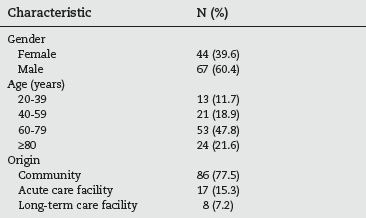
<body><![CDATA[<P>The terms "single-room isolation" (isolation of patients in a single-bedded  room), "cohorting" (physical segregation of a group of patients with MRSA from  the other patients in a geographically distinct area of the same ward) and  "barrier nursing" (use of aprons or gowns, gloves and, in some cases masks, by  the HCP as the only physical barrier to transmission) were used to refer to the  level of isolation, as recommended by an extensive systematic review on  isolation policies.<SUP>14</SUP></P>     <P>"Morbidity" estimation was based on the indicators proposed by Ducel <I>et  al</I>.<SUP>15</SUP>&nbsp;and Horan and Gaynes<SUP>16</SUP>, MRSA rates, using  three different denominators: proportion of MRSA (percentage of strains  resistant to methicillin within the total of <I>S. aureus</I> identified), the  incidence (number of MRSA per 1,000&nbsp;admissions) and incidence density  (number of MRSA per&nbsp;1,000&nbsp;patient-days). </P>     <P><I><B>Microbiological methods </B></I></P>     <P>Isolates were grown on blood and chocolate agar and confirmed as <I>S.  aureus</I> by colony morphology, Gram stain, catalase test and through the rapid  method "Staph aureus fumouze" (Fumouze Diagnostics, Paris, France). The  antimicrobial susceptibility testing was determined by the automatic system  "Vitek 2" (bioMérieux, Marcy l'Etoile, France). In case of doubt, confirmation  of the minimum inhibitory concentration result was performed through "E-test"  (AB Biodisk, Solna, Sweden). Strains with minimum inhibitory concentrations of  4&nbsp;&#956;g/mL of oxacillin or greater were considered resistant and 2&nbsp;&#956;g/mL  or less, sensitive, according to the "Clinical and Laboratory Standards  Institute" guidelines.<SUP>17 </SUP></P>     <P><I><B>Statistical analysis </B></I></P>     <P>Statistical analysis was performed using the "Statistical Package for the  Social Sciences" (SPSS Inc., Chicago, USA) version 13.0. Categorical variables  were compared using the chi-square or Fisher's exact test. To evaluate agreement  between doctors and nurses, responsible for each patient, observed agreement and  the "Kappa" statistic were applied. "Kappa" statistic was assessed to quantify  the extent of agreement beyond chance achieved by the two groups of HCP's  considered. The level of significance adopted was 5%.</P>     <p>&nbsp;</p>     <P><B>Results </B></P>     <P><I><B>Demographic characteristics and risk factors </B></I></P>     <P>During the 192&nbsp;day study period, 111&nbsp;cases were detected. The  demographic characteristics of these are listed in table&nbsp;1. The&nbsp;male  gender predominated (60.4% of the studied population) and almost half (47.8%)  were between 60&nbsp;and 79&nbsp;years old. The majority of the patients came  from the community (77.5%), but 17&nbsp;of them (12.6%) were transferred from  other hospitals and 8 (7.2%) from long-term care facilities.</P>     ]]></body>
<body><![CDATA[<p>&nbsp;</p>     <p><b>Table 1 - Demographic characteristics of the studied population (n=111)</b></p>     <p><img src="/img/revistas/rpsp/v29n2/29n2a06t1.jpg"></p>     
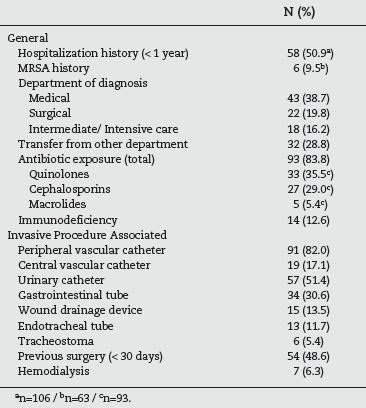
<p>&nbsp;</p>	     <P>According to table&nbsp;2, more than half (50.9%) of the patients had a  history of hospitalization during the previous year and almost 10% had  previously been detected with MRSA. The majority of cases were identified in  medical specialities (38.7%) followed by surgical (19.8%) and  intermediate/intensive care department (16.2%). However it should be taken into  account that 28.8% of the patients had been transferred from another ward,  before the one where the MRSA was identified. A vast majority (83.8%) were  exposed to antimicrobial therapy during the week before, with quinolones in  35.5% of the cases and cephalosporins in 29.0%. With respect to the risk factors  associated with invasive procedures, 82.0% had a peripheral venous catheter and  51.4% an urinary catheter. Almost half (48.6%) had been subjected to a surgical  procedure in the last thirty days and 17.1% had a central vascular catheter.  </P>     <p>&nbsp;</p>     <p><b>Table 2 - Risk factors present in the studied population (n=111)</b></p>     <p><img src="/img/revistas/rpsp/v29n2/29n2a06t2.jpg"></p>     
<p>&nbsp;</p>	     <P><I><B>Morbidity and mortality </B></I></P>     ]]></body>
<body><![CDATA[<P>As listed in table&nbsp;3, the mean length of stay was 40.7&nbsp;days (median  31.5; range 5-182) with 20&nbsp;patients (18.0%) who stayed more than  60&nbsp;days.</P>     <p>&nbsp;</p>     <p><b>Table 3 - Morbidity and mortality in the studied population: general and MRSA SPECIFIC (n=111)</b></p>     <p><img src="/img/revistas/rpsp/v29n2/29n2a06t1.jpg"></p>     
<p>&nbsp;</p>	     <P>More than one quarter of the studied population (27.0%) died in the hospital  and 8 (7.2%) were transferred to other healthcare facilities. In 72.1% of the  patients the MRSA was detected 48&nbsp; hours after admission. The proportion of  MRSA detected&nbsp; was 60.0%, the incidence was 11.9&nbsp; per  1,000&nbsp;admissions and incidence density revealed 1.66&nbsp;cases per  1,000&nbsp;patient-days. </P>     <P><I><B>Perception of the healthcare professionals </B></I></P>     <P>Table 4&nbsp; shows the perception of the HCP's about the epidemiology of the  MRSA, as well as the measures considered adequate to manage patients with  positive cultures. More than 70% of the doctors and nurses considered the  identified strains as hospital acquired infections, however, in the remaining  cases, nurses referred twice as frequently as the doctors that the strains could  be community acquired. For this question, the observed agreement was 74.2% and  the Kappa value of 0.336, which corresponds to a "fair agreement" between  observers.<SUP>18</SUP></P>     <p>&nbsp;</p>     <p><b>Table 4 - Perception of nurses and doctors of the epidemiology of MRSA and measures to manage positive patients</b></p>     ]]></body>
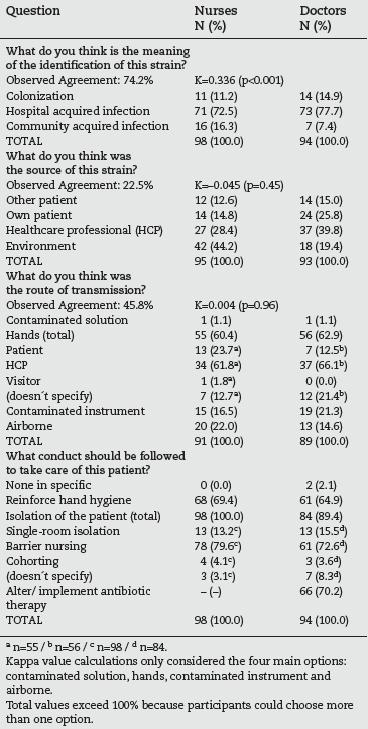
<body><![CDATA[<p><img src="/img/revistas/rpsp/v29n2/29n2a06t4.jpg"></p>     
<p>&nbsp;</p>	     <P>For the second question (perception about the source of the strain), 44.2% of  the nurses answered the "environment", followed by 28.4% of these professionals  who thought the source was a HCP. More doctors (39.8%) agreed to the hypothesis  of the source being a HCP, 25.8% chose the option "own patient" and  18&nbsp;doctors (19.4%) answered the "environment". For this question the  observed agreement was low (22.5%) and the Kappa value (-0.045) compatible to  "by chance" agreement between these two groups of professionals.</P>     <P>For the perception of the route of transmission, more than half of both  nurses and doctors referred the hands as the main route (60.4&nbsp;and 62.9%,  respectively). Within this category, it was the "hands of a HCP" which was  indicated most frequently (61.8% of nurses and 66.1% of the doctors). The second  option was "airborne" for nurses (22.0%) and "contaminated instrument" for  doctors (21.3%). The observed agreement was 45.8% and the Kappa value (0.004)  was, again, compatible to "by chance" agreement.</P>     <P>When asked about the conduct to be followed for the care of MRSA positive  patients, two (2.1%) doctors answered "none specifically". The response  "reinforce hand hygiene" was chosen by almost 70% of the nurses and by 64.9% of  the doctors. All the nurses (100%) and 89.4% of the doctors agreed that the  patient needed some type of isolation. Within this category, the first option  was "barrier nursing" (79.6% of the nurses and     <BR>72.6% of the doctors)  followed by single-room isolation (13.3% and 15.5%, respectively). The need to  alter/implement antibiotic therapy was assumed by 66&nbsp;doctors (70.2%).</P>     <p>&nbsp;</p>     <P><B>Discussion and conclusions </B></P>     <P>More than half of the studied sample had a history of hospitalization during  the previous year and almost 10% had been previously diagnosed with MRSA,  similarly to the 14.4% found by a study conducted in two terciary-care centers  in Saudi Arabia.<SUP>19</SUP></P>     <P>Interestingly, in the present study we found that it was in the medical  department where most cases were detected, followed by surgical wards and  intermediate/intensive&nbsp;care units, in contrast to other studies where the  intensive care&nbsp;units (ICU) were in the first  place.<SUP>19-21&nbsp;</SUP>This difference could be explained by the aggressive  strategy to control the MRSA in both ICU's of this hospital (we are not aware if  this occurred in the other studies). This information should be interpreted  carefully, considering the exclusion criteria of this study, namely the fact  that patients who had died when the result was known were not studied, since  this could have had an influence in the number of critical patients included.  Other sources of bias could be the different ratios ICU/general beds in the  hospitals studied and the mobility of the patients within the facilities: we  identified that 28.8% of the patients had been in other wards before the one  where the MRSA was identified. A Spanish study detected an even higher value:  37.8% in patients with bacteraemia by MRSA.<SUP>22</SUP></P>     ]]></body>
<body><![CDATA[<P>Monnet <I>et al.</I><SUP>23</SUP>&nbsp;described several studies which  conclude that exposure to cephalosporins, quinolones and macrolides constitutes  risk factors for colonization or infection by MRSA. Similarly to our  investigation, two other studies<SUP>20,22</SUP>&nbsp;detected an exposure to  antibiotics of over 70% in a population with MRSA and, in another hospital,  around 66%.<SUP>24</SUP>&nbsp;In contrast with the 35.5% described by us, a  640&nbsp;bed USA hospital study<SUP>25</SUP>&nbsp;identified an exposure of  67.6% of MRSA positive patients to quinolones.</P>     <P>With the respect to the risk factors associated with invasive procedures,  Montesinos <I>et al.<SUP>20</SUP>&nbsp;</I>likewise detected a similar  proportion of patients with intravascular catheter (79%) and subjected to a  previous surgical intervention (51%) but a higher exposure to urinary catheters  (77%). In a Swiss study,<SUP>24</SUP>&nbsp;45.7% of the MRSA colonized patients  had a not specified indwelling device and 54.3% a history of surgery in the last  thirty days. </P>     <P>The length of stay of the studied individuals was 4.5&nbsp;times higher when  compared to the general adult hospitalized population in this hospital  (40.7&nbsp;<I>versus</I> 9.0&nbsp;days). This value was higher than the  difference found in a USA study developed in an acute care military facility,  where MRSA patients had a length of stay 3.3&nbsp;times higher.<SUP>26</SUP></P>     <P>Although the mortality value we described may not be directly related to the  mortality caused by MRSA, it may be an indication of the morbidity associated  with this microorganism, as well as the susceptibility of the population it  affects. For this indicator a 5.5&nbsp;fold difference was found between the  studied population and the general adult hospitalized population (27.0%  <I>versus</I> 4.9%). Madani <I>et al</I>.<SUP>19</SUP>&nbsp;described a general  mortality of 53.7% in a population infected with MRSA, but regarded as mortality  directly associated with this infection 36.4% of the cases. </P>     <P>Usually an infection is considered acquired at a healthcare facility when it  appears 48&nbsp;hours after the admission.<SUP>16</SUP>&nbsp;In this study  31&nbsp;patients (27.9%) were identified as MRSA positive less than  48&nbsp;hours after admission, which could lead us to consider a community  origin. A Portuguese study<SUP>27</SUP>&nbsp;involving 3,266&nbsp;healthy  individuals from the community detected low prevalence of MRSA nasal  colonization (0.7%). However, all but 3&nbsp;of our patients had classical risk  factors for MRSA carriage: 6&nbsp;came from other acute care facilities,  4&nbsp;from long term care facilities and 18&nbsp;had a history of  hospitalization during the previous year. </P>     <P>MRSA rates in Portugal are know to be high: in 2005&nbsp;the "European  Antimicrobial Resistance Surveillance System" detected a proportion of  resistance of 46.6% in Portugal,<SUP>1</SUP>&nbsp;which is in agreement with the  47.5% of resistance reported in a Portuguese study involving  9&nbsp;hospitals.<SUP>28</SUP>&nbsp;Both values were still lower than the 60.0%  detected in our study. A German study<SUP>29</SUP>&nbsp;identified an average  value of incidence density of 2.77%thou in 38&nbsp;ICU's and a French  multicenter study<SUP>30</SUP>&nbsp;described a rise of this indicator from  0.71&nbsp;to 0.96%thou between 1996&nbsp;and 2000. Richet <I>et  al.</I><SUP>31</SUP>&nbsp;studied 90&nbsp;healthcare facilities around the world  and detected median values of 0.40%thou for Western Europe and hospital  category&lt;500&nbsp;beds. Once again the values found were lower than the one  in our study (1.66%thou).</P>     <P>The majority of the HCP's had the perception that this MRSA strains were  hospital acquired, but Kappa value identified just a "fair agreement" between  nurses and doctors. A possible explanation for this would be the HCP's not  taking into account the 48&nbsp;hour timing generally used to distinguish  hospital from community acquired infection. Considering the changing  epidemiology of the MRSA, Klevens <I>et al.</I><SUP>32</SUP>&nbsp; proposed a  different classification of cases into three mutually exclusive groups: (a)  healthcare-associated community-onset; (b) healthcare-associated hospital-onset  and (c) community-associated. This is an interesting approach and should be  considered in future research in this area. </P>     <P>Nurses identified first the "environment" and then a "member of the staff" as  the possible source (opposed to the doctors who chose "member of the staff"  first), perhaps because nurses spend more time on the wards and recognize the  limitations of the cleaning procedures. Both groups of HCP's are concerned about  being themselves the source of the MRSA, more than the option "other patient".  Bearing in mind that clinical microbiological cultures fail to identify up to  85% of MRSA-colonized patients,<SUP>33</SUP>&nbsp;if the HCP has the perception  that the other patients are not likely to be the source, this could have serious  implications on the adherence to the Standard Precautions. </P>     <P>Slightly more doctors than nurses thought the route of transmission was the  hands of a HCP. This is an interesting result considering that fewer doctors  chose the option "reinforce hand hygiene" when asked about the management of  MRSA positive patients. It would seem that there is a difference between the  knowledge and importance of this practice and its day-to-day application. One  study<SUP>34</SUP>&nbsp;recognized that 62% of the doctors and 72% of nurses  have the perception&nbsp;that they practice hand hygiene more than 80% of the  times before and after contact with patients, concluding that HCP's perception  of the compliance with infection control measures are better than their actual  practice, as demonstrated by observational studies. CDC  guidelines<SUP>35&nbsp;</SUP>also indicate physician status as an observed risk  factor for poor adherence to recommended hand-hygiene practices. It is  interesting to&nbsp; see that a substantial number of HCP's identified the air  as possible route of transmission (22% of the nurses and 14.6% of doctors).  Although some studies<SUP>36,37</SUP>&nbsp;suggest that MRSA is recirculated in  the air, especially after movement, such as in bedmaking, it is considered that  the transmission of MRSA within healthcare facilities primarily occurs via  carriage on the hands of healthcare workers.<SUP>11</SUP></P>     <P>The fact that two doctors and none of the nurses agreed that no specific  measures were necessary to take care of MRSA positive patients and that 100%  nurses identified the need to isolate these patients, in contrast with just  89.4% of the doctors, is in agreement with other studies. Afif <I>et  al.</I><SUP>38</SUP>&nbsp;referred that the compliance to MRSA precautions is  worse among doctors as compared to nurses (Odds Ratio 0.35; 95% confidence  interval, 0.14&nbsp;to 0.86). Seaton and Montazeri<SUP>39&nbsp;</SUP>described,  in a population of British doctors, that 10% did not agree with the use of  gloves when examining patients with MRSA and 34% did not believe in the efficacy  of alcohol hand rub solutions in reducing MRSA transmission, concluding that  "there is scope for improvement in awareness and knowledge about MRSA and its  management". Acknowledging this problem, the recent CDC  guidelines<SUP>40</SUP>&nbsp;advise that "improvement requires that the  organizational leadership make prevention an institutional priority and  integrate infection control practices into the organization's safety culture".  </P>     ]]></body>
<body><![CDATA[<P>The high endemic values detected in our study as well as differences in the  perception of the HCP's about the epidemiology and management of MRSA positive  patients justify the need to implement a global infection control programme for  MRSA, with consensus-based measures for management of colonized and infected  patients, more effective strategies for the rational use of antimicrobials, as  well as more dynamic and focused educational programmes for healthcare  professionals.</P>     <p>&nbsp;</p>     <P><B>References</B></P>     <!-- ref --><P>1. European Antimicrobial Resistance Surveillance System. European  Antimicrobial Resistance Surveillance System Annual Report 2005. [Internet].  Bilthoven: EARSS; 2005. [cited 2008 April 27]. Available from: <A href="http://www.rivm.nl/bibliotheek/rapporten/210624001.pdf" target="_blank">www.rivm.nl/bibliotheek/rapporten/210624001.pdf</A>.    &nbsp;&nbsp;&nbsp;&nbsp;&nbsp;&nbsp;&nbsp;&nbsp;[&#160;<a href="javascript:void(0);" onclick="javascript: window.open('/scielo.php?script=sci_nlinks&ref=000086&pid=S0870-9025201100020000600001&lng=','','width=640,height=500,resizable=yes,scrollbars=1,menubar=yes,');">Links</a>&#160;]<!-- end-ref --></P>      <!-- ref --><P>2. Grundmann H, Aires–De–Sousa M, Boyce J, Tiemersma E. Emergence and  resurgence of meticillin–resistant Staphylococcus aureus as a public–health  threat. Lancet. 2006;368:874–85.    &nbsp;&nbsp;&nbsp;&nbsp;&nbsp;&nbsp;&nbsp;&nbsp;[&#160;<a href="javascript:void(0);" onclick="javascript: window.open('/scielo.php?script=sci_nlinks&ref=000088&pid=S0870-9025201100020000600002&lng=','','width=640,height=500,resizable=yes,scrollbars=1,menubar=yes,');">Links</a>&#160;]<!-- end-ref --> </P>     <!-- ref --><P>3. Blot SI, Vandewoude KH, Hoste EA, Colardyn FA. Outcome and attributable  mortality in critically Ill patients with bacteremia involving  methicillin–susceptible and methicillin–resistant Staphylococcus aureus. Arch  Intern Med. 2002;62:2229–35.    &nbsp;&nbsp;&nbsp;&nbsp;&nbsp;&nbsp;&nbsp;&nbsp;[&#160;<a href="javascript:void(0);" onclick="javascript: window.open('/scielo.php?script=sci_nlinks&ref=000090&pid=S0870-9025201100020000600003&lng=','','width=640,height=500,resizable=yes,scrollbars=1,menubar=yes,');">Links</a>&#160;]<!-- end-ref --> </P>     <!-- ref --><P>4. Cosgrove SE, Sakoulas G, Perencevich EN, Schwaber MJ, Karchmer AW, Carmeli  Y. Comparison of mortality associated with methicillin–resistant and  methicillin–susceptible Staphylococcus aureus bacteremia: a meta–analysis. Clin  Infect Dis. 2003;36:53–9.    &nbsp;&nbsp;&nbsp;&nbsp;&nbsp;&nbsp;&nbsp;&nbsp;[&#160;<a href="javascript:void(0);" onclick="javascript: window.open('/scielo.php?script=sci_nlinks&ref=000092&pid=S0870-9025201100020000600004&lng=','','width=640,height=500,resizable=yes,scrollbars=1,menubar=yes,');">Links</a>&#160;]<!-- end-ref --> </P>     <!-- ref --><P>5. Engemann JJ, Carmeli Y, Cosgrove SE, Fowler VG, Bronstein MZ, Trivette SL,  et al. Adverse clinical and economic outcomes attributable to methicillin  resistance among patients with Staphylococcus aureus surgical site infection.  Clin Infect Dis. 2003;36:592–8.    &nbsp;&nbsp;&nbsp;&nbsp;&nbsp;&nbsp;&nbsp;&nbsp;[&#160;<a href="javascript:void(0);" onclick="javascript: window.open('/scielo.php?script=sci_nlinks&ref=000094&pid=S0870-9025201100020000600005&lng=','','width=640,height=500,resizable=yes,scrollbars=1,menubar=yes,');">Links</a>&#160;]<!-- end-ref --> </P>     <!-- ref --><P>6. Klevens RM, Morrison MA, Nadle J, Petit S, Gershman K, Ray S, et al.  Invasive methicillin–resistant Staphylococcus aureus infections in the United  States. JAMA. 2007;298:1763–71.    &nbsp;&nbsp;&nbsp;&nbsp;&nbsp;&nbsp;&nbsp;&nbsp;[&#160;<a href="javascript:void(0);" onclick="javascript: window.open('/scielo.php?script=sci_nlinks&ref=000096&pid=S0870-9025201100020000600006&lng=','','width=640,height=500,resizable=yes,scrollbars=1,menubar=yes,');">Links</a>&#160;]<!-- end-ref --> </P>     <!-- ref --><P>7. Kim T, Oh PI, Simor AE. The economic impact of methicillin–resistant  Staphylococcus aureus in Canadian hospitals. Infect Control Hosp Epidemiol.  2001;22:99–104.    &nbsp;&nbsp;&nbsp;&nbsp;&nbsp;&nbsp;&nbsp;&nbsp;[&#160;<a href="javascript:void(0);" onclick="javascript: window.open('/scielo.php?script=sci_nlinks&ref=000098&pid=S0870-9025201100020000600007&lng=','','width=640,height=500,resizable=yes,scrollbars=1,menubar=yes,');">Links</a>&#160;]<!-- end-ref --> </P>     <!-- ref --><P>8. Appelbaum C. Microbiology of antibiotic resistance in Staphylococcus  aureus. Clin Infect Dis. 2007;45&nbsp;Suppl 3:S165–70.    &nbsp;&nbsp;&nbsp;&nbsp;&nbsp;&nbsp;&nbsp;&nbsp;[&#160;<a href="javascript:void(0);" onclick="javascript: window.open('/scielo.php?script=sci_nlinks&ref=000100&pid=S0870-9025201100020000600008&lng=','','width=640,height=500,resizable=yes,scrollbars=1,menubar=yes,');">Links</a>&#160;]<!-- end-ref --> </P>     <!-- ref --><P>9. Kluytmans–Vandenbergh MF, Kluytmans JA. Community–acquired  methicillin–resistant Staphylococcus aureus: current perspectives. Clin  Microbiol Infect. 2006;12&nbsp;Suppl 1:9–15.    &nbsp;&nbsp;&nbsp;&nbsp;&nbsp;&nbsp;&nbsp;&nbsp;[&#160;<a href="javascript:void(0);" onclick="javascript: window.open('/scielo.php?script=sci_nlinks&ref=000102&pid=S0870-9025201100020000600009&lng=','','width=640,height=500,resizable=yes,scrollbars=1,menubar=yes,');">Links</a>&#160;]<!-- end-ref --> </P>     <!-- ref --><P>10. Chaberny IF, Sohr D, Rüden H, Gastmeier P. Development of a surveillance  system for methicillin–resistant Staphylococcus aureus in German hospitals.  Infect Control Hosp Epidemiol. 2007;28:446–52.    &nbsp;&nbsp;&nbsp;&nbsp;&nbsp;&nbsp;&nbsp;&nbsp;[&#160;<a href="javascript:void(0);" onclick="javascript: window.open('/scielo.php?script=sci_nlinks&ref=000104&pid=S0870-9025201100020000600010&lng=','','width=640,height=500,resizable=yes,scrollbars=1,menubar=yes,');">Links</a>&#160;]<!-- end-ref --> </P>     <!-- ref --><P>11. Henderson DK. Managing methicillin–resistant Staphylococci: a paradigm  for preventing nosocomial transmission of resistant organisms. Am J Med.  2006;119(6&nbsp;Suppl 1):S45–52.    &nbsp;&nbsp;&nbsp;&nbsp;&nbsp;&nbsp;&nbsp;&nbsp;[&#160;<a href="javascript:void(0);" onclick="javascript: window.open('/scielo.php?script=sci_nlinks&ref=000106&pid=S0870-9025201100020000600011&lng=','','width=640,height=500,resizable=yes,scrollbars=1,menubar=yes,');">Links</a>&#160;]<!-- end-ref --> </P>     <!-- ref --><P>12. Garner J, Hospital Infection Control Practices Advisory Committee,  Centers for Disease Control and Prevention, Public Health Service, U. S.  Department of Health and Human Services. Guideline for isolation precautions in  hospitals: Part II: recommendations for isolation precautions in hospitals. Am J  Infect Control.1996;24: 32–52.    &nbsp;&nbsp;&nbsp;&nbsp;&nbsp;&nbsp;&nbsp;&nbsp;[&#160;<a href="javascript:void(0);" onclick="javascript: window.open('/scielo.php?script=sci_nlinks&ref=000108&pid=S0870-9025201100020000600012&lng=','','width=640,height=500,resizable=yes,scrollbars=1,menubar=yes,');">Links</a>&#160;]<!-- end-ref --> </P>     <!-- ref --><P>13. Health Ministry, National Infection Control Programme. Epidemiological  surveillance protocol for bloodstream nosocomial infections. Lisbon: National  Health Institute Dr. Ricardo Jorge. National Infection Control Programme; 2004.    &nbsp;&nbsp;&nbsp;&nbsp;&nbsp;&nbsp;&nbsp;&nbsp;[&#160;<a href="javascript:void(0);" onclick="javascript: window.open('/scielo.php?script=sci_nlinks&ref=000110&pid=S0870-9025201100020000600013&lng=','','width=640,height=500,resizable=yes,scrollbars=1,menubar=yes,');">Links</a>&#160;]<!-- end-ref -->  </P>     <!-- ref --><P>14. Cooper BS, Stone SP, Kibbler CC, Cookson BD, Roberts JA, Medley GF, et  al. Sistematic review of isolation policies in the hospital management of the  methicillin–resistant Staphylococcus aureus: a review of the literature with  epidemiological and economic modelling. Health Technol Assess. 2003;7:1–194.    &nbsp;&nbsp;&nbsp;&nbsp;&nbsp;&nbsp;&nbsp;&nbsp;[&#160;<a href="javascript:void(0);" onclick="javascript: window.open('/scielo.php?script=sci_nlinks&ref=000112&pid=S0870-9025201100020000600014&lng=','','width=640,height=500,resizable=yes,scrollbars=1,menubar=yes,');">Links</a>&#160;]<!-- end-ref -->  </P>     <!-- ref --><P>15. Ducel G, Fabry J, Nicolle L. Prevention of hospital acquired infections:  a practical guide. 2nd ed. Copenhagen: World Health Organization; 2002.    &nbsp;&nbsp;&nbsp;&nbsp;&nbsp;&nbsp;&nbsp;&nbsp;[&#160;<a href="javascript:void(0);" onclick="javascript: window.open('/scielo.php?script=sci_nlinks&ref=000114&pid=S0870-9025201100020000600015&lng=','','width=640,height=500,resizable=yes,scrollbars=1,menubar=yes,');">Links</a>&#160;]<!-- end-ref --> </P>     <!-- ref --><P>16. Horan T, Gaynes R: Surveillance of nosocomial infections. In: Mayhall CG,  editor. Hospital epidemiology and infection control. 3rd ed. Philadelphia, PA:  Lippincott Willians &amp; Wilkins; 2004. p. 1659–1702.    &nbsp;&nbsp;&nbsp;&nbsp;&nbsp;&nbsp;&nbsp;&nbsp;[&#160;<a href="javascript:void(0);" onclick="javascript: window.open('/scielo.php?script=sci_nlinks&ref=000116&pid=S0870-9025201100020000600016&lng=','','width=640,height=500,resizable=yes,scrollbars=1,menubar=yes,');">Links</a>&#160;]<!-- end-ref --> </P>     <!-- ref --><P>17. Clinical and Laboratory Standards Institute. Performance standards for  antimicrobial susceptibility testing: fifteenth informational supplement. 15th  ed. Wayne, PA: Clinical and Laboratory Standards Institute; 2005.    &nbsp;&nbsp;&nbsp;&nbsp;&nbsp;&nbsp;&nbsp;&nbsp;[&#160;<a href="javascript:void(0);" onclick="javascript: window.open('/scielo.php?script=sci_nlinks&ref=000118&pid=S0870-9025201100020000600017&lng=','','width=640,height=500,resizable=yes,scrollbars=1,menubar=yes,');">Links</a>&#160;]<!-- end-ref --> </P>     <!-- ref --><P>18. Viera AJ, Garrett JM. Understanding interobserver agreement: the Kappa  Statistic. Fam Med. 2005;37:360–3.    &nbsp;&nbsp;&nbsp;&nbsp;&nbsp;&nbsp;&nbsp;&nbsp;[&#160;<a href="javascript:void(0);" onclick="javascript: window.open('/scielo.php?script=sci_nlinks&ref=000120&pid=S0870-9025201100020000600018&lng=','','width=640,height=500,resizable=yes,scrollbars=1,menubar=yes,');">Links</a>&#160;]<!-- end-ref --> </P>     <!-- ref --><P>19. Madani TA, AL–Abdullah NA, AL–Sanousi AA, Ghabrah TM, Afandi SZ, Bajunid  HA. Methicillin–resistant Staphylococcus aureus in two tertiary–care centers in  Jeddah, Saudi Arabia. Infect Control Hosp Epidemiol. 2001;22:211–6.    &nbsp;&nbsp;&nbsp;&nbsp;&nbsp;&nbsp;&nbsp;&nbsp;[&#160;<a href="javascript:void(0);" onclick="javascript: window.open('/scielo.php?script=sci_nlinks&ref=000122&pid=S0870-9025201100020000600019&lng=','','width=640,height=500,resizable=yes,scrollbars=1,menubar=yes,');">Links</a>&#160;]<!-- end-ref --> </P>     <!-- ref --><P>20. Montesinos I, Salido E, Delgado T, Lecuona M, Sierra A. Epidemiology of  methicillin–resistant Staphylococcus aureus at a university hospital in the  Canary Islands. Infect Control Hosp Epidemiol. 2003;24:667–72.    &nbsp;&nbsp;&nbsp;&nbsp;&nbsp;&nbsp;&nbsp;&nbsp;[&#160;<a href="javascript:void(0);" onclick="javascript: window.open('/scielo.php?script=sci_nlinks&ref=000124&pid=S0870-9025201100020000600020&lng=','','width=640,height=500,resizable=yes,scrollbars=1,menubar=yes,');">Links</a>&#160;]<!-- end-ref --> </P>     <!-- ref --><P>21. Fluit AC, Wielders CL, Verhoef J, Schmitz FJ. Epidemiology and  susceptibility of 3,051 Staphylococcus aureus isolates from 25&nbsp;university  hospitals participating in the European SENTRY study. J Clin Microbiol.  2001;39:3727–32.    &nbsp;&nbsp;&nbsp;&nbsp;&nbsp;&nbsp;&nbsp;&nbsp;[&#160;<a href="javascript:void(0);" onclick="javascript: window.open('/scielo.php?script=sci_nlinks&ref=000126&pid=S0870-9025201100020000600021&lng=','','width=640,height=500,resizable=yes,scrollbars=1,menubar=yes,');">Links</a>&#160;]<!-- end-ref --> </P>     <!-- ref --><P>22. Chaves F, Garcia–Martinez J, De Miguel S, Sanz F, Otero JR. Epidemiology  and clonality of methicillin–resistant and methicillin–susceptible  Staphylococcus aureus causing bacteremia in a tertiary–care hospital in Spain.  Infect Control Hosp Epidemiol. 2005;26:150–6.    &nbsp;&nbsp;&nbsp;&nbsp;&nbsp;&nbsp;&nbsp;&nbsp;[&#160;<a href="javascript:void(0);" onclick="javascript: window.open('/scielo.php?script=sci_nlinks&ref=000128&pid=S0870-9025201100020000600022&lng=','','width=640,height=500,resizable=yes,scrollbars=1,menubar=yes,');">Links</a>&#160;]<!-- end-ref --> </P>     <!-- ref --><P>23. Monnet DL, Mackenzie FM, Lopez–Lozano JM, Beyaert A, Camacho M, Wilson R,  et al. Antimicrobial drug use and methicillin–resistant Staphylococcus aureus,  Aberdeen, 1996–2000. Emerg Infect Dis. 2004;10:1432–41.    &nbsp;&nbsp;&nbsp;&nbsp;&nbsp;&nbsp;&nbsp;&nbsp;[&#160;<a href="javascript:void(0);" onclick="javascript: window.open('/scielo.php?script=sci_nlinks&ref=000130&pid=S0870-9025201100020000600023&lng=','','width=640,height=500,resizable=yes,scrollbars=1,menubar=yes,');">Links</a>&#160;]<!-- end-ref --> </P>     <!-- ref --><P>24. Marschall J, Mühlemann K. Duration of methicillin–resistant  Staphylococcus aureus carriage, according to risk factors for acquisition.  Infect Control Hosp Epidemiol. 2006;27:1206–12.    &nbsp;&nbsp;&nbsp;&nbsp;&nbsp;&nbsp;&nbsp;&nbsp;[&#160;<a href="javascript:void(0);" onclick="javascript: window.open('/scielo.php?script=sci_nlinks&ref=000132&pid=S0870-9025201100020000600024&lng=','','width=640,height=500,resizable=yes,scrollbars=1,menubar=yes,');">Links</a>&#160;]<!-- end-ref --> </P>     <!-- ref --><P>25. Weber SG, Gold HS, Hooper DC, Karchmer AW, Carmeli Y. Fluoroquinolones  and the risk for methicillin–resistant Staphylococcus aureus in hospitalized  patients. Emerg Infect Dis. 2003;9:1415–22.    &nbsp;&nbsp;&nbsp;&nbsp;&nbsp;&nbsp;&nbsp;&nbsp;[&#160;<a href="javascript:void(0);" onclick="javascript: window.open('/scielo.php?script=sci_nlinks&ref=000134&pid=S0870-9025201100020000600025&lng=','','width=640,height=500,resizable=yes,scrollbars=1,menubar=yes,');">Links</a>&#160;]<!-- end-ref --> </P>     <!-- ref --><P>26. Fishbain JT, Lee JC, Nguyen HD, Mikita JA, Mikita CP, Uyehara CF, et al.  Nosocomial transmission of methicillin–resistant Staphylococcus aureus: a  blinded study to establish baseline acquisition rates. Infect Control Hosp  Epidemiol. 2003;24:415–21.    &nbsp;&nbsp;&nbsp;&nbsp;&nbsp;&nbsp;&nbsp;&nbsp;[&#160;<a href="javascript:void(0);" onclick="javascript: window.open('/scielo.php?script=sci_nlinks&ref=000136&pid=S0870-9025201100020000600026&lng=','','width=640,height=500,resizable=yes,scrollbars=1,menubar=yes,');">Links</a>&#160;]<!-- end-ref --> </P>     <!-- ref --><P>27. Sa–Leao R, Sanches IS, Couto I, Alves CR, De Lencastre H. Low prevalence  of methicillin–resistant strains among Staphylococcus aureus colonizing young  and healthy members of the community in Portugal. Microb Drug Resist.  2001;7:237–45.    &nbsp;&nbsp;&nbsp;&nbsp;&nbsp;&nbsp;&nbsp;&nbsp;[&#160;<a href="javascript:void(0);" onclick="javascript: window.open('/scielo.php?script=sci_nlinks&ref=000138&pid=S0870-9025201100020000600027&lng=','','width=640,height=500,resizable=yes,scrollbars=1,menubar=yes,');">Links</a>&#160;]<!-- end-ref --> </P>     <!-- ref --><P>28. Melo–Cristino J, Alves AF, Amorim JM, Diogo J, Lito LM, Lopes P, et al.  Estudo multicêntrico de resistência aos antimicrobianos em nove hospitais  portugueses: comparação de resultados num intervalo de uma década. Revista  Portuguesa de Doenças Infecciosas. 2006;3:7–15.    &nbsp;&nbsp;&nbsp;&nbsp;&nbsp;&nbsp;&nbsp;&nbsp;[&#160;<a href="javascript:void(0);" onclick="javascript: window.open('/scielo.php?script=sci_nlinks&ref=000140&pid=S0870-9025201100020000600028&lng=','','width=640,height=500,resizable=yes,scrollbars=1,menubar=yes,');">Links</a>&#160;]<!-- end-ref --> </P>     <!-- ref --><P>29. Meyer E, Schwab F, Gastmeier P, Jonas D, Rueden H, Daschner FD.  Methicillin–resistant Staphylococcus aureus in German intensive care units  during 2000–2003: data from Project SARI (Surveillance of Antimicrobial Use and  Antimicrobial Resistance in Intensive Care Units). Infect Control Hosp  Epidemiol. 2006;27:146–54.    &nbsp;&nbsp;&nbsp;&nbsp;&nbsp;&nbsp;&nbsp;&nbsp;[&#160;<a href="javascript:void(0);" onclick="javascript: window.open('/scielo.php?script=sci_nlinks&ref=000142&pid=S0870-9025201100020000600029&lng=','','width=640,height=500,resizable=yes,scrollbars=1,menubar=yes,');">Links</a>&#160;]<!-- end-ref --> </P>     <!-- ref --><P>30. Albertini MT, Benoit C, Berardi L, Berrouane Y, Boisivon A, Cahen P, et  al. Surveillance of methicillin–resistant Staphylococcus aureus (MRSA) and  Enterobacteriaceae producing extended–spectrum beta–lactamase (ESBLE) in  Northern Fran a five–year multicentre incidence study. J&nbsp;Hosp Infect.  2002;52:107–13.    &nbsp;&nbsp;&nbsp;&nbsp;&nbsp;&nbsp;&nbsp;&nbsp;[&#160;<a href="javascript:void(0);" onclick="javascript: window.open('/scielo.php?script=sci_nlinks&ref=000144&pid=S0870-9025201100020000600030&lng=','','width=640,height=500,resizable=yes,scrollbars=1,menubar=yes,');">Links</a>&#160;]<!-- end-ref --> </P>     <!-- ref --><P>31. Richet HM, Benbachir M, Brown DE, Giamarellou H, Gould I, Gubina M, et  al. Are there regional variations in the diagnosis, surveillance, and control of  methicillin–resistant Staphylococcus aureus? Infect Control Hosp Epidemiol.  2003; 24:334–41.    &nbsp;&nbsp;&nbsp;&nbsp;&nbsp;&nbsp;&nbsp;&nbsp;[&#160;<a href="javascript:void(0);" onclick="javascript: window.open('/scielo.php?script=sci_nlinks&ref=000146&pid=S0870-9025201100020000600031&lng=','','width=640,height=500,resizable=yes,scrollbars=1,menubar=yes,');">Links</a>&#160;]<!-- end-ref --> </P>     <!-- ref --><P>32. Klevens RM, Morrison MA, Fridkin SK, Reingold A, Petit S, Gershman K, et  al. Community–associated methicillin–resistant Staphylococcus aureus and  healthcare risk factors. Emerg Infect Dis. 2006;12:1991–3.    &nbsp;&nbsp;&nbsp;&nbsp;&nbsp;&nbsp;&nbsp;&nbsp;[&#160;<a href="javascript:void(0);" onclick="javascript: window.open('/scielo.php?script=sci_nlinks&ref=000148&pid=S0870-9025201100020000600032&lng=','','width=640,height=500,resizable=yes,scrollbars=1,menubar=yes,');">Links</a>&#160;]<!-- end-ref --> </P>     <!-- ref --><P>33. Salgado CD, Farr BM. What proportion of hospital patients colonized with  methicillin–resistant Staphylococcus aureus are identified by clinical  microbiological cultures? Infect Control Hosp Epidemiol. 2006;27:116–21.    &nbsp;&nbsp;&nbsp;&nbsp;&nbsp;&nbsp;&nbsp;&nbsp;[&#160;<a href="javascript:void(0);" onclick="javascript: window.open('/scielo.php?script=sci_nlinks&ref=000150&pid=S0870-9025201100020000600033&lng=','','width=640,height=500,resizable=yes,scrollbars=1,menubar=yes,');">Links</a>&#160;]<!-- end-ref --> </P>     <!-- ref --><P>34. Berhe M, Edmond MB, Bearman, GM. Practices and an assessment of health  care workers'' perceptions of compliance with infection control knowledge of  nosocomial infections. Am J Infect Control. 2005;33:55–7.    &nbsp;&nbsp;&nbsp;&nbsp;&nbsp;&nbsp;&nbsp;&nbsp;[&#160;<a href="javascript:void(0);" onclick="javascript: window.open('/scielo.php?script=sci_nlinks&ref=000152&pid=S0870-9025201100020000600034&lng=','','width=640,height=500,resizable=yes,scrollbars=1,menubar=yes,');">Links</a>&#160;]<!-- end-ref --> </P>     <!-- ref --><P>35. Boyce JM, Pittet D. Guideline for hand hygiene in health care settings:  recommendations of the Healthcare Infection Control Practices Advisory Committee  and the HICPAC/ SHEA/APIC/IDSA Hand Hygiene Task Force. MMWR. 2002;51  (RR–16):1–44.    &nbsp;&nbsp;&nbsp;&nbsp;&nbsp;&nbsp;&nbsp;&nbsp;[&#160;<a href="javascript:void(0);" onclick="javascript: window.open('/scielo.php?script=sci_nlinks&ref=000154&pid=S0870-9025201100020000600035&lng=','','width=640,height=500,resizable=yes,scrollbars=1,menubar=yes,');">Links</a>&#160;]<!-- end-ref --> </P>     <!-- ref --><P>36. Solberg CO. Spread of Staphylococcus aureus in hospitals: causes and  prevention. Scand J Infect Dis. 2000;32:587–95.    &nbsp;&nbsp;&nbsp;&nbsp;&nbsp;&nbsp;&nbsp;&nbsp;[&#160;<a href="javascript:void(0);" onclick="javascript: window.open('/scielo.php?script=sci_nlinks&ref=000156&pid=S0870-9025201100020000600036&lng=','','width=640,height=500,resizable=yes,scrollbars=1,menubar=yes,');">Links</a>&#160;]<!-- end-ref --> </P>     <!-- ref --><P>37. Shiomori T, Miyamoto H, Makishima K, Yoshida M, Fujiyoshi T, Udaka T, et  al. Evaluation of bedmaking–related airborne and surface methicillin–resistant  Staphylococcus aureus contamination. J Hosp Infect. 2002;50:30–5.    &nbsp;&nbsp;&nbsp;&nbsp;&nbsp;&nbsp;&nbsp;&nbsp;[&#160;<a href="javascript:void(0);" onclick="javascript: window.open('/scielo.php?script=sci_nlinks&ref=000158&pid=S0870-9025201100020000600037&lng=','','width=640,height=500,resizable=yes,scrollbars=1,menubar=yes,');">Links</a>&#160;]<!-- end-ref --> </P>     <!-- ref --><P>38. Afif W, Huor P, Brassard P, Loo Vg. Compliance with methicillin–resistant  Staphylococcus aureus precautions in a teaching hospital. Am J Infect Control.  2002;30:430–3.    &nbsp;&nbsp;&nbsp;&nbsp;&nbsp;&nbsp;&nbsp;&nbsp;[&#160;<a href="javascript:void(0);" onclick="javascript: window.open('/scielo.php?script=sci_nlinks&ref=000160&pid=S0870-9025201100020000600038&lng=','','width=640,height=500,resizable=yes,scrollbars=1,menubar=yes,');">Links</a>&#160;]<!-- end-ref --> </P>     <!-- ref --><P>39. Seaton RA, Montazeri AH. Medical staff knowledge about MRSA colonization  and infection in acute hospitals. J Hosp Infect. 2006;64:297–9.    &nbsp;&nbsp;&nbsp;&nbsp;&nbsp;&nbsp;&nbsp;&nbsp;[&#160;<a href="javascript:void(0);" onclick="javascript: window.open('/scielo.php?script=sci_nlinks&ref=000162&pid=S0870-9025201100020000600039&lng=','','width=640,height=500,resizable=yes,scrollbars=1,menubar=yes,');">Links</a>&#160;]<!-- end-ref --> </P>     <!-- ref --><P>40. Siegel JD, Rhinehart E, Jackson M, Chiarello L, The Healthcare Infection  Control Practices Advisory Committee. Guideline for isolation precautions:  preventing transmission of infectious agents in healthcare settings. Am J Infect  Control. 2007;35(10&nbsp;Suppl 2):S65–164.    &nbsp;&nbsp;&nbsp;&nbsp;&nbsp;&nbsp;&nbsp;&nbsp;[&#160;<a href="javascript:void(0);" onclick="javascript: window.open('/scielo.php?script=sci_nlinks&ref=000164&pid=S0870-9025201100020000600040&lng=','','width=640,height=500,resizable=yes,scrollbars=1,menubar=yes,');">Links</a>&#160;]<!-- end-ref --> </P>     <p>&nbsp;</p>     <P><B>Acknowledgments </B></P>     <P>Financial support: "Programa Operacional Ciência e Inovação 2010", supported  by European Social Funding and Portuguese Ministry of Science and Technology  (Fundação para a Ciência, Tecnologia e Ensino Superior).</P>     <p>&nbsp;</p>     <P><I>Received 5&nbsp;November 2010</I></P>      <P><I>Accepted 12&nbsp;May 2011</I></P>      ]]></body><back>
<ref-list>
<ref id="B1">
<label>1</label><nlm-citation citation-type="book">
<collab>European Antimicrobial Resistance Surveillance System</collab>
<source><![CDATA[European Antimicrobial Resistance Surveillance System Annual Report 2005]]></source>
<year>2005</year>
<publisher-loc><![CDATA[Bilthoven ]]></publisher-loc>
<publisher-name><![CDATA[EARSS]]></publisher-name>
</nlm-citation>
</ref>
<ref id="B2">
<label>2</label><nlm-citation citation-type="journal">
<person-group person-group-type="author">
<name>
<surname><![CDATA[Grundmann]]></surname>
<given-names><![CDATA[H]]></given-names>
</name>
<name>
<surname><![CDATA[Aires-De-Sousa]]></surname>
<given-names><![CDATA[M]]></given-names>
</name>
<name>
<surname><![CDATA[Boyce]]></surname>
<given-names><![CDATA[J]]></given-names>
</name>
<name>
<surname><![CDATA[Tiemersma]]></surname>
<given-names><![CDATA[E]]></given-names>
</name>
</person-group>
<article-title xml:lang="en"><![CDATA[Emergence and resurgence of meticillin-resistant Staphylococcus aureus as a public-health threat]]></article-title>
<source><![CDATA[Lancet]]></source>
<year>2006</year>
<volume>368</volume>
<page-range>874-85</page-range></nlm-citation>
</ref>
<ref id="B3">
<label>3</label><nlm-citation citation-type="journal">
<person-group person-group-type="author">
<name>
<surname><![CDATA[Blot]]></surname>
<given-names><![CDATA[SI]]></given-names>
</name>
<name>
<surname><![CDATA[Vandewoude]]></surname>
<given-names><![CDATA[KH]]></given-names>
</name>
<name>
<surname><![CDATA[Hoste]]></surname>
<given-names><![CDATA[EA]]></given-names>
</name>
<name>
<surname><![CDATA[Colardyn]]></surname>
<given-names><![CDATA[FA]]></given-names>
</name>
</person-group>
<article-title xml:lang="en"><![CDATA[Outcome and attributable mortality in critically Ill patients with bacteremia involving methicillin-susceptible and methicillin-resistant Staphylococcus aureus]]></article-title>
<source><![CDATA[Arch Intern Med]]></source>
<year>2002</year>
<volume>62</volume>
<page-range>2229-35</page-range></nlm-citation>
</ref>
<ref id="B4">
<label>4</label><nlm-citation citation-type="journal">
<person-group person-group-type="author">
<name>
<surname><![CDATA[Cosgrove]]></surname>
<given-names><![CDATA[SE]]></given-names>
</name>
<name>
<surname><![CDATA[Sakoulas]]></surname>
<given-names><![CDATA[G]]></given-names>
</name>
<name>
<surname><![CDATA[Perencevich]]></surname>
<given-names><![CDATA[EN]]></given-names>
</name>
<name>
<surname><![CDATA[Schwaber]]></surname>
<given-names><![CDATA[MJ]]></given-names>
</name>
<name>
<surname><![CDATA[Karchmer]]></surname>
<given-names><![CDATA[AW]]></given-names>
</name>
<name>
<surname><![CDATA[Carmeli]]></surname>
<given-names><![CDATA[Y]]></given-names>
</name>
</person-group>
<article-title xml:lang="en"><![CDATA[Comparison of mortality associated with methicillin-resistant and methicillin-susceptible Staphylococcus aureus bacteremia: a meta-analysis]]></article-title>
<source><![CDATA[Clin Infect Dis]]></source>
<year>2003</year>
<volume>36</volume>
<page-range>53-9</page-range></nlm-citation>
</ref>
<ref id="B5">
<label>5</label><nlm-citation citation-type="journal">
<person-group person-group-type="author">
<name>
<surname><![CDATA[Engemann]]></surname>
<given-names><![CDATA[JJ]]></given-names>
</name>
<name>
<surname><![CDATA[Carmeli]]></surname>
<given-names><![CDATA[Y]]></given-names>
</name>
<name>
<surname><![CDATA[Cosgrove]]></surname>
<given-names><![CDATA[SE]]></given-names>
</name>
<name>
<surname><![CDATA[Fowler]]></surname>
<given-names><![CDATA[VG]]></given-names>
</name>
<name>
<surname><![CDATA[Bronstein]]></surname>
<given-names><![CDATA[MZ]]></given-names>
</name>
<name>
<surname><![CDATA[Trivette]]></surname>
<given-names><![CDATA[SL]]></given-names>
</name>
</person-group>
<article-title xml:lang="en"><![CDATA[Adverse clinical and economic outcomes attributable to methicillin resistance among patients with Staphylococcus aureus surgical site infection]]></article-title>
<source><![CDATA[Clin Infect Dis]]></source>
<year>2003</year>
<volume>36</volume>
<page-range>592-8</page-range></nlm-citation>
</ref>
<ref id="B6">
<label>6</label><nlm-citation citation-type="journal">
<person-group person-group-type="author">
<name>
<surname><![CDATA[Klevens]]></surname>
<given-names><![CDATA[RM]]></given-names>
</name>
<name>
<surname><![CDATA[Morrison]]></surname>
<given-names><![CDATA[MA]]></given-names>
</name>
<name>
<surname><![CDATA[Nadle]]></surname>
<given-names><![CDATA[J]]></given-names>
</name>
<name>
<surname><![CDATA[Petit]]></surname>
<given-names><![CDATA[S]]></given-names>
</name>
<name>
<surname><![CDATA[Gershman]]></surname>
<given-names><![CDATA[K]]></given-names>
</name>
<name>
<surname><![CDATA[Ray]]></surname>
<given-names><![CDATA[S]]></given-names>
</name>
</person-group>
<article-title xml:lang="en"><![CDATA[Invasive methicillin-resistant Staphylococcus aureus infections in the United States]]></article-title>
<source><![CDATA[JAMA]]></source>
<year>2007</year>
<volume>298</volume>
<page-range>1763-71</page-range></nlm-citation>
</ref>
<ref id="B7">
<label>7</label><nlm-citation citation-type="journal">
<person-group person-group-type="author">
<name>
<surname><![CDATA[Kim]]></surname>
<given-names><![CDATA[T]]></given-names>
</name>
<name>
<surname><![CDATA[Oh]]></surname>
<given-names><![CDATA[PI]]></given-names>
</name>
<name>
<surname><![CDATA[Simor]]></surname>
<given-names><![CDATA[AE]]></given-names>
</name>
</person-group>
<article-title xml:lang="en"><![CDATA[The economic impact of methicillin-resistant Staphylococcus aureus in Canadian hospitals]]></article-title>
<source><![CDATA[Infect Control Hosp Epidemiol]]></source>
<year>2001</year>
<volume>22</volume>
<page-range>99-104</page-range></nlm-citation>
</ref>
<ref id="B8">
<label>8</label><nlm-citation citation-type="journal">
<person-group person-group-type="author">
<name>
<surname><![CDATA[Appelbaum]]></surname>
<given-names><![CDATA[C]]></given-names>
</name>
</person-group>
<article-title xml:lang="en"><![CDATA[Microbiology of antibiotic resistance in Staphylococcus aureus]]></article-title>
<source><![CDATA[Clin Infect Dis]]></source>
<year>2007</year>
<volume>45</volume>
<numero>3</numero>
<issue>3</issue>
<page-range>S165-70</page-range></nlm-citation>
</ref>
<ref id="B9">
<label>9</label><nlm-citation citation-type="journal">
<person-group person-group-type="author">
<name>
<surname><![CDATA[Kluytmans-Vandenbergh]]></surname>
<given-names><![CDATA[MF]]></given-names>
</name>
<name>
<surname><![CDATA[Kluytmans]]></surname>
<given-names><![CDATA[JA]]></given-names>
</name>
</person-group>
<article-title xml:lang="en"><![CDATA[Community-acquired methicillin-resistant Staphylococcus aureus: current perspectives]]></article-title>
<source><![CDATA[Clin Microbiol Infect]]></source>
<year>2006</year>
<volume>12</volume>
<numero>1</numero>
<issue>1</issue>
<page-range>9-15</page-range></nlm-citation>
</ref>
<ref id="B10">
<label>10</label><nlm-citation citation-type="journal">
<person-group person-group-type="author">
<name>
<surname><![CDATA[Chaberny]]></surname>
<given-names><![CDATA[IF]]></given-names>
</name>
<name>
<surname><![CDATA[Sohr]]></surname>
<given-names><![CDATA[D]]></given-names>
</name>
<name>
<surname><![CDATA[Rüden]]></surname>
<given-names><![CDATA[H]]></given-names>
</name>
<name>
<surname><![CDATA[Gastmeier]]></surname>
<given-names><![CDATA[P]]></given-names>
</name>
</person-group>
<article-title xml:lang="en"><![CDATA[Development of a surveillance system for methicillin-resistant Staphylococcus aureus in German hospitals]]></article-title>
<source><![CDATA[Infect Control Hosp Epidemiol]]></source>
<year>2007</year>
<volume>28</volume>
<page-range>446-52</page-range></nlm-citation>
</ref>
<ref id="B11">
<label>11</label><nlm-citation citation-type="journal">
<person-group person-group-type="author">
<name>
<surname><![CDATA[Henderson]]></surname>
<given-names><![CDATA[DK]]></given-names>
</name>
</person-group>
<article-title xml:lang="en"><![CDATA[Managing methicillin-resistant Staphylococci: a paradigm for preventing nosocomial transmission of resistant organisms]]></article-title>
<source><![CDATA[Am J Med]]></source>
<year>2006</year>
<volume>119</volume>
<page-range>S45-52</page-range></nlm-citation>
</ref>
<ref id="B12">
<label>12</label><nlm-citation citation-type="journal">
<person-group person-group-type="author">
<name>
<surname><![CDATA[Garner]]></surname>
<given-names><![CDATA[J]]></given-names>
</name>
</person-group>
<collab>Hospital Infection Control Practices Advisory Committee^dCenters for Disease Control and Prevention, Public Health Service, U. S. Department of Health and Human Services</collab>
<article-title xml:lang="en"><![CDATA[Guideline for isolation precautions in hospitals: Part II: recommendations for isolation precautions in hospitals]]></article-title>
<source><![CDATA[Am J Infect Control]]></source>
<year>1996</year>
<volume>24</volume>
<page-range>32-52</page-range></nlm-citation>
</ref>
<ref id="B13">
<label>13</label><nlm-citation citation-type="book">
<collab>Health Ministry^dNational Infection Control Programme</collab>
<source><![CDATA[Epidemiological surveillance protocol for bloodstream nosocomial infections]]></source>
<year>2004</year>
<publisher-loc><![CDATA[Lisbon ]]></publisher-loc>
<publisher-name><![CDATA[National Health Institute Dr. Ricardo Jorge. National Infection Control Programme]]></publisher-name>
</nlm-citation>
</ref>
<ref id="B14">
<label>14</label><nlm-citation citation-type="journal">
<person-group person-group-type="author">
<name>
<surname><![CDATA[Cooper]]></surname>
<given-names><![CDATA[BS]]></given-names>
</name>
<name>
<surname><![CDATA[Stone]]></surname>
<given-names><![CDATA[SP]]></given-names>
</name>
<name>
<surname><![CDATA[Kibbler]]></surname>
<given-names><![CDATA[CC]]></given-names>
</name>
<name>
<surname><![CDATA[Cookson]]></surname>
<given-names><![CDATA[BD]]></given-names>
</name>
<name>
<surname><![CDATA[Roberts]]></surname>
<given-names><![CDATA[JA]]></given-names>
</name>
<name>
<surname><![CDATA[Medley]]></surname>
<given-names><![CDATA[GF]]></given-names>
</name>
</person-group>
<article-title xml:lang="en"><![CDATA[Sistematic review of isolation policies in the hospital management of the methicillin-resistant Staphylococcus aureus: a review of the literature with epidemiological and economic modelling]]></article-title>
<source><![CDATA[Health Technol Assess]]></source>
<year>2003</year>
<volume>7</volume>
<page-range>1-194</page-range></nlm-citation>
</ref>
<ref id="B15">
<label>15</label><nlm-citation citation-type="book">
<person-group person-group-type="author">
<name>
<surname><![CDATA[Ducel]]></surname>
<given-names><![CDATA[G]]></given-names>
</name>
<name>
<surname><![CDATA[Fabry]]></surname>
<given-names><![CDATA[J]]></given-names>
</name>
<name>
<surname><![CDATA[Nicolle]]></surname>
<given-names><![CDATA[L]]></given-names>
</name>
</person-group>
<source><![CDATA[Prevention of hospital acquired infections: a practical guide]]></source>
<year>2002</year>
<edition>2</edition>
<publisher-loc><![CDATA[Copenhagen ]]></publisher-loc>
<publisher-name><![CDATA[World Health Organization]]></publisher-name>
</nlm-citation>
</ref>
<ref id="B16">
<label>16</label><nlm-citation citation-type="book">
<person-group person-group-type="author">
<name>
<surname><![CDATA[Horan]]></surname>
<given-names><![CDATA[T]]></given-names>
</name>
<name>
<surname><![CDATA[Gaynes]]></surname>
<given-names><![CDATA[R]]></given-names>
</name>
</person-group>
<article-title xml:lang="en"><![CDATA[Surveillance of nosocomial infections]]></article-title>
<person-group person-group-type="editor">
<name>
<surname><![CDATA[Mayhall]]></surname>
<given-names><![CDATA[CG]]></given-names>
</name>
</person-group>
<source><![CDATA[Hospital epidemiology and infection control]]></source>
<year>2004</year>
<edition>3</edition>
<page-range>1659-1702</page-range><publisher-loc><![CDATA[Philadelphia^ePA PA]]></publisher-loc>
<publisher-name><![CDATA[Lippincott Willians & Wilkins]]></publisher-name>
</nlm-citation>
</ref>
<ref id="B17">
<label>17</label><nlm-citation citation-type="book">
<collab>Clinical and Laboratory Standards Institute</collab>
<source><![CDATA[Performance standards for antimicrobial susceptibility testing: fifteenth informational supplement]]></source>
<year>2005</year>
<edition>15</edition>
<publisher-loc><![CDATA[Wayne^ePA PA]]></publisher-loc>
<publisher-name><![CDATA[Clinical and Laboratory Standards Institute]]></publisher-name>
</nlm-citation>
</ref>
<ref id="B18">
<label>18</label><nlm-citation citation-type="journal">
<person-group person-group-type="author">
<name>
<surname><![CDATA[Viera]]></surname>
<given-names><![CDATA[AJ]]></given-names>
</name>
<name>
<surname><![CDATA[Garrett]]></surname>
<given-names><![CDATA[JM]]></given-names>
</name>
</person-group>
<article-title xml:lang="en"><![CDATA[Understanding interobserver agreement: the Kappa Statistic]]></article-title>
<source><![CDATA[Fam Med]]></source>
<year>2005</year>
<volume>37</volume>
<page-range>360-3</page-range></nlm-citation>
</ref>
<ref id="B19">
<label>19</label><nlm-citation citation-type="journal">
<person-group person-group-type="author">
<name>
<surname><![CDATA[Madani]]></surname>
<given-names><![CDATA[TA]]></given-names>
</name>
<name>
<surname><![CDATA[AL-Abdullah]]></surname>
<given-names><![CDATA[NA]]></given-names>
</name>
<name>
<surname><![CDATA[AL-Sanousi]]></surname>
<given-names><![CDATA[AA]]></given-names>
</name>
<name>
<surname><![CDATA[Ghabrah]]></surname>
<given-names><![CDATA[TM]]></given-names>
</name>
<name>
<surname><![CDATA[Afandi]]></surname>
<given-names><![CDATA[SZ]]></given-names>
</name>
<name>
<surname><![CDATA[Bajunid]]></surname>
<given-names><![CDATA[HA]]></given-names>
</name>
</person-group>
<article-title xml:lang="en"><![CDATA[Methicillin-resistant Staphylococcus aureus in two tertiary-care centers in Jeddah, Saudi Arabia]]></article-title>
<source><![CDATA[Infect Control Hosp Epidemiol]]></source>
<year>2001</year>
<volume>22</volume>
<page-range>211-6</page-range></nlm-citation>
</ref>
<ref id="B20">
<label>20</label><nlm-citation citation-type="journal">
<person-group person-group-type="author">
<name>
<surname><![CDATA[Montesinos]]></surname>
<given-names><![CDATA[I]]></given-names>
</name>
<name>
<surname><![CDATA[Salido]]></surname>
<given-names><![CDATA[E]]></given-names>
</name>
<name>
<surname><![CDATA[Delgado]]></surname>
<given-names><![CDATA[T]]></given-names>
</name>
<name>
<surname><![CDATA[Lecuona]]></surname>
<given-names><![CDATA[M]]></given-names>
</name>
<name>
<surname><![CDATA[Sierra]]></surname>
<given-names><![CDATA[A]]></given-names>
</name>
</person-group>
<article-title xml:lang="en"><![CDATA[Epidemiology of methicillin-resistant Staphylococcus aureus at a university hospital in the Canary Islands]]></article-title>
<source><![CDATA[Infect Control Hosp Epidemiol]]></source>
<year>2003</year>
<volume>24</volume>
<page-range>667-72</page-range></nlm-citation>
</ref>
<ref id="B21">
<label>21</label><nlm-citation citation-type="journal">
<person-group person-group-type="author">
<name>
<surname><![CDATA[Fluit]]></surname>
<given-names><![CDATA[AC]]></given-names>
</name>
<name>
<surname><![CDATA[Wielders]]></surname>
<given-names><![CDATA[CL]]></given-names>
</name>
<name>
<surname><![CDATA[Verhoef]]></surname>
<given-names><![CDATA[J]]></given-names>
</name>
<name>
<surname><![CDATA[Schmitz]]></surname>
<given-names><![CDATA[FJ]]></given-names>
</name>
</person-group>
<article-title xml:lang="en"><![CDATA[Epidemiology and susceptibility of 3,051 Staphylococcus aureus isolates from 25 university hospitals participating in the European SENTRY study]]></article-title>
<source><![CDATA[J Clin Microbiol]]></source>
<year>2001</year>
<volume>39</volume>
<page-range>3727-32</page-range></nlm-citation>
</ref>
<ref id="B22">
<label>22</label><nlm-citation citation-type="journal">
<person-group person-group-type="author">
<name>
<surname><![CDATA[Chaves]]></surname>
<given-names><![CDATA[F]]></given-names>
</name>
<name>
<surname><![CDATA[Garcia-Martinez]]></surname>
<given-names><![CDATA[J]]></given-names>
</name>
<name>
<surname><![CDATA[De Miguel]]></surname>
<given-names><![CDATA[S]]></given-names>
</name>
<name>
<surname><![CDATA[Sanz]]></surname>
<given-names><![CDATA[F]]></given-names>
</name>
<name>
<surname><![CDATA[Otero]]></surname>
<given-names><![CDATA[JR]]></given-names>
</name>
</person-group>
<article-title xml:lang="en"><![CDATA[Epidemiology and clonality of methicillin-resistant and methicillin-susceptible Staphylococcus aureus causing bacteremia in a tertiary-care hospital in Spain]]></article-title>
<source><![CDATA[Infect Control Hosp Epidemiol]]></source>
<year>2005</year>
<volume>26</volume>
<page-range>150-6</page-range></nlm-citation>
</ref>
<ref id="B23">
<label>23</label><nlm-citation citation-type="journal">
<person-group person-group-type="author">
<name>
<surname><![CDATA[Monnet]]></surname>
<given-names><![CDATA[DL]]></given-names>
</name>
<name>
<surname><![CDATA[Mackenzie]]></surname>
<given-names><![CDATA[FM]]></given-names>
</name>
<name>
<surname><![CDATA[Lopez-Lozano]]></surname>
<given-names><![CDATA[JM]]></given-names>
</name>
<name>
<surname><![CDATA[Beyaert]]></surname>
<given-names><![CDATA[A]]></given-names>
</name>
<name>
<surname><![CDATA[Camacho]]></surname>
<given-names><![CDATA[M]]></given-names>
</name>
<name>
<surname><![CDATA[Wilson]]></surname>
<given-names><![CDATA[R]]></given-names>
</name>
</person-group>
<article-title xml:lang="en"><![CDATA[Antimicrobial drug use and methicillin-resistant Staphylococcus aureus, Aberdeen, 1996-2000]]></article-title>
<source><![CDATA[Emerg Infect Dis]]></source>
<year>2004</year>
<volume>10</volume>
<page-range>1432-41</page-range></nlm-citation>
</ref>
<ref id="B24">
<label>24</label><nlm-citation citation-type="journal">
<person-group person-group-type="author">
<name>
<surname><![CDATA[Marschall]]></surname>
<given-names><![CDATA[J]]></given-names>
</name>
<name>
<surname><![CDATA[Mühlemann]]></surname>
<given-names><![CDATA[K]]></given-names>
</name>
</person-group>
<article-title xml:lang="en"><![CDATA[Duration of methicillin-resistant Staphylococcus aureus carriage, according to risk factors for acquisition]]></article-title>
<source><![CDATA[Infect Control Hosp Epidemiol]]></source>
<year>2006</year>
<volume>27</volume>
<page-range>1206-12</page-range></nlm-citation>
</ref>
<ref id="B25">
<label>25</label><nlm-citation citation-type="journal">
<person-group person-group-type="author">
<name>
<surname><![CDATA[Weber]]></surname>
<given-names><![CDATA[SG]]></given-names>
</name>
<name>
<surname><![CDATA[Gold]]></surname>
<given-names><![CDATA[HS]]></given-names>
</name>
<name>
<surname><![CDATA[Hooper]]></surname>
<given-names><![CDATA[DC]]></given-names>
</name>
<name>
<surname><![CDATA[Karchmer]]></surname>
<given-names><![CDATA[AW]]></given-names>
</name>
<name>
<surname><![CDATA[Carmeli]]></surname>
<given-names><![CDATA[Y]]></given-names>
</name>
</person-group>
<article-title xml:lang="en"><![CDATA[Fluoroquinolones and the risk for methicillin-resistant Staphylococcus aureus in hospitalized patients]]></article-title>
<source><![CDATA[Emerg Infect Dis]]></source>
<year>2003</year>
<volume>9</volume>
<page-range>1415-22</page-range></nlm-citation>
</ref>
<ref id="B26">
<label>26</label><nlm-citation citation-type="journal">
<person-group person-group-type="author">
<name>
<surname><![CDATA[Fishbain]]></surname>
<given-names><![CDATA[JT]]></given-names>
</name>
<name>
<surname><![CDATA[Lee]]></surname>
<given-names><![CDATA[JC]]></given-names>
</name>
<name>
<surname><![CDATA[Nguyen]]></surname>
<given-names><![CDATA[HD]]></given-names>
</name>
<name>
<surname><![CDATA[Mikita]]></surname>
<given-names><![CDATA[JA]]></given-names>
</name>
<name>
<surname><![CDATA[Mikita]]></surname>
<given-names><![CDATA[CP]]></given-names>
</name>
<name>
<surname><![CDATA[Uyehara]]></surname>
<given-names><![CDATA[CF]]></given-names>
</name>
</person-group>
<article-title xml:lang="en"><![CDATA[Nosocomial transmission of methicillin-resistant Staphylococcus aureus: a blinded study to establish baseline acquisition rates]]></article-title>
<source><![CDATA[Infect Control Hosp Epidemiol]]></source>
<year>2003</year>
<volume>24</volume>
<page-range>415-21</page-range></nlm-citation>
</ref>
<ref id="B27">
<label>27</label><nlm-citation citation-type="journal">
<person-group person-group-type="author">
<name>
<surname><![CDATA[Sa-Leao]]></surname>
<given-names><![CDATA[R]]></given-names>
</name>
<name>
<surname><![CDATA[Sanches]]></surname>
<given-names><![CDATA[IS]]></given-names>
</name>
<name>
<surname><![CDATA[Couto]]></surname>
<given-names><![CDATA[I]]></given-names>
</name>
<name>
<surname><![CDATA[Alves]]></surname>
<given-names><![CDATA[CR]]></given-names>
</name>
<name>
<surname><![CDATA[De Lencastre]]></surname>
<given-names><![CDATA[H]]></given-names>
</name>
</person-group>
<article-title xml:lang="en"><![CDATA[Low prevalence of methicillin-resistant strains among Staphylococcus aureus colonizing young and healthy members of the community in Portugal]]></article-title>
<source><![CDATA[Microb Drug Resist]]></source>
<year>2001</year>
<volume>7</volume>
<page-range>237-45</page-range></nlm-citation>
</ref>
<ref id="B28">
<label>28</label><nlm-citation citation-type="journal">
<person-group person-group-type="author">
<name>
<surname><![CDATA[Melo-Cristino]]></surname>
<given-names><![CDATA[J]]></given-names>
</name>
<name>
<surname><![CDATA[Alves]]></surname>
<given-names><![CDATA[AF]]></given-names>
</name>
<name>
<surname><![CDATA[Amorim]]></surname>
<given-names><![CDATA[JM]]></given-names>
</name>
<name>
<surname><![CDATA[Diogo]]></surname>
<given-names><![CDATA[J]]></given-names>
</name>
<name>
<surname><![CDATA[Lito]]></surname>
<given-names><![CDATA[LM]]></given-names>
</name>
<name>
<surname><![CDATA[Lopes]]></surname>
<given-names><![CDATA[P]]></given-names>
</name>
</person-group>
<article-title xml:lang="pt"><![CDATA[Estudo multicêntrico de resistência aos antimicrobianos em nove hospitais portugueses: comparação de resultados num intervalo de uma década]]></article-title>
<source><![CDATA[Revista Portuguesa de Doenças Infecciosas]]></source>
<year>2006</year>
<volume>3</volume>
<page-range>7-15</page-range></nlm-citation>
</ref>
<ref id="B29">
<label>29</label><nlm-citation citation-type="journal">
<person-group person-group-type="author">
<name>
<surname><![CDATA[Meyer]]></surname>
<given-names><![CDATA[E]]></given-names>
</name>
<name>
<surname><![CDATA[Schwab]]></surname>
<given-names><![CDATA[F]]></given-names>
</name>
<name>
<surname><![CDATA[Gastmeier]]></surname>
<given-names><![CDATA[P]]></given-names>
</name>
<name>
<surname><![CDATA[Jonas]]></surname>
<given-names><![CDATA[D]]></given-names>
</name>
<name>
<surname><![CDATA[Rueden]]></surname>
<given-names><![CDATA[H]]></given-names>
</name>
<name>
<surname><![CDATA[Daschner]]></surname>
<given-names><![CDATA[FD]]></given-names>
</name>
</person-group>
<article-title xml:lang="en"><![CDATA[Methicillin-resistant Staphylococcus aureus in German intensive care units during 2000-2003: data from Project SARI (Surveillance of Antimicrobial Use and Antimicrobial Resistance in Intensive Care Units)]]></article-title>
<source><![CDATA[Infect Control Hosp Epidemiol]]></source>
<year>2006</year>
<volume>27</volume>
<page-range>146-54</page-range></nlm-citation>
</ref>
<ref id="B30">
<label>30</label><nlm-citation citation-type="journal">
<person-group person-group-type="author">
<name>
<surname><![CDATA[Albertini]]></surname>
<given-names><![CDATA[MT]]></given-names>
</name>
<name>
<surname><![CDATA[Benoit]]></surname>
<given-names><![CDATA[C]]></given-names>
</name>
<name>
<surname><![CDATA[Berardi]]></surname>
<given-names><![CDATA[L]]></given-names>
</name>
<name>
<surname><![CDATA[Berrouane]]></surname>
<given-names><![CDATA[Y]]></given-names>
</name>
<name>
<surname><![CDATA[Boisivon]]></surname>
<given-names><![CDATA[A]]></given-names>
</name>
<name>
<surname><![CDATA[Cahen]]></surname>
<given-names><![CDATA[P]]></given-names>
</name>
</person-group>
<article-title xml:lang="en"><![CDATA[Surveillance of methicillin-resistant Staphylococcus aureus (MRSA) and Enterobacteriaceae producing extended-spectrum beta-lactamase (ESBLE) in Northern Fran a five-year multicentre incidence study]]></article-title>
<source><![CDATA[J Hosp Infect]]></source>
<year>2002</year>
<volume>52</volume>
<page-range>107-13</page-range></nlm-citation>
</ref>
<ref id="B31">
<label>31</label><nlm-citation citation-type="journal">
<person-group person-group-type="author">
<name>
<surname><![CDATA[Richet]]></surname>
<given-names><![CDATA[HM]]></given-names>
</name>
<name>
<surname><![CDATA[Benbachir]]></surname>
<given-names><![CDATA[M]]></given-names>
</name>
<name>
<surname><![CDATA[Brown]]></surname>
<given-names><![CDATA[DE]]></given-names>
</name>
<name>
<surname><![CDATA[Giamarellou]]></surname>
<given-names><![CDATA[H]]></given-names>
</name>
<name>
<surname><![CDATA[Gould]]></surname>
<given-names><![CDATA[I]]></given-names>
</name>
<name>
<surname><![CDATA[Gubina]]></surname>
<given-names><![CDATA[M]]></given-names>
</name>
</person-group>
<article-title xml:lang="en"><![CDATA[Are there regional variations in the diagnosis, surveillance, and control of methicillin-resistant Staphylococcus aureus?]]></article-title>
<source><![CDATA[Infect Control Hosp Epidemiol]]></source>
<year>2003</year>
<volume>24</volume>
<page-range>334-41</page-range></nlm-citation>
</ref>
<ref id="B32">
<label>32</label><nlm-citation citation-type="journal">
<person-group person-group-type="author">
<name>
<surname><![CDATA[Klevens]]></surname>
<given-names><![CDATA[RM]]></given-names>
</name>
<name>
<surname><![CDATA[Morrison]]></surname>
<given-names><![CDATA[MA]]></given-names>
</name>
<name>
<surname><![CDATA[Fridkin]]></surname>
<given-names><![CDATA[SK]]></given-names>
</name>
<name>
<surname><![CDATA[Reingold]]></surname>
<given-names><![CDATA[A]]></given-names>
</name>
<name>
<surname><![CDATA[Petit]]></surname>
<given-names><![CDATA[S]]></given-names>
</name>
<name>
<surname><![CDATA[Gershman]]></surname>
<given-names><![CDATA[K]]></given-names>
</name>
</person-group>
<article-title xml:lang="en"><![CDATA[Community-associated methicillin-resistant Staphylococcus aureus and healthcare risk factors]]></article-title>
<source><![CDATA[Emerg Infect Dis]]></source>
<year>2006</year>
<volume>12</volume>
<page-range>1991-3</page-range></nlm-citation>
</ref>
<ref id="B33">
<label>33</label><nlm-citation citation-type="journal">
<person-group person-group-type="author">
<name>
<surname><![CDATA[Salgado]]></surname>
<given-names><![CDATA[CD]]></given-names>
</name>
<name>
<surname><![CDATA[Farr]]></surname>
<given-names><![CDATA[BM]]></given-names>
</name>
</person-group>
<article-title xml:lang="en"><![CDATA[What proportion of hospital patients colonized with methicillin-resistant Staphylococcus aureus are identified by clinical microbiological cultures?]]></article-title>
<source><![CDATA[Infect Control Hosp Epidemiol]]></source>
<year>2006</year>
<volume>27</volume>
<page-range>116-21</page-range></nlm-citation>
</ref>
<ref id="B34">
<label>34</label><nlm-citation citation-type="journal">
<person-group person-group-type="author">
<name>
<surname><![CDATA[Berhe]]></surname>
<given-names><![CDATA[M]]></given-names>
</name>
<name>
<surname><![CDATA[Edmond]]></surname>
<given-names><![CDATA[MB]]></given-names>
</name>
<name>
<surname><![CDATA[Bearman]]></surname>
<given-names><![CDATA[GM]]></given-names>
</name>
</person-group>
<article-title xml:lang="en"><![CDATA[Practices and an assessment of health care workers'' perceptions of compliance with infection control knowledge of nosocomial infections]]></article-title>
<source><![CDATA[Am J Infect Control]]></source>
<year>2005</year>
<volume>33</volume>
<page-range>55-7</page-range></nlm-citation>
</ref>
<ref id="B35">
<label>35</label><nlm-citation citation-type="journal">
<person-group person-group-type="author">
<name>
<surname><![CDATA[Boyce]]></surname>
<given-names><![CDATA[JM]]></given-names>
</name>
<name>
<surname><![CDATA[Pittet]]></surname>
<given-names><![CDATA[D]]></given-names>
</name>
</person-group>
<article-title xml:lang="en"><![CDATA[Guideline for hand hygiene in health care settings: recommendations of the Healthcare Infection Control Practices Advisory Committee and the HICPAC/ SHEA/APIC/IDSA Hand Hygiene Task Force]]></article-title>
<source><![CDATA[MMWR]]></source>
<year>2002</year>
<volume>51</volume>
<page-range>1-44</page-range></nlm-citation>
</ref>
<ref id="B36">
<label>36</label><nlm-citation citation-type="journal">
<person-group person-group-type="author">
<name>
<surname><![CDATA[Solberg]]></surname>
<given-names><![CDATA[CO]]></given-names>
</name>
</person-group>
<article-title xml:lang="en"><![CDATA[Spread of Staphylococcus aureus in hospitals: causes and prevention]]></article-title>
<source><![CDATA[Scand J Infect Dis]]></source>
<year>2000</year>
<volume>32</volume>
<page-range>587-95</page-range></nlm-citation>
</ref>
<ref id="B37">
<label>37</label><nlm-citation citation-type="journal">
<person-group person-group-type="author">
<name>
<surname><![CDATA[Shiomori]]></surname>
<given-names><![CDATA[T]]></given-names>
</name>
<name>
<surname><![CDATA[Miyamoto]]></surname>
<given-names><![CDATA[H]]></given-names>
</name>
<name>
<surname><![CDATA[Makishima]]></surname>
<given-names><![CDATA[K]]></given-names>
</name>
<name>
<surname><![CDATA[Yoshida]]></surname>
<given-names><![CDATA[M]]></given-names>
</name>
<name>
<surname><![CDATA[Fujiyoshi]]></surname>
<given-names><![CDATA[T]]></given-names>
</name>
<name>
<surname><![CDATA[Udaka]]></surname>
<given-names><![CDATA[T]]></given-names>
</name>
</person-group>
<article-title xml:lang="en"><![CDATA[Evaluation of bedmaking-related airborne and surface methicillin-resistant Staphylococcus aureus contamination]]></article-title>
<source><![CDATA[J Hosp Infect]]></source>
<year>2002</year>
<volume>50</volume>
<page-range>30-5</page-range></nlm-citation>
</ref>
<ref id="B38">
<label>38</label><nlm-citation citation-type="journal">
<person-group person-group-type="author">
<name>
<surname><![CDATA[Afif]]></surname>
<given-names><![CDATA[W]]></given-names>
</name>
<name>
<surname><![CDATA[Huor]]></surname>
<given-names><![CDATA[P]]></given-names>
</name>
<name>
<surname><![CDATA[Brassard]]></surname>
<given-names><![CDATA[P]]></given-names>
</name>
<name>
<surname><![CDATA[Loo]]></surname>
<given-names><![CDATA[Vg]]></given-names>
</name>
</person-group>
<article-title xml:lang="en"><![CDATA[Compliance with methicillin-resistant Staphylococcus aureus precautions in a teaching hospital]]></article-title>
<source><![CDATA[Am J Infect Control]]></source>
<year>2002</year>
<volume>30</volume>
<page-range>430-3</page-range></nlm-citation>
</ref>
<ref id="B39">
<label>39</label><nlm-citation citation-type="journal">
<person-group person-group-type="author">
<name>
<surname><![CDATA[Seaton]]></surname>
<given-names><![CDATA[RA]]></given-names>
</name>
<name>
<surname><![CDATA[Montazeri]]></surname>
<given-names><![CDATA[AH]]></given-names>
</name>
</person-group>
<article-title xml:lang="en"><![CDATA[Medical staff knowledge about MRSA colonization and infection in acute hospitals]]></article-title>
<source><![CDATA[J Hosp Infect]]></source>
<year>2006</year>
<volume>64</volume>
<page-range>297-9</page-range></nlm-citation>
</ref>
<ref id="B40">
<label>40</label><nlm-citation citation-type="journal">
<person-group person-group-type="author">
<name>
<surname><![CDATA[Siegel]]></surname>
<given-names><![CDATA[JD]]></given-names>
</name>
<name>
<surname><![CDATA[Rhinehart]]></surname>
<given-names><![CDATA[E]]></given-names>
</name>
<name>
<surname><![CDATA[Jackson]]></surname>
<given-names><![CDATA[M]]></given-names>
</name>
<name>
<surname><![CDATA[Chiarello]]></surname>
<given-names><![CDATA[L]]></given-names>
</name>
</person-group>
<article-title xml:lang="en"><![CDATA[The Healthcare Infection Control Practices Advisory Committee. Guideline for isolation precautions: preventing transmission of infectious agents in healthcare settings]]></article-title>
<source><![CDATA[Am J Infect Control]]></source>
<year>2007</year>
<volume>35</volume>
<page-range>S65-164</page-range></nlm-citation>
</ref>
</ref-list>
</back>
</article>