<?xml version="1.0" encoding="ISO-8859-1"?><article xmlns:mml="http://www.w3.org/1998/Math/MathML" xmlns:xlink="http://www.w3.org/1999/xlink" xmlns:xsi="http://www.w3.org/2001/XMLSchema-instance">
<front>
<journal-meta>
<journal-id>0870-9025</journal-id>
<journal-title><![CDATA[Revista Portuguesa de Saúde Pública]]></journal-title>
<abbrev-journal-title><![CDATA[Rev. Port. Sau. Pub.]]></abbrev-journal-title>
<issn>0870-9025</issn>
<publisher>
<publisher-name><![CDATA[Escola Nacional de Saúde Pública]]></publisher-name>
</publisher>
</journal-meta>
<article-meta>
<article-id>S0870-90252012000100007</article-id>
<article-id pub-id-type="doi">10.1016/j.rpsp.2012.03.001</article-id>
<title-group>
<article-title xml:lang="en"><![CDATA[Drug utilization research in a primary mental health service in Northeast of Brazil]]></article-title>
<article-title xml:lang="pt"><![CDATA[Estudo de utilização de medicamentos em um serviço de saúde mental primário no Nordeste do Brasil]]></article-title>
</title-group>
<contrib-group>
<contrib contrib-type="author">
<name>
<surname><![CDATA[Souza]]></surname>
<given-names><![CDATA[Thais Teles de]]></given-names>
</name>
<xref ref-type="aff" rid="A01"/>
</contrib>
<contrib contrib-type="author">
<name>
<surname><![CDATA[Silva]]></surname>
<given-names><![CDATA[Wellington Barros da]]></given-names>
</name>
<xref ref-type="aff" rid="A02"/>
</contrib>
<contrib contrib-type="author">
<name>
<surname><![CDATA[Quintans]]></surname>
<given-names><![CDATA[Jullyana de Souza Siqueira]]></given-names>
</name>
<xref ref-type="aff" rid="A03"/>
</contrib>
<contrib contrib-type="author">
<name>
<surname><![CDATA[Onofre]]></surname>
<given-names><![CDATA[Alexandre Sherlley Casimiro]]></given-names>
</name>
<xref ref-type="aff" rid="A02"/>
</contrib>
<contrib contrib-type="author">
<name>
<surname><![CDATA[Onofre]]></surname>
<given-names><![CDATA[Fabiana Botelho de Miranda]]></given-names>
</name>
<xref ref-type="aff" rid="A02"/>
</contrib>
<contrib contrib-type="author">
<name>
<surname><![CDATA[Quintans-Júnior]]></surname>
<given-names><![CDATA[Lucindo José]]></given-names>
</name>
<xref ref-type="aff" rid="A02"/>
</contrib>
</contrib-group>
<aff id="A01">
<institution><![CDATA[,Universidade Federal do Paraná Sector de Ciências da Saúde ]]></institution>
<addr-line><![CDATA[ ]]></addr-line>
<country>Brazil</country>
</aff>
<aff id="A02">
<institution><![CDATA[,Universidade Federal de Sergipe Departamento de Fisiologia ]]></institution>
<addr-line><![CDATA[ ]]></addr-line>
<country>Brazil</country>
</aff>
<aff id="A03">
<institution><![CDATA[,Universidade Federal de Sergipe  ]]></institution>
<addr-line><![CDATA[ ]]></addr-line>
<country>Brazil</country>
</aff>
<pub-date pub-type="pub">
<day>00</day>
<month>00</month>
<year>2012</year>
</pub-date>
<pub-date pub-type="epub">
<day>00</day>
<month>00</month>
<year>2012</year>
</pub-date>
<volume>30</volume>
<numero>1</numero>
<fpage>55</fpage>
<lpage>61</lpage>
<copyright-statement/>
<copyright-year/>
<self-uri xlink:href="http://scielo.pt/scielo.php?script=sci_arttext&amp;pid=S0870-90252012000100007&amp;lng=en&amp;nrm=iso"></self-uri><self-uri xlink:href="http://scielo.pt/scielo.php?script=sci_abstract&amp;pid=S0870-90252012000100007&amp;lng=en&amp;nrm=iso"></self-uri><self-uri xlink:href="http://scielo.pt/scielo.php?script=sci_pdf&amp;pid=S0870-90252012000100007&amp;lng=en&amp;nrm=iso"></self-uri><abstract abstract-type="short" xml:lang="en"><p><![CDATA[The Psychosocial Care Center (CAPS) is a community-based mental health service in Brazil, which aims to promote the psychosocial rehabilitation of patients. Accordingly, this study describes the drug use evaluation in a primary mental health service in Northeast of Brazil. Setting: CAPS ‘Valter Correia’, São Cristovão, Sergipe, Brazil. Methods: A cross-sectional study was conducted between August 2009 and May 2010. Initially, Medical records were reviewed and evaluated. Then, we applied interviews with the patients (and/or their informal/family caregivers) attended at the CAPS. Informations were obtained regarding to demographic and clinical features, diagnoses and drugs prescribed. All patients registered in the CAPS were included in the study. The results were statistically analyzed using the EpiInfo and were compared with results from literature. Results: The CAPS ‘Valter Correia’ consists of 101 registered patients, the majority were male (58.4%), illiterate (51.5%), without monthly income (49.5%) and the average age of them 42.2 years (SD = 12.0). Schizophrenia was the most frequent mental disorder (31.5%). The average number of medications by patients was 3.11 (SD = 1.41), and the older group of patients (75-80 years) presented the largest consumption of medications (5.50 drugs/patient). The psychiatric drug class most frequently prescribed was antipsychotics (44.8%). Angiotensin-converting enzyme inhibitors were the most prevalent non-psychiatric therapeutic class (15.8%). It was detected 133 drug-drug interactions (3.0% mild, 54.1% moderate, 29.3% severe and 13.5% contraindicated). Conclusion: The results revealed the need for monitoring the pharmacotherapy of patients with mental disorders to encourage the rational use of medications.]]></p></abstract>
<abstract abstract-type="short" xml:lang="pt"><p><![CDATA[O Centro de Atenção Psicossocial (CAPS) é um serviço de saúde mental de base comunitária no Brasil, que visa promover a reabilitação psicossocial dos pacientes. O presente estudo descreve a avaliação do uso de medicamentos em um service de saúde mental primário no Nordeste do Brasil. Ambiente: CAPS «Valter Correia», São Cristovão, Sergipe, Brasil. Métodos: Estudo transversal foi realizado entre agosto de 2009 e maio de 2010. Inicialmente, os registros médicos foram revisados e avaliados. Em seguida, foram realizadas entrevistas com os pacientes (e/ou seus cuidadores) atendidos no CAPS. Informações foram obtidas sobre as características demográficas e clínicas, diagnósticos e medicamentos prescritos. Todos os pacientes cadastrados no CAPS foram incluídos no estudo. Os resultados foram analisados estatisticamente utilizando o programa EpiInfo e foram comparados com os resultados da literatura. Resultados: O CAPS "Valter Correia" é composto por 101 pacientes cadastrados, a maioria do sexo masculino (58,4%), analfabetos (51,5%), sem renda mensal (49,5%) e a média de idade deles era de 42,2 anos (DP = 12,0). A esquizofrenia foi o transtorno mental mais freqüente (31,5%). O número médio de medicamentos por pacientes foi de 3,11 (DP = 1,41), e o grupo de pacientes mais velhos (75-80 anos) apresentou o maior consumo de medicamentos (5,50 medicamentos/paciente). A classe de medicamentos psiquiátricos mais prescrita foi a dos antipsicóticos (44,8%). A classe dos inibidores da enzima conversora da angiotensina foi a mais prevalente classe não-psiquiátrica (15,8%). Foram detectadas 133 interações medicamentosas fármaco-fármaco (3,0% de severidade leve, 54,1% moderada, 29,3% grave e 13,5% contra-indicada). Conclusão: Os resultados demonstram a necessidade de acompanhamento da farmacoterapia de pacientes com transtornos mentais para incentivar o uso racional de medicamentos.]]></p></abstract>
<kwd-group>
<kwd lng="en"><![CDATA[Psychosocial care center]]></kwd>
<kwd lng="en"><![CDATA[Drug utilization research]]></kwd>
<kwd lng="en"><![CDATA[Mental health]]></kwd>
<kwd lng="pt"><![CDATA[Centro de Atenção Psicossocial]]></kwd>
<kwd lng="pt"><![CDATA[Estudo de Utilização de medicamentos]]></kwd>
<kwd lng="pt"><![CDATA[Saúde Mental]]></kwd>
</kwd-group>
</article-meta>
</front><body><![CDATA[ <P><B>Drug utilization research in a primary mental health service in Northeast of  Brazil</B></P>     <p>&nbsp;</p>     <P><B>Thais Teles de Souza<SUP>a</SUP>, Wellington Barros da Silva<SUP>b</SUP>,  Jullyana de Souza Siqueira Quintans<SUP>c</SUP>, Alexandre Sherlley Casimiro  Onofre<SUP>d</SUP>, Fabiana Botelho de Miranda Onofre<SUP>d</SUP>, Lucindo José  Quintans–Júnior<SUP>e</SUP></P></B>     <P><SUP>a</SUP>Programa de Pós–graduação em Ciências Farmacêuticas, Universidade  Federal do Paraná, Brazil</P>     <P><SUP>b</SUP>Departamento de Fisiologia, Universidade Federal de Sergipe,  Brazil</P>     <P><SUP>c</SUP>Campus de Ciências da Saúde de Lagarto, Universidade Federal de  Sergipe, Brazil</P>     <P><SUP>d</SUP>Departamento de Fisiologia, Universidade Federal de Sergipe,  Brazil</P>     <P><SUP>e</SUP>Departamento de Fisiologia, Universidade Federal de Sergipe,  Brazil. <A href="mailto:lucindo@pq.cnpq.br">lucindo@pq.cnpq.br</A></P>     <p>&nbsp;</p>     <P><B>Abstract</B></P>    ]]></body>
<body><![CDATA[<P>The Psychosocial Care Center (CAPS) is a community–based mental health  service in Brazil, which aims to promote the psychosocial rehabilitation of  patients. Accordingly, this study describes the drug use evaluation in a primary  mental health service in Northeast of Brazil. Setting: CAPS ‘Valter Correia’, São Cristovão, Sergipe, Brazil. Methods: A cross–sectional study was conducted between August 2009 and May 2010.  Initially, Medical records were reviewed and evaluated. Then, we applied  interviews with the patients (and/or their informal/family caregivers) attended  at the CAPS. Informations were obtained regarding to demographic and clinical  features, diagnoses and drugs prescribed. All patients registered in the CAPS  were included in the study. The results were statistically analyzed using the  EpiInfo and were compared with results from literature. Results: The CAPS ‘Valter Correia’ consists of 101 registered patients, the majority  were male (58.4%), illiterate (51.5%), without monthly income (49.5%) and the  average age of them 42.2 years (SD = 12.0). Schizophrenia was the most frequent  mental disorder (31.5%). The average number of medications by patients was 3.11  (SD = 1.41), and the older group of patients (75–80 years) presented the largest  consumption of medications (5.50 drugs/patient). The psychiatric drug class most  frequently prescribed was antipsychotics (44.8%). Angiotensin–converting enzyme  inhibitors were the most prevalent non–psychiatric therapeutic class (15.8%). It  was detected 133 drug–drug interactions (3.0% mild, 54.1% moderate, 29.3% severe  and 13.5% contraindicated). Conclusion: The results revealed the need for monitoring the pharmacotherapy of patients  with mental disorders to encourage the rational use of medications.</P>     <P><B>Keywords:</B> Psychosocial care center. Drug utilization research. Mental health.</P>     <p>&nbsp;</p>     <P><B>Estudo de utilização de medicamentos em um serviço de saúde mental primário  no Nordeste do Brasil</B></P>     <P><B>Resumo</B></P>    <P>O Centro de Atenção Psicossocial (CAPS) é um serviço de saúde mental de base  comunitária no Brasil, que visa promover a reabilitação psicossocial dos  pacientes. O presente estudo descreve a avaliação do uso de medicamentos em um  service de saúde mental primário no Nordeste do Brasil. Ambiente: CAPS «Valter Correia», São Cristovão, Sergipe, Brasil. Métodos: Estudo transversal foi realizado entre agosto de 2009 e maio de 2010.  Inicialmente, os registros médicos foram revisados e avaliados. Em seguida,  foram realizadas entrevistas com os pacientes (e/ou seus cuidadores) atendidos  no CAPS. Informações foram obtidas sobre as características demográficas e  clínicas, diagnósticos e medicamentos prescritos. Todos os pacientes cadastrados  no CAPS foram incluídos no estudo. Os resultados foram analisados  estatisticamente utilizando o programa EpiInfo e foram comparados com os  resultados da literatura. Resultados: O CAPS "Valter Correia" é composto por 101 pacientes cadastrados, a maioria  do sexo masculino (58,4%), analfabetos (51,5%), sem renda mensal (49,5%) e a  média de idade deles era de 42,2 anos (DP = 12,0). A esquizofrenia foi o  transtorno mental mais freqüente (31,5%). O número médio de medicamentos por  pacientes foi de 3,11 (DP = 1,41), e o grupo de pacientes mais velhos (75–80  anos) apresentou o maior consumo de medicamentos (5,50 medicamentos/paciente). A  classe de medicamentos psiquiátricos mais prescrita foi a dos antipsicóticos  (44,8%). A classe dos inibidores da enzima conversora da angiotensina foi a mais  prevalente classe não–psiquiátrica (15,8%). Foram detectadas 133 interações  medicamentosas fármaco–fármaco (3,0% de severidade leve, 54,1% moderada, 29,3%  grave e 13,5% contra–indicada). Conclusão: Os resultados demonstram a necessidade de acompanhamento da farmacoterapia de pacientes com transtornos mentais para incentivar o uso racional de  medicamentos.</P>     <P><B>Palavras Chave:</B> Centro de Atenção Psicossocial. Estudo de Utilização de medicamentos. Saúde  Mental.</P>     <p>&nbsp;</p>     <P><B>Introduction</B></P>     <P>Mental disorders represent a health problem of social relevance for their  high incidence in populations from different countries and culturally distinct  societies. We estimated 17–35% prevalence of mental disorders in Brazilian  population. However, these disorders are still far from receiving an adequate  importance.<SUP>1</SUP><SUP>, </SUP><SUP>2</SUP><SUP>, </SUP><SUP>3</SUP><SUP>,  </SUP><SUP>4</SUP></P>     ]]></body>
<body><![CDATA[<P>In this context, the introduction of psychosocial care centers (CAPS) were  one of some health services created, based on Brazilian psychiatric reform. The  CAPS are characterized by a day care service, which is proposed as an  alternative to a psychiatric hospital. Its main objective is to offer a  psychosocial rehabilitation to their patients.<SUP>5</SUP></P>     <P>The sociodemographic characteristics of CAPS patients have an important  influence to improve their assistance.<SUP>2</SUP><SUP>, </SUP><SUP>6</SUP>  Moreover, psychotropic drugs cause adverse events, which compromises the  adherence to treatment and then the quality of life.<SUP>7</SUP></P>     <P>Some studies have demonstrated the relationship between the process of use of  drugs, morbidity and mortality related to drugs and as these may trigger adverse  reactions. In these studies, problems such as adverse reactions, non-compliance,  overdose or inadequate therapy are factors that lead to failure of therapy. If  this is not detected and resolved, it can lead to death.<SUP>8</SUP><SUP>,  </SUP><SUP>9</SUP><SUP>, </SUP><SUP>10</SUP><SUP>, </SUP><SUP>11</SUP><SUP>,  </SUP><SUP>12</SUP><SUP>, </SUP><SUP>13</SUP><SUP>, </SUP><SUP>14</SUP><SUP>,  </SUP><SUP>15</SUP></P>     <P>Thus, it is necessary to evaluate the drug utilization in mental health care  in order to assess drug therapy, detect the risk factors associated with the use  of medications and promote the rational use of drugs. Drug utilization research  are defined, according to WHO, as studies on marketing, distribution,  prescription, and use of drugs in a society, with special emphasis on the  resulting medical, social and economic consequences. These studies have as their  main objective the promotion of the rational use of drugs.<SUP>16</SUP><SUP>,  </SUP><SUP>17</SUP></P>     <P>In recent years, literature has highlighted the involvement of the pharmacist  in programs to optimize the effects of medications, through monitoring the use  of drugs. The application of rational criteria can ensure greater compliance  with therapy, effectiveness and safety of medications used by  patients.<SUP>18</SUP><SUP>, </SUP><SUP>19</SUP><SUP>, </SUP><SUP>20</SUP></P>     <p>&nbsp;</p>     <P><B>Aim of study</B></P>     <P>The present study aimed to evaluate the use of medications by patients in a  primary mental health service located in a city at the Northeast of Brazil.</P>     <p>&nbsp;</p>     <P><B>Methods</B></P>     ]]></body>
<body><![CDATA[<P>We conducted, in an unprecedented way in Sergipe state, a cross-sectional  study between August 2009 and May 2010 at a type I psychosocial care center  (CAPS) ‘Valter Correia’ in São Cristovão, Sergipe, Brazil. All patients  registered in the CAPS (and/or their informal/family caregivers) were included  in the study.</P>     <P>CAPS type I is a unit for own psychosocial care with therapeutic workshops  and other forms of care and operational capacity to provide healthcare coverage  to a population between 20,000 and 70,000 inhabitants, working under two shifts,  developing daily activities in mental health.<SUP>21</SUP></P>     <P>Data was collected from patient medical records, such as sociodemographics,  clinical characteristics and pharmacological treatments. Sociodemographic data  included patient gender, age, educational status, occupational activity,  benefits or pensions, income and marital status. Diagnoses (according to the  ICD-10 international classification of mental and behavioral  disorders)<SUP>22</SUP> and the patient's psychiatric admission history were the  clinical characteristics obtained. Details of all psychiatric prescribed  medications were also collected, including dose, frequency, administration  routes and therapeutic indications. Drugs were classified according to the  anatomical therapeutic chemical (ATC) classification system and the defined  daily dose (DDD). The ATC/DDD system is a widely used tool for exchanging and  comparing data on drug consumption at international, national or local  levels.<SUP>23</SUP></P>     <P>In addition, personal interviews were performed (applied to the patients  and/or their informal/family caregivers) and collective interviews (applied to  groups of patients and/or their informal/family caregivers), in order to compare  informations registered on records, collect the missing data on records,  identify features on the use of medications and characterize the perception of  patients about their health problems and their treatments. The interviews were  conducted by a graduate student in pharmacy, previously trained.</P>     <P>The protocols were approved by the Ethics Committee on Human Research at the  Federal University of Sergipe. Patients participating in the study were informed  about every step and agreed to participate in the survey through a term of  informed consent.</P>     <P>The programs EPI-INFO (version 3.5.1-obtained from <A  href="http://www.cdc.gov/EpiInfo" target="_blank">www.cdc.gov/EpiInfo</A>) and Excel  (Microsoft<SUP>®</SUP>) were used to statistical analysis. The study protocol  was approved by the Ethics Committee of Federal University of Sergipe.</P>     <P>During the development of this study, it was ministered lectures, home  visits, workshops and meetings for patients, informal/family caregivers, and for  the multidisciplinary team of the CAPS. The themes approached the rational use  of medications, mental disorder, psychopharmacology, medicinal plants, hygiene,  handicraft, culture, integration, social inclusion, first aid and use of  alcohol, tobacco and others drugs.</P>     <p>&nbsp;</p>     <P><B>Results</B></P>     <P>101 registered patients were distributed in intensive (13.86%),  semi-intensive (52.48%) and non-intensive (33.66%) regime at CAPS Valter  Correia. Those regimes are defined by their clinical conditions, based on  clinical care and therapy of patients. According to their needs, patients  belonging to intensive regime require daily care by a specialized  multidisciplinary team (up to 25 days/month), patients belonging to  semi-intensive regime require frequent care (up to 12 days/month) and patients  belonging to non-intensive regime require less frequent attendance (up to 3 days  of the month).</P>     ]]></body>
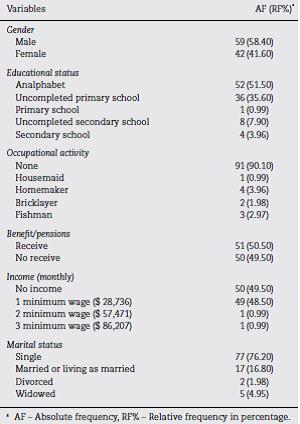
<body><![CDATA[<P>The mean age of patients was 42.18±12.01-years-old, median of 42 years. Table  1 describes the distribution of other important socio-demographic  parameters.</P>     <p>&nbsp;</p>     <p><B><a name="t1"></a><a href="#topt1">Table 1</a>&nbsp;Sociodemographics data of patients attended at CAPS valter Correia (n=101)</B></p>     <p><img src="/img/revistas/rpsp/v30n1/30n1a07t1.jpg"></p>     
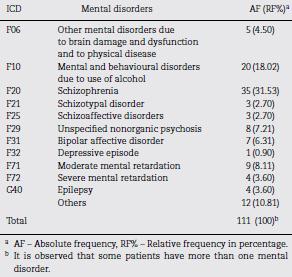
<p>&nbsp;</p>     <P>Schizophrenia was the most prevalent mental disorder (31.53%). The mental  disorder profile presented by the patients attended on the CAPS, according with  the international classification of mental and behavioral disorders  (ICD-10)<SUP>22</SUP> is described in Table 2.</P>     <p>&nbsp;</p>     <p><B><a name="t2"></a><a href="#topt2">Table 2</a>&nbsp;Mental disorders diagnosed at CAPS patients according to ICD-10 (n=101)</B></p>     <p><img src="/img/revistas/rpsp/v30n1/30n1a07t2.jpg"></p>     
<p>&nbsp;</p>     ]]></body>
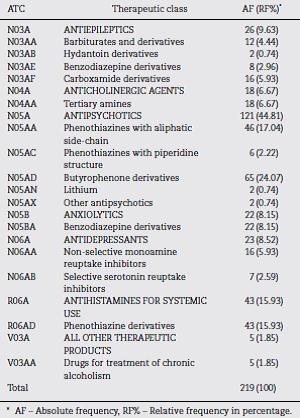
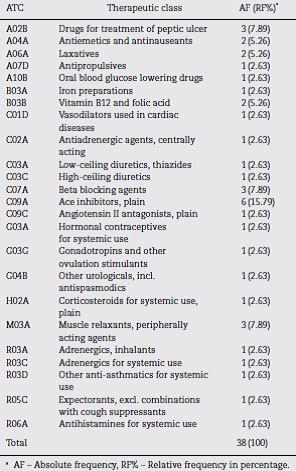
<body><![CDATA[<P>Some patients presented other diseases associated to mental disorders, such  as arterial hypertension (18.81%), diabetes mellitus (10.9%), gastritis (10.9%),  asthma (4.0%), others heart problems (7.9%) and hypothyroidism (2.2%).</P>     <P>Regarding to the pharmacotherapeutic profile, Table 3 exhibits the  therapeutic classes of psychiatric drugs used by patients attended at CAPS.  Table 4 describes the therapeutic classes of non-psychiatric drugs used by  patients attended at CAPS, according to the WHO-ATC/DDD methodology. The  psychiatric drug class most frequently prescribed was antipsychotics (44.8%) and  the non-psychiatric drug class most prevalent was angiotensin-converting enzyme  inhibitors (15.8%).</P>     <p>&nbsp;</p>     <p><B><a name="t3"></a><a href="#topt3">Table 3</a>&nbsp;Therapeutic classes of psychotropic drugs used by patients attended at CAPS Valter Correia, according to  ATC classification</B></p>     <p><img src="/img/revistas/rpsp/v30n1/30n1a07t3.jpg"></p>      
<p>&nbsp;</p>     <p><B><a name="t4"></a><a href="#topt4">Table 4</a>&nbsp;Therapeutic classes of non-psychotropic drugs used by patients attended at CAPS Valter Correia, according  to ATC classification</B></p>     <p><img src="/img/revistas/rpsp/v30n1/30n1a07t4.jpg"></p>     
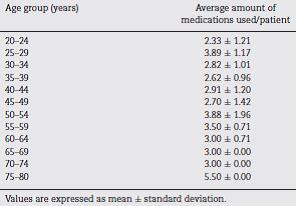
<p>&nbsp;</p>     <P>The average number of medications (psychotropic and non-psychotropic) used by  patients was 3.11±1.41 medications/patients, median 3 (Table 5).</P>     ]]></body>
<body><![CDATA[<p>&nbsp;</p>     <p><B><a name="t5"></a><a href="#topt5">Table 5</a>&nbsp;Mean number of medications (psychotropic and non-psychotropic) used by patients attended at CAPS Valter  Correia, according to the age group</B></p>     <p><img src="/img/revistas/rpsp/v30n1/30n1a07t5.jpg"></p>     
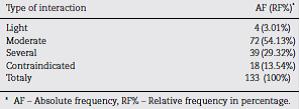
<p>&nbsp;</p>     <P>Table 6 shows the percentage of drug interactions presented by pacients of  the CAPS, according to the degree of severity.</P>     <p>&nbsp;</p>     <p><B><a name="t6"></a><a href="#topt6">Table 6</a>&nbsp;Drug interactions (drug-drug) presented by patients attended at CAPS Valter Correia, classified by degree  d severity</B></p>     <p><img src="/img/revistas/rpsp/v30n1/30n1a07t6.jpg"></p>     
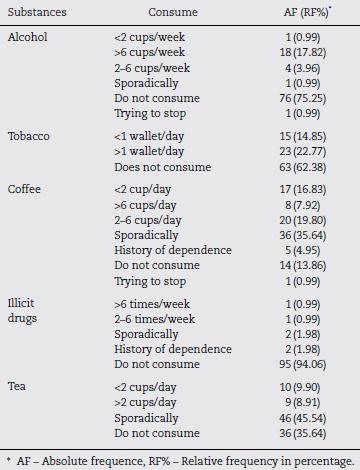
<p>&nbsp;</p>     <P>With respect to consumption of others substances, it is observed in Table 7  the profile of use alcohol, tobacco, illicit drugs and teas.</P>     ]]></body>
<body><![CDATA[<p>&nbsp;</p>     <p><B><a name="t7"></a><a href="#topt7">Table 7</a>&nbsp;Consume of alcohol, tobacco, coffee, illicit drugs and tea by patients attended at CAPS Valter  Correia</B></p>     <p><img src="/img/revistas/rpsp/v30n1/30n1a07t7.jpg"></p>     
<p>&nbsp;</p>     <P><B>Discussion</B></P>     <P>The CAPS is an open and community service of mental health on the unified  health system (SUS) in Brazil. Its main objective is to establish a reference  place to treatment for people with mental disorders, who need an intensive care  related to their severity and/or persistence demand.<SUP>5</SUP></P>     <P>101 registered patients at CAPS ‘Valter Correia’ were distributed in  intensive (13.86%), semi-intensive (52.48%) and non-intensive (33.66%) regime.  The average age of patients was 42.18±12.01 years. These results were in  concordance by other studies, which claim that mental disorders affect people of  all ages, with the prevalence on 30–49 years.<SUP>24</SUP><SUP>,  </SUP><SUP>25</SUP> The presence of mental disorder at this age group influences  the way of life, interrupting productivity as a result of disability caused by  disease.<SUP>24</SUP></P>     <P>It is observed in <a href="#t1">Table 1</a><a name="topt1"></a> that the CAPS consisted mainly of male patients  (58.50%), which differs from others studies that indicate the prevalence of  females.<SUP>24</SUP><SUP>, </SUP><SUP>26</SUP></P>     <P>Most patients were single (76.20%), childless (54.50%), illiterate (51.50%),  without occupation (90.10%), without benefits (49.50%) and without monthly  income (49.50%). These results suggest that the presence of mental disorder can  influence the cultural background of people and the chance to attend school is  low, which can make it difficult to enter at university and gain a good job.  According to OMS (2001)<SUP>2</SUP>, five from ten causes of inability on the  world are mental disorder.</P>     <P>Regarding to the nosological profiles, <a href="#t2">Table 2</a><a name="topt2"></a> reveals that there are  patients with more than one type of mental disorder and that schizophrenia is  the most prevalent mental disorder (31.53%).</P>     ]]></body>
<body><![CDATA[<P>Schizophrenia is one of the most serious neuropsychiatric diseases and  affects about 1% of world population. Currently, there is no specific prevention  for this disease. Neuroleptic or antipsychotic drugs are used as the primary  treatment for all stages of the disease.<SUP>27</SUP></P>     <P>Depressive episodes are common mental disorders on Brazilian  population,<SUP>28</SUP><SUP>, </SUP><SUP>29</SUP><SUP>,  </SUP><SUP>30</SUP><SUP>, </SUP><SUP>31</SUP> but we found in only 0.90% of our  CAPS patients. This difference should be caused due to the introduction of a new  model of psychiatric care, which is still suffering transition in Brazil. Part  of the population, who suffers from mood and anxiety disorders, is probably  under-diagnozed. Another part, even receiving the correct medical diagnosis,  chooses to receive ambulatory treatment without resort to the CAPS, which could  be in consequence of stigmas fear.</P>     <P>Consumption of alcohol and others drugs is an important cause of disorder.  Mental behavioral disorders due the consumption of alcohol were found in 18.02%,  due the consumption of multiple drugs and others psychoactive substances in  0.90% and due to the use of cocaine in 0.90%. Those patients should be indicated  for an AD type of CAPS.</P>     <P>The psychiatric drug class most frequently prescribed was antipsychotics  (44.8%), described in <a href="#t3">Table 3</a><a name="topt3"></a>. Angiotensin-converting enzyme inhibitors (ACEI)  were the most prevalent non-psychiatric drug class (15.8%) (<a href="#t4">Table 4</a><a name="topt4"></a>). Those  results are in consistence with the most prevalent diseases, schizophrenia for  antipsychotics and hypertension for ACEI medications.</P>     <P>There is currently a very large number of antipsychotic medications, with  different profile of side effects, but with similar potency when use in  equivalent doses. However, there are individual differences on efficacy,  tolerance and cost. Particular context should be used to choose the adequate  drug.</P>     <P>The average number of medications used by patients was 3.11±1.41  medications/patients. The largest consumption of medications was found in the  75–80 years group, 5.5 medications for patient (<a href="#t5">Table 5</a><a name="topt5"></a>). These data are in with  the literature. Elderly population is marked by a higher frequency of chronic  degenerative diseases. It has greater demand for health services and medication,  which predisposes the geriatric population to great risks with the practice of  polypharmacy and adverse effects of medications.<SUP>32</SUP></P>     <P>In regard to drug interactions,<SUP>33</SUP><SUP>, </SUP><SUP>34</SUP><SUP>,  </SUP><SUP>35</SUP> 3.0% mild, 54.1% moderate, 29.3% severe and 13.5%  contraindicated (<a href="#t6">Table 6</a><a name="topt6"></a>). Those results demonstrate the need to evaluate  possible interventions, since drug interactions may, among other things,  increase undesired medications effects, lead to ineffective therapy and endanger  the life of patient.<SUP>36</SUP><SUP>, </SUP><SUP>37</SUP><SUP>,  </SUP><SUP>38</SUP><SUP>, </SUP><SUP>39</SUP></P>     <P>It is observed in <a href="#t7">Table 7</a><a name="topt7"></a> that 24.75% of patients consumed alcohol, 37.62%  tobacco, 86.14% caffeine, 5.94% illicit drugs and 64.36% tea. It is necessary a  further detailed study, since these substances can interact with several  medications.</P>     <P>The medications have an important role in the health system, they can save  lives or remove the signs and symptoms of numerous diseases.<SUP>40</SUP>  However, the drugs may increase the costs of health care if used  improperly.<SUP>41</SUP> According to WHO data, hospitals spend 15%–20% of their  budgets to deal with the complications caused by misuse of  medications.<SUP>42</SUP></P>     <P>In this context, pharmacists are professionals who can actively participate  in the multidisciplinary team, make the management of pharmacotherapy, assess  the use of medications, provide guidelines and perform pharmacotherapeutic  monitoring of patients, which contribute to the rational use of medications and  improve the quality of life of patients.<SUP>43</SUP></P>     ]]></body>
<body><![CDATA[<p>&nbsp;</p>     <P><B>Conclusion</B></P>     <P>Our results revealed the need for monitoring the pharmacotherapy of patients  with mental and behavioral disorders to encourage the rational use of  medications. This monitoring is necessary, since these patients are  polymedicated, have other comorbidities, and use drugs that cause adverse  effects, which compromise the adherence of treatment and consequently their  quality of life.</P>     <p>&nbsp;</p>     <P><B>Bibliografía</B></P>     <!-- ref --><P>1. Alves DSN. Reestruturação da atenção em saúde mental: situação atual:  diretrizes e estratégias. En: Amarante P., editors. Psiquiatria social e reforma  psiquiátrica. Rio de Janeiro: Fiocruz; 1994. 197–204.    &nbsp;&nbsp;&nbsp;&nbsp;&nbsp;&nbsp;&nbsp;&nbsp;[&#160;<a href="javascript:void(0);" onclick="javascript: window.open('/scielo.php?script=sci_nlinks&ref=000098&pid=S0870-9025201200010000700001&lng=','','width=640,height=500,resizable=yes,scrollbars=1,menubar=yes,');">Links</a>&#160;]<!-- end-ref --> </P>     <!-- ref --><P>2. Organização Pan–Americana de Saúde. Organização Mundial da Saúde.  Relatório sobre a saúde no mundo de 2001: Saúde mental: nova concepção, nova  esperança. Geneva: OPAS; 2001.    &nbsp;&nbsp;&nbsp;&nbsp;&nbsp;&nbsp;&nbsp;&nbsp;[&#160;<a href="javascript:void(0);" onclick="javascript: window.open('/scielo.php?script=sci_nlinks&ref=000100&pid=S0870-9025201200010000700002&lng=','','width=640,height=500,resizable=yes,scrollbars=1,menubar=yes,');">Links</a>&#160;]<!-- end-ref --> </P>     <!-- ref --><P>3. Pinheiro KAT, Horta BL, Pinheiro RT, Horta LL, Terres NG, Silva RA. Common  mental disorders in adolescents: a population based cross–sectional study. Rev  Bras Psiquiatr. 2007; 29:241–5.    &nbsp;&nbsp;&nbsp;&nbsp;&nbsp;&nbsp;&nbsp;&nbsp;[&#160;<a href="javascript:void(0);" onclick="javascript: window.open('/scielo.php?script=sci_nlinks&ref=000102&pid=S0870-9025201200010000700003&lng=','','width=640,height=500,resizable=yes,scrollbars=1,menubar=yes,');">Links</a>&#160;]<!-- end-ref --> </P>     <!-- ref --><P>4. Lima MCP, Menezes PR, Carandina L, Cesar CLG, Barros MBA, Goldbaum M.  Transtornos mentais comuns e uso de psicofármacos: impacto das condições  socioeconômicas. Rev Saúde Pública. 2008; 42:717–23.    &nbsp;&nbsp;&nbsp;&nbsp;&nbsp;&nbsp;&nbsp;&nbsp;[&#160;<a href="javascript:void(0);" onclick="javascript: window.open('/scielo.php?script=sci_nlinks&ref=000104&pid=S0870-9025201200010000700004&lng=','','width=640,height=500,resizable=yes,scrollbars=1,menubar=yes,');">Links</a>&#160;]<!-- end-ref --> </P>     <!-- ref --><P>5. Ministério da Saúde. Minuta Portaria NAPS/CAPS, de 02 de December de 1999,  Brasília, DF: Ministério da Saúde; 1999.    &nbsp;&nbsp;&nbsp;&nbsp;&nbsp;&nbsp;&nbsp;&nbsp;[&#160;<a href="javascript:void(0);" onclick="javascript: window.open('/scielo.php?script=sci_nlinks&ref=000106&pid=S0870-9025201200010000700005&lng=','','width=640,height=500,resizable=yes,scrollbars=1,menubar=yes,');">Links</a>&#160;]<!-- end-ref --> </P>     <!-- ref --><P>6. Tavares M, Takeda S. Organização de Serviços de Atenção Primária de Saúde.  En: Ducan B.B., Schmidt M.I., Pankow J.S., editors. Medicina ambulatorial:  condutas clinicas em atenção primaria. 2nd ed. Porto Alegre: Artes Médicas;  1996. 2229.    &nbsp;&nbsp;&nbsp;&nbsp;&nbsp;&nbsp;&nbsp;&nbsp;[&#160;<a href="javascript:void(0);" onclick="javascript: window.open('/scielo.php?script=sci_nlinks&ref=000108&pid=S0870-9025201200010000700006&lng=','','width=640,height=500,resizable=yes,scrollbars=1,menubar=yes,');">Links</a>&#160;]<!-- end-ref --> </P>     <!-- ref --><P>7. Lara DR, Abreu PB. Esquizofrenia. En: Kapczinski F., Quevedo J., Izquierdo  I., editors. Bases biológicas dos transtornos psiquiátricos. Porto Alegre:  Artmed; 2000. 109–17.    &nbsp;&nbsp;&nbsp;&nbsp;&nbsp;&nbsp;&nbsp;&nbsp;[&#160;<a href="javascript:void(0);" onclick="javascript: window.open('/scielo.php?script=sci_nlinks&ref=000110&pid=S0870-9025201200010000700007&lng=','','width=640,height=500,resizable=yes,scrollbars=1,menubar=yes,');">Links</a>&#160;]<!-- end-ref --> </P>     <!-- ref --><P>8. Bates DW, Cullen DJ, Laird N, Petersen LA, Small SD, Servi D, et–al.  Incidence of adverse drug events and potential adverse drug events. JAMA. 1995;  274:29–34.    &nbsp;&nbsp;&nbsp;&nbsp;&nbsp;&nbsp;&nbsp;&nbsp;[&#160;<a href="javascript:void(0);" onclick="javascript: window.open('/scielo.php?script=sci_nlinks&ref=000112&pid=S0870-9025201200010000700008&lng=','','width=640,height=500,resizable=yes,scrollbars=1,menubar=yes,');">Links</a>&#160;]<!-- end-ref --> </P>     <!-- ref --><P>9. Hepler CD, Strand LM. Opportunities and responsibilities in pharmaceutical  care. Am J Hosp Pharm. 1990; 47:533–43.    &nbsp;&nbsp;&nbsp;&nbsp;&nbsp;&nbsp;&nbsp;&nbsp;[&#160;<a href="javascript:void(0);" onclick="javascript: window.open('/scielo.php?script=sci_nlinks&ref=000114&pid=S0870-9025201200010000700009&lng=','','width=640,height=500,resizable=yes,scrollbars=1,menubar=yes,');">Links</a>&#160;]<!-- end-ref --> </P>     <!-- ref --><P>10. Ernst FR, Grizzle AJ. Drug–related morbidity and mortality: updating the  cost–of–illness model. J Am Pharm Assoc (Wash). 2001; 41:192–9.    &nbsp;&nbsp;&nbsp;&nbsp;&nbsp;&nbsp;&nbsp;&nbsp;[&#160;<a href="javascript:void(0);" onclick="javascript: window.open('/scielo.php?script=sci_nlinks&ref=000116&pid=S0870-9025201200010000700010&lng=','','width=640,height=500,resizable=yes,scrollbars=1,menubar=yes,');">Links</a>&#160;]<!-- end-ref --> </P>     <!-- ref --><P>11. Hafner JWJR, Belknap SM, Squillante MD, Bucheit KA. Adverse drug events  in emergency department patients. Ann Emerg Med. 2002; 39:258–67.    &nbsp;&nbsp;&nbsp;&nbsp;&nbsp;&nbsp;&nbsp;&nbsp;[&#160;<a href="javascript:void(0);" onclick="javascript: window.open('/scielo.php?script=sci_nlinks&ref=000118&pid=S0870-9025201200010000700011&lng=','','width=640,height=500,resizable=yes,scrollbars=1,menubar=yes,');">Links</a>&#160;]<!-- end-ref --> </P>     <!-- ref --><P>12. Morris CJ, Cantrill JA, Hepler CDP. Preventing drug related morbidity:  determining valid indicators. Int J Qual Health Care. 2002; 14:183–98.    &nbsp;&nbsp;&nbsp;&nbsp;&nbsp;&nbsp;&nbsp;&nbsp;[&#160;<a href="javascript:void(0);" onclick="javascript: window.open('/scielo.php?script=sci_nlinks&ref=000120&pid=S0870-9025201200010000700012&lng=','','width=640,height=500,resizable=yes,scrollbars=1,menubar=yes,');">Links</a>&#160;]<!-- end-ref --> </P>     <!-- ref --><P>13. Dall’Agnol RSA. Identificação e quantificação dos problemas relacionados  com medicamentos em pacientes que buscam atendimento no serviço de emergência do  HCPA. Porto Alegre: Universidade Federal do Rio Grande do Sul. Faculdade de  Farmácia; 2004. Dissertação de Mestrado em Ciências Farmacêuticas.    &nbsp;&nbsp;&nbsp;&nbsp;&nbsp;&nbsp;&nbsp;&nbsp;[&#160;<a href="javascript:void(0);" onclick="javascript: window.open('/scielo.php?script=sci_nlinks&ref=000122&pid=S0870-9025201200010000700013&lng=','','width=640,height=500,resizable=yes,scrollbars=1,menubar=yes,');">Links</a>&#160;]<!-- end-ref --> </P>     <!-- ref --><P>14. Spina E, Santoro V, D’Arrigo C. Clinically relevant pharmacokinetic drug  interactions with second–generation antidepressants: an update. Clin Ther. 2008;  30:1206–27.    &nbsp;&nbsp;&nbsp;&nbsp;&nbsp;&nbsp;&nbsp;&nbsp;[&#160;<a href="javascript:void(0);" onclick="javascript: window.open('/scielo.php?script=sci_nlinks&ref=000124&pid=S0870-9025201200010000700014&lng=','','width=640,height=500,resizable=yes,scrollbars=1,menubar=yes,');">Links</a>&#160;]<!-- end-ref --> </P>     <!-- ref --><P>15. Villa TCS, Brunello MEF, Arcêncio RA, Sassaki CM, Assis EG, Gonzalez RIC.  Fatores preditivos aos resultados desfavoráveis no tratamento da tuberculose:  revisão integrativa da literatura (2001–2005). Online Brazilian Journal of  Nursing. Special number for undergraduate researches [Internet]. 2008 Spring  [access 27 April 2011]. Available at: <A href="http://www.objnursing.uff.br/index.php/nursing/issue/view/12" target="_blank">www.objnursing.uff.br/index.php/nursing/issue/view/12</A>.    &nbsp;&nbsp;&nbsp;&nbsp;&nbsp;&nbsp;&nbsp;&nbsp;[&#160;<a href="javascript:void(0);" onclick="javascript: window.open('/scielo.php?script=sci_nlinks&ref=000126&pid=S0870-9025201200010000700015&lng=','','width=640,height=500,resizable=yes,scrollbars=1,menubar=yes,');">Links</a>&#160;]<!-- end-ref --></P>     <!-- ref --><P>16. Laporte JR, Tognoni G. Principios de epidemiología del medicamento. 2nd  ed. Barcelona: Masson–Salvat; 1993.    &nbsp;&nbsp;&nbsp;&nbsp;&nbsp;&nbsp;&nbsp;&nbsp;[&#160;<a href="javascript:void(0);" onclick="javascript: window.open('/scielo.php?script=sci_nlinks&ref=000128&pid=S0870-9025201200010000700016&lng=','','width=640,height=500,resizable=yes,scrollbars=1,menubar=yes,');">Links</a>&#160;]<!-- end-ref --> </P>     <!-- ref --><P>17. Leite SN, Vieira M, Veber AP. Estudos de utilização de medicamentos: uma  síntese de artigos publicados no Brasil e América Latina. Ciênc Saúde Coletiva.  2008; 13:793–802.    &nbsp;&nbsp;&nbsp;&nbsp;&nbsp;&nbsp;&nbsp;&nbsp;[&#160;<a href="javascript:void(0);" onclick="javascript: window.open('/scielo.php?script=sci_nlinks&ref=000130&pid=S0870-9025201200010000700017&lng=','','width=640,height=500,resizable=yes,scrollbars=1,menubar=yes,');">Links</a>&#160;]<!-- end-ref --> </P>     <!-- ref --><P>18. Brook O, Hout H, Nieuwenhuyse H, Heerdink E. Impact of coaching by  community pharmacists on drug attitude of depressive primary care patients and  acceptability to patients: a randomized controlled trial. Eur  Neuropsychopharmacol. 2003; 13:1–9.    &nbsp;&nbsp;&nbsp;&nbsp;&nbsp;&nbsp;&nbsp;&nbsp;[&#160;<a href="javascript:void(0);" onclick="javascript: window.open('/scielo.php?script=sci_nlinks&ref=000132&pid=S0870-9025201200010000700018&lng=','','width=640,height=500,resizable=yes,scrollbars=1,menubar=yes,');">Links</a>&#160;]<!-- end-ref --> </P>     <!-- ref --><P>19. Granados FM, Yangüas EP. Criterios de optimización de la terapia  antipsicótica: margen terapéutico. Farm Hosp. 2004; 28:214–24.    &nbsp;&nbsp;&nbsp;&nbsp;&nbsp;&nbsp;&nbsp;&nbsp;[&#160;<a href="javascript:void(0);" onclick="javascript: window.open('/scielo.php?script=sci_nlinks&ref=000134&pid=S0870-9025201200010000700019&lng=','','width=640,height=500,resizable=yes,scrollbars=1,menubar=yes,');">Links</a>&#160;]<!-- end-ref --> </P>     <!-- ref --><P>20. Costa LF, Sousa LG, Oliveira AM, Fonseca CA. Atenção farmacêutica para  portadores de cuidados especiais. REF. 2006; 3:19–21.    &nbsp;&nbsp;&nbsp;&nbsp;&nbsp;&nbsp;&nbsp;&nbsp;[&#160;<a href="javascript:void(0);" onclick="javascript: window.open('/scielo.php?script=sci_nlinks&ref=000136&pid=S0870-9025201200010000700020&lng=','','width=640,height=500,resizable=yes,scrollbars=1,menubar=yes,');">Links</a>&#160;]<!-- end-ref --> </P>     <!-- ref --><P>21. Ministério da Saúde. Portaria 336/GM, de 19 de February de 2002,  Brasília, DF: O Ministério; 2002.    &nbsp;&nbsp;&nbsp;&nbsp;&nbsp;&nbsp;&nbsp;&nbsp;[&#160;<a href="javascript:void(0);" onclick="javascript: window.open('/scielo.php?script=sci_nlinks&ref=000138&pid=S0870-9025201200010000700021&lng=','','width=640,height=500,resizable=yes,scrollbars=1,menubar=yes,');">Links</a>&#160;]<!-- end-ref --> </P>     <!-- ref --><P>22. World Health Organization. The ICD–10 Classification of Mental and  Behavioural Disorders: diagnostic criteria for research. Geneva: WHO; 1993.    &nbsp;&nbsp;&nbsp;&nbsp;&nbsp;&nbsp;&nbsp;&nbsp;[&#160;<a href="javascript:void(0);" onclick="javascript: window.open('/scielo.php?script=sci_nlinks&ref=000140&pid=S0870-9025201200010000700022&lng=','','width=640,height=500,resizable=yes,scrollbars=1,menubar=yes,');">Links</a>&#160;]<!-- end-ref --> </P>     <!-- ref --><P>23. World Health Organization. The Anatomical Therapeutic Chemical (ATC)  classification system and the Defined Daily Dose (DDD) [access: 10 February  2012]. Available at: <A href="http://www.whocc.no/atc_ddd_index/" target="_blank">www.whocc.no/atc_ddd_index/</A>.    &nbsp;&nbsp;&nbsp;&nbsp;&nbsp;&nbsp;&nbsp;&nbsp;[&#160;<a href="javascript:void(0);" onclick="javascript: window.open('/scielo.php?script=sci_nlinks&ref=000142&pid=S0870-9025201200010000700023&lng=','','width=640,height=500,resizable=yes,scrollbars=1,menubar=yes,');">Links</a>&#160;]<!-- end-ref --></P>     <!-- ref --><P>24. Machado VMMC. Atuação do enfermeiro junto aos usuários do centro de  atenção psicossocial CAPS geral na cidade de Sobral – CE. Ceará: Universidade  Estadual Vale do Acaraú (UVA); 2006. Monografia de Especializacão em Saúde  Mental.    &nbsp;&nbsp;&nbsp;&nbsp;&nbsp;&nbsp;&nbsp;&nbsp;[&#160;<a href="javascript:void(0);" onclick="javascript: window.open('/scielo.php?script=sci_nlinks&ref=000144&pid=S0870-9025201200010000700024&lng=','','width=640,height=500,resizable=yes,scrollbars=1,menubar=yes,');">Links</a>&#160;]<!-- end-ref --> </P>     <!-- ref --><P>25. Cardoso L, Galera SAF. Doentes mentais e seu perfil de adesão ao  tratamento psicofarmacológico. Rev Esc Enferm USP. 2009; 43:61–7.    &nbsp;&nbsp;&nbsp;&nbsp;&nbsp;&nbsp;&nbsp;&nbsp;[&#160;<a href="javascript:void(0);" onclick="javascript: window.open('/scielo.php?script=sci_nlinks&ref=000146&pid=S0870-9025201200010000700025&lng=','','width=640,height=500,resizable=yes,scrollbars=1,menubar=yes,');">Links</a>&#160;]<!-- end-ref --> </P>     <!-- ref --><P>26. Pelisoli CL, Moreira AK. Caracterização epidemiológica dos usuários do  Centro de Atenção Psicossocial Casa Aberta. Rev Psiquiatr Rio Gd Sul. 2005;  27:270–7.    &nbsp;&nbsp;&nbsp;&nbsp;&nbsp;&nbsp;&nbsp;&nbsp;[&#160;<a href="javascript:void(0);" onclick="javascript: window.open('/scielo.php?script=sci_nlinks&ref=000148&pid=S0870-9025201200010000700026&lng=','','width=640,height=500,resizable=yes,scrollbars=1,menubar=yes,');">Links</a>&#160;]<!-- end-ref --> </P>     <!-- ref --><P>27. Pádua AC, Gama CS, Lobato MI, Abreu PB. Esquizofrenia: diretrizes e  algoritmo para o tratamento farmacológico. En: Cordiolo A.V., et–al, editors.  Psicofármacos: consulta rápida. Porto Alegre: Artmed; 2005. p. 343.    &nbsp;&nbsp;&nbsp;&nbsp;&nbsp;&nbsp;&nbsp;&nbsp;[&#160;<a href="javascript:void(0);" onclick="javascript: window.open('/scielo.php?script=sci_nlinks&ref=000150&pid=S0870-9025201200010000700027&lng=','','width=640,height=500,resizable=yes,scrollbars=1,menubar=yes,');">Links</a>&#160;]<!-- end-ref --> </P>     <!-- ref --><P>28. Regier DA, Narrow WE, Rae DS. The de facto US mental and addictive  disorders service system: epidemiologic catchment area prospective 1 year  prevalence rates of disorders and services. Arch Gen Psychiatry. 1993; 50:85–94.    &nbsp;&nbsp;&nbsp;&nbsp;&nbsp;&nbsp;&nbsp;&nbsp;[&#160;<a href="javascript:void(0);" onclick="javascript: window.open('/scielo.php?script=sci_nlinks&ref=000152&pid=S0870-9025201200010000700028&lng=','','width=640,height=500,resizable=yes,scrollbars=1,menubar=yes,');">Links</a>&#160;]<!-- end-ref -->  </P>     <!-- ref --><P>29. Kessler RC, Mcgonagle KA, Zhao S, Nelson CB, Hughes M, Eshleman S, et–al.  Lifetime and 12–month prevalence of DSM–IIIR psychiatric disorders in the United  States. Arch Gen Psychiatry. 1994; 51:8–19.    &nbsp;&nbsp;&nbsp;&nbsp;&nbsp;&nbsp;&nbsp;&nbsp;[&#160;<a href="javascript:void(0);" onclick="javascript: window.open('/scielo.php?script=sci_nlinks&ref=000154&pid=S0870-9025201200010000700029&lng=','','width=640,height=500,resizable=yes,scrollbars=1,menubar=yes,');">Links</a>&#160;]<!-- end-ref --> </P>     <!-- ref --><P>30. Jenkins R, Lewis G, Bebbington P, Brugha T, Farrell M, Gill B, et–al. The  National Psychiatric Morbidity Survey of Great Britain: initial findings from  the household surveys. Psychol Med. 1997; 27:775–89.    &nbsp;&nbsp;&nbsp;&nbsp;&nbsp;&nbsp;&nbsp;&nbsp;[&#160;<a href="javascript:void(0);" onclick="javascript: window.open('/scielo.php?script=sci_nlinks&ref=000156&pid=S0870-9025201200010000700030&lng=','','width=640,height=500,resizable=yes,scrollbars=1,menubar=yes,');">Links</a>&#160;]<!-- end-ref --> </P>     <!-- ref --><P>31. Anderson IM. Selective serotonin reuptake inhibitors versus tricyclic  antidepressants: a metaanalysis of efficacy and tolerability. J Affect Disord.  2000; 58:19–36.    &nbsp;&nbsp;&nbsp;&nbsp;&nbsp;&nbsp;&nbsp;&nbsp;[&#160;<a href="javascript:void(0);" onclick="javascript: window.open('/scielo.php?script=sci_nlinks&ref=000158&pid=S0870-9025201200010000700031&lng=','','width=640,height=500,resizable=yes,scrollbars=1,menubar=yes,');">Links</a>&#160;]<!-- end-ref --> </P>     <!-- ref --><P>32. Anderson GM, Beers MH, Kerluke K. Auditing prescription practice using  explicit criteria and computerized drug benefit claims data. J Eval Clin Pract.  1997; 3:283–94.    &nbsp;&nbsp;&nbsp;&nbsp;&nbsp;&nbsp;&nbsp;&nbsp;[&#160;<a href="javascript:void(0);" onclick="javascript: window.open('/scielo.php?script=sci_nlinks&ref=000160&pid=S0870-9025201200010000700032&lng=','','width=640,height=500,resizable=yes,scrollbars=1,menubar=yes,');">Links</a>&#160;]<!-- end-ref --> </P>     <!-- ref --><P>33. Baxter K. Stockley's drug interactions. Chicago: Editora Pharmaceutical  Press; 2009.    &nbsp;&nbsp;&nbsp;&nbsp;&nbsp;&nbsp;&nbsp;&nbsp;[&#160;<a href="javascript:void(0);" onclick="javascript: window.open('/scielo.php?script=sci_nlinks&ref=000162&pid=S0870-9025201200010000700033&lng=','','width=640,height=500,resizable=yes,scrollbars=1,menubar=yes,');">Links</a>&#160;]<!-- end-ref --> </P>     <!-- ref --><P>34. Lacy CF, Armstrong LL, Goldman MP, Lance LL. Medicamentos Lexi–Comp  Manole. São Paulo: Ed. brasileira. Manole; 2009.    &nbsp;&nbsp;&nbsp;&nbsp;&nbsp;&nbsp;&nbsp;&nbsp;[&#160;<a href="javascript:void(0);" onclick="javascript: window.open('/scielo.php?script=sci_nlinks&ref=000164&pid=S0870-9025201200010000700034&lng=','','width=640,height=500,resizable=yes,scrollbars=1,menubar=yes,');">Links</a>&#160;]<!-- end-ref --> </P>     <!-- ref --><P>35. Thomson Reuters Healthcare. Find drug interactions [homepage na  Internet]. New York, NY: Micromedex Healthcare Series; 2012 [access 10 Jun  2010]. Available at: <A href="http://newmdx.csis.com.tw/home/dispatch" target="_blank">newmdx.csis.com.tw/home/dispatch</A>.    &nbsp;&nbsp;&nbsp;&nbsp;&nbsp;&nbsp;&nbsp;&nbsp;[&#160;<a href="javascript:void(0);" onclick="javascript: window.open('/scielo.php?script=sci_nlinks&ref=000166&pid=S0870-9025201200010000700035&lng=','','width=640,height=500,resizable=yes,scrollbars=1,menubar=yes,');">Links</a>&#160;]<!-- end-ref --></P>     <!-- ref --><P>36. Campos ERC, Bardina NB, Veja MA, Lee BF. Interacciones medicamentosas:  errores en la medicacion. Rev Cuba Farm. 1990; 24:281–7.    &nbsp;&nbsp;&nbsp;&nbsp;&nbsp;&nbsp;&nbsp;&nbsp;[&#160;<a href="javascript:void(0);" onclick="javascript: window.open('/scielo.php?script=sci_nlinks&ref=000168&pid=S0870-9025201200010000700036&lng=','','width=640,height=500,resizable=yes,scrollbars=1,menubar=yes,');">Links</a>&#160;]<!-- end-ref --> </P>     <!-- ref --><P>37. Fonseca AL. Interações medicamentosas. Rio de Janeiro: EPUC; 1994.    &nbsp;&nbsp;&nbsp;&nbsp;&nbsp;&nbsp;&nbsp;&nbsp;[&#160;<a href="javascript:void(0);" onclick="javascript: window.open('/scielo.php?script=sci_nlinks&ref=000170&pid=S0870-9025201200010000700037&lng=','','width=640,height=500,resizable=yes,scrollbars=1,menubar=yes,');">Links</a>&#160;]<!-- end-ref --> </P>     <!-- ref --><P>38. Oga S, Basile AC. Medicamentos e suas interações. São Paulo: Atheneu;  1994.    &nbsp;&nbsp;&nbsp;&nbsp;&nbsp;&nbsp;&nbsp;&nbsp;[&#160;<a href="javascript:void(0);" onclick="javascript: window.open('/scielo.php?script=sci_nlinks&ref=000172&pid=S0870-9025201200010000700038&lng=','','width=640,height=500,resizable=yes,scrollbars=1,menubar=yes,');">Links</a>&#160;]<!-- end-ref --> </P>     <!-- ref --><P>39. Nies AS, Spielberg SE. Principles of therapeutics. En: Gilman's G.,  editors. The pharmacological basis of therapeutics. 9th ed. New York: Mc  Graw–Hill; 1996. 43–62.    &nbsp;&nbsp;&nbsp;&nbsp;&nbsp;&nbsp;&nbsp;&nbsp;[&#160;<a href="javascript:void(0);" onclick="javascript: window.open('/scielo.php?script=sci_nlinks&ref=000174&pid=S0870-9025201200010000700039&lng=','','width=640,height=500,resizable=yes,scrollbars=1,menubar=yes,');">Links</a>&#160;]<!-- end-ref --> </P>     <!-- ref --><P>40. Noelle L. Bioethics and 21st century: view point of the jurist. Presse  Med. 2002; 31:565–70.    &nbsp;&nbsp;&nbsp;&nbsp;&nbsp;&nbsp;&nbsp;&nbsp;[&#160;<a href="javascript:void(0);" onclick="javascript: window.open('/scielo.php?script=sci_nlinks&ref=000176&pid=S0870-9025201200010000700040&lng=','','width=640,height=500,resizable=yes,scrollbars=1,menubar=yes,');">Links</a>&#160;]<!-- end-ref --> </P>     <!-- ref --><P>41. Pepe VLE. Castro CGSO. A interação entre prescritores, dispensadores e  paciente: informação compartilhada como possível benefício terapêutico. Cad  Saúde Pública. 2000; 16:815–22.    &nbsp;&nbsp;&nbsp;&nbsp;&nbsp;&nbsp;&nbsp;&nbsp;[&#160;<a href="javascript:void(0);" onclick="javascript: window.open('/scielo.php?script=sci_nlinks&ref=000178&pid=S0870-9025201200010000700041&lng=','','width=640,height=500,resizable=yes,scrollbars=1,menubar=yes,');">Links</a>&#160;]<!-- end-ref --> </P>     <!-- ref --><P>42. Agencia Nacional de Vigilancia Sanitaria (Brasil). Parcerias para  diminuir o mau uso de medicamentos. Rev Saúde Pública. 2006; 40(1):191–4.    &nbsp;&nbsp;&nbsp;&nbsp;&nbsp;&nbsp;&nbsp;&nbsp;[&#160;<a href="javascript:void(0);" onclick="javascript: window.open('/scielo.php?script=sci_nlinks&ref=000180&pid=S0870-9025201200010000700042&lng=','','width=640,height=500,resizable=yes,scrollbars=1,menubar=yes,');">Links</a>&#160;]<!-- end-ref --> </P>     <!-- ref --><P>43. Dolder C, Symanski B, Wooton T, Mckinsey J. Pharmacist interventions in  an inpatient geriatric psychiatry unit. Am J Health Syst Pharm. 2008; 65:1795–6.    &nbsp;&nbsp;&nbsp;&nbsp;&nbsp;&nbsp;&nbsp;&nbsp;[&#160;<a href="javascript:void(0);" onclick="javascript: window.open('/scielo.php?script=sci_nlinks&ref=000182&pid=S0870-9025201200010000700043&lng=','','width=640,height=500,resizable=yes,scrollbars=1,menubar=yes,');">Links</a>&#160;]<!-- end-ref --> </P>     <p>&nbsp;</p>     <P><B>Acknowledgments</B></P>     <P>We would like to thank the Fundação de Apoio à Pesquisa e à Inovação  Tecnológica do Estado de Sergipe/FAPITEC-SE and National Council of  Technological and Scientific Development (Conselho Nacional de Desenvolvimento  Científico e Tecnológico/CNPq/Brazil) for the fellowship support.</P>     <p>&nbsp;</p>     <P><B>Conflicts of interest</B></P>     <P>The authors have no conflicts of interest to declare.</P>     <p>&nbsp;</p>     <P><I>Received 30 May 2011</I></P>     <P><I>Accepted 20 March 2012</I></P>     ]]></body>
<body><![CDATA[ ]]></body><back>
<ref-list>
<ref id="B1">
<label>1</label><nlm-citation citation-type="book">
<person-group person-group-type="author">
<name>
<surname><![CDATA[Alves]]></surname>
<given-names><![CDATA[DSN]]></given-names>
</name>
</person-group>
<article-title xml:lang="pt"><![CDATA[Reestruturação da atenção em saúde mental: situação atual: diretrizes e estratégias]]></article-title>
<person-group person-group-type="editor">
<name>
<surname><![CDATA[Amarante]]></surname>
<given-names><![CDATA[P]]></given-names>
</name>
</person-group>
<source><![CDATA[Psiquiatria social e reforma psiquiátrica]]></source>
<year>1994</year>
<page-range>197-204</page-range><publisher-loc><![CDATA[Rio de Janeiro ]]></publisher-loc>
<publisher-name><![CDATA[Fiocruz]]></publisher-name>
</nlm-citation>
</ref>
<ref id="B2">
<label>2</label><nlm-citation citation-type="book">
<collab>Organização Mundial da Saúde^dOrganização Pan-Americana de Saúde</collab>
<source><![CDATA[Relatório sobre a saúde no mundo de 2001: Saúde mental: nova concepção, nova esperança]]></source>
<year>2001</year>
<publisher-loc><![CDATA[Geneva ]]></publisher-loc>
<publisher-name><![CDATA[OPAS]]></publisher-name>
</nlm-citation>
</ref>
<ref id="B3">
<label>3</label><nlm-citation citation-type="journal">
<person-group person-group-type="author">
<name>
<surname><![CDATA[Pinheiro]]></surname>
<given-names><![CDATA[KAT]]></given-names>
</name>
<name>
<surname><![CDATA[Horta]]></surname>
<given-names><![CDATA[BL]]></given-names>
</name>
<name>
<surname><![CDATA[Pinheiro]]></surname>
<given-names><![CDATA[RT]]></given-names>
</name>
<name>
<surname><![CDATA[Horta]]></surname>
<given-names><![CDATA[LL]]></given-names>
</name>
<name>
<surname><![CDATA[Terres]]></surname>
<given-names><![CDATA[NG]]></given-names>
</name>
<name>
<surname><![CDATA[Silva]]></surname>
<given-names><![CDATA[RA]]></given-names>
</name>
</person-group>
<article-title xml:lang="en"><![CDATA[Common mental disorders in adolescents: a population based cross-sectional study]]></article-title>
<source><![CDATA[Rev Bras Psiquiatr]]></source>
<year>2007</year>
<volume>29</volume>
<page-range>241-5</page-range></nlm-citation>
</ref>
<ref id="B4">
<label>4</label><nlm-citation citation-type="journal">
<person-group person-group-type="author">
<name>
<surname><![CDATA[Lima]]></surname>
<given-names><![CDATA[MCP]]></given-names>
</name>
<name>
<surname><![CDATA[Menezes]]></surname>
<given-names><![CDATA[PR]]></given-names>
</name>
<name>
<surname><![CDATA[Carandina]]></surname>
<given-names><![CDATA[L]]></given-names>
</name>
<name>
<surname><![CDATA[Cesar]]></surname>
<given-names><![CDATA[CLG]]></given-names>
</name>
<name>
<surname><![CDATA[Barros]]></surname>
<given-names><![CDATA[MBA]]></given-names>
</name>
<name>
<surname><![CDATA[Goldbaum]]></surname>
<given-names><![CDATA[M]]></given-names>
</name>
</person-group>
<article-title xml:lang="pt"><![CDATA[Transtornos mentais comuns e uso de psicofármacos: impacto das condições socioeconômicas]]></article-title>
<source><![CDATA[Rev Saúde Pública]]></source>
<year>2008</year>
<volume>42</volume>
<page-range>717-23</page-range></nlm-citation>
</ref>
<ref id="B5">
<label>5</label><nlm-citation citation-type="book">
<collab>Ministério da Saúde</collab>
<source><![CDATA[Minuta Portaria NAPS/CAPS, de 02 de December de 1999]]></source>
<year>1999</year>
<publisher-loc><![CDATA[Brasília^eDF DF]]></publisher-loc>
<publisher-name><![CDATA[Ministério da Saúde]]></publisher-name>
</nlm-citation>
</ref>
<ref id="B6">
<label>6</label><nlm-citation citation-type="book">
<person-group person-group-type="author">
<name>
<surname><![CDATA[Tavares]]></surname>
<given-names><![CDATA[M]]></given-names>
</name>
<name>
<surname><![CDATA[Takeda]]></surname>
<given-names><![CDATA[S]]></given-names>
</name>
</person-group>
<article-title xml:lang="pt"><![CDATA[Organização de Serviços de Atenção Primária de Saúde]]></article-title>
<person-group person-group-type="editor">
<name>
<surname><![CDATA[Ducan]]></surname>
<given-names><![CDATA[B.B.]]></given-names>
</name>
<name>
<surname><![CDATA[Schmidt]]></surname>
<given-names><![CDATA[M.I.]]></given-names>
</name>
<name>
<surname><![CDATA[Pankow]]></surname>
<given-names><![CDATA[J.S.]]></given-names>
</name>
</person-group>
<source><![CDATA[Medicina ambulatorial: condutas clinicas em atenção primaria]]></source>
<year>1996</year>
<edition>2</edition>
<page-range>2229</page-range><publisher-loc><![CDATA[Porto Alegre ]]></publisher-loc>
<publisher-name><![CDATA[Artes Médicas]]></publisher-name>
</nlm-citation>
</ref>
<ref id="B7">
<label>7</label><nlm-citation citation-type="book">
<person-group person-group-type="author">
<name>
<surname><![CDATA[Lara]]></surname>
<given-names><![CDATA[DR]]></given-names>
</name>
<name>
<surname><![CDATA[Abreu]]></surname>
<given-names><![CDATA[PB]]></given-names>
</name>
</person-group>
<article-title xml:lang="pt"><![CDATA[Esquizofrenia]]></article-title>
<person-group person-group-type="editor">
<name>
<surname><![CDATA[Kapczinski]]></surname>
<given-names><![CDATA[F]]></given-names>
</name>
<name>
<surname><![CDATA[Quevedo]]></surname>
<given-names><![CDATA[J]]></given-names>
</name>
<name>
<surname><![CDATA[Izquierdo]]></surname>
<given-names><![CDATA[I]]></given-names>
</name>
</person-group>
<source><![CDATA[Bases biológicas dos transtornos psiquiátricos]]></source>
<year>2000</year>
<page-range>109-17</page-range><publisher-loc><![CDATA[Porto Alegre ]]></publisher-loc>
<publisher-name><![CDATA[Artmed]]></publisher-name>
</nlm-citation>
</ref>
<ref id="B8">
<label>8</label><nlm-citation citation-type="journal">
<person-group person-group-type="author">
<name>
<surname><![CDATA[Bates]]></surname>
<given-names><![CDATA[DW]]></given-names>
</name>
<name>
<surname><![CDATA[Cullen]]></surname>
<given-names><![CDATA[DJ]]></given-names>
</name>
<name>
<surname><![CDATA[Laird]]></surname>
<given-names><![CDATA[N]]></given-names>
</name>
<name>
<surname><![CDATA[Petersen]]></surname>
<given-names><![CDATA[LA]]></given-names>
</name>
<name>
<surname><![CDATA[Small]]></surname>
<given-names><![CDATA[SD]]></given-names>
</name>
<name>
<surname><![CDATA[Servi]]></surname>
<given-names><![CDATA[D]]></given-names>
</name>
</person-group>
<article-title xml:lang="en"><![CDATA[Incidence of adverse drug events and potential adverse drug events]]></article-title>
<source><![CDATA[JAMA]]></source>
<year>1995</year>
<volume>274</volume>
<page-range>29-34</page-range></nlm-citation>
</ref>
<ref id="B9">
<label>9</label><nlm-citation citation-type="journal">
<person-group person-group-type="author">
<name>
<surname><![CDATA[Hepler]]></surname>
<given-names><![CDATA[CD]]></given-names>
</name>
<name>
<surname><![CDATA[Strand]]></surname>
<given-names><![CDATA[LM]]></given-names>
</name>
</person-group>
<article-title xml:lang="en"><![CDATA[Opportunities and responsibilities in pharmaceutical care]]></article-title>
<source><![CDATA[Am J Hosp Pharm]]></source>
<year>1990</year>
<volume>47</volume>
<page-range>533-43</page-range></nlm-citation>
</ref>
<ref id="B10">
<label>10</label><nlm-citation citation-type="journal">
<person-group person-group-type="author">
<name>
<surname><![CDATA[Ernst]]></surname>
<given-names><![CDATA[FR]]></given-names>
</name>
<name>
<surname><![CDATA[Grizzle]]></surname>
<given-names><![CDATA[AJ]]></given-names>
</name>
</person-group>
<article-title xml:lang="en"><![CDATA[Drug-related morbidity and mortality: updating the cost-of-illness model]]></article-title>
<source><![CDATA[J Am Pharm Assoc (Wash)]]></source>
<year>2001</year>
<volume>41</volume>
<page-range>192-9</page-range></nlm-citation>
</ref>
<ref id="B11">
<label>11</label><nlm-citation citation-type="journal">
<person-group person-group-type="author">
<name>
<surname><![CDATA[Hafner]]></surname>
<given-names><![CDATA[JWJR]]></given-names>
</name>
<name>
<surname><![CDATA[Belknap]]></surname>
<given-names><![CDATA[SM]]></given-names>
</name>
<name>
<surname><![CDATA[Squillante]]></surname>
<given-names><![CDATA[MD]]></given-names>
</name>
<name>
<surname><![CDATA[Bucheit]]></surname>
<given-names><![CDATA[KA]]></given-names>
</name>
</person-group>
<article-title xml:lang="en"><![CDATA[Adverse drug events in emergency department patients]]></article-title>
<source><![CDATA[Ann Emerg Med]]></source>
<year>2002</year>
<volume>39</volume>
<page-range>258-67</page-range></nlm-citation>
</ref>
<ref id="B12">
<label>12</label><nlm-citation citation-type="journal">
<person-group person-group-type="author">
<name>
<surname><![CDATA[Morris]]></surname>
<given-names><![CDATA[CJ]]></given-names>
</name>
<name>
<surname><![CDATA[Cantrill]]></surname>
<given-names><![CDATA[JA]]></given-names>
</name>
<name>
<surname><![CDATA[Hepler]]></surname>
<given-names><![CDATA[CDP]]></given-names>
</name>
</person-group>
<article-title xml:lang="en"><![CDATA[Preventing drug related morbidity: determining valid indicators]]></article-title>
<source><![CDATA[Int J Qual Health Care]]></source>
<year>2002</year>
<volume>14</volume>
<page-range>183-98</page-range></nlm-citation>
</ref>
<ref id="B13">
<label>13</label><nlm-citation citation-type="">
<person-group person-group-type="author">
<name>
<surname><![CDATA[Dall’Agnol]]></surname>
<given-names><![CDATA[RSA]]></given-names>
</name>
</person-group>
<source><![CDATA[Identificação e quantificação dos problemas relacionados com medicamentos em pacientes que buscam atendimento no serviço de emergência do HCPA]]></source>
<year></year>
</nlm-citation>
</ref>
<ref id="B14">
<label>14</label><nlm-citation citation-type="journal">
<person-group person-group-type="author">
<name>
<surname><![CDATA[Spina]]></surname>
<given-names><![CDATA[E]]></given-names>
</name>
<name>
<surname><![CDATA[Santoro]]></surname>
<given-names><![CDATA[V]]></given-names>
</name>
<name>
<surname><![CDATA[D’Arrigo]]></surname>
<given-names><![CDATA[C]]></given-names>
</name>
</person-group>
<article-title xml:lang="en"><![CDATA[Clinically relevant pharmacokinetic drug interactions with second-generation antidepressants: an update]]></article-title>
<source><![CDATA[Clin Ther]]></source>
<year>2008</year>
<volume>30</volume>
<page-range>1206-27</page-range></nlm-citation>
</ref>
<ref id="B15">
<label>15</label><nlm-citation citation-type="journal">
<person-group person-group-type="author">
<name>
<surname><![CDATA[Villa]]></surname>
<given-names><![CDATA[TCS]]></given-names>
</name>
<name>
<surname><![CDATA[Brunello]]></surname>
<given-names><![CDATA[MEF]]></given-names>
</name>
<name>
<surname><![CDATA[Arcêncio]]></surname>
<given-names><![CDATA[RA]]></given-names>
</name>
<name>
<surname><![CDATA[Sassaki]]></surname>
<given-names><![CDATA[CM]]></given-names>
</name>
<name>
<surname><![CDATA[Assis]]></surname>
<given-names><![CDATA[EG]]></given-names>
</name>
<name>
<surname><![CDATA[Gonzalez]]></surname>
<given-names><![CDATA[RIC]]></given-names>
</name>
</person-group>
<article-title xml:lang="pt"><![CDATA[Fatores preditivos aos resultados desfavoráveis no tratamento da tuberculose: revisão integrativa da literatura (2001-2005)]]></article-title>
<source><![CDATA[Online Brazilian Journal of Nursing]]></source>
<year>2008</year>
</nlm-citation>
</ref>
<ref id="B16">
<label>16</label><nlm-citation citation-type="book">
<person-group person-group-type="author">
<name>
<surname><![CDATA[Laporte]]></surname>
<given-names><![CDATA[JR]]></given-names>
</name>
<name>
<surname><![CDATA[Tognoni]]></surname>
<given-names><![CDATA[G]]></given-names>
</name>
</person-group>
<source><![CDATA[Principios de epidemiología del medicamento]]></source>
<year>1993</year>
<edition>2</edition>
<publisher-loc><![CDATA[Barcelona ]]></publisher-loc>
<publisher-name><![CDATA[Masson-Salvat]]></publisher-name>
</nlm-citation>
</ref>
<ref id="B17">
<label>17</label><nlm-citation citation-type="journal">
<person-group person-group-type="author">
<name>
<surname><![CDATA[Leite]]></surname>
<given-names><![CDATA[SN]]></given-names>
</name>
<name>
<surname><![CDATA[Vieira]]></surname>
<given-names><![CDATA[M]]></given-names>
</name>
<name>
<surname><![CDATA[Veber]]></surname>
<given-names><![CDATA[AP]]></given-names>
</name>
</person-group>
<article-title xml:lang="pt"><![CDATA[Estudos de utilização de medicamentos: uma síntese de artigos publicados no Brasil e América Latina]]></article-title>
<source><![CDATA[Ciênc Saúde Coletiva]]></source>
<year>2008</year>
<volume>13</volume>
<page-range>793-802</page-range></nlm-citation>
</ref>
<ref id="B18">
<label>18</label><nlm-citation citation-type="journal">
<person-group person-group-type="author">
<name>
<surname><![CDATA[Brook]]></surname>
<given-names><![CDATA[O]]></given-names>
</name>
<name>
<surname><![CDATA[Hout]]></surname>
<given-names><![CDATA[H]]></given-names>
</name>
<name>
<surname><![CDATA[Nieuwenhuyse]]></surname>
<given-names><![CDATA[H]]></given-names>
</name>
<name>
<surname><![CDATA[Heerdink]]></surname>
<given-names><![CDATA[E]]></given-names>
</name>
</person-group>
<article-title xml:lang="en"><![CDATA[Impact of coaching by community pharmacists on drug attitude of depressive primary care patients and acceptability to patients: a randomized controlled trial]]></article-title>
<source><![CDATA[Eur Neuropsychopharmacol]]></source>
<year>2003</year>
<volume>13</volume>
<page-range>1-9</page-range></nlm-citation>
</ref>
<ref id="B19">
<label>19</label><nlm-citation citation-type="journal">
<person-group person-group-type="author">
<name>
<surname><![CDATA[Granados]]></surname>
<given-names><![CDATA[FM]]></given-names>
</name>
<name>
<surname><![CDATA[Yangüas]]></surname>
<given-names><![CDATA[EP]]></given-names>
</name>
</person-group>
<article-title xml:lang="es"><![CDATA[Criterios de optimización de la terapia antipsicótica: margen terapéutico]]></article-title>
<source><![CDATA[Farm Hosp]]></source>
<year>2004</year>
<volume>28</volume>
<page-range>214-24</page-range></nlm-citation>
</ref>
<ref id="B20">
<label>20</label><nlm-citation citation-type="journal">
<person-group person-group-type="author">
<name>
<surname><![CDATA[Costa]]></surname>
<given-names><![CDATA[LF]]></given-names>
</name>
<name>
<surname><![CDATA[Sousa]]></surname>
<given-names><![CDATA[LG]]></given-names>
</name>
<name>
<surname><![CDATA[Oliveira]]></surname>
<given-names><![CDATA[AM]]></given-names>
</name>
<name>
<surname><![CDATA[Fonseca]]></surname>
<given-names><![CDATA[CA]]></given-names>
</name>
</person-group>
<article-title xml:lang="pt"><![CDATA[Atenção farmacêutica para portadores de cuidados especiais]]></article-title>
<source><![CDATA[REF]]></source>
<year>2006</year>
<volume>3</volume>
<page-range>19-21</page-range></nlm-citation>
</ref>
<ref id="B21">
<label>21</label><nlm-citation citation-type="book">
<collab>Ministério da Saúde</collab>
<source><![CDATA[Portaria 336/GM, de 19 de February de 2002]]></source>
<year>2002</year>
<publisher-loc><![CDATA[Brasília^eDF DF]]></publisher-loc>
<publisher-name><![CDATA[O Ministério]]></publisher-name>
</nlm-citation>
</ref>
<ref id="B22">
<label>22</label><nlm-citation citation-type="book">
<collab>World Health Organization</collab>
<source><![CDATA[The ICD-10 Classification of Mental and Behavioural Disorders: diagnostic criteria for research]]></source>
<year>1993</year>
<publisher-loc><![CDATA[Geneva ]]></publisher-loc>
<publisher-name><![CDATA[WHO]]></publisher-name>
</nlm-citation>
</ref>
<ref id="B23">
<label>23</label><nlm-citation citation-type="">
<collab>World Health Organization</collab>
<source><![CDATA[The Anatomical Therapeutic Chemical (ATC) classification system and the Defined Daily Dose (DDD)]]></source>
<year></year>
</nlm-citation>
</ref>
<ref id="B24">
<label>24</label><nlm-citation citation-type="book">
<person-group person-group-type="author">
<name>
<surname><![CDATA[Machado]]></surname>
<given-names><![CDATA[VMMC]]></given-names>
</name>
</person-group>
<source><![CDATA[Atuação do enfermeiro junto aos usuários do centro de atenção psicossocial CAPS geral na cidade de Sobral - CE]]></source>
<year>2006</year>
<publisher-loc><![CDATA[Ceará ]]></publisher-loc>
<publisher-name><![CDATA[Universidade Estadual Vale do Acaraú]]></publisher-name>
</nlm-citation>
</ref>
<ref id="B25">
<label>25</label><nlm-citation citation-type="journal">
<person-group person-group-type="author">
<name>
<surname><![CDATA[Cardoso]]></surname>
<given-names><![CDATA[L]]></given-names>
</name>
<name>
<surname><![CDATA[Galera]]></surname>
<given-names><![CDATA[SAF]]></given-names>
</name>
</person-group>
<article-title xml:lang="pt"><![CDATA[Doentes mentais e seu perfil de adesão ao tratamento psicofarmacológico]]></article-title>
<source><![CDATA[Rev Esc Enferm USP]]></source>
<year>2009</year>
<volume>43</volume>
<page-range>61-7</page-range></nlm-citation>
</ref>
<ref id="B26">
<label>26</label><nlm-citation citation-type="journal">
<person-group person-group-type="author">
<name>
<surname><![CDATA[Pelisoli]]></surname>
<given-names><![CDATA[CL]]></given-names>
</name>
<name>
<surname><![CDATA[Moreira]]></surname>
<given-names><![CDATA[AK]]></given-names>
</name>
</person-group>
<article-title xml:lang="pt"><![CDATA[Caracterização epidemiológica dos usuários do Centro de Atenção Psicossocial Casa Aberta]]></article-title>
<source><![CDATA[Rev Psiquiatr Rio Gd Sul]]></source>
<year>2005</year>
<volume>27</volume>
<page-range>270-7</page-range></nlm-citation>
</ref>
<ref id="B27">
<label>27</label><nlm-citation citation-type="book">
<person-group person-group-type="author">
<name>
<surname><![CDATA[Pádua]]></surname>
<given-names><![CDATA[AC]]></given-names>
</name>
<name>
<surname><![CDATA[Gama]]></surname>
<given-names><![CDATA[CS]]></given-names>
</name>
<name>
<surname><![CDATA[Lobato]]></surname>
<given-names><![CDATA[MI]]></given-names>
</name>
<name>
<surname><![CDATA[Abreu]]></surname>
<given-names><![CDATA[PB]]></given-names>
</name>
</person-group>
<article-title xml:lang="pt"><![CDATA[Esquizofrenia: diretrizes e algoritmo para o tratamento farmacológico]]></article-title>
<person-group person-group-type="editor">
<name>
<surname><![CDATA[Cordiolo]]></surname>
<given-names><![CDATA[A.V.]]></given-names>
</name>
</person-group>
<source><![CDATA[Psicofármacos: consulta rápida]]></source>
<year>2005</year>
<page-range>343</page-range><publisher-loc><![CDATA[Porto Alegre ]]></publisher-loc>
<publisher-name><![CDATA[Artmed]]></publisher-name>
</nlm-citation>
</ref>
<ref id="B28">
<label>28</label><nlm-citation citation-type="journal">
<person-group person-group-type="author">
<name>
<surname><![CDATA[Regier]]></surname>
<given-names><![CDATA[DA]]></given-names>
</name>
<name>
<surname><![CDATA[Narrow]]></surname>
<given-names><![CDATA[WE]]></given-names>
</name>
<name>
<surname><![CDATA[Rae]]></surname>
<given-names><![CDATA[DS]]></given-names>
</name>
</person-group>
<article-title xml:lang="en"><![CDATA[The de facto US mental and addictive disorders service system: epidemiologic catchment area prospective 1 year prevalence rates of disorders and services]]></article-title>
<source><![CDATA[Arch Gen Psychiatry]]></source>
<year>1993</year>
<volume>50</volume>
<page-range>85-94</page-range></nlm-citation>
</ref>
<ref id="B29">
<label>29</label><nlm-citation citation-type="journal">
<person-group person-group-type="author">
<name>
<surname><![CDATA[Kessler]]></surname>
<given-names><![CDATA[RC]]></given-names>
</name>
<name>
<surname><![CDATA[Mcgonagle]]></surname>
<given-names><![CDATA[KA]]></given-names>
</name>
<name>
<surname><![CDATA[Zhao]]></surname>
<given-names><![CDATA[S]]></given-names>
</name>
<name>
<surname><![CDATA[Nelson]]></surname>
<given-names><![CDATA[CB]]></given-names>
</name>
<name>
<surname><![CDATA[Hughes]]></surname>
<given-names><![CDATA[M]]></given-names>
</name>
<name>
<surname><![CDATA[Eshleman]]></surname>
<given-names><![CDATA[S]]></given-names>
</name>
</person-group>
<article-title xml:lang="en"><![CDATA[Lifetime and 12-month prevalence of DSM-IIIR psychiatric disorders in the United States]]></article-title>
<source><![CDATA[Arch Gen Psychiatry]]></source>
<year>1994</year>
<volume>51</volume>
<page-range>8-19</page-range></nlm-citation>
</ref>
<ref id="B30">
<label>30</label><nlm-citation citation-type="journal">
<person-group person-group-type="author">
<name>
<surname><![CDATA[Jenkins]]></surname>
<given-names><![CDATA[R]]></given-names>
</name>
<name>
<surname><![CDATA[Lewis]]></surname>
<given-names><![CDATA[G]]></given-names>
</name>
<name>
<surname><![CDATA[Bebbington]]></surname>
<given-names><![CDATA[P]]></given-names>
</name>
<name>
<surname><![CDATA[Brugha]]></surname>
<given-names><![CDATA[T]]></given-names>
</name>
<name>
<surname><![CDATA[Farrell]]></surname>
<given-names><![CDATA[M]]></given-names>
</name>
<name>
<surname><![CDATA[Gill]]></surname>
<given-names><![CDATA[B]]></given-names>
</name>
</person-group>
<article-title xml:lang="en"><![CDATA[The National Psychiatric Morbidity Survey of Great Britain: initial findings from the household surveys]]></article-title>
<source><![CDATA[Psychol Med]]></source>
<year>1997</year>
<volume>27</volume>
<page-range>775-89</page-range></nlm-citation>
</ref>
<ref id="B31">
<label>31</label><nlm-citation citation-type="journal">
<person-group person-group-type="author">
<name>
<surname><![CDATA[Anderson]]></surname>
<given-names><![CDATA[IM]]></given-names>
</name>
</person-group>
<article-title xml:lang="en"><![CDATA[Selective serotonin reuptake inhibitors versus tricyclic antidepressants: a metaanalysis of efficacy and tolerability]]></article-title>
<source><![CDATA[J Affect Disord]]></source>
<year>2000</year>
<volume>58</volume>
<page-range>19-36</page-range></nlm-citation>
</ref>
<ref id="B32">
<label>32</label><nlm-citation citation-type="journal">
<person-group person-group-type="author">
<name>
<surname><![CDATA[Anderson]]></surname>
<given-names><![CDATA[GM]]></given-names>
</name>
<name>
<surname><![CDATA[Beers]]></surname>
<given-names><![CDATA[MH]]></given-names>
</name>
<name>
<surname><![CDATA[Kerluke]]></surname>
<given-names><![CDATA[K]]></given-names>
</name>
</person-group>
<article-title xml:lang="en"><![CDATA[Auditing prescription practice using explicit criteria and computerized drug benefit claims data]]></article-title>
<source><![CDATA[J Eval Clin Pract.]]></source>
<year>1997</year>
<volume>3</volume>
<page-range>283-94</page-range></nlm-citation>
</ref>
<ref id="B33">
<label>33</label><nlm-citation citation-type="book">
<person-group person-group-type="author">
<name>
<surname><![CDATA[Baxter]]></surname>
<given-names><![CDATA[K]]></given-names>
</name>
</person-group>
<source><![CDATA[Stockley's drug interactions]]></source>
<year>2009</year>
<publisher-loc><![CDATA[Chicago ]]></publisher-loc>
<publisher-name><![CDATA[Editora Pharmaceutical Press]]></publisher-name>
</nlm-citation>
</ref>
<ref id="B34">
<label>34</label><nlm-citation citation-type="book">
<person-group person-group-type="author">
<name>
<surname><![CDATA[Lacy]]></surname>
<given-names><![CDATA[CF]]></given-names>
</name>
<name>
<surname><![CDATA[Armstrong]]></surname>
<given-names><![CDATA[LL]]></given-names>
</name>
<name>
<surname><![CDATA[Goldman]]></surname>
<given-names><![CDATA[MP]]></given-names>
</name>
<name>
<surname><![CDATA[Lance]]></surname>
<given-names><![CDATA[LL]]></given-names>
</name>
</person-group>
<source><![CDATA[Medicamentos Lexi-Comp Manole]]></source>
<year>2009</year>
<publisher-loc><![CDATA[São Paulo ]]></publisher-loc>
<publisher-name><![CDATA[Manole]]></publisher-name>
</nlm-citation>
</ref>
<ref id="B35">
<label>35</label><nlm-citation citation-type="book">
<collab>Thomson Reuters Healthcare</collab>
<source><![CDATA[Find drug interactions]]></source>
<year>2012</year>
<publisher-loc><![CDATA[New York^eNY NY]]></publisher-loc>
<publisher-name><![CDATA[Micromedex Healthcare Series]]></publisher-name>
</nlm-citation>
</ref>
<ref id="B36">
<label>36</label><nlm-citation citation-type="journal">
<person-group person-group-type="author">
<name>
<surname><![CDATA[Campos]]></surname>
<given-names><![CDATA[ERC]]></given-names>
</name>
<name>
<surname><![CDATA[Bardina]]></surname>
<given-names><![CDATA[NB]]></given-names>
</name>
<name>
<surname><![CDATA[Veja]]></surname>
<given-names><![CDATA[MA]]></given-names>
</name>
<name>
<surname><![CDATA[Lee]]></surname>
<given-names><![CDATA[BF]]></given-names>
</name>
</person-group>
<article-title xml:lang="es"><![CDATA[Interacciones medicamentosas: errores en la medicacion]]></article-title>
<source><![CDATA[Rev Cuba Farm]]></source>
<year>1990</year>
<volume>24</volume>
<page-range>281-7</page-range></nlm-citation>
</ref>
<ref id="B37">
<label>37</label><nlm-citation citation-type="book">
<person-group person-group-type="author">
<name>
<surname><![CDATA[Fonseca]]></surname>
<given-names><![CDATA[AL]]></given-names>
</name>
</person-group>
<source><![CDATA[Interações medicamentosas]]></source>
<year>1994</year>
<publisher-loc><![CDATA[Rio de Janeiro ]]></publisher-loc>
<publisher-name><![CDATA[EPUC]]></publisher-name>
</nlm-citation>
</ref>
<ref id="B38">
<label>38</label><nlm-citation citation-type="book">
<person-group person-group-type="author">
<name>
<surname><![CDATA[Oga]]></surname>
<given-names><![CDATA[S]]></given-names>
</name>
<name>
<surname><![CDATA[Basile]]></surname>
<given-names><![CDATA[AC]]></given-names>
</name>
</person-group>
<source><![CDATA[Medicamentos e suas interações]]></source>
<year>1994</year>
<publisher-loc><![CDATA[São Paulo ]]></publisher-loc>
<publisher-name><![CDATA[Atheneu]]></publisher-name>
</nlm-citation>
</ref>
<ref id="B39">
<label>39</label><nlm-citation citation-type="book">
<person-group person-group-type="author">
<name>
<surname><![CDATA[Nies]]></surname>
<given-names><![CDATA[AS]]></given-names>
</name>
<name>
<surname><![CDATA[Spielberg]]></surname>
<given-names><![CDATA[SE]]></given-names>
</name>
</person-group>
<article-title xml:lang="en"><![CDATA[Principles of therapeutics]]></article-title>
<person-group person-group-type="editor">
<name>
<surname><![CDATA[Gilman's]]></surname>
<given-names><![CDATA[G]]></given-names>
</name>
</person-group>
<source><![CDATA[The pharmacological basis of therapeutics]]></source>
<year>1996</year>
<edition>9</edition>
<page-range>43-62</page-range><publisher-loc><![CDATA[New York ]]></publisher-loc>
<publisher-name><![CDATA[Mc Graw-Hill]]></publisher-name>
</nlm-citation>
</ref>
<ref id="B40">
<label>40</label><nlm-citation citation-type="journal">
<person-group person-group-type="author">
<name>
<surname><![CDATA[Noelle]]></surname>
<given-names><![CDATA[L]]></given-names>
</name>
</person-group>
<article-title xml:lang="en"><![CDATA[Bioethics and 21st century: view point of the jurist]]></article-title>
<source><![CDATA[Presse Med]]></source>
<year>2002</year>
<volume>31</volume>
<page-range>565-70</page-range></nlm-citation>
</ref>
<ref id="B41">
<label>41</label><nlm-citation citation-type="journal">
<person-group person-group-type="author">
<name>
<surname><![CDATA[Pepe]]></surname>
<given-names><![CDATA[VLE]]></given-names>
</name>
<name>
<surname><![CDATA[Castro]]></surname>
<given-names><![CDATA[CGSO]]></given-names>
</name>
</person-group>
<article-title xml:lang="pt"><![CDATA[A interação entre prescritores, dispensadores e paciente: informação compartilhada como possível benefício terapêutico]]></article-title>
<source><![CDATA[Cad Saúde Pública]]></source>
<year>2000</year>
<volume>16</volume>
<page-range>815-22</page-range></nlm-citation>
</ref>
<ref id="B42">
<label>42</label><nlm-citation citation-type="journal">
<collab>Agencia Nacional de Vigilancia Sanitaria</collab>
<article-title xml:lang="pt"><![CDATA[Parcerias para diminuir o mau uso de medicamentos]]></article-title>
<source><![CDATA[Rev Saúde Pública]]></source>
<year>2006</year>
<volume>40</volume>
<numero>1</numero>
<issue>1</issue>
<page-range>191-4</page-range></nlm-citation>
</ref>
<ref id="B43">
<label>43</label><nlm-citation citation-type="journal">
<person-group person-group-type="author">
<name>
<surname><![CDATA[Dolder]]></surname>
<given-names><![CDATA[C]]></given-names>
</name>
<name>
<surname><![CDATA[Symanski]]></surname>
<given-names><![CDATA[B]]></given-names>
</name>
<name>
<surname><![CDATA[Wooton]]></surname>
<given-names><![CDATA[T]]></given-names>
</name>
<name>
<surname><![CDATA[Mckinsey]]></surname>
<given-names><![CDATA[J]]></given-names>
</name>
</person-group>
<article-title xml:lang="en"><![CDATA[Pharmacist interventions in an inpatient geriatric psychiatry unit]]></article-title>
<source><![CDATA[Am J Health Syst Pharm]]></source>
<year>2008</year>
<volume>65</volume>
<page-range>1795-6</page-range></nlm-citation>
</ref>
</ref-list>
</back>
</article>