<?xml version="1.0" encoding="ISO-8859-1"?><article xmlns:mml="http://www.w3.org/1998/Math/MathML" xmlns:xlink="http://www.w3.org/1999/xlink" xmlns:xsi="http://www.w3.org/2001/XMLSchema-instance">
<front>
<journal-meta>
<journal-id>0870-9025</journal-id>
<journal-title><![CDATA[Revista Portuguesa de Saúde Pública]]></journal-title>
<abbrev-journal-title><![CDATA[Rev. Port. Sau. Pub.]]></abbrev-journal-title>
<issn>0870-9025</issn>
<publisher>
<publisher-name><![CDATA[Escola Nacional de Saúde Pública]]></publisher-name>
</publisher>
</journal-meta>
<article-meta>
<article-id>S0870-90252012000200008</article-id>
<article-id pub-id-type="doi">10.1016/j.rpsp.2012.12.005</article-id>
<title-group>
<article-title xml:lang="en"><![CDATA[Program "Via verde do AVC": analysis of the impact on stroke mortality]]></article-title>
<article-title xml:lang="pt"><![CDATA[Programa "Via verde do AVC": análise do impacto sobre a mortalidade do AVC]]></article-title>
</title-group>
<contrib-group>
<contrib contrib-type="author">
<name>
<surname><![CDATA[Silva]]></surname>
<given-names><![CDATA[Sara]]></given-names>
</name>
<xref ref-type="aff" rid="A01"/>
</contrib>
<contrib contrib-type="author">
<name>
<surname><![CDATA[Gouveia]]></surname>
<given-names><![CDATA[Miguel]]></given-names>
</name>
<xref ref-type="aff" rid="A01"/>
</contrib>
</contrib-group>
<aff id="A01">
<institution><![CDATA[,Catolica Lisbon School of Business and Economics  ]]></institution>
<addr-line><![CDATA[Lisbon ]]></addr-line>
<country>Portugal</country>
</aff>
<pub-date pub-type="pub">
<day>00</day>
<month>07</month>
<year>2012</year>
</pub-date>
<pub-date pub-type="epub">
<day>00</day>
<month>07</month>
<year>2012</year>
</pub-date>
<volume>30</volume>
<numero>2</numero>
<fpage>172</fpage>
<lpage>179</lpage>
<copyright-statement/>
<copyright-year/>
<self-uri xlink:href="http://scielo.pt/scielo.php?script=sci_arttext&amp;pid=S0870-90252012000200008&amp;lng=en&amp;nrm=iso"></self-uri><self-uri xlink:href="http://scielo.pt/scielo.php?script=sci_abstract&amp;pid=S0870-90252012000200008&amp;lng=en&amp;nrm=iso"></self-uri><self-uri xlink:href="http://scielo.pt/scielo.php?script=sci_pdf&amp;pid=S0870-90252012000200008&amp;lng=en&amp;nrm=iso"></self-uri><abstract abstract-type="short" xml:lang="en"><p><![CDATA[The program ‘Via verde do AVC’ has been implemented in Portugal since 2005, with the objective of reducing mortality by stroke. Mortality rates from stroke have been decreasing, but no studies have been done measuring the link between this trend and ‘Via verde do AVC’. This study aims to assess whether the program has achieved significant health gains. We rely on two data sources: individual level hospital data on ischemic stroke admissions and regional level stroke mortality rates. For both types of data we find no evidence that ‘Via verde do AVC’ had a statistically significant impact on ischemic stroke mortality.]]></p></abstract>
<abstract abstract-type="short" xml:lang="pt"><p><![CDATA[O programa "Via verde do AVC" foi implementado em Portugal desde 2005, com o objetivo de reduzir a mortalidade por AVC. As taxas de mortalidade por AVC têm vindo a diminuir, mas nenhum estudo tentou medir a ligação entre esta tendência e a "Via verde do AVC". Este estudo pretendeu avaliar se o programa conseguiu ganhos significativos de saúde. Contámos com 2 fontes de dados: dados hospitalares a nível individual de internamentos por AVC isquémico e taxas regionais de mortalidade por AVC. Para ambos os tipos de dados não encontrámos qualquer evidência de a "Via verde do AVC" ter um impacto estatisticamente significativo sobre a mortalidade do AVC isquémico.]]></p></abstract>
<kwd-group>
<kwd lng="en"><![CDATA[Stroke]]></kwd>
<kwd lng="en"><![CDATA[Mortality rates]]></kwd>
<kwd lng="en"><![CDATA[Health gains]]></kwd>
<kwd lng="en"><![CDATA[Intervention]]></kwd>
<kwd lng="en"><![CDATA[Effectiveness]]></kwd>
<kwd lng="en"><![CDATA[DRG]]></kwd>
<kwd lng="pt"><![CDATA[Acidente vascular cerebral]]></kwd>
<kwd lng="pt"><![CDATA[Taxas de mortalidade]]></kwd>
<kwd lng="pt"><![CDATA[Ganhos de saúde]]></kwd>
<kwd lng="pt"><![CDATA[Intervenção]]></kwd>
<kwd lng="pt"><![CDATA[Efetividade]]></kwd>
<kwd lng="pt"><![CDATA[GDH]]></kwd>
</kwd-group>
</article-meta>
</front><body><![CDATA[ <P><b>ARTIGOS ORIGINAIS</b></P>     <P><b>Program "Via verde do AVC": analysis of the impact on stroke mortality</b></P>     <P><b>Programa "Via verde do AVC": análise do impacto sobre a mortalidade do  AVC</b></P>     <p>&nbsp;</p>     <P><b>Sara Silva<SUP>a</SUP>, Miguel Gouveia<SUP>a</SUP>,<sup><a href="#0">*</a></sup><a name="top0"></a> </b></P>     <P><SUP>a</SUP>Catolica Lisbon School of Business and Economics, Lisbon,  Portugal</P>     <p>&nbsp;</p>     <P><B>ABSTRACT</B></P>     <P>The program ‘Via verde do AVC’ has been implemented in Portugal since 2005,  with the objective of reducing mortality by stroke. Mortality rates from stroke  have been decreasing, but no studies have been done measuring the link between  this trend and ‘Via verde do AVC’.</P>     <P>This study aims to assess whether the program has achieved significant health  gains. We rely on two data sources: individual level hospital data on ischemic  stroke admissions and regional level stroke mortality rates.</P>     ]]></body>
<body><![CDATA[<P>For both types of data we find no evidence that ‘Via verde do AVC’ had a  statistically significant impact on ischemic stroke mortality.</P>     <P><B>Keywords: </B>Stroke. Mortality rates. Health gains. Intervention. Effectiveness. DRG. </P>     <p>&nbsp;</p>     <P><B>RESUMO</B></P>     <P>O programa "Via verde do AVC" foi implementado em Portugal desde 2005, com o  objetivo de reduzir a mortalidade por AVC. As taxas de mortalidade por AVC têm  vindo a diminuir, mas nenhum estudo tentou medir a ligação entre esta tendência  e a "Via verde do AVC".</P>     <P>Este estudo pretendeu avaliar se o programa conseguiu ganhos significativos  de saúde. Contámos com 2 fontes de dados: dados hospitalares a nível individual  de internamentos por AVC isquémico e taxas regionais de mortalidade por AVC.</P>     <P>Para ambos os tipos de dados não encontrámos qualquer evidência de a "Via  verde do AVC" ter um impacto estatisticamente significativo sobre a mortalidade  do AVC isquémico.</P>     <P><B>Palavras chave: </B>Acidente vascular cerebral. Taxas de mortalidade. Ganhos de saúde. Intervenção. Efetividade. GDH. </P>     <p>&nbsp;</p>     <P><B>Introduction</B></P>     ]]></body>
<body><![CDATA[<P><I>Stroke</I></P>     <P>As defined by WHO, stroke is a cerebrovascular disease (CVD) "caused by the  interruption of the blood supply to the brain, usually because a blood vessel  bursts [hemorrhagic stroke] or is blocked by a clot [ischemic  stroke]."<SUP>1</SUP></P>     <P>There are 15 million people suffering from stroke every year – a trend that  is expected to hold in the future. Of those, 5.5 million die and other 5 million  are left permanently disable. It is the third cause the death in the World  (10%), only exceeded by coronary heart disease (13%) and cancer  (12%).<SUP>2</SUP></P>     <P>Vascular diseases are the number one cause of death also in Portugal. They  are responsible for almost 40% of mortality,<SUP>3</SUP> and of those,  approximately 45% are caused by stroke. In 2004, the standardized mortality by  stroke was 97.6/100.000 inhabitants, with large regional  asymmetries.<SUP>4</SUP></P>     <P>Despite the efforts devoted to the development of more effective  drugs,<SUP>5</SUP> intravenous rt-PA (recombinant tissue plasminogen activator)  is the only approved treatment for stroke; it is only effective for acute  ischemia – responsible for about 80% of the total stroke episodes, and can only  be used within 3h after the beginning of symptoms.</P>     <P>For this reason – and given the fact that up to 70% of mortality by stroke  occurs before arrival to the hospital,<SUP>6</SUP> the National Health Plan and  the National Program for Prevention and Control of CVD have defined specific  strategies and targets to reduce both the standardized mortality rate, in  particular for people below 65 years old, and in-hospital mortality by  stroke.<SUP>4</SUP> In order to achieve these targets, the program ‘Via verde do  AVC’ has been implemented across the country since 2005 and the entire process  followed by patients was redesigned.</P>     <P>The process is initiated by a phone call to the emergency number (112) and  redirected to a local and specialized call center (CODU) that coordinates the  operations until the arrival of the patient to the hospital (Pre-hospital  Stage). When arrived at the hospital, a battery of exams are done, in order to  certify that the patient fulfills all the medical requirements for rt-PA  administration (In-hospital Stage). For those who survive but are not fully  recovered from the stroke episode, there is a net of rehabilitation services,  intended to provide assistance to the patients after the in-hospital period  (Post-hospital Stage/Rehabilitation). For further details, see the reports from  the "Coordenação Nacional para as Doenças Cardiovasculares".Via verde applies  only to patients 18 or older and up to 80 years old.</P>     <P><I>Stroke programs worldwide</I></P>     <P>In response to programs aimed at reducing blood pressure and smoking, the  incidence of stroke in developed countries has been declining in the recent  years.<SUP>7</SUP> Nevertheless, the overall rates are still high, and many  countries (such as USA, Denmark, Spain and Netherlands) have already introduced  stroke programs specifically targeted to stroke patients.</P>     <P>Investments have been made in educational programs to increase awareness of  procedures for initial assessment, acute treatment, and transport of potential  stroke patients.<SUP>8</SUP> Intra-hospital changes have also been introduced  during the last decade, aimed to reduce delays in medical  response.<SUP>9</SUP><SUP>, </SUP><SUP>10</SUP></P>     ]]></body>
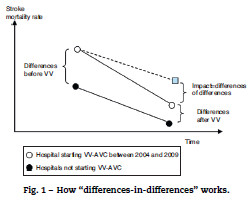
<body><![CDATA[<P>Organizational changes in both pre- and intra-hospital stages as done in  Spain, analyzed through time, have translated not only in more patients treated  with rt-PA, but also in a significantly larger percentage of patients who  achieve functional independence after 3 months.<SUP>11</SUP></P>     <P>Another important aspect is the post-hospital stage of stroke, as  rehabilitation can also deliver significant health gains for stroke patients –  shorter admission times, greater independence, improvement in quality of life  and greater probability of home discharge instead of long-tem  care.<SUP>12</SUP></P>     <P>Moreover, cost-effectiveness studies carried out in the USA,<SUP>13</SUP>  Spain,<SUP>14</SUP> and in Netherlands<SUP>15</SUP> show that these  organizational changes in stroke assistance have translated into cost savings,  while generating health gains.</P>     <P>In short, when properly planned and implemented, it can be said that  organizational change can facilitate and support scientific advances, achieving  both health gains and cost savings. In this sense, this work aims to assess  whether the "Via verde do AVC" (VV-AVC) program in Portugal has achieved  significant health gains and, if not, what might be the reasons for such  result.</P>     <p>&nbsp;</p>     <P><B>Data collection and methodology</B></P>     <P>The analysis was performed by studying individual level in-patient hospital  data on stroke admissions and by studying regional level stroke mortality rates,  in order to search for a link between the existence of Via verde and a reduction  in stroke mortality.</P>     <P>In the analysis of in-hospital mortality each observation corresponds to a  single stroke episode, and only the episodes treated in an hospital are  considered, while the regional analysis is based on regionally aggregated data,  taking into account all the cases in which stroke was stated as the cause of  death. Moreover, in the first approach the clinical outcome is survival or death  of stroke patients, while in the second analysis the outcome variable is the  stroke mortality rate per 100.000 inhabitants.</P>     <P>In both cases the methodology used will be the differences-in-differences  approach. This approach is used often and it ensures that the results are valid  even if other factors are changing mortality rates over time. An example of the  use of differences in differences in Economics can be seen in the work of  Meyer.<SUP>16</SUP> The basic idea is illustrated in <a href="#f1">Fig. 1</a>, where the approach  filters out other changes from the analysis by looking at how changes over time  differ between areas and years where VV-AVC was initiated and areas and years  without VV-AVC. A limitation of the analysis is that it assumes changes over  time would be similar for both types of areas if there were no VV-AVC.</P>     <p>&nbsp;</p> <a name="f1"> <img src="/img/revistas/rpsp/v30n2/30n2a08f1.jpg">     
]]></body>
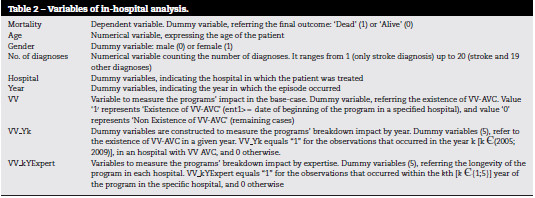
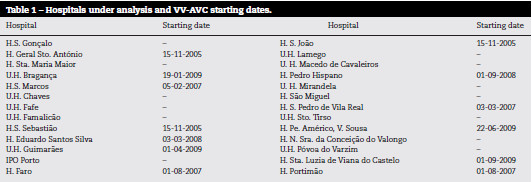
<body><![CDATA[<p>&nbsp;</p>     <P><I>In-hospital mortality</I></P>     <P>Clinical information on stroke patients for in-hospital mortality this  analysis considers only Health Regions North and Algarve, since these were the  only regions with consistent data available on the VV-AVC starting dates. It was  collected from the annual DRG databases (known as GDH in Portugal). Data on the  starting date of the program in each of the relevant hospitals were collected  from official reports and press releases published by ARS Norte and Algarve.  Based on the opinion of medical experts, the relevant episodes selected had a  first diagnosis (ICD 9 CM) with codes 433 or 434 – ischemic stroke, which are  the program's target. These criteria have been used previously in published  work.<SUP>17</SUP><SUP>, </SUP><SUP>18</SUP> Since VV-AVC started in 2005, and  the analysis requires data from before and after the program's introduction in  each hospital (as well as data from hospitals without VV-AVC), the time frame  considered was from 2004 to 2009. For other Health Regions we were not able to  find a comprehensive list with the starting dates of VV-AVC by hospital.</P>     <P>The criteria specified earlier lead to a selection of 28.837 episodes. This  data were analyzed by logistic regression performed with STATA 10. The hospitals  considered and the VV-AVC starting dates are described in <a href="#t1">Table 1</a>. The  explanatory variables used can be seen in <a href="#t2">Table 2</a>.</P>     <p>&nbsp;</p> <a name="t1"> <img src="/img/revistas/rpsp/v30n2/30n2a08t1.jpg">     
<p>&nbsp;</p> <a name="t2"> <img src="/img/revistas/rpsp/v30n2/30n2a08t2.jpg">     
<p>&nbsp;</p>     <P>To capture the effects of VV-AVC alternative approaches were followed: </P>     <P>&#8728; <B>Base case</B> – a single dummy variable (VV) is used to account for the  existence of the program.</P>     <P>&#8728; <B>Breakdown of the impact by year</B> – This approach is meant to capture  the effect of VV-AVC in a specific year. The more people are aware, prone and  able to use the program, the greater the overall impact it can attain. However,  since this process of change is generally slow, it is predictable that, as time  passes, the program enlarges its coverage and, consequently, the average impact  on the target population increases.</P>     ]]></body>
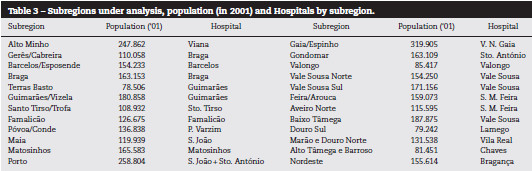
<body><![CDATA[<P>&#8728; <B>Breakdown of the impact by expertise</B> – it captures the effect of  expertise acquired with the practice in Via verde do AVC. It is expected that,  the longer the existence of the program, the better the system performs, which  ultimately translates into a greater impact on clinical outcomes. For a given  hospital a set of dummy variables capture the first year of VV-AVC in that  hospital, the second year, and so forth. All dummy variables set to zero mean  that a hospital never had VV-AVC.</P>      <P>A similar analysis was also performed, limiting the sample to 9.014 ischemic  stroke episodes of patients with age higher than 18 and lower than 65 years old  (which is the range defined by the National Health Plan as the priority target  group), instead of a range from 18 to 80 (which is the maximum range for  clinical intervention).</P>     <P><I>Regional mortality</I></P>     <P>This analysis is limited to subregions in the North Health Region  (considering the Hospitals mentioned in <a href="#t1">Table 1</a>, except H. Faro and H. Portimão,  also due to data limitations). The North health Region was divided into 24  subregions with average population of 152.319 (in 2001), as detailed in <a href="#t3">Table 3</a>.  The data concerning stroke mortality (standardized mortality rate – SMR) by  subregion, year, gender and age group were made available by ARS Norte (the  primary source of data being INE). It was not possible to limit the analysis to  the program's target population so all deaths by cerebrovascular diseases, for  all ages, were included.</P>     <p>&nbsp;</p> <a name="t3"> <img src="/img/revistas/rpsp/v30n2/30n2a08t3.jpg">     
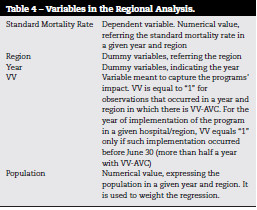
<p>&nbsp;</p>     <P>Data on population by region through time were collected from INE databases.  The information previously collected concerning the starting date of VV-AVC in  each hospital was also used for this analysis. The time frame considered was  from 2001 to 2009.Regression analysis with 216 observations was performed with  STATA 10, using multiple linear regressions, in two different approaches: </P>     <P>• Simple linear regression</P>     <P>• Linear regression weighted by regional population</P>     <P>As for in-hospital data, a similar analysis was performed for regional data,  including only episodes below 65 years old. The variables included are described  in <a href="#t4">Table 4</a>.</P>     ]]></body>
<body><![CDATA[<p>&nbsp;</p> <a name="t4"> <img src="/img/revistas/rpsp/v30n2/30n2a08t4.jpg">     
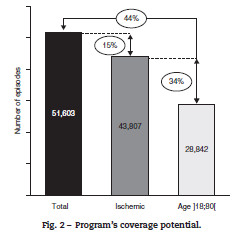
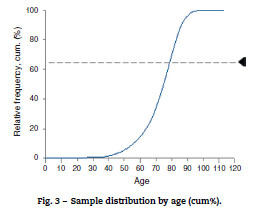
<p>&nbsp;</p>     <P><B>Results</B></P>     <P><I>The in-patient sample</I></P>     <P>After selecting episodes from the DRG database, the data were composed of  51.603 observations. By excluding hemorrhagic stroke the sample suffered a 15%  reduction. Moreover, when data were restricted even further, in order to contain  only those cases which met the age criteria of the program, only 28.837 episodes  were eligible to the activation of "VV-AVC" – which represents 56% of the total  number of stroke episodes during the period of 2004–2009 (<a href="#f2">Fig. 2</a>). In terms of  age distribution, there is a clear dominance of episodes in patients with ages  between 60 and 90 years old, as shown in <a href="#f3">Fig. 3</a>.</P>     <p>&nbsp;</p> <a name="f2"> <img src="/img/revistas/rpsp/v30n2/30n2a08f2.jpg">     
<p>&nbsp;</p> <a name="f3"> <img src="/img/revistas/rpsp/v30n2/30n2a08f3.jpg">     
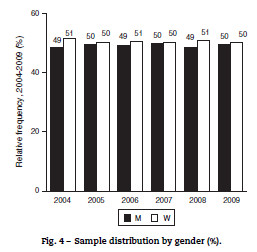
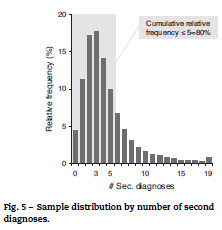
<p>&nbsp;</p>     <P>When gender is considered without age restrictions, the incidence of stroke  is similar for men and women (<a href="#f4">Fig. 4</a>), and this characteristic holds over time.  For stroke patients, the modal number of diagnoses other than stroke is 3, and  almost 80% have 5 or less secondary diagnosis (<a href="#f5">Fig. 5</a>).</P>     <p>&nbsp;</p> <a name="f4"> <img src="/img/revistas/rpsp/v30n2/30n2a08f4.jpg">     
]]></body>
<body><![CDATA[<p>&nbsp;</p> <a name="f5"> <img src="/img/revistas/rpsp/v30n2/30n2a08f5.jpg">     
<p>&nbsp;</p>     <P><I>Descriptive statistics</I></P>     <P>For the in-hospital sample, as described in <a href="#t5">Table 5</a>, mortality rates of  stroke patients aged between 18 and 80 are around 8%, with a standard deviation  of approximately 3%. In terms of patient characterization, 56% of them are men,  and their age is 67±10. Moreover, patients arrive at the hospital with an  average of about 5 diagnoses.</P>     <p>&nbsp;</p> <a name="t5"> <img src="/img/revistas/rpsp/v30n2/30n2a08t5.jpg">     
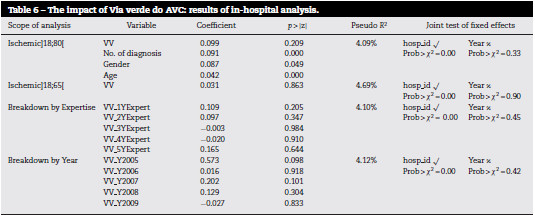
<p>&nbsp;</p>     <P>When analyzing regional data, statistics show that the standard mortality  rate in the North region is approximately 100/100.000 inhabitants, but when the  ratio is weighted by the population, it decreases slightly – which means that  the mortality rate in the most populated subregions is lower than average.</P>     <P><I>Regression analysis</I></P>     <P>The results of the regressions performed can be seen in <a href="#t6">Table 6</a>. When  considering the impact of the program on the base case (ischemic stroke patients  with age above 18 and below 80 years old) as well as the restricted group (aged  between 18 and 65), measured by a single VV variable, there is no statistical  evidence of impact of VV-AVC on mortality.</P>     <p>&nbsp;</p> <a name="t6"> <img src="/img/revistas/rpsp/v30n2/30n2a08t6.jpg">     
]]></body>
<body><![CDATA[<p>&nbsp;</p>     <P>Using the breakdown of the intervention variable by expertise, as well as the  breakdown by year, the results obtained show similar conclusions: there is no  statistically significant decrease in mortality of ischemic stroke patients  captured in any of the dummy variables.</P>     <P>On the other hand, the impact of the number of diagnoses and age on mortality  is highly significant in all regressions (although only presented in the  base-case) – the larger the number of diagnosis or the older the patient, the  higher the probability of death; gender varies between borderline significant  (<I>p</I>-value=0.049) and non-significant, but always with a positive bias –  which translates in a higher propensity for women to die in case of stroke.</P>     <P>In all of these approaches, the vector of hospital dummies are jointly  significantly (<I>p</I>&gt;<I>&#967;</I><SUP>2</SUP>=0.00%), while there is no  statistical evidence that time has contributed for a shift on stroke mortality  (<I>p</I>&gt;<I>&#967;</I><SUP>2</SUP> around 40% for age]18;80[and higher than 90%  for age]18;65[).</P>     <P>A measure of the explanatory power of these analyses (the pseudo  <I>R</I><SUP>2</SUP>) is around 4%.</P>     <P>In conclusion, based on these analyses, it is not possible to conclude that  the program was able to improve the health status of stroke patients through the  decrease of in-hospital mortality, even if the impact is broken down by degree  of expertise or year of observation.</P>     <P>The results of the regional analysis are on display in <a href="#t7">Table 7</a>. According to  the results obtained in both approaches (simple, and population-weighted), both  for age upper-limit of 80 and 65, once again, there is no statistical evidence  that the existence of ‘VV-AVC’ in the regions translates into lower mortality  for stroke patients (<I>p</I>-values ranging from 10% to 30%).</P>     <p>&nbsp;</p> <a name="t7"> <img src="/img/revistas/rpsp/v30n2/30n2a08t7.jpg">     
<p>&nbsp;</p>     <P>On the other hand, there are large differences among regions and throughout  the years, since the joint tests show that the respective coefficients are  statistically different from zero (<I>p</I>&gt;<I>F</I>=0.00%).</P>     ]]></body>
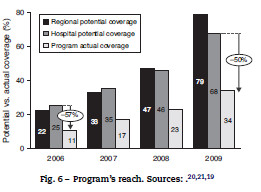
<body><![CDATA[<P><I>Program's limitations that might explain the results obtained</I></P>     <P>Given the fact that none of the analysis performed showed significant  effectiveness of the program VV-AVC in reducing mortality, it is relevant to  focus on the program's design and implementation strategy, in order to better  understand the possible causes that are limiting its success.</P>     <P><I>Promotion and reach</I></P>     <P>The trigger of the process is a call to the emergency services at the  occurrence of a stroke episode. In this sense, informative campaigns to increase  the population's awareness are critical for the success of the program. However,  in Portugal, the program has not been heavily promoted and many people might be  still not aware of its existence.</P>     <P>Indeed, when considering the North region (the one with the largest adherence  rates, based on official reports on the topic,<SUP>19</SUP> and through time, as  more hospitals implement the program, the population covered increases  dramatically from 25% to around 70% ("hospital potential coverage", the ratio of  stroke patients in hospitals with VV-AVC and total stroke patients in hospitals  in the region). However, the percentage of patients who are actually using it  ("program actual coverage", percentage of total stroke patients in the region  treated with rt-PA) – although increasing at a similar rate –, is only about  half of the potential number of episodes that could have used the program (<a href="#f6">Fig. 6</a>).</P>     <p>&nbsp;</p> <a name="f6"> <img src="/img/revistas/rpsp/v30n2/30n2a08f6.jpg">     
<p>&nbsp;</p>     <P>Based on this figures, it is possible to argue that it is not enough to  create more infrastructures to tackle the problem: it is also critical to  involve the population on this program, to make it aware of its existence and  thus, to translate potential impact into actual impact.</P>     <P><I>Training and expertise</I></P>     <P>In order to achieve the best outcomes possible, it is important that  everybody involved in the process is fully capable and knowledgeable about it.  So, training should be continuously implemented.<SUP>4</SUP></P>     ]]></body>
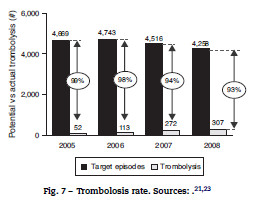
<body><![CDATA[<P>However, when considering data on the time elapsed since the beginning of  symptoms until arrival to the hospital ("onset-to-door"), not much improvement  has been achieved since the implementation of the program, and approximately 50%  of the patients transported by INEM take longer than 1 hour to arrive at the  hospital.<SUP>22</SUP></P>     <P>Along with this goes the fact that, of all the episodes that meet the  program's requirements (ischemic stroke patients with age between 18 and 80),  only a small fraction has been treated with rt-PA (from 1% in 2005 to 7% in  2008), which means that the ultimate purpose of the program (providing the  stroke patients with trombolitic treatment) is rarely achieved and only a small  fraction of the target population is actually benefiting from the process in  full (<a href="#f7">Fig. 7</a>).</P>     <p>&nbsp;</p> <a name="f7"> <img src="/img/revistas/rpsp/v30n2/30n2a08f7.jpg">     
<p>&nbsp;</p>     <P><I>Post-hospital care and rehabilitation</I></P>     <P>Another relevant stage of the stroke process is post-hospital care. As  mentioned before, many countries have adopted programs that include  rehabilitation treatment, in order to improve the patients health conditions and  their functional status, since many of those who survive are still limited in  their physical conditions.</P>     <P>In Portugal, in particular, although there is the intention to include this  stage in the process, there is not much information concerning its actual  implementation and monitoring. Also, there is no systematic track of the  patients’ health status after hospital discharge, and thus, no information on  its evolution over time.</P>     <P>For this reason, and now that the pre- and intra-hospital stages are already  implemented, it would be important to focus on this issue and to develop  mechanisms that would allow stroke patients to have comprehensive access to  post-hospital health care services, thus maximizing the program's reach  throughout the whole process of stroke treatment.</P>     <p>&nbsp;</p>     <P><B>Conclusions</B></P>     ]]></body>
<body><![CDATA[<P>Since the program's implementation in 2005 until nowadays, data have shown a  sharp and steady decrease of stroke mortality in Portugal. However, according to  the analysis performed, considering both in-hospital observations, as well as  population-level data, there is no statistical evidence that such a decrease is  related to the implementation of ‘Via verde do AVC’.</P>     <P>In an attempt to understand the reason for this result, some possible  explanations were presented. First of all, the efforts on promotion and  information campaigns about the program might have not been enough to reach as  many people as it would be possible and desirable. Second, there is still a very  small fraction of the target population being treated with rt-PA drugs. Finally,  the poor implementation of post-hospital care might further limit the results of  the overall program.</P>     <P>The analysis itself also has some limitations: as it focuses on few regions,  it is not possible to reach nationwide conclusions; and in the regional  analysis, it was not possible to fully match the sample with the program's  requirements (stroke category and age groups).</P>     <P>In short, although the results obtained do not show a very positive picture,  they bring to light some important insights of what can be done differently. In  this sense, this work should be interpreted as a driving force to continuously  strive for the development of better and more effective mechanisms, in which  resources are properly allocated and used – afterall, "Improvement" is a  never-ending process.</P>     <p>&nbsp;</p>     <P><B>Bibliografía</B></P>     <!-- ref --><P>1. WHO. WHO health topics: stroke, cerebrovascular accident [Online]. Geneva:  World Health Organization; 2011. [cited 09.10.11]  <a href="http://www.who.int/topics/cerebrovascular_accident/en/" target="_blank">http://www.who.int/topics/cerebrovascular_accident/en/</a>.    &nbsp;&nbsp;&nbsp;&nbsp;&nbsp;&nbsp;&nbsp;&nbsp;[&#160;<a href="javascript:void(0);" onclick="javascript: window.open('/scielo.php?script=sci_nlinks&ref=000119&pid=S0870-9025201200020000800001&lng=','','width=640,height=500,resizable=yes,scrollbars=1,menubar=yes,');">Links</a>&#160;]<!-- end-ref --> </P>     <!-- ref --><P>2. Mackay J, Mensah G. The atlas of hearth disease and stroke. Geneva: WHO;  2004.    &nbsp;&nbsp;&nbsp;&nbsp;&nbsp;&nbsp;&nbsp;&nbsp;[&#160;<a href="javascript:void(0);" onclick="javascript: window.open('/scielo.php?script=sci_nlinks&ref=000121&pid=S0870-9025201200020000800002&lng=','','width=640,height=500,resizable=yes,scrollbars=1,menubar=yes,');">Links</a>&#160;]<!-- end-ref --> </P>     ]]></body>
<body><![CDATA[<!-- ref --><P>3. INE. Óbitos (No.) por sexo e causa de morte [Online]. Lisboa: Instituto  Nacional de Estatística; 2010. [cited 12.10.11]  <a href="http://www.ine.pt/xportal/xmain%3Fxpid=INE%26xpgid=ine_indicadores%26indOcorrCod=0001675%26contexto=bd%26selTab=tab2" target="_blank">http://www.ine.pt/xportal/xmain%3Fxpid=INE%26xpgid=ine_indicadores%26indOcorrCod=0001675%26contexto=bd%26selTab=tab2</a>.    &nbsp;&nbsp;&nbsp;&nbsp;&nbsp;&nbsp;&nbsp;&nbsp;[&#160;<a href="javascript:void(0);" onclick="javascript: window.open('/scielo.php?script=sci_nlinks&ref=000123&pid=S0870-9025201200020000800003&lng=','','width=640,height=500,resizable=yes,scrollbars=1,menubar=yes,');">Links</a>&#160;]<!-- end-ref -->  </P>     <!-- ref --><P>4. Ministério da Saúde. Alto Comissariado da Saúde. Coordenação Nacional para  as Doenças Cardiovasculares. Documento orientador sobre vias verdes do EAM e  AVC, 2007.    &nbsp;&nbsp;&nbsp;&nbsp;&nbsp;&nbsp;&nbsp;&nbsp;[&#160;<a href="javascript:void(0);" onclick="javascript: window.open('/scielo.php?script=sci_nlinks&ref=000125&pid=S0870-9025201200020000800004&lng=','','width=640,height=500,resizable=yes,scrollbars=1,menubar=yes,');">Links</a>&#160;]<!-- end-ref --> </P>     <!-- ref --><P>5. Grotta J, Jacobs TP, Koroshetz WJ, Moskowitz MA. Stroke program review  group: an interim report. J Am Heart Assoc Stroke. 2008; 39:1364–70.    &nbsp;&nbsp;&nbsp;&nbsp;&nbsp;&nbsp;&nbsp;&nbsp;[&#160;<a href="javascript:void(0);" onclick="javascript: window.open('/scielo.php?script=sci_nlinks&ref=000127&pid=S0870-9025201200020000800005&lng=','','width=640,height=500,resizable=yes,scrollbars=1,menubar=yes,');">Links</a>&#160;]<!-- end-ref --> </P>     <!-- ref --><P>6. Gomes RS. Vias verdes: EAM e AVC. Lisboa: Coordenação Nacional para as  Doenças Cardiovasculares; 2007.    &nbsp;&nbsp;&nbsp;&nbsp;&nbsp;&nbsp;&nbsp;&nbsp;[&#160;<a href="javascript:void(0);" onclick="javascript: window.open('/scielo.php?script=sci_nlinks&ref=000129&pid=S0870-9025201200020000800006&lng=','','width=640,height=500,resizable=yes,scrollbars=1,menubar=yes,');">Links</a>&#160;]<!-- end-ref --> </P>     <!-- ref --><P>7. Internet Stroke Center. About stroke: stroke statistics [Online]. The  Internet Stroke Center. Available from:  <a href="http://www.strokecenter.org/patients/about–stroke/stroke–statistics" target="_blank">http://www.strokecenter.org/patients/about–stroke/stroke–statistics</a> [cited 24.04.12].    &nbsp;&nbsp;&nbsp;&nbsp;&nbsp;&nbsp;&nbsp;&nbsp;[&#160;<a href="javascript:void(0);" onclick="javascript: window.open('/scielo.php?script=sci_nlinks&ref=000131&pid=S0870-9025201200020000800007&lng=','','width=640,height=500,resizable=yes,scrollbars=1,menubar=yes,');">Links</a>&#160;]<!-- end-ref -->  </P>     ]]></body>
<body><![CDATA[<!-- ref --><P>8. Oser CS, McNamara MJ, Fogle CC, Gohdes D, Helgerson SD, Harwell TS.  Educational outreach to improve emergency medical services systems of care for  stroke in Montana. Prehosp Emerg Care. 2010; 14:259–64.    &nbsp;&nbsp;&nbsp;&nbsp;&nbsp;&nbsp;&nbsp;&nbsp;[&#160;<a href="javascript:void(0);" onclick="javascript: window.open('/scielo.php?script=sci_nlinks&ref=000133&pid=S0870-9025201200020000800008&lng=','','width=640,height=500,resizable=yes,scrollbars=1,menubar=yes,');">Links</a>&#160;]<!-- end-ref --> </P>     <!-- ref --><P>9. Heo JH, Kim YD, Nam HS, Hong K, Ahn SH, Cho HJ, et–al. A computerized  in–hospital alert system for thrombolysis in acute stroke. J Am Heart Assoc  Stroke. 2010; 41:1978–83.    &nbsp;&nbsp;&nbsp;&nbsp;&nbsp;&nbsp;&nbsp;&nbsp;[&#160;<a href="javascript:void(0);" onclick="javascript: window.open('/scielo.php?script=sci_nlinks&ref=000135&pid=S0870-9025201200020000800009&lng=','','width=640,height=500,resizable=yes,scrollbars=1,menubar=yes,');">Links</a>&#160;]<!-- end-ref --> </P>     <!-- ref --><P>10. Nam HS, Han SW, Ahn SH, Lee JY, Choi HY, Park IC, et–al. Improved time  intervals by implementation of computerized physician order entry–based stroke  team approach. Cerebrovasc Dis. 2007; 23:289–93.    &nbsp;&nbsp;&nbsp;&nbsp;&nbsp;&nbsp;&nbsp;&nbsp;[&#160;<a href="javascript:void(0);" onclick="javascript: window.open('/scielo.php?script=sci_nlinks&ref=000137&pid=S0870-9025201200020000800010&lng=','','width=640,height=500,resizable=yes,scrollbars=1,menubar=yes,');">Links</a>&#160;]<!-- end-ref --> </P>     <!-- ref --><P>11. Simal P, García A, Masjuan J, Alonso de Leciñana M, Fuentes B, Díaz F,  et–al. Trombólisis en Madrid: ¿cada vez más y mejor? Análisis de series  temporales durante 4 años. Neurología. 2009; 24:804–7.    &nbsp;&nbsp;&nbsp;&nbsp;&nbsp;&nbsp;&nbsp;&nbsp;[&#160;<a href="javascript:void(0);" onclick="javascript: window.open('/scielo.php?script=sci_nlinks&ref=000139&pid=S0870-9025201200020000800011&lng=','','width=640,height=500,resizable=yes,scrollbars=1,menubar=yes,');">Links</a>&#160;]<!-- end-ref --> </P>     <!-- ref --><P>12. Carod–Artal FJ, Medeiros MS, Horan TA, Braga LW. Predictive factors of  functional gain in long–term stroke survivors admitted to a rehabilitation  programme. Brain Inj. 2005; 19:667–73.    &nbsp;&nbsp;&nbsp;&nbsp;&nbsp;&nbsp;&nbsp;&nbsp;[&#160;<a href="javascript:void(0);" onclick="javascript: window.open('/scielo.php?script=sci_nlinks&ref=000141&pid=S0870-9025201200020000800012&lng=','','width=640,height=500,resizable=yes,scrollbars=1,menubar=yes,');">Links</a>&#160;]<!-- end-ref --> </P>     ]]></body>
<body><![CDATA[<!-- ref --><P>13. Demaerschalk BM, Hwang HM, Leung G. Cost analysis review of stroke  centers, telestroke, and rt–PA. Am J Manage Care. 2010; 16:537–44.    &nbsp;&nbsp;&nbsp;&nbsp;&nbsp;&nbsp;&nbsp;&nbsp;[&#160;<a href="javascript:void(0);" onclick="javascript: window.open('/scielo.php?script=sci_nlinks&ref=000143&pid=S0870-9025201200020000800013&lng=','','width=640,height=500,resizable=yes,scrollbars=1,menubar=yes,');">Links</a>&#160;]<!-- end-ref --> </P>     <!-- ref --><P>14. Leciñana–Cases MA, Gil–Núñez A, Díez–Tejedor E. Relevance of stroke code,  stroke unit and stroke networks in organization of acute stroke care: the Madrid  acute stroke care program. Cerebrovasc Dis. 2009; 27(Suppl. 1):140–7.    &nbsp;&nbsp;&nbsp;&nbsp;&nbsp;&nbsp;&nbsp;&nbsp;[&#160;<a href="javascript:void(0);" onclick="javascript: window.open('/scielo.php?script=sci_nlinks&ref=000145&pid=S0870-9025201200020000800014&lng=','','width=640,height=500,resizable=yes,scrollbars=1,menubar=yes,');">Links</a>&#160;]<!-- end-ref --> </P>     <!-- ref --><P>15. Baeten S, van Exel NJ, Dirks M, Koopmanschap MA, Dippel DW, Niessen LW.  Lifetime health effects and medical costs of integrated stroke services: a  non–randomized controlled cluster–trial based life table approach. Cost Eff  Resour Allocation. 2010; 8:21–31.    &nbsp;&nbsp;&nbsp;&nbsp;&nbsp;&nbsp;&nbsp;&nbsp;[&#160;<a href="javascript:void(0);" onclick="javascript: window.open('/scielo.php?script=sci_nlinks&ref=000147&pid=S0870-9025201200020000800015&lng=','','width=640,height=500,resizable=yes,scrollbars=1,menubar=yes,');">Links</a>&#160;]<!-- end-ref --> </P>     <!-- ref --><P>16. Meyer B. Natural and quasi–natural experiments in economics. J Bus Econ  Stat. 1995; 13:151–62.    &nbsp;&nbsp;&nbsp;&nbsp;&nbsp;&nbsp;&nbsp;&nbsp;[&#160;<a href="javascript:void(0);" onclick="javascript: window.open('/scielo.php?script=sci_nlinks&ref=000149&pid=S0870-9025201200020000800016&lng=','','width=640,height=500,resizable=yes,scrollbars=1,menubar=yes,');">Links</a>&#160;]<!-- end-ref --> </P>     <!-- ref --><P>17. Cortez–Pinto H, Gouveia M, dos Santos Pinheiro L, Costa J, Borges M, Vaz  Carneiro A. The burden of disease and the cost of illness attributable to  alcohol drinking–results of a national study. Alcohol Clin Exp Res. 2010;  34:1442–9.    &nbsp;&nbsp;&nbsp;&nbsp;&nbsp;&nbsp;&nbsp;&nbsp;[&#160;<a href="javascript:void(0);" onclick="javascript: window.open('/scielo.php?script=sci_nlinks&ref=000151&pid=S0870-9025201200020000800017&lng=','','width=640,height=500,resizable=yes,scrollbars=1,menubar=yes,');">Links</a>&#160;]<!-- end-ref --> </P>     ]]></body>
<body><![CDATA[<!-- ref --><P>18. Borges M, Gouveia M, Costa J, Pinheiro LS, Paulo S, Carneiro AV. Carga da  doença atribuível ao tabagismo em Portugal. Portuguese J Pulmonol. 2009;  6:951–1004.    &nbsp;&nbsp;&nbsp;&nbsp;&nbsp;&nbsp;&nbsp;&nbsp;[&#160;<a href="javascript:void(0);" onclick="javascript: window.open('/scielo.php?script=sci_nlinks&ref=000153&pid=S0870-9025201200020000800018&lng=','','width=640,height=500,resizable=yes,scrollbars=1,menubar=yes,');">Links</a>&#160;]<!-- end-ref --> </P>     <!-- ref --><P>19. Ministério da Saúde. Alto Comissariado da Saúde. Coordenação Nacional  para as Doenças Cardiovasculares. Vias verdes coronária e do acidente vascular  cerebral: indicadores de actividade. Lisboa: Coordenação Nacional para as  Doenças Cardiovasculares; 2010. p. 31.    &nbsp;&nbsp;&nbsp;&nbsp;&nbsp;&nbsp;&nbsp;&nbsp;[&#160;<a href="javascript:void(0);" onclick="javascript: window.open('/scielo.php?script=sci_nlinks&ref=000155&pid=S0870-9025201200020000800019&lng=','','width=640,height=500,resizable=yes,scrollbars=1,menubar=yes,');">Links</a>&#160;]<!-- end-ref --> </P>     <!-- ref --><P>20. INE. ARSN. Mortalidade por doença vascular–cerebral: ACeS Região Norte  2001–2009. Porto: Departamento de Saúde Pública da ARS Norte; 2011.    &nbsp;&nbsp;&nbsp;&nbsp;&nbsp;&nbsp;&nbsp;&nbsp;[&#160;<a href="javascript:void(0);" onclick="javascript: window.open('/scielo.php?script=sci_nlinks&ref=000157&pid=S0870-9025201200020000800020&lng=','','width=640,height=500,resizable=yes,scrollbars=1,menubar=yes,');">Links</a>&#160;]<!-- end-ref --> </P>     <!-- ref --><P>21. ACSS. GDH – Grupos de Diagnósticos Homogéneos 2004–2009. Lisboa: ACSS;  2009.    &nbsp;&nbsp;&nbsp;&nbsp;&nbsp;&nbsp;&nbsp;&nbsp;[&#160;<a href="javascript:void(0);" onclick="javascript: window.open('/scielo.php?script=sci_nlinks&ref=000159&pid=S0870-9025201200020000800021&lng=','','width=640,height=500,resizable=yes,scrollbars=1,menubar=yes,');">Links</a>&#160;]<!-- end-ref --> </P>     <!-- ref --><P>22. INEM. Estatísticas: via verde do AVC: tempo desde início dos sintomas até  chegada do doente ao Hospital [Online]. Lisboa: INEM; 2007–2009. [cited  01.12.11] <a href="http://avc.inem.pt/avc/stats_avc_site/stats.asp" target="_blank">http://avc.inem.pt/avc/stats_avc_site/stats.asp</a>.    &nbsp;&nbsp;&nbsp;&nbsp;&nbsp;&nbsp;&nbsp;&nbsp;[&#160;<a href="javascript:void(0);" onclick="javascript: window.open('/scielo.php?script=sci_nlinks&ref=000161&pid=S0870-9025201200020000800022&lng=','','width=640,height=500,resizable=yes,scrollbars=1,menubar=yes,');">Links</a>&#160;]<!-- end-ref --> </P>     ]]></body>
<body><![CDATA[<!-- ref --><P>23. ARS Norte. Um ano de reflexão e mudança: Comissão Regional do Doente  Crítico. Porto: ARS Norte; 2009. p. 72.    &nbsp;&nbsp;&nbsp;&nbsp;&nbsp;&nbsp;&nbsp;&nbsp;[&#160;<a href="javascript:void(0);" onclick="javascript: window.open('/scielo.php?script=sci_nlinks&ref=000163&pid=S0870-9025201200020000800023&lng=','','width=640,height=500,resizable=yes,scrollbars=1,menubar=yes,');">Links</a>&#160;]<!-- end-ref --> </P>     <p>&nbsp;</p>     <P><B>Conflicts of interest</B></P>     <P>The authors have no conflicts of interest to declare.</P>     <p>&nbsp;</p>     <P><b>Acknowledgement</b></P>     <P>This paper has benefited from comments and suggestions by Margarida  Borges.</P>     <p>&nbsp;</p>     <P>Received 18 May 2012. Accepted 27 December 2012 </P>     ]]></body>
<body><![CDATA[<p>&nbsp;</p>     <P><Sup><a name="0"></a><a href="#top0">*</a></Sup>Autor para Correspondência: <a href="mailto:mig@ucp.pt">mig@ucp.pt</a></P>      ]]></body><back>
<ref-list>
<ref id="B1">
<label>1</label><nlm-citation citation-type="book">
<collab>WHO</collab>
<source><![CDATA[WHO health topics: stroke, cerebrovascular accident]]></source>
<year>2011</year>
<publisher-loc><![CDATA[Geneva ]]></publisher-loc>
<publisher-name><![CDATA[World Health Organization]]></publisher-name>
</nlm-citation>
</ref>
<ref id="B2">
<label>2</label><nlm-citation citation-type="book">
<person-group person-group-type="author">
<name>
<surname><![CDATA[Mackay]]></surname>
<given-names><![CDATA[J]]></given-names>
</name>
<name>
<surname><![CDATA[Mensah]]></surname>
<given-names><![CDATA[G]]></given-names>
</name>
</person-group>
<source><![CDATA[The atlas of hearth disease and stroke]]></source>
<year>2004</year>
<publisher-loc><![CDATA[Geneva ]]></publisher-loc>
<publisher-name><![CDATA[WHO]]></publisher-name>
</nlm-citation>
</ref>
<ref id="B3">
<label>3</label><nlm-citation citation-type="book">
<collab>INE</collab>
<source><![CDATA[Óbitos (No.) por sexo e causa de morte]]></source>
<year>2010</year>
<publisher-loc><![CDATA[Lisboa ]]></publisher-loc>
<publisher-name><![CDATA[Instituto Nacional de Estatística]]></publisher-name>
</nlm-citation>
</ref>
<ref id="B4">
<label>4</label><nlm-citation citation-type="">
<collab>Ministério da Saúde</collab>
<source><![CDATA[Alto Comissariado da Saúde: Coordenação Nacional para as Doenças Cardiovasculares. Documento orientador sobre vias verdes do EAM e AVC]]></source>
<year>2007</year>
</nlm-citation>
</ref>
<ref id="B5">
<label>5</label><nlm-citation citation-type="journal">
<person-group person-group-type="author">
<name>
<surname><![CDATA[Grotta]]></surname>
<given-names><![CDATA[J]]></given-names>
</name>
<name>
<surname><![CDATA[Jacobs]]></surname>
<given-names><![CDATA[TP]]></given-names>
</name>
<name>
<surname><![CDATA[Koroshetz]]></surname>
<given-names><![CDATA[WJ]]></given-names>
</name>
<name>
<surname><![CDATA[Moskowitz]]></surname>
<given-names><![CDATA[MA]]></given-names>
</name>
</person-group>
<article-title xml:lang="en"><![CDATA[Stroke program review group: an interim report]]></article-title>
<source><![CDATA[J Am Heart Assoc Stroke]]></source>
<year>2008</year>
<volume>39</volume>
<page-range>1364-70</page-range></nlm-citation>
</ref>
<ref id="B6">
<label>6</label><nlm-citation citation-type="book">
<person-group person-group-type="author">
<name>
<surname><![CDATA[Gomes]]></surname>
<given-names><![CDATA[RS]]></given-names>
</name>
</person-group>
<source><![CDATA[Vias verdes: EAM e AVC]]></source>
<year>2007</year>
<publisher-loc><![CDATA[Lisboa ]]></publisher-loc>
<publisher-name><![CDATA[Coordenação Nacional para as Doenças Cardiovasculares]]></publisher-name>
</nlm-citation>
</ref>
<ref id="B7">
<label>7</label><nlm-citation citation-type="book">
<collab>Internet Stroke Center</collab>
<source><![CDATA[About stroke: stroke statistics]]></source>
<year></year>
<publisher-name><![CDATA[The Internet Stroke Center]]></publisher-name>
</nlm-citation>
</ref>
<ref id="B8">
<label>8</label><nlm-citation citation-type="journal">
<person-group person-group-type="author">
<name>
<surname><![CDATA[Oser]]></surname>
<given-names><![CDATA[CS]]></given-names>
</name>
<name>
<surname><![CDATA[McNamara]]></surname>
<given-names><![CDATA[MJ]]></given-names>
</name>
<name>
<surname><![CDATA[Fogle]]></surname>
<given-names><![CDATA[CC]]></given-names>
</name>
<name>
<surname><![CDATA[Gohdes]]></surname>
<given-names><![CDATA[D]]></given-names>
</name>
<name>
<surname><![CDATA[Helgerson]]></surname>
<given-names><![CDATA[SD]]></given-names>
</name>
<name>
<surname><![CDATA[Harwell]]></surname>
<given-names><![CDATA[TS]]></given-names>
</name>
</person-group>
<article-title xml:lang="en"><![CDATA[Educational outreach to improve emergency medical services systems of care for stroke in Montana]]></article-title>
<source><![CDATA[Prehosp Emerg Care]]></source>
<year>2010</year>
<volume>14</volume>
<page-range>259-64</page-range></nlm-citation>
</ref>
<ref id="B9">
<label>9</label><nlm-citation citation-type="journal">
<person-group person-group-type="author">
<name>
<surname><![CDATA[Heo]]></surname>
<given-names><![CDATA[JH]]></given-names>
</name>
<name>
<surname><![CDATA[Kim]]></surname>
<given-names><![CDATA[YD]]></given-names>
</name>
<name>
<surname><![CDATA[Nam]]></surname>
<given-names><![CDATA[HS]]></given-names>
</name>
<name>
<surname><![CDATA[Hong]]></surname>
<given-names><![CDATA[K]]></given-names>
</name>
<name>
<surname><![CDATA[Ahn]]></surname>
<given-names><![CDATA[SH]]></given-names>
</name>
<name>
<surname><![CDATA[Cho]]></surname>
<given-names><![CDATA[HJ]]></given-names>
</name>
</person-group>
<article-title xml:lang="en"><![CDATA[A computerized in-hospital alert system for thrombolysis in acute stroke]]></article-title>
<source><![CDATA[J Am Heart Assoc Stroke]]></source>
<year>2010</year>
<volume>41</volume>
<page-range>1978-83</page-range></nlm-citation>
</ref>
<ref id="B10">
<label>10</label><nlm-citation citation-type="journal">
<person-group person-group-type="author">
<name>
<surname><![CDATA[Nam]]></surname>
<given-names><![CDATA[HS]]></given-names>
</name>
<name>
<surname><![CDATA[Han]]></surname>
<given-names><![CDATA[SW]]></given-names>
</name>
<name>
<surname><![CDATA[Ahn]]></surname>
<given-names><![CDATA[SH]]></given-names>
</name>
<name>
<surname><![CDATA[Lee]]></surname>
<given-names><![CDATA[JY]]></given-names>
</name>
<name>
<surname><![CDATA[Choi]]></surname>
<given-names><![CDATA[HY]]></given-names>
</name>
<name>
<surname><![CDATA[Park]]></surname>
<given-names><![CDATA[IC]]></given-names>
</name>
</person-group>
<article-title xml:lang="en"><![CDATA[Improved time intervals by implementation of computerized physician order entry-based stroke team approach]]></article-title>
<source><![CDATA[Cerebrovasc Dis]]></source>
<year>2007</year>
<volume>23</volume>
<page-range>289-93</page-range></nlm-citation>
</ref>
<ref id="B11">
<label>11</label><nlm-citation citation-type="journal">
<person-group person-group-type="author">
<name>
<surname><![CDATA[Simal]]></surname>
<given-names><![CDATA[P]]></given-names>
</name>
<name>
<surname><![CDATA[García]]></surname>
<given-names><![CDATA[A]]></given-names>
</name>
<name>
<surname><![CDATA[Masjuan]]></surname>
<given-names><![CDATA[J]]></given-names>
</name>
<name>
<surname><![CDATA[Alonso de Leciñana]]></surname>
<given-names><![CDATA[M]]></given-names>
</name>
<name>
<surname><![CDATA[Fuentes]]></surname>
<given-names><![CDATA[B]]></given-names>
</name>
<name>
<surname><![CDATA[Díaz]]></surname>
<given-names><![CDATA[F]]></given-names>
</name>
</person-group>
<article-title xml:lang="es"><![CDATA[Trombólisis en Madrid: ¿cada vez más y mejor? Análisis de series temporales durante 4 años]]></article-title>
<source><![CDATA[Neurología]]></source>
<year>2009</year>
<volume>24</volume>
<page-range>804-7</page-range></nlm-citation>
</ref>
<ref id="B12">
<label>12</label><nlm-citation citation-type="journal">
<person-group person-group-type="author">
<name>
<surname><![CDATA[Carod-Artal]]></surname>
<given-names><![CDATA[FJ]]></given-names>
</name>
<name>
<surname><![CDATA[Medeiros]]></surname>
<given-names><![CDATA[MS]]></given-names>
</name>
<name>
<surname><![CDATA[Horan]]></surname>
<given-names><![CDATA[TA]]></given-names>
</name>
<name>
<surname><![CDATA[Braga]]></surname>
<given-names><![CDATA[LW]]></given-names>
</name>
</person-group>
<article-title xml:lang="en"><![CDATA[Predictive factors of functional gain in long-term stroke survivors admitted to a rehabilitation programme]]></article-title>
<source><![CDATA[Brain Inj]]></source>
<year>2005</year>
<volume>19</volume>
<page-range>667-73</page-range></nlm-citation>
</ref>
<ref id="B13">
<label>13</label><nlm-citation citation-type="journal">
<person-group person-group-type="author">
<name>
<surname><![CDATA[Demaerschalk]]></surname>
<given-names><![CDATA[BM]]></given-names>
</name>
<name>
<surname><![CDATA[Hwang]]></surname>
<given-names><![CDATA[HM]]></given-names>
</name>
<name>
<surname><![CDATA[Leung]]></surname>
<given-names><![CDATA[G]]></given-names>
</name>
</person-group>
<article-title xml:lang="en"><![CDATA[Cost analysis review of stroke centers, telestroke, and rt-PA]]></article-title>
<source><![CDATA[Am J Manage Care]]></source>
<year>2010</year>
<volume>16</volume>
<page-range>537-44</page-range></nlm-citation>
</ref>
<ref id="B14">
<label>14</label><nlm-citation citation-type="journal">
<person-group person-group-type="author">
<name>
<surname><![CDATA[Leciñana-Cases]]></surname>
<given-names><![CDATA[MA]]></given-names>
</name>
<name>
<surname><![CDATA[Gil-Núñez]]></surname>
<given-names><![CDATA[A]]></given-names>
</name>
<name>
<surname><![CDATA[Díez-Tejedor]]></surname>
<given-names><![CDATA[E]]></given-names>
</name>
</person-group>
<article-title xml:lang="en"><![CDATA[Relevance of stroke code, stroke unit and stroke networks in organization of acute stroke care: the Madrid acute stroke care program]]></article-title>
<source><![CDATA[Cerebrovasc Dis.]]></source>
<year>2009</year>
<volume>27</volume>
<numero>^s1</numero>
<issue>^s1</issue>
<supplement>1</supplement>
<page-range>140-7</page-range></nlm-citation>
</ref>
<ref id="B15">
<label>15</label><nlm-citation citation-type="journal">
<person-group person-group-type="author">
<name>
<surname><![CDATA[Baeten]]></surname>
<given-names><![CDATA[S]]></given-names>
</name>
<name>
<surname><![CDATA[van Exel]]></surname>
<given-names><![CDATA[NJ]]></given-names>
</name>
<name>
<surname><![CDATA[Dirks]]></surname>
<given-names><![CDATA[M]]></given-names>
</name>
<name>
<surname><![CDATA[Koopmanschap]]></surname>
<given-names><![CDATA[MA]]></given-names>
</name>
<name>
<surname><![CDATA[Dippel]]></surname>
<given-names><![CDATA[DW]]></given-names>
</name>
<name>
<surname><![CDATA[Niessen]]></surname>
<given-names><![CDATA[LW]]></given-names>
</name>
</person-group>
<article-title xml:lang="en"><![CDATA[Lifetime health effects and medical costs of integrated stroke services: a non-randomized controlled cluster-trial based life table approach]]></article-title>
<source><![CDATA[Cost Eff Resour Allocation]]></source>
<year>2010</year>
<volume>8</volume>
<page-range>21-31</page-range></nlm-citation>
</ref>
<ref id="B16">
<label>16</label><nlm-citation citation-type="journal">
<person-group person-group-type="author">
<name>
<surname><![CDATA[Meyer]]></surname>
<given-names><![CDATA[B]]></given-names>
</name>
</person-group>
<article-title xml:lang="en"><![CDATA[Natural and quasi-natural experiments in economics]]></article-title>
<source><![CDATA[J Bus Econ Stat.]]></source>
<year>1995</year>
<volume>13</volume>
<page-range>151-62</page-range></nlm-citation>
</ref>
<ref id="B17">
<label>17</label><nlm-citation citation-type="journal">
<person-group person-group-type="author">
<name>
<surname><![CDATA[Cortez-Pinto]]></surname>
<given-names><![CDATA[H]]></given-names>
</name>
<name>
<surname><![CDATA[Gouveia]]></surname>
<given-names><![CDATA[M]]></given-names>
</name>
<name>
<surname><![CDATA[dos Santos Pinheiro]]></surname>
<given-names><![CDATA[L]]></given-names>
</name>
<name>
<surname><![CDATA[Costa]]></surname>
<given-names><![CDATA[J]]></given-names>
</name>
<name>
<surname><![CDATA[Borges]]></surname>
<given-names><![CDATA[M]]></given-names>
</name>
<name>
<surname><![CDATA[Vaz Carneiro]]></surname>
<given-names><![CDATA[A]]></given-names>
</name>
</person-group>
<article-title xml:lang="en"><![CDATA[The burden of disease and the cost of illness attributable to alcohol drinking-results of a national study]]></article-title>
<source><![CDATA[Alcohol Clin Exp Res.]]></source>
<year>2010</year>
<volume>34</volume>
<page-range>1442-9</page-range></nlm-citation>
</ref>
<ref id="B18">
<label>18</label><nlm-citation citation-type="journal">
<person-group person-group-type="author">
<name>
<surname><![CDATA[Borges]]></surname>
<given-names><![CDATA[M]]></given-names>
</name>
<name>
<surname><![CDATA[Gouveia]]></surname>
<given-names><![CDATA[M]]></given-names>
</name>
<name>
<surname><![CDATA[Costa]]></surname>
<given-names><![CDATA[J]]></given-names>
</name>
<name>
<surname><![CDATA[Pinheiro]]></surname>
<given-names><![CDATA[LS]]></given-names>
</name>
<name>
<surname><![CDATA[Paulo]]></surname>
<given-names><![CDATA[S]]></given-names>
</name>
<name>
<surname><![CDATA[Carneiro]]></surname>
<given-names><![CDATA[AV]]></given-names>
</name>
</person-group>
<article-title xml:lang="pt"><![CDATA[Carga da doença atribuível ao tabagismo em Portugal]]></article-title>
<source><![CDATA[Portuguese J Pulmonol]]></source>
<year>2009</year>
<volume>6</volume>
<page-range>951-1004</page-range></nlm-citation>
</ref>
<ref id="B19">
<label>19</label><nlm-citation citation-type="book">
<collab>Ministério da Saúde^dAlto Comissariado da Saúde. Coordenação Nacional para as Doenças Cardiovasculares</collab>
<source><![CDATA[Vias verdes coronária e do acidente vascular cerebral: indicadores de actividade]]></source>
<year>2010</year>
<page-range>31</page-range><publisher-loc><![CDATA[Lisboa ]]></publisher-loc>
<publisher-name><![CDATA[Coordenação Nacional para as Doenças Cardiovasculares]]></publisher-name>
</nlm-citation>
</ref>
<ref id="B20">
<label>20</label><nlm-citation citation-type="book">
<collab>INE^dARSN</collab>
<source><![CDATA[Mortalidade por doença vascular-cerebral: ACeS Região Norte 2001-2009]]></source>
<year>2011</year>
<publisher-loc><![CDATA[Porto ]]></publisher-loc>
<publisher-name><![CDATA[Departamento de Saúde Pública da ARS Norte]]></publisher-name>
</nlm-citation>
</ref>
<ref id="B21">
<label>21</label><nlm-citation citation-type="book">
<collab>ACSS</collab>
<source><![CDATA[GDH: Grupos de Diagnósticos Homogéneos 2004-2009]]></source>
<year>2009</year>
<publisher-loc><![CDATA[Lisboa ]]></publisher-loc>
<publisher-name><![CDATA[ACSS]]></publisher-name>
</nlm-citation>
</ref>
<ref id="B22">
<label>22</label><nlm-citation citation-type="book">
<collab>INEM</collab>
<source><![CDATA[Estatísticas: via verde do AVC: tempo desde início dos sintomas até chegada do doente ao Hospital]]></source>
<year>2007</year>
<publisher-loc><![CDATA[Lisboa ]]></publisher-loc>
<publisher-name><![CDATA[INEM]]></publisher-name>
</nlm-citation>
</ref>
<ref id="B23">
<label>23</label><nlm-citation citation-type="book">
<collab>ARS Norte</collab>
<source><![CDATA[Um ano de reflexão e mudança: Comissão Regional do Doente Crítico]]></source>
<year>2009</year>
<page-range>72</page-range><publisher-loc><![CDATA[Porto ]]></publisher-loc>
<publisher-name><![CDATA[ARS Norte]]></publisher-name>
</nlm-citation>
</ref>
</ref-list>
</back>
</article>