<?xml version="1.0" encoding="ISO-8859-1"?><article xmlns:mml="http://www.w3.org/1998/Math/MathML" xmlns:xlink="http://www.w3.org/1999/xlink" xmlns:xsi="http://www.w3.org/2001/XMLSchema-instance">
<front>
<journal-meta>
<journal-id>0870-9025</journal-id>
<journal-title><![CDATA[Revista Portuguesa de Saúde Pública]]></journal-title>
<abbrev-journal-title><![CDATA[Rev. Port. Sau. Pub.]]></abbrev-journal-title>
<issn>0870-9025</issn>
<publisher>
<publisher-name><![CDATA[Escola Nacional de Saúde Pública]]></publisher-name>
</publisher>
</journal-meta>
<article-meta>
<article-id>S0870-90252013000100006</article-id>
<article-id pub-id-type="doi">10.1016/j.rpsp.2013.01.001</article-id>
<title-group>
<article-title xml:lang="en"><![CDATA[The planning system and fast food outlets in London: lessons for health promotion practice]]></article-title>
<article-title xml:lang="pt"><![CDATA[O sistema de planeamento dos “outlets” de “fast food” em Londres: lições para a prática da promoção da saúde]]></article-title>
</title-group>
<contrib-group>
<contrib contrib-type="author">
<name>
<surname><![CDATA[Caraher]]></surname>
<given-names><![CDATA[Martin]]></given-names>
</name>
<xref ref-type="aff" rid="A01"/>
</contrib>
<contrib contrib-type="author">
<name>
<surname><![CDATA[O'Keefe]]></surname>
<given-names><![CDATA[Eileen]]></given-names>
</name>
<xref ref-type="aff" rid="A02"/>
<xref ref-type="aff" rid="A03"/>
</contrib>
<contrib contrib-type="author">
<name>
<surname><![CDATA[Lloyd]]></surname>
<given-names><![CDATA[Sue]]></given-names>
</name>
<xref ref-type="aff" rid="A01"/>
</contrib>
<contrib contrib-type="author">
<name>
<surname><![CDATA[Madelin]]></surname>
<given-names><![CDATA[Tim]]></given-names>
</name>
<xref ref-type="aff" rid="A04"/>
</contrib>
</contrib-group>
<aff id="A01">
<institution><![CDATA[,City University London  ]]></institution>
<addr-line><![CDATA[London ]]></addr-line>
<country>United Kingdom</country>
</aff>
<aff id="A02">
<institution><![CDATA[,London Metropolitan University  ]]></institution>
<addr-line><![CDATA[ ]]></addr-line>
</aff>
<aff id="A03">
<institution><![CDATA[,University College London  ]]></institution>
<addr-line><![CDATA[London ]]></addr-line>
<country>United Kingdom</country>
</aff>
<aff id="A04">
<institution><![CDATA[,NHS Tower Hamlets  ]]></institution>
<addr-line><![CDATA[London ]]></addr-line>
<country>United Kingdom</country>
</aff>
<pub-date pub-type="pub">
<day>00</day>
<month>01</month>
<year>2013</year>
</pub-date>
<pub-date pub-type="epub">
<day>00</day>
<month>01</month>
<year>2013</year>
</pub-date>
<volume>31</volume>
<numero>1</numero>
<fpage>49</fpage>
<lpage>57</lpage>
<copyright-statement/>
<copyright-year/>
<self-uri xlink:href="http://scielo.pt/scielo.php?script=sci_arttext&amp;pid=S0870-90252013000100006&amp;lng=en&amp;nrm=iso"></self-uri><self-uri xlink:href="http://scielo.pt/scielo.php?script=sci_abstract&amp;pid=S0870-90252013000100006&amp;lng=en&amp;nrm=iso"></self-uri><self-uri xlink:href="http://scielo.pt/scielo.php?script=sci_pdf&amp;pid=S0870-90252013000100006&amp;lng=en&amp;nrm=iso"></self-uri><abstract abstract-type="short" xml:lang="en"><p><![CDATA[This article considers how health promotion can use planning as a tool to enhance healthy eating choices. It draws on research in relation to the availability and concentration of fast food outlets in a London borough. Current public health policy is confining planning to local settings within a narrow framework drawing on discourses from social psychology and libertarian economics. Policy is focusing on behaviour change, voluntary agreements and devolution of the public health function to local authorities. Such a framework presents barriers to effective equity-based health promotion. A social determinant-based health promotion strategy would be consistent with a national regulatory infrastructure supporting planning.]]></p></abstract>
<abstract abstract-type="short" xml:lang="pt"><p><![CDATA[Este artigo aborda o modo como a promoção da saúde pode usar o planeamento como uma ferramenta para se comer de modo mais saudável. A pesquisa centra-se na disponibilidade e na concentração de “outlets” de “fast food” em Londres. A política pública de saúde limita o planeamento às estruturas locais, dentro de um desenho teórico estreito que vai desde a psicologia social à economia liberal. A política está centrada na mudança do comportamento, nos acordos voluntários e na devolução da função saúde pública às autoridades locais. Tal estrutura apresenta barreiras a uma eficaz promoção da saúde baseada na equidade. Uma estratégia apoiada nos determinantes sociais seria consistente com um planeamento de apoio à infraestrutura reguladora nacional.]]></p></abstract>
<kwd-group>
<kwd lng="en"><![CDATA[Planning]]></kwd>
<kwd lng="en"><![CDATA[Fast food]]></kwd>
<kwd lng="en"><![CDATA[Local environments]]></kwd>
<kwd lng="en"><![CDATA[Health promotion]]></kwd>
<kwd lng="en"><![CDATA[Local involvement]]></kwd>
<kwd lng="en"><![CDATA[Public health]]></kwd>
<kwd lng="pt"><![CDATA[Planeamento]]></kwd>
<kwd lng="pt"><![CDATA[“Fast food”]]></kwd>
<kwd lng="pt"><![CDATA[Ambientes locais]]></kwd>
<kwd lng="pt"><![CDATA[Promoção da saúde]]></kwd>
<kwd lng="pt"><![CDATA[Participação local]]></kwd>
<kwd lng="pt"><![CDATA[Saúde pública]]></kwd>
</kwd-group>
</article-meta>
</front><body><![CDATA[ <P align="right"><b>ARTIGOS ORIGINAIS</b></P>     <P><b>The planning system and fast food outlets in London: lessons for health  promotion practice</b></P>     <P><b>O sistema de planeamento dos “outlets” de “fast food” em Londres: li&ccedil;&otilde;es para a pr&aacute;tica da promo&ccedil;&atilde;o da sa&uacute;de</b></P>     <p>&nbsp;</p>     <P><b>Martin Caraher<SUP>a</SUP><sup><a href="#0">*</a></sup><a name="top0"></a>, Eileen O'Keefe<SUP>b</SUP>, Sue Lloyd<SUP>a</SUP>, Tim Madelin<SUP>c</SUP> </b></P>     <P><SUP>a</SUP>City University London, London, United Kingdom</P>     <P><SUP>b</SUP>London Metropolitan University and University College London,  London, United Kingdom</P>     <P><SUP>c</SUP>NHS Tower Hamlets, London, United Kingdom</P>     <p>&nbsp;</p>     <P><B>ABSTRACT</B></P>     ]]></body>
<body><![CDATA[<P>This article considers how health promotion can use planning as a tool to  enhance healthy eating choices. It draws on research in relation to the  availability and concentration of fast food outlets in a London borough. Current  public health policy is confining planning to local settings within a narrow  framework drawing on discourses from social psychology and libertarian  economics. Policy is focusing on behaviour change, voluntary agreements and  devolution of the public health function to local authorities. Such a framework  presents barriers to effective equity–based health promotion. A social  determinant–based health promotion strategy would be consistent with a national  regulatory infrastructure supporting planning.</P>     <P><B>Keywords: </B>Planning. Fast food. Local environments. Health promotion. Local involvement.  Public health. </P>     <p>&nbsp;</p>     <P><B>RESUMO</B></P>     <P>Este o artigo aborda o modo como a promo&ccedil;&atilde;o da sa&uacute;de pode usar o planeamento  como uma ferramenta para se comer de modo mais saud&aacute;vel. A pesquisa centra–se na  disponibilidade e na concentra&ccedil;&atilde;o de “outlets” de “fast food” em Londres. A  pol&iacute;tica p&uacute;blica de sa&uacute;de limita o planeamento &agrave;s estruturas locais, dentro de  um desenho te&oacute;rico estreito que vai desde a psicologia social &agrave; economia  liberal. A pol&iacute;tica est&aacute; centrada na mudan&ccedil;a do comportamento, nos acordos  volunt&aacute;rios e na devolu&ccedil;&atilde;o da fun&ccedil;&atilde;o sa&uacute;de p&uacute;blica &agrave;s autoridades locais. Tal  estrutura apresenta barreiras a uma eficaz promo&ccedil;&atilde;o da sa&uacute;de baseada na  equidade. Uma estrat&eacute;gia apoiada nos determinantes sociais seria consistente com  um planeamento de apoio &agrave; infraestrutura reguladora nacional.</P>     <P><B>Palavras-chave: </B>Planeamento. “Fast food”. Ambientes locais. Promo&ccedil;&atilde;o da sa&uacute;de. Participa&ccedil;&atilde;o  local. Sa&uacute;de p&uacute;blica. </P>     <p>&nbsp;</p>     <P><B>Introduction and background</B></P>     <P>There is an extensive public health literature outlining problems of access  to affordable healthy foods for many, especially low-income, households in  England. The development of what has been called the obesogenic environment,  favours the unhealthy choice.<SUP>1</SUP><SUP>, </SUP><SUP>2</SUP> It requires  multi-disciplinary understanding to make sense of complexity of the system and  thus to design and implement effective policy across these levels. Problems of  the obesogenic environment are amenable to being addressed by public health and  planning law.<SUP>3</SUP><SUP>, </SUP><SUP>4</SUP><SUP>, </SUP><SUP>5</SUP></P>     <P>Public health has a long tradition of using planning as a tool for  change,<SUP>6</SUP> yet in recent times this has been neglected echoing the  claim of Ridde and Cloos<SUP>7</SUP> that the link between health promotion and  political science has been lost; and that while health promotion is essentially  a political act wishing to address inequalities it fails to use social science  to understand the world that it seeks to change. Much literature on access to  healthy food highlights the ‘ubiquitous’ nature of fast food outlets in local  environments and the problematic nutritional status of the food served from  them. Few, however, deal with the planning system as a means of addressing the  issue, opting for description of the problem and often locating solutions in  changing menu planning and individual behaviour choice.<SUP>8</SUP></P>     ]]></body>
<body><![CDATA[<P>Calls for regulation, often elicit cries of ‘the nanny state’. In light of  this response it is important to emphasise the use of planning as a means of  involving local people in shaping their local food environment as well as its  function in pursuit of healthy outcomes. Notwithstanding wide consensus within  the public health community in understanding the obesity epidemic current  government policy in England focuses on voluntary undertakings<SUP>9</SUP> by  the private sector food industry to improve their products, and interventions  informed by social psychology and behavioural economics to provide incentives  for communities, families and individuals to adopt healthier  behaviour.<SUP>10</SUP></P>     <P>Concerns about the unregulated nature of fast food outlets in the UK have led  to a call at the United Kingdom Public Health Association Annual Forum 2009 from  ‘The Food &amp; Nutrition special interest group’ that they would work to  “<I>embed in planning processes the ability of local communities to grow, sell  and buy locally produced food. Local authorities should use their restrictive  powers (by-laws) to create these opportunities by restricting fast food outlets  and supermarkets”.</I> Given the focus on health promotion there is a need to  address issues of local power and how this can be incorporated into any  initiative that might be labelled “paternalistic” in directing people towards  certain types of behaviours.</P>     <P>Health promotion in respect of such a complex system must ensure that the  focus goes beyond an emphasis on behaviour to one which helps create supportive  and health enhancing environments. The Ottawa Charter for Health Promotion says  that ‘<I>Health promotion is the process of enabling people to increase control  over, and to improve their health</I>’<SUP>11</SUP><SUP>, </SUP><SUP>12</SUP>;  our contention is that this can be done by involving planners, public health  professionals and the public in decisions about the local food environment  backed up by regulatory mandates at supra-local levels This is consistent with  the robust update of the Ottawa Charter approach found in the World Health  Organization's evidence-rich Commission on the Social Determinants of Health  which called for a strategy to:</P>     <P>“Reinforce the primary role of the state in the regulation of goods with a  major impact on health such as tobacco, alcohol, and food.”<SUP>13</SUP></P>     <P>This article considers the position of planning within a health promotion  strategy taking the obesogenic environment seriously. A case study approach is  used and it draws on research on fast food outlets (FFOs) in Tower Hamlets, a  London Borough. The context for this case study is that in the United Kingdom at  a time when many high street retail shops are facing closure, one area of growth  is the fast food sector. The predictions are that low-income groups will eat out  more from fast food outlets seeking a ‘bargain’, and there is an opportunity for  more business by attracting middle-income price conscious lunchtime  consumers.<SUP>14</SUP></P>     <p>&nbsp;</p>     <P><B>Existing research on fast food and local environments</B></P>     <P>Links have been drawn between obesity and fast-food by researchers such as  Popkin.<SUP>15</SUP> Links include the composition of food and drink but also  issues such as choice, price and portion size.<SUP>16</SUP> Some studies have  found a concentration of FFOs in deprived areas and an area effect on food  choice and consumption.<SUP>17</SUP><SUP>, </SUP><SUP>18</SUP><SUP>,  </SUP><SUP>19</SUP><SUP>, </SUP><SUP>20</SUP> A report on high street take-aways  in England showed that food from such outlets was often high in fat, salt, and  sugar making healthy choices hard, even for those wishing to make healthy  choices.<SUP>21</SUP> For example, a KFC meal of a ‘tower burger’, regular BBQ  beans, yoghourt and cola provided 97 per cent of the guideline daily amount of  salt and 69 per cent of sugar.<SUP>21</SUP> A 2009 consumer group report  highlighted similar findings with a quarter of children reporting eating at a  fast outlet in the last week and consuming too much fat, salt and sugar and  opting for adult sized portions.<SUP>22</SUP></P>     <P>Without access to shops offering a wide variety of affordable, healthy and  culturally acceptable food, poor and minority communities may not have equitable  access to the variety of healthy food choices available to non-minority and  wealthy communities.<SUP>23</SUP><SUP>, </SUP><SUP>24</SUP> Members of  low-income households are more likely to have patterns of food and nutrient  intake that contribute to poor health outcomes.<SUP>25</SUP> National data from  the low-income diet and nutrition survey found that low-income families are more  likely to consume high fat processed meals or fast-foods and snack  foods.<SUP>26</SUP> The above applies also to children and younger adults who  spend a large proportion of their pocket money on food. In 2005 children  reported spending &pound;1.01 on the way to school and 74p on the way home largely on  the 3Cs of confectionary, chocolate and carbonated drinks.<SUP>27</SUP> This  equates to &pound;549 million per annum. Meals and snacks eaten outside the home  account for about 40 per cent of calories.<SUP>28</SUP> Fast-foods have an  extremely high energy density and humans have a weak innate ability to recognise  foods with a high energy density and to appropriately regulate the amount of  food eaten in order to maintain energy balance. This produces what has been  termed ‘passive over-consumption’.<SUP>29</SUP> A key point about eating food  from fast-food outlets is that you do not have control over the content of such  food.</P>     <P>The research findings on the location and concentration of fast food and  retail outlets differs from area to area and depends on the type of outlet and  quality and range of food on sale.<SUP>30</SUP> A large number and  concentrations of fast food outlets can blight an area in several ways. For  example, objections to concentrations of fast food outlets can be as much to do  with crime and disorder as health and nutrition. Location in an area can often  be more to do with passing trade, land prices, parking facilities and travel  routes than with serving the local community<SUP>31</SUP>. Work in London shows  that the situation differs from area to area and highlights the need for local  assessment and local practice informed by evidence and local  circumstances.<SUP>32</SUP> Nevertheless, the most recent evidence indicates  that the geographical distribution of fast food outlets varies with degrees of  deprivation.<SUP>33</SUP></P>     ]]></body>
<body><![CDATA[<P>Research in the UK shows that fast food outlets can be found clustered around  schools,<SUP>34</SUP><SUP>, </SUP><SUP>35</SUP> but little work has been carried  out on the solutions to this problem or how to prevent it. The high energy  density of fast-food, and the impact on burden of disease associated with this,  was emphasised in the Foresight Report Tackling Obesities.<SUP>1</SUP> A more  recent report on fast food reported that in ‘<I>policy terms the sector is  nearly invisible</I> – <I>taken for granted, yet under the radar of official  appraisal and public debate</I>.’ (p. 3).<SUP>36</SUP> The official response to  the situation has largely been on education, information and labelling. All of  these represent down-stream responses and still locate activity in the realm of  the individual or family. These are of course necessary activities and part of  the overall approach but they are insufficient to address the ubiquitous nature  of such outlets on the high street or near people's homes. This picture presents  reasons for considering the use of the planning system as a component of health  promotion.</P>     <p>&nbsp;</p>     <P><B>Case study of the fast food landscape in tower hamlets</B></P>     <P>Below is presented in some detail a case study from one London borough, Tower  Hamlets, which has developed and introduced its own supplemental or extra  guidance.<SUP>37</SUP><SUP>, </SUP><SUP>38</SUP><SUP>, </SUP><SUP>39</SUP> A  case study approach has been adopted<SUP>40</SUP> to present findings that offer  lessons for using the planning system and which allows questions to be asked  about the approach of planning and its fit with public health and health  promotion activities. In what follows, the case study is based on various  strands of work carried out in a London Local Authority, Tower Hamlets. The case  study:      <P>• provides an overview of the fast food landscape in the authority;</P>     <P>• outlines how evidence-based policy was developed in the authority with  stakeholders to address problems of unhealthy takeaways;</P>     <P>• considers how that policy provides space for planning as a component of  health promotion at the local level.</P>      <P>The Tower Hamlets work along with that in the ObesCities report comparing  obesity prevention strategies in New York and London<SUP>41</SUP> has spurred a  number of local authorities across the UK into taking action. All the data  unless otherwise stated comes from two studies.<SUP>41</SUP> The detail of the  methodology such as mapping, focus groups, observational studies, food sampling  and policy analysis have not been presented here but can be found in the reports  and articles referenced.<SUP>37</SUP><SUP>, </SUP><SUP>38</SUP><SUP>,  </SUP><SUP>39</SUP></P>     <P><I>Background to the study area</I></P>     <P>The borough of Tower Hamlets is one of the 33 London Boroughs with a  population estimated at 232,000.<SUP>42</SUP> The borough has a long history of  migration from the early 1600s onwards with various waves of French, Irish,  Afro-Caribbean and, more recently, migrants from the Indian sub-continent  settling there, before moving onto other areas.<SUP>43</SUP> The majority of the  population are from a non-white British background, with the largest minority  ethnic group (34 per cent) being Bangladeshi with half of this community ‘third’  generation – born locally. Mortality rates in the borough are high from heart  disease, and cancers and respiratory disease are highest or second highest when  compared to other London boroughs. In comparison with England norms these are  the biggest contributors to inequalities in life expectancy between Tower  Hamlets and other English local authorities.<SUP>44</SUP> Only 15 per cent of  eleven, thirteen, and fifteen year old pupils in the borough eat 5 or more  portions of fruit and vegetables compared to the national figure of 23 per cent.  Fifteen per cent of four to five year old children are obese and this increases  to 23 per cent for 11 year olds; it is the most deprived borough for income  deprivation affecting children.<SUP>45</SUP> A 2009 health and lifestyle survey  in Tower Hamlets found among 16 year olds high use of fast-food take-aways and  low levels of consumption of recommended amounts of fruit and  vegetables.<SUP>46</SUP> Males report eating fast-food with a far greater  frequency than females and members of ethnic minority groups such as those from  a South Asian background reporting higher levels of eating out, 26.5 per cent as  compared to 15.4 per cent from other backgrounds.</P>     ]]></body>
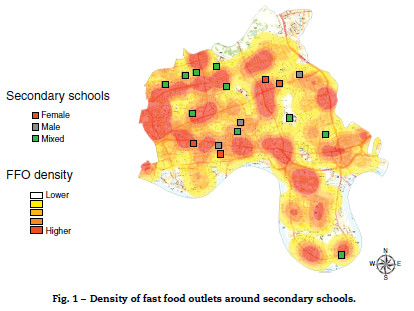
<body><![CDATA[<P><I>Findings</I></P>     <P>There are 2214 registered food businesses in the borough of which 297 were  grocers or mini-markets and 627 were FFOs. Ninety-eight per cent of households  (93,219) are within 10&nbsp;min walk of a FFO. At first glance physical access  to shops in Tower Hamlets would appear to be adequate with 76 per cent of  households within 10&nbsp;min walk of a supermarket, retail market, bakers or  greengrocers. Nearly all (97 per cent) of households were within a similar  distance of a grocery store, although our research indicates that many ‘grocery’  stores would only carry a very limited range of ‘healthy’ food. This was shown  by our use of the proxy measure of the availability of five fresh fruit and  seven fresh vegetables in any one shop. This should be contrasted with the  finding from the mapping that 97 per cent of households are within 10&nbsp;min  walk of a FFO. Similarly 98 per cent of schools had six FFOs within 400&nbsp;m  and 15 within 800&nbsp;m (see <a href="#f1">Fig. 1</a>). Samples of the food taken from the  outlets showed most to be high in fat, salt or sugar. So the choices people have  are heavily weighted in favour of unhealthy ones.</P>     <p>&nbsp;</p> <a name="f1"> <img src="/img/revistas/rpsp/v31n1/31n1a06f1.jpg">     
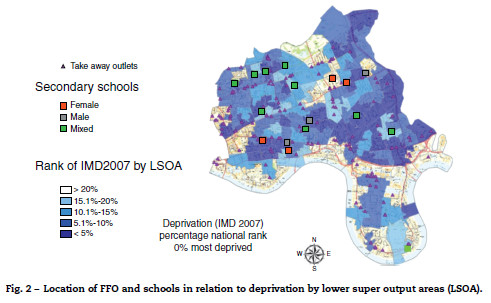
<p>&nbsp;</p>     <P>The School Food Trust in 2008 published findings on the number of junk food  outlets around schools in England, devising an index of schools to ‘junk food  outlets’ (including confectionary shops) and ranking local authorities on this  basis.<SUP>47</SUP> There was no separate figure for Tower Hamlets which was  grouped with ten other London Boroughs to provide an index of 36.7, i.e. 37  outlets per secondary school. The national average was 23 outlets per school,  with an urban average of 25 outlets per school and for London 28. Our estimates  of the ratio of food outlets to secondary schools for Tower Hamlets provides a  ratio of 41.8 outlets per school which compares to School Food Trust average  ratio of 38.6 for the UK 10 ‘<I>worst’</I> areas. The debate over the role that  geographic access and availability play in determining dietary outcomes has  proved contentious and much of the work undertaken has not been on highly  urbanised, geographically compact areas, such as Tower Hamlets.</P>     <P>Our findings showed concentrations of FFOs near schools and in deprived  areas, using national deprivation rankings (see <a href="#f2">Fig. 2</a>), but these  concentrations did not persist when Tower Hamlets’ internal rankings of  deprivation were used. The area of Tower Hamlets has such widespread poverty  that the differences within the area are marginal whereas comparison with  neighbouring boroughs shows up these inequalities. Several issues emerged. One  was the clustering of FFOs; a second was the clustering of FFOs in deprived  areas in the north of the borough around both schools and neighbourhoods.  Sampling and analysis of food typically bought from FFOs showed that it was high  in fat, saturated fat.</P>     <p>&nbsp;</p> <a name="f2"> <img src="/img/revistas/rpsp/v31n1/31n1a06f2.jpg">     
<p>&nbsp;</p>     <P>The qualitative and observational study support this  contention.<SUP>37</SUP><SUP>, </SUP><SUP>38</SUP><SUP>, </SUP><SUP>39</SUP> So  there is a need to expand the focus from hot fast-food to what Sinclair and  Winkler<SUP>33</SUP> call the cold take-aways, such as the sandwich shops and  grocery stores. Our own data show that the availability of these cold food  outlets is high. Also while school gate policies restricting access to the high  street were useful in preventing pupils from purchasing food at lunchtimes, they  had no impact on stopping purchase of unhealthy products on the way to and from  school.</P>     <P>The problems are fourfold for those living in the Borough of Tower Hamlets:      ]]></body>
<body><![CDATA[<P>1. The lack of healthy options and the absence of any nutrition information  in fast-food outlets.</P>     <P>2. The lack of other affordable healthy options in the local environment.</P>     <P>3. Large numbers of take-aways contributing to an obesogenic environment and  lack of healthy choice.</P>     <P>4. The lack of owner awareness of the problem, along with the perceived extra  costs that providing healthy food would require and a lack of customer  demand.</P>     <P><I>Research informed policy development</I></P>     <P>Findings from the research sketched above was used to help inform local  policy and actions in the borough. The presentation of data with a local focus  brought home to many of the public health and council officials what remains an  abstract argument in reports such as the WCRF global report.<SUP>48</SUP> The  establishment of a local advisory group was important in this respect as a key  issue was to use the findings to inform processes of training support, local  health promotion activities and the development of local planning policy. The  research information had to be communicated in ways which were understandable  and had meaning for a wide policy audience. Local data carries weight in  influencing local policy development. Part of the reporting and review process  involved informing the steering group of developments in other geographical  areas. Key among these was the potential to develop policy for planning and  regulating openings of new FFOs in the borough and for planning officials in the  local authority to work with public health staff in the health agency. This has  occurred following a number of council decisions and planning appeals.</P>     <P>The local authority continues to develop this work and has commissioned  further research (see <A  href="http://moderngov.towerhamlets.gov.uk/ieListDocuments.aspx?CId=320&amp;MId=3416&amp;Ver=4" target="_blank">http://moderngov.towerhamlets.gov.uk/ieListDocuments.aspx?CId=320&amp;MId=3416&amp;Ver=4</A>).  The policy documents resulting from this work have been sent for public  consultation -technically known as a ‘<I>Call for Representations’</I> (<A  href="http://moderngov.towerhamlets.gov.uk/ieListDocuments.aspx?CId=320&amp;MId=3416&amp;Ver=4" target="_blank">http://moderngov.towerhamlets.gov.uk/ieListDocuments.aspx?CId=320&amp;MId=3416&amp;Ver=4</A>)  and have been approved. The proposals are for restrictions on types of outlets  in designated areas of the borough some of which are:      <P>• In some designated areas there will be no new openings of FFOs due to the  adverse effect on the quality of life for local residents</P>     <P>• FFOs will not be allowed to exceed five per cent of total shopping  units.</P>     <P>• There must be two non-food units between every new restaurant or  take-away</P>     ]]></body>
<body><![CDATA[<P>• The proximity of a school or local authority leisure centre can be taken  into consideration in all new applications for a FFO</P>     <P>• New FFOs will only be considered in town centres or retail areas and not in  residential areas.</P>      <P>The attempt to link public health and planning is far from over, but the  outcomes so far show what can be achieved in attempting to influence the health  of an area by a focus on the upstream elements of place. As well as the planning  system developments outlined above the local and health authorities supported  work with existing local fast food outlets<SUP>52</SUP> including:      <P>• Reviewing the Council's own commercial letting policies to promote  healthier food on sale in local retail centres.</P>     <P>• Undertaking a social marketing programme to help overcome perceived  barriers to healthy eating in Tower Hamlets, including identifying healthy  options.</P>     <P>• Training for owners on raising awareness and how to produce healthy  food.</P>     <P>• The development of an awards scheme.<SUP>49</SUP></P>     <P>This multi-pronged approach is necessary to address the existing situation  and to plan for the future opening and control of new FFOs. This includes  working with fast-food owners to improve the nutrition of their products as well  as promote healthier options and smaller portion size as well as working with  suppliers of sauces and processed meat products to change the composition of  food at source or ‘upstream’.<SUP>49</SUP> Many of the fast food outlets in the  borough are small independent operators and owned by members of ethnic minority  communities. In tackling the issues there is a need to work with these small  independent operators to help them improve their food offer and not disadvantage  them. There are few chain outlets in residential areas of the borough, the  national and international brand chains being located central in the south of  the borough, an area which has a business district. This constitutes an  equalities issue as restrictions on new openings may disadvantage those small  and medium scale entrepreneurs, often coming from the local community, while  major chains can sit out the process and/or appeal any local regulation.</P>     <p>&nbsp;</p>     <P><B>Discussion</B></P>     ]]></body>
<body><![CDATA[<P>In London the major thrust for using planning processes to control the food  environment has been taken by local authorities. Some local authorities are  beginning to address these issues, perhaps the most publicised being Waltham  Forest, in the north east of London, taking steps to ban new outlets within  400&nbsp;m of a school, and others such as Barking and Dagenham, in the east of  London, developing new local supplementary guidance (<A  href="http://www.healthyplaces.org.uk/case-studies/barking-dagenham/" target="_blank">http://www.healthyplaces.org.uk/case-studies/barking-dagenham/</A>  accessed 8th Sept) as well as the proposal to introduce a &pound;1000 levy to be used  to tackle childhood obesity in the borough. So there are attempts towards health  promoting development at the local level within London and indeed across  England. There is no national guidance on food or fast food outlets in the local  environment, therefore leaving those authorities who are interested in tackling  the issue to develop their own.</P>     <P>In order to make the case for using planning to promote a salutogenic and  weaken the obesogenic environment, it is useful to bring developments elsewhere  to the attention of local decision-makers as was the case in Tower Hamlets.  Providing local data on the scale of the problem brought awareness of the  problem but not necessarily of the solutions. The use of public health ‘law’ is  well established in controlling the availability of items such as alcohol,  tobacco<SUP>50</SUP>. Samia Mair and colleagues<SUP>51</SUP> in the US examined  how zoning laws might be used to restrict the opening of FFOs. Planning can  employ incentives, performance or conditional zoning.<SUP>52</SUP> Performance  zoning takes account of the effects of land use on the local area and community.  Specific ways of achieving this include banning and or restricting:      <P>• FFOs and/or drive through outlets.</P>     <P>• ‘Formula’ outlets (formula can be defined broadly to include local  take-ways that have one or more outlets or narrowly to include only larger  national chains).</P>     <P>• FFOs in certain areas or by directives specifying distance from schools,  hospitals.</P>     <P>• By using quotas in certain areas either by number of shop frontage or by  use of density.</P>     <P>• Restricting opening hours.</P>     <P>• Making the link between registration for food hygiene and licensing more  explicit.</P>     <P>• Introducing labelling in fast food outlets.</P>     <P>• Using ‘choice editing’ and specifying the nutrient content of food sold, so  the choice is made before the consumer purchases.</P>     ]]></body>
<body><![CDATA[<P>The implementation of such restrictions may seem far fetched in England, yet  Los Angeles has banned the opening of FFOs in certain areas for a year. The Los  Angeles initiative is an anti-obesity measure as they found that there was a  concentration of FFOs in poor areas.<SUP>53</SUP> New York City is distinctive  as a world city putting in place wide-ranging public health policy which  includes a deliberate focus on regulatory measures as the context for health  promotion.<SUP>54</SUP><SUP>, </SUP><SUP>55</SUP> Its planning strategy in  respect of FFO has attracted attention for compulsory calorie labelling of menu  items in chains having 15 or more outlets. This can assist consumers to make  healthier choices, but it is crucial to see that this is set within a broad  framework which shapes the food environment to ensure access to healthier  food.<SUP>56</SUP> Hence the New York the city-wide ban on trans-fats and  requirement for nutrition standards for all public food procurement has upstream  impacts on the population not just individuals able to make healthy choices.  Approaches and policies not adopted or taken-up in London.</P>     <P>The ObesCities Report, a comparative study of policies developed in New York  and London to tackle childhood obesity noted the wide-ranging and robust  approach taken in New York in respect of fast food outlets.<SUP>57</SUP> The  first recommendation of the ObesCities Report was to use land use planning  powers to control takeaways. This would include “zoning and land use review, tax  incentives and city owned property” to shape the spatial distribution of  healthier food outlets. Commenting at the report's launch, Boris Johnson, the  Mayor of London, declared war on junk food firms saying that ‘<I>fast food  exclusion zones could be set up around schools and in parts of the city with an  obesity problem</I>.’ He added that ‘<I>A superb 2012 legacy for London would be  the obliteration of childhood obesity. I hope that working with New York will  result in leaner, fitter, children and families in both cities. I want to take  on the fast food companies who mercilessly lure children into excessive calorie  consumption</I>’.<SUP>58</SUP> As the Mayor is responsible for pan-London  spatial planning, general planning policy, pan-London public health policy might  be expected to provide a framework for improving the food environment in respect  of takeaways. In Novemebr 2012 the Mayor launched a toolkit’ for fast food  outlets. This stopped short of developing a pan-London perspective on fast food  location and regulation or of recommending the development of exclusion zones  around schools. Instead it offered guidance to individual boroughs to develop  their own approaches to tackling the problem.<SUP>59</SUP></P>     <P>At the time of writing the UK government are proposing changes to the  planning system to make it less bureaucratic and more business friendly (<A  href="http://www.communities.gov.uk/news/corporate/1871021" target="_blank">http://www.communities.gov.uk/news/corporate/1871021</A>,  accessed 3rd September 2012). This has been seen by some as being sympathetic to  big businesses and making it easier for them to gain permission to open outlets  while cutting back on local accountability. While the existing English planning  guidance for town centres does not specifically address the issue of take-aways,  it does include a section on health impact assessment and food which states that  ‘<I>[T]here will be a benefit to people on lower incomes through improved access  to good quality fresh food and other local goods and services at affordable  prices. This is because the new impact test will better promote consumer choice  and retail diversity helping to control price inflation, improving accessibility  and reducing the need to travel</I>’. Nevertheless, there is no <I>legal  requirement</I> for planning authorities to gauge the health impact of a new  business. The next section addresses whether the public health landscape  provides a framework to promote healthy food environments.</P>     <P>The public health landscape is changing in England at national, regional and  local levels, with much implementation due to come on stream from April 2013.  Heralded as putting communities, families and individuals in the driving seat  for policymaking, the public health function is being devolved to local  authorities. This is intended to enable action on some of the social  determinants of health to be brought together to promote health and wellbeing.  Local policy formation is to be supported by national policy based on voluntary  agreements with the food industry – The Responsibility Deal (see <A  href="http://responsibilitydeal.dh.gov.uk/" target="_blank">http://responsibilitydeal.dh.gov.uk</A>,  accessed 10th January 2013). There are no mandates to regulate through planning,  but there is a proposal which has relevance to the fast food industry: a calorie  reduction pledge. Actions to address this proposal might include reformulation  of products to make them less energy dense, reduce portion sizes and provide  calorie labelling to influence consumer choice. To date the main focus has been  on retailers and not FFOs. Another issue arising from the responsibility deals  is that they mainly involve large national and multi-national companies and not  small independent outlets like the majority of FFOs in the Tower Hamlets case  study above. Another key point to note about the Pledges and the Responsibility  Deal is that they are voluntary agreements. It is recognised that the effect of  voluntary agreements is limited.<SUP>60</SUP> The relocation of public health to  local authorities gives them an advantage in that they are closer to the  planning system and could, like the early pioneers of public health, take  advantage of this relocation.</P>     <P>The legislation for public health in England includes the establishment of a  London Health Improvement Board (LHIB), to be run by the Mayor and the 33 London  Local Authorities working to add value to the public health activities of those  local authorities. Also it has been agreed that childhood obesity is to be one  of its four priorities. With a primary focus on a Healthy Schools programme, it  has proposed a set of nine key tasks, developed following workshops with  stakeholders which included vigorous debate. One of the nine priority tasks  through March 2014 is to “Change the food environment in London to support  healthier choices – working in partnership with the London Food Board and  others”. Components of this task include undertakings in three areas:      <P>1. “Support local authorities to use existing planning powers to restrict the  opening of takeaways, especially close to schools”;</P>     <P>2. Extend the “Healthy Catering Commitments” programme which provides awards  to eating establishments which voluntarily meet given nutritional standards;</P>     <P>3. Take steps to “increase the availability of fruit and vegetables in  convenience stores…” (<A  href="http://www.lhib.org.uk/attachments/article/101/2b-Child%20Obesity.pdf" target="_blank">http://www.lhib.org.uk/attachments/article/101/2b-Child%20Obesity.pdf</A>,  accessed 14 Sept 2012).</P>     <P>None of the LHIB proposed work programme calls for additional pan-London or  national planning powers. However, two elements of the preliminary planning may  provide a basis for at least <I>discussing</I> the need for pan-London and  national regulation:</P>     <P>First the development of the LHIB's vision, aims and delivery principles has  “included an analysis of the approach taken in New York City to tackle obesity,  its impact, and the lessons London can learn. At a strategic level, this  includes the need for shared vision and commitment from senior leaders and  influential figures; and the development of bold proposals that stimulate debate  among leaders and communities”.</P>     ]]></body>
<body><![CDATA[<P>Second “Consideration of equity issues is a core part of this work, and a  health inequalities impact assessment will be developed to accompany the final  workplan.”</P>     <P>There is potential, therefore for the work of the LHIB to be open to new  learning about best practice from elsewhere. In the context of the  London-centric focus of politicians and the media in England, such learning  might lead to useful spin-offs for other localities. Any work on take-aways and  fast food needs to be set in the context of how, where and why people access  food as set out in a recent report from the American Planning Association who  warn of the dangers of allowing obesogenic and unhealthy situations to develop,  and then expecting that health promotion or planning can tackle the  problems.<SUP>61</SUP></P>     <p>&nbsp;</p>     <P><B>Conclusion</B></P>     <P>We contend that long-term options are best pursued though the introduction of  central enabling legislation which local government authorities and local health  agencies can adopt. When addressing whole system problems, such as those  resulting from an obesogenic environment, local policy-making is necessary but  not sufficient. Planning on its own cannot address the total problem. Other  upstream interventions acting on social determinants of health employed  elsewhere including taxes and subsidies provide incentives to both those running  FFOs and customers.<SUP>57</SUP><SUP>, </SUP><SUP>62</SUP></P>     <P>Successive national governments in England have not put into place at the  national level, social determinants informed health promotion infrastrucure that  would engage speedily and effectively with unhealthy food environments. The  default position consistent with the emerging public health landscape in England  runs the danger of further disadvantaging the very communities most at risk.</P>     <P>Many public health analysts welcome empowered decision-making at the local  level, which is promised in the emerging public health policy in England, in  contrast with wholly top-down policy formation. Top down decision making might  give little scope for shaping initiatives in line with distinctive demographic  and epidemiological assessment and judgement by civil society groups and  communities of practice. While existing planning legislation in London and  England is weak in protecting citizens and for providing salutogenic  environments, it does offer opportunities. This article has shown how in Tower  Hamlets and many other localities in both London and across England there is  enthusiasm to control the local food environment and that links can be made  across formal public health services and local authority planning services to  move towards a health promoting public health strategy. We would not want to  claim success for all the activities undertaken since our work but would make  some claim to this being the ‘kickstart’ for a body of work ranging from  activities with local owners of outlets, reformulation of foods, the training of  food service staff, a registration scheme and the development of local planning  guidance. The lessons from this research have been used to inform similar  processes in areas such as Glasgow, Liverpool/Merseyside and  Belfast.<SUP>63</SUP><SUP>, </SUP><SUP>64</SUP></P>     <P>Moves towards new and more powerful legislation related to the food  environment must grasp the current potentials and limitations of the planning  system. This knowledge and skill base must be shared by local politicians,  planners, businesses and communities. In this context spirited impetus to  support local authorities is being provided by civil society groups. For  instance, The National Heart Forum, an influential civil society alliance of  national organisations, has stepped in to provide background information on how  to use planning. Its recent report devoted to local authorities describes the  planning system, outlines how planning can be used for public health and  specifies specific mechanisms and processes which can be used.<SUP>65</SUP> In  addition it has in 2012 set up an on-line resource, Healthy Places, to provide  what has hitherto been very difficult to access, a compendium of successful case  studies (see <A  href="http://www.healthyplaces.org.uk/key-issues/hot-food-takeaways/development-control/" target="_blank">http://www.healthyplaces.org.uk/key-issues/hot-food-takeaways/development-control/</A>).</P>     <P>While legislative systems differ, the US experience merits further  consideration in the context of English planning laws. The initiatives in New  York City as well as being anti-obesity measures are also designed to address  the issue of widening inequalities. It is notable that while New York adopts  informational behaviour change initiatives as in the case of calorie labelling,  this is within a policy portfolio with a strong presence of regulation. This  approach has been credited with “NY City's life expectancy rising faster than  anywhere else in the USA” and attributed to the “…city's aggressive efforts to  reshape New York's social environment…” a movement led by the city's public  health department with forceful backing from its Mayor.<SUP>66</SUP></P>     <p>&nbsp;</p>     ]]></body>
<body><![CDATA[<P><B>Bibliograf&iacute;a</B></P>     <!-- ref --><P>1. Foresight. Tackling obesities: future choices?project report. London: The  Stationery Office; 2007.    &nbsp;&nbsp;&nbsp;&nbsp;&nbsp;&nbsp;&nbsp;&nbsp;[&#160;<a href="javascript:void(0);" onclick="javascript: window.open('/scielo.php?script=sci_nlinks&ref=000104&pid=S0870-9025201300010000600001&lng=','','width=640,height=500,resizable=yes,scrollbars=1,menubar=yes,');">Links</a>&#160;]<!-- end-ref --> </P>     <!-- ref --><P>2. Swinburn BA, Sacks G, Hall KD, McPherson K, Finegood TD, Moodie ML, et–al.  The global obesity pandemic: shaped by global drivers and local environments.  Lancet. 2011; 378:804–14.    &nbsp;&nbsp;&nbsp;&nbsp;&nbsp;&nbsp;&nbsp;&nbsp;[&#160;<a href="javascript:void(0);" onclick="javascript: window.open('/scielo.php?script=sci_nlinks&ref=000106&pid=S0870-9025201300010000600002&lng=','','width=640,height=500,resizable=yes,scrollbars=1,menubar=yes,');">Links</a>&#160;]<!-- end-ref --> </P>     <!-- ref --><P>3. Dietz WH, Benken DE, Hunter AS. Public health law and the prevention and  control of obesity. Milbank Quart. 2009; 87:215–27.    &nbsp;&nbsp;&nbsp;&nbsp;&nbsp;&nbsp;&nbsp;&nbsp;[&#160;<a href="javascript:void(0);" onclick="javascript: window.open('/scielo.php?script=sci_nlinks&ref=000108&pid=S0870-9025201300010000600003&lng=','','width=640,height=500,resizable=yes,scrollbars=1,menubar=yes,');">Links</a>&#160;]<!-- end-ref --> </P>     <!-- ref --><P>4. Sallis JF, Glanz K. Physical activity and food environments: solutions to  the obesity epidemic. Milbank Quart. 2009; 87:123–54.    &nbsp;&nbsp;&nbsp;&nbsp;&nbsp;&nbsp;&nbsp;&nbsp;[&#160;<a href="javascript:void(0);" onclick="javascript: window.open('/scielo.php?script=sci_nlinks&ref=000110&pid=S0870-9025201300010000600004&lng=','','width=640,height=500,resizable=yes,scrollbars=1,menubar=yes,');">Links</a>&#160;]<!-- end-ref --> </P>     <!-- ref --><P>5. Mello M. New York city''s war on fat. N Engl J Med. 2009; 360:2015–20.    &nbsp;&nbsp;&nbsp;&nbsp;&nbsp;&nbsp;&nbsp;&nbsp;[&#160;<a href="javascript:void(0);" onclick="javascript: window.open('/scielo.php?script=sci_nlinks&ref=000112&pid=S0870-9025201300010000600005&lng=','','width=640,height=500,resizable=yes,scrollbars=1,menubar=yes,');">Links</a>&#160;]<!-- end-ref -->  </P>     <!-- ref --><P>6. Finer SE. The life and times of Sir Edwin Chadwick. London: Methuen and  Co; 1952.    &nbsp;&nbsp;&nbsp;&nbsp;&nbsp;&nbsp;&nbsp;&nbsp;[&#160;<a href="javascript:void(0);" onclick="javascript: window.open('/scielo.php?script=sci_nlinks&ref=000114&pid=S0870-9025201300010000600006&lng=','','width=640,height=500,resizable=yes,scrollbars=1,menubar=yes,');">Links</a>&#160;]<!-- end-ref --> </P>     <!-- ref --><P>7. Ridde V, Cloos P. Health promotion, power and political science. Global  Health Promot. 2011; 18:03–4.    &nbsp;&nbsp;&nbsp;&nbsp;&nbsp;&nbsp;&nbsp;&nbsp;[&#160;<a href="javascript:void(0);" onclick="javascript: window.open('/scielo.php?script=sci_nlinks&ref=000116&pid=S0870-9025201300010000600007&lng=','','width=640,height=500,resizable=yes,scrollbars=1,menubar=yes,');">Links</a>&#160;]<!-- end-ref --> </P>     <!-- ref --><P>8. Rayner G, Lang T. Is nudge an effective public health strategy to tackle  obesity?. No. Br Med J. 2011; 342:d2177. (Clinical Research Ed.    &nbsp;&nbsp;&nbsp;&nbsp;&nbsp;&nbsp;&nbsp;&nbsp;[&#160;<a href="javascript:void(0);" onclick="javascript: window.open('/scielo.php?script=sci_nlinks&ref=000118&pid=S0870-9025201300010000600008&lng=','','width=640,height=500,resizable=yes,scrollbars=1,menubar=yes,');">Links</a>&#160;]<!-- end-ref -->). </P>     <!-- ref --><P>9. Department of Health. The public health responsibility deal. 2011.  Available at: <A  href="http://responsibilitydeal.dh.gov.uk/" target="_blank">http://responsibilitydeal.dh.gov.uk/</A>  [accessed 10.09.12].    &nbsp;&nbsp;&nbsp;&nbsp;&nbsp;&nbsp;&nbsp;&nbsp;[&#160;<a href="javascript:void(0);" onclick="javascript: window.open('/scielo.php?script=sci_nlinks&ref=000120&pid=S0870-9025201300010000600009&lng=','','width=640,height=500,resizable=yes,scrollbars=1,menubar=yes,');">Links</a>&#160;]<!-- end-ref --> </P>     <!-- ref --><P>10. Sunstein C, Thaler R. Nudge: improving decisions about health, wealth,  and happiness. Yale: Yale University Press; 2008.    &nbsp;&nbsp;&nbsp;&nbsp;&nbsp;&nbsp;&nbsp;&nbsp;[&#160;<a href="javascript:void(0);" onclick="javascript: window.open('/scielo.php?script=sci_nlinks&ref=000122&pid=S0870-9025201300010000600010&lng=','','width=640,height=500,resizable=yes,scrollbars=1,menubar=yes,');">Links</a>&#160;]<!-- end-ref --> </P>     <!-- ref --><P>11. World Health Organization. The Ottawa Charter. Geneva: WHO; 1986.    &nbsp;&nbsp;&nbsp;&nbsp;&nbsp;&nbsp;&nbsp;&nbsp;[&#160;<a href="javascript:void(0);" onclick="javascript: window.open('/scielo.php?script=sci_nlinks&ref=000124&pid=S0870-9025201300010000600011&lng=','','width=640,height=500,resizable=yes,scrollbars=1,menubar=yes,');">Links</a>&#160;]<!-- end-ref --> </P>     <!-- ref --><P>12. Nutbeam D. Health promotion glossary. Geneva: WHO; 1998.    &nbsp;&nbsp;&nbsp;&nbsp;&nbsp;&nbsp;&nbsp;&nbsp;[&#160;<a href="javascript:void(0);" onclick="javascript: window.open('/scielo.php?script=sci_nlinks&ref=000126&pid=S0870-9025201300010000600012&lng=','','width=640,height=500,resizable=yes,scrollbars=1,menubar=yes,');">Links</a>&#160;]<!-- end-ref --> </P>     <!-- ref --><P>13. World Health Organization. Closing the gap in a generation: health equity  through action on the social determinants of health. Geneva: WHO; 2008. p. 16.    &nbsp;&nbsp;&nbsp;&nbsp;&nbsp;&nbsp;&nbsp;&nbsp;[&#160;<a href="javascript:void(0);" onclick="javascript: window.open('/scielo.php?script=sci_nlinks&ref=000128&pid=S0870-9025201300010000600013&lng=','','width=640,height=500,resizable=yes,scrollbars=1,menubar=yes,');">Links</a>&#160;]<!-- end-ref -->  </P>     <!-- ref --><P>14. McDonalds and Allegra Strategies. Eating out in the UK 2009: a  comprehensive analysis of the informal eating out market. London: Allegra; 2009.    &nbsp;&nbsp;&nbsp;&nbsp;&nbsp;&nbsp;&nbsp;&nbsp;[&#160;<a href="javascript:void(0);" onclick="javascript: window.open('/scielo.php?script=sci_nlinks&ref=000130&pid=S0870-9025201300010000600014&lng=','','width=640,height=500,resizable=yes,scrollbars=1,menubar=yes,');">Links</a>&#160;]<!-- end-ref -->  </P>     <!-- ref --><P>15. Popkin B. The world is fat: the fads, trends, policies and products that  are fattening the human race. New York: Avery; 2009.    &nbsp;&nbsp;&nbsp;&nbsp;&nbsp;&nbsp;&nbsp;&nbsp;[&#160;<a href="javascript:void(0);" onclick="javascript: window.open('/scielo.php?script=sci_nlinks&ref=000132&pid=S0870-9025201300010000600015&lng=','','width=640,height=500,resizable=yes,scrollbars=1,menubar=yes,');">Links</a>&#160;]<!-- end-ref --> </P>     <!-- ref --><P>16. Lin BH, Guthrie J. The quality of children''s diets at and away from  home. Food Rev USDA. 1996; May?August:45–50. Economic Research Service.    &nbsp;&nbsp;&nbsp;&nbsp;&nbsp;&nbsp;&nbsp;&nbsp;[&#160;<a href="javascript:void(0);" onclick="javascript: window.open('/scielo.php?script=sci_nlinks&ref=000134&pid=S0870-9025201300010000600016&lng=','','width=640,height=500,resizable=yes,scrollbars=1,menubar=yes,');">Links</a>&#160;]<!-- end-ref --> </P>     <!-- ref --><P>17. Macdonald L, Cummins S, Macintyre S. Neighbourhod fast–food environment  and area deprivation–substitution or concentration?. Appetite. 2007; 49:251–4.    &nbsp;&nbsp;&nbsp;&nbsp;&nbsp;&nbsp;&nbsp;&nbsp;[&#160;<a href="javascript:void(0);" onclick="javascript: window.open('/scielo.php?script=sci_nlinks&ref=000136&pid=S0870-9025201300010000600017&lng=','','width=640,height=500,resizable=yes,scrollbars=1,menubar=yes,');">Links</a>&#160;]<!-- end-ref -->  </P>     <!-- ref --><P>18. Reidpath DD, Burns C, Garrard J, Mahoney M, Townsend M. An ecological  study of the relationship between social and environmental determinants of  obesity. Health Place. 2002; 2:141–5.    &nbsp;&nbsp;&nbsp;&nbsp;&nbsp;&nbsp;&nbsp;&nbsp;[&#160;<a href="javascript:void(0);" onclick="javascript: window.open('/scielo.php?script=sci_nlinks&ref=000138&pid=S0870-9025201300010000600018&lng=','','width=640,height=500,resizable=yes,scrollbars=1,menubar=yes,');">Links</a>&#160;]<!-- end-ref --> </P>     <!-- ref --><P>19. Kavanagh A, Thornton L, Tattam A, Thomas L, Jolley D, Turrel G. VicLANES:  place does matter for your health. Melbourne: University of Melbourne; 2007.    &nbsp;&nbsp;&nbsp;&nbsp;&nbsp;&nbsp;&nbsp;&nbsp;[&#160;<a href="javascript:void(0);" onclick="javascript: window.open('/scielo.php?script=sci_nlinks&ref=000140&pid=S0870-9025201300010000600019&lng=','','width=640,height=500,resizable=yes,scrollbars=1,menubar=yes,');">Links</a>&#160;]<!-- end-ref -->  </P>     <!-- ref --><P>20. Kwate NAO. Fried chicken and fresh apples: racial segregation as a  fundamental cause of fast–food density in black neighborhoods. Health Place.  2008; 14:32–44.    &nbsp;&nbsp;&nbsp;&nbsp;&nbsp;&nbsp;&nbsp;&nbsp;[&#160;<a href="javascript:void(0);" onclick="javascript: window.open('/scielo.php?script=sci_nlinks&ref=000142&pid=S0870-9025201300010000600020&lng=','','width=640,height=500,resizable=yes,scrollbars=1,menubar=yes,');">Links</a>&#160;]<!-- end-ref --> </P>     <!-- ref --><P>21. National Consumer Council. Takeaway health: how takeaway restaurants can  affect your chances of a healthy diet. London: National Consumer Council; 2008.    &nbsp;&nbsp;&nbsp;&nbsp;&nbsp;&nbsp;&nbsp;&nbsp;[&#160;<a href="javascript:void(0);" onclick="javascript: window.open('/scielo.php?script=sci_nlinks&ref=000144&pid=S0870-9025201300010000600021&lng=','','width=640,height=500,resizable=yes,scrollbars=1,menubar=yes,');">Links</a>&#160;]<!-- end-ref -->  </P>     <!-- ref --><P>22. Which? Fast food: do you know what our kids are eating? Which?. 2009.  October, p. 66–8.    &nbsp;&nbsp;&nbsp;&nbsp;&nbsp;&nbsp;&nbsp;&nbsp;[&#160;<a href="javascript:void(0);" onclick="javascript: window.open('/scielo.php?script=sci_nlinks&ref=000146&pid=S0870-9025201300010000600022&lng=','','width=640,height=500,resizable=yes,scrollbars=1,menubar=yes,');">Links</a>&#160;]<!-- end-ref --> </P>     <!-- ref --><P>23. Burns C, Inglis AD. Measuring food access in Melbourne: access to healthy  and fast–foods by car, bus and foot in an urban municipality in Melbourne.  Health Place. 2007; 13:877–85.    &nbsp;&nbsp;&nbsp;&nbsp;&nbsp;&nbsp;&nbsp;&nbsp;[&#160;<a href="javascript:void(0);" onclick="javascript: window.open('/scielo.php?script=sci_nlinks&ref=000148&pid=S0870-9025201300010000600023&lng=','','width=640,height=500,resizable=yes,scrollbars=1,menubar=yes,');">Links</a>&#160;]<!-- end-ref --> </P>     <!-- ref --><P>24. Morland K, Wing S, Diez Roux A, Poole C. Neighbourhood characteristics  associated with the location of food stores and food service places. Am J Prev  Med. 2002; 22:23–9.    &nbsp;&nbsp;&nbsp;&nbsp;&nbsp;&nbsp;&nbsp;&nbsp;[&#160;<a href="javascript:void(0);" onclick="javascript: window.open('/scielo.php?script=sci_nlinks&ref=000150&pid=S0870-9025201300010000600024&lng=','','width=640,height=500,resizable=yes,scrollbars=1,menubar=yes,');">Links</a>&#160;]<!-- end-ref --> </P>     <!-- ref --><P>25. Dowler E. Policy initiatives to address low–income households?  nutritional needs in the UK. Proc Nutr Soc. 2008; 67:289–300.    &nbsp;&nbsp;&nbsp;&nbsp;&nbsp;&nbsp;&nbsp;&nbsp;[&#160;<a href="javascript:void(0);" onclick="javascript: window.open('/scielo.php?script=sci_nlinks&ref=000152&pid=S0870-9025201300010000600025&lng=','','width=640,height=500,resizable=yes,scrollbars=1,menubar=yes,');">Links</a>&#160;]<!-- end-ref --> </P>     <!-- ref --><P>26. Nelson M, Erens B, Bates B, Church S, Boshier T. Low income diet and  nutrition survey. London: Food Standards Agency; 2007.    &nbsp;&nbsp;&nbsp;&nbsp;&nbsp;&nbsp;&nbsp;&nbsp;[&#160;<a href="javascript:void(0);" onclick="javascript: window.open('/scielo.php?script=sci_nlinks&ref=000154&pid=S0870-9025201300010000600026&lng=','','width=640,height=500,resizable=yes,scrollbars=1,menubar=yes,');">Links</a>&#160;]<!-- end-ref --> </P>     <!-- ref --><P>27. Sodexho. The Sodexho school meals and lifestyle survey 2005: Whyteleafe.  Surrey: Sodexho; 2005.    &nbsp;&nbsp;&nbsp;&nbsp;&nbsp;&nbsp;&nbsp;&nbsp;[&#160;<a href="javascript:void(0);" onclick="javascript: window.open('/scielo.php?script=sci_nlinks&ref=000156&pid=S0870-9025201300010000600027&lng=','','width=640,height=500,resizable=yes,scrollbars=1,menubar=yes,');">Links</a>&#160;]<!-- end-ref --> </P>     <!-- ref --><P>28. Henderson L, Gregory J, Swan G. National Diet and Nutrition Survey:  adults aged 19 to 64 years: volume 1: types and quantities of foods consumed.  London: TSO; 2002.    &nbsp;&nbsp;&nbsp;&nbsp;&nbsp;&nbsp;&nbsp;&nbsp;[&#160;<a href="javascript:void(0);" onclick="javascript: window.open('/scielo.php?script=sci_nlinks&ref=000158&pid=S0870-9025201300010000600028&lng=','','width=640,height=500,resizable=yes,scrollbars=1,menubar=yes,');">Links</a>&#160;]<!-- end-ref --> </P>     <!-- ref --><P>29. Prentice AM, Jebb SA. Fast–foods, energy density and obesity: a possible  mechanistic link. Obes Rev. 2003; 4:187–94.    &nbsp;&nbsp;&nbsp;&nbsp;&nbsp;&nbsp;&nbsp;&nbsp;[&#160;<a href="javascript:void(0);" onclick="javascript: window.open('/scielo.php?script=sci_nlinks&ref=000160&pid=S0870-9025201300010000600029&lng=','','width=640,height=500,resizable=yes,scrollbars=1,menubar=yes,');">Links</a>&#160;]<!-- end-ref --> </P>     <!-- ref --><P>30. Coun S. Deprivation amplification revisited: or, is it always true that  poorer places have poorer access to resources for healthy diets and physical  activity?. Int J Behav Nutr Phys Activ. 2007; 4:32.    &nbsp;&nbsp;&nbsp;&nbsp;&nbsp;&nbsp;&nbsp;&nbsp;[&#160;<a href="javascript:void(0);" onclick="javascript: window.open('/scielo.php?script=sci_nlinks&ref=000162&pid=S0870-9025201300010000600030&lng=','','width=640,height=500,resizable=yes,scrollbars=1,menubar=yes,');">Links</a>&#160;]<!-- end-ref --> </P>     <!-- ref --><P>31. Melaniphy J. The restaurant location guidebook, a comprehensive guide to  picking restaurant and quick service food locations. Chicago: International Real  Estate Location Institute Inc; 2007.    &nbsp;&nbsp;&nbsp;&nbsp;&nbsp;&nbsp;&nbsp;&nbsp;[&#160;<a href="javascript:void(0);" onclick="javascript: window.open('/scielo.php?script=sci_nlinks&ref=000164&pid=S0870-9025201300010000600031&lng=','','width=640,height=500,resizable=yes,scrollbars=1,menubar=yes,');">Links</a>&#160;]<!-- end-ref --> </P>     <!-- ref --><P>32. Bowyer S, Caraher M, Eilbert K, Carr–Hill R. Shopping for food: lessons  from a London borough. Br Food J. 2009; 111:452–74.    &nbsp;&nbsp;&nbsp;&nbsp;&nbsp;&nbsp;&nbsp;&nbsp;[&#160;<a href="javascript:void(0);" onclick="javascript: window.open('/scielo.php?script=sci_nlinks&ref=000166&pid=S0870-9025201300010000600032&lng=','','width=640,height=500,resizable=yes,scrollbars=1,menubar=yes,');">Links</a>&#160;]<!-- end-ref --> </P>     <!-- ref --><P>33. Sinclair S, Winkler JT. The School Fringe: what pupils buy and eat from  shops surrounding secondary schools. London: Nutrition Policy Unit, London  Metropolitan University; 2008.    &nbsp;&nbsp;&nbsp;&nbsp;&nbsp;&nbsp;&nbsp;&nbsp;[&#160;<a href="javascript:void(0);" onclick="javascript: window.open('/scielo.php?script=sci_nlinks&ref=000168&pid=S0870-9025201300010000600033&lng=','','width=640,height=500,resizable=yes,scrollbars=1,menubar=yes,');">Links</a>&#160;]<!-- end-ref --> </P>     <!-- ref --><P>34. Austin SB, Melly SJ, Sanchez BN, Patel A, Buka S, Gortmaker SL.  Clustering of fast–food restaurants around schools: a novel application of  spatial statistics to the study of food environments. Am J Public Health. 2005;  95:1575–81.    &nbsp;&nbsp;&nbsp;&nbsp;&nbsp;&nbsp;&nbsp;&nbsp;[&#160;<a href="javascript:void(0);" onclick="javascript: window.open('/scielo.php?script=sci_nlinks&ref=000170&pid=S0870-9025201300010000600034&lng=','','width=640,height=500,resizable=yes,scrollbars=1,menubar=yes,');">Links</a>&#160;]<!-- end-ref --> </P>     <!-- ref --><P>35. Day PL, Pearce JR. Obesity–promoting food environments and the spatial  clustering of food outlets around schools. Am J Prev Med. 2011; 40:113–21.    &nbsp;&nbsp;&nbsp;&nbsp;&nbsp;&nbsp;&nbsp;&nbsp;[&#160;<a href="javascript:void(0);" onclick="javascript: window.open('/scielo.php?script=sci_nlinks&ref=000172&pid=S0870-9025201300010000600035&lng=','','width=640,height=500,resizable=yes,scrollbars=1,menubar=yes,');">Links</a>&#160;]<!-- end-ref --> </P>     <!-- ref --><P>36. New Economics Foundation. An inconvenient sandwich: the throwaway  economics of takeaway food. London: New Economics Foundation; 2010.    &nbsp;&nbsp;&nbsp;&nbsp;&nbsp;&nbsp;&nbsp;&nbsp;[&#160;<a href="javascript:void(0);" onclick="javascript: window.open('/scielo.php?script=sci_nlinks&ref=000174&pid=S0870-9025201300010000600036&lng=','','width=640,height=500,resizable=yes,scrollbars=1,menubar=yes,');">Links</a>&#160;]<!-- end-ref --> </P>     <!-- ref --><P>37. Caraher M, Lloyd S, Madelin T. The ?school Foodshed?: schools and  fast–food outlets in a London borough. Br Food J. 2013. DOI information  unavailable.    &nbsp;&nbsp;&nbsp;&nbsp;&nbsp;&nbsp;&nbsp;&nbsp;[&#160;<a href="javascript:void(0);" onclick="javascript: window.open('/scielo.php?script=sci_nlinks&ref=000176&pid=S0870-9025201300010000600037&lng=','','width=640,height=500,resizable=yes,scrollbars=1,menubar=yes,');">Links</a>&#160;]<!-- end-ref --> </P>     <!-- ref --><P>38. Lloyd S, Caraher M, Madelin T. Fish and chips with a side order of trans  fat: the nutrition implications of eating from fast–food outlets: a report on  eating out in East London. London: Centre for Food Policy, City University;  2010.    &nbsp;&nbsp;&nbsp;&nbsp;&nbsp;&nbsp;&nbsp;&nbsp;[&#160;<a href="javascript:void(0);" onclick="javascript: window.open('/scielo.php?script=sci_nlinks&ref=000178&pid=S0870-9025201300010000600038&lng=','','width=640,height=500,resizable=yes,scrollbars=1,menubar=yes,');">Links</a>&#160;]<!-- end-ref --> </P>     <!-- ref --><P>39. Lloyd S, Madelin T, Caraher M. Report on fast food outlets (FFOs) in  Tower Hamlets: a borough perspective. London: Centre for Food Policy, City  University; 2008.    &nbsp;&nbsp;&nbsp;&nbsp;&nbsp;&nbsp;&nbsp;&nbsp;[&#160;<a href="javascript:void(0);" onclick="javascript: window.open('/scielo.php?script=sci_nlinks&ref=000180&pid=S0870-9025201300010000600039&lng=','','width=640,height=500,resizable=yes,scrollbars=1,menubar=yes,');">Links</a>&#160;]<!-- end-ref --> </P>     <!-- ref --><P>40. Thomas G. How to do your case study: a guide for students and  researchers. London: Sage; 2010.    &nbsp;&nbsp;&nbsp;&nbsp;&nbsp;&nbsp;&nbsp;&nbsp;[&#160;<a href="javascript:void(0);" onclick="javascript: window.open('/scielo.php?script=sci_nlinks&ref=000182&pid=S0870-9025201300010000600040&lng=','','width=640,height=500,resizable=yes,scrollbars=1,menubar=yes,');">Links</a>&#160;]<!-- end-ref --> </P>     <!-- ref --><P>41. City University of New York , London Metropolitan University. A tale of  two ObesCities comparing responses to childhood obesity in London and New York  City. 2010.    &nbsp;&nbsp;&nbsp;&nbsp;&nbsp;&nbsp;&nbsp;&nbsp;[&#160;<a href="javascript:void(0);" onclick="javascript: window.open('/scielo.php?script=sci_nlinks&ref=000184&pid=S0870-9025201300010000600041&lng=','','width=640,height=500,resizable=yes,scrollbars=1,menubar=yes,');">Links</a>&#160;]<!-- end-ref --> </P>     <!-- ref --><P>42. Greater London Authority. Round population projection PLP low. London:  GLA; 2007.    &nbsp;&nbsp;&nbsp;&nbsp;&nbsp;&nbsp;&nbsp;&nbsp;[&#160;<a href="javascript:void(0);" onclick="javascript: window.open('/scielo.php?script=sci_nlinks&ref=000186&pid=S0870-9025201300010000600042&lng=','','width=640,height=500,resizable=yes,scrollbars=1,menubar=yes,');">Links</a>&#160;]<!-- end-ref --> </P>     <!-- ref --><P>43. Dench G, Gavron K, Young M. The New East end: kinship, race and conflict.  London: Profile Books; 2006.    &nbsp;&nbsp;&nbsp;&nbsp;&nbsp;&nbsp;&nbsp;&nbsp;[&#160;<a href="javascript:void(0);" onclick="javascript: window.open('/scielo.php?script=sci_nlinks&ref=000188&pid=S0870-9025201300010000600043&lng=','','width=640,height=500,resizable=yes,scrollbars=1,menubar=yes,');">Links</a>&#160;]<!-- end-ref --> </P>     <!-- ref --><P>44. Tower Hamlets PCT. Annual public health report. London: Tower Hamlets  PCT; 2007.    &nbsp;&nbsp;&nbsp;&nbsp;&nbsp;&nbsp;&nbsp;&nbsp;[&#160;<a href="javascript:void(0);" onclick="javascript: window.open('/scielo.php?script=sci_nlinks&ref=000190&pid=S0870-9025201300010000600044&lng=','','width=640,height=500,resizable=yes,scrollbars=1,menubar=yes,');">Links</a>&#160;]<!-- end-ref --> </P>     <!-- ref --><P>45. OFSTED Tellus2 Survey; 2007. <a href="http://www.ofsted.gov.uk/" target="_blank">http://www.ofsted.gov.uk/</a> [accessed  26.07.08].    &nbsp;&nbsp;&nbsp;&nbsp;&nbsp;&nbsp;&nbsp;&nbsp;[&#160;<a href="javascript:void(0);" onclick="javascript: window.open('/scielo.php?script=sci_nlinks&ref=000192&pid=S0870-9025201300010000600045&lng=','','width=640,height=500,resizable=yes,scrollbars=1,menubar=yes,');">Links</a>&#160;]<!-- end-ref --> </P>     <!-- ref --><P>46. Ipsos MORI. Face to face random probability survey of 2342 respondents  aged 16 and over carried out in Tower Hamlets on behalf of the local NHS trust.  London: Ipsos MORI; 2009.    &nbsp;&nbsp;&nbsp;&nbsp;&nbsp;&nbsp;&nbsp;&nbsp;[&#160;<a href="javascript:void(0);" onclick="javascript: window.open('/scielo.php?script=sci_nlinks&ref=000194&pid=S0870-9025201300010000600046&lng=','','width=640,height=500,resizable=yes,scrollbars=1,menubar=yes,');">Links</a>&#160;]<!-- end-ref --> </P>     <!-- ref --><P>47. School Food Trust. Junk food temptation towns index. London: School Foods  Trust; 2008.    &nbsp;&nbsp;&nbsp;&nbsp;&nbsp;&nbsp;&nbsp;&nbsp;[&#160;<a href="javascript:void(0);" onclick="javascript: window.open('/scielo.php?script=sci_nlinks&ref=000196&pid=S0870-9025201300010000600047&lng=','','width=640,height=500,resizable=yes,scrollbars=1,menubar=yes,');">Links</a>&#160;]<!-- end-ref --> </P>     <!-- ref --><P>48. American Institute for Cancer Research. World activity, and the  prevention of cancer: a global, perspective. Washington: Cancer Research  Fund/American Institute for Cancer Research; 2007.    &nbsp;&nbsp;&nbsp;&nbsp;&nbsp;&nbsp;&nbsp;&nbsp;[&#160;<a href="javascript:void(0);" onclick="javascript: window.open('/scielo.php?script=sci_nlinks&ref=000198&pid=S0870-9025201300010000600048&lng=','','width=640,height=500,resizable=yes,scrollbars=1,menubar=yes,');">Links</a>&#160;]<!-- end-ref --> </P>     <!-- ref --><P>49. Sandelson M. Tower Hamlets Food for Health Award Project March 2009?March  2012. London: Tower Hamlets Public Health Directorate; 2012.    &nbsp;&nbsp;&nbsp;&nbsp;&nbsp;&nbsp;&nbsp;&nbsp;[&#160;<a href="javascript:void(0);" onclick="javascript: window.open('/scielo.php?script=sci_nlinks&ref=000200&pid=S0870-9025201300010000600049&lng=','','width=640,height=500,resizable=yes,scrollbars=1,menubar=yes,');">Links</a>&#160;]<!-- end-ref --> </P>     <!-- ref --><P>50. Brownell K, Warner K. The perils of ignoring history: big tobacco played  dirty and millions died. How similar is big food?. Milbank Quart. 2009;  87:259–94.    &nbsp;&nbsp;&nbsp;&nbsp;&nbsp;&nbsp;&nbsp;&nbsp;[&#160;<a href="javascript:void(0);" onclick="javascript: window.open('/scielo.php?script=sci_nlinks&ref=000202&pid=S0870-9025201300010000600050&lng=','','width=640,height=500,resizable=yes,scrollbars=1,menubar=yes,');">Links</a>&#160;]<!-- end-ref --> </P>     <!-- ref --><P>51. Samia Mair J, Pierce M, Teret S. The use of zoning to restrict fast food  outlets: a potential strategy to combat obesity. USA: The Center for Law and the  Public''s Health at Georgetown and Johns Hopkins Universities; 2005.    &nbsp;&nbsp;&nbsp;&nbsp;&nbsp;&nbsp;&nbsp;&nbsp;[&#160;<a href="javascript:void(0);" onclick="javascript: window.open('/scielo.php?script=sci_nlinks&ref=000204&pid=S0870-9025201300010000600051&lng=','','width=640,height=500,resizable=yes,scrollbars=1,menubar=yes,');">Links</a>&#160;]<!-- end-ref --> </P>     <!-- ref --><P>52. Samia Mair J, Pierce MW, Teret SP. The use of zoning to restrict fast  food outlets: a potential strategy to combat obesity. The Centre for Law and  Public Health, Johns Hopkins University; 2005.    &nbsp;&nbsp;&nbsp;&nbsp;&nbsp;&nbsp;&nbsp;&nbsp;[&#160;<a href="javascript:void(0);" onclick="javascript: window.open('/scielo.php?script=sci_nlinks&ref=000206&pid=S0870-9025201300010000600052&lng=','','width=640,height=500,resizable=yes,scrollbars=1,menubar=yes,');">Links</a>&#160;]<!-- end-ref --> </P>     <P>53. Reuters Los Angles. City Council passes fast food ban. Available on <a href=" http://www.reuters.com/article/healthNews/idUSCOL06846020080730" target="_blank"> http://www.reuters.com/article/healthNews/idUSCOL06846020080730</a> [accessed  29.08.08]. </P>     <!-- ref --><P>54. New York City Department of Health and Mental Hygiene. Healthy heart  avoid trans fat. Available on <a href="http://www.nyc.gov/html/doh/html/cardio/cardio–transfat.shtml" target="_blank">http://www.nyc.gov/html/doh/html/cardio/cardio–transfat.shtml</a>  [accessed  29.08.08].    &nbsp;&nbsp;&nbsp;&nbsp;&nbsp;&nbsp;&nbsp;&nbsp;[&#160;<a href="javascript:void(0);" onclick="javascript: window.open('/scielo.php?script=sci_nlinks&ref=000209&pid=S0870-9025201300010000600054&lng=','','width=640,height=500,resizable=yes,scrollbars=1,menubar=yes,');">Links</a>&#160;]<!-- end-ref --> </P>     <!-- ref --><P>55. Dinour L, Fuentes L, Freudenberg N. Reversing obesity in New York City:  an action plan for reducing the promotion and accessibility of unhealthy food.  New York: City University of New York Campaign against Diabetes and the Public  Health Association of New York City; 2009.    &nbsp;&nbsp;&nbsp;&nbsp;&nbsp;&nbsp;&nbsp;&nbsp;[&#160;<a href="javascript:void(0);" onclick="javascript: window.open('/scielo.php?script=sci_nlinks&ref=000211&pid=S0870-9025201300010000600055&lng=','','width=640,height=500,resizable=yes,scrollbars=1,menubar=yes,');">Links</a>&#160;]<!-- end-ref --> </P>     ]]></body>
<body><![CDATA[<!-- ref --><P>56. Ashe M, Jernigan D, Kline R, Galaz R. Land use planning and the control  of alcohol, tobacco, firearms and fast food restaurants. Am J Public Health.  2003; 93:1404–8.    &nbsp;&nbsp;&nbsp;&nbsp;&nbsp;&nbsp;&nbsp;&nbsp;[&#160;<a href="javascript:void(0);" onclick="javascript: window.open('/scielo.php?script=sci_nlinks&ref=000213&pid=S0870-9025201300010000600056&lng=','','width=640,height=500,resizable=yes,scrollbars=1,menubar=yes,');">Links</a>&#160;]<!-- end-ref --> </P>     <!-- ref --><P>57. Freudenberg N, Libman K, O?Keefe E. A tale of two ObesCities: the role of  municipal governance in reducing childhood obesity in New York and London. J  Urban Health Bull N Y Acad Med. 2010.    &nbsp;&nbsp;&nbsp;&nbsp;&nbsp;&nbsp;&nbsp;&nbsp;[&#160;<a href="javascript:void(0);" onclick="javascript: window.open('/scielo.php?script=sci_nlinks&ref=000215&pid=S0870-9025201300010000600057&lng=','','width=640,height=500,resizable=yes,scrollbars=1,menubar=yes,');">Links</a>&#160;]<!-- end-ref --> </P>     <!-- ref --><P>58. Crerar P. Grow your own school dinners to beat obesity, says Boris  Johnson. Eveing Standard. 2010. 25th January. Available on <A  href="http://www.standard.co.uk/news/grow–your–own–school–dinners–to–beat–obesity–says–boris–johnson–6710610.html" target="_blank">http://www.standard.co.uk/news/grow–your–own–school–dinners–to–beat–obesity–says–boris–johnson–6710610.html</A>  [accessed 10.01.13].    &nbsp;&nbsp;&nbsp;&nbsp;&nbsp;&nbsp;&nbsp;&nbsp;[&#160;<a href="javascript:void(0);" onclick="javascript: window.open('/scielo.php?script=sci_nlinks&ref=000217&pid=S0870-9025201300010000600058&lng=','','width=640,height=500,resizable=yes,scrollbars=1,menubar=yes,');">Links</a>&#160;]<!-- end-ref --> </P>     <!-- ref --><P>59. The Mayor of London. Takeaways toolkit: tools, interventions and case  studies to help local authorities develop a response to the health impacts of  fast food takeaways. London: The Greater London Authority; 2012.    &nbsp;&nbsp;&nbsp;&nbsp;&nbsp;&nbsp;&nbsp;&nbsp;[&#160;<a href="javascript:void(0);" onclick="javascript: window.open('/scielo.php?script=sci_nlinks&ref=000219&pid=S0870-9025201300010000600059&lng=','','width=640,height=500,resizable=yes,scrollbars=1,menubar=yes,');">Links</a>&#160;]<!-- end-ref --> </P>     <!-- ref --><P>60. Sharma L, Teret S, Brownell K. The food industry and self–regulation:  standards to promote success and to avoid public health failures. Am J Public  Health. 2010; 100:240–6.    &nbsp;&nbsp;&nbsp;&nbsp;&nbsp;&nbsp;&nbsp;&nbsp;[&#160;<a href="javascript:void(0);" onclick="javascript: window.open('/scielo.php?script=sci_nlinks&ref=000221&pid=S0870-9025201300010000600060&lng=','','width=640,height=500,resizable=yes,scrollbars=1,menubar=yes,');">Links</a>&#160;]<!-- end-ref --> </P>     ]]></body>
<body><![CDATA[<!-- ref --><P>61. Hodgson K. Planning for food access and community–based food system. US:  American Planning Association; 2012.    &nbsp;&nbsp;&nbsp;&nbsp;&nbsp;&nbsp;&nbsp;&nbsp;[&#160;<a href="javascript:void(0);" onclick="javascript: window.open('/scielo.php?script=sci_nlinks&ref=000223&pid=S0870-9025201300010000600061&lng=','','width=640,height=500,resizable=yes,scrollbars=1,menubar=yes,');">Links</a>&#160;]<!-- end-ref --> </P>     <!-- ref --><P>62. Mytton OT, Clarke D, Rayner M. Taxing unhealthy food and drinks to  improve health. BMJ. 2012; 344:e2931.    &nbsp;&nbsp;&nbsp;&nbsp;&nbsp;&nbsp;&nbsp;&nbsp;[&#160;<a href="javascript:void(0);" onclick="javascript: window.open('/scielo.php?script=sci_nlinks&ref=000225&pid=S0870-9025201300010000600062&lng=','','width=640,height=500,resizable=yes,scrollbars=1,menubar=yes,');">Links</a>&#160;]<!-- end-ref --> </P>     <!-- ref --><P>63. Glasgow Centre for Population Health. Are school lunchtime stay–on–site  policies sustainable? A follow–up study. Briefing paper 33. Glasgow Centre for  Population Health: Glasgow; 2012.    &nbsp;&nbsp;&nbsp;&nbsp;&nbsp;&nbsp;&nbsp;&nbsp;[&#160;<a href="javascript:void(0);" onclick="javascript: window.open('/scielo.php?script=sci_nlinks&ref=000227&pid=S0870-9025201300010000600063&lng=','','width=640,height=500,resizable=yes,scrollbars=1,menubar=yes,');">Links</a>&#160;]<!-- end-ref --> </P>     <!-- ref --><P>64. Stevenson L. Practical strategies to improve the nutritional quality of  take–away foods. Presentation at Heart of Merseyside conference 'Takeaways  Unwrapped' Developing Local Policy: healthier food and the 'informal eating out'  sector. Thursday 7th April 2011. 2011.    &nbsp;&nbsp;&nbsp;&nbsp;&nbsp;&nbsp;&nbsp;&nbsp;[&#160;<a href="javascript:void(0);" onclick="javascript: window.open('/scielo.php?script=sci_nlinks&ref=000229&pid=S0870-9025201300010000600064&lng=','','width=640,height=500,resizable=yes,scrollbars=1,menubar=yes,');">Links</a>&#160;]<!-- end-ref --> </P>     <!-- ref --><P>65. Mitchell C, Cowburn G, Foster C. Assessing the options for local  authorities to use the regulatory environment to reduce obesity. London: The  National Heart Forum; 2011.    &nbsp;&nbsp;&nbsp;&nbsp;&nbsp;&nbsp;&nbsp;&nbsp;[&#160;<a href="javascript:void(0);" onclick="javascript: window.open('/scielo.php?script=sci_nlinks&ref=000231&pid=S0870-9025201300010000600065&lng=','','width=640,height=500,resizable=yes,scrollbars=1,menubar=yes,');">Links</a>&#160;]<!-- end-ref --> </P>     ]]></body>
<body><![CDATA[<!-- ref --><P>66. Alcorn T. Redefining public health in New York City. Lancet. 2012;  379:2037–8.    &nbsp;&nbsp;&nbsp;&nbsp;&nbsp;&nbsp;&nbsp;&nbsp;[&#160;<a href="javascript:void(0);" onclick="javascript: window.open('/scielo.php?script=sci_nlinks&ref=000233&pid=S0870-9025201300010000600066&lng=','','width=640,height=500,resizable=yes,scrollbars=1,menubar=yes,');">Links</a>&#160;]<!-- end-ref --> </P>     <p>&nbsp;</p>     <P><B>Conflicts of interest</B></P>     <P>The authors have no conflicts of interest to declare.</P>     <p>&nbsp;</p>     <P>Received 18 September 2012. Accepted 21 January 2013 </P>     <p>&nbsp;</p>     <P><Sup><a name="0"></a><a href="#top0">*</a></Sup>Corresponding author: <a href="mailto:m.caraher@city.ac.uk">m.caraher@city.ac.uk</a></P>      ]]></body><back>
<ref-list>
<ref id="B1">
<nlm-citation citation-type="book">
<collab>Foresight</collab>
<source><![CDATA[Tackling obesities: future choices project report]]></source>
<year>2007</year>
<publisher-loc><![CDATA[London ]]></publisher-loc>
<publisher-name><![CDATA[The Stationery Office]]></publisher-name>
</nlm-citation>
</ref>
<ref id="B2">
<nlm-citation citation-type="journal">
<person-group person-group-type="author">
<name>
<surname><![CDATA[Swinburn]]></surname>
<given-names><![CDATA[BA]]></given-names>
</name>
<name>
<surname><![CDATA[Sacks]]></surname>
<given-names><![CDATA[G]]></given-names>
</name>
<name>
<surname><![CDATA[Hall]]></surname>
<given-names><![CDATA[KD]]></given-names>
</name>
<name>
<surname><![CDATA[McPherson]]></surname>
<given-names><![CDATA[K]]></given-names>
</name>
<name>
<surname><![CDATA[Finegood]]></surname>
<given-names><![CDATA[TD]]></given-names>
</name>
<name>
<surname><![CDATA[Moodie]]></surname>
<given-names><![CDATA[ML]]></given-names>
</name>
</person-group>
<article-title xml:lang="en"><![CDATA[The global obesity pandemic: shaped by global drivers and local environments]]></article-title>
<source><![CDATA[Lancet]]></source>
<year>2011</year>
<volume>378</volume>
<page-range>804-14</page-range></nlm-citation>
</ref>
<ref id="B3">
<nlm-citation citation-type="journal">
<person-group person-group-type="author">
<name>
<surname><![CDATA[Dietz]]></surname>
<given-names><![CDATA[WH]]></given-names>
</name>
<name>
<surname><![CDATA[Benken]]></surname>
<given-names><![CDATA[DE]]></given-names>
</name>
<name>
<surname><![CDATA[Hunter]]></surname>
<given-names><![CDATA[AS]]></given-names>
</name>
</person-group>
<article-title xml:lang="en"><![CDATA[Public health law and the prevention and control of obesity]]></article-title>
<source><![CDATA[Milbank Quart]]></source>
<year>2009</year>
<volume>87</volume>
<page-range>215-27</page-range></nlm-citation>
</ref>
<ref id="B4">
<nlm-citation citation-type="journal">
<person-group person-group-type="author">
<name>
<surname><![CDATA[Sallis]]></surname>
<given-names><![CDATA[JF]]></given-names>
</name>
<name>
<surname><![CDATA[Glanz]]></surname>
<given-names><![CDATA[K]]></given-names>
</name>
</person-group>
<article-title xml:lang="en"><![CDATA[Physical activity and food environments: solutions to the obesity epidemic]]></article-title>
<source><![CDATA[Milbank Quart]]></source>
<year>2009</year>
<volume>87</volume>
<page-range>123-54</page-range></nlm-citation>
</ref>
<ref id="B5">
<nlm-citation citation-type="journal">
<person-group person-group-type="author">
<name>
<surname><![CDATA[Mello]]></surname>
<given-names><![CDATA[M.]]></given-names>
</name>
</person-group>
<article-title xml:lang="en"><![CDATA[New York city''s war on fat]]></article-title>
<source><![CDATA[N Engl J Med.]]></source>
<year>2009</year>
<volume>360</volume>
<page-range>2015-20</page-range></nlm-citation>
</ref>
<ref id="B6">
<nlm-citation citation-type="book">
<person-group person-group-type="author">
<name>
<surname><![CDATA[Finer]]></surname>
<given-names><![CDATA[SE]]></given-names>
</name>
</person-group>
<source><![CDATA[The life and times of Sir Edwin Chadwick]]></source>
<year>1952</year>
<publisher-loc><![CDATA[London ]]></publisher-loc>
<publisher-name><![CDATA[Methuen and Co]]></publisher-name>
</nlm-citation>
</ref>
<ref id="B7">
<nlm-citation citation-type="journal">
<person-group person-group-type="author">
<name>
<surname><![CDATA[Ridde]]></surname>
<given-names><![CDATA[V]]></given-names>
</name>
<name>
<surname><![CDATA[Cloos]]></surname>
<given-names><![CDATA[P]]></given-names>
</name>
</person-group>
<article-title xml:lang="en"><![CDATA[Health promotion, power and political science]]></article-title>
<source><![CDATA[Global Health Promot]]></source>
<year>2011</year>
<volume>18</volume>
<page-range>03-4</page-range></nlm-citation>
</ref>
<ref id="B8">
<nlm-citation citation-type="journal">
<person-group person-group-type="author">
<name>
<surname><![CDATA[Rayner]]></surname>
<given-names><![CDATA[G]]></given-names>
</name>
<name>
<surname><![CDATA[Lang]]></surname>
<given-names><![CDATA[T]]></given-names>
</name>
</person-group>
<article-title xml:lang="en"><![CDATA[Is nudge an effective public health strategy to tackle obesity?]]></article-title>
<source><![CDATA[No. Br Med J.]]></source>
<year>2011</year>
<volume>342</volume>
<page-range>d2177</page-range></nlm-citation>
</ref>
<ref id="B9">
<nlm-citation citation-type="">
<collab>Department of Health</collab>
<source><![CDATA[The public health responsibility deal]]></source>
<year>2011</year>
</nlm-citation>
</ref>
<ref id="B10">
<nlm-citation citation-type="book">
<person-group person-group-type="author">
<name>
<surname><![CDATA[Sunstein]]></surname>
<given-names><![CDATA[C]]></given-names>
</name>
<name>
<surname><![CDATA[Thaler]]></surname>
<given-names><![CDATA[R]]></given-names>
</name>
</person-group>
<source><![CDATA[Nudge: improving decisions about health, wealth, and happiness]]></source>
<year>2008</year>
<publisher-loc><![CDATA[Yale ]]></publisher-loc>
<publisher-name><![CDATA[Yale University Press]]></publisher-name>
</nlm-citation>
</ref>
<ref id="B11">
<nlm-citation citation-type="book">
<collab>World Health Organization</collab>
<source><![CDATA[The Ottawa Charter]]></source>
<year>1986</year>
<publisher-loc><![CDATA[Geneva ]]></publisher-loc>
<publisher-name><![CDATA[WHO]]></publisher-name>
</nlm-citation>
</ref>
<ref id="B12">
<nlm-citation citation-type="book">
<person-group person-group-type="author">
<name>
<surname><![CDATA[Nutbeam]]></surname>
<given-names><![CDATA[D.]]></given-names>
</name>
</person-group>
<source><![CDATA[Health promotion glossary]]></source>
<year>1998</year>
<publisher-loc><![CDATA[Geneva ]]></publisher-loc>
<publisher-name><![CDATA[WHO]]></publisher-name>
</nlm-citation>
</ref>
<ref id="B13">
<nlm-citation citation-type="book">
<collab>World Health Organization</collab>
<source><![CDATA[Closing the gap in a generation: health equity through action on the social determinants of health]]></source>
<year>2008</year>
<page-range>16</page-range><publisher-loc><![CDATA[Geneva ]]></publisher-loc>
<publisher-name><![CDATA[WHO]]></publisher-name>
</nlm-citation>
</ref>
<ref id="B14">
<nlm-citation citation-type="book">
<collab>McDonalds and Allegra Strategies</collab>
<source><![CDATA[Eating out in the UK 2009: a comprehensive analysis of the informal eating out market]]></source>
<year>2009</year>
<publisher-loc><![CDATA[London ]]></publisher-loc>
<publisher-name><![CDATA[Allegra]]></publisher-name>
</nlm-citation>
</ref>
<ref id="B15">
<nlm-citation citation-type="book">
<person-group person-group-type="author">
<name>
<surname><![CDATA[Popkin]]></surname>
<given-names><![CDATA[B.]]></given-names>
</name>
</person-group>
<source><![CDATA[The world is fat: the fads, trends, policies and products that are fattening the human race]]></source>
<year>2009</year>
<publisher-loc><![CDATA[New York ]]></publisher-loc>
<publisher-name><![CDATA[Avery]]></publisher-name>
</nlm-citation>
</ref>
<ref id="B16">
<nlm-citation citation-type="journal">
<person-group person-group-type="author">
<name>
<surname><![CDATA[Lin]]></surname>
<given-names><![CDATA[BH]]></given-names>
</name>
<name>
<surname><![CDATA[Guthrie]]></surname>
<given-names><![CDATA[J]]></given-names>
</name>
</person-group>
<article-title xml:lang="en"><![CDATA[The quality of children''s diets at and away from home]]></article-title>
<source><![CDATA[Food Rev USDA]]></source>
<year>1996</year>
<page-range>45-50</page-range><publisher-name><![CDATA[Economic Research Service]]></publisher-name>
</nlm-citation>
</ref>
<ref id="B17">
<nlm-citation citation-type="journal">
<person-group person-group-type="author">
<name>
<surname><![CDATA[Macdonald]]></surname>
<given-names><![CDATA[L]]></given-names>
</name>
<name>
<surname><![CDATA[Cummins]]></surname>
<given-names><![CDATA[S]]></given-names>
</name>
<name>
<surname><![CDATA[Macintyre]]></surname>
<given-names><![CDATA[S]]></given-names>
</name>
</person-group>
<article-title xml:lang="en"><![CDATA[Neighbourhod fast-food environment and area deprivation-substitution or concentration?]]></article-title>
<source><![CDATA[Appetite]]></source>
<year>2007</year>
<volume>49</volume>
<page-range>251-4</page-range></nlm-citation>
</ref>
<ref id="B18">
<nlm-citation citation-type="journal">
<person-group person-group-type="author">
<name>
<surname><![CDATA[Reidpath]]></surname>
<given-names><![CDATA[DD]]></given-names>
</name>
<name>
<surname><![CDATA[Burns]]></surname>
<given-names><![CDATA[C]]></given-names>
</name>
<name>
<surname><![CDATA[Garrard]]></surname>
<given-names><![CDATA[J]]></given-names>
</name>
<name>
<surname><![CDATA[Mahoney]]></surname>
<given-names><![CDATA[M]]></given-names>
</name>
<name>
<surname><![CDATA[Townsend]]></surname>
<given-names><![CDATA[M]]></given-names>
</name>
</person-group>
<article-title xml:lang="en"><![CDATA[An ecological study of the relationship between social and environmental determinants of obesity]]></article-title>
<source><![CDATA[Health Place]]></source>
<year>2002</year>
<volume>2</volume>
<page-range>141-5</page-range></nlm-citation>
</ref>
<ref id="B19">
<nlm-citation citation-type="book">
<person-group person-group-type="author">
<name>
<surname><![CDATA[Kavanagh]]></surname>
<given-names><![CDATA[A]]></given-names>
</name>
<name>
<surname><![CDATA[Thornton]]></surname>
<given-names><![CDATA[L]]></given-names>
</name>
<name>
<surname><![CDATA[Tattam]]></surname>
<given-names><![CDATA[A]]></given-names>
</name>
<name>
<surname><![CDATA[Thomas]]></surname>
<given-names><![CDATA[L]]></given-names>
</name>
<name>
<surname><![CDATA[Jolley]]></surname>
<given-names><![CDATA[D]]></given-names>
</name>
<name>
<surname><![CDATA[Turrel]]></surname>
<given-names><![CDATA[G]]></given-names>
</name>
</person-group>
<source><![CDATA[VicLANES: place does matter for your health]]></source>
<year>2007</year>
<publisher-loc><![CDATA[Melbourne ]]></publisher-loc>
<publisher-name><![CDATA[University of Melbourne]]></publisher-name>
</nlm-citation>
</ref>
<ref id="B20">
<nlm-citation citation-type="journal">
<person-group person-group-type="author">
<name>
<surname><![CDATA[Kwate]]></surname>
<given-names><![CDATA[NAO]]></given-names>
</name>
</person-group>
<article-title xml:lang="en"><![CDATA[Fried chicken and fresh apples: racial segregation as a fundamental cause of fast-food density in black neighborhoods]]></article-title>
<source><![CDATA[Health Place]]></source>
<year>2008</year>
<volume>14</volume>
<page-range>32-44</page-range></nlm-citation>
</ref>
<ref id="B21">
<nlm-citation citation-type="book">
<collab>National Consumer Council</collab>
<source><![CDATA[Takeaway health: how takeaway restaurants can affect your chances of a healthy diet]]></source>
<year>2008</year>
<publisher-loc><![CDATA[London ]]></publisher-loc>
<publisher-name><![CDATA[National Consumer Council]]></publisher-name>
</nlm-citation>
</ref>
<ref id="B22">
<nlm-citation citation-type="">
<source><![CDATA[Which? Fast food: do you know what our kids are eating? Which?]]></source>
<year>2009</year>
<page-range>66-8</page-range></nlm-citation>
</ref>
<ref id="B23">
<nlm-citation citation-type="journal">
<person-group person-group-type="author">
<name>
<surname><![CDATA[Burns]]></surname>
<given-names><![CDATA[C]]></given-names>
</name>
<name>
<surname><![CDATA[Inglis]]></surname>
<given-names><![CDATA[AD]]></given-names>
</name>
</person-group>
<article-title xml:lang="en"><![CDATA[Measuring food access in Melbourne: access to healthy and fast-foods by car, bus and foot in an urban municipality in Melbourne]]></article-title>
<source><![CDATA[Health Place]]></source>
<year>2007</year>
<volume>13</volume>
<page-range>877-85</page-range></nlm-citation>
</ref>
<ref id="B24">
<nlm-citation citation-type="journal">
<person-group person-group-type="author">
<name>
<surname><![CDATA[Morland]]></surname>
<given-names><![CDATA[K]]></given-names>
</name>
<name>
<surname><![CDATA[Wing]]></surname>
<given-names><![CDATA[S]]></given-names>
</name>
<name>
<surname><![CDATA[Diez Roux]]></surname>
<given-names><![CDATA[A]]></given-names>
</name>
<name>
<surname><![CDATA[Poole]]></surname>
<given-names><![CDATA[C]]></given-names>
</name>
</person-group>
<article-title xml:lang="en"><![CDATA[Neighbourhood characteristics associated with the location of food stores and food service places]]></article-title>
<source><![CDATA[Am J Prev Med]]></source>
<year>2002</year>
<volume>22</volume>
<page-range>23-9</page-range></nlm-citation>
</ref>
<ref id="B25">
<nlm-citation citation-type="journal">
<person-group person-group-type="author">
<name>
<surname><![CDATA[Dowler]]></surname>
<given-names><![CDATA[E]]></given-names>
</name>
</person-group>
<article-title xml:lang="en"><![CDATA[Policy initiatives to address low-income households nutritional needs in the UK]]></article-title>
<source><![CDATA[Proc Nutr Soc]]></source>
<year>2008</year>
<volume>67</volume>
<page-range>289-300</page-range></nlm-citation>
</ref>
<ref id="B26">
<nlm-citation citation-type="book">
<person-group person-group-type="author">
<name>
<surname><![CDATA[Nelson]]></surname>
<given-names><![CDATA[M]]></given-names>
</name>
<name>
<surname><![CDATA[Erens]]></surname>
<given-names><![CDATA[B]]></given-names>
</name>
<name>
<surname><![CDATA[Bates]]></surname>
<given-names><![CDATA[B]]></given-names>
</name>
<name>
<surname><![CDATA[Church]]></surname>
<given-names><![CDATA[S]]></given-names>
</name>
<name>
<surname><![CDATA[Boshier]]></surname>
<given-names><![CDATA[T]]></given-names>
</name>
</person-group>
<source><![CDATA[Low income diet and nutrition survey]]></source>
<year>2007</year>
<publisher-loc><![CDATA[London ]]></publisher-loc>
<publisher-name><![CDATA[Food Standards Agency]]></publisher-name>
</nlm-citation>
</ref>
<ref id="B27">
<nlm-citation citation-type="book">
<collab>Sodexho</collab>
<source><![CDATA[The Sodexho school meals and lifestyle survey 2005]]></source>
<year>2005</year>
<publisher-loc><![CDATA[WhyteleafeSurrey ]]></publisher-loc>
<publisher-name><![CDATA[Sodexho]]></publisher-name>
</nlm-citation>
</ref>
<ref id="B28">
<nlm-citation citation-type="book">
<person-group person-group-type="author">
<name>
<surname><![CDATA[Henderson]]></surname>
<given-names><![CDATA[L]]></given-names>
</name>
<name>
<surname><![CDATA[Gregory]]></surname>
<given-names><![CDATA[J]]></given-names>
</name>
<name>
<surname><![CDATA[Swan]]></surname>
<given-names><![CDATA[G]]></given-names>
</name>
</person-group>
<source><![CDATA[National Diet and Nutrition Survey: adults aged 19 to 64 years: volume 1: types and quantities of foods consumed]]></source>
<year>2002</year>
<publisher-loc><![CDATA[London ]]></publisher-loc>
<publisher-name><![CDATA[TSO]]></publisher-name>
</nlm-citation>
</ref>
<ref id="B29">
<nlm-citation citation-type="journal">
<person-group person-group-type="author">
<name>
<surname><![CDATA[Prentice]]></surname>
<given-names><![CDATA[AM]]></given-names>
</name>
<name>
<surname><![CDATA[Jebb]]></surname>
<given-names><![CDATA[SA]]></given-names>
</name>
</person-group>
<article-title xml:lang="en"><![CDATA[Fast-foods, energy density and obesity: a possible mechanistic link]]></article-title>
<source><![CDATA[Obes Rev]]></source>
<year>2003</year>
<volume>4</volume>
<page-range>187-94</page-range></nlm-citation>
</ref>
<ref id="B30">
<nlm-citation citation-type="journal">
<person-group person-group-type="author">
<name>
<surname><![CDATA[Coun]]></surname>
<given-names><![CDATA[S]]></given-names>
</name>
</person-group>
<article-title xml:lang="en"><![CDATA[Deprivation amplification revisited: or, is it always true that poorer places have poorer access to resources for healthy diets and physical activity?]]></article-title>
<source><![CDATA[Int J Behav Nutr Phys Activ]]></source>
<year>2007</year>
<volume>4</volume>
<page-range>32</page-range></nlm-citation>
</ref>
<ref id="B31">
<nlm-citation citation-type="book">
<person-group person-group-type="author">
<name>
<surname><![CDATA[Melaniphy]]></surname>
<given-names><![CDATA[J]]></given-names>
</name>
</person-group>
<source><![CDATA[The restaurant location guidebook, a comprehensive guide to picking restaurant and quick service food locations]]></source>
<year>2007</year>
<publisher-loc><![CDATA[Chicago ]]></publisher-loc>
<publisher-name><![CDATA[International Real Estate Location Institute Inc]]></publisher-name>
</nlm-citation>
</ref>
<ref id="B32">
<nlm-citation citation-type="journal">
<person-group person-group-type="author">
<name>
<surname><![CDATA[Bowyer]]></surname>
<given-names><![CDATA[S]]></given-names>
</name>
<name>
<surname><![CDATA[Caraher]]></surname>
<given-names><![CDATA[M]]></given-names>
</name>
<name>
<surname><![CDATA[Eilbert]]></surname>
<given-names><![CDATA[K]]></given-names>
</name>
<name>
<surname><![CDATA[Carr-Hill]]></surname>
<given-names><![CDATA[R]]></given-names>
</name>
</person-group>
<article-title xml:lang="en"><![CDATA[Shopping for food: lessons from a London borough]]></article-title>
<source><![CDATA[Br Food J]]></source>
<year>2009</year>
<volume>111</volume>
<page-range>452-74</page-range></nlm-citation>
</ref>
<ref id="B33">
<nlm-citation citation-type="book">
<person-group person-group-type="author">
<name>
<surname><![CDATA[Sinclair]]></surname>
<given-names><![CDATA[S]]></given-names>
</name>
<name>
<surname><![CDATA[Winkler]]></surname>
<given-names><![CDATA[JT]]></given-names>
</name>
</person-group>
<source><![CDATA[The School Fringe: what pupils buy and eat from shops surrounding secondary schools]]></source>
<year>2008</year>
<publisher-loc><![CDATA[London ]]></publisher-loc>
<publisher-name><![CDATA[Nutrition Policy Unit, London Metropolitan University]]></publisher-name>
</nlm-citation>
</ref>
<ref id="B34">
<nlm-citation citation-type="journal">
<person-group person-group-type="author">
<name>
<surname><![CDATA[Austin]]></surname>
<given-names><![CDATA[SB]]></given-names>
</name>
<name>
<surname><![CDATA[Melly]]></surname>
<given-names><![CDATA[SJ]]></given-names>
</name>
<name>
<surname><![CDATA[Sanchez]]></surname>
<given-names><![CDATA[BN]]></given-names>
</name>
<name>
<surname><![CDATA[Patel]]></surname>
<given-names><![CDATA[A]]></given-names>
</name>
<name>
<surname><![CDATA[Buka]]></surname>
<given-names><![CDATA[S]]></given-names>
</name>
<name>
<surname><![CDATA[Gortmaker]]></surname>
<given-names><![CDATA[SL]]></given-names>
</name>
</person-group>
<article-title xml:lang="en"><![CDATA[Clustering of fast-food restaurants around schools: a novel application of spatial statistics to the study of food environments]]></article-title>
<source><![CDATA[Am J Public Health]]></source>
<year>2005</year>
<volume>95</volume>
<page-range>1575-81</page-range></nlm-citation>
</ref>
<ref id="B35">
<nlm-citation citation-type="journal">
<person-group person-group-type="author">
<name>
<surname><![CDATA[Day]]></surname>
<given-names><![CDATA[PL]]></given-names>
</name>
<name>
<surname><![CDATA[Pearce]]></surname>
<given-names><![CDATA[JR]]></given-names>
</name>
</person-group>
<article-title xml:lang="en"><![CDATA[Obesity-promoting food environments and the spatial clustering of food outlets around schools]]></article-title>
<source><![CDATA[Am J Prev Med]]></source>
<year>2011</year>
<volume>40</volume>
<page-range>113-21</page-range></nlm-citation>
</ref>
<ref id="B36">
<nlm-citation citation-type="book">
<collab>New Economics Foundation</collab>
<source><![CDATA[An inconvenient sandwich: the throwaway economics of takeaway food]]></source>
<year>2010</year>
<publisher-loc><![CDATA[London ]]></publisher-loc>
<publisher-name><![CDATA[New Economics Foundation]]></publisher-name>
</nlm-citation>
</ref>
<ref id="B37">
<nlm-citation citation-type="journal">
<person-group person-group-type="author">
<name>
<surname><![CDATA[Caraher]]></surname>
<given-names><![CDATA[M]]></given-names>
</name>
<name>
<surname><![CDATA[Lloyd]]></surname>
<given-names><![CDATA[S]]></given-names>
</name>
<name>
<surname><![CDATA[Madelin]]></surname>
<given-names><![CDATA[T]]></given-names>
</name>
</person-group>
<article-title xml:lang="en"><![CDATA[The school Foodshed: schools and fast-food outlets in a London borough]]></article-title>
<source><![CDATA[Br Food J]]></source>
<year>2013</year>
</nlm-citation>
</ref>
<ref id="B38">
<nlm-citation citation-type="book">
<person-group person-group-type="author">
<name>
<surname><![CDATA[Lloyd]]></surname>
<given-names><![CDATA[S]]></given-names>
</name>
<name>
<surname><![CDATA[Caraher]]></surname>
<given-names><![CDATA[M]]></given-names>
</name>
<name>
<surname><![CDATA[Madelin]]></surname>
<given-names><![CDATA[T]]></given-names>
</name>
</person-group>
<source><![CDATA[Fish and chips with a side order of trans fat: the nutrition implications of eating from fast-food outlets: a report on eating out in East London]]></source>
<year>2010</year>
<publisher-loc><![CDATA[London ]]></publisher-loc>
<publisher-name><![CDATA[Centre for Food Policy, City University]]></publisher-name>
</nlm-citation>
</ref>
<ref id="B39">
<nlm-citation citation-type="book">
<person-group person-group-type="author">
<name>
<surname><![CDATA[Lloyd]]></surname>
<given-names><![CDATA[S]]></given-names>
</name>
<name>
<surname><![CDATA[Madelin]]></surname>
<given-names><![CDATA[T]]></given-names>
</name>
<name>
<surname><![CDATA[Caraher]]></surname>
<given-names><![CDATA[M]]></given-names>
</name>
</person-group>
<source><![CDATA[Report on fast food outlets (FFOs) in Tower Hamlets: a borough perspective]]></source>
<year>2008</year>
<publisher-loc><![CDATA[London ]]></publisher-loc>
<publisher-name><![CDATA[Centre for Food Policy, City University]]></publisher-name>
</nlm-citation>
</ref>
<ref id="B40">
<nlm-citation citation-type="book">
<person-group person-group-type="author">
<name>
<surname><![CDATA[Thomas]]></surname>
<given-names><![CDATA[G]]></given-names>
</name>
</person-group>
<source><![CDATA[How to do your case study: a guide for students and researchers]]></source>
<year>2010</year>
<publisher-loc><![CDATA[London ]]></publisher-loc>
<publisher-name><![CDATA[Sage]]></publisher-name>
</nlm-citation>
</ref>
<ref id="B41">
<nlm-citation citation-type="">
<collab>City University of New York^dLondon Metropolitan University</collab>
<source><![CDATA[A tale of two ObesCities comparing responses to childhood obesity in London and New York City]]></source>
<year>2010</year>
</nlm-citation>
</ref>
<ref id="B42">
<nlm-citation citation-type="book">
<collab>Greater London Authority</collab>
<source><![CDATA[Round population projection PLP low]]></source>
<year>2007</year>
<publisher-loc><![CDATA[London ]]></publisher-loc>
<publisher-name><![CDATA[GLA]]></publisher-name>
</nlm-citation>
</ref>
<ref id="B43">
<nlm-citation citation-type="book">
<person-group person-group-type="author">
<name>
<surname><![CDATA[Dench]]></surname>
<given-names><![CDATA[G]]></given-names>
</name>
<name>
<surname><![CDATA[Gavron]]></surname>
<given-names><![CDATA[K]]></given-names>
</name>
<name>
<surname><![CDATA[Young]]></surname>
<given-names><![CDATA[M]]></given-names>
</name>
</person-group>
<source><![CDATA[The New East end: kinship, race and conflict]]></source>
<year>2006</year>
<publisher-loc><![CDATA[London ]]></publisher-loc>
<publisher-name><![CDATA[Profile Books]]></publisher-name>
</nlm-citation>
</ref>
<ref id="B44">
<nlm-citation citation-type="book">
<collab>Tower Hamlets PCT</collab>
<source><![CDATA[Annual public health report]]></source>
<year>2007</year>
<publisher-loc><![CDATA[London ]]></publisher-loc>
<publisher-name><![CDATA[Tower Hamlets PCT]]></publisher-name>
</nlm-citation>
</ref>
<ref id="B45">
<nlm-citation citation-type="">
<source><![CDATA[OFSTED Tellus2 Survey]]></source>
<year>2007</year>
</nlm-citation>
</ref>
<ref id="B46">
<nlm-citation citation-type="book">
<collab>Ipsos MORI</collab>
<source><![CDATA[Face to face random probability survey of 2342 respondents aged 16 and over carried out in Tower Hamlets on behalf of the local NHS trust]]></source>
<year>2009</year>
<publisher-loc><![CDATA[London ]]></publisher-loc>
<publisher-name><![CDATA[Ipsos MORI]]></publisher-name>
</nlm-citation>
</ref>
<ref id="B47">
<nlm-citation citation-type="book">
<collab>School Food Trust</collab>
<source><![CDATA[Junk food temptation towns index]]></source>
<year>2008</year>
<publisher-loc><![CDATA[London ]]></publisher-loc>
<publisher-name><![CDATA[School Foods Trust]]></publisher-name>
</nlm-citation>
</ref>
<ref id="B48">
<nlm-citation citation-type="book">
<collab>American Institute for Cancer Research</collab>
<source><![CDATA[World activity, and the prevention of cancer: a global, perspective]]></source>
<year>2007</year>
<publisher-loc><![CDATA[Washington ]]></publisher-loc>
<publisher-name><![CDATA[Cancer Research Fund/American Institute for Cancer Research]]></publisher-name>
</nlm-citation>
</ref>
<ref id="B49">
<nlm-citation citation-type="book">
<person-group person-group-type="author">
<name>
<surname><![CDATA[Sandelson]]></surname>
<given-names><![CDATA[M]]></given-names>
</name>
</person-group>
<source><![CDATA[Tower Hamlets Food for Health Award Project March 2009?March 2012]]></source>
<year>2012</year>
<publisher-loc><![CDATA[London ]]></publisher-loc>
<publisher-name><![CDATA[Tower Hamlets Public Health Directorate]]></publisher-name>
</nlm-citation>
</ref>
<ref id="B50">
<nlm-citation citation-type="journal">
<person-group person-group-type="author">
<name>
<surname><![CDATA[Brownell]]></surname>
<given-names><![CDATA[K]]></given-names>
</name>
<name>
<surname><![CDATA[Warner]]></surname>
<given-names><![CDATA[K]]></given-names>
</name>
</person-group>
<article-title xml:lang="en"><![CDATA[The perils of ignoring history: big tobacco played dirty and millions died. How similar is big food?]]></article-title>
<source><![CDATA[Milbank Quart]]></source>
<year>2009</year>
<volume>87</volume>
<page-range>259-94</page-range></nlm-citation>
</ref>
<ref id="B51">
<nlm-citation citation-type="">
<person-group person-group-type="author">
<name>
<surname><![CDATA[Samia Mair]]></surname>
<given-names><![CDATA[J]]></given-names>
</name>
<name>
<surname><![CDATA[Pierce]]></surname>
<given-names><![CDATA[M]]></given-names>
</name>
<name>
<surname><![CDATA[Teret]]></surname>
<given-names><![CDATA[S]]></given-names>
</name>
</person-group>
<source><![CDATA[The use of zoning to restrict fast food outlets: a potential strategy to combat obesity. USA: The Center for Law and the Public''s Health at Georgetown and Johns Hopkins Universities]]></source>
<year>2005</year>
</nlm-citation>
</ref>
<ref id="B52">
<nlm-citation citation-type="book">
<person-group person-group-type="author">
<name>
<surname><![CDATA[Samia Mair]]></surname>
<given-names><![CDATA[J]]></given-names>
</name>
<name>
<surname><![CDATA[Pierce]]></surname>
<given-names><![CDATA[MW]]></given-names>
</name>
<name>
<surname><![CDATA[Teret]]></surname>
<given-names><![CDATA[SP]]></given-names>
</name>
</person-group>
<source><![CDATA[The use of zoning to restrict fast food outlets: a potential strategy to combat obesity]]></source>
<year>2005</year>
<publisher-name><![CDATA[The Centre for Law and Public Health, Johns Hopkins University]]></publisher-name>
</nlm-citation>
</ref>
<ref id="B53">
<nlm-citation citation-type="">
<collab>Reuters Los Angles</collab>
<source><![CDATA[City Council passes fast food ban]]></source>
<year></year>
</nlm-citation>
</ref>
<ref id="B54">
<nlm-citation citation-type="">
<collab>New York City Department of Health and Mental Hygiene</collab>
<source><![CDATA[Healthy heart avoid trans fat]]></source>
<year>29.0</year>
<month>8.</month>
<day>08</day>
</nlm-citation>
</ref>
<ref id="B55">
<nlm-citation citation-type="book">
<person-group person-group-type="author">
<name>
<surname><![CDATA[Dinour]]></surname>
<given-names><![CDATA[L]]></given-names>
</name>
<name>
<surname><![CDATA[Fuentes]]></surname>
<given-names><![CDATA[L]]></given-names>
</name>
<name>
<surname><![CDATA[Freudenberg]]></surname>
<given-names><![CDATA[N]]></given-names>
</name>
</person-group>
<source><![CDATA[Reversing obesity in New York City: an action plan for reducing the promotion and accessibility of unhealthy food]]></source>
<year>2009</year>
<publisher-loc><![CDATA[New York ]]></publisher-loc>
<publisher-name><![CDATA[City University of New York Campaign against Diabetes and the Public Health Association of New York City]]></publisher-name>
</nlm-citation>
</ref>
<ref id="B56">
<nlm-citation citation-type="journal">
<person-group person-group-type="author">
<name>
<surname><![CDATA[Ashe]]></surname>
<given-names><![CDATA[M]]></given-names>
</name>
<name>
<surname><![CDATA[Jernigan]]></surname>
<given-names><![CDATA[D]]></given-names>
</name>
<name>
<surname><![CDATA[Kline]]></surname>
<given-names><![CDATA[R]]></given-names>
</name>
<name>
<surname><![CDATA[Galaz]]></surname>
<given-names><![CDATA[R]]></given-names>
</name>
</person-group>
<article-title xml:lang="en"><![CDATA[Land use planning and the control of alcohol, tobacco, firearms and fast food restaurants]]></article-title>
<source><![CDATA[Am J Public Health]]></source>
<year>2003</year>
<volume>93</volume>
<page-range>1404-8</page-range></nlm-citation>
</ref>
<ref id="B57">
<nlm-citation citation-type="journal">
<person-group person-group-type="author">
<name>
<surname><![CDATA[Freudenberg]]></surname>
<given-names><![CDATA[N]]></given-names>
</name>
<name>
<surname><![CDATA[Libman]]></surname>
<given-names><![CDATA[K]]></given-names>
</name>
<name>
<surname><![CDATA[OKeefe]]></surname>
<given-names><![CDATA[E]]></given-names>
</name>
</person-group>
<article-title xml:lang="en"><![CDATA[A tale of two ObesCities: the role of municipal governance in reducing childhood obesity in New York and London]]></article-title>
<source><![CDATA[J Urban Health Bull N Y Acad Med]]></source>
<year>2010</year>
</nlm-citation>
</ref>
<ref id="B58">
<nlm-citation citation-type="">
<person-group person-group-type="author">
<name>
<surname><![CDATA[Crerar]]></surname>
<given-names><![CDATA[P]]></given-names>
</name>
</person-group>
<source><![CDATA[Grow your own school dinners to beat obesity, says Boris Johnson: Eveing Standard]]></source>
<year>2010</year>
<month>. </month>
<day>25</day>
</nlm-citation>
</ref>
<ref id="B59">
<nlm-citation citation-type="book">
<collab>The Mayor of London</collab>
<source><![CDATA[Takeaways toolkit: tools, interventions and case studies to help local authorities develop a response to the health impacts of fast food takeaways]]></source>
<year>2012</year>
<publisher-loc><![CDATA[London ]]></publisher-loc>
<publisher-name><![CDATA[The Greater London Authority]]></publisher-name>
</nlm-citation>
</ref>
<ref id="B60">
<nlm-citation citation-type="journal">
<person-group person-group-type="author">
<name>
<surname><![CDATA[Sharma]]></surname>
<given-names><![CDATA[L]]></given-names>
</name>
<name>
<surname><![CDATA[Teret]]></surname>
<given-names><![CDATA[S]]></given-names>
</name>
<name>
<surname><![CDATA[Brownell]]></surname>
<given-names><![CDATA[K]]></given-names>
</name>
</person-group>
<article-title xml:lang="en"><![CDATA[The food industry and self-regulation: standards to promote success and to avoid public health failures]]></article-title>
<source><![CDATA[Am J Public Health]]></source>
<year>2010</year>
<volume>100</volume>
<page-range>240-6</page-range></nlm-citation>
</ref>
<ref id="B61">
<nlm-citation citation-type="book">
<person-group person-group-type="author">
<name>
<surname><![CDATA[Hodgson]]></surname>
<given-names><![CDATA[K]]></given-names>
</name>
</person-group>
<source><![CDATA[Planning for food access and community-based food system]]></source>
<year>2012</year>
<publisher-name><![CDATA[American Planning Association]]></publisher-name>
</nlm-citation>
</ref>
<ref id="B62">
<nlm-citation citation-type="journal">
<person-group person-group-type="author">
<name>
<surname><![CDATA[Mytton]]></surname>
<given-names><![CDATA[OT]]></given-names>
</name>
<name>
<surname><![CDATA[Clarke]]></surname>
<given-names><![CDATA[D]]></given-names>
</name>
<name>
<surname><![CDATA[Rayner]]></surname>
<given-names><![CDATA[M]]></given-names>
</name>
</person-group>
<article-title xml:lang="en"><![CDATA[Taxing unhealthy food and drinks to improve health]]></article-title>
<source><![CDATA[BMJ]]></source>
<year>2012</year>
<volume>344</volume>
<page-range>e2931</page-range></nlm-citation>
</ref>
<ref id="B63">
<nlm-citation citation-type="book">
<collab>Glasgow Centre for Population Health</collab>
<source><![CDATA[Are school lunchtime stay-on-site policies sustainable?: A follow-up study. Briefing paper 33]]></source>
<year>2012</year>
<publisher-loc><![CDATA[Glasgow ]]></publisher-loc>
<publisher-name><![CDATA[Glasgow Centre for Population Health]]></publisher-name>
</nlm-citation>
</ref>
<ref id="B64">
<nlm-citation citation-type="confpro">
<person-group person-group-type="author">
<name>
<surname><![CDATA[Stevenson]]></surname>
<given-names><![CDATA[L]]></given-names>
</name>
</person-group>
<article-title xml:lang="en"><![CDATA[Practical strategies to improve the nutritional quality of take-away foods]]></article-title>
<source><![CDATA[]]></source>
<year></year>
<conf-name><![CDATA[ Heart of Merseyside conference 'Takeaways Unwrapped' Developing Local Policy: healthier food and the 'informal eating out' sector]]></conf-name>
<conf-date>Thursday 7th April 2011</conf-date>
<conf-loc> </conf-loc>
</nlm-citation>
</ref>
<ref id="B65">
<nlm-citation citation-type="book">
<person-group person-group-type="author">
<name>
<surname><![CDATA[Mitchell]]></surname>
<given-names><![CDATA[C]]></given-names>
</name>
<name>
<surname><![CDATA[Cowburn]]></surname>
<given-names><![CDATA[G]]></given-names>
</name>
<name>
<surname><![CDATA[Foster]]></surname>
<given-names><![CDATA[C]]></given-names>
</name>
</person-group>
<source><![CDATA[Assessing the options for local authorities to use the regulatory environment to reduce obesity]]></source>
<year>2011</year>
<publisher-loc><![CDATA[London ]]></publisher-loc>
<publisher-name><![CDATA[The National Heart Forum]]></publisher-name>
</nlm-citation>
</ref>
<ref id="B66">
<nlm-citation citation-type="journal">
<person-group person-group-type="author">
<name>
<surname><![CDATA[Alcorn]]></surname>
<given-names><![CDATA[T]]></given-names>
</name>
</person-group>
<article-title xml:lang="en"><![CDATA[Redefining public health in New York City]]></article-title>
<source><![CDATA[Lancet]]></source>
<year>2012</year>
<volume>379</volume>
<page-range>2037-8</page-range></nlm-citation>
</ref>
</ref-list>
</back>
</article>