<?xml version="1.0" encoding="ISO-8859-1"?><article xmlns:mml="http://www.w3.org/1998/Math/MathML" xmlns:xlink="http://www.w3.org/1999/xlink" xmlns:xsi="http://www.w3.org/2001/XMLSchema-instance">
<front>
<journal-meta>
<journal-id>0870-9025</journal-id>
<journal-title><![CDATA[Revista Portuguesa de Saúde Pública]]></journal-title>
<abbrev-journal-title><![CDATA[Rev. Port. Sau. Pub.]]></abbrev-journal-title>
<issn>0870-9025</issn>
<publisher>
<publisher-name><![CDATA[Escola Nacional de Saúde Pública]]></publisher-name>
</publisher>
</journal-meta>
<article-meta>
<article-id>S0870-90252013000100008</article-id>
<article-id pub-id-type="doi">10.1016/j.rpsp.2013.01.002</article-id>
<title-group>
<article-title xml:lang="en"><![CDATA[Efficiency and equity consequences of decentralization in health: an economic perspective]]></article-title>
<article-title xml:lang="pt"><![CDATA[Consequências em eficiência e equidade da descentralização na saúde: uma perspetiva económica]]></article-title>
</title-group>
<contrib-group>
<contrib contrib-type="author">
<name>
<surname><![CDATA[Alves]]></surname>
<given-names><![CDATA[Joana]]></given-names>
</name>
<xref ref-type="aff" rid="A01"/>
</contrib>
<contrib contrib-type="author">
<name>
<surname><![CDATA[Peralta]]></surname>
<given-names><![CDATA[Susana]]></given-names>
</name>
<xref ref-type="aff" rid="A02"/>
</contrib>
<contrib contrib-type="author">
<name>
<surname><![CDATA[Perelman]]></surname>
<given-names><![CDATA[Julian]]></given-names>
</name>
<xref ref-type="aff" rid="A01"/>
</contrib>
</contrib-group>
<aff id="A01">
<institution><![CDATA[,Universidade Nova de Lisboa Escola Nacional de Saúde Pública ]]></institution>
<addr-line><![CDATA[Lisboa ]]></addr-line>
<country>Portugal</country>
</aff>
<aff id="A02">
<institution><![CDATA[,Universidade Nova de Lisboa Nova School of Business and Economics ]]></institution>
<addr-line><![CDATA[Lisboa ]]></addr-line>
<country>Portugal</country>
</aff>
<pub-date pub-type="pub">
<day>00</day>
<month>01</month>
<year>2013</year>
</pub-date>
<pub-date pub-type="epub">
<day>00</day>
<month>01</month>
<year>2013</year>
</pub-date>
<volume>31</volume>
<numero>1</numero>
<fpage>74</fpage>
<lpage>83</lpage>
<copyright-statement/>
<copyright-year/>
<self-uri xlink:href="http://scielo.pt/scielo.php?script=sci_arttext&amp;pid=S0870-90252013000100008&amp;lng=en&amp;nrm=iso"></self-uri><self-uri xlink:href="http://scielo.pt/scielo.php?script=sci_abstract&amp;pid=S0870-90252013000100008&amp;lng=en&amp;nrm=iso"></self-uri><self-uri xlink:href="http://scielo.pt/scielo.php?script=sci_pdf&amp;pid=S0870-90252013000100008&amp;lng=en&amp;nrm=iso"></self-uri><abstract abstract-type="short" xml:lang="en"><p><![CDATA[Over the recent years, decentralization has been adopted in many health systems. The question however remains of whether local actors do better than the central government. We summarize the main insights from economic theory on the impact of decentralization and its empirical validation. Theory suggests that the decision to decentralize results from a trade-off between its advantages (like its capacity to cater to local tastes) and costs (like inter-regional spillovers). Empirical contributions point that decentralization results in better health outcomes and higher expenditures, resulting in ambiguous consequences on efficiency; equity consequences are controversial and address the relevance of redistribution mechanisms.]]></p></abstract>
<abstract abstract-type="short" xml:lang="pt"><p><![CDATA[Apesar de muitos sistemas de saúde terem optado recentemente pela descentralização, fica por esclarecer se os governos locais têm um melhor desempenho do que os centrais. Este artigo sumariza os principais resultados da teoria económica sobre o impacto da descentralização e a sua validade empírica. A decisão de descentralizar resulta duma arbitragem entre as vantagens, como a adaptação às preferências, e os inconvenientes, como as externalidades inter-regionais. Os estudos empíricos sugerem que a descentralização permite ganhos em saúde mas também despesas maiores, com consequências ambíguas em termos de eficiência, e que as consequências para a equidade, sendo controversas, indicam a relevância dos mecanismos de redistribuição.]]></p></abstract>
<kwd-group>
<kwd lng="en"><![CDATA[Decentralization]]></kwd>
<kwd lng="en"><![CDATA[Efficiency]]></kwd>
<kwd lng="en"><![CDATA[Equity]]></kwd>
<kwd lng="en"><![CDATA[Health economics]]></kwd>
<kwd lng="en"><![CDATA[Incentives]]></kwd>
<kwd lng="pt"><![CDATA[Descentralização]]></kwd>
<kwd lng="pt"><![CDATA[Eficiência]]></kwd>
<kwd lng="pt"><![CDATA[Equidade]]></kwd>
<kwd lng="pt"><![CDATA[Economia da saúde]]></kwd>
<kwd lng="pt"><![CDATA[Incentivos]]></kwd>
</kwd-group>
</article-meta>
</front><body><![CDATA[ <P align="right"><b>ARTIGOS ORIGINAIS</b></P>     <P><b>Efficiency and equity consequences of decentralization in health: an economic  perspective</b></P>     <P><b>Consequ&ecirc;ncias em efici&ecirc;ncia e equidade da descentraliza&ccedil;&atilde;o na sa&uacute;de: uma  perspetiva econ&oacute;mica</b></P>     <p>&nbsp;</p>     <P><b>Joana Alves<SUP>a</SUP><sup><a href="#0">*</a></sup><a name="top0"></a>, Susana Peralta<SUP>b</SUP>, Julian  Perelman<SUP>a</SUP></b> </P>     <P><SUP>a</SUP>Escola Nacional de Sa&uacute;de P&uacute;blica, Universidade Nova de Lisboa,  Lisboa, Portugal</P>     <P><SUP>b</SUP>Nova School of Business and Economics, Universidade Nova de  Lisboa, Lisboa, Portugal</P>     <p>&nbsp;</p>      <P><B>ABSTRACT</B></P>     <P>Over the recent years, decentralization has been adopted in many health  systems. The question however remains of whether local actors do better than the  central government. We summarize the main insights from economic theory on the  impact of decentralization and its empirical validation. Theory suggests that  the decision to decentralize results from a trade–off between its advantages  (like its capacity to cater to local tastes) and costs (like inter–regional  spillovers). Empirical contributions point that decentralization results in  better health outcomes and higher expenditures, resulting in ambiguous  consequences on efficiency; equity consequences are controversial and address  the relevance of redistribution mechanisms.</P>     ]]></body>
<body><![CDATA[<P><B>Keywords: </B>Decentralization. Efficiency. Equity. Health economics. Incentives. </P>     <p>&nbsp;</p>     <P><B>RESUMO</B></P>     <P>Apesar de muitos sistemas de sa&uacute;de terem optado recentemente pela  descentraliza&ccedil;&atilde;o, fica por esclarecer se os governos locais t&ecirc;m um melhor  desempenho do que os centrais. Este artigo sumariza os principais resultados da  teoria econ&oacute;mica sobre o impacto da descentraliza&ccedil;&atilde;o e a sua validade emp&iacute;rica.  A decis&atilde;o de descentralizar resulta duma arbitragem entre as vantagens, como a  adapta&ccedil;&atilde;o &agrave;s prefer&ecirc;ncias, e os inconvenientes, como as externalidades  inter–regionais. Os estudos emp&iacute;ricos sugerem que a descentraliza&ccedil;&atilde;o permite  ganhos em sa&uacute;de mas tamb&eacute;m despesas maiores, com consequ&ecirc;ncias amb&iacute;guas em  termos de efici&ecirc;ncia, e que as consequ&ecirc;ncias para a equidade, sendo  controversas, indicam a relev&acirc;ncia dos mecanismos de redistribui&ccedil;&atilde;o.</P>     <P><B>Palavras-chave: </B>Descentraliza&ccedil;&atilde;o. Efici&ecirc;ncia. Equidade. Economia da sa&uacute;de. Incentivos. </P>     <p>&nbsp;</p>      <P><B>Introduction</B></P>     <P>Over the recent years, decentralization has been one of the main reforms  adopted in many health systems. Strong decision power of sub-central governments  already existed in Scandinavian counties and in federal states like Canada,  Switzerland and Australia<SUP>1</SUP>; the most recent devolution processes have  been observed in NHS systems, namely in Spain and Italy (toward regions), and  the UK (toward Wales, Scotland, Northern Ireland). In a few words, more  delegation to local authorities was expected to improve services through a  combination of better knowledge of local needs, preferences and providers’  characteristics, higher accountability of policy-makers and efficiency-enhancing  competition among jurisdictions.</P>     <P>These expected benefits are however far from obvious and the major question  for policy-makers and researchers remains, that is, whether local actors really  do better than the central government. Put differently, the issue is whether  decentralization allows for the provision of better and equitable health  services to all citizens at an acceptable cost. Oates<SUP>2</SUP> was the first  one to suggest that the decision to decentralize results from a trade-off  between its advantages and costs. Whether the benefits actually outweigh the  costs – the efficiency issue – is ultimately an empirical question. The  literature has mainly focused on overall efficiency by estimating the impact of  decentralization on economic growth.<SUP>3</SUP><SUP>, </SUP><SUP>4</SUP>  Another alternative is to measure the impact of decentralization on sectoral  policies.<SUP>5</SUP> Decentralization of health policies is relatively recent;  the literature is still scarce and often provides contradictory results. We  summarize the main insights from economic theory on the impact of  decentralization of health policies, and we review empirical studies that have  tested some of these theoretical assumptions.</P>     <p>&nbsp;</p>     ]]></body>
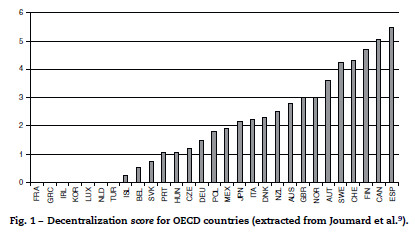
<body><![CDATA[<P><B>Institutional context</B></P>     <P>Decentralization in health care can adopt many different forms. Following the  typology proposed by Vrangbaek,<SUP>6</SUP> our main interest here is in  devolution or <I>political</I> decentralization, through which power is  “decentralized to lower-level political authorities such as regions or  municipalities”. Other forms of decentralization are also possible which are  beyond the scope of the present paper. De-concentration and bureaucratization  involve transfers between administrative levels and from political to  administrative level, respectively (think for example in the Portuguese context,  of transfer of competences to Regional Health Authorities). Decentralization  also refers to delegation, which involves transferring power to more or less  autonomous public organization management (like public enterprises, for example  the “hospitals S.A” in Portugal, Foundation Trusts in the UK or public insurance  companies in Bismarckian-type health systems). Privatization itself can be  considered as a form of decentralization.</P>     <P>Our focus here is thus on the transfer of political authority in the health  area from higher to lower levels of government or from national to sub-national  levels.<SUP>7</SUP> Regional, provincial or municipal elected governments may  thus be responsible for planning, organizing, delivering and financing health  services. Multiple arrangements are however possible and devolution has taken  many different forms across OECD countries (for a complete mapping of  decentralization experiences in Europe, see Bankauskaite et al.<SUP>8</SUP>).  The size of decentralized entities is highly variable, from small counties in  Sweden (average population 31,000) to large autonomous regions in Spain (average  population 2,444,000). The extent of competences also varies. The central state  may keep responsibilities in several domains, for instance the Canadian Federal  state defines policies regarding health prevention and promotion, the Swiss  Confederation defines the basic health benefit package, and generally all  central states impose a series of more or less stringent regulations on quality,  supply, coverage, pricing rules or budget allocation. A key issue which  differentiates decentralization experiences relates to the funding of health  expenditures and financial autonomy. Decentralized governments may have the  power to raise taxes, or receive transfers depending on their contribution to  fiscal revenues. They may then be free to set the budget allocated to health and  its distribution among health sectors. By contrast, sub-central government  levels may be financed by transfers based on risk-equalization schemes and  benefit from low autonomy in defining tax rates. In the latter case,  decentralized governments may thus have the political power to decide about  allocation of resources but do not control the amount of available resources for  health. Hence the expenditure side is decentralized, but revenue is not.</P>     <P><a href="#f1">Fig. 1</a>, extracted from Joumard et al.<SUP>9</SUP>, nicely describes the  degree of decentralization in health in OECD countries (where a 0 score implies  that central government takes most of key decisions while a 6 score implies  residual competences for the central government). Countries have heterogeneous  sub-central governments, with different size, autonomy and responsibilities  allocated. The criteria to define this score have been established by Paris et  al.<SUP>10</SUP>, using a survey. They include in particular the sub-central  governments’ authority on setting tax bases and rates, the budget allocation for  health and its distribution between health sectors, the financing of different  health services and practitioners and the setting of public health objectives.  Spain, Canada, Finland, Sweden and Switzerland have higher autonomy of  sub-central governments while Portugal is among the countries with the lowest  health decentralization.</P>     <p>&nbsp;</p> <a name="f1"> <img src="/img/revistas/rpsp/v31n1/31n1a08f1.jpg">     
<p>&nbsp;</p>     <P>Note that the decentralization question, the way we pose it (devolution or  political decentralization), is more common in NHS-type health systems. These  systems have been usually characterized by highly centralized decision-making,  with one single insurer/payer and provider (the central state), and little  autonomy given to providers. By contrast, health systems based on social  insurance schemes have been usually characterized, to various extents, by  multiple insurance schemes and some degree of publicly subsidized private  provision. Hence, transferring power to local institutions has certainly  responded to a demand for more autonomy in more rigid NHS-type health  systems.</P>     <P>Spain, Canada and Italy are particularly relevant cases to understand the  empirical literature because the consequences of decentralization in health have  been more extensively analyzed. The most decentralized country according to  Joumard et al.<SUP>9</SUP> is Spain. The central government provides the general  framework and coordinates the health system while Autonomous Communities (AC)  provide health care services and are responsible for health planning,  organization and management.<SUP>11</SUP> Funds are centrally collected and  allocated to regions by means of a block central grant following an unadjusted  capitation formula.<SUP>11</SUP> Only Navarra and the Basque Country benefit  from fiscal authority.</P>     <P>By contrast, the Canadian Confederation, composed of 10 provinces and 3  territories, has been decentralized since the 19th century.<SUP>12</SUP> Health  funding, administration and delivering are competences of provinces, which also  define physician financing rules and hospital global budgets. However health  promotion, prevention and provision to specific groups are Federal competencies.  Provinces are responsible for funding health care expenditures, based on  provincial taxes and transfers from the central government. Transfers depend  themselves on taxes collected at provincial level; an equalization program was  however implemented to avoid strong differences in transfers related to  discrepancies in provinces’ revenue-generating potential.<SUP>13</SUP></P>     <P>Finally, the 20 Italian regions also control health care provision, although  general objectives (like the detailed list of services to be provided) and main  principles of the health system are defined at the central level. Regions can  develop regional health plans, allocate resources and collect revenues freely,  like setting user charges for drugs prescriptions or reimburse rates for drugs  and services not covered at national level. Regional authorities also enjoy  financial autonomy in taxation; in practice, regional health expenditures are  financed at 36.7% by regional taxes.<SUP>14</SUP> Additionally, regional health  expenditures are financed by transfers from the central state (57.3% of  expenditures), essentially from a so-called National equalizing fund. This fund  is based on the idea that all regions must achieve a minimum level of  expenditures, so that transfers top up regions’ own revenue in case it is unable  to fund this minimum level.</P>     ]]></body>
<body><![CDATA[<p>&nbsp;</p>     <P><B>Theoretical background</B></P>     <P>The debate on the relative merits of policy decentralization dates back to  Tiebout,<SUP>15</SUP> who put forward a very optimistic argument for the  optimality of local public good provision, based on an analogy between  competitive markets and competing jurisdictions. Oates,<SUP>2</SUP> in contrast,  suggests that decentralization results from a trade-off between its advantages  and costs. According to Oates, the advantage of decentralization lies in its  capacity to cater to local tastes, be it because of better information or simply  because the central government cannot differentiate public good provision. The  cost of decentralization stems essentially from the presence of inter-regional  spillovers. For instance, better health prevention in one municipality benefits  its neighbors. However, if health prevention is decentralized, each municipality  fails to take into account the benefit of its investment in other  municipalities, and is therefore likely to invest sub-optimally, leading to  under-provision and/or low quality of health services. While Oates’ argument  that a central government is unable to differentiate the provision of local  public goods according to local preferences has been challenged since, his main  intuition that the decision to decentralize rests on a fundamental trade-off  between costs and advantages remains. One of the main costs of decentralization  which has been analyzed in the literature is the failure to exploit economies of  scale.<SUP>16</SUP> For instance, collective purchasing of resources (drugs,  medical devices, equipments, etc.) or collective administration of health  services may display decreasing average costs and be thus more efficiently  provided at a centralized level.</P>     <P>The inter-regional spillovers at the heart of Oates's argument, referred  here-above, are of the horizontal type (that is, between sub-central governments  of the same level). Another sort of spillovers which may create inefficiencies  under decentralization is the vertical ones between local and central  governments. These occur if one government level's policy decisions have an  impact in the policy outcomes of the other level. These phenomena are highly  plausible in the health care sector. If, for example, sub-central governments  are responsible for some public health prevention programs and the central state  delivers health care, local policies likely affect services use and costs at the  central level. Unless sub-central governments are rewarded for their actions,  they have little incentives to provide an optimal value of prevention, whose  benefits are fully enjoyed by the central state.</P>     <P>Recently, the literature has put forward political economy arguments in favor  of decentralization. For instance, it may be that the voters, who are  imperfectly informed about the economy, use the policies put in place by the  neighboring politicians to impose discipline on their own local representative.  In such a world of opportunistic policy makers, decentralization may be a strong  mechanism to prevent corruption or promote provision of public  services.<SUP>17</SUP> Another argument is that decentralization forces local  jurisdictions to compete for mobile resources (for instance, labor or capital)  and puts a downward pressure on taxation, thus prompting a more efficient use of  scarce resources (see Wilson<SUP>18</SUP> for a survey of the tax competition  literature). Besley and Smart<SUP>19</SUP> show that this need not be the case,  since higher discipline of local politicians comes at the cost of a worse  selection. Indeed, it is only when an opportunistic politician misbehaves that  the voters are given the chance to oust her from power and replace her with a  potentially benevolent politician. Political accountability results from a  trade-off between these two mechanisms (discipline and selection), and further  decentralization has opposite effects in both.</P>     <P>What can be said about the likelihood of local governments being captured by  special interests? Bardhan and Mookherjee<SUP>20</SUP> show that there is no  theoretical reason to suppose that local governments are more prone to this than  central ones. They put forward a theoretical model of probabilistic voting where  capture by special interests results from a combination of voter awareness,  interest group cohesiveness, electoral uncertainty and competition, district  heterogeneity and the electoral system. Their main conclusion is that the extent  of capture at the local level is most likely context-specific and needs to be  assessed empirically.</P>     <P>A few authors have looked at the applicability of these arguments to the  specific case of health decentralization. Levaggi and Smith<SUP>21</SUP> claim  that sub-central governments are better informed about the constraints of local  supply and about variations in demand. Variations in demand are obviously  related first to differences in local needs, for instance regions experience  discrepancies in the prevalence of diseases, in behavioral and non-behavioral  risk factors (including in particular ageing or social determinants), perhaps  also in the effectiveness of specific interventions. Hence priorities are likely  to differ according to burden of disease or cost-effectiveness criteria. Also  local preferences shape variations in demand, leading to different priorities  and resource allocation criteria. We may think that some regions have a higher  concern for inequalities in health and social determinants, while others put a  greater emphasis on provider choice and responsiveness to patients’ preferences.  These differences in needs and preferences are very clear if we compare European  countries. Discrepancies in local supply are related to the availability and  density of physicians, nurses, equipments, but also to differences in local  prices and practices. Central governments have tried to account for these  differences in financing sub-central governments, through more or less  sophisticated risk-adjustment schemes, but may not be able to address these  issues to locally adjusted planning or organization. Sub-central governments may  be better equipped to respond to local preferences and priorities, to coordinate  providers’ actions and to identify the sources of inefficiency. Hence,  decentralization is expected to enhance quality and responsiveness of care while  reducing costs; this theoretical view is at the origin of most decentralization  processes.</P>     <P>As regards the potential incentives that favor efficiency and/or quality in  health care provision, both the tax competition and the yardstick competition  mechanisms are likely to arise in health policies, thus leading sub-central  governments to compete with each other to provide high-quality services at low  user charges or financed through lower taxes. First, better and more efficient  services contribute to attract mobile citizens, hence increase sub-central  governments’ economic activity and fiscal revenues. Second, competition occurs  through citizens benchmarking their demands on the basis of neighbor sub-central  governments’ performance.<SUP>22</SUP> If sub-central governments are  politically accountable, a local politician providing poorer services than his  neighbors’ counterparts would likely fail re-election. In a few words, efficient  provision contributes to attractiveness and citizens’ satisfaction.</P>     <P>It is a well-known fact that decentralization may hamper redistribution (see,  Cremer et al.<SUP>23</SUP> for a survey of the literature), when taxes are  locally collected. Areas with high health needs are in general the poorer ones  (there is large evidence of the relationship between poverty and poor health  status, see Marmot Review<SUP>24</SUP>); under fiscal decentralization,  underprivileged areas capture lower resources from taxation and benefit from a  lower capacity to invest in high-quality services and efficient provision.  Decentralization then produces differences in the quality and availability of  services, charges and outcomes. Increasing inequity is one of the major threats  of decentralization, even if good risk-sharing agreements potentially mitigate  this effect. In other words, the viability of decentralization depends on the  existence of solidarity mechanisms between decentralized authorities.</P>     <P>The reverse is also possible, i.e., sub-central governments only competing on  high-quality services, leading to over-provision of services and high health  expenditures (<I>race to the top</I>). This situation is more likely to occur  when fiscal decentralization is low and sub-central governments face soft budget  constraints. This may the case, for example, if the central government  systematically bails out sub-central governments which are excessively indebted  or if transfers to sub-central governments are based on past expenditures.</P>     ]]></body>
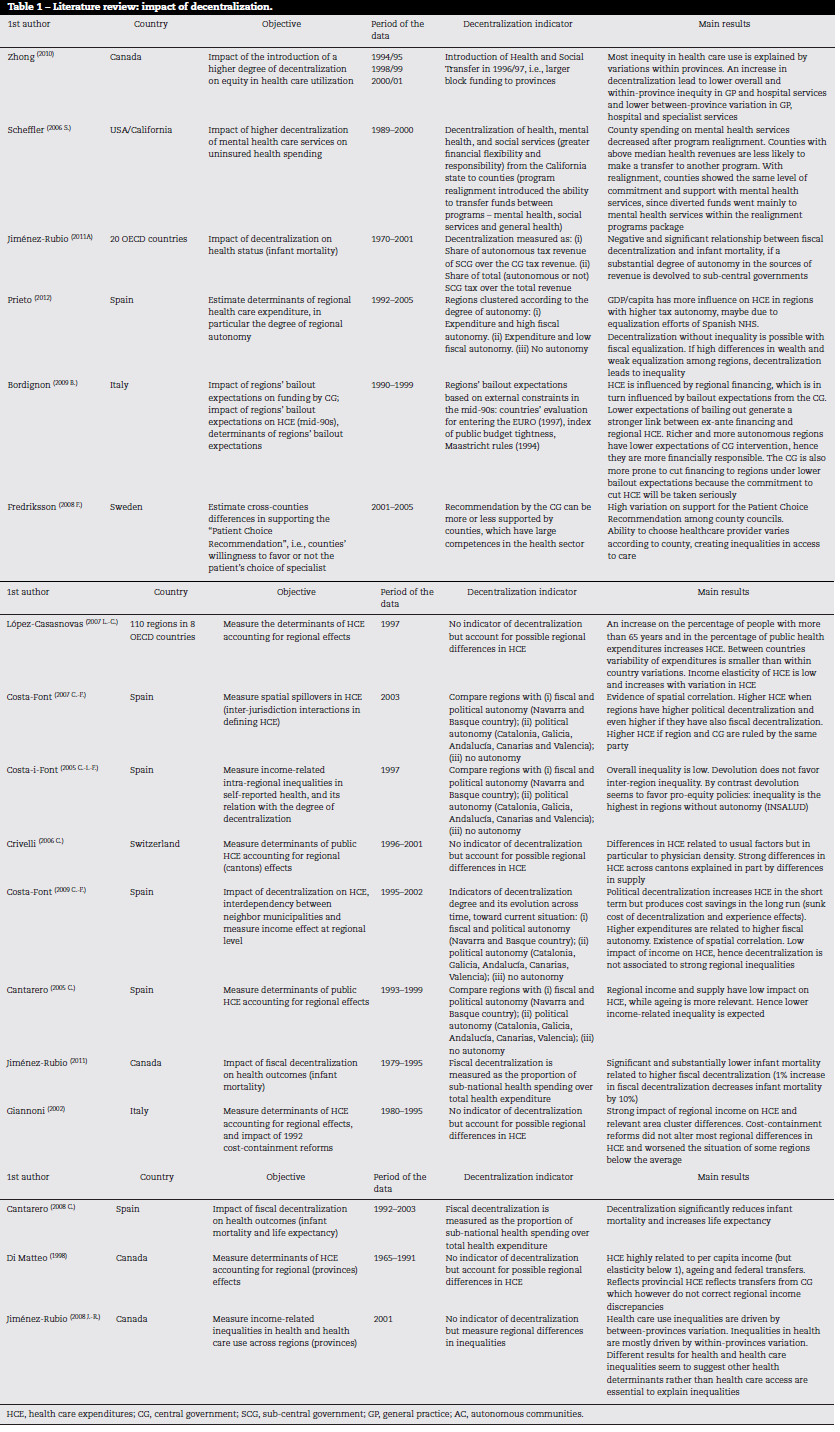
<body><![CDATA[<P>This brings us to the fundamental question of the funding of local public  goods. Indeed, various arrangements are possible regarding the degree of  decentralization of both the expenditure and the revenue functions.<SUP>25</SUP>  A considerable share of local government funding comes from central government  transfers. These transfer schemes must be carefully designed and rest on clear  rules (depend on variables which are not easy for local governments to  manipulate) so as to avoid moral hazard leading to excess expenditures. Indeed,  as the central government is unable to distinguish the sources of high spending  between higher needs and inefficiencies, sub-central governments have an  incentive to hide their true needs to obtain higher financing from the central  authority.</P>     <P>To sum up, the theoretical literature does not provide a definitive answer  about the impact of decentralization on health policies. The high concern in  many countries for equity in health is a major argument against  decentralization, unless strong solidarity mechanisms are put in place. The  contradictory expectations about efficiency require careful empirical  validation. In these times of adverse economic circumstances, efficiency is more  than ever a major issue in decision-making, and strong evidence is necessary  before advocating for decentralization in health.</P>     <p>&nbsp;</p>     <P><B>Empirical evidence</B></P>     <P>In order to get an exhaustive overview on empirical evidence, we performed a  systematic literature review. We conducted a computerized literature search in  PubMed (National Center for Biotechnology Information, Bethesda, Maryland) and  Google Scholar, supplemented by a search of quoted references. Text keywords  used in the search included decentralization, federalism, health, health care,  equity, and efficiency. We restricted our analysis to those performed in OECD  countries to allow for relevant comparisons, that is, in a comparable context.  We only included empirical studies about the impact of decentralization, hence  excluding theoretical studies, studies about legislation or about political or  organizational aspects of decentralization, editorials and literature reviews.  The search was limited to English-language articles published from 1995 to July  2012, when decentralization in health has become a relevant and applied policy  option in OECD countries. Our search allowed collecting 17 papers, whose main  characteristics and results are displayed in <a href ="/img/revistas/rpsp/v31n1/31n1a08t1.jpg">Table 1</a>. Studies were divided  according to distinct analyzes, based on the most relevant decentralization  outcomes, namely inequalities in health and health care, health expenditures and  health outcomes.</P>     
<P><I>Inequality in health and health care use</I></P>     <P>The consequences of decentralization on inequality were the main issue  analyzed by Zhong<SUP>13</SUP>, Jim&eacute;nez-Rubio et al.<SUP>1</SUP>,  Costa-i-Font<SUP>26</SUP> and Frederiksson and Winblad<SUP>27</SUP>.  Zhong<SUP>13</SUP> found that in Canada inequalities in health care use  (overall, within provinces and between provinces) decreased after  decentralization. Most inequality was explained by within-provinces variation,  while between-provinces variations did not much contribute to  inequality.<SUP>13</SUP> By contrast, Jim&eacute;nez-Rubio et al.<SUP>1</SUP> also  using data from Canadian provinces observed that income-related inequalities in  health care use resulted from between-provinces variations while income-related  inequalities in health were related to within-region variations. While  Zhong<SUP>13</SUP> used an overall inequity measure, Jim&eacute;nez-Rubio et  al.<SUP>1</SUP> used an income-related one, which possibly explains the  discrepant results. The results by Jim&eacute;nez-Rubio et al.<SUP>1</SUP> certainly  question the equalization scheme across provinces; the redistribution of funds  from richer to poorer provinces does not seem to avoid inequity in health care  use related to between-province variations (for example, health care use is  lower in Quebec that has a lower-than-average income per capita). As the author  emphasizes, advocates of decentralization would however consider these  differences as related to different preferences, hence legitimate.  Income-related inequity in health was mostly related to differences between rich  and poor people within provinces, here questioning the efforts by provinces to  reduce inequalities (would a central government be more committed to reduce  inequity in health?).</P>     <P>For Spain, Costa-i-Font<SUP>26</SUP> found a small overall, within and  between regions income-related inequality in health, although somewhat higher in  regions with lower autonomy. The author explains this difference by the greater  role of the private sector in those regions. He also emphasizes that  decentralization may have favored equity due to a high commitment of regions to  achieve this objective, which corresponds to a high citizens’ concern. Finally,  Fredriksson and Winblad<SUP>27</SUP> studied a specific reform toward more  provider choice in Sweden, where health care use is highly decentralized at the  county level. The author showed that while some counties supported the reform  through favoring choice, others implemented administrative barriers against it.  Therefore, autonomy on decision making (regarding provider choice) resulted on  inequalities between people living in different Swedish counties.</P>     <P><I>Health expenditures</I></P>     <P>Inequality related to decentralization was also observed indirectly, through  examining the impact of regional GDP per capita on health care expenditures.  Indeed, a greater impact of regional income on health care expenditure would  mean that richer regions spend significantly more on health than poor ones,  hence creating inequalities in health care use. Although all studies using  regional data conclude that health care expenditures do not vary much with  income (the <I>elasticity</I> with respect to income is below one), results are  contrasted and vary between countries. For Spain, Prieto and  Lago-Pe&ntilde;as<SUP>28</SUP> found a positive relation between income and public  health expenditures only in regions with higher fiscal autonomy. Regions without  fiscal autonomy benefitted from national equalization efforts and therefore  managed to achieve high levels of health care expenditures despite of lower  income. The low impact of income on health care expenditures in Spain was  confirmed by Cantarero, Costa-i-Font and Moscone.<SUP>29</SUP><SUP>,  </SUP><SUP>11</SUP> The same conclusion could be drawn for Canada,<SUP>21</SUP>  although the impact of income on health expenditures was greater than in Spain.  Using a specific indicator, Di Matteo and Di Matteo<SUP>30</SUP> showed the  positive impact of federal transfers on health care expenditure. That is,  federal transfers certainly reduce the impact of regional income on expenditures  but do not fully correct regional income discrepancies. The picture is somewhat  different in Italy, where regional income had a strong impact on health care  expenditures.<SUP>31</SUP> The authors showed also that cost-containment  measures have not altered cross-regional differences in health care expenditures  and have even worsened them in some cases. For Switzerland, Crivelli et  al.<SUP>32</SUP> observed a large impact of physician supply, which is highly  variable across regions, on health care expenditures. Hence cross-regional  differences in health care supply may also be a source of inequality across  regions. Finally, using data from 110 regions of 8 OECD countries,  Lopez-Casasnovas and Saez<SUP>33</SUP> showed a low elasticity of health care  expenditure with respect to income. However, the impact of income was higher  across regions in countries with higher inter-regional income inequalities,  leading in turn to higher discrepancies in health care expenditures.</P>     ]]></body>
<body><![CDATA[<P>Scheffler and Smith<SUP>34</SUP>, Costa-i-Font and Moscone<SUP>11</SUP>,  Costa-i-Font and Pons-Novell<SUP>22</SUP> addressed the impact of  decentralization on health expenditures, while Bordignon and Turati<SUP>35</SUP>  examined the impact of the interaction between central and sub-central  governments. Scheffler and Smith<SUP>34</SUP> showed for California that  spending on uninsured patients decreased with the higher counties’ autonomy in  allocating funds across health and social programs. Costa-Font and  Pons-Novell<SUP>22</SUP> observed that Spanish regions with both political and  fiscal autonomy had higher health expenditures as compared to regions without  autonomy or with political autonomy only. Costa-i-Font and Moscone<SUP>11</SUP>  observed however that decentralization increased expenditures only in the short  run, producing savings in the long run. They argued that firstly  decentralization increased health care costs due to sunk costs; then this effect  was minimized in the long run by an experience curve, that is, learning-by-doing  allowed reducing costs. Regarding assumptions from economic theory, Costa-i-Font  and Moscone<SUP>11</SUP> also showed the existence of spatial correlation of  health care expenditures between neighbor jurisdictions, sustaining the  assumption of horizontal spillovers. This result may hence be due to competition  between neighbor jurisdictions to increase attractiveness or due to politicians  being judged based on the neighbor counterparts’ actions.</P>     <P>Finally, Bordignon and Turati<SUP>35</SUP> used 1990s Italian adjustment  process imposed by an external entity (the European Union) to understand the  role of expectations and the strategic interactions between the central state  and regions, using data on health care expenditures. Regions expecting that the  central government will intervene in case of debt softened their budget  constraints and the relationship between the funding they receive from the  central government and health expenditures was lower. By contrast, during  external adjustment, the central government was perceived as more stringent and  the link between funding and expenditures became stronger. And the central  government was also more prone to cut funding to regions because it knew its  commitment not to bailout would be taken more seriously. Interestingly, authors  showed that more autonomy lead to more financially responsible policies because  expectations of bailout were low. This paper thus emphasized that transfer  mechanisms, which are always present in decentralized countries, created  incentives that may be more or less detrimental for efficiency depending on how  they are designed and put in practice.</P>     <P><I>Health results</I></P>     <P>Results about the impact of decentralization on health outcomes are scarce  but consistent across studies. Jim&eacute;nez-Rubio<SUP>12</SUP><SUP>,  </SUP><SUP>36</SUP> and Cantarero and Pascual<SUP>37</SUP> agree on identifying  a positive relationship between fiscal decentralization and health results,  measured through infant mortality. Cantarero and Pascual<SUP>37</SUP> used an  alternative measure of health status (life expectancy) which confirmed the  positive contribution of decentralization to health status.</P>     <p>&nbsp;</p>     <P><B>Conclusion</B></P>     <P>Although the economics literature has largely discussed the impact of  decentralization, empirical results remain scarce, in particular regarding  decentralization in health. Nevertheless, decentralization of health policies  and funding has been largely implemented in various countries and is generally  considered as a relevant option to improve efficiency in health  care.<SUP>7</SUP></P>     <P>Our review of the literature allows draw preliminary conclusions, based on  relatively recent decentralization experiences, in particular in Canada, Italy,  Spain and Switzerland. First and foremost, devolution of political (and fiscal)  authority to sub-government levels seems to increase health care expenditures  but also improve health outcomes, mainly measured through infant mortality rate.  According to economic theory, decentralization may foster competition between  jurisdictions to increase attractiveness, and increase pressure on local  governments because citizens evaluate their performance based on neighbor  counterparts’ actions. The empirical literature suggests that enhanced  competition prompts local decision-makers to increase health care expenditures  (<I>race to the top</I>) and not the reverse in order to decrease taxes (<I>race  to the bottom</I>), with a favorable impact on health. The case of Spain is  particularly enlightening, which shows that the increase in health care  expenditures has been the highest in regions with fiscal autonomy. This result  may reflect the high people's demand for high-quality health services, and the  higher responsiveness of local authorities to this preference. The higher health  care expenditures under decentralization may however reflect also higher costs,  related for instance to duplication of inputs (two neighbor regions offering  similar services which could be shared), diseconomies of scale, or the sunk  costs associated to implementation of a local health provision scheme. To some  extent, adverse incentives may play some role if sub-central governments are not  fully financially responsible for their expenditures. In particular, moral  hazard may exist if sub-central governments expect their debts being covered by  the central state (bailout) or if their budget depends more largely from  transfers from the central state. In a few words, decentralization does not  appear at first sight as a means to control or reduce health care expenditures,  but as an incentive to provide better and possibly more expensive services. The  efficiency consequences are thus ambiguous, as it is unclear whether additional  benefits – measured through a very reduced number of indicators – are worth  additional costs.</P>     <P>Regarding equity, empirical results are ambiguous and certainly related to  the specific countries’ context. Inequity in health and health care is low in  Spain, where health expenditures are also poorly related to the region  GDP/capita. Additionally, inequity in health care seems to be lower in more  autonomous regions, so that decentralization may have favored equity. In Canada,  income-related inequity in health care is related to between-provinces  inequalities. In Italy and Switzerland, there is a strong relationship between  regions (resp. cantons) income and health care expenditures, resulting in a  large heterogeneity in health care expenditures. These results may certainly be  related to lower equalizing mechanisms in these two countries coupled with a  higher fiscal autonomy. Note also that different decisions across regions,  namely about physicians or equipment supply, also potentially create  differences/inequity in health care delivery.</P>     <P>To conclude, solidarity mechanisms across sub-central authorities are  relevant to avoid the emergence of large inequalities across regions in health  care delivery and expenditures. However, redistribution of funds also reduces  jurisdictions’ financial responsibility, with possible detrimental consequences  on expenditures and ambiguous consequences on efficiency. This last aspect is of  particular importance if jurisdictions compete with each other for providing  high-quality services and not through lowering tax rates.</P>     ]]></body>
<body><![CDATA[<p>&nbsp;</p>     <P><B>Bibliograf&iacute;a</B></P>     <!-- ref --><P>1. Jim&eacute;nez–Rubio D, Smith P, Doorslae E. Equity in health and health care in  a decentralised context: evidence from Canada. Health Econ. 2008; 17:377–92.    &nbsp;&nbsp;&nbsp;&nbsp;&nbsp;&nbsp;&nbsp;&nbsp;[&#160;<a href="javascript:void(0);" onclick="javascript: window.open('/scielo.php?script=sci_nlinks&ref=000065&pid=S0870-9025201300010000800001&lng=','','width=640,height=500,resizable=yes,scrollbars=1,menubar=yes,');">Links</a>&#160;]<!-- end-ref -->  </P>     <!-- ref --><P>2. Oates W. Fiscal federalism. New York: Harcourt Brace Jovanovich; 1972.    &nbsp;&nbsp;&nbsp;&nbsp;&nbsp;&nbsp;&nbsp;&nbsp;[&#160;<a href="javascript:void(0);" onclick="javascript: window.open('/scielo.php?script=sci_nlinks&ref=000067&pid=S0870-9025201300010000800002&lng=','','width=640,height=500,resizable=yes,scrollbars=1,menubar=yes,');">Links</a>&#160;]<!-- end-ref -->  </P>     <!-- ref --><P>3. Iimi A. Decentralization and economic growth revisited: an empirical note.  J Urban Econ. 2005; 57:449–61.    &nbsp;&nbsp;&nbsp;&nbsp;&nbsp;&nbsp;&nbsp;&nbsp;[&#160;<a href="javascript:void(0);" onclick="javascript: window.open('/scielo.php?script=sci_nlinks&ref=000069&pid=S0870-9025201300010000800003&lng=','','width=640,height=500,resizable=yes,scrollbars=1,menubar=yes,');">Links</a>&#160;]<!-- end-ref --> </P>     <!-- ref --><P>4. Rodriguez–Pose A, Ezcurra R. Does decentralization matter for regional  disparities?: a cross–country analysis. J Econ Geogr. 2010; 10:619–44.    &nbsp;&nbsp;&nbsp;&nbsp;&nbsp;&nbsp;&nbsp;&nbsp;[&#160;<a href="javascript:void(0);" onclick="javascript: window.open('/scielo.php?script=sci_nlinks&ref=000071&pid=S0870-9025201300010000800004&lng=','','width=640,height=500,resizable=yes,scrollbars=1,menubar=yes,');">Links</a>&#160;]<!-- end-ref --> </P>     ]]></body>
<body><![CDATA[<!-- ref --><P>5. Galiani S, Gertler P, Schargrodsky E. School decentralization: helping the  good get better, but leaving the poor behind. J Public Econ. 2008; 92:2106–20.    &nbsp;&nbsp;&nbsp;&nbsp;&nbsp;&nbsp;&nbsp;&nbsp;[&#160;<a href="javascript:void(0);" onclick="javascript: window.open('/scielo.php?script=sci_nlinks&ref=000073&pid=S0870-9025201300010000800005&lng=','','width=640,height=500,resizable=yes,scrollbars=1,menubar=yes,');">Links</a>&#160;]<!-- end-ref -->  </P>     <!-- ref --><P>6. Vrangbaek K. Towards a typology for decentralization in health care. En:  Saltman R.B., Bankauskaite V., Vrangbaek K., editors. Decentralization in health  care. Maidenhead: McGraw–Hill. Open University Press; 2007 (European Observatory  on Health Systems and Policies Series). 44–62.    &nbsp;&nbsp;&nbsp;&nbsp;&nbsp;&nbsp;&nbsp;&nbsp;[&#160;<a href="javascript:void(0);" onclick="javascript: window.open('/scielo.php?script=sci_nlinks&ref=000075&pid=S0870-9025201300010000800006&lng=','','width=640,height=500,resizable=yes,scrollbars=1,menubar=yes,');">Links</a>&#160;]<!-- end-ref --> </P>     <!-- ref --><P>7. Bankauskaite V, Saltman RB. Central issues in the decentralization debate.  En: Saltman R.B., Bankauskaite V., Vrangbaek K., editors. Decentralization in  health care. Maidenhead: McGraw–Hill. Open University Press; 2007 (European  Observatory on Health Systems and Policies Series). 9–21.    &nbsp;&nbsp;&nbsp;&nbsp;&nbsp;&nbsp;&nbsp;&nbsp;[&#160;<a href="javascript:void(0);" onclick="javascript: window.open('/scielo.php?script=sci_nlinks&ref=000077&pid=S0870-9025201300010000800007&lng=','','width=640,height=500,resizable=yes,scrollbars=1,menubar=yes,');">Links</a>&#160;]<!-- end-ref --> </P>     <!-- ref --><P>8. Joumard I, Bankauskaite V, Paris V, Dubois HFW, Andr&eacute; C, Devaux M, Saltman  RB, Nicq C, Wei L. Health systems institutional characteristics: a survey of 29  OECD countries. 23–43.    &nbsp;&nbsp;&nbsp;&nbsp;&nbsp;&nbsp;&nbsp;&nbsp;[&#160;<a href="javascript:void(0);" onclick="javascript: window.open('/scielo.php?script=sci_nlinks&ref=000079&pid=S0870-9025201300010000800008&lng=','','width=640,height=500,resizable=yes,scrollbars=1,menubar=yes,');">Links</a>&#160;]<!-- end-ref --> </P>     <!-- ref --><P>11. Costa–i–Font J, Moscone F. The impact of decentralization and  inter–territorial interactions on Spanish health expenditure. Empir Econ. 2008;  34:167–84.    &nbsp;&nbsp;&nbsp;&nbsp;&nbsp;&nbsp;&nbsp;&nbsp;[&#160;<a href="javascript:void(0);" onclick="javascript: window.open('/scielo.php?script=sci_nlinks&ref=000081&pid=S0870-9025201300010000800009&lng=','','width=640,height=500,resizable=yes,scrollbars=1,menubar=yes,');">Links</a>&#160;]<!-- end-ref --> </P>     ]]></body>
<body><![CDATA[<!-- ref --><P>12. Jim&eacute;nez–Rubio D. The impact of decentralization of health services on  health outcomes: evidence from Canada. Appl Econ. 2011; 43:3907–17.    &nbsp;&nbsp;&nbsp;&nbsp;&nbsp;&nbsp;&nbsp;&nbsp;[&#160;<a href="javascript:void(0);" onclick="javascript: window.open('/scielo.php?script=sci_nlinks&ref=000083&pid=S0870-9025201300010000800010&lng=','','width=640,height=500,resizable=yes,scrollbars=1,menubar=yes,');">Links</a>&#160;]<!-- end-ref --> </P>     <!-- ref --><P>13. Zhong H. The impact of decentralization of health care administration on  equity in health and health care in Canada. Int J Health Care Finance Econ.  2010; 10:219–37.    &nbsp;&nbsp;&nbsp;&nbsp;&nbsp;&nbsp;&nbsp;&nbsp;[&#160;<a href="javascript:void(0);" onclick="javascript: window.open('/scielo.php?script=sci_nlinks&ref=000085&pid=S0870-9025201300010000800011&lng=','','width=640,height=500,resizable=yes,scrollbars=1,menubar=yes,');">Links</a>&#160;]<!-- end-ref --> </P>     <!-- ref --><P>14. Ferrario C, Zanardi A. Fiscal decentralization in the Italian NHS: what  happens to interregional redistribution?. Health Policy. 2011; 100:71–80.    &nbsp;&nbsp;&nbsp;&nbsp;&nbsp;&nbsp;&nbsp;&nbsp;[&#160;<a href="javascript:void(0);" onclick="javascript: window.open('/scielo.php?script=sci_nlinks&ref=000087&pid=S0870-9025201300010000800012&lng=','','width=640,height=500,resizable=yes,scrollbars=1,menubar=yes,');">Links</a>&#160;]<!-- end-ref --> </P>     <!-- ref --><P>15. Tiebout C. A pure theory of local expenditures. J Polit Econ. 1956;  64–416.    &nbsp;&nbsp;&nbsp;&nbsp;&nbsp;&nbsp;&nbsp;&nbsp;[&#160;<a href="javascript:void(0);" onclick="javascript: window.open('/scielo.php?script=sci_nlinks&ref=000089&pid=S0870-9025201300010000800013&lng=','','width=640,height=500,resizable=yes,scrollbars=1,menubar=yes,');">Links</a>&#160;]<!-- end-ref --> </P>     <!-- ref --><P>16. Haimanko O, Le Breton M, Weber S. Transfers in a polarized country:  bridging the gap between efficiency and stability. J Public Econ. 2005;  89:1277–303.    &nbsp;&nbsp;&nbsp;&nbsp;&nbsp;&nbsp;&nbsp;&nbsp;[&#160;<a href="javascript:void(0);" onclick="javascript: window.open('/scielo.php?script=sci_nlinks&ref=000091&pid=S0870-9025201300010000800014&lng=','','width=640,height=500,resizable=yes,scrollbars=1,menubar=yes,');">Links</a>&#160;]<!-- end-ref --> </P>     ]]></body>
<body><![CDATA[<!-- ref --><P>17. Belleamme P, Hindriks J. Yardstick competition and political agency  problems. Social Choice Welfare. 2005; 24:155–69.    &nbsp;&nbsp;&nbsp;&nbsp;&nbsp;&nbsp;&nbsp;&nbsp;[&#160;<a href="javascript:void(0);" onclick="javascript: window.open('/scielo.php?script=sci_nlinks&ref=000093&pid=S0870-9025201300010000800015&lng=','','width=640,height=500,resizable=yes,scrollbars=1,menubar=yes,');">Links</a>&#160;]<!-- end-ref --> </P>     <!-- ref --><P>18. Wilson JD. Theories of tax competition. Natl Tax J. 1999; 52:269.    &nbsp;&nbsp;&nbsp;&nbsp;&nbsp;&nbsp;&nbsp;&nbsp;[&#160;<a href="javascript:void(0);" onclick="javascript: window.open('/scielo.php?script=sci_nlinks&ref=000095&pid=S0870-9025201300010000800016&lng=','','width=640,height=500,resizable=yes,scrollbars=1,menubar=yes,');">Links</a>&#160;]<!-- end-ref --> </P>     <!-- ref --><P>19. Besley T, Smart M. Fiscal restraints and voter welfare. J Public Econ.  2007; 91:755–73.    &nbsp;&nbsp;&nbsp;&nbsp;&nbsp;&nbsp;&nbsp;&nbsp;[&#160;<a href="javascript:void(0);" onclick="javascript: window.open('/scielo.php?script=sci_nlinks&ref=000097&pid=S0870-9025201300010000800017&lng=','','width=640,height=500,resizable=yes,scrollbars=1,menubar=yes,');">Links</a>&#160;]<!-- end-ref --> </P>     <!-- ref --><P>20. Bardhan PK, Mookherjee D. Capture and governance at local and national  levels. Am Econ Rev. 2000; 90:135–9.    &nbsp;&nbsp;&nbsp;&nbsp;&nbsp;&nbsp;&nbsp;&nbsp;[&#160;<a href="javascript:void(0);" onclick="javascript: window.open('/scielo.php?script=sci_nlinks&ref=000099&pid=S0870-9025201300010000800018&lng=','','width=640,height=500,resizable=yes,scrollbars=1,menubar=yes,');">Links</a>&#160;]<!-- end-ref --> </P>     <!-- ref --><P>21. Levaggi R, Smith PC. Decentralization in health care: lessons from public  economics. En: Smith P., Ginnelly L., Sculpher M., editors. Health policy and  economics: opportunities and challenges. London: Open University Press; 2004.    &nbsp;&nbsp;&nbsp;&nbsp;&nbsp;&nbsp;&nbsp;&nbsp;[&#160;<a href="javascript:void(0);" onclick="javascript: window.open('/scielo.php?script=sci_nlinks&ref=000101&pid=S0870-9025201300010000800019&lng=','','width=640,height=500,resizable=yes,scrollbars=1,menubar=yes,');">Links</a>&#160;]<!-- end-ref -->  </P>     ]]></body>
<body><![CDATA[<!-- ref --><P>22. Costa–i–Font J, Pons–Novell J. Public health expenditure and spatial  interactions in a decentralized national health system. Health Econ. 2007;  16:291–306.    &nbsp;&nbsp;&nbsp;&nbsp;&nbsp;&nbsp;&nbsp;&nbsp;[&#160;<a href="javascript:void(0);" onclick="javascript: window.open('/scielo.php?script=sci_nlinks&ref=000103&pid=S0870-9025201300010000800020&lng=','','width=640,height=500,resizable=yes,scrollbars=1,menubar=yes,');">Links</a>&#160;]<!-- end-ref --> </P>     <!-- ref --><P>23. Cremer H, Pestieau P. Factor mobility and redistribution. Handbook of  regional and urban economics. Vol. 4. Amsterdam: Elsevier; 2004. 2529–60.    &nbsp;&nbsp;&nbsp;&nbsp;&nbsp;&nbsp;&nbsp;&nbsp;[&#160;<a href="javascript:void(0);" onclick="javascript: window.open('/scielo.php?script=sci_nlinks&ref=000105&pid=S0870-9025201300010000800021&lng=','','width=640,height=500,resizable=yes,scrollbars=1,menubar=yes,');">Links</a>&#160;]<!-- end-ref --> </P>     <!-- ref --><P>24. Institute of Health Equity. Marmot review: fair society, healthy lives:  strategic review of health inequalities in England post 2010. London: Institute  of Health Equity; 2010.    &nbsp;&nbsp;&nbsp;&nbsp;&nbsp;&nbsp;&nbsp;&nbsp;[&#160;<a href="javascript:void(0);" onclick="javascript: window.open('/scielo.php?script=sci_nlinks&ref=000107&pid=S0870-9025201300010000800022&lng=','','width=640,height=500,resizable=yes,scrollbars=1,menubar=yes,');">Links</a>&#160;]<!-- end-ref --> </P>     <!-- ref --><P>25. OECD. Taxing powers of state and local government. Paris: OECD  Publications; 1999.    &nbsp;&nbsp;&nbsp;&nbsp;&nbsp;&nbsp;&nbsp;&nbsp;[&#160;<a href="javascript:void(0);" onclick="javascript: window.open('/scielo.php?script=sci_nlinks&ref=000109&pid=S0870-9025201300010000800023&lng=','','width=640,height=500,resizable=yes,scrollbars=1,menubar=yes,');">Links</a>&#160;]<!-- end-ref --> </P>     <!-- ref --><P>26. Costa–i–Font J. Inequalities in self–reported health within Spanish  Regional Health Services: devolution re–examined?. Int J Health Plann Manage.  2005; 20:41–52.    &nbsp;&nbsp;&nbsp;&nbsp;&nbsp;&nbsp;&nbsp;&nbsp;[&#160;<a href="javascript:void(0);" onclick="javascript: window.open('/scielo.php?script=sci_nlinks&ref=000111&pid=S0870-9025201300010000800024&lng=','','width=640,height=500,resizable=yes,scrollbars=1,menubar=yes,');">Links</a>&#160;]<!-- end-ref --> </P>     ]]></body>
<body><![CDATA[<!-- ref --><P>27. Fredriksson M, Winblad U. Consequences of a decentralized healthcare  governance model: measuring regional authority support for patient choice in  Sweden. Soc Sci Med. 2008; 67:271–9.    &nbsp;&nbsp;&nbsp;&nbsp;&nbsp;&nbsp;&nbsp;&nbsp;[&#160;<a href="javascript:void(0);" onclick="javascript: window.open('/scielo.php?script=sci_nlinks&ref=000113&pid=S0870-9025201300010000800025&lng=','','width=640,height=500,resizable=yes,scrollbars=1,menubar=yes,');">Links</a>&#160;]<!-- end-ref --> </P>     <!-- ref --><P>28. Prieto DC, Lago–Pe&ntilde;as S. Decomposing the determinants of health care  expenditure: the case of Spain. Eur J Health Econ. 2012; 13:19–27.    &nbsp;&nbsp;&nbsp;&nbsp;&nbsp;&nbsp;&nbsp;&nbsp;[&#160;<a href="javascript:void(0);" onclick="javascript: window.open('/scielo.php?script=sci_nlinks&ref=000115&pid=S0870-9025201300010000800026&lng=','','width=640,height=500,resizable=yes,scrollbars=1,menubar=yes,');">Links</a>&#160;]<!-- end-ref --> </P>     <!-- ref --><P>29. Cantarero D. Decentralization and health care expenditure: the Spanish  case. Appl Econ Lett. 2005; 12:963–6.    &nbsp;&nbsp;&nbsp;&nbsp;&nbsp;&nbsp;&nbsp;&nbsp;[&#160;<a href="javascript:void(0);" onclick="javascript: window.open('/scielo.php?script=sci_nlinks&ref=000117&pid=S0870-9025201300010000800027&lng=','','width=640,height=500,resizable=yes,scrollbars=1,menubar=yes,');">Links</a>&#160;]<!-- end-ref --> </P>     <!-- ref --><P>30. Di Matteo L, Di Matteo R. Evidence on the determinants of Canadian  provincial government health expenditures: 1965–1991. J Health Econ. 1998;  17:211–28.    &nbsp;&nbsp;&nbsp;&nbsp;&nbsp;&nbsp;&nbsp;&nbsp;[&#160;<a href="javascript:void(0);" onclick="javascript: window.open('/scielo.php?script=sci_nlinks&ref=000119&pid=S0870-9025201300010000800028&lng=','','width=640,height=500,resizable=yes,scrollbars=1,menubar=yes,');">Links</a>&#160;]<!-- end-ref --> </P>     <!-- ref --><P>31. Giannoni M, Hitiris T. The regional impact of health care expenditure:  the case of Italy. Appl Econ. 2002; 34:1829–36.    &nbsp;&nbsp;&nbsp;&nbsp;&nbsp;&nbsp;&nbsp;&nbsp;[&#160;<a href="javascript:void(0);" onclick="javascript: window.open('/scielo.php?script=sci_nlinks&ref=000121&pid=S0870-9025201300010000800029&lng=','','width=640,height=500,resizable=yes,scrollbars=1,menubar=yes,');">Links</a>&#160;]<!-- end-ref --> </P>     ]]></body>
<body><![CDATA[<!-- ref --><P>32. Crivelli L, Filippini M, Mosca I. Federalism and regional health care  expenditures: an empirical analysis for the Swiss cantons. Health Econ. 2006;  15:535–41.    &nbsp;&nbsp;&nbsp;&nbsp;&nbsp;&nbsp;&nbsp;&nbsp;[&#160;<a href="javascript:void(0);" onclick="javascript: window.open('/scielo.php?script=sci_nlinks&ref=000123&pid=S0870-9025201300010000800030&lng=','','width=640,height=500,resizable=yes,scrollbars=1,menubar=yes,');">Links</a>&#160;]<!-- end-ref --> </P>     <!-- ref --><P>33. L&oacute;pez–Casasnovas G, Saez M. A multilevel analysis on the determinants of  regional health care expenditure: a note. Eur J Health Econ. 2007; 8:59–65.    &nbsp;&nbsp;&nbsp;&nbsp;&nbsp;&nbsp;&nbsp;&nbsp;[&#160;<a href="javascript:void(0);" onclick="javascript: window.open('/scielo.php?script=sci_nlinks&ref=000125&pid=S0870-9025201300010000800031&lng=','','width=640,height=500,resizable=yes,scrollbars=1,menubar=yes,');">Links</a>&#160;]<!-- end-ref --> </P>     <!-- ref --><P>34. Scheffler R, Smith RB. The impact of government decentralization on  county health spending for the uninsured in California. Int J Health Care  Finance Econ. 2006; 6:237–58.    &nbsp;&nbsp;&nbsp;&nbsp;&nbsp;&nbsp;&nbsp;&nbsp;[&#160;<a href="javascript:void(0);" onclick="javascript: window.open('/scielo.php?script=sci_nlinks&ref=000127&pid=S0870-9025201300010000800032&lng=','','width=640,height=500,resizable=yes,scrollbars=1,menubar=yes,');">Links</a>&#160;]<!-- end-ref --> </P>     <!-- ref --><P>35. Bordignon M, Turati G. Bailing out expectations and public health  expenditure. J Health Econ. 2009; 28:305–21.    &nbsp;&nbsp;&nbsp;&nbsp;&nbsp;&nbsp;&nbsp;&nbsp;[&#160;<a href="javascript:void(0);" onclick="javascript: window.open('/scielo.php?script=sci_nlinks&ref=000129&pid=S0870-9025201300010000800033&lng=','','width=640,height=500,resizable=yes,scrollbars=1,menubar=yes,');">Links</a>&#160;]<!-- end-ref --> </P>     <!-- ref --><P>36. Jim&eacute;nez–Rubio D. The impact of fiscal decentralization on infant  mortality rates: evidence from OECD countries. Soc Sci Med. 2011; 73:1401–7.    &nbsp;&nbsp;&nbsp;&nbsp;&nbsp;&nbsp;&nbsp;&nbsp;[&#160;<a href="javascript:void(0);" onclick="javascript: window.open('/scielo.php?script=sci_nlinks&ref=000131&pid=S0870-9025201300010000800034&lng=','','width=640,height=500,resizable=yes,scrollbars=1,menubar=yes,');">Links</a>&#160;]<!-- end-ref -->  </P>     ]]></body>
<body><![CDATA[<!-- ref --><P>37. Cantarero D, Pascual M. Analysing the impact of fiscal decentralization  on health outcomes: empirical evidence from Spain. Appl Econ Lett. 2008;  15:109–11.    &nbsp;&nbsp;&nbsp;&nbsp;&nbsp;&nbsp;&nbsp;&nbsp;[&#160;<a href="javascript:void(0);" onclick="javascript: window.open('/scielo.php?script=sci_nlinks&ref=000133&pid=S0870-9025201300010000800035&lng=','','width=640,height=500,resizable=yes,scrollbars=1,menubar=yes,');">Links</a>&#160;]<!-- end-ref --> </P>     <p>&nbsp;</p>     <P><B>Conflicts of interest</B></P>     <P>The authors declare that there are no conflicts of interests.</P>     <p>&nbsp;</p>     <P><B>Funding</B></P>     <P>This investigation was funded by the Funda&ccedil;&atilde;o para a Ci&ecirc;ncia e a Tecnologia  through the project PTDC/EGE-ECO/104094/2008.</P>     <p>&nbsp;</p>     <P>Received 17 September 2012. Accepted 21 January 2013 </P>     ]]></body>
<body><![CDATA[<p>&nbsp;</p>     <P><Sup><a name="0"></a><a href="#top0">*</a></Sup>Corresponding author: <a href="mailto:joana.alves@ensp.unl.pt">joana.alves@ensp.unl.pt</a></P>      ]]></body><back>
<ref-list>
<ref id="B1">
<nlm-citation citation-type="journal">
<person-group person-group-type="author">
<name>
<surname><![CDATA[Jiménez-Rubio]]></surname>
<given-names><![CDATA[D]]></given-names>
</name>
<name>
<surname><![CDATA[Smith]]></surname>
<given-names><![CDATA[P]]></given-names>
</name>
<name>
<surname><![CDATA[Doorslae]]></surname>
<given-names><![CDATA[E]]></given-names>
</name>
</person-group>
<article-title xml:lang="en"><![CDATA[Equity in health and health care in a decentralised context: evidence from Canada]]></article-title>
<source><![CDATA[Health Econ]]></source>
<year>2008</year>
<volume>17</volume>
<page-range>377-92</page-range></nlm-citation>
</ref>
<ref id="B2">
<nlm-citation citation-type="book">
<person-group person-group-type="author">
<name>
<surname><![CDATA[Oates]]></surname>
<given-names><![CDATA[W]]></given-names>
</name>
</person-group>
<source><![CDATA[Fiscal federalism]]></source>
<year>1972</year>
<publisher-loc><![CDATA[New York ]]></publisher-loc>
<publisher-name><![CDATA[Harcourt Brace Jovanovich]]></publisher-name>
</nlm-citation>
</ref>
<ref id="B3">
<nlm-citation citation-type="journal">
<person-group person-group-type="author">
<name>
<surname><![CDATA[Iimi]]></surname>
<given-names><![CDATA[A.]]></given-names>
</name>
</person-group>
<article-title xml:lang="en"><![CDATA[Decentralization and economic growth revisited: an empirical note]]></article-title>
<source><![CDATA[J Urban Econ]]></source>
<year>2005</year>
<volume>57</volume>
<page-range>449-61</page-range></nlm-citation>
</ref>
<ref id="B4">
<nlm-citation citation-type="journal">
<person-group person-group-type="author">
<name>
<surname><![CDATA[Rodriguez-Pose]]></surname>
<given-names><![CDATA[A]]></given-names>
</name>
<name>
<surname><![CDATA[Ezcurra]]></surname>
<given-names><![CDATA[R.]]></given-names>
</name>
</person-group>
<article-title xml:lang="en"><![CDATA[Does decentralization matter for regional disparities?: a cross-country analysis]]></article-title>
<source><![CDATA[J Econ Geogr]]></source>
<year>2010</year>
<volume>10</volume>
<page-range>619-44</page-range></nlm-citation>
</ref>
<ref id="B5">
<nlm-citation citation-type="journal">
<person-group person-group-type="author">
<name>
<surname><![CDATA[Galiani]]></surname>
<given-names><![CDATA[S]]></given-names>
</name>
<name>
<surname><![CDATA[Gertler]]></surname>
<given-names><![CDATA[P]]></given-names>
</name>
<name>
<surname><![CDATA[Schargrodsky]]></surname>
<given-names><![CDATA[E]]></given-names>
</name>
</person-group>
<article-title xml:lang="en"><![CDATA[School decentralization: helping the good get better, but leaving the poor behind]]></article-title>
<source><![CDATA[J Public Econ.]]></source>
<year>2008</year>
<volume>92</volume>
<page-range>2106-20</page-range></nlm-citation>
</ref>
<ref id="B6">
<nlm-citation citation-type="book">
<person-group person-group-type="author">
<name>
<surname><![CDATA[Vrangbaek]]></surname>
<given-names><![CDATA[K.]]></given-names>
</name>
</person-group>
<article-title xml:lang="en"><![CDATA[Towards a typology for decentralization in health care]]></article-title>
<person-group person-group-type="editor">
<name>
<surname><![CDATA[Saltman]]></surname>
<given-names><![CDATA[R.B.]]></given-names>
</name>
<name>
<surname><![CDATA[Bankauskaite]]></surname>
<given-names><![CDATA[V.]]></given-names>
</name>
<name>
<surname><![CDATA[Vrangbaek]]></surname>
<given-names><![CDATA[K.]]></given-names>
</name>
</person-group>
<source><![CDATA[Decentralization in health care]]></source>
<year>2007</year>
<page-range>44-62</page-range><publisher-loc><![CDATA[Maidenhead ]]></publisher-loc>
<publisher-name><![CDATA[McGraw-HillOpen University Press]]></publisher-name>
</nlm-citation>
</ref>
<ref id="B7">
<nlm-citation citation-type="book">
<person-group person-group-type="author">
<name>
<surname><![CDATA[Bankauskaite]]></surname>
<given-names><![CDATA[V]]></given-names>
</name>
<name>
<surname><![CDATA[Saltman]]></surname>
<given-names><![CDATA[RB]]></given-names>
</name>
</person-group>
<article-title xml:lang="en"><![CDATA[Central issues in the decentralization debate]]></article-title>
<person-group person-group-type="editor">
<name>
<surname><![CDATA[Saltman]]></surname>
<given-names><![CDATA[R.B.]]></given-names>
</name>
<name>
<surname><![CDATA[Bankauskaite]]></surname>
<given-names><![CDATA[V.]]></given-names>
</name>
<name>
<surname><![CDATA[Vrangbaek]]></surname>
<given-names><![CDATA[K.]]></given-names>
</name>
</person-group>
<source><![CDATA[Decentralization in health care]]></source>
<year>2007</year>
<page-range>9-21</page-range><publisher-loc><![CDATA[Maidenhead ]]></publisher-loc>
<publisher-name><![CDATA[McGraw-HillOpen University Press]]></publisher-name>
</nlm-citation>
</ref>
<ref id="B8">
<nlm-citation citation-type="">
<person-group person-group-type="author">
<name>
<surname><![CDATA[Joumard]]></surname>
<given-names><![CDATA[I]]></given-names>
</name>
<name>
<surname><![CDATA[Bankauskaite]]></surname>
<given-names><![CDATA[V]]></given-names>
</name>
<name>
<surname><![CDATA[Paris]]></surname>
<given-names><![CDATA[V]]></given-names>
</name>
<name>
<surname><![CDATA[Dubois]]></surname>
<given-names><![CDATA[HFW]]></given-names>
</name>
<name>
<surname><![CDATA[André]]></surname>
<given-names><![CDATA[C]]></given-names>
</name>
<name>
<surname><![CDATA[Devaux]]></surname>
<given-names><![CDATA[M]]></given-names>
</name>
<name>
<surname><![CDATA[Saltman]]></surname>
<given-names><![CDATA[RB]]></given-names>
</name>
<name>
<surname><![CDATA[Nicq]]></surname>
<given-names><![CDATA[C]]></given-names>
</name>
<name>
<surname><![CDATA[Wei]]></surname>
<given-names><![CDATA[L.]]></given-names>
</name>
</person-group>
<source><![CDATA[Health systems institutional characteristics: a survey of 29 OECD countries]]></source>
<year></year>
<page-range>23-43</page-range></nlm-citation>
</ref>
<ref id="B9">
<nlm-citation citation-type="journal">
<person-group person-group-type="author">
<name>
<surname><![CDATA[Costa-i-Font]]></surname>
<given-names><![CDATA[J]]></given-names>
</name>
<name>
<surname><![CDATA[Moscone]]></surname>
<given-names><![CDATA[F]]></given-names>
</name>
</person-group>
<article-title xml:lang="en"><![CDATA[The impact of decentralization and inter-territorial interactions on Spanish health expenditure.]]></article-title>
<source><![CDATA[Empir Econ.]]></source>
<year>2008</year>
<volume>34</volume>
<page-range>167-84</page-range></nlm-citation>
</ref>
<ref id="B10">
<nlm-citation citation-type="journal">
<person-group person-group-type="author">
<name>
<surname><![CDATA[Jiménez-Rubio]]></surname>
<given-names><![CDATA[D]]></given-names>
</name>
</person-group>
<article-title xml:lang="en"><![CDATA[The impact of decentralization of health services on health outcomes: evidence from Canada]]></article-title>
<source><![CDATA[Appl Econ.]]></source>
<year>2011</year>
<volume>43</volume>
<page-range>3907-17</page-range></nlm-citation>
</ref>
<ref id="B11">
<nlm-citation citation-type="journal">
<person-group person-group-type="author">
<name>
<surname><![CDATA[Zhong]]></surname>
<given-names><![CDATA[H.]]></given-names>
</name>
</person-group>
<article-title xml:lang="en"><![CDATA[The impact of decentralization of health care administration on equity in health and health care in Canada]]></article-title>
<source><![CDATA[Int J Health Care Finance Econ]]></source>
<year>2010</year>
<volume>10</volume>
<page-range>219-37</page-range></nlm-citation>
</ref>
<ref id="B12">
<nlm-citation citation-type="journal">
<person-group person-group-type="author">
<name>
<surname><![CDATA[Ferrario]]></surname>
<given-names><![CDATA[C]]></given-names>
</name>
<name>
<surname><![CDATA[Zanardi]]></surname>
<given-names><![CDATA[A]]></given-names>
</name>
</person-group>
<article-title xml:lang="en"><![CDATA[Fiscal decentralization in the Italian NHS: what happens to interregional redistribution?]]></article-title>
<source><![CDATA[Health Policy]]></source>
<year>2011</year>
<volume>100</volume>
<page-range>71-80</page-range></nlm-citation>
</ref>
<ref id="B13">
<nlm-citation citation-type="journal">
<person-group person-group-type="author">
<name>
<surname><![CDATA[Tiebout]]></surname>
<given-names><![CDATA[C.]]></given-names>
</name>
</person-group>
<article-title xml:lang="en"><![CDATA[A pure theory of local expenditures]]></article-title>
<source><![CDATA[J Polit Econ.]]></source>
<year>1956</year>
<page-range>64-416</page-range></nlm-citation>
</ref>
<ref id="B14">
<nlm-citation citation-type="journal">
<person-group person-group-type="author">
<name>
<surname><![CDATA[Haimanko]]></surname>
<given-names><![CDATA[O]]></given-names>
</name>
<name>
<surname><![CDATA[Le Breton]]></surname>
<given-names><![CDATA[M]]></given-names>
</name>
<name>
<surname><![CDATA[Weber]]></surname>
<given-names><![CDATA[S]]></given-names>
</name>
</person-group>
<article-title xml:lang="en"><![CDATA[Transfers in a polarized country: bridging the gap between efficiency and stability]]></article-title>
<source><![CDATA[J Public Econ]]></source>
<year>2005</year>
<volume>89</volume>
<page-range>1277-303</page-range></nlm-citation>
</ref>
<ref id="B15">
<nlm-citation citation-type="journal">
<person-group person-group-type="author">
<name>
<surname><![CDATA[Belleamme]]></surname>
<given-names><![CDATA[P]]></given-names>
</name>
<name>
<surname><![CDATA[Hindriks]]></surname>
<given-names><![CDATA[J]]></given-names>
</name>
</person-group>
<article-title xml:lang="en"><![CDATA[Yardstick competition and political agency problems]]></article-title>
<source><![CDATA[Social Choice Welfare]]></source>
<year>2005</year>
<volume>24</volume>
<page-range>155-69</page-range></nlm-citation>
</ref>
<ref id="B16">
<nlm-citation citation-type="journal">
<person-group person-group-type="author">
<name>
<surname><![CDATA[Wilson]]></surname>
<given-names><![CDATA[JD]]></given-names>
</name>
</person-group>
<article-title xml:lang="en"><![CDATA[Theories of tax competition]]></article-title>
<source><![CDATA[Natl Tax J]]></source>
<year>1999</year>
<volume>52</volume>
<page-range>269</page-range></nlm-citation>
</ref>
<ref id="B17">
<nlm-citation citation-type="journal">
<person-group person-group-type="author">
<name>
<surname><![CDATA[Besley]]></surname>
<given-names><![CDATA[T]]></given-names>
</name>
<name>
<surname><![CDATA[Smart]]></surname>
<given-names><![CDATA[M.]]></given-names>
</name>
</person-group>
<article-title xml:lang="en"><![CDATA[Fiscal restraints and voter welfare]]></article-title>
<source><![CDATA[J Public Econ.]]></source>
<year>2007</year>
<volume>91</volume>
<page-range>755-73</page-range></nlm-citation>
</ref>
<ref id="B18">
<nlm-citation citation-type="journal">
<person-group person-group-type="author">
<name>
<surname><![CDATA[Bardhan]]></surname>
<given-names><![CDATA[PK]]></given-names>
</name>
<name>
<surname><![CDATA[Mookherjee]]></surname>
<given-names><![CDATA[D]]></given-names>
</name>
</person-group>
<article-title xml:lang="en"><![CDATA[Capture and governance at local and national levels]]></article-title>
<source><![CDATA[Am Econ Rev.]]></source>
<year>2000</year>
<volume>90</volume>
<page-range>135-9</page-range></nlm-citation>
</ref>
<ref id="B19">
<nlm-citation citation-type="book">
<person-group person-group-type="author">
<name>
<surname><![CDATA[Levaggi]]></surname>
<given-names><![CDATA[R]]></given-names>
</name>
<name>
<surname><![CDATA[Smith]]></surname>
<given-names><![CDATA[PC]]></given-names>
</name>
</person-group>
<article-title xml:lang="en"><![CDATA[Decentralization in health care: lessons from public economics]]></article-title>
<person-group person-group-type="editor">
<name>
<surname><![CDATA[Smith]]></surname>
<given-names><![CDATA[P.]]></given-names>
</name>
<name>
<surname><![CDATA[Ginnelly]]></surname>
<given-names><![CDATA[L.]]></given-names>
</name>
<name>
<surname><![CDATA[Sculpher]]></surname>
<given-names><![CDATA[M.]]></given-names>
</name>
</person-group>
<source><![CDATA[Health policy and economics: opportunities and challenges]]></source>
<year>2004</year>
<publisher-loc><![CDATA[London ]]></publisher-loc>
<publisher-name><![CDATA[Open University Press]]></publisher-name>
</nlm-citation>
</ref>
<ref id="B20">
<nlm-citation citation-type="journal">
<person-group person-group-type="author">
<name>
<surname><![CDATA[Costa-i-Font]]></surname>
<given-names><![CDATA[J]]></given-names>
</name>
<name>
<surname><![CDATA[Pons-Novell]]></surname>
<given-names><![CDATA[J]]></given-names>
</name>
</person-group>
<article-title xml:lang="en"><![CDATA[Public health expenditure and spatial interactions in a decentralized national health system]]></article-title>
<source><![CDATA[Health Econ]]></source>
<year>2007</year>
<volume>16</volume>
<page-range>291-306</page-range></nlm-citation>
</ref>
<ref id="B21">
<nlm-citation citation-type="book">
<person-group person-group-type="author">
<name>
<surname><![CDATA[Cremer]]></surname>
<given-names><![CDATA[H]]></given-names>
</name>
<name>
<surname><![CDATA[Pestieau]]></surname>
<given-names><![CDATA[P.]]></given-names>
</name>
</person-group>
<source><![CDATA[Factor mobility and redistribution: Handbook of regional and urban economics]]></source>
<year>2004</year>
<volume>4</volume>
<page-range>2529-60</page-range><publisher-loc><![CDATA[Amsterdam ]]></publisher-loc>
<publisher-name><![CDATA[Elsevier]]></publisher-name>
</nlm-citation>
</ref>
<ref id="B22">
<nlm-citation citation-type="book">
<collab>Institute of Health Equity</collab>
<source><![CDATA[Marmot review: fair society, healthy lives: strategic review of health inequalities in England post 2010]]></source>
<year></year>
<publisher-loc><![CDATA[London ]]></publisher-loc>
<publisher-name><![CDATA[Institute of Health Equity; 2010]]></publisher-name>
</nlm-citation>
</ref>
<ref id="B23">
<nlm-citation citation-type="book">
<collab>OECD</collab>
<source><![CDATA[Taxing powers of state and local government]]></source>
<year>1999</year>
<publisher-loc><![CDATA[Paris ]]></publisher-loc>
<publisher-name><![CDATA[OECD Publications]]></publisher-name>
</nlm-citation>
</ref>
<ref id="B24">
<nlm-citation citation-type="journal">
<person-group person-group-type="author">
<name>
<surname><![CDATA[Costa-i-Font]]></surname>
<given-names><![CDATA[J]]></given-names>
</name>
</person-group>
<article-title xml:lang="en"><![CDATA[Inequalities in self-reported health within Spanish Regional Health Services: devolution re-examined?]]></article-title>
<source><![CDATA[Int J Health Plann Manage]]></source>
<year>2005</year>
<volume>20</volume>
<page-range>41-52</page-range></nlm-citation>
</ref>
<ref id="B25">
<nlm-citation citation-type="journal">
<person-group person-group-type="author">
<name>
<surname><![CDATA[Fredriksson]]></surname>
<given-names><![CDATA[M]]></given-names>
</name>
<name>
<surname><![CDATA[Winblad]]></surname>
<given-names><![CDATA[U]]></given-names>
</name>
</person-group>
<article-title xml:lang="en"><![CDATA[Consequences of a decentralized healthcare governance model: measuring regional authority support for patient choice in Sweden]]></article-title>
<source><![CDATA[Soc Sci Med.]]></source>
<year>2008</year>
<volume>67</volume>
<page-range>271-9</page-range></nlm-citation>
</ref>
<ref id="B26">
<nlm-citation citation-type="journal">
<person-group person-group-type="author">
<name>
<surname><![CDATA[Prieto]]></surname>
<given-names><![CDATA[DC]]></given-names>
</name>
<name>
<surname><![CDATA[Lago-Peñas]]></surname>
<given-names><![CDATA[S]]></given-names>
</name>
</person-group>
<article-title xml:lang="en"><![CDATA[Decomposing the determinants of health care expenditure: the case of Spain]]></article-title>
<source><![CDATA[Eur J Health Econ]]></source>
<year>2012</year>
<volume>13</volume>
<page-range>19-27</page-range></nlm-citation>
</ref>
<ref id="B27">
<nlm-citation citation-type="journal">
<person-group person-group-type="author">
<name>
<surname><![CDATA[Cantarero]]></surname>
<given-names><![CDATA[D.]]></given-names>
</name>
</person-group>
<article-title xml:lang="en"><![CDATA[Decentralization and health care expenditure: the Spanish case]]></article-title>
<source><![CDATA[Appl Econ Lett]]></source>
<year>2005</year>
<volume>12</volume>
<page-range>963-6</page-range></nlm-citation>
</ref>
<ref id="B28">
<nlm-citation citation-type="journal">
<person-group person-group-type="author">
<name>
<surname><![CDATA[Di Matteo]]></surname>
<given-names><![CDATA[L]]></given-names>
</name>
<name>
<surname><![CDATA[Di Matteo]]></surname>
<given-names><![CDATA[R.]]></given-names>
</name>
</person-group>
<article-title xml:lang="en"><![CDATA[Evidence on the determinants of Canadian provincial government health expenditures]]></article-title>
<source><![CDATA[J Health Econ]]></source>
<year>1998</year>
<volume>17</volume>
<page-range>1965-1991</page-range><page-range>211-28</page-range></nlm-citation>
</ref>
<ref id="B29">
<nlm-citation citation-type="journal">
<person-group person-group-type="author">
<name>
<surname><![CDATA[Giannoni]]></surname>
<given-names><![CDATA[M]]></given-names>
</name>
<name>
<surname><![CDATA[Hitiris]]></surname>
<given-names><![CDATA[T.]]></given-names>
</name>
</person-group>
<article-title xml:lang="en"><![CDATA[The regional impact of health care expenditure: the case of Italy]]></article-title>
<source><![CDATA[Appl Econ]]></source>
<year>2002</year>
<volume>34</volume>
<page-range>1829-36</page-range></nlm-citation>
</ref>
<ref id="B30">
<nlm-citation citation-type="journal">
<person-group person-group-type="author">
<name>
<surname><![CDATA[Crivelli]]></surname>
<given-names><![CDATA[L]]></given-names>
</name>
<name>
<surname><![CDATA[Filippini]]></surname>
<given-names><![CDATA[M]]></given-names>
</name>
<name>
<surname><![CDATA[Mosca]]></surname>
<given-names><![CDATA[I]]></given-names>
</name>
</person-group>
<article-title xml:lang="en"><![CDATA[Federalism and regional health care expenditures: an empirical analysis for the Swiss cantons]]></article-title>
<source><![CDATA[Health Econ]]></source>
<year>2006</year>
<volume>15</volume>
<page-range>535-41</page-range></nlm-citation>
</ref>
<ref id="B31">
<nlm-citation citation-type="journal">
<person-group person-group-type="author">
<name>
<surname><![CDATA[López-Casasnovas]]></surname>
<given-names><![CDATA[G]]></given-names>
</name>
<name>
<surname><![CDATA[Saez]]></surname>
<given-names><![CDATA[M]]></given-names>
</name>
</person-group>
<article-title xml:lang="en"><![CDATA[A multilevel analysis on the determinants of regional health care expenditure: a note]]></article-title>
<source><![CDATA[Eur J Health Econ]]></source>
<year>2007</year>
<volume>8</volume>
<page-range>59-65</page-range></nlm-citation>
</ref>
<ref id="B32">
<nlm-citation citation-type="journal">
<person-group person-group-type="author">
<name>
<surname><![CDATA[Scheffler]]></surname>
<given-names><![CDATA[R]]></given-names>
</name>
<name>
<surname><![CDATA[Smith]]></surname>
<given-names><![CDATA[RB]]></given-names>
</name>
</person-group>
<article-title xml:lang="en"><![CDATA[The impact of government decentralization on county health spending for the uninsured in California]]></article-title>
<source><![CDATA[Int J Health Care Finance Econ]]></source>
<year>2006</year>
<volume>6</volume>
<page-range>237-58</page-range></nlm-citation>
</ref>
<ref id="B33">
<nlm-citation citation-type="journal">
<person-group person-group-type="author">
<name>
<surname><![CDATA[Bordignon]]></surname>
<given-names><![CDATA[M]]></given-names>
</name>
<name>
<surname><![CDATA[Turati]]></surname>
<given-names><![CDATA[G]]></given-names>
</name>
</person-group>
<article-title xml:lang="en"><![CDATA[Bailing out expectations and public health expenditure]]></article-title>
<source><![CDATA[J Health Econ]]></source>
<year>2009</year>
<volume>28</volume>
<page-range>305-21</page-range></nlm-citation>
</ref>
<ref id="B34">
<nlm-citation citation-type="journal">
<person-group person-group-type="author">
<name>
<surname><![CDATA[Jiménez-Rubio]]></surname>
<given-names><![CDATA[D.]]></given-names>
</name>
</person-group>
<article-title xml:lang="en"><![CDATA[The impact of fiscal decentralization on infant mortality rates: evidence from OECD countries]]></article-title>
<source><![CDATA[Soc Sci Med]]></source>
<year>2011</year>
<volume>73</volume>
<page-range>1401-7</page-range></nlm-citation>
</ref>
<ref id="B35">
<nlm-citation citation-type="journal">
<person-group person-group-type="author">
<name>
<surname><![CDATA[Cantarero]]></surname>
<given-names><![CDATA[D]]></given-names>
</name>
<name>
<surname><![CDATA[Pascual]]></surname>
<given-names><![CDATA[M]]></given-names>
</name>
</person-group>
<article-title xml:lang="en"><![CDATA[Analysing the impact of fiscal decentralization on health outcomes: empirical evidence from Spain]]></article-title>
<source><![CDATA[Appl Econ Lett]]></source>
<year>2008</year>
<volume>15</volume>
<page-range>109-11</page-range></nlm-citation>
</ref>
</ref-list>
</back>
</article>