Carmen Barrau1, Maria Porras1, Eva Romero1, Carlos Zurera1, Nídia Ramos2, Celestino Soares2, Eugénia Neto2, António Marreiros2, José Entrudo2, Fernando Romero1
ABSTRACT
Soil biofumigation (SB) and soil solarization (SS) are nonchemical methods for the control of soilborne pathogens. SS uses solar radiation to heat soil and SB is based on the action of volatile compounds produced by the decomposition of Cruciferae, essentially glucosinolates (Gs) and isothiocyanates (ITCs). Brassica spp. are used as biofumigant because of their different concentrations and types of ITCs that are different in their toxicity against pathogenic fungi. Suppressiveness of the Brassica varies between species. Biofumigant effect depends on plant age and environmental growth conditions. Brassica carinata, the most effective species on the in vitro control of Phytophthora spp., was selected as biofumigant to evaluate and compare the ability of SB and SS to control Phytophthora spp. in soil and to enhance field production of strawberry. SB with B. carinata + SS reduce P. cactorum in soil and increases strawberry yield and fruit weigh.
Key-words: Soil biofumigation, soil solarization, Brassica carinata, Phytophthora cactorum, glucosinolates.
RESUMO
A biofumigação do solo (SB) e a solarização do solo (SS) são métodos não químicos para a luta contra os micróbios patogénicos do solo. A SS usa a radiação solar para aquecer o solo e o SB é baseado na acção dos compostos temporários produzidos pela decomposição das Crucíferas, essencialmente glucosinolatos (Gs) e isothiocianatos (ITCs). Brassica spp. é usada como biofumigante por causa da concentração de compostos biofumigantes e tipos diferentes de ITCs que diferem na toxicidade face aos fungos patogénicos. A capacidade supressiva de Brassica varia com a espécie. O efeito de Biofumigação depende da idade de planta e das condições ambientais de crescimento. Brassica carinata é a espécie mais eficaz in vitro, na luta contra Phytophthora spp., foi seleccionada como biofumigante para avaliar e comparar a capacidade de SB e SS na luta contra este fungo no solo, e para avaliar a produção de morango. A SB com B. carinata + SS reduz P. cactorum no solo e aumenta o rendimento da produção de morango e o peso do fruto.
]]> Palavras-chave: Biofumigação do solo, solarização do solo, Brassica carinata, Phytophthora cactorum, glucosinolatos.
INTRODUCTION
Pathogens control based on the chemical soil desinfestation are under revision due to their negative environmental connotations derived from their use. Soil biofumigation (SB) and soil solarization (SS) are non-chemical alternative methods for soilborne pathogen control. SS uses solar radiation to heat soil under a transparent plastic film to temperature levels that are detrimental to soilborne plant pathogen (Katan, 1981).
SB control is based on the action of volatile compounds produced by the decomposition of Cruciferae, essentially glucosinolates (Gs) and isothiocyanates (ITCs) derived from their hydrolysis. Different species of Brassica are used as biofumigant because of their different concentrations and types of ITCs emission during their decomposition. ITCs are different in their toxicity against the pathogenic fungi (Angus, et al., 1994; Harding & Wicks, 2001).
Preliminary results published by this research team have demonstrated the existence of differences in the biofumigant in vitro effect depending on the Cruciferae tested. These works showed that the suppressiveness of the Brassica varies between species, variation of biofumigant effect depends on factors as: plant age and environmental growth conditions (Porras et al., 2007a, Romero et al., 2007). These results make possible the utilisation of different species as biofumigant according to the crops. Brassica carinata in siliquas formation was the most effective biofumigant tested in vitro against Phytophthora spp. (Zurera et al., 2007).
The objectives of the current work was to determine SB and SS effect in strawberry fields, using B. carinata selected as biofumigant to evaluate and compare the ability in soil to control Phytophthora spp. and the effect on field production of strawberry.
MATERIAL AND METHODS
Field experiments were conducted in an experimental strawberry farm located in Moguer (Huelva, SW Spain). Plots, never treated with methyl bromide, were naturally infested by Phytophthora spp. Treatments were SS, SB+SS, and the untreated control (C). A randomized complete block design with eight replications was used. SB was done with B. carinata (10 Kg.m-2 incorporated at l0 cm depth). Plots were solarized from July to September, using clear 50-µm low-density polyethylene mulch.
]]> In October of 2007, strawberry cv. “Camarosa” was planted. Plants were grown in an intensive annual system on drip-irrigated raised beds with black plastic mulch (Porras et al., 2007b).Soil samples (20 cm deep) were collected in July (prior to SS), in October (10 days before planting), and monthly from the date of planting to the end of the trials, each year. One gram of air-dried soil was suspended in 99 ml of sterile water agar (0.3%), and 1 ml aliquots were spread onto petri dishes containing semiselectives medium P5 ARP to determine the presence of Phytophthora spp. (Jeffers and Martin, 1986). Plates (10 replicates) were incubated at 25°C in dark for 7 days. Phytophthora colonies were identified (Erwin and Ribeiro, 1996), counted, and expressed as colony forming units (CFU) per gram of soil.
All ripe fruit of 8 randomly selected plants per plot were harvest once per week from January to May, and marketable fruit were weighed.
Analysis of variance (Statistics 8, Analytical Software for Windows) was performed for fruit weight, strawberry production, and Phytophthora CFU. Mean separation was conducted using the Tukey´s Studentized Range (HSD) comparison method at P<0.05.
RESULTS AND CONCLUSIONS
Results published by this research team showed that SB with Brassicas combined with SS showed a high potential in the control of pathogens of the soil (Romero et al., 2006) and the increase crops productivity (Barrau, et al., 2005,2006).
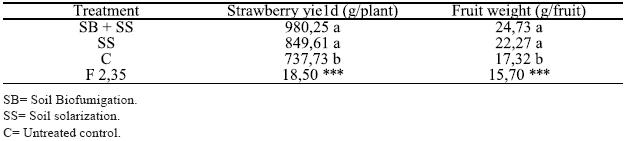
SB+SS and SS significantly increased total accumulated strawberry yield from February to May and also increased mean fruit weight relative to C (Table 1).
Table 1 – Strawberry yield and fruit weight (***, P<0.001).
]]>
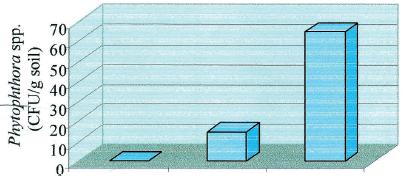
Both treatments reduced Phytophthora soil population from October to May relative to C, especially SB+SS at beginning of the season, one month after plantation, critical moment for the establishment of strawberry plant (Figure 1.).
Figure 1 – Phytophthora spp. soil population at the beginning of the season. SB= Soil biofumigation; SS= Soil solarization; C= Untreated control.
The current work contributed to the development and optimization of SB with Brassica and SS as alternatives to the traditional use of chemicals in strawberry production.
]]> AKNOWLEDGEMENTS
FEDER (ANDALGHORT Project, Common Initiative INTERREG III-A Spain-Portugal) supported this research.
REFERENCES
Angus, J.F.; Gardner, P.A.; Kirkegaard, J.A. & Desmarchelier, J.M. (1994) - Biofumigation: Isothiocyanates released from Brassica roots inhibit growth of the take-all fungus. Plant and Soil 162: 107-112.
Barrau, C.; Porras, M.; Salas, D.; Ramos, N.; Neto, E.; Soares, C.; Entrudo Fernandes, J. & Romero, F. (2005) - Alternativas viáveis ao uso de pesticidas na cultura do tomateiro (Lycopersicon esculentum). Libro de resumo VIl Encontro Nacional de Produção Integrada Escola Superior Agrária, Coimbra, Portugal. pp. 258.
Barrau, C.; Porras, M.; Salas, D.; Ramos, N.; Soares, C. & Romero, F. (2006) -Efecto de biofumigación, solarización y biofungicidas sobre Phytophthora infestans. Libro de Resúmenes XIII Congreso de la Sociedad Espanola de Fitopatologia. Murcia, Espana, 165 pp.
Erwing , D.C. & Ribeiro, O.K. (1996) - Phytophthora diseases worldwide. APS Press, St. Paul, MN. USA. [ Links ]
Harding, R.B. & Wicks, T.J. (2001) - Effects of incorporating Brassica and cereal cover crop residues on soil populations of Verticillium dahliae. Proceedings of the 2nd Soil-borne Diseases Conference, Lorne, Victoria. pp 148-149.
]]> Jeffers, S.N. & Martin, S.B., 1986. Comparison of two media selective for Phytophthora and Pythium species. Plant Dis. 70:1038-1043.Katan, J. (1981) - Solar heating (solarization) of soil for control of soilborne pests. Annual Review of Phytopathology 19: 211-236.
Porras, M.; Romero, E.; Zurera, C.; Barrau, C. & Romero, F. (2007a) -Biofumigation and soil solarization as nonchemical altematives in strawberry fields. 15th Intemational Reinhardsbrunn Symposium, Modern Fungicides and Antifungal Compouds. Germany.
Porras, M.; Barrau, C.; Arroyo, F.T.; Santos, B.; Blanco, C. & Romero, F. (2007b) Reduction of Phytophthora cactorum in strawberry fields by Trichoderma spp. and soil solarization. Plant Disease 91: 142-146.
Romero, E.; Zurera, C.; Barrau, C. & Romero, F. (2006) -Efecto biofumigante de especies de Brassica en el crecimiento de Phytophthora spp. in vitro. Avance de resultados. Libro de Resúmenes XIIl Congreso de la Sociedad Espanola de Fitopatología. Murcia, Espana, pp.167.
Romero, E.; Zurera, C; Porras, M; Barrau, C. & Romero, F. (2007) - Biofumigant effect of Brassica species in the growth of Phytophthora spp. in vitro. 15th International Einhardsbrunn Symposium, Modern Fungicides and Antifungal Compouds. Germany.
Zurera, C.; Romero, E.; Porras, M.; Barrau, C. & Romero, F. (2007) -Brassica carinata as a biofumigant to control Phytophthora spp. in strawberry fields. XVI International Plant Protection Congress, Abstract. Glasgow. pp. 546.
1 IFAPA. Centro “Las Torres-Tomejil”, Junta de Andalucia. Ap. Correos Oficial, 41.200. Alcalá deI Rio, Sevilla, Spain. carmen.barrau@juntadeandalucia.es
]]> 2 Direcção Regional de Agricultura e Pescas do Algarve ( DRAPALG). Ap. 282. Patacão, 8001-904 Faro, Portugal. cbsoares@drapalg.min-agricultura.ptComunicação apresentada no Congresso da Sociedade Portuguesa e Fitopatologia, Coimbra
Recepção/Reception: 2008.02.19
Aceitação/Acception: 2009.07.09
]]>